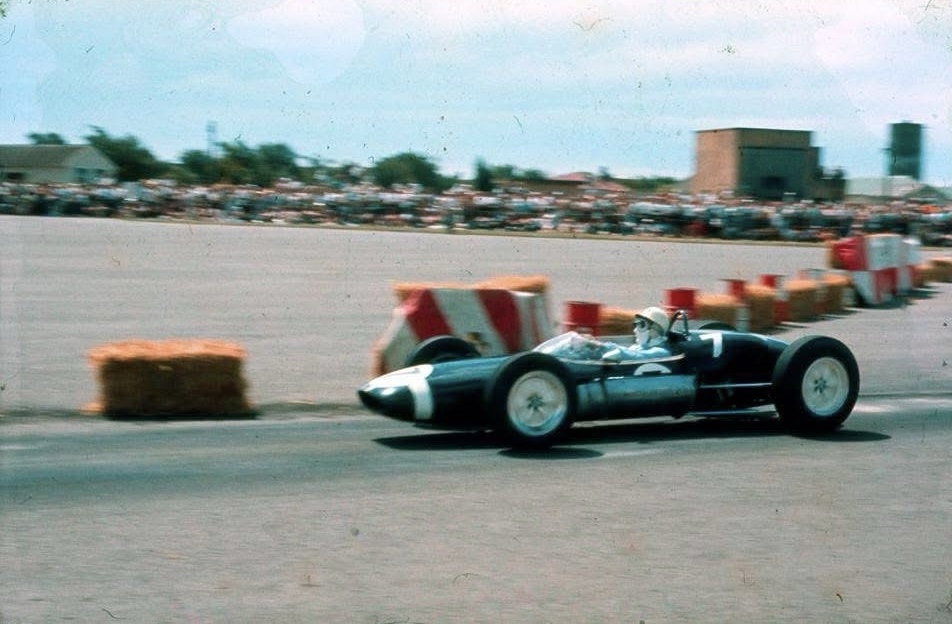
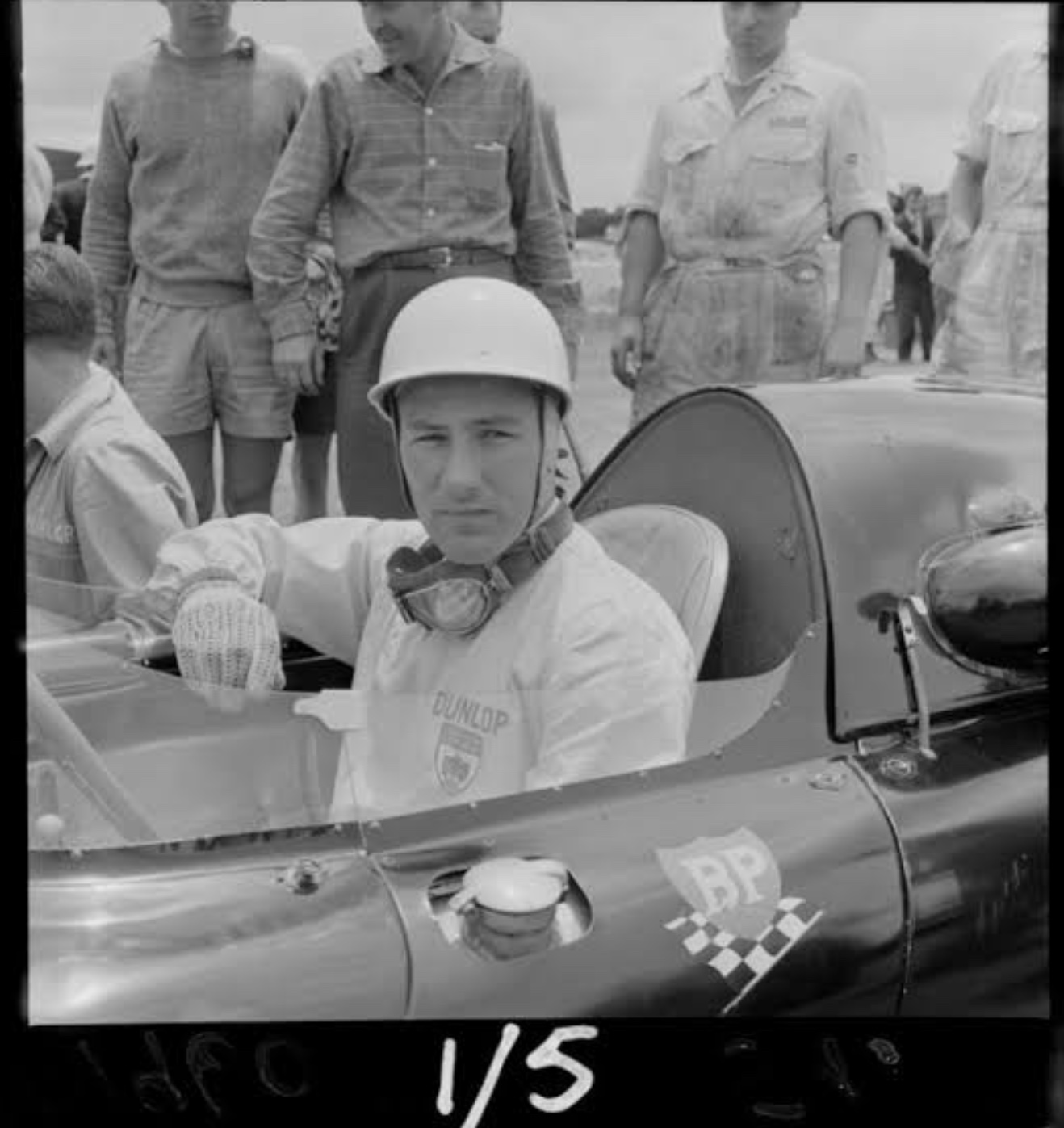
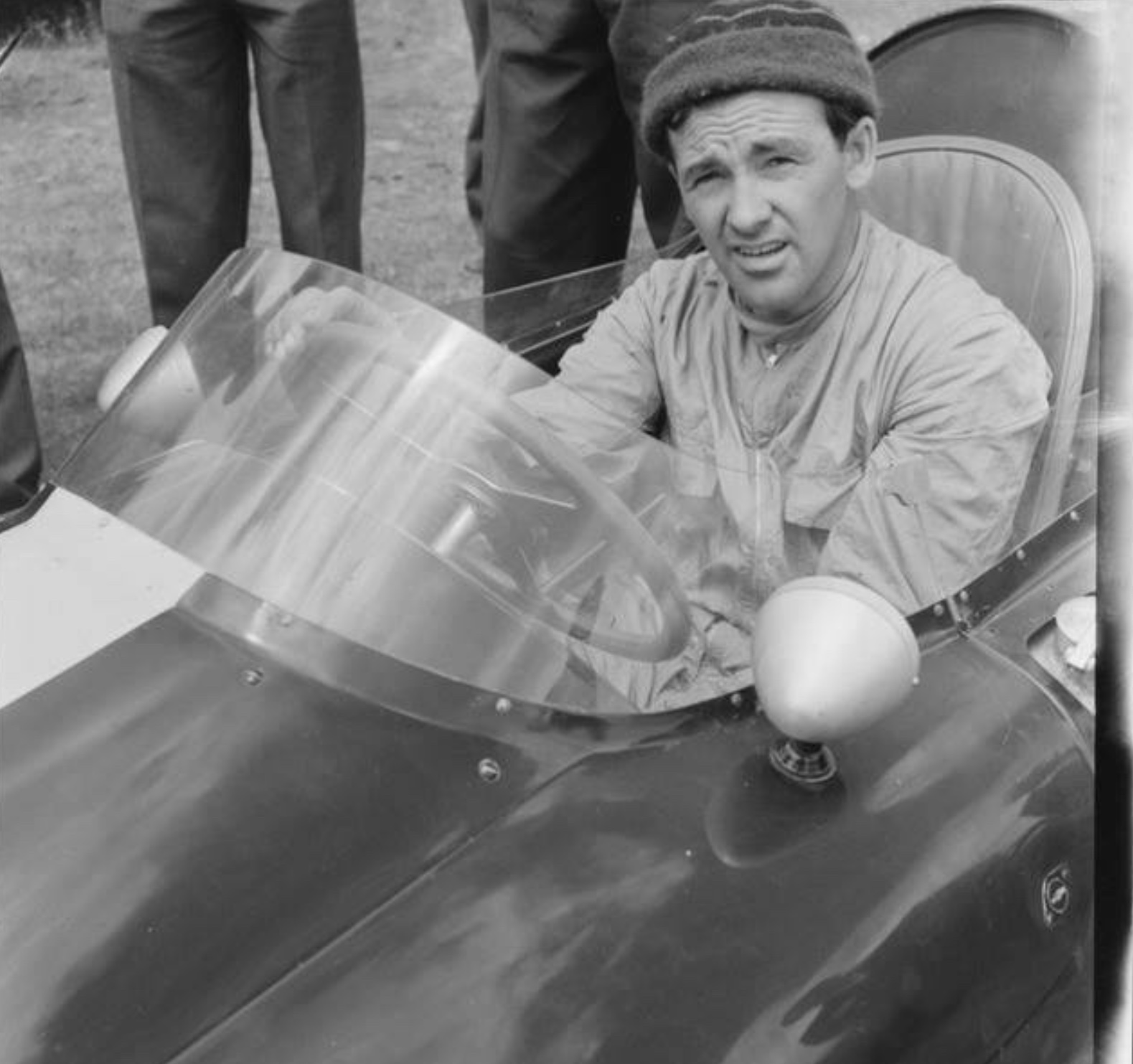
Stirling Moss on his way to winning the January 20, 1962 Lady Wigram Trophy in searing New Zealand heat.
He has the side-panels of Rob Walker’s Lotus 21 Climax FPF 2.5 removed to get a bit of air flowing through the cockpit of chassis #935.
I love this ode to the demise of the fabulous front-engined Grand Prix cars written by Digby Paape.
‘I remember coming away from this race thinking, “Well, that’s the end of exciting racing.” Gone were the front engined monopostos with loud exhausts that rang off the Port Hills, the drivers biceps fighting the wood-rimmed steering wheel, the blue chrome on the exhausts, the dirty spoked wheels, the broadsides and four-wheel-drifts. All gone with the advent of these pesky little cars that cornered on rails and sounded like Austin A40’s.’
Luvvit!
Australian great Lex Davison referred to the Coopers as ‘Anti-Climaxes’ and ‘Mechanical Mice’…not that it stopped him racing and winning in them!
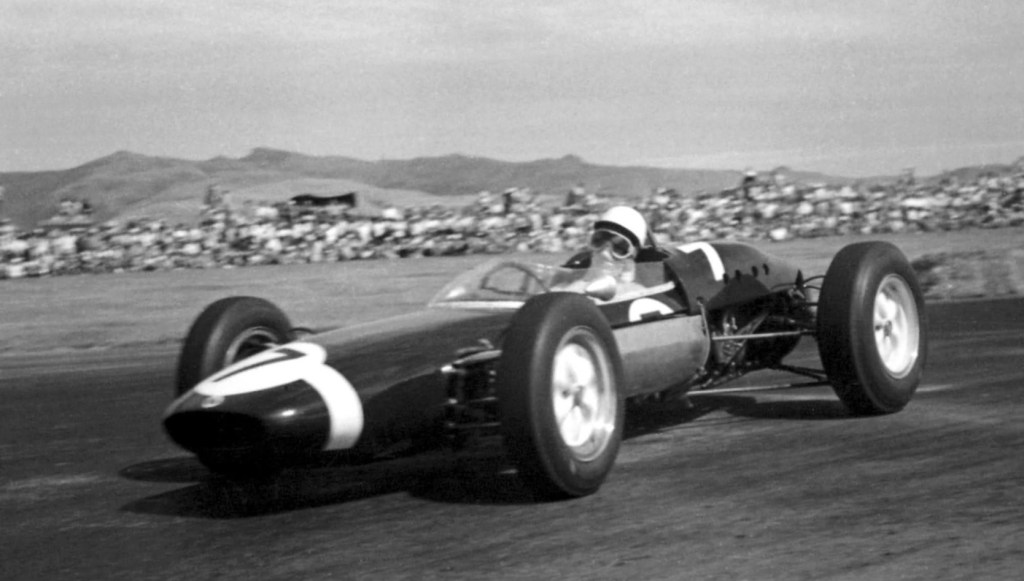
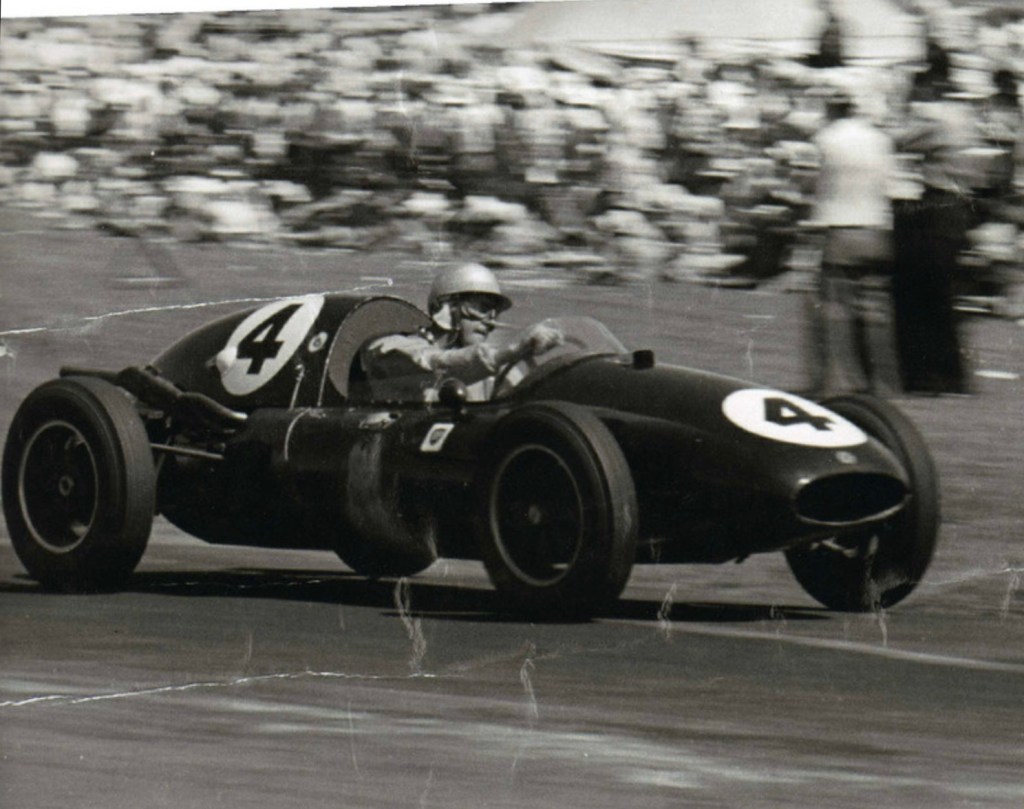
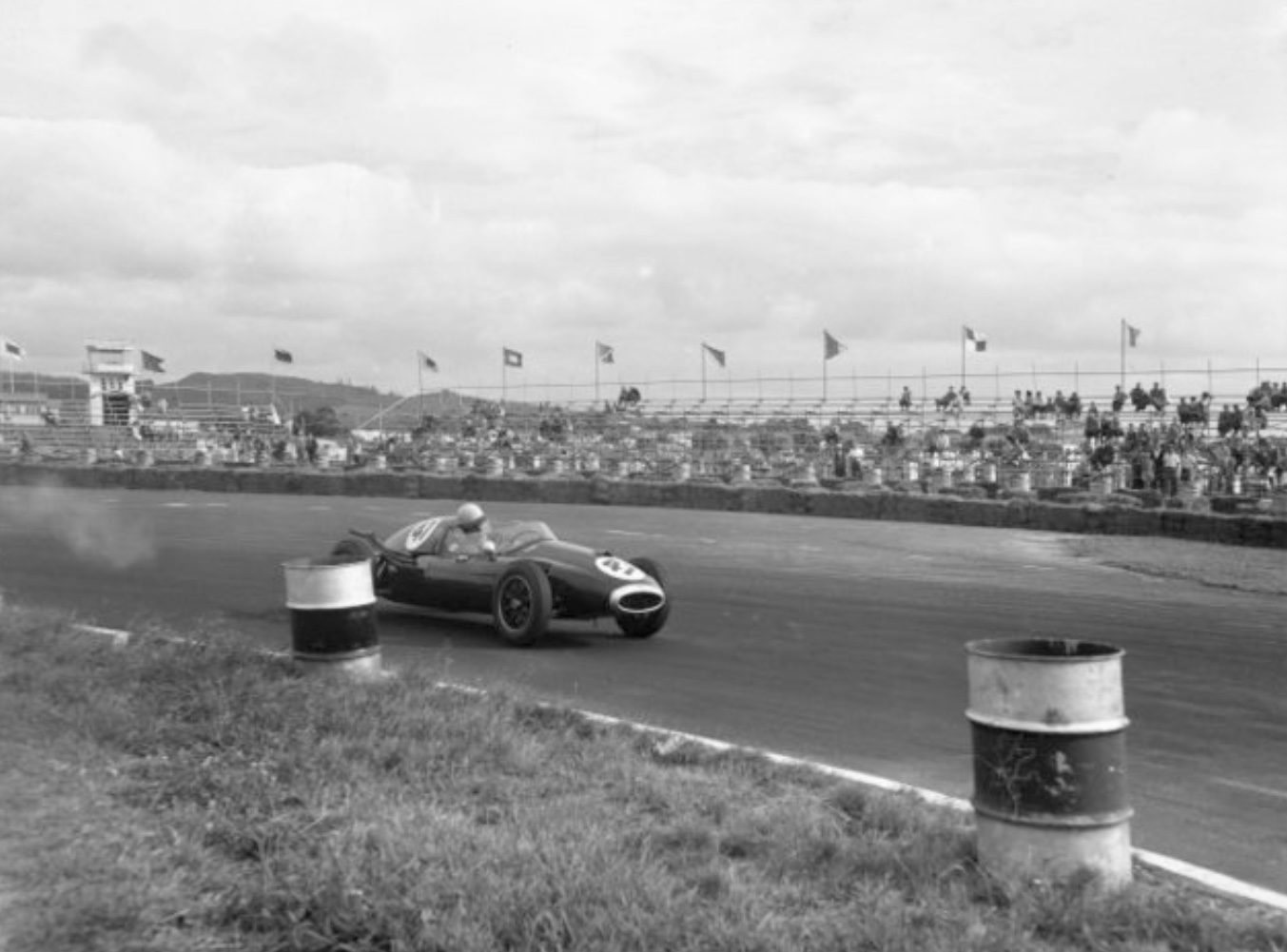
Moss approaching the Wigram hairpin (unattributed)Jack Brabham on his way to victory at Ardmore in 1958, Cooper T43 FPF 2.2 (unattributed)
The mid-engined rout started early in NZ. Jack Brabham won the 1958 NZ GP at Ardmore aboard a Cooper T43 Climax on January 11, a week before Moss won the first Championship F1 race in a mid-engined car at Buenos Aires on January 19. He too raced a Cooper T43 in that Argentine Grand Prix, one of Rob Walker’s cars.
Broaden the definition to Grand Prix racing and the mid-engined feat wasn’t a big deal given Auto Union’s pre-war successes, but such is the fixation with Formula One these days that most prefer to ignore the history of a period that doesn’t interest them or of which they have no knowledge.
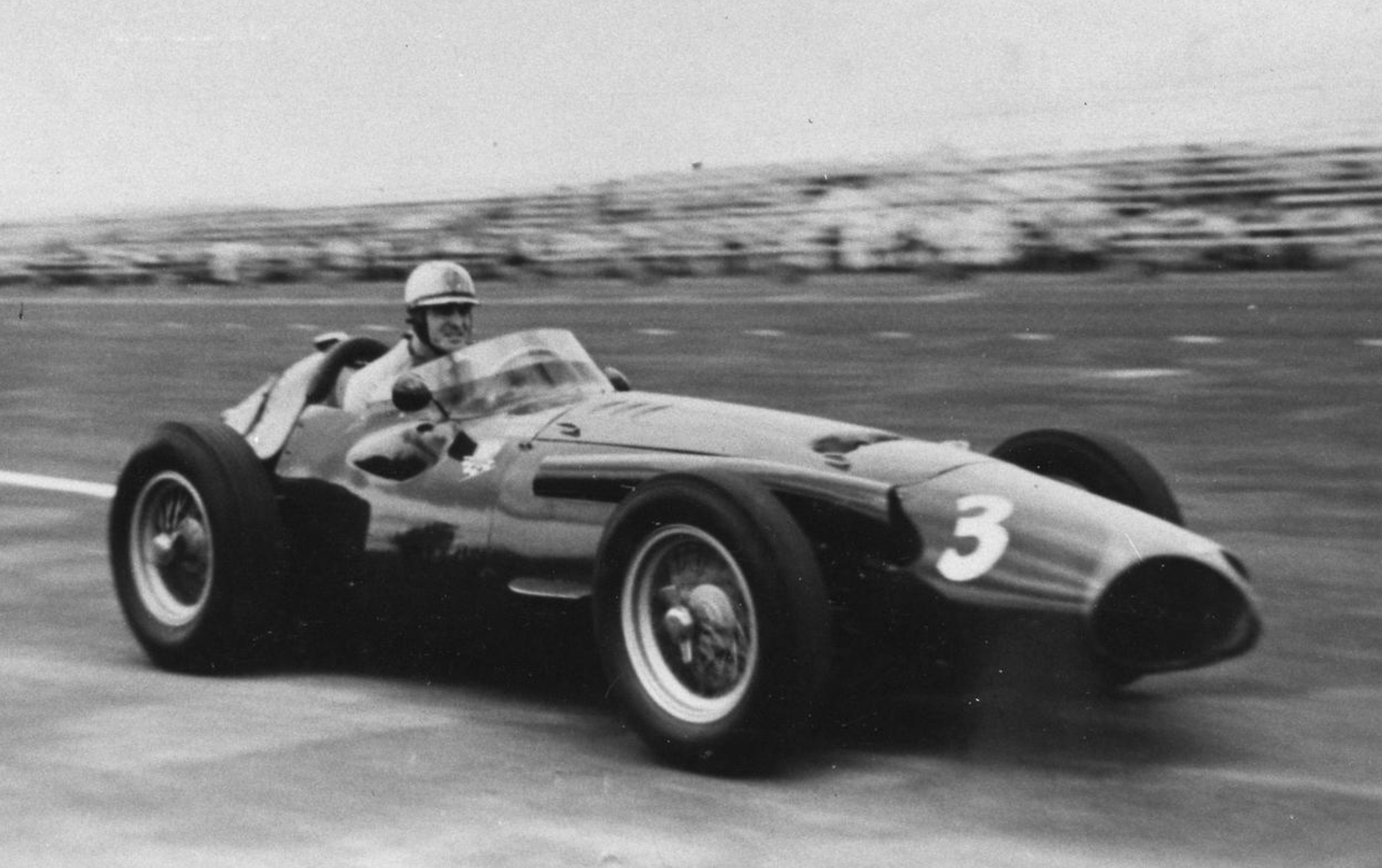
It wasn’t too many years before – 1956 – that Moss had first visited the country and taken New Zealand’s premier race, again at Ardmore aboard one of the great front-engined Grand Prix cars, the Maserati 250F.
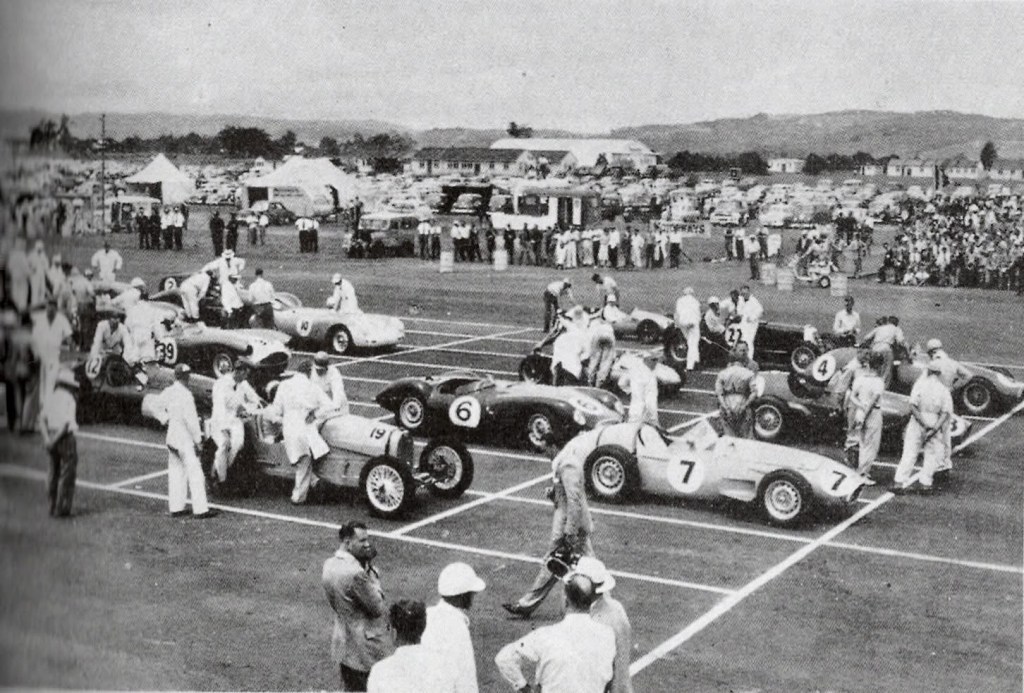
#7 is Moss’ with the 3-litre Ferrari 500/625s of Peter Whitehead and #4 Tony Gaze alongside. The Bugatti is Ron Roycroft’s T35A Jaguar, #6 is another Jaguar engined car, Peter Whitehead’s Cooper T38 being raced by Reg Parnell. Peter lent Reg the car after Parnell’s Aston Martin DP155 had engine problems in practice. Moss won from Gaze and Whithead.
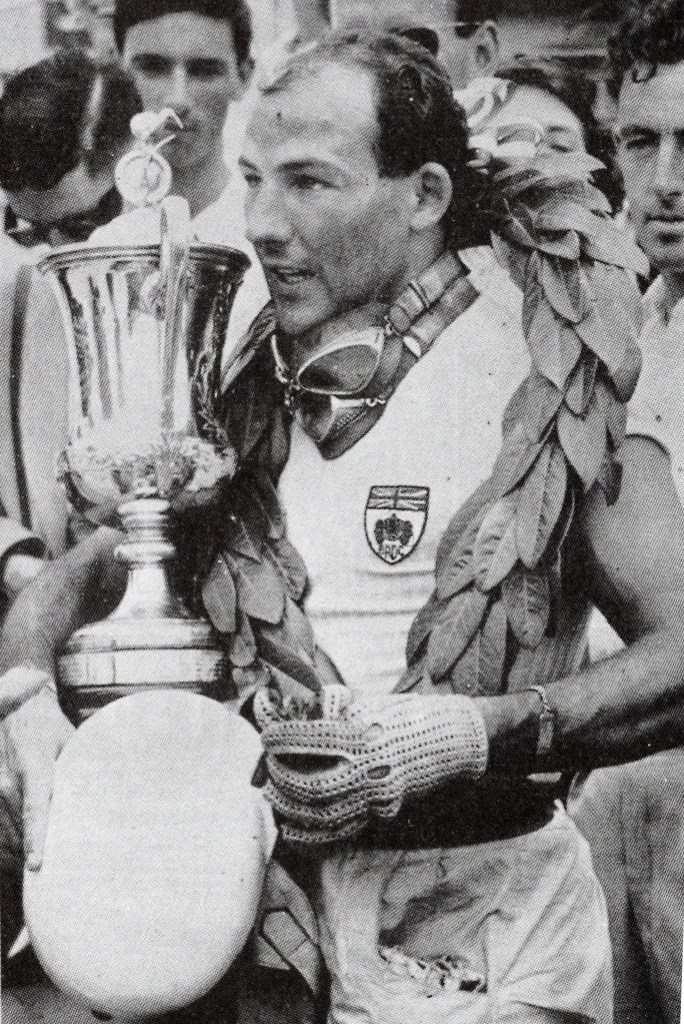
Moss post race with biceps bulging having wrestled with his 250F’s wood-rimmed wheel for the previous 2 hours 32 minutes!
Tailpiece…
(R Herrick)
Rob Walker’s NZ GP winning Lotus 21 Climax leaves Ardmore on the back of a modest trailer towed by a Borgward Isabella Coupe…simpler times.
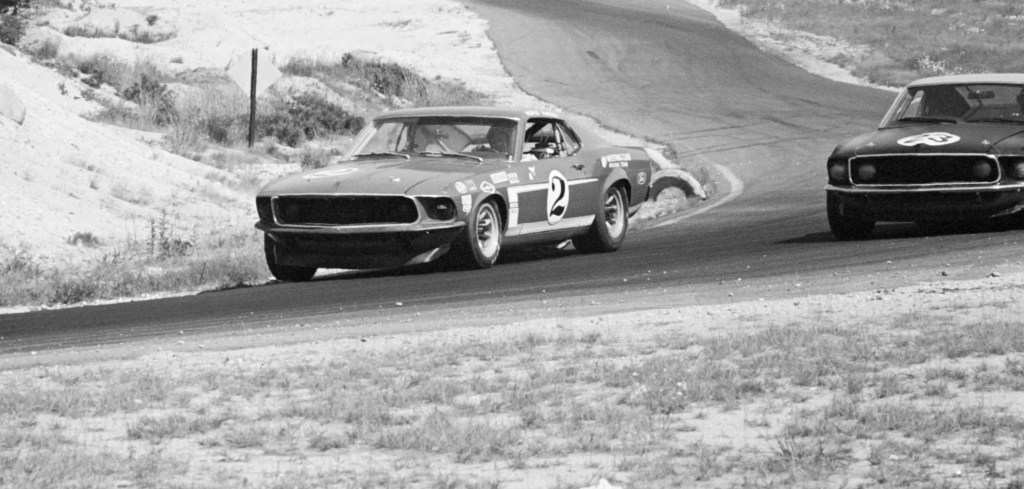
Peter Revson’s Shelby Ford Mustang Boss 302 is chased by George Follmer’s similar Bud Morre prepared car in the October 5, 1969 Mission Bell 250 Trans-Am round at Riverside.
Revvie was fourth and and George lost a wheel, Mark Donohue’s Penske Chev Camaro Z28 won.
You cannot be my age without getting all hot and sweaty about the better American and Australian pony-cars of the day, the Boss 302 has always been the high water mark of the genre for me. They are an incredibly handsome road car, while the Kar-Kraft built racers are simply as good as a racing tourer ever gets.
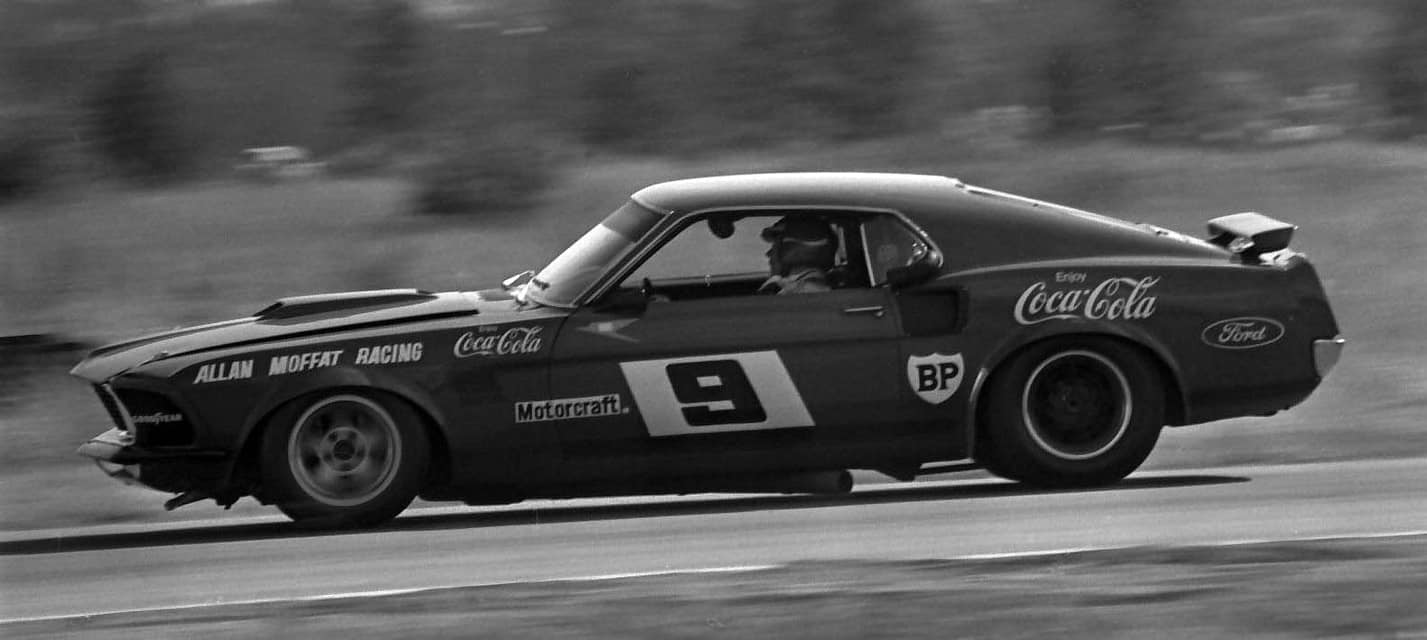
Alan Moffat’s Coke-Red Trans-Am is seared into the souls of a couple of generations of Australian race-fans. While it won a gazillion races Moff never quite took the Australian Touring Car Championship in it. It’s still here thankfully, and gets around a bit, it’s still as big a magnet in the paddock for me as it ever was. See this epic here: https://primotipo.com/2020/03/06/moffats-shelby-brabham-elfin-and-trans-am/
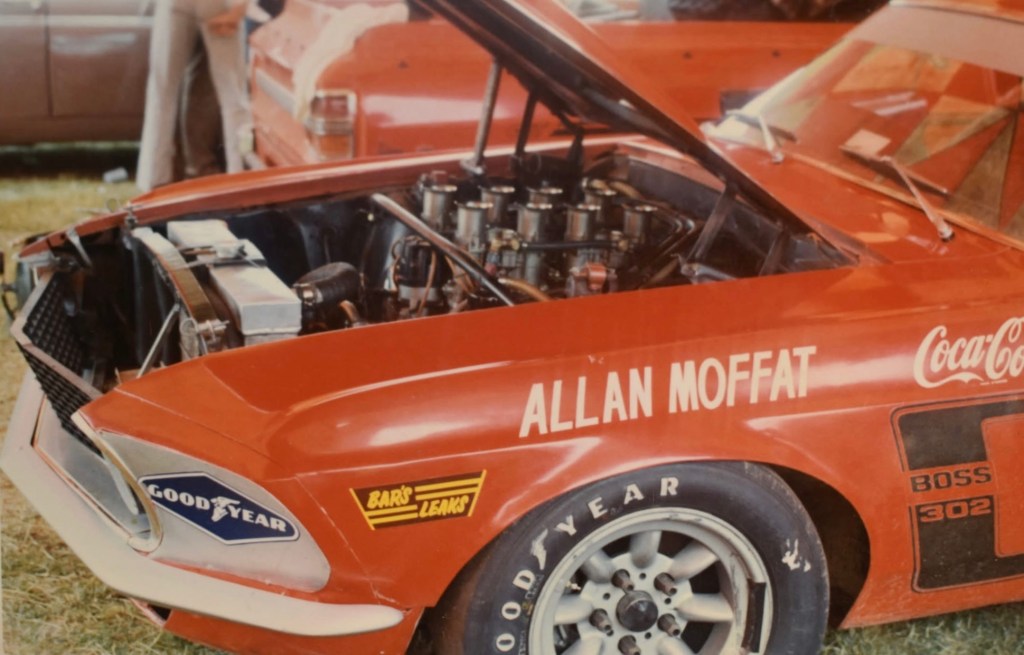
Lynton Hemer has so nailed Marvin’s Mustang in its ultimate spec – Coke red and ROH Dragmags – for me at least. Arty-farty, back-lit shot on Warwick Farm’s Northern Crossing in April 1972. Long, low, mean and menacing…it was all of that, and more (L Hemer)Engine bay of Moffat’s car in the Symmons Plains paddock in 1971. Note the Minilites and 48IDA Webers with which the car mainly raced. If memory serves the car was delivered – it was given to him – with a Tunnel-Port 302 not a Boss 302. This was soon addressed, am I right in saying – short 351 Clevo period excepted – that the car always raced with Webers? Time to buy The Book, then I would know! (G Feltham)
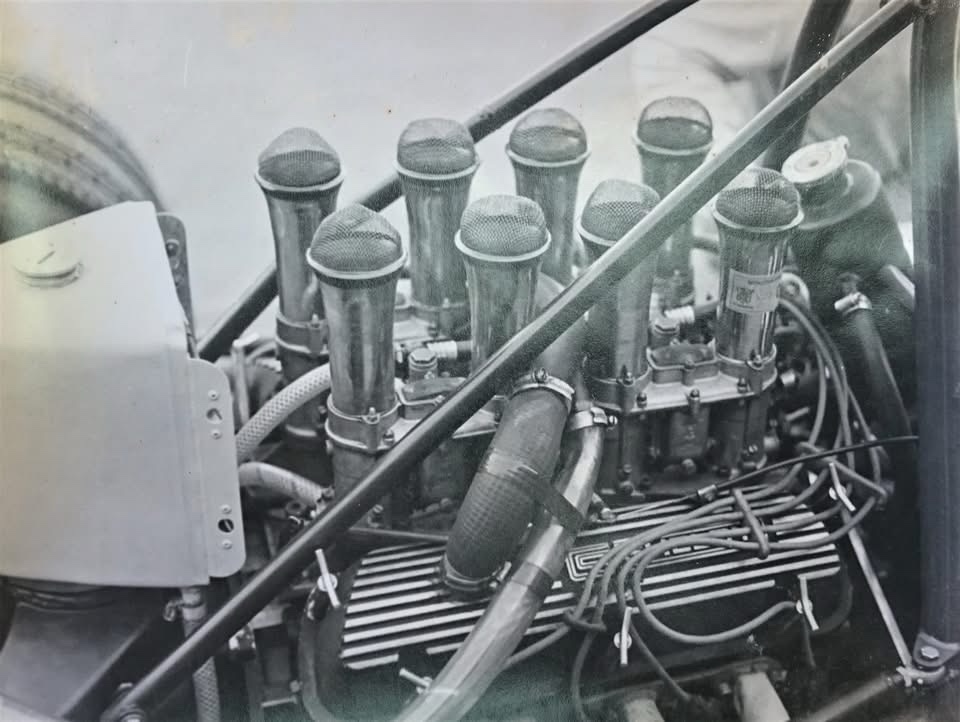
This article is the byproduct of a search for information on F5000 variants of the 5-litre Boss V8.
Such detail is as rare as the engines themselves were in the day. Ford Boss F5000 engines mainly found their way into the small number of Lotus 70s built by Lotus Components in 1969-70.
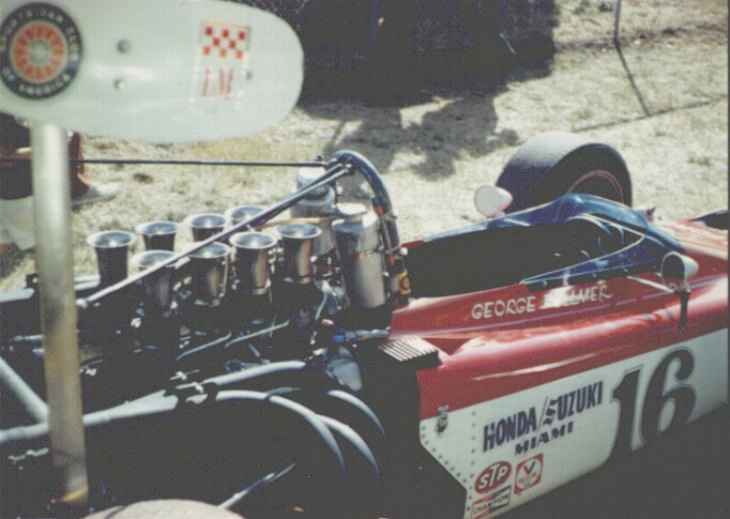
George Follmer won a few races in Lotus 70s fitted with Ryan Falconer prepared engines in 1970-71. The shot below shows the business end of one of them at Ontario Speedway in 1971.
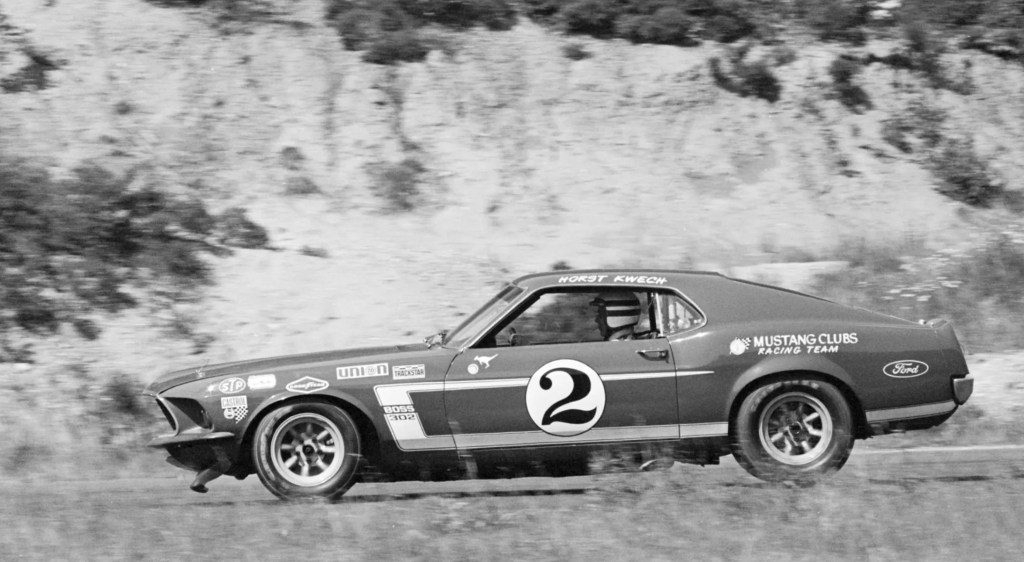
George Follmer, his crew and Lotus 70B-01 Ford during the F1/F5000 Questor GP weekend in March 1971. Q30 and DNF rocker arm in the first heat, DNS the second, race winner Mario Andretti, Ferrari 312B. Al Bartz is my best guess of Boss 302 supplier, neat installation (P Brosius)Horst Kwech, Shelby Boss 302, Bridghampton June 22, 1969. DNF transmission in the race won by George Follmer’s Bud Moore Boss 302 (Bonhams-Revs)
Before I start rabbiting on about the Boss 302 F5000 aspect you might find it interesting to see how the Ford Mustang Boss 302 car came into being. It was very much a function of the failure of Ford’s Tunnel-Port (T-P) 302 V8 engines in the Mustangs run by Shelby American in 1968.
Dan Gurney?, Shelby Mustang, Kent Pacific, September 1969 (unattributed)Ace Kiwi David Oxton, Lotus 70-02, Sebring October 25, 1970. Q10 and a fabulous fourth behind seasoned pros Donohue, Hobbs and Wietzes. I’m not sure David had even finished with his Elfin 600 Formula Ford at that point! Falconer & Dunn prepped Boss 302
Race engineering legend Carroll Smith assessed the F5000 engine alternatives in a December 22, 1971 document he prepared for Roy Woods Racing in advance of the 1972 season.
‘The Ford Boss 302 will put out more power than the Chev right now,’ he wrote. ‘The increase is in the neighbourhood of 5% which, while significant, is not enormous. The engine is 25-30 pounds heavier than the Chevy and all of the increase is in the cylinder heads, which is unfortunate from the handling point of view.’
‘In my opinion this engine has not been developed to the same level as the Chevy unit and some surprises, particularly in the valve-train, should be expected. Parts can be obtained and while the overall program would be $10,000/$15,000 more expensive, I believe that a Ford program is more attractive than a Chevy program simply because of the power advantage.’
‘Development is necessary in the following areas: valve train geometry and materials, dry-sump configuration, piston configuration, exhaust configuration, ram-air box configuration. Bartz is the only conceivable builder. Falconer should not be considered.’
Ultimately, Woods chose an Al Bartz prepared Boss 302 for the Matich A50 chassis Smith successfully recommended, rather than the Repco-Holden V8 he preferred. George Follmer raced the car several times in early 1972 before it was damaged and set aside.
George Follmer Matich A50-03 Ford Boss at Laguna Seca in 1972. Al Bartz engine (M Follmer Archive)Chris Amon sneaking a look at Frank Gardner just after The Esses apex, Warwick Farm 100 Tasman round, February 1971. Lotus 70-2 Ford Boss 302 Falconer & Dunn and Lola T192 Morand-Chev (L Hemer)
Ford’s Total Performance ethos didn’t extend to Formula 5000, why bother with that investment when you are belting the hell out of everybody globally on the circuits, in the forests and on the strips?!
The Penske Camaro Z28s were the over 2-litre Trans-Am champs in 1969: Mark Donohue won at Briar, Mont Tremblant, Watkins Glen, Laguna Seca, Sears Point and Riverside, while Ronnie Bucknum won at Mid Ohio and Seattle. Bud Moore’s outfit were the dominant Ford team, it was a skinny year for Carroll Shelby. Parnelli Jones won at Michigan and Donnybrooke, Sam Posey (Shelby) at Lime Rock and George Follmer at Bridghampton.
In 1970 Penske jumped ship from Chevrolet to American Motor Corporation. They ran the AMC Javelin programme and only just missed the drivers title. Parnelli Jones’ Moore Mustang beat Donohue by a point, 142-141, but Ford comfortably won the manufacturers title, 72 to 59 points.
The Bud Moore Jones and Follmer Boss 302s at rest in the Bridghampton paddock, 1969. Minilites on Jones’ car, American Racing Wheels on Follmer’s (Revs-A Bochroch))Horst Kwech, Shelby Boss goes inside Jim Harrell’s Mustang at Bridghampton in June 1969, both DNF (Bonhams-Revs)
Bud Moore ran the Fords with Jones winning at Laguna, Lime Rock, Mid-Ohio, Seattle and Riverside, and Follmer at Bryar. Donohue prevailed at Bridghampton, Road America and Mont Tremblant.
With a Trans-Am in the bag FoMoCo withdrew from the fray – so too did Chev and Chrysler – leaving Bud Moore to run the cars again in ’71 against AMC, Penske/Donohue won.
It was the end of the Boss 302 programme, before too long Total Performance became Total Boredom as the automotive world dealt with the perennial Middle East Clusterfuck, global stagflation and the push for lower car emissions. FoMoCo had bigger fish to fry than racing for a while.
There was decent money invested in F5000 but all the big-guys ran Chevs: VDS, Chaparral-Haas and Vels-Parnelli when they came in. Derek Bennett found it easy to put Alan Smith Chevs in his Chevrons, Rugby wasn’t far from Bolton. It’s interesting that nobody did a decent Ford programme, but again, in Frank Gardners words, ‘if yer aunty had balls she’d be ‘yer uncle’, who cares what didn’t happen!
A race-ready Trans-Am Boss 302 V8 with a pair of Holley Dominators atop, transistorised ignition and a deep sump road-race oil pan (J Smart)
Engine Specifications…
The standard Boss 302 engine combined the Windsor four-bolt small block and the then-upcoming 351 Cleveland’s cylinder heads to provide a high-performance road engine as the basis for a great road-racing engine.
The 90° V8 302cid pushrod, two-overhead valve, cast iron block/heads unit had a bore/stroke of 4 inches (101.6 mm)/3 inches (76.2 mm) and a compression ratio of 10.5:1. In road form a Holley 780CFM 4-barrel carb was fitted.
The crankshaft was a high-strength steel forging, it was cross-drilled in 1969 (eliminated in 1970 for better reliability??) High-performance rods were 5.155″ length (same as 289 Hi-Po) Main bearings are four-bolt design. The high-lift cam design had 290 degrees of duration and .477 in (12.1 mm) lift. The combustion chambers are a closed 62cc design.
The block was a unique high nickel percentage, thin wall, nodular iron casting. The canted valve head design was shared with the 351 Cleveland but modified for Boss 302 use. Rocker arms were adjustable rocker studs with new long slot rockers. The harmonic balancer design was new. The crankcase was equipped with a windage tray.
Of course, what I’m really after is a similar spec sheet for a Ryan Falconer or Al Bartz F5000 Boss 302…If you have some hard data, it’s information I’d love to see it, mark@bisset.com.au
Etcetera…
(Hot Rod)
Parnelli Jones in the 1969 Mission Bell 250 at Riverside aboard a Bud Moore Boss 302. Mark Donohue won the race in a Penske Chev Camaro Z28. GM won the Trans-Am.
The following year Jones won the title with Moore, albeit the cars were repainted the yellow FoMoCo wanted to more effectively grab the punters eye! That’s Jones below winning at Laguna Seca in April 1970, and the following shot is a Laguna pit lane scene.
(A Brown)
Lotus 70-01, Follmer, Sebring October 25, 1970 Q5 and DNF overheating. Falconer & Dunn built Boss 302.
I’ve never really rated these cars – most of the books don’t – but Follmer won at Mont Tremblant and Mid-Ohio during the hotly-contested SCCA Continental Championship in 1970, so there cannot have been too much wrong with either the chassis…or engine! George’s skill at twiddling the wheel duly noted.
(Getty)
Let’s finish with the Trans-Am stuff as we started, with the Mission Bell 250.
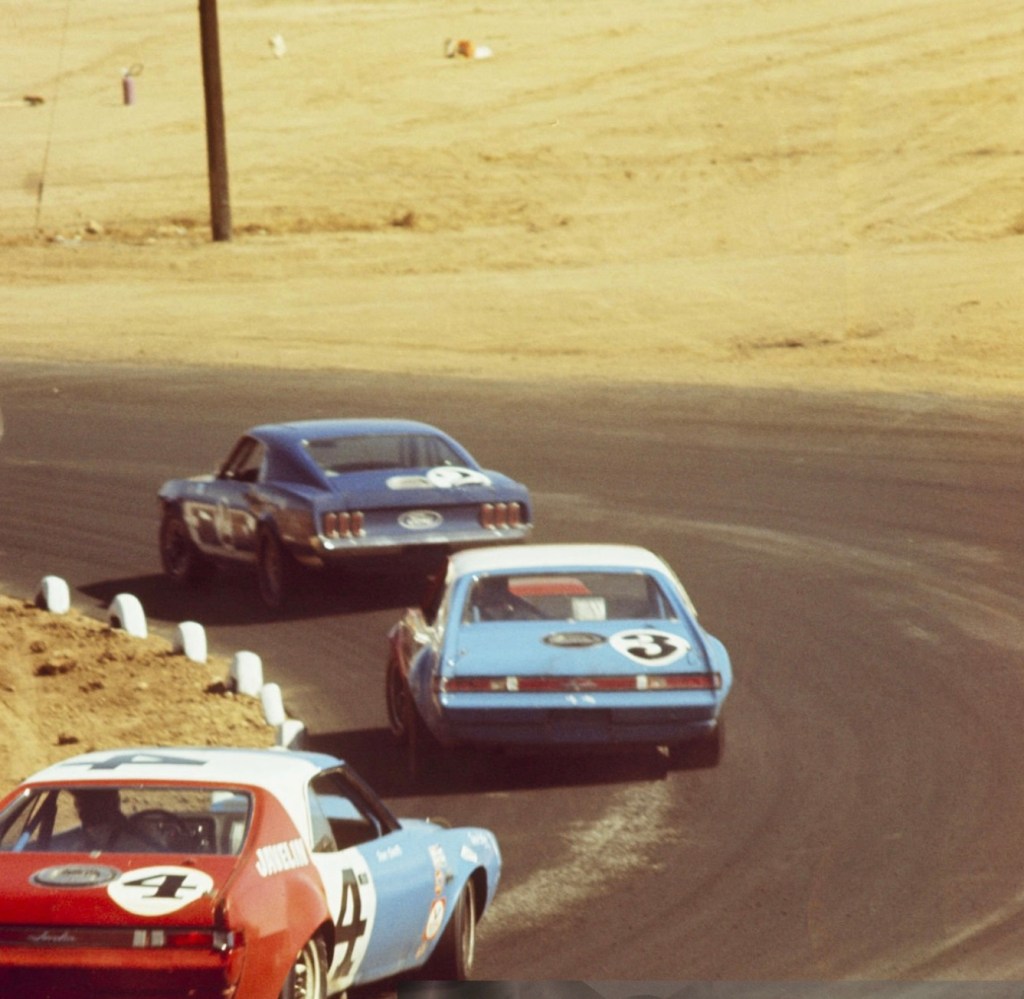
Horst Kwech leads the AMC Javelins of Jerry Grant #3 and Ron Grable #4. October 6, 1969. The Donohue and Ronnie Bucknum Z28s were up front with Jerry Titus’ Pontiac Firebird third.
What a fabulous spectacle of under and over 2-litre variety the Trans-Am must have been!
Follmer at Sebring during the final round of the 1970 SCCA Continental F5000 championship on October 25. Q5 and DNF overheating. Looks like he’s ‘winged’ somebody or something.
George didn’t contest the championship in 1971 but came back with the Roy Woods Matich A50 Bartz-Ford Boss shown below in the Watkins Glen pitlane during the June 18, weekend. Q9 and retired, it was the last time he raced the Matich.
About which he was disparaging in a December 2009 Vintage Racecar interview. Follmer regarded the chassis as too flexible, which is intriguing as the other five Repco-Holden V8 powered chassis did not suffer from that affliction at all.
The plot thickens in the sense that Carroll Smith helped build Matich A50-03 over the Southern Summer of 1971-72 in Sydney inclusive of the critical mounting plate and related components to mount the Boss Ford to the Matich tub. A dummy block was used in this process. The installation of the Bartz-Ford race engine was done in Wood’s Northridge, California workshop.
I don’t doubt George’s diagnostic skills, but am intrigued to see if any of you can find contemporary accounts of this lot.
(Revs-Bill Oursler)
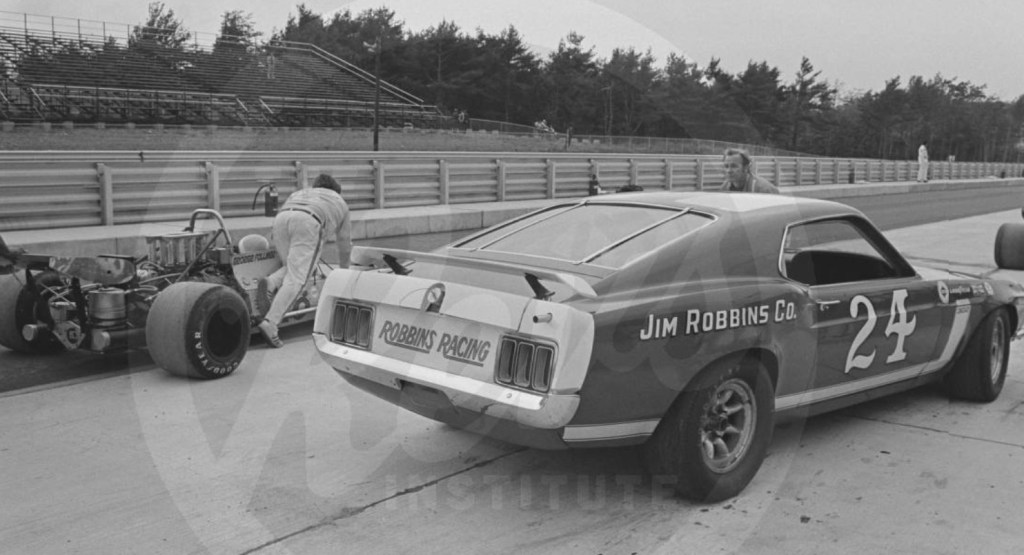
While George didn’t have a happy time with the Matich at the ‘Glen, all wasn’t lost that weekend as he won the Trans-Am round in a Roy Woods AMC Javelin! Jerry Thompson’s Mustang (above #24) was second and Woods in his other team Javelin, third.
Credits…
Getty Images, FoMoCo, Jim Smart, Bonhams-Revs, Harry Hurst, Allen Brown, Greg Feltham, John Lemm, Mike Follmer Collection, Stephen Dalton Archive, Ian Smith, Phil Brosius, oldracingcars.com
Tailpieces…
Stan Keen, Elfin MR5 Ford, Adelaide 100 Tasman round February 25, 1973 seventh (J Lemm)
I forgot about the national championship won by a Boss Ford 302 in Australia…
Stan Keen won the four-round 1975 Australian Hillclimb Championship in his ex-John Walker Elfin MR5 #5724.
Keen ran the car on the circuits and in the hills. While it was off the pace at Tasman and Gold Star F5000 level it was always a frontrunner on the South Australian circuits with Stan a quick driver. It would have been interesting to have seen him have a steer of something a bit more current.
(unattributed)
The engine was self prepared and is fed, as you can see, by 48IDAs. Output? Who knows, well short of the Chevs and Repco-Holdens though! Really a Ford Boss 302, or a Boss Ford 302 in name only?…dunno.
(J Lemm)
Happy chap, certainly Collingrove, perhaps after Stan’s bagged the ’75 AHCC round there? And yes, he usually ‘climbed it with the MR5 cockpit surround off.
Afterthought…
What about Gossy’s Matich A53-007 Ford aka A55 Ford ya’phuckin idiot? I can hear some of my Orstralian friends saying.
Nobody seems to know exactly what concoction of Ford bits that Peter Molloy built ‘Boss engine’ comprised…watch this space, I’ll spare you the ‘I reckons’.
The shot below is of JG being installed in the car in the Sandown paddock by Grant O’Neill and bearded Peter Doulman over the February 5, 1978 Rothmans International round weekend. From memory he did only few laps before it broke, not enough to be given a time.
Goss did practise it at Oran Park over the February 26 weekend, doing a 1.07.9, he did a 1.06.8 in A51/53 Repco-Holden; and this was one-second away from Warwick Brown’s pole in the latest Lola T333/T332C Chev.
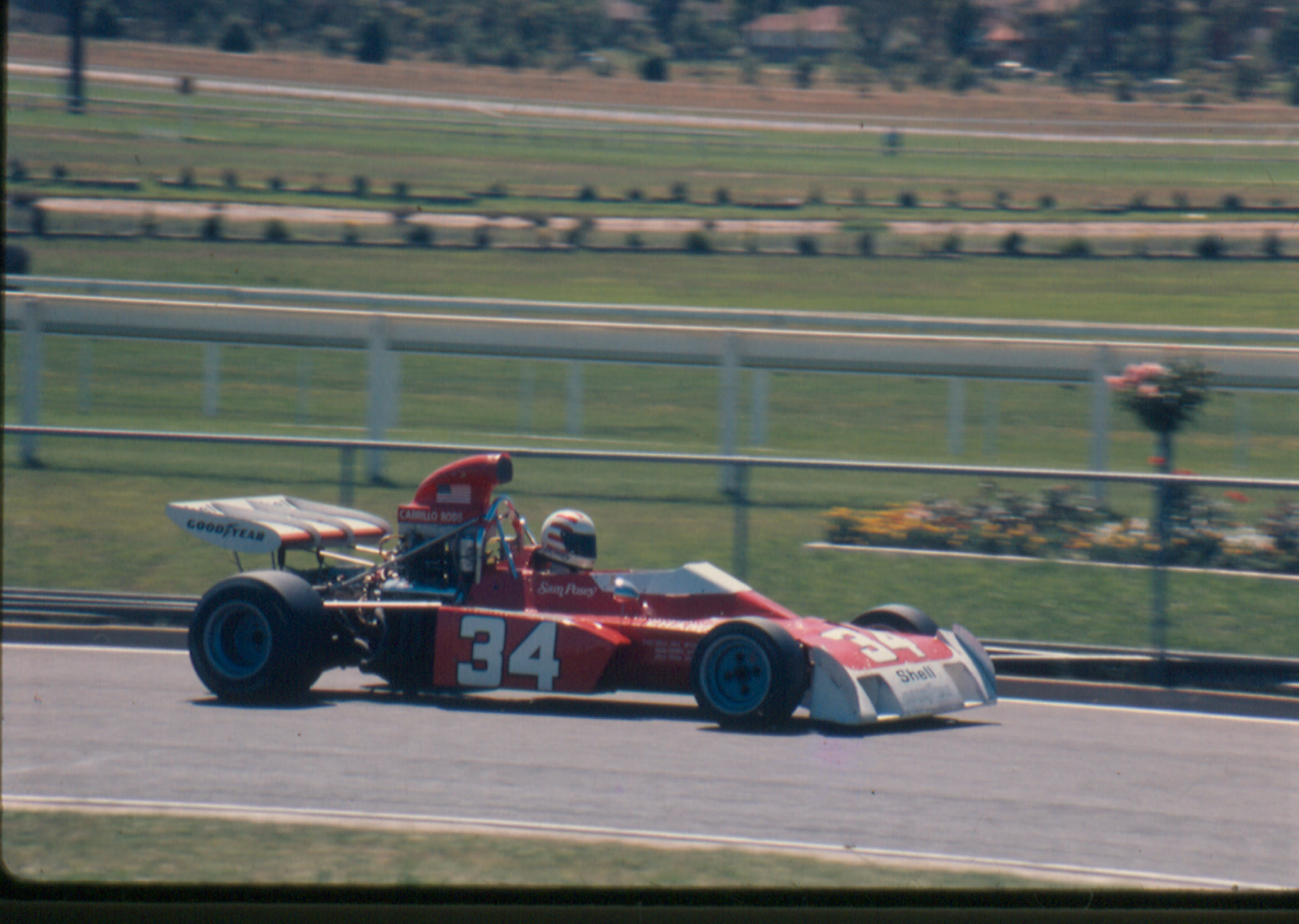
Sam Posey, Surtees TS11 Chev in the Wigram pitlane during the January 20, 1973 Lady Wigram Trophy weekend.
John Surtees’ first two F5000 designs – the Len Terry designed 1969-71 TS5/TS5A and 1971 TS8 – sold well and were quite successful.
The TS11 was Surtees 1972 F5000 car. Based on the Grand Prix TS9B the prototype was tested by Big John at Goodwood but was written off shortly thereafter when Mike Hailwood hit a patch of oil and crashed it at Brands Hatch on October 28..
That curtailed plans for John Surtees to race it, and win the November 1971 Australian Grand Prix at Warwick Farm to help generate some sales.
Sam Posey at Tyler Graphics, Mount Kisko, New York in 1987. This photograph by Marabeth Cohen-Taylor was given to the National Gallery of AustraliaJohn Surtees, Surtees TS8/9-002 battling with Alan Hamilton’s McLaren M10B Chev, Colin Bond, McLaren M10C Repco-Holden and Graeme Lawrence’s Brabham BT30 Ford FVC in the Warwick Farm Esses during the 1971 AGP (L Hemer)
Surtees’ and Hailwood‘s TS8/9 and first TS11…
An alternative car, a TS8 (with TS9 chassis 002) was sent to Sydney instead. Surtees qualified it ninth and was well placed for a decent finish before a slow puncture forced an even slower pitstop and tyre change.
That same car was then raced very competitively by Mike Hailwood in the 1972 Tasman Cup. Hailwood crashed the TS8 (chassis TS9-002) in the final New Zealand round at Teretonga so a new TS11 chassis was sent to Sydney and a front-radiator TS11 – tagged TS11/03 – was built up from the pile of parts to complete the final four Australian rounds.
Mike was second in the championship behind Graham McRae despite not winning a round: Q3 and second at Pukekohe, Levin Q4/third, Wigram Q4/second, Teretonga Q1/DNF crash. In Australia, this time with the outwardly similar TS11: Surfers Paradise no time/sixth, Warwick Farm Q17/fifth, Sandown Q7/fourth and Adelaide Q4/second.
Mike Hailwood at Warwick Farm during the February 1972 Tasman Cup round, Surtees TS11 Chev (L Hemer)NZ (T Marshall)
Build numbers and competitor set…
Five TS11s were built, including the Hailwood Tasman car, and there are another four mystery-cars as Allen Brown correctly describes such machines, see here: https://www.oldracingcars.com/surtees/ts11/
The most successful TS11 was TS11/04, the Champcarr Inc – Doug Champion and Fred Carrillo – machine based in San Juan, California raced by Sam Posey in the 1972 US F5000 L&M Championship, the most competitive of the F5000 competitions globally.
Posey testing TS11/04 at Ontario Speedway in 1972. That venue was not part of the ’72 L&M (M Rizzo)Posey in TS11/04 in the Lime Rock pitlane in 1972. Q9 and third behind Brett Lunger and Brian Redman (G Rickes)
1972 was the year of the McRae GM1 and Lola T300 so the going was tough, but the talkative, talented American racer of single-seaters, Can-Am, Champcars – plus an occasional F1 drive – got the best out of the car, finishing second behind Graham McRae and then Brian Redman and Brett Lunger tied in third in Chevron B24/Lola T300 respectively: 87, 69 and 60 points respectively.
Posey didn’t win a round but placed second at Laguna Seca, Road America and Riverside in a season of consistency and reliability.
Bomb Bay, Wigram Q11 and DNF engine on January 20. McRae won from Warwick Brown and Steve Thompson (B Hopping)Posey at Surfers Paradise in February 1973. Fifth from Q9, Frank Matich won (P Overell)
Posey’s Tasman…
When Sam crossed the Pacific his reliability seems to have deserted him! What didn’t change was the pace of McRae, and there were a few other quicks at the front of the 1973 Tasman Cup field too: Frank Matich, John McCormack, Steve Thompson, Allan Rollinson, Max Stewart and Warwick Brown to name a few.
In the four Kiwi rounds he was: Pukekohe NZGP Q11 DNF throttle, Levin Q7 DNF engine, Wigram Q11 DNF engine and Teretonga Q9 and second behind Alan Rollinson. So, a good finish to the first half of the series before crossing the Tasman for Surfers Paradise.
Surfers Q9 and fifth, Warwick Farm Q6 and seventh, Sandown Q6 and sixth, Adelaide Q2 and DNF undisclosed. It was all pretty uninspiring, the sheer pace evident in the US was missing and four DNF’s in eight races doesn’t win championships.
McRae won the championship with three wins aboard his McRae GM1 Chev, 40 points from John McCormack, Elfin MR5 Repco-Holden two wins and 29 points and Frank Matich, Matich A50 Repco-Holden, one win, 27 points.
Posey in the Sandown pits, and paddock below in February 1973. Q6 and sixth, McRae won (stupix)(J Blanden)Pukekohe pits 1973. Q11 and DNF throttle. John McCormack won the NZ GP in an Elfin MR5 Repco-Holden (B Kempthorne)
Specifications…
Gijs van Lennep won the European F5000 Championship with his car (TS11/02) but was lucky in that the quicker McRae and Brian Redman biased their F5000 seasons on both sides of the Atlantic to the US L&M rather than the British Rothmans Formula 5000 Championship.
As mentioned above the, TS11 was a development of the F1 TS9B. It had a period typical aluminium alloy monocoque chassis, a Chev 5-litre engine to the choice of the customer, and used Hewland’s ubiquitous DG300 five speed transaxle.
It had a Tyrrell or sportscar type nose, side radiators and inboard front suspension, the top rocker actuating a coil spring damper unit, magnesium uprights with an adjustable roll bar. The brakes were outboard. At the rear was magnesium uprights, a single top and parallel bottom yonks with a pair of radius rods doing fore and aft locational duties on either side. Brakes were inboard, note the oil-rads under the wing.
Posey on Sandown’s main straight during the 1973 Tasman round. That Sandown is part of a horse racing complex is readily apparent…and a might fine venue it is (G Moulds)
Etcetera…
This shot of Mike Hailwood in the Sandown Park, Australian GP dummy grid on February 20, 1972 gives us a better look at the unpainted full-monocoque Surtees TS11 chassis – TS11/03 – of the three-week old car.
The structure extends right up behind behind the drivers shoulders in the photograph below. Mike was fourth from Q7, the was race won by Graham McRae’s Leda GM1 Chev.
(B Jackson)
Mike Hailwood chats with a mechanic in the Warwick Farm 100 paddock over the February 13, 1972 weekend.
Note the inboard rocker front suspension and single radius rod doing locational duties at the rear.
(B Jackson)
Rear wing area very busy, to the detriment of it doing its job!
Note the faired oil coolers either side of the vertically mounted oil tank, and Varley battery underneath it. The rear suspension has only one – top – radius rod on each side but the lower suspension comprises a wide based wishbone and an additional ‘toe’ link.
(B Jackson)
Roll bar mounted directly to the rear bulkhead and in nicely braced both fore and aft, note the single radius rod.
There was nothing wrong with the assembly of the new car by Mike’s mechanics. It finished all four races in Australia, well up too.
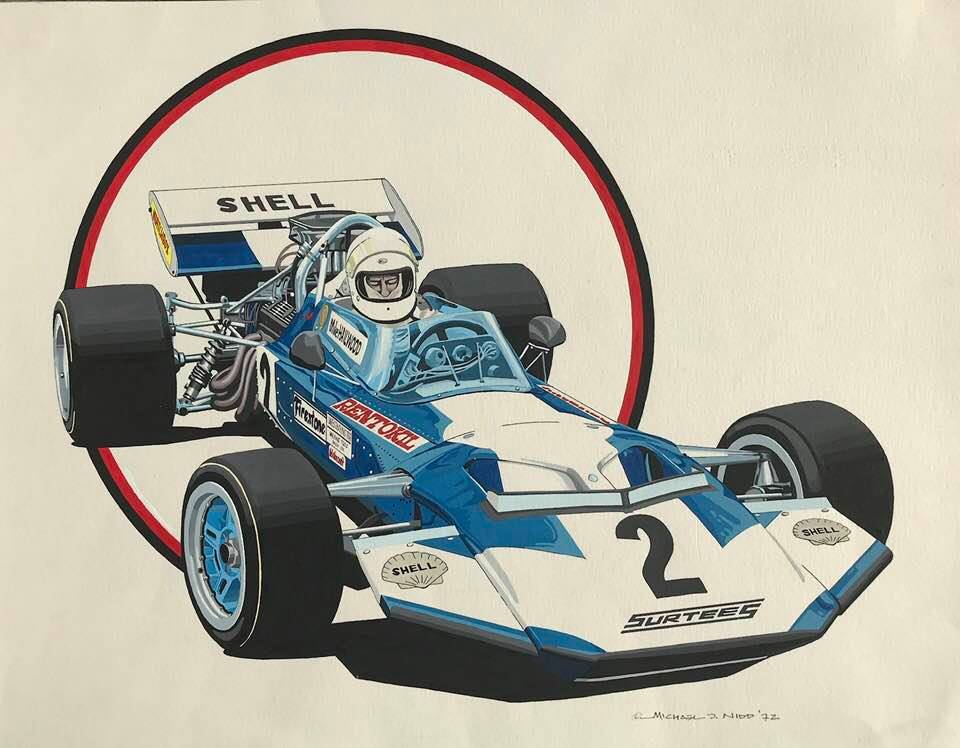
(M Nidd)
Without wanting to confuse things further, see above a wonderful painting of Hailwood’s Surtees TS8 as it appeared in New Zealand in the summer of ’72…
(S Love)
John Surtees and Sam Posey in the Laguna Seca paddock in 1971. ‘Well, keep going the way you are and there probably is an F1 drive at home for you Sam.’
(Pinterest)
Sam Posey in front of Mike Hailwood during the October 1972 US GP at Watkins Glen.
The pair are racing Champcarr/works-Surtees TS9B Ford DFVs. Sam was Q24 and 12th, Mike Q14 and an accident impacted 17th. Jackie Stewart won in a Tyrrell 005 Ford DFV.
Credits…
Dave Waldron via Gerard Richards, Bryn Kempthorne, Maurizio Rizzo, Marabeth Cohen-Tyler, Brian Hopping, Paul Overell, Greg Rickes, Glen Moulds, Michael Kidd, Steve Love, Stupix, Old Motor Racing Photographs Australia Archive, Pinterest, Brian Jackson photos via Glenn Paine, John Blanden
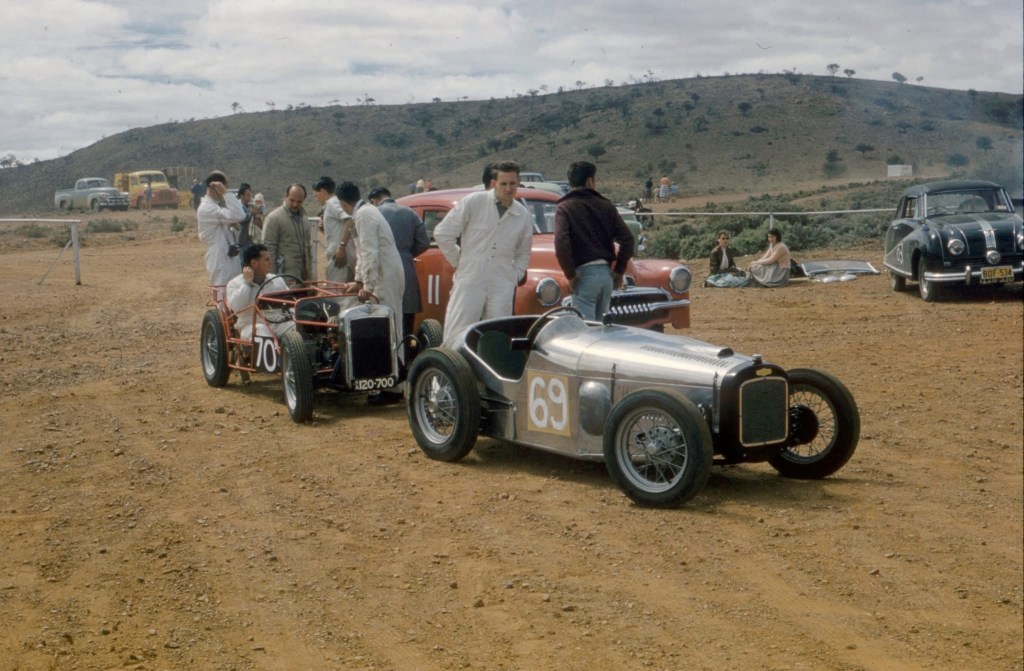
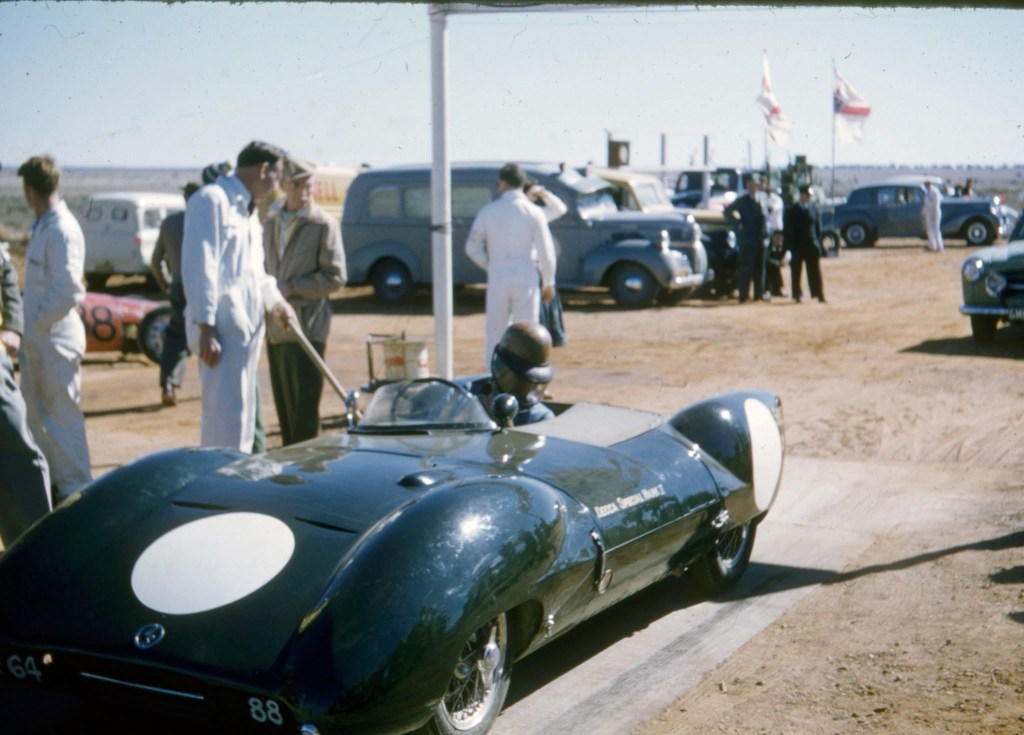
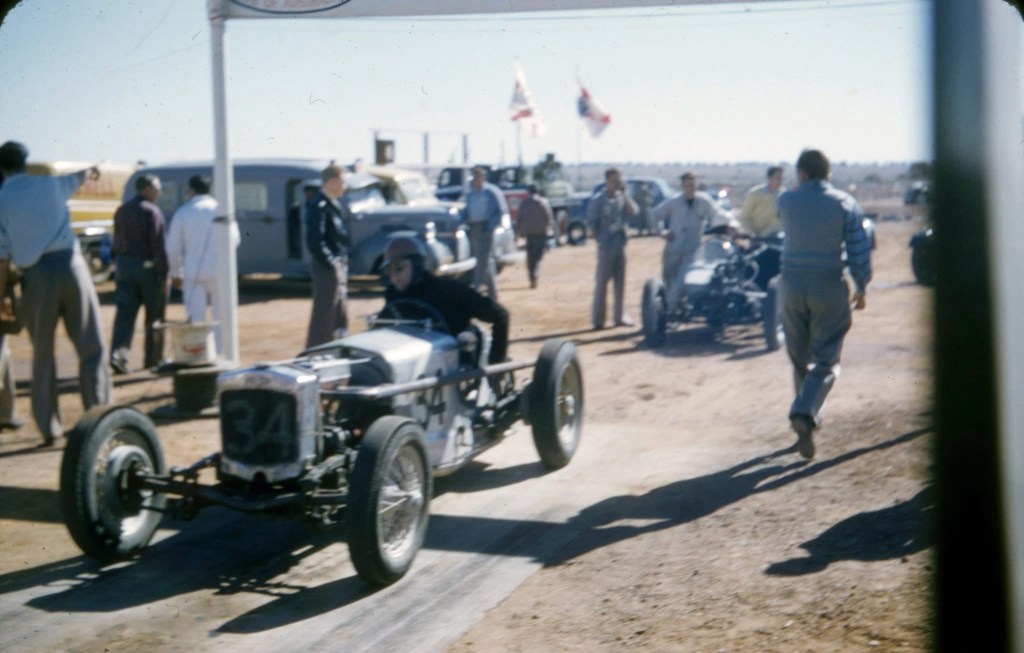
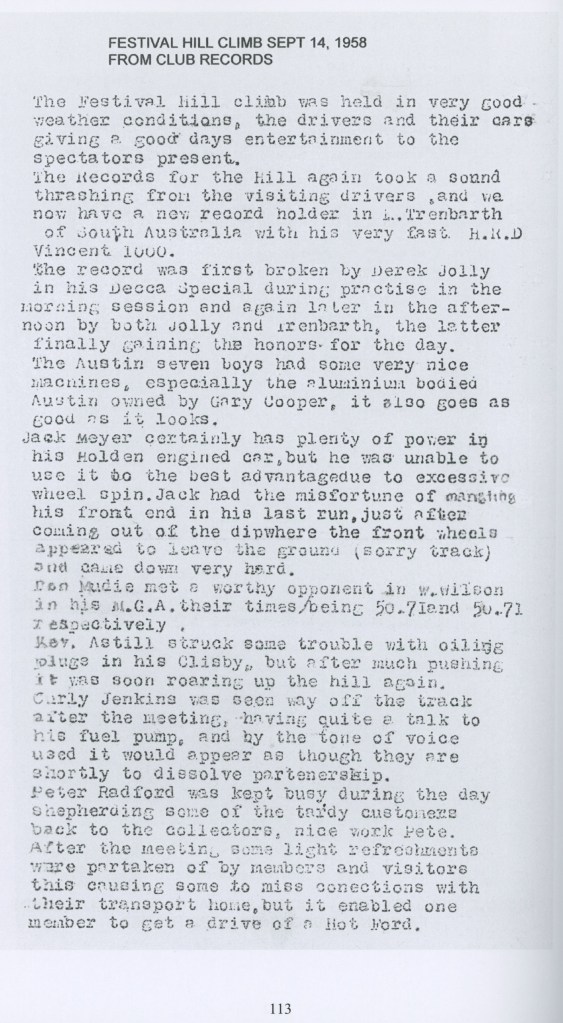
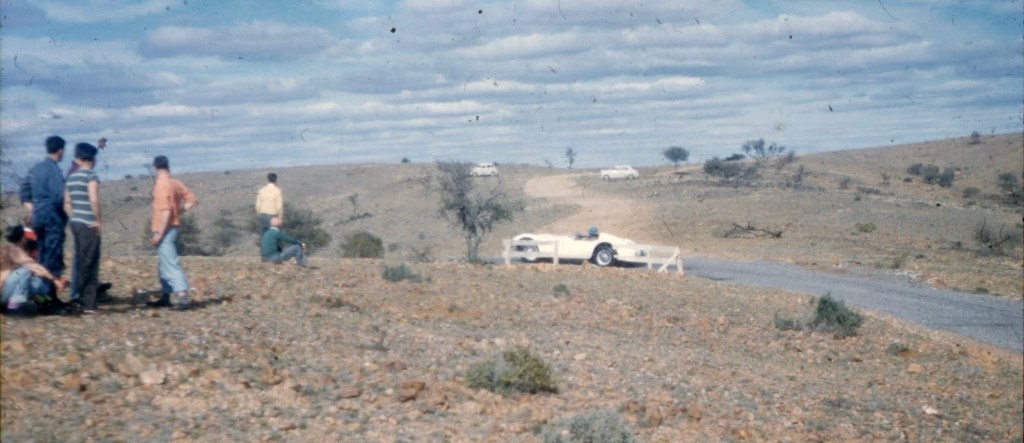
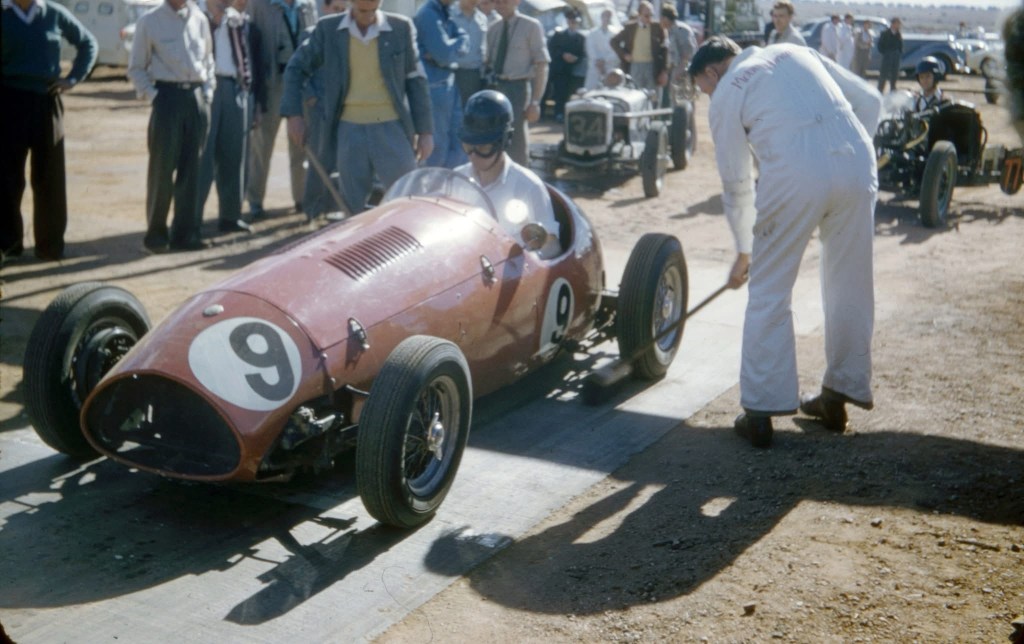
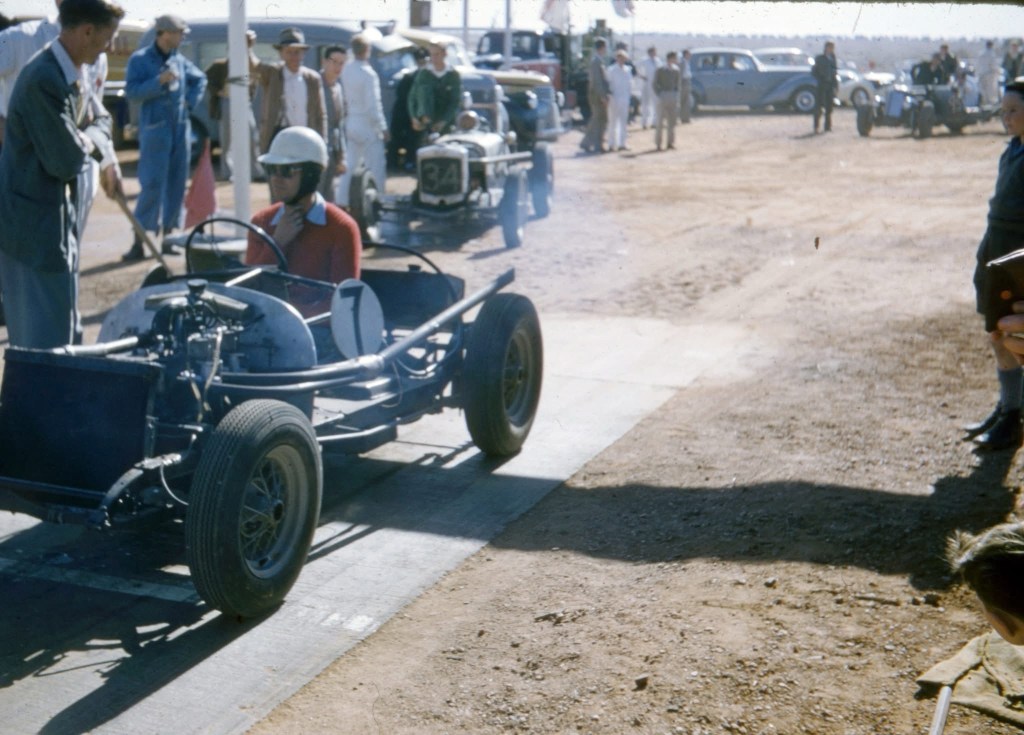
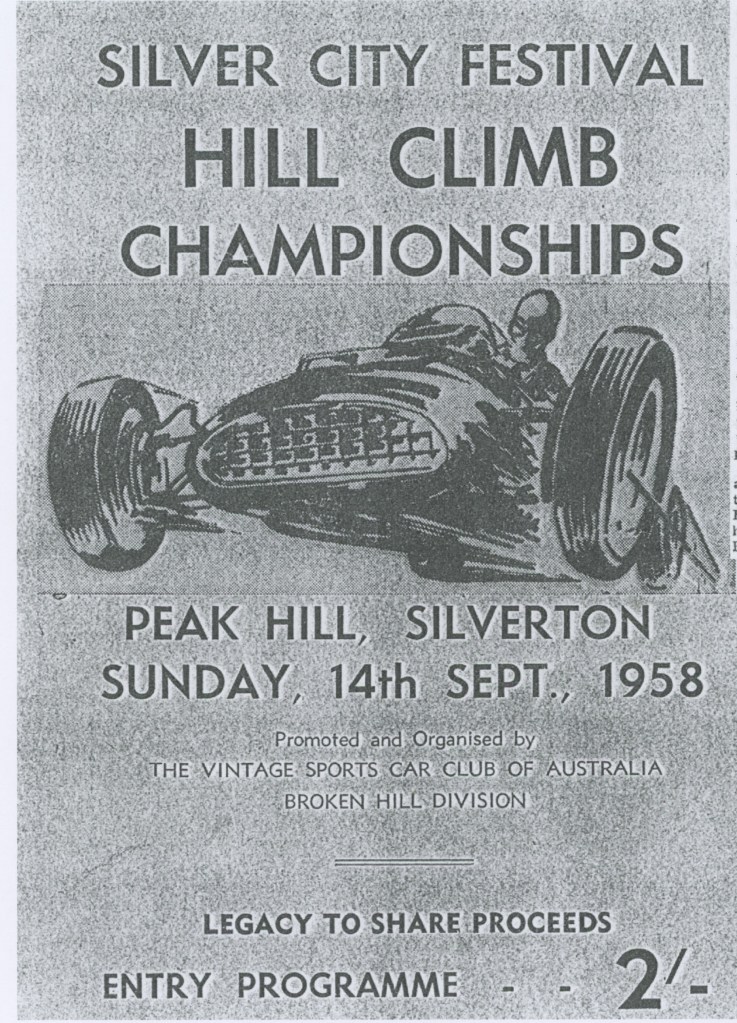
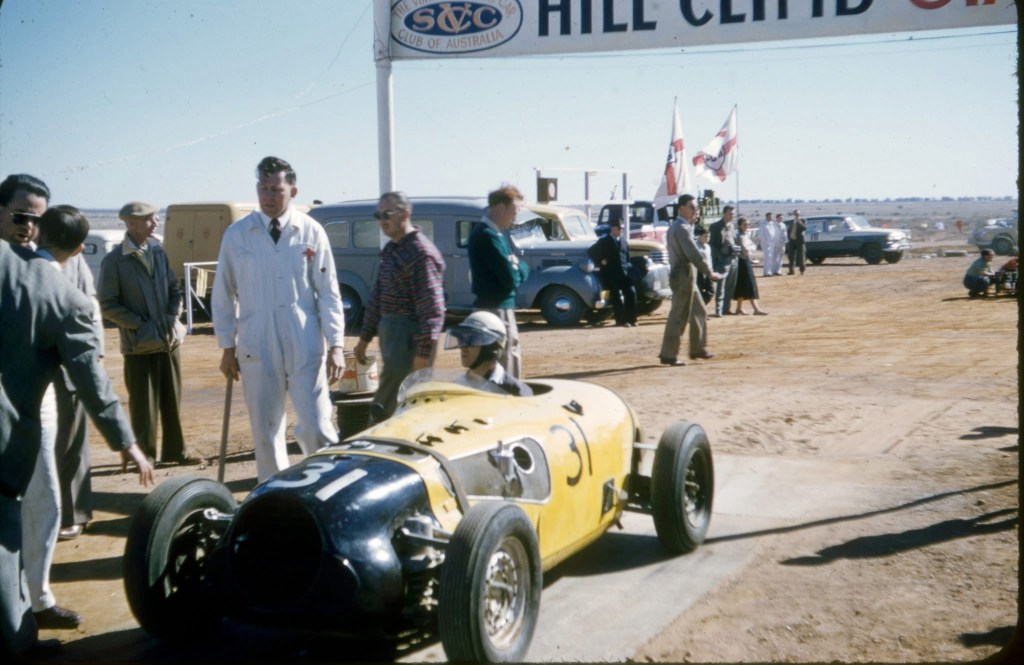
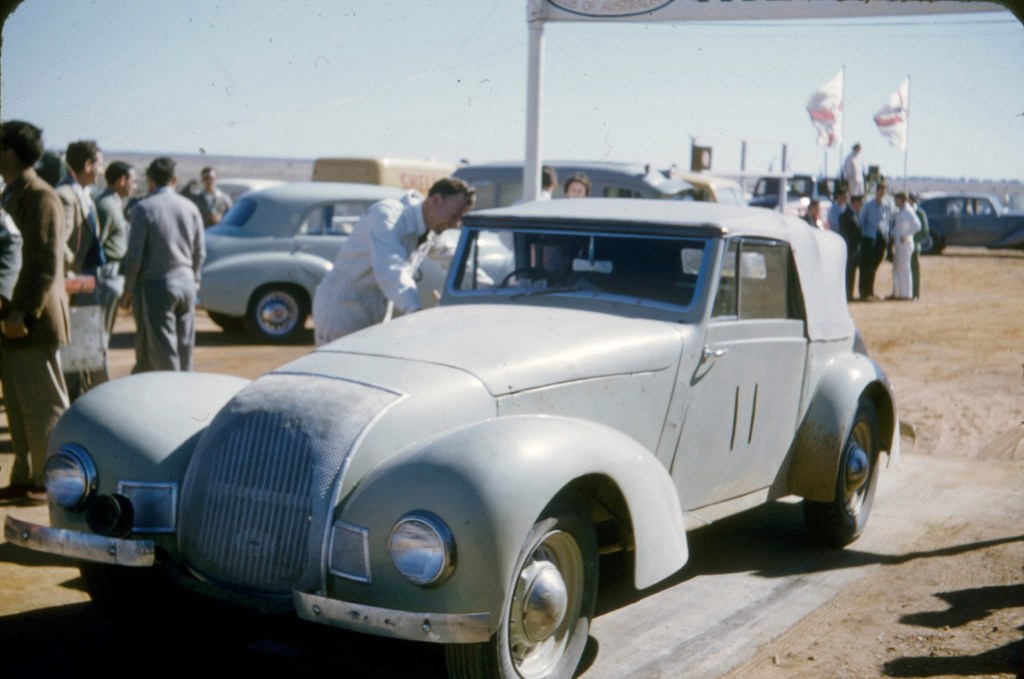
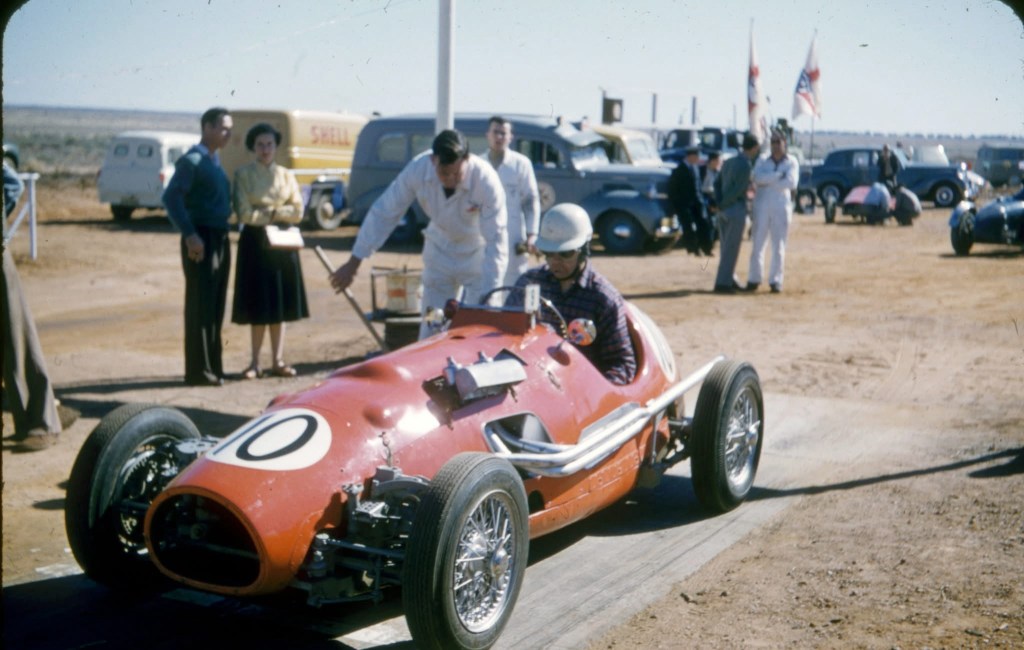
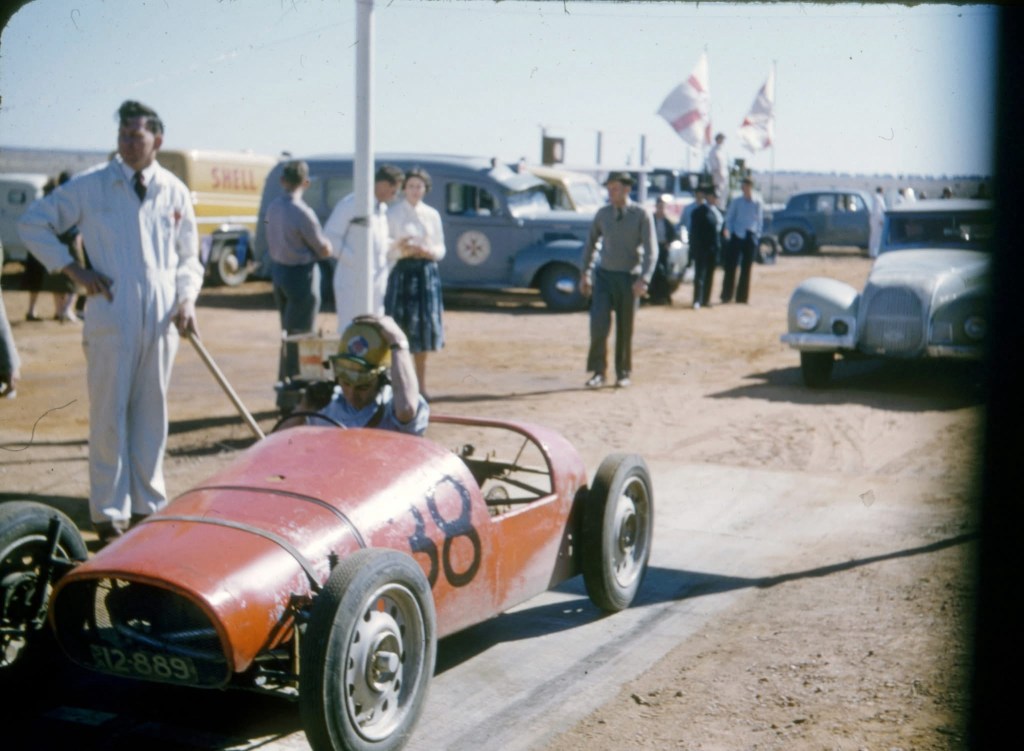
The Peak Hill, Silverton, hillclimb meeting near Broken Hill on September 14, 1958.
That’s none other than future Elfin Sportscars boss Garrie Cooper looking immaculate in his Persil-white overalls alongside his BMC A-series powered Austin 7 Spl.
#70 is Bruce Went’s Austin, he did a 55.39 sec run, while the more potent Cooper Motor Bodies clad machine, sleeved down to sneak into the under 750cc class, did a best of 45.17.
What a scene! Red Holden FJ, the Austin Atlantic at right and a couple of chicks making the best of the dusty paddock on a good old-fashioned struggle-rug. Bleak indeed!
We have Peter Kelly to thank for these unique, Kodakrome shots which he bought in a Trash n’ Treasure Market a few years ago. ‘Yer can be lucky, he was, and so are we, many thanks Peter! Bill Williamson’s Facebook page does it yet again! Special thanks also to Doug Gordon and Tony Johns for their archival material and leading the charge on car IDs.
Note that some of the photographs are from a meeting held at Peak Hill twelve months before, on July 28, 1957.
(P Kelly Collection)
Silverton is only a drop-kick from the New South Wales-South Australian border, 1,200km from Sydney, 540km from Adelaide. Big drives for your racing-fix, not really, not in Australia!
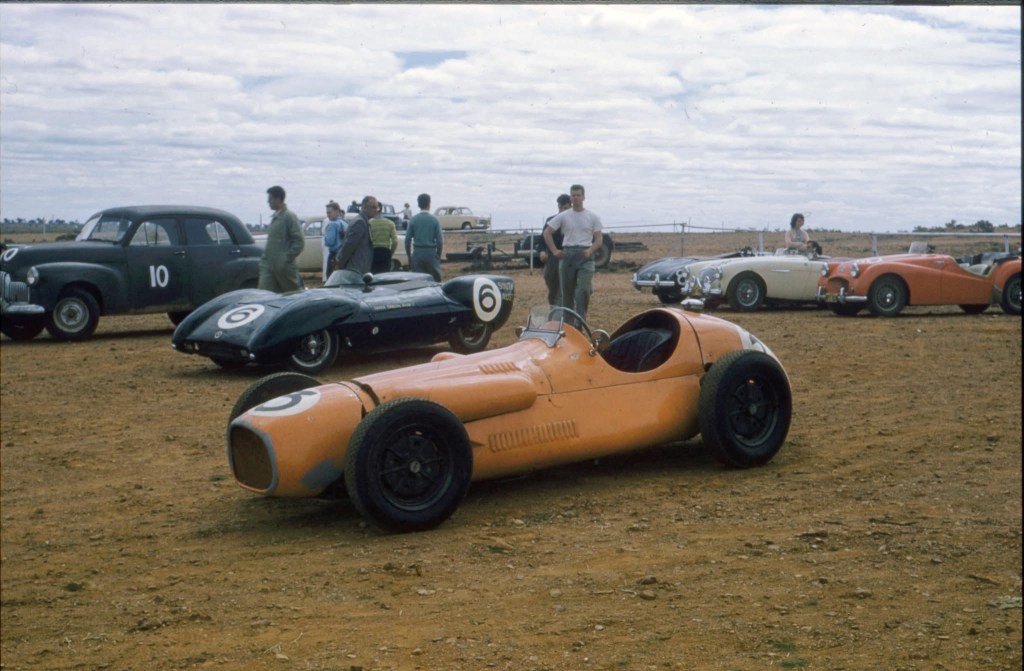
The two cars above were top-shelf here at the time. Up front is #5 Jack Myers’ W.M. Special – a modified Cooper T20 powered by a 2440cc Waggott-Holden DOHC, triple-SU fed six-cylinder engine – the slinky British Racing Green sportscar behind is Derek Jolly’s #6 Lotus inspired Decca Mk2 Climax FWA Spl. Car #10 is ME Nancarrow’s Holden 48-215. ‘Malcolm Nancarrow, who went on to race a Lotus Elite and a Lotus Cortina in South Australia during the 1960s.’ wrote Rob Bartholomaeus.
Jack Myers fettling the Waggott-Holden twin-cam ‘Grey six’ cylinder engine in the Gnoo Blas paddock (P Kelly Collection)
Enthusiast/historian Doug Gordon writes that ‘Peak Hill hillclimb was laid out on hilly ground just outside Silverton, a little mining township close to Broken Hill. These days it’s famous as the location for filming Mad Max, there is a Mad Max museum there.’
‘When (vintagent/racer) Neville Webb was there a branch of the Vintage Sports Car Club of Australia was formed. From the early 1950s to June 1959 a hillclimb track was laid out in the dirt and drew a wide-range of cars including the ex-Bira MG K3.’
‘There were plans to build a bitumen racetrack nearby but that was quashed by the local police who were concerned about the safety aspects as the club was small and didn’t have the budget for the extensive safety fencing that would have been required.’
‘Here is the original layout of the hillclimb being held by local historian Don Mudie. There is still an active Veteran and Vintage Car Club but their interests are outside racing.’
(D Gordon Archive)(P Kelly Collection)
Neville Webb’s Frazer Nash Monoposto and below.
A special, the car is not one of the three factory cars, one of which was raced in-period by Tim Joshua/Ron Egerton and others in Australia, and is still here currently being restored.
(D Gordon Archive)(T Johns Collection)(P Kelly Collection)(P Kelly Collection)
South Australia’s Murray Trenberth bagged FTD in his 996 Vee-Twin Vincent Spl, he did a 42.54 sec run. A very quick car on the circuits as well. Ralt wheels? Big Bertha behind is R Laneyrie’s Ford V8 Coupe.
(P Kelly Collection)
M Dillon’s Triumph Spl 351-1000cc entry.
(P Kelly Collection)
Bill Pile, MG TC Spl s/c, great looking car, who built the body?
(P Kelly Collection)
I Virgo VMF under 350cc car, July 1957.
D Evans D & D Ford 10 Spl front and centre. #34 behind is the Webb Frazer Nash monoposto, no idea about the other car (P Kelly Collection)
Keith Rilstone in the Eldred Norman built Zephyr Special s/c, July 1957.
(P Kelly)
B Bowring, Allard M drophead, Ford flathead V8, July 1957.
(P Kelly)
The legendary MacHealey, Greg McEwin up, July 1957.
(P Kelly)
‘Meadows Special, Riley 12 chassis, Lancia running gear: 5th Series front end and diff, 7th Series gearbox, and Meadows engine out of a Chick car built in Adelaide.’
‘I bought the car in 1968 for $25, then fitted the engine and gearbox into the Chandler Lancia Special, to become the Lancia Meadows.’ thanks Rob Harcourt.
‘Here it is below as I bought it. I towed it home to Adelaide from Broken Hill on an A-frame behind my mates AP6 Valiant. Imagine doing that today!’
(R Harcourt)(P Kelly)
I Phillips, PDS, an under 350cc car. July 1957.
(P Kelly)
F Roberts, Holden 6 Special.
‘Perhaps the first Holden Special to compete in Australia,’ observed John Medley. July 1957.
Credits…
Peter Kelly Collection via a random Trash ‘n Treasure purchase!, Tony Johns Collection, Doug Gordon Archive, Lindsay Siebler, Rob Harcourt
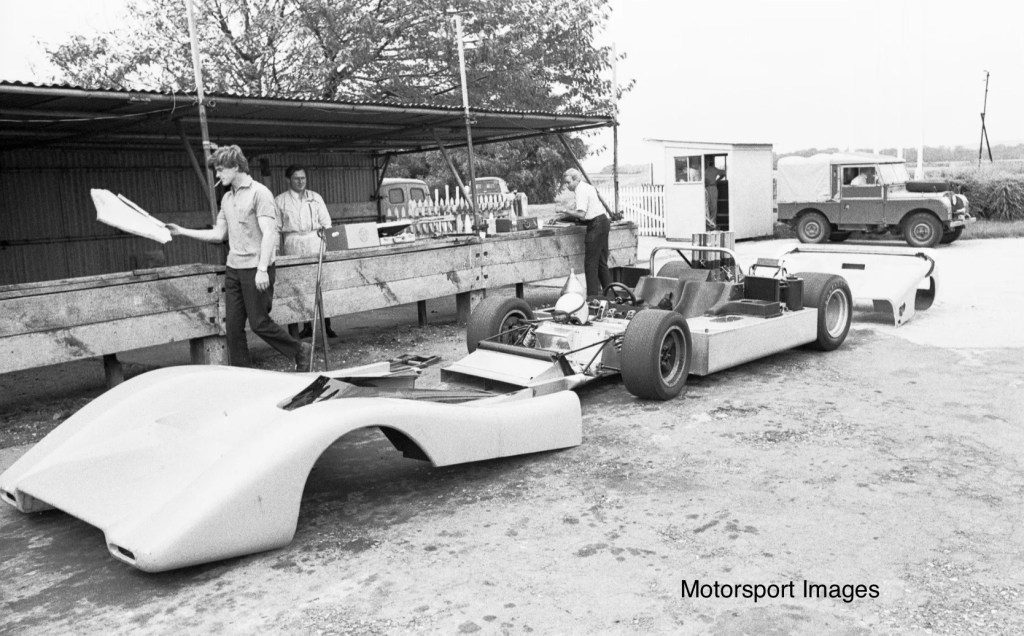
‘It’s the first McLaren M8A Chev outside McLaren’s David Road factory in Colnbrook,’ Derek Kneller recalled.
‘I was a fabricator working with Don Beresford, John Thompson and George Begg on the M8As. The shot was taken on my Polaroid camera when the first body was fitted.’
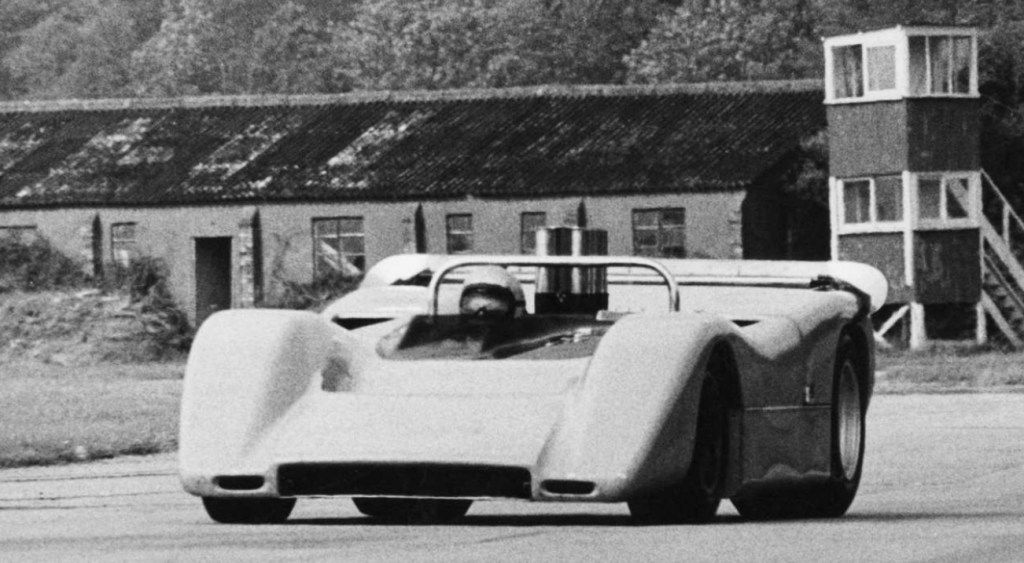
The shot below of Alistair Caldwell, Bruce McLaren and Teddy Mayer testing the car at Goodwood in July 1968 dates Derek’s shot. The car is still not fitted with mirrors, but does have a small spoiler on the rear bodywork, so perhaps a day #1 or day #2 test…
(goodwood.com.)
Bruce blasting past the Super Shell Building at Goodwood, what is that material going across the back of the car from wheel arch to wheel arch?
It wasn’t a bad season, McLarens won all six Can-Am Cup rounds: Denny Hulme took three, Bruce, Mark Donohue (M6A Chev) and John Cannon (M1B Chev) one apiece. Denny won the Canadian-American Challenge Cup from Bruce and Mark.
Etcetera…
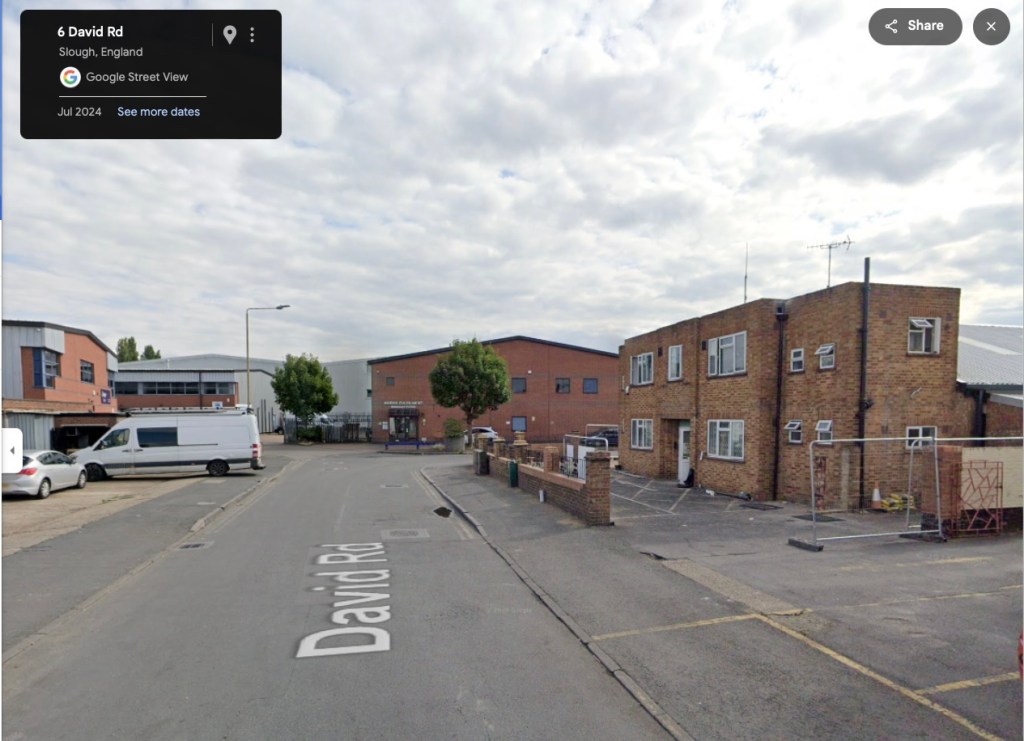
As David Road is today courtesy of Andrew Hicks.
Credit…
Derek Kneller, Motorsport Images, Goodwood.com, Andrew Hicks
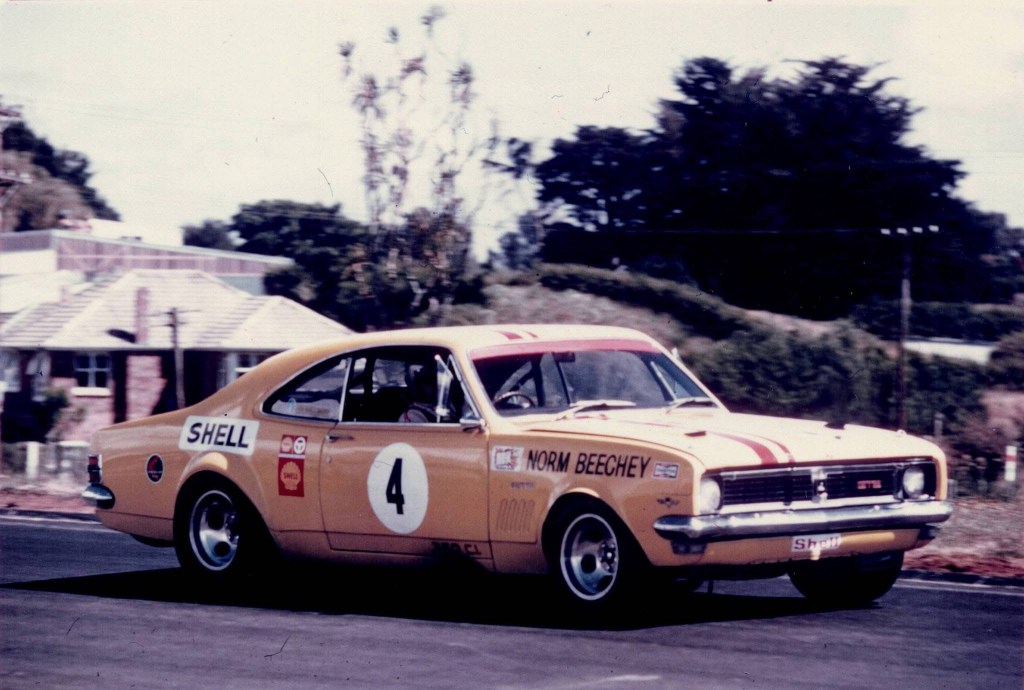
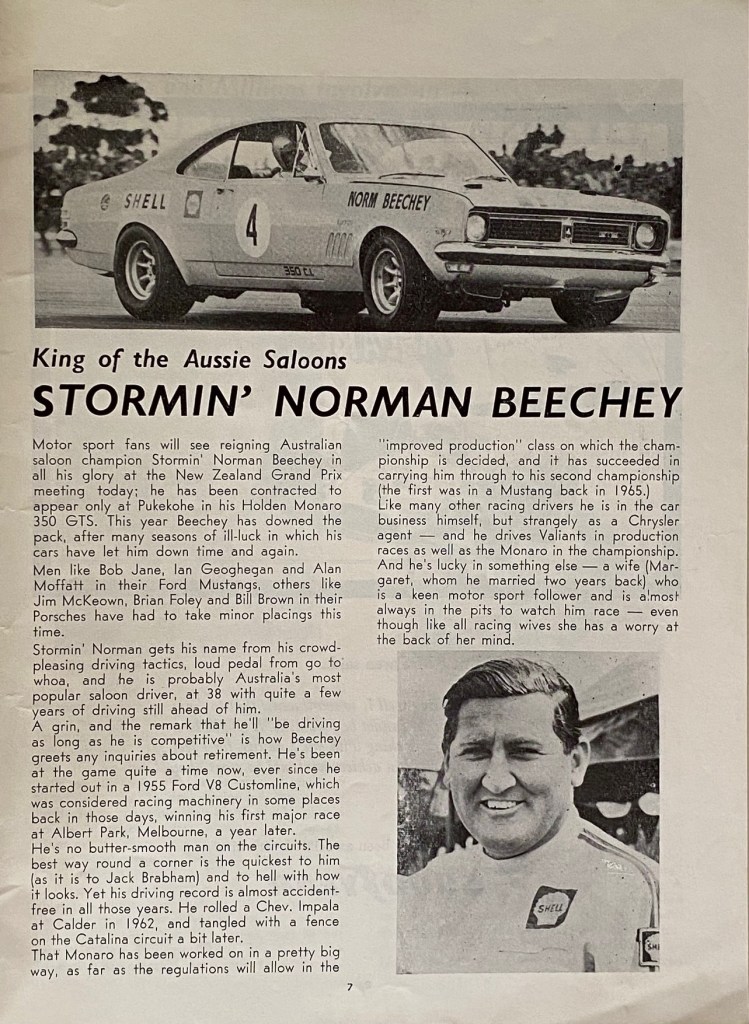
Beechey exits the Pukekohe hairpin in his legendary 1970 Australian Touring Car Championship winning Holden Monaro HT GTS350 during the 1971 NZGP weekend.
The idea for the first in this occasional series of Australian Touring Cars Abroad came from my latest photo raid of two fantastic Kiwi racing FB sites: Old New Zealand Motor Racing and South Island Motorsports, suss them both out.
But of course New Zealand wasn’t/isn’t the only country ‘Oz tourer pros‘ have visited. I’ve prostituted the idea a bit by including blokes like Frank Gardner, Brian Muir and Horst Kwech whose over-there touring car racing was based over-there not here, if that makes sense as a differentiator…
(Bay of Plenty News)
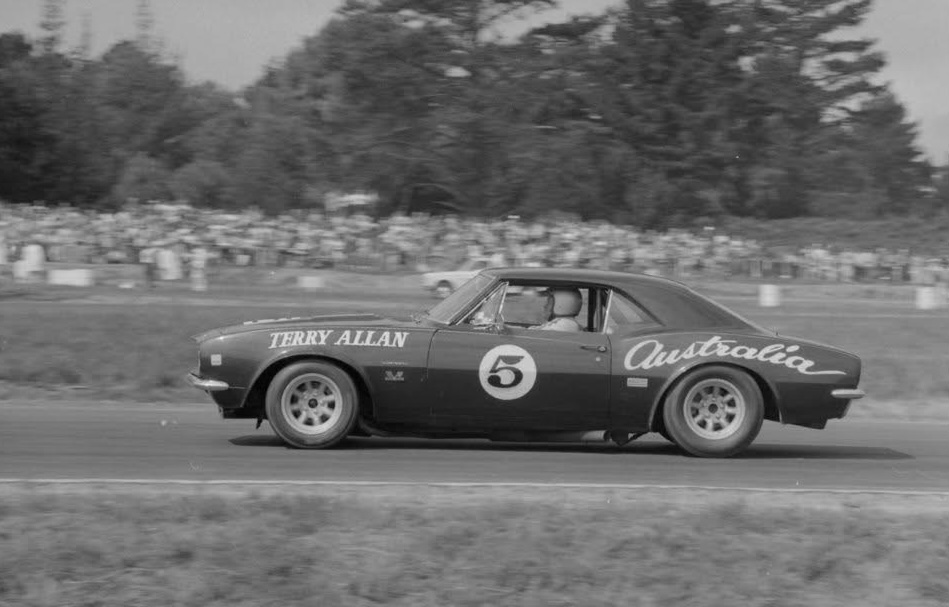
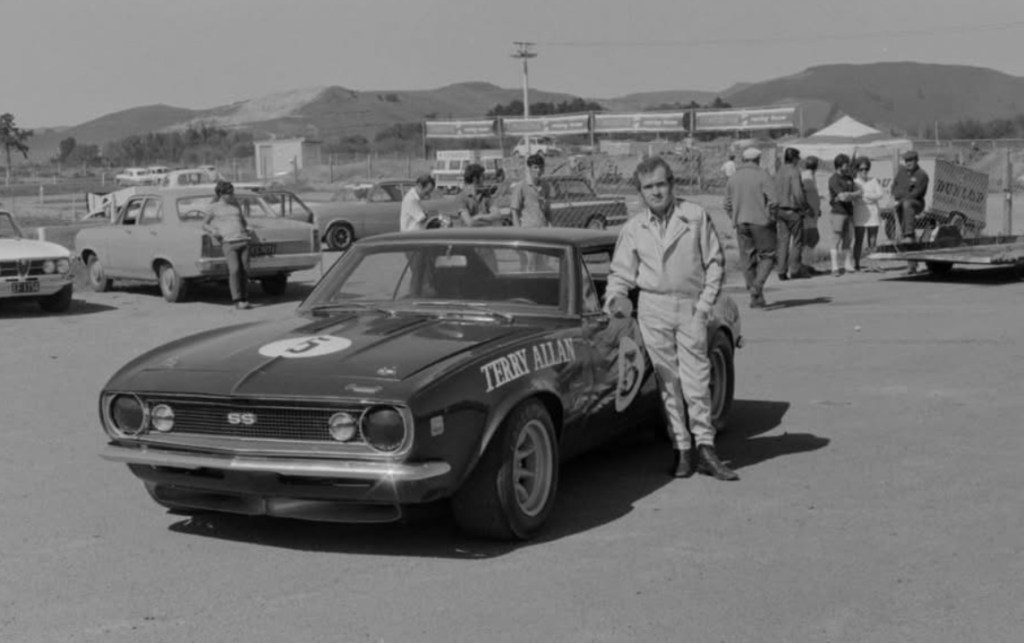
Terry Allan at Baypark in May 1970
Steve Holmes wrote on The Roaring Season, ‘In 1967, young Melbourne motorsport enthusiast Terry Allan took a trip to the US and purchased a new Camaro to race in Australia. Fitted with a 396ci big block Rat motor, and quad-side draught Webers, the Camaro caused a huge stir with race fans on its debut in May 1967, as this was the first Camaro to race anywhere in Australasia.’
‘Allan raced the Camaro from 1967 to 1971, then sold it to Graeme Blanchard. From there it went to Lakis Manticas and then to Barry Wearing in 1974, after which it appears to have vanished.’
‘Information about Terry Allan’s Camaro has been difficult to find. A couple of magazines have attempted to trace its current whereabouts, or ultimate fate, but have drawn blanks. Rumours surrounded the car, and its US origins, and the possibility it may have been race prepared at the workshop of GM racing guru Bill Thomas, but these were all hearsay.’
What became of Terry Allan folks?
(Bay of Plenty News)
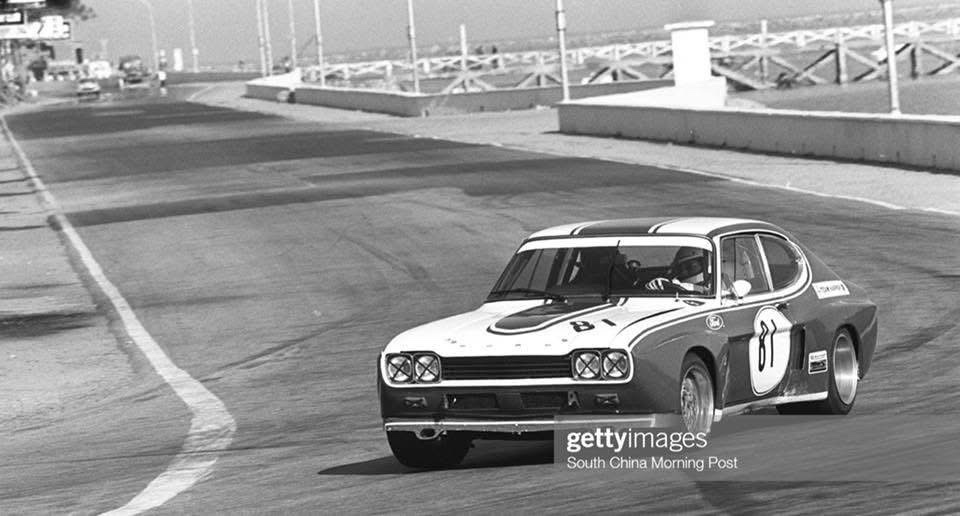
Allan Moffat’s Team Harper/Ford Cologne Ford Capri RS2600 on the way to winning the 53 lap November 18, 1973 Touring Car Race at Macau. Second and third were Tachi Nobuhide and Jose Ramirez aboard Toyota Celica GTs.
Moffat must have been impressed, a year later FoMoCo Oz had an RS3100 on the water for him to race in Australia. Macau was a little bit of try before you buy in a sense. See here: https://primotipo.com/2015/04/09/australias-cologne-capris/
(T Growden)
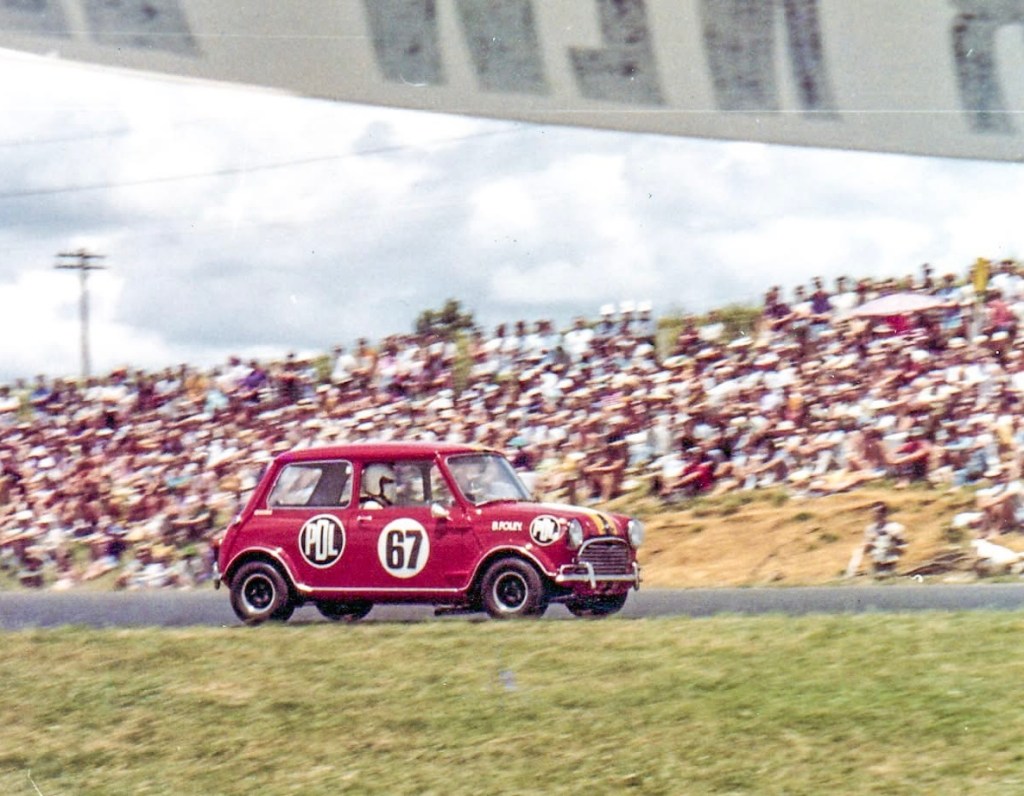
Brian Foley’s Morris Cooper S at Pukekohe during the 1969 New Zealand Grand Prix weekend. ‘Second in the the 1000-1300cc race.’
The title for Australian King of the Coopers was a tussle between Sydney based Foley, and Melbourne based Peter Manton, with honourable mentions to John Leffler, Lynn Brown and Don Holland. And yes my friends, there are more depending upon the period you have in mind.
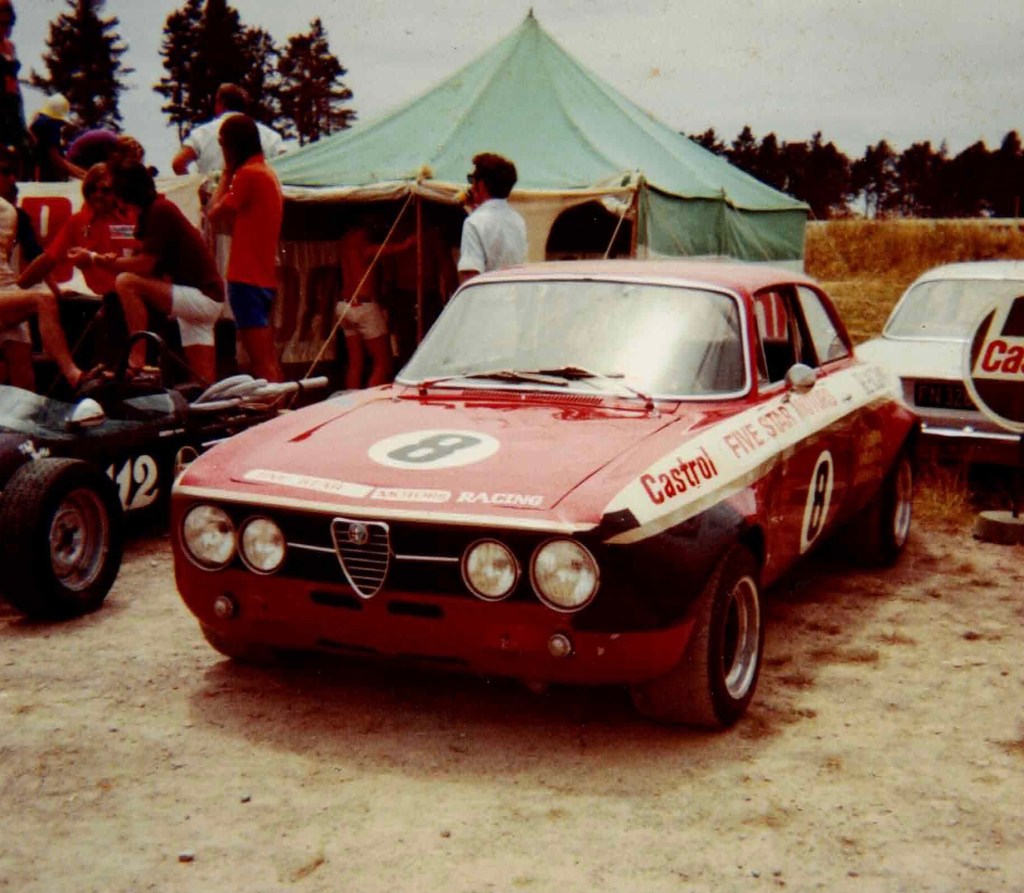
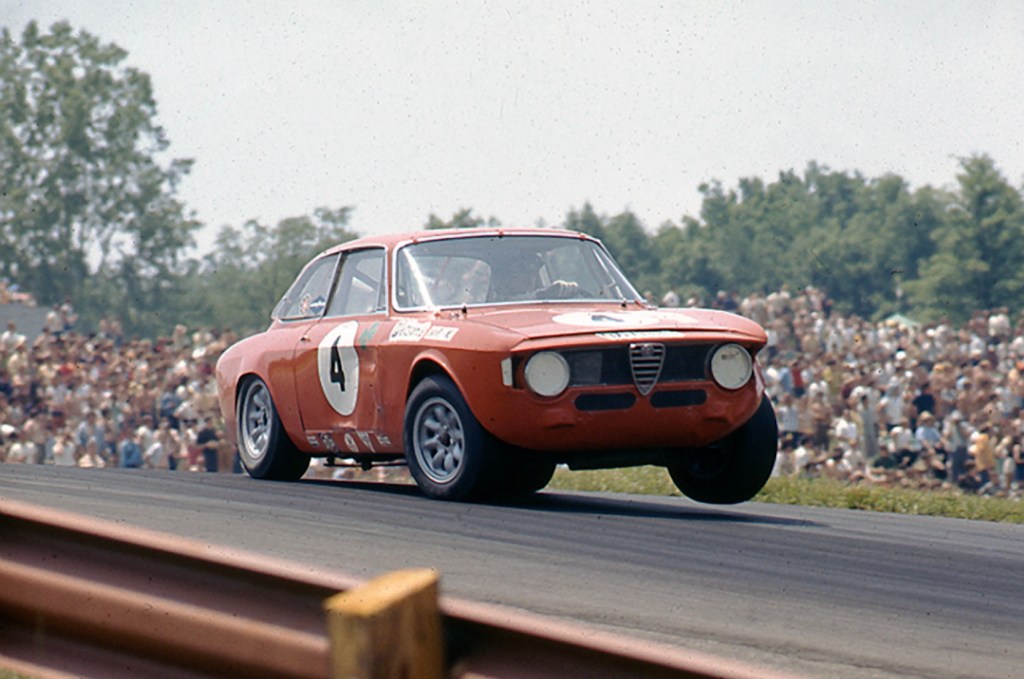
By 1971 Brian was teasing Australian Alfisti with this ex-Auto Delta Alfa Romeo 1750 GTAm. The 2-litre machine was under-gunned against the V8 Pony Cars that had the ATCC stitched up, but it was still a crowd-pleaser and ‘2-litre Class’ winning machine.
Here he is below at Shah Alam, Kuala Lumpur, Malaysia in 1972.
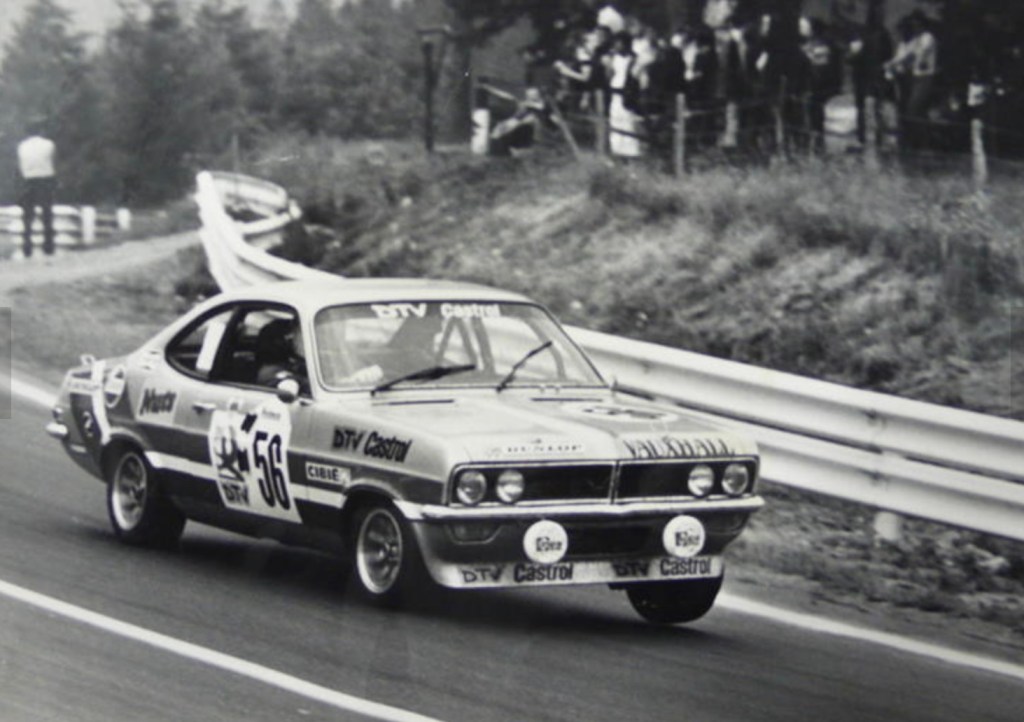
Peter Brock raced overseas a bit: BMW 3.5-litre CSL, Porsche 956 and some Commodores but maybe not as much as one would have expected of one of the world’s greatest touring car drivers of his era?
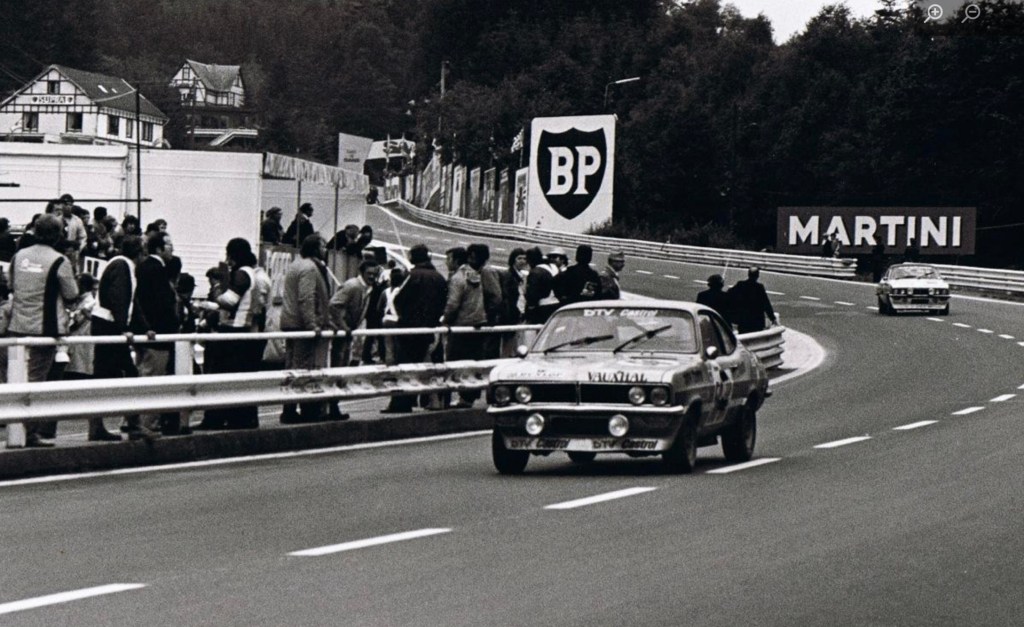
In 1977 he teamed up with his ‘UK GM equivalent’, Gerry Marshall for the 24 Hours of Spa in a factory Vauxhall Firenza Magnum.
Built by Bill Blydentein’s Dealer Team Vauxhall squad, the Group 1 Spa Magnum had some trick modifications including twin Weber 48DCOEs and a cam fitted to the 2.3-litre slant-four increasing its power to circa-172bhp. A Getrag five-speed ‘box completed a light, fast package.
(Bonhams)
Marshall and Brock were second at Spa with the Beefy-Brit chasing down second with 30 minutes to go, they also took the ‘Coup du Roi’ teams and the Index of Performance.
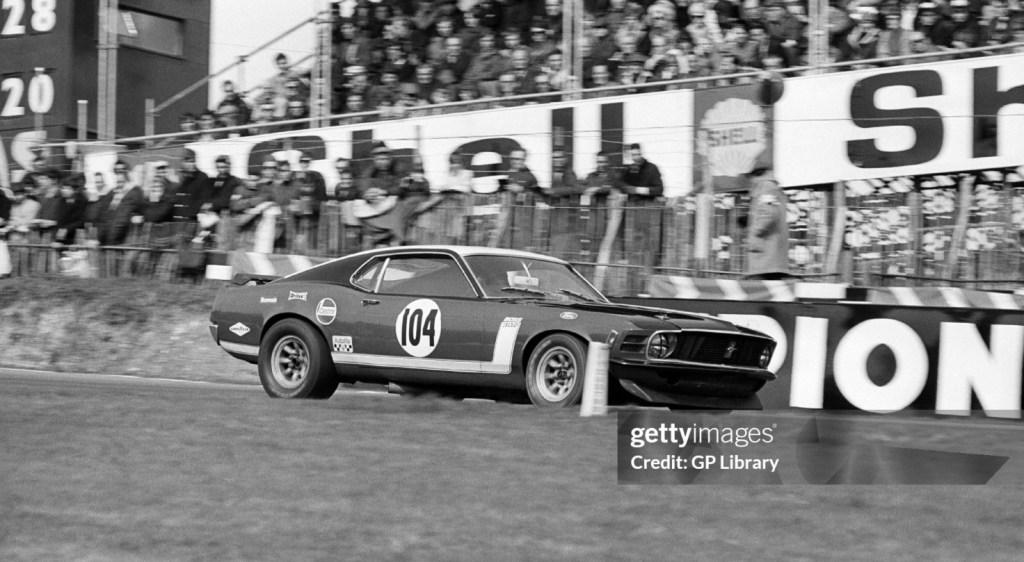
Frank Gardner on the way to winning a Guards Trophy race at Brands Hatch in May 1970, Ford Mustang Boss 302.
FG won the British Saloon/Touring Car Championship in 1967-68 aboard a Ford Falcon Sprint and Lotus Cortina/Ford Escort Twin-Cam respectively. In a decade long dream run in Europe, Gardner annually had single-seater, sportscar and touring car programmes/races in all corners of the globe and did justice to all of the different disciplines.
He returned to Australia in late 1974.
(John Lawton)
Pete Geoghegan in characteristic style giving his Ford Falcon GTHO Super Falcon a lungful at Baypark in 1973.
Pete took pretty much all of his cars across the ditch, I’ll do a post of those exclusively some time soon.
(S Laverick)
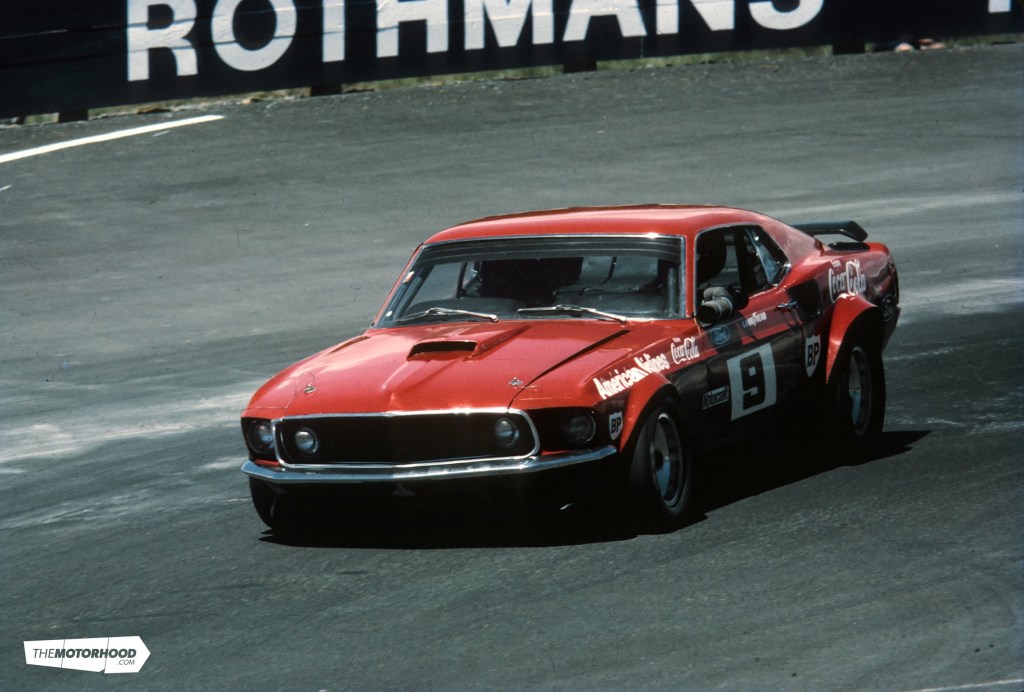
Moffat’s Coke Mustang Boss 302 at rest in the Pukekohe paddock in 1972, and on the move below.
More often than not race-paddocks are shit-holes, not so Puke which always looks wonderful in photos with its undulations, leafy trees and grass.
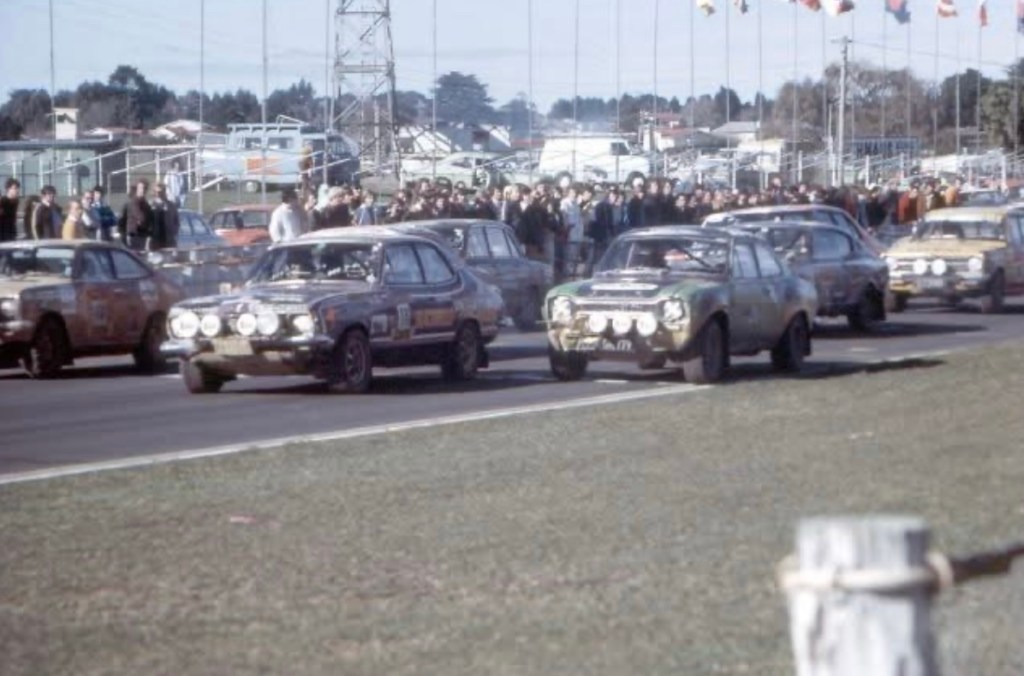
Colin Bond in the NZ Holden Dealer Team Holden Torana GTR XU-1 during the 1973 Heatway Rally run between July 7-14 out of Christchurch.
120 cars entered the event which was won by 1983 World Rally Drivers Championship winner Hannu Mikkola and Jim Porter, and Mike Marshall and Arthur McWatt both in Ford Escort RS1600 Mk1s, then Shekhar Mehta and Wayne Jones Datsun 180B, then the Bond/George Shepheard LJ XU-1.
Bondy was a crowd favourite in whatever he drove and is one of Australia’s most versatile drivers of any era. On-the-dirt he won three Australian Rally Championships in 1971-72-74, all with George Shepheard alongside and all in GTR XU-1s. Funny, in my mind he bagged another in his Escort RS days, but not so…albeit Greg Carr won one aboard a CB prepared Escort in 1978.
(S Taylor)(Alpina Auomobiles)
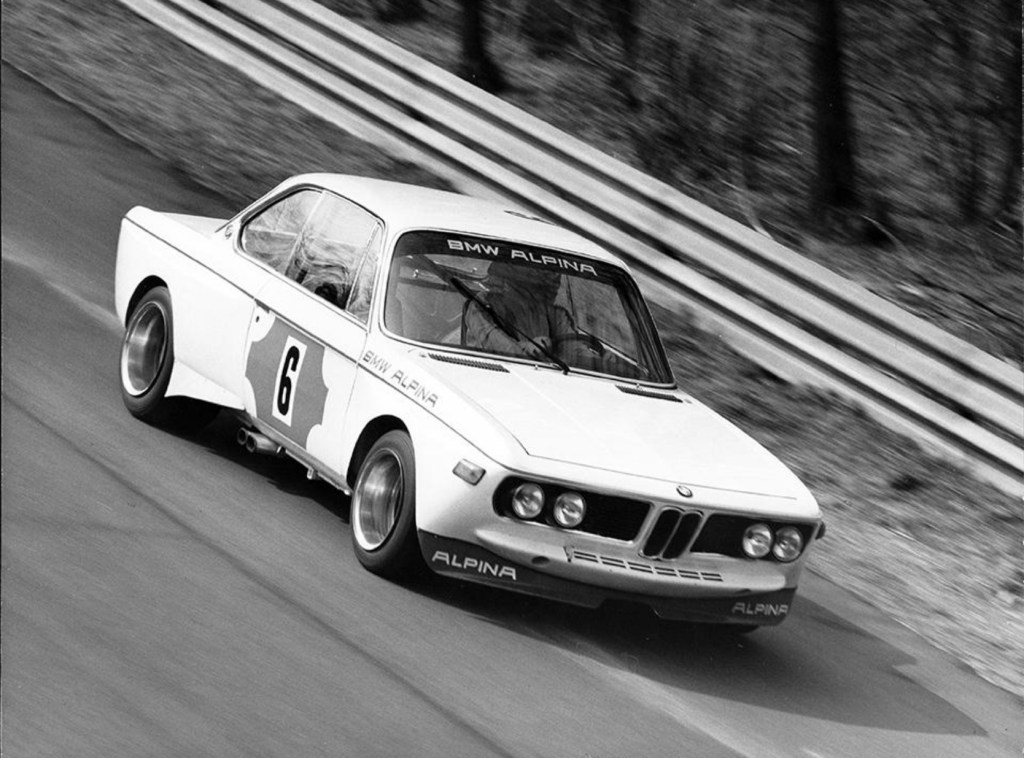
Brian ‘Yogi’ Muir in the Alpina BMW CSL 3-litre during the first round of the 1973 European Touring Car Championship at Monza in March 1973. He shared the car with Niki Lauda. See here: https://primotipo.com/2022/09/03/brian-muir/
Amazing career as a UK based international from the mid-1960s in touring cars and sportscars until his death from a heart attack on the way home from the RAC Tourist Trophy at Silverstone on September 11, 1973. He was only 52, born June 30, 1931.
Brilliantly conceived by Sydney racer Tom Nailard, the project was acquired by Frank Gardner who essentially created a two-seat Lola F5000 car with his expansive knowledge of the Huntington company’s parts catalogue.
Winner of the Australian Sports Sedan Championship from 1977-79 for Gardner/Grice/Grice before CAMS’ legislative pencil caught up with them.
(unattributed)
Peter Brock on the way to second place in the Guia Production Car race at Macau in 1971.
LC XU-1 with Globe Rallymaster wheels. Which car izzit, the Holden Dealer Team wrenches had wenches nicknames for the cars didn’t they?: Saggy Sally, Juicy Lucy! Raunchy Rita or whatever!?
(NAS)
Moffat again, this time during the 1973 Singapore Grand Prix weekend on the tough, dangerous Thomson Road circuit.
FoMoCo Oz bought this Alan Mann Racing built Ford Escort Ford FVA for AM to race as a sports sedan about 1970. It was always a struggle to keep up with the V8s. There ain’t no substitute for cubes. Sometimes.
By the time it got to Singapore it was probably fitted with a 2-litre Ford BDG engine. The spec and destiny of the car is of interest if someone can fill me in.
Moff won a heat but had a flat in the final that caused an accident, Brian Foley’s Alfa GTA Lwt won the final.
(Klemantaski Collection)
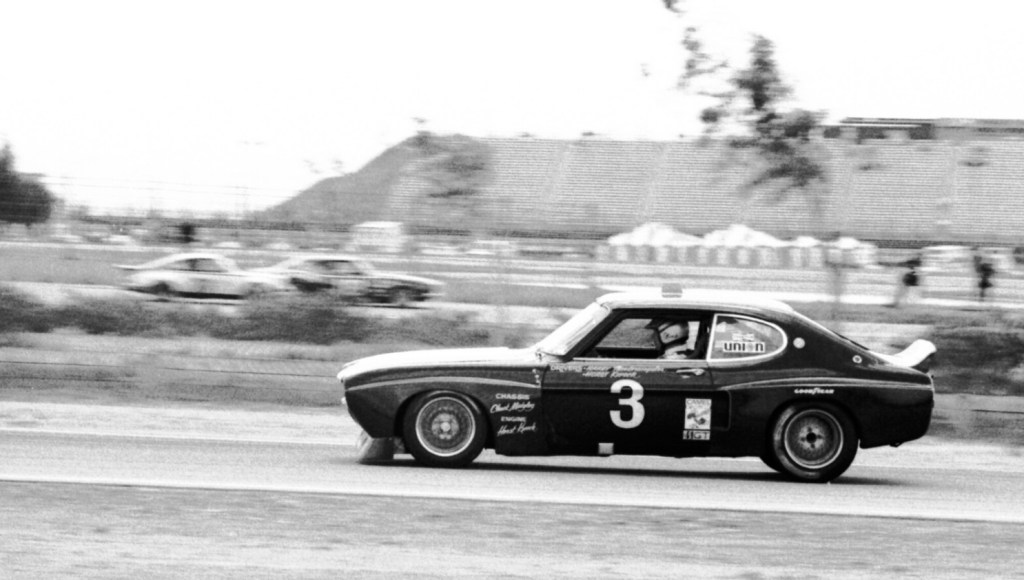
Speaking of which, here is Horst Kwech racing an Alfa Romeo GTA in a 1970 Trans-Am round at Mid Ohio, and below a Ford Capri RS3100 in an IMSA race in 1974, circuit unknown.
The Baypark promoters were clearly very touring car friendly, they promoted a lot of NZ v Oz contests which must have been fantastic to watch and hear.
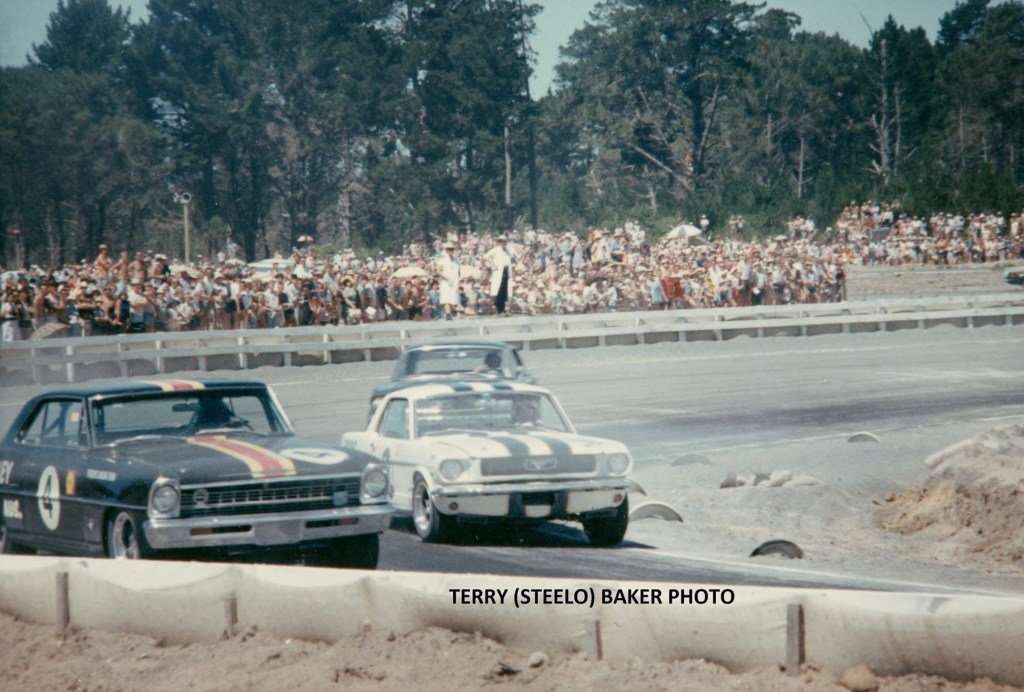
Here Melbourne’s own is doing battle in his Chev Nova with, I think, Paul Fahey’s Ford Mustang. Who won these December 1996 or 1967 hitouts? A little bit more here: https://primotipo.com/2019/09/26/norm-jim-and-pete/
(R Grimwood)
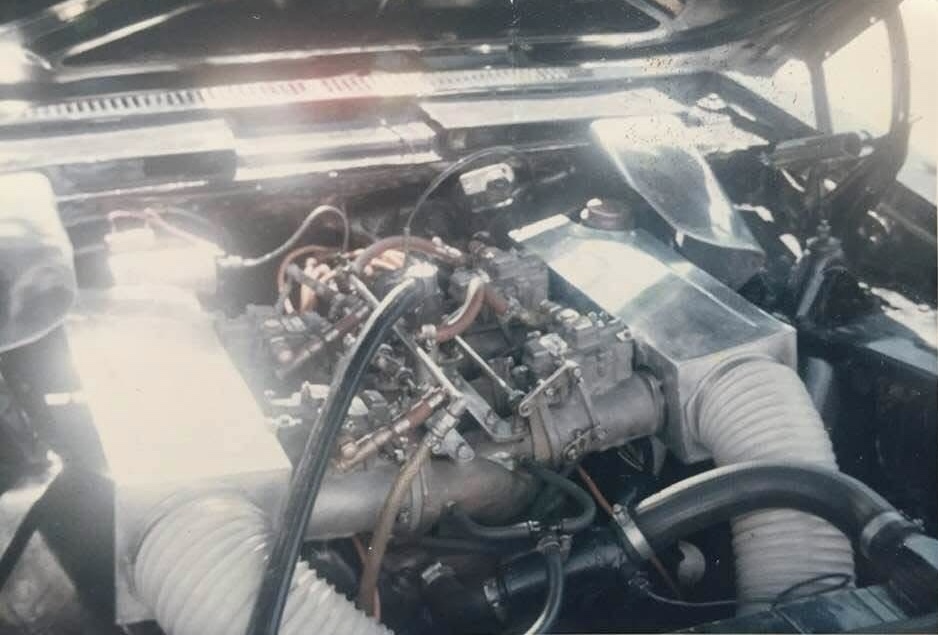
The cars got presence hasn’t it! Not the rare under bonnet shot of the 327 fed by four Weber DCOs on a neat crossover inlet manifold nicely ducted with cool air.
Did Claude Morton do Norm’s engines?
(J Copsey)(J Copsey)
Credits…
Steve Elliott, Stephen Dalton Archive, Bay of Plenty News shots via Bryan Miller, National Archive of Singapore, Klemantaski Collection, JD Decrevel, Getty Images, Stephen Laverick, Sean Taylor, Bruce Scott, Alpina Automobiles, Klemantaski Collection, JD Decrevel, Rod Grimwood, The Motorhood, Terry Baker, Jeff Copsey
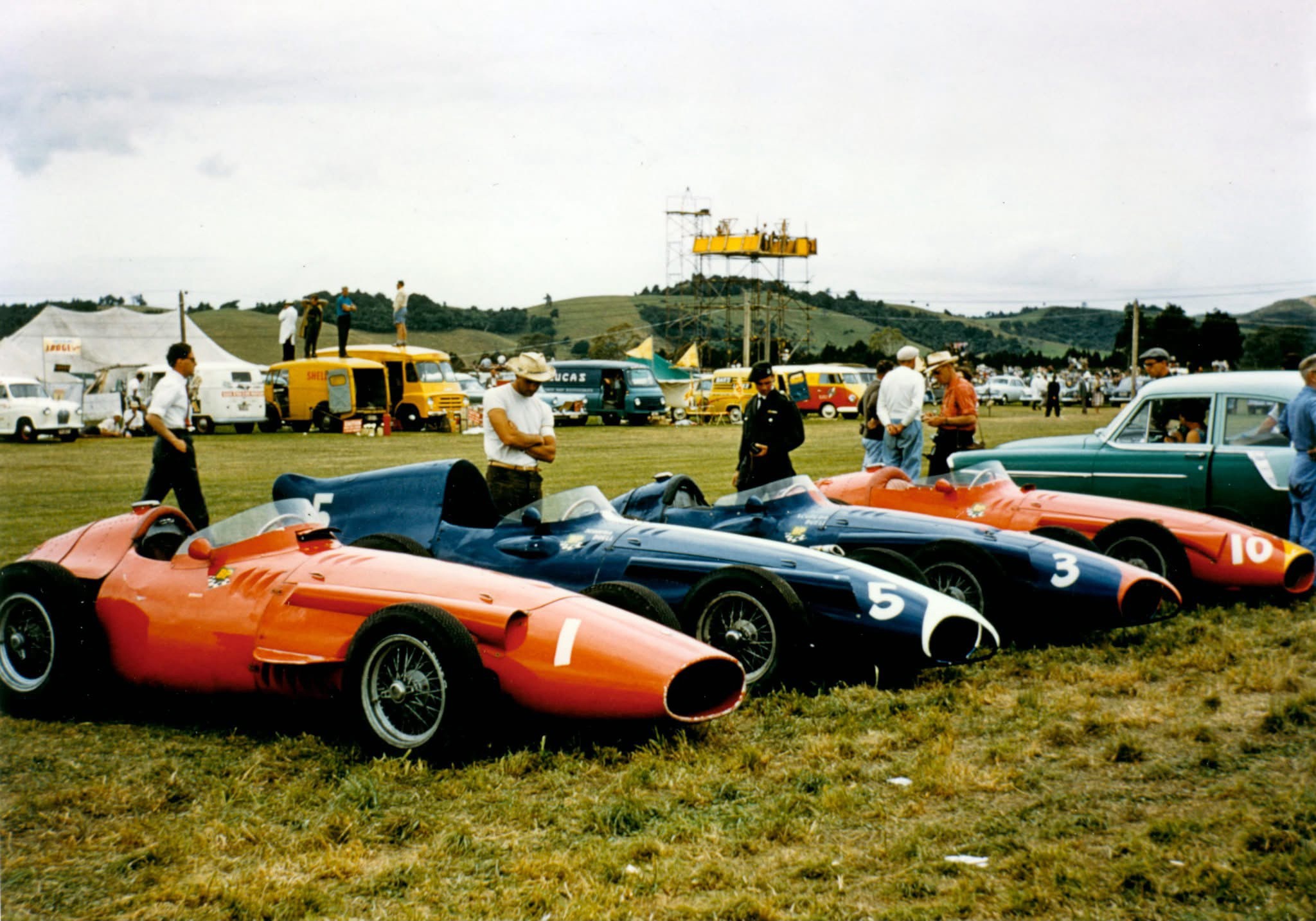
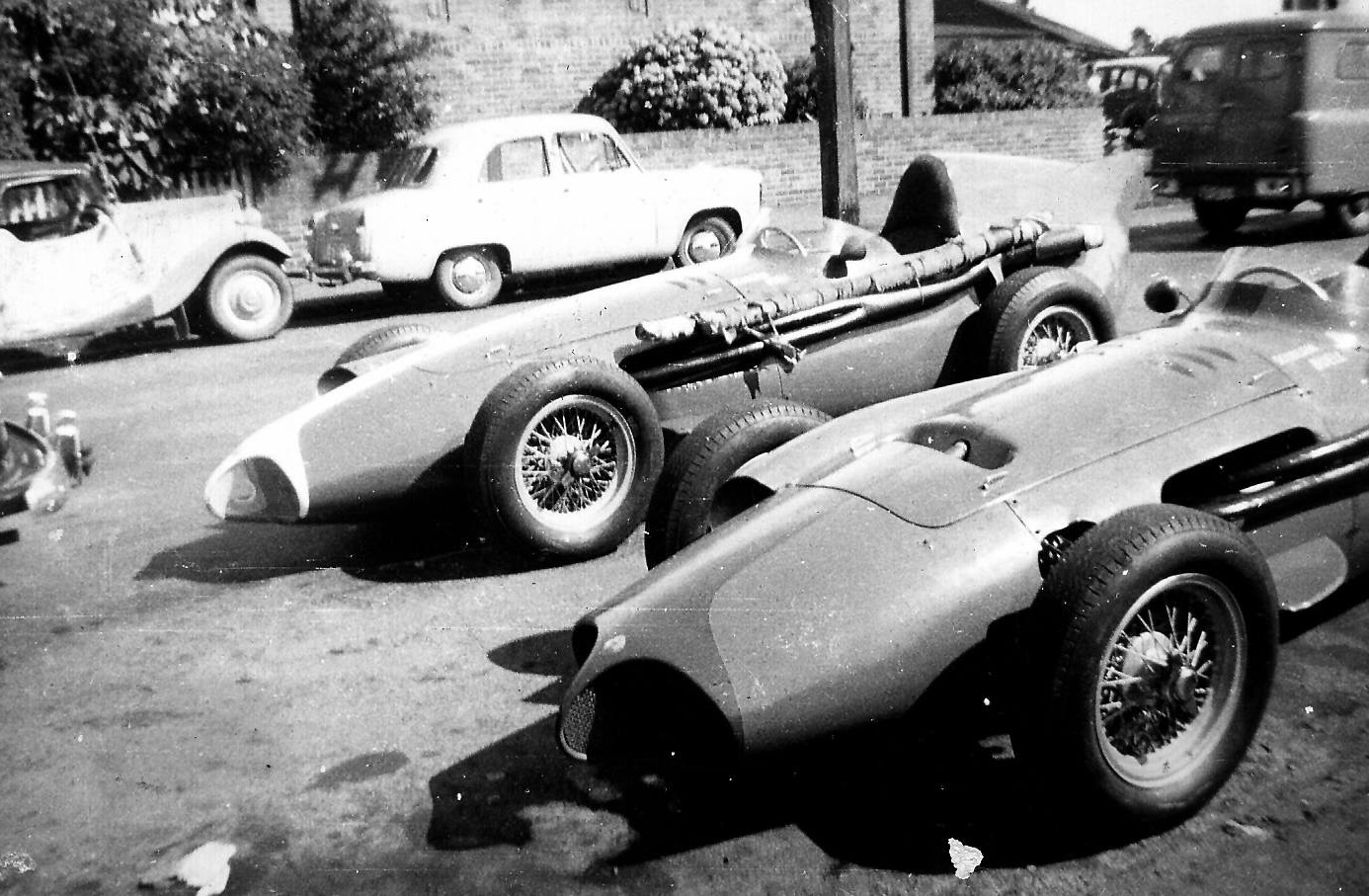
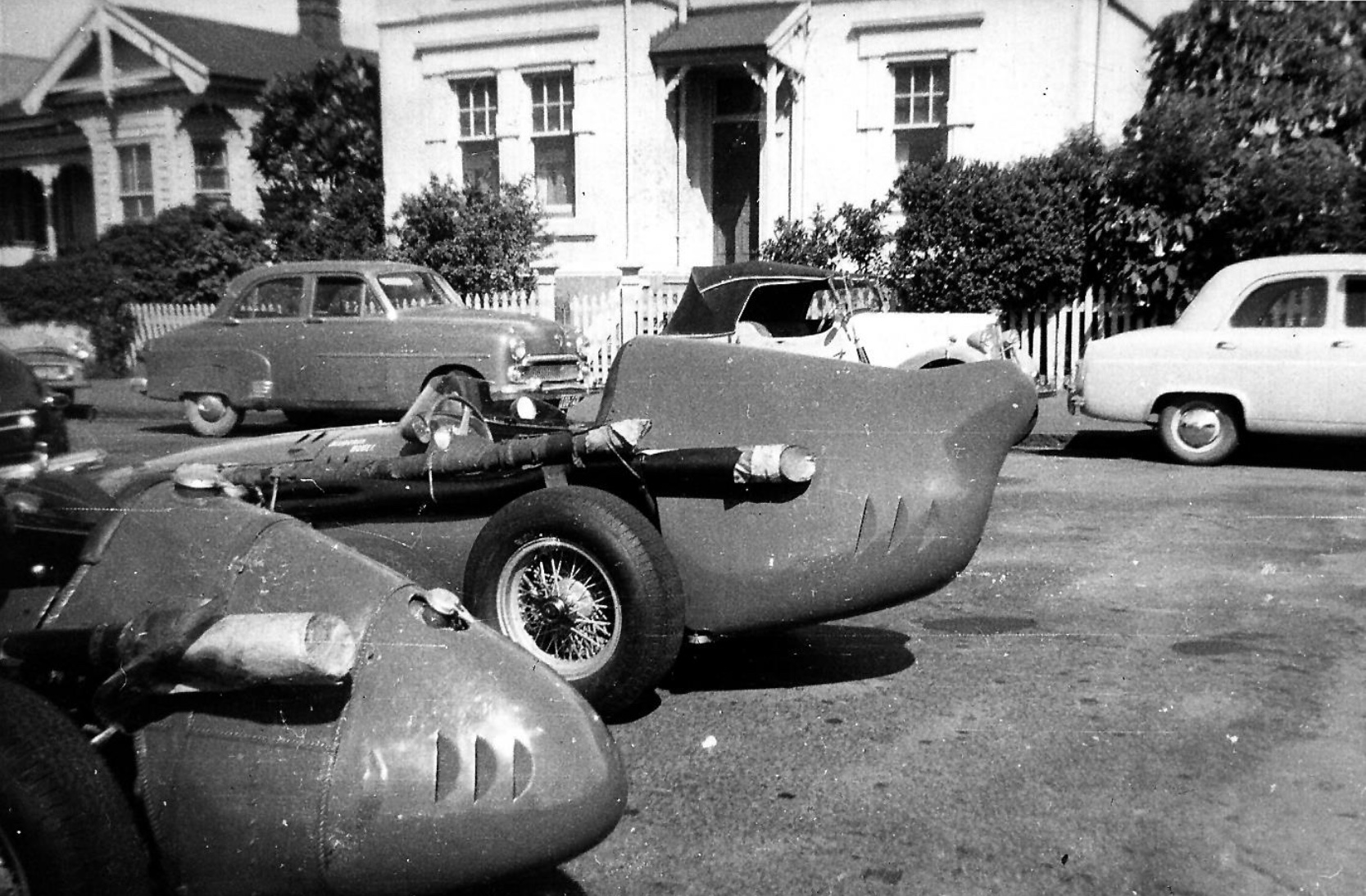
The Ardmore line up of Maserati 250Fs in January 1959 would have done justice to a European Grand Epreuve of two years before. They weren’t the duck’s-guts there in 1959 but were still competitive in Australasia for twelve months or so.
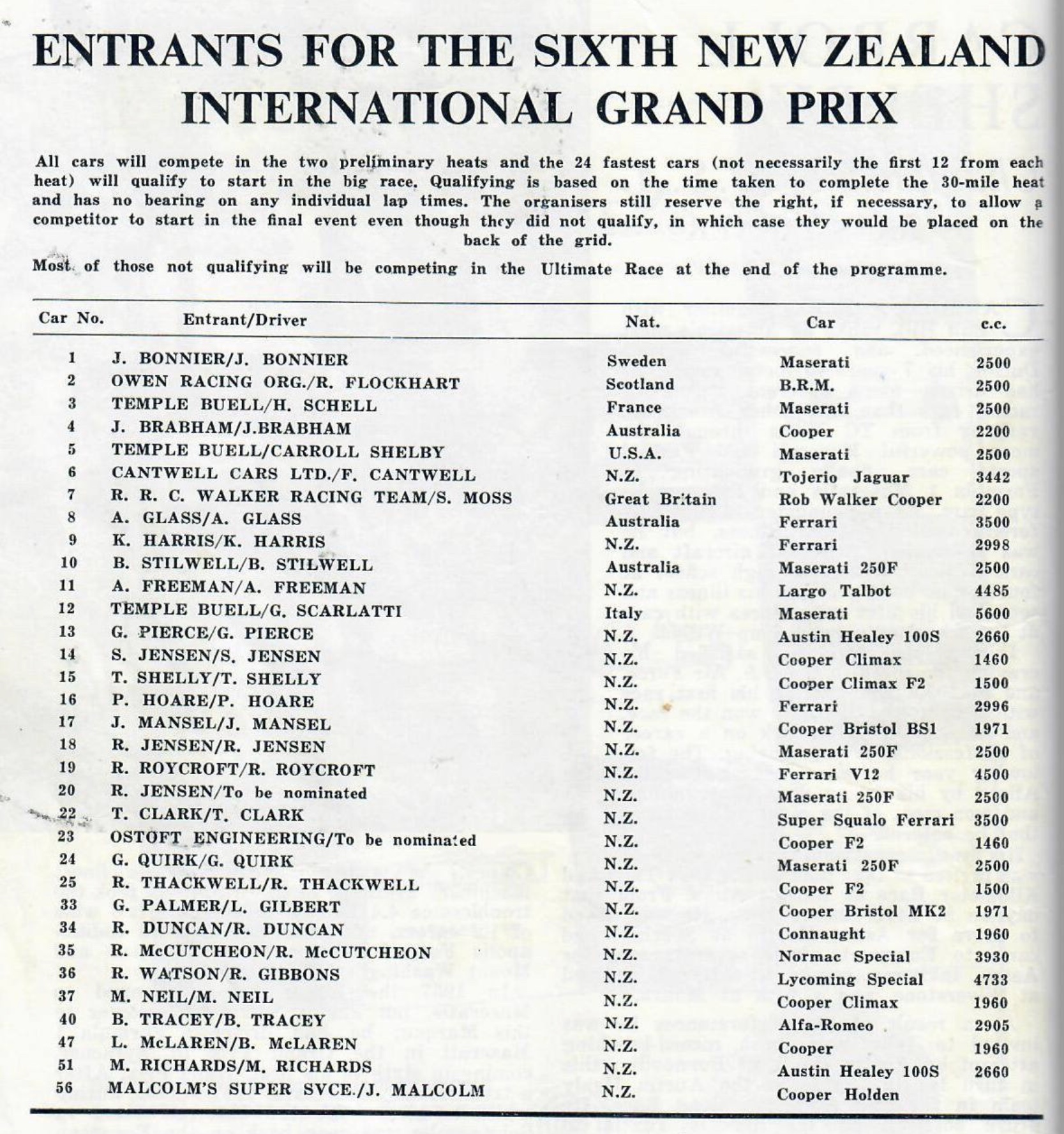
From the left it’s Jo Bonnier #2529, Carroll Shelby #2534, Harry Schell #2533 and Bib Stillwell #2516. Three other 250Fs were entered that weekend: Ross Jensen #2509/2504, Gavin Quirk #2504/2509, and Johnny Mansel #2508/2513.
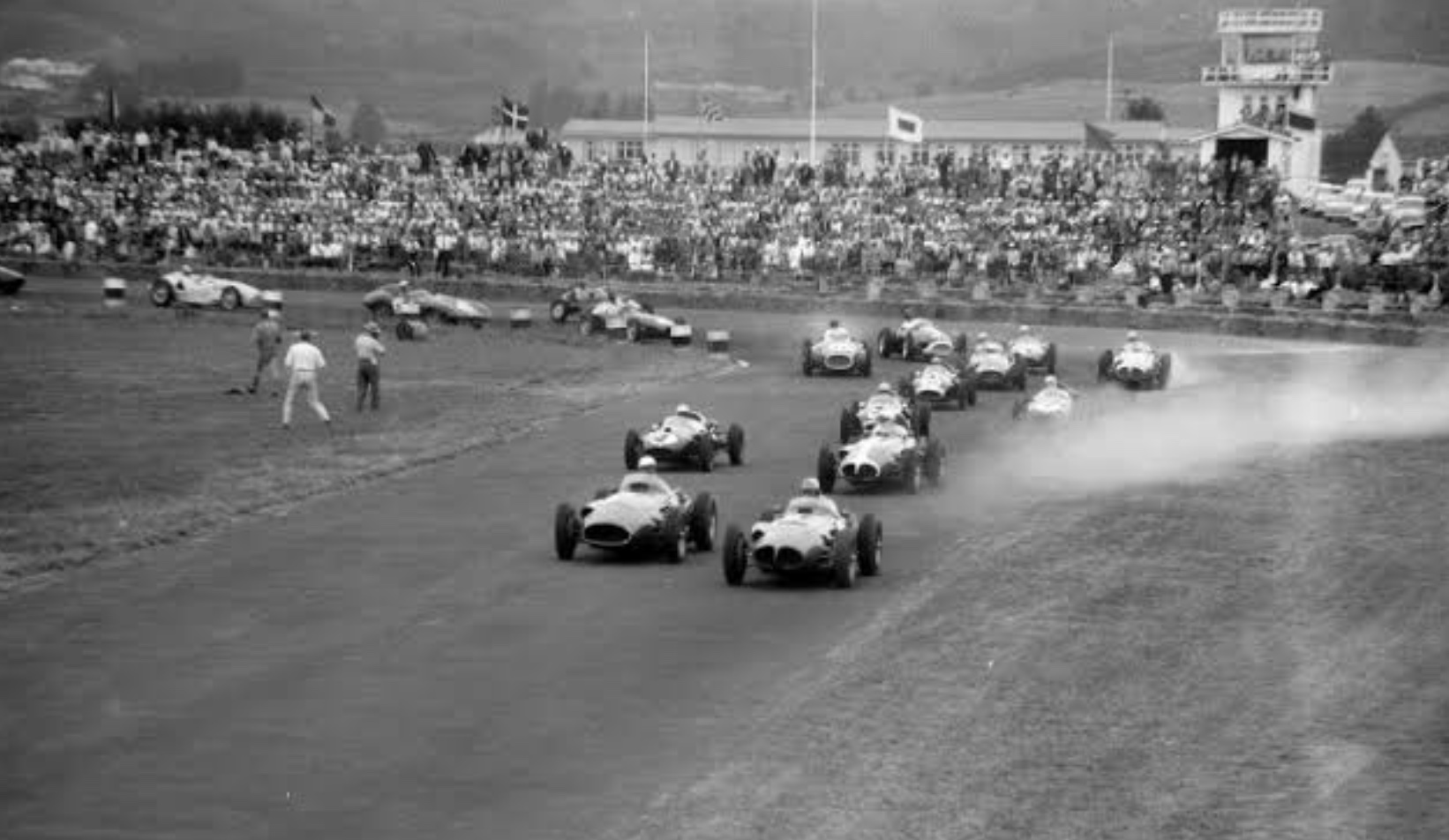
The Maserati 250Fs are away well at the start of the race, Harry Schell leads from Jo Bonnier, Carroll Shelby and then #4 Jack Brabham’s Cooper T45 Climax from Stirling Moss #7 and Bruce McLaren #47 similar cars. Then comes Merv Neil, Cooper T43 Climax, Ross Jenson, right and Bib Stillwell centre in 250Fs. Tom Clark’s Ferrari Super Squalo #22 then Syd Jensen’s Cooper #14 and John Mansel Maserati 250F.Approaching the corner Pat Hoare, Ferrari, Len Gilbert- partially obscured in a Cooper Bristol, Ken Harris in his sports Ferrari Monza #9 and Allen Freeman’s Talbot Lago T26C
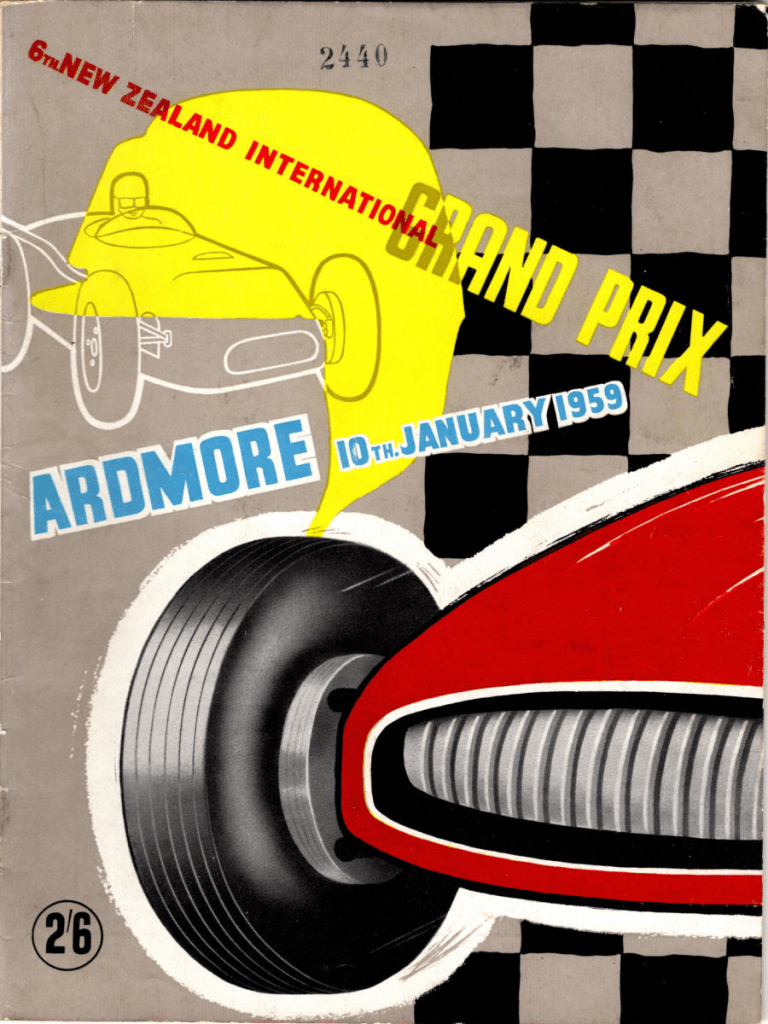
The January 10, 1959 Ardmore grid was the most impressive to that point in the events history.
Inspiration for this piece was tripping over the opening photographs whilst researching something else and being amazed by the breadth and depth of the field.
This article is a truncated, hot-rodded version of Bruce Sergent’s sergent.com’s coverage of the race. This is a ripper site, my standard Kiwi reference tool, click here for their full account of the race; https://sergent.com.au/motor/1959.html
This amazing grid was due to ‘the barnstorming tour by the NZIGP’s livewire secretary Frank ‘Buzz’ Perkins, who had taken off the previous July, followed the circuits of Europe, and signed up everyone in sight, including the eventual world champion, Mike Hawthorn, whose grim tenacity won him the 1958 crown in the face of the greater brilliance of Moss’ wrote Sergent.
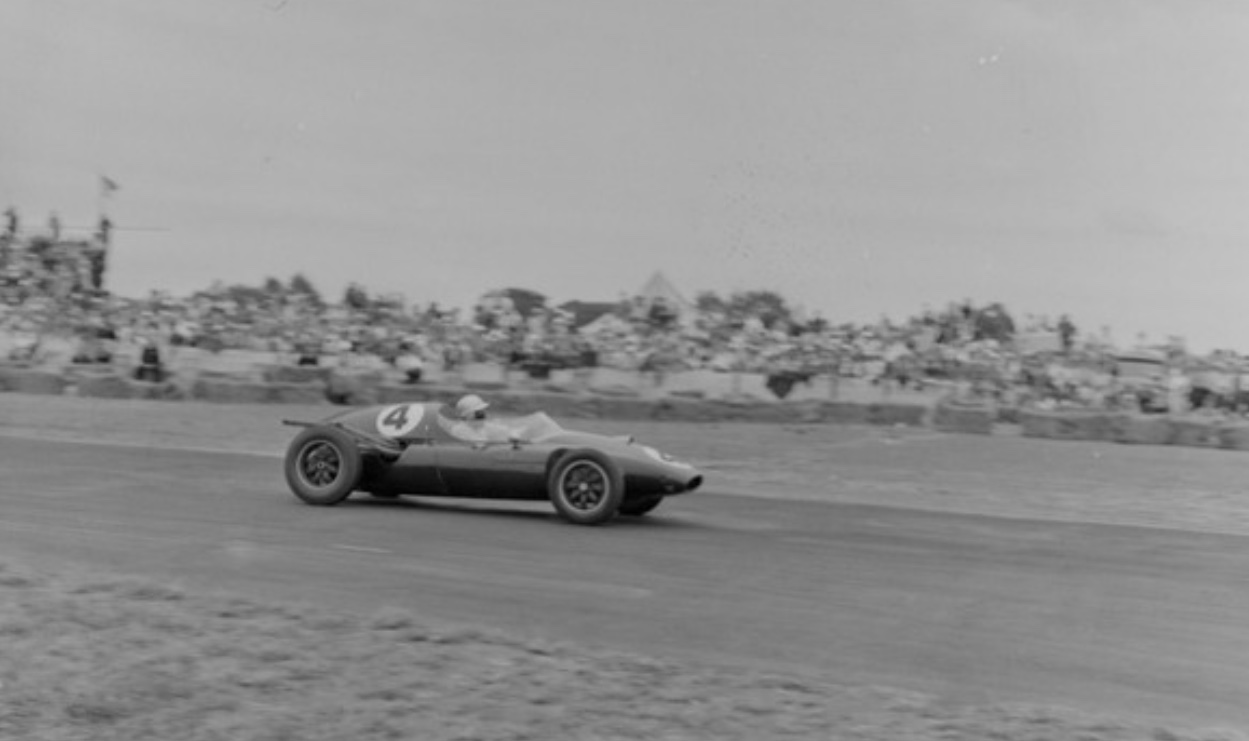
Stirling Moss (above) won the 150 mile Grand Prix in Rob Walker’s Cooper T45 Climax FPF 2015cc. Jack Brabham, the previous years winner, was second and Bruce McLaren third, both also in T45 Coopers (2.2 and 2-litre FPFs respectively). Then came a trio of Maserati 250Fs raced by Carroll Shelby, Ross Jensen and Bib Stillwell.
‘Hawthorn won his championship and retired from racing. The New Zealand Grand Prix was run on January 10, and on January 19 Hawthorn met his death when his Jaguar, travelling at over 80mph, skidded on a greasy main highway south of London. Had he come to New Zealand he might still have been alive.’
The dangers of motor racing were ever present at the time, Sergent observed, ‘There were some old faces missing from the 1959 entry. Stewart Lewis-Evans had been killed at Casablanca, Archie Scott-Brown died at Spa and Peter Whitehead had been fatally injured as a passenger in the Tour de France.’
Brabham and McLaren’s works Coopers were powered by Coventry Climax FPFs of 2200cc and 1960cc respectively, 2.5 litre variants would be available to the duo in F1 Championship events that year. Ron Flockhart raced a front-engined BRM Type 25, the Owen Racing Organisation returning to NZ for the first time of many, since 1954.
‘All sorts of rumours were current as to the might of the Maserati entry. By this time, the Modena factory was kept going only with the support of American finance and oil millionaire Temple Buell, who had in effect taken over the racing management of Maserati.’
‘The cars, to be driven by Harry Schell and colourful Texan Carroll Shelby…were rumoured to be the latest “Piccolo” design – the ultra-lightweight model under development at the time Fangio left racing – and one of them was to have a motor with the new desmodromic valve gear, operated mechanically instead of by return springs.’
Photographer Garth Taylor, ‘The Buell cars have just been taken off the ship and were being “unwrapped” at Ross Jensen Motors in Remuera Road, Auckland’ (G Taylor)(G Taylor)
‘Travelling in company with the Buell stable, but as an independent, was wealthy Swedish driver Joakim Bonnier, with the prototype lightweight which had been driven by Fangio, and finally, also under the Maserati banner, was Ross Jensen, in a car built round the frame of the Bira race-winner of 1955, but with the latest motor and transmission, giving the low, offset driving position.’
‘And finally, the great Guerino Bertocchi, famous old-time racing drover and Maserati’s chief tester, was to be on the spot to supervise preparation and running of the Buell cars’.
In addition to the overseas visitors there was a strong local entry plus several Australian’s who made the trip ‘across the ditch.’
Tom Clark entered his Ferrari Super-Squalo with Arnold Glass who came over from Sydney with the sister-car, ‘right up to scratch after a refit at Maranello, getting a new 625/555 motor in the process’. Pat Hoare’s 625 rounded out the Ferrari entry.
Syd Jensen had returned from a successful European tour with his Cooper T45 fitted with a F2 1500cc FPF. Other local Coopers included Merv Neil, who had raced in Europe and returned home via Australia for a couple of races, with a new 2-litre FPF for his Cooper T45. Ray Thackwell also returned from the UK with a T43 powered by a 1.5 FPF whilst Tony Shelly’s Cooper was the single-cam T41 model.
Allan Freeman, Talbot Lago T26C (unattributed)(NatLib)
Johnny Mansel (above) acquired Ross Jensen’s ex-Moss 250F, Bib Stillwell had a similar ex-Hunt Maserati 250F fitted with disc brakes, Gavin Quirk also entered his 250F, while Ron Roycroft entered his Ferrari 375.
Jack Malcolm’s Cooper Holden, Len Gilbert’s ex-George Palmer Cooper-Bristol were also entered. Allan Freeman raced his Lago-Talbot T26C, Ron Duncan his Connaught and Brian Tracey the ex-Moore/Roycroft/Mansel Alfa Romeo Tipo-B, both cars now very long in the tooth.
‘Specials’ included Watson’s Lycoming with Bob Gibbons at the wheel. The Normac Special, driven by Reg McCutcheon failed to qualify. Frank Cantwell (Tojeiro-Jaguar 3442cc) was the leading sports-car with Ken Harris (Monza Ferrari) and the Austin-Healeys of Graham Pierce and Max Richards also entered.
Len Gilbert’s swoopily-bodied Cooper T23 Bristol (NatLib)(NatLib)
Moss’ Cooper T45 (above) was the same chassis in which he won the 1958 Formula Libre Melbourne Grand Prix at Albert Park on 30 November, the very last meeting at the venue until the modern era. Moss won that 100 mile race from Jack’s Cooper T45 and Doug Whiteford’s Maserati 300S.
It was fitted with an Alf Francis built 2-litre Climax FPF, not the normal engine of 1964cc, one with an Alf Francis specification crank which increased the stroke to give 2015cc. The engine was very hot and bothered by the end of the stifling Albert Park weekend but was made good in time for Ardmore.
‘On arrival, the bunch of Maseratis proved slightly disappointing. The Bonnier car had raced in the first United States Grand Prix at Watkins Glen and was not in the happiest condition, and neither of the Buell cars had the expected desmodromic valve system. They were, however, right up to the mark in other respects, the one to be driven by Shelby having a very high tail, similar to the Vanwall and quite unlike the traditional Maserati line.’
Ron Flockhart on the way to winning the Lady Wigram Trophy that summer from pole, BRM Type 25 (unattributed)Flockhart’s BRM was allocated #2 in the NZ GP programme, but raced with #12 (unattributed)
Ron Flockhart was out early in his Type 25 BRM doing a time of 1m 23.6s, or 86.7 mph, over two seconds faster than Ross Jensen’s 1m 26s in the ex-Moss Maserati during the ‘Little Ardmore’ meeting after the last NZ GP.
Moss first appeared in official practice, his Cooper doing 1m 23s, Brabham was a second slower, Flockhart on 1.24.5, McLaren 1.26.2, Ross Jensen 1.26.3 and Harry Schell 1.26.4. ‘Five thousand unexpected visitors turned up to see the practice, despite official warnings to keep away from the (airfield) course.’
In the afternoon Moss did ‘1.21.5, a time which caught organisers napping by being right off the official time-to-speed conversion chart. This was 5 seconds better than Jensen’s record. Moss’ driving in practice could only be described as fantastic, and no-one who was there will ever forget the sight of the Cooper coming out of the left-hander into Pit Straight, travelling at well over 100 mph and literally bucking with the acceleration, while Moss coolly kept the car in line.’
Whilst all was calm in the RRC Walker camp ‘…those of the Maserati establishment were not so happy. The ebullient Schell and Bertocchi were not in agreement over tactics, though all the drivers and Bertocchi were unhappy over the braking situation. Even in practice, Shelby’s car was suffering from grabbing brakes, though both machines were going well otherwise. It was eventually decided to run the cars without a full complement of fuel, risking a pit stop in an effort to lighten the load on the braking systems.’
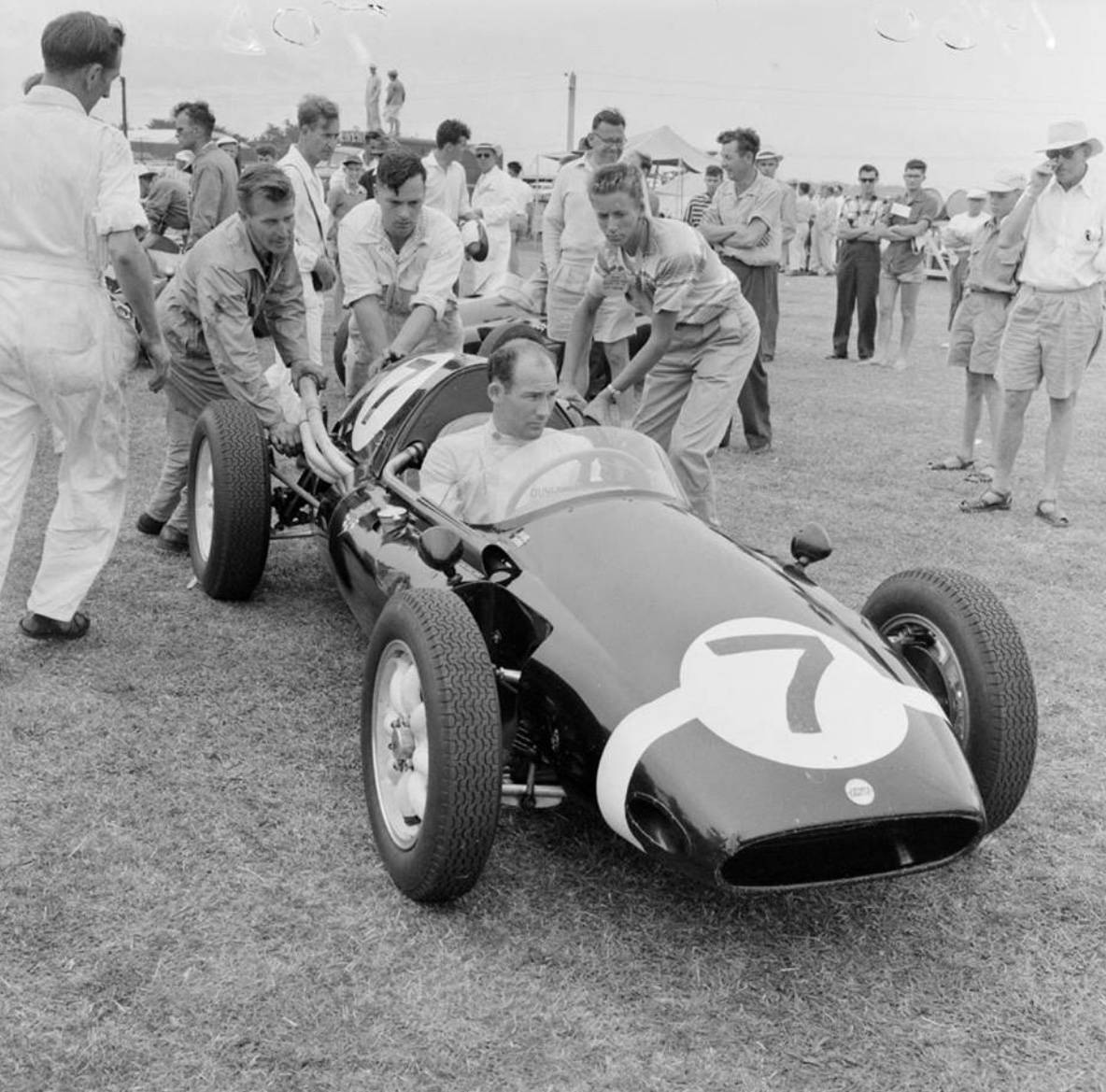
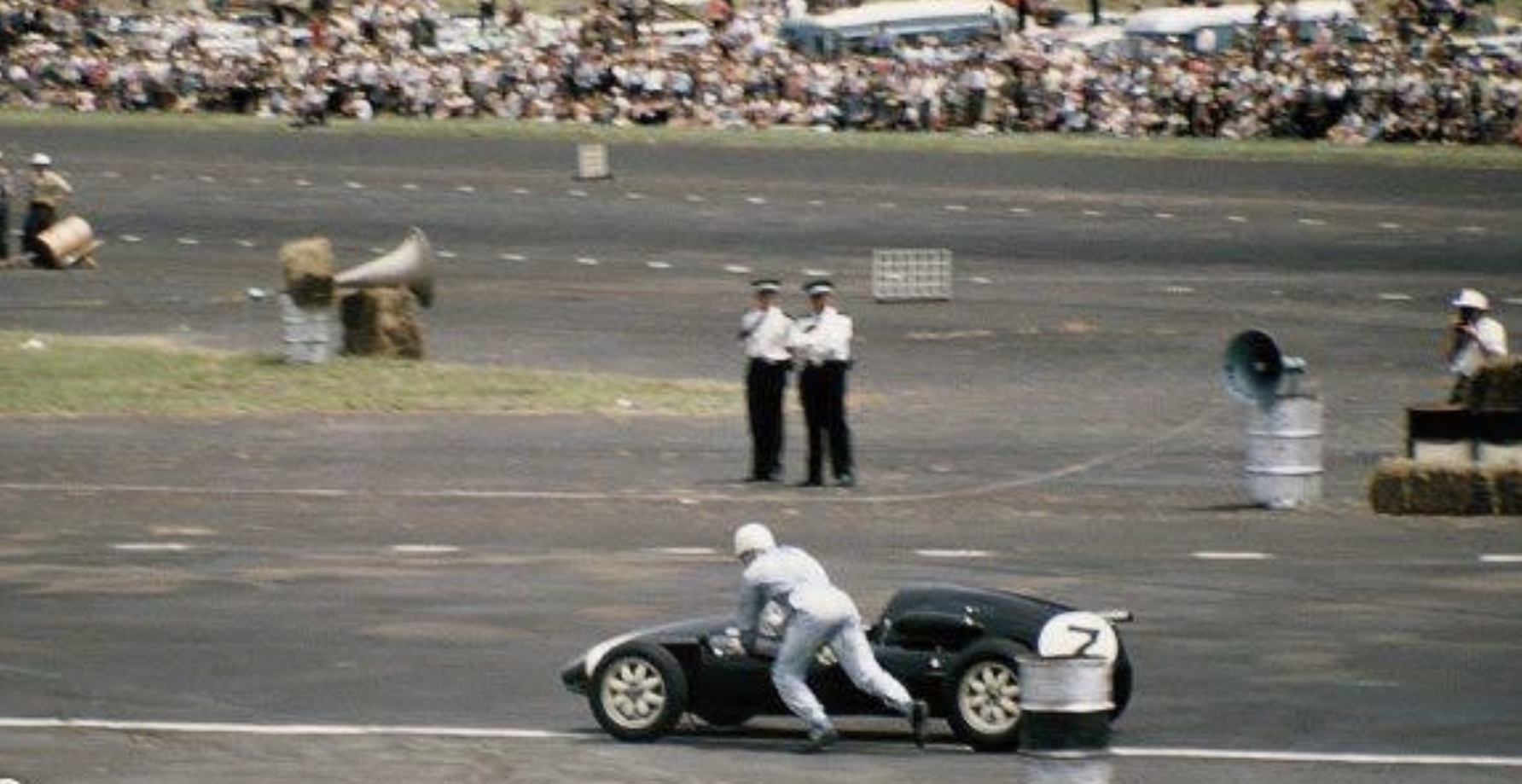
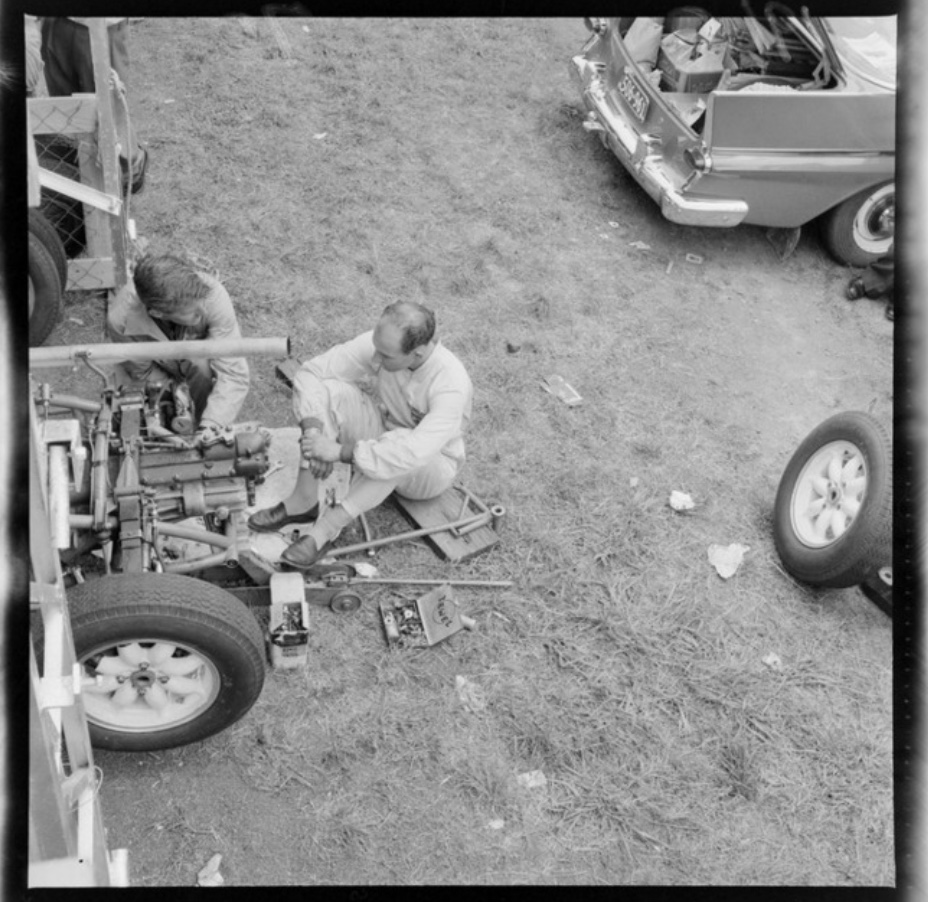
Moss pushes his Cooper after braking a rear driveshaft, said item being repaired in the shot below (NatLib)
Heats and the Grand Prix…
The excitement of raceday started early for young Maserati enthusiast, David Williamson, ‘We were heading to the racetrack at Ardmore. As we pottered along in my mate’s Morris 8, suddenly we were almost blown off the road when Guerino Bertocchi wailed past at twice our speed in the 250F Maserati Piccolo, his cap on backwards, smiling as he cut through the early morning traffic!’
At the circuit, much to the crowd’s disappointment, Moss broke a halfshaft. Brabham had a spare Cooper and, without hesitation, offered the part to the Moss crew, who set to work to replace the part.
Brabham won the first heat in 21m 48s, with a fastest lap of 1.25.8 (84 mph), ahead of McLaren, Bonnier, Schell and Stillwell, indicating that the Maseratis were going to be outclassed by the Coopers from the outset. Bob Gibbons, who actually led for some time, was sixth in the Lycoming.
Ron Flockhart conceded the lead to Moss in the early stages of the second heat and won the race in his BRM Type 25 upon Moss’ retirement. He was followed by Shelby, Ross Jensen, Syd Jensen and Mansel. Race time was 21m 40s, and the fastest lap 1.24.2 (85.2 mph) was shared by Moss and Flockhart.
Pole position on the grid was Flockhart’s, followed by Brabham, McLaren, Bonnier, Schell, Shelby, Ross Jensen, Stillwell, Gibbons, Syd Jensen, Mansel, Clark, Hoare, Neil, Thackwell, Glass, Quirk, Harris, Gilbert, Freeman, Moss and Shelly.
The start was a shattering affair in more ways than one.
‘The Minister of Transport, the Hon. J. Mathison, added prestige but not skill to the occasion, and the field got away after a misunderstanding which left Flockhart stalled on the line, to be pushed away, the length of Pit Straight behind the remainder of the field.’
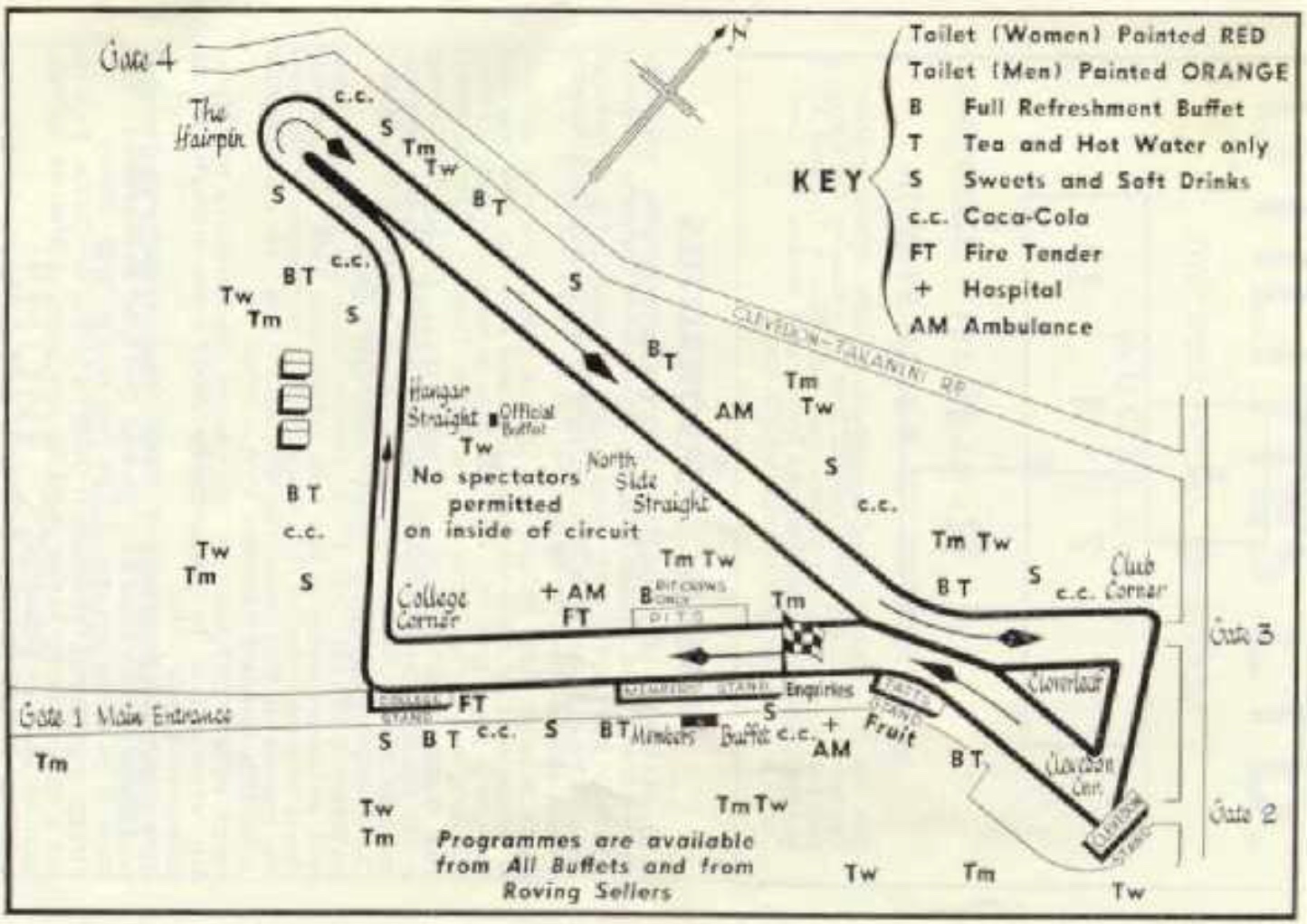
Moss carved through the field from the back of the grid, he was sixth by the time the cars reached the end of the straight and turned into College Corner.
Brabham, Cooper T45 (NatLib)Harry Schell (unattributed)
The three ‘team’ Maseratis led from the start, Harry Schell was fast away from the second row to tail Bonnier from Shelby, Brabham, McLaren, Moss, Neil and Stillwell.
Along the back straight, having by then overtaken all but Schell, Bonnier and Brabham,Moss jumped Brabham, but was in turn overtaken by Jack going into the Cloverleaf.
‘By a display of his driving at its most superb, Moss cut out three of the world’s best drivers in a matter of half a mile, roaring into Pit Straight in the lead at the end of the first lap, an astounding piece of driving.’
He was followed by Bonnier, Schell and Brabham, with Shelby a wheel’s distance ahead of McLaren and Stillwell. By lap four Moss had surged away to a 60-yard lead from Brabham’s Cooper T45 with the Schell, Bonnier and Shelby Maseratis and McLaren on his tail. The rest were Ross Jensen, Stillwell, Clark, Neil, Mansel and Syd Jensen.
The BRM had meanwhile been making up lost ground spectacularly, by the sixth lap Flockhart had come up to fourth place, following a spin by McLaren, which had dropped him back to eighth. There ensued a battle royal between Jensen, Maserati 250F who challenged Flockhart’s BRM for the position, a contest which lasted until lap 14.
Bonnier retired on lap 5, a fuel leak forcing a visit to the pits, after two laps he returned and worked up to 10th position, finally retiring on lap 41 with a steering problem.
At the end of 19 laps, Moss had lapped all but six of the field, was 35 seconds ahead of Brabham and on the way to lapping Schell. Flockhart had moved up to third place, Jensen was fourth, and Shelby and McLaren were disputing fifth position, a duel which ended on the 20th lap when McLaren pipped the high-tailed Maserati on the Cloverleaf.
Two consistent drivers were Stillwell and Syd Jensen, who retained their Maserati 250F places next over the first 20 laps as the leaders fought it out, and behind them came the bright red Super Squalo driven by Clark.
Moss was a half-lap ahead of Brabham by lap 22, whist Flockhart, who had clocked 144 mph in the speedy BRM along the back straight, was making ground on Brabham’s Cooper.
‘Hard on Jensen’s heels (he was lying third) came McLaren and Shelby, the trio holding station together for a number of laps. Next came Schell in the other and faster Buell Maserati, but oil fumes were rising from it and the motor was missing.’
On the next lap round, Jensen was in third place and Flockhart missing. A minute later, he coasted into the pits. The bonnet was lifted, and a mechanic threw a pipe into the pits in disgust; it was the oil breather, which had come adrift and allowed oil to spurt out on to the rear tyres. So ended yet another BRM bid for the New Zealand Grand Prix.
‘After two more laps, during which Moss put in his fastest lap, one of 1m 24.8s (85 mph), and reached 152mph on the back straight, Moss had lengthened his lead to a lap. He and Brabham both lapped a very groggy Schell, who came into the pits, overcome by fumes from oil leaking through a loosened cylinder head stud onto the red-hot exhaust manifold.’
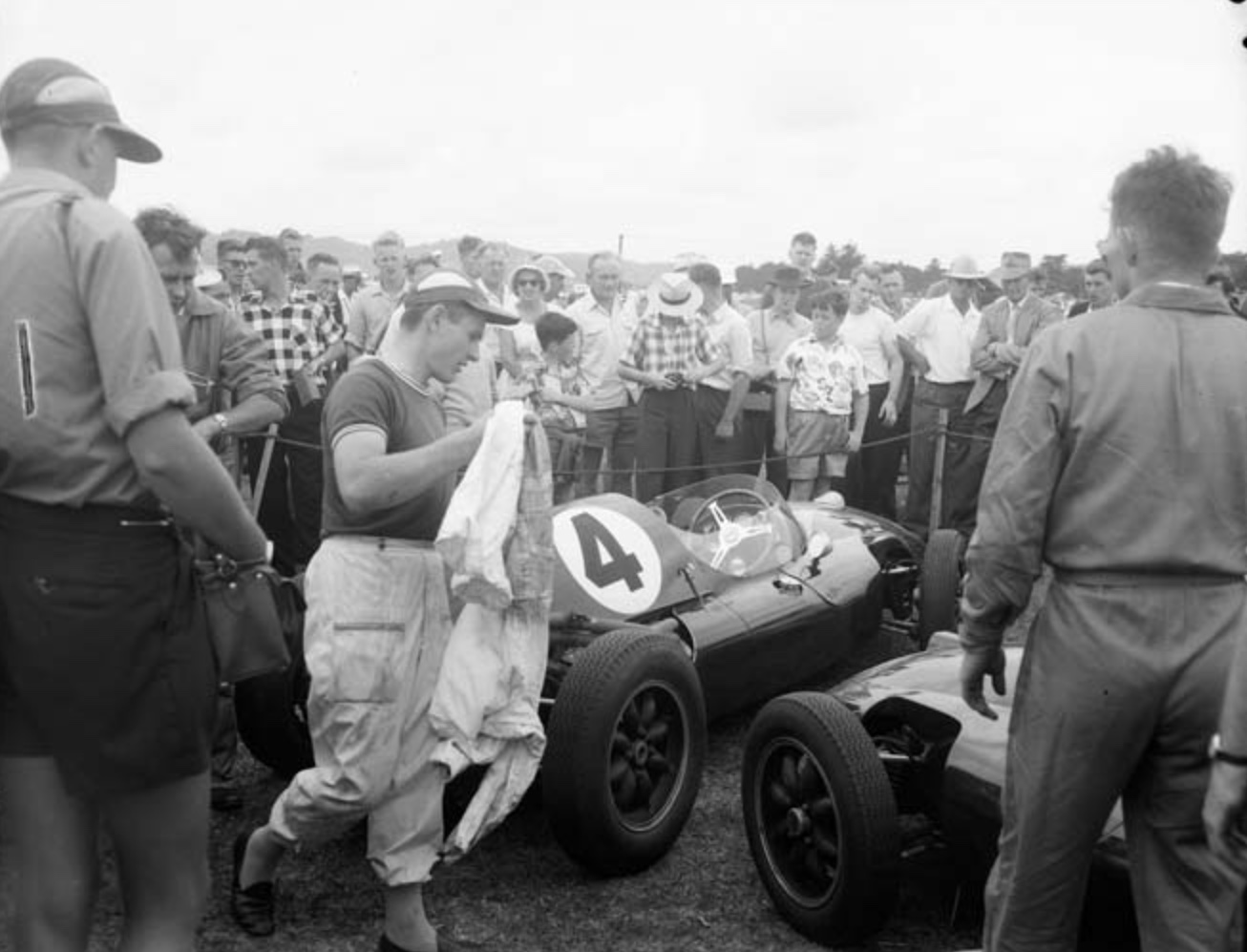
Bruce McLaren, Cooper T45 Climax (NatLib)Bruce McLaren approaches his Cooper T45, #4 is Jack’s car (NatLib)
This left the two Coopers out in front, Jensen and McLaren having a private dogfight with Shelby over the next three positions. At half-way, the position was the same with the rest of the positions filled by Stillwell, Syd Jensen, Gibbons, Neil, Clark and Mansel.
At this stage, it looked as though McLaren was going smoothly, with Jensen in much the same vein, both having a slight edge on Shelby. But the spectators were not to know that McLaren was changing gears with his glove torn to tatters and the skin already working off the palm of his hand, after losing the knob of the gear-lever on his early spin.
Jensen’s car was beginning to show signs of clutch trouble which was to slow him for the duration, towards the finish the car was clutchless and Jensen was making his changes on engine note.
Shelby was in trouble, for although he took Jensen and McLaren for third position, with the white-streaked, high-tailed Maserati sounding healthy, he was suffering from agonising cramp in one leg – and his brakes were beginning to fade.
Finally he stopped at the pits on lap 41, hopping around on one leg while Harry Schell leapt into the car and set off after the leaders. Driving furiously, he pulled himself up into fifth place behind Jensen by the 51st lap, and in the meantime McLaren had finally established a lead over the low, light-blue Jensen Maserati, to be now third.
Carroll Shelby, Le Mans winner together with Roy Salvadori before the year was out, Aston Martin DBR1/300 (NatLib)
Moss was going great guns, and Brabham’s only hope was that the other halfshaft would break, or some other failure. McLaren sat equally patiently in third place, but Jensen began to lose ground to Schell from lap 55 onwards, the motor misfiring with plug trouble.
Jensen’s clutch deteriorated and his motor sickened, Schell reeled him in rapidly, going past on the back straight on lap 63. The leading group was so far ahead of the rest, headed by Bib Stillwell and Syd Jensen in the little Formula II Cooper, that Jensen was still able to run on into fifth position, despite a spin on the second last lap.
Schell’s bid to put the Maserati further up the field failed, both because of Moss’ pace and also through the complete failure of the drum brakes – the linings of the rear brakes had been welded to the drum castings by heat – torn clean off the shoes with only Schell’s experience carrying him through.
‘Probably 80,000 people saw the race, a record for any type of sporting event in New Zealand. Moss’ time, 1h 48m 24.4s, an average of 82.8 mph., was over three miles faster than Brabham’s winning drive over exactly the same course the year before, and he put in a lap of 1m 24.8s (85 mph), also a race record, though well outside his remarkable 1.21.5 in practice.’
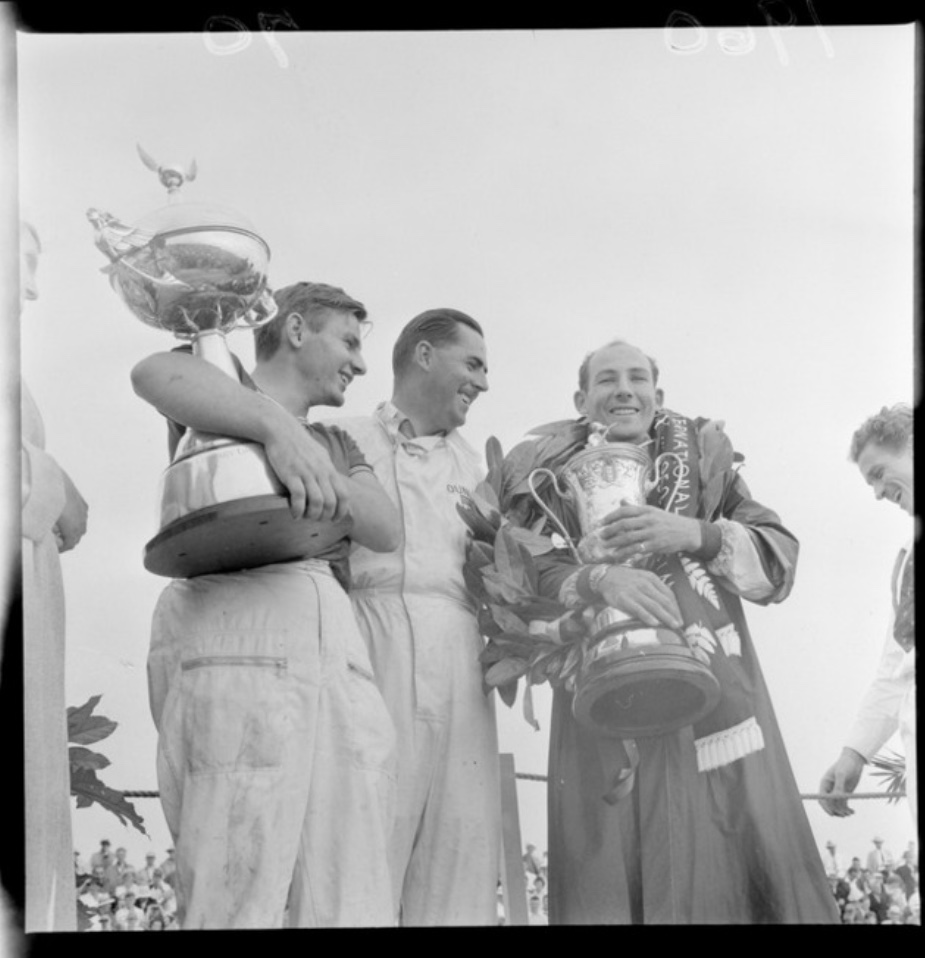
Moss (NatLib)Brabham, Moss, who is holding the trophy? (NatLib)
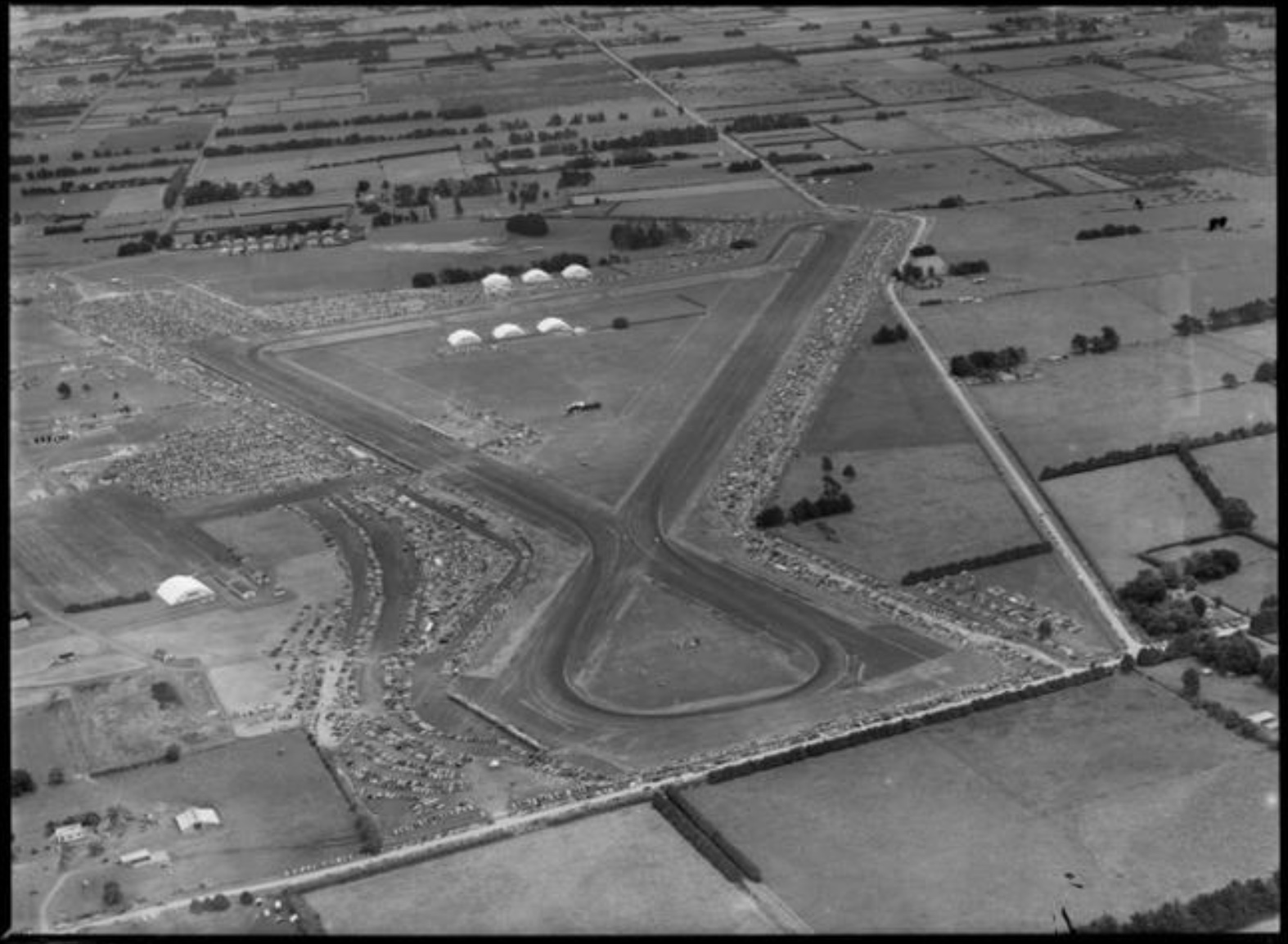
Ardmore was New Zealand’s best known circuit in the 1950s and 1960s, the airfield 30km to Auckland’s south. There was only the one big race meeting of the year otherwise the strip was mainly used by crop-dusters and the Auckland Gliding Club.
Etcetera…
(NatLib)
Bib Stillwell smiling for the camera, although I doubt he would have listed his ex-Hunt Maserati 250F as amongst his favourite machines however much they were the customer 2.5 litre GP car of the era. More of a Cooper and Brabham kinda guy?
#2516 below was the ex-Reg Hunt very successful 1956 season car. Bib popped it on a ship to Modena to freshen and update it. It was a long time before he got it back!
McLaren (NatLib)(NatLib)
Gavin Quirk’s Maserati 250F is the ex-BRM machine soon to shoot Christopher The Great, Chris Amon to prominence under the guidance of Bruce Wilson. Happily, the car is still in NZ.
Dunno, who is it? (NatLib)
Photo and other Credits…
Digital NZ- Alexander Turnbull Library, ‘NaLib’- National Library, Government of NZ, Garth Taylor, David Williamson
Bibliography…
The narrative is a heavily truncated, modified version of Bruce Sergent’s sergent.com race account, any errors are mine
Tailpieces…
Lets check out the new car!…
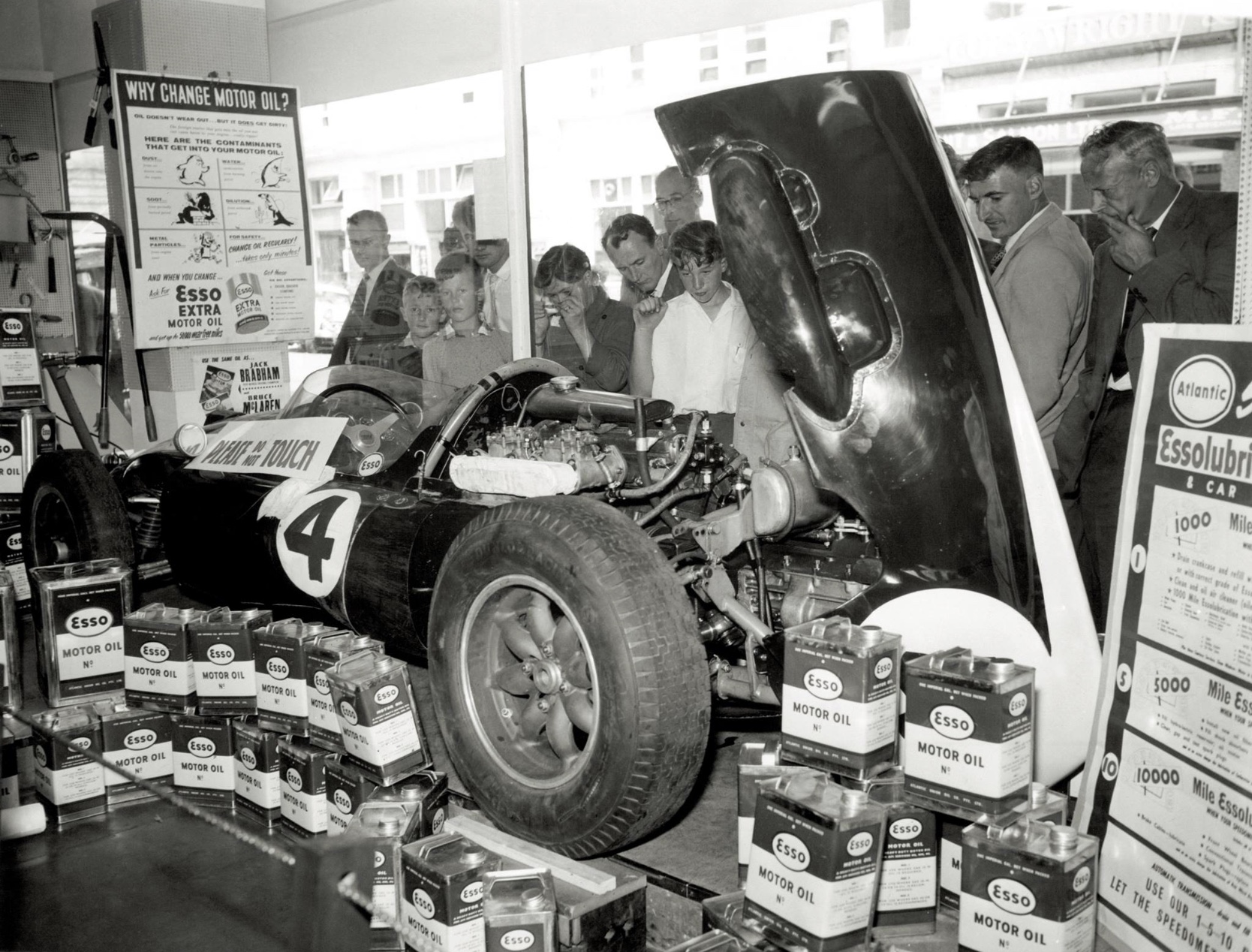
The fans check out the latest Cooper at the McLaren Garage in Remeura before the Ardmore meeting- Brabham’s T45 Climax.









































 primotipo...