


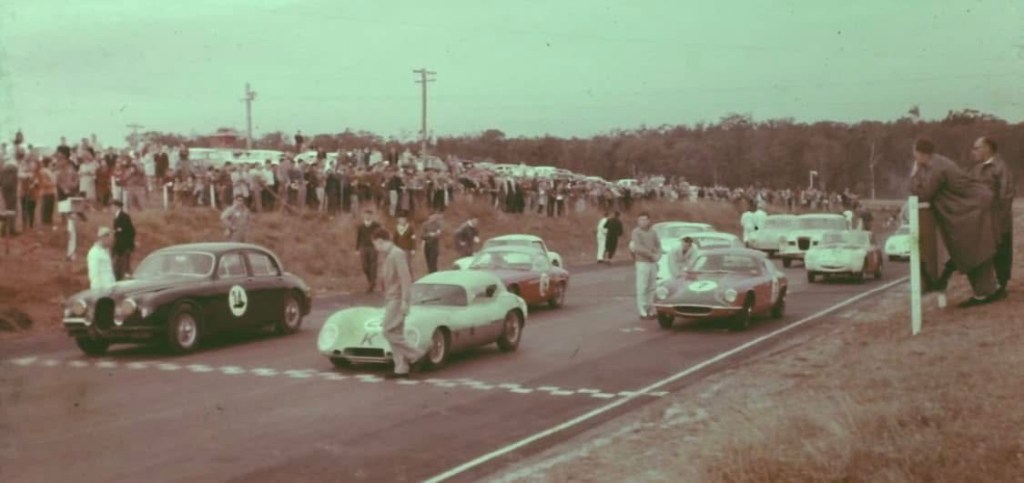
The grid for the Australian GT Championship at Lakeside, Queensland on 8 July 1962…
Bill Pitt, Jaguar 3.4 alongside John French in the Centaur Waggott-Holden, then the two Lotus Elites of Tony Osborne #16 and #7 Brian Foley. On the row behind is #21 Les Howard, Austin Healey Sprite Ford-Cosworth, in the middle is the partially obscured #31 Porsche 356 of Tony Basile and on the left the white #30 Renault Floride of Terry Kratzmann .
The light-coloured Sprite further back is #51 Sib Petralia, #60 Paul Fallu, Karmann Ghia, whilst the #4 Wolseley has long-time competitor Ken Peters at the wheel. The unmistakable outline of the grey Renault Dauphine is #6 M Hunt. Dennis Geary #22 was also entered in the HWM Jaguar – then in two-seat Coupe form but with the very same chassis and mechanicals of the car raced by Lex Davison to win the 1954 Australian Grand Prix – ‘just down the road’ at Southport on the Gold Coast.
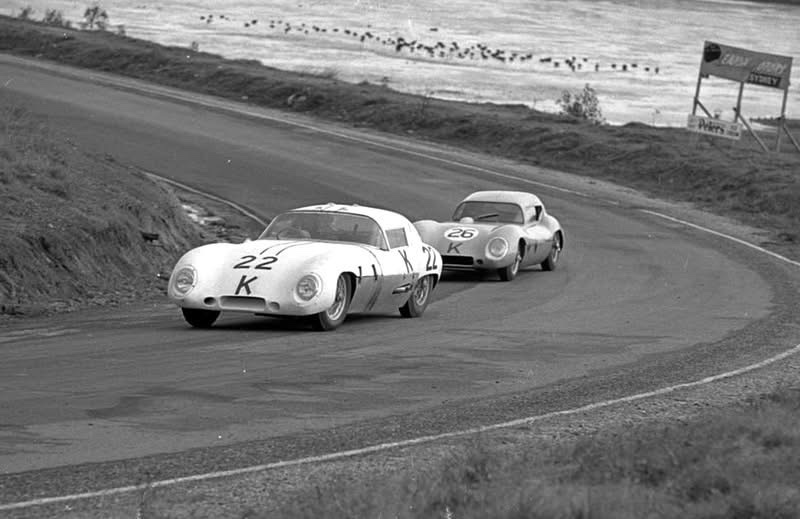
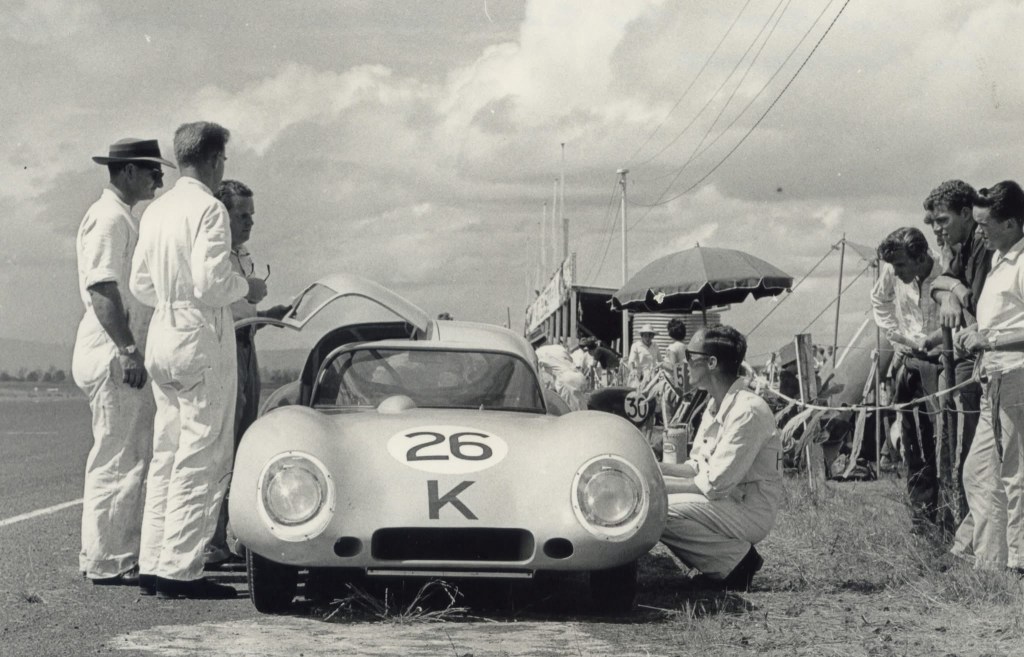
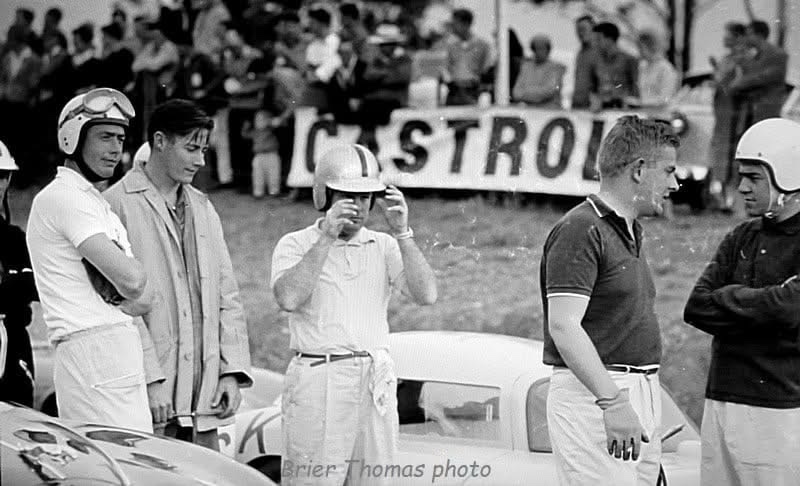
The 50 lap 75 mile race was won in 62:6.06 minutes/seconds by French from Basile, Pitt, Howard then came Foley. Sib Petralia won the under 1-litre class, Basile the 1000-1600cc , French the 1600-2600cc and Pitt the 2600cc class and over.
The race was the third Australian GT Championship for Appendix K cars, the first was held at Bathurst during the October 1960 meeting and was won by Leo Geoghegan’s Lotus Elite, the 1961 event was at Warwick Farm in July, and Frank Matich won in his Jaguar D-Type.
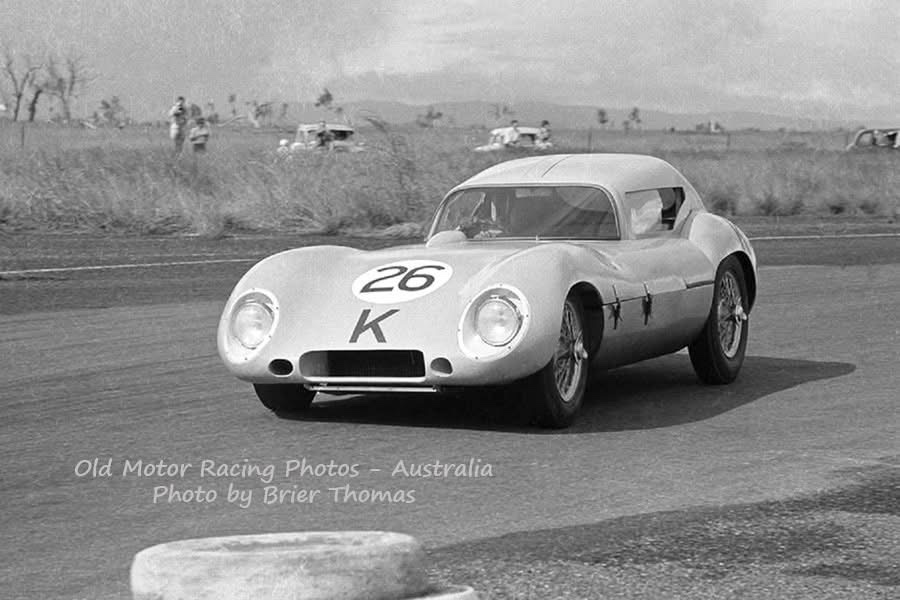
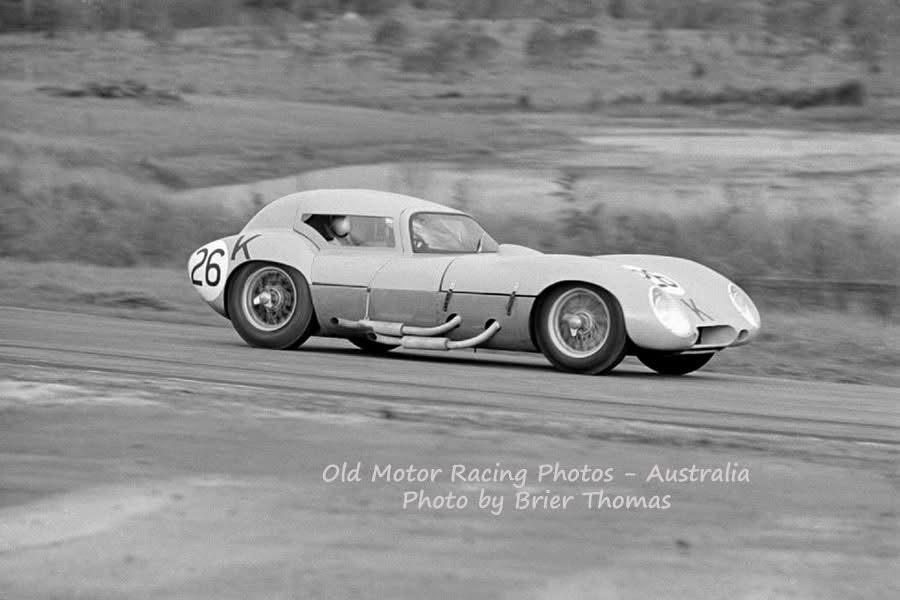
Toowong, Brisbane, University of Queensland Mechanical Engineering graduate Tim Harlock built his first car in four years, from concept to completion, commencing when he was barely out of his teens.
‘I was always mechanically inclined,’ Tim told Mildred Eden in 1962. ‘But beyond toying with a metal building set and making model aeroplanes, I had never before tackled anything of this magnitude.’
Car racing became Tim’s main interest while still at school.
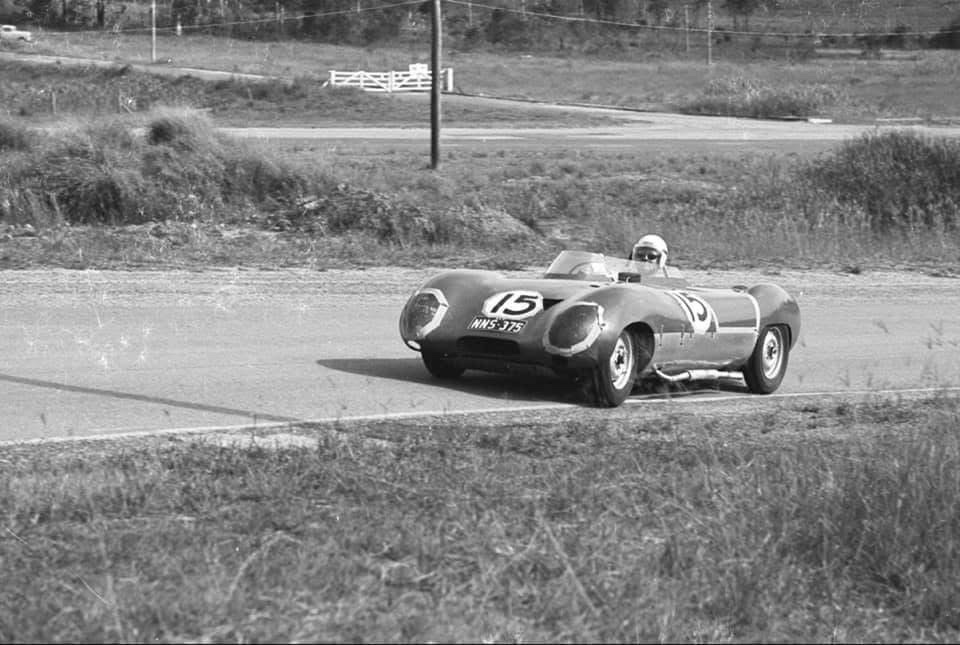
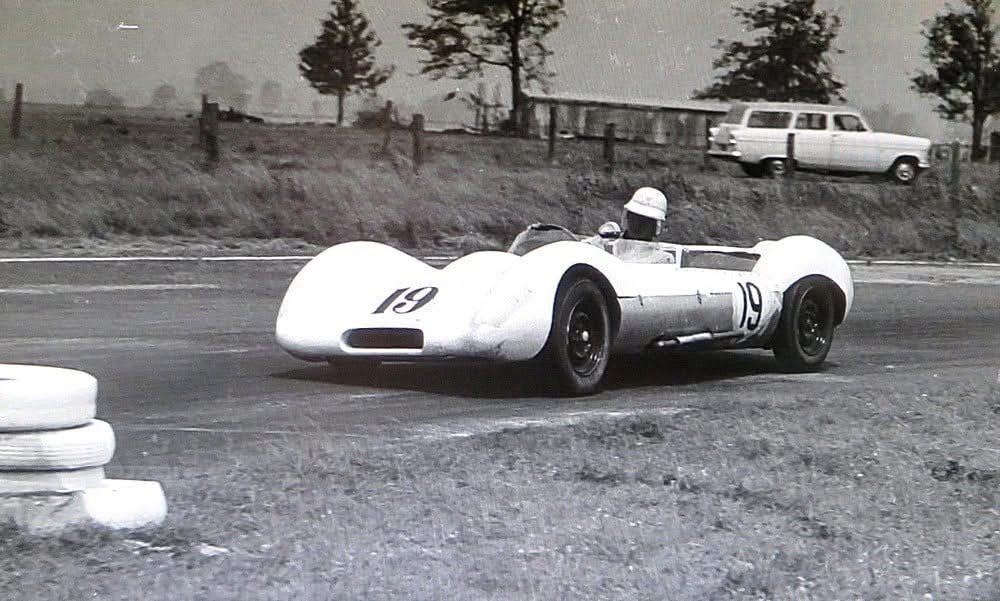
‘I saw my first race about 10 years ago in England, where we lived while my father, a soldier, was stationed over there. It was at Boreham Wood, but I don’t even remember who was racing at thc time. I did not become a real enthusiast until later.” –
He was determined to race himself but couldn’t afford it so he decided to build himself a car. ‘I’d learnt the basic theory in engineering, but all the practical knowledge came from friends with years of racing experience.
‘Wal Anderson, who is a retired racing driver, was a fund of information, and my friend Keith Turner worked with me on the construction. Incidentally, we have built two cars now, one each.’
The chassis of the Centaur/Centaur Mk 1B is a multi-tubular spaceframe, with the front suspension comprising upper and lower wishbones, modified Alford & Alder uprights and coil spring damper units. The rear comprised a well located BMC A-series rear axle diff assembly.
The engine was a Ford 105E 997cc, an Anglia also provided the gearbox, drum brakes were Morris Major 9-inch front and 7-inch rear.
The nose is Lotus 11-esque!, I can read your minds. Tim did a deal with Chas Whatmore after he damaged the nose of his Lotus 11 at Lakeside, Harlock took a mould from that car, the rest of the body aluminium.
Tim and Keith began to race their cars in June 1961. It wasn’t too long before Wal Anderson introduced John French to Tim Harlock, and shortly thereafter, the 1962 Australian Championship-winning Centaur-Waggott project commenced; the championship C-W was the third of 11 Centaur sportscars built.
Centaur Waggott-Holden GT…
Bill Tuckey, one of Australia’s greatest motoring writers of the 1960s-70s, wrote this fantastic article about the car in the September 1962 issue of Sports Car World, easily my favourite Australian mag until its untimely demise in the 1980s.
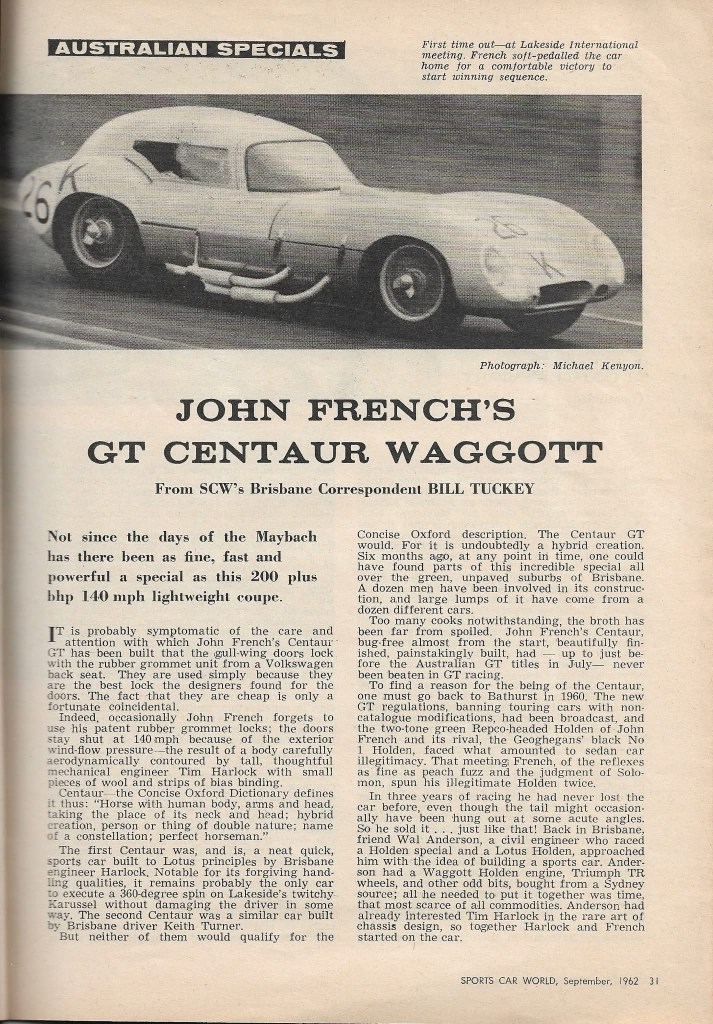
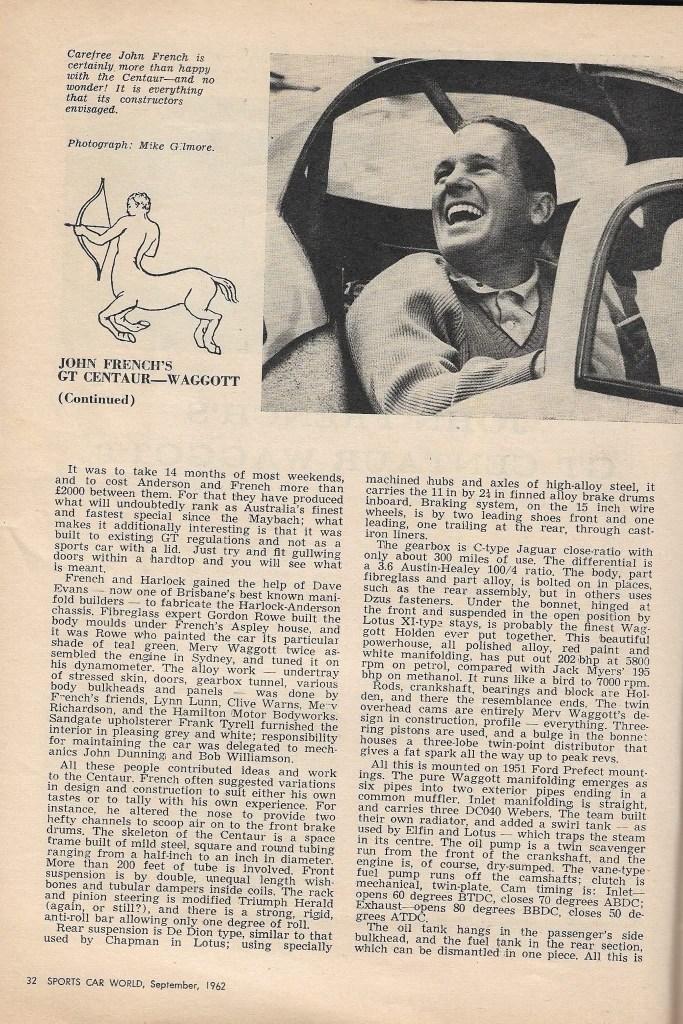
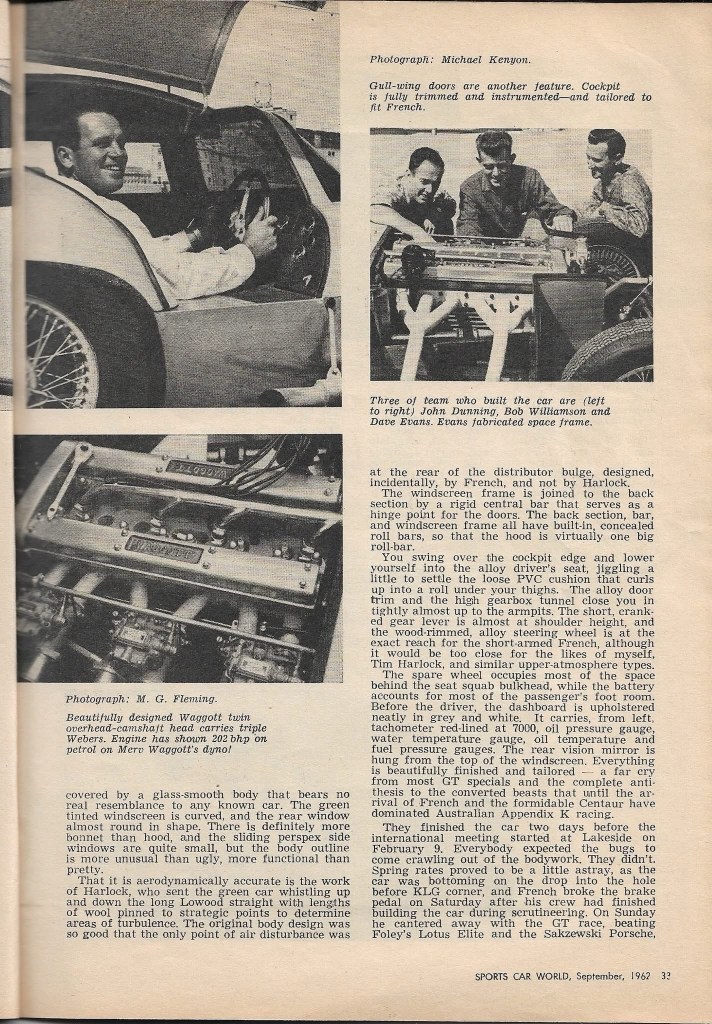
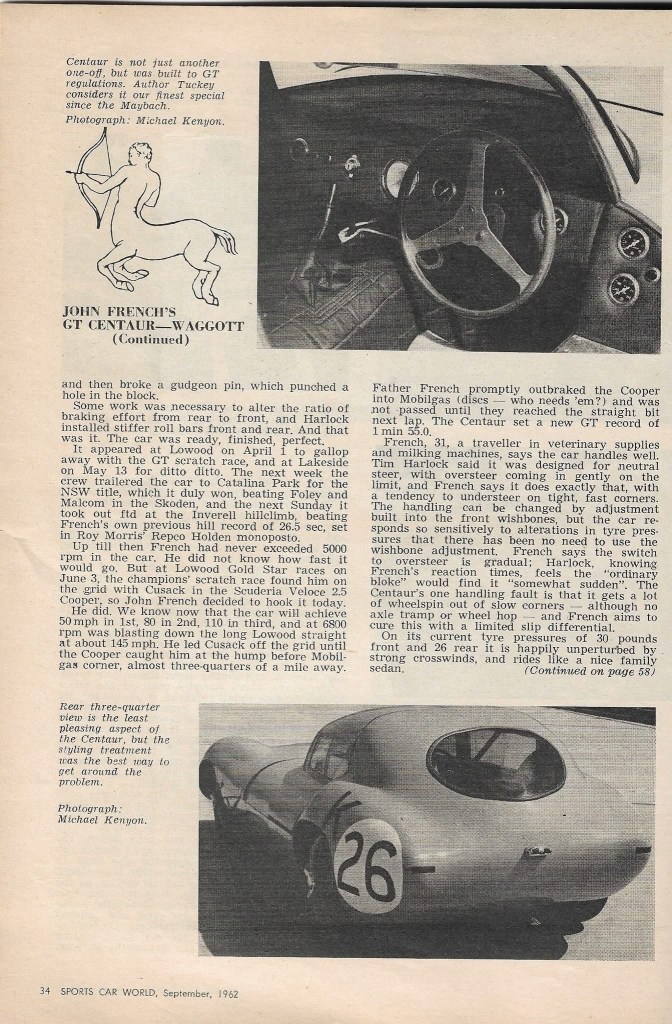
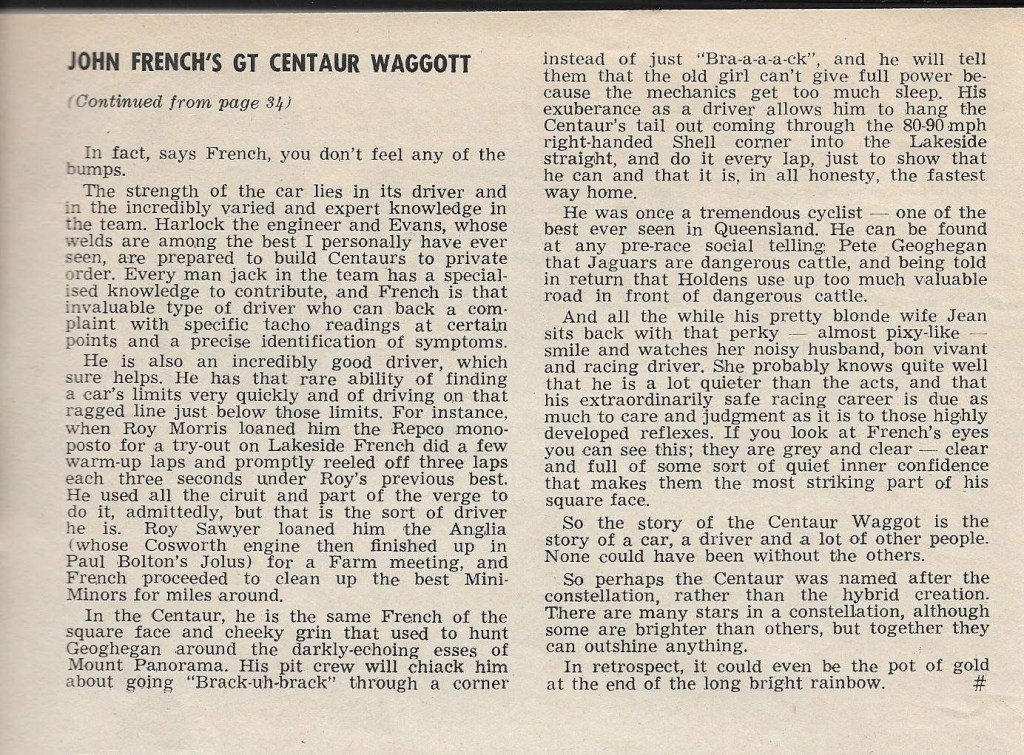
Etcetera…
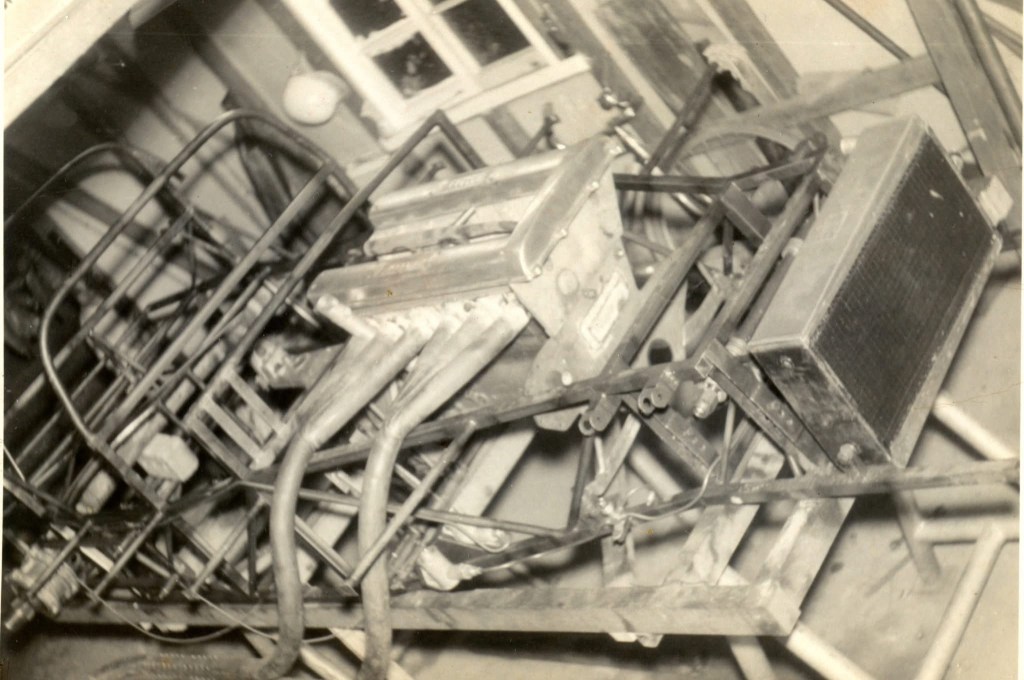
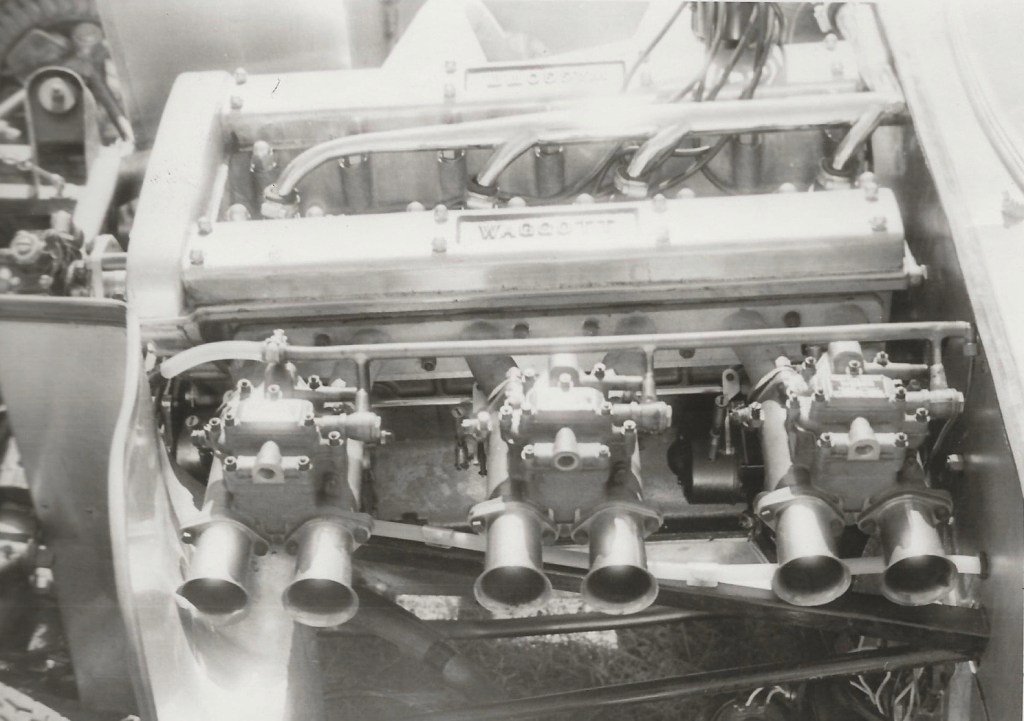
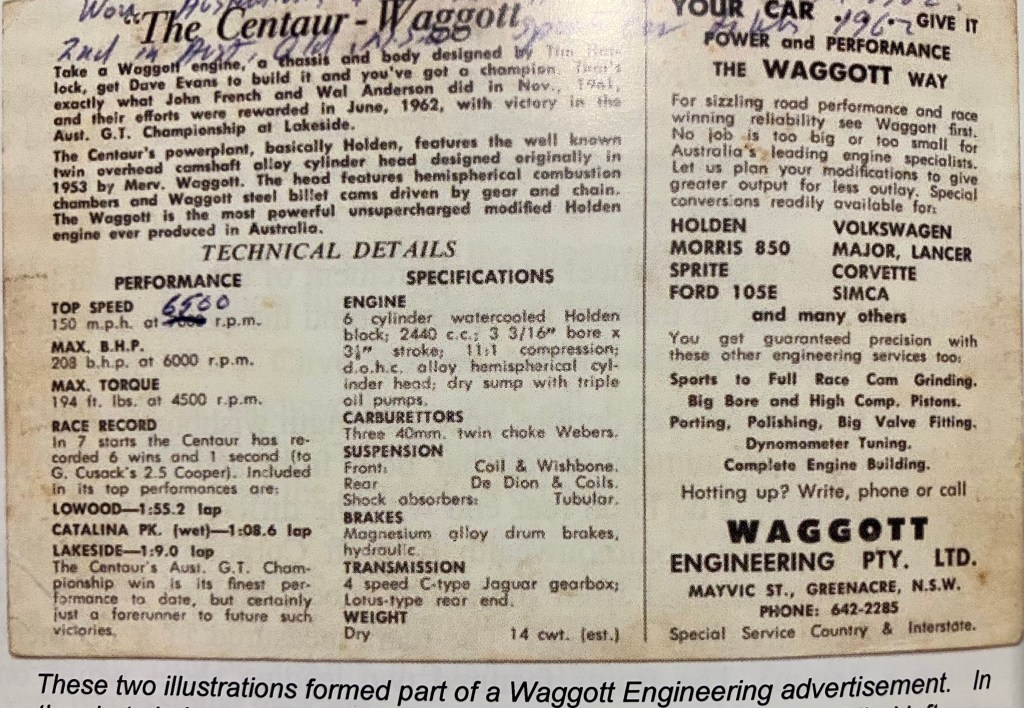
Waggott-Holden engine dummy installation in the Centaur chassis. The shot below more fully describes the engine specifications, and the bottom one is a collage of in-period Waggott Engineering photographs with Merv at top right.
Credits…
Sports Car World, the Brier Thomas photographs are courtesy of Graham Ruckert, Mildred Eden Australian Women’s Weekly, Peter Le Francke Collection, Bob Williamson Collection, Greg Smith Collection, John Campbell Collection
Finito…
 primotipo...
Hi Mark,
Another fine article, but how did it get to be 3-litres with a Holden block and crank. 2600cc was about their limit.
Ray
Thanks Ray,
That’s what haste does to you!
I’ve got 2440cc for the W-H in Jack Myers’ W-M Holden but I’ve no idea where I got that from a decade ago, it would be interesting to know what is correct.
It’s possible of course that the capacity of the twincs built differed a bit.
m
Mark,
The car won the 1600cc to 2600cc class in the 1962 AGTC (as stated above and as noted in the race report in Australian Motors Sports, September 1962) so the capacity could not have been greater than 2600cc, at least for that race.
Cheers,
Rob B.
Hi Mark,great article on the Waggot twin cam. I guess it was based on a grey motor but I can’t see in there how they got 3litres. Did they stroke it as well?Do you know any detail on that thanks. Cheers,Rob.