Melbourne racer/raconteur/engineer/mechanic Greg Smith put these three shots up on his ‘Pre-1960 Historic Racing in Australasia’ Facebook page – very highly recommended – a while back. He is the custodian of Cec Warren’s photo archive.
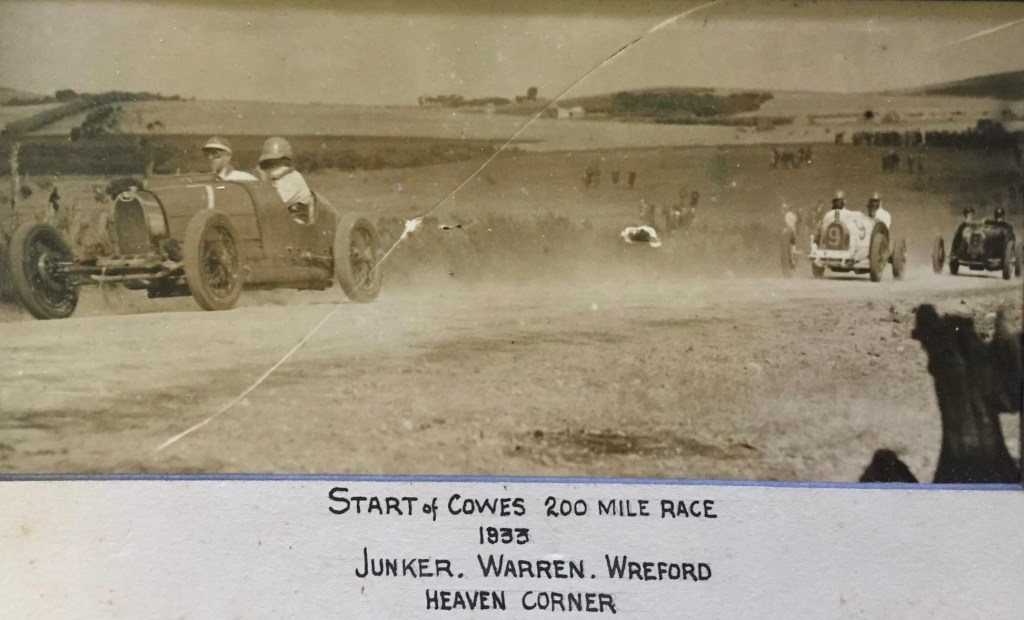
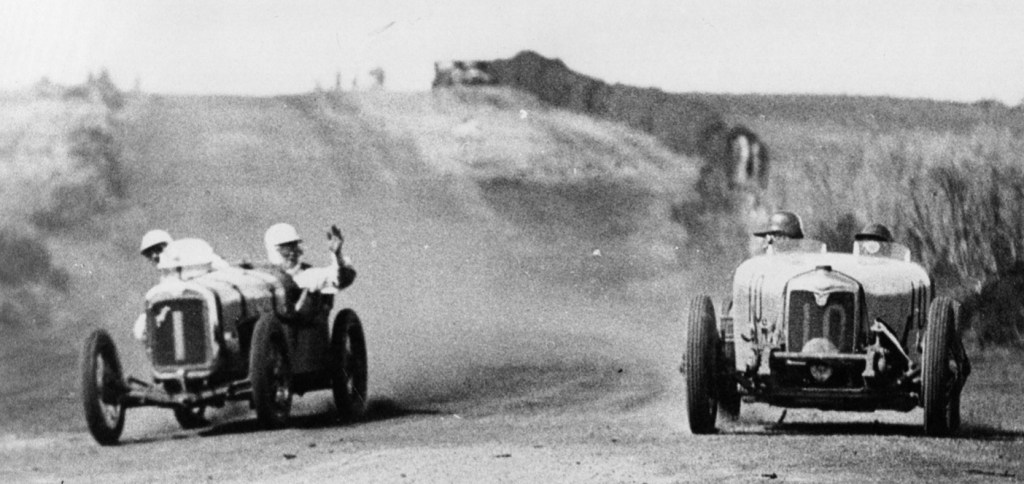
The 1933 200 Mile Race aka the Australian Grand Prix. EG Mackay Bugatti T39, Cec Warren, Bugatti T37 and Mert Wreford, Bugatti T39.
Two 1.5-litre straight-eight unsupercharged, three-valve, SOHC 80-90bhp Type 39s, sandwiching a 1.5-litre four cylinder, unsupercharged, three-valve SOHC 60bhp Type 37. The race was won by Bill Thompson’s Riley Brooklands.
Interestingly, perhaps, The Argus started its coverage of the race on March 24, 1933, with the headline, ‘Australian Grand Prix’, then went on to describe it as the Victorian Light Car Clubs 200-mile race – the Fourth Australian Grand Prix. They really weren’t too sure what to call the thing.
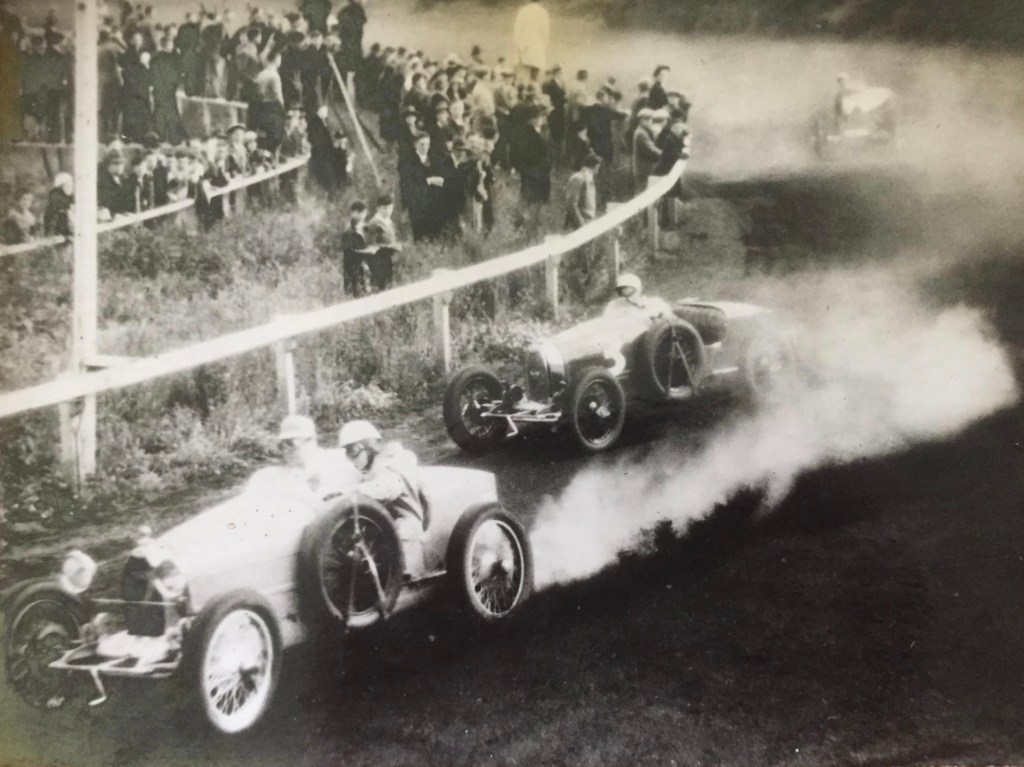
Cec Warren, Bugatti T37, on his way to winning the Invitation Handicap on the short-lived Richmond Racecourse Speedway, Melbourne track in 1932.
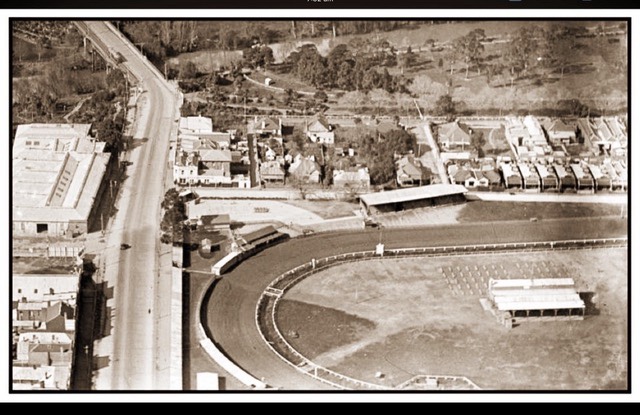
For you Melburnians, the track was primarily a horse racing facility owned by the ‘colourful legendary’ John Wren, which was located on land abutting a site near the Yarra River and abutting Bridge Road.
Etcetera…
(S King Archive)
Many thanks to Steven King for these photographs and advice as to the exact location of the Richmond Racecourse.
It will mean nothing other than to those familiar with Melbourne’s inner east, that’ll be me and a few others active on this site!
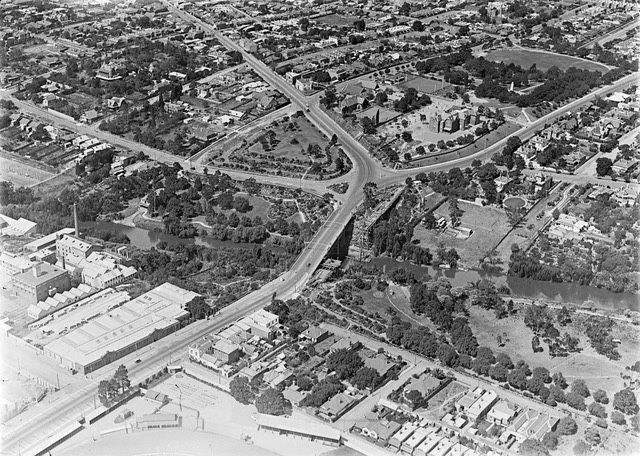
The bottom left of the top shot has just the north-eastern corner of the racecourse in shot. That’s Bridge Road in the bottom left corner, go up the page, and you are heading east. This side of the Yarra River is Richmond, with light industry – textiles, clothing and footwear back then – and workers. East of the river is Kew to the left and Hawthorn to the right, then, as now ‘stockbroker-belt’ suburbs. Church Street branches diagonally to the left heading north and all of the features are still there a century on: the parklands, and Hawthorn West Primary School at the intersection of Church Street, and Burwood Road, the main road that branches to the right heading east.
There is now, and has been forever, a rowing club on the east bank of the river, beside the bridge and the Melbourne Girls College on the west bank; the parklands alongside the bridge there fuses into sporting facilities, then the school.
(S King Archive)
The shot above shows the north eastern corner of the I racecourse on the Bridge Road and Westbank Terrace corner, and the Bridge Hotel on that corner, which I highly recommend. The part of the course shown is now residential housing and ‘Officeworks.’
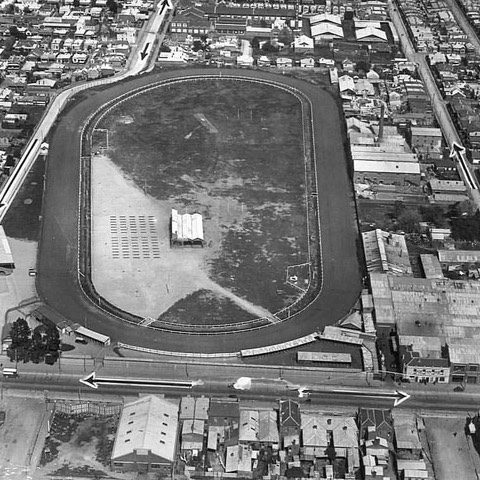
The shot below shows Bridge Road at the bottom, and Westbank Terrace to the left – heading up the photo is south – keep going and you hit Swan Street. The side road with the arrow on it to the right is Stawell Street.
(S King Archive)
This article in the Melbourne Argus published on January 14, 1941, answers the question on all of your lips: when did the race course site become housing?
‘RICHMOND RACECOURSE HOUSING PLAN
Erection of 138 working-men’s homes on the old Richmond racecourse will begin soon when contracts, tenders for which closed on Friday, are let by the Housing Commission.
In preparation for building, the commission has removed the high iron fence surrounding the racecourse and levelled the area. Streets and sites have been marked out.
The commission undertook the new housing plan on the suggestion of Richmond Council.
Many applications have already been made for the new houses. Tenants of dwellings condemned in Richmond are expected to receive preference.’
“Carl Junker, winner of the fastest time prize at the Australian Grand Prix at Phillip Island is the most modest man in the motor world. He had so little confidence in himself that it was only the repeated urgings of Terdich (Arthur Terdich, winner of the ’29 AGP) that caused him to enter.
This was his first big race, as he has previously competed in nothing more exciting than hillclimbs, but was formerly a motor cyclist of ability, and is a dirt track fan. Junker’s Bugatti, formerly the property of Sid Cox the NSW motorist, has a guaranteed speed of 115 miles per hour.”
“G McFarlane, winner of the Australian Outboards Championship in Melbourne on Albert Park Lake, is an Adelaide University student, who is in his second season with hydroplanes.”
He raced a boat called Tilmerie, and won the open class title in two heats and a final. At the end of the carnival, in a special speed test, he broke the Australian record averaging slightly over 45mph, beating the existing record of 42mph. McFarlane took the O’Donohue Shield for the championship, and held it for the ensuing 12 months.
“He is following in the footsteps of his father, GH McFarlane, who began outboarding in 1900, and was one of the pioneers of hydro-planing in South Australia. GH competed in several Australian championships with Millawa, and won the Albert Cup in New South Wales with Maltric, and successfully defended the cup in South Australia in 1929. Young McFarlane and his father built the boat in which he won the title on their station (farm) at Brinkley on the River Murray.”
TheReferee April 1, 1931Carl Junker in the Phillip Island winning Bugatti T39 #4607 in Melbourne after the 1931 win (B King Collection)
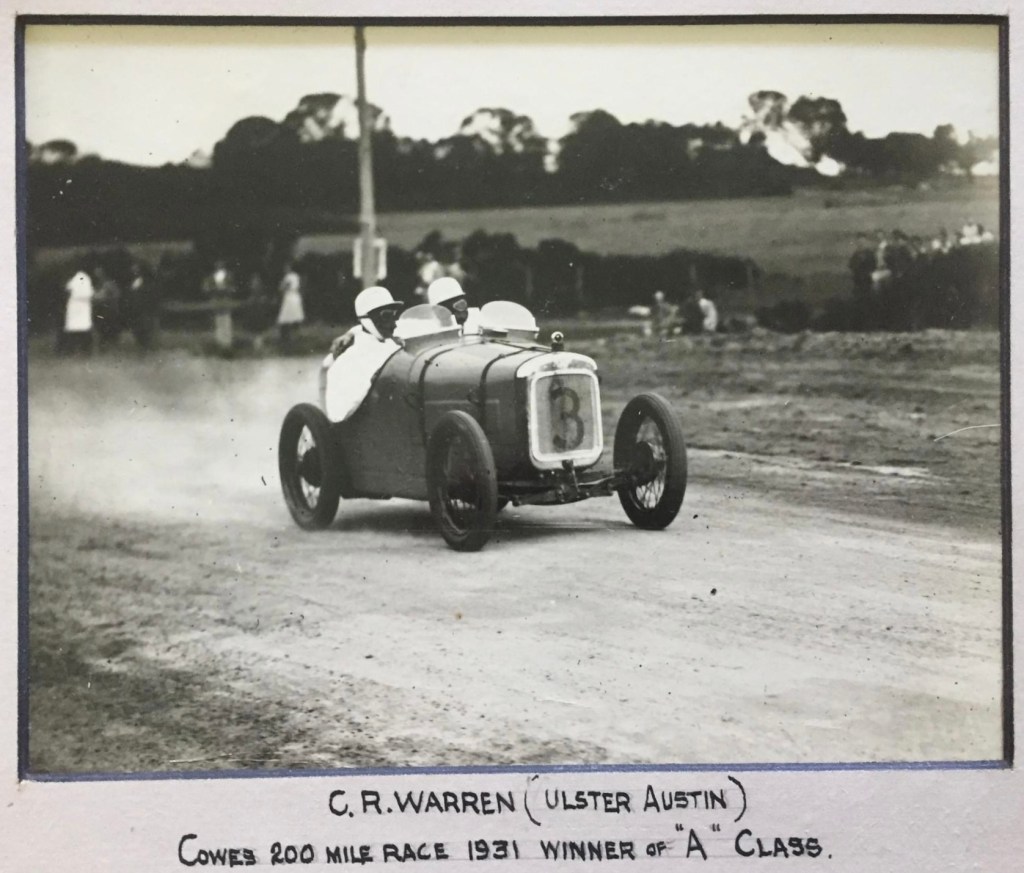
The 31′ AGP is somewhat controversial even after all these years. The Labour Day weekend, Monday March 23 race, 30 1/2 laps of the 6 1/2 mile rectangular sandy-gravel course, 200 miles in all, was held as a handicap.
“The system of handicapping to be adopted will be an allowance in time, based on the capacity of the engine, plus the knowledge of the speed of each car, and skill of the driver.” The West Australian record on February 12, 1931. “The data obtained by the promoters from the previous car races held on this course will, it is claimed, enable the handicappers to allot starts in accordance with the speed capabilities of each contestant, thus ensuring a better, fairer and more interesting race.”
Handicap racing was common in Australia until the early 1950s as we had relatively few racing cars of vastly differing performance spread over a huge area. Handicapping encouraged a come-what-you-brung ethos as the handicapping system meant everybody got a fair go, whether you raced a Bugatti or an Austin 7. In a perfect world, with the handicappers prognostications spot on – impossible of course – the field would all be bunched up together, mechanical mayhem permitting in the last lap or so of the race.
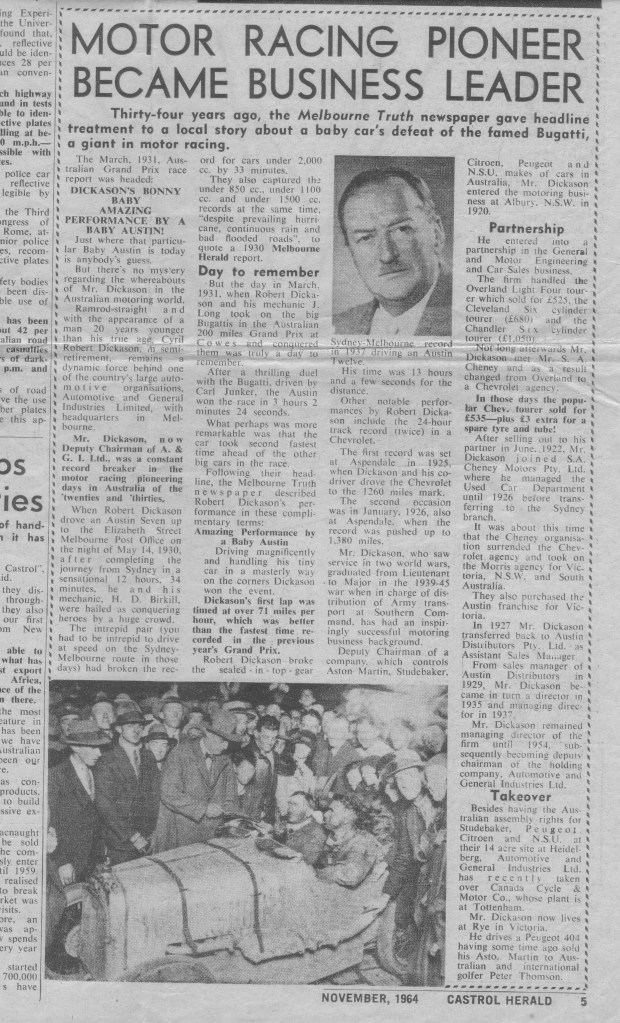
Cyril Dickason, Austin 7 Ulster, with onboard mechanic James Long won the race on handicap, received the plaudits of the crowd and were given the winners trophy. The early Tuesday morning newspapers reported the win in unequivocal fashion, then the event organisers, the Victorian Light Car Club changed the results and awarded the race to the Carl Junker/Reg Nutt Bugatti T39, which had done the fastest time.
Why?
(D Zeunert Collection)
About 5,000 spectators made the trip to Phillip Island to watch the race. Not many you may think, but back then the trip involved a train from Flinders Street Station in Melbourne to Frankston, then another on a branch line to Stony Point, on the shore of Westernport Bay. A shortish ferry ride took you, and perhaps your car if you were one of the fortunate few to own one, to Cowes on the Island. Then one had a walk of a mile or so, or more depending on where you watched the race on the course.
In an absorbing contest – 19 cars entered but only 13 started in a sign of ‘Depression times – Carl Junker’s1496cc straight-eight Bugatti T39, “Off a handicap of 10 minutes, gave a wonderfully consistent performance, and finished the long journey – 31 times around the course – in 2hr 54min 50.25sec. That was the fastest time, and by recording it Junker won the principal prize of 100 pounds. In a supercharged Austin Seven of 748cc CR Dickason (off 30 min) achieved second fastest time (3hr 2min 24.5sec). His handling of such a small machine, particularly on the bad corners, was keenly admired. He lost a minute or so through having to stop twice for minor adjustments. Third on time was the veteran, Harold Drake-Richmond (Bugatti T37 1496cc) off 10min, his figures being 3hr 3min 19.25sec.”
Dickason and May in Austin 7s start their first lap while the heavy metal awaits their turn. From the right; #15 Hope Bartlett and #14 Arthur Terdich, both in AGP winning Bugatti T37A’s off scratch. #20 is Jack Clement’s ex-AV Turner/G Meredith 1927 AGP winning car. #12 is Harold Drake-Richmond’s Bugatti T37, and then #9 is Bill Lowe’s Lombard AL3 (J Sherwood Collection via T Davis)Front runner, Hope Bartlett, Bugatti T37A s/c #37358 from Cyril Dickason’s Austin 7 Ulster s/c, he has just passed him, Heaven Corner (J Sherwood Collection via T Davis)
“On the handicaps Dickason won comfortably, passing the finishing line for the last time a lap and a half ahead of Junker. Junker and Hope Bartlett were having a thrilling tussle, in the 30th lap, for second when Bartlett, driving a supercharged four-cylinder Bugatti, had mechanical trouble and was obliged to stop…”
The Iron Cross for stupidity went to Bartlett – arguably the most experienced and best credentialed of the drivers who started – who had the race shot to bits in the same Bugatti T37A in which Bill Thompson won the year before, but kept going faster still while well in the lead. Somewhat inevitably, the the supercharged-four blew and with it went Hope’s chance to join the AGP Roll of Honour where he surely belongs.
(Austin 7 Club)
All good so far. At the end of the race Dickason was acclaimed the winner of the AGP, received the plaudits of the crowd, probably copped a peck on the cheek from Miss Phillip Island and was handed the AGP trophy for winning the race on handicap. He was formally feted as the 1931 Australian Grand Prix winner, with the Tuesday morning Melbourne Sun – the day after the race – proclaiming as such above.
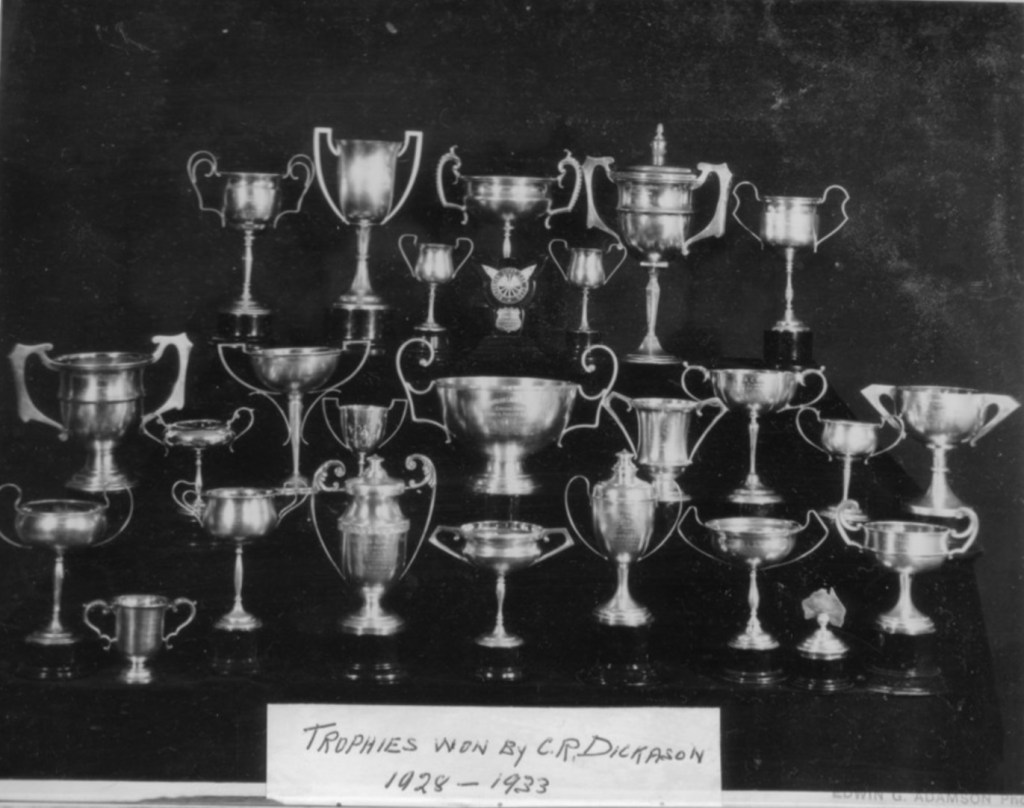
The 1931 AGP Trophy is the big one in the middle of the third row from the top in Cyril Dickason’s collection. There’s no doubt they gonged him as the winner, the question is why the same mob then took it away. Clearly though, Dickason gave them the 1931 equivalent of ‘Go and Get Rooted’ when the blue-blazer commanders of the VLCC asked for that nice trophy back, he hung onto it (Austin 7 Club)
Then, 24 hours later, the fix was on, the Victorian Light Car Club committee had met, and announced Junker as the victor, the AGP winner. Dickason’s wife recorded in a November 6, 1982 letter to assist Birdwood Mill historians with photo details of the image below, “C.R Dickason, in Supercharged Austin 7, passing G Dentry. He won the Grand Prix but the following day the Victorian Light Car Club altered the rules and awarded the race to C Junker in a Bugatti.”
Certainly the Melbourne Sun, published on the Tuesday morning after the race, before the VLCC gave the rules a tickle, published an article which records, “Driving magnificently and making a non-stop run, C.R. Dickason, in a supercharged Austin Seven, off 30 minutes handicap, won the fourth 200 mile Australian Grand Prix, run here today.”
So, in the very early hours of Tuesday morning, when The Sun‘s presses rolled in Flinders Street, Melbourne, the winner of the AGP was Cyril Dickason. That he was presented with the award post-race is supported by the fact that the AGP Trophy remained in his collection. He never gave it back, even if the VLCC was stupid enough to ask for it’s return…
Dickason’s mechanic, James Long thanks Barney Dentry – with wife Bess alongside – for making room, Riley Brooklands (fourth) (Austin 7 Club)
The VLCC committee in 1931 comprised AJ Terdich, H Drake-Richmond, AW Bernadou, OF Tough, AC Tye, A Carlton, F Walch, G Weiss, JW Condon, WJ Middleton and G Wright. At least three, and probably more of these fellas were/had been Bugatti owners/racers. I wonder how many of the establishment car club, VLCC committeemen were Austin 7 owners? Clubs are often terrible things when it comes to governance, who knows what went on and why in the hallowed, dark timber, panelled halls of the VLCC’s Fitzroy premises.
“I mean olde-bean, an ‘Orstin 7 won in 1928, ruddy-hell we can’t have another of those plebian roller-skates beating our French racing aristocrats! Besides, the Austins are grubby-factory cars, ours are amateur entries which are much more worthy and in the spirit of the race. And look, I know Carl Junker is only a Heidelberg butcher and didn’t go to Scotch (College) or Grammar (Melbourne) let alone live in Toorak or South Yarra but he is a protestant stout-chap, has plenty of money, and goodness – happy-hockey sticks – the main thing is he’s driving a Bugatti and that’s what we want winning OUR RACE not a ruddy-Austin…blah-blah, wank-toss-jerk see you at the Club this evening old-China…”
Well OK, maybe I’ve overdone it a bit. We Skips like to think of ourselves as an egalitarian lot and in relative terms compared to some other parts of the world that’s correct. But back then, your family, address, school, clubs, religion and of course bank balance all mattered. A lot. Why did the LCCV seemingly steal that AGP from Dickason and Austin and give it to Junker and Bugatti?
Two of my close mates are on opposite sides of this argument. Austin 7/Bentley historian/author/racer Tony Johns swings one way and Bugatti historian/author/racer Bob King the other. Getting hold of a copy of the supplementary regulations for this race meeting would resolve the good-natured banter about this long ago AGP. That is, hopefully that document makes clear the basis on which the winner of the AGP was to be awarded, on a scratch or handicap basis. In short, we want to know if CR Dickason and Austin were shafted, or otherwise.
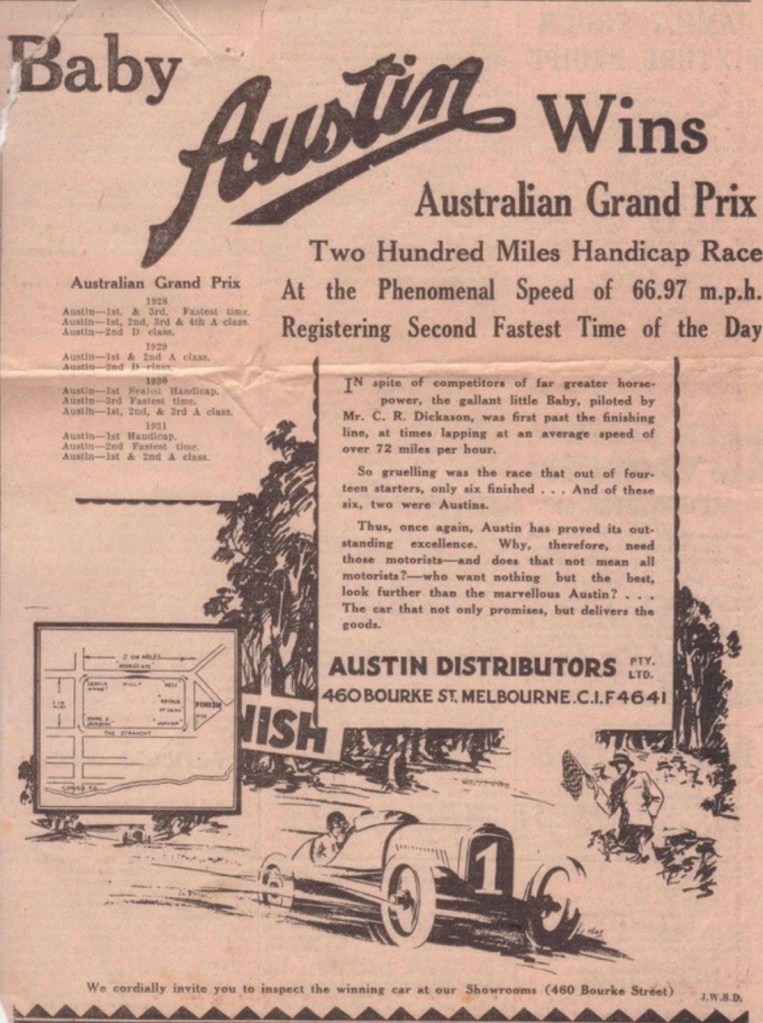
Austin Distributors ad which appeared in the Melbourne Truth on 28 March 1931. By that stage Austin Distributors Pty. Ltd, and their lawyers would have been aware the VLCC had reallocated the spoils of victory, so there is a commendable ‘up yours’ element to this piece of corporate communication. By the 1970s the Truth‘s raison d’être had evolved into a compelling mix of titties and lies (Austin 7 Club)
Etcetera…
(Dickason Collection, Austin 7 Club)
Credits…
The Referee, Sydney, April 1, 1931, Bob King Collection, Tony Johns Collection via The Nostalgia Forum, John Sherwood Collection via Tony Davis, Austin 7 Club, Harold Paynting via Ann Dickason Collection, David Zeunert Collection
Tailpiece…
(B King Collection)
Carl Junker (right) and mechanic, Mr E Lauder, having a cuppa before the start of the Phillip Island 100 on New Years Day 1934. The Persil white overalls would not have looked quite so perfect a couple of hours later. It’s a Bugatti T39 again, but this time chassis #4604. Blow the shot up and suss the characters in the crowd, wonderful.





 primotipo...