Posts Tagged ‘1938 Australian Hillclimb Championship’

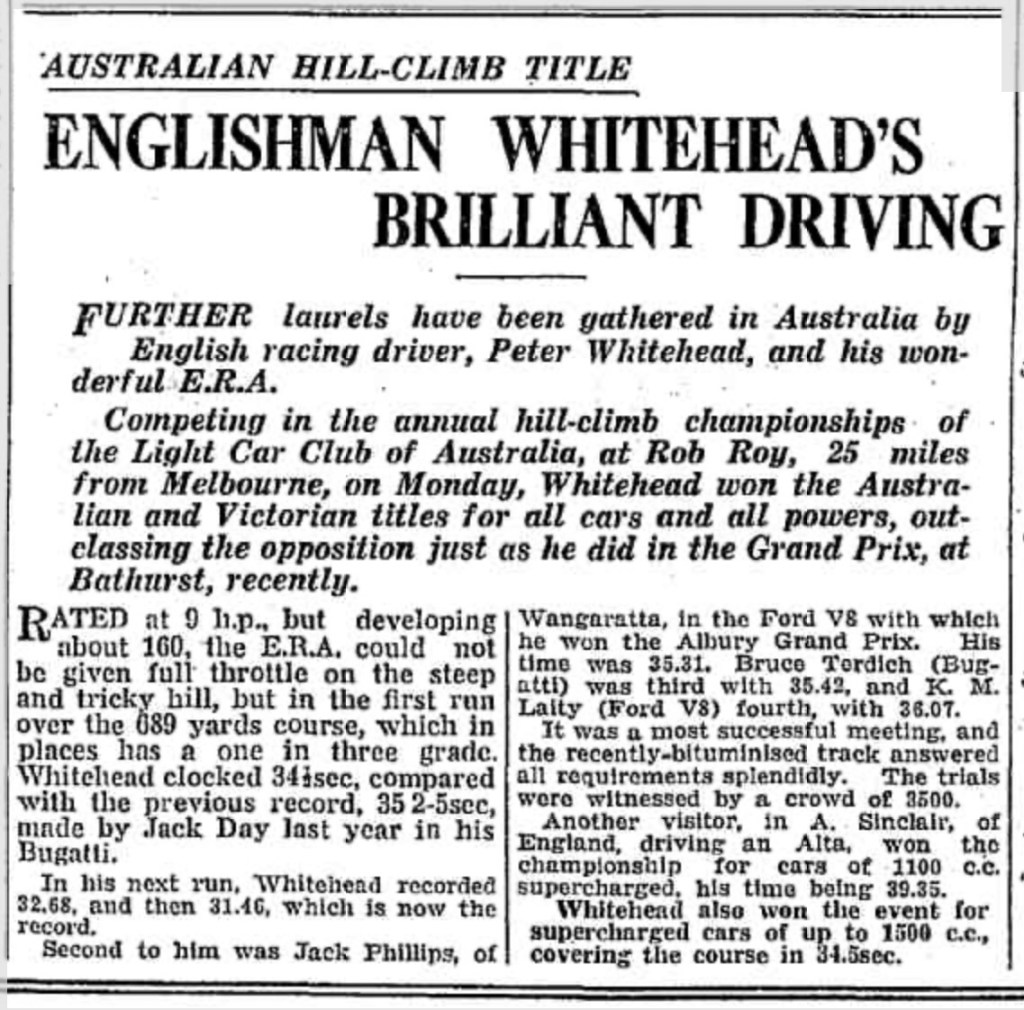
The Referee Sydney, June 16, 1938
(L Sims Collection)

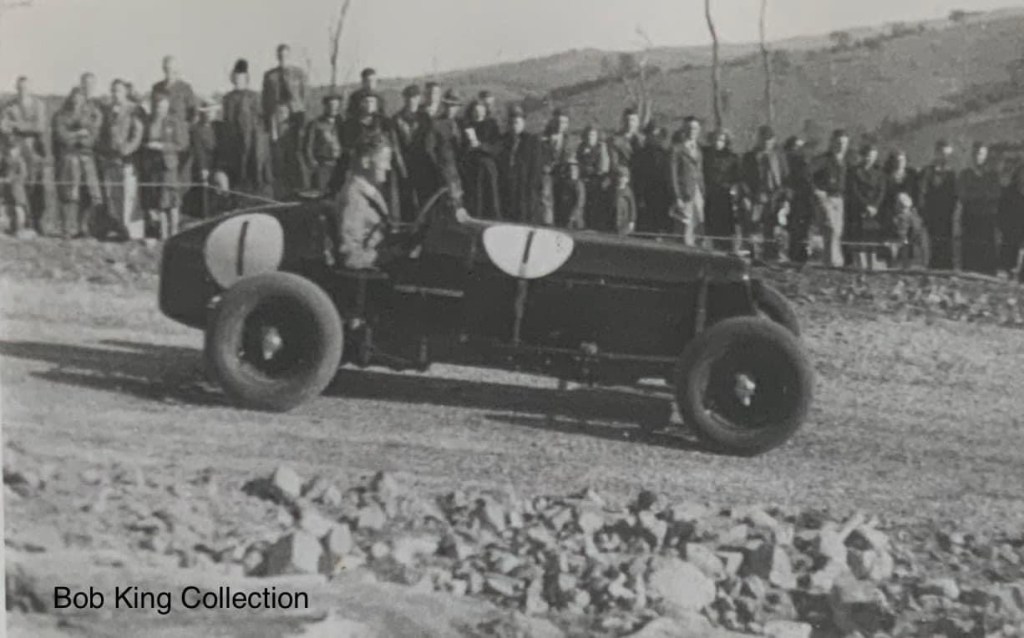
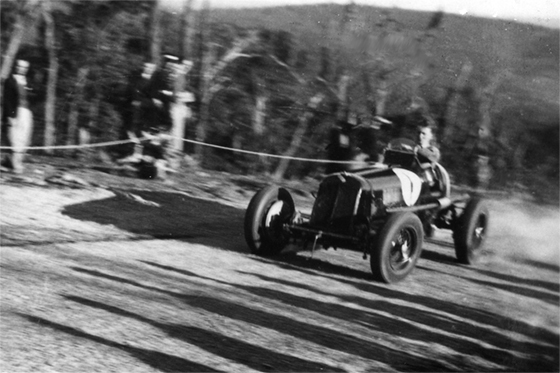
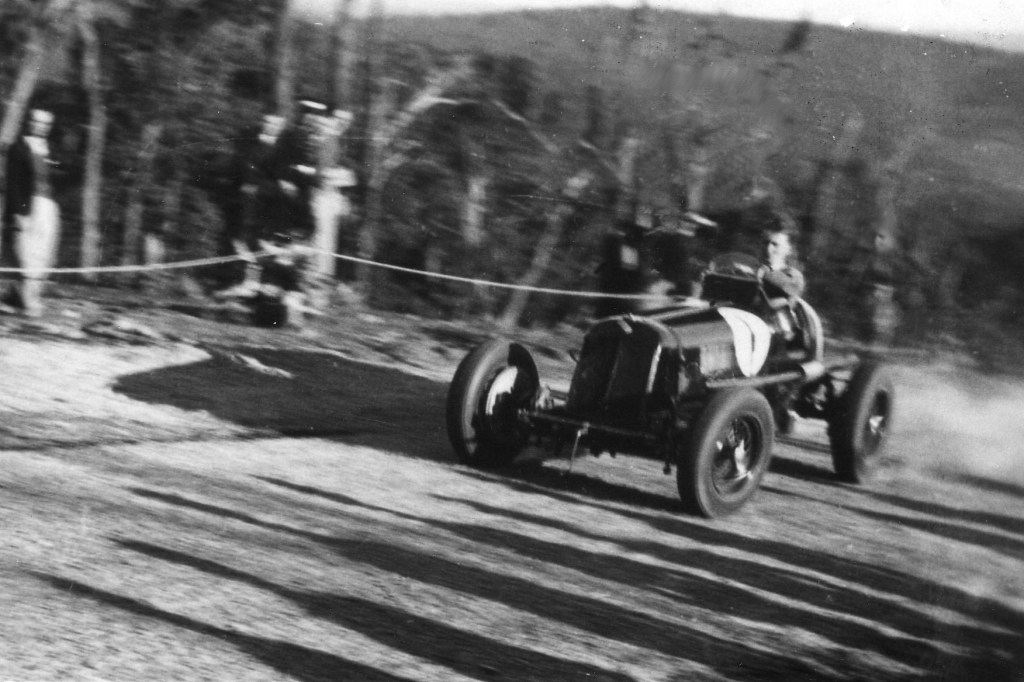
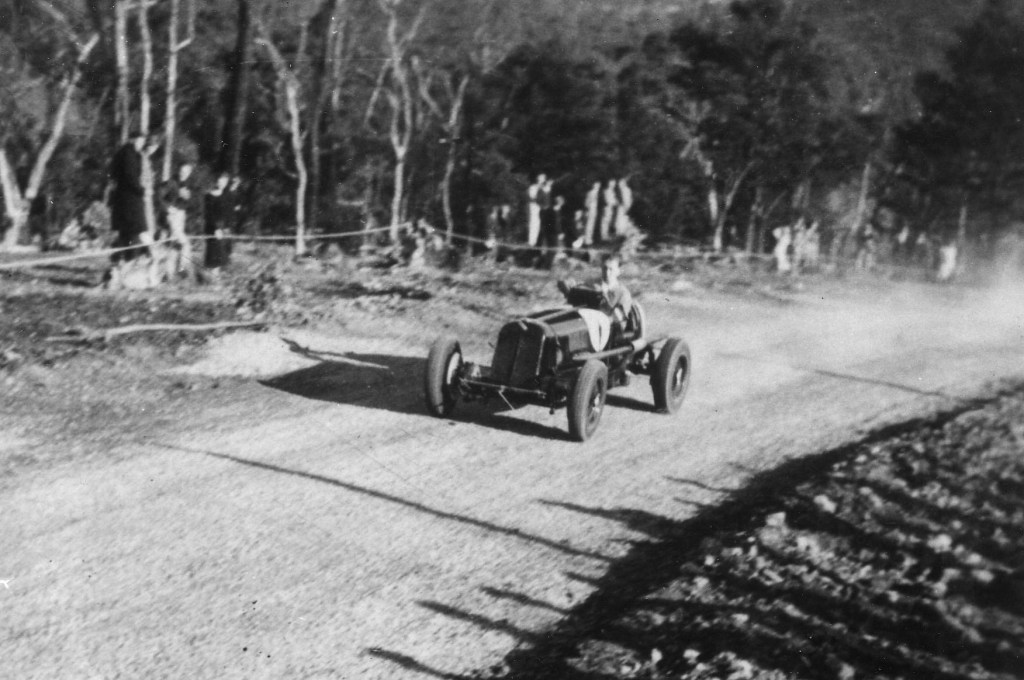
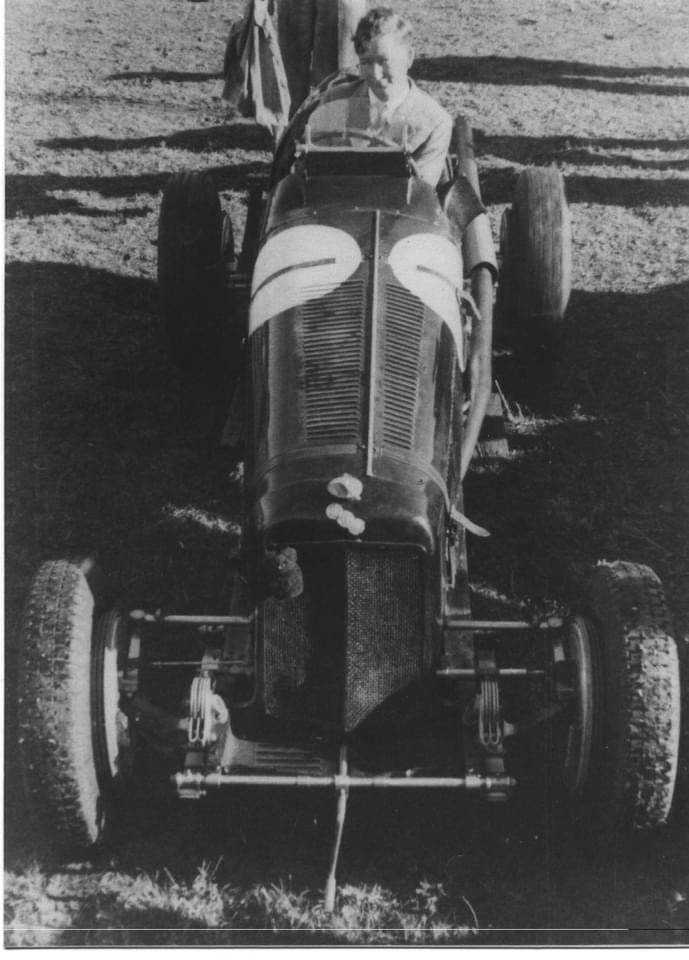
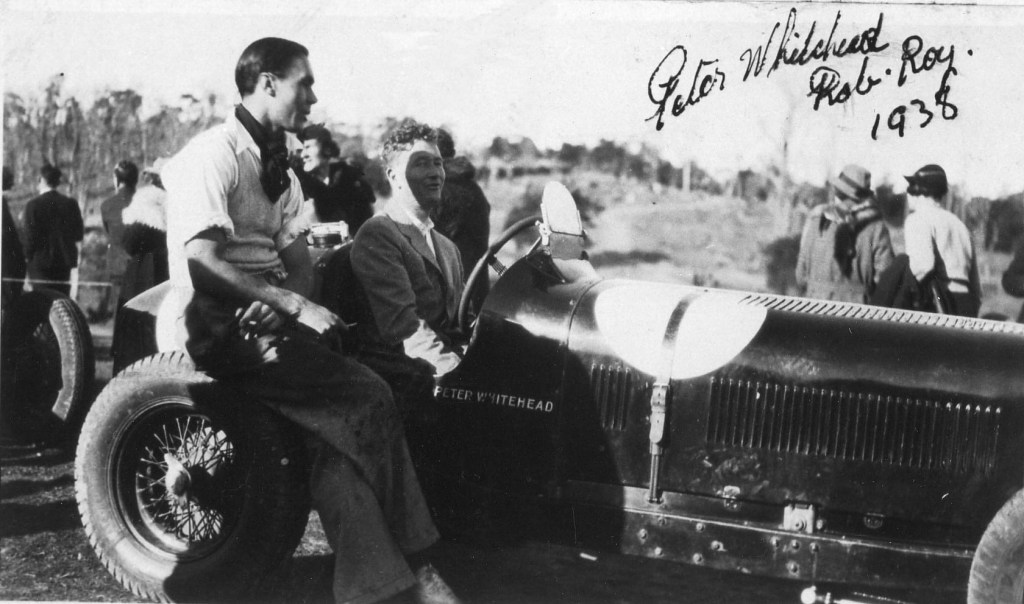
Peter Whitehead sans helmet on the way to an Australian Hillclimb Championship win aboard his ERA B-Type #R10B, then 1.5-litres supercharged, on Monday, June 13, 1938, at Rob Roy, 40 km east of Melbourne.

He came, saw, and conquered Australia in 1938, winning the Australian Grand Prix and Hillclimb Championship and attended to the needs of the family wool processing and spinning business too.

See here: https://primotipo.com/2015/04/16/peter-whitehead-in-australia-era-r10b-1938/ here: https://primotipo.com/2016/02/24/peter-whiteheads-1938-oz-tour/ and here: https://primotipo.com/2023/03/17/whiteheads-1938-review-of-australian-racing/ and here:
(L Sims Collection)

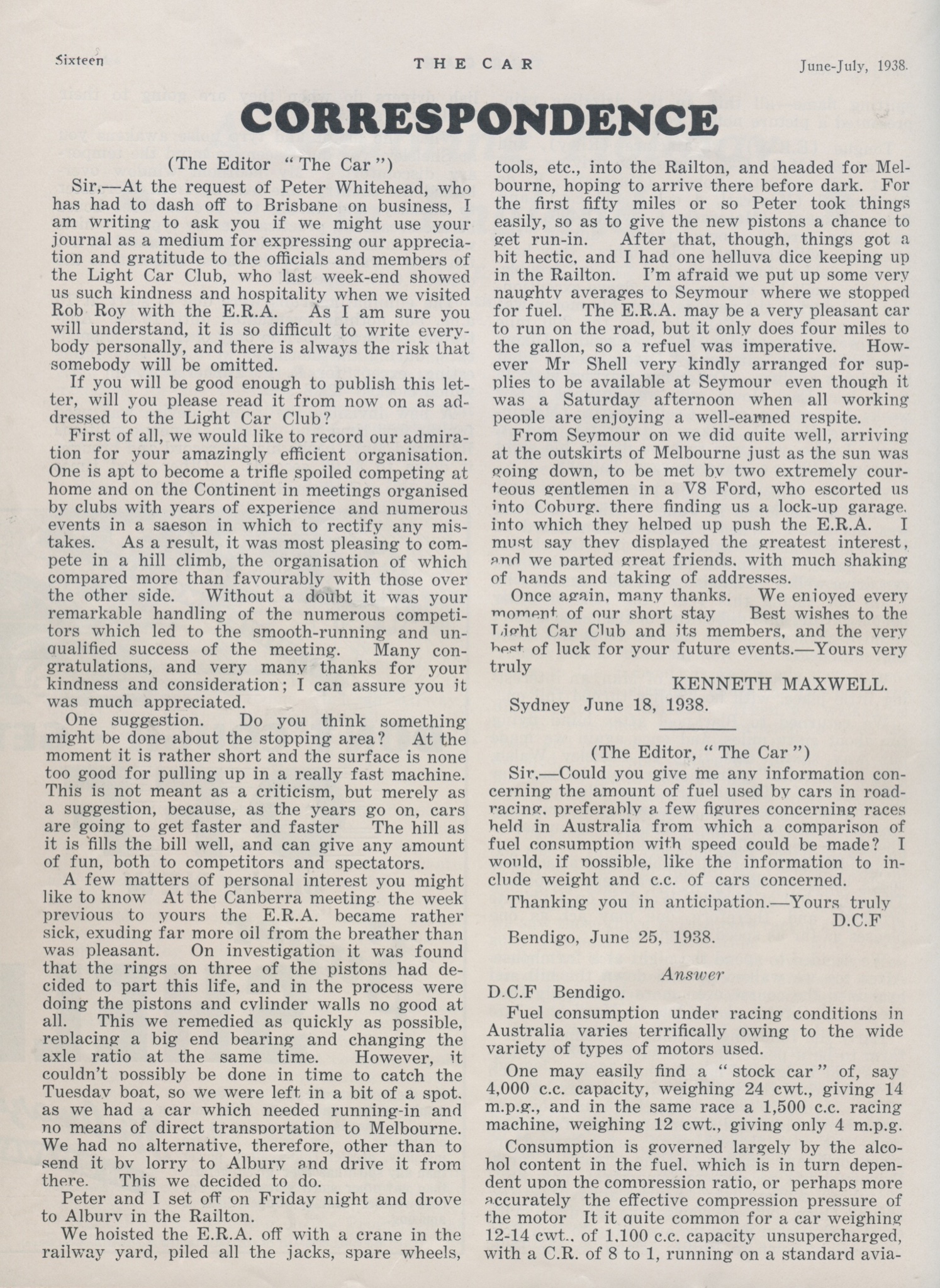
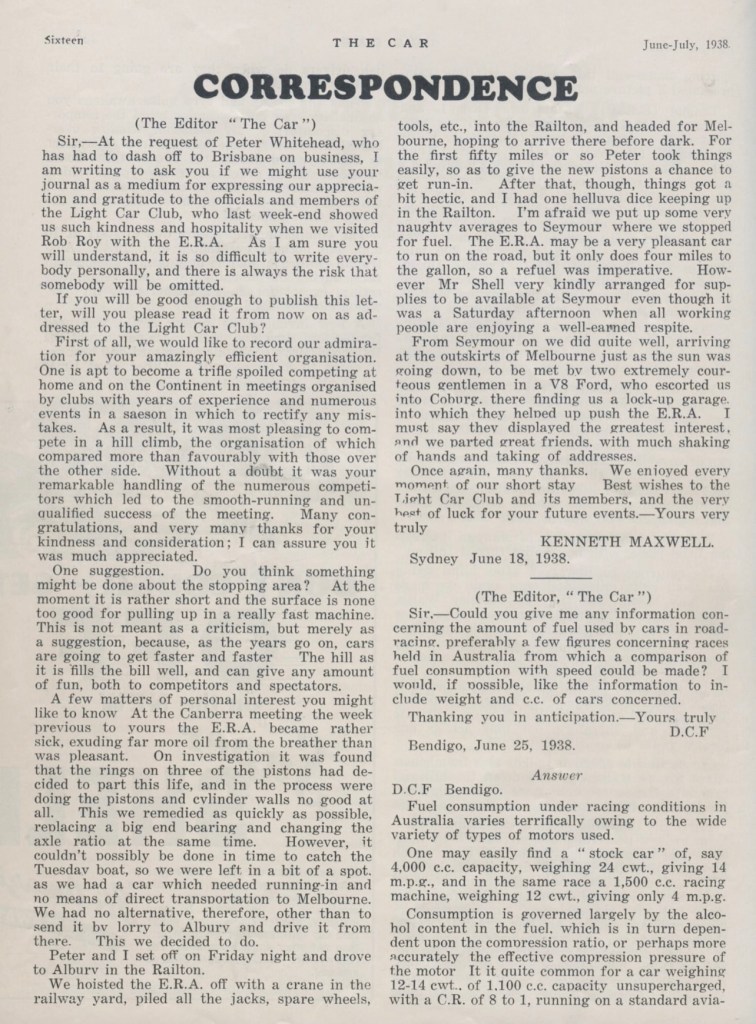
What follows are Whitehead’s observations about Rob Roy and related adventures, as told to his Australian friend, Kenneth Maxwell, and published in The Car, the official organ of the Light Car Club of Australia, the organiser and promoter of Rob Roy.
(T Johns Collection)
(L Sims Collection)

She’ll be comin’ down the (Rob Roy) mountain as she comes…

Etcetera…
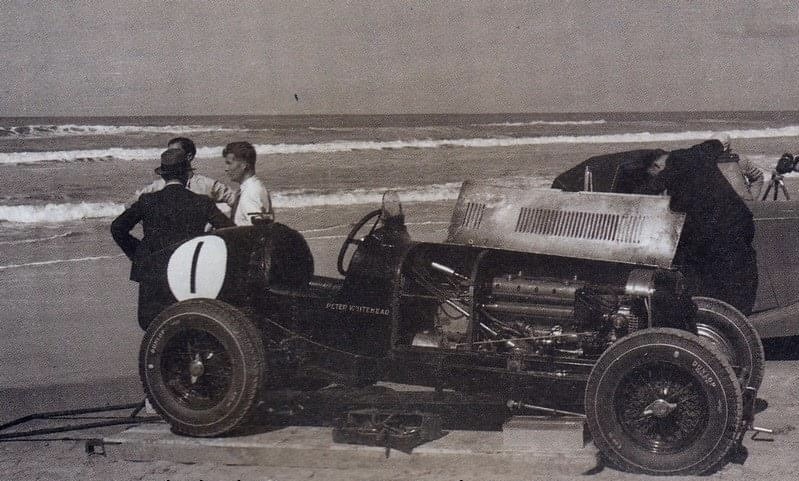
Surfs-Up albeit not that much! Whitehead and entourage keep a close eye on the 90 Mile Beach’s rising tide during a spot of land speed record breaking in Victoria
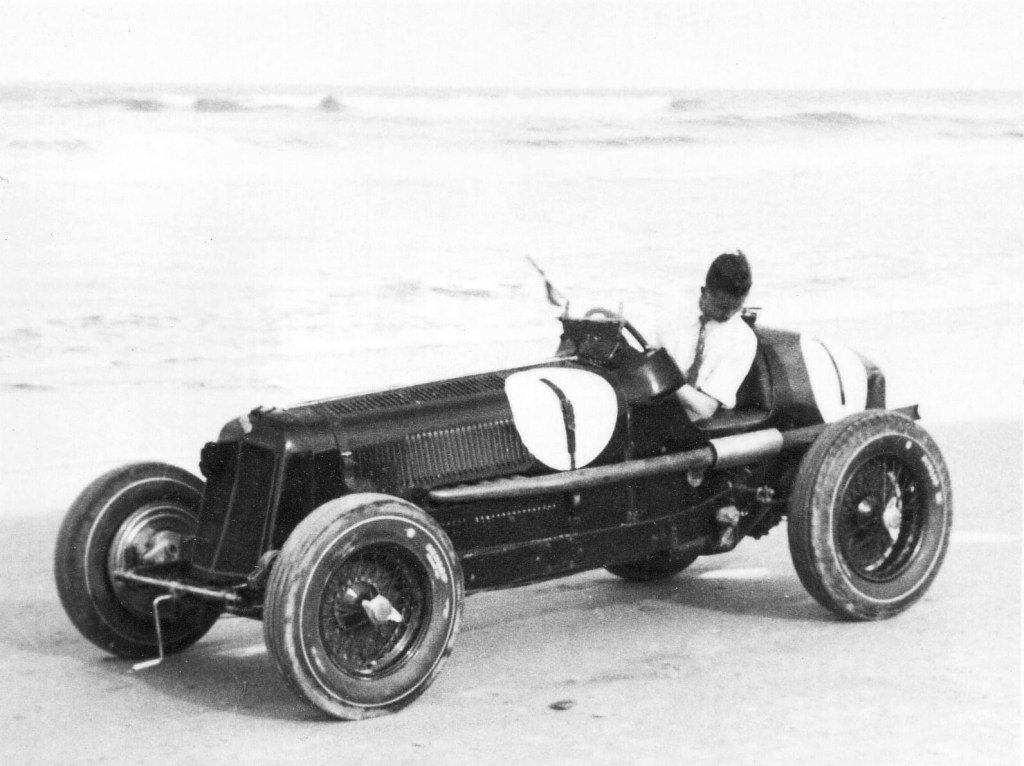
Greg Smith wrote that ‘A young bloke from Orbost rode his pushbike to 90 Mile Beach to watch this car on the sand in the speed trials and it was his inspiration to get involved in motorsport. That bloke was (Oz driving and engineering legend) Harry Firth.’
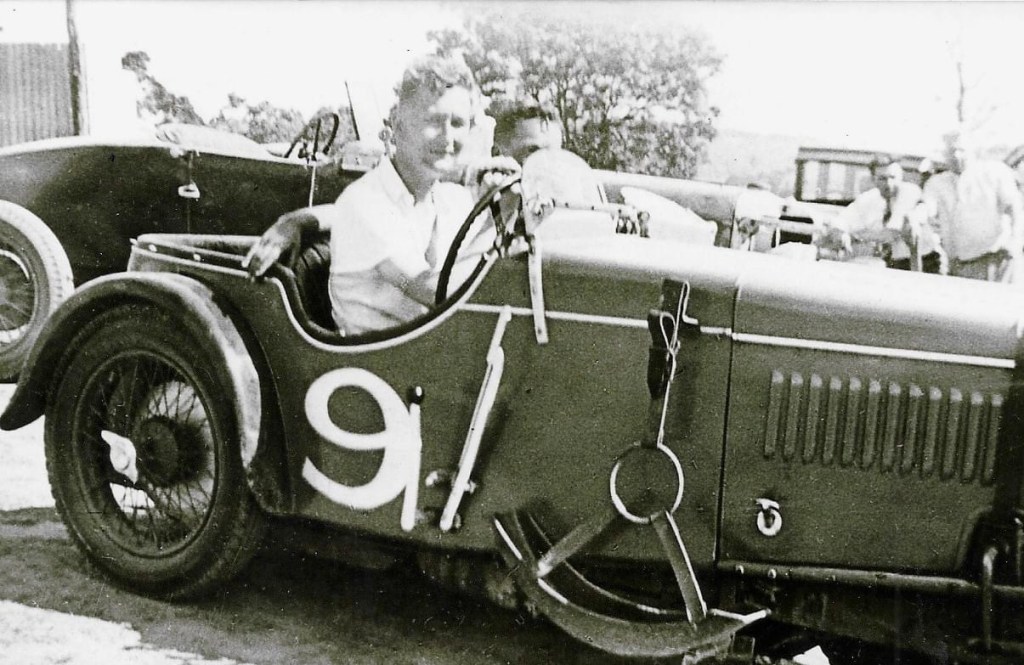
Peter didn’t run the ERA in Rob Roy’s November 20, 1938 meeting but LCCA stalwart, Jim Leech gave him a run in his Frazer Nash, he did an amazing 34.77-sec run. Car now owned by the Davey-Milne brothers.
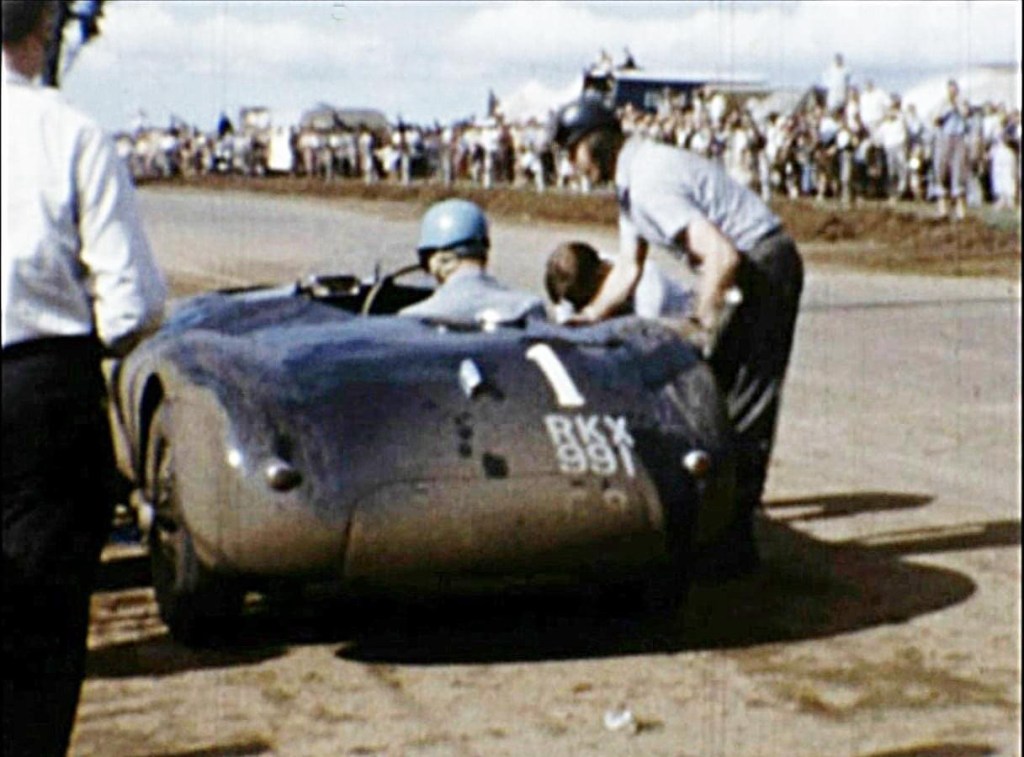
(Cummins Collection)

Peter returned to Australia a number of times, the visit I tend to forget is when he entered his Jaguar C-Type in the Mount Druitt 24-Hour in January 31-February 1, 1954.

Paul Cummins tells the story, ‘Whitehead’s Jaguar ‘C’ Type XKCO39 was co-driven by Tony Gaze and Alf Barrett. The race started at 2 pm on January 31st, with a Le Mans Start. Organised by Belfred Jones and his company Speed Promotions and run under the ARDC for unmodified production cars, it was the first 24-hour race in Australia and attracted 22 cars.’
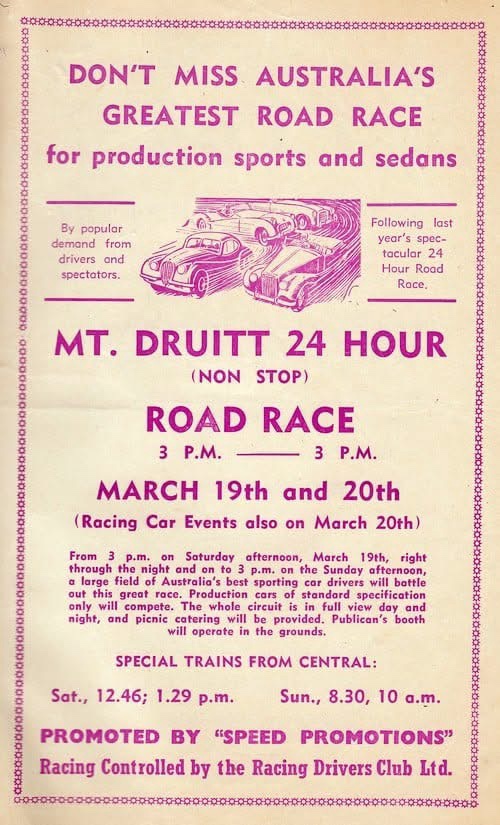
It all looks good other than the dates! (B Williamson Collection)
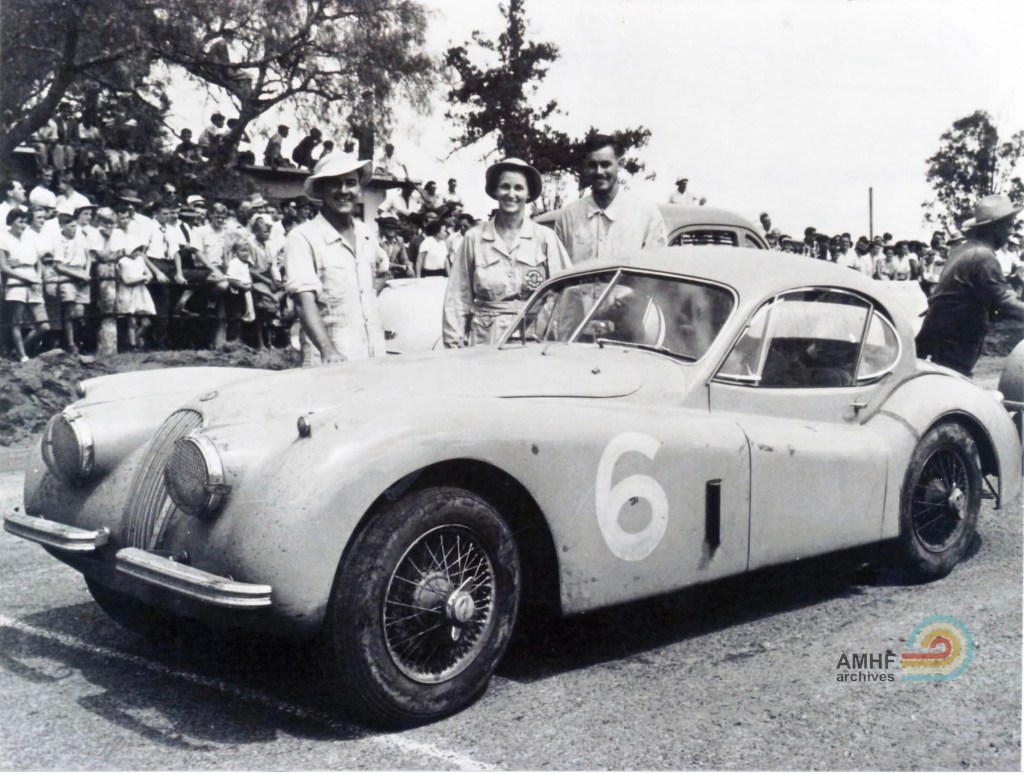
The Mount Druitt 24-Hour winning Jag XK120 FHC crewed by Geordie Anderson, Bill Pitt and Charlie Swinburne (B Caldersmith-AMHF)

‘There was no crowd control and the road surface gradually disintegrated making it a rough going and forcing the ‘C’, which was leading, to pull out with rear suspension problems. Peter Whitehead started the race and by the third lap had already started overtaking slower cars. By the end of the first hour he overtook the Geordie Anderson XK120 FHC that was in second.

By the eight hour mark the ‘C’ had completed 217 laps and was 23 laps ahead of the second placed Holden of Shaw. Hitting a pothole at midnight put an end to the ‘C’ Type’s race. All 22 cars finished as the ‘retirements’ rejoined at the end. The car race wasn’t repeated but amazingly in October the world’s first 24 hour bike race was run there.’
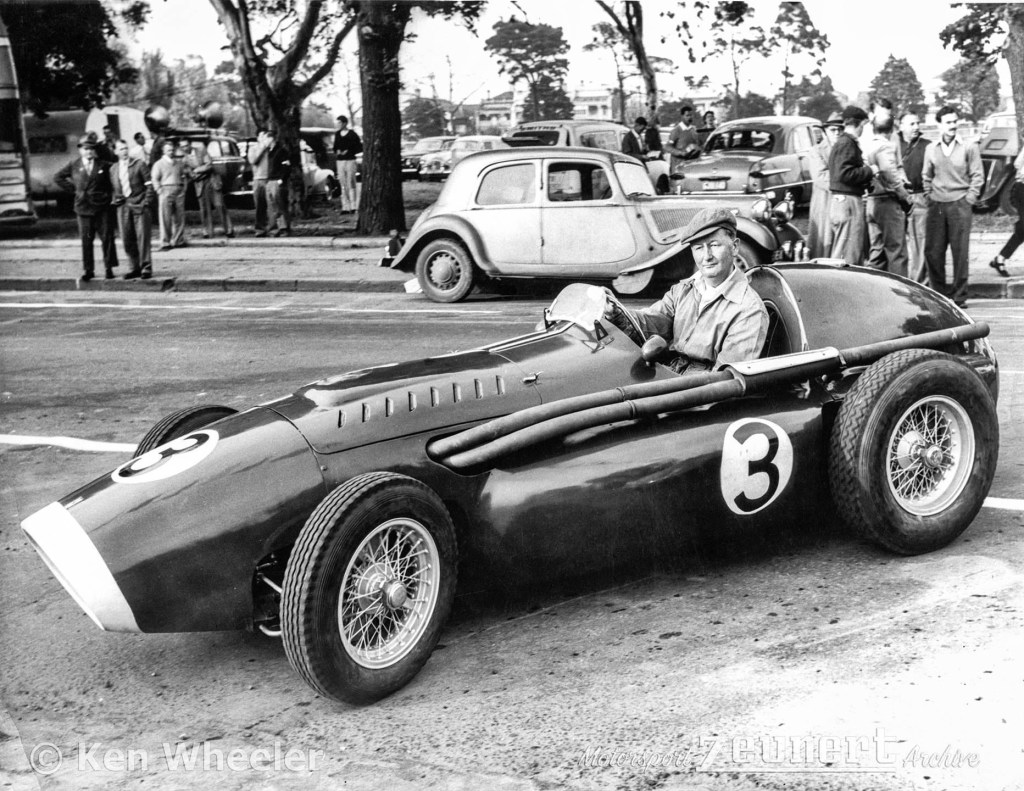
The November 1956 ‘Olympic’ Australian Grand Prix at Albert Park attracted a stellar field including the Officine Maserati 250Fs raced by Stirling Moss and Jean Behra. See here: https://primotipo.com/2018/01/16/james-linehams-1956-agp-albert-park/

Peter is shown above manoeuvring his Ferrari 555 Super Squalo 3.4-litre in the paddock. He was third in the race, behind Moss and Behra, in his final competition appearance in Australia. I wonder if he continued to travel to Melbourne on business in the period between then and his untimely death during the September 1958 Tour de France.

Credits…

The Referee Sydney June 16, 1938, Leon Sims Collection, Bob King Collection, Ian & Paul Cummins Collection, Ken Wheeler via David Zeunert Collection, Bob Williamson Collection, AMHF Archive

Tailpiece…
(L Sims Collection)

Finito…

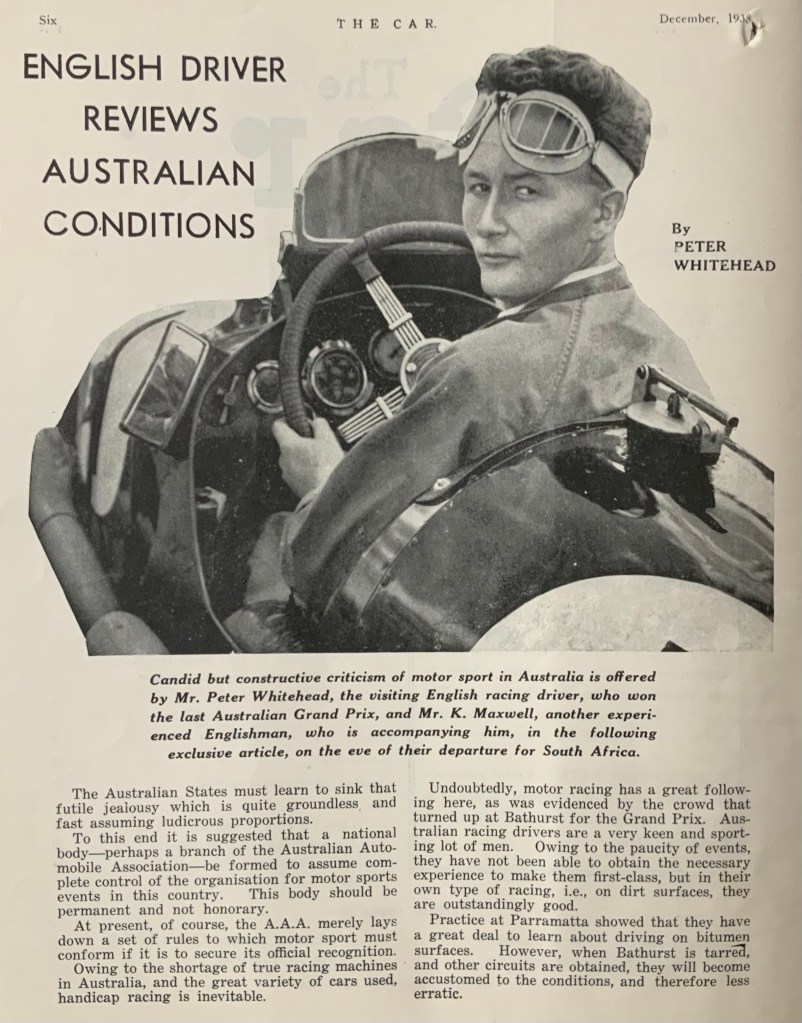
Whitehead is shown here in the cockpit of his ERA during the abortive – and aborted – Parramatta Park, Sydney meeting in 1938 (B King Collection)

English international, Peter Whitehead spent quite a bit of time in Australia during 1938 on business. One hat he wore was as a member of the W&J Whitehead family, Bradford based, wool textiles business, the other was as the driver of his much smaller motor racing enterprise.

His success in ‘chasing sheep’ is unknown but his motorsport endeavours were well rewarded with victories in the Australian Grand Prix at Bathurst, and the Australian Hillclimb Championship at Rob Roy in Victoria’s Christmas Hills. See here; https://primotipo.com/2016/02/24/peter-whiteheads-1938-oz-tour/ and here; https://primotipo.com/2015/04/16/peter-whitehead-in-australia-era-r10b-1938/

As you will appreciate from the articles, Whitehead was in Australia long enough, and travelled broadly enough, for his views to be fully formed on the state of motorsport play at that time.

(B King Collection)
Blurry and ‘Hatless’ Whitehead during the Australian Hillclimb Championship meeting at Rob Roy in June 1938. He did FTD and set the course record at 31.46 seconds on the still unsealed course which opened a year earlier (L Sims Collection)

Peter Whitehead was spot on with his observations really.

Picking up his points in the order they were made, the Confederation of Australian Motor Sport (CAMS) was formed in 1953 to manage, organise and regulate (sic) the sport on a national basis. Perhaps without World War 2 a more focused governing body would have replaced the Australian Automobile Association earlier.

Handicap racing continued throughout Australia well into the 1950s. We had a relatively small number of racing cars spread over a vast continent. Handicaps ensured everybody had a chance of victory, by this means, competitors were prepared to travel vast distances by road, rail or coastal ships to race.

Then the only Australian racers who competed ‘regularly’ on bitumen roads were the West Australians on their Round the Houses road courses in various country towns. Allan Tomlinson’s stunning Lobethal AGP win in 1939 is in part credited to his skill on such surfaces relative to the east coast based competitors, aboard his MG TA Spl s/c. See here; https://primotipo.com/2020/12/04/tomlinsons-1939-lobethal-australian-grand-prix/

A series of races to attract international competitors did eventually happen, formally with the Tasman Cup – seven/eight races in NZ and Australia in January-February each year – in 1964, and informally with a series of international races for the better part of a decade before that. Peter Whitehead returned and raced a couple of Ferraris here during that period. See here; https://primotipo.com/2020/10/10/squalo-squadron/

The bad-blood, combative relationship between the New South Wales Police and the racing community lasted well into the 1950s and is a story in itself.

This piece was written by Kenneth Maxwell earlier in the trip and was published in the June-July issue of The Car.

The Yarra Falls building site in 1918. Melburnians will note the roofline of the Convent of the Good Shepherd on the north side of Johnston Street, that building is still there on the wonderful Collingwood Children’s Farm site; a visit to rural Australia in inner Melbourne is worth a trip for any international tourist. The Falls site was redeveloped, keeping many of the original buildings, for business and residential use several decades ago (Picture Victoria)

Etcetera…

The Whiteheads were customers of Australian wool from the earliest of times. The contents of an article in The Argus (Melbourne) appealed to the economist in me. The piece reported on the business trip of Henry Whitehead, a relative of Peter Whitehead, in January 1920 who is described as having interests in “three of the largest of the great Yorkshire textile works.”

Whitehead’s visit was as a director/advisor of Yarra Falls Spinning Co Pty. Ltd. at 80-110 Trenerry Crescent, Abbotsford – on the shores of the Yarra River in Melbourne where wool was scoured/cleaned – and he commented that “Although Australia is the greatest wool producer in the world she could not have competed with England before the war in the marketing in Australia of goods manufactured out of her own raw materials…But times have changed, and today Australia has the opportunity of making more of her own goods, and particularly of making up her own raw materials.”

Funnily enough, a century on, we are still better at shearing sheep and digging holes in the ground (mining) than manufacturing, that is, value adding to the raw materials we export to others.

Henry Whitehead spoke of the need for immigration of skilled labour to aid growth of the industry and encourage further British investment.

The Yarra Falls Spinning Company was then capitalised at £200,000, “the great bulk of which is Australian money.” The other directors, with the exception of Whitehead, were Australian, the factory was commenced in 1918 and employed 200 in 1920. The only limiting factor in expanding the business right then beyond relatively simple wool scouring and combing, to the production of worsted cloth (for clothing) was the difficulty of getting specialised weaving plant and equipment made, and imported from the UK.

So, Peter Whitehead would have been busy, apart from his racing…

Credits…

The Car, December 1938 via the Bob King Collection, Leon Sims Collection, Ted Hood, The Argus January 1, 1920, Picture Victoria

Tailpiece…

(T Hood)

Peter Whitehead fettles his ERA #R10B in frigid Canberra weather in June 1938. He was taking part in annual speed record attempts in the national capital, weird though that seems.

Mind you, there was a round the houses taxi race in Canberra not so many years ago, the Canberra 400 from 2000-2002.

Mark Skaife, Holden VX Commodore V8 Supercar en-route to winning the 2002 Canberra 400, Parliament House in the background (unattributed)

Finito…