Posts Tagged ‘Australian Land Speed Records’

(R Button Archive)

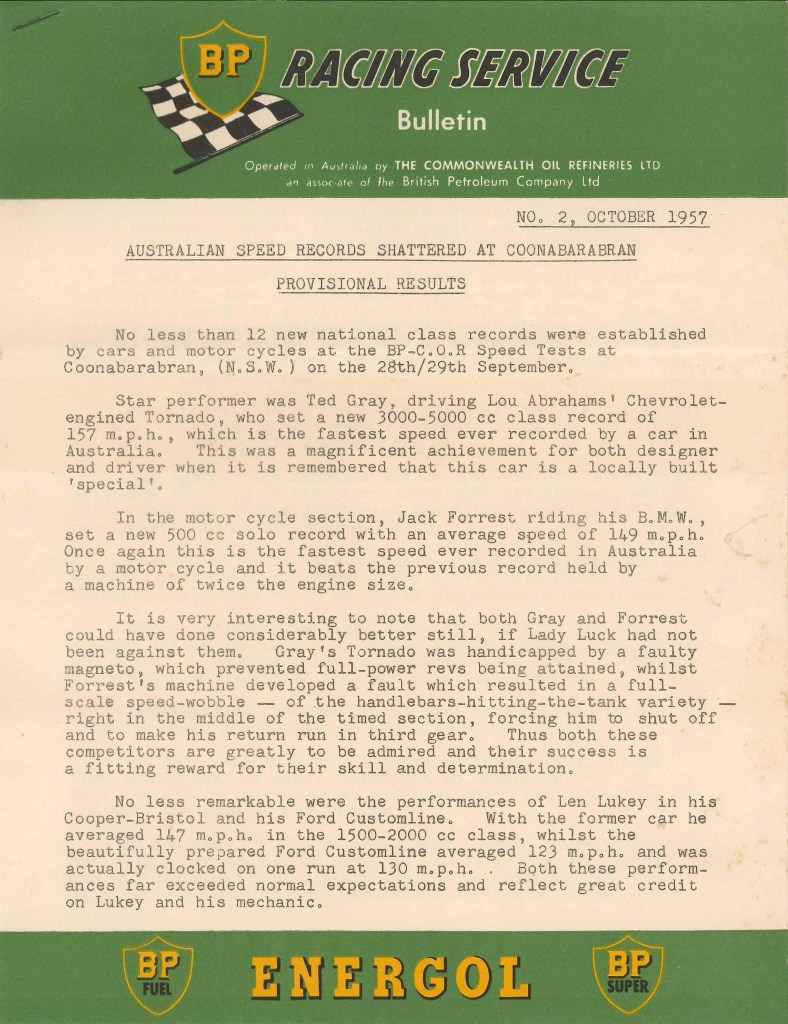
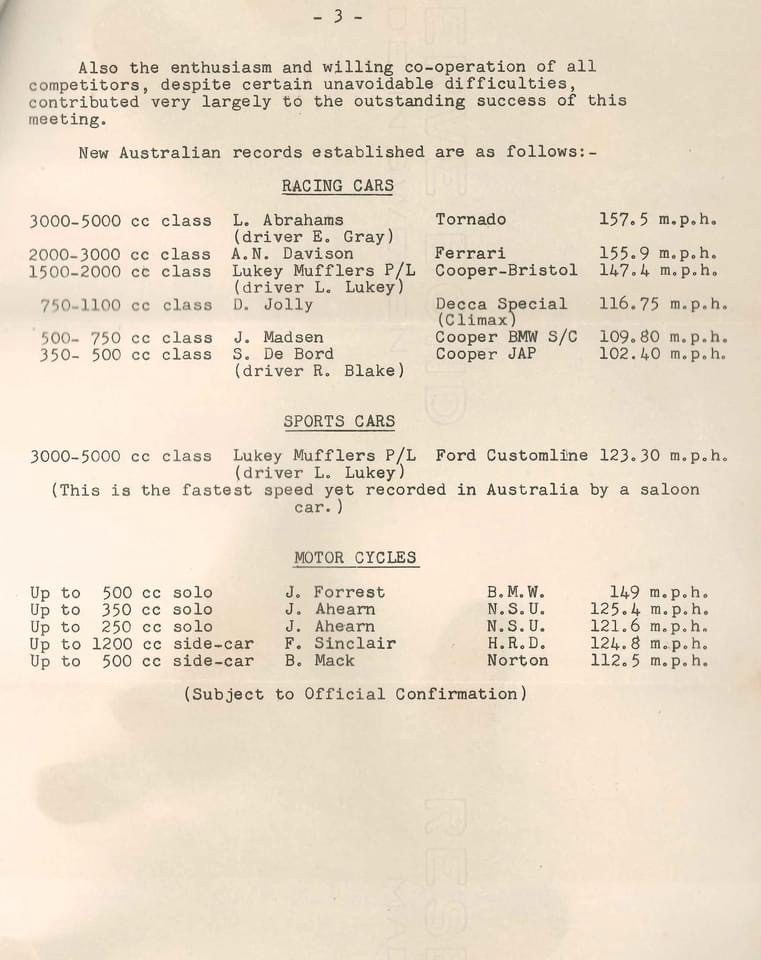
‘This BP Press Release was still in its original envelope with some pit pass tags’, Peter Button wrote of his late Uncle, Ron Button’s archive.

‘Ron didn’t talk about his time racing, it’s only on the passing of his son, Phil, that the extent of his motor racing history has become apparent. I’m piecing it together. I have his wooden helmet and Light Car Club of Australia badges, I’m sure he would be glad the racing community is getting something out of them,’ he wrote on Bob Williamson’s Old Motor Racing Photographs – Australia Facebook page, which continues to give…and give. My Lordy-me there is are good goings on, sharing of knowledge on this site and Smithy’s Pre-1960 Historic Racing in Australasia one.
(V Mills)

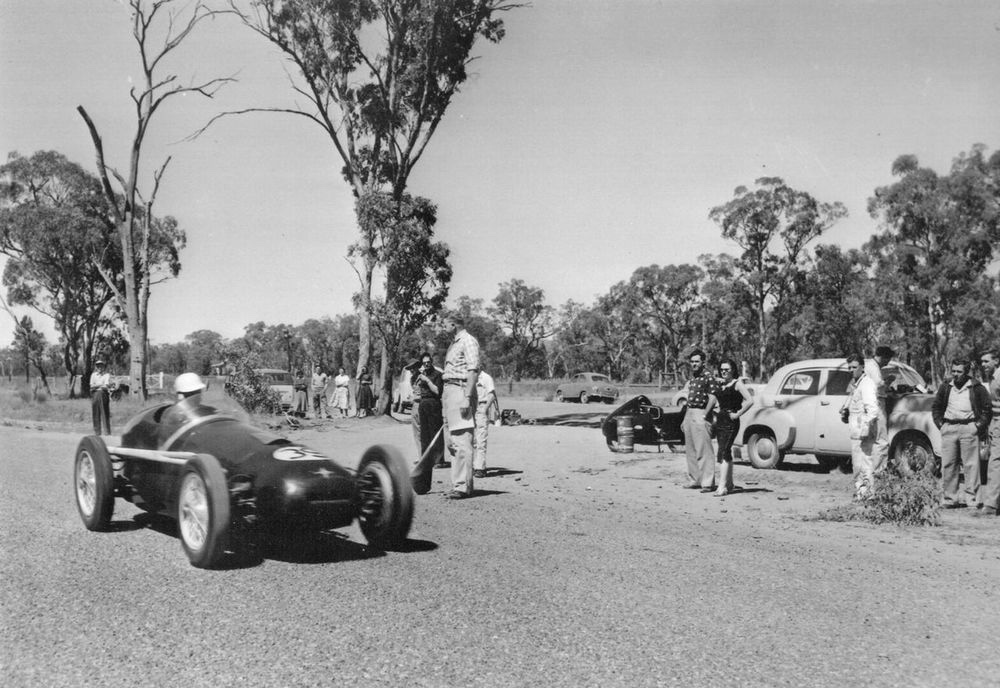
Star of the show was Ted Gray aboard Tornado 2, just fitted with its new, much modified fuel-injected Chev Corvette 283cid engine. Here he lines up for the start at Tipperary on September 28-29, 1957. It may look old but it sounded pretty much F5000 if some way short of the power of those 1970s roller-skates.

While BP’s spiel describes Tornado as a ‘locally built special’, by 1958 the Gray, Lou Abrahams and brothers Mayberry built Tornado was objectively the fastest Formula Libre road-racer in the country…if not the most reliable. It was quicker than Stan Jones’ 250F and Lex Davison’s Ferrari 500/625, Tiger Ted was no longer a spring-chookin’ by then either.

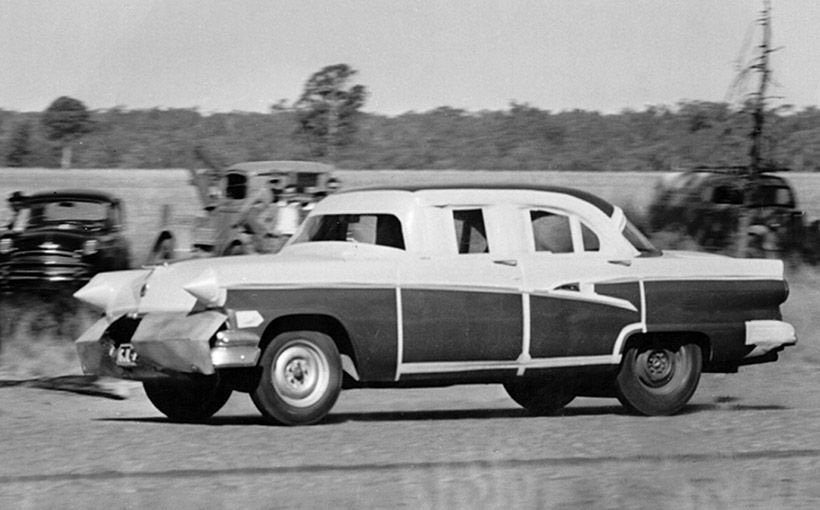
While Len Lukey’s home-made attempts to streamline his race Ford Customline may look a bit half-arsed, in fact NASA would have been proud of him, the big beast did a two-way average of 123.30mph.
(Chevron)

Back-story…

Prominent motorsport identity/engineer/racer/Australian Rally Champion navigator/CAMS administrator Graham Hoinville was tasked by his employer, BP to find a suitable site to stage some Australian Land Speed Record attempts in early 1956.

About 12 months later he selected from a shortlist, a dead-straight four-mile stretch of the Coonabarabran-Baradine road at Baradine, 535km north-west of Sydney. The road adjacent to the railway line between the two townships he assessed as suitable for some promotional record-breaking. The road ran past the gates of Tipperary Station (farm), locally the event became known as the Tipperary Flying Mile.

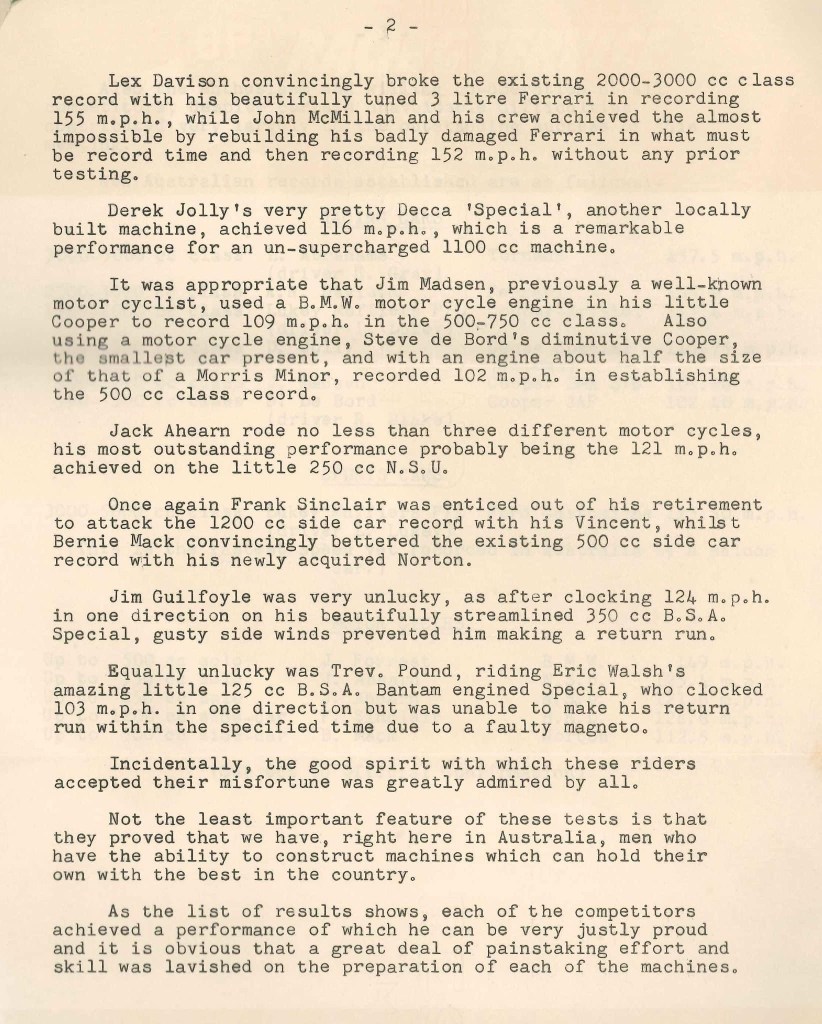
Drivers hand-picked to attend the 1957 BP-COR (Commonwealth Oil Refinery) Speed Trial were all BP contracted drivers and riders, including Davison, Ferrari 500/625 – soon to the first Gold Star Champion, the Australian Driver’s Championship – Gray racing Lou Abrahams’ Tornado 2 Chev, Lukey, Cooper T23 Bristol and Ford Customline V8, Derek Jolly, Decca Mk2 Coventry Climax sportscar, John McMillan, Ferrari 555 Super Squalo and Roy Blake’s Cooper JAP. Motorcyclist invitees included Jack Forrest, BMW 500 and Jack Ahearn, Norton Manx 350.
(R Button Archive)

Over 3,000 spectators rocked-up to watch the cars run over a flying kilometre, and the bikes’, a flying half mile. While the road had been resurfaced, it was only 18 feet wide and had a pronounced crown. Strong winds and bushfires in the area added to the challenge…

It was so blustery on the Saturday that the motorcycle attempts were postponed to Sunday when conditions were kinder. In accordance with FIA regs, a run in opposite directions had to be made within an hour, and timed to 1/100th of a second.
(V Mills)

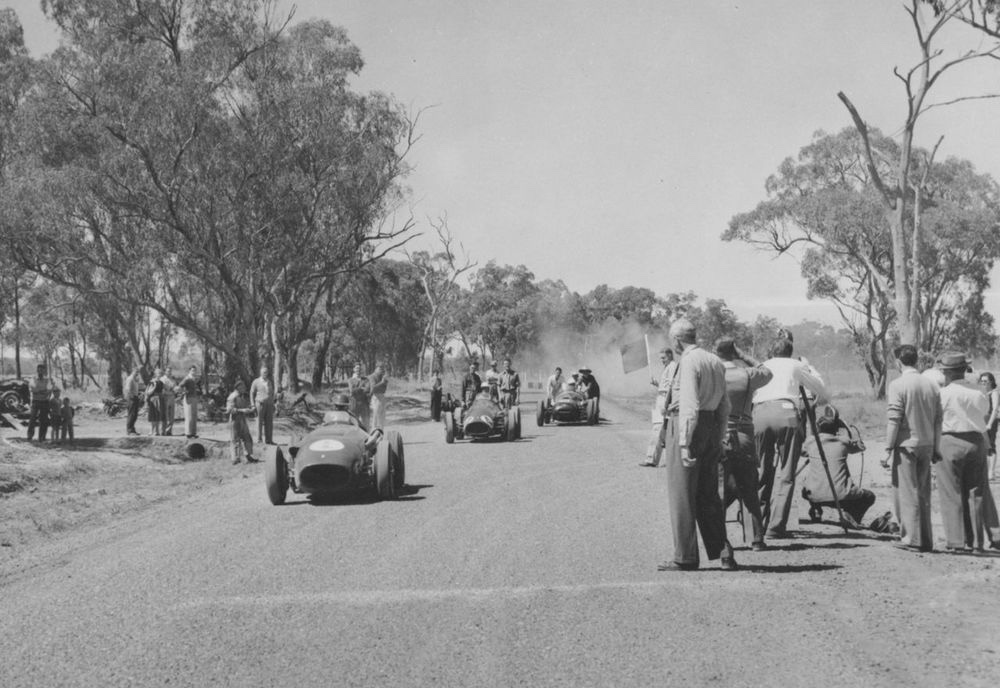
The group of ‘outright cars’ included John McMillan’s Ferrari 555 Super Squalo, Lex Davison’s Ferrari 500/625 3-litre and Ted Gray’s big, booming Tornado Chev, all three of which are heading for the start above.

It all looks suitably casual and bucolic, but some great work was done in what was the first mass attack on local land-speed-records. Almost every local record for cars and bikes was broken. Nationally, that Baradine region feat has never been toppled.
(R Button Archive)
(oldbikemag.com.au)

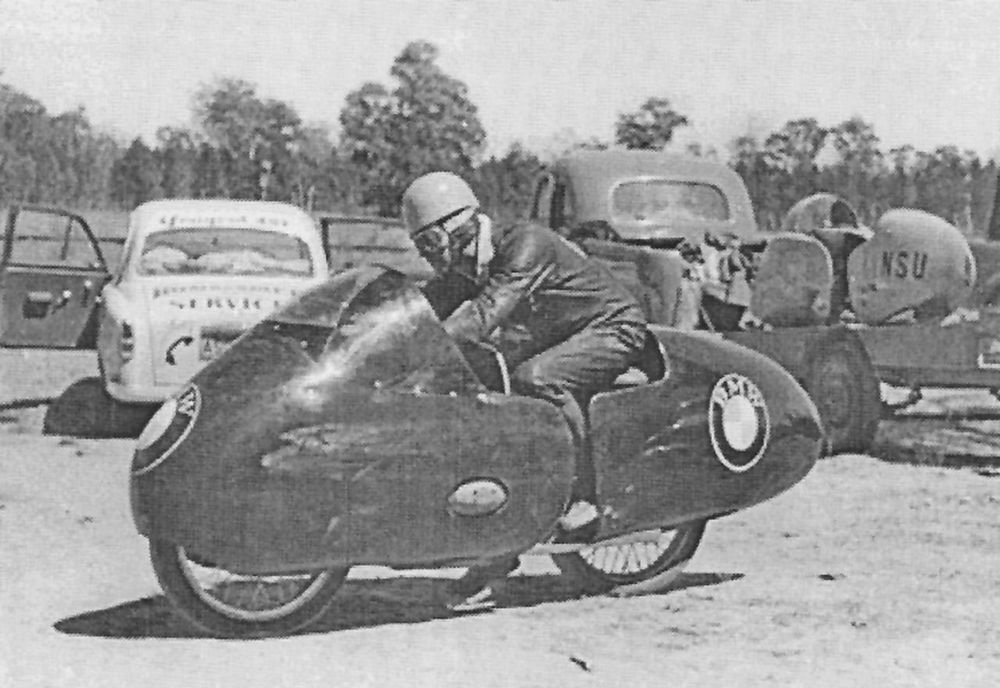
Jack Forrest set a new outright record of 149mph on his ex-works BMW Rennsport 500 despite a blistered rear tyre and an altercation with a flock of galahs, the damage inflicted by said birds obvious on the fairing. The NSU on the trailer is Jack Ahearn’s Sportmax.
It wasn’t all plain sailing…

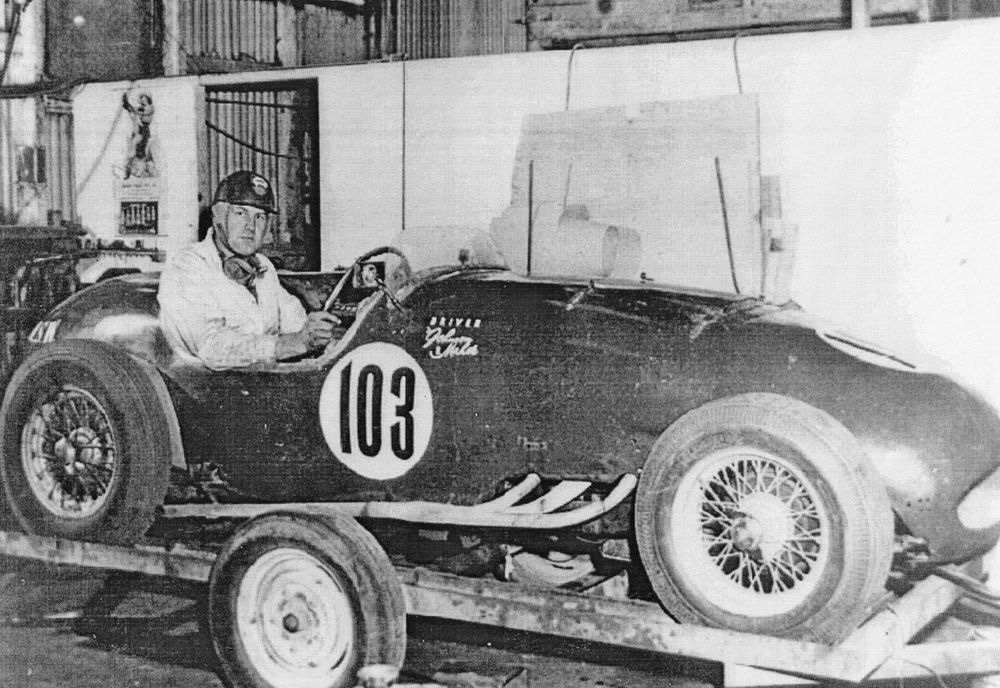
Jim Johnson decided to give his MG TC Special a final test run before the off to ensure a misfire was sorted. With the roads still open to normal traffic, Johnson arrived at high speed on the Coonabarabran-Baradine road at the Tipperary Station farm gates at about 6.30am – listening hard to his engine but not necessarily watching fully in front of him – just as a fuel truck turned right into Tipperary. Johnson went straight under the truck, the unfortunate Leichhardt garage proprietor and father died instantly in gruesome fashion. The truck didn’t have external rear vision mirrors so the driver didn’t see him coming. It wasn’t a great start to the event, but the event hadn’t actually started for the day…

Credits…

Ron Button Archive, V Mills photographs in the Coonamble Times, Jim Scaysbrook’s Tipperary Flying Mile article on oldbikemag.com.au dated October 4, 2019, Chevron Publishing

Tailpiece…
(V Mills)

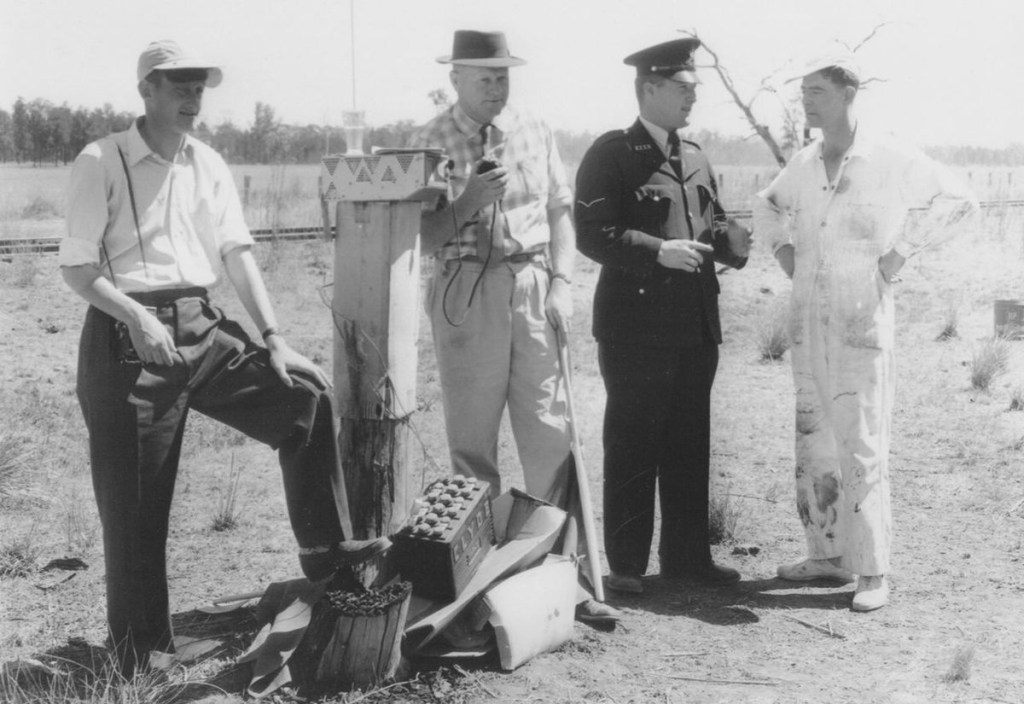
Officialdom ready for the off: the butcher, baker, candle-stick maker and copper. In the manner of the day, everybody pitched in. Note the lightweight battery…

Finito…

(F Pearse)

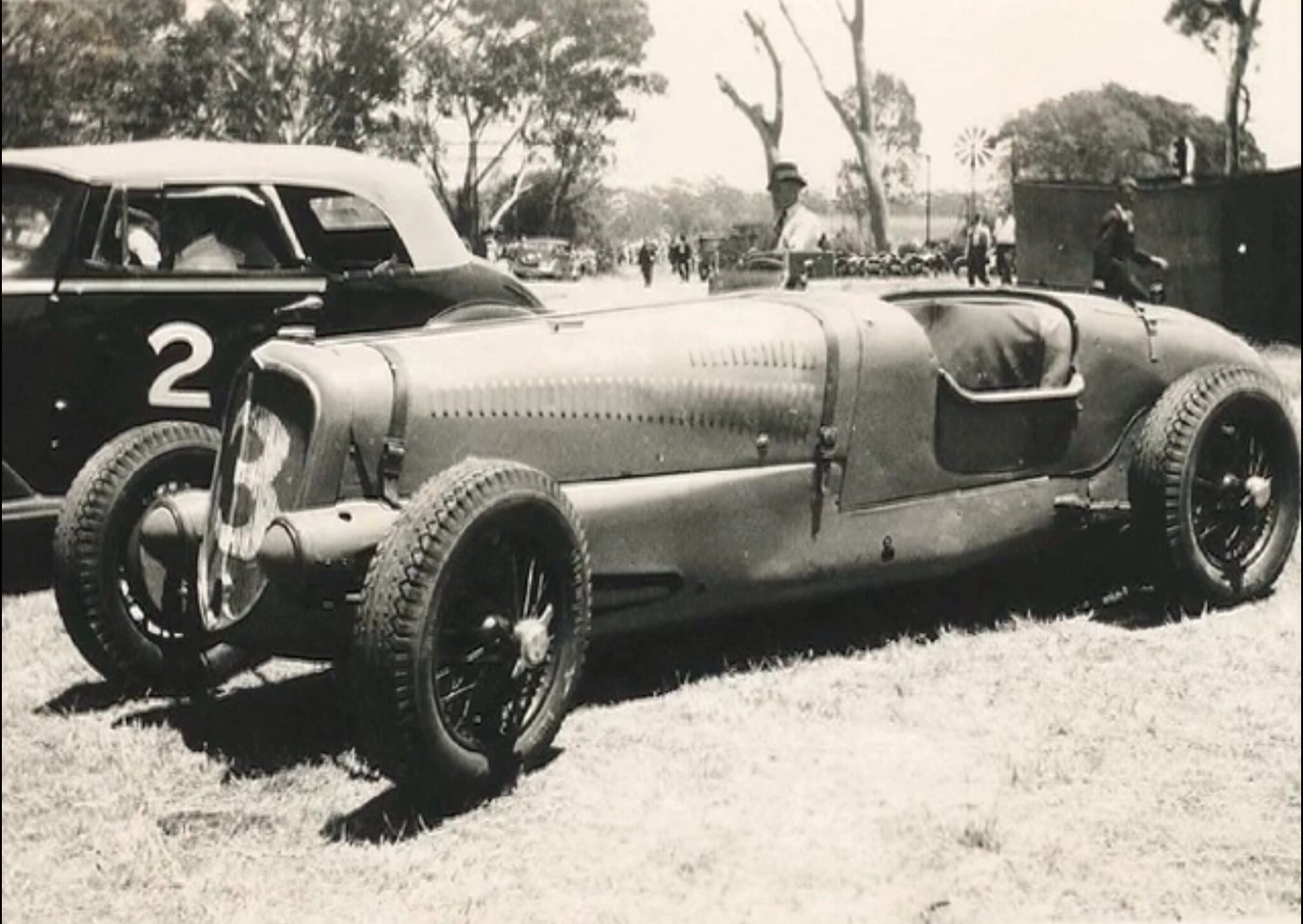
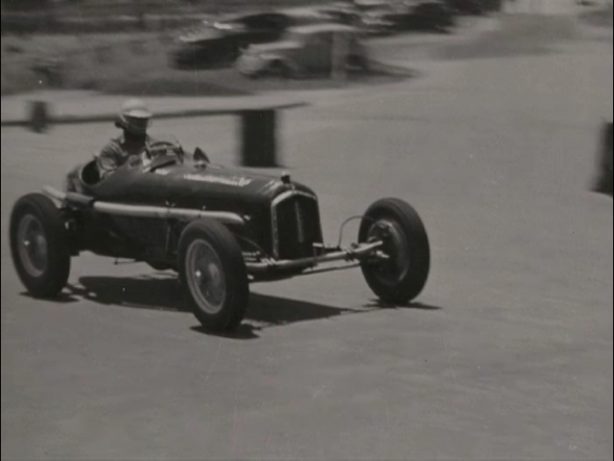
The Jack Saywell Alfa Romeo Tipo B/P3 and John Snow Delahaye 135CS and friends at The Coorong, South Australia on January 5 and 6 1939…

The two intrepid Sydney racers contested the 1939 Australian Grand Prix at Lobethal on 2 January, the handicap race famously won by Allan Tomlinson in his MG TA Spl s/c. Saywell aboard ‘the fastest car in Australia’ was off scratch and finished sixth, slowed by tyre problems on the scorching hot South Australian summer day. Snow was off 4 minutes 15 seconds in the French sportscar and was fourth. Everybody that day was outfoxed, out-prepared and outraced by the three youngsters from Perth- Tomlinson and two fellow racer/fettlers Clem Dwyer and Bill Smallwood.

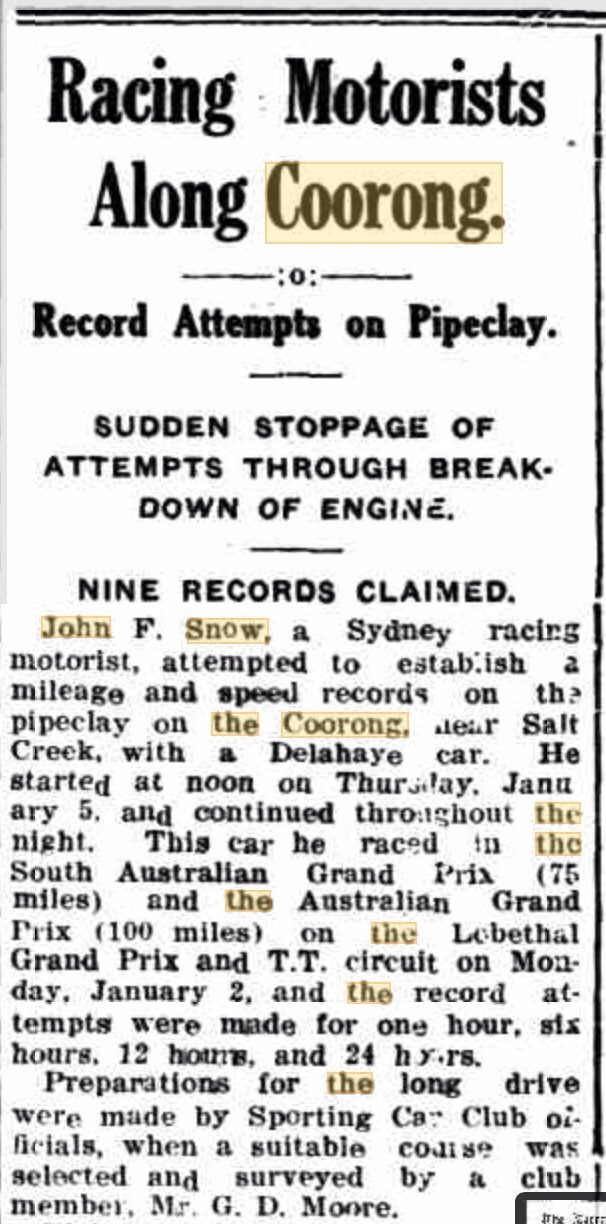
Whilst in South Australia they decided to attack some Australian speed records on the pipe-clay surface of The Coorong, at a little spot near Salt Creek, 210 km from Adelaide.

Huge amounts of preparation went into the attempts with the Sporting Car Club of South Australia playing an organisational role and in ensuring compliance with international rules.

Not the Coorong but the Lobethal paddock earlier in the week- John Snow’s gorgeous Delahaye 135CS- he used the Hudson behind in the Australian Stock Car Championship that weekend too (N Howard)

Whilst attempts were being made by Snow and Victorian racer Lyster Jackson over longer distances/times, both Snow and Saywell also wanted a crack at The Flying Mile (Class C for Snow and Outright for Saywell) which had to be timed to the nearest hundredth of a second rather than a tenth of a second- the best which could be achieved with a chronometer. The Adelaide University Physics Department were involved in creating some automatic photo-electric timing equipment which met the accuracy requirements of the international regulations.

Two existing speed records had been set in South Australia during February 1935 at Sellicks Beach by John H Dutton (Class C 92 mph Flying Mile) and CW Bonython MG (Class A 76.09 mph) but the Fleurieu Peninsula beach would not suffice in length for this endeavour which sought records between an hour and twenty-four hours.

A huge open area was needed with space for long, high speed corners to keep average speeds up. Whilst the opening photo may be at the Coorong, it could be at Sellicks- perhaps its a promotional shot taken prior to the record attempts or maybe a test run. Let me know if you have certainty about the locale.

Weather delayed the attempts by a few days but the SCCSA officials were out and about at 5 am on the morning of Thursday 5 January 1939 and prepared a surface as ‘smooth as glass’- the wind was up on the day and was said to be anything up to a 40 mph headwind.

The temperature was 96 degrees Fahrenheit, by the end of the week the temperature in Adelaide was 117 degrees! ‘Despite that a crowd of over 200 people ventured out into that desolate landscape and into those incredible temperatures, setting up a tent city’ wrote John Medley.

The chosen course had been professionally surveyed by an SCCSA club-member and measured 10 miles 318 yards- it was a huge oval comprising two straights of 5 miles and ‘wide circles at either end for turning’.

John Snow started the blue Delahaye 135CS at noon and was soon lapping consistently, the intent being to stick to a plan to coax the car through 24 hours- it wasn’t a sprint after all.

John covered the first 185 miles in just over two hours averaging 92 mph. The car was then refuelled in 4 minutes and Lyster Jackson jumped aboard- he maintained the average of 92 mph in his 10 lap stint and then made another refuelling stop and some ‘engine adjustments’ were made. The first tyre stop, which took 49 seconds, was made a little later and then Jackson was relieved by Snow after the speedy machine had completed 35 laps, or about 366 miles.

Snow had been going again for less than 3 miles when valve trouble ended further motoring at about 6.30 pm.

A perfect world would have been popping a spare engine into the car between the 150 mile Grand Prix and the record attempt but Snow didn’t have a spare despite his wealth. The car ‘was overhauled by the Englishman brought to Australia specially to prepare the car’- lets come back to that point.

The distance travelled in the first hour was 92 miles, for three hours about 275 miles. Jackson did the quickest lap at 6:26 with Snow’s 6:32. ‘No attempt was made to push the car’ but a mean speed of 130 mph was reached on the long straights.

The team claimed records to the Australian Automobile Association for 50, 100 and 200 miles- 50, 100, 200 and 500 kilometres- and 1 and 3 hours. Those recognised in the Australian record books are;

Standing 100 km 40 mins 45.5- 91.47 mph, Standing 200 km 1 hour 21.29.0- 91.51 mph, Standing 50 Miles 32.55.4- 91 mph, Standing 100 Miles 6:5.33.0- 91.51 mph.

Obviously the Delahaye was in no fit state to attack the Flying Mile, whilst one newspaper report has it that Saywell’s Vittorio Jano designed masterpiece did 132 mph for the Flying Mile and 88 mph for the Standing Mile.

‘On the following day , it was Jack Saywell’s turn…the task was perhaps simpler, the red car attacking only two records, the standing start and flying start mile- but the blistering temperature, sandy surface and blustery 45 mph sidewind across his path were going to be a hindrance…in accordance with AAA rules, a run in each direction was required, and the Alfa used its Lobethal rear axle ratio, the second highest of four available’ John Medley wrote.

‘Using a four mile run in against the breeze, Saywell averaged 128 mph for the first officially timed run. In the opposite direction he used a shorter run in and averaged 140 mph for the flying mile. The average of the two runs was 134.7 mph, the fastest officially recorded speed in Australian history breaking the previous record by over 35 mph’.

‘The Alfa was then prepared for its attempt on the standing start one mile record. Spewing dirt off its spinning back wheels for the first 400 yards, the booming Alfa then got into its stride and crossed the line at 142 mph, wind assisted. Into the wind Saywell crossed the finishing line at 125 mph. When the times were totalled and the speed averaged, the mean speed was 89.2 mph, another new Australian record’ John Medley wrote.

Some Australian enthusiasts will be aware that John Snow, scion of the wealthy Sydney ‘Snows Department Stores’ family made annual trips to the UK both to purchase merchandise for the family business and to race and purchase some top-end cars either to order or for re-sale back in Oz.

The 1939 AGP grid, for example, comprised at least four cars (John Crouch Alfa 8C2300 Le Mans, Colin Dunne MG K3 Magnette, Saywell’s Tipo B and Snows Delahaye 135CS) imported to Australia by the front-rank Sydney racer.

John Snow during the 1939 AGP weekend at Lobethal, Delahaye 135CS (N Howard)

The Delahaye was a remarkably astute purchase by Snow for Australian handicap racing- it was not an outright winner other than on the ‘right day’ but with enough speed and reliability built into it by virtue of its sports-racer intent would always be ‘thereabouts’ in the handicaps which predominated in Australia. And so it was, mainly. The car probably coulda-shoulda won several AGP’s, but in the end it only took the one, in John Crouch’s hands at Leyburn, Queensland in 1949.

The 6 cylinder, 3557cc, OHV 160 bhp car, chassis ‘47190’ was turned into a ‘corn-chip’ as a consequence of a disastrous trailer fire due to an errant cigarette butt flicked out of the car window upon the trip back to Sydney after the 1951 AGP at Narrogin, Western Australia. Enough of the car existed to reconstruct in the seventies/eighties.

The English mechanic referred to earlier was ‘Jock’ Finlayson, he was brought to Australia by Snow and Saywell who by that time were operating ‘Monza Service’, at 217 Bourke Street, East Sydney looking after various racing and top-end road cars.

The very well credentialled (ex-Bentley, Birkin, Straight, Seaman) poor chap totally stuffed up the timing of Saywell’s 2.9 litre, DOHC, supercharged Tipo B engine when he rebuilt it and rooted the engine as a consequence.

With no confidence in anyone else locally to address the engine and having plenty of moolah Jack popped the engine onto a boat back to Milan, but the ship is thought to have been sunk in the immediate months of the War- Saywell never saw that engine again!

Chassis ‘5002’ was not reunited with a motor of kosher original specification until it was restored in Australia in the early sixties. It had an active, long, eventful racing career mind you, albeit fitted with GMC and Alvis motors…

Credits…

Fred Pearse Collection, ‘John Snow: Classic Motor Racer’ John Medley, Norman Howard from the Bob King Collection

Tailpiece: Jack Saywell, Alfa Romeo Tipo B, AGP Lobethal 1939…

(N Howard)

Finito…