Mike Imrie’s Ford Falcon V8 sports sedan gets the jump on Alfie Costanzo’s Porsche Cars Australia Lola T430 Chev into Shell corner, Sandown during a Formule Libre race in 1979.
Maybe not. How bout they shared an early Sunday discretionary practice session, it’s an interesting juxtaposition of car types all the same.
The trouble with building the world’s best Formula 5000 car, the Lola T330/T332/T332C, is how Eric Broadley and his band of merry men could better it!
Alan Jones, Lola T332 Chev ahead of Peter Gethin’s Chevron B37 Chev during the February 1977 Sandown Park Cup, two DNFs, with Max Stewart’s Lola T400 Chev the winner below. All of the first three shots Shell Corner (B Forsyth)(R Steffanoni)
The 1975 Lola T400 (above) oozed smart thinking, including variable or rising-rate suspension. Initially it was labelled a dog, but by mid-1975 an update kit and setup guidance had customers who persevered with the cars on the right track: Teddy Pilette’s VDS T400 won the 1975 European F5000 Championship from his teammate, Peter Gethin, while in Australia Max Stewart’s T400 won the 1975 Australian Grand Prix and many Gold Star and Rothmans International rounds from 1975-77.
The ultimate F5000 test was of course, the US Championship, where Eppie Wietzes was the best of the T400s in 1975 with fifth place in the standings. The Americans and Australasians loved their T332s, some like the Jim Hall-Chaparral T332Cs raced by Brian Redman were very highly refined and developed, and prodigiously fast.
Frank Gardner all cocked up in the Esses during the February 1971 Warwick Farm 100 Tasman round won by FG’s works Lola T192 Chev (L Hemer)Kevin Bartlett, Lola T300 Chev, Glyn Scott Memorial Trophy Gold Star round, Surfers Paradise 1972
Broadley then took a leaf out of his own F5000 playbook. The Frank Gardner developed Lola T192 Chev was still winning races in 1971 when Broadley, Gardner and designer John Barnard went smaller by building the 1972 model-year Lola T300 Chev.
Essentially, Gardner felt a car based on an F2/FB T240 aluminium monocoque chassis would provide a lower centre of gravity and improved aerodynamics. Fitted with big radiators mounted beside the drivers shoulders, a 500 bhp Chev and Hewland DG300 five speed transaxle where a Ford FVA and FT200 five speed transaxle once lived, the T242, and a little later the renamed T300 was a luscious looking racing car!
Once refined by Gardner in the late 1971 season races the T300 won a lot of races around the world and sold like hot cakes in ’72. The 1973-74 T330/T332 refined the package into one of the most successful series of customer racing cars ever built. Probably the most successful if you account for the central-seat 5-litre Can-Am T332CS and T333 variants as well.
For 1976 Lola planned to do ‘a T192 to T300 all over again’.
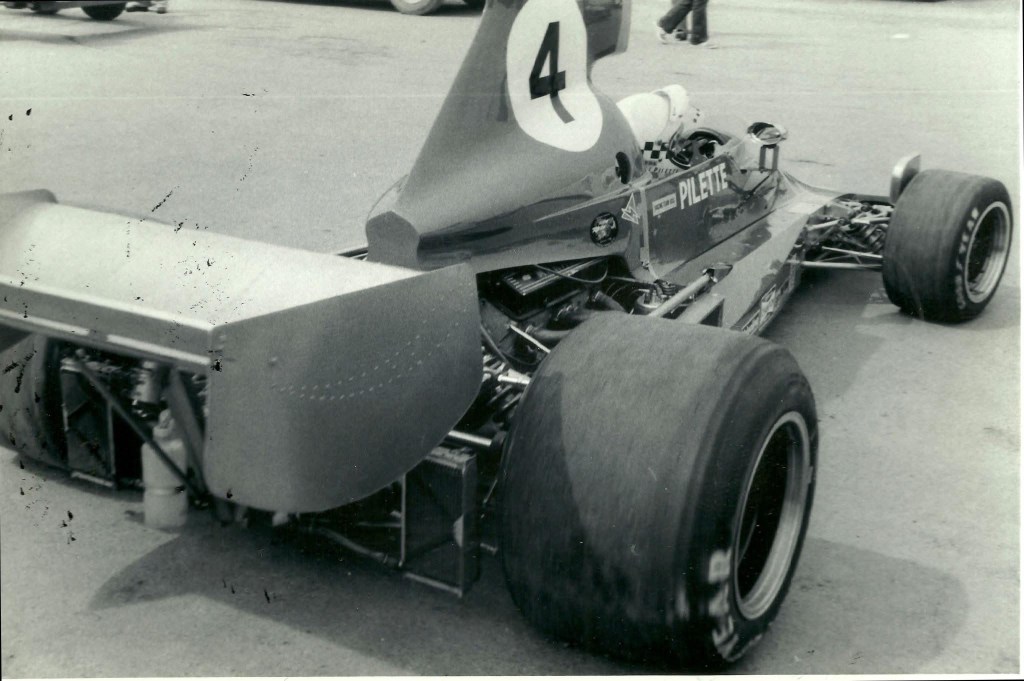
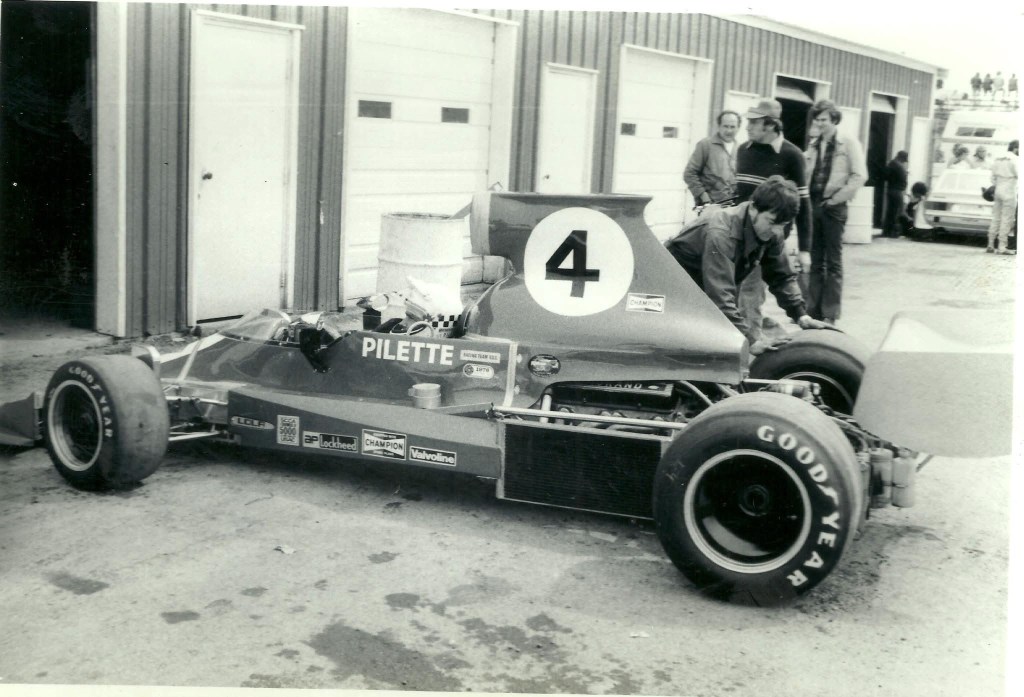
Teddy Pilette testing a Lola T450 F2 chassis fitted with a Chev V8, DG300 Hewland etc at Paul Ricard. Note that a front radiator is fitted at this stage. In the later shot of Teddy below, the radiators have been moved to the rear, parallel with the radius rods (Lola)Note the ‘brackets on brackets’ front suspension assemblies as per the text (Auto Hebdo)
Lola initially built and tested a car based on an F2 T450 tub, but ultimately, went with a monocoque based on the T360 Formula Atlantic, which was also a narrow design.
The T430 had a full-width nosecone, unlike all of the T300-series cars, but the radiators were mounted at the rear, having initially, as the photos above show, experimented with a front-mounted radiator.
The suspension was different to the T360 in that the quite conventional mix of magnesium uprights, upper and wide-based lower front wishbones, Koni/coil spring damper units and an adjustable roll-bar. were attached to brackets that in turn were attached to the tub.
The rear suspension comprised Lola magnesium uprights, a single upper link, two parallel lower links and a pair of radius rods doing fore and aft locational duties, and again Koni/coil springs and an adjustable roll bar. VDS’s chief mechanic, Steve Horne, christened the car The Flying Bracket!
In essence, as Allen Brown described it, the T430 has ‘T332-style suspension geometry. Essentially, Lola had built a smaller version of the T300/330/332 design.’ Teddy Pilette wrote cryptically on Facebook, ‘Eric Broadley wanted to make a small, narrow car to get the advantage of straight-line speed…but no good on the curve!!!!’
Steve Horne added (in relation to a Riverside photograph) ‘The drivers swapped cars that weekend and didn’t change much. I normally looked after the B37 (see results summary below), but that weekend was demoted to the 430! The Chevron was one of the best F5000s I worked on. It didn’t really have any development done on it, and the biggest downfall for both cars (T430s and B37) were the Morand engines, which just weren’t competitive in the USA.’
SCCA-USAC Formula 5000 1976…
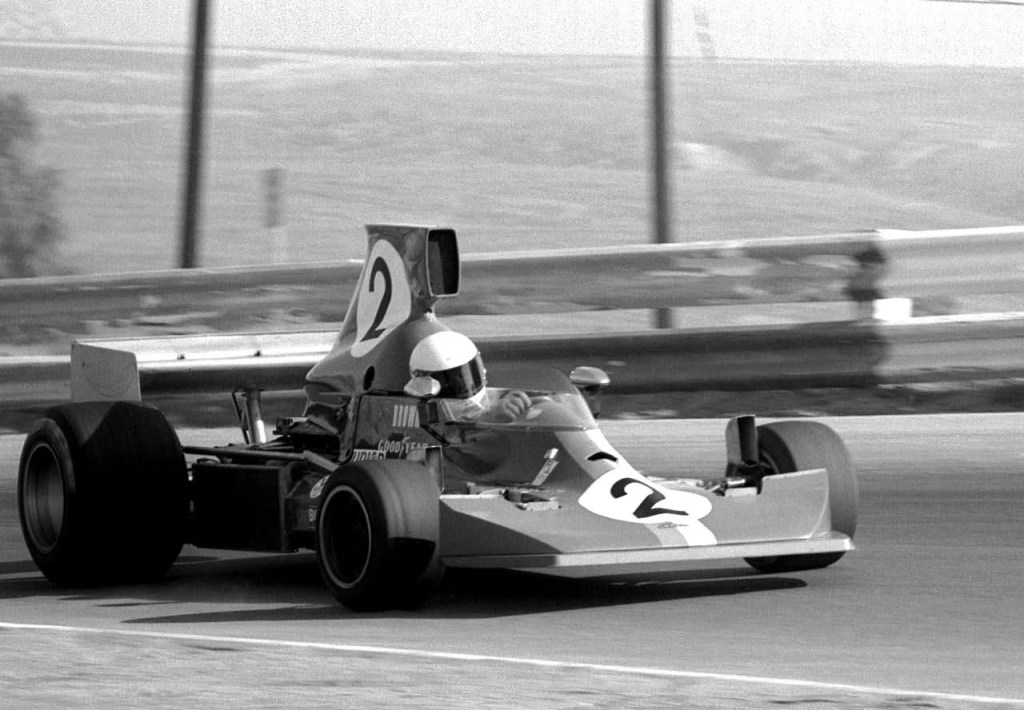
Three Lola T430s were sold, two to Count Rudy Van Der Straten’s Racing Team VDS, and one to Jim Hall’s. In addition to his pair of Lolas for the 1976 US F5000 Championship – the last – VDS also acquired Derek Bennett’s last F5000 design, the Chevron B37 Chev, having successfully run B24/B28s previously; Peter Gethin won the 1974 Tasman Cup aboard a VDS Chevron B24 Chev.
It must have been quite an expensive year for the beer-baron, carrying chassis spares for different makes of cars. To add to the mix, he also appears to have acquired the T332C HU55 that Warwick Brown was racing for Bay Racing until its demise. WB’s first appearance for VDS was at Road America on July 25.
Pilette raced T430 HU1 and Gethin and Brown HU2, Gethin’s preferred mount was the B37, but Teddy grabbed it once or twice too…
Teddy Pilette, Lola T430 Chev HU1 at the Pocono 1976 US F5000 season opener – the T430’s first race – in May 1976 (B Featherly)Oil radiators mounted either side at the rear (B Featherly)(B Featherly)
As to results: Pocono, May 9, Teddy was Q5 and third and fourth in the heats, then 12th in the final won by Redman’s T332C. At Mosport on June 20 Teddy was third from Q7 in the race won by Alan Jones’s T332. Jackie Oliver had a memorable win for Dodge at Road America on July 25, Shadow DN6B with Pilette sixth from Q11. Gethin was ninth from Q8. Redman won again at Mid Ohio on August 8 with Gethin seventh from Q11. Pilette was fifth overall, and second in his heat from Q7 in the Chevron B37…
The dominance of the Lola T332C was again confirmed with Redman’s win in the Hall-Haas entry at Road America on August 28, where Pilette was Q2 – easily the best qualifying performance of a T430 all year – and fifth, with Brown Q6 in T430 HU2 and DNF, while Peter was Q8 and fourth in the B37.
Allen Brown wrote that ‘With two rounds to go, Alan Jones and Jackie Oliver were tied for the championship lead, but when Oliver retired at Road America and Jones had to miss the race to be at the Dutch Grand Prix, Redman won and leapt into a significant points lead.’
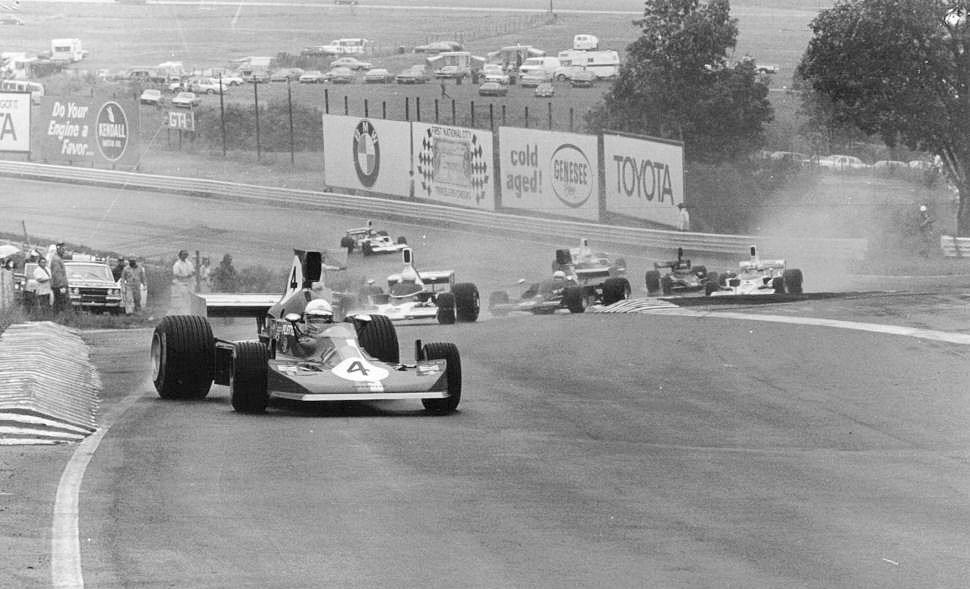
Teddy Pilette leading the field in the wet at Watkins Glen in ? 1976 DNF on lap 14 with engine failure (Lola Heritage via T Pilette)Warwick Brown, T430 Riverside 1976 and below (unattributed)
At Mid-Ohio on August 8, Redman won again with Gethin seventh in HU2 and Teddy fifth in the B37. In the final round at Riverside on July 17, VDS were again busy with three cars. Up front, it was Al Unser in a T332 Chev with WB sixth in HU2 from Q11, Gethin 10th from Q16 in the B37 and Teddy 12th from Q10 in HU1.
Redman won the championship from Unser, Oliver and Jones, the best of the T430 pilots was Warwick Brown in seventh, but most of WB’s points harvest was aboard the Bay Racing Lola T332C.
Lift Off: Surfers 100 1977. L>R WB T430, Peter Gethin Chevron B37, Vern Schuppan, Elfin MR8-C, with John Leffler’s white Lola T400 correcting his start slide and perhaps looking for a run between Gethin and Schuppan. The first three were Brown, Gethin, and Leffler (D Simpson)
1977 Rothmans International Series Australia…
Given the scale of the investment, and success of VDS it was a poor season, best to cut ‘yer losses, take the cars to Australia, win the series, then flog them at the end of it. Which is exactly what happened!
Warwick Brown won two of the four Rothmans International rounds – Oran Park and Surfers Paradise – and the championship from Peter Gethin, in the VDS Chevron B37 Chev and Alan Jones Lola T332 Chev.
Jones was the star of the series but a jumped start in the AGP at Oran Park and writing off a T332 at Surfers cruelled his chances. Yip’s boys leased KB’s T332 for that race.
At the end of the series, VDS sold the two T430s to Porsche Cars Australia/Alan Hamilton, who had had one season of F5000 in 1971, and with business booming, thought he would have another crack.
Bruce Allison bought the Chevron B37 and had a fantastic year in it, contesting the British F5000/Group 8 Championship, winning many fans, some races, and the prestigious Grovewood Award.
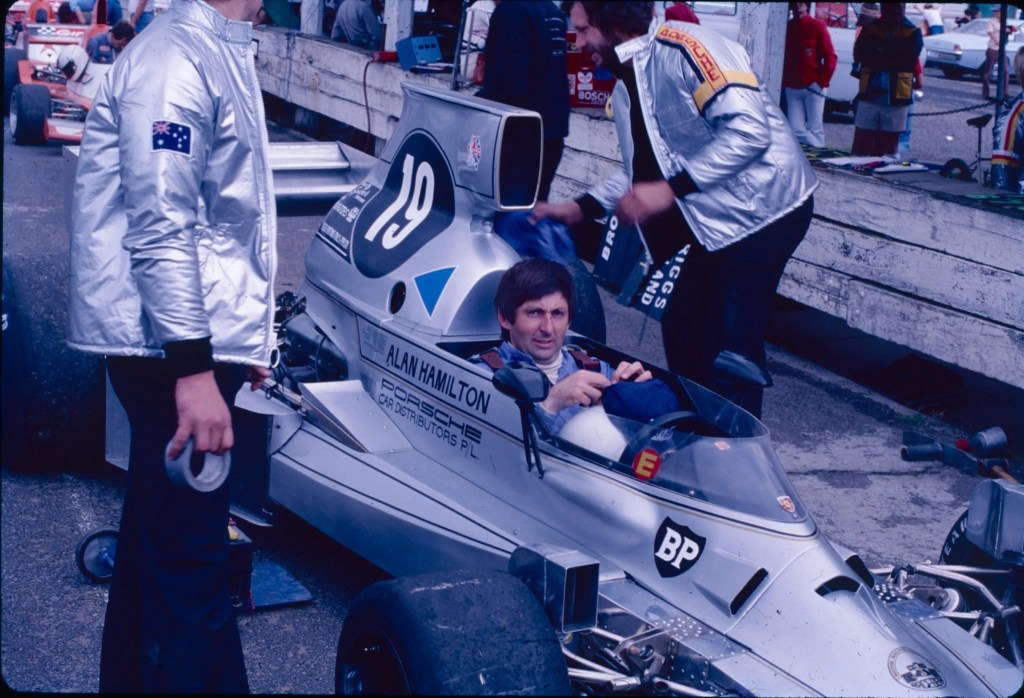
‘Hammo’ in the Sandown pitlane during the 1978 AGP weekend (B Atkin)
Porsche Cars Australia Alan Hamilton…
Brown raced HU2 to wins in the Australian Grand Prix at Oran Park and in the Surfers Paradise 100, while Max Stewart took his final win in his Lola T400 Chev HU3 at Sandown the week later.
Alan Jones’ Sid Taylor-Teddy Yip Lola T332 Chev was the fastest combination in the 1977 Rothmans Series, with AJ redeeming himself in the final round at Adelaide International. Jones was pinged for jumping start at Oran Park, bent a Lola in practice at Surfers, then led at Sandown before retiring.
In his ’77 Gold Star campaign aboard HU2, ‘Hammo’ was second at Sandown, fourth at Calder and second at Phillip Island for fourth overall behind John McCormack’s McLaren M23 Repco-McCormack Leyland.
Hamilton also contested the 1978 Rothmans Series for fifth at Sandown, tenth at Adelaide International and sixth at Surfers Paradise before vacating the seat for Derek Bell at Oran Park, where the British all-rounder was eighth from Q11.
Warwick Brown won the series again with a VDS machine, this time a Lola T333 Chev Can-Am car (HU2) converted to a T332C F5000 car, amusing to me at least, given the number of T332s that made the conversion journey the other way…
Derek Bell ahead of Kevin Bartlett at Oran Park at Oran Park in 1978. Lola T430 Chev and Brabham BT43 Chev (C Snowden)Alan Hamilton aboard his immaculate Lola T430 Chev during the 1978 Australian Grand Prix at Sandown before That Lap. Note the very neat T332-based nose fitted by then
While grids for the Rothmans International Series were still adequate, the domestic Gold Star was a different matter. The case for a change to Formula Pacific was being put, with F5000 hanging on. Alan Hamilton missed the opening round of the Gold Star at Oran Park but entered for the Australian Grand Prix at Sandown on September 10.
That ‘Fangio Meeting’ was mega with the great man demonstrating a 3-litre W196S-engined Mercedes-Benz W196R Grand Prix car with much brio throughout the weekend and ‘racing’ Jack Brabham in Jack’s 66 F1 Championship-winning Brabham BT19 Repco 620 V8.
The utter excitement of the sight and sound of that legendary car-driver combination was to a large extent ruined by the accidents that befell Garrie Cooper and Alan Hamilton, and to a lesser extent Vern Schuppan, in the Grand Prix won by Graham McRae, McRae GM3 Chev.
Alan lost control of the twitchy, unforgiving Lola on the fast left-hander off The Causeway then went backwards into the Dunlop Bridge breaking the car into two and breaking a leg, his pelvis and sustaining serious head injuries.
While there that day, I was nowhere near the accident, which was in a no-spectator area on the inside of the track. The vibe of the place that day, with three big hits and limited information flow to us punters, is something I still remember.
It took a long time for Hamilton to recover, he carried maladies related to that accident for the rest of his life, not least the diabetes that prevented him from ever holding a full competition licence again.
Hamilton supported a lot of drivers along the way, it’s beyond the scope of this article. When he decided to continue to race the other T430, HU1, he chose Italian Australian Alfredo Costanzo, then 35 years old.
Costanzo in the Sandown dummy grid. Flying Bracket factor front and rear is clear (D House)This shot shows the low frontal area presented by Costanzo’s T430 compared with Brown’s T332 further back; Perkins’ Elfin MR8 looking as slippery as the T430. Oran Park 1979 (B Forsyth)
Costanzo’s first race was at the Sandown round of the 1979 Rothmans Series on February 4, where he won, what a debut! He took the Adelaide round as well.
The shot above shows Costanzo, Lola T430 Chev, ahead of Larry Perkins, Elfin MR8C Chev, and Warwick Brown, Lola T332C Chev in the final Oran Park round on February 25, 1979.
Rob Newman, racer and in John Walker’s AGP and Gold Star winning 1979 year, the preparer of JW’s Lola T332, observed: ‘Poor Alfie had a driveshaft failure and lost the race and the series. Perkins went on to win the 1979 Rothmans series without winning a race, and Warwick salvaged one race win from what had been an awful 1979 Rothmans series for him, his last season as a professional driver, if I recall correctly.’
Shortly after the Rothmans, the Gold Star commenced with the Australian Grand Prix at Wanneroo Park on 11 March. Costanzo bagged pole, then he and Perkins took one another out in a first-lap, first-corner battle for victory. Another perennial battler, John Walker, won the day in Martin Sampson’s Lola T332 Chev; the duo took the Gold Star that year, too, with Alfie the winner of the Sandown round.
Take No Prisoners. Classic dive and chop manoeuvre between Perkins’ Elfin MR8 and Alfie’s T430 eliminates both at the start of the 1979 AGP at Wanneroo Park. A great pity, as that joust could have been really something (unattributed)AGP victor John Walker is licking his lips in the #25 white Lola T332 behind the Wanneroo Air Show (unattributed)
Into 1980, the Hamilton-Costanzo-T430 combination finally came good in a Gold Star season of many different winners, winning the coveted award from Jon Davison and John Bowe and taking victory in the Sandown and the Rose City 10000 at Winton in T430 HU1.
Alfie’s last hurrah in the old car was in the Australian Grand Prix at Calder on November 16. By then, the conversion of McLaren M26-4E to a ground-effects Chev-engined F5000 car in PCA’s workshops was a bit behind schedule, so Hamilton’s crew dusted off the T430 for one last time, finishing fourth in the race behind Alan Jones, Williams FW07B Ford, Bruno Giacomelli, Alfa Romeo 179 V12 and Didier Pironi’s Elfin MR8 Chev. Alfie and Didi gave one another a bit of hip-and-shoulder that day!
Bob Minogue, Lola T430 Chev, Shell Corner, Sandown 1981. From memory, the lack of airboxes at this stage was the notion of the entrants/penniless sponsor Arco Graphite to make F5000 cars look more contemporary (R Lewis)
The car didn’t move far with Brighton racer Bob Minogue, the purchaser. He had been out of racing for a while but proved very much up to the task and not intimidated at all, racing the car in the 1981 Gold Star and into the Arco Graphite Series in 1981-82 as Formula Pacific finally took over as Australia’s National F1.
All three T430s live in New Zealand with T430 HU2 rebuilt around the chassis plate, which ‘took pride of place’ on Alan Hamilton’s office pin-board for a couple of decades.
(A Mitchell)The Costanzo T430 Chev at Surfers Paradise in 1979 and below at Sandown. Circa 520bhp in the day (M Strudwick)(C Jewell)
Rod Steffanoni, Chris Jewell, Bill Forsyth, Lynton Hemer, Michael Strudwick, Chris Snowden, Auto Hebdo, Lola Heritage, Teddy Pilette, Bob Featherly, Neil Laracy, Chris Parker, Robin Lewis, Alex Mitchell
Tailpieces…
(C Parker)
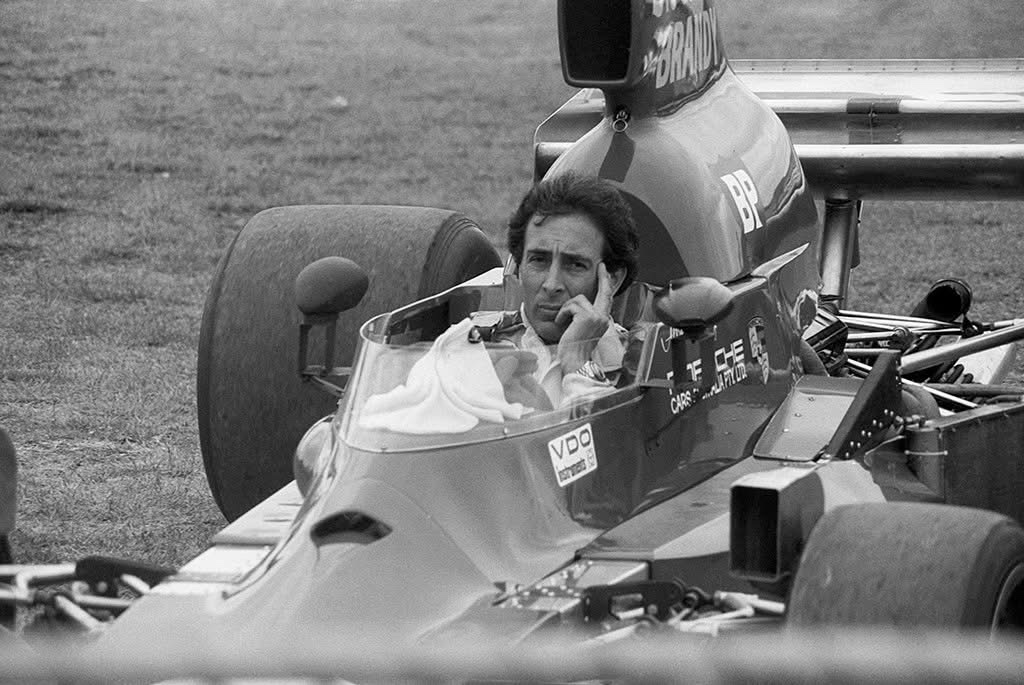
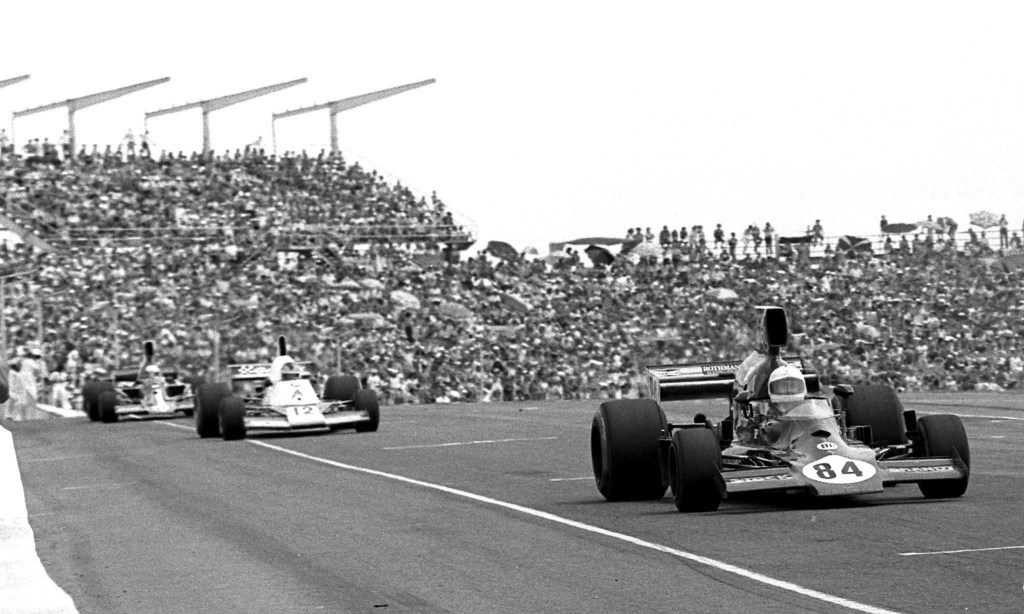
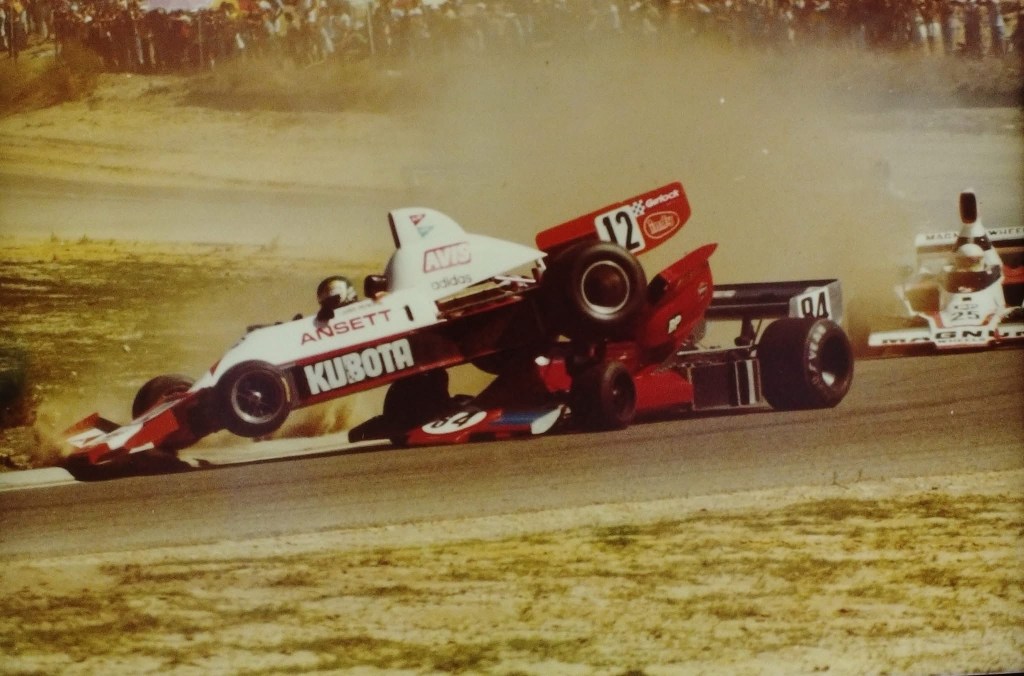
I was there somewhere, that day, every day over that Sandown Sunday, February 20, 1977, weekend.
Raceday wasn’t a good day for WB, he had qualified fourth but boofed the T430 into the Dandy Road fence on the warm-up or parade lap, Max Stewart won from Alfie and Garrie Cooper: Lola T400, Lola T332 and Elfin MR8-C all Chev powered.
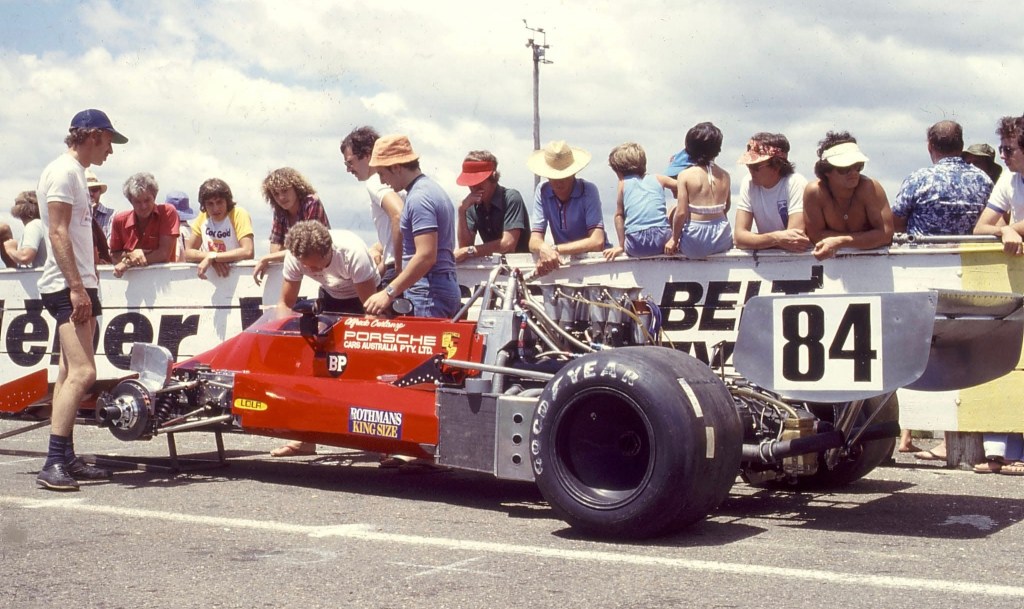
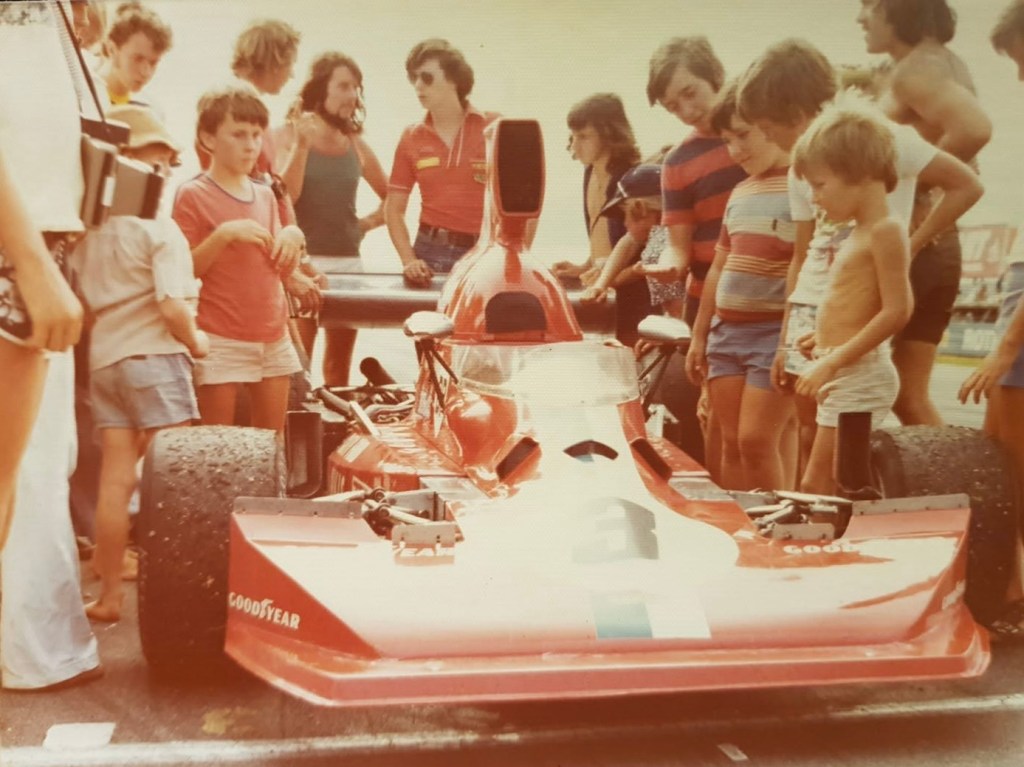
Look at the crowd…And below? Surfers perhaps? Racing cars are like magnets for little tackers and bigger blokes alike, aren’t they!?
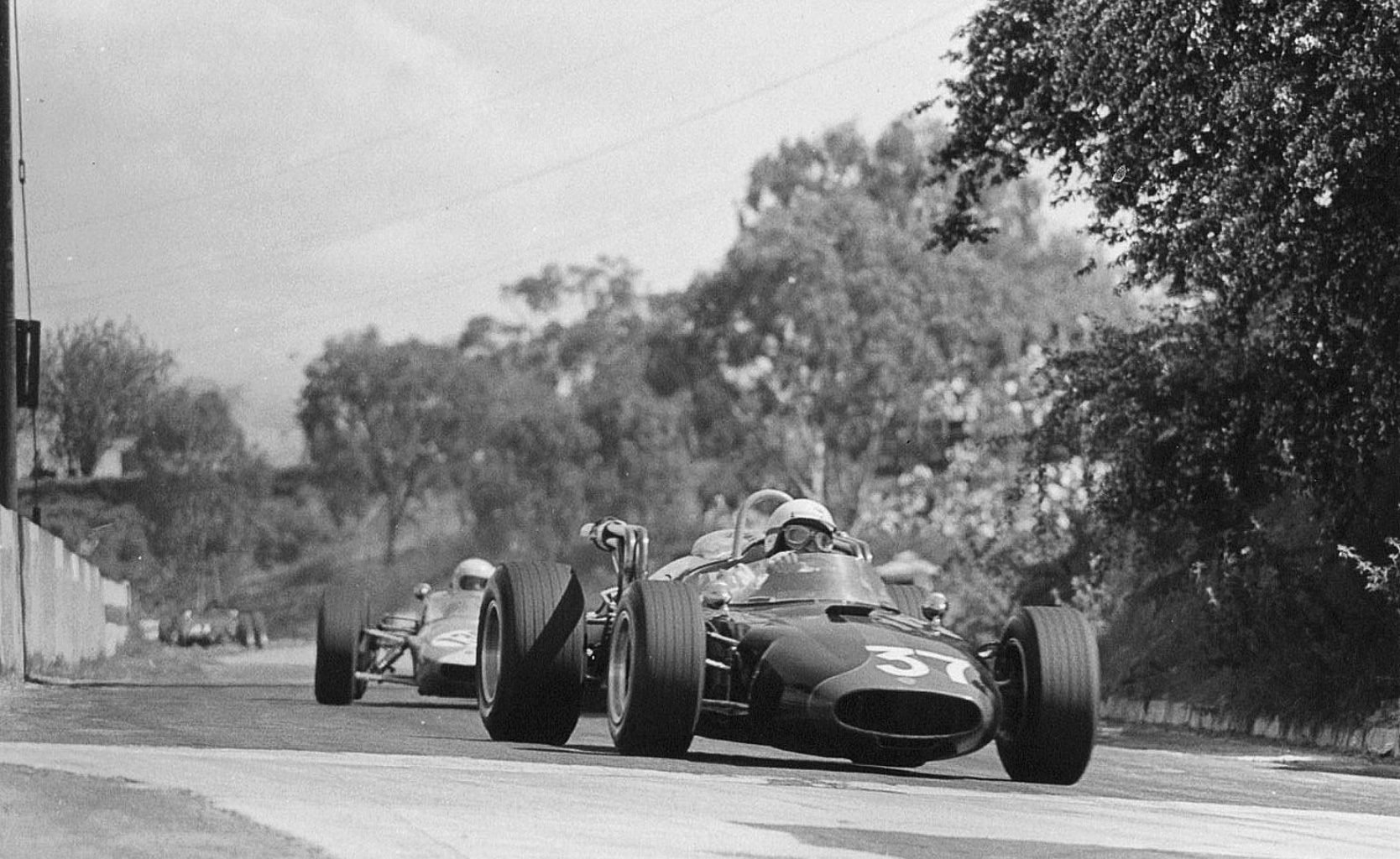
Ken Cox’ Cooper T53 Ford at Hume Weir’s ‘New Year’ meeting on 29 December 1968…
The wise owls of The Nostalgia Forum have determined this Cooper ‘Lowline’ as either #F1-4-61, the ex Yeoman Credit/Reg Parnell Racing 1961 Intercontinental Formula car raced by John Surtees and then Roy Salvadori in Australasia, or #F1-7-61 the ex-Rob Walker car raced by Stirling Moss in F1 and the Australasian Internationals in 1962. Perhaps the latter is more likely Allen Brown surmises on his excellent oldracingcars.com, see the link at the end of this piece. The car still exists in the hands of the Banister Family in Sydney.
Whatever the case isn’t it a fantastic looking car? Dick Simpson has captured it and Ken’s style marvellously!
I can feel and hear the rumble of the 289 Ford small-block bent-eight. Its not Australia’s ‘first F5000’ mind you, that honour goes to Austin Miller’s Geoff Smedley built Cooper T51 Chev which set an Australian Land Speed Record at Bakers Beach in Tasmania in 1961 at 163.94mph or thereabouts.
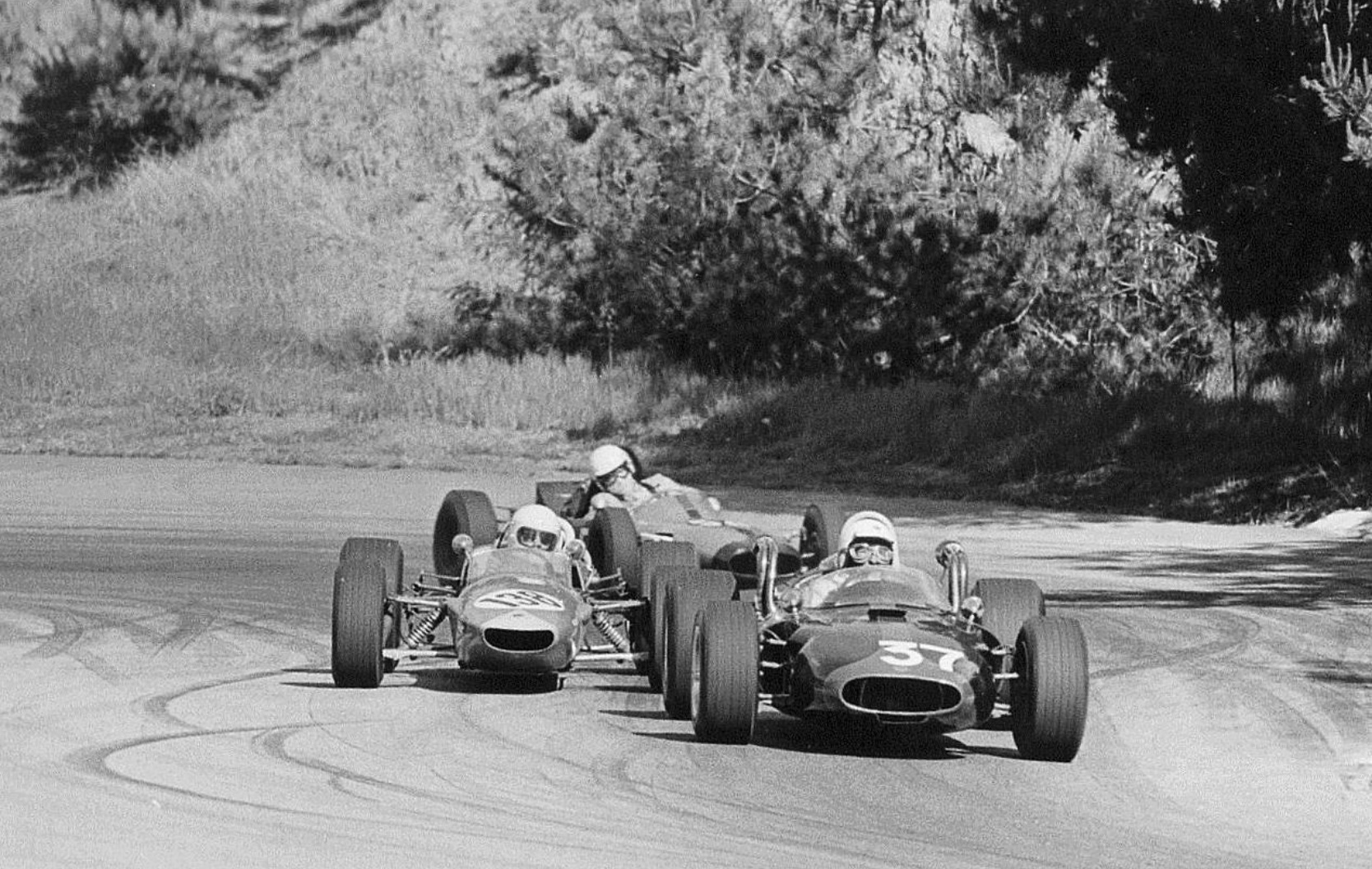
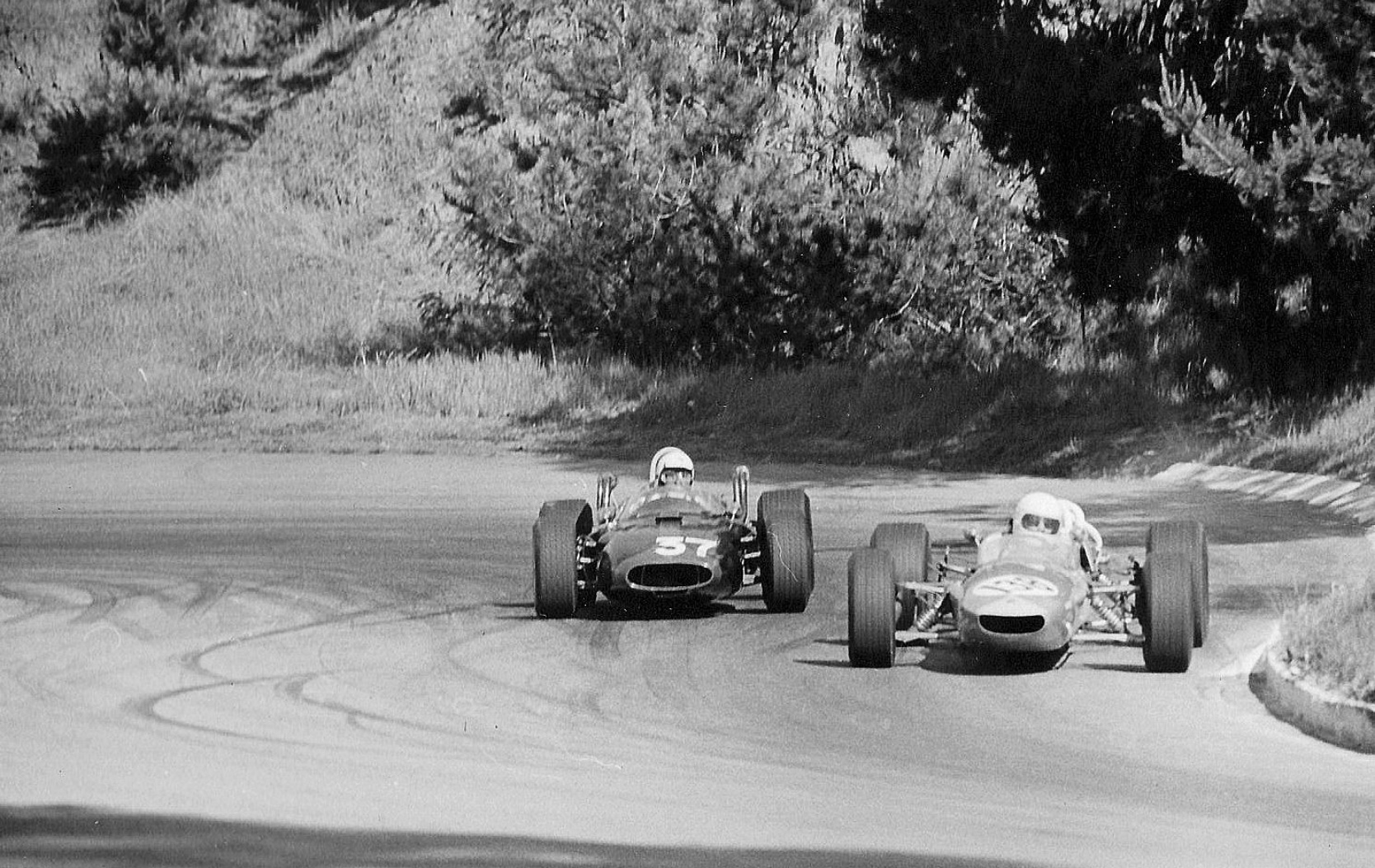
Cox from Bob Minogue, Elfin Mono Ford, Hume Weir circa 1969 (C Baron)And again out of Scrub- who and what is the third car I wonder (C Baron)
The essentials of the Cox Cooper are as follows, sourced from a ‘Motor Racing Australia’ story written by Ray Bell in September 2001.
Cox raced anything and everything- speedway, dirt tracks and bitumen from the forties onwards. One of his main supporters was a timber-cutter named John Cierpicki, he acquired the Cooper in a sale of Stan Jones’ assets after Stan got into terrible strife off the back of the 1961 Australian recession- the car was extricated from an old chook-shed in Camberwell, Melbourne circa 1966. As a former long time Camberwell resident I am fascinated to know the whereabouts of said chook-shed…
Norm Beechey’s engine man, Claude Morton with assistance from Kerry Luckins at Paul England Engineering in Moonee Ponds soon had a 179 Holden six-cylinder ‘Red Motor’ race-prepped and inserted into the rear of the T53. It’s said only one frame tube had to be removed in this process, the tube was returned when the Ford engine went in.
The car raced with the Holden engine for a few years, the Colotti gearbox was rebuilt by Claude Morton and adapted to the Holden-six with a bell-housing made by someone long since forgotten. The 289 had modified heads and a cam, it was fed by a four-barrel carb with ‘the exhausts made by Alan King’s Panel Shop over a dozen VB’s’. Later a 302 bottom end went in and a mismatched installation of 351 heads.
The car first raced in V8 engined form at Hume Weir on the 30 November- 1 December 1968 weekend which makes this meeting surely its second outing? The machine raced at the Weir, Winton, Calder and Phillip Island and ‘took on some minor kind of prominence at a time when the argument was raging about whether or not Australia should adopt F5000,’ Bell observes.
Bryan Thomson raced the car at Winton in 1970, Bob Minogue owned it for a bit, then Des Lascelles with the car even contesting an F5000 race – the Motor Show Trophy meeting at Warwick Farm in September 1972 – it no doubt looked a bit out of place in amongst the T300 Lolas, Elfin MR5s and McLaren M10s…
Click here for Allen Browns piece on Cooper T53’s- all you wanted to know but were afraid to ask;
Doesn’t it look like a great, race long dice between the nimble, light Elfin and big, booming Cooper- Minogue was that impressed, or needing the challenge he bought the car.
Credits…
Dick Simpson, oldracingcars.com, The Nostalgia Forum, Ray Bell, Charles Baron
Darryl Harvey’s 1934 Ford Rodster takes on the Graeme Bolwell Jaguar Healey Sports at Riverside, Melbourne circa 1963 (P Ryan)
Saturday mornings for me generally have a common pattern depending upon whether i am with The Italian Sheila in Toorak, of whom i wrote in a Cooper S context not so long ago, or sub-optimally flying solo at my place in Windsor, a couple of kays south of Melbourne’s CBD.
Windsor is an interesting place, me ‘an a few ancient Greek ladies are its oldest residents. Otherwise its populated by 25 year old perky bottomed hornbags who say ‘Like’ a lot and their 26 year old gym-toned studmeister boyfriends who tend not to say much at all. Therefore, visually, Chapel Street is easy on the eye.
And so it was on Saturday 2 February, flying solo i did my uber-early jogging lap of Albert Park where i have the ducks and a solo fisherman near Powerhouse to keep me company and then retired to Oppen, the Scandinavian inspired cafe joint (recommended) beside Windsor station where i settle down for an hour or two with faithful Surface Pro to knock together some shite for you lot.
Its quiet there until 10.30 when the hotties and boyfriends arrive for replenishment of their slender frames after the rigours of the night before. At this point i leave as i don’t cope well with twenty young female people saying ‘Like’ in ever more shrill voices…and most of these knuckles have had pwivate school education gauging by the expensive vowels which accompany the continuum of ‘Like’s.
So, i wandered back to the Peel Street Love-Shack and pondered the next move of the day.
And then it happened…
Conor Ryan arrived with ‘my’ car 30 minutes after his father called me about the wonderful chance to drive it. Elgaram perfectly happy in busy Melbourne morning summers traffic and makes a superb early morning run/track car. Three of my mates called me within two days of the Phillip Island meeting to find out if the car can be bought- it can’t! (M Bisset)
I got the Works Driver phone call i longed for from Enzo Ferrari back in 1979.
I guess all of us who have been offered such rides have the approaches made in different ways, often through a manager or intermediary, or perhaps their Dad if the opportunity is a Kart and the driver nine years of age. But in my case the Team Owner took the direct approach and called me, i was watering the petunias out back at the time.
Patrick Ryan is a mate and long time historic racer in Australia having been involved since the start of historic racing in the mid-seventies. His fleet includes various vintage Vauxhalls, a Brabham Ford FJ, the supercharged MG TA Spl he usually races, a recently acquired American Sprintcar which is giving the Group LB fields a serious fright, other stuff, and the Elgaram Jaguar.
‘I’ve entered the Elgaram at the Island, i want to encourage you back into racing, you’ve been out of it too long, how bout having a lash in the car as i now can’t make it?’ was the gist of the call. How could one say no to such an act of generous stupidity?
Before i even had the chance to email Pat my fifty page Driving Contract with all the usual carve-outs for my own sponsors names on the car, driving suit, fees, accommodation requirements, media appearance obligations and all the rest of it the Equipe Elgaram’s Chief Test Driver was on the phone to say he was in the area and did i want to drive the car?
This was code for ‘lets see if the fat prick will fit in the thing’ before we proceed too far.
Pat’s son Conor Ryan had been down the road doing a ‘you show me yours and i’ll show you mine’ session with Bob King in Brighton- Conor drove Bob’s Bugatti T35 (lucky prick) and Bob the Elgaram.
Twenty minutes after the call- forty minutes after i had first spoken to Pat, Conor pulled up out front of the shack, startling a couple of hotties in the process. Before too long we set off up Dandenong Road in the direction of Caulfield Racecourse amongst thick mid-morning traffic, not ideal, but that 10 km and back was the extent of my pre-Phillip Island familiarisation.
This was all very impressive, Equipe Elgaram was far more organised than Scuderia Shitfight, my own race organisation.
First impressions were good- comfy driving position, with pedals, gear lever and instruments all in the right spot- lucky as the seat is fixed, so it was going to be a case of ‘tough-titties’ otherwise. The Jaguar engine sounds great with lots of mid-range punch and more than loud enough to scare the shit out of the hornbags trundling along in their white 3 Series. ‘Like, did you see that thing babe? Like?’. Like yeah i did like, fuckin’ loud. No muffler the bastard. Like.’
The Moss gearbox promised to be more of a challenge, not really like the Mk9 Hewland with which i am far more familiar.
And therein lay the challenge of the thing.
Other than a few club events in my road Alfa’s and Lotus Elise down the decades all of my race experience has been in Formula Vee and Formula Fords with two modest test sessions in a Ralt RT4 F Pac. I am used to fancy, schmancy, lithe, nimble, responsive poof-house little single seaters not a big hairy front-engined, rear-drive sportscar- a mans car.
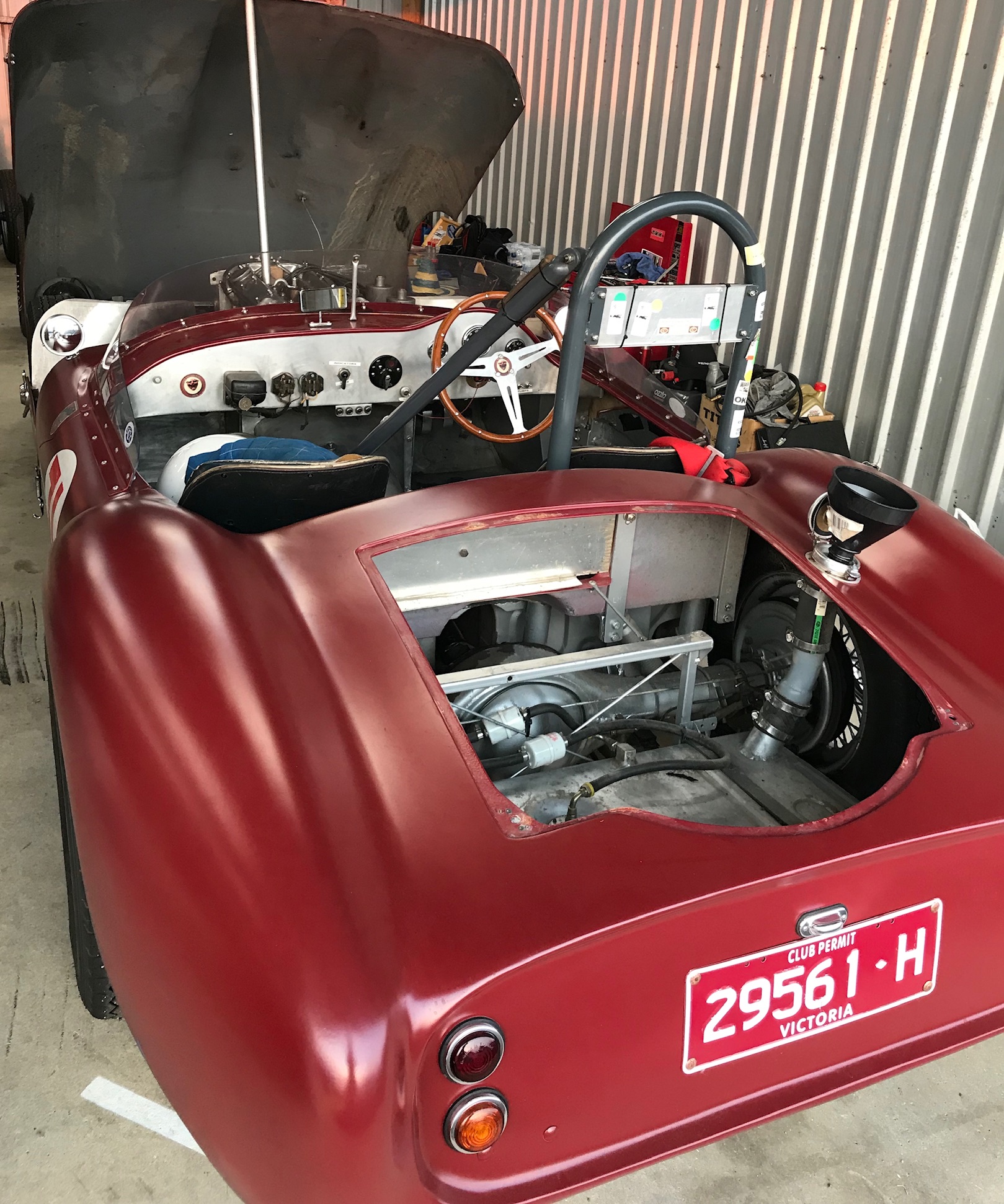
Rex Styles, Winton (P Ryan)Twin SU fed, ‘cooking spec’ Jag XK 3.8 litre engine sits well back in the chassis (M Bisset)Healey/Ford solid rear axle fitted with slippery diff, leaf springs, telescopic shocks, Panhard Rod and short radius rods locate the thing- very well. Brakes are drum and ahem. Stock Healey tank and in-line filters and Terry Cornelius’ structure to support the body (M Bisset)
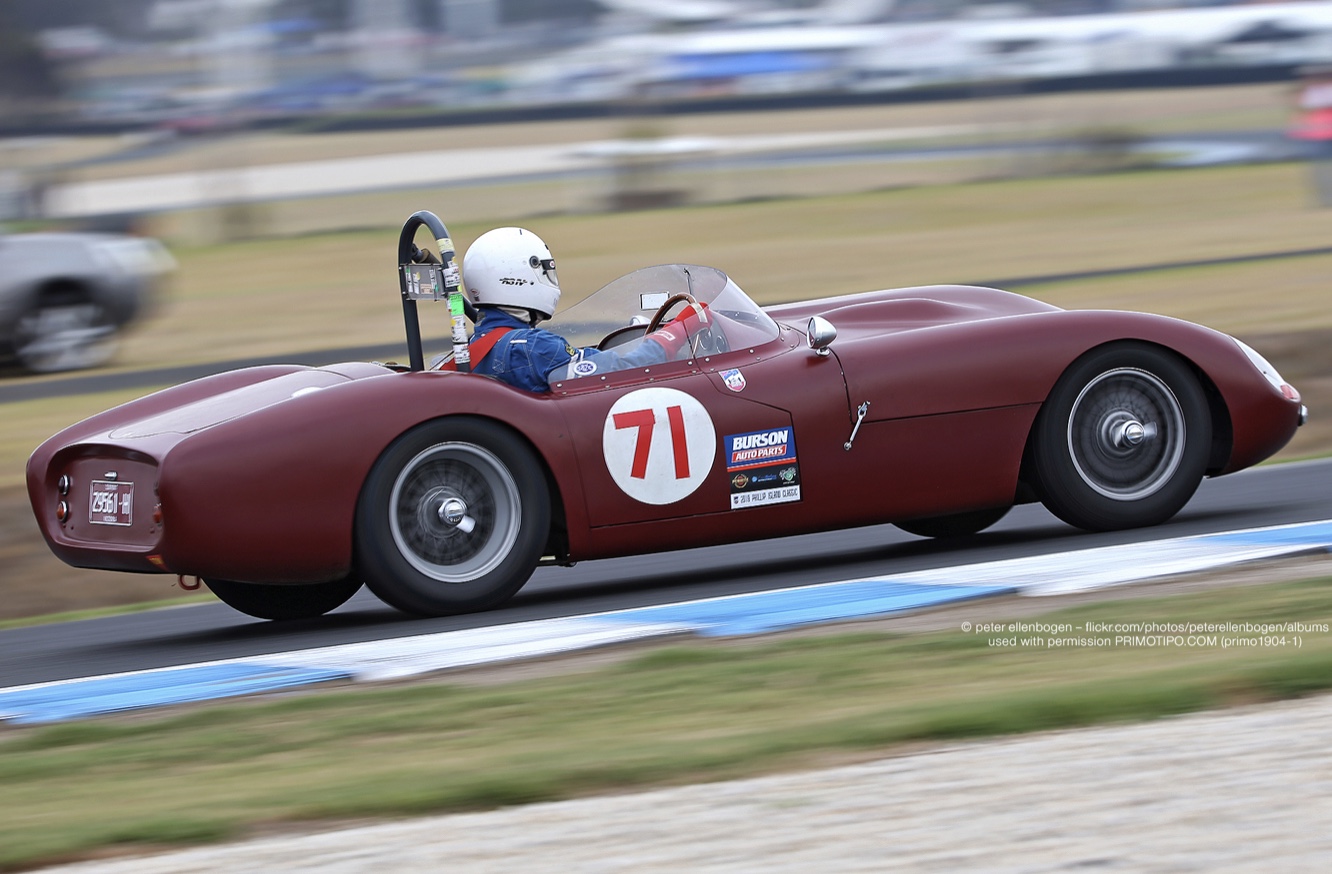
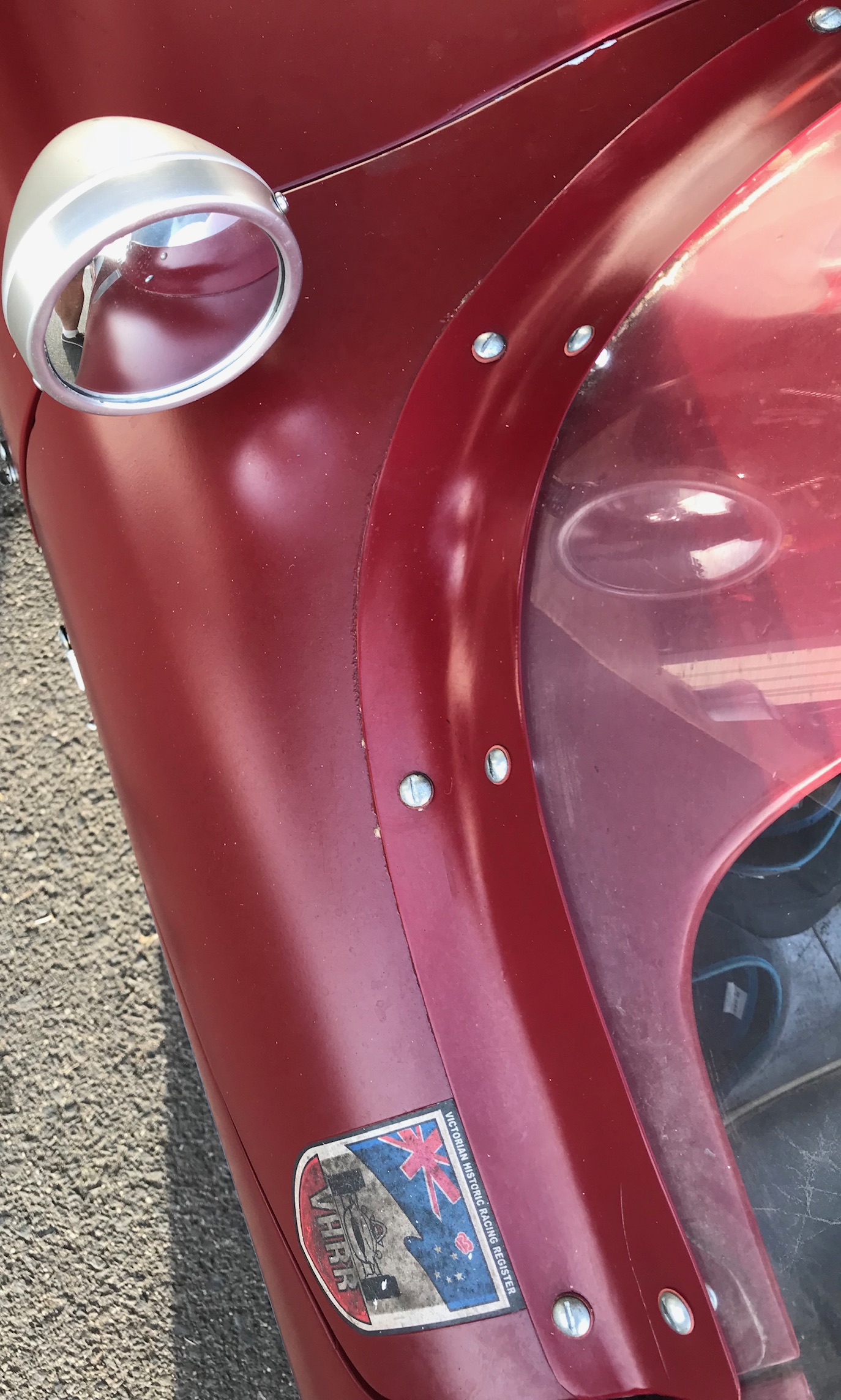
We will come to a full history of the Elgaram a little later. In essence it was built by Frankston, Melbourne bayside dentist Bill Suhr in 1961 and is a clever amalgam of Austin Healey 100-4 chassis, suspension, brakes and fuel tank, Jaguar twin-carb, twin-cam, XK 3.8 litre six-cylinder engine, Moss 4-speed gearbox and an AH rear axle incorporating a Ford 9 inch diff inclusive of slippery function. The whole lot is clad in a very swoopy, sexy, curvaceous body made by Graeme Bolwell- the first fibreglass body made by the Bolwells, Graeme was the car’s second owner and Suhr his dentist.
The car passed through many hands before being acquired by Patrick in 1974. Eventually the car rose to the top of the family restoration and preparation tree, it first raced at Sandown in 2013.
My competition licence lapsed long ago, the process of getting the requisite piece of paper to run in the Regularity from CAMS was surprisingly easy. That combination of words- ‘CAMS and surrisingly easy’ are not normally found together in the same sentence.
Also straightforward was fitting into my race suit. I figured that would not necessarily be the case after a decade and a bit. Clearly in that regard The Italian Sheilas pre-christmas demand that i ‘lose some weight if you want to sleep with me’ was effective. Desperate people do desperate things of course.
Jean-Pierre Bisset, P Is March 2019, lithe lisson lines clear (Bollyblog)
During the week before the meeting i did Melbourne, Perth, Brisbane and Sydney then back to Melbourne between Monday and Thursday flogging our corporate message to the poor employees so i was tad rooted by the time i pointed my Alfa in the direction of my sisters place at San Remo, a drop-kick from the Island later on Thursday night with my kit.
But hey, i’m a Works Driver, i’ve done no race prep of the car nor had to tow the little critter to the meeting, that task was undertaken by Conor, driving the other Ecurie Elgaram racer that weekend- a Daveric Formula Vee (Elfin NG copy) and John Noble- Chief Engineer, Race Tactitian, Driver Coach and regular driver of the Ecurie Elgaram fleet.
John is a couple of years older than me- we worked out over the weekend that we grew up 500 metres apart, attended the same Boroondara Primary School in North Balwyn- and i very clearly remember as a young kid his TC rocketing around the area in the mid-seventies- a car, delightfully, he still owns.
The three of us had a ball looking after each other, the cars ran like clockwork so there was plenty of time to take in the contents of the paddock and talk/meet near neighbours including John Medley, Dick Willis, Shane Bowden, Les Wright and many others including my cronies Andrew McCarthy, Peter and David Brennan, David Mottram, Simon Gardiner and his offsider Andrew, Jeremy Mantello, Adam Berryman, Tania Langsford, Peter Ellenbogen, Lynton Hemer, David Crabtree and many more. The fun guys are in the ‘right-bottom corner’ of the PI paddock all the same!
For me i had a big responsibility to the car and its owners- to absorb, taste and test it but most importantly bring it home in one piece for John Noble to drive back to Williamstown at the weekends completion. In that regard the Regularity is ideal as you set your own pace- i’ve done so many meetings at PI the circuit was no issue but in an unfamiliar car it rewards respect. Shit happens and when it does down there, at high speed.
Big beefy Healey/Ford rear axle, the fibreglass body is light but the engine/box are not. Sexy beast from every angle (M Bisset)Big wood-rimmed wheel nice to use, cockpit full of patina, it looks the goods. Six-point harness and old seat which holds you nicely and is comfy. Smiths instruments natch! Handbrake is ‘fly-off’, pedals beautifully placed for toe/heel and shift for the Moss 4-speeder in ze right spot (M Bisset)I got on with the Moss box in the end, sort of. Lucas ignition box with St Christopher medallion dangling. Note the fuses, ignition switch and starter button. Switch alongside starter is for the thematic fan which is needed in warmer weather, Up is on (M Bisset)
You can tell the car has been set up by experienced racers as soon as you sit in it. The controls are all well placed and clearly marked. The fixed seat is perfectly placed for those 6 foot tall- Pat, Conor…and me luckily.
To start the thing you switch the electric fuel pumps on- the up position, turn the ignition key, and, with a prod of the twin-SU’s, stab the starter button. Usually, the engine, in ‘cooking’ specification- and giving about 290 bhp on Ian Tate’s dyno the Monday before the meeting, grumbles into life and is easily kept alive with gentle applications of throttle.
Instruments comprise a Smiths chronometric tachometer which makes me go all funny because i love sitting and looking at those things and their ‘wonky movements’- most of my own cars have had them. Smiths also provide the water temperature and oil pressure gauges.
All three are easy to read with the tach mounted such that 5000 rpm is in the vertical position. Conor said ‘use 4800 thru the gears and whatever it will pull in top’- my imposed rev limits were 4800 on the way up and 5000 in top- i needed to feather the thing on both straights as it pulls harder than a busload of school-boys, all up weight is circa 900 Kg- not light but not heavy either, the Bolwell body slips through the salty, warm seaside air very nicely.
The six point harness holds you in place well- not like a single-seater of course, the seat is delightfully unrestored and you can saunter around the paddock no wux at all, the engine is not in ultimate spec in terms of tune, the clutch is light and easy to operate with well felt ‘bite’ points.
Balaclava and helmet on, switch on the electric fan once on the move- the up position, it felt strange to rumble away from the form-up area, down the pitlane and out onto the circuit sitting up in a car rather than ensconced down low within it. It is a totally different orientation to the road.
‘Use your imagination and the thing feels like you are sitting in and looking out of a Maserati 300S’ Pat Ryan said to me on that first phone call and so it is too. The big six makes a magnificent, deep-throated bellow, the shape of the dash and vista out front make you feel you are in a fifties sports-racer- which in conception is exactly what the car is despite an early sixties build.
I decided i didn’t love the Moss box in Dandenong Road but moderated that a bit at PI.
From first to third are changes made on a ‘one-two count’- you cannot beat the slow syncro whereas the third to top shift (direct) is as fast as your left hand will move. Bewdiful. The brake and throttle pedals are perfectly placed for heel ‘n toe operation- the top-third change is a soda. Third to second is much more of a challenge with a soft detent to that plane, which makes it way too easy to end up in limbo-land below reverse if you go too far left- a couple of angel rides into MG suggested using third and letting the big fat torque curve do its thing was the percentage play. Doing that also precludes an unsettling ‘snap’ shift from second to third before rolling onto the throttle for the left-hander outta MG- critical for a quick lap as those revs carry you onto the long PI straight.
Lesson learned. I’m sure when you are familiar with the box, its not an issue.
Up the rise before the dive into MG- Nigel Tait behind in Lolita BMC
The handling of the car is just superb, somewhat to my surprise.
At high speed it has stabilising mild understeer but out of third gear Honda and especially third gear Siberia you can get the thing into a yummy easily controllable delicate slide on exit. Whilst the XK engine- and Moss box are not exactly Twiggy in girth those lumps are mounted well back in the chassis as you can see in the photos- the driver also sits well back. It would be intriguing to know just what the front/rear weight ratio is. Whatever it is the thing works well- the ‘slippery’ allows the power to be put to the tarmac and panhard rod and ‘radius rods’ either side of the car locate the rear axle well.
At the front its wishbones/lever arm shockers- the turn in is pretty good albeit the amount of feel via the 14 inch wheel and worm and sector steering is not quite the same as a ten inch Momo and Van Diemen rack and pinion- but if you don’t use that inappropriate frame of reference and consider the road/track tyres with which the car is shod it turns in well driving it at the pace i was and driving it as a single-seater rather than chucking it about more the way the Ryans do. I noticed how much ‘slack’ in the steering there is in my first session on Friday but by the end of our event on Sunday wasn’t even noticing it- familiarity is the point here.
But the brakes. Faaaaark- wot brakes?
Man those drums- ‘keep an eye on your braking distances after the second lap’ Conor had warned me and he was not kidding. The levels of retardation are totally unlike anything i’ve ever run on a circuit- twice at Honda i went straight on an extra 20 metres or so and then turned back hard right onto the racing line having misjudged the distances required. The car pulls up straight- its just that it doesn’t pull up! If thats what a drum braked car of the period(s) is about i dips me hat to all of yez who race them. Conor and Pat do very fast times in that car, quite how they do them with those anchors is something for me to ponder.
The Elgaram Jag is a stunning piece of kit in terms of looks and performance. The acceleration to a six-cylinder basso-profundo symphony is marvellous, and the gearbox is great to use as long as you work to its delightfully ‘mechanical’ in feel, slow timing. The handling is precise, steering light but joisus i really didn’t like the brakes.
The beauty of the thing is its race and road use, as a 200 km early morning run car its hard to think of something more charismatic- my Elise would do it more clinically, the Elgaram with a good deal more brio and presence.
What a marvellous car! A tribute to both its builders and its restorers, which is rather a nice segue to the machines origins.
Jag Healey Special in its original form was as ugly as a hatful of arseholes as we crass Australians sometimes couch these things. Holden FJ Ute behind with an added on canopy- Graeme Bolwell up (Bolwell)
Design, Build, Construction and Evolution In Period…
Bill Suhr commenced the project in 1960, it would be interesting to know what his motorsport background was before he came upon the notion of a special incorporating the Jaguar XK engine as was relatively common at the time.
He acquired a brand new Austin Healey 100-4 chassis, (number unknown despite plenty of effort to find out- we surmise it was a spare part), suspension and wheels and fuel tank from the Frankston, Melbourne bayside dealership.
To that he added a Jaguar Mk7 engine built to ‘D Type specifications’ in terms of valves, camshafts and other items.
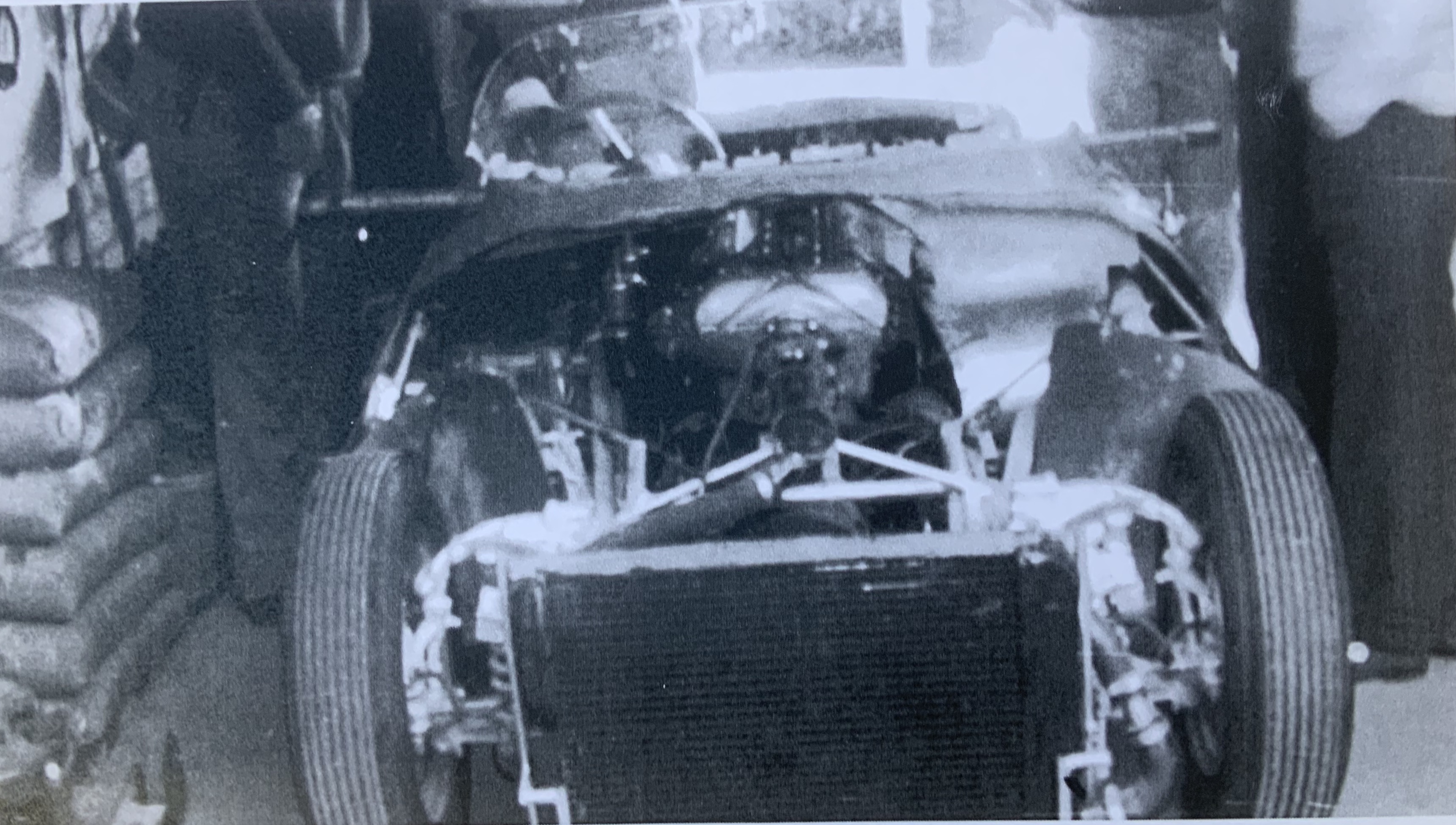
Chassis and suspension Healey BN1, tall Jag XK 3.8 litre six, period crossplies on skinny wires (P Ryan)Workshop unknown, perhaps the car in-build (P Ryan)Graeme Bolwell place unknown (Bolwell)
The body was built by Bobby Wragg a local plaster business owner in the Lotus 11 style, as a sideline. But with the radiator exposed it was ‘as ugly as a hatful…’ and not particularly aerodynamically efficient either.
Registered (Victoria) in Suhr’s name HHD-671 from March 1961 to March 1962 the car was entered as the ‘Jaguar Healey Sports’ at the old Mount Martha Hillclimb, Geelong Sprints in August 1961 (15.90 seconds) and at Phillip Island in December 1962 where Suhr won the over 3 litre sportscar scratch- amongst other events, in Victoria.
Graeme Bolwell with his mother, Lorna, looking on, Mount Martha Hillclimb 1961, note the headrest, how long did that last i wonder? (P Ryan)JHS at the second Templestow Hillclimb meeting (R Styles)The nose of the Bill Suhr Jaguar Healey Special alongside Murray Carter’s Carter Corvette at Geelong Sprints in 1961- Event 16- 15.9 seconds for Bill, 13.550 for Murray (Autosportsman)
Graeme Bolwell then bought the car, or rather part-exchanged it from Bill- his dentist.
Suhr took the MGA 1500 Graeme had been using as his daily driver to the Police Training College in St Kilda Road, Melbourne as a part trade.
Bolwell didn’t like the body so removed the original and built his own. He started from scratch making a centre bulkhead from tubular steel, covering it with aluminium. ‘He…formed the panel shape in plaster and chicken wire, smoothing it over before fibreglassing over it. This resulted in the rough side of the glass surface facing outward, which in turn had to be filled, smoothed and painted.’ The windscreen was the rear window of an FE Holden.
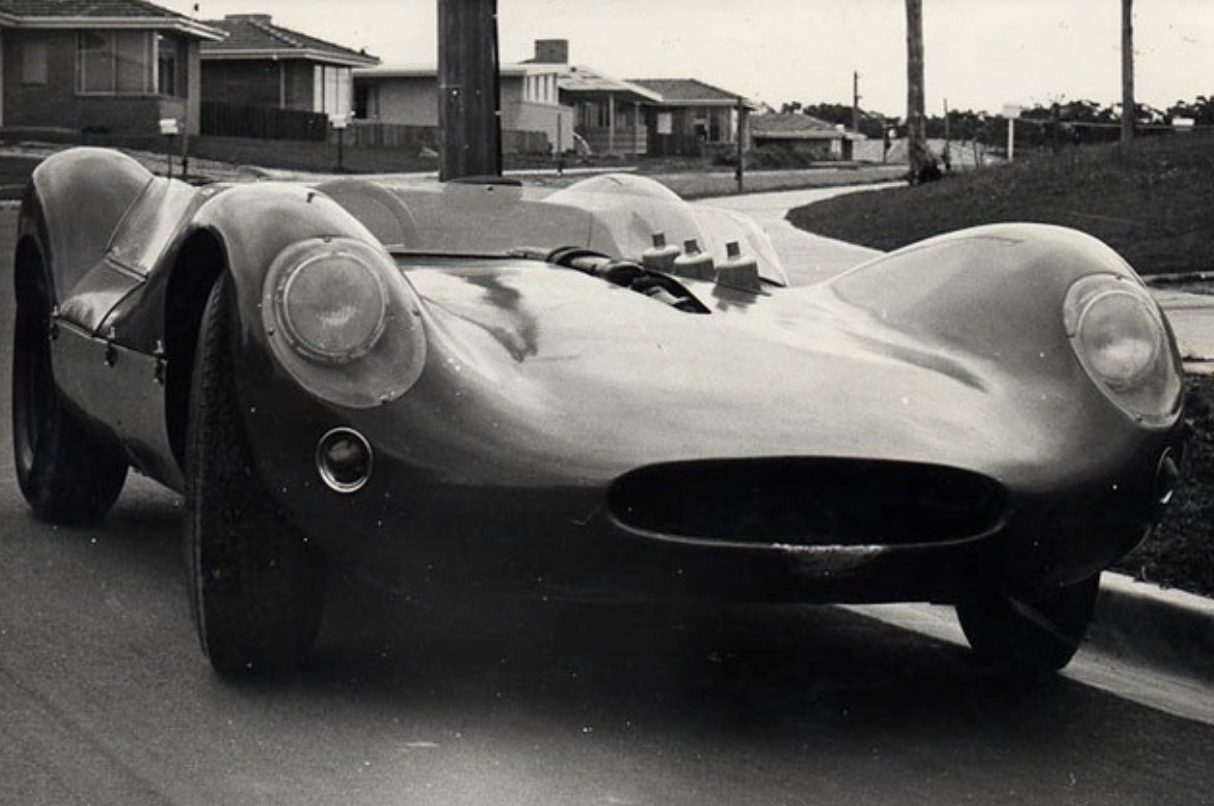
The front of the car was E Type’esque but unique- there was no mould so the car was strictly a one off. Graeme’s design flair was apparent right from the start, without doubt the car is visually arresting from any angle.
Graeme Bolwell in the driveway of his parents Frankston home (Bolwell)(P Ryan)
Graeme Bolwell developed a quite beautiful body for the JHS, here pictured in what i assume is the driveway of the family home in Frankston. A small sign proclaiming ‘Bolwell Cars’ was attached to the letterbox of this outer suburban Bayside house in June 1962- Campbell Bolwell’s intentions were clear!
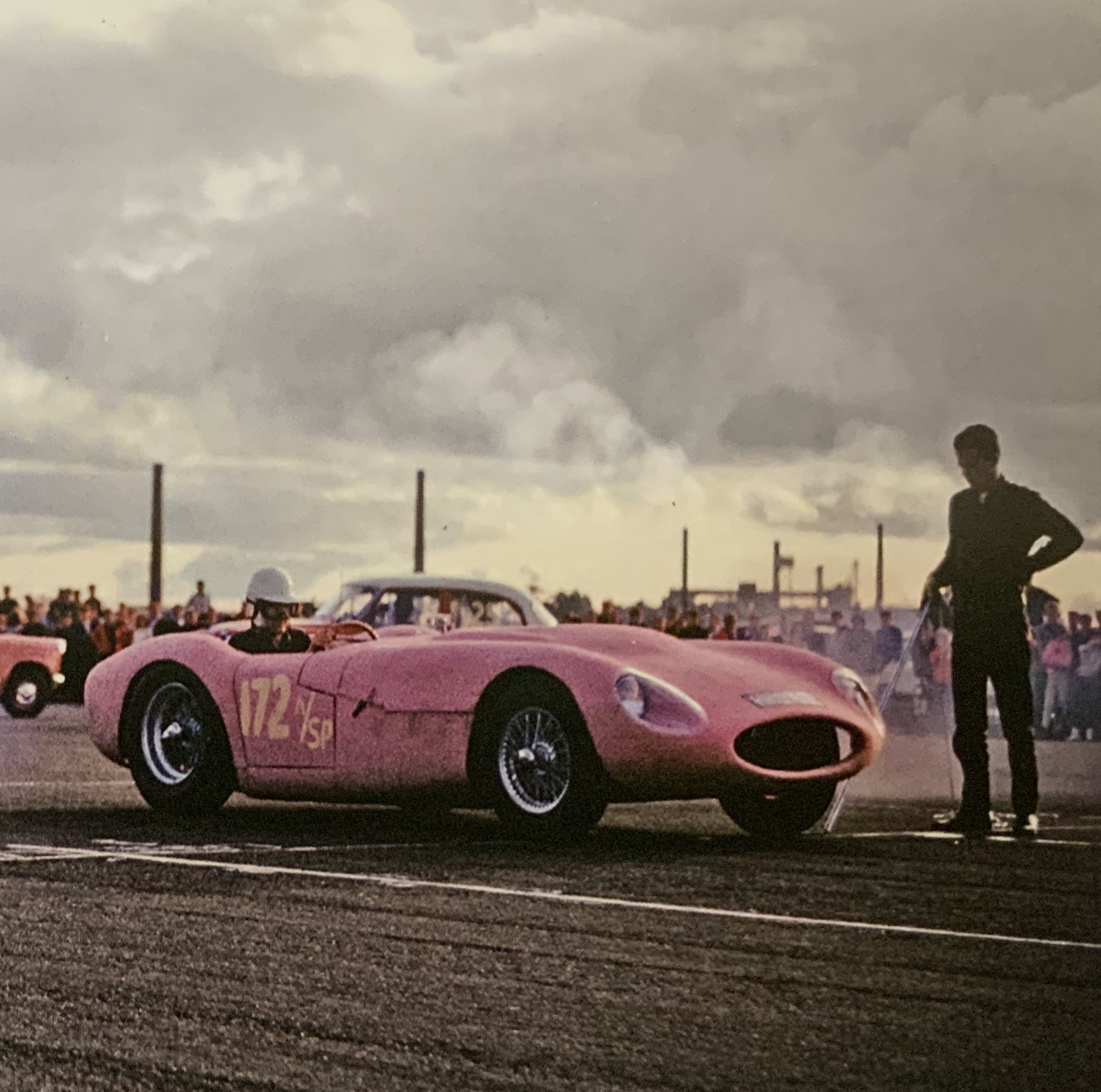
Look carefully on the door of the car above, those competition numbers are the same as those on the opening photograph at Riverside Dragway.
Its a pity we don’t have the date of that meeting, it’s safe to assume it was pretty soon after the body was fitted- there are still some finishing touches to come inclusive of a windscreen.
(Bolwell)
The car was said to be the fastest sporty in Frankston, Graham took it to the drags at Fishermens Bend (Riverside) and took home three trophies- 13.9 seconds for the standing quarter was his time but in the main the car was a roadie, his day to day transport.
The body for the Jaguar Healey Sports was the first such built by Bolwell, it is referred to in Bolwell circles as the ‘Bolwell Mk3 or 3B’- the third car built by the Bolwell brothers. Lets come back to that a little later on.
Graeme advertised it in the December 1963 issue of Australian Motor Sports, the ad is below. You will note Graeme identifies the car as ‘Jaguar-Healy (sic) Sports’.
Australian Motor Sports December 1963Rex Styles in the Elgaram Jag faces off against John Skipper Allard J3, Geelong Sprints August 1964- 15.770 for Bob and 16.280 for John. Lex Davison took FTD that day in his Brabham Climax with a time of 12.98 seconds with Earl Davey Milne doing a 14.06 in the Bugatti Chev Spl I wrote about a short time ago (Autosportsman)
Unable to sell it, he traded the car in at Dick Thurston’s Pitstop Motors, Elsternwick where Rex Syles, a salesman there at the time, bought it on 18 February 1964- Rex traded in his Fiat 1500.
Styles used the car as both daily transport and weekend racer at venues as diverse as Winton, Lakeland (first meeting) and Templestowe Hillclimb. Bob Minogue, later a racer of some note, his work at the wheel of an ex-Brown/Hamilton/Costanzo Lola T430 Chev F5000 springs to mind, was a friend of Styles. During this period the car was entered as the Elgaram Jaguar – Elgaram being the Maragle Avenue, Brighton street-name spelt backwards – Bob Minogue’s locale at the time. Bob recalls, ‘I rebuilt the engine for Rex, but I never drove the car.’
In fact Styles raced the car at the inaugural Lakeland meeting on 15 March as ‘Elgaram’ so the name change seems to have been effected pretty much from the start of his ownership. FTD on that hot Lakeland day went to a youthful Tim Schenken in the White 500, ‘the White entered, go-kart based 500 cc device’ in a time of 33.25 seconds.
‘Rex Styles comes over the top in the Elgaram’ is the April 1964 Australian Autosportsman Lakeland caption
Minogue did a 15.77 second pass at the Geelong Eastern Beach Sprints in August 1964. Styles decided to part with the much loved car when the engine developed an ominous engine knock after a Templestowe meeting.
The happy purchaser was WC Lucas of West Newport, like Pat Ryan and his family, a proprietor of a busline. He was a very active competitor on both road and track including Templestowe, Rob Roy, Calder, Geelong (he did 17.320 secs in 1965) and the Riverside Dragway.
Bill eventually over-revved the car bigtime, the tell tale said 9800rpm, a number for the which the Lyons/Heynes/Hassan XK engine was not designed. As a consequence he rebuilt the car around a worked over Ford Customline Star model V8 to which he mated a Crossley pre-selector gearbox! I imagine the little beastie was rather front-heavy at this point- during this period the car was entered in race meetings as ‘Beast’.
The Crossley box did not work well so Lucas refitted the Jag transmission, whatever the shortcomings of the configuration the car was a rocket in a straight line, recording more than 135 mph, a number which must have given the Werribee coppers something to think about. Over the standing quarter, 115 mph was the number through the traps.
The standard Healey diff was not up to the pace, so was ‘locked’ which resulted in broken axles so a change to a coil-sprung Jag XK120 rear end was made with which the car handled ‘reasonably well’ with race Dunlops fitted to the front and road going radials on the rear!
Bill Lucas owned the car for around three years and sold it, unregistered, in April 1966.
The car in essence has spent most of its life in Melbourne’s Western suburbs from the time Lucas owned it until the present.
Bill Lucas in the Elgaram Jag ‘Jag Spl’ at Templestowe Hillclimb in September 1966 (S Dalton)
Altona’s Fred Woolski bought it and dragged it, perhaps at Calder, he fitted vertical exhaust stacks by cutting sections from the bonnet, fitted a Customline dash and then sold to the car to ‘anon unknown’ in Altona who removed the engine and ‘box to fit to his road Customline.
The cars dark ‘limbo-land’ between life and death has well and truly begun- its now a cheap ‘ole’ (not so old in reality at all) banger.
Alan Forsythe of Braybrook then entered the cars life, his brother fitted an FC Holden ‘Grey-Six’ and gearbox to use in the paddocks. The next owner’s contribution was to pull the brakes apart and lose said componentry.
Footscay’s Jim Evans planned to use it in club events but it never cleared the Western Suburbs back-blocks before he sold it to fund his twenty-first Birthday celebrations! I doubt the cash realised would have bought too many Melbourne Bitter long-necks!
Elgaram during Iain McPherson’s ownership, note the Holden six engine. It’s before Iain found the original bonnet hiding in someone’s shed and the original Lucas aero screen. Note the wire wheels on the front and disc wheels on the back, when they needed to replace the rear end with an XK120 Jag unit the disc wheels became necessary (I McPherson)
The Limbo-Land was over when Bulleen’s Iain McPherson bought it.
During the period after the car crossed back over the Yarra McPherson started the long process of restoration by locating the bonnet, by then missing.
McPherson is a Healey enthusiast, his plan was to fit an AH engine to the car and use it in club events. Finding a photo of the machine in a racing magazine changed that, with great detective work and perseverance he obtained Rex Syles address from CAMS and over a number of years identified and made contact with most of the cars owners- this (truncated by me) chronology of the car’s ownership is Iain’s wonderful work.
Eventually Iain decided to focus on other projects at which point the car trekked back over the Yarra to Pat Ryan in Williamstown. Patrick paid the princely sum of $150 for the bundle of bits on 24 May 1974.
The three photos below were taken at the Ryan Bros Buslines depot which was then in Brunel Street, Essendon/Aberfeldie. Pat has carefully laid out the components gathered by Iain McPherson over several years but the scale of the task is clear!
(P Ryan)
(P Ryan)
(P Ryan)
Restoration…
Patrick was bitten by the car bug bigtime early in his life and has amassed an eclectic collection of cars he bought because he liked them- not for their investment value. He is a doer, user and racer not a poseur or polisher- which is not to say the cars are shabby.
By the time the Elgaram arrived he was both looking after the family busline with all the responsibilities of an employer and starting a family. And their were other projects and a racer or two to prepare for the next historic meeting.
‘The problem was every time I did prioritise the thing and put it up on blocks I managed to do something to myself. Once I got Hodgkin’s Lymphoma, the next time I came off my bike bigtime and broke my neck. Eventually I was talking to David Rapley about stuff, it turned out he didn’t have a customer project at the time so quick as a flash we bundled up all of the bits and pieces are trailered it up to his place at Bunyip.’ This was the early 2000’s.
‘I had long decided to restore it to its Elgaram Jaguar specs but when acquired most of the critical bits were missing including the Jaguar engine and Moss gearbox. These I got off Jag racer and repairer Bob How.’
‘Iain McPherson had retained the wire wheels and hubs. Steve Pyke and Jim McConville helped with all of the myriad Healey bits and pieces we needed. Mechanically David brought the project together by, as David modestly said, ‘doing a rolling chassis mock-up’ whilst the body was built by racer/panel man Terry Cornelius at his shop in Korowa up on the Murray.’
Terry picks up the story ‘David had worked the chassis over and managed to set the bits and pieces of existing bodywork in place on the rolling chassis with a few rudimentary supports which allowed me to get the picture…similar to the Sabrina Austin, repaired after an horrific trailer accident after Historic Winton in 1979, it was clear a new body was required.’
‘Like Sabrina, the Elgaram body had been built “inside out” and never employed a mould. First I had to create a buck. The buck is a replica of the finished article and requires a different approach inasmuch as when completed, its temporary supporting frame will by convenience, be different to the final supporting frame. The buck is then completed to its ultimate dimensions and principles in terms of styling, openings, hinge-ing and so on. The existing sections of bodywork were also used.’
‘When happy with the progress- effectively a shiny replica of the original body the buck was delivered, complete with frame, and an extended, more robust chassis whilst the mould was being created- to Maverick Boats of Corowa, the local boat manufacturing company. They expertly made a mould in fibreglass which neatly enveloped the buck. At the same time, a basic external frame I had created, was incorporated for extra strength.’
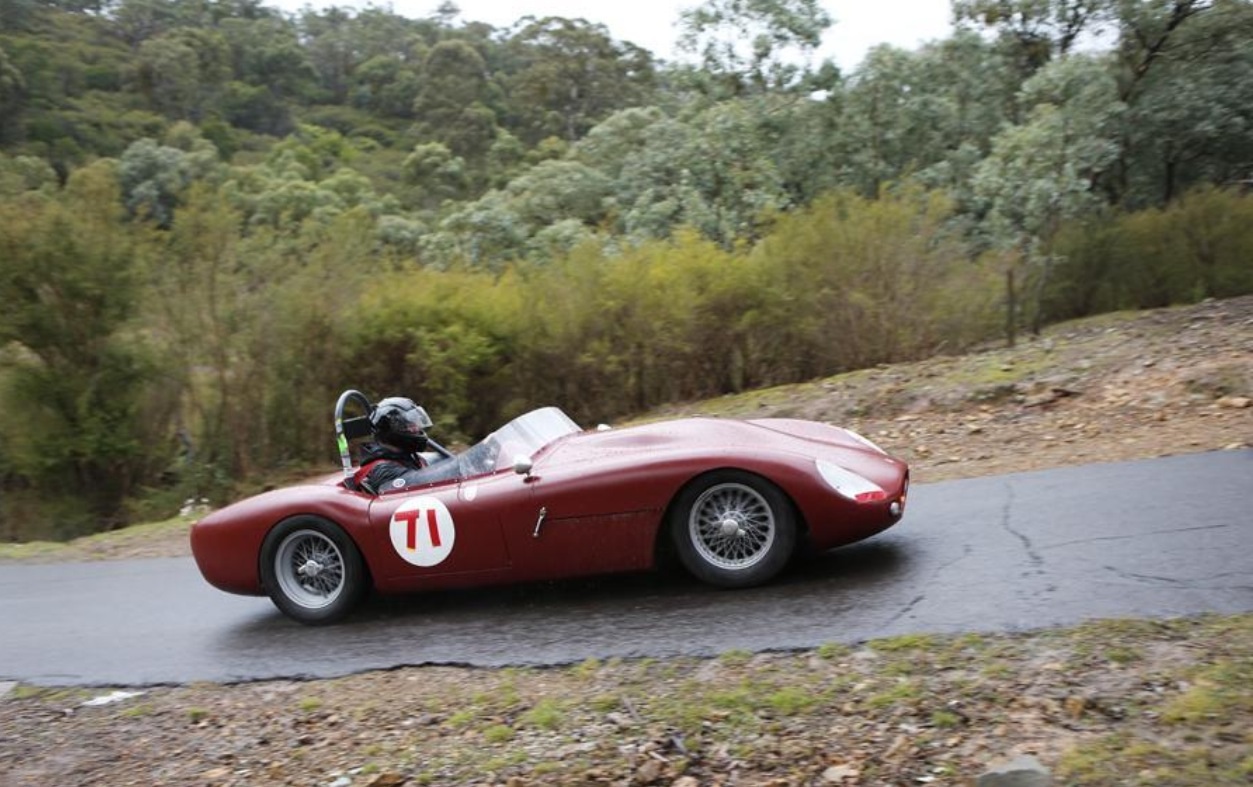
‘Next step was a body laid-up within the new mould, after which it was released and finally both body and mould were returned to my ‘shop. Then, finally, a mould existed for the Elgaram and subsequently the new body was attached to the chassis via a newly designed and executed minimal framework. The main job was then done with attention then turned to the hinged and ‘catched’ openings, and, finally, when all of that was satisfactory, the body was painted with an intentionally faded maroon top coat’
Patrick ‘We were blown away by the result- both the look of the car and also the patina of David’s work in the cockpit and fine detail- not that it was a surprise!’
‘It was finally finished four or five years ago, its first run an MSCA Sandown Club Day in which I drove it. It was a great day for a first time out, other than some wheel/body clearance issues the car ran well and has given Conor, John Noble and a few others an immense amount of pleasure since both on the road, in hillclimbs and on the circuits. Suhr knew what he was about, he concocted a clever assemblage of parts that was very quick in its day. And still is now!’ quipped Patrick.
Tony Lupton at Rob Roy Hillclimb shortly after the Elgaram’s return to life (unattributed)
What Is In a Name?…
This car has been called a variety of things over the years, which is of course the owners perogative.
Original constructor Bill Suhr designated his concoction of components the ‘Jaguar Healey Special’, a name used by Graeme Bolwell in period. During the Rex Styles era he entered the car as the Elgaram Jaguar. Bill Lucas entered it as Jaguar Special, Beast or The Beast. Who knows what the boys from the west called it in their short periods of ownership.
The Bolwell folk refer to it either as the Bolwell Mk3 or Mk3B, it is appropriate that the car be referred to as one of the continuum of cars the Bolwell brothers evolved through on the way to becoming manufacturers in their own right.
But the car was never referred to as Bolwell Mk3 or Mk3B ‘in period’ by Graeme including at the time of its sale. Clearly though, by the time of the Bolwell Mk4, launched on or about April 1964, the Bolwells had counted back through their previous projects to arrive at Mk4- their first ‘bespoke’ machine.
Correctly, Campbell Bolwell figured in similar fashion to ACB Chapman that the punters would be happier to buy a car off somebody who had been in the game for a while and Mk4 had better connotions of that than Mk1!
Bolwell Mk4 Sports in the Mordialloc suburb close to the factory at a guess, circa 1964 (Bolwell)John Noble swung the Elgaram past the Bolwell display of 60 cars at the end of the 2019 Phillip Island Historic meeting, Campbell Bolwell made a beeline for the car, here he is, clearly enjoying a drive in his dentist, and brothers old car on the roads adjoining the circuit (J Noble)Bolwell Mk4 GT Coupe circa- circa 1964 (Bolwell)
In fact, in 1974 when a youthful Pat Ryan excitedly visited the Mordialloc factory in his Beetle to tell the Bolwells about his find they were dismissive of it and couldn’t get Pat out the door quickly enough.
Times and attitudes change of course.
These days the Elgaram Jaguar- the specific era and specification of the car to which Pat restored the machine, is welcomed by Bolwell folk, indeed there was a steady stream of very knowledgeable marque enthusiasts taking pictures of the car and talking about it over the Phillip Island weekend.
For the absence of doubt, as the lawyers are want to say, in period the car was never called a Bolwell by Messrs Suhr, Styles, Lucas, Woolski, Forsythe, Evans, McPherson or Bolwell. It was not, is not and never was referred to as the Bolwell Mk3 or Mk3B until marketing convenience deemed it so.
(P Ryan)
Etcetera…
The Elgaram’s engine was donated by a Mark 7 Jag- engine number 3576, chassis number 710876, the car was first registered (Victoria) WY-981 on 2 April 1952. Bill Suhr first registered the Jaguar Healey Special (Victoria) HHD-671 on 8 March 1961.
(P Ryan)
(M Bisset)
M Bisset)
JHS cockpit, note wood-rimmed wheel and Holden rear window used as windscreen (P Ryan)
(M Bisset)
(M Bisset)
(P Ryan)
(M Bisset)
(M Bisset)
(Bolwell)
Credits…
Patrick Ryan Collection, the history of the ownership chronology of the car was carefully researched and documented bu Iain McPherson, AHR- Australian Hot Rodder Number One, Bolwell Company, Bolwell Car Club, Peter Ellenbogen, Anna McConnell
Tailpiece: Graeme Bolwell, Jaguar Healey Sports, Riverside Dragway, Fishermans Bend circa 1963…
(AHR)
I just love this photograph of Graeme Bolwell not long after the construction of the JHS’ new set of clothes- no doubt he was in touch with his feminine side but the car was never pink, the hue is in the developing of the slide not the colour in actuality.
How sweet it is, whilst clearly influenced by the Jag E Type it is derivative of the period but does have a beautiful distinctive cohesiveness all of its own.
Quite how Pat happened upon ‘Australian Hot Rodder’ Number One to find this photo- both the pink car and driver are not identified in the text of the magazine, I do not know. The publication has a brief history about the commencement of Drag Racing from the nascent Australian Hot Rodding scene, which is interesting.
Organised, but not legal drag racing started in Australia on a strip of then very quiet, out of the way, Doherty’s Road at the back of Altona North not far from Geelong Road in Melbourne’s west in early 1957.
The Southern Hot Rod Club, founded in the late, lamented St Moritz ice skating rink in St Kilda- it’s where the boys hung out, were a highly organised lot inclusive of timers with CAMS ‘spoon type’ starter switches.
In the civilised manner of the day, the car and bike guys cooperated, the bike racers who used an intersecting road to test their machines alternated with the drag racers 30 minutes about- and the police, who were aware of the activities turned a blind eye. ‘For Christ’s sake be careful won’t you. You’re on a public road’ one member of the force is reputed to have said having stumbled upon the activities about twelve months after they commenced.
Things became a tad more kosher with the move to Pakenham Airstrip during 1958 but by 1961 the pressures of increased rent, CAMS sticking their noses in and more regular use by parachutists of the strip meant a new home had to be found.
An unused airstrip at Fishermans Bend provided the solution.
A policeman who was a SHRC member floated the use of the venue with the Chief Commissioner of Police and the path was smoothed by him with the Port Melbourne Council, who had jurisdictional responsibilities- to use the old runway for ‘speed trials’ on a non-profit basis under police guidance.
And so the sport of drag racing commenced in Australia at ‘Riverside’.
All of which is wonderful but I wonder what the date of the Riverside meeting pictured is?!
(D Crabtree)
Postscript…
Pat’s generous offer of the drive of his pride and joy (one of them anyway!) came about as he became very ill with cancer just after Christmas in December 2018, he lost that battle on 6 August 2019.
St Mary’s Williamstown was overflowing with over 1000 people, I’ve never been to a bigger funeral which said everything about a bloke who was a wonderful husband, father, friend, businessman and employer. A fine, decent, fair and principled man- the likes of Patrick are rare.
RIP Patrick Ryan, 24 March 1953-6 August 2019.
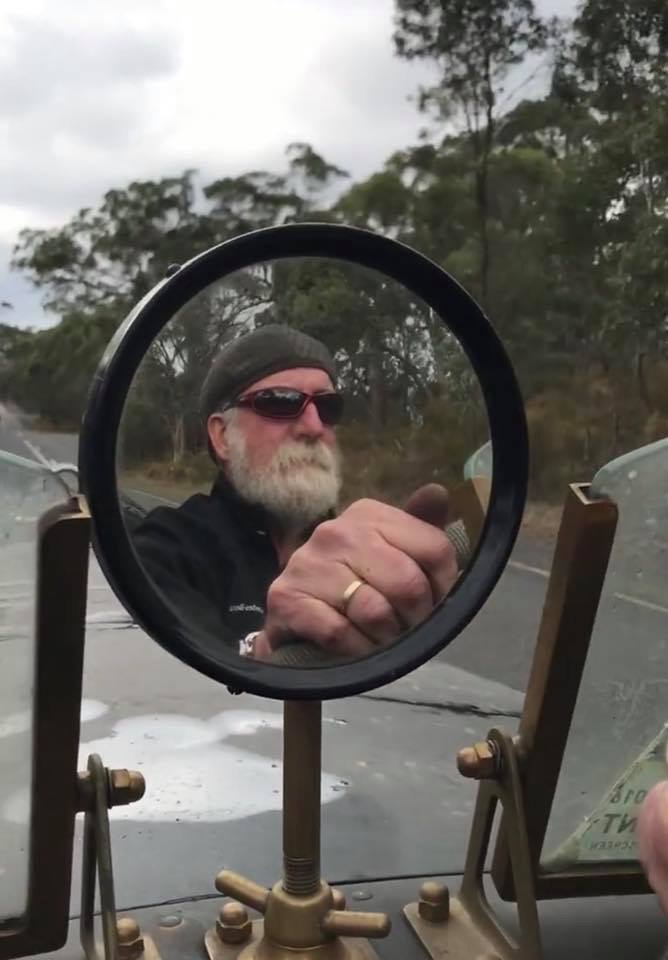
The two photos are of Pat in his Vauxhall GP Replica on the road with David Crabtree in 2017 and at Mount Tarrengower, Maldon, Victoria.
























 primotipo...