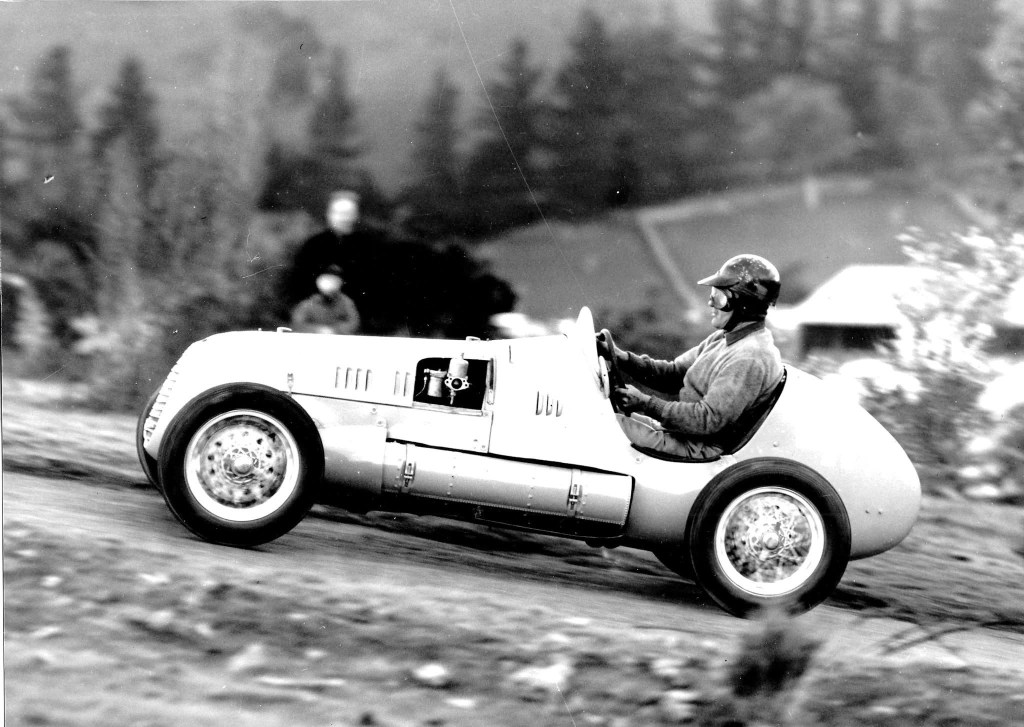
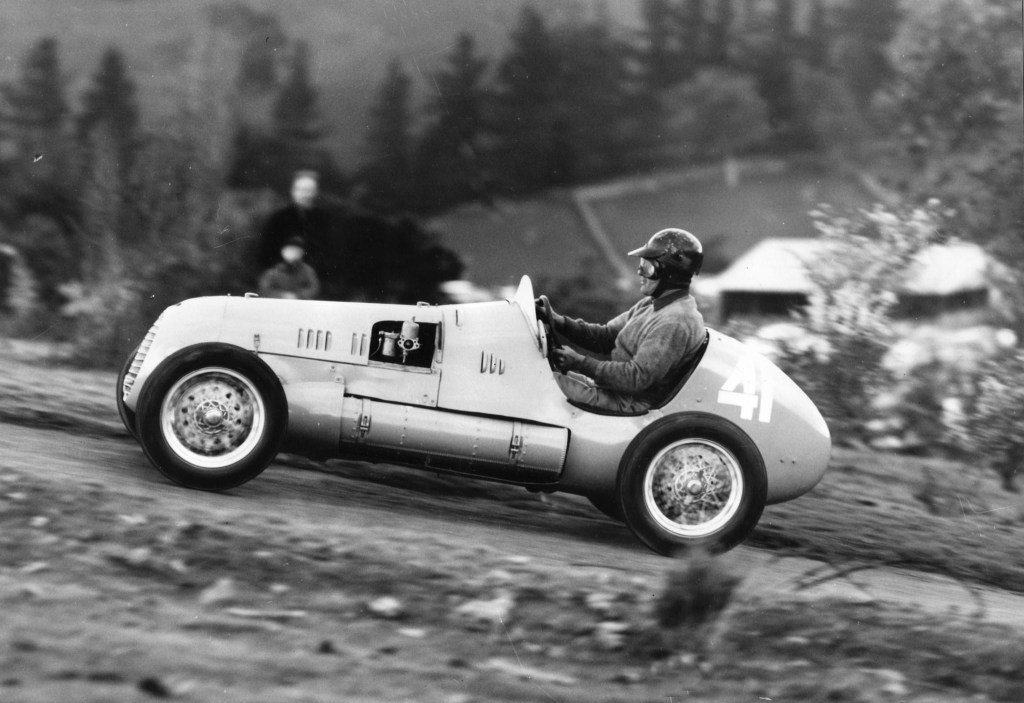
Legendary Australian Touring Car racer/engineer/tuner/team manager/CAMS politician Harry Firth ascends Rob Roy aboard a Cisitalia D46 in 1958. What a magic, crisp pan shot.
This ex-everybody car never did much in Australia. Its arrival more or less corresponded with the end of our long handicap racing era, and we didn’t have the right class for the car, 1100cc events here and there duly noted.
‘Only months earlier (May 4, 1958) Reg Nutt took the borrowed Leech Cisitalia to the top of the Hill in 28.30 secs. Now it was Harry’s turn however he couldn’t match Reg’s time. Harry’s time of 29.52 secs was more than 1 sec slower. But Harry probably won the most money on the day driving a Hillman for a second, Triumph TR2 for a first and the Cisitalia for a second,’ wrote Leon Sims.
Firth prepared and raced plenty of sportscars before his highly successful 1960-80’ish tourer-era but he didn’t race many monopostos? That SU carb doesn’t look kosher on an Italian car either, surely it didn’t arrive here so equipped…
(G Hill)
Leon Sims, ‘This photo is from our (MG Car Club) second annual historic and classic meeting Feb 28, 1994. From the left: John Crouch, AGP winner, Australian Hillclimb Champion and Australia’s Cooper distributor in the 1950s. Harry Firth, multiple class winner and class record holder at Rob Roy. Bill Prowse, Rob Roy competitor from the 1947 LCCA years and also MGCC years.’
(L Sims Archive)
Credits…
Leon Sims, The Age via Leon Sims Archive, Gary Hill
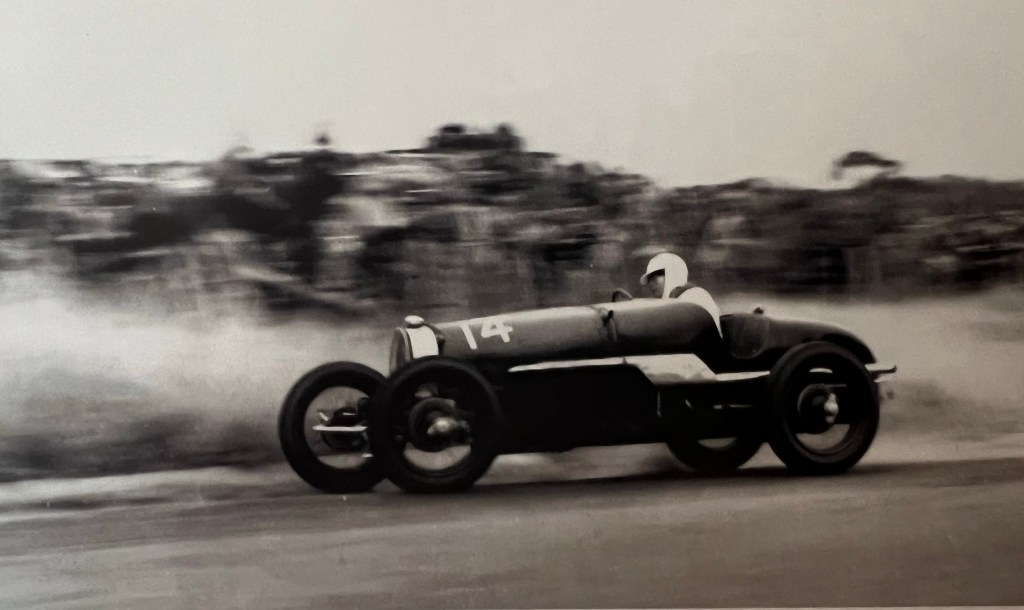
Lyndon Duckett on the way to winning the Longford Trophy in the Anzani Bugatti – Anzani R1 four cylinder, twin-cam engined Bugatti Type 35 chassis #4450 – on March 7, 1955.
Reportage of the early Longford meetings is pretty thin on the ground, so this contemporary summary of the weekend’s proceedings written by Brian Nichols for the May 1955 issue of Modern Motor is great to see, and share. Many thanks to Barry Oliver for posting it online.
Etcetera…
Geoff Smedley’s Triumph TR2 rounding Pub Corner, the Country Club Hotel more formally.
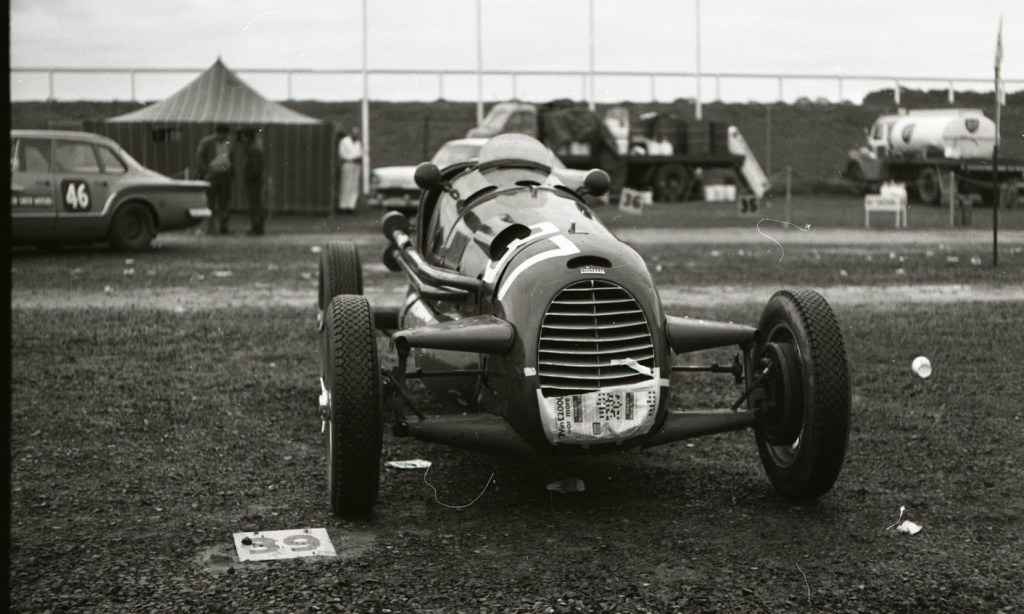
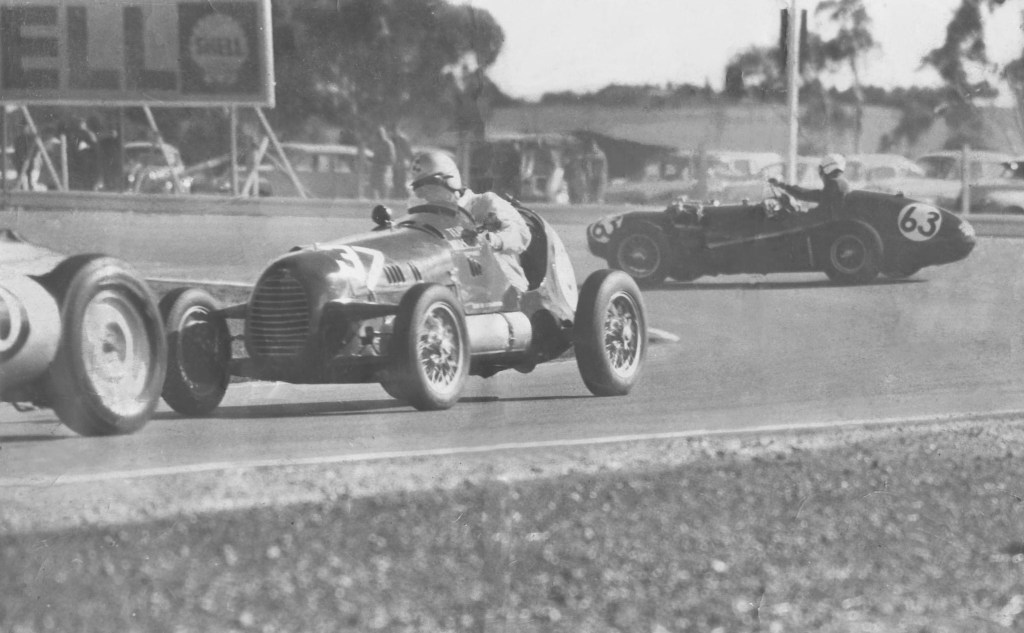
Pretty scratchy, shitty one of a favourite car, the Cisitalia D46 driven by Alan Watson; the machines Australian debut apparently. Through the viaduct in front of an MG T-Type Special. See here for more: https://primotipo.com/2023/09/08/cisitalia-d46/
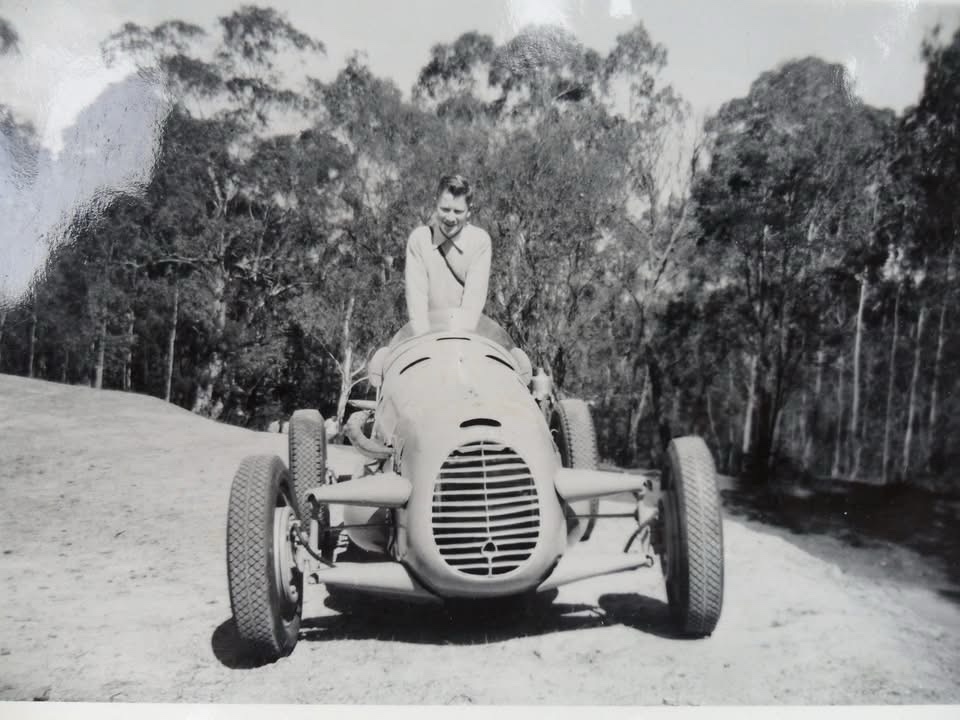
‘No idea of time period, wife found them in a secondhand shop!’ wrote Robert Haines of this post on Bob Williamson’s Old Motor Racing Photographs – Australia page. Many thanks to Robert and his chairperson!
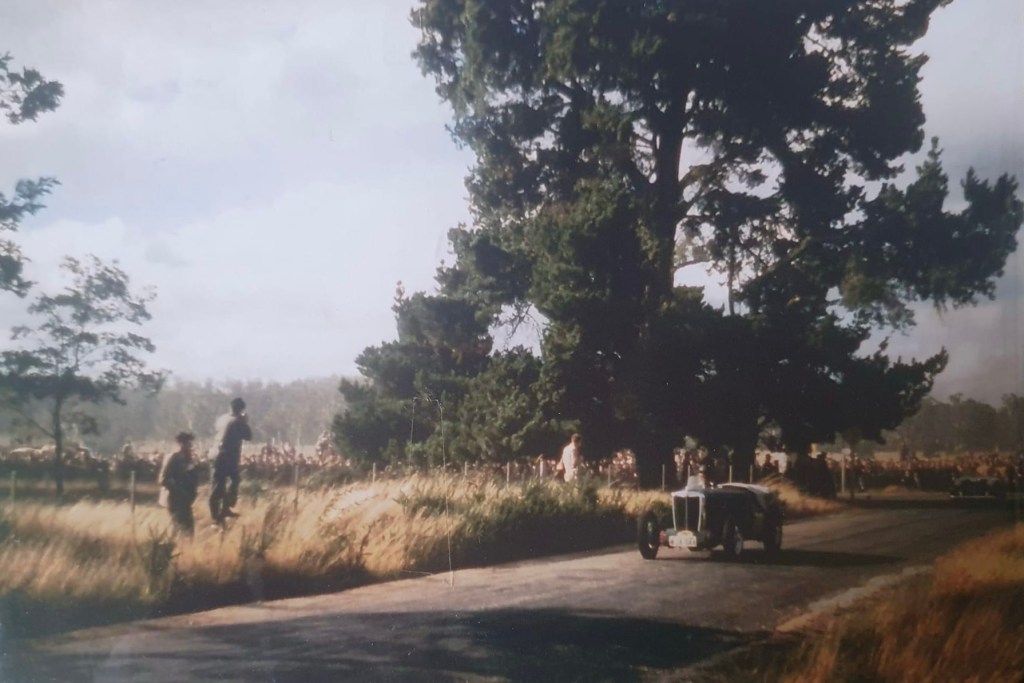
Mountford Corner, happily that magnificent tree still marks the spot!
The MG TF above is driven by longtime Tasmanian Senator, Peter Rae, still alive in his 90s.
And this T-Type special was raced either by Derrick Holden or Mike Winch.
Credits…
Paul Cross Collection via Neil Kearney’s ‘Longford: A Little Town with a Big Motor’, Modern Motor May 1955 via Barry Oliver Collection, Robert Staines, Rob Knott, Matthew Magilton
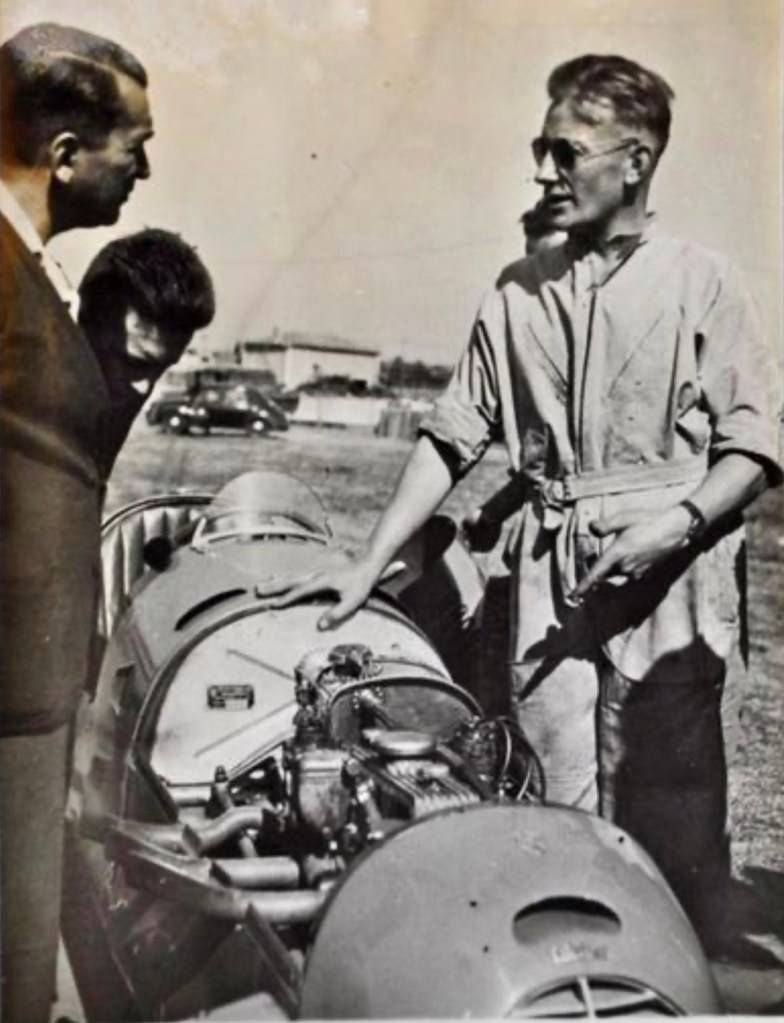
Reg Nutt aboard the Leech Brothers owned Cisitalia D46 Fiat at Rob Roy hillclimb in Melbourne’s glorious Christmas Hills on May 4, 1958. He ran second in his class that day behind multiple Australian Hillclimb Championship winner, Bruce Walton, Walton J.A.P with a time of 28.30 seconds.
Nutt was a riding mechanic in the first decade of Australian Grands Prix at Phillip Island in the 1920s and 1930s and then a racer of note in his own right, including AGPs. “Reg told me that he had raced 27 cars and never owned any of them,” recalled Bob King. What a lucky man.
Nutt in the Rob Roy paddock on November 5, 1947 when the car was owned by Fred Gibbs’ Sabina Motors (Davey-Milne Family Collection)Harry Firth in the D46 at Rob Roy in 1958. Later Oz 1960s and 1970s touring car star driver/engineer/team manager (L Sims Collection)
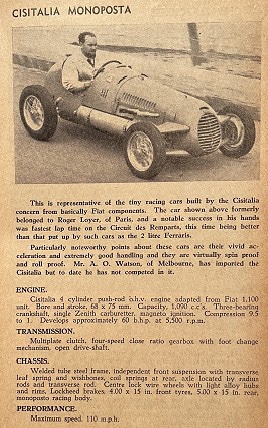
The car – chassis D461.1 according to John Blanden, and #0020 “the 20th of approximately 30 D46s built” according to a dealer in more recent times – was built in 1947 and sold to Frenchman, Roger Loyer (5/8/1907-24/3/1988) of the Ecurie de Paris. See here for a full-profile of Roger; https://gprejects.com/centrale/profiles/drivers/profile-roger-loyer
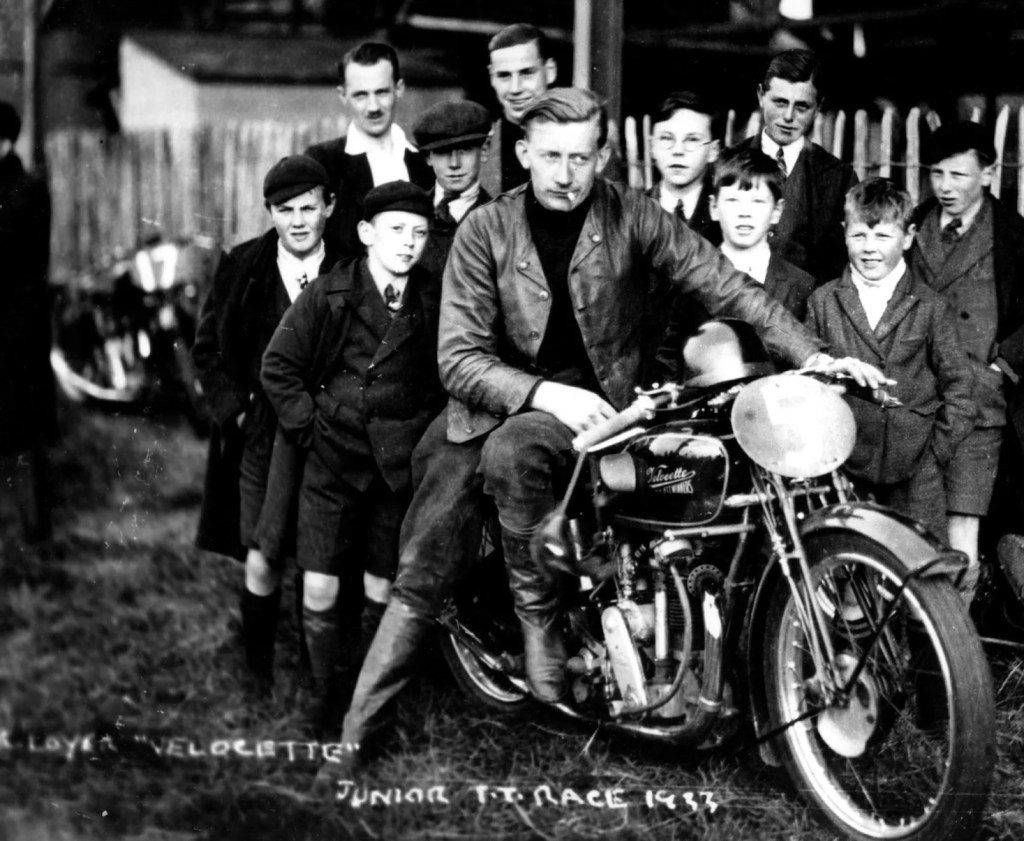
Loyer was a two time French national motorbike champion who switched from two wheels to four postwar aboard an old Delage D6. He then bought the Cisitalia – two D46s in fact, the other Ecurie de Paris car was driven by ‘the mysteriously self-styled Robert’ – which was prepared in his Ecurie de Paris garage located in the swish 17th Arondissement.
His D46 debut was at the Circuit des Remparts, Angouleme on June 15, 1947 and netted a heat victory, and third in the final sharing the car with Raymond Sommer. In the Coupe des Petites Cylindrees at Reims he was ninth, much better was third in the Coupe de Paris at the Bois de Boulogne in central Paris. Another strong fourth in a field of depth in the 330km GP du Comminges followed at St Gaudens in August, the three cars in front were Talbot Lagos. Late in the month Roger was third in a field of 12 Cisitalia D46s on the Circuit del Montenegro in Italy. A DNF late in the season at Lyon wasn’t representative of qualifying pace, fourth again at the Prix de Leman at Lausanne in October was followed by a season ending DNF with rear axle failure at the GP du Salon, Montlhery.
Roger Loyer and Velocette at the Isle of Man in 1933 (unattributed)GP des Remparts, Angouleme in 1949. Maurice Trintignant, Simca Gordini T11 in front won sharing with Jean Thepenier. Bruno Sterzi, Ferrari 166 #26, with Roger Loyer at right D46 Fiat DNF, and Harry Schell, D46 Fiat behind Trintignant (unattributed)Roger Loyer with his Cisitalia D46 Fiat at Lyon in September 1947 (Jannaud)
In a limited 1948 season – when the D46 was still very competitive in F2 events – Loyer raced at Pau in March, then Geneva in May for a DNF, then shared a car to third in the Circuit des Remparts with Robert in July. 1949 was worse in an even more limited campaign. DNQ at the Circuit du Lac in June and a crash at the Circuit des Remparts in July despite finishing second and setting fastest lap in the second heat. Robert and Roger shared a drive to sixth in the Circuit de Lac in a Simca, then contested the Grand Prix of the Nurburgring, where Roger was again a DNF.
Alan Watson was the buyer, but he didn’t use it much, notably giving it a run at Longford in March 1955. The car passed through several owners hands, albeit who were owners and who were drivers is lost a bit in the mists of time; the roll call includes Tony Osborne, John Doherty, Harry Firth, Syd Fisher, Ian Wells, Ray Gibbs and Ian Wells.
Lou Burke sold it to the Leech Brothers in 1964 and they used it for decades in Eastern Seaboard Australian historic events. The car was painted red circa 1980 when the pretty-Italian formed the bloke-magnet for the Lombard Insurance stand at motor shows. The car left Australia for the ‘States in 1987 and has pinged around the auction scene, some of the sales-prose Arthur Daley would be proud of.
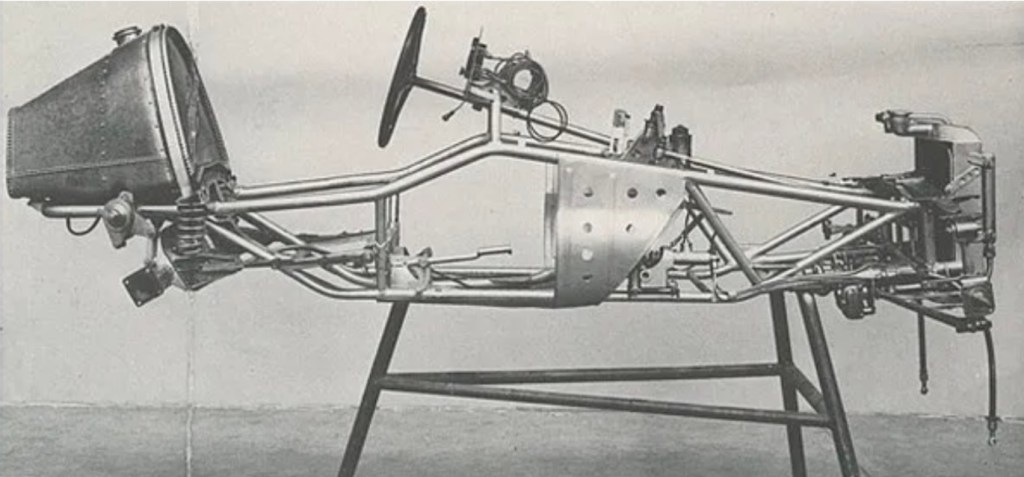
The lack of straight tube-runs would have offended Colin Chapman (but not Owen Maddock), however, the Cisitalia D46 spaceframe – here in definitive production form – was simple, light and stiff for its day. So elegant in its simplicity (unattributed)
Design and Production…
While the Piero Dusio founded (1943) and funded – Compagnia Industriale Sportiva Italia or Cisitalia – Dante Giacosa 1946 spaceframe design is rightly lauded as one of the world’s first, certainly of one built in volume, Australian historians point to the Chamberlain Brothers’ Chamberlain Indian/Eight of 1929 as a stunning much earlier expression of multi-tubular spaceframe brilliance. See here; https://primotipo.com/2015/07/24/chamberlain-8-by-john-medley-and-mark-bisset/
In 1944 Dusio, via an interlocutory contacted and contracted Giacosa (to the end of 1945), a Fiat engineer to design ‘the outline and technical hypothesis of a racing car using Foot 500 and 1100 components.’
Giacosa’s small team comprised draftsman Edoardo Grosso, and from August 1945, Giovanni Savonuzzi, Dante’s replacement. ‘The project number 201 in keeping with those used by Giacosa at Fiat. While the car was later called D46, this remained the basis of the subsequent numbering of Cisitalias: 202, 204, 303, 505, 808 etc.’
‘Giacosa’s project 201 (first version with low sides and straight tube-runs) had a tubular spaceframe, the first time (it wasn’t) this revolutionary construction system was used’ (Cisitalia)(D Giacosa)
Overcoat clad Giacosa susses one of his early D46s. He later remarked, “When I came to build the chassis it was in my mind to make it of tubing. That’ll appeal to Dusio, I thought, since he builds Beltrame bicycles in his workshop.” It’s also thought that the tubular cockpits of the Rosatelli designed aircraft Giacosa worked on during the war was also influential.
Whatever the case, the ‘framework chassis’ adopted was light and stiff and provided a platform to ‘which the mechanical parts could be easily mounted in a low position…using existing equipment and staff already specialised in this kind of procedure. The molybdenum chrome plated steel (remember how scarce high quality material was in this immediate post-war period) used came from leftover Aeritalia stock ‘used by Rosatelli in the construction of CR and BR aeroplanes during and after the war.’
‘An interesting system was chosen for the gear change using three semi-automatic gears. The rear axle with its upside-down differential was another novelty’ (Cisitalia)‘The design envisaged two ways of lowering the drive: using a crown wheel and pinion or turning the differential upside down and using driving gear. The second solution was adopted’ (Cisitalia)
To better exploit the chassis further lateral thinking was applied to other key components. The rear axle and diff was turned upside down, with a small aluminium crankcase developed for the Fiat engine allowing a bevel gear pair to take the drive from front to back passing under the differential towards the driveshaft turned from a steel billet -the gear pair offered a range of ratios to driver choice. This lowered the engine by 12cm.
Front suspension was lifted straight from the Fiat 500. ‘Hydraulic shock absorbers were fitted on the prolongation of the lower triangle’ (wishbone), but turned upside down compared to original Fiat fitment. An upper transverse leaf spring performed compliance and locational duties.
Equally brilliant was the Grosso drafted three-speed, semi-automatic mechanical gearbox ‘intended to save time for the drivers during races’, later in the D46’s life (1948) four-speed conventional Fiat ‘boxes were used.
Short tests of the prototype took place on a short circuit backing onto the railway at the rear of the factory in Corso Peschiera in February 1946: Adolfo Macchieraldo, Carlo Dusio, Giacosa and Savonuzzi all had a steer. More importantly the vastly experienced engineer/racer Piero Taruffi drove the disc-wheeled, sketchy bodied prototype a short while later, and was appointed the official test driver. Evolution of the then car progressed quickly.
Rear axle with short coil springs and lever action friction shocks. Frame member and diff also in shot (Cisitalia)A Giacosa sketch which shows the differences in the original solid rear suspension location medium and quarter elliptic setup adopted – as per text. Also shown is the clever diff/driveshaft arrangement (Cisitalia)
Initial problems included rear end judder rectified by replacing the two rigid lateral suspension arms with two quarter elliptic springs ‘five to the axle, rotating freely on two pinions integral with the chassis, offering only resistance to torsional stress like an anti-roll bar, leaving the real springing to two short coil springs. The axle was connected to the chassis via a hinged triangle mounted to the diff and a spring at the point of chassis attachment which allowed suspension adjustment.’
The chassis cracked in the central area so was strengthened, in part by enlarging the body side and inserting a welded shaped metal panel of greater size. Note the differences clear in side views of the frame of the prototype and production cars, it evolved from Colin Chapman straight tube-runs to Owen Maddock wonky-ones! and worked as well as Owen’s!
‘From the first model with a small tubular lattice-work frame, the D46 moved swiftly to the definitive version with a modified chassis and a sophisticated semi-automatic gearbox’ (Cisitalia)
By September 1946 seven D46 Fiat 508B/1100cc powered 62bhp @ 5500rpm, 370kg Voiturettes had been built. ‘The line of the car was fascinating and aggressive at first sight, offering pleasing solutions such as the double fairing on the front suspension which gave it something of the air of a biplane. The nose was perfect oval which incorporated a small upper air intake which fed the carburettor via a duct, brining a certain amount of overpressure when racing.’
The steering wheel could be tipped to allow easier access for the portly. The six-piece, beautiful, quick-fitting Itallumag body was made by Turin’s Rocco Motto, the riveted 45 litre duralumin fuel tank by De Gregori, another local.
The initial batch of seven cars were raced in the Coppa Brezzi at Valentino Park, Turin on September 3. Piero Dusio won from Franco Cortese and Louis Chiron, poor Tazio Nuvolari had the steering wheel come away in his hands when it broke away from its hinge, below.
(Wikipedia)‘The definitive version of the little 1100cc D46 with fairings on the front wheels and the curious system of the tip-up steering wheel’ (Cisitalia)(Cisitalia)
‘Selection of first gear or reverse was carried out by means of a lever set on the side of the steering column, while to change from first to second or from second to third or back down again the clutch pedal had to fully depressed. To change from second or third to first or neutral, the clutch pedal had to be fully depressed again, but after having moved the hand lever to the desired position. To use the clutch without changing gear, the pedal had to be depressed about halfway, when a hardening was encountered beyond which the gear shift was operated.’ Yeah right, buggered if that makes sense to me despite driving a couple of cars with pre-selector ‘boxes recently…
(Cisitalia)
Towards the end of 1947 Rudolf Hruska and Carlo Abarth joined Cisitalia as Technical General Manager and Racing Manager respectively. The D46 was modified and shown at the October 1947 Milan Motor Show (above).
The nose was still oval but more horizontal, the fairings deleted, sides extended to house two lateral fuel tanks. ‘The overall line of the car was influenced by the design of its big sister, the supercharged 1500cc Grand Prix car taking shape on the firm’s drawing boards.’
In addition, the semi-automatic gearbox was dropped in favour of a standard Fiat 1100 4-speeder, the rear suspension modified by fitment of twin torque arms on each side, and telescopic hydraulic shock absorbers adopted all-round.
Etcetera…
(Sud Ouest)
Cisitalia D46s at the Circuit des Remparts, Angouleme in 1949. #2 is Loyer, #28 is Guy Michelot and future, fast GP driver Harry Schell is on the move in the family Ecurie Bleue #20 machine.
(unattributed)
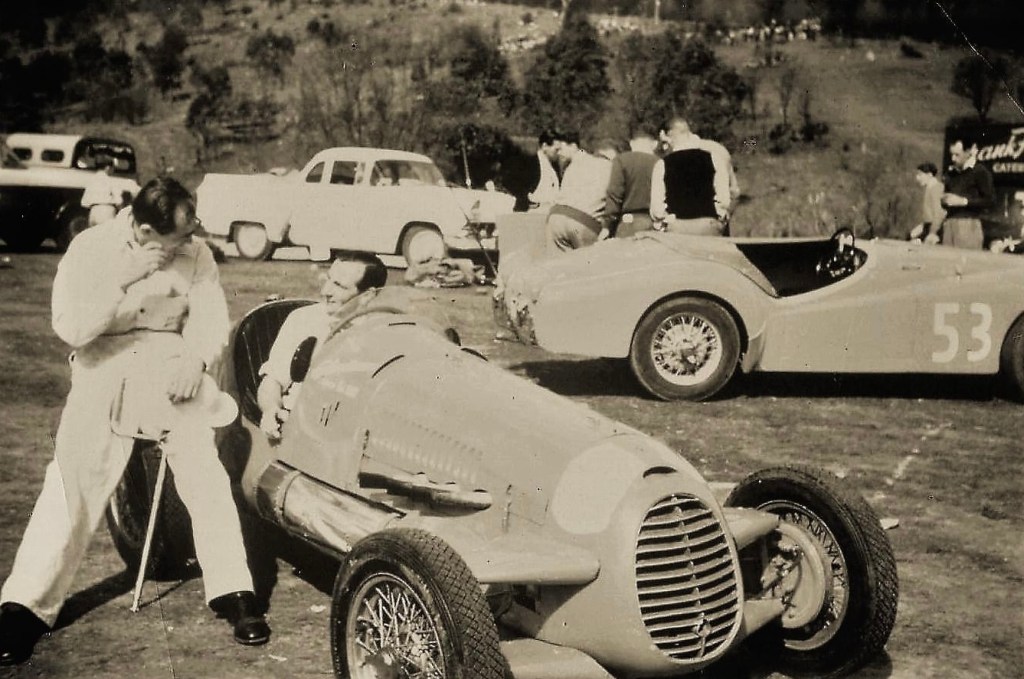
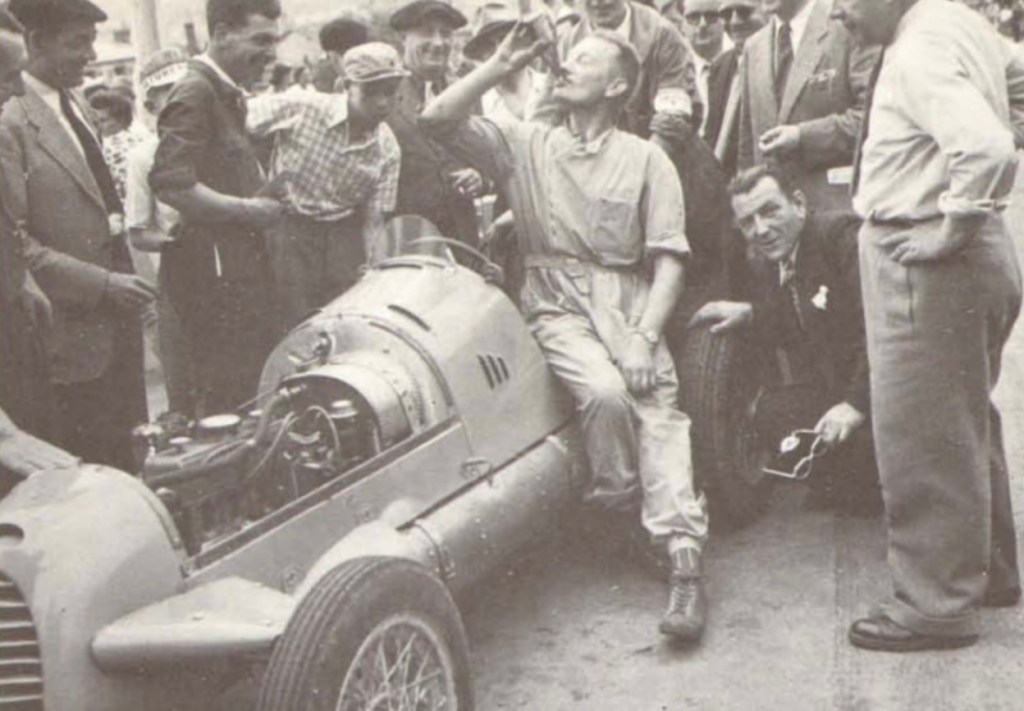
Roger Loyer having a gargle alongside ‘our’ D46, perhaps, Ecurie de Paris raced two, after a strong showing, place unknown. Fosters Lager stubby perhaps…
(M Wells Collection)
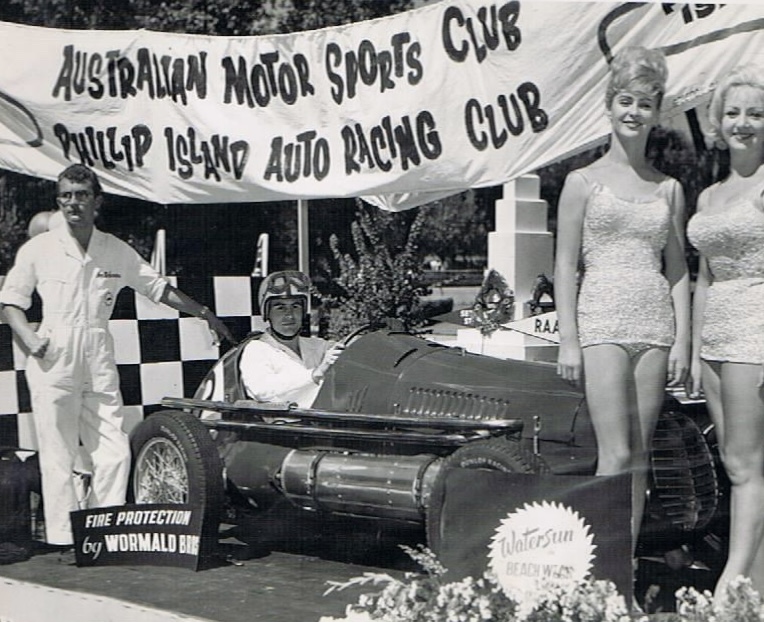
Who said tits don’t sell, it’s always worked with me? A couple of delightful lasses resplendent in much less than acceptable attire these days, during Melbourne’s March Moomba festival in the early 1960s.
(R Jackson)
Looking quite the beauty queen at Sandown in the 1970s above, and below in the old pits at the same venue in June 1963; so distinctive from every angle, form and function…
(A Tracey)(G Shepherd)
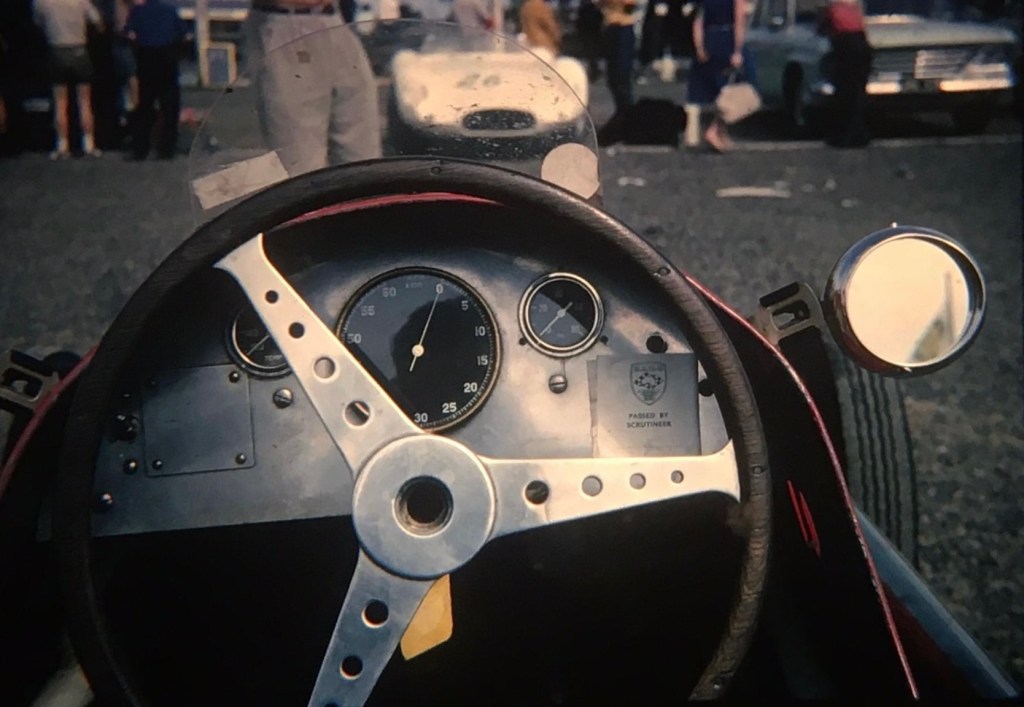
Not Tazio’s tiller but the altogether more flash one of ‘our’ D46 at Calder when owned by the Leech boys circa 1966.
(M Wells Collection)
Ian Wells with elbows out at Calder in the early 1960s. The car in strife behind is the “Platypus MG”, Greg Smith tells us. “By this time it was fitted with a big Healey-four, later to be reconfigured by Lou Molina as Vulgarilla (famous Oz MG Special raced by Molina, an equally legendary racer/hotelier/raconteur) and still sports the same alloy tail, maybe Murray Nankervis at the wheel.”
(A Tracey)
Jim Leech taking on the challenging Mount Tarrengower hill, in Victoria’s Goldfields region, 1964. The Brothers Leech had a small but very select collection of old cars they used extensively.
(Australian Motor Racing No 2 1952 – S Murray Collection)
WTF…
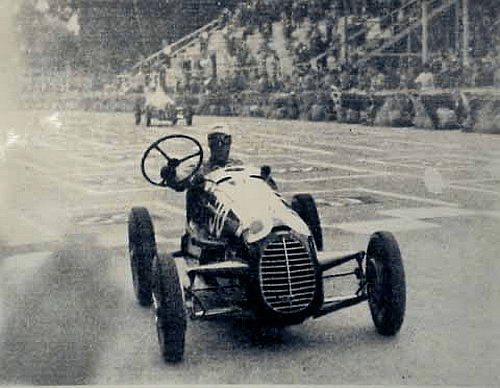
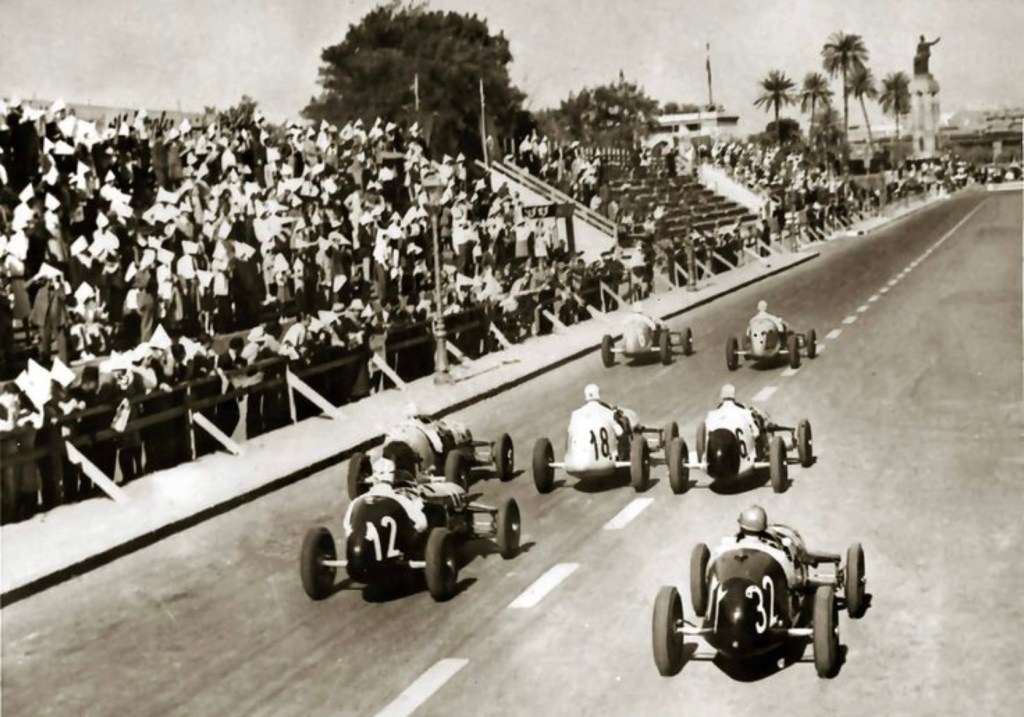
The Sehab Alma Bey Trophy was an invitation race for Cisitalia D46s held on the 1.48km Circuit El Guezireh – The Pyramid Circuit around the Guezireh Park – Cairo on March 9, 1947.
Franco Cortese won the first heat and Piero Taruffi the second, and Cortese the 50 lap final from Alberto Ascari, Taruffi, Piero Dusio and Mario Tadini (below entrant numbers unknown).
(New York Times)
Credits…
Reg Nutt Collection via Leon Sims, Troy Davey Milne, Mark Wells Collection, Graham Shepherd via David Zeunert, Jannaud, Russell Jackson, Ashley Tracey, New York Times, ‘Profile – Roger Loyer’ Jeremy Scott, ‘Historic Racing Cars in Australia’ John Blanden, ‘Cisitalia’ Nino Balestra and Cesare Agostini via Tony Johns, Stuart Murray Collection
Tailpiece…
Rendition by Martin Vins of a famous original photograph of Felice Bonetto – replete with fag – sliding his D46 Fiat at the Circuito di Mantova in 1948.
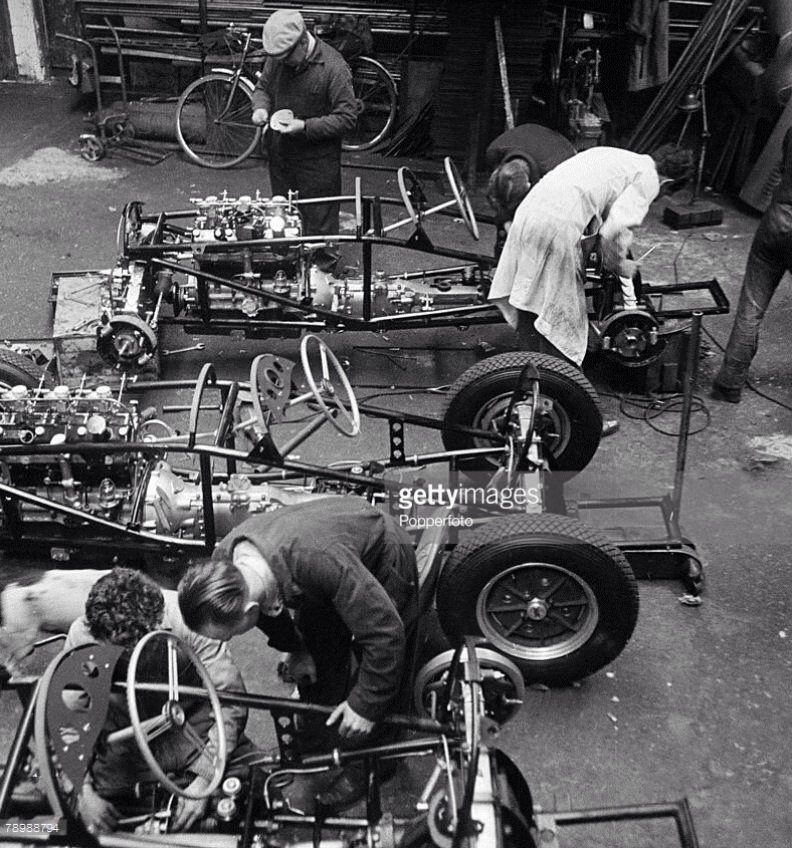
Engineers building a production run of these very successful T20/23 series of cars which were important in helping launch the careers of Mike Hawthorn and Jack Brabham amongst others. And positioning Cooper as just not builders of 500’s…
The photos were taken in Cooper’s Surbiton workhop in early 1953, the cars are the CB Mk2 or T23.
The essential difference (there were other improvements as well) between the T20/23 is that the latter used a spaceframe chassis, clear in shot, the earlier car a more traditional box section frame. Note the stack of frames, not yet stove-enamelled on the lower right of the shot.
I wrote an article about the T20 a while back so I won’t repeat myself, click here to read it;
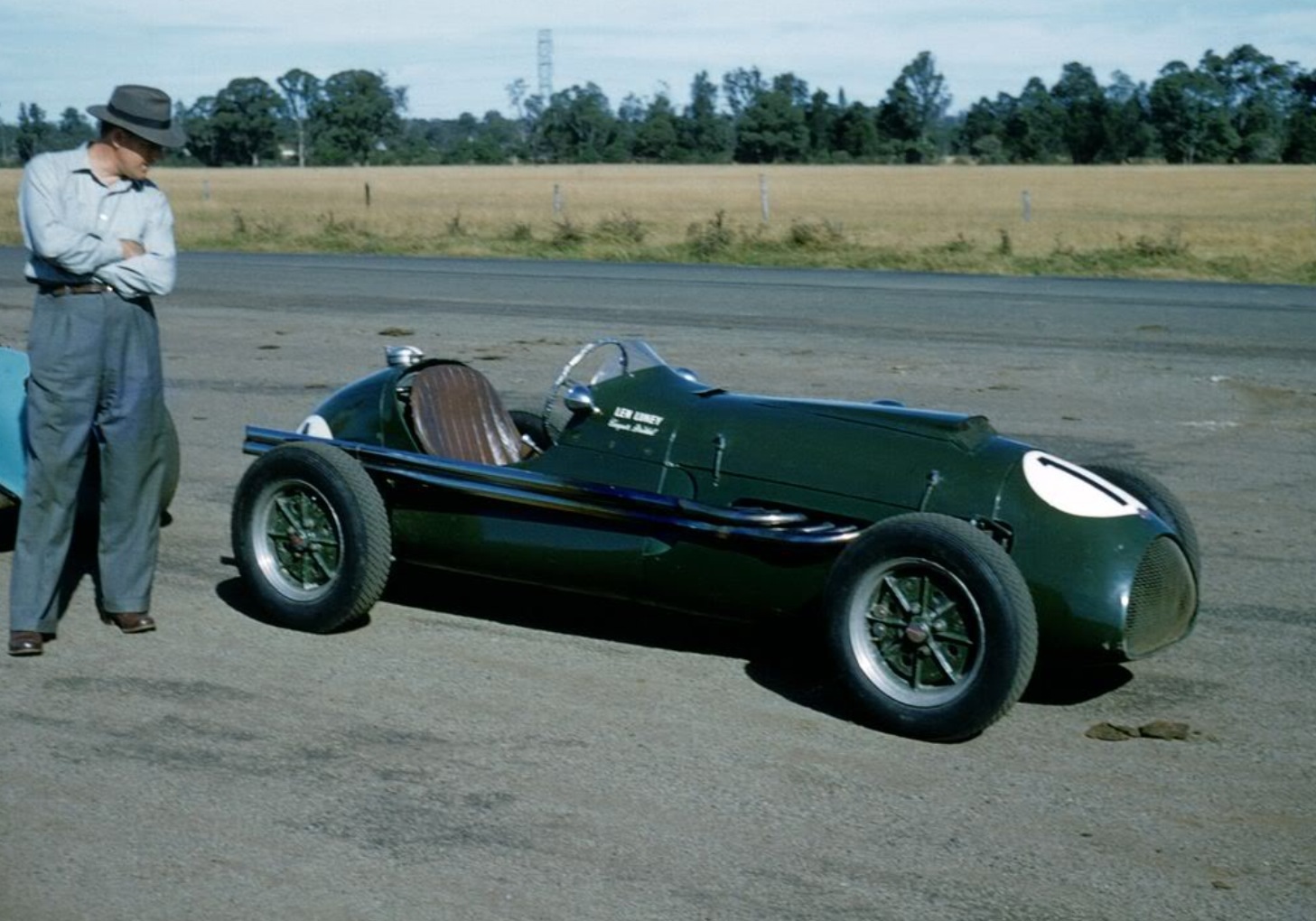
Australian Gold Star Champion 1959, Len Lukey’s Cooper T23 Bristol (chassis CBR/2/9/53) pictured at Mt Druitt, a circuit west of Sydney on 25 May 1958, the car did a 13.53 seconds standing quarter to take FTD. Shot shows the handsome lines of these cars to rather good effect as the gent looking on would attest. Later fitted with a Holden 6 cylinder engine, restored, for a time part of the Donington Collection and still extant (John Ellacott)
The workshop shots are great, the unclothed cars show the Bristol engine, the chassis and the suspension mix of wishbones and transverse leaf springs front and rear.
Cooper were somewhat maligned over the years about their ‘curvy spaceframes’ by engineering purists but in comparison with other cars of this period, the Cooper is a paragon of modernity if not a perfect example of triangulation!
Doug Nye credits Dante Giacosa’s design of the 1946 Cisitalia D46 for Piero Dusio, as the first modern customer spaceframe car ‘the production racing car trendsetter for an entire generation of designers’.
Cisitalia factory drawing of the D46 voiturette and its lovely, stiff spaceframe chassis, Fiat 1100cc 62bhp OHV engine. Suspension F/R lower arms/live axle with transverse semi-elliptic springs front and rear, hydraulic drum brakes. Drivers of the cars included the elite, Tazio Nuvolari and down
Robert Manzon’s 14th placed Cisitalia D46 during the 330Km GP du Comminges, St Gaudens 0n 10 August 1947. Race won by Louis Chiron’s Talbot Lago ’39. The caption with this shot simply says ‘1947 French GP’, which it is not. I have arrived at the above driver/car/event by elimination, some French readers will be familiar with the background, the other hint is the ‘team badge’ on the cars side, let me know if i am wrong or right for that matter! (GP Library)
As stated above the Cooper Bristol Mk1 (T20) used a simple fabricated box-section single plane-ladder frame with tacked on body supports and was very successful.
John Cooper and Owen Maddock’s (Cooper designer/engineer/draughtsman) 1953 Mk2/T23 used a multi-tubular frame which took advantage of the entire cross-sectional area available inside the body ‘and looked more like what would become known as a ‘spaceframe’ design though still sparsely triangulated…this new welded-up chassis frame employed all the same sized round section tube, and it was effectively the forerunner of many more British GP cars ‘spaceframes’ to follow’ Nye said.
So, if the car isn’t the trendsetter Giacosa’s was the Cooper lads were certainly spaceframe ‘early adopters’, very successfully so.
Note the beautiful light alloy Cooper wheels, rudimentary independent rear suspension set up of lower wishbones and top transverse leaf spring which would serve Cooper well till the end of the decade. Double wishbones and coil springs at the front appeared a bit earlier but the transverse top leaf is in use here.
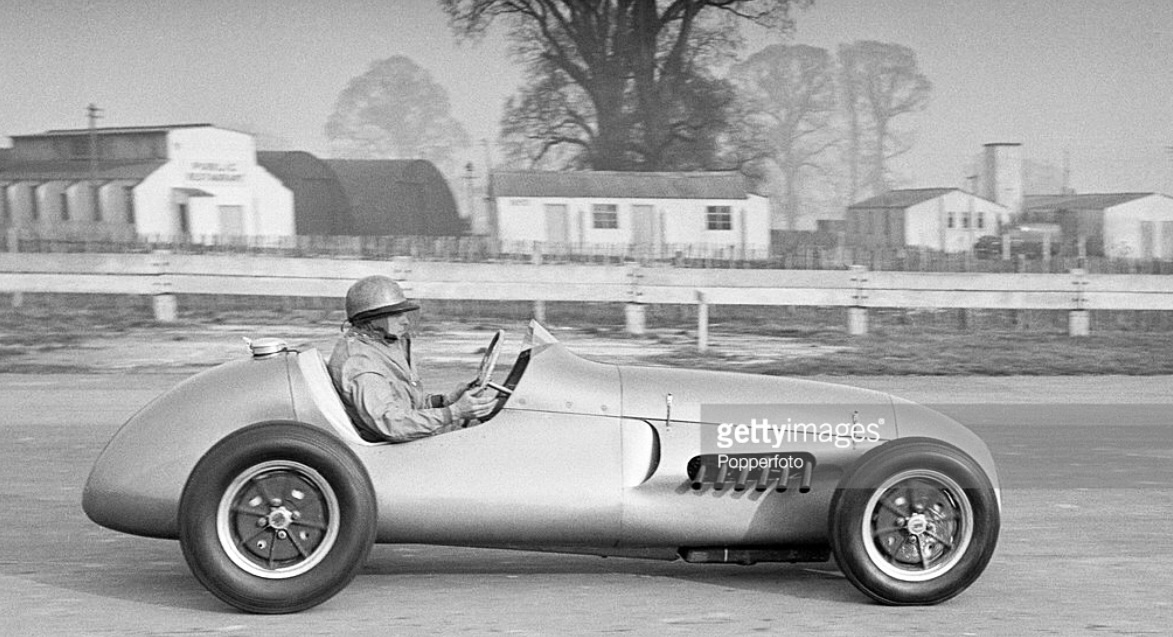
New Cooper T23 on what is perhaps its first test at Goodwood in late ’52 or early 1953, triple Solex fed 1971cc circa 155bhp spec engine as per text. Frame, neat throttle linkage and beautiful hand formed aluminium body also clear in shot (Popperfoto)
The Bristol/BMW engine develops around 155bhp from its 1971cc in BS4A spec, the engine is worth a paragraph or two.What follows is a summary in relation to the engines race application, not a chronology of the many variants fitted to road cars.
As demand for aircraft and engines eased towards the end of WW2 the Bristol Aeroplane Company decided to diversify into cars. The history of this great company is interesting, click here to read about it; http://www.bristolaero.org/bristol-built/
One of its directors, HJ Aldington, had impeccable BMW connections, another of his companies, AFN Ltd were both the constructors of Frazer Nash cars and the pre-War importers of BMW. The 2 litre engine the subject of this article, was fitted to BMW’s superb 328 sports car, famously the winner of the 1940 Mille Miglia in Huschke von Hanstein’s hands..
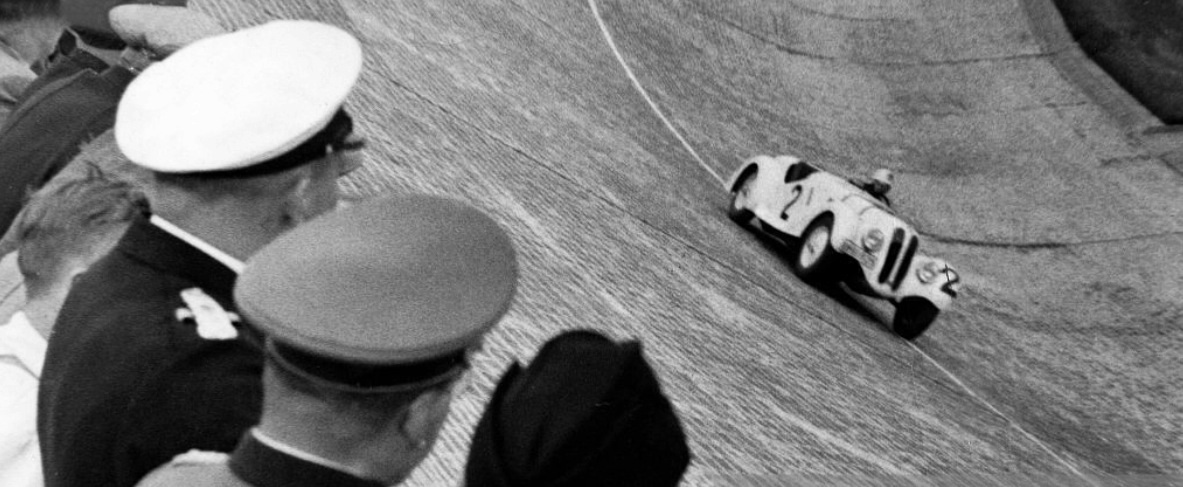
BMW 328 on Avus’ North Curve, Germany on 19 May 1938, driver and event unrecorded (Ullstein Bild)
In the post-war German mess, der Deutschlanders were keener for their technology to be shared with the ‘goodies rather than the baddies’ (the Ruskies), Aldington did a deal via the War Reparation Board which gave the engine technology to Bristol. The Brits fitted the engine to a 326 chassis and dressed the lot in an aerodynamic body similar to the 327 ‘Autenreith’ Coupe.
The first Bristol built engine was fired up on their dyno on 22 May 1946 and was soon fitted to its prototype ‘400’ car.
The engine was tall, slim and short despite its long stroke. The bores were cleverly siamesed within the cast iron block to allow the use of 4, rather than the 7 main bearings considered normal for a straight-six. The head had hemispherical combustion chambers with valves inclined at an included angle of 80 degrees with downdraught inlet ports between them.
Rather than twin overhead camshafts the valves were operated by 18! inclined cross-pushrods. For its success it demanded great engineering precision in its build, something Bristol had in spades. A steel crank ran in Vandervell ‘ThinWall’ lead indium bearings. Dry cylinder liners were of Brivadium alloy-steel so hard that for racing Bristol didn’t consider them run in until the engine had done 8000 miles!
After fitment of three downdraught SU carbs the ’85A’ engine developed 80bhp. The ’85C’ was fitted with three Solexes.
Bristols; Type 171 Sycamore helicopter and 401 Coupe in 1950 (Hutton Archive)
In 1948/9 Aldington asked Bristol to develop a high performance variant for Frazer Nash, this ‘FNS’ (Frazer Nash Specification) unit with 0.15 larger inlet ports, improved crank counter weights, Delco-Remy distributor rather than the Lucas unit developed 126bhp @ 5500rpm. In the FN Le Mans Rep the engines were very successful.
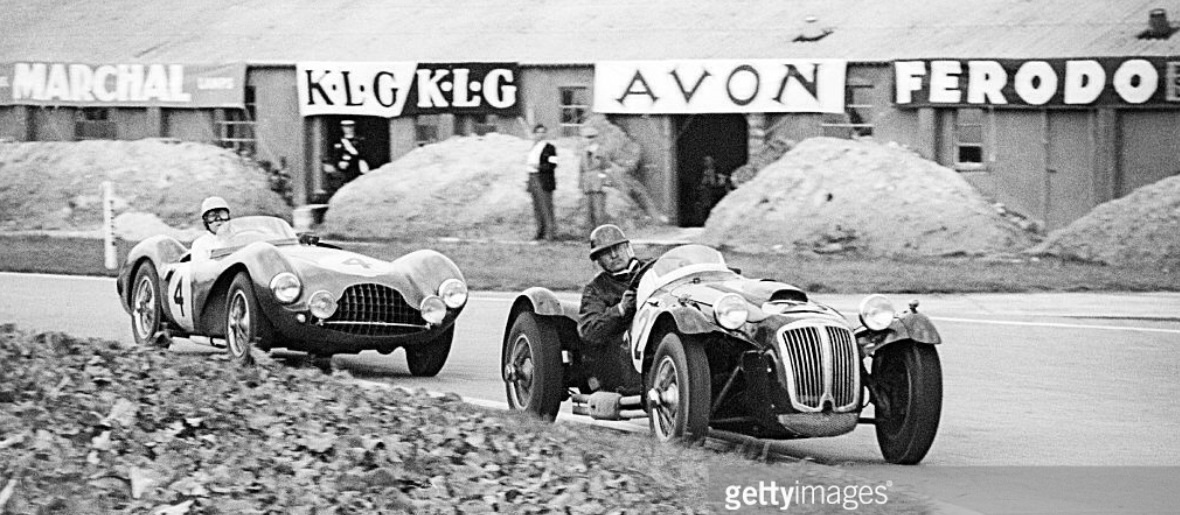
The 8th placed Bristol engined Frazer Nash Le Mans Replica of Dickie Stoop and Peter Wilson about to be swallowed by the winning Aston Martin DB3S with Reg Parnell at the wheel, he shared with Eric Thompson, during the Goodwood 9 Hours 22 August 1953 (GP Library)
Encouraged by the Frazer Nash success, Bristol built a new ‘Bristol Sport’ (BS) engine based on the ‘403’ Type 100 spec engine. These had blocks cast in chrome alloy steel. With a 66mm bore and 96mm stroke they displaced 1971cc.
The head was aluminium alloy with inlet valves made of chrome-nickel steel, exhaust valves of austentic-chrome steel. All of the valve gear was very light and polished. The crank was in aviation spec nitriding steel still running in 4 main bearings. A short duplex chain drove from the cranks nose to the high camshaft which ran in four bearings and carried a skew gear driving the distributor and oil pump shafts. High pressure lubrication was used but a wet sump retained. On ‘BS Series’ engines the head was ‘ported and polished’.
These engines, the Mark 2 version used by Mike Hawthorn’s Lavant Cup winning Cooper T20 at the Goodwood Easter 1952 meeting developed 149.8bhp@5550rpm on the Filton dyno before Leslie Hawthorn deployed his secret ‘witches brew’ of nitro-methane to produce more power still.
The ‘BS4A Mk1’ engines developed 155bhp@6000rpm and 148lb/ft of torque at 5000rpm.
Ultimate versions of the German/British engines were Cooper Bristol driver/engineer Bob Gerard’s de-siamesed port 2.2 litre variants running nitro-methane which developed 180bhp@7000rpm. Bristol’s own de-siamesed engine which ran at Le Mans in its Coupes developed a reliable 160bhp. By that time the 2 litre F2 racing for which these engines were developed was over.
The Cooper Bristols were important cars in the rise of the Surbiton marque and formidable weapons in the right hands if not Ferrari Tipo 500 beaters…
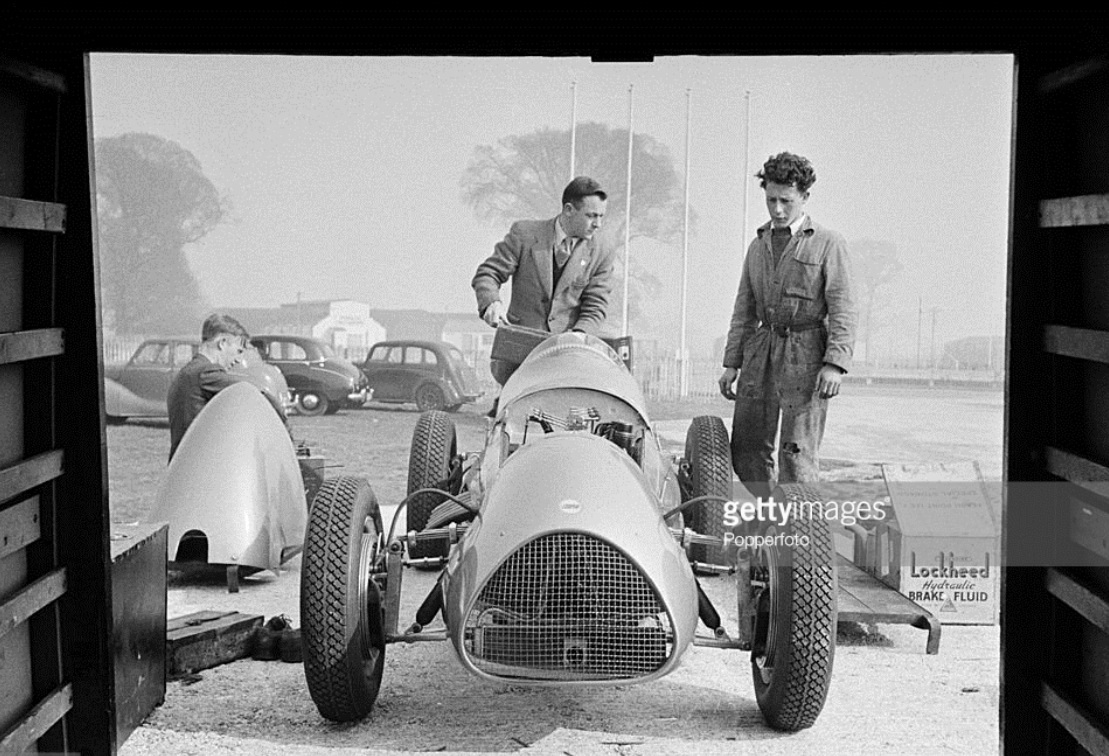
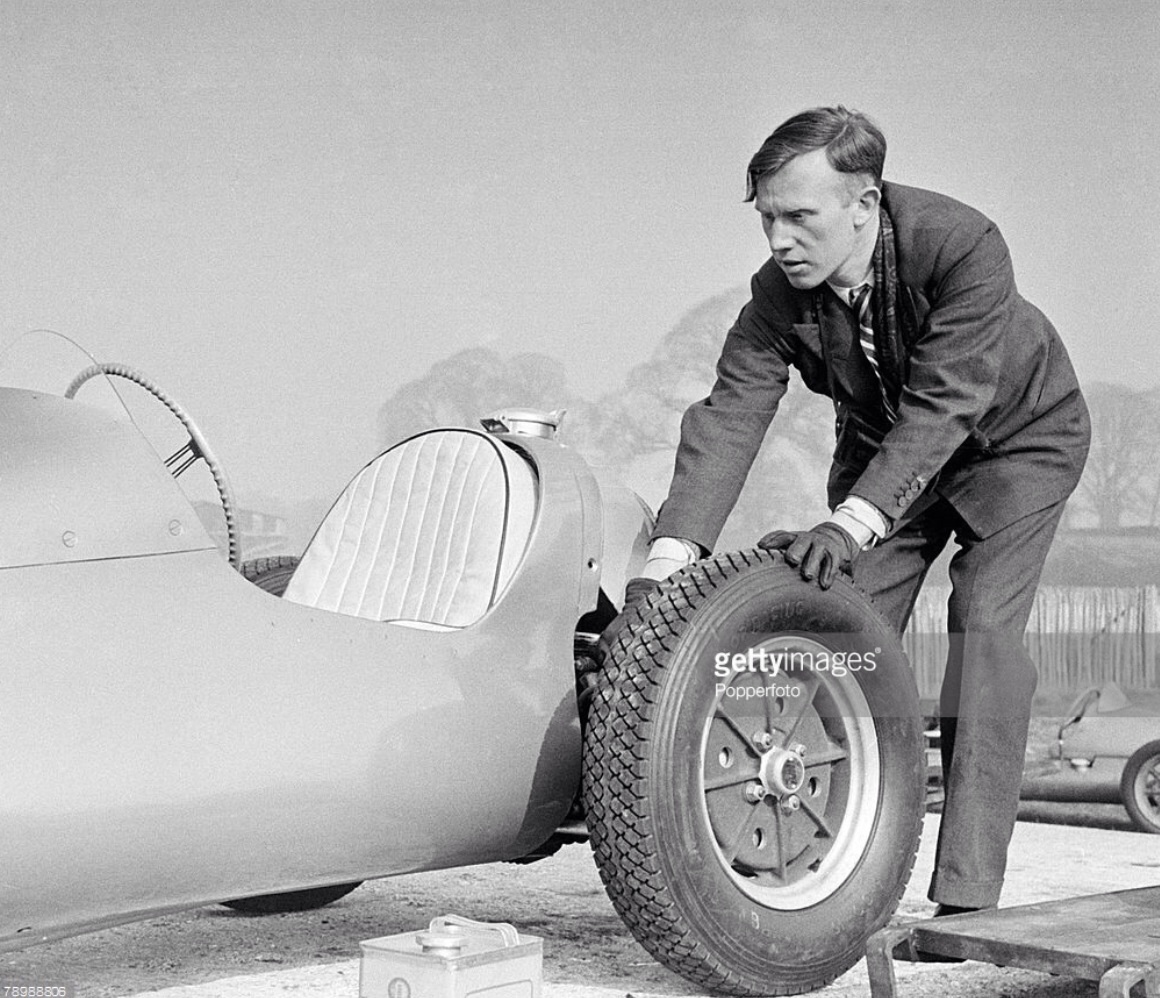
Cooper T23 Bristol being unloaded from its trailer on a bleak, winter Goodwood day in late 1952 or early 1953. 85km trip from Cooper’s Surbiton ‘shop to Goodwood. These shots (of the mechanics fettling the engine above and the two below) are undated other than 1 January 1953 which will be an approximation, there are no details of the mechanics or driver. My guess is that its a Cooper instigated press shoot, as are the workshop ones above, probably of the cars first test, the ‘stub exhausts’, these engines not usually raced as such, indicative of a ‘quick fix’ overnight to run the car for the first time. If any of you have the details please provide them and i will update the text (Popperfoto)
Bibliography…
Doug Nye ‘History of The GP Car’, Automobile Year, John Blanden ‘Historic Racing Cars in Australia





















 primotipo...