


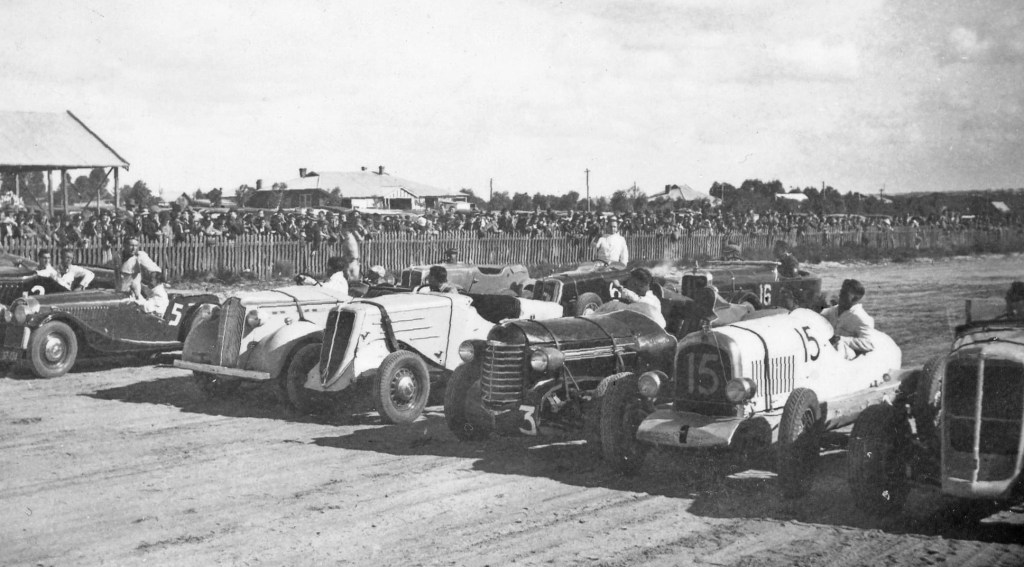
Kelvin Bullock’s 1917 Scripps-Booth V8 Special looking very handsome at Lake Perkolilli, Western Australia in the late-1930s.
I’d never heard of the marque Scripps-Booth (S-B) until tripping over this shot of Bullock’s handsome racer on Graeme Cocks’ mighty-fine Lake Perkolilli Red Dust Revival Facebook page; https://www.facebook.com/reddustrevival2022/
The American marque was imported into Western Australia by the Armstrong Cycle and Motor Agency, this car was living in the rural hamlet of Corrigin when Claremont racer/mechanic Bulloch acquired it and extensively modified it circa 1937.
He raced at various of the West Australian’ Round the Houses towns including Albany, Bunbury, Pingelly, Applecross, Cannington, Dowerin and Lake Perkolilli.


Motorist and Wheelman magazine outlined the technical details of the Scripps-Booth Model D based special, as Cocks quipped, it shows just how inventive Specials builders were.
The engine was a Ferro V8, one of the first production American V8s, “which was surprisingly modern in design, and a most beautifully made and finished motor.” It still had its original cast iron pistons and had never been rebored. “The valves now in use, were designed for an Essex, and turned own for the Scripps. They are now closed by Chevrolet springs.”
The Alanson Brush designed series of V8s were built by the Ferro Machine and Foundry Company in Cleveland, Ohio; the Ferro Corporation still exists. The engine chosen by Scripps Booth was Ferro’s Model 8-35, a 162cid/2660cc, a two-main bearing OHV unit famous for being one of the first production automobile V8s, the first too with the block and crankcase produced as a single casting, 16 years before the 1932 Ford V8. The 8-35 had a 2 5/8 inch bore, 3 3/4 inch stroke, with a compression ratio of about 5.5:1. Fed by a Zenith twin-barrel carb, it produced 22.05hp/SAE, with an advertised output of 35hp. A Bosch magneto provided the sparks on Bulloch’s engine.
One owner described the engine as like two four-cylinder motors joined at the crankshaft, with each bank of cylinders fed by one chamber of a water heated inlet manifold. A heavy flywheel kept the vibrations at bay.
“The gearbox is original Scripps-Booth, but the rest of the 889kg that makes up the car, includes parts from a remarkable number of makes. The front dumb-irons are Chevrolet and the wheels and spring shackles Citroen. The radiator grille is ’34 Ford, the core Chevrolet, while the fan did 10 years service on a Rugby but its mounting is Bulloch Special.”
“Both the front axle and front brakes are Whippet, while the lamps in the first place showed the way to a driver of a Chrysler. The steering box, tailshaft and universals are Essex. At the top of the column a Ford steering wheel rides and behind it are two Austin bucket seats. Shock absorbers are Ford, and the rear braking, Bulloch says, ‘is by accident’!”
James Scripps-Booth and his creations…
“James Scripps Booth was a Detroit-area artist and automotive engineer. Born on May 31, 1888, in Detroit, Michigan, Booth was the eldest child of George Gough Booth, of the Booth publishing chain, and Ellen Scripps Booth, of the Scripps publishing empire,” according to the Detroit Historical Society. What follows is their ‘Encyclopaedia of Detroit’ entry on Booth.
“Booth grew up in a household that encouraged an awareness and appreciation of the arts, and he spent many hours sketching in and around his parents’ home in Detroit, surrounded by an extensive art collection. He also encountered many distinguished artists, writers, and musicians. Booth received most of his education through private schools and left school before finishing tenth grade. He taught himself the basics of automobile mechanics by systematically dismantling and reassembling the family’s car. While employed at the Detroit Evening News he developed his writing skills, broadened his automotive background, and refined his art techniques.”
“In 1910 at the age of 22, he married Jean Alice McLaughlin in Detroit. Following their marriage, Booth and his wife moved to Paris, where Booth studied art at the École des Beaux-Arts. They also spent some time living in Etaples, France, where Booth learned the fundamentals of working with pastels from Michigan-born artist Myron Barlow. In the decades following the couple’s return to the U.S., several of Booth’s works received critical acclaim at exhibitions at the Detroit Museum of Art and at other shows in both Michigan and California.”
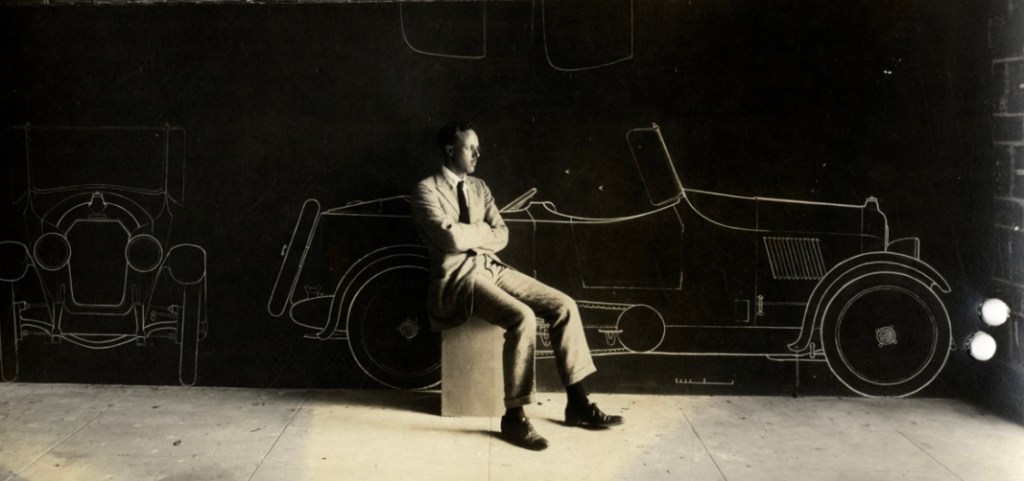

“As Booth perfected his artistic talents, he also developed a keen interest in mechanical engineering and automotive design. Many of his early drawings consisted of new designs for automobiles. In 1913, Booth developed his first automobile prototype, the “Bi-Autogo,” a unique two-wheeled cyclecar. The Bi-Autogo utilized the first V-8 engine ever built in Detroit. Booth’s Scripps-Booth Cyclecar Company was defunct within a year but was responsible for memorable designs. In 1914, with the financial support of his uncle William Booth, publisher of The Detroit News, Booth began his second business venture, the Scripps-Booth Automobile Company. The company produced more traditional upscale automobiles and was much more successful than the cyclecar business. Booth resigned in 1913 and moved to Pasadena, California. The company was purchased by General Motors and continued to operate until 1922.”
“In the 1930’s Booth moved his family back to Detroit from California, established an industrial design/art studio in Indian Village, and assumed responsibilities both as a trustee of the Brookside School and Cranbrook Foundation and as a director of the Cranbrook Academy of Art. During World War II, Booth published the General Handbook, Motor Mechanics Simplified: Understand Your Car, used by the American Red Cross in their automotive mechanics classes.”
“Following Booth’s death on September 13, 1954, a large collection of his automotive drawings, artwork, and several of his cars were donated to area institutions, including the Detroit Historical Museum.”

Scripps-Booth Model D…
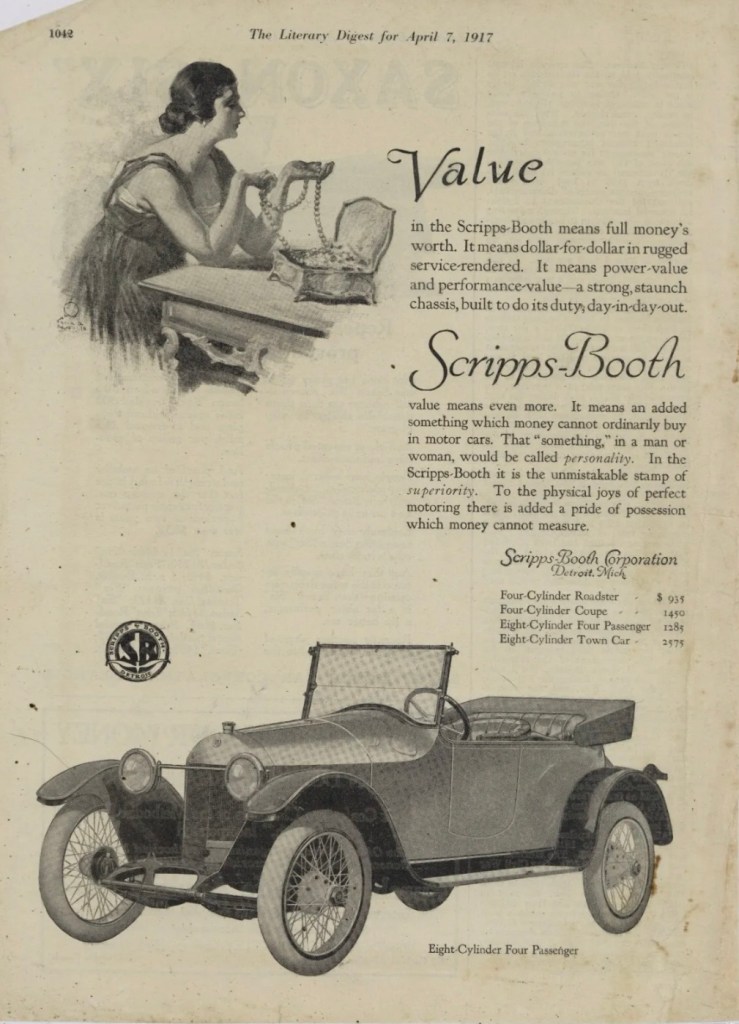
The donor car for Bullock’s special, the model D was built between July 1916 and July 1917. VIN numbers quoted are 101-801 (and 101-700) and 801-1807 (and 801-1525) respectively: 700 cars and 725 cars depending upon the figures you believe.
While Booth’s prototype of the Model D V8 was the short wheelbase (115 inch) two-seat sporty Vitesse, Booth lost the production battle with his fellow management team of the Michigan based Scripps-Booth Company. The cars built were 2-door tourers and town cars (and runabout, chummy runabout/roadster built on a 120 inch wheelbase. Whether S-Bs imported to Australia were factory built or arrived sans-bodies, given the favourable tax-treatment afforded cars imported as rolling-chassis, is unclear.
The agents for S-B in Australia were the Armstrong Motor and Cycle Agency in WA, Roy Standfield Ltd in Sydney (from 1919 John McGrath) and Durance-Mayston Motors in Melbourne. It appears the cars came to Australia in some numbers, 62 S-Bs were registered in NSW in 1919 alone. How many are left here now? less than 10 it seems.

What inspired this exploration of the arcane is the gorgeous looking body Bulloch had built by a body-artisan of some ability in Perth. It seems it’s perhaps not entirely original though. Perth man Graeme Holman is building a tribute car to the long-lost Bulloch Scripps-Booth V8 Special and credits the design inspiration for it as the 1934 Ford Model 40 Special Speedster commissioned by Edsel Ford for his own use. What a shame it is the magnificent E.T. ‘Bob’ Gregorie designed car was not put into series-production, they would have sold like hot-cakes. See here for a great piece on these cars; https://www.thetruthaboutcars.com/2012/01/look-at-what-i-found-the-most-significant-car-at-the-2012-naias-edsel-fords-1934-model-40-special-speedster/


Bulloch bought his S-B in late 1937 or early 1938 in Corrigin, an affluent wheatbelt town 230km southeast of Perth. Perhaps the car was a farmer’s pride and joy and was pushed into a shed when it eventually misbehaved? Interestingly, a Mr C.D. Kerr placed fifth in a S-B at the Bibra Lake standing-quarter mile meeting in February 1935 (26.4sec), I wonder if it’s the same car?
Quite who the team of mechanic/engineers/bodybuilders that assembled the cocktail of S-B Model D chassis, engine and gearbox and other assemblage of components into such a cohesive looking and seemingly competitive racer is unknown…but I’d love to know.
Kelvin Bulloch had been a prominent in the WA Sporting Car Club from about 1935. In ’37 he won the club’s silver-star for the greatest aggregate points in club competitions as well as the over 1500cc hill climb and had considerable success in gymkhanas. In 1936 he won the club’s eight-hour trial, the year before he dead-heated with Aub Melrose for first place.

Bulloch is said to have raced the car at various of the WA Round the Houses town tracks including Albany, Bunbury, Pingelly, Applecross, Cannington and Lake Perkolilli, with his best result a win at Dowerin in September 1938. There he won the main event, a 20 lap handicap, “driving well to gain the lead in the early stages” and triumphing despite his engine misfiring in the race’s final stages.
In an article to promote that Dowerin meeting, The West Australian described the car as ‘The Venerable Scripps-Booth’. It reads “One of the most unlucky drivers in recent months has been Kelvin Bulloch. He failed to start at Albany, and a minor ignition failure robbed him of almost certain victory in the big race at Dowerin in June. This time he is hopeful that the old Scripps-Booth, which has been dubbed ‘The Scraps’ will at least last the course.”
The class of the field in WA then was soon to be 1939 Australian Grand Prix winner Allan Tomlinson and his MG TA Spl s/c and Jack Nelson in a Ballot 2LS Ford V8 Spl.
Quite what became of the Kelvin Booth Scripps-Booth V8 Special is unknown, do get in touch if you can assist.

Other Australian competition Scripps-Booth…
“A picture of my old man, Wally Cox about 1937,” Allen Cox wrote. “A 23 year old petrol-head, his car was a 1922 Scripps-Booth fitted with a T-Model Ford engine fitted with a Frontenac or Rajo cylinder head conversion. In addition to that he pulled off the guards and lightened it etc. The problem was that in small country towns the constabulary knew where everyone lived!”

1960’s drag-racing champion and speedshop chain entrepreneur Eddie Thomas owned a Scripps-Booth 13-34 162cid V8 that he fitted to a speedway midget he raced circa 1940.
What became of these cars and engines is unknown.
Etcetera…
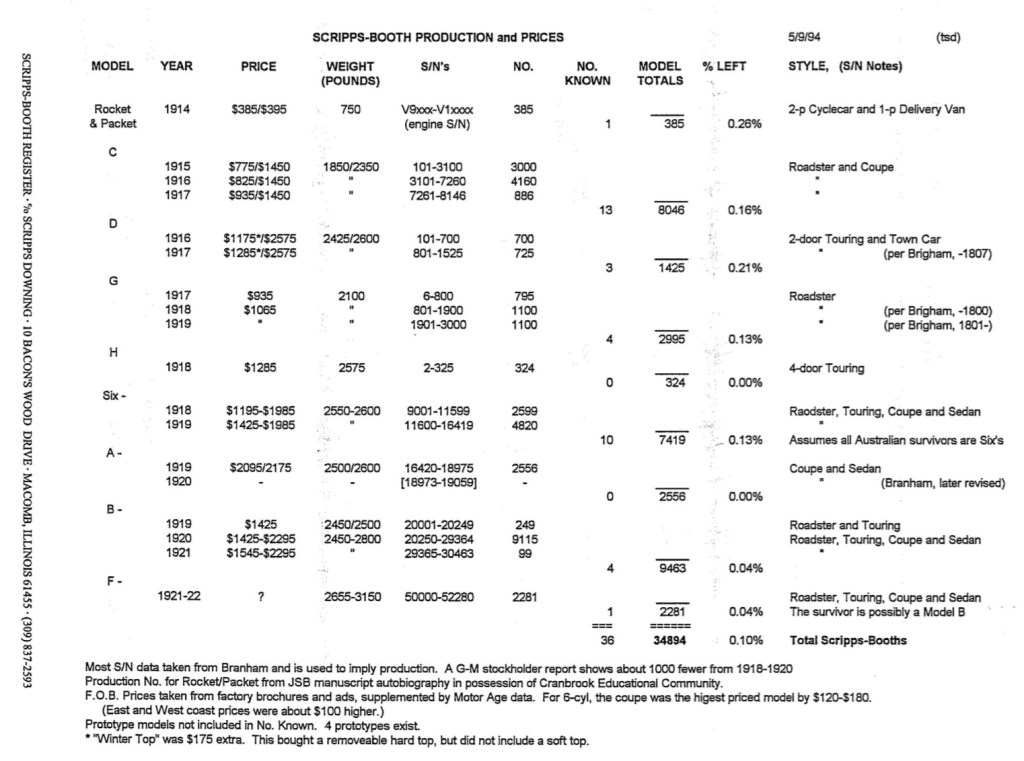
These tables are from the Scripps Booth register, check out scrippsboothregister.com if you have a hankering to learn more about these cars.


Credits…
Red Dust Revival Facebook page, Graeme Cocks Collection, Detroit Historical Society, Harold A Parker, scrippsboothregister.com, various newspapers via Trove, Terry Walker’s Place – West Australian race results, Ferro Corporation, FoMoCo
Tailpiece…

Finito…
 primotipo...