


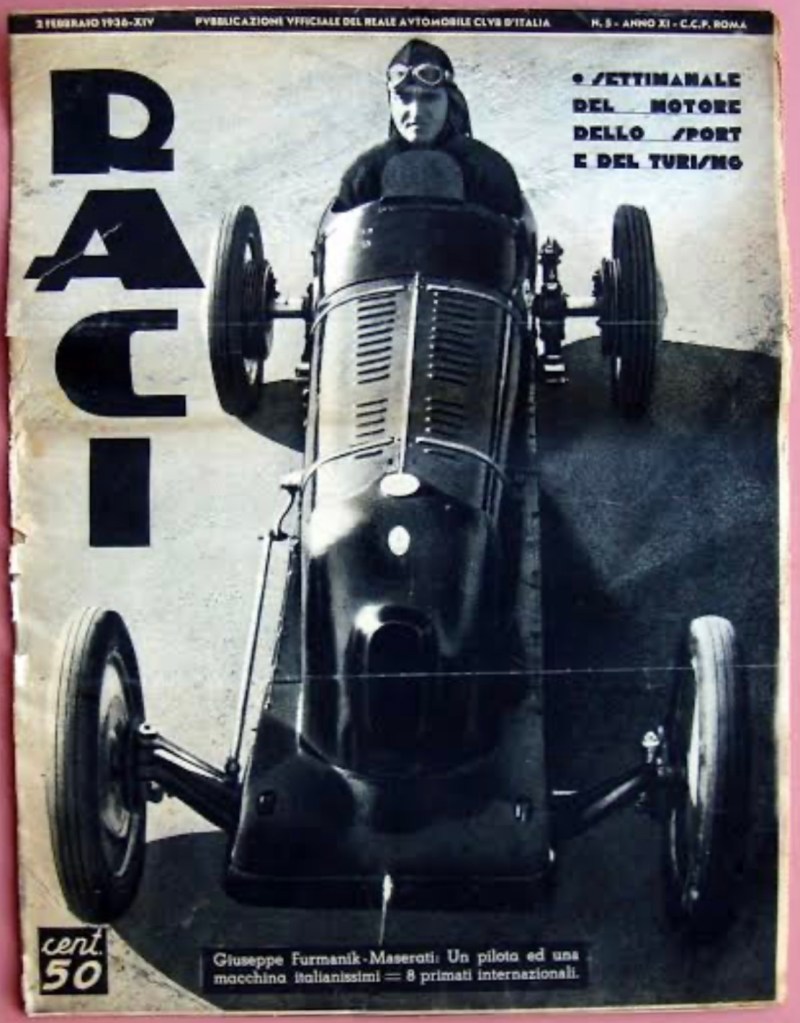
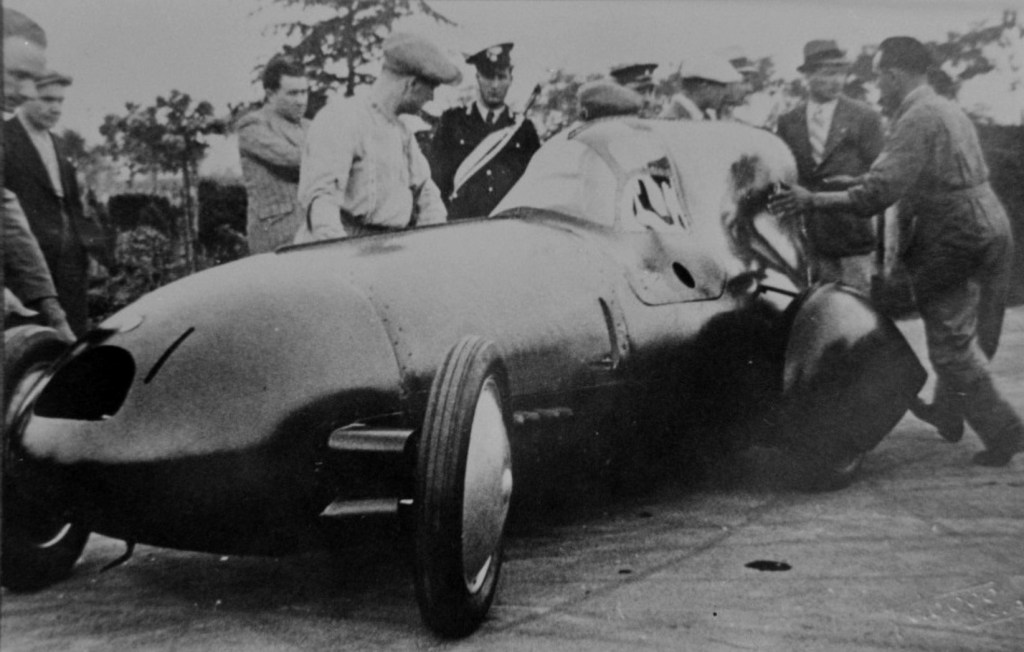
Ernesto Maserati looks on as Giuseppe Furmanik readies himself and his lightweight, streamlined, four cylinder 4C powered Maserati 6CM, chassis #1136 for a run during several speed record attempts he made at Tassignano on the Firenze-Mare Autostrada on June 2-3 1937.
Furmanik set the 1001-1500cc Flying One Kilometre record on June 3 at 148.4mph/237.568kmh (or 148.2/238.6 depending upon your source).
The car’s special aluminium bodywork was designed by the Centro Sperimentale Aeronautico di Giudonia and built by Carozzeria S. A. Viotti of Torino. Furmanik used the machine – also referred to as 4CM #1536, for which no factory build sheet exists – and another 4CM, chassis #1120, in record attempts.

Of Polish descent Joseph Furmanik was born in Switzerland in 1903 then moved to Italy with his father circa 1919-20. He adopted ‘Giuseppe’, became an engineer, co-designed a parachute named the Salvator and married money.
Settled in Rome, he became a prominent figure in 1930s Italian motor racing with his competition exploits probably funded by parachute royalties. He succeeded Count Vincenzo Florio as President of the Royal Automobile Club of Italy (RACI) in 1937.

4CM Technical Specifications…
Furmanik took delivery of 4CM #1120, a four-cylinder, twin-cam, two-valve, Roots-supercharged 125bhp at 5000-6000rpm 1100cc Maserati 4CM monoposto, on August 12, 1932.
The 4CM was avant-garde for its time, Maserati followed Alfa Romeo’s single-seater lead set by Vittorio Jano and his team with their Grand Prix Alfa Romeo Tipo B/P3 Monopostos.
Very light, the car’s two parallel channel section chassis members were only 620mm wide with bodywork tightly proportioned around the key mechanical components. Hydraulic brakes were fitted, again, leading edge for the time. The car had a four speed gearbox and period typical suspension comprising solid axles front and rear sprung by semi-elliptic leaf springs, friction dampers were fitted. The wheelbase was 240cm, track 120/120cm and weight circa 520-580kg.
4CM early competition…
The 4CMs looked great and were fast in a limited number of outings in their first year of competition, 1932. In the German Grand Prix held on the Nurburgring in July, Ernesto Maserati and Amedeo Ruggeri were third of 15 Group 2 800-1500cc cars in the race won by Rudy Caracciola’s Alfa Tipo B 2.6. Maserati followed up with fourth of the Voiturettes – Ernesto’s little 1100cc Maser was surrounded by 1500cc cars – at the Masarykuv Okruh at Brno in September.

Furmanik’s Record Breaking…
Furmanik raced #1120 throughout 1933 finishing third in the Coppa Ciano Junior and Coppa Acerbo Junior in July/August and missing the final of the Monza Grand Prix in September and DNF in his heat.
Into 1934 Furmanik started the Coppa Ciano as favourite in the Voiturette class but didn’t finish after a slight accident on the first lap. He was fourth in the Coppa Acerbo Junior.
Giuseppe does not appear to have raced #1120 in 1935 (see change of ownership to Gino Rovere shortly) and then decided to plan an attack on the World Speed Record.
#1120’s power was increased (output not specified) and a lighter more streamlined body was designed by Mario Revelli di Beaumont – ‘the most prolific car designed you’ve never heard of’ – and the front brakes removed, the result about 470kg/1036lbs. He also adapted the gearbox to provide for three tall gears.
Furmanik’s first runs, on November 28, 1935 were made on the Lucca-Altopascio section of the Firenze-Mare Autostrada, then on the Pescara road circuit on January 8, 1936, and then again on the same section of the Firenze-Mare Autostrada on January 29, 1936.


Gino Rovere…
Gino Rovere was a wealthy enthusiast who became Maserati’s President. He supported Furmanik’s efforts, making available funds to increase the engine’s output and further improve aerodynamics.
With a 4C engine then developing some 150bhp at 7,200 rpm and the Centro Sperimentale Aeronautico di Giudonia/Carozzeria closed aero body fitted to 6CM chassis #1536, Furmanik set the Flying Kilometre record mentioned at the outset in June 1937.
Along the way #1120’s ownership changed from Furmanik to Rovere and the car was returned to Maserati’s Bologna factory where it’s said it was fitted with a 1.5-litre engine for Rovere to race in selected 1935 Voiturette events: Brooklands in the May 6 JCC International Trophy (results please), then at Dieppe and finally Modena.


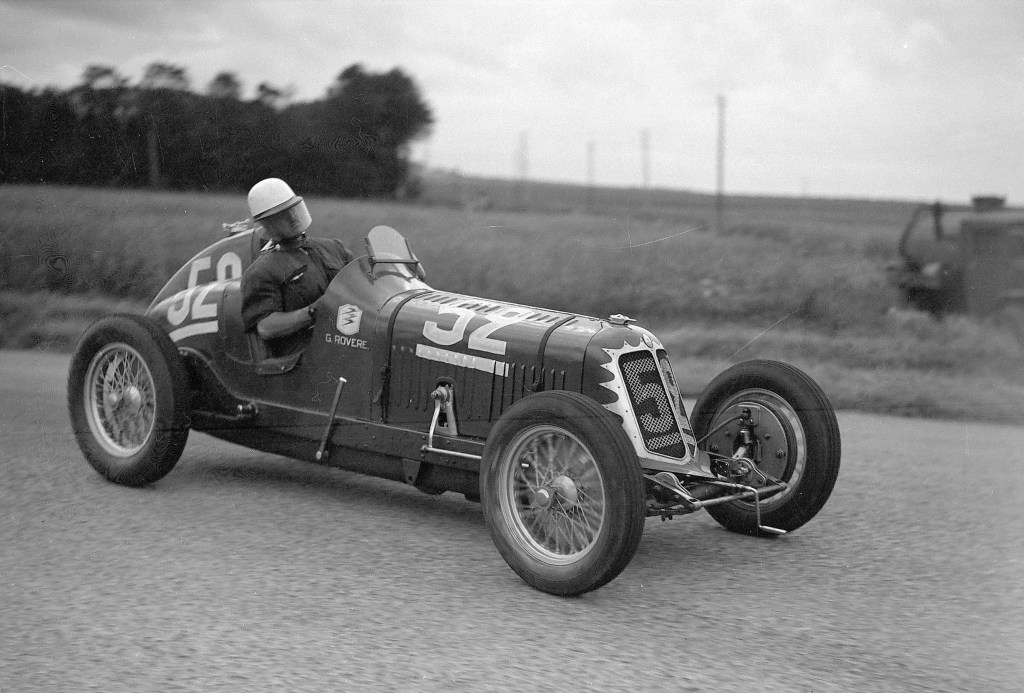
In the GP de Dieppe on July 20, Rovere qualified seventh on the 19 car grid and finished eighth, handing his car over to ‘his protege’ Giuseppe Farina late in the race, Farina promptly set the fastest time of the day despite the car’s quoted 1.1-litre capacity. Rovere also contested the Circuit di Modena Junior on September 15 for Q5 and DNF, again the capacity is quoted as 1100cc in the goldenera.fi results.
In 1936 Rovere’s team competed under the works banner given his status as Maserati’s President. #1120 was raced by various works drivers early that year and then sold to Scuderia Impero. Agostino Prosperi and Mario Colini drove it, then Rovere had a return bout with his old car at Pescara.
In the modern era, #1120 has been a regular part of the UK historic scene in 1100cc and 1500cc form raced by many drivers including Sean Danaher, Martin Stretton, Barrie Baxter and Stefan Schollwoeck.

Build numbers…
Maserati built 16 4CMs between 1932-35: Nine 1100s – chassis numbers #1115, 1116, 1118, 1119, 1120, 1122, 1125, 1127 and 1128 (note that #1120 and 1125 were both later fitted with 1500cc engines), Six 1500s – 1514, 1521 (also fitted with an 1100cc engine), 1525, 1526, 1527 and 1528, and One 2000cc – 2011.
Etcetera…
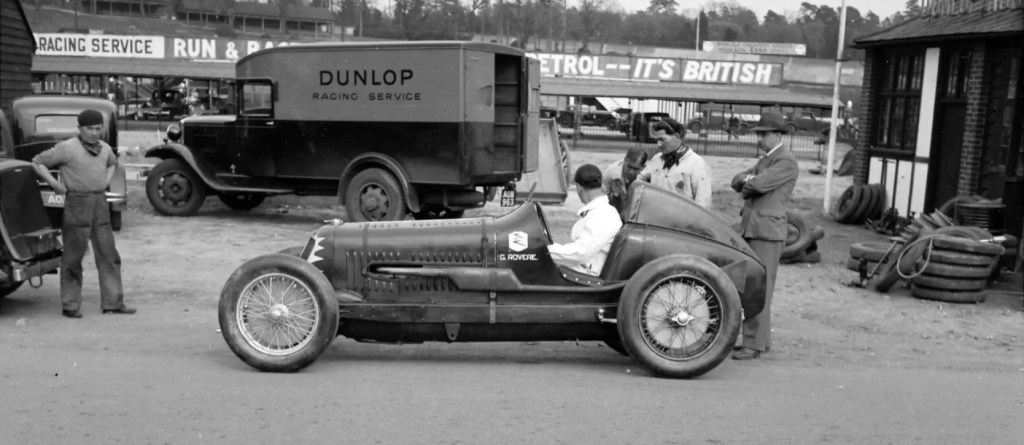
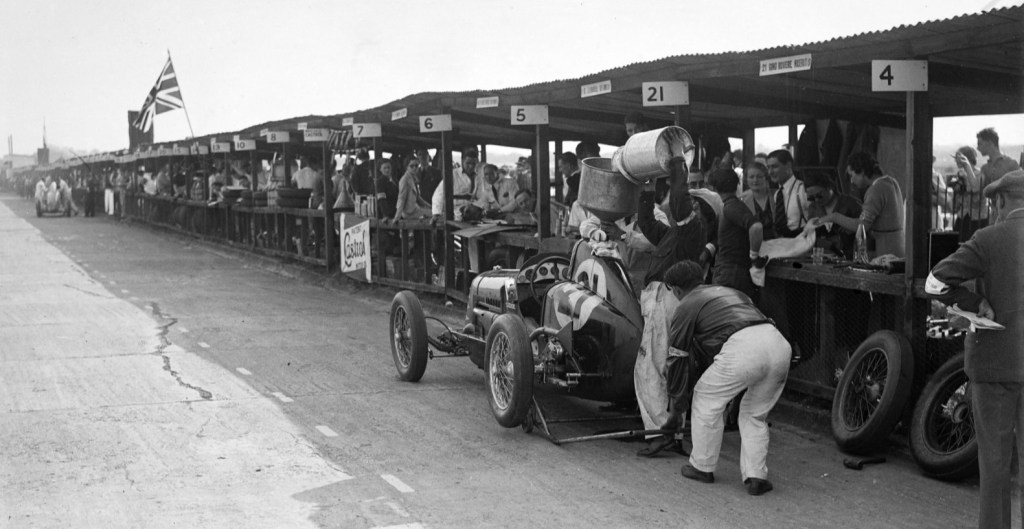
Two more shots of Rovere in the Brooklands 1935 paddock, #1120 in profile and three-quarter rear for a pitstop.
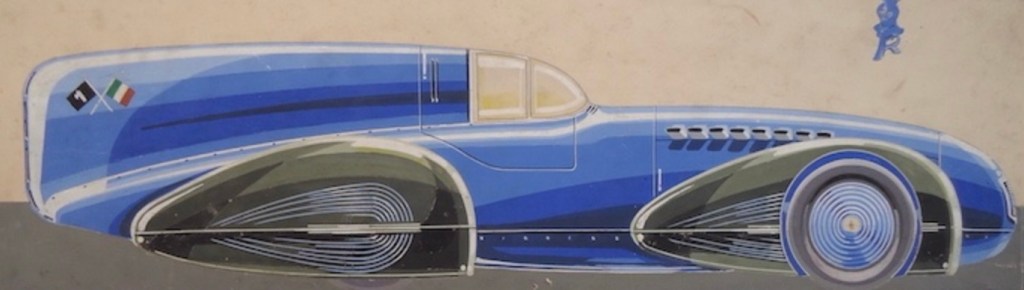
A rendering of the Centro Sperimentale Aeronautico di Giudonia design, and below #1536 in one specification in which the car ran. Compare and contrast with the first three photographs in this piece.

Credits…
Anonymous photographer within the Pirelli Archives, MotorSport Images, Leif Snellman’s superb The Golden Era of Grand Prix Racing – goldenera.fi, The Nostalgia Forum, thanks to Maserati historian Kevin Tjeerdsma for advice on correction of facts and chassis numbers
Finito…
 primotipo...