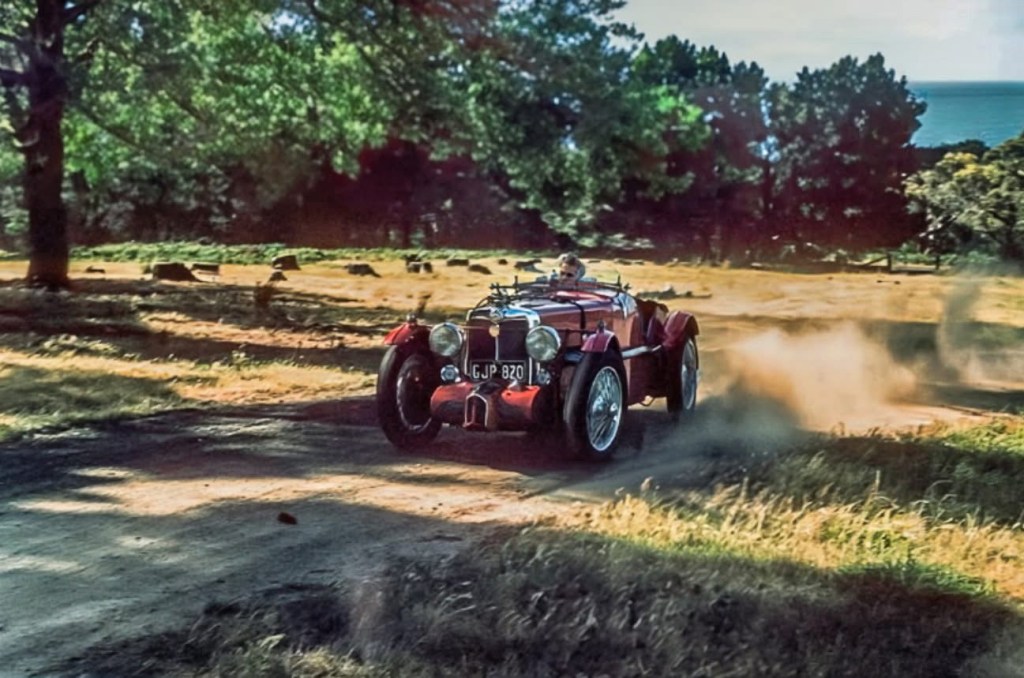
John Sawyer’s MG K3 #K3752 tail out on the Mount Martha Hillclimb, on Melbourne’s Mornington Peninsula, in November 1955.
Richard Millington wrote that ‘K3752 was the K3 prototype and was the recce car for MG’s attack on the 1933 Mille Miglia.’
Sawyer originally ‘did his time’ with Otto Stone, assisting in the preparation of Stan Jones’ Maserati 250F and other cars, ultimately becoming team manager of Bob Jane Racing in the glory years from the early 1960s, when it was Australia’s biggest and most diverse.
Some healthy exchanges on Bob Williamson’s Facebook page between Richard Millington, David Trunfull and Tony Johns, and then later between Tony, Bob King – who competed at the Mount Martha Hillclimb – and I determined that the event was at Mount Martha, near Balcombe rather than the Tuerong Valley Hillclimb, the other contender, ‘just down the road from Foxey’s Hangout, close to the corner of Tubbarubba and Balnarring Roads where the local farmers slung their dead foxes over the fence!’
(J Plowright)
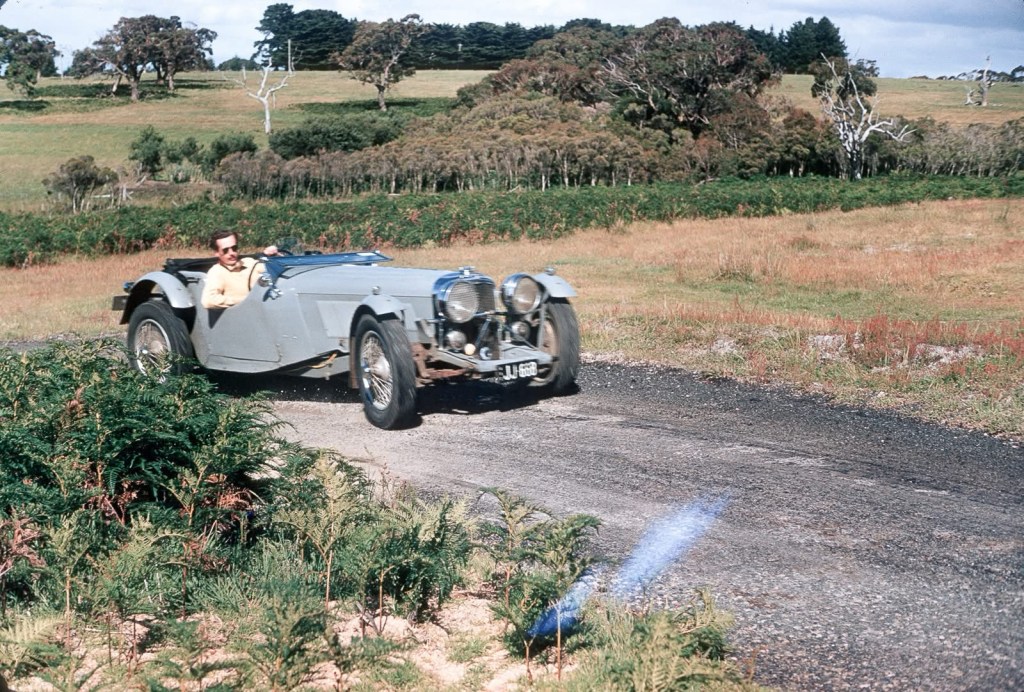
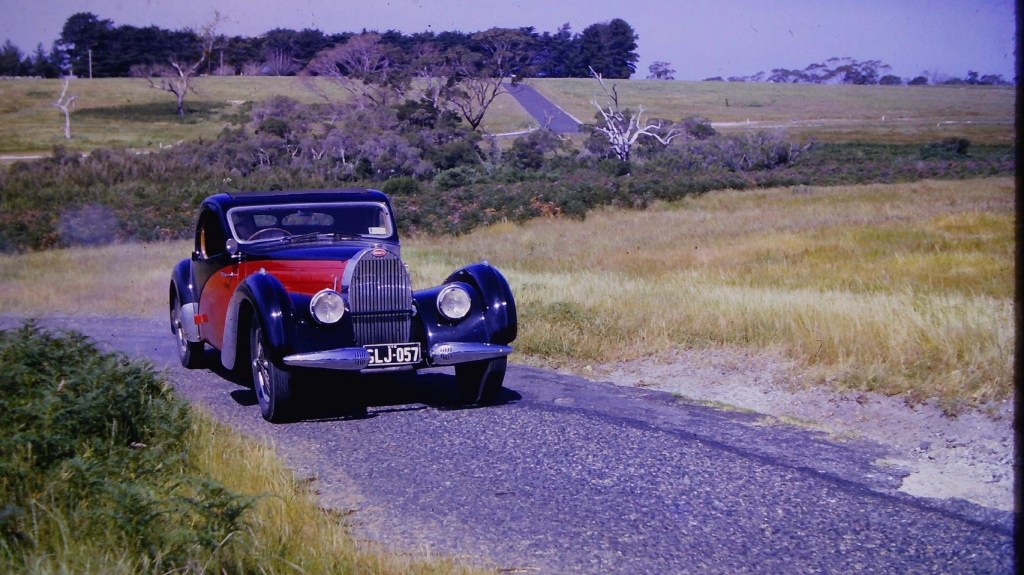
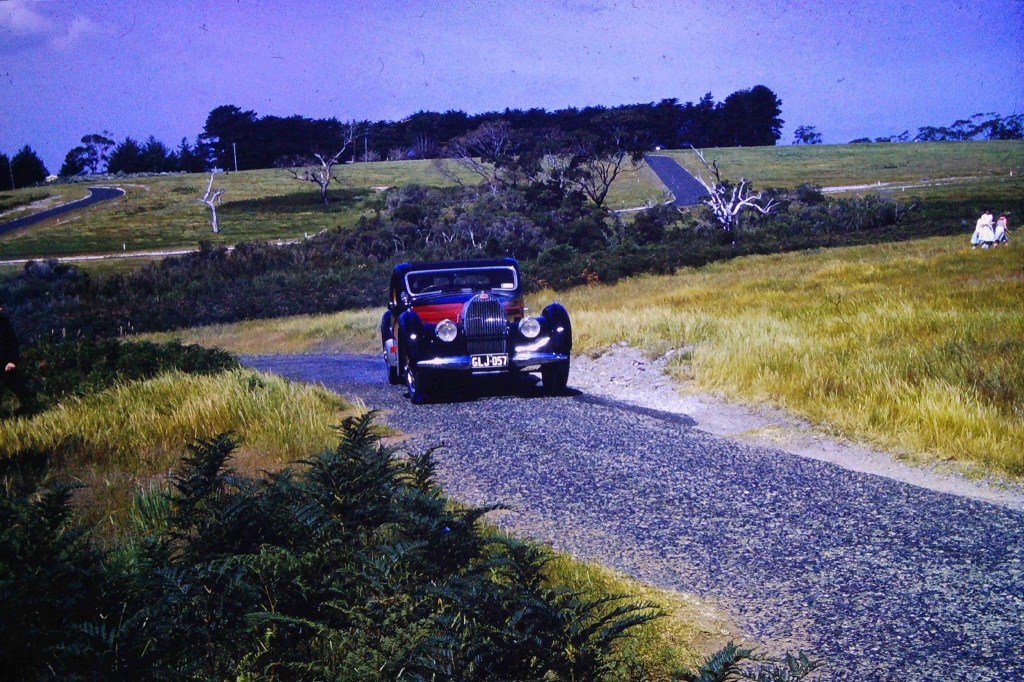
What is clear in these two shots: Laurie Rofe’s Jaguar SS100 in 1955 above, and Bob King’s Bugatti T57C below, on November 18, 1962, is the encroachment of suburbia upon Mount Martha in the intervening seven years.
(J Plowright)
Laurie Rofe’s Jaguar SS100, again in 1955.
Bob King giving his Bugatti Type 57C Atalante Coupe some wellie at the VSCC Mount Martha meeting in November 1962, not too long after the purchase of chassis #57788 from Henry and Peter Dale.
‘I set equal FTD with my great friend, Graeme Lowe’s Alfa Romeo 6C1750.’ Bob owned the car for only two years; the end of his exciting ownership came during a trip to Sydney to take in the Warwick Farm 100 Tasman Cup meeting over the February 16, 1964 weekend.
Overheating problems diverted the young Doctor’s attention from both Jack Brabham’s on-track performances and, more importantly, the attractive young lass who accompanied him north to Sin City. Salvation came over that weekend in the form of Eric Pengilley, who paid a good deal more for the car than the classy Frenchie owed Bob. The machine has been owned for decades by Stuart Murdoch.
(J Plowright)
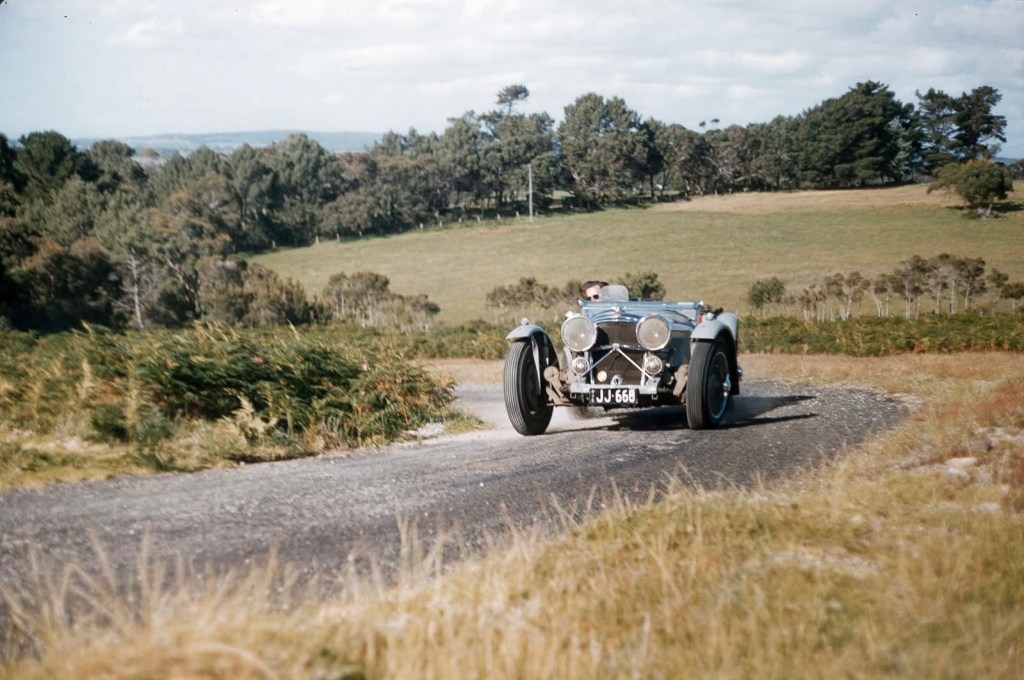
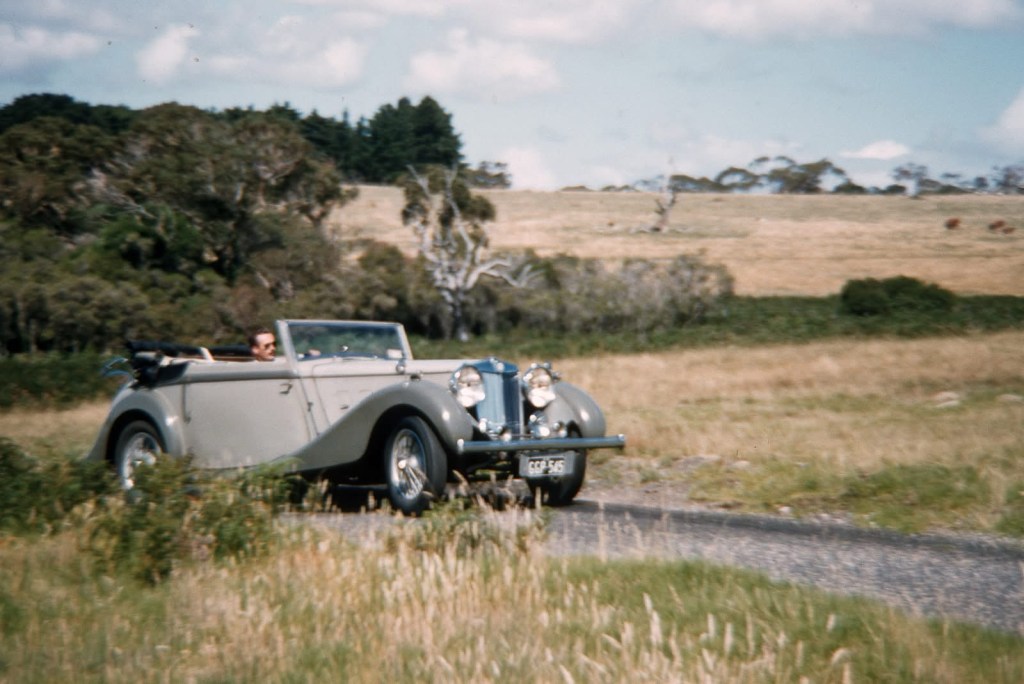
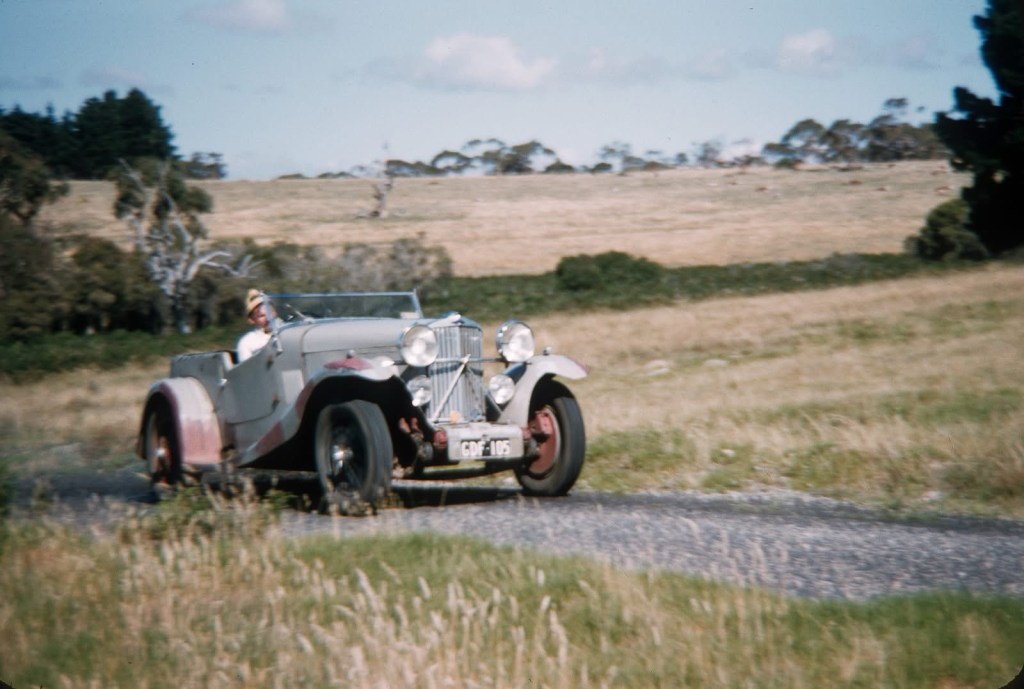
Laurie Rofe again in 1955, this time aboard an MG SA Coupe, and R Dowrick below in a Talbot 105.
(J Plowright)
More on the locational stuff from Tony Johns, who spectated at the 1962 event, and provided this excerpt from a Victorian Drivers Club magazine outlining one of the upcoming Sporting Motor Club’s Mount Martha events.
‘COMING EVENTS:
Hill Climb at Mt. Martha…This meeting is being organised by the Sporting Motor Club under a C.A.M.S. permit, and we are being invited as a club to take part. There will be a special category for Vintage Cars.
For those who can come in the morning, meet at the Mornington War Memorial at 11 a.m (then, I think, located on the intersection of Main Street and the Nepean Highway, Mornington). Entry fee £1. Unregistered vehicles 25/-. Prize: Pewter Tankard (Vintage Class). Fastest of several runs.
Hill climb not steep, and a picture-postcard atmosphere prevails. All food to be brought. Barbeque to be held after the finish of the climb. Any members without cars will be welcome to come in other members’ cars. If not, bring Pop’s Holden.
If members come later, drive down the Nepean Highway three miles past the War Memorial, turn right on the first road past the bridge at the School of Signals. Drive along the road one mile, then turn left a half mile, where the hill climb will be seen on the left.’
Credits…
Richard Millington, Jon Plowright, Don Ashton Archive via Tony Johns, Bob King Archive
Tailpiece…
(R King Arc)
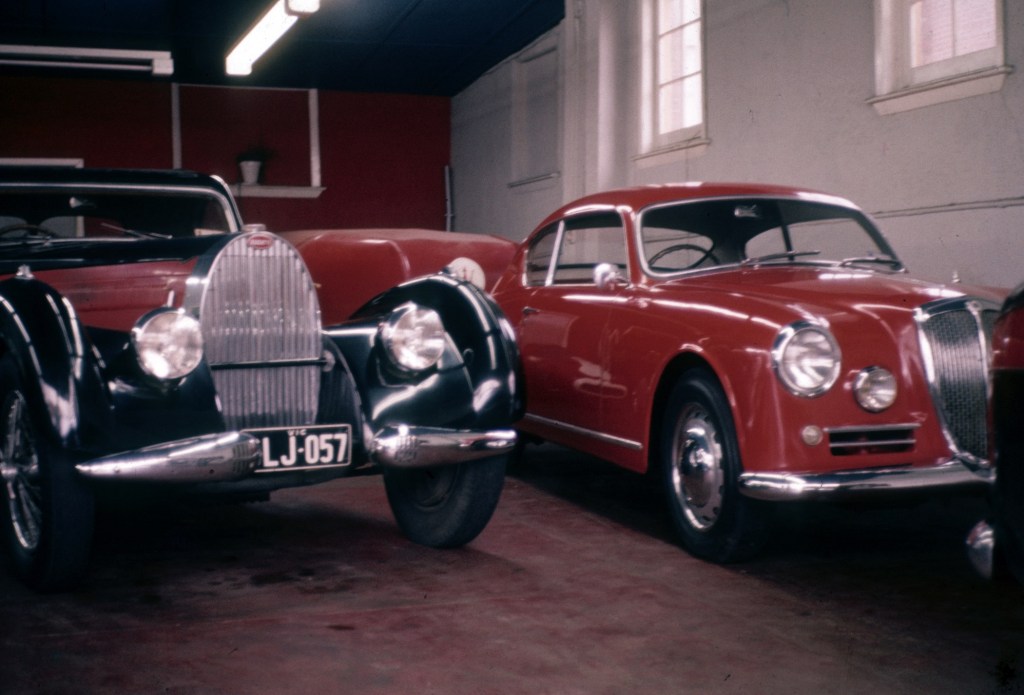
King’s Bugatti Type 57C, and friend, in Dicer Doug’s – Doug Whiteford Tuning Service – emporium of speed at number 5 Carlisle Street, St Kilda, in late 1961 or early 1962, not long before he bought it. Ring for an appointment on XJ1233…
These super shots of Bob Jane Racing cars contributed (mainly) by Russell Martin and James Semple to Bob Williamson’s Australian Motor Racing Photographs Facebook page are too good not to share more widely.
The machine above is the Can-Am McLaren M6B Repco 740 5-litre V8 in which John Harvey won the 1971-72 Australian Sports Car Championships. See here: https://primotipo.com/2018/09/09/sandown-sunrise/
(R Martin)
Many of Russell Martin’s shots were taken at what appears to have been a press day at Calder, perhaps in late 1970, given the cars present and their livery.
Jane’s Chevrolet Camaro ZL-1 is a Top 25 all-time Australian Touring Car, winner of the 1971-72 Australian Touring Car Championships, powered by an aluminium Can-Am 427 big block in ’71 and a tiddly 350 cast iron small block in ’72. CAMS did a parity pirouette at the end of ’71 and banned the 7-litre engine despite it being homologated, not that it made any difference to the ATCC results. What a car…
A list of all of the cars Bob owned and raced would be a mighty impressive one! There were a couple of Series Production cars in this era, the Holden LC Torana GTR XU-1 shown above and a Monaro GTS 350. Southern Motors was Bob’s Holden dealership. I wonder what the Bob Jane Racing headcount was in that 1970-72 period? More here, including my attempt at a list of Bob’s racing cars: https://primotipo.com/2020/01/03/jano/
(J Semple)
John Harvey on the way to winning the RAC Tourist Trophy at Wawrick Farm on April 30, 1972, the third round of the Australian Sports Car Championship
Harves was the primary driver of this car but Bob had the occasional gallop as well. At the end of 1972 the car was parked, Castrol – if I remember the story rightly – wanted the focus to be on the team’s taxis not its single-seaters and sports car so the Brabham BT36 Waggott, Bowin P8 Repco-Holden and the McLaren were set aside in the workshop. The BT36 was sold to Ian Cook and Denis Lupton, the Bowin P8 chassis went to John Leffler and its Repco-Holden F5000 V8 engine was lent to Ron Harrop to use in his Holden EH sports sedan.
Two Australian sports car star-cars were parked for commercial reasons in this era while still in their prime: Frank Matich’s Matich SR4 Repco 860 5-litre in 1970 and the Bob Jane McLaren, both could have won the ASCC for years had they raced on…
The M6B’s life from then on was as a display machine at Bob Jane T-Marts throughout the land, the family still own it.
(R Martin)
The following excerpt from Tony McGirr’s book, ‘Gentleman John Harvey : Memories of How it Was’ related Harvey’s recollections of the McLaren M6B Repco.
‘I would rate the McLaren and my 76 Offy (speedcar) as the best cars I have ever driven in terms of driver satisfaction. I enjoyed driving them. More, I loved driving them. I was always relaxed and felt part of each car. Obviously, I won a lot of races in each, they were just sensational.
With a car such as the McLaren, it was a purpose built racing car. The engine was in the correct position. The weight distribution was perfect. Now, I’m talking about the late 1960s and early 1970s, and this was simply a fabulous motor car.
Not only that, but being a sports car, with a full enveloping body, it had style. It was a stunning looking car. When we rolled it out of the back of the transporter, people would come for miles to look at it. They would just stand there with their mouths open. They had never seen anything like it.
So, that was an added element to its appeal. By that stage too, Repco had the 5-litre V8 engines working properly. In the early days of the Repco V8 2.5-litre engines, they had lots of problems. By the time of the McLaren, they had the engines working properly. The engine we had was very reliable and very powerful.
Another thing in favour of the McLaren was the fact that it had a full monocoque chassis. Most of the sports cars I was racing against at the time, including the Elfins and Frank Matich’s early cars, were all of tube-frame construction and subject to a bit of frame-flex and twist. In the later period of Frank’s development of his cars, the SR4 was the quickest car by far. It had a 5-litre twin-cam engine. The engine we were using was a 5-litre single cam version.
Now, I’m not making excuses here, I am simply outlining the relevant technical differences. Frank’s car had another hundred horsepower, and was much faster in a straight line. However, when we came to braking, and going through the twisty bits, the McLaren would catch up every metre he had gained on the straight. In a couple of cases, he could do the fastest lap of the race, and I could match it a little later, when my fuel load went down, and we had a bit better power-to-weight ratio.
But, the final word on the McLaren – fantastic. Plus, Bob Jane had a very deep affection for Bruce. They had known one another for some years. Bob also knew Pat, Bruce’s wife. As a tragic irony, Bob and I were with Bruce the night before he died. In fact, we were in London on business, mainly to see how the McLaren was being finished off.
Now, Bruce had made that car as ‘a special’ for Bob, and the Repco engine. Because, at the time Bruce was using the 7-litre Chevy engine as a stressed member of the car’s structure, and was hanging the rear suspension off the transmission. Because the Repco engine was not robust enough (more correctly, the engines weren’t designed to be used as stress-bearing members) to be used this way, Bruce built a couple of chassis members, or pontoons, off the back of the bulkhead, to accommodate the Repco engine. He got Ron Tauranac to bring around a spare engine block so he could use that as a dummy to set up the engine in the redesigned chassis.
So, in that way, Bob’s McLaren was a specially built one-off car. Anyway, we were with Bruce on his last night. We were heading off, and back to Australia. At that time, Bruce was the recipient of the Grovewood Award, and had to go to the function that evening to receive the award. This was a very prestigious award in those days. Anyway, Bruce had forgotten to bring his best suit, and it was too far to go home to get it. Bruce and Bob were about the same size. Both were short, stocky types, with solid shoulders.
Bruce was inclined to brush the whole thing off and said, ‘Ah well, it’s only a suit’. Bob insisted that he be able to lend Bruce his own new suit that he had in his bags. So, off went Bruce to collect the award in Bob’s new suit. He thought that was terrific.’
Repco-Brabham – Repco from 1969 – the RB740 all aluminium, SOHC, two-valve, Lucas injected 5-litre V8 is quoted by Repco as having 460bhp @ 7500 rpm and weighed 360 pounds (R Martin)
‘With the international time difference, and the time it took our flight to get back to Sydney airport, there on the front page of the Sydney Morning Herald were the words, ‘Bruce McLaren killed’. We couldn’t believe it. We had been with him just the night before.
So, that was a really sad end to our trip. After that, the McLaren became an extra special car for Bob. Particularly so because he was the one who owned it. It became special for me for the period in which I drove it. I think Bob drove it a couple of times, but basically, that was my car for the whole period of its racing career.
We retired the car at the end of the ’72 championship, and the car has never been raced since. They have restored it twice. When I say ‘twice’, I mean the first restoration was pretty good, but the second was exceptional. The only person who has driven it since, was when Denny Hulme drove it at the ’85 Grand Prix in a parade lap (below). Bob wanted me to drive it last year, or the year before, at the Grand Prix at Albert Park. I was really looking forward to that, except that the engine had traces of water in the oil, and the whole thing was cancelled.’
(Bob Jane Racing Heritage)M6B sales chick. Bob Jane T-Mart, Parramatta Road, Granville in June 1976, with the nose of Jane’s Maserati 300S, which had been restored by Jim Shepherd (spelling? not John Sheppard) not long before (Cummins Archive)
‘Bob is probably the only person in the whole world who was an original owner of a McLaren race car, and who still owns it. It has never changed hands, and while ever Bob lives, it will never change hands.
Was the McLaren finicky’ to set up? I ask this in reference to modern Formula One cars, which they fool around with all the time. There are so may adjustments on modern cars, it seems to take them forever to set them up properly.
We didn’t have the same range of adjustments on the McLaren. Today, on almost everything, they have electronics. They have sensors all over the cars. The driver now has nowhere near the input we had in those days.
Mechanically, things are still somewhat similar. They still have suspensions with wishbones, springs, shock absorbers, roll-bars, and brake adjustments. The major difference is that we didn’t have any aerodynamic features to worry about, and we were on treaded tyres.
My first response when I sat in the McLaren was to say that the arches on the front mudguards were too high. Bruce had been using a much taller tyre. Technology was changing, and the result was we were using a smaller diameter tyre. We had the tyre sitting low down, and the crown of the mudguard up high. This made it pretty difficult to see your proper racing line.
We finally lopped the top off the big, tall radius of the front mudguards. We had a stylist do it, and I still think it was all for the better for the aesthetics of the car. It looked more balanced. It looked much nicer. Certainly, the newer rubber worked to enhance the performance of the car.
But, apart from that cosmetic change, we changed very little. Things like springs, we never had to change. Bruce had the springs made from this fantastic spring steel, and that meant that the springs never sagged. On other cars that I had raced with locally made springs, you had to be checking them all the time. You had to check them for installed height, static height, and compressed height. You had to take dimensions of these things all the time, because the springs would sag. This could lower your ride height, and all sorts of adverse things could happen as a result.
The springs in the McLaren – and the Brabham – we never had to touch. From that point of view, it was just shock absorber adjustments and wheel alignment. This was very important for the geometry of the front end. Adjustment of the rear ride height was also critical. Other than that, it was pretty much trouble-free. And as I said, by that time the engines were pretty reliable, so we had a good finish rate. It was a lovely car to drive. I just enjoyed driving it so much.’
Allan Moffat organised the purchase of a Shelby Mustang (car #3 above) for John Sawyer and Bob Jane in late 1968. Jane’s car was one car raced by Horst to victory at Riverside. VIN#8RO1J118XXX was the very last of the 1968 K-K/Shelby cars built and had only raced three times in the hands of Dan Gurney, Peter Revson and Horst.
Happily for both Jane and Moffat, it was soon on its way to Australia with Moffat expecting to race the hand-me-down Mustang GT390 in 1969 whilst his team-owner raced the near-new car, on the face of it the pair were a strong combination for the ensuing year…This story is told in the piece linked above.
Bob Jane, Ford Mustang 390, Phillip Island paddock circa- 1968 (R Martin)(R Martin)
The Jane V8 Repco was one of the few short-lived Bob Jane Racing cars.
The Bob Britton/Rennmax Engineering-built machine was campaigned by Harvey in the 1970 Australian Gold Star Championship, the last ‘Tasman 2.5 Era’ Gold Star.
When Harvey was first recruited by Bob after Spencer Martin’s retirement at the end of 1967, Harves inherited the Brabham BT23E Repco-Brabham 2.5 V8 Jane acquired from Jack Brabham at the end of the ’68 Tasman Cup.
John was nearly killed in it at Bathurst during that year’s first Gold Star round over the Easter long weekend. Harvey then raced it throughout 1969 and into early 1970 as related in this article:
John Harvey being looked after on the Oran Park 1970 grid by John Sawyer, Jane Repco V8. That’s Max Stewart alongside in Alec Mildren’s Mildren Waggott TC-4V
The Jane Repco V8 used the same pair of ex-Jack Brabham 295bhp @ 9000 rpm Repco 2.5-litre 830 V8s fitted to the BT23E, but the chassis – built on Britton’s BT23 jig – had revised suspension geometry to suit the latest generation of ever-evolving and widening tyres and other changes including the bodywork. As the story below relates, John could, woulda, shoulda won that Gold Star…The car has lived on, in ANF2 form, for many years in a WA museum I think.
Jane in the Jaguar E-Type Lwt at Calder, and the Elfin 400 Repco-Brabham 620 4.4-litre V8, perhaps on the same day below circa-1967, again with Bob at the wheel. See here for a piece on Bob’s E-Types: https://primotipo.com/2018/04/15/perk-and-pert/
(R Simmonds)
Elfin 400 Repco 620 620 4.4-litre V8 in Bob Jane’s hands at Calder circa 1967, above as I say, and in the Phillip Island paddock below, a little later 1968’ish; note the more substantial roll bar and rear spoiler in the shot below.
Bob Jane – yep, I know it’s Harves number – in one of his favourite cars, the John Sheppard built Holden Torana GTR XU-1 Repco-Brabham 620 4.4-litre V8 at Warwick Farm in 1972.
The Total and Castrol Bob Jane Racing thing seems to be a 1972-73 commercial relationship. I’m not sure how the two oil companies co-existed on the cars, but doubtless one of you taxi-fans will know the answer.
The Torana was born as a consequence of the growth in interest in. sports sedans and the availability of the Repco-Brabham 620 4.4 V8 in Janes workshop. After Bevan Gibson’s fatal Easter Bathurst 1969 crash in Bob’s Elfin 400 Repco 4.4, the remains, sans engine, were sold to Victorian Ken Hastings. Less than a year later the engine was put back into work…
Jane on the bonnet of the XU1-Repco (J Semple)(J Semple)
Harvey’s Torana sports sedan (above and below) leads Allan Moffat’s Mustang Trans-Am 302 and Bob Janes Holden Monaro HQ GTS 350 – both improved tourers – at Warwick Farm in 1972. The Monaro was another Sheppo build of course.
Ray Bell tells me that it’s the ‘November 5, ’72 meeting, Moffat won. Harvey retired after two laps in the early race, but not before he had pointedly moved over off the grid to block Moffat. In the second race Pete had diff troubles after forcing his way to second and dropped back so it was Moffat, then Harvey and Jane at the finish. This was when Moffat did a 1:37.5.’
(J Semple)(J Semple)
Beauty and The Beast Torana sports sedans.
The aluminium SOHC, Lucas injected 4.4-litre 400 bhp @ 7000 rpm, 360 pounds, Repco RB620 V8 powered, John Harvey driven, Bob Jane Racing Holden Torana GTR XU-1 chased by the cast iron, pushrod, Lucas injected 5-litre 475 bhp @ 7000 rpm, 485 pounds, Repco-Holden F5000 powered, Colin Bond driven, Holden Dealer Team Holden Torana GTR XU-1 at Oran Park. Ray advises that Harvey won both these encounters during the May 1973 meeting.
John Sheppard was prolific when he joined Bob Jane Racing, there were some seriously fast racing cars run by Bob in the Sheppo era including the Chev Camaro ZL-1, Holden Monaro HQ GTS 350, Holden Torana GTR XU-1 Repco, McLaren M6B Repco, Brabham BT36 Waggott TC-4V and Bowin P8 Repco-Holden. Sheppo scratch builds are the Monaro and Torana.
(J Semple)
Jane in the Monaro from Pete Geoghegan’s Ford GTHO Super Falcon 351 in its definitive, post-John Joyce-Bowin Designs rebuilt form at Warwick Farm in 1972. Probably the same race as three pics back, touring cars were sooooo fuckin’ good back then! Totally unlike the bullshit parity-sameness dog’s bollocks of today. Bob on the WF grid below on the same day.
(J Semple)(I Smith)
Calder March 1979, it looks like Janey is wearing the same Bell Magnum open-face helmet he was using a decade before – same Monaro but wilder sports-sedan specs – it was an improved tourer when first built way back in 1972.
(I Smith)
Bob Jane’s Pat Purcell built Chev Monza 350 at Dandenong Road, Sandown in December 1980. Amazing car, time to do an Auto Action under the skin piece on it with the unpublished shots we have…
Credits…
James Semple, Russell Martin, Ian Smith, Murray Thomas, Australian Muscle Car, Cummins Archive, ‘Gentleman John Harvey : Memories of How It Was’ Tony McGirr, Ray Bell
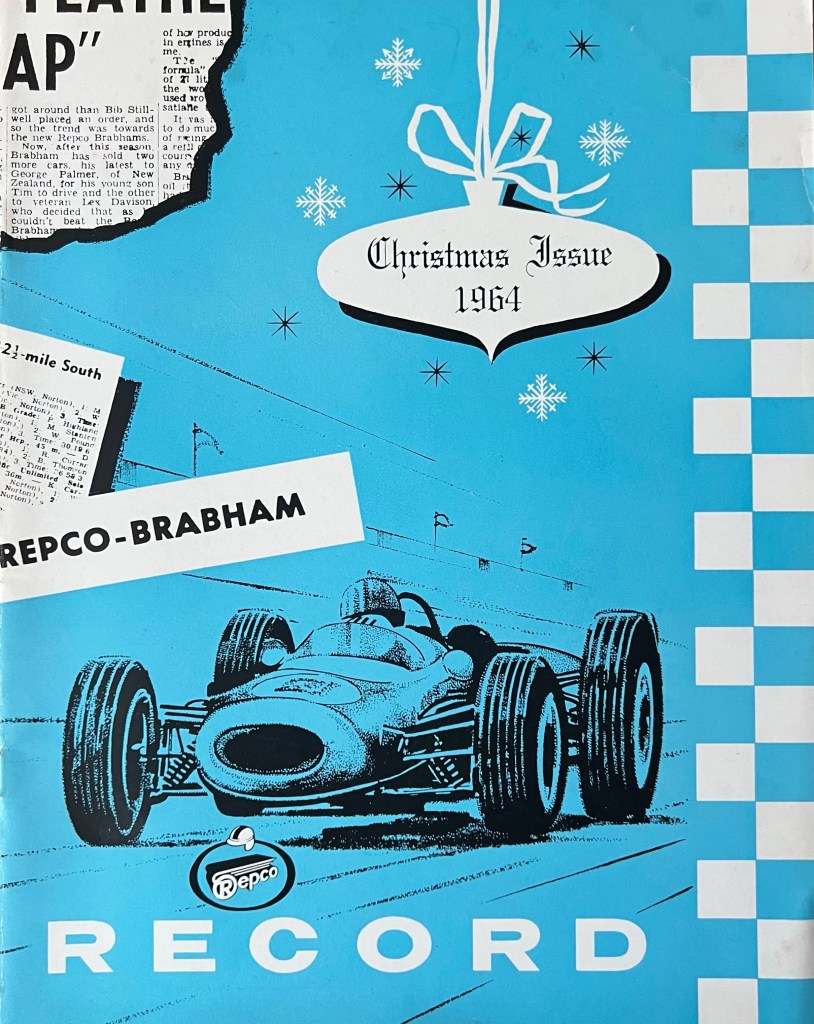
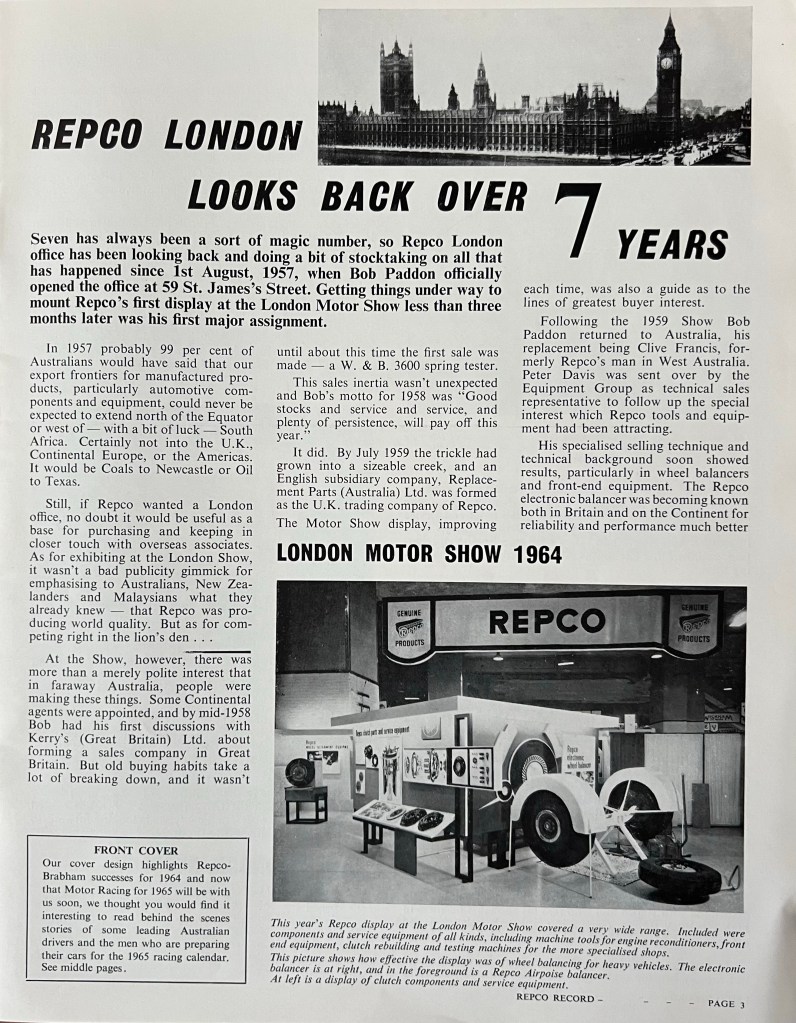
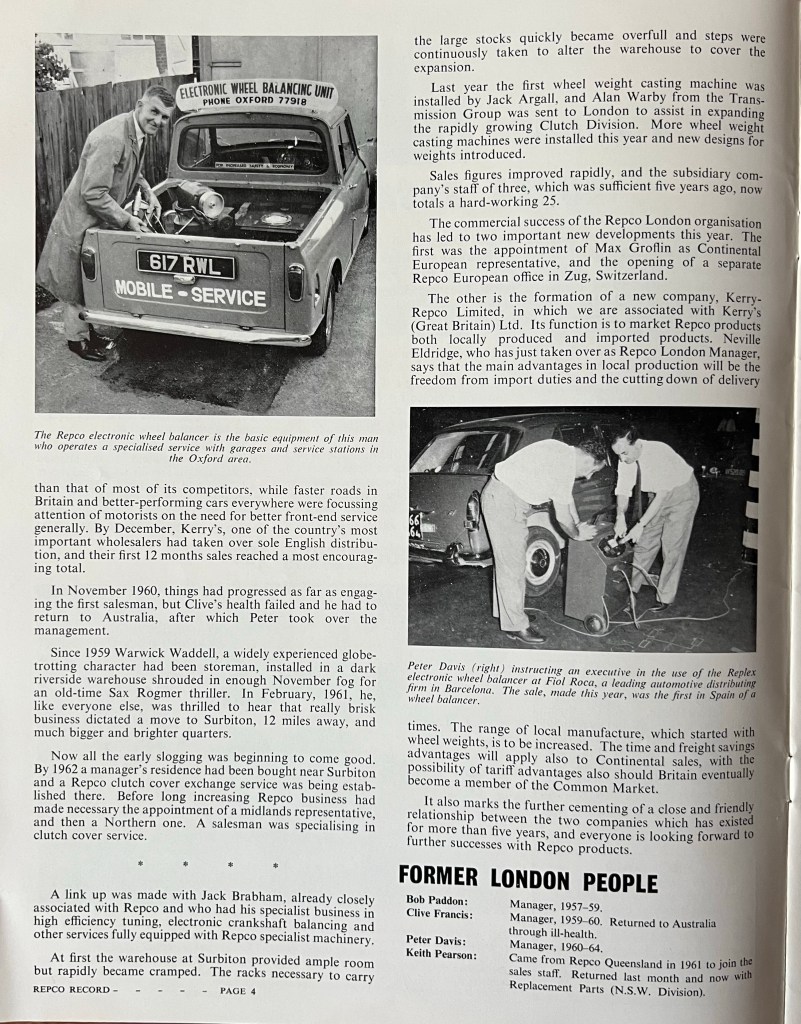
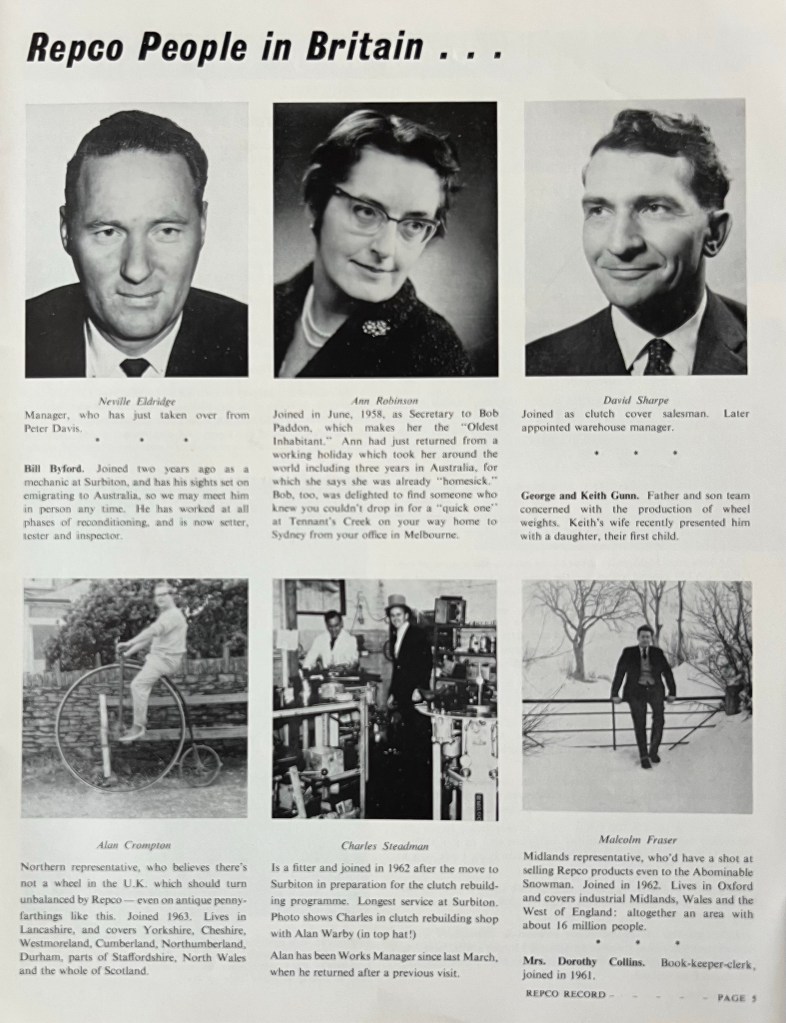
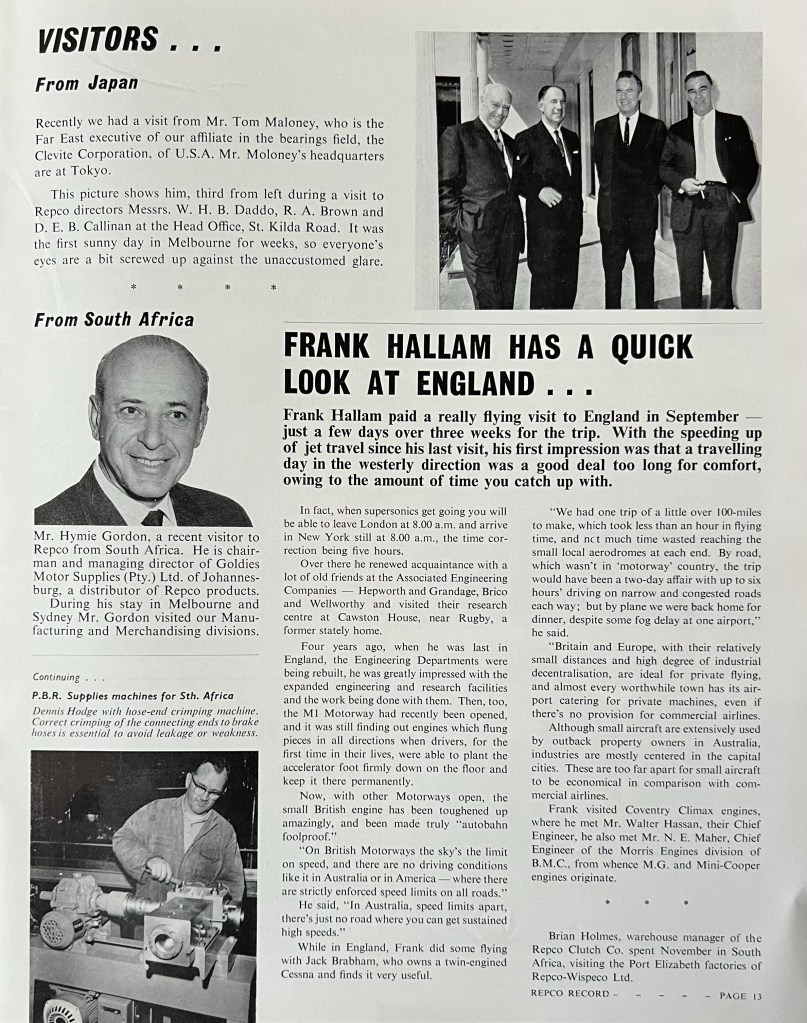
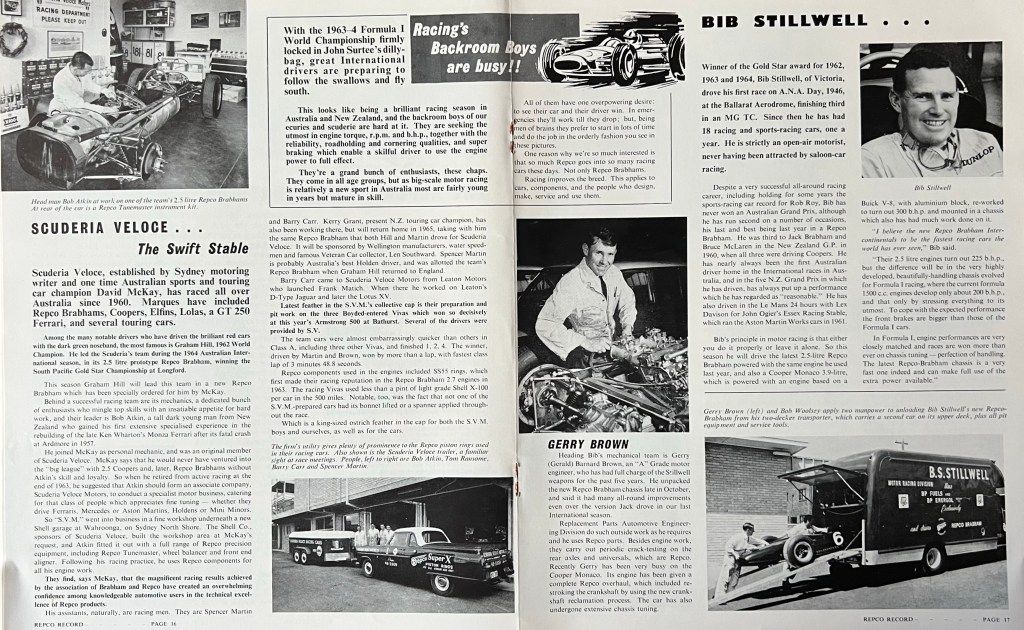
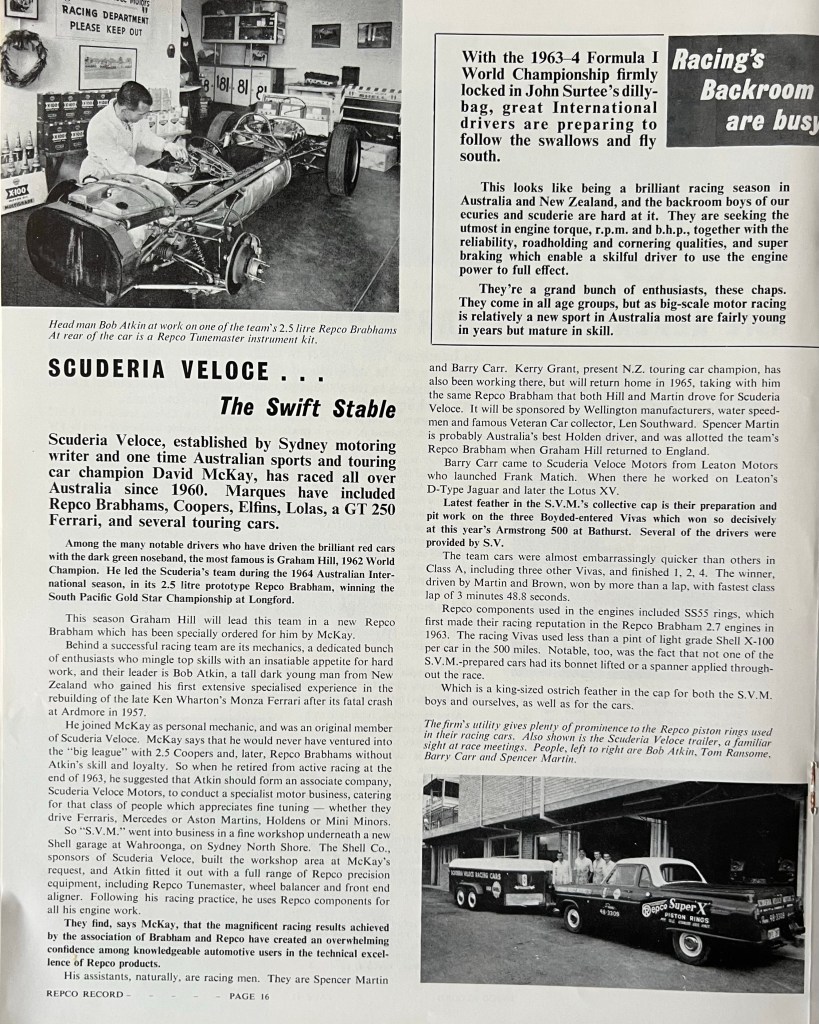
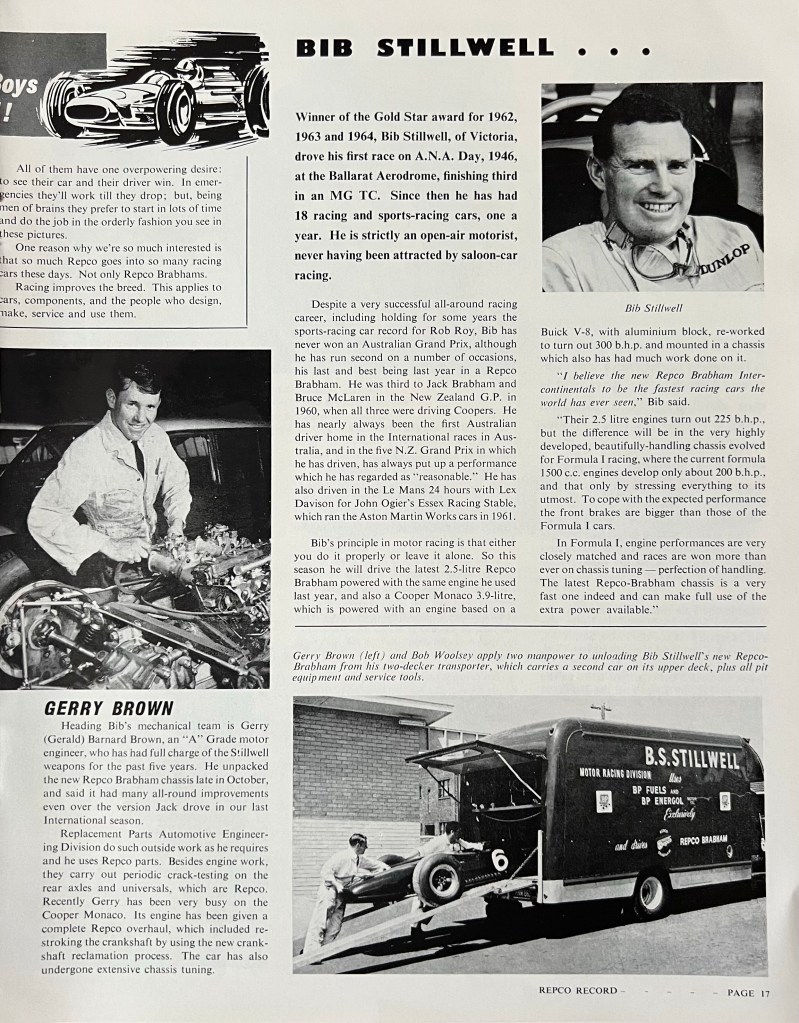
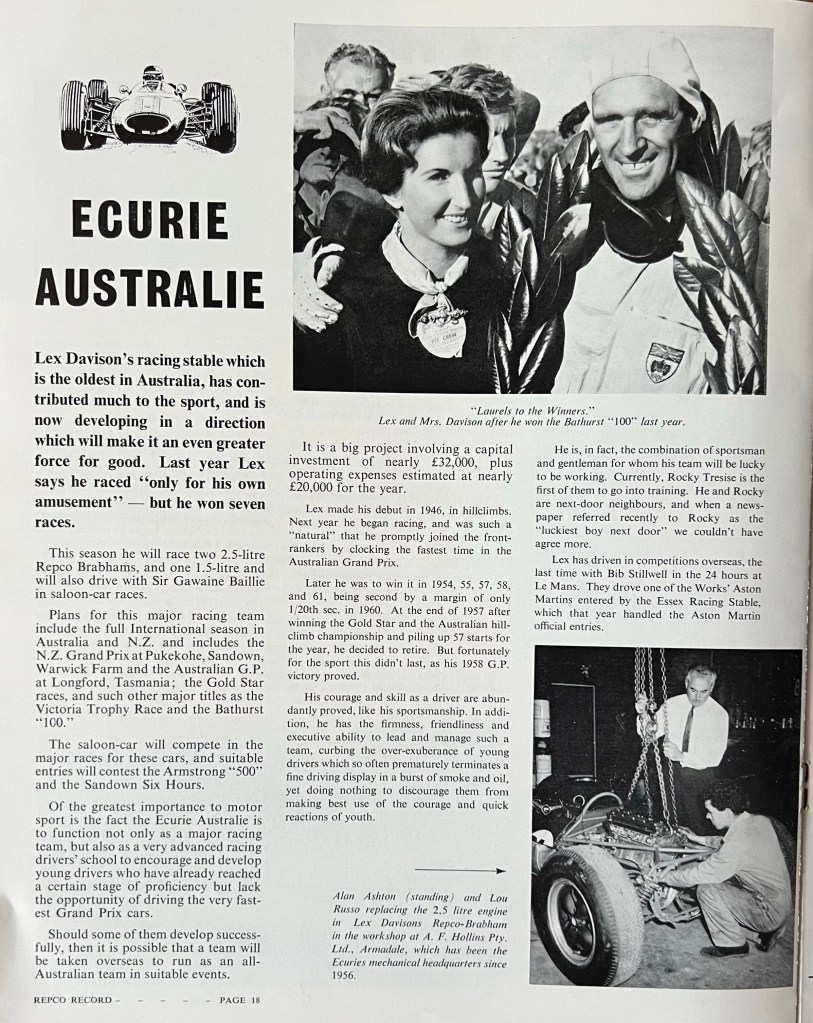
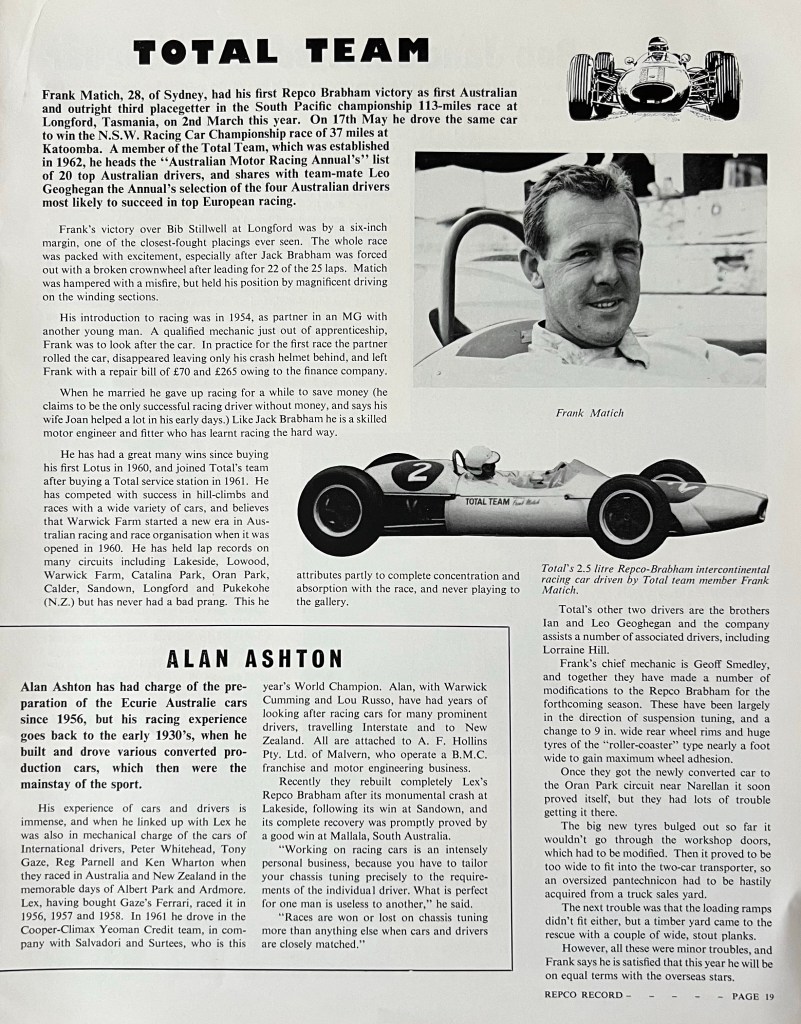
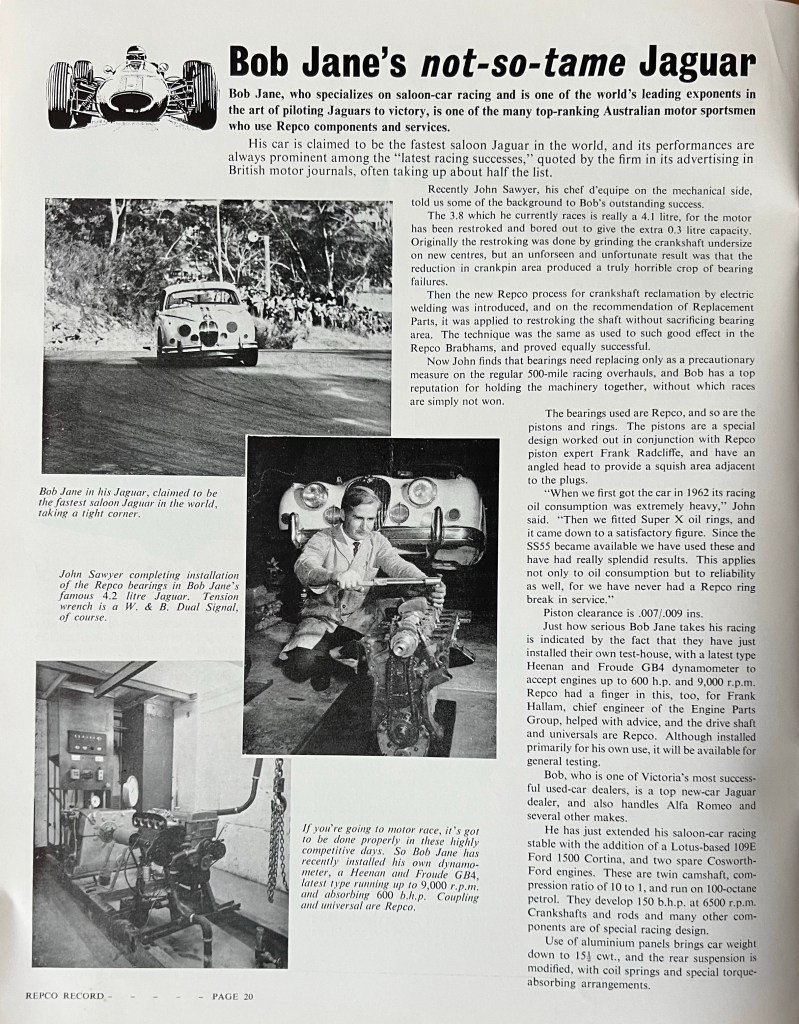
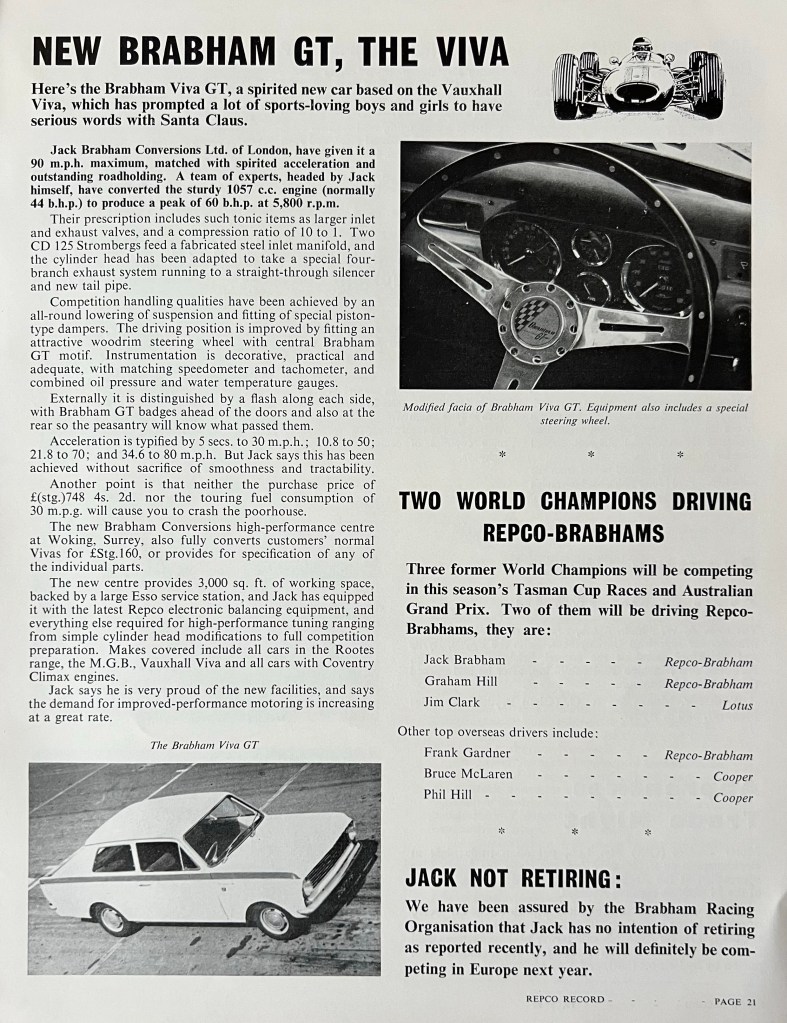
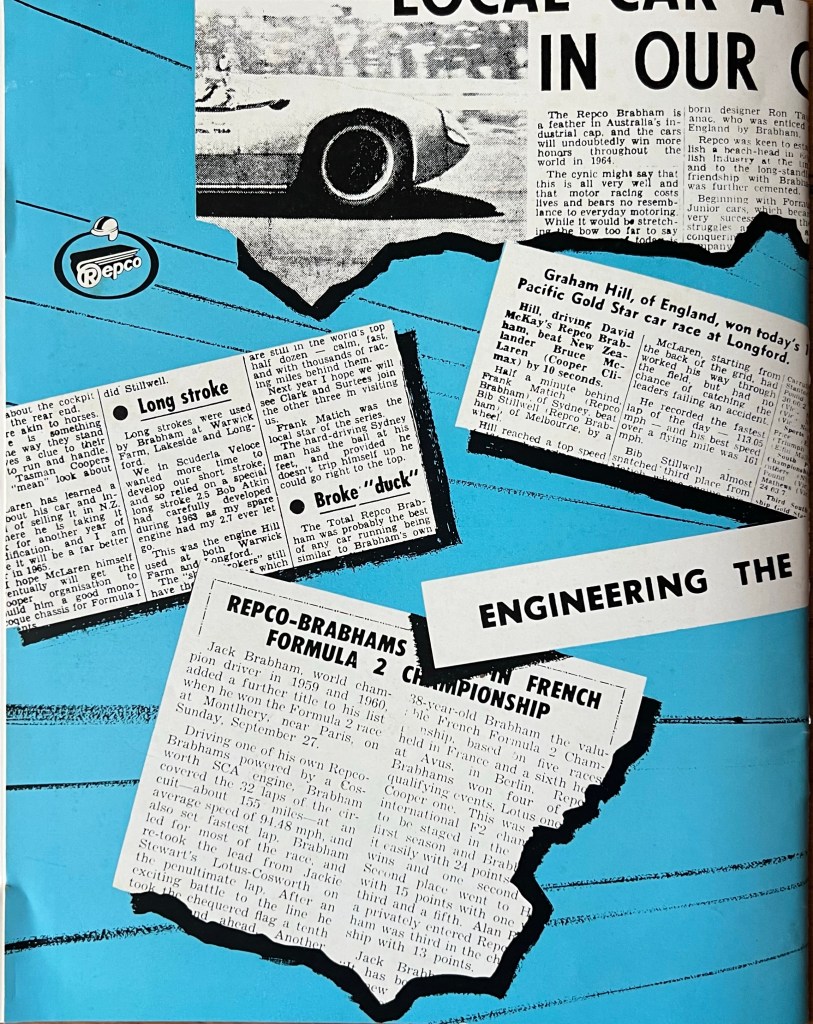
I’ve occasionally wondered exactly when Repco Ltd commenced operating in the UK, in a Repco-Brabham connection. Repco’s in-house magazine, the ‘Repco Record’ Christmas 1964 issue tells me the former Australian automotive industry colossus hung-the-shingle out at 59 St James Street, London on August 1, 1957.
The meetings Frank Hallam had in London that are of the most interest to us go unrecorded of course: Messrs Irving, Brabham and Tauranac, Laystall and Lucas spring to mind.
I suspect the primary purpose of the trip was to put-a-rocket up Phil Irving, who in Hallam’s mind, was running late with the design of RBE620, the SOHC, two valve, fuel-injected 2.5-litre Tasman Cup V8 based on the Oldsmobile F85 aluminium block. Worse to Frank, Phil and Jack were occasionally leaving-the-reservation on ‘agreed design direction.’ Said engine fired its first shot in Repco’s Richmond engine laboratory dyno on March 26, 1965.
Credits…
Repco Ltd, the Repco Record is from Rodway Wolfe’s archive




 primotipo...