Posts Tagged ‘Ken Tyrrell’

(MotorSport)

“Och aye! That really is more like it” or thoughts to that general effect. Jackie Stewart in his brand new Tyrrell 001 Ford Cosworth DFV at Oulton Park during the August 22, 1970 Gold Cup weekend.

Derek Gardner’s first F1 design was only days old and already it felt better than the customer March 701 Ford – victories in the Race of Champions and Spanish GP (Stewart) and International Trophy (Chris Amon) notwithstanding – that he had been racing that season.
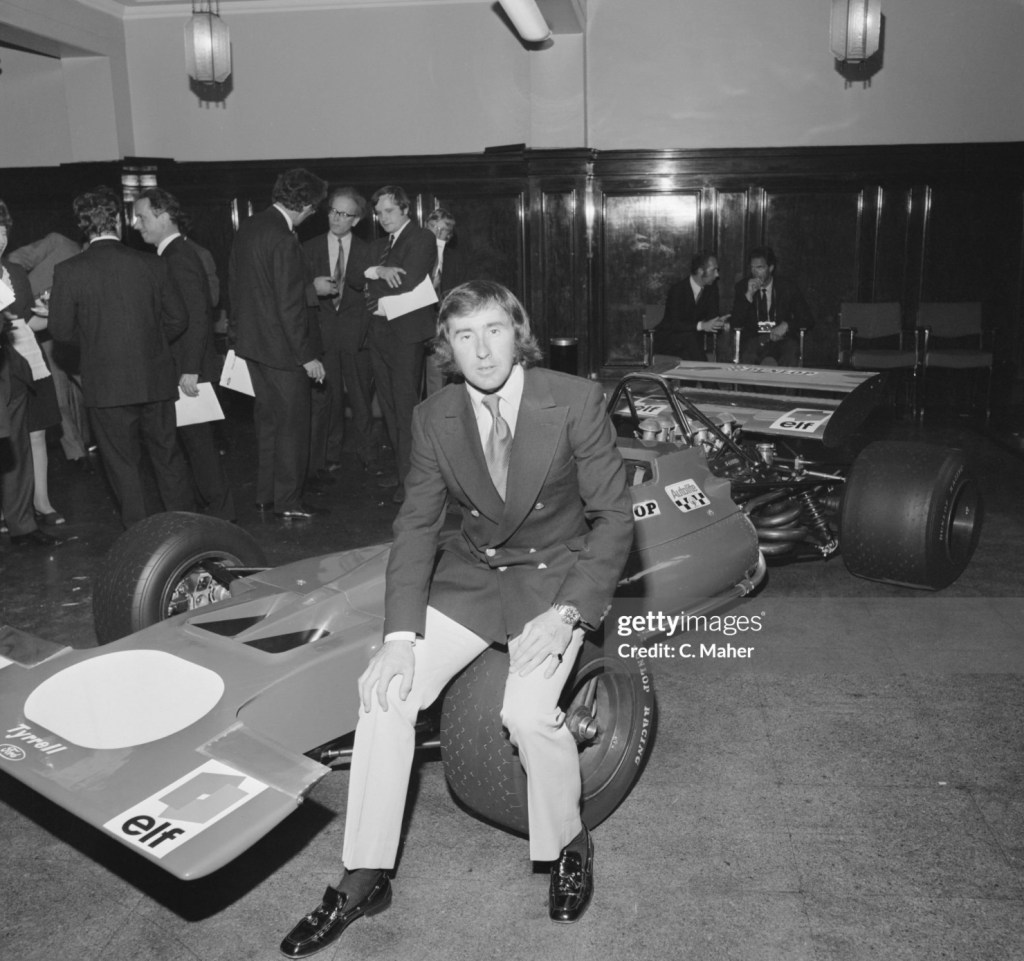
Press release of the Tyrrell 001 at Ford’s London premises, August 18, 1970

Stewart and Tyrrell’s Matra International team had won the 1969 World Drivers and Manufacturers Championships with the superb Matra MS80 Ford. For 1970 the French aerospace giant wanted to race only Matra V12 engined cars. After Tyrrell and Stewart travelled to France and Stewart tested the new Matra MS120 the pair decided they preferred to stick with the Ford engine; hence the acquisition of March 701s. See here for a short piece on the 701: https://primotipo.com/2014/05/15/blue-cars-rock/

Tyrrell quickly realised he needed to build his own car to control his destiny, rather than be at the mercy of a chassis manufacturer, so Gardner was engaged and secretly set to work in a design studio he established at his Leamington home.

Ken got to know and respect Derek during the occasions on which Matra International raced the Matra MS84 Ford 4WD drive car in 1969, Gardner was then employed by Ferguson Research and was responsible for the transmission in that car.
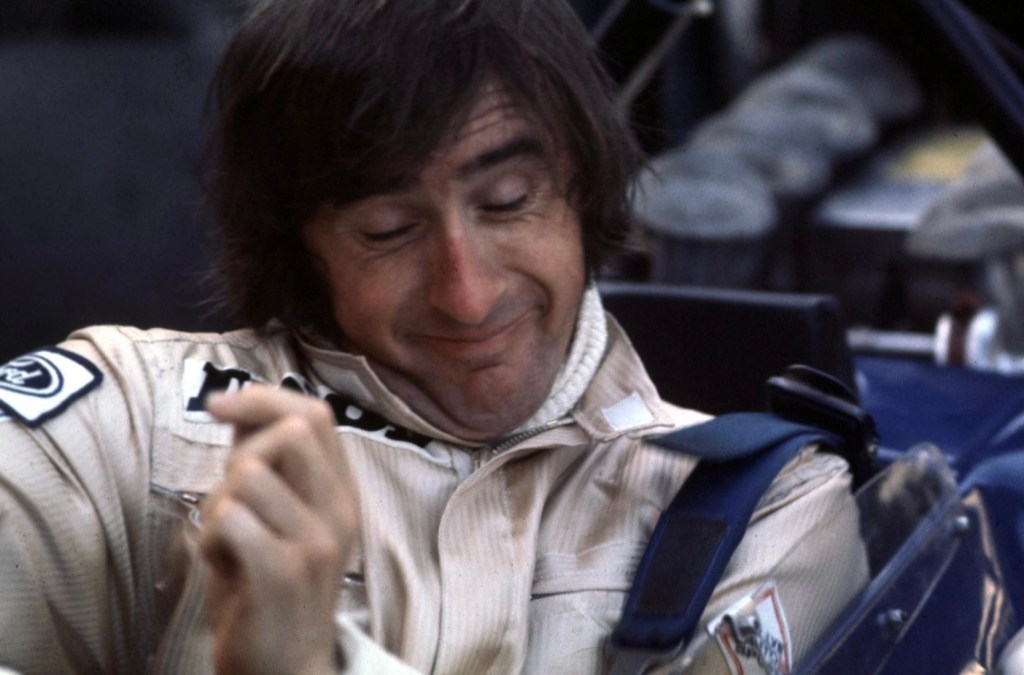
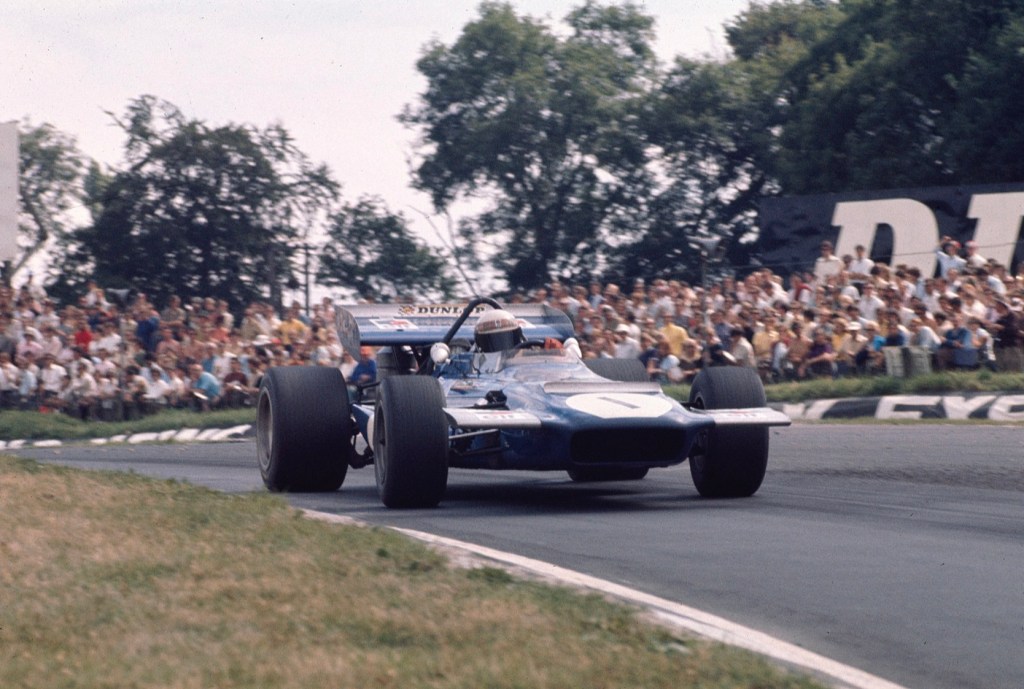
“…and then it does that, really suddenly!’ OR “…it doesn’t matter what I do, it just doesn’t respond!” JYS and March 701 Ford (MotorSport)
Stewart at Brands Hatch in the Tyrrell March 701 Ford during the July 1970 British GP (MotorSport)

The guidelines were, amongst others, that the design needed to be simple and competitive with minimal development, with a deadline of the August 22, Oulton Park Gold Cup meeting.

Gardner decided upon a light, aerodynamic car with very lower polar moment of inertia and optimum front-rear weight distribution. He had a wooden buck of the chassis made by a local joinery firm for Stewart to try. At that point the Tyrrell mechanics were let in on the secret with comments invited about what went where and maintenance – important design considerations for someone who hadn’t designed a racing car before
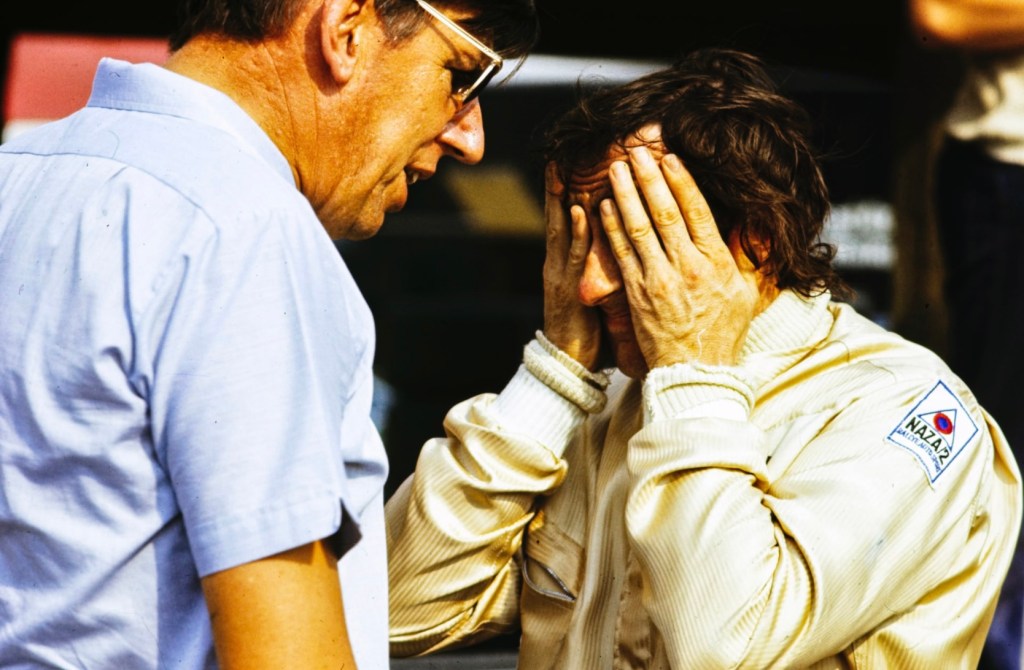
Hockenheim, Germany Q7 and DNF engine in the March 701, Jochen Rindt won(Schlegelmilch/MotorSport)
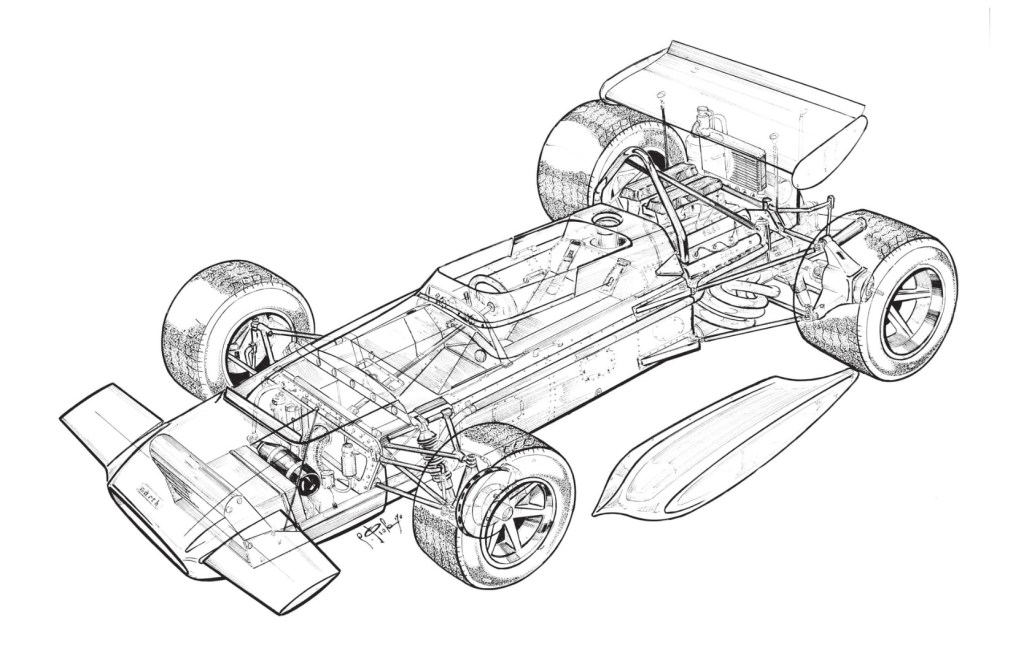
March 701 Ford cutaway drawing (G Piola)

Given Tyrrell’s famous Ockham timber yard operation was equipped to prepare racing cars, not build them – something that would change quickly enough – a swag of well known industry suppliers and ‘subbies were soon busily making components to the account of this fella named Gardner D.

A Ford DFV engine and Hewland FG 5-speed gearbox were sent over to Derek, while Maurice Gomm’s Gomm Metal Developments fabricated Gardner’s open, bath-tub, pregnant-belly, monocoque chassis out of 18-gauge NS4 aluminium alloy. Derek had modelled a tenth-scale model of the car in the University of Surrey’s wind-tunnel. The front of the chassis covered Wee-Jackie’s feet, while a subframe extended forwards to carry the radiator and front lower wishbone pick-up points.

Doug Nye wrote that “A massive front bulkhead structure extended into Matra-like wings on each side, supporting tiny, split upper wishbones and top mounts for the outboard coil spring/damper units. Very wide-based fabricated lower wishbones were used.”
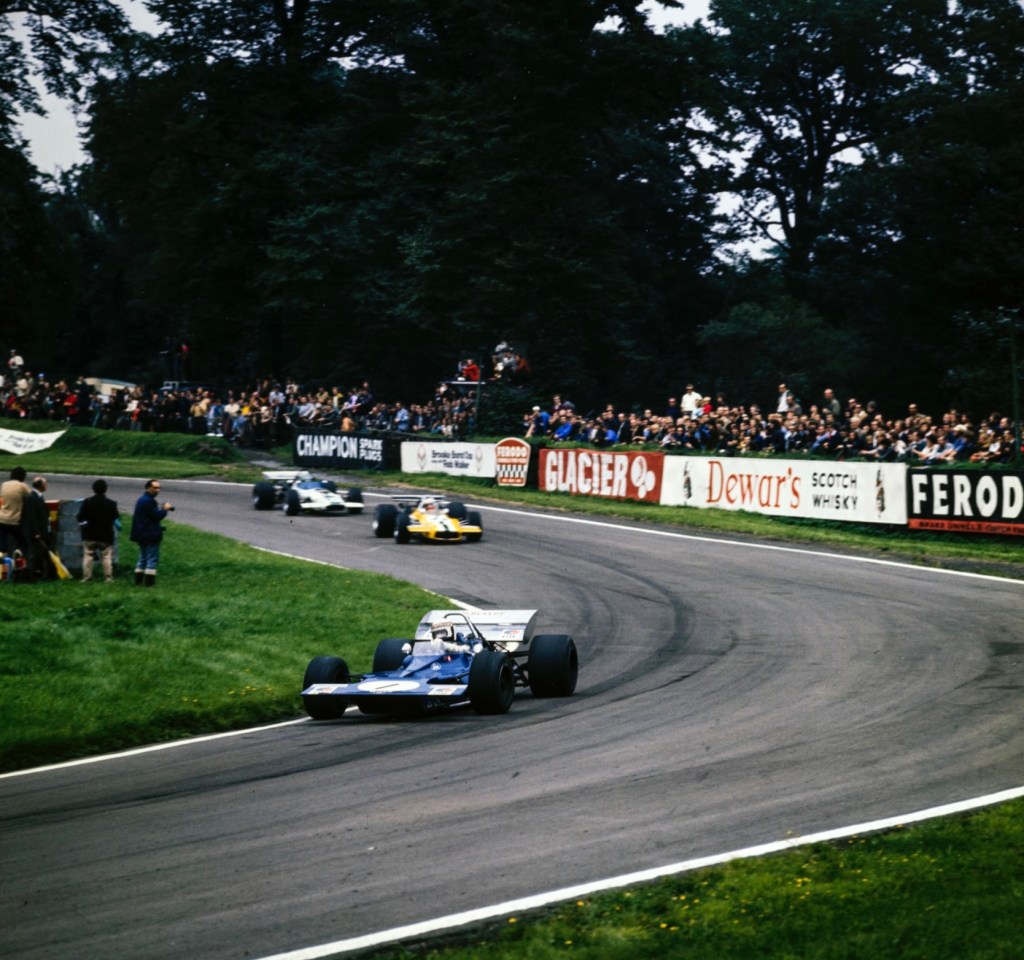
Jackie Stewart in 001 ahead of Mike Hailwood, Lola T190 Chev and Reine Wisell, McLaren M10B Chev Oulton Park Gold Cup, August 1970 (MotorSport)

The Ford DFV engine was mounted, as the design intended, to the bulkhead aft of the driver, while the rear suspension was attached to the DFV and Hewland transaxle via tubular subframes. Len Terry’s ‘industry standard’ parallel power links were used with a single top link, twin radius rods and again outboard coil springs/Koni shocks.

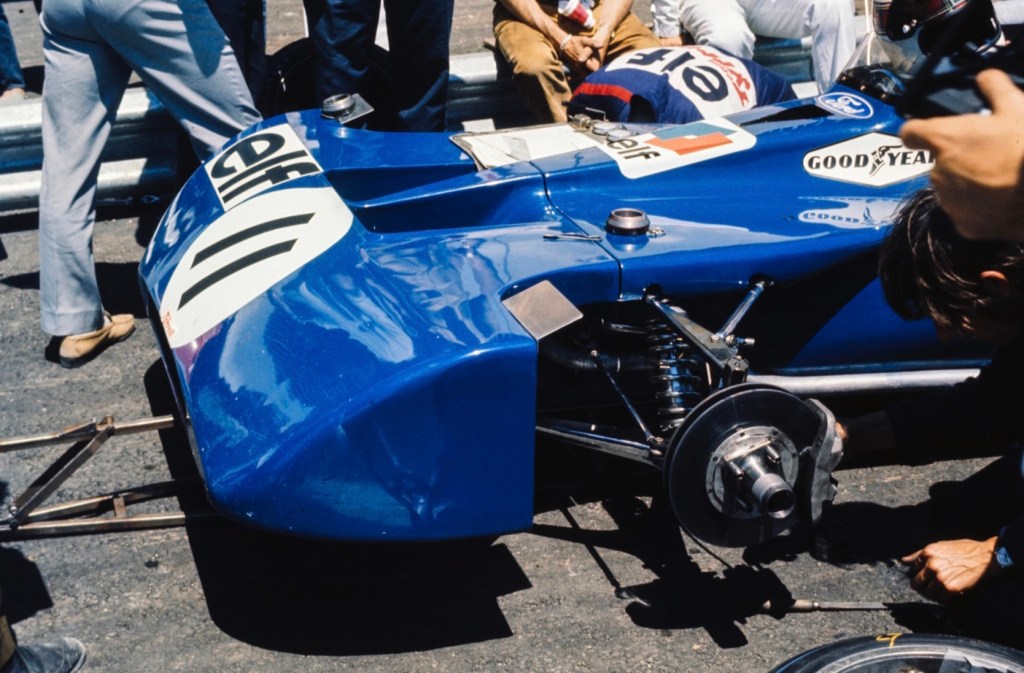
Brakes were outboard at the front, and inboard at the rear: rotors were ventilated and 10.5 inches in diameter front and rear. Aeroplane and Motor provided many of the castings: uprights, wheels and other items, Laystall made the stub axles and Jack Knight Engineering did most of the machining.

The unusual nose and cowling shape were informed by the ‘tunnel-work, the central spine designed to divert relatively clean air around the side of the cockpit back onto the two-tier rear wing mounted atop a gearbox strut.

“When the prototype car (#001) was first assembled and weighed it scaled some 100 lb less than the team’s proprietary March 701s, and was only 32 lb above the minimum weight limit. It had cost Ken Tyrrell £22,500 less engine and gearbox, compared to the purchase price of £9000 for his March 701s.” Nye wrote.
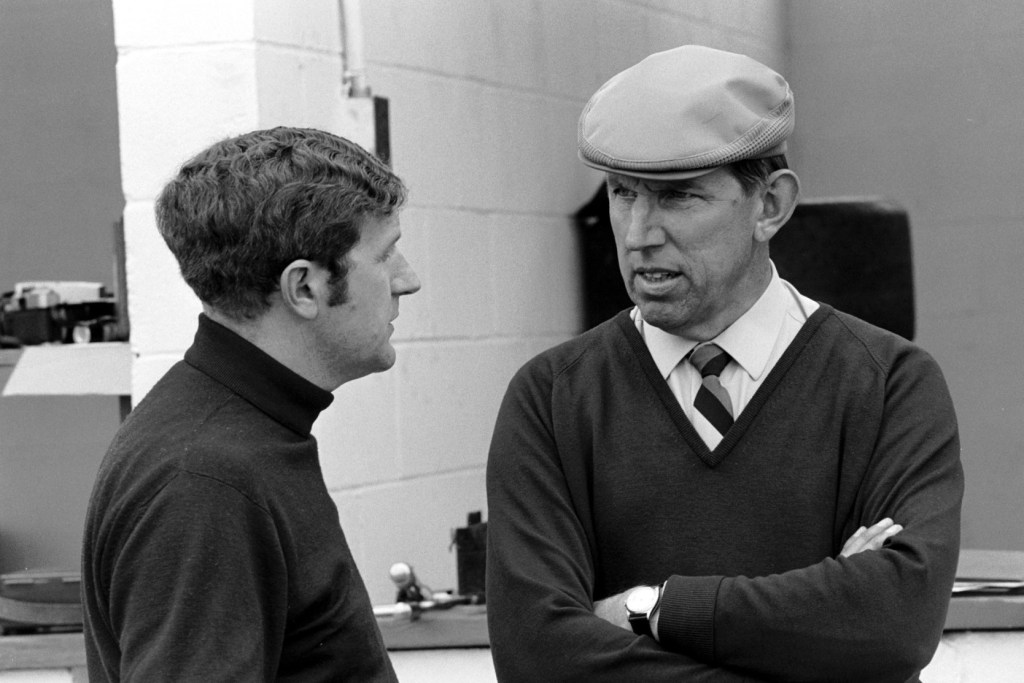
Messrs Gardner and Tyrrell looking youthful in 1970 (MotorSport)
Tyrrell 003 Ford cutaway drawing, the eagle-eyed may pick the Girling twin-disc brakes (T Matthews)

After completion and dealing with all of the press-release niceties the car was despatched to Oulton Park where 18 cars faced the starters flag: five GP and thirteen F5000 cars.

Niggles that weekend included metering unit failure and a blocked fuel injection unit, so JYS also practiced and qualified his March fifth, but elected to start from the rear of the grid in 001 having not set a time.

On lap two of the first heat he pitted after the throttle jammed, to have the linkage eased a bit, and to have loose bodywork made good. He returned to set the lap record (twice) before an oil pick-up problem caused the engine to fail. John Surtees’ TS7 Ford won that heat, and Jochen Rindt’s Lotus 72C Ford the second, with John victorious overall.

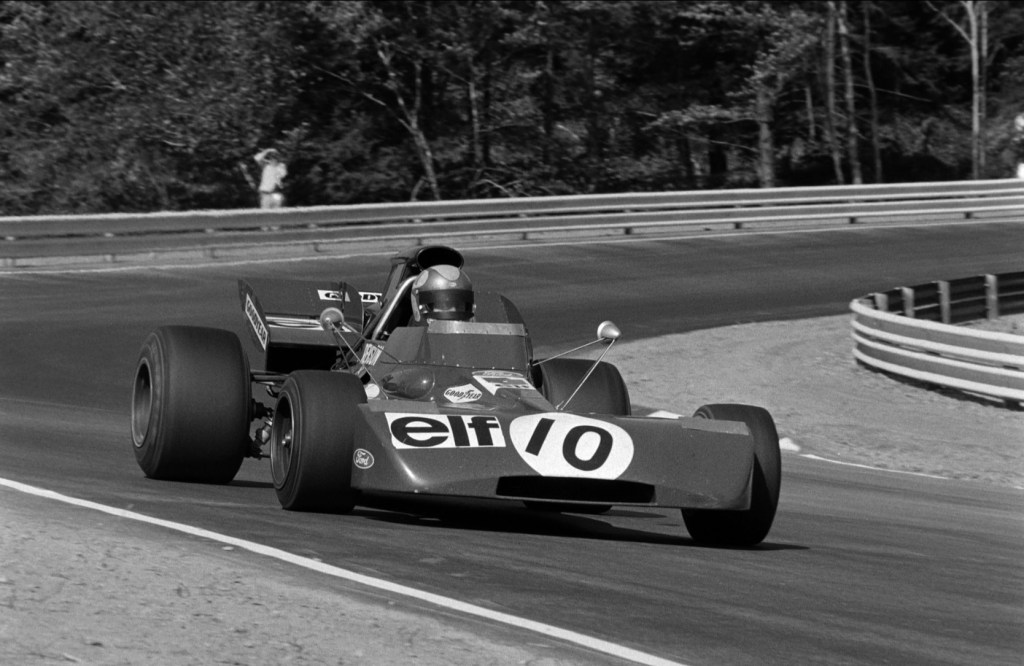
Mosport, Canada 1970 (MotorSport)
Stewart and team at Mosport where keeping wheels on 001 was a problem, and a broken stub axle (MotorSport)

Given a choice of cars Stewart did the logical thing and plumped for the new Tyrrell 001 for the final four championship round of the season at Monza, Mosport, Watkins Glen and Mexico City.

At Monza the car’s main fuel tanks weren’t picking up enough fuel to the collector to run at sustained maximum rpm so he raced his 701 – despite being distraught after the death of his close friend Jochen Rindt in practice – to second place behind Clay Regazzoni’s Ferrari 312B, Regga’s first GP win.

Things improved big time in North America. Jackie started from pole in Canada and was on the front row in the US and at Mexico City. At Mosport the wheels kept coming loose in practice, and then a left-hand-front stub-axle failed while Jackie led the race. Gardner designed stronger parts which were machined from solid magnesium by the Jack Knight crew and used on the car at the Glen and in Mexico.

Jackie lost in upstate New York when an oil-line retaining clip parted, “causing the plastic line to fall against a hot exhaust manifold and burn through, which allowed the lubricant to haemorrhage away.” Emerson Fittipaldi took his first GP win that weekend in a Lotus 72C Ford.

The Mexican GP was an entirely forgettable weekend all round, not least for Jackie Stewart, who hit a stray dog at 160mph. “It disintegrated and the car veered violently to the left towards a bank where spectators were sitting cross-legged a few metres from the tarmac. I only just managed to regain control and prevent my car from ploughing into that area and scything through the crowd.”

Importantly, despite the somewhat predictable niggles, the car was fast: Team Tyrrell, Stewart, Ford, Elf and the other sponsors looked forward to 1971 with plenty of optimism.

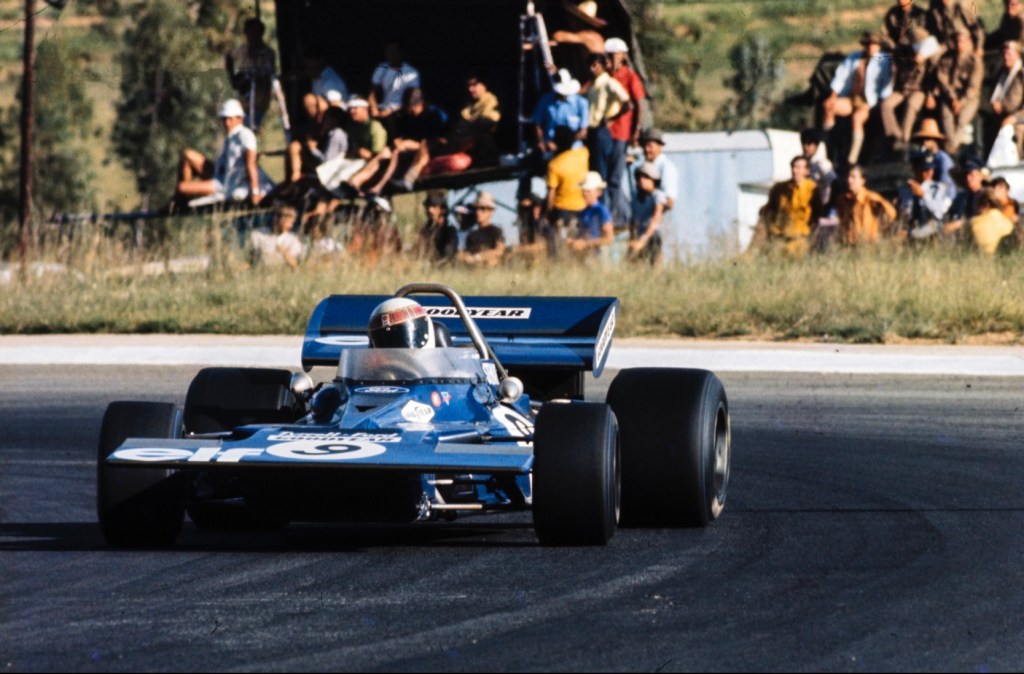
The Big Three at Kyalami in 1971: Stewart, Gardner and Tyrrell (MotorSport)
Stewart in 001 during the ’71 South African GP (MotorSport)

Over that 1970-71 winter the team built up another car, chassis #002 for Francois Cevert. A taller chap than his team-leader, the chassis was four inches longer than #001, the wheelbase 1.5 inches longer, and the side-skins of the tub were thicker 16-gauge NS4 aluminium. In addition, Derek simplified the front bulkhead structure and braced the roll-bar forward, rather than aft. “This latter change was to allow the engine to break away from the chassis in an accident without compromising the drivers protection, and would become standard practice in all categories over the next four to five years,” wrote Allen Brown.

Longtime tyre provider, Dunlop withdrew from F1 at the ned of 1970 so Tyrrell did over 1400 trouble-free miles (two engines) with Goodyear in warm Kyalami over the annual break. Trouble-free but not incident free: a pebble jammed between the throttle pedal and bracket causing a crash which crushed the tub’s left-front corner and jarred Stewart’s wrist. The car was sent home, the monocoque unstitched, the skins repaired then the chassis was reassembled and returned to South Africa.
Stewart in his new Tyrrell 003 on the way to victory at Montjuïc Park, Barcelona in 1973. Rainer Schlegelmilch photographic brilliance (MotorSport)

Not much was wrong with 001, Stewart started his first three races in 1971 from pole…and finished second in all them: the South African GP, Race of Champions at Brands Hatch and the Questor GP at Ontario Motor Speedway in California.

From then JYS moved to Tyrrell 003 – identical in spec to 002 – and immediately won in Spain (Montjuich Park) and Monaco with it. He had brake dramas in the Zandvoort dunes but bounced back at Paul Ricard, Silverstone and the Nurburgring putting the World Championship in-the-bag. Later in the season Jackie won at Mosport and Francois took his first – and sadly his only – GP victory at Watkins Glen. Tyrrell won the Constructors Championship in its first full year of competition as a manufacturer.

Great cars! Doug Nye named his chapter in ‘The History of The Grand Prix Car 1966-1985’ about the 1970-73 championship Tyrrells ‘Uncomplicated Craftsmanship’, which about says it all…

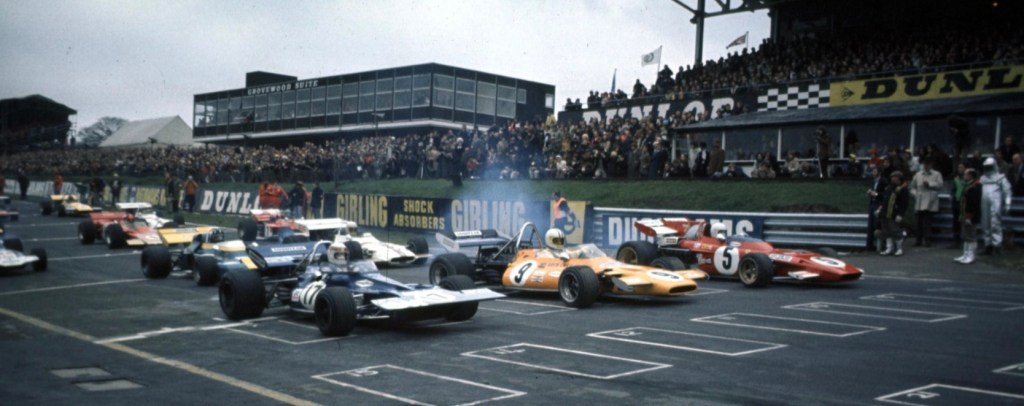
Not a shot of Francois! Let’s fix that, here in during the September 5, 1971 Italian GP weekend in 002. Ronnie Peterson at left in his March 711 Ford, Cevert in 002, Mike Hailwood, Surtees TS9 Ford and one of the BRMs. Peter Gethin’s BRM P160 took a famous win by a bees-dick – one-tenth of a second – from Peterson then Cevert (MotorSport)

Etcetera…

Oulton Park 1970

(MotorSport)

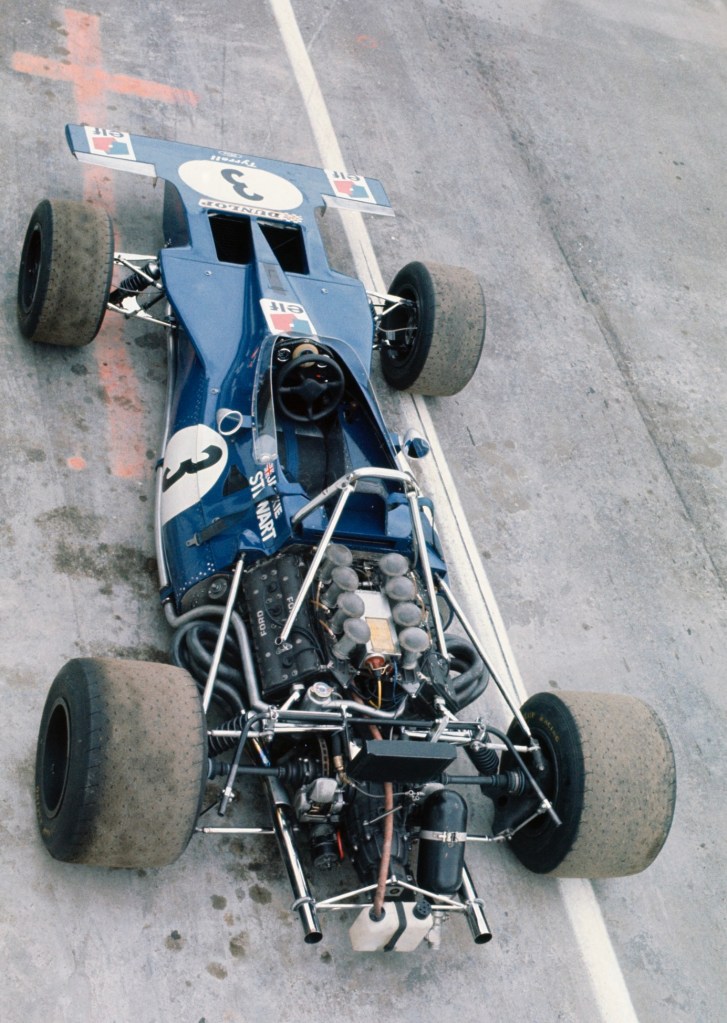
This overhead shot of Tyrrell 001 at Mosport in 1970 – sans rear wing – is a great one to show the overall packaging of the car – body features as per earlier text – and the period typical Ford Cosworth DFV, Hewland transaxle and outboard suspension. Quality of design, execution and preparation outstanding.
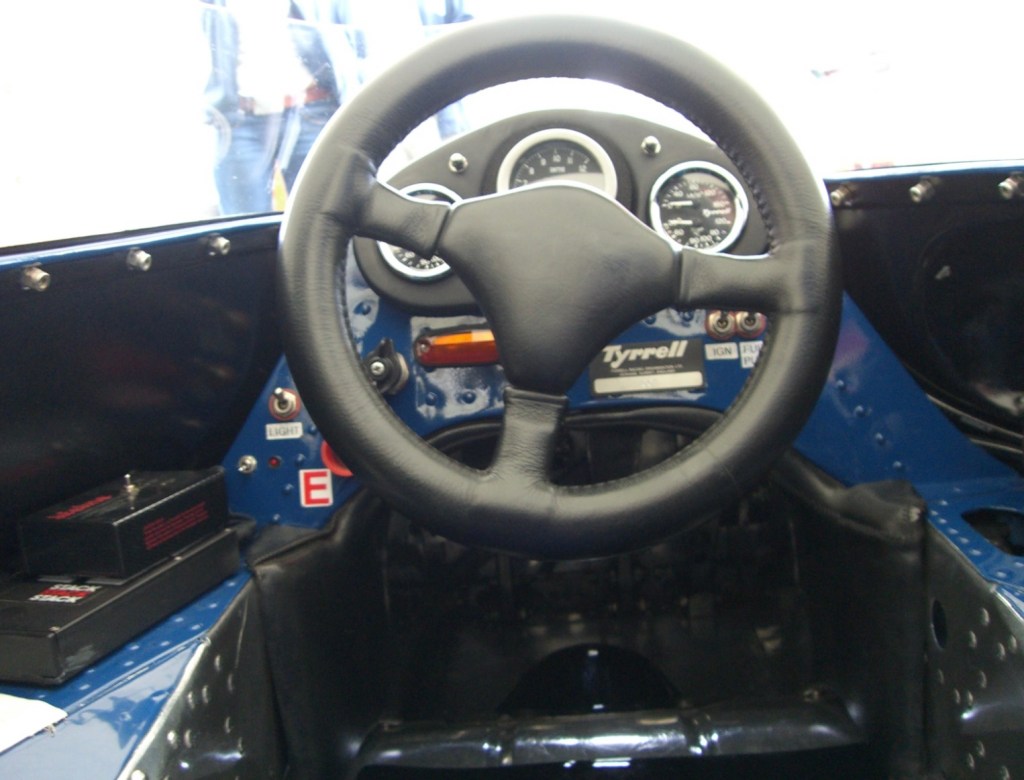
Contemporary photograph of 001’s cockpit.

(MotorSport)

Mechanics work on Francois Cevert new #002 at Kyalami in 1971. Note the forward facing roll bar bracing
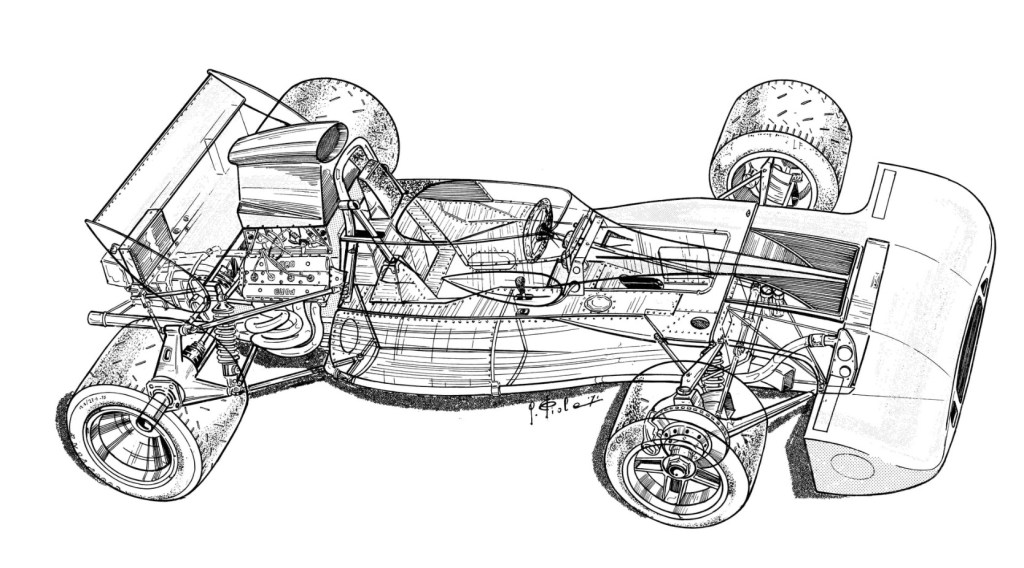
Tyrrell 002 Ford (G Piola)
(MotorSport)

Race of Champions March 21, 1971. Stewart in 001, Denny Hulme, McLaren M19A Ford and Clay Regazzoni, Ferrari 312B2. Regazzoni won from Stewart and Surtees in his TS9 Ford.

French GP 1971, Tyrrell 003, note Girling twin-disc set up (MotorSport)

Tyrrell experimented with Girling twin-disc front brakes fitted to 001 at Silverstone during the May 1971 International Trophy weekend. After Monaco both regular cars: 002 and 003 were fitted with the double-disc brakes as here, to Jackie Stewart’s 003 at Paul Ricard.

Doug Nye explains the set-up, “There were twofold discs on each hub, spaced by a double thickness of pad material, and with pistons on only one side of the caliper. The discs were given a degree of side-float which allowed them to move sideways, cramped by the pads, when the brakes were applied. The idea was to double pad and disc area and provide better heat dissipation plus the opportunity to reduce line pressures which permitted the use of smaller pistons and less deflection on pad wear. The problem had been that conventional discs were wearing the brake pads into a taper form. This in turn promoted knock-off when the drivers braked hard, giving a spongy pedal feel and slashing driver confidence.”

The twin-discs were removed from both cars at Ricard, “after Stewart had a harmless spin into the catch-fencing, for Girling seemed happy with the lessons learned thus far.” Nye wrote.
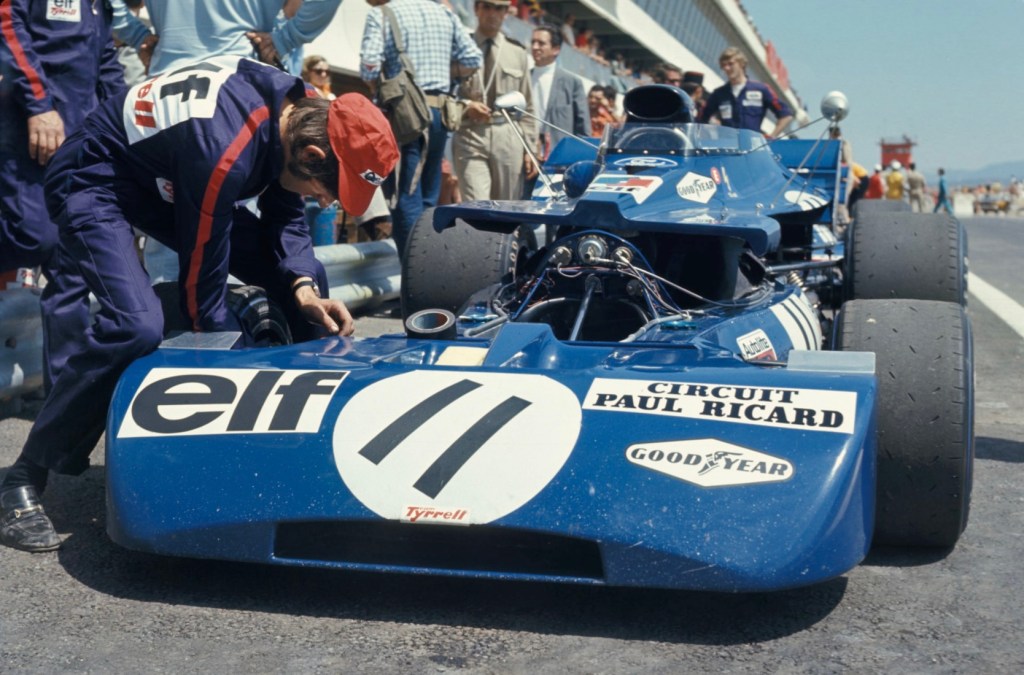
(MotorSport)

Two of Derek Gardner’s innovations are shown in the shot above, Stewart’s 003 at Paul Ricard, and Peter Revlon having this final in-period race of 001 at Watkins Glen in 1971 below.

The ‘Tyrrell nose’ first appeared in scutineering over the Dutch GP weekend and made its race debut at Ricard. The bluff nose extended to the maximum allowable width ahead of the front wheels, reducing the lift they caused and reducing drag.

With that, Gardner introduced the second alternative nose treatment until the ground effect era, the other was the wedge nose inspired by the Lotus 56/72.

Doug Nye notes that Stewart was “simply uncatchable on the long (Ricard) Mistral straight”. After the Tyrrell 1-2 in France and Stewart’s strong win at Silverstone a fortnight later, his engine was sealed and checked, and a fuel sample was taken in France with no irregularities found. Tyrrell simply had two very quick cars and drivers…

Note also the engine snorkels on the two cars. Lotus fitted ducts to the 72 from the 1970 British GP, and Matras snorkels, but Gardner’s design was sealed allowing clean air and a mild ‘supercharging’ effect.

It was far from the end of Derek Gardner’s innovations of course!

(MotorSport)

Peter Revson had a long international apprenticeship. Six years after winning the Monaco F3 GP and some promising top-five F2 performances in Ron Harris-Team Lotus 35s in 1965, at the ripe old age of 32 he returned to F1.

In 1971 he won the Can-Am Cup aboard a works McLaren M8F Chev and popped the team’s McLaren M16 Offy on pole at Indianapolis, then finished second behind Al Unser’s Colt Ford.

Tyrrell engaged Revson to race 001 at Watkins Glen. He qualified 19th but only did a lap after clutch failure. It was the last in-period ‘race’ for Tyrrell 001, Peter raced for McLaren in Grand Prix racing in 1972-73. See here: https://primotipo.com/2014/07/24/macs-mclaren-peter-revson-dave-charlton-and-john-mccormacks-mclaren-m232/

Happily, #001 is owned by the Tyrrell Family.

(MotorSport)

Credits…

MotorSport Images, Rainer Schlegelmilch, ‘History of The Grand Prix Car 1966-85’ Doug Nye, ‘Winning Is Not Enough’ Jackie Stewart, Automobile Year 19

Tailpiece…

(MotorSport)

February 2010 in the Ockham woodyard.

Finito…

image

Jackie Stewart jumps his Ken Tyrrell ‘Equipe Matra International’ MS80 Ford during the German Grand Prix on August 3 1969…

In a marvellous GP season Jackie triumphed over friends and rivals Jochen Rindt, Lotus 49, Jacky Ickx and Piers Courages’s Brabham BT26’s, the Kiwi McLaren twins Hulme and McLaren and Chris Amons fast but unreliable Ferrari.

image

Jean-Pierre Jaussaud with his Matra MS2 Ford prior to the start of the Zandvoort Trophy, 29 August 1965 DNF. Kurt Ahrens won the race in a Brabham BT16 Ford (Revs Institute)

Matra had raced in the the ‘junior’ F3 and F2 formulae as well as in endurance racing since 1965. From the very start the single-seaters used sophisticated monocoque chassis with technology borrowed from Matra’s aerospace arm in having its fuel contained directly in box section pontoons which were sealed with a polymer resin.

image

MS80 tub being assembled at Velizy in early 1969. Note the lateral bulkheads referred to in the text, immensely strong, it looks heavy but wasn’t (Ludvigsen)

The competition used bag tanks, the advantage of the Matra approach was that that each pontoon had lateral bulkheads greatly improving both the strength and torsional rigidity of the tubs. Results weren’t initially great but soon the French crowd had blue coloured cars to cheer, Jean Pierre Beltoise taking a notable first win at Reims.

Jabby Crombac, the famed French racing journalist introduced Matra boss Jean Luc Lagardere to Ken Tyrrell. After Jackie Stewart test drove a modified F3 Matra fitted with a 1 litre BRM F2 engine and was blown away with its traction, he raced the cars in 1966, the year Jack Brabham swept the board in F2 with his  Honda powered cars.

image

Jacky Ickx racing his Tyrrell Matra MS7 Ford F2 car during the 1967 German GP, DNF with suspension failure. Denny Hulme won the race in a Brabham BT24 Repco (unattributed)

For 1967, the new 1.6 litre F2 formula commenced. Matra Ford FVA powered cars won many races driven by Stewart, Jacky Ickx in the other Tyrrell entered car and the works Matras driven by JPB, Henri Pescarolo and ‘Johnny’ Servoz Gavin. Ickx won the title driving both MS5 and the later MS7 chassis.

Matra’s Grand Prix program was the result of a happy confluence of events… Race success meant it was ready and keen to step up and in reality it could afford to do so from its own group resources. The French government had just created a state owned oil company ‘Essence et Lubrificants Francaise’ or ELF. The marketing decision was taken that motor racing sponsorship and success would be the best way to promote the company rather than traditional mass media advertising. Further, the French Government, aware of Matra’s success to date saw GP racing success via Matra as a means of restoring French national prestige.

image

The Beltoise/Pescarolo Matra MS630 prior to the 1967 1000Km of Paris at Montlhery DNF, race won by the Ickx/Hawkins Mirage M1 Ford (unattributed)

And so Elf agreed to support Matra (and an amazingly successful driver support program over the decades to come), the government kicked in about £800,000. Doug Nye wryly noted that the nominated engineer, former Simca technician Georges Martin saw a racing car for the first time at that years 1967 London Racing Car Show! He proved to be a fast learner mind you!

Over at Ockham in Surrey Ken Tyrrell was evolving his own Grand Prix Racing plans which in essence evolved around several factors. His own team infrastructure, based at his timber yard were ‘up for it’ having raced successfully in the junior classes for over a decade. Jackie Stewart had tired of BRM with whom he entered F1 in 1965, but ’65 was his best season, the teams H16 was uncompetitive despite every effort to squeeze pace and reliability from the spectacular, ambitious, heavy beast. Stewart himself had absolute confidence in Ken and his team and was looking for a new ’68 drive.

Walter Hayes confirmed to Ken that Cosworth would sell Ford DFV’s engines to him for the ’68 season, Colin Chapmans exclusivity agreement being broken by Hayes with Colin’s reluctant agreement.

Matra agreed to sell Ken a variant of their V12 chassis designed around the DFV’s compact dimensions. This was an incredibly smart decision by Matra and perhaps the government, a lot of expectation had been created around the Matra V12 program in the media, to the extent the V12 took a while to be competitive, and it did, another car with a proven engine/driver would help ease the pressure. Finally Ken secured Dunlop and Matra support to fund his ambitious program, and so was created a combination which won the World Drivers and Manufacturers titles within 2 years.

bel spa

JPB in the V12 Matra MS11 at Spa in 1968. He was 8th in the race won by Bruce McLaren’s McLaren M7A Ford, Stewart was 4th in an MS10 Ford (Heritage Images)

Matra’s first F1 cars were the Ford powered MS9 and 10 raced by Stewart in 1968, from Monaco the Velizy outfit entered the MS11 powered by their own 3 litre V12. The evolution of these V12 F1 cars I wrote about a while back, click on this link here to read about them, the focus of this article is the Ford engined cars;

Venetia Day and the 1970 Matra MS120…

image

Jackie Stewart during the 1968 South African GP in the MS9 Matra prior to its Ford Cosworth conrod failure, Jim Clark won his final GP in a Lotus 49 Ford , 1 January (unattributed)

The prototype of the 1968 MS9 was a modified ’67 F2 MS7 chassis to which a DFV was bolted directly to the monocoques rear bulkhead. The difference between this prototype and the MS9 was that the latter car had a lightweight frame extending from the monocoques rear bulkhead to a fabricated suspension pickup diaphragm fitting around the gearbox.

The structure wasn’t designed to take suspension loads but rather to keep the suspension settings in place when engine changes were effected. Chassis designer Bernard Boyers’s approach was practical, in the case of the Lotus 49 and all of its ‘copyists’ the car had to be wheel aligned and brakes bled after a ‘Cossie engine change.

matra jpb

JPB in his MS10 during his guest drive at the ’68 Spanish GP. Note the MS 10 monocoque and bulkhead above his knees, DFV and brakelines atop the top radius rods (unattributed)


jpb spain

JPB guesting for the injured Stewart at the 1968 Spanish GP, he qualified and raced 5th, the race won by Hill’s Lotus 49 Ford (unattributed)

The cars monocoque was as described earlier, rocker arm top and lower wishbone suspension with coil spring/damper units were used at the front and single top link, inverted lower wishbone, twin radius rods and coil spring shocks again at the rear. In short all ‘period typical’. Uprights and hubs were donated by the MS630 endurance racer, the gearbox the robust Hewland DG300 5 speed transaxle.

image

JYS on the way to winning the ‘International Gold Cup’ at Oulton Park on 17 August 1968, Chris Amon was 2nd in his Ferrari 312 and Jack Oliver 3rd in his works Lotus 49B Ford (unattributed)

This hybrid was tested and raced in South Africa, JYS popped it on the front row and lead Clark before it’s DFV swallowed a valve. The car, short of tankage given it’s F2 derivation, would have needed a quick stop prior to the races conclusion.

The definitive 1969 MS10 had an extra fuel cell between the driver and engine made its debut in the Brands ‘Race of Champions’. Whilst fast the cars issues were around the weight of its endurance derived suspension and wheel hardware which affected the cars sprung/unsprung ratio. There were then some problems of durability in lightened components. Stewart lost the Spa lead when the fuel pumps didn’t pick up the ELF he needed to complete the race.

image

Front row of the French GP at Rouen on 7 July 1968. The nose of Jochen Rindt’s Brabham BT26 Repco, the much maligned ‘860 Series’ Repco V8 was fast whilst it held together DNF, with JYS in the middle in his MS10 Matra 3rd and victor Jacky Ickx, Ferrari 312 (Schlegelmilch)

A lighter FG400 Hewland box was fitted at Rouen but the car, despite its aerospace parent was behind in the evolution of wings realtive to some other teams.

But at the Nurburgring in streaming wet conditions it all came together; Stewart’s wrist damaged in an F2 Matra at Jarama was ok, the midships mounted wing worked as did the Dunlop wets and Jackie drove superbly taking Matra’s first GP win.

Stewart won again at Oulton Park and at Watkins Glen and was in with a title shot in Mexico, tank sealing polymer detached and jammed his DFV’s fuel pump with Graham Hill taking the ’68 drivers, and Lotus the manufacturers championship. By any objective assessment 1968 was an amazing season for GP ‘newbees’ Tyrrell and Matra, the experienced Stewart delivering in spades.

bel silvers

JPB in the 4WD Matra MS84 trailing Jo Sifferts Lotus 49B, both Ford DFV powered thru the fields on Northhamptonshire during the ’69 British GP at Silverstone (Schlegelmilch)

For 1969 some insightful decisions were taken by Matra with a view to winning the title…

They redesigned the V12, the new ‘MS12’ appeared in the MS120 chassis in 1970. Whilst the V12’s were raced in their ’69 endurance program they were withdrawn from F1, the focus of the ’69 program the Ford powered cars.

Tyrrell would therefore race 2 cars in ’69 driven by JYS and JPB, the conventional rear drive MS80, a new car designed by Bernard Boyer. In addition an ‘MS84’ Cosworth powered Matra 4WD using the British Ferguson transmission was designed and built. Stewart wanted the cars available for wet races of which there were several in 1968. It’s a story for another time but the belief at the time was that the tyres of the day even with the growing downforce provided by wings would not provide sufficient grip/traction given the potency of the 3 litre engines and in particular the punch of the DFV. 4WD was being used successfully at Indy at the time, whilst duly noting the particular nature of that circuit. The Ferguson GP car and its system is described in this article;

Ferguson P99 Climax: Graham Hill: Australian Grand Prix 1963…

image

Matra MS80…

Boyers’s starting point for his new car were the deficiencies of the MS10.  These were its mid-ship fuel tank which was inadequately stressed compromising the chassis’ overall stiffness. There was too much front suspension camber change for tyres growing in width, this resulted in lots of understeer and instability under braking. The inboard front suspension mount caused the shocks to overheat and finally at the rear inadequate toe control caused toe steer as the wheel prescribed its arc as the suspension moved up and down.

Boyer applied the same monocoque fuel tank construction system even though it would be outlawed by mandated bag tanks from 1970. His ‘one season’ car had its tanks ‘Coke Bottle’ style in bellied tanks getting the fuel load around the cars centre of gravity. The fuel tanks were baffled by the addition of polyurethane foam. The tub was a ‘full monocoque’ in that the scuttle was fully stressed (not open like the MS10) , the oil tank was moved from its MS9/10 forward mounting to a spot between the drivers shoulders and the DFV.

image

Ken Tyrrell’s team fettle one of the MS80’s during the Italian GP weekend in ’69. Hewland FG ‘box, note the twin parallel lower links mentioned in the text, single top link and coil spring/damper complete the rear suspension package (Schlegelmilch)

Front suspension went to conventional if slightly less aerodynamic upper and lower wishbones rather than the top rocker deployed in 1968. The suspension geometry was and always is determined by the needs of the tyres. The Dunlops for 1969 were 13/15 inches in diameter front/rear. Parallel lower links first used by LenTerry/BRM were used at the rear to get better toe control, brakes at the rear were mounted inboard next to the Hewland FG ‘box reducing unsprung weight.

In terms of the cars aero, and their would be much change in 1969, broad front wings either side of the nose would trim the front/rear balance of a tall strut upright mounted rear wing. The DFV at the time developed about 430bhp @ 9500rpm, when first tested at Montlhery the car weighed 535Kg, 15 less than the MS10.

image

1969 GP Season depth…Ickx Brabham BT26A 1st with Stewart 2nd and Rindt DNF in Matra MS80 and Lotus 49B and Denny Hulme’s papaya yellow McLaren M7A DNF, all of those cars Ford Cosworth DFV powered (unattributed)

The most competitive packages of 1969 were Stewart’s Matra MS80 Ford and the similarly powered Brabham BT26 of Jacky Ickx and the Rindt/Hill Lotus 49 twins, especially Jochen…

Rindt left Brabham after a year of BT26 speed and Repco ‘860 Series’ quad cam V8 unreliability. Ickx won 2 1969 GP’s (Germany and Canada) with the mildly updated, but Cosworth powered BT26, a car in which Jochen may well have taken the ’69 title had he stayed. Not that his Lotus 49 lacked speed, he finally won his first GP late in the season at Watkins Glen but the prodigiously fast Austrian wasn’t easy on a car and it’s preparation let him down. The surprise of the season was Piers Courage’ speed in the year old, and converted from Repco power ex-works BT26, the BT34 ‘Lobster Claw’ wasn’t a great design but Ron Tauranac never built an F1 dud?! Don’t mention the Trojan I guess!

The McLaren M7A’s were quick all year. Bruce had reliability and consistency, Denny had speed and DNF’s, a bad run of reliability. Bruce took the Can Am drivers title in ’69 in the M8B Chev and Denny won the season ending Mexican GP, which was some sort of reward for the M7, a typically simple, beautifully engineered McLaren.

jys clermont

Stewart on the way to MS80 victory on the majestic Clermont Ferrand road circuit during the ’69 French GP (unattributed)

The ‘other Kiwi’, Chris Amon was consistently top 5’ish on Saturday despite the Ferrari V12 giving away considerable power and torque to the ubiquitous DFV, but the car was way too unreliable to allow a sustained attack on a race let alone the title. He ‘chucked’ Ferrari around the time of Monza after one engine breakage too many. The new Flat-12 failed, again, behind him at Modena, a decision to leave Maranello (in F1, he still drove the factory 512S sporty in 1970) he forever rued as that engine quickly became a GP great of the seventies.

amon monaco

Chris Amon and JYS from the ’69 Monaco front row. It was a tough year for Chris and Ferrari, both had pace but the Fazz was hopelessly unreliable. Amon and Stewart both DNF at Monaco, the race won by Hill’s Lotus 49B Ford (Schlegelmilch)

The conclusion to be drawn from the foregoing is that 1969 was a season of great depth, there were plenty of car/driver combinations who were contenders for the ‘69 crowns as the teams set off from Europe for Kyalami at the seasons outset…

The MS80 was tested at Montlhery but didn’t do too many miles so Tyrrell elected to race MS10 to a win in South Africa in Stewart’s hands.

image

Jackie Stewart leading the ’69 Spanish GP at fabulous Montjuic Park, Barcelona. MS80 racing a full GP with high wings for the last time, wings banned over the Monaco ’69 weekend (unattributed)

Another victory followed for the MS80 upon its race debut in the ‘Brands Hatch International’ and a championship win at Montjuic Park, Barcelona in the Spanish Grand Prix. This is the famous race in which both Lotus 49 rear wings failed precipitating an instant ‘high wing’ ban by the FIA mid way through the following Monaco GP weekend. Click on this link for an article about those events;

‘Wings Clipped’: Lotus 49: Monaco Grand Prix 1969…

image

JYS and Ken Tyrrell at Monaco 1969, MS80 (Getty)

Hill won at Monaco for the final time, both MS80’s retired on the same lap when cracked gearbox universal joints, discovered pre-race failed during the tough on transmissions event.

Jackie won at Zandvoort, the cars evolved aerodynamically with neat wing-cum-engine covers and JPB reinforced his speed in a front running car by running 2nd to JYS in a glorious win for Matra at Clermont Ferrand, a sensational road course.

image

Stewart in his MS80 1st, Rindt DNF in helmet beside his Lotus 49B Ford with champion Graham Hill’s 7th similar car behind in the Zandvoort pitlane in June 1969 (Heritage)

Jackie then won the British GP at Silverstone after a titanic dice with Jochen and after overcoming a practice crash caused by a bit of loose kerbing puncturing a front Dunlop. Dunlop, Firestone and Goodyear were involved in a war for F1 supremacy at the time, Ickx’ superior Goodyear G20’s a big part of his Nurburgring success.

image

JYS prior to the ’69 German GP 2nd, MS80 (Schlegelmilch)

At Monza Ken Tyrrell counselled JYS to fit an ultra tall 2nd gear to avoid an extra change on the last lap run to the line of a typical Italian slipstreaming battle; in the event that made the difference, JYS narrowly pipping Rindt’s Lotus to take the race and the ’69 titles. The Mosport, Watkins Glen and Mexico City races went to Ickx, Rindt and Hulme.

And so ended the race career of MS80 but not before Ken Tyrrell gave ‘it one last shake’…

Matra’s lack of sales success with its Type 530 road car was largely due to lack of a decent dealer network. Whilst powered by a Ford V4, Lagardere’s attempts to sell the car via Fords network fell on deaf ears. Undeterred, Matra designed a new car powered by a Simca engine, such car would be sold through its dealers but only on the basis that Matra end it’s relationship with Ford in F1 terms. A modified for 1970 MS80 was out despite Tyrrells overtures.

Upon Lagardere’s insistence JYS tested his MS80 DFV against the new for 1970 MS120 V12 at Albi but the canny Scot was convinced the DFV was still the engine to have. And so a series of events unfolded which saw JYS race Tyrrell run March 701 DFV’s until Derek Gardner’s MS80-esque Tyrrell 001 appeared in August 1970, cars which yielded drivers and constructors titles in 1971 and 1973.

image

JPB Matra MS120 at the Osterreichring in 1970 6th (unattributed)

Mind you JYS in a Matra MS120 is a tantalising 1970 thought!

JPB and Henri Pescarolo raced the MS120 that year, both worthy drivers, JPB a GP winner but that car was definitely a race winner in the little Scots hands in 1970. As it was Matra didn’t win another GP, albeit the V12 did win a race or two in Ligiers some years later, an updated MS80 in 1970 for sure would have given Rindt, Brabham and Ickx a run for their money.

image

JYS at Monaco in 1969, MS80, no wings, this shot during the race (unattributed)


matra int

The dominant equipe of 1969, Tyrrell’s Matra International at Silverstone with Beltoise’ MS80 and MS84 4WD (Patrick Jarnoux)

Etcetera…

drivers

(Matra)


jpb brands

JPB heads into Druids Hill at Brands during the ’68 British GP, Matra MS11 V12 (unattributed)


jys

Stewart at Zandvoort 1968. A win in his MS10 Ford from JPB’s MS11 which was over a minute and a half behind (unattributed)


jys germany

Stewart on his way to a marvellous Nurburgring victory in 1968, Matra MS10 Ford (unattributed)


jpb monaco

JPB in the Monaco pits during 1969. Its early in the weekend, his MS80 still has its wings (unattributed)


jys cler

Stewart at Clermont in 1969, compare and contrast the MS80 neat engine cover come rear wing with the high strut mounted wings of the early season, a quintessential Matra MS80 shot . JYS won from JPB, a second in arrears of his team-leader (unattributed)

References and Photo Credits…

Doug Nye ‘History of The Grand Prix Car’, ‘Matra MS80’ in Profile Publications, oldracingcars.com- always a primary reference source for me, checkout Allen Brown’s pieces on all of the F1 Matras; https://www.oldracingcars.com/f1/matra/

Rainer Schlegelmilch, Getty Images, Patrick Jarnoux, Karl Ludvigsen

Tailpiece: JYS enters the Nurburgring circuit from the paddock, 3 August 1969, MS80 Ford…

image

(unattributed)

Finito…


Francois Cevert, Tecno 68 Ford F3 1968

(Automobile Year)

Francois Cevert applies some gentle correction to his Tecno 68 Ford F3 car, Rouen, France 1968…

I was researching another article and tripped over some photos of a very young Francois Cevert in an Alpine in his F3 days…

It reminded me of how many talented young drivers were killed before their prime well into the 1970’s- Francois, Tom Pryce, Gerry Birrell, Roger Williamson, Piers Courage and Tony Brise all spring readily to mind.

The monocoque chassis of the 1970’s were far stronger than the spaceframes of ten years before but as the width and grip of tyres and the aerodynamic downforce the cars produced improved, it meant that accidents, when they occurred at the higher cornering speeds could be particularly horrific. It was a collision with an armco fence, in an accident of this type when his Tyrrell got away from him which killed Francois at Watkins Glen in 1973.

John Barnards’ pioneering use of a carbon fibre chassis in the first McLaren MP4 in 1981 was a driver safety ‘game-changer’.

Francois Cevert 1968

Cevert in his ‘Bell Magnum’ 1968 (unattributed)

As a young teenager just getting interested in racing Cevert ‘had it all’- dazzling film star looks, talent aplenty and racing for a team which was carefully nurturing his talent.

Ken Tyrrell recruited Francois into his Elf sponsored team after the retirement of Johnny Servoz-Gavin due to an eye injury. Jackie Stewart spotted Cevert in 1969 when contesting F2 races and suggested to Tyrrell he keep an eye on him.

Stewart immediately clicked with the young Frenchman, they had a remarkably mature relationship as teammates by the standards of today (Piquet/Mansell, Prost/Senna, Rosberg/Hamilton for example!) with Stewart mentoring the younger man, exactly as Graham Hill had done with the young Scot in 1965. Francois fitted into the ‘family team’ that Tyrrell was. Norah and Ken, Jackie and Helen Stewart, Derek Gardner and the mechanics was a famously friendly place to be- albeit a very competitive one.

Cevert made his Grand Prix debut in the team’s March 701 Ford at the 1970 Dutch GP, by the end of 1971 he won his one and only GP victory at Watkins Glen, ironically the circuit at which he would lose his life.

Stewart freely admitted Ceverts’ equal or superior speed in 1973, the team leading role Cevert was to play in 1974, when JYS retirement was planned was cruelly stolen from him.

Francois Cevert, Alpine A280 Renault, Brands Hatch F3 October 1967

(unattributed)

Francois in the Brands Hatch paddock (above) for the ‘ER Hall Trophy’ Meeting October 29 1967.

Alpine A280 Renault, DNF in a race flagged off after 10 laps due to the conditions, the top 10 finishers included future F1 drivers Henri Pescarolo, John Miles, Peter Gethin, Reine Wisell, and Derek Bell- the field also included future F1 drivers Ian Ashley, Gijs Van Lennep, Jean-Pierre Jaussaud, Dave Walker, Clay Regazzoni, Piers Courage, Howden Ganley…a field of some depth!

This article and photographs celebrate Francois’ time in his formative F3 and F2 years.

Cevert, born in 1944, originally became interested in racing via Jean Pierre Beltoise, his sister was dating the future French champion at the time.

After two years doing National Service he enlisted in a racing school at Magny Cours, winning the ‘Volant Shell’ competition, the prize was an Alpine A280 Renault F3 car.

Francois’ Magny Cours drive was funded by a married woman ‘Nanou’, he met her aged 19 and  she fell for him during a holiday in which she too was completing the race course- the shot below is of his wet, winning drive in a Merlyn Mk 7.

cev vol

(unattributed)


cev dep

Francois and Patrick, Volant Shell 1966 (unattributed)

Patrick Depailler also contested the final, finishing second, here the pair of them are looking very sodden after the race.

The Winfield Racing entered car was underfunded and relatively uncompetitive in 1967 but Francois did enough to be offered a works Alpine drive for 1968 but he turned this down and talked his way into the Tecno team, who had a much more competitive machine.

Francois Cevert , Pau F3 1967, Alpine A280 Renault

Early in the 1967 season, April 2 with the Alpine A280 Renault, at Pau. DNF in the race won by Jean-Pierre Jaussaud’s Matra MS6 Ford (unattributed)

He missed five rounds of the French Championship but won the first he entered at Monthlery on May 12, he was immediately competitive in his Tecno. A strong fourth place followed in the  Monaco F3 GP and  put his name into prominence, Ronnie Peterson placed third, he too would make his F1 debut in a March 701 in 1970.

Francois then took further wins at La Chatre, Nogaro and Albi winning the French F3 championship that year.

Francois Cevert, Albi 1968, Tecno 68 Ford F3

1st place in the 1968 French F3 Championships’ final 1968 round at Albi. Tecno 68 Ford (unattributed)

Francois progressed to a factory F2 Tecno in 1969…

The Ford FVA powered Tecno 69 was a very competitive car also driven by fellow 1970 F1 ‘newbee’ Clay Regazzoni. The class was hotly contested by drivers including Jochen Rindt, Jackie Stewart, Graham Hill and Piers Courage, the class contained both pretenders to the thrones of current champions and the champions themselves.

Johnny Servoz-Gavin won the European F2 Championship that year in a Matra MS7 Ford from Hubert Hahne in a Lola T102 BMW/ BMW 269 from Francois in third, it had been a strong debutant F2 season in a field of great depth.

Francois Cevert, Tecno 68 Ford FVA, Pau 1969

Francois Ceverts Pau 1969 was more successful then his 1967 visit- fourth in the F2 race in the Tecno 68 Ford FVA  won by ‘F2 king’ Jochen Rindt Lotus 59B Ford FVA. High wings banned shortly thereafter by the FIA during the 1969 Monaco GP weekend (unattributed)


Francois Cevert, Tecno 69 FVA, German GP 1969

Francois in the Tecno 69 Ford FVA F2 car during the 1969 German GP. He qualified sixteeth, and second quickest of the F2 cars in a field of 26 cars. DNF after 9 laps with gearbox failure (unattributed)

Into 1970 Francois continued in F2 and was also picked up by Matra for their endurance program, the 3 litre V12 sportscars provided his first taste of real power.

Cevert drove for the team for the rest of his life, Servoz retired and the rest, as they say, is history and one of Grand Prix Racings’ great ‘mighta-beens’…

Other Cevert Reading…

Francois and Jack Brabham at Matra in 1970; https://primotipo.com/2016/09/09/jack-and-francois-matra-ms660/

Tyrrell Aerodynamic Evolution; https://primotipo.com/2016/05/31/tyrrell-002-monza-1972/

Etcetera…

Francois Cevert , Matra MS660, Monthlery 1970

(unattributed)

Jack Brabham and Francois Cevert teammates at Matra in 1970.

Jack was in his last year of F1 and Francois his first- winners of the Paris 1000Km at Monthlery in 1970, Matra MS660

Francois Cevert, March 701 Ford, Dutch GP 1970

(unattributed)

First Grand Prix, the Dutch in 1970, Team Tyrrell March 701 Ford.

Q 15 of 24 cars and DNF with an engine failure on lap 31 of the race won by Jochen Rindt’s Lotus 72 Ford. This was the tragic race in which Piers Courage lost his life in a high speed crash in his De Tomaso 505 Ford.

Francois Cevert, TecnoTF71Ford FVA , Imola 1971

(unattributed)

Cevert continued to do the occasional F2 race after he had broken into GP racing.

Here he is aboard a Tecno TF/71 Ford FVA, in the ‘City of Imola GP’ in July 1971. He was non-classified tenth in the race won by Carlos Pace’ March 712M Ford FVA. ‘Tyrrell nose’ quickly adopted by others after appearing at the French Grand Prix earlier in July, but pioneered by Chevron in F2.

Brigitte and Francois 1971

(unattributed)

Francois and Brigitte Bardot at the Paris Racing Car Show in 1971.

By this time Cevert is a GP star if not an ‘ace’- the car is Graham Hills F1 mount of 1970, the Rob Walker owned Lotus 72 Ford- they make an attractive couple!

image

Cevert F3 victory celebration with parents, Tecno 68 Ford , 1968

(unattributed)

Francois celebrates a 1968 F3 victory with his parents, circuit not disclosed. Tecno 68 Ford F3.

Below, Ceverts #44 Tecno in the Monaco F3 paddock 1968- #39 Francois Mazet also Tecno 68 Ford mounted and #40 Etienne Vigoureux Martini MW3 Ford.

Monaco F3 pit scene 1968

(unattributed)


Francois Cevert, Tyrrell 002 Ford, USGP 1971

(unattributed)

Francois, Monza 1971, Tyrrell 002 Ford.

He was third in that blink of an eye finish between Peter Gethin, Ronnie Peterson, March 711 Ford, Francois and Mike Hailwood, Surtees TS9 Ford- Gethin’s BRM P160 V12 was the victor by a tenth of a second from Peterson and Cevert.

Tecno logo

Credits…

Automobile Year 16, DPPI, The Nostalgia Forum’, F2 Index, oldracingcars.com

Finito…