Posts Tagged ‘McLaren M10A Chev’

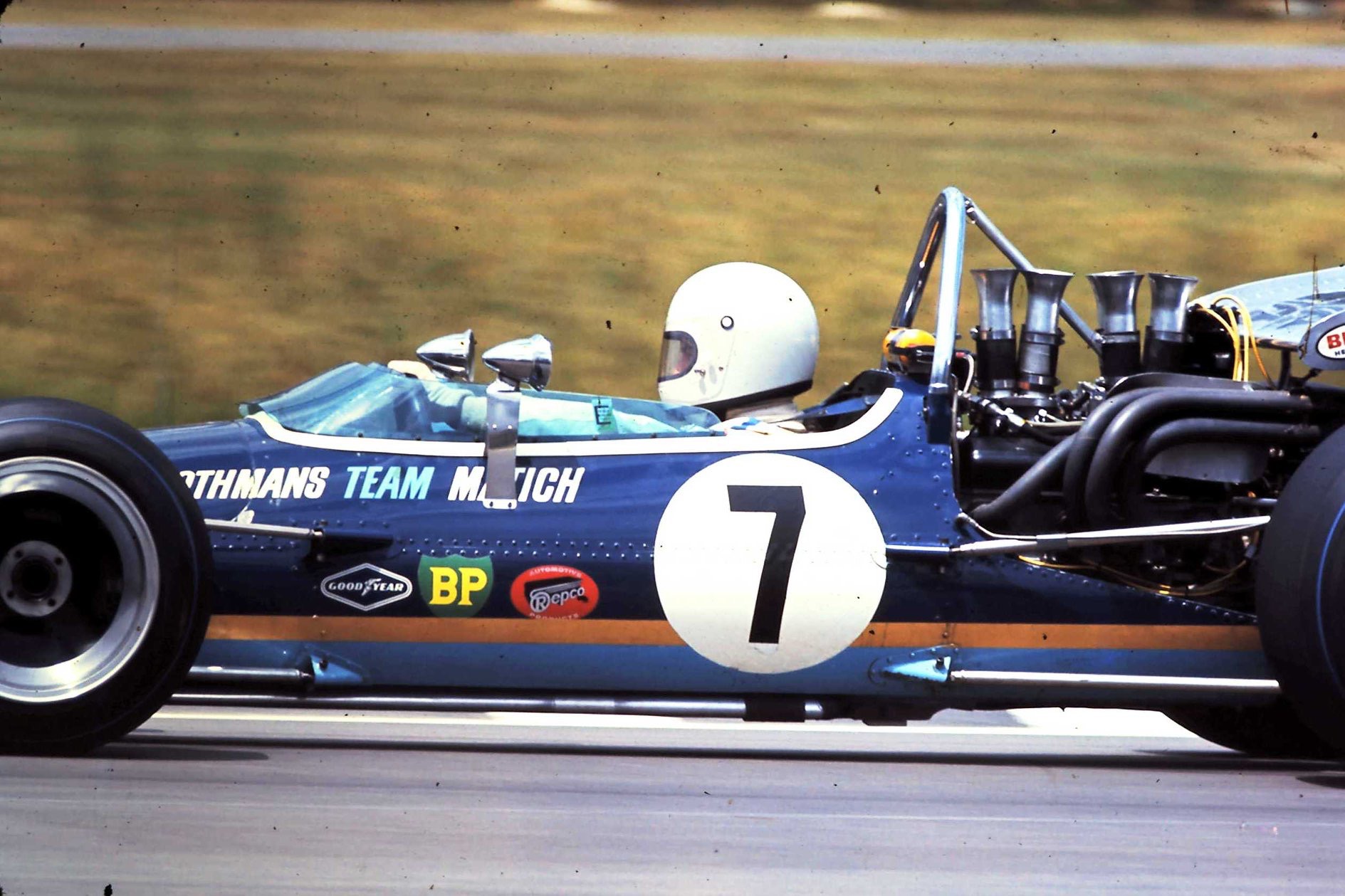
Rothman’s promo handout of the type used at race meetings back in the day.

Frank Matich did well with this unique Repco-Holden F5000 V8 engined McLaren M10B, chassis 400-10, winning the Australian Grand Prix with it in November 1970. In early ‘71, after finishing second to Graham McRae’s M10B Chev in the Tasman Cup, he took he entered the first two rounds of the US F5000 Championship held in California in April/May. He won the Riverside Grand Prix and finished second in the following Monterey Grand Prix at Laguna Seca, proving the car was one of the quickest F5000s around.

Sponsorship commitments forced his return to Australia to contest the Gold Star, a pity! Given the solid US campaign you would think Repco – he was their contracted test and race driver – and Rothmans would have seen the good sense in staying a bit longer and surfing the wave of success. US wins would have created good column inches back home and promoted Repco-Holden engine sales stateside, the irony of successful Australian V8s on the ‘home turf’ of that pushrod-V8-donk genre will not be lost on most of you. When Repco and Matich returned to the US with a full-on two car works L&M F5000 Championship assault in 1973 it was a clusterfuck, a tangent covered in this article and another linked below; https://primotipo.com/2015/09/11/frank-matich-matich-f5000-cars-etcetera/

(R Wolfe Collection)

Back home things turned to custard as he collided with another car – in a zig-zag moment as two cars converged – in practice at Oran Park before the first Gold Star round on June 27.

By then FM had decided to build his own car, so rather than order a replacement M10B chassis from Trojan Cars – manufacturers of McLaren customer cars – he decided his Brookvale team should rebuild the buggered monocoque as practice for what became the Matich A50 Repco-Holden that November. FM’s cars to that point – the SR3-4 sportscars – had spaceframe chassis.

When the thrice tubbed – the original, a Trojan replacement after a July 1970 prang, plus the Matich built chassis – M10B was rebuilt it was designated M10C.

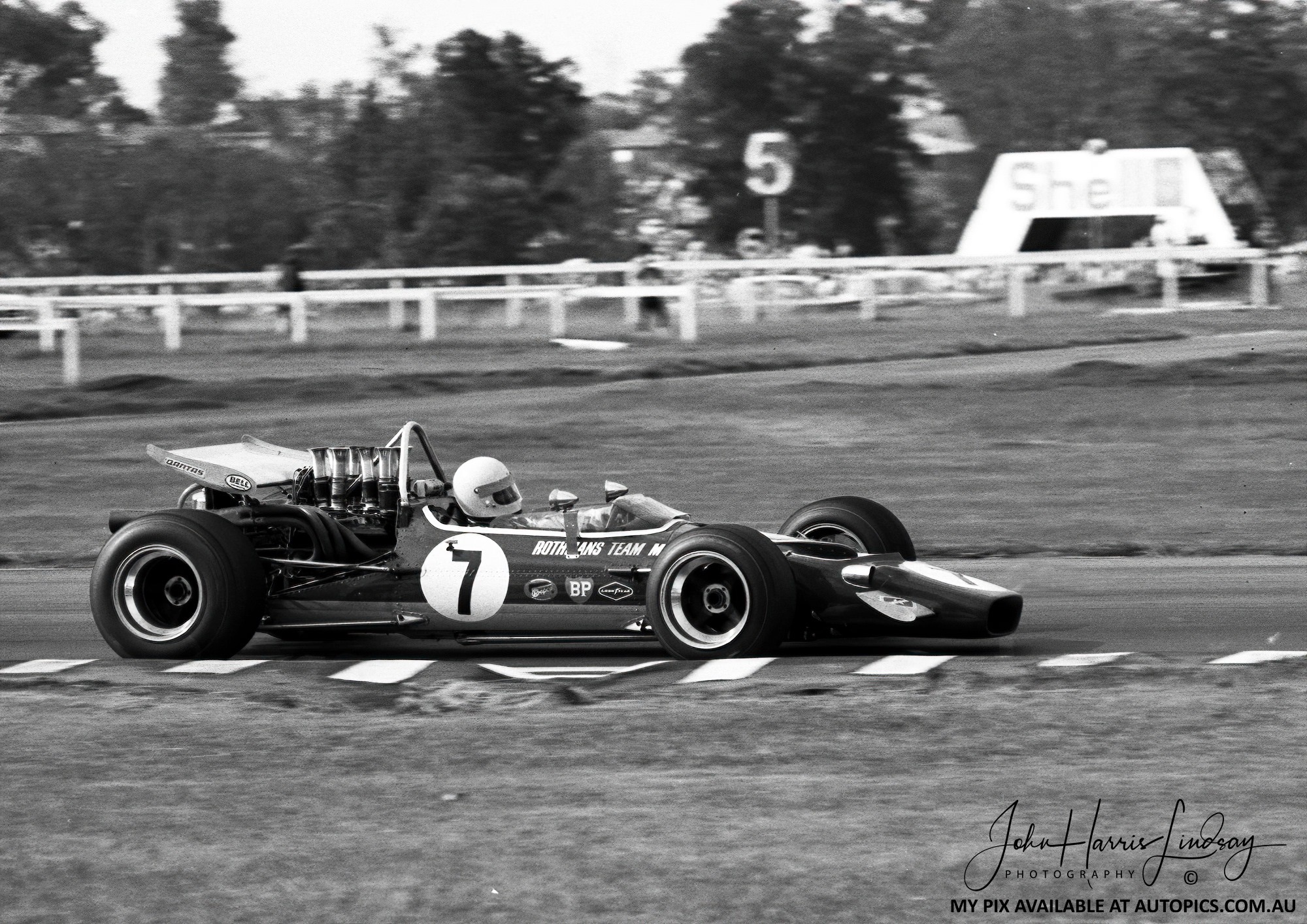
Compare and contrast. Matich shown winning the November 1970 AGP above at Warwick Farm fitted with 15-inch front and rear wheels, and below at the same circuit using 13-inch jobbies up front during the February WF Tasman round, DNF electrical. Same car, chassis 400-10, and same tub at this point! (unattributed)
(Terry Russell/an1images.com)
Matich in the M10C in New Zealand – where folks? – during the ’71 Tasman showing its M7/M14 13-inch front wheels. Isn’t it neat looking sans hi-airbox – that ‘innovation’ was introduced by Tyrrell during the ’71 French GP weekend – and with engine cover (D Kneller Collection)

In the lead up to the 1971 Tasman, FM developed 13-inch Goodyears as part of his test-driver role with Goodyear, he was one of about 10 in the world at the time, he was the distributor of the Akron giant’s race-tyres in Australia too. F1 cars raced on 13-inch covers and Goodyear were keen to evolve suitable boots of the same diameter for the heavier F5000s. The M10A and M10B were supplied ex-factory with 15-inch wheels front and rear. Simultaneously, the Matich crew increased the wheelbase of the car by 150mm by using redesigned front wishbones and longer radius rods, these and other subtle changes heralded the very quick C-specification.

Back to the ’71 Gold Star. Matich won at Surfers Paradise when he rejoined the Gold Star circus on August 29, 1971 but retirements at Warwick Farm and Sandown cruelled his championship aspirations. By then the main game was readying the new Matich A50 Repco-Holden for the November 21 AGP at Warwick Farm where the several days old car finished a splendid first!

Etcetera…

(G Wadsworth Collection)

Matich in the middle of the leading gaggle of cars not long after the start of the Riverside Grand Prix, that’s Sam Posey’s Surtees TS8 Chev turning in. The red car out of focus on the left looks suspiciously like Skip Barber’s F1 March 701 Ford DFV. Ron Grable’s Lola T190 Chev won the first 38 lap heat and Posey won the second, but FM’s two second placings won the day and the bubbles overall.

(M Kidd)

I like this unfinished painting, Kiwi artist Michael Kidd never got beyond his initial sketch of the McLaren M10C Repco-Holden in ‘71 Tasman specs as shown below. Matich leads Niel Allen’s M10B Chev and Frank Gardner’s works-Lola T192 Chev in the distance. Circuit folks? How ’bout completing the painting Michael?

(D Kneller Collection)

What’s interesting to we anoraks – perhaps – is that between the end of the Tasman and the trip to the US a couple of months later, Matich fitted a more substantial roll-over hoop with two rear stays mounted further back on the car at the rear. Look at the shots above and below. I wonder why? Different US regs perhaps, dunno, that’s one for Derek Kneller…

(D Kneller Collection)

The more you look, the more you see of course, here’s one for the Repco-Holden perves. Don’t the inlet trumpets on the engine above indicate that that injection slides are in use rather than butterflies? I thought by this stage slides had been given the arse by REDCO given their propensity to jam from the collection of roadside detritus on our shitty tracks?

Credits…

Rod Wolfe Collection, Derek Kneller Collection, Terry Russell, Michael Kidd, Eli Solomon

Tailpiece…

Frank Matich, McLaren M10A Chev, Thomson Road, Singapore GP, March 1970 (E Solomon)

Frank Matich’s F5000 commitment began with the purchase of this McLaren M10A Chev in late 1969, before CAMS had ‘finally landed’ on their decision for the new Australian National F1 to succeed the much loved, but running out of puff, 2.5-litre formula. That balsy-call by FM and staggering tale of ‘decision making fuck-wittery’ by the Conspiracy Against Motor Sport is contained within this exhausting epic; https://primotipo.com/2018/05/03/repco-holden-f5000-v8/

By the way, the small minded and petty (me) can still take the piss out of CAMS’ name quite legitimately. They registered the new business name Motorsport Australia with effect from January 1, 2020 but the full legal name of the organisation we all love is the Confederation of Australian Motor Sport Ltd (ABN 55 069 045 665) trading as Motorsport Australia, so CAMS it is.

Frank’s M10A, chassis 300-10, was delivered to him in August 1969, and Derek Kneller, ex-McLaren came with it. Derek and Peter Mabey immediately set to and updated the car to the just coming M10B spec – DG300, radiator, body, suspension wheels etc – and created a jet that Matich put on pole in four 1970 Tasman rounds for two wins, the NZ GP at Pukekohe and Wigram.

The last time Frank raced it – F5000 was not Gold Star legal in 1970, see fuck-wittery above – was during the March 29, 1970 Formula Libre 1970 Singapore Grand Prix on the big-balls Upper Thomson Road circuit.

Eli Solomon picks up the story, “Frank complained that his car weighed 1500lbs and carried 28.5 gallons of petrol designed for a 100 mile course. Talk that Niel Allen would also race an M10A never materialised (albeit he had a race winning M10B ready for the 1970 Tasman).”

“In Thursday practice Matich took out a bus stop doing 160mph on the Murder Mile, his best time had been 2:05.5, fifth fastest compared with the winner Graeme Lawrence, Ferrari 246T on pole at 1:57.8. Kevin Bartlett, Mildren Alfa Romeo T33 2.5 V8, did 1:58.6 and Max Stewart, Mildren Waggott TC-4V 2-litre, 1:59.6.” Lawrence won from John MacDonald’s Brabham BT10/23C Ford FVA and Albert Poon’s similarly powered Brabham BT30.

M10A-300-10 was rebuilt around a Repco-Holden V8 and sold to Don O’Sullivan. McLaren F5000 fetishests should suss Allen Brown’s archive here, budget two days to do the journey thoroughly; https://www.oldracingcars.com/mclaren/m10a/ and here; https://www.oldracingcars.com/mclaren/m10b/

Matich’s M10A 300-10 on the NZ GP grid at Pukekohe, January 10, 1970. Guy tapping the nose folks? the Keke Rosberg look-alike is Hugh Lexington with Graeme ‘Lugs’ Adams alongside right. Matich won from Derek Bell, Brabham BT26 Ford DFW and Graeme Lawrence, Ferrari Dino 246T. Engine is a Traco prepped Chev (The Roaring Season)

Obiter…

One last final fleeting glance for me before uploading this masterpiece. The Rothmans’ shot of 400-10 isn’t a photograph of the car in M10C spec but rather M10B spec before modification, the specification sheet listing is M10B before mods too, the poor old marketers are always the last to know. So, sleep easy now with that knowledge, I’m not OCD-ADHDxyz believe it or not but I do have my uber-anal moments…

Finito…
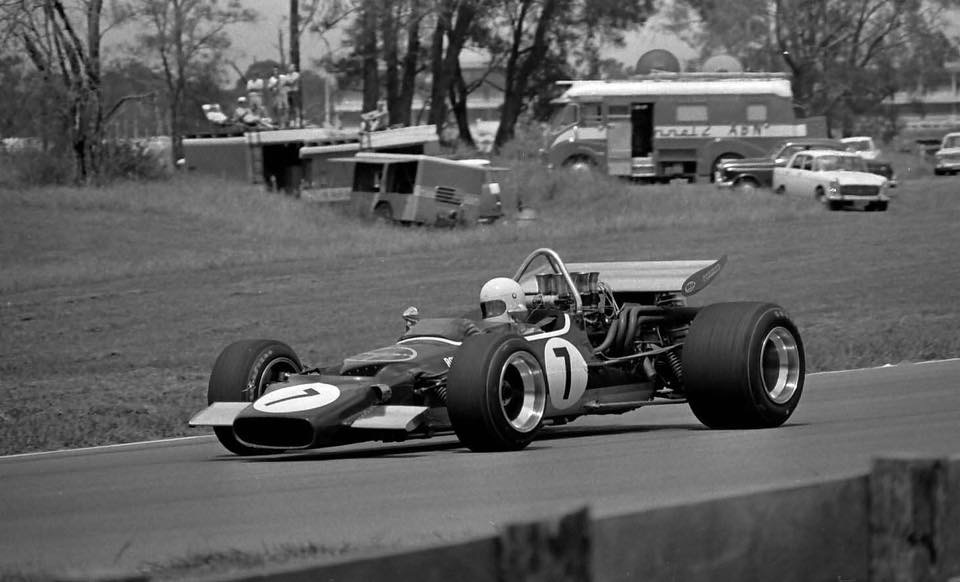
(L Hemer)

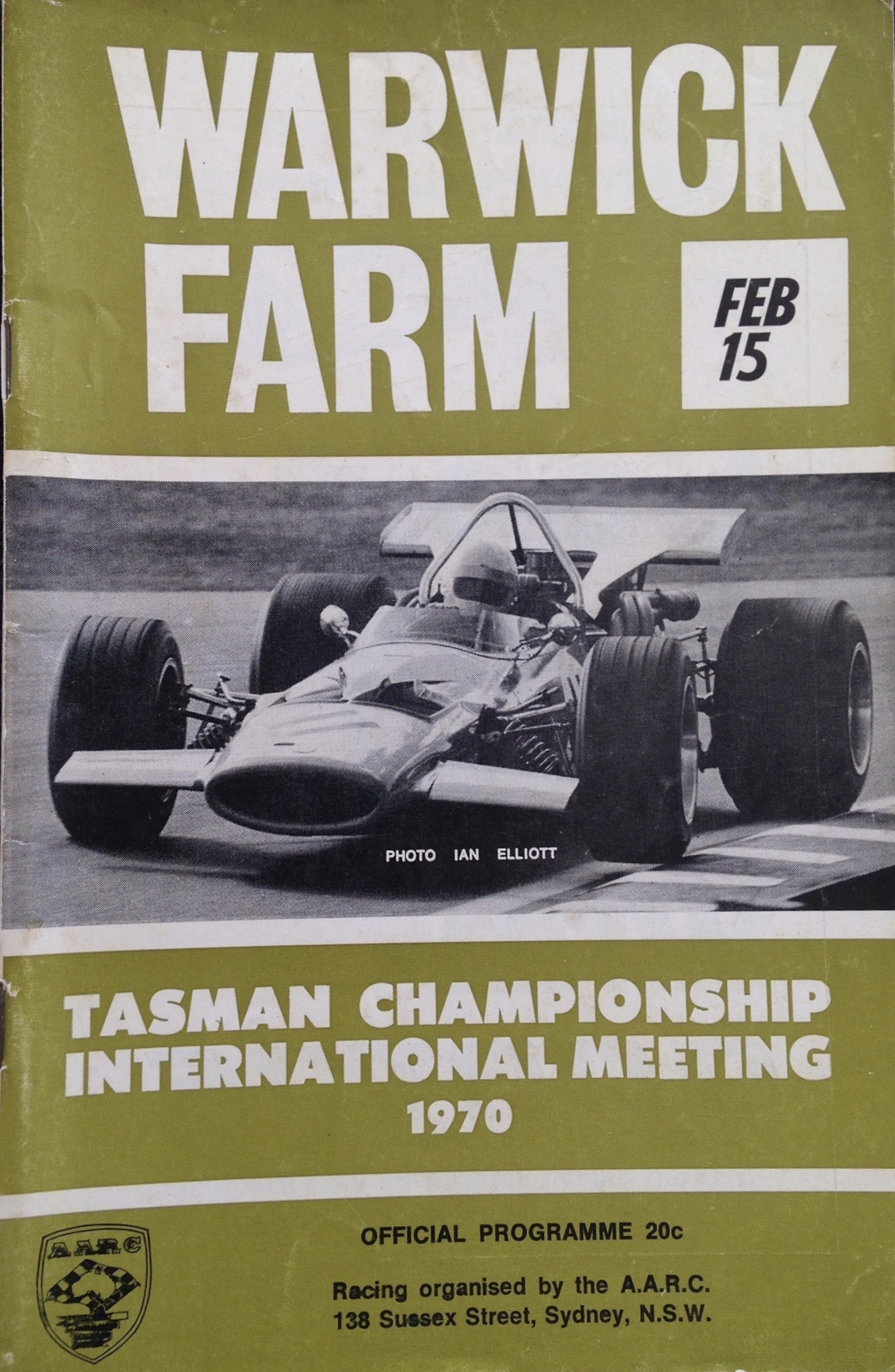
Lynton Hemer’s great shot catches the Frank Matich McLaren M10A Chev in the braking area before Creek Corner during practice for the Warwick Farm 100 on February 15, 1970.

Love the ABC TV outside broadcast van and flaggies and other officials cars sprinkled amongst the trees.

The 1970 Tasman was an interesting one in that the 2.5 Tasman cars which were on the way out (sadly) ended up having, just, the pace and the reliability to lift the Tasman Cup one last time over F5000, which was on the way in. Graeme Lawrence took the title with one win in the Ferrari Dino 246T Chris Amon raced to victory the year before, Matich was second in the points score with two wins.

(R Thorncraft)

The Matich crew first raced their M10A in September 1969 and progressively modified the car in many respects to the new M10B specifications- Hewland DG300 gearbox instead of LG600 etcetera, see this epic on Matich here; Frank Matich: Matich F5000 Cars etcetera… | primotipo…

Frank’s car was the quickest of the series, he won the NZ GP at Pukekohe and at Wigram. Only a splash and dash stop for fuel at Surfers gifted Graham McRae that win and engine problems at the Sandown final round- having started from pole – spoiled his Tasman, Niel Allen’s new M10B won that day with Lawrence’ second place enough to give him the series win.

Jaime Gard susses, whilst FM sucks on the sponsors product

Matich started at Warwick Farm from grid two with Graeme Lawrence on pole, he had an early coming together with Kevin Bartlett’s Mildren Waggott TC-4V, which Derek Kneller believes was the cause of the broken left-rear upright after 29 of the race’s 45 laps.

In a splendid drive, KB he won the race in the sweetest of racing cars, the Mildren Yellow Submarine, from Max Stewart’s Mildren Waggott TC-4V, Graeme Lawrence Ferrari Dino 246T 2.4 V6 and then the first of the F5000s- Niel Allen’s McLaren M10B Chev.

FM talks to Lugsy Adams looking particularly summer-posh in Rothmans Team Matich shorts ‘n long sox whilst Jaime Gard looks altogether more casual – not much they can do at this stage of proceedings.

FM’s Matich SR3 Repco was owned then by Don O’Sullivan, I imagine Gard was over from Perth and in-situ at the Matich workshops looking after the prep of that car, and totally involved otherwise – he of ‘Gardos’ fame I wrote about a while ago;https://primotipo.com/2017/11/30/dons-party-f5000-party/

Credits…

Lynton Hemer, John Lindsay, Russell Thorncraft, oldracingcars.com

Thanks to Kris Matich and Derek Kneller for assistance with event and people detail

Tailpiece…

FM’s Matich is fitted with an injected Chevvy here having commenced the series in New Zealand with units fitted with Webers. By this stage Matich’ Repco sponsorship was being refocused away from the Matich SR4 sportscar powered by 4.8/5 litre Repco RB760 V8’s in favour of the Repco Holden F5000 engines which were in the early stages of development by Phil Irving, Brian Heard and the rest of the crew in Maidstone.

The early promise of that Repco Holden engine was realised with FM’s Australian Grand Prix win aboard his M10B Repco at the Farm ten months hence

Finito…

eaton monaco

George Eaton, BRM P153 in gorgeous pre-Yardley, traditional livery. Monaco 1970 (GP Library)

George Eaton navigates the tricky Monaco circuit in an unsuccessful attempt to qualify his new BRM P153 at the principality in 1970…

Tony Southgate’s new design was a very competitive machine, after the teams disastrous 1969.  Pedro Rodriguez won a classic Spa duel in the P153 with Chris Amon in 1970 but Eaton, the Canadian racer struggled to get the best from it in his only fullish F1 year.

Looking objectively at his results in Grand Prix racing, the wealthy young heir to the Eatons Department Stores empire didn’t appear to have what it takes at the absolute elite level, but comparing his and Pedro’s performances in the Can Am BRM P154 Chev later in 1970 perhaps puts things in a slightly different perspective.

image

Eaton’s BRM P153 DNF oil tank, buzzes past the works McLaren M14D Alfa and M14A Ford of Andrea de Adamich DNQ and Peter Gethin DNF prang, respectively in the Zandvoort pitlane, 1970 (Schlegelmilch)

Eaton started racing in a Shelby Cobra in 1966. He raced a Chev Camaro at Daytona in 1967 and soon bought a McLaren Elva Mk3 Chev Can Am car in which he contested the USRRC and the Can Am Series in 1967. In 1968 he bought a McLaren M1C Chev, his best result was a 3rd place at Laguna Seca, in the wet, in 1968.

In 1969 he took a big step up contesting both the Can Am with a McLaren M12 Chev and the US Formula A, nee F5000 Championship in a McLaren M10A Chev, the ‘ducks guts’ chassis to have that year.

image

Eaton, McLaren M10A Chev, Mosport 1969, DNF transmission in the race won  by John Cannon’s Eagle Mk5 Chev (ORC)

His best Can Am races in the M12 were a 2nd at Texas and 3rd at Edmonton but he was quick, consistently qualifying in the top six all year. In FA, in fields of some depth he raced in most of the US rounds, 6th at the Shaefer GP his best. He contested only four of the Canadian rounds taking a good win at Mont Tremblant in May.

Off the back of these results he was offered drives in the F1 BRM P138, a ‘roughy’ of a car, in the US and Mexican GP’s in late 1969, retiring from both after qualifying last in both. Hardly the basis upon which to extend a contract for the following season, but that’s exactly what Lou Stanley offered George for 1970- a drive alongside the quick, unlucky Jackie Oliver and the blindingly fast Pedro Rodriguez.

image

Dutch GP, BRM P153, Q18, DNF. Rindt won in a Lotus 72 Ford (Schlegelmilch)

Eaton had a terrible F1 season, Pedro made the P153 sing. Oliver was quick but seemed to have all the engine unreliability, whilst George, probably not getting the best of equipment, was slow on the circuits which were unfamiliar to him and the car unreliable.

He qualified best in his home, Mosport event, 9th, outpacing Oliver and finished 10th. He qualified 14th at Watkins Glen and again retired but otherwise didn’t qualify higher than 14th with DNQ’s in Spain and Monaco.

His speed in the Can Am series was a bit different though…

1970 BRM P154 Can Am Season…

eaton brm

George Eaton with the BRM P154 Chev, 11 June 1970 (Dick Darrell)

Eaton’s pace was put into better perspective when compared with Pedro Rodriguez, his team leader and undoubtedly one of the fastest five blokes on the planet at the time, in Can Am cars.

Rodriguez contested the Donnybrooke, Laguna Seca and Riverside events, the last three of the series races from late September to 1 November. The ‘head to head’ comparison in identical P154 chassis on circuits upon which both had competed before is as follows;

Donnybrooke; Pedro Q7 P9 George Q5, DNF rocker

Laguna Seca; Pedro Q9 P5 George Q8 crash on lap 11

Riverside; Pedro Q7 P3 George Q 1.5 secs quicker than Pedro in practice but boofed the car and DNS

So, George appears to have had Pedro’s speed if not consistency in Can Am cars noting there was a veritable gulf between the pair in F1. Nobody ever suggested these 700bhp Can Am roller-skates were easy-peasey to drive, interesting innit?! Maybe Eaton should be given a little more credit for outright pace than he is usually accorded. He was not just a rich pretty-boy.

Before Pedro arrived to drive the other P154 chassis Eaton started the season at Mosport with Q7 and DNF with oil leak and transmission problems.

At St Jovite he was 3rd having  qualified 9th. To Watkins Glen Q13 and brake failure, Edmonton Q6 with a wheel bearing failure. The car had little pre-season testing some of these problems are indicative of that. At Mid Ohio he had fuel pressure problems which outed him, the dramas resulted in Q25. His results for the last three races are listed above in the comparison with Pedro.

image

Eaton P154 Laguna Seca 1970, Q8 and crashed (The Enthusiast Network)

Further perspective on Eaton’s performance is provided by Pedro’s opinion of the car, the Mexican had been ‘around the block’ in terms of experience of big cars since his ‘teens and driven some horrid ones, the Ferrari’s he raced in 1968 and the BRM’s in 1969 prime examples.

Pedro visited Tony Southgate after racing the P154, Southgate recorded in his book ‘Pedro raced the car later in the season and afterwards came to see me in my office at Bourne to talk about the experience and told me in its present form the car was horrible to drive.

I had great admiration for Pedro, so I knew it must be really bad. I was very embarrassed and immediately set about re-engineering it and fixing all the problems. The revised car, the P167 went on to be very good in 1971 but it was still a low budget operation’.

The BRM Can Am program was minimal in 1971, two events plus Interserie races for Pedro at Zolder and wins for Brian Redman at Imola and Hockemheim, after Pedro’s death at the Norisring in a Herbert Muller owned Ferrari 512M.

In terrible irony Pedro took the Muller ride only after a testing engine failure in the P167 meant he could not race the BRM and therefore took the Ferrari drive.

Brian Redman raced the P167 at Laguna to 4th, and Howden Ganley the same chassis at Riverside to 3rd, proof positive that progress had been made.

eaton-mosport

George Eaton in the BRM P154 Chev, Q6 DNF wheel bearing in front of Gary Wilson’s Lola T163 Chev 6th, at Edmonton on 26 July 1970. Denny Hulme won in a McLaren M8D Chev. Lots of available wheel arch a function of the P154 being designed for 19 inch wide wheels but only 17’s available- unsuitable suspension geometry one of the cars many issues (John Denniston)

But Bourne were not in a budgetary position to offer George another Can Am season in 1971, one he deserved.

Another season in F1 was a different thing, he had not done enough to keep that seat. As it was BRM were very competitive in F1 in 1971, Siffert and Rodriguez both taking a win apiece before their untimely deaths. Peter Gethin took another at Monza in the drive of his life in one of THE great GP finishes.

Into 1971 and 1972 George raced in endurance events although he was invited to guest drive a P160 BRM in the ’71 Canadian Grand Prix, qualifying 21st, slowest of the four BRM’s entered, he finished 15th.

George Eaton was a very fine driver and quicker than he is given credit for in Can Am cars at least. He extracted more from the very ordinary BRM P154, in qualifying in three consecutive events than an ace like Pedro Rodriguez could produce from the same chassis, a pretty ordinary one at that…

image

George in the ‘Klondike 200’, Edmonton pits awaiting chassis changes in 1970. BRM P154 Chev, Q6 and DNF, wheel bearing. Fundamental issues with the car were the late decision on doing the program, one forced upon designer Tony Southgate- and lack of testing miles and development before it left the UK for the US. George did the development miles in the races, lots of stuff breaking as a consequence. Article on the P154 and P167 coming soon (Denniston)

Credits…

GP Library, The Enthusiast Network, classiccars.com, John Denniston, Dick Darrell

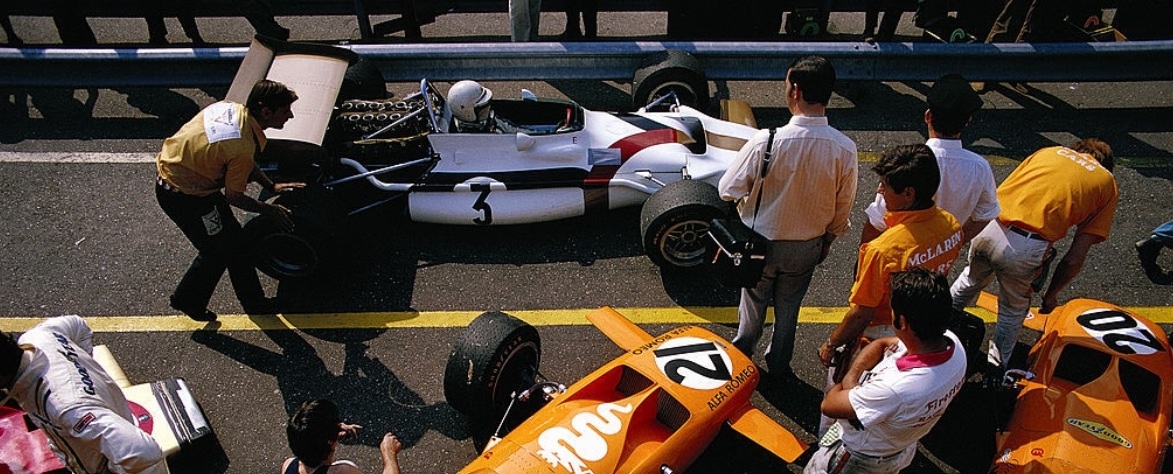
Tailpiece: Monaco 1970, this time from above. The BRM P153/P160 are wonderful cars, in reality the great Bourne marques last really consistently competitive hurrahs…

image

Such beautiful and fast cars, one of the surprises of 1970, Tony Southgate’s BRM P153, Eaton at Monaco, DNQ (Schlegelmilch)