Posts Tagged ‘Mickey Thompson’

(D Friedman)

Dan Gurney awaits the start of the 1962 Indianapolis 500 in his Thompson Buick V8, with Fritz Voigt and Mickey Thompson in attendance, Memorial Day, Indiana, May 30, 1962.

Jack Brabham and John Cooper started the mid-engined Indy revolution – I’m not suggesting they were the first to race a mid-engined car there – in 1961 with their tiddly 2.7-litre Cooper T54 Climax FPF.

Mickey Thompson wasn’t the only Indycar builder to take the mid-engined bait, but one of his three Thompson Buick V8s driven by Indy debutant Dan Gurney, was the only mid-engined car that took the start in 1962.

His John Crosthwaite-designed, aluminium-bodied machine comprised a lightweight spaceframe chassis, a modified new aluminium Buick BOP – Buick, Oldsmobile, Pontiac – 215cid V8 and a Halibrand transaxle.

This revolutionary, aluminium production V8 weighed only 317 pounds, about 200 pounds less than Detroit’s cast iron equivalent thereof. Let’s stick with the engine for a bit.


Buick’s innovative V8 featured a deep-skirt aluminium block containing an assortment of iron and steel parts: cast-in bore liners, forged connecting rods, and a crankshaft supported by five main-bearing caps. The result was an engine that weighed 324 lbs, circa 200 lbs less than Chevy’s small-block V-8 (GM Media)

While the ads of the three General Motors’ subsidiaries that fitted the motors to their cars extolled the virtues of better fuel economy and a lighter car, racers looked at the obvious lightweight performance potential too.

The Buick and Pontiac 215 engines were identical but Oldsmobile’s ‘Rockette V8’ had revised heads. The Buick version used a five-bolt pattern around each cylinder, while the Oldsmobile jobbie used a six-bolt pattern to alleviate potential warping of the heads on high-compression variants of the engine

To the Olds party-faithful, the changes made the new engine look like its much respected predecessor, the Olds-Rocket V8, and to those seeking big power gains, the Olds F85 engine was the go, the extra head bolt would assist in avoiding blown head gaskets in performance applications.

While I covered broadly the donor engine that formed the bottom end of Repco-Brabham Engines’ 1966 F1 World Championship winning 620 V8 in this lengthy epic: https://primotipo.com/2014/08/07/rb620-v8-building-the-1966-world-championship-winning-engine-rodways-repco-recollections-episode-2/ I didn’t look at the engines parentage in any detail. This fantastic Macs Motor City article does just that: https://macsmotorcitygarage.com/featherweight-wonder-inside-buicks-1961-aluminum-v8/ and this Hagerty one: https://www.hagerty.com/media/magazine-features/hagerty-magazine/buicks-little-aluminum-v-8/

You can feel and hear the vibe in this pre-start shot (IMS)

Crosthwaite – Thompson – Buick Indy Car 1962

British engineer John Crosthwaite designed the Thompson 1962 machine for Mickey Thompson.

Crosthwaite’s and Thompson’s collaboration came about after John’s success with the Dolphin Formula Junior built by a company owned by Bud Hull, in the San Diego/Del Mar area of Southern California. Thompson noticed the pace of the cars and sought him out: https://0398ca9.netsolhost.com/dolphin01.htm

Soon, Thompson and his sponsors, Harvey Aluminium and Jim Kimberly of Kimberly Clark, approached  Crosthwaite to design a mid-engined car inspired by those by then de rigeur in European road-racing for the 1962 500.

John Crosthwaite, Jack Brabham and Buddy Hull at right after testing the Dolphin Mk1 Fiat FJ at Riverside in November 1960 during the US Grand Prix weekend. Brabham had already won his second F1 World Championship in Portugal a couple of weeks before (Wiki)
John Crosthwaite with one of his completed ’62 Thompson Buicks in Thompson’s Long Beach machine shop. Note the fuel tank locale, Halibrand wheel and beefy spaceframe. Body buck for something else? (Wiki)

Thompson Buick Design & Construction…

Crosthwaite drew on his earlier work in drawing a tubular steel spaceframe chassis, with fully independent suspension front and rear: upper and lower wishbones and coil spring/dampers and adjustable roll bars at the front, and a single upper links, twin radius rods and and gain coil spring/dampers and adjustable bar at the rear. The 16-inch Halibrand wheels and Firestones were way smaller than the usual 18/20 inch units used by the big, heavy roadsters.

The engine was a radical choice as well. Offies had ruled the day for decades. Not only was the Buick V8 the first stock-block engine raced at Indy since 1946, but it was also, as we have seen, brand-new. General Motors had developed a technique to cast aluminium engines in large volumes. The 3.5-litre 317 lb aluminium Buick-Oldsmobile-Pontiac BOP 215 V8 was the first volume production V8 in the world and was just on the market, fitted to the Buick Special, Oldsmobile F85 and Pontiac Tempest. More on the engine mods shortly. The transaxle was a Halibrand two-speed: fast and much faster! It was mated to the engine via a bespoke, shallow, cast bell-housing.

There was no pressure! The project had to be completed in just 120 days. Crosthwaite worked long hours living in a motel close to Thompson’s Los Angeles workshop where the car was built by a crew led by Fritz Voigt.

Key elements laid bare in the Indy garage: spaceframe chassis, modified Buick 215 stock-block aluminium V8, Halibrand two-speed transaxle, disc brakes (D Friedman)
Hilborn fuel injection, roller rockers by Iskenderian or Crower (D Friedman)

Buick 215 V8…

The Buick V8 underwent significant performance surgery to be match fit against the 4.2-litre fuel-injected Offys, which gave about 350 bhp in 500-mile race spec at the time.

While multiple parties were involved in the engine’s development, the key modifications were made by Scarab engineers, who worked on improving the engine’s breathing capacity, and Mickey Thompson’s team who experimented with fuel injection and made a specially fabricated intake manifold to suit.

Or is that the case? There seem to be two schools of thought…

In its August 1962 issue that year, Hot Rod reported that the Buick was a Mickey Thompson (M/T) project with no factory help. M/T pistons with a 14:1 compression ratio and M/T aluminum rods were coupled to an M/T cast ductile-iron crankshaft with a 3.10-in stroke. (M/T was then marketing “Cast Billet” stroker crankshafts for popular V8s.) Iskenderian supplied the roller camshaft and kit, while Bob Bubenik engineered the gear drive for the cam and oil, water, and fuel pumps. HIlborn fuel injection with both laydown and vertical-stack manifolds were tried, but vertical stacks proved best. Quoted output was 330 bhp on straight methanol fuel.

Buick 215 engine, mods as per text (MMCG)
(MMCG)

A few years later, in a May, 1970 feature Hot Rod interviewed some Buick executives who had a different perspective. In this version, noted Buick engineer Nelson Kunz led the three-month program, working closely with Thompson. Oversize cylinder liners allowed a bore of 3.6125 inches, but here the 3.10-in ductile iron stroker crank was a welded Buick piece and the connecting rods were 4340 steel. Large-port head castings and a Crower H-1 roller cam kit completed the combination, which produced 370 bhp at 7200 rpm. They reported about 15 engines were built with a few sent to sports car teams, including Lance Reventlow’s Scarab operation.

It’s hardly surprising if GM was a bit cute about its involvement in-period, given the Motor Racing Ban Deal between the Big Three at the time: GM, FoMoCo and Chrysler. On the balance of probabilities, Traco were involved too. They built a 3.9-litre modified, Weber-fed, Buick 215 V8 for Lance Reventlow, which was fitted to his Scarab RE Formula Libre car raced by Chuck Daigh in the February 1962 Sandown Park International.

That race was won by Jack Brabham’s Cooper T55 Climax. While the new Scarab chassis needed development – it was never raced again – the potency of the engine impressed onlookers, including Brabham, whose first Repco-Brabham F1 V8, built in 1965, used the Oldsmobile 215 F85 block in modified form; the RB620 3-litre V8 won World Drivers and Constructors Championships in 1966.

These early developments of the BOP 215 V8 Mickey Thompson and others were very important to the engine’s subsequent use by Repco-Brabham Engines and in the back of Bruce McLaren’s new McLaren-Elva sportscars, and others. More about the Scarab RE Buick in this article: https://primotipo.com/2016/01/27/chucks-t-bird/

Ain’t she very sweet, a handsome, purposeful machine in every respect. DG during the obligatory posed qualifying shot (IMS)

1962 Indy 500… 

Dan’s primary race program in 1962 was with Porsche in F1 and endurance sportscars. He therefore arrived in Indiana match fit and as sharp as a tack.

Gurney told Andrew Ferguson about his debut year at Indy in 1962 in Ferguson’s research for his great book, ‘Team Lotus – The Indianapolis Years’.

‘I had first gone to Indianapolis in 1962, at the invitation of an entrant named John Zink. I took the obligatory driver’s test in his traditional front-engined Offy roadster, but what he was hoping to qualify for the race was a rear-engined frame. I’m sure it was actually an old Lotus chassis – powered by a Boeing gas turbine.’

‘He had some Boeing engineers who were keen to promote these things as high-reliability, cheap-to-run engines powering Kenworth trucks. One of the engineers was running one on the street in a ’32 Ford roadster, which must have been quite exciting.’

Dan smiling as best he can, Moore 62 Boeing during Indy qualifying (IMS)
Boeing Model 502-10F turboshaft engine, a lightweight unit normally used in helicopters, being fettled at Indy. Moore 62 chassis aka John Zink Trackburner Spl (IMS)

‘But when Jack Zink appeared at Indy with his turbine car he was stiff and sore and his face and arms covered in scabs and grazes, because while testing the car back at some place in Oklahoma he’d flipped it during a test run. And when I got out on to the Speedway in the car it was plain that its 350 horsepower wasn’t enough. A gas turbine develops maximum torque at stall, like a steam engine, so the faster you ran it the less it delivered.’

‘In those days we were still having to brake into the turns at Indy, so when you went back on the gas that turbine could set very competitive corner speeds, and came off the turns with good acceleration. But part way down the straight it would be all over for the day. It just ran out of power and stopped accelerating.’

‘I was really having to hustle it in the effort to set competitive lap times, and it became clear that it just didn’t have enough power. So I told Zink that if he could find anyone to drive it faster he shouldn’t worry about hurting my feelings – he should go right ahead and try them…and then Mickey Thompson asked if I’d like to drive one of his new rear-engined Buick V8-powered cars.’

Thompson and Fritz Voigt during Indy qualifying. The ‘body-off’ shots suggest a high level of design and execution quality despite the tight timelines involved (MMCG)
‘Fancy meeting you here Colin!’ Gurney greets his Indy 500 guest, Colin Chapman, from the Hospitality Suite! Rather a successful weekend for them both (D Friedman)

Dan had a lot riding on the race. He had funded Colin Chapman to come over and see the 1962 Indy 500 with a view to hooking Lotus and Ford up for a proper shot at the 1963 500. Dan knew an Indy version of the then ‘spankers Lotus 25 monocoque – which debuted at the Dutch GP in May that year – was a race winner.

Dan’s switch to Thompson’s aluminium Buick V8 stock block-powered mid-engined Crosthwaite design proved a good one. The Indy Rookie qualified the new car a tremendous eighth with a speed of 147.886 mph, impressive in every respect. Having said that, Dan was of course, racing mid-engined cars all the time, there was nothing unconventional about the layout to him.

Up at the pointy end, the top three were Roadsters: Parnelli Jones’ Watson Offy from Rodger Ward’s similar car and Bobby Marshman’s Epperly Offy in third.

A couple of youngsters who done real good! Roger Penske wishes Dan well before he jumps in and puts on the ‘belts mandatory at Indy. Note the crash pad on the steering wheel and injection trumpet debris protector (IMS)
Mickey Thompson and Dan Gurney just before the start (R Brock/Getty)

After the start, Gurney gradually worked his way into ninth place after the initial stages. The only incident in those early stages was on lap 17 when a four-car pile-up involving Jack Turner, Bob Christie, Allen Crowe and Chuck Rodee. Noteworthy is that AJ Foyt lost a wheel off his Trevis Offy on lap 69.

Running nicely, on lap 92 of 200, Dan experienced a problem with the rear end and was forced to retire. A leaking Halibrand transaxle was later attributed to an improperly mounted seal around the starter shaft in the back of the gearbox which fell out and killed the gearbox.

The race was won by Ward from Len Sutton’s Watson Offy then Eddie Sachs’ Epperly Offy, with Dan classifed 20th and in the money to the tune of $US5161.

Pitstop for Dan, who was out on lap 92 in the Thompson Harvey Aluminium Spl (unattributed)
(D Friedman)

Despite not finishing, the Thompson Buick’s performance was considered noteworthy as it demonstrated again the potential of the rear-engined layout and a light aluminium stock block V8 at Indy.

The move looked prophetic on Dan’s part when one of two drivers who drove the John Zink Trackburner Spl aka Moore 62 Boeing. After Dan left, Duane Carter, and then Bill Cheesbourg, tried to get the Moore 62 up to speed but couldn’t. Cheesbourg followed Dan to Thompson’s outfit and drove the #35 Harvey Aluminium Special – Thompson Buick – #35 but missed the cut as did Chuck Daigh who had preceded him…

A third #33 Thompson Buick owned by Jim Kimberly was driven by Porky Rachwitz and Jack Fairman, who both failed to qualify.

The Thompson Harvey Aluminium Special at Indy in 1962 (B Tronolone-Revs)

Etcetera…

Gurney aboard Zink’s Watson Offy for his Rookie Test, Indy 1962, and the shot below (D Friedman)

In order to pass his rookie test Gurney used a good, old, reliable Roadster. Zink’s Offy powered car was no less a chassis than the updated Watson used by Pat Flaherty to win the 1956 race for Zink.

Of interest, perhaps, from indycar.com. ‘Rookie tests from 1936-80 took place during practice for the Indianapolis 500 in May, when the track was open nearly the entire month. Many rookie drivers took advantage of turning their required laps early in May, when there was less traffic because veteran drivers often waited until later in the month to begin their programs.’

(unattributed)
(LAT)

Rookie tests for seasoned professionals such as Gurney may seem a little strange, during July 1962 he had won his first championship Grand Prix for Porsche at Rouen-Les-Essarts aboard the the 1.5-litre flat-eight powered car (above).

But Indianapolis is a treacherous place, especially back then.

Porsche 804 laid bare at Zandvoort in May 1962, the meeting at which Gurney – along with the rest of motor racing – went WOW over Chapman’s new monocoque Lotus 25 Climax (J Alexander)

As a consequence, ‘In 1981, the Rookie Orientation Program was formalized. The biggest difference between ROP and previous rookie tests was the entire session was reserved for rookies only, with the session taking place sometime in April or early May. Drivers no longer needed to find clear track amid veteran practice to learn the ropes.’

‘It doesn’t matter if the driver is making their first NTT Indycar series start in the “500” or has extensive global racing success. They all must take the test.’

‘Some noteworthy drivers who were established stars before their first Indy 500 start required to take a rookie test include existing or eventual F1 World Champions Alberto Ascari, Juan Manuel Fangio, Jack Brabham, Jim Clark, Graham Hill, Denis Hulme, Jackie Stewart, Jochen Rindt, Emerson Fittipaldi, Nelson Piquet, Nigel Mansell and Fernando Alonso.’

(unattributed)

Dan aboard John S Zink’s Moore 62 Boeing, the John Zink Trackburner, in the Indy pitlane during qualifying. See below for more detail, lots of it on Allen Browns Old Racing Cars website: https://www.oldracingcars.com/indy/results/1962/indianapolis500/

Click on the link, then go to note 3, ‘Moore 62 Dan Gurney’, read that, then click on the link to the ‘Len Williams report’ for an amazing account of the car’s construction, testing by Zinc on the track at his ranch, and then the fun and games at Indy trying to coax the car into the race. Truly wonderful stuff.

Moore 62 Boeing turbine and Halibrand transaxle. Designer Denni Moore has gone to great lengths to stiffen the large opening that contains the bulky turbine engine ((D Friedman)
Thomson and Voigt, this angle shows how the Thompson Buick’s engine is mounted offset left (MMCG)
Firestone boys do their thing. Symmetry albeit offset left! (IMS)
Dan Gurney on the Indy 500 and GP racing in 1965
Mickey Thompson and John Crosthwaite sandwich a Harvey Aluminium representative well before the #35 car failed to make the ’62 500 cut in the hands of Chuck Daigh and Bill Cheesbourg! (JC Collection)

John Crosthwaite

Crosthwaite died on September 5, 2010, aged 84. 

After the Mickey Thompson cars for the 1962-63 Indy 500, Crosthwaite joined Holman Moody in July 1963. When their Indy project fell through, Crosthwaite commenced at BRM that December.

Later in his career, he was involved in designing chassis for road cars, including the Intermeccanica Italia, the Bond Bug, and the Reliant Scimitar GTE.

Crosthwaite worked with some notable figures/businesses in the sport, including Cooper, Team Lotus, Graham Hill, Dan Gurney, and Jackie Stewart. His innovative designs, particularly for the Indy 500, left a lasting impact on motorsport engineering.

You can’t go past Wiki’s entry for a great summary of Crosthwaite’s life of achievement: https://en.wikipedia.org/wiki/John_Crosthwaite

Buick had an ad ready to go had they won in ’91…Gary Bettenhausen DNF radiator after 89 laps, the best placed Buick turbo-V6-powered car was Stan Fox’s Lola T91/00, which was eighth in the race won by Rick Mears’ 2.65-litre Penske PC20 Ilmor Chev 265-A V8.

Credits…

David Friedman Archive, Macs Motor City Garage, psychoontyres.co.uk, Ray Brock/Getty Images, Bob Tronolone-The Revs Institute, Indy Motor Speedway, IMS-Indianapolis Motor Speedway Archive, oldracingcars.com, GM Corp, John Crosthwaite Collection via Wikipedia, LAT, Jesse Alexander, indycars.com

Finito…

image

Al Unser blasts out of the pits during his victorious 1970 Indy 500 win in his Lola/Colt ‘Johnny Lightning Special’…

Opportunistic American mechanics, drivers and team owners were slow to recognise a good thing.

Jack Brabham’s first appearance at the Brickyard in 1961 with his little 2.7-litre Cooper T54 Coventry Climax FPF saw him qualify 13th, finish 9th and take home a big payday by the GP standards of the day.

indy jack

With John Cooper and Jack having made clear the advantages of mid-engined cars on their patch American team-owners and mechanics followed the path started by Cooper in the early 1950’s, their first GP win, in Argentina 1958, when Moss won in a 2 litre Cooper T43.

The first in the US to recognise the mid-engined trend was Mickey Thompson, he teamed with Dan Gurney with a proprietary chassis and aluminum Buick V8 power to qualify 8th in 1962, he was classified 20th with 92 laps.

dan in mt spl Dan Gurney in Mickey Thompson’s Buick stock block V8 powered ‘Harvey Aluminium Special’, Thompson in the dark shirt at right, Indy 1962. This engine, famously the brother of the F85 Olds, the block of which formed the basis of the Repco Brabham ‘RB620’ 1966 World F1 Championship winning 3 litre V8. Chassis designed by Brit John Crosthwaite, 3 cars built for the ’62 race (unattributed)

1963 made it clear the Indy roadster’s days were numbered when Jim Clark and Gurney brought Colin Chapman’s lightweight Ford pushrod V8 powered Lotus 29 to The Brickyard. In that first year Clark was barely beaten by Parnelli Jones in a Watson Offy roadster. Some say given the oil the Watson was dropping that only the Indy ‘establishment’ prevented a victory that was rightfully Clark/Chapman’s. Jones took the lesson to heart.

jim and dan Jim and Dan (right), Lotus 29 Ford, Indy, morning practice 18 May 1963, note offset suspension. Superb bits of kit (Bob Jennings)

In 1964, 12 of the 33 of the grid were mid-engined cars. Their builders are a directory of Gasoline Alley; Watson, Epperly, Huffaker, Vollstedt, Thompson and Halibrand, only two constructors were ‘furrin, Lotus and Brabham.

In 1965 only a single roadster, Gordon Johncock’s Watson Offy, finished in the top ten. There were only 6 front-engined roadsters in the 33 car field, Clark finally won in his Lotus 38 Ford. By 1966 there was only one roadster left. The transition was complete, in five years the Indy field and the shape of American champcar racing had been transformed.

indy lotus Lotus 38 Ford erotica Indy 1965, the year of Jim Clark’s win in one of these cars, Bobby Johns drove the other factory car. Essential elements the aluminium monocoque chassis, DOHC Ford ‘Indy’ V8, mid-engined layout of course and superb Lotus attention to detail (Bob D’Olivo)

The period of innovation continued throughout the ’60’s…

Andy Granatelli’s STP Corporation raced a four wheel drive Pratt and Whitney turbine engined car driven by Parnelli Jones at Indy in ’67. After leading nearly every lap of the rain interrupted race a 25 cent part in the gearbox failed, bringing the ‘whooshmobile’ to a halt giving the win to A.J. Foyt’s now conventional Coyote-Ford V8. Jones was classified 6th.

What made this period a golden one apart from the innovation of cars like Parnelli’s Granatelli turbine were a confluence of events which included Ford’s global drive to dominate all forms of racing; Grands Prix, Le Mans, drag strips, NASCAR and USAC. Firestone and Goodyear also battled each other like the heavyweight champs they were, in the process creating tyres of great grip as the understanding of polymer chemistry developed exponentially.

indy parnelli

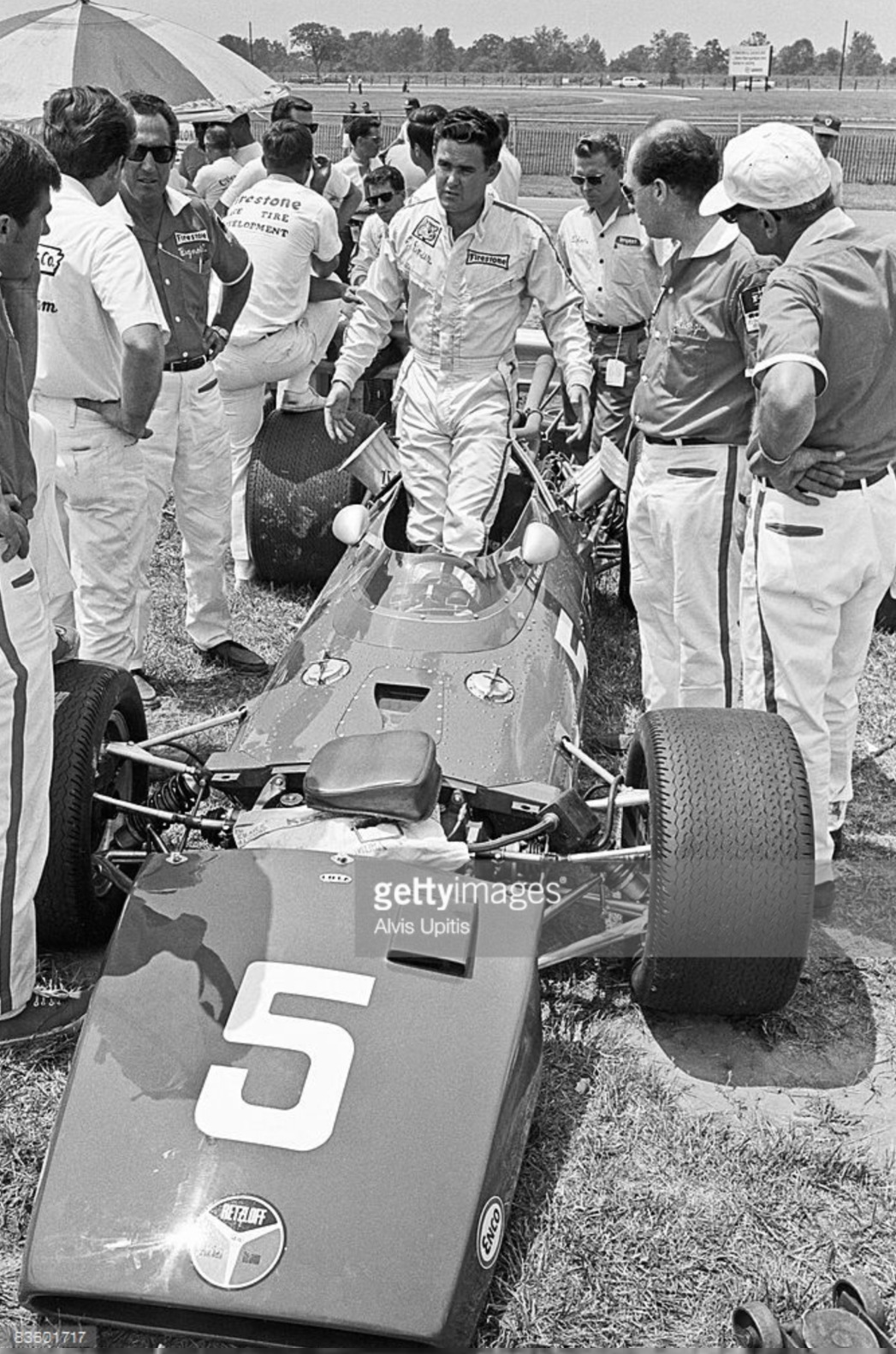
The advantages of 4WD were shown by Jones in 1967. George Bignotti sought to exploit it by combining 4WD grip with the dominant Ford V8 in 1968 with a 4WD Lola T150 for Al Retzloff , founder of a Houston based chemical company, to be driven by Al Unser. And so the basis of the later ‘Johnny Lightning Special’ was born.

I wrote an article about the equally iconic ‘American Red Ball Spl’ Lola T90 Ford, which provides some context in terms of Lola’s early Indycars and which took Graham Hill to his 1966 Indy win, click here to read it;

Graham Hill’s ‘American Red Ball Spl’ Lola T90 Ford: Indy Winner 1966…

indy al snap Al Indy ’68, Lola T150 Ford (unattributed)

In the 500 Unser qualified the new 4WD Lola outside the second row in 6th but crashed on lap 40 when a spindle broke, brother Bobby won in an Eagle Offy.

indy lola red Lola T150 Ford at Indy ’68, note the vestigial ‘wing’, their is no such thing as an ugly Lola, bias duly acknowledged! (unattributed)

After repair back at Lola’s Bromley works in England the T150 returned in time for the USAC road course race at Indy Raceway Park. Unser proved his versatility on road circuits, winning both heats. His victory came a week after taking his first USAC Championship victory on the dirt at Nazareth. He followed up both wins with another victory later in the season at Langhorne.

indy lola upright Al in the T150 on 21 July 1968, he won at Indianapolis Raceway Park, Clermont, Indiana. Aluminium monocoque tub, upper and lower wishbone and coil spring damper unit front suspension all clear. Look carefully and you can see the front driveshaft behind the steering arm (Alvis Upitis)
al and jo Unser’s Lola T150 Ford chasing Jo Leonard’s Lotus 56 Pratt & Whitney turbine 4WD, Clermont, Indiana, 1968 . The photo says everything that was good about Indy in the ’60’s, innovation! For a while anyway, inevitably political pressure was applied to maintain orthodoxy and contain ‘runaway costs’ (Alvis Upitis)

A major development in 1969 US racing was the foundation of the ‘Vel’s Parnelli Jones’ Ford team which would go all the way to F1 with Mario Andretti in 1975.

Supported by Ford and Firestone, Vel Miletich and Parnelli Jones set up their own team, buying out Al Retzloff, acquiring his Lola Fords and the services of legendary chief mechanic George Bignotti, his co-chief Jim Dilamarter and Al Unser. Their objective was to dominate USAC racing and also to race competitively in F1, taking the Firestone banner into Goodyear dominated territory.

USAC reacted predictably to the advantages of 4WD by restricting them to just 10-inch tyre widths, effectively robbing the promising but expensive technology of its advantage and protecting the status quo of USAC car owners.

Bignotti and Dilamarter converted the T150, carrying USAC #3 signifying Al Unser’s 1968 driving championship standing, to rear wheel drive with side-mounted fuel cells and the distinctive ‘coal chute’ rear decks feeding air to rear-mounted oil coolers. The Lola was renamed the Vel’s Parnelli Jones Special.

In its first race at Phoenix, Al put the VPJ Spl on pole but the Ford V8 dropped a valve on lap 14 whilst in the lead. After Hanford on April 13 the show headed for Indianapolis for the long month of May.

It rained continuously throughout the first week of qualifying. Unser was fast, but broke his leg in a motorcycle accident whilst waiting for the weather to clear! This car was given to veteran Bud Tingelstad who qualified 18th and was classified 15th when a Ford valve again broke on lap 155.

bud Bud Tingelstad in the VPJ Lola T150 Ford, at Indy in 1969 (unattributed)

Jim Malloy qualified and finished 2nd in the T150 in the ‘Rex Mays Classic’ at the Milwaukee Mile, then 7th at Langhorne. Unser crashed in practice for the 151 mile road course race at Continental Divide on July 6, taking over Malloy’s car for the feature but dropped out with broken suspension.

Al capped the car’s season with a win from pole at Phoenix on November 15, finishing 2nd in the 1969 driver’s championship to Mario Andretti, amazing given that after his motorcycle accident at Indy he had only 19 starts to Andretti’s 24.

Unser spoke to Gordon Kirby about 1969; ‘If I hadn’t broke my leg in 1969 the car was totally capable of winning the 500 in ’69,’ he said. ‘It was already there and 1970 showed it. Look at the races I won through the last half of ‘69 and in ‘70 I just dominated everything. The Indycar and the dirt car (King Ford) were both fantastic cars to drive’.

image


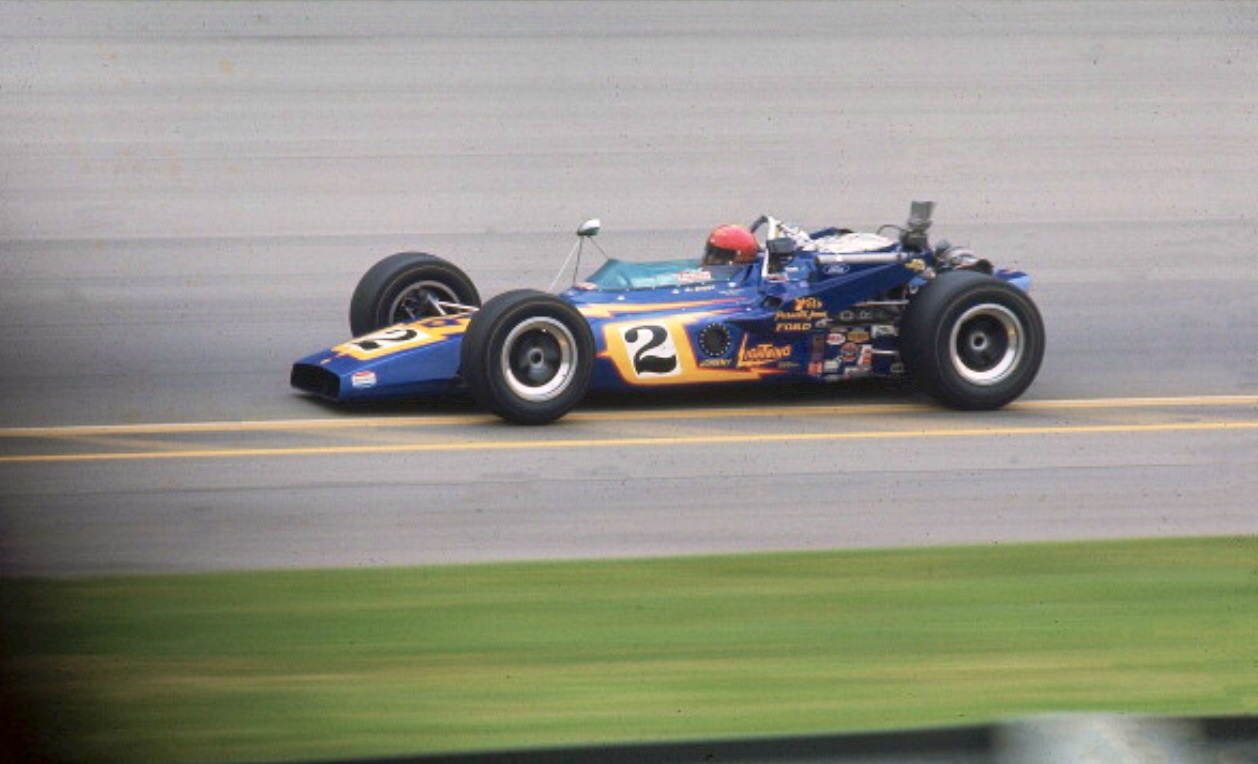
For 1970 the Lola-based Vel’s Parnelli Jones Special was again modified with aerodynamic improvements and changed its identity yet again to ‘Lola-Colt’… Bignotti and Dilamarter built two more cars using this proven and highly developed car as the pattern. They were known as ‘P.J. Colts’. In 1970 Unser used two cars; the 1968 continuously modified Lola T150 Ford as his short paved oval/road course car and one of the new Colts as his long circuit car including Indy.

Miletich and Jones signed Topper Toys as the team’s sponsor, its ‘Johnny Lightning’ blue livery with bold yellow lightning bolts outlined in red became one of racing’s most recognized, brilliant and striking liveries.

Unser had an amazing 1970 in which he won 10 of 18 starts including the Indy 500, had a record 15 top-5 finishes and 8 poles. It was close to total domination and set Al Unser on the way to his 4 Indy 500 wins.

image Unser in the winning PJ Colt Ford ‘Johnny Lightning Spl’ during the 1970 ‘500 (unattributed)

With the Lola T150 he won at Phoenix in the season opener, at Indianapolis Raceway Park in July, the Tony Bettenhausen 200 at Milwaukee in August and the Trenton 300 in October. He was two laps in the lead in the California 500 at Ontario in September when the transmission broke with just 14 laps to go.

Other placings included 3rd at Sears Point, Trenton and in the Rex Mays 150 at Milwaukee, 2nd at Langhorne, 5th on the road course at Continental Divide and 2nd at the season-ending race at Phoenix.

image

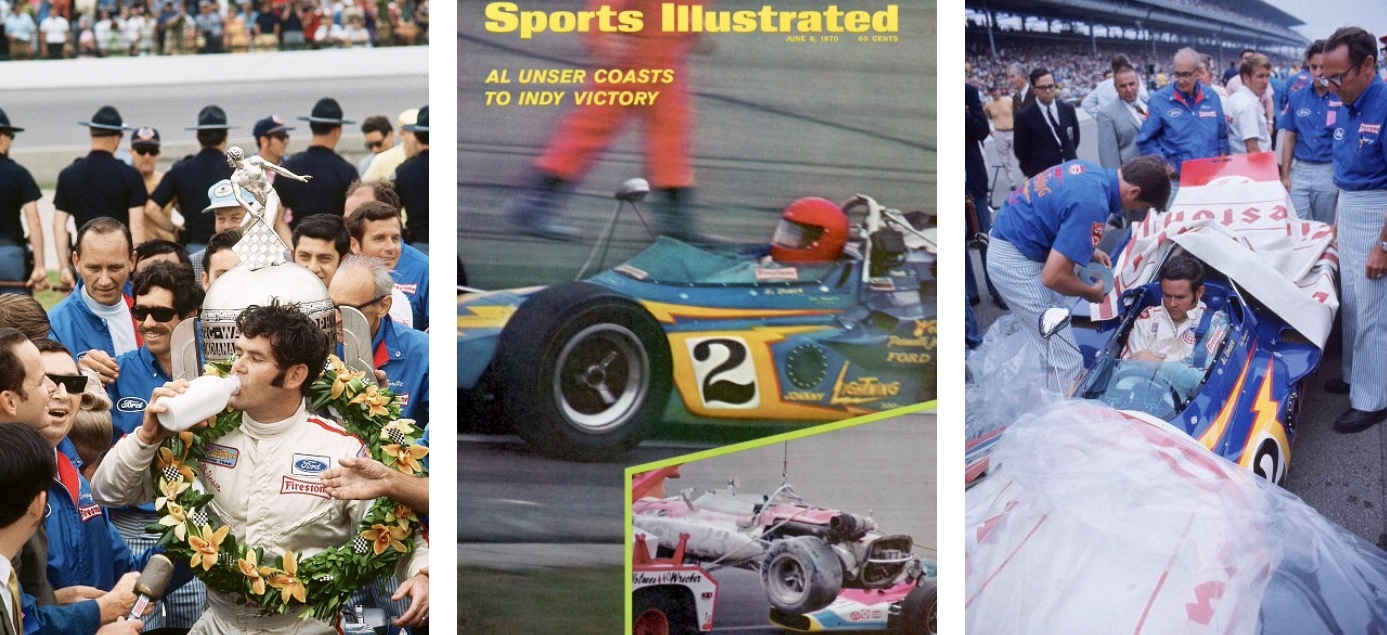
The 54th Indy 500 was held on Saturday, May 30, 1970, Unser dominated the race, winning  pole position and leading 190 laps en route to victory in the PJ Colt Ford. He joined his brother Bobby as the first duo of brothers to win at Indy. It was the first of 4 wins there for Al.

Joint car owner Parnelli Jones, race winner in 1963, became the second person (after Pete DePaolo) to win separately as both a driver and team owner. Unser carted $271,697 back to New Mexico of a record $1,000,002 purse, the first time an Indy prize fund topped $1 million.

Rain on race morning delayed the start by about thirty minutes. On the pace lap, Jim Malloy smacked the outside wall in turn 4, which delayed the start further. All 33 cars in the field were turbocharged for the first time.

al victory lane (Getty)

In his MotorSport interview with Kirby Unser gives full credit to George Bignotti. ‘Once George understood you he was absolutely a terrific mechanic. He could figure things out. George also always hired the right people. He put a team together and made it work. George had a knack for that. He was good at performing and making sure the car finished the races. As long as I didn’t crash, i finished the races. George Bignotti made my career. Without George I would’ve never been able to handle it.’

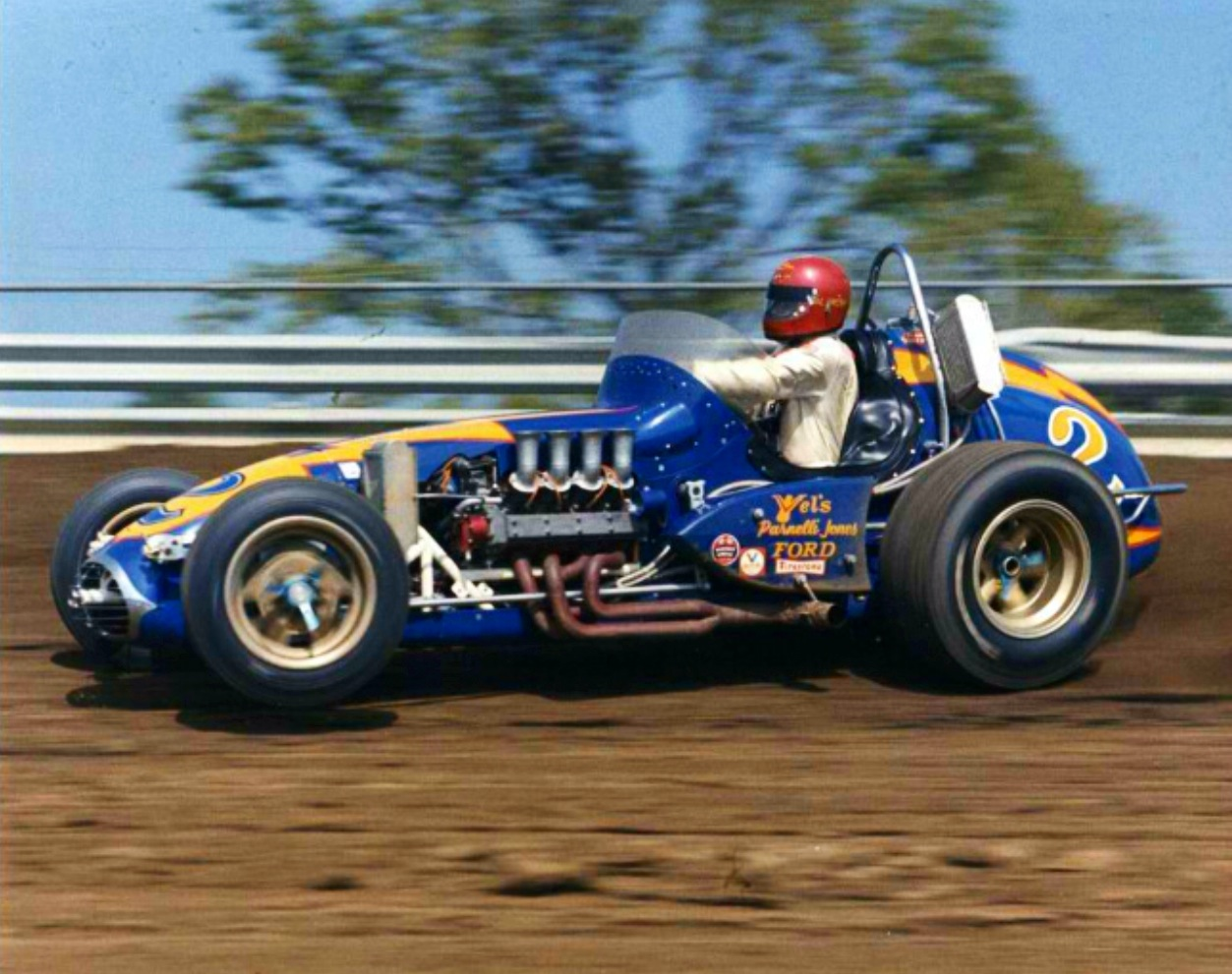
king ford Another ‘Johnny Lightning Spl’ 1970 win for Al on the way to his USAC crown, this time in the King Ford during the ‘Golden State 100’ at California State Fairgrounds, Sacramento on 4 October 1970. Al led 99 of 100 laps of 1 mile after Mario Andretti crashed his King Ford on lap 69

Big Al has fond memories of a great era in American racing and is disgusted with modern Indycar racing and the arrival of the spec car age. ‘People were always trying new things and looking for new ways of doing things. Today there isn’t any of that. It just tears me up. There’s nothing but a spec car to buy and you’re told what to do with it. You not allowed to do anything. It’s unbelievable!’

al clermont Unser in the ‘Retzloff Racing’, see the badge on the cars nose, at Clermont, Indiana in 1968 (Alvis Upitis)

Lola T150 Specifications 1970…

Aluminium monocoque chassis, Ford DOHC 4 valve turbo-charged 159cid V8 giving circa 900bhp@ 8500rpm, 4 speed Hewland LG500 gearbox.

Suspension; Front upper and lower wishbones with coil spring/damper units. Rear single top link, inverted lower wishbone, coil spring/damper units and single radius rod. Adjustable roll bars front and rear. Disc brakes and rack and pinion steering.

Originally delivered as a 4wd car for 1968, the car was converted to normal rear wheel drive as per the text in 1969. The T150 still exists, beautifully restored as does the PJ Colt ’70 Indy winner.

michigan Unser’s Lola T150 Ford beside Ronnie Bucknum’s winning Eagle Offy prior to the Michigan International Speedway race at Brooklyn, Michif gan on 13 October 1968 (Alvis Upitis)

Etcetera…

image

al and mario Al Unser’s Lola T150 Ford leads Mario Andretti’s Hawk Ford at Indianapolis Raceway Park, Clermont, Indiana on 21 July 1968, Al took the win (Alvis Upitis)
al and jlspl Unser and the stunning ‘Johnny Lightning Spl’ graphics. Lola/PJ Colt Ford, Indy 1970 (Bettman)

Credits…

glennmason.com, Alvis Upitis, The Enthusiast Network, Bob D’Olivo, Bob Jennings

Bibliography…

MotorSport magazine interview by Gordon Kirby of Al Unser, Sotheby’s

Tailpiece: Al Unser in the Indy Museum with the 1911 winning Marmon Wasp and tyres indicative of progress…

image