


Every now and again I dip into Australia’s intercity record breaking era of crazy speeds over vast distances on incredibly poor unmade ‘roads’ and could never find a summary of these adventures until now!
I tripped over H.O. Balfe’s article about 25 years of Melbourne-Sydney record-breaking, published in the Sydney newspaper The Referee on April 26, 1933, while doing research on Harry Beith. It was somewhat laborious to digitise, but it’s great ‘document of record’ stuff.
‘Melbourne to Sydney by motorcar in in 25 hours! Just a little over one day 572 miles ! What a speed!
Yes, they said that a quarter of a century ago when Harry James and Charlie Kellow first set figures for a speed run between Melbourne and Sydney by motor car.
That was in January 1907. Both James and Kellow are still on deck, and there in nothing more interesting than to get Harry James talking about that pioneer journey in their 26 h.p. Talbot. The roads were just bush tracks, mainly, and on the New South Wales side the heat was so terrific that at Yass the petrol containers they carried were distorted into egg shape.
“It’s plain hell further on,” said the country folk. That was an accurate description. For miles, James and Kellow and the gallant Talbot fought their way through bushfires in blinding, choking smoke, striving desperately not to think of what would happen were it to spark to lodge on a splash of petrol.
But James and Kellow won through, compared with that nightmare drive, present-day assaults on the record are mere joy rides.
Sydney was reached after 23 hours and 40 minutes. James and Kellow held that record for nearly two years, and lost it in December 1909, when C.G. Day and S Custance, likewise aboard a Talbot 25, in December got through in 21 hours 19 minutes.
And now the desire to capture that record was a fever in the veins of motorists. Only a few months elapsed, and then Syd Day and Will Whithourn, driving a 20 h.p. Vinot, a make that is never heard of now, sped across the 565 miles in 20 hours 10 minutes.
That was not bad going, in three years, 5 1/2 hours had been lopped off the original record, and still the roads were so bad as to give the daredevils of those days a thorough gruelling. It was not an uncommon thing to lose hours through having to stop to open gates and railway level crossings.
Before the pioneers did their Job and faded out of the picture, the record was to be smashed once again. That was in April 1910 – a month after the Day-Whitbourn effort – when White and Custance in their 25 h.p Talbot reduced the time to 19 hours 47 minutes. That was only 23 minutes better than Day and Whitbourn’s time, but it set a new record on the books, for it was the first time that the one driver had ever held the honours on two occasions.’

‘Then appeared one of the finest racing motorists who ever held a steering wheel – the late Arthur F Turner (actually Albert Valentine Turner) victim of a hill climb crash in N.S.W. some years ago.
In his first attack on the record, in May 1913, Turner had the most powerful car that had ever been tried out on the Sydney-Melbourne road – a 50 h.p. American Underslung. In spite of road surface difficulties and a good deal of tyre trouble, Turner reached Melbourne in 19 hours 2 minutes. But he was very disappointed, he expected to reduce the previous best time by at least two hours.
The outbreak of War put an end to record-breaking feats until March 1919, when Boyd Edkins, another whose name and fame as a racing driver will not readily be forgotten, drove a Vauxhall (1914 Vauxhall A-Type Prince Henry chassis A210 aka ’50 Bob’; in our pre-decimal currency days 50 bob was two-pounds, 10 shillings – the chassis number) between the two capitals in what was then the remarkable time of 16 hours 55 minutes. Edkins was content with his one smack at the record. He never did it again.’

Five years elapsed before Edkin’s record was broken, and it was the redoubtable A.V. Turner who did the breaking. Incidentally, Turner ushered in one of the most hectic periods in the history of the inter-capital dash. In his sports model Delage he flung the 565 miles behind him in 16 hours 47 minutes.
Two weeks later, Norman Smith appeared on the scene for the first time, and with Earle Croyadill, a clever mechanic beside him, cut the figures to 15.38, driving an Essex with a much higher compression ratio than was usual in those days.
The roads, particularly on the Victorian side, were better now than ever they had been, and the attacks on the record lost their one-time aspect of reliability trials and became furious races against time.
In a 30 h.p. Vauxhall, S.C. Ottaway, a Sydney owner-driver, was responsible for a remarkable piece of driving which brought the record down to 14.43. That was in January 1923. But the new time stood for only a fortnight before it crumbled to 14.28 under the onslaught of Smith and Earle Croyadill. The Essex came through without trouble or incident of any kind, but hardly had time to cool off before A.V. Turner, in a Delage owned by R Kirton, of Sydney, reduced the time to 13.47.

Smith, in the meantime, had taken the Essex to Tasmania, where, with Bert Henthorn as passenger, he drove from Launceston to Hobart and return (242 miles) in 4 hours 18 minutes. With Tasmanian dust still in his overalls, so to speak, Smith and L Emmerson, on Monday, December 24, 1923, burned up the Sydney-Melbourne road once again, and now the record was down to 12 hours 59 minutes.
Turner waited three months and then renewed the duel that had been of absorbing interest to motorists all over Australia. In March 1924, after completing the Dunlop 1,000 miles reliability trial, with a 20 h.p. Itala, determined to have another shot at the record in this car. He was successful, 25 minutes being chopped off Smith and Emmerson’s time. Arthur O’Connor was Turner’s mechanic on this occasion.

Neither Smith nor Turner ever attacked the Sydney-Melbourne record again. As a matter of fact, times were being cut down to such an extent, and speeds were creeping up so high, that the Victorian Police and municipal authorities commenced to frown severely on record-breaking attempts, and even the Royal Automobile Club of Victoria issued a statement that no good purpose was being served by them.


There was a lull, therefore, until March 1927, when E.J. Buckley and Harry J. Beith began another duel. Accompanied by C.E. Cooper, and driving a stock model Hudson, Buckley dashed over the route in 11.51. A great drive, but it was eclipsed a month later by Harry Beith’s 11.14 in a Chrysler 70.
Right on the heels of this came Buckley again, with a 10.51, also in January 1928, and two months later Buckley and Cooper reached an average of 53 m.p.h. in registering 10 hours 51 minutes. Beith did not wait longer than a week before dashing off again, and this time, in February 1928, he regained the record with 10.42.

Not to outdone, Buckley and Cooper pushed off again on April 10, 1929. They still had their stock model Hudson, but in the interim, it had been further “hotted up”, and an average of 55 miles an hour carved out the journey in 10.24.
In October 1929, the Chrysler 70 was brought out again. Beith set out from the Melbourne G.P.O. and, until after the Victorian border was reached, looked as though he was going to be the first to break 10 hours. He was well inside his schedule until Gundagai was reached, and there a broken fan belt held him up for an hour – a precious hour. His route on this occasion was 575 miles, and it is obvious that but for this mishap, he would have been the first to set single figures for the hour tally.

Beith and Buckley retired, and in March 1930, there appeared a new Richmond in the field – one Don Robertson of Vaucluse, N.S.W. Robertson, a Graham-Paige owner, was in Melbourne for a holiday, and found his car going so nicely that he determined to attack the inter-capital record. Going back to Sydney, he stripped her and fitted a three-ply chassis.
All went well on the dash from Sydney until after Robertson, past Mittagong. Then he ran into a fog bank that encompassed him for 70 miles. However, he was inside his schedule at Albury, where Harry Beith waited to pilot him through, but at Tallarook, on the Victorian side, a puncture delayed him for some minutes.
Splendid Average
In spite of all of this, Robertson reached Melbourne after 10 hours and 5 minutes – truly a wonderful feat for an amateur driver at his first attempt. He had the splendid average of 57 m.p.h.
Robertson was so fresh on reaching Melbourne that his friends had their work cut out to dissuade him from turning around and racing back to Sydney.
While the records for all-powers cars were steadily being whittled down, the light car drivers had not been inactive. The first to create a light car record was A Vaughan, who, in company with G McKennzie, in December 1923, drove a four-cylinder Citroen from Melbourne to Sydney in 15 hours 20 minutes, averaging 38 m.p.h. Some stretches of the road were very bad, and a 28-mile detour near Gundagai made the full distance 593 miles.
Several years elapsed before H. Drake-Richmond in a 30S Fiat, sped over the route in 14.20, and the next holder of the record was C.R. Dickason, who, with H.D. Burkill as passenger in a stock model Austin 12, drove all the way in top gear, registering 13.20, averaging 43 m.p.h. and reaching 70. The previous Sydney-Melbourne record for a car in top gear all the way was 21 hours.


W.G. Buckle, in a Sports Triumph ‘super seven’, cut Dickason’s time to 14.16 in March 1930, and two months later J.E. Bray, of Sydney, in a standard sports Morris Minor, recorded 13.9 after experiencing heavy rain and bad road conditions on the N.S.W. side.
Bray held the record for only eight days, when it was wrested from him by previous holders in Dickason and Burkill in their ‘Baby’ Austin, their time being 12.30, after running into heavy gales and rain in places on the N.S.W. side, striking patches on the roads that were litte better than quagmires, and where they had to travel in low gear for many miles, and damaging a back wheel through a puncture at Seymour.
Then came Tragedy. On June 8, 1930, Reg Brearley and Albert Elliott, two of Victoria’s best-known drivers, set out from Sydney in a Bugatti (Bugatti T37.37146 was second in the 1929 AGP driven by Brearley and is now owned by Tom Roberts) to make a secret attempt on the record. While rounding a sharp bend on the approach to Howell’s Creek, nine miles from Gunning (N.S.W.), the car left the road, leapt an embankment and somersaulted. Brearley was killed instantly, and Elliott died in Yass Hospital the same day.
And now the light car record, made a couple of weeks ago by Arthur Beasley in his Singer 9 stands at 11 hours 59 minutes. That the “little fellows” will reach 10 hours is certain.’
Etcetera…
Racing Drivers
Most of the drivers mentioned in this article were professional drivers involved in the burgeoning motor industry as dealers and repairers or as employees of importers, dealers and repairers.
They were also competitors by nature or necessity, where the motorsport events of the day – say circa-1925 – comprised trials, hillclimbs, sprints, more serious stuff on the bankings of Maroubra or Aspendale, at Penrith or perhaps the dusty circuit at Lake Perkolilli. Not to forget intercity or cross-continental record breaking. The first Australian GP wasn’t held until 1927 with circuit racing as we now know it ‘common’ from the mid-1930s.
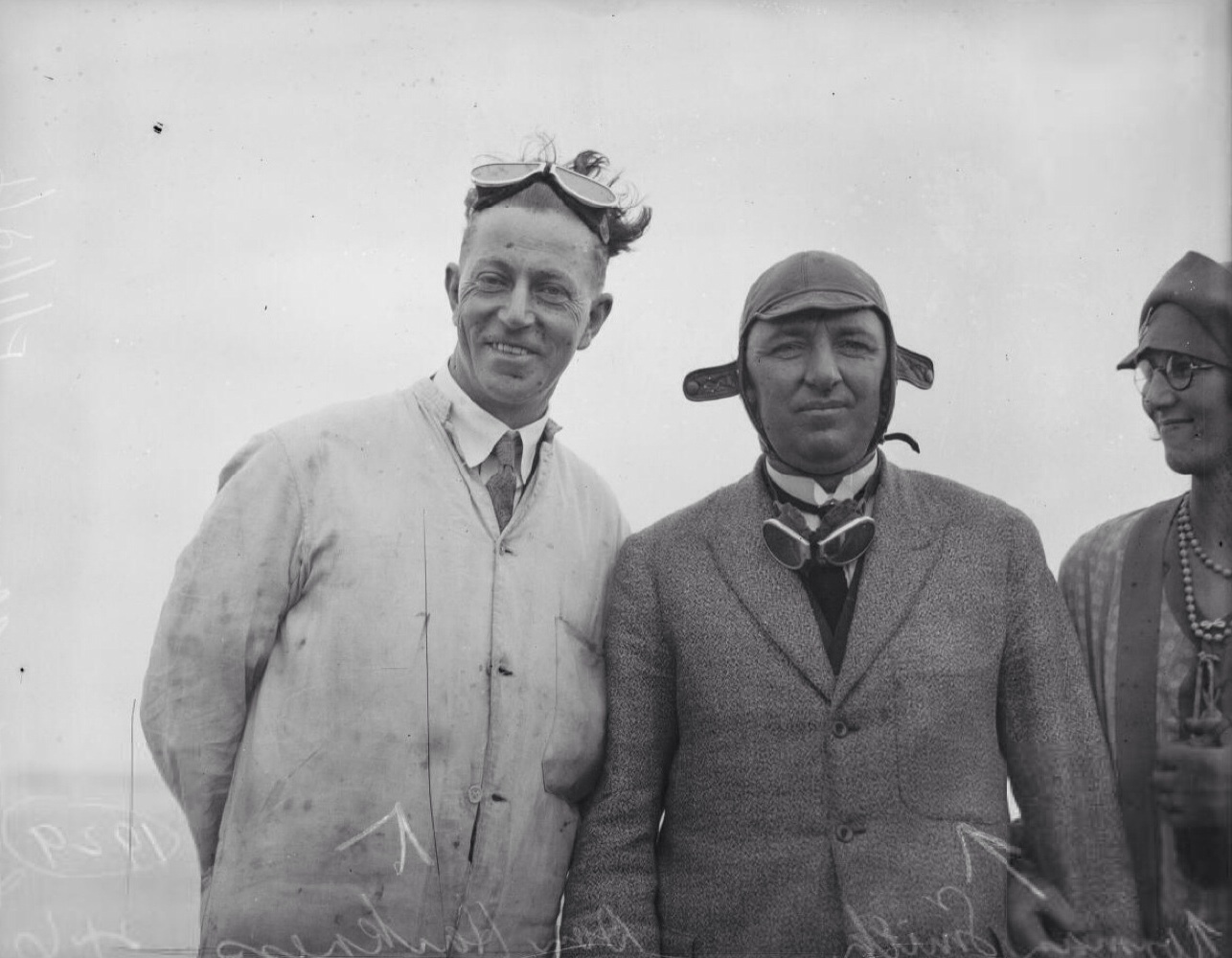
The roll call here of blokes in these categories includes – in rough order of Melbourne-Sydney appearances – AV Turner, Boyd Edkins, Wizard Smith, EJ ‘Joe’ Buckley, Harry Beith, Harold Drake-Richmond, Cyril Dickason and Reg Brearley.
Chrysler’s and Harry Beith’s Crowning Achievements
On February 4, 1928 The Armidale Chronicle reported that for the second time in one month Beith, lowered the Sydney-Melbourne road record in a Chrysler 70, on the last occasion down to 10 hours 42 minutes, an average speed of 58.88 miles per hour.
At that time, Chrysler, in addition to holding the Australasian 1000 mile speed record, also the 24-hour record, held every Australasian record between adjacent State capitals, an achievement never before attained by any other make of car. ‘Designed to Perform-Built to Endure’ indeed!
That Tragedy
Yass Coroners Report : Daily Advertiser Wagga Wagga June 21, 1930
Speed Records : Coroner Urges Prohibition
Needless to say, the Coroner reporting on the death of Messrs Brearley and Elliott (Mr J.W. Yoe in Yass) found the obvious, that they were killed (fatally injured in the wordy manner of legal folk) while attempting the light car motor record between Sydney and Melbourne, then added the following rider:
‘Immediate representations should be made to the authorities on the extreme urgency of action to bring in regulations to fix a reasonable speed limit and to prohibit absolutely motor car and motor cycle record breaking. Speed records are business propaganda and are of no public use , while they are a great source of danger to those making the attempts and to the travelling public.’
Speed Records and Their Significance : The Newcastle Sun March 31, 1927
The leader writer of The Newcastle Sun had an interesting philosophical and prophetic slant on speed.
‘The breaking of the motor speed record with a pace of 203 miles an hour (Sir Henry Segrave, Sunbeam) , though it may be received glumly by pedestrians, has certain Implications which are worth considering.
Of course until shire and suburban councils build roads equal to those which nature has built on the Florida beach, where the record was made, such speeds will be impracticable in any wheeled vebicles.
Vehicles not supported by wheels but by air, however, have no limit to their possible speed except that imposed by the ratios of structural strength to weight and weight to engine power.
This record car speed has again and again been exceeded by airmen. Speeds of between 250 and 300 miles an hour are not uncommon. A practicable speed of 250 miles an hour would girdle the earth in 100 hours, about four days. Within the space of time it now takes to reach New Zealand from Sydney by sea, a man might start at Singapore and flying east over the Phillippines, Panama, the Gold Coast, and India, return along the world’s greatest circumference to Singapore.
Puck’s forty-minute Journey (Puck’s line from A Midsummer Night’s Dream is I’ll put a girdle round the earth in forty minutes”), of course, has not been reached, and never will be reached. Such a speed would exceed the planetary speed, which melts the meteor in the upper atmosphere. But a four-day trip around the globe is as certain in the future as any human certainty can be.
Even now Jules Verne’s hustling traveller who made the circuit an 80 days one seems a leisurely fellow compared to Captain Cobham, who flew to Australia and back recently in six weeks out and a month back, with frequent long stoppages. In a few years this journey will be done without the long stoppages, and Australians will leave Sydney or Melbourne on Friday night and reach London on Tuesday morning.
Despite then the condemnation of the psychologist and the contempt of the philosopher, speed records insofar as they mark higher and higher peaks in mechanical efficiency and control, have a very definite practical meaning in the narrowing of what 25 years ago seemed a very large world indeed.
Whether we will be any happler or better when we can take a three or four day jaunt to London is a matter which may be left to philosophy. Probably we will not. The conveniences of life do not necessarily bring happiness. That, however, does not prevent them from being used.
Speed for the sake of speed seems rather a futile business, but speed harnessed to utility is the whole keystone of modern civilised progress. Old slow processes are continually being replaced by faster ones. The car in ousting the horse and the motor ‘bus the street railway, because of its higher speed of transit. The steam and oil driven vessel has driven the “wind-jammer,” its beauty and its leisurely acceptance of calm and storm, off the seas. Within a very few years, as we count the life of man, the air vessel of the future will make the passenger liner as obsolete as the wool clipper is today.
The Court of Public Opinion
SPEED RECORDS R.A.C.V. ATTITUDE The Age Melbourne June 21, 1930
Strong condemmation is expressed by the Royal Automobile Club of Victoria at attempts to make speed records such as led to the untimely death of Messrs. Reginald Brearly and Albert Elliott when endeavoring to lower the light motor car record between Sydney and Melbourne on 9th inst.
“The R.A.C.V. has always sets its face against such practices,” said a prominent office-bearer of the club yesterday, “and it has taken special pains to warn drivers against them.”
While adopting this attitude, members of the club point to the change of thought that has taken place respecting the enforcement of a general speed limit. This remarkable change of attitude in recent years regarding limitation of motor car speed is strikingly illustrated in a draft bill to regulate road traffic prepared last year for presentation to the British Parliament. The first schedule to the bill, dealing with motor cars and motor cycles used for passengers only, stipulates that if all the wheels are fitted with pneumatic tyres and the vehicle is not drawing a trailer and is constructed to carry not more than eight persons in addition to the driver, “there shall be no speed limit.” Or, “if all the wheels are fitted with pneumatic tyres and the vehicle is not drawing a trailer, and is constructed to carry more than eight persons in addition to the driver,” the speed limit shall be thirty miles an hour. In any other case – of such vehicles – the speed limit in restricted to twenty miles an hour.
On this question of speed limitation the Royal Commission for Transport in Great Britain, in its first report to Parliament in July, 1929, says:-“We have been at great pains to obtain all the relevant evidence possible on the question, and have received statements showing the practice in various countries abroad.”
Every one of the motor organisations (meaning thereby such bodies as the Automobile Association, the Royal Automobile Club, the Royal Scottish Automobile Club and the Society of Motor Manufacturers and Traders) strongly advocates the abolition of a general speed limit for motor cars and motor cycles, and also of special speed limits in towns or villnges, holding that for the purpose of checking dangerous driving it is far better to rely on the powers given or to be given in the clauses of the Road Traffic Bill dealing with dangerous driving than on the rigid enforcement of speed limits.
“This,” the report says, “might have been expected, but the same view was put forward by, among others, the Country Councils’ Association, the Urban District Councils’ Association and the Association of Municipal Corporations.
“The police were divided on the question. The Commissioner of Police of the metropolis advocated a general speed limit of thirty-five miles an hour, as did also a majority of city and borough chief con• stables, while on the other hand thirty-seven out of fifty-five county chief constables were opposed to all speed limits other than those mentioned in the first schedule of the Road Traffic Bill.
The report proceeds to say that opponents of speed limits for motor cars and motor cycles put forward the view that the enforcement of speed limits diverts the attention of the police from watching dangerous corners and congested portions of roads and streets by compelling them to set traps on open stretches of road where little or no danger exists; that the psychological effect on motorist: speed limits is bad, in that it causes them to think that If they do not esceed the speed limit prescribed they are driving with safety, whereas forty miles an hour may be quite safe under certain conditions and five miles an hour may be dangerous in other cases; that speed in itself is not dangerous provided the car is under proper control; aud that the proper remedy is to subject the really reckless driver convicted of dangerous driving to very severe penalties which could not be inflicted on a man who had been found guilty of a technical offence only.
Epitomising the results of very careful consideration of all the evidence the commission’s report says:-“We have come to the conclusion that provided all wheels are fitted with pneumatic tyres there should be no general speed limit for motor cars or motor cycles.”
MOTOR SPEED RECORDS The Age, Melbourne June 12, 1930
‘Difficulties of the Police
The difficulties experienced by the police in preventing motor speed records between capitals being attempted over the public roads were seferred to yesterday by the Chief Secretary in commenting on the death of two men who were killed in trying to lower the Sydney-Melbourne record. One of the difficulties, he said, was to prove that the men who participated in the tests drove their car in a manner daugerous to the public, and the fact that two men had been killed during the week end seemed to indicate that the danger was with them.
Of course, high speeds might be dangerous to persons using the roads, but he could not recall a case of any person having been injured by record breakers. Unally the tests were quietly arranged, and the police did not know when they were being held. Even it they did it might be necessary to have policemen stationed all along the route to secure the necessary evidence that the record breakers were driving at a speed dangerous to the public. Instructions had been issued to the police to try to enforce the laws relating to speeding, and he was satisfied that the department was doing all it could to enforce them, but the difficulties were great.’
‘Attitude of the Light Car Club.
The honorary secretary of the Victorian Light Car Club (Mr. O. F. Tough) stated yesterdny that the policy of the Victorian Light Car Club was antagonistic to attempts to break motor car records on public roads, and that the club had always refused to assist, start or check in any of the competitors.
Mr. Tough anid the committee felt it was necessary to make this statement, as some persons thought the club was assiting these attempts owing to the fact that the late Mr. R. Brearley, who was killed while attempting a record, was a member of the club.’
MOTOR RECORDS. VICTORIAN BAN. PROSECUTIONS INSTITUTED. Sydney Morning Herald January 8, 1929
‘Commenting on an announcement that two Englishmen, Messrs. J. E. P. Howey and R.C. Gallop, had arrived in Sydney, and intended to attempt to break the motor car speed record between Sydney and Melbourne, the chief of the Traffic Control Branch, Sub-Inspector Salts, sald today that the proposal was against the law in Victoria, The names of the motorists would be taken. and prosecutions would follow.
Section 18 of the Highways and Vehicles Act expressly forbade the use of motor vehicles on public highways for purposes of racing or trial of speed, and made offenders liable to penalty not exceeding £50.
Sub-Inspector Salts added that the police had taken action against motorists attempting to break records on previous occasions.
Action would shortly be taken against two motorists who had left Melbourne in an attempt to break the record between Melbourne and Perth recently. The names of the motorists had been taken before they left Victoria.’
So, it seems clear from this piece that in Victoria at least, intercity record-setting was illegal.
Taking The Piss
LIGHT CAR RECORD Sydney to Melbourne The Argus Melbourne June 19, 1933
‘Driving a Bugatti car, Mr. J. Clements, of Sydney, accompanied by W. Warneford (mechanic), broke the record for a light car from Sydney to Melbourne on Saturday (June 17) by 20 minutes. The time for the journey was 10 hours 53 minutes (The Referee gave the time as 10 hours 50 minutes), giving an average speed of more than 50 miles an hour.
The previous record was established a few weeks ago by Mr. C. Warren.
Messrs. Clements and Warneford left the General Post-Office, Sydney, at half-past 6 o’clock on Saturday morning, and at 23 minutes past 5 o’clock in the afternoon they arrived at the Elizabeth Street, Melbourne post office where they were checked in by officials of the Victorian Junior Light Car Club.
If it had not been for a mishap between Gundagai and Albury, which caused a delay of an hour, the record would have been broken by a much wider margin. The car was ftted with eight P214 Pyrox sparking plugs, which were sealed before the attempt on the record was begun.’
In due course, Jack Clements was hauled before the courts. The Argus report of August 3, 1933, is almost impossible to read, but the gist of it is that he admitted the facts as presented by the wallopers and was fined £5.
The Bugatti Jack Clements used to take the light car Sydney-Melbourne record was Australia’s most famous Bugatti, the ex-AV Turner/Geoff Meredith 1927 Australian Grand Prix winning 2-litre straight-eight Bugatti Type 30 Special, chassis 4087, the very significant core components of which are owned by Melbourne Automobilists the Murdoch family.
Photo and Reference Credits…
The Referee April 26, 1933 article by H.O. Balfe, Col Blundell Collection, The Newcastle Sun, The Age, The Argus, and other multiple newspapers via Trove, Cyril Dickason Archive via Tony Johns, Tim Shellshear Archive, the State Library of Victoria, Robert Robinson
Tailpiece…

WILL PROBABLY BE BROKEN. SYDNEY-CANBERRA SPEED RECORD. Mr Lyon’s New Car. The Evening News, Rockhampton April 14, 1934
‘Records between Sydney and Canberra which are now held by the Prime Minister’s chauffeur, ‘Tracey’, will probably be broken by that driver when a new high speed British car, which has just been purchased for (Prime Minister) Mr. Lyons at a cost of £1000, is delivered.’
How cool is that, the Prime Minister of Oz and his chauffeur held an Australian intercity record!
‘This car has a speed range up to 80 miles an hour and will enable the Prime Minister to cover the distance between Canberra and Sydney in about four hours. A fast car is necessary for Mr. Lyons, who makes frequent official visits to Sydney. The car, which he is now using, enables him to return to Canberra in good time after a day’s work.
The Sydney car used by Federal Ministers in Melbourne is to be replaced by the car now used by Mr. Lyons.’
The question then is, of course, what the make and model of the cars was. The best I could find is the shot of Lyons above with one of his cars in Devonport during 1931, the year before he became PM (January 6 1932-April 7 1939, his date of death).
Finito…













 primotipo...