

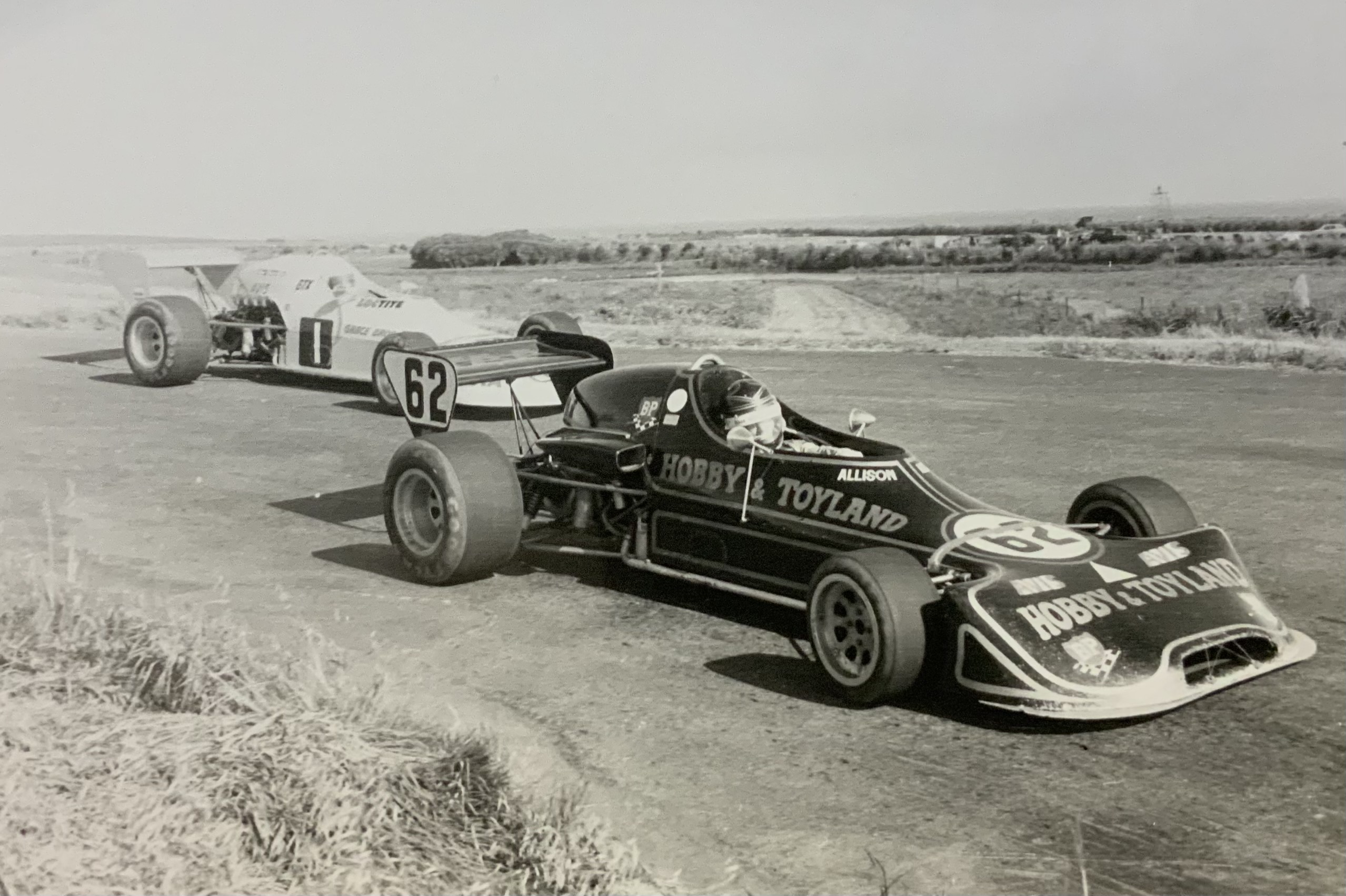
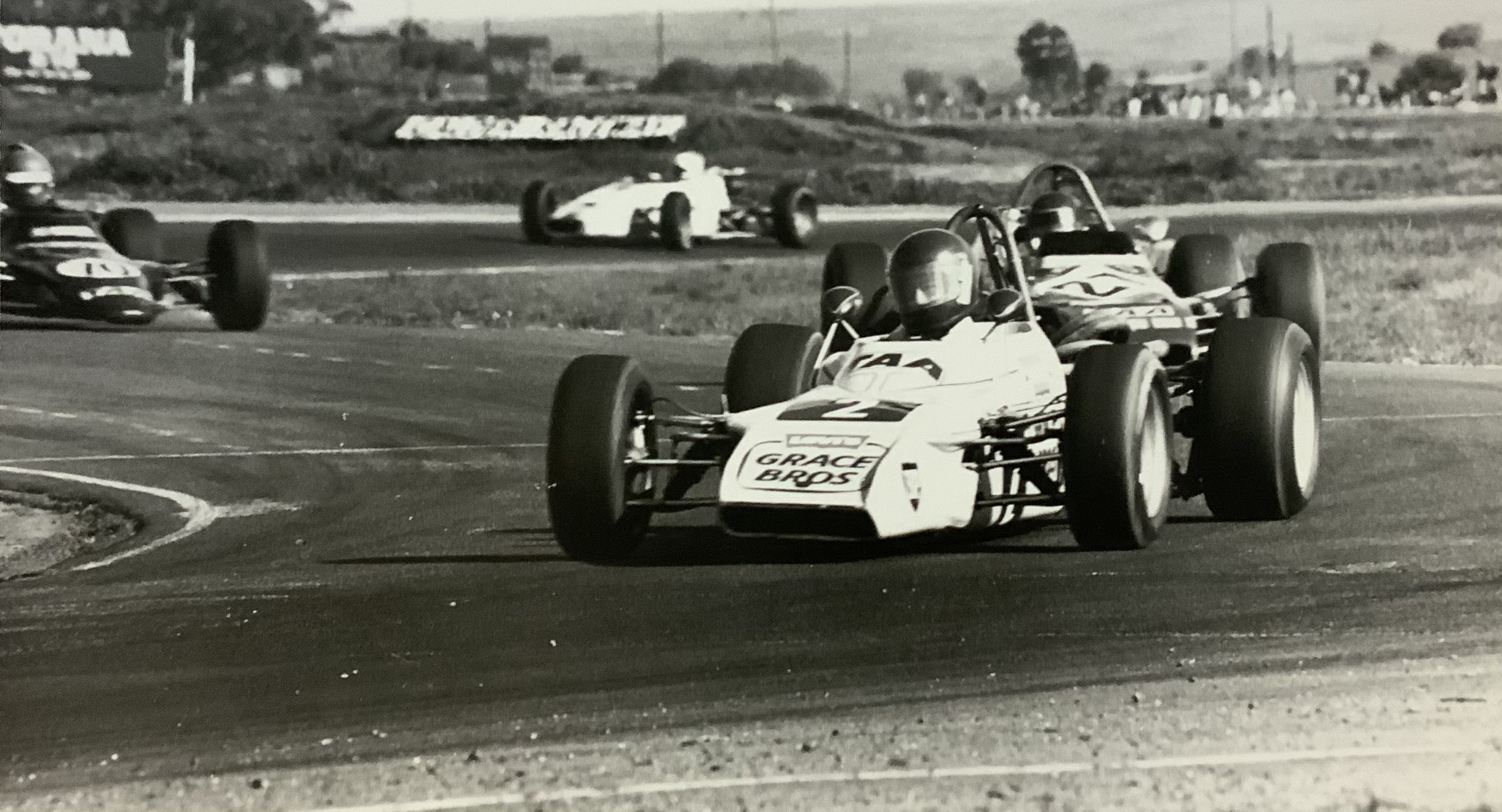
Modern enthusiasts probably know of Birrana Racing as an outfit which won multiple Gold Stars running Reynard Formula Holdens. But for some of us, the most exciting period of Malcolm Ramsay’s lifetime passionate commitment to motor racing was the 1971-1974’ish period when he and his business partner, Tony Alcock, and their small crew at Logan Street, Adelaide built 20 or so jewels of championship winning FF, F3, F2 and Formula Atlantic single seaters. Oh yes, there was a VW powered mid-engined speedway Speedcar too, which rather shows they were not lacking innovation!
At the end of 1974, they ceased volume production, building racing cars simply wasn’t profitable. Mal constructed a few more racers in the ensuing years. Tony Alcock, the designer/fabricator, ran Bob Muir in British Formula Atlantic in 1975. Adelaide entrepreneurs Bob and Marj Brown took their two updated Birrana 273s to England for a season. Bob did well with several thirds and a fourth place in the two year old car among hotshots like Tony Brise, Jim Crawford, Brian Henton and Gunnar Nilsson.
Like Tony Brise, Tony Alcock joined Graham Hill’s Embassy Racing F1 team. Similarly, he was at the fateful Embassy Hill GH2 Ford Paul Ricard test on November 29, and subsequent Piper Aztec flight back to Elstree Airfield, England. Graham Hill crashed the aircraft in thick fog at Arkley Golf Club killing all aboard; Alcock, Hill, Brise, designer Andy Smallman and mechanic Terry Richards.
It was a monumental tragedy, to say the least.
What might have been for all of them, not least Tony Alcock? During 1974 he wrote a regular Auto Action column. This May piece is about Birrana’s design process. I found it interesting, and reproduce it for that reason, and also to put on electronic record the members of Birrana Cars during that golden 1972-1974 era.
“I always liken designers, fabricators and mechanics as the racing equivalent of a TV production team. We know that the actors get most of the recognition, but of course the truth of the matter is that without the script writer, producer, director, film crew and so on, then the actor would be nowhere. Now although the modern race driver is an important part of the final product, it is the men behind him, the fabricators, welders, machinists, fibreglass men, painters, platers etc who make up the initial 80% of the total effort.”
“It is our job, Malcolm Ramsay and myself, at Birrana Cars to assemble all these tradesmen in the correct sequence to present a product such as the 2/374 range of cars. Basically, our respective roles are something like this.”
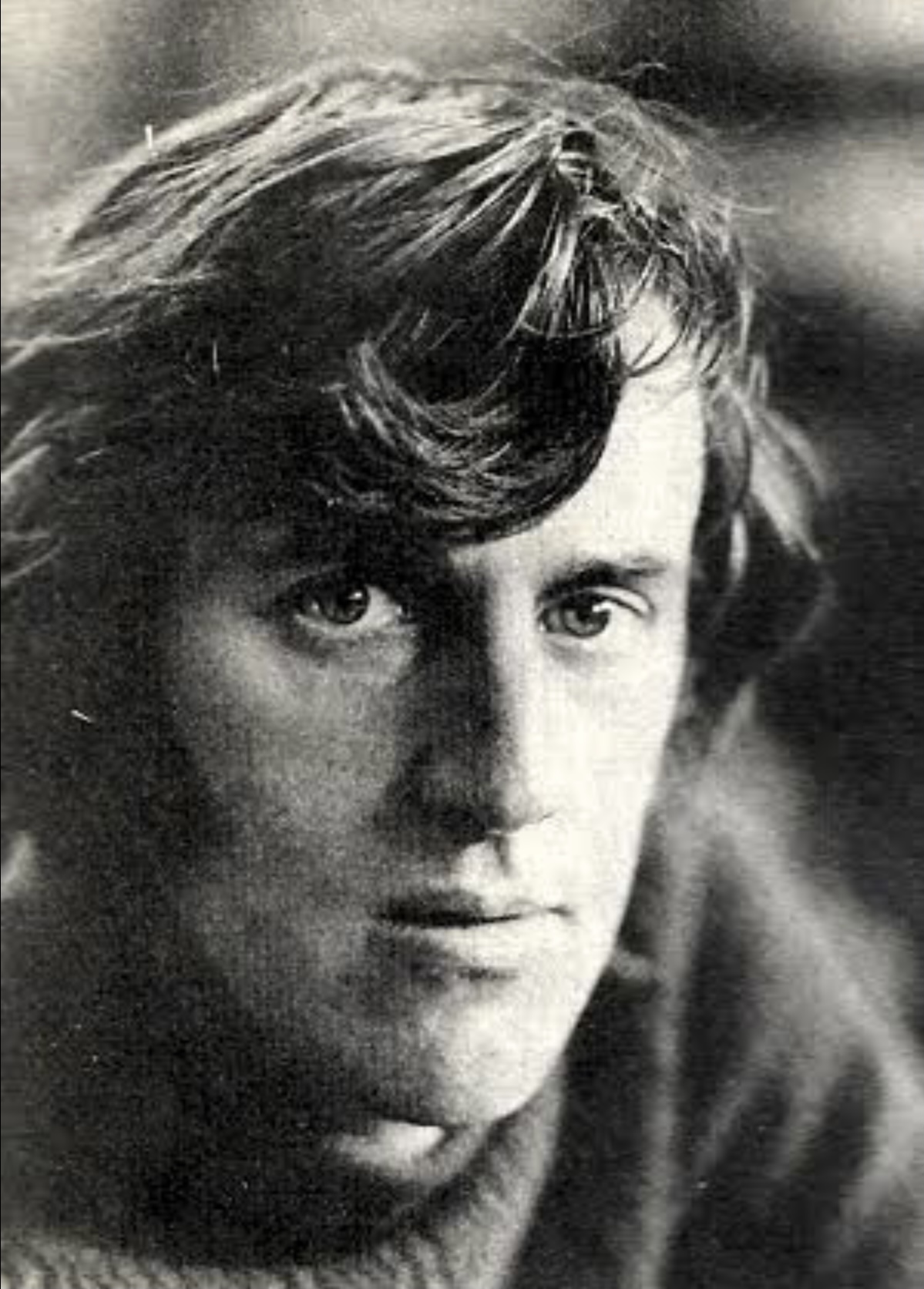
“Starting with the previous years car, we decide on the areas which we feel need improvement and together with experiments which we have tried in some form or another during the year, we begin to formulate some sort of basic outline for our new model. At this stage I usually work at home so that the work can be achieved without interruption enabling the car to be drawn up as quickly as possible.”
“Whilst I do most of the basic design work, I reckon that two heads are better than one, so there is constant communication between Mal and myself. At the same time as the drawings start coming through, he is organising a supply of raw materials, radiator suppliers, rack and pinon assemblies, pattern makers etc.”
“From the basic chassis drawings, which comprise an overall side and top elevation, there are detailed ones of each bulkhead and suspension pickups, rear frames, suspension systems, body shape etc. From these more detailed drawings, Brian Farquhar, our welder, constructs the chassis and suspension jigs and from these the bulkheads and wishbones. Mike Lobanof machines the chassis and suspension bushes, discs, wheels, castings and so on. John Porter, our ‘March-immigre’ specialises in detail fabrication such as wing brackets, radius arms, parallel link brackets, headers, tanks, etc. I usually fold-up the tubs and Mal and I both attack the body mock-up prior to him doing the moulds. Our other man, Peter Nightingale, can usually be found stripping and rebuilding our existing cars as well as maintaining our Hart engines and Hewland gearboxes.”
“All of this is an over-simplification of the effort and just plain hard-yakka, which often means an all-nighter or two, but it is the general scene, which goes on at Elfin or Bowin or many other manufacturers.”
“As you can see it really isn’t very exciting or glamorous, all this back-room work, but to us it’s all worth it as the frustrations and heartaches suddenly vanish when our sparkling new creation is wheeled out to the start line ready for its first race.”
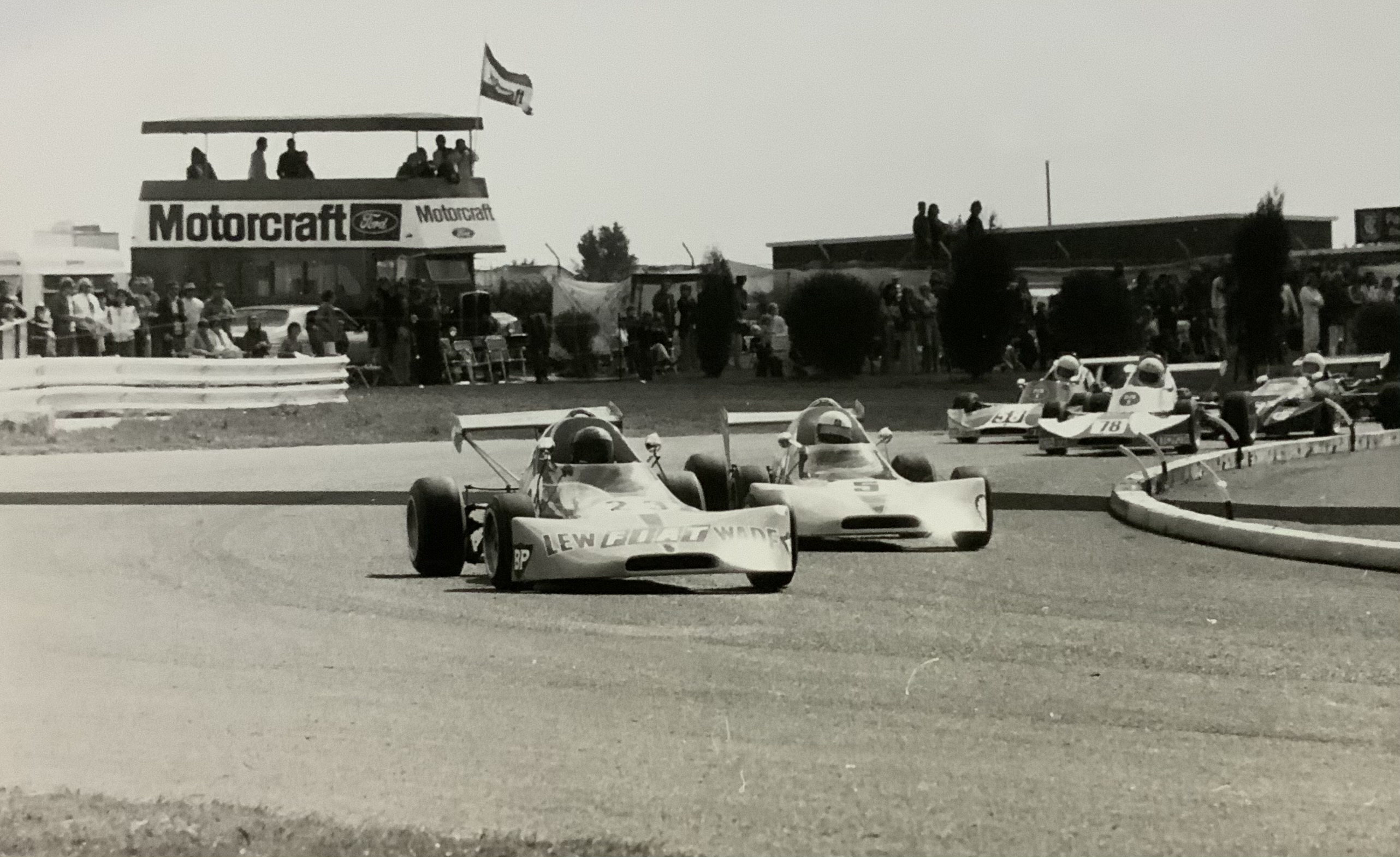
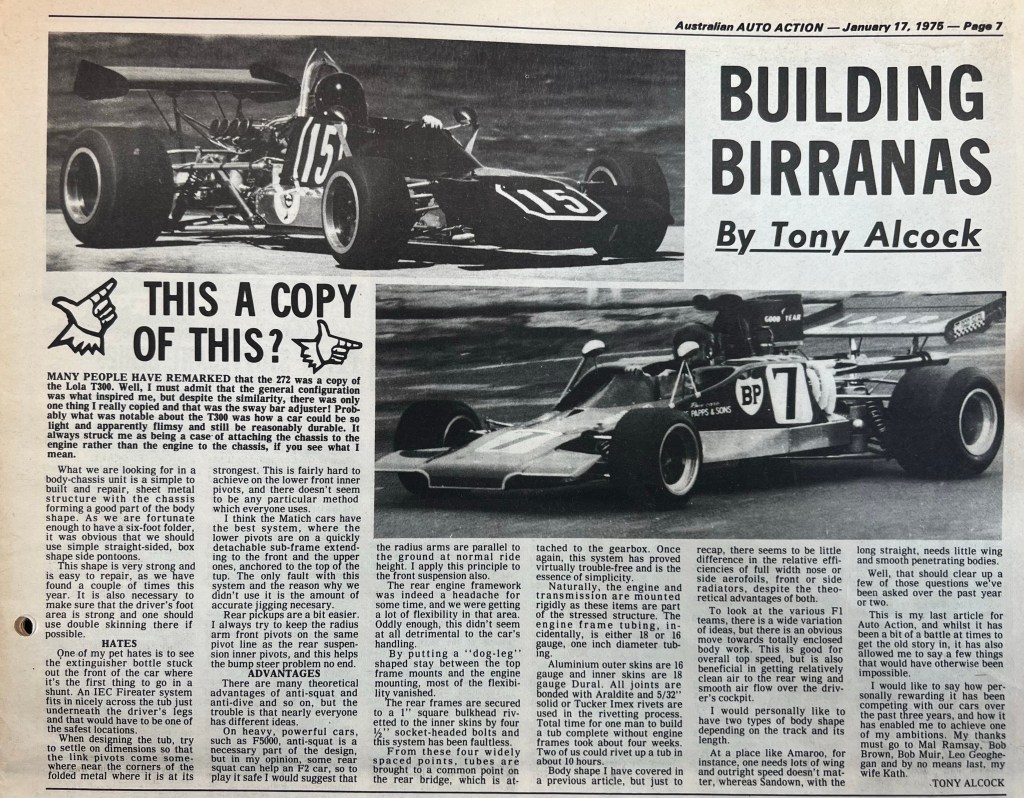
I SUPPOSE I MUST HAVE RECEIVED a least a dozen letters over the last couple of months from people asking me about the cars.
Questions such as: “How do I go about designing a racing car?” “Or what determines where you put the roll centres?” Or “I am building a model, could you supply me with all the necessary dimensions?” and so on.
What I propose to try and do now is to give a brief run down in this and the next article on my method of designing and building a (reasonably) successful formula 2 car.
I hope I don’t make it sound too easy because it sure isn’t.
Bear in mind that I am starting right from scratch because that is precisely what I had to do with the first F.F. and the 272.
Looking through every motor magazine over the previous two years, I was able to get an average of what the wheelbase and front and rear track should be, I added two inches to these measurements because that was the way things were heading and all things being equal is the obvious way for stability and ease of driving.
I arrived at a 94” wheelbase and 57½” rear and 56″ front tracks, I increased this to 58½” and 58″‘ respectively in the 273 while the wheelbase stayed at 94″‘
There was a tremendous amount of research into the front and rear upright and brake assemblies too detailed to go into here.
Roughly, the front upright was based on the Triumph Herald upright pivot point dimensions.
However that has a king pin inclination of around 9 degrees which was too much, ao I settled for 5 degrees K.P.I.
This gives less change of camber on turns.
LIVE STUBS
Also, I wanted to use the live front stub axle, being a more rigid item and giving less offset from the upright pivot points to the centre of the contact patch.
A lighter steering effort results the closer these points are. So that a compromise is gained between lightness and feel, I settled on roughly 2½” which ties in nicely with the axle and disc brake set up.
Right, now we have a centre-line of the tyre, a tyre size, an axle centreline, two outer pivot points on the upright and a track,
What roll centre to use? From 15 years experience I settled on 2½”, in other words an educated guess. This has been raised progressively in subsequent models.
Now we come to a dimension called the virtual swing arm length. This is usually 2 to 3 times the track.
From here on, we have to start using a drawing board and the following details relate to a frontal view of the car. I try to work full size where possible for accuracy, but a scale drawing is acceptable.
LINE
Draw a line from the centre of the contact patch, through the roll centre until you reach a vertical line which indicates the length of the virtual swing arm length. Where these lines cut, draw back two more lines to the upright pick up points.
These are now the angles on which the front suspension links will be.
The lengths of these links can only be determined by using all different combinations of lengths until in conjunction with the wheel movement traversing 3″‘ either side of normal ride height, a satisfactory amount of camber change is achieved.
Our cars usually have about 2½ degree to 3 degree total camber change but this varies a lot from designer to designer.
Of course it doesn’t end there by any means. You must be sure that the tyre does not move too much laterally, in other words give a lot of track change.
From normal ride height to full bump our car moves about 1/8″‘. The next detail is to try and limit the roll centre rising and falling too much as the wheels move up and down.
This is very important for predictable handling. Our roll centres move about ½” in total.
Now that you have arrived at a whole lot of satisfactory figures in the vertical plane, the car must be subjected to degrees of roll. I do my drawings at l degree, 2 degree, and 2 1/2 degrees keeping an eye on all the variables such as camber change (try to avoid excessive positive camber readings here) track change (shouldn’t go over 1/16″ from normal ride to full bump) and roll centre (should stay close to what it does in the vertical plane).
GOOD GEOMETRY
When all this has been achieved, you would have fairly good suspension geometry, so now onto the rear.
This method would be the same as the front except that a suitable rear upright must be used or designed.
I’ll make no secret of the fact that the dimensions of an Elfin upright provided me with a starting point here although there is no similarity at all now.
Set your rear roll centre about a third as high again as the front. Most rear suspensions have the upper link appreciably shorter than the bot-tom. More camber change is desirable at the back and it is most important to make sure that there is virtually nil camber change from normal ride height to full droop.
Camber change here will give a rear steering effect under brakes as the tail tends to rise.
Well, there it is, the “Basic Design your own racing car kit” — just in time for Xmas!
I started off doing the first Formula Ford. I adapted the geometry considerably to suit the 272 and I would say that the whole effort regarding the suspension took about three weeks of fairly solid effort.
There are easier ways, using trignometry and computers and so on, but I’m afraid I am personally not much or a mathematician.
I think there are two ways to design cars successfully. One is to be a Colin Chapman, and have that certain something which puts him at the forefront of innovation and design, or to gain knowledge through read-ing, observing and building up ideas through practical experience.
Most of us have to resort to the latter, and I am glad to say that this method has so far worked for me.
Credits…
Tony Alcock in his Auto Action columns, the first on May 17, 1974. Thanks to Bruce Williams, Auto Action publisher/owner, Geoff Selton
Finito…
 primotipo...
Thank you Mark Bisset for remembering this little group of Aussie achievers. The loss of those men was a loss to both Australia and the UK. Thank you again for remembering them.
I think the photo of Andrew Miedecke, Birrana F73, Peter Finlay, Palliser WDF2 and the nose of Paul Bernasconi’s Mawer 004 was taken at Calder. That little hill in the background looks like the rallycross jump and the Torana sign behind the ‘jump’ reminds me of the one at Turn 1.
Hi Mark,
I wonder when Tony Alcock joined the Embassy Hill team? When I interviewed Bob Muir he couldn’t recall. I don’t think that Alcock had any input into the Hill GH2 and I don’t think he was involved in converting the Birrana 273 into the disastrous Minos F2 car that Muir ran in 1976. Muir said the Minos was all his work but I wonder whether Alcock was involved? I understand that ex-Matich mechanic Derek Kneller assisted Muir during his 76 F2 season but I believe it wasn’t a happy time.
Paul
[…] where else he ran it so equipped, buggered if I know the meeting date either. More Birrana here: https://primotipo.com/2021/10/12/tony-alcock-birrana-cars-design-process/ and here: […]
Your enthusiasm deserves a medal
Thanks Bruce,
It is weirdly addictive I guess!
m