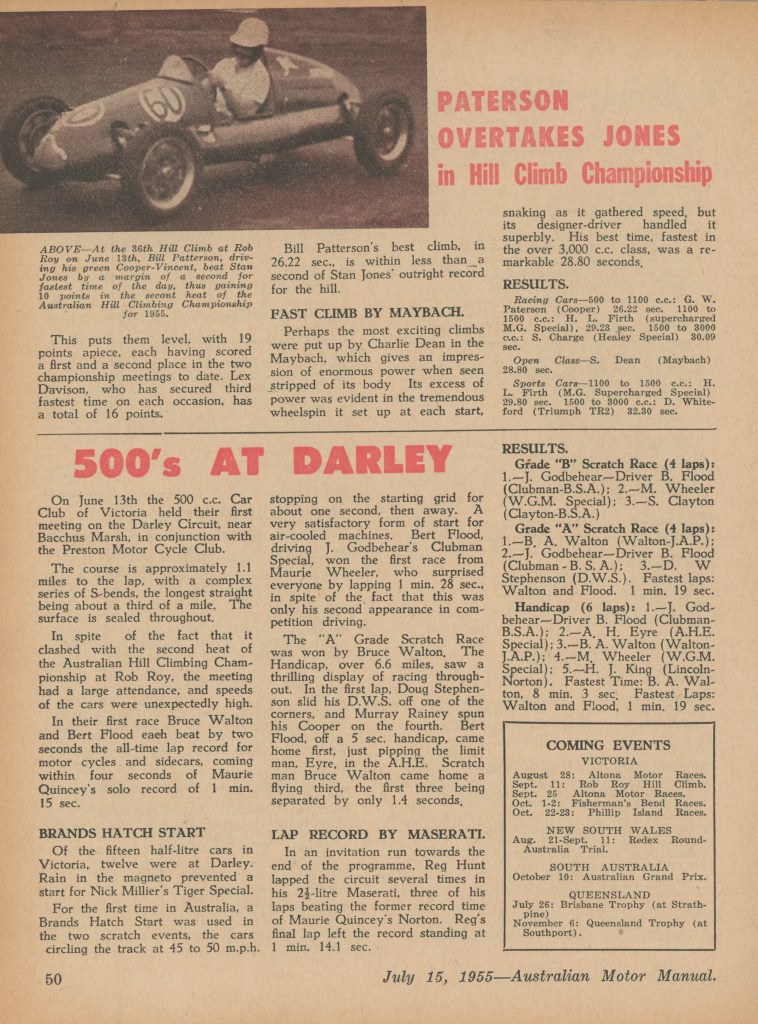
Racing a Grand Prix Maserati around the short, tight Darley circuit outside Melbourne would have been somewhat akin to racing in ‘yer backyard…
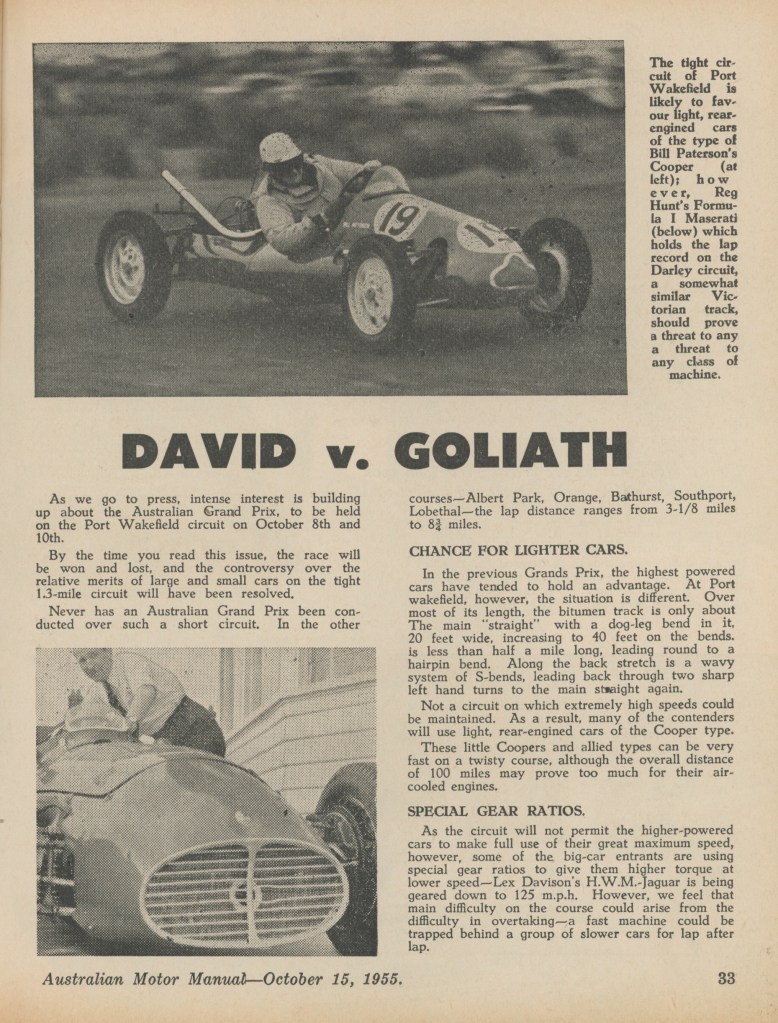
Reg Hunt pretty much became-the-pace when he imported this 2.5-litre Maserati A6GCM (chassis ) to Australia, he was stiff not to win the ‘AGP at Port Wakefield, South Australia with it in 1955.
These two Australian Motor Manual excerpts highlight the controversy surrounding the selection of Port Wakefield as the AGP venue that year given its short length – only the Goulburn course used for the first AGP in 1927 was shorter – and put in the electronic public domain Hunt taking the Darley lap record in his lead up preparation to the AGP.
This press advertisement dated January 13, 1968 changed the racing world as we knew it in many parts of the globe, the US and some other places excepted…
The days of the mobile fag, franger and fragrance wrapper were underway, for better or worse.
While Lotus and Imperial Tobacco were negotiating the commercial deal which would take advantage of the FIA/CSI relaxation of rules relating to the advertising of non-trade products and services on racing cars, the business of motorsport rolled on.
(MotorSport)
Jim Clark took off where he left off at the end of 1967, the fastest car/driver combination won the South African Grand Prix in Kyalami. Clark won aboard his Lotus 49 Ford from Graham Hill in the other Team Lotus entry, and Jochen Rindt’s Brabham BT24 Repco.
After that race – his final Championship GP win as events transpired – he flew to New Zealand along with Jack Brabham, Bruce McLaren, Denny Hulme, Chris Amon, Pedro Rodriguez and Graham Hill to join other internationals, Frank Gardner and Piers Courage, and local drivers for the 1968 Tasman Cup.
That summer the highly competitive 2.5-litre series comprised four rounds in NZ, and in Australia, commencing with the NZ GP at Pukekohe on January 6, and concluding with the South Pacific Trophy at Longford, Tasmania on March 4. Eight events in eight weeks on both Kiwi islands, shipping the circus across the Tasman Sea from the very south of the South Island (Teretonga) to Brisbane…oh, yes, and prepare the cars for the 100 mile races too. While the series was famous for sun, fun and spunkmuffins there was some serious racing as well. To win the Tasman required a mix of speed, discipline, endurance and organisation.
(LAT)
Chris Amon jumped out of the blocks, winning at both Pukekohe, and Levin aboard his works Ferrari Dino 246T. JC had engine failure after 44laps in the NZ GP while in the lead, and suspension problems at Levin (above). He ran wide off the track early, caught Amon but then went off again and bent a radius rod while trying to pass Chris.
During the week between Levin and the Lady Wigram Trophy round, the small team looking after Jim’s Lotus 49 Ford DFW organised a signwriter of some talent, at Hutchinson Ford, Christchurch to apply the cancer-stick signage in accordance with the Gold Leaf corporate identity standards manual…a document with which Lotus staff were to become intimately familiar.
Kiwi journalist, Allan Dick wrote that there was a function held in Christchurch on the Friday evening of the race weekend to unveil the new colours, perhaps the shot below is during said gig, albeit the venue doesn’t appear particularly salubrious.
(MotorSport)(A Batt)
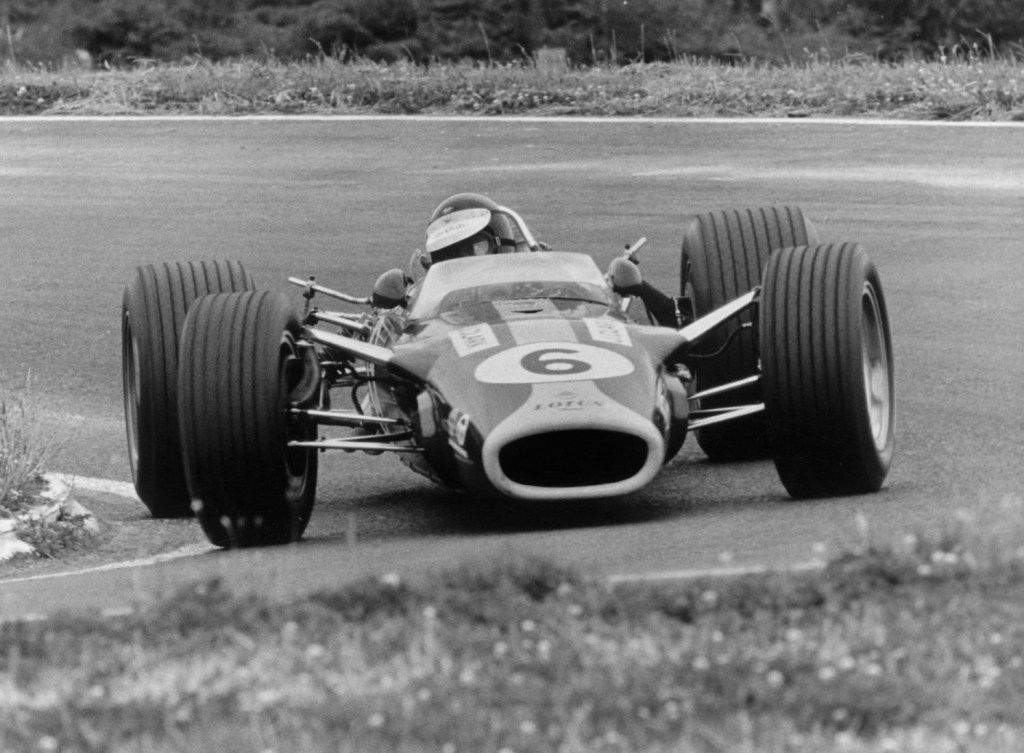
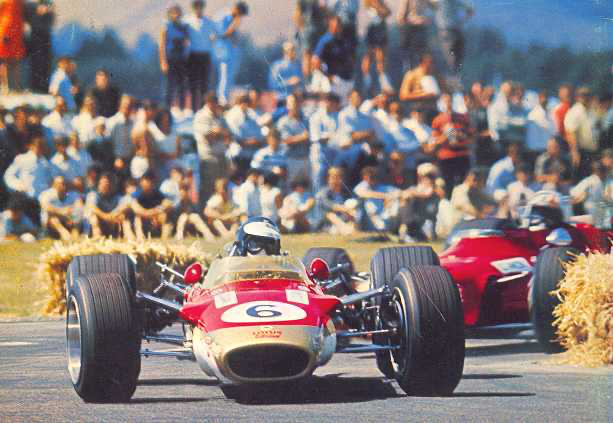
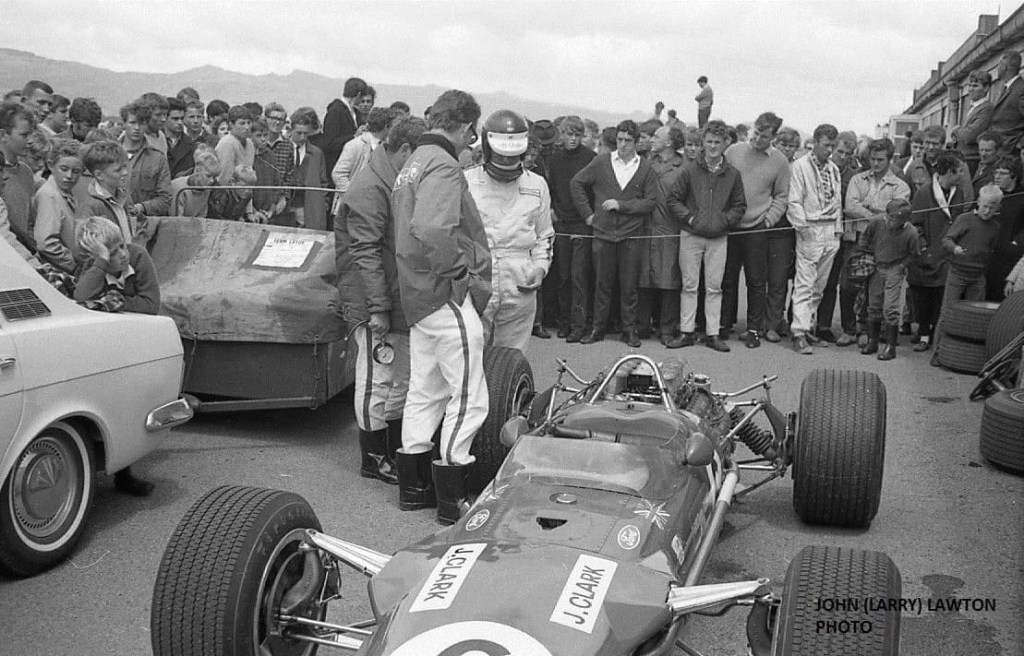
Big Wigram crowd taking in the candy-coloured Lotus – chassis number R2, Jim’s 1967 F1 mount – over the January 20 weekend. Clark provided plenty of cheer for the suits back in the UK when he won ‘on GLTL debut’ from Amon and Denny Hulme’s F2 Brabham BT23 Ford FVA.
These three shots are all at Wigram Clark from Amon at Wigram (sergent.com)Wigram looks chilly that day, Kiwi-Oz touring car ace Jim Richards with his hands in race-suit pockets towards the far right of the crowd
Bruce McLaren won for BRM at Teretonga in the final NZ round. He finished in front of Clark after Jim had an off while in the lead. Bruce’s mount was a 2.5-litre V12 engined BRM P126, a chassis designed by Len Terry, and being blooded in advance of the ‘68 F1 season by McLaren, Rodriguez and Richard Attwood.
Clark had a much stronger run on the other side of the Tasman Sea – where he was joined by teammate Graham Hill, who had been enjoying a family holiday – winning the Surfers Paradise 100, the Warwick Farm 100 in Sydney and the Australian Grand Prix at Sandown, in Melbourne’s outer suburbs. Only the final round at Longford eluded him, Piers Courage took a wonderful victory there in his F2 McLaren M4A Ford FVA in streaming rain.
Clark at Teretonga where a high speed off cost him the lead to Bruce McLaren (unattributed)Clark at Sandown winning the AGP, here on Pit Straight in third gear. The shot highlights the shortcomings of the too low roll bar. While Jim was well familiar with seat belts in his ‘Indycars’, he missed these safety devices in Grand Prix racing, commonplace as they were by the end of the year
When he departed Australia on or about March 5, Jim Clark had won his final GP and championship, he died a month later at Hockenheim during the first heat of the Deutschland Trophy, Euro F2 Championship round, aboard a GLTL Lotus 48 Ford FVA on April 7, 1968.
Last discussion before the off with Dave ‘Beaky’ Sims, Hockenheim April 7, 1968 (MotorSport)Clark here running behind Chris Irwin, Lola T100 and Chris Lambert, Brabham BT23C, the Lotus, Lola and Brabham all Ford FVA powered (MotorSport)
Etcetera…
(W Reid)
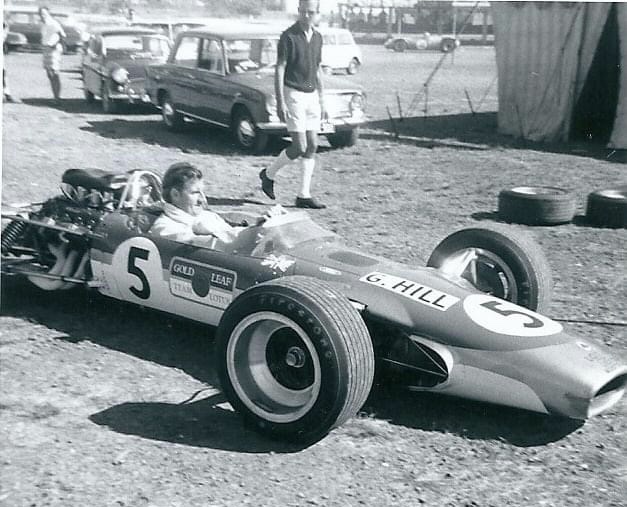
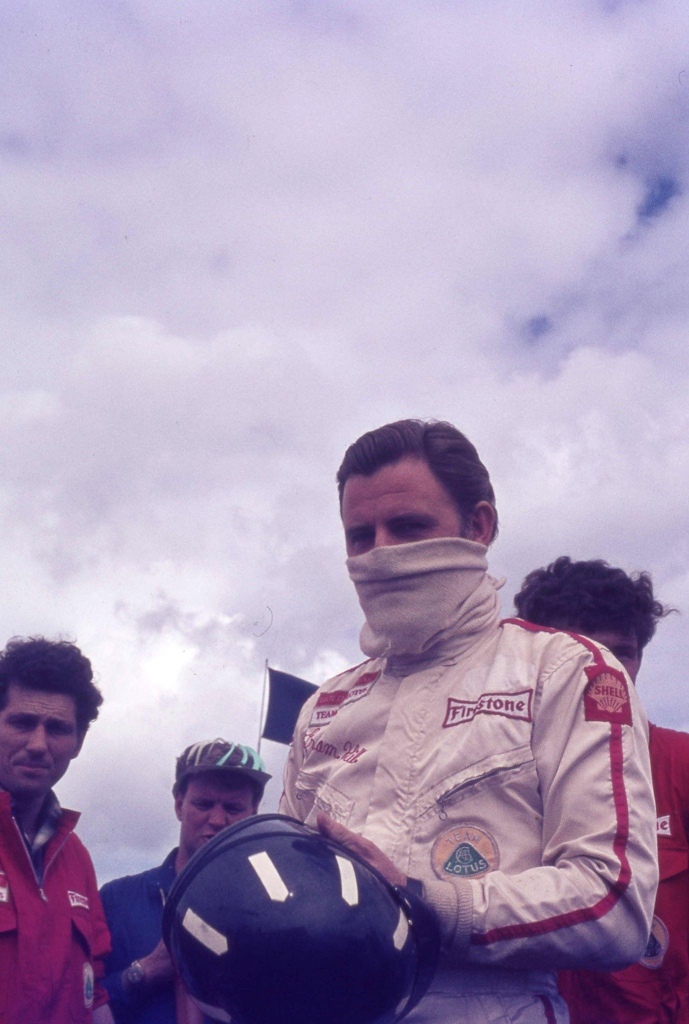
Graham Hill displaying his new colours, ones he immortalised in the F1 record book by the end of a tragic year, Sandown paddock, February 1968.
(W Reid)
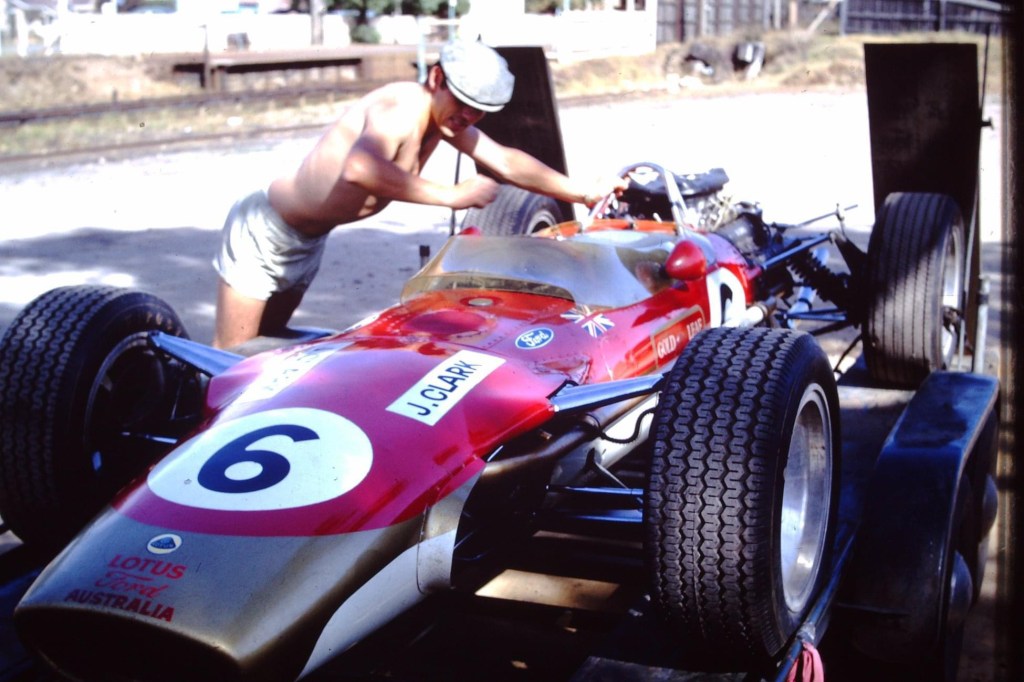
Hill raced Lotus 49 chassis R1, early spec 49s used a ZF five-speed transaxle rather than the later Hewland DG300, engine is the Ford Cosworth DFW 2.5-litre V8. The skinny rears – front tyres – are for transport purposes. A bit of arcane trivia for Melburnians is that the GLTL Lotuses were fettled in the Head Brothers, BMC dealership and bodyworks, at 504 Neerim Road, Murrumbeena, (below) not too far from Sandown.
(J Makeham)
Ford Australia must have kicked in a few dollars to the budget, note the crude ‘Australia’ added to the deft signwriting on the nose of the Lotus executed in Christchurch. The elaborate trailer is as flash as the one I used to tow my Formula Vee.
(C Neale)
Jim Clark about to go out and win the AGP at Sandown. The official margin between Clark’s Lotus 49 and Chris Amon’s Ferrari 246T is one-tenth/sec, but it was closer than that!
(unattributed)
Fags…
Kiwi enthusiast/historian Graham Woods wrote that “The first car (other than in places like the US where such advertising had been allowed) to carry tobacco sponsorship was in South Africa in a round of the SA F1 Championship.”
“The driver was John Love, and the tobacco company, Gunston. Three weeks before Wigram, Love and Sam Tingle started the South African GP, the opening round of the world championship in a Brabham and SA built LDS on January 1. Love was ninth and Tingle DNF – both were in Gunston colours. “
John Love in the Team Gunston Brabham BT20 Repco during the ‘68 South African GP (LAT)
“South Africa was Jim Clark’s last GP win in the green and yellow of Team Lotus. The first race for Lotus in GLTL colours was at Wigram, the first championship GP, the Spanish GP at , a race won by Graham Hill’s Lotus 49 Ford…another GP that got away from Chris Amon, whose Ferrari 312 dominated practice and led most of the race.”
Graham Hill enroute to winning the 1968 Spanish GP, GLTL Lotus 49 Ford (MotorSport)(CAN)
Afterthought…
The afterthought goes to Allan Dick of New Zealand’s Classic Auto News.
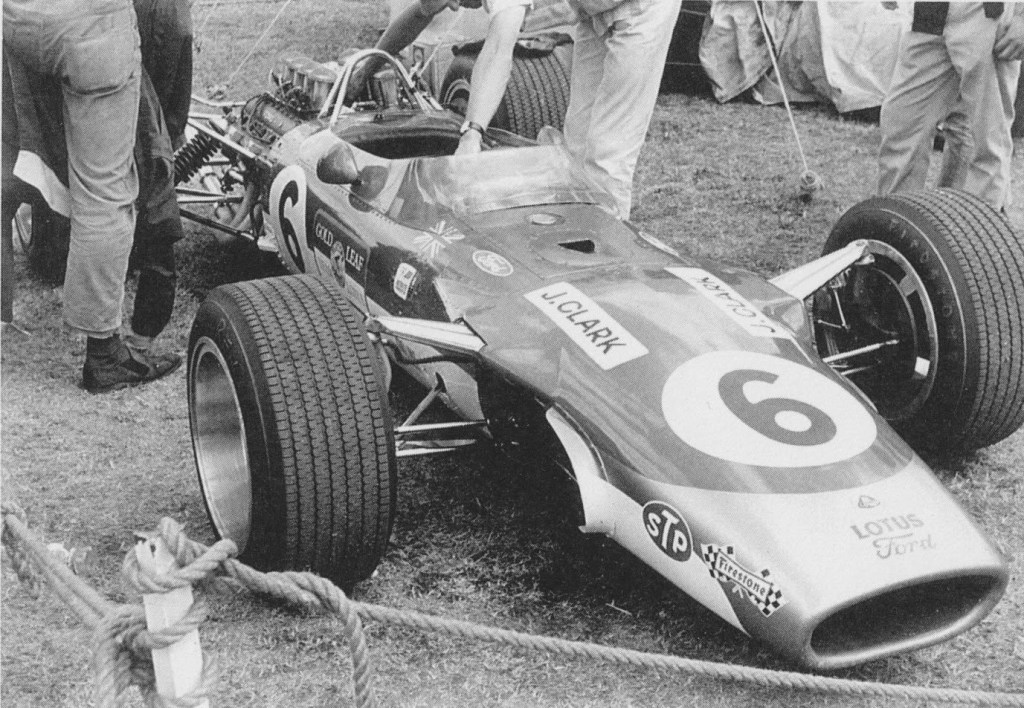
‘Historic image of Jim Clark’s Lotus 49T (“T” for Tasman) at Wigram 1968. It’s historic because this was the first time the public had seen the new Gold Leaf sponsorship — a first for Formula One on this scale. The deal with Lotus and the tobacco company had been finalised between Levin and Wigram and it was done in “secret”.’
‘There had been an official and rather exclusive unveiling on the Friday evening in the snobby “The Motor Racing Club” way of doing things in those days, but it was Saturday morning when the great unwashed got to see it. There it sat, paint so new it still looked sticky and fenced off with a great lump of old rope! The reaction? I can still remember it clearly! It was “Yucchhh!” Nobody liked it. It looked cheap and taudry. Nobody thought it was good. We far preferred the dark green with yellow stripe — traditional Lotus. But the world got used to it.’
Credits…
Bryan Miller Collection, LAT Photographic, Allan Batt, Ray Sinclair, John Lawton, Warren Reid, Chris Neale, John Makeham, Allan Dick Classic Auto News
Frank Matich leads a Triumph TR4 and Austin Healey 100 on the short stretch of road between Long Bridge as he aims his Lotus 19B Climax into the progressively more-uphill-on turn-in Newry Corner during the 1964 Australian Tourist Trophy, February 29, 1964.
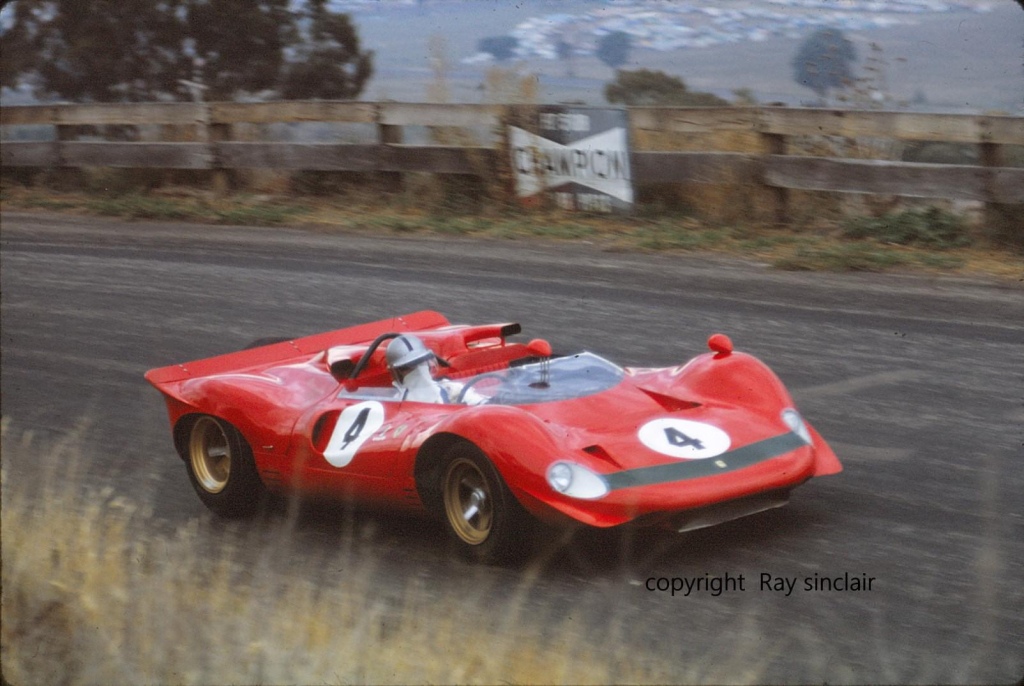
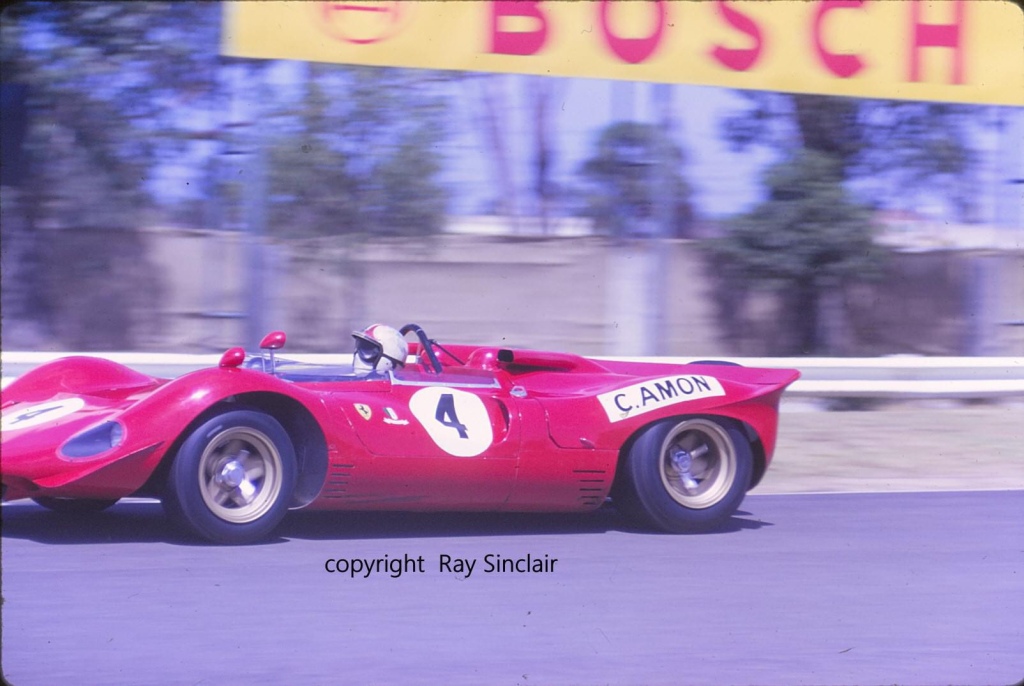
Bill Brown in the Scuderia Veloce Ferrari 350 Can Am – aka P4 – at Bathurst during the 1968 Easter meeting. Such a marvellous evocative shot of the most seductive of cars.
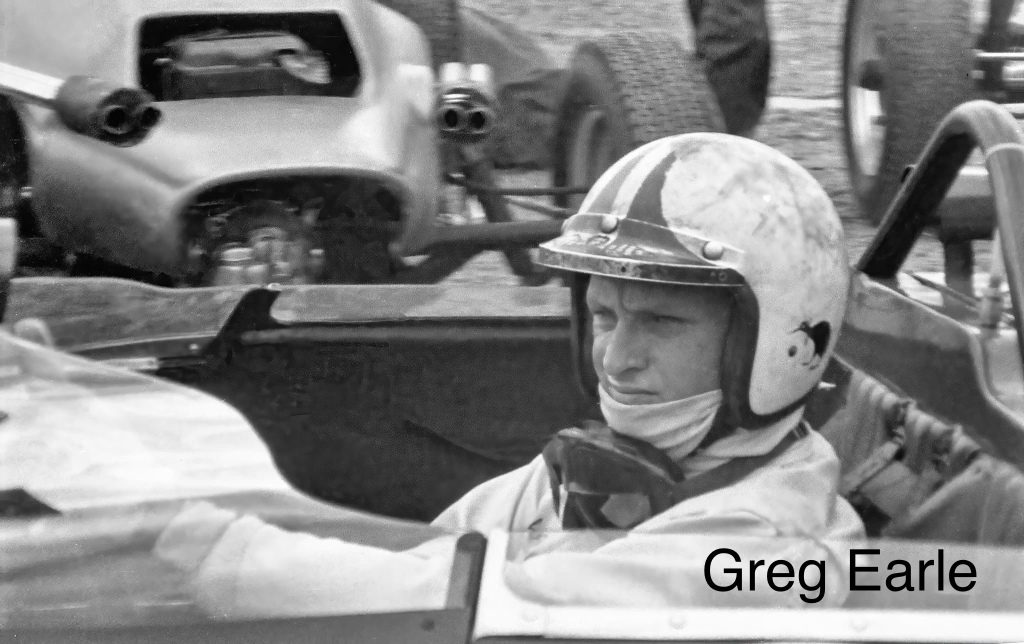
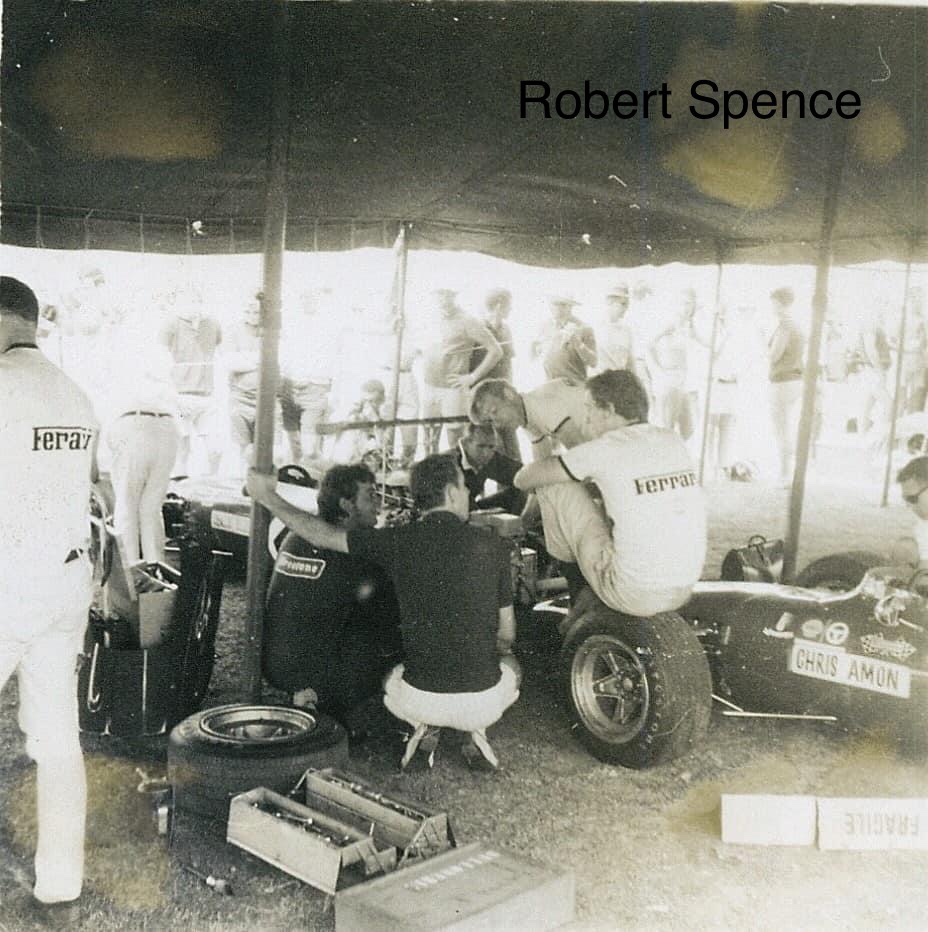
In the space of a week photographs popped up on Bob Williamson’s FB site on Scuderia Veloce topics from three different photographers, Ray Sinclair, Greg Earle and Robert Spence.
In the shot below the scowling Kiwi is motoring through the Sandown paddock, perhaps miffed that his 4.2-litre 480bhp V12 was beaten by Frank Matich in the Sydneysider’s 4.4-litre Repco V8 powered Matich SR3. See here for a feature on this Ferrari; https://primotipo.com/2015/04/02/ferrari-p4canam-350-0858/
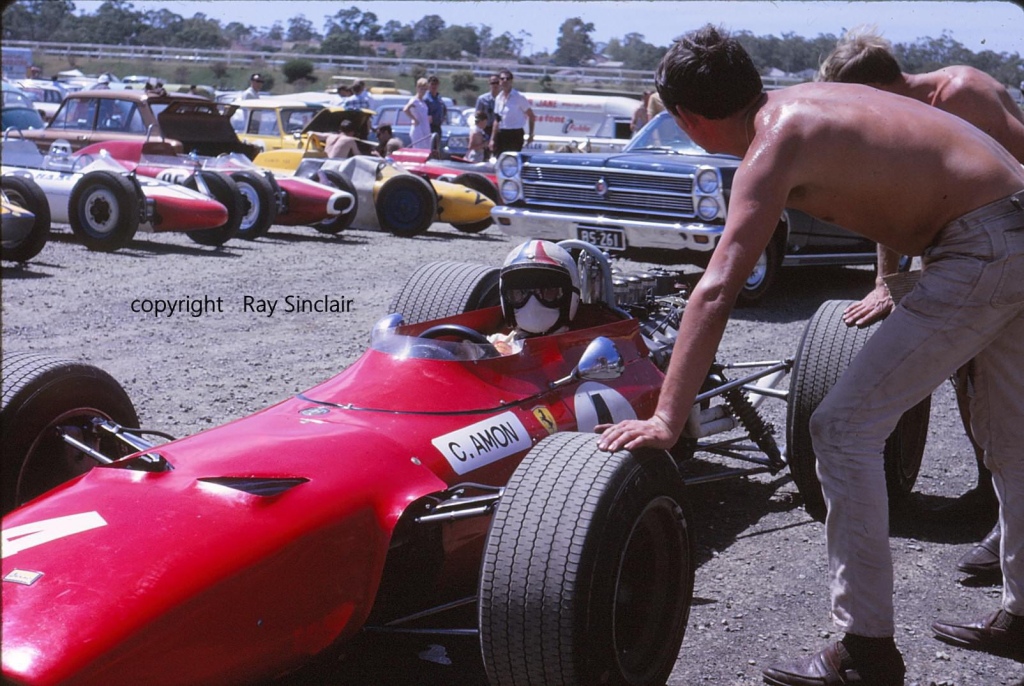
Chris Amon at very sunny Sandown earlier in the year aboard his Ferrari 246T, with a line of Formula Vees behind, with Bib Stillwell arriving at the circuit in the Ford Galaxie.
Chris just failed to pip Jim Clark in the closest of finishes in the Sandown Australian Grand Prix Tasman Cup round the following day, the official margin was one-tenth of a second. With that the Scot took both his last final GP and championship win – the Tasman Cup – aboard his works Lotus 49 Ford DFW. See here for a piece on that weekend; https://primotipo.com/2021/03/06/1968-australian-gp-sandown-2/
350 Can Am in the Sandown paddock. The #7 Brabham is Greg Cusack’s SV machine, the BT23A Repco raced by Jack Brabham the year before. Quickie on the BT23A here; https://primotipo.com/2017/01/04/scuds/
On the blast past the old pit-counter at Sandown, paradise for a young enthusiast, with the V12 howling its fabulous song in third gear.
Amon was given the short back-and-sides by Frank Matich’s Matich SR3 Repco V8 at the three meetings they met in the sportscar Tasman Cup round supports that summer; Warwick Farm, Surfers Paradise and Sandown. I wonder why FM didn’t take the SR3 to Longford to bag the Quadrella?
The only timing device missing from the Jones Boy’s dash is a grandfather clock! Alan awaits the off in his Lola THL2 Ford at San Marino in 1986.
That weekend AJ was Q21 and DNF overheating after 28 laps in the race won by Alain Prost’s McLaren MP4/2C TAG-Porsche. The Frenchman won four of the 16 rounds and the drivers title by two points from Nigel Mansell’s Williams FW11 Honda, albeit Williams took the constructors championship by a country mile – 45 – points from McLaren. Lola Ford finished eighth.
(MotorSport)
Jones above during the 1985 AGP weekend in Adelaide where his results were again disappointing, Q19 and DNF with electrical failure after completing on 20 laps in the Lola THL1 Hart. Keke Rosberg won the race in his Williams FW10B Honda. We’ve been there before with these Hart four-cylinder and Ford V6 1.5-turbo F1 machines, see here; https://primotipo.com/2016/10/21/hart-attack/
Jones’ Lola THL2 Ford overhead, Hungaroring August 1986. Ford Cosworth GBA 1.5-litre V6 twin-turbo(SMH)
Jones had far more success in the AGP at Calder, west of Melbourne, in 1980 where he raced his Williams FW07B Ford to a dominant win from Bruno Giacomelli’s wailing V12 Alfa Romeo 179B in a mixed field of GP cars (two) and F5000 machines.
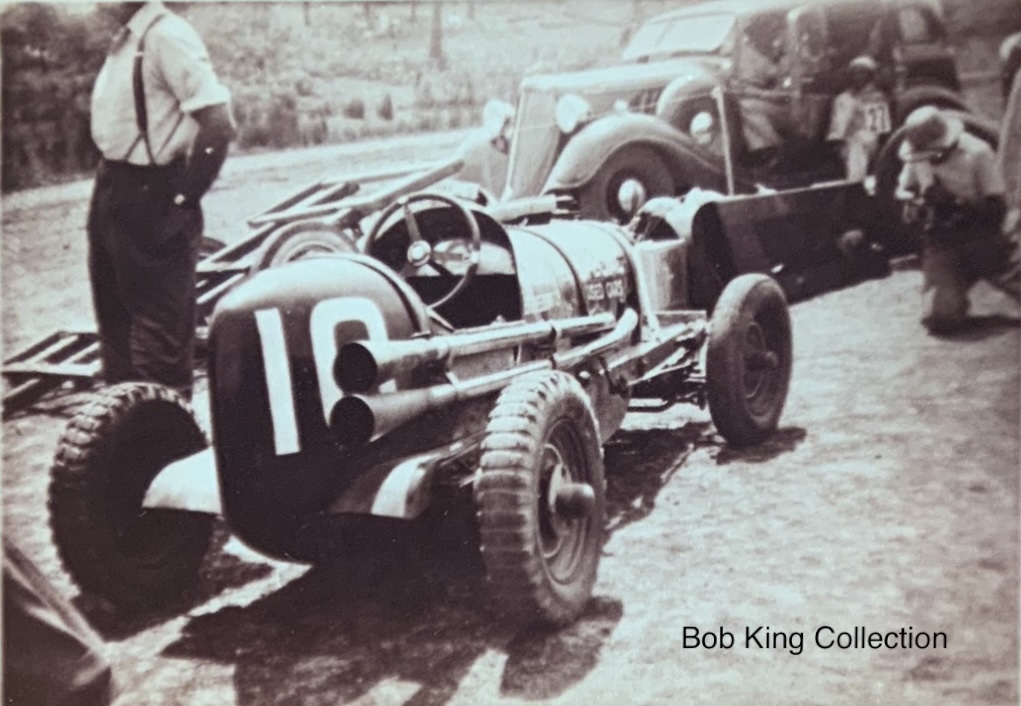
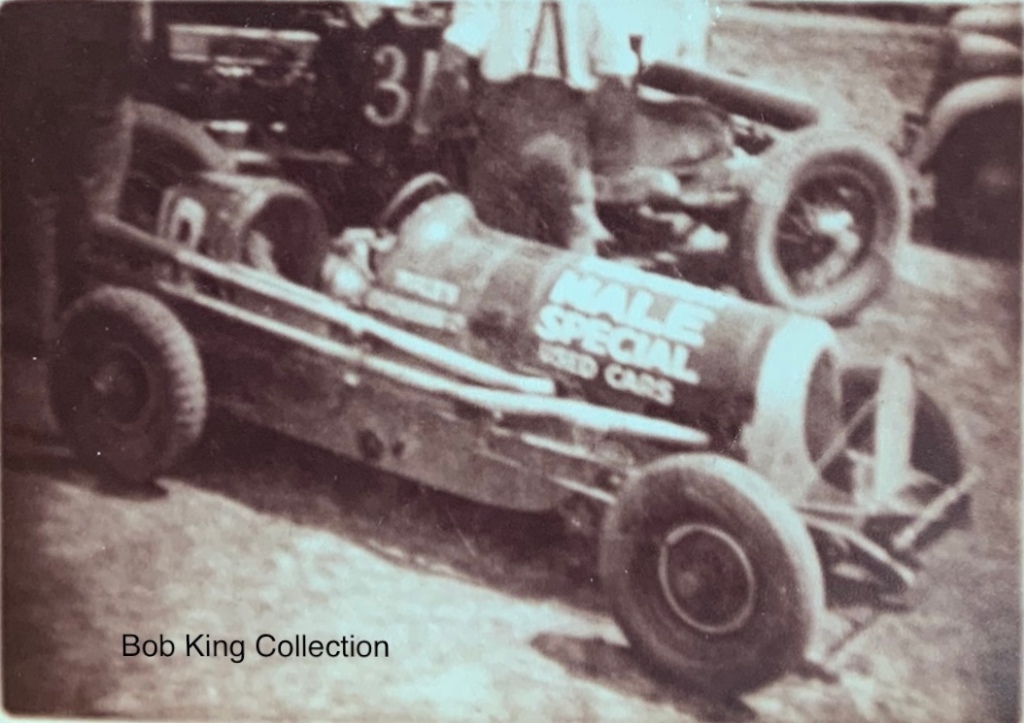
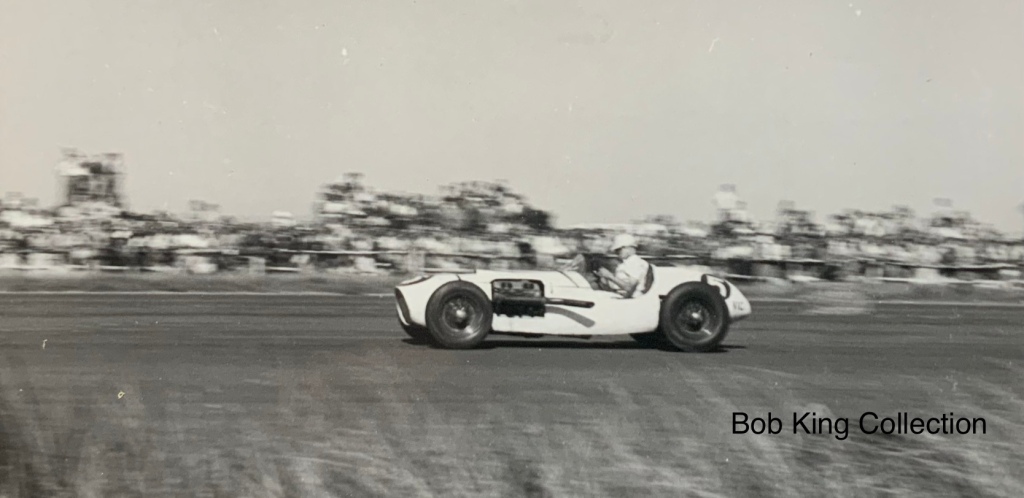
Not so much special, but three specials sponsored by Melbourne car dealer, Alan D Male and raced by Ted Gray in the immediate pre-WW2 years.
One was the JAP engined speedway midget above, the next a buggered-if-I-know powered midget and the third, Alta 21S, ex-Alan Sinclair/Bill Reynolds, and by then Ford V8 powered.
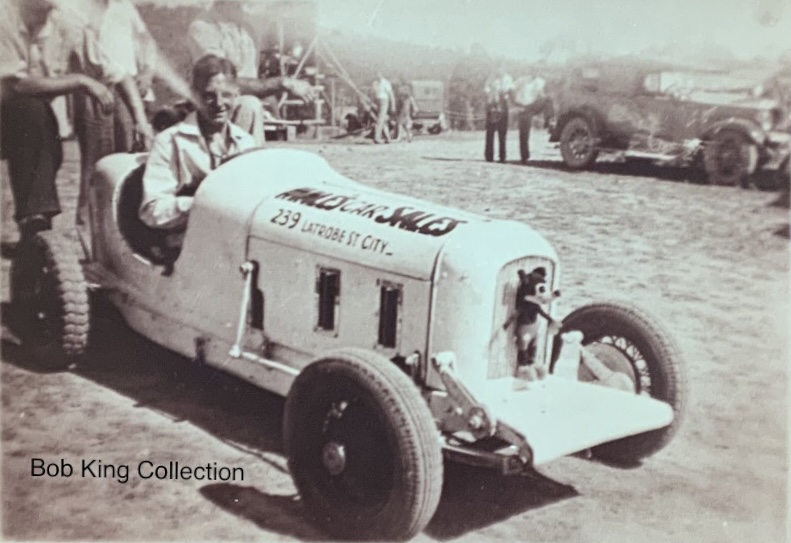
Male operated yards at 233 and 239 Latrobe Street, Melbourne named Males Car Sales and AD Male Car Sales respectively. This seemingly successful business man was important in the rise and rise of Tiger Ted pre-War, his final push into the top rank was provided post-War by Lou Abrahams.
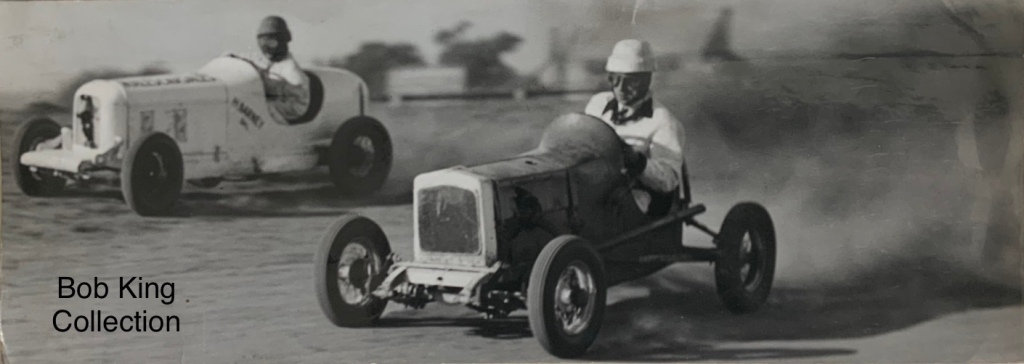
Gray gave the visiting Peter Whitehead’s ERA B-Type a serious run for his money in the midget above during meetings at Aspendale Speedway and Rob Roy hillclimb in 1938. Leon Sims tells us that in the meeting above, Rob Roy 5 on November 20, 1938, that Gray set the FTD 0.5 seconds outside the hill record set by Whitehead only five months before. In the process “he set the committee of the Light Car Club of Australia scratching their heads in concern over the suitability of a car designed for midget racing, taking the award on their hill. It was not seen as a ‘proper car’ in their eyes.”
When Jack Brabham raced his midget at Rob Roy post-war he had the same problems but went to Sydney, fitted some brakes to his car, and returned to take the Australian Hillclimb Championship at Rob Roy in 1951. Up yours Blue Blazer Officialdom, or something like that!
This is the ‘other midget’, a rare shot with car owner Alan Male at the wheel at Rob Roy 5, he did a time of 31.5 seconds. I’d love to know the builder and specifications of this car. If Mickey Mouse seems an odd radiator-shroud fear not for the little-fella, he seems to have been adopted by the team as a mascot, he is present on the team’s Alta 21S Ford shown further below.
Ted Gray on the outside of A ‘Stud’ Beasley (as in head stud or babe-magnet?) at Aspendale in August 1938, with Mickey still hanging on for grim life. I’m rather hoping some of you may be able to tell me a little more about Alan Male in order that we can put it on the public record.
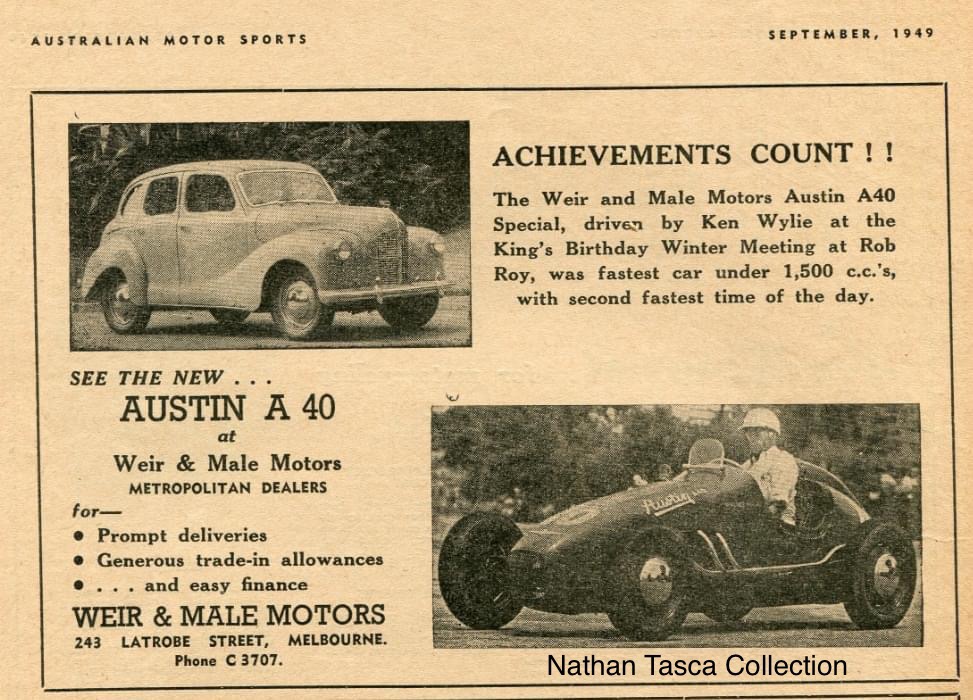
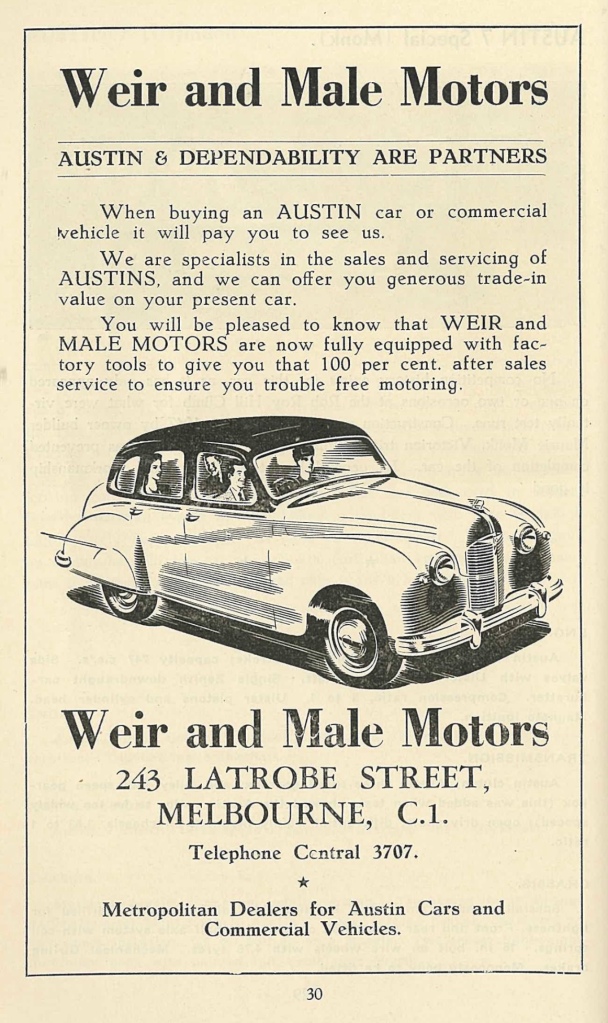
Nathan Tasca’s research shows he was still trading in cars post-War, as Weir & Male Motors at 243 Latrobe Street, familiar territory for him! He still maintained his interest in motor racing, note the AMS advertisement below. The wording of the ad, and coverage of the car in the Motor Manual 1950-51 Australian Motor Racing Year Book confirms the car was built by Ken Wylie for Weir & Male Motors, Austin dealers, and was driven by Wylie.
(Photographer-Byron Gunther)
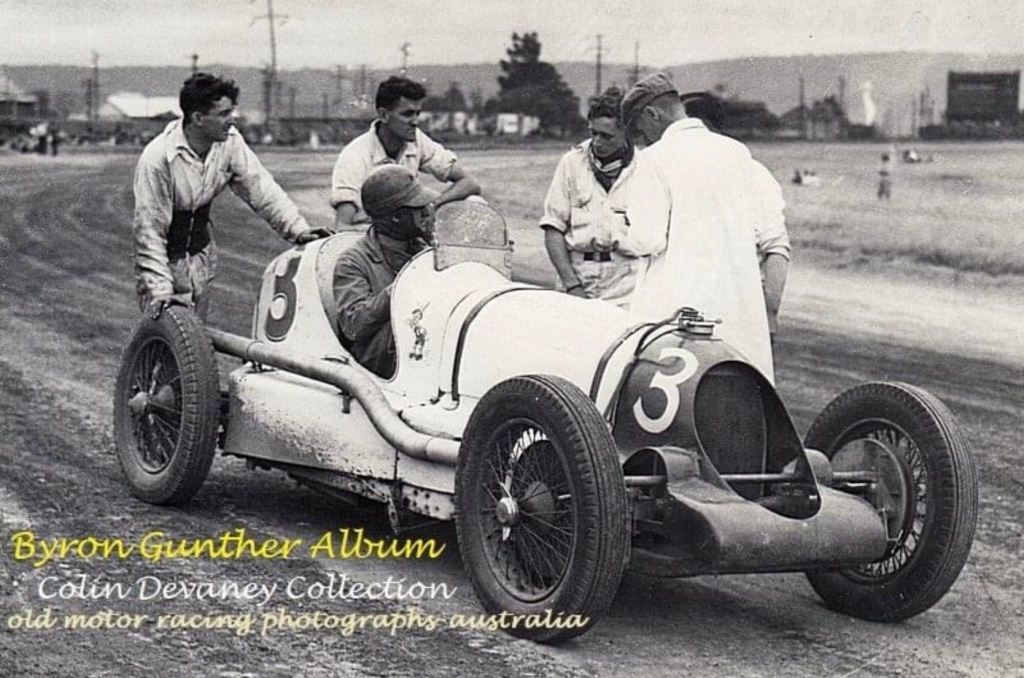
The final Male Special/Ford V8 Special – it was entered in various names – is most correctly, using the modern – make-model-engine manufacturer – ‘racing car description protocol’ Alta 21S Ford V8. Here Ted is considering proceedings with his crew and officialdom at Penrith Speedway, NSW in 1940.
While built as a road racing racing sportscar, and modified by Sinclair’s team in the UK before coming to Australia as a road racing 1100cc supercharged single-seater, the car performed well both on the roads and on dirt speedways, as here. The car was raced well into the war years, Gray in the Male Special V8 beating S Bail’s Midget V8 in a 3 lap match race at Aspendale on Sunday January 19, 1941, his final entry March-April ’41. Picking up the Austin connection, Tony Johns tells me S Bail was a partner in the Bail Brothers Austin sub-agency (Stan and Wally) in Hampton Street, Brighton in the 1960s.
By the way, the little dude on the scuttle of the Alta is Pinocchio not Mickey Mouse…there is a story there, but what is it? I know, Walt Disney was so impressed with Ted’s performances he was slipping a few greenbacks Male’s way…
Motor Manual 1950-51 Yearbook via David Zeunert Collection
Credits…
Bob King Collection, photos perhaps taken by Ted Hider-Smith, The Argus January 20, 1941, David Zeunert Collection
Tailpiece…
Tiger Ted aboard the very new Tornado 1 Ford V8 at Fishermans Bend in early 1955, date please (car #5).
When the shortcomings of Alta 21S finally became apparent after Lou Abrahams’ big-brawny Ardun-Abrahams head Ford V8 was dropped between its chassis rails the Abrahams, Gray and Mayberry team built Tornado 1. This car’s short life ended when Gray had a huge accident at Bathurst in October 1955 after brake dramas, see the articles linked above for the details.
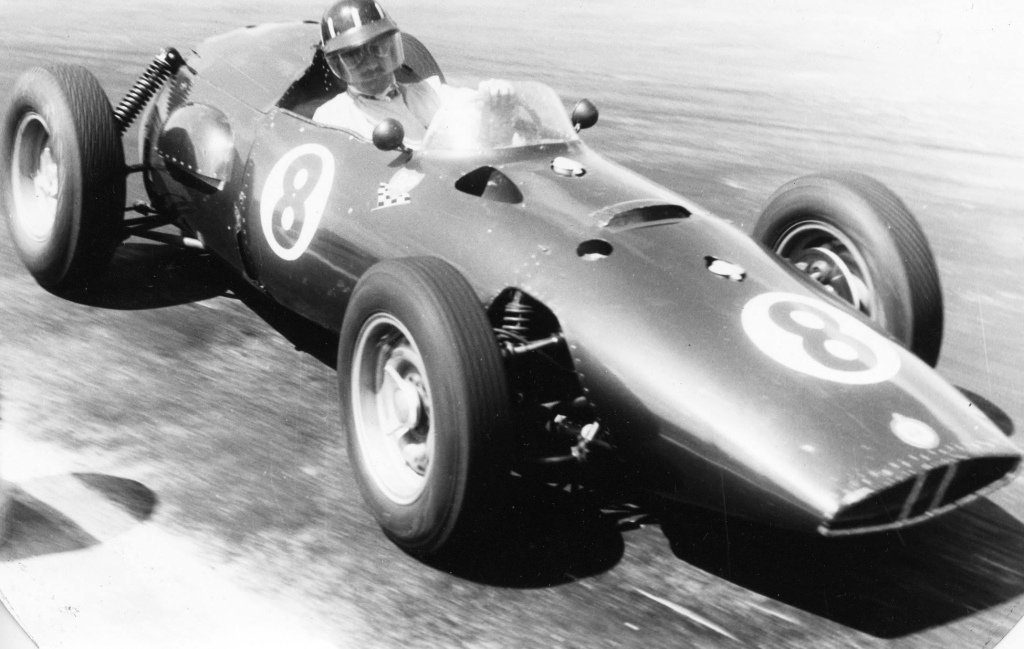
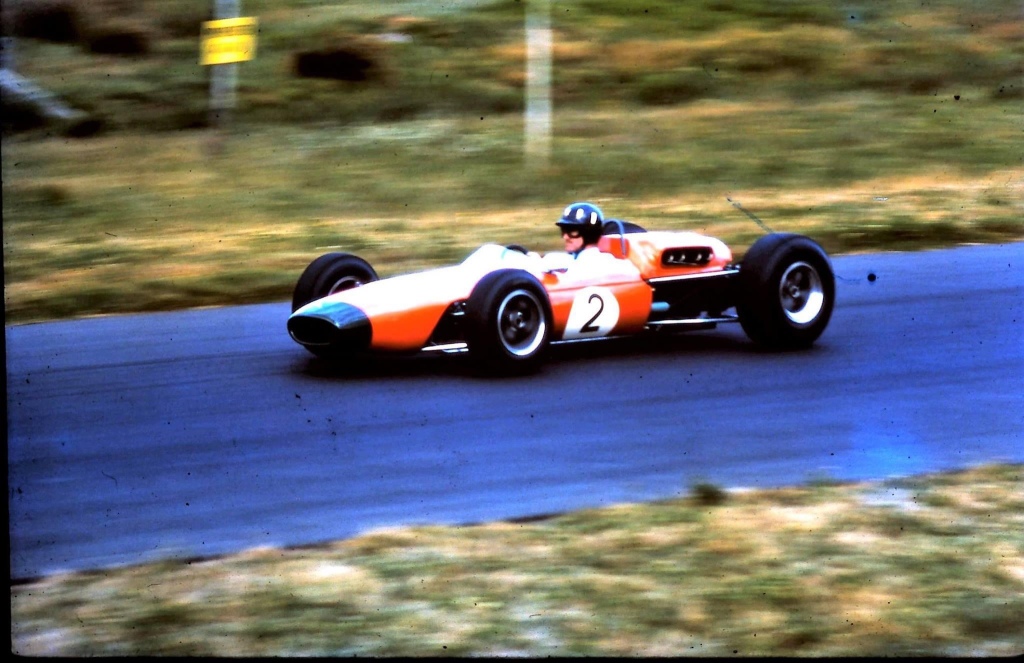
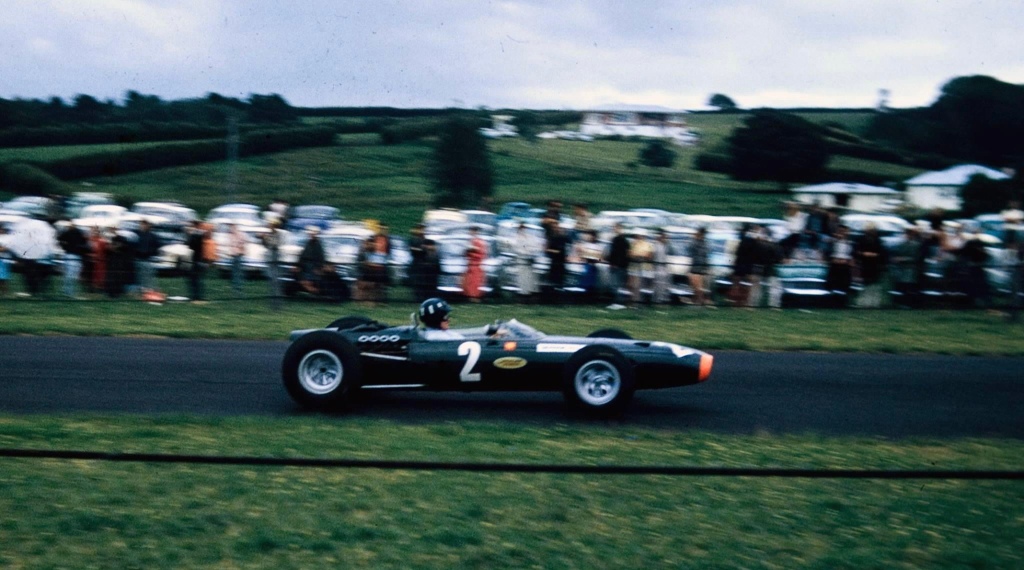
Graham Hill aboard his BRM P48 Grand Prix car in the first race of many races in New Zealand over the ensuing decade. Ardmore during the January 7, 1961 New Zealand Grand Prix.
65,000 Kiwis rocked up in searing Auckland heat to see 14 international drivers take on the locals. Hill finished third behind the two works Cooper T53 Climax 2.5s of Jack Brabham and Bruce McLaren.
The Bourne equipe were regular visitors to New Zealand, having first made the trip in 1954 when a single BRM P15 V16 driven by Ken Wharton blew the minds of Kiwis with its staggering performance and sound, if not its reliability. The Rubery Owen Group/Owen Organisation had subsidiaries in New Zealand and Australia so BRM made the long trip on many occasions to wave the flag, despite the protestations of Chief Engineer, Tony Rudd in some years when he would have preferred to prioritise development of his GP machines over the European winter.
The BRM P48 – the marques first mid-engined car – took its swansong on this trip, and its only international win in the final meeting on the Ballarat Airfield in Victoria, albeit it was Hill’s team-mate, Dan Gurney who took the chequered flag that day. That year BRM didn’t contest the other Kiwi internationals, more on the BRM P48 here; https://primotipo.com/2018/03/16/bourne-to-ballarat-brm-p48-part-2/
(E Sarginson)
Hill missed 1962 but returned for the ’63 summer as World Champion albeit he raced the revolutionary Ferguson P99 Climax four-wheel-drive car down south rather than his championship winning BRM P57/578.
He was stiff to miss out on third place in the NZ GP (above) held at the new Pukekohe track outside Auckland, he lost his clutch at the start then the gearbox cried enough on the very last lap. Hill returned home for a break, before returning for the Australian rounds. Innes Ireland raced the car at Levin for Q5/third, Wigram last/DNF o/heating and Teretonga Q5/third.
Hill’s best in Australia was a win in a greasy preliminary at Lakeside where the car’s grip showed through. In those pre-Tasman Cup 2.5 days both New Zealand and Australia had Formula Libre as their national categories. Once Coventry Climax developed the 2.75-litre ‘Indy’ FPF for Cooper’s 1961 assault on the Indy 500 that engine became the power unit de jour in Australasian events. The FPFs fitted to the P99 were 2.5-litre units so Hill and Ireland were starting behind the eight-ball compared with Brabham, McLaren, John Surtees and Tony Maggs etc who had 2.7s. So fitted we may really have seen the potential of these exciting cars which were somewhat hamstrung when raced with 1.5-litre FPFs in F1 events, where they were less able to ‘carry the additional weight’ inherent in the additional, complex transmission and associated components. What might have been?
(B Ferrabee)
In 1964 Hill contested two rounds of the Tasman Cup in Australia aboard a Brabham BT4 Climax 2.5 run by the David McKay’s Scuderia Veloce. He was third at Warwick Farm and won the South Pacific Trophy at Longford, so he happily signed up again in 1965, racing a brand new Brabham BT11A Climax, Ron Tauranac’s latest Tasman challenger which was also used by Jack and Frank Gardner.
Graham opened his ’65 Tasman account as he closed 1964 with a win at Pukekohe, the NZ GP. Hill again, as became his norm, skipped the balance of the Kiwi races to have some family time, doing the Warwick Farm and Sandown Australian rounds for fifth and DNF. More about the ’65 Tasman here; https://primotipo.com/2017/11/02/levin-international-new-zealand-1965/
Hill was complimentary about the preparation of his car by Bob Atkin and Spencer Martin, Martin raced this same chassis to Australian Gold Star championship wins in 1966 and 1967.
Graham Hill and Spencer Martin swap notes at Pukekohe. By that stage Repco were the largest supplier of FPF parts in the world having had the commercial rights from circa 1962 (K Buckley)(M Fistonic)
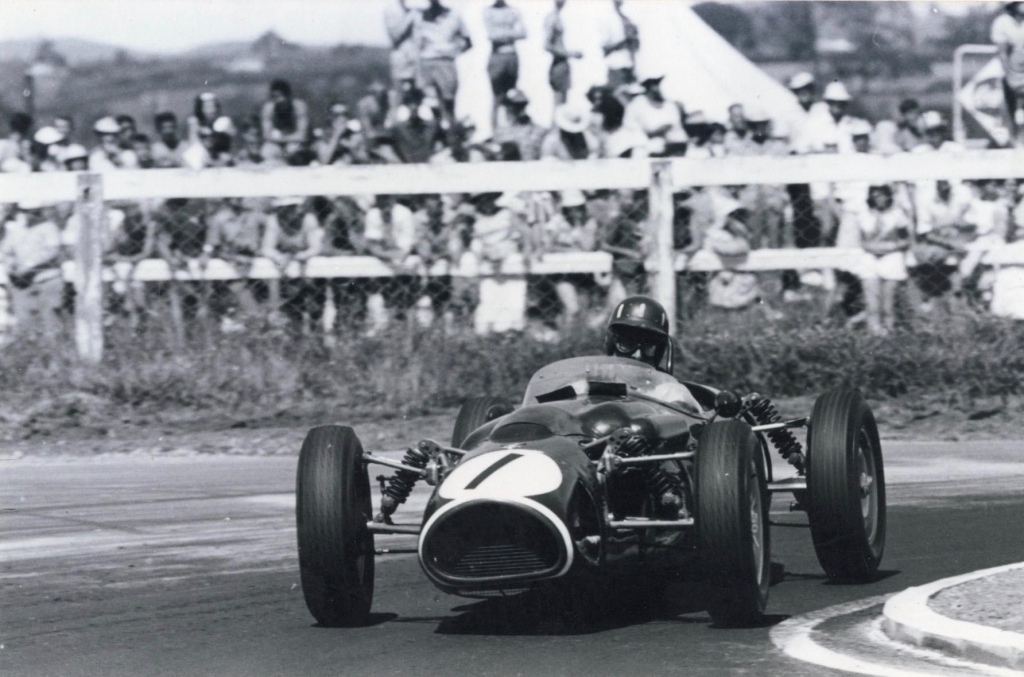
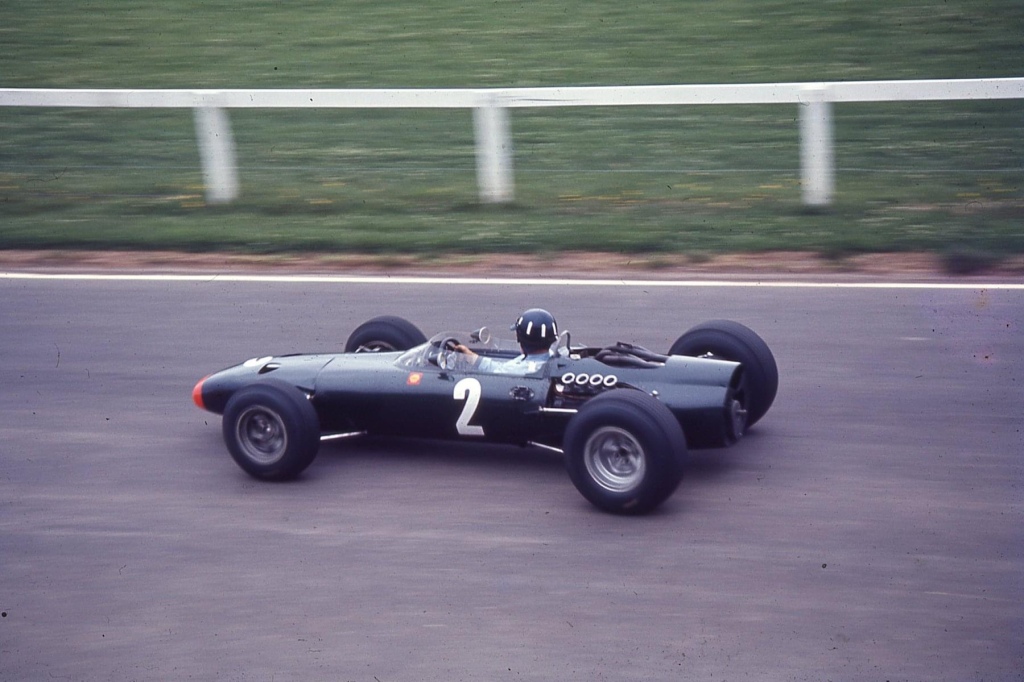
BRM returned to Australasia in 1966, figuring that their just obsolete F1 P261s, their P60 V8 engines bored from 1.5-1.9-litres would do the trick, and so it proved. Graham above at Pukekohe, where he won the NZ GP on the January 8 weekend.
In fact the series was a BRM rout, the team won seven of the eight rounds, Jackie Stewart – then an F1 newbee but with the 65′ Italian GP win under his belt – took four victories, Hill two, and Richard Attwood one at Levin, he stood in for Graham there and in the following race at Wigram. The BRM P261 Tasman story is contained here; https://primotipo.com/2020/02/22/1966-australian-grand-prix-lakeside/
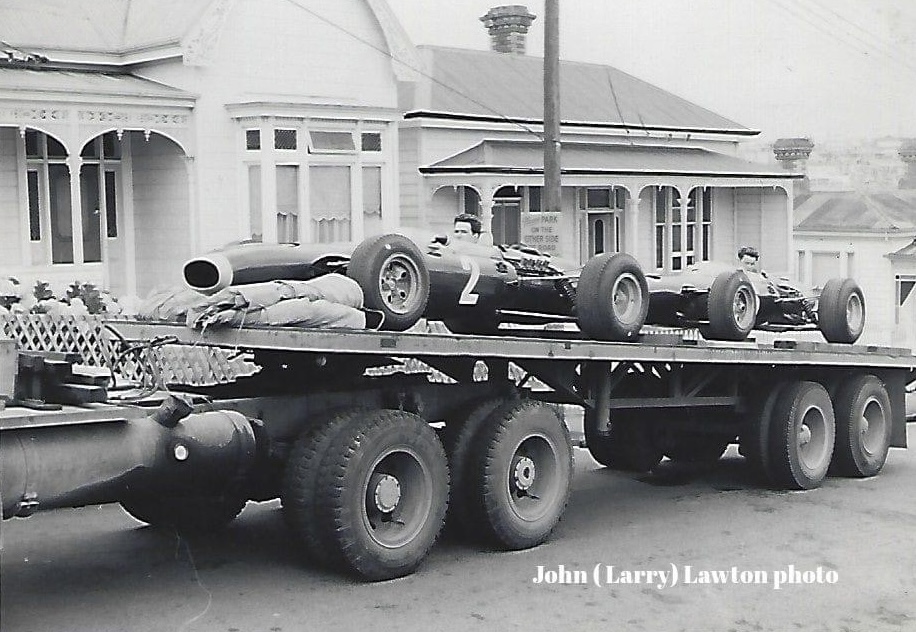
The interesting shot above shows the BRMs arriving for scrutineering before the series opener at Pukekohe in January 1966. It’s at Grey Lynn near the Auckland City car testing station
Hill in the superb BRM P261 at Pukekohe, perhaps this machine and the epochal Lotus 25-33 series of cars are the two best machines of the 1.5-litre 1961-65 F1 era, Ferrari 158 duly noted (B Kempthorne)
In 1967 and 1968 Graham missed the NZ Tasman rounds in their entirety. He decamped from BRM to Lotus at the end of 1966 in a timely move which neatly matched the arrival of the ’67 Lotus 49 Ford DFV V8, another machine which set the trend for a couple of decades.
While Jackie Stewart gave him a good run for his money at BRM, Graham jumped from the fat into the flames with Jim Clark as his Lotus teammate. Clark easily won the ’67 Tasman with a 2-litre Climax FWMV V8 powered Lotus 33 F1 chassis, and in 1968, his F1 Lotus 49 powered by the 2.5-litre Cosworth, the DFW. Graham did only the Warwick Farm Tasman round in ’67, where he raced a new Lotus 48 Ford FVA F2 car in an expensive exercise for the WF promoter, the Australian Automobile Racing Club. Again he enjoyed a holiday at home in early 1968, then did the four Australian rounds, with his bests, second to Clark at Surfers Paradise and Warwick Farm.
(LAT)
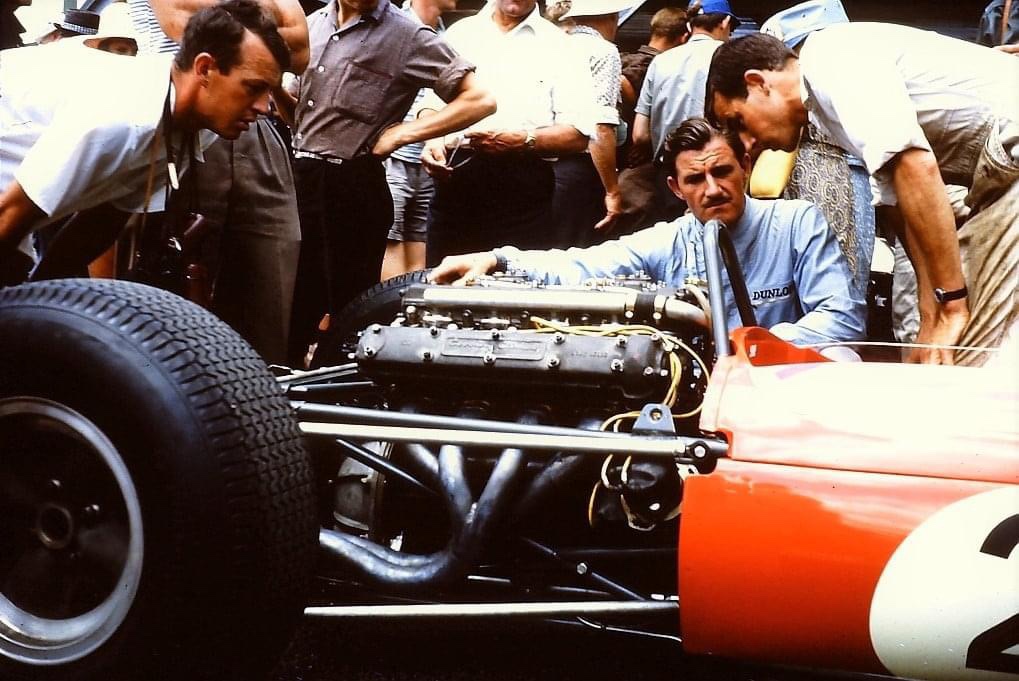
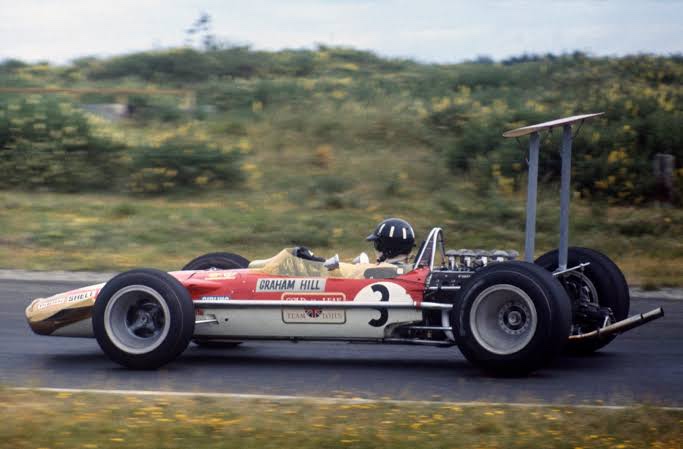
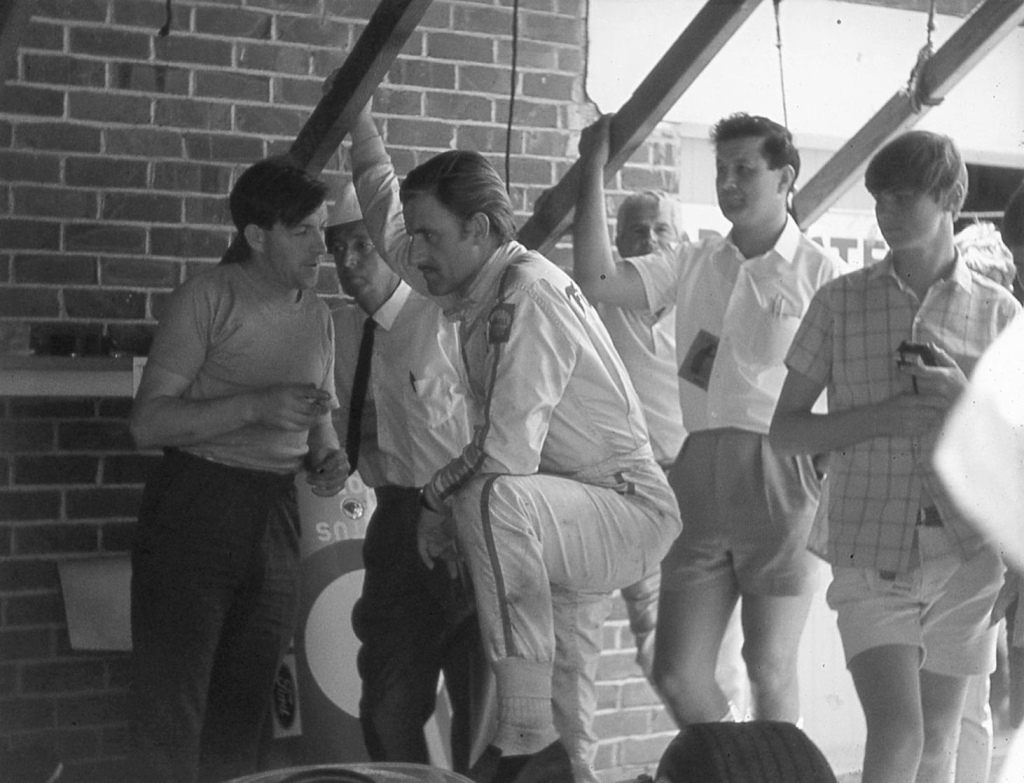
Hill aboard his Gold Leaf Team Lotus, Lotus 49B Ford DFW on his way to second place at Teretonga in 1969, and below in earnest conversation with a mechanic during the Puke first Tasman round.
(M Fistonic)
Hill arrived down south as the freshly minted World Champion after a season in which his brave leadership helped Team Lotus gather themselves together after the tragic death of Jim Clark in a Hockenheim F2 race on April 7.
It wasn’t to be a cushy summer though, Jochen Rindt was a man on a mission with a competitive F1 (and Tasman) car for the first time. His Lotus 49B Ford set the pace, winning two rounds to the four scored by Chris Amon in a title winning run of speed and consistency in a Ferrari Dino 246T.
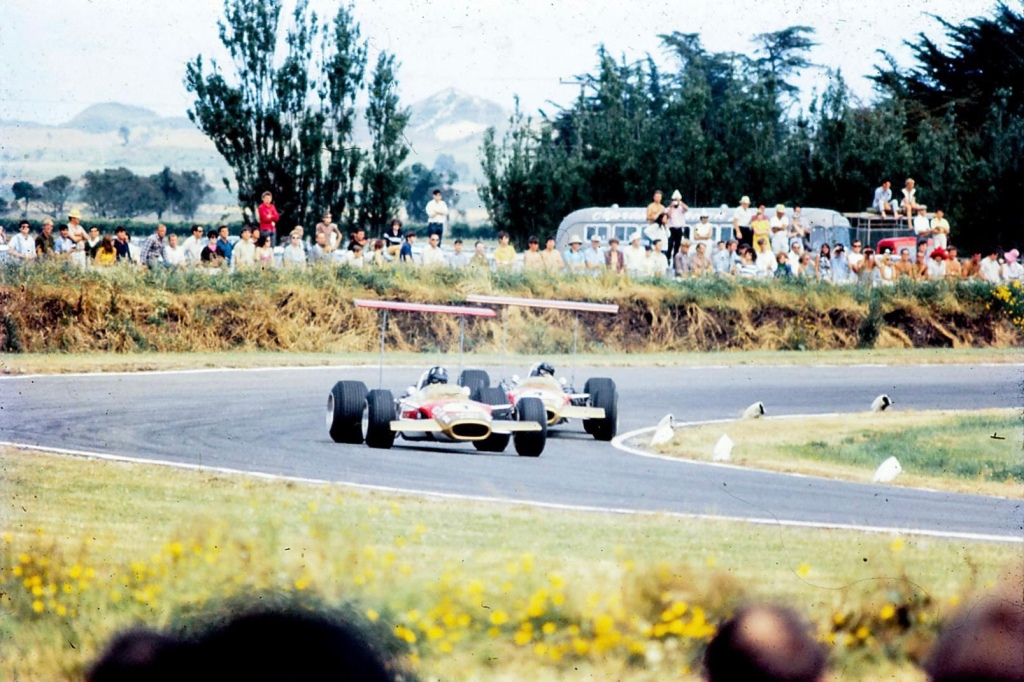
Hill with Rindt chomping away at him, Cabbage Tree corner Levin 1969, where both Lotus 49B DFW DNF, Rindt with a big accident which required a replacement car to be sent from Hethel (B Spurr)
Graham didn’t take a victory that summer, his bests were second places to Rindt at Wigram and at Teretonga behind Piers Courage in Frank Williams’ Brabham BT24 Ford DFW. More about the Lotus 49Bs in Australasia that summer here; https://primotipo.com/2022/02/26/lotus-49b-ford-chassis-r8/
The change in Tasman formula to F5000 (1970-71 transition years noted) and the growing number of F1 races in a season put paid to trips by full-time F1 drivers for a couple of months after Christmas each year. It was awfully sweet while it lasted, with Hill G one of the most popular visitors of all with the punters.
Credits…
Euan Sarginson, LAT, Ken Buckley, Brian Ferrabee, Milan Fistonic, Bryn Kempthorne, Brian Spurr, Warner Collins, John Lawton
Tailpiece…
(W Collins)
Graham Hill preparing to load up at Wigram on January 18, 1969. Jochen won from Graham that day with local hero Chris Amon third, Piers Courage and Derek Bell fourth and fifth, demonstrating the typical depth of Tasman Cup fields.

















 primotipo...