


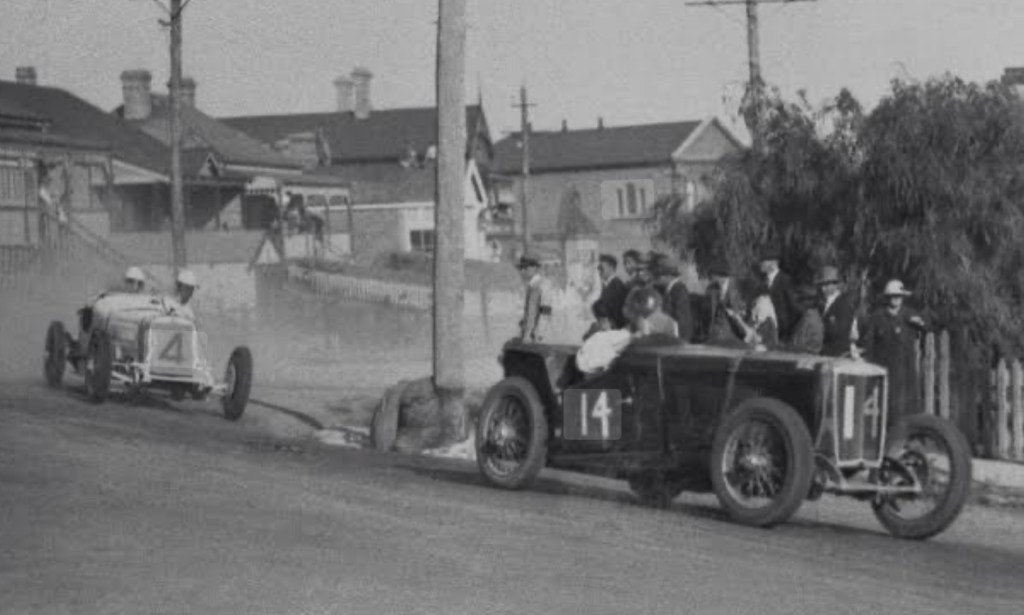
The first of these Round the Houses events at Albany, a town on the south coast of Western Australia, 400km from Perth – next stop Antarctica – was a ’50 Mile T.T. Grand Prix’ held on March 8, 1936; indeed it was the very first of many such Round the Houses race meetings held throughout WA right into the early 1960s.
The ’36 meeting was part of a series of ‘Back to Albany Week’ events designed by the local council to pump some tourist-£s into the local economy. Other motor racing events that weekend included car and motorcycle hillclimbs at nearby Mount Clarence; the same circuit was used for a 100-mile cycling Grand Prix.
Although very successful, it wasn’t all beer and skittles, protests were made by local church leaders concerned about their peaceful Sunday being interrupted by the sound of high performance engines and an influx of ruffians from Perth. The reaction of the local ratepayers was strong enough for the WA Premier, Philip Collier to promise the event wouldn’t be held again. However, happily, he was given-the-arse before the end of the year and fellow Labor Premier John Willock could clearly see votes in the Albany event…so the carnival continued until WW2 ruined everything.
Generally the relationship between the motor racing establishment and the police throughout Australia was combative, exceptions were in the Peoples Republik of Phillip Island and in Western Australia where the WA Sporting Car Club had a very cooperative relationship with the wallopers.

Grand Prix, Albany 1938 (C Batalier)
Another impressive Albany panorama, this time ‘An MG Midget at the bottom of the long downhill Parade Street Straight, possibly the fastest leg of the 2-mile 4km circuit.’ I can’t reconcile what I see in the shot above with the results/car numbers that I have. I look forward to advice from one of you Perthies as to the car/driver combo…
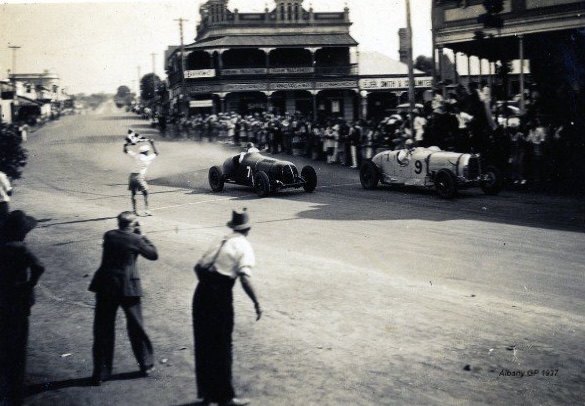
Duncan Ord’s Bugatti T57 and Clem Dwyer, Plymouth at Pingelly in 1940, not Albany in 1937…
I’m not sure were Old finished at Albany in ’39, but in 1940 he was third in the handicap race off scratch and did the fastest race time, also setting a new lap record at 1 min 11.5; a time that became the permanent record for the circuit, the late 1950s track was a different layout.
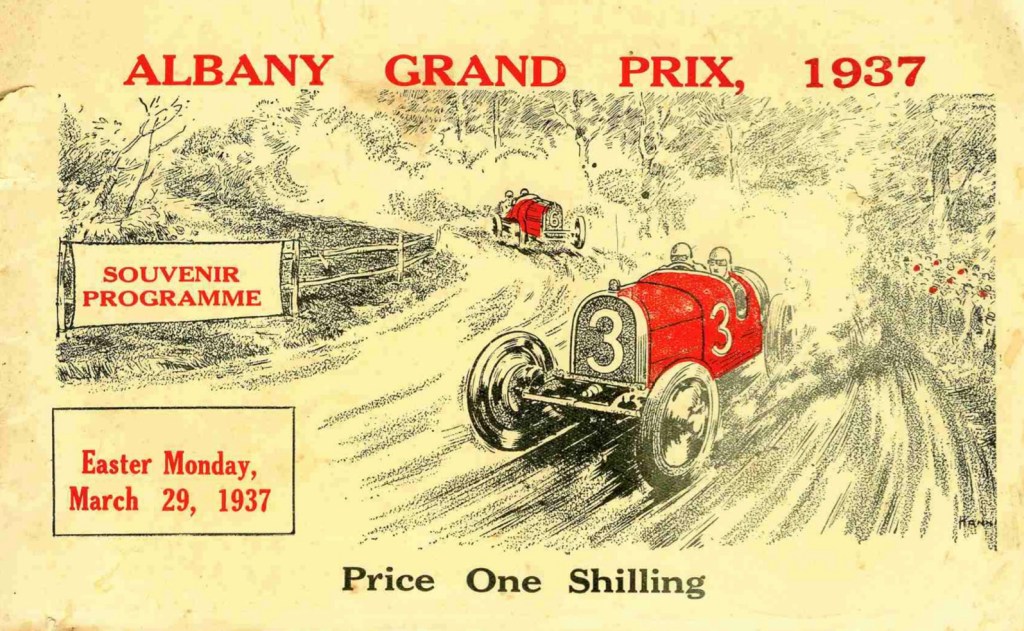
The second Albany GP, held on March 1937 was won by Ray Hall’s Ford V8 Spl from Spencer Stanes, Vauxhall Spl, and Neil Baird’s Terraplane.
The April 16, 1938 Albany GP was won by 1939 Australian Grand Prix winners, Alan Tomlinson’s and his MG TA Spl S/c, from Jack Nelson, Ballot Spl, with Norm Kestel’s MG TA in third.
In 1939 Jack Nelson’ Ballot prevailed from the EJ Coleman and Bill Smallwood MG TAs on April 19. The final wartime race, the Albany Tourist Trophy, was won by Brian Homes in the Bartlett Special on March 25. JB Wittenoom was second in his Oldsmobile, and Ord, as noted above, third in his Bugatti.


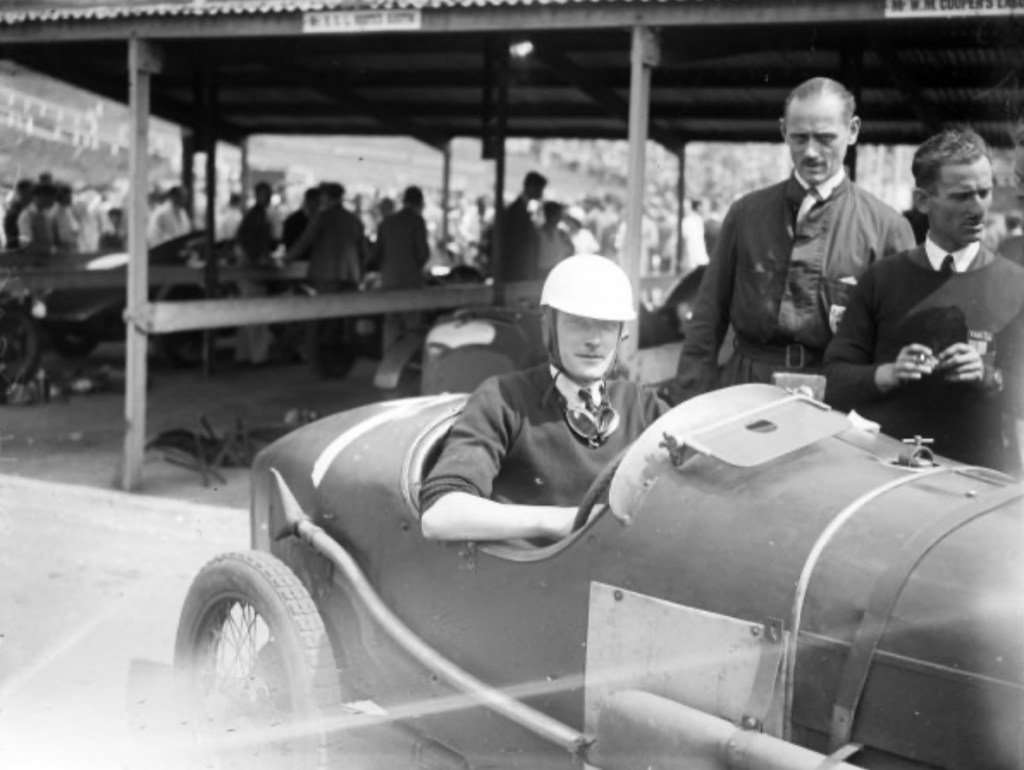
This sleek little monoposto is the 1927 Salmson San Sebastian based four-cylinder, 1086cc twin-cam, supercharged Bartlett Special, built by JH Bartlett of Notting Hill Gate, London, primarily as a Brooklands racer in 1932.
Clem Dyer visited the UK in 1935 and returned with this machine, said to have held the class lap-record on Brooklands Mountain track, rather than the Frazer Nash he had in mind. Upon seeing the car run at Brooklands, Victorian Frazer Nash monoposto exponent, Tim Joshua said the ‘he had never seen such terrific acceleration.’
By late 1938 the car held the class state flying-quarter mile record at 103.4mph, while the standing quarter-mile time of 17 3/10 sec was also a state open record. The car set a four-mile record of 97.2mph at Lake Perkolilli in 1938. Clem set an Albany lap record of 1 min 15 sec in the 1937 race but the fastest man on the course but a number of pitstops with cooling woes ruined his chances. Brian Holmes took one tenth off this in the Bartlett in 1939.
Etcetera…

The 1940 Australian Grand Prix was to be held in Albany!
So impressed was the Australian Automobile Association – the forerunner to CAMS – by the standard of road racing being conducted in Western Australia, that they announced in April 1939 that the 1940 Australian Grand Prix would be held that January on Albany’s Middleton Beach circuit.
In a great decision to spread-the-Grand Prix-love, the AAA decided in future that the race should be held by different states in rotation: WA in 1940, Victoria in 1941, Queensland 1942, NSW in 1943 and South Australia in 1944.
While the war put-paid to that lot, the principle of rotation was implemented post-war and was maintained until Bob Jane contracted to run the race at Calder from 1980, when ‘nobody really wanted’ it, until Adelaide got the F1 gig in 1985.

Round The House Ramblings : Albany Grand Prix 1940
This race lead up piece in the Thursday 14 March 1940 issue of The Western Mail tickled my fancy; no attribution as to the author sadly.
WHAT would be the reactions of the average car driver on the road today if he were asked to make a gear change every 10 seconds, and to keep it up for over one hour. Even with the aid of synchromesh gear boxes, automatic and semi-automatic clutches, and all the aids to driving incorporated in the automobile of today, it is problematical if the proposition would sound practicable, or even sensible, at first glance, but it is one of the little known, but nevertheless interesting details of any Albany Grand Prix.
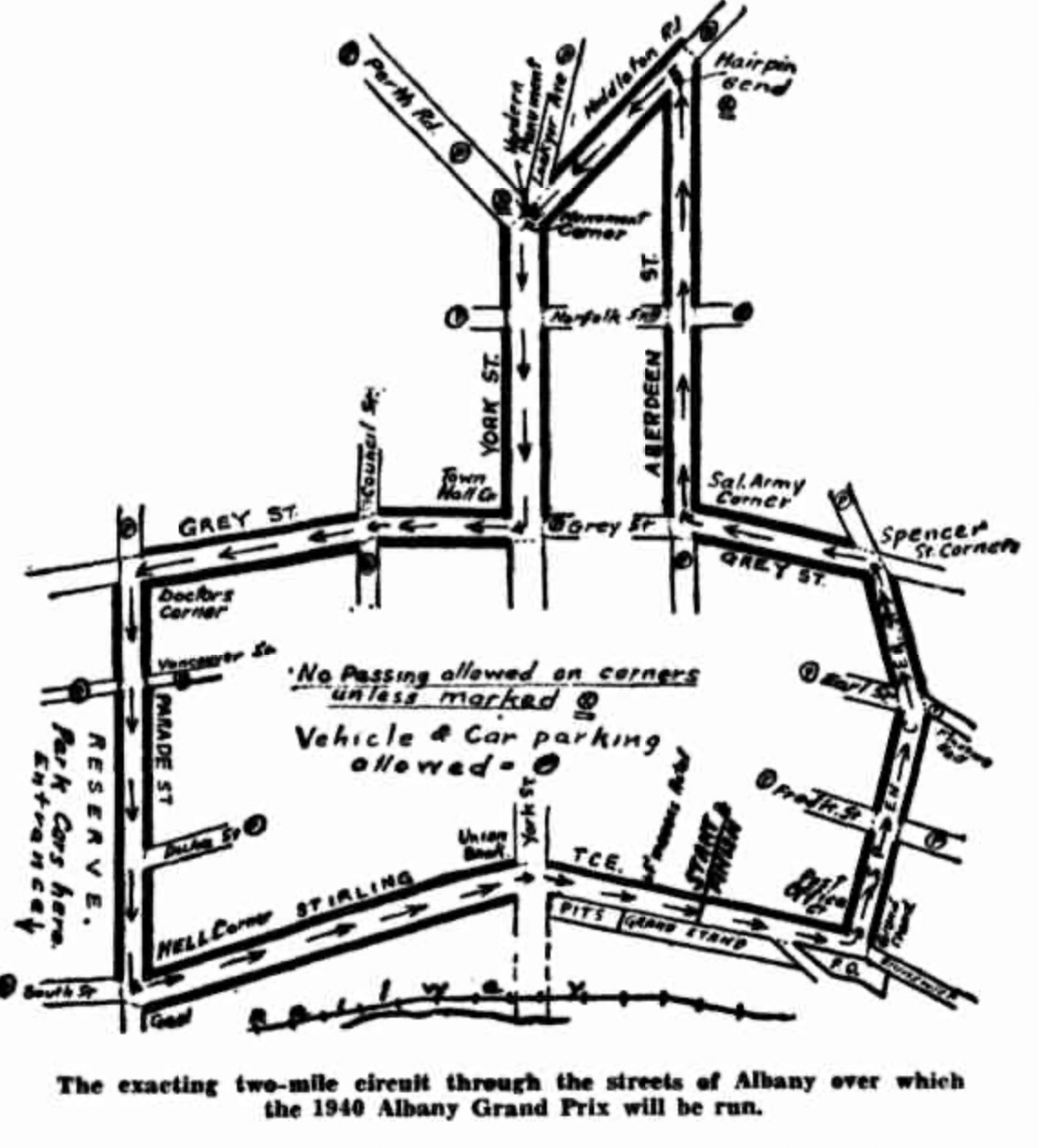
THE tortuous, hilly, two-mile circuit, with six right angle turns, one hairpin, two slight curves, and a third curve or even half turn to be negotiated every lap makes very severe calls on both driver and every part of his machine, but it is possibly the gearbox and clutch which receives the greatest puntshment.
The six right angle turns, and the hairpin will call for at least one change down approaching, with the necessary change up after having negotiated the corner.
This means at least 14 gear changes per lap, while the 25 laps will need no fewer than 350, all to be made in slightly over, or possibly under 60 minutes, according to the speed of your machine. Cars fitted with four-speed boxes naturally achieve even higher totals than this, but it will be readily realised that the claim of one gear change every 10 seconds is far from extravagant.

How then does the Albany event compare with other events in other parts of Australia, and in other parts of the world? Comparisons are difficult, because there are few circuits similar to Albany used anywhere in the world, while nowhere else in Australia is Round-the-Houses racing permitted. The circuit of the Grand Prix held at Monaco on the Riviera in southern France is approximately the same length, certainly no longer, and the fact that competing cars at Monaco in 1934, while capable of speeds up to 150 m.ph. actually averaged 54 m.p.h, indicates that the circuit must present hazards and difficulties not unlike the Albany event.
Last year Jack Nelson (Ballot Ford Spl) won the event in record time, slightly less than 58 minutes for the 50 miles, an average of approximately 52 m.p.h. This may not sound at all inspiring to those high speed motorists who accomplish incredible averages on the high road, although most of these said averages are worked out after the run has been made, and after extensive deductions have been made for roadside repairs, refreshment, etc., leaving a nett “running time” which then returns an average so high that the driver feels quite apprehensive to realise the truly terrific speed at which he has fied across the country. Nelson’s machine incidentally was electrically timed last June at a speed in excess of 107 m.p.h. so it will be appreciated that the machine that will eventually better his time at Albany will require to be something really fast handled by a master of the game.

Races Compared.
Contemporary Australian races are all over open road eircuits, the South Australian circuit at Lobethal and the Mt. Panorama circuit at Bathurst, New South Wales, being the two most noteworthy examples.
Both these circuits are far greater in extent that Albany, Lobethal by nearly nine miles. It is the considered opinion of one of our local competitors who has attended the last two events, and not as a competitor, that very few of the entrants in that event would last the gruelling 25 laps that constitute the Albany Grand Prix.
Incidentally it is noteworthy that no brake test is held prior to the Lobethal race. In this State no car ever starts In a road race without a rigid brake test.
Preparation of Cars.
Generally speaking preparation of the entrants’ cars is not of the high standard which applies in Western Australia. Last January one of the competing cars at Lobethal was a 1936 stock touring car (five passenger) with hood and windscreen removed, bonnet strap in place, and the rear doors roped together to keep them shut. The Technical Committee of the local club would swoon in horror if called upon to examine such a vehicle. Naturally with the greater population in the East there are more of the real racing vehicles competing, but the built up machines (later generally described as Australian Specials-an assemblage of components from multiple donor vehicles) appear to be accepted in almost any condition.
Photographs fail to disclose anything that could vie with the local cars such as those owned by Jack Nelson and Barry Ranford. Incidentally Ranford is one of the four men who will be making their first racing appearance at Albany this Easter. The others are Bill Smith, Harley Hammond, Geoff Glyde, and Arthur Wright. Of the remaining nine competitors, Ernie Brammer, Aubrey Melrose, Ed. Harris, John Wittenoom, Ron Posselt, Duncan Ord have all driven at Albany once. While Ted Kinnear, Bill Smallwood and Brian Holmes have driven twice.
It is also of interest to recall that the Bartlett driven by Brian Holmes, and entered in the name of Clem Dwyer, is the only car competing this year that contested the original Albany event. In the initial event on March 8, 1936, and again the following year, Dwyer was at the wheel himself, and the persistence with which the car has competed with ever since, at every possible opportunity should eventually be rewarded with a major victory. This year Duncan Ord (Bugatti T57) shares the dubious distinction of going off scratch with the Bartlett, and the resultant race should be full of interest. Incidentally, it is the first time that two cars have shared the scratch position at Albany. The small high revving Bartlett will be matched against the big Bugatti with over twice the capacity and certainly about as much more weight.
The contrast in the machines will lend colour to their strivings. Ed Harris, who drove at Albany two years ago in a 1934 black Terraplane, will this year be seen at the wheel of the 1935 blue Terraplane raced hitherto by Neil Baird, which he has acquired. It is being raced in detuned condition, the last high compression head avalaible having gone off at the same event last year. The blue Terraplane will be starting in its fourth consecutive Albany. Kinnear, Smith and Wright are all off the limit mark together, and will comprise an interesting trio. Kinnear has received 25 seconds more than last year, while Ernie Brammer, who has not fitted his ultra light body for this year, has received a full minute to make up for it.
Bill Smallwood, third last year, has come back 65 seconds, and will have to drive well to run into the places. Ed. Harris and Barry Ranford go off together, 15 seconds better off than was Baird last year, while John Wittenoom is 50 seconds better off on 3.20. Ron Posselt has a stiff job, being second back marker, only 1.30 ahead of the scratch men. On the surface he has been dealt with a shade harshly, but handicappers have at their disposal information denied to lesser mortals, and no doubt have their reasons.
An Open Race.
The field is set now, and the race has to be won. On appearance it is one of the most open races yet held in this state, and with so many new cars and drivers is full of interest despite the absence of Tomlinson and Nelson. Who can still recall when the redoubtable Ossie Cranston withdrew from racing after many successful years? It did not seem possible that his fame could ever be eclipsed, and although it has not, because he was of an earlier day, others have made names for themselves since then, and now some of them are missing from the list of starters, even if only temporarily. When they return to the lists, it they do, they may find a new champion waiting to engage them in battle. Nevertheless in its cheapest form, car racing is an expensive sport to follow, and months of preparation can go for nought if the Goddess of Luck does not ride with the machine. Perhaps the luck of the game will be the deciding factor at Albany this year, and perhaps the winner will be one least expected. To select the winner at this stage would be a guess pure and simple.
Credits…
Collections Western Australia-Albany Advertiser, Claude-James Batelier, Richard Rigg Collection, Western Mail November 3 1938, MotorSport Images
Finito…
 primotipo...
The photo of the Plymouth Spl. no7 and the Bugatti was Pinjelly 1940 . The Clem Dwyer Plymouth was built in 1940.
Mark,
Car 7 in the second pic is Clem Dwyer in his Plymouth Special.
It’s also possible the MG in the first is the P-type Dwyer had earlier raced. Of his run at the inaugural hillclimb event, Alan Tomlinson told me: “You could hear the car all the way up the hill, the gearchanges, braking and accelerating, it was a perfect run and nobody could beat that.”
The quote from someone who went to Lobethal but didn’t compete could be from either Nelson or Dwyer, who were there helping Tomlinson. Nelson went back later to compete.
Ray
Many thanks Ray,
Great stuff.
m
The diagram of the track layout shows the “Start / Finish” line just after a RIGHT hand kink in Stirling Crescent, but the photo of the two cars crossing the finish line shows them just going through a LEFT hand kink. Is the diagram incorrect; or has the photo been inserted back to front, and the numbers photoshopped onto the photo. Or is there some other explanation?
Mark,
It is implied above that Bob Jane ran the Australian Grand Prix at Calder from 1979. Shouldn’t that be 1980?
Cheers,
Rob B.
Cheers Rob