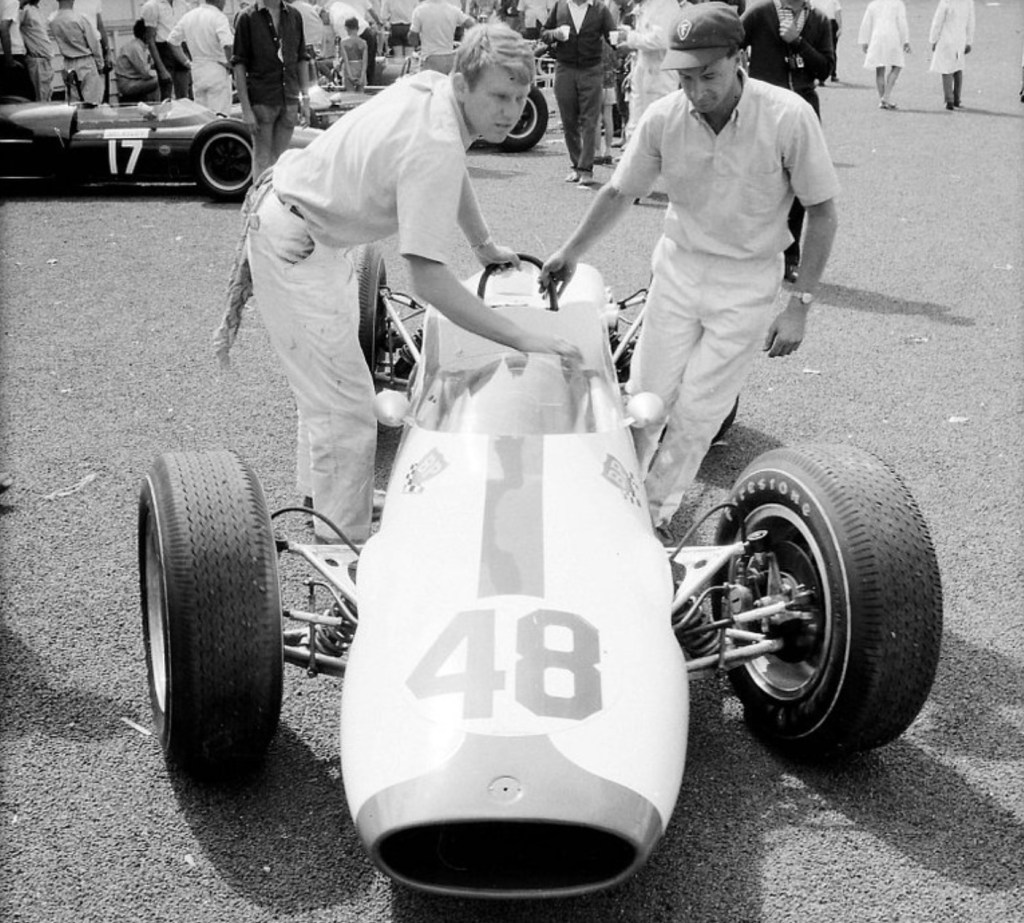
Tyler Alexander at left with Phil Hill’s Bruce McLaren Motor Racing Cooper T70 Climax FPF 2.5 at Pukekohe, Auckland during the January 9, 1965 New Zealand Grand Prix meeting. Car #17 is John Riley’s Lotus 18/21 Climax.
This car was an updated version of a chassis Bruce and the late Tim Mayer raced the year before – T70 FL-1-64 – while The Chief raced a new design designated the T79: T79 FL-1-65. It’s pretty familar turf to us, see here: https://primotipo.com/2016/11/18/tim-mayer-what-might-have-been/
(D Shaw)
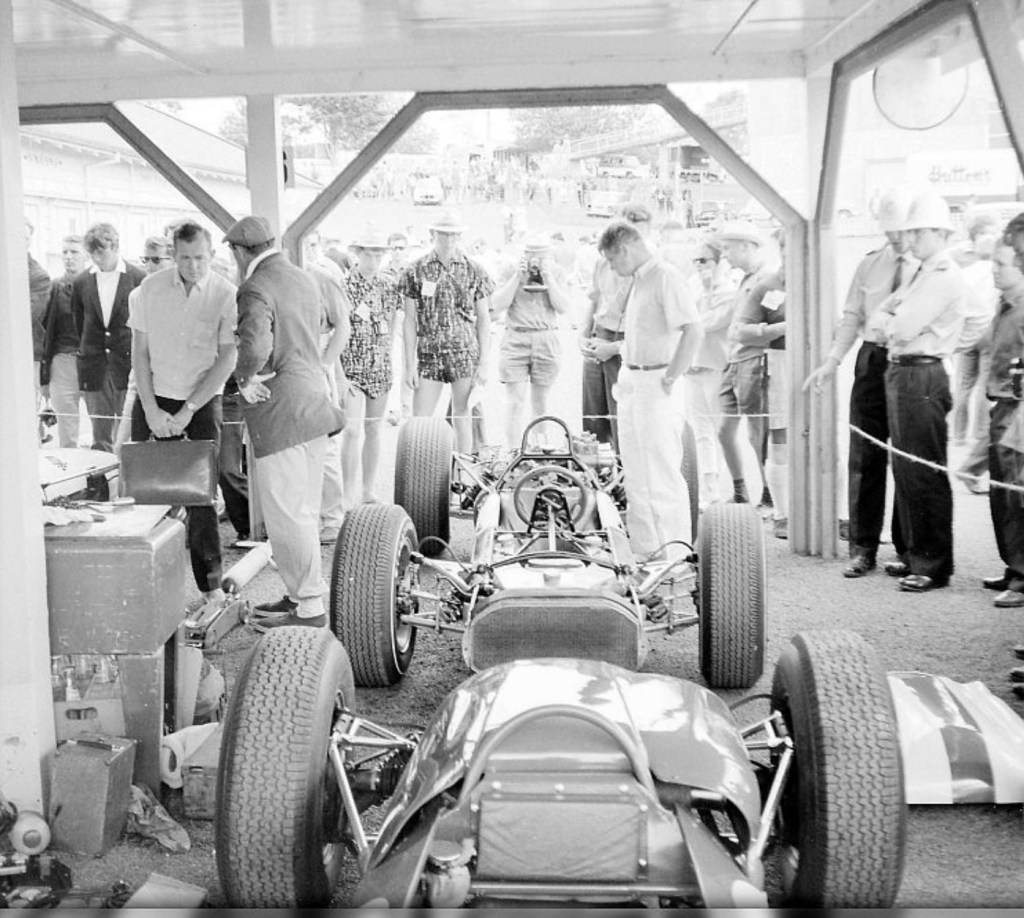
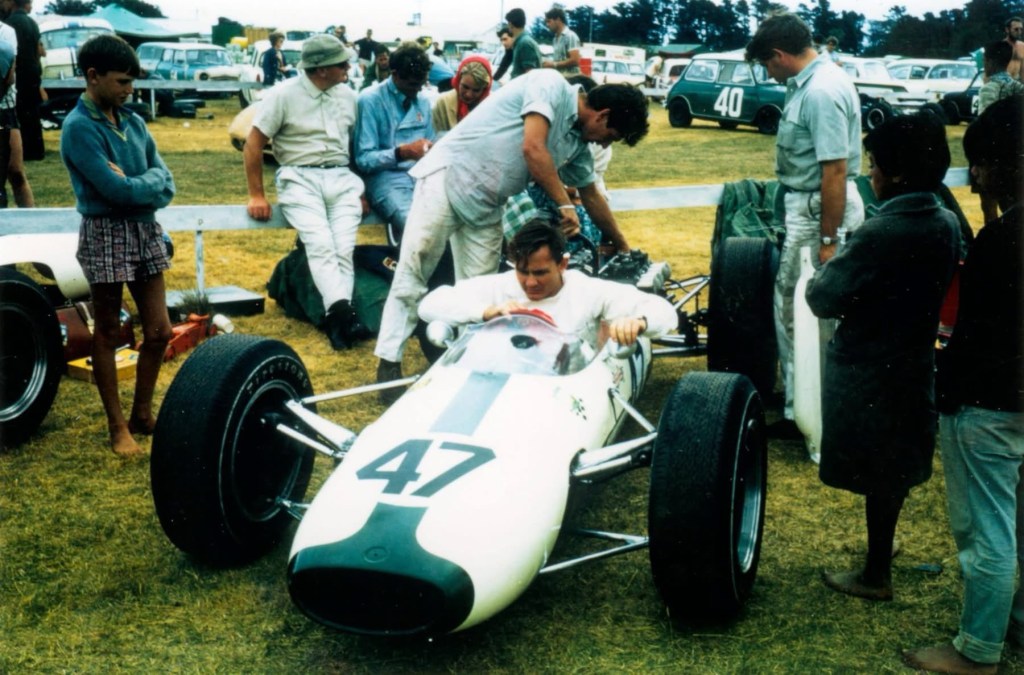
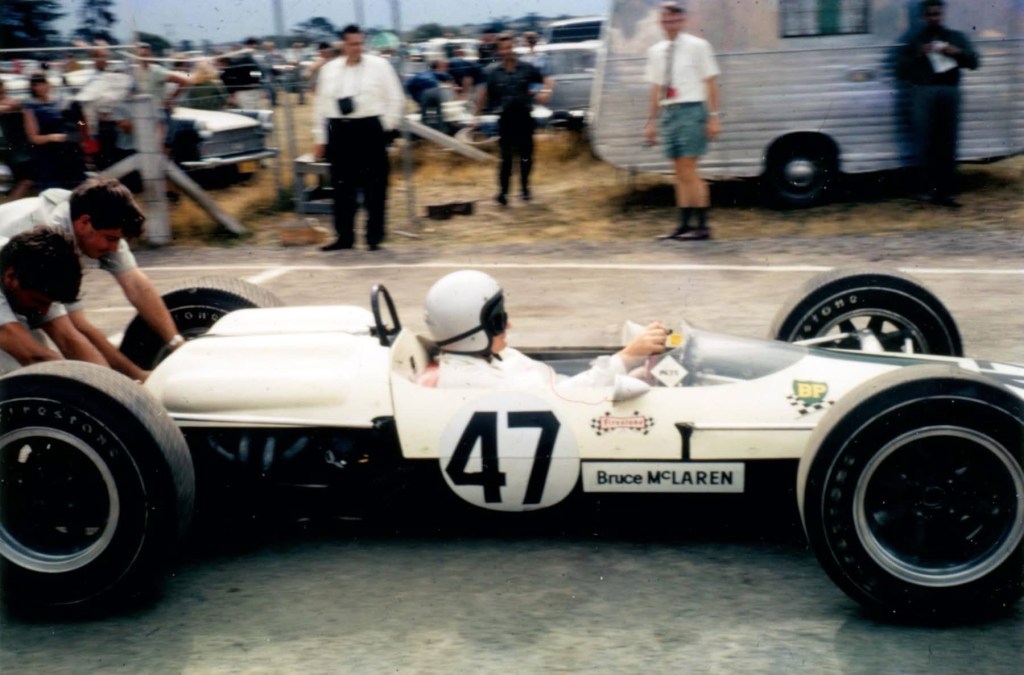
That’s the chassis of the T70 above at Pukekohe – with a Brabham BT4 in the foreground – while Bruce is settling himself into the T79 at Levin, the second Tasman round below.
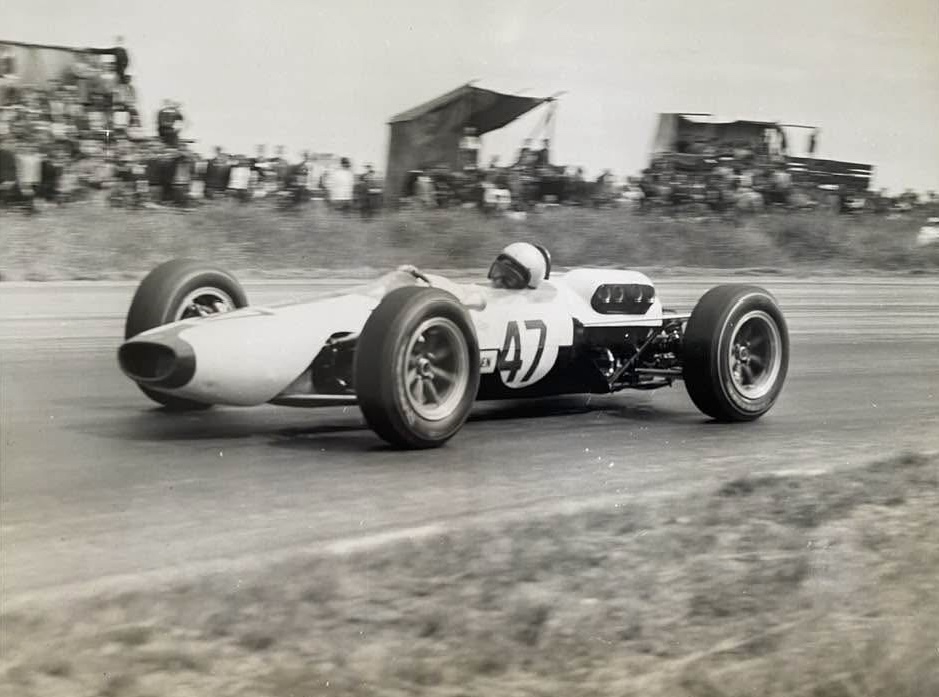
Bruce and Jim Clark collided in one of the Pukehohe heats. While Jim started the GP in his works Lotus 32B Climax, Bruce’s Cooper’s T79 was hors d’combat for the weekend, so he commandeered Phil’s T70 but succumbed to gearbox failure after 13 of the race’s 50 laps. Clark lasted only 2 laps before suspension problems, leaving Graham Hill to win the race aboard his Scuderia Veloce Brabham BT11A Climax.
(unattributed)
McLaren was fifth at Levin, with Jim Clark’s Lotus 32B Climax the race winner. Jim was the Tasman Cup victor too, with four wins from the seven championship rounds or five wins from eight races, including the Lakeside 99 non-championship round. Not to forget, however many heats Clark won.
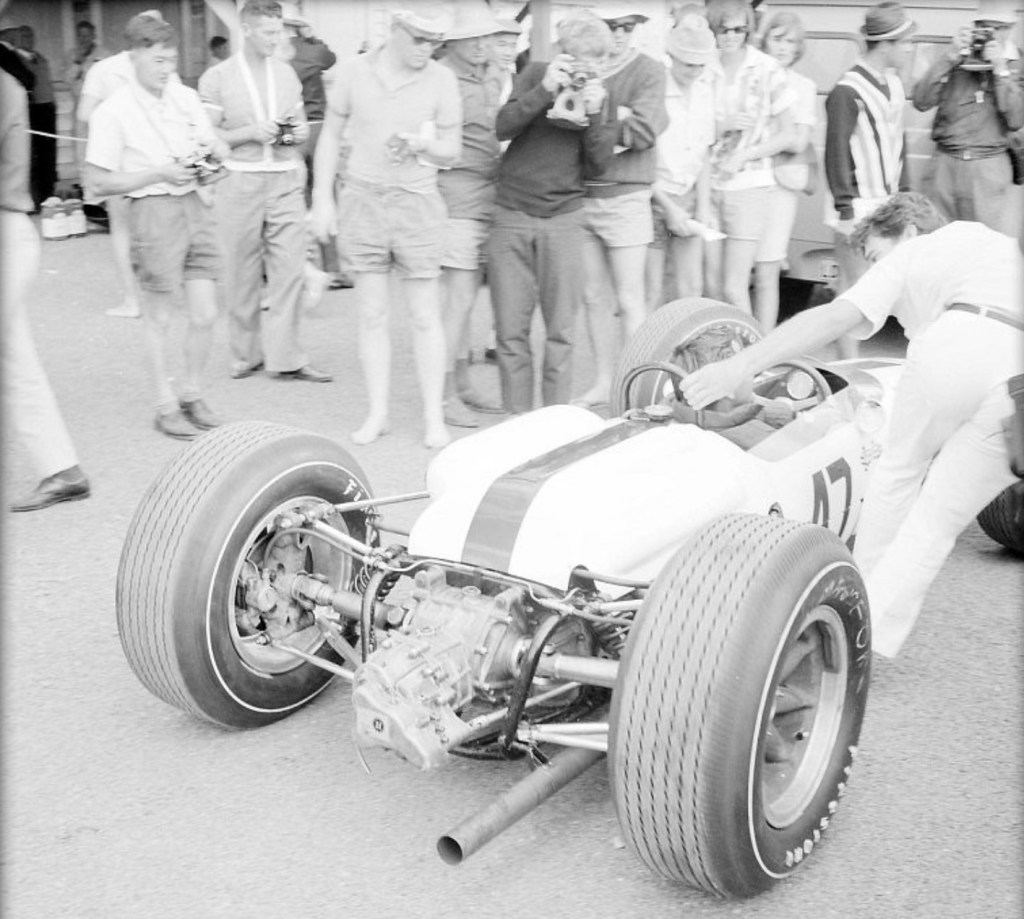
Bruce’s Tasman plans were thrown somewhat up in the air. The two Coopers were designed around 13-inch Dunlops but Bruce had signed a contract with Firestone for supply of tyres. Defining though the deal was commercially, in the short term the hard, American 15-inch covers were shite for road racing.
The bigger wheels resulted in handling problems which would normally have been sorted before the long trip south. As it was, the necessary makeshift modifications were made between races.
NZ GP at Pukekohe, Bruce didn’t start the T79 having collided with Jim Clark in a heat. Note the Hewland HD 5-speed transaxle and tall Firestones (D Shaw)(unattributed)
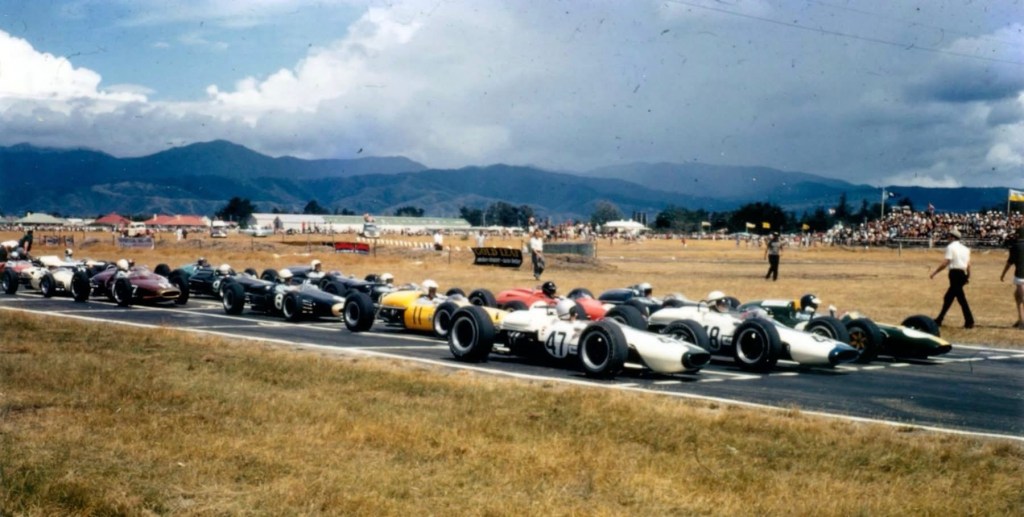
The Levin International start on January 16, with Phil and Bruce alongside Clark despite problems adapting Bruce’s new Firestone tyres to a chassis designed with Dunlops in mind.
Despite these difficulties McLaren did Wigram and Teretonga races in faster times than those which gave him his 1964 victories.
In Australia, once 13-inch wheels were available, McLaren was fourth at Sandown and won the Australian Grand Prix final round at Longford from pole to finish the Tasman series runner-up to Clark, while Phil Hill was a well-merited third. There is no doubt that if pre-trip testing time had been on their side, the Cooper-Climax drivers would have made a much better showing in New Zealand.
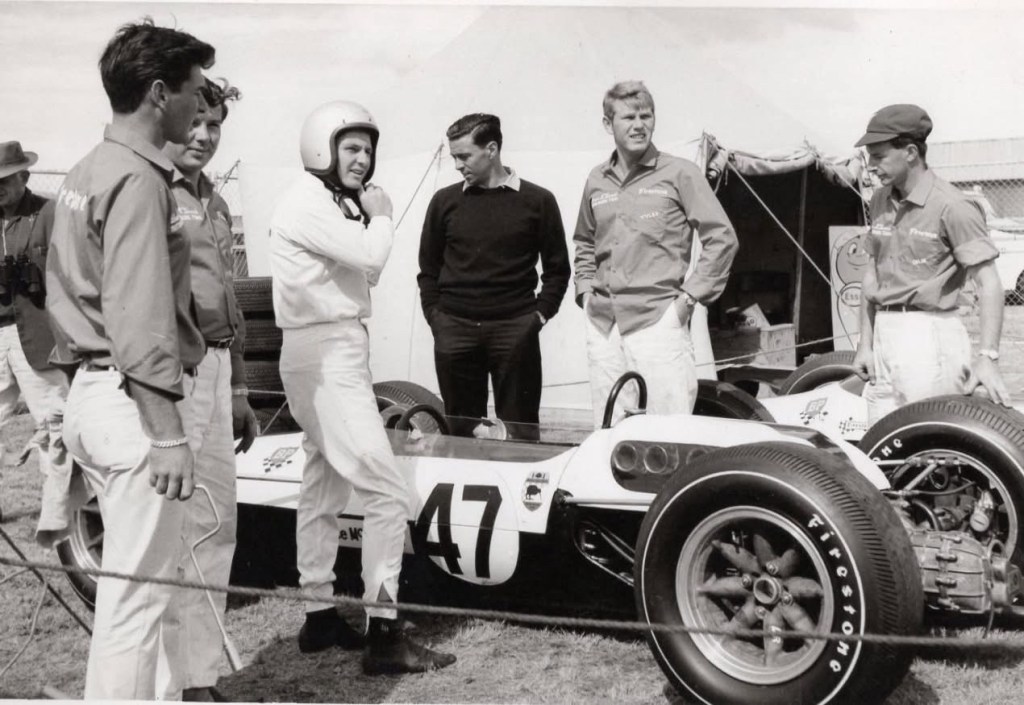
Pop McLaren, Wally Willmott, Bruce Harre, Bruce McLaren, Jim Clark, Tyler Alexander and Colin Beanland David Oxton informs us, in the Wigram paddock, over the January 23, 1965 weekend.
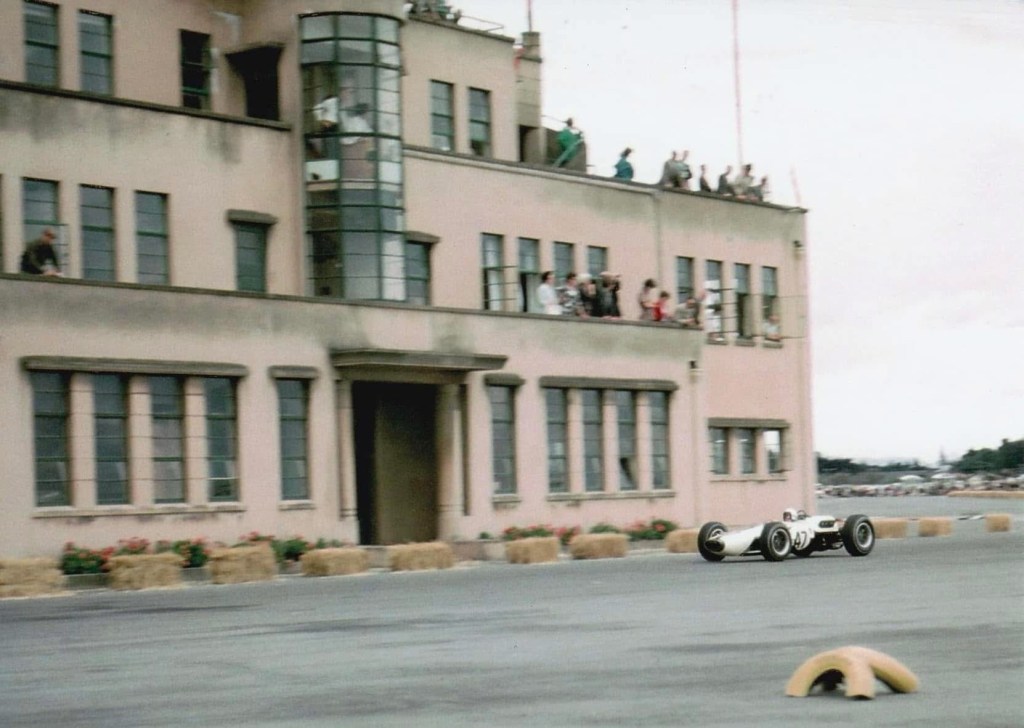
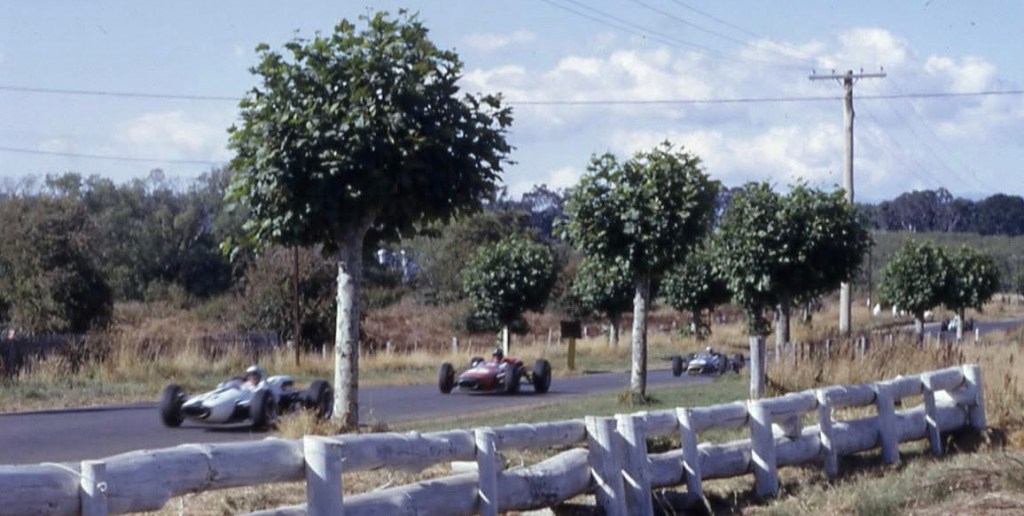
Showing real progress, McLaren, below, was second to Clark’s Lotus with the well-driven Brabham BT7A Climax of Jim Palmer in third.
(CAN)(A Horrox)
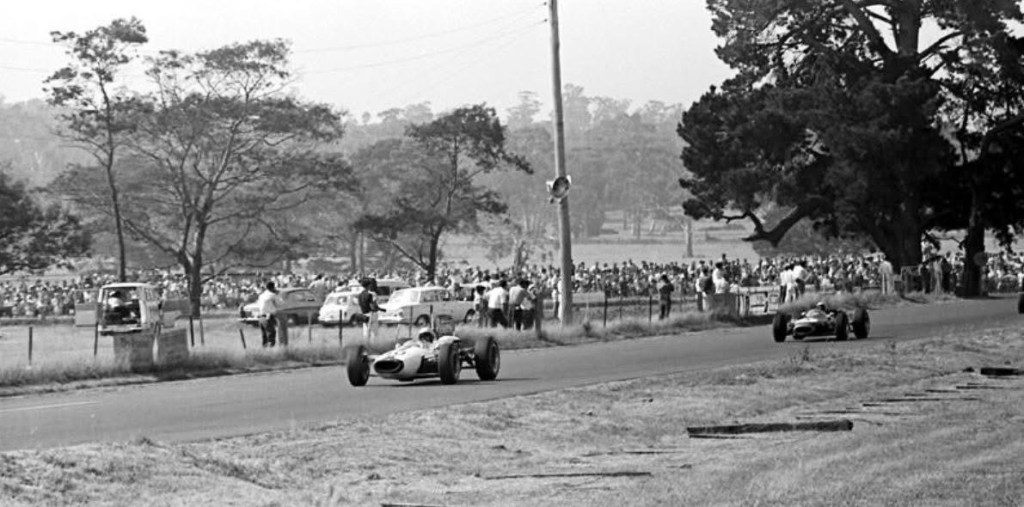
Teretonga, above, was better still with a team two-three – McLaren from Hill – but Jim Clark was still the man in the front of the field with three wins on the trot, only Graham Hills Scuderia Veloce Brabham BT11A Climax win in the New Zealand Grand Prix at Pukekohe at the start of the month ‘rained on Jimmy’s Lotus parade.’
(K Wright)
Bruce McLaren leads Graham Hill and Jack Brabham early in his victorious run in the AGP into Longford village: Cooper T70, and Brabham BT11A’s by two, all Coventry Climax FPF 2.2-litre powered. McLaren and Brabham below.
(GP Library)(MotorSport)
Every Dog Has its Day – perhaps every car too!
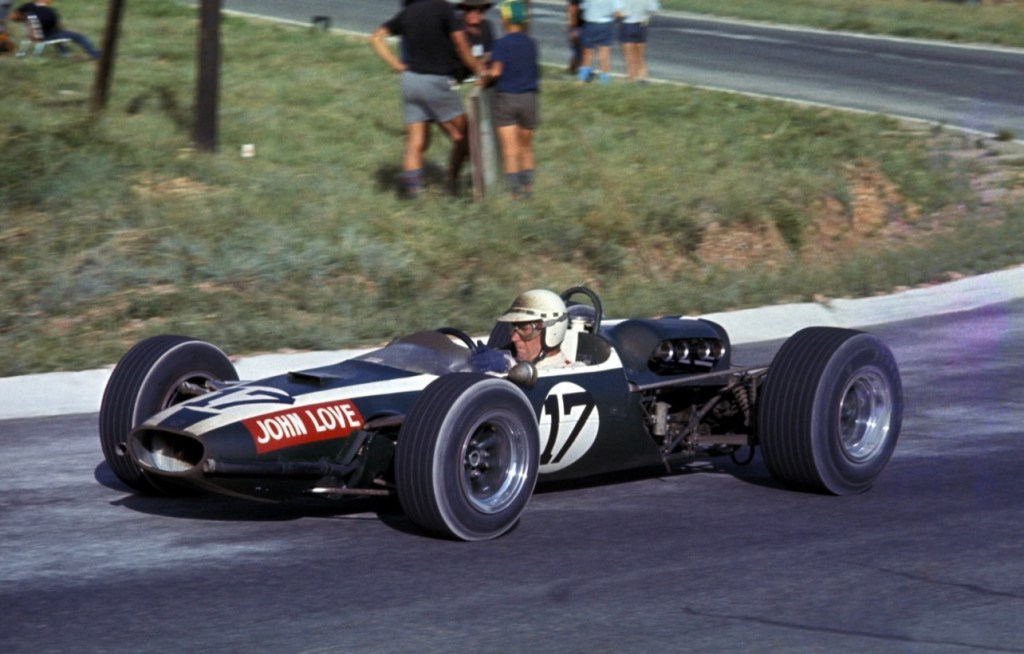
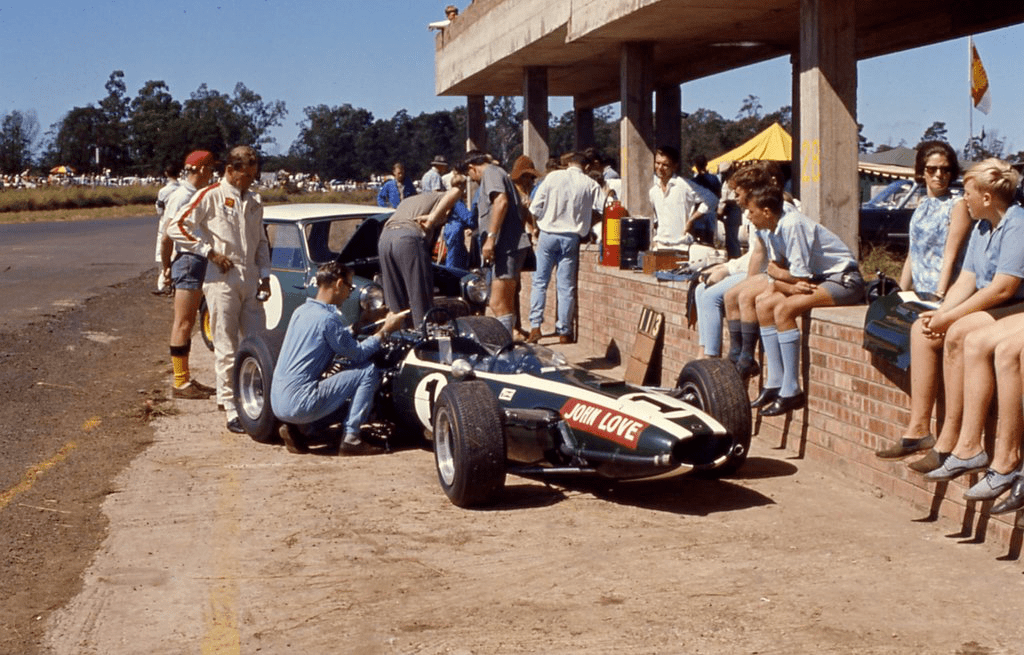
At the end of the Tasman, Bruce McLaren sold the T79 to South African ace, John Love. The shot above shows him on the way to a brilliant second place in the 1967 South African Grand Prix.
The machine was a star-car in Africa, winning the 1965, 1966 and 1967 South African National F1 Championships, co-credits to Love’s Cooper T55 Climax and Brabham BT20 Repco in 1965 and 1967 duly noted.
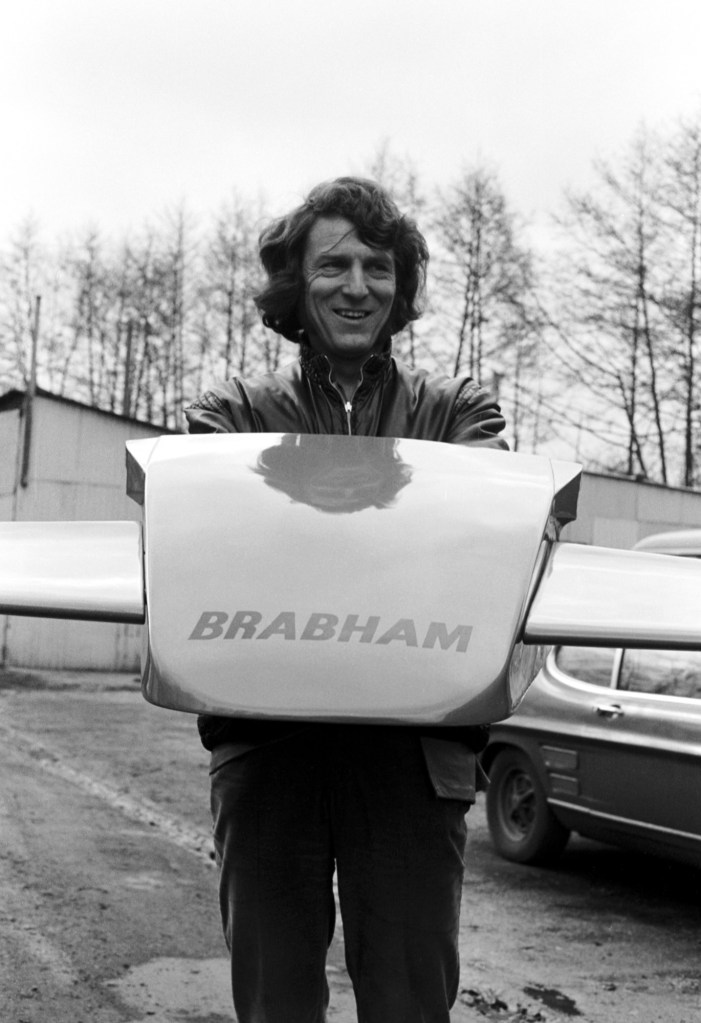
Keith Greene on the occasion of his appointment as Team Manager of Brabham by Bernie Ecclestone, the new owner of Motor Racing Developments Ltd in 1972.
Ron Tauranac would have approved of this povvo-PR announcement out front of MRD in Byfleet Road, New Haw, Weybridge, Surrey. The prop is a BT38 (?) nosecone.
At the wheel during the August 5, 1962 German Grand Prix. Gilby BRM, Q19 0f 30 and DNF suspension after 7 of 15 laps. Graham Hill won from John Surtees and Dan Gurney: BRM P57, Lola Mk4 Climax and Porsche 804.
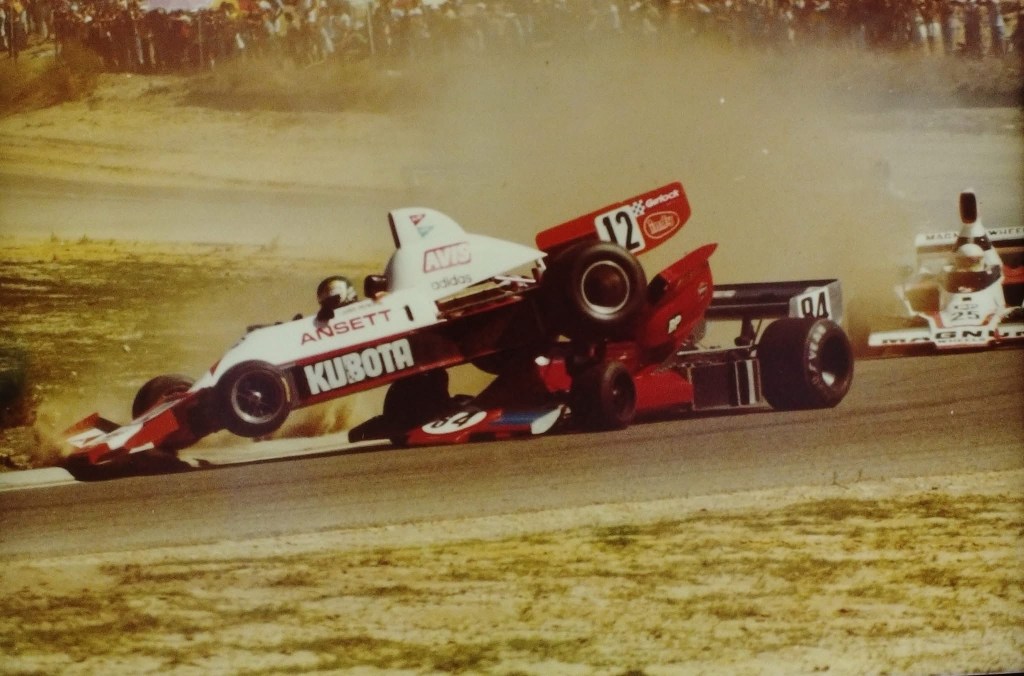
Mike Imrie’s Ford Falcon V8 sports sedan gets the jump on Alfie Costanzo’s Porsche Cars Australia Lola T430 Chev into Shell corner, Sandown during a Formule Libre race in 1979.
Maybe not. How bout they shared an early Sunday discretionary practice session, it’s an interesting juxtaposition of car types all the same.
The trouble with building the world’s best Formula 5000 car, the Lola T330/T332/T332C, is how Eric Broadley and his band of merry men could better it!
Alan Jones, Lola T332 Chev ahead of Peter Gethin’s Chevron B37 Chev during the February 1977 Sandown Park Cup, two DNFs, with Max Stewart’s Lola T400 Chev the winner below. All of the first three shots Shell Corner (B Forsyth)(R Steffanoni)
The 1975 Lola T400 (above) oozed smart thinking, including variable or rising-rate suspension. Initially it was labelled a dog, but by mid-1975 an update kit and setup guidance had customers who persevered with the cars on the right track: Teddy Pilette’s VDS T400 won the 1975 European F5000 Championship from his teammate, Peter Gethin, while in Australia Max Stewart’s T400 won the 1975 Australian Grand Prix and many Gold Star and Rothmans International rounds from 1975-77.
The ultimate F5000 test was of course, the US Championship, where Eppie Wietzes was the best of the T400s in 1975 with fifth place in the standings. The Americans and Australasians loved their T332s, some like the Jim Hall-Chaparral T332Cs raced by Brian Redman were very highly refined and developed, and prodigiously fast.
Frank Gardner all cocked up in the Esses during the February 1971 Warwick Farm 100 Tasman round won by FG’s works Lola T192 Chev (L Hemer)Kevin Bartlett, Lola T300 Chev, Glyn Scott Memorial Trophy Gold Star round, Surfers Paradise 1972
Broadley then took a leaf out of his own F5000 playbook. The Frank Gardner developed Lola T192 Chev was still winning races in 1971 when Broadley, Gardner and designer John Barnard went smaller by building the 1972 model-year Lola T300 Chev.
Essentially, Gardner felt a car based on an F2/FB T240 aluminium monocoque chassis would provide a lower centre of gravity and improved aerodynamics. Fitted with big radiators mounted beside the drivers shoulders, a 500 bhp Chev and Hewland DG300 five speed transaxle where a Ford FVA and FT200 five speed transaxle once lived, the T242, and a little later the renamed T300 was a luscious looking racing car!
Once refined by Gardner in the late 1971 season races the T300 won a lot of races around the world and sold like hot cakes in ’72. The 1973-74 T330/T332 refined the package into one of the most successful series of customer racing cars ever built. Probably the most successful if you account for the central-seat 5-litre Can-Am T332CS and T333 variants as well.
For 1976 Lola planned to do ‘a T192 to T300 all over again’.
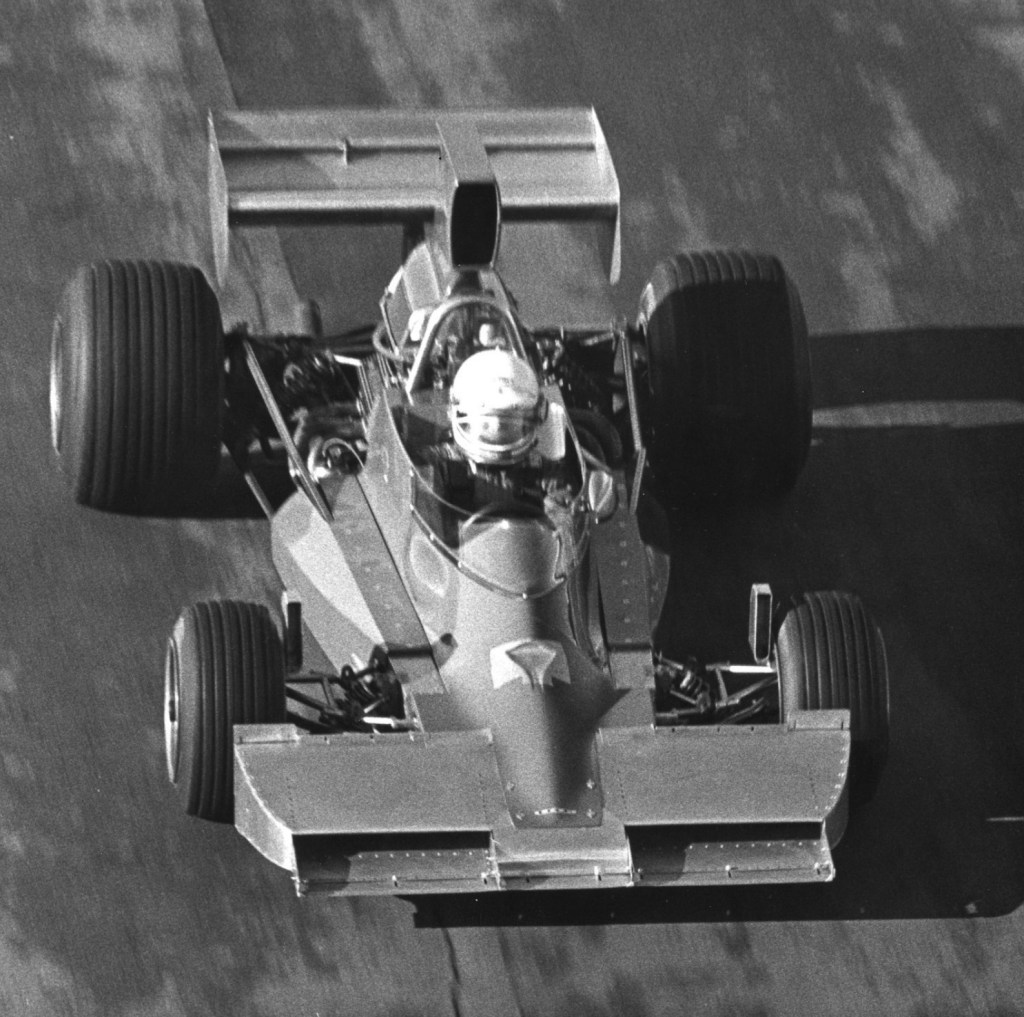
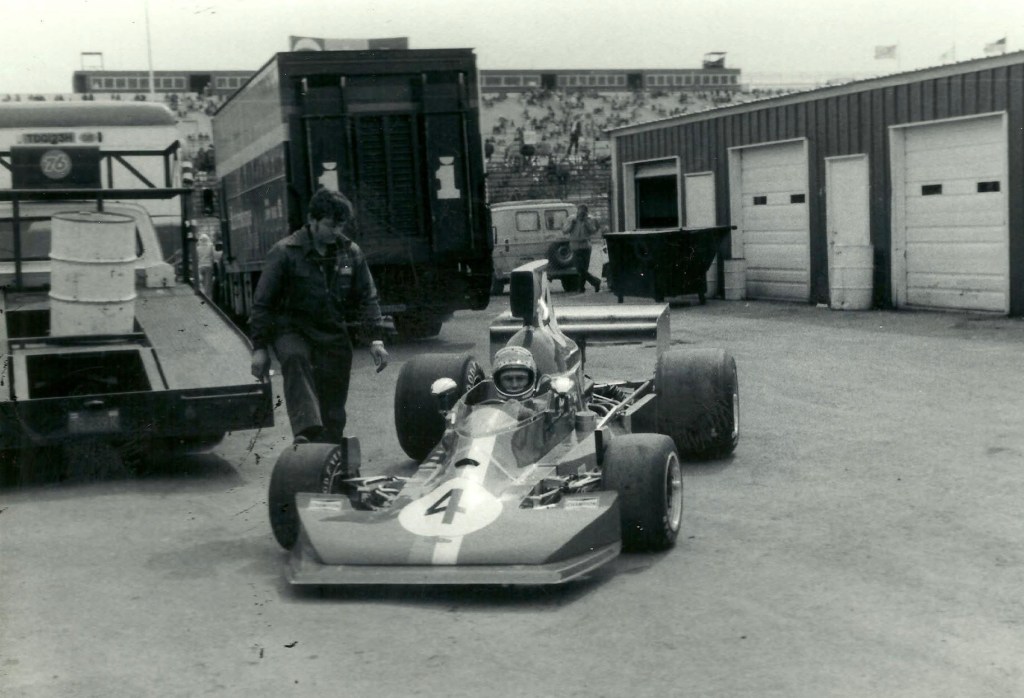
Teddy Pilette testing a Lola T450 F2 chassis fitted with a Chev V8, DG300 Hewland etc at Paul Ricard. Note that a front radiator is fitted at this stage. In the later shot of Teddy below, the radiators have been moved to the rear, parallel with the radius rods (Lola)Note the ‘brackets on brackets’ front suspension assemblies as per the text (Auto Hebdo)
Lola initially built and tested a car based on an F2 T450 tub, but ultimately, went with a monocoque based on the T360 Formula Atlantic, which was also a narrow design.
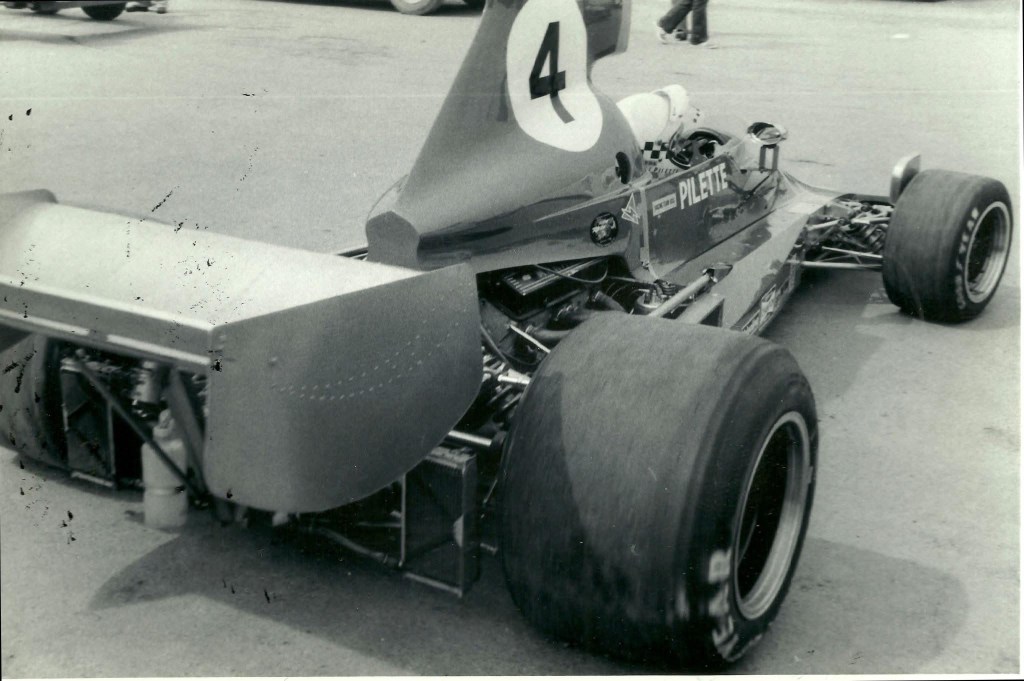
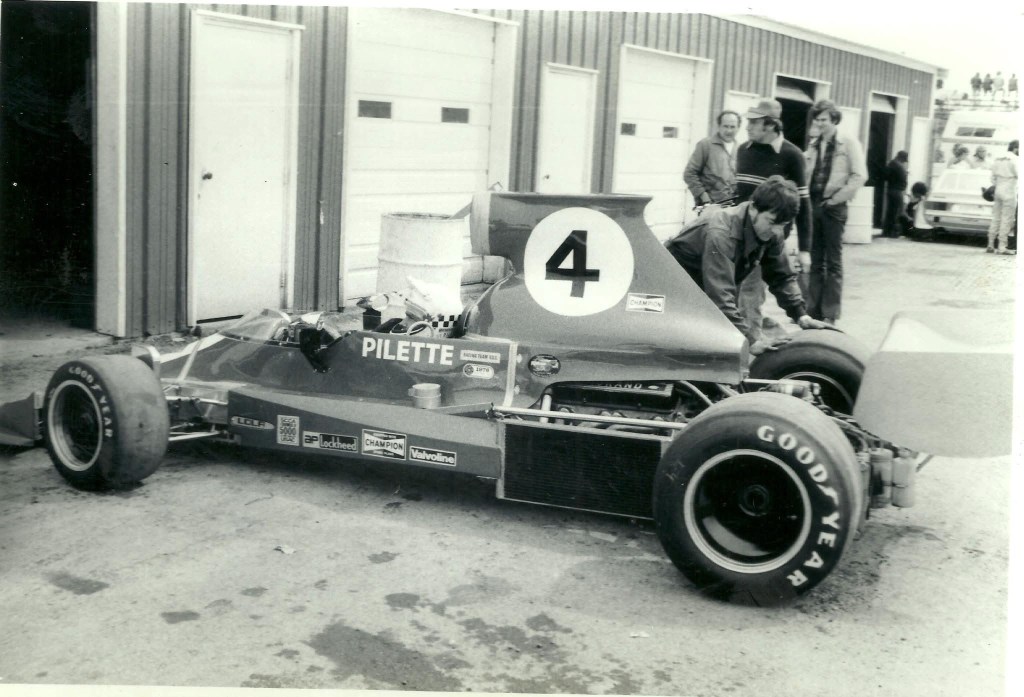
The T430 had a full-width nosecone, unlike all of the T300-series cars, but the radiators were mounted at the rear, having initially, as the photos above show, experimented with a front-mounted radiator.
The suspension was different to the T360 in that the quite conventional mix of magnesium uprights, upper and wide-based lower front wishbones, Koni/coil spring damper units and an adjustable roll-bar. were attached to brackets that in turn were attached to the tub.
The rear suspension comprised Lola magnesium uprights, a single upper link, two parallel lower links and a pair of radius rods doing fore and aft locational duties, and again Koni/coil springs and an adjustable roll bar. VDS’s chief mechanic, Steve Horne, christened the car The Flying Bracket!
In essence, as Allen Brown described it, the T430 has ‘T332-style suspension geometry. Essentially, Lola had built a smaller version of the T300/330/332 design.’ Teddy Pilette wrote cryptically on Facebook, ‘Eric Broadley wanted to make a small, narrow car to get the advantage of straight-line speed…but no good on the curve!!!!’
Steve Horne added (in relation to a Riverside photograph) ‘The drivers swapped cars that weekend and didn’t change much. I normally looked after the B37 (see results summary below), but that weekend was demoted to the 430! The Chevron was one of the best F5000s I worked on. It didn’t really have any development done on it, and the biggest downfall for both cars (T430s and B37) were the Morand engines, which just weren’t competitive in the USA.’
SCCA-USAC Formula 5000 1976…
Three Lola T430s were sold, two to Count Rudy Van Der Straten’s Racing Team VDS, and one to Jim Hall’s. In addition to his pair of Lolas for the 1976 US F5000 Championship – the last – VDS also acquired Derek Bennett’s last F5000 design, the Chevron B37 Chev, having successfully run B24/B28s previously; Peter Gethin won the 1974 Tasman Cup aboard a VDS Chevron B24 Chev.
It must have been quite an expensive year for the beer-baron, carrying chassis spares for different makes of cars. To add to the mix, he also appears to have acquired the T332C HU55 that Warwick Brown was racing for Bay Racing until its demise. WB’s first appearance for VDS was at Road America on July 25.
Pilette raced T430 HU1 and Gethin and Brown HU2, Gethin’s preferred mount was the B37, but Teddy grabbed it once or twice too…
Teddy Pilette, Lola T430 Chev HU1 at the Pocono 1976 US F5000 season opener – the T430’s first race – in May 1976 (B Featherly)Oil radiators mounted either side at the rear (B Featherly)(B Featherly)
As to results: Pocono, May 9, Teddy was Q5 and third and fourth in the heats, then 12th in the final won by Redman’s T332C. At Mosport on June 20 Teddy was third from Q7 in the race won by Alan Jones’s T332. Jackie Oliver had a memorable win for Dodge at Road America on July 25, Shadow DN6B with Pilette sixth from Q11. Gethin was ninth from Q8. Redman won again at Mid Ohio on August 8 with Gethin seventh from Q11. Pilette was fifth overall, and second in his heat from Q7 in the Chevron B37…
The dominance of the Lola T332C was again confirmed with Redman’s win in the Hall-Haas entry at Road America on August 28, where Pilette was Q2 – easily the best qualifying performance of a T430 all year – and fifth, with Brown Q6 in T430 HU2 and DNF, while Peter was Q8 and fourth in the B37.
Allen Brown wrote that ‘With two rounds to go, Alan Jones and Jackie Oliver were tied for the championship lead, but when Oliver retired at Road America and Jones had to miss the race to be at the Dutch Grand Prix, Redman won and leapt into a significant points lead.’
Teddy Pilette leading the field in the wet at Watkins Glen in ? 1976 DNF on lap 14 with engine failure (Lola Heritage via T Pilette)Warwick Brown, T430 Riverside 1976 and below (unattributed)
At Mid-Ohio on August 8, Redman won again with Gethin seventh in HU2 and Teddy fifth in the B37. In the final round at Riverside on July 17, VDS were again busy with three cars. Up front, it was Al Unser in a T332 Chev with WB sixth in HU2 from Q11, Gethin 10th from Q16 in the B37 and Teddy 12th from Q10 in HU1.
Redman won the championship from Unser, Oliver and Jones, the best of the T430 pilots was Warwick Brown in seventh, but most of WB’s points harvest was aboard the Bay Racing Lola T332C.
Lift Off: Surfers 100 1977. L>R WB T430, Peter Gethin Chevron B37, Vern Schuppan, Elfin MR8-C, with John Leffler’s white Lola T400 correcting his start slide and perhaps looking for a run between Gethin and Schuppan. The first three were Brown, Gethin, and Leffler (D Simpson)
1977 Rothmans International Series Australia…
Given the scale of the investment, and success of VDS it was a poor season, best to cut ‘yer losses, take the cars to Australia, win the series, then flog them at the end of it. Which is exactly what happened!
Warwick Brown won two of the four Rothmans International rounds – Oran Park and Surfers Paradise – and the championship from Peter Gethin, in the VDS Chevron B37 Chev and Alan Jones Lola T332 Chev.
Jones was the star of the series but a jumped start in the AGP at Oran Park and writing off a T332 at Surfers cruelled his chances. Yip’s boys leased KB’s T332 for that race.
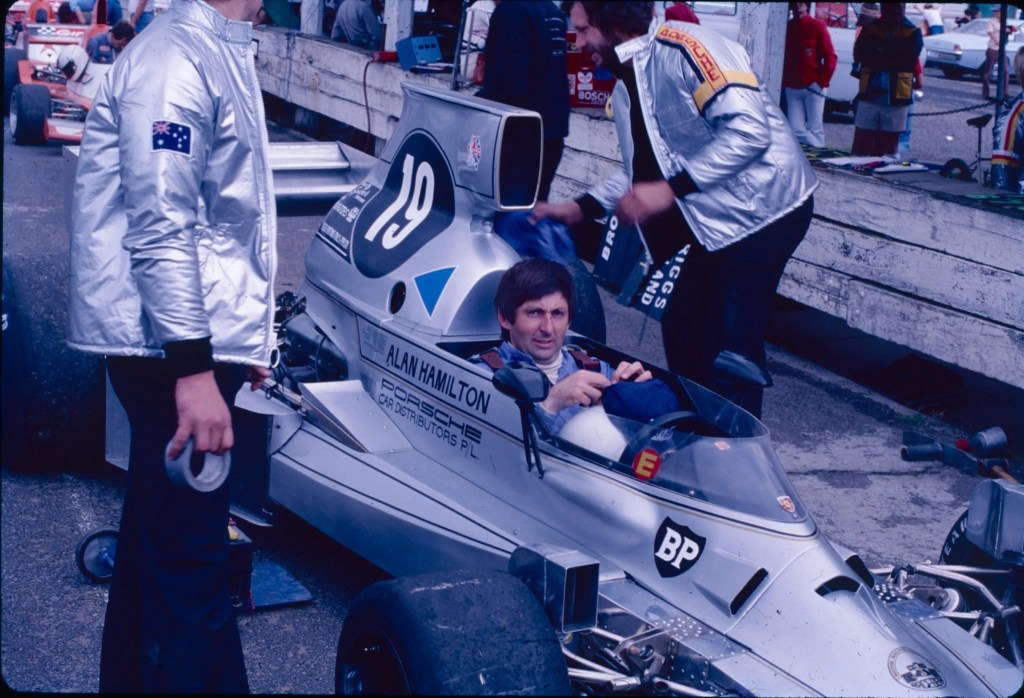
At the end of the series, VDS sold the two T430s to Porsche Cars Australia/Alan Hamilton, who had had one season of F5000 in 1971, and with business booming, thought he would have another crack.
Bruce Allison bought the Chevron B37 and had a fantastic year in it, contesting the British F5000/Group 8 Championship, winning many fans, some races, and the prestigious Grovewood Award.
‘Hammo’ in the Sandown pitlane during the 1978 AGP weekend (B Atkin)
Porsche Cars Australia Alan Hamilton…
Brown raced HU2 to wins in the Australian Grand Prix at Oran Park and in the Surfers Paradise 100, while Max Stewart took his final win in his Lola T400 Chev HU3 at Sandown the week later.
Alan Jones’ Sid Taylor-Teddy Yip Lola T332 Chev was the fastest combination in the 1977 Rothmans Series, with AJ redeeming himself in the final round at Adelaide International. Jones was pinged for jumping start at Oran Park, bent a Lola in practice at Surfers, then led at Sandown before retiring.
In his ’77 Gold Star campaign aboard HU2, ‘Hammo’ was second at Sandown, fourth at Calder and second at Phillip Island for fourth overall behind John McCormack’s McLaren M23 Repco-McCormack Leyland.
Hamilton also contested the 1978 Rothmans Series for fifth at Sandown, tenth at Adelaide International and sixth at Surfers Paradise before vacating the seat for Derek Bell at Oran Park, where the British all-rounder was eighth from Q11.
Warwick Brown won the series again with a VDS machine, this time a Lola T333 Chev Can-Am car (HU2) converted to a T332C F5000 car, amusing to me at least, given the number of T332s that made the conversion journey the other way…
Derek Bell ahead of Kevin Bartlett at Oran Park at Oran Park in 1978. Lola T430 Chev and Brabham BT43 Chev (C Snowden)Alan Hamilton aboard his immaculate Lola T430 Chev during the 1978 Australian Grand Prix at Sandown before That Lap. Note the very neat T332-based nose fitted by then
While grids for the Rothmans International Series were still adequate, the domestic Gold Star was a different matter. The case for a change to Formula Pacific was being put, with F5000 hanging on. Alan Hamilton missed the opening round of the Gold Star at Oran Park but entered for the Australian Grand Prix at Sandown on September 10.
That ‘Fangio Meeting’ was mega with the great man demonstrating a 3-litre W196S-engined Mercedes-Benz W196R Grand Prix car with much brio throughout the weekend and ‘racing’ Jack Brabham in Jack’s 66 F1 Championship-winning Brabham BT19 Repco 620 V8.
The utter excitement of the sight and sound of that legendary car-driver combination was to a large extent ruined by the accidents that befell Garrie Cooper and Alan Hamilton, and to a lesser extent Vern Schuppan, in the Grand Prix won by Graham McRae, McRae GM3 Chev.
Alan lost control of the twitchy, unforgiving Lola on the fast left-hander off The Causeway then went backwards into the Dunlop Bridge breaking the car into two and breaking a leg, his pelvis and sustaining serious head injuries.
While there that day, I was nowhere near the accident, which was in a no-spectator area on the inside of the track. The vibe of the place that day, with three big hits and limited information flow to us punters, is something I still remember.
It took a long time for Hamilton to recover, he carried maladies related to that accident for the rest of his life, not least the diabetes that prevented him from ever holding a full competition licence again.
Hamilton supported a lot of drivers along the way, it’s beyond the scope of this article. When he decided to continue to race the other T430, HU1, he chose Italian Australian Alfredo Costanzo, then 35 years old.
Costanzo in the Sandown dummy grid. Flying Bracket factor front and rear is clear (D House)This shot shows the low frontal area presented by Costanzo’s T430 compared with Brown’s T332 further back; Perkins’ Elfin MR8 looking as slippery as the T430. Oran Park 1979 (B Forsyth)
Costanzo’s first race was at the Sandown round of the 1979 Rothmans Series on February 4, where he won, what a debut! He took the Adelaide round as well.
The shot above shows Costanzo, Lola T430 Chev, ahead of Larry Perkins, Elfin MR8C Chev, and Warwick Brown, Lola T332C Chev in the final Oran Park round on February 25, 1979.
Rob Newman, racer and in John Walker’s AGP and Gold Star winning 1979 year, the preparer of JW’s Lola T332, observed: ‘Poor Alfie had a driveshaft failure and lost the race and the series. Perkins went on to win the 1979 Rothmans series without winning a race, and Warwick salvaged one race win from what had been an awful 1979 Rothmans series for him, his last season as a professional driver, if I recall correctly.’
Shortly after the Rothmans, the Gold Star commenced with the Australian Grand Prix at Wanneroo Park on 11 March. Costanzo bagged pole, then he and Perkins took one another out in a first-lap, first-corner battle for victory. Another perennial battler, John Walker, won the day in Martin Sampson’s Lola T332 Chev; the duo took the Gold Star that year, too, with Alfie the winner of the Sandown round.
Take No Prisoners. Classic dive and chop manoeuvre between Perkins’ Elfin MR8 and Alfie’s T430 eliminates both at the start of the 1979 AGP at Wanneroo Park. A great pity, as that joust could have been really something (unattributed)AGP victor John Walker is licking his lips in the #25 white Lola T332 behind the Wanneroo Air Show (unattributed)
Into 1980, the Hamilton-Costanzo-T430 combination finally came good in a Gold Star season of many different winners, winning the coveted award from Jon Davison and John Bowe and taking victory in the Sandown and the Rose City 10000 at Winton in T430 HU1.
Alfie’s last hurrah in the old car was in the Australian Grand Prix at Calder on November 16. By then, the conversion of McLaren M26-4E to a ground-effects Chev-engined F5000 car in PCA’s workshops was a bit behind schedule, so Hamilton’s crew dusted off the T430 for one last time, finishing fourth in the race behind Alan Jones, Williams FW07B Ford, Bruno Giacomelli, Alfa Romeo 179 V12 and Didier Pironi’s Elfin MR8 Chev. Alfie and Didi gave one another a bit of hip-and-shoulder that day!
Bob Minogue, Lola T430 Chev, Shell Corner, Sandown 1981. From memory, the lack of airboxes at this stage was the notion of the entrants/penniless sponsor Arco Graphite to make F5000 cars look more contemporary (R Lewis)
The car didn’t move far with Brighton racer Bob Minogue, the purchaser. He had been out of racing for a while but proved very much up to the task and not intimidated at all, racing the car in the 1981 Gold Star and into the Arco Graphite Series in 1981-82 as Formula Pacific finally took over as Australia’s National F1.
All three T430s live in New Zealand with T430 HU2 rebuilt around the chassis plate, which ‘took pride of place’ on Alan Hamilton’s office pin-board for a couple of decades.
(A Mitchell)The Costanzo T430 Chev at Surfers Paradise in 1979 and below at Sandown. Circa 520bhp in the day (M Strudwick)(C Jewell)
Rod Steffanoni, Chris Jewell, Bill Forsyth, Lynton Hemer, Michael Strudwick, Chris Snowden, Auto Hebdo, Lola Heritage, Teddy Pilette, Bob Featherly, Neil Laracy, Chris Parker, Robin Lewis, Alex Mitchell
Tailpieces…
(C Parker)
I was there somewhere, that day, every day over that Sandown Sunday, February 20, 1977, weekend.
Raceday wasn’t a good day for WB, he had qualified fourth but boofed the T430 into the Dandy Road fence on the warm-up or parade lap, Max Stewart won from Alfie and Garrie Cooper: Lola T400, Lola T332 and Elfin MR8-C all Chev powered.
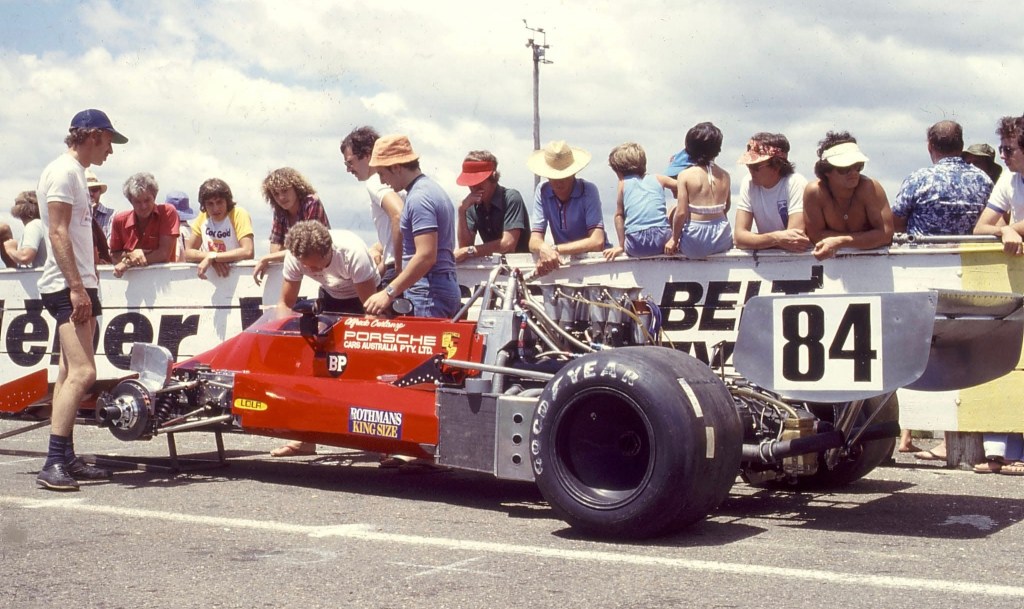
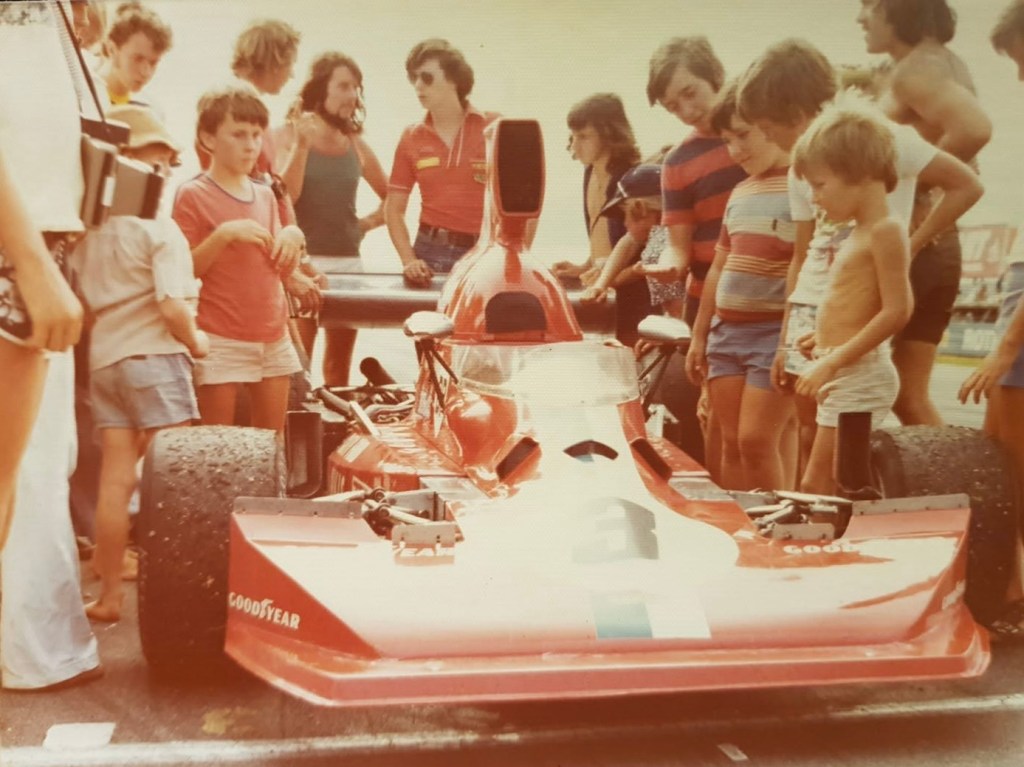
Look at the crowd…And below? Surfers perhaps? Racing cars are like magnets for little tackers and bigger blokes alike, aren’t they!?
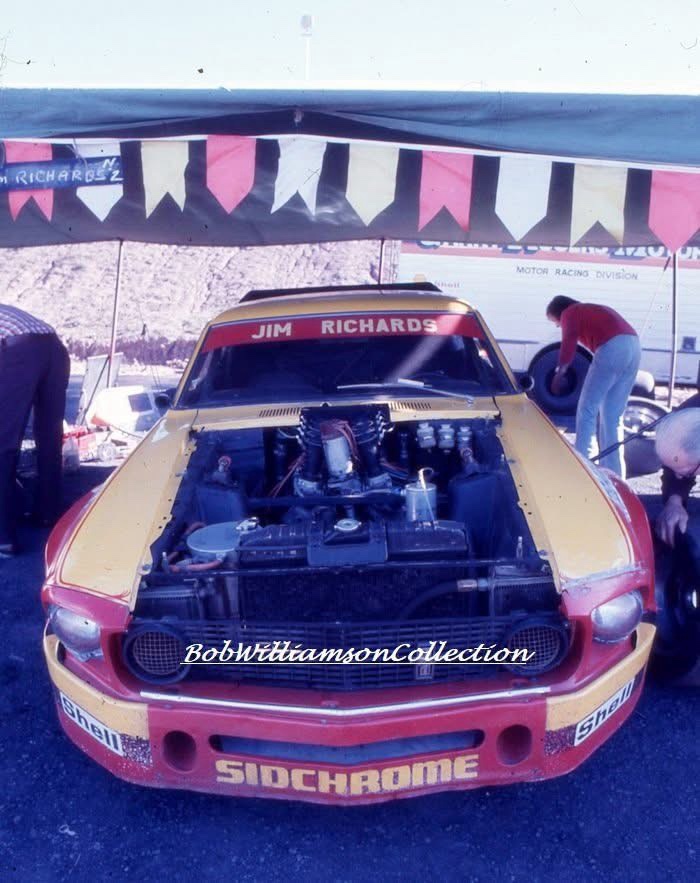
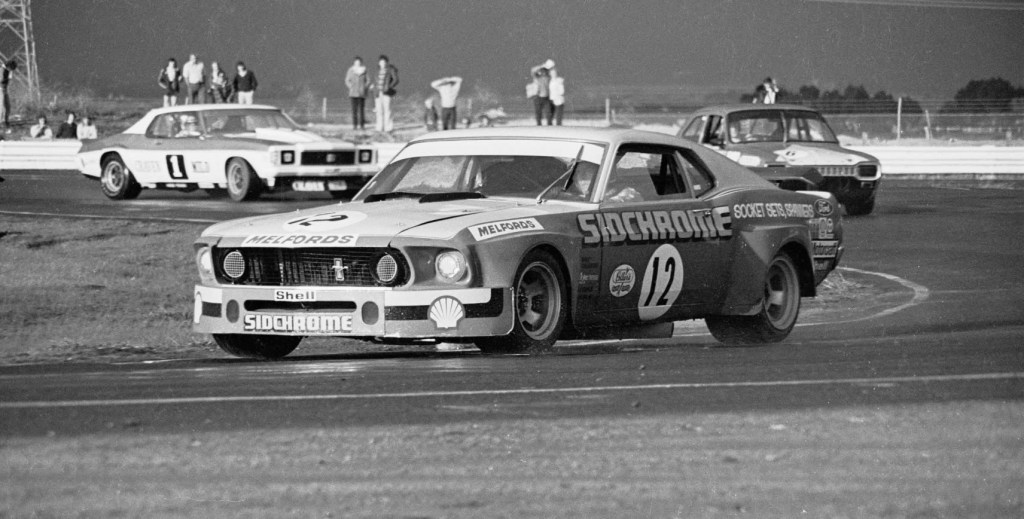
I was at Sandown on the dull, wet, cold Sandown July 6, 1975 weekend that Jim Richards debuted his Ford Mustang Boss 351, he won twice in front of local hot-shots, including Allan Moffat’s Ford Capri RS3100, John McCormack’s Chrysler Charger Repco-Holden V8 and others.
Jim had special dispensation to run his Kiwi wheel-tyro combo, which was more generous than the ten-inch-wide rule here. The experts thought that would bring him back to the field…it didn’t! He took 13 wins from 30 starts that year, 27 of them podiums.
(I Smith)
The amazing thing about that Murray Bunn-built car, long-term friend and JR collaborator, is that it wasn’t nearly as exotic as most of the Australian front-runners of the day: John McCormack’s Chrysler Charger Repco-Holden, the Bob Jane Racing Monaro and Torana Chev raced by Bob and John Harvey, Bryan Thomson’s VW Chev V8, Allan Moffat’s Ford Capri RS3100 and Pete Geoghgan’s Holden Monaro GTS 350.
Bonnet off during the Baskerville 10,000 Sports Sedan meeting (T Johnson)
It was lightened a bit, but the suspension front and rear wasn’t wild, it had a Ford nine-inch rear and Borg Warner ‘box, nothing special so far. The Gurney-Eagle aluminium-headed, Lucas-injected Cleveland 351 V8 was Murray’s too, now that was really trick! And mounted well back in the chassis, as you can see from these shots.
Calder 1975, Jim in front of Mike Stillwell’s Ford Escort BDG 2-litre and Pete Geoghegan’s John Sheppard built Monaro GTS350 Chev (I Smith)(S Elliott)
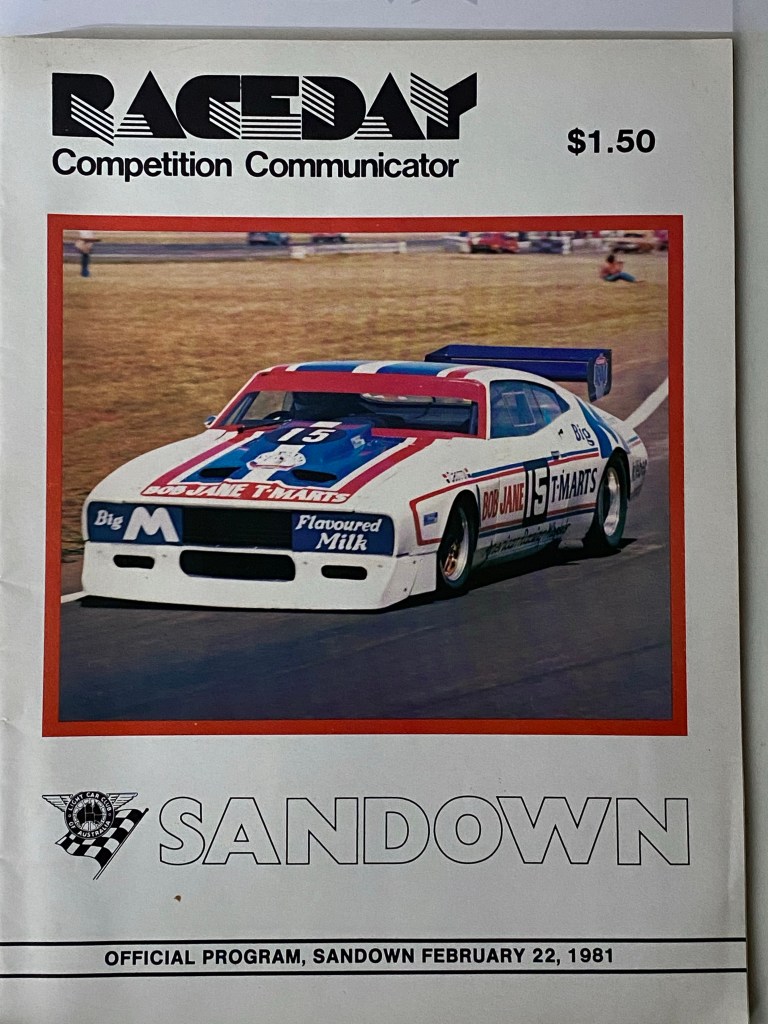
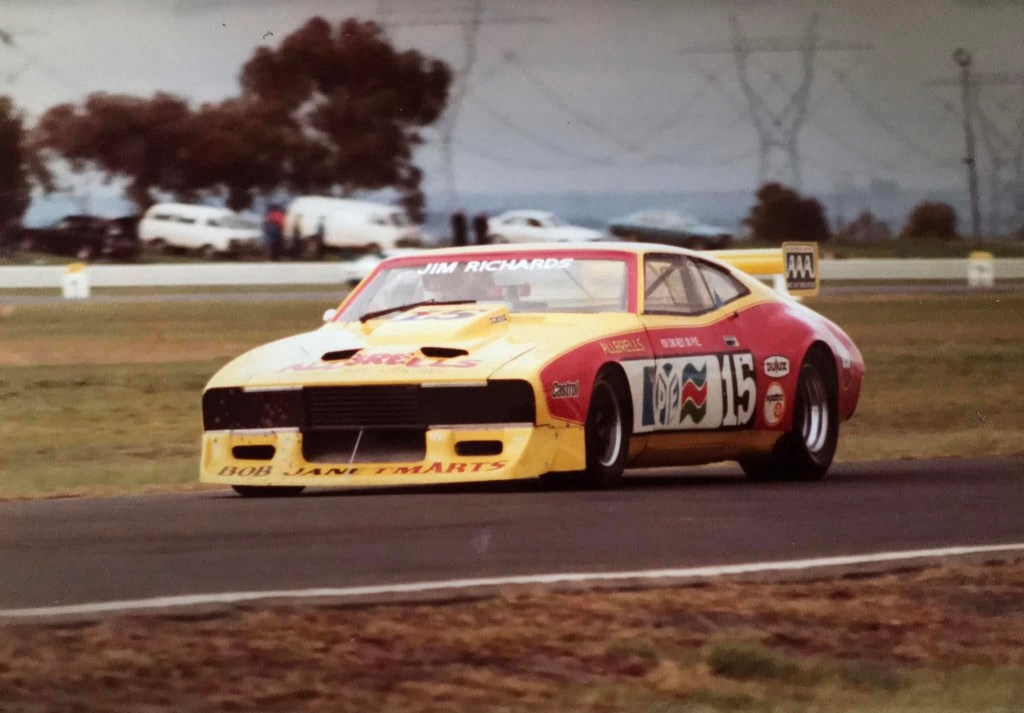
When it became time to build the Mustang’s successor, Jim Richards again turned to Murray Bunn to build the replacement Ford Falcon GT351 Hardtop sports sedan, with the only major carry-over item the raucous, roaring Cleveland Gurney-Eagle injected 351.
The shot above shows Murray Bunn and his apprentice, Murray Smith, setting up one of the two Hewland transaxle casings within the Hardtop’s multi-tubular spaceframe chassis in Bunn and Cumming’s Takanini premises just southwest of Auckland during 1977.
(S Dalton Collection)
I was rummaging through Auto Action’s JR photo files and found an untouched envelope of 12 under-the-skin photographs that have never been published until now. So, if you are a Ford or Jim Richards fan, grab a copy of Auto Action Premium issue #1908, which is still for sale in Australia for another fortnight.
Ford supplied the shell and pressed door, bonnet and roof panels in aluminium. The car taking shape at Bunn & Cummings, Takanini, NZ in 1977. Wheels bespoke castings to suit Eagle/McLaren magnesium uprights (S Elliott)
The car was fast right outta the wrapper, the only thing between Jim and the 1978 Australian Sports Sedan Championship won by Allan Grice’s superb, but category-rooting Chev Corvair V8 was the lack of a spare engine.
Despite that, his new, unsorted car bagged more points than Gricey, but the rules then had that ‘drop your worst result bullshit’. Anyway, have a read of the 4,000-word, eight-page and 25-photograph piece.
Jim was superb to work with, so too was the Beast’s restorer, Graham Booth; the car’s historic demonstration re-debut isn’t too far away!
Richards at Calder in 1981 (P Husband)
Credits…
Chequered Flag, Terry Johnson, Ian Smith, Steve Elliott, Peter Husband, Competition Communicator Stephen Dalton Collection, Bob Williamson Collection
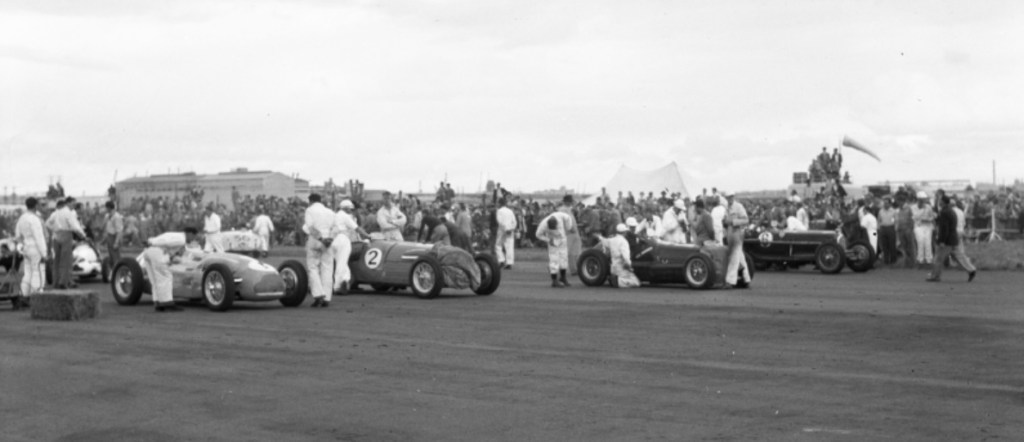
The front row of the Victorian Trophy grid at Fishermans Bend on Sunday, October 4, 1953 comprises, from the left, Doug Whiteford’s Talbot-Lago T26C, Stan Jones’ Maybach 1, Cec Warren, Maserati 4CL and Lex Davison, Alfa Romeo P3.
Tony Johns notes, ‘My program has Lex Davison’s HWM Jaguar scratched, so he raced his back-up Alfa Romeo. Doug Whiteford retired the Talbot-Lago with broken gears in the transfer box. Stan Jones won the race with Davison second and George Pearse, Cooper Mk4 Vincent third.’
‘Reg Nutt driving Jack Day’s Talbot Darracq TD700 sheared the blower drive and for Sunday and fitted a TC manifold and carburettors.’ Wow!
(L Sims Archive)
Didn’t Stan jump outta the box! Whiteford at left, then George Pearse, Cooper Mk4 Vincent and then the distinctive, upright-stance of #14 the ex-Sinclair The Spook Alta 21S Ford with Ted Gray up.
While the Victorian Trophy was a scratch race, there was also a handicap section won by Silvio Massola’s HRG from Davison and Jones.
While researching 1953 I thought I’d make a similar determination but there seems to be only three potential qualifying rounds that year: the Australian Grand Prix held at Albert Park won by Doug Whiteford’s Talbot-Lago T26C on November 21, the Victorian Trophy on October 4, and the 100-mile New South Wales Grand Prix held at Gnoo Blas on October 5. Jack Robinson won the handicap race in his Jaguar XK120 Special while the ‘Grand Prix title (the scratch section of the race) was awarded to Jack Brabham’s Cooper T23 Bristol (below) who had set the fastest race time.’
You will appreciate the degree of difficulty for a competitor in contesting races in Orange and Melbourne on consecutive days.
Jack Robinson, Jaguar XK120 Special, Bathurst, October 1955 (I Arnold)Jack Brabham, Cooper T23 Bristol, NSW GP, Gnoo Blas 1953 (Wikipedia)
The Australian Sporting Car Club – hitherto the Bathurst promoter – organised that first race at Gnoo Blas as the ASCC was ‘splitting asunder’ and its relationships with the City of Bathurst and the local police were so poisonous that Bathurst’s blue-riband Easter and October long-weekends of racing – probable Gold Star rounds – didn’t take place in 1953. The ASCC couldn’t get a permit, whereas the Auto-Cycle Union did, running a two day Easter ‘bike meeting.
Those of you with John Medley’s Bathurst Bible should read chapter 17, it’s interesting to be reminded of the sequence of events that saw the Australian Racing Drivers Club take over from the ASCC as the promoter of car racing at Mount Panorama.
So, given all those circumstances, it doesn’t seem appropriate to calculate a ’53 Gold Star Faux Division winner…The historians amongst you may know that the 1978 and 1979 Gold Stars were held over three rounds, while the 1981 affair was contested over only two; all three were in F5000’s dying days. In 1987, the Gold Star was a one-race gig, so I have precedent on my side, but I’ll leave it alone, I think. One race and ‘two other rounds’, which were effectively mutually exclusive, seems as lame as the one race 1987 championship. The perfect world in 1953 would have been for Whiteford, Jones, and Brabham to have faced off in all three races, I would have had a couple of pounds on Dicer Doug coming out on top….
Doug Whiteford and Talbot-Lago T26C take the plaudits of the Albert Park crowd after winning the 1953 Australian Grand Prix, his third such victory (The Age)
Credits…
Arthur Gordon Fraser-State Library of Victoria, Tony Johns, Leon Sims Archive, Ian Arnold, Wikipedia, The Age
The old Holden Special Vehicles one-two in Adelaide, Larry Perkins from Denny Hulme, Holden VL Commodore SS Group A SVs, touring car support race during the 1988 Australian Grand Prix carnival.
It was the first for Tom Walkinshaw’s nascent marque, but far from the last! One of most unfortunate aspects of Peter Brock’s cataclysmic act of corporate suicide with General Motors Holden was that the jewel in the crown, Holden’s performance vehicles arm, was delivered into Johnny Foreigner’s hands. Tom Walkinshaw’s hands.
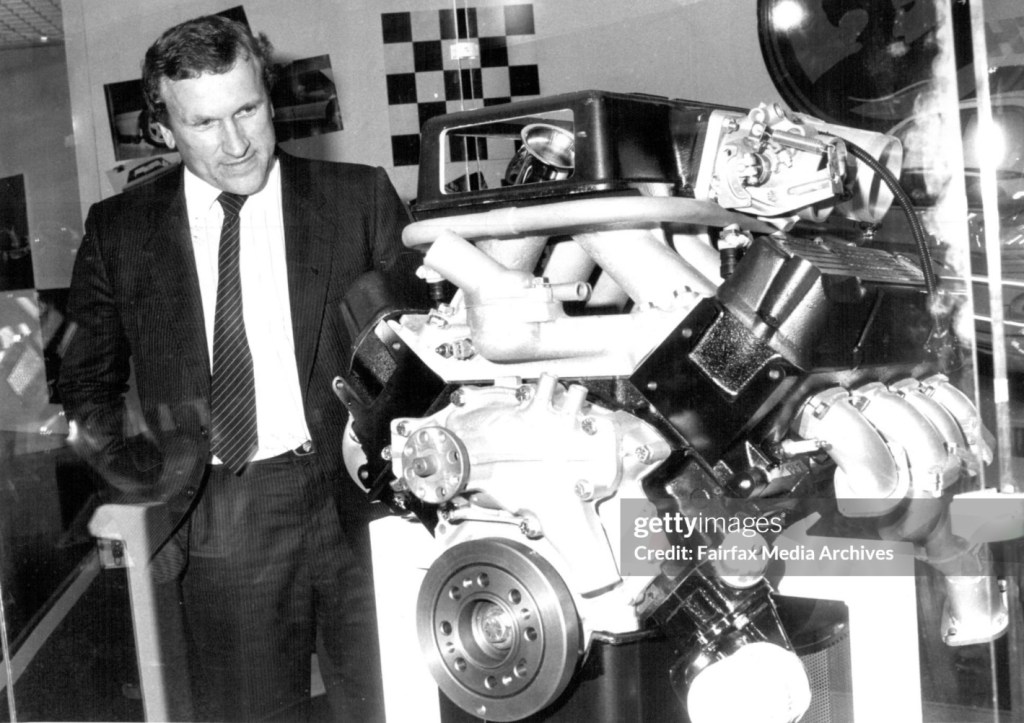
Walkinshaw with Holden VL 5-litre V8, this Sydney Motor Show photo is dated October 16, 1987
The Great Scot seized the opportunity with both hands and with strong local management led by John Crennan made a motza…and built some great cars.
The great Peter Stevens designed the car to an aerodynamic brief sketched by Walkinshaw on a Regent Hotel, Melbourne napkin. The sketch was done in Crennan’s presence, who nearly had kittens when he considered the task of selling such a visually challenging car, however effective the aerodynamics on track undoubtedly were.
Steven’s design sketch of the HSV VL was done as a freelancer engaged by TWR (Peter Stevens Design)Larry Perkins, John Harvey, John Lindell and John Crennan with the 500th VLSS destined for Tom Walkinshaw. Yes, Holden people, some of the fibreglass bits weren’t fitted at the owner’s request (Perkins Engineering)(LAT)
Tom Walkinshaw in the Holden VL Commodore SS, he shared with Jeff Allam, to 15th place in the September 4, 1988 RAC Tourist Trophy ETCC round, won by the Andy Rouse/Alain Ferte RS500
The cars were effective on track…and hard to sell! HSV’s first model had to be memorable and it most certainly was however difficult it was for the whiteshoes to move.
While Stevens set about his task, Crennan briefed Australian corporate brand identity agency Flett, Henderson Arnold in Abbotsford, Melbourne to develop the HSV logo and a brand manual that encompassed all uses of the brandmark across the cars, signage, letterhead, in-dealership, brochures and other corporate marketing material.
Richard Henderson led a small team which came up with a range of ideas, including the one Holden fans know and love…
I’d been an outside advisor to FHA, then Australia’s pre-eminent brand design and implementation outfit in the 1990s and 2000s – Telstra, BHP Billiton, Orica, Sydney Olympic and Paralympic Games, Crown Casino were all our designs – and joined FHA as a shareholder/CEO just in time to be invited to HSV’s 1988 Bathurst junket. A weekend on the slops to start a 13-year adventure had to be a good sign.
HSV entertainment didn’t extend to hot and cold running blondes at that stage, it was very much ham and cheese sarnies and a beer in a modest tent. It was so hands-on that Crennan himself drove the ‘Kombi’ full of freeloaders to Bathurst Airport after the event. It’s all a bit hazy actually…
The TWR car raced by Uncle Tom and Jeff Allam (below) was a bit of a shitter, Q8 and DNF rear axle after only five laps. Larry’s run was a lot better, Q8 and running second in the race including giving his boss, Walkinshaw a session, but on lap 137 he pitted with engine problems. That TWR built car won Bathurst in Win Percy and Allan Grice’s hands in 1990.
Etcetera…
John Fenner Dandenong Plant Manager, Perkins, Harvey, Crennan, perhaps, Mick Finn HSV National Parts & Accessories Manager, and John Lindell on July 18, 1988 (Perkins Engineering)
Cause for celebration, completion of the build of the 500th VL SS at GM’s Dandenong factory on July 18, 1988, the end of the run. Not quite actually, they later built another 250. Why was that if they really sold so poorly?
(Auto Action)
Larry during the Wellington 500, NZ 1988, he was second with Denny Hulme behind the winning Roberto Ravaglia/Emmanuele Pirro BMW M3 Evo. FHA’s race livery looks pretty good…
(Perkins Engineering)
Perkins and Part. Larry and Neill ‘Part’ Burns, legendary engine builder in 1988. That Holden cast iron, pushrod, two-valve, fuel-injected, circa 480bhp, 4987cc V8. The car weighed about 1325kg, discs front and rear, of course, it had 11×17 inch wheels front and rear, the whole lot hit the road via a Getrag 5-speed ‘box.
(S Dalton Collection)(S Dalton Collection)(S Dalton Collection)
Many thanks to Stephen Dalton for this September 1988 Holden Motor Sport bulletin.
Finish as we started, Larry in front in Adelaide in 1988. Maybe the HSV VL SS wasn’t the prettiest roadie but it was one helluva good looking racing car!
(Adelaide Grand Prix)
Credits…
Getty Images, Peter Stevens Design, daviddowsey.com, Perkins Engineering, Motorsport Images, Auto Action, Adelaide Grand Prix, Stephen Dalton Collection
Tailpiece…
(MotorSport)
It’s easy to forget, given his subsequent touring car success, that Tom cut his teeth in single-seaters. Here in the October 6, 1974 British F5000 championship at Snetterton. Q8 and DNF oil pump in this Modus M5 Ford-Cosworth GAA 3.4-litre V6.
Colin Anderson and riding mechanic at Hell Bend on the Victor Harbor-Port Elliott road circuit during the Australian Grand Prix-South Australian Centenary Grand Prix held on December 26, 1936.
The pair are racing the Morris Special owned by Alf Barrett, one of Australia’s greatest racing drivers. He was a star of the immediate pre and post-war period aboard an Alfa Romeo 8C2300 Monza he raced from 1939. The car behind Anderson is George Martin’s AC 16/80.
Barrett entered three cars that Christmas 1936 weekend: a Lombard AL3 acquired from Jack Day in late 1935 for himself, an MG P-Type for Bryant & May family member Tim Joshua, and the Morris for another friend, Colin Anderson a principal of still respected Toorak based, multi-office real estate agency RT Edgar.
Alf retired the 1.2-litre Lombard after the supercharger pop-off valve blew off and could not be found despite a half-hour search! Colin Anderson wasn’t classified in the 1.5-litre Morris with overheating problems and a spin, but Tim Joshua had better luck. He was second in the P-Type behind the similar car driven by the winner, Les Murphy. Joshua led the race for some laps before a seven minute stop for unidentified maladies.
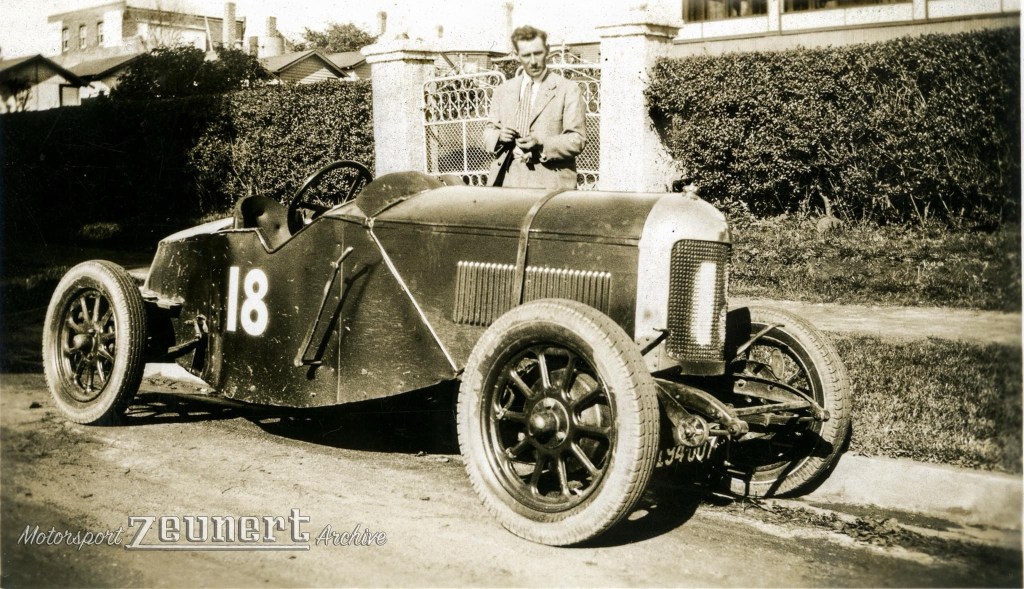
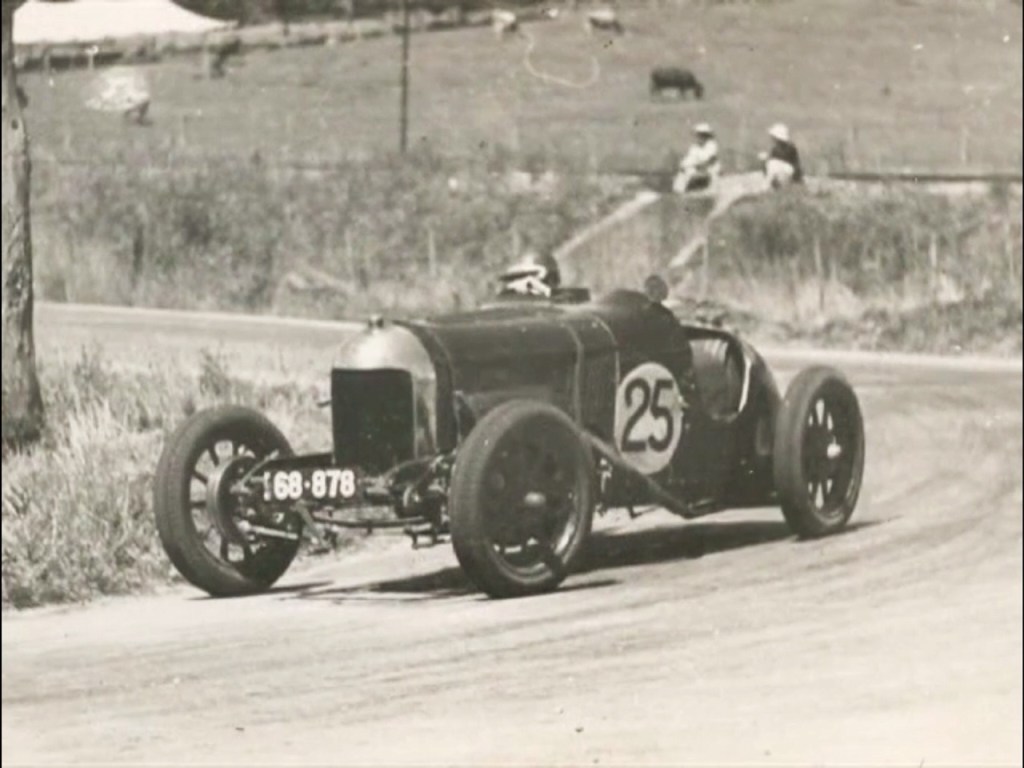
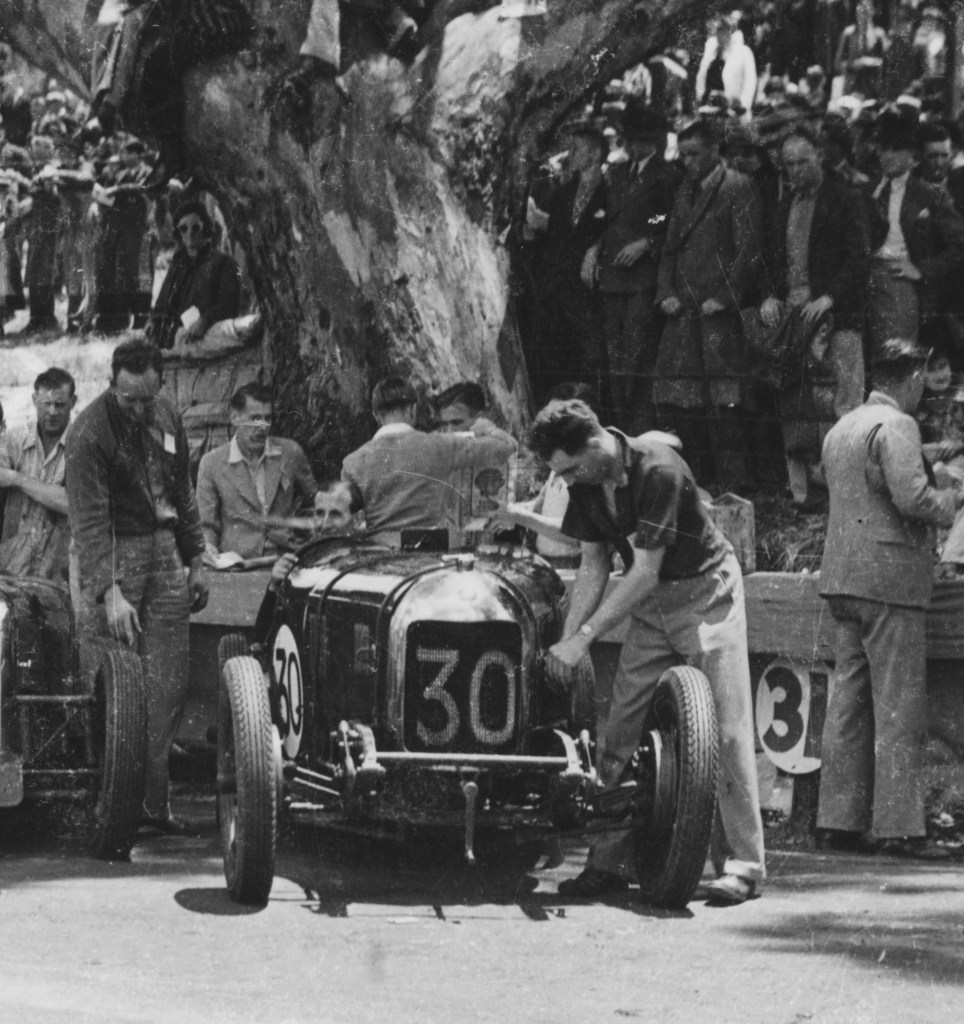
Alf Barrett alongside his Morris Special early in its life circa 1933, perhaps outside the family home in Armadale. Note the differences in bodywork and chassis undercut mentioned below (D Zeunert Collection)Barrett aboard his Morris at Kayannie Corner Lobethal during the January 3, 1938 South Australian GP weekend. Alf raced the Morris only once at Lobethal and used #30 in the race. Perhaps this is an early practice shot while still running a number used in a previous meeting, the Victorian rego plates were removed by raceday too (N Howard)
Barrett was born in 1909 to a wealthy family who made their fortune in malt. Today Barrett Burston Malting is part of the publicly listed United Malt Group Ltd. He grew up in Armadale in Melbourne’s inner-east and started messing around with petrol engined devices with his brother Gib (Julian) in the large grounds of their home.
Not far away, a young man destined to become a master-mechanic, preparing cars for Barrett, Tony Gaze and Lex Davison amongst others, Alan Ashton, was serving his time as an apprentice at AF Hollins Motor Engineers in High Street.
The three youngsters met and were soon messing around with cars and bikes which they tested at Aspendale Speedway.
Alf, Gib and Alan built their first racing car out of a Morris Cowley in 1933, initially hillclimbing the purposeful, attractive biposto. It was competitive in the handicap race events of the day too, winning the Light Car Club of Australia’s Winter 100 from 14 other competitors at Phillip Island in June 1935.
While the Lombard was the Morris’ successor, Alf had lots of trouble with it. John Medley wrote that ‘Pretty though it was, it was a nightmare for Barrett, a later owner discovering water jackets filled with bronze to heal unimaginable horrors. Never reliable , it was later re-engined with Vauxhall power.’
Amidst entries in the Lombard, he raced it in the Easter 1938 AGP at Bathurst won by Peter Whitehead’s ERA B-Type, Barrett continued to race the Morris which proved its pace with a great second place among much heavier metal in the 150 mile March 1937 Phillip Island Trophy.
Barrett, at Lobethal before the start of the January 3, 1938 South Australian Grand Prix (N Howard)Tony Ohlmeyer, MG T-Spl, Jim Boughton Morgan 4-4, Barrett’s Morris Cowley Spl and Ron Uffindell’s Austin 7 Spl
He also raced the Morris in the 100 mile January 3, 1938 South Australian Grand Prix at Lobethal, but DNF in the handicap race won by Noel Campbell’s Singer Bantam from Colin Dunne’s MG K3 and Tony Ohlmeyer’s MG T-Type.
He also contested the 148 mile Interstate Grand Prix/Albury Grand Prix at Wirlinga near Albury that March. Alf was pretty handy behind the wheel, he was quite spectacular in the long suffering Morrie at Wirlinga despite the side-valve machine having a top speed of no more than 90mph, but again he failed to finish.
Barrett at Wirlinga in March 1938, the event was variously called the Interstate Grand Prix and Albury Grand Prix, the programme says the latter. Jack Phillips and Ted Parsons, local Wangaratta boys won in their Ford V8 Special (L Egan)
Little is known about the mechanical specifications of the car, but Stephen Hands wrote that ‘For many years Graeme Steinfort (a Melbourne lawyer/racer/restorer/historian had the block from Alf’s car. It had several interesting modifications, one was to reduce the reciprocating mass in the valvegear. Alf had cut away half the mushroom head of the cam-follower to leave only a bit directly over the cam lobe. It was prevented from rotating by a small block of metal screwed onto the block.’
‘Alf later modified the body somewhat, the photos show the dropped down radiator and cutaway body for more elbow-room. Some of the photos clearly show that Alf dropped the chassis under the rear axle. It would be interesting to see photos without the bodywork to illustrate how he did it.’
John Medley noted that the Morris was destroyed in a bushfire with only the engine surviving. It seems to have been fitted with a Laystall steel crankshaft, and the engine was fitted to Geoff Russell’s Russell Morris Special.
(Mildenhalls)
Etcetera…
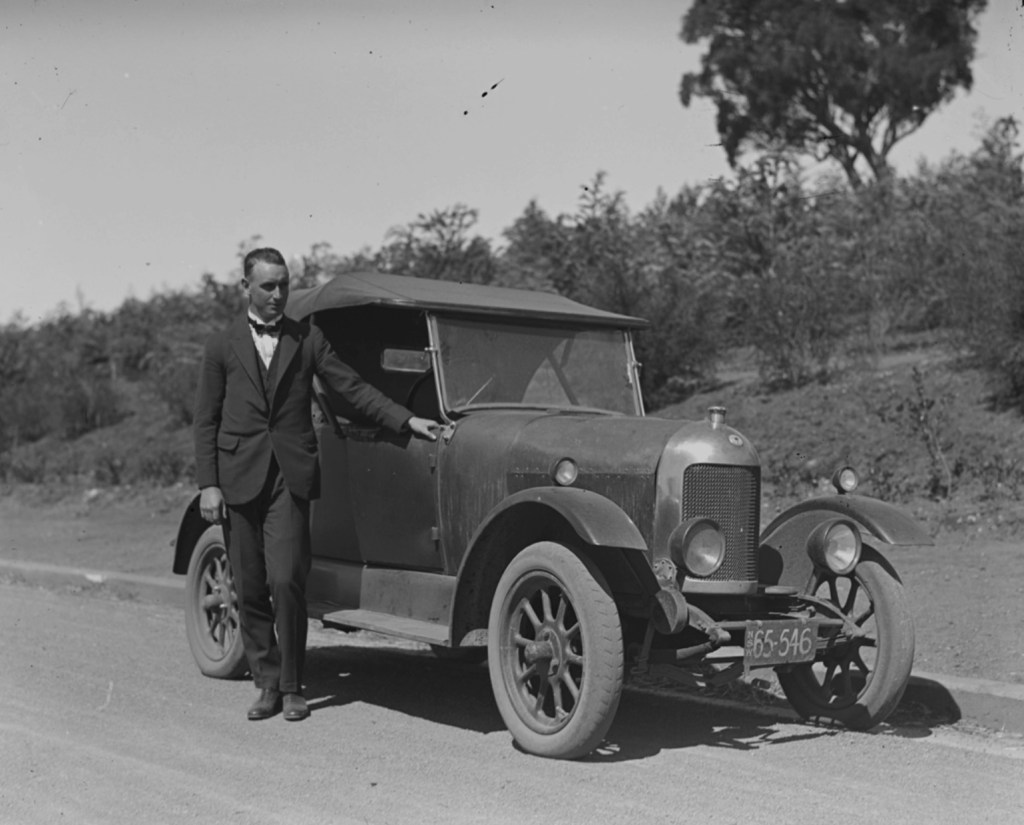
A Bullnose Morris Cowley with the proud owner in Canberra, date unknown. Ideal car for a public servant no doubt.
WR Morris, the Morris Company founder spent nearly a month in Australia in February/March 1928, accompanied by his chief designer, Mr Seaward, learning, Morris said ‘many things about tracks, clearance and other details that were required of the roads of Australia. It was up to him, when he returned to the old country, to do his best to supply the Britishers on this side of the water with what they required.’
Interestingly Morris said, ‘he could not leave Australia without saying he had never seen a better organised body works in the world than Holdens (then a body builder)’, which hw had seen in Adelaide that morning.
It’s easy to think of Morris as a marque that disappeared within the British Motor Corporation, but ‘the output of Morris products is approximately half the output of the whole of the British motor industry,’ The Register reported on April 2, 1927.
By November 1928 The Register reported that Morris products now embody many improvements as a result of WR Morris’ visit. Chief amongst these was enhanced pulling power of the new Morris Cowley engine, ‘in the past a second gear car for hill work but now having top-gear performance comparable with any four cylinder car on this market. Such improved performance and other engineering refinements makes the Cowley very desirable for country or city use.’ I wonder what Alf Barrett would have made of this lot!?
(Anderson Family Archive)
Credits…
Ron Blum Collection, Warwick Anderson, John Medley in ‘The Official 50 Race History of the Australian Grand Prix’, Norman Howard, Stephen Hands on Greg Smith’s Pre 1960 Historic Racing in Australasia Facebook page, David Zeunert Collection, Len Egan, Mildenhall’s Canberra, The Register March 7 and November 7, 1928.
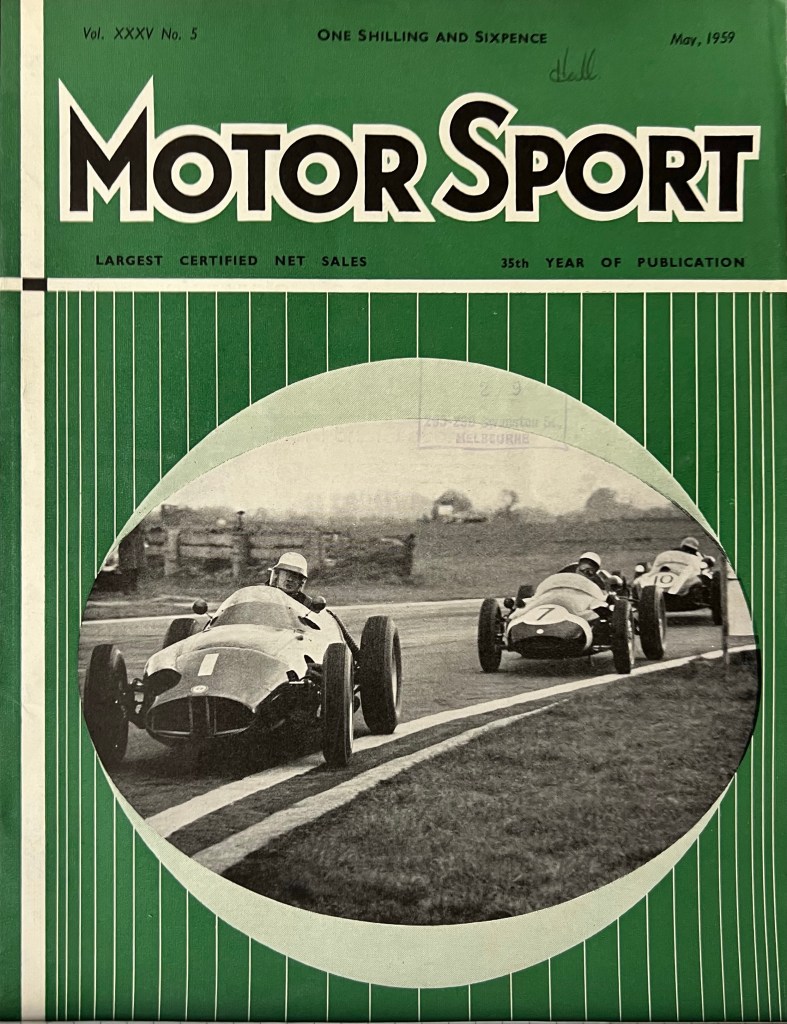
‘Harry Schell, BRM Type 25 leads Stirling Moss, Cooper T51 Climax at the BARC Easter Goodwood Meeting. The BRM was no match for the full-Formula 1 Cooper Climax cars (read 2.5-litre Climax engined ) on the Goodwood circuit. Brabham (Cooper No 10) also passed Schell early in the race.’
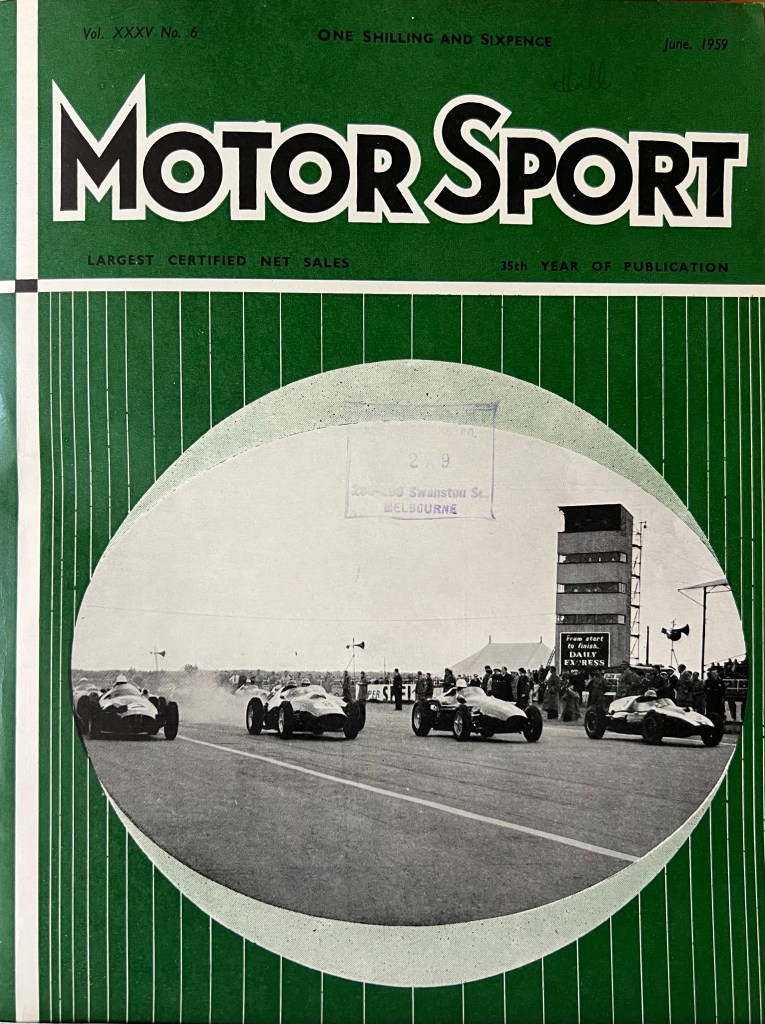
‘Four makes on the front row! The start of the BRDC International Trophy Race at Silverstone, with, left to right, Moss BRM Type 25, Brooks Ferrari Dino 246, Salvadori in one of the sensational Aston Martin DBR4/250s and Jack Brabham the ultimate winner in works Cooper-Climax No 3.’






























 primotipo...