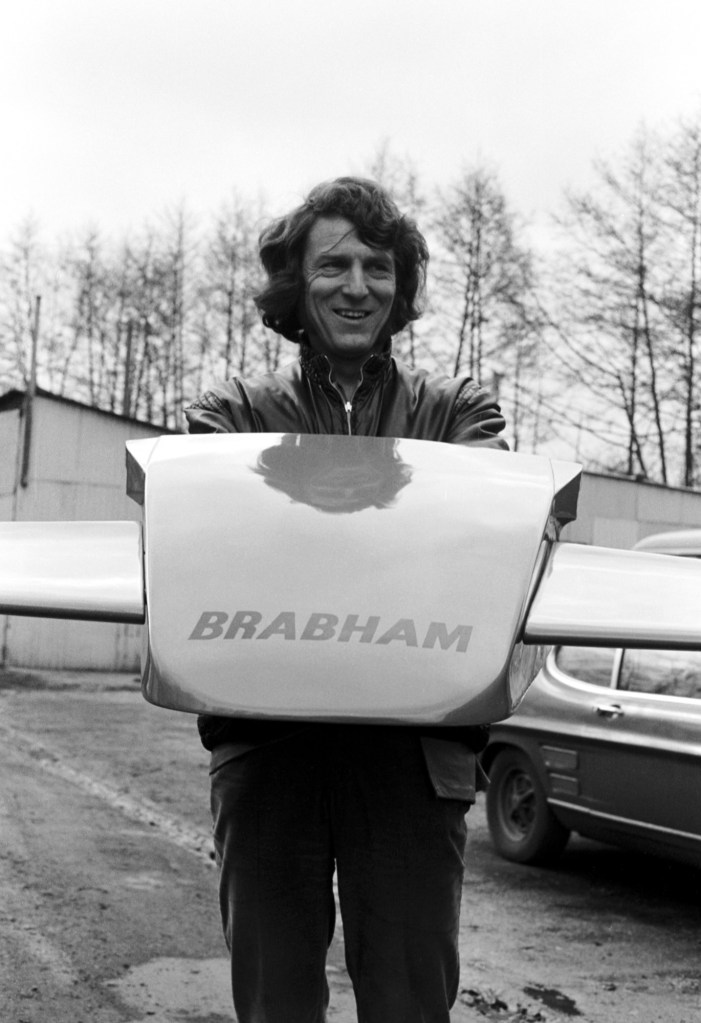
Keith Greene on the occasion of his appointment as Team Manager of Brabham by Bernie Ecclestone, the new owner of Motor Racing Developments Ltd in 1972.
Ron Tauranac would have approved of this povvo-PR announcement out front of MRD in Byfleet Road, New Haw, Weybridge, Surrey. The prop is a BT38 (?) nosecone.
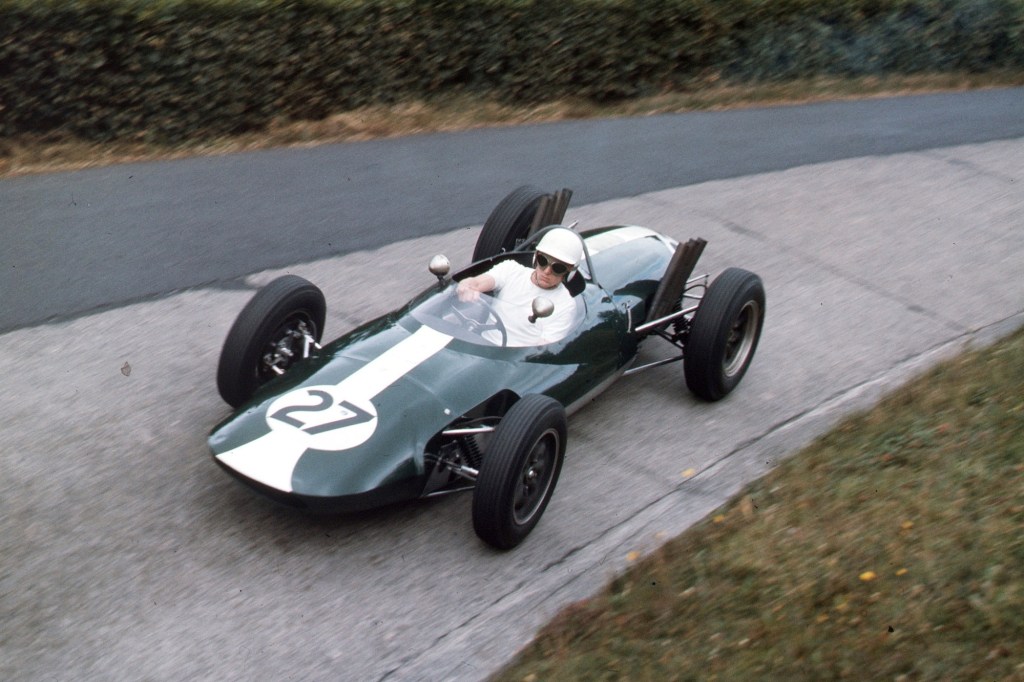
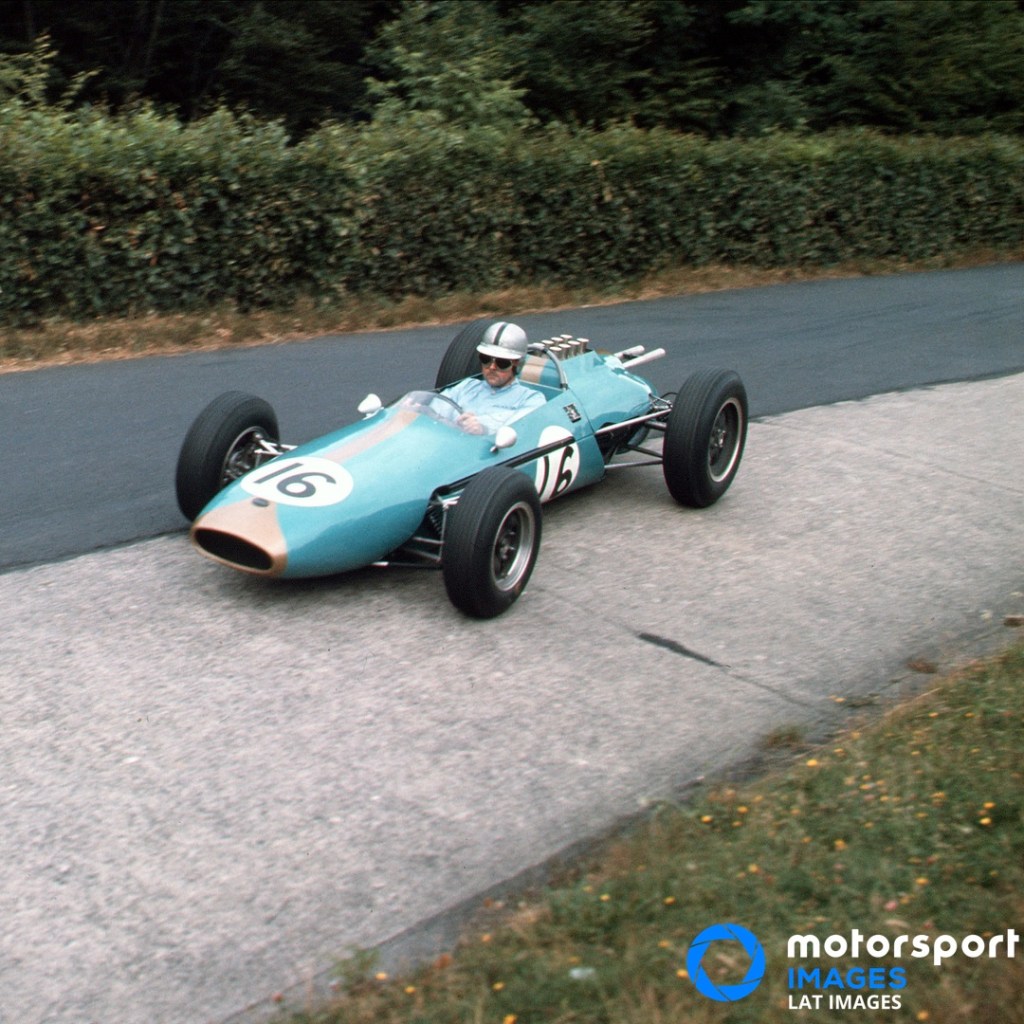
At the wheel during the August 5, 1962 German Grand Prix. Gilby BRM, Q19 0f 30 and DNF suspension after 7 of 15 laps. Graham Hill won from John Surtees and Dan Gurney: BRM P57, Lola Mk4 Climax and Porsche 804.
Now here’s a bit of McLaren history you didn’t know.
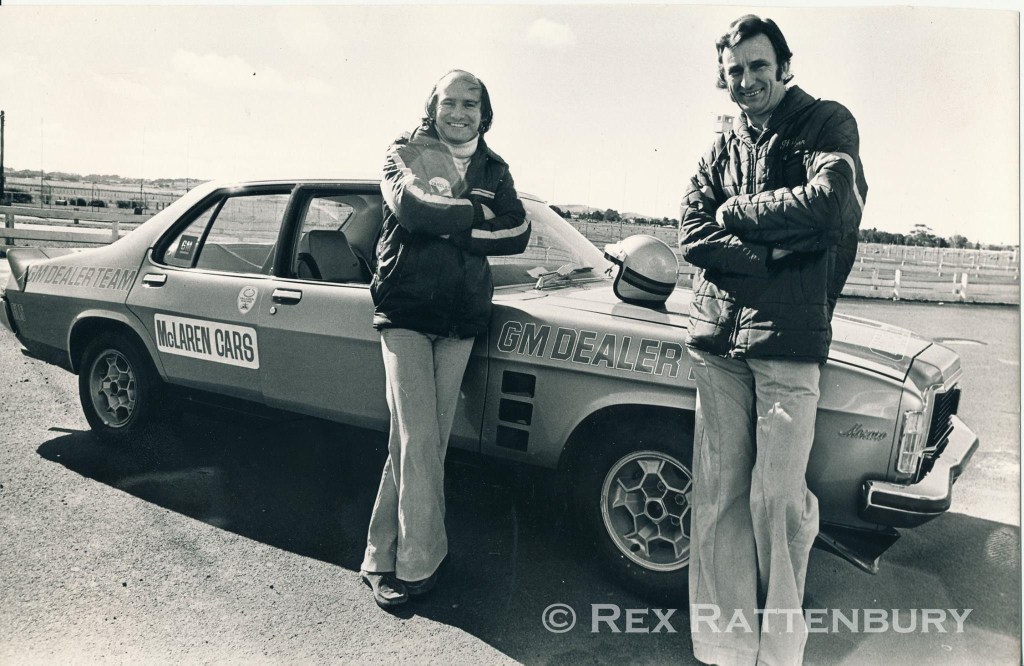
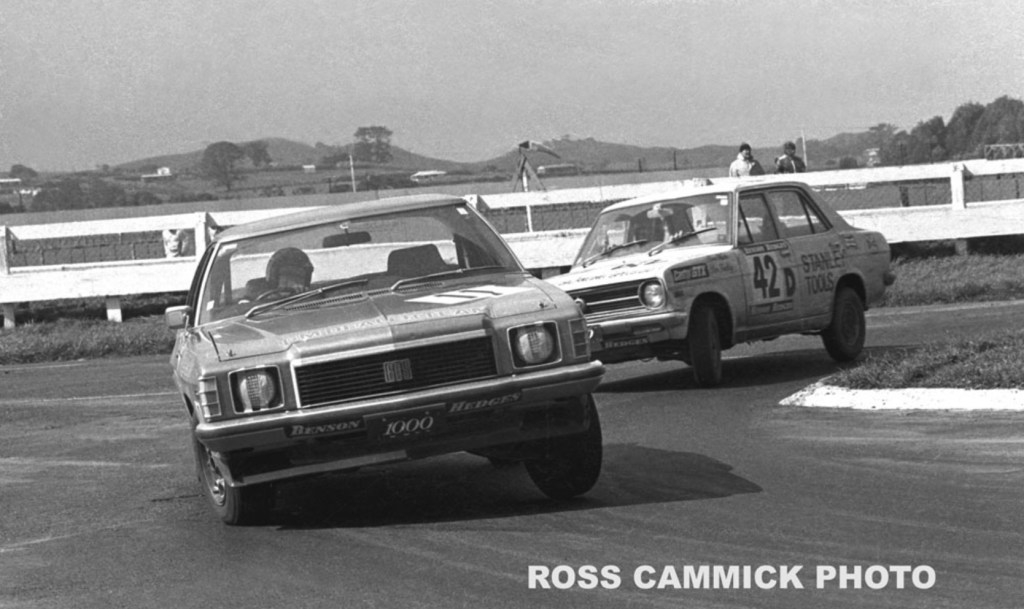
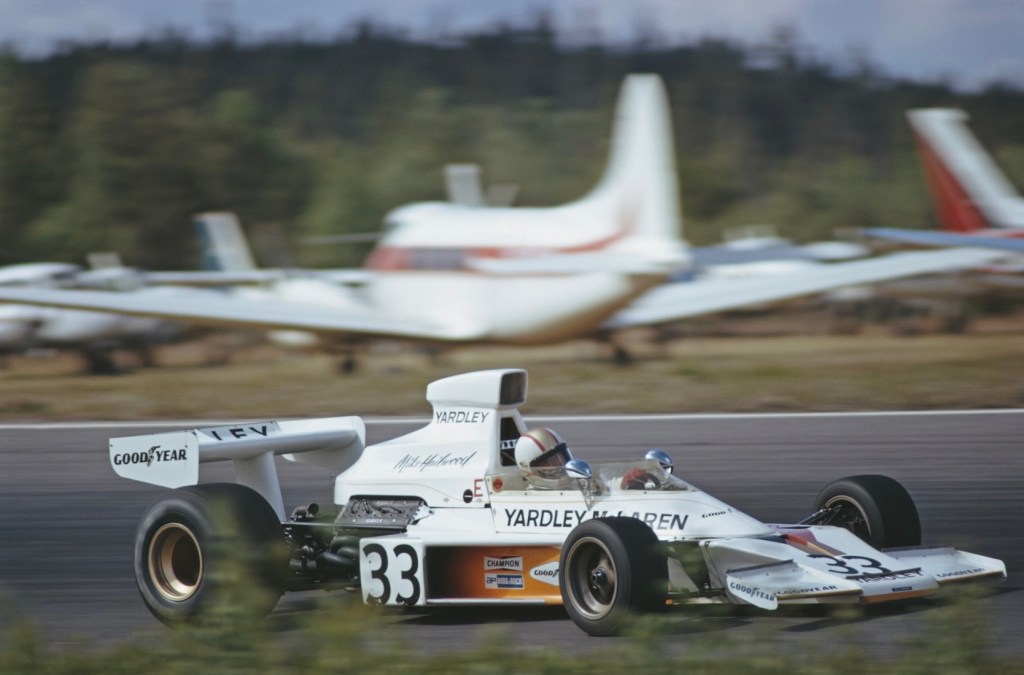
McLaren Cars ‘entered’ a Holden in New Zealand’s annual touring car endurance classic, the Benson & Hedges 1000 at Pukekohe in 1976.
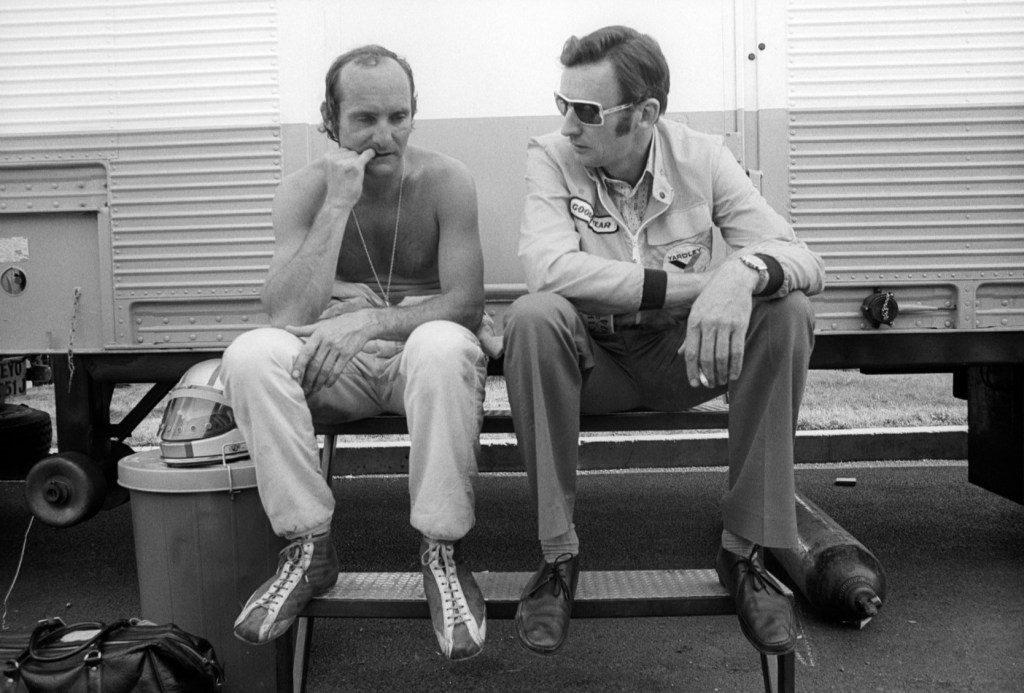
The four-door Holden Monaro GTS 308 V8 was crewed by Mike Hailwood and Phil Kerr with none other than 1967 World Champion, Denis Clive Hulme as Team Manager.
Phil Kerr ahead of the Dave Winter/Ron Findlay Datsun 1200. DNF in the race won by the Jim Little/Graeme Richardt Chrysler Valiant Charger.
He bagged the Tasman Cup, Indianapolis 500, World Drivers Championship, the French – read Eiropean – F2 Championship plus a swag of touring car and sportscar victories.
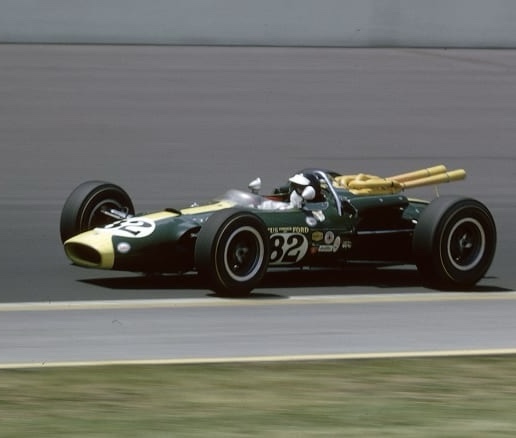
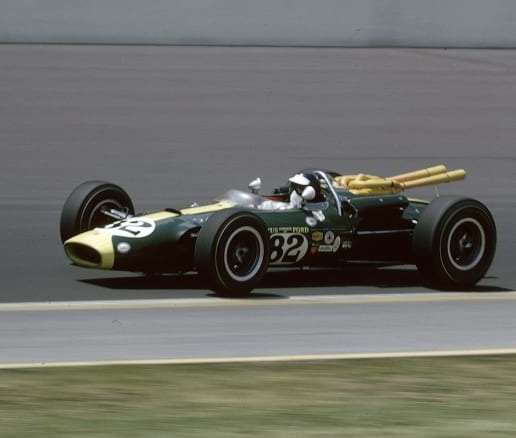
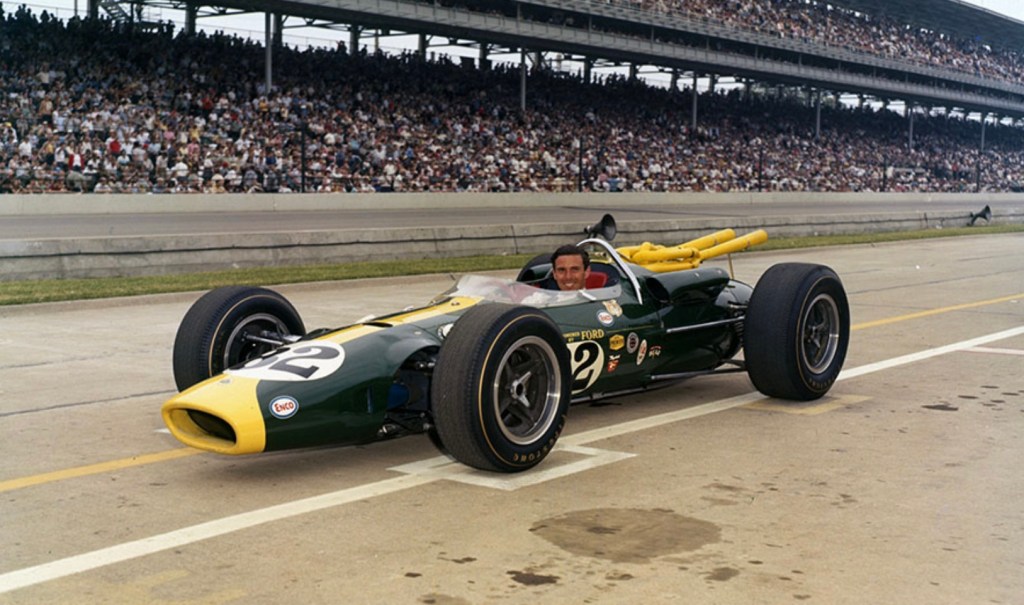
The shot above is of Clark enroute to victory at Indianapolis on May 31, 1965, Lotus 38 Ford-Indy 4.2-litre V8.
Hethel circa-1967 (unattributed)Lakeside 99, March 1965. Lotus 32B Climax. Jim won from Frank Gardner and Spencer Martin in Brabham BT11As (Daily Telegraph)
‘Can you give us a hand with the car Jimmy? Yep, no worries Ray (Parsons) I’ll do the fronts.’
Clark and Parsons ready Clark’s Lotus 32B Climax FPF 2.5 for the Warwick Farm 100 during the February weekend. That’s Roy Billington, Jack Brabham’s mechanic on the far left by the pit counter and Lanky Frank Gardner in the white helmet. Meanwhile, Frank Matich blasts past in his Brabham BT7A Climax.
Clark romped home in the Tasman, winning four rounds. He won Levin, Wigram, Teretonga and Warwick Farm on-the-trot, then picked up the Lakeside non-championship round at the end of the tour. Bruce McLaren was second and Jack Brabham third.
No way did Jim get home to Scotland on too many occasions in 1965.
By my reckoning – aided by and improving on Peter Windsor’s article of 10 years ago – Clark had 29 winning drives in 1965, ranging from short Tasman Cup heats to the 500 miles at Indianapolis.
Peter’s list of 26 wins missed two Grands Prix, amazingly, and one F2 victory, so for mine, it’s 29 wins in that very big year.
(IMS)
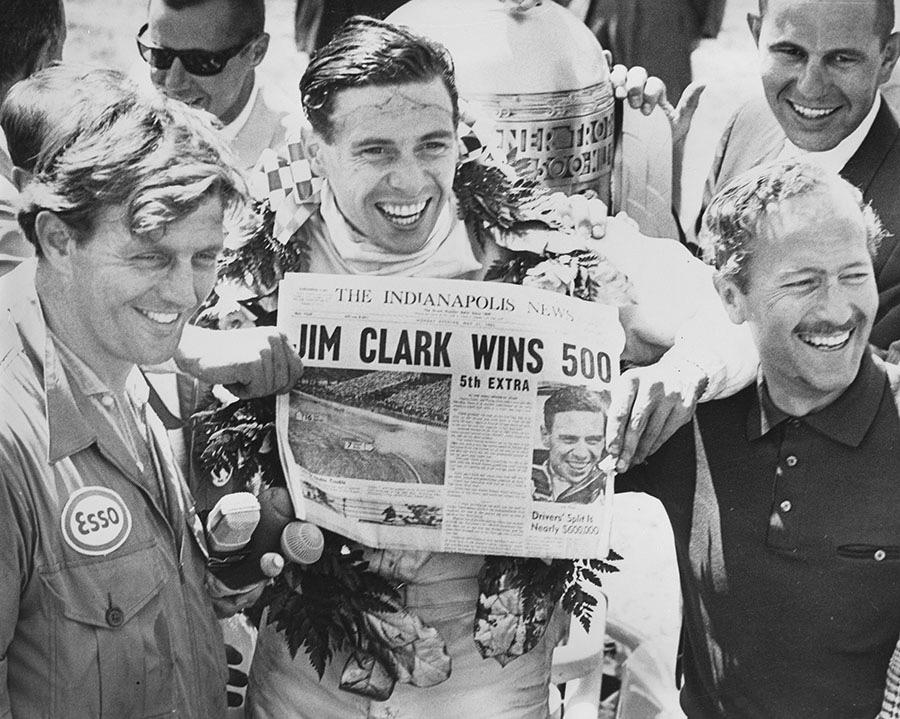
Clark was edged out of pole at Indy by AJ Foyt’s Lotus 34 Ford but Jim took the May 31 win that had been coming for two years, leading 190 of the 200 laps.
Parnelli Jones was second, Lotus 34 Ford, and Mario Andretti aboard a Hawk 1 Ford wad third. Al Miller’s Lotus 29 Ford was fourth; yes it was a great race for the Lotus lads.
(IMS)(IMS)
The win was well merited to say the least. Fortunate for Colin Chapman too, Ford would have pickled his testicles had there been a fuck-up like the year before!
In Team Lotus’ first year at the Brickyard in 1963 the Indy Establishment simply shafted the interlopers in favour of one of their own…
Of course Clark’s main programme for the year was Grand Prix racing.
That season he won three non-championship F1 races: the first heat of the Race of Champions at Brands Hatch, the Syracuse GP and the Sunday Mirror Trophy at Goodwood. He also took six of the ten championship events, four from pole: the South African, French, British, German, Italian and Mexican Grands Prix.
(unattributed)Clark on the hop at Goodwood during the August 1964 RAC Tourist Trophy, Lotus 30 Ford (Sutton)
Team Lotus wasn’t all beer and skittles. Every now and then Chapman built a shit-box, the Lotus 30 Ford 289 V8 was one of them.
While the concept of a backbone-chassis somewhat akin to the Lotus Elan made marketing, and, perhaps, theoretical sense, in practice it had a level of flaccidity the engineering equivalent of a couple of Blue-Bombers was never going to fix.
Clark wrestles with the gorgeous but recalcitrant 350bhp machine above, and with the ‘ten more mistakes’ – as Richie Ginther described it – aboard the Lotus 40 Ford in the LA Times GP at Riverside in October 1965; he was second to Hap Sharp’s Chaparral 2A Chev in a marvellous drive. One of Clark’s many attributes was to get the best out of a car, even a sub-optimal one. A bit more Lotus 30 here:https://primotipo.com/2016/08/30/rac-tourist-trophy-goodwood-1964/
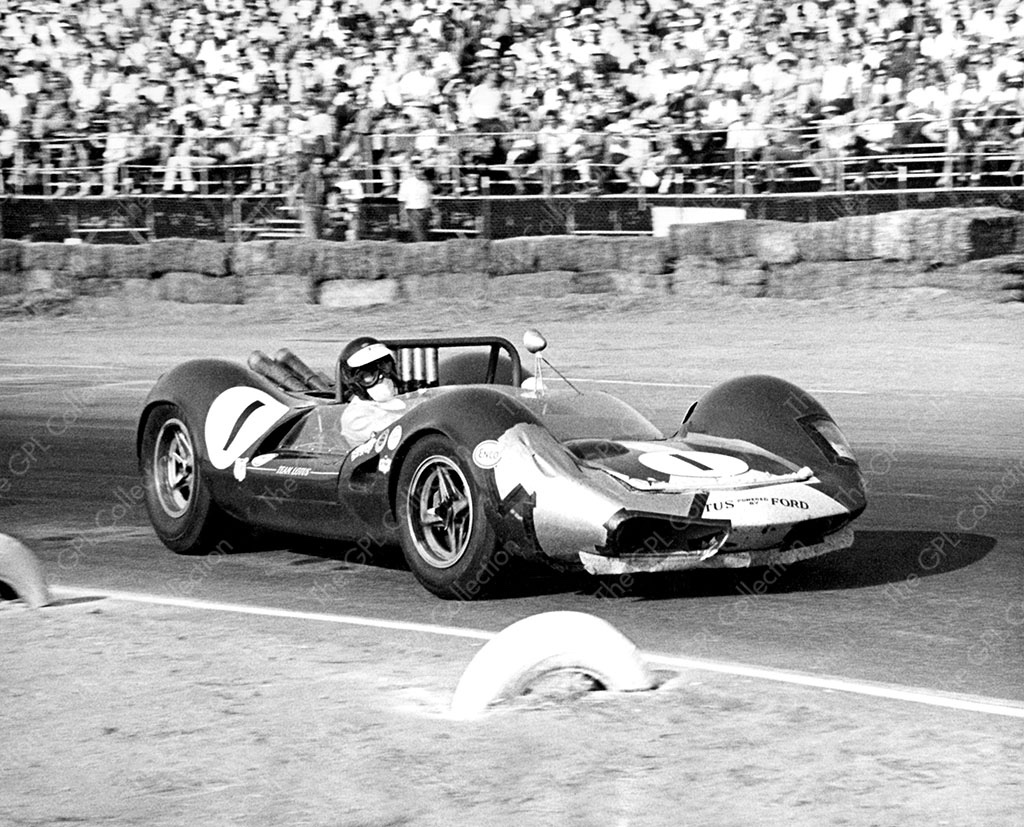
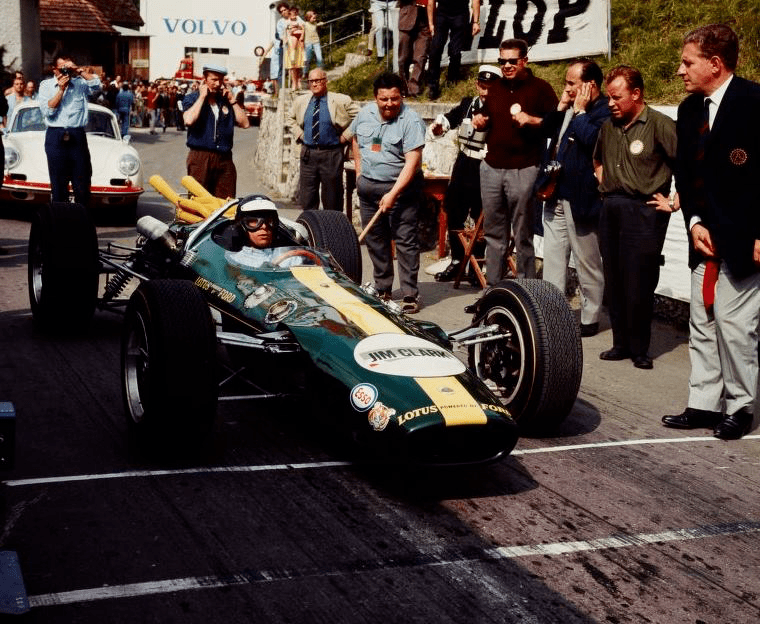
Of course, just when you think The Boss might give you a weekend off he comes up with the notion of doing a hillclimb or two in your Indy winning Lotus 38 Ford in the Swiss Alps.
‘Don’t fret Jimmy, we’ll give you a car with symmetrical suspension – it was chassis 38-4 rather than the Indy winner, chassis 38-1 – and off to St Ursanne-Les Rangiers we go on August 22.
Clark did a demonstration run in 5:20.8 while Jo Siffert did FTD in his Brabham BRM 1.5 V8 F1 car. Charles Vogele was second and Silvio Moser third.
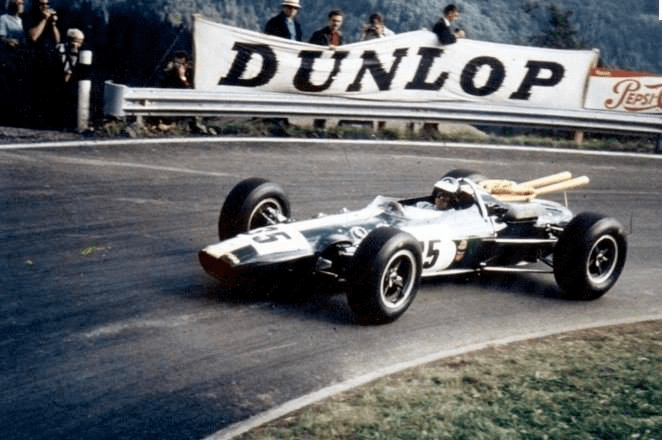
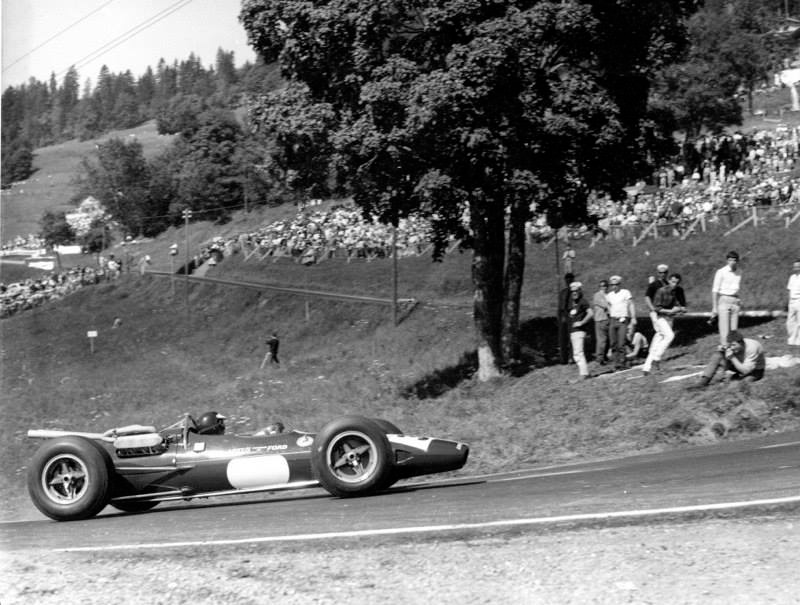
Next was Ollon-Villars also in Switzerland on the following weekend, August 29.
Lou Drozdowski wrote, ‘Clark spun off the course during practice and spent much of the afternoon among the sheep and pastures making his way back. He did however set a time of 4:34 compared to Ludovico Scarfiotti, Ferrari 206P FTD of 4:09.’ Gerhard Mitter was second and Gianpiero Biscaldi third.
Ollon-Villars (unattributed)Ollon-Villars (unattributed)Big-bertha’s butt at Ollon-Villars (B Cahier)(LAT)
Lotus’ relationship with Ford was strong and multi-faceted, one element of which was the Ford Cortina Lotus Mk 1 and 2 and the Escort Twin-Cam, all of which were fitted with the Lotus-Ford twin-cam, two-valve twin-Weber fed engine.
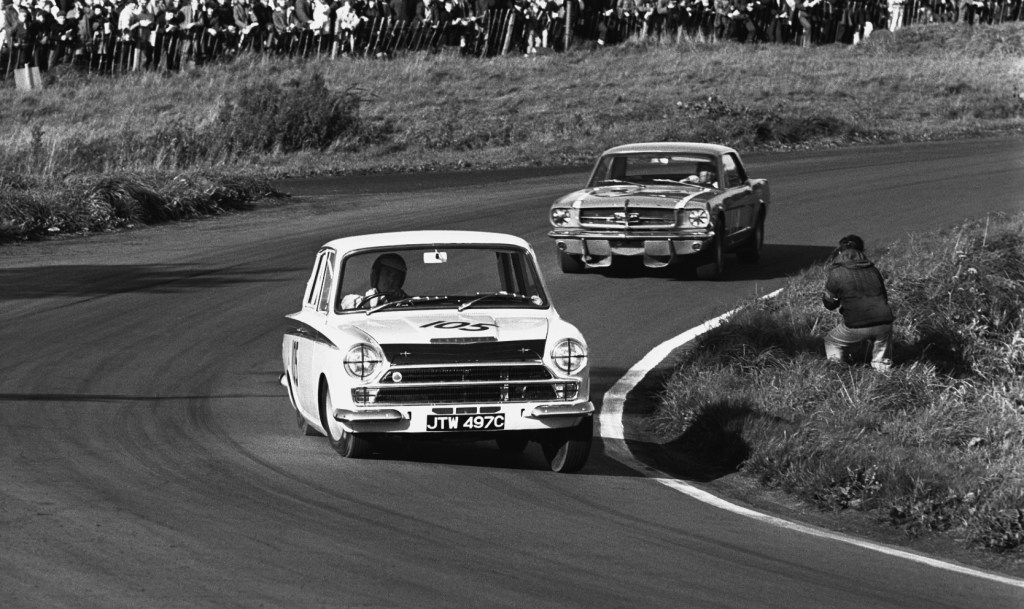
While it could be seen as hit-and-giggle in the context of his other ‘65 race-programmes, moving-metal was a very serious business so Clark approached his Lotus Cortina races that year in the UK and North America just as seriously as he did everything else.
Here he is giving Jack Brabham a run for his money at Oulton Park during the British Saloon Car Championship round on September 18, 1965. Jack’s mount is Alan Mann’s Ford Mustang. More on the Lotus Cortina here: https://primotipo.com/2014/11/16/jim-clark-lotus-cortina-sebring-1964/
Etcetera…
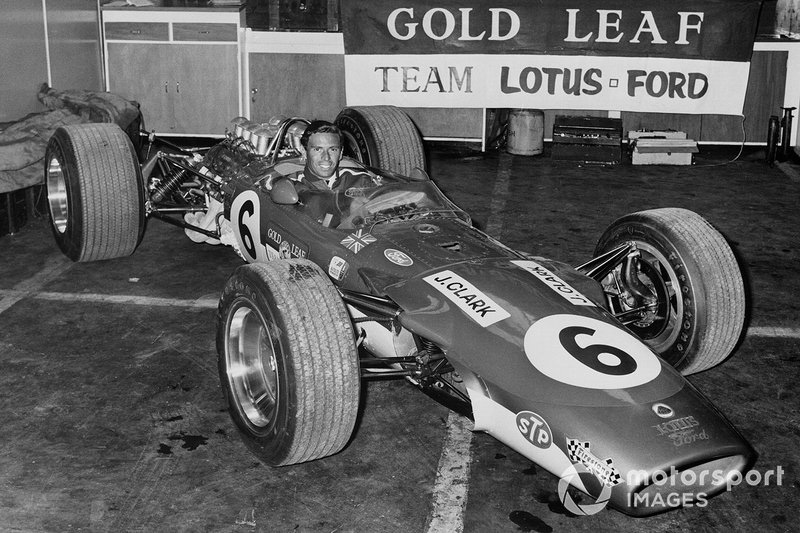
The Lotus 49 first ran in Gold Leaf Team Lotus colors during the Lady Wigram Trophy on January 20, 1968.
The transformation from Team Lotus’ perfect livery to fag-packet occurred during the week between the Levin International on January 13 and Wigram.
With a done deal in London, the Lotus team arranged for a skilled signwriter at Hutchinson Ford in Christchurch to apply the new Gold Leaf livery to Jim’s Lotus 49.
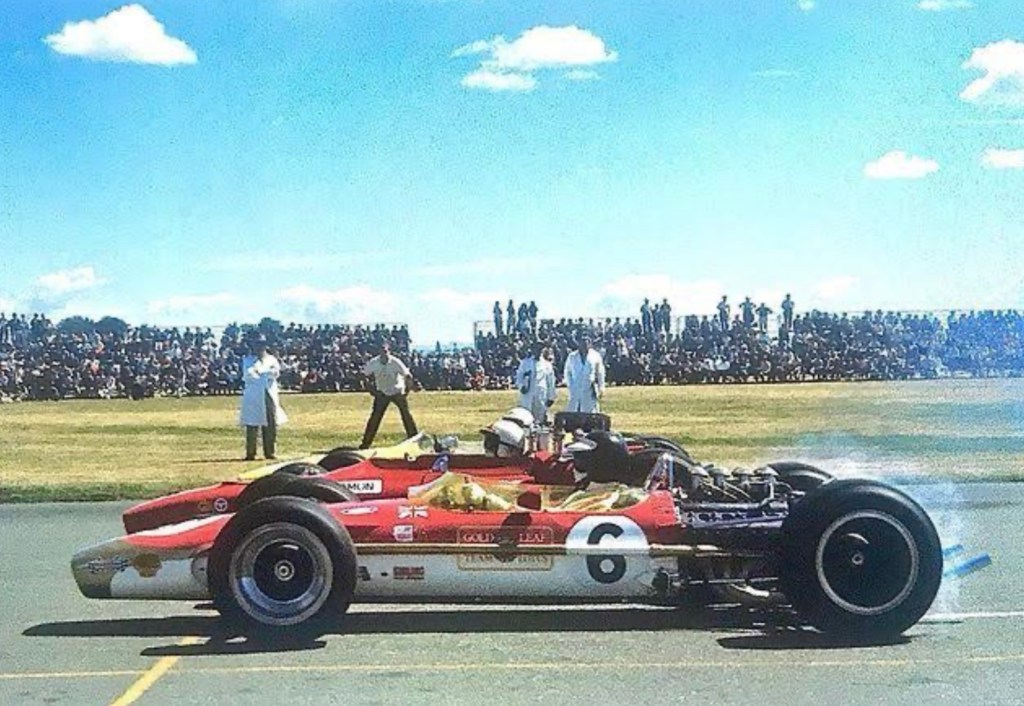
Clark, Amon, Gardner: Lotus 49 Ford DFW, Ferrari 246T and Brabham BT23D Alfa Romeo. Wigram 1968
Outside the US and some other countries it was the beginning of big corporate sponsorship in motor racing.
Ever the leader, Chapman’s quick commercial response and applying the new sponsorship colours demonstrates just how rapidly change took place once advertising restrictions in racing were lifted prior to the 1968 season.
(unattributed)
Credits…
Indianapolis Motor Speedway (IMS), Bruce Wells, The Jim Clark Trust (TJCT), Lou Drozdowski in lotuseuropa.org
Tailpiece…
(TJCT)
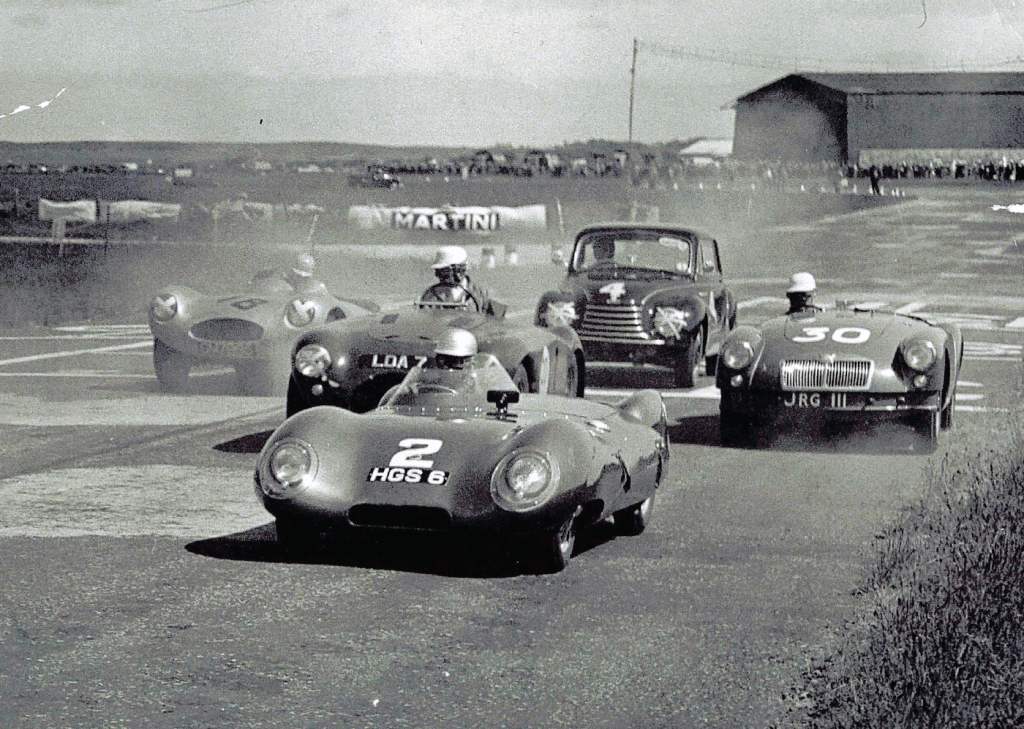
Jim Clark’s first race was at Crimond, aboard Ian- Scott-Watson’s DKW Sonderklasse on June 16, 1956.
That’s JL Fraser Lotus 11 front-and-centre, then from the left #18 AR Millar Saltire, LDA7 Kenny McLennan’s Kit MG, #4 Clark in Scott-Watsons DKW Sonderklasse, and John Campbell, MGA.
The Jim Clark Trust wrote that ‘In the sportscar race there was no handicap, so the DKW was hopelessly outclassed. Clark did pass one car but his joy was short-lived. The tailender was heading for the pits with broken halfshaft and the DKW finished in last place.’
‘Santa Claus Hill-The remarkable drive by Graham Hill (17) in a Lotus 7 at Brands Hatch on Boxing Day, when he outdrove Piper (19) and Ashdown (18) in Lotus Elevens, to win the Christmas Trophy at an average speed of 64.8 m.p.h.’
This piece by Denis Jenkinson caught my attention – the great man’s words always do – incredibly, by modern standards, the over 5,000 word feature has no photographic support whatsoever. It’s gold as a piece of in-period analysis…so I thought why not reproduce it in full with photographs.
Sylistically, it’s amazing, the longest paragraph is a staggering just over 700 words. DSJ isn’t a big fan of too many commas or full stops and there are no colons or semi-colons or fancy shit like that to be seen. At all. He explores all of his points in great detail using a less-is-more dicta throughout. It flows so well as a consequence…
While I have reproduced Jenkinson’s words and punctuation as was, I have added in a heading here and there to assist with your navigation having considered and rejected the use of photographs for that purpose.
Over to you, DSJ, hopefully he isn’t turning in his grave at the result!
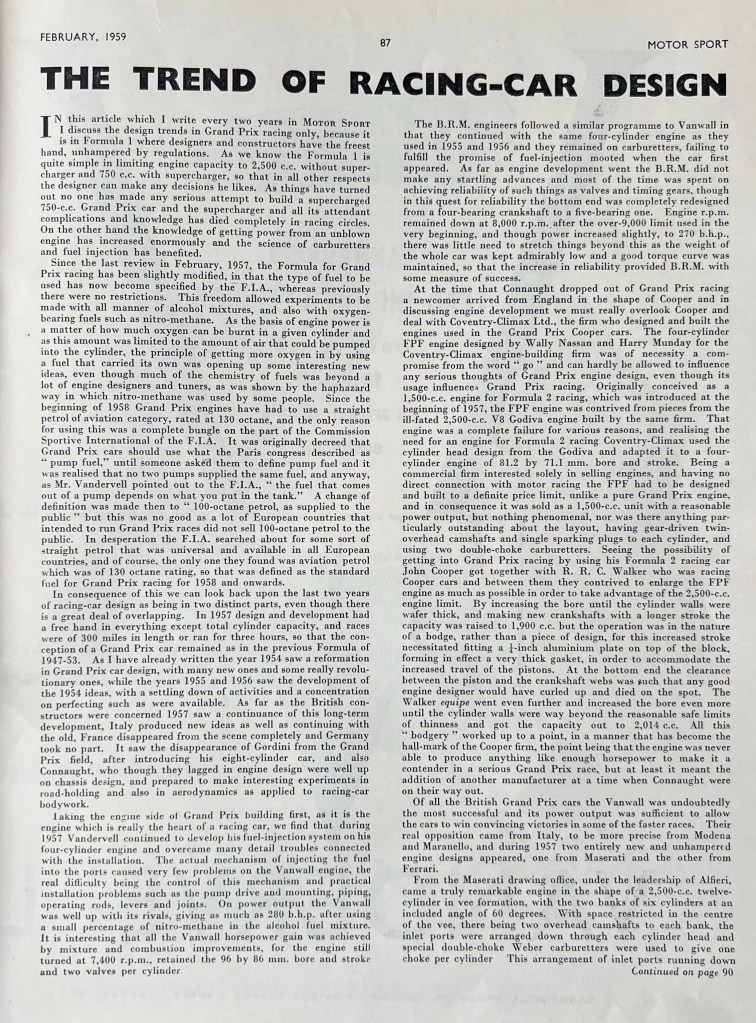
In this article which I write every two years in MotorSport, I discuss the design trends in Grand Prix racing only, because it is in Formula 1 where designers and constructors have the freest hand unhampered by regulations.
As we know the Formula 1 is quite simple in limiting engine capacity to 2,500 c.c. without supercharger and 750 c.c. with supercharger, so that in all other respects the designer can make any decisions he likes. As things have turned out no one has made any serious attempt to build a supercharged 750 c.c. Grand Prix car and the supercharger and all its attendant complications and knowledge has died completely in racing circles. On the other hand the knowledge of getting power from an unblown engine has increased enormously and the science of carburetters and fuel injection has benefited.
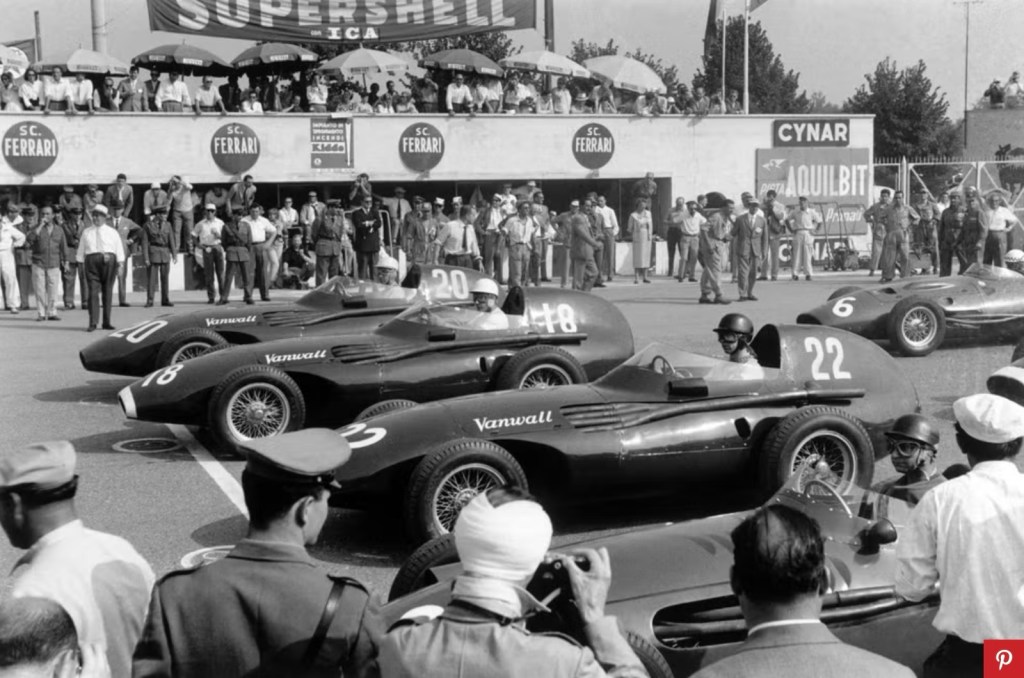
Rule Brittania! Change is afoot. Lewis-Evans on pole, then Moss and Brooks on Vanwalls, and Fangio, obscured, Maserati 250F. Italian GP, 1957. Moss won from Fangio and Von Trips, Lancia-Ferrari D50 (LAT)
Formula changes since the last review…
Since the last review in February, 1957, the Formula for Grand Prix racing has been slightly modified, in that the type of fuel to be used has now become specified by the F.I.A., whereas previously there were no restrictions. This freedom allowed experiments to be made with all manner of alcohol mixtures, and also with oxygen-bearing fuels such as nitro-methane. As the basis of engine power is a matter of how much oxygen can be burnt in a given cylinder and as this amount was limited to the amount of air that could be pumped into the cylinder, the principle of getting more oxygen in by using a fuel that carried its own was opening up some interesting new ideas, even though much of the chemistry of fuels was beyond a lot of engine designers and tuners, as was shown by the haphazard way in which nitro-methane was used by some people.
JM Fangio at Aintree, July 20 1957. Maserati 250F. DNF in the British GP won by Brooks/Moss. JMF won his fifth and final World Championship that year (Getty/L Klemantaski)
Since the beginning of 1958 Grand Prix engines have had to use a straight petrol of aviation category, rated at 130 octane, and the only reason for using this was a complete bungle on the part of the Commission Sportive International of the F.I.A. It was originally decreed that Grand Prix cars should use what the Paris congress described “pump fuel,” until someone asked them to define pump fuel and it was realised that no two pumps supplied the same fuel, and anyway, as Mr. Vandervell pointed out to the F.I.A., “the fuel that comes out of a pump depends on what you put in the tank.” A change of definition was made then to “100-octane petrol, as supplied to the public” but this was no good as a lot of European countries that intended to run Grand Prix races did not sell 100-octane petrol to the public. In desperation the F.I.A. searched about for some sort of straight petrol that was universal and available in all European countries, and of course, the only one they found was aviation petrol which was of 130 octane rating, so that was defined as the standard fuel for Grand Prix racing for 1958 and onwards.
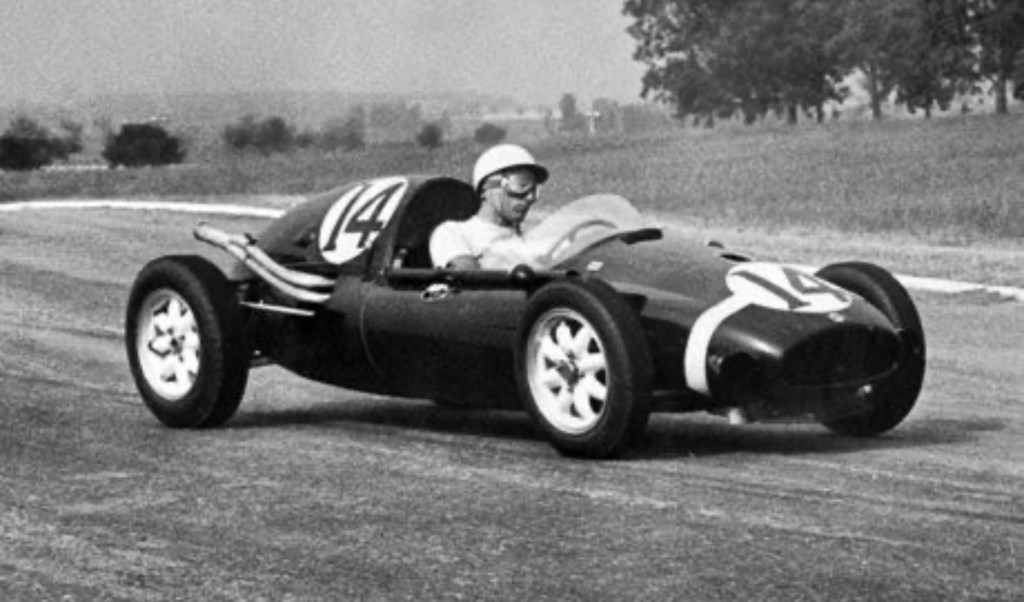
Stirling Moss on the way to winning a game-changer, the January 19, 1958 Argentine Grand Prix aboard Rob Walker’s Cooper T43 Climax 1960cc (unattributed)
Design and development in two parts…
In consequence of this we can look back upon the last two years of racing-car design as being in two distinct parts, even though there is a great deal of overlapping. In 1957 design and development had a free hand in everything except total cylinder capacity, and races were of 300 miles in length or ran for three hours, so that the conception of a Grand Prix car remained as in the previous Formula of 1947-53. As I have already written the year 1954 saw a reformation in Grand Prix car design, with many new ones and some really revolutionary ones, while the years 1955 and 1956 saw the development of the 1954 ideas, with a settling down of activities and a concentration on perfecting such as were available. As far as the British constructors were concerned 1957 saw a continuance of this long-term development, Italy produced new ideas as well as continuing with the old, France disappeared from the scene completely and Germany took no part. It saw the disappearance of Gordini from the Grand Prix field, after introducing his eight-cylinder car, and also Connaught, who though they lagged in engine design were well up on chassis design, and prepared to make interesting experiments in road-holding and also in aerodynamics as applied to racing-car bodywork.
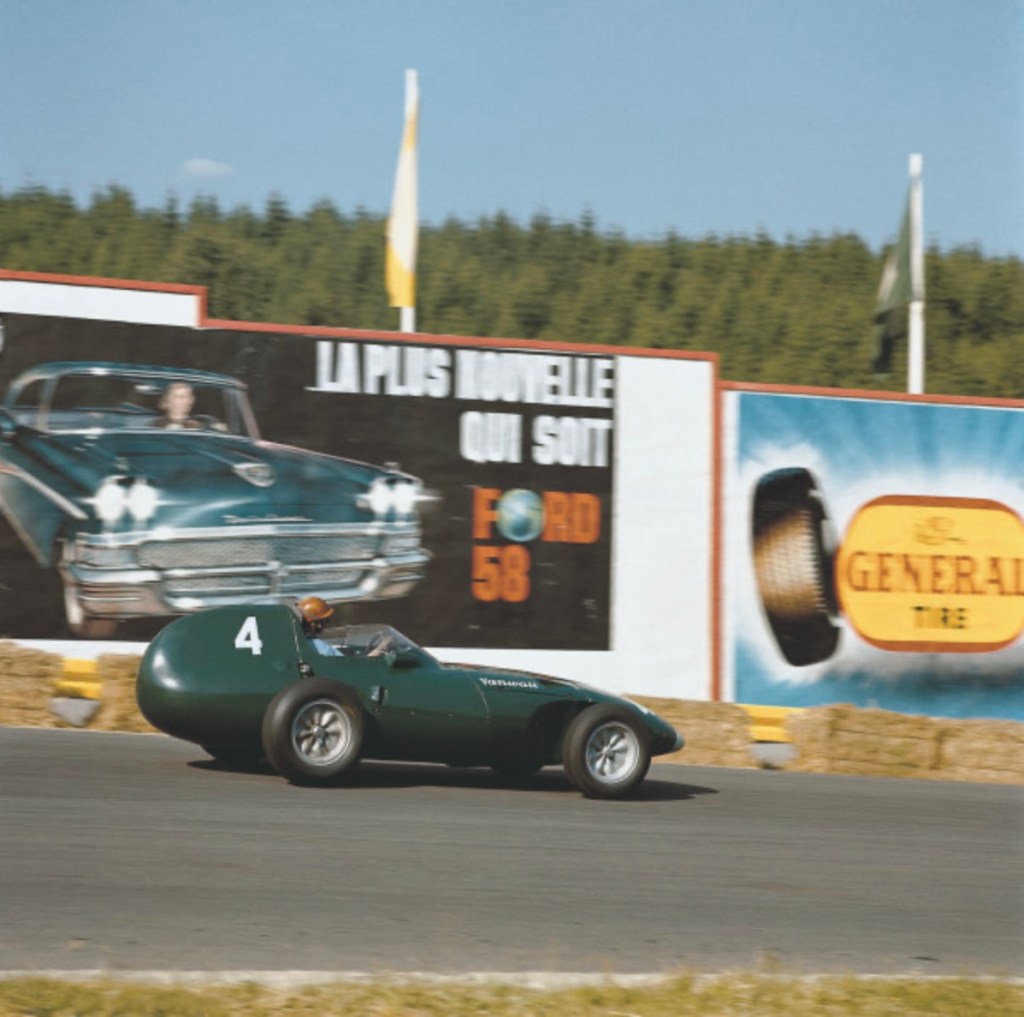
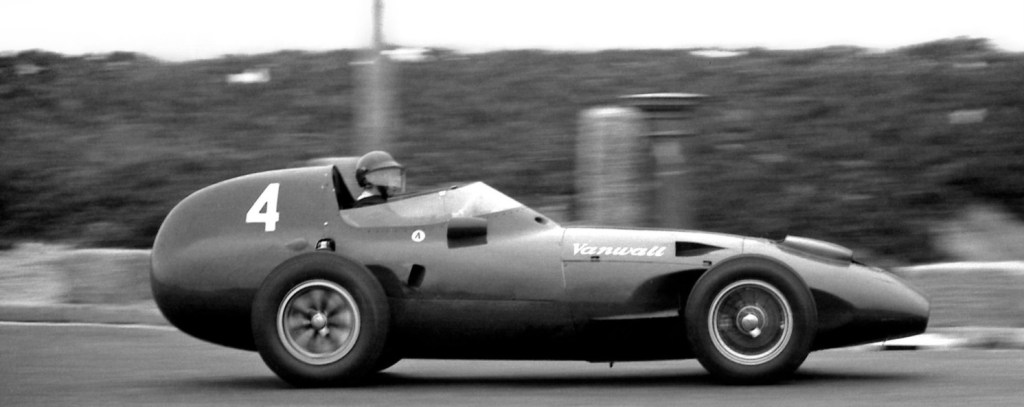
Tony Brooks, Vanwall VW5 on the way to winning at Spa in 1958 (LAT)Vanwall, Spa June 15, 1958. Vanwall VW5 2.5-litre, DOHC four good for circa 270bhp in 1958 Avgas spec (LAT)
Engines…
Taking the engine side of Grand Prix building first, as it is the engine which is really the heart of a racing car, we find that during 1957 Vandervell continued to develop his fuel-injection system on his four-cylinder engine and overcame many detail troubles connected with the installation. The actual mechanism of injecting the fuel into the ports caused very few problems on the Vanwall engine, the real difficulty being the control of this mechanism and practical installation problems such as the pump drive and mounting, piping operating rods, levers and joints. On power output the Vanwall was well up with its rivals, giving as much as 280 b.h.p. after using a small percentage of nitro-methane in the alcohol fuel mixture. It is interesting that all the Vanwall horsepower gain was achieved by mixture and combustion improvements, for the engine still turned at 7,400 r.p.m., retained the 96 by 86 mm. bore and stroke and two valves per cylinder.
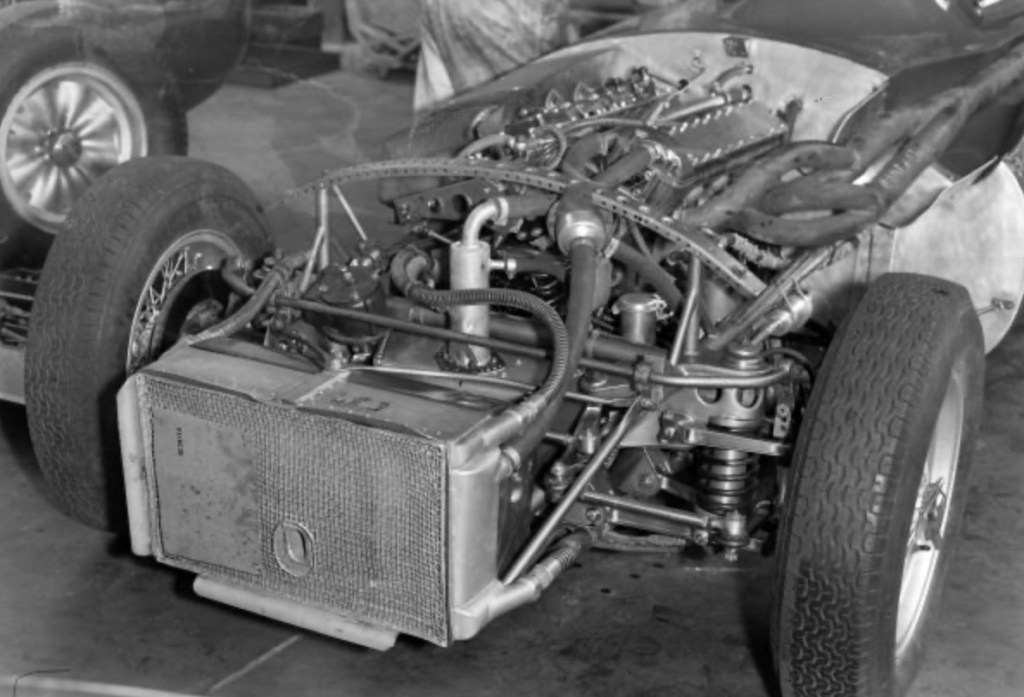
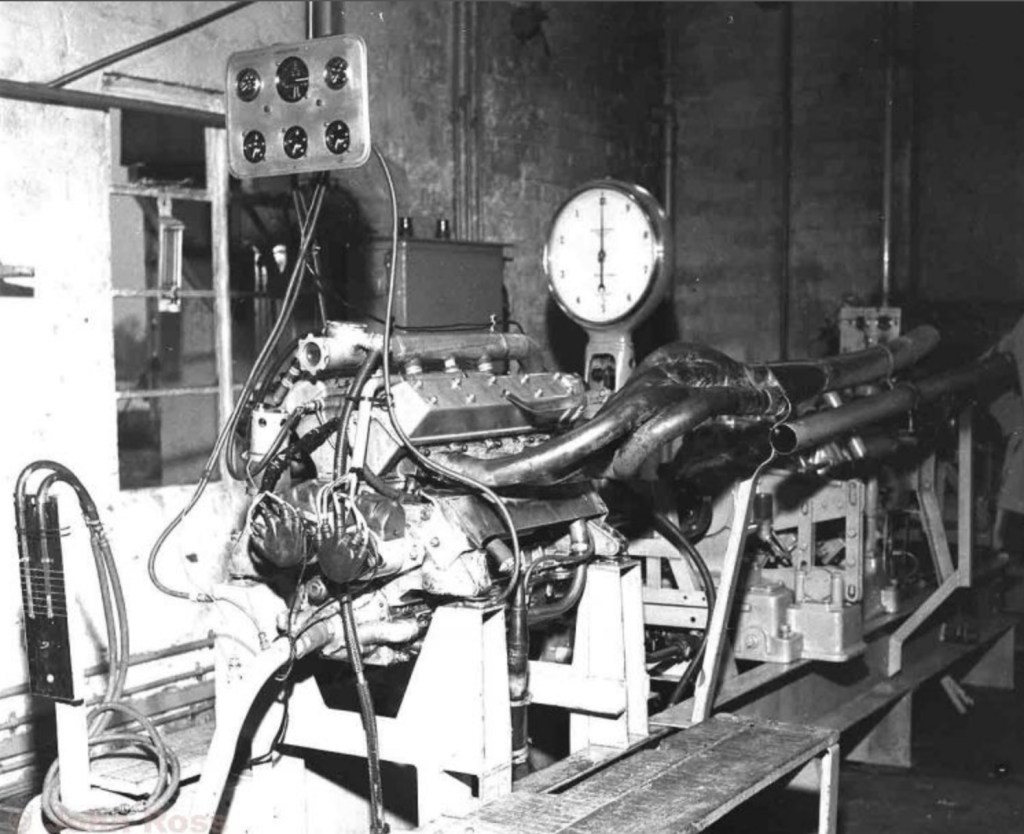
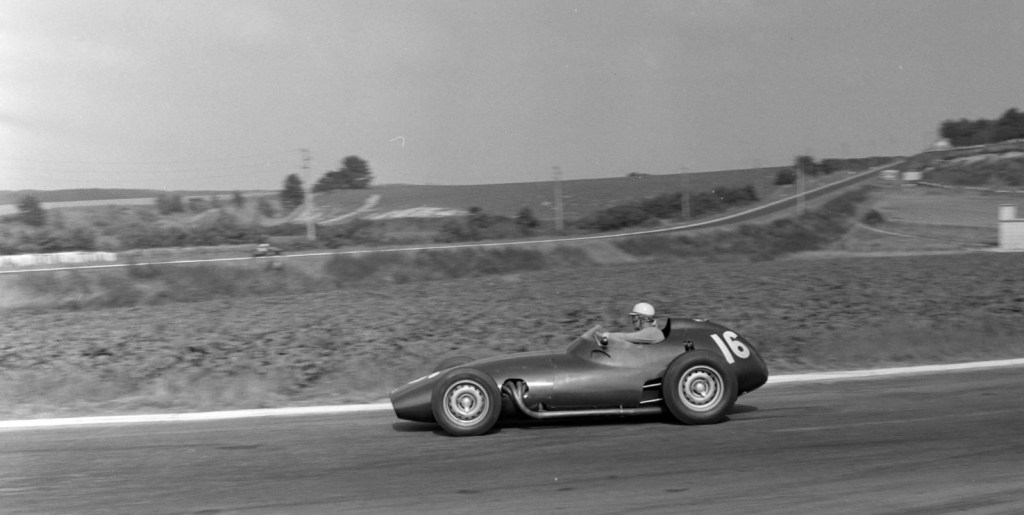
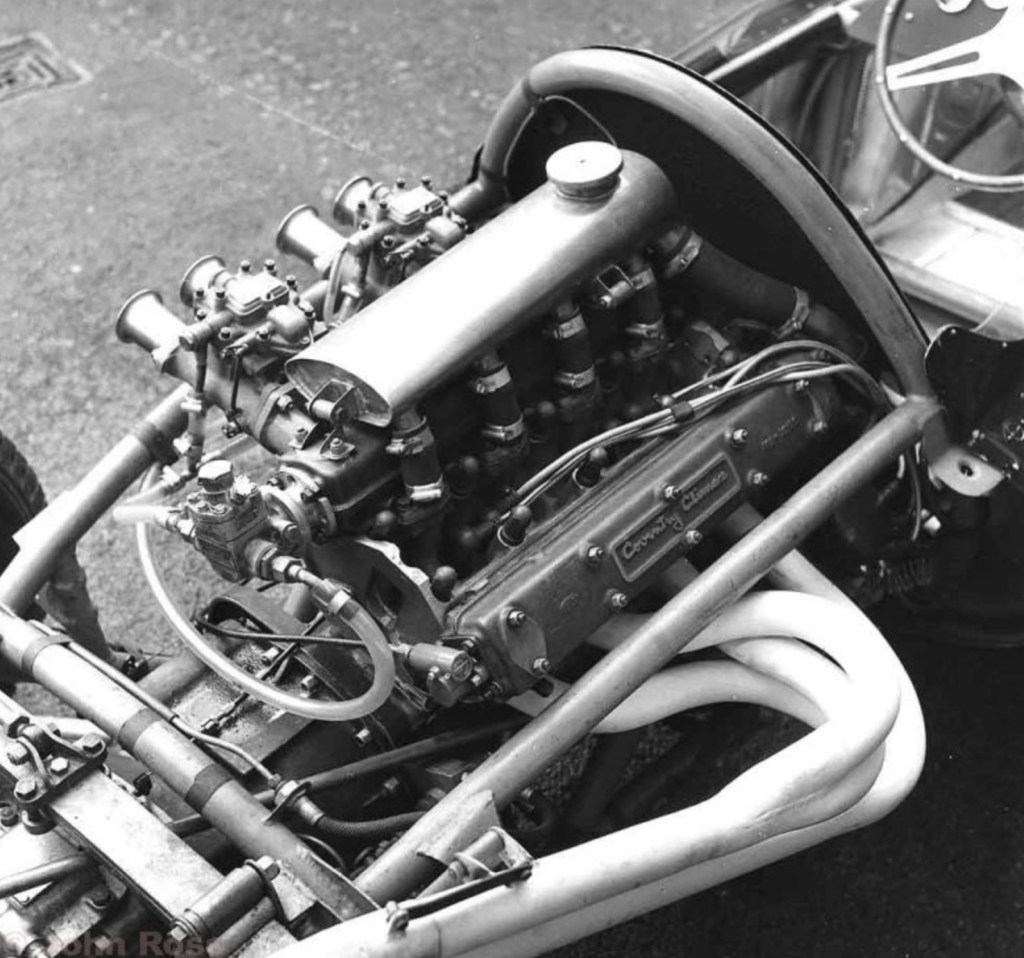
BRM P25 engine on the Folkingham test bed (J Ross)Harry Schell, BRM Type 25, Reims 1958 (Getty/M Tee)
The B.R.M. engineers followed a similar programme to Vanwall in that they continued with the same four-cylinder engine as they used in 1955 and 1956 and they remained on carburetters, failing to fulfill the promise of fuel-injection mooted when the car first appeared. As far as engine development went the B.R.M. did not make any startling advances and most of the time was spent on achieving reliability of such things as valves and timing gears, though in this quest for reliability the bottom end was completely redesigned from a four-bearing crankshaft to a five-bearing one. Engine r.p.m. remained down at 8,000 r.p.m. after the over-9,000 limit used in the very beginning, and though power increased slightly, to 270 b.h.p., there was little need to stretch things beyond this as the weight of the whole car was kept admirably low and a good torque curve was maintained, so that the increase in reliability provided B.R.M. with some measure of success.
Stuart Lewis-Evans’ victorious Connaught B-Type. He won the Glover Trophy on Easter Monday, Goodwood, April 22, 1957 (J Ross)
At the time that Connaught dropped out of Grand Prix racing a newcomer arrived from England in the shape of Cooper and in discussing engine development we must really overlook Cooper and deal with Coventry-Climax Ltd., the firm who designed and built the engines used in the Grand Prix Cooper cars. The four-cylinder FPF engine designed by Wally Nassan and Harry Munday for the Coventry-Climax engine-building firm was of necessity a compromise from the word ” go” and can hardly be allowed to influence any serious thoughts of Grand Prix engine design, even though its usage influences Grand Prix racing.
Originally conceived as a 1,500-c.c. engine for Formula 2 racing, which was introduced at the beginning of 1957, the FPF engine was contrived from pieces from the ill-fated 2,500-c.c. V8 Godiva engine built by the same firm. That engine was a complete failure for various reasons, and realising the need for an engine for Formula 2 racing Coventry-Climax used the cylinder head design from the Godiva and adapted it to a four-cylinder engine of 81.2 by 71.1 mm. bore and stroke. Being a commercial firm interested solely in selling engines, and having no direct connection with motor racing the FPF had to be designed and built to a definite price limit, unlike a pure Grand Prix engine, and in consequence it was sold as a 1,500-c.c. unit with a reasonable power output, but nothing phenomenal, nor was there anything particularly outstanding about the layout, having gear-driven twin-overhead camshafts and single sparking plugs to each cylinder, and using two double-choke carburetters.
Lotus 16 Climax FPF (Alan Stacey or Graham Hill) during the British GP weekend July 16, 1958. Silverstone (LAT)Graham Hill’s Lotus 16 Climax ahead of Jack Brabham’s Cooper T45 Climax during the 1958 British Grand Prix at Silverstone (unattributed)
Seeing the possibility of getting into Grand Prix racing by using his Formula 2 racing car John Cooper got together with R. R. C. Walker who was racing Cooper cars and between them they contrived to enlarge the FPF engine as much as possible in order to take advantage of the 2,500-c.c. engine limit. By increasing the bore until the cylinder walls were wafer thick, and making new crankshafts with a longer stroke the capacity was raised to 1,900 c.c. but the operation was in the nature of a bodge, rather than a piece of design, for this increased stroke necessitated fitting a quarter-inch aluminium plate on top of the block forming in effect a very thick gasket, in order to accommodate the increased travel of the pistons. At the bottom end the clearance between the piston and the crankshaft webs was such that any good engine designer would have curled up and died on the spot. The Walker equipe went even further and increased the bore even more until the cylinder walls were way beyond the reasonable safe limits of thinness and got the capacity out to 2,014 c.c. All this ” bodgery” worked up to a point, in a manner that has become the hall-mark of the Cooper firm, the point being that the engine was never able to produce anything like enough horsepower to make it a contender in a serious Grand Prix race, but at least it meant the addition of another manufacturer at a time when Connaught were on their way out.
A Vanwall fuel-injected four during the 1958 British GP weekend (LAT)
Of all the British Grand Prix cars the Vanwall was undoubtedly the most successful and its power output was sufficient to allow the cars to win convincing victories in some of the faster races. Their real opposition came from Italy, to be more precise from Modena and Maranello, and during 1957 two entirely new and unhampered engine designs appeared, one from Maserati and the other from Ferrari.
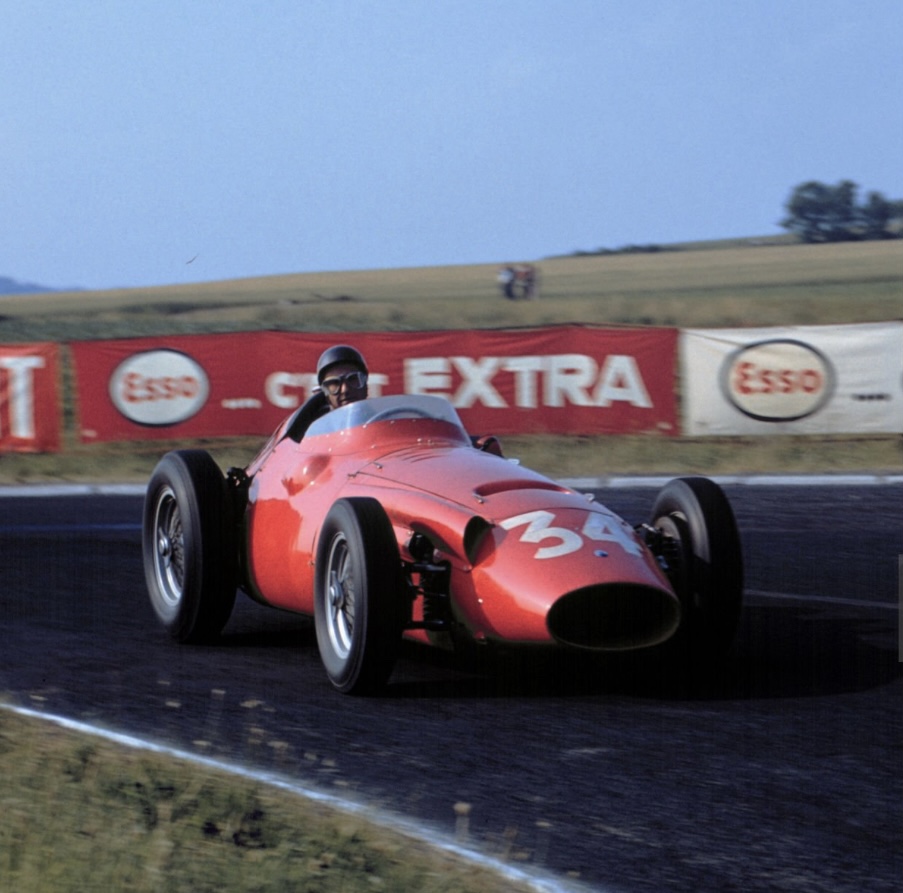
V12 Maserati engined 250F at Pescara on August 18, 1957. With the kitty running low we never did get to see what Maserati could have done with this engine in 1958-59 (Getty/B Cahier)Harry Schell aboard a V12 equipped Maserati 250F during practice at Monaco in 1957. Oh to have heard that thing…(LAT)
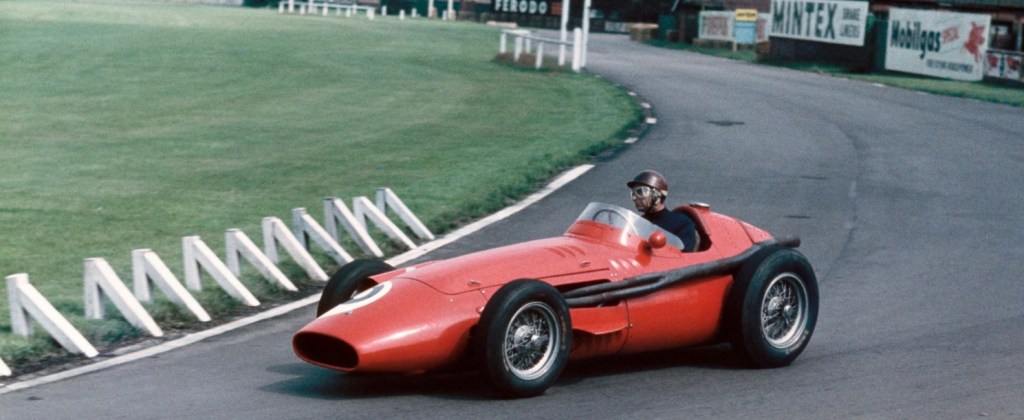
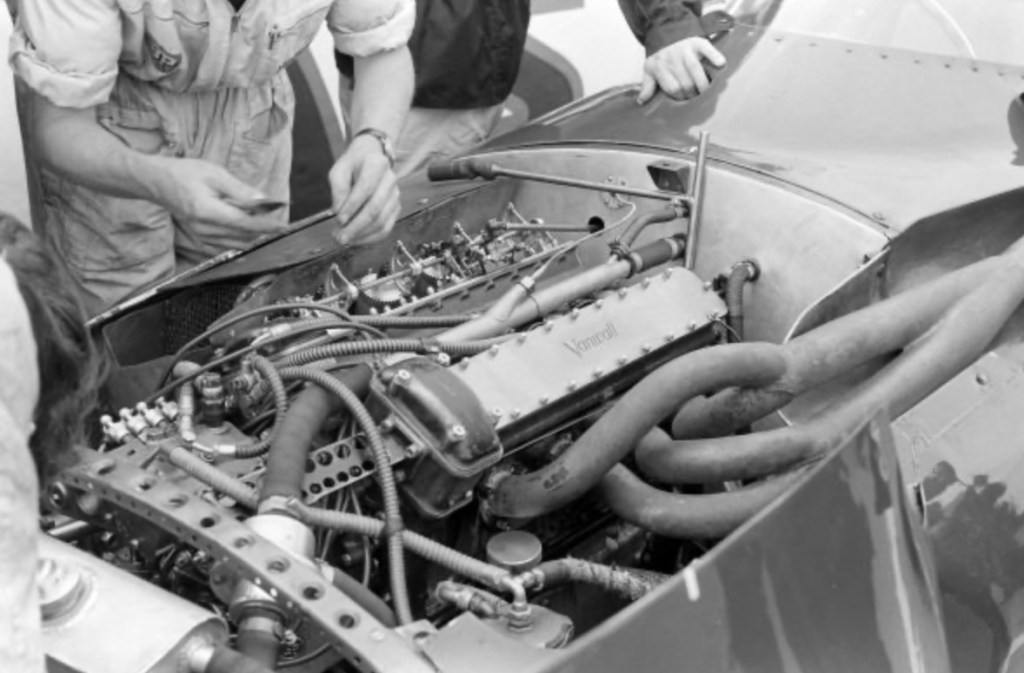
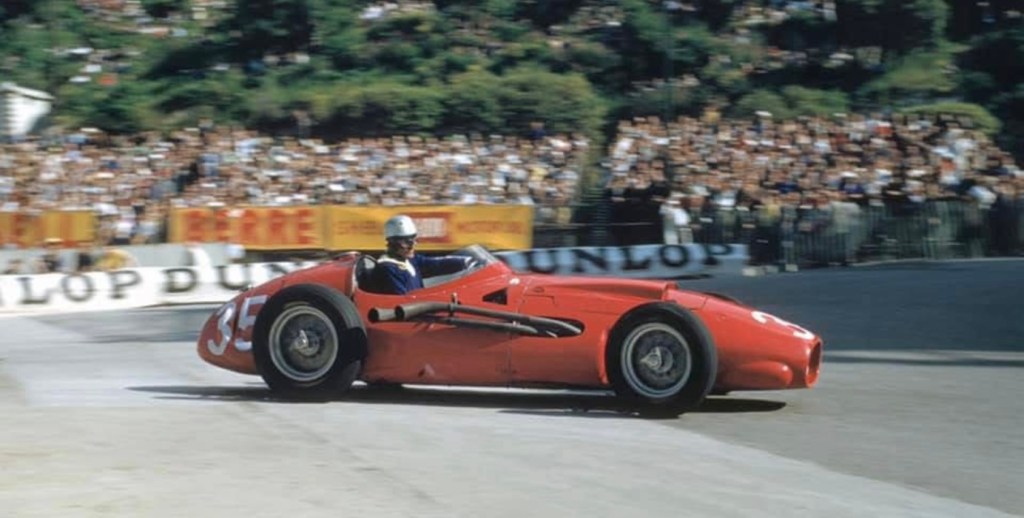
From the Maserati drawing office, under the leadership of Alfieri, came a truly remarkable engine in the shape of a 2,500-c.c. twelve-cylinder in vee formation, with the two banks of six cylinders at an included angle of 60 degrees. With space restricted in the centre of the vee, there being two overhead camshafts to each bank, the inlet ports were arranged down through each cylinder head and special double-choke Weber carburetters were used to give one choke per cylinder. This arrangement of inlet ports running down past the plugs was unusual but not new, having been used by Mercedes-Benz on the W196 engine, and by B.M.W. before that. The Maserati engine used a bore and stroke of 68.5 by 56 mm., and this very short stroke allowed for high r.p.m. with 10,000 often being used. With such high speeds in use ignition was a problem, the orthodox magneto being unable to withstand the speeds and deliver sufficient sparks to the 24 plugs, there being two to each cylinder. A high voltage coil and distributor system was used, with a 12 contact distributor driven off each inlet camshaft and 24 separate coils mounted on the scuttle, current being supplied by a battery carried in the cockpit. Revs and power were no problem to this new engine, nor was the reliability factor lacking, but as B.R.M. had found back in 1950-53 such high revolutions with a limited power range proved very difficult for the driver to control. Although Maserati used a five-speed gearbox the car was always suffering from the r.p.m. dropping below 6,000 at which there was little torque. Without the use of extra special fuels this engine developed over 300 b.h.p. and had it been used with a six- or eight-speed gearbox it might have proved successful. However, after a whole season of development, during which time it proved remarkably reliable, but not very practical, the project was shelved due to Maserati giving up factory racing participation.
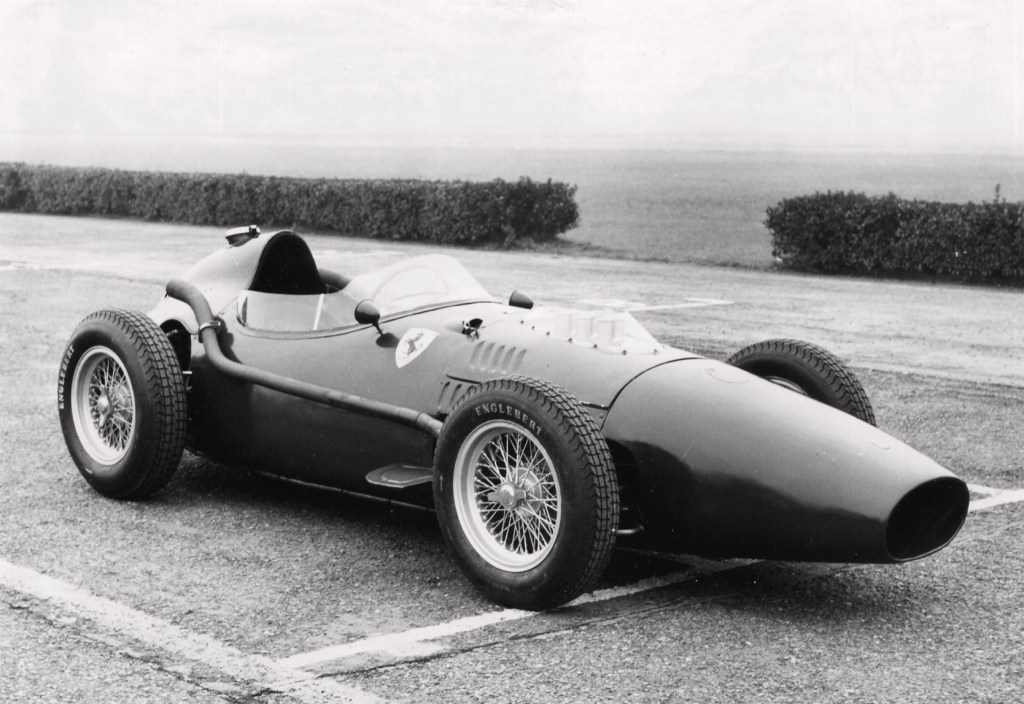
A rebuilt Ferrari Dino V6 awaits its new home in the Spa paddock, June 15, 1958. Ferrari’s V6 family of engines were still winning well into the 1970s (LAT)Factory shot of the 1958 Ferrari Dino 246 Ferrari)
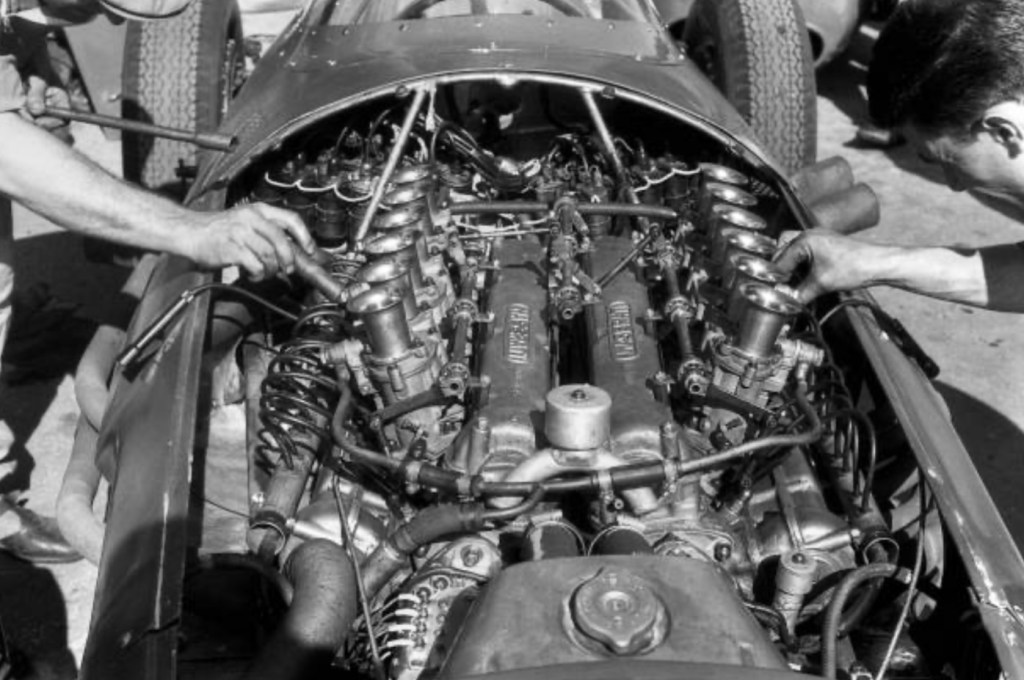
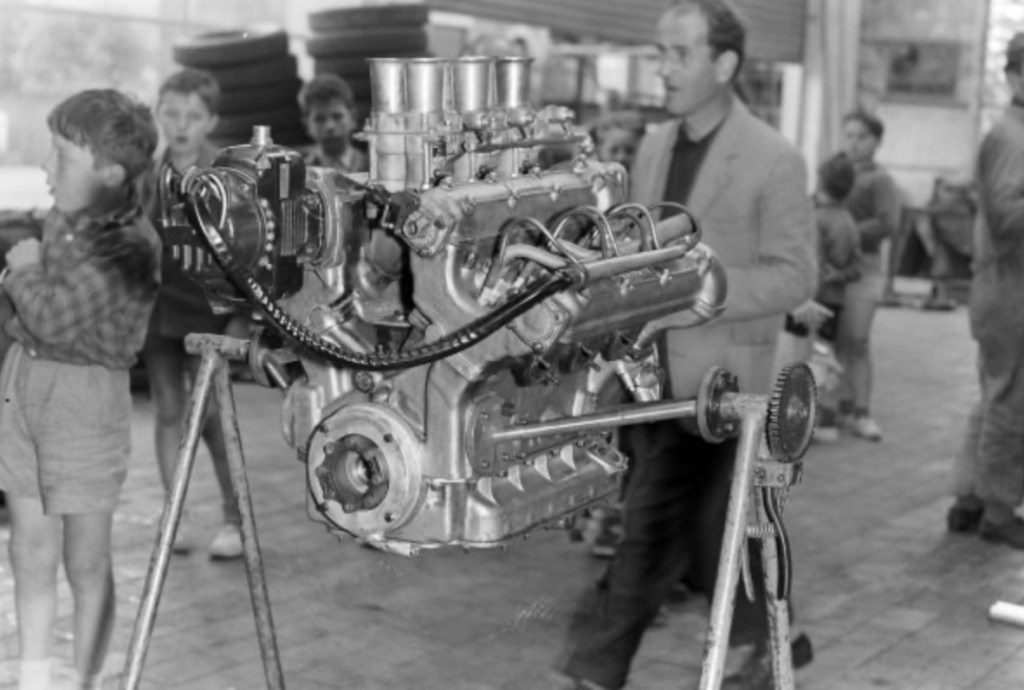
The other new engine to come from Italy emanated from that genius of design inspiration, Enzo Ferrari, though much of the idea for this new engine came from his son Dino Ferrari, who was to die from an illness before the new engine was really under way. In memory of his son, Enzo Ferrari named the new engine the Dino and it was originally built as a 1,500 c.c. Formula 2 unit, but the basic design was such that it was eventually enlarged to a full 2.5-litres and used for a new Formula 1 Grand Prix car. This engine was a 65-degree vee six-cylinder, the two blocks of three cylinders being staggered relative to one another, with the left-hand block slightly ahead of the right-hand one on the crankcase. Whereas the new Maserati vee engine had driven the four camshafts and all the accessories by a vast train of straight cut gears, the Dino Ferrari engine used roller chains to drive its four camshafts; three down-draught double-choke Weber carburetters were mounted in the vee of the engine. As a Formula 2 engine, with a bore and stroke of 70 by 64.5 mm. it was specifically designed to run on straight petrol of 100-octane rating and used a 9.5 to l compression ratio and 9,000 r.p.m. At the end of 1957 this design was enlarged to 2,417 c.c. by increasing the bore and stroke to 85 by 71 mm. and with the compression lowered to 8.8 to l and the r.p.m. dropped to 8,300 it still ran on straight petrol. Consequently when the 1958 season began the Dino engine was all set to race under the modified Formula. By the end of a season of development it was producing nearly 290 b.h.p. and was quite safe at 9,400 r.p.m., a figure quite often used by the drivers in the heat of the battle, even though 8,500 r.p.m. was given as a rev-limit. This new Ferrari engine replaced the Lancia V8 engine that the Scuderia had been using during 1957, for it had reached the end of its development after four years of hard usage.
In the two years under review these two Italian engines were the only two new designs to appear, and while of completely opposing views they had in common such things as four overhead camshafts, two plugs per cylinder, two valves per cylinder and a high r.p.m. range for maximum power and had carburation by Weber instruments specially designed for each particular engine.
With the 130-octane ruling in 1958 one might have expected engine design to change, but such short notice was given of the fuel regulation that Vanwall, B.R.M. and Maserati could do little except adapt their existing engines. Cooper had to rely on whatever engine development work was being done by Coventry-Climax, and they were joined by Lotus in the Formula 1 field, who also relied on the Coventry firm for their power unit. Ferrari was the only one who was able to take advantage of the new fuel regulation and had no trouble as his engine had never used anything else but straight petrol. As Maserati had given up racing officially they did not bother too much about converting their trusty 250F six-cylinder to run on aviation petrol, and for the first race they merely recommended a change of jets to their customers, not even bothering to lower the compression ratio. The surprising thing was that the Maserati engine responded to this treatment and went on working throughout the season with no drastic alterations, though later the factory built some new engines with modified cylinder heads. This fact rather indicated that in 1957 they were either not taking full advantage of the alcohol/nitro-methane mixture they were using, the engine was running too cool, or that 130-aviation spirit was able to produce as much power as alcohol. This latter suggestion, coupled with different working temperatures, seemed to be the keynote of Grand Prix engines in 1958 for Vanwall found their power output still around the 270 b.h.p. mark, as did B.R.M., but working temperatures had gone up by as much as 200 degrees at the exhaust valves so that getting the Vanwall and the B.R.M. engines to run on straight petrol was not so much a problem of thermo-dynamics and combustion as one of metallurgy. Coventry-Climax made little advance in 1958 the unit being used in Formula 1 still being the mechanical “bodge” that had been perpetrated in 1957, though it did prove surprisingly successful as a result of unreliability in the more advanced designs. With Lotus taking part in Grand Prix racing it was not surprising that some new ideas were forthcoming and Chapman designed an intriguing new car with the engine canted over to lie almost horizontal. This meant a few modifications being made to the FPF unit in respect of oil collection, but it is interesting that drainage of the valve gear was no problem for the cylinder head had been originally designed to run in a canted-over position on the Godiva V8. The main problem involved was that of carburation, for they had to use an existing Weber horizontal double-choke instrument for each pair of cylinders, and within the space limitations under the bonnet the only possible shape of inlet manifold caused a considerable power loss, which they could ill-afford.
End of an era, Fangio aboard a Maserati 250F at Reims in 1958. Q8 and fourth in the race won by Hawthorn’s Dino 246 (Getty/L Klemantaski)A twin-Weber fed Climax 1.5-FPF in the back of a Cooper T45 F2 car at Surbiton in February 1958 (J Ross)
One cannot help feeling that had Lotus been based in Italy they could have got the help of the Weber carburetter firm who would have designed suitable carburetters for the engine layout, probably of the semi-downdraught type as used on the vee-12 Maserati. Throughout the whole period of unsupercharged racing engine design, it has been noteworthy that Alfa-Romeo, Ferrari, Maserati and O.S.C.A. have been able to work in close co-operation with Weber and have special carburetters designed specifically for an individual engine, whereas British engine designers have had to adapt an existing instrument if using Weber. The only co-operation in England has been from the S.U. Company, who designed new double-choke instruments to fit the standard Coventry-Climax FPF unit. Because of his inability to solve the power loss through the altered inlet manifold Chapman had to abandon his horizontal engine position and return to one of near vertical. In passing it is interesting that some years ago when Moto-Guzzi were dominating motor-cycle racing with their 250-c.c., 350-c.c. and 500-c.c. single-cylinder machines with horizontal cylinder layout, Norton Motors experimented with the same idea, turning the renowned Manx Norton engine through 90 degrees, but the idea was abandoned because they could never overcome the carburation problems.
Over the past two years we can sum up the engine design trend briefly by saying that Britain has shown no trend, except the further development of old designs, while Italy has tried two completely new units, one successful and one not so much so. As has been the case for many years, even back in the 1920s, the limit of power production for a given type of engine has seldom been one of design knowledge, but has been a question of metallurgy and being able to build the engines to withstand the designed power production.
Lotus 16 Climax, Silverstone July 19, 1958. Driveshaft from front mounted FPF to the rear mounted box at left, and yet another angle of Chapman’s chassis mastery. It wasn’t a great car of course…(LAT)
Gearboxes…
Before turning to chassis design, which includes the basic frame itself, suspension units and the road-holding qualities, we might look briefly into gearboxes.
We find that Vanwall, and B.R.M. have made no changes at all, while Maserati merely developed their existing gearbox, to make all five speeds usable all the time, instead of first gear being merely for starting from rest. Ferrari designed an entirely new gearbox for his Dino engine, but it was in reality a scaled-down version of the Lancia D50 box, mounted to one side of the differential and having the clutch incorporated in it, between the bevel gears which turn the propshaft drive at right angles, and the box itself. Unlike most people, Ferrari decided that four speeds would be sufficient for his new gearbox. Cooper continued to use an adaptation of the Citroën four-speed unit, though for 1958 it was completely reworked, made stronger and used all Cooper-manufactured parts.
The dreaded Lotus Queerbox sequential five-speed tranny. Despite plenty of development attention it never quite hit the mark. Note too the small tube frame, Chapman Struts, driveshafts and inboard discs. ’58 British GP (LAT)
The only other new gearbox to appear in Grand Prix Racing was from Lotus, this being a constant-mesh five-speed unit mounted in one with the final drive and differential housing, and appeared in 1957 in the Lotus Formula 2 car, and in 1958 in the Formula 1 version. This gearbox is remarkable in its compactness and light weight, there being five pairs of gears mounted very close together, each pair continually in mesh and the drive from the engine is locked to any one of the bottom five gears at choice, by a sliding locking mechanism that travels through the hollow centres of the gears. Chapman has added to this design by trying two types of gear-change mechanism, one a positive-stop arrangement where the lever is always in the same position and a movement one way or the other effects a change up or down, as desired; the other arrangement was still positive-stop but had a progressive lever position, the short lever travelling along a slotted guide from first to fifth gears.
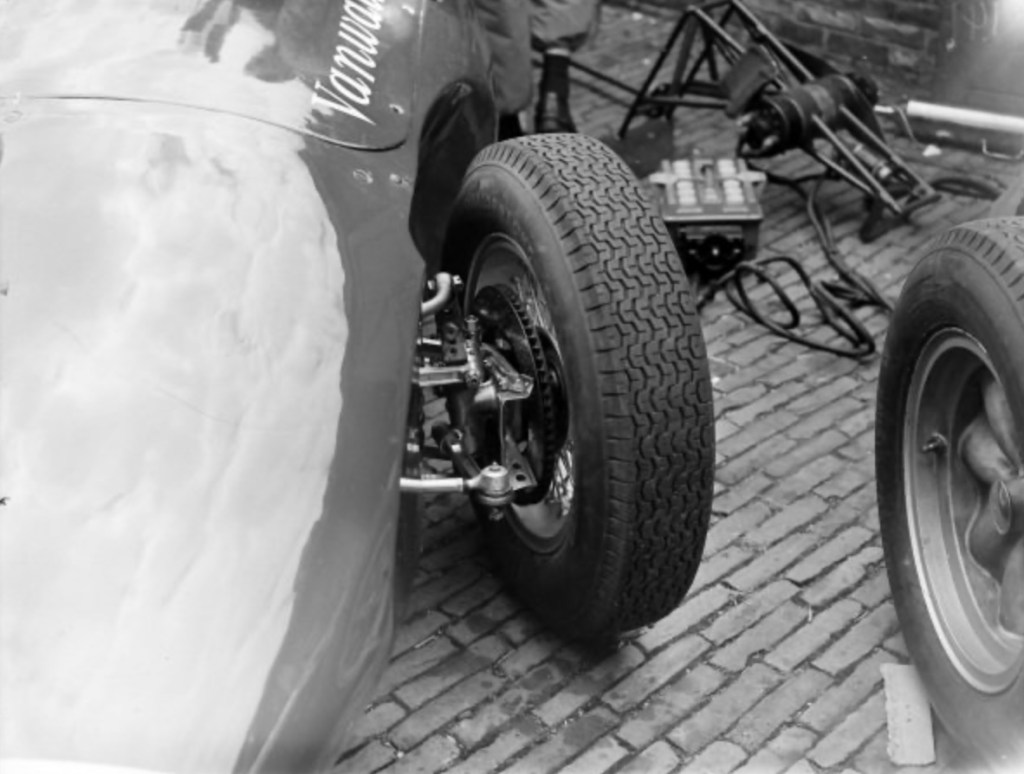
Vanwall chassis in the Spa paddock, June 15, 1958. Another bit of Chapman magic. De Dion tube, inboard disc, twin radius rods and coil spring-shock all clear. So too that whopper fuel tank (LAT)
Chassis and Suspension…
In the realm of chassis and suspension design it has again been Colin Chapman who has provided the new ideas, on his own Lotus cars, and in consultation with B.R.M. and Vanwall. One thing that is significant is that space-frames are now universal, except that Ferrari went from a full space-frame on his Formula 2 car to a semi-space-frame on his Dino Formula 1car.
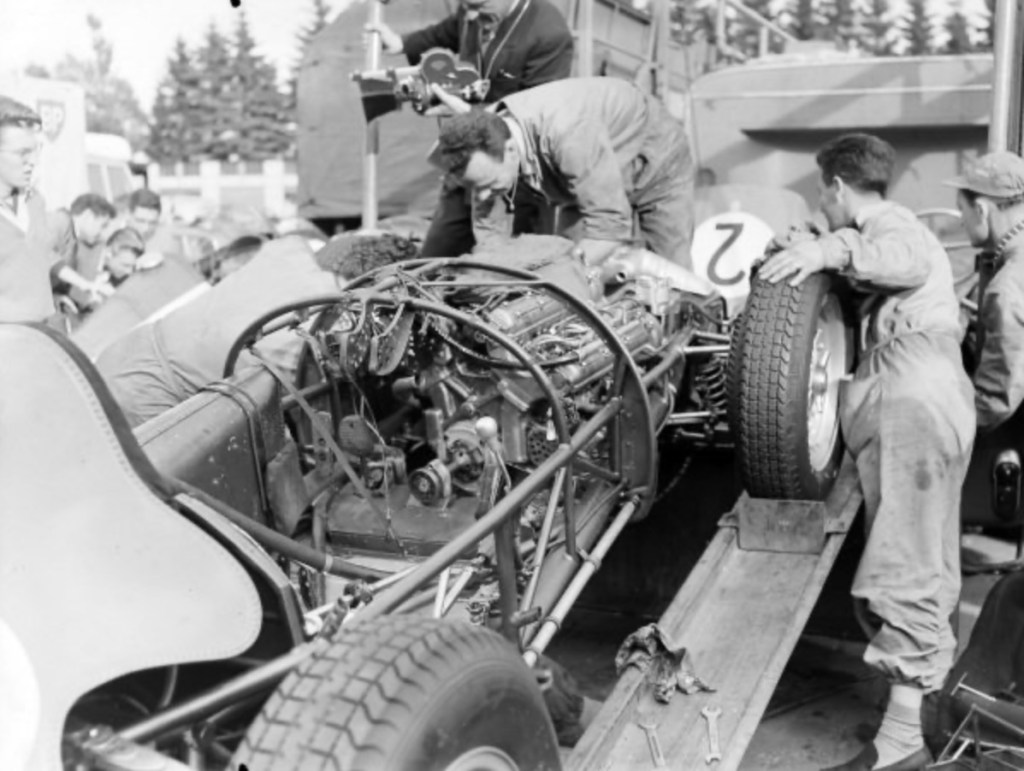
Ferrari Dino 246 chassis is multi-tube but dominated by a pair of lower big-tube longerons. Mechanics load a car onto a truck at the Nurburgring on August 3,1958 (LAT)
Vanwall remained unchanged, being set with a near-perfect design for the car in question, while B.R.M. changed to a fully-stressed space-frame of Chapman inspiration and naturally both Formula 1 and Formula 2 Lotus cars have the acme of lightweight space-frames.
Vanwall spaceframe chassis, de Dion tube and oil filter housing present, undated (J Ross)Lotus 16 Climax, British GP July 1958 Silverstone. Beautiful spaceframe chassis, note the twin-throat SUs feeding the Climax FPF (LAT)
Cooper employs the general principles, but still fails to carry them through to finality, relying on heavy gauge tubing to impart strength and continuing to use curved tubes which are anathema to the space-frame designer. Maserati built new chassis frames in 1957 and again in 1958 and both times took a decided step forward in space-frame design, the layout being reasonable and diameter and gauge of tubing getting positively daring for Modena designers, who have long been reluctant to contemplate anything under 12 or 14 s.w.g. tubing.
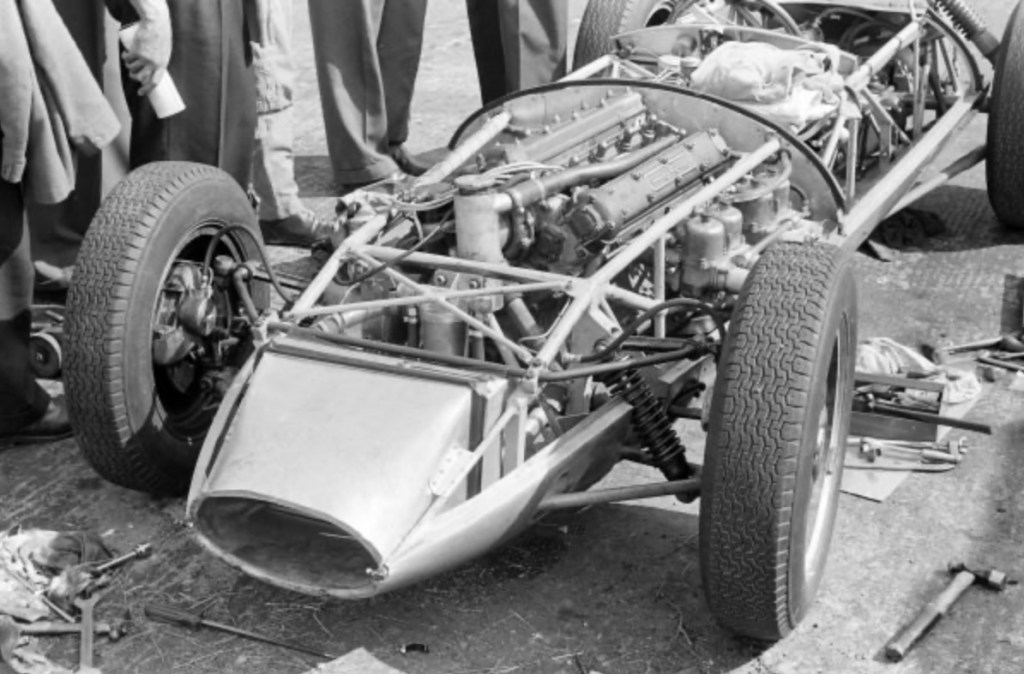
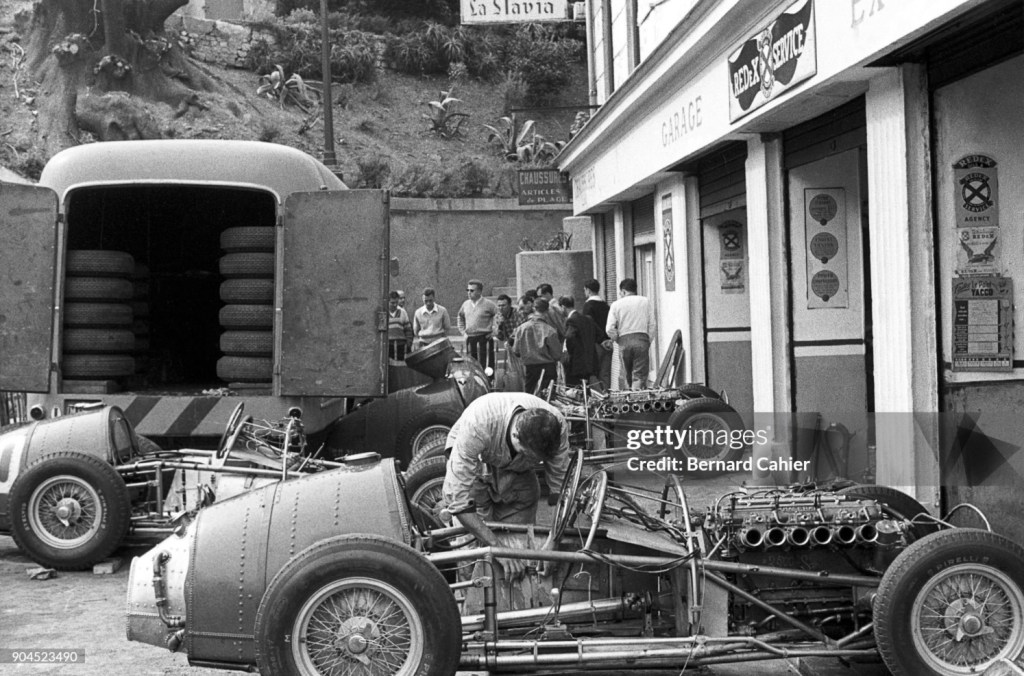
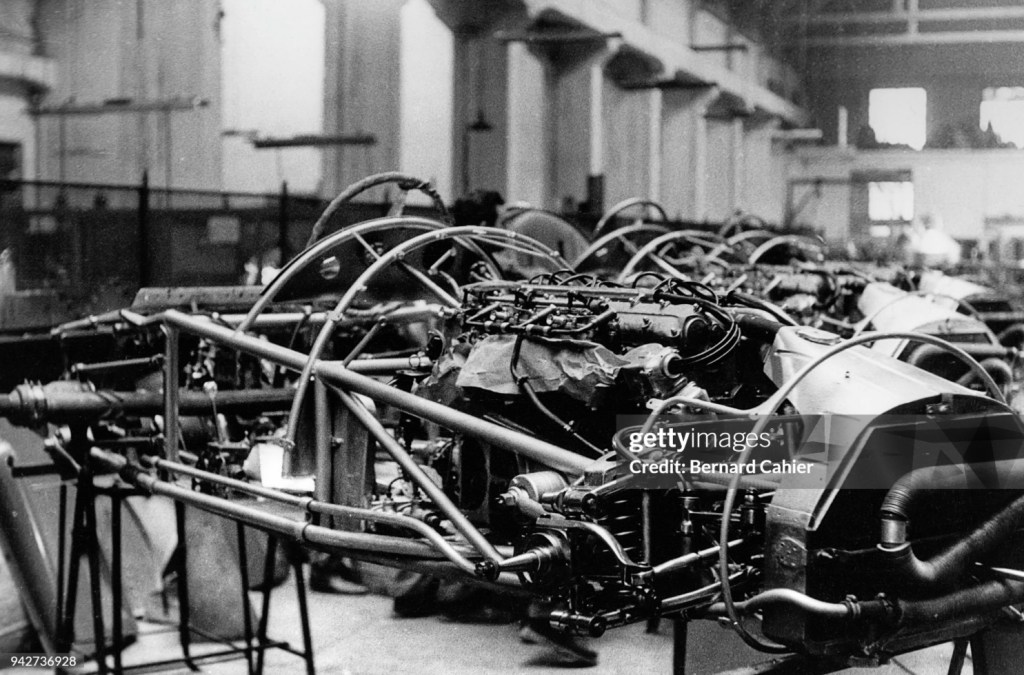
Maserati 250F ‘big tube spaceframe’ chassis at Monaco in 1956A row of Maseratis lined up in Modena on January 10, 1956
As regards front suspension there is now universal agreement in the double-wishbone and interspersed coil-spring layout, though the execution varies. Last to join this school of thought was Cooper who introduced it for his 1958 cars. Vandervell still uses beautifully machined forgings for his wishbones, as did Maserati in 1957, though on the 1958 Modena car a welded tubular construction was used. B.R.M. also used welded tubular construction of particularly nice design, while Cooper uses a very simple tubular layout, as does Ferrari on the Dino. Once again it is Chapman who differs, for his top wishbone is formed by a tubular strut and the end of a torsion anti-roll bar, his top wishbone member thus doing two jobs. Coil springs with tubular telescopic shock-absorber in the centre are popular, but some people still prefer the Houdaille vane-type shock-absorbers.
Cooper T45 Climax undressed revealing its upper and lower wishbone front suspension, Alford & Alder front uprights and coil spring-damper units – Coil Overs in modern vulgaresque – fuel tanks in close proximity to the pilot. You can just see the tip of the rear transverse leaf at right-rear (J Ross)Front suspension of Graham Hill’s Lotus 16, British GP 1958. Note the roll bar doubling up for locational duty, caliper is Girling (LAT)
At the rear coil springs are equally in favour with British designers, Vanwall, B.R.M. and Lotus using them, while Cooper remains faithful to the transverse leaf spring, as does Ferrari and Maserati, though the Maranello concern experimented with coil springs on one car. The bigger cars still adhere to a de Dion layout at the rear, Vanwall, B.R.M., Ferrari and Maserati all using variations on the theme, while the small cars as exemplified by Cooper and Lotus have independent rear suspension. While Vanwall and B.R.M. provide lateral location by a Watt-linkage, Ferrari and Maserati still using a sliding guide. B.R.M. and Maserati mount their de Dion tube ahead of the rear axle assembly, and Vanwall and Ferrari mount theirs behind. On one thing all four agree, and that is that fore and aft location is provided by two parallel radius rods at each end of the tube.
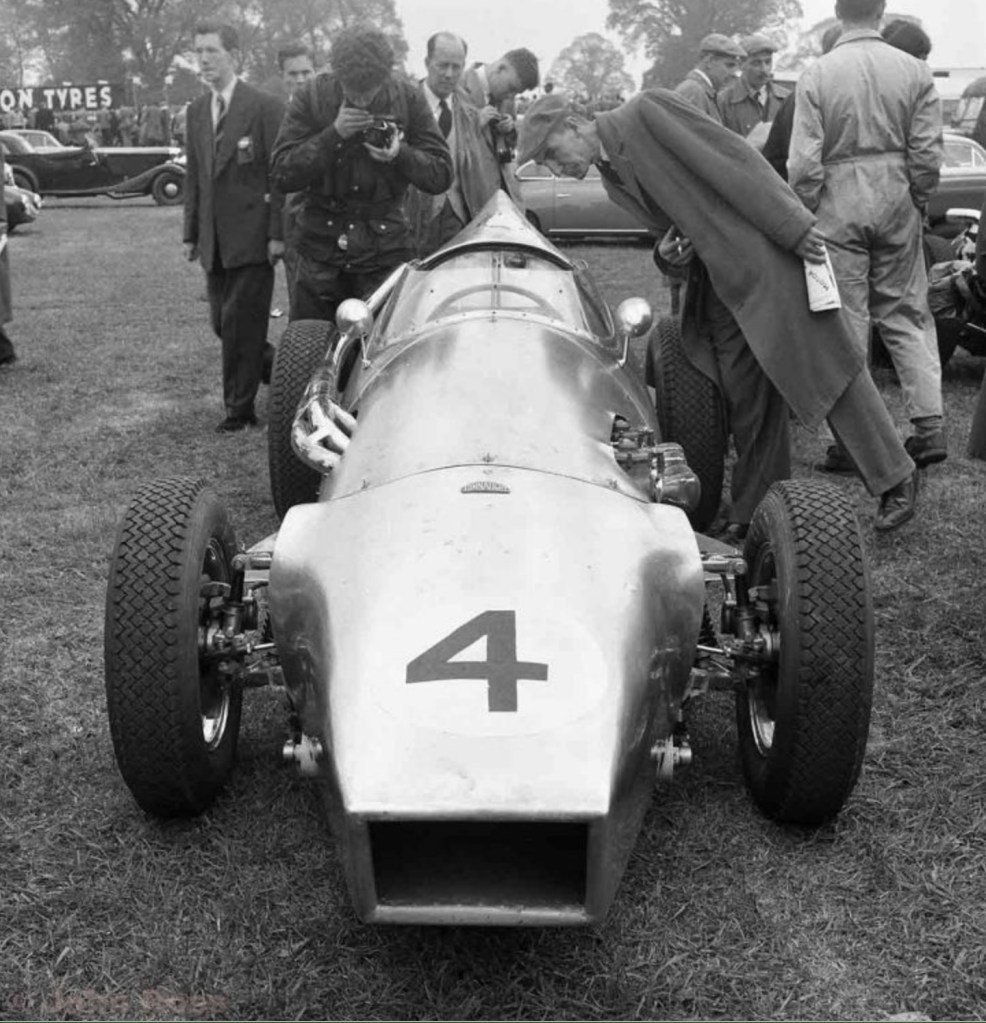
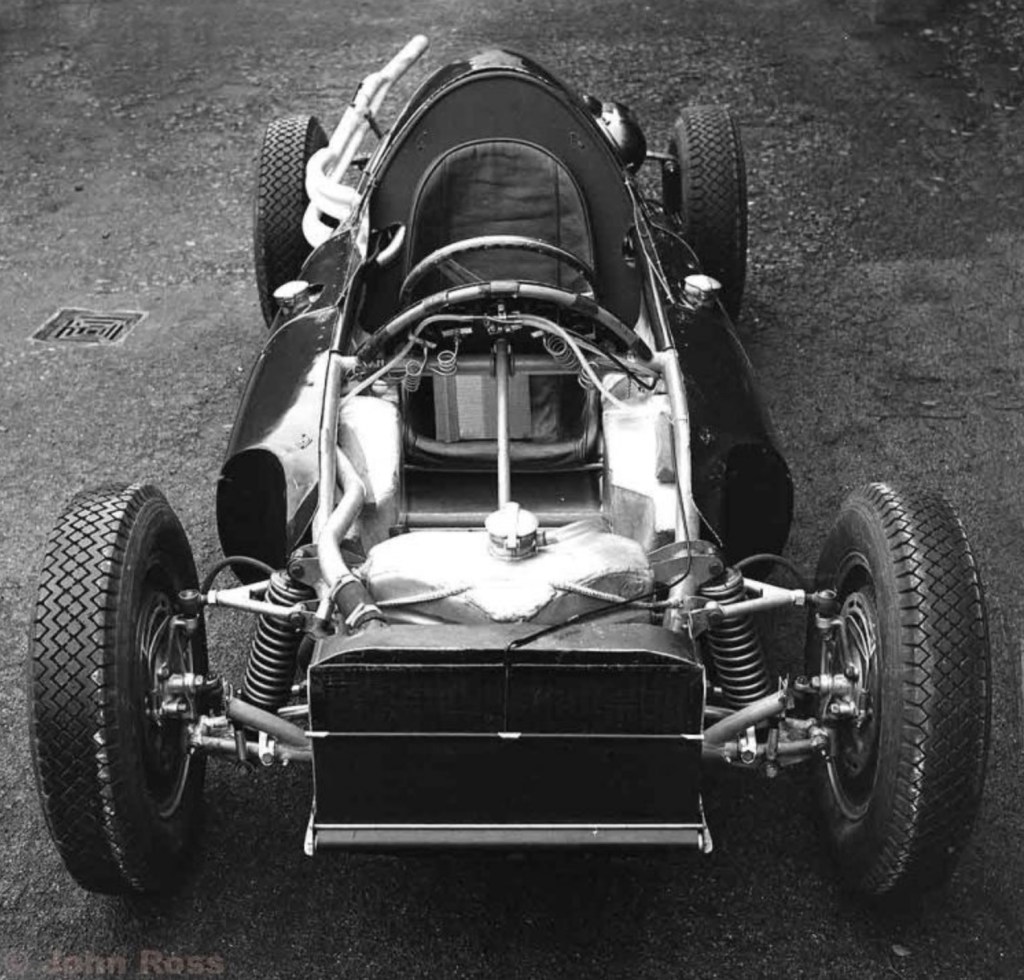
BRM Type 25 rear suspension. De Dion tube and spring-shocks units clear. The driveshafts await their transmission (J Ross)BRM Type 25 1958 spec (C LaTourette)
On rear suspension Chapman and Cooper diverge widely, though both are fully independent, the former having an ingenious layout in which the hub is positioned in three directions, one forwards and inwards by a radius arm, one completely inwards by the half-shaft which has two universal joints but no sliding spline, and the third by the coil-spring unit which provides upwards and inwards location. With the radius arm, the half-shaft and coil spring forming an equilateral triangle with the whe l hub at the apex, this suspension is a new approach and in consequence called for a new name, and was called the “Chapman Strut Principle.”
Chapman’s tiny F2 Lotus 12 Climax FPF grew into just as small a GP car! Superb small-tube spaceframe chassis, note the Chapman Struts to which DSJ refers. Inboard discs, Queerbox, oil filter. Big brother Lotus 16 alongside (LAT)Graham Hill in Lotus 12 Climax (#353) during the 1958 BRDC International Trophy Meeting on May 3, 1958. A significant day: Lotus’ F1 debut…and Hill G’s (GPL)
Cooper continues to use his transverse leaf spring and lower wishbone layout, which originates from back in 1945 when he built his first car using Fiat Topolino front suspension. Nowadays the Cooper rear end is a sound and solid affair, with elektron hub carrier, roll-free leaf-spring mounting and good lateral location. On some cars used in Formula l a second wishbone was mounted above the existing one on each side and the transverse leaf spring was coupled to the hub carrier by a free link, thus relieving the spring of braking and accelerating stresses.
Dunlop alloy wheels on the BRM Type 25 at Bourne in early 1959. Peter Berthon and Tony Rudd admire the latest iteration of a car that finally fulfilled its promise at Zandvoort in Jo Bonnier’s hands that year (J Ross)
Wheels…
As regards wheels the British have a very definite liking for the solid type of alloy wheel, while the Italians still retain the old-fashioned wire-spoke wheel of Rudge pattern. Vanwall made some interesting experiments with wheels, assisted by Lotus, in the search for reducing unsprung weight and designed alloy wheels for the front which were non-detachable, having the wheel races mounted in the wheel casting itself, the whole assembly being held on by a conventional single split-pinned stub axle nut. These alloy wheels were not a success as they shrouded the front brakes and prevented air flow round the brake discs so were replaced by the normal Rudge hub wire wheel. Later a new wheel was designed on the same principle as the alloy wheel, in having the races mounted in the wheel itself and doing away with the heavy splined hub. With Grand Prix races reduced to two hours’ duration and tyres showing marked improvement in wear capabilities there is little need for a k.o. hub at the front. Like Connaught in the past, Cooper and Lotus use bolt-on wheels at each end of their cars. Vanwall still retain k.o. hubs at the rear, the splined portion being shrunk into the alloy wheel. B.R.M. use Dunlop alloy disc wheels all round, with k.o. hubs, these being a standard Dunlop racing component.
Owen Maddock’s Cooper T45 Climax showing both its curved chassis tubes and ubiquitous alloy wheels. The essence of pragmatic simplicity (J Ross)Rear suspension of Peter Collin’s Ferrari Dino 246 during the 1958 British GP weekend. Big ventilated drum, transverse leaf spring, two radius rods and spinner for the wire wheel (LAT)
Brakes…
On the question of brakes the British are unanimous in their agreement on the use of disc brakes, though how they are used and what type still vary greatly. Vanwall continue to use their own manufacture, made under Goodyear patents, with the rear ones mounted inboard; B.R.M. use Lockheed components, with a single unit at the rear, mounted on the back of the gearbox and braking through the final drive unit, while Cooper and Lotus both use proprietary Girling units, one mounted on each wheel back and front.
After struggling along with cast-iron drums of excellent design on the Lancia/Ferraris and again on the Dino Ferraris, the Maranello engineers then developed a bi-metal drum and finally succumbed to the British influence and experimented with Dunlop and Girling disc brakes on the Dino cars. Maserati took an interesting step backwards on braking, for after developing bigger and better alloy drum brakes with steel liners, for the 250F in 1957, they then built a much smaller and lighter car for 1958 and were able to use a design of alloy drum brake that they had discarded in 1956.
Vanwall front suspension and ventilated front disc at Zandvoort during the Dutch GP weekend, May 26, 1958. Cooper alloy wheel at right (LAT)Tony Brooks’ Vanwall at Oporto, Portuguese GP 1958. Note Frank Costin’s superb aero-body and mix of front wire, and rear alloy wheels (Getty)
Experiments in fully streamlined bodywork still continue to appear, in particular at Reims, and in 1957 Vanwall produced a Grand Prix car with a fully enveloping front half, and with fairings over the rear wheels which blended into the tail. The car never had a proper test and development never proceeded, but in 1958, at Monza they tried a further idea, in having a fully enclosed cockpit. formed by a detachable Perspex bubble which clamped on top of the normal wrap-round windscreen. 1958 at Reims was left to the Walker equipe to try full streamlining, by fitting their Coopers with panelling that enclosed all four wheels and merged into the normal body, but the results were inconclusive and the project was abandoned after practice. The Italians realised after 1956 that streamlining and aerodynamics was not their forte.
The Vanwall Streamliner at Monza in 1958 (LAT)
Summing Up…
Summing up briefly, we can say that British Grand Prix designers fall into two categories, one consisting of Vanwall and B.R.M., who were prepared and able to design racing cars from scratch, and having done so carried on with long-term development programmes and the other consisting of Lotus and Cooper who have very limited capabilities and design their cars around a number of limited factors, but both are ready and willing to experiment as far as their facilities allow them to go.
While Vanwall and B.R.M. started the Formula with cars built in the light of past Grand Prix car designs, and with the modification in 1958 to two-hour races, they have had to continually strive to modify their cars down in the question of size and lightness, and in Italy Maserati have done likewise.
Cooper and Lotus, on the other hand, started in Grand Prix racing with a car designed for an entirely different type of event, and by good fortune the change in the Formula tended to sway in their direction so that only a very slight increase in size in 1958 made their cars much more suitable for the racing encouraged by the present Formula, which is in the nature of non-stop sprint-like events.
Ferrari stands alone in all this, in being the only constructor to start all over again, with a car that was a good compromise between the old Lancia/Ferrari, or such things as the Mercedes-Benz W196 or the original 250F Maserati, and the Formula 2 lightweights as exemplified by Cooper and Lotus. The result has been that the Dino Ferrari proved itself eminently suited to all Grand Prix circuits as far as its general character, size and robustness was concerned.
The size and lightness point is illustrated here during the Goodwood Glover Trophy in May 1959 with Moss’ Cooper T51 Climax chasing Harry Schell’s bigger, heavier BRM Type 25. Moss won from Brabham and Schell (Getty/M Tee)Mike Hawthorn on the way to victory aboard a Ferrari Dino 246 in the Glover Trophy at Goodwood on April 7, 1958 (LAT)
Because the F.I.A. deemed it wise to run Grand Prix cars on aviation petrol, and reduce race lengths to 200 miles, there has been a distinct trend towards building smaller and lighter Grand Prix cars and in consequence there has been a search for reducing the unsprung weight on the cars.
By a logical series of steps the design trend of today’s Grand Prix car is undergoing a radical change, for without the possibility of using wasteful alcohol, fuel consumption has improved from something like 4-5 m.p.g. to 9-10 m.p.g.; the shorter races have reduced the total carrying capacity required, this large reduction in weight has allowed smaller tyres and lighter suspension parts to be used, and a smaller overall car has permitted smaller and lighter brakes and the whole character of Grand Prix racing is changing from one where driver, mechanics, team-manager and designer all had to work as a unit, to one where each member of the team does his job and then sits back and watches the next man do his.
Not so long ago the driver depended on his mechanics to change tyres and refuel the car during a race, and they depended on the team manager to control them sensibly, while the designer stood by to see any flaws in the design of his car both from the driving angle and the pit-work angle. Now the design is finished, the mechanics prepare the car, the manager organises the entry for a given race and then they sit back and watch the driver drive his short, but of necessity, concentrated race.
With the new rule for Grand Prix racing introduced in 1958 that drivers should not change cars once the race has begun, there has been even less encouragement for team work. The result has been one of clashing individuals and although it has nothing to do with the trend of racing-car design, the Grand Prix picture has changed in recent years because of the trend of design, encouraged by small modifications to the Grand Prix Formula.-D. S. J.
Moss at Silverstone during the 1958 British GP. DNF, Collins’ Ferrari won (Getty)
Credits…
Denis Jenkinson, MotorSport February, 1959, LAT Images, C La Tourette, John Ross, Getty Images, Grand Prix Library
Tailpiece…
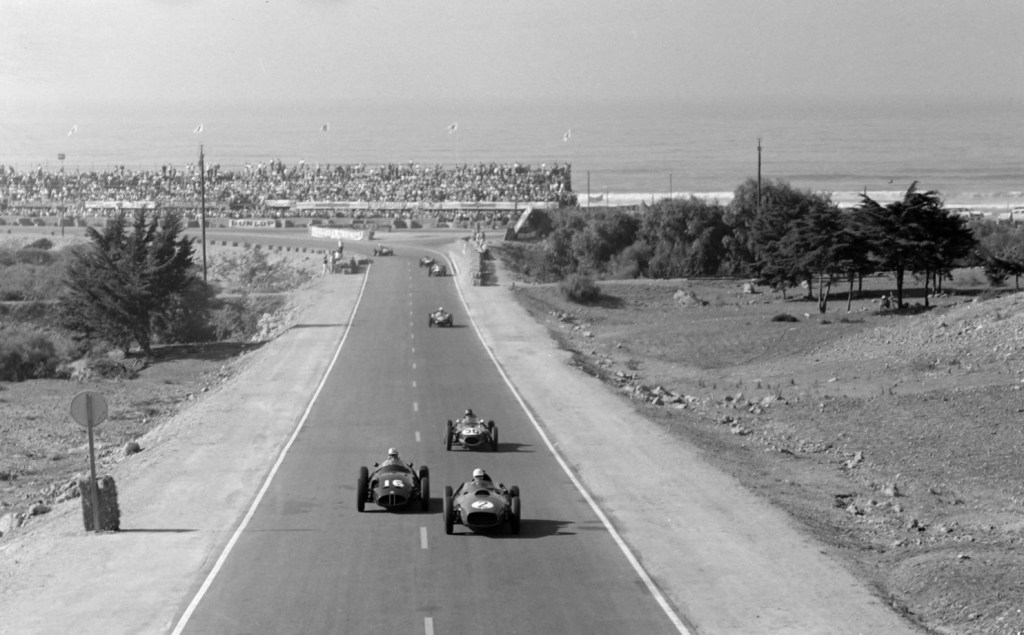
Not a Cooper to be seen in this shot at Ain Diab, Morocco on October 19, 1958.
It shows Olivier Gendebien’s Ferrari Dino 246 leading Harry Schell’s BRM Type 25 and Graham Hill’s Lotus 16 Climax in a mid-field Moroccan GP dice.
The Coopers would become rather more prominent in 1959…
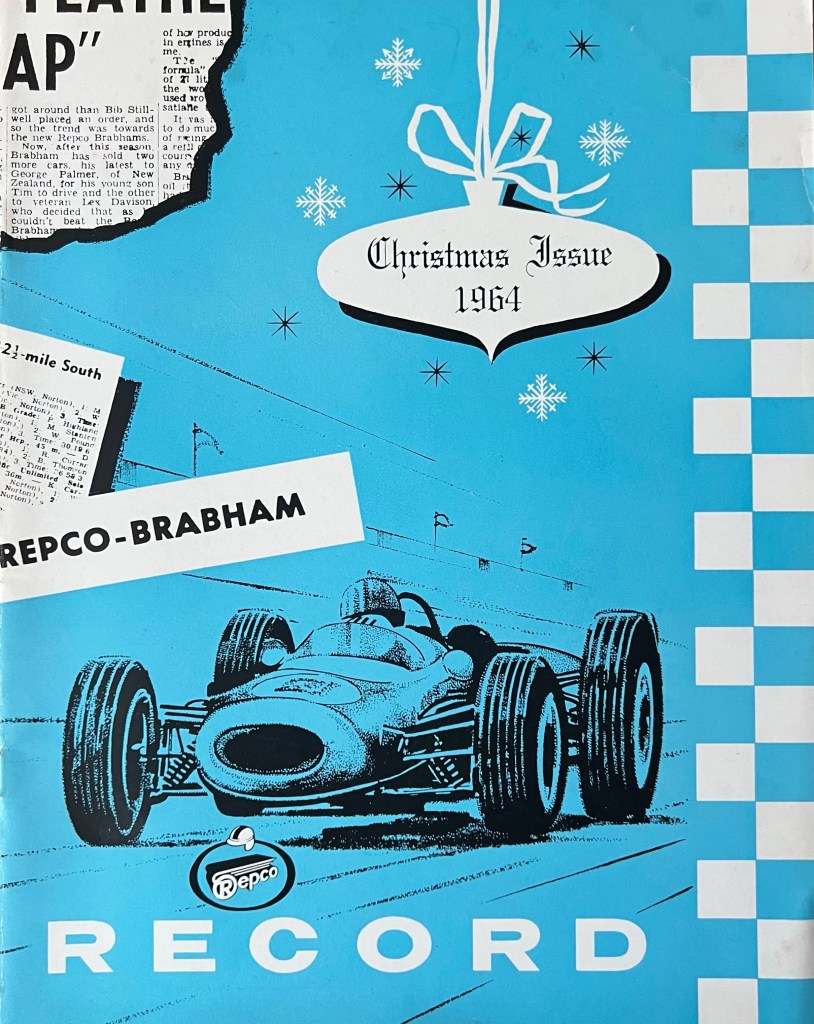
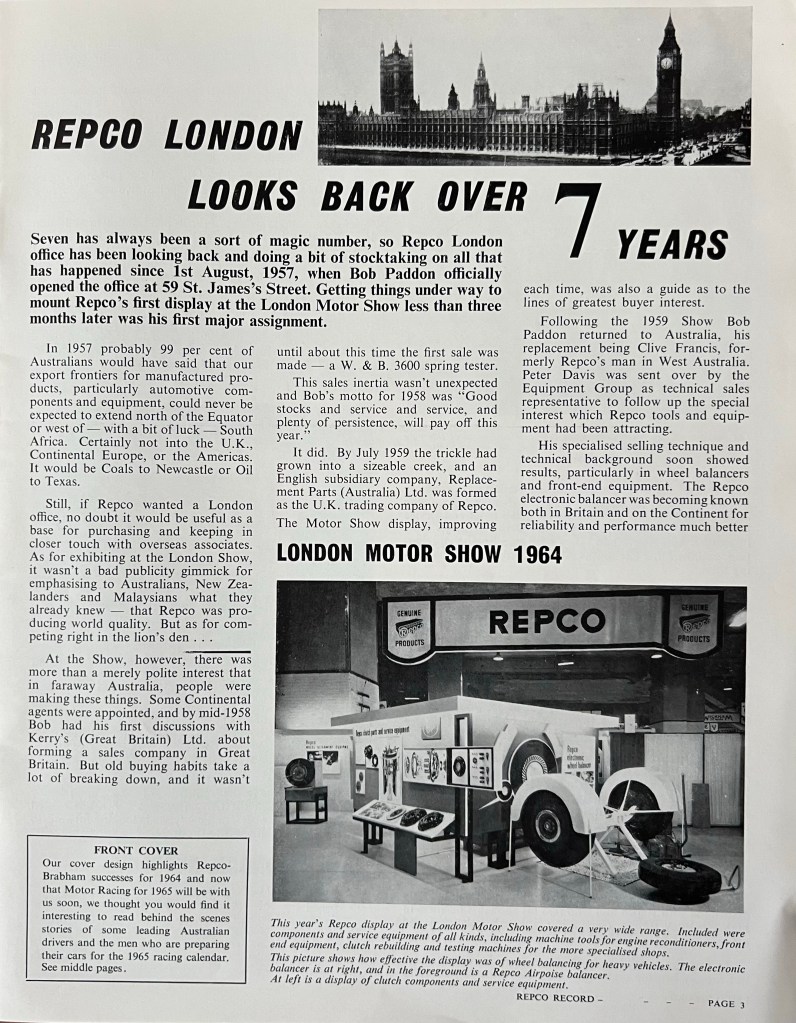
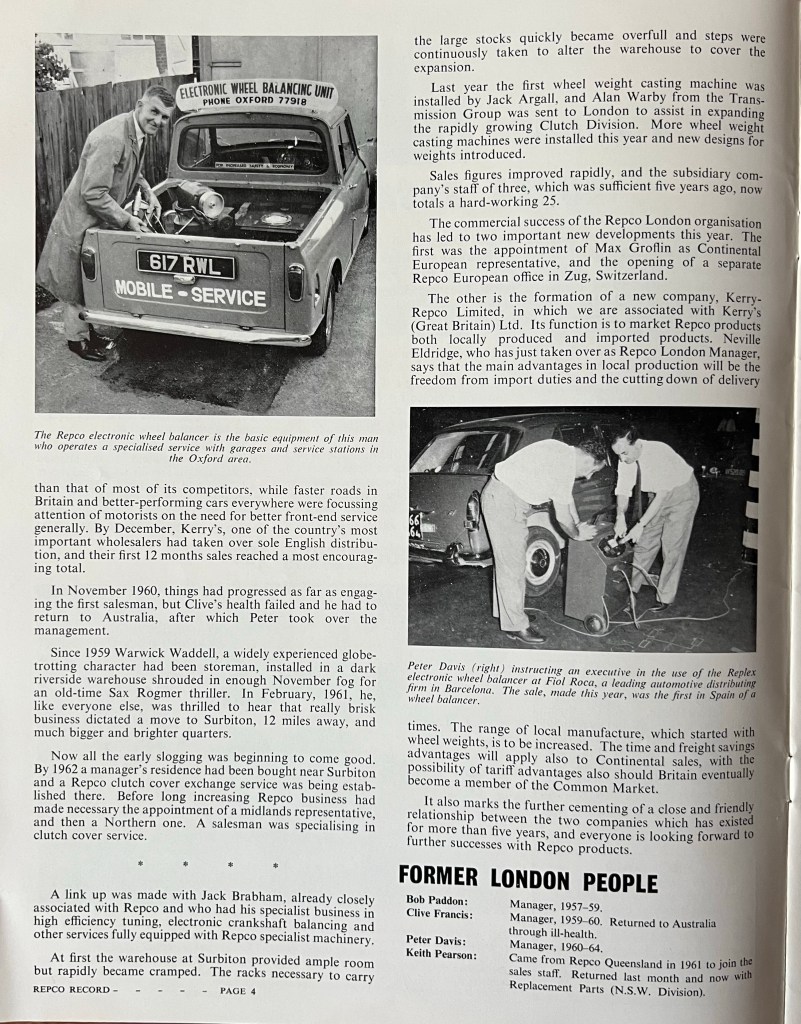
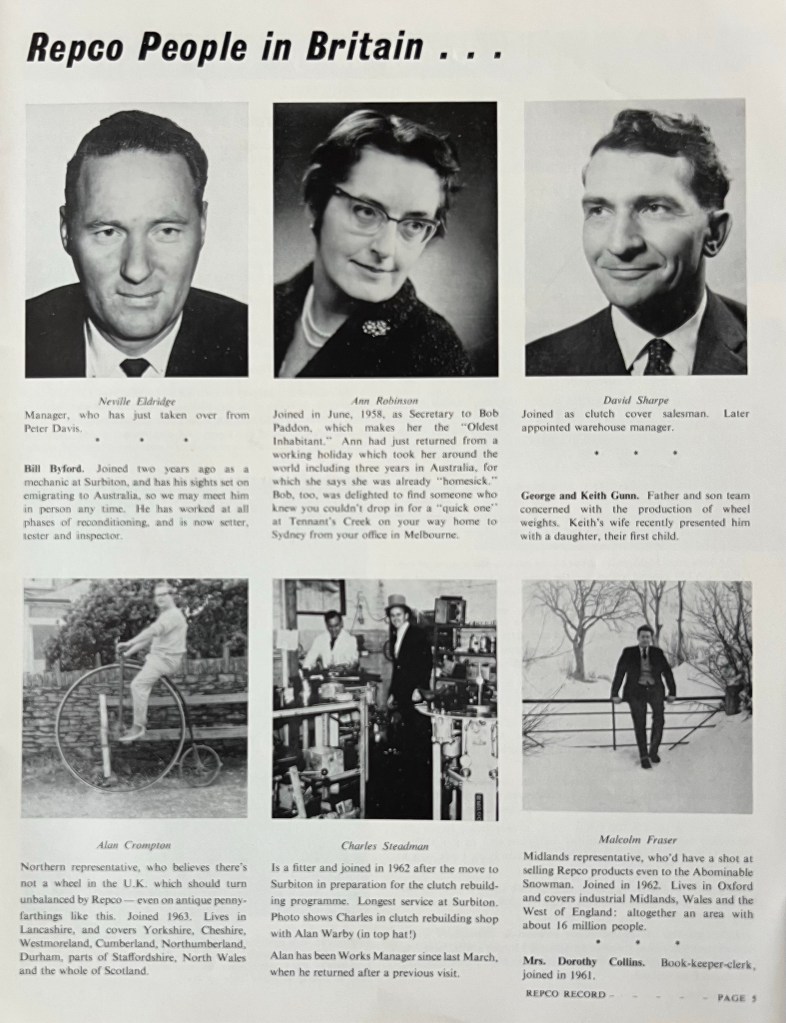
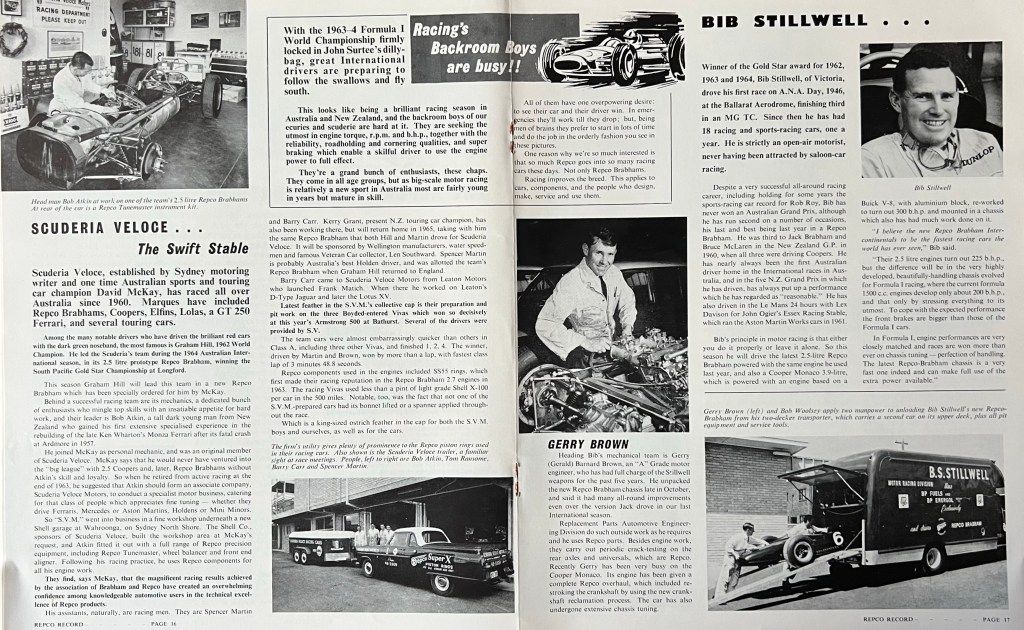
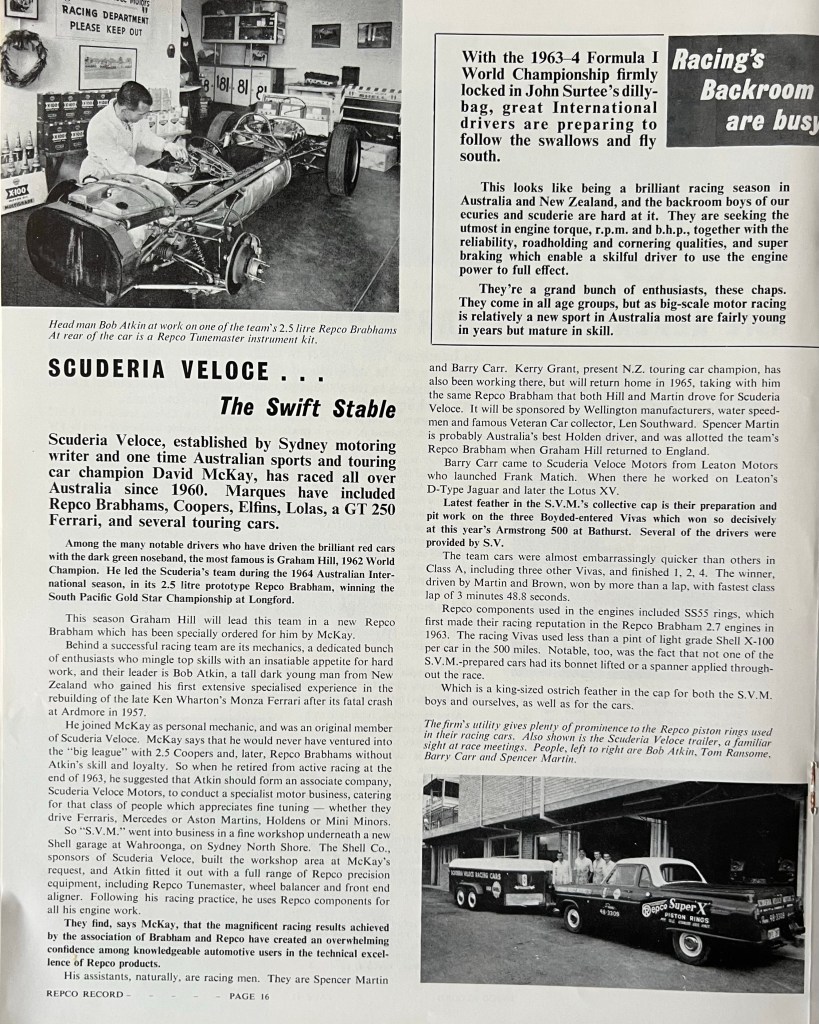
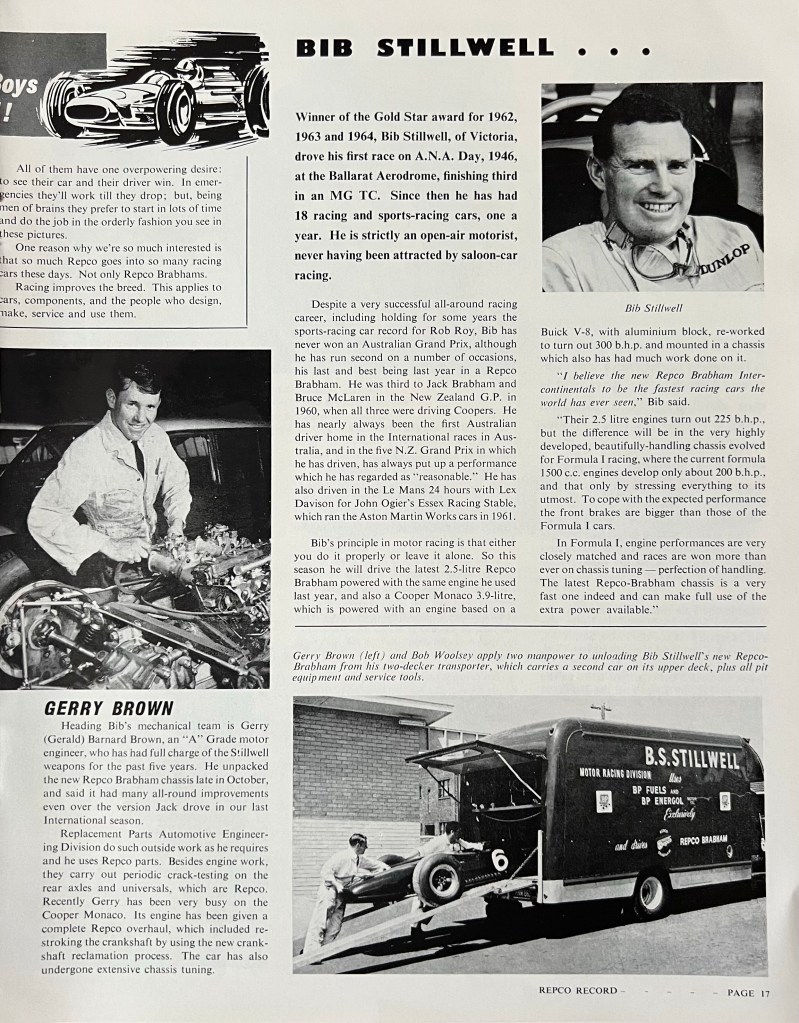
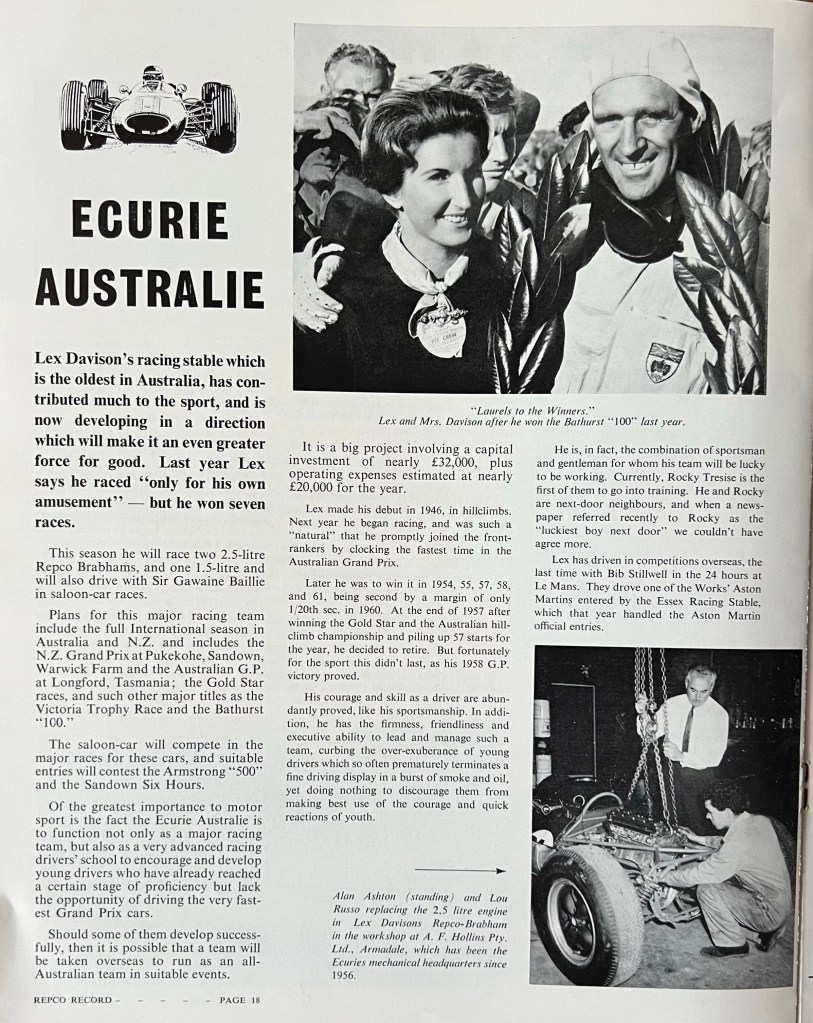
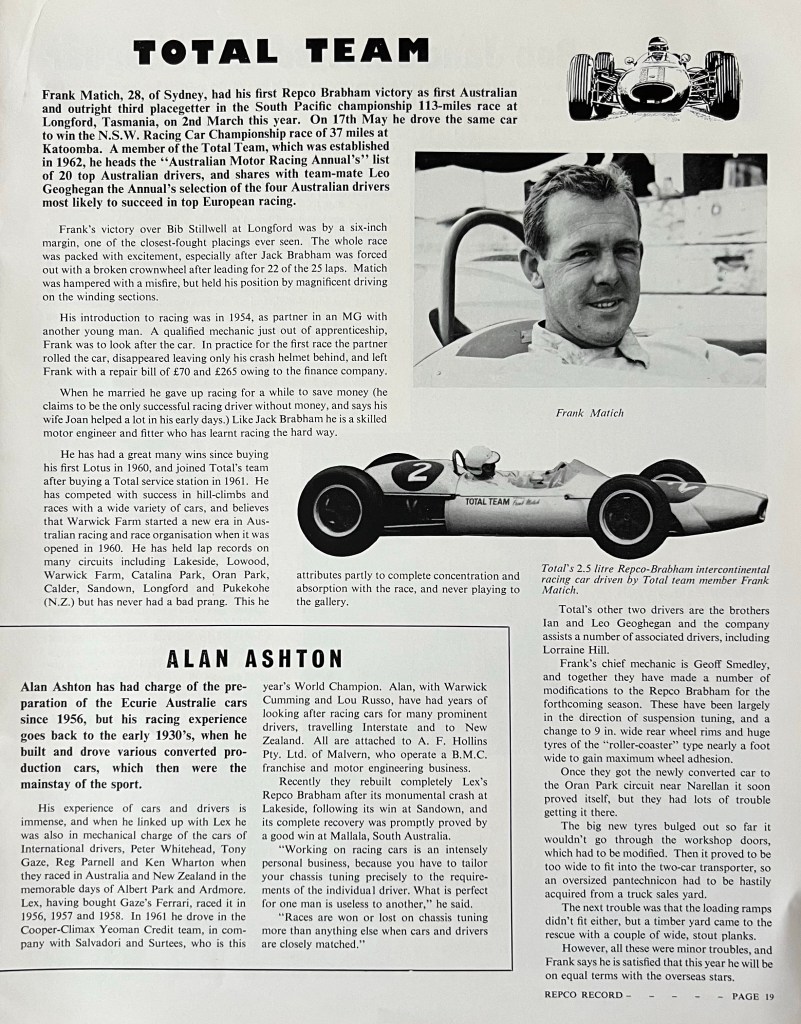
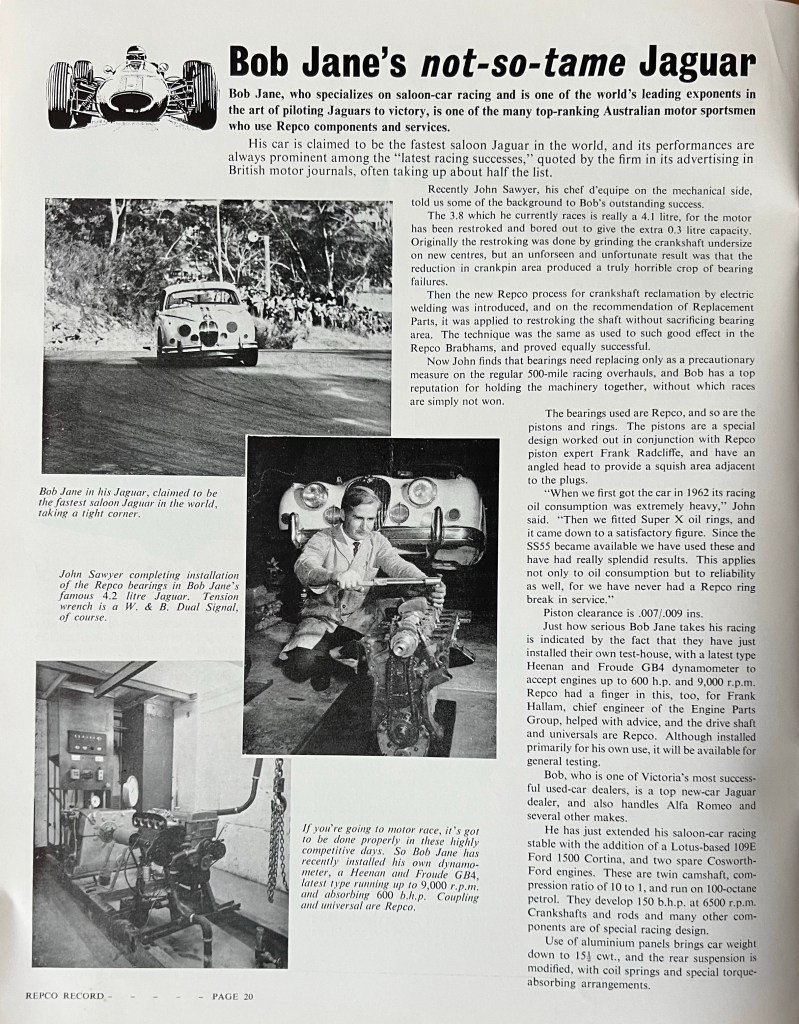
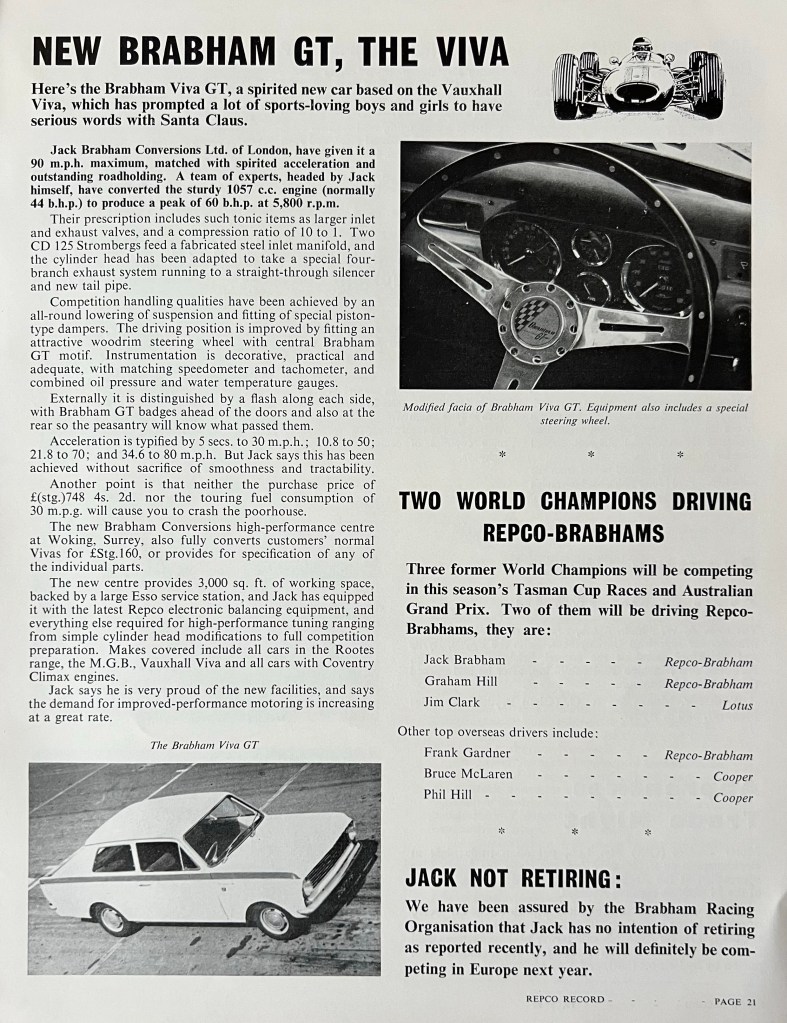
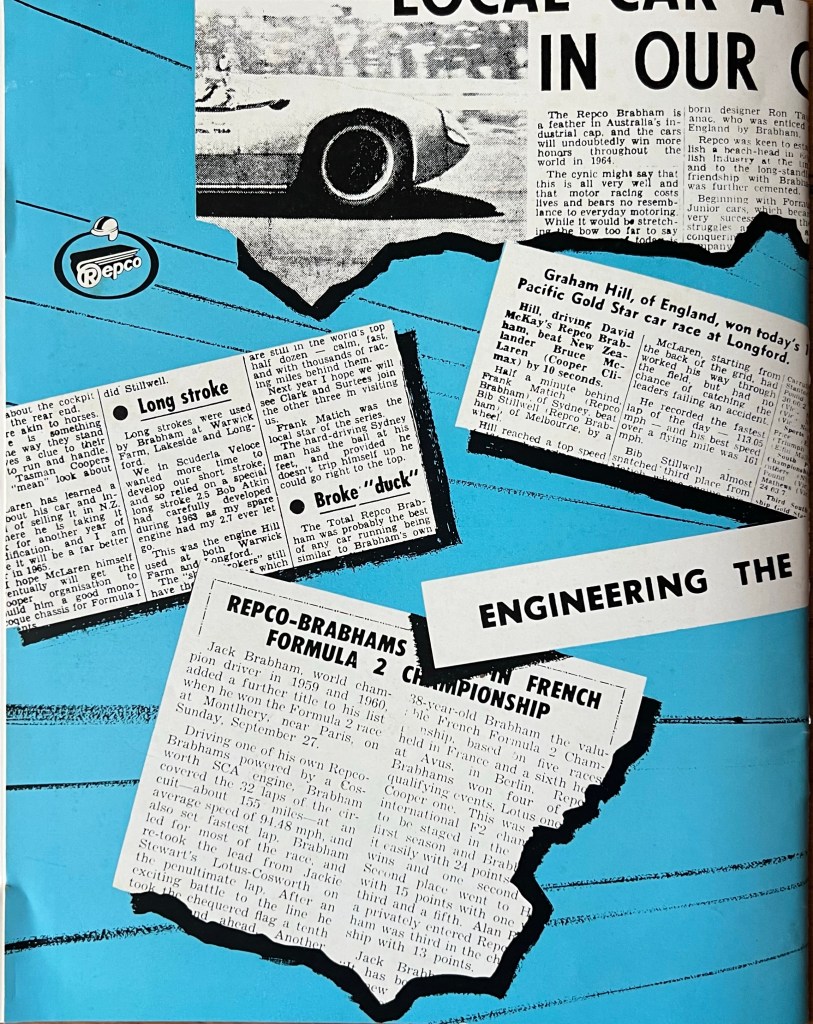
I’ve occasionally wondered exactly when Repco Ltd commenced operating in the UK, in a Repco-Brabham connection. Repco’s in-house magazine, the ‘Repco Record’ Christmas 1964 issue tells me the former Australian automotive industry colossus hung-the-shingle out at 59 St James Street, London on August 1, 1957.
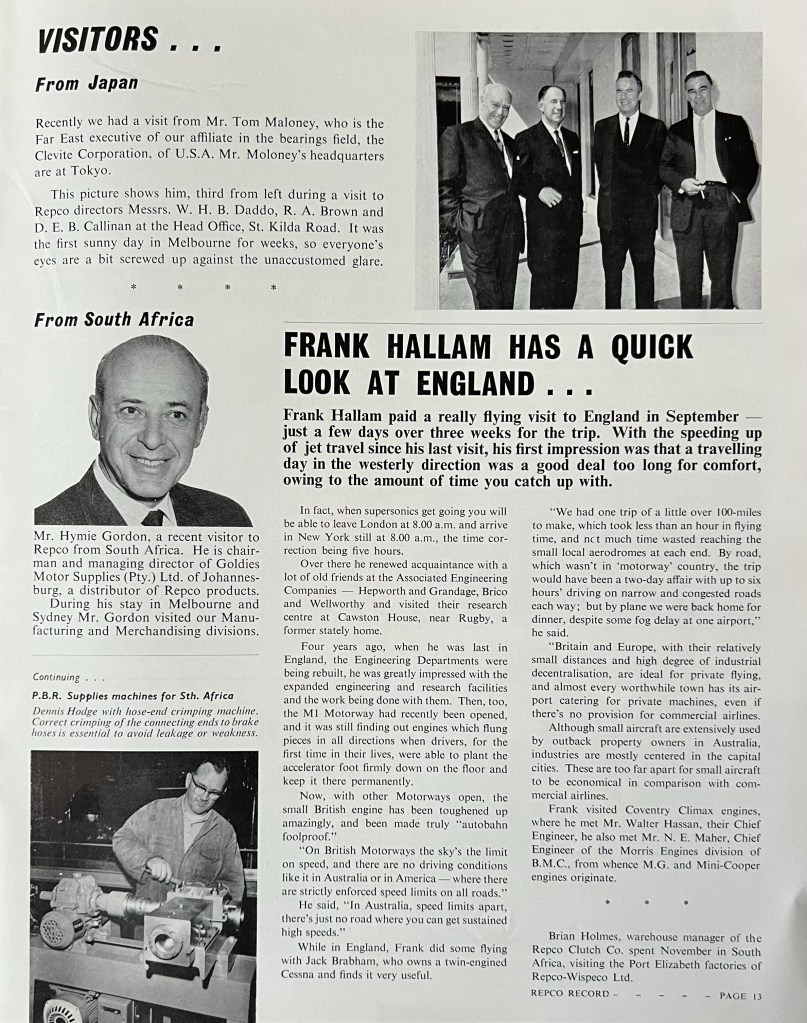
The meetings Frank Hallam had in London that are of the most interest to us go unrecorded of course: Messrs Irving, Brabham and Tauranac, Laystall and Lucas spring to mind.
I suspect the primary purpose of the trip was to put-a-rocket up Phil Irving, who in Hallam’s mind, was running late with the design of RBE620, the SOHC, two valve, fuel-injected 2.5-litre Tasman Cup V8 based on the Oldsmobile F85 aluminium block. Worse to Frank, Phil and Jack were occasionally leaving-the-reservation on ‘agreed design direction.’ Said engine fired its first shot in Repco’s Richmond engine laboratory dyno on March 26, 1965.
Credits…
Repco Ltd, the Repco Record is from Rodway Wolfe’s archive
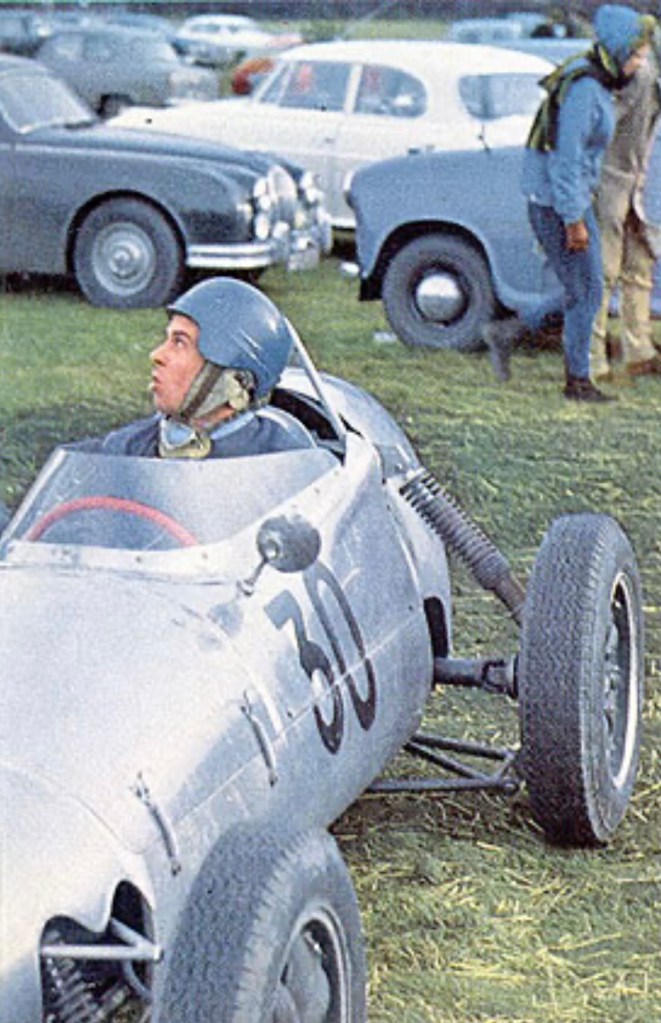
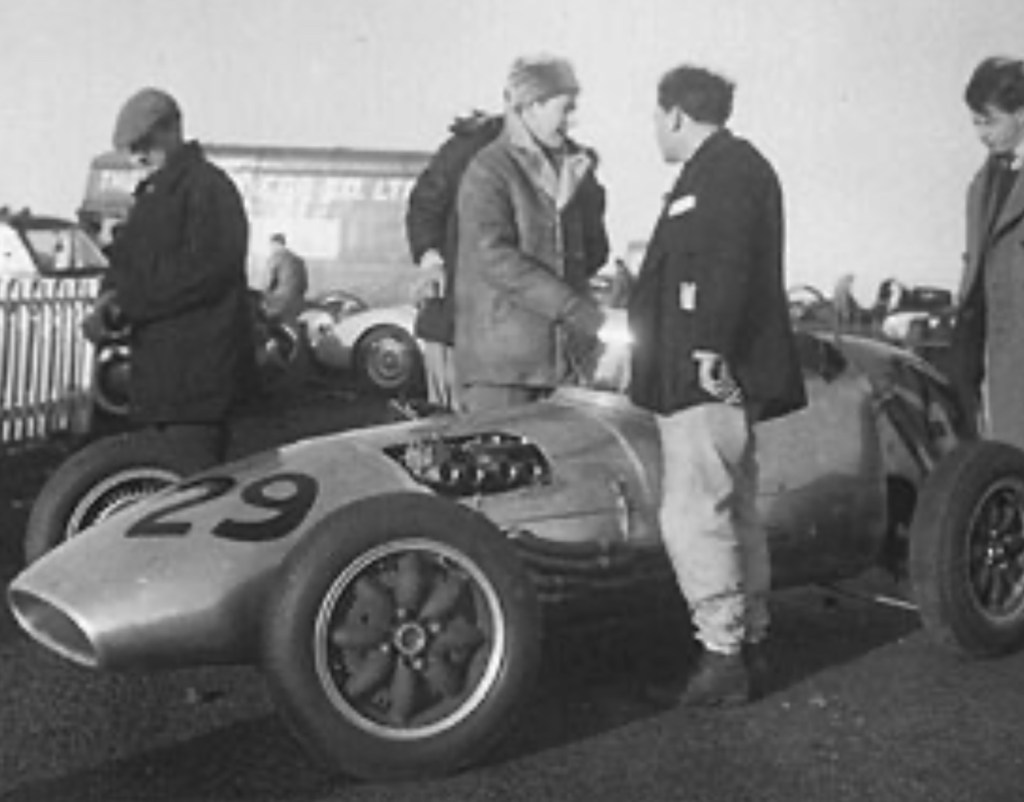
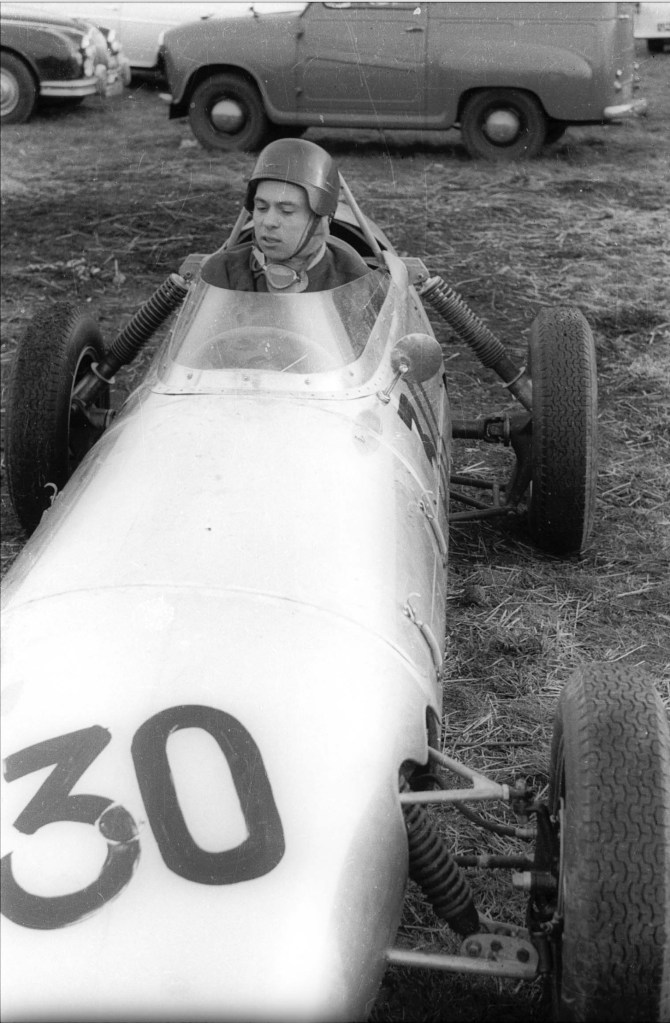
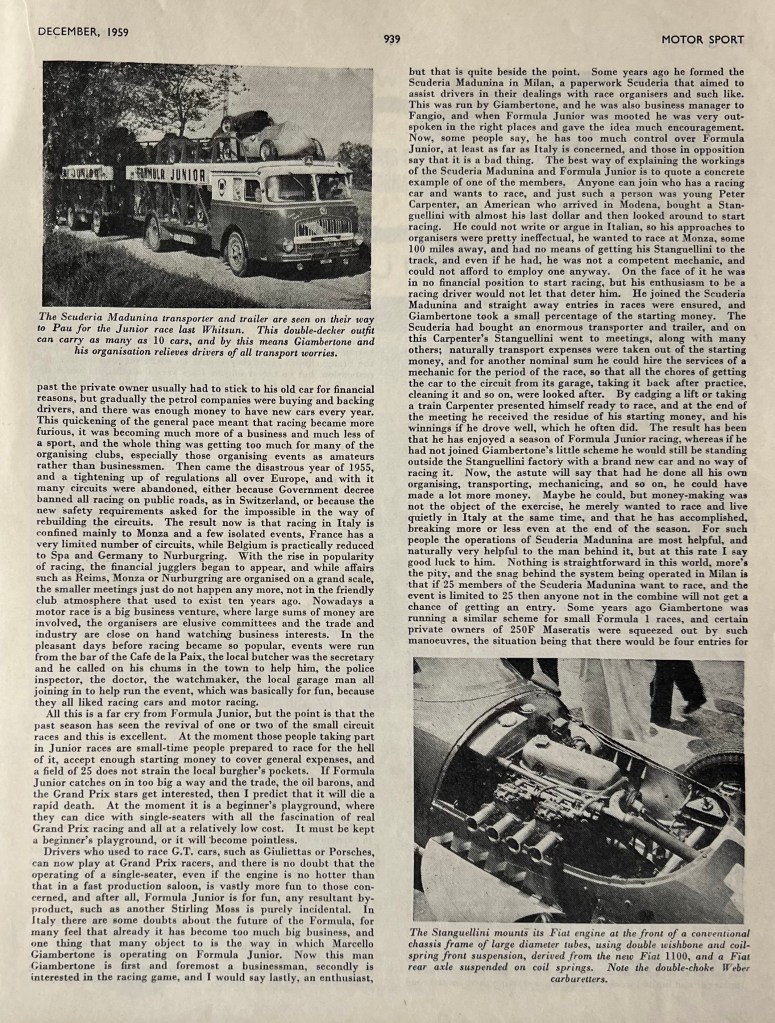
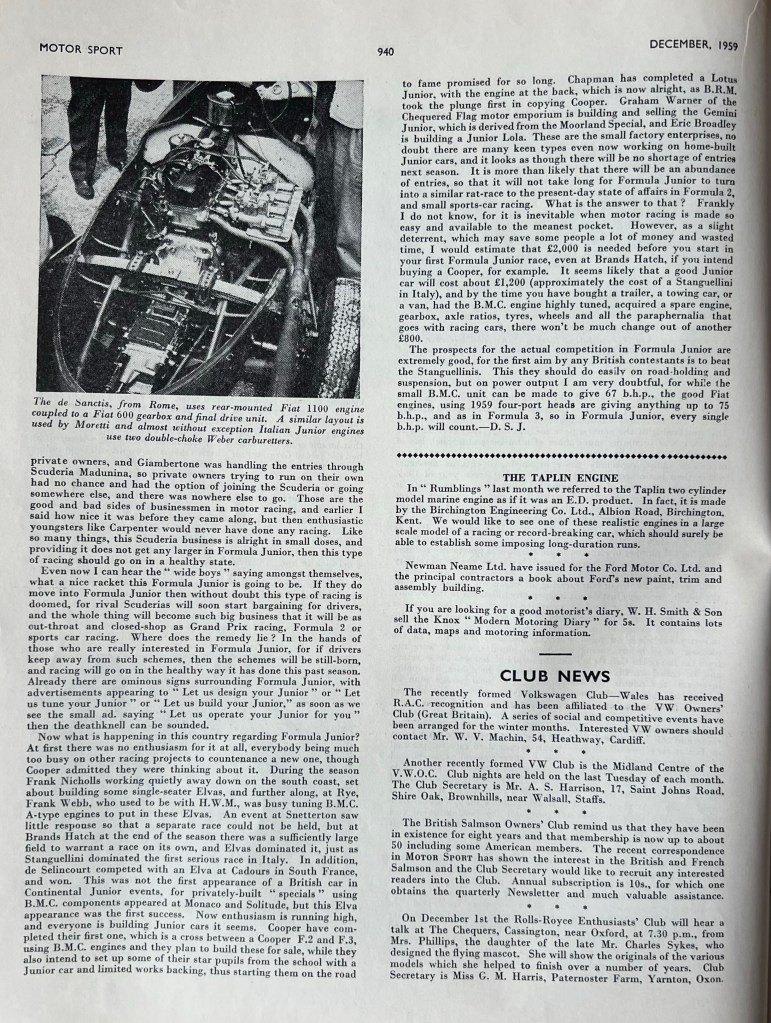
Jim Clark’s single-seater debut – aboard Gemini Mk2 BMC #30 – took place in a Formula Junior event at Brands Hatch’s Boxing Day meeting in 1959. Who is driving the Cooper T52 number 3-something in front of the Gemini?: Mike McKee, Bill Lacy, Edward Hine or Ian Burgess.
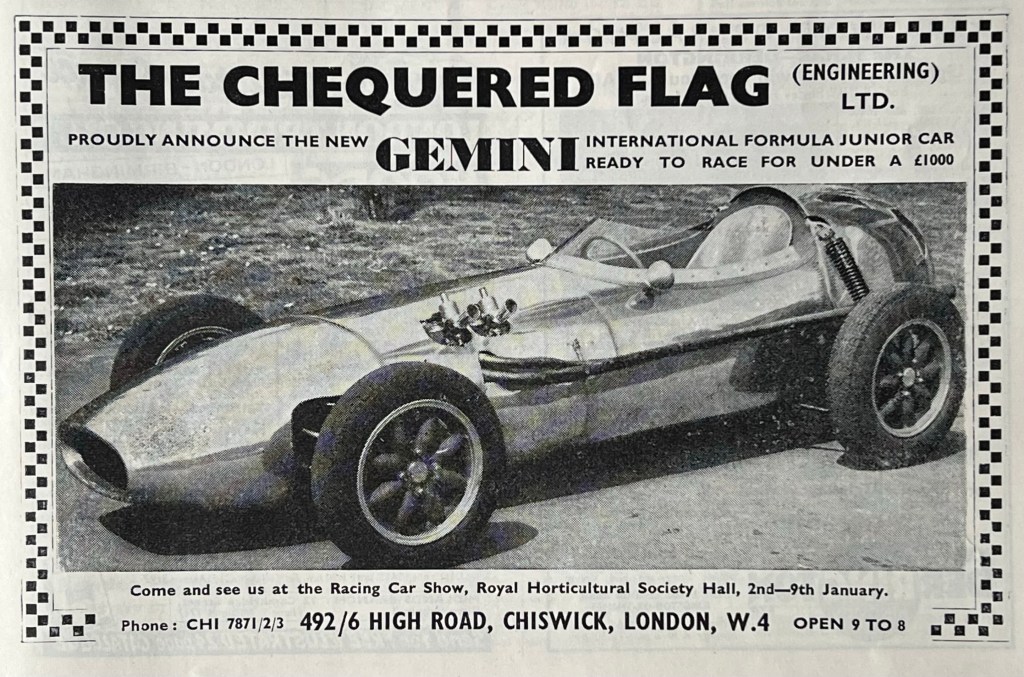
Clark was invited to contest the John Davy Trophy by his regular Lotus Elite opponent, ex-RAF pilot Graham Warner. Warner wanted the Scots youngster who had impressed him so much to drive one of his new Gemini Mk2s (#chassis number please folks, one I can rely on) for The Chequered Flag, a renowned London sportscar dealership. Clark’s Elite was owned by his mentor Iain Scott-Watson.
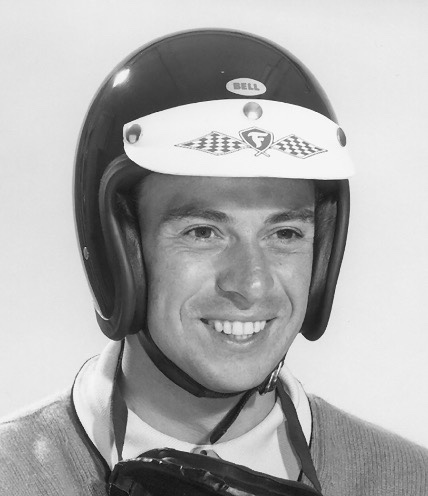
Clark aboard the Gemini in the Brands paddock. Helmet brand folks? (B Ward)
Jim qualified the unfamiliar car mid-pack after reliability issues during practice. On raceday his battery was flat on the grid so he was push-started after the pack had departed, finishing eighth. 12 cars contested that race which was won by Peter Arundell, one of Clark’s Team Lotus teammates in 1960.
The pair and Trevor Taylor, all raced Team Lotus Lotus 18 Cosworth-Fords, were the stars of Formula Junior in 1960. Clark won the John Davy race at the same Brands Boxing Day meeting twelve months hence and the John Davy British Formula Junior Championship, while Taylor won the BRDC/MotorRacing British Formula Junior Championship.
By then Formula Junior was a bit ho-hum for Jim as he made his Grand Prix debut at Zandvoort aboard a Lotus 18 Climax 2.5 FPF on June 6, 1960.
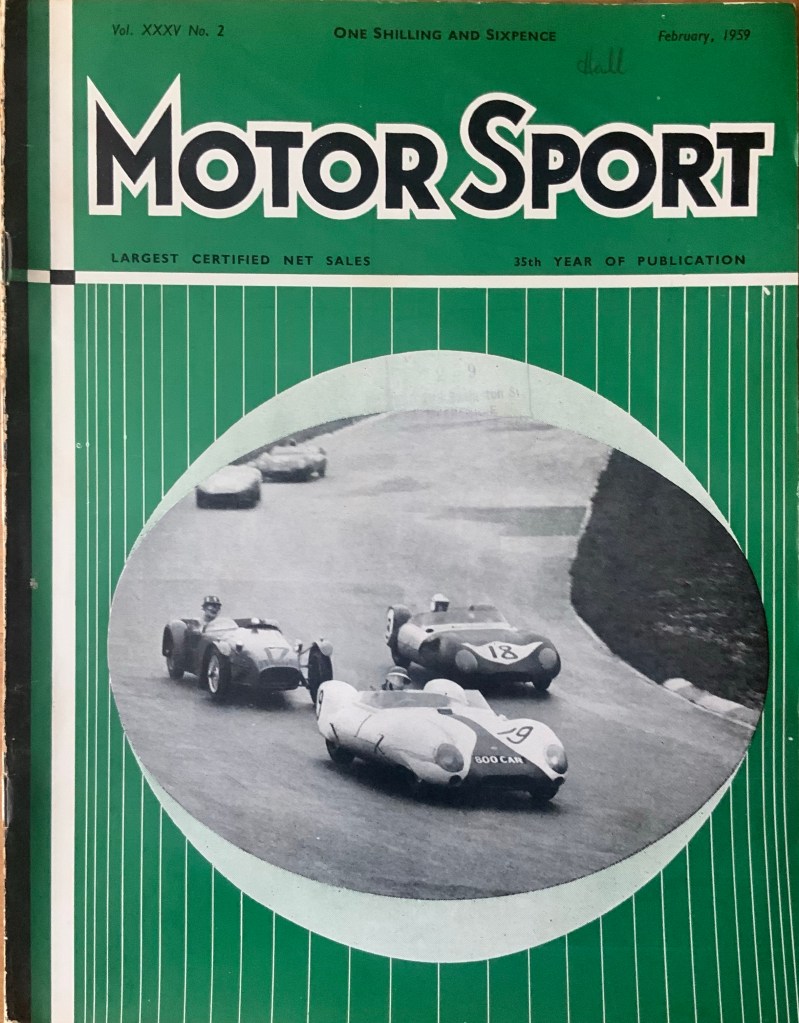
Motorsport January 1960
Gemini Mk2…
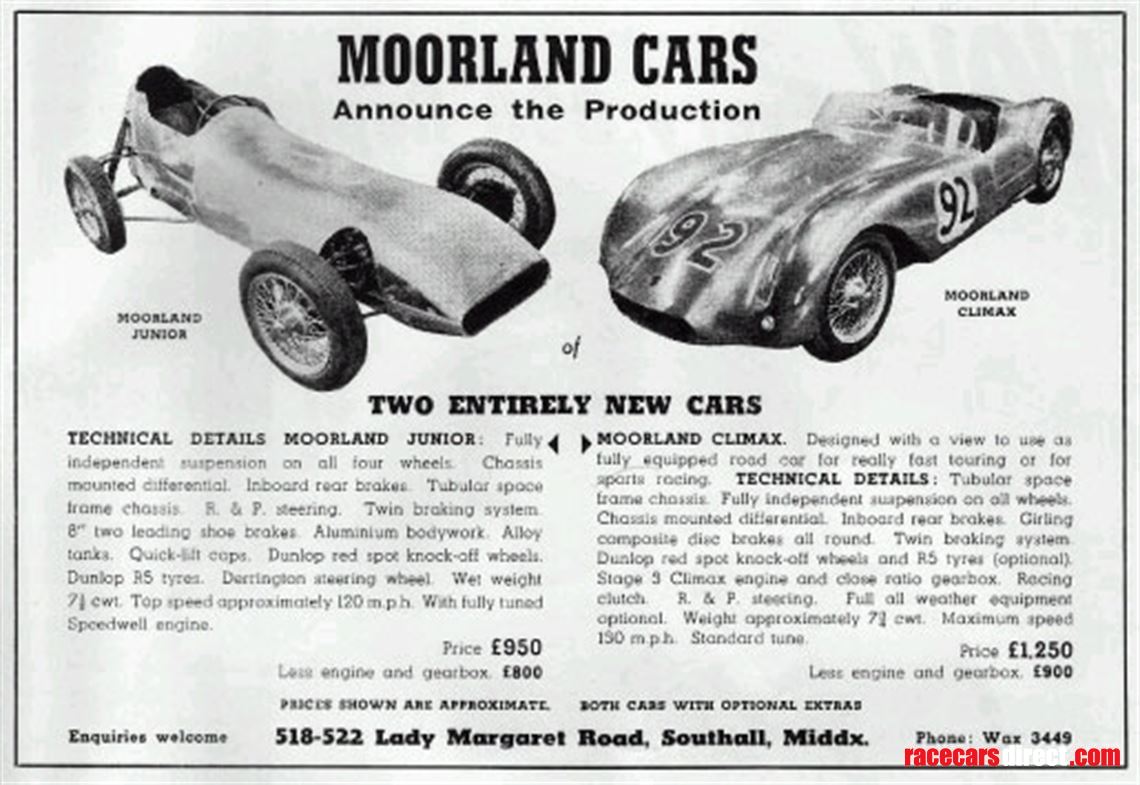
The entrepreneurial Warner had planned to race the Moorland, a front-engined Speedwell-BMC powered Formula Junior designed by the great Len Terry – everybody writes this but Terry does not make any reference to this car in his ‘Racing Car Design and Development’ Terry and Alan Baker – and built by Les Redmond in the August 3, 1959 Brands Hatch meeting.
Running late returning home after racing his Lotus Elite in a support event for the German Grand Prix on the Nurburgring, Warner phoned Ian Raby and offered him the drive. Despite starting at the back of the grid, he passed two Elvas and won the mixed FJ-F3 race.
Without the means to mass-produce the cars, Warner took over the project from Redmond, building and selling the slimmed down and stiffened car which Warner called the Gemini Mk2; Gemini being his star-sign. Warner’s The Chequered Flag Engineering Ltd subsidiary planned to build six cars but ended up constructing about 30.
Ian Raby raced the first Gemini Mk2 BMC in the World Sports Trophy FJ race at Brands Hatch on October 4, 1959 but failed to finish. Up front were three Elva 100 BMCs, the winner was Mike McKee. Warner was entered in a Ford powered Gemini as well but did not race.
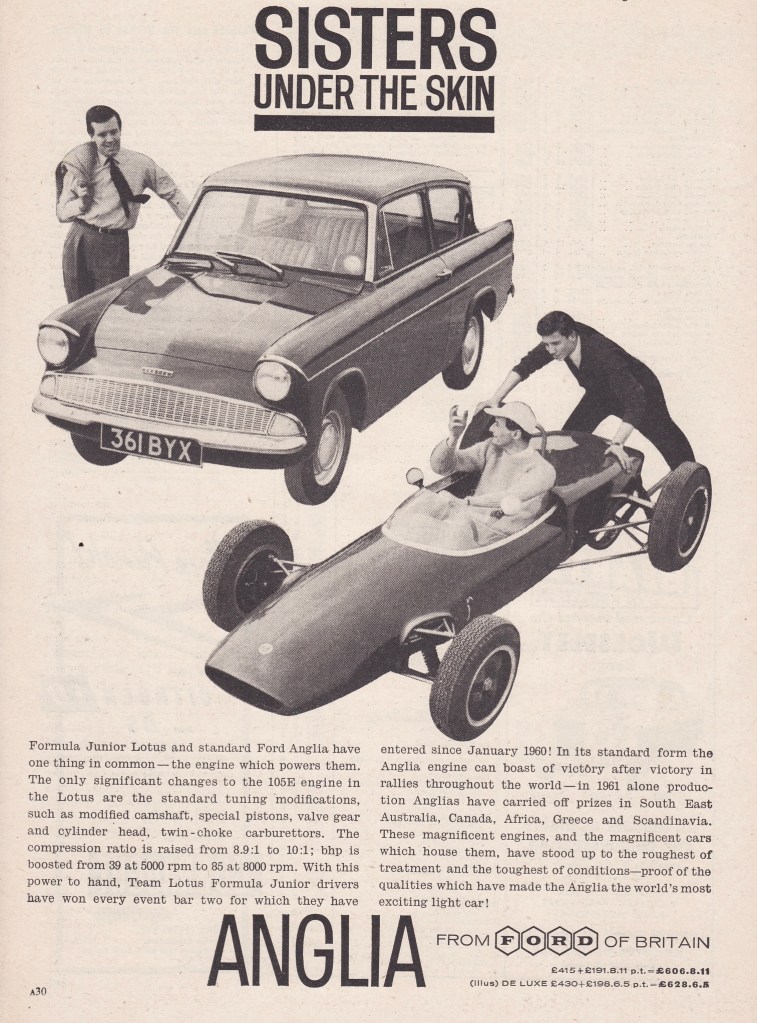
Ford’s fourth-series, frugal, family man Anglia also had a new two-OHV, all-cast iron, four-cylinder engine pumping out a massive 39bhp. Warner could see the latent potential of the design and was intrigued to know what Keith Duckworth, who looked after his Elite, could extract from the engine.
After initial reluctance from FoMoCo, Warner bought and shipped six 105E motors to Cosworth Engineering to be breathed upon.
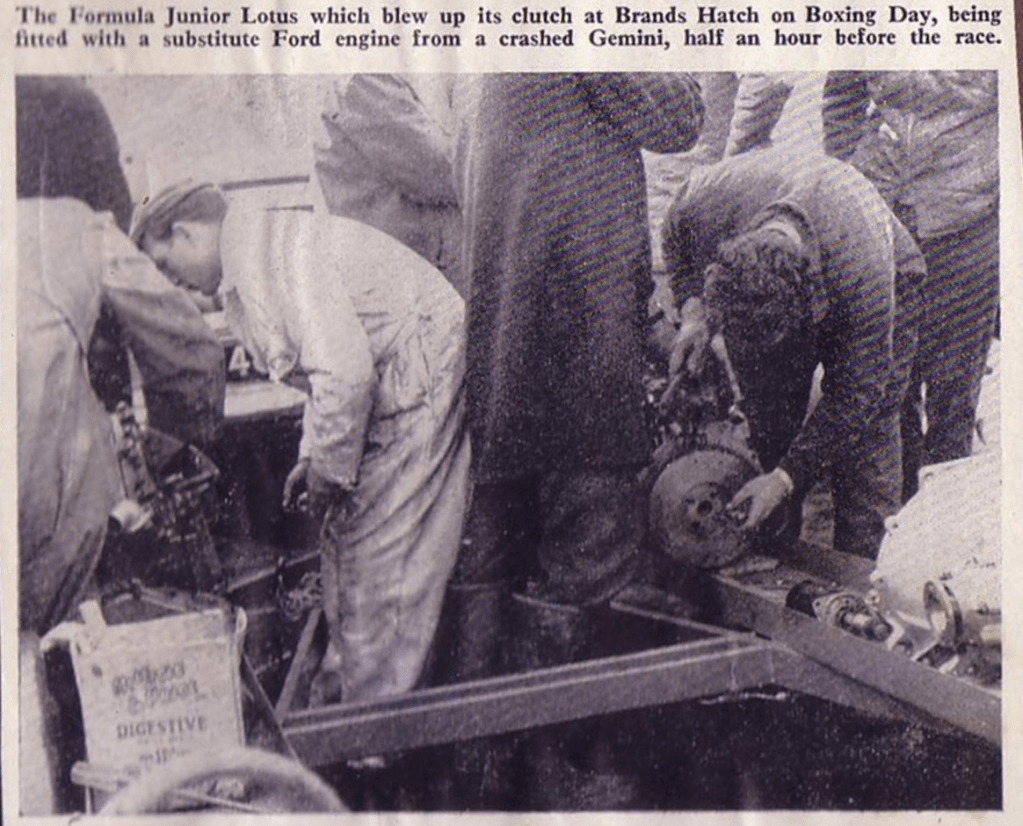
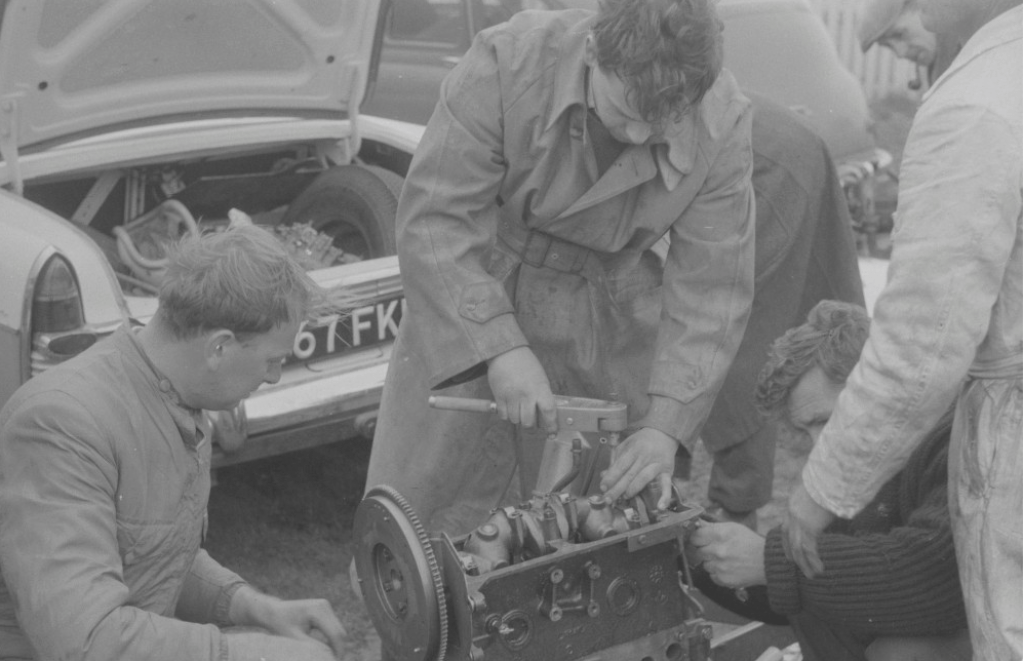
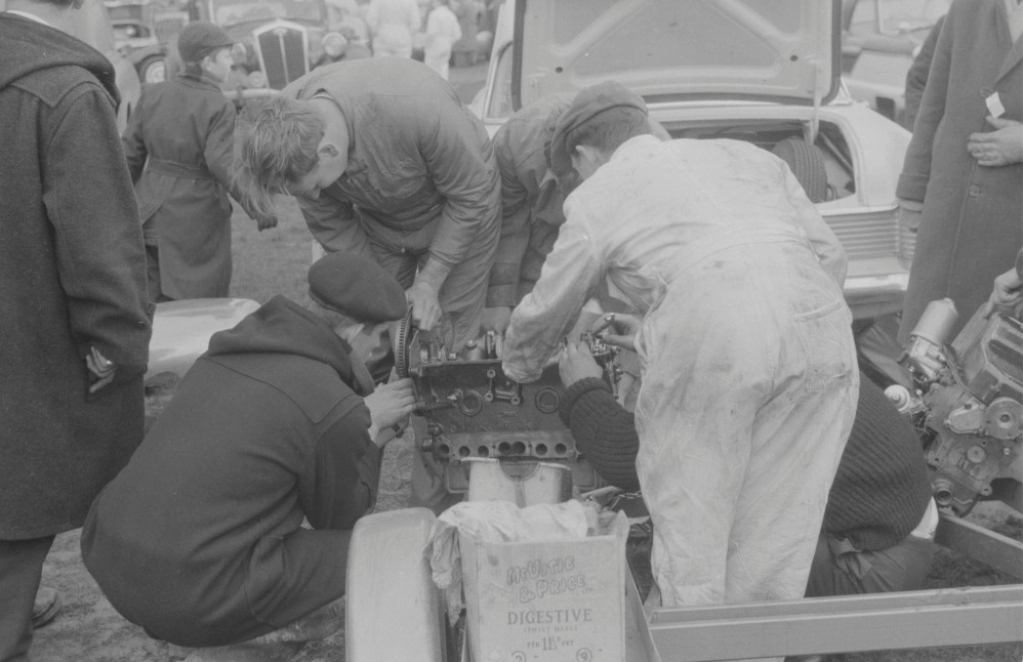
And so it was that Graham Warner entered the Brands Boxing Day ’59 meeting with a pair of Geminis. Warner’s was fitted with the Cosworth engine while Clark’s car had a BMC motor. In practice Warner’s engine threw a flywheel which caused Graham to crash, ruling the car out of the race.
Graham Warner and Gemini Mk2 Cosworth, Brands Boxing Day 1959 (B Ward)
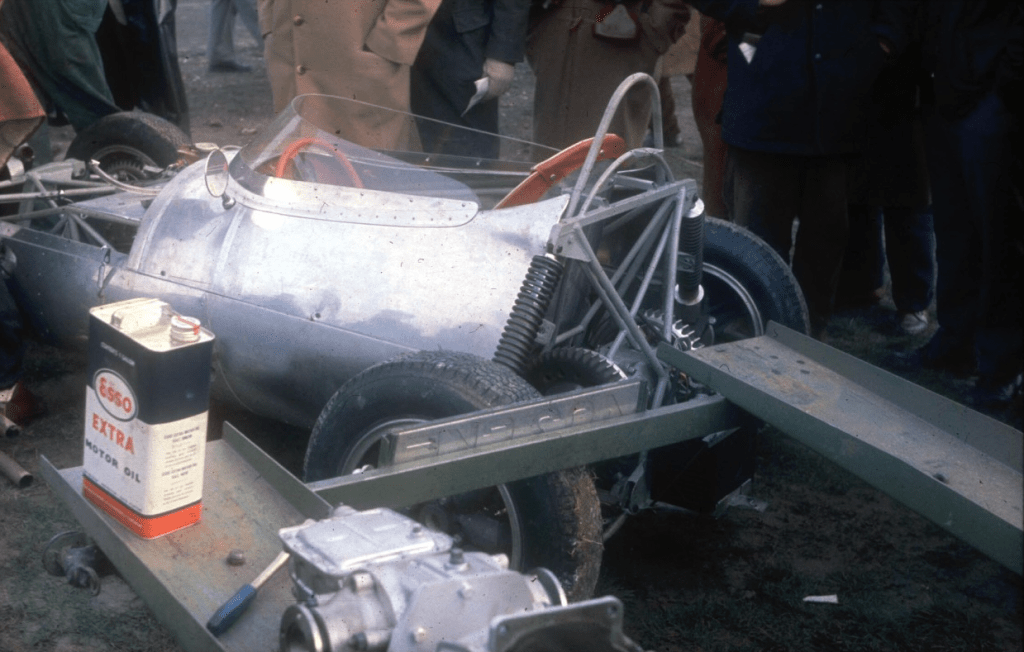
The Cosworth engine from Warner’s car, rectified, was then fitted to the Lotus 18 unpainted prototype which was having its first race in Alan Stacey’s hands with a mildly tuned Ford Anglia engine. Colin Chapman had placed an order for an engine from his former employee too.
Despite working throughout Christmas Day, Duckworth couldn’t finish both engines. Warner got the race unit while Chapman’s for Stacey was fitted with twin-carbs and extractors but was otherwise standard’ish.
The switch ended up being not so simple as the Gemini Cosworth engine had a lower sump than the Anglia unit fitted to the Lotus 18 which caused bottoming problems in the race. Clark was pushed away last with a flat battery and finished eighth as stated above, while Stacey with his bitsa-engine and with suspension settings awry and far from resolved, spun, finishing 10th.
Despite the lowly placing, Chapman was sold. He could foresee selling lots of Lotus 18 FJs and ordered 25 Cosworth 105Es to power them. Duckworth was out of penury…and the rest is history. See here: https://primotipo.com/2024/07/11/cosworth-engineering-ltd/
FoMoCo Anglia ad circa-1961. Lotus 20. The 85bhp @ 8,000rpm quoted is the claimed output – 85/90 @ 7,500 actually – of a 1960 Cosworth Ford MkIII 997cc FJ engine. ‘An improved version of the MkII using A3 profile cam with strengthened bottom-end and (optional) dry sump lubrication.’ (Ford)
Afterburn…
The same day I put this piece up Roger Herrick sent me a note and the fantastic photographs below.
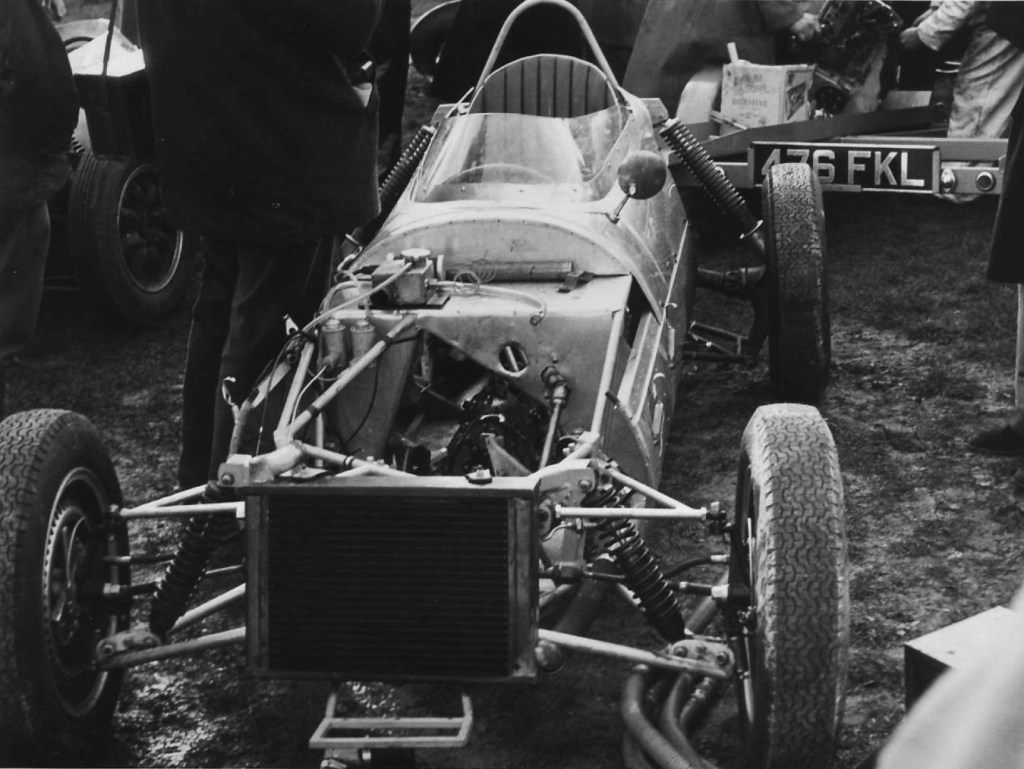
‘Here are some more photos of the swap of the Cosworth Ford engine from the Gemini to the Lotus 18 – done in the paddock on the back of a trailer – just in time to get the Lotus out to the grid.’
‘ I don’t know if the early Geminis had chassis numbers unless they needed overseas carnets. The first Gemini Mk2 (the Mk1 was a ‘badge engineered’ Moorland) had a chassis plate with the name “Anne” after Brad ward’s girlfriend. This car is in NZ and still has the Anne plate.’
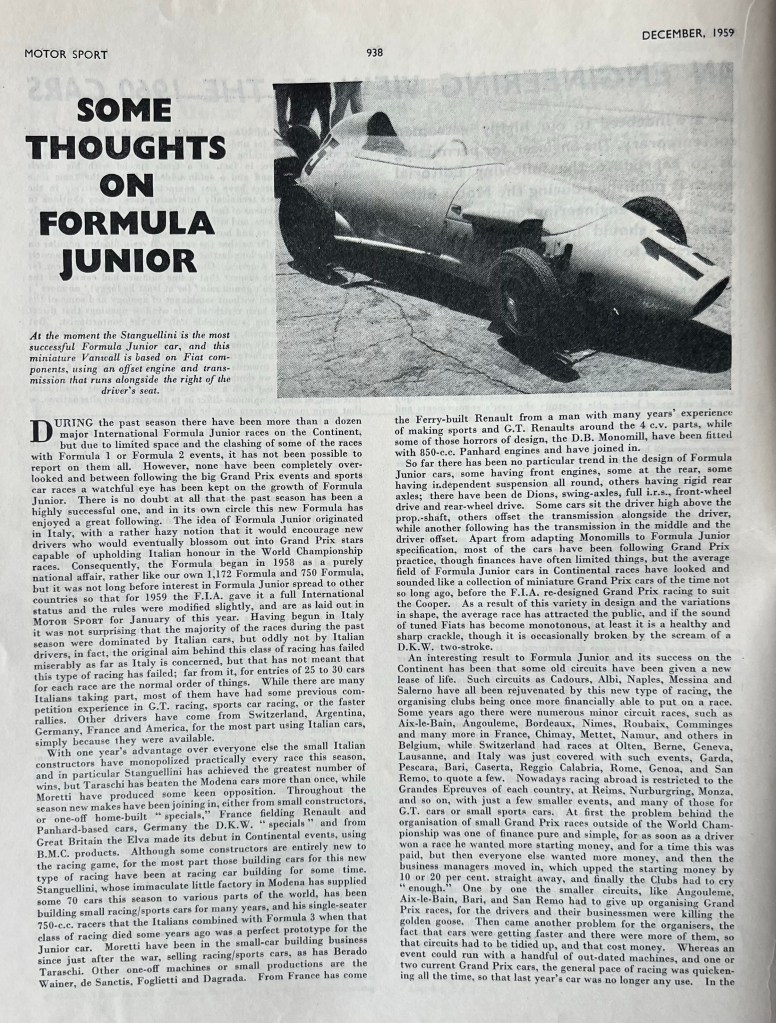
Given the point in time we are talking about, the end of 1959, who better to give us a perspective on the FJ state-of-play right then, than the learned DSJ.
Credits…
MotorSport Images, MotorSport December 1959, racecarsdirect.com, F2Index-Fastlane, the judge13.com, Brad Ward, Roger Herrick Archive
Stirling Moss on his way to winning the January 20, 1962 Lady Wigram Trophy in searing New Zealand heat.
He has the side-panels of Rob Walker’s Lotus 21 Climax FPF 2.5 removed to get a bit of air flowing through the cockpit of chassis #935.
I love this ode to the demise of the fabulous front-engined Grand Prix cars written by Digby Paape.
‘I remember coming away from this race thinking, “Well, that’s the end of exciting racing.” Gone were the front engined monopostos with loud exhausts that rang off the Port Hills, the drivers biceps fighting the wood-rimmed steering wheel, the blue chrome on the exhausts, the dirty spoked wheels, the broadsides and four-wheel-drifts. All gone with the advent of these pesky little cars that cornered on rails and sounded like Austin A40’s.’
Luvvit!
Australian great Lex Davison referred to the Coopers as ‘Anti-Climaxes’ and ‘Mechanical Mice’…not that it stopped him racing and winning in them!
Moss approaching the Wigram hairpin (unattributed)Jack Brabham on his way to victory at Ardmore in 1958, Cooper T43 FPF 2.2 (unattributed)
The mid-engined rout started early in NZ. Jack Brabham won the 1958 NZ GP at Ardmore aboard a Cooper T43 Climax on January 11, a week before Moss won the first Championship F1 race in a mid-engined car at Buenos Aires on January 19. He too raced a Cooper T43 in that Argentine Grand Prix, one of Rob Walker’s cars.
Broaden the definition to Grand Prix racing and the mid-engined feat wasn’t a big deal given Auto Union’s pre-war successes, but such is the fixation with Formula One these days that most prefer to ignore the history of a period that doesn’t interest them or of which they have no knowledge.
It wasn’t too many years before – 1956 – that Moss had first visited the country and taken New Zealand’s premier race, again at Ardmore aboard one of the great front-engined Grand Prix cars, the Maserati 250F.
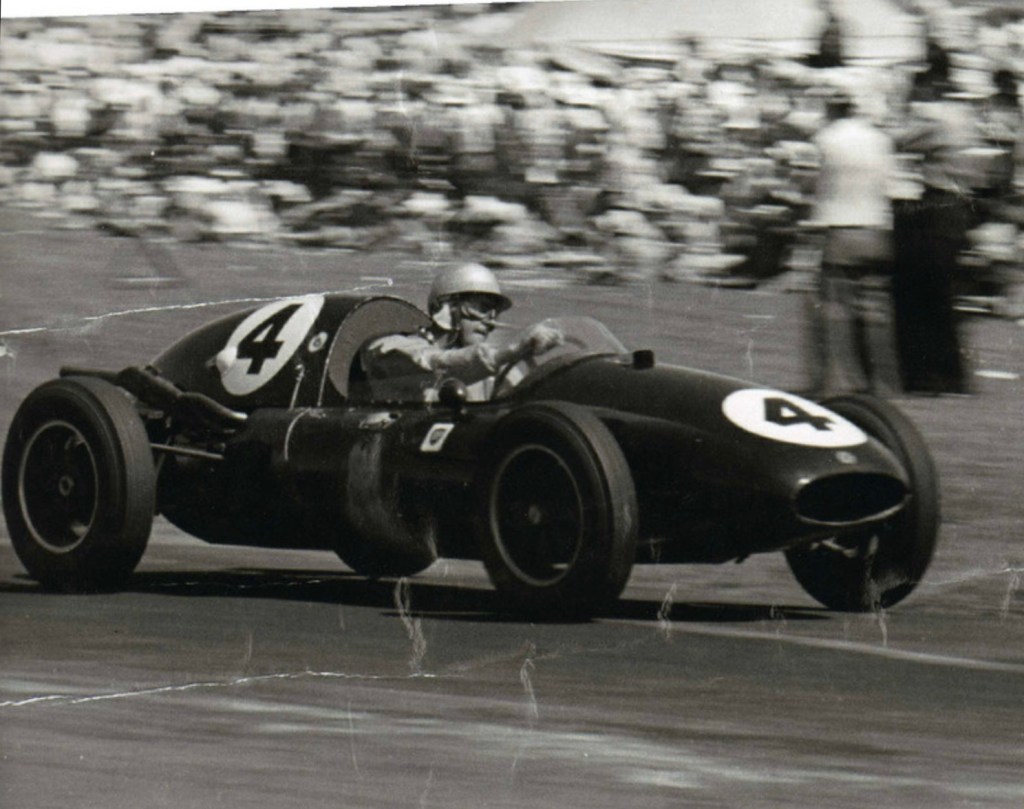
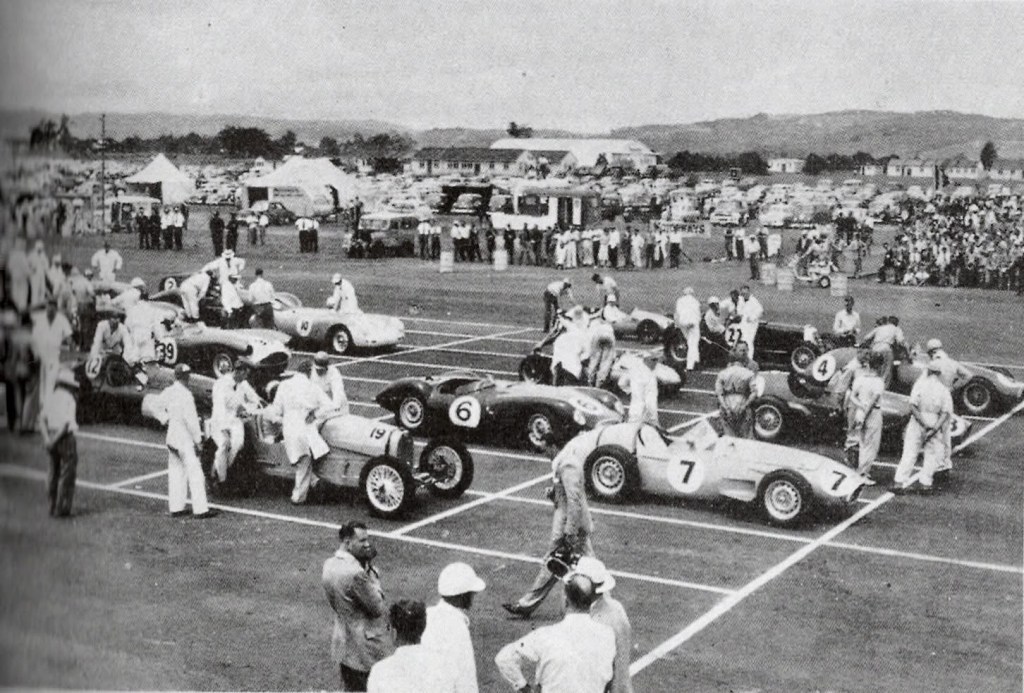
#7 is Moss’ with the 3-litre Ferrari 500/625s of Peter Whitehead and #4 Tony Gaze alongside. The Bugatti is Ron Roycroft’s T35A Jaguar, #6 is another Jaguar engined car, Peter Whitehead’s Cooper T38 being raced by Reg Parnell. Peter lent Reg the car after Parnell’s Aston Martin DP155 had engine problems in practice. Moss won from Gaze and Whithead.
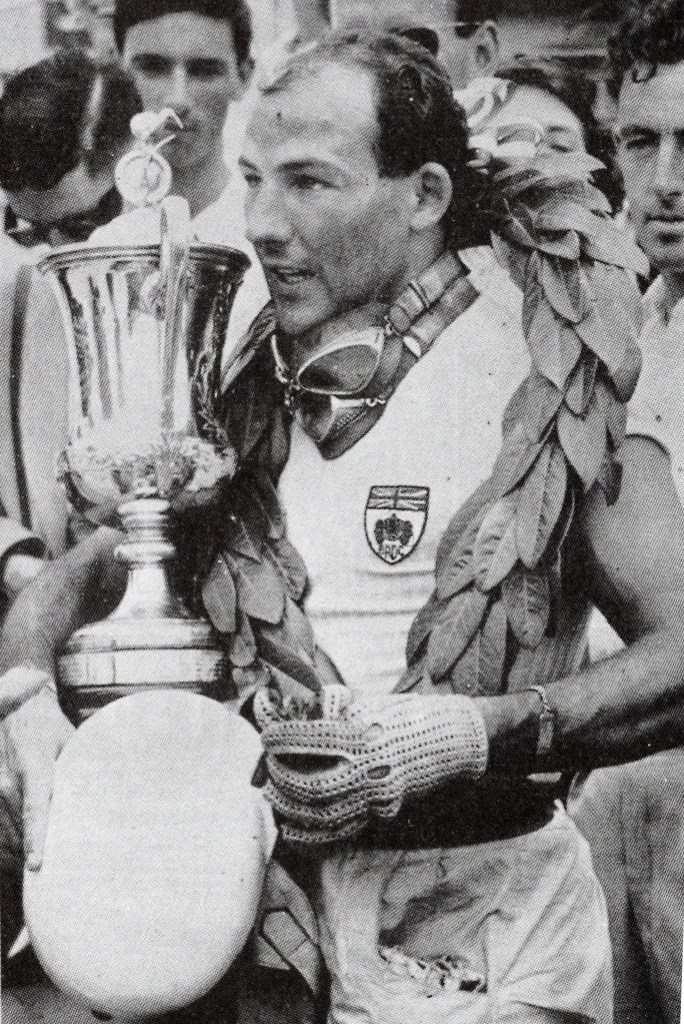
Moss post race with biceps bulging having wrestled with his 250F’s wood-rimmed wheel for the previous 2 hours 32 minutes!
Tailpiece…
(R Herrick)
Rob Walker’s NZ GP winning Lotus 21 Climax leaves Ardmore on the back of a modest trailer towed by a Borgward Isabella Coupe…simpler times.
Frank Matich during the LA Times GP, Riverside Can-Am round on October 29, 1967.
He qualified the 4.4-litre tiddly Matich SR3 Repco-Brabham V8 20th but crashed out of the event won by Bruce McLaren’s 5.7-litre McLaren M6A Chev after completing only 30 of the 62 lap, 200 mile journey.
FM is one of my obsessions, every now and then I Google ‘Frank Matich, United States’ to see what pops up. This time, Pete Biro’s shot did, then you Google the bloke you’ve heard of but know nothing about…
Biro – June 1, 1933-December 26, 2018 – was a semi-pro stage and close-up magician and photo-journalist/author who got his start when Road & Track engaged him to do a story about the Barneson Special, then David E Davis discovered him and gave him assignments for Car and Driver.
He and Davis travelled the world, along the way Biro was commissioned by Goodyear, Sports Illustrated, Time, Life and many others. Of course many of his subjects became friends, including Dan Gurney, Phil Hill, Bruce McLaren, Denny Hulme, Jackie Stewart, AJ Foyt, Richard Petty and many others. See here: https://youtu.be/uNEHyexrC_I?si=NpbKvFdyur4LArfB
(P Biro)
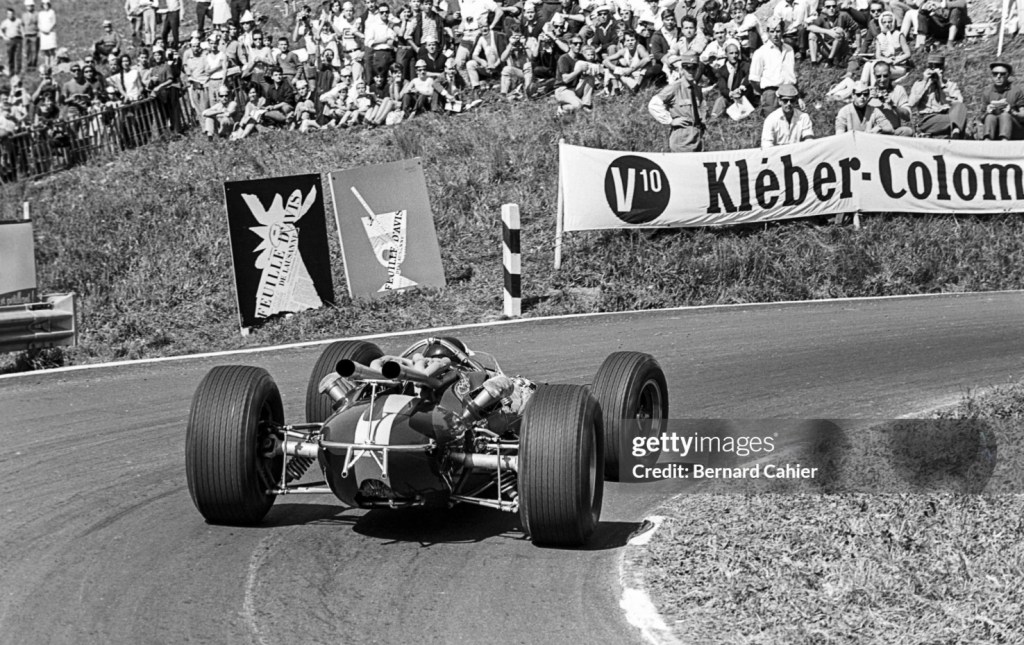
Jim Clark, Lotus 38 Ford, Indianapolis 1966.
The Great Scot started from the middle of the front row and may well have won the race…but he was second behind, perhaps, Graham Hill’s Lola T90 Ford.
Jim Hall enquires of Vic Elford, ‘Hows it going out there?’ With the legendary – still as innovative as tomorrow – sucker – Chaparral 2J Chev in 1970.
Interviewed by George Levy, Vic Elford remembered that ‘My first impression was, I don’t really see it as very quick, because it just sort of goes around corners. But then of course it got down to analysing it, we found it was going around corners about 12 or 15% quicker than anything else would.’
‘The 2-litre Class’ during the 1966 US Grand Prix at Watkins Glen on October 6.
Peter Arundell’s Lotus 33 Climax FWMV V8, Mike Spence, Lotus 25 BRM perhaps, then maybe the fast approaching Jochen Rindt’s Cooper T81 Maserati. Who knows?
Dan Gurney, McLaren M8D Chev, Mont Tremblant, St Jovite June 28, 1970.
Who better to help McLaren recover after the loss of Bruce at Goodwood in 1970?
It was all looking good for a while, until competing oil sponsors – Gulf and Castrol – got in the way. Understandable I guess. Dan won the season opener at Mosport and then St Jovite in June, then had dramas at Watkins Glen in mid-July that saw him finish sixth from grid 2.
Bruce McLaren gulps a fresh breath of air at Riverside during the 1960 US GP, he was third in his Cooper T53 Climax behind the Lotus 18s of Stirling Moss and Innes Ireland.
Biro about to have the colour of his jocks changed by five laps alongside Jackie Oliver in a Can-Am Shadow DN4 Chev around Laguna Seca in 1973-74, see here: https://primotipo.com/2017/02/11/delicate-touch/
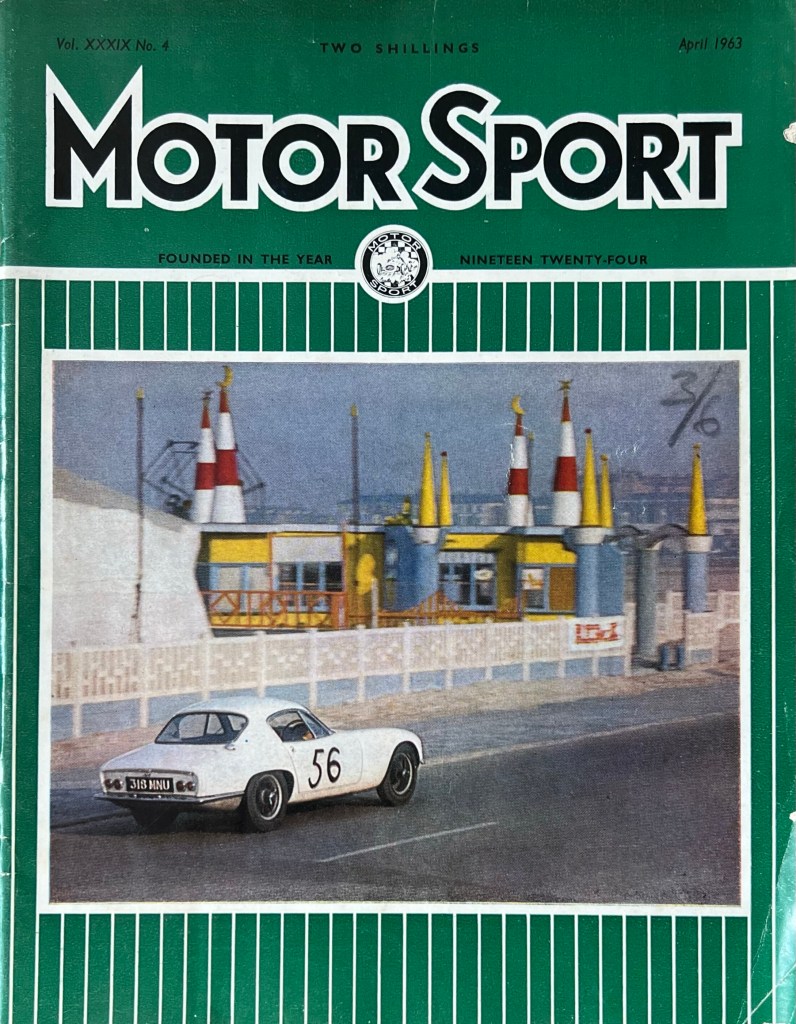
‘Cedric Brierley was well known in Club racing until a bad crash put him out of racing for some time, leaving him with a disability which precludes the use of a normal gearbox. He has had a Lotus Elite fitted with a 1.5-litre single-cam Coventry Climax engine and Hobbs automatic gearbox and at the Southport Speed Trials he proved to be nearly as quick as the E-Type Jaguars.’ MotorSport wrote.
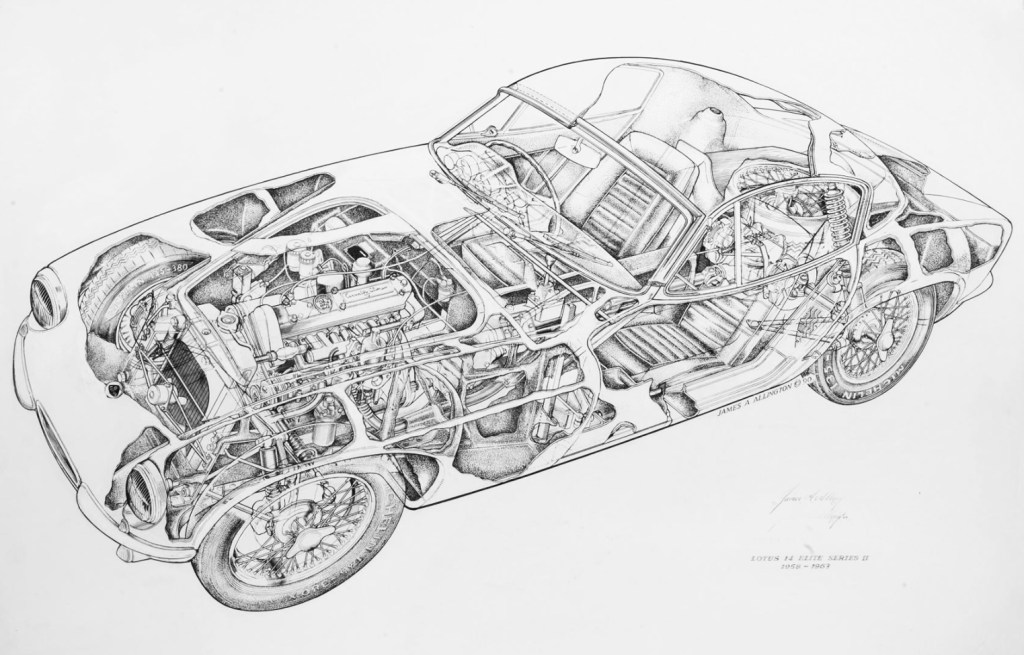
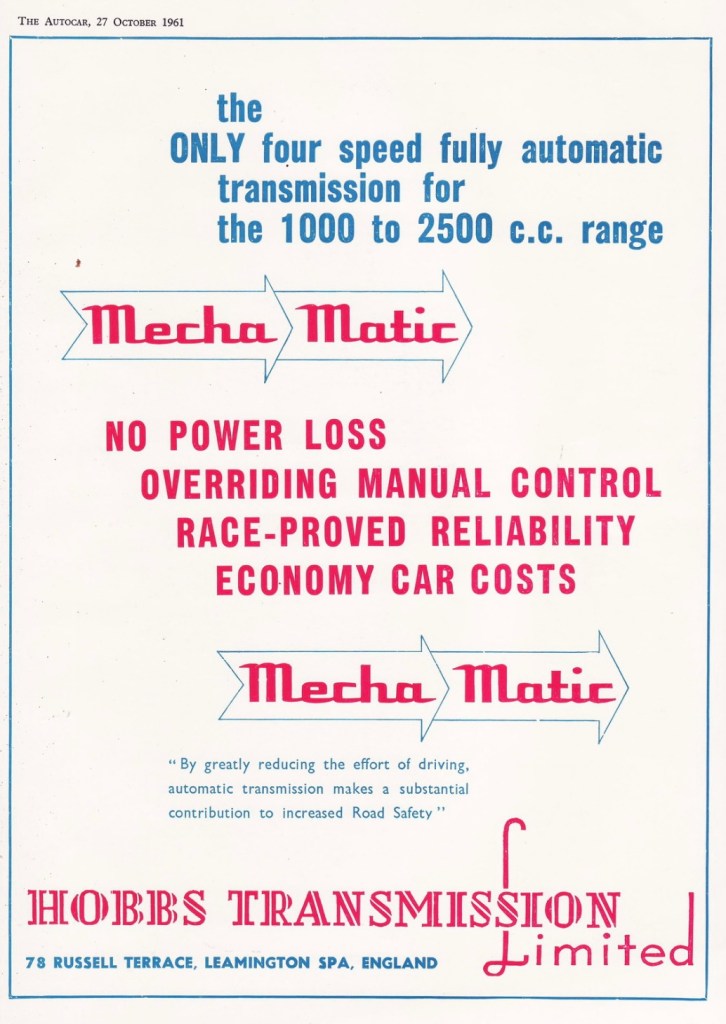
It was the beauty of the shot that initially captured my attention, then you start to dig…I thought there was only one Elite fitted with a Hobbs Mecha-Matic gearbox – Howard Frederick Hobbs was an Adelaide born engineer – not so…
Rupert Lloyd Thomas wrote on The Nostalgia Forum, ‘Let us try and put the achievements of Howard Hobbs in context. He built the 1015 automatic transmission and fitted it to a Lotus Elite for the 1961 season.
In November 1960, David Hobbs, Howard’s son, acquired Lotus Elite, 5649 UE, from Chequered Flag, Chiswick, London, that was to launch his international racing career. The engine of the Elite was modified by Cosworth to Stage III tune producing 108 b.h.p. and a Hobbs Mecha-Matic gearbox was fitted, specially modified for racing. Hobbs said, “Chapman was not involved in the project, but our engine was blueprinted by some young tuner by the name of Keith Duckworth.”
The Hobbs Mecha-Matic gearbox high point came at the Nurburgring on May 28, 1961, when David Hobbs, and Bill Pinckney, two Midlands lads, defeated the might of Porsche in the 1600cc sports racing class in the Nurburgring 1000 kms with their automatic Lotus Elite. Bumped up to the 1600cc class by the organisers for their non-standard gearbox, after protests from fellow competitors, they faced much more powerful opposition from Porsche. After this remarkable achievement the future of the gearbox looked set fair. A long trip to Italy for Le Quattro Ore di Pescara on August 15 was less successful. The car dropped a valve early in the race, mechanic Ben Cox remembers worrying about taking the blame for what turned out to be a material failure.
Colin Chapman was sufficiently impressed to contact Hobbs in order that Jim Clark could drive the car in the 3 Hours of Daytona on 11 February 1962. As David Hobbs fought to establish himself as a professional racing driver he had also come to the attention of the Jaguar factory, and for 1962 he took over the privateer Peter Berry-entered E-Type from Bruce McLaren for the season. He was entered in the Jaguar, 3 BXV, for the inaugural Daytona 3 hours with the Lotus sitting idle. As Hobbs tells it, “Colin Chapman rang up and asked if he could borrow the Mecha-Matic Elite for Jim Clark to race at the same event.” Clark drove the Mecha-Matic in Florida, streaking away in the class lead but retiring after 60 laps with a failed starter motor and being classified 29th.
Jim Clark later had a road-going Elite, HSH 200, fitted with a Hobbs gearbox, as did Stirling Moss. Clark said in the book ‘Jim Clark at the Wheel’, “Those who scorn automatics take note!”
(J Allington)
The Mecha-Matic Elites…
Thomas again, ‘I have found three:
The road car of Jim Clark Reg # HSH 200. This plate would have been issued in 1961 by Berwick C.C. Chassis No: EB-1659, Engine No: FWE10233 – SUPER 95 Specification. Bristol Plate No: EB-1659. Originally yellow and silver. Subsequently sold in 1962 to a George V. Simpson, who painted it dark blue, Scottish racing colours.
The Cedric Brierley car, Reg # 318 MNU.
The Stirling Moss road car Reg # HRT 163D. Body/Chassis no.1789 and was fitted with a Twin-cam engine, make unknown. Colour yellow. This is a 1966 reg no. so car may have been re-registered that year on change of specification. Car thought to be in the USA, last known owner was a Richard Richardson.
So we have a story involving David Hobbs, Keith Duckworth, Colin Chapman, Jim Clark and Stirling Moss. Duckworth later put cash into developing the ideas of Howard Hobbs, Clark and Moss bought the cars.
An intriguing footnote. About the time Duckworth was taking up the VKD transmission for racing, Howard Hobbs was still battling his old nemesis Borg-Warner in the road car game: http://archive.comme…ly-transmission ‘
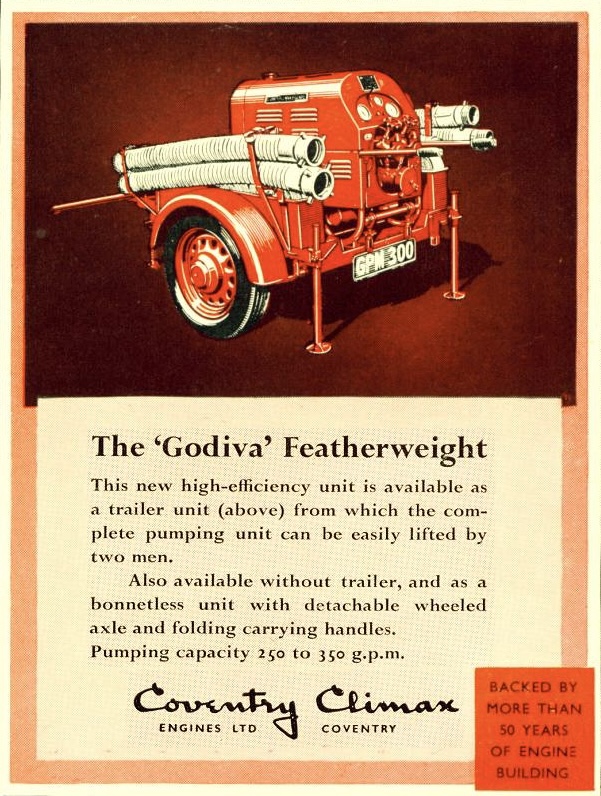
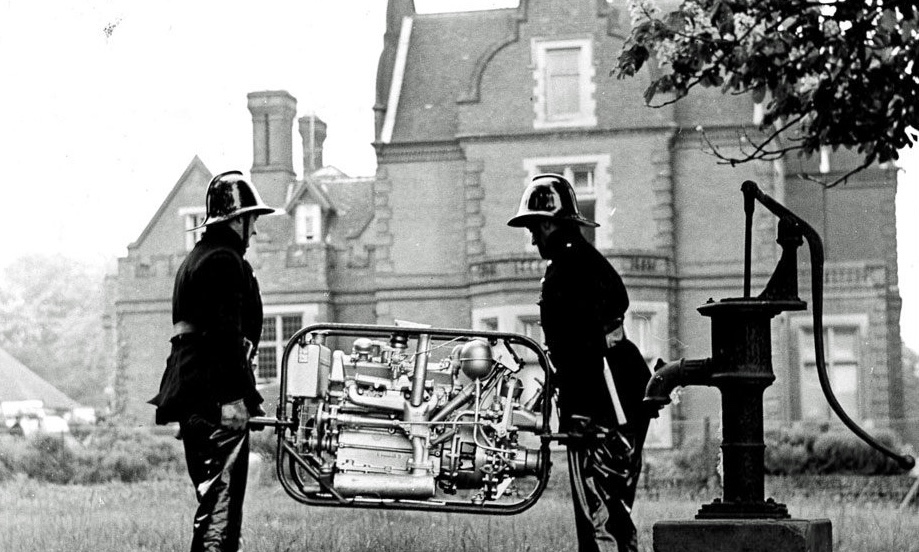
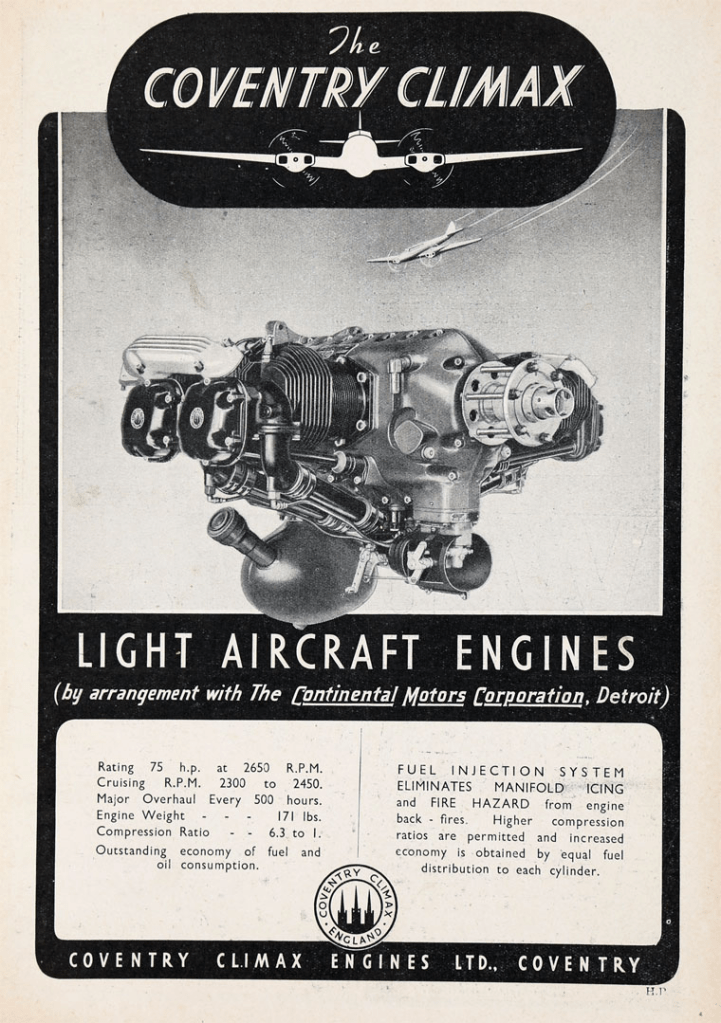
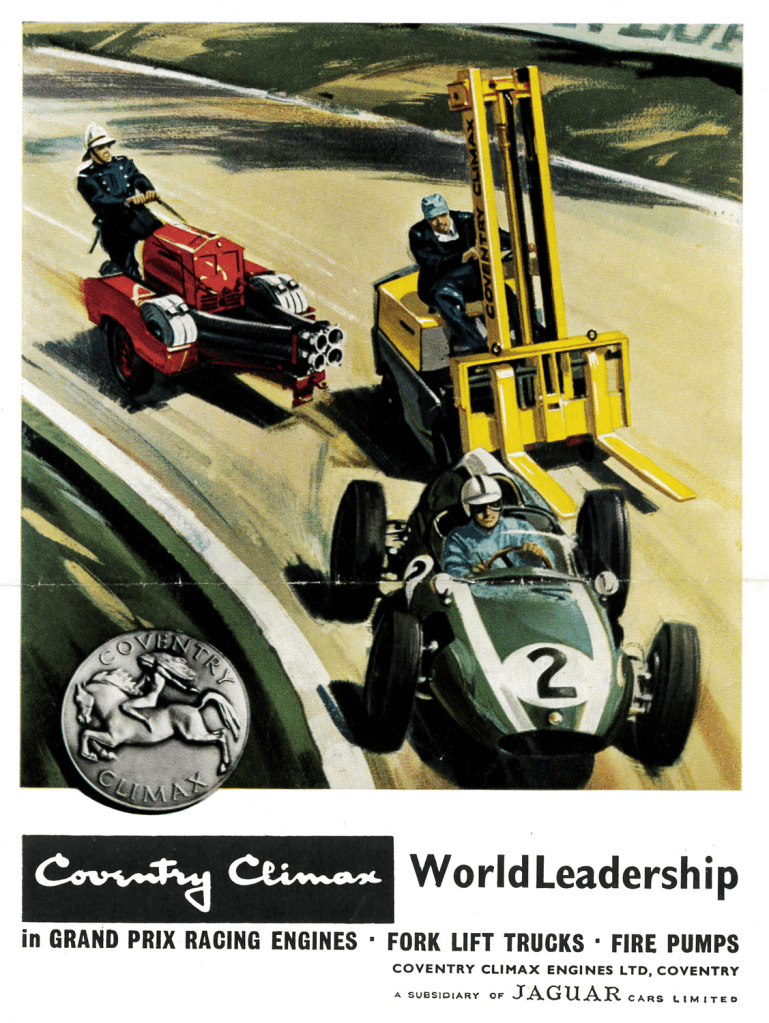
Coventry Climax’ mega racing successes were begat by the Godiva Featherweight engine as you all know. Here is a great Graces Guide summary of the corporate evolution of Coventry Climax, formed in 1917: https://www.gracesguide.co.uk/Coventry_Climax_Engines
(Godiva Ltd)
Etcetera…
1939
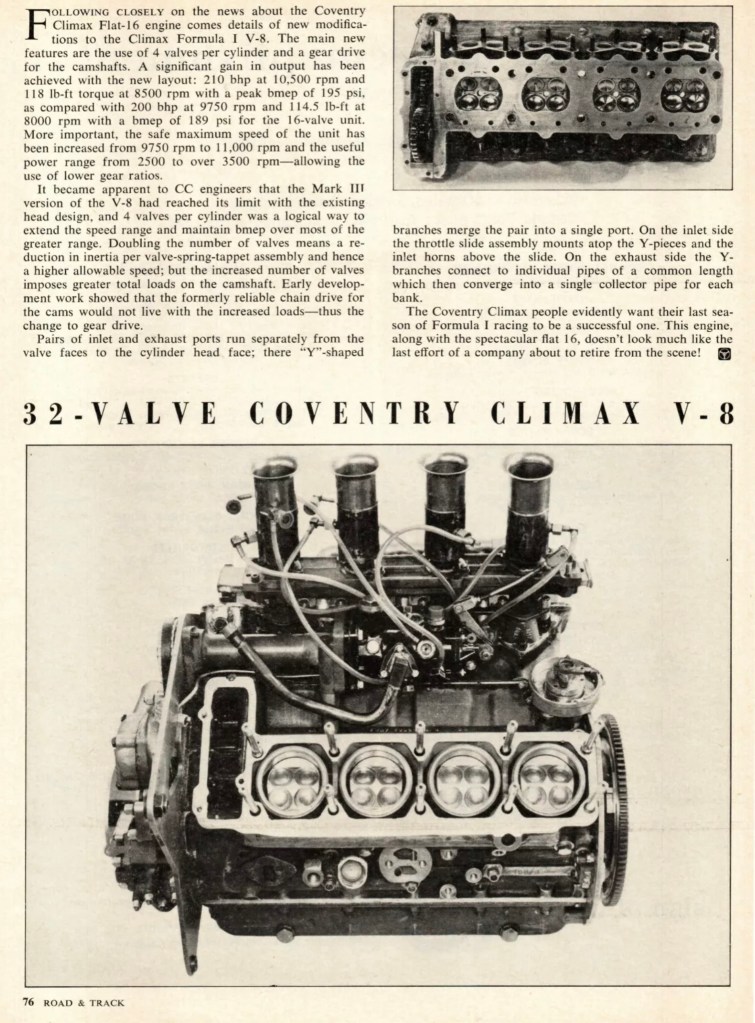
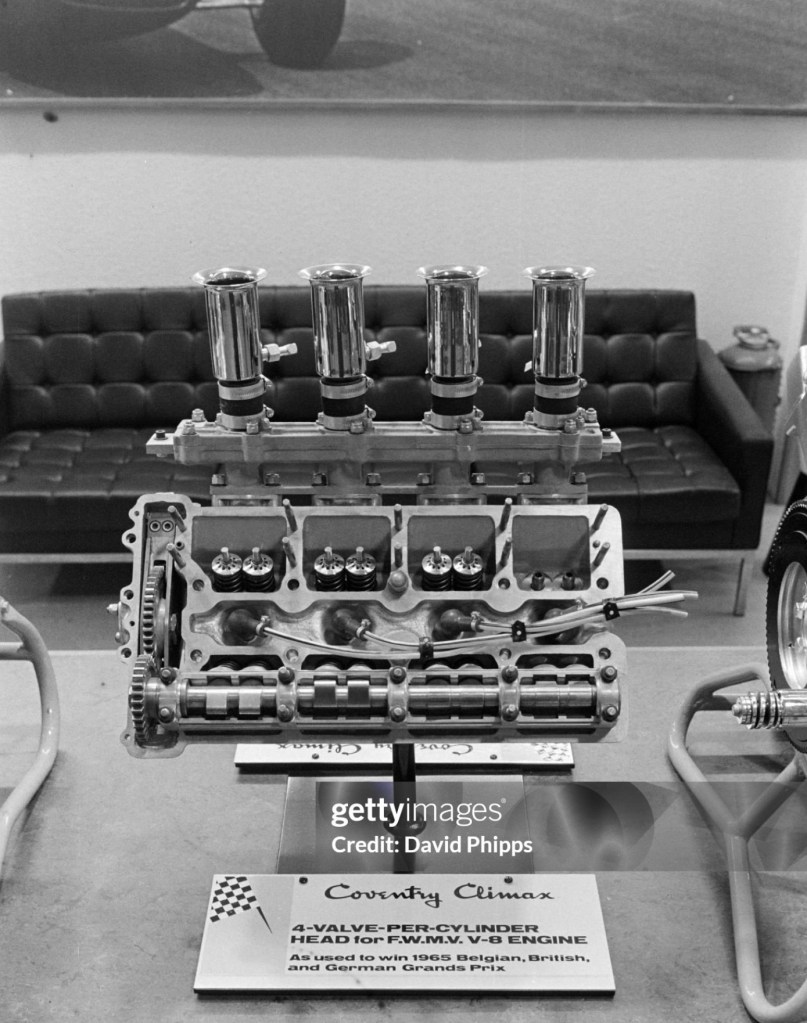
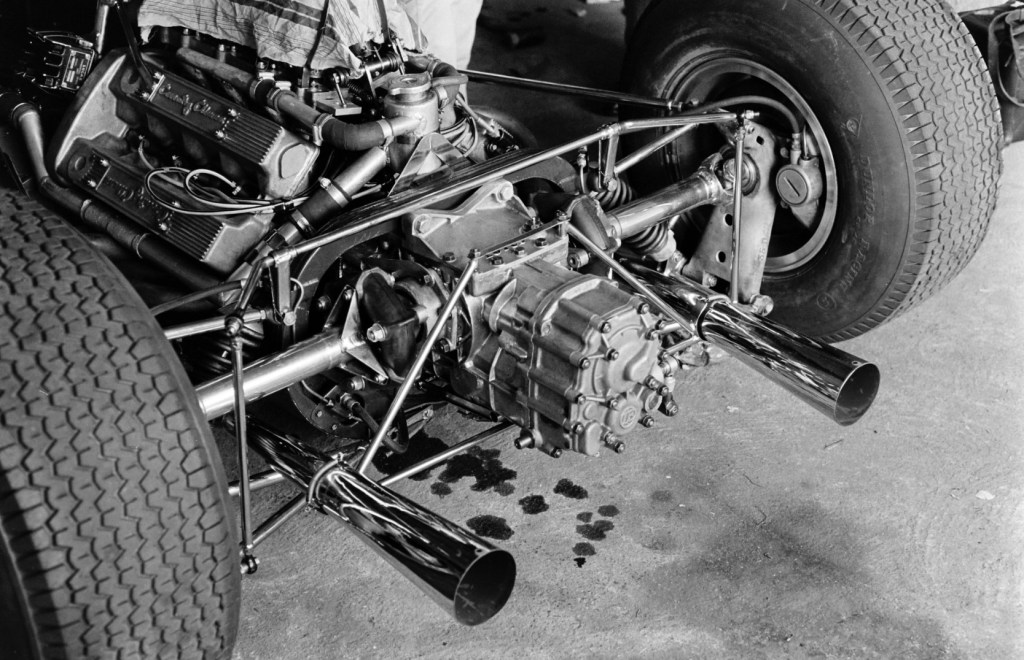
Irrelevant in the context of this article but it popped up in my Google search, so why not. Shots of the two (?) semi-undressed F1 Coventry Climax FWMV Mk 6 and Mk 7 1.5-litre four-valve V8s aren’t common.
The Cams were gear, rather than chain-driven as in the case of the earlier FWMVs, as David Phipps’ London Motor Show shot taken at Earls Court in October 1965 demonstrates.
The Mk6 FWMV Coventry Climax V8 (below) made for Lotus fitted to a 33 chassis in 1965, circuit unknown. Quick visual differentiators (below) from a two-valver are the ribbed cam-covers and, depending on the crank spec of the engine concerned, and ‘conventional’ rather than crossover exhausts. Aren’t the megaphones nice…212bhp @ 10,300rpm are the numbers I have. ZF five-speed transaxle.
(MotorSport)
Credits…
MotorSport April 1963, Rupert Lloyd Thomas, James Allington, Road & Track, MotorSport Images, Godiva Ltd, Getty Images-David Phipps
Alan Jones, Surtees TS19 Ford during the US GP West at Long Beach on March 28, 1976.
What caught my eye was John Surtees’ Franger-Mobile without the ads for Durex’ finest. Too much for American sensibilities or something? The BBC cracked-it too didn’t they, refused to cover F1 that season?
Anyway, having randomly lobbed on this photo, I kept going through the amazing Getty Images archive, this Jones homage is the result.
It seemed to me rather a cohesive design from the pens of Big John and Ken Sears, but its looks flattered to deceive a bit. Sadly.
Jones, Monaco Q19 and first lap collision, DNF
Jones’ best result in 16 races with the car was a brilliant second behind James Hunt’s McLaren M23 Ford in the non-championship Race of Champions at Brands Hatch in March. In Grands Prix he was fourth in the season-ending Japanese GP where Hunt won the title, and bagged a pair of fifths at Zolder and Brands Hatch.
After Alan decided he would rather race in the US than saddle up again with former World Champ Surtees, his countrymen, Larry Perkins and Vern Schuppan had a crack or two in TS19s in 1977 but they didn’t like the cars much either although.
Vittorio Brambilla’s best TS19 results in 1977 almost exactly matched Jones’ the year before, but by then Jones had returned to F1 with Shadow after the horrific death of Tom Pryce during the ’77 South African Grand Prix.
AJ found the Shadow DN8 Ford much more to his liking than the TS19, bagging points in six races including a first breakthrough F1 win at the Osterreichring, and third place at Monza.
TS19 in the pits at Long Beach in March 1976, where Alan was unclassified.
The pyramid type aluminium monocoque has more than a nod to Gordon Murray’s Brabham BT42-44s but has two angles to it. Front mounted radiators, pull-rod actuation of the front spring, fuel carried centrally aft of the driver, the usual Ford Cosworth DFV-Hewland FGA400 combo, rear springs are torsion bars (?), single top-links and wide based lower wishbones and one radius rod assisting fore-aft locational duties on each side. Interesting.
Race of Champions, Brands Hatch paddock in March 1976 where the Jones boy is catching up with what’s happening in Australia, Chequered Flag was a good publication at the time.
Jones, Lola T332 Chev ahead of Peter Gethin’s VDS Chevron B37 Chev on the run down to Dandenong Road during the February 1977 Sandown Park Cup. DNF for both, Max Stewart won in his Lola T400 Chev (I Smith)
He raced at home that summer for the first time since leaving for the UK circa-1968 – after the September 1968 Sandown Three Hour in which he co-drove a Holden Monaro HK GTS327 to second place – doing all four rounds of the February 1977 Rothmans International Series.
He brained everybody with his speed in the Sid Taylor/Theodore Racing Lola T332C Chev, taking one win, jumped the start of the AGP and got pinged at Oran Park, then boofed the car during practice at Surfers. Third place overall with his raw pace riveting to watch…
A couple of classic Nurburgring shots during the July 31, 1976 German GP weekend, above aviating at the Flugplatz and below the Karussel photograph shows the attractive lines of the TS19 to good effect.
AJ was tenth from Q14 of 26 on the disastrous weekend in which Niki Lauda came close to losing his life aboard a Ferrari 312 T2.
There is that double angle tub on display, doesn’t the bodywork enhance the flow of air onto the wing? Alternative front nose being tried during practice at the Nurburgring below.
Jones on the hop at Watkins Glen in October 1978, Williams FW06 Ford and looking on-it in the damp pitlane at the Osterreichring in August 1978 below.
When Jones joined Williams for a one-car attack in 1978 it didn’t necessarily look the best of moves, but Patrick Head’s first F1 car, the FW06 proved an excellent design which was well prepared as FW had an adequate budget for the very first time. Jones made the Saudi Airlines sponsored car fizz, finishing 9 of the 16 races he started with second, fourth and fifth his best results in the US, South Africa and France respectively.
With Frank Williams and the FW06 at Long Beach during the 1979 US GP West in October below.
‘The best’ of the non-ground effect cars in 1978, the FW06 was off the pace in 1979 amongst a more competitive grid, arguably, Jones would have won the 1979 title had the FW07 appeared earlier than it did; Woulda-coulda-shoulda…
(D Phipps)
Amongst the fastest ground-effect machines of the early 1980s was the Williams FW07 Ford in its various iterations, here with Jones in front one of one of the Renaults at the Osterreichring in August 1980 where he finished second in an FW07B.
Great shots of the fully extended sliding skirts of the FW07Bs of Carlos Reutemann #28 and Jones in the Watkins Glen paddock in October 1980, and below of the tunnel support structure at Hockenheim in 1979 where AJ won.
The FW07 was first raced at Jarama in April 1979 with Clay Regazzoni taking its first race win in the British Grand Prix at Silverstone in July, then Jones won four of the last six races that year as the FW07 hit its straps, and took the title in 1980 with victories in Argentina, France, Britain, Canada and the US.
Overhead shot at Monza in 1979 shows the critical elements of the car: inboard front suspension offering a clear flow of air into the ground-effect tunnels, the size of which is enhanced by a very slim aluminium honeycomb chassis, and centrally mounted fuel cell. Not to forget the 3-litre Ford Cosworth DFV engine.
Jones as snug as a bug in a rug at Brands Hatch in 1980.
I can’t quite read the FW07B chassis plate, but Allen Brown’s oldracingcars.com tells me he used FW07B/7 and FW07B/8 in practice, winning the race aboard FW07B/7.
Adelaide GP meeting in November 1991 aboard the BMW M3 Evolution he raced to fourth place in the Australian Touring Car Championship. Adelaide wasn’t part of the ATCC.
Credits…
Getty Images, Ian Smith
Tailpiece…
AJ during practice for the one and only Grand Prix Masters race at Kyalami on November 11-13 2005. His mount is a Reynard/Delta 2KI Cosworth XB.
The naturally aspirated 3.5-litre 80-degree V8s were built by Nicholson-McLaren and tuned to give 650bhp @10,400rpm and 320lb/ft of torque at 7,800rpm.
Jones practiced but didn’t start the race with neck soreness, Nigel Mansell won from Emerson Fittipaldi and Riccardo Patrese.
Sorta a great idea but there is a difference between old pro-golfers having a hit and old pro-racing drivers ‘having a hit’…the story is well told here: https://en.wikipedia.org/wiki/Grand_Prix_Masters









 primotipo...