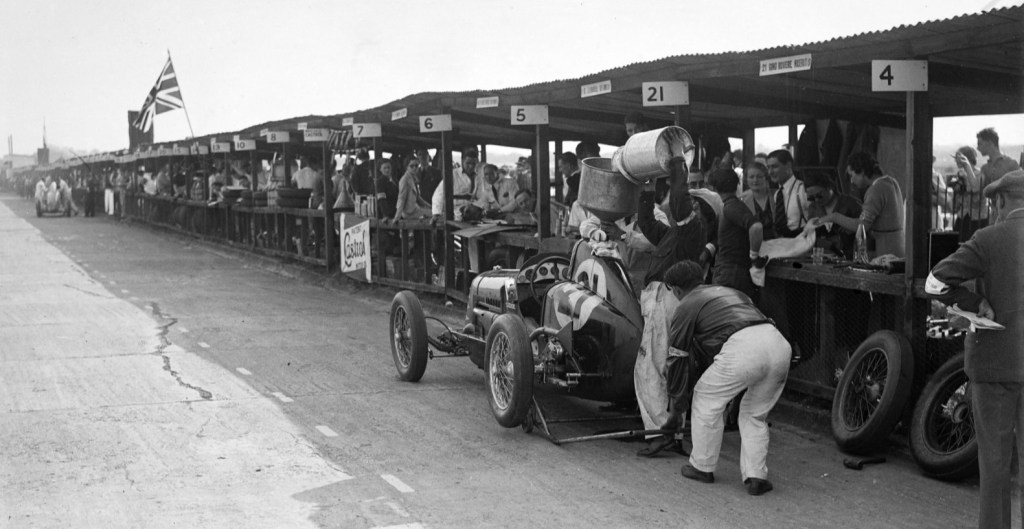
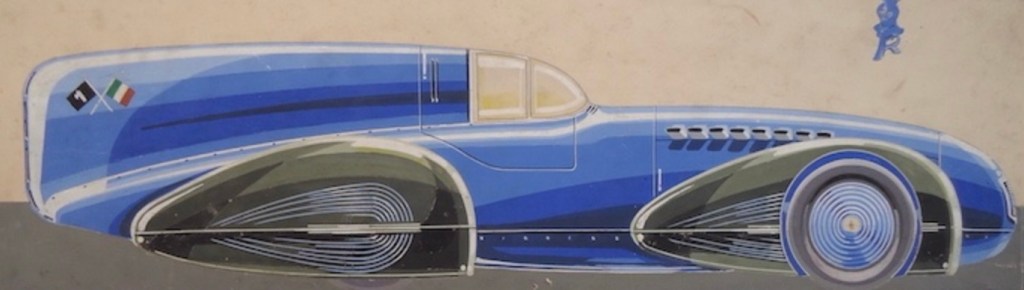
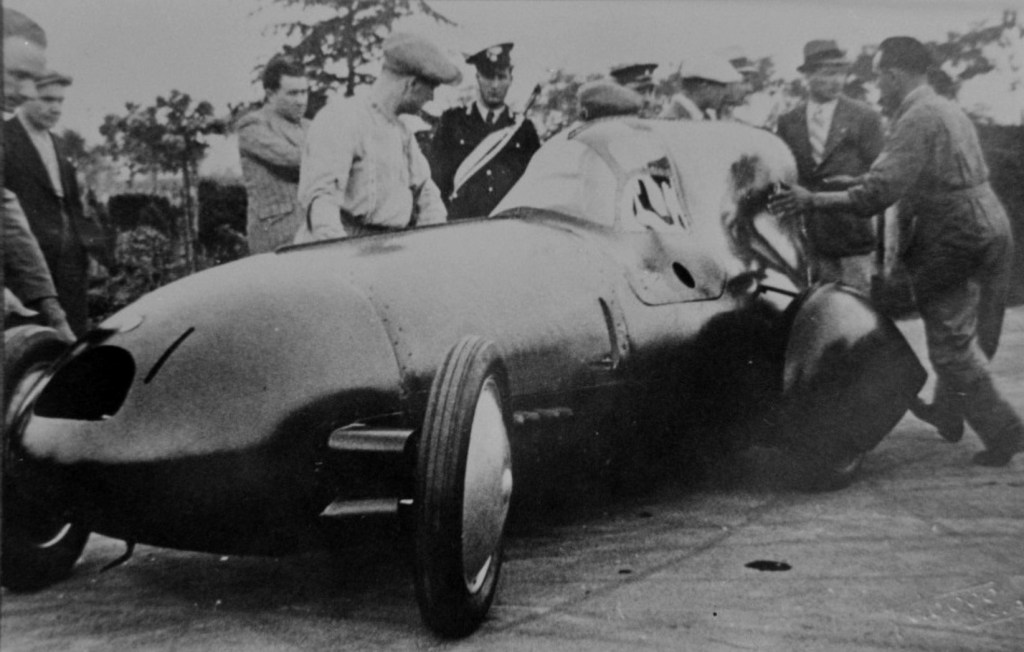
The somewhat other-worldly sight of two Mercedes Benz W196S/300SLR’s with air-brakes deployed as they approach the Esses at Le Mans in 1955…
When you consider the engineering of this clever response to the braking power of the Jaguar D-Type’s Dunlop brakes one can’t but wonder about the development of a German equivalent?!
The Benz was the champion sportscar of 1955 winning most of the blue-riband events: Targa Florio, the Mille Miglia and the Tourist Trophy, the exception being Le Mans of course.
Mercedes withdrew whilst in the lead due to the accident in which Pierre Levegh was an innocent party, which took his life and that of about 84 spectators, not to forget the 180 folks who were injured.
Built by Mercedes test department, this one-off 3-litre 192bhp 300SL powered 105mph race transporter, in Mercedes words “Was predestined to demoralise the opposition. If the racing car transported was that fast, even worse could be expected of the Silver Arrow on its platform.”(Mercedes Benz)Le Mans 1955. Hawthorn, Jaguar D-Type from Fangio early in the race, Dunlop Curves, note that Fangio’s air-brake is still deployed (unattributed)Le Mans 1955. Castellotti, Hawthorn, Fangio: Ferrari 121 LM DNF, Jag XKD first, Benz 300SLR entry withdrawn (Getty)
Design and construction…
In essence the W196S, as the factory model number suggests, “is basically a Type W196R Formula One racing car with a two-seater sports car body,” Mercedes Benz (mercedes-benz-publicarchive.com) wrote. The W196R won back to back drivers titles for Juan Manuel Fangio and Mercedes in 1954-55.
“The main technical difference is to found in the engine: the racing sports car, not being bound by the Formula One regulations, limiting the engines displacement (to 2.5-litres), is powered by a 3-litre version of the eight-cylinder in-line engine and features cylinder blocks made, not from steel, but from light alloy. Apart from this, the 300SLR was not powered by special methanol-based racing fuel but by premium petrol.”
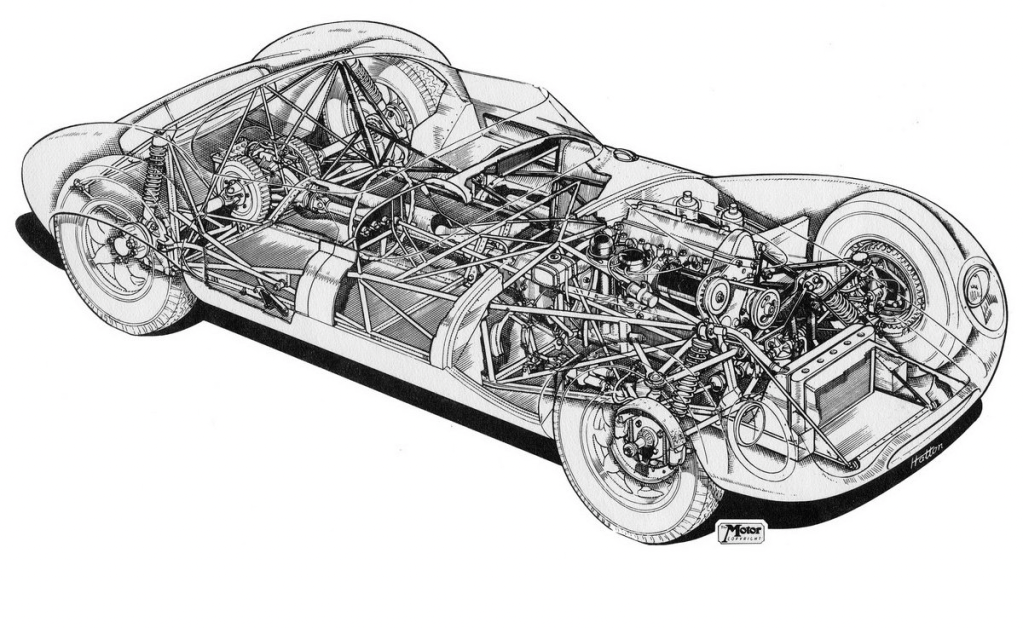
W196S cutaway with the multi-tubular spaceframe chassis and the disposition of major components: 3-litre straight-eight fuel injected engine, rear mounted transaxle and inboard drum brakes front and rear are clear (Autocar)(Mercedes Benz)
Key design elements of the car start with a multi-tubular steel spaceframe chassis. Suspension is by upper and lower wishbones at the front, torsion bars and dampers. At the rear are swing-axles, torsion bars with again telescopic dampers or shocks. Massive inboard drum brakes are used at both ends to stop the 701kg car in ready to race trim.
Le Mans 1955. The engine view is dominated by the Bosch direct-injection high pressure pump and inlets (Getty)
At the heart of the matter is the superbly built Mercedes straight-eight cylinder engine. Cast in two blocks of four-cylinders it runs on a pre-war style roller bearing crankshaft. Bosch provided the fuel injection, the two valves per cylinder of desmodromic actuation. The 3-litre engine produced circa 310 bhp @ 7400 rpm on ‘pump’ fuel as against the more exotic brew which fed its GP brother.
The full technical specifications of this car are at the end of the article.
A very famous photo I first saw in Automobile Year, Moss and Jenkinson, Mille Miglia 1955 (unattributed)
Race programme…
Mercedes didn’t attend the 23 January Buenos Aires 1000 Km first round of the Manufacturers Championship which was won by the Ferrari 375 Plus raced by Valiente/Ibanez. The Sebring 12 Hour was won by the Briggs Cunningham entered Jaguar XKD crewed by Mike Hawthorn and Phil Waters, again Mercedes missed the event held on 13 March.
The 300SLRs arrived with a bang in Italy with the Stirling Moss/Denis Jenkinson combination winning the Mille Miglia in front of Fangio driving solo in a sister car.
This win and all-time-record speed of 157.65km/h has been eulogised down the decades and needs no further comment from me. Seek out Denis Jenkinson’s account of the race in MotorSport, it is one of the great pieces of automotive race journalism.
Le Mans followed in June with the works Jag-Ds of Mike Hawthorn and Ivor Bueb completing the largest number of laps to cross the line in first position, after Mercedes Benz respectful withdrawal from the event whilst in the lead.
Moss, 300SLR, Dundrod 1955 with the unmistakable slender frame of Herr Neubauer at rightMoss, SLR winner of the TT at Dundrod 1955, the following cars folks? (unattributed)
Dundrod’s wild road circuit hosted the Tourist Trophy in mid September. The race started in warm weather which deteriorated to rain later in an event became an 300SLR rout: the Moss/John Fitch car won from the Fangio/Kling machine with the Von Trips/Simon/Kling machine third. The best placed Jag was the Hawthorn/Desmond Titterington car in fourth, albeit it wasn’t running at the finish.
Targa Florio 1955, the Titterington/Fitch SLR gets s tickle before the off, typical Sicilian backdrop. The winner was the Moss/Peter Collins 300SLR (unattributed)
Targa Florio 1955, again Titterinton/Fitch fourth placed SLR from the third place Ferrari Monza 860 of Castellotti/Robert Manzon (unattributed)
The Germans again beat the Italians on home turf, taking the Targa Florio with a one-two from Ferrari on 16 October. The Moss/Peter Collins car finished ahead of Fangio/Kling with the best placed Ferrari the 860 Monza raced by Eugenio Castellotti and Robert Manzon.
Despite missing several events, Mercedes won the constructors championship by one point from Ferrari: 24 points to 23 with Jaguar in third on 16. The W196S won every single race it entered and finished…
The chassis is a light-weight multi-tubular spaceframe, front suspension comprised upper and lower wishbones, torsion bar springs and telescopic shocks. Those huge, light alloy finned drum brakes are mounted inboard and 300mm in diameter. Steering is worm-and-sector, the front tyres 6.00 x 16, the radiator is huge! The alloy oil tank is behind the right-front wheel, while the fuel tank sits high at the back, its capacity not specified by Mercedes.
The 234kg engine – type M196S – is eight-cylinders in line and inclined 53 degrees to the right in the chassis. The silumin head is cast in one piece: DOHC, two plugs per cylinder, two inclined valves per cylinder with desmodromic valve gear, compression ratio 9:1. Bosch 8-plunger injection pump,
Block – two Silumin blocks of four-cylinders each with chrome plated aluminium liners. Bore/stroke 78 x 78 mm, capacity 2982 cc. Crankshaft 10-bearing (roller bearings) Hirth-type crank with central power take off. Dry sump lubrication via a gear pump. Electricals are by Bosch: starter, generator and twin-magneto ignition.
The rear suspension comprises alloy uprights, a single-joint lower swing axle and top links, longitudinal torsion bar springs and telescopic shocks. The 275mm diameter brakes are inboard duplex light-alloy drums and air-cooled.
The transaxle is five-speed, a gate shift was used with a locking system
(Mercedes Benz)
The wheelbase is 2370mm, front track 1330mm, rear track 1380mm, the cars length 4300mm, its width 1740mm and height 1100mm and the “weight of the car in ready for operation status” is/was 901kg.
While the five gear ratios were fixed, the final drive was to choice with top sipped quoted as “over 300km/h.”over 300 km/h. Wheelbase, 2370 m, Front track,1330 mm, Rear track, 1380 mm, Length, 4300 mm, Width, 1740 mm, Height, 1100 mm, Weight, 901 kg ready to race, Fuel tank 265 litres, Engine weight, 234 kg
(Mercedes Benz)
Etcetera…
(Mercedes Benz)
You should take a trip to mercedes-benz-publicarchive.com some time, the quality of the racing content is unbelievable. I’ve added in some shots but these are just the tip of the iceberg, have a look for yourself.
Top shot! Isn’t that machine such a cohesive, great looking, purposeful racing car…
JM Fangio on the way to winning the 209km Swedish GP held at Kristianstad on August 7, 1955. He won from Stirling Moss’ 300SLR and Eugenio Castellotti’s works-Ferrari 121 LM in 1 hr 18m 13.7sec.
I imagine the colour of the underwear of the photographer was changing at this moment, protected only by a layer of Armco as he was. Still, if the worst happened he could decamp into the dam behind…Shots from this spot at Sandown, outside Peters/Torana Corner are rare after about this time as the spot was made Verboten!
Norm Beechey, Holden Monaro HT GTS 350 from the Pete Geoghegan (left) and Bob Jane Mustang 302s, with a smidge of Jim McKeown’s Porsche 911S behind Pete, and then most of Brian Foley’s, and the rest. 1970 Australian Touring Car Championship, round three, April 19.
While Allan Moffat started from pole (where is he in this shot!?), Stormin’ Norm had a great day at the office, leading from start to finish and setting a lap record. He took his second 1970 ATCC round win of the season, victorious from Geoghegan and Moffat (Mustang Trans-Am 302) on the way to an immensely popular series win in his big, booming, Shell-yellow Monaro GTS 350; the first time an Oz built car had won the title.
(G Feltham)
These two shots are of man and machine at Symmons Plains circa-1970, not sure of the meeting date, the number doesn’t work for the ATCC round.
(G Feltham)
Ray Barfield races his ex-works/David McKay Aston Martin DB3S, chassis 9, at Caversham in 1959, meeting date folks?
The second placed car at Le Mans in 1956 (Stirling Moss/Peter Collins) was initially raced in Australia by McKay with success, before passing briefly through Stan Jones’ hands and into Barfield’s, where, I believe, it remains. More about the car in this article: https://primotipo.com/2017/09/28/david-mckays-aston-martin-db3ss/
(G Russell-Brown)
Gary Russell-Brown very kindly sent in these shots of the Barfield/DB3S combination at Caversham during the June 6, 1960 Six Hour Le Mans. Ray was a DNF after completing 60 laps, the winner, Jack Ayres/Lionel Beattie did 178.
(G Russell-Brown)(unattributed)
John Harvey under brakes on the entry to Creek Corner, Warwick Farm 1972. His mount is the brilliant – small, variable rate suspension, side-radiator, edgy-wedge – work of John Joyce, the Bob Jane owned Bowin P8 Repco-Holden F5000
P8-118-72 was completed at Bowin’s, Brookvale, Sydney factory in August 1972 to Bob Jane’s order, fitted with a Repco Holden V8 for John Harvey.
It practiced at the Surfers Aug 27 Gold Star round but didn’t start with fuel problems. Harvey then raced in a non-championship event at Warwick Farm a week later (above), where he was fifth in the first heat but collided with Kevin Bartlett at the start of second.
At that point, major team sponsor, Castrol, directed Jane to put most of the team’s energies into racing their touring cars: the Camaro, Monaro and Torana’s, while the Bowin and McLaren M6B Repco V8 sportscar were largely set aside.
In mid-1974 the car, less engine and gearbox, was sold to John Leffler to replace his damaged ANF2 Bowin P8 Hart-Ford #P8-136-74. Leffler pranged his new Bowin on its debut at Amaroo Park.
Converted to ANF2 specification – fitted with a Hart-Ford 416B 1.6-litre engine, Hewland FT200 gearbox etc – he raced P8-118-72 in the Australian F2 Championship and in Gold Star events. Once sorted, the car was a jet, winning the Phillip Island F2 round late in the year.
Sue Ransom leased and raced it at Calder and Wanneroo Park in 1975. The car remained in Western Australia, perhaps owned by Rod Housego and Ian Wookey, before reappearing at Wanneroo in Rob Richards hands between 1980-82 in Formula Pacific – Ford BDA engined – specification.
Perth Bowin fan Matthew Lloyd did a superb job restoring the car to ANF2 spec, but he died in 2008 just as it was being finished. Bought by Dean Saunders in 2009, I believe it is being slowly re-restored to Repco-Holden F5000 spec, do get in touch if you have more recent information. .
I just like this pair of posters to promote brand new Surfers Paradise International Raceway in 1966.
While it was a fabulous circuit, and at the time built in the-sticks, the incredible growth of the Gold Coast made it irresistible to developers, which was its fate circa August 1987.
John Harvey’s Brabham BT23E Repco 740 in the foreground, while Niel Allen jumps aboard his McLaren M10B Chev at Bathurst during the Easter 1970 weekend.
In the shot below Niel jumps off the line, it’s Leo Geoghegan’s Lotus 39 Repco on the far side.
Ain’t she sweet…John Harvey’s Bob Jane Racing Jane Repco 830 2.5 V8 at rest in the Warwick Farm paddock during the Gold Star round on September 6.
Harves was out with fuel pump failure, Leo Geoghegan won the race, and ultimately the title aboard his Lotus 59B Waggott TC-4V 2-litre.
This car was built on Bob Britton’s (Rennmax Engineering) Brabham BT23 jig to replace Jane’s ageing BT23E with many mods but notably changes in suspension geometry to suit the latest generation of ever-widening tyres. It exists in a West Australian museum.
I love Graham Ruckert’s superb shot of John French on the limit in Pete Geoghegan’s recalcitrant but very powerful Ford Super Falcon in front of Brian Foley’s superb in every respect Alfa Romeo GTAm at Lakeside on July 25, 1971.
It was Lakeside’s Australian Touring Car Championship round that weekend. Pete gave the car a gallop in a support race but elected to race his trusty Mustang in the championship event, having French – a Ford factory racer – drive the Big Henry.
It seems right to show you furriners what a standard Ford Falcon GTHO looks like…here it’s Allan Moffat easing his beast – an XW Phase 1 GTHO – out of Peters Corner at Sandown during his victorious Sandown 3-Hour win on September 14, 1969.
Moffat/John French won from two other similar cars crewed by Tom Roddy/Murray Carter and Fred Gibson/Barry Seton.
Jim Clark, Lotus 49 Ford DFW ahead of Chris Amon, Ferrari Dino 246T at Dandenong Road, Sandown during their epic dice for the lead of the 1968 Australian Grand Prix in February 1968.
Geoff Brabham – 1975 Australian F2 Champion – raced his Birrana 274 Hart-Ford 416-B 1.6 ANF2 car twice at Calder in May and August 1975.
While Brian Sampson’s Cheetah Mk5 Toyota ANF3 car behind makes sense the Alan Gissing Holden sporty does not, so I guess it’s a practice session. Geoff won three of the seven rounds, and the ’75 title, with Alf Costanzo second and Andrew Miedecke third. See here: https://primotipo.com/2018/09/20/brabs-gets-the-jump/
Garrie Cooper won that day at Mallala – GC’s only Gold Star victory – in his superb Elfin 600C Repco 830 V8 from Geoghegan and Max Stewart’s Mildren Waggott TC-4V 1.6.
Kevin Bartlett won the Gold Star that year aboard the Mildren Yellow Submarine which was powered by Alfa Romeo T33 2.5 V8s until the final round when he won the Hordern Trophy at Warwick Farm armed with the first of Merv Waggott’s 2-litre TC-4Vs.
(MotorSport)
Paul Radisich (above and below) tips his Holden Special Vehicles Commodore VE into Shell Corner during the Sandown 500, the ninth round of the 2007 Australian V8 Supercar Championship on September 14-16.
He shared the car with Rick Kelly to second place, the following machine is the Will Davison/Steve Johnson Ford Falcon BF. The race was won by Jamie Whincup and Craig Lowndes’ Triple Eight Falcon BF.
Garth Tander (HSV Commodore VE) won the 2007 drivers title – by two points from Whincup – and HSV the team championship.
(MotorSport)(E Solomon)
All antipodean front row at the start of the 1969 Selangor Grand Prix. Roly Levis’ Brabham BT23C Ford on pole, then Graeme Lawrence’s McLaren M4A Ford FVA in the middle, and Garrie Cooper’s Elfin 600C Repco 830 V8 2.5 on the right.
Lawrence, surely with John McDonald the ‘winningest’ of drivers in South East Asia in the period, won the race from Levis and Australian, Tony Maw, Elfin 600 Ford.
Ron Marks and Graham Gillies aboard Marks’ Lancia Stratos HF in the Samford Forest on the press day before the start of the 1976 Lutwyche Village Warana Rally, the final round of six in the Australian Rally Championship that year.
The pair finished fourth, first was Murray Coote and Brian Marsden in a Datsun 1600. The ARC was won by Ross Dunkerton and Jeff Beaumont aboard a Datsun 240Z; four wins and one second placing.
Ex-water-skiing champion, Marks’ other rally credits included starts in the 1976 Holden Dealers, SEV Marchal and Southern Cross, and 1978 Southern Cross and the Castrol International rallies.
(G Ruckert)
The shot above shows the car out front of the Annand & Thompson Lancia and Fiat dealership in Newstead, Brisbane, before the ’76 Warana Rally.
Graham Ruckert, “I was selling Fiat/Lancia cars for the dealership at the time, they provided some sponsorship for the event and we got to display the car during the week before the event…I had a short run in the passenger seat with Ron Marks on the Press Day at Samford which was pretty memorable!”
(B Keys)
And above demonstrating the style for which the Stratos was famous during the October 1976 Holden Dealers International Rally held in the forests around Moe and Traralgon. Those large chimneys in the background belong to one of the coal fired power stations in Victoria’s Latrobe Valley.
(T Parkinson Collection)
MG TC Specials to the fore at the start of the Lobethal 50, a support race for the 1948 South Australian 100, held at Lobethal on New Years Day, January 1. #32 is Ron Edgerton, #29 is Harold Clisby, #31 is WJ Mentz, while car #34 further back is raced by AK Eadie.
The 100 mile, 12 lap, handicap feature race was run in front of 10,000 spectators in cool conditions and was won by Jim Gullan’s Ballot Oldsmobile from Granton Harrison in the Phillips Ford V8 Special, then Edgerton’s TC.
(K Drage)
Speaking of the great Harold Clisby, here he is a few years later at left with the equally talented Phil Irving at Sandown on March 2, 1962.
Harold would have been up to his armpits designing his F1 Clisby 1.5-litre engine, while Phil’s Repco Brabham RB620 2.5/3-litre is still a couple of years away…Mind you, Jack Brabham took more than a passing glance of the aluminium 3.9-litre Buick V8 fitted in the back of Chuck Daigh’s Scarab RE only yards away.
The F85 Oldsmobile V8 that Jack pitched successfully to the Repco Board as the basis of his new Tasman 2.5 litre engine was the Buick’s brother, different only in the number of head retention studs. See here: https://primotipo.com/2016/01/27/chucks-t-bird/
Derek Kneller has just finished assembling Bob Muir’s – Bob and Marj Brown owned – Chevron B35 Ford BDX 2-litre F2 car in Chevron’s Bolton factory in early 1977.
Barry Randall’s Ex-Doug MacArthur Rennmax Repco 2.5 V8 blasting out of MG Corner at Phillip Island as a car in the background makes the downhill plunge into it.
Car then raced for many years in Victoria by the Gibson family out of Benalla, and for many years owned by Jay Bondini.
Battle of the ‘1.6-litre Four Valvers’ during the May 3, 1969 J.A.F. Grand Prix aka the Japanese GP.
Sohei Kato’s third-placed Mitsubishi Colt F2C R39B ahead of Glyn Scott’s fourth placed Bowin P3 Waggott TC-4V at Fuji International. Up the front, Leo Geoghegan won in his venerable ex-Jim Clark Lotus 39 Repco 830 2.5 V8 from Roly Levis’ Brabham BT23C Ford FVA. More here: https://primotipo.com/2015/03/02/leo-geoghegan-australian-driving-champion-rip/
(B Dickson)
A random internet find, a decent drawing of the Alec Mildren Brabham BT23D Alfa Romeo T33 2.5 V8 raced throughout 1968-69 by Frank Gardner and Kevin Bartlett.
KB is shown below in grand style by Dick Simpson at Bathurst during Easter 1968. Kevin was the quickest man on the mountain that weekend but was ousted with a broken rear upright, Phil West won his only Gold Star round aboard the Scuderia Veloce Brabham BT23A Repco V8. See here for more: https://primotipo.com/2021/07/06/mellow-yellow/
(Dick Simpson-oldracephotos.com)
Credits…
Peter D’Abbs, Greg Feltham, Gary Russell-Brown, Jock Alexander, Lance Ruting, Graham Ruckert, David Blanch-autopics.com.au, Repco, MotorSport Images, Eli Solomon Archive, Bruce Keys, Tony Parkinson Collection, Derek Kneller, Kevin Drage, Graham Ruckert, Bob Dickson, Dick Simpson-oldracephotos.com
Tailpiece…
(G Ruckert)
Marks and Gillies again in the Warana Rally.
Does anyone know the history of this car before it came to Australia? My Stratos owning friend, Phil Allen tells me he thinks there are only two Stratos resident in Australia at present and this isn’t the other one…
Jaime Gard flicking through one of his scrap books in December 2023 at Joe Ricciardo’s outer-Perth headquarters.
The 87 year old youngster is as fit as a fiddle, a lifelong focus on exercise and health allows him to put in plenty of time looking after Joe’s car collection.
Throughout a career that dates back to the early 1950s he has worked for some of the best racing outfits in the country including Bob Jane, Ian Diffen, Frank Matich and most importantly his longtime friend, confidant and Perth co-conspirator, the late Don O’Sullivan.
It was Don who was confident enough in Jaime’s ability to commission the design and construction of two world class Repco-Holden 5-litre V8 powered machines: the 1972 Gardos Sports/McLaren M8DG and 1973 Gardos OR2 F5000.
Jaime tries the cockpit for size, Gard 27 Ford. Head is a Brian Martin designed and built three-valver Gard Archive)Gard BMC FJ and Holden 48-215 at Lesmurdie Hillclimb in 1964 (Gard Archive)Gard aboard O’Sullivan’s Cooper Ford at Caversham in 1967 (Gard Archive)
Gard cut his racing teeth preparing speedway cars before adding circuit machines to his repertoire, then started racing a self-prepared Appendix J Holden 48-215. Not long after he built his first single seater, the Gard BMC FJ, and then the Gard 27 Ford 1.5.
By the mid-1960s Jaime had joined O’Sullivan – a successful Perth property developer and entrepreneur – preparing and racing some of his cars, including various Coopers and a Lola T70 Ford.
The connection with Matich began with the purchase of the Matich SR3 Repco raced by O’Sullivan and was followed by an M10A McLaren Repco-Holden F5000.
Jaime primes the big Ford V8 while Don waits. Lola T70 Ford, Wanneroo Park 1970 (Gard Archive)Jaime alongside O’Sullivan in the hi-winged Matich SR3 Repco 720 4.4 on the Warwick Farm grid in 1969. The bit of nosecone belongs to Matich’s all-conquering SR4 Repco (Gard Archive)
After O’Sullivan withdrew from racing Jaime had a long stint across town with Ian Diffen, including building a wild Valiant Charger V8 sports-sedan.
He was a noted speaker on vehicle dynamics, handling and engineering at various WA tertiary institutions during this period, and developed tyre testing equipment and processes which were adopted by Bob Jane T-Marts and Diffen’s tyre outlets.
Jaime maintains his currency too, still working on the Ricciardello family’s Alfa Romeo Alfetta Chev V8 sports sedan.
To read my story on Jaime – nobody has given him the full-treatment before – 4500 words, 42 photographs, 10 pages – you’ll need to buy the latest issue of Australian Muscle Car. Issue 144 is in-store in Australia now, and for the next month or so, or purchase the mag online here: https://www.musclecarmag.com.au/current-issue
About half the mag comprises Steve Normoyle’s pieces about the fantastic Holden Torana SL/R 5000 L34, it’s 50 this year, while Bryan Thompson Part 1 is a beauty too, plus lots more.
Etcetera…
(Gard Archive)
The brand new Gardos OR2 Repco-Holden sits in the Adelaide International sun during the Adelaide 100, February 25, 1973 Tasman round weekend. Howie Sangster did too few laps to be classified, but the car impressed onlookers on its debut.
Warwick Brown won the race in his Lola T332 Chev, the wing alongside belongs to one of the two Racing Team VDS Chevron B24s raced by Peter Gethin and Teddy Pilette.
(Gard Archive)
Jaime, seated, during the mid-1970s build of the Ian Diffen Charger sports-sedan.
It started life as Diffen’s Series Prod E38, then morphed into a Group C machine before being completely re-purposed. It’s extant and living back in Perth after being a Queenslander for decades.
(Gard Archive)
Gard got to know Frank Gardner over the years, he did the initial track testing of the Diffen Charger.
Here he is snooping around O’Sullivan’s workshops in the late 1980’s sussing Jaime’s build of a new Lola Mk3B Chev, a Lola model with which FG was very familiar.
(unattributed)
Credits…
Jaime Gard Collection
Tailpiece…
(Gard Archive)
Jaime, Gard BMC FJ on the wilds of the Albany Round the Houses street circuit in 1964. Doesn’t that look fantastic!
Jack Myers may well have been the very first Holden Hero, but if not he was certainly an early bird in the very long line of touring car champs to race General Motors Holdens’ products.
Here he is in front of the pack aboard his very quick, self modified 48-215 during a South Pacific Trophy support race at Gnoo Blas, Orange in January 1956.
Hard chargers both, Stan Jones and Jack Myers at Mount Panorama during the October 1960 Craven A International weekend (C Lynch-SLNSW)(B Williamson Collection)Myers at Bathurst in 1958
The Kingsford, NSW racer/mechanic/engineer/retailer was up to his armpits in Holden 48-215s from early on, racing a 110mph cream Humpy from 1953.
Myers soon offered 100 mph Holden motoring to all for £130. His kit involved boring your block to 3 3/16 inches, new pistons and rings, a shaved-head, re-ground cam, 12 inner valve-springs, an additional Stromberg carb, Myers inlet manifold and extractors, sports air-cleaners and a Lukey muffler. Seems as-cheap-as-chips!
Bathurst’s first ‘Production Car Race’ was held in October 1950; the first Holden entered at Mount Panorama was R Isackson’s Uni Motors car during the Easter 1951 meeting, but he didn’t start the race. The first Holden finisher on this holiest of racing turf was the 48-215 driven by R Mitchell who was fifth in a six lap sedan handicap in 1954. He was timed at 91mph down Conrod.
Fittingly, the first Mount Panorama Holden winner was Jack. John Medley anointed him “the Holden wonder-man of the mid-1950s, his black-roofed yellow car going progressively more quickly over the years.” 109.9mph down Conrod during the Easter 1956 weekend to be precise. He took that win in a six lap handicap in October 1955, the following year he was back in one of the swiftest Greys of all.
Myers aboard the Cooper T20 Holden during the 1957 AGP at Caversham. DNF in the race won by the Lex Davison/Bill Patterson Ferrari 500/625Aboard the more advanced, spaceframe chassis, but still Cooper derived, WM Holden Special on Pit Straight during practice for the the Craven-A International at Bathurst in October 1960. DNS in the race won by Jack Brabham’s Cooper T51 Climax 2.5 FPF
After campaigning the winning Holden far and wide: Mount Druitt, Gnoo Blas, Mount Panorama, Strathpine, Lowood, Fishermans Bend and Port Wakefield, Myers was up for the next challenge.
He bought Stan Coffey’s, rolled Cooper T20 (#CB-1-52) single-seater and repaired it at his Anzac Parade ‘shop. Then, together with Merv Waggott, he built and progressively developed the big-daddy of early Holden engined racers, the 2.4-litre DOHC Waggott-Holden WM Holden.
Stirling Moss was so fascinated by this home-grown application of technology to a Cooper type he knew so well, he did some demonstration laps in it at Sydney’s Cumberland Speedway whilst in Oz for the November 1956 AGP at Albert Park. Jack was twelfth at the Park and first Australian car home.
Myers was typical of so many Holden Heroes from the 1950s to 1970s, he serviced them for customers, modified them, made and sold hot-bits and raced them.
Myers Holden 48-215 at Mount Druitt, Sydney in the early 1950s.
Sitting up in the breeze! Myers, Cooper T20 Waggott-Holden, at Caversham, AGP 1957
Myers in the form-up area, or dummy-grid depending upon your religion, Craven-A International meeting at Mount Panorama in October 1960. That’s Austin Miller’s Cooper T51 at left.
While early on in his ownership of the ex-Stan Coffey Cooper T20, the car was rightly called a Cooper, but as Jack crashed and rebuilt the car/developed it, the machine became more Myers than Cooper, and fitted with that extraordinary twin-cam six fitted, more Waggott-Myers than Cooper!
Note the disc brakes above, albeit the front suspension still looks kosher-Cooper T20, the stylised Jack Myers brandmark in a neat touch. Myers didn’t start the car in the feature won by Jack Brabham’s Cooper T51 Climax.
Brabham was present at Bathurst for the first time since 1955, 6,000 people turned up for practice to see the twice World Champ. Unfortunately, as John Medley wrote, “Jack Myers crashed the newly disc-braked WM Cooper on top of the mountain, bending the chassis and destroying the suspension. There would be no overnight (or any) rebuilds this time. The motor was sold, the remains of the car sold separately, Myers borrowed the little Dalro Reno to run at this meeting, and would then turn his attention to his little hillclimb special – the ex-Saywell/Reynolds Mark IV Cooper with his Triumph ‘twin-twin’ engine.”
Tragically, Jack died at the wheel of the Cooper Triumph at Catalina Park, Katoomba on January 21, 1962 (7/1/18-21/1/62). The WM Holden was ultimately restored and lives at the National Motor Museum, Birdwood Mill campus, in the Adelaide Hills.
Myers – famous for racing in these horizontally hooped T-shirts – and crew in the Mount Panorama paddock, Easter 1959. Bonus points for crew-members names folks? That is a Cooper alloy wheel.
The boys push start that Waggott-Holden twin-cam six into life before the start of the 1959 Bathurst 100 on March 31. Stan Jones’ Maserati 250F is in the middle and race victor Ross Jensen’s 250F on pole at right. All the fun of the fair, look at that crowd! Jack was an excellent fourth behind Jensen, Len Lukey, Cooper T45 Climax, and Arnold Glass, Maserati 250F.
Stan is in the early stages of his best season and a bit ever, he was the reigning Gold Star Champion (1958) and at this stage of the year had won the Australian Grand Prix at Longford a month before. Jensen was seriously quick, he ran the Maserati at Bathurst in ’58, but failed to finish the 100, and finish the job he did a year later in convincing style!
WM Holden in the pits at Gnoo Blas, and again at the start of a race below, in February 1960. The ex-Whiteford Talbot-Lago T26C #110007 was raced by Barry Collerson.
While it is true that the WM-Holden was the sexiest and quickest Holden-powered racing car of the period, the most successful was Tom Hawkes’ Cooper T23 Repco-Holden (below). Chassis #CB/Mk2/1/53) was no less a car than the ex-Jack Brabham Redex Special – a Bristol 2-litre six cylinder powered T23 – albeit continuously evolved by Hawkes after Jack sold the car (to Stan Jones then on to Hawkes) when he left for Europe in early 1955. Its Repco Hi-Power crossflow headed engine was far less exotic than Merv’s twinc, but was more reliable.
Very late in its in-period competitive life the T23 was fitted with a Chev 283cid V8, a task commenced by Tom Hawkes and Murray Rainey, and finished by Earl Davey-Milne. It’s still owned by the Davey-Milnes and is shown below last week. Mighty fine it is too…
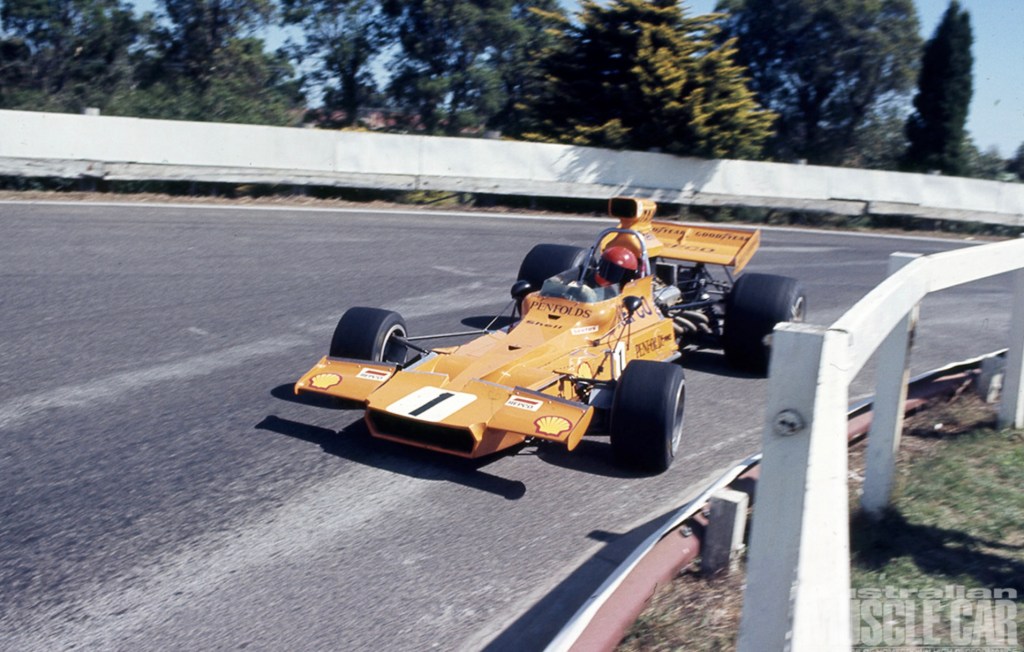
(C Lynch-SLNSW)
Back where we started, Gnoo Blas in 1956, how did Jack do in the touring car races that weekend, and who is at the wheel of in that little VW Beetle 1200!?
Credits…
Cec Lynch-Pix-State Library of New South Wales, Bob Williamson Collection, Les Mortimer, David Medley, Ken Devine, Kelsey Collection, Kaleda Family Collection, National Archives of Australia, ‘Bathurst:Cradle of Australian Motor Racing’ John Medley
Tailpieces…
(Lynch/SLNSW)
“Don’t even think about it kid, my 48-215 has been worked over by Jack Myers, you don’t have a chance!”
This shot is from a Pix puff-piece in 1955 promoting Italian toy cars for David Jones, a national department store chain. The little dude appears to be a handy-mechanic and would be 80’ish now. Chassis number and make of EV unknown…
Moore and his Kiwi Equipe Cooper T43 Climax FWB during the F2 London Trophy meeting at Crystal Palace on June 10, 1957
Ronnie Moore was an outstanding Kiwi sportsman, an international speedway rider who won the Individual World Speedway Championship in 1954 and 1959. He earned 13 international caps for the Australian national team, 50 for New Zealand and 21 for Great Britain in career that spanned 1949-75. In addition, he was a pretty handy F2 racer in 1957-58.
Born in Hobart, Tasmania, Australia on 8 April 1933, his father, Les Moore was also a champion rider who built a ‘Wall of Death’ in his backyard, and later turned it into a business, performing at Royal (Agriculture) Shows around Australia.
Ronnie began riding the wall at 13, then got his speedway start on an old Rudge after the family had moved to New Zealand in 1947.
Les stunned the NZ Speedway world when he rode the Rudge to a track record in Wellington, beating local star Bruce Abernethy. Les then got an offer to help set up a new track in Christchurch so the family shifted south.
While born in Australia, Ronnie always considered himself a Kiwi. He had to wait until he was 15 – the legal age to get a drivers licence – to have his first official race drive and later reckoned he could barely touch the foot-pegs on the Rudge when he lined up on the dirt track at Tai Tapu in 1948.
Kiwis Ronnie Moore and Barry Briggs from Australia’s Jack Young at Wembley during the September 1960 World Speedway Championship meetingWembley, September 1959, World Speedway Championship
In 1949, Moore began racing on a regular basis at his father’s Aranui Speedway in the Sandhills near Christchurch. He remembered counting the trucks as they brought all the dirt from the Lyttelton tunnel to create the track and arena.
Stuff.co.nz records that “His career clicked when he started riding a specialist, secondhand speedway bike his dad brought off Norman Parker,” a leading English racer who competed in New Zealand.
He moved to the UK in 1950. Wimbledon promoter Ronnie Green spotted his potential despite crashing through the wire-mesh safety fence on his first trial ride! He raced for the Wimbledon Dons in the British League, becoming team captain after two years, and continued with them until 1963, apart from two years in the late 1950s when he raced F2 Coopers.
“Speedway was second to football then in people going through the turnstiles, with crowds of up to 15,000 just for a league match.”
Moore was the youngest ever rider to qualify for a Speedway World Championship. He did that in 1950, aged just 17. Four years later, he became New Zealand’s first motorcycle world champion when he took the 1954 championship in front of 80,000 people at Wembley. Even more remarkable is that he was only 21 and took five wins from five starts, despite riding with a leg that had been broken badly not that long before in five places.
He had slid into a safety fence at a meeting in Denmark and stopped dead, his leg was bent around the bike’s handlebars. While the Danish doctors predicted a recovery time of nine months, Moore sought the advice of a Kiwi Harley Street surgeon who had made his name getting fighter pilots back in the sky quickly. His thigh to toe plaster cast was whipped off and the first of two braces were made which allowed the bone to heal, while reducing the rate at which his muscles would otherwise have withered.
Ronnie and Bruce Abernethy, Kiwi Stars both, in 1952 (A Jeffries)The two Moore family Kiefts – chassis C51-2 and C52-3 – as they left the factory en-route to New Zealand in 1951. Yes, the truck remained in the UK…(C Read Collection)
He was World Championship runner up in 1955-56 to England’s Peter Craven and Swede Ove Fundin. Fellow Kiwi, Barry Briggs won the championship in 1957-58 when Ronnie raced Formula 2 cars while at the peak of his powers.
He formed a two car team – Kiwi Equipe – with fellow EnnZedder Ray Thackwell – father of Mike – and they ran a pair of Cooper T43 Climax’s in 1957-58.
The pair of them went very well, not least in Ronnie’s case because he had been dabbling with cars at home each summer. He and his dad bought a pair of Kieft 500s in 1951, the small engines were soon replaced with supercharged 1000cc Vincent Black Shadow Vee-twins. The cars were very much outright contenders in the Formula Libre. Ronnie recalled in ‘The Ronnie Moore Story’ that “The result was electrifying. I was once clocked at 125mph down Wigram’s main straight – and I was still in third gear.”
One second hand Kieft post its Wigram Big One in 1952. Nice road car until that point! (R Dew)
Moore had a very lucky escape at Wigram in 1952. He came through Hangar flat-chat to find Don Ransley in the middle of the track, Ransley had spun Les Moore’s Alfa 8C2300 sportscar, “I piled straight in and the world started spinning around.”
“It was like hitting an express train, the Kieft somersaulted and came to rest upside down with me trapped underneath. I was conscious and couldn’t move, then fuel started running out of the tank and over me. I was in agony and there was real danger of the car exploding. The three or four minutes I was under the car seemed like an eternity. Appalled at what happened, Don Ransley through caution to the wind, leapt out of the Alfa and single-handedly turned the Kieft over…Apart from surface abrasions, there was nothing seriously wrong with me a few days in bed wouldn’t cure. The poor Kieft was a different matter, about all I managed to salvage was a wheel and a few bits of the motor. The Alfa hardly had a scratch!”
Ronnie’s car racing career included testing duties of this speedway car. The Allard designed and built ‘Atom’ was a prototype of a proposed fleet of cars being considered for racing on British speedways the following year. Wimbledon, September 1955. He was caught out and rolled over by track ruts, Ronnie broke his collarbone but recovered quickly enough (G Woods Collection)Cooper T43 Climax FWB, Brands Hatch 1957. Date unknown, the number doesn’t work for any of the Brands meetings Ronnie contested that year (Daily Mail)
In two truncated F2 seasons – about eight meetings in 1957 and six in 1958 – Ronnie did very well against seasoned F1 drivers and up-and-comers. His best results include a win against few cars at Roskilde, third in the Rochester Trophy at Brands and a fourth at Mallory Park. The race winners of meetings Moore contested were Jack Brabham, Tony Marsh and Roy Salvadori aboard Cooper T43s, and Maurice Trintignant on a factory Ferrari Dino 156.
His 1958 results included third at Brands in May and a pair of fourths in the Pau GP and Annerley Trophy at Crystal Palace. Race winners in his six ’58 meetings were the Trintignant, McLaren, Ian Burgess, Stuart Lewis-Evans and Syd Jensen Coopers (T43 and T45 Climaxes) and Cliff Allison’s Lotus 12 Climax.
Moore’s promising and way-too-short car racing career came to an end after a plea from his wife Jill, who was in hospital, giving birth to twin-daughters, Kim and Lea at the time. “She asked me if I’d quit. You break an arm or a leg in speedway, but you get over that. But three of your friends have been killed in car racing this year,” she said.
Ivor Bueb, Maserati 250F from Ronnie Moore’s Cooper T43 Climax during the September 1957 BRDC International Trophy meeting at Silverstone. Jean Behra won in a BRM P25, Bueb was ninth and Moore 17th (Getty)Crystal Palace, June 1957. The pair of Kiwi Equipe Cooper T43s – Ray Thackwell’s is the car beyond (Getty)
So Moore returned to Wimbledon for 1958, then in 1959 became Speedway World Champion again after fellow Kiwi Barry Briggs gave up some of his nitro-fuel so Ronnie could top up his tank before his fifth and final ride that day. He was runner-up again in 1960, to Fundin. Moore won the New Zealand Speedway Championship in 1956, 1962, 1968 and 1969.
He returned home in 1963 after another broken leg, the family was ready to stop shuffling between New Zealand and England. Ronnie invested in a motorcycle business and even re-activated the ‘Wall of Death’ show.
Sure enough he soon got the competitive twitches, feeling as though he had unfinished business and made a return to international racing in 1969, riding for Wimbledon and reaching the World Championship final at the ripe old age of 36. In 1970, he took the World Pairs Championship with fellow speedway great Ivan Mauger, at Malmo Stadium in Sweden .
At Belle Vue Stadium, Manchester in 1969Ronnie working on his bike in 1969. As to the make of frame and engine, your guess is as good as mine (Daily Mail)
1974 saw the first ’Battle of the World Champions’ series held in New Zealand and Australia, featuring four world champions: Barry Briggs, Ronnie Moore, Ove Fundin and Ivan Mauger. It was during the Jerilderie Park Speedway round in New South Wales that Moore nearly lost his life. His gear was stolen and he had to borrow someone else’s to ride. He crashed, suffering serious head injuries and was lucky to survive.
Moore was awarded an MBE in 1985 by the Queen, is a member of the Motorcycle New Zealand, New Zealand Sports and World Speedway Halls of Fame and won the Canterbury Sports Legends award in 2014. The Canterbury Park Motorcycle Speedway was renamed the Moore Park Motorcycle Speedway.
Twice World Champion, three times World Championship runner up, four times New Zealand Champion, World Pairs Champion and many other career achievements, Ronnie Moore is a great icon of New Zealand motorcycle sport, he died of lung cancer in Christchurch on August 18, 2018, aged 85.
(G Woods Collection)
Jill, Ronnie, Shani, Gina, Kim and Lea Moore at home circa 1972.
Etcetera…
While Ronnie was enjoying success in the UK, Les had acquired two Jano Alfa Romeos, an 8C2300 (chassis number please?) and no less a P3 than chassis #50005, the car with which Tazio Nuvolari belted the Silver Arrows by winning the 1935 German Grand Prix.
Moore found the P3 tricky to drive but won the Lady Wigram Trophy on the RNZAF airfield of the same name in 1951-52. Les died at the wheel of a celebrated NZ Special, the RA4 Vanguard, at Saltwater Creek, Timaru in October 1960 after the car rolled.
Valerie, Clarice, Les and Ron Moore with P3 Alfa Romeo after the 1952 Lady Wigram trophy victory (G Woods Collection)Moore at Wimbledon in 1955 (unattributed)
As mentioned above, the Atom was built by Allard to the order and brief of Wimbledon Speedway owner Ronnie Green in 1955, he was keen to ‘spice-up the show’.
Powered by a 500cc JAP speedway and clutch assembly, the 64-inch wheelbase car used an Allard Clipper chassis and many Ford components. Two were built. Click here for a great article about the project on The Allard Register website: http://www.allardregister.org/blog/2010/7/9/the-allard-atom.html
(unattributed)(unattributed)
Showtime! Date and place unknown. “Ronnie Moore on the Bally-rollers and Graham Pickup with the microphone. A free show outside the wall to attract punters to the show,” recalled Lindsay Mouat.
Craig Norman chipped in, “I was too scared to watch the actual show but I vividly remember watching spellbound at his outside display. He had perfect control and balance.”
(unattributed)
Credits…
This piece uses as a base an article written by Motorcycling NZ historian Ian Dawson on the occasion of Moore’s admission to the MNZ Hall of Fame in 2012. Getty Images, F2 Index, Graham Woods, Chris Read Collection, ‘The Ronnie Moore Story’ by Rod Dew, Alan Jeffries, Lindsay Mouat, Craig Norman
Tailpiece…
Ronnie Moore, Geoff Mardon, Ove Fundin, George White and Peter Craven prepare to compete in the Speedway World Championship at Wembley in September 1959.
All of these PR shots were taken during daytime, before the crowds arrived…
“A group of Rileys during the (Victorian) Centenary Grand Prix – January 1 1935 – weekend at Phillip Island,” wrote David Trunfull.
“The Ulster Imp is being driven by Bill Williamson, his passenger is Air Commodore Johnny Summers. The Brooklands #6 is being driven by Bill Galpin from New Zealand, the passenger is MC Shmith. This car is the ex-Riley works car that won the 1933 AGP driven by Bill Thompson. Brooklands 63.902 is being driven by Merton Wreford, his passenger is Alan Wyatt, the source of this photo. Wreford worked for the Riley distributor, BL Cohen.”
Another shot from the same event. “#6 is the Bill Thompson 1933 AGP car. It was brought over specially for the Centenary 300 by Bill Galpin but for some unknown reason it didn’t take place in the race.”
Trunfull, “The ex-Riley team car was raced in the UK by Sir Malcolm Campbell, AK v.d Becke and Sir Chris Staniland.” “The Brooklands also won the 1949 inaugural Lady Wigram Trophy (on the RNZAF Christchurch airforce base of the same name ) in the hands of Morrie Proctor. It still resides in Christchurch,” chipped in John Newell.
The car on the right is another ex-Riley team car which is said to have been a spare for the 1934 Ulster Tourist Trophy. BL Cohen Pty Ltd imported it in 1934, Bill Williamson raced it for them. The Head brothers later owned and raced it, fitting a 12/4 race engine.”
“This car (the Imp) is now one by Ian Ruffley’s family, the original Ulster Imp engine is probably fitted to the late Terry Moran’s car,” wrote Jim Runciman.
This shot from Tony Johns “was taken during the 1932 AGP weekend at Phillip Island.” #14 is the ninth placed Bill Williamson driven Riley, car #19 Ken McKinney’s Austin 7 DNF. Bill Thompson won the race in a Bugatti T37A.
A bit of trivia, “if you enlarge the photo, the open door on the left has CRD (Cyril Dickason) and RCM (Clarrie May) and CRW (Cec Warren) who would have shared the same garage when they raced Austins in the 1931 AGP the year before.”
Credits…
The Car, David Trunfull, Jim Runciman, John Newell, Tony Johns, VSCC NSW Archive
Bruce McLaren tips his Cooper T70 Climax into Shell corner at Sandown during the 1964 Tasman Cup round – the Australian Grand Prix – DNF engine in the race won by Jack Brabham. See here: https://primotipo.com/2020/04/20/mclaren-cooper-t70-sandown/
The ‘first McLarens’ – two Cooper T70s – built by Bruce McLaren and Wally Willmott at Coopers in late 1963 have been very much in the news, and star of the historic show at the 2024 Australian Grand Prix carnival given it’s 60 years since Bruce McLaren won the very first Tasman Cup driving the two T70s that summer. Bruce won three of the eight rounds – NZ GP at Pukekohe, Lady Wigram Trophy and Teretonga International – in this car #T70 FL-2-64, so too did Jack Brabham (Brabham BT7A Climax), but Bruce had the better haul of points.
Sadly, Tim Mayer crashed the car Bruce is driving above, to his death at Longford three weeks after Sandown. The surviving car (#FL-1-64) is owned by Adam Berryman, proudly showing off a car which has been in the family since 1974 at Government House, Melbourne on March 21. See here for more about the T70: https://primotipo.com/2016/11/18/tim-mayer-what-might-have-been/
(M Bisset)(M Bisset)(Eisert Family)
Aussie Ace, Bob Muir alongside the ex-Gary Campbell/Jones-Eisert Lola T330 Chev HU14 during the 1973 US L&M F5000 Championship round at Laguna Seca. Jerry Eisert is alongside Muir, John Wright is attending to the right-front, with Peter Molloy in the white top to the left.
Reg Hunt’s Maserati A6GCM/250 during the 1955 Moomba TT meeting held at Albert Park on March 26-27. I’m not so sure its the prosperous motor dealer owner at the wheel.
Hunt had a great weekend with his new car – a 2.5-litre Maserati 250F engined A6GCM – winning the Argus Cup 50-miler and one heat of the Argus Trophy 50-mile feature. He led the final until the red car’s crown wheel and pinion failed, giving Doug Whiteford’s well driven old Talbot-Lago T26C a lucky win.
Hunt turned the local scene on its head with this car, it was the most recent Grand Prix car imported to Australia for many a long year. All of his motor dealer rivals had to reach way-deep into their pockets to keep up with the Brighton Road dealer. See here for more on this car: https://primotipo.com/2017/12/12/hunts-gp-maser-a6gcm-2038/
Holden 48-215 at Albert Park was about the extent of the State Library of Victoria caption, before 1970 Australian Rally Champion, Bob Watson came to the rescue.
“It’s a BP Rally of the 1950s, possibly Lex Davison driving. A sub-event in Albert Park at the end of the rally, later events finished at Chadstone Shopping Centre on Mother’s day in front of huge crowds.” See here: https://primotipo.com/2018/12/06/general-motors-holden-formative/
(SLNSW-R Donaldson)
Ross Jensen on the way to victory of the 1959 Bathurst 100 held over the Easter long-weekend, Maserati 250F, #2509/2504. He is negotiating Hell Corner before heading up Mountain Straight.
It was a terrific win by the visiting Kiwi, all of our Top-Guns were there but Ross beat the lot: Stan Jones, Arnold Glass, Len Lukey, Alec Mildren, Doug Whiteford and others. He was as sharp-as-a-tack having raced for the works-Lister Jaguar team in Europe in 1958 upon the recommendation of Archie Scott Brown who had raced his works-lister in New Zealand in the Summer of ’58 and was impressed by what he saw.
That’s Len Lukey congratulating him below, #5 is Len’s Cooper T45 Climax 2-litre, the 250F on the far side is Glass’s. Love the proboscis…
(SLNSW-R Donaldson)(Auto Action)
Colin Bond, Holden LH Torana SL/R 5000 L34 during the 1975 Phillip Island 500k enduro, a round of the Australian Manufacturers Championship.
1948 Australian Grand Prix winner, Frank Pratt, and passenger Alick Smith at Phillip Island, date unknown. Pratt, a Geelong motor cycle dealer and racer, had famously barely done any car racing when he won that Point Cook, RAAF Airbase, AGP (photo below). See here: https://primotipo.com/2021/09/27/werrangourt-archive-10-george-martins-bmw-328/
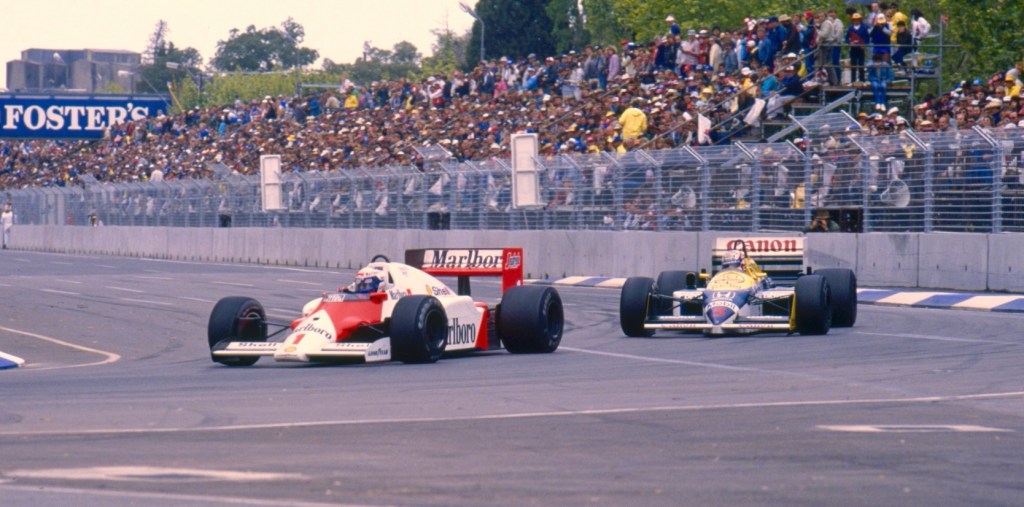
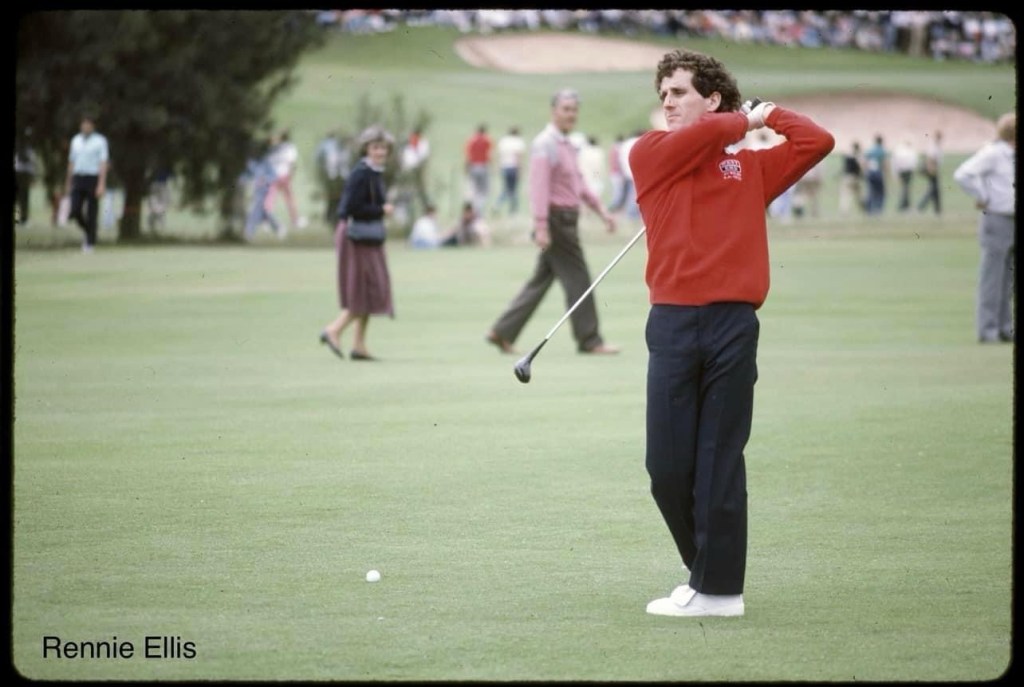
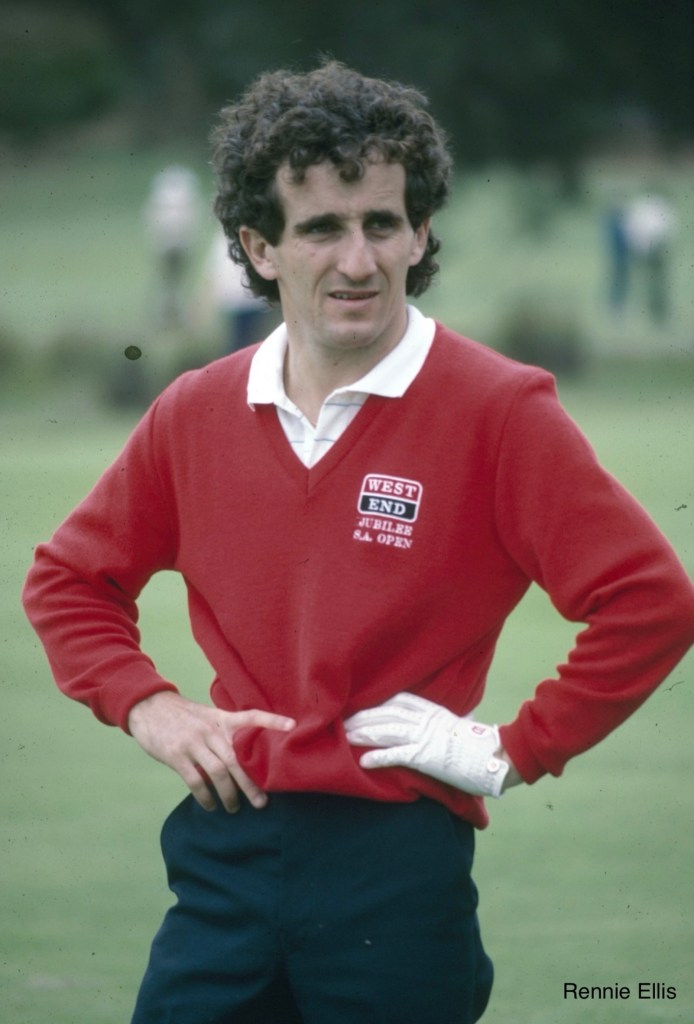
Alain Prost during the West End Jubilee South Australian Open Pro-am golf tournament held at Kooyonga during the 1986 Australian Grand Prix week in Adelaide.
He looks pretty relaxed, and the weekend worked out mighty fine too.
Poor old Nigel had his 180mph Williams FW11 Honda 1.5 V6 tyre blowout, so his teammate Piquet was brought in for a precautionary tyre change and Alain’s McLaren MP4/2C TAG-Porsche 1.5 V6 won the race…and the title(s) in a thriller-diller of a race: Drivers and Constructors.
Glen Dix flags an ecstatic Alain Prost home in the 1986 AGP. His McLaren wasn’t as fast as the FW11 Williams that year but he chipped away with a mix of speed and consistency: the Fab-Four in ‘86 were Mansell, Piquet, Senna…and Prost(SLV)
Sportscar grid at Warwick Farm circa 1967. Frank Matich, Matich SR3 Oldsmobile, Bob Jane, Elfin 400 Repco, Glyn Scott’s Lotus 23B Ford and Bill Brown – perhaps – in the Scuderia Veloce Ferrari 250LM. More on Matich’s Ferrari muncher here: https://primotipo.com/2023/04/02/matich-sr3/
Nigel Mansell blasts away from a pitstop on the Surfers Paradise road circuit during the March 21, 1993 Australian Indycar Grand Prix, Lola T93/00 Ford Cosworth XB V8.
In a portent of things to come that year, series debutant Mansell won the opening round of the ’93 CART Championship. He won five of the 16 rounds, and the championship with 191 points, fellow ex-F1 World Champ, Emerson Fittipaldi was second on 183, Penske PC22 Chev.
(C Denby)
Not so much thought of as a racing car in Australia, Leyland’s P76 4.4-litre V8 got a run in New Zealand’s annual B &H 1000 enduro, in this case the 1975 event at Pukekohe.
This one was raced by the very experienced and successful David Oxton and Garry Pederson who finished fourth, the winning car was another Australian car, a Valiant Charger – usually dominant in this race – driven by Wayne Wilkinson and Bryan Innes.
Chris Denby, in an amusing Facebook post relates the story of the exhaust problem which befell the similar car raced by Dauntsey Teagle and Jim Murdoch. “Over a few laps its impressive engine became ‘uncorked’, which injected some great V8 sound into its otherwise fairly subdued race noise.”
“Suddenly it sounded more lie a stock-car than a production saloon – very impressive in the stand. The stewards were quick to act, within minutes a message came over the Tannoy asking if any spectator had a P76 V8 in the carpark would he allow his car to be relieved of its exhaust system to help a race team on the track (they faced exclusion otherwise).”
“That approach didn’t work. A later Tannoy message said, ‘If a spectator with a Leyland P76 notices a much louder than normal exhaust note upon leaving the track, don’t worry, the race mechanics will fix it before you depart…”
(MotorSport)
Vern Schuppan contesting the Race of Champions at Brands Hatch in March 1973, BRM P160D.
The Victorian Governor’s Australian GP party is a wonderful event on the Thursday before the race, here is Jenny and Vern Schuppan on March 21, 2024.
Vern has just turned 81 and is a sharp as a tack. The couple live in a penthouse apartment in the Adelaide Markets – on the AGP course – and split their time between there, visiting their son and family in Melbourne, their daughter in Cambridge, and another home in Portugal.
(M Bisset)(SLNSW)
Fred Withers at Penrith aboard the Marcus Clark & Company owned Cleveland Six racer, circa 1925.
It’s hard to believe that department stores once sold cars, but there-ya-go! This company was founded by Marcus Clark in Newtown, Sydney in 1883 and by the early 1900s was a colossus operating from buildings like this on the corner of Pitt and George Streets, Railway Square, Sydney.
(Hall & Co)(Nambour Chronicle January 22, 1926)
Withers raced the Cleveland Six at Penrith and Maroubra Speedways in New South Wales/Sydney and at Aspendale, outside Melbourne in the 1920s. He was also a record-breaker of some repute using Cleveland and Essex products.
He was famous at the time for some crazy jumps performed with his Essex to gain column-inches in the dailies, this shot was taken in 1927.
(J Sherwood Collection)(P Jones)
Frank Matich contesting the 1970 New Zealand Grand Prix in his much-modified McLaren M10A Chev at Pukekohe. FM had a pretty good Tasman Series, winning here at Pukekohe and at Wigram a week later. While he had the pace, he didn’t have Graeme Lawrence’s Ferrari Dino 246T reliability. Graeme prevailed by five points, 30 to 25.
(T Glenn)
A little later, from 1971-74, Frank Matich and his small team designed and built six F5000 cars: three A50s, two A51s – one A51 evolved into the short-lived A52 – and this A53, the very last of the breed.
Matich A53/007 in build in FM’s ‘shop in Military Road, Cremorne in late 1973 (D Kneller)
Credits…
Getty Images, State Library of Victoria, Charles Pratt-State Library of Victoria, Rennie Ellis, MotorSport Images, Chris Denby, Peter Jones, John Sherwood Collection in ‘Half a Century of Speed’ by Tony & Pedr Davis and Barry Lake, Bob Williamson Collection, Eisert Family Collection, Derek Kneller, State Library of NSW-Lynch, Tony Glenn, oldracingcars.com
Maybach 2 on display at the Melbourne International Motor Show, Exhibition Buildings, April 1-10 1954 (D Zeunert Collection)
A while back I published an article about Maybach 1, the first in a series of three chassis – four cars – built by Charlie Dean/Repco Research and Ernie Seeliger between 1947 and 1958. Click on this link to that piece: https://primotipo.com/2024/01/15/maybach-1-technical-specifications/
As with that article, this one is also a copy of the technical specifications and evolution of these machines published in the Australian Motor Sports Annual 1958-59. The author’s name isn’t cited, so I’ve credited it to John Goode, the book’s editor.
The photo choices are mine, so too the are the Notes sections. I’m taking as-read a general knowledge of Maybach, but if you need a refresher, click on the links at the end of this piece.
(L Sims)
Introduction…
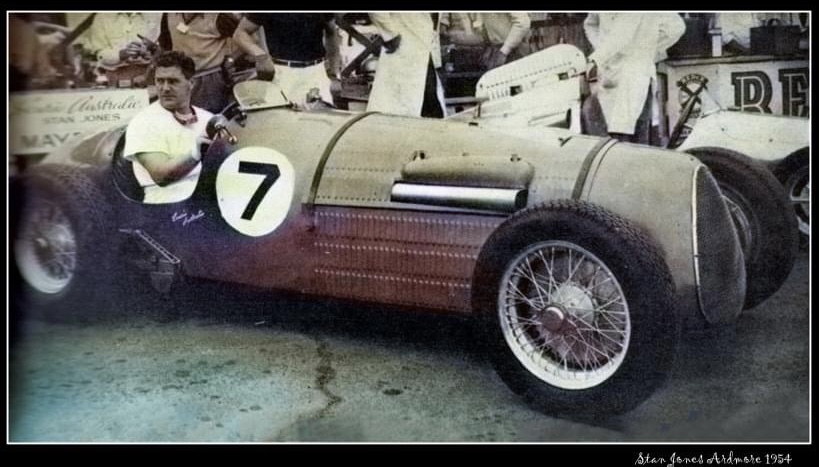
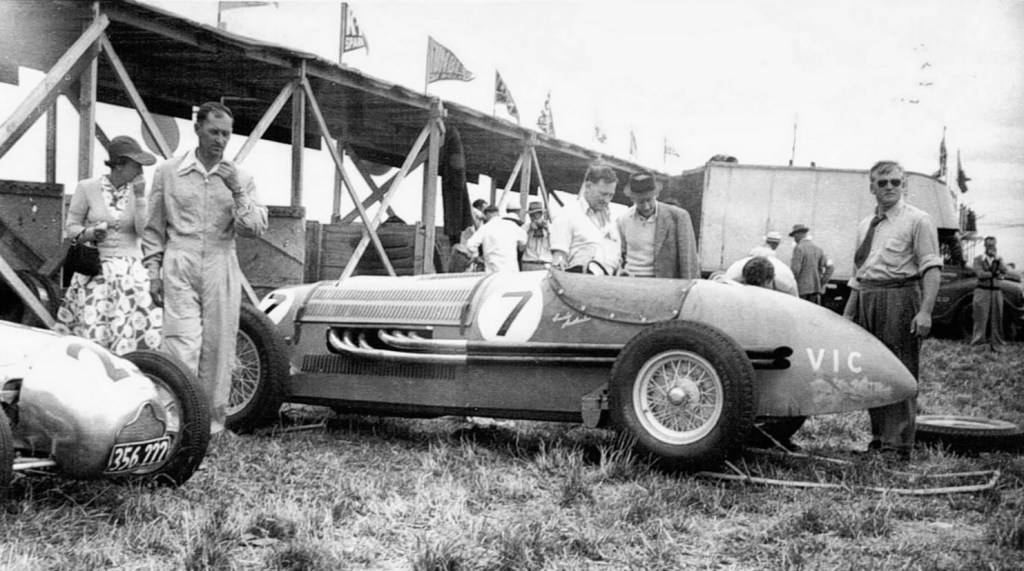
Here are three photographs to illustrate the journey from Maybach 1 in 1947 to Maybach 1 Series 3 – the 1954 New Zealand Grand Prix winner in Stan Jones’ hands – to get us to the start of this article, Maybach 2, which commenced its life in April 1954.
The shot above shows Charlie Dean and the brave Jack Joyce aboard Maybach 1 at Rob Roy during the Melbourne Cup long-weekend in November 1947. What a wild road car the beast would have made, the car received its body immediately prior to the 1948 Australian Grand Prix held at Point Cook, in Melbourne’s inner-west.
(G Thomas)
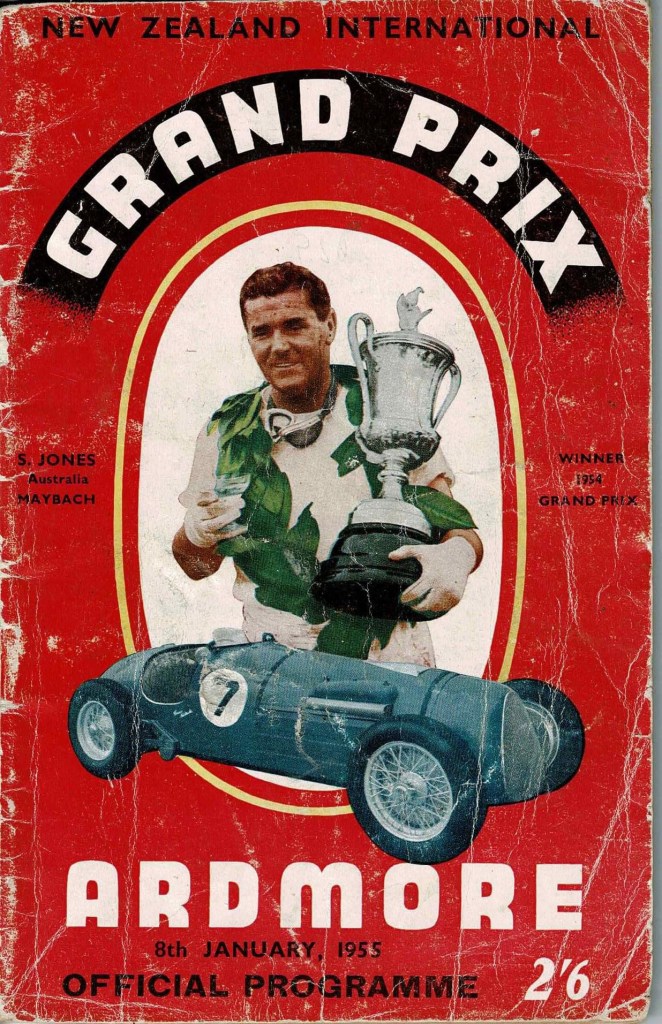
The shot above shows Dean on-the-hop at Rob Roy in 1948 – Maybach 1 painted in its original white – and below coloured blue, on test at Willsmere, near Dean’s Kew home circa 1951. And then below that, the Repco advertisement shows Maybach 1 Series 3 winning the 1954 NZ GP at Ardmore.
(D Stubbs)Compare and contrast: Maybach 1 Series 3 above, with Maybach 2 below (B Caldersmith)
MAYBACH II (April 1954-November 29, 1954)…
ENGINE: 6 cyl. in-line single oh. camshaft. Bore and stroke: 91 × 110mm. Capacity: 4,250 c.c. Output: 257 b.h.p. at 5,000 .p.m. (bench tested). Carburettors: Three 2 3/16″ S.U. Compression Ratio: 11 to 1. Fuel used: 60% Methanol, 20% Benzol, 20% Aviation Petrol Octane rating: 110. Cast iron cylinder block with wet liners.
Single casting cast iron cylinder block and crankcase, with sump joint well below the crankshaft centre line. Crankshaft machined all over and fully counter balanced, running in eight white metal lined bearings, one between each crank throw and an extra one behind the camshaft drive pinion situated at rear end of crankshaft. Wet liners fitted to cylinder bores with lightweight balanced connecting rods and other reciprocating parts.
Single camshaft running in seven white metal bearings, opening valves by means of rocker arms fitted with eccentric bushes which could be rotated and locked to adjust valve clearances. Rockers had roller cam followers. Valves inclined at 65 degrees in hemispherical head and located on opposite sides. Helical timing gears with idler (originally compounded fabric, but replaced by steel).
Wet sump lubrication through filter with pressure fed oil supplied to centre main bearings, then to other caps, and through the crankshaft to big end bearings. Also fed to valve rocker shafts and camshaft bearings.
Complete body and chassis redesign converting it into a single seater. Mk. I Series 3 Maybach motor used.
NOTES:
The wording in relation to the chassis is misleading. Maybach 1’s chassis was set aside – tired and much modified as it was – and a new single-seater chassis was designed and fabricated for Maybach 2.
The engine came from a German half-track vehicle captured during the Middle East campaign and shipped to Australia for technical study by the military.
Maybach 2 in the Southport paddock during the November 1954 Australian Grand Prix meeting, racer, Owen Bailey at far left (VSCC Collection)Stan being pushed onto the grid. He led the race before a chassis weld broke on lap 14 of 27, pitching him down the road at high speed. Jones was miraculously ok but Maybach 2 was very dead (J Psaros)
TRANSMISSION: Gearbox: four speed using Fiat 525 case with Repco manufactured gears. Ratios: First- 7.08:1 Second-4.94:1 , Third-3.78:1, Top-3.14:1.
DRIVESHAFT: Dropped to pass beneath back axle and driving a short forward shaft into differential through two helical gears, easily accessible from rear, permitting alteration to overall ratios up or down by 3%. Differential: Resembled American Four Lock locking type constructed by Repco workshops from their own and American components. Rear Axle: Vibrac type high tensile steel.
CHASSIS: Frame: Based on two 4″ dia. 16 gauge steel tubes.
Suspension: Front – Independent with wishbones and Delco shock absorbers with low placed 3 leaf traverse spring. Rear Panhard type with reversed quarter elliptic springs and torque arms anchored to heavy cross member linking two main longitudinal tubes of the chassis. Tubular Monroe Wylie shock absorbers.
Steering: Peugeot rack and pinion.
Brakes: Paton’s Hydraulic using twin parallel master cylinders, one operating front and one the rear. Action on both integral but operation separate permitting one set in action if others fail. Front shoes, twin leading design with I6in. special helically finned drums, cooled by air scoops to forward sides. Rear shoes of leading and trailing type in 14 in. drums.
Wheels: Locally constructed wire type with Rudge Whitworth hubs. Front 18″ dia. Tyres: 5.25 × 18. Rear 16″ dia. Tyres: 7.00 x 16.
Body: Single light aluminium shell easily removable in three seclions. Fuel Capacity: 25 gallons in tail mounted aluminium tank.
Dimensions: Wheelbase 94″ • Track: Front 4 ft. 3 ins. Rear 4 ft. I ins. Weight: 16 cwt. Power/weight ratio: 7 Ibs. per b.h.p.
“Rare photograph showing the front crossmember of Maybach 2 where the chassis tube broke” (S Scholes Collection-Wheels May 1955)
NOTES:
In many ways Maybach 2 was the one that got away…
It went like a jet from the start, Jones won the Victorian Trophy at Fishermans Bend in March 1954 on its race debut, then won again at the Easter Bathurst meeting where he took the two preliminaries before gearbox failure scuttled his run in the feature. He was victorious again at Altona in May and was second to Jack Brabham’s Cooper T23 Bristol there in June. At Fishermans Bend in October he had gearbox failure again.
Then it was off to Southport for the AGP in November where Stan simply drove away from the field until the chassis weld failure caused the massive accident that destroyed the car, and from which Jones very fortunately walked away…
This 4.2-litre 257bhp @ 5000 rpm, 725kg monoposto was one helluva fast racing car.
In the woulda-coulda-shoulda stakes were the battles we never got to see with Stan aboard Maybach 2 and Reg Hunt’s Maserati A6GCM/250 in 1955. Hunt upped the local ante big-time when he imported a current GP car, and was immediately quick in it, his talent refined with some 500cc F3 racing aboard a Cooper MkVIII in Europe in 1954.
Reg’s Maserati gave about 240bhp @ 7200rpm and weighed between 500-580kg. Both the Maserati and Maybach 2 had four-speed ‘boxes, IFS and live-rear axles. Maybach’s weakness was its ginormous, all cast iron engine which weighed circa 320kg; let’s not forget it was designed for the German military not competition use. The 250F engine’s quoted weight is 197kg, much of the weight differences between the two cars is in engine weight.
While torque figures for Maybach 2 weren’t quoted, the long stroke 4.2-litre six would have produced more torque than its twin-cam Italian competitor but not, one suspects, enough to offset the considerable weight disadvantage.
Whatever the case, when Maybach 2 was destroyed at Southport, all of the momentum gained by building, racing, and refining the car was lost. Maybach 3 (below) didn’t appear until the April 1955 Bathurst 100 weekend when the team started the process again, by which time Reg was used to and exploiting his car successfully.
What is my point? The Repco-Maybach program effectively ended post-Southport, with only one remaining engine to instal in Maybach 3, a 3.8-litre unit at that. Stan confronting Reg in 1955 aboard Maybach 2 really would have been something to see…woulda-coulda-shoulda.
AMS Annual 1958-59Jones in Maybach 3 during the 1956 South Pacific Championship (R Donaldson)
MAYBACH III (1955 – Jan 1956)…
ENGINE: 6 cyl. in-line inclined 60 degrees to left. Shortened stroke crankshaft (approx. 10% ). Bore and stroke: 90 × 100 mm. Capacity: 3,800 c.c. Compression Ratio: 11 to 1. Power Output: 260 b.h.p. at 5,000 r.p.m. Direct fuel injection by Dean and Irving.
TRANSMISSION: Clutch: Repco single plate. Gearbox: Four speed with top overall ratio 3.2 to 1. Drive: Open propeller shaft passing on right of driver to offset differential. Differential: limited slip (as previous model).
Charlie Dean at Rob Roy, date unknown. The competition debut of Maybach 3, was at Templestowe Hillclimb on May 8, 1955. 68.56sec where Dean was third in the over 3-litre racing car class (SLV)(SLV)(Davey-Milne)Rob Roy again. Despite the fuzziness, note the the considerable reduction in engine height achieved by the 60-degree laydown of the Maybach six (Davey-Milne)
CHASSIS: Frame: Built up from two 4″ dia. steel tubes, linked by transverse tubing. Redesigned body of flatter appearance due to inclined engine.
Suspension: Front – Independent with transverse leaf spring set low. Rear Quarter elliptics with radius rods.
Dimensions: Wheelbase 95″. Track Front 4 ft. 3 ins. Rear 4 ft. 1 in. Steering: Marles box and divided track rod.
Maybach 3 in the Gnoo Blas paddock in 1956. Trumpets of Repco built fuel injection clear (B Caldersmith)(B Caldersmith)
NOTES:
The beginning of the end. Jones (above) is an absolute bolter at the start of the January 1956 South Pacific Championship at Gnoo Blas, New South Wales.
Reg Hunt’s new Maserati 250F is way back here but will reel Stan in. Being pushed hard to hang onto the very best European F1 car of the day, the Maybach engine let go in a big way.
Jones had a 250F several months later. Stan let his good friend, ace engineer/mechanic/racer Ern Seeliger loose on Maybach, its evolution to Chev Corvette 283 V8 power and other modifications – Maybach 4 – was soon underway.
(B Caldersmith)(AMS Annual 1959-60)Stan Jones, Maybach 4 Chev, Australian Grand Prix, Lowood, June 1960 DNF engine (B Thomas)
MAYBACH IV March- 1958…
ENGINE: Chevrolet Corvette 8 cyl. Vee motor. 4.6 litre. Compression ratio: 9.2:1. Bore and stroke: 98.501 × 76 mm stroke. 2 four-barrel Carter Carbs. 274 b..p. at 6,000 r.p.m. 300 Ibs. torque at 3,500 r.p.m. All oilways completely modified. Bearings altered in regard to oil ways. Engine dry sumped. Modified cooling system.
GEARBOX: As previous Maybach. Drive: As previous Maybach. Differential: As previous Maybach modified with shortened axles incorporating constant velocity joints. Clutch: Seeliger designed and built multi-plate clutch.
CHASSIS: As previous Maybach but chassis lengthened lo take Di Dion rear end. New 30 gallon fuel tank fitted.
Suspension: As previous Maybach with mods. to front end by fitting an anti-roll bar incorporating brake forque rods and transverse leaf in place of quarter eliptics at rear.
Dimensions: Same as previous Maybach, but rear track widened to 4 ft. 2 ins. All up weight reduced to 14} cwt. with 4 gals. of petrol. Full oil and water.
NOTES: Ern Seeliger first ran Maybach 4 at Fishermans Bend in March 1958.
In one of The Great Australian Grands Prix, Stan Jones, Maserati 250F, Lex Davison, Ferrari 500/625 and Ted Gray, Tornado 2 Chev battled up front for most of the ‘58 race on Mount Panorama until Lex was the last-man-standing. Ern Seeliger drove a great race into second, with Tom Hawkes third in his much modified ex-Brabham Cooper T23 Repco-Holden.
Jones proved further the pace of Seeliger’s final Maybach evolution by winning a Gold Star round in it at Port Wakefield in 1959. It would have been very interesting to see what times Stan could have done in Ern’s car in practice at Bathurst over that ’58 AGP weekend!
(AMS Annual 1958-59)
Etcetera…
(VHRR Archive)
Prettiest of the lot in my opinion…Stan the Man on the way to winning the Victorian Trophy at Fishermans Bend in 1954, Maybach 2.
(B Caldersmith)Maybach 2 in the Southport paddock over the 1954 AGP weekend (J Psaros)
Starting grid of the 1955 Australian GP (or is a heat, whatever) at Port Wakefield, South Australia. #5 Reg Hunt, Maserati A6GCM/250, Jones, Maybach 3, #8 Tom Hawkes, Cooper T23 Bristol, #6 Jack Brabham in the winning Cooper T40 Bristol and #10 Kevin Neal, Cooper T23 Bristol.
This is a good contextual shot showing Jones in Maybach 3 – Mercedes W196 styling influence clear – among current’ish European cars: Reg Hunt’s Maserati A6GCM 2.5 – the so-called interim 250F – two Cooper T23s of Tom Hawkes #8 and Kevin Neal. Plus the nose of the winner and newest car here, Jack Brabham in the mid-engined Cooper T40 Bristol he built in time for the British Grand Prix at Aintree that July.
(G McKaige)
The final evolution of the Dean/Repco Research Maybach engine development programme. ‘Short-stroke’ 3.8-litre and fuel injected delivering circa 260bhp @ 5000rpm. George McKaige took this shot of Maybach 3 at Fishermans Bend in October 1955. I wonder what that plate in the engine bay says?
(Q Miles)
Great colour photograph of Maybach 4 Chev in the Lowood paddock inJune 1959. Note how the twin-Carter-carbed Corvette 283 V8 is offset to the right allowing the driver to sit low to the left rather than high atop the driveshaft.
Credits…
Australian Motor Sports Review 1958-59, Brian Caldersmith, Brier Thomas, Jock Tsaros, Davey-Milne Family Collection, George McKaige and Chester McKaige via their superb two ‘Beyond The Lens’ books, Stan Griffiths, Dacre Stubbs, VSCC Vic Collection, J Montasell, Clem Smith, Quentin Miles, Ron Edgerton Collection
Tailpiece…
(K Drage)
Towards the end of a very long competitive Maybach road.
Stan Jones lines Maybach 4 Chev up alongside Alec Mildren’s tiny, mid-engined 2-litre Cooper T45 Climax before the start of the South Australian Trophy, Port Wakefield Gold Star round in March 1959.
Jones won the race from Len Lukey and Keith Rilstone – it was the last championship level win for Maybach in-period.
One of my true racing loves is the 1970 F1 Ferrari 312B and its successors.
I’ve done it to death of course, this article tells its story in detail: https://primotipo.com/2016/02/26/life-is-all-about-timing-chris-amon-and-the-ferrari-312b/ But this series of shots of an engine change during practice in Clay Regazzoni’s 312B/001 during the 1970 German GP weekend at the Hockenheim Motordrom are too good to ignore. We’ll make this the first of a similar series of a largely pictorial nature.
Doug Nye characterises this Mauro Forghieri – and team – designed machine as one the best integrated F1 Ferraris. The photographs here convey clearly why this is so.
Clay Regazzoni and Jacky Ickx, Ferrari 312Bs sandwich the winning Lotus 72C Ford of Jochen Rindt during the early laps at Hockenheim (LAT)(LAT)
The four main-bearing twelve cylinder engine – a Flat-12 or 180-degree V12 – depending upon your engineering religion of choice – was a paragon of reliable power after the early challenges experienced largely by Chris Amon circa-September 1969 were overcome.
These shots show how low, wide and compact it was. All that weight sat low in the chassis with the wild monocoque carrying the engine ‘underslung’. At that early stage of its development, Ferrari quote an output of 450bhp @ 12000rpm, a capacity of 2991.01cc and bore/stroke of 78.5×51.5mm.
(LAT)
Devoid of tyres, Regga’s #312B/001 sits on its tummy.
Note the inboard rocker front suspension – Ferrari had used this set up continually since the 1963 156 Aero – and clever way in which the aero-element rollbar stay ‘triangulates’ the monocoque boom. Oh to have been there to watch the engine replacement!
Ferrari still used their ‘Aero semi-monocoque’ at this stage, in that the tubular steel chassis had aluminium panels riveted to it with the engine used as a semi-stressed member.
Five of these chassis were built: 312B/001 – #312B/004 albeit #312B/002 was re-tubbed after Jacky Ickx’ collision with Jack Oliver’s BRM P153 during the 1970 Spanish GP. All four cars exist, what lucky owners they are! See oldracingcars.com for chassis by chassis details: https://www.oldracingcars.com/ferrari/312b/
#312B/001 was Ickx’ usual chassis throughout that season: the Austrian, Canadian and Mexican GP winner. As the chassis number suggests, this machine was the first built. It was entered for Chris Amon in the 1969 Italian Grand Prix but failed to take to the track after engine failure in three test sessions at Modena in the lead up to Monza.
(LAT)
Jochen Rindt won the Hockenheim race that weekend during the mid-season run of victories – the Dutch, French, British and German GPs – that gave the fearless Austrian enough points to win the World Drivers Championship posthumously. With a little more luck it could have been Jacky Ickx, but karma, thankfully prevailed.
In Germany the top-three qualifiers were Ickx, Rindt and Regazzoni. While the Ferrari challenge was strong, newcomer Regga – who won the Italian GP in September – led laps 22 and 23 of the race and was then slowed and retired with gearbox trouble in the 50 laps race.
Rindt’s win from Ickx was a good one, Denis Jenkinson noted in MotorSport that “As was very evident in Zandvoort it was the Lotus 72 showing superiority over the other competitors, rather than the driver…he (Rindt) won by only 0.7 sec from Ickx but the win was convincing as he was able to pass the Ferrari whenever he wished…”
(LAT)
More often than not the floor is a key contributor to the structural rigidity of both spaceframe and monocoque chassis – glued and riveted as they often are – but apparently not so much with this Ferrari, the floor of which was seemingly located by removable bolts. There are rubber fuel-bags within the monocoque on each side, mandated by the FIA from 1970.
(LAT)(MotorSport)
Front suspension long top rocker and wide based lower wishbone, steering rack and steering arm mounting ‘ear’ on the upright on one of the 312Bs at Kyalami during the 1970 South African GP weekend.
Credits…
LAT Images, oldracingcars.com, Ferrari.com
Tailpiece…
(LAT)
Is Borsari the mechanic? I know the face of the longtime Scuderia man, I’m just not so sure of the name. Look how Forghieri is shifting weight to the very rear of the car: the Varley battery and neatly faired oil radiators. Outboard rear suspension is period-typical: cast magnesium uprights, single top links, inverted lower wishbones and twin radius rods, plus coil-spring/Koni dampers.
This is the second in an occasional series of articles plucked from the early issues of Autocourse, via the collection of my friend, racer and historian, Tony Johns.
In the unlikely event one could find Formula 1 articles of a technical type amongst all of the ‘Drive to Survive’ inspired dull, shit-boring, insipid dross in most magazines these days, one on racing spark plugs would be the last to expect!
These days they are a purchase-instal-and-forget item but once upon a time one’s méchanicien needed to be able to anticipate, read, and change plugs to suit the changing weather and other circumstances throughout a race weekend. Remember the shots of a mechanic labouring in the pits and paddock under big wooden boxes of plugs?
This article was written by Herr G Werner, a Bosch employee.
Oh yes, the opening shot is before the off, Spa, the Grand Prix de Belgique, June 17, 1951. Juan Manuel Fangio #2 is on pole in his Alfa Corse Alfa Romeo 159 with Giuseppe Farina alongside in another Alfa; the 1951 and 1950 World Champions of course. Farina won from the pair of Scuderia Ferrari Ferrari 375 V12s driven by Alberto Ascari and Luigi Villoresi.
Car #12 on the second row is Piero Taruffi’s Ferrari 375 (DNF rear axle) and #8 Ascari. Farina took 2hr 45min 46.2sec to complete the 36-lap, 316-mile race through the daunting, high speed swoops and dives of the Ardennes road circuit.
Fangio finished ninth and last. He was gradually catching Farina in the lead, when he pitted for fuel and tyres after 14 laps but no amount of hammering by the mechanics of the left rear wheel would move it (below). In the end the poor technicians removed the brake drum and wheel assembly, losing nearly 15 minutes in total. Fangio rejoined last of the remaining ten runners and four laps adrift of Farina.
Autocourse notes the following in relation to the Fangio and Farina 159s, “Fitted with an oval-section petrol tank each side of the driver extending forwards to the bulkhead and an oval-section tank on the right-hand side of the engine under the exhaust manifold. Fangio’s car had a De Dion back axle.”
(MotorSport)(Autocourse)
The Racing Plug : Its selection and the factors which influence its efficiency
Much has been written about sparking plugs. A whole science has evolved around them and their correct choice, and they have been become an inexhaustible theme for discussion at large motor sport events. A glance at the problem of the correct choice of sparking plugs will prove ample justification for this.
The purpose of our article is the discussion of the “Racing Plug”. Although its construction and requirements are entirely different from those of a normal plug, they have nevertheless many things in common.
One thing is expected from every type of plug. At exactly the right moment it must produce a sufficiently powerful spark for the fuel mixture in the cylinder of the engine to be ignited and for the chemical energy of the fuel to be converted into heat and work, thus giving life to the engine.
For obvious reasons a racing engine makes more specialised demands on the construction and material of the plug than does an ordinary engine. The right choice of a racing plug for a particular race needs much experience and knowledge of the many factors which play their part in the functioning of the plug. These problems will shortly be considered.
For every race the type of track and its length are common knowledge. The tuning of the engine develops from these known facts and from the conditions laid down in the regulations.
The type of fuel to be used will be either prescribed or left to choice. On it depends the compression ratio, the carburettor adjustment, the degree to which the ignition is to be advanced and, of course, the sparking plug itself. The length of the race and the engine’s performance determine the fuel consumption and accordingly the number of stops required for refuelling during long races. Fuels with a high alcoholic content raise problems different from petrol, benzol or a mixture of these two.
A two-stroke engine using a fuel-oil mixture requires a different plug from a four-stroke engine.
The weather is also a factor to be taken into consideration, as changes may occur between practice days and the actual day of the race. Even the most ideal carburettor and ignition adjustments may have to be changed if, for example, it is raining on the day of the race whilst during practice it was bright and dry.
We need hardly tell the experts, whether firms or individuals, how to adjust their engines so as to be “fit” for a particular race, but there are the younger ones without the experience of the more seasoned enthusiasts to whom perhaps a few hints might be of value. If amongst these tips there is something new to the old hands, we shall be doubly rewarded.
We feel that perhaps fifty years’ experience of plugs has given us some authority and we make no apology for stating our views.
I. What sparking plugs are required when the length and conditions of the race are known ?
This question, in so far as heat value is concerned, will, in most cases, be resolved after practice, but to some extent the driver must know the sort of plug he requires, at least the plug thread-either 18 mm. or 14 mm. thread diameter and 12 1/2 mm. or 18 mm. reach.
2. The higher the compression ratio, r.p.m. and consequently the engine pertormance, the higher the heat value of the plug must be, if self-ignition is to be avoided
3. Tracks which have no gradients and where corners can be taken without loss of speed present no great difficulty in the choice of the right heat value of the plug. Then, a high heat value and consequently a cold or hard plug is preferable as there is less danger of the plug becoming dirty or oily.
4. On tracks with steep gradients and many corners when brakes and accelerators are much in use it is different.
When decelerating and consequently pouring less fuel mixture into the cylinder a momentary depression results in the combustion chamber. This causes oil to seep through the piston rings which brings with it a danger of the plugs getting oily and the formation of a carbon deposit. If carbon enters the plug, it may well stop the plug from firing, as carbon is an electrical conductor. This conductor may cause a short and instead of the plug sparking, the impulse will be diverted to the secondary circuit. It will be seen therefore that conditions demand special care in the choice of plug, as it is important to ensure that the plug does not become overheated during long races on fast circuits.
On the other hand the plug must not become oily when braking at corners or descending slopes; it must reach such a temperature to ensure that all the carbon is burnt up thus avoiding the formation of a secondary circuit. This temperature is approximately 500 degrees centigrade at the points.
5. If the driver removes his plug during practice after a fast run and discovers (generally by means of a magnifying glass) that a fine light grey metal deposit, the size of a microscopic pearl, has formed on the electrodes and insulator, then there has been an error, even if, according to the driver’s opinion, the engine has been running well. This metal deposit means that the ignition was too advanced and that there is a burning of the piston. Here, too, it may be advisable to use a colder plug with a correspondingly higher heat value. But the most important factor of all is a correct ignition adjustment.
6. The metal washer between the plug and the engine must not be forgotten. This washer must fit well but not too tightly. If too tightly fitted, then the piece between the thread and the plug body will become strained and looseness will result. The looseness brings about a deterioration of the thermal conductivity in the inner part of the plug which causes overheating.
Plug-box to the fore on the scuttle of one of the Alfa 159s during the July 1951 British GP weekend at Silverstone (MotorSport)Bosch 1950s adPlug box atop the engine bay of a Ferrari 375 V12 again at Silverstone during the 1951 GP weekend. Twin-plug heads = 24 plugs, I wonder what a good time to change them all was? (MotorSport)
7. If the compression ratio of the engine is raised with a consequent increase in output, the temperature of the exhaust gas from the engine itself becomes relatively cooler. The ultimately greater output is due to the fact that more heat is converted into energy; thus proportionately less heat passes unused from the exhaust pipe.
The implication is that the engine would now appear to run cooler, and the most suitable plug would be one with a lower heat value. This, however, is not the case. Although the greater amount of heat converted into energy in the engine’s combustion chamber-the most economical use of the fuel-leads to a relatively lower temperature, the combustion gas temperature in the chamber itself and also of the plugs, pistons and valves become higher as the amount of heat being converted is greater. It will be realised, therefore, that a high compression ratio demands a correspondingly high heat value of the plug and therefore a colder one.
8. The amount that the ignition is advanced measured in the degrees of the angular movement of the crankshaft or in the mm. of the stroke, greatly influences the output and particularly the temperature of the plugs, the piston and valves. The more advanced the ignition, the longer the period of contact between the flame and the plug, the piston and valves, which naturally become correspondingly hotter. If the ignition is advanced then a colder plug with a higher heat value is necessary. It is, of course, well known that the ignition must be advanced when the amount of engine revolutions is increased.
9. No alteration can be made to the plug seat or to the position of the plug unless the cylinder-head is altered. Nevertheless it may be said that the shape of the combustion chamber as well as the position of the plug and of the ignition spark are of great importance to starting and accelerating and to the output of the engine.
10. The selection of the plug for a two-stroke racing engine, running on a mixture of fuel and oil should not be more difficult than the selection of a plug for a four-stroke engine. It has to be remembered of course, that fuel, to which oil has been added in the ratio of 1 : 15 or 1 : 20 requires a rather warmer plug as the danger of it getting dirty and of carbon forming is greater than with a four-stroke engine. Therefore a plug with too high a heat value should not be chosen.
11. In general the heat value of a plug for an air-cooled engine should be somewhat higher than for a water-cooled engine. The plug should be cooler for the simple reason that with an air-cooled engine the rate of loss of temperature from the plug to the cylinder is smaller and therefore the cylinder and the plug seat become hotter.
12. It should be said that in principle the temperature of the water in a water-cooled engine has little influence on the temperature of the plug. Therefore the water temperature should have little bearing on the choice of the heat value of the plug.
13. The type of fuel used has the greatest influence, not only on the output of the engine, on the fuel consumption and on the number of refuelling stops during long races, but also on the carburettor adjustment. In view of the large output required, the adjustment of the carburettor must be generous. This adjustment may well cause the plug to get dirty and especially will have an influence on the temperature of the plug in use.
It is well known that a fuel with a high alcohol content allows for high compression and therefore an increased output. As alcohol possesses a high vaporization heat, the engine, and to a certain degree, the plug, remain cool.
Unfortunately, the self-ignition temperature of the alcohol fuels is considerably lower than that of petrol and benzol. Therefore, self-ignition may take place, in spite of the fact that the knocking resistance of alcohol is higher than of hydrocarbon fuels, i.e., petrol and benzol.
14. It is hardly necessary to mention that should the engine, pistons, piston-rings, cylinder sleeve, valves, etc., be in bad condition, this may be responsible for the plug getting oily or dirty.
15. The weather, in particular, has a great influence on the selection of plugs. Not only the team manager, the driver and the mechanics, but also those who are responsible for plug service, may consider themselves lucky if the weather during the actual race remains the same as during practice.
If during practice the weather is hot and dry and the plugs are selected accordingly, but on the day of the race it is cold and rainy, then in most cases a new plug which gets warmer, i.e., with a lower heat value, must be selected. Conversely, if the weather changes change from cold and rain during practice to dry during the race, a higher heat value, ie, a colder plug is indicated.
The weather indeed poses a problem for plugs, but generally it is fair to say that the height of the barometer is proportional to the height of the heat value of the plug.
It is beyond the scope of this article to go into the many factors which influence ignition and the many different stages of combustion. Theses subjects will be dealt with at some later date.
(Werkfoto Bosch)
From left to right a typical range of racing plugs shown in assembling order of hardness. It will be seen that the gas volume in the mouth of the plug decreases with the plug’s increasing ability to stand heat.
This photograph shows Bosch racing plugs with a thread of 3/4 and 1/2 inch. For alloy cylinder heads the longer thread is used to safeguard against stripping while the shorter thread is quite satisfactory for cast heads. The plug lying in the middle shows the centre and earth electrodes and the spark gap.
Credits…
Autocourse No 2 1951, Editor Stanley Sedgwick. Tony Johns Collection
Tailpiece…
(Rudy Mailander)
“Louveau’s car after running out of road and overturning’. Swiss Grand Prix, Bern, May 27, 1951.” It looks like quite an accident…
Bern’s 4.52-miles wasn’t for the faint heated either, especially in the wet. “Henri Louveau ran out of road on (lap 31) the fast corner after passing the pits, overturning his Talbot , and sustained a broken leg.” He qualified his Ecurie Rosier Talbot-Lago T26C 11th of 21 starters in his second and last championship GP start. The race was won by Fangio from Taruffi. More about Louveau here: https://www.f1forgottendrivers.com/drivers/henri-louveau/
Autocourse described the challenges of the place thus, “The Bremgarten Circuit at Berne is at the same time perhaps the most beautifully situated and the most exacting course in Europe. The bends, curves, corners and gradients make constant demands upon both drivers and cars and the thickly-wooded stretches leave no margin for error.”
(MotorSport)
This shot of the Henri Louveau and Louis Rosier Talbot-Lago T26Cs shows rather well some of the perils of Bremgarten.