I’ve been to the ‘States but never done a ‘motor racing tour’, when I do so Road America, Elkhart Lake will be one of the ‘musts’…
I first saw the place in books on the CanAm Series as a teenager and was taken by its undulating terrain, challenging layout and wooded setting in Wisconsin’s Kettle Moraine.
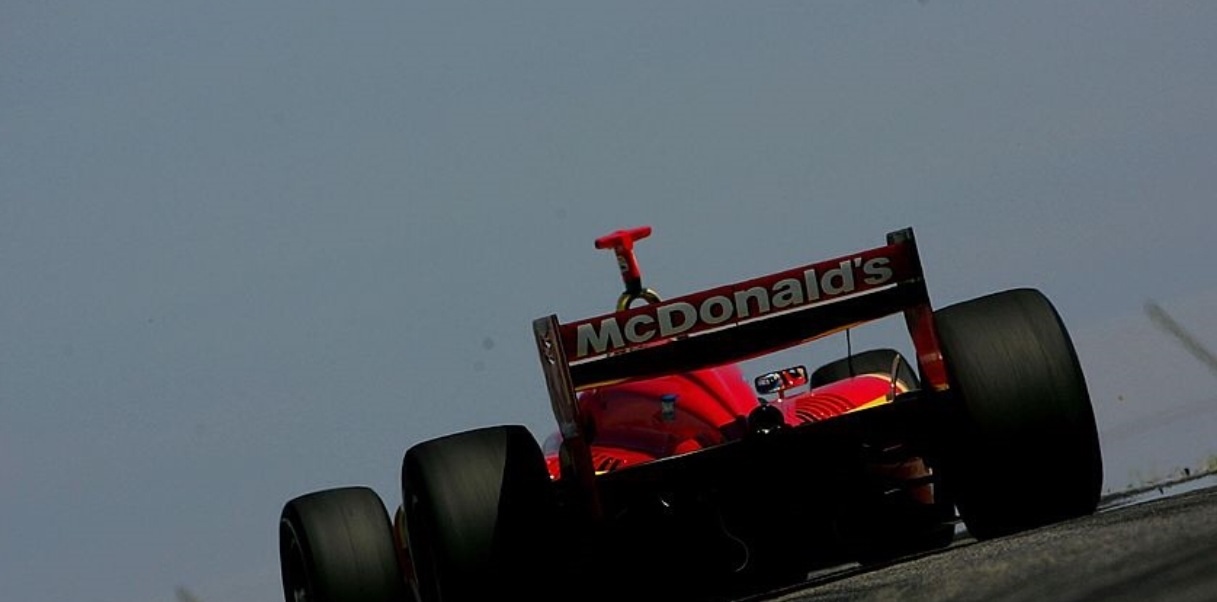
These photos of Sebastien Bourdais in the 2007 Champcar round there seemed worth sharing.
Bourdais reflection in the pits, Road America 2003 (Ingham)
The Le Mans born second generation racer burst from French karting and junior formulae and vaulted from European Formula 3000 success in 2002 to Indycars in 2003. He became the series dominant driver taking the title from 2004-2007 before jumping to F1 with Toro Rosso in 2008 and into 2009.
Bourdais won the Road America ‘Generac Grand Prix’ from pole extracting all the mandated Panoz DP01 2.65 litre single-turbo Cosworth V8 had to offer. His Newman Haas entered car won from Dan Clarke and Graham Rahal.
Bourdais remains a competitive racer in Sportscars and Indycars having won a ‘Chevrolet Dual in Detroit’ race at Belle Isle Park in this years (2016) series.
Many thanks to Stephen Dalton for identifying the car and driver who are famous in the pantheon of Australian motor racing indeed. Frank Pratt drove this 328 to victory in the Australian Grand Prix at Point Cook, not too far away from Rob Roy in January 1948. The event featured is the 11th Rob Roy on 24 November 1946, one of Pratt’s first drives in the car.
This much raced 328, chassis #85136, was imported to Oz by Sydney driver/businessman John Snowon one of his trips to Europe. He bought it from a German General in 1937, Snow acquired it on behalf of George Martin, president of the Light Car Club, Melbourne.
Martin raced it in the ’38 AGP at Bathurst won by Peter Whitehead’s ERA R10B, then unfortunately lost his life in the car on the return trip to Melbourne in an accident near Wagga Wagga.
George Martin in the 328 at left 15th, and John Crouch MG TA 5th, 1938 AGP at Bathurst, some of the challenges of the gravel track obvious in this shot (Dave Sullivan)
Repaired, by 1946 the car passed into the hands of Geelong motor cycle racer/dealer Frank Pratt who famously won his first circuit race in it; the 1948 Australian Grand Prix, at Point Cook airforce base west of Melbourne.
As a very successful motor cycle racer he was not new to competition and racecraft. He also had a favourable handicap, the AGP was run to F Libre and handicapped for many years. Pratt scored a lucky win with high speed consistency, the car prepared by racer/engineer Harry Firth.
Dalton adds; ‘..Les Murphy (was) mentioned as a possible driver of the car, because Pratt was injured at a Ballarat Motorcycle meeting. But not car preparation, Harry Firth said he did the brakes, chassis and gearbox on the BMW. Mick Scott did the engine. Harry also mentions preparing the Gaze HRG 1500, but wasn’t allowed to do the Alta’ which Gaze retired after 5 laps.
In a race run in horrid, stifling hot summer conditions which took their toll on both cars and their pilots especially the highly strung single-seaters and racing cars, Frank triumphed.
Pratt on his way to victory on a horrible Melbourne summers day, AGP, Point Cook, January 26 1948, BMW 328 (George Thomas)
Click here for an interesting article about Frank Pratt, little has been written about him. ‘Pratt and Osborne’ still exists as a motor-cycle dealership in Geelong, a port city 75 Km from Melbourne on Port Phillip Bay. http://www.smcc.com.au/docs/Leonard%20Frank%20Pratt.pdf
The BMW was later raced by Peter McKenna all over Australia; at Fishermans Bend, Ballarat Airfield and Albert Park in Victoria and as far afield as Southport’s 1954 Australian Grand Prix. The car passed through various custodians hands in Oz before leaving the country in the 1990’s.
The BMW in the Nuriootpa paddock, Australian GP meeting 1950, Peter McKenna (SLSA)
Credits…
‘Historic Racing Cars in Australia’ John Blanden’, George Thomas, Stephen Dalton, Dave Sullivan, State Library of South Australia
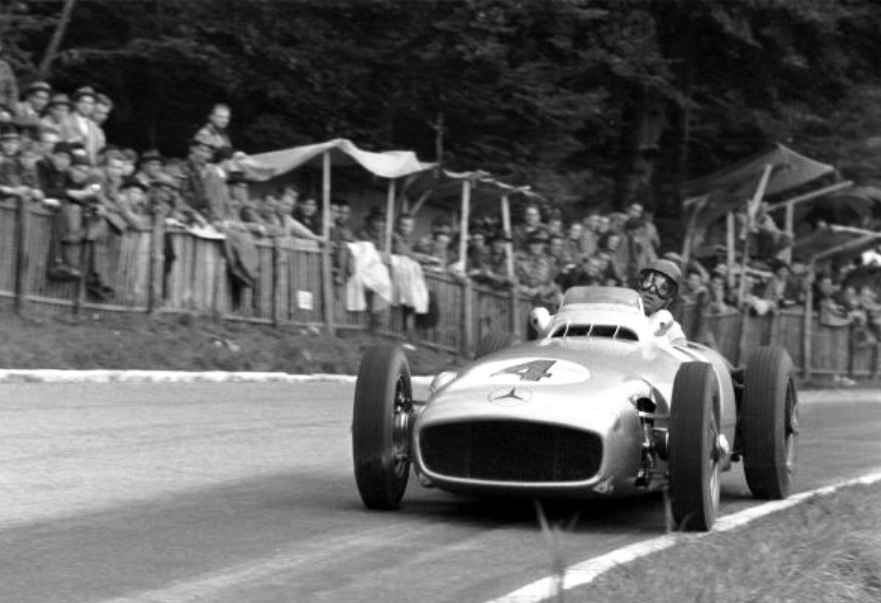
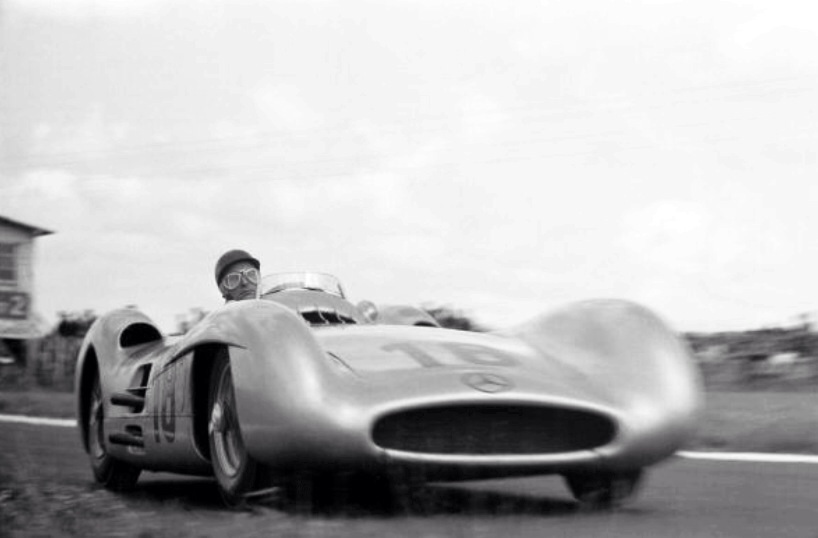
I chose these two shots of the thousands of the great Argentinian as they demonstrate his delicate touch and judgement at very high speeds…
The first is driving the Alfa 159 for his beloved ‘Alfa Corse’ at Reims on 1 July 1951, his first championship winning season. He is clipping the inside grass on the back section of this French Grand Prix road course in the Champagne Region.
The second is at Bremgarten driving the Mercedes Benz W154 bang on line during the Swiss Grand Prix on 22 August 1954, also a title winning season of course.
Marvel at the finesse, it’s as clear in these neutral or slight understeer shots as the many high speed oversteer shots many of which are at Reims at well over 125mph…
(Klemantaski)
1954 French, Reims GP: Victory in #18 Mercedes Benz W154 upon its debut (Klemantaski)
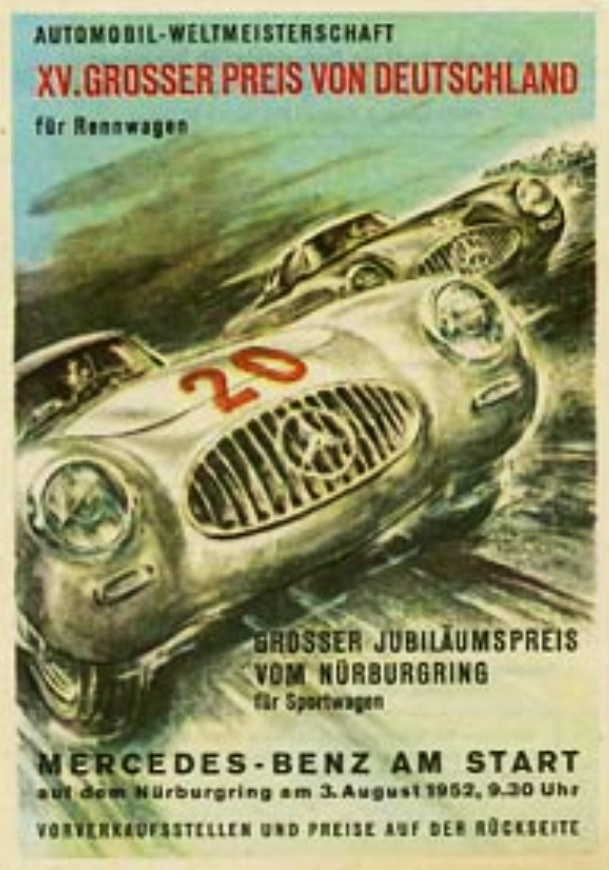
The 1952 German Grand Prix was won by Alberto Ascari’s Ferrari 500, a fairly predictable result in 1952/3…
The dominant F2 GP 1952/3 combo of Ascari and Ferrari 500, on his way to a Nurburgring 1952 victory. Teammates Farina and Fischer were 2nd/3rd in similar Fazz 500’s (GP Library)
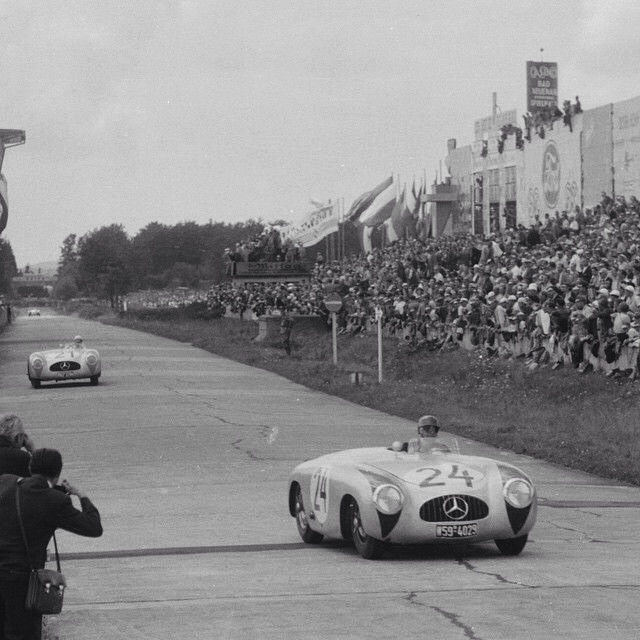
A huge field of cars contested the sportscar supporting event, after a spirited dice pre-War Mercedes GP ace Hans Hermann #21 won from post-War Mercedes GP driver Karl Kling #24 both driving the Benz W194 300 SL heading into the North Curve (below).
The 300SL Coupe won the LeMans 24 Hours that June, Lang shared the drive with Fritz Riess, the win important in a series of steps which took the company back into GP racing in 1954. And in putting into production a road-going variant of the 300SL!
Start of the sportscar race, i’ll take any help you have with car/driver combinations; #21 Hermann, #24 Kling excepted! (GP Library)
Top Down; Victory ceremony with Hermann and Klings cars in shot. No idea in 300SL!. #23 Theo Helfrich in 300SL, the ‘slight’ frame of Benz famous team-manager Neubauer readily evident (GP Library)
Credit…
GP Library
Tailpiece: 300SL Coupe Beauty…
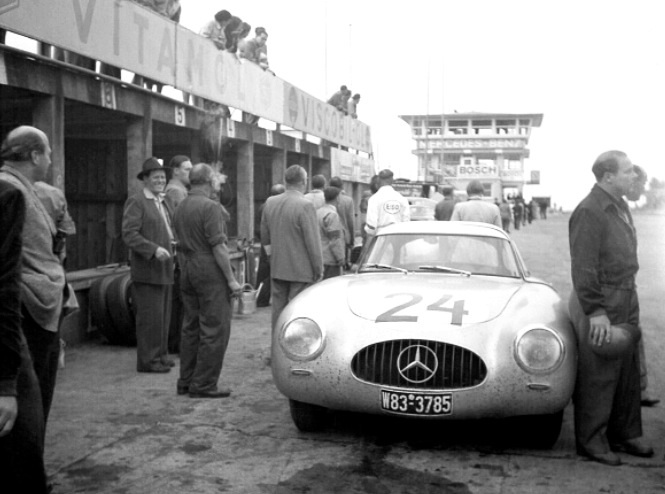
Famously it was Max Hoffman, the New York based importer of VW at the time who insisted the 300SL W194 racer be ‘productionised’, selling like hotcakes given its beauty and technical specifications, the Americans taking circa 80% of the 1400 cars built. This car has Klings #24, clearly he raced the Sporty rather than the Coupe. Nurburgring 1952 (GP Library)
The front suspension of one of the McLaren MP4/7A Honda V12’s is fettled during Hungarian GP practice, Budapest on 16 August 1992…
The front suspension comprises upper and lower wishbones and pushrods, one of which is being adjusted, actuating coil springs and Showa dampers. Carbon fibre chassis of course. The 3.5 litre V12 car was designed by a team led by Neil Oatley. Ayrton Senna and Gerhard Berger raced the cars to 5 wins, including Senna’s race victory in Hungary (below), but struggled to match the pace of Nigel Mansell’s Williams FW14B Renault that year.
(Honda)
Credit…
Rainer Schlegelmilch, Honda
Tailpiece: Senna and team during German GP practice, Hockenheim, 25 July 1992…
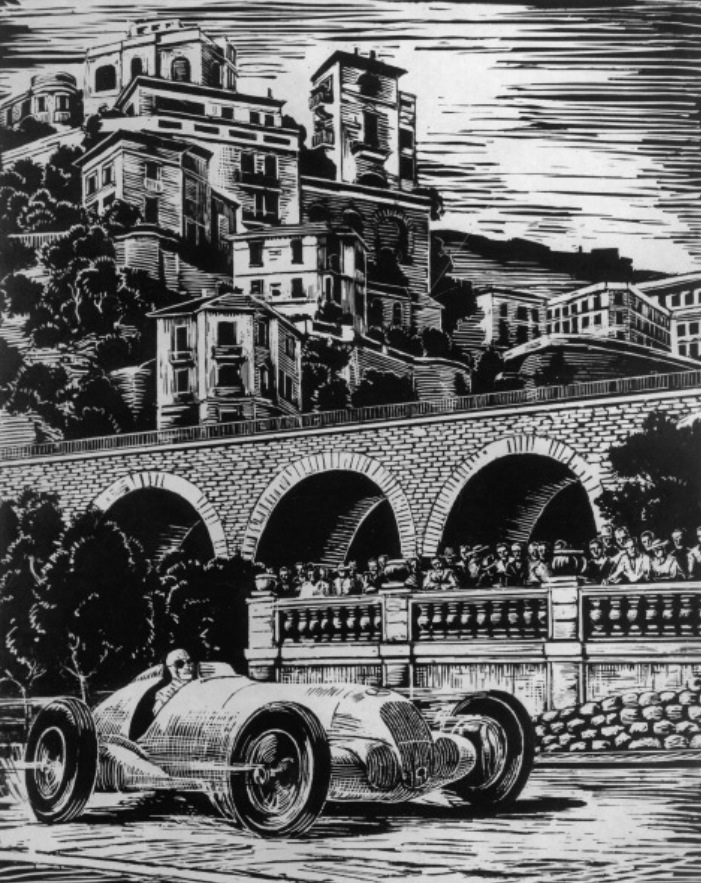
Interesting drawing of one of the dominant Mercedes W125 during the 1937 Monaco Grand Prix held on 8 August…
Manfred von Brauchitsch won from Rudy Carraciola and Christian Kautz, Goffredo Zehender was fifth, the only interloper to the Mercedes party was Hans Stuck’ Auto Union Type C which was fourth.
von Brauchitsch #10 and Caracciola below in their epic race for the GP lead, these 560bhp 5.66 litre cars GRAND in every sense of the word…
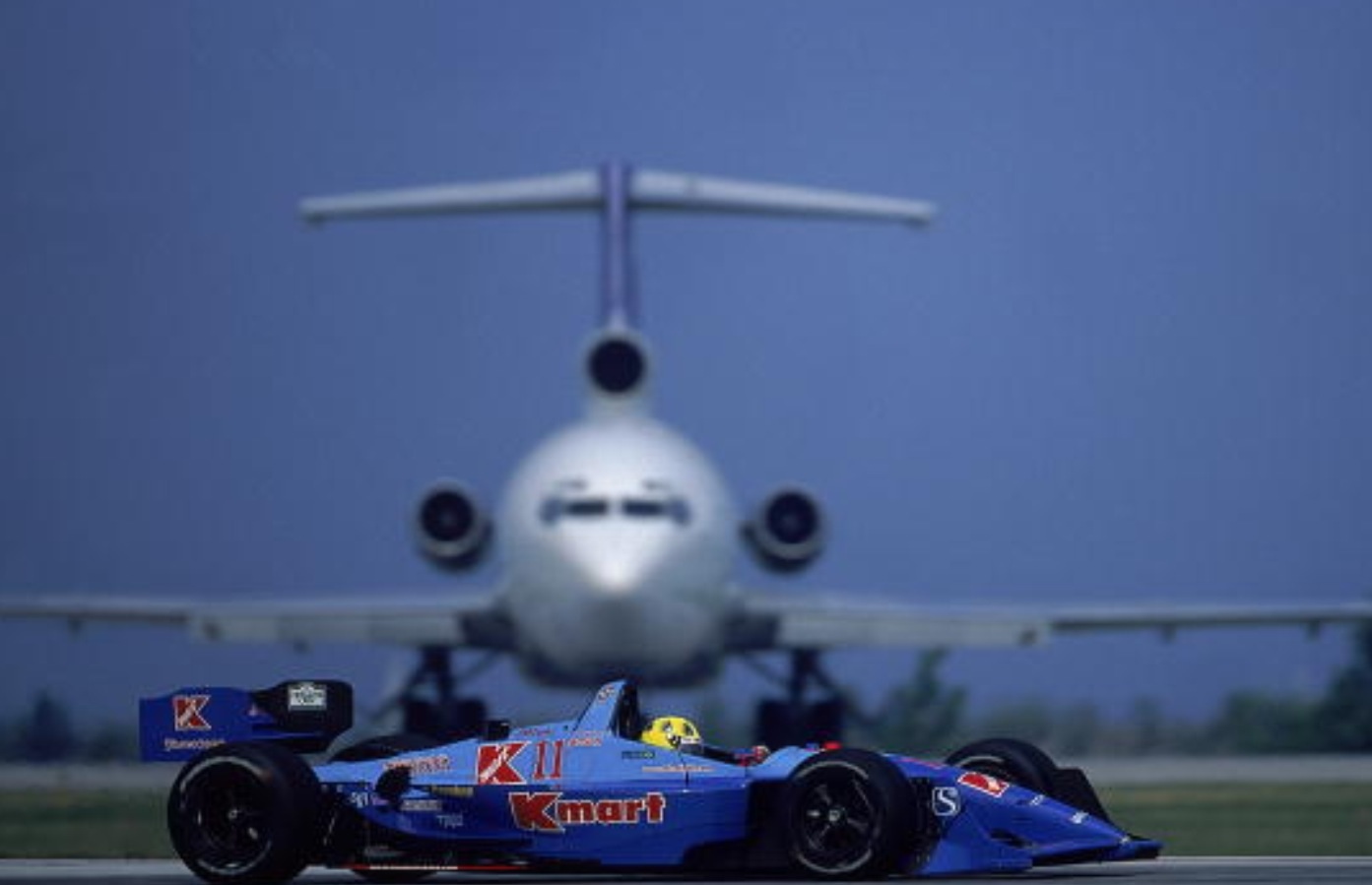
Christian Fittipaldi’s Newman-Haas Lola Toyota during the Marconi Cleveland Grand Prix at Burke Lakefront Airport on 30 June 2001…
This popular race was held 26 times in Cleveland, Ohio from 1982 to 2007, the operational airport was closed for racing one week a year and converted to a course which was tough for drivers and superb for spectators. Its wide, flat expanses meant punters could see most of the track from the grandstands, the races noted for lots of wheel to wheel dicing and many passing zones.
Dario Franchitti passes a ship on Lake Erie, Cleveland 2001 (David Maxwell)
The 2001 race was won by Dario Franchitti from Memo Gidley and Bryan Herta the variety in this wonderful class demonstrated by the cars used; Reynard 01i Honda, Lola B1/00 Toyota and Reynard 01i Ford respectively! I loathe the plethora of controlled formulae globally today. Christian Fittipaldi qualified his Lola B1/00 Toyota 15th and finished 11th. Gil de Ferran won the CART title that year in a Team Penske run Reynard 01i Honda.
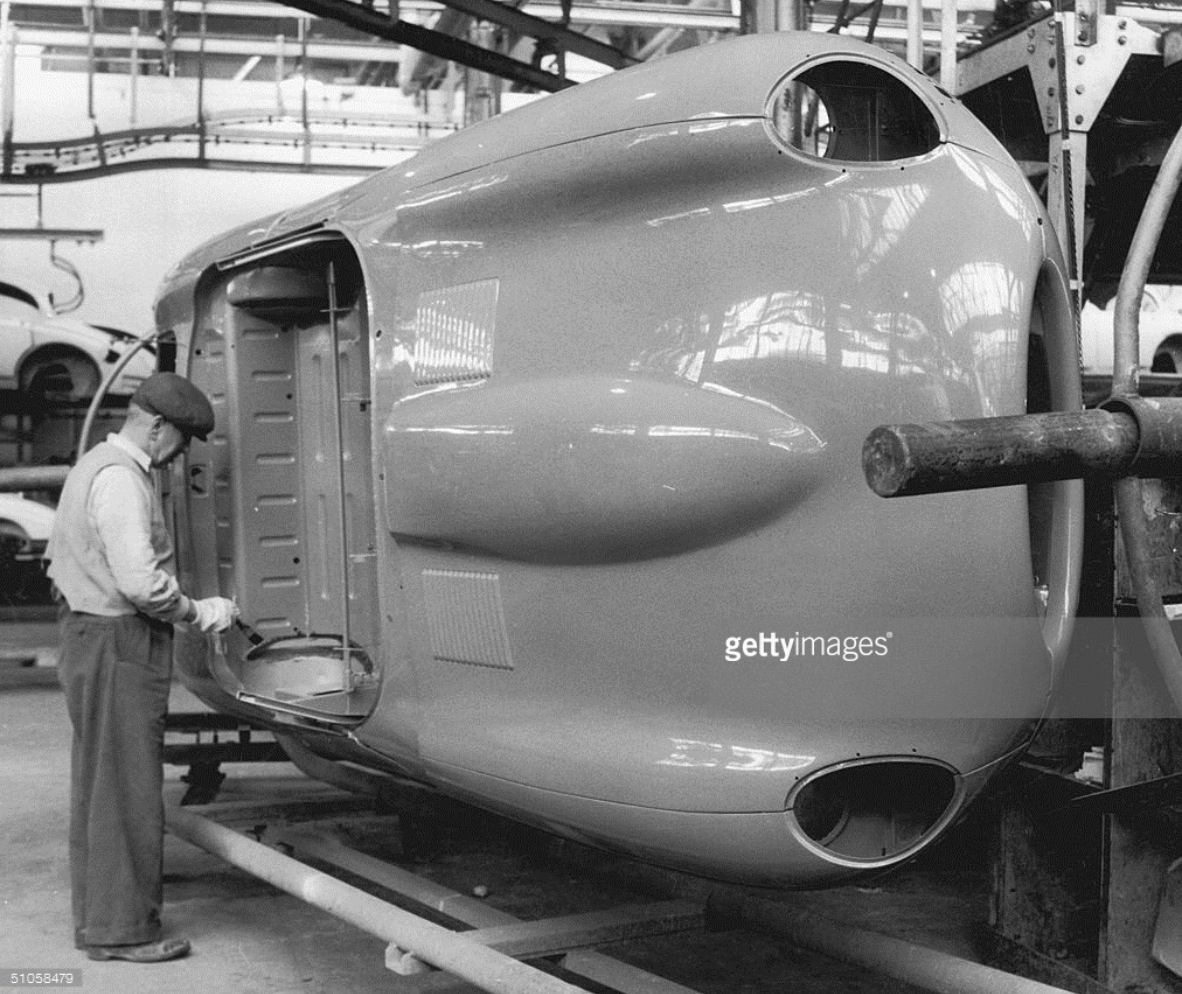
The E Type not ‘Pete’ the painter. Never owned or driven one but always loved the things…
The shot is dated 25 May 1961, ‘pete’ is completing the ‘computer aided finish’ of the cars luscious body, looks like a house-brush to me! I’ve got a nice E Type article ready to go, must get reader Rob Bailey, an old Alfisti, racer mate and E Type owner to pen me two paragraphs about ‘the owners experience’ then its done!
The ‘E’ was released, export only at first from March ’61, so this is an early-build 3.8 drop-head in the Browns Lane, Coventry paint shop.
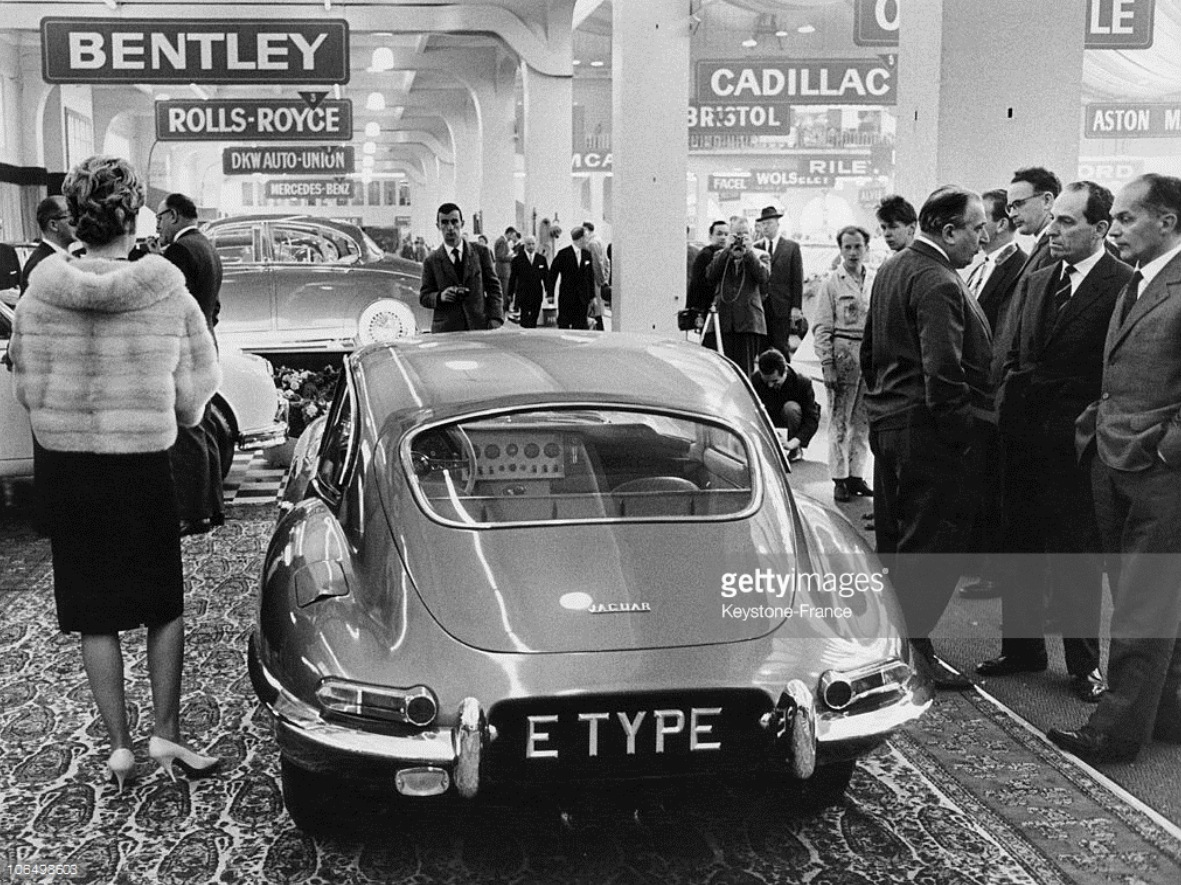
The picture below is at the Geneva Show in November 1961.
Credits…Getty Images
The shot below is again Browns Lane, the production lines idle on 14 February 1972, during the UK Miners Strike. On the line are V12 E’s and XJ6′, has their ever been a more curvy, muscular but handsome sedan? ‘Grace, Space, Pace’ was Jags sedan advertising tagline of the sixties, says it all really!
James Hunt dives for the inside line in his March 713S Ford, AJ and his Brabham BT28 Ford has left a gap way bigger than he ever did when they slugged it out in GP racing…
It’s 1971, the BRSCC MCD Shell Super Oil British F3 Championship at Brands Hatch on 1 March 1971 and both drivers are trying hard to jump up to the next level, the road for Hunt would be easier than Jones, James a coming star with the Hesketh March 731 in 1973 and Jones an F1 ‘occasional’ from 1974.
The ‘facts’ are from the photo caption, the cars and drivers are correct but the date/Brands event don’t accord with the ‘F2 Register’ record of that event, my F3 race resource. It appears AJ didn’t race with #69, a number with obvious appeal to him at all during ’71.
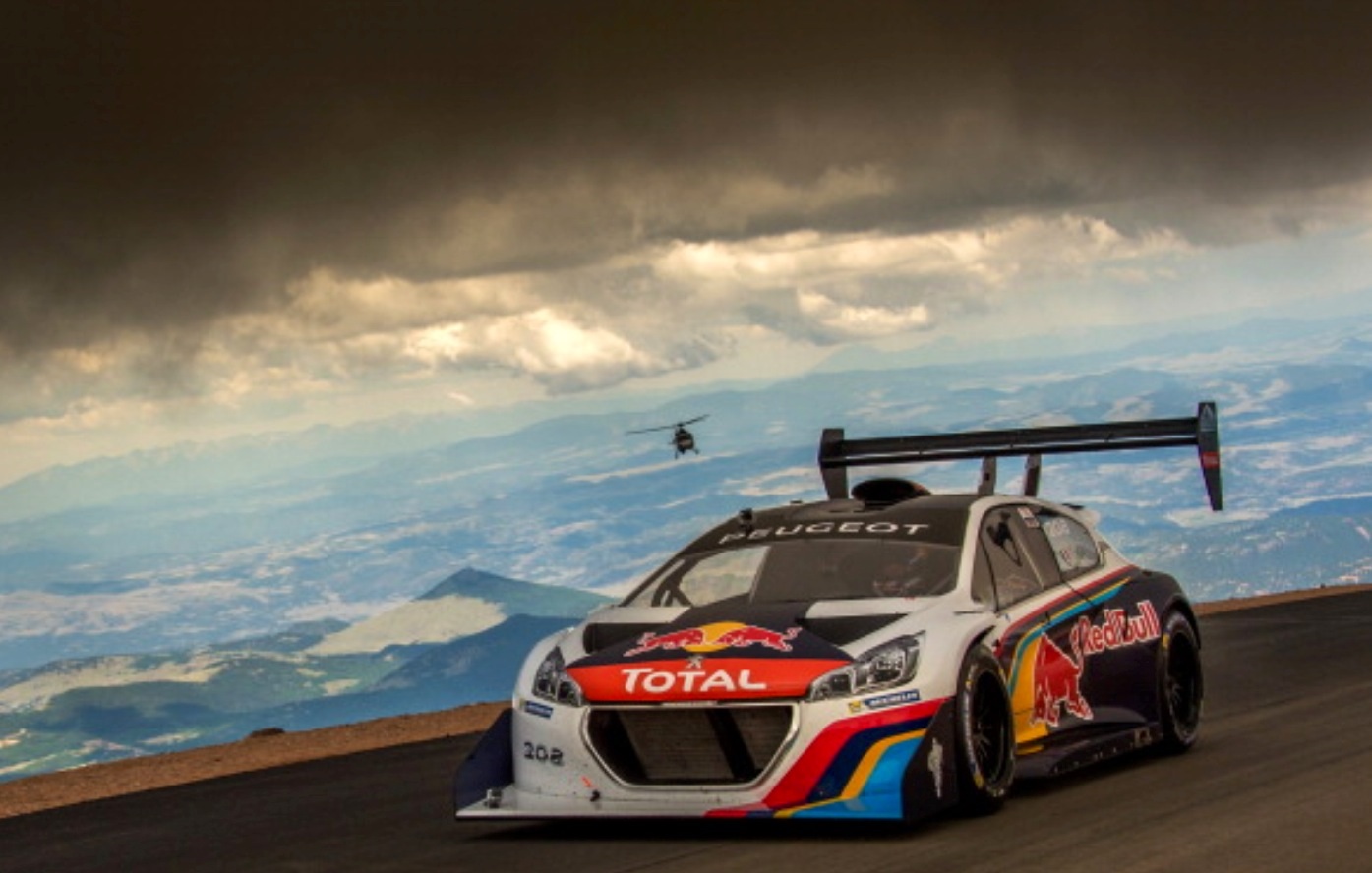
Sebastien Loeb takes his Peugeot 208 T16 over the Pikes Peak finishing line on 30 June 2013. He set the current climb record at Pikes Peak in his 208 T16 that weekend…
His time of 8:13.878 was 50 seconds quicker than second placegetter Rhys Millen’s time which was 44 seconds quicker than his previous best! It was an all-out ‘big budget’ attack on the event which was repaid in spades by the 9 times World Rally Champion.
Loeb spoke of the particular challenges of preparing for the event on the Red Bull website;
‘It was quite short on time for Peugeot to build a car and for me to test it. I had the first test near Paris, just for an hour. Then I wanted to go on a track because I needed some space to understand how the car behaves, it’s so impressive, with so much acceleration, braking and downforce, that I needed to drive on a big track. So we went to Circuit Paul Ricard and then to Mont Ventoux in France. It’s a place that looks a little bit like Pikes Peak, so it was good to practice there.’
‘You need to be 100 percent sure of every corner of the track. Before I went to America, I started to watch some videos to start to learn it. Then I went there with my rally co-driver, Daniel Elena and I took some notes like I take in a rally, describing all the road, all the corners, all the angles, everything. Then I started to learn these notes by heart and before every corner I knew, OK, that’s the 130 right, that’s the 140 left and so I could remember all the track like that.’
‘This car is closer to a racing car than a rally car because you have big slicks, you have a lot of downforce, a big engine. You also have 4WD and that’s a bit closer to rally, but it’s so powerful compared to a rally car that you cannot really compare. The driving is very different, you have to drive more like on a track with a racing car, using the downforce, keeping the speed in the high speed corners and braking very late because of the downforce. It’s a car you cannot slide. When you start to slide it starts to bump, so it’s not made for that! You drive it like an F1 car, just using the right line and not sliding.
‘When I was on the start line I was really ready and 100 percent confident with the car. I was sure of my preparation and feeling good. There was no point where I really had a moment. I was pushing, but I was feeling safe, so no big moments and I was able to put all my best sectors together for race day’.
Technical Specifications…
Peugeot described the car as ‘practically an out-and-out endurance racing prototype’. Half of the downforce generated by the 208 comes from the specially designed undertray which sits beneath the car.
The 3.2-litre, twin-turbo V6 engine develops 875bhp, a 6 speed sequential gearbox, 4 wheel drive, carbon brakes and double wishbone suspension all round with pushrods actuating torsion bars all part of a highly sophisticated package.
The 208 chassis was of ‘old school’ multi-tubular spaceframe construction the car weighing 875Kg.
Peugeot Sport engineer Jean-Christophe Pallier said: ‘Your imagination is the only limit when you set out to design a car for Pikes Peak. We’ve shaved the car down to 875 kilogrammes and as a result we’ve achieved the magic and symbolic power to weight ratio of 1:1, one bhp for every one kg of weight.’
The six-speed transmission, carbon brakes, air intake and aero-including the two-metre wide rear wing, are all from the 908 Le Mans car. The mid-engined 208, as geared, did 0-62mph in 1.8 seconds and zero to its top speed of 150mph in 7 seconds.
Results…
Click on this link for a good article on the 2013 event
















 primotipo...