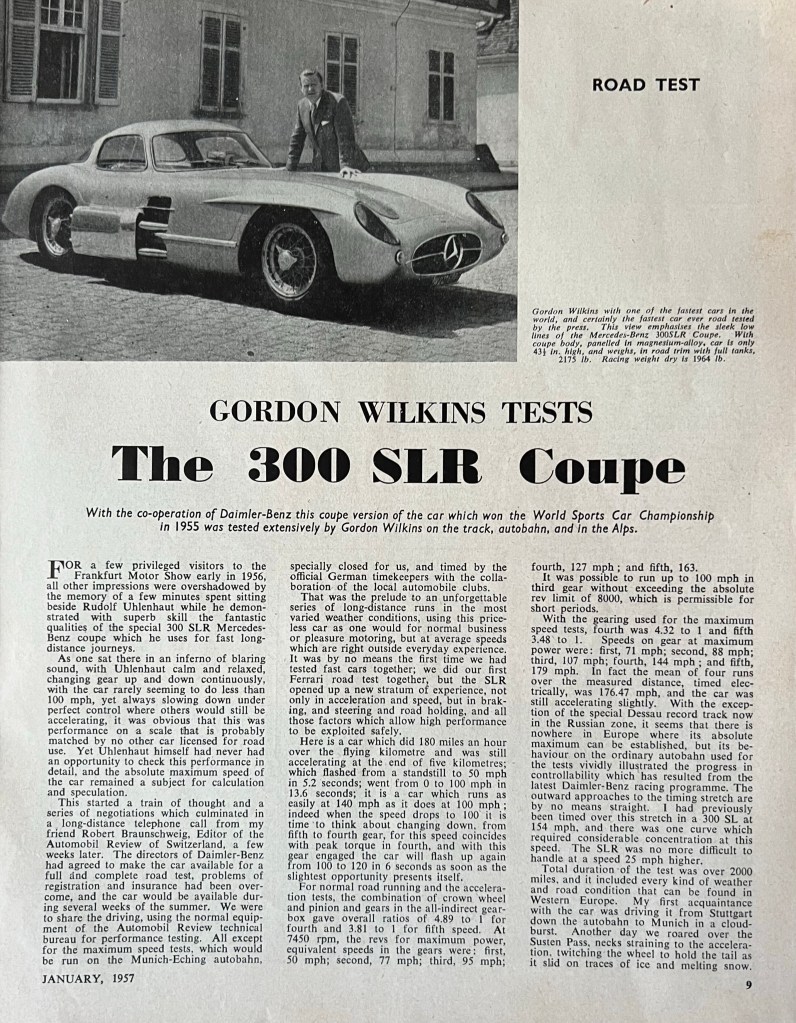
Comprehensive road tests of the 300 SLR Uhlenhaut are rather thin on the ground, so this article, written by Gordon Wilkins and published in the January 1957 issue of Motor Racing, seems like a good one to share. Gordon explains the circumstances surrounding the test in the opening paragraphs, so here it is.
Etcetera…
What I hadn’t realised until reading the spiel about these two cars on Mercedes Benz’ fantastic website, is that the first of the cars built was the very first W196S – 300 SLR – built, in November 1953.
Because Benz were running behind completion of the W196R Grand Prix car, resources being devoted to the sports car were redeployed to ensure the W196 race debut at Reims in July 1954 could be met.
Mercedes had planned to build a mix of 300 SLR coupes and spyders to driver preference, but when it became clear to Alfred Neubauer that most of the drivers preference was to race an open car – noise inside the car was the perceived issue – the build program was amended accordingly with the first of the open cars finished in June 1954.
(Mercedes Benz)(Mercedes Benz)
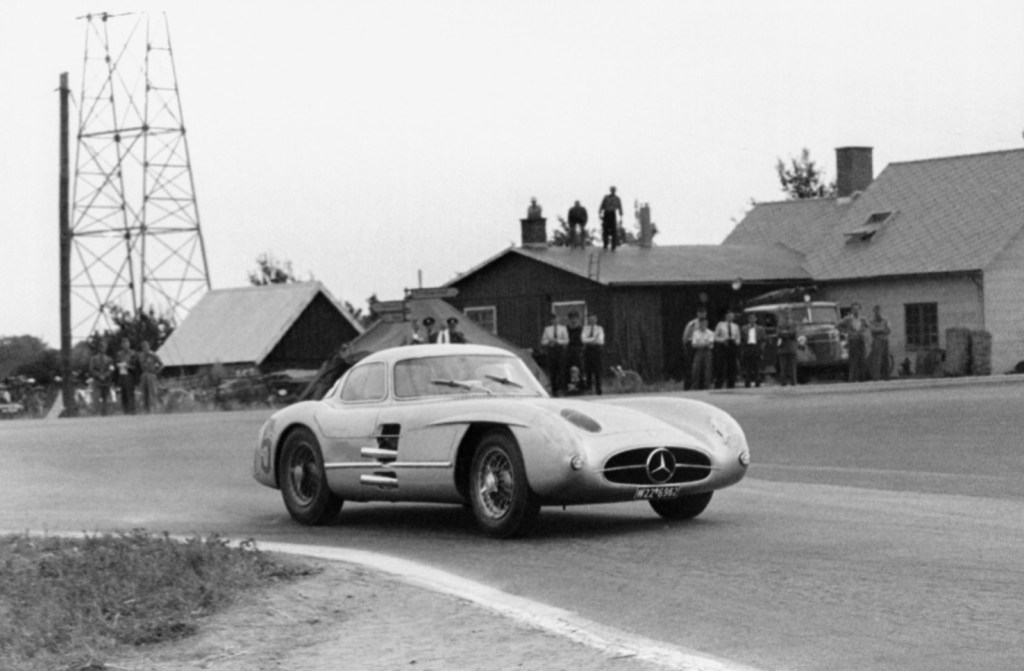
The 300 SLR Coupé made its first public appearance in August 1955, with Rudolf Uhlenhaut at the wheel during practice for the Swedish Grand Prix in Kristianstad.
By then 300 SLR spyders had already clinched a spectacular one-two in the Mille Miglia and in Sweden. The 300 SLR build program was completed in late summer 1954 after the successful start of the Formula 1 season.
In the 1955 World Sports Car Championship, which began for Daimler-Benz with the Mille Miglia on 30 April-1 May in Brescia, only the open-top version initially appeared.
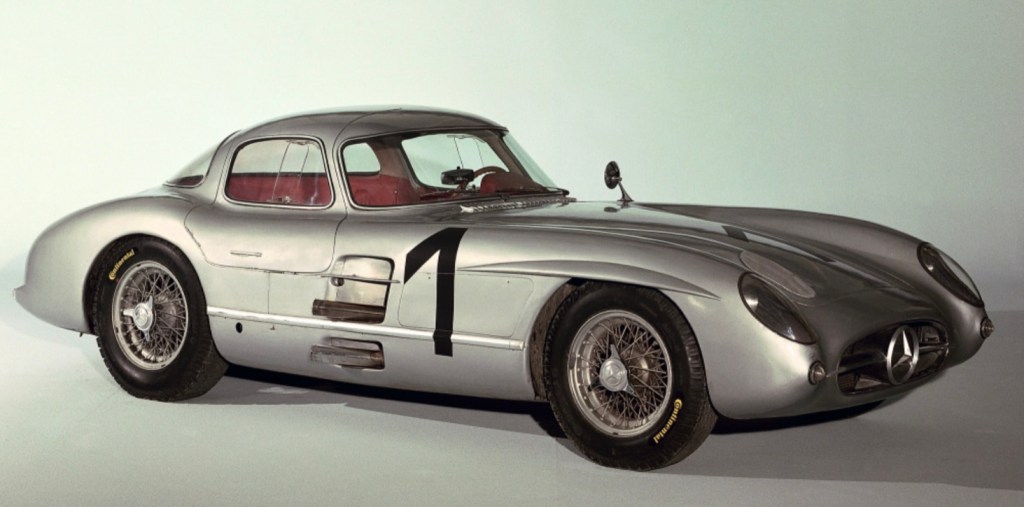
(Mercedes Benz)Carrying #1 as the car did during practice during the Targa weekend in 1955 (Mercedes Benz)
Mercedes planned to race in the Carrera Panamericana in Mexico in November 1955 and in 1956, and therefore reactivated production of the coupé version in the summer of ’55 when two cars were completed.
For long-distance races, the aim was to give drivers the option of open or closed cars, but the two exotic machines weren’t raced after the Daimler-Benz Board withdrew from motorsport on October 11, 1955 after the Le Mans disaster.
As a consequence the 300 SLR Coupé’s motorsport outings were limited to practice and test drives at the Swedish Grand Prix, at Monza, the Tourist Trophy in Ireland and the Targa Florio.
Mercedes Benz, ‘The first completed coupé covered more than 10,000 kilometres; Rudolf Uhlenhaut was mainly at the wheel; Wolfgang Graf Berghe von Trips, a newcomer to the Mercedes-Benz racing team, was given the opportunity to familiarise himself with the 300 SLR on the trip to the Tourist Trophy in Ireland. With a third place, which he achieved in a team with André Simon in the open-top version, the talented young driver contributed to the Mercedes-Benz one-two-three victory in this race.’
(Mercedes Benz)(Mercedes Benz)
Uhlenhaut, a master test driver, had already demonstrated the reliability and suitability of the 300bhp racer for everyday use with his extensive journeys across Europe and thought it sensible to make the spectacular car available to the press for an extensive test.
‘In July 1956, journalists from the Swiss Automobil Revue magazine, led by its editor-in-chief Robert Braunschweig, subjected the 300 SLR Coupé to a long-distance test covering a total of 3500 kilometres. One concession to road traffic was the huge exhaust silencer on the right-hand side of the vehicle, which reduced the deafening background noise to a more bearable level. At the beginning of July and in mid-September, high-speed test drives and top speed measurements were carried out with both examples of the coupé in the presence of Rudolf Uhlenhaut.’
From the left: W196S Uhlenhaut, 300SL-W198, 300SL-W194, 300SL-W194-011. Ditto below (Mercedes Benz)(Mercedes Benz)
‘The “Uhlenhaut Coupé”, as the car has been called by car enthusiasts since the late 1980s, is considered one of the most important icons of the Mercedes-Benz brand and also the most valuable car in the world. In May 2022, one of the two vehicles built in 1955 was sold to a private bidder for 135 million euros at an auction in the Mercedes-Benz Museum. The proceeds are used to finance the “Mercedes-Benz Fund” – a global scholarship program that aims to encourage a new generation of schoolchildren and students to develop new technologies, in particular for decarbonisation and resource conservation. The second vehicle has been on display at the Mercedes-Benz Museum for many years and is one of the most spectacular exhibits there.’
Credits…
Bob King Collection, Motor Racing January 1957, Mercedes Benz
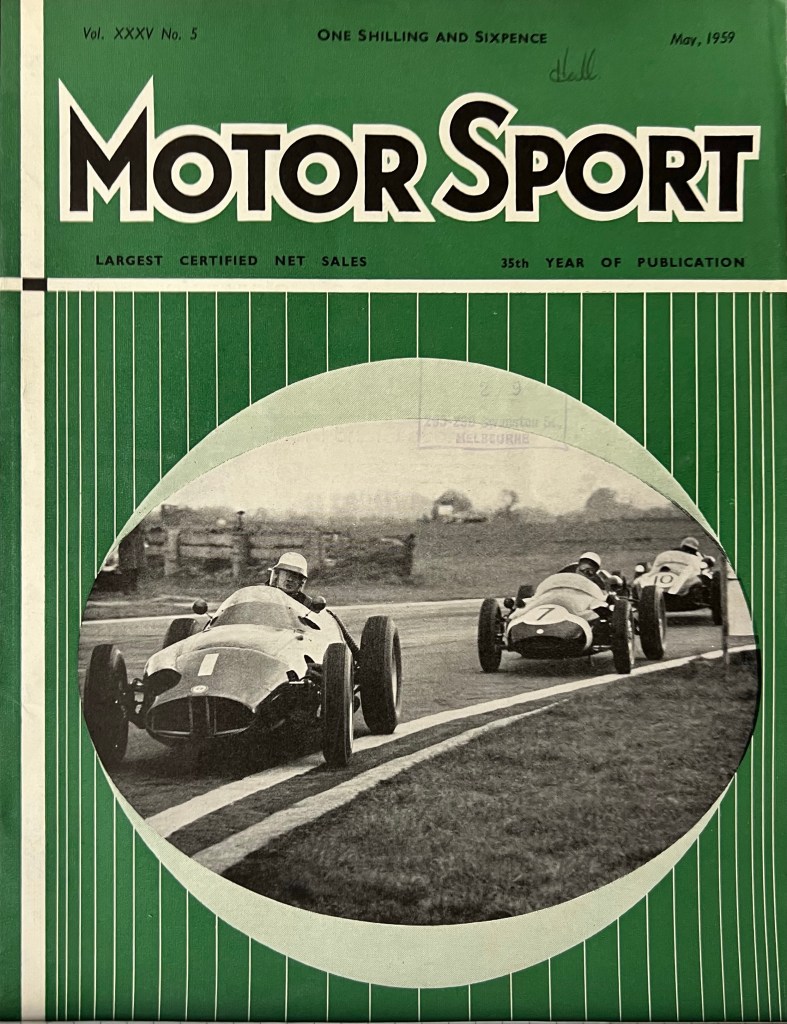
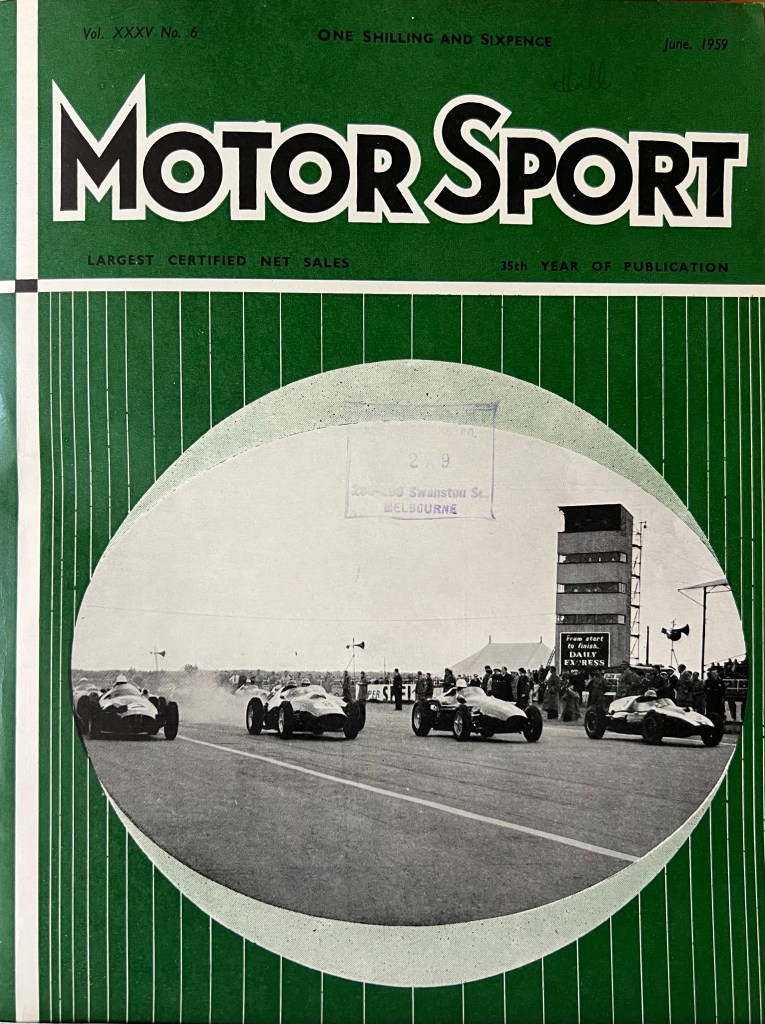
‘Harry Schell, BRM Type 25 leads Stirling Moss, Cooper T51 Climax at the BARC Easter Goodwood Meeting. The BRM was no match for the full-Formula 1 Cooper Climax cars (read 2.5-litre Climax engined ) on the Goodwood circuit. Brabham (Cooper No 10) also passed Schell early in the race.’
‘Four makes on the front row! The start of the BRDC International Trophy Race at Silverstone, with, left to right, Moss BRM Type 25, Brooks Ferrari Dino 246, Salvadori in one of the sensational Aston Martin DBR4/250s and Jack Brabham the ultimate winner in works Cooper-Climax No 3.’
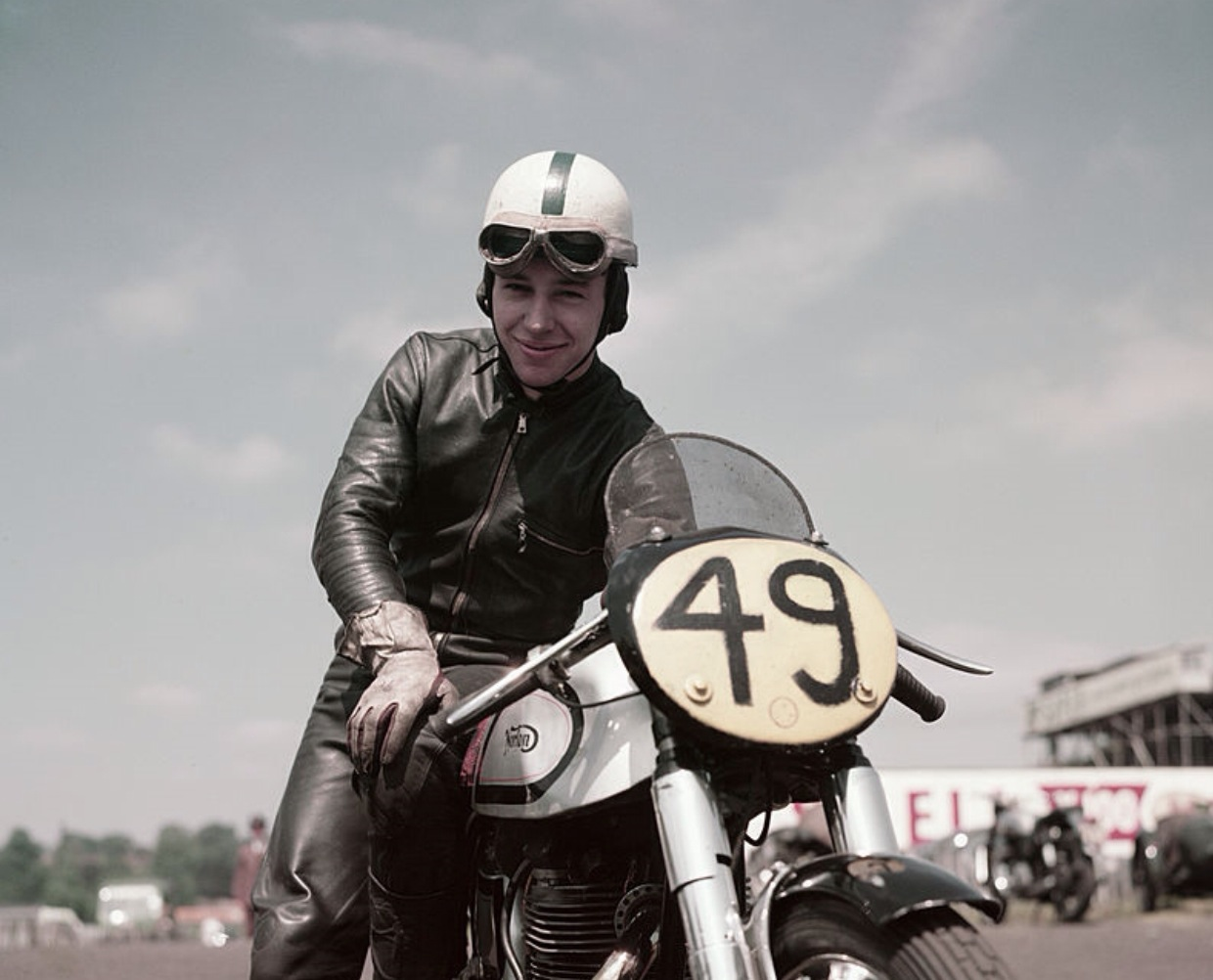
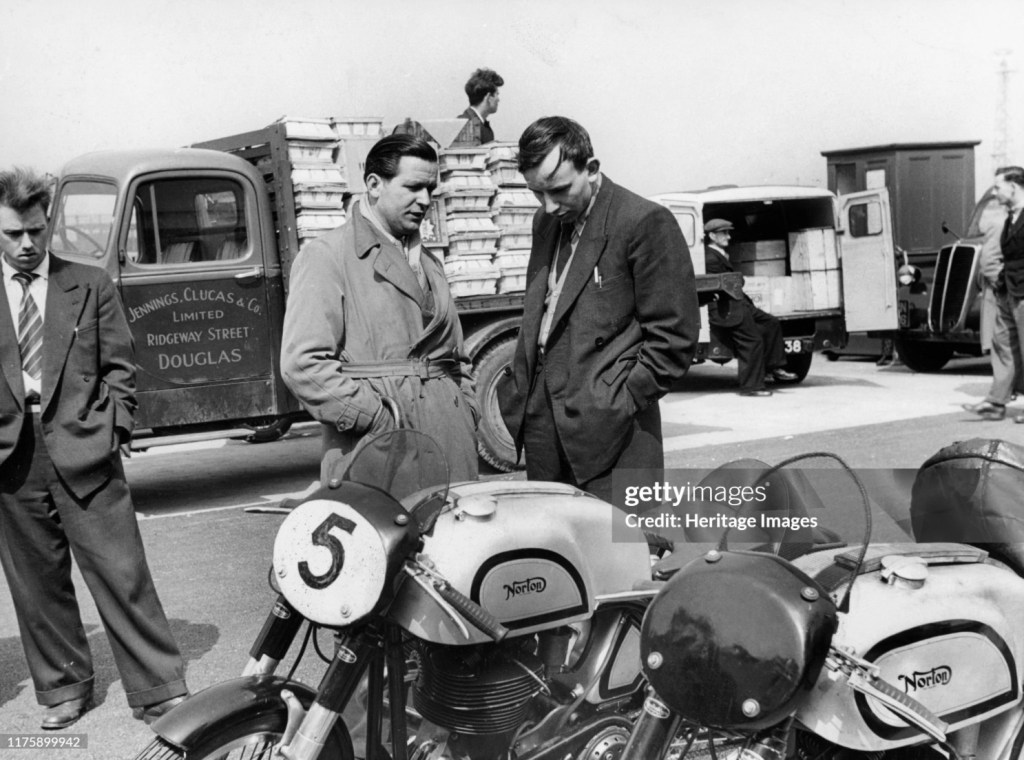
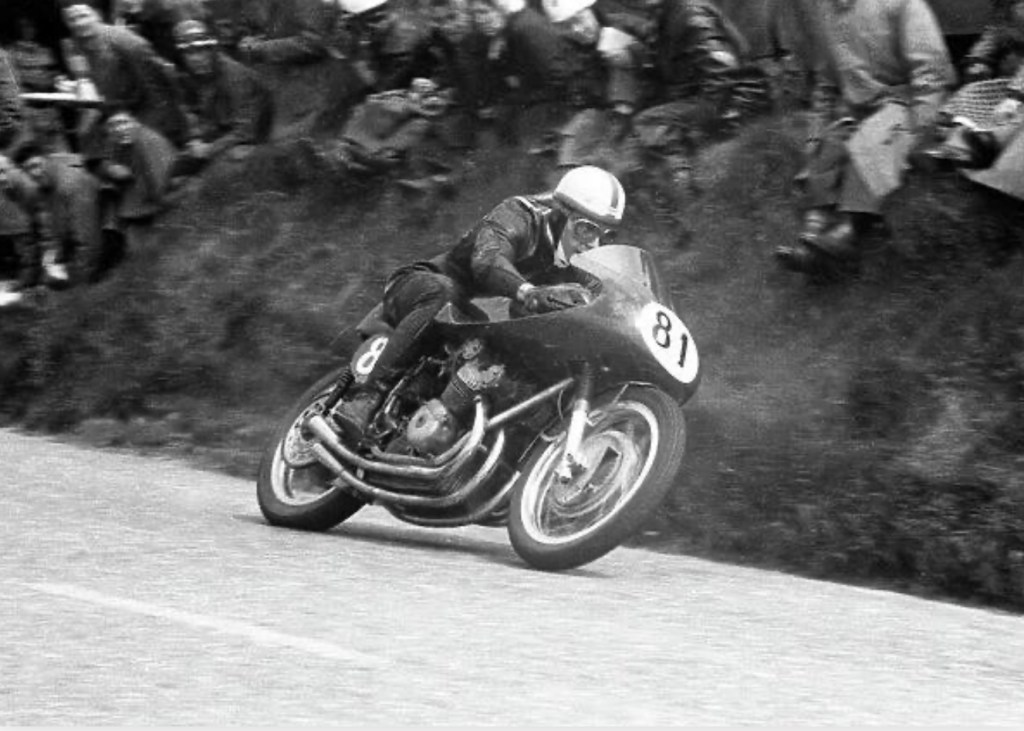
John Surtees and works-Norton Manx 500 prior to the start of a race at the International Meeting, Silverstone 9 April 1955…
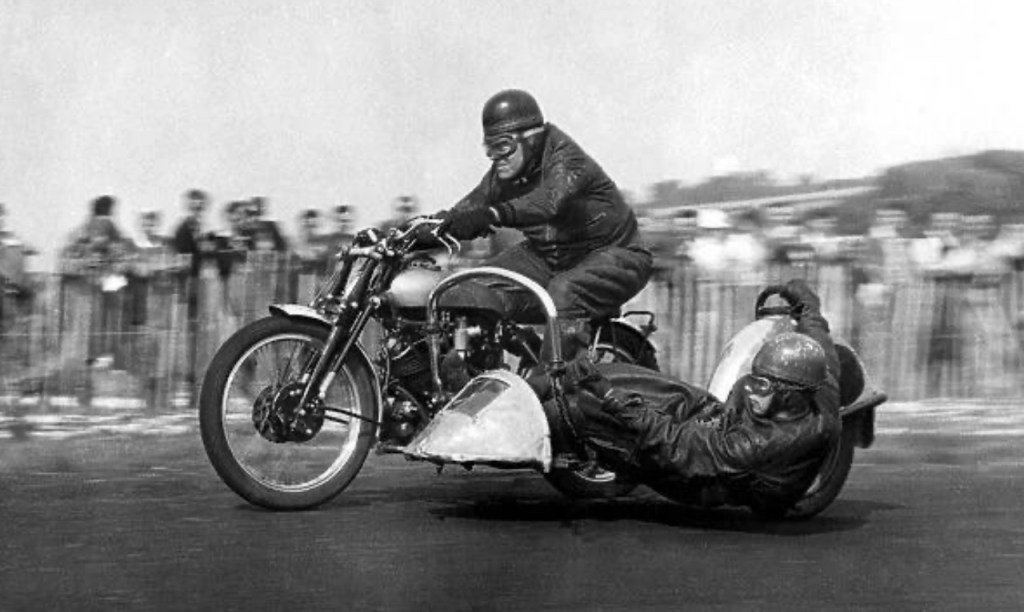
Born in 1934 (11 February 1934-10 March 2017) at Tatsfield, Surrey, Surtees famously grew up working in his dad’s South London motorcycle shop. Jack Surtees was a former bus driver turned sidecar racer, it was on his father’s Vincent 1000cc sidecar-outfit that John first competed at 14.
As a school leaver at 15, John contested grass track races at Brands Hatch on a Excelsior-JAP B14 500, soon graduating to road racing, initially aboard a Triumph Tiger 70 250, at Brands in April 1950. After commencing his apprenticeship with Vincents’ Stevenage factory the same year he soon commenced racing a self-prepared Vincent Grey 500 single, taking his first win at Aberdare Park, South Wales.
Jack and John Surtees on Jack’s Vincent 1000cc outfit at Brands Hatch in 1952 (J Topham)On the Vincent Grey Flash 500 single, circuit folks? (John Surtees World Champion)
In 1951 he hit the headlines after giving World Champion Geoff Duke’s factory twin-cam Norton curry on his pushrod single at Thruxton, soon establishing himself as one of Britain’s future stars, graduating from the Vincent in 1952 to a 500cc Manx Norton on which he contested his first World Championship race, finishing sixth in the Ulster GP.
In 1953 John made his Isle of Man debut having been loaned a pair of factory Nortons by race chief Joe Craig. But he got himself in Craig’s bad-book as he’d already committed to run Dr Joe Ehrlich’s works 125cc EMC two-stroke, only to crash it in practice and break his wrists after front-fork failure.
John Surtees at right during the June 1954 IOM TT weekend: 15th in the Senior and 11th in the Junior TTs on his privately entered machines. #5 is perhaps the 350
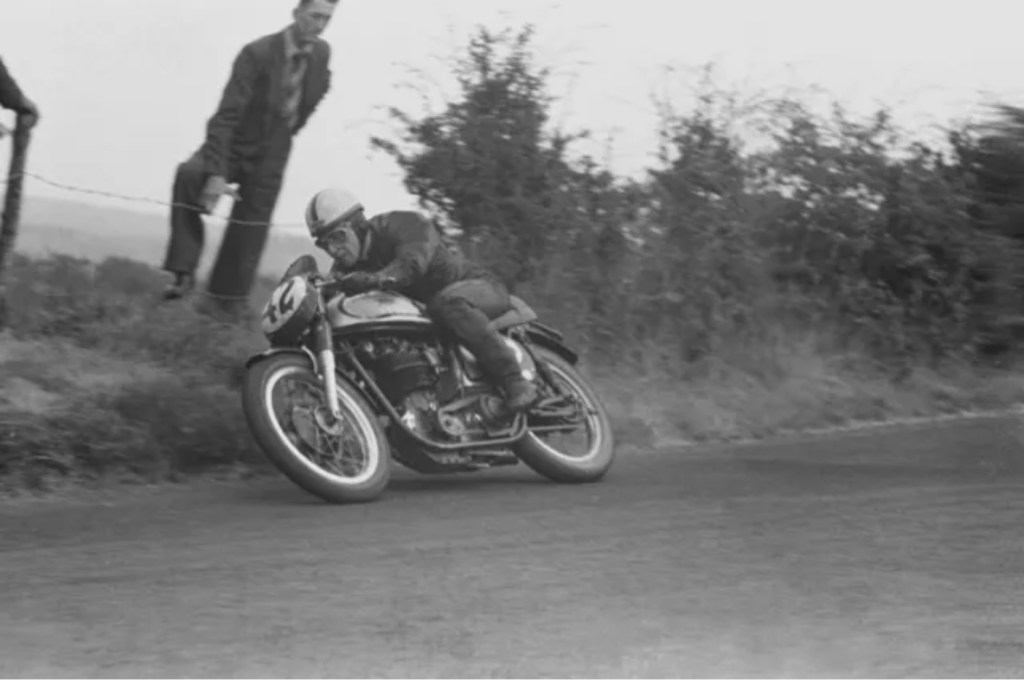
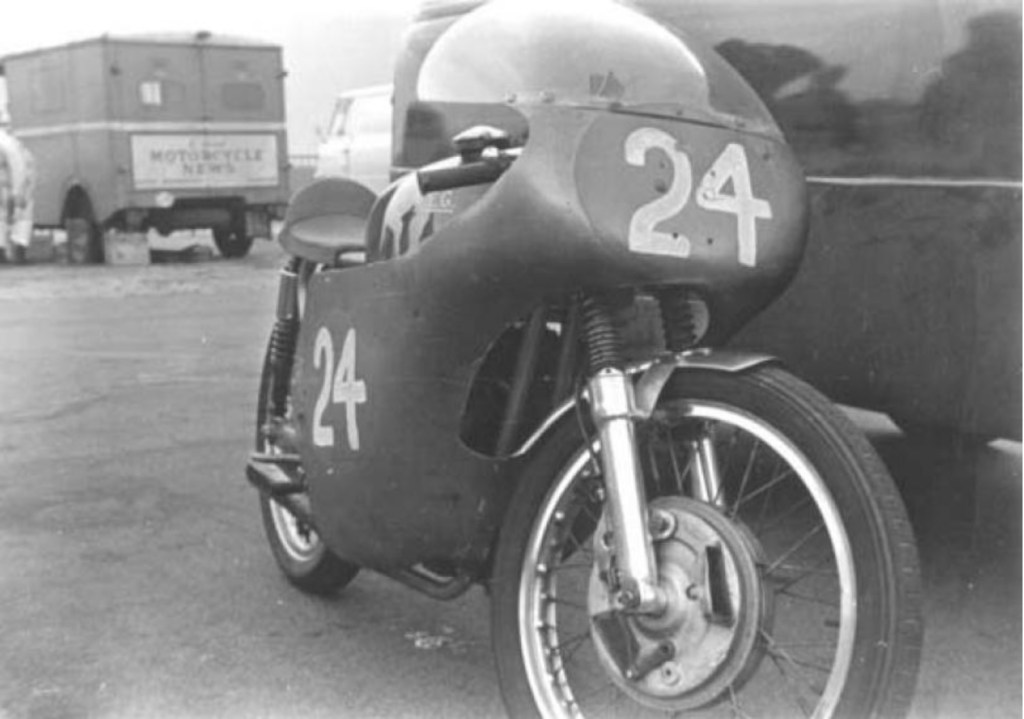
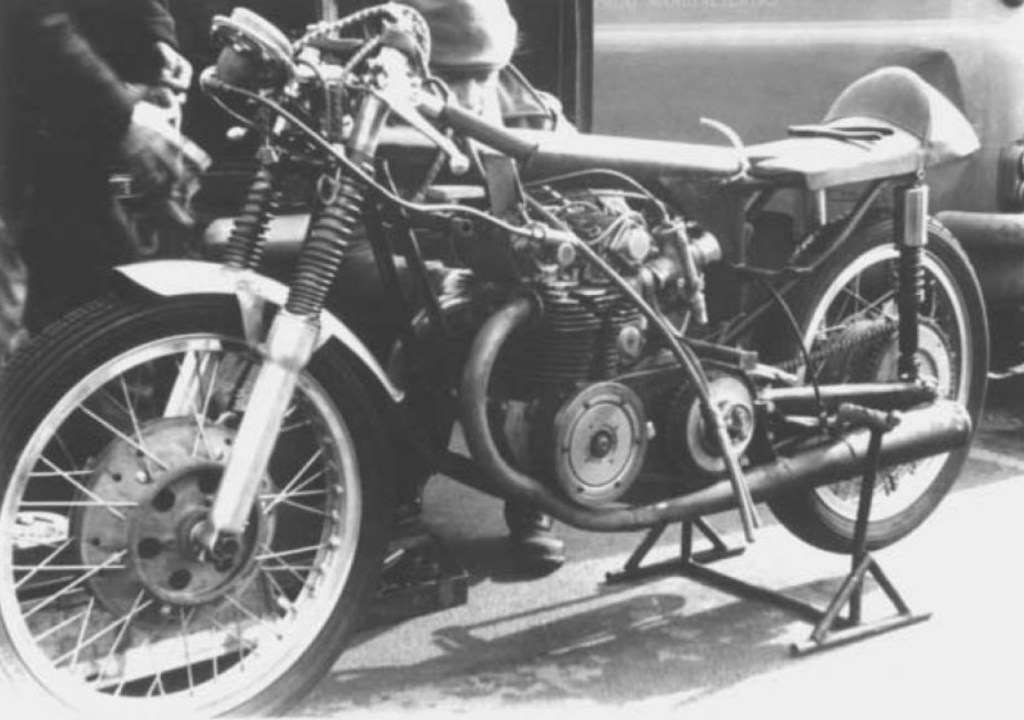
Craig cracked the shits when he couldn’t race his Nortons so John raced a pair of customer Norton 350/500s with great success in 1954. On these bikes he was 11th in the IOM 350cc Junior race and 15th in the 500cc Senior, also taking the British 250cc championship that year by winning 15 races of 17 starts on the unique R.E.G. 250 DOHC parallel-twin built by talented businessman Robert E Geeson.
As a consequence of that great season, Craig finally gave Surtees his first works Norton rides in what proved to be the British manufacturer’s final season of racing what were by then outclassed singles in 1955. John won 69 of 75 races that he started in Britain and raced regularly on the Continent, but it was on an NSU Sportmax that he recorded his first GP win, the 250cc Ulster GP at Dundrod on August 13.
Surtees, NSU Sportmax, 250cc Ulster GP winner, Dundrod August 13, 1955 (unattributed)Surtees, works-Norton Manx 500, Ulster GP, Dundrod, 1955 Senior TT. Led until his fuel stop then DNF with mechanical failure. Bill Lomas won both the 350 and 500 races on Moto Guzzis (A Herl)
With Norton’s end-of-season retirement from racing imminent, John finished the year by twice beating reigning 500cc World Champion Geoff Duke’s Gilera 500-4 at Silverstone and then Brands Hatch. Gilera, Moto Guzzi and BMW (for whom he’d ridden in the German GP on an RS500 Boxer) all chased his signature on a contract for 1956.
Instead Surtees began a five-year association with MV Agusta – after Count Domenico Agusta’s elderly mother had inspected him to decide whether she liked the cut-of-his-jib – winning his first seven races on the sonorous Italian in early-season British national races before winning the Isle of Man Senior TT, his debut World Championship Grand Prix race on the MV 500-four. And the rest, as they say, is history…click here for my article on the champion: https://primotipo.com/2014/11/30/john-surtees-world-champion-50-years-ago/
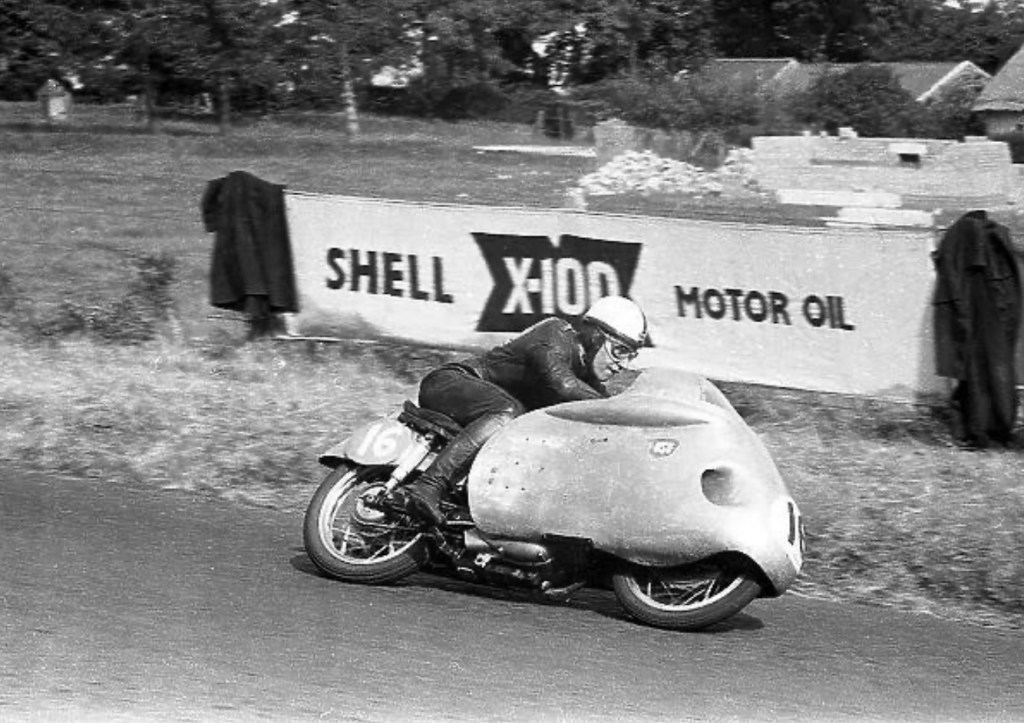
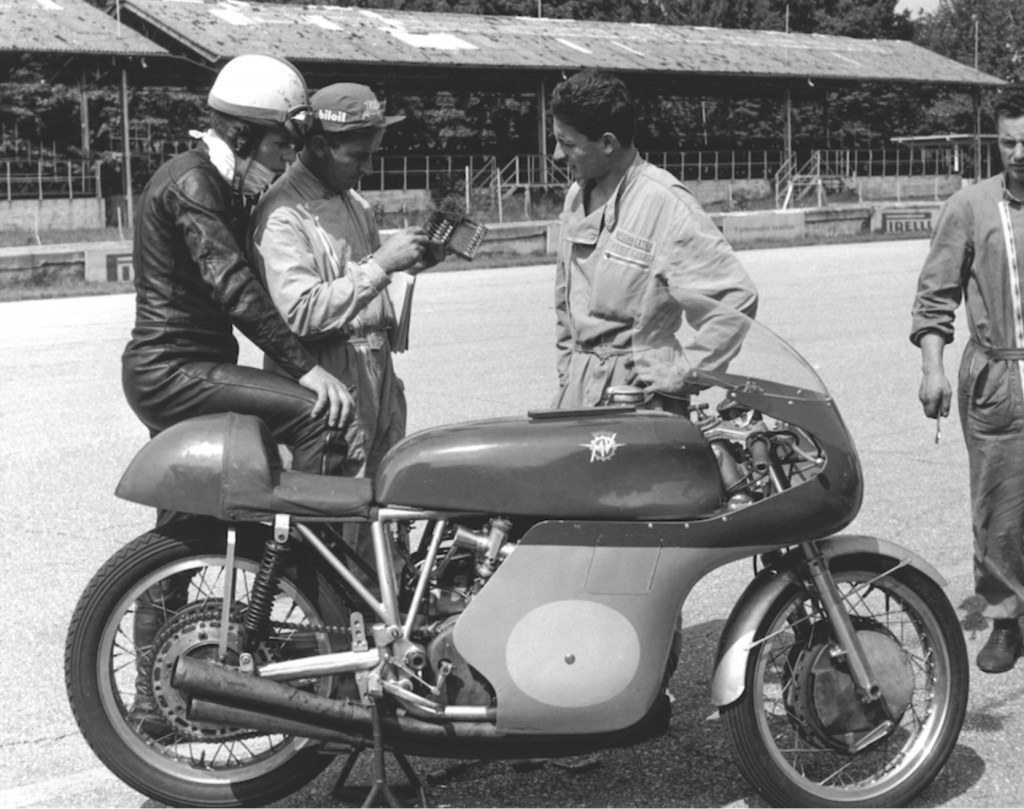
Surtees testing an MV, date and place unknown (unattributed)Surtees on the way to winning the Senior TT at Kates Cottage on the Isle of Man in 1956, MV 500 (ttracepics.com)
Credit…
Central Press, ridersdrivemag.com, A Herl, ttracepics.com, ‘John Surtees-World Champion’ by John Surtees and Alan Henry, J Topham-TopFoto, Rodger Kirby
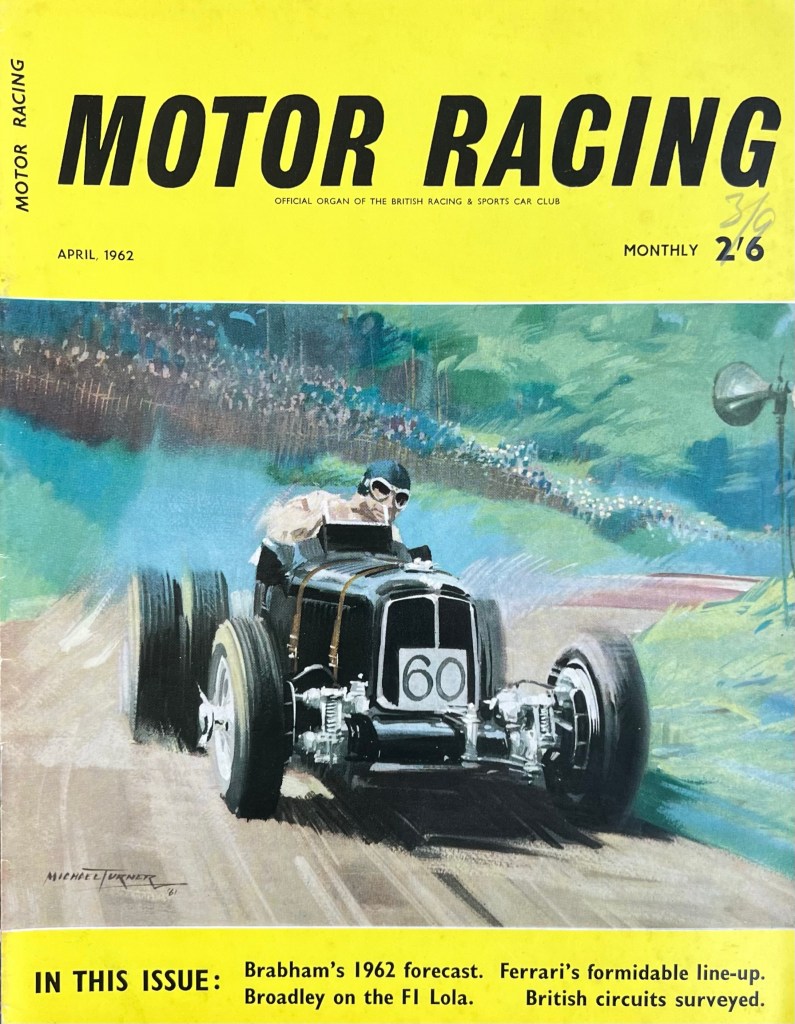
‘Michael Turner painting of Raymond Mays at Shelsley Walsh in 1949 with his famous 2-litre ERA R4D‘…
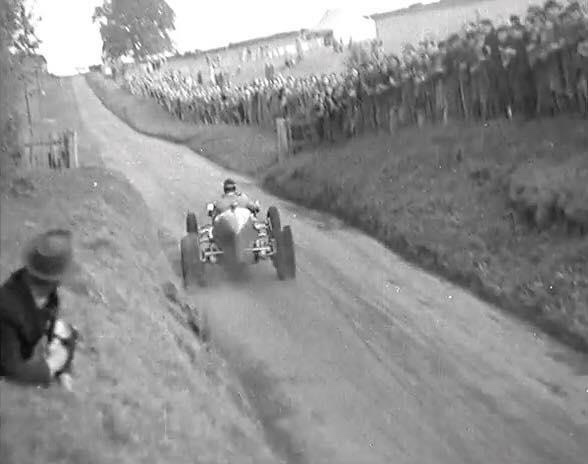
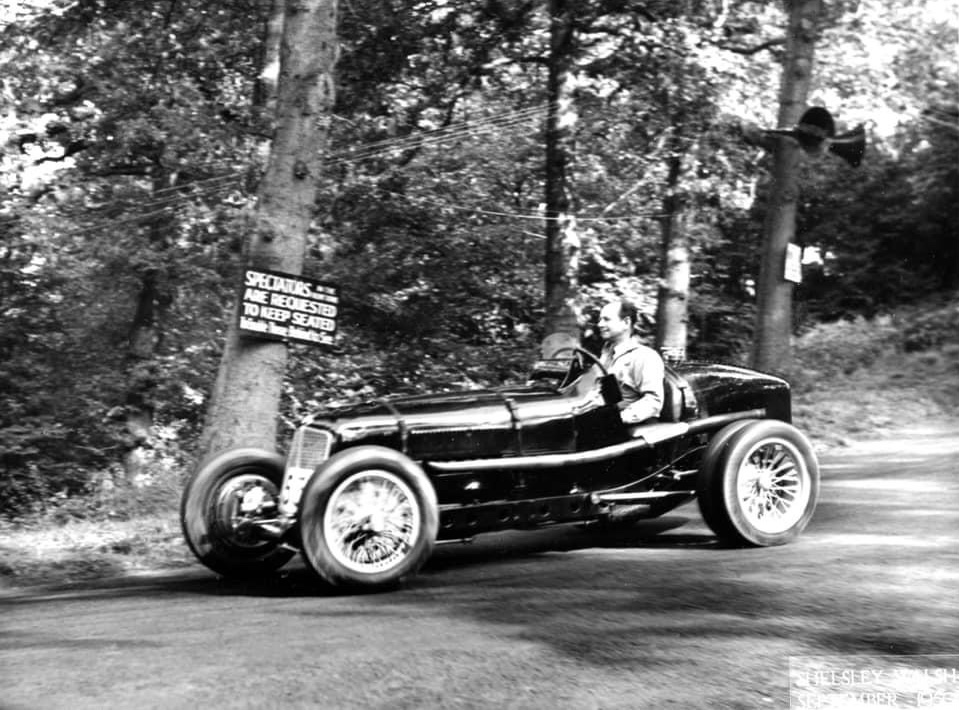
Mays was the King of Shelsley Walsh from the 1920s to the late 1940s, taking numerous FTDs and outright records in this period. He was ERA’s founding force ‘which was the first commercial racing car maker in Great Britain in 1934 and the rock upon which Britain’s current billion dollar racing car industry is built,’ wrote Simon Lewis. Mays won the first two British Hillclimb Championships in 1947-48 aboard R4D.
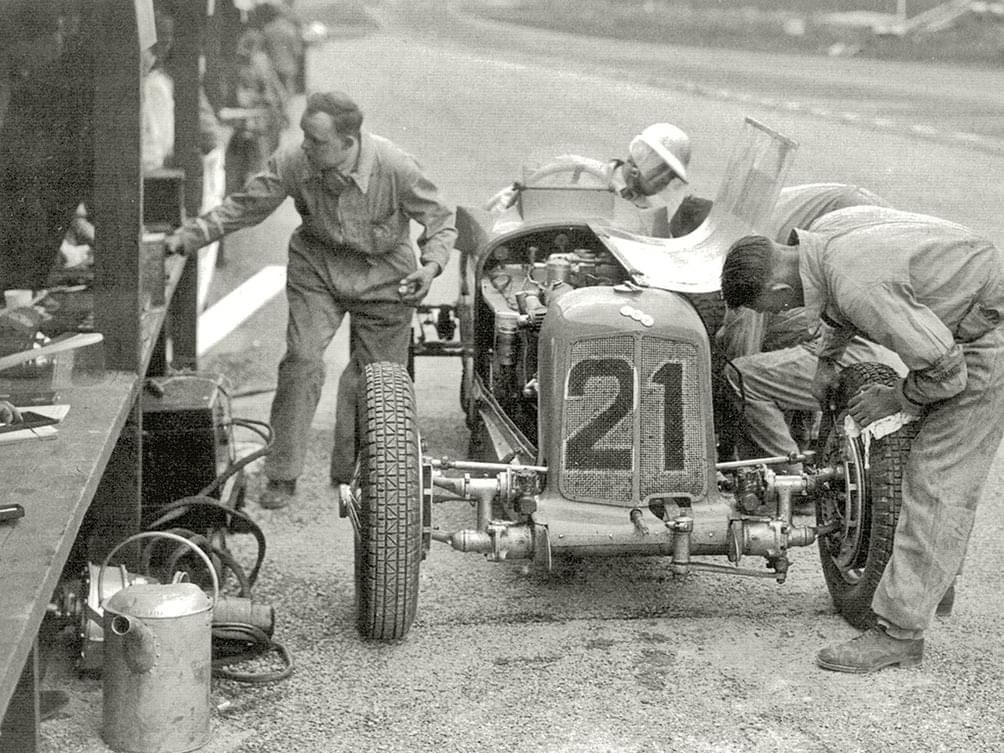
Ray Mays at Donington during the April 9, 1938 Empire Trophy meeting, the first time this chassis appeared in ‘D-specification’ .
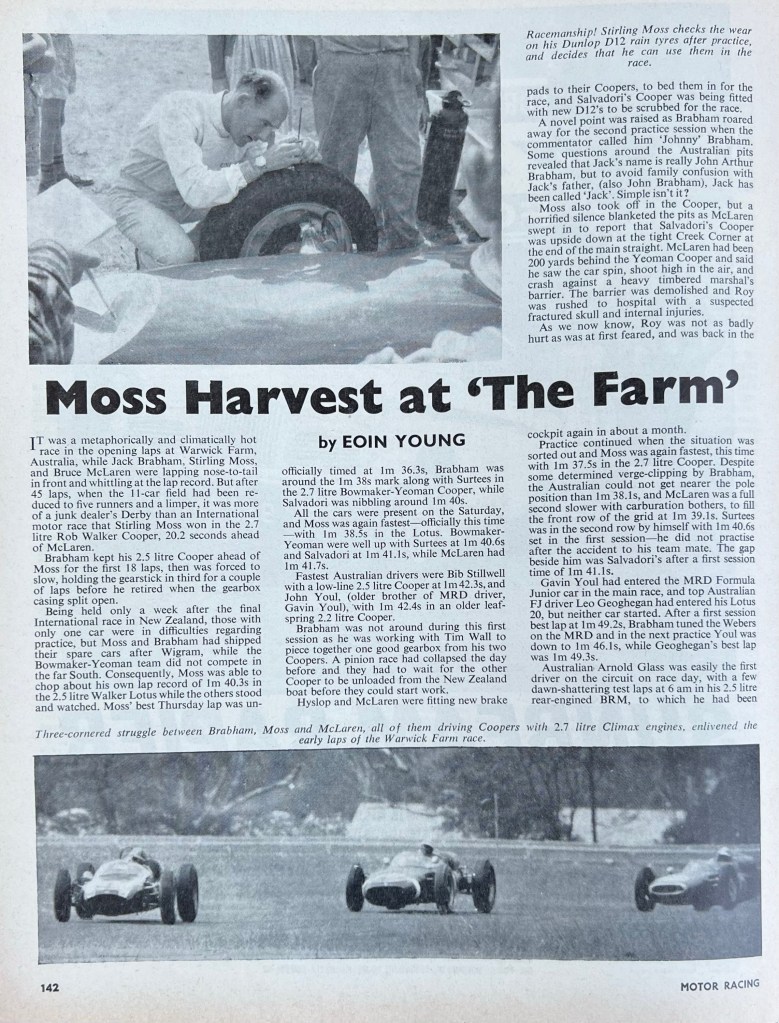
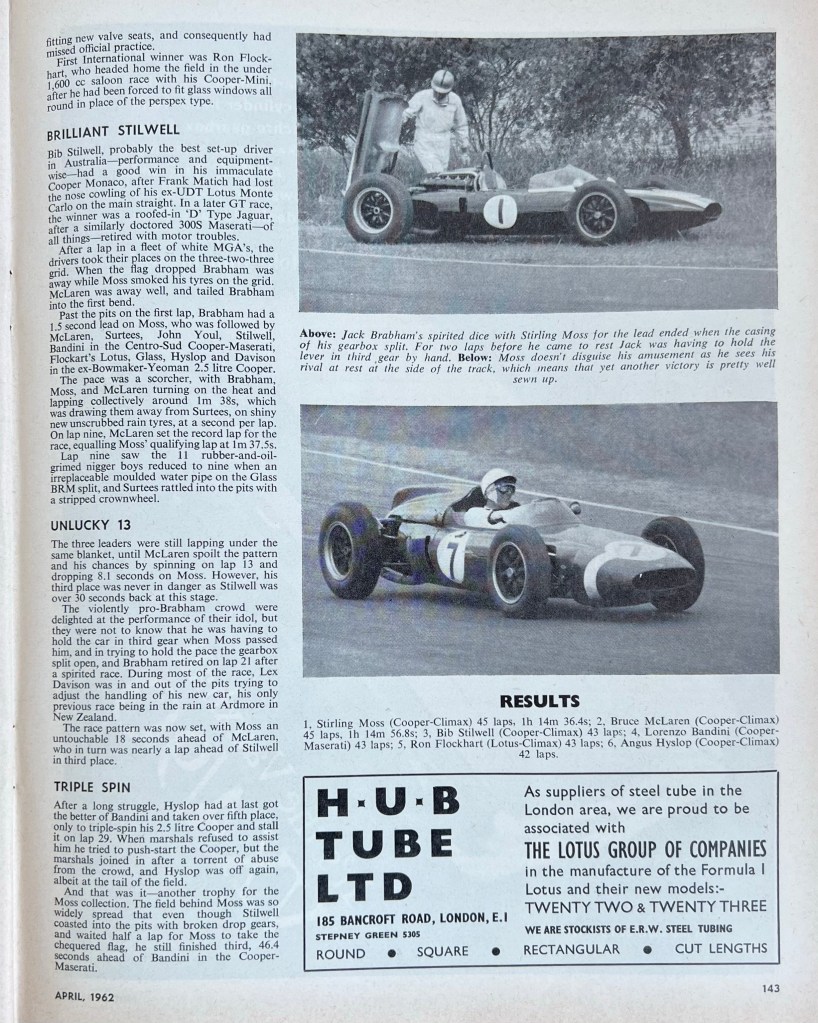
Of the rest of the articles within the April 1962 issue of Motor Racing I rather liked the coverage of Stirling Moss’ dominance of the Warwick Farm 100.
Credits…
Motor Racing April 1962, ERA Facebook Group, Adam Ferrington, Adam Wragg and Vlad Shnur Collections
Tailpiece…
(A Wragg Collection)
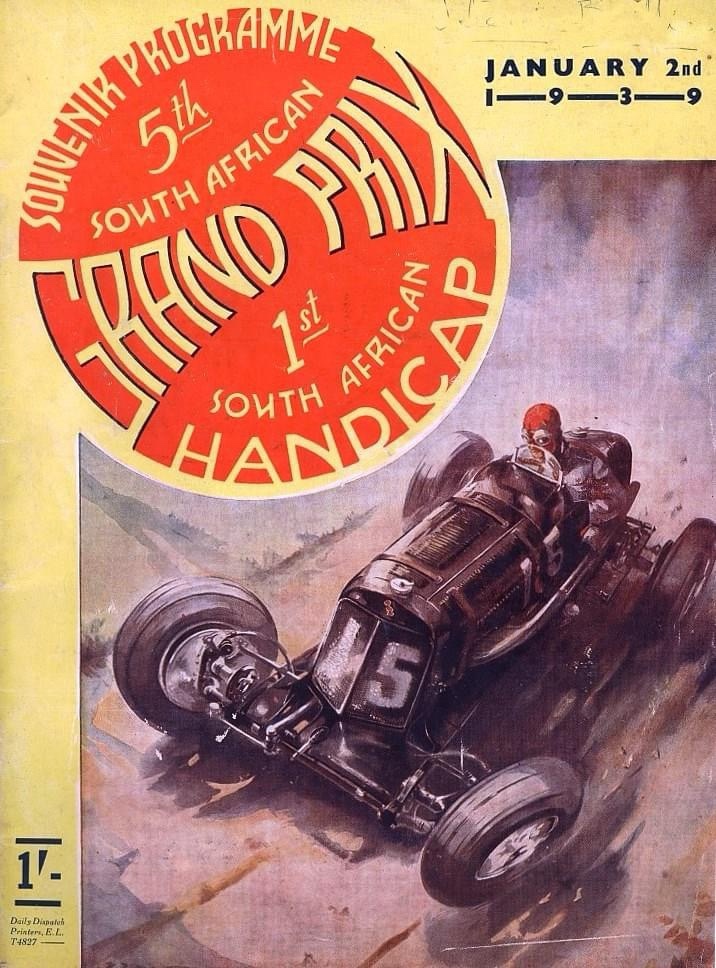
While R4D features on the cover of the 1939 South African Grand Prix programme, it didn’t race.
Gigi Villoresi won the 18 lap race held on the 11 mile Prince George Circuit around East London aboard a Maserati 6CM, but the 15 starters included four ERAs: Roy Hesketh in R3A was fourth, Earl Howe R8B, fifth, while Peter Aitken raced R11B to seventh, with Peter Whitehead the only ERA DNF, he blew a piston on R10B. Perhaps the car was a little tired after its extensive tour of Australia – inclusive of an AGP win at Bathurst – throughout 1938.
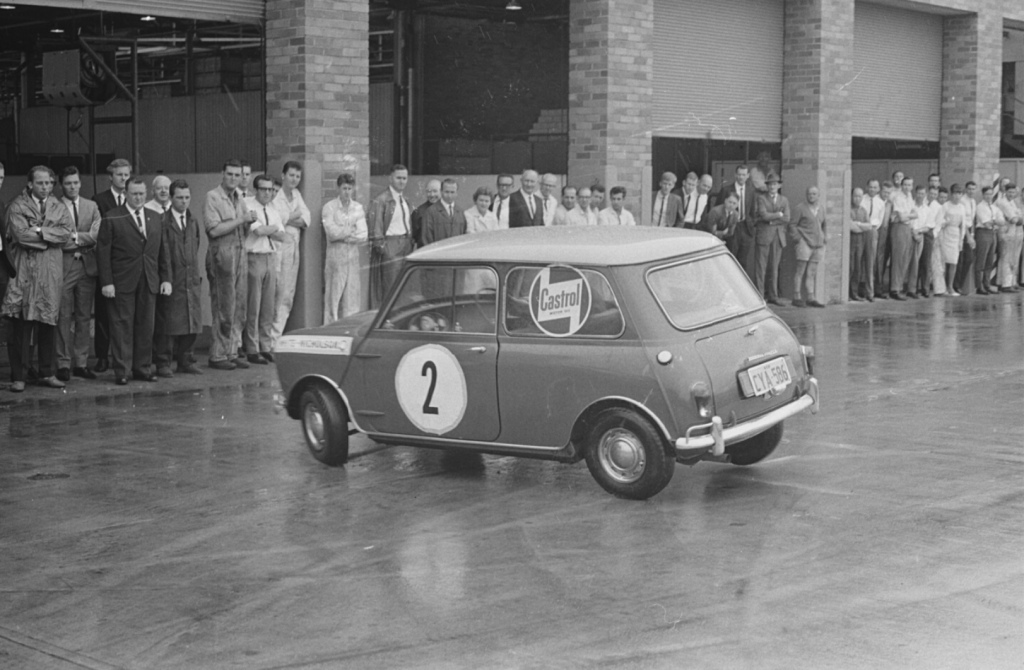
“Don’t even think about!” said Liz Stanton of the Mini Automatic. “It hasn’t got enough poke to pull ‘yer foreskin back, the Cooper S is the go for a studmeister like you,” or words to that general effect.
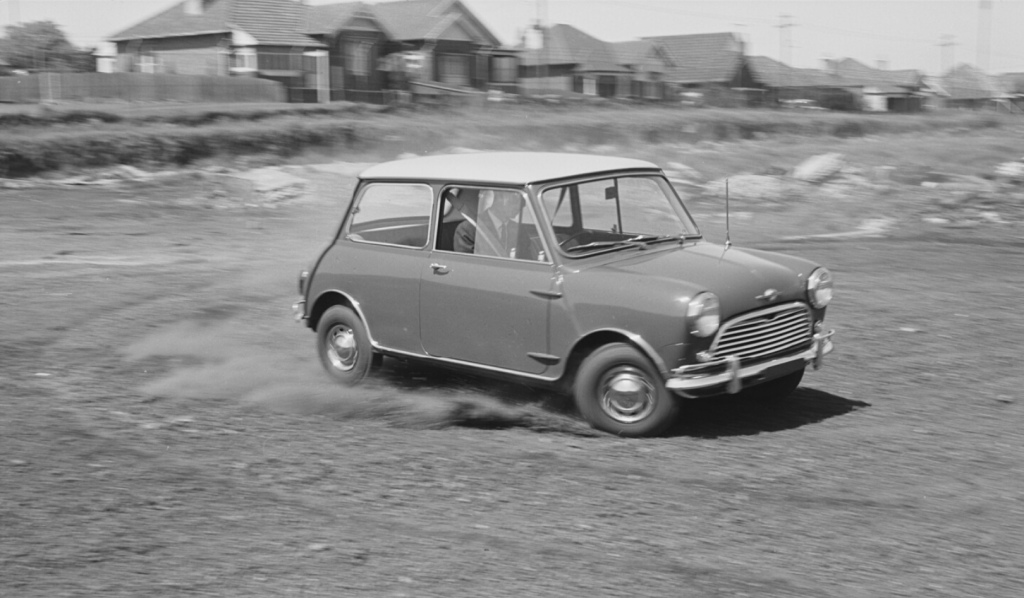
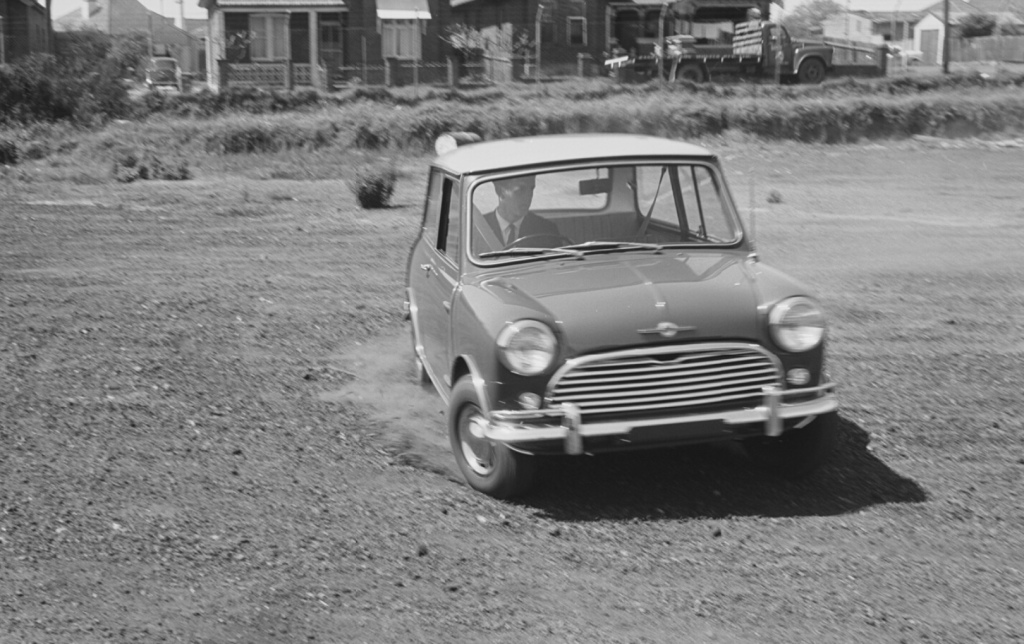
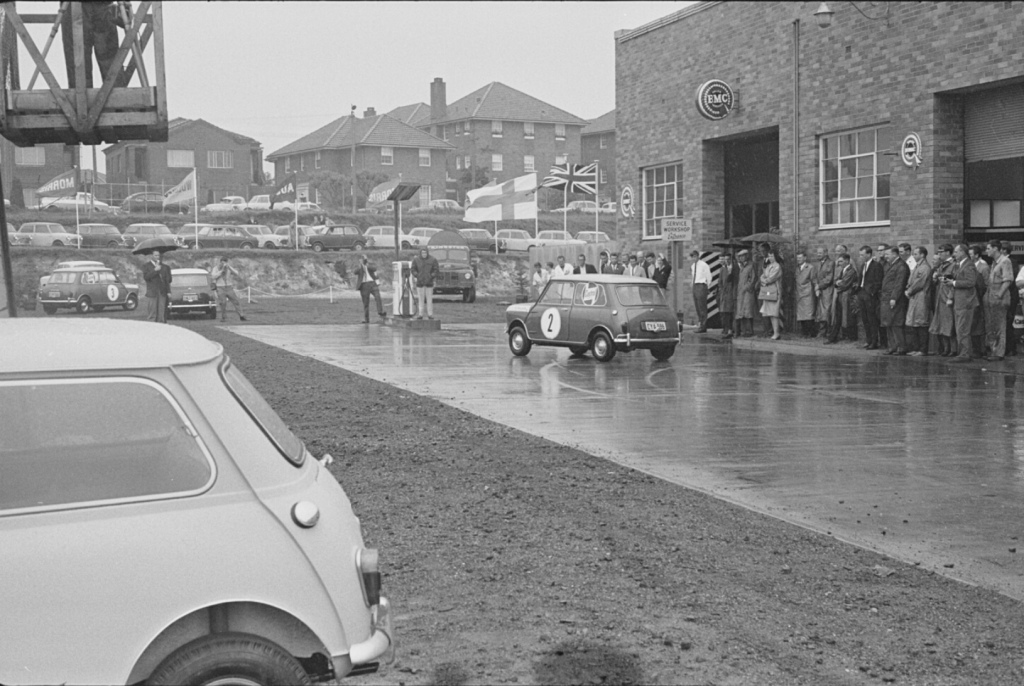
Pix photographer Bob Donaldson shot the Mini Matic launch at Surfers Paradise in September 1967 and five years before, a Morris Cooper test in October 1962, not to forget his November 1964 Zetland Grand Prix shots…
(Donaldson/SLNSW)Morris 850 at left, Cooper at right (Donaldson/SLNSW)
By the look of the backgrounds on some of the action shots, the drive and photos took place on the British Motor Corporation’s massive site centred on Zetland, six kilometres south of Sydney.
While common knowledge to Oz motor enthusiasts, some of you furriners may not be aware that a huge range of BMC cars were manufactured in full in Australia – bodies and engines included – until the favourable tariff treatment afforded the mother-country was eliminated in the early 1970s, after you bastards joined the EU…
Surely there has been no better small performance car on road, track, the hills and in the forests than the Cooper/Cooper S? Not to forget the iconic status of Alec Issigonis’ brilliant, original ADO15 (Austin Design Office) design.
Topsy grew in engine capacity – but critically not in size – from 997cc-54bhp to 998cc-54bhp, then 1071cc-69bhp, then for a while 970cc-64bhp, and 1275cc-75bhp, before settling at that 1275cc magic-number…
(Donaldson/SLNSW)
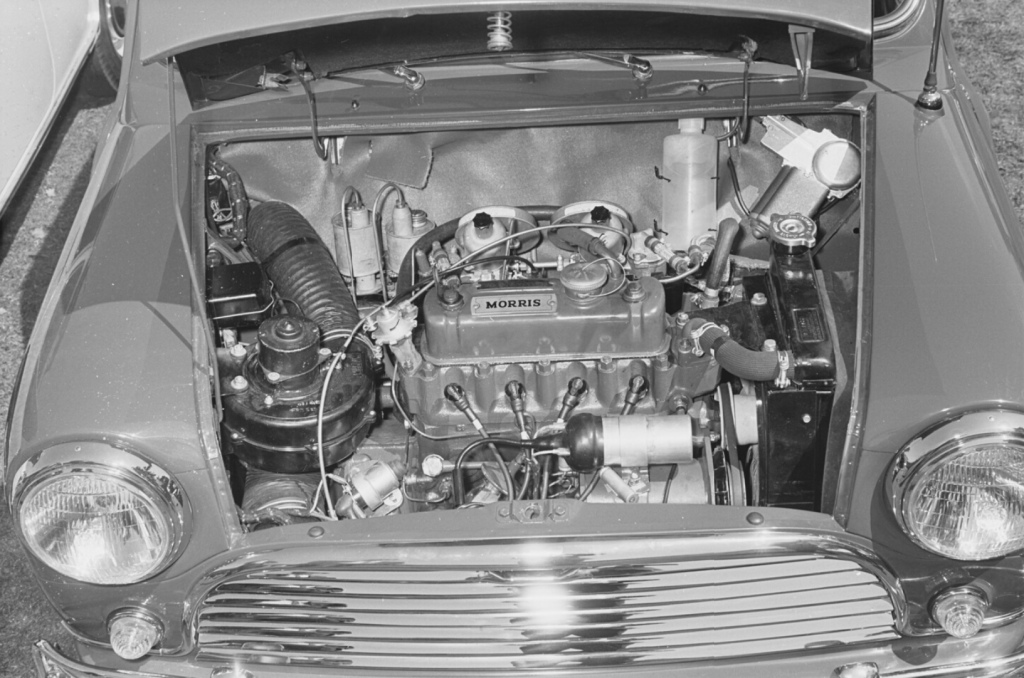
Note the factory extractors and twin HS2 SU carbs, the 997 gave circa 54bhp, not shedloads, but the thing weighed nothing and far more was easily capable of being extracted.
(Donaldson/SLNSW)
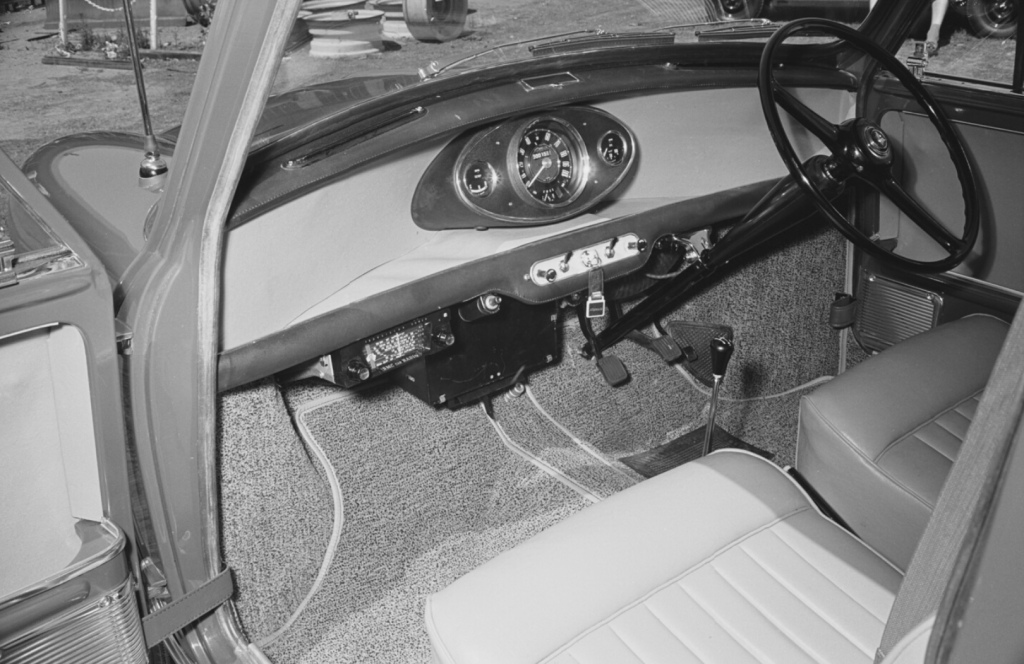
That instrument-pod never changed, thankfully. Coopers got a remote gearshift which was fast and great to use, the 850 got a long pudding-stirrer. The standard steering wheel was shit but no Cooper was complete without aftermarket Mota-Lita or Momo wheels and a Smiths tach. Oh yes, a racy mirror too, but only on the driver’s side.
(Donaldson/SLNSW)
The 7.5 inch front discs were effective, rare on small cars then too. Issigonis and John Cooper knew a thing or two about competition after all.
(Donaldson/SLNSW)
“Where is the other 5-gallon tank?” you ask. That came with the 1275cc S from 1966.
(Donaldson/SLNSW)(Donaldson/SLNSW)
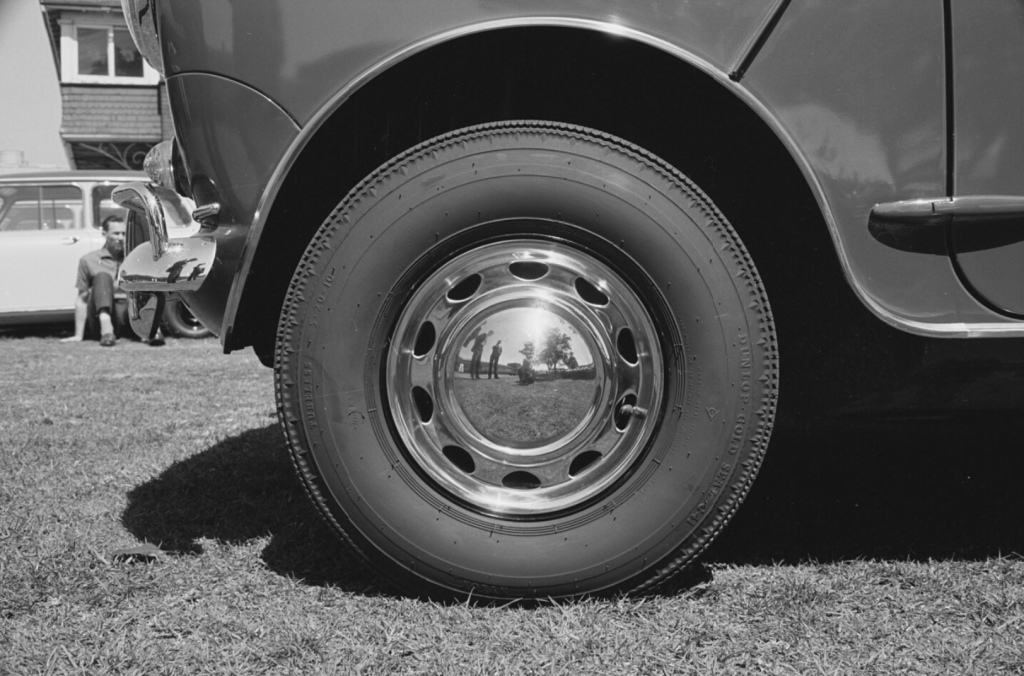
“Oh no!” Those steel wheels have got to go, and usually did. The well heeled bought Minilites but I always thought a set of Cosmic wheels were hard to toss visually, and were a bit stronger for road use and abuse.
Paddy Hopkirk competes in the little known ‘Zetland Grand Prix’ in November 1964.
Factory BMC drivers Hopkirk – winner of the Monte Carlo Rally aboard a Cooper S partnered by Henry Liddon that January – John Fitzpatrick, Timo Makinen and Rauno Aaltonen were in Australia to contest the first Sandown 6-Hour enduro on November 29.
Evan Green at the left? Paddy Hopkirk in the centre, and John Fitzpatrick, perhaps, at right (Donaldson/SLNSW)(Donaldson/SLNSW)
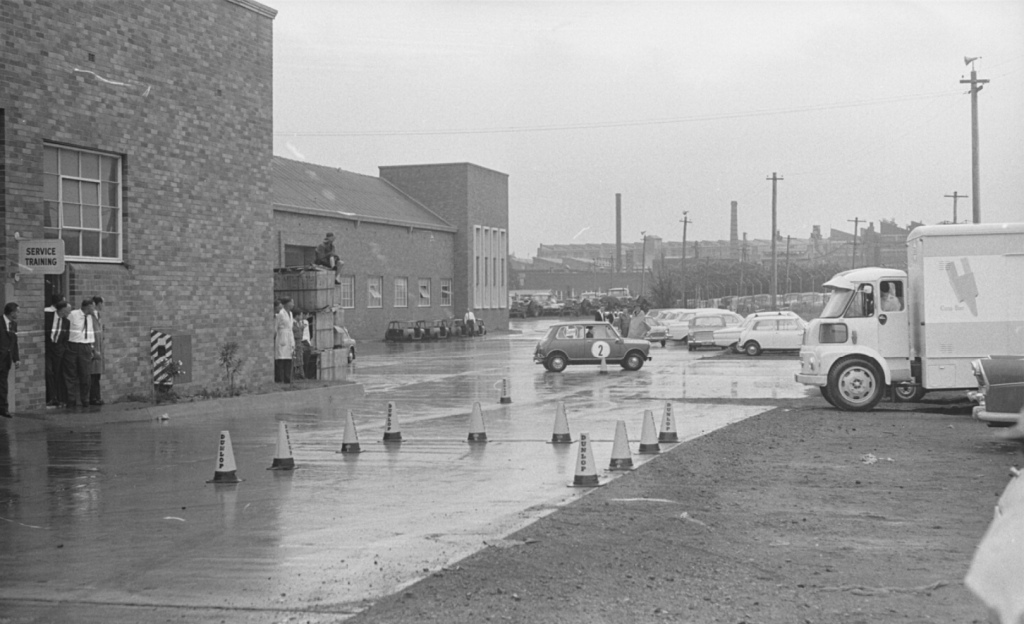
Part of the promotional activities set up by BMC Oz while the visitors were in their grasp was this demonstration of the capabilities of the cars built by the Sydney workers right in their own backyard.
Note the content of the safety processes/briefings: to the workers, ‘keep an eye on the cars’ and to the drivers, ‘try not to hit anyone’…Mission accomplished I believe. What a blast that would have been.
(Donaldson/SLNSW)
Credits…
Bob Donaldson, Pix, State Library of New South Wales, The Sun UK, LAT, Ashley Tracey
Tailpieces…
(The Sun UK)
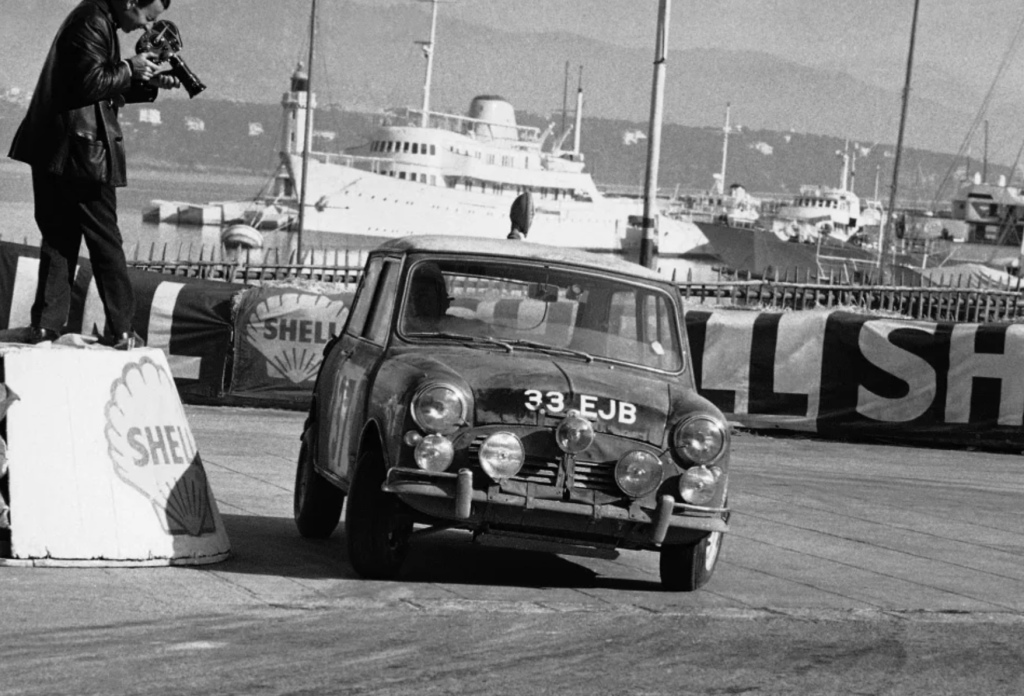
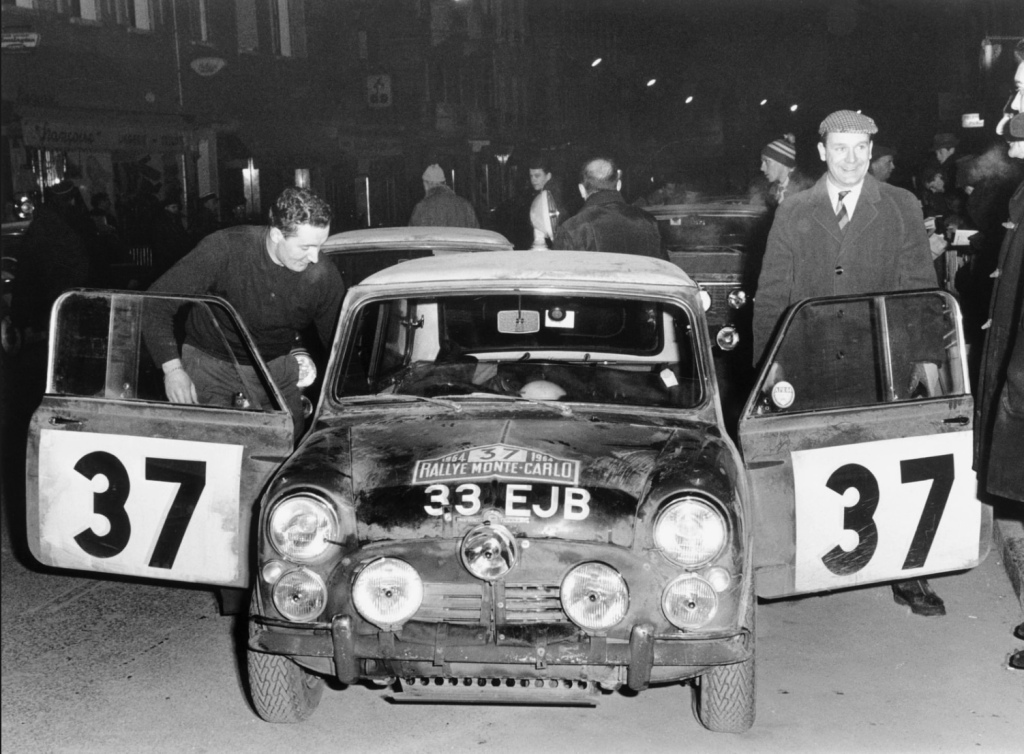
Paddy Hopkirk races around Monaco during the final 1964 Monte stage, and below after securing the historic win, with co-driver, Henry Liddon.
(LAT)(A Tracey)
Sandown 6-Hour 1964, the end of the first lap perhaps with the Barry Topen/Digby Cooke Fiat 2300 leading two of the three works-Cooper S.
These 1275 S were British built cars brought to Australia for the event by Zetland’s newly formed competition department, the idea of BMC PR Manager – and rally driver – the much respected Evan Green.
Alan Kemp managed the department, while the three Cooper S racers were prepared for Sandown by the legendary Peter Molloy – then working with Brian Foley in Sydney – at BMC’s Melbourne workshop in Moorabbin.
Peter Manton/Brian Foley were second, seven laps adrift of the victorious Alec Mildren Racing Alfa Romeo TI Super driven by Roberto Businello and Ralph Sach. The Hopkirk/Fitzpatrick car was sixth, while the Makinen/Aaltonen pair failed to finish after losing a wheel and rolling. See here for some footage of the race: https://youtu.be/LZiQ4PJSmyo?si=Sb39mqNzckopf-kK
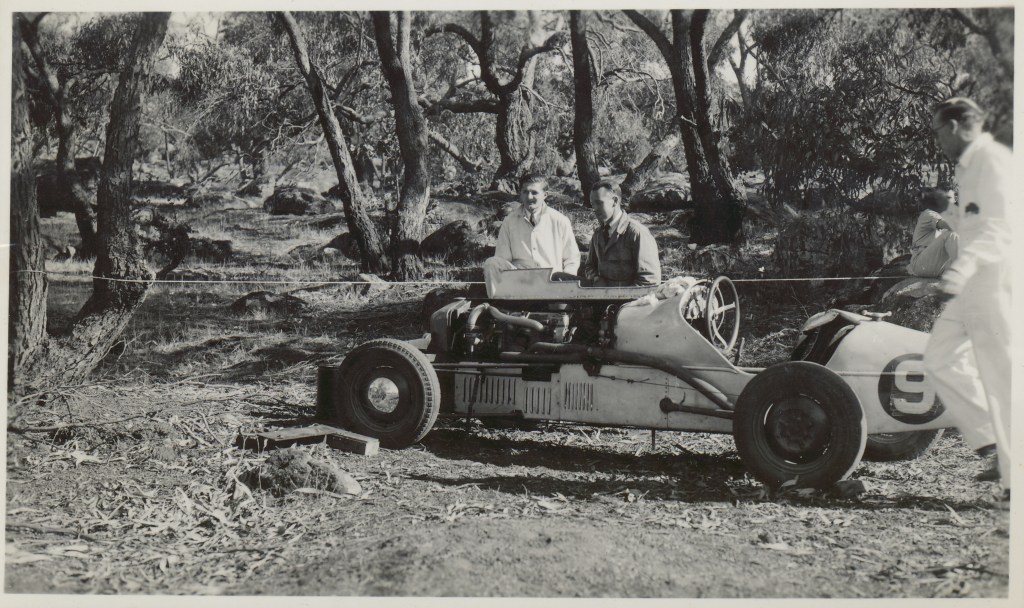
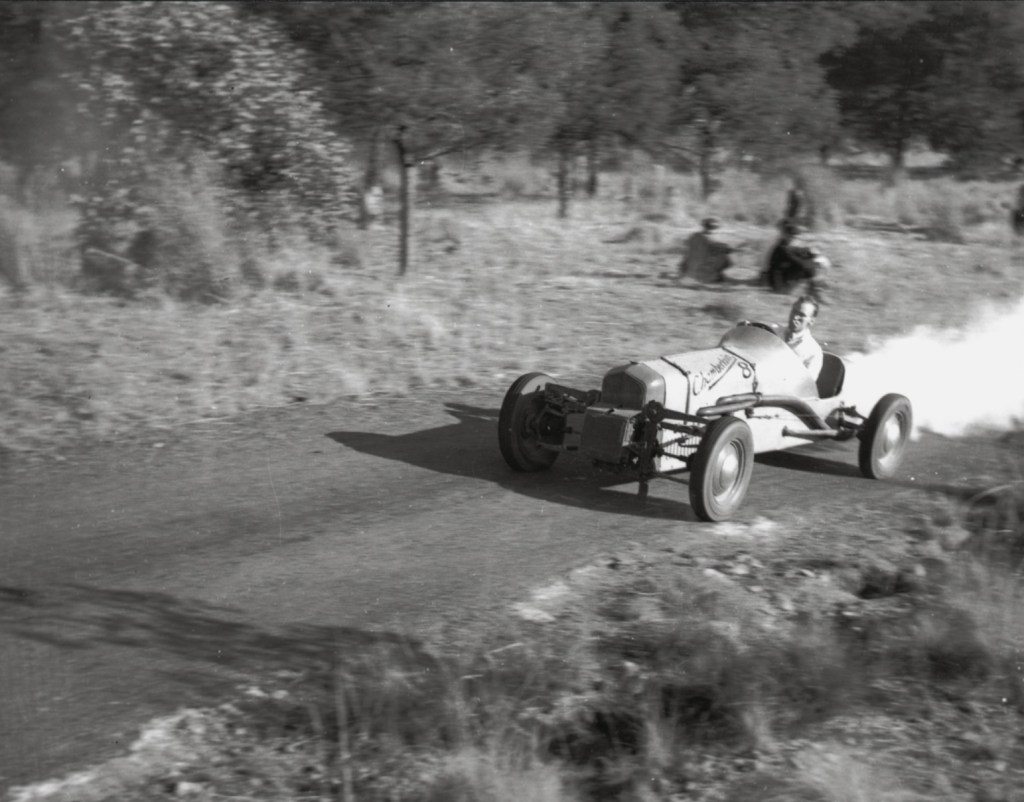
This pair of shots are of Jim Hawker at the 16th Rob Roy in June 1948 above, and the 10th Rob Roy meeting below, in 1946.
(G Thomas)(G Thomas)
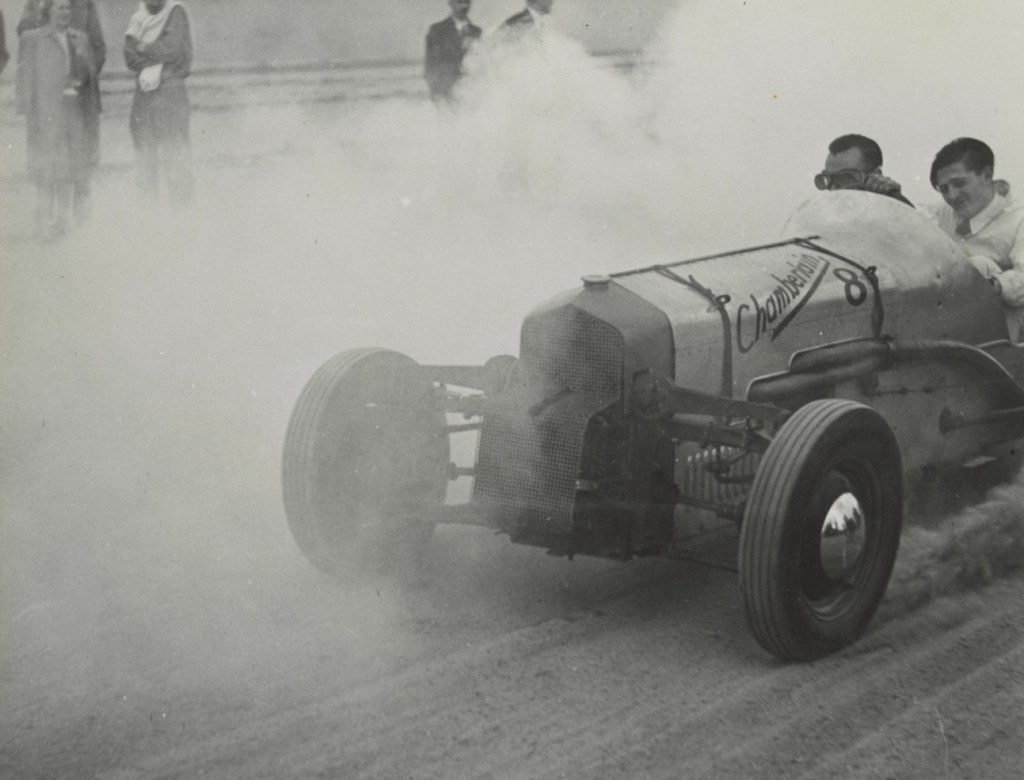
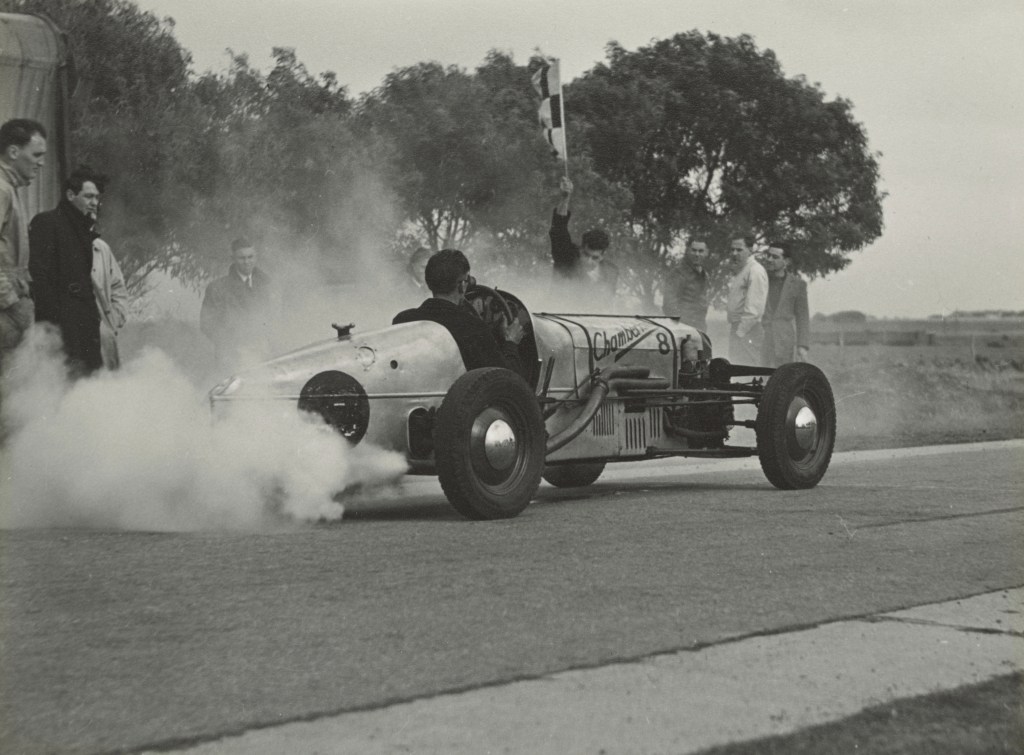
Peeling out during a run at the Vintage Sports Car Club speed trials on June 16, 1947.
Spaceframe chassis, independent suspension front and rear, front wheel drive, and a complex four cylinder 1.1-litre, stepped bore, eight-piston, vertically opposed, supercharged two-stroke, twin-plug engine amongst its pre-war bag of tricks.
Kelvin Bullock’s 1917 Scripps-Booth V8 Special looking very handsome at Lake Perkolilli, Western Australia in the late-1930s.
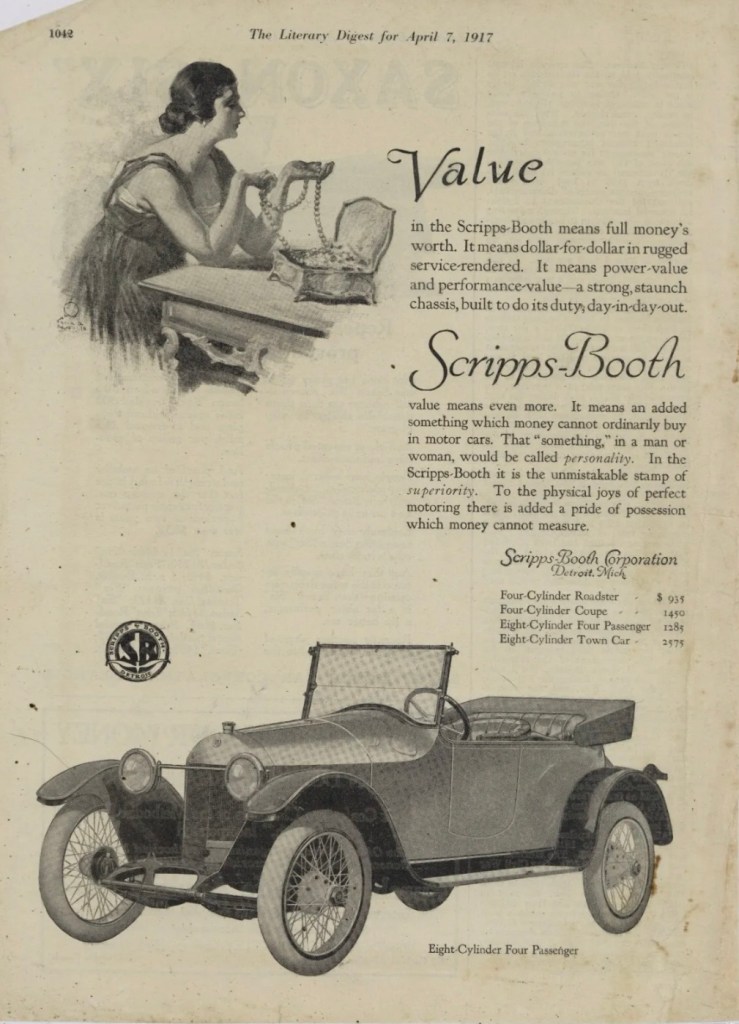
I’d never heard of the marque Scripps-Booth (S-B) until tripping over this shot of Bullock’s handsome racer on Graeme Cocks’ mighty-fine Lake Perkolilli Red Dust Revival Facebook page; https://www.facebook.com/reddustrevival2022/
The American marque was imported into Western Australia by the Armstrong Cycle and Motor Agency, this car was living in the rural hamlet of Corrigin when Claremont racer/mechanic Bulloch acquired it and extensively modified it circa 1937.
He raced at various of the West Australian’ Round the Houses towns including Albany, Bunbury, Pingelly, Applecross, Cannington, Dowerin and Lake Perkolilli.
Dowerin, September 4, 1938 and side view of the Bulloch Scripps-Booth V8 Spl (G Cocks)Ferro V8 engine 1916-17 technical details as per text (Ferro)
Motorist and Wheelman magazine outlined the technical details of the Scripps-Booth Model D based special, as Cocks quipped, it shows just how inventive Specials builders were.
The engine was a Ferro V8, one of the first production American V8s, “which was surprisingly modern in design, and a most beautifully made and finished motor.” It still had its original cast iron pistons and had never been rebored. “The valves now in use, were designed for an Essex, and turned own for the Scripps. They are now closed by Chevrolet springs.”
The Alanson Brush designed series of V8s were built by the Ferro Machine and Foundry Company in Cleveland, Ohio; the Ferro Corporation still exists. The engine chosen by Scripps Booth was Ferro’s Model 8-35, a 162cid/2660cc, a two-main bearing OHV unit famous for being one of the first production automobile V8s, the first too with the block and crankcase produced as a single casting, 16 years before the 1932 Ford V8. The 8-35 had a 2 5/8 inch bore, 3 3/4 inch stroke, with a compression ratio of about 5.5:1. Fed by a Zenith twin-barrel carb, it produced 22.05hp/SAE, with an advertised output of 35hp. A Bosch magneto provided the sparks on Bulloch’s engine.
One owner described the engine as like two four-cylinder motors joined at the crankshaft, with each bank of cylinders fed by one chamber of a water heated inlet manifold. A heavy flywheel kept the vibrations at bay.
“The gearbox is original Scripps-Booth, but the rest of the 889kg that makes up the car, includes parts from a remarkable number of makes. The front dumb-irons are Chevrolet and the wheels and spring shackles Citroen. The radiator grille is ’34 Ford, the core Chevrolet, while the fan did 10 years service on a Rugby but its mounting is Bulloch Special.”
“Both the front axle and front brakes are Whippet, while the lamps in the first place showed the way to a driver of a Chrysler. The steering box, tailshaft and universals are Essex. At the top of the column a Ford steering wheel rides and behind it are two Austin bucket seats. Shock absorbers are Ford, and the rear braking, Bulloch says, ‘is by accident’!”
Dowerin September 4, 1938 (G Cocks Collection)
James Scripps-Booth and his creations…
“James Scripps Booth was a Detroit-area artist and automotive engineer. Born on May 31, 1888, in Detroit, Michigan, Booth was the eldest child of George Gough Booth, of the Booth publishing chain, and Ellen Scripps Booth, of the Scripps publishing empire,” according to the Detroit Historical Society. What follows is their ‘Encyclopaedia of Detroit’ entry on Booth.
“Booth grew up in a household that encouraged an awareness and appreciation of the arts, and he spent many hours sketching in and around his parents’ home in Detroit, surrounded by an extensive art collection. He also encountered many distinguished artists, writers, and musicians. Booth received most of his education through private schools and left school before finishing tenth grade. He taught himself the basics of automobile mechanics by systematically dismantling and reassembling the family’s car. While employed at the Detroit Evening News he developed his writing skills, broadened his automotive background, and refined his art techniques.”
“In 1910 at the age of 22, he married Jean Alice McLaughlin in Detroit. Following their marriage, Booth and his wife moved to Paris, where Booth studied art at the École des Beaux-Arts. They also spent some time living in Etaples, France, where Booth learned the fundamentals of working with pastels from Michigan-born artist Myron Barlow. In the decades following the couple’s return to the U.S., several of Booth’s works received critical acclaim at exhibitions at the Detroit Museum of Art and at other shows in both Michigan and California.”
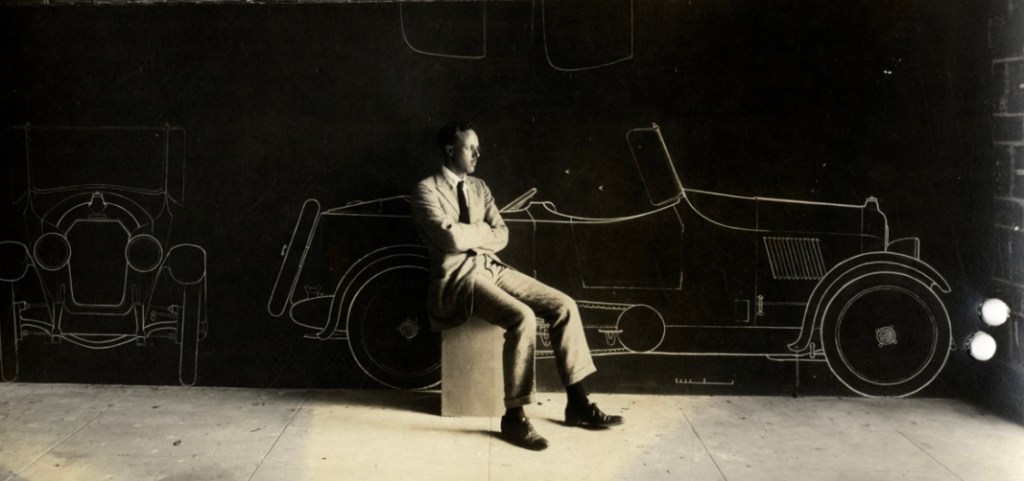
James Scripps Booth (he didn’t hyphenate his own name) posing with a life size drawing of his Da Vinci ‘Pup’ cyclecar in 1921 (HA Parker)James Scripps Booth’s drawing of the 115 inch wheelbase 1915-16 Scripps-Booth Vitesse Speedster V8, only one of which was built. The reverse of this drawing has this note by James “Proposed for Scripps Booth, accepted and detailed, then policy changed by Clarence Booth, then JSB quit.”
“As Booth perfected his artistic talents, he also developed a keen interest in mechanical engineering and automotive design. Many of his early drawings consisted of new designs for automobiles. In 1913, Booth developed his first automobile prototype, the “Bi-Autogo,” a unique two-wheeled cyclecar. The Bi-Autogo utilized the first V-8 engine ever built in Detroit. Booth’s Scripps-Booth Cyclecar Company was defunct within a year but was responsible for memorable designs. In 1914, with the financial support of his uncle William Booth, publisher of The Detroit News, Booth began his second business venture, the Scripps-Booth Automobile Company. The company produced more traditional upscale automobiles and was much more successful than the cyclecar business. Booth resigned in 1913 and moved to Pasadena, California. The company was purchased by General Motors and continued to operate until 1922.”
“In the 1930’s Booth moved his family back to Detroit from California, established an industrial design/art studio in Indian Village, and assumed responsibilities both as a trustee of the Brookside School and Cranbrook Foundation and as a director of the Cranbrook Academy of Art. During World War II, Booth published the General Handbook, Motor Mechanics Simplified: Understand Your Car, used by the American Red Cross in their automotive mechanics classes.”
“Following Booth’s death on September 13, 1954, a large collection of his automotive drawings, artwork, and several of his cars were donated to area institutions, including the Detroit Historical Museum.”
Scripps-Booth Model D…
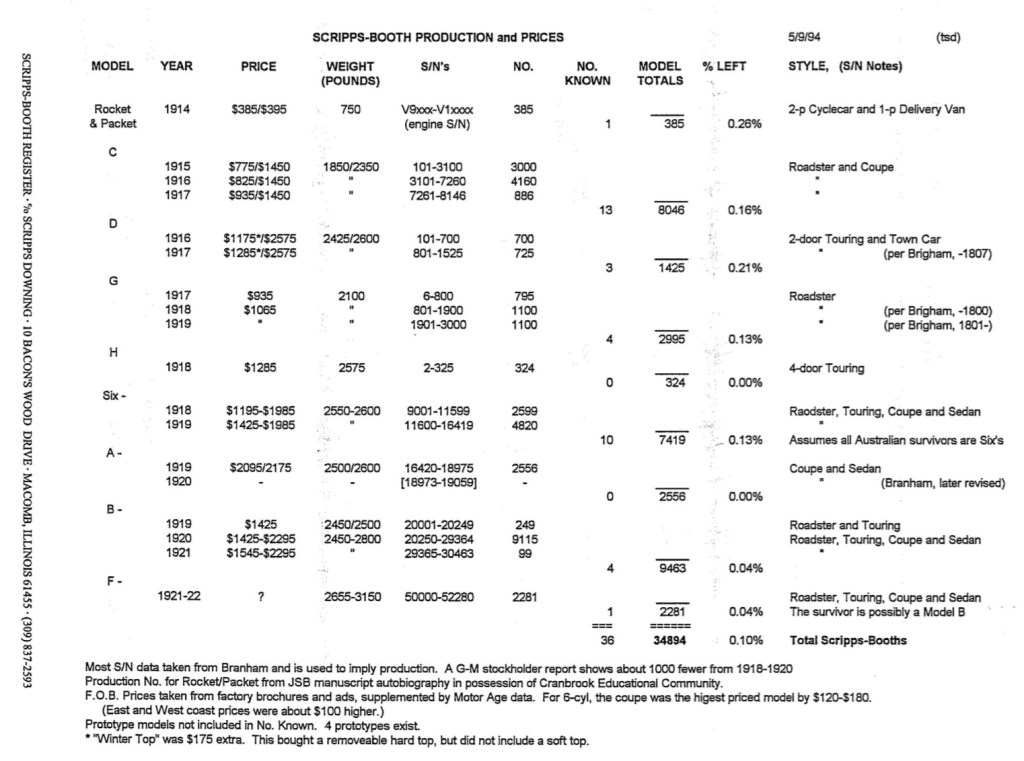
The donor car for Bullock’s special, the model D was built between July 1916 and July 1917. VIN numbers quoted are 101-801 (and 101-700) and 801-1807 (and 801-1525) respectively: 700 cars and 725 cars depending upon the figures you believe.
While Booth’s prototype of the Model D V8 was the short wheelbase (115 inch) two-seat sporty Vitesse, Booth lost the production battle with his fellow management team of the Michigan based Scripps-Booth Company. The cars built were 2-door tourers and town cars (and runabout, chummy runabout/roadster built on a 120 inch wheelbase. Whether S-Bs imported to Australia were factory built or arrived sans-bodies, given the favourable tax-treatment afforded cars imported as rolling-chassis, is unclear.
The agents for S-B in Australia were the Armstrong Motor and Cycle Agency in WA, Roy Standfield Ltd in Sydney (from 1919 John McGrath) and Durance-Mayston Motors in Melbourne. It appears the cars came to Australia in some numbers, 62 S-Bs were registered in NSW in 1919 alone. How many are left here now? less than 10 it seems.
1916 Ferro ‘V-Type’ Motors ad. The types listed are the 8-35 (163cid), 8-48 (198cid), and 8-60 (265cid), that is 35, 48 and 60hp V8s and the 12-80 80hp V12. Hopefully, you can just read this…
What inspired this exploration of the arcane is the gorgeous looking body Bulloch had built by a body-artisan of some ability in Perth. It seems it’s perhaps not entirely original though. Perth man Graeme Holman is building a tribute car to the long-lost Bulloch Scripps-Booth V8 Special and credits the design inspiration for it as the 1934 Ford Model 40 Special Speedster commissioned by Edsel Ford for his own use. What a shame it is the magnificent E.T. ‘Bob’ Gregorie designed car was not put into series-production, they would have sold like hot-cakes. See here for a great piece on these cars; https://www.thetruthaboutcars.com/2012/01/look-at-what-i-found-the-most-significant-car-at-the-2012-naias-edsel-fords-1934-model-40-special-speedster/
The second Ford Speedster ordered by Edsel Ford – 1934 Type 40 Special Speedster – with its original, very elegant front styling, the photo was perhaps taken near Greenwich Village on Ford’s Dearborn campus. The shot below shows Ford Chief Designer Bob Gregorie’s scale model of the 1940 restyling to address overheating issues, and Edsel’s note to him (FoMoCo)(FoMoCo)
Bulloch bought his S-B in late 1937 or early 1938 in Corrigin, an affluent wheatbelt town 230km southeast of Perth. Perhaps the car was a farmer’s pride and joy and was pushed into a shed when it eventually misbehaved? Interestingly, a Mr C.D. Kerr placed fifth in a S-B at the Bibra Lake standing-quarter mile meeting in February 1935 (26.4sec), I wonder if it’s the same car?
Quite who the team of mechanic/engineers/bodybuilders that assembled the cocktail of S-B Model D chassis, engine and gearbox and other assemblage of components into such a cohesive looking and seemingly competitive racer is unknown…but I’d love to know.
Kelvin Bulloch had been a prominent in the WA Sporting Car Club from about 1935. In ’37 he won the club’s silver-star for the greatest aggregate points in club competitions as well as the over 1500cc hill climb and had considerable success in gymkhanas. In 1936 he won the club’s eight-hour trial, the year before he dead-heated with Aub Melrose for first place.
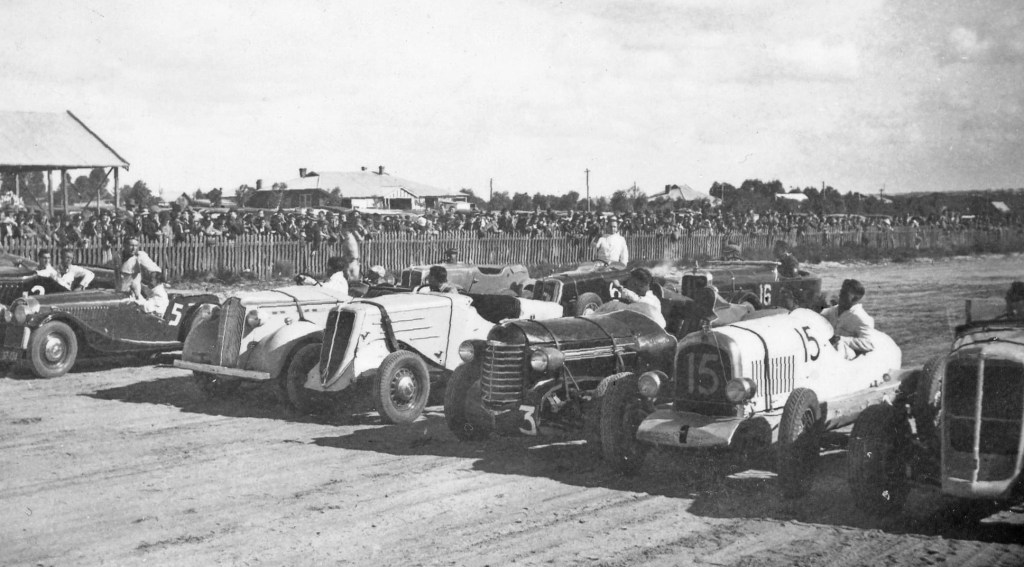
Some of the field at the September 1938 Dowerin meeting, Bulloch #6. Help with other car IDs welcome (G Cocks)
Bulloch is said to have raced the car at various of the WA Round the Houses town tracks including Albany, Bunbury, Pingelly, Applecross, Cannington and Lake Perkolilli, with his best result a win at Dowerin in September 1938. There he won the main event, a 20 lap handicap, “driving well to gain the lead in the early stages” and triumphing despite his engine misfiring in the race’s final stages.
In an article to promote that Dowerin meeting, The West Australian described the car as ‘The Venerable Scripps-Booth’. It reads “One of the most unlucky drivers in recent months has been Kelvin Bulloch. He failed to start at Albany, and a minor ignition failure robbed him of almost certain victory in the big race at Dowerin in June. This time he is hopeful that the old Scripps-Booth, which has been dubbed ‘The Scraps’ will at least last the course.”
The class of the field in WA then was soon to be 1939 Australian Grand Prix winner Allan Tomlinson and his MG TA Spl s/c and Jack Nelson in a Ballot 2LS Ford V8 Spl.
Quite what became of the Kelvin Booth Scripps-Booth V8 Special is unknown, do get in touch if you can assist.
(Cox Family)
Other Australian competition Scripps-Booth…
“A picture of my old man, Wally Cox about 1937,” Allen Cox wrote. “A 23 year old petrol-head, his car was a 1922 Scripps-Booth fitted with a T-Model Ford engine fitted with a Frontenac or Rajo cylinder head conversion. In addition to that he pulled off the guards and lightened it etc. The problem was that in small country towns the constabulary knew where everyone lived!”
(Thomas Family)
1960’s drag-racing champion and speedshop chain entrepreneur Eddie Thomas owned a Scripps-Booth 13-34 162cid V8 that he fitted to a speedway midget he raced circa 1940.
What became of these cars and engines is unknown.
Etcetera…
These tables are from the Scripps Booth register, check out scrippsboothregister.com if you have a hankering to learn more about these cars.
Model D styling drawings by James Scripps Booth
Credits…
Red Dust Revival Facebook page, Graeme Cocks Collection, Detroit Historical Society, Harold A Parker, scrippsboothregister.com, various newspapers via Trove, Terry Walker’s Place – West Australian race results, Ferro Corporation, FoMoCo
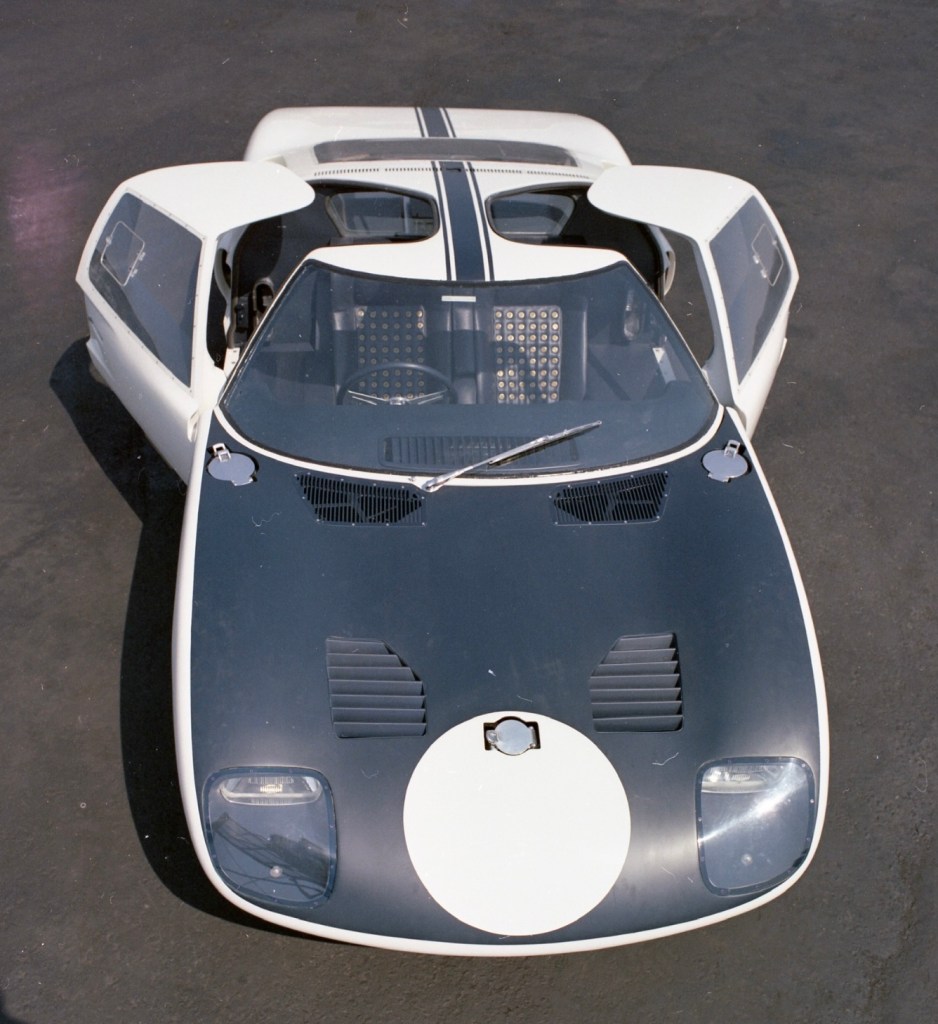
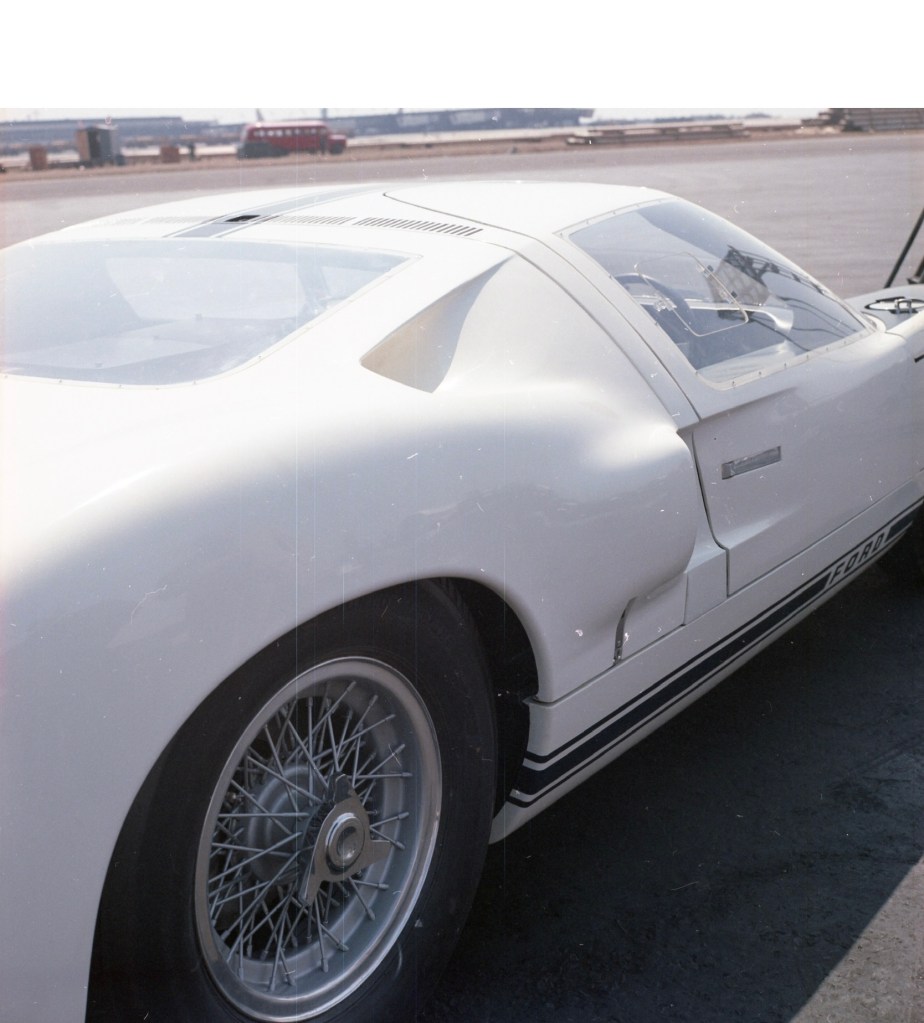
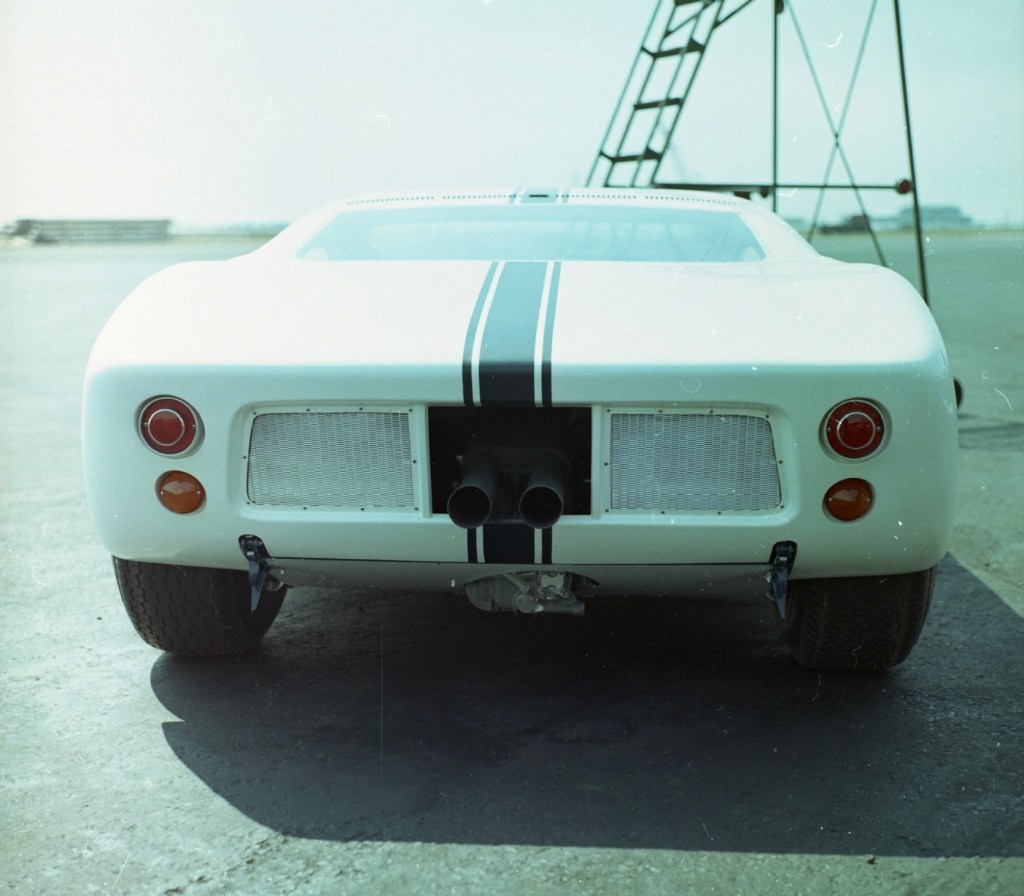
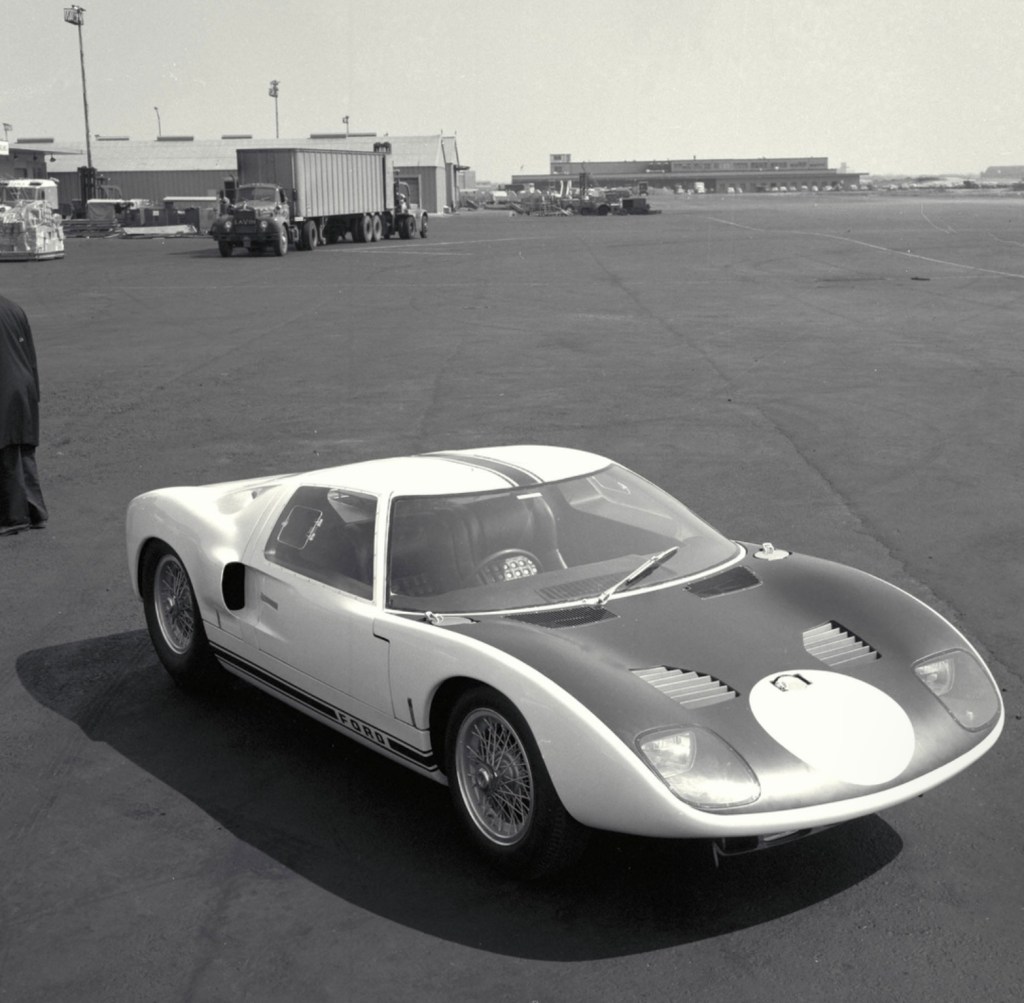
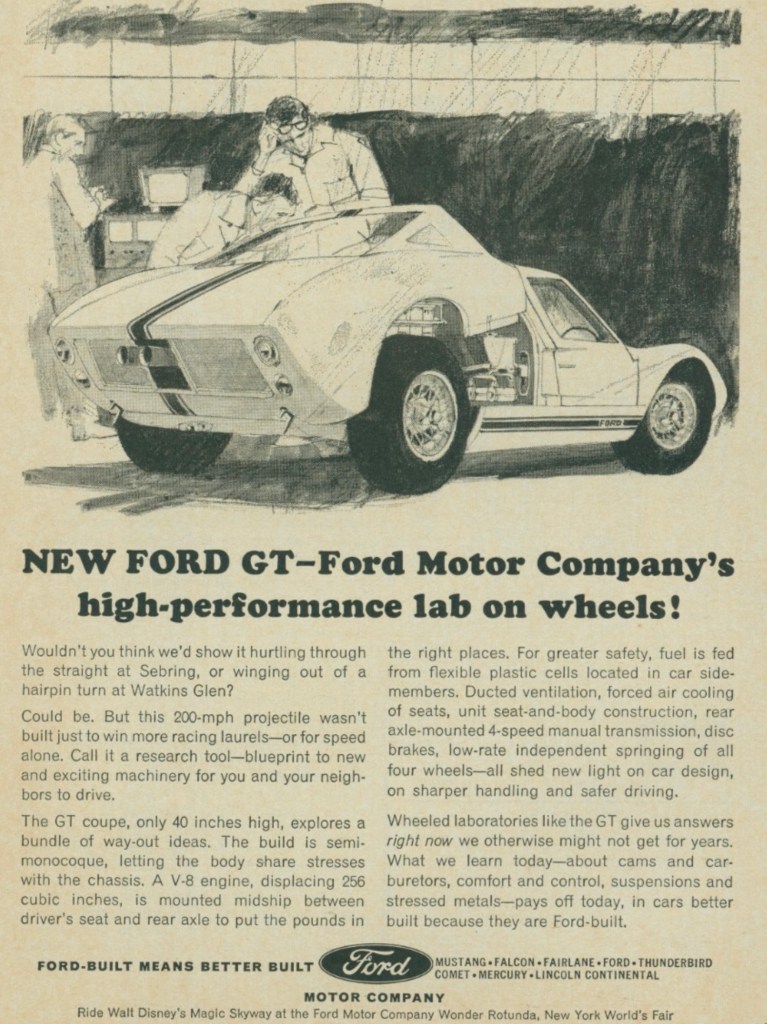
Ford GT40 chassis 101, the first of 12 prototypes built, on the runway at JFK Airport, New York, in early April 1964…
The machine is on its way to the New York International Auto Show, having been presented publicly to journalists in an open day at Slough, then outside the offices of Trans World Airlines at Heathrow on April Fools Day, before it was flown to the US “to be used for a press conference prior to the Mustang launch,” then display between April 4-12.
The car was a starlet for only the briefest of times, it was destroyed in an accident in the wet while being driven by Jo Schlesser during the Le Mans test weekend on April 18.
Jo Schlesser, Le Mans test weekend, Ford GT40 #101, April 1964 (MotorSport)Ford GT40 1964 cutaway (FoMoCo)
Ford’s blunt telex on May 22, 1963 announced the end of discussions of the takeover of Ferrari by the Detroit giant. “Ford Motor Company and Ferrari wish to indicate, with reference to recent reports of their negotiations toward a possible collaboration that such negotiations have been suspended by mutual agreement.”
A month later Ford created the High Performance and Special Models Operations Unit – catchy ‘innit? – to design and build a Le Mans winner. Members of that group included Roy Lunn and Carroll Shelby. Kar Kraft was established within FoMoCo to oversee the Ford GT program, with Lunn its manager.
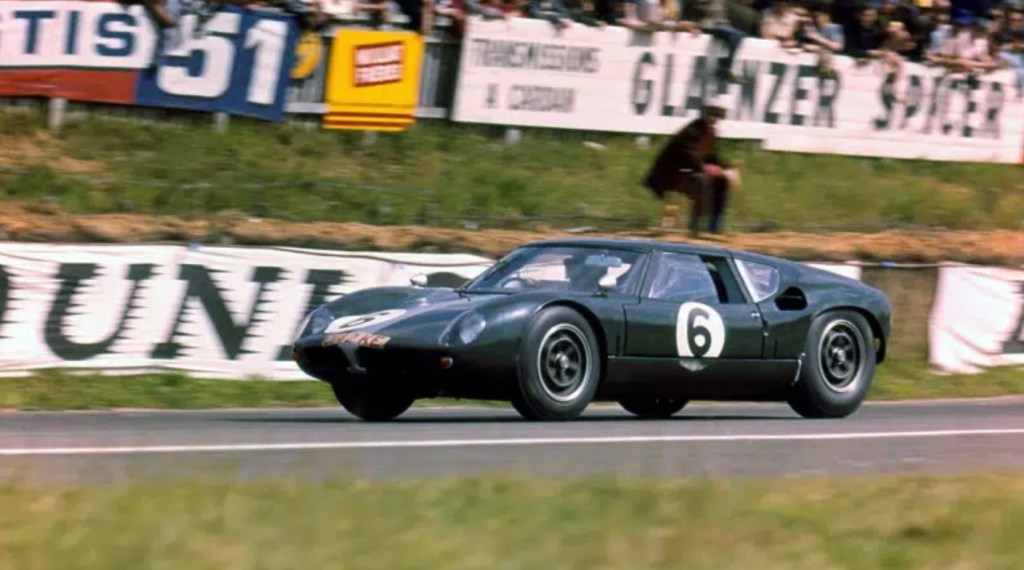
They soon identified and contracted Eric Broadley as project engineer, his monocoque Lola Mk6 GT Ford, which had performed well at Le Mans in 1963, despite not finishing, was a ground-breaking sports-prototype. As part of the deal Ford acquired the two existing Lola GTs, giving them a nice head start. John Wyer was appointed as race manager, a role he had performed at Aston Martin when Shelby co-drove an Aston Martin DBR1 with Roy Salvadori to Le Mans victory in 1959.
“The four pronged team comprised Lunn and Broadley designing and building the cars, Wyer managed the operation with Shelby acting as frontman in Europe,” Ford wrote.
(FoMoCo)
Key members of the Slough design team included Broadley, Lunn, Phil Remington and Len Bailey.
In the 10 months prior to the ’64 Le Mans classic the program got underway at Lola’s premises in Bromley. The Ford Advanced Vehicles (FAV) operation later moved to a factory in Slough, alongside Lola, who moved as well – in the middle of what is now referred to as Motorsport Valley – in the Thames Valley.
Some development work was carried out in Dearborn, but in essence the Ford GT40 was a British design funded by US dollars. The Ford contribution – most critically was absolute monetary and management commitment from the top to succeed – included engines and aero-modelling in which a scale model of the car was tested in their Maryland wind tunnel. Computer aided calculations related to aerodynamics under braking was undertaken and anti-dive geometry explored. The two Lola Mk6 Fords were used as mobile test-beds in the hands of Bruce McLaren and others until the end of 1963.
Le Mans test weekend (MotorSport)(FoMoCo)
Let’s go back to the April 1964 logistics of #101. Ford GT40 anoraks shouldn’t get too excited by this piece, the words are a support for a bunch of great Ford Motor Company photos taken at JFK and in the studio I’ve not seen before. After the New York International Auto Show, the car retuned to the UK and was transported to the Motor Industry Research Association (MIRA) test track at Nuneaton where private shakedown tests took place.
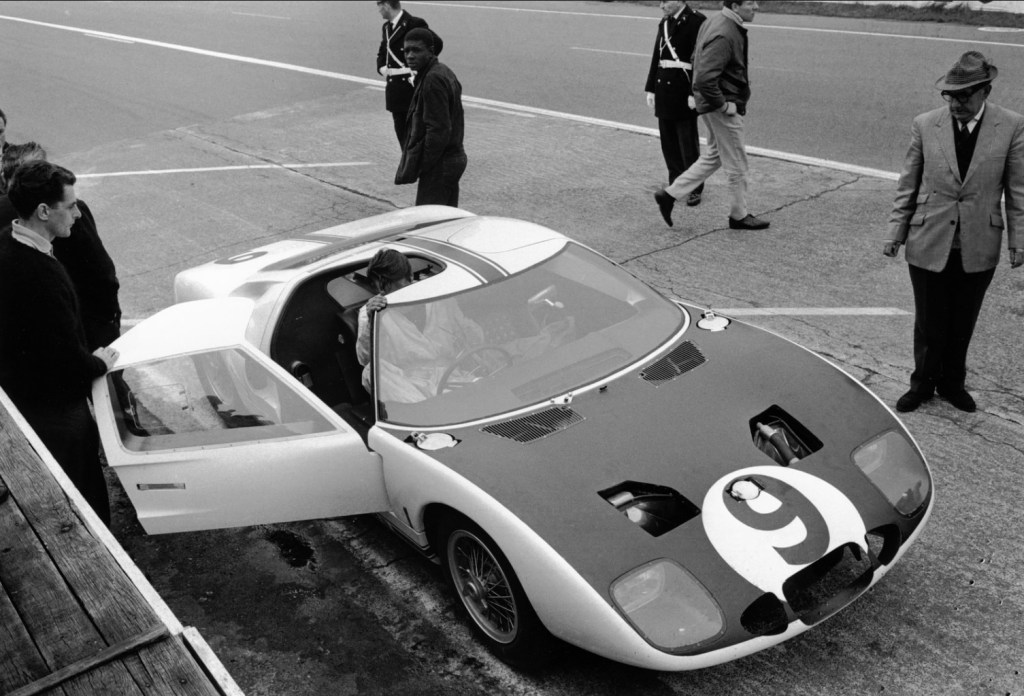
The Le Mans test weekend followed on April 18-19. Jo Schlesser was allocated #101 and Roy Salvadori #102. Jo had already complained about high speed directional instability, when, on his eighth lap, he lost control in the wet at over 150mph. Miraculously, the car didn’t roll or hit trees, but it was destroyed with Schlesser copping only a minor cut to his face. Lady Luck was with him that day…not so at Rouen in 1968.
(FoMoCo)
Chassis and Suspension…
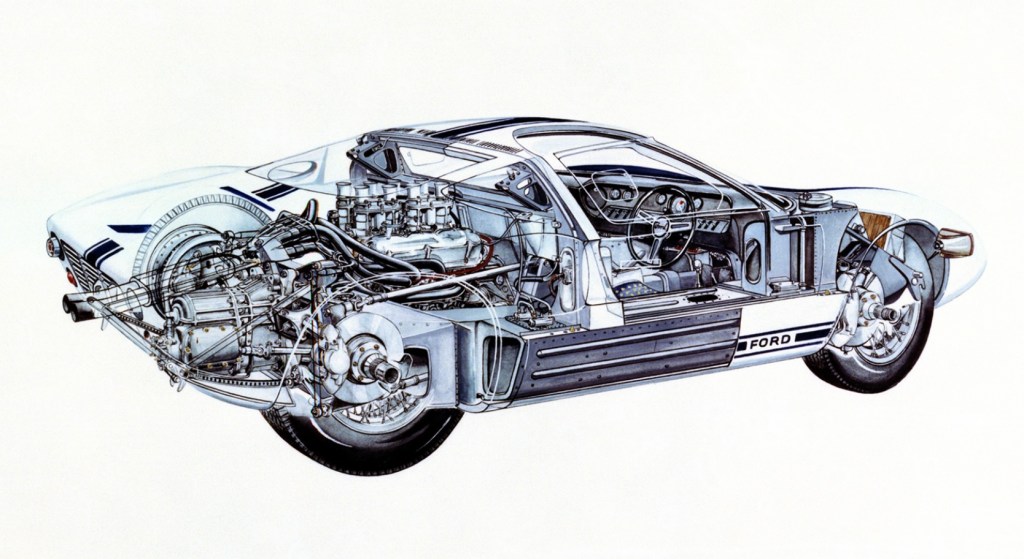
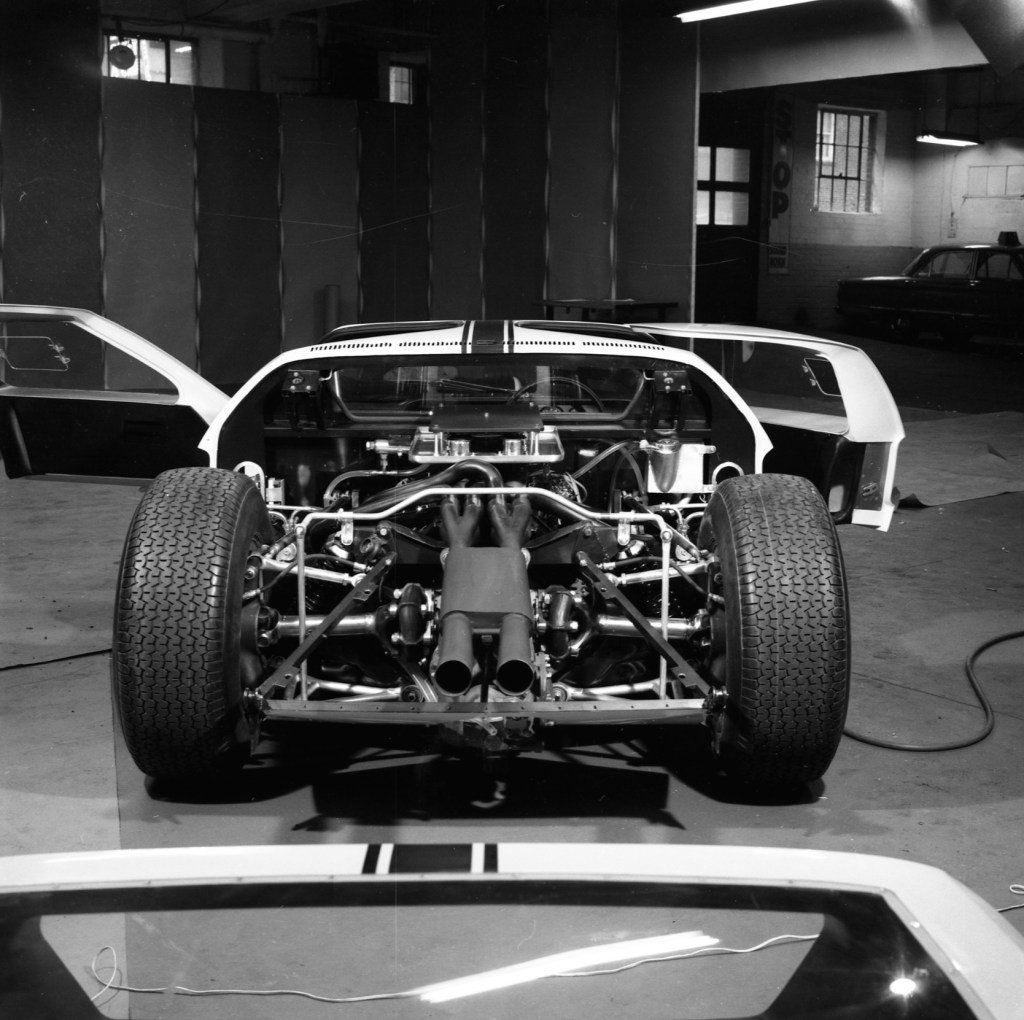
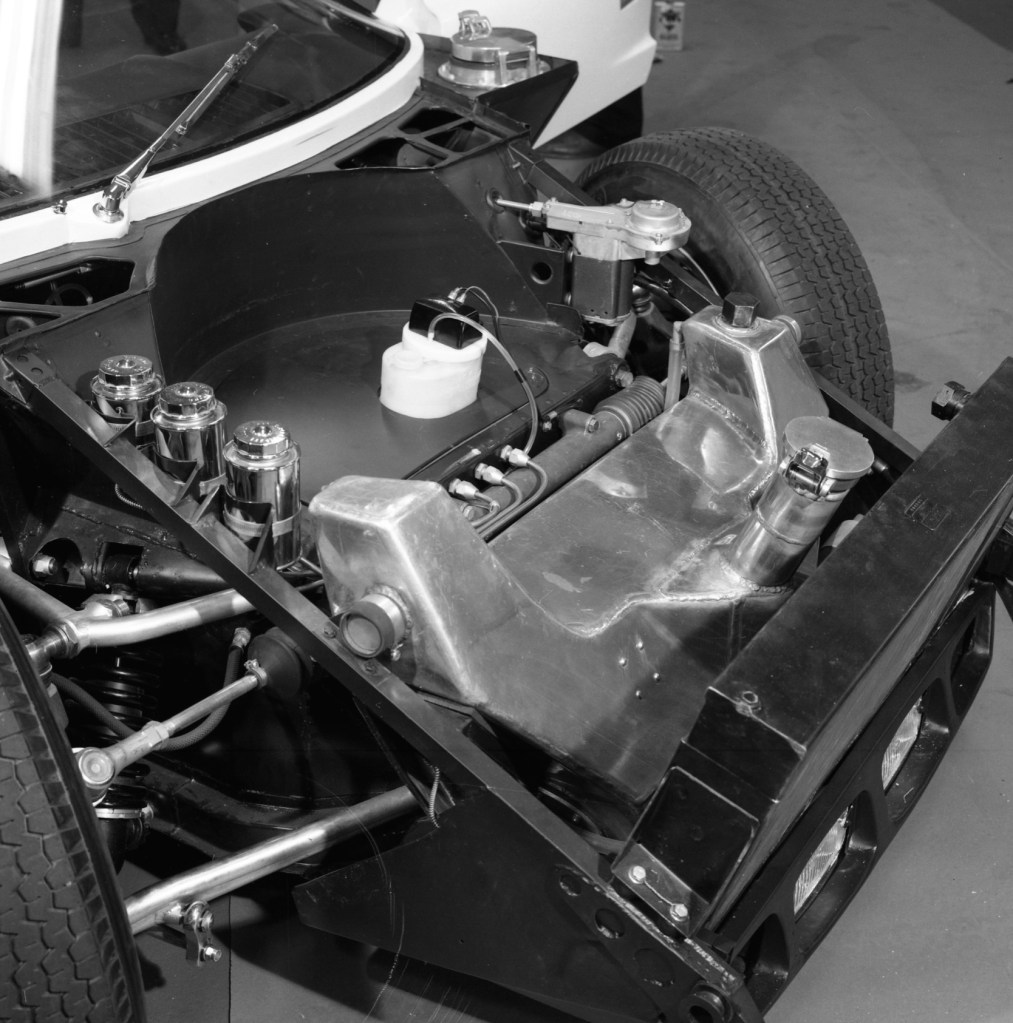
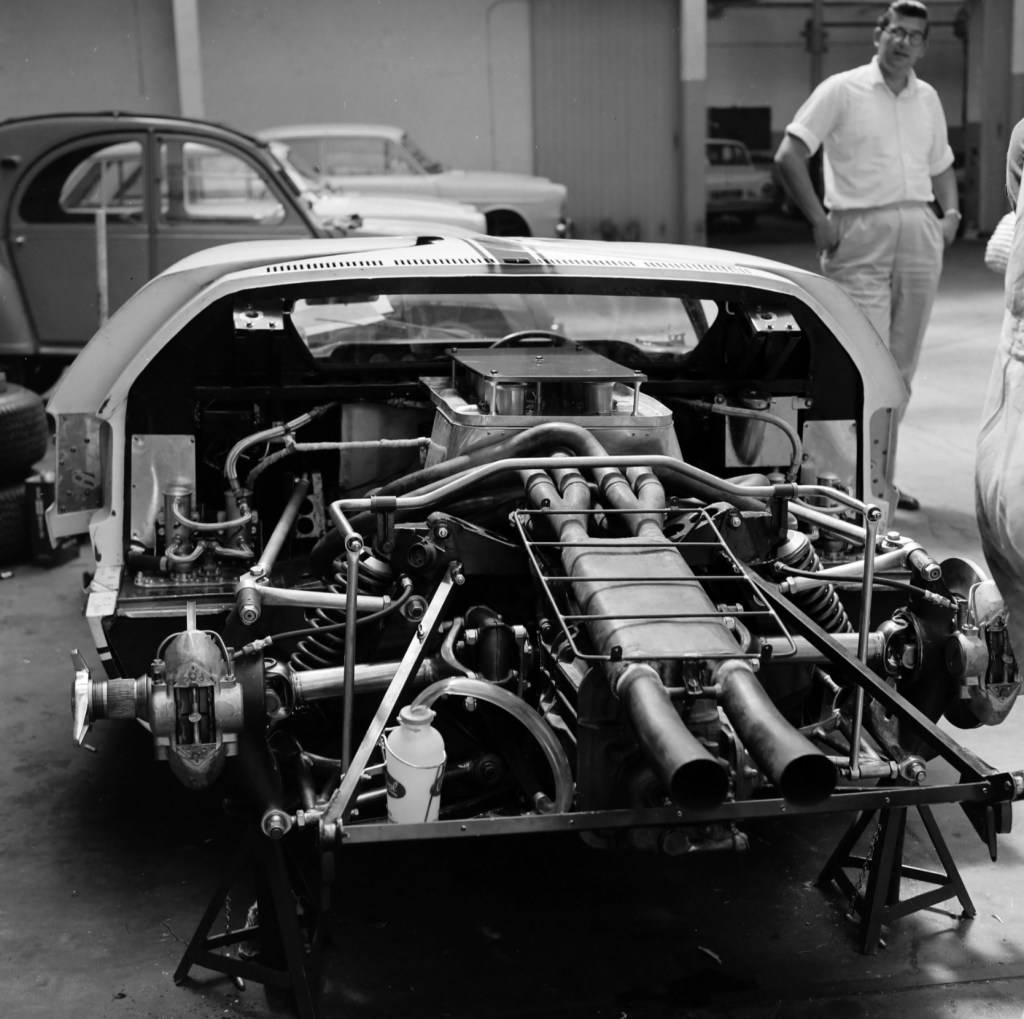
The Abbey Panels built steel monocoque – Eric Broadley wanted aluminium, while Ford wanted steel – incorporated two square tube stiffeners that ran from the scuttle to the nose. At the rear was a lightweight detachable subframe which supported the engine and suspension. Each sill-panel housed a bag-type fuel tank. The car weighed circa 865kg.
(FoMoCo)(FoMoCo)
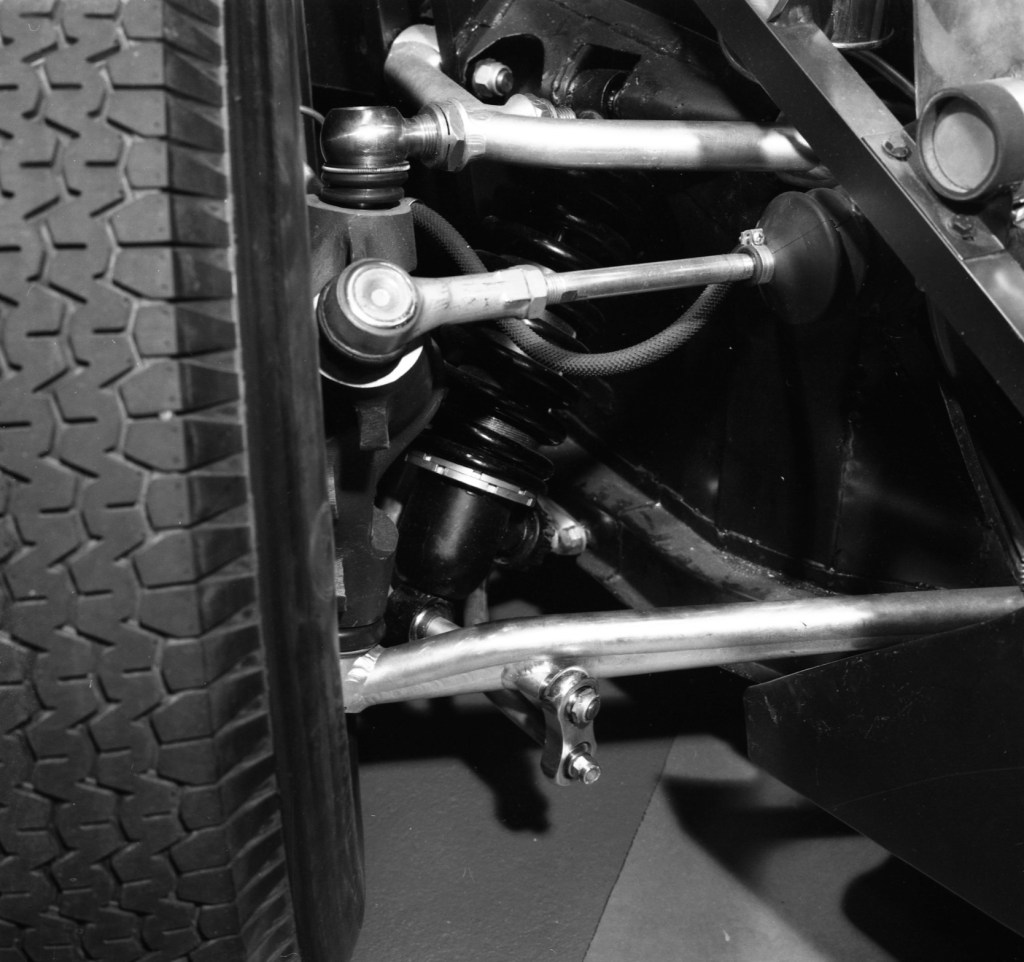
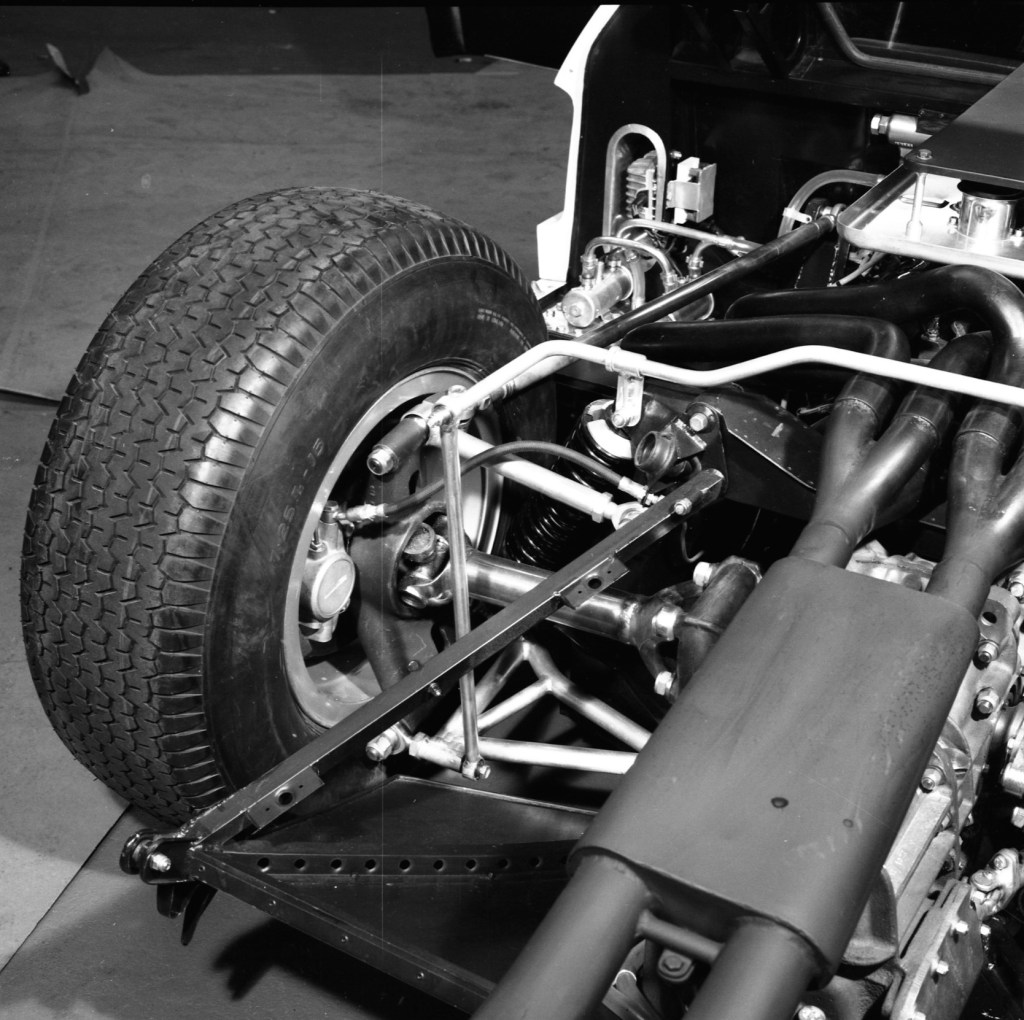
Front suspension was period typical upper and lower wishbones and coil spring/ Armstrong damper units, and an adjustable roll bar, the uprights were made of magnesium alloy. There was nothing radical at the rear either. Again the uprights were mag-alloy, there were single top links, lower inverted wishbones, coil spring/dampers and two radius rods looking after fore-aft location, and an adjustable roll bar.
(FoMoCo)
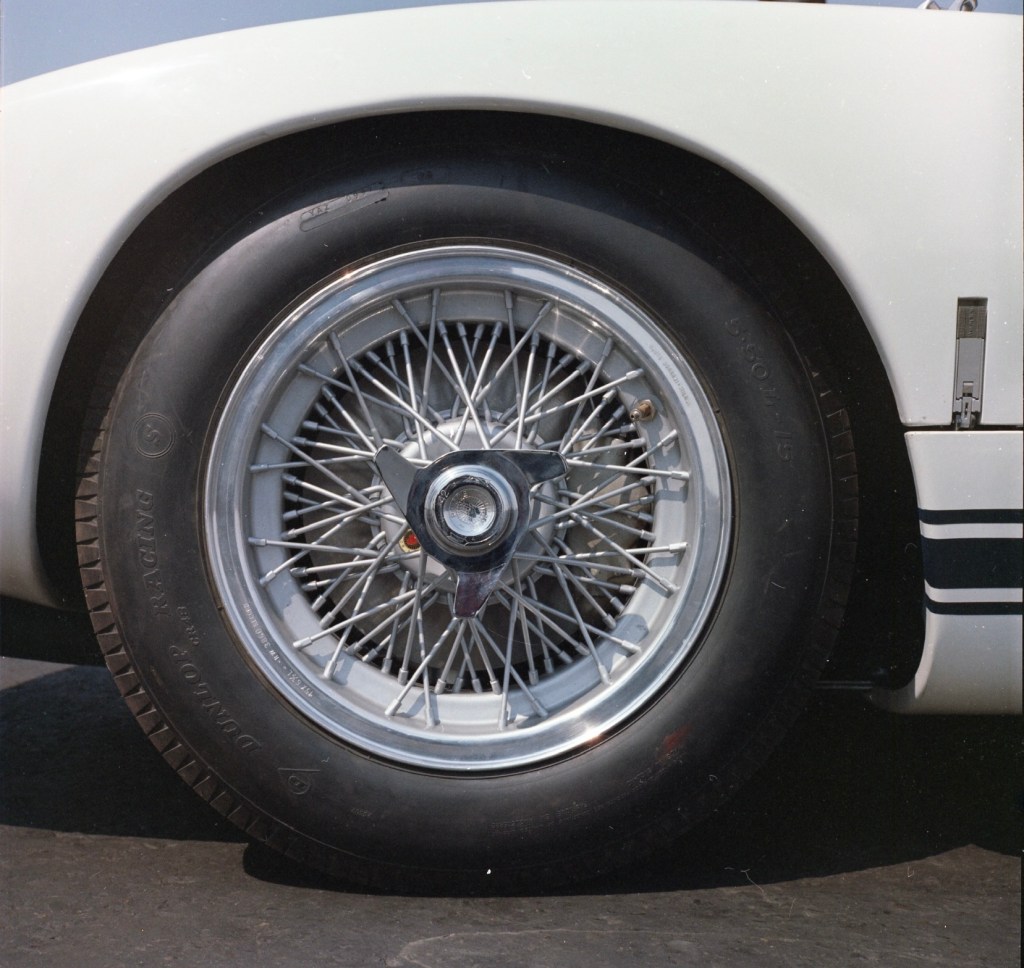
Brakes were 11.5 inch Girling rotors and calipers, while the wheels were heavy 15-inch Borrani wires, pretty naff by that stage given the modern technology used throughout the design; and addressed by Shelby American when they took over developmental charge of the race program from the end of 1964. The knock-off Borranis were 6.5-inches wide at the front and 8-inches up the back. ‘Boots’ were Dunlop R6s.
(FoMoCo)
Engine and Transmission…
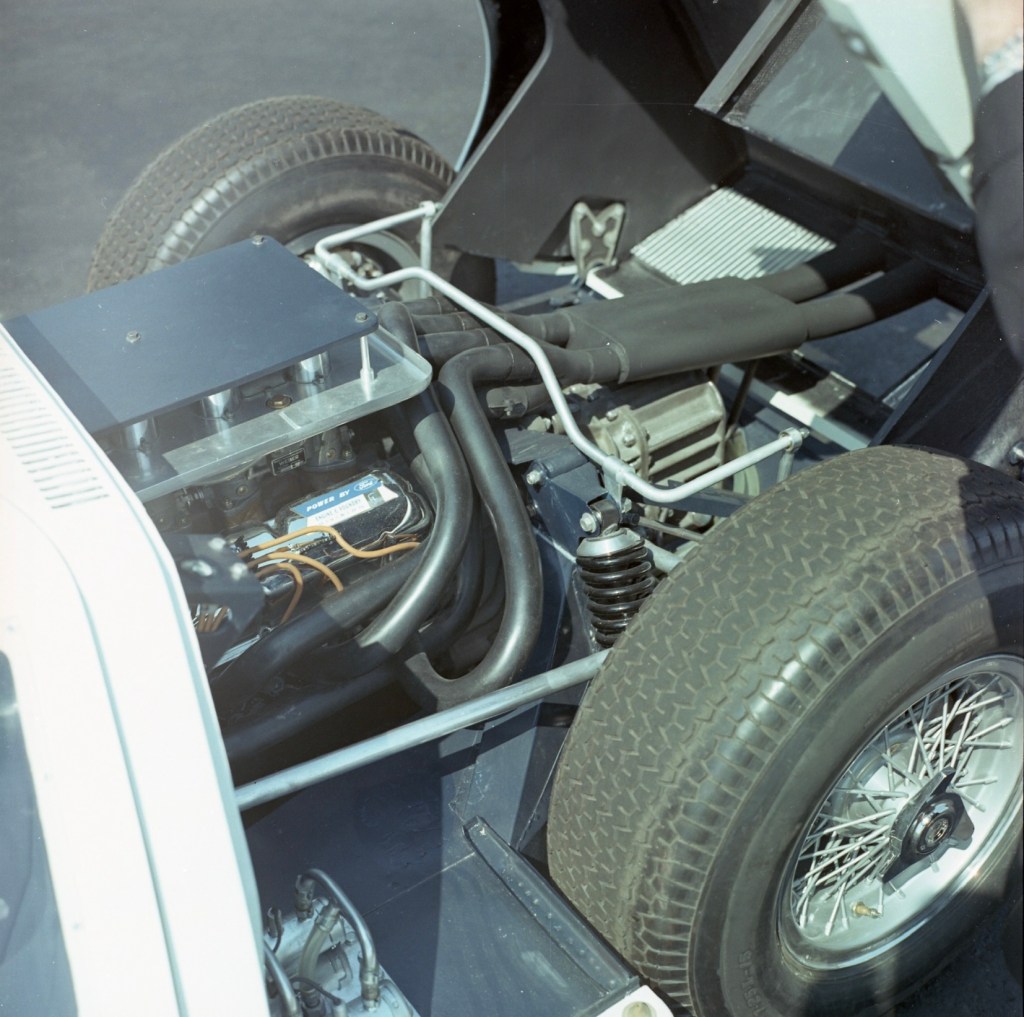
The engine was a Ford Windsor small-block, cast iron, pushrod 90 degree 255cid V8. With a bore-stroke of 95.5 x 72.9mm, the four 48IDA Weber fed 4183cc engine developed circa 350bhp @ 7200rpm and 299lb-ft of torque at 5200rpm using a compression ratio of 12.5:1.
Colotti provided their Type 37 four speed transaxle which incorporated a limited slip diff to get the power to the road via a Borg and Beck triple plate clutch. Gear ratios were of course to choice, with a top speed of 205mph quoted with Le Mans gearing.
(FoMoCo)
Bodywork and Aerodynamics…
The GT40 name came about by picking up on the cars incredibly low height, two inches lower than than Broadley’s Lola Mk6.
Specialised Mouldings, a Lola supplier, based then in Upper Northwood, made the fibreglass bodies, the aerodynamics of which took much time to get right. Shelby ‘perfected’ the sensational, muscularly-erotic shape of the cars which won Le Mans in 1966-68-69 over the winter of 1964-65. The ’67 Mk4 being a different aerodynamic kettle-of-fish.
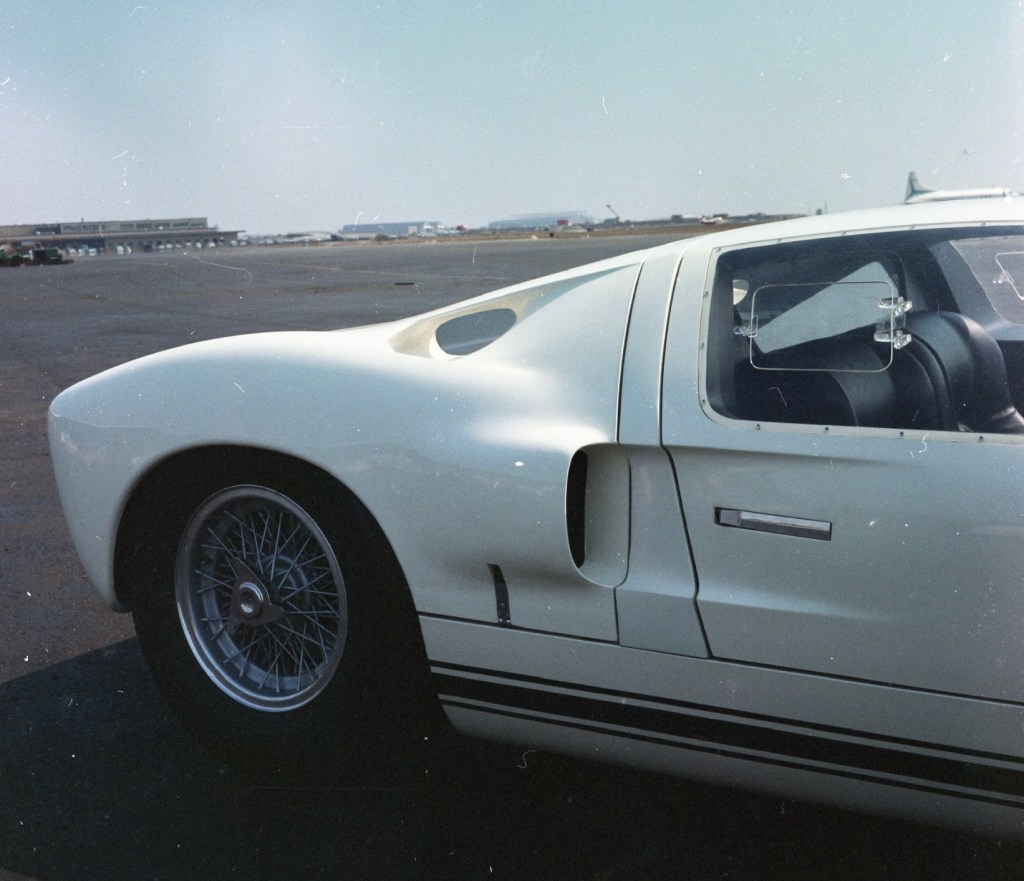
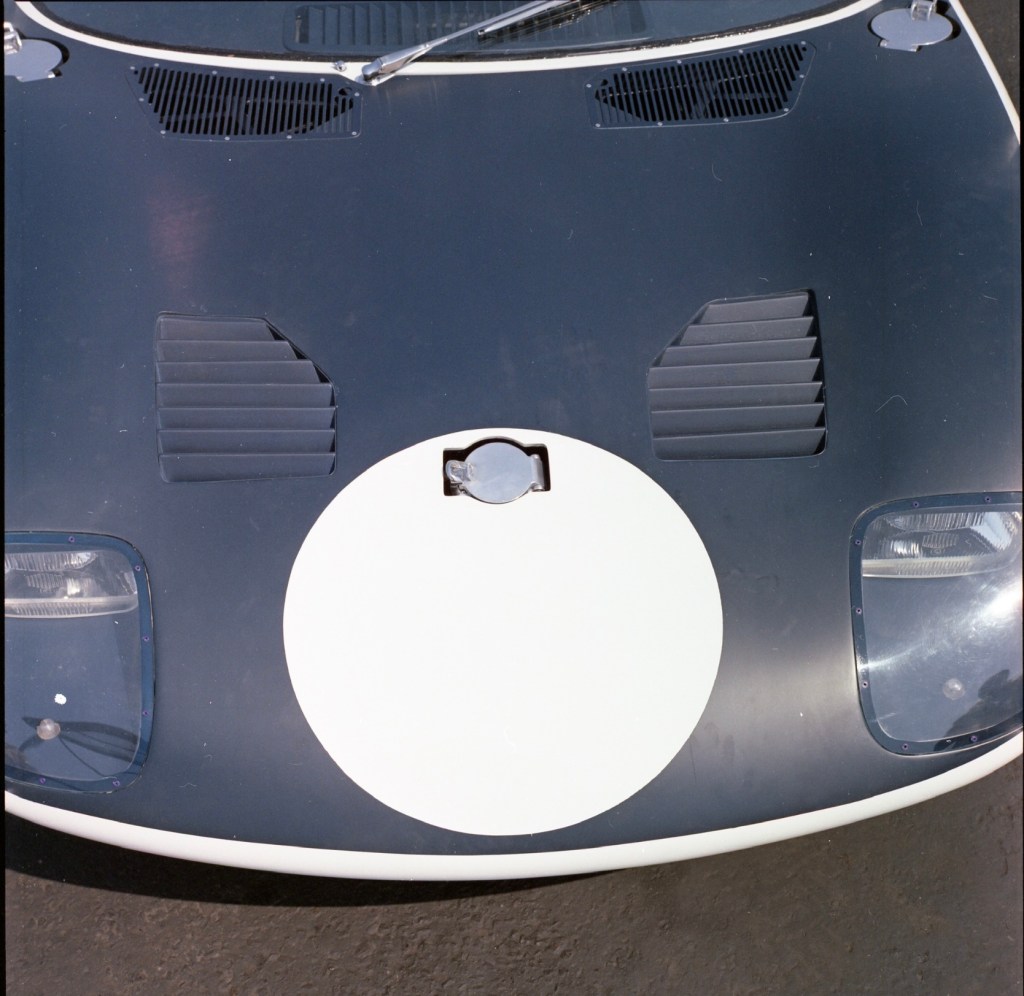
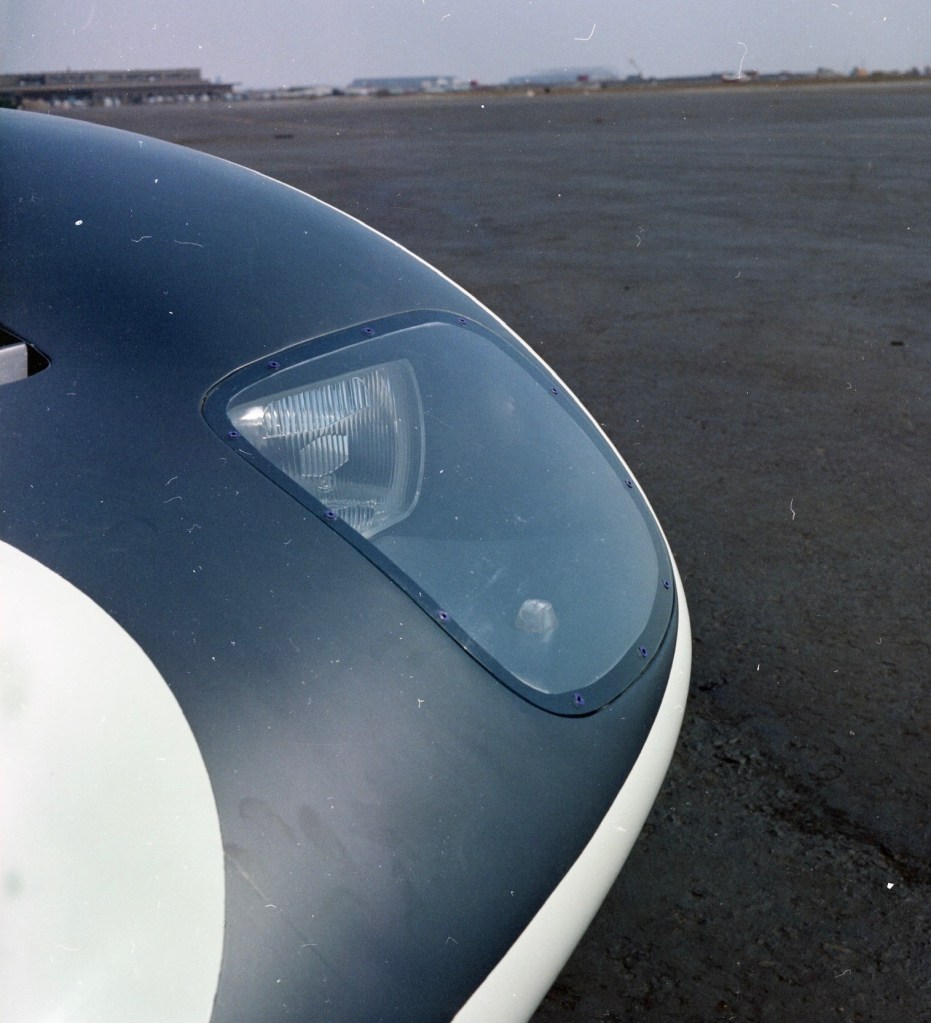
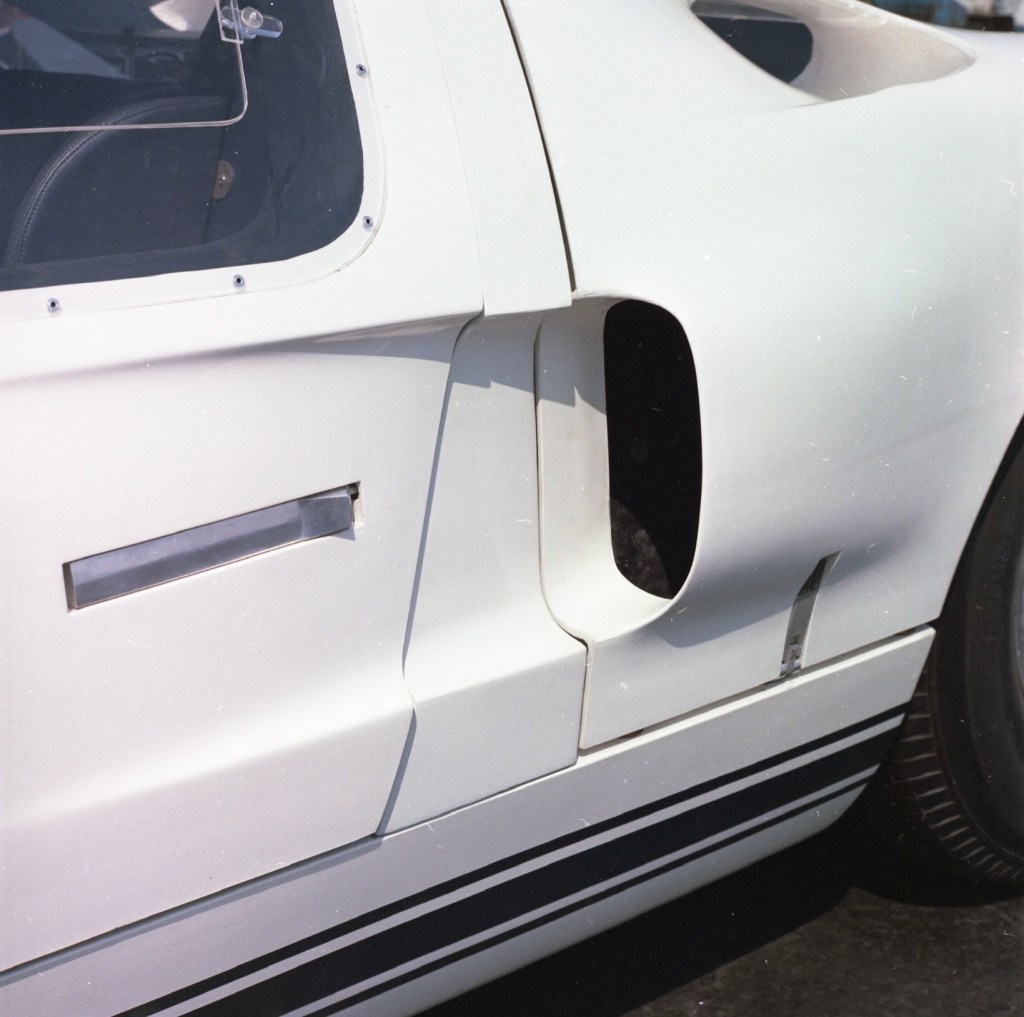
The headlights were fixed under clear Plexiglass covers with additional spotlights inboard of the brake ducts. Two big air intakes were sculpted into each flank to assist engine cooling with additional ducts on the panels each side of the rear screen.
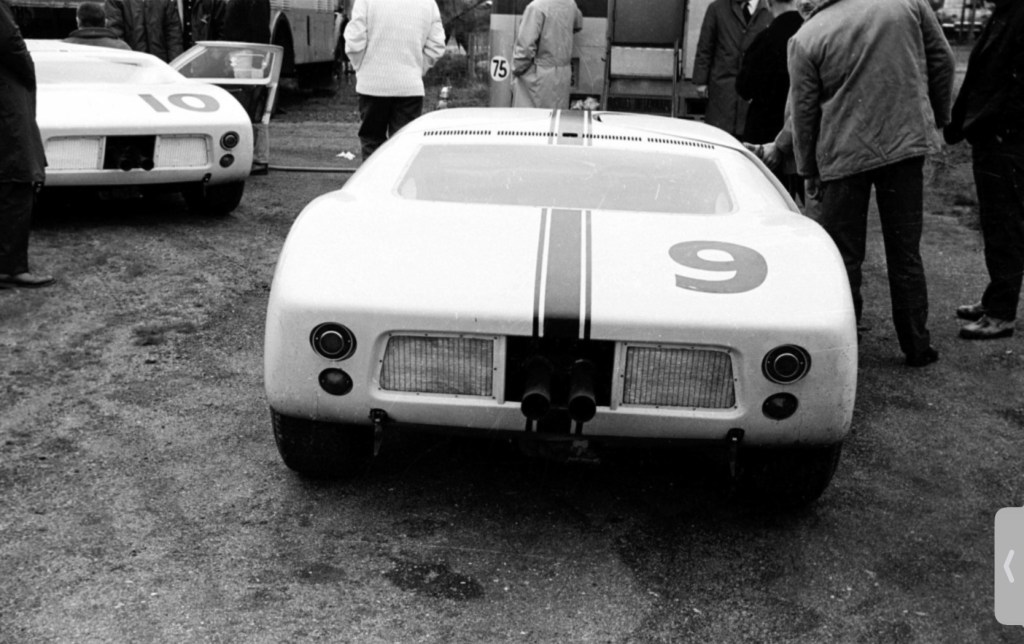
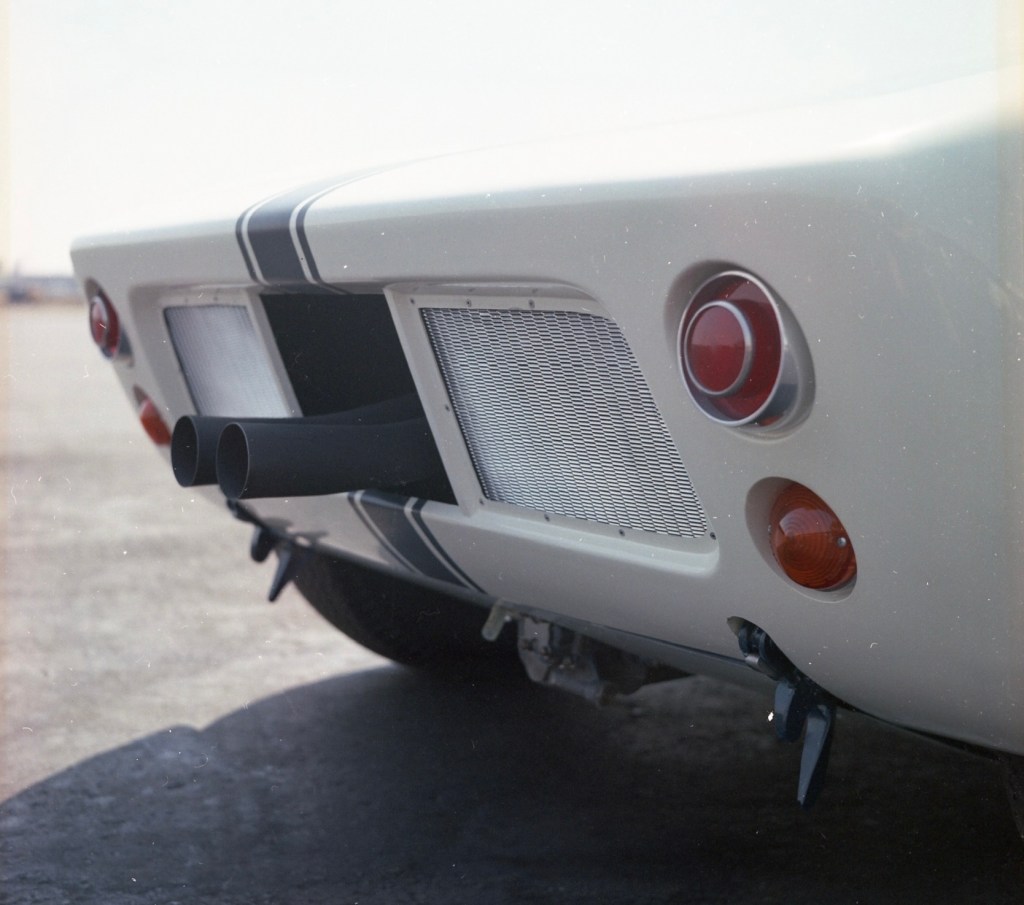
At the rear were meshed cooling vents through which the raucous V8 exited its gasses. The body was slippery enough but not yet effective.
(FoMoCo)(FoMoCo)
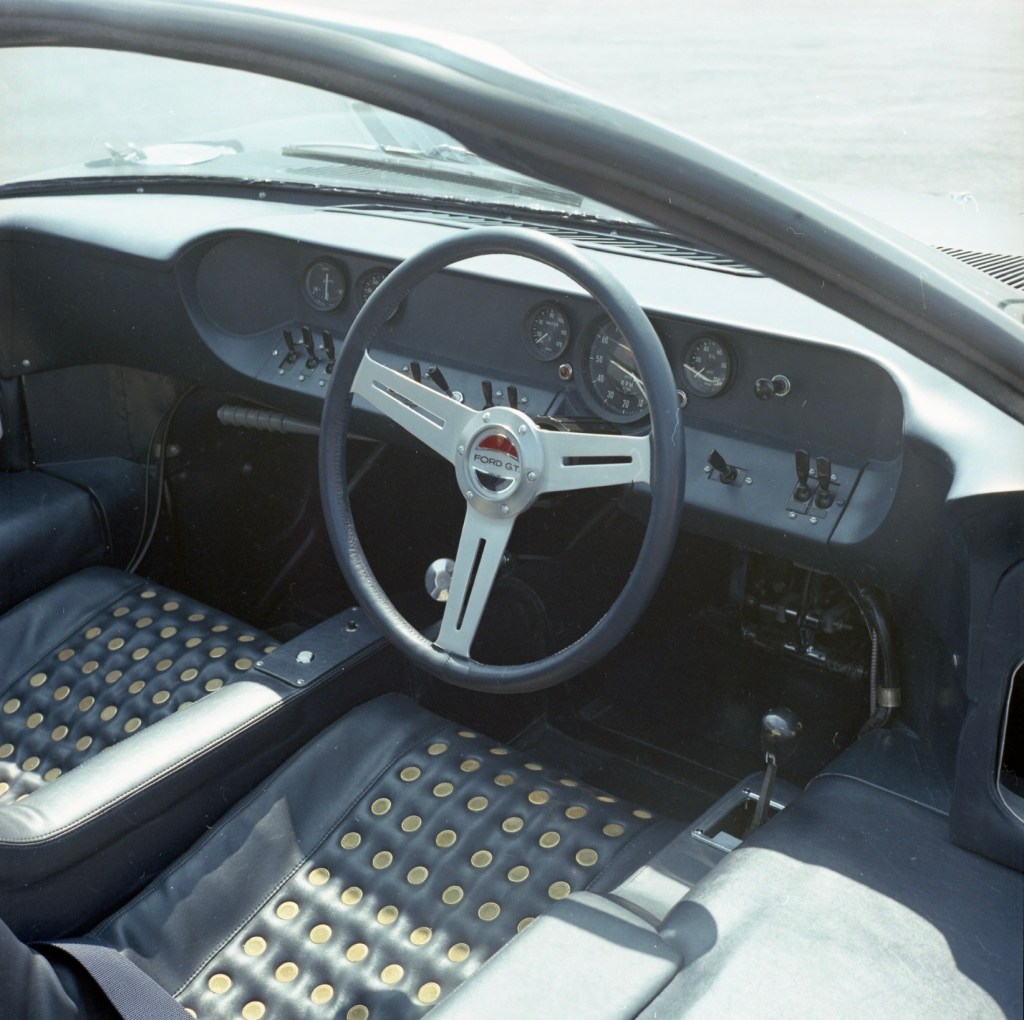
Driver ergonomics were very much to the fore. The top off each door was cut deeply into the roof. Once the driver cleared the wide-sill of the RHD, right-hand shift machine, he popped his arse into a light, fabric, perforated seat fixed in location; the pedals were adjustable.
I’m not sure if the 12 prototypes were built in this manner, but Denis Jenkinson described the GT40 production process in MotorSport as follows.
“The steel body chassis unit, made by Abbey Panels, of Coventry arrives in Slough in a bare unpainted form. Front and rear subframes are fitted, for carrying body panels etc, and then the unit goes to Harold Radford Ltd, where the fibreglass doors, rear-engine hatch which forms the complete tail, and front nosepiece, which is a single moulding, are cut-and-shut to fit the chassis/body unit, these panels then being marked and retained for the car in question. The fibreglass components are made by Glass Fibre Engineering of Farnham, Surrey and then delivered to Slough in the bare unpainted state. When the chassis/body unit is returned from Radfords the factory at Slough then assembles all the suspension parts, steering, wiring, engine, gearbox and so on, the final car being painted in the particular colour required by the customer.”
Checkout this evocative piece at Abbey Panels and Le Mans…
Many thanks for the tip-off Tony Turner!
1964 Season…
Given the lack of development time before the GT40 was raced, the initial races were pretty much a disaster.
Ford lost #101 (Schlesser) during the Le Mans test, while Salvadori gave #102 a gentle run, they were 12th and 19th quickest.
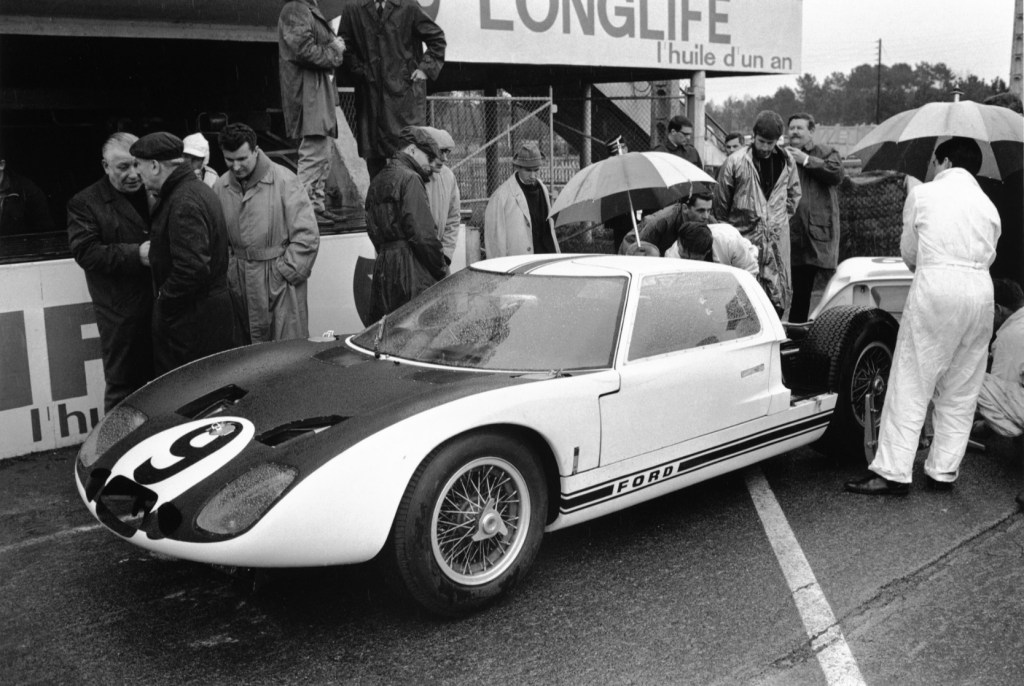
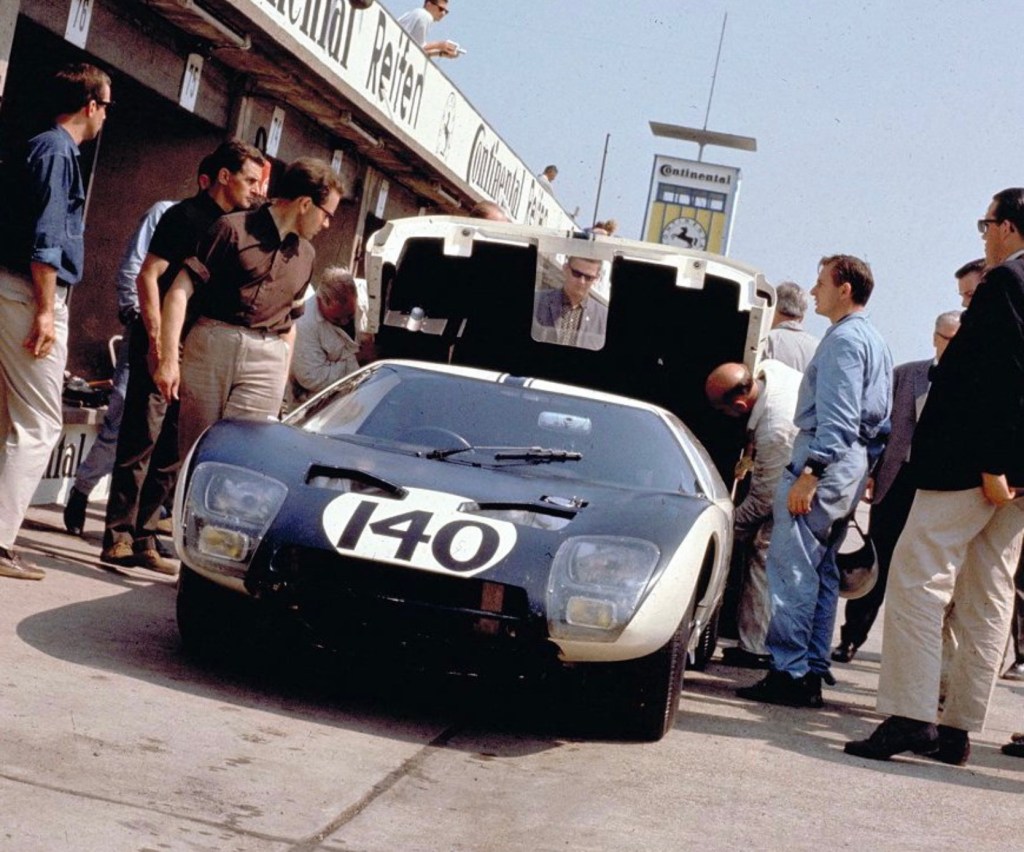
Six weeks later #102 contested the Nurburgring 1000km with a modified front clip manned by vastly experienced racer/engineers, Bruce McLaren and Phil Hill. Bruce was the lead test-driver on the GT40 programme. They qualified the car second behind the Ferrari 275P of John Surtees and Lorenzo Bandini. Phil ran between second and fourth in his stint but the car was retired with suspension damage early after Bruce took the wheel.
Broadley in brown, McLaren in blue, #102 in white. Nurburgring 1000km 1964 (unattributed)Business end of one of the GT40s at Reims in 1964 (MotorSport)Le Mans 1964. Attwood/Schlesser GT40 from the Baghetti/Maglioli, Ferrari 275P and Bonnier/Hill Ferrari 330P (MotorSport)
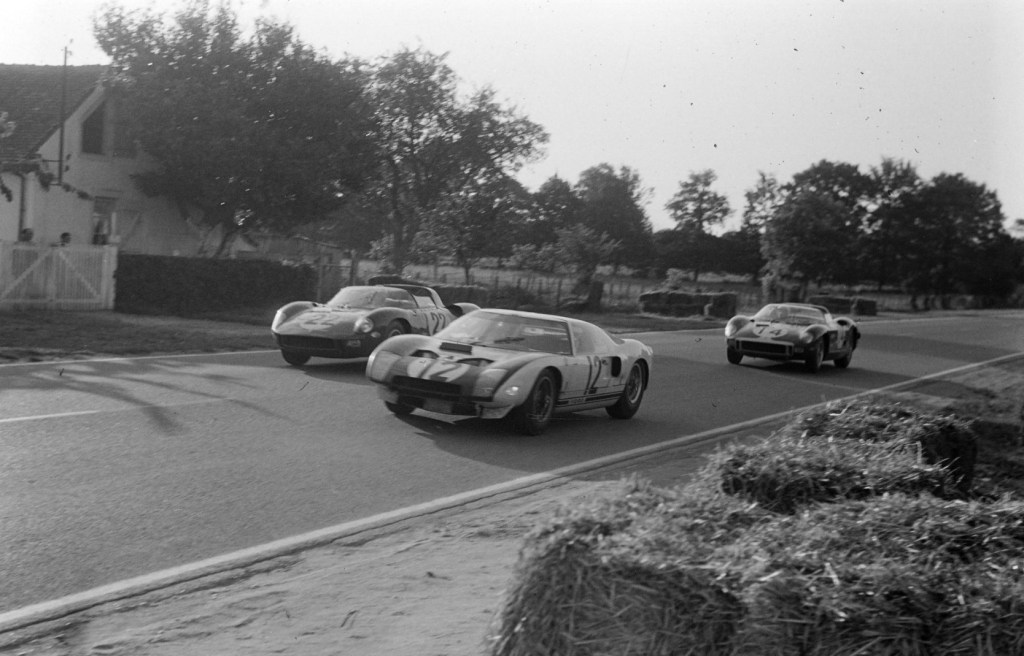
At Le Mans three cars were entered for Hill/McLaren, Richie Ginther/Masten Gregory and Richard Attwood/Schlesser. While Ford set a lap record, all three cars retired; the Attwood car caught fire, with both other cars retiring with gearbox failure.
The two cars that appeared at the Reims 12 Hours a fortnight after Le Mans were #102 and #103, plus a new car, #105, powered by Shelby prepared 289 V8 giving about 390bhp at a lower 6750rpm – 341lb-ft of torque was up too. New third-fourth selectors were fitted to the Colotti ‘boxes, and the dog-rings hardened. The Surtees/Bandini Ferrari 250LM started from pole, but by lap 10 the Ginther GT40 led McLaren. Richie’s lead ended with crown wheel and pinion failure on lap 34, Atwood’s with a plug that had come out of the gearbox, while the Hill/McLaren car blew its engine.
Chassis 103 and 104 were then raced in the Nassau Speed Week by Hill and McLaren fitted with 289 V8s (4.7-litres). Only Phil made it through the Nassau Tourist Trophy qualifier, Bruce had suspension problems in 104. Hill’s car suffered the same fate in the feature race.
Without a finisher in four meetings, chassis #103 and #104 were shipped to Shelby American in California. “The decision was made in Dearborn to move the (development) work back back to the US, with Carroll Shelby given operational control and Lunn engineering control.” Ford’s website records.
Over that autumn and winter an intensive development programme together with with FAV produced a race winner, not a Le Mans winner mind you, but that would come soon enough…
And what happened to #101 you ask?…
The car’s odometer recorded only 465 miles at the time of its death. It was written off with many parts salvaged…the monocoque may have been repaired and renumbered. Ford has never released the details of what became of the various components, not least the all-important chassis. There is a replica of course, no point letting a vacant chassis number go to waste, it won an award at Pebble Beach, so I guess it’s a very shiny one.
Etcetera…
(FoMoCo)(FoMoCo)
‘Total Performance’, ‘Going Ford is The Going Thing’, and the rest.
I lapped it all up! What was not to love about a global transnational with such commitment to motor racing in every sphere? From Formula Ford to Formula 1, Bathurst to Brands Hatch and the high banking of Daytona to the Welsh forests…God bless ‘em I say.
#102 and #101, Salvadori and Schlesser, Le Mans test weekend, April 1964 (unattributed)(FoMoCo)(FoMoCo)(FoMoCo)
Credits…
Ford Motor Company, corporateford.com, MotorSport Images
Tailpiece…
(MotorSport)
If Enzo started it all by ending negotiations with Ford, Eric Broadley finished it, unintentionally.
His Lola Mk6 Ford GT was so late for Le Mans that Eric sent drivers Richard Attwood and David Hobbs ahead and he drove the car to La Sarthe. What a road car…
The two Brits raced it as it arrived at the track; there were no alternative springs, bars or ratios. A missed shift by Hobbs of the tricky Colotti box ended their race too.
Eric Broadley bet-the-farm on that brilliant car but it paid off rather well!
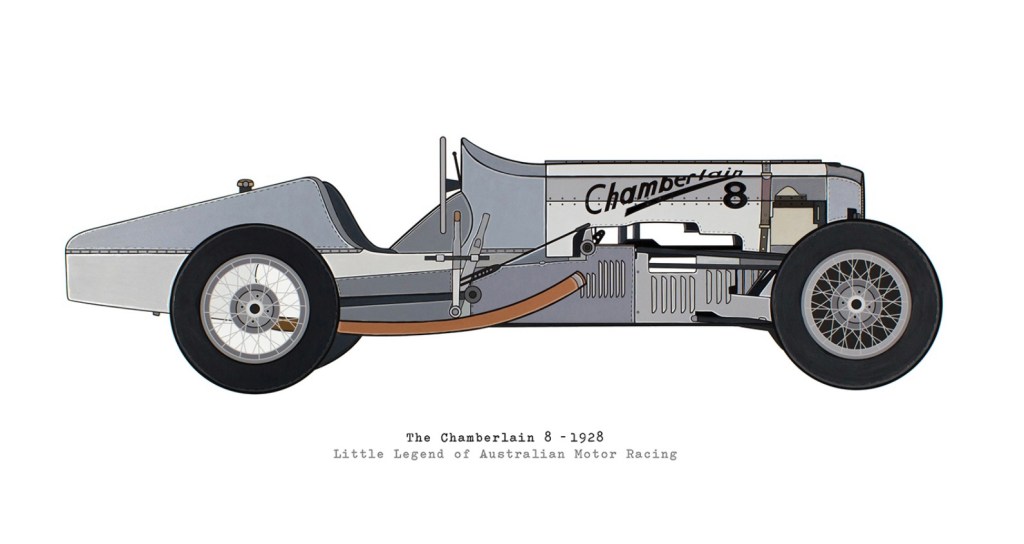
Chamberlain 8 painting – as it is currently sans-engine – in the Birdwood Mill Museum, South Australia (artomobile.com.au)
The Chamberlain Eight’s four cylinder, eight piston, supercharged, twin-crank, two stroke engine left an unforgettable, ear-splitting impression on all who saw it at the 1978 50-year anniversary of the 1928 100 Miles Road Race aka Australian Grand Prix at Phillip Island.
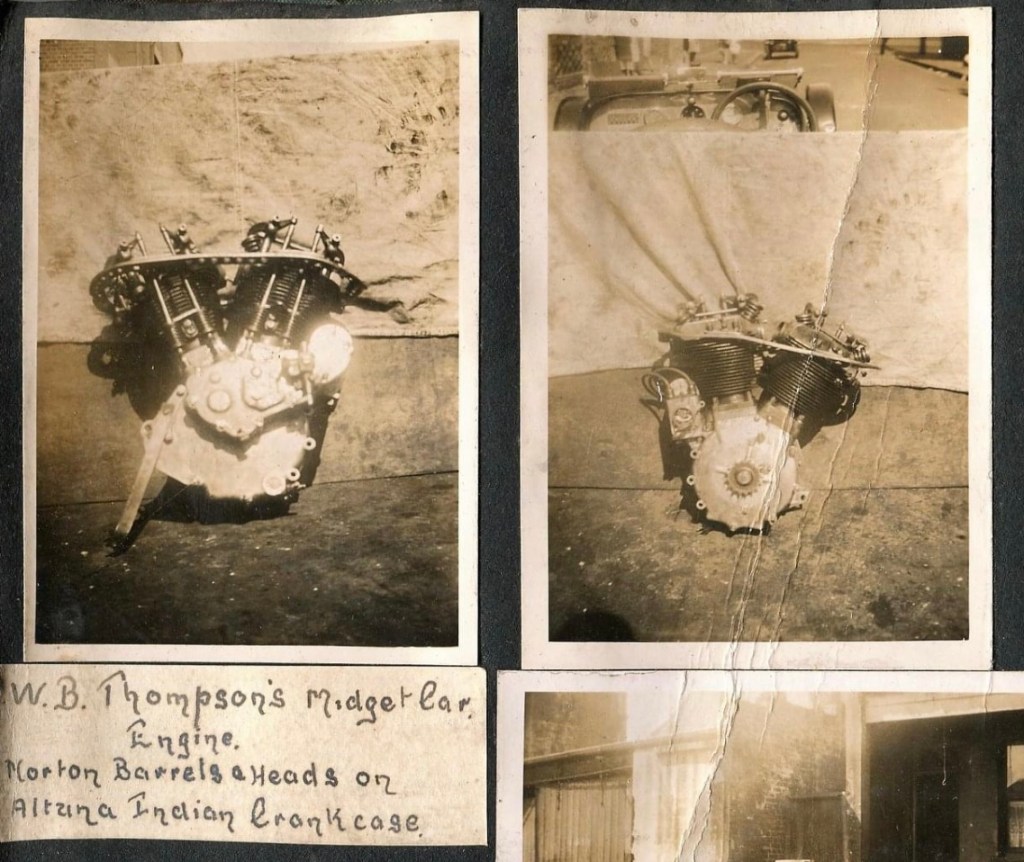
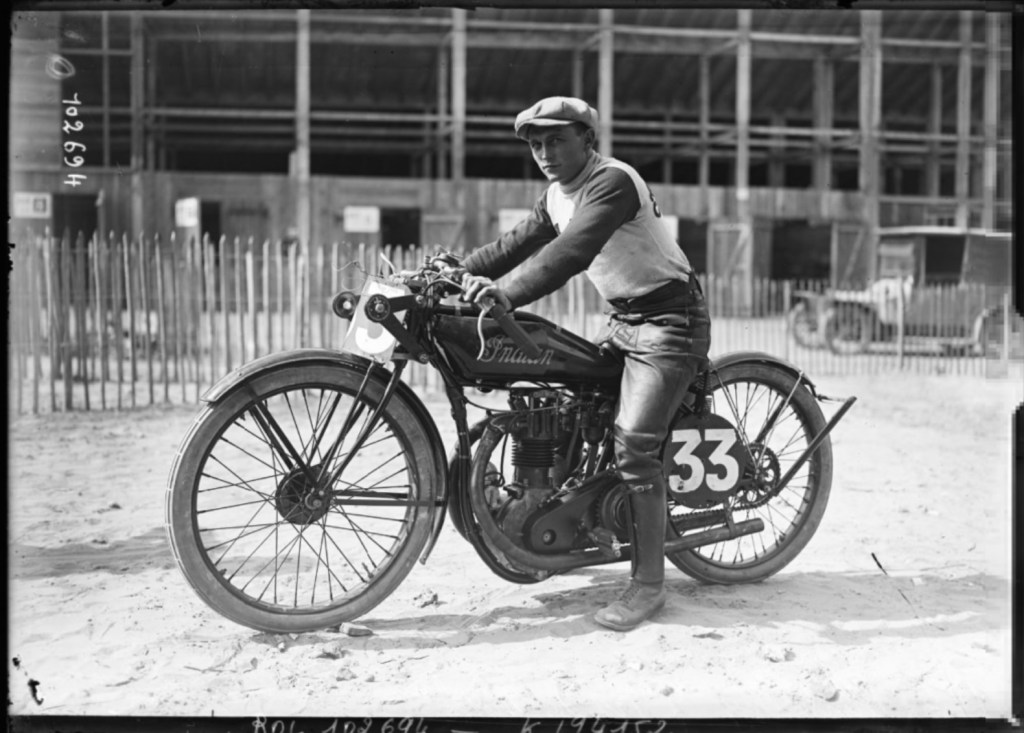
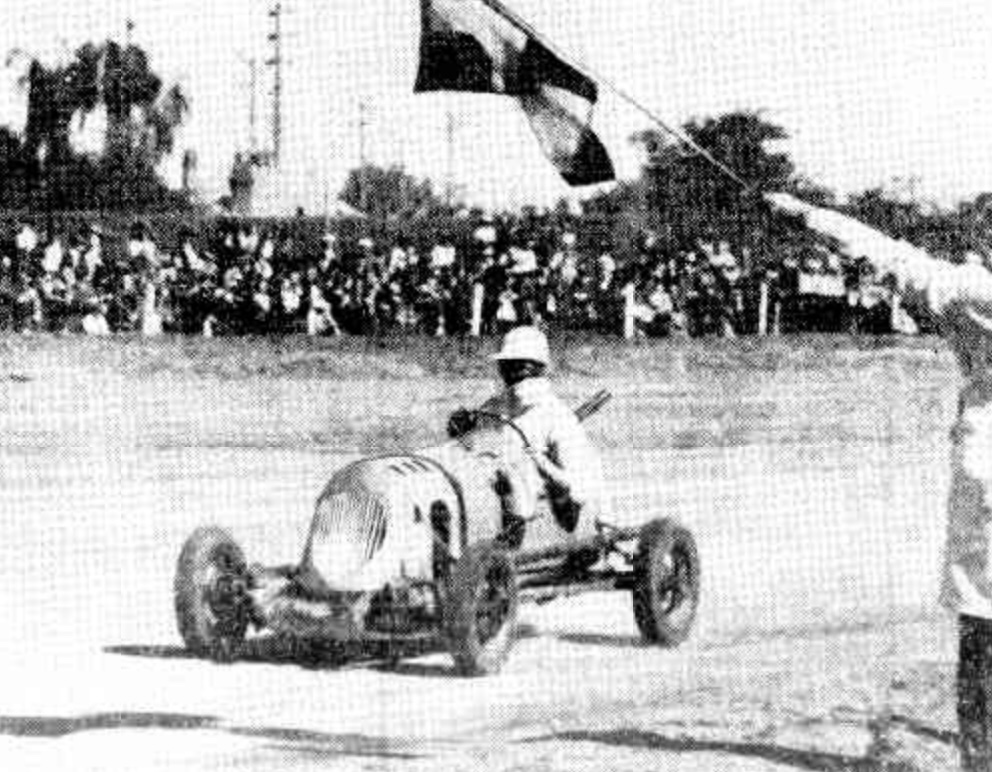
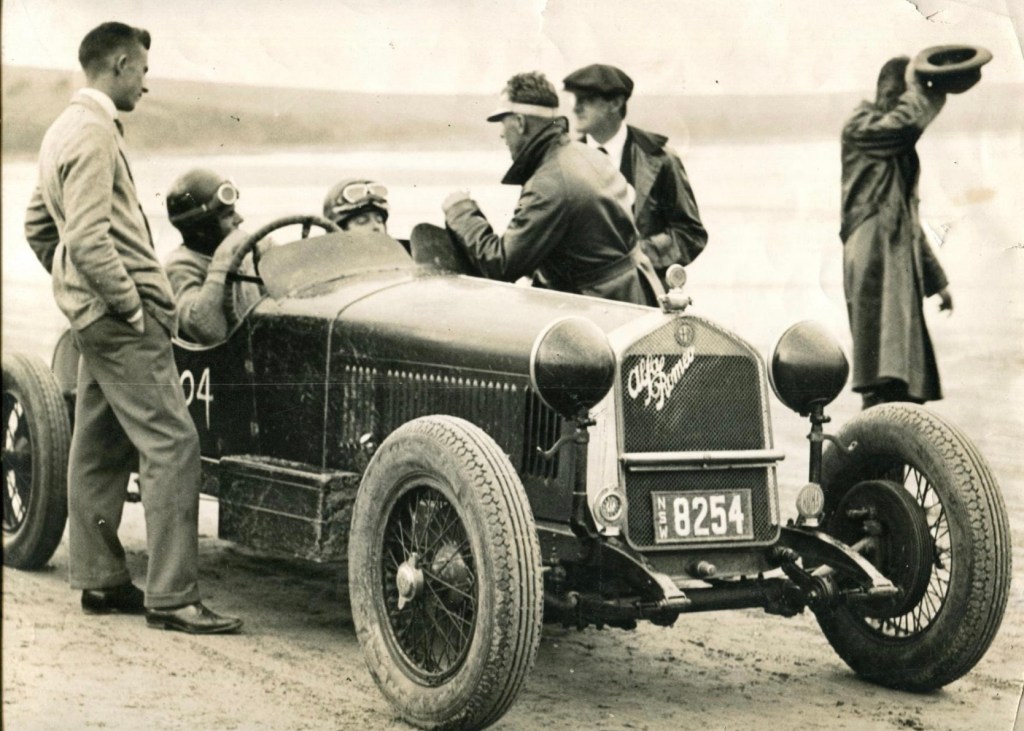
What I hadn’t fully appreciated in fulsome fascination for a car which was at the cutting edge in its engine, chassis, suspension and front wheel drive – all of which were out-there in 1929 – was the length of time it was first fitted with Indian motorcycle engines. It first saw the light of day with a Daytona unit and then an Altoona. It was only when Bob Chamberlain travelled overseas that he handed the car to his brother Bill, who built and fitted the Chamberlain engine circa 1934-35.
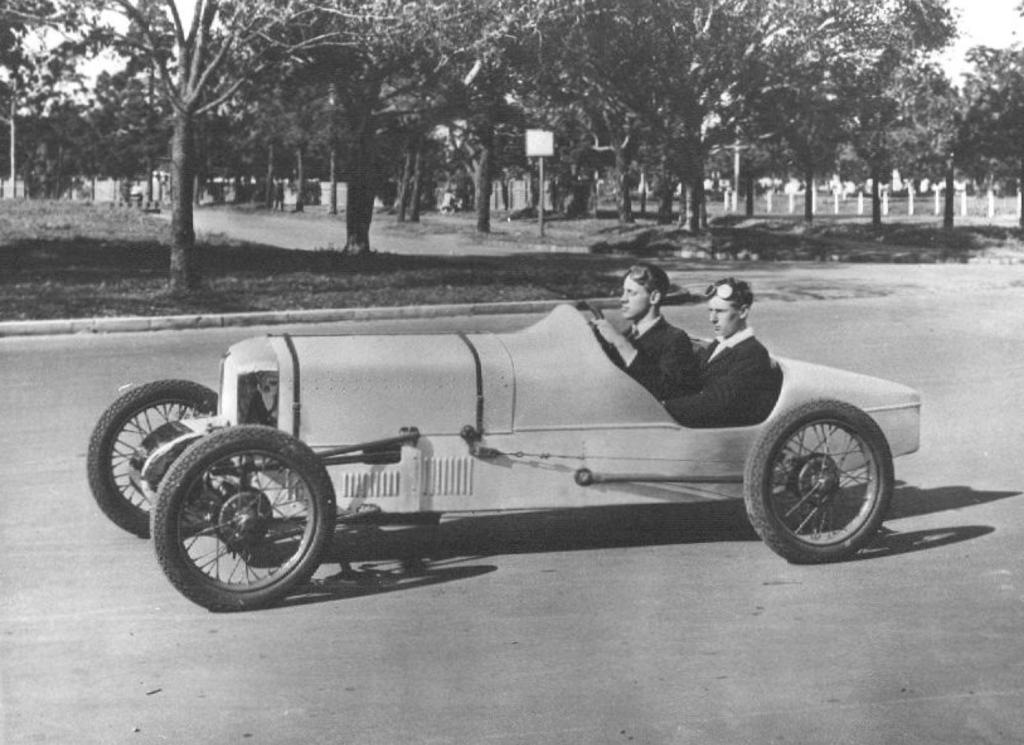
Bob Chamberlain at the wheel of The Beetle as the family called the car, Chamberlain Indian, circa 1929 (Chamberlain Australian Innovator)The ex-Chamberlain Indian, Altoona Indian-Norton engine during the period it was installed in Bill Thompson’s ‘Lane Special’ speedway midget (Fred Pearse)
The publication of a good photograph of the Altoona racing engine taken by mechanic Fred Pearse, and published on Bob Williamson’s Old Australian Motor Racing Photographs Facebook page by Peter Reynell, piqued my interest.
It’s unsurprising that the Chamberlains chose an Indian engine for their beloved Beetle, from the businesses incarnation Indian was innovative and used motorsport to develop the product and build their name, they finished 1-2-3 at the Isle of Man TT in 1911.
John Medley picks up the story (in the article linked above) “The car’s first engine was a big-valve Daytona Indian motor cycle unit. In this form, the road registered car covered thousands of miles but trouble was experienced with the valve gear.”
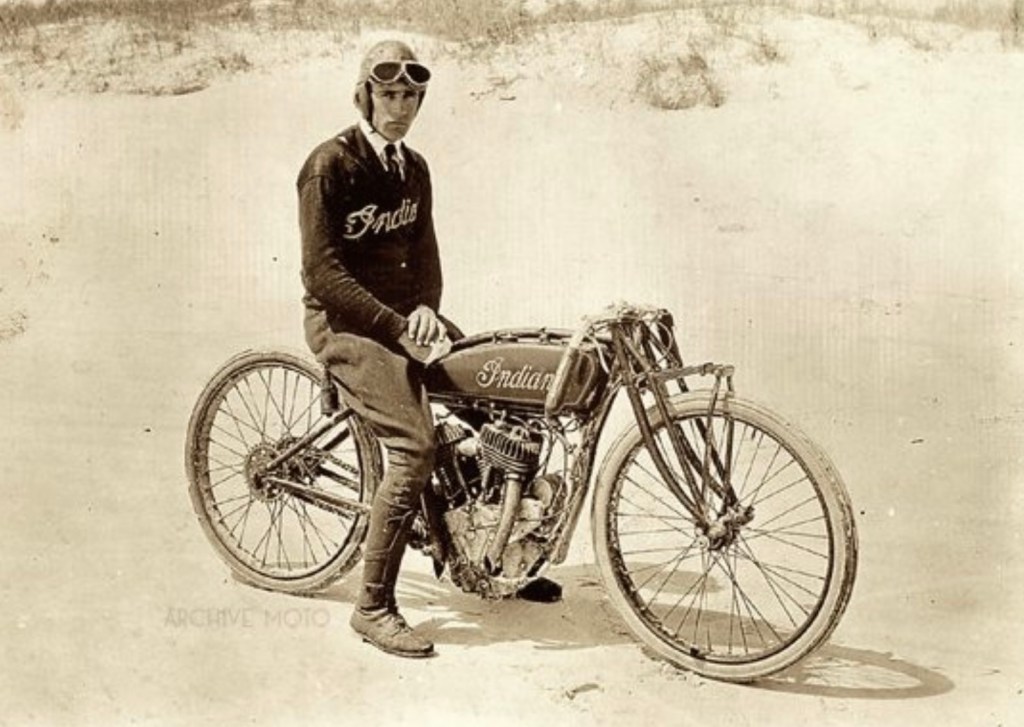
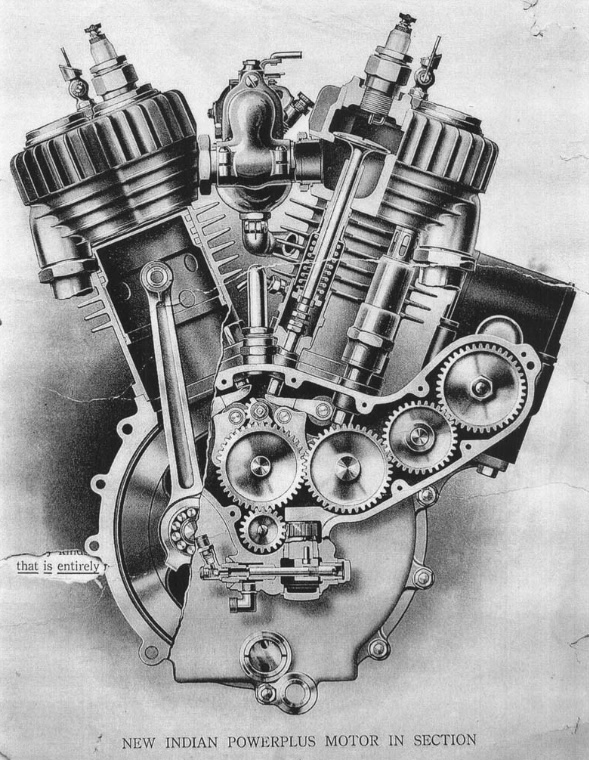
In April 1920 a 998cc side-valve, Vee-twin Indian Powerplus ridden by James McBride achieved a top speed of 99.25mph on the Daytona Beach course. The race versions of the Powerplus motor subsequently became known as the Daytona, throughout the 1920s various configurations of factory racers were built around this record setting engine.
Gene Walker on a factory Indian Powerplus 61cid, at Ormond Beach, Daytona in April 1920. Walker and fellow rider Herbert McBride collected 24 US and international records on this sortie to the Daytona speed coast. “Walker performed so well onboard his newly configured side-valve machine – with its distinctive finned exhaust ports seen in this photo – that the setup became known as the ‘Daytona’ motor, a legend in American racing circles” wrote (archivemoto.com)Indian Powerplus 1-litre side-valve Vee-twin cutaway. Designed by Charles Gustafson and refined and developed by Charles Franklin (unattributed)
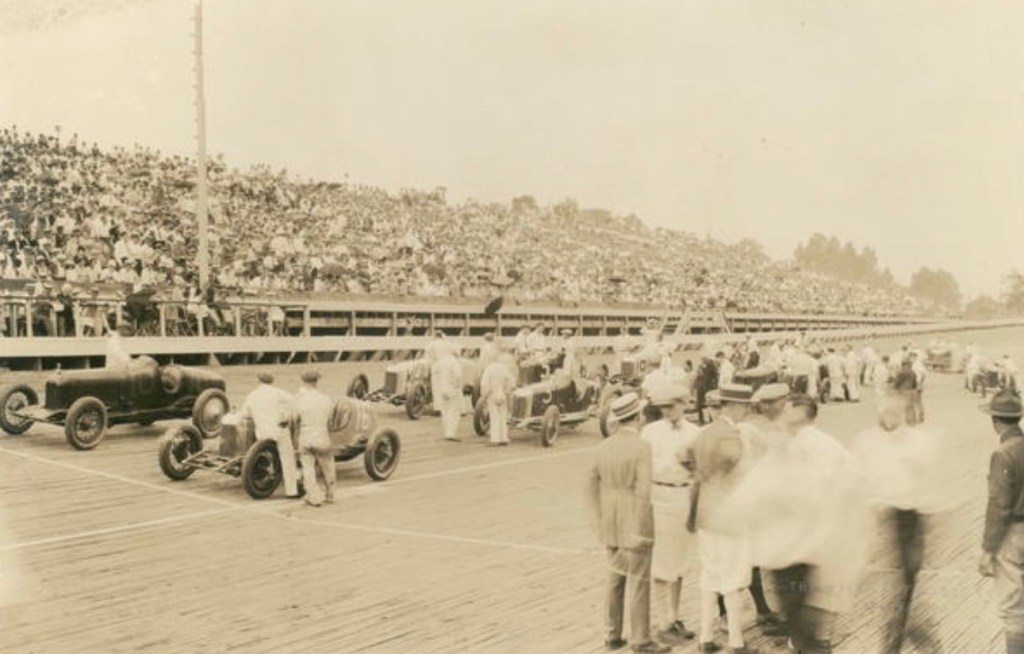
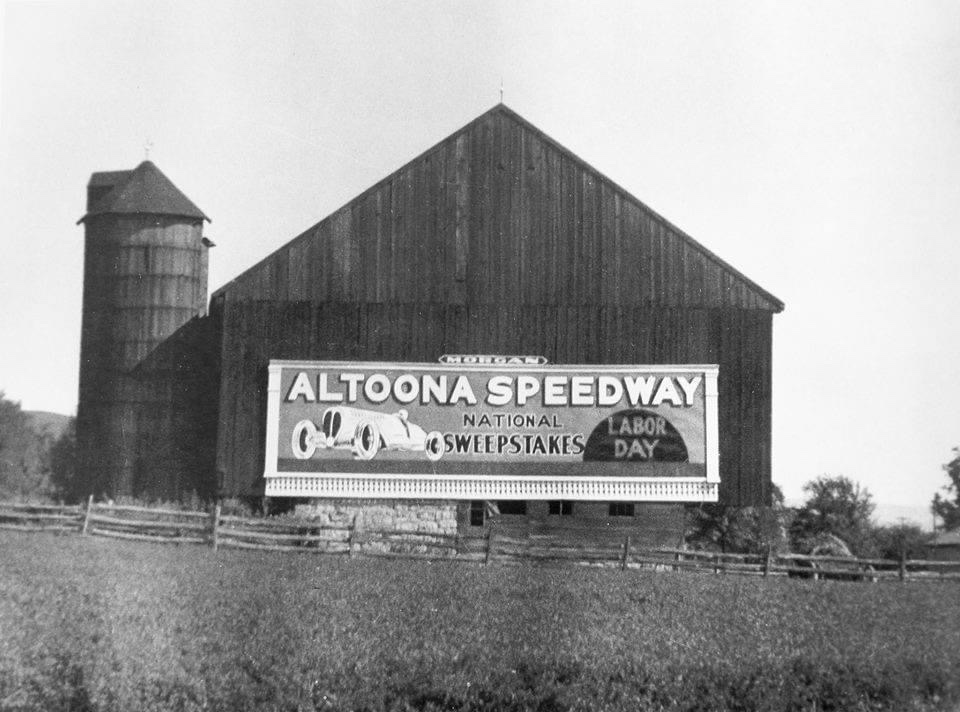
The Altoona Speedway was a 1.25 mile board track at Tipton, near Altoona, Pennysylvania which was home to the national championships in the 1920s, winning there was a big deal.
Indian’s designer, Charles Franklin – Irish road-racer and Brooklands tuner who discovered the ‘squish-effect’ in combustion chambers 10 years before Harry Ricardo – inherited a new 61cid side-valve engine from his predecessor, Charles Gustafson, which he turned into a race engine (there were also eight valve and 45cid variants) to take on the best at Altoona. The engine incorporated timing gears and crank carried on self-aligning ball-bearings, two oil pumps, removable heads and twin up-draught Zenith racing carbs.
With the new engine – still mounted in a 1920 spec board-racing frame – Curley Fredericks lapped Altoona at 114mph in a July 1926 race, the highest speed ever recorded on a circular board track. On Hampshire’s 1.25 mile board track that August he did 120.3mph, the fastest speed ever recorded on the boards. These unique race venues vanished soon after when the sanctioning bodies and manufacturers withdrew their support given safety and maintenance issues, so Frederick’s record still stands.
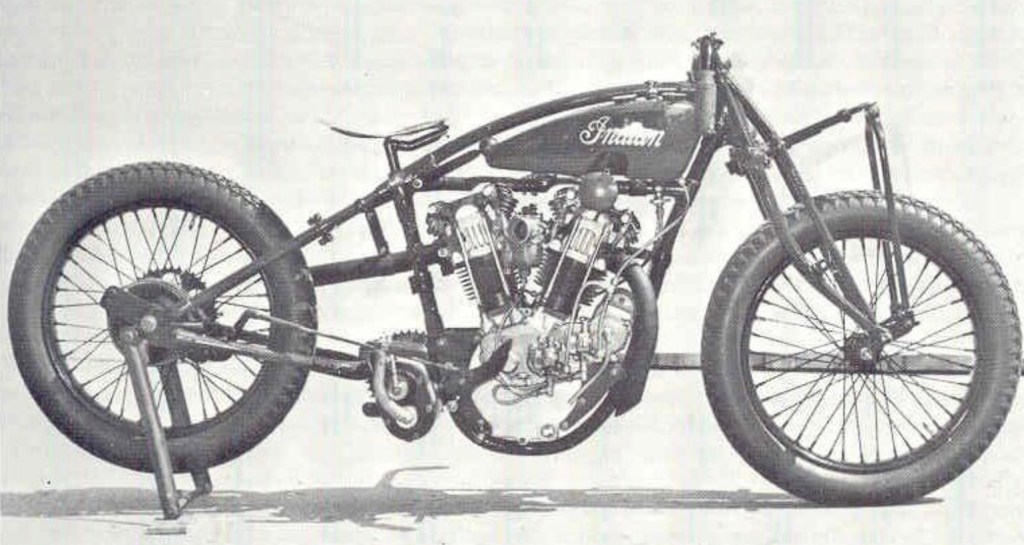
Of course it wasn’t long before Indian applied the Altoona name to its 1926-28 factory side-valve racers. The engines were used in disciplines other than board racing, including hillclimbs and drag racing
Indian Altoona 8-valve racer (unattributed)Altoona Speedway, grid of the Fall Classic in September 1924. Front left Ernie Ansterburg, Duesenberg, #16 Ray Cariens, Miller and #3 Bennet Mill in another Miller. Four Indy winners contested this race – look at that crowd! – Tommy Milton, Jimmy Murphy (who won the Classic), Joe Boyer and Peter DePaolo (Paul Sheedy Collection via firstsuperspeedway.com)Indian factory rider, Paul Anderson (who raced in Australia over the 1924-25 summer) aboard a 500cc, four-valve, single-cylinder 1924 road racer at Montlhery in 1925. Frame is “a full-loop design like Indian’s board-track racers, and a front brake 3 years before other Indians got them,” wrote The Vintagent (Bibliotheque Nationale de France)
To promote the opening meeting of John Wren’s Melbourne Motordrome (aka The Murder Drome and Suicide Saucer on the Olympic Pool/Collingwood FC site) in November 1924 the promoters imported four top US stars and their bikes; Paul Anderson and Johnny Seymour on eight-valve Indians and Ralph Hepburn and Jim Davis on Harleys.
Ultimately the Harley duo rode borrowed Douglas twins when their machines failed to arrive on time. In the solo-final Seymour and Hepburn dead-heated. The Indian riders had a successful tour albeit Seymour (later an Indy racer) broke a leg at one meeting. Among his successes, Anderson won the 10-Mile Solo under-500cc NSW Championship in January 1925, and did a record-breaking 125mph over a half mile on Adelaide’s Sellicks Beach. Anderson won so many scratch races on the Melbourne Motordrome that the promoters abandoned scratch events and ran handicaps!
When the Chamberlains were looking for greater performance they turned to “A motor (500cc, eight-valve, V-twin) of novel design, using an Altoona Indian crankcase, originally used by the famous American, Paul Anderson,” The Sun, Sydney reported.
“The cylinders were scrapped and 588cc overhead valve Norton cylinders and cam gears and two carburettors were fitted, and the compression ratio raised to 10:1.”
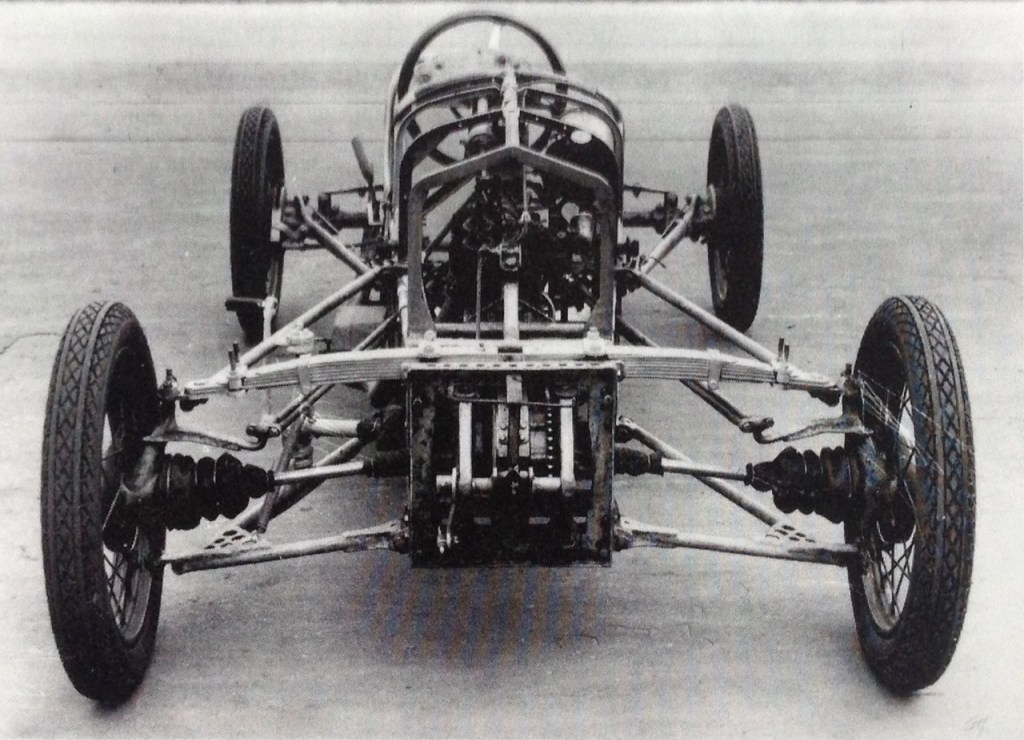
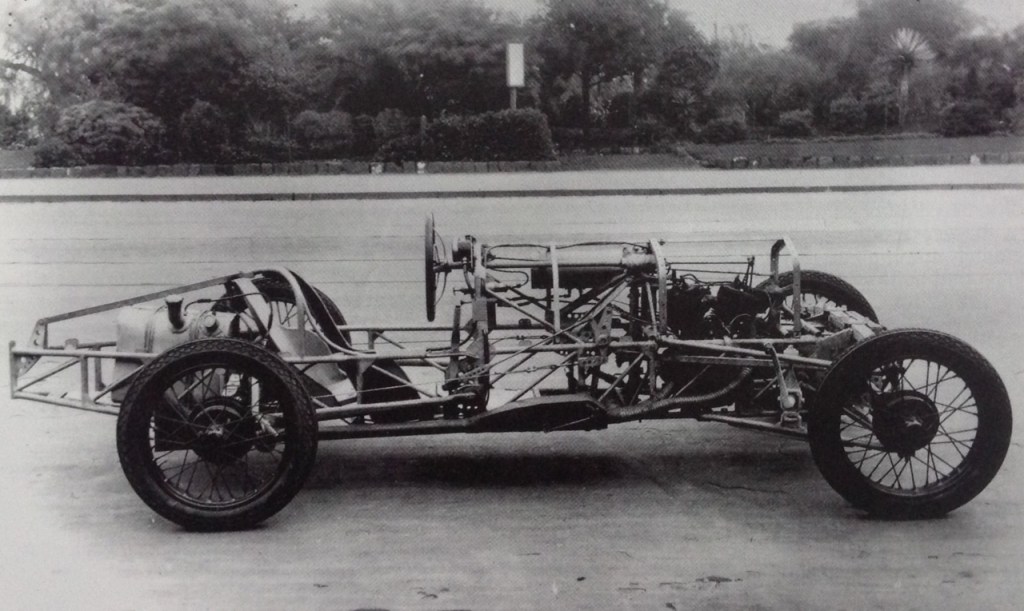
Chamberlain Indian front shot shows front-wheel drive, with CV joints made in-house. IFS by top leaf spring with locating radius-rods, wide based lower wishbones. Hartford friction dampers not fitted in this shot. Gearbox (in house) and chain-drive clear as is the tiny size of the car. Brakes are inboard drums (The Chamberlain)Chamberlain Indian circa 1929, light multi-tubular spaceframe chassis as per later 1950s and onwards practice…(The Chamberlain)
John Medley continues, “The car now became quite competitive, particularly in sprint events, easily holding the Wheelers Hill (in outer Eastern Melbourne) record for example. It ran in the numerous sprint events run by the Light Car Club of Australia, Junior Car Club and the Royal Automobile Club in Victoria during the period, as well as circuit races at Aspendale (inner Melbourne bayside suburb) and Safety Beach (holiday destination on Melbourne’s Port Phillip Bay).”
“Entered three times for the AGP at Phillip Island, the car was not successful. At the first attempt (1931) a piston seized due to the alloy being unsatisfactory, so the car did not start. By the following year the Chamberlains had made their own pistons from ‘Y’ alloy and the car completed practice without any troubles. In the race it only lasted 3 laps, when a crankpin broke.”
“Bob had trouble recalling a third attempt at the Island but checked his records and found that the car was indeed entered and listed as supercharged, although he is sure the car did not actually race in this form. Bob says that the blower was fitted to the Indian motorcycle engine and the compression lowered in the hope of improving big-end bearing life. It didn’t work out that well but this two-cylinder supercharged engine powered the car at several meetings at Melbourne’s Aspendale Speedway as well as a number of hillclimbs, with some success.”
“Then, in 1934, in Bob Chamberlain’s first attempt at Mount Tarrengower, the car crashed not too far from the site of (Australian Hillclimb Champion) Peter Holinger’s Holinger Repco V8 1977 accident. It has been said of Mount Tarrengower that if you make a mistake you have to fight for airspace with the pigeons. Bob Chamberlain was saved from that battle by a stout tree, which he scored at top speed just beyond the finishing line.”
It is at that point that Bob Chamberlain departed overseas and Bill Chamberlain set to work on construction of the Chamberlain 8 that Bill Thompson enters the picture.
Bill Thompson and Bill Balgarnie in the Lanes Motors MG K3 during the 1935 AGP weekend at Phillip Island. The pair finished a close second off scratch in the handicap race (B Thompson Collection via B King)
Thompson had won the Australian Grand Prix thrice, aboard the same Bugatti T37A in 1930 and 1932 and racing a Brooklands Riley in 1933. He was regarded as the best of his generation. By 1935 he had retired from road racing, but was perennially short of cash so decided to compete in the nascent sport of midget speedway racing, an activity which dovetailed nicely with his recent appointment as managing director of National Speedways Ltd.
In need of a car, Thompson convinced Lanes Motors – Melbourne dealers of Morris and MG amongst others – where he was head of the MG department, that midget racing would provide great exposure for their products on tracks at Sydney’s Showgrounds and Wentworth Park, Penrith, Newcastle and the Olympic Park Melbourne.
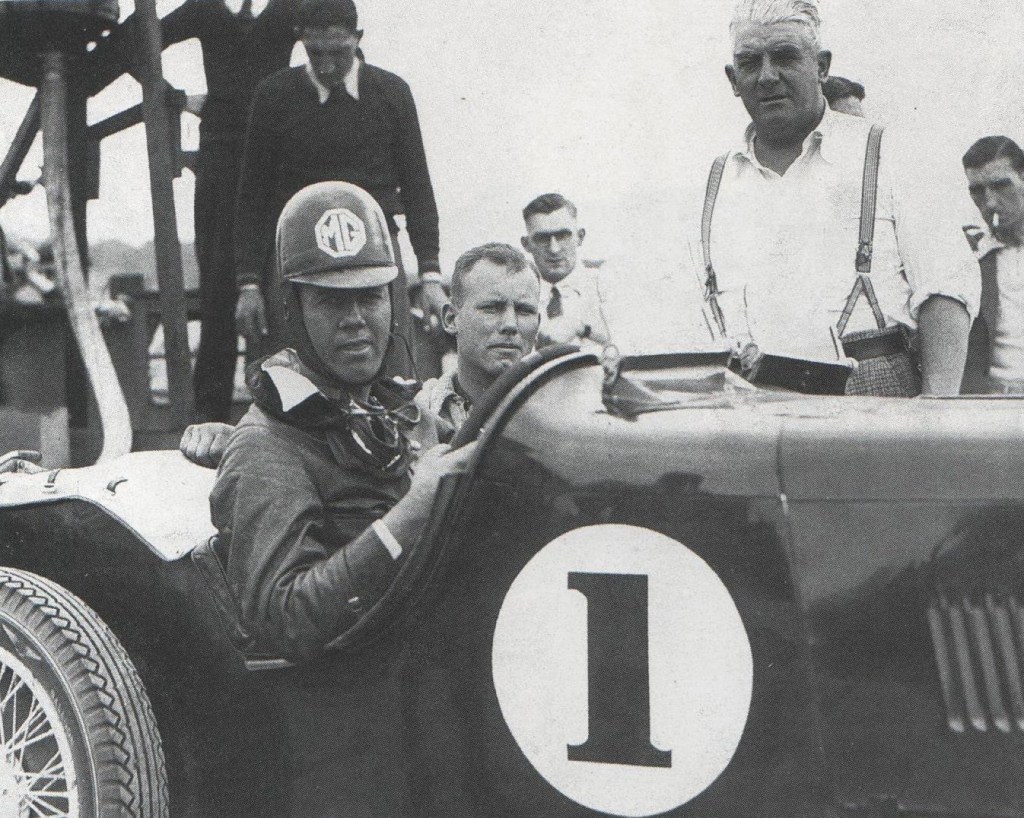
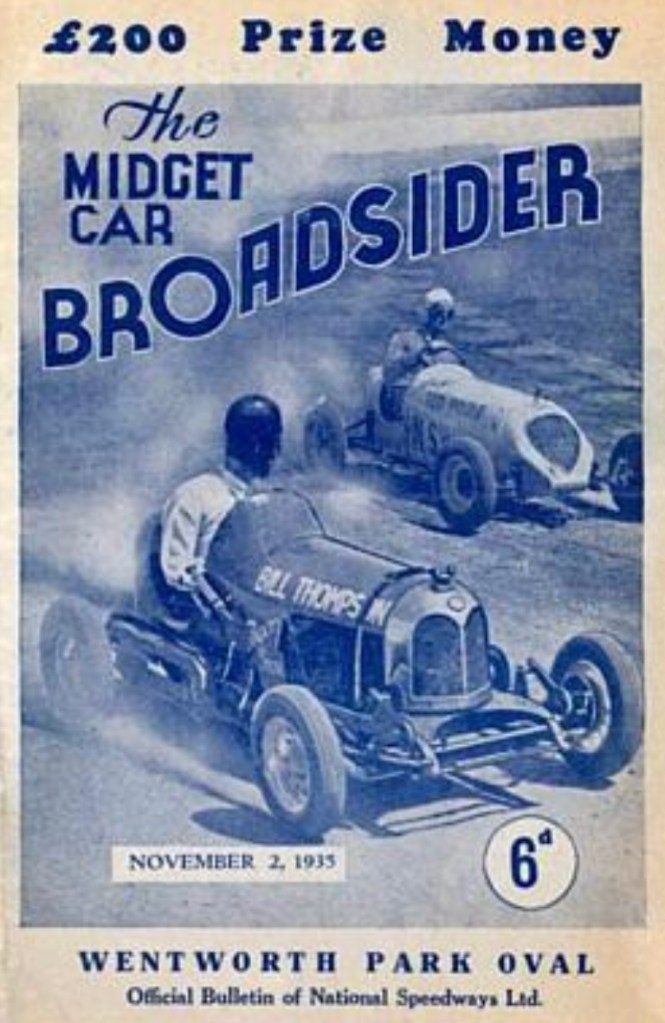
He concepted his ‘No 1’ machine, the Altoona Indian powered Lane Special to be powered by the light, potent, proven Altoona Indian-Norton engine. Built in Lanes’ racing department in South Melbourne the car “has a clutch and speed (sic) gear box and the chassis, steering axles, brakes etc built up from Morris Minor and MG parts,” The Sun recorded.
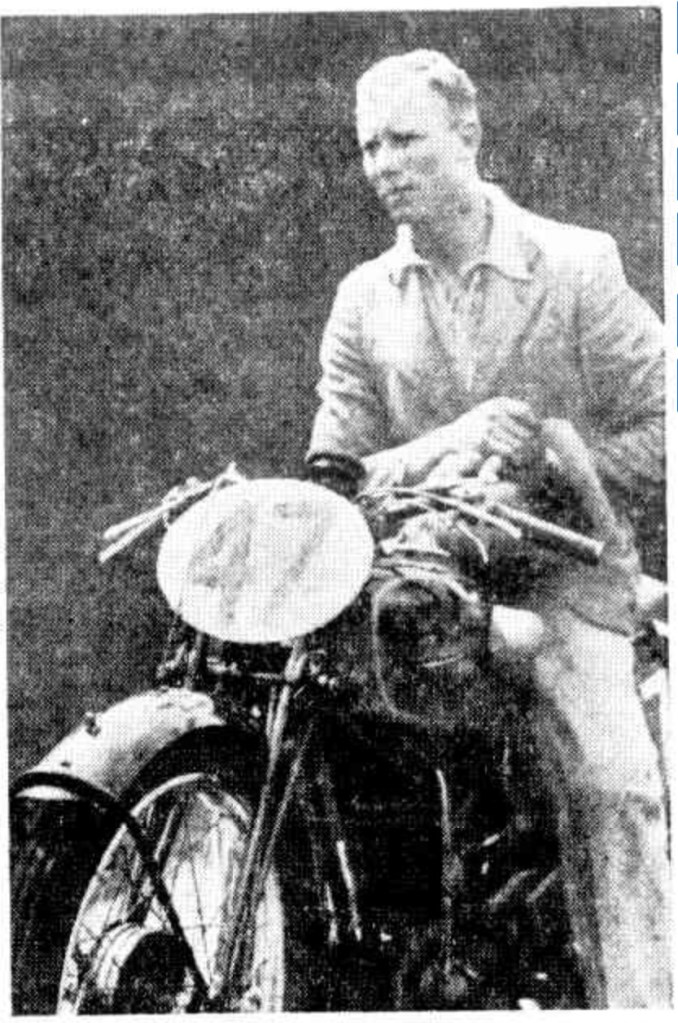
Australian international motorcyclist/master mechanic, Wilfred ‘Bill’ Balgarnie – who had represented Australia at the Isle of Man aged 22 in 1934, finishing 13th on a Velocette 350 in both Junior and Senior TTs – was also involved in the construction of the car. Balgarnie accompanied Thompson as riding mechanic in two of his AGP wins and in many of his major races.
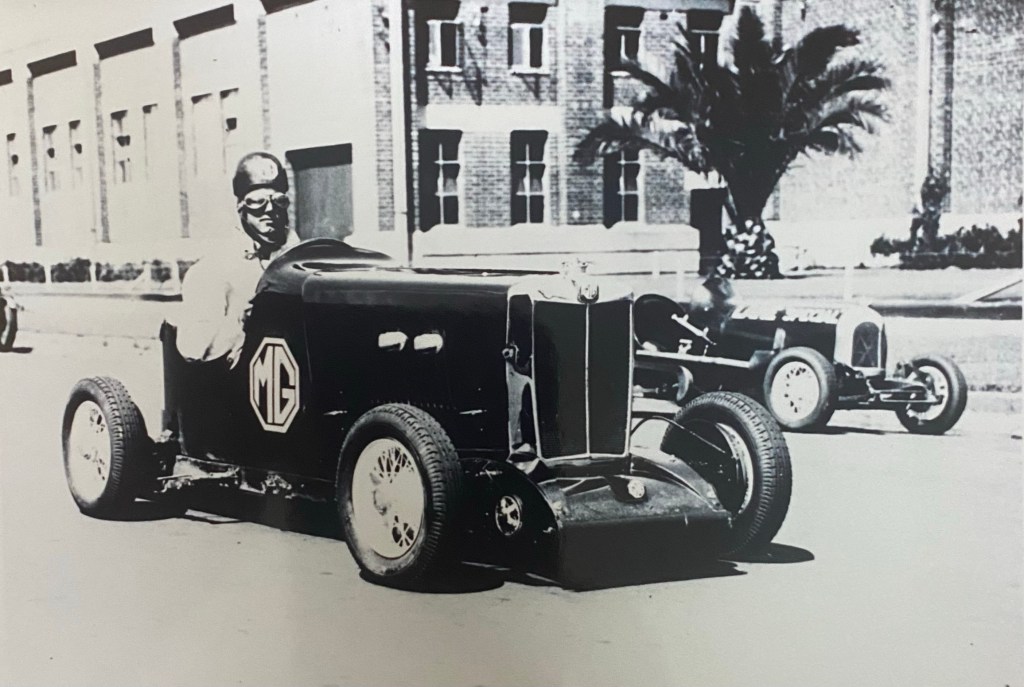
Balgarnie worked on Bill’s car and on a P-Type MG which was to be adapted for midget competition and raced by him. The 845cc engine was retained and modified, while the body was streamlined and lightened, the engine/transmission lowered, and mandatory 12-inch by 4-inch wheels fitted.
The Bill Balgarnie modified MG P-Type Midget – there cannot have been too many MGs raced globally as dedicated dirt speedway machines?! – with Bill Thompson up, chassis number folks? Note the Lane Special at rear. Given the backdrop, Wentworth Park, Sydney I think (B Thompson Collection via B King) Bill Thompson, Lane Spl Indian Altoona, and Ted Poole at Wentworth Park, Sydney in 1935 (vintagespeedway.com)
By August ’35 Thompson’s equipe also included Bob Findlay’s Midget. Balgarnie had performed so well in the P-Type Spl that Thompson acquired a better car for him, with which he was formidable throughout 1936-37.
The Sun reported in November 1935 that Thompson had a successful season (February to May) in Victoria but “has been disappointed with the Lane Special’s performance since its arrival in Sydney.” Thompson consulted with “famous speed merchant Ron MacKellar (Sydney Ford dealer and racer/engineer)” to dismantle the Altoona Indian engine to recondition it to find the 70bhp of which the motor is capable.”
When fitted to the Chamberlain “it has been credited with lapping Phillip Island at 78mph, “only 6mph below the official lap record. It was timed over the mile there at 103mph.”
While Thompson’s speedway record is said to be ‘undistinguished’, I’d like to record his results if any of you have ready access to Kent Patrick’s biography of Thompson. Time I bought it.
Finally, what became of that rather special engine I wonder…
Bill Balgarnie aboard his works-Velocette “waits to hand in his gear on the eve of the Isle of Man event” in 1934 (Western Mail)
Etcetera: Bill Balgarnie…
I was aware of Bill Balgarnie as a talented mechanic/riding mechanic but not his own record as a racer on two wheels and four.
Some Troving (Trove is an Australian newspaper digital archive) reveals that Bill was as much of an ace in a car as he was on ‘bikes, including countless midget wins, victory in the 1937 NSW State Midget Championship in front of 25000 spectators at Penrith and much more.
A Western Mail, Perth article about him published in March 1951 helps fill in the gaps, I’ve paraphrased it and added some other tidbits.
Born of parents who lived in Bowral, he first became interested in motorcycle racing when he left school in Sydney, competing in road races around Sydney and at Bathurst.
By 1934 he was one of the leading riders in NSW and was chosen to represent Australia at the Isle of Man. When he arrived in the UK, Velocette made a 350cc bike available for the races contested by 80 riders including the champions of England, Germany, Spain and France.
While the going was tough, the bike performed faultlessly and he averaged 74mph to finish 13th, and first visiting rider home. In so doing he won The Motorcycle Visitors Cup and received a replica of the Senior TT Trophy for recording one of the races’ fastest times.
The Junior TT was held the following day, “A terrible day, very foggy and wet and on parts of the course, visibility was very limited. I must confess I was pretty anxious about that ride, but again the machine went without a hitch and averaged about the 70 mark.” He was again 13th on the 350.
Afterwards he toured England for several months and for a period received specialist training at MG. He visited Brooklands and did a trial lap on a borrowed bike at 97mph, just missing out on the Gold Star awarded for laps of 100mph and over.
Then it was off to the Belfast TT, then France for an “international car race”, and finally Milan for a tour of Alfa Romeo before returning home to Australia late in 1934.
Balgarnie was immediately back in the fray, using his tuition at Abingdon to prepare and act as riding mechanic aboard Bill Thompson’s Lanes Motors entered MG K3 Magnette in the Centenary 300 at Phillip Island, the longest race for “purely racing cars” in Australia in January 1935.
In a winning position from scratch, and on-the-hop, Thompson sought to pass another competitor on the outside at Heaven Corner on lap 12, slid, then ran out of road as he corrected, crashed into a scoreboard and rolled. Thompson escaped with facial injuries but Balgarnie’s chest was crushed, “which kept him from work for several weeks.” The perils and stupidity of allowing riding mechanics…
Balgarnie takes the chequered flag to win the 1937 Australian Midget Championship at Penrith New South Wales. Make of chassis and engine would be a bonus? (Western Mail)
By 1936 Balgarnie was back in Sydney to race and running a servo in Rushcutters Bay, in addition to “dabbling in wrestling to develop his strength”!
The Australian Midget Car Championship and Five Miles Amateur Car Championships followed at Penrith in April 1937, and shortly thereafter a major accident when a fellow competitor stalled right in front of him at the Sydney Showgrounds. “It was too late to avoid him, I crashed into his back axle, looped the loop and turned over three times. After that I can’t remember a thing, I was out to it for three days.” He recovered quickly despite a cracked skull, broken arm and injured thumb.
Showing that he wasn’t at all phased by the accident Balgarnie won his class driving Ron MacKellar’s MacKellar Spl s/c at Waterfall Hillclimb in late August.
In February 1940 he married Pauline Laidley at Double Bay, the bride was given away by Ron Mackellar in a large wedding. In the early 1940s he joined the armed services but returned to competition with a couple of hill-climb drives aboard the Chamberlain 8 in 1946.
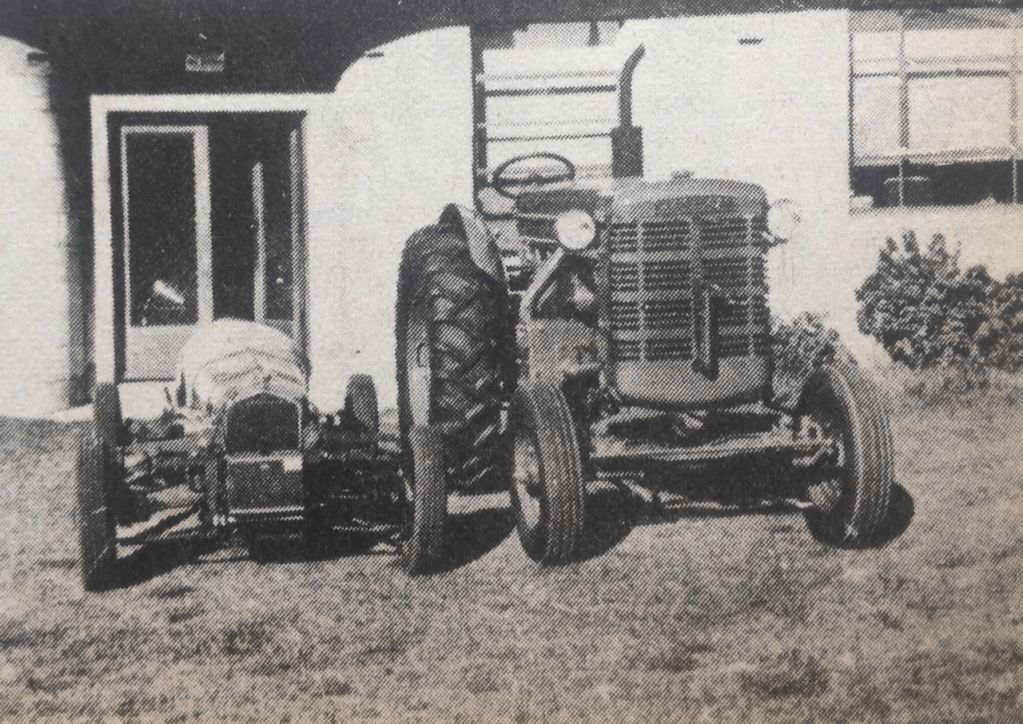
By then employed by the Chamberlains, Balgarnie was promoted to the position of works manager for Chamberlain Tractors whose manufacturing facility was in Perth. At the time of the Western Mail interview he lived in Dalkeith Road, Nedlands.
The Chamberlain 8 with the first of the Chamberlain tractors in 1946 (Cars and Drivers)
Balgarnie Snippets…
In the 1930s, the Midget racing season ran from November to May
Balgarnie rebuilt the Jack Jones/Mrs JAS Jones Alfa Romeo 6C 1750 Zagato SS after it was “completely burned out” in 1933. “Used as a hack for many years,” Jack Jones set second fastest time of the day in the May 1937 Canberra Speed Trials at 102.2mph over the standing quarter mile, “Which speaks well for the skill of the mechanic who rebuilt the car and was mainly responsible for its performance in Canberra,” the Sydney Referee reported. Frank Kleinig’s supercharged Miller powered Kirby Deering Special was quickest at 116.9mph.
In December 1935 Balgarnies speedway midget was reported to be equipped with “BSA overgear and an Altoona crankcase.”
In a 15 August 1935 Sydney Referee news item about the upcoming 1935-36 “season in Melbourne there will be at least 24 drivers available when the Olympic Park track reopens again” with the “big shots” among them “Bill Thompson, Bob Findlay, Bill Wilcox, Barney Dentry, George Beavis, Les Gough, Ern Day, Fred Curtis, Joe Parmeley, Bill Allan, Bill Balgarnie, Arch Tuckett, Arthur Higgs and Sid Gowar.”
Percy Hunter with JAS Jones aboard the Jones family Alfa Romeo 6C1750 SS Zagato at Gerringong Beach New South Wales in 1930 (A Patterson)
Credits…
artomobile.com.au, ‘The Chamberlain’ John Hazelden, ‘Chamberlain Australian Innovator’ Bruce Lindsay, thevintagent.com, The Sun Sydney November 1, 1935, various 1934- newspapers via Trove, The Vintagent, Bibliotheque Nationale de France, archivemoto.com, Paul Sheedy Collection via firstsuperspeedway.com, Bill Thompson Collection via Bob King, Cars and Drivers, vintagespeedway.com, Adrian Patterson Collection, Daniel Statnekov Collection, Getty Images, silhouet.com
Tailpieces…
(D Statnekov Collection)
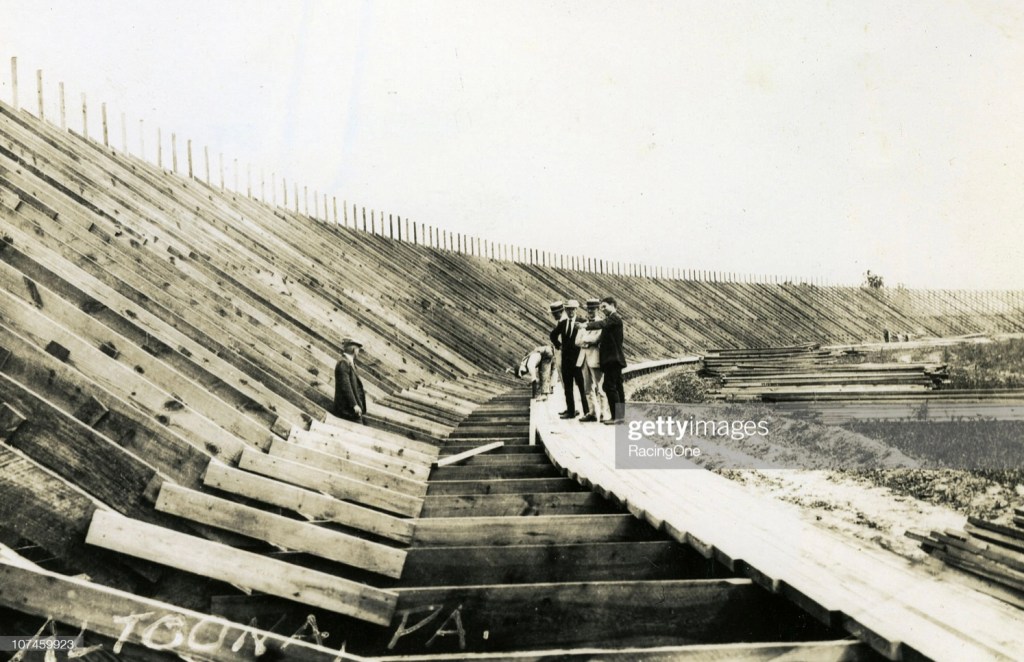
Now, where did I put my hammer? The engineering and construction challenge, and ongoing maintenance, were considerable! Dated by Getty as 1950, but lets call it 1922.
Altoona Speedway was built at Tipton, 20km north of Altoona, Pennysylvania as a 1.25-mile timber-oval with corners banked at 32-degrees, by entrepreneurs Jack Prince and Art Pillsbury.
It operated between September 4, 1923 and September 7, 1931, then was destroyed by fire in May 1936. In 1935 an oiled-dirt oval was built on the site, then post-war, a quarter-mile track opened on the infield, it held meetings until 1952. Industrial buildings now occupy the site.
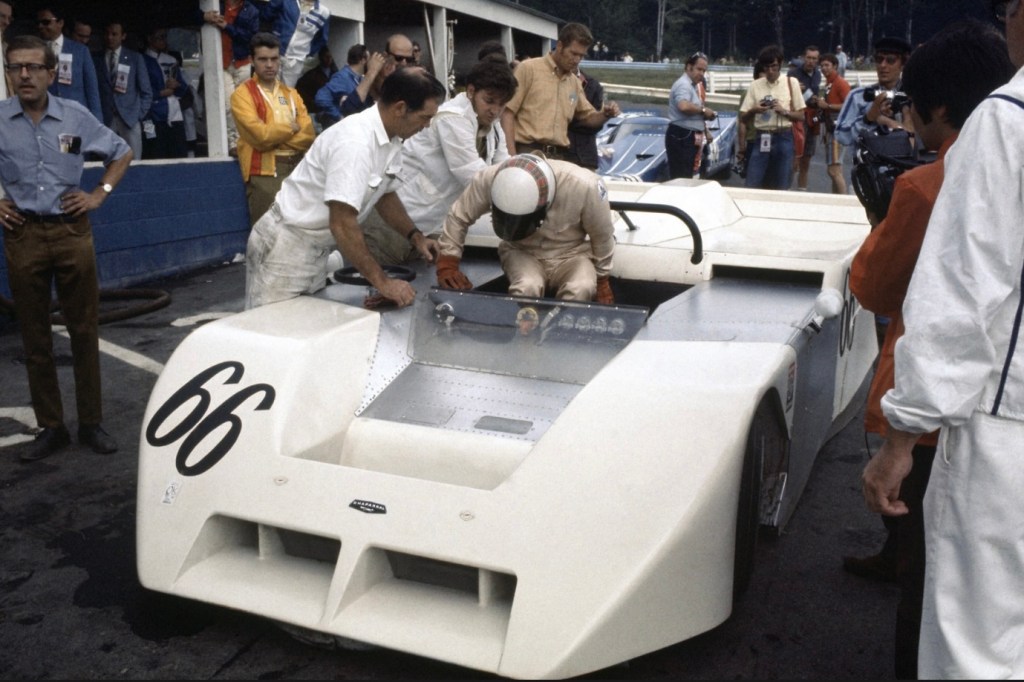
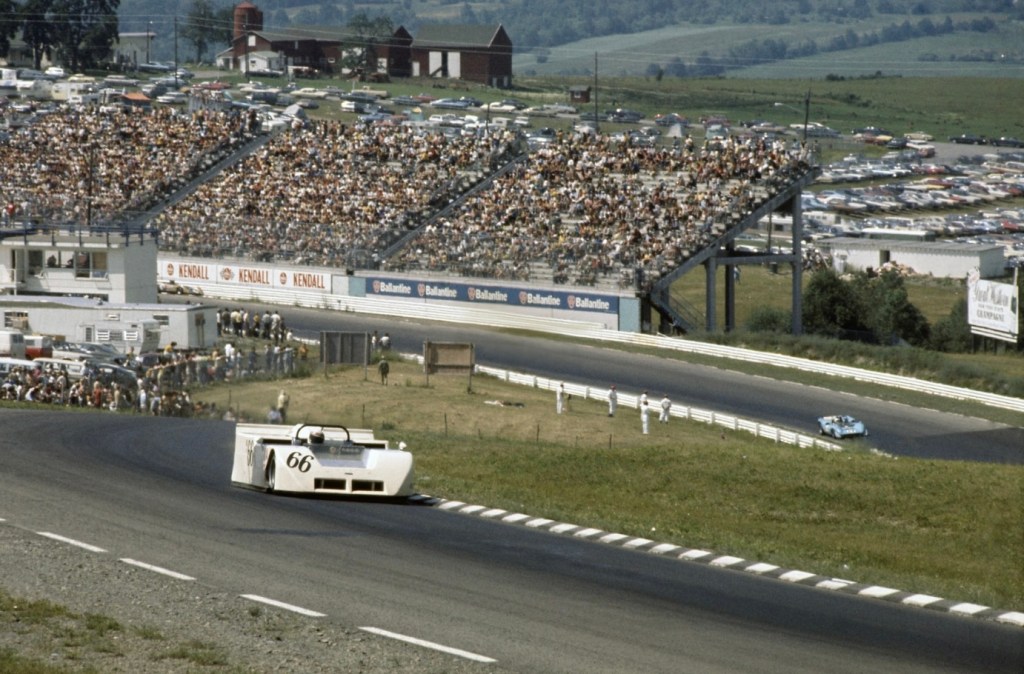
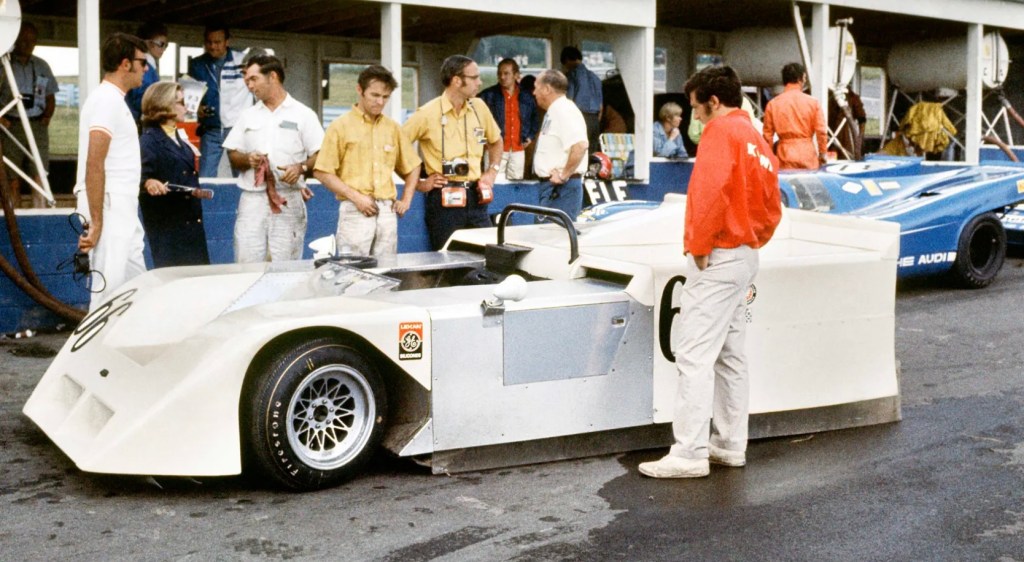
JYS loads up into the Chaparral 2J at Watkins Glen in July 1970 (LAT)
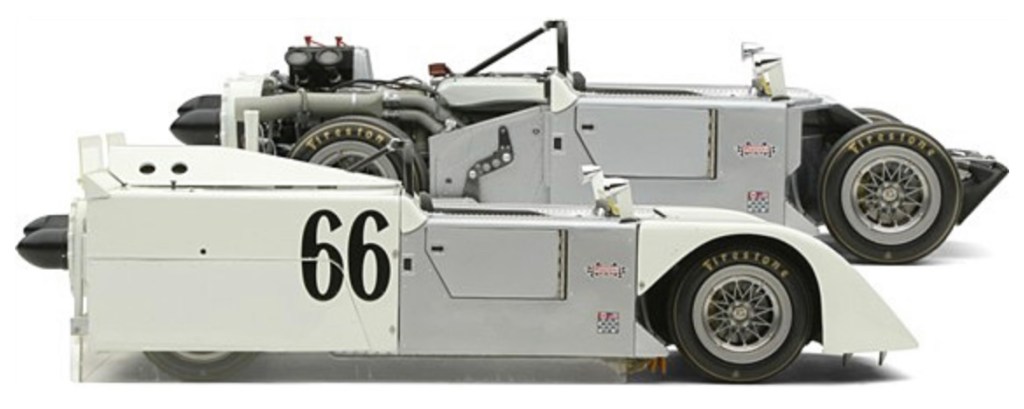
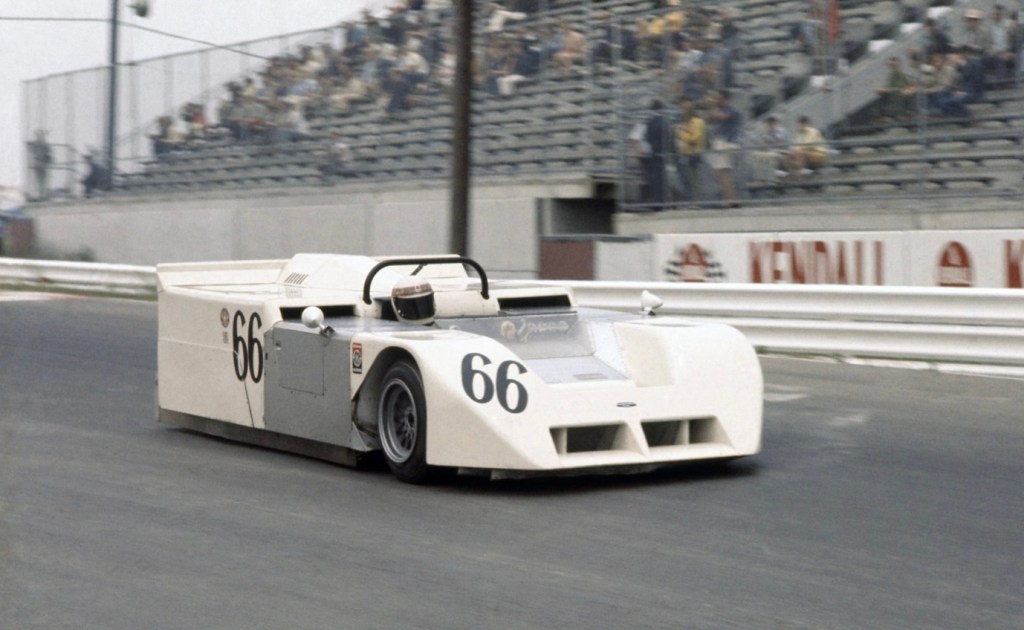
Apart from the Chaparral 2J Chev, name another car raced in 1970 that looks as edgy now as it did way back then?
I still remember flicking through Automobile Year 18 in Camberwell Grammar’s library in 1971 and flipping-my-14-year-old-lid at the sight of the 2J. My oldest mate remembers me saying, “Look at George Jetson’s car!” The only things missing were Jane, Judy, Elroy, and of course ‘rAstro!
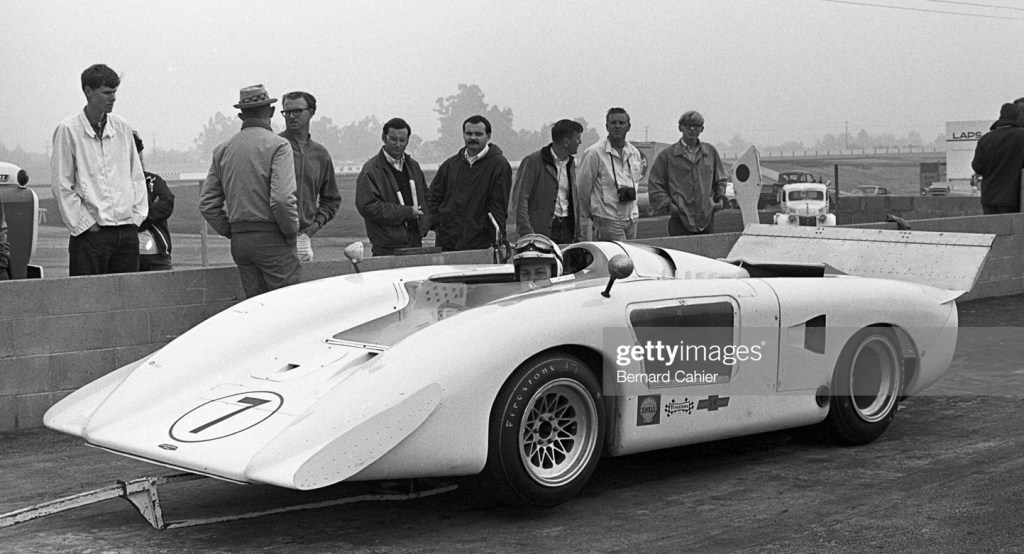
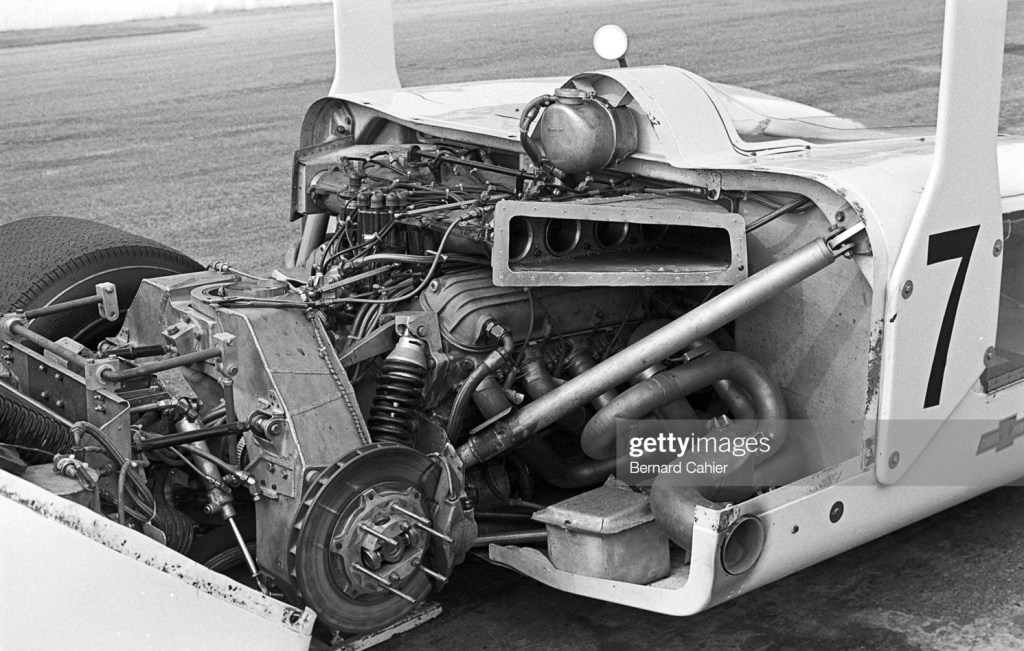
John Surtees, Chaparral 2H Chev at Riverside in October 19692H butt at Riverside in October 1969. Of note is the world’s biggest fabricated aluminium De Dion rear axle and one of the worlds biggest radius rods. ZL1 Chev has a crossover inlet manifold to get the fuel injection trumpets out of the airstream, ditto routing of extractors. Enormous wing fitted in this shot – you can see the vertical support – which is not installed in the shot above, remember too that this car was originally designed and built with the driver fully enclosed inside, something John Surtees pushed strongly against
Jim Hall has gonads the size of pineapples.
His outrageous 1969 offering, the wedgy, door-stop, knee high, De Dion rear-ended 2H was a complete flop. It’s driver, John Surtees, thought Hall had been smoking wacky baccy at Woodstock rather than working with clean-cut Nixon supporters at GM’s Skunkworks to design a new car.
Ever the poker player, Hall doubled his bets and concepted a machine so advanced and fast it was banned after only four races.
The Phil Hill/Mike Spence winged Chaparral 2F Chev looking lonely on the Daytona banking in 1967, DNF (Getty)
Chaparral had been giving the rest of the racing world aerodynamics and aero-technology lessons for five years or so to that point.
By 1970 the aluminium monocoque chassis was passe, so too was the aluminium block 650bhp’ish Chev ZL1 V8, even Chaparral/GM’s semi-automatic three-speed transaxle was a bit ho-hum.
Legend has it the inspiration for the 2J was a child’s fan-mail drawing to Hall of a sports racer being sucked down to the road by giant fans extracting the air underneath.
Whether it was ‘Elroy Jetsons’ sketch, an extension of previous Chapparral/GM R&D work, or divine providence, GM’s Paul Von Valkenburgh and Charlie Simmons, and Chaparral’s Don Gates started modelling the possibilities on Chevy R&D’s Suspension Test Vehicle.
More of a test-rig than a car, it enabled them to play with roll-centres and stiffness, ride height, pitch axis, anti-dive/squat and lots of other stuff; this rig became the 2J test mule.
“Gates worked out a fan and skirt infill defence system while Don Cox, Ernie DeFusco and Joe Marasco engineered a chassis to match,” Doug Nye wrote.
(sportscardigest.com)(sportscardigest.com)
The resulting tricky bits were the slab-sided, fully-fenced bodywork and Rockwell JLO 247cc two-stroke 45bhp snowmobile engine which powered two rear fans nicked from an M-109 Howitzer Tank. That combination could move 9,650 cubic feet of air a minute @ 6,000rpm, creating negative pressure equal to 2,200 pounds of downforce. Unlike other racing cars, the downforce was independent of the speed of the car.
For three-quarters of its footprint the car was ‘attached’ to the ground via skirts made of General Electric’s new, trick, Lexan polycarbonate. The skirts moved up and down with the movement of the car via a system of cables, pulleys and machined arms that bolted to the suspension. On the smoother Can-Am venues the seal was good, with the fans on the car hunkered-down by two inches.
The net effect of all of this was that the car sucked itself to the road, thereby creating immense cornering power and traction.
Stewart on the Watkins Glen grid, Chris Ecomomaki in front looking for a mike (J Meredith Collection)Vic Elford togs-up at Riverside. The car in front is Peter Revson’s Carl Haas entered Lola T220 Chev, Revson is sitting on the pit wall to the right of the Lola’s rear. His performances in that car propelled him into a works-McLaren M8F Chev with which he won the 1971 Can-Am Cup – F1 followed (B Cahier-Getty)
During the 2J’s build Jim Hall was smart enough to give SCCA officialdom a look at the car to ensure it was kosher in the almost-anything-goes Group 7/Can-Am world. The crew-cut mob deemed it hunky-dory to race.
While the car was first tested at Rattlesnake Raceway in November 1969, the complex machine missed the June 14, 1970 Mosport season opener and the following Canadian round at St Jovite. But 2J-001 finally arrived aboard a modest ute (pick-up) at Watkins Glen in mid July.
It’s driver was reigning World Champion Jackie Stewart in a one-race deal supported by GM (weird given the Ford sponsored Cosworth engine which powered his F1 cars). JYS had plenty of sportscar experience, including Can-Am cars, but nothing prepared him for the 2J.
“The car’s traction, its ability to brake and go deeply into corners is something I’ve never experienced before in a car of this size and bulk,” he wrote in Faster! “Its adhesion is such that it seems able to take unorthodox lines through turns, and this, of course, is intriguing.”
Jackie Stewart during practice at Watkins Glen, and below, a wonderful race day panorama (LAT)(LAT)
Stewart, and Vic Elford, retained by Hall to drive the car for the balance of the series, experienced the same other worldly, steep learning curve – retraining the brain about what was possible – as Mario Andretti encountered with Peter Wright and Colin Chapman’s Lotus 78-79 ground-effect cars in 1977-1978.
In a practical sense, half the problem was keeping the auxiliary engine alive – remember it wasn’t designed for this application – in its new harsh environment with all the trackside detritus the fans sucked up from the bottom of the car and regurgitated out the back at speed. Not to forget the skirts and their support mechanisms. The engineering challenge of this lot was mega.
Stewart qualified the brave-new-world 2J third behind the dominant orthodoxy, Denny Hulme and Dan Gurney’s new Batmobile-Beautiful McLaren M8D Chevs. Jackie closed on Dan during the race before being forced to pit, then went out for another seven laps – 22 in all – he bagged fastest lap before braking problems ended his race.
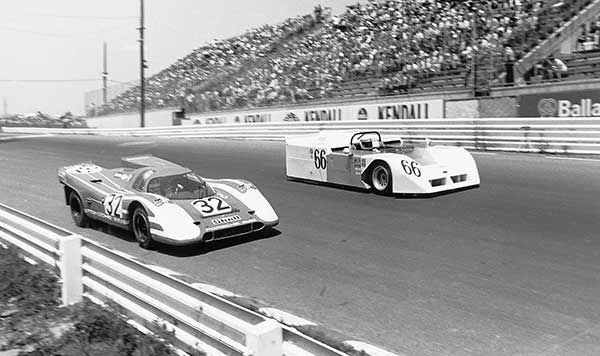
2J-001 at rest in the Watkins Glen pitlane. Sole sponsor decal is for GE-Lexan. Porsche Salzburg 917 of either Vic Elford or Dickie Attwood behind (LAT)Stewart blasts past Attwood’s third placed Porsche 917. While Hulme’s McLaren M8D Chev won at Watkins Glen, the next six placings were taken by Group 5 enduro cars, not the Group 7 cars for which the race was run. Said Porsche 917 and Ferrari 512S’ had already done the Watkins Glen 6-Hours the day before, most without an engine change between the two races. The JW 917 of Pedro Rodriguez/Leo Kinnunen won (unattributed)
Context is everything. The Glen’s Can-Am round was always topped up by Group 5-6 World Endurance Championship cars which were also in town for the Watkins Glen 6-Hour.
The dominant 1970-71 endurance racer was the swoopy-rounded, spaceframe, 4.5-4.9-litre flat-12 engined Porsche 917. Alongside the 917 the 2J looked like a Sci-Fi film prop!
The Texans missed the next three rounds at Edmonton, Mid Ohio and Road America to further develop the car before rejoining the circus at Road Atlanta in mid-September.
Elford recalled his impressions of the car to MotorSport, “Drving the car was just out of this world. The start-up procedure was a bit like an aeroplane I suppose, you didn’t just jump into first gear and drive away.”
“I put my left foot hard on the brake to make sure it didn’t go anywhere, then fire-up the little engine which immediately started to drive the two monster fans at the back, sucking up the air underneath. When I did this the car would literally go: ‘Shhhp!’ and lower itself down to the ground by about two and a half inches.”
Such was the suction of the turbines, the 2J could tootle off on its own at up to 30mph if the brakes weren’t applied.
At Road Atlanta Vic popped it on pole and finished sixth after ignition problems with the snowmobile engine.
“You get to the stage of thinking it’s just not possible to go around any corner at that speed, and adapting to it mentally is the most difficult approach because no other car has ever gone around a corner as fast as this one,” Elford recalled.
“Another great thing about the suction is that it doesn’t allow the cars’s handling characteristics to change as you go through a corner. Whichever way it’s set it remains that way at all times, whether its a fast corner or a slow swerve – it remains absolutely constant.”
Come race day Elford was always impacted by the three speed semi-auto transaxle, rather than the four of the LG600 Hewland equipped competition, that wasn’t the problem at Road Atlanta though, it was the subsidiary engine.
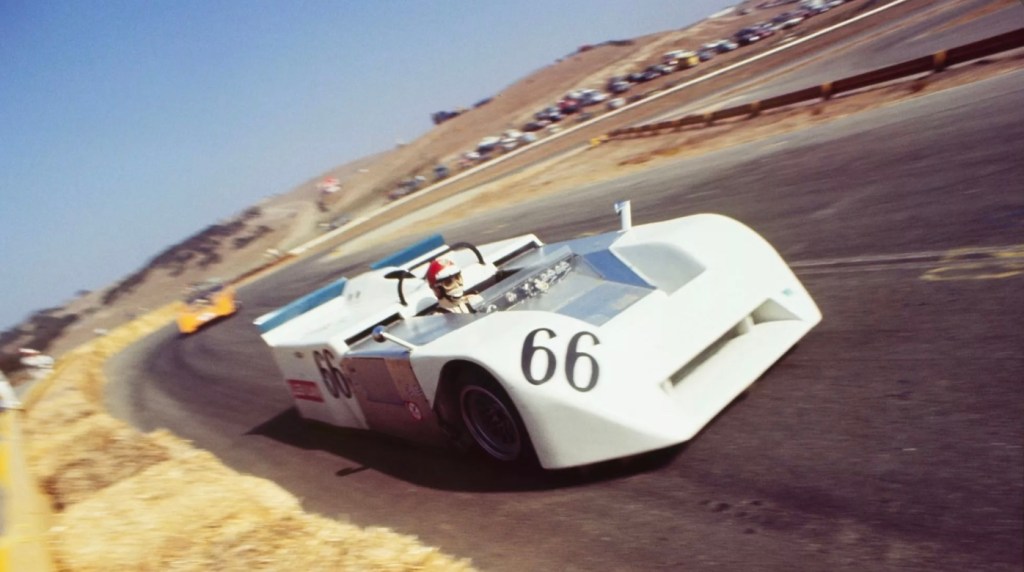
Laguna Seca followed a month later. There, Elford was the only car to go under a minute, a smidge less than two seconds quicker than Denny Hulme, despite never seeing the place before…
“I went around Laguna in 59 seconds and it was about five years before the next car managed to go under a minute, and that was an Indycar!”
He didn’t get to start from pole as the Chevy popped a-leg-out-of-bed in the warm-up early in the day, and there simply wasn’t the time for the Midland boys to pop in a new engine. The complexity of an engine change involved pulling much of the car apart and reassembly, a days work. It was an immense bummer for the Californian crowd.
Beautiful Laguna Seca profile shot of Vic Elford shows the unmistakable slab-sided lines of the car and operation of the skirts which appear to be riding the bitumen pretty well (unattributed)Imagine being showered by fast moving trackside shrapnel at 170mph, Dyson have nothing on this vacuum-cleaner! Elford in the Road Atlanta pitlane
The final Can-Am round was at Riverside a fortnight later. There, Elford was again well clear of Hulme in qualifying, this time the gap was a little over two seconds, these are huge margins folks.
“At one point we came into Turn 9 with Denny Hulme just in front of me. I was right up against the wall and I probably didn’t even change gear. I drove all the way around the outside of Denny in third gear. He went straight off, went into the pits and took his helmet off, sat on the pit wall and sulked for the next half hour!”
This time the Rockwell engine didn’t play ball, breaking its crank. The team managed to patch it up and take the start but it inevitably failed on lap two.
And that was it, the howls of protest were loud and long.
Not that there was any way known the 2J didn’t bristle with illegal ‘moveable aerodynamic devices’! No way can the SCCA officials who saw the car pre-season could have thought it otherwise, but – bless-em – they probably thought “Let ‘em run, the crowds will be huge and we’ll see what happens from there.”
In the process of banning it, the SCCA ripped the soul out of Can-Am in that Hall and his boys walked away.
Can-Am’s attraction was its anything goes nature which invited innovation. Anything goes was great, unless, it seems, it threatened the dominant orthodoxy. To me there was Chaparral-Can-Am and Post-Chaparral-Can-Am and the former was vastly better than the latter, with all due respect to Porsche and Shadow.
Elford in front of one of the Papaya-M8D-Terrors at Laguna Seca. Hay bales still very much around in 1970 (H Thomas/Getty)Brian Redman, Jim Hall, the Chaparral crew and their Lola T330/332 Chevs were the dominant US F5000 force from 1974-76. Here the duo are in the Elkhart Lake pits in 1974, Lola T332C Chev
Still, Hall kept his core team together running Lolas in the US F5000 and single-seat Can-Am championships, then had the joy of watching Lotus carry the ground effect torch forward, not that Chapman ever gave any credit his way, our Col never did that to anyone.
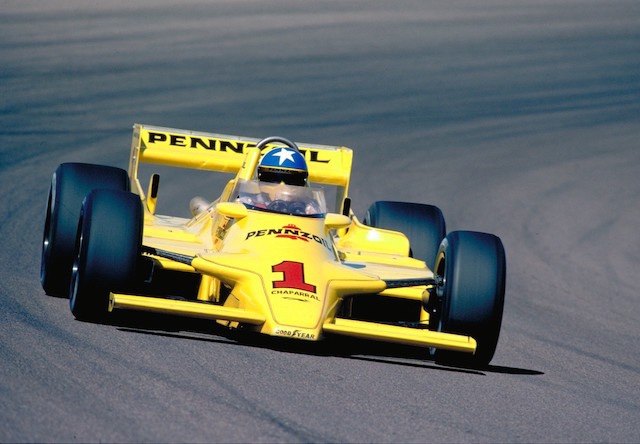
Hall then returned with the John Barnard designed ground effect Chaparral 2K Cosworth which won the CART championship and the Indy 500 in 1980 with Johnny Rutherford at the wheel.
Lone Star JR on the way to a win at Indy in 1980, Chaparral 2K Cosworth (IMS)
That Automobile Year 18 I prattled on about at the start of this masterpiece was hugely influential in stimulating my interest in cars and racing. Six of my Top Ten cars I first saw in that tome; Ferrari 312B, Lotus 72 Ford, Ferrari 512S, McLaren M8D Chev, Ferrari Dino 246GT and of course the Chaparral 2J. The Ferraris and McLaren are all about sex-on-wheels, the 72 and 2J are a tad more cerebral.
This article made me consider what the most influential racing car in my lifetime is? Its ‘gotta be a toss-up between the Lotus 25 Climax and 2J.
All monocoque racing cars are related to the 25, the first modern monocoque. The aerodynamics of racing cars since the Lotus 78 are related to the 2J. Let’s toss the coin as to which is the more influential, let the debate begin!
PS…
I ‘spose you think I’ve forgotten John and Charlie Cooper, but they were doing their mid-engined thing way before I was born, so, I’ve dodged that debate at least. In any event, Auto Union’s mid-engined missiles won GPs pre-war.
May 1967Thinkin, always thinkin. Jim Hall at Riverside in 1966 (B D’Olivo-Getty)
Credits…
MotorSport Images, sportscardigest.com, Indy Motor Speedway, Getty Images, J Meredith Collection, Harry Hurst, Sports Illustrated, Sportscar Digest, MotorSport November 2020 article by James Elson
Tailpieces…
“Aw come on Jim, it’s years since you raced in F1, time to return and give things a bit of a shake up.”
Jim Hall and Jackie Stewart pre-race at Watkins Glen. “Just make sure you have your left foot on the brake when we fire it up or you’ll mow down half the paddock!”
Note the fan-covers missing at Watkins Glen but present in subsequent races.
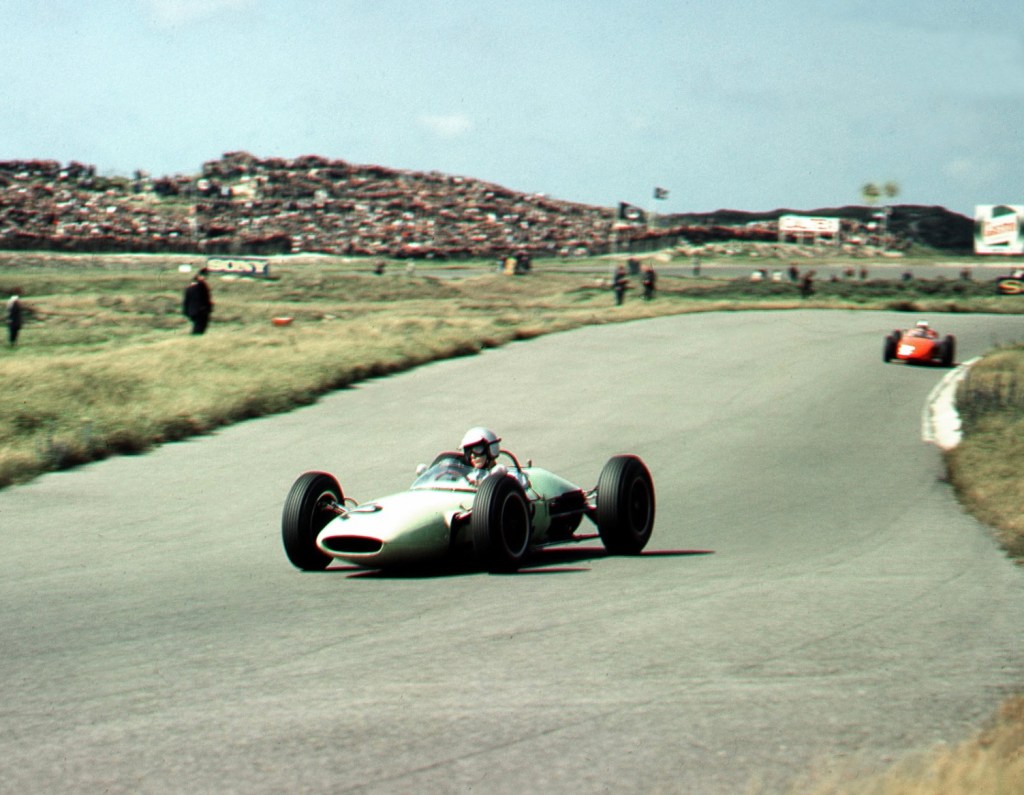
Jim Hall’s British Racing Partnership Lotus 24 BRM during the 1963 Dutch GP at Zandvoort, eighth in the race won by Jim Clark’s epochal Lotus 25 Climax. Carel de Beaufort’s ninth placed Porsche 718 in the distance (MotorSport)






























 primotipo...