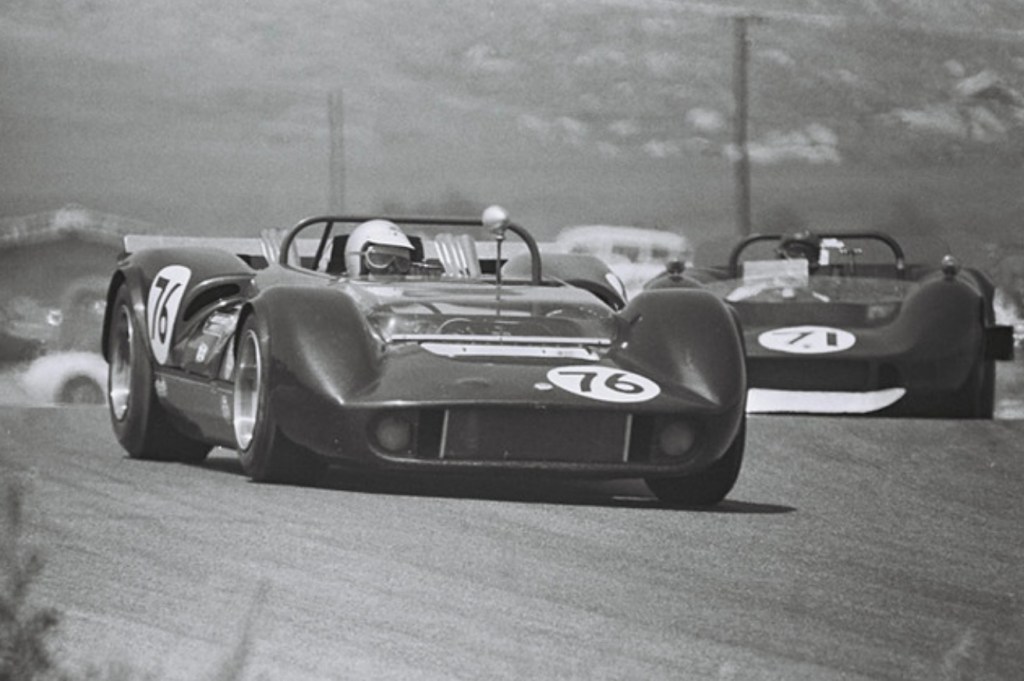
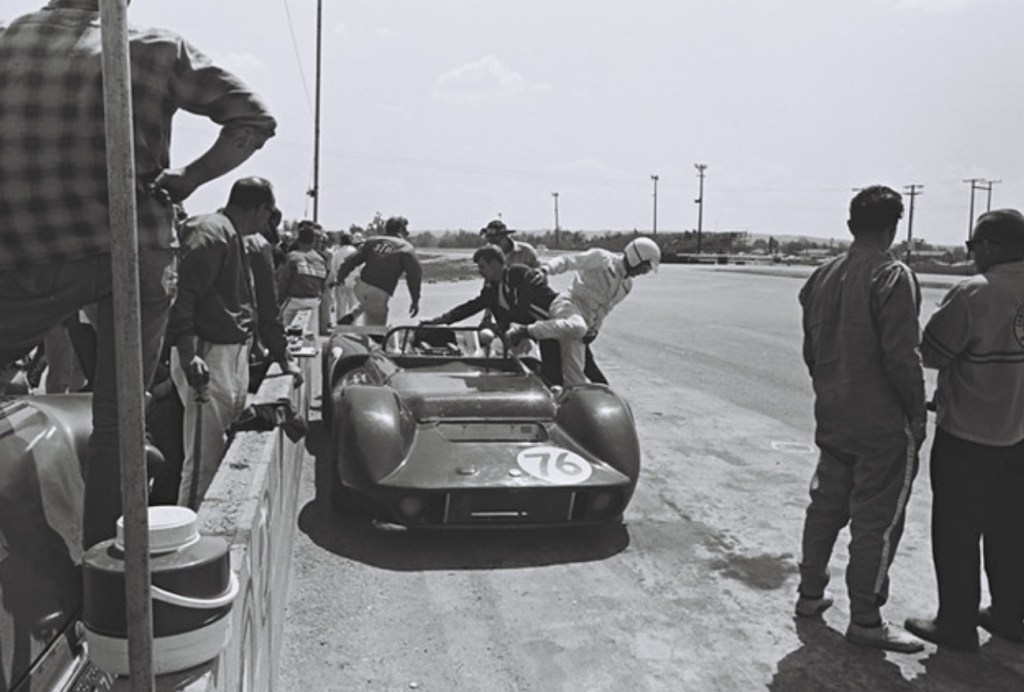
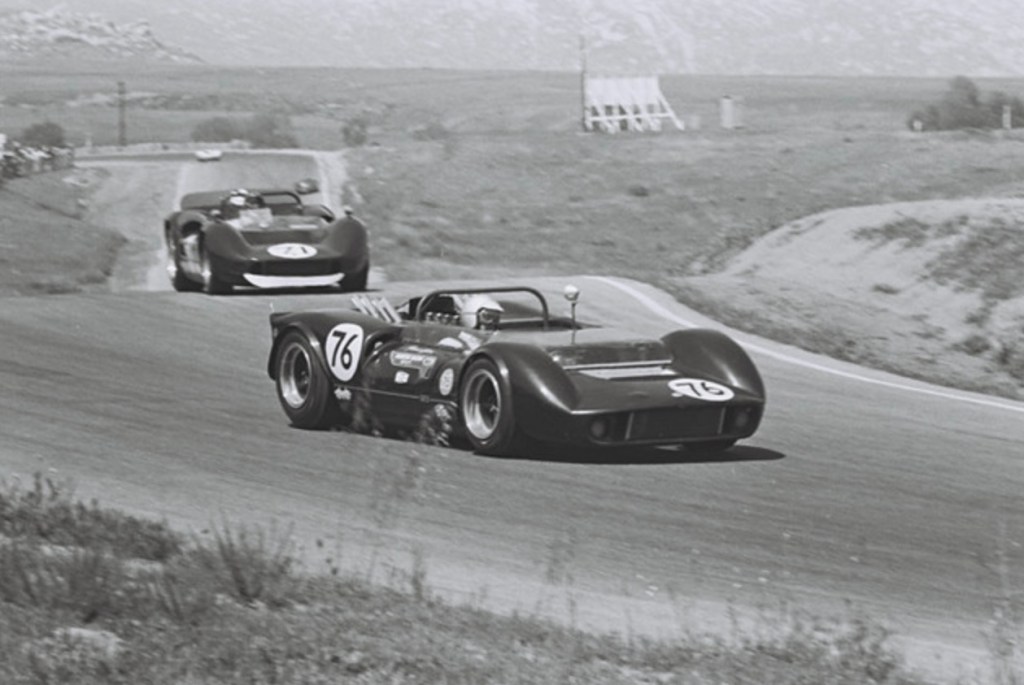
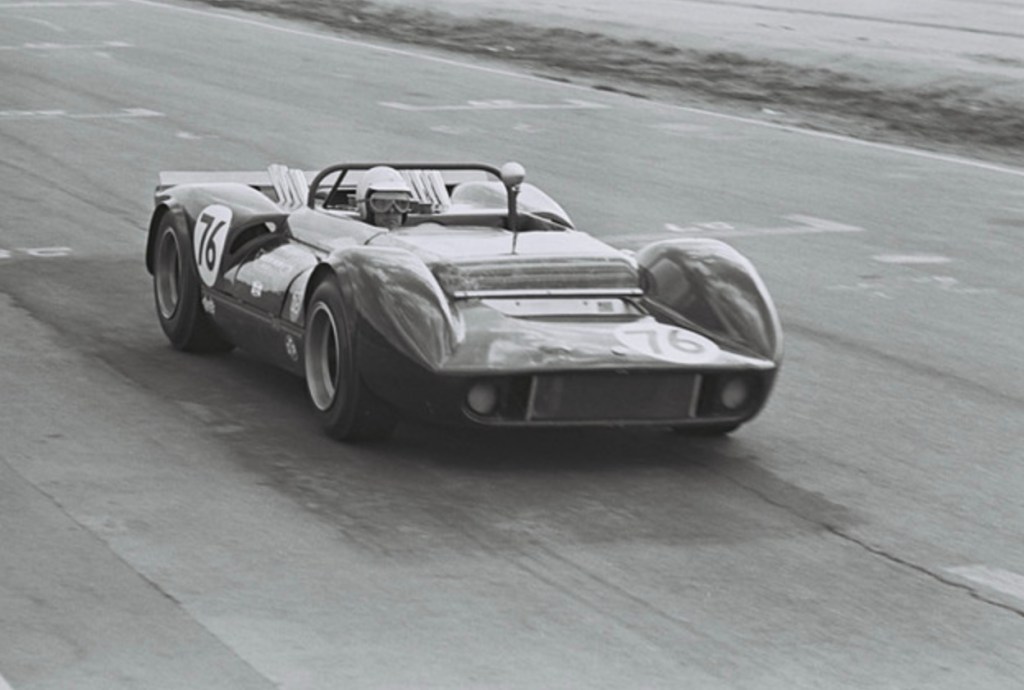
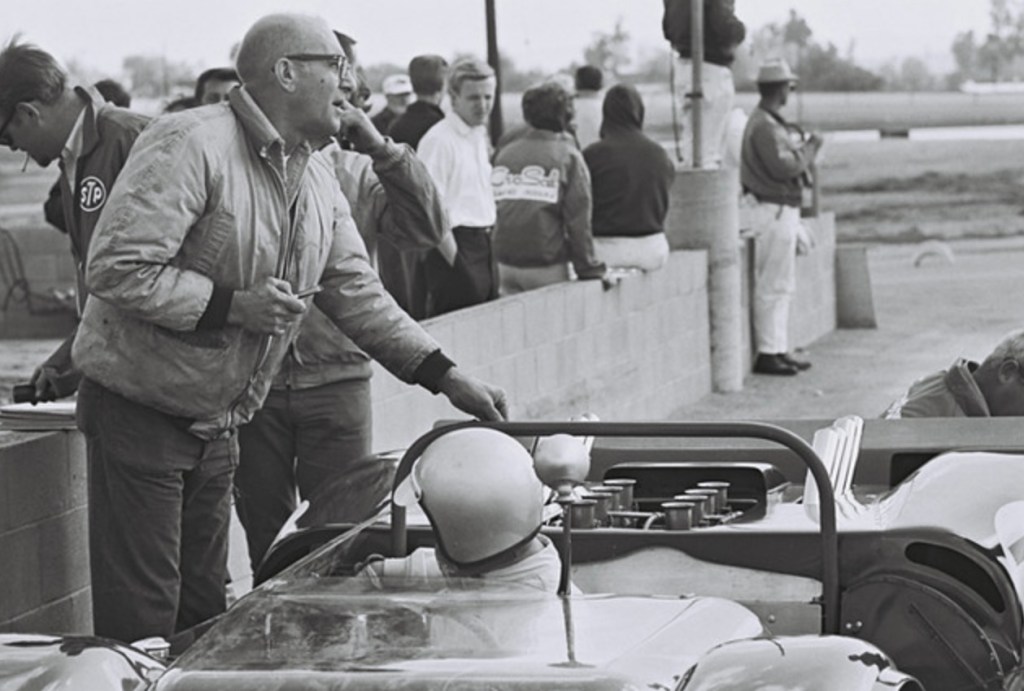
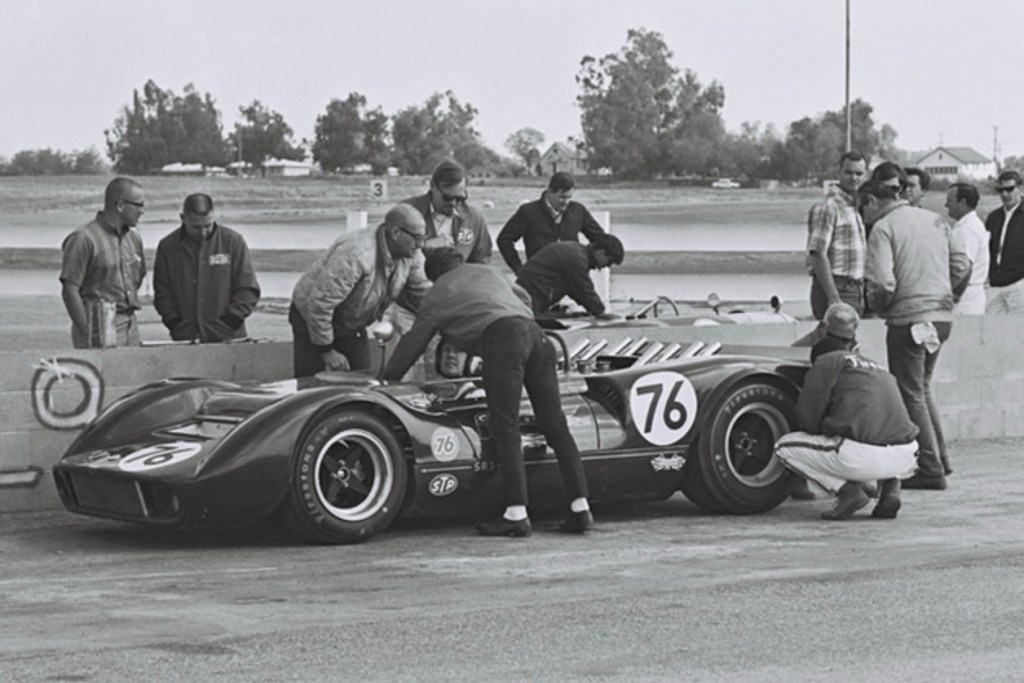
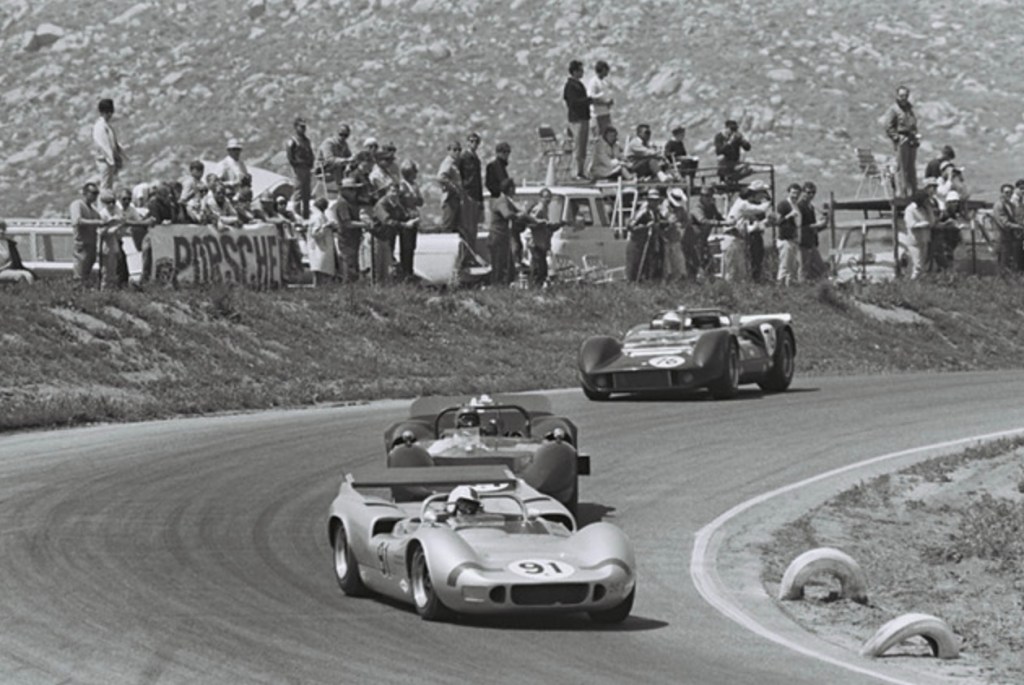
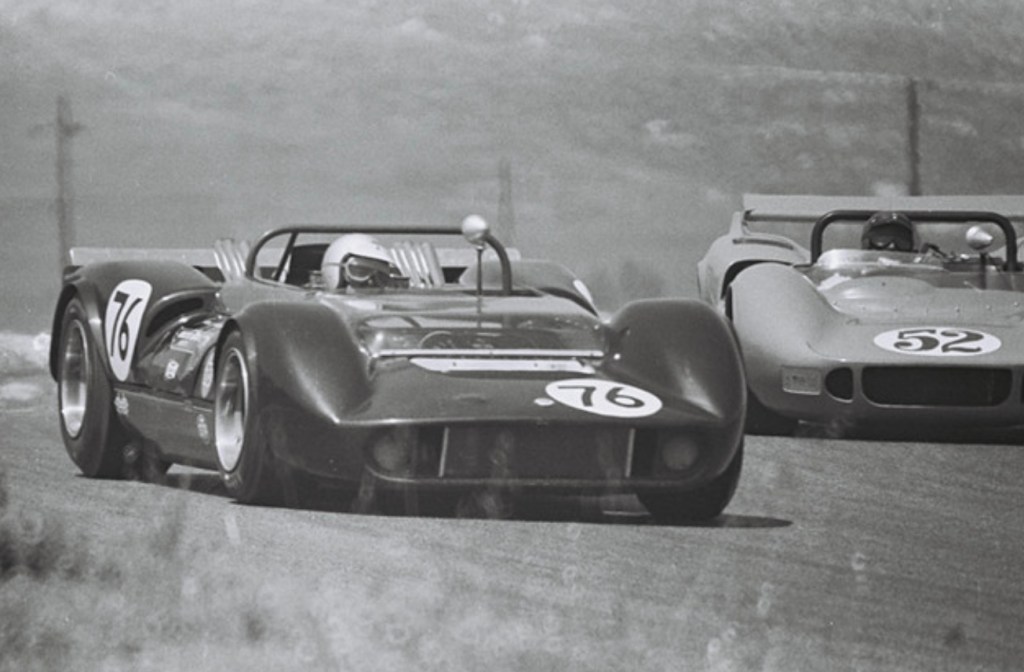
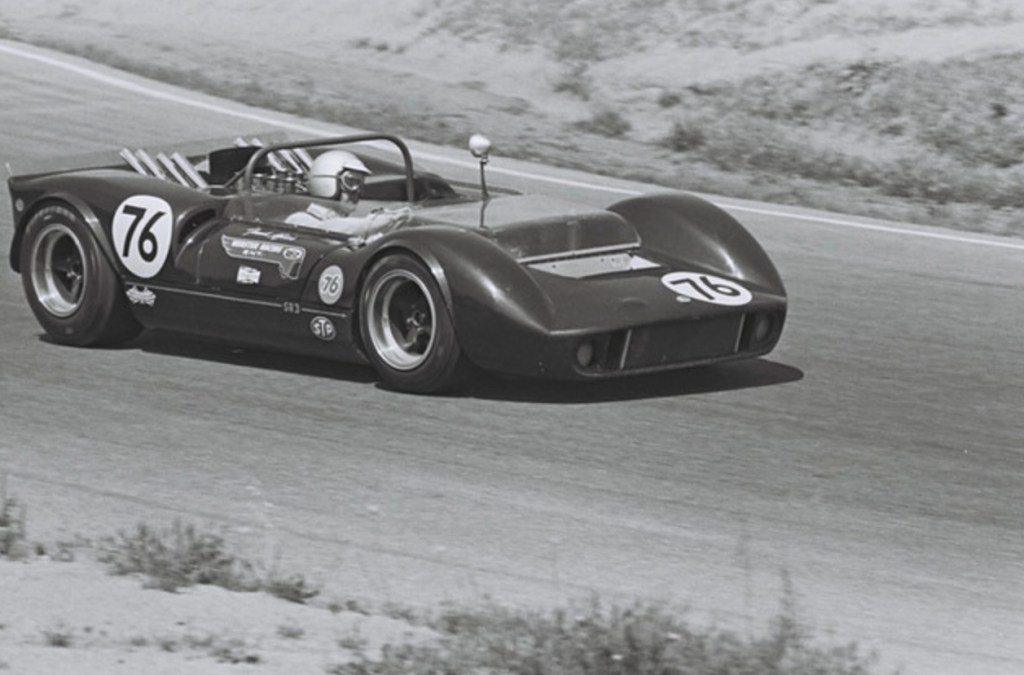
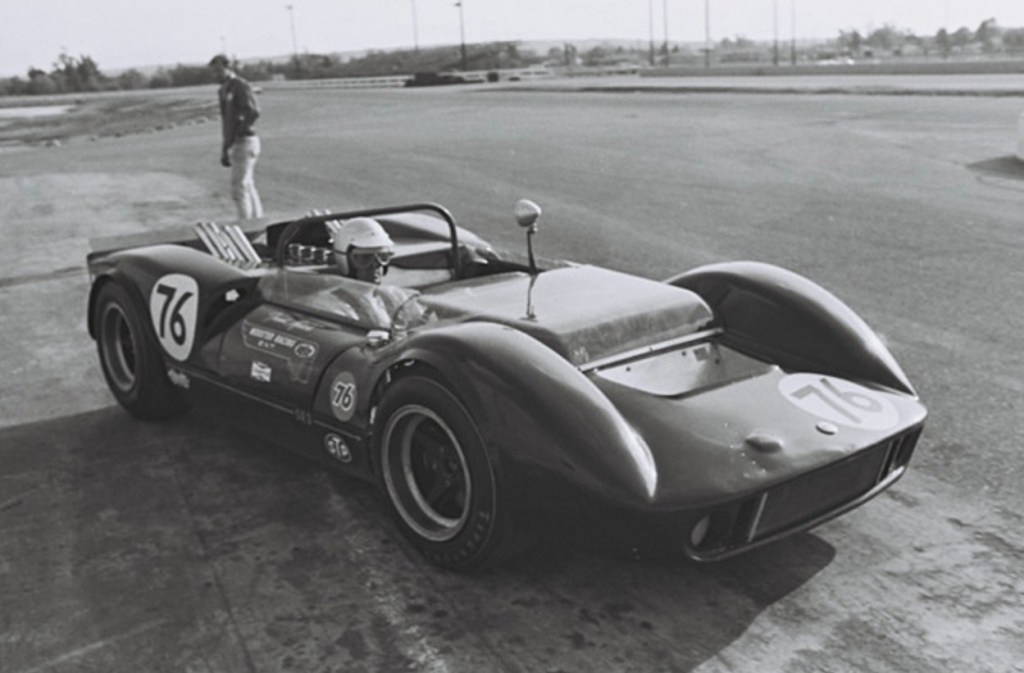
Frank Matich, Matich SR3 Oldsmobile ahead of Bud Morley, McLaren Elva Mk2 Chev during the United States Road Racing Championship round at Riverside, California on April 30, 1967
Many of you will be aware that FM contested Can-Am Challenge rounds that year whereas this race largely goes unreported
He had sold an SR3 to Marvin Webster in California and raced his own car in the Can-Am. This car was fitted with a modified 4-litre Oldsmobile F85 aluminium V8 by Webster’s crew while the other machine was powered by a customer Repco-Brabham Engines 620 4.4-litre V8.
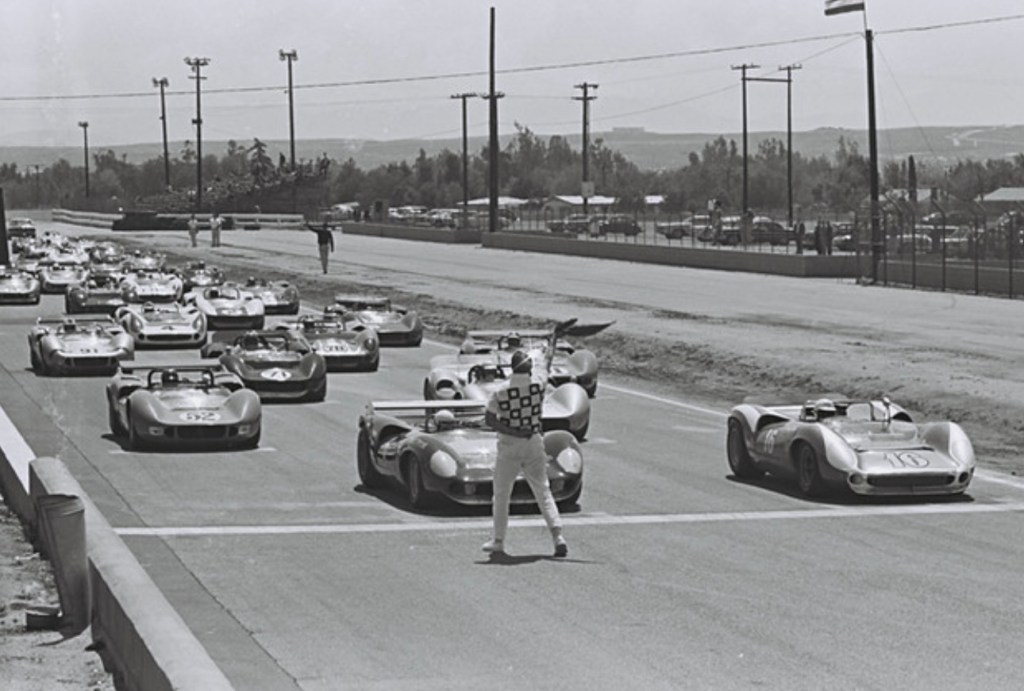
(D Friedman)Mark Donohue on pole with George Follmer on the right, Lola T70 Mk2 Chevs, #52 Peter Revson and #71 Bud Morley in McLaren Elva Chevs. Matich on the far right five rows back (D Friedman)Mark Donohue, Lola T70 Mk2 Chev (D Friedman)
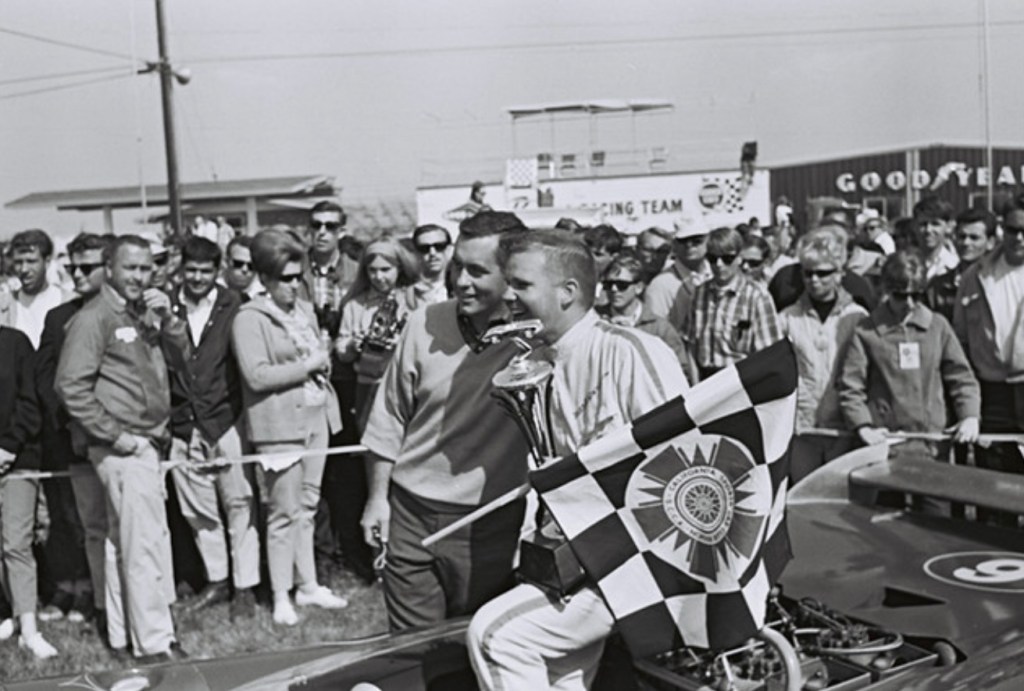
Mark Donohue won the 70 lap, 300km race in a Penske Lola T70 Mk2 Chev from Bob Bondurant and Peter Revson’s pair of Dana Chevrolet McLaren Elva Mk3 Chevs.
The pro-series was the Can-Am Cup, the USRRC was the next level down but still a national series with some topline steerers: George Follmer, Jerry Titus, Masten Gregory, Lothar Motschenbacher, Moises Solana, Scooter Patrick, Jerry Grant, and Sam Posey and Mike Goth, the latter a pair of drivers who did the Tasman in the F5000 years .
(D Friedman)
Matich qualified 13th and retired from the race with falling oil pressure after only 19 laps, not a happy weekend as they had blown an engine in the first USRRC round at Las Vegas the week before. The final race of his tour was the Laguna Seca round on May 7 with a finish this time, eighth from grid 10.
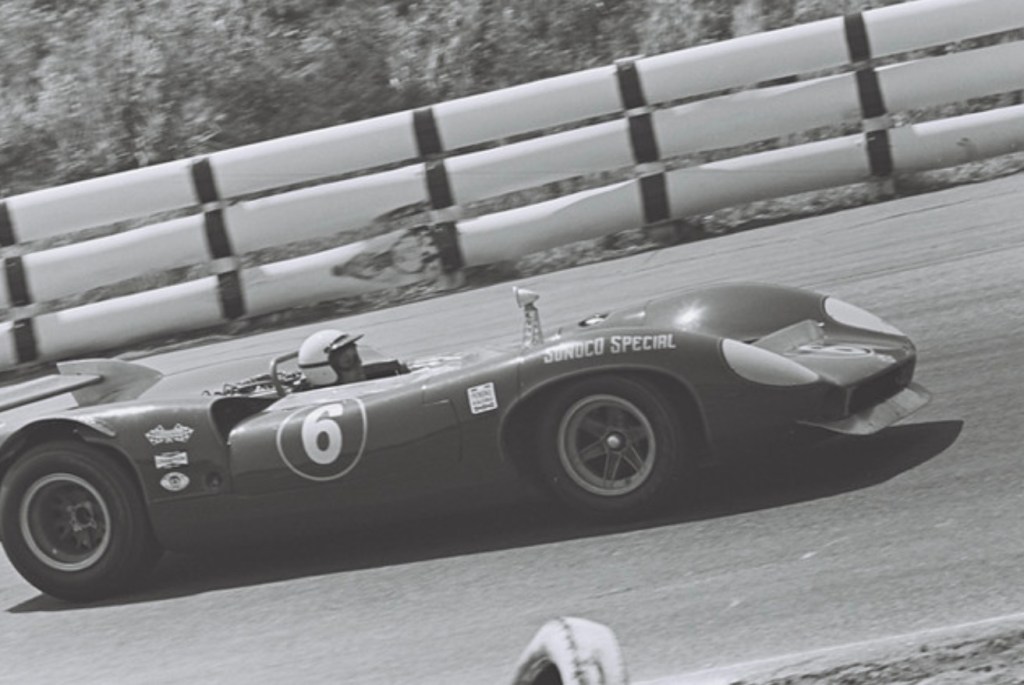
Matich from Mike Goth, Lola T70 Mk3 Chev, fifth (D Friedman)
Etcetera…
(D Friedman)
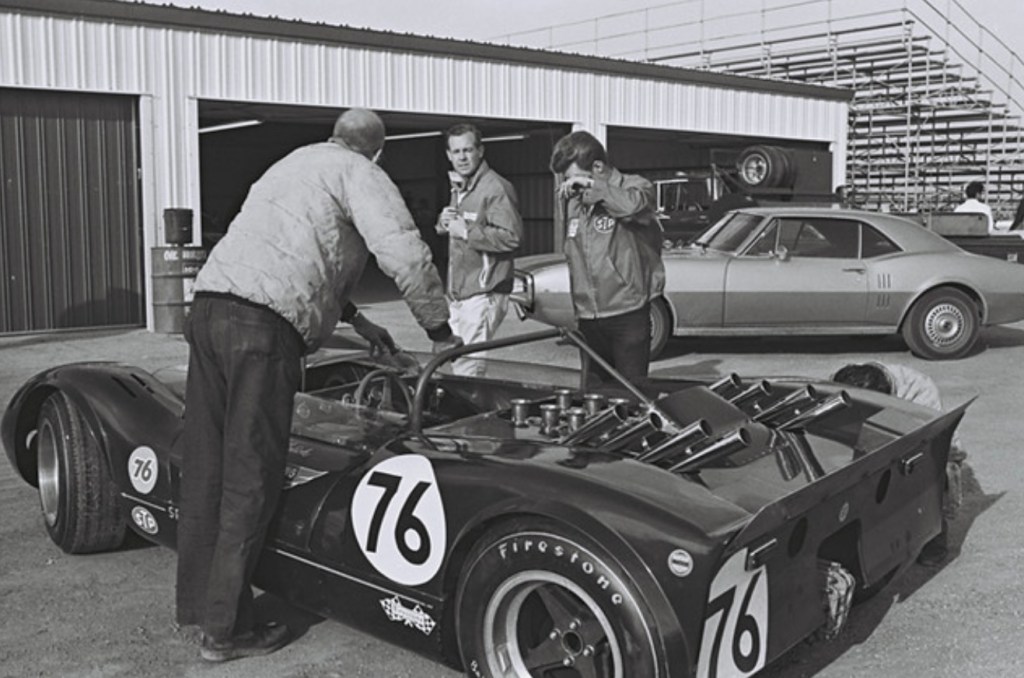
The Matich SR3 is derivative of a whole swag of sports-racers of the day but distinctively handsome all the same.
(D Friedman)
Marvin Webster calling the shots.
(D Friedman)(D Friedman)
Skip Scott’s McLaren Elva Mk3 Chev, DNF engine with Matich at the rear of this group.
(D Friedman)
Matich in front of Peter Revson’s McLaren Elva Mark 3 Chev.
(D Friedman)(D Friedman)(D Friedman)
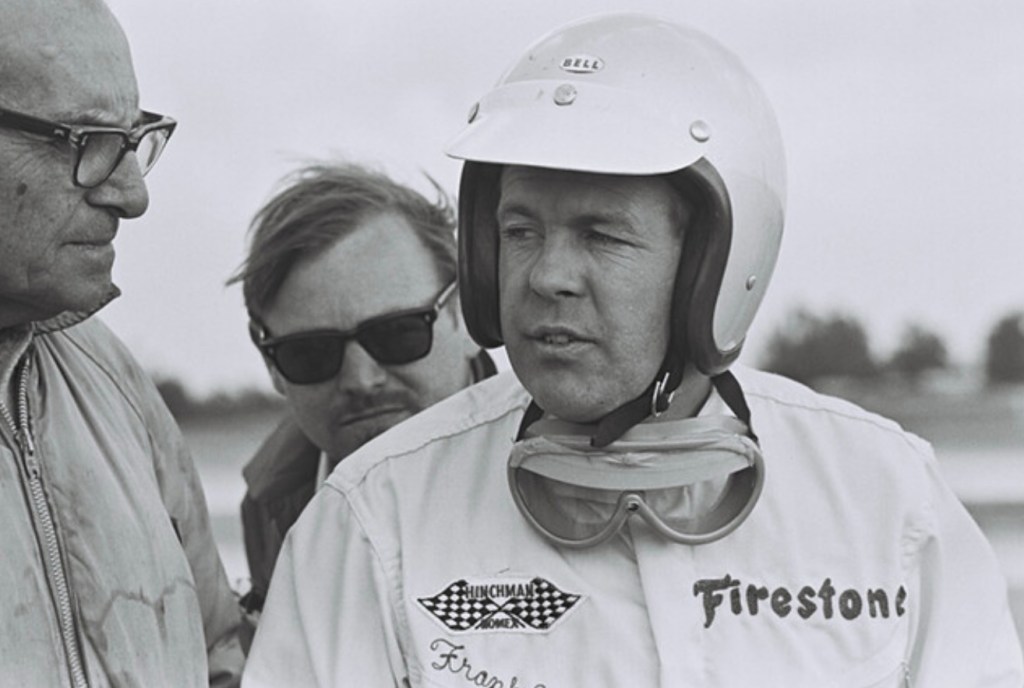
FM had the Australian franchises for Firestone Racing Tyres and Bell Helmets, I wonder if he landed both those fish during his ‘67 trips? Yes, he went with Goodyear a bit later when it seemed the way to go…
Credits…
David Friedman Archive
Tailpieces…
(D Friedman)
How far back did Roger Penske and Mark Donohue go? About here actually.
After Roger stopped driving in 1965 he fielded a pair of Corvettes at Daytona and Sebring in 1966 before forming the partnership with Donohue. USRRC titles followed in 1967-68 with Lola T70s, and the rest, as they say, is history.
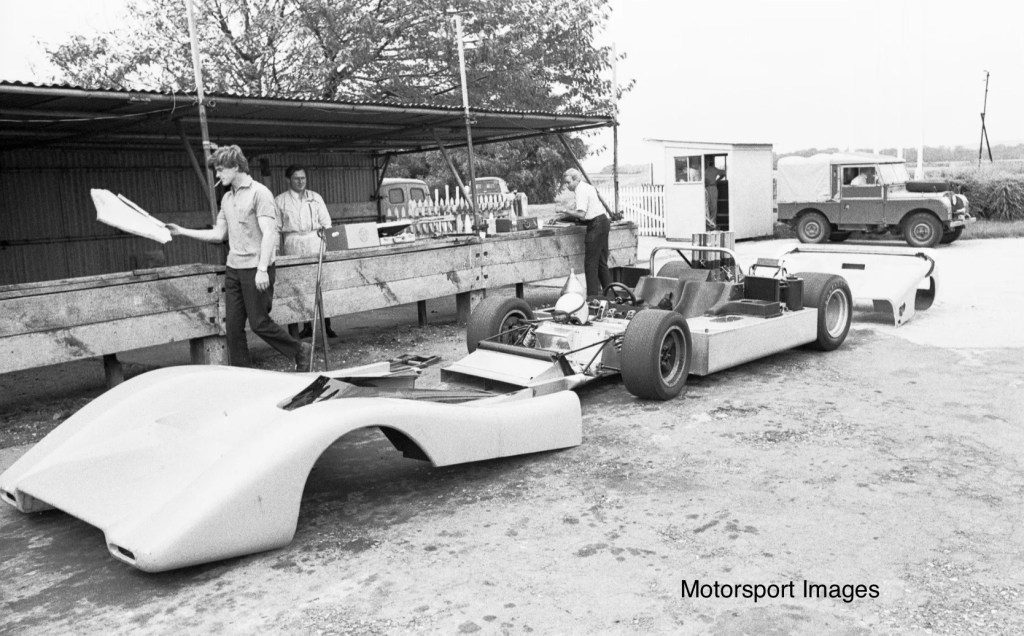
‘It’s the first McLaren M8A Chev outside McLaren’s David Road factory in Colnbrook,’ Derek Kneller recalled.
‘I was a fabricator working with Don Beresford, John Thompson and George Begg on the M8As. The shot was taken on my Polaroid camera when the first body was fitted.’
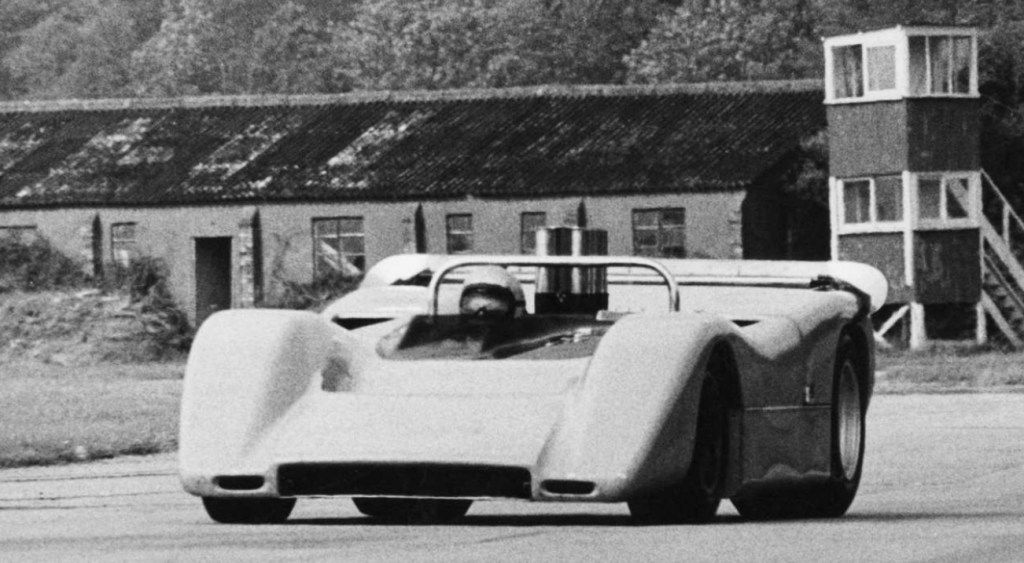
The shot below of Alistair Caldwell, Bruce McLaren and Teddy Mayer testing the car at Goodwood in July 1968 dates Derek’s shot. The car is still not fitted with mirrors, but does have a small spoiler on the rear bodywork, so perhaps a day #1 or day #2 test…
(goodwood.com.)
Bruce blasting past the Super Shell Building at Goodwood, what is that material going across the back of the car from wheel arch to wheel arch?
It wasn’t a bad season, McLarens won all six Can-Am Cup rounds: Denny Hulme took three, Bruce, Mark Donohue (M6A Chev) and John Cannon (M1B Chev) one apiece. Denny won the Canadian-American Challenge Cup from Bruce and Mark.
Etcetera…
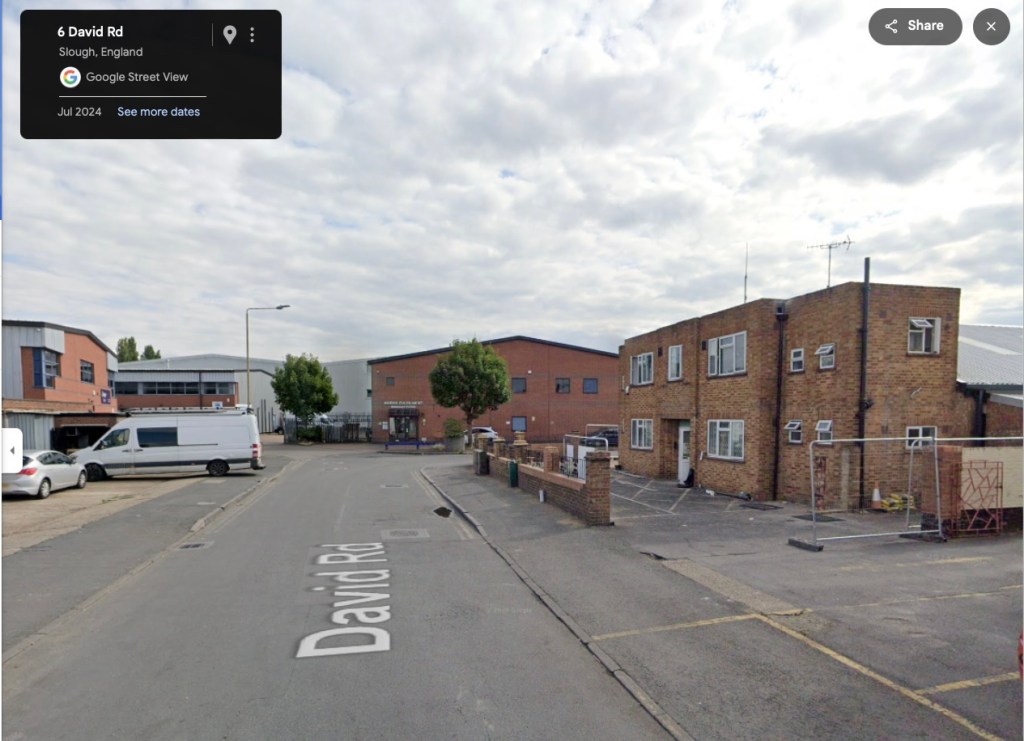
As David Road is today courtesy of Andrew Hicks.
Credit…
Derek Kneller, Motorsport Images, Goodwood.com, Andrew Hicks
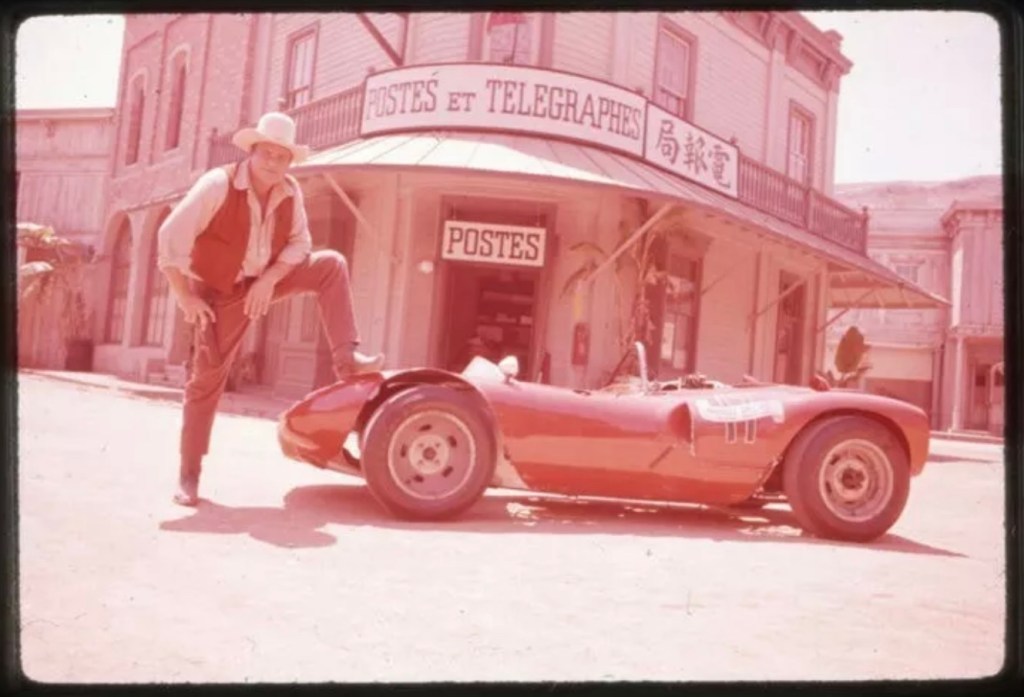
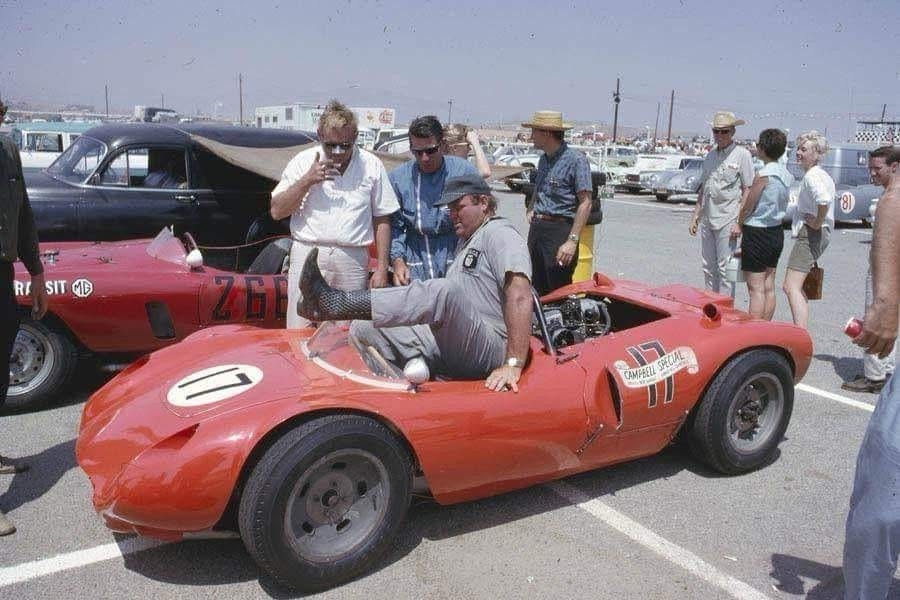
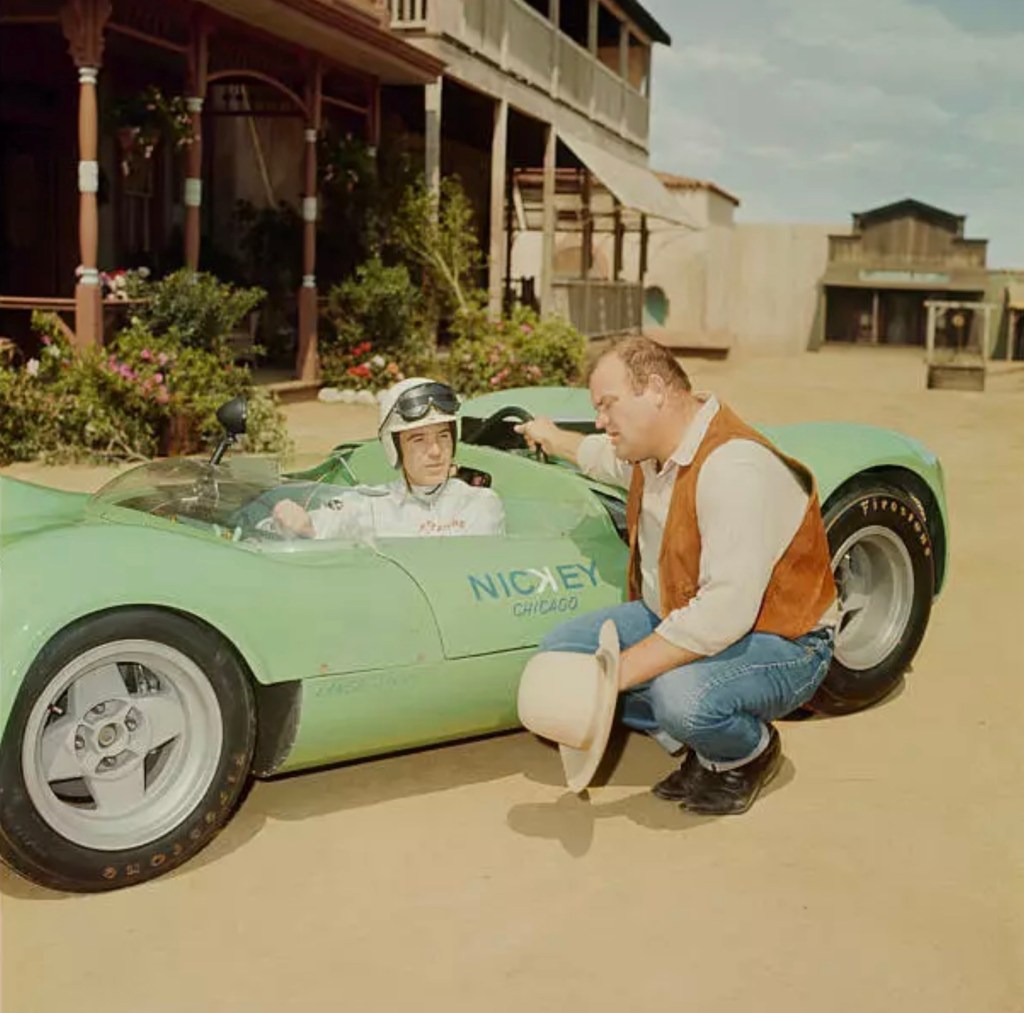
Hoss Cartwright’s Chev Corvette powered Campbell Corvette Special was one helluva way to get around the Paramount Studios’ backlot!
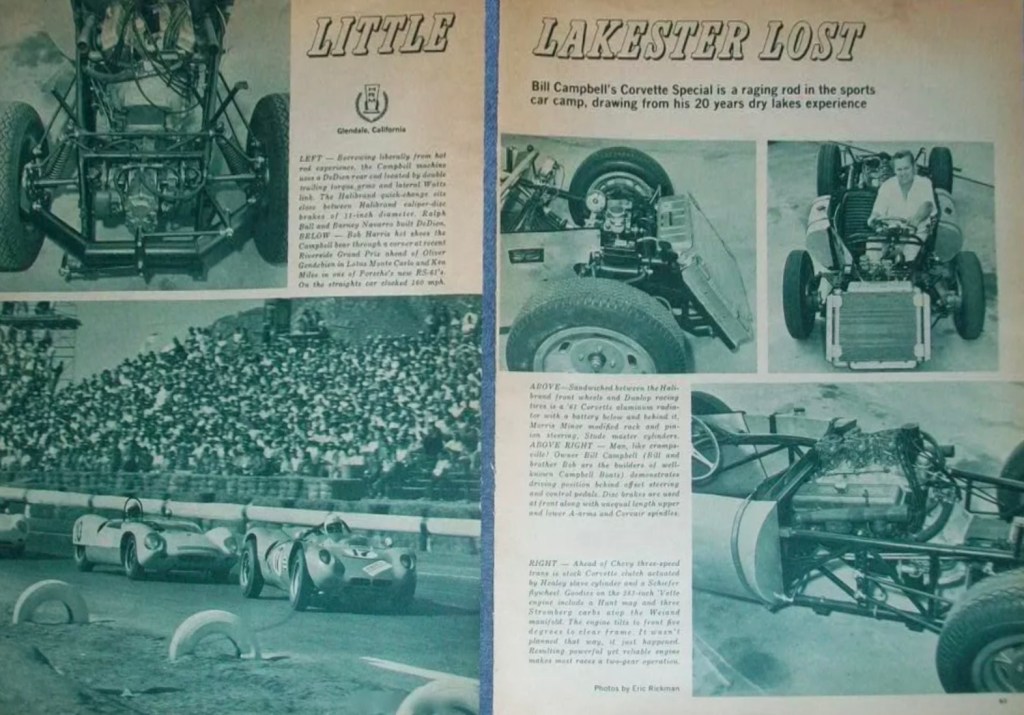
Dan Blocker poses on the set of ‘Bonanza’ with the first racing car he sponsored. The neat, small, fast Campbell Corvette Special was built by ace ex-AJ Watson Indycar fabricator/welder Wayne Ewing for Bill Campbell, an ex-dry-lake racer and boat manufacturer.
Blocker was a serious enthusiast. In 1966 his daily rides comprised a Chev El Camino ute and a Corvette, both provided by Chevrolet, sponsors of Bonanza. In addition he had an Iso Rivolta, Maserati 3500GT, Elva Maserati, a ‘Mercer Speedster’ powered by a flathead Seagrave V12, and had ordered a Lamborghini…and goodness knows what else.
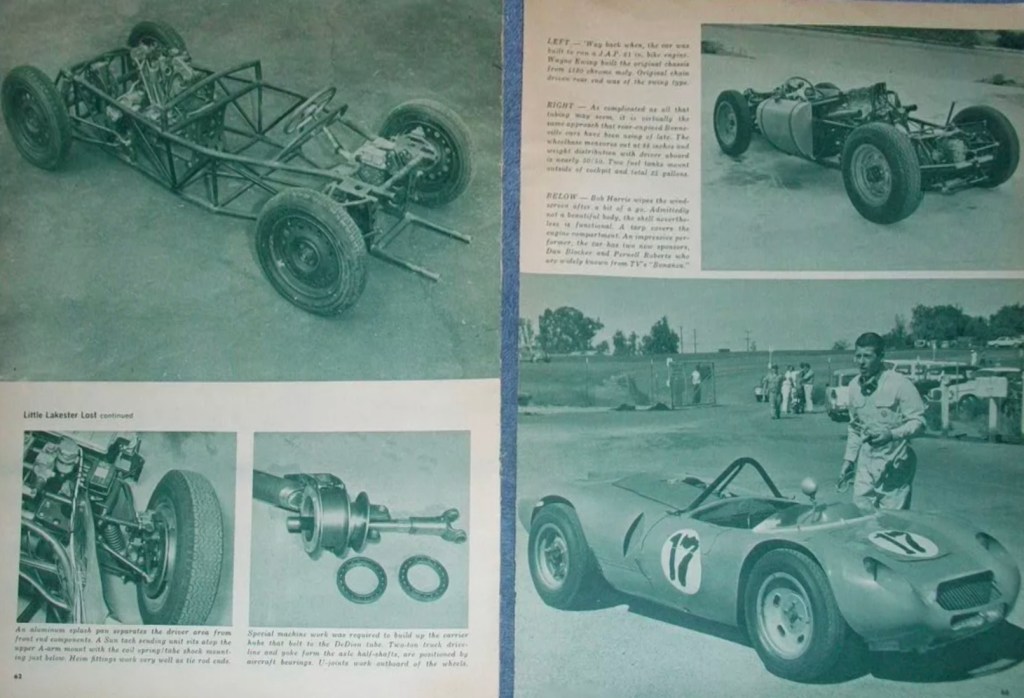
Initially powered by an 1100cc JAP engine, the ever-evolving Campbell became a fire-breather when a Corvette 283cid V8 was dropped into it. The car was then raced successfully by Dan’s close friend, stuntman Bob Harris.
(unattributed)
Blocker tries to insert his not inconsiderable 6 foot four into the SWB Campbell, it’s a pity there isn’t a next shot. I suspect he probably failed, to the relief of driver Harris in the blue race-suit.
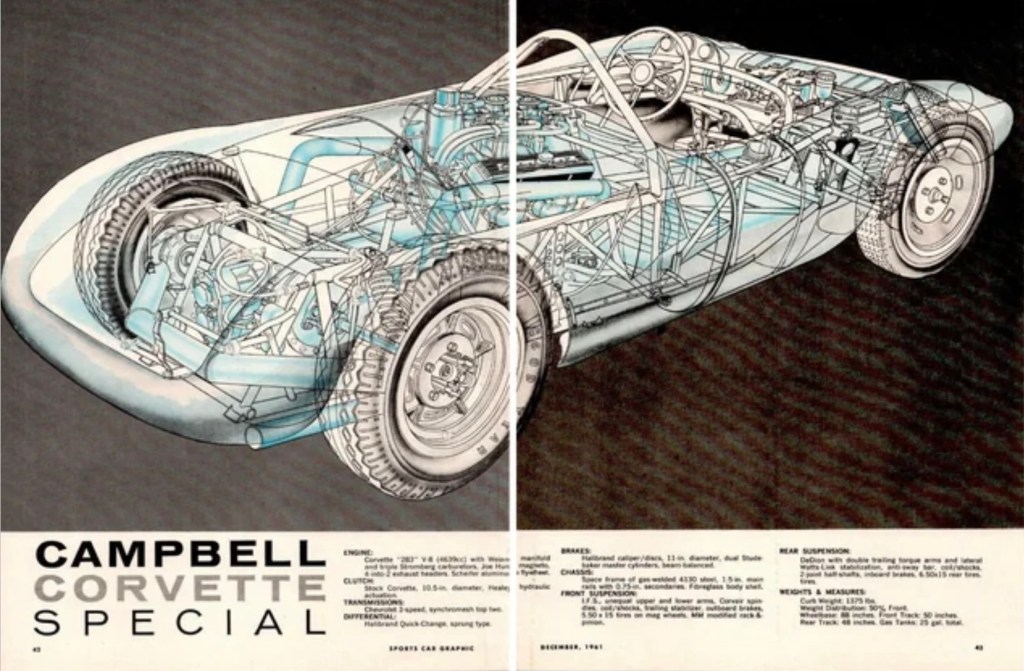
Ewing’s chassis was made of 4130 chrome-moly tube and proved sound enough to take the triple-Stromberg cast-iron lump, other features of which included a Weiand manifold, Schaefer flywheel and Hunt magneto. The engine was inclined downwards at the front by 5-degrees. A three-speed Chev gearbox and stock Corvette clutch was actuated by a Healey slave cylinder. The clutch and brake master cylinders were of Studebaker origin.
The Chev ‘box bolted directly to a quick-change Halibrand rear end while the original rear swing-axle was replaced by a De Dion set up fabricated by Ralph Ball and Barney Navarro. It was located by four-links and a watts linkage. The aluminium radiator was ’61 Vette, a Morris Minor donated the the steering rack and pinion which was modified to suit.
Up front, the original Fiat suspension were replaced with stronger, lighter upper and lower wishbones with uprights/spindles donated by a Chev Corvair. Halibrand also provided the disc brakes and wheels.
Harris, having led the first few laps of the Pacific Coast Championship at Del Mar in late 1962, returns to the track, only to run out of road in a subsequent attempt to make up lost ground on leader Jay Hills’ Porsche RSK (unattributed)
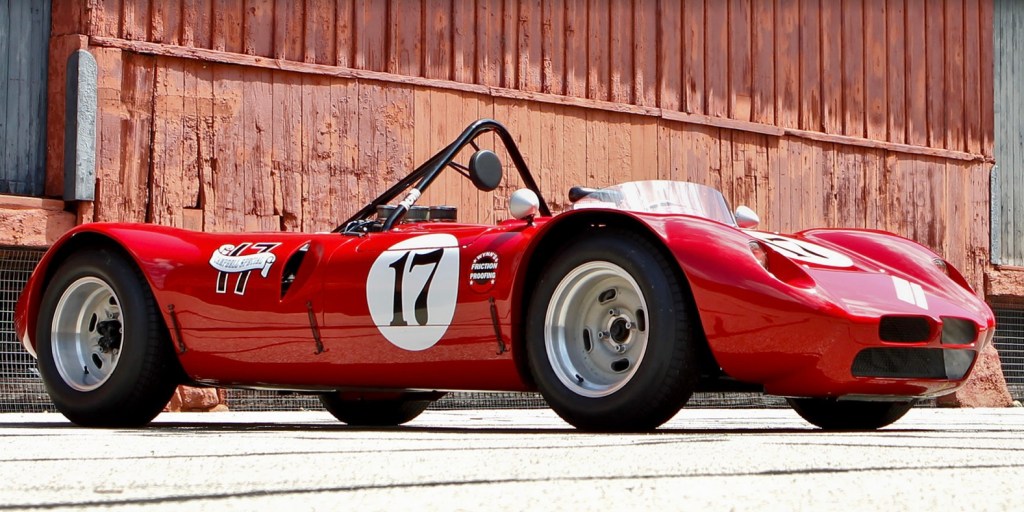
The result was a potent 1,375 pound machine with 50-50 weight distribution. One of the first Corvette powered mid-engined machines, the car was competitive from the outset and with a Chev 327 installed Harris took the cars first win at an SCCA regional at Riverside in June 1962. Yes, happily it still exists as an historic racer.
Harris raced the car through 1959-62 with wins Ian SCCA Regional at Riverside in in June ’62 and a second place at Las Vegas in October 1961. Harris crashed it at Santa Barbara in September 1962.
Campbell rebuilt it over the off-season, Jim Parkinson took the wheel in 1963 – still owned by Campbell – with his bests two wins at Del Mar and Santa Barbara in April-May, and second at Santa Barbara in September.
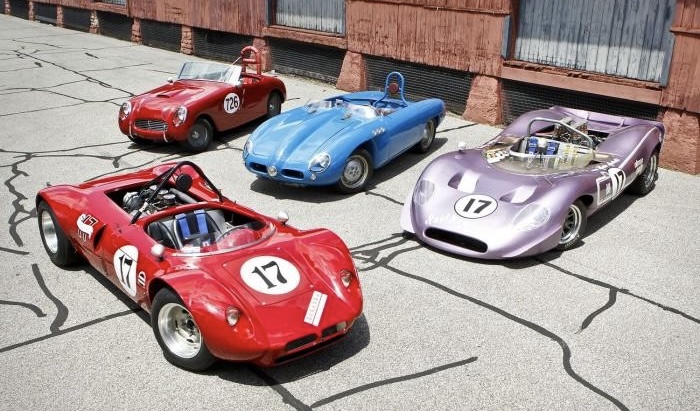
Campbell did a deal with Joshua Saslove in late ’63, trading the car on a Mistral bodied Kurtis. Saslove entered it in a couple of meetings but didn’t appear, raced it once at Mid-Ohio in June 1964 before it dropped outta sight. Acquired and restored by a Mr Mittler, its contemporary debut was at the 2005 Monterey Historic meeting.
(Gooding)(Gooding)
Etcetera…
While this unidentified magazine – a sold eBay item via a Google search – photographs is poorly reproduced you can at least get better sense of this innovative little special.
The race shot above shows Bob Harris in front of Olivier Gendebien’s Lotus 19 Climax during the Riverside Grand Prix; 13th and sixth in the 200 mile race won by Jack Brabham’s Cooper T57 Climax.
Credits…
gtplanet.net, article by Jerry Titus in Sports Car Graphic, Getty Images, Gooding & Co
Tailpieces…
See here for an article about this great Car Guy’s Can Am Genie Mk10 Oldsmobile raced by John Cannon: https://primotipo.com/2016/02/19/john-cannons-bonanza/ Cannon and Blocker on the Bonanza set a few years after the Campbell Corvette Special phase…
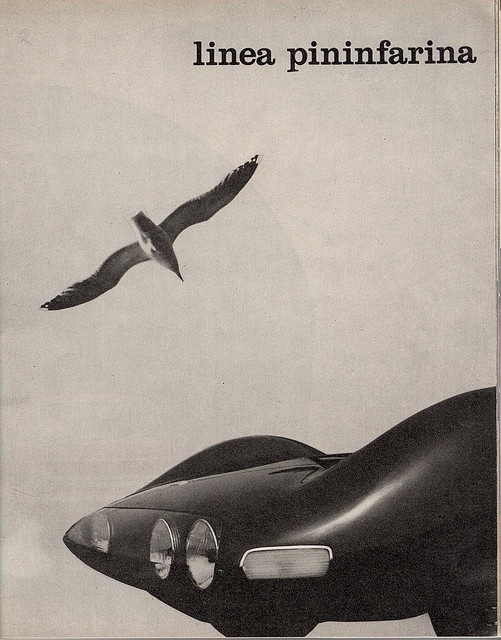
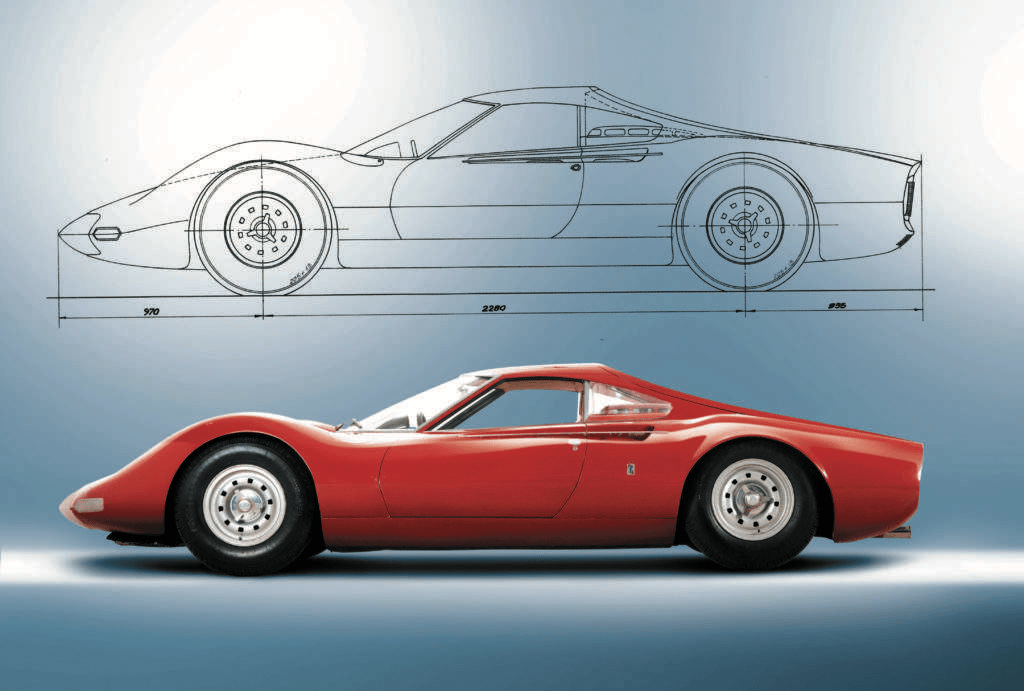
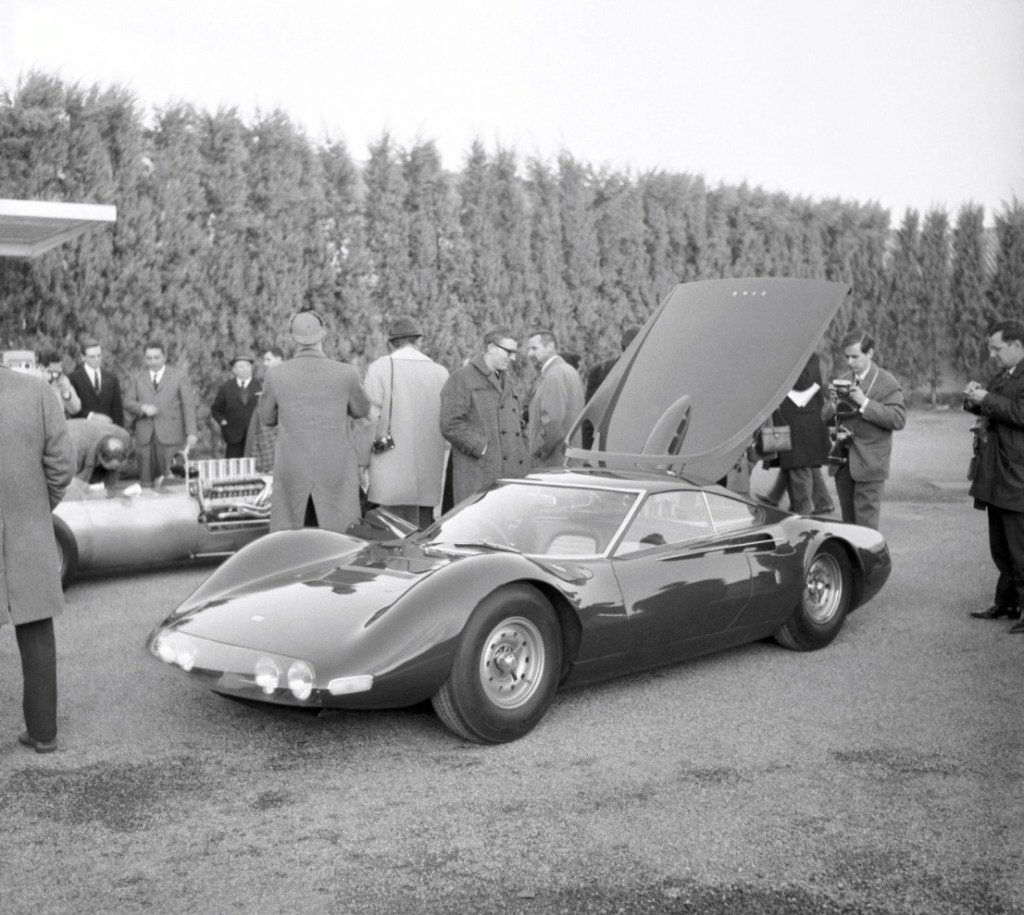
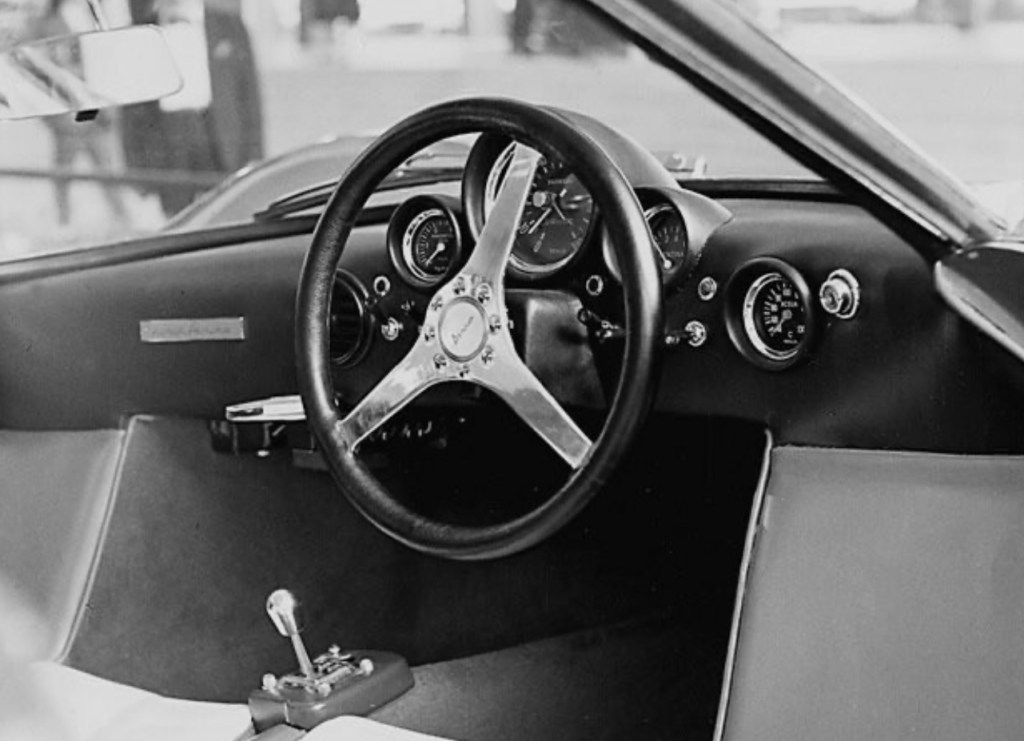
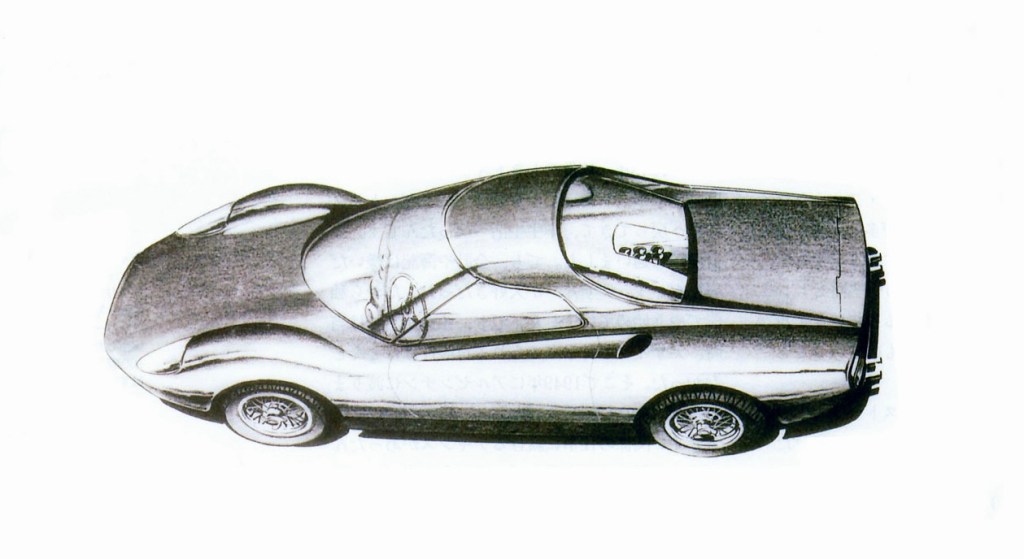
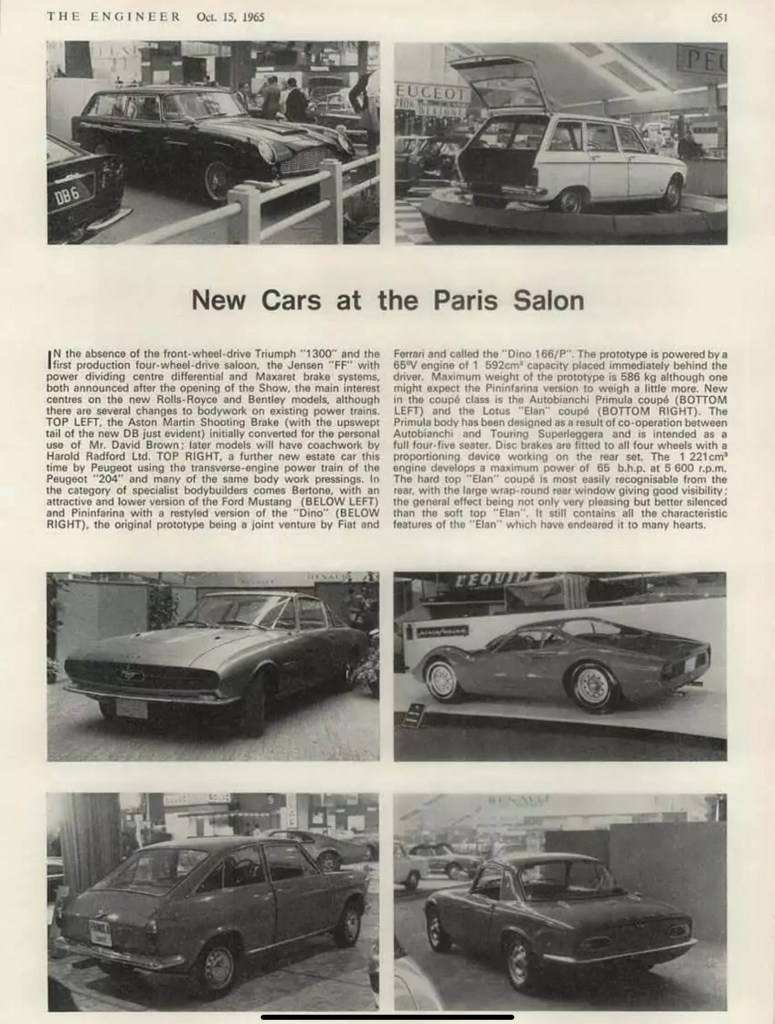
Chassis #840 was sourced from SEFAC, Ferrari’s racing department with the completed car presented at the Paris Salon in the October .
(unattributed)(Getty Images)
Here the cutie is being largely ignored by the world’s horsepower press at the launch of Ferrari’s new 3-litre Tipo 312 Grand Prix car at Maranello in March 1966. John Bolster’s Deerstalker stands out! More about that Ferrari 312 launch here: https://primotipo.com/2017/10/26/surtees-ferrari-312-modena-1966/
Bernie Bignell in his Lotus 23B Oldsmobile GT at Winton in 1976, that’s Alan Newton’s R&T Chev aka the ex-Frank Matich-Niel Allen Elfin 400 Chev behind, and a gaggle of Clubmans in the distance..
This remarkably ugly Lotus was bought by Dr Bernie from Willie Green in the UK in 1970. Motor Racing and Sportscar reported in January 1968 that Green, ‘a very rapid bra-strap manufacturer’ planned to turn Lotus 23 #23-S-70 into a GT car.
D &A Shells operating from the Bow flyover area of East London, in the region of Abbey and Livingstone Roads produced the Mercury GT ‘kit’. Quite a few were sold as the 23/23B approached middle-age and GT-racing grew.
The unfinished project, complete with Mercury body, Hewland HD5 transaxle and a bell-housing to suit an aluminium Oldsmobile/Buick V8 ended up in the hands of a dealer in Redditch from whom Bignell acquired the car.
Attractive enough at a distance! Bignell at Lakeland Hillclimb, east of Melbourne in 1972 (R Rodgers)
Bignell soon installed an 3.5-litre aluminium Oldsmobile V8 fed by four downdraught Webers, the thing was an arresting sight on-track and certainly sounded the goods. As a teenage spectator I remember it – how could you forget? – racing at Calder and Phillip Island, and perhaps Sandown.
Bernie enhanced the performance of the thing by lengthening the wheelbase by six inches, making changes to the suspension, adapting F5000 brakes and in a back-to-the-future moment returned the car back to open-sports spec. The result was a towering monument to supreme ugliness, ‘as the coupe was like a sauna even with the air-scoop’.
Bignell’s car at Calder in 1974. Gulf colours distract from a multitude of sins… (oldracephotos.com-Hammond)(G Stanfield via Marc Schagen)
Marc Schagen records that Bernie contested 32 race meetings until an engine failure sidelined it in 1978.
Master engineer/mechanic/team manager, the legendary John Sheppard – he has 13 national championships and two Bathurst 1000s to his name – bought the car and restored it to original Lotus Ford twin-cam specs circa 1981, it has passed through many hands since.
John Sheppard in the Lotus 23 at the Mangalore Airport sprints in 1993. Both the 23 and Lotus 22 Ford are in Geoghegan colours. Sheppo prepared their cars in period, the 22 is ex-Geoghegan, the 23 is not. Roy Williams in Sabrina awaits his turn (S Dalton)The RH Millar Lotus 23B Ford 1.6 Mercury GT, Llandow August 1968 (H Llewelyn)
Etcetera… Mr Sainswor wrote on the tentenths.com forum about the ‘Background on D&A and the Mercury GT. Founders Dennis Pollard and Alan Fowler, of D & A Shells, Ltd., started in London in 1962 to provide body kits and chassis for customers to convert their own cars (i.e. the Merlyn MK6 and Lotus 23) into closed GT cars.
In addition they produced a small number of space frames specifically to fit their fibreglass bodies. They continued to produce bodies and chassis for various frames and manufacturers until 1970 under the trade name Mercury.
The cars from D & A were period frames from various manufacturers fitted with the required body at D & A’s London site. The Mercury has a square tube frame originally thought to have been built by Chevron or Groopers of London and fitted with a Lotus 23 body, (note that the frame is four inches shorter than the Lotus 23). Because of it’s extremely light weight, rigid frame and semi-monocoque construction, it is much stronger than the Lotus 23.
I fell in love with these cars about 1965 when I saw one racing at the 750MC Relay at Snetterton entered by Mike Spence Racing (along with a Tojeiro EE ) – they were in the Scratch team. I know that George Silverwood raced one for some time (1300cc car?), and there was one that ran in the up to 2000cc class in the Motoring News GT Championship driven by Reg Skeels(?). The 2 litre car had cast magnesium MRE (Brabham) wheels – 7″ fronts and 9″ rears. I recall one well known Mercury GT had the registration number UWT2F (this might have been George Silverwood’s car – but can’t remember)’.
Credits…
Mark Bishop, Richard Rodgers, Lotus : The Historic Sports & Racing Cars of Australia’ Marc Schagen, The Nostalgia Forum, sainswor on tentenths.com, oldracephotos.com, Hugh Llewelyn via Wikipedia, Stephen Dalton
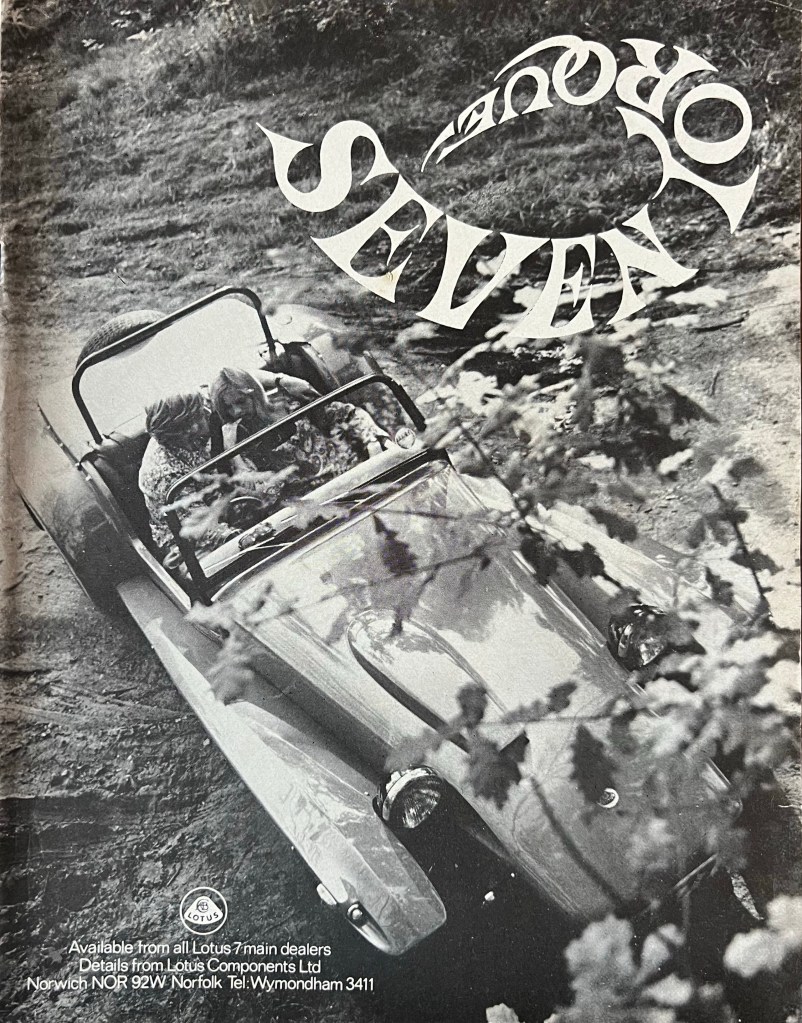
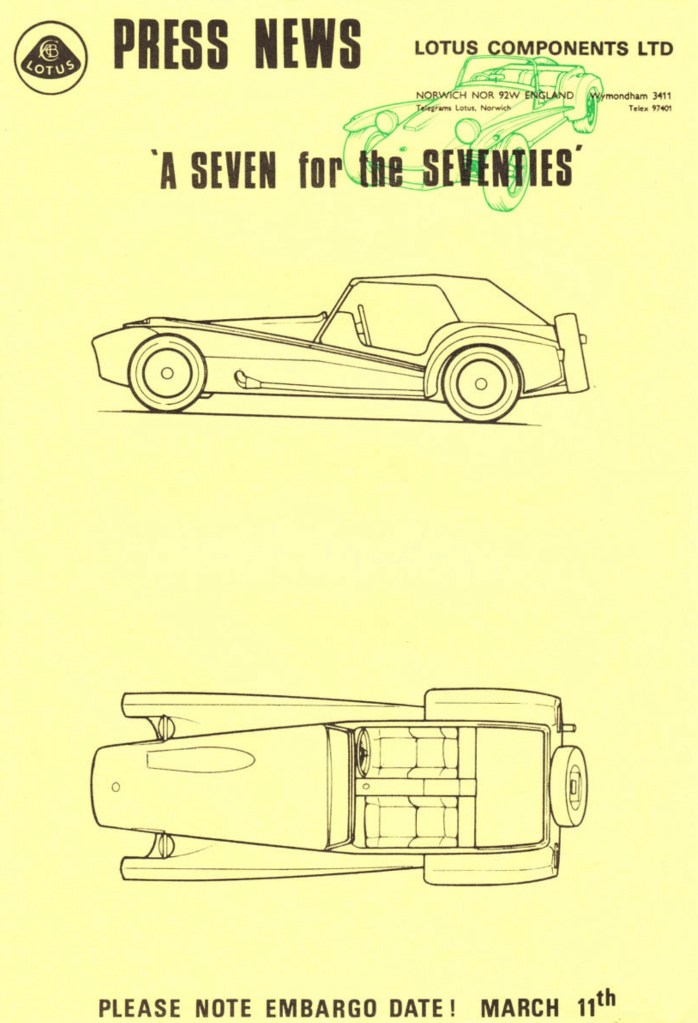
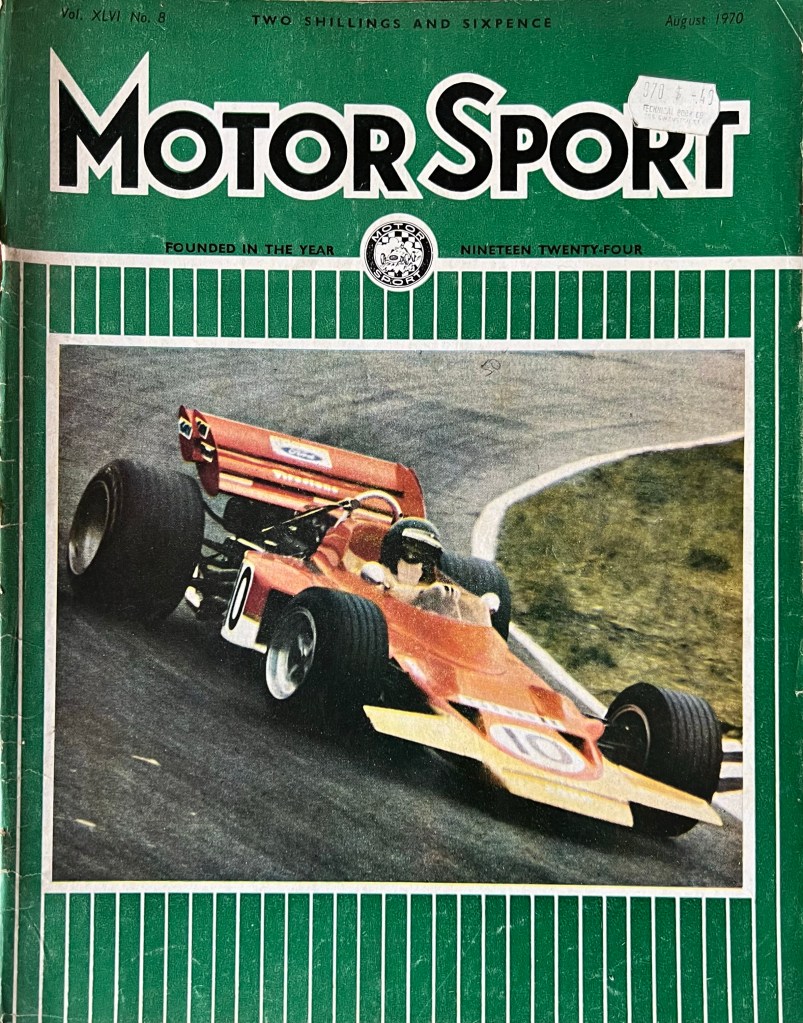
By 1970 Lotus Components’ advertising – in August 1970 MotorSport – of the new, but ageing, Lotus 7 Series 4 has a bit of hey-man, hip-cat, cool and groovy about it…
Our Col was always up to the minute after-all.
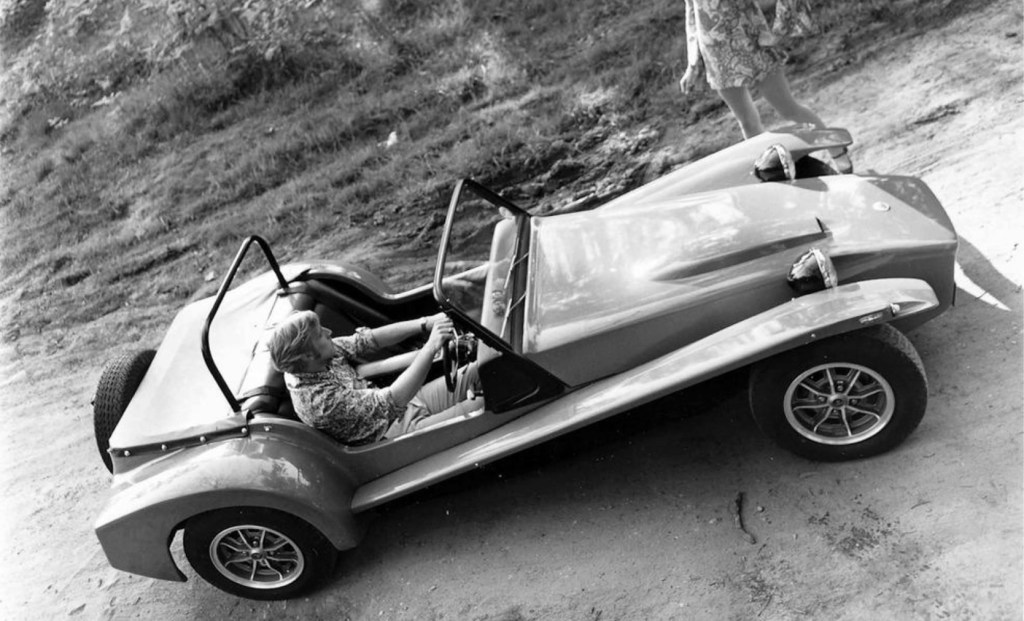
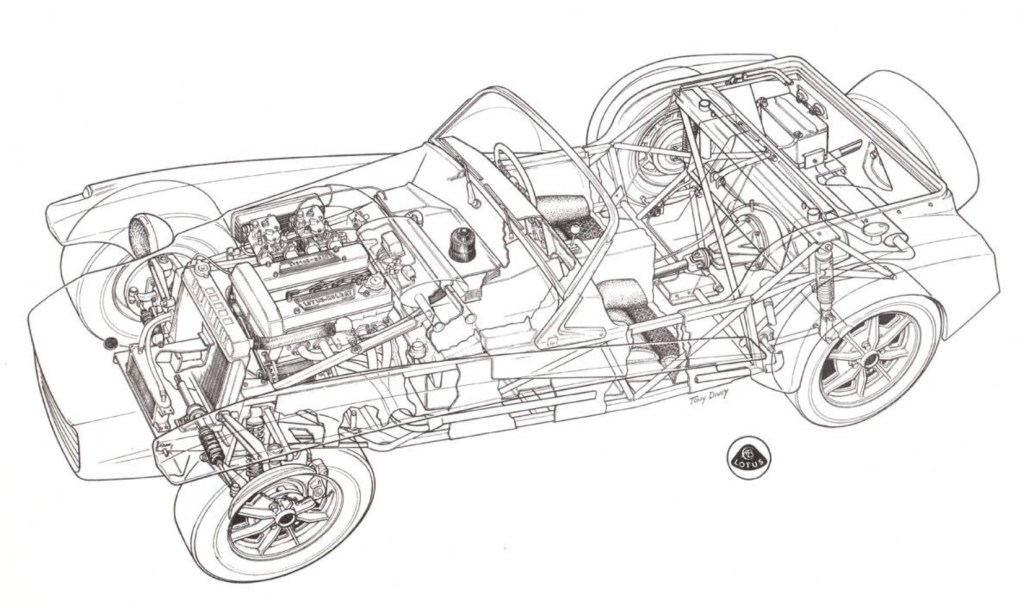
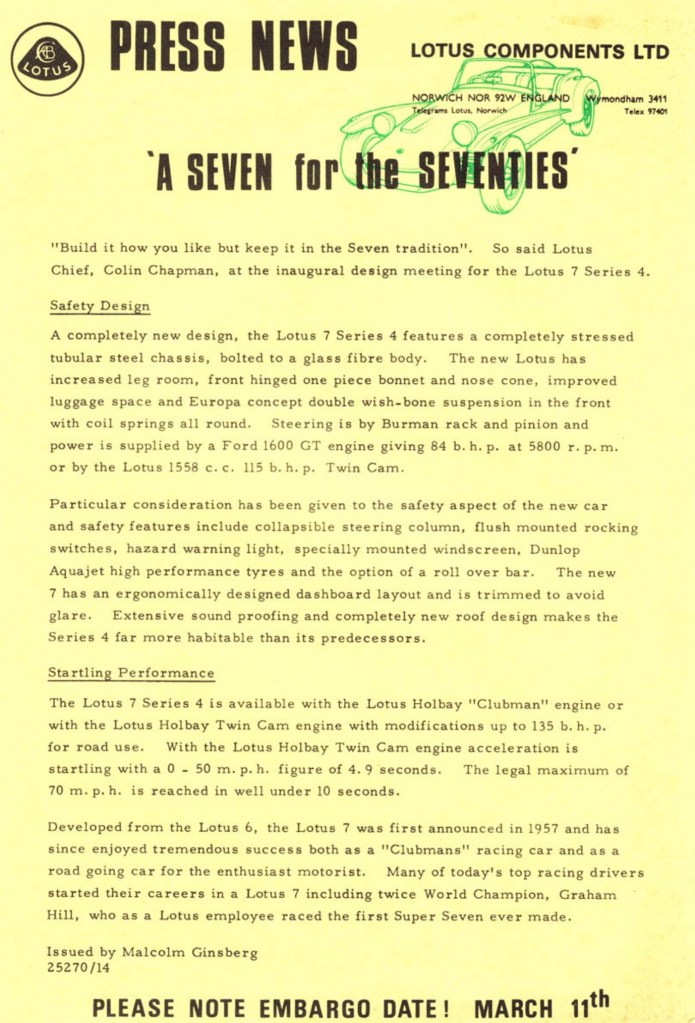
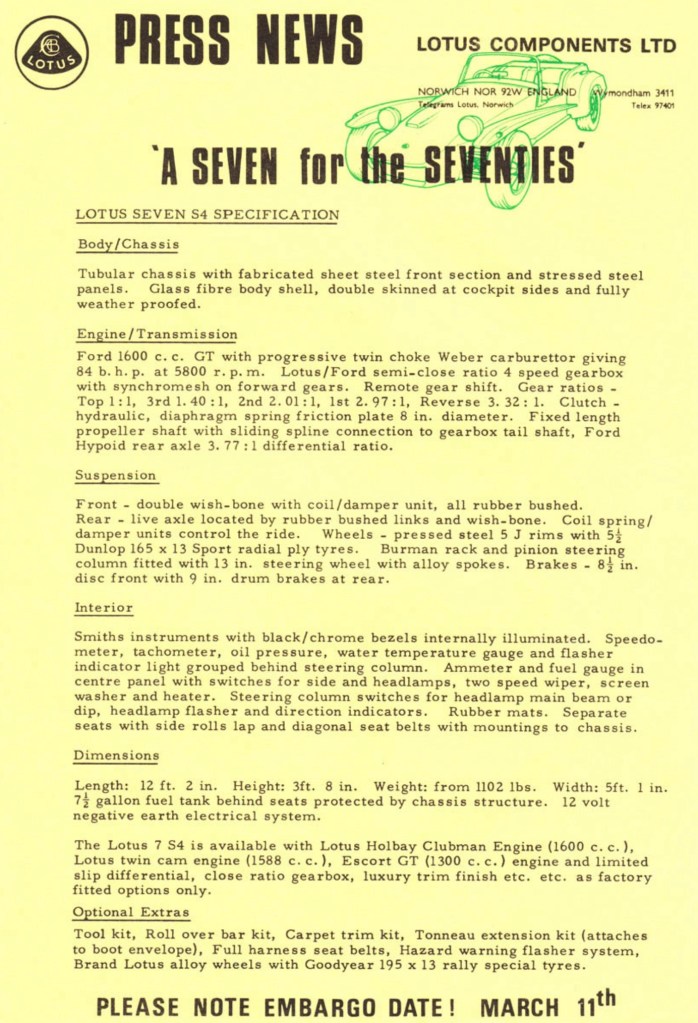
The Seven Series 4 – aka Lotus Type 60 – caused a stir given its new body styling when unveiled at the Geneva Show in March 1970; the original 7 was released in 1958, the S2 in 1960 and the S3 in 1968.
I guess they do have a touch of the beach buggy about them but I always liked the look, rare as the S4 is in Australia.
(Lotus Cars)(Lotus Cars)(J Robinson Collection)
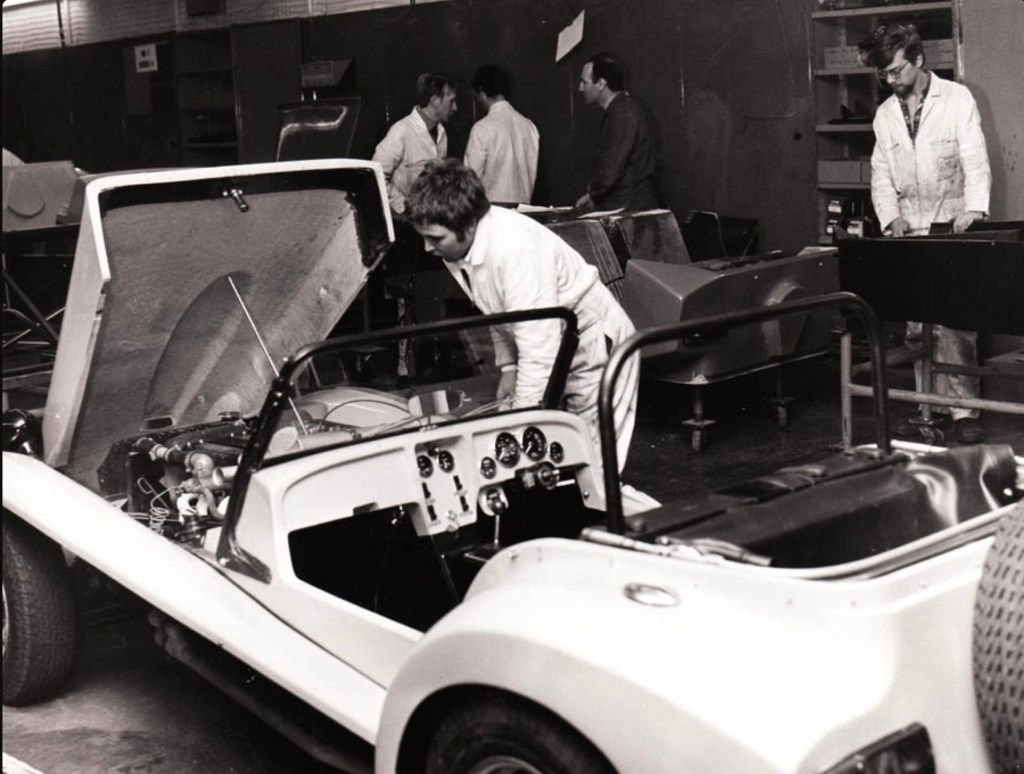
Check out this article about the evolution of the 7 from S3 to S4 spec written by John Robinson (above), one of the members of that small Lotus Components team way back in 1969. There are lots of other Lotus 7 articles there too. https://www.anglocanadianlotus7.ca/development-of-the-series-iv-seven/
These Lotus Components’ press releases are from the same article.
MotorSport’s caption rather put Team Lotus pace into context, ‘The Lotus 72 in the hands of Jochen Rindt has won three Grands Prix (Dutch, French, British) consecutively. Only the Dutch GP (here) proved him utterly superior, for elsewhere he has been conclusively led by 12-cylinder cars.’
Following its successful early-1950s World Sportscar Championship front-running Lancia D24, Grand Prix racing Lancia D50, and 1960-70’s World Rally Championship campaigns with the Fulvia HF and stunning Stratos, Lancia reverted to international sportscar racing to build its brand in 1979. Lancia Corse/Martini Racing contested the Group 5 title from 1979-82 with the Lancia Beta Montecarlo Turbo.
The shot above shows Riccardo Patrese on the way to winning the Brands Hatch 6 Hour on March 16, 1980. He shared the car with Walter Rohrl, second was Eddie Cheever and Michele Alboreto in another Lancia Corse entry, with Alain De Cadenet and Desire Wilson third in De Cad’s De Cadenet Lola LM Ford. To reinforce the Lancia rout, the Jolly Club Montecarlo raced by Mario Finotto and Carlo Facetti was fourth.
Eddie Cheever, second, from Desire Wilson, De Cadenet Lola LM Ford, third at Paddock Bend during the 1980 Brands race (N Forsythe)Patrese in the cockpit of chassis #1002 before the off at Brands Hatch (N Forsythe)
Group 5 was a silhouette formula for modified production cars spilt into under and over 2-litre classes. Lancia’s weapon of war was an extensively modified version of the Beta Montecarlo Coupé.
While normally aspirated in road trim, Lancia Corse sporting director Ceasare Fiorio concluded that turbo-charging the 1,425cc four-cylinder engine would give sufficient power and torque to win the 2-litre class allied with wild chassis and body modifications. As it transpired, the machines were also outright contenders.
(unattributed)(unattributed)
Engineer, Gianni Tonti was in overall control of the project. Ex-Lamborghini designer Gianpaolo Dallara built the Group 5 Stratos that won the 1976 Giro d’Italia, Fiorio was impressed with his work and therefore engaged Dallara Automobili to design and build the chassis. Carrozzeria Pininfarina designed and built the bodies.
Group 5 permitted bulk modifications, so the roof and door centre monocoque section of the donor car was retained but it was sandwiched by bespoke tubular subframes to carry the front suspension, wishbones and coil springs, and rear suspension, McPherson Struts, wishbones and engine/gearbox and ancillary components.
Pininfarina’s striking fibreglass coachwork was designed to increase downforce and featured an aggressive chin spoiler, extended wheel-arches and big rear wing. Only the car’s centre section retained any resemblance to the production car, yet it weighed 300kg less than the road car at about 810kg.
The Patrese/Hans Heyer Lancia Beta Montecarlo Turbo during the Nurburgring 1000km, May 1980. Led then slipped to fourth outright in the final laps with overheating, won the 2-litre class (unattributed)Watkins Glen 6 Hour, July 1980 Lancia Beta Montecarlo Turbos. #33 Jolly Club Finotto/Ghinzani sixth, #32 Cheever/Alboreto second, and #31 Patrese/Heyer, first (D Balboni)
The engine development programme was supervised by Gianni Tonto at Abarth. With an engine naturally aspirated to turbo-charged capacity equivalency factor of 1.4 times, the Aurelio Lampredi designed, twin-cam, two-valve, Kugelfischer-Bosch injected engine had a capacity of 1425cc to pop in under the 2-litre limit.
Maximum output was boosted to 370bhp at 8,800rpm using a KKK-K27 turbo-charger and 1.2 bar of boost, a result slightly more than the 118bhp of the standard 2-litre Monte! The car was tested with up to 420bhp but the engines became grenades with 1.6 bar of boost.
The engine and five-speed transaxle was mounted transversely behind the driver as per the donor car and the regs. While the gearbox was cast using production moulds, the use of magnesium saved weight while Colotti internals provided a gearbox fit for purpose.
Michele Alboreto on the Daytona road course section. DNF dropped valve in the January 1981 24 Hours, the car was shared with Beppe Gabbiani and Piercarlo GhinzaniMichele Alboreto aboard the car he shared with Eddie Cheever and Carlo Facetti at Le Mans in 1981. Eighth outright and first in the 2-litre class (Getty Images)Riccardo Patrese on the way to a Brands Hatch 6 Hour class win in August 1979. Rohrl shared the car to fifth outright and first in class (unattributed)Launch of the Lancia Monte Carlo Turbo at the Pininfarina wind tunnel in December 1978 (Wiki)
Presented to the press at the Pininfarina factory in December 1978, the Montecarlo commenced testing in February 1979, initially with a 220bhp 2-litre Mirafiori normally aspirated rally engine until the 1.4-turbo was ready.
It first raced in the Silverstone 6 Hours in May (#51 below) having missed the Championship’s first two rounds. Finished in dramatic Zebra livery, Montecarlo chassis #1001 was driven by rising F1 racer Riccardo Patrese and ex-European Rally Champion and 1980/82 World Rally Champion Walter Rohrl, proving impressively quick in qualifying (seventh) but retired from the race after only four laps with a blown head gasket.
Despite continuing unreliability the team bagged sufficient points with class wins at Enna and Brands Hatch to take the World Championship of Makes Division 2 title in its debut season.
The Zebra Patrese/ Lancia Monte Carlo Turbo in the Silverstone 6-Hour pits in 1979. Q7 and DNF after 4-laps; head gasket failure after the radiator cap failed (unattributed)Lancia Corse pit action at Watkins Glen in July 1980 where the Monte Carlo Turbos finished first, second and sixth, vanquishing a squadron of Porsche 935s (French Speed Connection)
Lancia Corse made great advances with the five new cars which were built for 1980, the most significant developmental changes were in relation to tyres, suspension geometry, engine power, and weight.
Two extended sessions with Pirelli resulted in substantial changes despite the P7 Corsa radials being of the same construction and compounds. ‘Both the front and rear the overall diameter of the wheel-tyre assembly is unaltered, the front rims are now an inch smaller at 15 inches, and rears three inches larger at 19 ins. The new front tyre is narrower with a higher profile to provide a softer ride and better turn-in,’ Autosport reported. ‘The new rear is more significant, with a very low profile and greater width on the road, utilising all but 4mm of the maximum permitted 14ins of tread.’ Lancia made suspension changes to suit, with the drivers much happier with the overall balance of the car by the end of the sessions.
The engines were improved from the 380bhp delivered through a power band of 5500-8600rpm in 1979 to 410bhp arriving between 4500 and 9000rpm. In addition, a trip to the Jenny Craig Clinic reduced the ’80 cars weight to circa 770kg compared with circa 810kg of the early cars.
The Zebra livery continued but now with white/red and white/blue combinations. Although the team fared badly at Le Mans 24 – of three cars that started only the Finotto/Facetti machine finished in 19th – victories at Brands Hatch, Mugello and Watkins Glen brought the Lancia Montecarlo overall victory in the World Sportscar Championship. Patrese was the ‘winningest’ Lancia pilot, being the lead driver in each win.
The Cheever/Alboreto/Facetti car at Le Mans in 1981. Eighth outright and first in the 2-litre class with engines tuned to 400bhp spec (unattributed)Cockpit of one of the Monte Turbos at Le Mans in 1981 (R Schlegelmilch)
Having clinched victory by the penultimate Vallelunga round, Lancia missed the final event at Dijon in favour of the Giro d’Italia, in which the works cars appeared in the stunning, iconic Martini Rossi colours for the first time. First and second places ended a great year for the Montecarlo.
Lancia Corse raced with Martini livery from the start of 1981, that year the Montecarlo was equipped with twin turbo-chargers giving circa-450bhp. This was final year in which Lancia Corse used the Montecarlo as its frontline tool, they planned to enter Group C with the LC1 Barchetta in 1982. Despite that, the Monte proved good enough to secure its second World Championship with wins at the Nurburgring and Watkins Glen.
The works cars – 11 were built between 1979 and 1981 – were then sold, some were raced by privateers in 1982 in the last year of Group 5 but by then they were also-rans. See here for bulk detail: http://www.lanciabetamontecarlo.nl/Gp5/group%205+6.html
Watkins Glen pitstop for the Patrese seated, and Alboreto assisting, Lancia Beta Monte Carlo Turbo in 1981. Outright and 2-litre class winners (Belles Italiennes)
Etcetera…
(N Forsythe)
Shots of the launch function at the Pininfarina wind tunnel on December 19, 1978. Walter Rohrl is facing us at left with Cesare Florio further back.
(N Forsythe)(N Forsythe) Monte Group 5 chassis was a mix of standard’ish pressed steel monocoque and Dallara fabricated steel frames at each end (unattributed)(Pure Racing GT)
Fiorio achieved a promotional coup by signing Walter Rohrl and Gilles Villeneuve/Christian Geistdorfer to drive one of two Lancia Monte Carlo Turbos (Riccardo Patrese/Markku Alen/IIkka Kivimaki raced the other car to second place) entered in the 1979 Giro D’ Italia Automobilistico.
Both cars were set up to give about 360bhp with Villeneuve contesting only four of the races due to his Ferrari testing commitments. Rohrl/Villeneuve were first on the road aboard chassis #1002, but were later disqualified for using the motorway – failing to follow the route-book.
(unattributed)
Villeneuve ready to rock in these shots above and below, in his Ferrari overalls. Note the Momo steering wheel and stopwatches in the cockpit shot below.
(unattributed)(French Speed Connection)
The shot above shows the business end. You can see where the structural frame ends where the top of the strut mounts and the KKK-turbo is mounted. The lighter frame sections carry the other bits: oil tank, roll bar, exhaust etc.
The contemporary (Goodwood FOS) shot below completes the rear suspension picture by showing us the disc/hub/strut assembly which is located below by a barely visible boxed inverted wishbone.
Front of the Patrese/Cheever Monte Carlo during the 1981 Silverstone 6-Hour weekend. DNF crash after losing a wheel (A Fosh)(Bonhams)
The engine is shown above, it looks innocuous enough with the giant KKK-turbo out of picture. Camshafts are belt-driven, two-valves per cylinder. Fuel injection is Kugelfisher-Bosch.
(F Kraling)
Eddie Cheever about to climb aboard, and Michele Alboreto coming out of the car at Le Mans in 1981, eighth outright and first 2-litre car. This shot makes one feel as though you are there!
(rainmakerbell.com)
Kyalami 9 Hours, November 1981, Emanuelle Pirro and Michele Alboreto enroute to fourth place. The three cars in front were all Porsches, the winners, Jochen Mass and Reinhold Jost, raced a 936/80.
Credits…
Autosport, Anthony Fosh, Getty Images, Pure Racing GT, French Speed Connection, Nick Forsythe, Belles Italiennes, Bonhams, Dominic Balboni, Ferdi Kraling, rainmakerbell.com
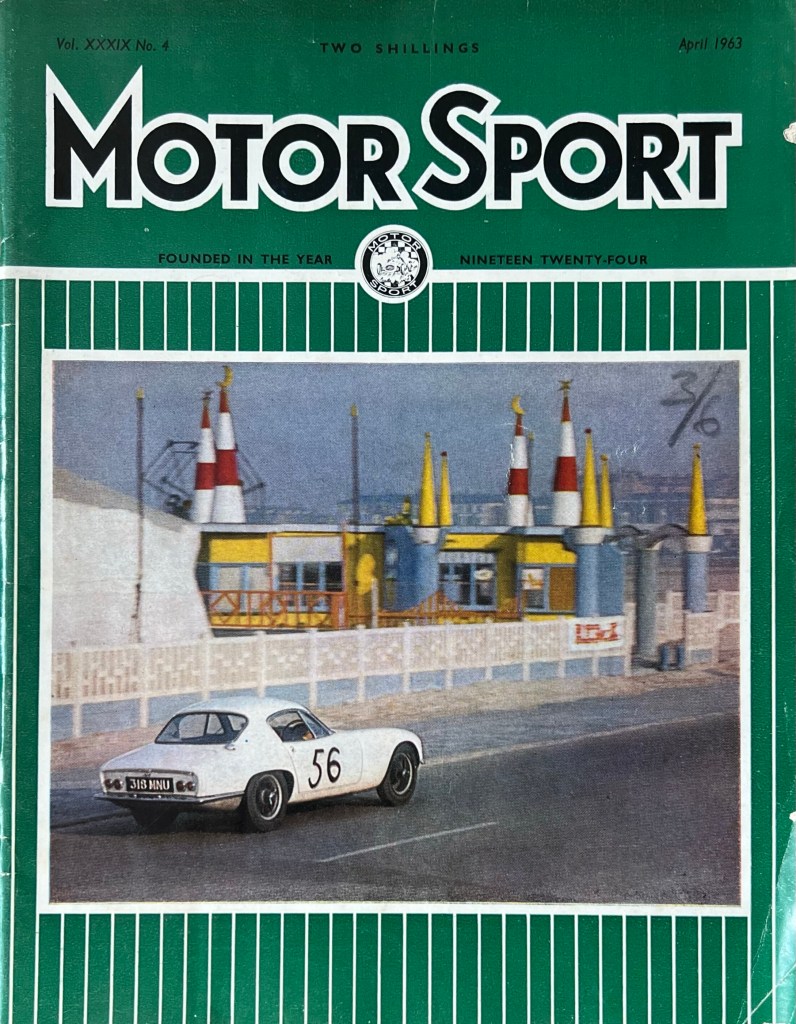
‘Cedric Brierley was well known in Club racing until a bad crash put him out of racing for some time, leaving him with a disability which precludes the use of a normal gearbox. He has had a Lotus Elite fitted with a 1.5-litre single-cam Coventry Climax engine and Hobbs automatic gearbox and at the Southport Speed Trials he proved to be nearly as quick as the E-Type Jaguars.’ MotorSport wrote.
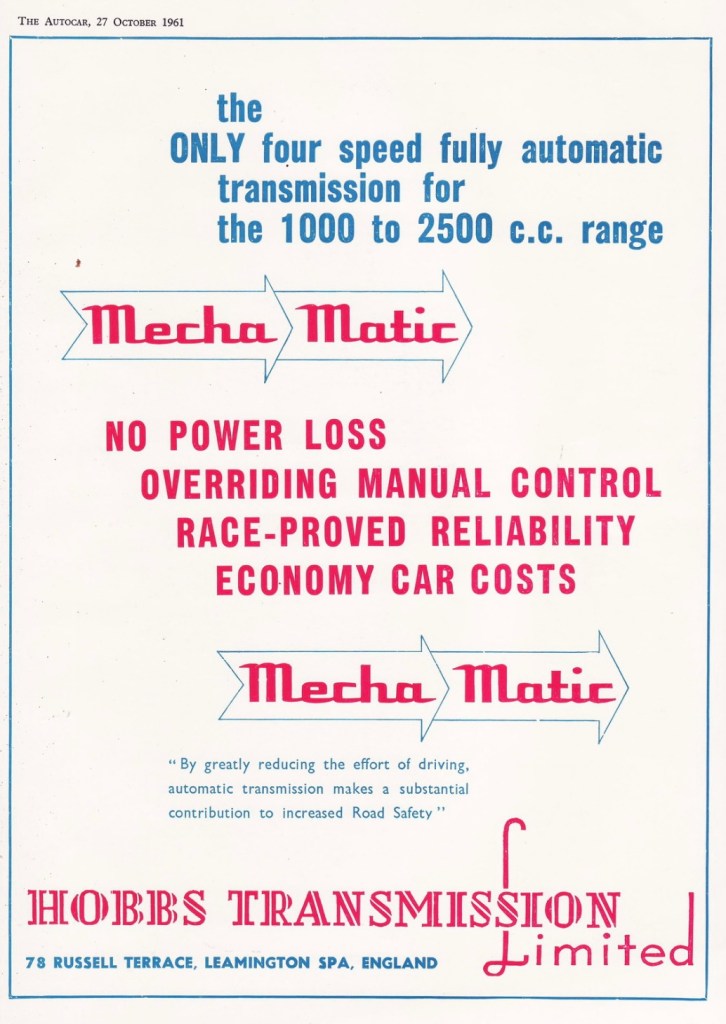
It was the beauty of the shot that initially captured my attention, then you start to dig…I thought there was only one Elite fitted with a Hobbs Mecha-Matic gearbox – Howard Frederick Hobbs was an Adelaide born engineer – not so…
Rupert Lloyd Thomas wrote on The Nostalgia Forum, ‘Let us try and put the achievements of Howard Hobbs in context. He built the 1015 automatic transmission and fitted it to a Lotus Elite for the 1961 season.
In November 1960, David Hobbs, Howard’s son, acquired Lotus Elite, 5649 UE, from Chequered Flag, Chiswick, London, that was to launch his international racing career. The engine of the Elite was modified by Cosworth to Stage III tune producing 108 b.h.p. and a Hobbs Mecha-Matic gearbox was fitted, specially modified for racing. Hobbs said, “Chapman was not involved in the project, but our engine was blueprinted by some young tuner by the name of Keith Duckworth.”
The Hobbs Mecha-Matic gearbox high point came at the Nurburgring on May 28, 1961, when David Hobbs, and Bill Pinckney, two Midlands lads, defeated the might of Porsche in the 1600cc sports racing class in the Nurburgring 1000 kms with their automatic Lotus Elite. Bumped up to the 1600cc class by the organisers for their non-standard gearbox, after protests from fellow competitors, they faced much more powerful opposition from Porsche. After this remarkable achievement the future of the gearbox looked set fair. A long trip to Italy for Le Quattro Ore di Pescara on August 15 was less successful. The car dropped a valve early in the race, mechanic Ben Cox remembers worrying about taking the blame for what turned out to be a material failure.
Colin Chapman was sufficiently impressed to contact Hobbs in order that Jim Clark could drive the car in the 3 Hours of Daytona on 11 February 1962. As David Hobbs fought to establish himself as a professional racing driver he had also come to the attention of the Jaguar factory, and for 1962 he took over the privateer Peter Berry-entered E-Type from Bruce McLaren for the season. He was entered in the Jaguar, 3 BXV, for the inaugural Daytona 3 hours with the Lotus sitting idle. As Hobbs tells it, “Colin Chapman rang up and asked if he could borrow the Mecha-Matic Elite for Jim Clark to race at the same event.” Clark drove the Mecha-Matic in Florida, streaking away in the class lead but retiring after 60 laps with a failed starter motor and being classified 29th.
Jim Clark later had a road-going Elite, HSH 200, fitted with a Hobbs gearbox, as did Stirling Moss. Clark said in the book ‘Jim Clark at the Wheel’, “Those who scorn automatics take note!”
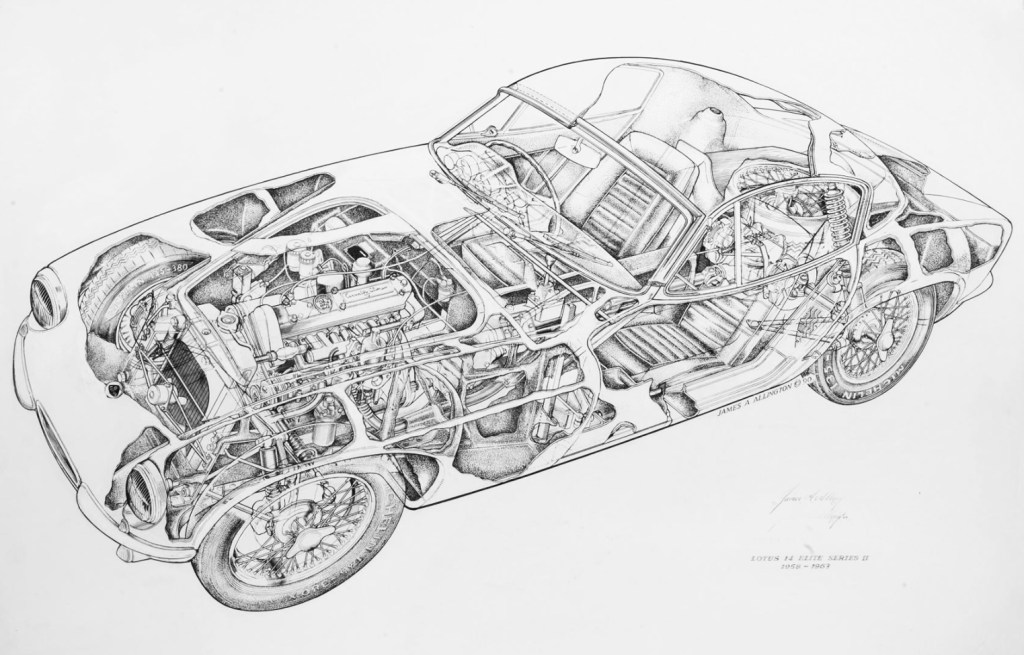
(J Allington)
The Mecha-Matic Elites…
Thomas again, ‘I have found three:
The road car of Jim Clark Reg # HSH 200. This plate would have been issued in 1961 by Berwick C.C. Chassis No: EB-1659, Engine No: FWE10233 – SUPER 95 Specification. Bristol Plate No: EB-1659. Originally yellow and silver. Subsequently sold in 1962 to a George V. Simpson, who painted it dark blue, Scottish racing colours.
The Cedric Brierley car, Reg # 318 MNU.
The Stirling Moss road car Reg # HRT 163D. Body/Chassis no.1789 and was fitted with a Twin-cam engine, make unknown. Colour yellow. This is a 1966 reg no. so car may have been re-registered that year on change of specification. Car thought to be in the USA, last known owner was a Richard Richardson.
So we have a story involving David Hobbs, Keith Duckworth, Colin Chapman, Jim Clark and Stirling Moss. Duckworth later put cash into developing the ideas of Howard Hobbs, Clark and Moss bought the cars.
An intriguing footnote. About the time Duckworth was taking up the VKD transmission for racing, Howard Hobbs was still battling his old nemesis Borg-Warner in the road car game: http://archive.comme…ly-transmission ‘
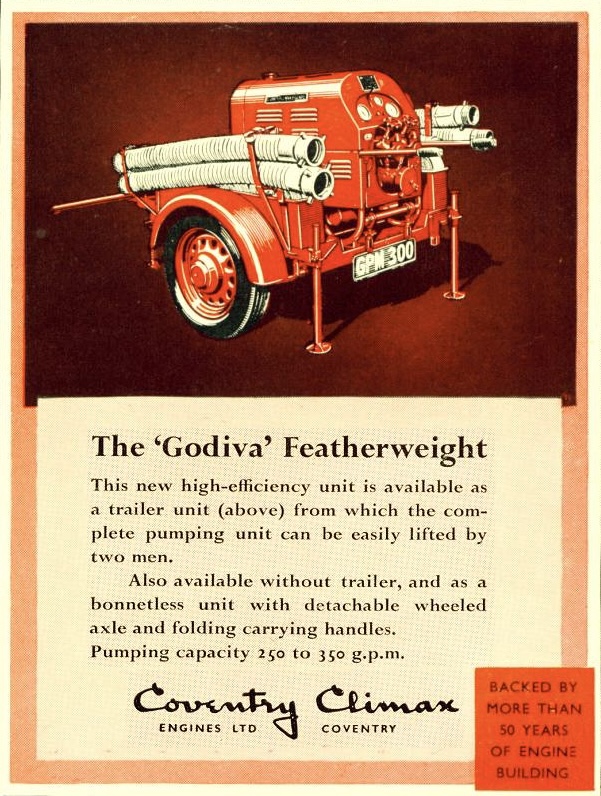
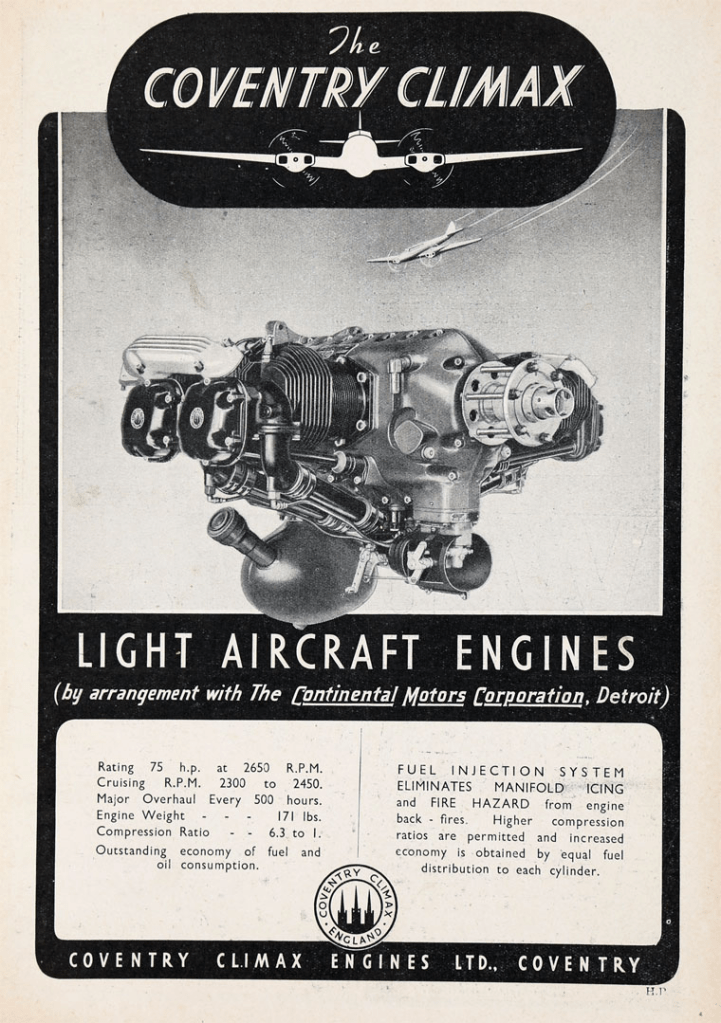
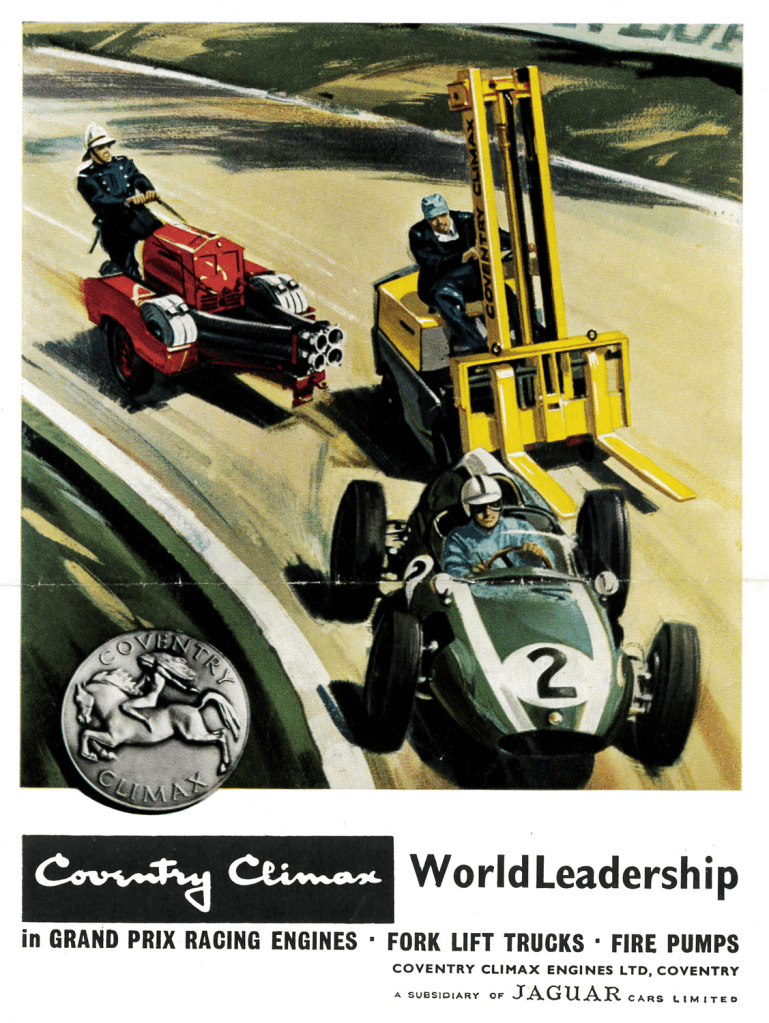
Coventry Climax’ mega racing successes were begat by the Godiva Featherweight engine as you all know. Here is a great Graces Guide summary of the corporate evolution of Coventry Climax, formed in 1917: https://www.gracesguide.co.uk/Coventry_Climax_Engines
(Godiva Ltd)
Etcetera…
1939
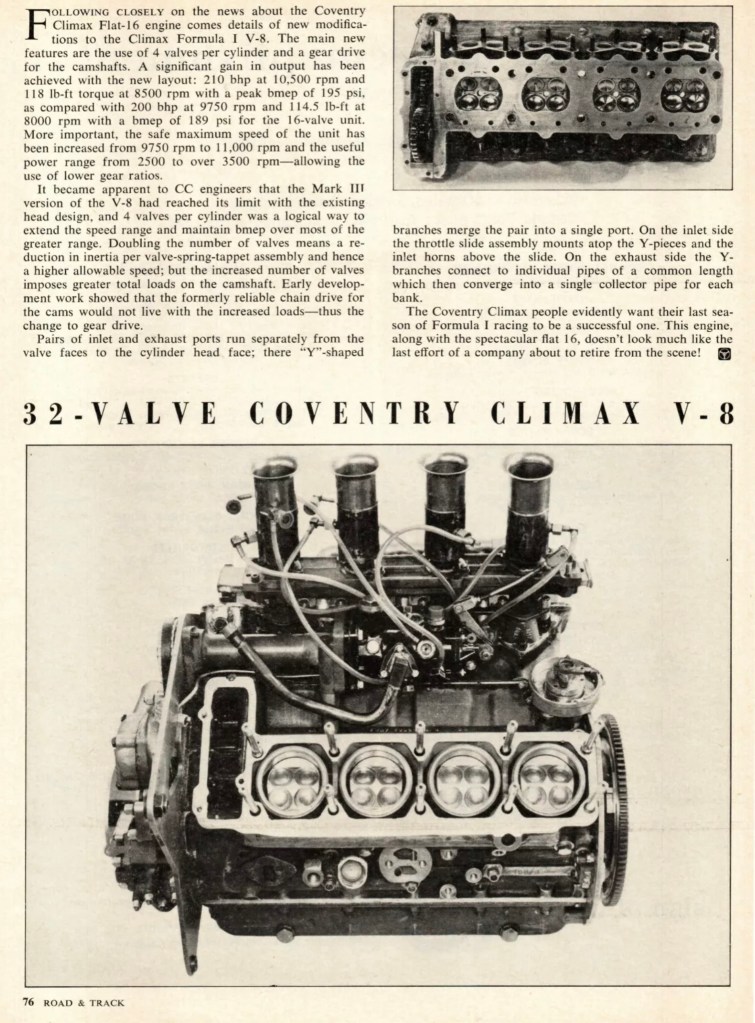
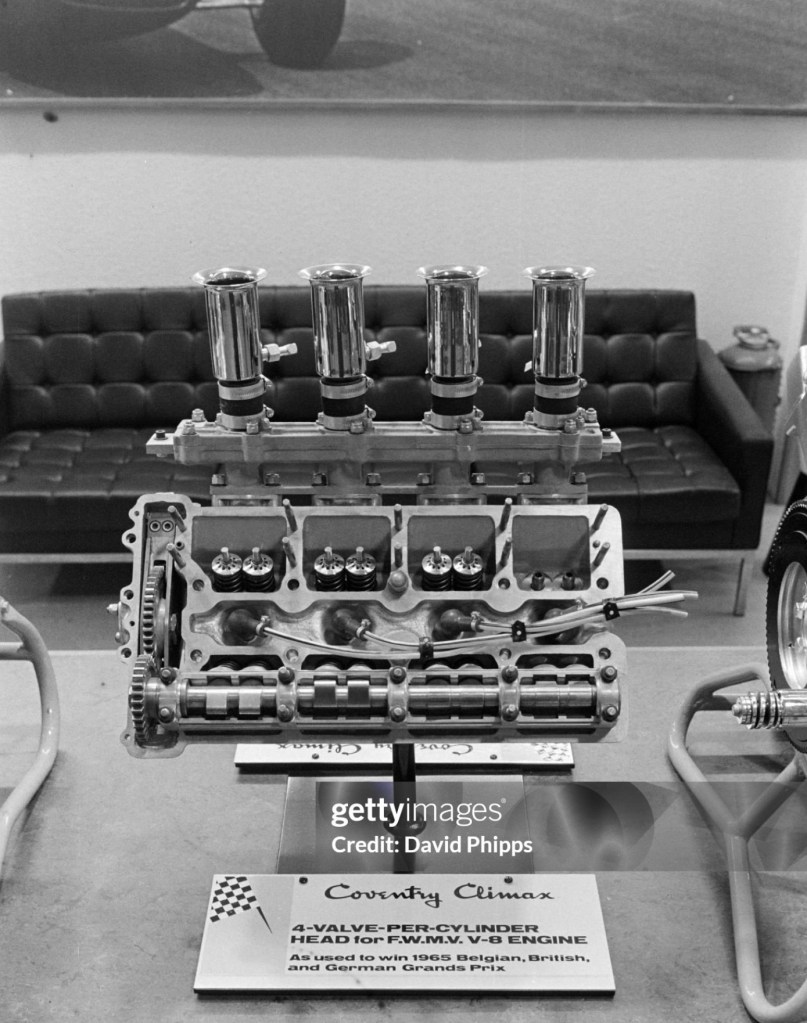
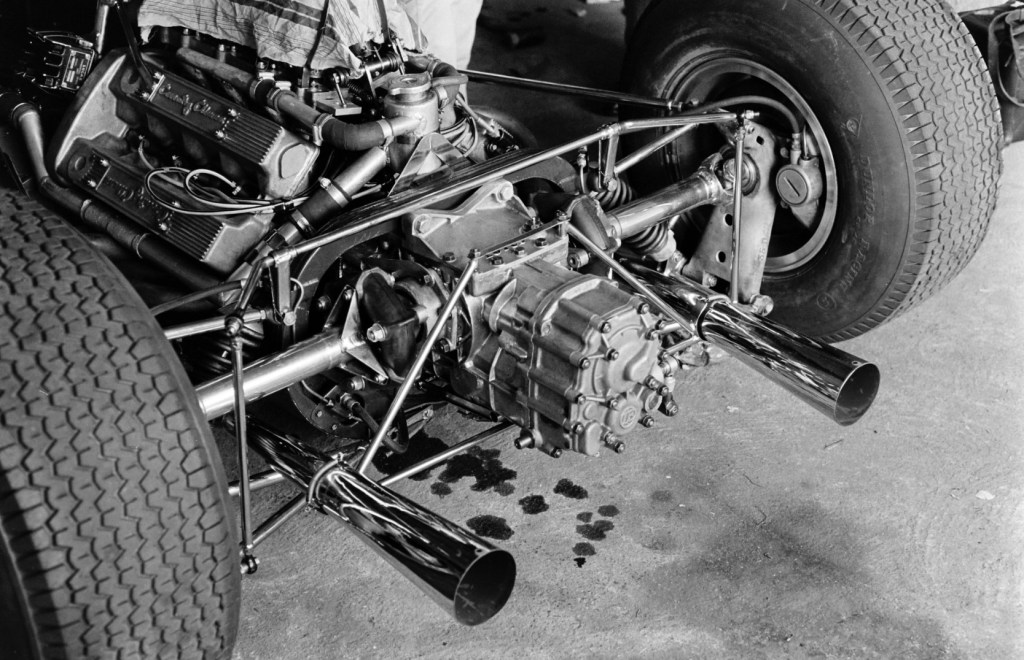
Irrelevant in the context of this article but it popped up in my Google search, so why not. Shots of the two (?) semi-undressed F1 Coventry Climax FWMV Mk 6 and Mk 7 1.5-litre four-valve V8s aren’t common.
The Cams were gear, rather than chain-driven as in the case of the earlier FWMVs, as David Phipps’ London Motor Show shot taken at Earls Court in October 1965 demonstrates.
The Mk6 FWMV Coventry Climax V8 (below) made for Lotus fitted to a 33 chassis in 1965, circuit unknown. Quick visual differentiators (below) from a two-valver are the ribbed cam-covers and, depending on the crank spec of the engine concerned, and ‘conventional’ rather than crossover exhausts. Aren’t the megaphones nice…212bhp @ 10,300rpm are the numbers I have. ZF five-speed transaxle.
(MotorSport)
Credits…
MotorSport April 1963, Rupert Lloyd Thomas, James Allington, Road & Track, MotorSport Images, Godiva Ltd, Getty Images-David Phipps
Roy Nockolds’ painting depicts Donald Healey on his way to setting a two-way average of 192.60mph for the flying-mile in a supercharged Austin Healey 100S Streamliner at Utah in September 1954.
The Queensland Times reported that ‘A modified Austin Healey Hundred running recently at the Bonneville Salt Flats, Utah, in the United States, was timed officially at a mean-speed of 192.6 miles per hour over one mile.’
‘Mr Donald Healey, the British car designer and racing driver, was at the wheel. Mr Healey broke all international records for the five and ten kilometre and five and ten mile distances in class D.’
‘The Austin Healey was fitted with an extended nose and tail and a bubble-top and was supercharged to compensate for the loss of power at the high altitude (4300ft) of the Utah Flats.’
(Alamy)
Carroll Shelby, Roy Jackson Moore and Donald Healey at Utah in August 1956 alongside a 100-6 endurance car with the 200mph supercharged six-cylinder powered – by then – Streamliner behind, see here for more: https://primotipo.com/2019/06/08/austin-healey-100s-streamliner/
Below is another Nockolds Bonneville print, this time depicting Donald Healey aboard Austin Healey 100 NOJ 391 on his way to breaking various American Automobile Association records in September 1953.
(R Nockolds)
Credits…
Motor Racing, Roy Nockolds, Queensland Times October 9, 1954, Alamy
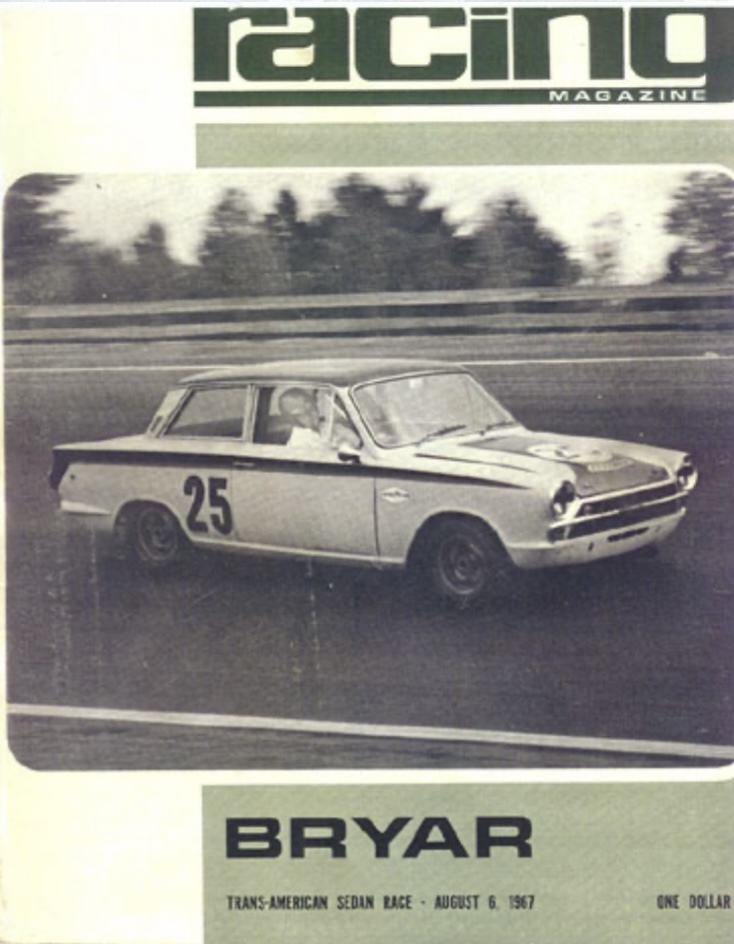
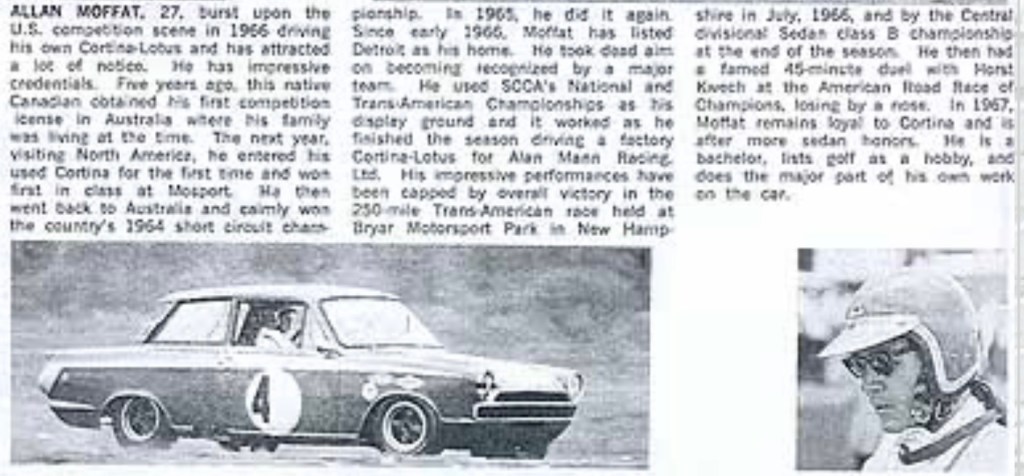
Racing Magazine, Vol 2 # 7 August 1967, cover shows Allan Moffat, probably that year (lotus-cortina.com)
It’s interesting to see how the Americans rated him in 1967.
‘Allan Moffat, 27 (born November 10,1939) burst upon the U.S. competition scene in 1965 driving his own Cortina Lotus and has attracted a lot of notice. He has impressive credentials. Five years ago, this native Canadian obtained his first competition license In Australia where his family was living at the time.’
‘The next year, visiting North America, he entered his used Cortina for the first time and won first in class at Mosport. He then went back to Australia and calmly won the country’s 1964 short circuit championship. In 1965 he did it again.’
‘Since early 1966, Moffat has listed Detroit as his home. He took dead aim at becoming recognized by a major team. He used SCCA’s National and Trans-American Championships as his display ground and it worked as he finished the season driving a factory Cortina-Lotus for Alan Mann Racing. His impressive performances have been capped by victory in the 250 mile Trans-American race held at Briar Motorsport Park in New Hampshire in July 1966 and by the central divisional Sedan B-class championship at the end of the season. He then had a famed 45 minute duel with Horst Kwech at the American Road Race of Champions, losing by a nose.’
‘In 1967 Moffat remains loyal to Cortina and is after more sedan honours. He is a bachelor, lists golf as a hobby, and does the major part of his own work on the car.’
The first motor race I attended was the Sandown Tasman round in 1972, the Australian Grand Prix that year. Despite being based in the Castrol tent surrounded by the HDT Torana XU-1s and works Chrysler Valiant Chargers there were only ‘two cars’ of interest to me that weekend: all of the single seaters and Moffat’s Mustang! The factory Falcon GTHO’s had as much presence as the Trans-Am but not its menace or sensual, muscular brutality.
With an Economics degree in my pocket I commenced working for a small chartered accounting firm in Toorak and used to see AM around and about there all the time. His workshop was for many years at 711 Malvern Road, Toorak, he lived in the area and I often saw him schmoozing clients at Topo Gigio and more often Romeo’s. While Topos has been gone for five years, Romeos is still there and Allan is an honoured long-standing guest when there with his wonderful minders; dementia sufferer as he is.
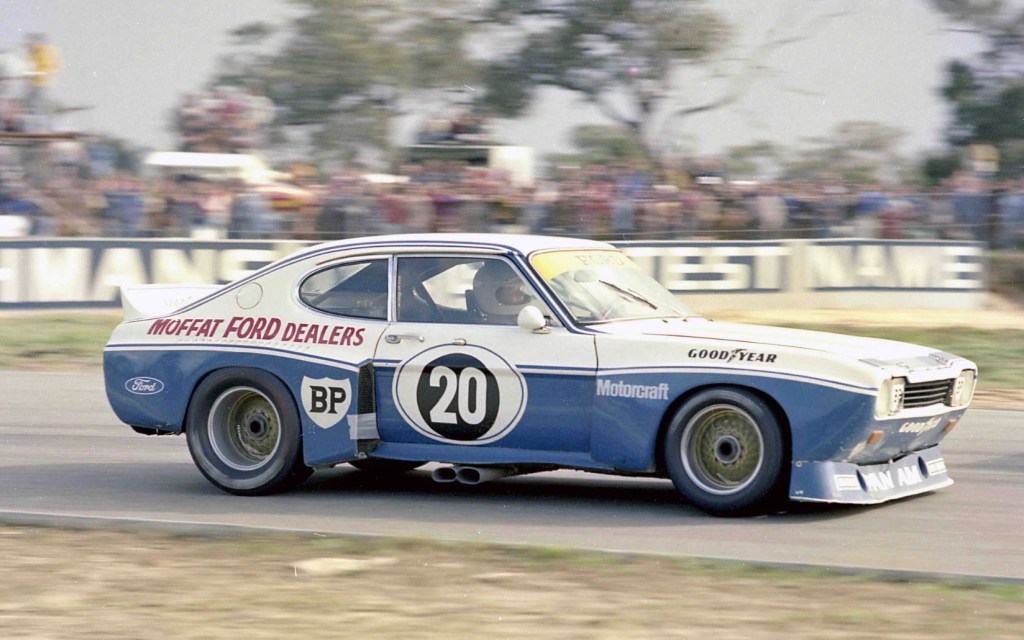
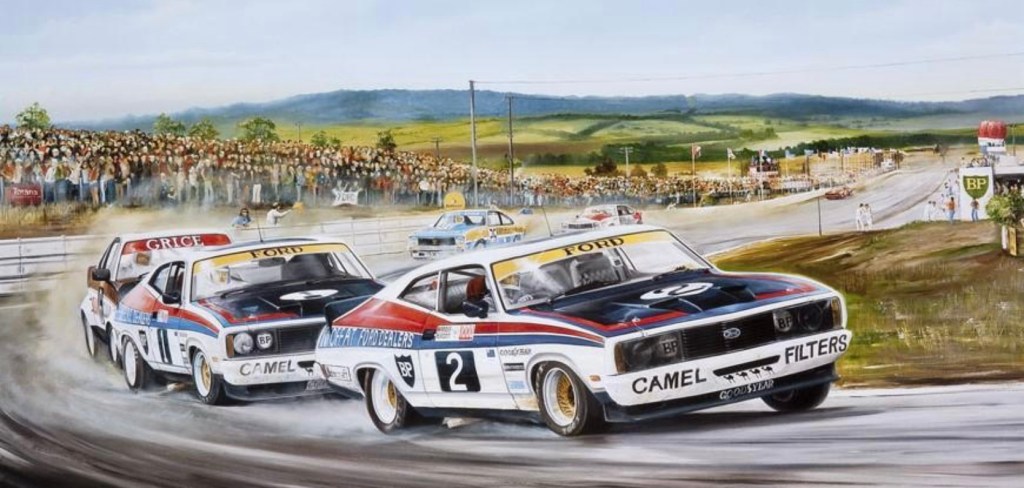
Moffat, ex-works Ford Capri RS3100, Wanneroo Park circa 1976 (autopics.com)That memorable Bathurst 1-2 in 1977: Colin Bond/Alan Hamilton from Allan Moffat/Jacky Ickx at Hell Corner, Ford XC Falcon GS500 Hardtops. The order was reversed at the end of course. That season was such a potent mix of Moffat, Bond, Carroll Smith and Peter Molloy all singing from the same hymn book (R Wilson)
As I got the hang of the working world a bit I developed a keen appreciation of Moff’s commercial skills in addition to his on-track prowess. He was very young when Ford US did a deal with him to run their surplus-to-requirements Lotus Cortinas in 1967. After his works-Ford Oz drives – 1969-73 plus bits and pieces subsequently – came to an end he did deals with Mazda, Holden, Porsche Cars Australia and others that kept him winning and in the public eye.
You have to figure he was trustworthy and gave value for money to his supporters and sponsors…I’m not saying there wasn’t a litigation blip or three along the way.
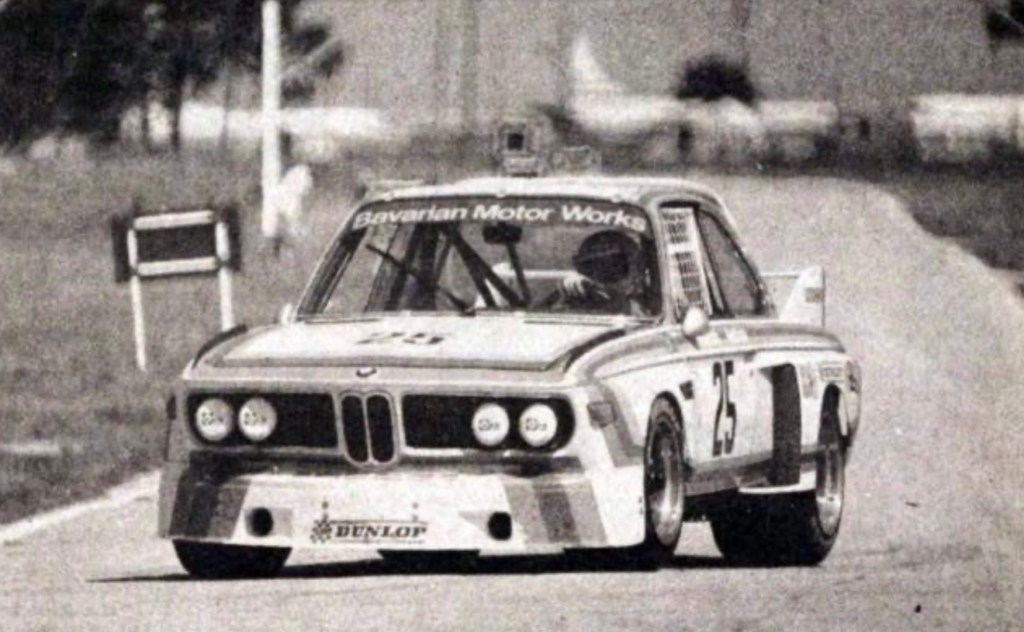
Moffat at the wheel of the 1975 Sebring winning BMW 3.0 CSL. This is a shit-shot, but it’s the only one I’ve seen where it’s definitely Moff at the wheel (Autoweek)
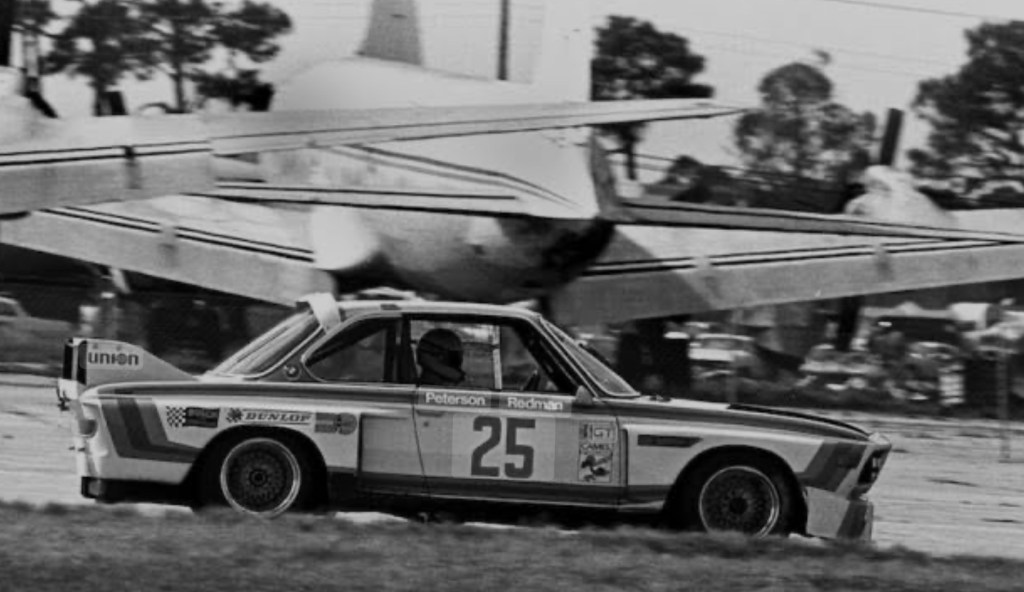
By early 1975 Allan Moffat had won the Australian Touring Car Championship, the Bathurst classic three times, and more long distance races than you can poke a stick at. So when the FIA wouldn’t let Ronnie Peterson contest (WTF?) the 1975 Sebring 12-Hours in a factory BMW 3-litre CSL there were enough folks in high places in the US who remembered Moffat to suggest him for the drive alongside the versatile and very quick Brian Redman. It was Moff’s first pro-drive of a make other than a Ford.
Moffat did an early stint then Redman took the wheel. Later, BMW’s pair-of-hares, Hans Stuck and Sam Posey joined in too after their car was sidelined; an oil leak led to a blown engine. Redman did about seven of the 12 hours, but it was a shared victory, a crucially important one for BMW too, it was their first big race win in America that gave their market presence and credibility a big lift.
Allan had a 911 SC roadie circa 1979, so the handling characteristics of a 911 Porsche – a triumph of engineering over physics – would not have been a huge surprise to him when Allan Hamilton entered him in a Porsche 934 in the 1980 Australian Sportscar Championship; he won three of the five rounds and the series handsomely.
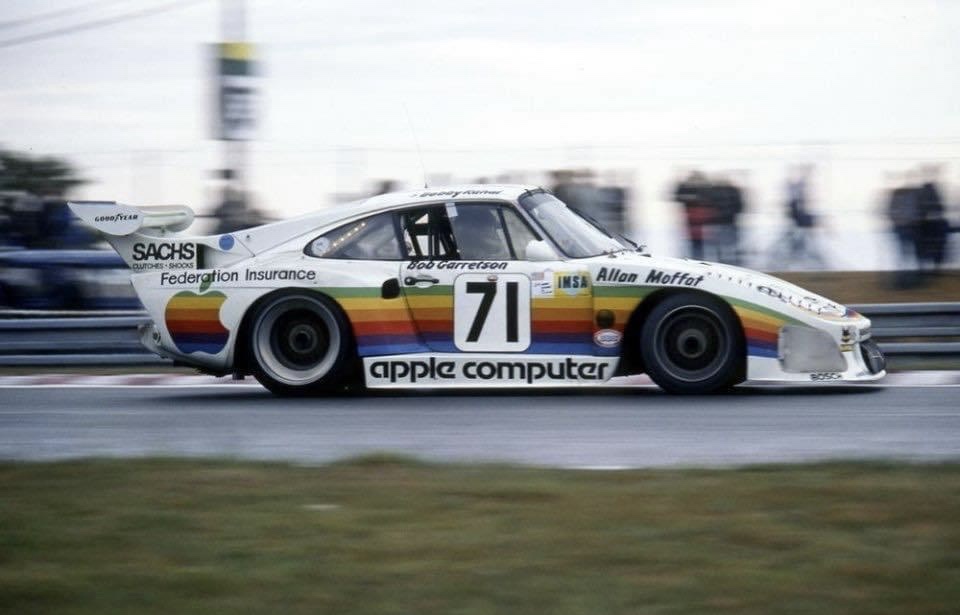
Doubtless the Dick Barbour Racing Porsche 935 K3 he raced with Bobby Rahal and Bob Garretson at Le Mans in 1980 was a thrill and challenge of a much higher order!
The result was a DNF after piston failure. The crew completed 134 laps, and retired in the 11th of the 24 hours. Dick Barbout entered three 935s, the only one that finished was the pole-car, raced by John Fitzpatrick, Brian Redman and Barbour himself to fifth place. Fitzpatrick, a familiar Bathurst winning name to Australian enthusiasts, put the 935 K3 1980 Kremer machine on pole.
(M Heurtault)Dekon Chev Monza, Sandown, July 4, 1976. Under brakes into Shell (R Davies)
One of the things I loved most about Al-Pal was his propensity to import cars and talent, rather than buy-local. That it drove most of the Taxi-Boganisti of this country nuts made it even better.
The Dekon Chev Monza is a case in point. The irony is that Aussie Export Horst Kwech was a key member of the team that developed and raced the cars in the Ewe-Ess-A. I was there the day he ran the 200 Year USA celebration livery at Sandown in 1976 but I’ve no idea if he won the Sports Sedan feature?
Imagine how lacking in colour Oz touring car racing would have been without Moffat’s imported Lotus Cortina, KarKraft Mustang, Cologne Capri, B52 Falcon Hardtop (sort of), Dekon Monza and the Mazdas. Moffat in a ‘fuckin Rice Burner’ was more than the fanatical Bathurst Fruit Loops could take…priceless it was!
(LAT)
Moffat’s powers of lobbying and schmoozing officialdom came to the fore in and around the racing of the Mazda RX7 in the Australian Touring Car, and Manufacturers Championships…but let’s not go there.
He won the first ATCC round for a Japanese car at Lakeside on April 3/4 1982, and then brought home the bacon by taking three of the five Australian Endurance Championship rounds in 1982, and the 1983 Australian Touring Car Championship, winning four of the eight rounds, taking both titles.
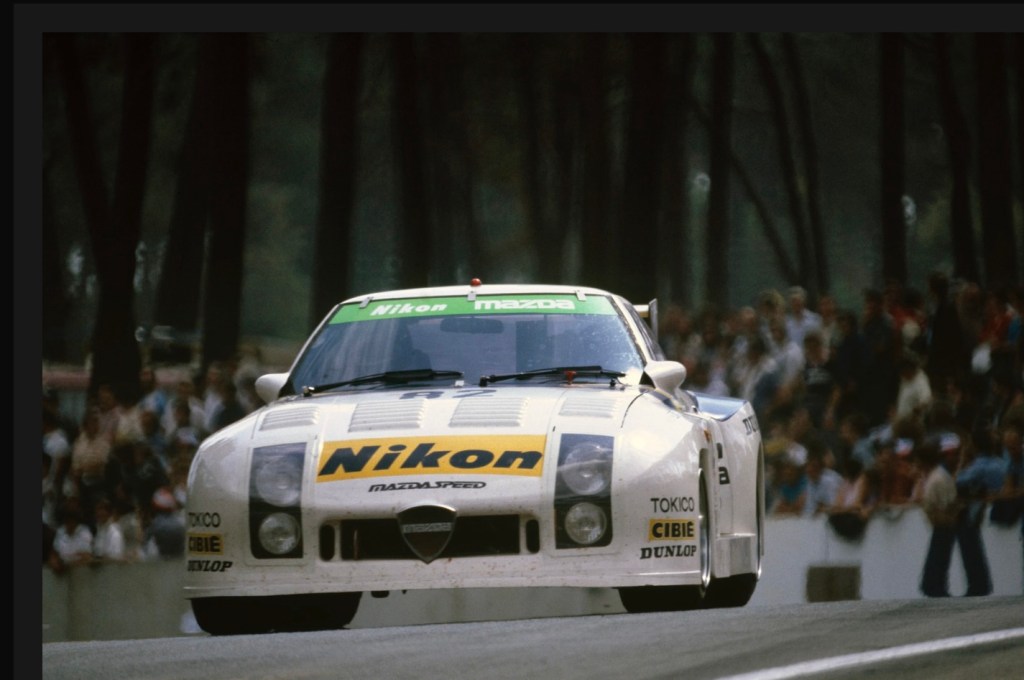
The century old, Hiroshima based multinational rewarded Moffat’s success with his final drive at Le Mans in 1982. He shared a Mazda RX-7 254i GTX IMSA class machine (above) to 14th place sharing the drive with Japanese racers, Yojiro Terada and Takashi Yorino.
Nobody who was around can forget the tragic self-immolation of Peter Brock in 1986-87 over ‘his Energy Polariser (magnetism and chrystal placement) that enhanced vehicle performance’ debacle.
But before that, .Brocky threw his mate and intense rival – thanks to the recommendation of John Harvey, Brock’s tight-hand-man and a personal friend of Moff – Moffat a motor racing lifeline in the form of a Holden ride for selected rounds of the ‘86 Euro Touring Car Championship and Oz long distance enduros.
Larry Perkins, already working for Brock, was of course the logical choice for the ride but he left Peter over the Polariser, as far as he was concerned Brocky was just jerkin’-the-gherkin.
When the combination of a particularly potent brew of Hurstbridge wacky-bakky, the influence of Witch-Doctor Eric Dowker, a Messiah Complex and whatever else got the better of Brock – a staggering Australian in every respect – General Motors Holden pulled the plug on him in February 1987; it was entirely the appropriate remedy for them of course.
Moffat told his biographer, John Smailes, ‘If I’d been in the position where I had General Motors in my hip-pocket, I would never, never, never have put myself above them. That’s not corporate cowardice; it’s just common sense. Peter could have lived to fight another day (if he backed down on the polariser fitment to the Commodore Director and subjected the car to GM’s homologation processes). Who knows? In some parallel universe he might even have got the polariser up.’
‘John Harvey, the last man standing, resigned, I went with him. There seemed nothing, really, to stay around for. Ten months later Peter won Bathurst again. Despite all that had gone down, he had accomplished a rise from the ashes that made my Project Phoenix all those years ago look paltry.’
Moffat at Monza in 1987, the nascent team had precious little in the way of spare parts, fortunately the new VL SS Group A behaved rather well (Garry Rogers)
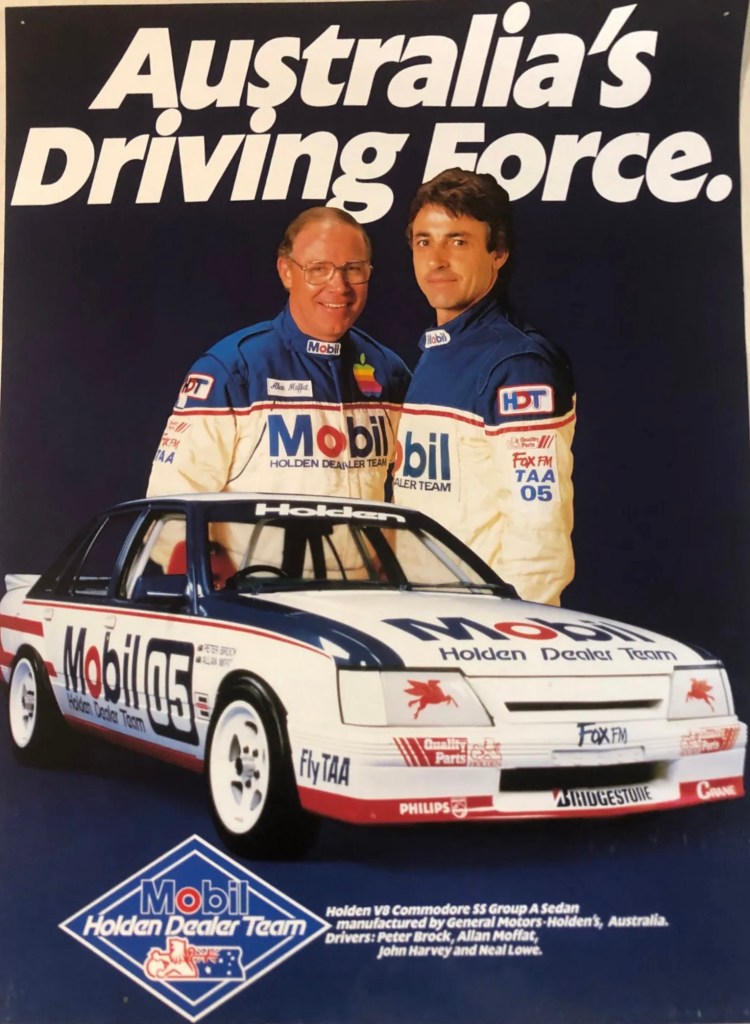
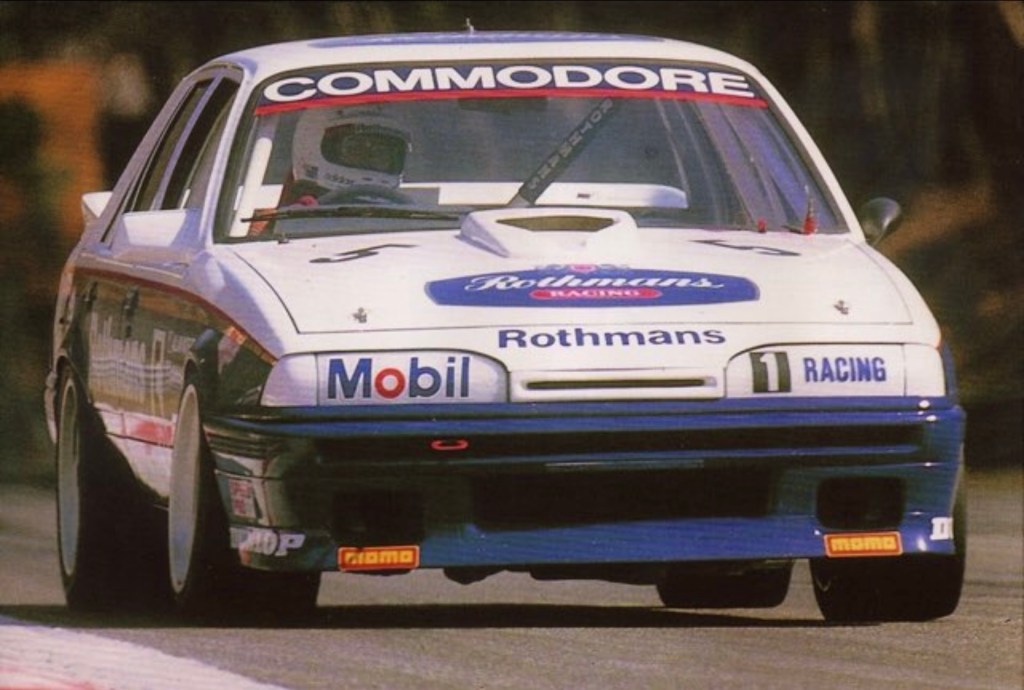
In the short term Brock had his creditors to deal with. Without a car, and still intent in contesting some of the 1987 World Touring Car Championship rounds – Brock and Moffat did four rounds in ’86 as preparation for ’87 – Moffat acquired, via an intermediary, Brock’s new, unraced 1987 05 car, a Holden VL Commodore SS Group A.
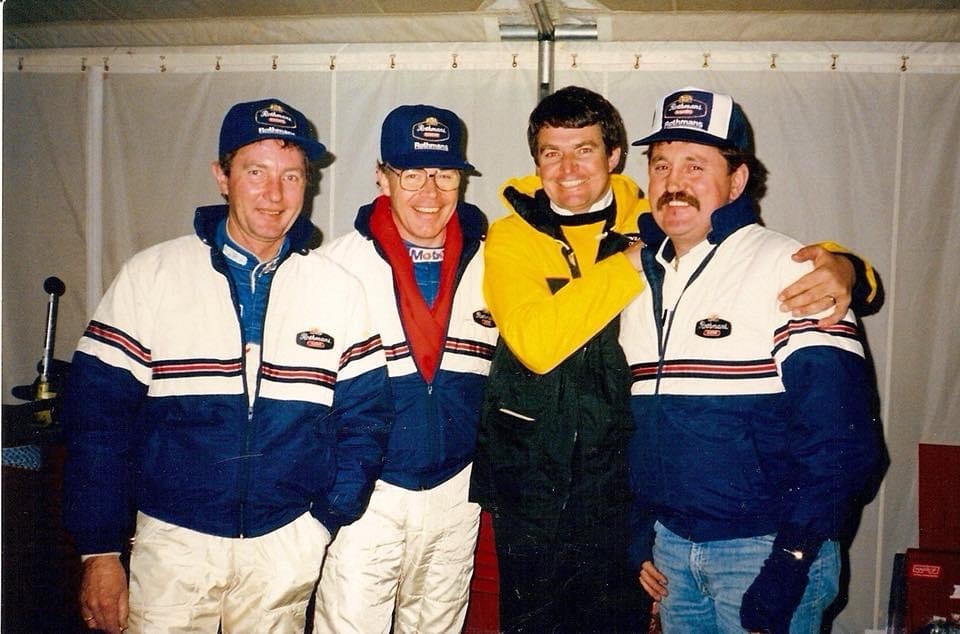
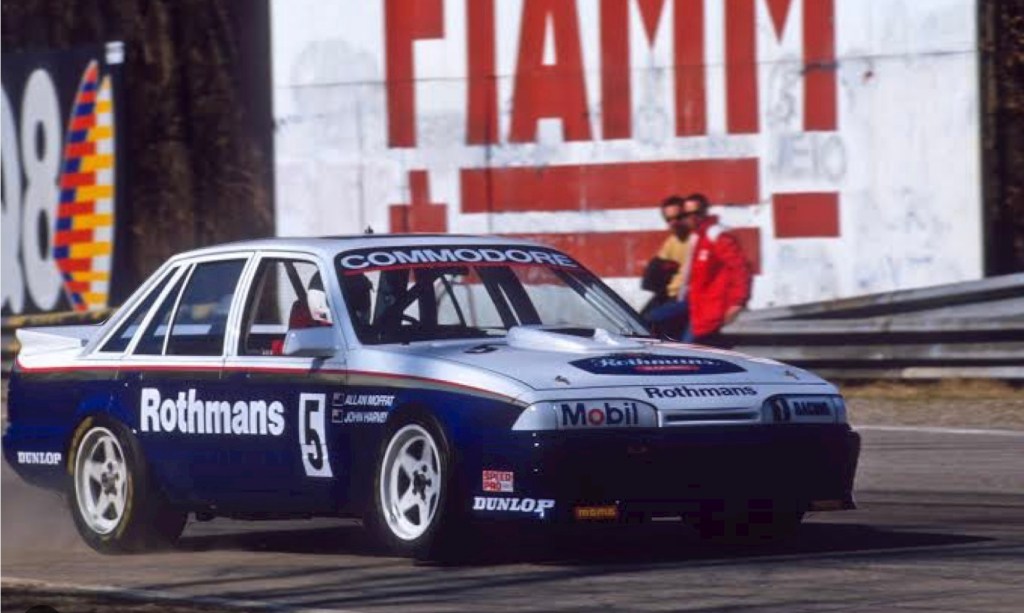
Showing his commercial skills again, Moff quickly, in not much more than a month, pulled together some sponsors, popped the Commodore on a plane and contested four rounds of the 1987 WTCC with John Harvey as co-driver. They sensationally and famously won the first round at Monza after the first six cars home – BMW M3s – were pinged for being illegally light on the evening after the race!
Harvey, Moffat, Dunlop Oz’s Russell Stuckey, and Mick Webb at Monza in 1987. Happy chappies indeed (R Stuckey Collection)I never thought the VL Commodore was a pretty car but it sure looked good in Rothmans livery! Monza ’87 (an1images.com)
Moffat’s 1987 European Safari results are as follows: 22/3/87 Monza 500km Q10 and first, 19/4 Jarama 4-Hours Q11 DNF lost wheel on lap 78, 10/5 500km de Bourgogne-Dijon Q10 DNF blown engine on lap 44, and 1-2/8 Spa 24-Hours Q18 fourth.
When Allan got home he had a Ford Sierra RS500 for Bathurst, while Brock had the winning car…
Etcetera…
(B Williamson Collection)
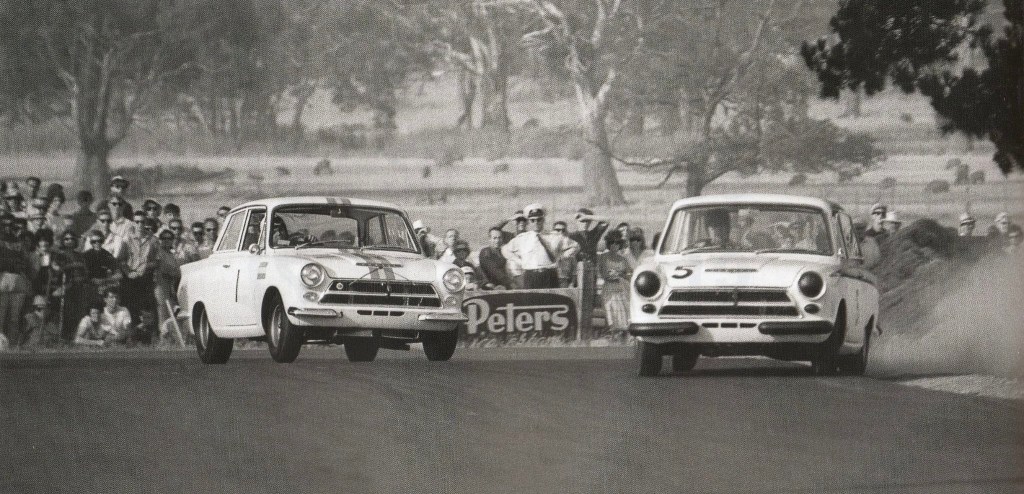
Al-Pal using all the road to stay ahead of Bob Jane on the exit of Mountford corner during the March 1965 Longford Tasman round; Lotus Cortinas both, Moff’s ex-works, Jano’s locally developed.
These blokes dooked it out on-circuit for years of course, I wonder at what meeting they first swapped-paint!?
(B Stratton)
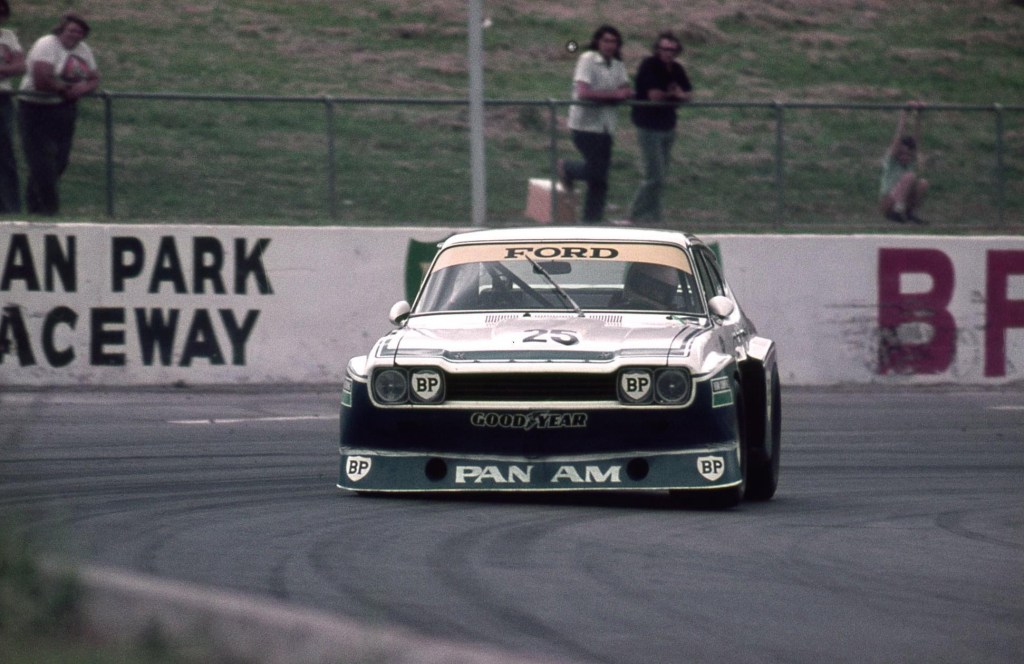
Moffat in the Cologne Capri at Oran Park in 1976. If the sight of it didn’t move the erectile tissue the sound of it most certainly did.
The price was right of course – FoMoCo supplied – but otherwise the relatively heavy 3.4-litre, quad cam, four-valve, injected Cosworth Ford GAA powered long distance coupe lacked the cubes’-and-pubes’ – cubic inches and torque – for Australian Sports Sedan racing.
With a need for big V8 punch out of our predominantly point and squirt type of tracks the Capri was never going to be a consistent winner. And so it proved. So he bought the Monza, but then Ford cracked the shits so he put the Monza aside and jumped back into the ‘Crappy. I wonder how many meetings he did in both of these cars as a consequence of all of that?
Allan Moffat in America Facebook page, Mathieu Heurtault, Randall Wilson, Robert Davies, Autoweek, Brian Stratton, an1images.com, Bob Williamson Collection, Russell Stuckey Collection, ‘Climbing the Mountain’ Allan Moffat and John Smailes










 primotipo...