Archive for the ‘Touring Cars’ Category

(Ebay)

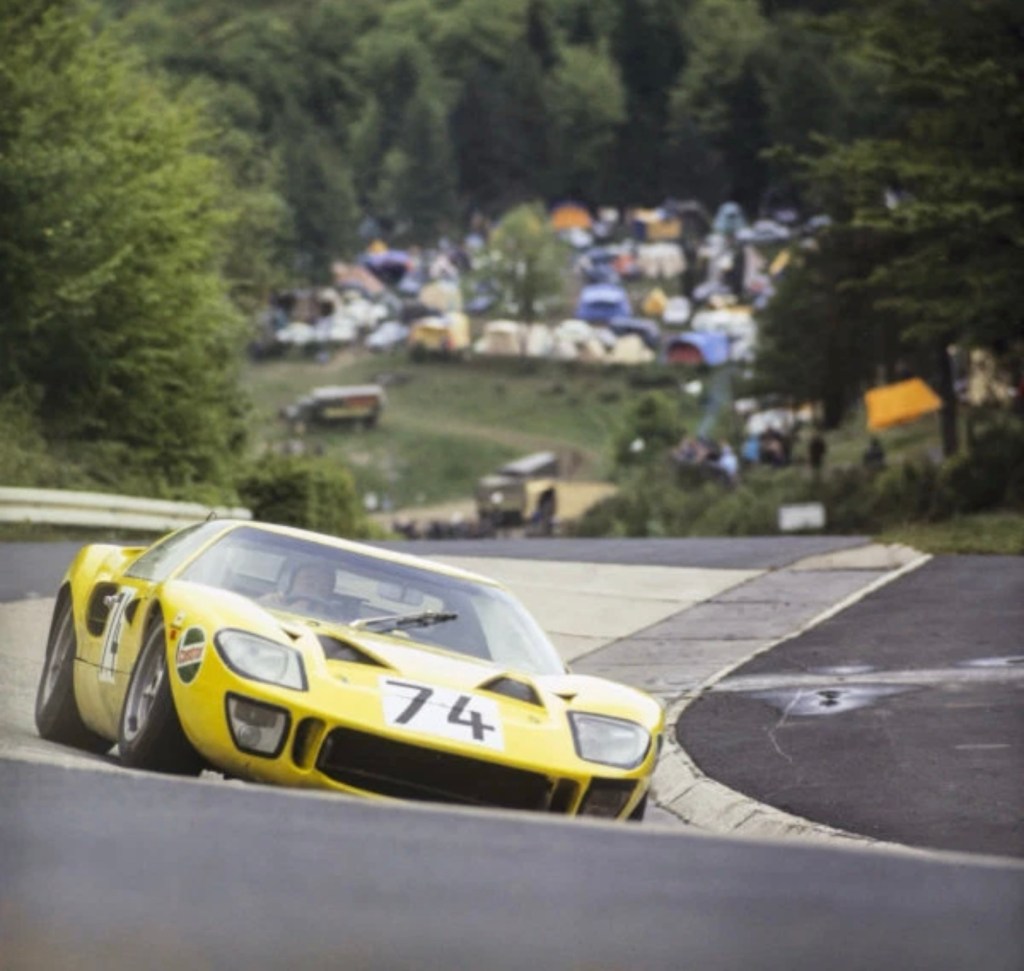
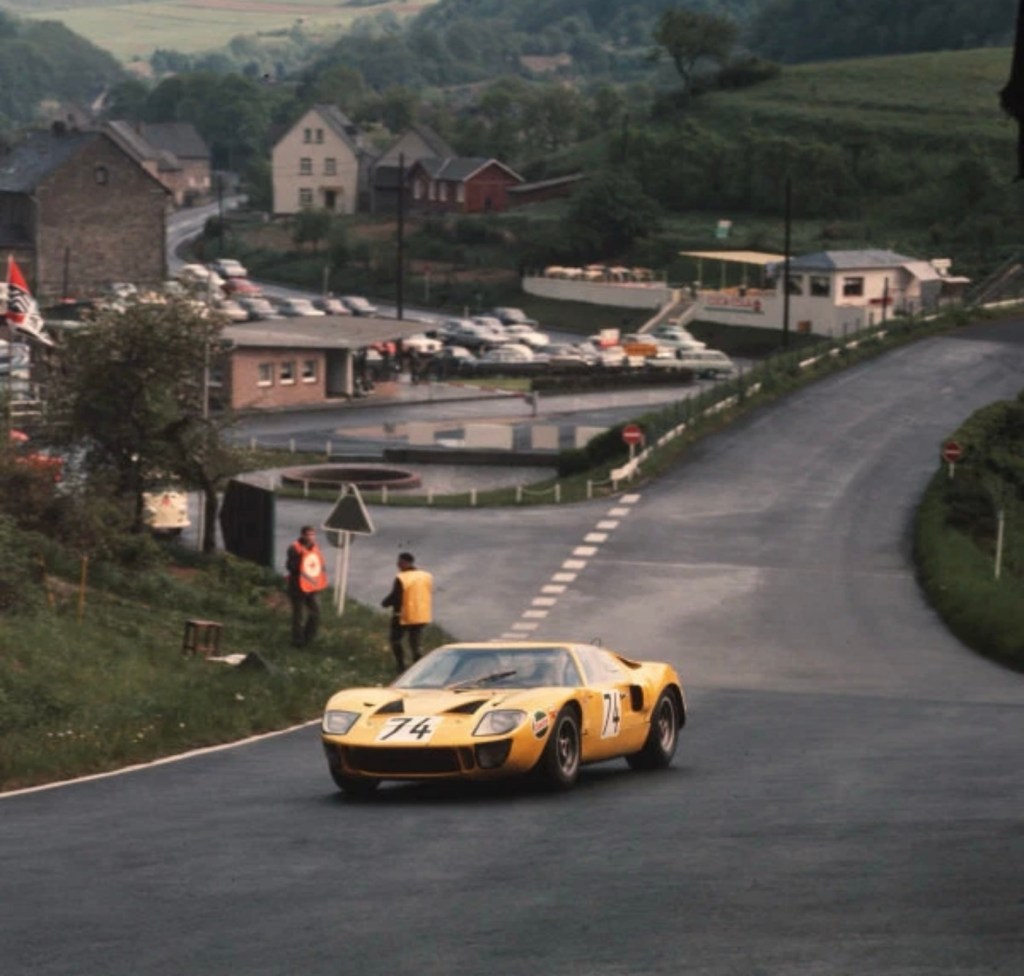
The John Reaburn/Nicholas Granville-Smith Ford GT40 during the 1968 Nurburgring 1000 km.

Melbourne-born John Reaburn – 20/10/1936-26/11/2016 – raced sports cars briefly in Europe in the mid-1960s before retiring at the ripe old age of 32 at the end of ’68. 

He inherited the bug from his father Wal who raced a Humpy Holden and operated WJ Reaburn Auto Electrical Engineers Pty. Ltd. from 891-893 High Street, Armadale, Melbourne.

Reaburn’s Holden FJ at the Geelong Speed Trials date unknown (R Simmonds Archive)
A brace of Buchanans. John Reaburn chases Wally Mitchell at Phillip Island, date unknown

John raced the Holden and then made his name with consistent winning pace in a potent Buchanan Holden from April 1960 to July 1961. Into the mix were drives in Jaywood Motors, Appendix J Holden Humpy, and FC.

He competed in the 1960-64 Armstrong 500 at Phillip Island and Bathurst, sharing a Singer Gazelle with Harry Firth in 1960, and then Firth’s works Ford Cortina GT, Zephyr MkIII and Falcon. He also raced a FoMoCo Cortina GT in the first Sandown enduro, the 1964 6-Hour International, with Geoff Russell finishing a rousing third outright..

Reaburn in the Ford Falcon XP he shared with Harry Firth during the April 1965 Ford 70000 Mile Durability Run at the FoMoCo You Yangs proving ground (Ford)
Firth/Reaburn works-Cortina GT during the April 1964 Lowood 4 Hour, winning their class and ‘outright’

He took on the big-car challenge in 1965, finishing fifth in the one-race Australian Touring Car Championship at Sandown won by Norm Beechey’s Ford Mustang. Raeburn’s mount was the 7-litre Ford Galaxie left in Australia after the ’64 Sandown International by Sir Gawaine Baillie.

Reaburn jumped on a ship for Europe with the intention of racing the car in the UK, but Baillie had sold it before he got there. Brian Muir was third in that Sandown ATCC in his Holden EH S4; he too was soon heading off to the UK, very successfully so.

Reaburn, perhaps, in the Baillie Galaxie at Warwick Farm in 1965 (P Reynell)

Undeterred, Reaburn started working for Graham Warner’s Chequered Flag Motors in 1966, driving their Shelby Cobra in the Zeltweg 500 km (DNF oil leak) that September. He was in the best of company, sharing the grid with GP drivers Jochen Rindt, Jo Siffert, Mike Spence, Innes Ireland, Mike Parkes, David Hobbs and Bob Bondurant.

Nick Brittan wrote about Reaburn in Motoring News during 1966, ‘Raeburn Shines in Driving Test. I don’t seem to be able to get through a month in this column without making some comment about a new Australian driver. In fact I’ve been accused of running an Antipodean news sheet.’

Johnny Reaburn is the latest of the “gday there mate” brigade that are invading our shores. Johnny, a massive, lantern-jawed Melburnian, ran Holdens and FoMoCo cars back home.

JR in the Zeltweg pits in 1966. Bob Bondurant raced the other Chequered Flag Cobra, DNF engine. And yes, like me, the signwriter struggled with the spelling of JR’s name (JR Archive)
JR during the September 1966 Zeltweg 500km DNF oil leak in the Chequered Flag Shelby Cobra. Race won by the works Porsche 906 crewed by Gerhard Mitter and Hans Hermann (Zdjecie)

‘Bathurst class successes, three Lowood 4 hour races on the trot, second in the Sandown 6 hour, plus numerous other solid performances, are grounds for giving the bloke a trial.’

‘What shook everybody up last week was his performance at the passout at Brands with the Motor Racing Stables outfit in front of a big crowd of journalists and enthusiasts. Eight lessons in a Formula Ford with the passout in an F3 in the reverse direction on the Club circuit, Johnny equalled the time set by professional driver and instructor Tony Lanfranchi on his fourth lap.’

‘He improved his time by a full seven-tenths of a second on the remaining six laps. Tony then jumped back in the car, but it took him twelve laps to equal the time Johnny had set. He should be deported or given a drive, as this was his first time in open wheelers.’

He raced Mike de Udy’s Porsche 906 with Roy Pike in the Reims 12 Hours in 1967 (DNF), and took part in several 1968 World Sportscar Championship rounds. His car was a yellow Ford GT40, chassis #1001, owned by Andy Cox, ‘who had won money on the football pools and bought himself a GT40,’ wrote Doug Nye.

Reaburn’s driving partners were Nicholas Granville-Smith and another Australian tyro who did a stint at The Chequered Flag, Tim Schenken. 

Monza 1000km grid April, 1968 (JR Archive)
Nurburgring 1000km April 1968, on the way to 21st place (LAT)

At the Monza 1000 km in April he shared the car with Schenken, DNF engine. At the Nürburgring on May 19, he and Granville-Smith were 21st in the 1000 km.

At Spa-Francorchamps, the week after the Nurburgring, back with Tim, John had a major off on the first lap of the 1000 km enduro.

Doug Nye was there reporting the event for Motoring News and wrote on The Nostalgia Forum, ‘It absolutely widdled with rain and early in the race John dropped the car in the pack on the right hand kink coming down the hill from La Source, past the pits. The GT40 spun round and round and round in a ball of spray and only near the bottom of the hill – entering Eau Rouge – did it finally slither off onto the grass and subside into a ditch on the left side of the track. It was very spectacular, with phenomenal avoidances all round. Pity, he’d been driving it pretty well until then.’

Nurburgring, JR ahead of the second place works Porsche 907 of Hermann/Attwood (LAT)
Raeburn with Brigitte Bardot (JR Archive)

Reaburn reported his exploits back home via Racing Car News. Amongst the unreported good times of high performance off the track was a week-long dalliance with Brigitte Bardot that was memorable enough for her to purchase him a Rolex watch inscribed, ‘To Johnny, Love BB’. ‘True story’ confirms Greg Smith, who had a lot to do with Reaburn in the modern historic era, ‘I’ve seen the watch.’

‘Don’t forget that he was instrumental in getting the David Price-written Joan Richmond book published (Joan Richmond: The Remarkable Previously Untold Story),’ chipped in Bob King.

Reaburn tested an F3 car at Brands Hatch in 1966, matching class front-runner Tony Lanfranchi’s times, and a works F2 Lotus 48 Ford FVA at Hethel in 1967, but, being a tall unit, decided to concentrate on sports car racing. 

He quit racing at the end of 1968, aged 32. In recent years John lived in retirement with his wife in Mooroolbark, Victoria. He died of a stroke on Saturday, 26 November 2016, aged 80.

Etcetera…

A Truish Story from 1965 by Clark Watson.

‘Young John Reaburn, south-eastern suburbs of Melbourne, six-foot-five in his socks, had come to England on the back of a Bathurst class win with Harry Firth. Europe didn’t care. Single-seater cockpits were built for midgets, so John ended up on the showroom floor of Chequered Flag Motorsport in Savile Row, selling Elans and the odd Ferrari while demonstrating Colin Chapman’s ultra-rare analogue driving simulator — one of only two ever made.’

‘One day, a Scottish Lord named Andy walked in — heir to half the Highlands, banned from racing by his mother until he produced heirs of his own. Instead, he spent the family’s millions running sports-car teams and collecting rogues like McLaren, Amon, Rindt, Surtees, and Bondurant. He took one look at the giant Australian and decided he liked him. Soon, John was testing for Andy’s private outfit and sharing a flat in Clapham with Bruce McLaren and Chris Amon.’

‘What happened in that flat stayed in that flat — except one story that finally slipped out. One winter evening, Andy dropped John home after a test day and said only, “Midnight. Sofa. Helmet. I’ll pick you up.” Over dinner, Bruce and Chris just sniggered. When John reached for the wine, they pushed water at him and told him to sleep. Just after midnight, a rattly old lorry reversed down the lane. Andy was directing mechanics who whipped a sheet off the load to reveal a gleaming silver Shelby Daytona Cobra, already thudding and rocking on its springs. Andy climbed into the passenger seat. “You drive.” They ghosted through sleeping London, turned right into Hyde Park itself — gates closed, lights out — pure madness.’ 

‘Fifty metres from disaster, the park blazed into light and the gates swung wide. Men in bowlers closed them again behind the Cobra. Andy grinned. “Foot flat, Johnno. The gates always open if you’re quick enough.”

‘The Midnight Stakes – the exact course. Horse Guards Parade → up the Mall → full slide around the Victoria Memorial (“the cake top”) → hard left into Hyde Park along South Carriage Drive → blast out at Marble Arch → down Park Lane → left into Constitution Hill → long, long opposite-lock slide back into Horse Guards Parade forecourt. Roughly 2.9 miles door-to-door. They did a slow reconnaissance lap first, just to let the oil warm and the tyres scrub in. Then they lined up again on the gravel.Top hats, tails, cigars, brandy, chalkboards, bowls of £100 notes. Tradition since the Napoleonic Wars on horseback, motorised by the Bentley Boys in 1929. Tonight it was John’s turn.’

‘Andy smacked the quarter panel. “Helmet on. The clock starts the moment you leave the forecourt. Don’t lift for the park — the gates will open.” John tightened the belts until they bit, clicked first, and dropped the hammer. Out of Horse Guards flat in second up the Mall, braked as late as he dared for the right into the park — 150 mph showing — then flat again. Lights flared, gates flew open, the Cobra thundered through the empty park like a silver bullet. Hard left at Marble Arch, 152 mph down Park Lane, police Pandas with blues twinkling, blocking every side street. One huge four-wheel drift around the Victoria Memorial — two perfect black doughnuts for the tourists to puzzle over next morning — then flat out down Constitution Hill and a long opposite-lock slide back into Horse Guards 1 minute 58.4 seconds dead.’

‘New outright record. John was dragged from the ticking Cobra, bundled into a waiting black cab and whisked home while the toffs threw top hats in the air and settled their bets. The record stood exactly thirteen nights. Then Chris Amon took the same 2.9-mile loop in a full Le Mans-spec GT40, big Ford V8 spitting blue flame, touching 198 mph past the Dorchester, and stopped the clocks at 1 minute 47 seconds flat. That night, the birds left every tree in Hyde Park in one black cloud, and half the palace windows rattled in their frames.’

‘The next morning, a humourless new Assistant Commissioner killed the game stone dead. The Cobra disappeared onto a ferry for Ireland before lunch, the chalkboard vanished, and the Horse Guards Midnight Stakes were declared finished “for the duration”.

‘Or so they say. Because if you’re ever in central London on a moonless night and you hear a big American V8 or a Le Mans Ford bark just once after the clocks strike twelve, sending the birds flying from the trees……you’ll know the gates are still opening for someone.’

Reaburn in the Buchanan Holden at Rob Roy, date unknown (L Sims Archive)
AMS September 1960 (G Edney Collection)
(JR Archive)

Outside Rootes HQ in Melbourne (?) 1960 with Harry Firth. Seventh in Class C 1960 Armstrong 500 at Phillip Island, up front of the class was the Geoff Russell/David Anderson/Tony Luxton Peugeot 403.

(JR Archive)

The word according to Harry…’Now listen here cock, just do this, this, and that, and we’ll win the class’, date and place unknown, yes, Harry is leaning on a Cortina.

(B Wells)

Bathurst 500 1964, the Bill Buckle/Brian Foley Citroen inside the Firth/Reaburn FoMoCo Cortina GT. Third in Class D and Class C respectively.

(Ford)

Firth or Reaburn during the 1965 FoMoCo You Yangs Durability Run, Ford Falcon XP Hardtop, see here:https://primotipo.com/2022/03/18/ford-falcon-70000-mile-9-day-reliability-trial/

(Zdjecie)

Zeltweg 500km grid on September 11, 1966. Johannes Ortner, Abarth 1300 GT, John Reaburn, Shelby Cobra and David Hobbs in Bernard White’s Ferrari 250LM.

(JR Archive)

In the Monza pits during the 1968 1000km weekend, that’s Tim Schenken in the sunglasses awaiting his turn at the wheel.

Schenken was a prudent co-driver choice, being the man on every team manager’s list. That year, he won the British Formula Ford Championship, Merlyn Mk11, the BRSCC-MCD British F3 Championship, Chevron B9 Ford/Brabham BT21X Ford/Brabham BT28 Ford and the Grovewood Award. Not bad…

Credits…

John Reaburn Archive via Greg Smith, Ebay, LAT, Ron Simmonds Archive, Leon Sims Archive, Peter Reynell, Brier Thomas, Graham Edney Collection, Bruce Wells, Ford Motor Company, Zdjecie on Historia jakiej nie znacie, David Lowe photo via Tony Johns’ archive

Finito…

Sun-Herald cartoonist Mark Knight captured it rather nicely I thought?

Canadian-born Australian touring car racer – one of our legends – Allan George Moffat died last week after suffering from Alzheimer’s Disease for the last few years. November 10, 1939-November 22, 2025. Rest In Peace.

(R Hobman)

Moffat and Peter Brock after winning the January 1986 Wellington 500 in a 5-litre Holden Commodore VK.

(R Hobman)

I’ve written about the parts of Allan’s long career – 1962 to 1990 – that interest me here: https://primotipo.com/2024/09/30/allan-moffat-random/ here: https://primotipo.com/2015/04/09/australias-cologne-capris/ here: https://primotipo.com/2023/01/13/cologne-capris-take-3/ here:https://primotipo.com/2020/04/14/allan-moffat-single-seater-racer/ not to forget this one:https://primotipo.com/2020/03/06/moffats-shelby-brabham-elfin-and-trans-am/

With so many photographs popping up in the media since his death, it seemed a good idea to filch a few and add some more as a tribute to a man who provided so much fizz and sparkle to our scene on every level for so long. Google away for the statistical stuff.

(autopics.com)

On the grass at Sandown after one of his many wins at his home track, in the 1970 Sandown 250 enduro – the traditional Bathurst curtain-raiser – works XW Ford Falcon GTHO Phase 2.

His family settled in Melbourne from Canada – his Dad was a Massey Ferguson exec – and I guess the Melbourne die was cast when he arrived back permanently with the Kar-Kraft Mustang Trans-Am in 1969. Ford Australia have always been Melbourne-based based and he needed to be close to the action, so Melbourne it was, Toorak specifically.

Booting his XY GTHO Phase 3 out of Dandy Road at Sandown in the Sandown 250 the following year, DNF after only three laps, gotta be a qualifying flyer, AM wouldn’t have fried his Goodyears like this in an endurance race.

(B Nelson)

Barry Nelson and AGM with the ex-Clark Lotus Cortina at Hume Weir during the Boxing Day 1965 meeting

Nelson, ‘There was only one pre-airflow ex-Jim Clark Cortina in Australia, the later car was built in the Toorak workshop by me and Peter Thorn. The tow car is my FJ Holden panel van with hot Grey motor.’

Scrapping with Jim McKeown’s Lotus Cortina for the South Australian Touring Car Championship win in 1966. Clem Smith’s Valiant won the bubbles (P Smeets)
(S Elliott)

Steve Elliott has captured the pensive, focused AGM of renown before a race – gotta be his ‘75 NZ Tour? – at Bay Park, New Zealand, aboard the fabulous Trans-Am, one of the most celebrated of all Australian Touring Car combos. I love this shot.

(autopics.com)

Here with the injected 351 borrowed from his Super Falcon at Calder’s Tin Shed corner? And below the distinctive Ford F150 rig that towed the car coast to coast, at Oran Park.

Oran Park, August 9, 1971 (R Jones)
New Zealand circa-1972, circuit folks?

The planets were never aligned for Moff and the Boss 302 to take out the Australian Touring Car Championship they deserved, but karma caught up when he and the works-Phase 3 HO won his first of four ATCCs in 1973.

The shot above looks like the November 1972 Surfers 300 Manchamp round with FoMoCo Team Manager Howard Marsden doing his thing from the pit counter at the end of the Series Production Era, they won it. The one below is the Group C HO at Oran Park in June 1973, the happy ATCC year; they won that race too.

(insidesport.com.au)

The Falcon GT351 Hardtops were tougher going without direct factory support, golden ATCC 1977 year duly noted: the ATCC, Bathurst 1000 and Manufacturers Championship was pretty good going by Moff, Colin Bond and colleagues!

Surfers Paradise 300 in 1978 above, XC Cobra 351, and some of the key men in that period below: Peter Molloy, AGM and Mick Webb, missing from the shot (1978?), is Carroll Smith, who team managed the brilliant 1977 effort and was back Stateside by then.

(G Lindley)
1977 Bathurst 1000 one-two weekend: Moffat/Ickx and Colin Bond/Alan Hamilton. Ford XC Falcon GS500 Hardtop 351. Carroll Smith with his back to us (speedcafe.com)
(I Smith)

Moffat and Jim McKeown at it again, this time a decade later in a pair of sports sedans at Hume Weir in June 1975: the fabulous howling ex-works Ford Capri RS3100 Cosworth 3.4 V6 and the Alan Hamilton/Porsche Cars Australia mid-engined Porsche 911 Turbo that CAMS shortly thereafter legislated out of existence.

(R Cammick)

The Mighty Dekon built Chev Monza 350 at Bay Park, New Zealand, on its way to Australia in late 1975, and below all close up and friendly at Torana Corner, Sandown in 1979.

(R Martin)
(BMW)

BMW claim their 1975 Sebring 12-Hour win – Hans Stuck, Brian Redman, Sam Posey, Allan Moffat – with a 3.5-litre 3.0 CSL ‘launched’ the marque into the public’s consciousness in the United States.

(BMW)

It was Moff’s biggest international win too. Over the years he contested many international enduros including Le Mans on several occasions.

The shot below shows him at the wheel of the Dick Barbour Racing Porsche 935 K3 he stared with Bob Garretson and Bobby Rahal at Le Mans in 1980; DNF piston in the 11th hour.

Moffat aboard the Andy Rouse-built, leased Ford Sierra RS500, at Bathurst in 1987, the car retired on lap 31 before AGM had a steer. His co-drivers were Rouse and Thierry Tassin.

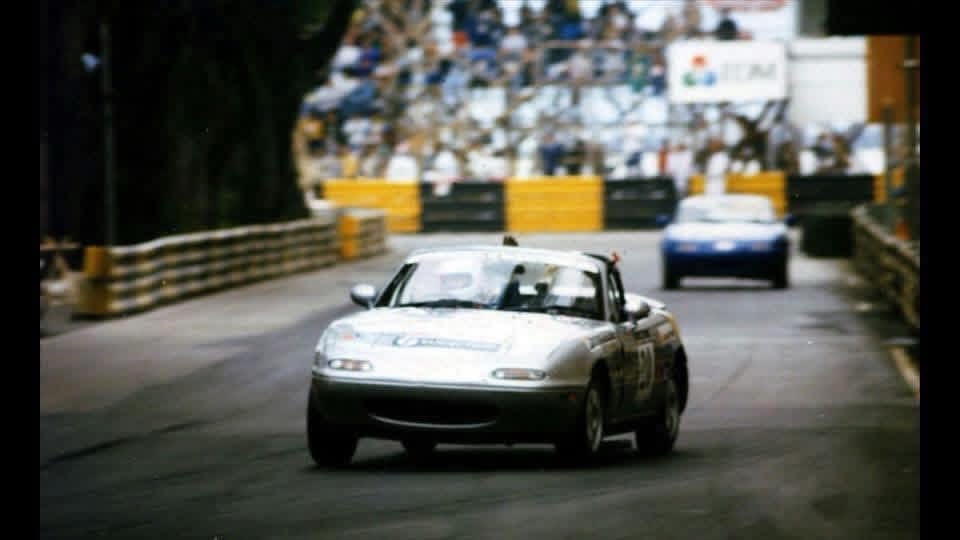
Allan’s last serious race was the 1989 Fuji 500, in which he raced his Eggenberger-built RS500 to victory together with Klaus Niedzwiedz. Moffat entered the car #39, his birth year, won the race, then quietly retired from driving. Macau GP Mazda MX5 hit and giggle support race duly noted…

Credits…

Barry Nelson, Russell Hobman, Steve Elliott, autopics, Rob Jones, Glenis Lindley, Peter Smeets, Ian Smith, Ross Cammick, Russell Martin, Allan Moffat Archive, BMW, LAT, Getty, speedcafe.com

Tailpiece…

(Moffat Archive)

In the very best of company at Indy during the Month of May in 1965 with Colin Chapman, Jim Clark, the rest of the boys and the victorious Lotus 38 Ford Indy 4.2 V8.

Finito…

(K Bartlett Archive)

Kevin Bartlett posted this shot of him chasing Ian ‘Pete’ Geoghegan in KB’s Morris Minor 1000 – ‘one I bought from the NRMA write-off yard with only superficial damage’ – on Bob Williamson’s ‘Old Motor Racing Photographs-Australia Facebook page.

Aussie international racer/historian, Peter Finlay chipped in with ‘The Geoghegans were the first in Australia to race an 850 Mini’.

Hmmm, I thought, is that so?

Noted Cooper historian, Stephen Dalton, advises as follows, ‘The 850 went on sale on 23 March if my brain is operating! So the car’s competition debut was soon after. KB’s shot is on 21 May 1961 at Warwick Farm. Ian did get period coverage, quoting him as being the first to race a Morris 850 (this one listed at 995cc already), but he wasn’t.

Peter Manton ran at Tarrawingee on 23 April, while Bruce Coventry and Sid Sakzewski ran Minis at Lakeside the weekend before Warwick Farm.

And Harry Firth made its competition debut at Rob Roy before all of them. A week before Tarra and nearly a month before the Lakeside meeting took place…’

Morris 850 Development Pace…

This piece from Tony Johns’ upcoming book on the history of Austin 7 Racing in Australia shows just how quickly local tuners hopped onto the Mini Bandwagon…

‘The Australian Motor Sports Club (AMSC) had previously organised hillclimbs at Greensborough, Hurstbridge and Hepburn Springs. When the LCCA decided, due to dwindling spectator numbers, now less than 500, that they no longer wanted to run meetings at Rob Roy. The AMSC were allowed to organise a meeting on Sunday, July 2, 1961.

A few days before the weekend, the club put up yellow posters around Melbourne stating ‘Rob Roy Hillclimb – Sunday – Next – July 20d’ It worked, a crowd of 2,500 spectators arrived.

It was Nigel Tait’s first hillclimb, and he was one of five entries in the Austin 7 Formula class. Fastest was lan Wells with a best time of 35.54 secs, still well outside Bill Rees’ class record of 31.47 in the ex-Derek Jolly Austin.

Later Mini-King Peter ‘Skinny’ Manton fitted a supercharger to his Monaro Motors entered Morris 850 (Mini) to win the Gran Turismo class -1100cc class 37.18secs.

In the Touring class, he used an overbored Mini to beat the Austin Distributors Mini driven by Harry Firth, with times of 35.19 and 37.13 seconds respectively.

Two weeks later, on July 16, Nigel was having his first outing at Templestowe hillclimb. Initially, the track was damp and greasy, but dried out after lunch. lan Wells was nearly three seconds outside Bowring’s class record, with lan Walker and John Robertson filling the minor placings.’

Credits…

Kevin Bartlett, Stephen Dalton

(G Simkin)

You’ve got to love a multi-purpose tow car!

Steve Holmes’ wrote that Jim Richards’ Holden Monaro HT GTS 350 not only towed his ex-Willment Racing Group 2 Ford Escort Twin-Cam up and down New Zealand’s two islands but also doubled up at some meetings as a production racer, as above at Levin circa-1970, date folks?

Jim’s Escort aerobatics below at Wigram in 1972, three-wheeling out of Hangar en route to Control Tower.

(T Marshall

This wonderful history of Jim’s Escort is courtesy of the NZ Historic Muscle & Saloon Cars Facebook site, slightly paraphrased.

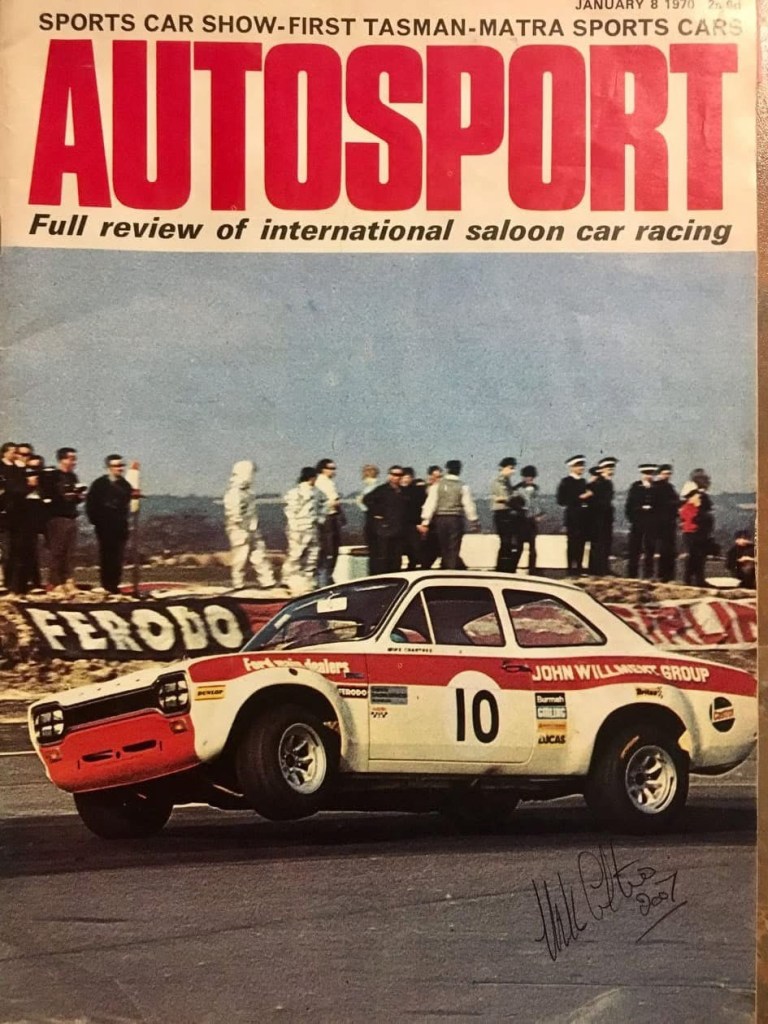
‘The Jim Richards twin-cam Mk I Escort famous in NZ motor sport, we are very thankful to Rayden and Irene Smith for saving the car and returning it to the track. Mike Crabtree raced the car in the UK and he and his family have helped piece together its early UK history.

Technical Specs: 1968 Escort Twin Cam racing car built by Willment Racing, England. Engine 1700 cc Lotus Twin Cam 180 bhp. Brakes: Disc front, drum rear. Gearbox: Ford 4 speed with LSD.

The car started life as one of the first Twin Cam Escorts made at Ford’s competition plant in Boreham, England. Ford’s public relations chief, Walter Hayes, gave the car to John Willment for race development. Willment’s facilities were south of London, and they campaigned various cars throughout the 1960s, including single seaters, Cortinas, Ford Galaxie, Cobras, GT40s and the Mk I Escort Twin Cams development, which resulted in quite a unique suspension and chassis setup.

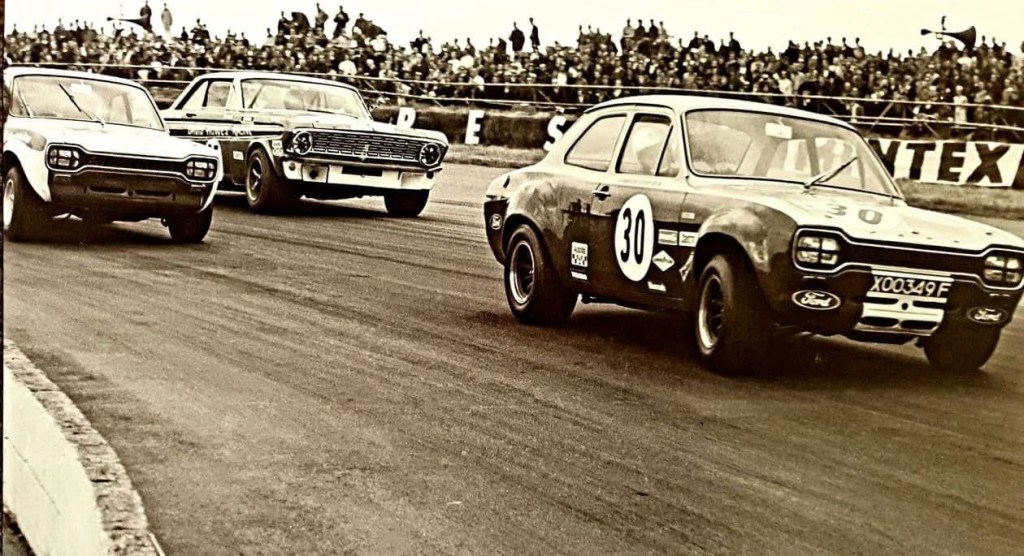
Mike Crabtree worked for Willment and raced the car to win the 2-litre class of the 1969 British Saloon Car Championship, competing alongside the Alan Mann Escort X00349F of Frank Gardner, Roy Pierpoint’s WJ Shaw Falcon Sprint and the works Britax Downton Mini Cooper S of Gordon Spice.

(NZ Hist Muscle & Saloon Cars)

Mike fondly remembers driving it on three wheels and maintains it was a very forgiving racer, something subsequent drivers have mentioned. Mike and his wife Joan have travelled to New Zealand to see the car and are delighted it is still being used as intended 50 years on.

Jim and Mary Carney of Whangarei purchased the car from Willment Racing in late 1969 and imported it to New Zealand for Jim Richards to race in the New Zealand Saloon Car Championship. Running with “Radio Hauraki” and “Carney Racing” liveries, Jim produced some great racing against much larger and more powerful machines in the golden era of NZ saloon racing. It was also used as the bridal car for Jim and Faye when they married in 1972.

Subsequent owners include Lin Nielsen and John Beattie, both racing in the OSCA series in the 1970s. Lin had the car repainted following a paint shop blaze in a bright “Fairmonte Motor Court” colour scheme. Power plants over the years have been Lotus-Ford Twin-Cam, Ford Pinto, Mazda 13B rotary, Ford BDA and back to a Twin-Cam in the 1990s.

Rayden and Irene Smith have been the car’s custodians for 30 years, and Rayden continues to use it competitively. As with many old original race cars, it is no concours “silk purse”. It wears a battle-scarred patina of 50 years of racing with several layers of old paint schemes beneath its Willment livery, and still has the bog and panel repairs from Mike Crabtree’s battles with Pierpoint, Spice and Gardner in England in 1969.

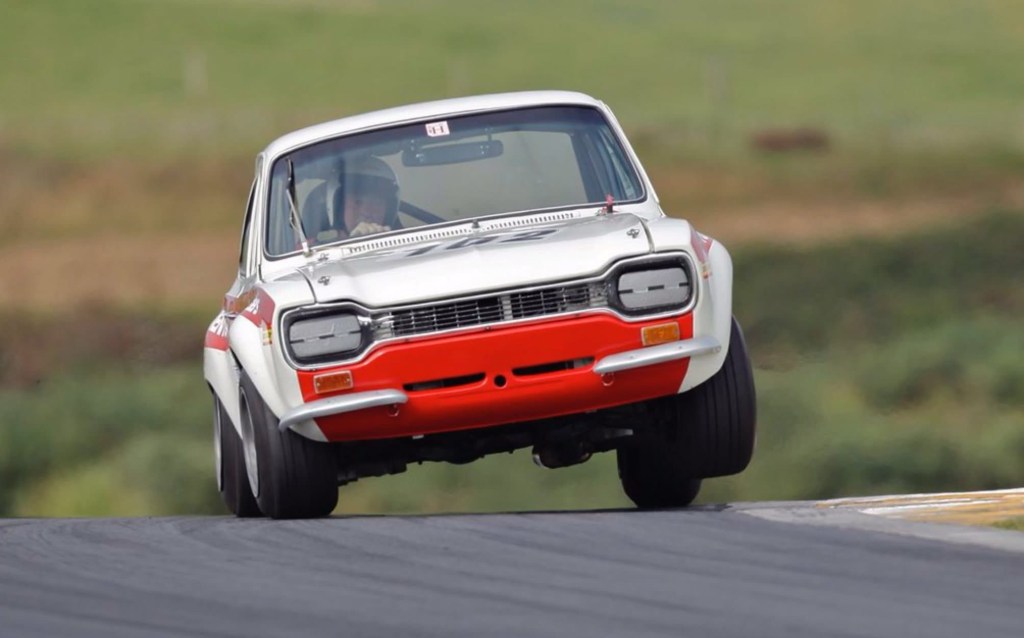
Great action shot of Rayden Smith thru turn 3 at Hampton Downs cocking the inside front wheel just as Mike Crabtree - and other Escort components – in the day (NZ Hist Muscle & Saloon Cars)

Credits…

Steve Holmes-The Roaring Season, Garry Simkin, Terry Marshall, NZ Historic Muscle & Saloon Car’s Facebook site

Finito…

(M Thomas)

These super shots of Bob Jane Racing cars contributed (mainly) by Russell Martin and James Semple to Bob Williamson’s Australian Motor Racing Photographs Facebook page are too good not to share more widely.

The machine above is the Can-Am McLaren M6B Repco 740 5-litre V8 in which John Harvey won the 1971-72 Australian Sports Car Championships. See here: https://primotipo.com/2018/09/09/sandown-sunrise/

(R Martin)

Many of Russell Martin’s shots were taken at what appears to have been a press day at Calder, perhaps in late 1970, given the cars present and their livery.

Jane’s Chevrolet Camaro ZL-1 is a Top 25 all-time Australian Touring Car, winner of the 1971-72 Australian Touring Car Championships, powered by an aluminium Can-Am 427 big block in ’71 and a tiddly 350 cast iron small block in ’72. CAMS did a parity pirouette at the end of ’71 and banned the 7-litre engine despite it being homologated, not that it made any difference to the ATCC results. What a car…

The shot above is at Calder, the one below at hell Corner during the Bathurst Easter ATCC round where Pete Geoghegan and Allan Moffat had a famous race-long dice. See here: https://primotipo.com/2015/10/15/greatest-ever-australian-touring-car-championship-race-bathurst-easter-1972/

(J Semple)
(R Martin)

A list of all of the cars Bob owned and raced would be a mighty impressive one! There were a couple of Series Production cars in this era, the Holden LC Torana GTR XU-1 shown above and a Monaro GTS 350. Southern Motors was Bob’s Holden dealership. I wonder what the Bob Jane Racing headcount was in that 1970-72 period? More here, including my attempt at a list of Bob’s racing cars: https://primotipo.com/2020/01/03/jano/

(J Semple)

John Harvey on the way to winning the RAC Tourist Trophy at Wawrick Farm on April 30, 1972, the third round of the Australian Sports Car Championship

Harves was the primary driver of this car but Bob had the occasional gallop as well. At the end of 1972 the car was parked, Castrol – if I remember the story rightly – wanted the focus to be on the team’s taxis not its single-seaters and sports car so the Brabham BT36 Waggott, Bowin P8 Repco-Holden and the McLaren were set aside in the workshop. The BT36 was sold to Ian Cook and Denis Lupton, the Bowin P8 chassis went to John Leffler and its Repco-Holden F5000 V8 engine was lent to Ron Harrop to use in his Holden EH sports sedan.

Two Australian sports car star-cars were parked for commercial reasons in this era while still in their prime: Frank Matich’s Matich SR4 Repco 860 5-litre in 1970 and the Bob Jane McLaren, both could have won the ASCC for years had they raced on…

The M6B’s life from then on was as a display machine at Bob Jane T-Marts throughout the land, the family still own it.

(R Martin)

The following excerpt from Tony McGirr’s book, ‘Gentleman John Harvey : Memories of How it Was’ related Harvey’s recollections of the McLaren M6B Repco.

‘I would rate the McLaren and my 76 Offy (speedcar) as the best cars I have ever driven in terms of driver satisfaction. I enjoyed driving them. More, I loved driving them. I was always relaxed and felt part of each car. Obviously, I won a lot of races in each, they were just sensational.

With a car such as the McLaren, it was a purpose built racing car. The engine was in the correct position. The weight distribution was perfect. Now, I’m talking about the late 1960s and early 1970s, and this was simply a fabulous motor car.

Not only that, but being a sports car, with a full enveloping body, it had style. It was a stunning looking car. When we rolled it out of the back of the transporter, people would come for miles to look at it. They would just stand there with their mouths open. They had never seen anything like it.

So, that was an added element to its appeal. By that stage too, Repco had the 5-litre V8 engines working properly. In the early days of the Repco V8 2.5-litre engines, they had lots of problems. By the time of the McLaren, they had the engines working properly. The engine we had was very reliable and very powerful.

Another thing in favour of the McLaren was the fact that it had a full monocoque chassis. Most of the sports cars I was racing against at the time, including the Elfins and Frank Matich’s early cars, were all of tube-frame construction and subject to a bit of frame-flex and twist. In the later period of Frank’s development of his cars, the SR4 was the quickest car by far. It had a 5-litre twin-cam engine. The engine we were using was a 5-litre single cam version.

Now, I’m not making excuses here, I am simply outlining the relevant technical differences. Frank’s car had another hundred horsepower, and was much faster in a straight line. However, when we came to braking, and going through the twisty bits, the McLaren would catch up every metre he had gained on the straight. In a couple of cases, he could do the fastest lap of the race, and I could match it a little later, when my fuel load went down, and we had a bit better power-to-weight ratio.

But, the final word on the McLaren – fantastic. Plus, Bob Jane had a very deep affection for Bruce. They had known one another for some years. Bob also knew Pat, Bruce’s wife. As a tragic irony, Bob and I were with Bruce the night before he died. In fact, we were in London on business, mainly to see how the McLaren was being finished off.

Now, Bruce had made that car as ‘a special’ for Bob, and the Repco engine. Because, at the time Bruce was using the 7-litre Chevy engine as a stressed member of the car’s structure, and was hanging the rear suspension off the transmission. Because the Repco engine was not robust enough (more correctly, the engines weren’t designed to be used as stress-bearing members) to be used this way, Bruce built a couple of chassis members, or pontoons, off the back of the bulkhead, to accommodate the Repco engine. He got Ron Tauranac to bring around a spare engine block so he could use that as a dummy to set up the engine in the redesigned chassis.

So, in that way, Bob’s McLaren was a specially built one-off car. Anyway, we were with Bruce on his last night. We were heading off, and back to Australia. At that time, Bruce was the recipient of the Grovewood Award, and had to go to the function that evening to receive the award. This was a very prestigious award in those days. Anyway, Bruce had forgotten to bring his best suit, and it was too far to go home to get it. Bruce and Bob were about the same size. Both were short, stocky types, with solid shoulders.

Bruce was inclined to brush the whole thing off and said, ‘Ah well, it’s only a suit’. Bob insisted that he be able to lend Bruce his own new suit that he had in his bags. So, off went Bruce to collect the award in Bob’s new suit. He thought that was terrific.’

Repco-Brabham – Repco from 1969 – the RB740 all aluminium, SOHC, two-valve, Lucas injected 5-litre V8 is quoted by Repco as having 460bhp @ 7500 rpm and weighed 360 pounds (R Martin)

‘With the international time difference, and the time it took our flight to get back to Sydney airport, there on the front page of the Sydney Morning Herald were the words, ‘Bruce McLaren killed’. We couldn’t believe it. We had been with him just the night before.

So, that was a really sad end to our trip. After that, the McLaren became an extra special car for Bob. Particularly so because he was the one who owned it. It became special for me for the period in which I drove it. I think Bob drove it a couple of times, but basically, that was my car for the whole period of its racing career.

We retired the car at the end of the ’72 championship, and the car has never been raced since. They have restored it twice. When I say ‘twice’, I mean the first restoration was pretty good, but the second was exceptional. The only person who has driven it since, was when Denny Hulme drove it at the ’85 Grand Prix in a parade lap (below). Bob wanted me to drive it last year, or the year before, at the Grand Prix at Albert Park. I was really looking forward to that, except that the engine had traces of water in the oil, and the whole thing was cancelled.’

(Bob Jane Racing Heritage)
M6B sales chick. Bob Jane T-Mart, Parramatta Road, Granville in June 1976, with the nose of Jane’s Maserati 300S, which had been restored by Jim Shepherd (spelling? not John Sheppard) not long before (Cummins Archive)

‘Bob is probably the only person in the whole world who was an original owner of a McLaren race car, and who still owns it. It has never changed hands, and while ever Bob lives, it will never change hands.

Was the McLaren finicky’ to set up? I ask this in reference to modern Formula One cars, which they fool around with all the time. There are so may adjustments on modern cars, it seems to take them forever to set them up properly.

We didn’t have the same range of adjustments on the McLaren. Today, on almost everything, they have electronics. They have sensors all over the cars. The driver now has nowhere near the input we had in those days.

Mechanically, things are still somewhat similar. They still have suspensions with wishbones, springs, shock absorbers, roll-bars, and brake adjustments. The major difference is that we didn’t have any aerodynamic features to worry about, and we were on treaded tyres.

My first response when I sat in the McLaren was to say that the arches on the front mudguards were too high. Bruce had been using a much taller tyre. Technology was changing, and the result was we were using a smaller diameter tyre. We had the tyre sitting low down, and the crown of the mudguard up high. This made it pretty difficult to see your proper racing line.

We finally lopped the top off the big, tall radius of the front mudguards. We had a stylist do it, and I still think it was all for the better for the aesthetics of the car. It looked more balanced. It looked much nicer. Certainly, the newer rubber worked to enhance the performance of the car.

But, apart from that cosmetic change, we changed very little. Things like springs, we never had to change. Bruce had the springs made from this fantastic spring steel, and that meant that the springs never sagged. On other cars that I had raced with locally made springs, you had to be checking them all the time. You had to check them for installed height, static height, and compressed height. You had to take dimensions of these things all the time, because the springs would sag. This could lower your ride height, and all sorts of adverse things could happen as a result.

The springs in the McLaren – and the Brabham – we never had to touch. From that point of view, it was just shock absorber adjustments and wheel alignment. This was very important for the geometry of the front end. Adjustment of the rear ride height was also critical. Other than that, it was pretty much trouble-free. And as I said, by that time the engines were pretty reliable, so we had a good finish rate. It was a lovely car to drive. I just enjoyed driving it so much.’

(R Martin)
(R Martin)

This ridiculously long epic on Allan Moffat covers the development of the Shelby Trans-Am Mustangs, Bob’s Mustang 390 and Shelby Mustang above get guernseys too: https://primotipo.com/2020/03/06/moffats-shelby-brabham-elfin-and-trans-am/

Allan Moffat organised the purchase of a Shelby Mustang (car #3 above) for John Sawyer and Bob Jane in late 1968. Jane’s car was one car raced by Horst to victory at Riverside. VIN#8RO1J118XXX was the very last of the 1968 K-K/Shelby cars built and had only raced three times in the hands of Dan Gurney, Peter Revson and Horst.

Happily for both Jane and Moffat, it was soon on its way to Australia with Moffat expecting to race the hand-me-down Mustang GT390 in 1969 whilst his team-owner raced the near-new car, on the face of it the pair were a strong combination for the ensuing year…This story is told in the piece linked above.

Bob Jane, Ford Mustang 390, Phillip Island paddock circa- 1968 (R Martin)
(R Martin)

The Jane V8 Repco was one of the few short-lived Bob Jane Racing cars.

The Bob Britton/Rennmax Engineering-built machine was campaigned by Harvey in the 1970 Australian Gold Star Championship, the last ‘Tasman 2.5 Era’ Gold Star.

When Harvey was first recruited by Bob after Spencer Martin’s retirement at the end of 1967, Harves inherited the Brabham BT23E Repco-Brabham 2.5 V8 Jane acquired from Jack Brabham at the end of the ’68 Tasman Cup.

John was nearly killed in it at Bathurst during that year’s first Gold Star round over the Easter long weekend. Harvey then raced it throughout 1969 and into early 1970 as related in this article:

John Harvey being looked after on the Oran Park 1970 grid by John Sawyer, Jane Repco V8. That’s Max Stewart alongside in Alec Mildren’s Mildren Waggott TC-4V

The Jane Repco V8 used the same pair of ex-Jack Brabham 295bhp @ 9000 rpm Repco 2.5-litre 830 V8s fitted to the BT23E, but the chassis – built on Britton’s BT23 jig – had revised suspension geometry to suit the latest generation of ever-evolving and widening tyres and other changes including the bodywork. As the story below relates, John could, woulda, shoulda won that Gold Star…The car has lived on, in ANF2 form, for many years in a WA museum I think.

Jane Repco V8 (R Martin)
(R Simmonds)

Jane in the Jaguar E-Type Lwt at Calder, and the Elfin 400 Repco-Brabham 620 4.4-litre V8, perhaps on the same day below circa-1967, again with Bob at the wheel. See here for a piece on Bob’s E-Types: https://primotipo.com/2018/04/15/perk-and-pert/

(R Simmonds)

Elfin 400 Repco 620 620 4.4-litre V8 in Bob Jane’s hands at Calder circa 1967, above as I say, and in the Phillip Island paddock below, a little later 1968’ish; note the more substantial roll bar and rear spoiler in the shot below.

I’ve written at great length about Garrie Cooper’s Elfin 400s generally here: https://primotipo.com/2015/05/28/elfin-400traco-olds-frank-matich-niel-allen-and-garrie-cooper/ and about Bob’s car here: https://primotipo.com/2018/04/06/belle-of-the-ball/ so I’m loath to rabbit on again. Long stories, sad ones too.

(R Martin)
(J Semple)

Bob Jane – yep, I know it’s Harves number – in one of his favourite cars, the John Sheppard built Holden Torana GTR XU-1 Repco-Brabham 620 4.4-litre V8 at Warwick Farm in 1972.

The Total and Castrol Bob Jane Racing thing seems to be a 1972-73 commercial relationship. I’m not sure how the two oil companies co-existed on the cars, but doubtless one of you taxi-fans will know the answer.

The Torana was born as a consequence of the growth in interest in. sports sedans and the availability of the Repco-Brabham 620 4.4 V8 in Janes workshop. After Bevan Gibson’s fatal Easter Bathurst 1969 crash in Bob’s Elfin 400 Repco 4.4, the remains, sans engine, were sold to Victorian Ken Hastings. Less than a year later the engine was put back into work…

Jane on the bonnet of the XU1-Repco (J Semple)
(J Semple)

Harvey’s Torana sports sedan (above and below) leads Allan Moffat’s Mustang Trans-Am 302 and Bob Janes Holden Monaro HQ GTS 350 – both improved tourers – at Warwick Farm in 1972. The Monaro was another Sheppo build of course.

Ray Bell tells me that it’s the ‘November 5, ’72 meeting, Moffat won. Harvey retired after two laps in the early race, but not before he had pointedly moved over off the grid to block Moffat. In the second race Pete had diff troubles after forcing his way to second and dropped back so it was Moffat, then Harvey and Jane at the finish. This was when Moffat did a 1:37.5.’

(J Semple)
(J Semple)

Beauty and The Beast Torana sports sedans.

The aluminium SOHC, Lucas injected 4.4-litre 400 bhp @ 7000 rpm, 360 pounds, Repco RB620 V8 powered, John Harvey driven, Bob Jane Racing Holden Torana GTR XU-1 chased by the cast iron, pushrod, Lucas injected 5-litre 475 bhp @ 7000 rpm, 485 pounds, Repco-Holden F5000 powered, Colin Bond driven, Holden Dealer Team Holden Torana GTR XU-1 at Oran Park. Ray advises that Harvey won both these encounters during the May 1973 meeting.

See here for the HDT Beast: https://primotipo.com/2016/10/12/bondys-bathurst-beast/

(J Semple)

Yep, 350 Chev under that thar’ bonnet!

John Sheppard was prolific when he joined Bob Jane Racing, there were some seriously fast racing cars run by Bob in the Sheppo era including the Chev Camaro ZL-1, Holden Monaro HQ GTS 350, Holden Torana GTR XU-1 Repco, McLaren M6B Repco, Brabham BT36 Waggott TC-4V and Bowin P8 Repco-Holden. Sheppo scratch builds are the Monaro and Torana.

(J Semple)

Jane in the Monaro from Pete Geoghegan’s Ford GTHO Super Falcon 351 in its definitive, post-John Joyce-Bowin Designs rebuilt form at Warwick Farm in 1972. Probably the same race as three pics back, touring cars were sooooo fuckin’ good back then! Totally unlike the bullshit parity-sameness dog’s bollocks of today. Bob on the WF grid below on the same day.

(J Semple)
(I Smith)

Calder March 1979, it looks like Janey is wearing the same Bell Magnum open-face helmet he was using a decade before – same Monaro but wilder sports-sedan specs – it was an improved tourer when first built way back in 1972.

(I Smith)

Bob Jane’s Pat Purcell built Chev Monza 350 at Dandenong Road, Sandown in December 1980. Amazing car, time to do an Auto Action under the skin piece on it with the unpublished shots we have…

Credits…

James Semple, Russell Martin, Ian Smith, Murray Thomas, Australian Muscle Car, Cummins Archive, ‘Gentleman John Harvey : Memories of How It Was’ Tony McGirr, Ray Bell

Finito…

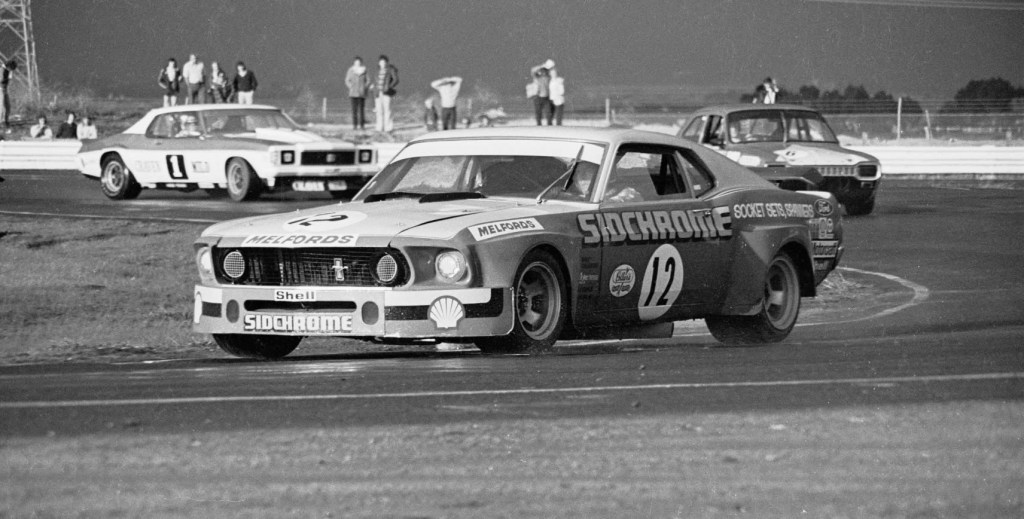
I was at Sandown on the dull, wet, cold Sandown July 6, 1975 weekend that Jim Richards debuted his Ford Mustang Boss 351, he won twice in front of local hot-shots, including Allan Moffat’s Ford Capri RS3100, John McCormack’s Chrysler Charger Repco-Holden V8 and others.

Jim had special dispensation to run his Kiwi wheel-tyro combo, which was more generous than the ten-inch-wide rule here. The experts thought that would bring him back to the field…it didn’t! He took 13 wins from 30 starts that year, 27 of them podiums.

(I Smith)

The amazing thing about that Murray Bunn-built car, long-term friend and JR collaborator, is that it wasn’t nearly as exotic as most of the Australian front-runners of the day: John McCormack’s Chrysler Charger Repco-Holden, the Bob Jane Racing Monaro and Torana Chev raced by Bob and John Harvey, Bryan Thomson’s VW Chev V8, Allan Moffat’s Ford Capri RS3100 and Pete Geoghgan’s Holden Monaro GTS 350.

Bonnet off during the Baskerville 10,000 Sports Sedan meeting (T Johnson)

It was lightened a bit, but the suspension front and rear wasn’t wild, it had a Ford nine-inch rear and Borg Warner ‘box, nothing special so far. The Gurney-Eagle aluminium-headed, Lucas-injected Cleveland 351 V8 was Murray’s too, now that was really trick! And mounted well back in the chassis, as you can see from these shots.

Calder 1975, Jim in front of Mike Stillwell’s Ford Escort BDG 2-litre and Pete Geoghegan’s John Sheppard built Monaro GTS350 Chev (I Smith)
(S Elliott)

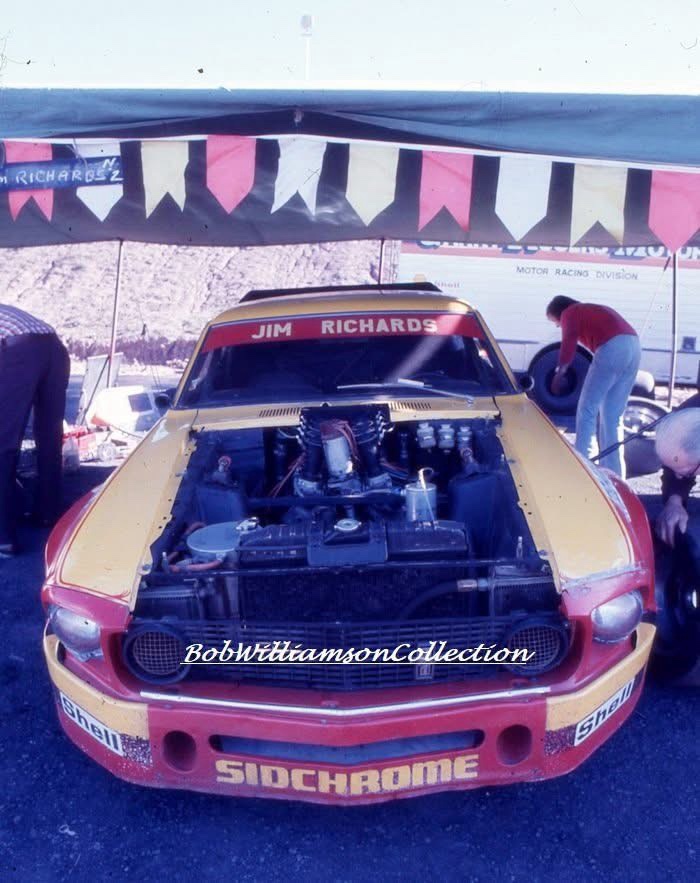
When it became time to build the Mustang’s successor, Jim Richards again turned to Murray Bunn to build the replacement Ford Falcon GT351 Hardtop sports sedan, with the only major carry-over item the raucous, roaring Cleveland Gurney-Eagle injected 351.

The shot above shows Murray Bunn and his apprentice, Murray Smith, setting up one of the two Hewland transaxle casings within the Hardtop’s multi-tubular spaceframe chassis in Bunn and Cumming’s Takanini premises just southwest of Auckland during 1977.

(S Dalton Collection)

I was rummaging through Auto Action’s JR photo files and found an untouched envelope of 12 under-the-skin photographs that have never been published until now. So, if you are a Ford or Jim Richards fan, grab a copy of Auto Action Premium issue #1908, which is still for sale in Australia for another fortnight.

Ford supplied the shell and pressed door, bonnet and roof panels in aluminium. The car taking shape at Bunn & Cummings, Takanini, NZ in 1977. Wheels bespoke castings to suit Eagle/McLaren magnesium uprights (S Elliott)

The car was fast right outta the wrapper, the only thing between Jim and the 1978 Australian Sports Sedan Championship won by Allan Grice’s superb, but category-rooting Chev Corvair V8 was the lack of a spare engine.

Despite that, his new, unsorted car bagged more points than Gricey, but the rules then had that ‘drop your worst result bullshit’. Anyway, have a read of the 4,000-word, eight-page and 25-photograph piece.

Jim was superb to work with, so too was the Beast’s restorer, Graham Booth; the car’s historic demonstration re-debut isn’t too far away!

Richards at Calder in 1981 (P Husband)

Credits…

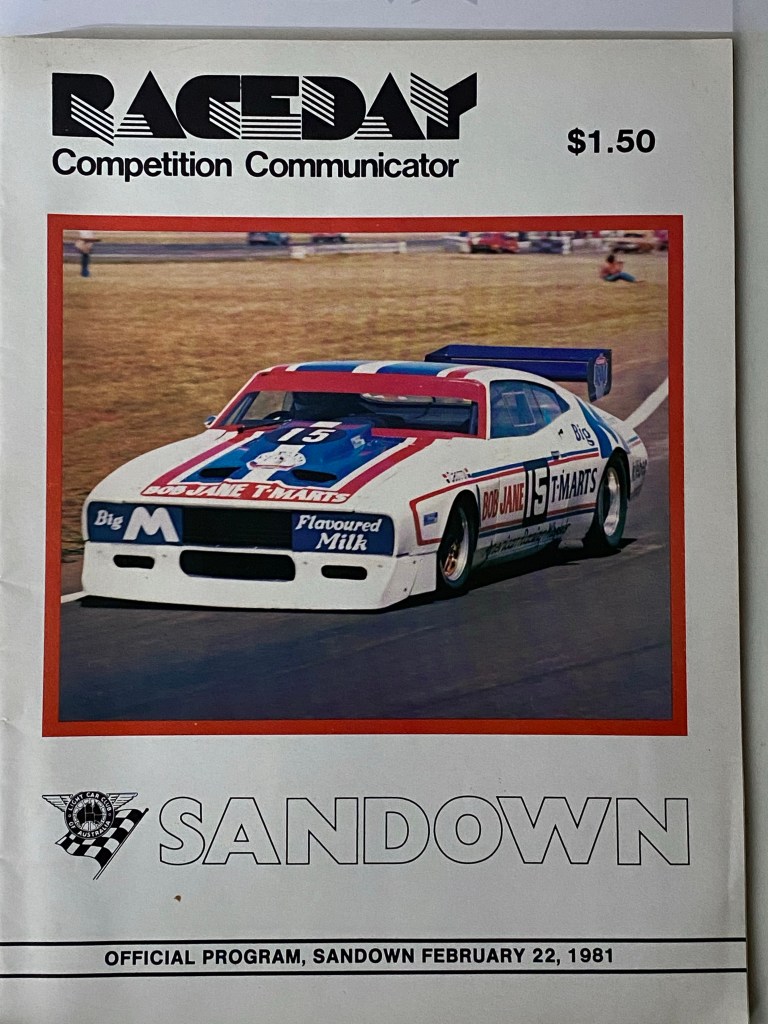
Chequered Flag, Terry Johnson, Ian Smith, Steve Elliott, Peter Husband, Competition Communicator Stephen Dalton Collection, Bob Williamson Collection

Tailpiece…

(S Elliott)

Finito…

My ignorance of what is right under my nose never ceases to amaze me.

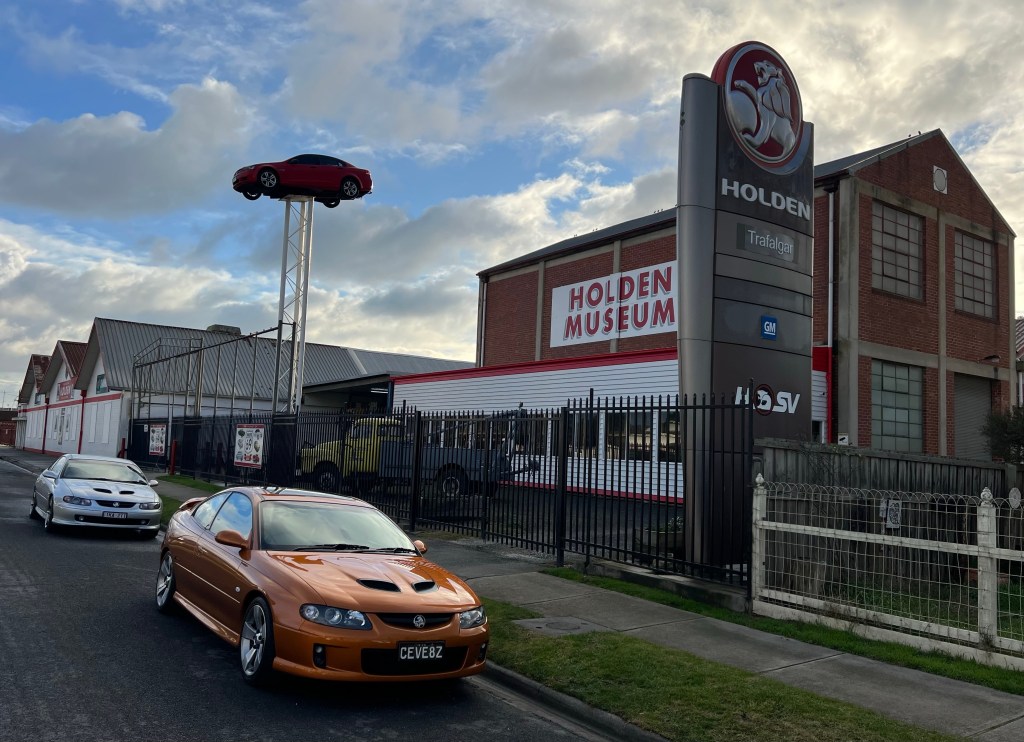
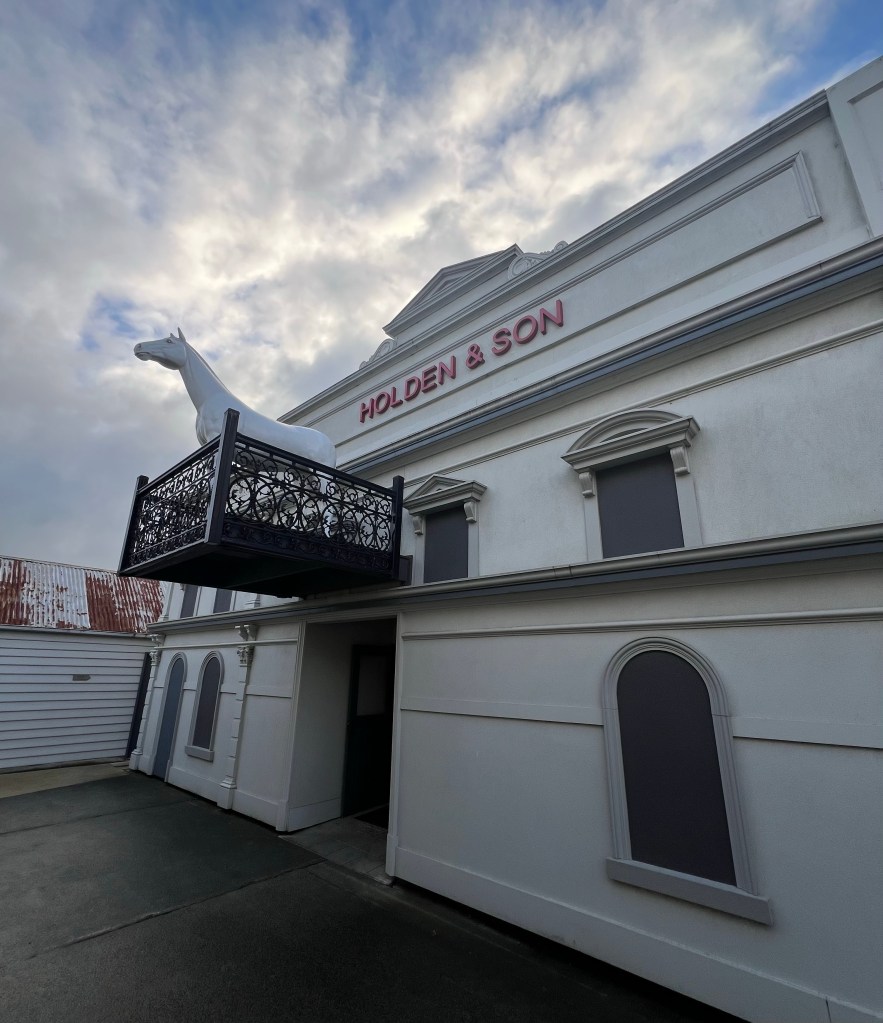
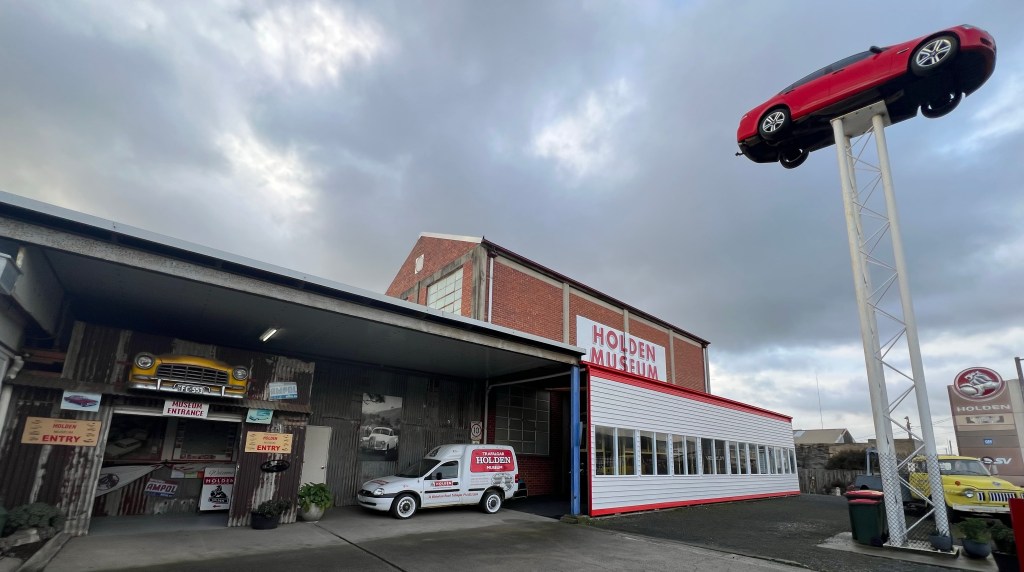
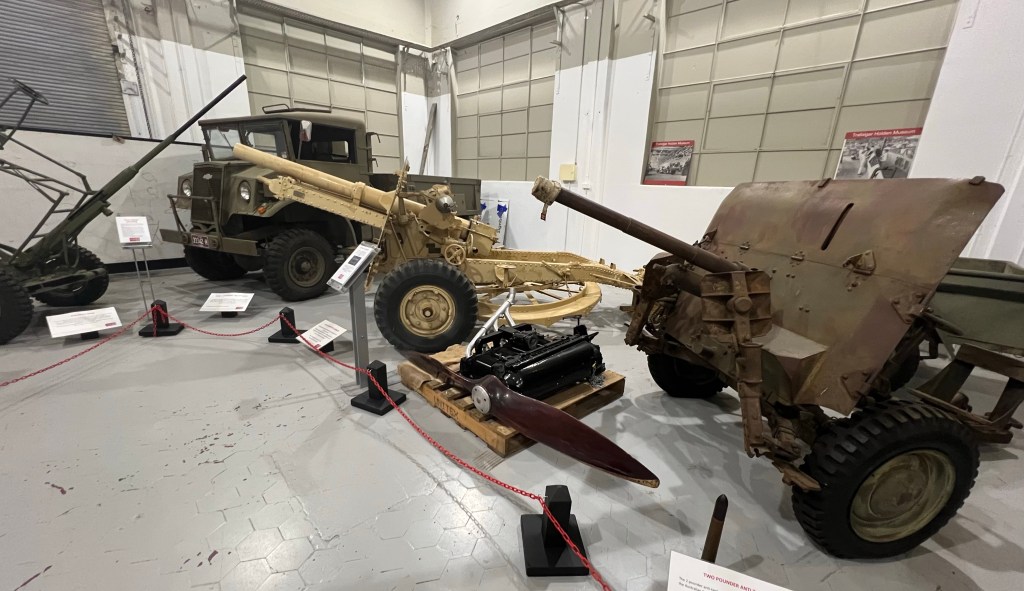
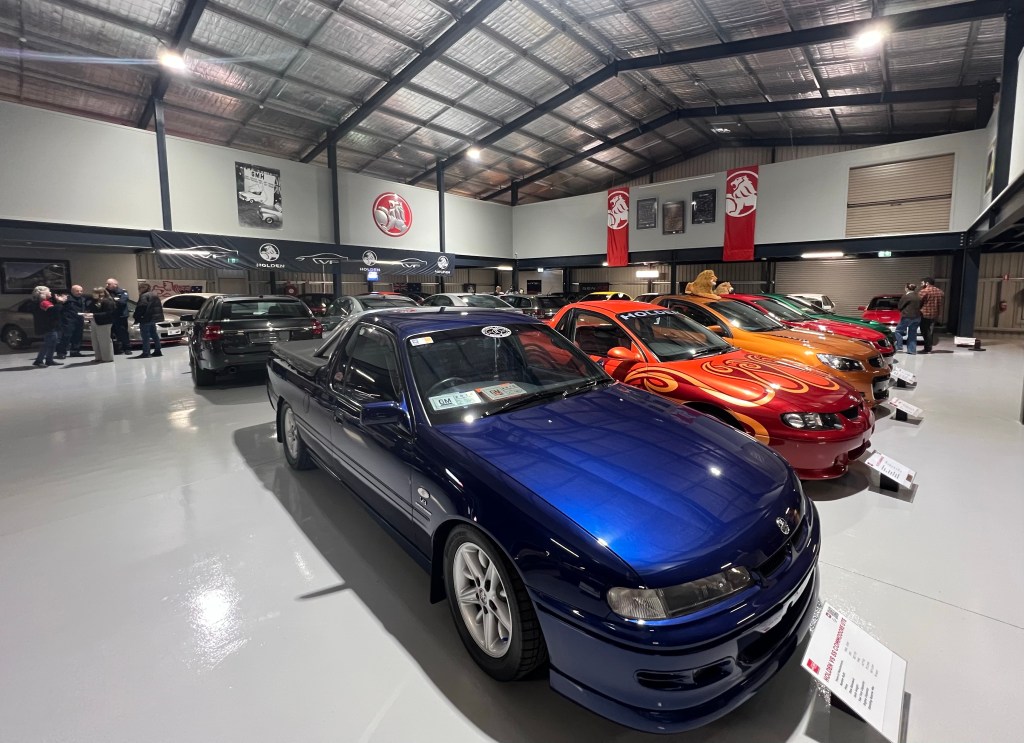
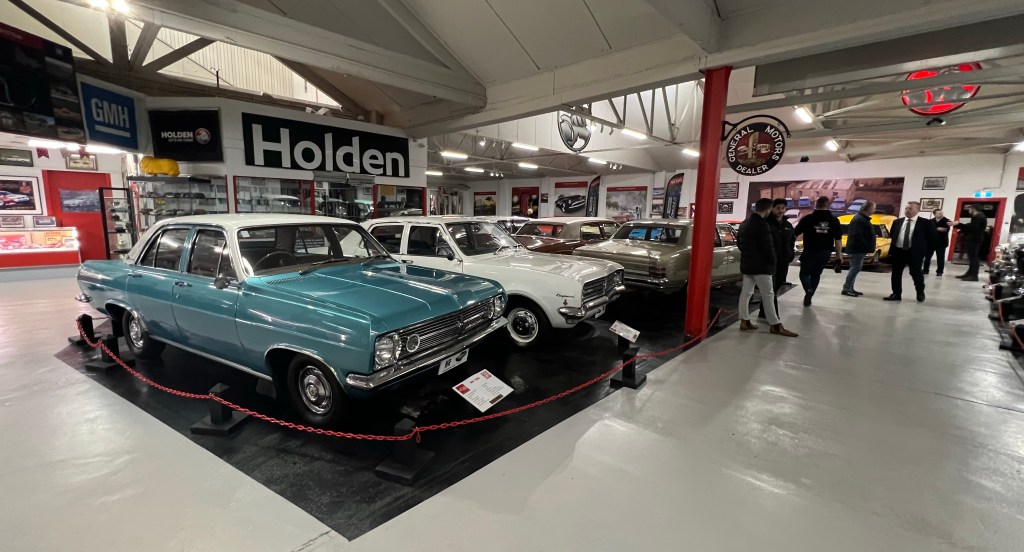
Despite the Trafalgar Holden Museum celebrating its tenth birthday in 2024, I was unaware of its existence until invited along to the official opening of the Neil Joiner Heritage Centre Building on the site of the old Trafalgar Butter factory, 74 Waterloo Road, 125 km north of Melbourne on the Princes Highway.

My invite was as Big Bad Brucie Williams’ bitch, publisher of Auto Action.

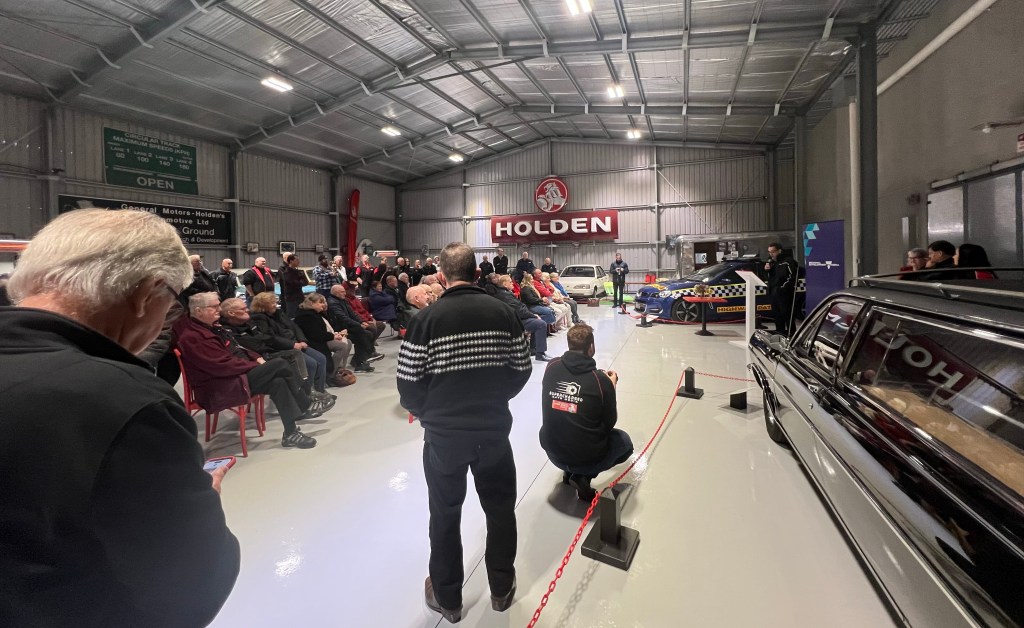
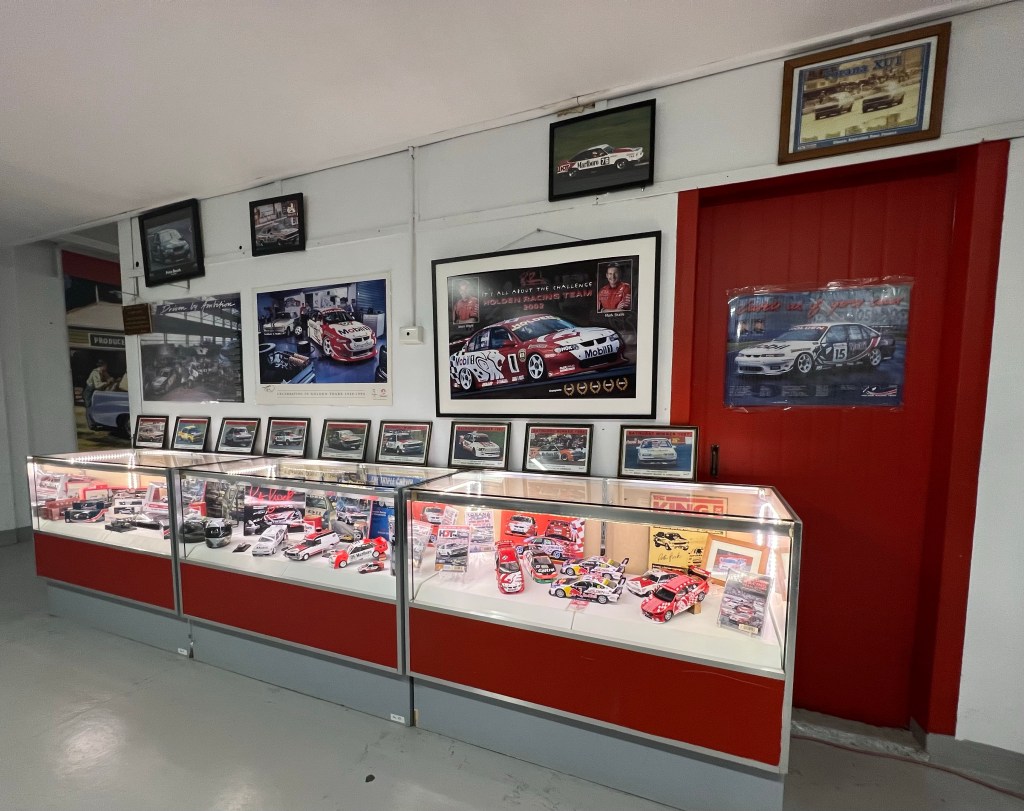
250 of the Holden party-faithful attended in a mix of old and new buildings, which house a collection of 150-200 Holdens and memorabilia. The ceremony was performed by the Victorian Minister for Tourism, Sport and Major Events, Steve Dimopoulos.

Dimopolous recognised and applauded the passion of Neil Joiner and his family, he told Auto Action that ‘It’s a magnificent facility, a really important part of Victoria’s industrial and automotive history. We were proud to provide $470,000 to assist in building a museum that will be good for the local economy.’ 

Local businessman Joiner, who died in 2024, was a dedicated Holden enthusiast who focused on transforming the old butter factory into a Holden museum after his retirement in 2007.

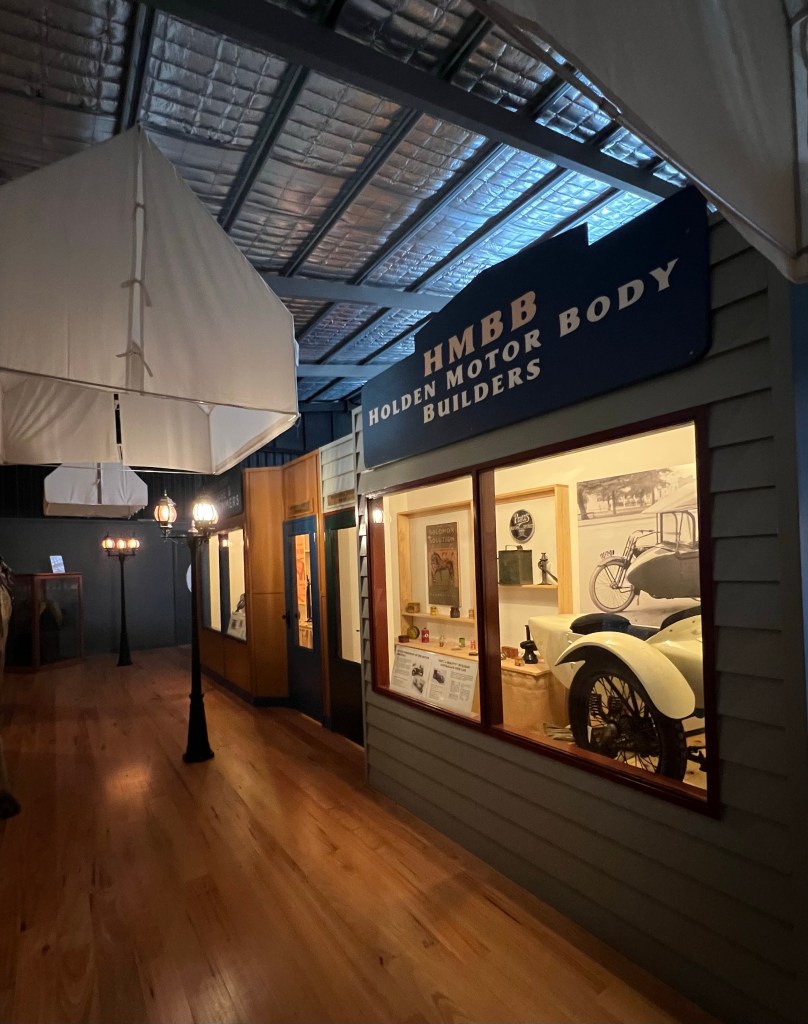
I was aware of Holden’s past as an Adelaide coach builder of horse-drawn buggies long before its automotive growth, but not its far-distant past as a saddlery. This aspect is cleverly explored in an older building recently made over for that purpose.

Joiner’s vision wasn’t just about the cars. It was telling the whole story from the early saddlery and buggy era, armaments made during World War 2, the Frigidaire range of home products and the cars from Holden-bodied Buicks to the last ZB Commodores. 

Joiner tipped in his entire collection of cars and memorabilia and Holden came to the party too, with 27 of about 80 cars they have spread throughout Australia.

There was a strong presence of Holden identities including Chris Payne, Paul Beranger, Richard Ferlazzo, author/historian Norm Darwin, Erebus’ Chris Payne, Jason Bargwanna, Garry and Barry Rogers, plus an army of enthusiasts.

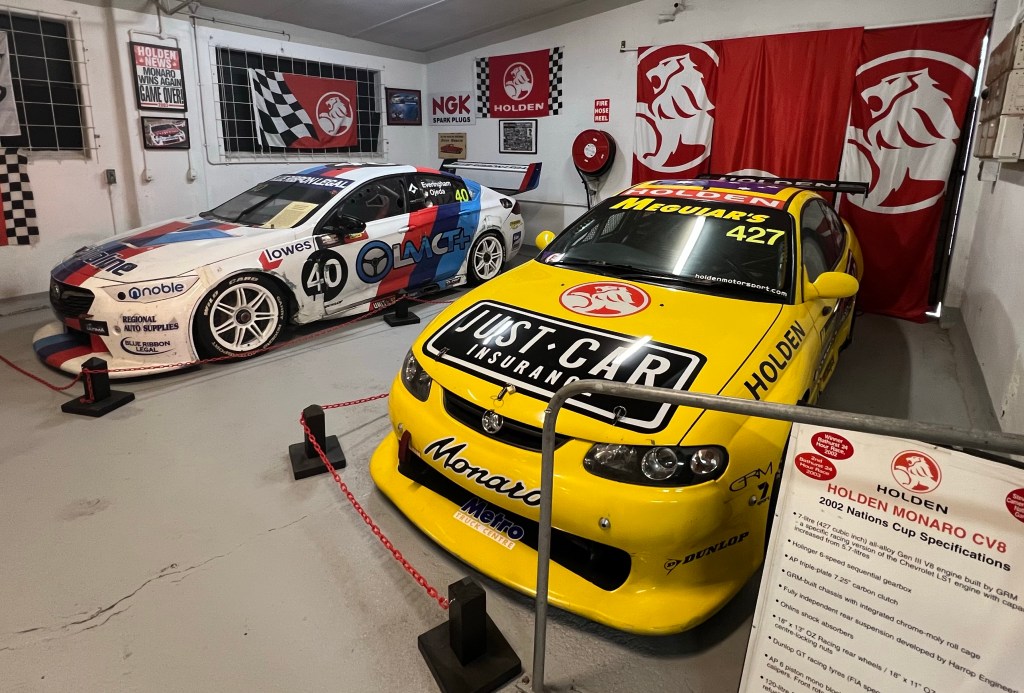
Rogers owns a farm closeby and has supported the museum with two cars on display, a 2002 Nations Cup Monaro CV8 427 (foreground) and the ZB Commodore Supercar (at rear) raced by Tyler Everingham and Jayden Ojeda to 19th place in the 2019 Bathurst 1000. The car looks magic in as-finished-Bathurst condition.

Holden Monaro CV8 2002 Nations Cup Specifications (yellow car)

GRM-built chassis with integrated chrome-moly roll cage

7-litre (427 cubic inch) all-alloy Gen III V8 engine built by GRM a specific racing version of the Chevrolet LS engine with capacity increased from 5.7-litres. Holinger 6-speed sequential gearbox, AP triple-plate 7.25″ carbon clutch

Fully independent rear suspension developed by Harrop Engineering, Ohlins shock absorbers. AP 6 piston mono block front calipers / 4 piston mono block rear calipers. Front rotor – 375 x 35mm, rear – 343 x 35mm

18″ x 13″ OZ Racing rear wheels / 18″ x 11″ OZ Racing front wheels-centre-locking nuts, Dunlop GT racing tyres (FIA specs)

120-litre FIA-approved racing fuel cell with Siamese dry-break refuelling system. GRM-designed and developed carbon-fibre / Kevlar composite aero package. Motel onboard engine and dash management system. 4 onboard air jacks

The museum is a must-visit for all car nuts, not just the rusted-on Holden diehards. I’m a Ford man, I’ve never owned a Holden, but Dad had plenty of them as company cars – remember that pre-FBT perk?! – So I’ve plenty of experience driving them as well as having plenty of firsts inside Holdens! Like most of us over 15, I suspect.

What did he have now I think of it? EH Wagon three-on-the-tree and then autos: HD, HR and HK wagons, then HG and HQ Premier sedans before switching to the dark side with an XB Fairmont and Fords thereafter.

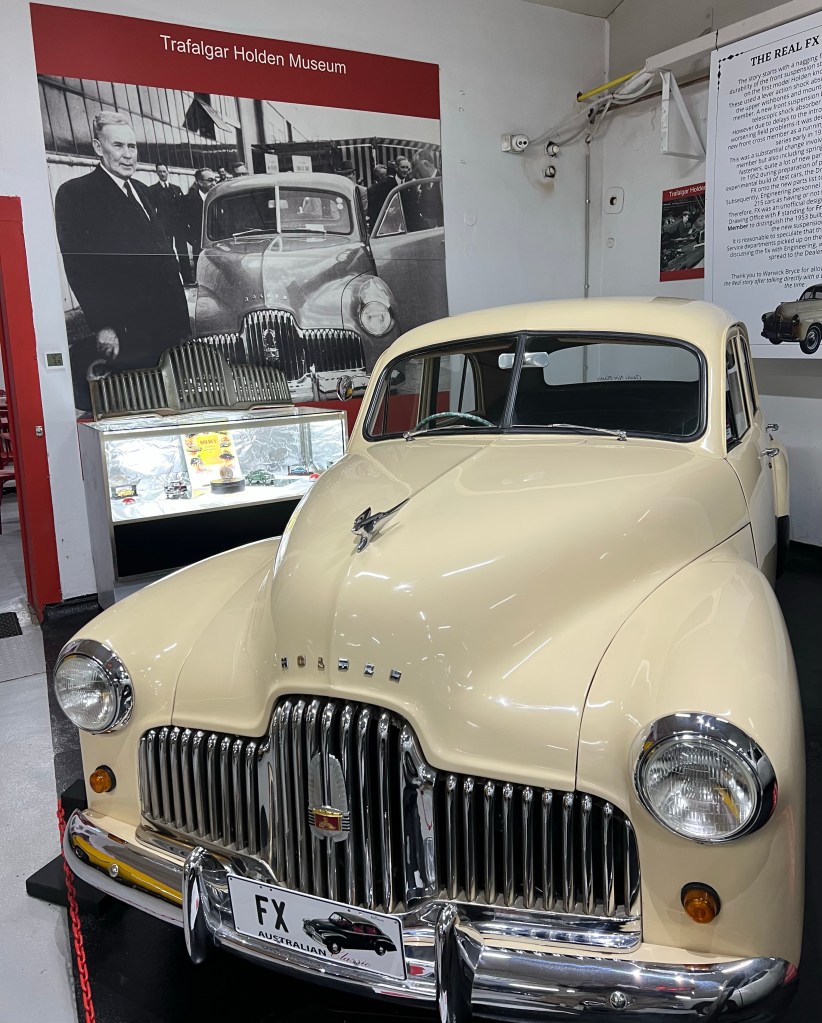
What follows is a random potpourri of shots of cars and exhibits that caught my eye. The verbiage is the Museum’s not mine. Do go up and have a look, its really great.

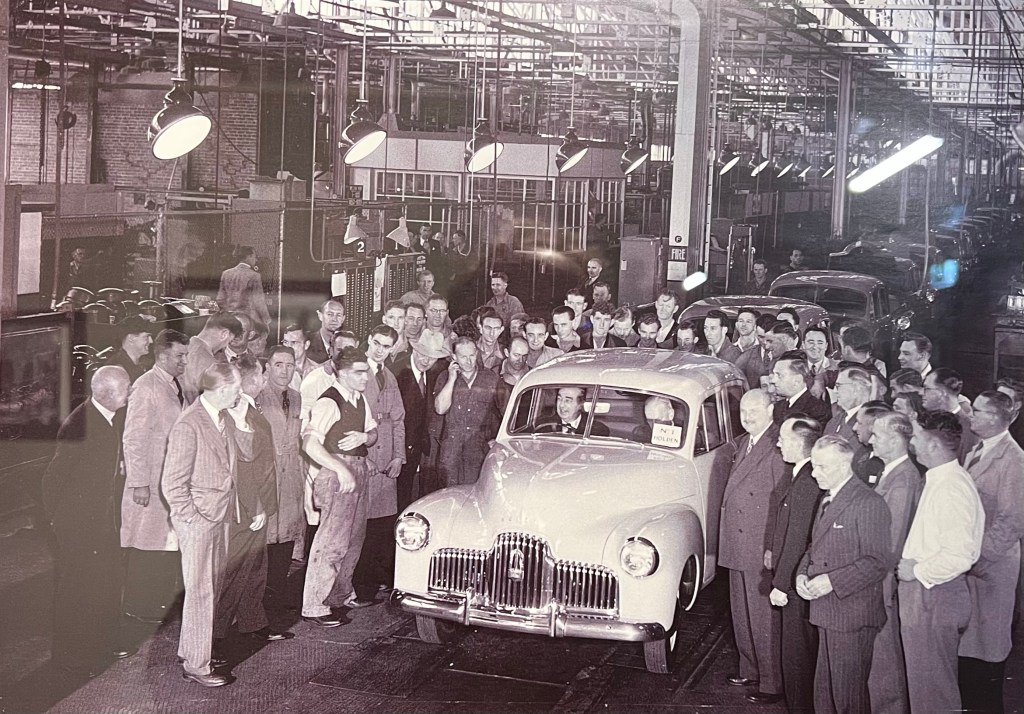
The first Holden 48-215 to roll off the Woodville production line on November 1, 1948, was driven by Holden’s MD, Harold Battle, with engineer Russ Begg alongside. See here: https://primotipo.com/2018/12/06/general-motors-holden-formative/

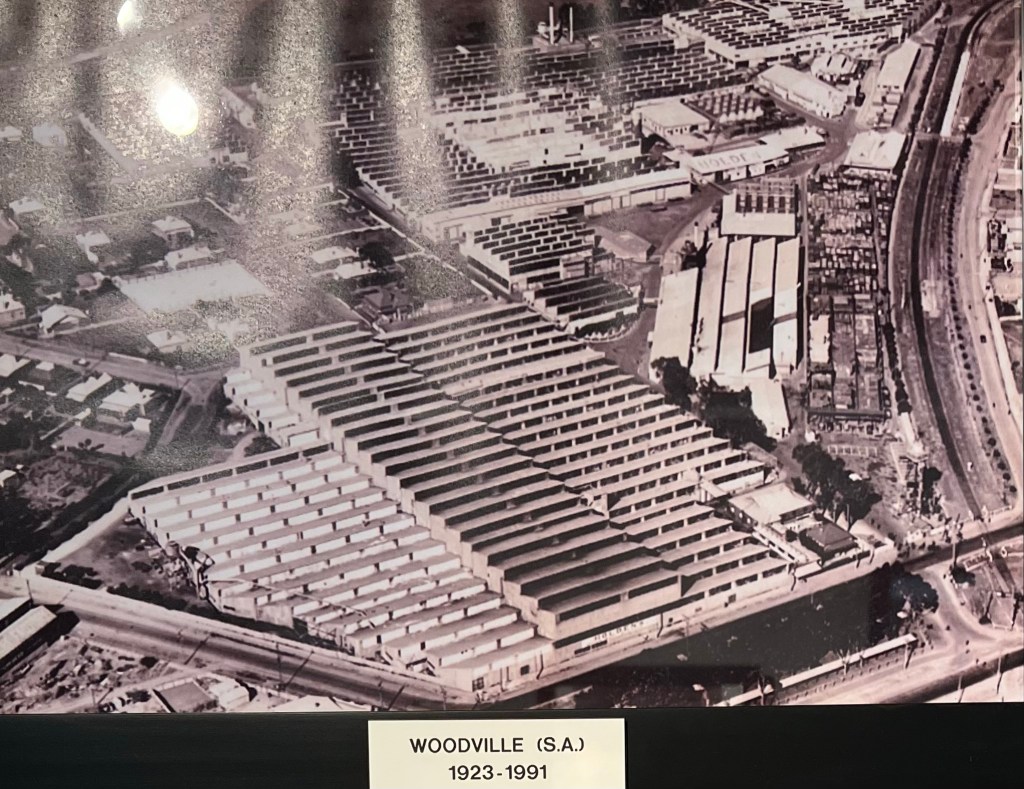
Woodville Plant, South Australia…

‘Throughout Holden’s 158-year history, SA has been the source of horse drawn coach and automotive body manufacturing engineering development and production for the company.

First automotive bodies were designed and manufactured in 1917, meaning Holden was in the automotive manufacturing business for 100 years by the 2017 closedown of manufacturing.

Established in 1919, known as Holden’s Motor Body Builders Ltd. (HMBB) manufactured bodies at its King William St Adelaide factory and at Woodville from 1925 where it employed 5,500 people.

HMBB made bodies for 40 different brands of cars. Over half a million bodies were made before the Holden 48-215 was launched. Exporting of bodies commenced in 1939.

Within the first few years of operation Woodville became one of the biggest body manufacturers in the world as well as being the sole supplier of car bodies for General Motors in Australia. GMH was formed by the merging of HMBB with the assembly plants previously operated by GM Australia.

Forced by Australia’s isolation during WW2, the need for innovation, improvisation and invention was paramount in all Holden plants. Woodville became the largest producer of war related equipment and supplies within GMH.

After the war, major advances in body manufacturing engineering, sheet-metal press tooling, body assembly jigs and fixture design together with press and body assembly production systems centred around Woodville.’

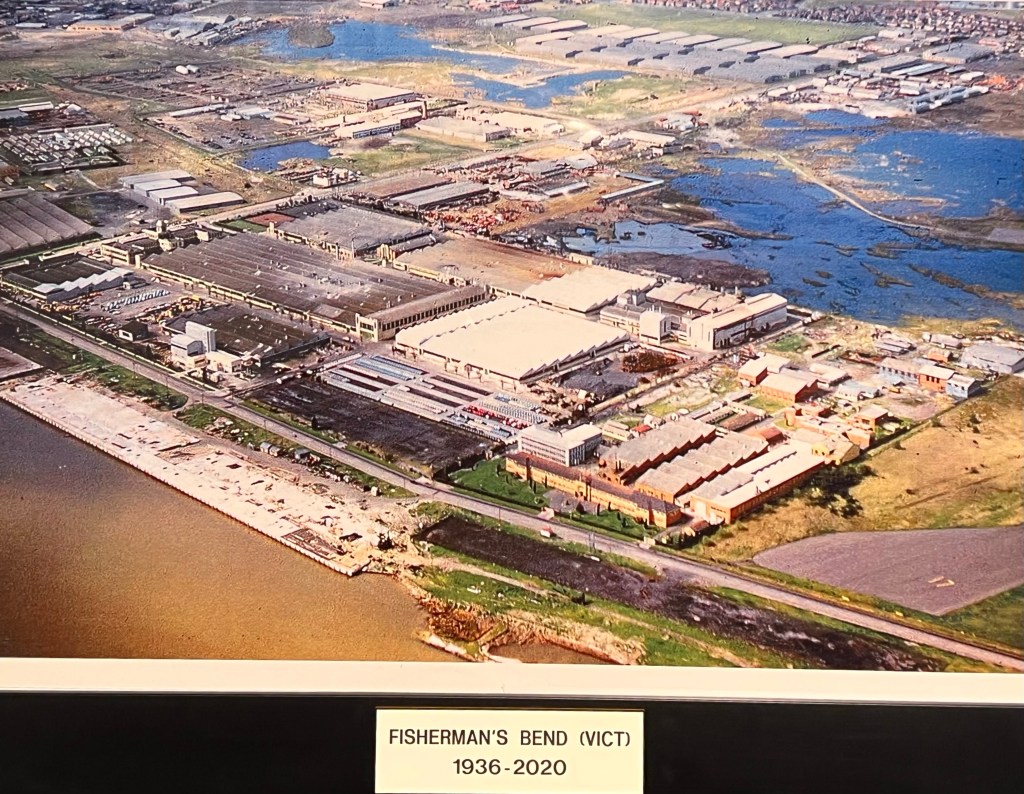
Fishermans Bend, Melbourne…

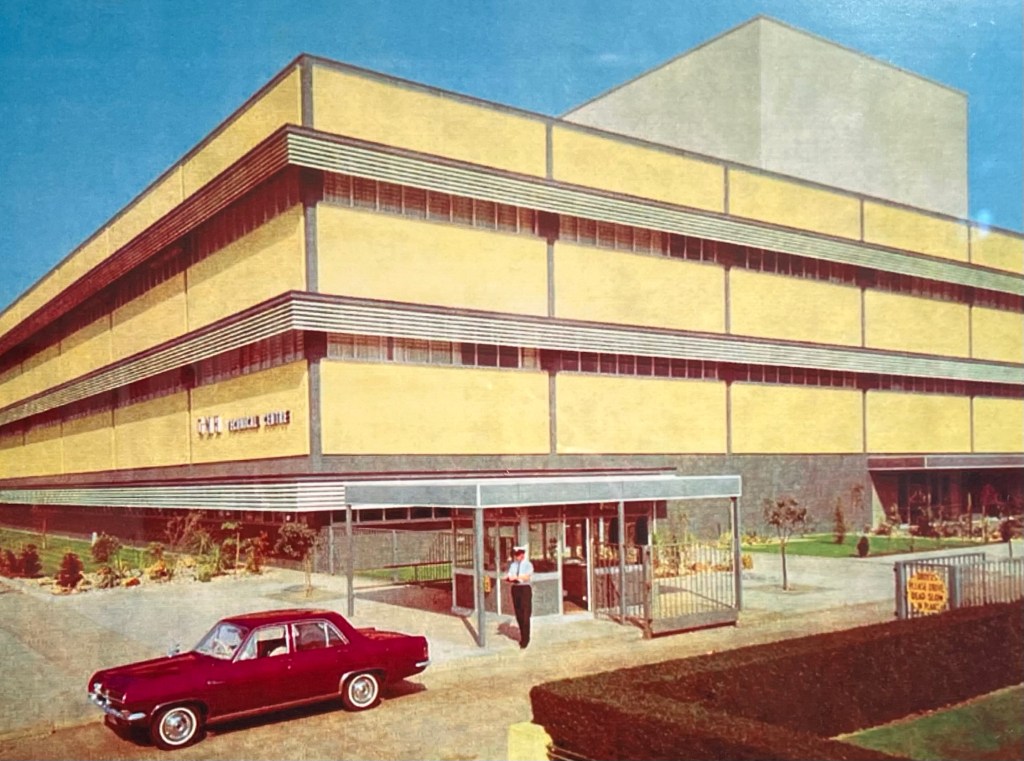
‘Head office was transferred from SA to Fishermen’s Bend, Melbourne. Opened in 1936, Fishermans Bend (correct spelling) became Holden’s headquarters, as well as its product design and product engineering centre.

During WW2 it produced a vast array of war equipment, including the development and production of many types of trucks. Critical to Holden’s future was the introduction of a world class foundry duringWW2 to produce engine blocks and heads.’

‘The plant assembled the first Holden car, the 48-215, based on fully trimmed bodies being supplied from Woodville, South Australia, and most mechanical components being made in Fishermans Bend plants. It produced the vast majority of the mechanical components in the car including the engine, transmission rear axle and suspension components. This was at a time when the Australian automotive supplier industry in Australia was not well developed, so Holden manufactured a lot more of the car internally.’

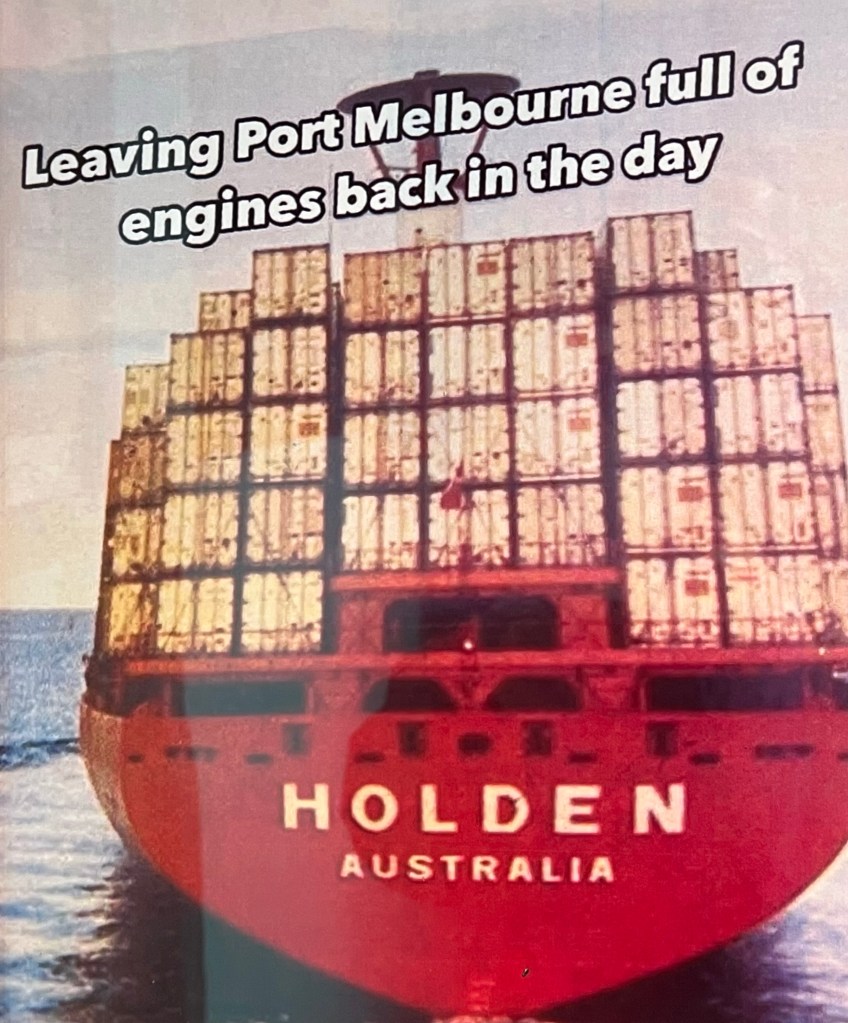
‘In 1956 vehicle assembly in Victoria was relocated to a new Dandenong plant. The Fishermans Bend plant was reconfigured to concentrate mostly on engine manufacture for domestic and for 4-cylinder export territories. It became Australia’s largest exporter of elaborately transformed goods. The famous 6 cylinder in line and V8 Holden engines were produced here.’

‘Fishermans Bend went on to produce a peak of 960 engines per day up until November 29, 2016, when it was closed after 76 years of engine manufacturing.’

Export

‘Holden had a significant program running for many decades beginning with the FJ exports to New Zealand in 1954.

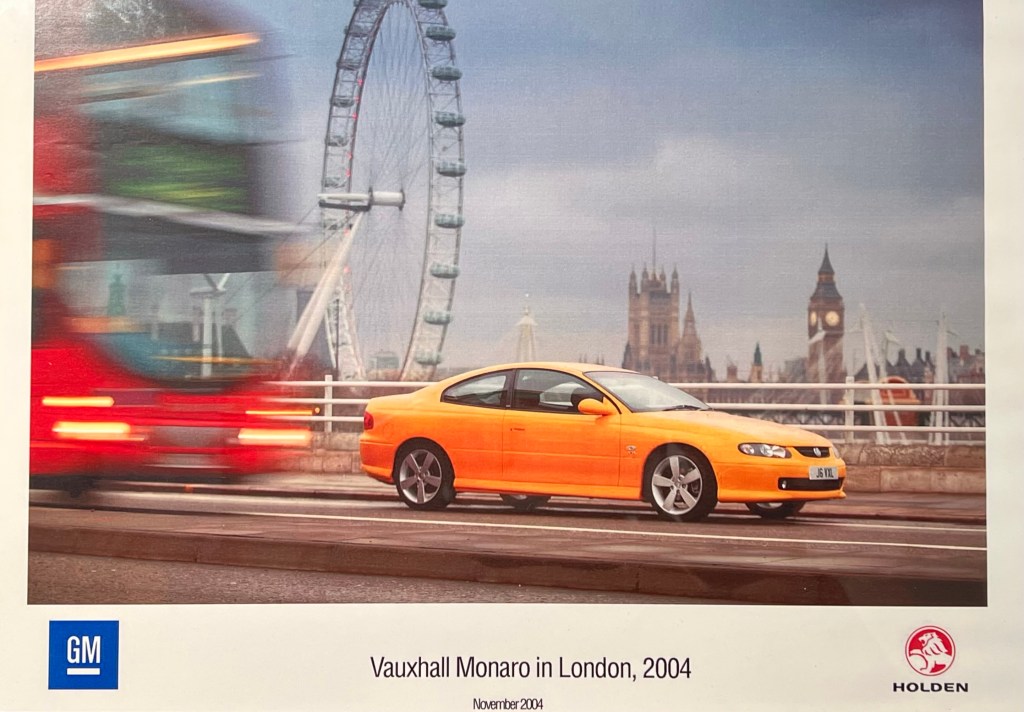
In later years exports were most significant in the Middle East and America with both the commodore and Statesman nameplates being altered to both Chevrolet and Pontiac, but the vehicles were Holden.

Over the years Holden exported completely built-up cars (CBU’s) cars in parts and assemblies to be assembled at their destination (CKD packs) and of course engines and other componentry. These programs added billions of dollars of income to the Australian economy and validated Holden as a producer of world class vehicles, automotive engines and componentry.

As well, Holden exported its incredible expertise and knowledge in the design and development of cars for its parent company in the USA, General Motors.’

The Holden Emblem : The Lion…

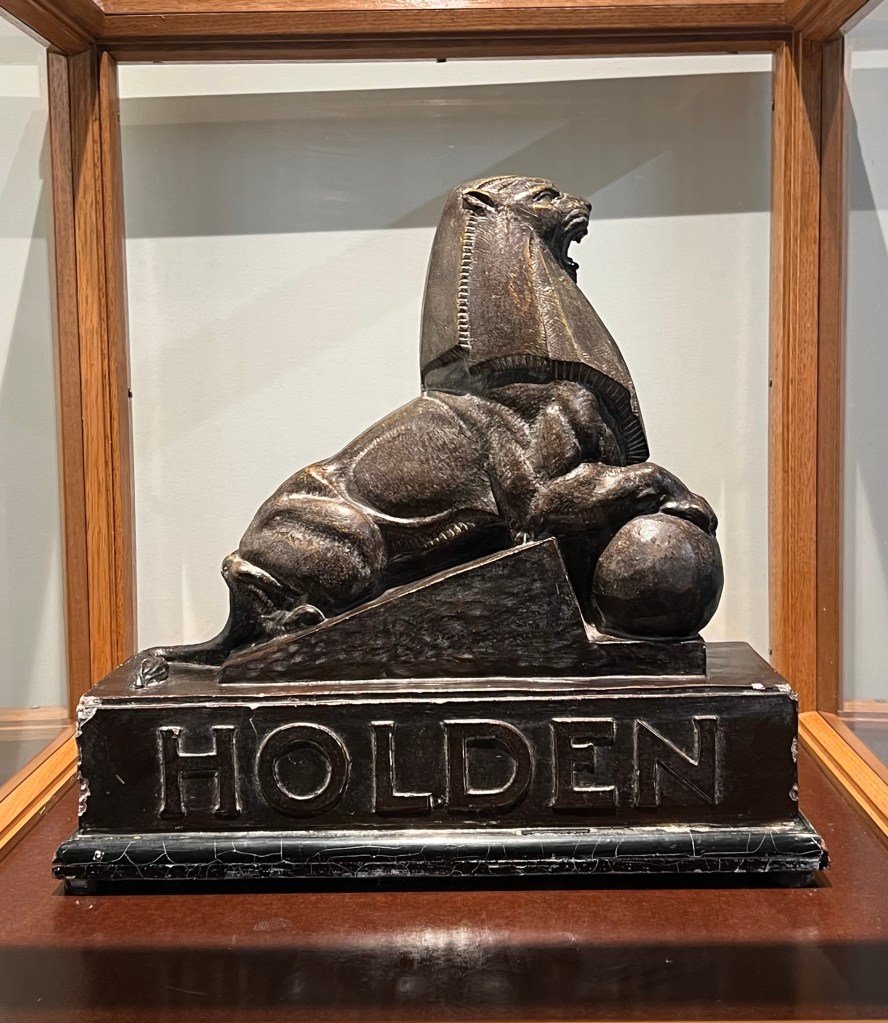
‘As an emblem, the Holden Lion relates to the time when coach builders engraved their company name or trademark on the door sill, or on a plate fixed to the instrument panel.

In the early 1920s Holden Motor Body Builders used a large brass plate embossed with a winged figure representing industry against a background of factory buildings. In 1926 the company decided to downsize the brass plate and emulate the practice of Fisher Body in the USA, which attached a neat replica of its coach trademark to the lower part of the cowl. Because the existing emblem was too detailed to be embossed on a small plate, a new design was commissioned to be based on the Egyptian-style ‘Wembley Lion’, symbol of London’s 1924-25 British Empire Exhibition. Fashion themes of the time from clothing to furniture, films and songs all were influenced by Egyptian antiquity.

According to fable, the principle of the wheel was suggested to primitive man when observing a lion rolling a stone. Thus inspired the pre-eminent Australian sculptor of the day George Rayner Hoff, to create the ‘lion and stone’ sculpture. This was replicated in a pressed metal plate that was fixed to all bodies built by Holden’s Motor Body Builders from 1928.

More than 75 years later the evolution of the lion and stone symbol can be traced through series of badges proudly worn by a cavalcade of cars, some recognised by early GM model enthusiasts but most dear to the hearts of generations of Australians since 1948 advent of the 48-215 or FX Holden.

The chrome-winged surround on the FX/FJ grille badge was Cadillac inspired.

The classic Egyptian lion design gave way in 1972 to a more modern interpretation of the symbol, which in turn was replaced in 1994 by the powerful Holden brand we are familiar with today.’

Holden 132 CID Grey motor…

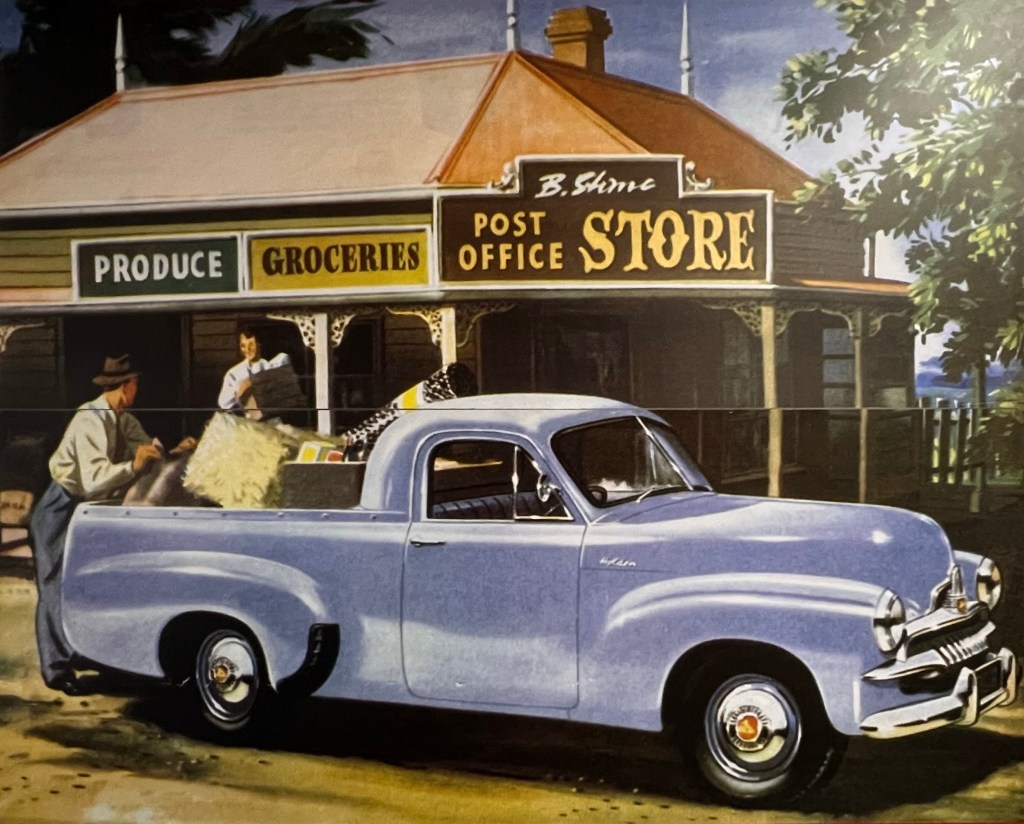
Powered cars such as the FJ Ute above.

‘The introduction of the first Holden car in 1948, the 48/215, saw the first mass produced car engine in Australia.

Designed in 1938 by GM for Project 195-Y15, it was only used in the Holden car and all production Holden’s were fitted with engines made in a purpose built facility at Fisherman’s Bend, Melbourne.

Though small in capacity, the use of six cylinders ensured a smooth, efficient engine with good torque, giving the lightweight 48/215 more than adequate performance.

Dubbed the Grey motor on account of their paint, about 650,000 of these 132 motors were made from 1948 to 1960 and many were sold for use as stationary engines to drive generators, pumps and the like.

Type 6 cylinder, 7 port head. Capacity 132.5 cid, 2171cc. Inlet valve size 1.28, 32.5 mm. Power 60bhp, 44.5kw @ 3800rpm.’

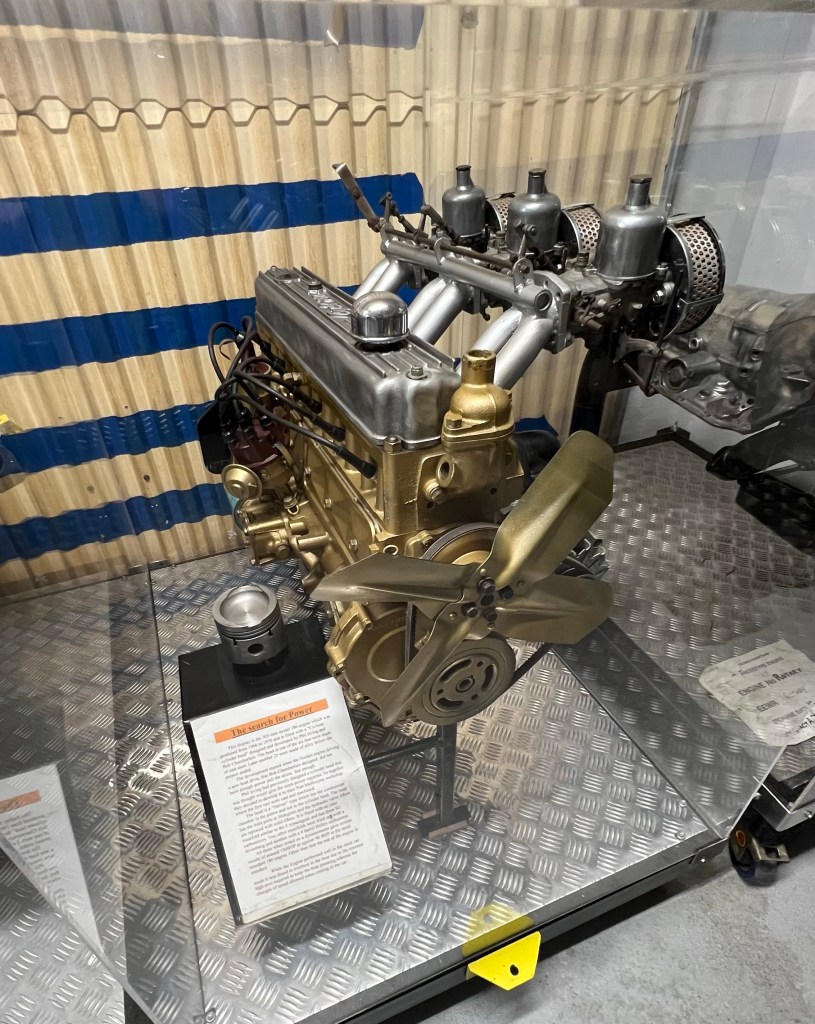
The search for Power

‘This display is the 3-litre model 186 engine which was produced from 1966 to 1970 and is fitted with a ‘Cyclone cylinder head’ designed and developed by Phil Irving and Bob Chamberlain.

The head is one of the six that were made of cast steel. Later another 25 were made of alloy before the project ended. Development started when the Holden engine driving a new boat drive, that Bob Chamberlain designed, did not have enough power pull the skiers fast enough.

Phil Irving had previously designed a cylinder head that was thought would give the extra power required. So together they decided to develop it in their Port Melbourne workshop where the first two were cast and machined.

The head is a ‘Heron type’ which has the combustion chamber in the piston and not in the cylinder head. The head has the Inlet ports at 30degrees and the hydraulic valve lifters are replaced with solid lifters. It is fitted with an inlet manifold similar to the E-Type Jaguar and has three SU carburettors. Two other manifolds were tried out with a Stromberg and another with a 4-barrel Holley carburettor.

All three when tested on a dynamometer gave similar results of around 150bhp as against 90 bhp in the stock standard 186 engine. Other than that the rest of the engine is standard.

While the engine performed well in the stock car mode it was found to overheat in the boat due to the constant high revs required to keep the boat planing, whereas the changes of speed allowed some cooling in the car.’

Holden Bodyworks…

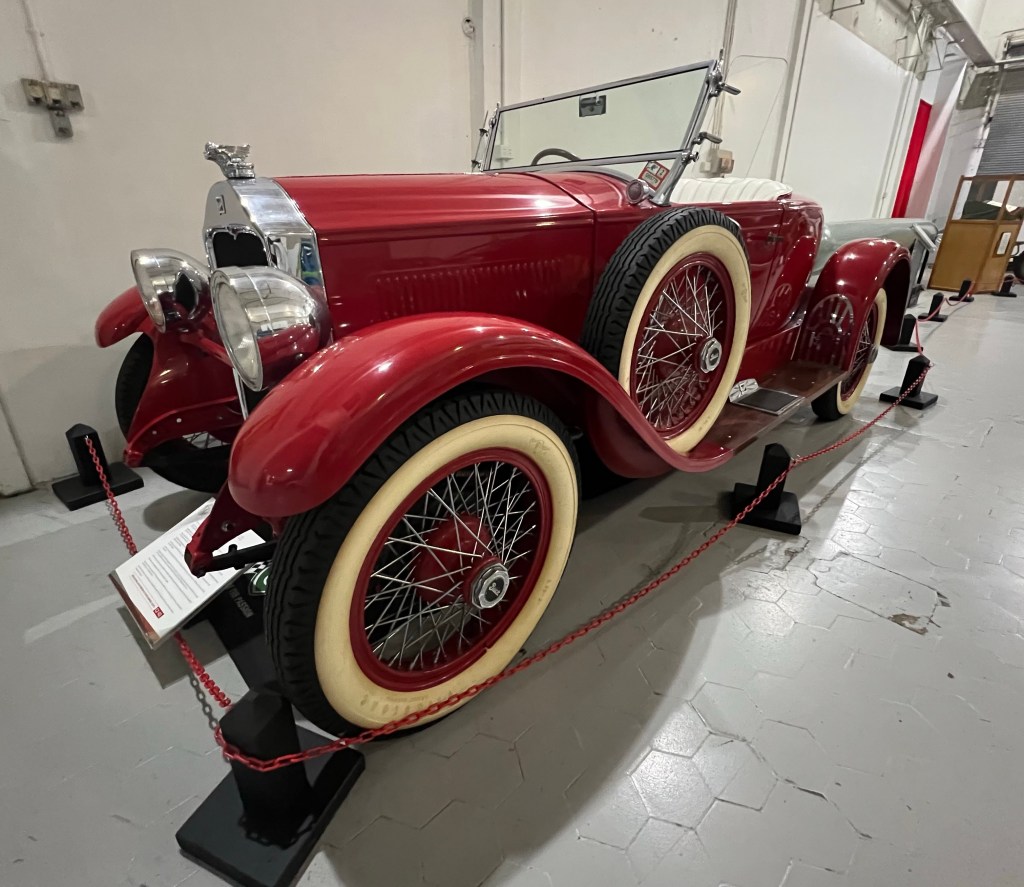
‘If cars could talk, few would have as many stories to tell as this stunning 1928 Buick Speedster.

Built by Holden Bodyworks in 1928, the car was shipped to England for performance improvements and to compete in the Brookland Time Trials. Calculations confirm the car would have been capable of 140mph at just over 5000rpm. This is far in excess of top speeds that were being achieved at that time for any production type car.

The car was noticed in the Brooklands track car park by two Vickers test pilots and they were encouraged to take the car for a spin around the track for a bit of fun. The recorded oncaged to attain an unofficial top speed of 138mph without crashing. This is 20mph faster than anything But things turned sour for the record-setter, with police closing down the track after several high-speed crashes had resulted in death.

Unable to continue racing, the Buick returned to Australia and was sold to a private buyer in Mildura who saw porentia in its speed.

Painted matte black, with its headlights removed and holes cut into its body to accommodate barreis, the car was used to run moonshine (illegal alcohol) across the Victoria-NSW border between Mildura and Echuca. Travelling only at night using moonlight for navigation, the Buick became known to locals as the mocnight speedse The dutlaw car evaded police until its eventual capture in 1964.

Seizure under the new proceeds of crime laws saw its demise, with the car crushed and puched into a creek, a mere lay forgotten for 20 years forgotten.’

Is this for real?? Sounds like a touch of the Donald Trumps to me?

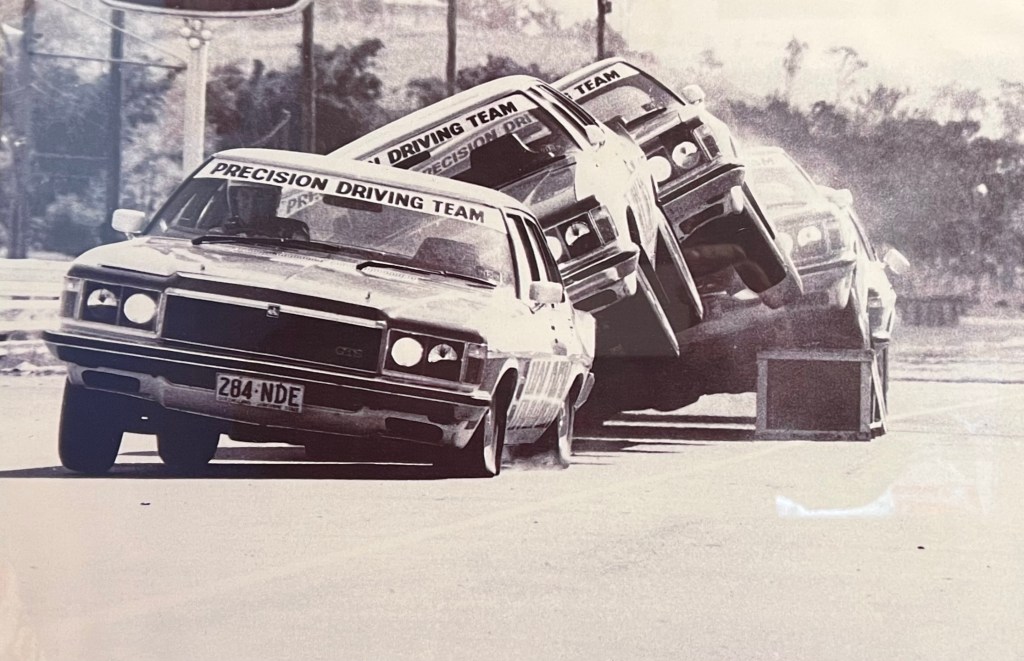
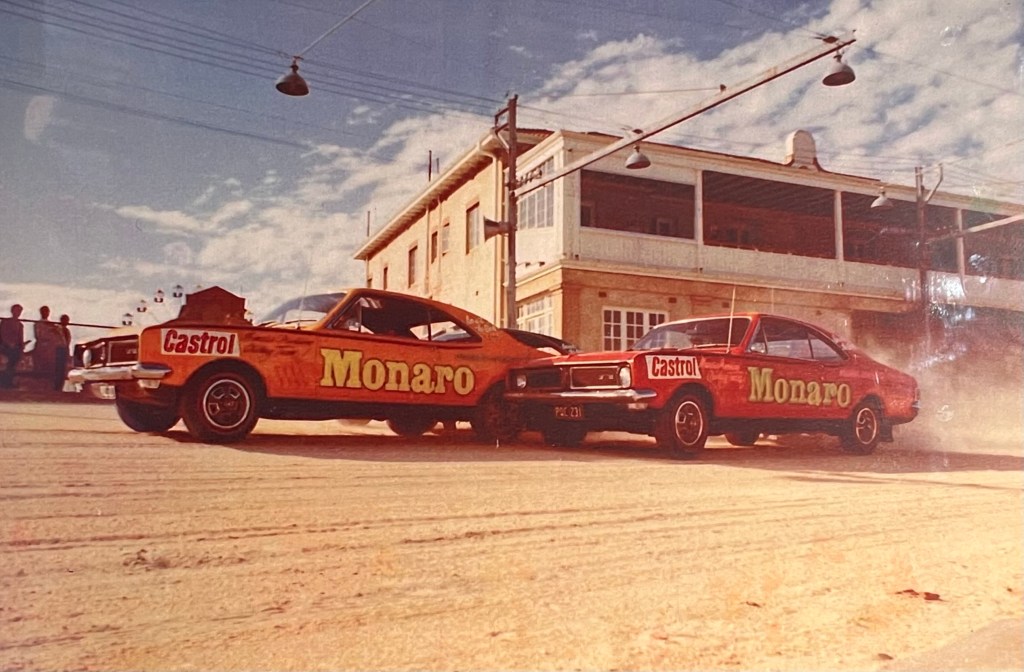
Five years before I finally made it to a race meeting in 1972 the Holden Precision Driving Team blew my tiny mind at the Royal Melbourne Show.

‘We all saw them’ perform around Australia wherever we lived. Monaro GTS sedans above, and coupes below, venues folks?

This one gave me a chuckle too.

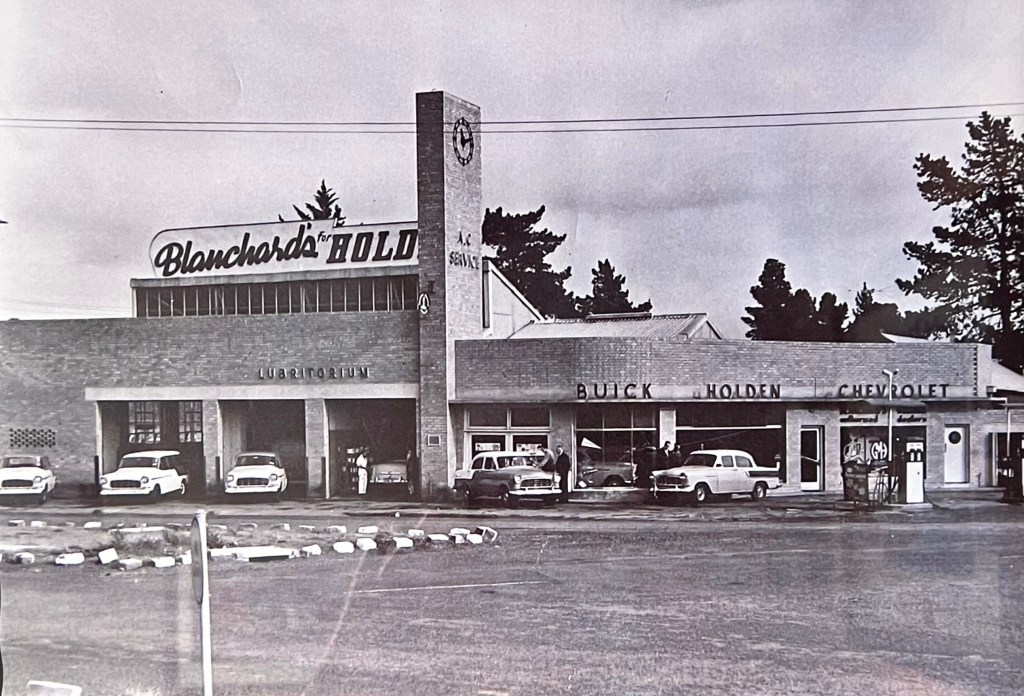
Blanchards Holden were on one of Melbourne’s busiest intersections, the corner of Springvale and Dandenong Roads, Springvale, only a drop-kick from Sandown.

It’s a mega corner of about six bits of road these days, but that roundabout in the late-1950s – the line-up of FCs makes it 1958-60’ish – looks pretty lame…

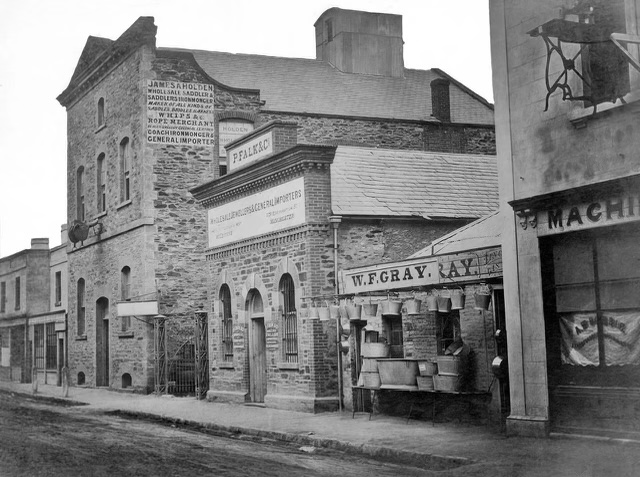
James A Holden’ saddlery, King William St, Adelaide (D Zeunert Archive)

Etcetera…

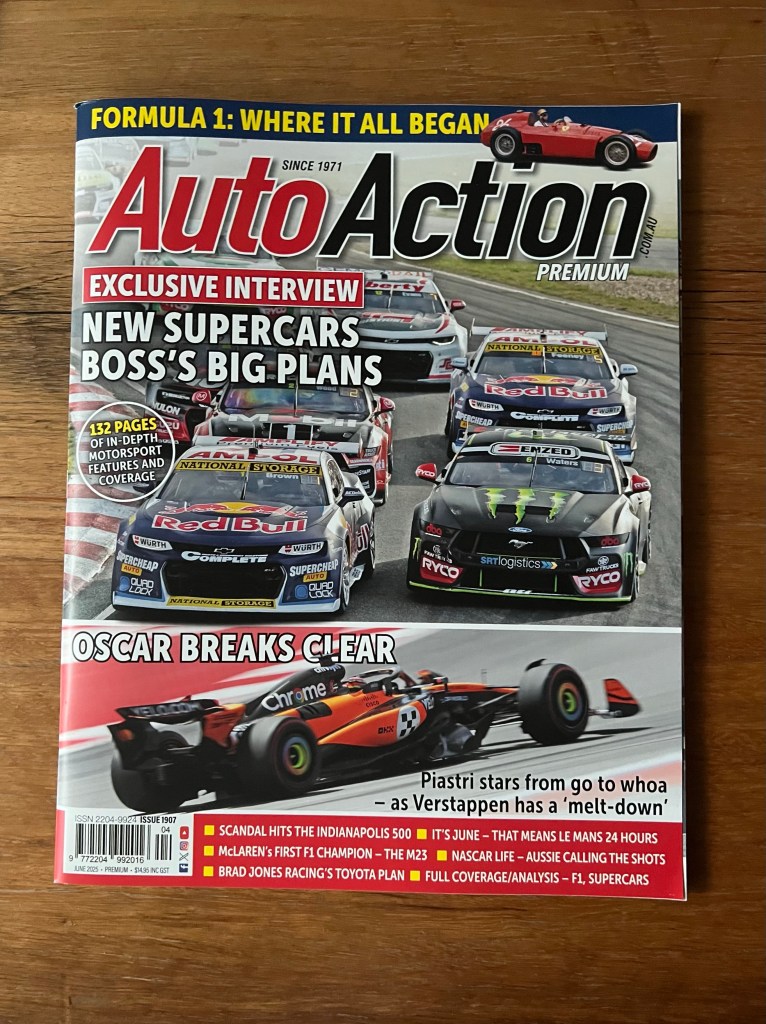
Don’t miss the latest, June Auto Action, on-sale for only the next few days, see below for the contents. The July 132-page monthly, issue #1908, will be in store this Thursday/Friday.

I’m not sure of the full content of that one yet, but my historic bits are a short piece on the museum, a ten-pager on the Tasman Cup from 1964-69. This is the first of two parts and has many ‘unseen’ photos taken by John Ellacott and Paul Cross. There is also an eight-page under-the-skin piece on Jim Richard’s Murray Bunn built Ford Falcon Hardtop Guney-Eagle 351 sports sedan. This one has Auto Action photos taken in the day that have never been published. It’s amazing what lurks in our files! Finally, Lord Alexander’s Hesketh outfit won its one and only championship F1 race, the Dutch Grand Prix in June 1975 . We have a two-page look at the unlikely but totally professional Peer, Bubbles Horsley, James Hunt and Harvey Postlethwaite.

Photo Credits…

M Bisset, Holden, David Zeunert Archive

Tailpieces…

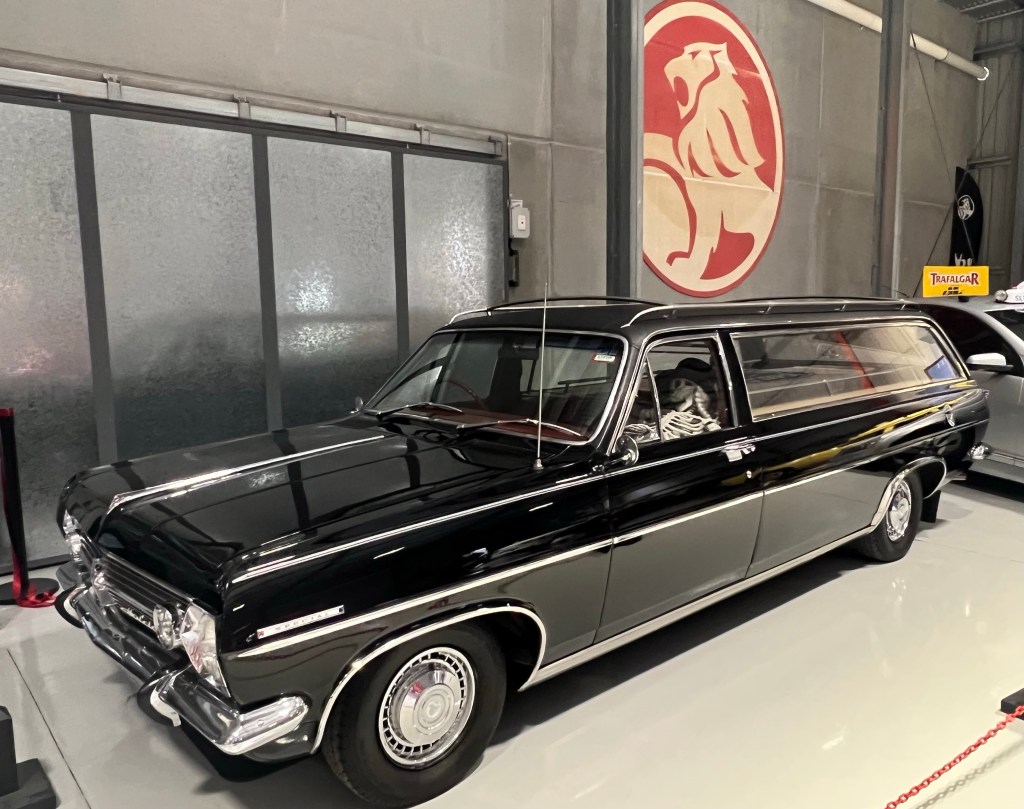
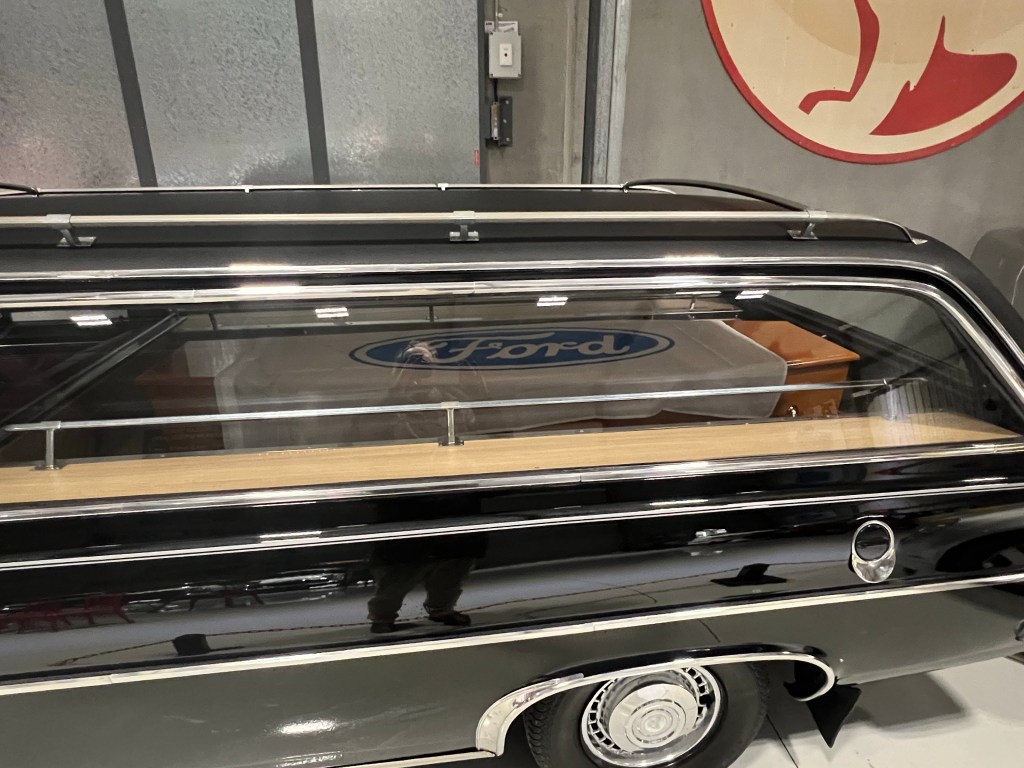
This coach-built, immaculate HR Hearse caught the eye.

The skeleton in the front seat was predictable enough, but the Ford banner atop the coffin in the rear was amusing to the Blue Oval Brigade present!

Finito…

Now here’s a bit of McLaren history you didn’t know.

McLaren Cars ‘entered’ a Holden in New Zealand’s annual touring car endurance classic, the Benson & Hedges 1000 at Pukekohe in 1976.

The four-door Holden Monaro GTS 308 V8 was crewed by Mike Hailwood and Phil Kerr with none other than 1967 World Champion, Denis Clive Hulme as Team Manager.

Phil Kerr ahead of the Dave Winter/Ron Findlay Datsun 1200. DNF in the race won by the Jim Little/Graeme Richardt Chrysler Valiant Charger.

Valiants won the race nine times on the trot from 1970-78. See here: https://primotipo.com/2023/12/18/valiant-charger-r-t-1971-73/

See this Australian Muscle Car piece for more on the B &H race: https://www.musclecarmag.com.au/feature/the-mclaren-monaro-587634

I wonder if Ron Dennis bought the Holden for his museum?

(Motorsport Images)

Phil giving Mike ‘the rounds of the kitchen’ after Michael the Cycle crashed his McLaren M23 Ford out of the 1974 Monaco GP on lap 12.

And below enroute to a DNF with a fuel line problem from Q11, Swedish GP at Anderstorp that June.

(Motorsport Images)

Credits…

Rex Rattenbury, Ross Cammick, MotorSport Images

Finito…

(L Sims Archive)

Legendary Australian Touring Car racer/engineer/tuner/team manager/CAMS politician Harry Firth ascends Rob Roy aboard a Cisitalia D46 in 1958. What a magic, crisp pan shot.

This ex-everybody car never did much in Australia. Its arrival more or less corresponded with the end of our long handicap racing era, and we didn’t have the right class for the car, 1100cc events here and there duly noted.

‘Only months earlier (May 4, 1958) Reg Nutt took the borrowed Leech Cisitalia to the top of the Hill in 28.30 secs. Now it was Harry’s turn however he couldn’t match Reg’s time. Harry’s time of 29.52 secs was more than 1 sec slower. But Harry probably won the most money on the day driving a Hillman for a second, Triumph TR2 for a first and the Cisitalia for a second,’ wrote Leon Sims.

A great car indeed, see here: https://primotipo.com/2023/09/08/cisitalia-d46/ here: https://primotipo.com/2023/09/08/cisitalia-d46/ and here for Harry: https://primotipo.com/2019/01/29/harry-firths-mg-tc-spl-s-c/

Firth prepared and raced plenty of sportscars before his highly successful 1960-80’ish tourer-era but he didn’t race many monopostos? That SU carb doesn’t look kosher on an Italian car either, surely it didn’t arrive here so equipped…

(G Hill)

Leon Sims, ‘This photo is from our (MG Car Club) second annual historic and classic meeting Feb 28, 1994. From the left: John Crouch, AGP winner, Australian Hillclimb Champion and Australia’s Cooper distributor in the 1950s. Harry Firth, multiple class winner and class record holder at Rob Roy. Bill Prowse, Rob Roy competitor from the 1947 LCCA years and also MGCC years.’

(L Sims Archive)

Credits…
Leon Sims, The Age via Leon Sims Archive, Gary Hill

Finito…