Archive for the ‘Who,What,Where & When…?’ Category

(Feisst)

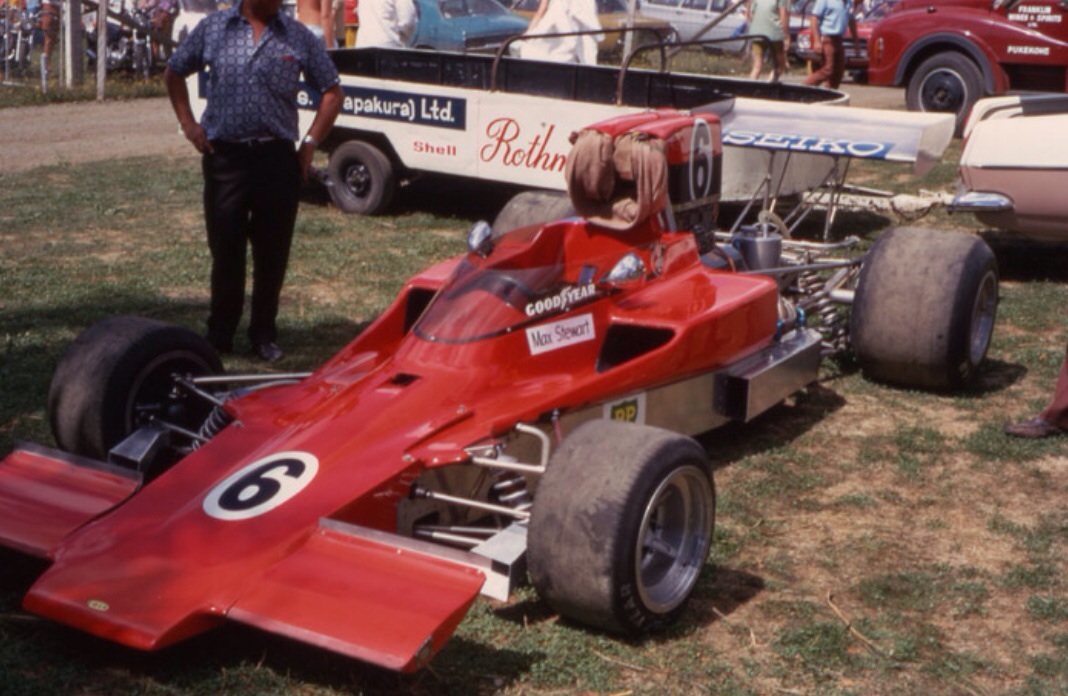
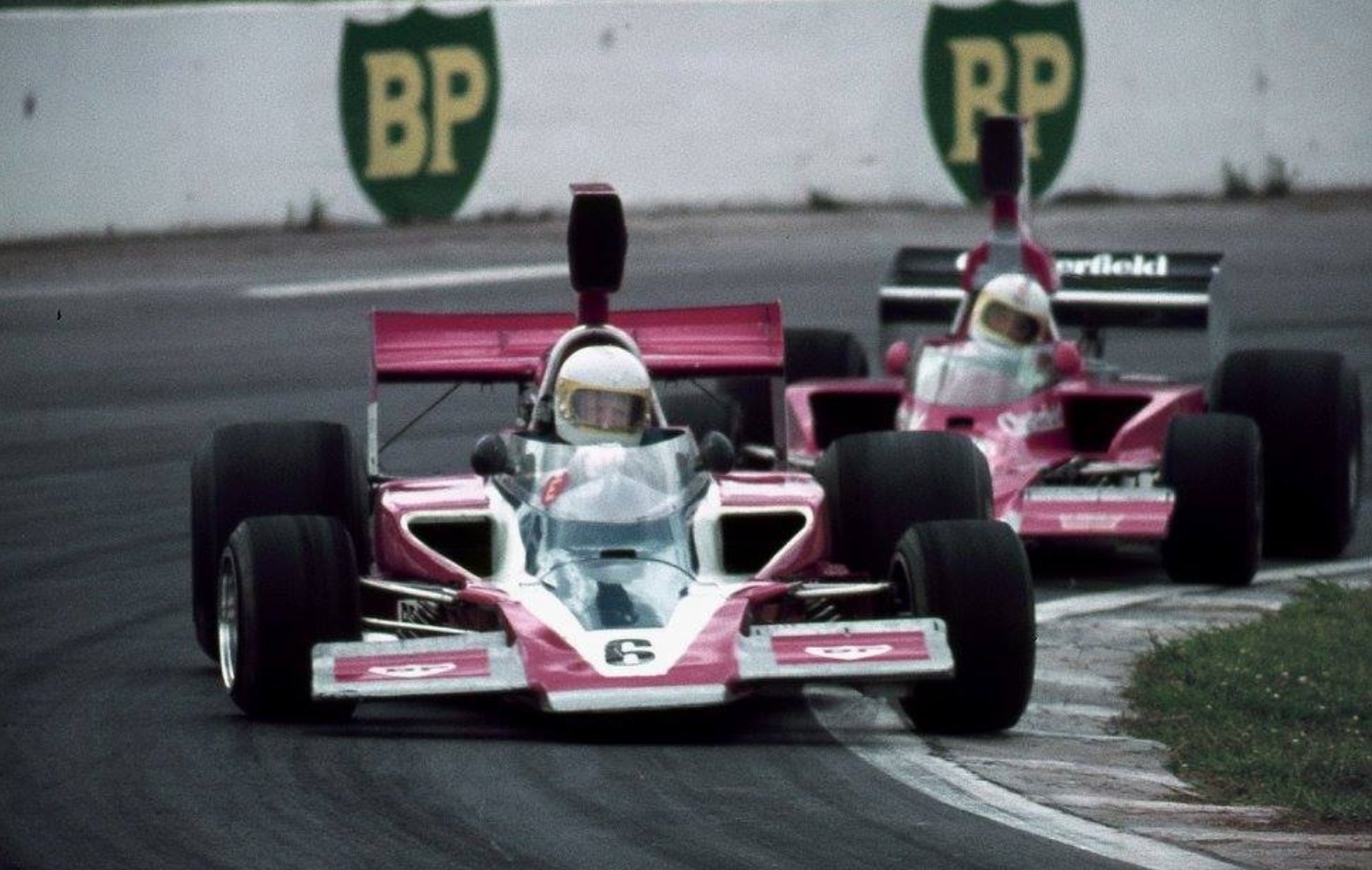
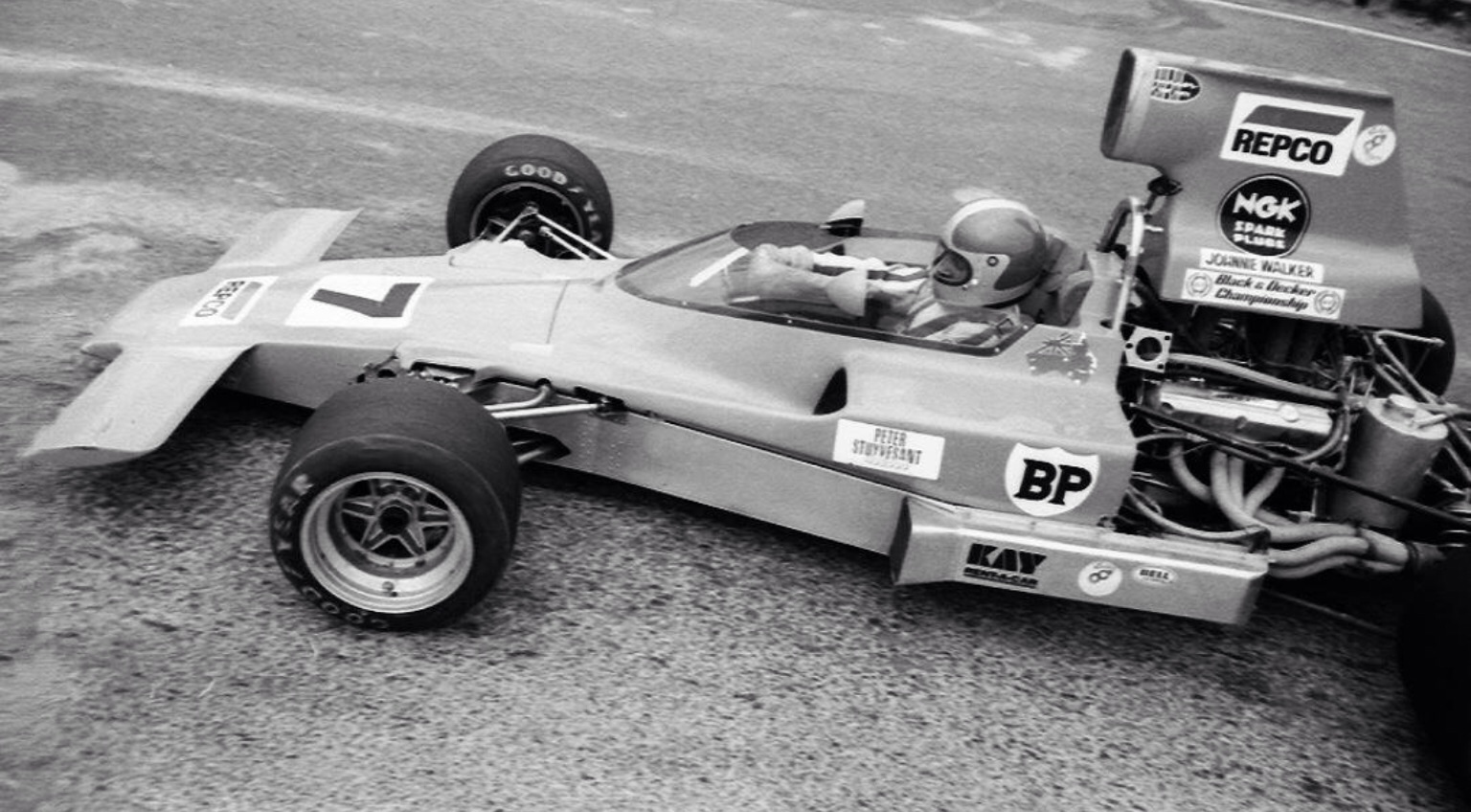
Max Stewart looks pretty happy aboard his pristine, new Elfin MR5 Repco, New Zealand Grand Prix, Pukekohe 1972…

He is talking to Elfin works mechanic Dale Koenneke, well known in Australia for his work with Elfins, John McCormack and later K&A Engineering, an enduring partnership in Adelaide he formed with Harry Aust.

Max took to F5000 like a duck to water. His speed in 2 litre cars- he won the 1971 Australian Gold Star series in his trusty Mildren Waggott 2 litre was immediately transferred across to the more demanding 5 litre, 480bhp MR5. The Elfin wasn’t the ‘ducks guts’ of cars albeit John McCormack developed his car to a fine race, and championship winning pitch. But in 1972 Max was the fastest guy aboard an MR5- a quicker driver than Garrie Cooper, McCormack and John Walker. Very soon McCormack and Walker developed ultimate speed whereas Garrie- quick in a Tasman 2.5 car was never more than a journeyman in 5 litre single-seaters.

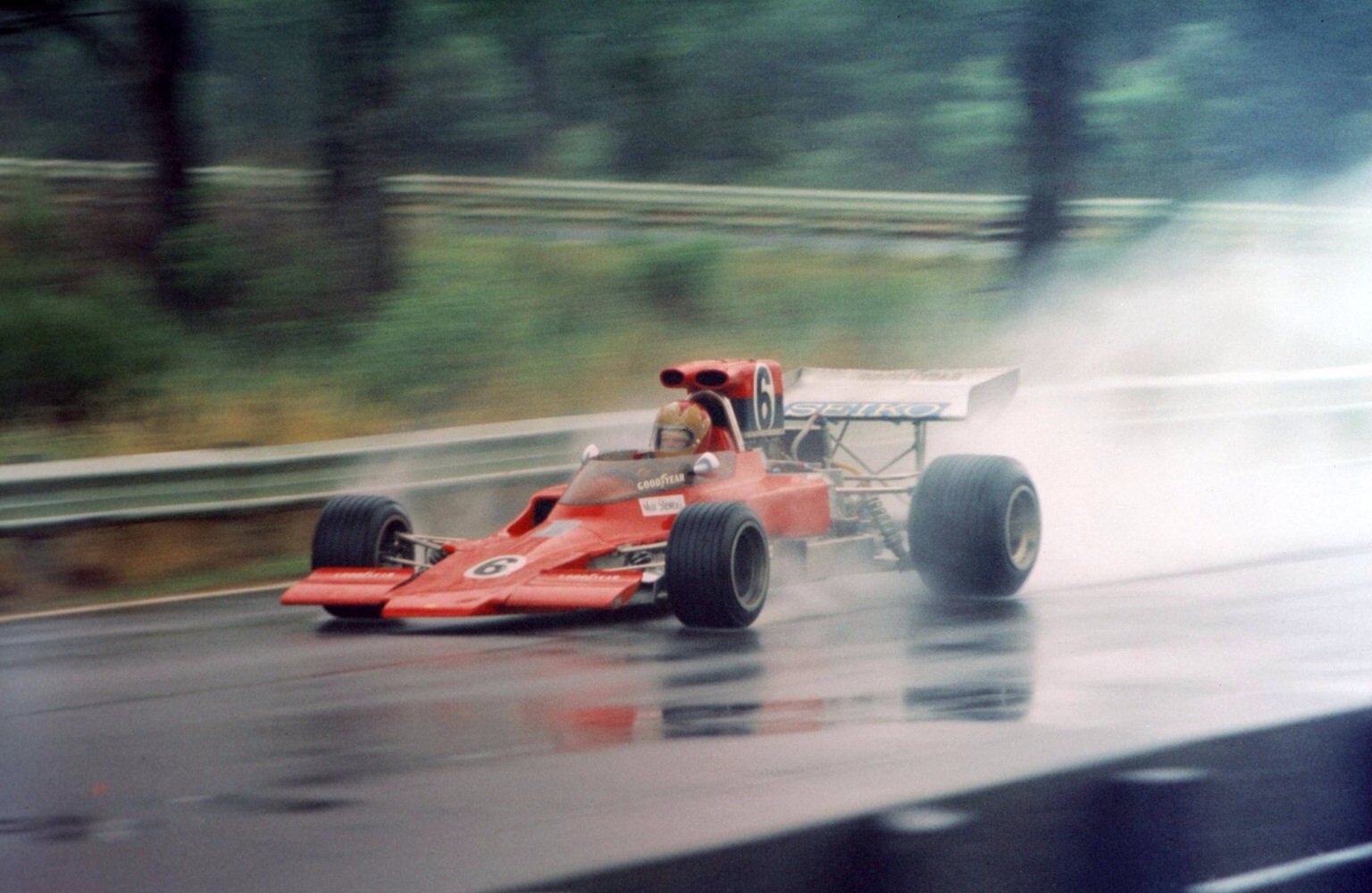
Stewart booting the MR5 around Warwick Farm during the 1972 ‘Hordern Trophy’ Gold Star round- 3rd behind Frank Matich’s Matich A50 Repco and Kevin Bartlett’s Lola T300 Chev (Aust Motor Racing Annual)

The MR5 looked superb. Even though Alec Mildren abandoned his race team at the end of 1970 Max kept the Mildren yellow team colour on his own cars- both the Mildren Waggott in 1971 and MR5 in 1972. He retained the Seiko and BP sponsorships too. What a sad day for Australian motor-racing it was when Alec finally pulled the pin. He was such a wonderful benefactor/entrant of Frank Gardner, Kevin Bartlett and Max Stewart and others, but those fellas in particular.

The MR5 wasn’t the ‘Silver Hammer’ at all for Max though. That car was undoubtedly the racer which followed, his ex-works Frank Gardner driven development prototype Lola T330 Chev ‘HU1’. It was the very first of that ‘category destroying’! series of dominant T330/332 Lolas. Max made HU1 sing for years and was always competitive with the T332’s. Both the T330 and MR5 ’5722’ are still in Australia, restored and exercised regularly.

Photo Credits…

Mike Feisst Collection on The Roaring Season, Neil Stratton, Australian Motor Racing Annual 1973, Tony Glenn

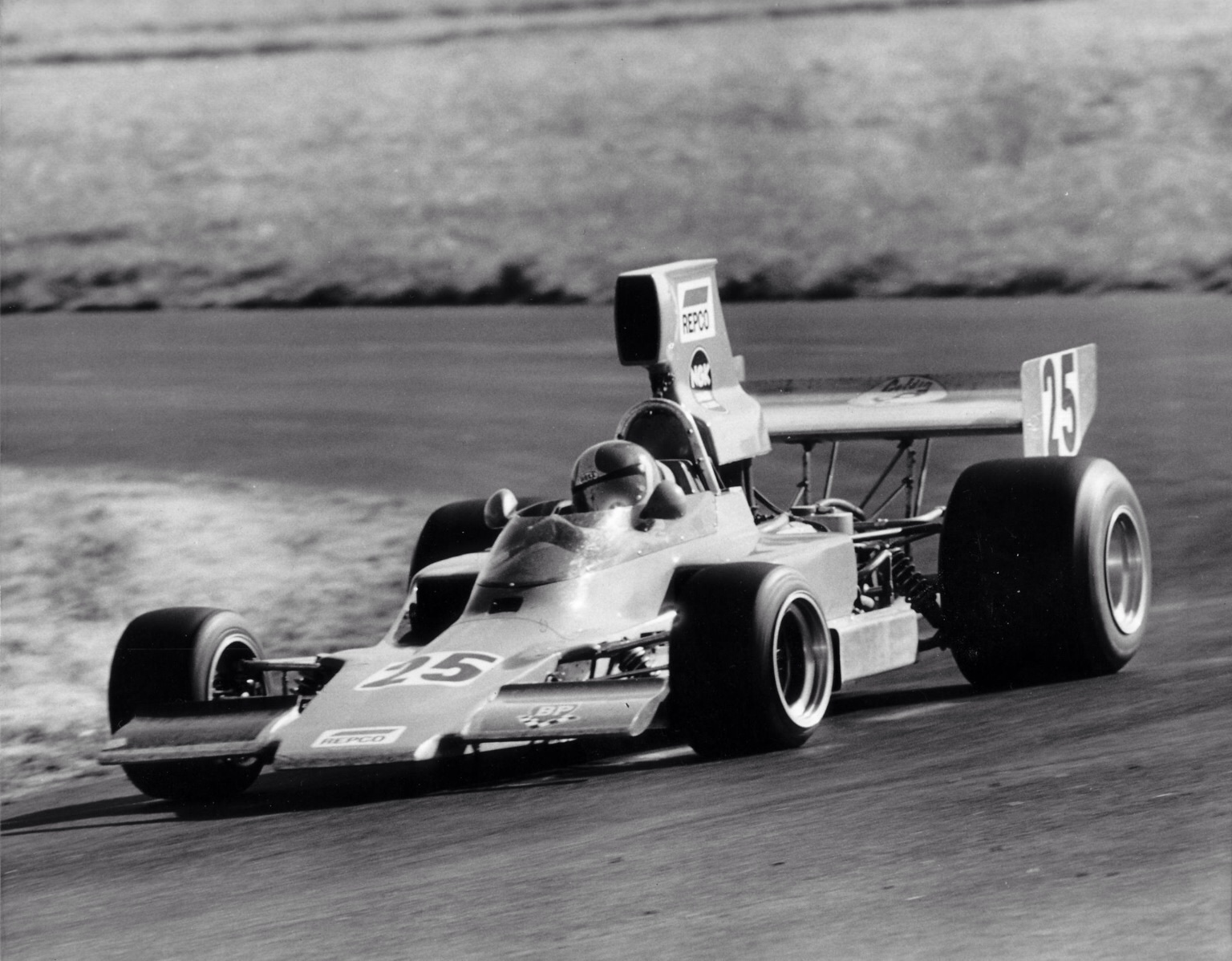
Tailpiece: Stewart swallowed by his Lola’s schnorkel, Pukekohe paddock 1973…

(Feisst)

Whilst Frank Gardner ‘retired’ from single-seater racing towards the end of the 1972 Tasman Series he continued to test openwheelers in his capacity as Lola’s development engineer/tester. He also raced this chassis, T330 ‘HU1’ once or twice in some end of season European F5000 Championship rounds in 1972 as he developed the production spec 1973 T330 for Eric Broadley.

HU1 was then sold to Max to run in the ’73 Tasman with Gardner on hand to advise the lanky Aussie on how to extract the best from the car, which he most certainly did. Here the car is in the Pukekohe paddock twelve months after the shot at this articles outset, both photos taken by the same photographer, Mike Feisst.

Max 5th aboard T330 HU1 during the final, sodden Warwick Farm Tasman in 1973. Steve Thompson won in a Chevron B24 Chev (Tony Glenn)

Postscript: The choice of Elfin/Repco/Lola/Chev…

Stewart didn’t have great reliability from the MR5 in either the ’72 Tasman or the Gold Star- his best results were a 5th and 4th at Pukekohe and Levin in the Tasman and two 3rd places in the Gold Star at his home NSW tracks of Oran Park and Warwick Farm.

The decision to go with Lola was an easy one. He had witnessed at first hand the speed of the T300’s driven by his mate Kevin Bartlett, Bob Muir and others and no doubt Frank Gardner was able to impress upon him the speed of the coming T330. Frank Matich was at the front of the Repco queue- FM was their works driver after all, with perhaps McCormack and Cooper getting the next best customer engines.

Lola Chev was an eminently sensible move which paid off in spades for Max albeit not initially! The story of Stewarts’ success in his Lola’s is one for another time, suffice it to say aboard T330 ‘HU1’ he won the 1974 Teretonga and Oran Park Tasman rounds, the Australian Gold Star Series winning five of the six rounds including the Australian Grand Prix at Oran Park. Quite a season for the popular boy from Orange.

Max Stewart ahead of great friend and rival Kevin Bartlett during the 1974 Gold Star round at Oran Park won by Max. Lola T330 from T332 . KB DNF, Max won from the T332’s of Warwick Brown and Graeme Lawrence (Stratton)

Finito…


(Adelaide Observer)

A couple of years ago I wrote a long piece about the first car race in Australia, the article asserts that momentous event took place at Sandown Park, Melbourne on 12 March 1904. I’m in a constant search to find an earlier race

Whilst not a car race but a ‘demonstration or parade’, what seems to be the first event of this type in Australia was held at Adelaide Oval on Saturday 11 October 1902. More interesting is that the first claimed motor-cycle race in Australia took place on the same day.

The Adelaide meeting was promoted by the ‘League of Wheelmen’ a cycling organisation at no less a temple of sport than the wonderful, picturesque Adelaide Oval, not at all a venue I would have considered as one at which ‘motor racing’ took place.

Located in North Adelaide, Adelaide Oval is the best sporting venue in Australia. That my friends is a huge statement for a Melburnian member of the Melbourne Cricket Club, our ground is the Melbourne Cricket Ground. We Melburnians reckon the MCG is the best bit of sporting dirt on the planet, but good ole Adelaide Oval is better. It doesn’t win in terms of seating capacity, but the location, surroundings, vibe, the hill and scoreboard, the vista of trees towards St Peters Cathedral cannot be matched. And having seen a few stadiums around the world its ‘up there’ with the best globally in character and comfort if not capacity.

That Saturday the League of Wheelmen hosted a day of racing- cycling, motor car demonstrations and the new ‘sport of kings and millionaires’ as the Adelaide Advertiser put it- motor racing. The motor-cycle racing 5 mile event event was ‘the first motor race in Australia’ the paper reported.

The hallowed turf primarily used for cricket and football (Australian Rules) then incorporated a steeply banked track at its outer perimeter which was ideal for cycle racing and ‘admirably adapted for contests between motor cycles and for the establishment of records’ if not so great for motor car racing.

The days program was dominated by cycling events with many interstate competitors taking part. In addition there were 13 contestants of the motor-cycle races in the afternoon with ‘the final’- my god, a championship! to be held the following week, on 18 October.

An interesting part of the program ‘to indicate the growth of the (motor) industry’ was a parade of cars, motor-cycles, quadri-cycles, cycles and velocipedes, the organisers showing a keen sense of history of transport with a focus on the previous thirty or forty years.

The Adelaide Observer reported that the display created a favourable impression. ‘The big cars whirred around the track with surprising velocity, and so easy were they to control and so graceful in their evolutions that their popularity is assured’. It seems fair to say that the success of the demonstration of cars on that October day, and the following weekend provided some type of impetus for the first car race in Australia at Sandown and the first car race in South Australia, at Morphettville two years later.
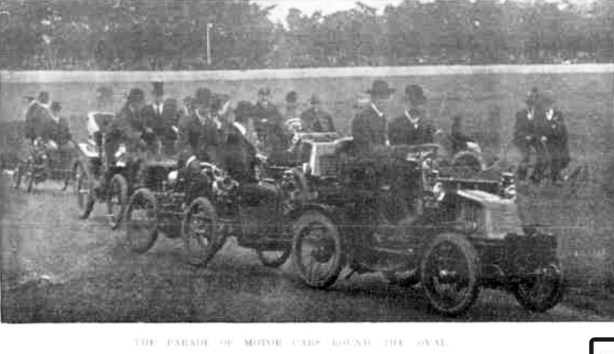
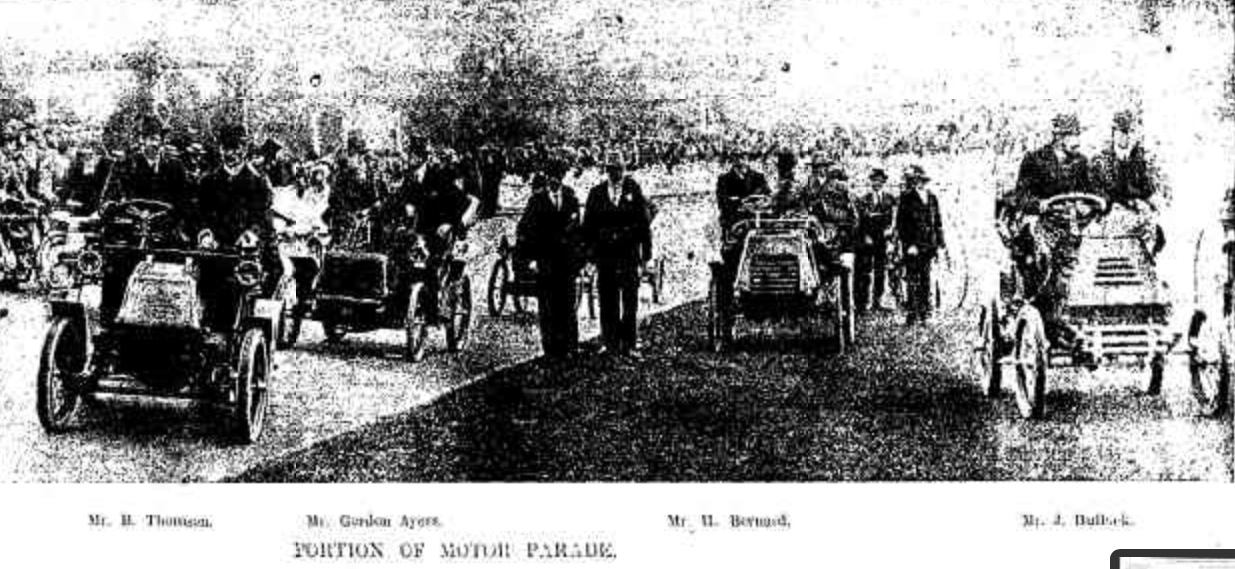
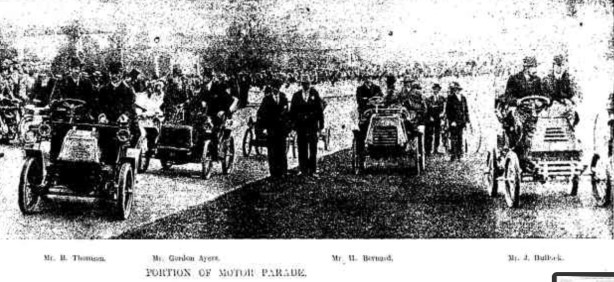
Parade of motor cars at Adelaide Oval on 11 October 1902 (Observer)

Context is Everything in History?…

We forget sometimes just how far we have come.

The Adelaide Observer of 18 October 1902, in an article entitled ‘How The World Moves’ comments upon how the dreams of Jules Verne were coming true. At the time the voyage to America from the UK had been cut to 124 hours, ‘with only 70 hours at sea’. ‘In rather less than 400 years the record of Magellan in circumnavigation of the globe has been cut from three years to between 50 and sixty days’.

The article addresses ‘The Age of the Engineer’ and notes that the cheaply constructed great Siberian railway being eventually destined to be recognised as one of the great wonders of the railway world, with ‘the Era of the Canals’ taking 1000 miles out of  global journeys. ‘Many ancient landmarks are threatened and many time honoured routes promise to become ways of the past, interesting as the grass grown coach roads of England, but no more frequented by the conveyances one so familiar.’

In addition to the above more macro view of progress, this extract from the Adelaide ‘Chronicle’ of the same day very concisely places the development of the bicycle, motorcycle and motor car in the context of the up till then omnipotent form of personal transport, the horse…

‘The opening day of the League of Wheelman’s October race meeting marked an interesting epoch in the history of cycling. One of the events on the programme was a motor cycle race- the first held in the Southern Hemisphere, and it was to be the introduction of this novelty and an exhibition of motor cars that the large attendance was due’.

The cycling world is one of rapid evolution. Forty years ago velocipedes equal to a speed of six or seven miles an hour were a favourite means of locomotion. They gradually developed into the ordinary high machine, with which it was possible on a good track to ride a mile in three minutes. It is only a little more than a decade since the ‘safety’ chain-driven machine, with pneumatic tyres, made its appearance in the streets of Adelaide, and the ‘ordinary’ disappeared before its more stylish and faster rival.’

‘From the early nineties the safety revolutionised cycle racing, and record succeeded record at a bewildering rate, until it became common for a cyclist behind pace to eclipse the times of the best racehorses the world has ever produced’.

‘The popularity of the sport developed…the League of Wheelmen…at one time promised to become a very wealthy body…but two or three years later the absence of crack riders from the other side of the world and the lack of variety in the sport, coupled with unfavourable weather conditions, resulted in unprofitable meetings’.

‘Now the motor has come to play its part in the sport, and its advent was enthusiastically welcomed on Saturday…the gate receipts…and next Saturdays takings…will all be profit.’
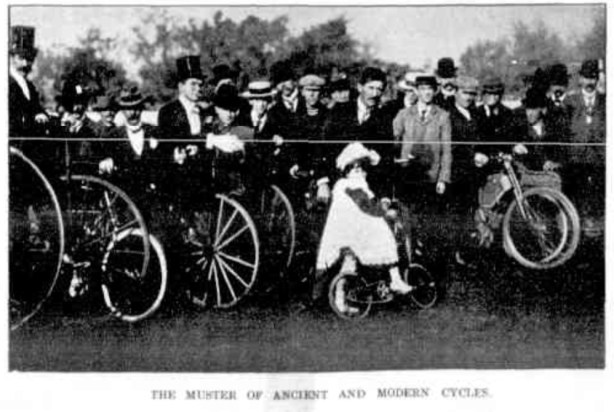
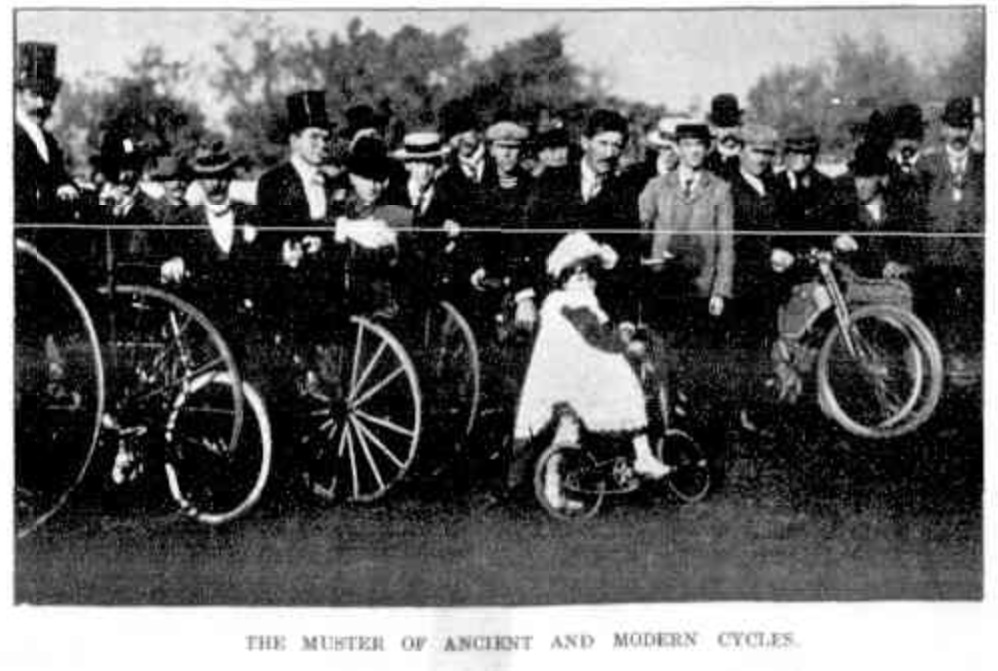
Mix of old and new cycles, Adelaide Oval 11 October 1902 (Observer)

‘The story of the evolution of the motor car was admirably told on Saturday in the exhibition of ancients and modern methods of locomotion…the early form of the bicycle was illustrated by old wooden velocipedes…40 years old…ridden in the old fashioned costume of top hats and black suits with flying coat-tails…Alongside of these were motorcycles ridden by Messrs TP O’Grady, A Allison, W Baulderstone, W Courtney, R Davis, HM Aunger, RW Lewis, FR Burden, EA Gowan, D Bruce and EF Wilksch were shown.’

‘Most interest was shown in the motor cars, of which four were shown. Mr Gordon Ayres brought his car, a very handsome one…but it could not be taken onto the track…with an old set of tyres one of which blew out. Mr H Thomson’s ‘Swift’, which he has just imported attracted considerable notice. The other two cars which raced around the oval were both locally manufactured. One was shown by Mr V Lewis, and driven by Mr H Bernard, and the other was exhibited and driven by Mr J Bullock. In addition to these Messrs J Bullock, H Bernard and the representative of the Massey- Harris Company had motor quadricycles on the track. With all these machines careering round the oval at their best pace the spectacle was in the highest degree interesting. The exhibition was the success of the day, and when the officials of the league saw the impression it made on the spectators they at once resolved to repeat it next Saturday. Mr Ayers car will then be shown in action with all the others.’
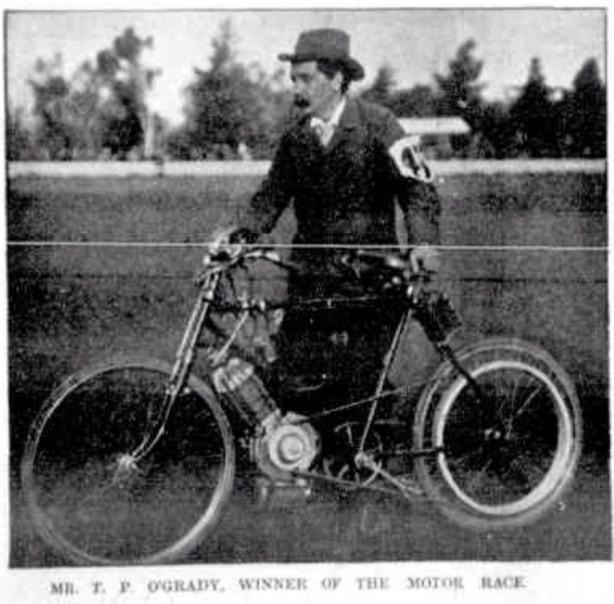
TP O’Grady with his ‘works’ Lewis motor-cycle- winner of the first motorbike race in Australia 11 October 1902 (Observer)

‘The other novelty of the meeting was the motor cycle race of 5 miles’. Originally their were 13 entries with the race divided into two heats, with two machines withdrawing from the first heat.

‘TP O’Grady was off scratch, W Courtney 30 seconds, A Allison 50 and W Baulderstone 1 min 5 sec. Baulderstone was away well and had almost completed a lap when O’ Grady was pushed off. Courtney retired early with a mechanical problem. O’ Grady’s machine took a while to get going, but when it did it was soon seen to be the fastest machine on the track. It lapped the others three times in the 15 laps and covered some of the circuits in 32 and 33 seconds. Its fastest pace was at the rate of 1 min 32 sec for the mile, or 30 miles per hour. O’ Grady an old time racing man, who constructed the motor himself at Mr V Lewis cycle works, was loudly cheered as he finished his five miles journey in 9 min 10 secs. Just after he crossed the line the belt of his motor broke. There was an interesting run for second place between Allison and Baulderstone. The latters machine lost the pace with which it started, and Allison was able to keep ahead’.

A story about Vivian Lewis and his nascent cycle, motor-cycle and car company is a story in itself, O’Grady was Works Manager, Works Rider/Driver! and a shareholder in Vivian Lewis Ltd.

The Adelaide Observer had this to say about O’Grady’s performance. Thomas Patrick ‘Tom’ O’Grady ‘carried off the honours’ covering the 5 miles in a time of 9 minutes 10 seconds ‘at times he travelled at the rate of 39 miles an hour’. Some of the laps of 612 yards were covered in 33.25 seconds with one mile timed at 1min 33 seconds. It was the first occasion on which the machine had been tested, it was not completed until the Saturday morning, the average of 1min 50 seconds per mile ‘must be considered gratifying, particularly as a strong wind had to be contended with’.

There were six starters in the second heat which was run at a lower pace with interest being lost when R Davis’ belt broke with 3 laps to go when he was overhauling the leaders. J Bullock won from FH Burden, RW Lewis, EF Wilksch and Davis. ‘The final between the first three in each heat will be run next Saturday’.

In a full program of bicycle racing many of the motorised racers jumped onto their normal racing cycles.

The Chronicle concluded its report by commenting favourably on the performance of ‘The Locomotive Band’, which gave a fine rendition of the march ‘Colonels Parade’, that there were no accidents during the day which ‘was well managed in every respect’.

In keeping with the mood of the week a novel race on the road was also advised, this comprised, ‘…a contest between B Thompson’s 4.5 hp car and the Broken Hill Express train ‘in a scamper to the Burra, the chauffeur and the engine driver to shake hands at the Adelaide Railway Station before starting’! Logistically this would have been easy as Adelaide Station is only several hundred metres from Adelaide Oval.

So. What do we take from all of the wonderful prose about the days activities on 11 October?…

Firstly, the claim that the first motor-cycle race in the Southern Hemisphere was run at Adelaide Oval on 11 October 1902 and won by TP O’Grady on a local Lewis machine.

It seems clear the first motor-cycle racers were graduates of bicycle racing.It makes sense doesn’t it in terms of the balance, competitiveness and the need for more speed required!

It also seems the case that the ‘League of Wheelmen’ saw motor cycle racing- and especially car competition which appears from the report to be the most popular event or motorised display on that October day, keys to future commercial success. To turn around their flagging gates.

Of course the bike and car racers would soon go their own separate ways probably when a greater number of venues became available to them both on public roads and specialist, speedway, closed circuits. But for the moment the would be motorised racers needed venues and the cyclists had them, and ‘in good nick’ too.
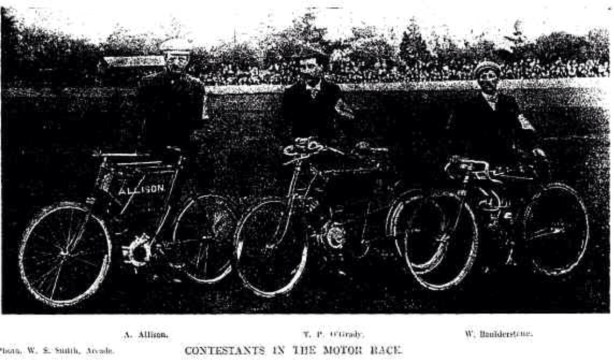
(Observer)

The 18 October meeting was run in splendid Adelaide spring weather with much expected from the motorised events but mechanical mayhem somewhat ruined the motor-cycle racing program…

The organisers changed the spectator amenities during the week by allowing better viewing of the cars, perhaps by allowing the punters to get closer to the action. His Excellency the Lieutenant-Governor conferred his patronage to the carnival. ‘Visiting officers of the Australian Squadron have accepted the Leagues invitation to be present’ the Evening Journal notes in an article published on the day of the race. Its interesting in these modern times to see what was regarded as relevant then but now is very much ‘who gives a rats’ stuff. Similarly the language of the day is wonderful in its eloquence, the prose of times gone by I enjoy I must admit. Long-winded sometimes but enjoyable nonetheless!

O’Grady’s ‘brilliant run’ of the week before stamped him as a certainty for the final, with many returning spectators expecting him to lap the field twice aboard his Lewis over the five mile duration of the final.

The contemporary newspapers reported upon the riders but not the machines, sadly. So, in the main, we don’t have details of the bikes ridden on that important occasion. The final was a race between five competitors with TP O’Grady off scratch, A Allison 50 seconds, VR Burden and W Baulderstone off 1 minute 5 seconds and the limit-man J Bullock on 1 minute 20 seconds.

A warm up for the bikes was provided during the cycle and motor parade which was also a feature of that days events. The competitors for the race had a trouble free run during this morning event.

During the later stages of the afternoon, just before the feature cycling event ‘The Australasian Ten Miles’, won by Victorian DJ ‘Don’ Walker, the ‘Motor Race’ commenced.

Bullock, Baulderstone, Burden and Allison completed a lap before O’Grady was pushed off from the start. There was general disappointment as the locally built Lewis bike was pulled onto the grass by its driver, the engine not firing properly. With 7 laps to go Burden passed the stationary O’ Grady, his ‘machine going splendidly’.

2 laps later Burden lapped Allison and with 4 to go caught Baulderstone again, with whom he had started. With 2 laps to run Burden passed Allison and finished an easy winner in 9 minutes 15 seconds. His time was 5 seconds slower than O’Grady’s over the same distance the week before. Bullock was 2nd in 9 mins 34 seconds and Baulderstone 3rd in 10 min 23 secs. Prize money for the race was ten, three and two pounds from first to third places.

The distance between Adelaide Oval and the fringe of Victoria Park, site of the first Formula One Australian Grand Prix in 1985 is small, 1.5 Km, but the performance difference between the cars displayed and Keke Rosberg’s victorious 900bhp Williams FW10 Honda is immense. In their wildest dreams, a spectator present on that glorious October 1902 day who also attended the AGP on a similarly wonderful, hot day in November 1985 could not have conceived of cars of such vastly different performance and sophistication within their own lifetime?
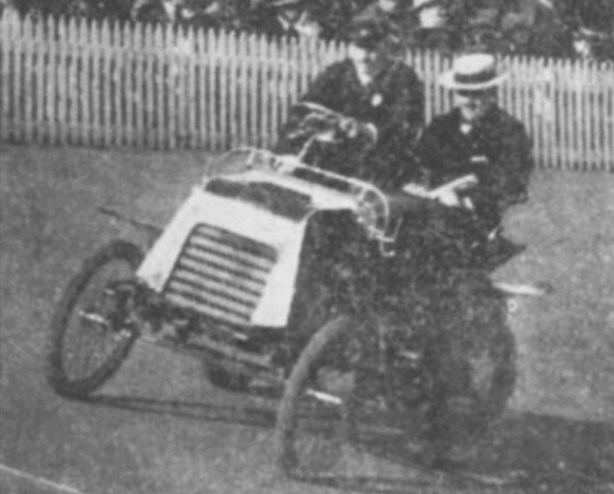
The Adelaide built Lewis car number 1, the first car built in South Australia on display/parade at Adelaide Oval on 11 October 1902, driver H Bernard. In 1902 form the car was powered by a water cooled 5HP, petrol, single-cylinder engine with ‘electric ignition’. The transmission had belt drive to a countershaft behind the rear axle from where spur gears drove the wheels. The Adelaide Oval event was one of the last public appearances of the first Lewis- motor car design was progressing rapidly and the 2 year old car was becoming dated. Lewis did build a few more cars but the future for the company was importing rather than manufacture, within a few years the business was distributing Napier, de Dion, Talbot and Star brands (unattributed)

Photo Credits…

 State Library of South Australia, Adelaide Advertiser, Adelaide Observer

 Bibliography…

Adelaide Advertiser 11, 17, 20 October 1902, The Daily Telegraph Sydney 13 October 1902, Adelaide Observer 18, 25 October 1902, The Adelaide Register 20 October 1902, earlymotor.com

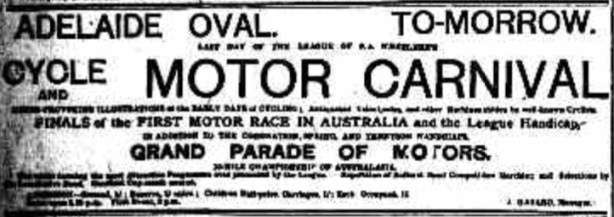
Tailpiece: Be There on 18 October 1902…


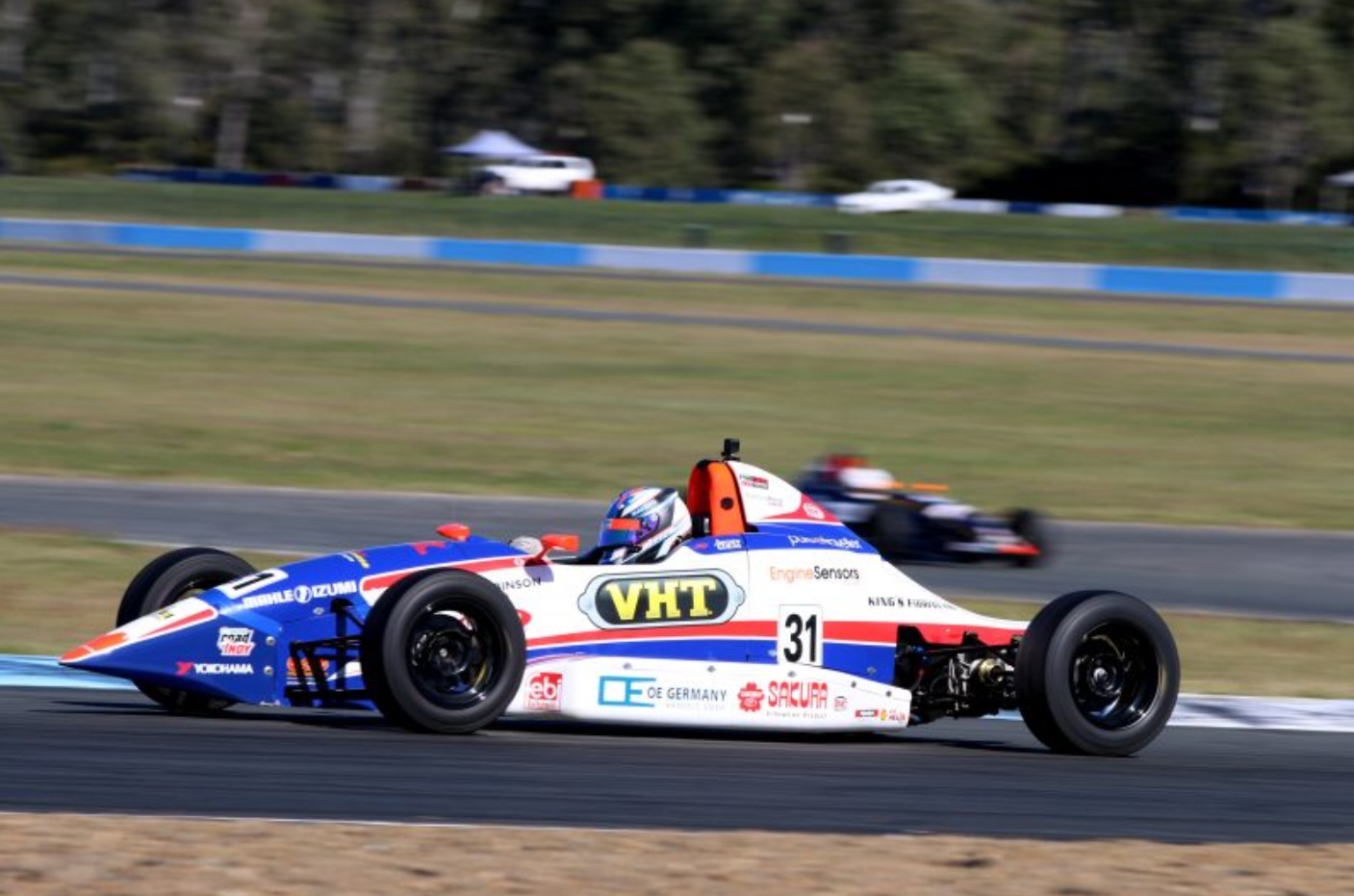
2017 works Spectrum 015 FF driven by Jayden Ojeda (Borland)

Australia’s ‘Auto Action’ magazine has an ‘Under The Skin’ section of its online publication which analyses the design and engineering of racing cars in some detail, its worth keeping an eye on…

 A short while ago AA interviewed Mike Borland about his latest Formula Ford design, the Spectrum 015, the article is also of interest in relation to the general health of FF in Australia.

All Australian enthusiasts will be well aware of Mike’s facility in Melbourne’s Braeside, down by Port Phillip Bay on the cities southern outskirts. Mind you, Borland Racing Developments have had plenty of success in the UK, the US and New Zealand with both Formula Ford and Ford 2000, the latter in the ‘States. So Spectrum are hardly an unknown marque globally these days.

Mike is the nephew of Brian Shead, designer, builder and racer of the very successful series of Cheetah racing cars so the desire to build cars was almost a natural part of his growing up process. Borland’s business originally prepared and ran ANF2 cars for customers in 1984 but soon morphed into construction of FF and F Vee racers. By the time I first met him in 1996 he was on the cusp of national FF success, Jason Bargwanna placed 2nd in the ’96 Australian FF Championship in a Spectrum 05C with Adam Macrow and Christian, son of Alan, Jones taking first and second in the 1998 championship aboard the 06 model.

In 2006 a Spectrum 011 raced to victory at Brands Hatch and more recently the company has had ongoing success in both Formula Ford and Ford 2000 in the US in addition to its position as market leader in Australia. Historic racers know the business for its restoration work and project engineering skills recently deployed on programs like Chris Lambden’s ‘Thunder 5000’, the prospective Australian National Formula 1 category/car.

Salutory is that Borlands have outlived all of the well known racing single-seater and sportscar marques of Australia with the exception of Elfin- and there is little doubt Mike will achieve that in the coming years. Mind you, at eighty Bob Britton is still working, Rennmax Engineering lives on, that business was started in the early sixties or perhaps even a little earlier. Bob Britton and Mike Borland, we salute you!

Australia does of course have vast engineering resources devoted to ‘Taxis’- V8 Supercars and Sports-Sedans to a lesser extent, and its great that large numbers of people can make a living out of the sport/business. But it is galling how small the engineering aspects of the purist end of the sport are, perhaps a global trend given the proliferation of one-make categories these days.

Click here for the Spectrum 015 Ford Duratec FF article;

https://autoaction.com.au/2017/06/20/skin-formula-ford-australia-world

Slinky, sexy, cost-effective and fast Spectrum 014 Ford 2000 160bhp car at Phillip Island in March 2017 running in the ‘Trophy’ class amongst an F3 field, Paul Zsidy up (Borland)

Postscript: On racing car production numbers in Australia…

I am not suggesting above that Elfin exists as a going concern still building racing cars, but rather that Elfin in its various guises inclusive of the Garrie Cooper period had a longer life than Borlands so far. Michael has eclipsed the lifespan and production numbers of Asp, Birrana, Bolwell, Bowin, Cheetah, Elwyn, Farrell, Hardman, Hustler, JMW, Kaditcha, Malmark-Elfin, Matich, Richards, Shrike, Spectre, Turnham, Welsor, Wren.

There are many others but these are constructors who have built five’ish cars or more off the top of my head. I dips me hat to anyone who can make a living out of building racing cars over time. I’ve been in small and medium sized businesses all of my working life and know just how hard it is- I can think of few markets more difficult than racecar manufacture in which to make a dollar!
Borland Racing Developments…

https://borlandracing.com/

Geoghegans were the Australian importers and distributors of Lotus cars from the mid-sixties to the mid-seventies when Jim Smith’s Peter Manton Motors in Melbourne stepped up to the plate

The brothers Geoghegan are no doubt well known to most primotipo readers by now, even you international mob. Between them they had ‘Taxis’ or Touring Cars and Open-Wheeler racing covered in Australia. Ian or ‘Pete’ Geoghegan was a multiple national champion aboard cars with a roof and Leo was similarly credentialed in the more rarefied and refined single-seater world.

Whilst the Lotus Racing Halo internationally was huge in the mid-sixties for all of the obvious reasons, the Geoghegan connection must have polished the Lotus brand considerably in this part of the world too.

Who wouldn’t want to buy a car from them and then have it serviced there? Why, if you were lucky during February, you might even time your trip to have your Elan’s Webers tickled with the visit of Team Lotus who operated from the Paramatta Road, Haberfield dealership during the Warwick Farm Tasman weekend.

(Dalton)

The Lotus franchise in Australia is a bit of a ‘hot spud’ really- no one has distributed the things for a long time.

Not even those who were multi-franchise dealers and therefore had the earnings of other marques with greater volumes to support the lower financial contributions of what has always been a very niche brand in Australia, the brothers Geoghegan probably the longest lived of the dealers.

Some well known motor racing names have been involved in flogging the wonderful but idiosynchratic cars down the decades.

Alec Strachan was the original importer, he was based at Waitara, Sydney and negotiated the rights with Chapman off the back of purchase of a Lotus 6-the first of Chapman’s machines in Australia. Then Derek Jolly with his impeccable racing and engineering connections to Chapman himself took over, but that was never going to really work, Adelaide is a long way from the main East Coast markets especially back then given the transport and road infrastructure. Adelaide, Perth, Brisbane and Hobart had tiny populations for such a niche product.

Performance Automobiles sold a few in Hobart and in Melbourne John Roxburgh, and Dick Thurston’s Pitstop Motors on the Nepean Highway, Brighton waved the Hethel flag. At the same time Lance Dixon sold plenty of used ones, many times I rode by bike from North Balwyn to Doncaster to dream about a red Europa or Elan. Simply Sportscars of South Melbourne have the rights now- these blokes are hard-core enthusiasts and should do well where others have failed.

Whad’ll she do mister? Leo Geoghegan’s ex-Clark Lotus 39 Repco sitting forlornly on the 253 Parramatta Road lot in 1970. Leo raced the car finally, having acquired it from Team Lotus after the 1966 Tasman Series, in the 1970 Tasman, then it was put to one side to sell whilst Leo raced to Gold Star victory in a new Lotus 59 powered by a Waggott 2 litre DOHC, 4 valve injected engine (Fistonic)

These photos by Milan Fistonic capture the late-sixties flavour of the Geoghegan’s dealership in Sydney’s Parramatta Road, ‘Auto Alley’.

The shots are very much dated as being late 1970, the year in which Leo stopped racing his evergreen ex-Clark Lotus 39 Repco V8. There it is, the 1969 JAF Japanese Grand Prix winner sitting on the used car lot just waiting for a punter with the necessary readies. Click here to read my article about this wonderful car; https://primotipo.com/2016/02/12/jim-clark-and-leo-geoghegans-lotus-39/

It was not an easy car to move at the time with F5000 in the process of becoming the new ANF1, to replace the 2.5 litre Tasman Formula. The nutbags at CAMS made F5000 cars eligible to contest the 1970 Tasman Series but not the domestic 1970 Gold Star- that title was won by Leo G in the Lotus 39’s replacement, a brand new Lotus 59B to which he bolted a superb circa 275bhp 2 litre Waggott engine built not too far from the dealership. The 39 fell into the very best of hands, John Dawson-Damer, who did a brilliant job restoring it to its original, ex-works 2.5 litre Coventry Climax FPF engined form. It’s still in Australia, happily!

It seems fitting to provide some period written flavour to accompany the photos.

To do so I have reproduced the wonderful recollections of ‘DanTra2858’ he contributed to ‘The Nostalgia Forum’, Daniel worked for the brothers Geoghegan at that time, the late sixties. I’ve positioned his thoughts around several different headings to preserve some semblance of flow.

(Dalton)

On assembling Lotuses in Australia.

The cars arrived by ship from Hethel ‘CKD’ or in Completely Knocked Down form… ‘…1969, also working there at the time was Barry Lake (racer and very well known racing journalist) and Wally Willmott (for many years Bruce McLaren’s right hand in the nascent years of BM Motor Racing in the UK) Service Manager was Bob Everitt.

With a little help to remove a Europa from its crate and the motor/gearbox and diff assemby, it took me about 10 hours to assemble a car ready for registration.

There were some long days assembling the cars mainly due to the clutch plates attaching themself to the flywheel. Of course this did not show up until the installation of the motor/gearbox into the car on initial start up, sometimes it could be rectified by starting the car in gear but not always. Then out with the motor/gearbox as that was easier than split, fix the problem then put it all back together again, good days!

When Lotus cars were imported…they came in a open frame wooden crate with the car wrapped in plastic sheeting, that was the full extent of protection (during the long voyage from England) The motor/gearbox assembly was in a wooden box complete with the suspension, tailshaft , diff and wheels. Each crate/box had identification numbers on them to match the motor to body, so the first thing to do was match up the components to assemble a car.

When this was done the body crate was opened, plastic wrapping removed and using 2 trolley jacks the body was moved into the workshop and placed on modified jack stands. Then the motor box was opened and all suspension parts/wheels were removed and taken into the workshop ready for assembly, by this this time it was time to stop work for morning tea!

Now refreshed it was time to fit the suspension and wheels so the car was now a roller which made it easier to work on. When assembling the rear suspension the diff, drive shafts, Hillman Imp rubber doughnuts etc were all fitted. Now for lunch.

So with a full belly it was time to bring in the motor/gearbox, tailshaft and fit them into the car, along with the exhaust system. When this assembly was bolted in, cooling hoses, electrics and other parts were fitted. Then it was time to present to this ‘new arrival’ its first full meal of lubricants including brake fluid, so we then bleed the brakes. By this time it was about 4 in the afternoon so a cuppa was in order, then back to work.

Now that the car was fully assembled the work really started. Re-check that all previously assembled parts were correctly assembled and all bolts/nuts were tight, oil levels were correct and that there were no leaks in the brake hydraulic system and fluid was at correct levels. Next I checked that the clutch operated correctly and if not then one of two steps were taken to rectify the adhesion of the clutch plate to the flywheel/pressure plate. If there was no trouble with the clutch it was time to connect the battery and start the motor, let it warm up, check for fluid leaks and bleed the heater system in the cabin of the car by slackening the bleed screw on top of the heater core remembering to tighten it after all the air was bled off. If there was clutch trouble the first thing we did was to start the car while in gear, this usually caused the clutch plate to release then operate correctly. If not then it was out with the motor/gearbox assy to fix the problem then pop it back into the car- this would add 3 hours to the assembly time.

If all went well it was now about 6 pm but still the to-do list list included wheel alignment, checking that all lights operated correctly and that all of the electrics worked. Then tyre pressures were set with a final check for leaking fluids. By this time it was about 8pm and another 12 hour day was complete leaving the road test for first thing the next day- that also included cleaning up wood crates and plastic wrapping. Then onto normal service work with another assembly starting the next day. Well folks that is how it was done at Geoghegans, I may have missed a few steps somewhere along the way, it is a long time from 1969…you have the picture’.

Plenty of lonely S2 Europa’s in 1970 (Fistonic)

On The Hot Sellers of the Lotus range…

‘The sales section always required stock on the floor that covered the Lotus range excluding Super 7’s. (Not sure why they were not imported to Australia, Chapman didn’t do the deal with Graham Nearn at Caterham cars to take over the rights to build 7’s until 1971 from memory, so Lotus Components were certainly still building them in the late sixties)

The slowest moving car was the Elan Plus 2 so every time one was sold we would assemble another but that did not happen often, the most popular was the Elan Coupe followed by the Europa, we would assemble 2 or 3 a week depending on sales of the model.

I found the Europa quicker to assemble than the Elan. My first experience driving a Europa along Paramatta Road (a main artery into and out of Sydney in the days before freeways it was the ’normal’ way to go between Melbourne and Sydney so there was plenty of local and interstate traffic inclusive of large semi-trailers) was just straight out frightening especially when a double decker bus pulled up alongside me while waiting for the traffic lights to change to green. Sitting in the Europa I found myself looking up at the centre of its wheels with the bus towering over me, a feeling of vulnerability quickly came over me.’

Tried and true technique of naked ladies to get us blokes to scan the pages of a brochure in a thorough manner. Lotus Elite brochure , must be US issue, way too racy for 1960 Australia (Dalton)

On Painful Customers…

‘Pete Geoghegan did not come down to the service section much at all…on one of those times he was showing off on a motor bike, doing wheel stands in the lube bay then the 6 foot dash from the lube bay through our parts area into the Lotus workshop then back again with the biggest smile I have ever seen on a guy that has just achieved what no-one else has done.

One Elan FHC I do remember very well.

Its owner arrived at our service area unannounced while we were having morning tea wanting something fixed right away, I told him that I would look at it as soon as I finished my coffee but that was the wrong answer for this guy.

He then spoke to Bob Everitt, the Service Manager and was told by him that I would look after his car as soon as I had finished my coffee, this slowed him down a bit but he kept on looking to his watch. So I finished my coffee quickly…went into the service bay held out my hand and introduced myself, without a blink he shook my hand introduced himself and told me what the problem was, I fixed it in 10 minutes and he was on his way, oh his name…Warwick Brown, I serviced his Elan from then on…’(In 1969 20 year old WB would have just been starting his racing career in a little Brabham owned by Pat Burke- who was still his patron when he won the Tasman Championship in 1975 aboard a Lola T332 Chev F5000)

Photographer Milan Fistonic with an eye for Plus 2 Elans (Fistonic)

Lotus equals ‘Lots Of Trouble Usually Serious’…

‘Whilst at Geoghegans I only worked on one Elite and was very impressed by the construction of the car as a full mono-fibreglass enclosure setup…it was on sale in the yard so it would have been a quick mechanical check up prior to the car going on sale. The main thing that had to be done, as with all fibreglass Lotus’ was to make sure that the electrical earth set up was not corrupted by corrosion on the body to chassis alloy mounting bobbins in the body. That was number one check on all Lotuses even new ones. The alloy bobbins on the Elite are for suspension mounting, but there again steel bolts into alloy bobbins, which means corrosion of the bobbin which have been known to become loose in their fibreglass enclosure- meaning fibreglass repairs.

Lotus Elans were bad for water leaks at the top of the A-pillar and in the boot. We tried re-gluing the door sealing at the top of the A-pillar but all to no avail as the inside plastic section of the seal kept on pulling it down leaving a small opening at the top where the seal assembly transferred to the horizontal. The final Geoghegan factory fix was to push the seal assembly up as hard as you could into the top of the A-pillar while your offsider drilled a one eighth inch hole through the vinyl inside section of the seal and into the fiberglass body, then insert a pop rivet and pull it home and there was a permanent fix with nothing but happy customers. By the way we didn’t leave the pop rivet just plain silver so it would show, we concealed it by painting it with a black texta.

For me the hardest thing while working at Geoghegans was learning how to spell their name, Smith or Brown would have been much easier!’…

Photo Credits…

Milan Fistonic

Bibliography…

DanTran2858, The Nostalgia Forum, Stephen Dalton Collection


(P Mellor)

John Surtees cruising his Lola Mk4A Climax around the Lakeside paddock during the 1963 Australian summer…

No doubt he is on the way to or from scrutineering, the Lola devoid of its usual slinky ‘Specialised Mouldings’ fibreglass body. These cars were designed by Eric Broadley as F1 machines, they were the front line weapons of the Bowmaker Racing Team during the 1962 season.

Strong results at championship level were skinny even when the too flexible spaceframe Mk4 chassis was braced with aluminium to become the ‘semi-monocoque’ Mk4A. The last of the Mk4’s was modified in this manner and is the car Surtees raced in Australasia in the summer of ’63- chassis ‘BRGP44′. The chassis made its debut in the non-championship Kanonloppet at Karlskoga in Surtees hands on 12 August 1962 and was then raced in the GP’s of Danske and Italy before being converted for Surtees’ use in the South Pacific.

The Mk4’s were fitted with both the Coventry Climax FWMV 1.5 litre V8 for F1 use and the 2.5 or 2.7 litre Coventry Climax FPF engine for the Intercontinental Formula and for Formula Libre as the Australasian summer races then were.

The global stock of FPF’s found a ready home in Australasia after the commencement of the 1.5 litre F1 as the ‘engine de jour’ in our Formula Libre, Gold Star and Tasman races until 1966 when ‘multi-cylinder’ engines arrived. The BRM P261 V8 won the Tasman in 1966 in Jackie Stewart’s hands, soon the Tasman was awash with interesting engines from BRM, Repco, Ferrari and Ford. Mind you, the good ‘ole FPF was still a contender in Gold Star events with Spencer Martin and Kevin Bartlett consistently knocking off Repco V8’s in domestic Australian events into 1967.

Surtees was on the cusp of four-wheel greatness of course. In 1964 he won the World F1 Drivers Championship for Ferrari in a Tipo 158, an additional title to match those already won on bikes.

Surtees in the Bowmaker Racing Lola Mk4A chassis ‘BRGP44’ Coventry Climax 2.7 FPF during the 1963 Australian GP weekend at Warwick Farm in February. He was 2nd in between winner Brabham and 3rd placed Bruce McLaren in Brabham BT4 and Cooper T62 respectively, both 2.7 FPF powered (Ellacott)

Bowmaker Racing entered cars for John and Tony Maggs that season in Australasia achieving a good measure of success. Competition was stiff too. That year the internationals included Jack Brabham, Bruce McLaren, Graham Hill (Ferguson P99) and coming-man Chris Amon. In addition Australian and New Zealand Champions included Bib Stillwell, Lex Davison, John Youl, David McKay and Jim Palmer- not all of these blokes did the whole series mind you.

The Lakeside International was held in blistering Queensland summer heat with Surtees taking a fine win from Graham Hill and Bib Stillwell. He was first in the NZ GP at Pukekohe early in January too, having gearbox dramas at Levin and Wigram and a distant 9th at Teretonga with undisclosed problems. He then contested the Australian events at Warwick Farm, finishing 2nd in the AGP at Warwick Farm, took the win at Lakeside and then jetted home to the UK and testing duties with Ferrari. The rest, as they say is history…

Photo Credits…

Peter Mellor on The Roaring Season, John Ellacott

Surtees Article…

John Surtees: World Champion 50 Years Ago…1964

Amon on the way to 7th in the Lola Mk4A ‘BRGP44’ now re-engined with a Coventry Climax FWMV V8, at Rouen, French GP June 30 1963. Clark won in a Lotus 25 Climax (unattributed)

Tailpiece: Chris Amon, Lola Mk4A Climax, French GP 1963…

Lola Mk4A ‘BRGP44’ raced on into 1963. The car was converted back into an F1 machine, the 2.7 FPF was lifted out after its sojurn in Australasia and an FWMV Coventry Climax V8 re-fitted back at Lola in Bromley. Chris Amon was allocated the car for the ’63 F1 season, although Maurice Trintignant raced it at Monaco. The cars best result that year was funnily enough Amon’s first race in it- 5th in the Glover Trophy at Goodwood.

image

(Beasy/Repco)

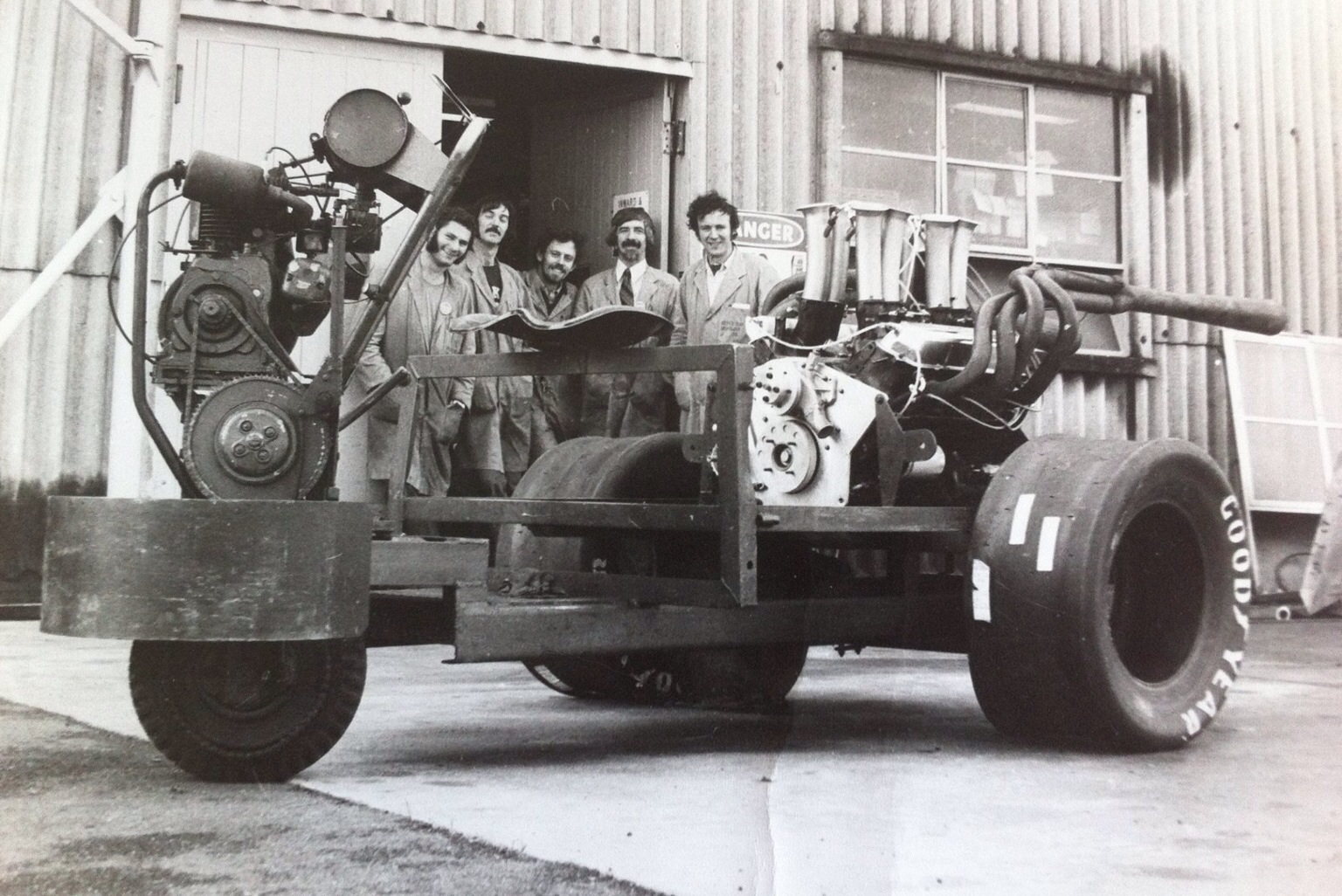
The fast way to get around Repco’s Maidstone factory…

Repco Engine Development Co chief Malcolm Preston bought this Veggie Cart from Melbourne’s Victoria Market to shift shite around the plant. These enterprising lads have neatly set it up for this fun shot. Luvvit!

The dapper bearded ‘70’s dude wearing the tie is Don Halpin, I spoke to him not so long ago, he hasn’t changed too much at all. Rodway Wolfe says the guy left of Don is John McVeigh and moustachioed fella is Ken Symes, on the far right is Brian Slader.

When is it though?

I’m guessing the up and over exhausts are to fit Frank Matich’s McLaren M10B/C, Frank was the works Repco driver who did the development work long before the first customer engines were sold. That makes it 1970 or 1971, but there are a load of Australian F5000 nutbags who can probably provide the date and time of day. The Bowin P8 also had this style of exhausts to clear the rising rate suspension linkages which precluded a low exhaust, that would make it late 1971 or 1972.

Mind you, thinking about it some more, the exhausts fitted may be just for the dyno. Its out that side door so the big V8 may be heading in the direction of the test-house. The long inlets look like those of one of the you-beaut, super trick, schmick, flat-plane crank engines too. These gave 525bhp, Repco’s horses were always stallions too, not geldings! So…that makes it 1973/4, the Repco boys ‘fashionable’ looks also define that era.

All opinions welcome and as you Repco F5000 experts can see I’ve covered the years 1970 to 1974, the whole period in which these superbly designed and made engines were built!…

image

1974 Sandown Tasman round, John Walker Lola T330 Repco 3rd, Peter Gethin won is a VDS Chevron B24 Chev (unattributed)

Credit…

The Repco cart photo is sourced from Mark Beasy, he and Will Beasy have a great Repco connection having inherited the only Repco Holden F5000 powered Lola on the planet, the ex-John Walker T330 ‘HU23’.

It’s getting closer to completion, the project was started by Mark and Will’s dad, Brian many years ago. I remember seeing Brian on quite a few occasions at his Lilydale home, client work always got in the way of that particular restoration and the thankless CAMS Historic Commission eligibility work he did. A top bloke- talented motor-cycle racer, car racer and engineer.

image

JW 1st in the 1973 Gold Star round at Phillip Island in November from McCormack and Cooper in Elfin MR5’s (Chris Parker)


image

(Alvis Upitis)


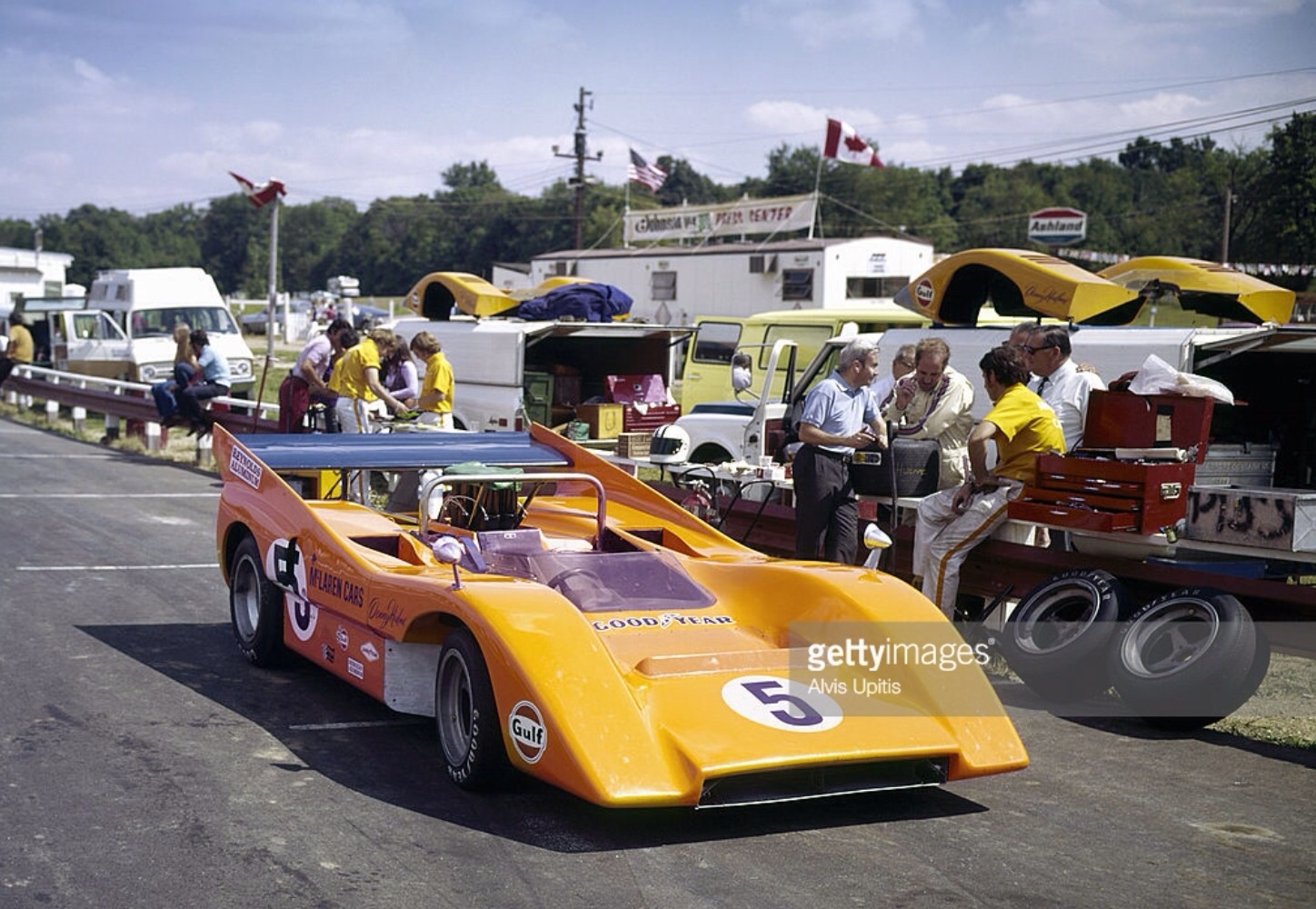
Denny Hulme unleashing all 670 ‘neddies’ of his McLaren M8D Chev at Mid Ohio in August 1970…

The alloy block Chev V8’s were 7.6 litres in 1970, the ‘Batmobile’ arguably the sexiest of the Can Am McLarens and certainly one of the most successful.

Denny won 6 of the 10 rounds and Dan Gurney another 2 before sponsorship conflicts brought to an end his drive which arose as a result of Bruce McLaren’s fatal testing accident aboard an M8D at Goodwood on 2 June 1970. Peter Gethin, Dan’s replacement won another round adding to the ‘papaya rout’.

image

Denny and Teddy Mayer are easy to pick, perhaps some of you can help with the names of the rest of the team, modest ute and trailer indicative of a ‘no frills’ approach to all but the ‘weapons of battle’ (Alvis Upitis)

I wrote an article about the McLaren M8D a while back, click here to read it;

Peter Gethin: McLaren M8D Chev: Can Am 1970…

image

Hulme won the Mid Ohio round, the ‘Buckeye Cup’ from Peter Revson’s Lola T220 Chev and Lothar Motschenbacher’s ex-works McLaren M8B Chev, in the shot above Denny is ahead of Lothar early in the race.

Credits…Alvis Upitis

image

Teddy Mayer, Denny and the team resolve the next set-up changes to Hulme’s steed (Alvis Upitis)


(Joel Wakely)

While two of my favourite drivers are Lorenzo Bandini and Australian Gold Star champion, Spencer Martin, it was quite a surprise to see them in the same shot. Lorenzo in a Cooper and Spencer a Holden…

Joel Wakely’s Boomerang Service Station at Concord, inner-western Sydney was well known amongst Australian motor-racing aficionados by February 1962 as builders of one of the fastest Appendix J Holden 48-215 sedans in the land peddled very hard by up-and-comer Spencer Martin.

The young Sydneysider was soon to race Tasman cars like Bandini’s Cooper for Australian racer/journalist/patron David McKay’s Scuderia Veloce, but that period was still a year or so away. Click here for Spencer’s own account of his racing career;

Bandini was also on the rise. His racing in the southern summer sun of ’62 was part of Mimmo Dei’s grand plan to give the young Italian some racing miles aboard his Scuderia Centro Sud T53 Cooper in the European off-season’ to get him razor sharp for the rigours of the coming season back home.

The 2.9 litre Maserati engined Cooper was very much a big-car, F1 by then was a 1.5-litre formula, so the experience was valuable for him. It was a successful strategy back then and still is, the New Zealand Toyota Racing Series every summer is a place young racers look to keep themselves race fit and help thrust their careers forward. Click here for my article about Bandini;

The car in the middle of the shot is the gorgeous Clive Adams designed Prad Holden sportscar styled along the lines of a Maserati 300S. Jack Pryor built the chassis and Stan Brown it’s shapely body. Spencer Martin bought, developed and raced the car successfully after Adams sold it.

And so it came to pass that Bandini’s Cooper was operated from the Boomerang Servo at the behest of BP, who supported Centro Sud. It made good sense as the garage was only 25km from Warwick Farm, near Liverpool on Sydney’s then western outskirts. Wakely recalls that ‘So many people heard about the car at the garage and came down to have a look we had to have crowd control!’

Centro Sud were not exactly renowned for the detail presentation of their cars, but even so I thought Lorenzo’s car looked a bit tatty. Perhaps the reason is that it isn’t the car he raced!

Have a look yourself at the photo below, it isn’t the same car. The inlet and exhaust sides of the Maserati engine are on the opposite sides to the Cooper in shot, apart from the body differences. I think the car above is a spare T51 Cooper, one of two acquired by Dei from Coopers in 1959 and raced in both F1 in 1959/60 and the Intercontinental Formula in 1961. Still, that’s my theory it may not be right! So, the question for my Australian friends is which Cooper chassis is Bandini sitting aboard? A Centro Sud spare or another car based that weekend at the Concord Temple of Speed?

I love these mysteries, but I like the answers even more…

(John Ellacott)

Lorenzo Bandini in the Centro Sud Cooper T53 Maserati – chassis F1-13-61 – during the Warwick Farm 100, 4 February 1962. Compare and contrast with the car in the opening shot.

Credits…

oldracingcars.com, sergent.com, Joel Wakely, John Ellacott

Other Reading…

Article about Spencer Martin and the iconic Ferrari 250LM he raced for David McKay

Finito…

(SLSA)

AG Bungey’s or GB Woodman’s Humberette 5HP on the startline of the Magill to Norton Summit Hillclimb, Adelaide, Saturday 16 December 1905…

The first of these events run by the Automobile Club of South Australia (ACSA) was held a year before, on 17 December 1904. I was terribly excited at finding a shot of a competitor in the first hillclimb in SA, but upon further research it appears the superb photograph is from the 1905 event, the second of three, the final in-period event being held in 1906.

The photo took my breath away, there is so much going on. I find fascinating the clothing and attire of the drivers, officials, kids and teenagers. Love the deer-stalker hat and pipe of the dude on the left. The officials with writing pads are HR Harley and HR Hammer- do let me know if any of you are related to them. The Steward at the start line is the Club Secretary RJ Hancock, perhaps he is the fella to the right of the car?

The competition was held in ideal Adelaide summer weather with what slight wind there was, blowing down the hills, perhaps impacting times slightly.

Bungey’s time for the 4 mile journey from the East Torrens Hotel at Magill (corner of what is now East Street and Magill Road) up into the Adelaide Hills finishing line at the White Gate, Norton Summit, was 42 ½ minutes which suggests he was either incredibly slow or had some type of mechanical drama. Woodman completed the distance in 30 min 7 seconds. Fastest time of the day, to use modern phraseology, was recorded by ES Rymill’s Darracq 15HP who did a time of 9 minutes 10 seconds. So keen was Rymill to win the event that his car was rebuilt, ‘like many cars it had been dismantled for the occasion’. Great to see the competitive spirit from motor racing’s most formative stages in South Australia!

Pictured below are the Rymill brothers, notable pioneering South Australian motorists, aboard their fast Darracq at the top of Belair Hill on the way to Victor Harbor during the ACSA Reliability Trial held during Easter 1905, 21 and 22 April. These type of reliability events were very popular in Australia in the early years of motoring with this one the first organised by the ACSA.

Adelaide’s ‘The Advertiser’ newspaper characterised communal views on the car at the time: ‘The average citizen considers that the principal characteristic of a motor car is its fickleness. In his opinion it will go sometimes, but often it will not go. To disabuse people of this erroneous idea the club inaugurated the trial, which has had the effect of proving that as a general rule the motor car is reliable, and, considering the distance covered at a high speed was 228 miles, there were comparatively few mishaps, and all of those were of a trivial nature. Of the 14 cars which competed seven (including the Rymill Darracq) succeeded in accomplishing the entire 228 miles, constituting a very severe test, within schedule time, and gained the full number of marks’.

(SLSA)

This trial comprised two legs, the first of 120 miles on Good Friday from Mitcham, an Adelaide suburb to Victor Harbour, site of the 1936 South Australian Centenary Grand Prix aka ‘1937’ Australian Grand Prix held in December 1936 on the Fleurieu Peninsula. On the Saturday, 108 miles were covered from Adelaide to Mannum.

Twenty one cars and five motor cycles contested the Norton Summit Hillclimb with the competitors arranged in classes according to their quoted power ‘and sent away at different times to obviate passing each other’ with ‘officials stationed at all the sharp curves on the road’. The quickest bike was N Jackson’s 2.5HP water-cooled Lewis, his time was 10 minutes 6 seconds.

The Advertiser’s report notes ‘There was not one breakdown or mishap, which speaks volumes for the excellence of the cars owned by South Australia’.

Just a brief note to put these early, formative motor sporting contests into the broader framework of motoring competition in Australia at the time. When I wrote about Australia’s first ‘Motor Car Race’ at Melbourne’s Sandown Racecourse on 12 March 1904, (link below) respected Australian motor racing historian/author/racer John Medley said ‘that was brave!’ meaning the topic is somewhat contentious. It would be great to hear from others who may feel an event other than the Sandown contest was the first.When was the first ‘race’ in New South Wales for example?

Australias First ‘Motor Car Race’: Sandown Racecourse, Victoria, March 1904…

In South Australia, for the record, it appears the first hillclimb, legal one anyway!, was the 17 December Norton Summit event on Saturday 17 December 1904 and the first ‘car race’, ‘where motor cars take the place of horses, and race in competition at their top speed’, was held at Morphettville Racecourse, 10 Km from Adelaide on Saturday 12 November 1904. This meeting was also promoted by the Automobile Club of South Australia.

FS Rymill had earned the nickname from Adelaide tram and cab-drivers of ‘The Flying Dutchman’ for his fast driving exploits in traffic. He and his Darracq 15HP were the stars of the show that Morphettville November day winning the 3 mile ‘Tourist Car Race’ from scratch, in this race a full complement of passengers were carried averaging at least 10 stone or over in weight. Rymill then won heat 1 of the ‘Starting Competition’ (starting the car by handle and then racing) and finally the 3 mile ‘Heavy Car Race’. Perhaps the latter was the premier event of the day, where Rymill again won off scratch from the De Dion 12HP of A Allison and De Dion 8HP of Dr Gault.

Bibliography…

‘The Advertiser’ Adelaide 20, 22 and 24 April, and 22 December 1905, ‘Chronicle 12 November 1904, ‘Adelaide Observer’ 19 November 1904

Photo Credits…

State Library of South Australia


hawkes-bathurst-cooper-58

Tom Hawkes, Cooper T23 Holden Repco, AGP Bathurst 1958 (unattributed)

Tom Hawkes racing his way up Mount Panorma towards a giant killing 3rd place during the 1958 Australian Grand Prix at Bathurst…

He finished behind Lex Davison’s winning Ferrari 500/625 and Ern Seeliger’s 4.6 litre fuel injected Chev V8 engined Maybach. Hawkes’ Cooper T23 is the ex-Brabham car chassis # CB/1/53 i wrote about not so long ago. Click here to read the article;

Jack’s ‘Altona Grand Prix’ and Cooper T23 Bristol…

Tom replaced the cars Bristol engine and fitted a Repco Hi-Power, Phil Irving designed head breathing much life into the standard 6 cylinder, OHV, inline Holden 6 cylinder ‘Grey Motor’. The engine raced at 2.3 litres in capacity.

The interesting thing is exactly where on Mount Panorama the shot is taken. The right hander at the top of Mountain Straight perhaps, ‘Quarry Corner’? All suggestions taken. Its a quintessential Australian country scene, in the absence of a crowd it could be anywhere!

Photo Credit…

Unsure, intrigued to know who took the wonderful shot