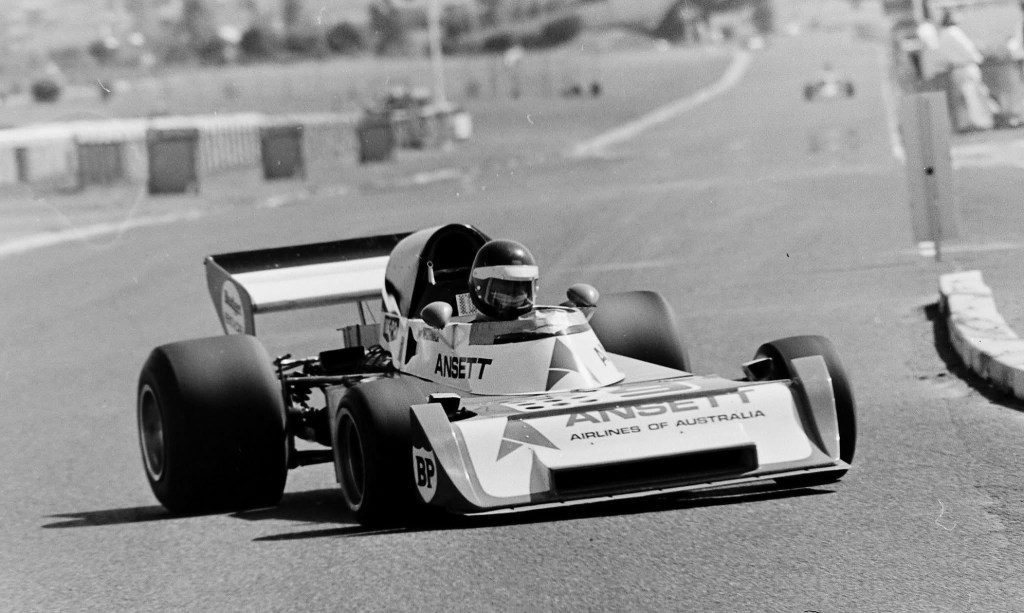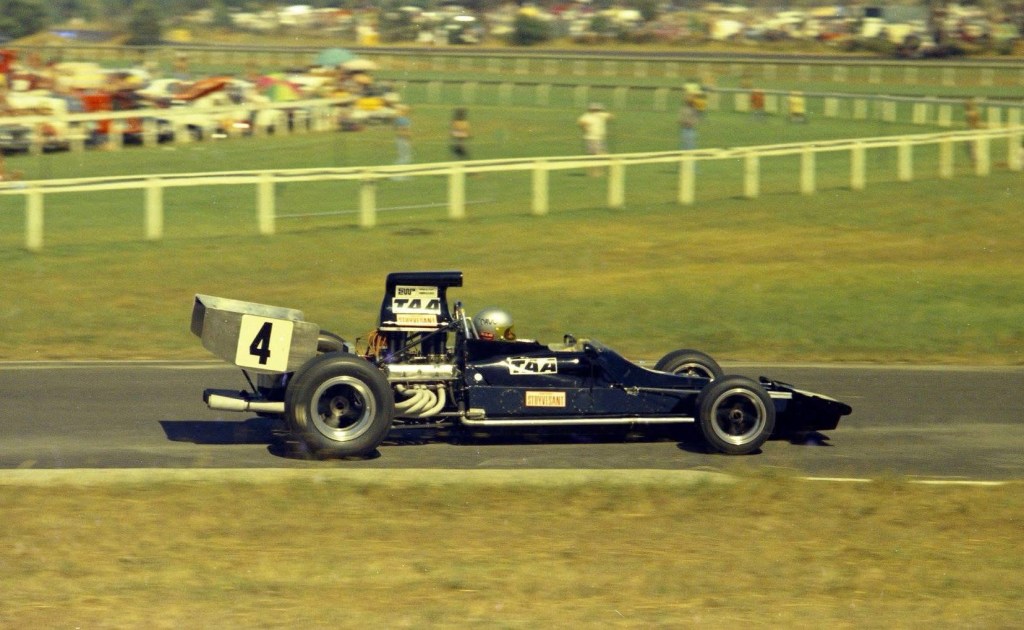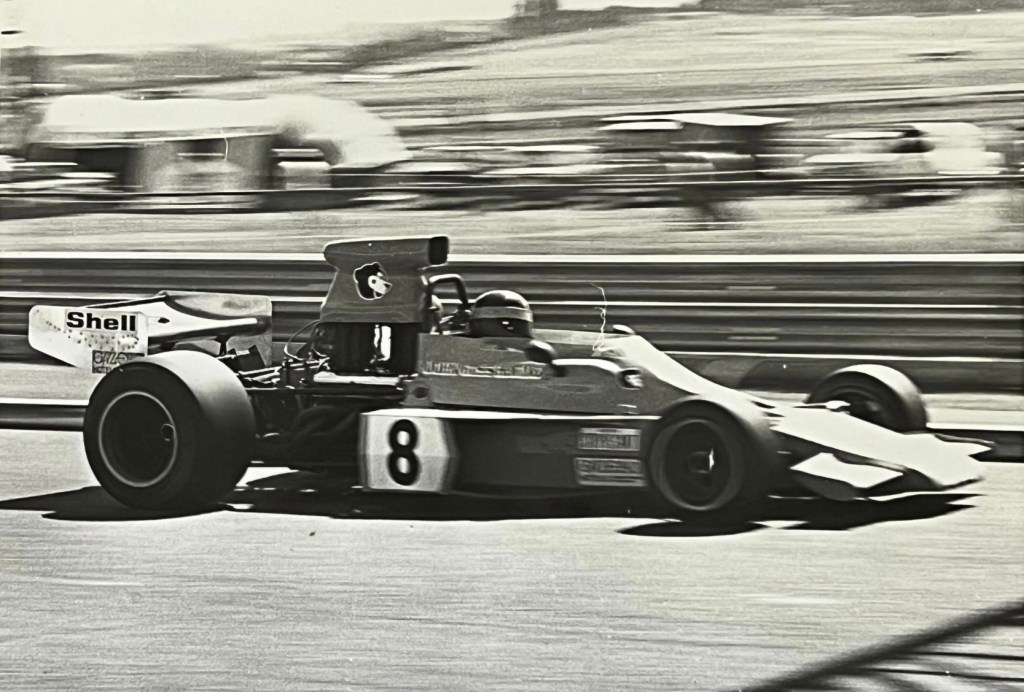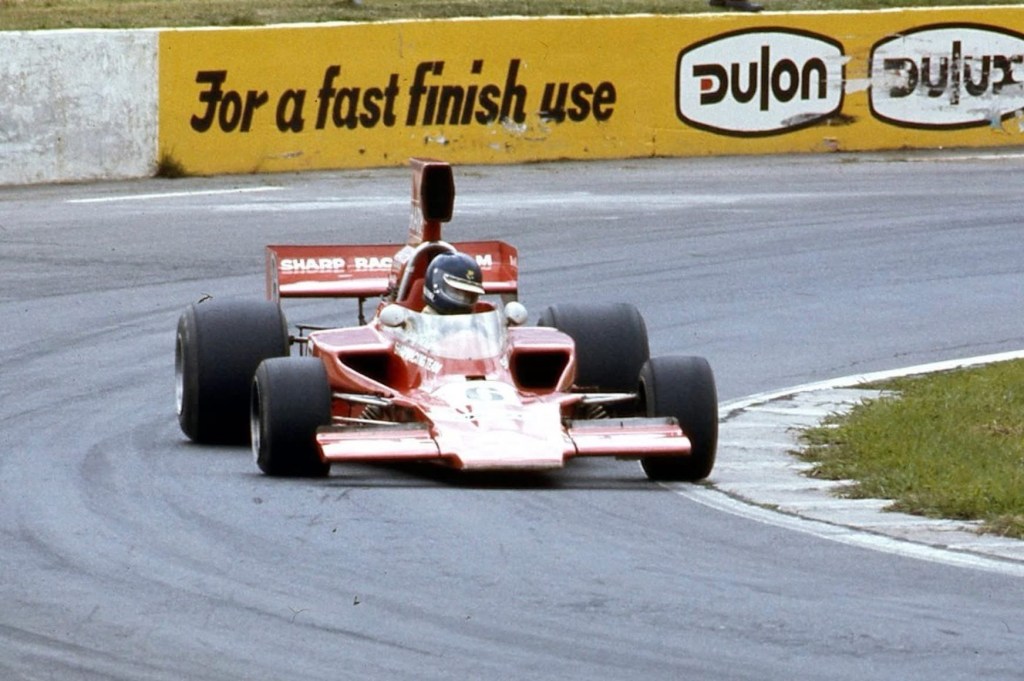
Posts Tagged ‘Max Stewart’

(D Simpson)

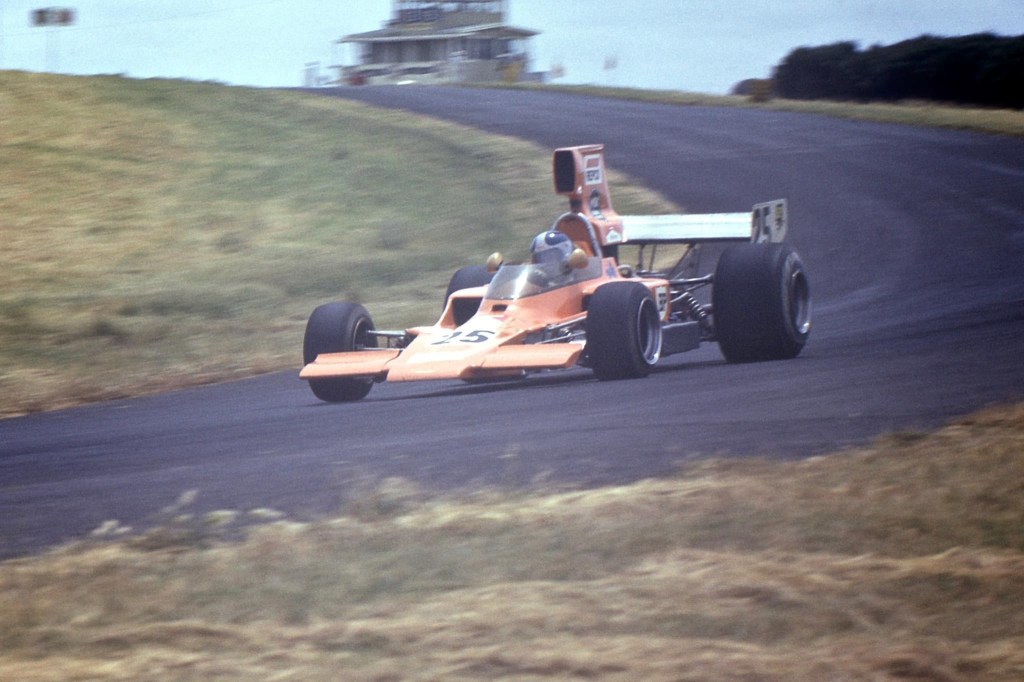
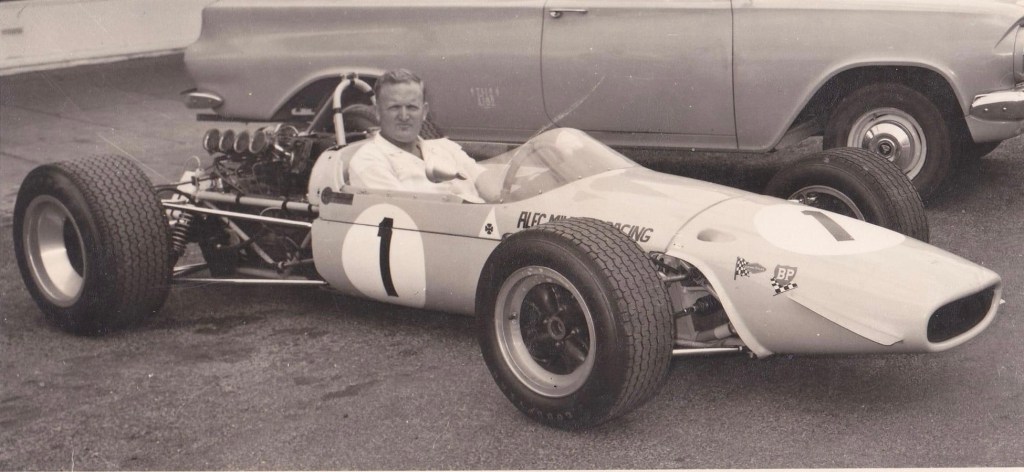
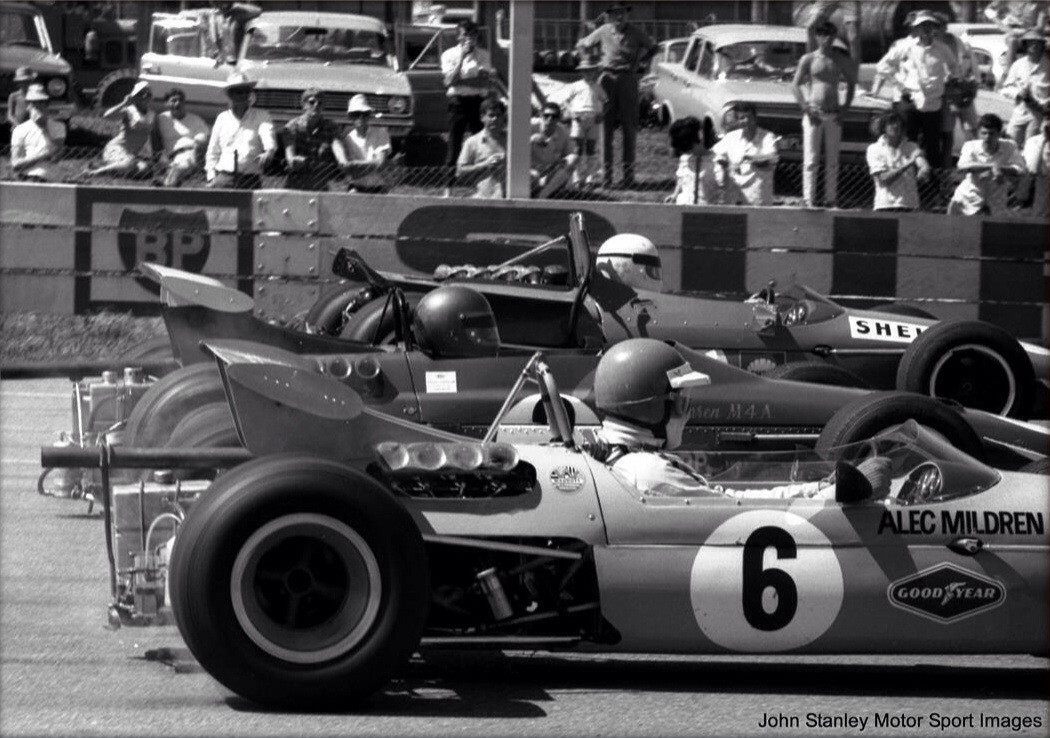
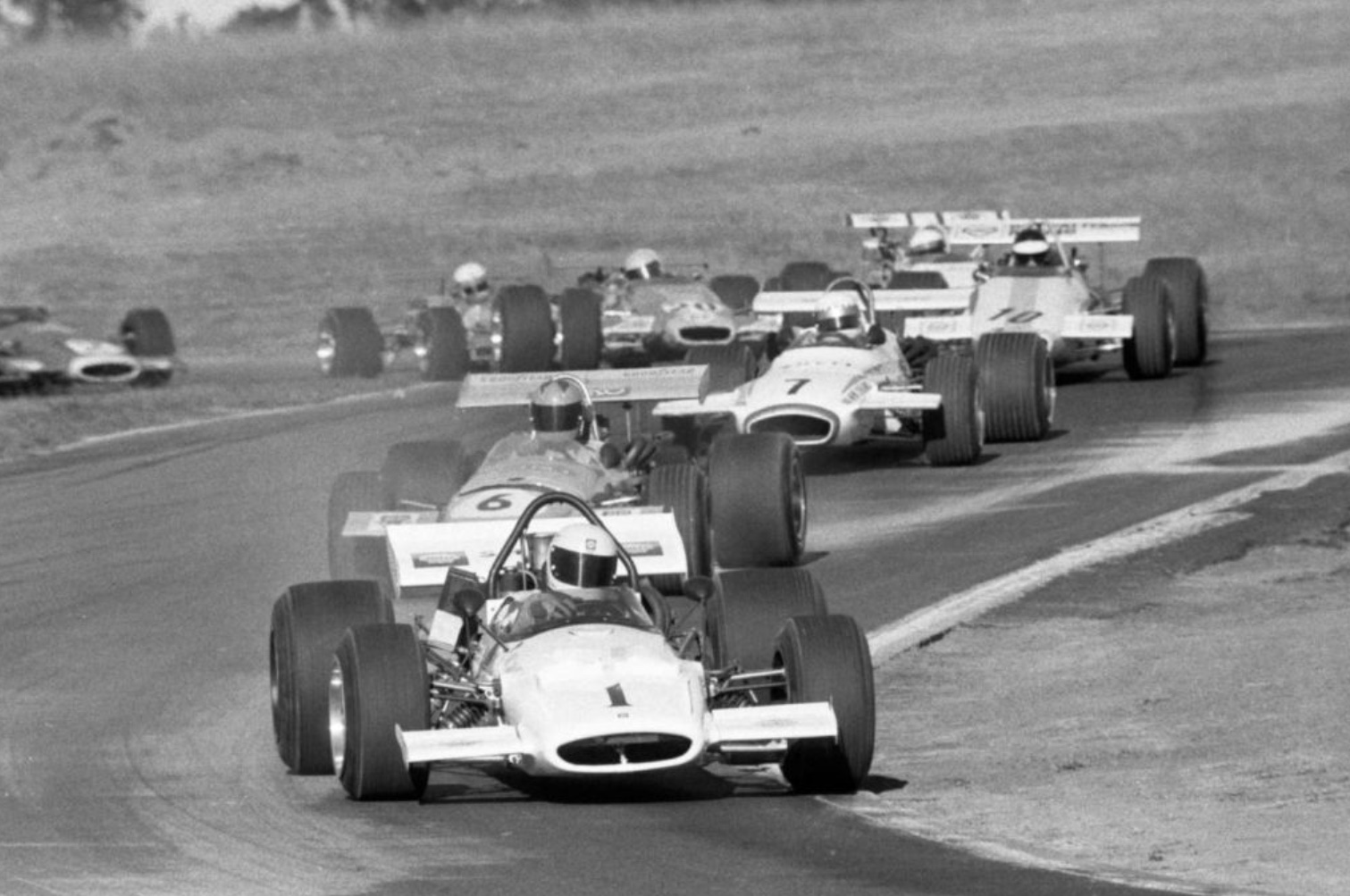
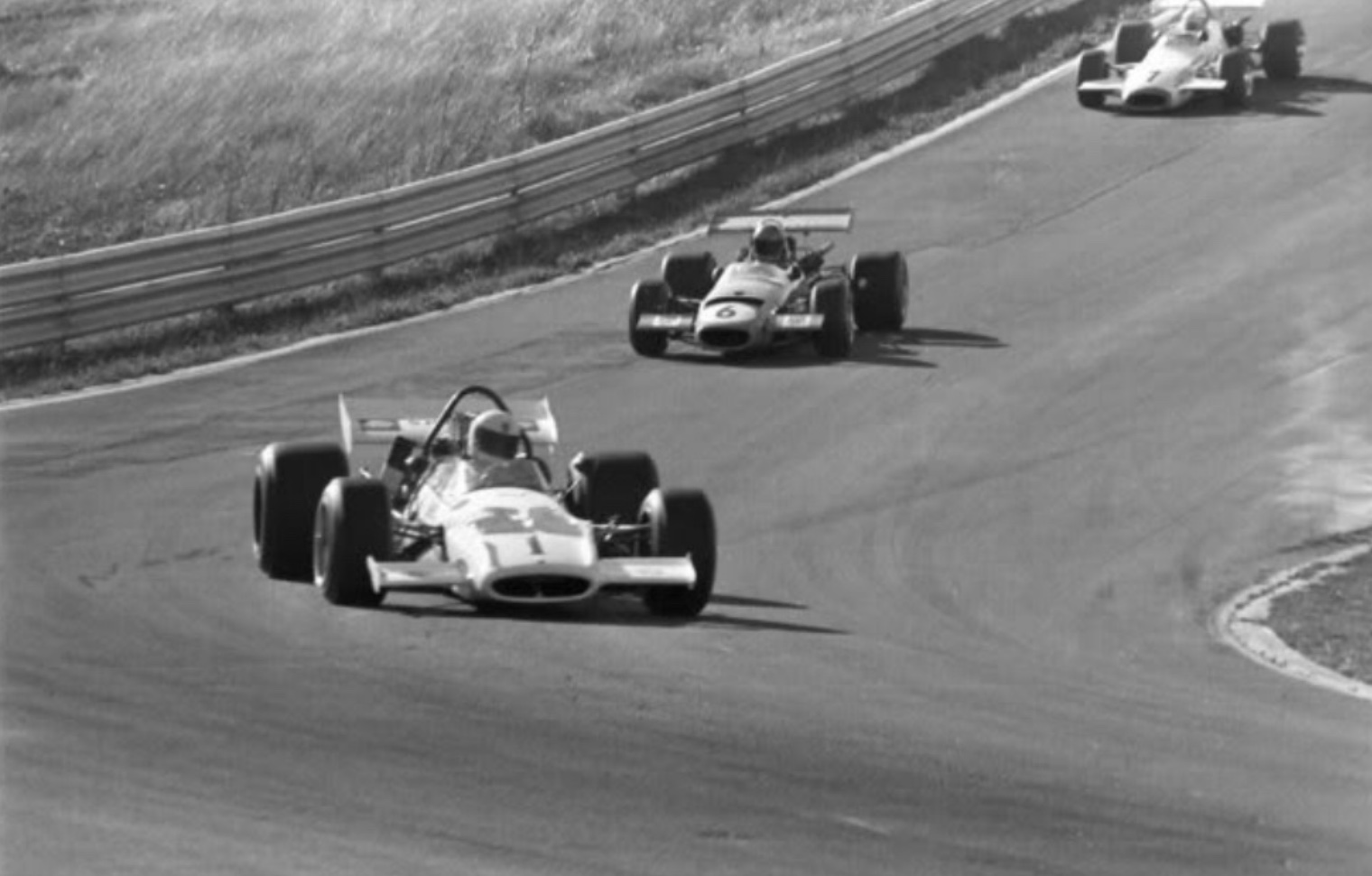
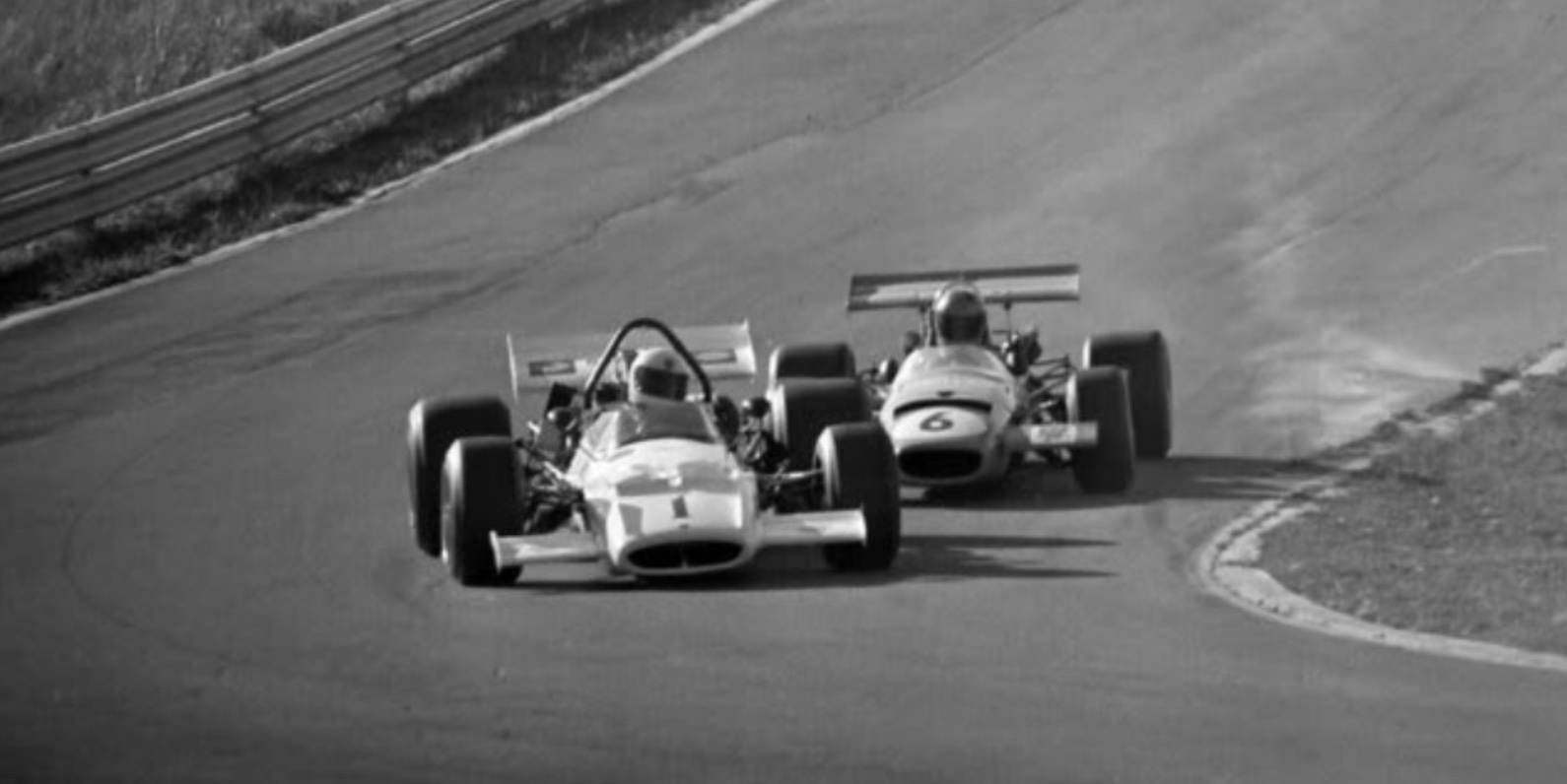
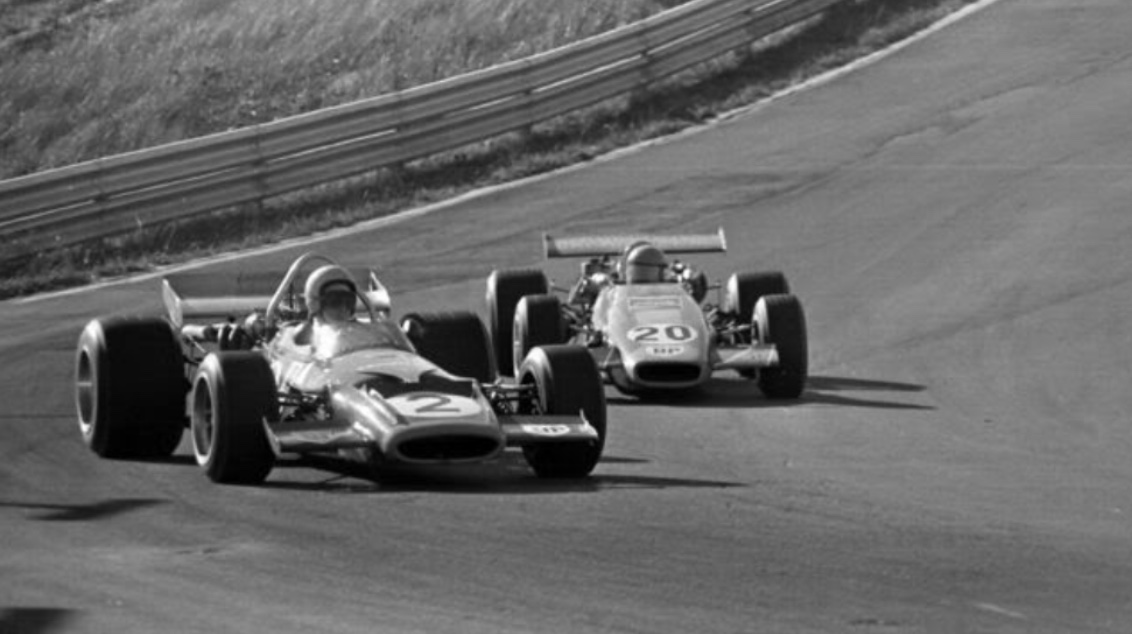
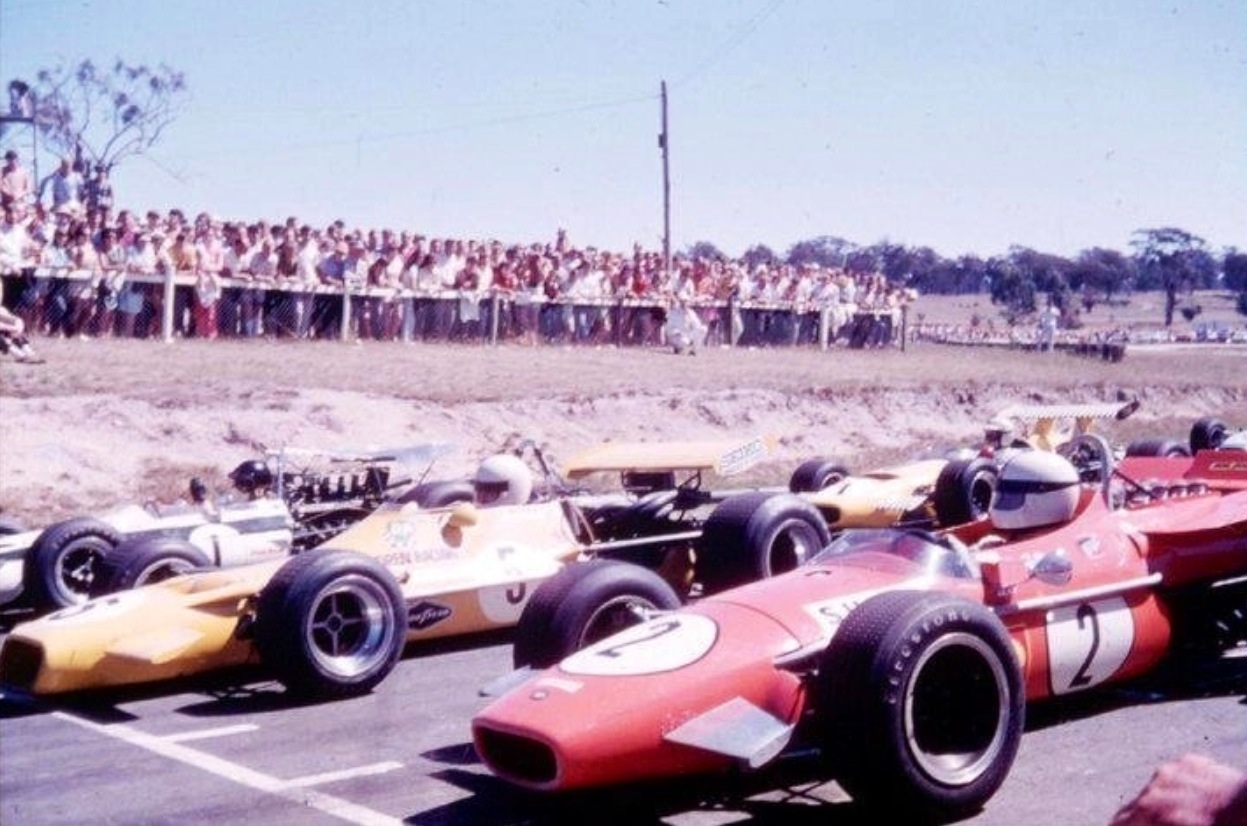
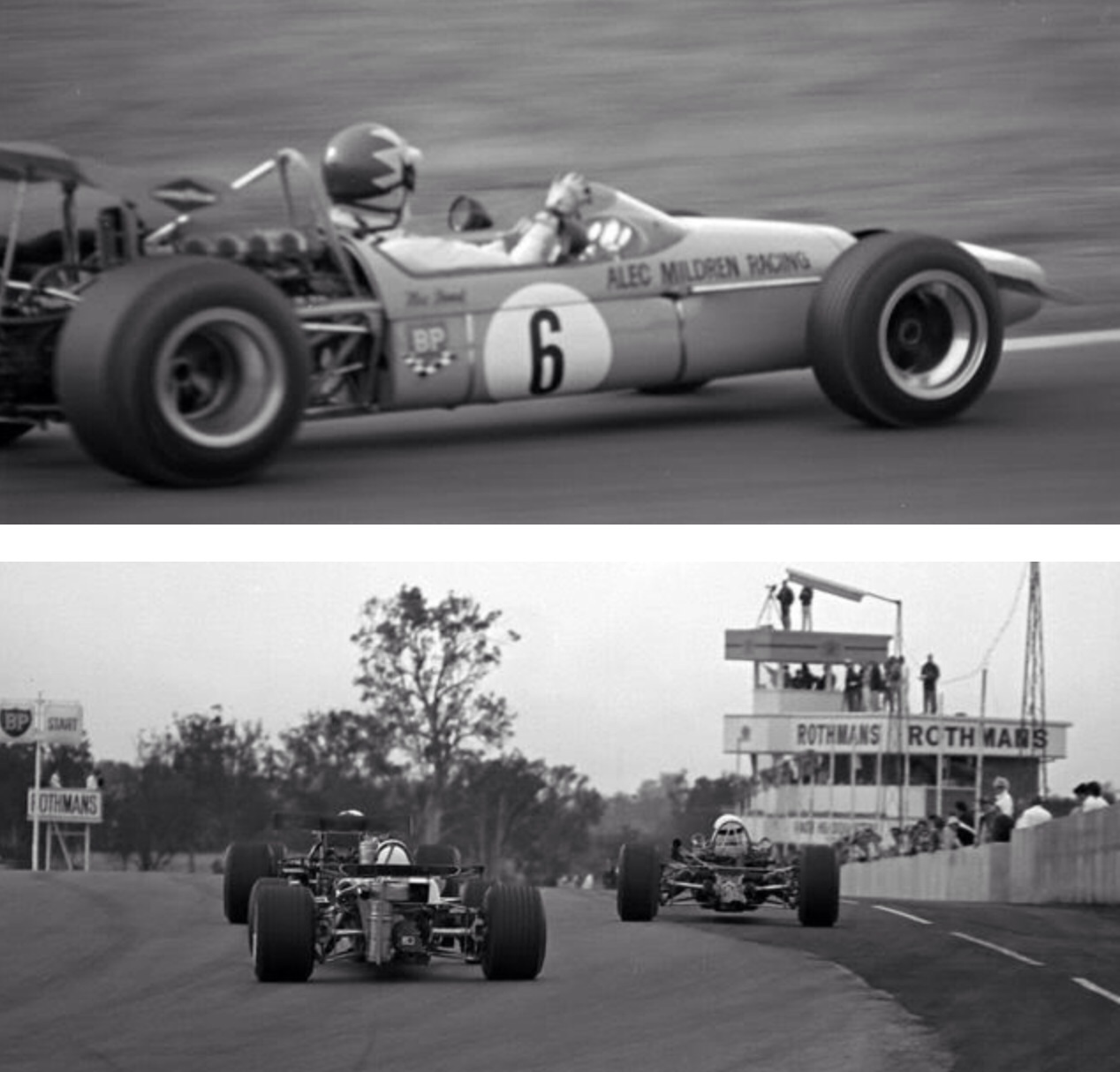
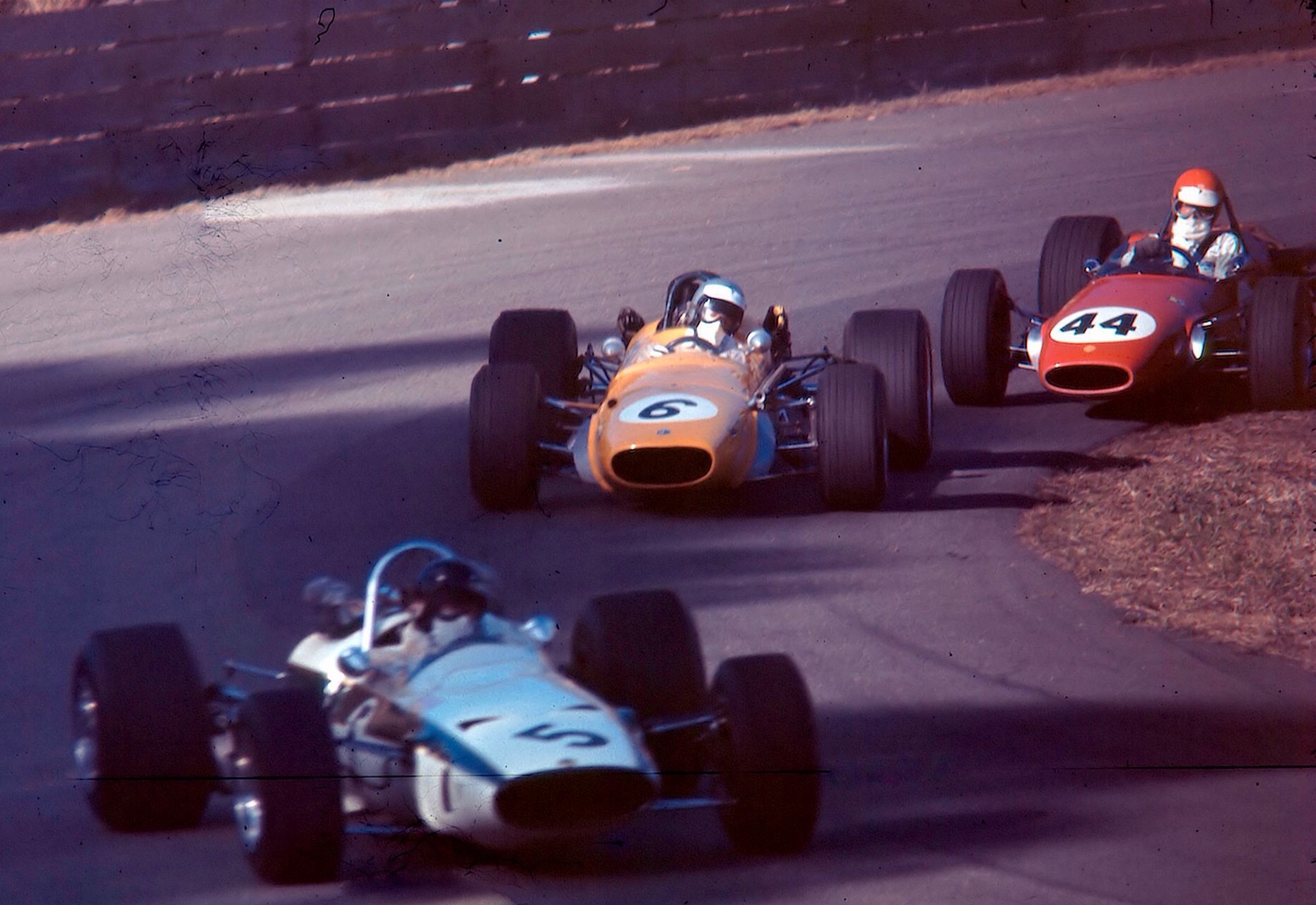
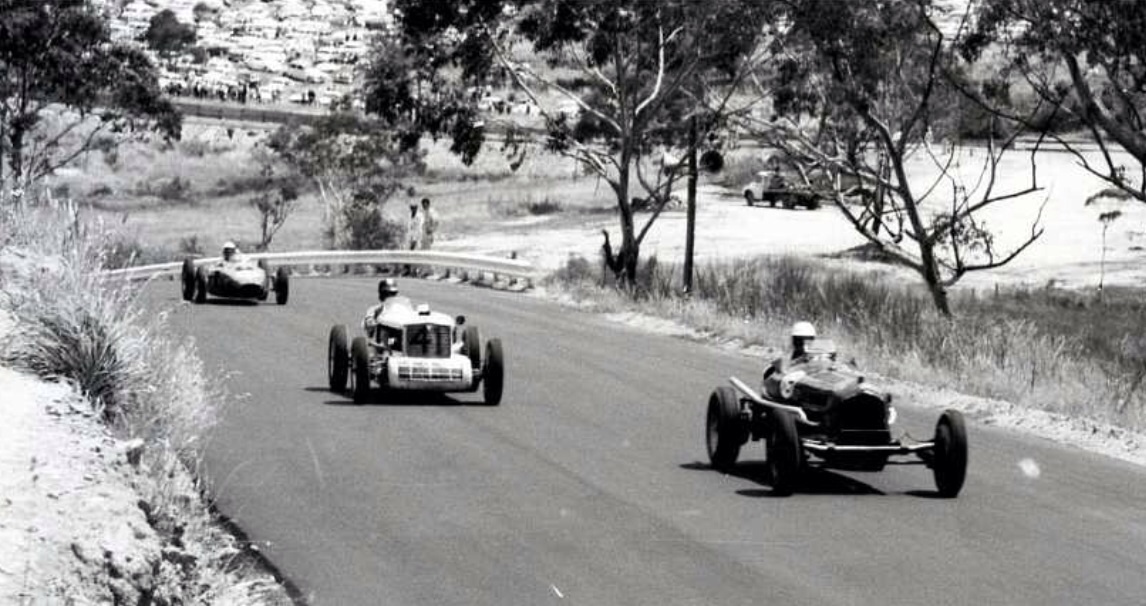
Leo Geoghegan from Kevin Bartlett and Max Stewart, Dunlop Curve, Catalina Park, in the New South Wales Blue Mountains, 9 June 1968…

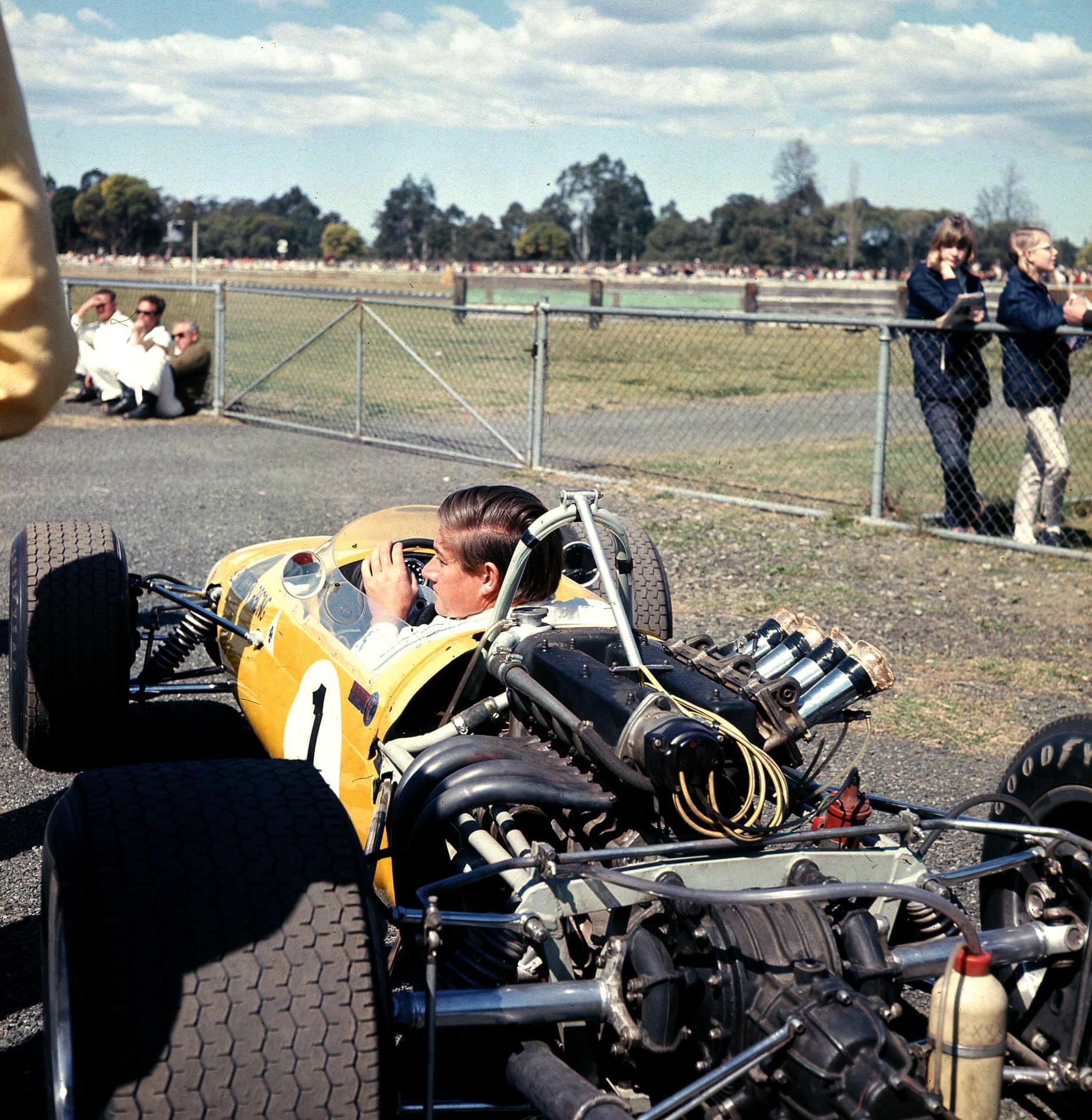
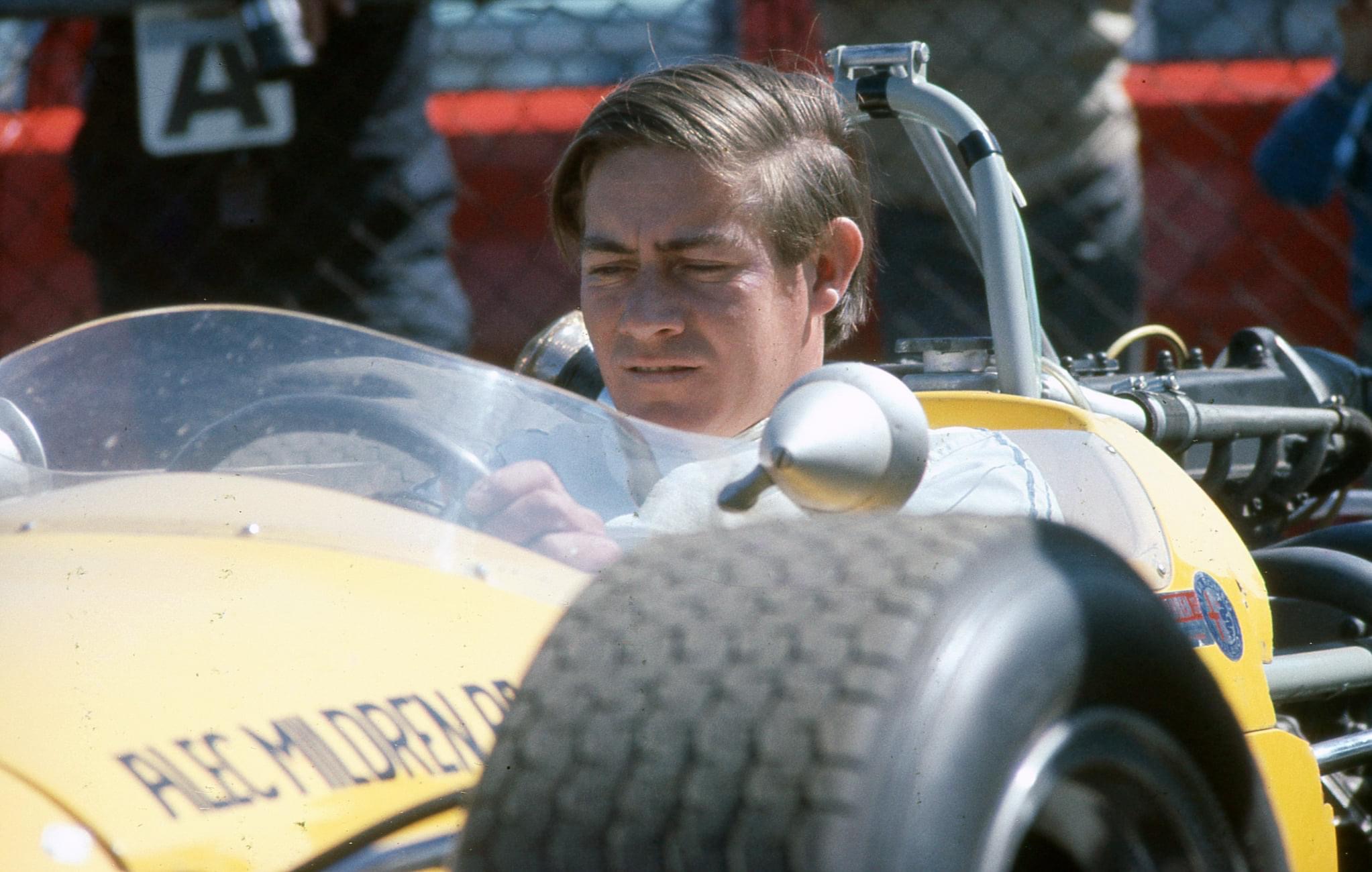
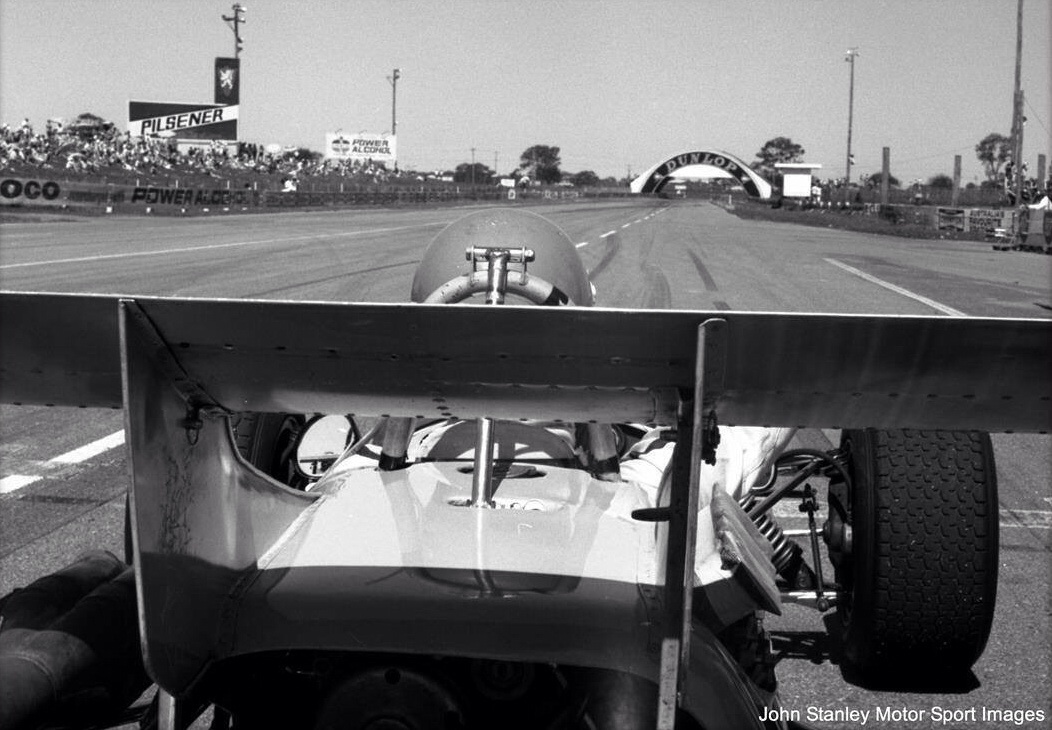
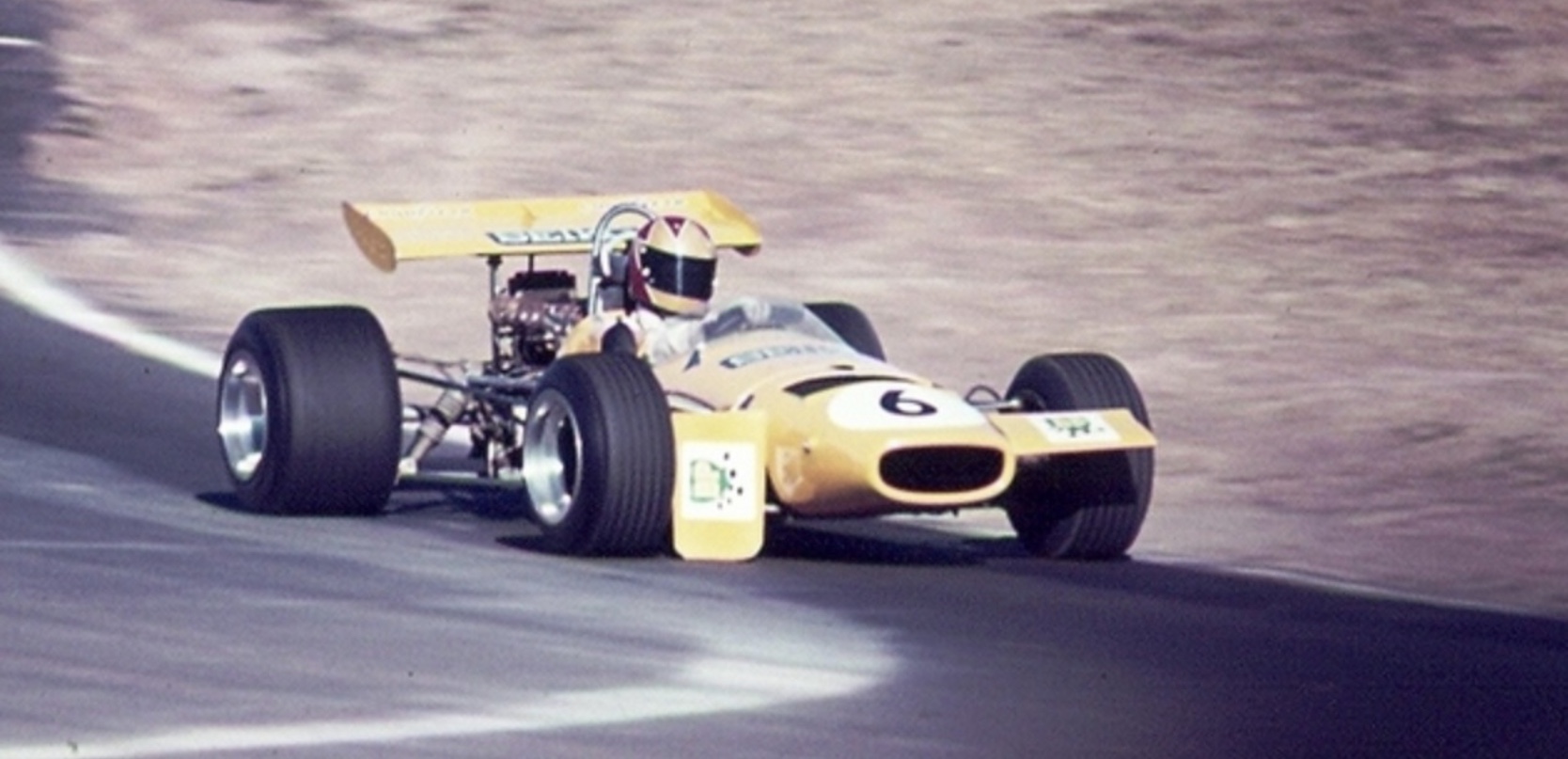
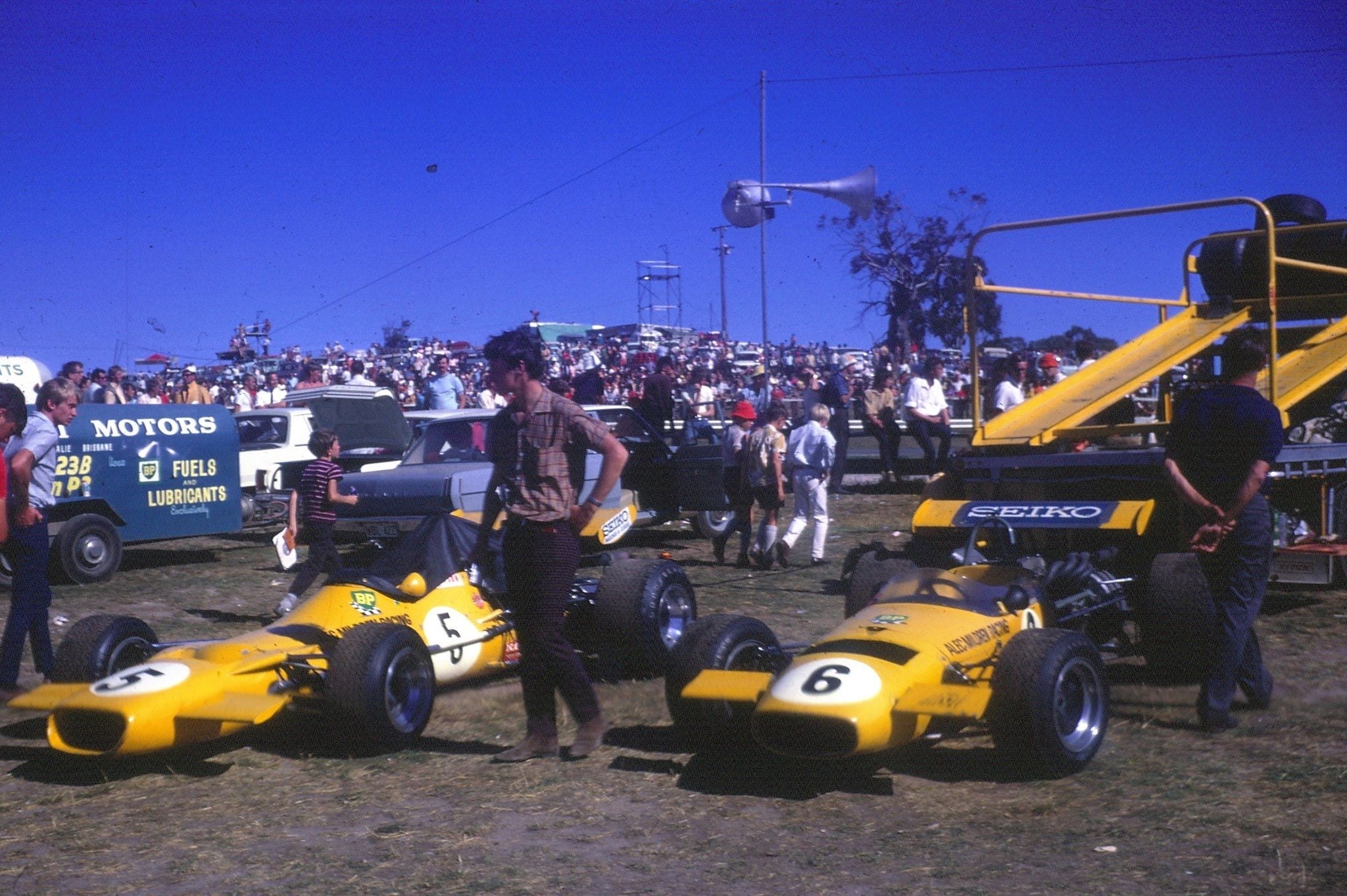
Geoghegan and Bartlett were both well-established ANF1-2.5 Tasman drivers by this stage, with Max the young-thruster chasing them hard. Here, the lanky Orange motor-trader, characteristically more out of the cockpit than in it, in his Rennmax BN2 Ford is chasing the 2.5-litre V8 Lotus 39 Repco and vivid ‘Mildren Yellow’ Brabham BT23D Alfa Romeo.

In fact, Maxxie was the oldest of these three but was just about to join KB in Alec Mildren’s squad and get the big leg up his career needed and deserved, and he delivered in spades, of course.

I love this shot, Dick Simpson has managed to capture three of my favourite cars and drivers with KB’s Brabham clearly the racer Dick’s camera was focused upon, en route to his first Gold Star that year.

Ray Bell recalls this meeting well, ‘…Leo Geoghegan, Kevin Bartlett and Phil West turned out in the best lineup of Gold Star 2.5 cars at Catalina Park.’
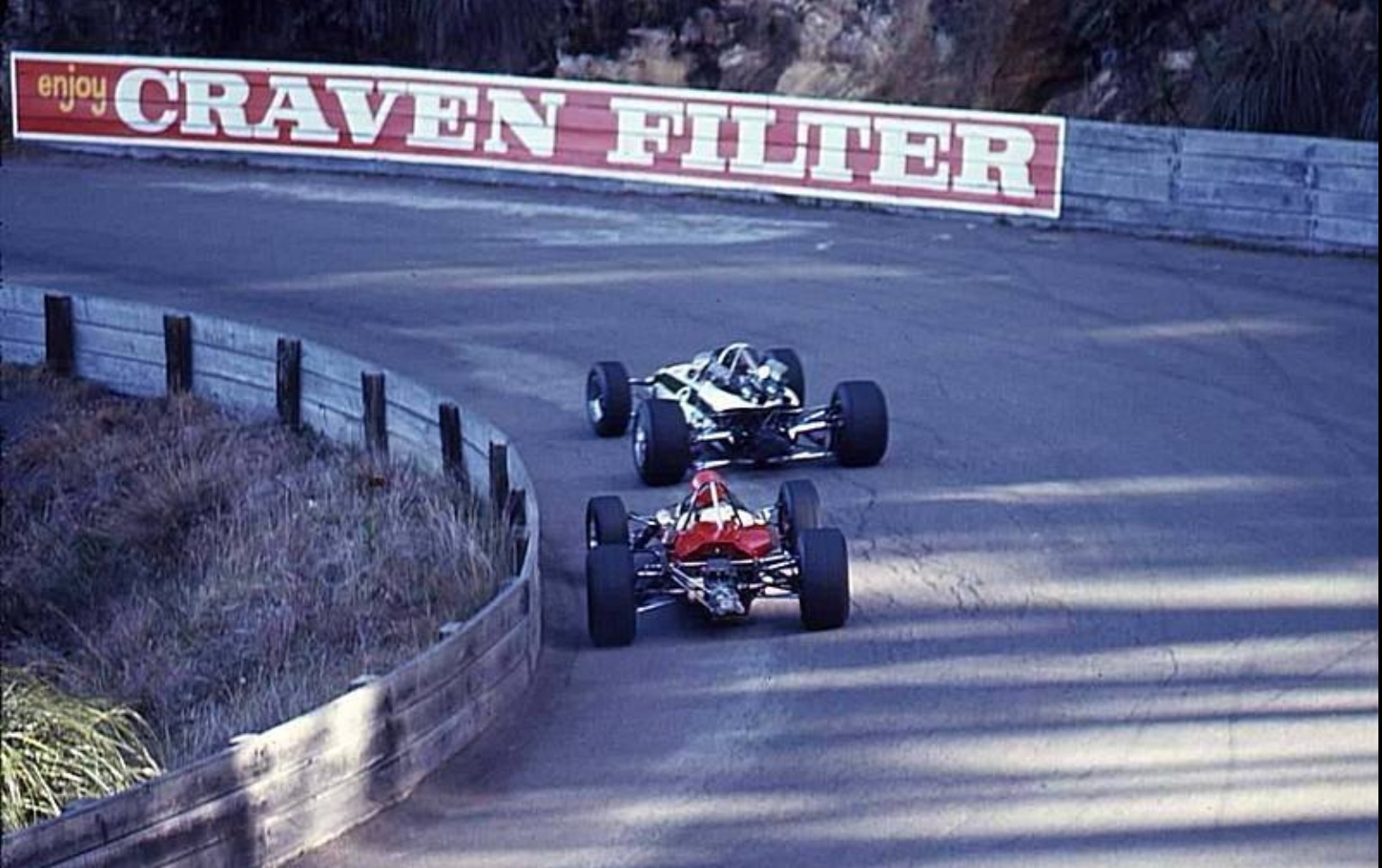
Geoghegan from Stewart heading out of Craven-A by the look of it! (N Randall)

Dry practice saw all three under Leo’s lap record and on race day it was reduced by a full two seconds, (from 55.6 to 53.6 seconds) with Bartlett two-tenths off the pace, West on 54.3 and Max Stewart in a 1500cc Rennmax eclipsing it as well with a 55.2.’

I’ve written about all three of these cars and drivers, so will not rabbit-on again here. Bartlett’s Brabham BT23D here; https://primotipo.com/2018/11/30/motori-porno-alfa-romeo-tipo-33-tasman-2-5-litre-v8/ , Stewart’s Rennmax here; https://primotipo.com/2014/09/12/max-stewart-rennmax-bn2-ford-easter-bathurst-1968/ , and Leo Geoghegan and his wonderful Lotus 39 Repco here; https://primotipo.com/2016/02/12/jim-clark-and-leo-geoghegans-lotus-39/

All three pieces are features so will keep you busy for a while.
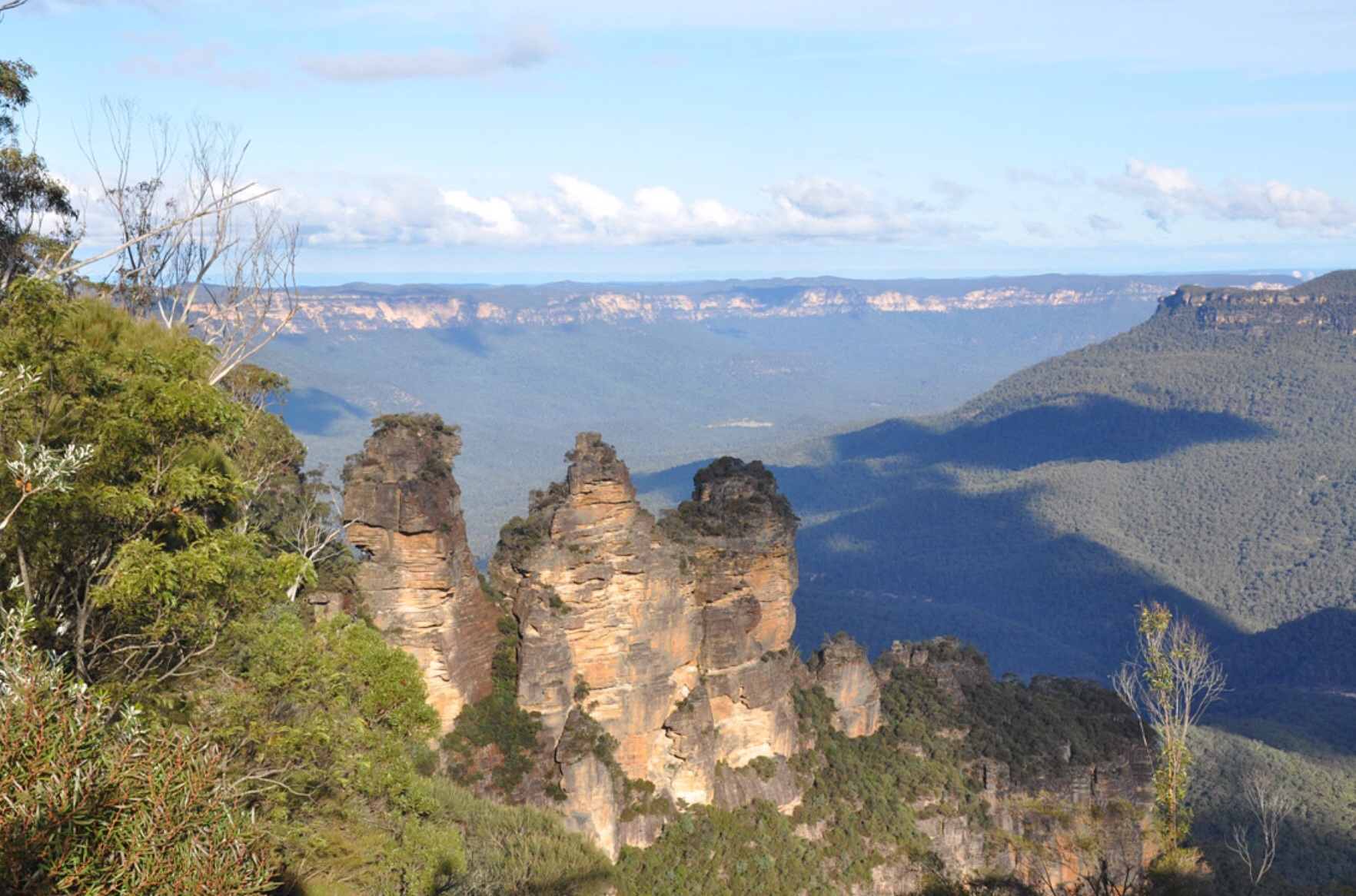
The Three Sisters, Katoomba

The Blue Mountains and Katoomba in particular are wonderful places and typically ‘Sydney 101’ must visits from either a global or Australian tourists perspective.

The town of about 7,500 people is 100 km from Sydney, an easy day trip, with Echo Point/The Three Sisters, the Skyway and funicular Scenic Railway, the attractions which instantly spring to my mind for little kids and big ones alike.

There are plenty of places to stay, too. Katoomba was one of many places of natural beauty that boomed in Australia in the early twentieth century, situated as they were on railway lines, making them easily accessible in the days of limited car ownership from the capitals, in this case, Sydney.

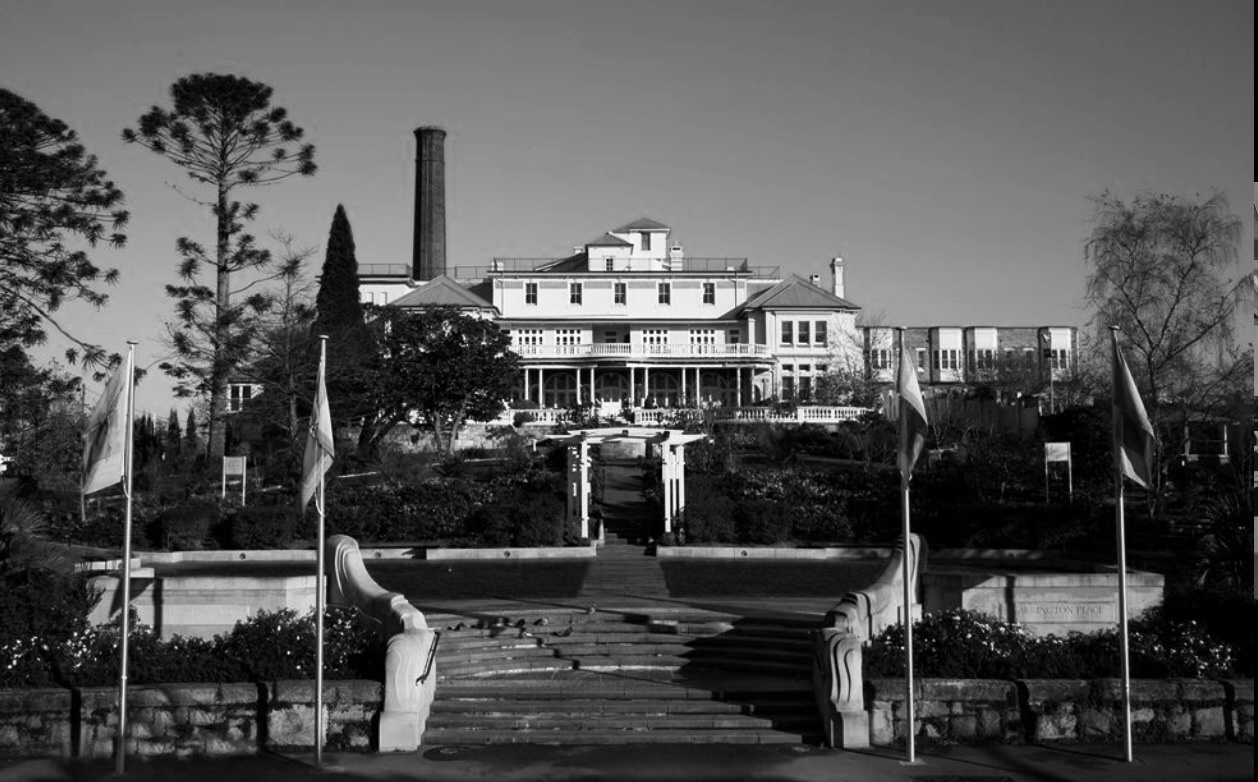
As we shall see the Carrington Hotel, which occupies the highest point in the town was the epicentre for the racers who frequented Catalina Park for an all too brief decade or so from 1961.
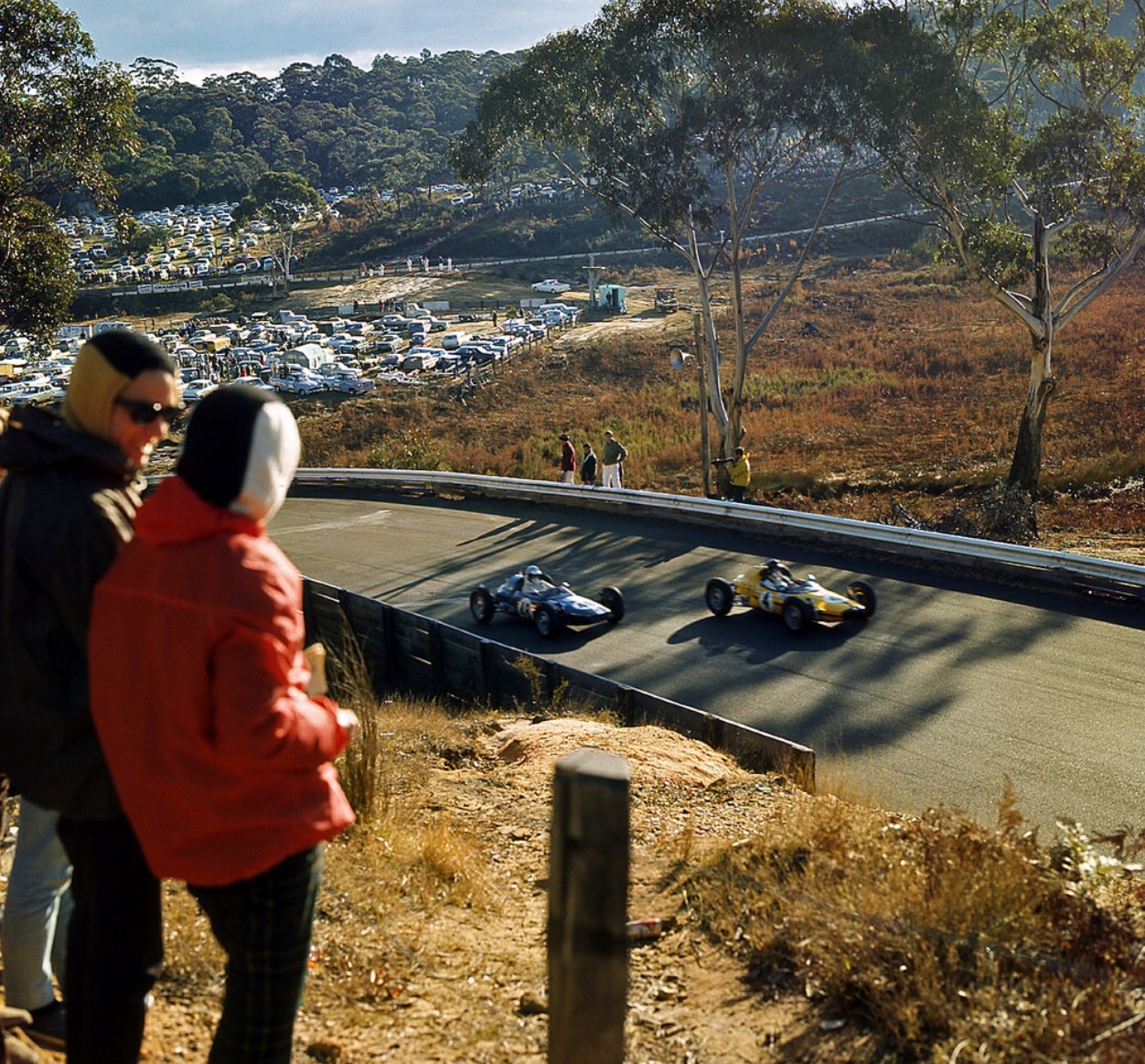
(BML)

Formula Vee dice at beautiful, bucolic and compact Catalina Park on a crisp winter day, it was not unknown for fog to delay proceedings, circa 1968…

The leading cars are Rennmax Mk1 Vees in the hands of Leo and Pete Geoghegan, practising for a celebrity race sponsored by Gary Campbell during the August 18, 1968, meeting. It’s Leo in Ken Goodwin’s car, and Pete in Terry O’Neill’s GS Motor Bodies blue car. Leo won from Pete with Max Stewart third.

The 2.1 kilometre Catalina circuit was located in the Katoomba Falls Creek Valley and opened on 12 February 1961, its final official event was the Mini Club of New South Wales Spring Meeting in 2000.

A group of 83 local businessmen joined forces, and the entity that owned and built the circuit infrastructure was the Blue Mountains Sporting Drivers Club, supported by the Blue Mountains City Council, which had acquired the land from Horace ‘Horrie’ Gates, owner of the Homesdale Guest House. The Australian Racing Drivers Club (ARDC) ran the place, organised and conducted the race meetings, the arrangement characterised in the magazines of the day as a 20-year lease.

In 1946, Gates felt the need to bring tourists back to the Blue Mountains after war hostilities ceased. Then the area of bush, swamps and springs known locally as ‘The Gully’ was largely undeveloped and was the home to a small settlement of Aboriginal and non-Aboriginal people.

Gates dammed Katoomba Falls Creek to form an ornamental lake around which he built an amusement park offering ‘every facility for fun and food’.

The park was an instant success. In 1948, the shell of an ex-RAAF Consolidated Catalina flying boat was added to the attractions, which included a Ferris wheel, merry-go-round, miniature train and ‘Giggle-House’ which showed Charlie Chaplin films. Many visitors thought the aircraft had been flown there, but it was dismantled and transported to the site by truck and then reassembled and anchored to a concrete block in the middle of the lake.

The plane gave the area its informal name- Catalina Park, albeit its more common name locally was and is The Gully, as I wrote earlier.
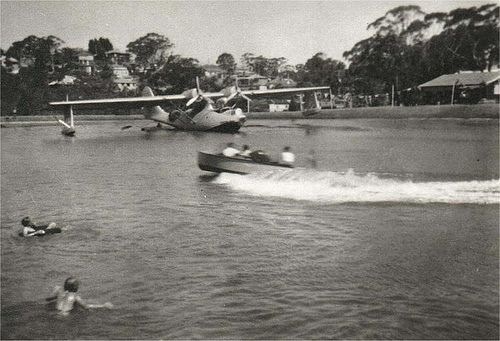
Look out kids, speedboat coming thru!

‘Up to thirty passengers paid two shillings to be taken out to the flying boat by punt, where in the dark, stuffy interior, they viewed a film of flight over the Sydney area, heard the story of the Catalina and tried out the controls. While the film was showing, an assistant would stand on the wing rocking the plane to simulate flight while the speedboat would circle the lake, providing waves and engine noise. Fun seekers emerged from this sensory experience dizzy and gasping for air, many too ill for further amusements!’ wrote John Merriman.

By 1952, the park and its attractions were becoming dilapidated, so the Council acquired the property, and with other parcels of land owned by others, had the intention of creating a public park and a treated water swimming pool. By 1954, the old Catalina was showing the ravages of time and neglect, so it was pulled up onto the bank and left to the souvenir hunters until sold in 1958 to Sheffield Welding and Engineering of Auburn, who dismantled the remains for scrap.

The Blue Mountains Council accepted proposals for the race circuit within the 47-hectare Frank Walford Park – Walford was the Mayor – with clearing commencing in 1957. ‘The last traditional owners were forcibly removed by 1959, the trauma caused to the community of people (of the Gundungurra and Darug clans) who were living in and around the Gully was profound and still reverberates.’

Let’s come back to this aspect at the end of the article, as the dispossession of The Gully residents then is the reason why there is little or no prospect for use of the remains of the track now for any modern motorsport events.
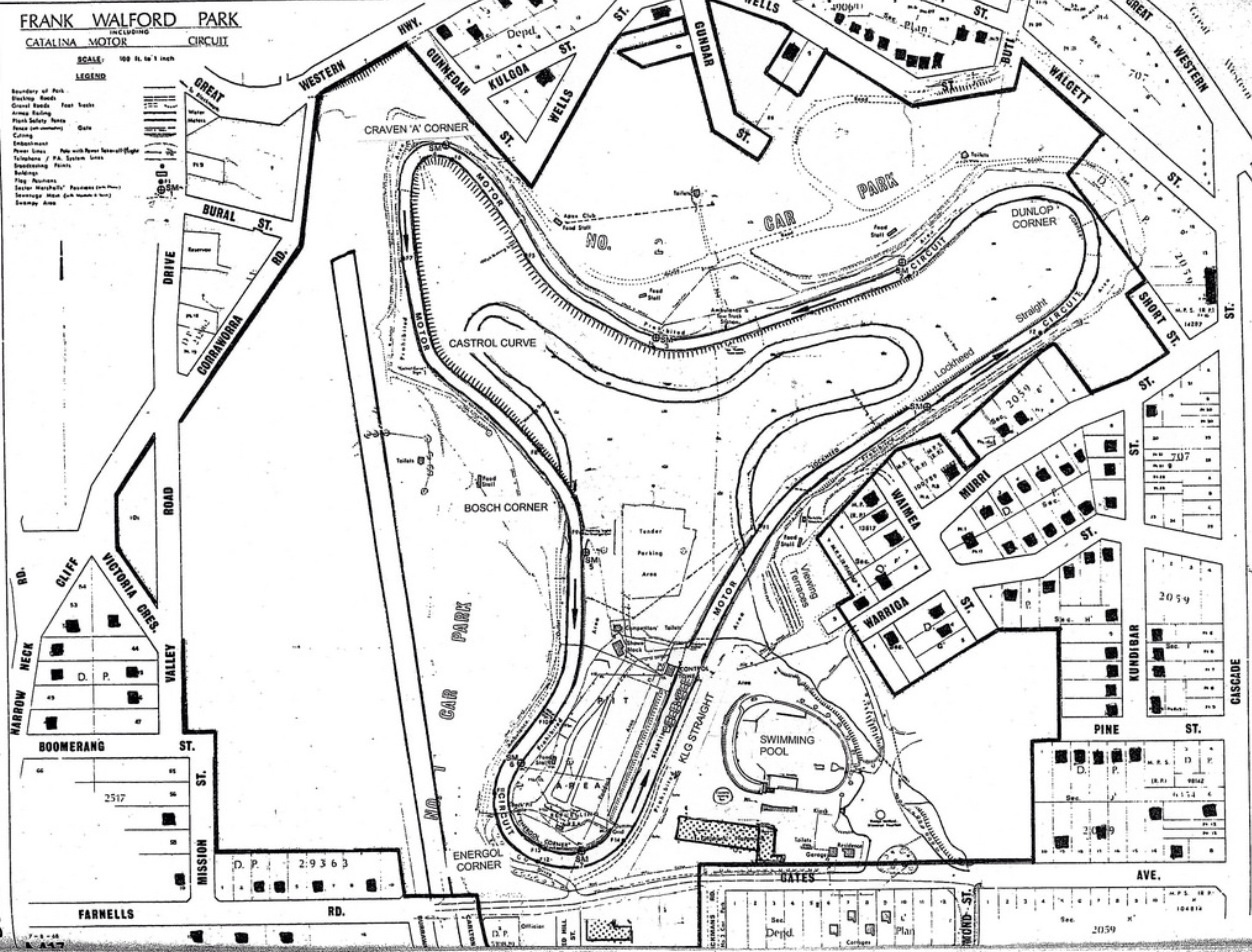
The Blue Mountains Sporting Drivers Club had a connection with Jack Brabham. Betty Brabham, nee Beresford, was a local girl, with then Cooper ace Jack said to have designed the basic layout of the circuit.

The track was relatively slow in the making as it was largely the work of volunteers who used council graders for the purpose. The council employees were BMSDC members, with another grader acquired for the purpose. A local builder provided his bulldozer whilst the club chiefs raised funds to build a control tower, toilets and fencing. Ray Bell wrote that ‘Hec and Jack Muir were leading lights, with a lot of the financial control under the wing of Harry Hammond, owner of the Skyway/Scenic Railway at Katoomba.’

The dangerous nature of the circuit for drivers was paradoxically caused by the 1957 NSW Speedways Act, which required fences to be fitted with vertical posts above the fence line and stipulated minimum requirements for safety fences. A ‘canyon of fences’ was the result,’ as Bell put it.
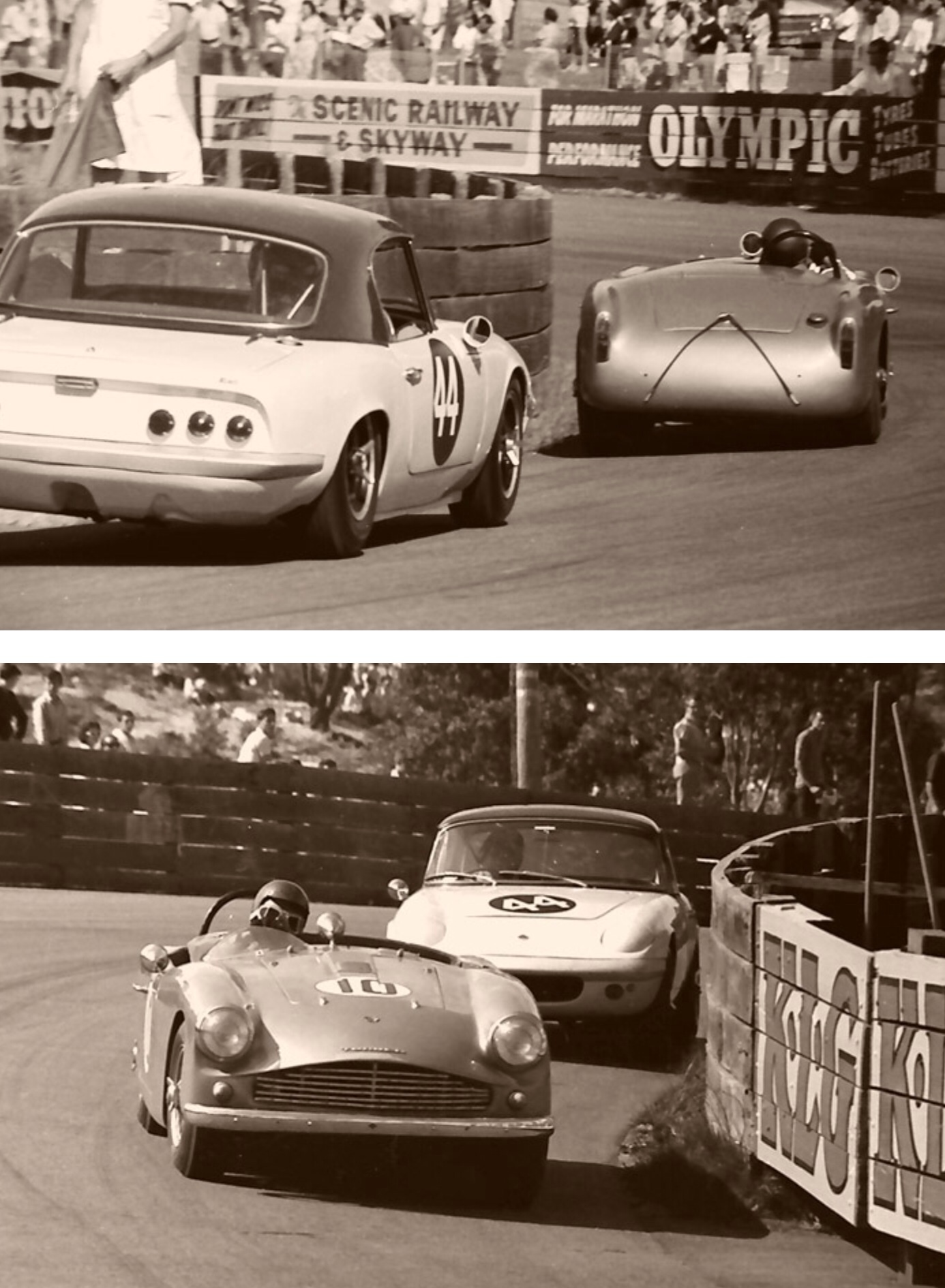
(B Wells)

The Canyon of Fences is well demonstrated by this Bruce Wells photograph of Fred Gibson, Lotus Elan, and Wal Donnelly, Turner Ford during a great dice circa 1965. The need for high-speed precision, with little room to gather up a-moment is well clear.
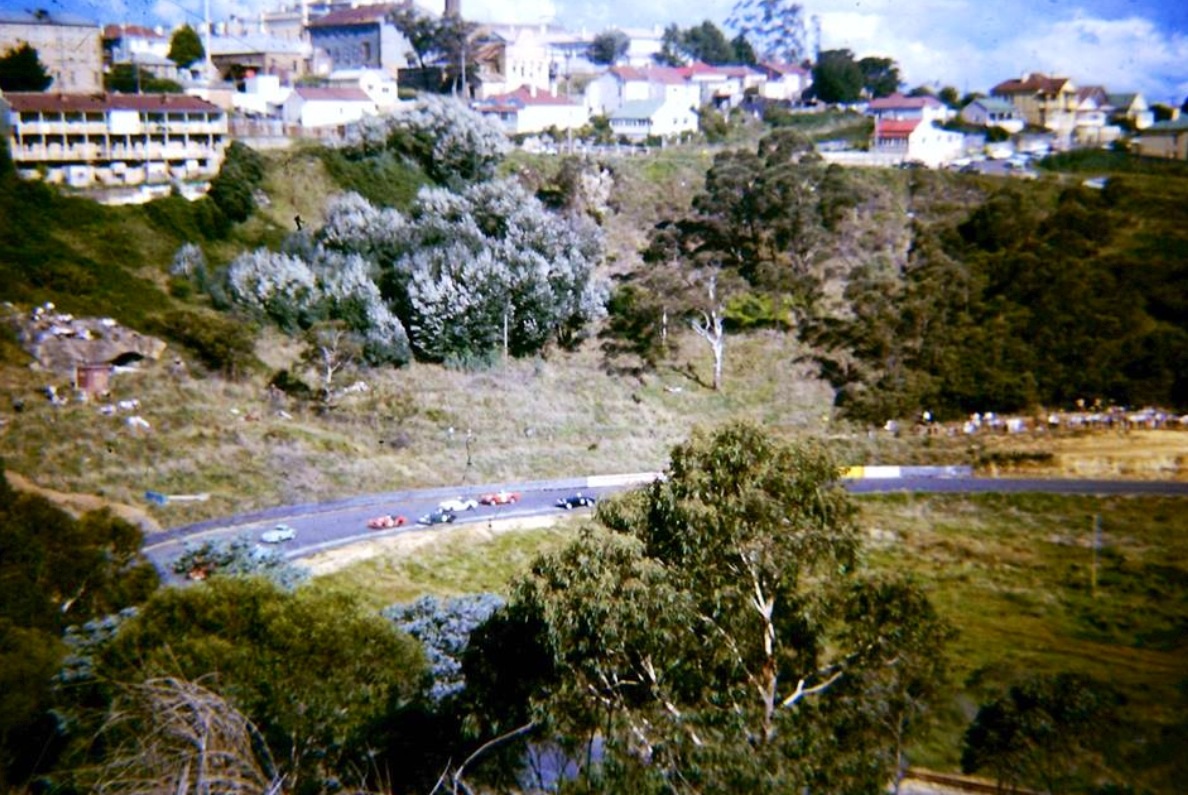
Catalina circa 1963, note the proximity of the Katoomba township (Alan Howard)

By the end of 1960, the interesting circuit, 1.3 miles or 2.09 kilometres in length, with a rise of 150 feet from its lowest to highest point, located very close to the main street of Katoomba, was nearly ready. The first meeting was scheduled for the weekend of February 12, 1961.
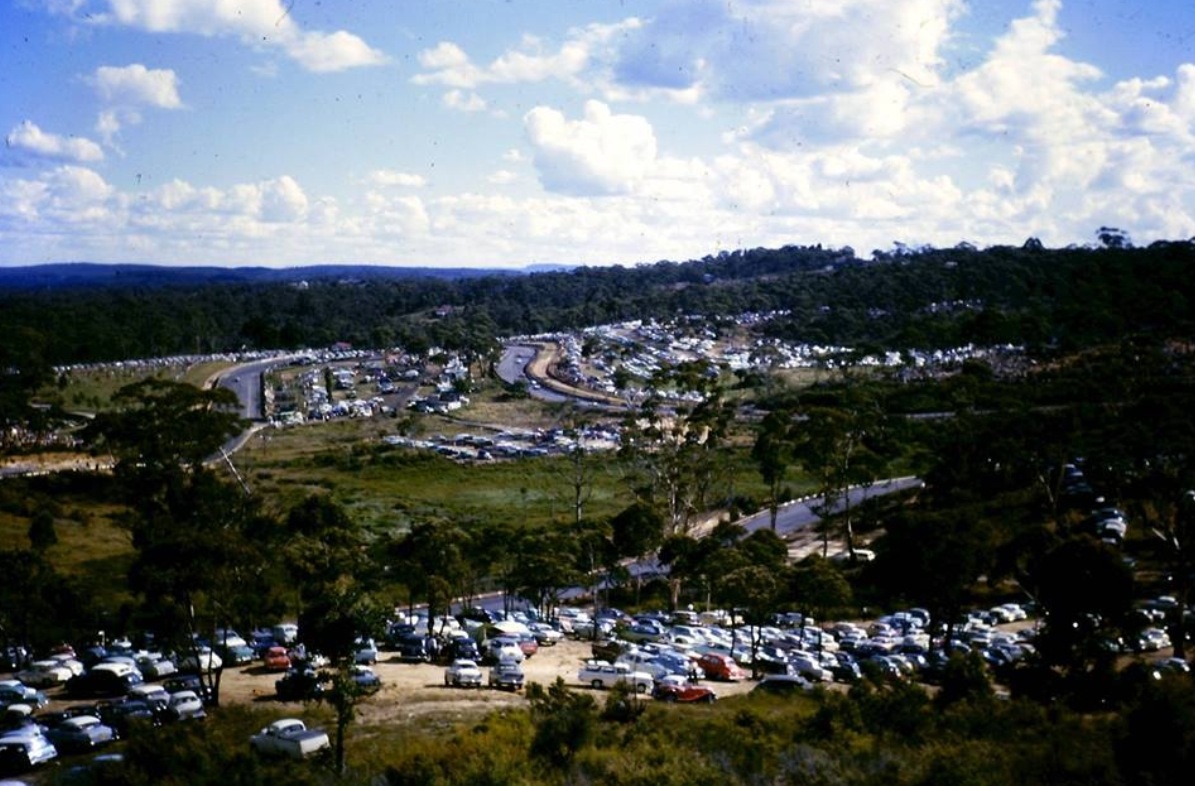
Another 1963 vista (Alan Howard)

The racing pundits concluded that Catalina would highlight handling and driving ability; both conclusions were correct, but the place was also a power circuit despite its short length. The steep climb out of ‘Craven-A’ and the hairpin at the track’s western end emphasised the need for plenty of mumbo.

The following series of photographs are of that first event all those years ago.

The first race of the day was won by Pete Geoghegan’s Jaguar before a packed house of spectators whose cars were parked a considerable walk from the track.
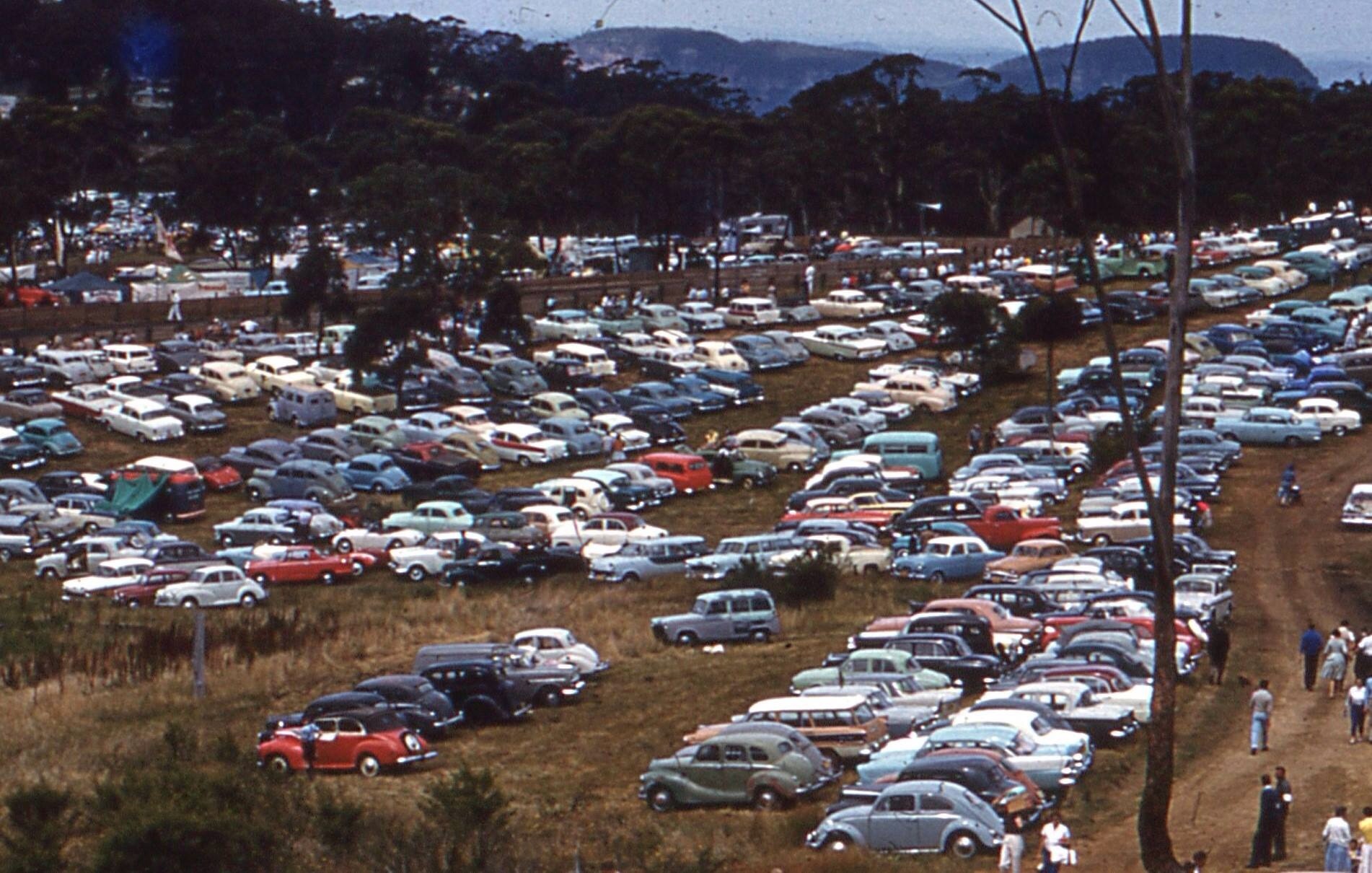
A full house for the first event in February 1961 (E Barwick)
Ray Wamsley Alfa Romeo P3 Chev, Frank Walters So-Cal Olds and Gordon Stewart in the mid-engined Stewart MG in the four lap Racing Car Group A race (Catalina Park)
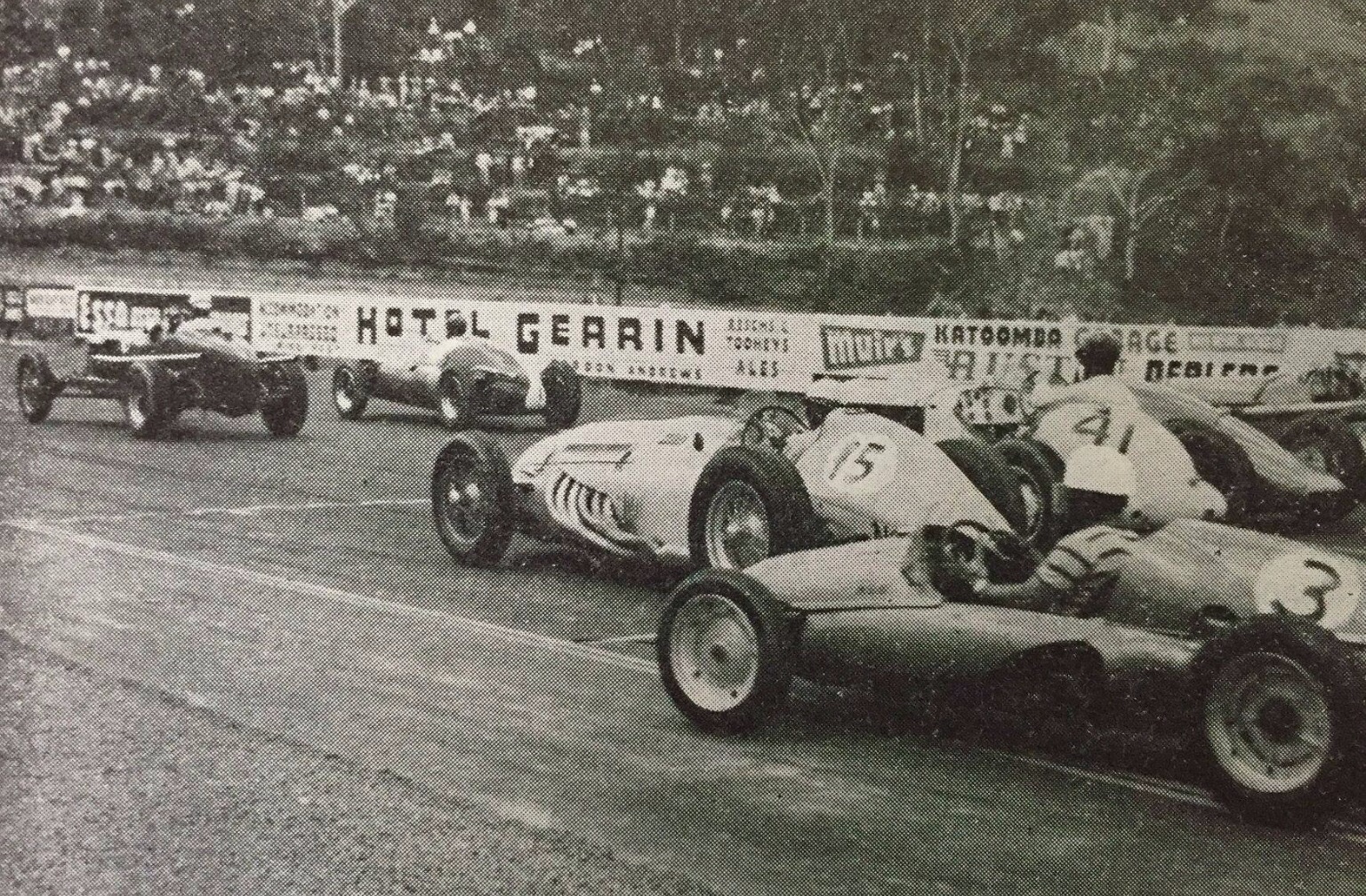
Start of the same race. #3 Jack Myers Thunderbird (sadly, he would die in this car at Catalina in 1963), #15 Barry Collerson, Talbot Lago T26C, #41 Frank Walters So-Cal Olds, the sloping rear tail alongside So-Cal is the Gordon Stewart, Stewart MG, while up front is Ray Wamsley’s Alfa P3 Chev and Noel Hall, Cooper (G Edney)
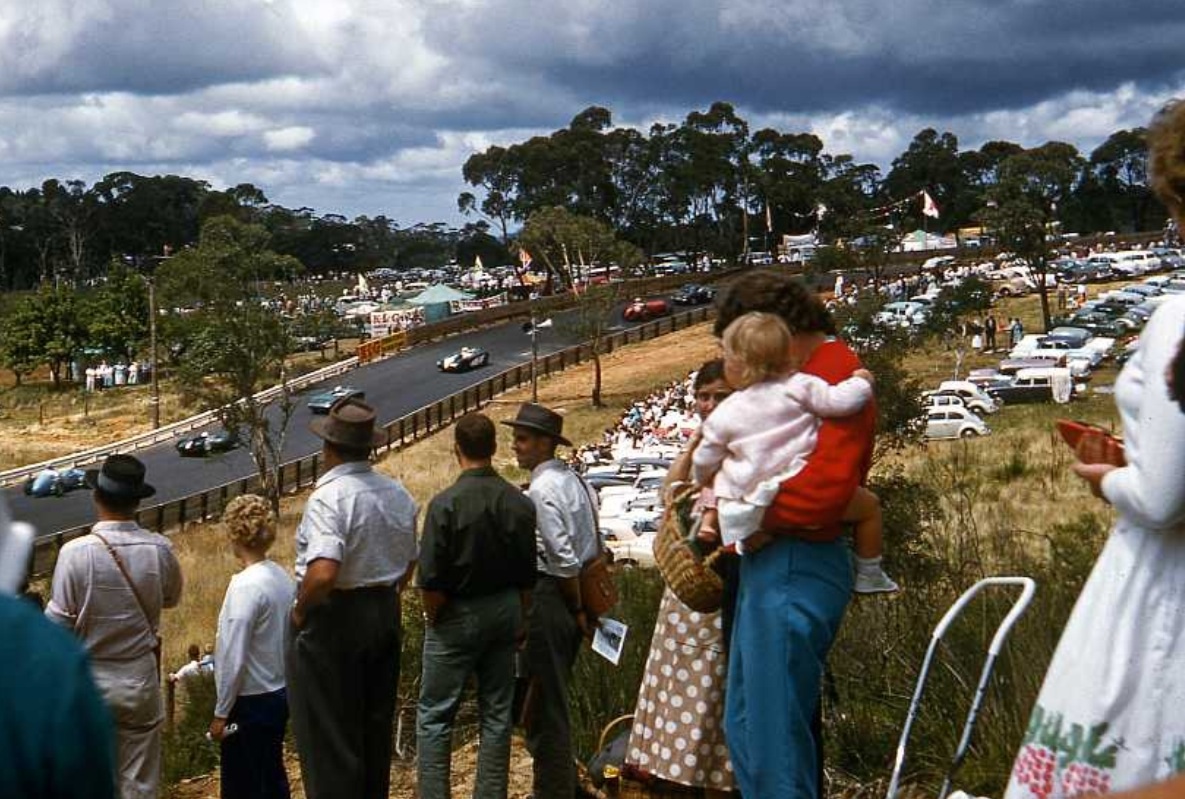
Probably the February 1961 meeting- the shot oozes atmosphere dunnit? Probably a parade of cars entered for the meeting (R Bell)
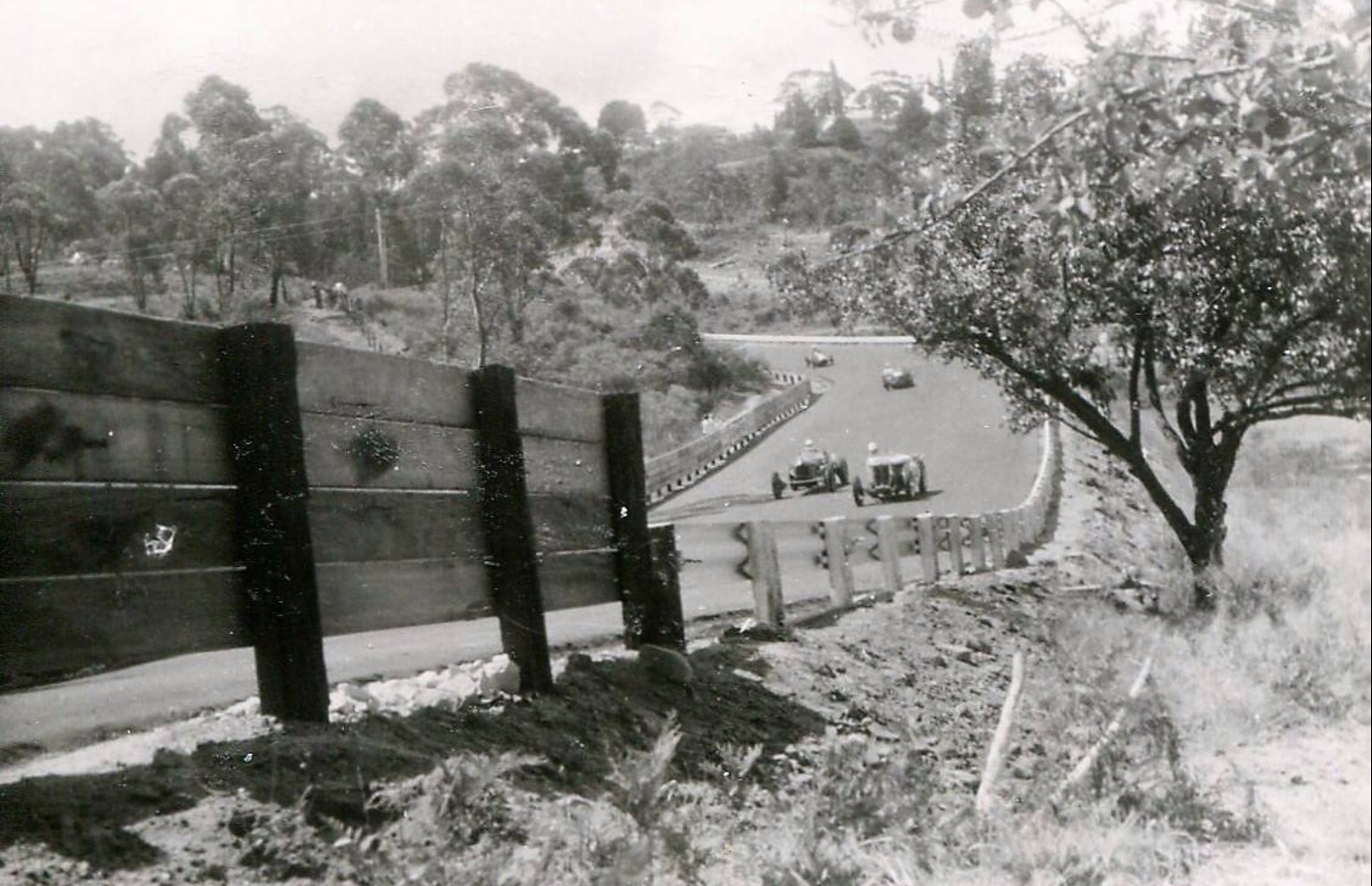
Interesting angle on this shot by Fred Pearse showing the undulation of the track; the Wamsley Alfa P3 Chev passing one of the MGs (F Pearse)

Catalina was not a circuit which hosted much in the way of national championships. Frank Matich won the Australian Formula Junior Championship in an Elfin FJ Ford in October 1962, in what was the only national title contested at the venue fondly remembered by both spectators and racers, one of whom is David Seldon. I love this affectionate piece by the Touring Car/Clubman racer;

‘….Catalina Park…to my mind was far and away the best, most rewarding short track to drive on in Australia. Set in a magnificent natural amphitheatre, the great unwashed would negotiate the winding, always muddy tracks to find their favourite rock to perch on for the day, like herds of feral mountain-goats waiting in the mist in anticipation.’

‘Because of the topography, you could see a good two-thirds of the track from most vantage points and of course to drive on it was a thrill a minute as it climbed and dipped and you raced through the blind tunnels created by the high safety fences made from railway sleepers which were always only centimetres away from certain expensive disaster.’

‘The whole weekend was as much a fun thing as anything. An event in itself. Beginning with the winding 100-mile drive from Sydney (the keen ones of us always took the longer but much more fun route up the Bells Line of Road and through Mount Victoria), it was a good way to “get your eye in” before the racing proper started.’

‘The early birds were able to stay at the Carrington Hotel which was always the centre of festivities for the weekend, whilst some had to try to get into the other motels littered around the town.’

‘A typical phone call was as follows: “ring, ring, ring…Hello, is that the Echo Point Motel?”…”Yes, how can I help you?” “Just wanted to know if you had any accommodation available for the weekend, etc?””Hmmmm, just let me check…pretty booked out…I think we are full. I guess you are coming up for the motor racing are you?” “Motor racing? Oh no, we are playing golf.” “Oh well, in that case, yes certainly, we have space”. “Great, we’ll have three rooms, thanks”.

‘And then we would arrive and park the trailers around the corner and sign-in, secure the rooms and keys before bringing the race cars into the car park…’

Seldo continues ‘They were certainly the good old days. When Bacardi and Coke was the drink of the day, I recall one Saturday or Sunday night they drank the Carrington out of Bacardi- apparently 6 cartons of it…But Catalina itself was the most rewarding track to drive on, I suspect because of the variety of interesting corners, the gradients, the narrowness, the danger, the totally unforgiving nature of it, and I guess just the sheer fear and consequent adrenalin. Amaroo Park was a poor cousin by comparison. Ahh, the cost of progress!’ David concluded.
(Carrington Hotel)

It’s interesting to look at Bell’s view on the market positioning of the circuit amongst its Sydney contemporaries: Warwick Farm and Oran Park, and its gradual demise.

‘State Championship races were a major fare in the early days’, wrote Bell. In fact, State Championships were run at Catalina on four occasions in 1962! FJ in March, ‘NSW Championships’ in May, ‘NSW Sports and Touring Car Championships’ in August and the Australian FJ Championship in October. From 1963 and beyond, the meetings were characterised as ‘Open National Meeting’.
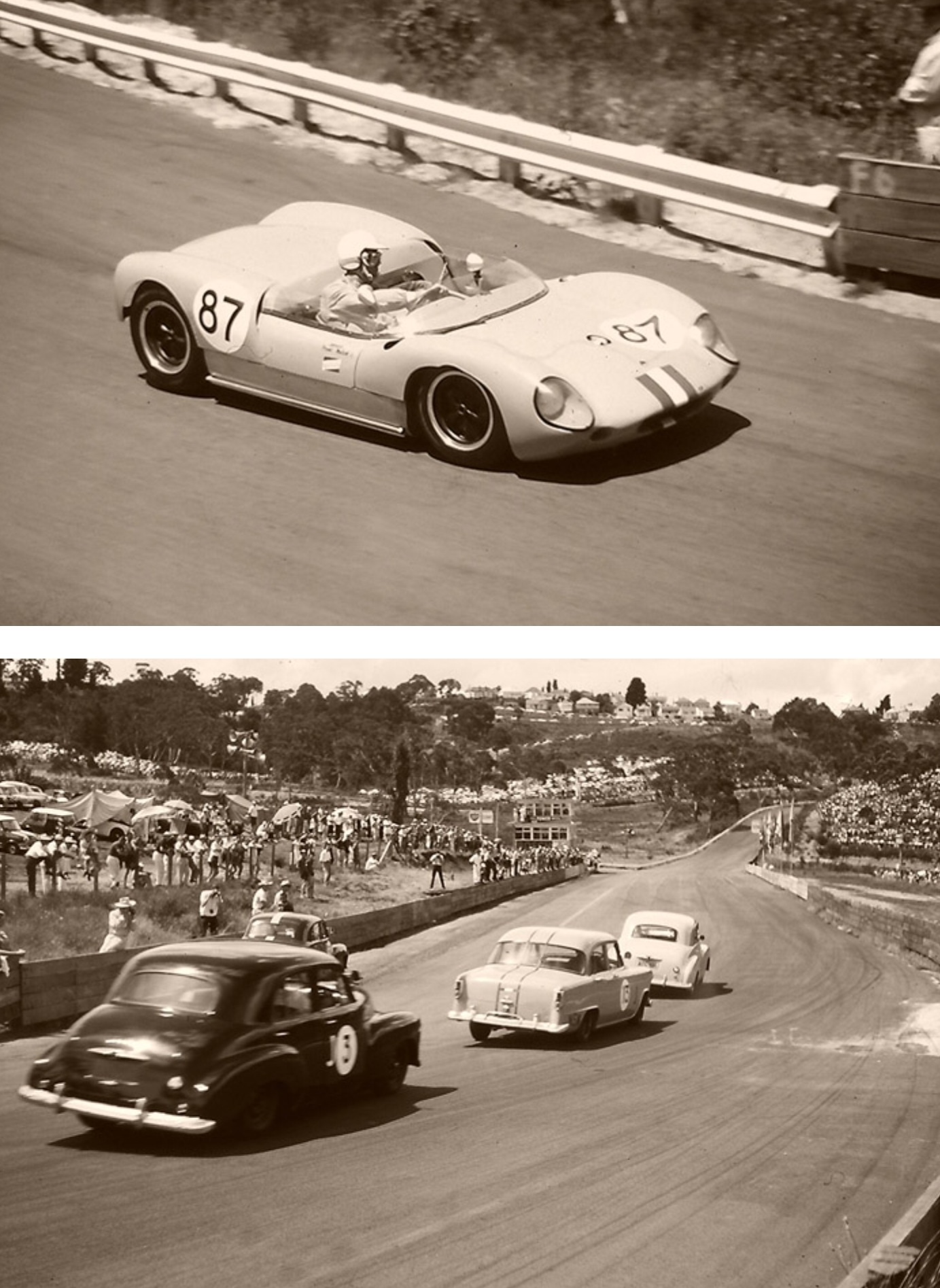
Frank Matich in his Lotus 19, circa 1963, the shot below is a group of Appendix J Tourers coming onto pit straight at the same meeting. Drivers folks? (B Wells)

‘The organisers very much directed the leanings of the racing towards Touring Cars’ said Bell, and successfully so, the ‘Neptune Series’ provided close racing and nurtured talent, its first winner in 1963 was Spencer Martin, who became the Australian Gold Star Champion in 1966-67 aboard the Bob Jane Racing Brabham BT11A Coventry Climax.

‘Matich was the (Catalina) master of the era, and he was a member of the ARDC. Together with the Geoghegan brothers (also Sydney boys) he was the man to beat at Catalina. But that was the nature of the racing at Catalina anyway.’
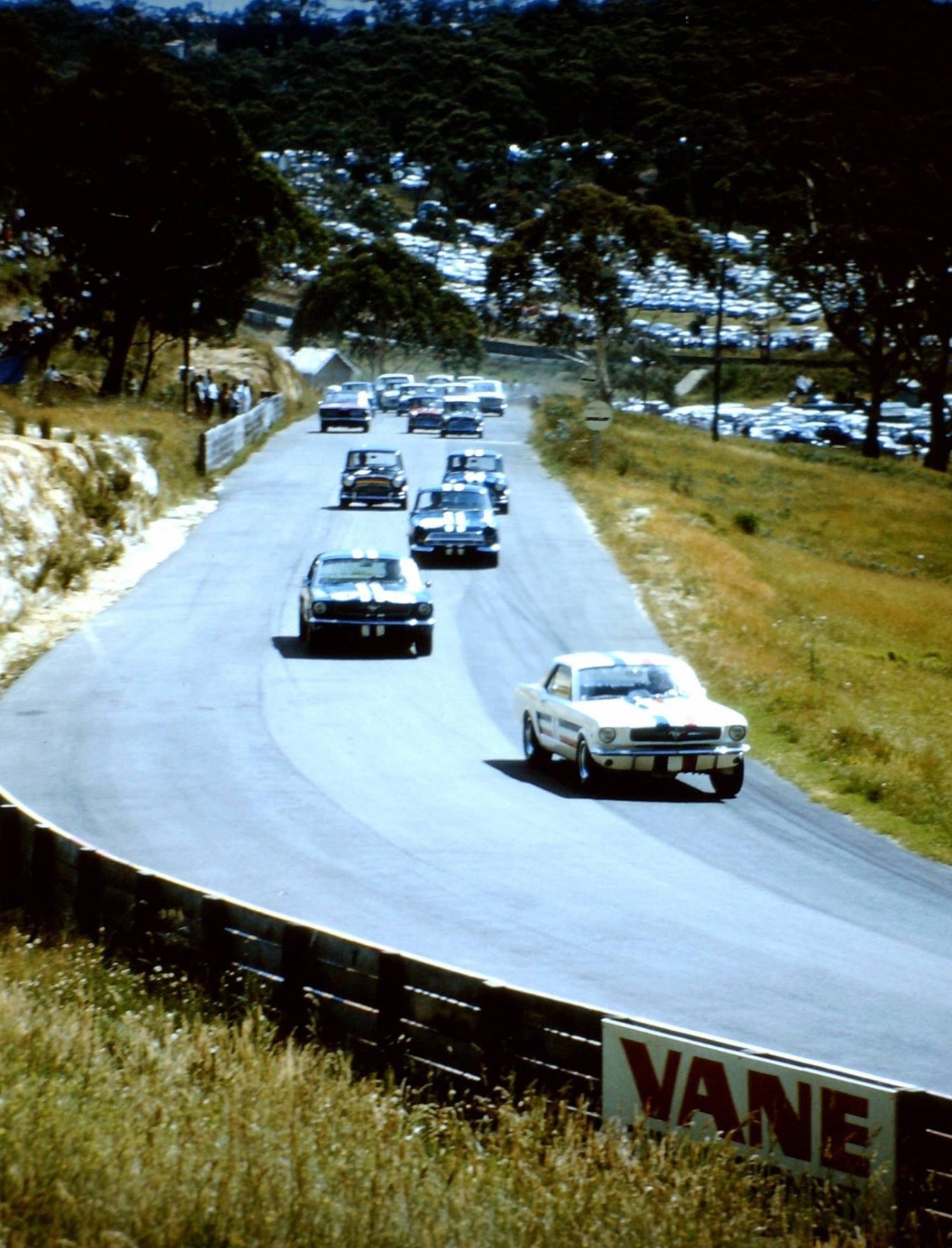
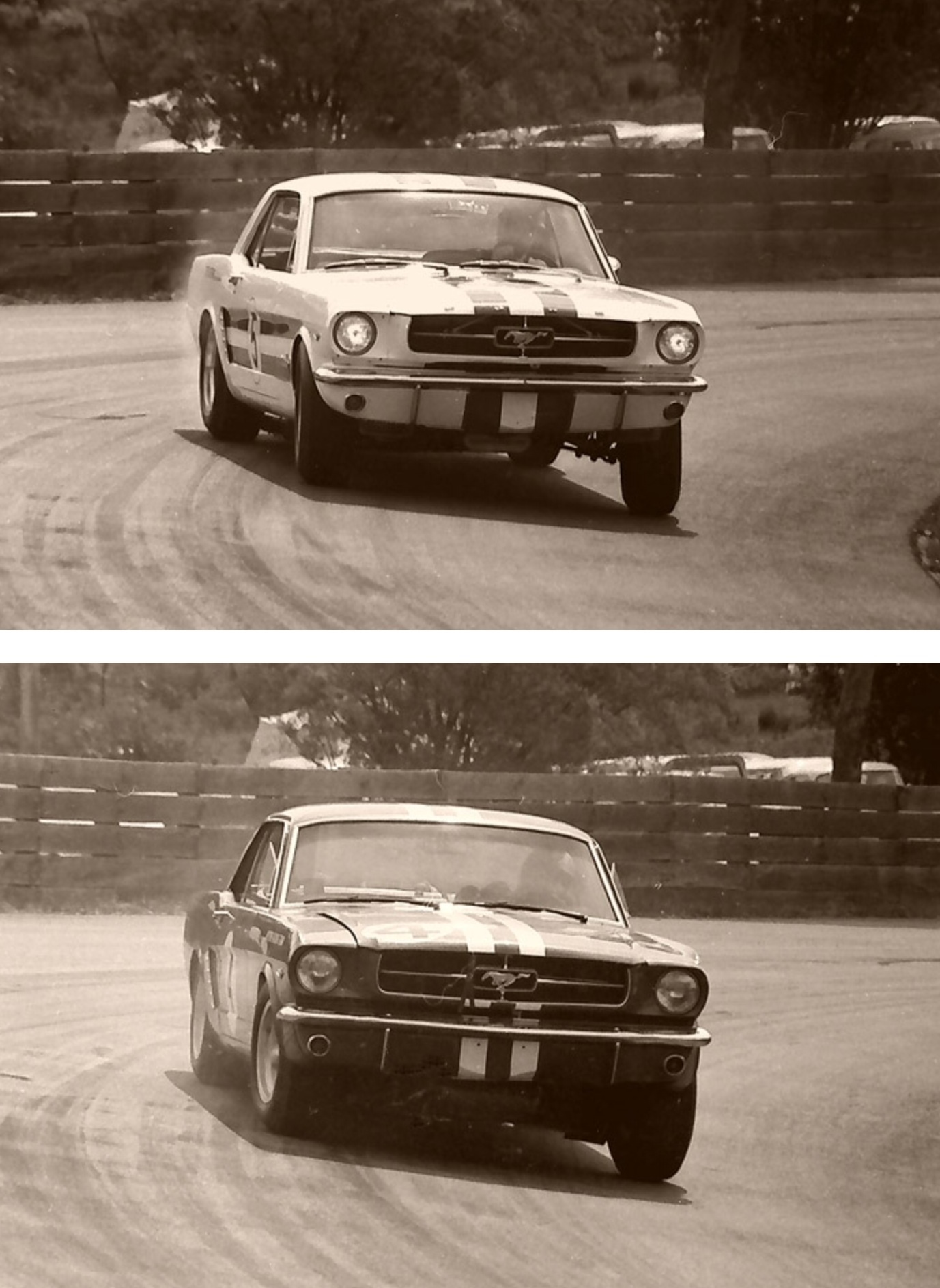
Geoghegan from Beechey in Mustangs, Jim McKeown, Lotus Cortina and then Peter Manton’s Cooper S, circa 1965 (P Hammon)
I love these shots of the Geoghegan (top) and Beechey Mustangs taken at Catalina at the same corner on the same day in 1965. It’s an oversteer/understeer handling lesson from a couple of masters. Which is not to say understeer was Norm’s usual modus operandi! (B Wells)

‘It was almost parochial, with the odd challenge for the local boys if there was a (State) title race. It mixed substandard machinery with the latest equipment, unlike the path being pursued by Warwick Farm, and was run by ARDC Chief, Jack Hinxman, with almost callous disregard for the professional era the sport was entering. They were ‘local’ meetings with occasional interstate participation.’

‘It was a form of racing very much beneath the standard of the circuit itself. Ignoring the ever-present fences, it was a challenging circuit and deserving of better. Those were heady days, and crowds were good through to 1966. But the face of the sport was changing, and Catalina wasn’t, so the decline began.  By 1968, the old specials were no longer seen at the kind of meetings Catalina was purporting to put on.’

‘Oran Park had long since given Sydney a second circuit, and the ARDC had another outlet for its activities. Oscar Glaser had embarked on the Amaroo Park Project as long ago as 1958…races were being held on a small part of the proposed circuit by 1967. The ARDC was ultimately to abandon the BMSDC and Catalina in favour of this much more convenient venue, Bell wrote.
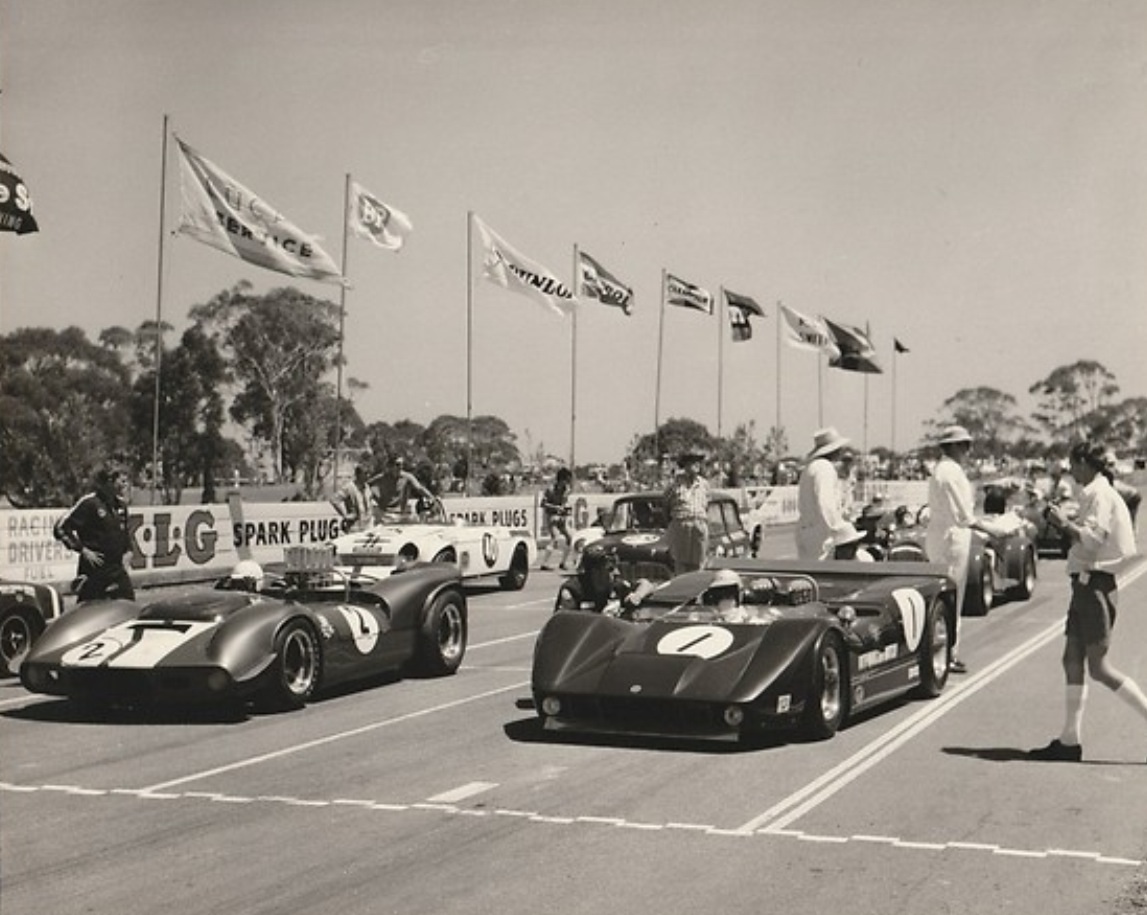
A glimpse of Bob Beasley’s Lotus 26R at left, then Niel Allen in the ex-Matich Elfin 400 Chev aka Traco Olds aka R &T Chev, and Frank Matich aboard his Matich SR4 Repco 4.8 760 during 1969. Ken Ward’s Morgan is behind FM. Lynn Brown’s Mini Lwt alongside Ward. Who is it in the Datsun 2000, Richard Mingay is my guess (Auslot)

Other factors included the hilly Catalina terrain, which made it uneconomic to adapt the place to ever-evolving modern safety standards. In addition, the Blue Mountains Council’s view of the circuit had hardened, whilst some sources have it that the BMSDC’s debt to the Council was not being repaid on time.

The track’s last open circuit meeting was held on January 25, 1970. Catalina continued as a rallycross venue; the televised sport also took place at Calder, with rallycross surviving well into the 1980s. In addition, the tarmac was used for lap dashes or club sprint meetings well into the 2000s unofficially.
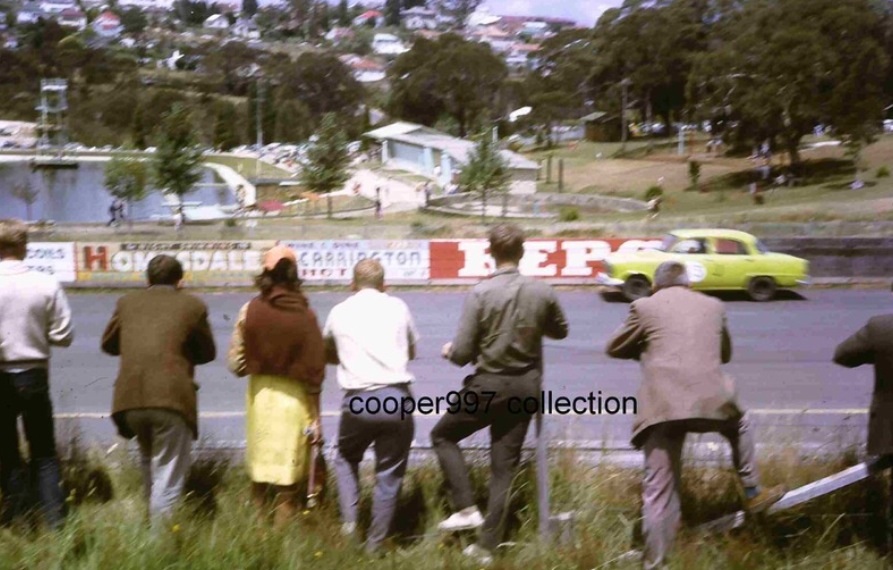
Bruce McPhee’s Holden FE heads past the pool in January 1964. Katoomba is only a drop kick away (S Dalton)

A new Olympic Pool adjacent to the original was opened in 1972. In 2003, the Katoomba Indoor Sports and Aquatic centre catered to the needs of the burgeoning population of the area on the site where once there was murky water and tadpoles. The original pool with wire netting and cement shelter still exists, serving mainly as a duck pond.

In 2002 The Gully was declared an Aboriginal Place, whilst still owned by the Blue Mountains Council.
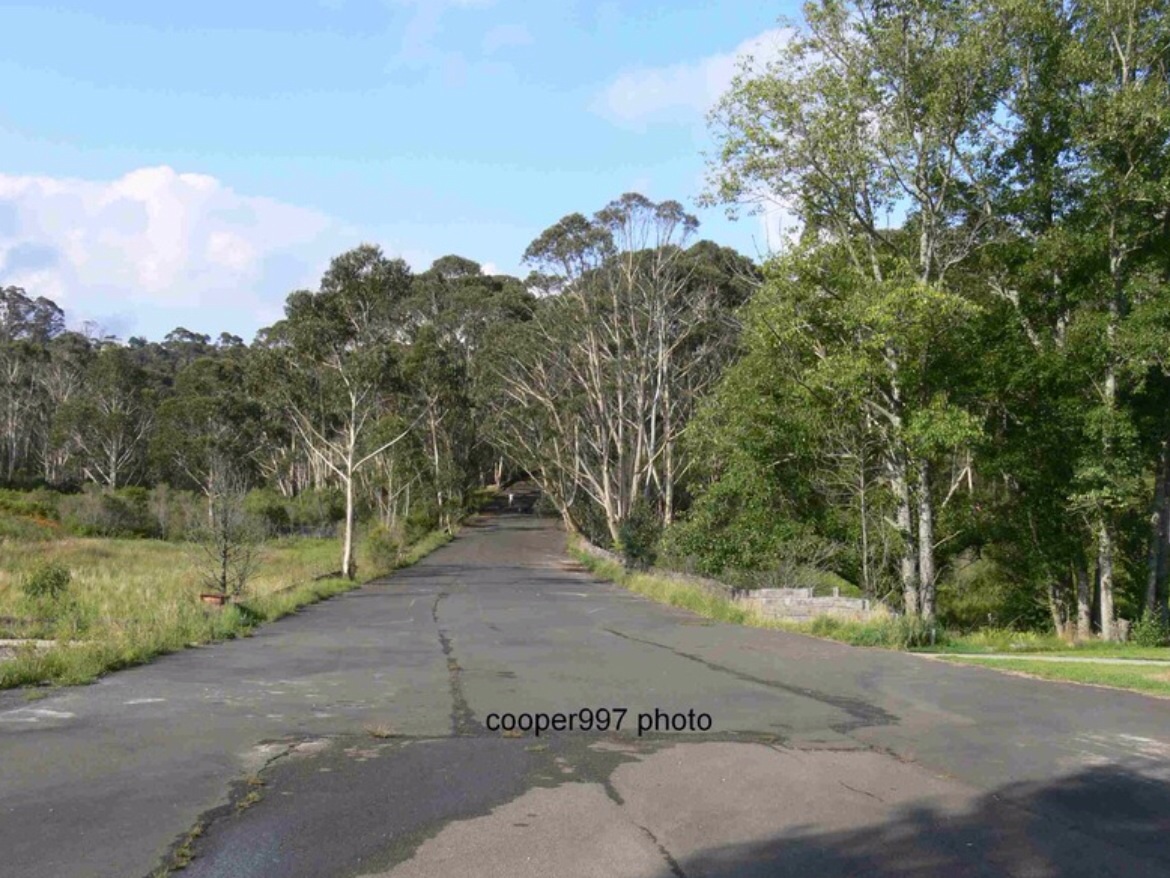
View from the startline in 2015 (S Dalton)

Catalina Now…

I’ve not visited Catalina Park, unfortunately, despite visiting Katoomba quite a few times over the decades. But my friend, motor racing historian Stephen Dalton, visited in February 2015 when the photograph above was taken.

Some excerpts of his The Nostalgia Forum post about his slow lap on foot are as follows.

‘…Hec Muir and his many helpers from the Blue Mountains Sporting Car Club created a miracle to build a circuit in the environs where they lived in the late 1950s. Indeed, in these politically sensitive times in which we live, it was not necessarily done in a politically correct manner. But they set out to build a circuit, and they achieved their goal. Even better, the competitors and crowds came, albeit for just 9 years of racing.’

‘…For a circuit that has been dormant approaching some 25 years (since Car Club sprints), the bitumen remains in surprisingly good nick…there is plenty of ground cover with nature taking it back and overhead canopies will continue to minimise sunlight reaching the circuit blacktop.’ Note that things may well have changed in the decade since Stephen visited!
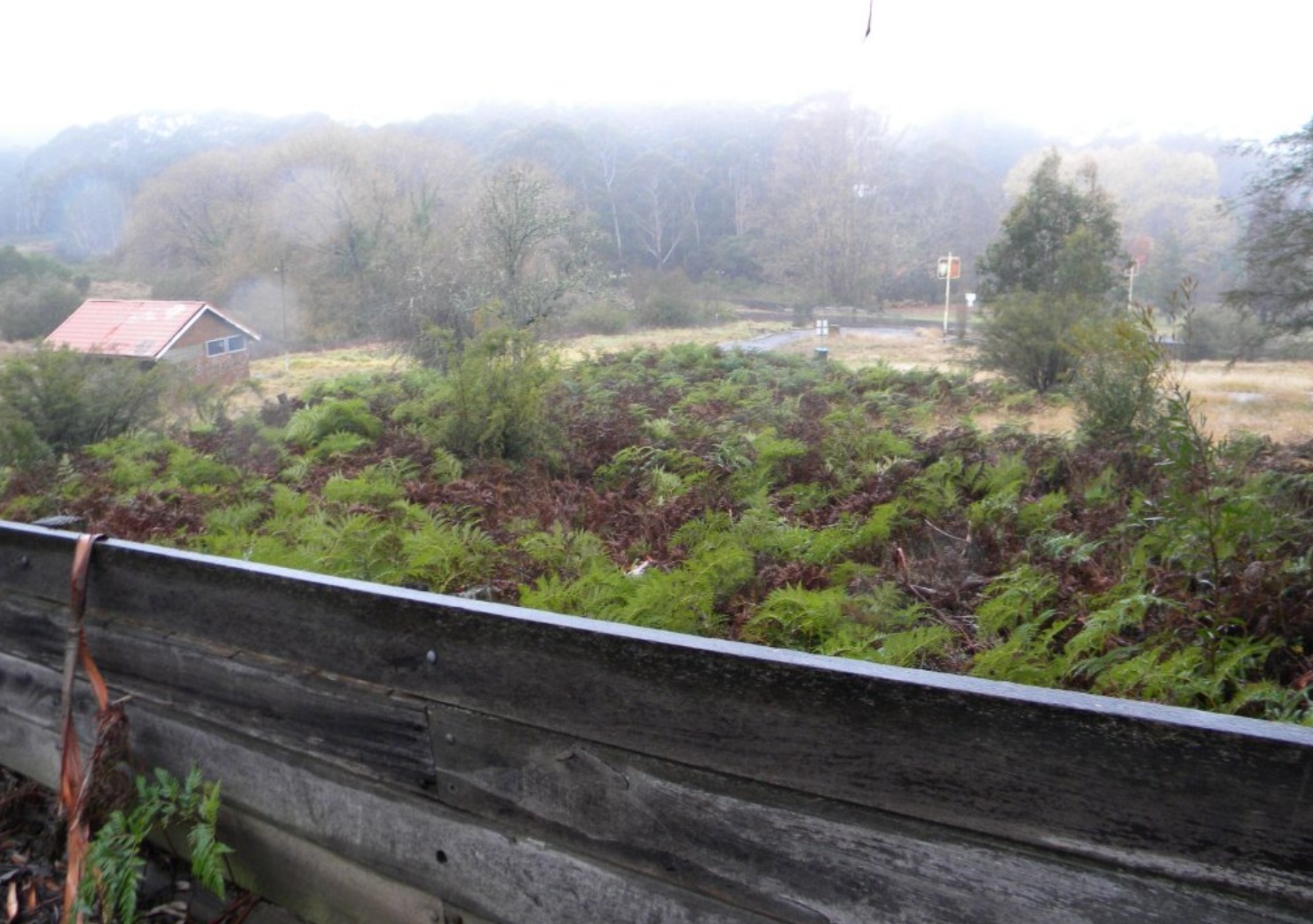
View down across the race fence towards the start finish line. Stephen Dalton advises that those signs are now long gone

‘Walking around from Craven-A, spring water meanders across the circuit that has also meant there’s a section fenced off where erosion has done its thing. Plus, a few sections have been concreted to stop the erosion from continuing. There’s also a tree or two that has fallen over, and the council workers no doubt received the memo to clear the walkway, but otherwise, pretty much leave it in the manner it fell. Because with The Gully…having been given back to the Aboriginal people, its use as a walkway for people, often with their dogs or cyclists, is what it’s about now. That, from my perspective, is better than it being completely fenced off, whereby no one can enjoy it, or motor racing people like us can visit.’

‘There is a little bit of motor racing infrastructure still there, the rusting metal and rotting wooden guardrails of the inner and outer circuit perimeters. As too are the once BP start/finish line signage poles, although the signs have since been souvenired. The rusting hulk of the starter’s steps remains near the inner guardrail, and a signal box that may have once been for communications or power lay on the ground close to the start/finish straight…’
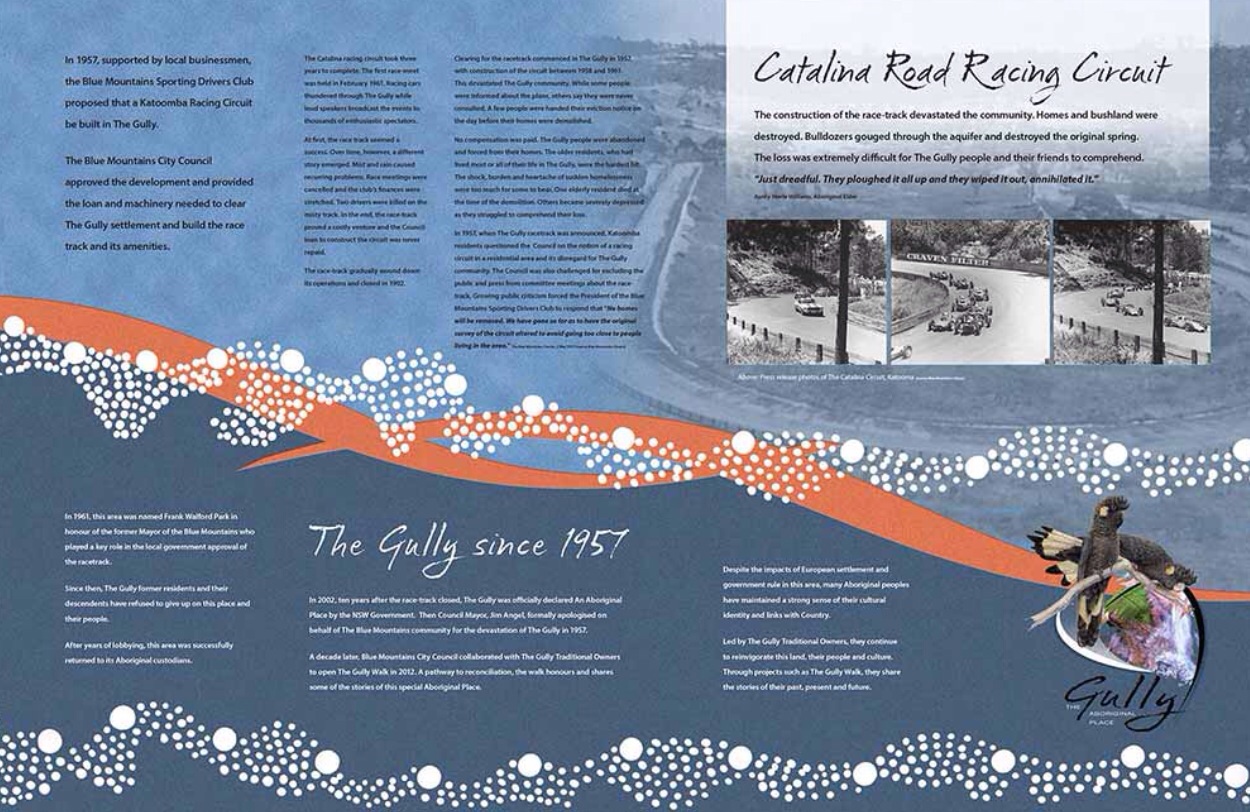
‘It is no doubt a sensitive issue with the Aboriginal heritage of the site, but there is only a small amount of information relating to the motor racing heritage. Maybe we should be grateful there’s some recognition. So, probably a bit pointless forming a working bee to get it up racing again!’ Stephen concluded wistfully.

There has been a fair bit of chatter about the preservation of what is left of the circuit, with a view to running at least some demonstration-type events, but the history of the Aboriginal dispossession in 1957 and subsequent events makes this highly unlikely, to say the least. So let’s take a look at the development of the area up until the mid-1950s, the dispossession of the residents and events in more recent times.

The development of The Gully was undertaken, as was the case globally in the late nineteenth and middle twentieth centuries, without due regard to the ecological values many of us now hold dear. A grazier filling in a wetland in the late 1800s and Gates bulldozing a natural swamp to create the dam for his park in the mid-forties were hardly big deals then.
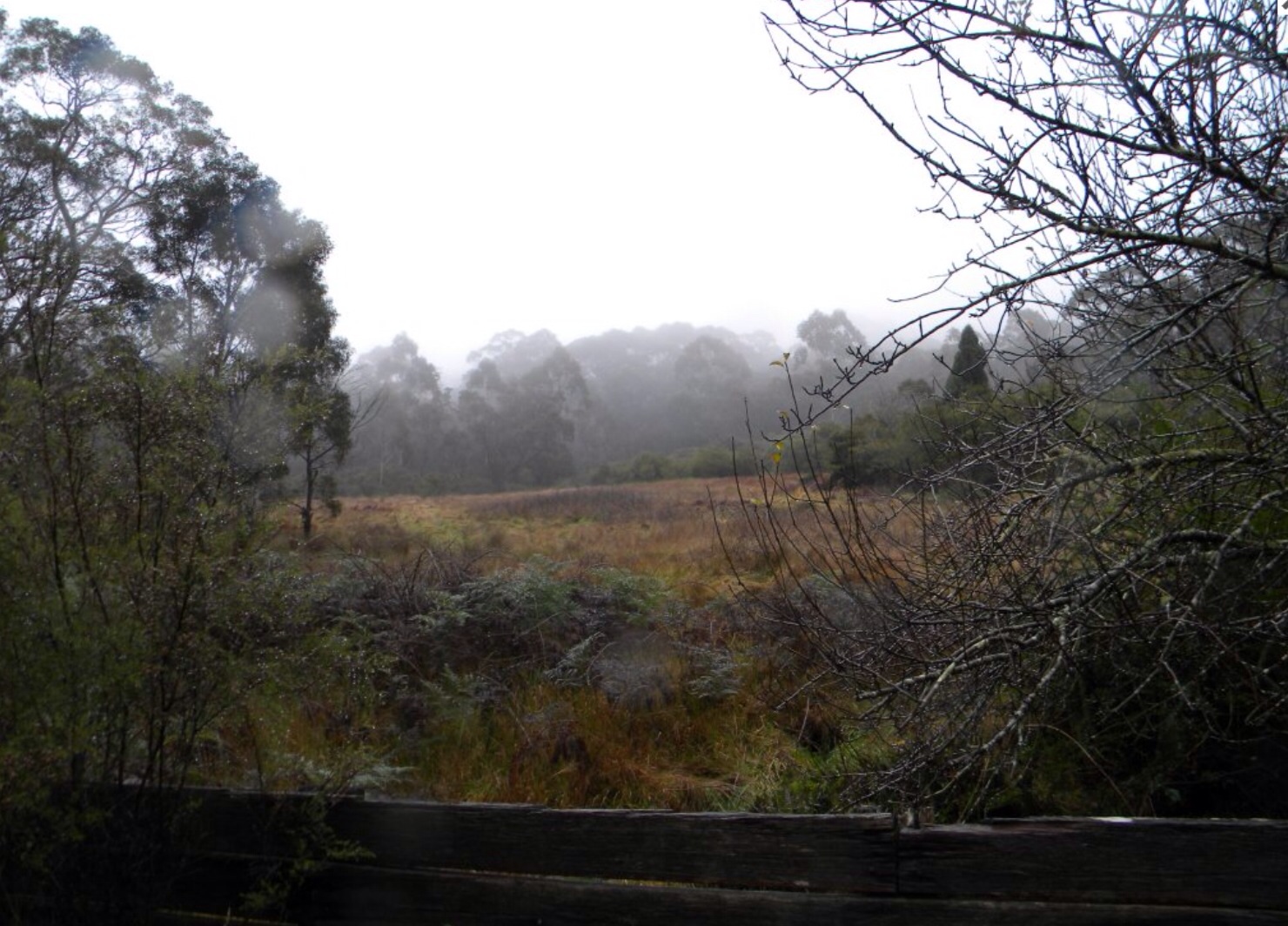
Katoomba Town Camp site in modern times, Catalina fence in foreground

Far more controversial, and callous, even in 1957, was the forcible removal of the residents of The Gully, noting that ‘A Heritage Study of The Gully Aboriginal Place, Katoomba NSW’ by Allan Lance Consulting in August 2005 records that Aboriginal people have been in the Upper Blue Mountains for thousands of years.

Lance wrote that by the mid 1950’s The Gully had ‘…become a refuge for the poor, both aboriginal and non-Aboriginal, who struggled to eke out an existence on the fringe of mainstream Australian life.’

‘Like the Aboriginal camps on the outskirts of many Australian towns in the early 20th century, those who lived there fought for a role in the economy of the town, working in jobs that were available, and sending their children to the local schools’.

‘They were accepted as individuals, but their status as outsiders remained, and when it became possible for the respectable citizens of the town to remove the camp by building the Catalina Park Racing Circuit in the late 1950s, the opportunity was taken, and this small community was destroyed.’

‘Those families were forcibly evicted from their homes, extracted from The Gully and one woman died of a heart attack during the raid’ The Habitat Advocate reported in 2009.

‘The far-reaching connections with those who once lived in The Gully and the nature of the eviction of Aboriginal Gully residents in the late 1950s, have led to The Gully becoming a rallying point for Aboriginal people in Sydney and the Blue Mountains and throughout Eastern Australia,’ Allan Lance wrote.

‘More than just an Aboriginal Place, this location also has significance for the descendants of the non-Aboriginal families who lived side by side with the Aboriginal people, sharing their struggle, often assisting with food and friendship when times were tough’.

In 1989, local residents, concerned about the poor state of the valley and with a desire to stop car racing, formed The Friends of Katoomba Falls Creek Valley Inc, who lobbied the Blue Mountains Council to have car racing banned and to restore the valley to its natural state.

In 2000, a Darug elder was responsible for achieving proper recognition for The Gully as an official Aboriginal Place; this was formalised on May 18, 2002. The Gully became protected under the relevant sections of the NSW Parks and Wildlife Act, which requires the land to be managed for the benefit of the community by the Blue Mountains Council, who still own it.
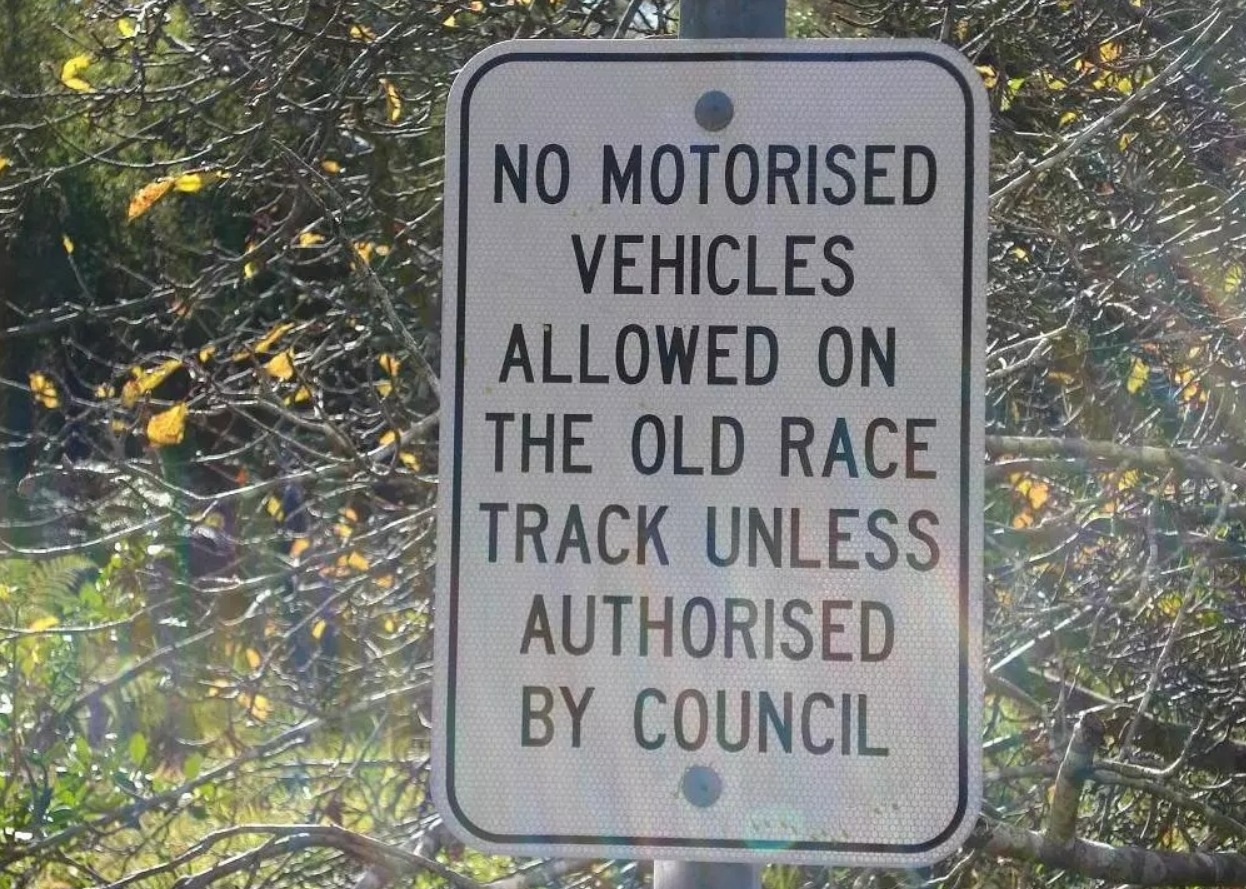
So what does all of this mean for any future motor racing use?

Being an Aboriginal Place means that management direction is given by the National Parks and Wildlife Act. Under this act, the Blue Mountains Council must take every care to protect and enhance Aboriginal values. To do that requires an archaeological study (the Allan Lance study) and ongoing consultation with the Aboriginal community over management of The Gully.

Note that the Local Government Act requires the Blue Mountains Council, as owners of the site, to manage it for the community and keep it safe for local visitors. As usual, the only winners in all of this lot will be voracious lawyers…

There is more though.

The Blue Mountains Council is required to obtain a Section 87 permit (a permit which allows exemptions to activities which otherwise may disturb the ground or old growth trees) before any action that may impact upon the Aboriginal values. For such a permit to be issued – such as a permit to use the land for some type of motor-sport event – it is first necessary for comprehensive consultation with the Aboriginal community to ensure its values are being protected.

Given the history of The Gully, particularly the events of 1957, I rather suspect the chance of a Section 87 permit, or consent in whatever form to be issued to allow a retrospective event, ignoring the fact that council funds are rather unlikely to be disgorged to rebuild the track, as having five-fifths of fuck-all chance of success.

Ironically, the Blue Mountains City Council is undertaking a review of the existing plan of management for The Gully at the time of writing, March 2019, click here to participate ;https://www.bmcc.nsw.gov.au/media-centre/gully-aboriginal-place-have-your-say-on-plan-of-management

It was probably a rather long digression but sometimes the motor racing history of Australia fuses with our social and societal history in a most unfortunate and sad kind of way, this is one of those occasions.

Please note that I am not suggesting racers were involved in ejecting people from their homes, but it is the case that Catalina was the catalyst for a series of events to build the track inclusive of removing a group of people who were in the way.

Younger Australian readers may care to remember, or be told, that we whiteys didn’t even include our Indigenous Brothers and Sisters in our census until a successful referendum in 1967 gave the Feds (Australian Parliament) the Constitutional power to make laws in relation to Aboriginals and Torres Strait Islanders, inclusive of their incorporation in our census.

Unfortunately the referendum did not recognise Aboriginal and Torres Strait Islander people as first peoples – odd given it’s a statement of fact – at this point a left of centre political dissertation by me of this particular constitutional opportunity is probably a step too far from an article which was 200 words about Leo, KB, Maxxie and Catalina Park until one digression led to the next. So here we are at 4800 words!

Note too, that I wrote it in 2019 and forgot to upload it, but I can’t be farnarkled checking what’s happened in the area in the last six years, and yep, I’ve not forgotten the Indigenous Voice referendum on October 14, 2023…
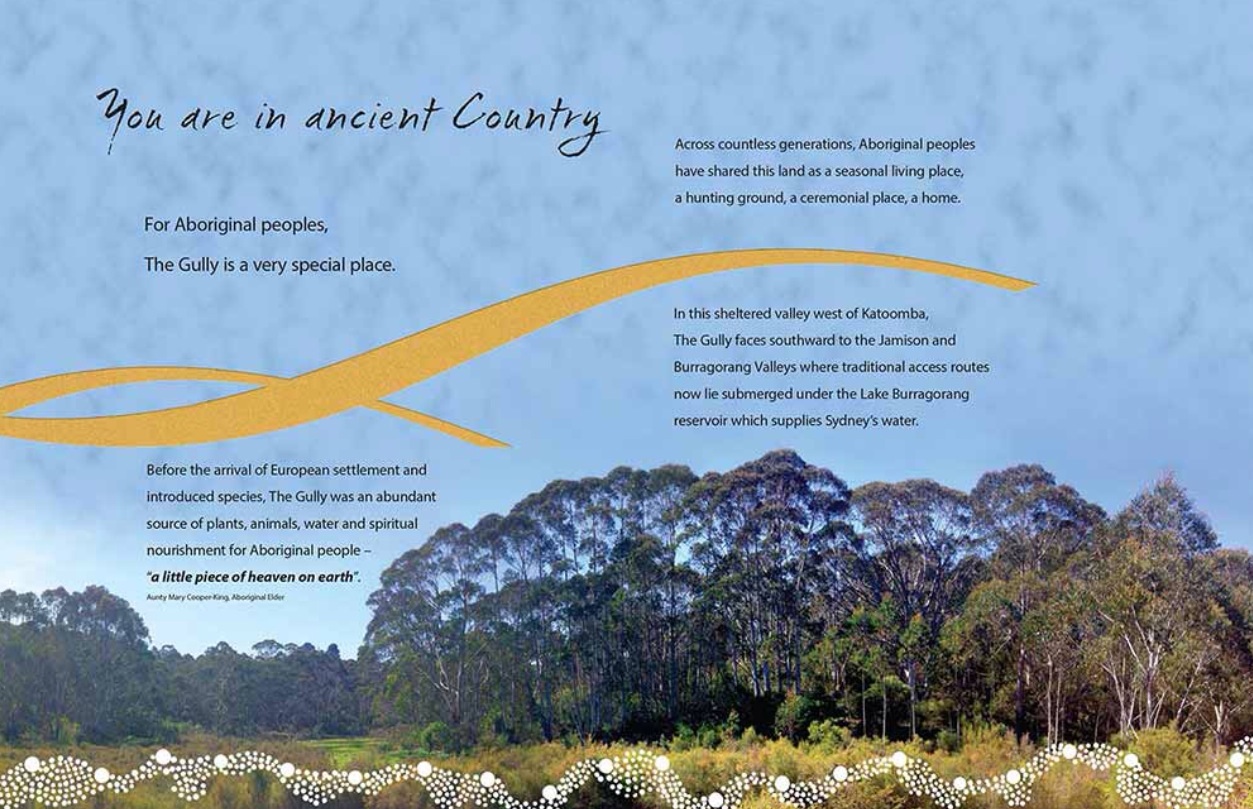
Etcetera…
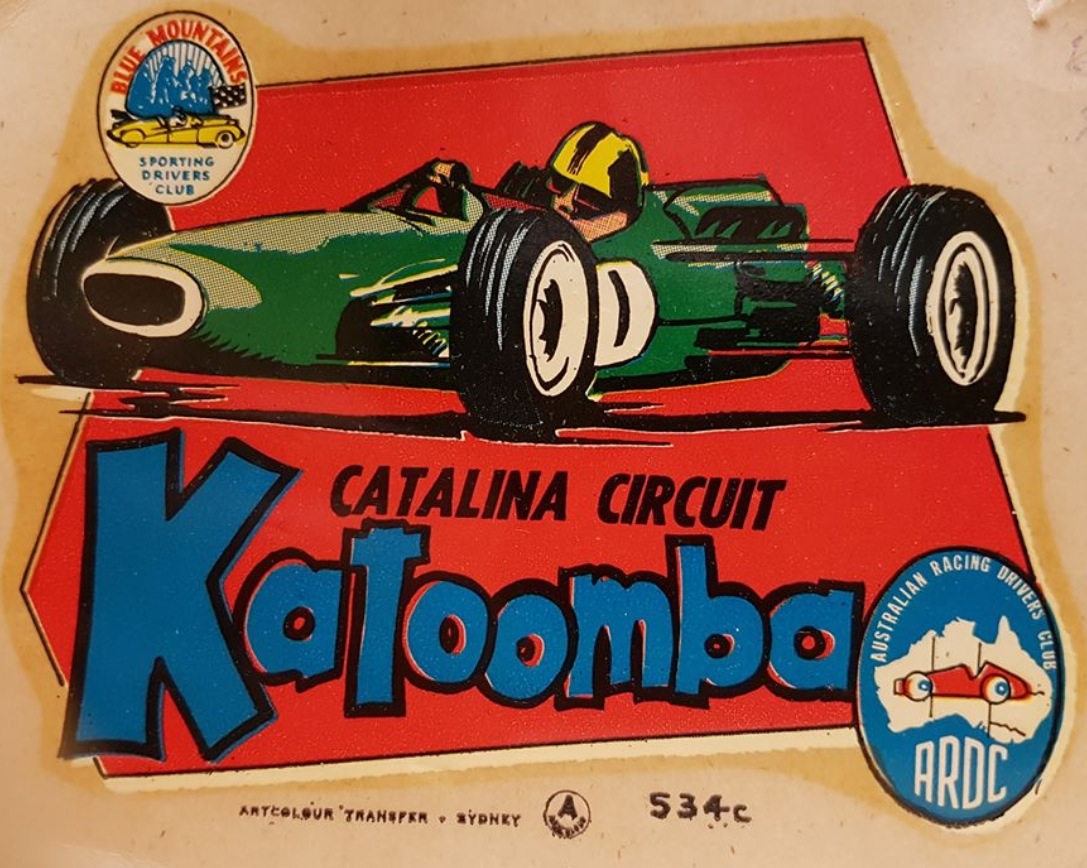
Australian Racing Drivers Club car decal with a stylised Lotus Climax, perhaps.
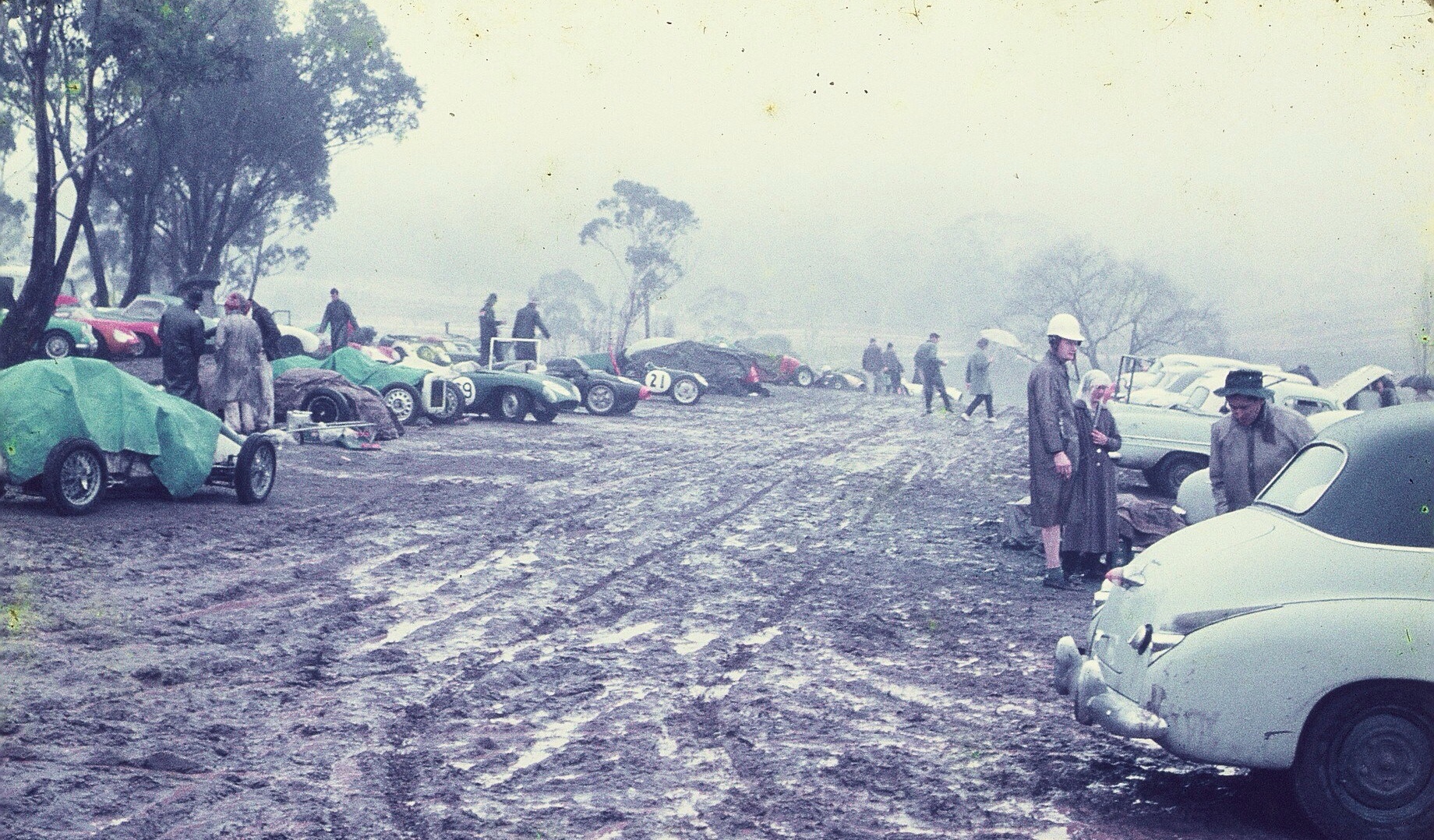
(FOC)

Oh goodness!

What a challenge for drivers and crews, the very nature of a racetrack in the mountainous areas of any country has its challenges, even in a dry continent such as Australia.

Catalina was notorious for its wet, muddy and foggy conditions, with meeting and event start times being adjusted accordingly to the weather’s whims, with plenty of organiser, competitor and spectator angst as a result.
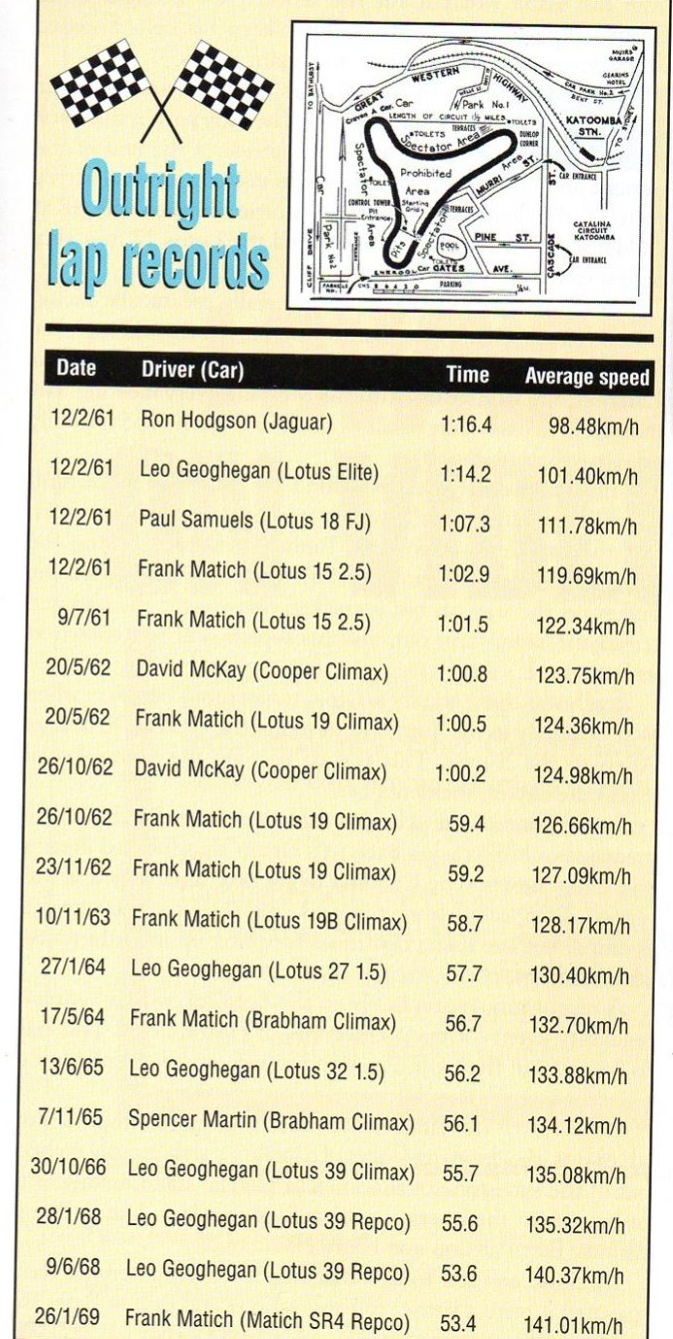
The list of lap-record holders is lifted from Ray Bell’s Motor Racing Australia article, with the Geoghegan and particularly Matich names looming large.
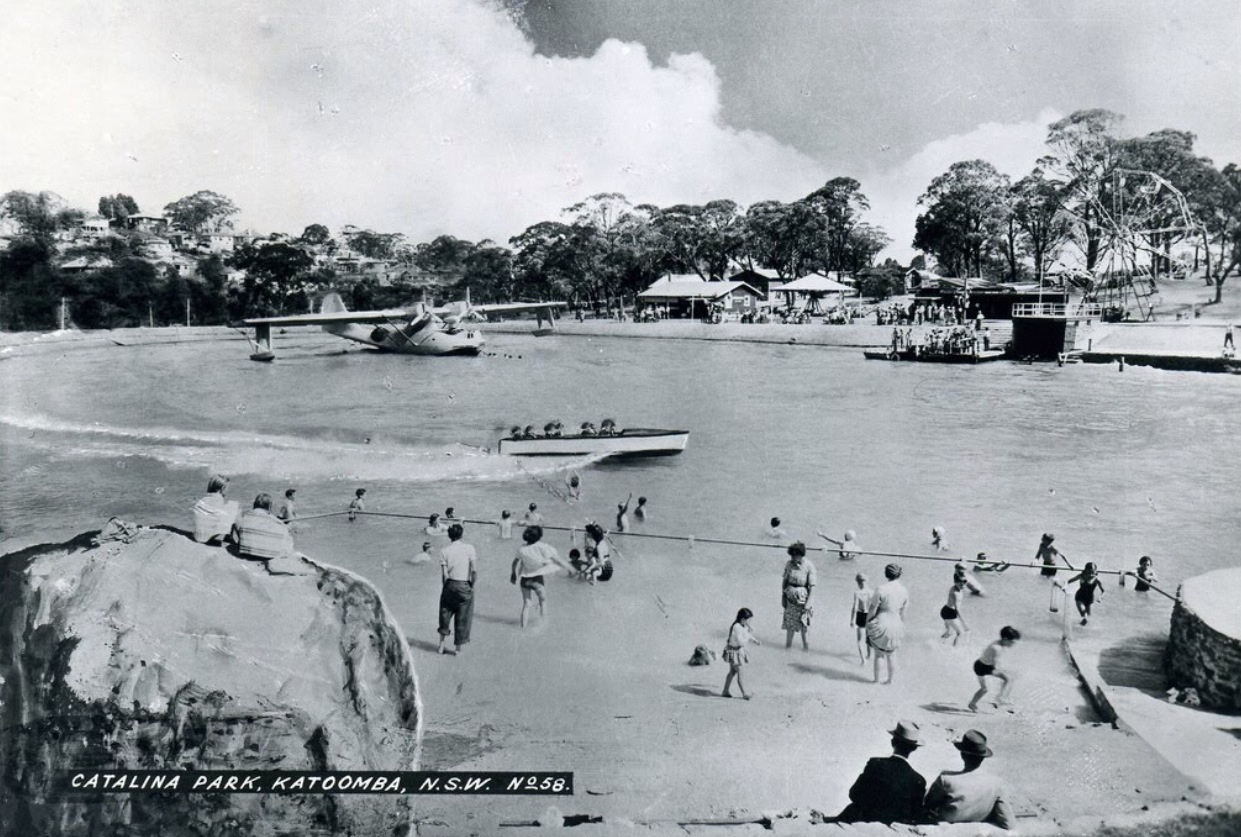
The Katoomba Catalina was a PB2B-1 with Serial Number A24-202.

Many of you are aviation enthusiasts, so let’s pursue this tangent for a bit. A wonderful bit of Sydney history is that Flying Boats operated out of Rose Bay in the harbour from 1938 to 1974.

In fact, Rose Bay was Australia’s first International Airport, with the Short Brothers built, long-range Short Empire Flying Boats, the provider of amazing, luxurious travel to the UK pre-War. The trip took 10 days, flying at 150 mph at 5000 feet for the great, the good and the wealthy.

The Catalinas were the best-loved flying boat of all. During the conflict, they were long-range patrol bombers and undertook night-time flights mining Japanese harbours in the Pacific.

In fact, you can still do joy flights from Rose Bay. A jaunt to Palm Beach and back is wonderful and will not destroy the budget completely. Read this piece on the Sydney Rose Bay Flying Boats; https://sydneylivingmuseums.com.au/stories/flying-boats-sydneys-golden-age-aviation
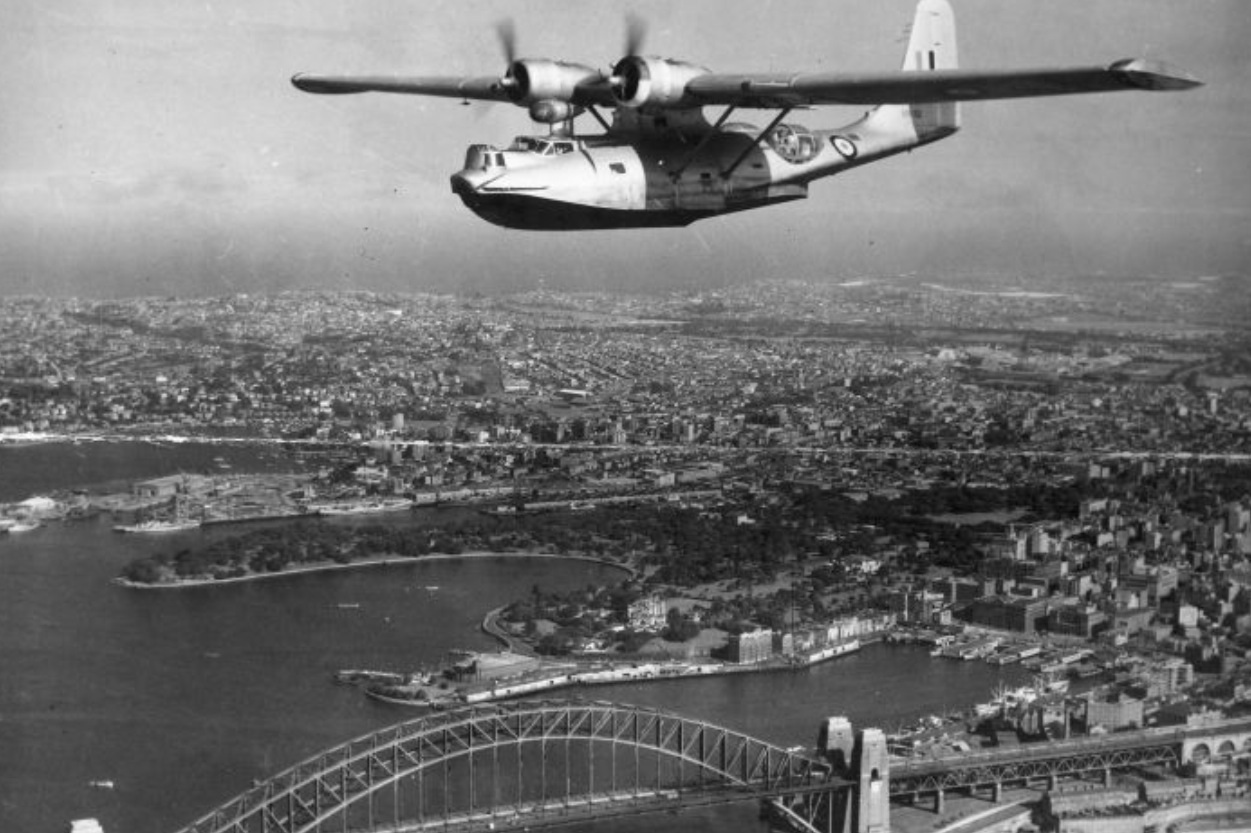
Catalina above Sydney, date uncertain

Butler Air Transport acquired three surplus RAAF Catalinas: A24-202, A24-362 and A24-376 on October 21, 1946. Butler’s were only after the engines and reusable parts. The stripped machines were then sold at auction to John Cain, who used them, and another Catalina A24-355, as floating guest accommodation at his Stoney Creek holiday park near Toronto, NSW. A storm flooded the place, which led to its demise circa 1950.

During the calm before the storm (sic, sort of), in 1948, Horace Gates bought good ole A24-202 for his park at Katoomba. In a sad end for A24-202, after the demise of Gate’s park, the Blue Mountains Council purchased the land, removed the Catalina during 1954 and then sold it to Sheffield Welding and Engineering. It was dismantled on site and scrapped.
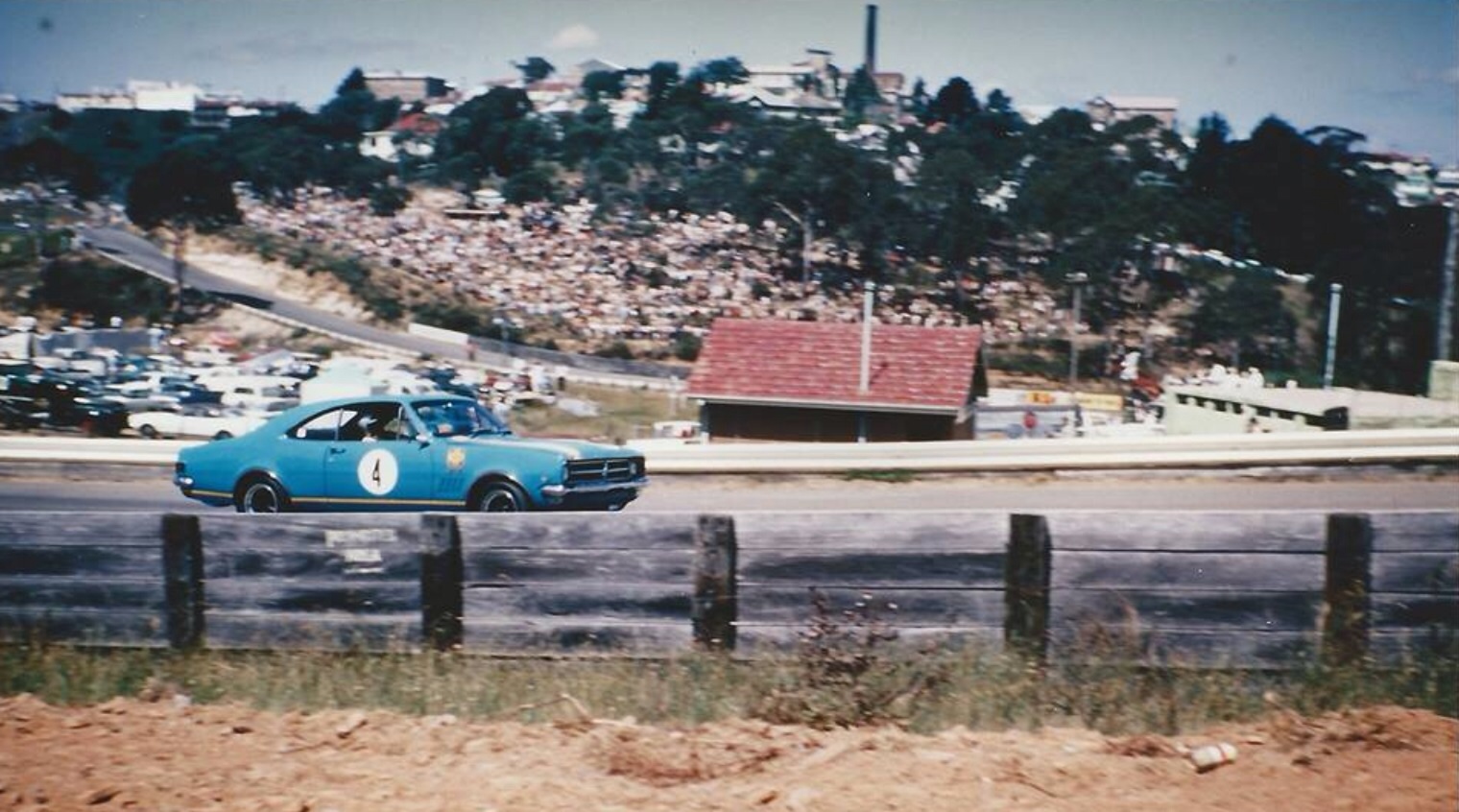
(FOC)

Norm Beechey’s HK Holden Monaro GTS 327 at Catalina in 1969. I don’t like his chances against Geoghegan at home that year. How did he fare against the local ace?
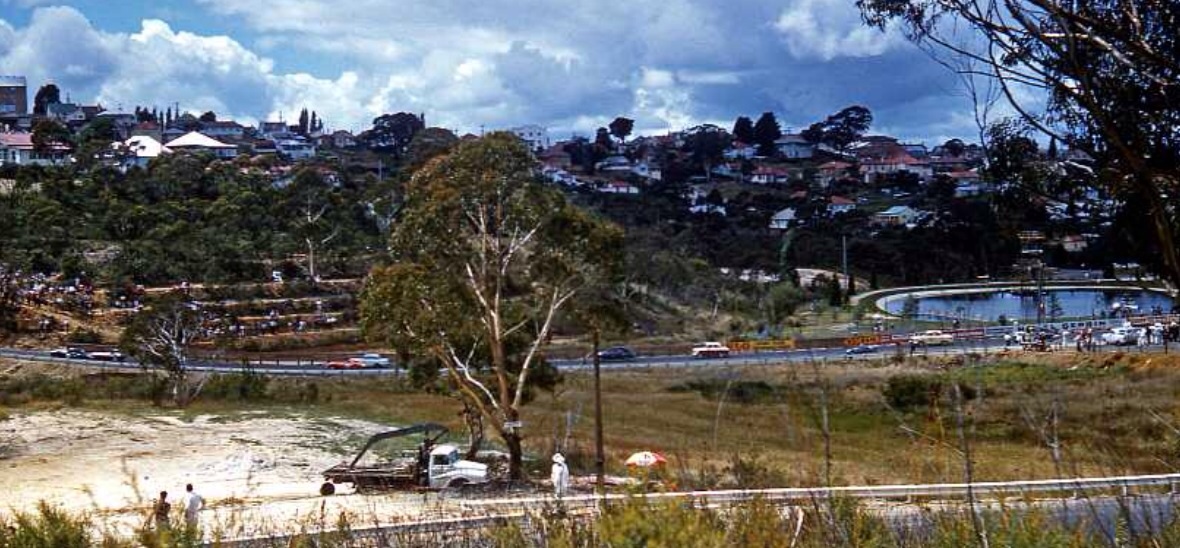
(R Bell)

The photo above is another from that first February 1961 meeting- any takers on any of the racers?
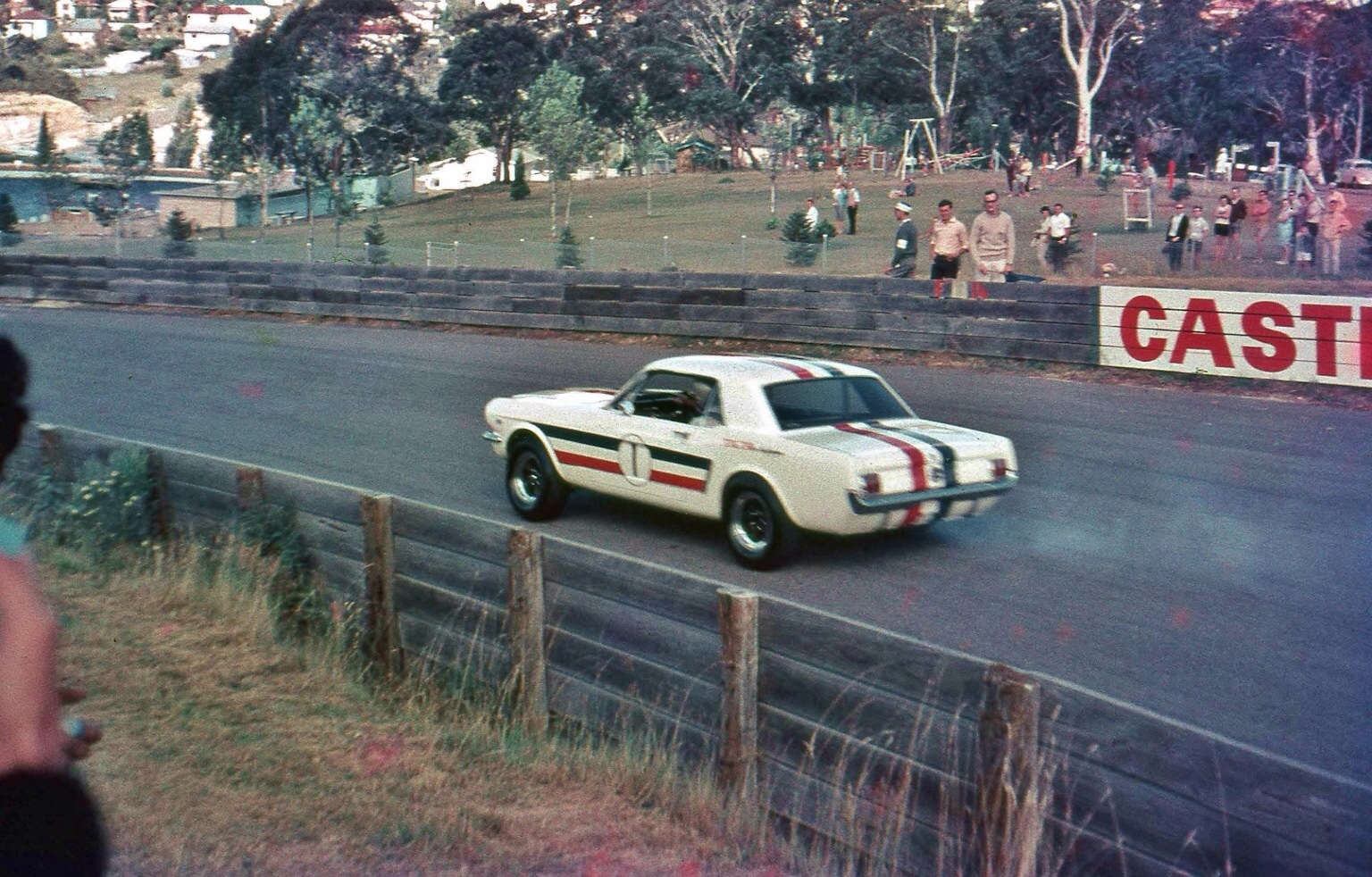
(unattributed)

The master, Pete Geoghegan in his first Mustang at Catalina circa 1965.
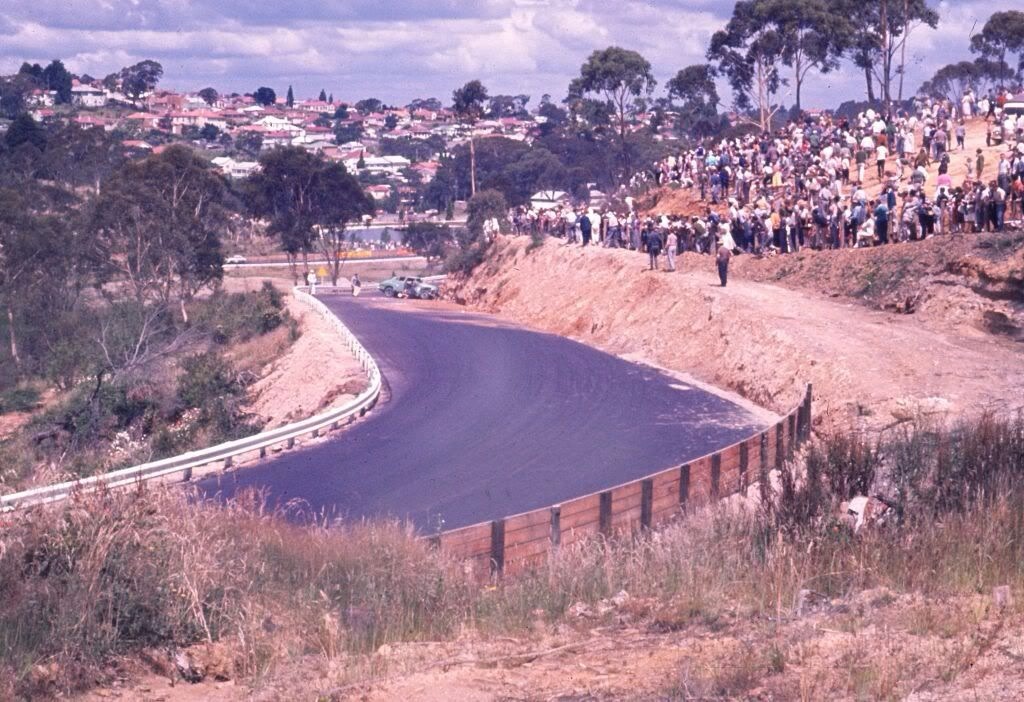
(unattributed)

A bit of carnage early in the circuit’s history. Peter Fnlay advises that Stan de Tiliga rolled his FX or FJ at the first meeting. Another shot which highlights the proximity of the track to Katoomba.
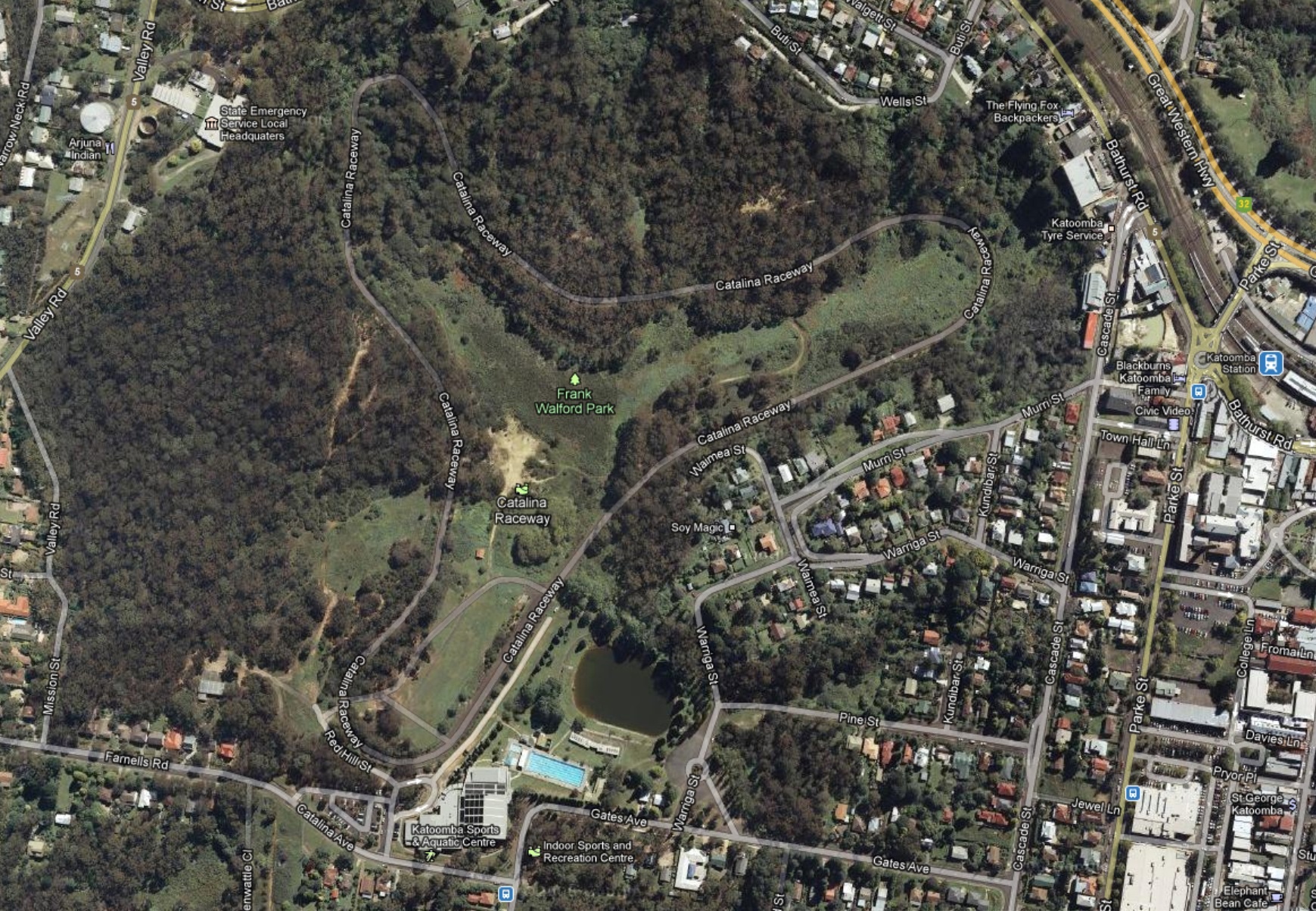
(sydneycyclepaths.com.au)

Contemporary overhead photograph of The Gully and surrounds. This shot is from a cycling website which is promoting the old circuit as a slice of bitumen which can be ridden.
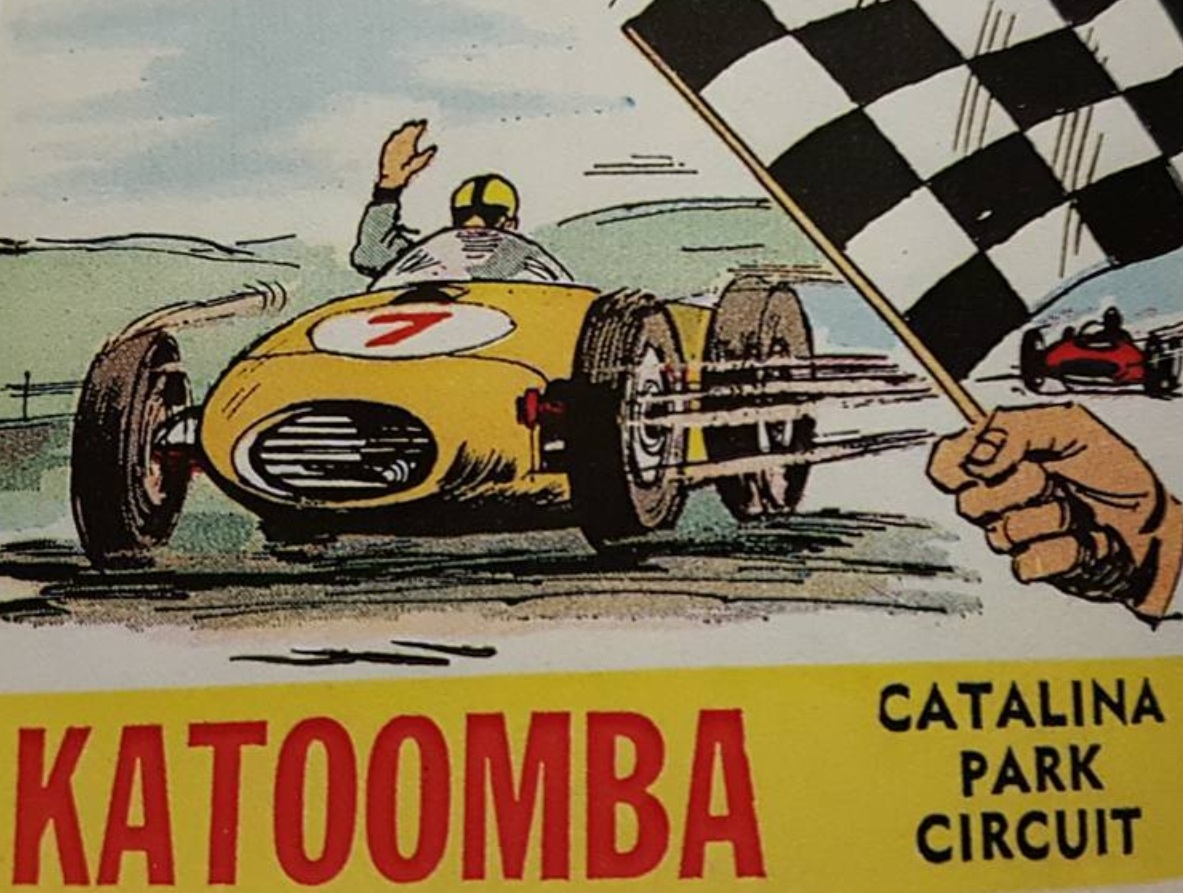
(J King)

 Bibliography…

Blue Mountains Local Studies paper by John Merriman 18 June 2010, A Heritage Study of The Gully Aboriginal Place, Katoomba, New South Wales’ by Allan Lance Heritage Consulting August 2005, The Habitat Advocate ‘The Gully (Gungaree) A Brief Background’ 2009

Motor Racing Australia ‘Closed Circuit’ article on Catalina Park by Ray Bell. Comments on The Nostalgia Forum by ‘Catalina Park’, Ray Bell, David Seldon and Stephen Dalton

Catalina aircraft information from David Legg, Geoff Goodall and John Merriman
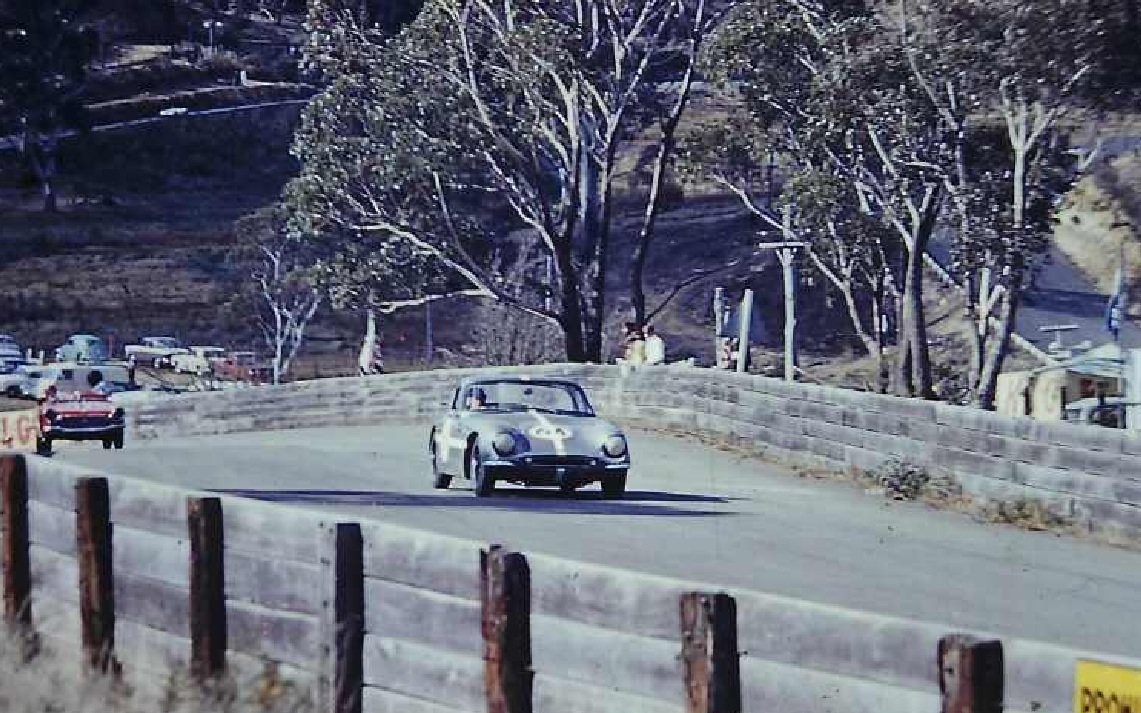
Kevin Bartlett, in a Peter Owen – TVR agent – owned TVR Grantura leads Noel Riley’s Honda S800, pits over the fence with the Geoghegan Lotus 23B Ford in the distance, perhaps (R Bell)
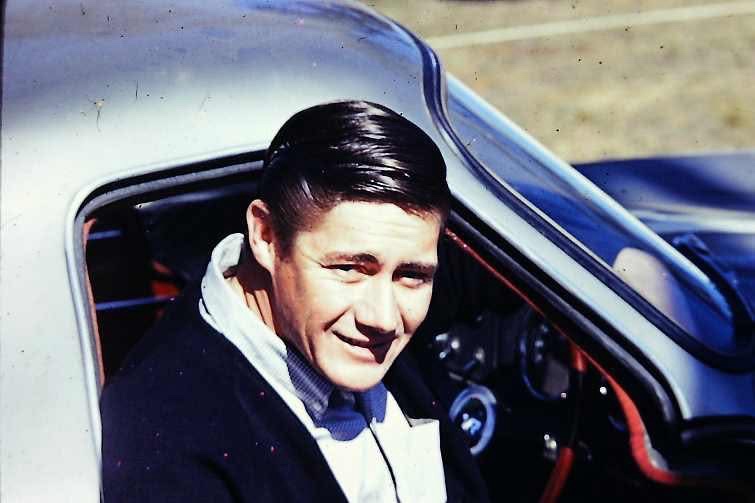
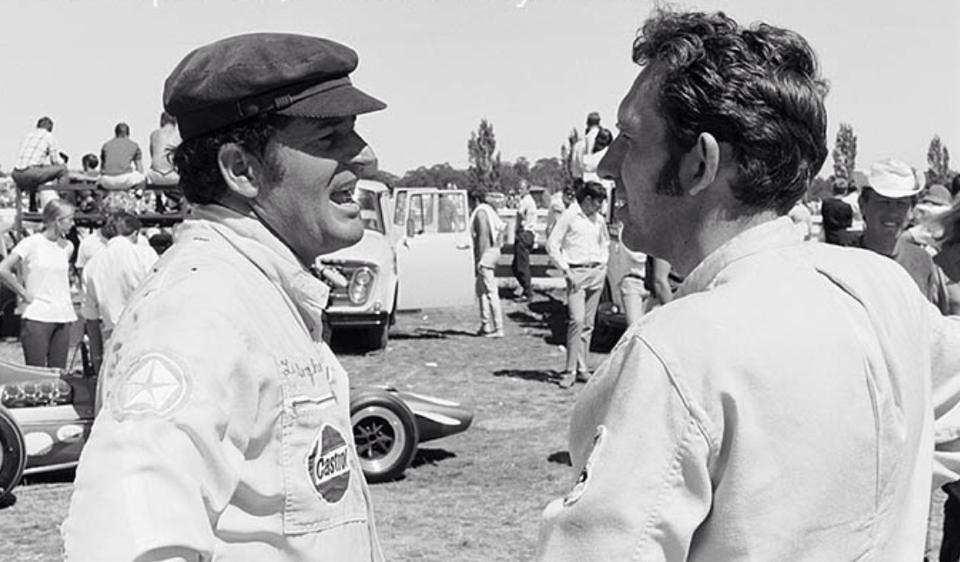
KB smiles for Ray Bell (R Bell)

Photo Credits…

Dick Simpson, Blue Mountains Library, Auslot, FOC- Friends of Catalina Park Facebook Group, Alan Howard, Graham Edney, Fred Pearse, Ray Bell, Norm Randall, Stephen Dalton Collection, Elizabeth Barwick, Tim Hislop, Phil Hammon, Joanne King. Many thanks to Ray Bell, Dale Harvey and Peter Finlay for photo caption corrections and additions

Tailpiece…
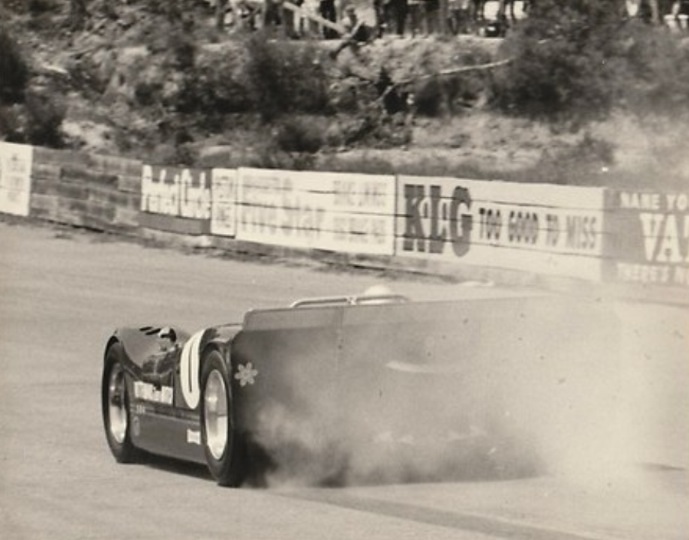
(Auslot)

Matich sets off in the race in which he set the all-time lap record for Catalina – 53.4 seconds – Matich SR4 Repco, Australia Day, 26 January 26, 1969. That car must have been quite a handful around that circuit!

Finito…
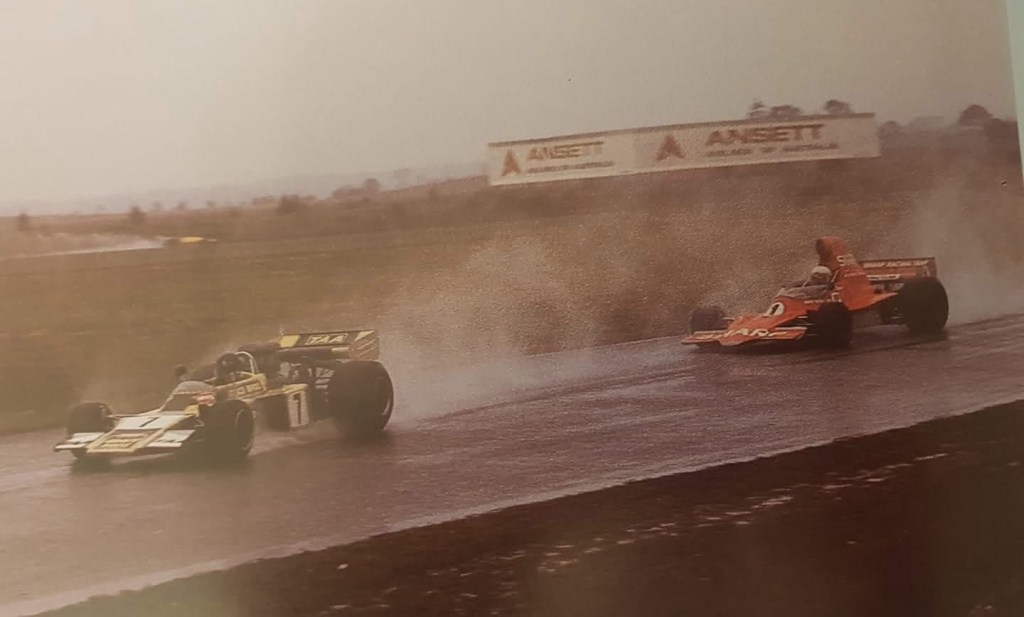
The battle for the lead of the AGP, John Leffler, Bowin P8 Chev from winner, Max Stewart, Lola T400 Chev (G Langridge)

While the popular notion of Surfers Paradise is of sun, surf, sand and bikini-clad babes, Greg Langridge’s photographs show that nothing could be further from that stereotype; the Gold Coast rained cats and dogs during the Australian Grand Prix held on August 31, 1975.

Sandown hosted the final ’75 Tasman Cup round on February 23, so it was a long time between drinks for the F5000 pilots that didn’t have a gig overseas or another domestic racing program to keep their hands in. The five-round Australian Drivers Championship, aka the Gold Star, started at Surfers and finished at Phillip Island on November 28.

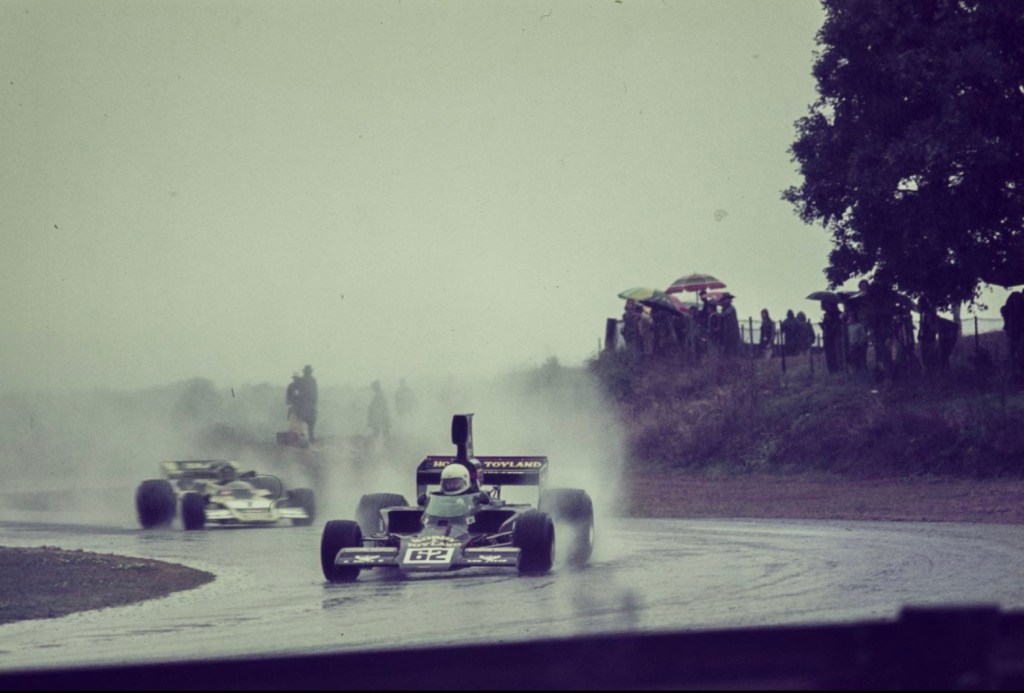
‘Eat ’em alive in 75′, Tasman champ Warwick Brown with Pat Burke’s Lola T332 HU27, the first of the T332s (S Elliott)

Gold Star Field…

Of the Tasman Top Trio, Warwick Brown headed back to the US, where he had a Jack McCormack Racing Talon Chev ride, Kiwi Graeme Lawrence did only the AGP, while John Walker was back with his Lola T332 retubbed after the colossal Sandown shunt from which he had ‘walked away’. Not back early enough, though, he missed the first AGP round, which proved rather critical at the season’s end…

Lanky Max about to load his good-self, including his famous Jolly Green Giant race suit, into his Lola T400 during practice which was as dry as raceday was wet! (C Jewell)

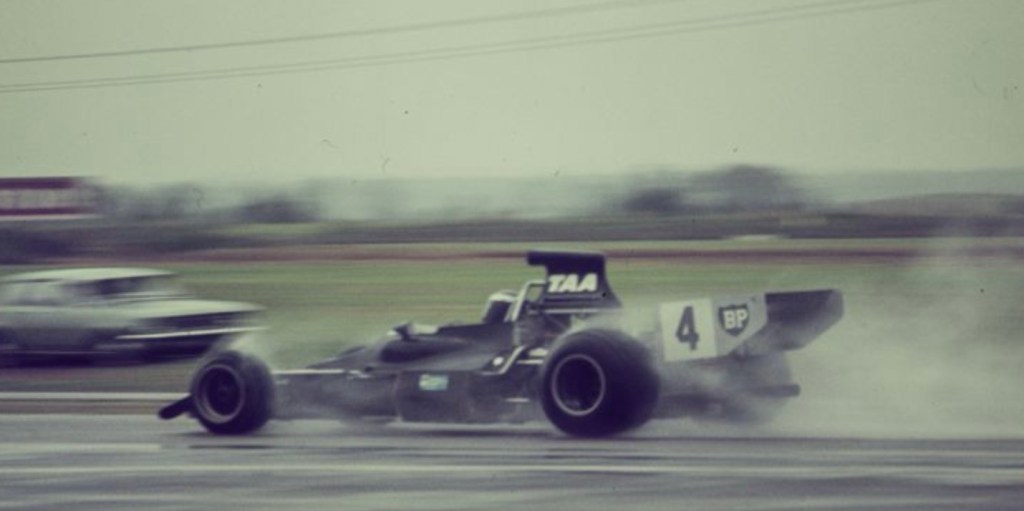
Max Stewart and Kevin Bartlett were still grumpy about their variable-rate suspension Lola T400 Chevs, while the advantages of John Leffler’s variable-rate suspension Bowin P8 – handling and roadholding aspects of his Bowin P6F Formula Ford and Bowin P8 Hart-Ford 416B that he loved throughout 1973-74 – weren’t realised as the marriage of a Chev V8 with the Bowin P8 monocoque was executed poorly by Leffo and his team; the car was as stiff as a centenarians todger. A shame, as a Repco-Holden was a P8 bolt-on – John Joyce designed and built the car for that engine – the Chev, while bought at a good price, was not so.

McCormack, Elfin MR6 Repco-Holden during the 1975 Lady Wigram Trophy (T Marshall)

A bloke falling back in love with Repco-Holden F5000 V8s was ’73 Gold Star Champ, John McCormack. He’d persevered with the aluminium Repco-Leyland F5000 V8-engined Elfin MR6 throughout 1974. While the car was light, it was hopelessly underpowered, unreliable and therefore uncompetitive.

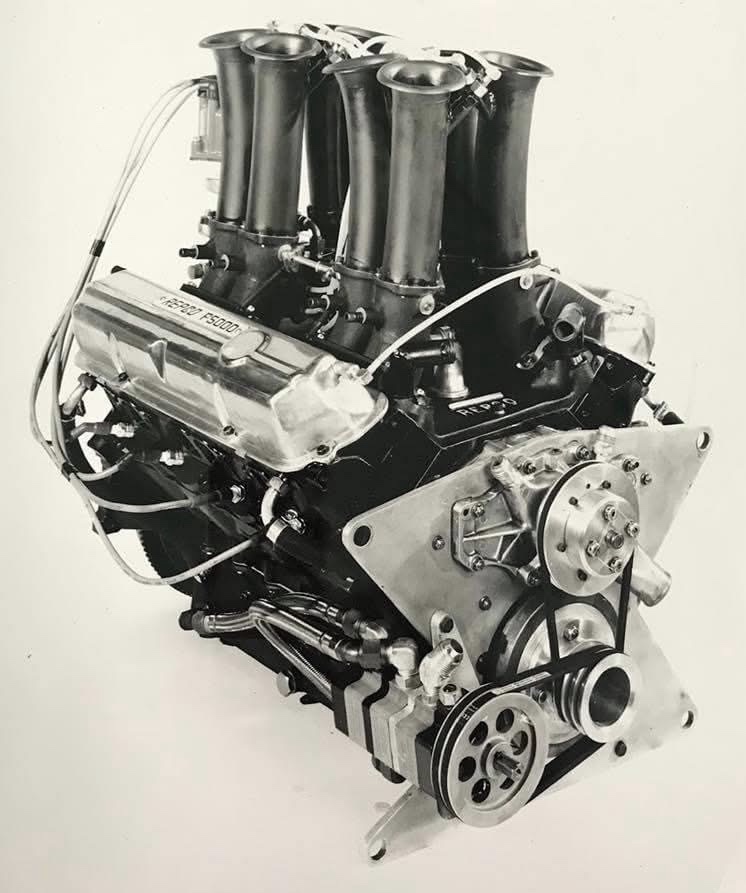
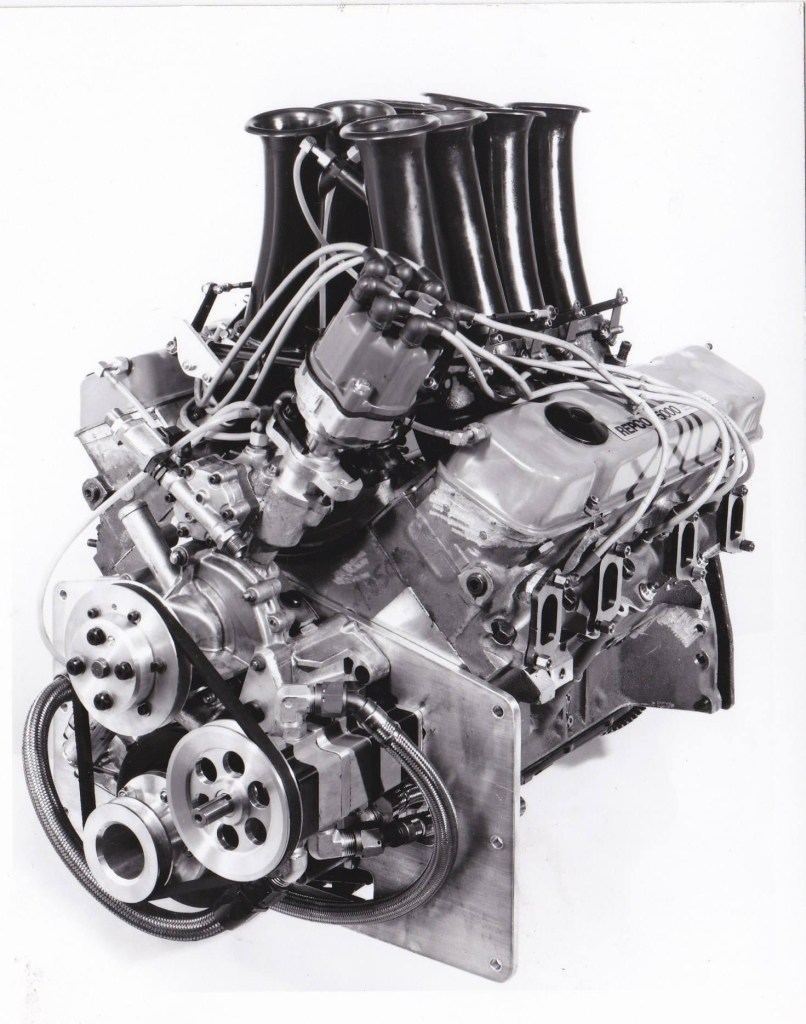
Repco-Holden F5000 V8 (Repco)
Repco-Leyland F5000 V8 (Repco)

Repco Ltd withdrew from racing in July 1974. The new Repco-Leyland F5000 program was a casualty. Unlike the cast-iron Holden 308 engine, the Leyland P76 V8 wasn’t structurally strong enough for racing. When Phil Irving ‘sectioned’ the engine at the program’s outset, he found it quite different to the Oldsmobile F85 aluminium V8 block that formed the basis of his 1966 World F1 Championship-winning 3-litre F1 Repco-Brabham 620 engine.

GM sold the BOP V8 (Buick-Oldsmobile-Pontiac) project to Rover, which made changes to it, too, and Leyland Australia when they built their 4.4-litre variant for the short-lived, very good but exceptionally ugly P76. Repco’s engineering resources would have overcome the shortcomings, as McCormack and Irving did ultimately, just! See here:https://primotipo.com/2024/10/18/repcos-withdrawal-from-racing/

In the interim, McCormack, Dale Koenneke and Simon Aram cranked old-faithful, their Repco-Holden V8s into the MR6 and instantly found the speed and reliability they needed. Mac was fourth in the ’75 Tasman.

‘Team Manager’ Warwick Brown with Bruce Allison’s Lola T332 Chev during the 1976 Rothmans International Series in NZ, circuit folks? (B Allison Collection)

The most impressive ’75 F5000 debutant was Bruce Allison, who enjoyed a successful season of ANF2 in 1974. His Birrana 274 Hart-Ford 416B was looked after by ace mechanic/engineer/Driver Whisperer Peter Molloy. The same combination ran the low miles Lola T332 Chev raced by KB in ’74 throughout 1975-76.

Soon to be 1975 Formula Ford Driver to Europe winner Paul Bernasconi was promising in Max Stewart’s other Lola T330 and T400, so too was Jon Davison in a self-funded Matich A50 Repco-Holden that had been raced by Walker in Australia and the US (A50-004). The Matich Repco-Holden top gun was John Goss, who was already a Tasman round winner despite graduating to F5000 in mid-1974.

Bruce Allison about to be lapped by John Leffler, Lola T332 Chev and Bowin P8 Chev (G Langridge)

Australian Grand Prix…

Bruce Allison proved he wasn’t remotely phased by the brawny 500bhp roller-skates, putting his T332 on pole of the big-balls track he knew so well. John Goss matched his time, with Leffo third.

When race day dawned very wet, the probable front-runners were rated as Stewart and Leffler, who had sets of Firestone wets of the type used by Brit Steve Thompson, who had run away and hid in his Chevron B24 Chev in the similarly soggy, steamy 1973 Warwick Farm 100 Tasman round.

Two warm-up laps allowed the starters to get a feel for the challenging conditions, then John Leffler’s Bowin jumped outta the box and blasted away under the Dunlop Bridge ahead of Allison, McCormack and Goss.

Leffo had a five-second gap after one lap and stretched this to 13 after seven. Bartlett spun early and dropped 20 seconds in his recovery. Leffler’s Bowin looked twitchy, but there was no holding him back as the race settled down.

After the first couple of laps Allison eased back a bit from the Grace Bros car but found McCormack’s Elfin MR6 harrying him. Jon Davison was driving his Matich well with fellow Matich racer Goss in heaps of strife with a badly misted visor after he’d accidentally wiped the demisting fluid off it before the race.

Enno Buesselmann retired his Elfin 622 Lotus-Ford ANF2 car after a dive under Graeme Lawrence at Firestone didn’t end well; he speared off onto the swamplike infield from which there was no escape.

Jon Davison, his Matich Repco-Holden by then running in A51/A53 side-radiator spec (G Langridge)
Terry Hook, Lola T332 Chev (G Langridge)

By lap five, Bartlett had closed right up on Davison while Stewart and McCormack gained on Allison. Leffler was lapping the stragglers but lengthened his lap times by four or five seconds each time he had to submarine through a car’s spray.

On lap nine Allison spun at Goodyear, letting McCormack and Stewart through while Bartlett retired after being hit by a missile as he raised his visor to see where he was going.

Leffler extended his lead to 20 seconds from McCormack and Stewart, then there was a gap to Allison, then Davison ahead of Ray Winter, in the ex-Gardner/Bartlett/Muir Mildren Yellow Submarine Hart-Ford 416B ANF2 car, then Lawrence, Lola T332, Garrie Cooper, Elfin MR5B Repco-Holden and Chris Milton’s ex-David Hobbs McLaren M22 Chev.

Adelaide boys Milton and Cooper, McLaren M22 Chev and Elfin MR5B Repco-Holden (G Langridge)
Allison Lola T332 (G Langridge)

Allison spun again after 17 laps at which point Peter Molloy called it a day, while McCormack and Stewart chased down Leffler.

With 20 laps down Leffler was slowed by Davison’s spray while Stewart blasted past Cooper and then caught Leffler but spun trying to go under him at Lukey.

Max then got his dander up and set the fastest race lap, gathered up McCormack in three laps, passing him under the bridge and set off after Leffler 10 seconds up the road but now nursing an engine that wasn’t running on all eight thanks to the liberal dousing of his electrics by the Rain Gods.

Stewart dived past Leffler into Lukey on lap 31 and then opened a lead just as McCormack was black-flagged into a pit stop for not wearing a vizor. Stewart wasn’t using his either; he was keeping it cocked open with one hand while driving with the other.

Cooper retired with suspension failure and McCormack was soon back in the pits with a tyre that had thrown its tread. This chain of misfortune left Ray Winter holding down third place in his F2 Mildren followed by Lawrence.

Max Stewart took a plucky, but lucky win from Leffler, the star of the day, then Ray Winter in a fantastic drive of the Sub, from Graeme Lawrence, John McCormack and Chris Milton.

Max Stewart popped his Bell Star visor up and down to get some sense of direction on a shocker of a Gold Coast day, Lola T400 Chev (GCB)
1975 Australian Gold Star Champion, John McCormack, Elfin MR6 Repco-Holden. Sandown International 1975 (B Keys)

Gold Star Championship…

A fortnight after Surfers the F5000 Circus convened at Sandown Park in Melbourne’s southern suburbs where the Marlboro 100 was taken in fine style by John Walker’s Lola T332 Repco-Holden from Bruce Allison, Kevin Bartlett and John Leffler.

Walker started the September 15 race from pole – no sign of any heebie-jeebies as a legacy of his Tasman Cup accident in February.

John Goss seemingly had the race in the bag, leading until lap 21 of 32 when his rear wing support broke. From then Walker and Allison were neck and neck with Bruce only metres away from Adelaide’s finest in the ex-Bartlett T332 Chev. Of the frontrunners, only McCormack – from grid two – had a DNF due to a gearbox problem.

Jon Davison, Matich A50 Repco-Holden, Sandown Intrrnational 1975 (G Fry)
John Goss on the way to winning the last ever Tasman Cup round at Sandown in February 1975. Matich A53 Repco-Holden (I Smith)

In a tightly compressed Gold Star, the next round was at Oran Park in Sydney’s outer west, the following weekend, September 21.

The top three qualifiers were Stewart, Allison and McCormack from Walker, Leffler and Bartlett. The race organisers used a two-heat format, each comprising 24 laps of the by then longer circuit.

Stewart won the first from McCormack and Leffler, Leffo having again got the jump at the start. Max led but trailed oil smoke, Mac awaited the black flag, which didn’t come, his percentage play didn’t work as by the time Max eased, he was out of the Elfin’s reach.

Stewart had the advantage until he pitted on lap 7 with his nose-section coming adrift. McCormack then led before being passed by Allison. John returned the favour, and the crowd was treated to that duel, and another between Walker and Leffler. Mac’s flat-plane-crank Repco-Holden had the better of Allison’s Molloy Chev, then the matter was settled when Bruce went wide exiting BP and hit the wall.

When the results were aggregated, John McCormack won the round from Stewart, Leffler and Walker. At that stage Stewart was on 15 Gold Star points, Leffler 13, and McCormack and Walker 12 points.

Paul Bernasconi aboard Max Stewart’s Lola T330 Chev – HU1 was the very first T330 chassis – at Oran Park in September 1975 (D Grant Collection)
Bruce Allison at Pukekohe in 1976, Lola T332 Chev (unattributed)

The final two rounds were in Victoria which made logistics a bit easier for the teams, Calder was on October 19, and Phillip Island a month later, on November 28.

Bob Jane’s boys went for a two-race format, 30 laps, or thirty miles each. John McCormack took pole with a 39.8-second lap – under the magic 40 seconds – from Max Stewart on 39.9 and KB 40 seconds neat.

McCormack won the first heat, holding the lead from flag to flag, from Stewart and John Walker, then a fiercely scrapping Bartlett and Leffler. John McCormack got the jump in the second heat, too. Stewart’s challenge faded early with engine problems and ultimately a black flag. Bartlett spun early, so too did Mac, leaving Walker in the lead, an advantage he held to the end from Mac, KB and Paul Bernasconi, in Max’s old T330 Chev.

McCormack won the round from Walker, Stewart and Bartlett; the Gold Star tally was McCormack 21, Stewart 19, Walker 18 and Leffler still on 13 and effectively out of the running. The title swung on the final round…

Max Stewart pitches his Lola T400 Chev over the inside of Tin Shed’s kerb, Calder 1975
Graeme Lawrence, Lola T332 Chev from John McCormack, Elfin MR6 Repco-Holden, Levin International 1975 (D Green)

KB was in good form as he drove over the bridge from San Remo to Newhaven on Phillip Island on November 20. He sneaked in the Macau Grand Prix between Calder and Phillip Island on November 16, finishing a great second to winner John McDonald’s Ralt RT1 Lotus-Ford. Bartlett raced an Equipe 66 (LC Kwan, Hong Kong) Brabham BT40 Lotus-Ford.

McCormack took pole on the fast, challenging, still pretty rough track, 1.8 seconds clear of Bartlett, Leffler and Stewart.

The Bowin P8 Chev put its power down amazingly well, and Leffo made another of his screamer starts, blasting into the lead from row two. Stewart was out early with a broken pushrod. KB lined Leffo up in Southern Loop; soon John Walker followed suit. McCormack’s challenge faded; a moment through the Southern Loop rough stuff on the first lap had upset his car’s handling, then Leffler slowed with fuel feed problems.

Walker was racing Bartlett for his (JW’s) Gold Star. He needed to win the race to bridge the gap to McCormack. For the rest of the race, it was cut-and-thrust. KB led, then extended his lead when JW miscued at Repco, who then made up the shortfall over the ensuing six laps. Walker took the lead and held it for three laps before the head gasket(s) started to fail, causing a loss of power.

Kevin Bartlett on the way to winning the Gold Star round at Phillip Island in November 1974, Lola T332 Chev. Bass Straight looks pretty wild, as does the track surface (R Davies)

The Australian Motor Racing Annual recorded it this way, ‘Bartlett quickly closed up again, passing Walker flat in fifth while crossing the line to start the final lap. Walker hung on, chasing the red Lola up the back section of the circuit, where he made a last try for the lead at the right-hander before Lukey. It almost came off, except that KB had him covered to the extent that the T400 stayed in front.’

‘However, KB hit a patch of water and spun off while Walker, trying to avoid the red Lola, speared off into the long grass on the inside of the circuit, heading for Len Lukey’s cow sheds. Bartlett was the first to recover and regained the circuit to win by 23 seconds from John McCormack, with a very angry Johnnie Walker filling third place in a Lola with a very battered nose.’

I’ve got to go back to 1973 to find a shot of John Walker at Phillip Island. It’s a goodie though, blasting his T330 Repco-Holden through Southern Loop at full noise or thereabouts. Winner of the October Gold Star round (J Walker Archive)

‘But the drama was not over, as KB sped across the line to receive the flag, he backed off, and the rear wheels of his car locked on the rain-dampened track. Next thing, KB was sideways at 230 km/h and heading for the armco. Many would have crashed, but KB’s superb reflex action saved the day, he avoided the fence by a few centimetres and continued safely on for his cool-down lap.’

‘It was KB’s first win since the championship race at Phillip Island the year before. For Walker, it was a bitter disappointment as a win in the race would have clinched him the Australian Driven Championship. But Walker failed to contest the first round – something no serious racer can afford to do if he wants to win a title.’

True…but perhaps a tad hard given the expenditure required of his Lola T332 to get it back into RWC in the time available. Thankfully, the planets and karma were fully aligned for JW in 1979 when he took a lucky AGP win and the Gold Star in Martin Sampson’s Lola T332 Chev – the ex-Bartlett/Allison/Bartlett chassis.

Surely one of the most brutally handsome racing cars ever built? Most successful too. John Walker’s T332 Repco-Holden during the ‘75 Tasman round. It was a toss up for me as to whether I wanted JW or WB to become the first and only Australian to win the Tasman Cup (B Keys)

Credits…

Greg Langridge-State Library of Queensland, Richard Cousins, GCB-Gold Coast Bulletin, Chris Jewell, Steve Elliott, Terry Marshall, Gavin Fry, Ian Smith, Doug Grant Collection, Mike Harding, Robert Davies, Bruce Keys

Tailpiece…

(R Davies)

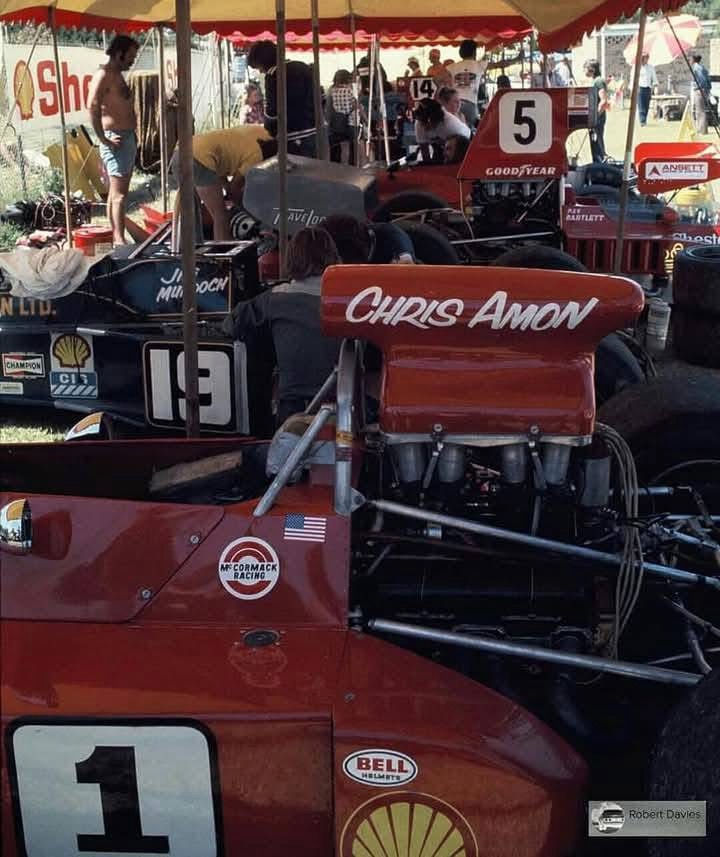
Heaven on a stick was the old paddock at Sandown!

Crowded as anything for competitors but great for spectators, here the Shell tent during the 1975 Tasman round with Chris Amon’s Talon MR1 shot front and centre. Then Jim Murdoch’s Begg 018, Kevin Bartlett’s Lola T332, with Graeme Lawrence’s #14 T333 airbox there too.

Finito…

(G Searl)

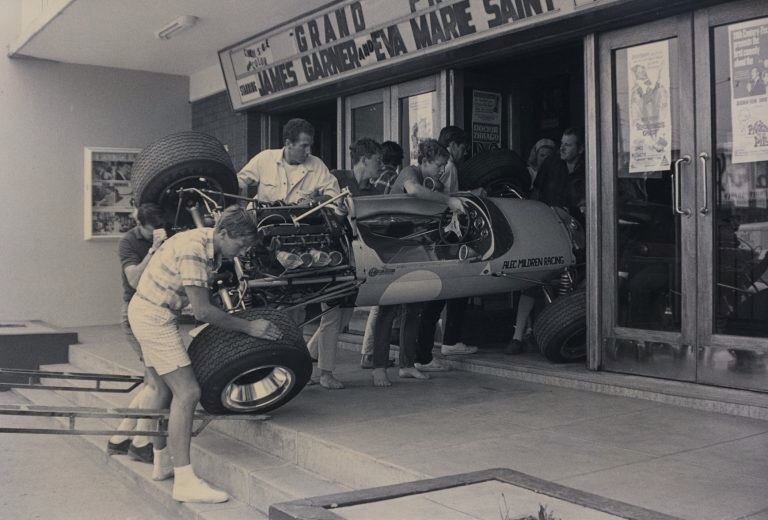
Just a little to the right fellas otherwise we’ll have to twist the chassis a smidge…

Alec Mildren Racing mechanics Bob Grange, in overalls, and Glenn Abbey partially obscured by the left front, manoeuvre their new Mildren (Rennmax) Alfa Romeo 1.6 F2 through the narrow front doors of the Avalon Cinema on Sydney’s Northern beaches.

Both Mildren and Abbey were locals so perhaps the deal to have the racer in situ during the screening of the film Grand Prix was hatched between the theatre owner and Mildren- a nice way to cross-promote his Alfa dealerships closeby and in the city.

The date is the more interesting thing in an arcane kind of way. Grand Prix was released in Australia on July 14, 1967, this car wasn’t built then. It first raced at Warwick Farm on September 5, 1968 in Kevin Bartlett’s hands, and was raced for the first time with a 1.6-litre Waggott TC-4V engine at Symmons Plains in Max Stewart’s tender loving care on March 3, 1969.

So…given the shorts on the fella looking after the right rear Goodyear I’m guessing it’s a school holidays screening in The Summer of ’69, the only thing missing is Bryan Adams twangin’ his Fender Strat (or whatever).

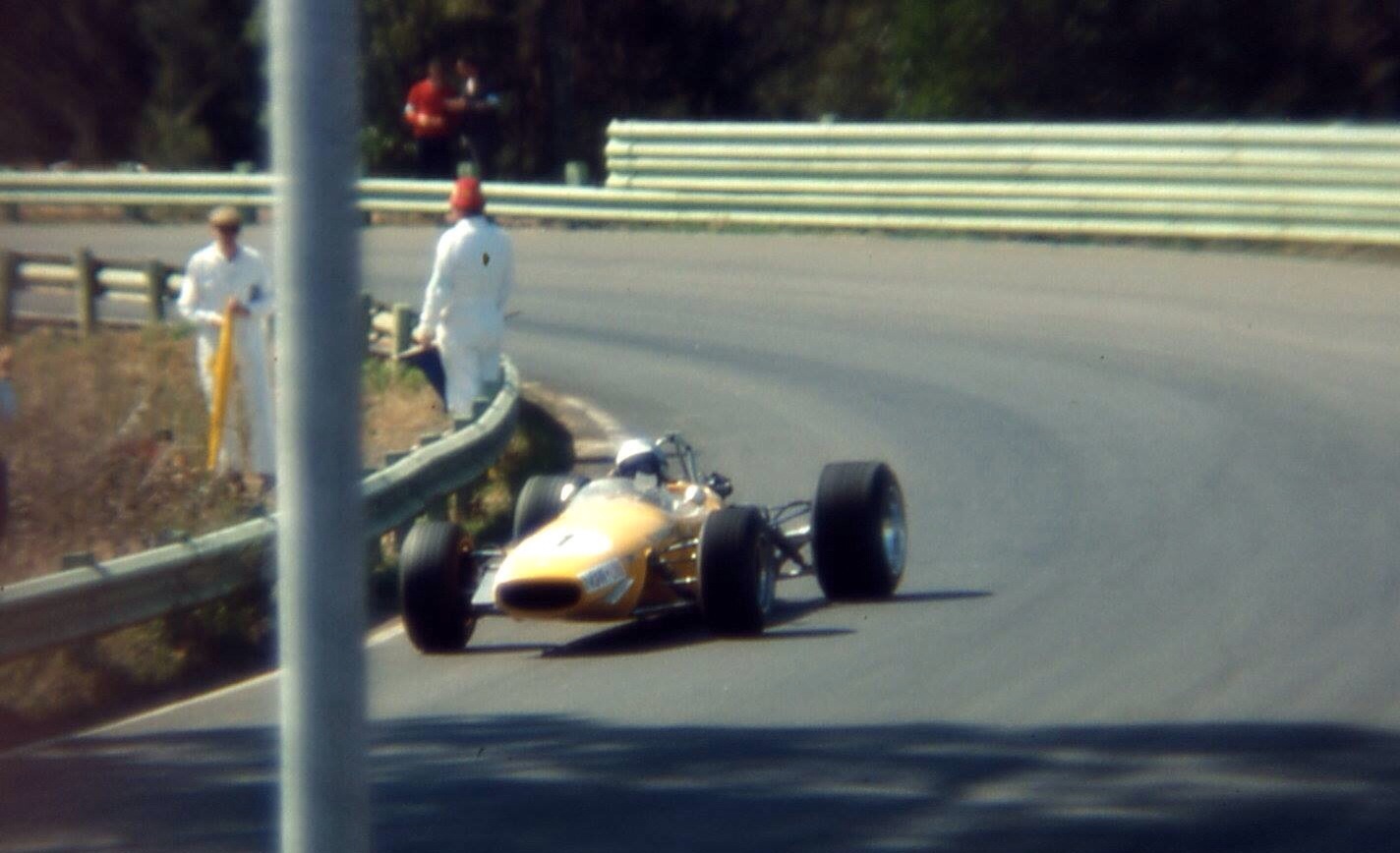
Kevin Bartlett slicing the new Mildren Alfa F2 through the Warwick Farm Esses, probably on the 8 September 1968 weekend of its race debut (D Harvey)
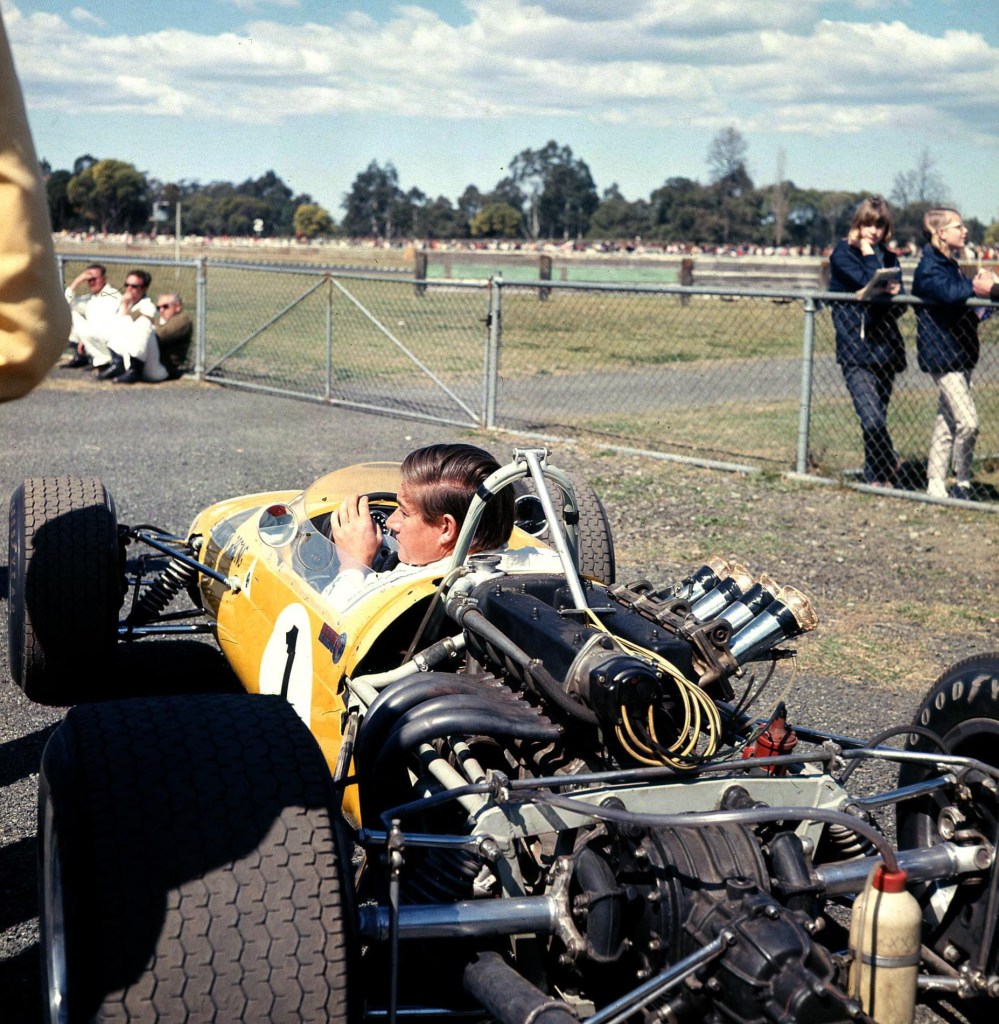
Bartlett on the WF dummy grid on September 8, 1968. Mildren Alfa Romeo F2 Four-Valve race debut (B Henderson)

This little Beastie is an oh-so-famous car in Australia. It won a swag of races in Max Stewart’s hands including the 1971 Australian Gold Star Championship and the 1972 Singapore Grand Prix.

It had more engines than you and I have had hot dinners: the Alfa Romeo DOHC twin-plug, four-valve 1600cc F2 featured in this article, Waggott TC-4V DOHC four-valve 1600/1860/2000cc, Alfa Romeo DOHC twin-plug, two-valve, Alfa Romeo 2000cc GTAm and Lotus/Ford DOHC two-valve 1600cc motors.

Treat this as the first of two articles on the Mildren Alfa/Waggott/Alfa/Ford dealing with its early life in 1968-1969 with a particular focus on the Alfa Romeo four-valve engine.  See these two Singapore GP pieces; https://primotipo.com/2016/11/24/singapore-sling-with-an-elfin-twist/ and; https://primotipo.com/2018/05/29/singapore-sling/

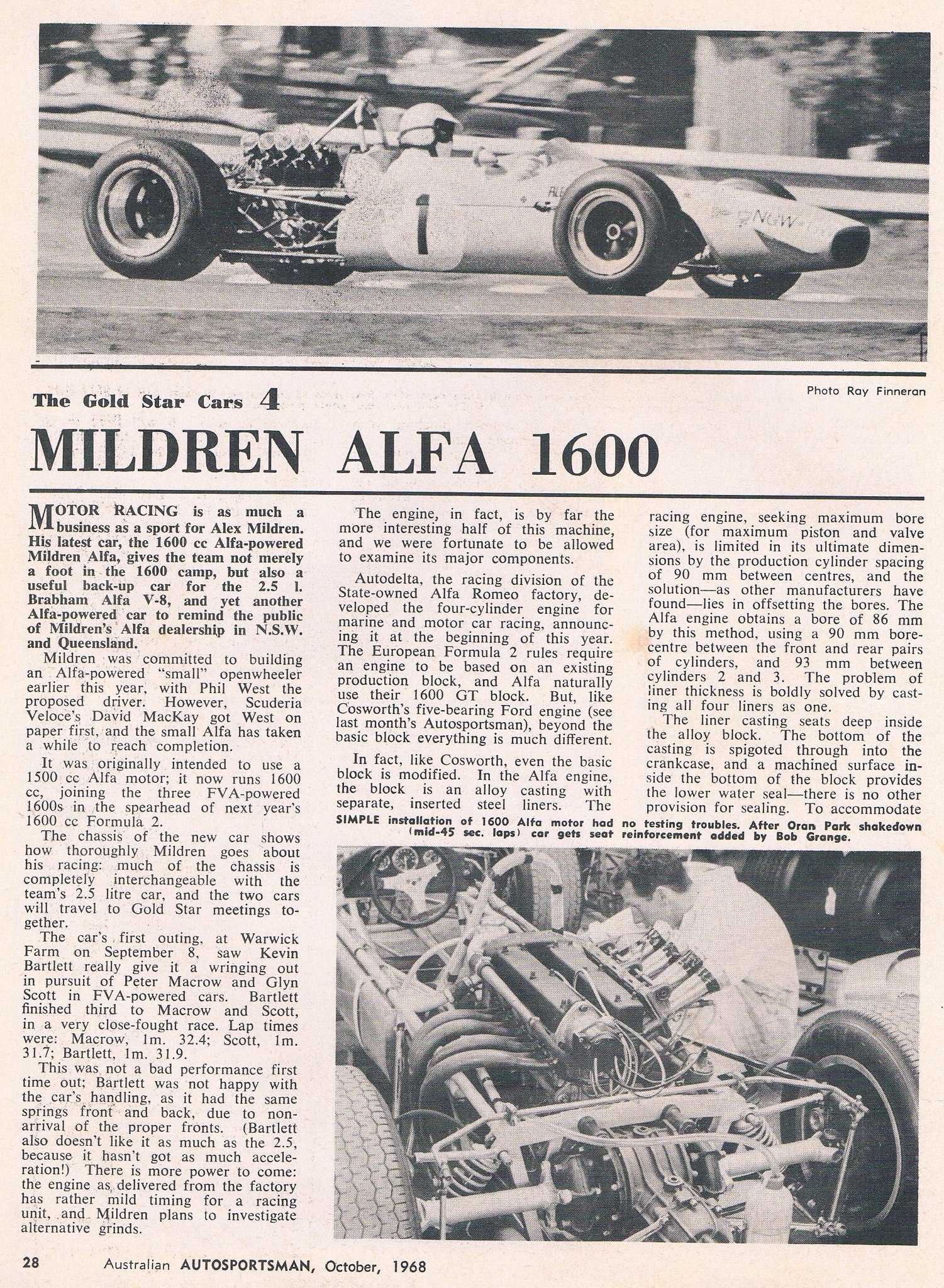
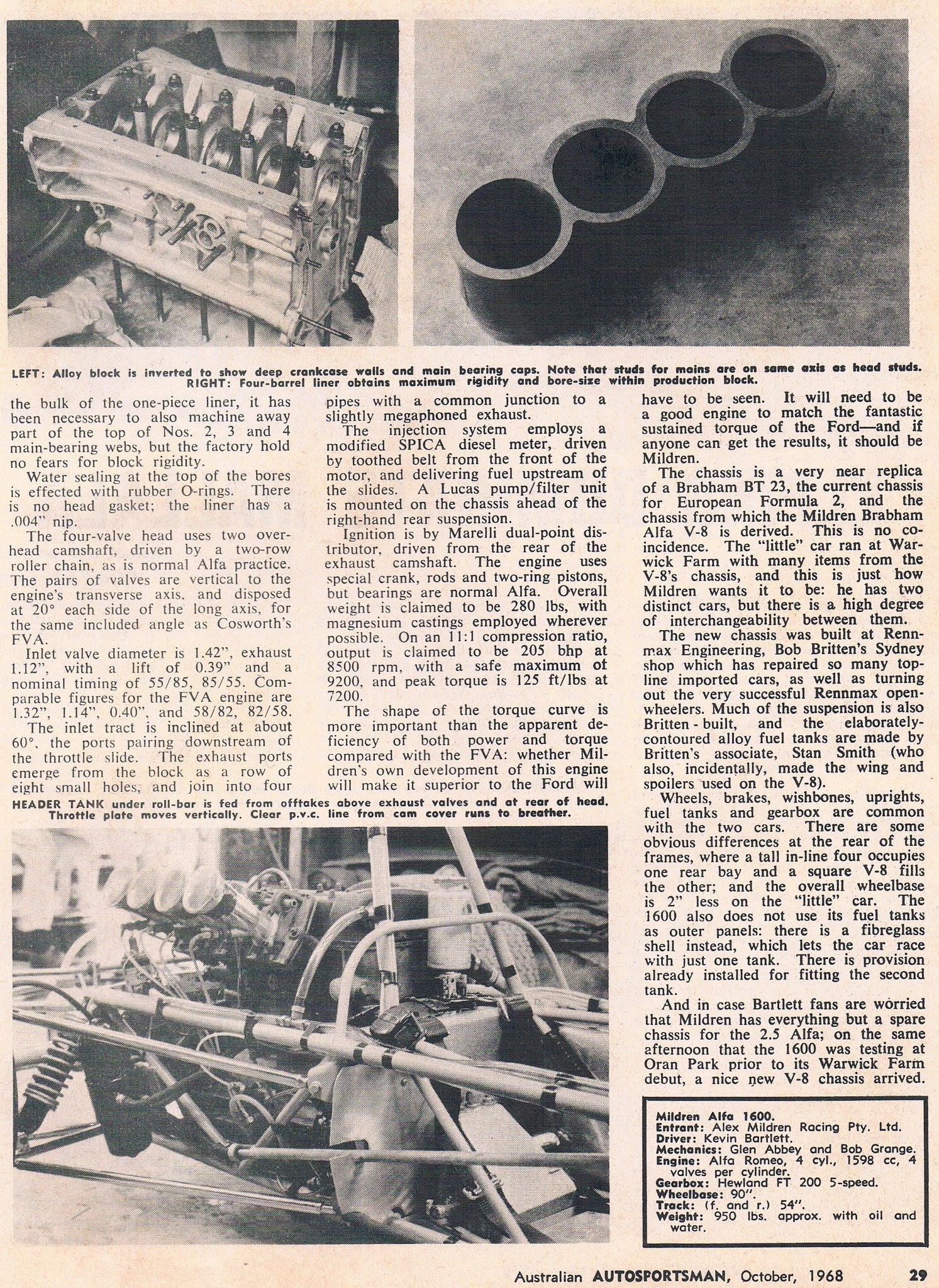
The article below on car and engine was published in the October 1968 issue of Australian Autosportsman and deals with the detail wonderfully well. I suspect it’s the best article on the planet on an extremely rare engine.

Kevin Bartlett commented on the performance of the engine in recent times on social media, “There was an issue with the piston ring to bore clearance which caused high oil use and lack of power, so the engine was returned to the maker. From that time the Waggott was born.”

So quickly out of love with the project had Alec Mildren become, that he advertised the car for sale in the November 1968 issue of Racing Car News.

But things moved quickly after that, Max Stewart was signed to join KB at Mildrens and Alec reached agreement with Merv Waggott to be the first to use his new Waggott TC-4V 1.6-litre Ford block engine.

Max made his race debut with Mildrens in the February 2, 1969 Australian Grand Prix at Lakeside where he was sixth in the Mildren Alfa, four laps adrift of the winner, Chris Amon’s Ferrari 246T.

After that, the Alfa Romeo/Autodelta engine was removed and in its place, the Waggott was installed, with Max taking his race debut with it in the first round of the 1969 Gold Star at Symmons Plains on March 3. Fuel metering unit problems ended his day early.

I’m not so sure the little four-valve engine left Australia either…

Max Stewart aboard the Mildren Alfa 1.6. The date of the shot is unknown but I wouldn’t mind betting that it is one of the very first shots of a car which was so kind to Max over the ensuing three or so seasons in Australia, Singapore and Japan (Central Western Daily)
Stewart in the Lakeside AGP paddock in February 1969. Mildren Alfa F2 (M Tyler)

Group 2 and F2…

Upon further research it’s apparent just what a rare car the Mildren Alfa was for the short time of its existence. As indicated above, the Alfa Romeo F2 engine was replaced by Merv Waggott’s very first 1600 TC-4V engine for the first 1969 Gold Star round at Symmons Plains.

Autodelta’s primary racing programs at the time were the Tipo 33 sports-racers which contested the World Endurance Championship and its 105 Series Coupe Alfa GTA Group 2 program, and the more modified Group 5 categories.

The 1600 four-valve engine was first fitted to Lucien Bianchi’s GTA for the 1967 Giro di Corsica, however he was eliminated at the beginning of the race. ‘Another engine was installed in Nanni Galli’s Brabham F2. At the time the price for this splendid masterpiece was 3,500,000 lire. The engine was also available with a normal GTA cylinder head for use with Weber carburettors’, Tony Adriaensens wrote in Allegerita.

Indeed, it’s probably (make that definitely) due to Group 5 priorities that the four-valve injected engine was built rather than the needs of F2.

A careful review of the European F2 Championship results (1.6 litres from 1967 to 1971 inclusive) on the F2 Index site shows only a very small number of such races in which Alfa Romeo powered cars participated. Even then, the descriptions of the engines are such that it’s not possible to make calls as to whether two-valve GTA engines or the four-valve motors were fitted. It’s also fair to say that both engines may have been fitted to chassis raced in Italian national level events.

Alfa Romeo/Autodelta 1.6-litre four-valve F2 engine being dyno tested, details unknown but welcome (unattributed)

For the record, the Alfa Romeo engined European F2 Championship entries, of ‘a works type’ as against a tiny number of privateers in older cars, in the 1.6 litre formula years are as follows: 2/10/67 GP Rome at Vallelunga Nanni Galli Brabham BT23 Alfa GTA Q16 and NC, 28/4/68 GP de Madrid Jarama Nanni Galli Brabham BT23 Alfa GTA Q20/10th, 23/6/68 Lottery GP Monza Giorgio Pianta Brabham BT23 Alfa GTA/Autodelta DNQ. Brabham BT23-8 was used on all three occasions, the car was entered by the Monza based Scuderia Ala D’Oro. I am intrigued to know if these were effectively works-entries in which case it is plausible the engines deployed were four-valvers.

To state the obvious, there was never a serious works effort to race the four-valve engine in F2, the only Alfa Romeo engine which could seriously hope to challenge the absolute dominance of the Ford Cosworth FVA.

Brabham née Rennmax née Mildren Alfa…

The reason Alec acquired the Alfa F2 engine was a business one, to promote his Alfa Romeo dealerships. Equally, the decision to go with Merv Waggott’s engines shortly thereafter, initially in 1600 cc capacity, later 1850cc and ultimately 2-litres was also a business one. That is, to put the best engines in his two cars: the Rennmax built Brabham BT23 replica which is the subject of this article, and the Len Bailey designed, Alan Mann Racing built monocoque Mildren ‘Yellow Submarine’ first raced by Gardner and then Bartlett with Alfa Tipo 33 2.5 V8’s and later 2-litre TC-4V Waggotts.

The potted, short form history of the car is as follows.

Rennmax Engineering’s Bob Britton created a Brabham BT23 jig from Brabham BT23-5 crashed by Denny Hulme during the 1968 Tasman Series. He built a number of cars on this jig as summarised by Allen Brown on oldracingcars.com here; http://www.oldracingcars.com/rennmax/bn3/

Fitted with an Autodelta Alfa Romeo 1.6-litre four-valve valve engine the car was first raced by Kevin Bartlett at Warwick Farm on September 8, 1968, it was then put to one side as the team focused on Bartlett’s successful Gold Star campaign in the Brabham BT23D Alfa.

Bartlett Mildren Alfa Romeo F2 Warwick Farm September 8, 1968 and below (R Watson)
KB with a few bodywork problems on the move (R Watson)

The chassis became Max Stewart’s regular car when he joined the Mildren Team in 1969. He first raced it, as recorded above, at the 1969 Lakeside Tasman round to sixth. Then the car was fitted with a Waggott 1600cc engine, for the opening, March 1969 Symmons Plains Gold Star round, later in the season a Waggott 1860 was used.

Fitted with a Waggott 2-litre from the 1970 Tasman through the 1970 Gold Star, 1971 Australian Tasman rounds and Gold Star, Max won the 1971 Gold Star triumphing over rumbling 5-litre F5000s.

It raced in the April 1971 Singapore GP, probably powered by a 1600 Alfa Romeo GTA engine fitted with a GTAm 2-litre cylinder head. By the time of the 1971 Gold Star season Alec Mildren Racing had ceased, the car was Stewart’s but was still entered and called the Mildren Waggott.

It was raced by Melbourne’s Tony Stewart (no relation) with support from Paul England in the 1972 Australian Tasman rounds fitted with a 2-litre Waggott.

Max raced and won the April 1972 Singapore GP powered by a Paul England 1.6 litre Lotus/Ford twin-cam. With another engine change, it contested the May 1972 JAF Japanese Grand Prix Waggott 2-litre powered.

The car returned to Australia and contested some 1972 Gold Star rounds driven by Allan Grice, Paul England 1.6 litre twin-cam powered. Max retained ownership of the car during this period.

Raced in the 1973 Malaysian GP to fourth, and the Singapore GP to seventh by Max, the car was entered as a Rennmax, 1.6 England powered.

The car was sold circa 1974 by Max to English born Australian F2/F5000 driver Ken Shirvington. He later sold it to Max Coulter, who raced it for a while then offered it for sale in the February 1981 issue of Racing Car News, raconteur and vastly talented engineer, Greg Smith of East Brighton, Victoria was the purchaser. It was a complete car, chassis tagged ‘AMR003’ fitted with a 1.6 BRM twin-cam which was consistent with the ANF2 class in which the car last raced contemporarily.

Amongst the bits Smithy acquired were engine mounts for the Ford L-Block Waggott 1600/1860 engines as well as the Waggott bespoke, alloy block 2-litre. He also had the Japanese GP long-range fuel tanks. The car was beautifully restored by Smithy and fitted with a 234bhp Waggott 1860 FVA after an eight year search for an engine.

Smith sold the car to Queenslander Max Pearson circa 2008. He further cosmetically restored it inclusive of fitment of a Waggott 2-litre engine. Pearson sold the machine to Stewart Corner in 2022.

In February 2018, via Facebook posts of the photograph at this articles outset, it became clear that Ken Shirvington sold another chassis tagged ‘AMR03’ to Joe Farmer. Farmer believes the chassis may have been built after the 1969 Easter Bathurst collision between Niel Allen, McLaren M4A Ford FVA and Stewart, Mildren Waggott 1.6 TC-4V. Smith or Kevin Bartlett are the only two men alive who could identify when the spare frame was built by careful examination of the chassis in total, and the engine bay in particular.

KB WF September 1968 (unattributed)

Afterthoughts…

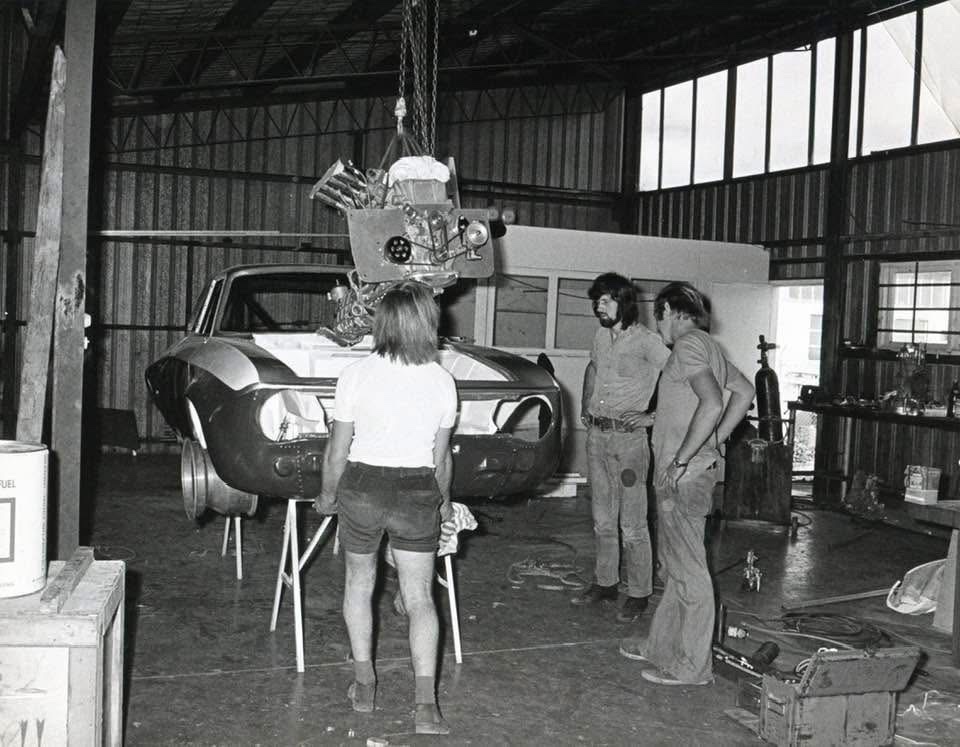
Given Vin Sharp’s responses – see them at the bottom of this piece – shown below is the Brian Foley owned ex-Mildren Racing/John French Alfa Romeo GTA #752561 being further lightened, strengthened and modified for its 1973 career as a ‘Sports Sedan’ in Bowin Designs’ Brookvale, Sydney factory in late 1972-early 1973.

Apropos Vin’s comments, it may well be ‘our-engine’ being inserted into the car albeit now at a capacity of over 1900cc. More about the two Mildren GTAs here: https://primotipo.com/2014/11/27/the-master-of-opposite-lock-kevin-bartlett-alfa-romeo-gta/

(J Barnes)
(G Moulds)

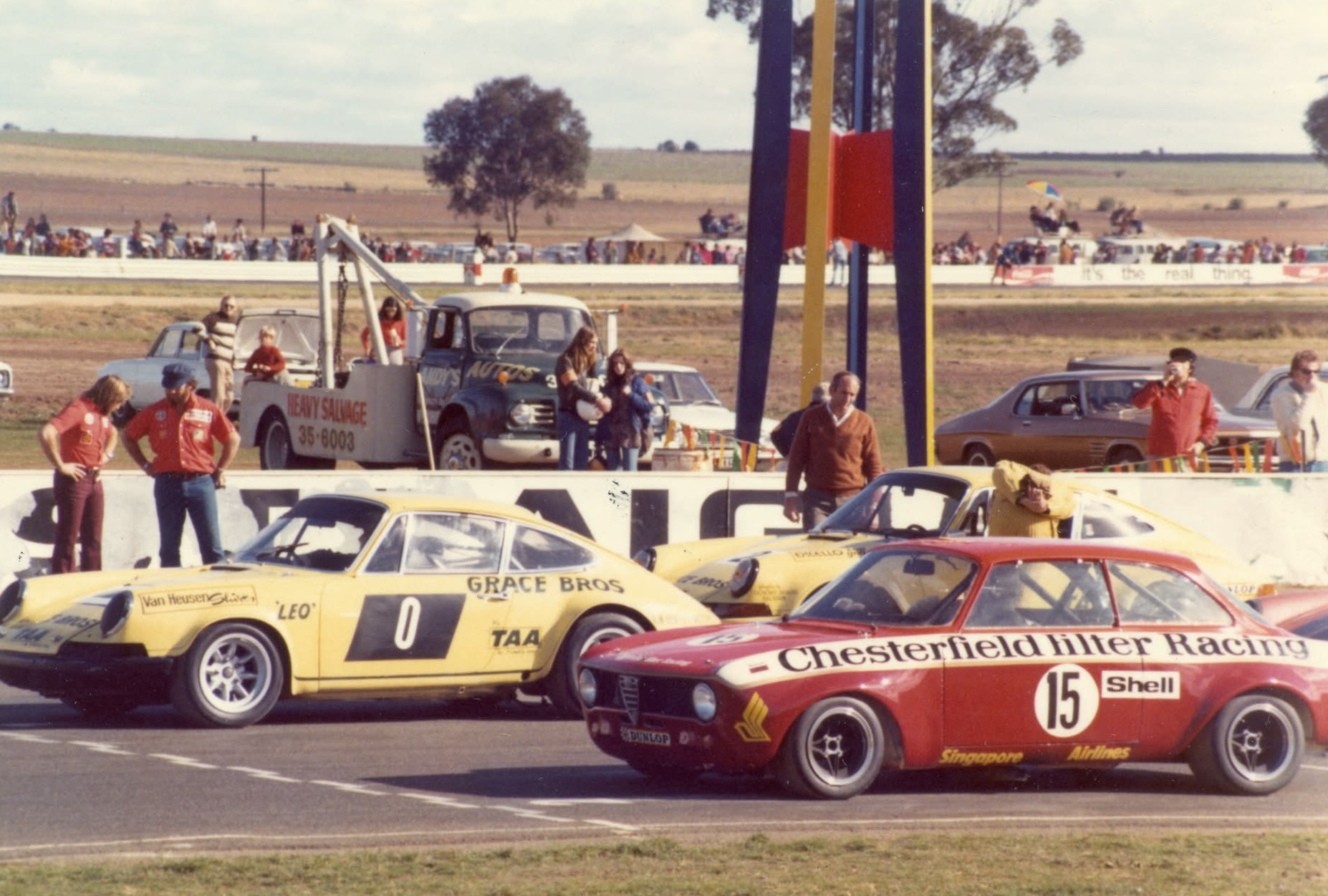
Brian Foley on the grid at Calder during 1973, the so-called GTA Lightweight #752561 after its surgery at Bowin Designs including fitment of Bowin wheels.

That’s Leo Geoghegan’s Porsche 911S alongside and I think, Bill Browns Carrera RS in the same Grace Bros yellow-hue.

Yes, the GTA Lightweight does look like Foley’s GTAm #1531068 but they are different – albeit similar at a distant glance – cars. See the article linked above for the detail, and this one on the GTAm: https://primotipo.com/2024/07/13/alfa-romeo-1750-gtam/

Credits/References…

Greg Smith and his Mildren and Waggott archives, Bryan Henderson, Avalon photo taken by Geoff Searl, Australian Autosportsman, Dale Harvey, Mike Tyler, Central Western Daily, Richard Watson, Vin Sharp, John Barnes, Glenn Moulds

Tailpiece…

(R Watson)

Two 1.6 litre Four-Valvers into Creek Corner, Peter Macrow plunges down the inside of KB in Tony Osborne’s McLaren M4A Ford FVA.

Finito…

(S Elliott)

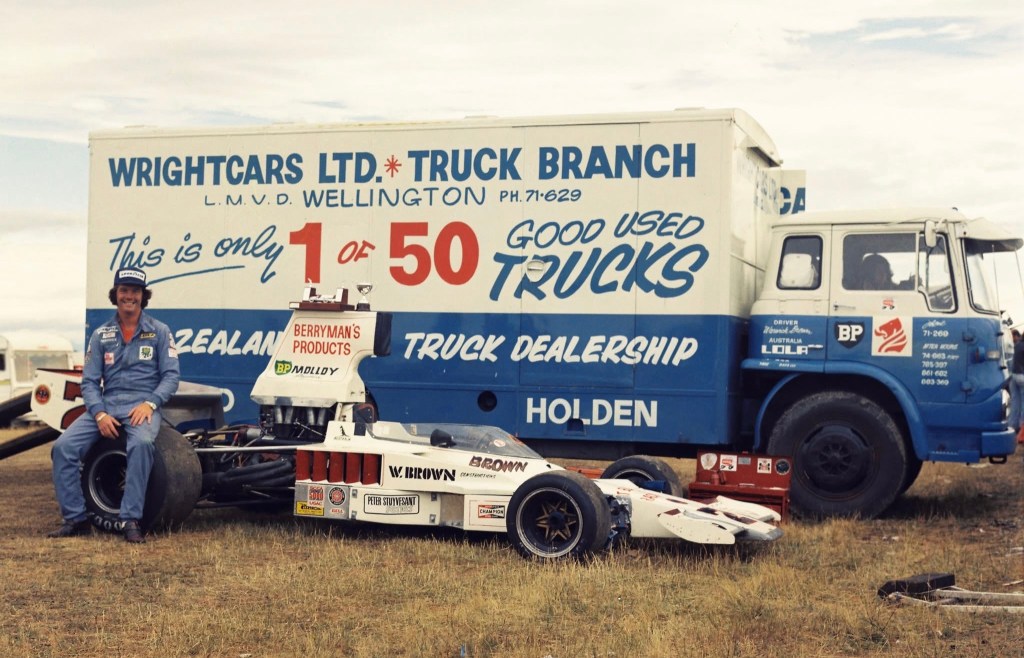
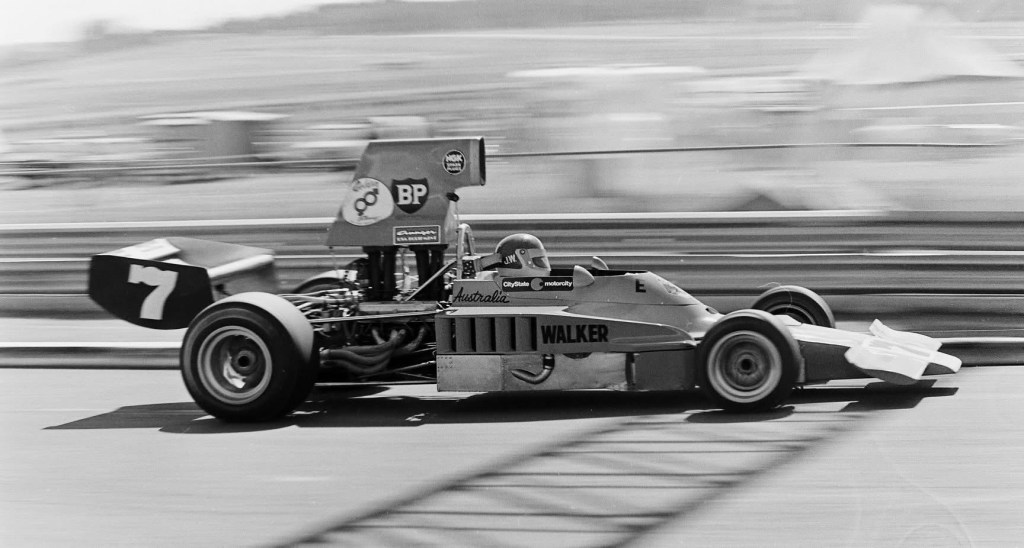
Warwick Brown and the Wrightcars truck he used in New Zealand during his successful 1975 Tasman Cup campaign. He was the only Aussie to win the coveted series, shown here with Lola T332 Chev #HU27 at Pukekohe, where he won the NZ GP on January 12.

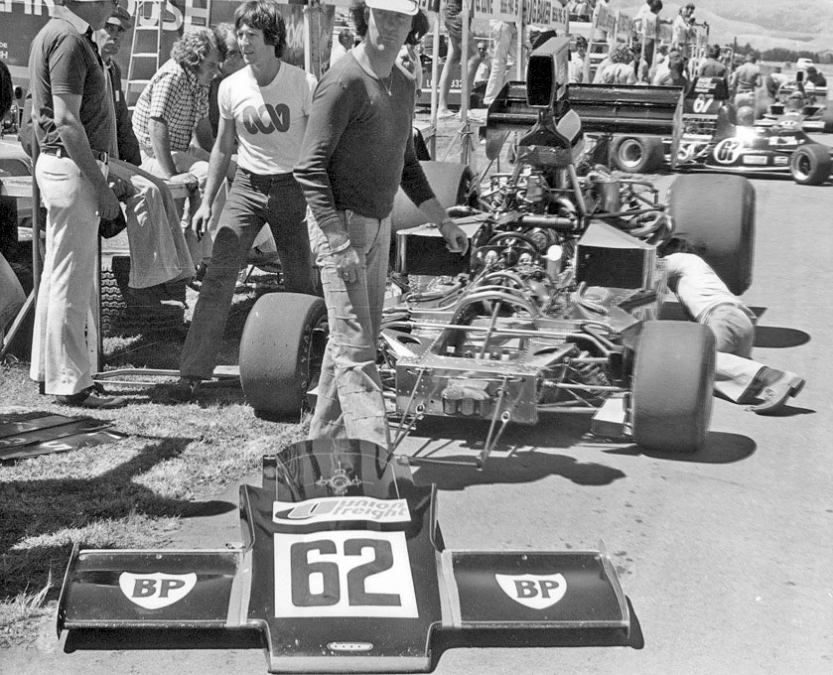
HU27 is the first T332 built, first racing in the opening Tasman round at Levin on January 6, 1974. Brown won the Adelaide 100 on February 24 and in so doing won the first of hundreds of in-period victories for the 332 and its many variants on every continent.

A very successful machine, Brown showed well in the US L&M F5000 championship in mid-1974 before coming home and proving the class of the AGP field before his Peter Molloy Chev broke a harmonic balancer. Then followed the Tasman in which he won two of the eight rounds in a very open year, five drivers won races.

Brown on the hop in HU27 in the 1975/Surfers Paradise Tasman round. He and mechanic/engineer/driver-whisperer Peter Molloy developed the car to a fine pitch in some US L&M races in mid-1974. Lola perves will notice the single-post supported banana-wing. Compare and contrast with the Lola factory fitment twelve months before (unattributed)
Brown during the February 1974 Oran Park Tasman round. Rear view of the early spec T332s-HU27 here. Compare and contrast with the Jones’ T332C further on. Car owned by Brown’s patron, Sydney businessman Pat Burke (D Harvey)

This article is largely an assemblage of factory/Carl Haas T332 information accumulated by Australian racer/restorer Jay Bondini who owned, restored and raced two T332s: HU43 ex-Carl Hogan and HU37 ex-Sid Taylor.

The Lola T330/T332/T332C/T332CS/T333 as a series of ‘same chassis’ related models are right up there as a contender for the title of ‘greatest production racing car’ – where greatest is defined as the most wins relative to production numbers.

Others that spring to mind are the Bugatti T35/T37/T39 series, Ralt’s RT2/3/4/5, the McLaren M7/M10 series and McLaren M8/8A/12/8B/8C/8D/8E/8F and Ford GT40 Marks 1-4 and more. Oh yeah, not to forget Lola’s own T70 series…it would be an interesting list to create and debate. One for another time.

For those unfamiliar with a T330, here is Max Stewart in HU1 ahead of Graeme Lawrence’s T332 HU28, both Chev powered, during the 1974 Sandown Tasman round won by Peter Gethin’s Chevron B24 Chev (B Keys)

Only 10 carryover parts from other model Lolas. No surprises there albeit most of the T330/332s I recall seeing in paddocks were fitted with Koni double-adjustable alloy shocks not Armstrongs.

Jongbloed 15-inch rear wheels became the-go later in ’74 from memory. So too, did the Chaparral type all-enveloping engine cowl/airbox, that turned a stunning looking car into the positively sinful: the T332C followed.

$US3,650 for a new tub in 1974 is about $US26,000 today. I wonder how much a new monocoque actually costs now from Lola’s designated chassis maker (who owns those rights these days?) or your favourite fabricator?

(C Parker Archive)

Alan Jones in Teddy Yip’s T332C HU61 Chev at Riverside in 1976, the final year of the US F5000 Championship before changing to 5-litre central-seat Can-Am in 1977…and further Lola T332 domination.

Chaparral were the first to do the enveloping engine cover/airbox on a T332. Apart from the body changes, the oil tank was moved, the roll-bar mounting changed and a central post rear-wing adopted. The later 332s also had the FIA mandated roll-hoop over the dash which had the byproduct of providing a bit more chassis stiffness.

See the letter from Chaparral‘s Jim Hall to Eric Broadley via Carl Haas explaining improvements to their car raced so successfully by Brian Redman in 1974-75 that allowed Lola to ‘productionise’ them as the T332C for 1976. Fascinating detail stuff of all the one-percenters that made a topline well funded outfit like Chaparral so successful: https://www.lolaheritage.co.uk/type_numbers/t332c/t332c.html

‘What are your three favourite racing cars Alan?’ I asked Jones at the Governor’s function before the 2023 AGP. ‘My F1 Williams FW07, the Lola T332, both the 5000 and Can-Am versions, and Alan Hamilton’s Porsche 935…’ was his response.

About says it all really, given his career spanned the mid-1960s well into the early-2000s and hundreds of different cars.

It’s not a factory drawing but is useful to show how wide and shallow the chassis of the T332 and T330 are. Note that, unlike the T300 chassis, the 330/332 used the engine as a semi-stressed member.

The flaw in the drawing – purportedly T332 – is that the rear suspension shows an inverted rear wishbone (T330) arrangement rather than the twin-parallel link set up used on T332s.

The combination of Lola Heritage’s website: T330 here: https://www.lolaheritage.co.uk/type_numbers/t330/t330.html T332 here: https://www.lolaheritage.co.uk/type_numbers/t332/t332.html and Allen Brown’s oldracingcars will keep you going for a while: the T330 is here: https://www.oldracingcars.com/lola/t330/ and T332 here: https://www.oldracingcars.com/lola/t332/

Credits…

Steve Elliot, Jay Bondini Archive, Dale Harvey, Chris Parker Archive, oldracingcars.com, Getty Images

Tailpiece…

(S Elliott)

Graeme Lawrence in the second T332 built, HU28, from Max Stewart in T400 Chev HU2 during the 1976 Peter Stuyvesant New Zealand F5000 Championship.

Just love Steve Elliott’s shot above – a corker! – but I have no idea of the circuit, help please Kiwis!?

Lawrence, the 1970 Tasman Cup winner aboard an ex-Amon Ferrari Dino 246T, fought out the 1975 Tasman with fellow T332 exponents Lawrence, John Walker (T330 HU23 Repco-Holden was rebuilt around a T332 tub) and Brown.

The battle went down to the wire at the final Sandown round where WB prevailed after Walker lived-to-fight-another-day with a monster first lap accident and Graeme had problems. John Goss won the race in his Matich A53 Repco-Holden.

Lawrence won the 1975 NZ Gold Star in this car and was always a front-runner in Australasian F5000. You can’t mention Kiwi Lola exponents without recognising Ken Smith, who won the Peter Stuyvesant Series, NZ GP at Pukekohe, and the NZ Gold Star in 1976. A big year! His mount was an ex-Chaparral/Brian Redman Lola T330/2 HU8. He may still be having the occasional Lola steer in his eighties!

Max Stewart was pretty-handy in Lolas too. In T330 HU1 he won the Australian Grand Prix at Oran Park and the Gold Star series in 1974, then took another AGP victory in the wet at Surfers Paradise the following year in the T400.

Brian Redman in the Chaparral/Haas Lola T332 HU42 Chev at Riverside, the final round of the 1974 US championship on October 27. Mario Andretti won from Brian aboard…the Vel’s Parnelli Jones T332 HU29 (Getty Images)

Afterthought…

The fact that the first and second T332s built were sold to colonials allowed me to make this piece Australasian centric, not that I need encouragement.

But how can you write something about Lola’s T330/332 without mentioning Brian Redman, King of F5000 in its latter era? Earlier Monarchs were, arguably, Peter Gethin and Graham McRae, the latter gets bonus points for doing much of his work aboard cars of his own manufacture.

It’s not that Brian was a Lola F5000 man early on either. He had success in McLaren’s M10 and M18s and did all the early development testing of the Chevron B24 in mid-1972 together with Derek Bennett.

But when he decided F1 wasn’t for him and made US F5000 his primary programme, his partnership with the factory-Carl Haas/Chaparral team yielded a trio of championships from their 1973-76 F5000 partnership – subsequent short Can-Am programme duly recognised. He raced Lola T330s in ’73 and T332s from ’74-76.

Redman didn’t give a yard away to any of the Formula One Johnnies he raced with in Scuderia Ferrari’s 1972-73 World Sportscar Championship campaign aboard 3-litre flat-12 312PBs: Ickx, Andretti, Peterson, Schenken, Pace, Reutemann etc. Surely Brian was the best driver outside F1 at the time? Bias duly declared…

Finito…

Max Stewart with John Walker at right, Calder 1972. Repco-Holden V8, then circa 490bhp powered Elfin MR5 and Matich A50 (S Gall)

During 1972, then Australian automotive parts manufacturing and retailing colossus, Repco Ltd celebrated its half century.

Yes folks, that means the now foreign owned 400 store retailer of automotive bits and pieces made by others is a centenarian in 2022! They have some exciting things planned for next year, I won’t rain on their parade by sharing the bits I’m aware of.

Time flies all too fast, as a young teenager I attended two of the five Repco Birthday Series F5000 championship meetings run at Calder between March and December ‘72 as part of those celebrations.

The man who was ‘sposed to win the Repco Birthday Series, F Matich Esq. Bi-winged Matich A50 Repco-Holden, Calder 1972 (S Gall)

At that stage Repco had been out of F1 for four years, the 3-litre V8 Repco Brabham Engines program had yielded two GP world constructors and drivers championships for Brabham Cars (Motor Racing Developments Ltd), Repco Brabham Engines Pty. Ltd, Jack Brabham and Denny Hulme in 1966-1967.

Repco’s cost effective means of maintaining a racing presence after pulling the F1 pin was a partnership with General Motors Holdens to build F5000 engines using GMH’ then ‘spankers 308 V8 as a base, from 1969 to 1974.

Phil Irving and Brian Heard did mighty fine jobs, their Repco-Holden V8 engine design won AGPs, NZ GPs, many Tasman rounds, several Gold Stars and countless sports-sedan and sportscar races.

The interloper: KB in his sinfully sexy and oh-so-fast Lola T300 Chev at Calder in 1972 (I Smith)

It was therefore a pain-in-the-tit when Kevin Bartlett’s Chev powered Lola T300 rained on Repco’s parade in their home state by winning a ‘72 championship the grand plan of which involved a Repco-Holden engined victory!

It wasn’t all bad, Frank Matich, in the Repco sponsored Matich A50 Repco-Holden won that years Gold Star, but KB’s two Birthday Series round wins gave him a nine point advantage over FM. Conversely, Bartlett was 12 points short of Matich in the Australian Drivers Championship, the Gold Star.

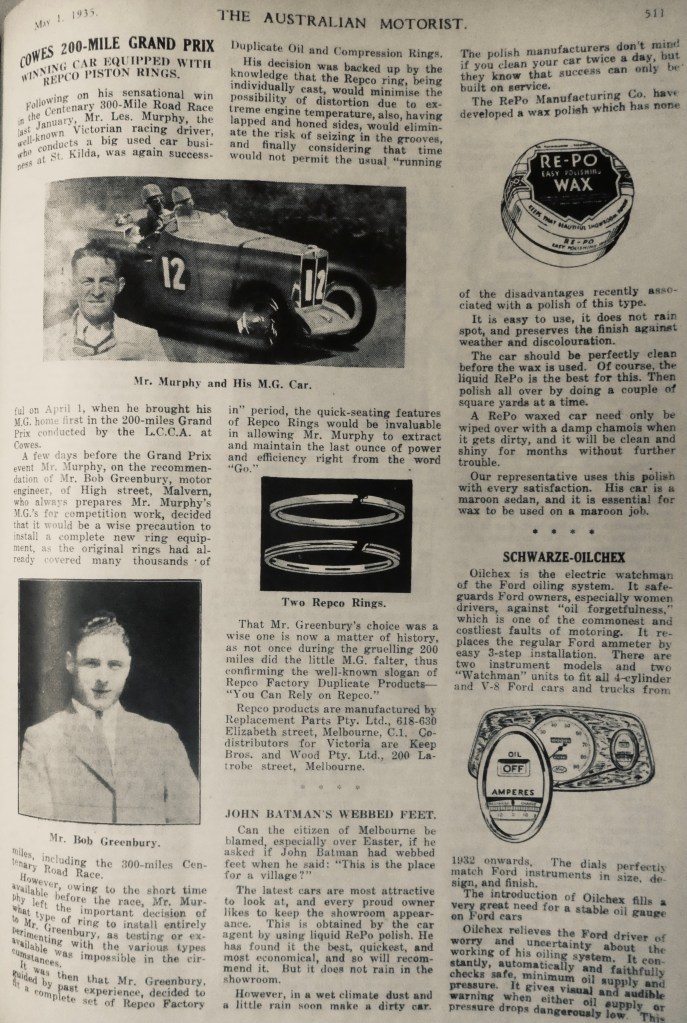
Repco’s race heritage goes all the way back. In 1935 they were sponsors of engineering substance, rather than just cash…not that cash is to be scoffed at (B King Collection)

In recent times Repco have returned to racing as series sponsors of the Bathurst maxi-taxis. In the forty years they were involved as OE and aftermarket suppliers to the motor industry, and constructors of cars (Maybachs, Repco Record), race engines, components and equipment from the mid-1930s to 1974 Repco’s involvement was supreme.

Still, the comparison is unfair. We once had an automotive industry in this country until it was sodomised to a standstill by a troika (sic) of incompetent, greedy fuckwits bereft of commonsense or a single-cell of vision; management, government and organised labour.

Gees he was a big, lanky prick wasn’t he? The capped Marvellous Maxwell Stewart partially obscured by mutton-chopped Bryan Thomson or Garrie Cooper (? who-izzit?) in the BP compound at Calder in 1972. Elfin MR5 Repco, not Max’ favourite car (S Gall)

Etcetera…

(T Johns Collection)

More on the use of Repco pistons and rings in 1935. This time fitted to Les Murphy’s MG P-Type during the ‘1935 Centenary 300’ held at Phillip Island in January.

(S Gall)

Warwick Brown proved he had the ability to handle these demanding 5-litre roller skates in 1972 having jumped out of a Cosworth FVC powered McLaren M4A – McLaren M10B Chev heading into Calder’s main straight in 1972.

(S Gall)

Graham ‘Lugsy’ Adams – then mechanic and later rather handy driver and F5000 constructor – does his best to focus on the Calder job at hand. Is that the future, and still current Mrs Brown looking thoroughly wonderful behind an M10B shortly to become Bryan Thomson’s Volksrolet?

Credits…

Stephen Gall, Bob King Collection, Ian Smith, Tony Johns Collection, Barry Edmunds

Tailpiece…

(B Edmunds)

John Harvey in one of the very few appearances of Bob Jane’s Bowin P8 Repco-Holden F5000 at Calder in 1972 – Surfers Paradise and Warwick Farm were the others as far as I can see.

Bowin bias hereby declared…here I go. Again.

This beautiful, small, light, compact, ingenious, variable-rate suspension F5000 never got the run it deserved. Supposedly Janey put it to one side because Castrol wanted him to focus on his taxis rather than his real cars.

Then Leffo bought it in mid-1974, sans Repco-Holden V8, to replace the P8 chassis he boofed at Amaroo and then stuffed up the installation of a Chev V8 into a chassis for which it was never designed, creating a car as stiff as a centenarians todger, with handling reflective thereof…

John Joyce’s P8 Repco design is a great Oz F5000 mighta-been, not that mighta-beens count for SFA in motor racing!

Finito…
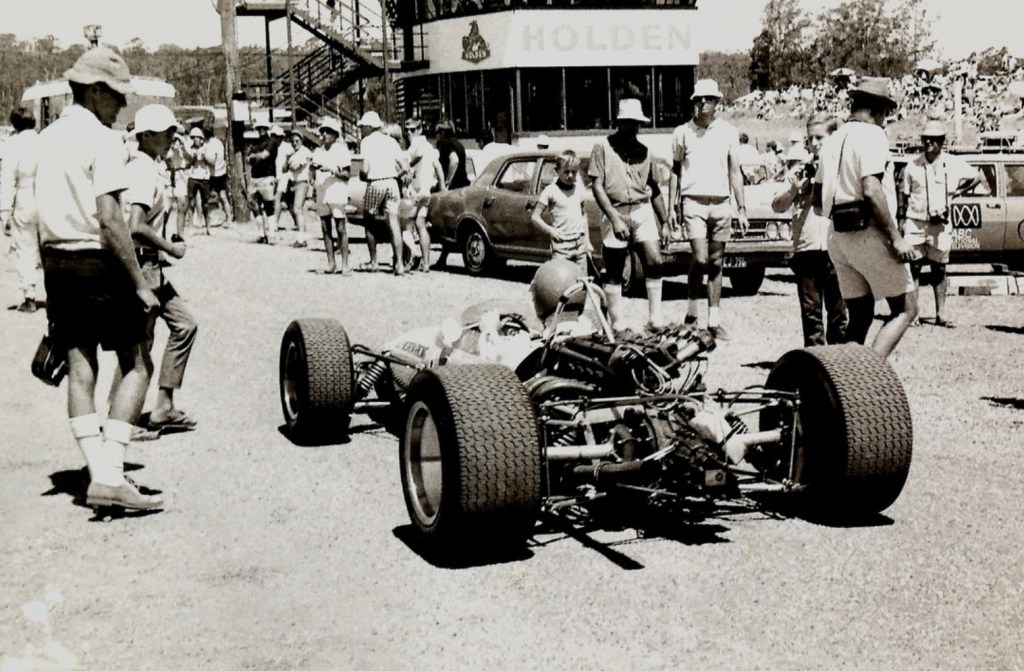
WB during practice (B Henderson)

Warwick Brown was the star of the show but didn’t win the AGP thanks to the failure of a crankshaft torsional vibration damper in the Peter Molloy tweaked Chevy V8 of his Lola T332.

To a large extent I covered this meeting in an article about Lella Lombardi a couple of months ago but the release of these photographs by photographer/racer Bryan Henderson made it clear that a second bite of the cherry was a good idea. See the Lella piece here; https://primotipo.com/2020/09/07/tigress-of-frugarolo/

Brown was the ‘form driver’. He was the first Lola T332 customer, he raced ‘HU-27’ throughout the 1974 Tasman Cup, then did the first Gold Star round at Oran Park before heading to the US to take in three US F5000 Championship rounds in which the Lola/Molloy/Brown/Pat Burke combination were extremely competitive.

WB was Q7, second in heat and 11th overall at Ontario, Q12, fourth in his heat and fifth overall at Laguna Seca and  then finished his tour with Q9, second in his heat and third overall at Riverside. It was not bad at all coming into their season ‘cold’ in the sense that four rounds had been contested by the time WB and Peter Molloy arrived. Brown came back to Australia razor sharp, those at the front in the US included Brian Redman, Mario Andretti, James Hunt, Al Unser and Bobby Unser, David Hobbs, Vern Schuppan and the rest.

Teddy Yip, WB and another in the OP paddock (B Henderson)


KB T332 from Max T330 (B Henderson)

Max Stewart was well prepared. His Lola T330, ‘HU1’, the very first development machine raced a couple of times in England by Frank Gardner in late 1972 before its sale to Max, gave nothing away to anybody. It was increasingly reliable to match the speed present from tits debut in Max’ hands at the start of the ’73 Tasman Cup.

Graeme Lawrence raced his T332 in the 1974 Tasman whereas Kevin Bartlett’s was a newer car, first raced at Oran Park. KB had a shocker of a Tasman. A crash at the Pukekohe NZ GP opening round broke the car and a leg and hip, but he would be on the pace having built up a car around a new Lola T332 tub.

Graeme Lawrence, Lola T332 Chev with a Birrana in the background (B Henderson)


Garrie Cooper, Elfin MR5 Repco-Holden (B Henderson)

The Elfin MR5s were now long in the tooth having first raced in mid-1971.

John McCormack was back in his given the unreliability and lack of power of the Repco-Leyland V8 fitted to the compact Elfin MR6. Mac, the reigning champion had a shocker of a 1974 Gold Star, an accident at Surfers due to a structural failure ensured he missed the Calder round while repairs were effected to the front bulkhead.

McCormack ‘re-possessed’ his MR5 for the AGP. 1973 Australian Sports Car Champion Phil Moore had driven the car throughout the Gold Star with good pace and reliability despite few test miles. In fact he was the best placed of the Ansett Team Elfin pilots that year, ending the season third despite missing the final two rounds at OP and Phillip Island.

Garrie Cooper was still racing his MR5 which was a mobile test-bed for the talented designers new ideas.

The MR6 became a competitive car when the Repco-Holden engine was fitted and the front suspension geometry revised. Whilst 50kg heavier than the aluminium Leyland, the Repco-Holden’s 520 bhp was not to be denied, Mc Cormack won the 1975 Gold Star racing this combination.

McCormack’s Elfin MR5, 1973 Gold Star Champion  (B Henderson)


Jon Davison working his Matich A50 Repco-Holden hard- look at the distortion of those Goodyears. A man very much on the pace when he acquired a T332 (B Henderson)

Matich standard bearers were Jon Davison’s ex-John Walker A50 Repco, chassis ‘004’ was the car Walker raced in the 1973 L&M. John Goss raced Frank Matich’ 1974 Tasman car, chassis ‘007’ the very last Matich built. This A53 was a sensational device, A51/53 ‘005’ won the 1976 AGP in Goss’ hands at Sandown.

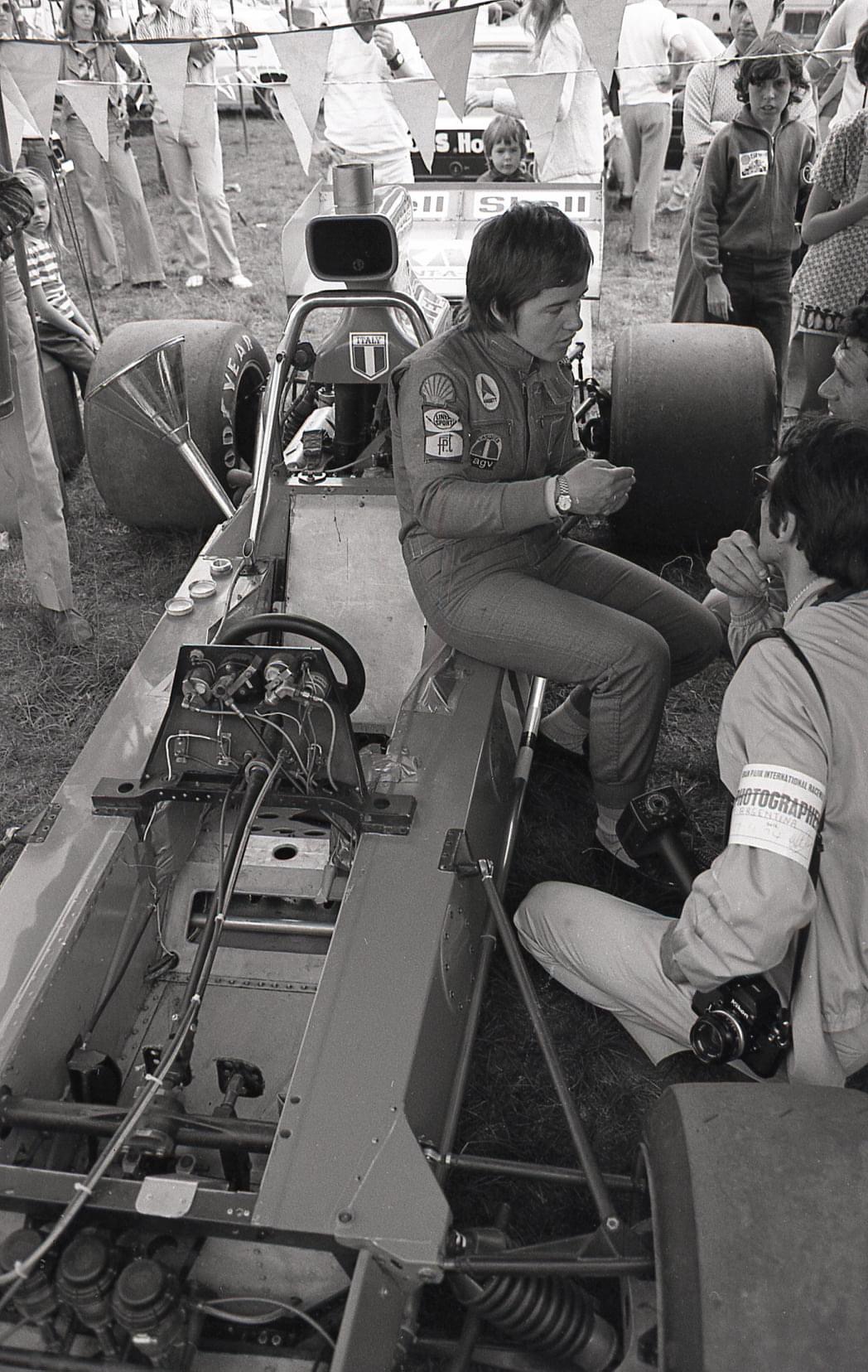
The A53 JG used to win at Sandown was the car raced by Lella Lombardi at Oran Park during this 1974 weekend. Then in A51 spec, it was one of the two chassis raced by Matich in the 1973 US L&M F5000 championship. The other, for the sake of completeness, ‘006’, was destroyed in a Warwick Farm testing accident in A52 spec with Bob Muir at the wheel in later 1973.

Lombardi had a big year of F5000 racing in Europe. Her primary campaign was aboard a Shellsport Lola T330 Chev. Late in the year she ran in the US and Australia when promoters could see the value in a ‘crowd-pulling chick’ amongst the fellas.

The ‘Tigress of Turin’ did not disappoint in Australia despite racing an unfamiliar car. Her crew included Frank Matich and later multiple Gold Star champion Alfie Costanzo as interpreter.

I don’t think anybody was going to beat WB at this meeting had he finished but I could easily see how Lella could have been on the podium especially if she were aboard her own T330, but it stayed in the UK.

Lombardi sitting on Matich tub ‘005’ during practice (B Henderson)


(B Henderson)

Gloomy faces all round in the Goss camp. The Repco engine has run a bearing, without a spare JG is out for the weekend. The dude in the white T-shirt is Repco’s, or perhaps ex-Repco by then, Don Halpin. The fella with his back to us is Grant O’Neill who moved across with the A53 from Matich to Goss as FM wound down his operation in Cremorne. Grant looked after Goss’ open-wheelers and Falcons for some years.

Warwick Brown was predictably quick in all sessions. After he did a 65.3, the team packed up and left the circuit but crafty Max bolted on a set of British Goodyears and nicked pole late in the final session with a 65.2. Bartlett was third on the grid with 65.9 with Lombardi fourth hampered by clutch failure. She finally did some decent laps stopping the Accusplits at 67.0 dead.

The grid was a very skinny nine cars. John Leffler made the cut with his gorgeous, very fast Bowin P8 Ford-Hart 416B ANF2 car. As mentioned above Goss lost an engine with bearing failure in the morning warm-up.

From left- Lombardi, Brown, Bartlett, Stewart and a glimpse of McCormack (HAGP)

From the off WB led convincingly all the way to his engine failure on lap 50. Lombardi got a great start and led the two amigos, Bartlett and Stewart but both passed the pint-sized Italian by the end of the first lap.

So it was Brown, Stewart, Bartlett with Lombardi and McCormack falling back, then Lawrence, Davison, Cooper and Leffler. After about 15 laps KB passed Max, aided by the Jolly Green Giant’s broken rear roll bar mount and stripped second gear- the latter damage was done at the start.

Leffo gave Garrie Cooper heaps in the little Bowin, well suited to Oran Parks new ‘twiddles’ with John well aware of the MR5’s strengths and areas of opportunity having done a few races in Max’s MR5 late in 1973. Lombardi caught Stewart but the big fella strenuously resisted her passing manoeuvres, then on lap 47 her oil pump failed causing the Holden engine to seize.

Bartlett from Stewart (B Henderson)


John Leffler, Bowin P6 Ford-Hart ANF2. Leffo did a million race miles in this car in 1974, all of the F2 championship rounds where he was amongst the class of the field headed by the Leo Geoghegan and Bob Muir Birrana 274/273, and the Gold Star rounds giving Grace Bros plenty of exposure and racegoers much pleasure given his brio behind the wheel (B Henderson)


Lombardi, Matich A51 Repco (B Henderson)

Two laps later WB’s harmonic balanced was hors ‘d combat which gave Kevin Bartlett the lead. For a while the Australian Triple Crown seemed possible- the Gold Star, Bathurst and an AGP. Then, on lap 58 of 61 laps KB’s Lola was starved of fuel, the T332’s pumps were not picking up the last 13 litres of juice!

Stewart took the lead, and despite his machine’s disabilities, won the race from McCormack’s, Elfin MR5, Graeme Lawrence’s T332, a lap down with an engine not at its best, then Jon Davison’s Matich A50 Repco and Garrie Cooper’s MR5 Repco- five finishers. There was no future in AGP’s being run other than during our summer internationals, whatever the formula, to get decent grids.

WB was ‘man of the match’ but lucked out, Lola T332 Chev (B Henderson)

Brown was the man of the meeting, getting back on the Lola horse which nearly killed him (a T300 Chev) at Surfers Paradise in 1973 was mighty impressive. WB carried the momentum forward, winning the 1975 Tasman Cup in this car, the only Australian to do so. He did get an Oran Park AGP win in 1977 too, on the day Alan Jones pumped the start bigtime.

It was a pity Lombardi didn’t return to Australasia for the 1975 Tasman but she had bigger fish to fry. Funding was in place so it was F1 in 1975 as a member of the March team together with Vittorio Brambilla.

Max Stewart takes the chequered flag, with barely a soul to see. What Covid 19 friendly meeting! Not really, just no spectators in that part of the world.

Stewart was like a fine wine wasn’t he, he got better and better with age? He was not exactly in the first flush of youth when he got the second Alec Mildren seat with Kevin Bartlett in late 1968. He won his first Gold Star in 1971 in the Mildren Waggott and then took to F5000 like a duck to water.

His Oran Park win was his fifth 1974 Gold Star victory in a row. It won him the title. Maybe he was lucky to win the AGP in the pissing rain at Surfers twelve months hence but those in front of him dropped out with drowned electrics. Max, who prepared his car together with Ian Gordon had electrics which functioned, that is, he made his own luck.

Etcetera…

(B Henderson)

Poor Susie Ransom (?) is trying to interview KB who is more interested in a glass of Pophry Pearl at the Leppington Inn after the meeting. Commonsense then prevailed with questions about tyre pressures, wing settings and roll-bar stiffness addressed.

(B Henderson)


(B Henderson)

Teddy Yip was omnipresent throughout the weekend. Here he is pointing out the Matich tacho-telltale in Mandarin. Lella’s English was not flash, I doubt Mandarin was effective so they probably settled with English.

Teddy was getting the lie of the land and perhaps starting to think about the deal which saw him bring a Lola T332 to Australia for our 1976 Rothmans International. Vern Schuppan raced a Yep/Sid Taylor Lola T332 to victory that summer.

(B Henderson)

Goss with his team bemoaning the bearing failure in his Repco-Holden engine, he knew a thing or two about that particular affliction didn’t he? Blazing the Falcon GT Hardtop Group C path in 1973 gave plenty of bottom end dramas which was eventually sorted with an engineering solution which met the good graces of the CAMS.

(B Henderson)

The Elfin MR5 is a bit maligned in some quarters. The most highly developed of the four cars built was John McCormack’s ‘works’ machine which won the 1973 Gold Star as well as the New Zealand Grands Prix in 1973 and 1974 despite Mac first racing it in later 1971.

(B Henderson)


(B Henderson)

So near but so far, Bartlett had the ‘Triple Crown’ of Australian motor racing chance but it was not quite to be!

He won a heat at Surfers and had the second in the bag until a front tyre deflated. In a season where he showed the Pukekohe accident had not cost him a tenth, he was second to Stewart at Calder and Sandown and then took victory at Phillip Island’s last round after a great dice with Stewart.

(B Henderson)

Lella ready to boogie.

Credits…

Bryan Henderson, many thanks for the fantastic photographs.

‘History of The Australian Grand Prix’ Graham Howard and Others, Getty Images, Fairfax Media

Tailpiece…

(B Henderson)

Graeme Lawrence in the ‘star car’ of F5000, the Lola T332. Engine troubles ruined his AGP weekend. The 1970 Tasman Cup champion was in a three way shootout several months later to win the 1975 Tasman together with Warwick Brown and John Walker in the Sandown final round but the cards fell Brown’s way.

Finito…
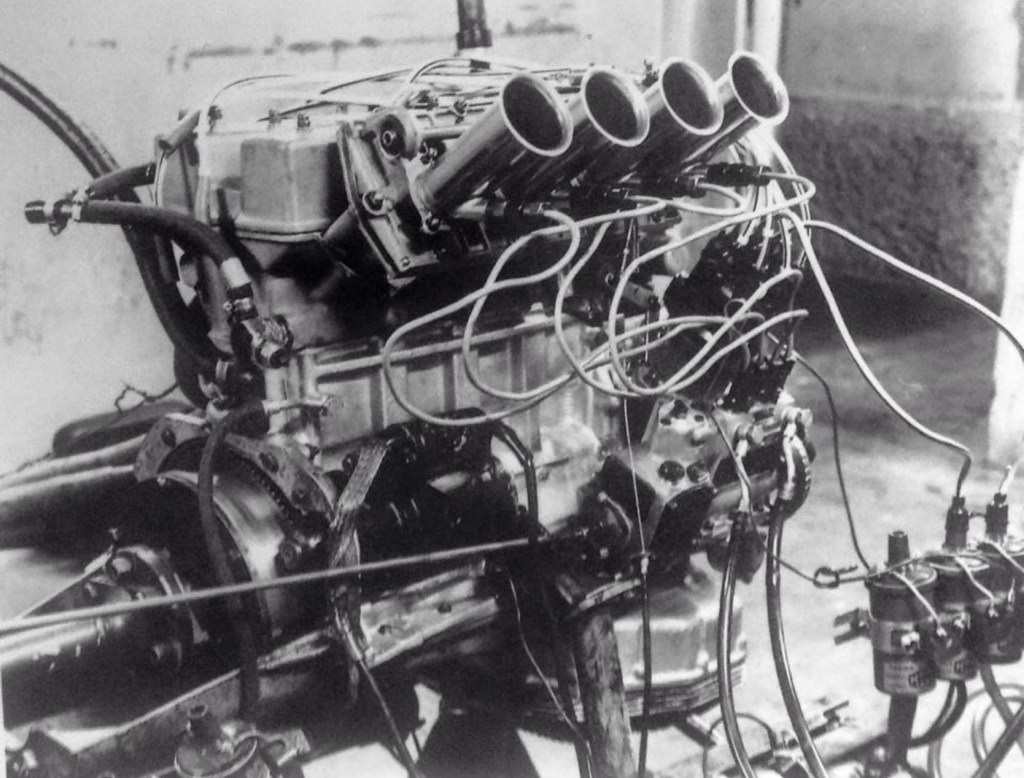
(B Henderson)

Peter Macrow, McLaren M4A Ford FVA leads Kevin Bartlett, Mildren Alfa Romeo 1.6 four-valve, Glynn Scott, Bowin P3 Ford FVA and Brian Page, Brabham BT2 Ford twin-cam, across The Causeway at Warwick Farm on 8 September 1968.

24,000 people were at the ‘farm that Sunday, Pete Geoghegan delivered to expectations by winning the one race, 34 lap, 76 miles Australian Touring Car Championship from Darrel King’s Cooper S and Alan Hamilton’s just ‘orf the boat Porsche 911S/T. Peter Wherrett’s ‘Racing Car News’ race report reveals one of the best tussles of the day was the 15 lapper for racing cars.

The Four Valve Assemblage was not quite complete, the fourth member of the growing group of 1.6 litre Euro F2 cars in Australia, Niel Allen, didn’t race his ex-Piers Courage McLaren M4A FVA. A bumma, because that would have added to the show.

KB settles himself into the Mildren Alfa, note spoilers, ‘new.uw’ is local 2UW radio station (B Henderson)


Lovely portrait of Glynn Scott, Niel Allen is telling Glynn how much more expensive the FVA is to maintain compared with the 5 litre Chev in his Elfin 400…(B Henderson)

Macrow was the ‘newbie’ to the front rank having shown great form in Tony Osborne’s Argo Chev sportscar since taking over its wheel early in the year after Ian Cook accepted Bob Jane’s offer to drive his Elfin 400 Repco and crossed town from Brunswick to East Malvern.

Osborne realised that the limits of the Cooper T53 based Argo had been reached, and acquired Kiwi, Jim Palmer’s McLaren M4A after Allen beat him to the punch to buy Courage’s quick 1968 Tasman mount. Palmer’s car was Bruce McLaren’s own machine, chassis ‘M4A-1’, the first of the breed raced by the chief throughout the 1967 European F2 Championship. Piers was ‘well represented’ on this grid, Glynn Scott’s motor was Courage’ Tasman Cup spare.

Kevin Bartlett was the ace present, but the Mildren Alfa, built on Bob Britton/Rennmax Engineering’s Brabham BT23 jig, was ‘spankers and unsorted. Mildrens dynoed the Alfa Romeo 1.6 litre, four-valve, Spica/Lucas injected engine at 197 bhp @ 8,500 rpm, whereas about 210/215 bhp was claimed for a decent FVA, so it promised to be a good race with Bartlett on pole from Macrow and Scott.

Mildren Alfa, KB. Copy Brabham BT23 spaceframe, Hewland FT200 5-speed transaxle. Alfa Romeo 1598 cc four-valve, alloy block, injected Euro F2 engine. At 280 pounds the Italian engine is lighter than a Lotus-Ford twin-cam? It sits taller in the frame? (B Henderson)


Bartlett at the end of Pit Straight turning into Paddock (B Henderson)


(B Henderson)

Peter got the jump, which was impressive in Bartlett’s backyard, from KB and Glynn and then a gap to to the 1.5 litre cars led by Brian Page, Brabham BT2 Ford, Clive Millis, Elfin Mono Ford, Maurie Quincey, Elfin 600B Ford, Ray Cary, Elfin Ford and the rest.

On lap 2 KB had a crack at Macrow going into Creek but spun on oil on the inside of the track, KB recovered and chased Peter and Glynn in the spectacular tail-out style which was his hallmark. By lap 8 he was up Glynn’s clacker and passed him but further progress was impeded by the chassis undertray coming loose, Scott took back second place.

Scott chased Macrow hard but the Victorian held on to take the biggest win of his career to that point from Scott and Bartlett, Tony Osbornes’s Argo Racing Equipe delighted with a well earned victory.

Credits…

Bryan Henderson took all the wonderful photographs. ‘Racing Car News’ October 1968

Tailpiece…

(B Henderson)

Nice portrait of 28 years old Kevin Bartlett getting his head sorted on the Warwick Farm dummy grid before the off. It was a great year for the Sydneysider, he won his first Gold Star at the wheel of Mildren’s Brabham BT23D Alfa Tipo 33 2.5 V8.

This chassis did not use the Alfa engine for long, Max Stewart raced it from 1969 fitted with Waggott TC-4V 1600 cc, 1760 cc and 2 litre motors with great success.

Finito…

Max Stewart awaits the start of the Gold Star race aboard his Mildren Waggott.

In the distance is the Harry-Flatters-In-Top-Gear entry to the right-hander under Dunlop Bridge- one of the most daunting corners in Oz motor racing, alongside (below) are John Harvey, Brabham BT23E Repco on the outside, and Niel Allen, McLaren M4A Ford FVA.

Kevin Bartlett was the race favourite but had problems in practice and as a consequence started from the back of the grid- his ex-Gardner Mildren Alfa 2.5 V8 was the class of the field in 1969 as the similarly engined Alec Mildren Racing Brabham BT23D had been the year before.

Love these John Stanley shots, they have a sort of moody quality about them?

Glen Abbey is behind KB down in grid slot 10. Bartlett won the race from Max by 1.5 seconds, then Leo Geoghegan’s venerable Lotus 39 Repco, Allen’s McLaren, Glynn Scott in a Bowin P3 Ford FVA and Ian Fergusson in a Bowin P3A Lotus-Ford twin-cam.

KB won the Gold Sar comfortably from Leo and Max, taking three of the six rounds- Symmons Plains at the seasons outset, Surfers and the final round at Warwick Farm in early December.

The latter event was significant in the history of this chassis as at the Farm the Sub was fitted with the very first of Merv Waggott’s 2 litre TC-4V engines, winning upon debut. From that point the Sub was so equipped until its ANF2 phase with Ray Winter.

Etcetera…

(unattributed)

John Harvey on the hop in Bob Jane’s Brabham BT23E Repco 830 V8, he was out with cam-follower failure after completing 38 laps.

Credits…

John Stanley

Tailpiece…

Finito…

(autopics.com/DBlanch)

The field on the first of 85 laps- the ‘Angus and Coote Diamond Trophy’, Gold Star Championship second round, Oran Park 26 June 1971…

Kevin Bartlett, McLaren M10B Chev from Max Stewart, Mildren Waggott TC-4V, Graeme Lawrence, Brabham BT30 Ford FVC 1.9 and then the dark helmeted Henk Woelders in his Elfin 600E Ford twin-cam- the first of the 1.6 litre ANF2 cars.

The 1971 Gold Star was an interesting one in that both 2 litre ‘race engines’ and F5000’s contested the championship- whilst F5000 cars were eligible for the Tasman Cup in 1970 and 1971- that year was the categories first in the domestic championship.

On the face of it perhaps the favourites at the seasons outset were Frank Matich and Kevin Bartlett in ‘match fit’ McLaren M10B’s. FM’s Repco Holden powered car was the ‘same car’ he and his team had continually evolved for eighteen months whereas KB’s chassis was the machine Niel Allen had raced in the 1970 and 1971 Tasman Series- beautifully prepared by Peter Molloy it was ready to boogie. Other F5000’s were Alan Hamilton’s brand new M10B- Allen’s spare chassis built up and sold when Allen retired from racing, and John McCormack’s Elfin MR5 Repco which appeared for the first time mid-season, at Sandown in September.

The quickest of the Waggott 2 litre TC-4V powered cars were Max Stewart’s Mildren and Leo Geoghegan’s Lotus 59B but Leo’s car was for sale so the reigning Gold Star champion contested few 1971 meetings.

Kevin Bartlett leads Max Stewart and Graeme Lawrence early in the race- KB appears to be running plenty of wing (L Hemer)


Gary Campbell and Tony Stewart in Elfin 600B/E Ford twin-cams inside Doug Heasman, Rennmax BN3 Ford (R Thorncraft)

It had taken until 1971 for the Tasman Cup to fall to an F5000- Graham McRae won it in an M10B whereas in 1970 Graeme Lawrence’s 2.4 litre Ferrari Dino 246 took the title, other Tasman 2.5 and 2 litre cars had been competitive amongst the 5 litre V8’s- the expectation was that an F5000 would win the Gold Star but Max Stewart’s fast, reliable Mildren Waggott won it with a win at this meeting- Oran Park and strong placings elsewhere to score 23 points to Bartlett and Hamilton’s 22 points each.

Bartlett was fast everywhere- he won the Governors Trophy Lakeside opening round- was on pole with Max at Oran Park, won the non-championship (that year) Hordern Trophy at Warwick Farm, and the Victorian Trophy at Sandown a week later but had the wrong tyres, that is, no wets at Symmons Plains where they were rather necessary, and blew an engine whilst leading at Mallala giving the new Elfin MR5 Repco its first title win in the hands of John McCormack. Mac would do very well with this car in the next two years on both sides of the Tasman Sea.

Max niggling away at KB- the big V8 blasted away on OP’s long straight but otherwise the little Mildren- Max’ car for 2 years by then was mighty quick elsewhere on the circuit (L Hemer)


(Peter Houston)


And again albeit by now MS has lost his right-front wing- did he ping one of KB’s Goodyears to do the damage? (L Hemer)

Matich’s campaign fizzled away too. The team missed the opening round at Lakeside as they were successfully campaigning the McLaren in the US- the team raced at the first two US F5000 Championship rounds in California, winning at Riverside with a pair of seconds in the two heats and were second at Laguna with another pair of seconds in the heats behind David Hobb’s M10B Chev.

Back home at Oran Park FM ran foul of another car earlier in the week doing enough damage for the team to build a new chassis- they did this rather than buy one from Trojan to give them valuable experience in advance of construction of FM’s new monocoque chassis Matich A50 Repco which would win the AGP later in the season upon its debut race from pole.

Matich leading a couple of cars through Laguna Seca’s Corkscrew on the 2 May 1971 weekend, McLaren M10B Repco (D Kneller)

The Matich McLaren was ready for the third round at Surfers in late August winning from pole. He started the Victorian Trophy at Sandown from pole but retired with blocked fuel-injection slides- KB won. With no chance of winning the title the team missed the final two rounds at Symmons and Mallala to focus on completion of the A50.

Alan Hamilton was impressive in his first year racing these demanding cars, whilst he came back to the machines in the late seventies it is a pity he didn’t persevere then whilst in ‘his youth’ and when the class could have done with another well prepared frontish of the field car- Warwick Brown or rather Pat Burke bought this car giving Warwick’s career a big kick-along in 1972 of course, the machine prepared by Peter Molloy.

Another big guy being monstered by a little one- Alan Hamilton, McLaren M10B Chev and John Walker, Elfin 600B Ford (L Hemer)


A couple of dicing Elfin 600s trying to stay clear of the Bartlett-Stewart express right up their clackers onto the OP main straight- Clive Millis from Tony Stewart (T Coles)


Graeme Lawrence’s nimble Brabham attacks Col Hyam’s Lola T192 Chev- note the sidepods fitted to the car by Gardner (L Hemer)

At Oran Park Max won from Graeme Lawrence’s visiting Brabham BT30 Ford FVC and Hamilton’s McLaren, Bartlett retired with his differential pinion stripped- the good ‘ole Hewland DG300 transmission was always marginal for F5000 use unless its maintenance was entirely up to snuff. The gearbox was originally built for F1 in 1966- for Dan Gurney and Jack Brabham when both the 3 litre Repco V8 and Eagle-Weslake V12 had far less than 500 pounds foot of torque tearing away at its gizzards…

F2 honours went to Henk Woelders who was fourth in an Elfin 600E- the dominance of this car in ANF2 at the time indicated by the fifth to ninth placed cars being Elfin 600B’s raced by Tony Stewart, Jack Bono, John Walker (soon to jump into an Elfin MR5), Vern Hamilton and Don Uebergang.

Henk Woelders’ Elfin 600E chasing Vern Hamilton’s 600B (L Hemer)

Etcetera…

(P Houston)

Melbourne racer Colin Hyams jumped into the big league with the acquisition of the works Lola T192 Chev Frank Gardner campaigned in the Tasman Cup that summer- FG did well in it too, taking a win at Warwick Farm and finishing fourth in the overall pointscore. Colin retired at Oran Park with gearbox dramas.

(L Hemer)

Gary Campbell’s Elfin 600B/E Ford, chassis ‘7122’ worked hard that year raced by both the Sydney ‘Provincial Motors’ motor dealer and Larry Perkins to whom he lent the car for a successful attack on the Australian Formula 2 Championship.

(L Hemer)

Alan Hamilton’s McLaren M10B ‘400-19’ despite ostensibly a 1970 model F5000 was brand new given its very late build into a complete car by Peter Molloy and sale to Hammo. As many Australian historic enthusiasts know, all these years later AH owns both his old car and the Allen/Bartlett chassis ‘400-02’- the wheels of which have been twiddled by Alfredo Costanzo until recent times.

(L Hemer)

John Walker in his 600B chassis ‘7018’, by this time the following year he was racing the fourth and last built Elfin MR5 Repco ‘5724’ in which he made his race debut in the last, Adelaide International round of the 1972 Tasman Cup in February 1972- the start of a mighty fine F5000 career in Australasia and the US inclusive of an Australian Gold Star and Grand Prix win in 1979. He was seventh at Oran Park 6 laps adrift of the front-runners with undisclosed dramas.

(P Houston)

Bartlett always raced with passion, lots of fire and brimstone and bucket-loads of natural brio. Lucky bastard.

KB pedalled the car through the 1972 Tasman inclusive of a Teretonga round win amongst much more modern metal and then did a US L&M round or two in it before racing Lola T300’s in both Australia and the US that year.

Credits…

Special thanks to Lynton Hemer, whose great photos inspired this piece

autopics.com- D Blanch, Russel Thorncraft, Tony Coles, Derek Kneller Collection, Peter Houston, oldracingcars.com

Tailpiece…

(L Hemer)

Max Stewart accepts the plaudits of the crowd on the warm-down lap- by June 1971 Alec Mildren Racing was well and truly disbanded but such are the bonds between driver and entrant that Max still carries Alec Mildren Racing signage and Seiko continued to provide financial support to Max into his first F5000 foray with an Elfin MR5 Repco in 1972.

Finito…
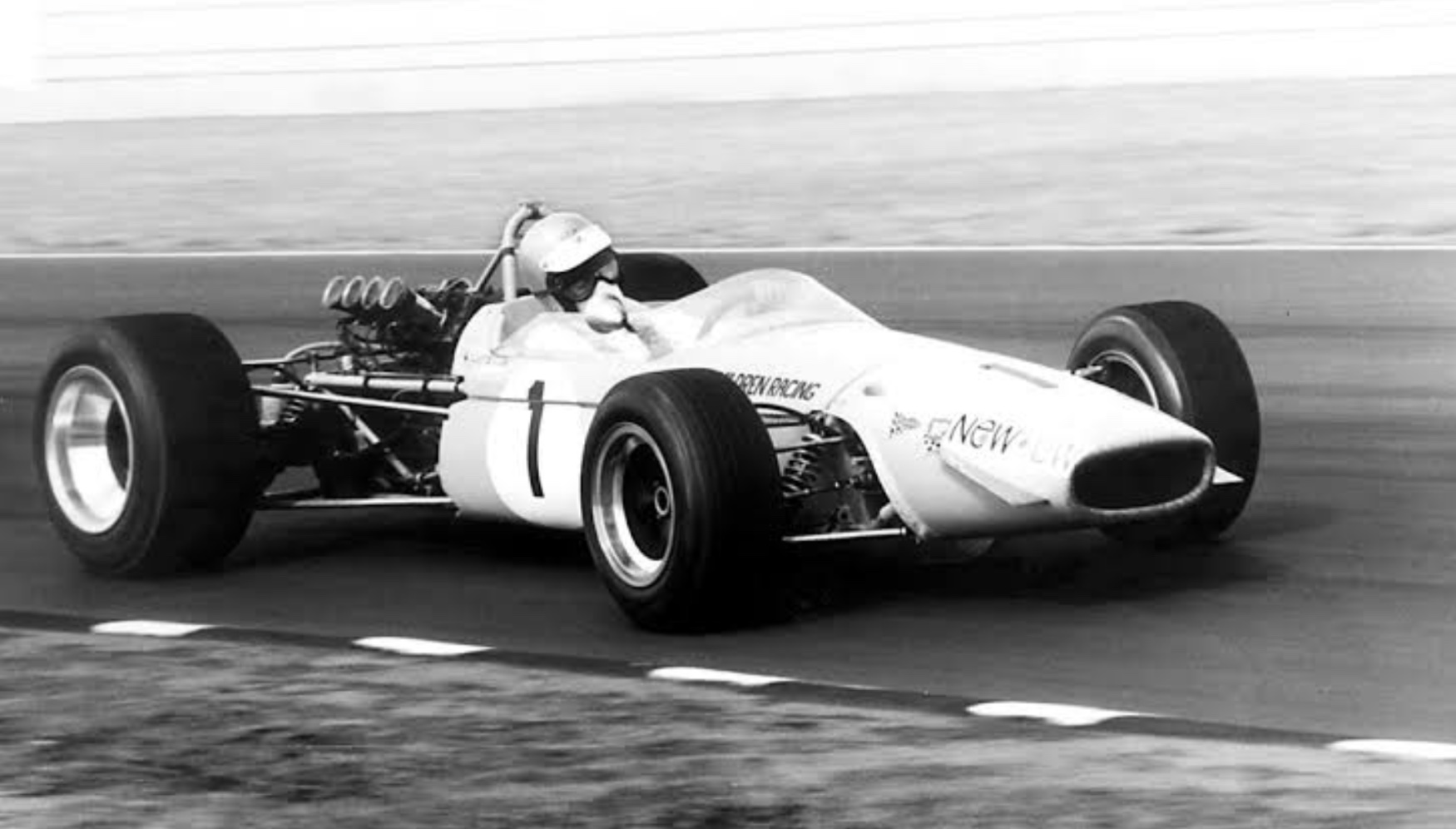
(P Greenfield)

Malcolm Ramsay awaits the start of the ‘Diamond Trophy’ Gold Star race at Oran Park on 28 June 1970…

His car is an Elfin 600C Repco ‘730’ 2.5 litre V8, alongside him you can just see the nose of the cars constructor, Garrie Cooper’s Elfin 600D ‘830’ V8- only three of these Repco V8 engined Elfins were built, John McCormack’s Elfin 600C was the other, and all are ‘Australian Motor Racing Royalty’ to me- about as good as it gets!

The Oran Park round was the third of the 1970 series, a championship which was wide open- reigning champion Kevin Bartlett had finished third in the first Symmons ‘Tasmanian Road Racing Championship’ round behind John Harvey’s old-faithful Brabham BT23E Repco and Leo Geoghegan’s equally venerable Lotus 39 Repco.

Bob Jane, John Harvey, a young Pat Purcell, ? and John Sawyer, side on during the 1970 Symmons round- car wing is BT23E (oldracephotos.com.au)


Symmons Plains 1970- changing of the guard- last race for Harvey’s Brabham BT23E Repco, Geoghegan’s white Lotus 39 Repco and almost KB’s last race in the Mildren Yellow Submarine Waggott. Max Stewart in the Mildren Waggott on row 2 (H Ellis)


Leo Geoghegan and Garrie Cooper at Symmons in 1970 (oldracephotos)


The Mildren Duo- The Sub, Mildren Waggott with Glynn Scott’s blue trailer alongside

At Lakeside for the ‘Governor’s Trophy’ in early June, Max Stewart won from Harvey’s new car, the ‘Jane Repco V8′ built on Bob Britton’s Brabham BT23 jig. It was a modified car with suspension geometry suited to the latest generation of cars and other tweaks. Bartlett DNF’d with ignition problems- and Leo Geoghegan made the championship debut of his Lotus 59B Waggott 2 litre ’59-FB-14’, at long last (or sadly depending upon how you view that wonderful Lotus 39) Leo had a modern car, that 39 had served him so well but had not delivered the Gold Star it was surely capable of- with Repco reliability in 1967 or 1968.

Lakeside, Governor’s Trophy 7 June 1970. Pole-sitter and winner Max Stewart in the Mildren Waggott with Kevin Bartlett in the Mildren ‘Yellow Submarine’ Waggott alongside (G Ruckert)

After Lakeside KB jumped on a plane to the ‘States to chance his arm over there in Indy racing- he raced on and off in the US from 1970 to 1973- we must get him to tell us that story.

Garrie Cooper, perhaps the other driver capable of winning the Gold Star that year also had a poor start to the season with his new Repco 830 Series V8 powered Elfin 600D ‘7012’. At Symmons he retired with a flat battery having failed to set a time in practice and at Lakeside he was ninth from Q5 with a misfire for the races duration.

Malcolm Ramsay was a title contender too- if the Repco planets could be aligned, mounted as he was in Cooper’s first Repco engined 600- the 600C ‘6908’ raced by Garrie in Asia and then sold before returning to Oz in late 1969.

GC Cooper, Elfin 600D Repco ‘830’, Oran Park June 1970- oh to have seen an ace in this chassis (oldracephotos)

1970 was an odd year in terms of Gold Star eligibility…

The Confederation of Australian Motor Sport made the following naff decisions during 1969 in an attempt to keep the peace with all interested parties- an impossible challenge of course and provide a formula, or formulae to suit the needs of Australian single-seater racing into the future. A summary of the rules for the next couple of years goes a bit like this;

1970 Tasman Series- Tasman 2.5, F5000 and 2 litre cars and under

1970 Gold Star- Tasman 2.5 and 2 litre cars and under

1971 Tasman- Tasman 2.5, F5000 and 2 litre cars and under

1971 Gold Star- F5000 and 2 litre cars and under

1972 Tasman- ditto as per ’71 Gold Star

1972 Gold Star- F5000 and ANF2 (to make up the numbers)

The impact of the above in 1970 was that those fellas who invested in F5000 could not race their cars in Australia- in particular Frank Matich and Niel Allen, both round winners during the 1970 Tasman could not race their McLarens in Gold Star events- a bummer for them and their fans but a bonus for the rest of the elite grid- Bartlett, Matich and Allen were out of the equation in 1970.

The machinations of the change from the Tasman 2.5 to F5000 category are ventilated at length in this article;

Repco Holden F5000 V8…

Wearing my Repco bias on my sleeve- 1970 was it, the last opportunity for the Maidstone concern to win either a Tasman or Gold Star 2.5 litre title for their beautiful little V8’s!

Max, second on the grid before the off, Mildren Waggott TC4V 2 litre. A jewel of a car and uber successful chassis (P Greenfield)

And so the title protagonists headed in the direction of Narellan on Sydney’s then western outskirts for the Oran Park round…

John Harvey put his stamp on practice with a 43 seconds dead lap in the Jane Repco with Max Stewart’s Mildren Waggott two-tenths adrift on a circuit Max knew like the back of his hand.

Its interesting that Max/Alec chose to keep racing the spaceframe car rather than the ‘Sub, a monocoque (after KB went away) but I guess Max wore that car like a glove- an extension of his body and he was never more than a bees-dick away from KB in terms of pace, so why not sell the Sub and keep the little Mildren nee Rennmax Waggott?

John Harvey ahead of one of the Elfin 600’s. Jane nee Rennmax Repco V8 – 830 Series V8. Bob Jane obtained the 830 V8’s used by Jack Brabham in the 1969 Brabham BT31- good works motors (L Hemer)

And as most of you know Mildren commissioned an F5000 car which Bartlett raced in the 1970 AGP and throughout the 1971 Tasman Series before the team was, very sadly, disbanded. But lets not get distracted from Oran Park.

Geoghegan did the same time as Max- he had clearly got to grips with the Lotus chassis and Waggott motors quickly having pedalled Repco V8’s since mid-1967. His Repco 830 would have had a smidge over 300 bhp with the Waggott at that stage of its development circa 265 bhp- albeit the 59B would have been a bit lighter overall than the 39.

Leo raced sans nose wings. Lotus 59B Waggott TC4V- yes please. OP June 1970 (oldracephotos)

Bob Muir demonstrated his growing pace with a 43.6 in his Rennmax BN2/3, at this meeting 2.5 Coventry Climax FPF powered- my guess is this was the best Gold Star FPF performance for a couple of years, by then these motors were no spring-‘chookins at all having taken two World Championships on the trot for Cooper/Jack Brabham in 1959 and 1960.

Bob bought a Waggott TC4V 2 litre engine which he popped into this chassis (in specification it is a BN3 but Bob referred to it as a BN2 ‘in period’) before the following ‘Sam Hordern Trophy’ round at Warwick Farm in early September and then later in the year bought the Mildren Yellow Sub off Alec and put the Waggott into that chassis- and somewhat famously rated his Rennmax BN2/3 the better car of the two. (same chassis as the Mildren Waggott).

Garrie Cooper and Malcolm Ramsay were fifth and sixth with a 44.6 and 45 seconds dead respectively, perhaps more could have been expected of the two V8’s but the dudes in front of them were all ‘locals’- if you can refer to an Orange resident as ‘local’ in Max’s case and Melbourne local for Harves! Harvey did plenty of laps at Oran Park before he emigrated to Mexico (Melbourne) when he started driving for Bob Jane .

John McCormack took the next step in his career when he replaced the ex-Jack Brabham 1962 AGP Caversham Brabham BT4 Climax FPF with an Elfin 600C in time for the 1970 Gold Star.

Fitting it with the FPF from the Brabham was sub-optimal but he was in the process of putting together a lease deal on a 740 Series Repco V8 with Malcolm Preston which would take him a further step along the path towards national championships in the years to come.

One day of The Year- that you can race your F5000 that is. Frank Matich on the way to 1970 AGP victory in his McLaren M10B Repco Holden (N Foote)

Preston and Mac developed a lifelong friendship during the Repco Holden F5000 years- Preston was the General Manager of REDCO, the Repco Engine Development Company which assumed the assets (most of ’em) of Repco Brabham Engines Pty. Ltd. and designed, built and maintained the Repco-Holden motors.

That Repco 740 engine was nestled in the spaceframe of Mac’s 600 ‘7011’ by the Hordern Trophy meeting, so he used it at WF, Sandown, Mallala (pole) the AGP at the ‘Farm in November as well as the Warwick Farm Tasman meeting in February 1971.

In 1970 the Australian Grand Prix was a stand alone meeting- not part of the Gold Star or Tasman Series and allowed Tasman 2.5, 2 litres and under- and F5000’s!

Warwick Farm Meister Frank Matich won the race from a strong field in his McLaren M10B Repco Holden- it was the first ‘notch in the belt’ for another world class race engine from the Repco boys, the design of which was led by Phil Irving- he of Vincent and Repco Brabham Engines ‘620 Series’ fame with the assistance of Brian Heard, also ex-RBE.

Queenslander Glynn Scott in his brand spankers Elfin 600B Waggott TC4V, DNF (L Hemer)

Meanwhile, back at Oran Park in June…

Glynn Scott was next up, seventh in a brand new Elfin 600B Waggott 2 litre. Glynn was sure to be quick in this car over the next season or two but his time in it was way too short, only a month later he was killed in an awful accident at Lakeside when he and his friend Ivan Tighe collided, Ivan also Elfin 600 mounted.

Waggott engined Elfin 600’s are rare beasts- this (destroyed) chassis ‘7016’, Gary Campbell’s ‘7122’ (the chassis, then powered by a Lotus-Ford twin-cam  in which Larry Perkins won the 1971 ANF2 Championship) and Ramsay’s ‘6908’ were so equipped.

The Goodwins, unrelated were next, Len in the ex-Piers Courage/Niel Allen McLaren M4A ‘M4A/2’ Ford Cosworth FVA, the Pat Burke owned car soon to become an important stepping stone in the career of Warwick Brown who raced it in 1971 before stepping into another ex-Allen McLaren, M10B F5000, for 1972- fame if not fortune followed.

Ken Goodwin’s Rennmax BN3 Ford in the OP paddock June 1970 (K Hyndman)

Ken Goodwin who had come through Formula Vee raced a beautifully self-prepared Rennmax BN3 Lotus-Ford t/c ANF2- its amazing how many guys did well in these beautifully forgiving motor-cars. Ron Tauranac got the Brabham BT23 design spot on and Bob Britton didn’t bugger things up in his translation of same!

The thirteen car grid was rounded out by the ANF2 1.6 cars of Jack Bono, Brabham BT2 Ford t/c, Ian Fergusson, Bowin P3 Ford t/c and Noel Potts Elfin 600 Alfa Romeo 1.5.

Come race-day there were only twelve starters, unfortunately Muir’s Coventry Climax engine had ‘oil leaks’ which could not be remedied.

Stewart’s Mildren sorted before the off- Glenn Abbey and Alec Mildren look on as Derek Kneller at front and Ian Gordon set final tyre pressures. Waggott 2 litre TC4V engine and FT200 Hewland ‘box (K Hyndman)

Gold Star fields in terms of numbers were always tough, other than in the Formula Pacific and Formula Holden ‘peaks during the eighties/nineties- in 1970 the number of starters were; Symmons 11, Lakeside 17, Oran Park 12, Warwick Farm 12, Sandown 18 and Mallala 12- the AGP, not a Gold Star round had 19 starters with F5000 making the difference in the main.

The field was interesting too- all of the top-liners were racing cars with spaceframe chassis, four had Repco 730 or 830 ‘crossflow’ V8’s, three modern as tomorrow Waggott 2 litres started, with one Ford Cosworth FVA, an ‘old school’ Coventry Climax FPF in the back of McCormack’s Elfin 600 and a smattering of Lotus-Ford twin-cam ANF2’s plus Pott’s 1.5 litre twin-cam, long stroke Alfa Romeo.

Look mum, one hand! Stewart shows perfect control and a gaggle of car down OP’s Main Straight (L Hemer)

The 82 lap race was won by Max Stewart by 17 seconds from the similarly engined Lotus 59 of Geoghegan, then the ‘Elfin-GT Harrison Racing’ 600 Repco’s of Garrie Cooper and Malcolm Ramsay.

McCormack was two laps back in his 600 FPF from John Harvey a couple of laps back with problems.

Than came Ian Fergusson’s monocoque Bowin P3 Ford, Noel Potts Elfin 600 Alfa and Glynn Scott with only 50 laps in his 600 Waggott.

As Max Stewart left Oran Park for home in Orange on the Sunday night little did he know the high point of his 1970 Gold Star season had been reached, he took no points at either of the following Warwick Farm (injector problem) or Sandown (bearing) rounds won by Leo Geoghegan and John Harvey respectively.

John Harvey in the Jane Repco V8 in Warwick Farm’s Esses during practice for the Septmeber Gold Star round won by Geoghegan from Cooper and Muir. Harves Q4 and DNF fuel pump (L Hemer)

In fact the difference between Leo and his pursuers that season was a blend of speed and consistency- lessons from his Repco years!

He won two of the six rounds but scored in all but one. Stewart and Harvey both won two rounds as well but scored points in four rounds apiece. Harves went mighty close though, he recalled recently ‘…at the last round of the Gold Star at Mallala I was so far in front of Leo Geoghegan and Max Stewart I thought I had the race and the series in the bag. However, not to be, the left front suspension broke and took me off the road.’

In terms of qualifying performances, often an indicator of outright speed, Harvey took pole on three occasions with Stewart, Geoghegan and McCormack, the latter at Mallala using his Repco V8, to good effect once.

Geoghegan won the championship with 33 points from Stewart 27, Harvey 25, Cooper 16 and Ramsay 9.

Leo’s 59B before the off with Bob Holden’s Escort Twin-Cam sharing the Castrol tent. OP June 1970, car still in Oz (K Hyndman)

Leo Geoghegan- Lotus 59B…

Leo Geoghegan’s Lotus 59B Waggott…

Max Stewart- Mildren Waggott…

Singapore Sling…

Bob Muir- Rennmax BN3 Waggott…

Rennmax BN2 Waggott…

Garrie Cooper- Elfin 600D Repco…
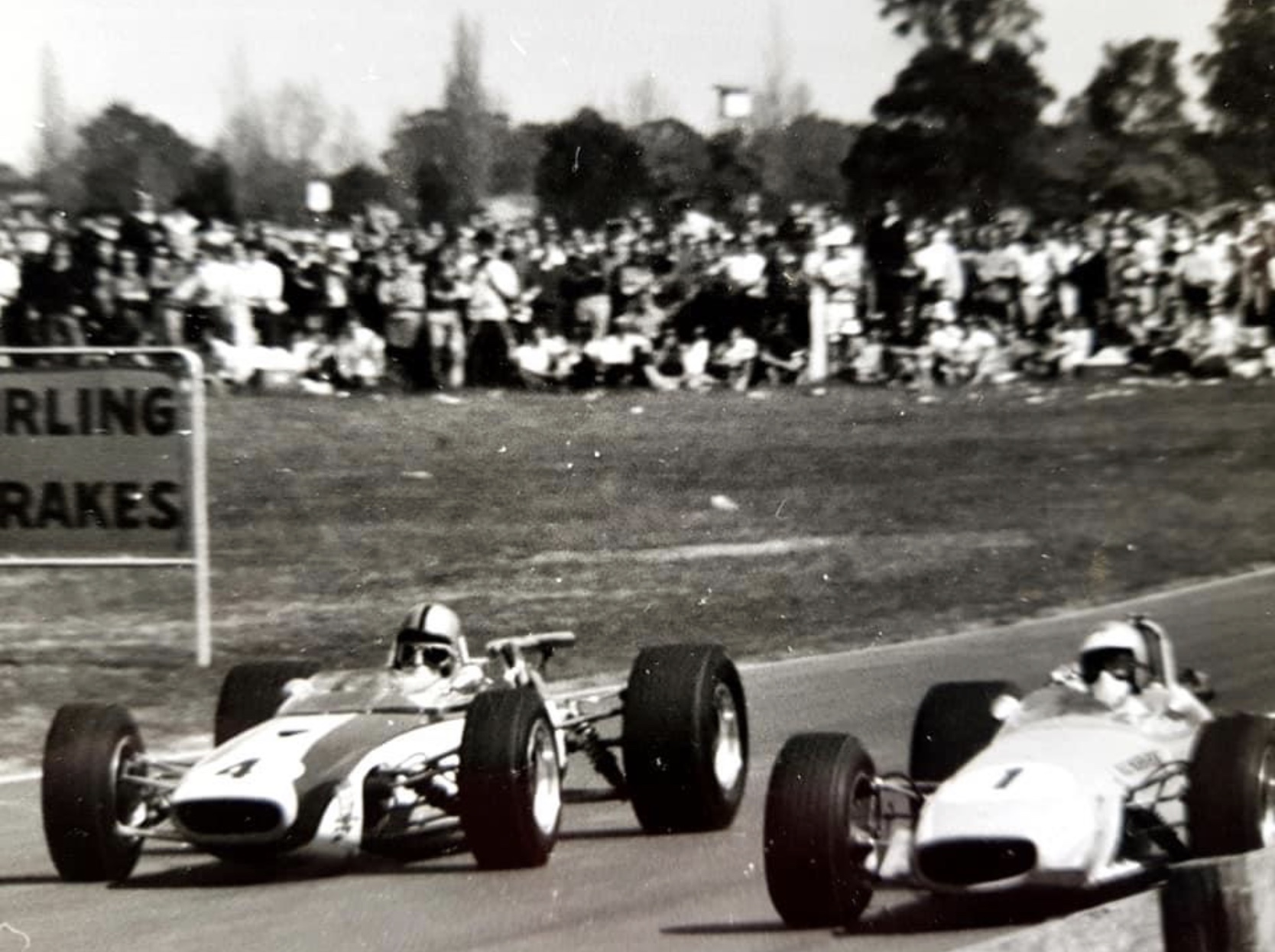
Garrie Cooper, Elfin 600D Repco V8

1970 Gold Star Season…

https://www.oldracingcars.com/australia/1970/

Credits…
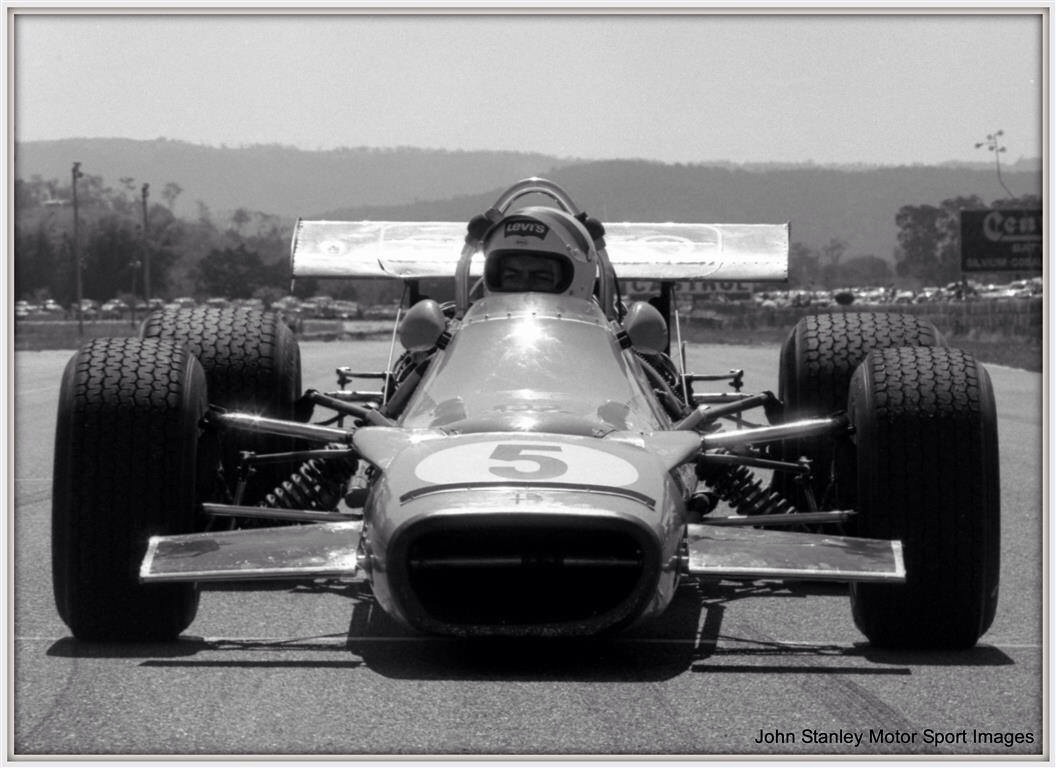
Peter Greenfield, Harold Ellis, Lynton Hemer, oldracingcars.com.au, Nigel Foote, Ken Hyndman, oldracephotos.com.au, John Harvey, Graham Ruckert

Tailpiece: Harves and Hottie, Maxxie and ‘Yoko Ono’…

(L Hemer)

Finito…