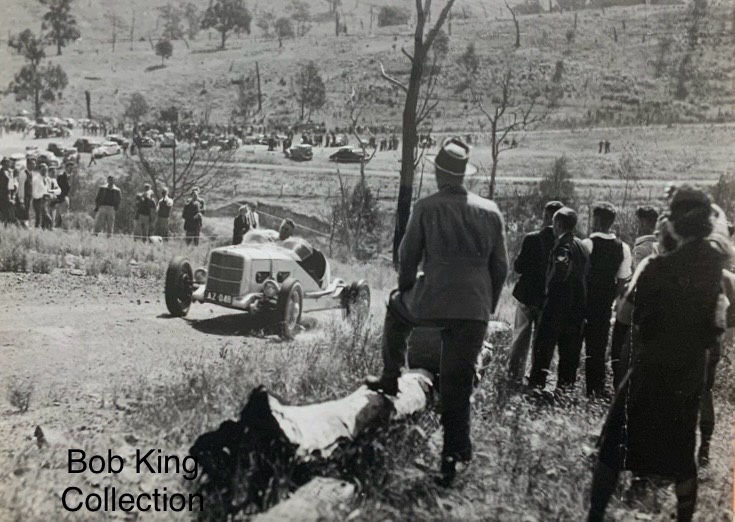
Evocative shot of Jack Phillips’ Ford V8 Special ascending Rob Roy hill in the Christmas Hills, 50km east of Melbourne
This car was one of the fastest and most successful racers in Australia – where handicap events then were standard fare – in the immediate pre and post-War period. Built by Phillips and Ted Parsons, his riding mechanic and partner in a Wangaratta Ford dealership, I’ve written about the combo before: https://primotipo.com/2023/03/07/jack-phillips-ted-parsons-ford-v8/
I’d love to know the date of the meeting and how Jack went? Before the January 13, 1939 Black Friday fires it seems?
(B King Collection)
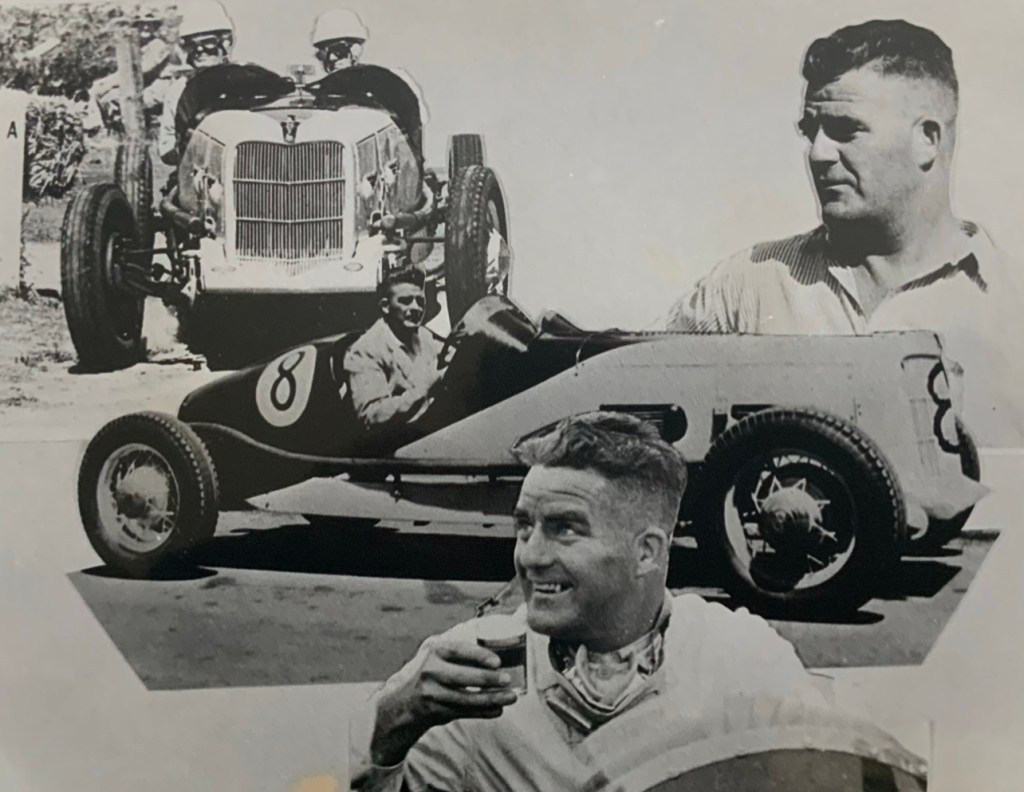
Phillips/Parsons (above and below) on the way to a win in the South Australian Hundred on formidable Lobethal in 1940.
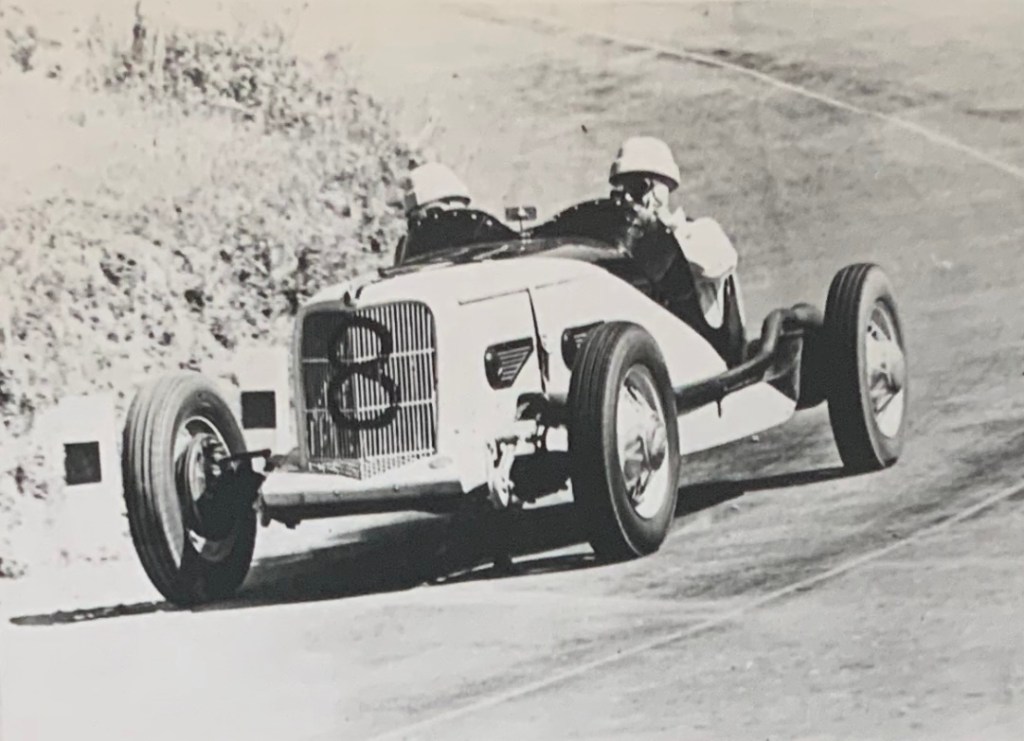
Phillips-Parsons airborne on the Wirlinga road circuit (cars4starters.com.au)
The Jack Phillips – Ted Parsons 1934 Ford V8 was Australia’s fastest of the breed pre-war. Here the machine is aviating on the Wirlinga road circuit – 10km northeast of Albury – on the Kings Birthday weekend in June 1940. The duo are on what was then called Orphanage Lane (now St Johns Road), the two crests which allowed the cars to take to the sky were near Corrys Road, Thurgoona, many thanks John Medley and Ray Bell.
The car was one of the most successful of all Australian racing cars in the immediate lead up to the conflict, placing sixth and third in the 1938 and 1939 Australian Grands Prix at Bathurst and Lobethal respectively. “In Victoria for the 1937-38 season, the Phillips Ford was awarded ‘The Car Trophy’ for the most successful competitor,” John Medley wrote.
The duo also won the Interstate Grand Prix/Albury and Interstate Cup on the Albury-Wirlinga road course in 1938-39 and the South Australian 100 at Lobethal in January 1940. On the same day the pair finished second to Les Burrows’ Hudson Terraplane Special in the Lobethal 50.
Bill and Ben the Flowerpot Men? Phillips/Parsons on the way to winning the South Australian 100 on New Years Day 1940 at Lobethal (unattributed)
As the lights were progressively turned down throughout 1940, the Phillips/Parsons pair were ninth in the Easter Bathurst 150 mile race won by Alf Barrett’s Alfa Romeo Monza. The car’s final meeting before being put on display for much of the conflict in their Wangaratta Motors Ford dealership was the 75 mile Albury and Interstate Cup Race on June 17, 1940. It was the final meeting on this road course and Barrett set the all-time lap record at 2 minutes 52 seconds but broke an axle and retired from the race. Harry James’ Terraplane won in a steady performance from John Crouch’s Alfa Romeo 8C2300 Le Mans with Phillips/Parsons third.
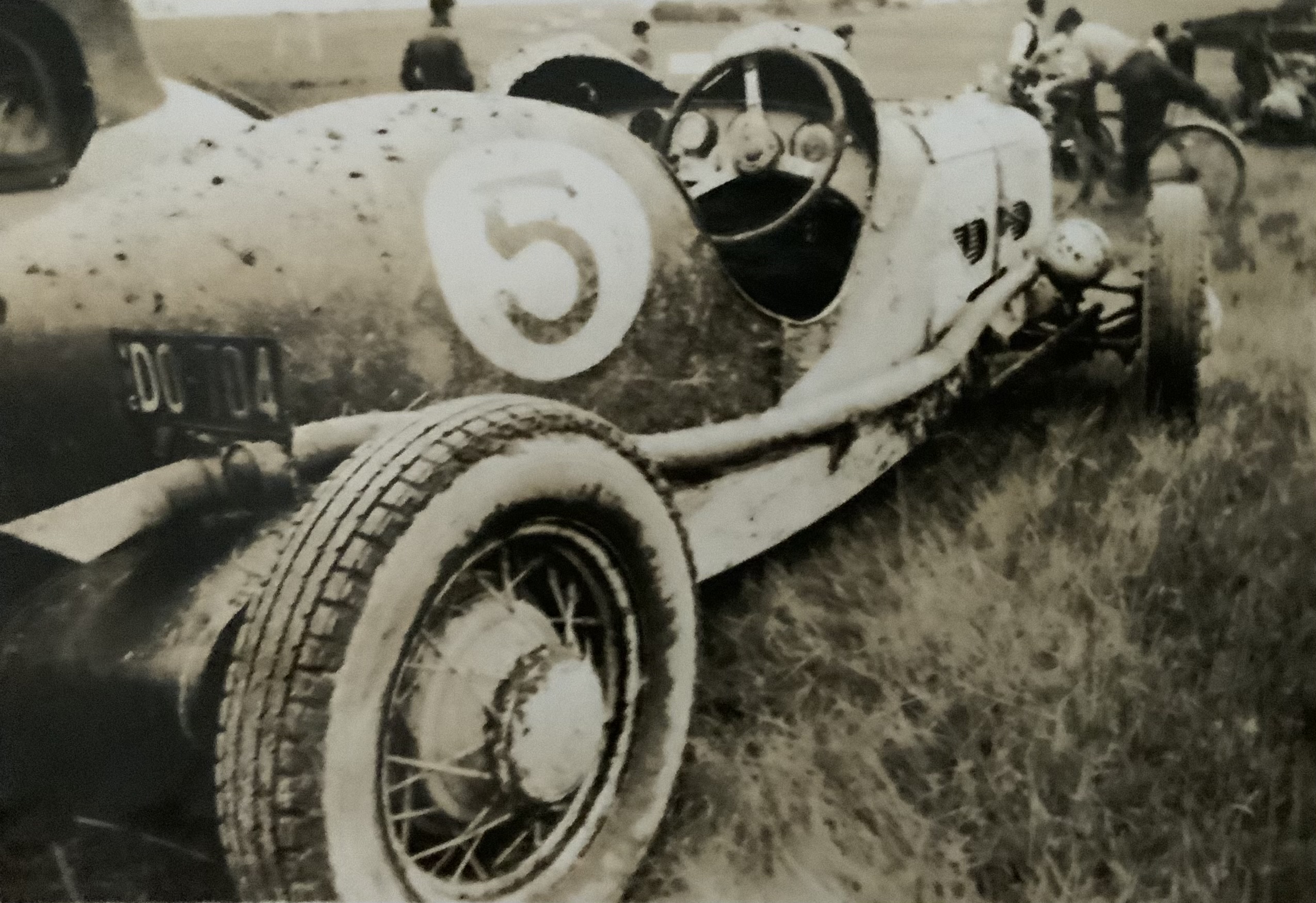
A great shot but whereizzit? Note the Victorian rego-plate and ‘tuned-length’ exhaust which will have aided driver and passenger comfort in longer races by dispensing with fumes and noise well-aft of the conducteurs. Quality of the body and standard of presentation impressive (cars4starters.com.au)
Based on a fire-damaged ‘34 sedan with over 20,000 miles on the clock, the car was modified in the partner’s Wangaratta, Victoria Ford dealership by fitment of a special, swoopy, lighter body. Engine enhancements included twin Winfield carburettors, Scintilla magneto, modified heads and free-flowing exhausts.
Timed at 115mph in top gear, it did 80 in second – at a then heady 6000rpm – using the 3.5:1 rear axle ratio. It was a paragon of solid reliability too, not suffering the overheating afflictions of so many modified Ford flatties.
The masked avengers on the Victor Harbor – Port Elliott road circuit during the 1936 South Australian Centenary Grand Prix, well protected from road detritus and here are using all of the available real estate. DNF after completing 21 of the 32 laps (B King Collection)
John Medley observed the car’s strengths, “The Phillips Ford simply soldiered on in prewar races on dirt and gravel roads, built tough to last to the finish. It continued to race postwar particularly in Victoria and South Australia where it was raced by South Australian Granton Harrison, by which time the newer breed of generally smaller and lighter V8 Specials could out-pace it.”
“Still it had been the mould in which the later V8s were shaped. In the postwar period, with T-Series MGs, Ford V8 specials were the backbone of Australian road racing.”
The Phillips/Parsons Ford was destroyed when it was crashed into a bridge, the remains were scrapped. Ted Parsons Jnr and his son Rob recreated the car between 2008-2014, the car took its bow at Winton in 2014.
Likely lads, who is the chap at left and where was the shot taken? (B King Collection)
Historian, Rob Bartholomaeus has worked out, by looking at his photographic archive, that a rebuild involving lightening and lowering the car and replacing the ’34 grille with a 1935 unit and a change in colour scheme from the one above, to the diagonal stripes shown in most of the other shots was made in late 1938 rather than 1937 as documented elsewhere. It seems the car started with underbody exhausts, then evolved to the side exhausts as above which were retained after the car was modified and repainted.
(B King Collection)
As noted above, the car’s last pre-war meeting was at Wirlinga in 1940. Bob King has this photograph in his collection, the caption on the back lists the racer as Bill Sinclair and the place, Oakleigh in 1942. I can find no Trove reference to this meeting at what is now a southern suburb of Melbourne. It appears as though the car is running the same number/roundel combination from Wirlinga, quite probably untouched. If anybody has information about the event do get in touch.
(unattributed)
It’s not clear when Granton Harrison bought the machine but he added to its tally of Australian Grands Prix entries, racing it at Point Cook to Melbourne’s west in 1948, where he placed fourth, and in 1950 at Nuriootpa in South Australia’s Barossa Valley where he was 11th in the race won by Doug Whiteford’s Ford V8 Special ‘Black Bess’, Bess was inspired by the Ossie Cranston and Phillips/Parsons Ford V8s.
The shot above is of Granton contesting the South Australian 100 at Lobethal on New Years Day, 1948. A good day for him too, he was second behind Jim Gullan’s Ballot Oldsmobile Special – and did fastest race time in the handicap event – continuing this car’s reputation for competitive reliability.
Back to the sequence of owners. Stephen Dalton has Granton advertising the car for sale in the February 1948 issue of Australian Motor Sports, with Jack O’Dea running it at Rob Roy in January 1949, perhaps Jack ran it as a borrow/view to purchase. As we can see Granton raced on for a couple of years after that, if anyone can help with the ownership sequence, do get in touch.
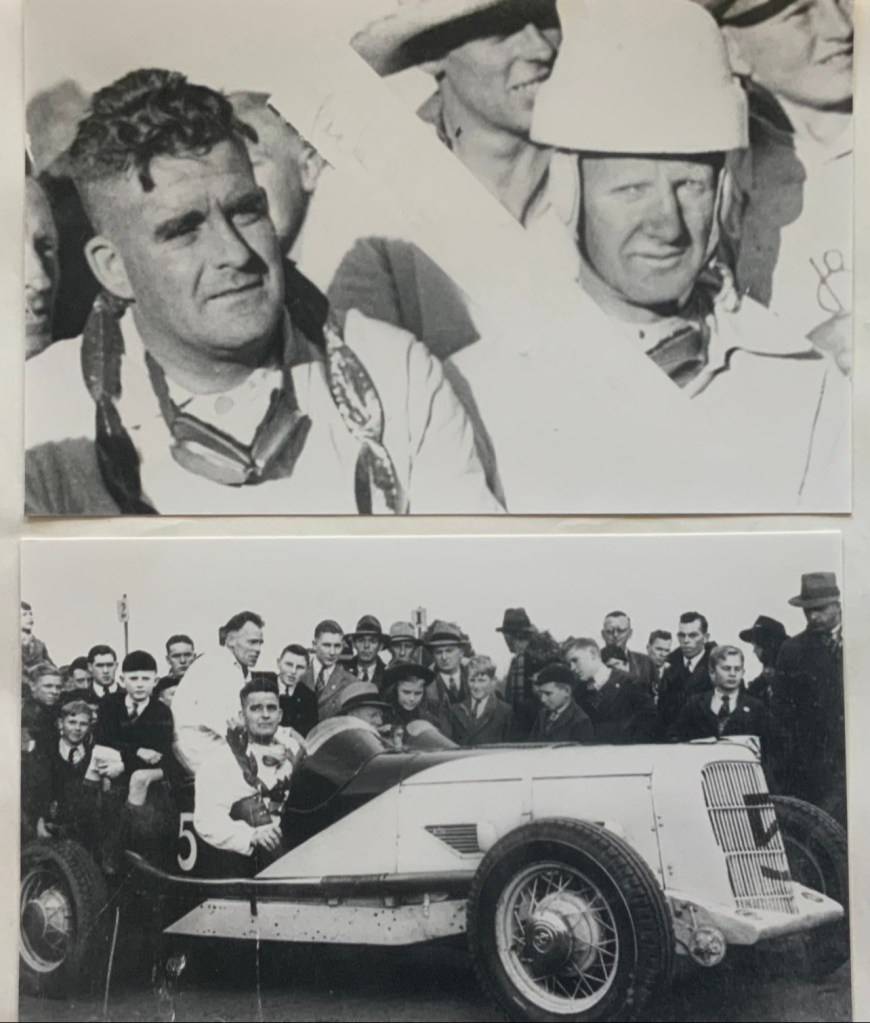
Ted (Edwin) Parsons wearing Warren Safety Helmet, goggles, white overalls – the pocket of which had the Ford V8 symbol embroidered – wearing a leather kidney belt. “To look your best under the overalls it was common for Ted to wear a white shirt and tie,” Ted’s son Rob Parsons wrote. Wirlinga 1939 perhaps, chap behind unknown (Parsons Family Collection)
Etcetera: The Warren Safety Aviation Helmet…
WT Warren invented the Warren Safety Helmet in 1912. The spring-equipped pilot safety helmet, made of leather and cork with vented ear collars was padded with horse hair and designed to minimise head injuries, the major cause of aero accident deaths at the time. The helmet was part of RAF listed kit issue from 1920-24.
Later models incorporated an ear audio piece and a breathing mask. By the time Phillips and Parsons used them they had been pensioned off by the RAF. Curtis and Taut & Co made the helmets under licence, the inscription in Parsons’ helmet, retained by the family, reads ‘No 2 Tuatz & Co Patent 17855 Aviators Safety Helmet. Maker Tautz & Co, Hunting Military and Multifit Tailors, 12 Grafton St, New Bond St, London.’
Phillips and Parsons with their distinctive Warren helmets after winning at Wirlinga in 1938 (J Dallinger)
Rob Parsons explained further, “While the helmet was obsolete for aircraft, they were used by Phillips and Parsons from 1935-39. With a lack of sporting regulations, these cars lacked the safety features of safety belts which were not considered a benefit for car racing. Drivers had a steering wheel and the co-driver a grab handle to hold onto. It would be common in rollovers to duck-down and brace yourself, perhaps to be trapped or otherwise flung free of the car, all with grave consequences.”
“Ted Parsons first introduction to motor racing was at the Benalla Airstrip circuit, perhaps a likely place to find such a helmet. On the back page of his photo album, he list drivers who died racing during his involvement, a reminder of the sport’s dangers. He retired from racing after the war to pursue golf and film-making.”
“Jack and Ted wore leather face shields to protect themselves from their own flying stones and other track debris, an idea adapted from the oxygen flying mask. The leather was painted white to match the colour of the car, aviation goggles protected their eyes,” Parsons wrote.
(Der Spiegel)
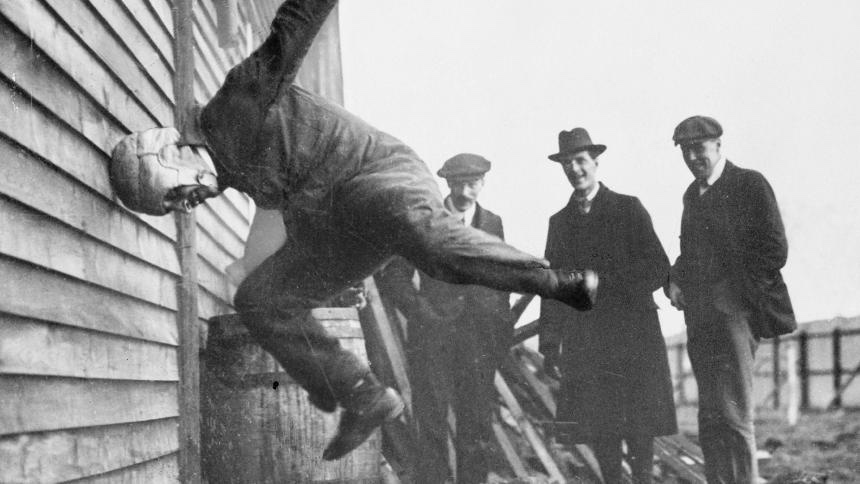
WT Warren tests his new helmet – as one does – by headbutting the wall of William Ewen’s Hendon flying school, where Warren was a trainee, in 1912.
What follows is the German-English translation from an article in Der Spiegel.
“In a 1912 issue of Flight magazine, British inventor WT Warren’s invention, a protective flight helmet is demonstrated. The image is often erroneously reported to be a football helmet.”
‘The wall against which the helmet carrier ran belongs to the flying school of William Hugh Ewen. The owner (middle) and and his chief pilot LWF Turner (left) are behind. The Lord in the foreground is his student Mr WT Warren. And, no, he has not failed the flight test and is just reacting to his anger.” Clearly the German hilarity is lost in translation.
“Dated 1912, Mr Warren is a tinkerer. He introduced his latest invention to experienced pilots: a protective helmet ‘that will attract considerable attention’, Flight magazine wrote. Warren’s leather cap was padded with horsehair: A system of steel springs should intercept any impact, thus reducing the risk of injury. Head injuries were the leading cause of death in flight accidents.”
Credits…
‘John Snow:Classic Motor Racer’ John Medley, State Library of Western Australia, cars4starters.com.au, Bob King Collection, ‘The Warren Safety Aviation Helmet’ by Rob Parsons in the July 2021 issue of ‘The Light Shaft’ – Austin 7 Club magazine, Parsons Family Collection via austin7club.org, John Dallinger, Der Spiegel
Tailpiece…
(SLWA)
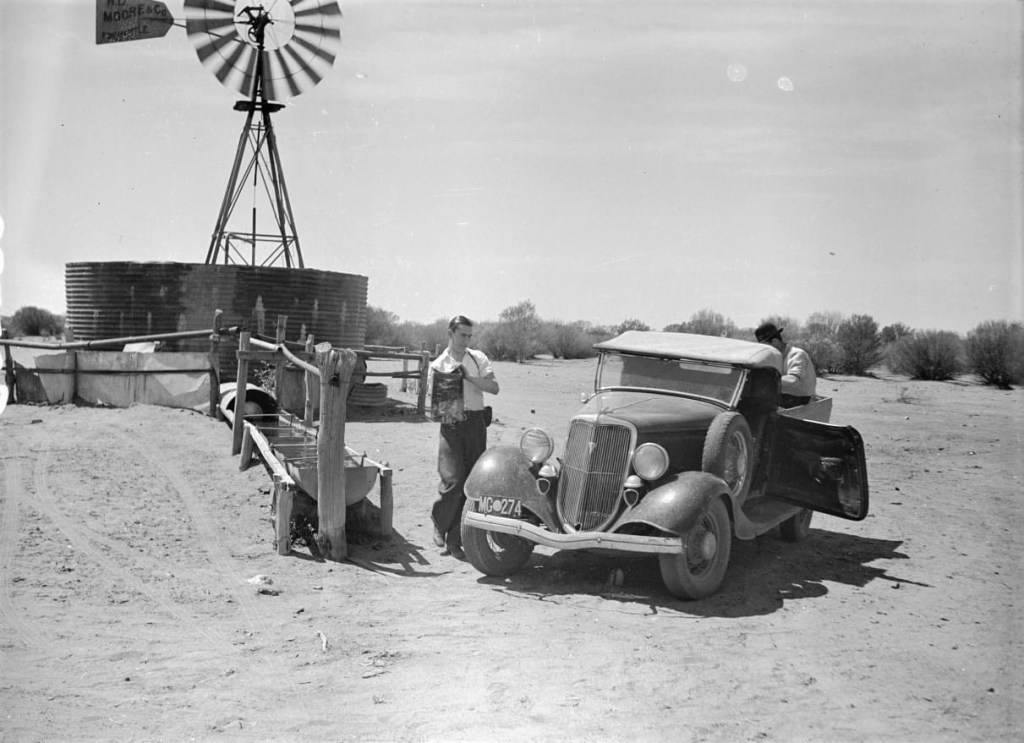
I’m cheating a bit, this 1934 Ford is a V8 ute rather than a sedan, but you get the jist of it.
The Phillips-Parsons racer was not too far removed from a roadie, rather than an out-and-out bespoke racer, reliant as it was on the standard chassis, axles wheel to wheel, differential and gearbox.
The ute is singing for its supper, doing a meat delivery in country Western Australia in 1937.






 primotipo...