Posts Tagged ‘1955 Le Mans 24 Hours’

(Klemantaski)

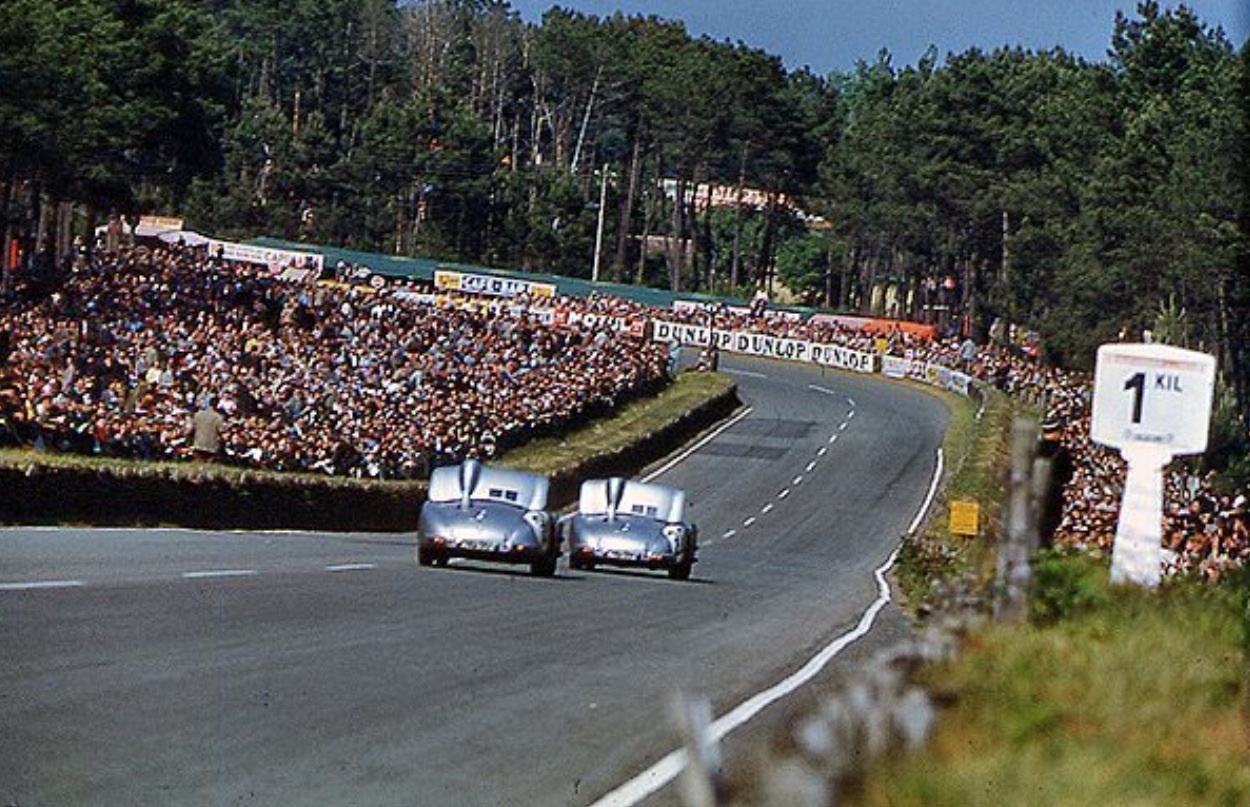
The somewhat other-worldly sight of two Mercedes Benz W196S/300SLR’s with air-brakes deployed as they approach the Esses at Le Mans in 1955…

When you consider the engineering of this clever response to the braking power of the Jaguar D-Type’s Dunlop brakes one can’t but wonder about the development of a German equivalent?!

The Benz was the champion sportscar of 1955 winning most of the blue-riband events: Targa Florio, the Mille Miglia and the Tourist Trophy, the exception being Le Mans of course.

Mercedes withdrew whilst in the lead due to the accident in which Pierre Levegh was an innocent party, which took his life and that of about 84 spectators, not to forget the 180 folks who were injured.
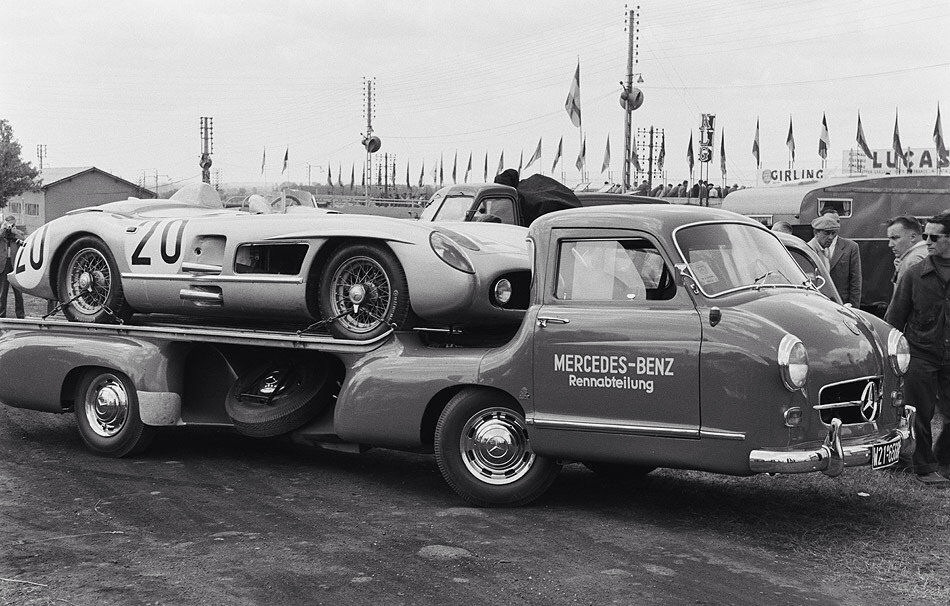
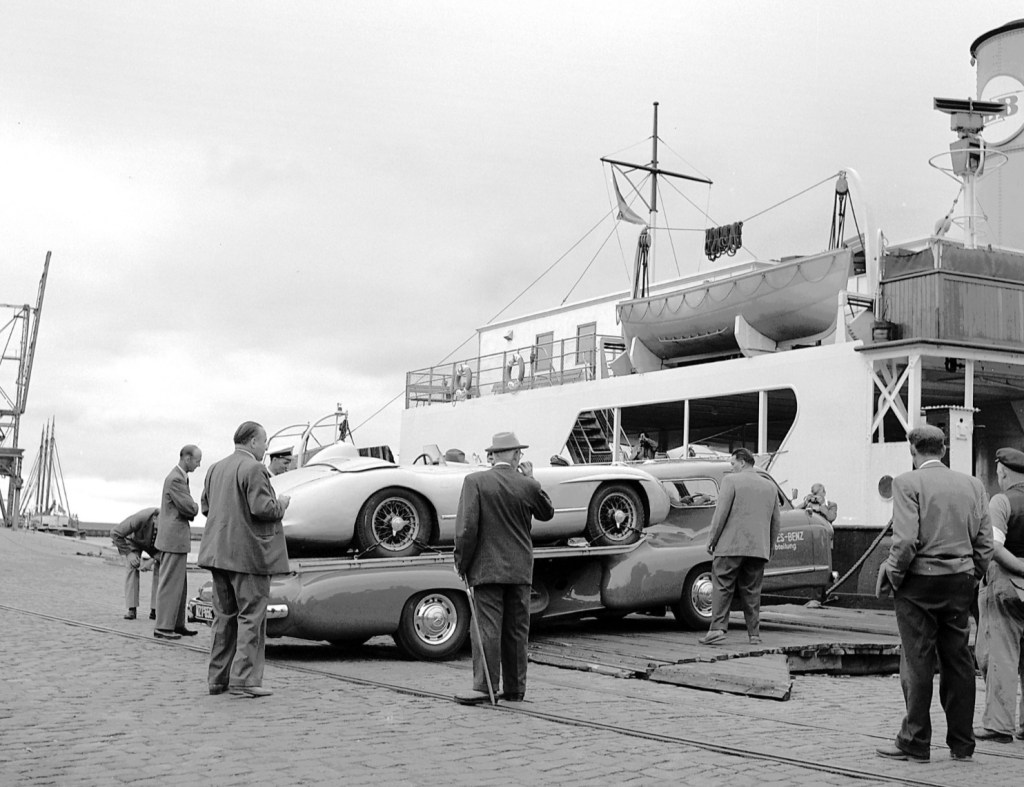
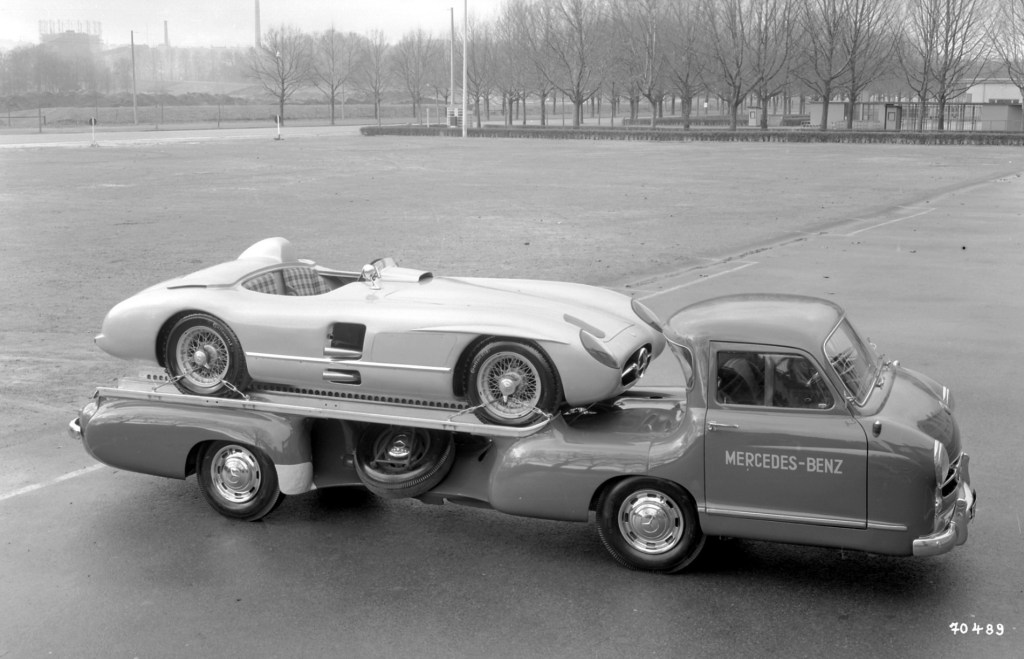
Built by Mercedes test department, this one-off 3-litre 192bhp 300SL powered 105mph race transporter, in Mercedes words “Was predestined to demoralise the opposition. If the racing car transported was that fast, even worse could be expected of the Silver Arrow on its platform.”(Mercedes Benz)
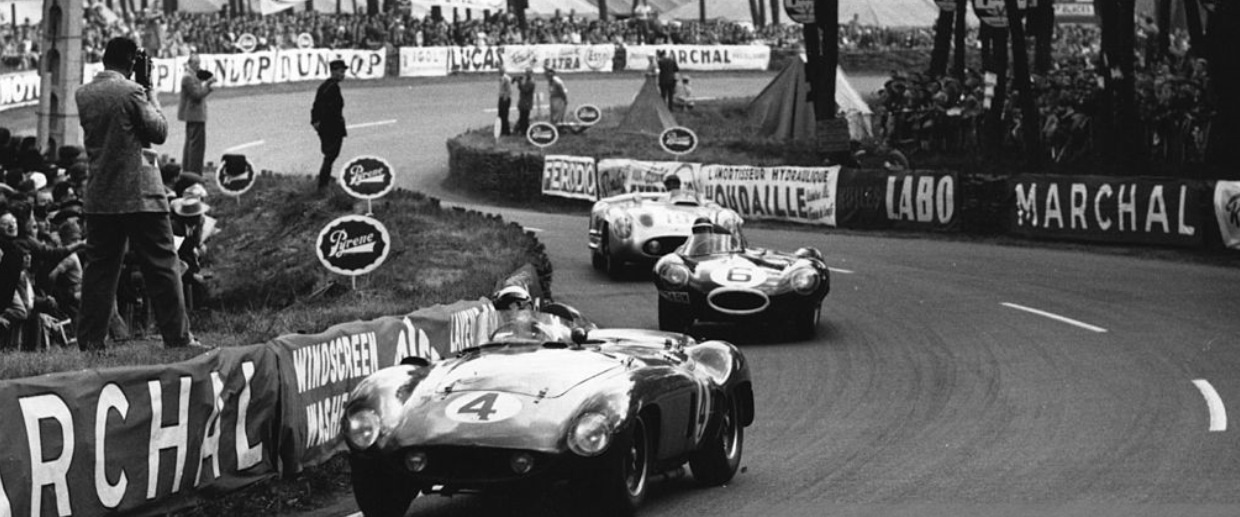
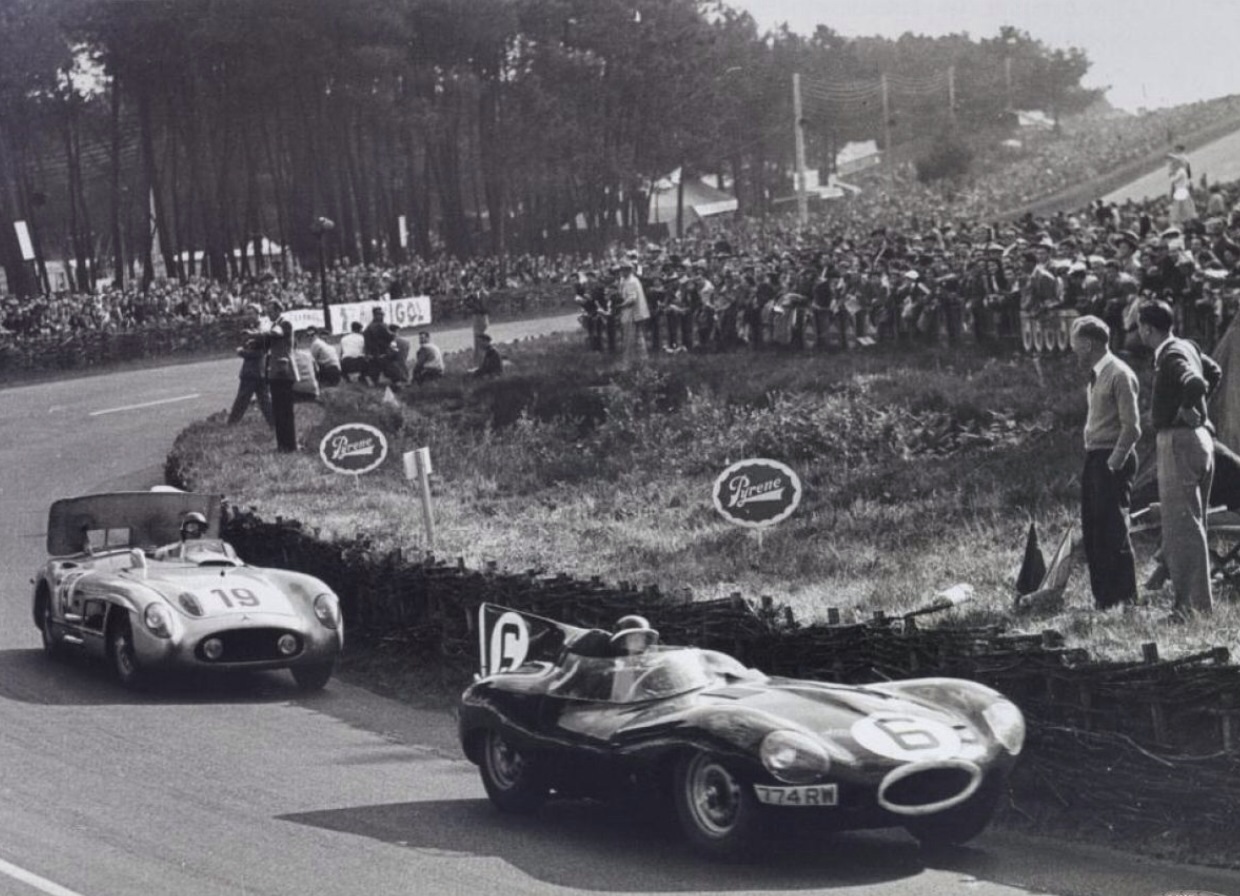
Le Mans 1955. Hawthorn, Jaguar D-Type from Fangio early in the race, Dunlop Curves, note that Fangio’s air-brake is still deployed (unattributed)
Le Mans 1955. Castellotti, Hawthorn, Fangio: Ferrari 121 LM DNF, Jag XKD first, Benz 300SLR entry withdrawn (Getty)

Design and construction…

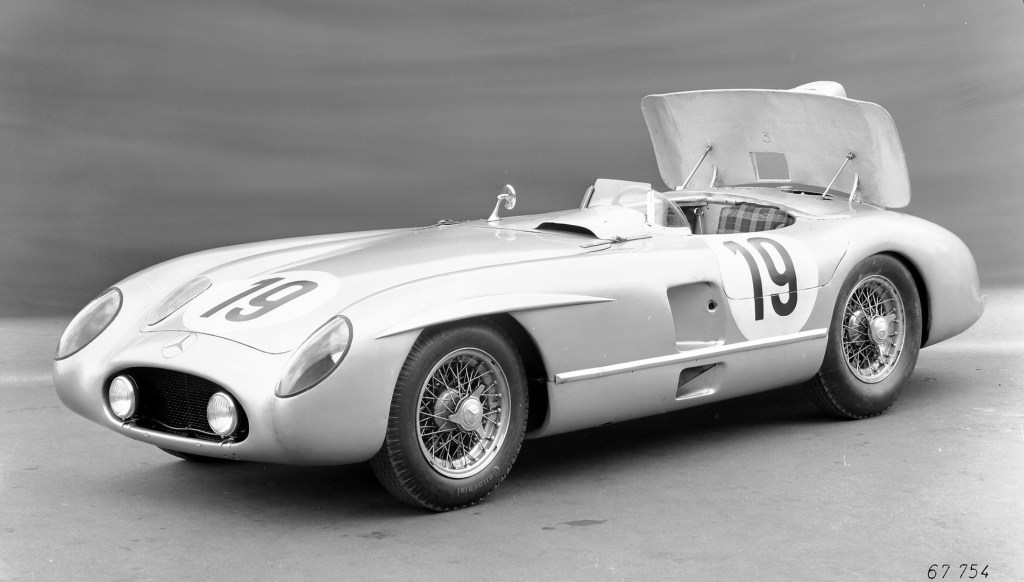
In essence the W196S, as the factory model number suggests, “is basically a Type W196R Formula One racing car with a two-seater sports car body,” Mercedes Benz (mercedes-benz-publicarchive.com) wrote. The W196R won back to back drivers titles for Juan Manuel Fangio and Mercedes in 1954-55.

“The main technical difference is to found in the engine: the racing sports car, not being bound by the Formula One regulations, limiting the engines displacement (to 2.5-litres), is powered by a 3-litre version of the eight-cylinder in-line engine and features cylinder blocks made, not from steel, but from light alloy. Apart from this, the 300SLR was not powered by special methanol-based racing fuel but by premium petrol.”
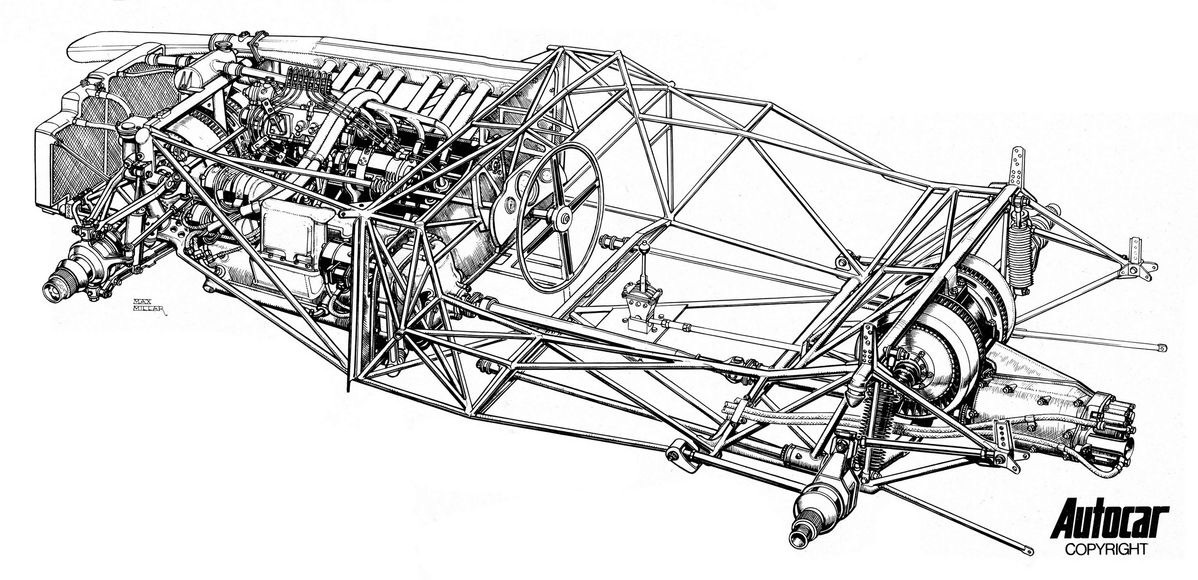
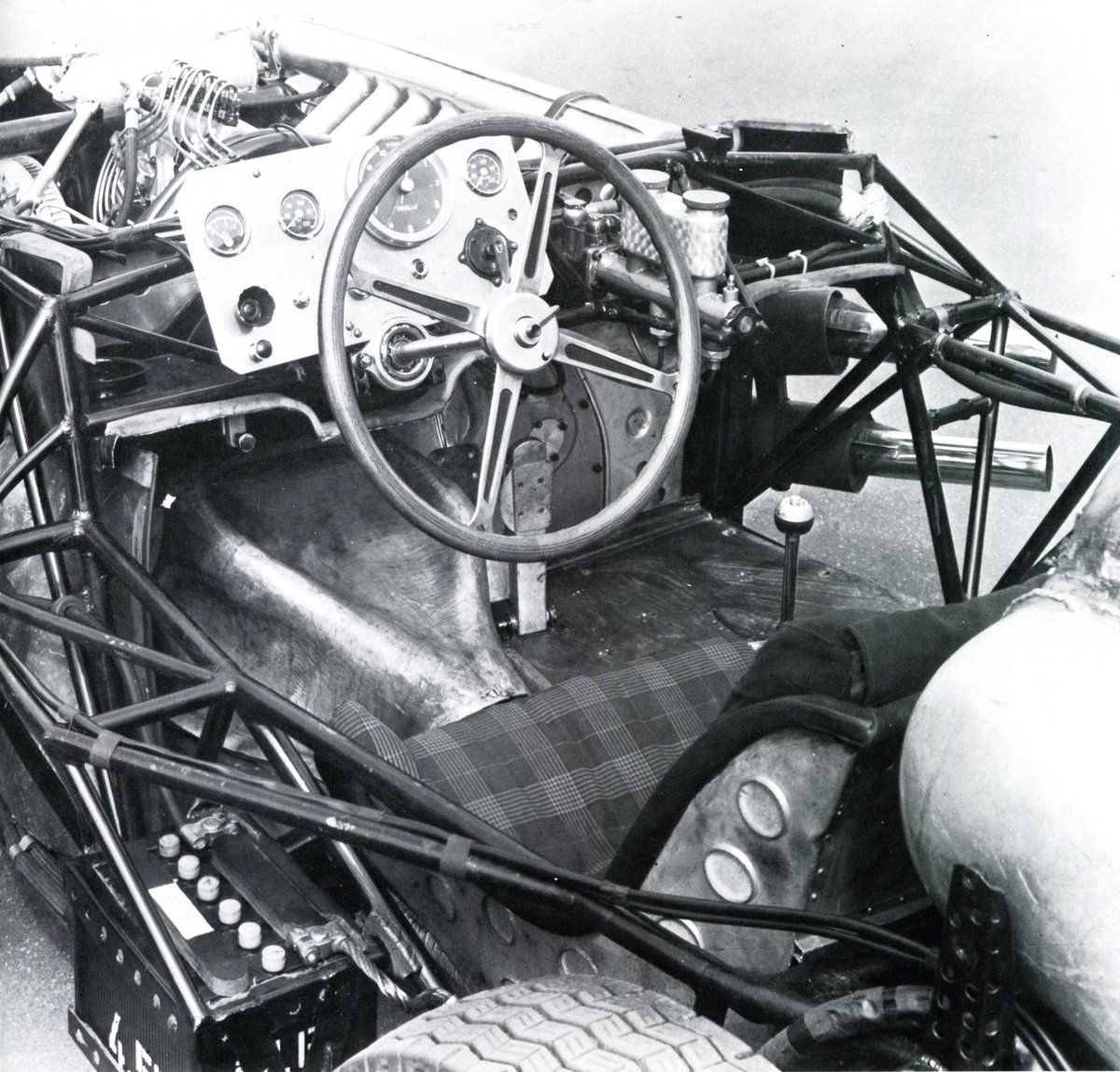
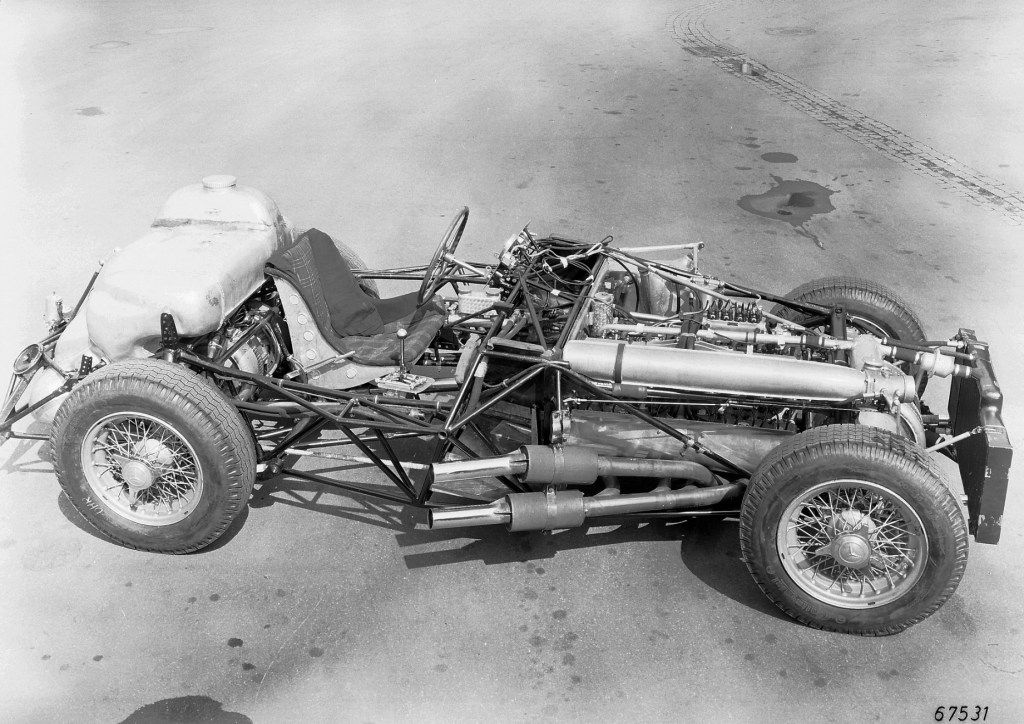
W196S cutaway with the multi-tubular spaceframe chassis and the disposition of major components: 3-litre straight-eight fuel injected engine, rear mounted transaxle and inboard drum brakes front and rear are clear (Autocar)
(Mercedes Benz)

Key design elements of the car start with a multi-tubular steel spaceframe chassis. Suspension is by upper and lower wishbones at the front, torsion bars and dampers. At the rear are swing-axles, torsion bars with again telescopic dampers or shocks. Massive inboard drum brakes are used at both ends to stop the 701kg car in ready to race trim.
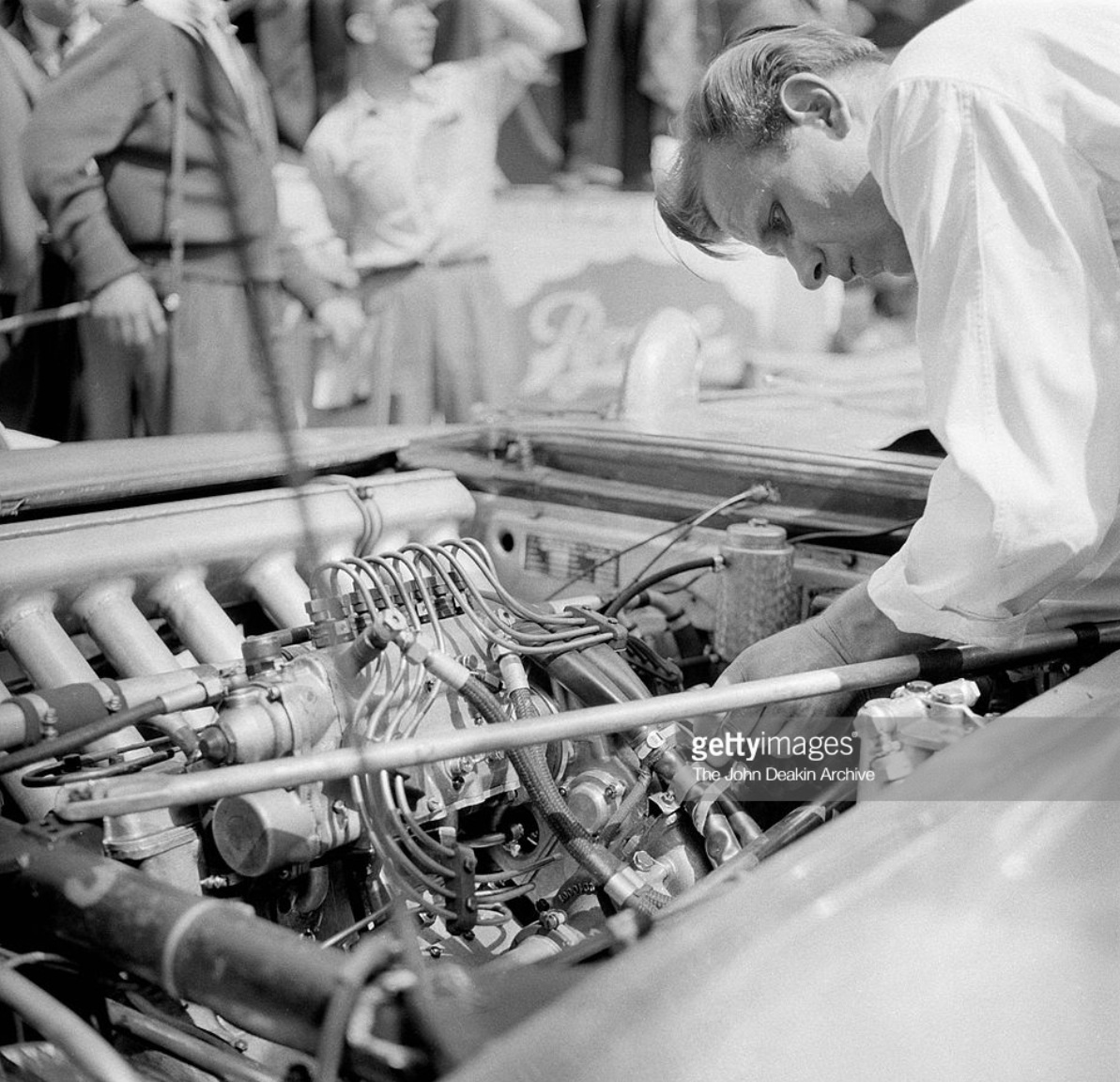
Le Mans 1955. The engine view is dominated by the Bosch direct-injection high pressure pump and inlets (Getty)

At the heart of the matter is the superbly built Mercedes straight-eight cylinder engine. Cast in two blocks of four-cylinders it runs on a pre-war style roller bearing crankshaft. Bosch provided the fuel injection, the two valves per cylinder of desmodromic actuation. The 3-litre engine produced circa 310 bhp @ 7400 rpm on ‘pump’ fuel as against the more exotic brew which fed its GP brother.

The full technical specifications of this car are at the end of the article.
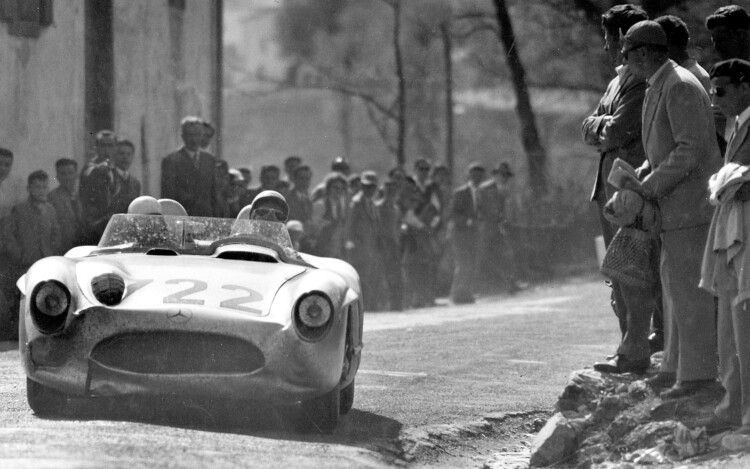
A very famous photo I first saw in Automobile Year, Moss and Jenkinson, Mille Miglia 1955 (unattributed)

Race programme…

Mercedes didn’t attend the 23 January Buenos Aires 1000 Km first round of the Manufacturers Championship which was won by the Ferrari 375 Plus raced by Valiente/Ibanez. The Sebring 12 Hour was won by the Briggs Cunningham entered Jaguar XKD crewed by Mike Hawthorn and Phil Waters, again Mercedes missed the event held on 13 March.

The 300SLRs arrived with a bang in Italy with the Stirling Moss/Denis Jenkinson combination winning the Mille Miglia in front of Fangio driving solo in a sister car.

This win and all-time-record speed of 157.65km/h has been eulogised down the decades and needs no further comment from me. Seek out Denis Jenkinson’s account of the race in MotorSport, it is one of the great pieces of automotive race journalism.

Le Mans followed in June with the works Jag-Ds of Mike Hawthorn and Ivor Bueb completing the largest number of laps to cross the line in first position, after Mercedes Benz respectful withdrawal from the event whilst in the lead.
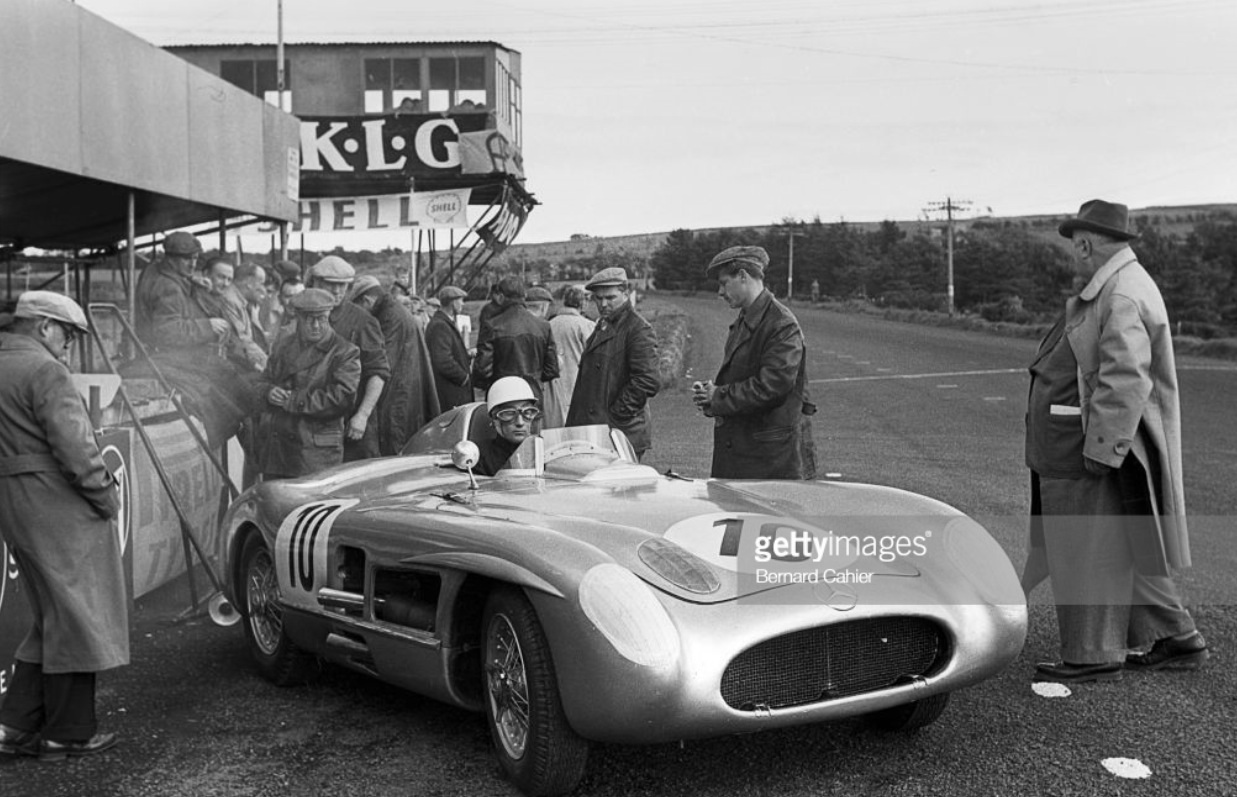
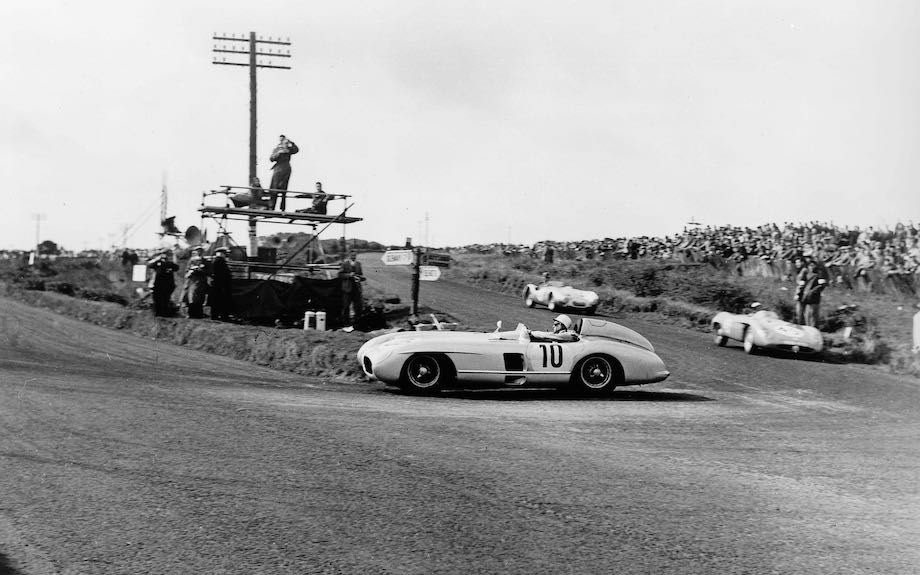
Moss, 300SLR, Dundrod 1955 with the unmistakable slender frame of Herr Neubauer at right
Moss, SLR winner of the TT at Dundrod 1955, the following cars folks? (unattributed)

Dundrod’s wild road circuit hosted the Tourist Trophy in mid September. The race started in warm weather which deteriorated to rain later in an event became an 300SLR rout: the Moss/John Fitch car won from the Fangio/Kling machine with the Von Trips/Simon/Kling machine third. The best placed Jag was the Hawthorn/Desmond Titterington car in fourth, albeit it wasn’t running at the finish.
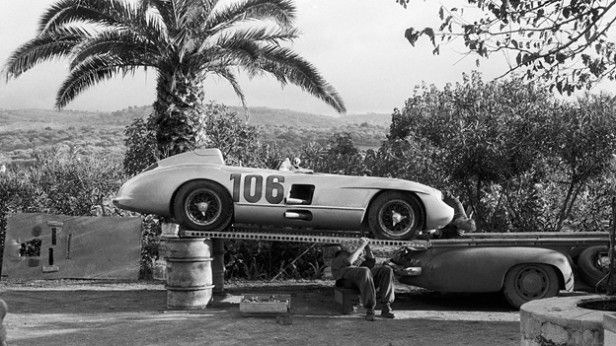
Targa Florio 1955, the Titterington/Fitch SLR gets s tickle before the off, typical Sicilian backdrop. The winner was the Moss/Peter Collins 300SLR (unattributed)
Targa Florio 1955, again Titterinton/Fitch fourth placed SLR from the third place Ferrari Monza 860 of Castellotti/Robert Manzon (unattributed)

The Germans again beat the Italians on home turf, taking the Targa Florio with a one-two from Ferrari on 16 October. The Moss/Peter Collins car finished ahead of Fangio/Kling with the best placed Ferrari the 860 Monza raced by Eugenio Castellotti and Robert Manzon.

Despite missing several events, Mercedes won the constructors championship by one point from Ferrari: 24 points to 23 with Jaguar in third on 16. The W196S won every single race it entered and finished…

At this point, Mercedes withdrew from the elite levels of the sport until returning with Peter Sauber’s sports-prototype cars in the mid-1980s. Click here for my W196R article; https://primotipo.com/2015/10/09/mercedes-benz-w196-french-gp-1954/
(Mercedes Benz)

Technical Specifications…

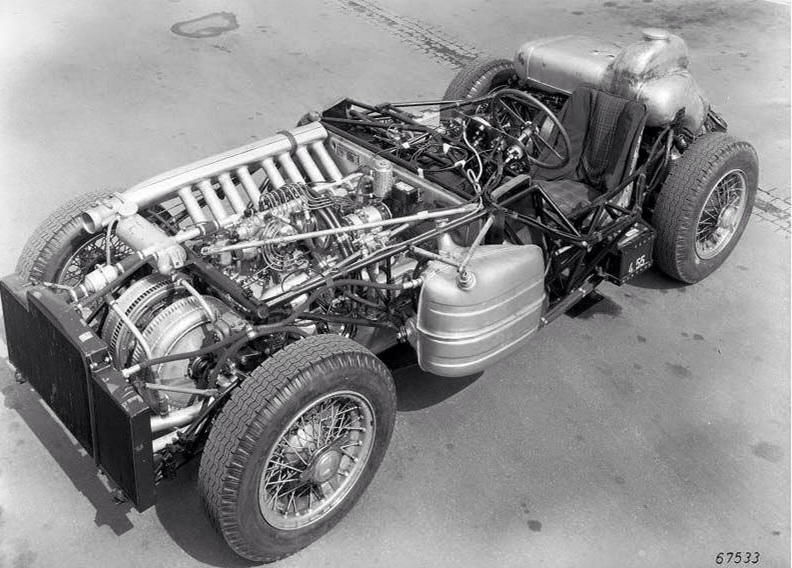
The chassis is a light-weight multi-tubular spaceframe, front suspension comprised upper and lower wishbones, torsion bar springs and telescopic shocks. Those huge, light alloy finned drum brakes are mounted inboard and 300mm in diameter. Steering is worm-and-sector, the front tyres 6.00 x 16, the radiator is huge! The alloy oil tank is behind the right-front wheel, while the fuel tank sits high at the back, its capacity not specified by Mercedes.

The 234kg engine – type M196S – is eight-cylinders in line and inclined 53 degrees to the right in the chassis. The silumin head is cast in one piece: DOHC, two plugs per cylinder, two inclined valves per cylinder with desmodromic valve gear, compression ratio 9:1. Bosch 8-plunger injection pump,

Block – two Silumin blocks of four-cylinders each with chrome plated aluminium liners. Bore/stroke 78 x 78 mm, capacity 2982 cc. Crankshaft 10-bearing (roller bearings) Hirth-type crank with central power take off. Dry sump lubrication via a gear pump. Electricals are by Bosch: starter, generator and twin-magneto ignition.

Power, 310bhp @ 7400rpm, 276bhp @ 7000 rpm, and torque 31.7mkg @ 5950 rpm
(Mercedes Benz)

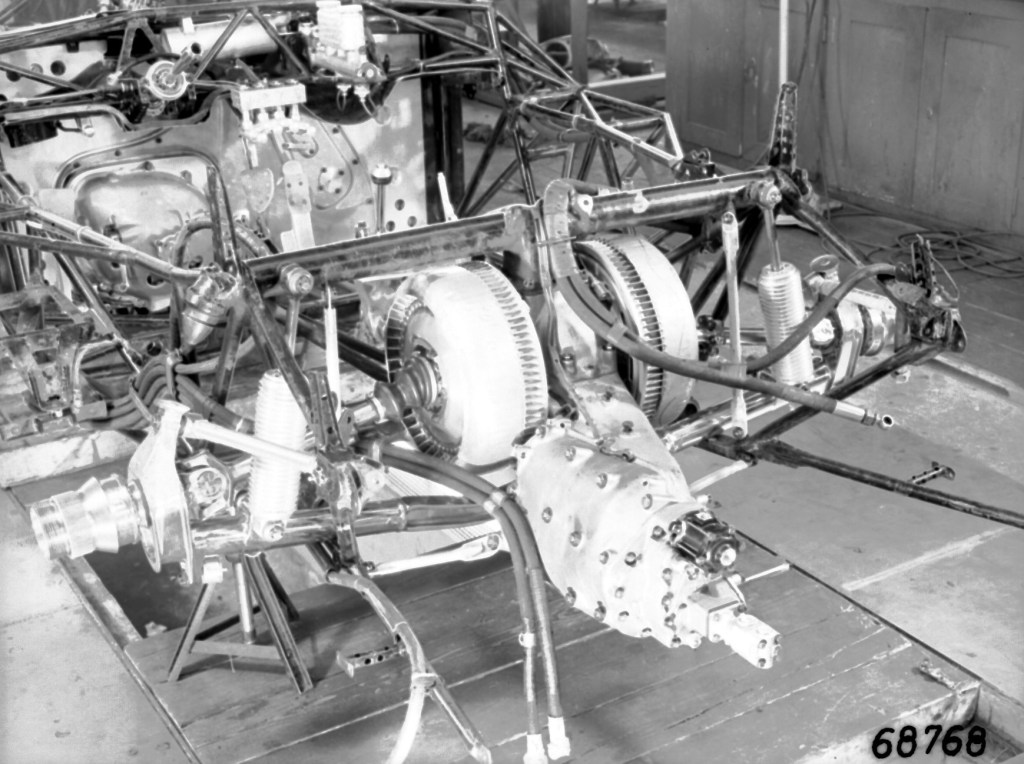
The rear suspension comprises alloy uprights, a single-joint lower swing axle and top links, longitudinal torsion bar springs and telescopic shocks. The 275mm diameter brakes are inboard duplex light-alloy drums and air-cooled.

The transaxle is five-speed, a gate shift was used with a locking system
(Mercedes Benz)

The wheelbase is 2370mm, front track 1330mm, rear track 1380mm, the cars length 4300mm, its width 1740mm and height 1100mm and the “weight of the car in ready for operation status” is/was 901kg.

While the five gear ratios were fixed, the final drive was to choice with top sipped quoted as “over 300km/h.”

(Mercedes Benz)

Etcetera…

(Mercedes Benz)

You should take a trip to mercedes-benz-publicarchive.com some time, the quality of the racing content is unbelievable. I’ve added in some shots but these are just the tip of the iceberg, have a look for yourself.
(Mercedes Benz)
(Mercedes Benz)
(Mercedes Benz)

Credits…

M@RS-mercedes-benz-publicarchive.com, Getty Images, Autocar

Tailpiece…
(Mercedes Benz)

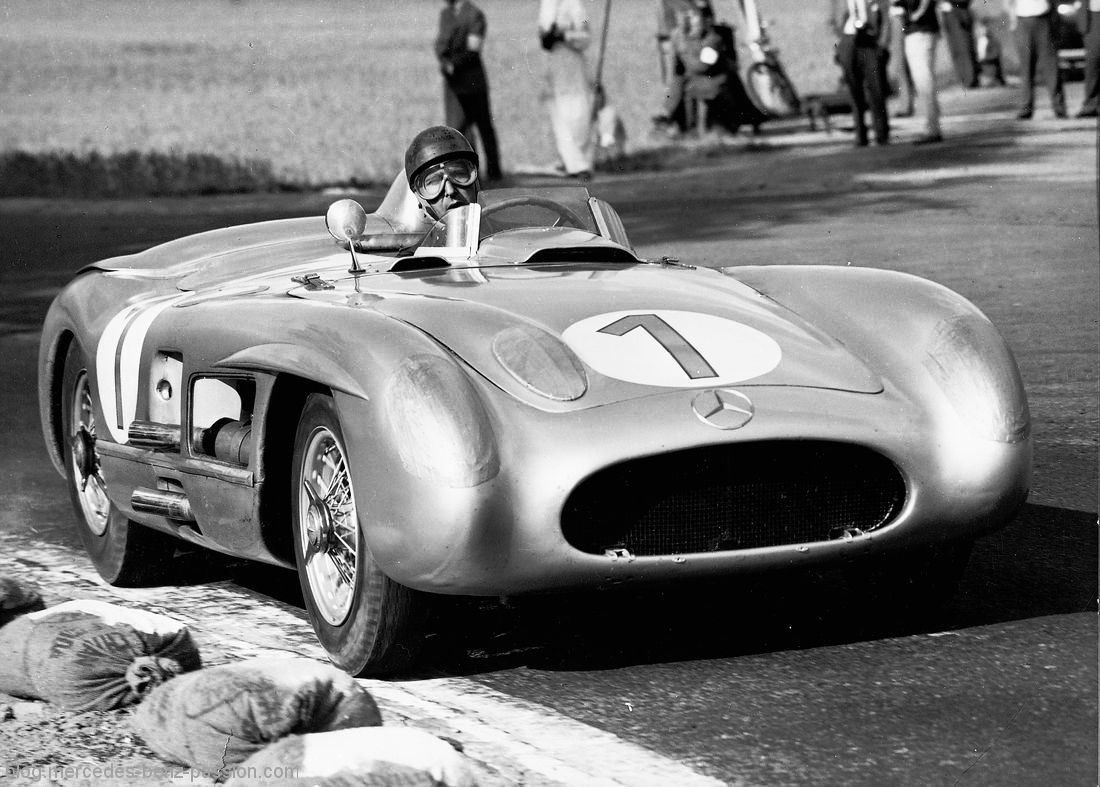
Top shot! Isn’t that machine such a cohesive, great looking, purposeful racing car…

JM Fangio on the way to winning the 209km Swedish GP held at Kristianstad on August 7, 1955. He won from Stirling Moss’ 300SLR and Eugenio Castellotti’s works-Ferrari 121 LM in 1 hr 18m 13.7sec.

Finito…

image

‘The good news is the car isn’t completely rooted, the bad news is I can’t get it going…’

Eric Thomson giving the Aston Martin team the sad news that the impressive run by the big Lagonda (Development Project) DP115 V12 has come to an abrupt halt. As the pictures show it was not for lack of trying. He spun and crashed the car in The Esses.

Thomson got the car mobile and back to the pits but it was retired after completing 26 laps, co-driver Dennis Poore didn’t get a drive in the race. Froilan Gonzalez and Maurice Trintignant won in a Ferrari 375 Plus, click on this article i wrote a while back;

Le Mans 1954…

image

No doubt there were plenty of yellow flags but Thomson was exposed as he successfully got the car running. Passing is the Pilette/Gilberte Gordini T17S DNF and Moss/Walker Jag D Type DNF, ’54 the D’s first Le Mans (Jack Garofalo)


image

(Klemantaski)

Eric Thomson blasts the brutally handsome Lagonda DP115 towards ‘White House’ during the early hours of the ’54 Le Mans…

He was running strongly in 3rd place at that stage of the race in a field that year which included the Ferrari 375 Plus, D Type Jags making their Le Mans debut, Cunningham C4R Chrysler V8’s, the DB3S were also potential outright cars in the ‘right circumstances’, the V6 Lancia D24’s and Porsche 550 Spyders to ‘pick up the scraps’.

image

Some ‘delicate’ panel beating of the Lagonda’s aluminium flanks by Eric (Jack Garofalo)


image

Lagonda DP115; Chassis tubular, front suspension trailing links, transverse torsion bars. Rear de Dion, trailing links & torsion bars, roll bars front and rear. Drum brakes.  Engine; 60 degree, aluminium 4486cc DOHC, 2 valve V12. 3 Weber IFC4 carbs, bore/stroke 82.5mmx69.8mm, compression ration 8.5:1. Circa 310bhp@7500rpm. Gearbox DB S32 5 speed. Weight circa 1140Kg (Klemantaski)

Lagonda’s new car during early tests on 22 April 1954.

Gearbox/transmission manufacturer David Brown bought Aston Martin and Lagonda, the acquisitions made as he admired the newly developed box-section Aston Martin chassis and the W.O. Bentley/’Willie’ Watson designed Lagonda straight-six engine. Initially he made the focus on road car development, the Aston’s used the old four cylinder engines.

One of these was hurriedly prepared for the 1948 Spa 24 Hours and won! It was the start of Aston Martin’s renewed racing efforts, both as a works team and selling racers as customer cars into the dawn of the sixties.

Using the Lagonda design as a basis, Aston Martin developed a new ‘DB3S’ sports racer at the start of the 1953 season. It was a  good 3 litre class car, but as an outright car it was bested by Lancia, Ferrari and Jaguar ‘heavy metal’. The CSI didn’t mandate a 3litre capacity upper limit for Sports Cars, to slow them down, until the start of 1958.

To compete for outright victory Aston Martin needed a larger more powerful engine, but there was no road going Aston into which to fit such an engine to make the project economically feasible.

Brown therefore decided to revive the Lagonda name and design a new V12 for both a racer and Lagonda road car.

image

Thomson in DP115 ‘neatly parked’ in The Esses. Car looks okey-dokey both front and rear in this shot. Note difference in cars nose compared with the earlier images of Brown at the wheel above and Parnell below (Jack Garofalo)

‘Willie’ Watson developed a 4.5 V12 engine. Following the basic design elements of the straight six, the new engine featured twin overhead camshafts and two plugs per cylinder. To keep weight down, the engine was cast in aluminium. Equipped with three quad-choke Webers it initially produced 280 bhp, but with development there was the potential for much more. Mated to a four speed ‘box, the engine was installed into an enlarger and ‘beefed up’ DB3S chassis. Similarly the body was DB3S derived albeit with three separate front air intakes.

image

Reg Parnell racing DP115 in its debut race, Silverstone BRDC International Trophy Meeting on 15 May 1954. Great looking car (GP Library)

During its first test, with David Brown at the wheel ‘DP115’ caught fire! The car was hurriedly repaired to contest the 1954 Silverstone ‘International Trophy’ F1 meeting supporting sportscar race, Reg Parnell finished 5th, well behind the Ferraris and Jaguars, but ahead of its 3 litre class winning sibling Astons.

By then after some fettling the engine produced circa 310 bhp, whereas the Ferrari’s claimed outputs were of greater than 350bhp. Initial problems included cold starting and handling characteristics, but there was no time to do the necessary development work before Le Mans on 12/13 June.

image

First lap Le Mans 1954, 2nd placed D Type of Rolt/Hamilton and #10 Bouillin Talbot Lago T26 GS. Check out the photographer? atop the pole!  (GP Library)

For Le Mans the four speed gearbox was replaced by a stronger five speeder and the nose of the modified with a single larger air-intake similar the DB3S.

Aston Martin entered 2 DP115s, but one was withdrawn and replaced by a 4th DB3S. The cars handling contributed to Eric Thompson’s spin after 2 hours, whilst lying in 3rd place. After the strenuous efforts clear in the photos he managed to coax the big V12 back to the Aston pits, but it was damaged too badly to be made raceworthy. In a poor race for the team none of the other Astons finished.

image

Thomson beavering away, he did ‘cut and shut’ the rear of the thing considerably, other shot is of Gonzalez in thw winning Ferrari 375 Plus (Getty)

The other DP115 first raced in the 1955 British Grand Prix support sportscar race, it finished 4th behind three DB3S. Neither car was raced again.

The cars 1954 results were poor but unsurprising with a relatively new and underdeveloped chassis and engine. Undeterred, for 1955, Brown’s team built two new multi-tubular spaceframe/backbone chassis to which the engine was fitted, the cars were designated  ‘DP166’.

image

The Parnell/Poore Lagonda DP166 in the Le Mans pits 1955 (unattributed)

One car was entered at the ’55 Le Mans, driven by Reg Parnell and Dennis Poore the Lagonda DP166 retired after 93 laps of the tragic race with fuel feed problems. That was the effective end of the V12 program. Encouraging for Brown was the 2nd place finish of the DB3S driven by growing GP star Peter Collins and equally developing endurance racer Paul Frere.

The focus for the next few years was the DB3S program. The chassis of both DP166s were later used to form the basis of the Aston Martin DBR2s. Le Mans and World Sportscar Championship success came of course in 1959 with the glorious 3 litre DBR1’s…

Le Mans 1959: Aston Martin DBR1/300…

Checkout this website of Michael Green’s, his mother, father and uncle worked at Aston’s during these years, his recollections fascinating reading…

http://www.offroadexperience.com/wcb/aminfo.htm

Credits…

ultimatecarpage.com

Tailpiece: Merde! Thomson gets plenty of advice from the Aston pit…

image

Finito…