Posts Tagged ‘Alfa Romeo T33’

(Yuriy Shevchuk)

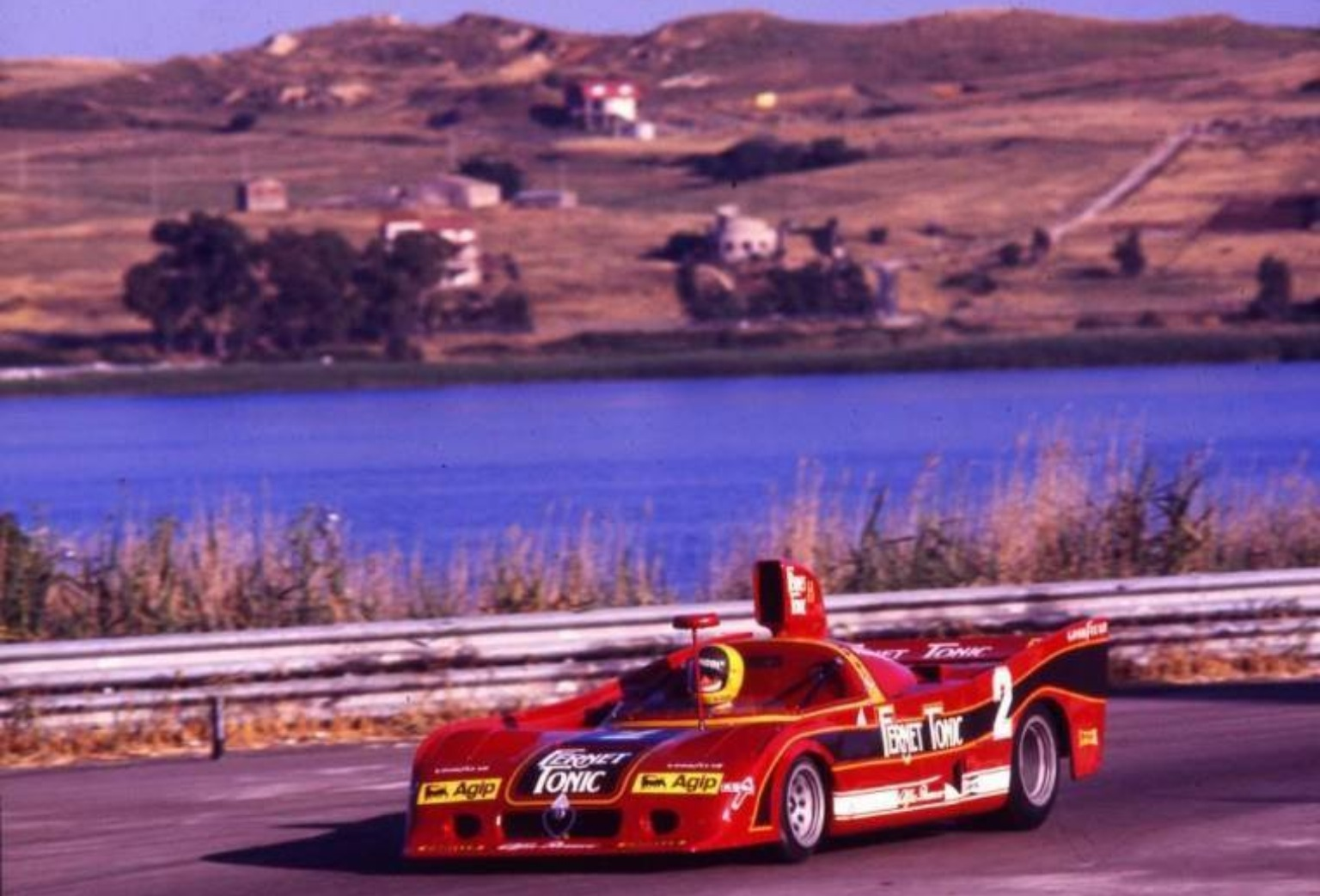
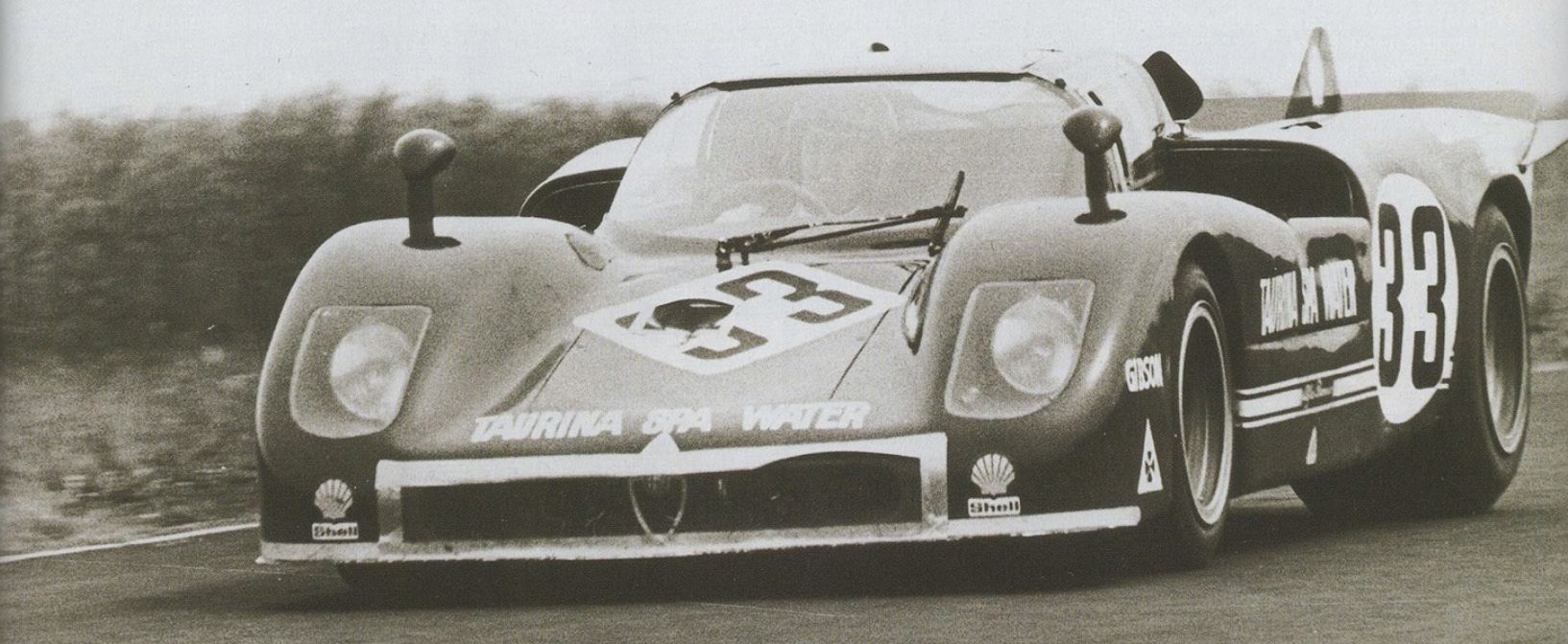
Rolf Stommelen jumps aboard the Alfa Romeo T33/TT/3 he shared with Nino Vaccarella in the May 5, 1972 Targa Florio, the pair retired with valve-spring failure on lap three.

The car carries #1 in recognition of Alfa’s fantastic win the year before when local lad Nino Vaccarella won with Toine Hezemans aboard a T33/3 3-litre V8. The brilliant Schlegelmilch shot below captures Nino during his winning ’71 drive.

(R Schlegelmilch)

It was a great year for Alfa Romeo/Autodelta, they won the Brands Hatch 1000km (Andrea De Adamich/Henri Pescarolo) and Watkins Glen 6-Hour (De Adamich/Ronnie Peterson) as well, not to forget class wins at Monza, Spa and Zeltweg. The opposition 3-litre flat-8 Porsche 908-03s and flat-12 Ferrari 312P were plenty quick too, not to forget the 5-litre 12-cylinder Porsche 917s and Ferrari 512S’.

(MotorSport)

Vaccarella, sharing the T33/TT/3 shown in the painting with Rolf Stommelen during the 1972 race. Despite the Porsche 908/03 inspired T33/TT/3 spaceframe chassis – lighter, weight-forward, still V8 powered (TT is telaio tubolare or tubular chassis) – making its debut in practice at Targa twelve months before, the four Autodelta entries still couldn’t knock off a late-entry singleton Ferrari 312PB 3-litre flat-12 driven by Arturo Merzario and rally-ace Sandro Munari.

Rolf Stommelen creating huge interest in the Targa pits in 1971, he is about to do some laps in the first Tipo 33/TT/3 spaceframe car. Its 219cm wheelbase was 13cm less than a T33/3 and at 560kg it was 50kg lighter. Rolf lapped in the 37 minute mark – reporting it too stiff – compared with other cars doing 34/35s. While entered for Carlo Facetti/Teodoro Zeccoli it was not intended they race it, nor did they drive it, but Rolf and Nino did, the long test process was underway

Nanni Galli and Helmut Marko were 17-seconds behind the winning Ferrari and catching it hand-over-fist at the end of the race, Marko set a lap record of 33min 41sec in his epic chase. De Adamich and Toine Hezemans were third in another Alfa T33/3, while the Vic Elford/Gijs Van Lennep duo were out with engine failure without completing a lap. As recorded, Vaccarella/Stommelen were out with a broken valve spring after completing three laps. 38 cars finished the gruelling event with a massive 37 DNF’s, five due to accident damage.

Art Merzario in – very low as always! – the winning Ferrari 312PB (P Lyons)
(Wiki-unattributed)

The first of the privateers placed fourth, the Antonio Zadra and Enrico Pasolini Scuderia Brescia Corse 2-litre Lola T290 Ford FVC is shown above at Collesano in a classic Targa shot, they also won the 2-litre class.

MotorSport)

The winning Ferrari (above) completed the 792km journey in 6hr 27min/48seconds. The Armco-installer must have been well-lubed with grappa when he executed his contract.

This wonderful race was living on borrowed time for yonks, it became a national race from 1974 until 1977 when the race ceased, albeit the Targa Florio Rally was a round of the Italian Rally Championship for some years.

Tribute events have popped up around the world, not least Targa Tasmania, itself in the news in recent years because of fatalities as a consequence of a mix of (mainly) amateur drivers, high speeds and unyielding eucalypts.

Butt shot of De Adamich in his T33/TT/3 during the 1972 race. Feel the vibe folks, you are so lucky if you experienced this lot!
Gijs Van Lennep swaps notes with an Autodelta technician before the off in 1972 (unattributed)
The Businello/Zeccoli/De Adamich/Galli Alfa T33 2-litre Periscopica heads out for practice on the Nurburgring during the May 1967 1000km weekend. They were fourth in the race won by the Udo Schutz/Joe Buzzetta Porsche 910 (unattributed)

Alfa Tipo 33 history in brief…

Alfa Romeo returned to sportscar racing in 1967, the early period of the 2-litre Tipo 33 Periscopica is covered in this article; https://primotipo.com/2015/06/23/alfa-romeo-tipo-33-periscopica-mugello-19/ and here on the evolution of the Tipo 33 V8 as fitted to single-seaters; https://primotipo.com/2019/11/29/mclaren-alfa-de-adamich-alfa-single-seater-v8s/

With a view to class and outright wins Chiti and his team started development of a 3-litre Tipo 33 which used an aluminium monocoque chassis rather than the complex cast magnesium chassis of the earlier 2-litre (and some 2.5-litre) machines.

Fitted with 2998cc 90-degree V8s giving between 400bhp @ 9000rpm and 440 bhp @ 9800rpm over the life of the 1969-72 program, and first six, then later five-speed Alfa gearboxes, the cars were first tested in early 1969.

Vaccarella during his victorious 1971 Targa win with Toine Hezemans. Alfa T33/3 monocoque, with Bernard Cahier’s rear body-off shot (below) of one of the T33/3s during the same meeting

With ongoing development, class wins at Imola and Zeltweg were achieved in 1970, with a magnificent run of success, as covered above in 1971.

Inspired by the ultra-light 908/03, and detuned-F1-powered Ferrari 312P, a new spaceframe T33/TT/3 was built, tested and raced in 1971 before an assault on the 1972 World Championship of Makes. While Alfa Romeo finished a very good second to Porsche in the 1971 World Sportscar Championship (72/51 points), things were grim in 1972 when Ferrari beat them resoundingly, 160 points to 85, with the Alfas not taking a win.

Ferrari won 10 of the 11 qualifying rounds with their 312PB, electing not to contest Le Mans on the basis that their detuned F1 engined cars wouldn’t last the distance. A 3-litre detuned F1 engined Matra MS670 V12 driven by Henri Pescarolo and Graham Hill took an historic win for France that day instead. While on one level Ferrari’s Le Mans non-appearance was savvy – they had the WSC locked up – it was also gutless, they dipped out on the only sportscar race that really matters every year.

Vaccarella aboard the Alfa T33/TT/3 he shared with Toine Hezemans to third place behind the Ferrari 312PBs of Mario Andretti/Jacky Ickx and Ronnie Peterson/Tim Schenken, Sebring 12-Hours March 1972
Duo of Alfa T33TT/12s on the Eau Rouge swoop, Spa 1000km 1975. Jacky Ickx from Henri Pescarolo, the Pesca/Derek Bell machine won from Ickx/Art Merzario

Context for Ferrari’s amazing 312PB dominance in 1972 is that they sacrificed their 1971 5-litre 512M program by selling cars/512S update kits to privateers but elected not to race the 512M as works cars, effectively gift-wrapping the final 5-litre Era endurance title for Porsche. It’s staggering in the sense that Ferrari could only finance the build of these 25 5-litre cars due to the sale of of his business to Fiat in 1969.

The pay-off was that the single 312P prototype that raced (driven mainly by Jacky Ickx and Clay Regazzoni) throughout 1971 was turned into a panzer division of evolved, ready-to-rock 312PBs in 1972. Despite ongoing development at Maranello, Matra caught Ferrari napping in 1973, winning five of the ten rounds, Le Mans and the title that year, change is the continuum after all.

Alfa T33/SC/12 1977. Monocoque chassis, five-speed Alfa transaxle, 180-degree V12 ‘flat-12’, 2995cc, gear driven DOHC, four-valve, Lucas fuel injected circa 520bhp @ 12000rpm (B Betti)
Alfa Romeo 520bhp 3-litre flat-12 during the Dijon 500km weekend in 1977. The Jean-Pierre Jarier/Art Merzario T33/SC/12 won this race

Alfa Romeo returned with the Tipo 33 TT/12 in 1973 – spaceframe 3-litre 500bhp flat-12 – and finally took the World Championship of Makes in 1975 with that car, and the World Sportscar Championship in 1977 with the Tipo 33 SC/12 – where SC is Scatolato, a boxed or monocoque chassis 3-litre 520bhp flat-12 and Tipo 33 SC/12 Turbo – monocoque 2.164-litre 640bhp flat-12 – open sports-prototypes.

Vittorio Brambilla enroute to a Monza 500km victory in April 1977, Alfa T33/SC/12

Credits…

Yuriy Shevchuk, Rainer Schlegelmilch, Pete Lyons, Getty Images, Bruno Betti, MotorSport Images, ‘Alfa Romeo Tipo 33 : The Development & Racing History’ Peter Collins and Ed McDonough

(MotorSport)

Tailpieces…

Evocative shot of Helmut Marko on-the-hop in his furious pursuit of the leading Ferrari 312PB in the closing stages of the 1972 Targa. It really was an impressive drive of the T33/TT/3 on this most toughest of tracks.

(MotorSport)

While these days best known as Red Bull’s stock-picker, Marko had the makings of a fine GP driver in 1972. He was, with Gijs Van Lennep, the reigning Le Mans champion aboard a fearsome Porsche 917K, but his racing career ended with the loss of sight in his left eye after an incident at Clermont Ferrand.

A stone thrown up by Emerson Fittipaldi’s Lotus 72D Ford penetrated his visor while at the wheel of a BRM P160B (above) during the closing stages of the July 1972 French GP. Marko later commented that, new to the car, his seat wasn’t fully sorted so he was sitting 15cm higher than in the P153B. But he was still happy to be at the wheel of a more competitive car, he qualified it sixth too, but that 15cm made all the difference with that small, sharp, missile…

Finito…
image

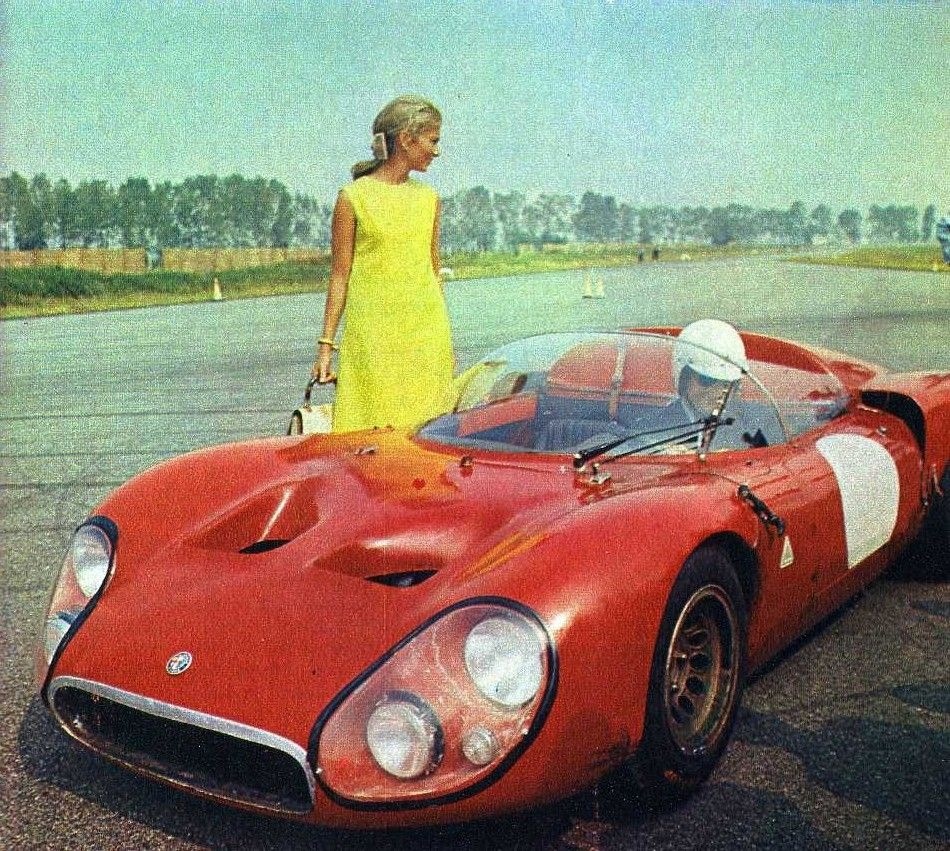
Alfa Romeo publicity shot of Prince Albert and Princess Paola, Belgian Royals at Balocco, Alfa’s test circuit…

The Prince is about to test the ultimately very successful Tipo 33, here in Mugello Spyder 2-litre 1967 form. Thanks to Claudy Schmitz for identifying the Royal Couple and Balocco as the correct venue, the power of Facebook! Whilst the Princess was born of Italian Royal blood it would be interesting to know the circumstances of this test drive, the car was definitely too small for their family of five!

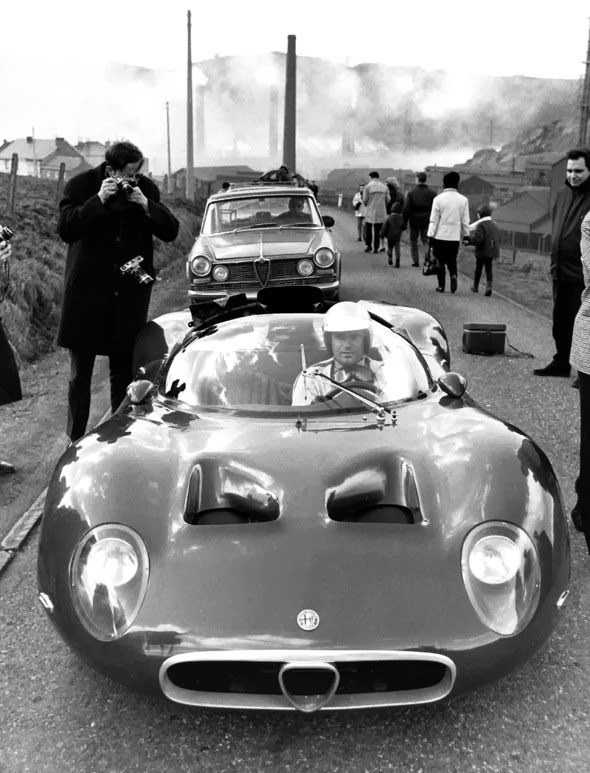
Alfa’s first mid-engined racer made its competition debut at the Fleron Hillclimb in Belgium on 12 March 1967, factory test pilot Teodoro Zeccoli took a win from some stiff competition.

image
Zeccoli at the Belgian Fleron Hillclimb upon the T33 ‘Periscopica’ debut meeting. Alfa 2600 Berlina behind. Fleron is in the Province of Liege, location appears very industrial, power station in the background (unattributed)

The 33 made its race debut at Sebring that summer of ’67, the weekend of 1 April...

Andrea De Adamich led the 12 Hour event’s first lap but both cars entered retired with suspension and overheating dramas.

Here are some shots of the cars in the Sebring paddock; #65 is DeAdamich/Zeccoli, #66 Roberto Businello/Nanni Galli. The race was won by the factory Ford Mk4 of Bruce McLaren and Mario Andretti. I covered the 1967 Endurance Season in some detail in an article i wrote a while back about Ferrari P4/CanAm350 ‘0858’ which may be of interest to some of you;

Ferrari P4/Can Am 350 #0858…

33 1
(Paolo Devodier)
33 2
(Paolo Devodier)

The more you look the more you see, Sebring, the DeAdamich/Zeccoli T33. Engine, two coils, behind the engine the circular vertical ducts which take cool air to the inboard discs when the body is lowered into position are clear. See the rear chassis diaphragm and coil spring/dampers, inboard Girling discs, oil tank to the left of the six-speed Alfa ‘box, battery to its right. Build quality clear.

33 3
(Paolo Devodier)

Those beautiful Alfa mag alloy wheels, filler for centrally located fuel tanks, a spare had to be carried under the regs of the time.The front of the cast magnesium chassis extension houses the radiator, you can just see the nearside suspension ‘top hat’ and adjustable roll bar going forward and mounting at its outer end.

33 4
Engine change in the Sebring ’67 garage. ‘Periscopica’ 2-litre T33 all alloy, Lucas injected, DOHC chain-driven two-valve V8 engine developed a claimed 260-270bhp @ 9500rpm (Paolo Devodier)

Four cars were entered in the ’67 Targa Florio

All failed to finish due to suspension problems (De Adamich/Jean Rolland/Bonnier/Baghetti) and a minor accident involving the Geki Russo/Nino Todaro. The race was won by the Porsche 910 of Paul Hawkins and Rolf Stommelen.

image
Targa Florio 1967. The Bonnier/Baghetti T33 ahead of the other factory cars…Periscopica clear to see. Love the ‘period’ hand-painted numbers. (Unattributed)
bonnier baghetti alsfa
Jo Bonnier in the T33 he shared with Giancarlo Baghetti during Targa 1967 (unattributed)
33 5
T33 cockpit shot at ’67 Targa. LHD unusual in racing sportscars, Alfa would later change to the norm. Momo steering wheel, Veglia instruments, change for six-speed box all clear, lots of instruments for the driver to monitor. Not sure which chassis this is, or the T33 in front, you can just see the tail of the Scuderia Filipinetti Ferrari P3/412P ahead (Rainer Schlegelmilch)

Nani Galli and Andrea De Adamich finally broke through for the team at the Nurburgring, they finished fifth in the 1000Km behind four Porsche 910s...

The winning Porsche 910 was driven by the combination of Joe Buzzetta and Udo Schutz. The De Adamich/Galli T33 had another suspension failure on lap 18, but they shared the other car driven by Businello/Zeccoli, the four drivers getting the joy of the cars’ first race finish.

33 6
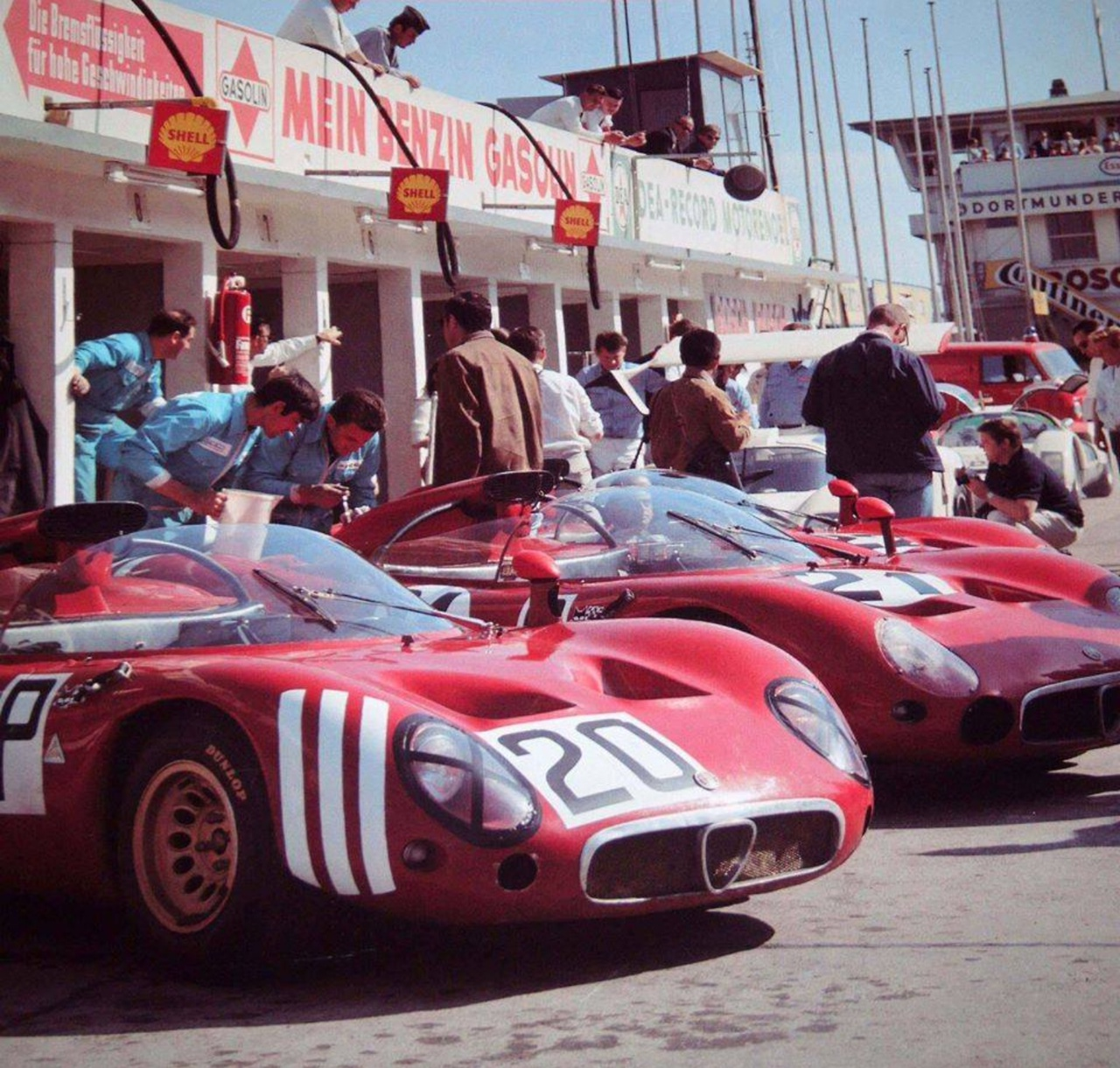
Autodelta SpA lineup in the Nurburgring pitlane, 28 May 1967. #20 DeAdamich/Galli (DNF suspension) #21 Russo/Baghetti (DNF ‘box) and #22 fifth place car of Businello/Zeccoli/DeAdamich/Galli (Accursio Cassarino)
33 8
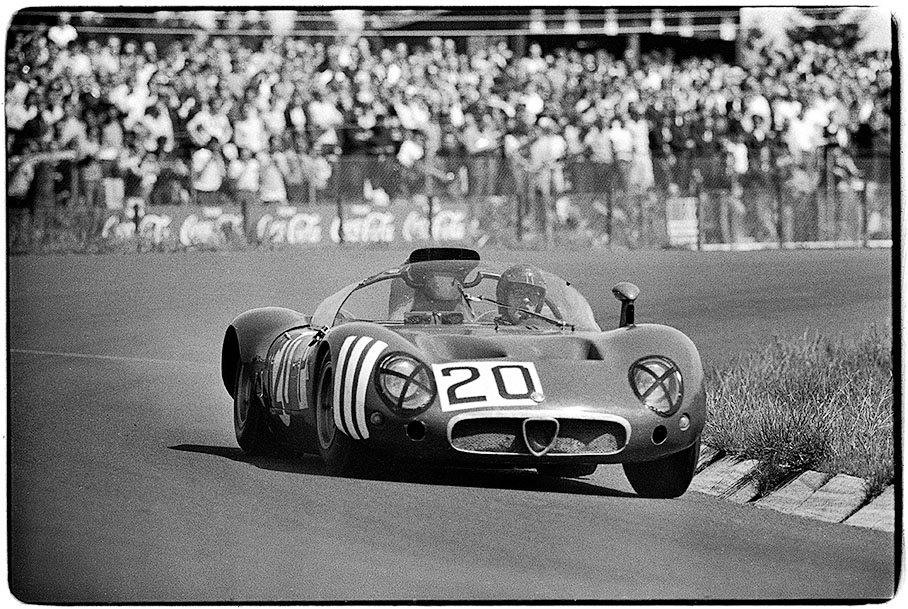
Andrea De Adamich in the T33 he shared with Nanni Galli, the Italian duo DNF with suspension failure, then hopped into the #22 surviving car for fifth place (unattributed)
nurb
The ‘pre-owned’ T33 of de Adamich/Galli during Nurburgring practice 28 May 1967 (Rainer Schlegelmilch)
33 9
Ignazio Giunti with tyre problems at Mugello (unattributed)

The Periscopica’s final start for 1967 was the Circuit of Mugello in July, eight laps of a tough 66km road circuit…

Udo Schutz and Gerhard Mitter won the race tailor made for the fast, light but tough Porsche 910. A privately entered GTA was the best place Alfa in seventh, the three Autodelta T33s of DeAdamich/Galli, Lucien Bianchi/Giunti and Colin Davis/Spartaco Dini all failed to finish.

33 10
(Accursio Cassarino)

It had been a patchy start but the Tipo 33 continually evolved over the following decade ultimately winning many races, sometimes not against the strongest of opposition, but ultimately winning the World Championship of Makes in 1975 and 1977.

Shown above is the 1977 Alfa 33 SC12 driven by Spartaco Dini at Enna-Pergusa in June. The car used a spaceframe chassis (Alfa used both spaceframes and monocoques during the model’s long life and evolution) and a 2.1-litre fuel injected, twin turbo, four-valve V12 producing circa 640bhp. Dini practiced the car but did not start, this car was driven by Francia/Merzario but was disqualified for a startline infringement, Arturo Merzario won in another SC12.

image
(Vic Berris)

The T33 in its original guise had an unusual chassis design...

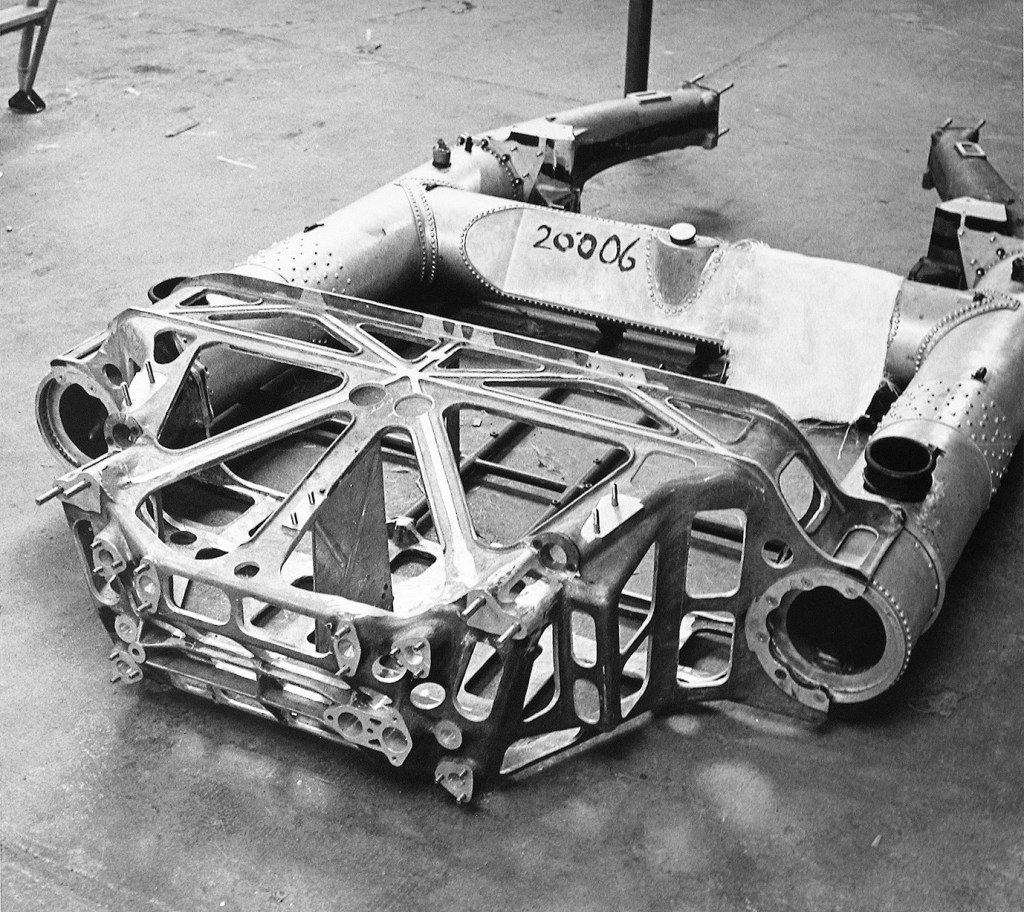
The main structure comprised two longitudinal aluminium spars to which was mounted a complex magnesium casting at the front, the front suspension mounted to it. At the rear the spars had a fabricated sheet metal saddle to which the suspension was attached.

The suspension itself was conventional for the period; upper and lower wishbones and coil spring/ damper units and single top link, inverted lower wishbone and twin radius rods, coil spring/ dampers at the rear. Adjustable sway bars fitted of course. Uprights were cast magnesium, steering rack and pinion with Girling disc brakes front and rear. Weight 580Kg.

(LAT)

Periscopica chassis. The incredible, complex cast magnesium front bulkhead referred to in the text is clear, the spars are bolted to it, and in turn, the two rear section pieces to the large spars.

image

The tall ram air intake gave the car it’s nickname, Periscopica…

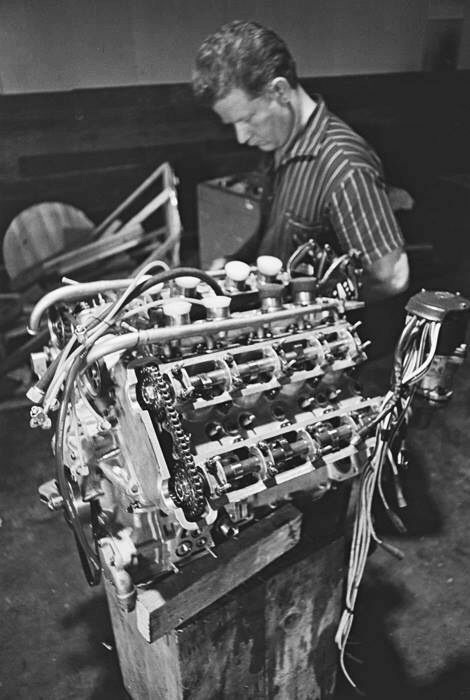
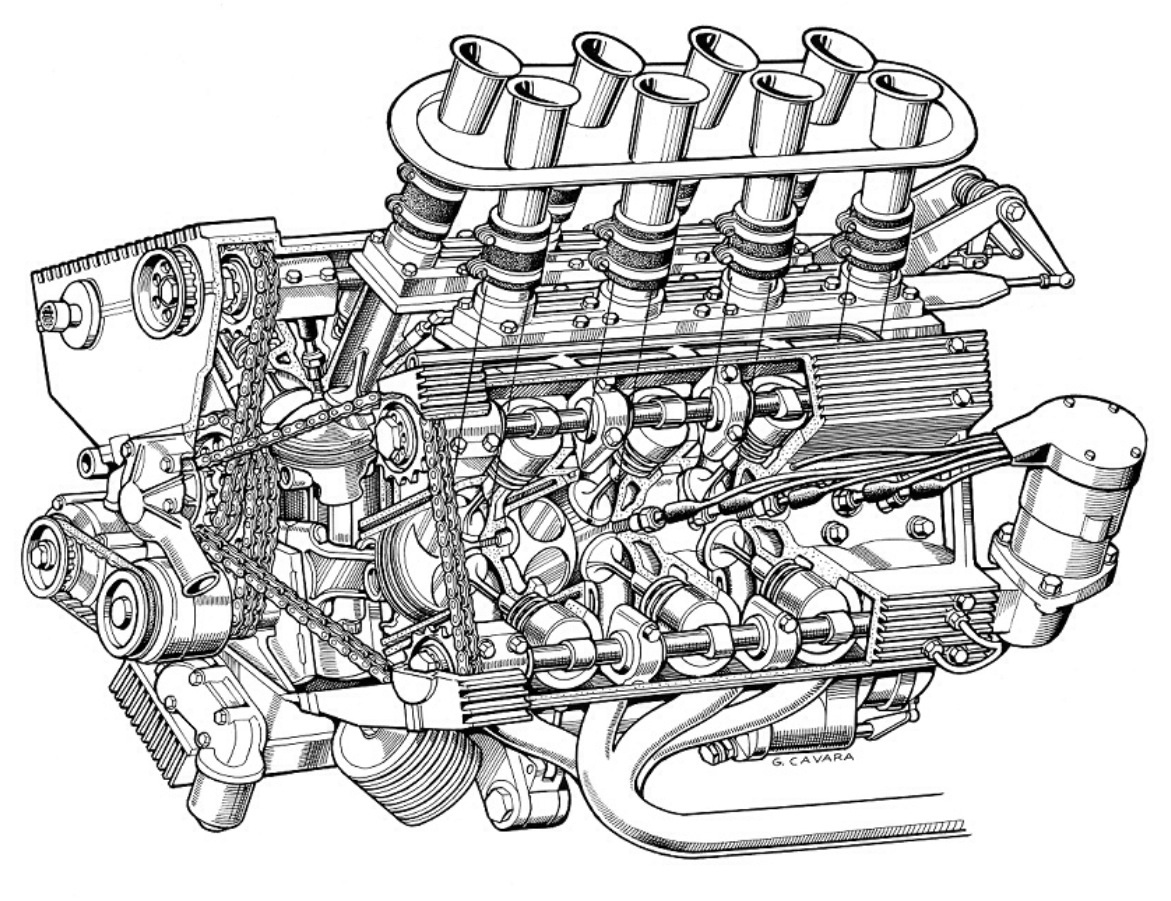
The heart of the early T33s was of course it’s superb little all alloy DOHC V8. Initially 2-litres (1995cc) and two-valves per cylinder, the cams were chain driven, the Lucas fuel injected engines power output was a claimed as 260bhp @ 9500rpm, the gearbox Alfa’s own six-speed transaxle.

Etcetera…

Also see this article on the Alfa T33/3 4-litre coupe: https://primotipo.com/2014/05/15/when-im-in-a-car-i/

Credits…

Cutaway drawing of car Vic Berris, engine cutaway G Cavara, Claudy Schmitz, Paolo Devodier, Accursio Cassarino, Rainer Schlegelmilch, Facebook ‘Alfa Romeo 33 Sport Car’ Group, LAT, Tony Pashley Collection

Tailpiece…

de ad nurb
(Rainer Schlegelmilch)

Andrea De Adamich jumping the T33 he shared with Nanni Galli at the Nurburgring 1000Km in 1967, DNF.

Finito…

photo (4)

Australian Sportscar Championship, the ‘Endeavour Cup’, Phillip Island 1975…

One of the stranger public relations exercises in 1975 was Alfa Romeo Australia’s entry of a Motor-Show Circuit-Queen in the Australian Sports Car Championship.

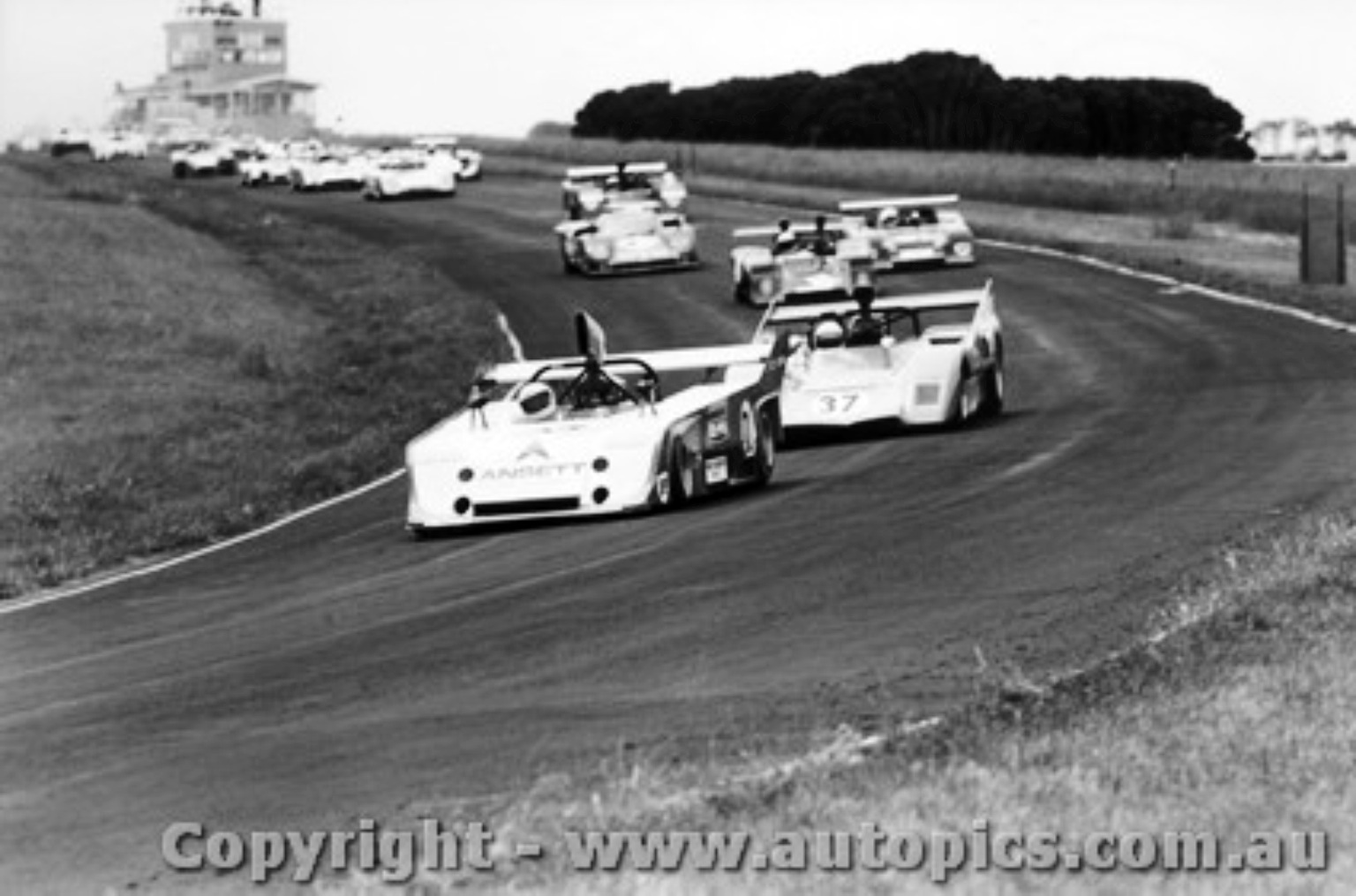
The one race Endeavour Cup – 30 laps 143km – held at Phillip Island on 30 November attracted a strong field of 40 or so of Group A or Can-Am type open sportscars, Production Sports and Clubman cars.

Elfin’s Garrie Cooper built a new car to contest sportscar racing in 1974, his MS7 was powered by one of his F5000 Repco-Holden engines, and was designed using all of the experience Ansett Team Elfin had gained in running 5-litre single-seater cars since 1971. The Elfin would offer the Alfa’s major competition.

Tipo 33/3 ‘75080-005’ Coupe…

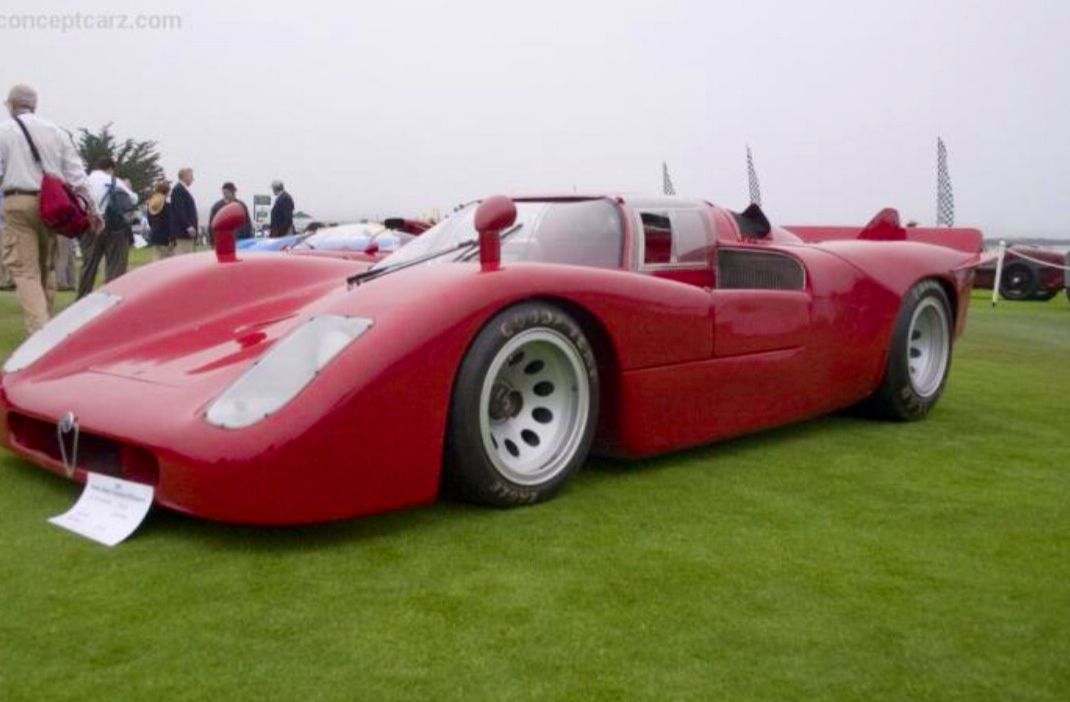
The superb looking Alfa Tipo 33/3 had been on the show circuit for some years, including an appearance at the Melbourne Motor Show in early 1975.

Alfa’s Tipo 33 in various forms was Autodelta’s entry in the World Sports Car Championship or Championship of Makes for over ten years with Alfa winning the championship in 1975 and 1977 using flat-12, circa 500-530bhp 33TT12 and 33SC12 machines.

‘Our’ Tipo 33/3 Coupe was built in 1969. The accepted history is that the car was updated by Autodelta in 1971 and is possibly chassis #75080-005.

The consensus is that the car is the machine raced by Nino Vaccarella at Hockenheim in July 1969. He popped the swoopy-coupe on pole at the Solituderennen and finished third behind Hans Hermann in David Piper’s Lola T70 Mk3B Chev, and Gerhard Koch in a Porsche 908/02. A month later in Sicily, he won the Coppa Citta di Enna against modest opposition. The rest is a bit uncertain, but at some point, perhaps 1971, a 4-litre DOHC, four-valve, circa 510bhp V8 replaced the 3-litre circa 400bhp four-valve unit originally fitted when raced by the Sicilian.

The 4-litre unit was developed for Can-Am series use. Chassis T33/3 75080-023 was raced by the Otto Zipper team with both 3 and 4-litre motors fitted. It was driven by Scooter Patrick without much success in the famous Group 7 series in 1970 and 1971. The results are hardly surprising given the 7-litre papaya coloured monsters (McLaren M8D/F Chev et al) running up front.

Zipper’s “4-litre car, a T33/3 was often referred to as a T33/4” according to Collins and McDonough. In the same way that T33/2s which raced with 2.5-litre V8s did not become T33/2.5s when so fitted, so too, our subject car when fitted with its 4-litre V8 did not become a T33/4.

Both the Zipper and subject car, are Tipo 33/3s. These are type, or model numbers, not engine capacities. To differentiate both cars (Zipper and the subject car) from T33/3s fitted with the usual 3-litre V8, the correct description is Tipo 33/3 4-litre. If evidence can be produced of Autodelta or Alfa Romeo using the T33/4 model designation in period, I will stand corrected.

In addition to the engine change, the T33/3 4-litre’s curvaceous original nose (see photos) was replaced by one to later 1971 specifications, which is as it raced in Australia. No photographs have come to light of the car competing in this later form elsewhere in the world.

The Alfa is a marked contrast visually with Cooper’s Elfin which was aerodynamically influenced by the all-conquering 1972-73 Can-Am Porsche 917/10-30.

By 1972 the Alfa T33/3 4-litre was being used as a promotional tool by Alfa Romeo globally in car shows, some poor quality photographs online show it in Beijing that year in the form shown below.

33 front

The Race…

The exotic Alfa Romeo created a lot of interest at Phillip Island but it wasn’t race prepared, and was fitted with unsuitable gear ratios. It smoked its way around the ‘Island for three days, Fred Gibson did a great job bringing the gorgeous, misfiring car home in third place.

Fred was in Alfa Romeo’s touring car squad at the time running 105 Series 2000 GTVs, but his pedigree included a potent Brabham BT16 Climax Tasman 2.5 single seater and a 5 litre-Elfin 400/R&T Chev sports car. His considerable engineering prowess and mechanical sympathy brought her home and gave we spectators the chance to see the fabulous car race in Australia for its one and only appearance. A lesser driver would not have been able to stroke the thing home.

Garrie Cooper ran away with the event, his sprint car was far quicker than the heavy endurance racer, unprepared as it was. Henry Michell was second in the Elfin 360 Repco 2.5 in which he won the Australian Sports Car Championship in 1974 (a four race series). Fourth was Paul Gibson in a Rennmax Repco 2.5 and fifth, Stuart Kostera in an ex-Frank Matich, Matich SR3A.

The shrill note of the 2.5-litre Repco Tasman V8s and muscular note of the Alfa, also running a single plane crankshaft was in marked contrast to the basso-profundo bellow of the Chev and Repco Holden production based V8s; that long straight and open nature of Phillip Island was, and still is an aural and visual feast.

autopics

I was there for the weekend which also featured the final round of the Australian Formula 2 Championship. Geoff Brabham won that race and title in a Birrana 274 Hart-Ford, then headed off to Europe to pursue F3 and subsequent fame and fortune.

The ordinary black and white paddock shots were the best I could manage with my little Olympus Trip 35 but show the car’s lines well. Call it Alfa’s 917 or 512S in looks without quite the success rate!

Retirement…

The Tipo 33/3 was sold to Melbourne Alfista Ern Stock for a nominal sum, and the cost of outstanding Customs duties, it was just an old racing car after all!

Stock was more of an old-car-guy than a racer. The car appeared at an Alfa Romeo Owners Club day at Winton driven by Col Goldie once. It also did a few laps of a Canberra Motel carpark at an Alfesta – the annual Easter gathering of the Australian Alfa Romeo clubs – one morning in the early 1980s. The poor old Canberra pollies had not heard such excitement since the Petrov Affair!

Eventually the car was Hoovered up by an American dealer as cars of its ilk became global Automotive Monets.

Only Alfa would have done the nutty thing they did, but god bless ’em for doing so, the car was worth travelling a long way to see and hear. It only ran in Australia, just once!

photo (5)

The scrappy photos above and below show the car being driven in anger. While perhaps not as pretty as in its original 1969 guise the machine has a muscular beauty all of its own – quite Ferrari 512S like.

It does make you wonder how it could have fared had it raced at 4-litres in 1970 or 1971 in endurance events. I’m not suggesting it would have knocked off the Ferrari or dominant Porsche 917 mind you, but in 1971 the T33/3 3-litre prototypes were quicker and more reliable than hitherto, taking wins at Brands Hatch, Targa and Watkins Glen thereby giving Alfa Romeo/Autodelta a very well deserved second placing behind Porsche, in the International Championship of Makes; a 4-litre Coupe in the mix is an interesting mighta-been?

G1

Fred Gibson, Phillip Island 1975

G1 (3)
(M Bisset)

Butt shot at Phillip Island 1975. With the addition of fresh rubber and attention to coolant, lubricants and brake fluid, a safety check and a wheel alignment it was off-we-go-with-what-we-have, superb opportunism by Alfa Australia really.

With a fresh engine and suitable ratios the car would have been competitive, but would not have knocked off Cooper’s Elfin. Melbourne Alfista and historian, Vin Sharp, recalls that Ern Stock bought a second engine with the car. Presumably the spares’ health was unknown otherwise the team could have swapped engines overnight at the Island to address the weekend long misfire.

photo (15)
(M Bisset)
image

Bullshit…

retirement

conceptcarz.com wrote in an article about the ‘1970 Tipo 33/4 Tasman Coupe’, and that the T33 was ‘Driven by Pescarolo and De Adamich in three liter form in Europe, it was later run with a 4 liter V8 in Europe’s InterSeries (in blue livery) driven by Teodoro Zeccoli. Later sent to Australia, at the request of Sig Tadini of Alfa-Romeo, Australia, the car was campaigned in the Tasman Cup, since it was already fitted with the larger V-8. It was driven by Graham Lawrence. It was brought to the United States in 1988’ our star writer/researcher wrote. Richard Cranium is his name I suspect.

I can be accused of slavishly following, what has on occasion turned out to be the utter crap written by others, but this nonsense is a total crock-of-shit.

The T33/3 Coupe was never, ever, referred to as a ‘1970 Tipo 33/4 Tasman Coupe’ in period – in any period, not at least until it became a beauty princess in the USA.

The 1970 Tasman Series was a championship of seven races in New Zealand and Australia that January/February for Tasman 2.5 (and under) and Formula 5000 single-seater racing cars. Not 3-litre or 4-litre or sportscars of any sort. The 1970 Tasman was won by Graeme (not Graham) Lawrence, a Kiwi, in an ex-Chris Amon Ferrari Dino 246T, a little, itty-bitty, red, cigar shaped cutey-car which bares little similarity to a big, red, butch 1969 Alfa Romeo T33/3 Coupe or a ‘1970 Alfa Romeo T33/4 Tasman Coupe’, whatever that is.

Lets raise a glass to utter Disney-esque, fanciful bullshit…

Etcetera

Another shot of Col Goldie?, Amaroo Park ‘Tribute to Alfa Romeo’ meeting in the eighties.

The car when owned by Ern Stock during an Alfesta in Canberra, 1982.

Dick Willis and Colin Bond (left) with the Tipo 33/3 4-litre during the launch of the Alfa 33 road car at Dick’s Coffs Harbour Alfa Romeo/Datsun dealership in 1984.

Bondy was racing Alfa’s amongst other things by that stage, and was present as an ‘Alfa Ambassadore’ as Dick put it.

Smile kid. ‘Walter Anker’ and our star car date and place unknown.

Photo and other Credits…

Autopix, Alfa Bulletin Board, Vin Sharp, Autodelta, Mark Bisset, Conceptcarz.com, ‘World Sports Racing Prototypes’- wsrp.cz, racingsportscars.com, Claudy Schmitz, Dick Willis, Tim Bartsch, ‘Alfa Romeo Tipo 33:The development & racing history’ Peter Collins & Ed McDonough, Auto Action December 4, 1975

Finito…