


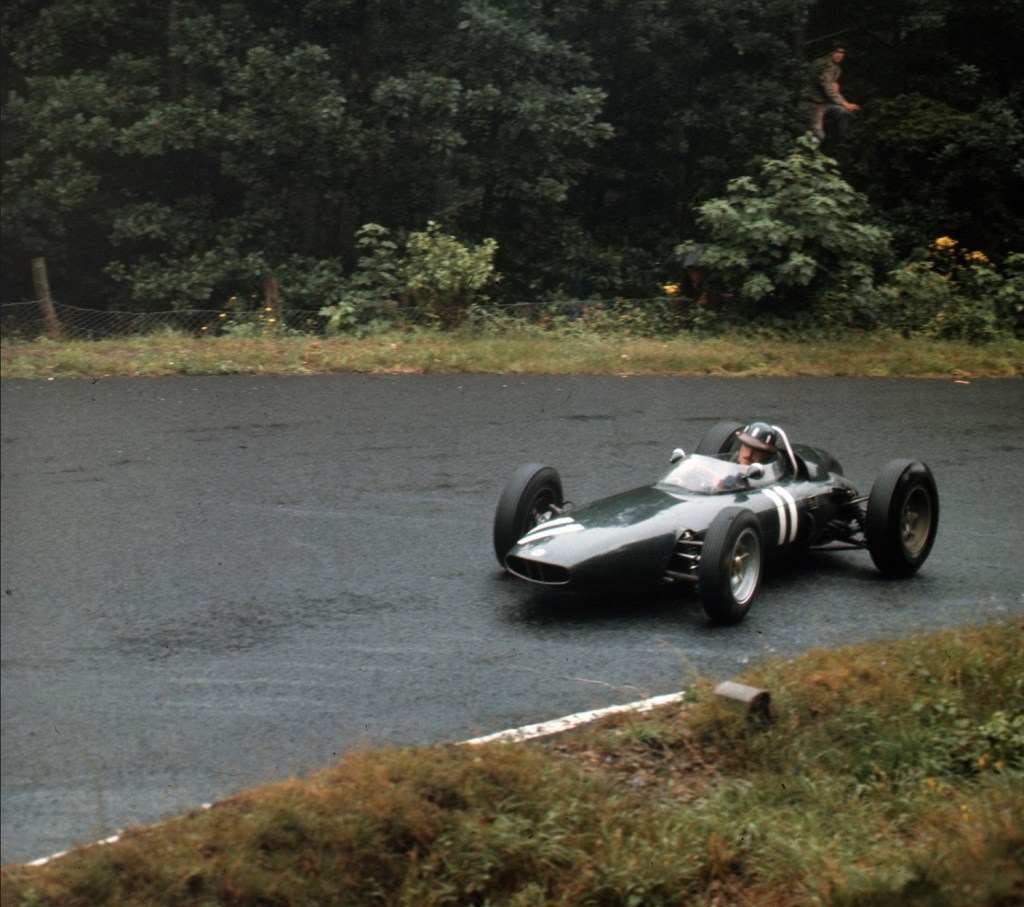
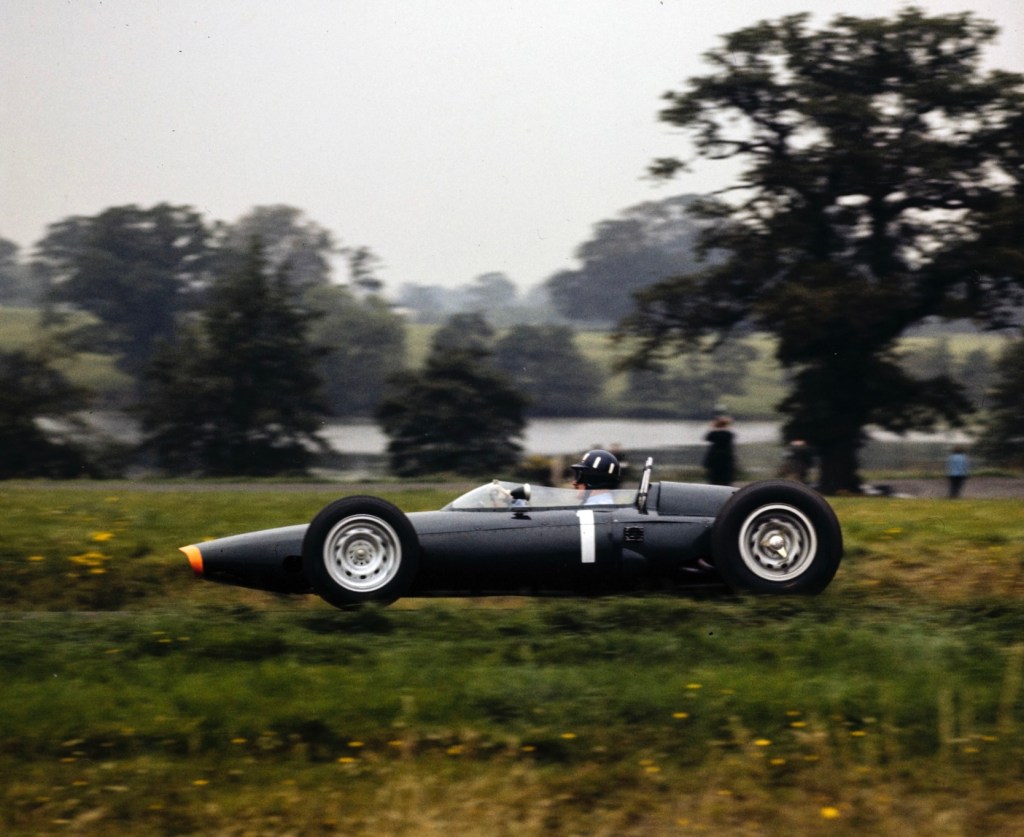
The ‘Stackpipe’ 1.5-litre P56 BRM V8 nestled in one of Graham Hill’s BRM P57/578 chassis’ during his and BRM’s victorious 1962 season…
This series of engines was immensely successful being competitive throughout the 1961-5 1.5-litre F1 and was a bit stiff not to have won the title on multiple occasions. Later in its life it became, in 1.9 and 2.1-litre capacities an effective Tasman Series weapon. It was victorious at 2.1 litres against new 3-litre F1 cars too, winning the 1966 Monaco GP Jackie for Stewart that May. Surely it’s one of GP racing’s great engines?
This is the first in an occasional series of articles focussing on engines, mind you, as usual it’s longer than intended. As is the case with most of my stuff the article is a function of a great photo (above) inspiring the piece rather than me thinking strategically about the relative merits of one engine to another in a particular era, and has grown a bit like Topsy over time!

Background…
BRM commenced the new 1.5-litre F1 in 1961 by using a Coventry Climax FPF Mark 2 engine, it’s ‘Project 56’ 1.5-litre V8 started late and was running behind schedule.
The teams long serving but ‘too dilettante’ technical director Peter Berthon was ‘shunted sideways’, seconded to work at the Harry Weslake Research consultancy in Rye, 280km away leaving Tony Rudd, his assistant, in charge.
By the time this 1960 Dutch GP change was effected, Berthon, with the assistance of consultant engineer Charles Amherst Villiers, an old school friend of BRM founder Raymond Mays and a long term associate of Berthon’s too, was already laying down the conceptual design and detailing of P56. The Shell oil companies research boffins also contributed their knowledge via a project they were completing at the time on ‘combustion in high speed transport engines’.

A core conceptual design foundation was efficiency at extremely high rpm by the standards of the time, and, for the first time BRM was to offer the engine for customer sale in addition to its works-role. There was money to be made, as Coventry Climax had proved in recent years by flogging engines to those with the readies. On Sir Alfred Owen’s insistence BRM were to contest that customer market.
In keeping with the BRM charter of using British suppliers if at all possible, Lucas’ new fuel injection system was chosen. Several design features of the old V16 were used including its timing gear, camshaft drives and similar con-rods, higher inertia loads of heavier pistons (than the V16) involved different big-end bolt arrangements though.
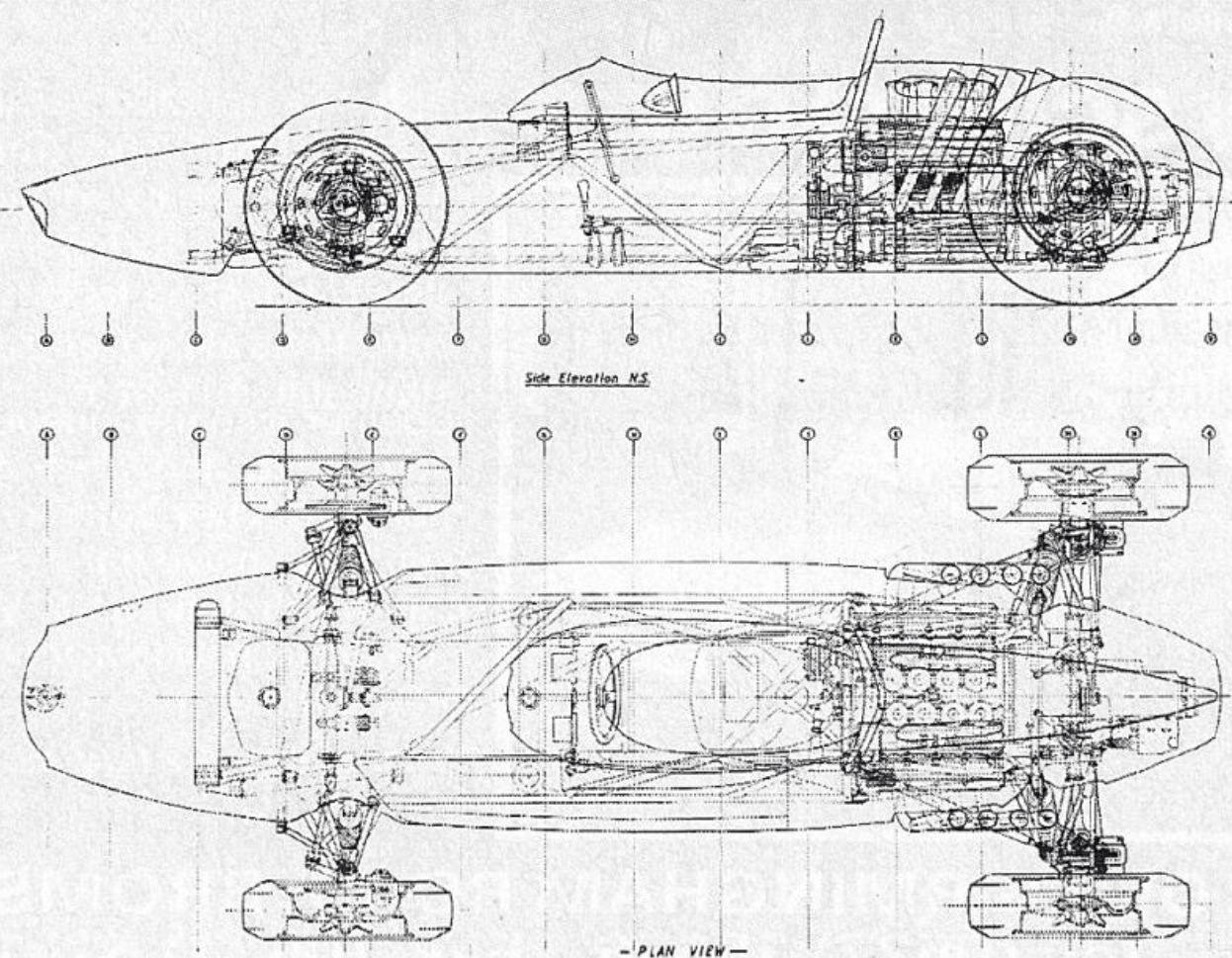
The engine was/is a 90 degree V8 with a bore and stroke of 68.1 x 50.88mm for a capacity of 1498cc, it’s heads and block cast in LM8 aluminium alloy. The sump was magnesium and the crank machined from nitrided EN40U alloy steel and ran in five Vandervell, 2.5 inch wide plain metal bearings. The cams, water pump and distributor for the transistorised ignition system were driven by gears off the crank’s nose.

Two ring die-cast pistons and forged con-rods were used initially but forged pistons with a different profile were experimented with later in the successful search for more power. Results justified Berthon’s original concept of minimising rotating and reciprocating mass with a very over-square bore/stroke ratio by the standards of the day to facilitate high rpm.
Up top the four cams ran in five roller bearings operating two inclined valves per cylinder via inverted tappets. Valve sizes were 1.5625 inch inlet, set at 45 degrees from the bore axis, and 1.20 inch exhaust, set at 30 degrees. Double valve springs were used and proved effective even at 11,000rpm, the valve-gear was designed for a maximum of 13,000rpm.
The new Lucas fuel injection system was of the port type, throttle slides were used after early butterfly throttles were tried and rejected. The compression ratio using mandated 100-octane fuel was 11.5:1. The fuel injected works engines claimed 10bhp more than the Weber carbed customer units in the first year. The metering unit was driven by a toothed rubber belt.

Lucas also provided the transistorised ignition system made necessary by 11,000 rpm. A conventional coil setup produced around 400 sparks per second, and a magneto 500 whereas the BRM needed 733 sparks per second at 11,000 rpm, a task the Lucas transistors achieved. Ignition timing was controlled by pole pieces mounted on the back of the flywheel in conjunction with a magnetic pick-up on the engine backplate. Current was provided by an alternator driven from the right-side inlet cam.

The prototype P56 engine #5601 was assembled at Bourne in June 1961, without starter motor it weighed 251 pounds. On 12 July in the Folkingham Aerodrome test house it first burst into life.
A second engine was built and run at Monza, in practice only, in 1961. That engine, 5602, produced over 184bhp. During 1962 maximum power was 193bhp@10,250rpm, the engines dyno curves showed 110@6,000, 150@7,500, 173@9,000 and 190bhp@9,750rpm.
At Monza in 1962, Hills victorious P578’s P56 engine achieved 10.6 MPG. Graham Hill’s 1962 season is briefly covered in this article, click here for the link; https://primotipo.com/2014/10/12/graham-hill-brm-p57-german-gp-1962/
Initially the engines were fitted with separate individual megaphone exhausts raking back at near to vertical on each side but they fatigued during a race and progressively broke. A low level system made its debut at Spa in 1962 but by then the Stackpipe BRM label had stuck!
A cross-over exhaust and flat plane crankshaft liberated a bit more power as did new Shell low viscosity oils, by February 1963 the works engines gave 200bhp from 9,750-10,500rpm. Four valve heads were tried for 1964 but ‘flopped fearfully’. Reversed port two valve heads and between-the-Vee-exhausts at the Italian GP provided 208bhp @10,750rpm.
Eventually, by filling combustion chambers with weld and re-machining, trial and error stuff engine 5618 produced 220bhp@11,750rpm. This engine was used by Hill at the 1965 BRDC Trophy and became his regular engine thereafter, ‘maxxing’ at 222bhp.
For the sake of completeness the P56 engine family also includes the P60 used in various capacities for 2-litre sportscar, endurance, Tasman and hillclimbing competition as follows;
1965/6 1880cc, 1966 1916cc, 1966-7 1998cc and 1966-8 2070cc.

Race Record…
The P56 and its big P60 brother was a remarkably long-lived engine at International level, let alone its national level wins.
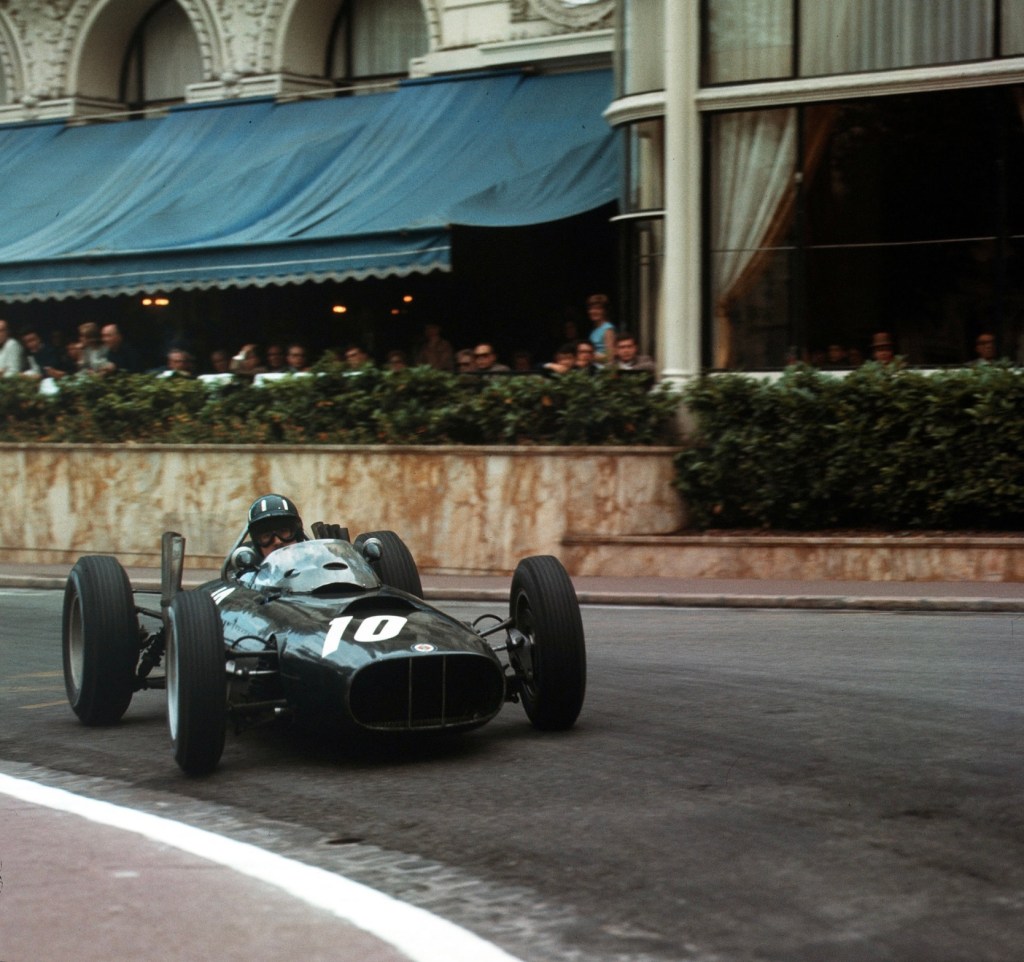
The engines first International win was in the rear of Graham Hill’s BRM P57 in the 1962 Brussells GP on 1 April, its first Championship GP win the Dutch on 20 May 1962, its last Jackie Stewart’s 1966 Monaco GP victory in 1966 amongst the new 3-litre GP cars. Jackie Stewart also scored the engine’s last International win in taking the Australian GP at Warwick Farm on 19 February 1967 in his BRM P261.

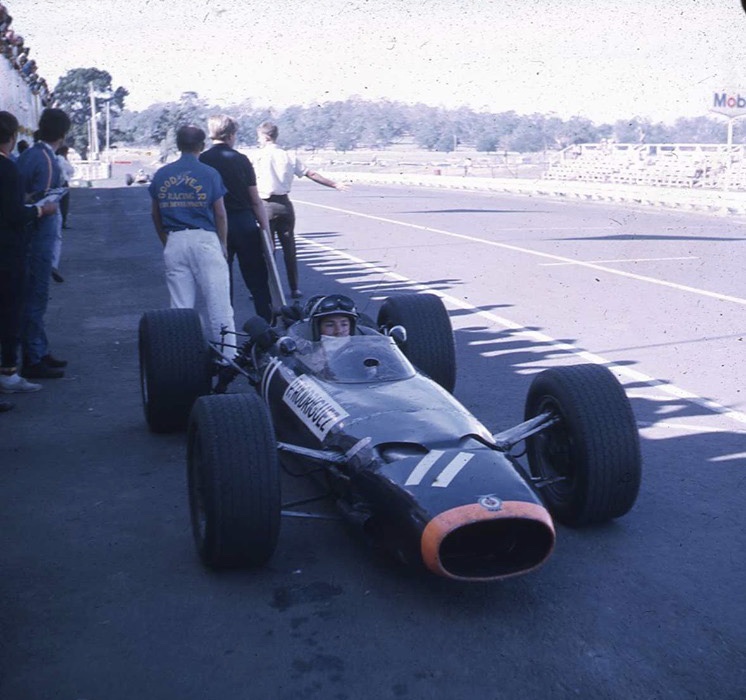
The engine’s final entry as a works engine was in the back of Pedro Rodriguez’ P261 at the Longford Tasman round in March 1968, he was second to Piers Courage’ McLaren M4A Ford FVA.
During that period the engine won the 1962 Drivers and Constructors titles with Hill. Hill/BRM were second in both the drivers and constructors titles in ’63 to Clark/Lotus, in ’64 to Surtees/Ferrari and in ’65 again to Clark/Lotus. The BRM P261 won the 1966 Tasman Championship for Jackie Stewart in a dominant display, BRM won seven of the eight rounds.
For the sake of completeness the wins for the engine. Note that i have not included heat wins in Non-Championship events, only Finals are as below. What comes through strongly is just how much Hill.G’s career was intertwined with this engine and how smart it was to sell them to all-comers.
1962;
Championship; Dutch, German and Italian GPs, all Hill in BRM P57 chassis
Non-Championship; GP Brussells, Glover Trophy Goodwood, Intl Trophy Silverstone all Hill BRM P57, Crystal Palace Trophy Innes Ireland Lotus 24 BRM, Kanonloppet Karlskoga Masten Gregory Lotus 24 BRM

1963;
Championship; South African, Monaco and US GPs all Hill BRM P57
Non-Championship; Int Trophy and Aintree 200 both Hill BRM P57, Glover Trophy Ireland Lotus 24 BRM, GP Siracuse Siffert Lotus 24 BRM
1964;
Championship; Monaco and US GPs both Hill in BRM P261
Non-Championship; Daily Mirror Trophy Ireland BRP BRM, GP Mediterraneo Enna Siffert Brabham BT11 BRM, Rand GP Natal Hill Brabham BT11 BRM
1965;
Championship; Monaco and US GPs Hill, Italian GP Stewart all BRM P261
Non-Championship; Int Trophy Stewart BRM P261, GP Mediterraneo Siffert Brabham BT11 BRM
1966;
Championship; Monaco GP Stewart BRM P261
Tasman; Pukekohe NZGP and Lakeside AGP Hill and Wigram, Teretonga, Sandown and Longford rounds, Stewart all in BRM P261
1967;
Tasman: Pukekohe NZGP and Warwick Farm AGP both Stewart in BRM P261

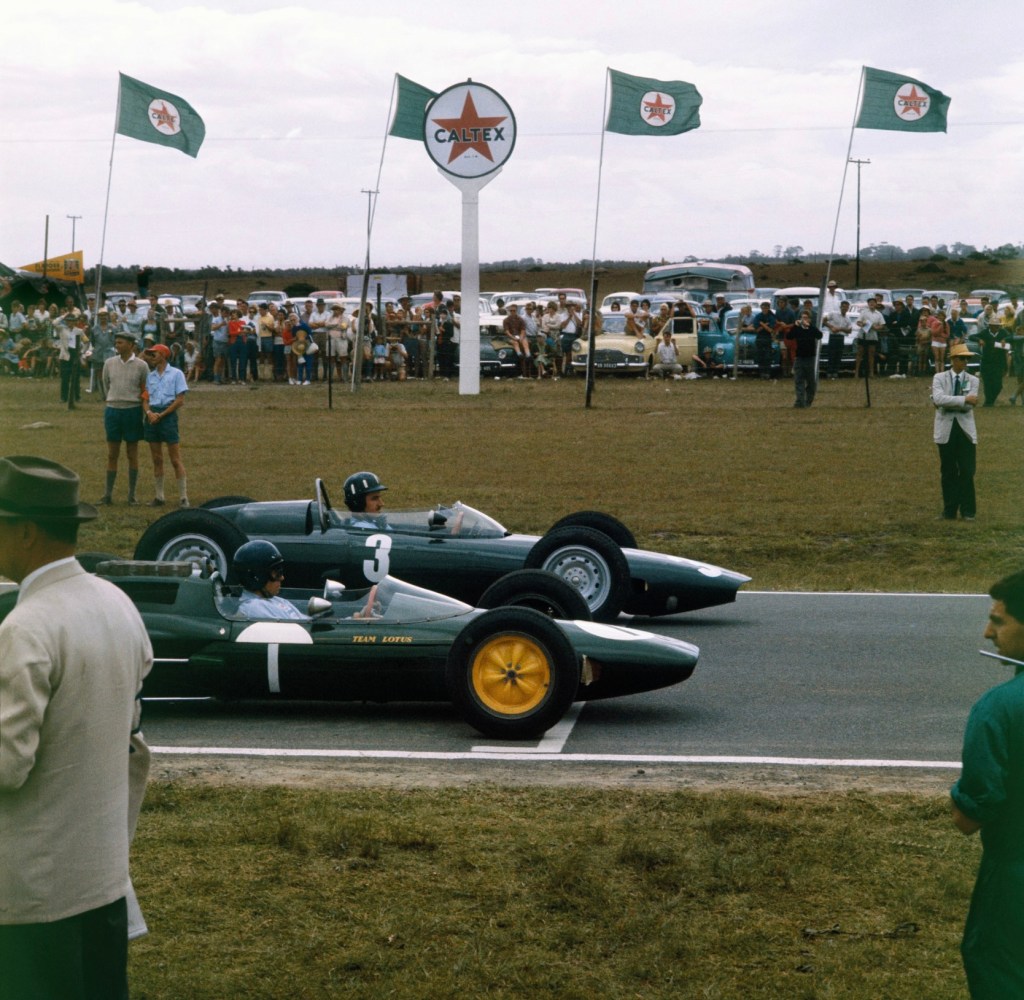
Relaxed scene at Longford on the 5 March 1967 Tasman weekend. That’s JYS on the wheel of P261 2614, Clark’s Lotus 33 Climax is alongside. #9 is Spencer Martin’s Brabham BT11A Climax with his car owner Bob Jane the stocky little dude in the drivers suit beside Stewart. The nose of Chris Irwin’s P261 2616 is also clear. On raceday Jack Brabham’s BT23A Repco won the South Pacific Trophy from Clark and Irwin.
Etcetera…

BRM P60 power at the Lakeside, Australian Grand Prix Tasman round on 20 February 1966. JYS and Graham lead in BRM P261s, Clark in Lotus 39 Climax, Gardner’s yellow nosed Brabham BT11A Climax, Jim Palmer’s Lotus 32B Climax, Spencer Martin’s red Brabham BT11A, Leo Geoghegan’s white Lotus 32 Ford 1.5 and the rest. Hill won from Gardner and Clark

Graham Hill’s BRM P60 engined Lotus 33 at the 29 April 1967, BRDC Intl Trophy Silverstone. That’s Damon practicing in the cockpit! DNF but fastest lap, the race was won by Mike Parkes’ 3-litre Ferrari 312. Graham had just left BRM for Lotus for the ’67 season but not the P56/60 engine which gave him so much success! Lotus’ engine of choice for ’66 was the BRM H16 but Chapman used the V8s as a stopgap with the H16 running late. Chapman’s Lotus 33s comprised a 2-litre Climax engined chassis for Clark and 2070cc P60 BRM engined one for Graham

Bibliography…
The bibles on all things BRM are Doug Nye’s three books, hopefully Vol 4 is not too far away! This article is a précis of Nye’s article on the P56 engine in his seminal, sensational ‘History of the Grand Prix Car 1945-65’
Photo Credits…
Rainer Schlegelmilch, The GP Library, Cahier Archive, Ellis French, Mike Feisst Collection & Ian Peak Collection/The Roaring Season, G Howard and Ors ‘History of The Australian GP’, grandprixengines.co.uk, Dennis Cooper Collection, John Saltinstall Collection
Tailpiece: Top Fuel Dragster…

Trevor Taylor’s BRP Mk2 BRM and its P56 V8 at Spa in 1964. Taylor was seventh, the race was won by Clark’s Lotus 25 Climax. It’s interesting that the stackpipe exhausts were still being used by BRP this late when the low level exhausts were producing more power, budgets and all that no doubt…
Finito...












 primotipo...