


Tony Johns sent me this wonderful article about the motorsport state of play in South Australia in 1954, many thanks.
Cars appears to be a magazine from The Argus stable, a Melbourne daily newspaper published from June 1846 to January 1957. Cars publisher was Larry S Cleland, anybody know of Lazza? The Sydney advertising rep was JM Sturrock of King Street, Jock Sturrock of yachting fame I wonder?
The article was written by Albert Ludgate, Chief Engineer of Lea-Francis cars from 1946. He emigrated to Australia together his family and a 1926 Lea-Francis K-Type in 1953, more of Albert later.

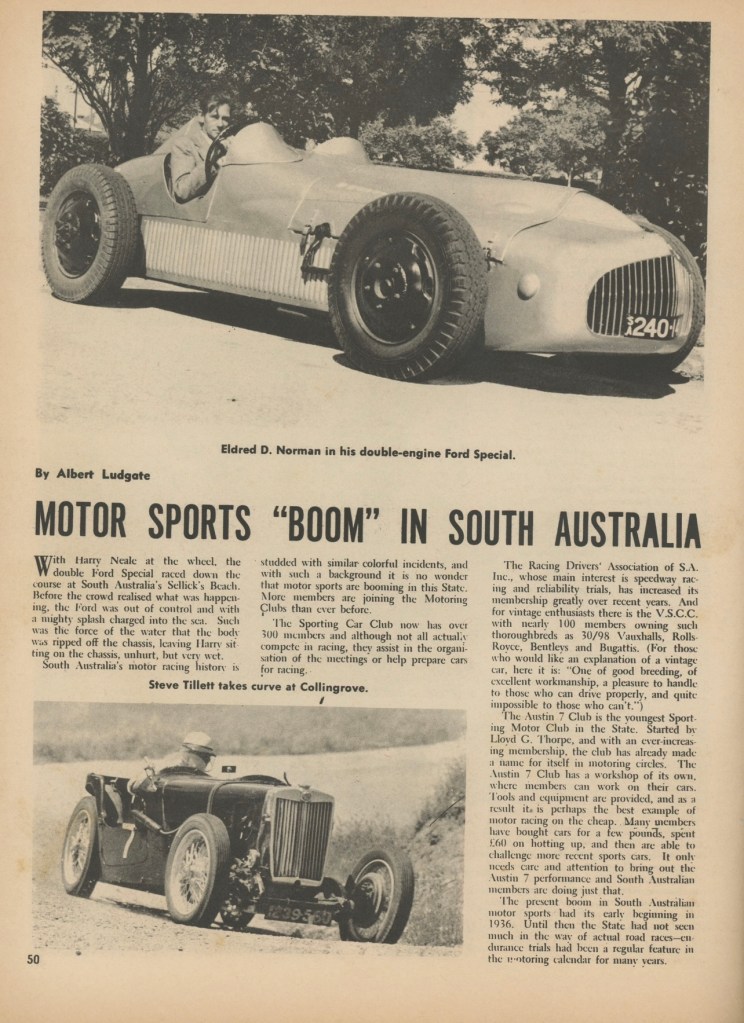
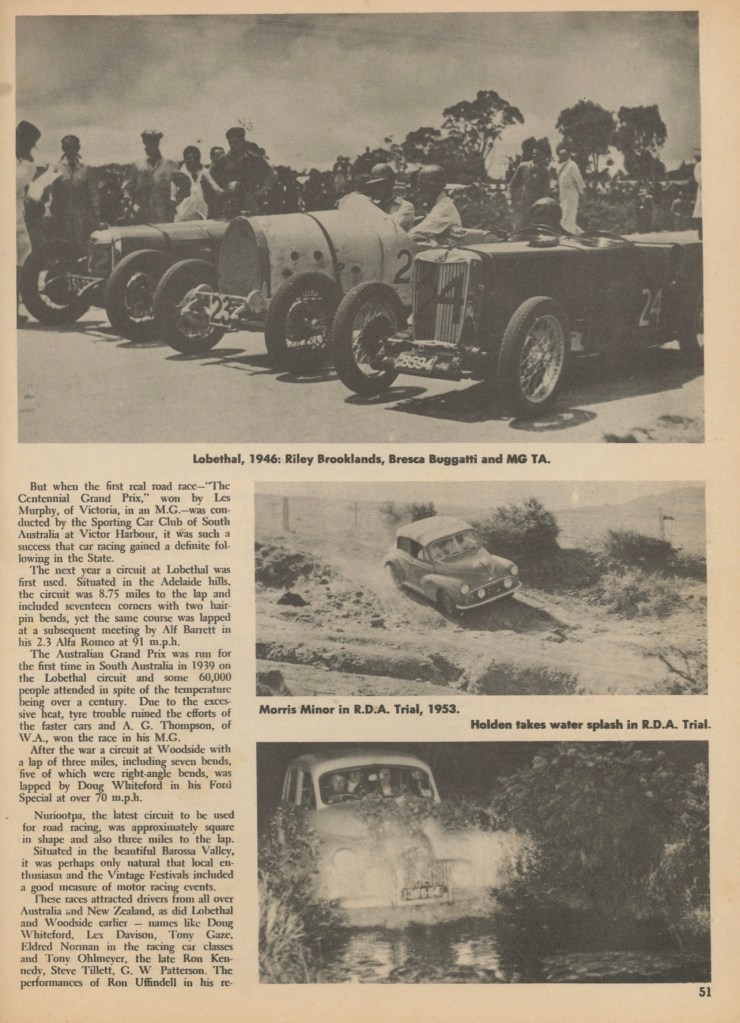
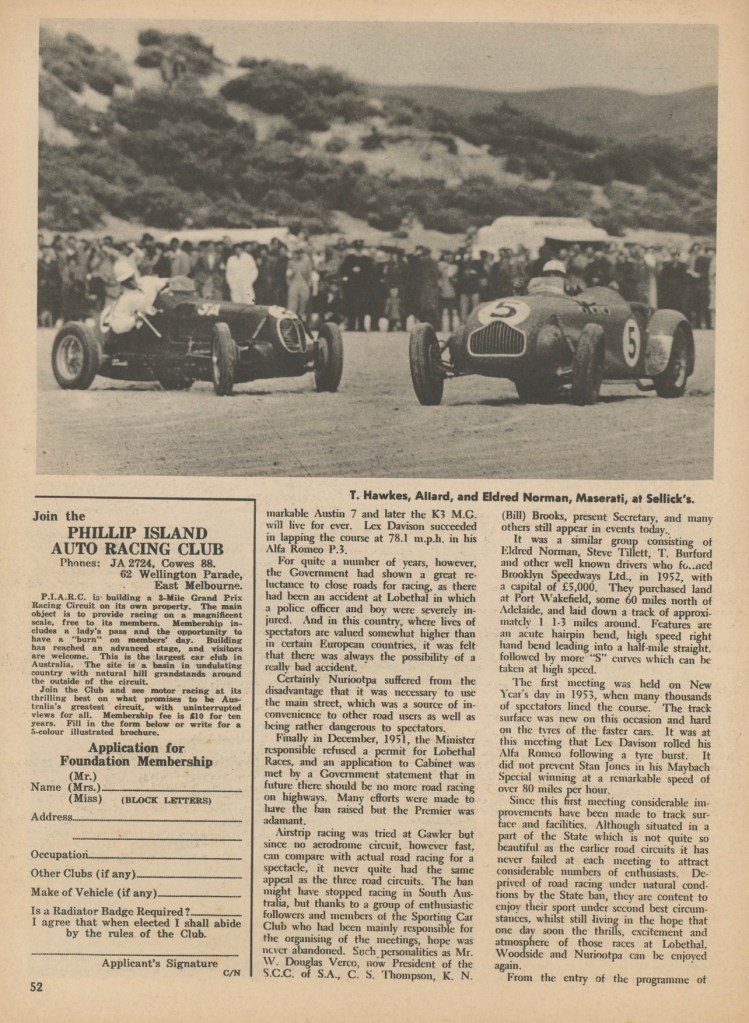


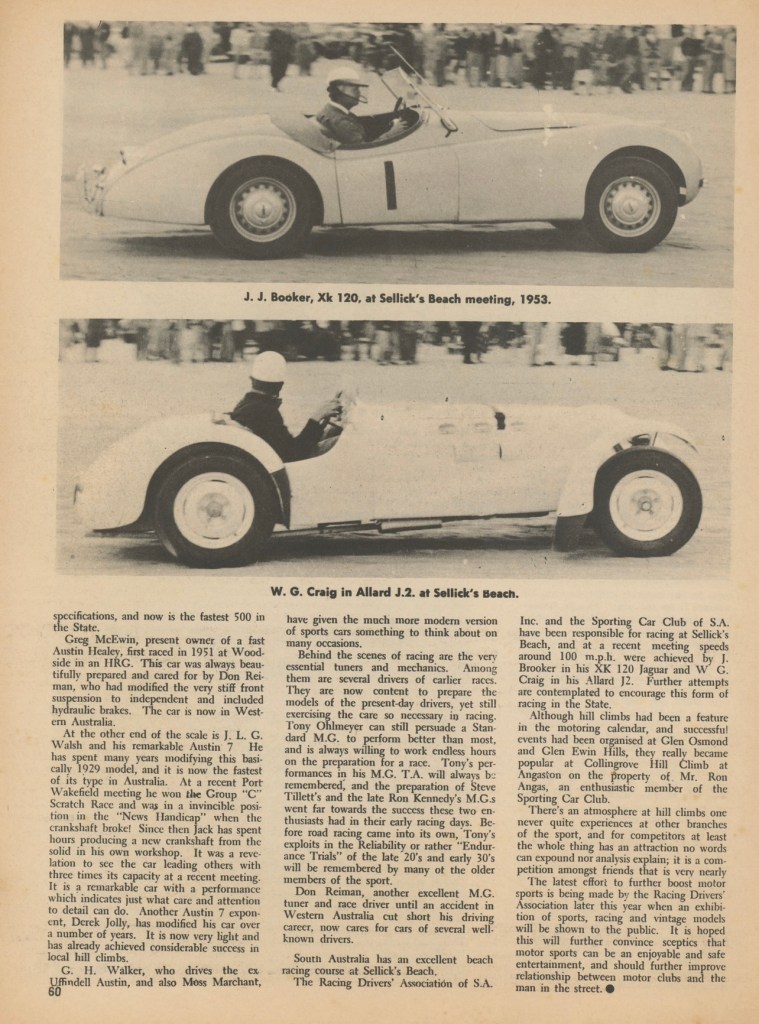
Etcetera…
Australian Grand Prix historians will note that at the time of publication – September 1954 – the 1937 Australian Grand Prix hadn’t been invented. That is, the fuckwit(s) who decided that the December 26, 1936 South Australian Centennial Grand Prix should be the 1937 AGP, rather than the 1936 AGP hadn’t done his/their Fake Nooooz thing.
The South Australian Government’s banning of racing on roads, quite possibly brewing for some time as Albert wrote, was probably precipitated by two deaths in bizarre circumstances during a motorcycle race at Woodside in 1949.

Albert Ludgate…
Ludgate’s early history I am yet to discover, but he was Chief Engineer of Lea-Francis from 1946.
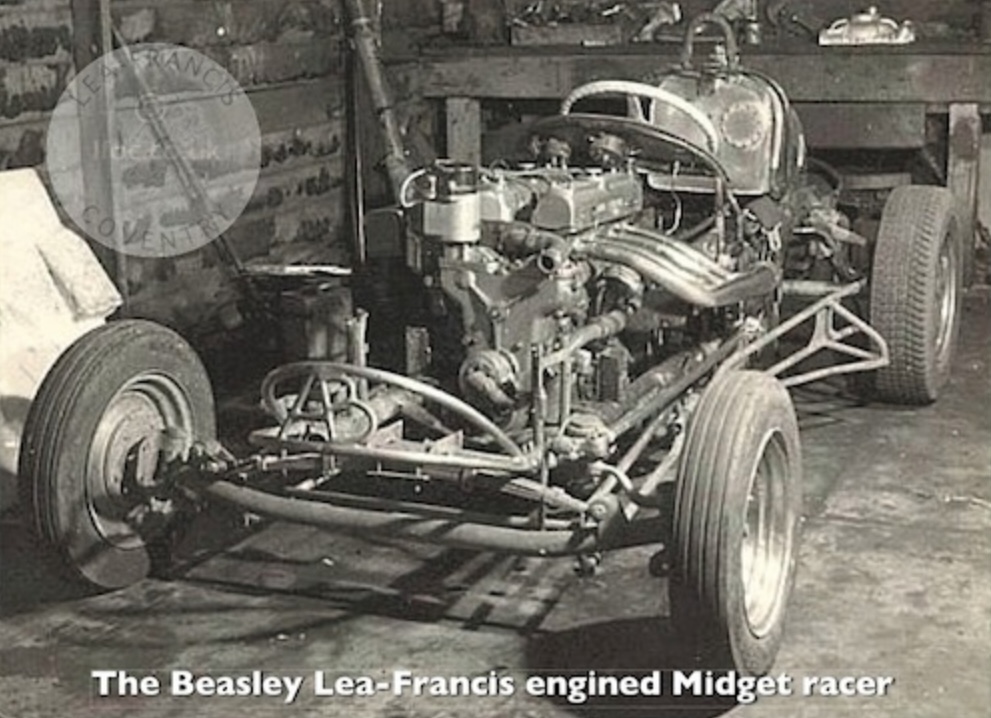
By February 1953 he was in Adelaide helping prepare one of his twin-high-cam ‘Leaf’ midget racing engines which had been fitted to Victorian ace, Alf Beasley’s speedcar for an international (SA Solo Championship) meeting at Rowley Park, Adelaide on Friday February 13, 1953.
These 1496cc, four-Amal or twin SU fed, dry-sump, gear-driven cam midget engines were aimed primarily at the large American market.
Bob Shimp won some heats in his Lea-Francis engined car at the Carpinteria Thunderbowl in South California on July 18, 1949, ‘then led the semi-main until the Lea-Francis engine in his midget failed’, wrote Kevin Triplett on his triplettracehistory.blogspot.com.
‘The 91-cubic inch Lea-Francis engine, purpose built in England for midget auto-racing featured dry-sump oiling, gear-driven double camshafts, four SU carburettors (sic), with a high compression ratio to run on alcohol. Record setting British driver, Dudley Froy, Lea-Francis designer Ken Rose and chief engineer Albert Ludgate made trips to the USA in 1948 and 1949 to show and sell samples of the engine.’
‘Besides Shimp, several US midget racers (including Woody Brown in Northern California) used the four cylinder “Leaf” engine but it never became popular (less than a dozen were built) given that its 120 horsepower could not match the power of the Offenhauser four-cylinder engine and it sometimes put connecting rods through the sides of the aluminium block.’
Contemporary Australian newspaper reports say that brothers Alf and Stud Beasley had a car each powered by a float of three of these trick Lea-Francis engines, and had some success with them. It makes one wonder where those engines are now…

Into 1954 Ludgate was the technical representative of Simmonds Accessories and the publicity officer of the (speedway) Racing Drivers Association, while JA Lawton & Sons also retained Albert, not to forget his writing abilities.
Ludgate and his Racing Drivers Association made quite a splash in October ’54 with their ‘Speed and Sports Motor Show’. More than 150 racing, veteran and speedway cars and bikes were amongst the exhibits in the Centennial Hall at Wayville. It was the first time in South Australia’s history that such a show had been run.
Three-quarter-midgets – TQ cars were on the march – were front and centre with Ludgate’s Simmons Nut-Ridge Special one of five TQs on display. In addition he showed a 150cc half-scale midget racer built for his six-year-old son.
Ludgate was a strong advocate of TQs and was a member a three man Racing Drivers Association specifications committee tasked with developing specifications for the class…and in due course he would make some cars.
By December 1954 Ludgate was living in Reade Park, later he bought a house in Colonel Light Gardens. He was well on the way to embedding himself within the local motorsport and automotive industries, having addressed members of the Aeronautical and Automotive Engineers about American car racing and engine development in the Kerr Grant Lecture Theatre at Adelaide University.


In his small Colonel Light Gardens garage, Ludgate Automotive Developments built sportscars, TQ midgets and go-karts using the Capricornia and Ricardian brandnames.
The Capricornia sportscars – the name was taken from the Tropic of Capricorn region – used a multi tubular chassis with two main side-members, a wheelbase of 91 inches and used standard or modified Holden parts, including front and rear suspension, and weighed about 715kg depending upon specifications.
The first of the series, John Plowman’s car was commenced in 1955 and completed just in time for for the 1956 Easter meeting at Port Wakefield ten months later. Fitted with an English RGS/Shattock fibreglass body, and with experienced racer/engineer, John Cummins at the wheel the car performed well. A long job list proved racing improves the breed!

John Bruggerman’s very successful Capricornia 3 racing car had a Holden (later Repco-Holden) grey-six fitted and used a shortened Buchanan (NH Buchanan Motor Co) body.
Ludgate’s pioneering TQs – a poor-mans introduction to speedway racing – used Austin 7 chassis, suitably bent 7 axles, and a variety of 500cc motorcycle engine driving through a gutted Austin 7 gearbox using a dog-clutch for stop and go.
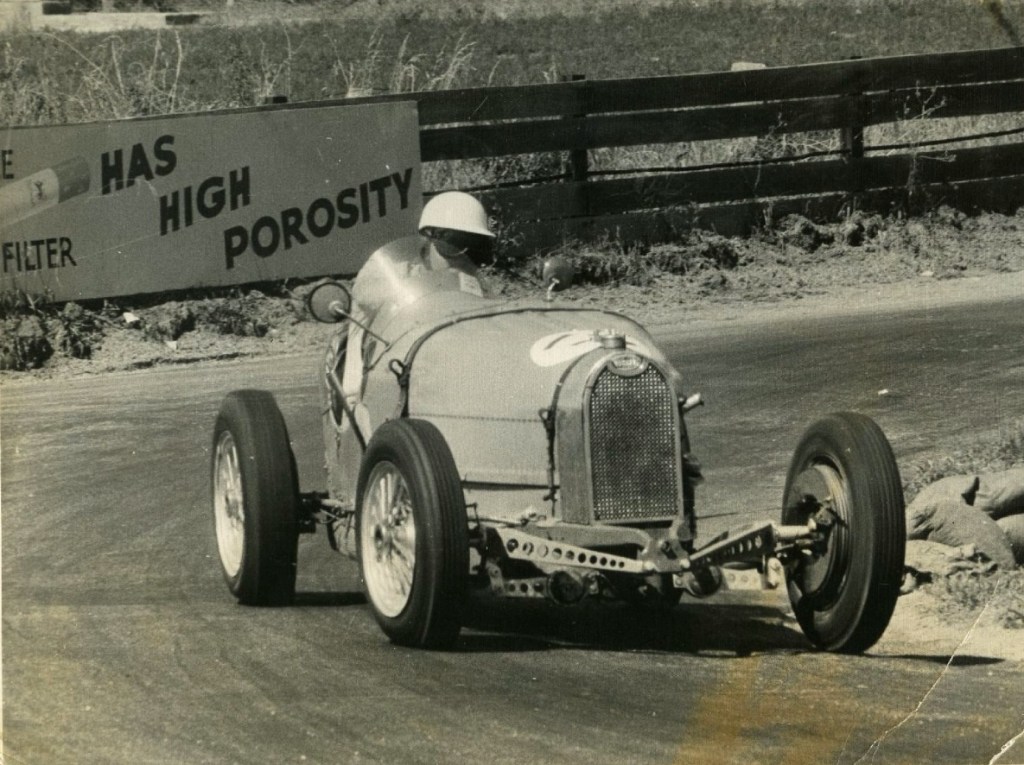
In the mid-1950s John Cummin’s met Ludgate in Adelaide in his capacity as a Perkins Diesel rep. Ludgate helped ‘with a lot of input’ in the early development of the Holden grey-six cylinder engine used in his Bugatti Holden. Cummins blazed the trail in Victoria with Holden engine development, his car is said to be the second Holden-powered racing car in the state, ‘Lou Molina’s, Silvio Massola built MM Holden Special being the first’.
‘The engine gave about 65 or 75 horsepower at 3500rpm’, Cummins recalled, ‘and it wasn’t worth two-bob at 4500! We fiddled with the needles in the triple 1 3/4″ SU carries and got 116 horsepower at 4500. Almost double the original Holden power output.’
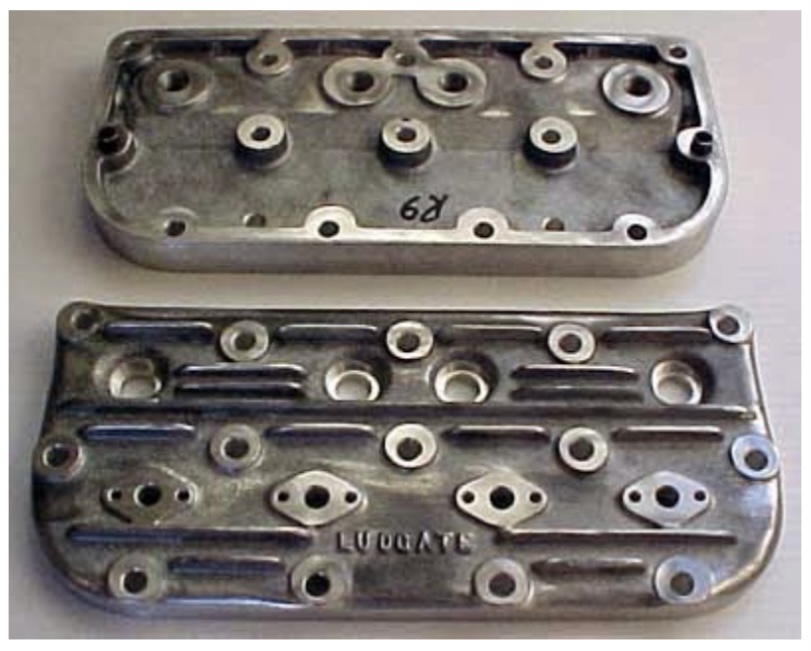
Ludgate also made Austin 7 cylinder heads for the Seven racing fraternity – think of Seven racing as the Formula Vee of the day – in the 1950s and early 1960s. The design featured sandwich construction with combustion chamber shape late-7. Enthusiasts often modified the shape to their own requirements. Ludgate built over 30 of the heads with many more built from his patterns after his death. They were used by many A7 racers in the day including Elfin’s Garrie Cooper during his formative years.
Amusingly, later, the street in which he lived was renamed Ludgate Circus which is surely indicative of the goings on at that address in the wee-small-hours and the fond regard in which Albert was held by his neighbours!
Ludgate retained his Lea-Francis for many years, using it daily to drop his son off at school and displaying it at the VSCC annual rally at Victor Harbor in 1961, by then he was described as a ‘well-known motoring personality’.
Late in his life the Australian Society of Automotive Engineers established and annually bestow the Albert Ludgate Award.
This summary of information about Albert Ludgate is the result of a days Troving and Googling, if anybody can add to the story please contact me: mark@bisset.com.au
Credits…
Cars via Tony Johns’ archive, Trove and other online research, News Adelaide, Victor Harbour Times, bollyblog.blogspot.com, v8vantage.com, triplettracehistory.blogspot.com, Lea-Francis Owners Club website, Paul Jaray on auto puzzles.com, Ron Burchett, Bruce White, Sports Cars and Specials September 1956, Tony Parkinson Collection, Steve Jones
Tailpiece…

Bill Pile or John Newmarch in the Ricardian Repco chasing Jim Goldfinch’s Austin Healey 100S at Port Wakefield circa 1959.
Finito…
 primotipo...