Posts Tagged ‘Dan Gurney’

(D Friedman)

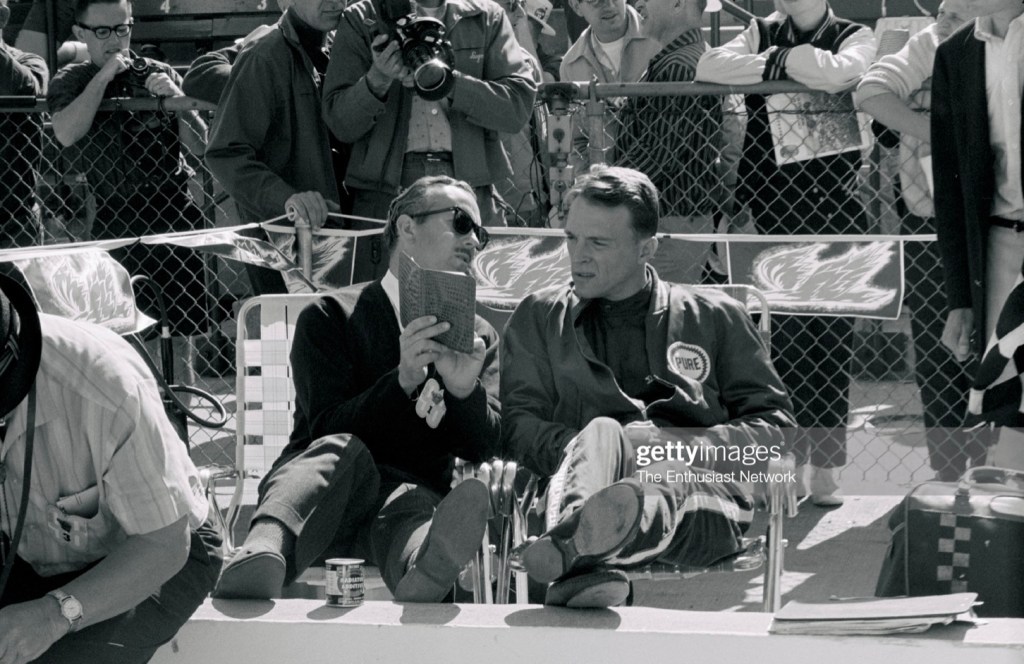
Dan Gurney awaits the start of the 1962 Indianapolis 500 in his Thompson Buick V8, with Fritz Voigt and Mickey Thompson in attendance, Memorial Day, Indiana, May 30, 1962.

Jack Brabham and John Cooper started the mid-engined Indy revolution – I’m not suggesting they were the first to race a mid-engined car there – in 1961 with their tiddly 2.7-litre Cooper T54 Climax FPF.

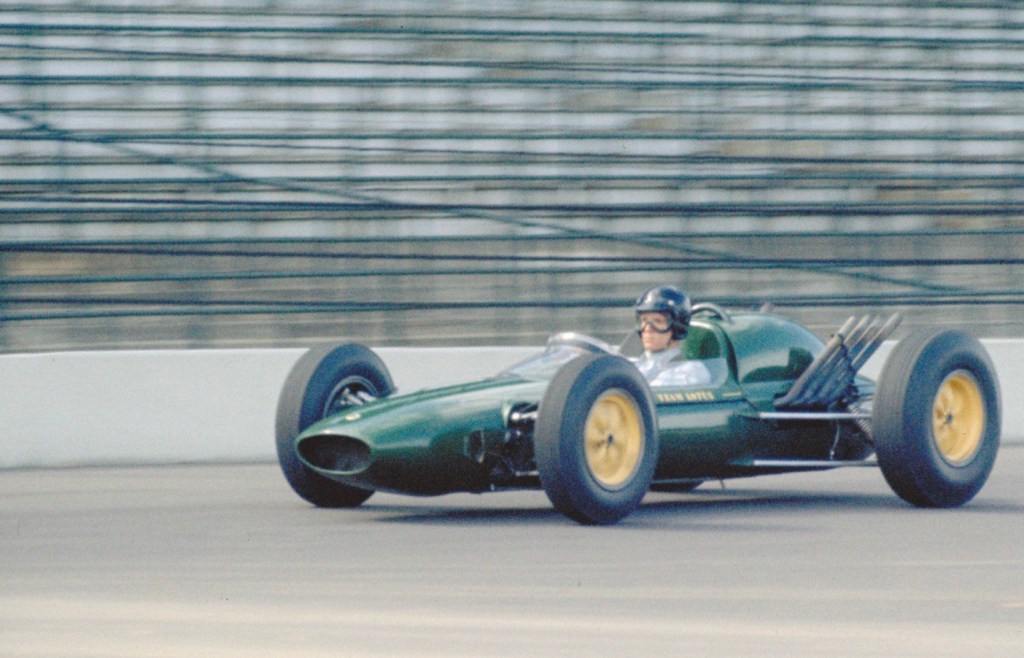
Mickey Thompson wasn’t the only Indycar builder to take the mid-engined bait, but one of his three Thompson Buick V8s driven by Indy debutant Dan Gurney, was the only mid-engined car that took the start in 1962.

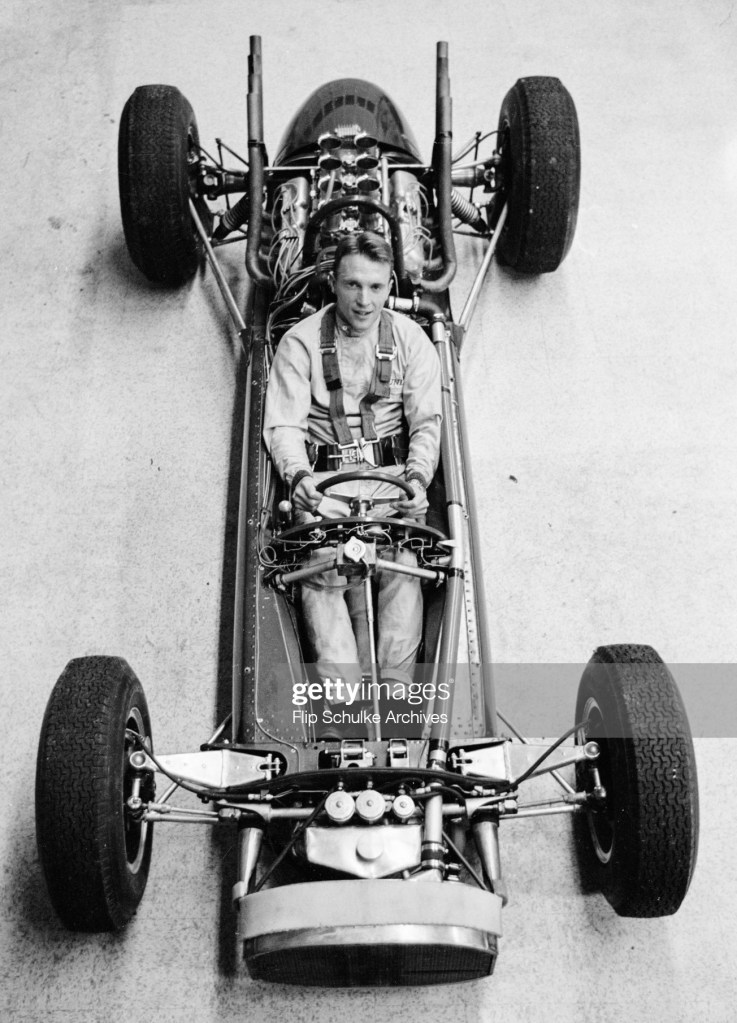
His John Crosthwaite-designed, aluminium-bodied machine comprised a lightweight spaceframe chassis, a modified new aluminium Buick BOP – Buick, Oldsmobile, Pontiac – 215cid V8 and a Halibrand transaxle.

This revolutionary, aluminium production V8 weighed only 317 pounds, about 200 pounds less than Detroit’s cast iron equivalent thereof. Let’s stick with the engine for a bit.


Buick’s innovative V8 featured a deep-skirt aluminium block containing an assortment of iron and steel parts: cast-in bore liners, forged connecting rods, and a crankshaft supported by five main-bearing caps. The result was an engine that weighed 324 lbs, circa 200 lbs less than Chevy’s small-block V-8 (GM Media)

While the ads of the three General Motors’ subsidiaries that fitted the motors to their cars extolled the virtues of better fuel economy and a lighter car, racers looked at the obvious lightweight performance potential too.

The Buick and Pontiac 215 engines were identical but Oldsmobile’s ‘Rockette V8’ had revised heads. The Buick version used a five-bolt pattern around each cylinder, while the Oldsmobile jobbie used a six-bolt pattern to alleviate potential warping of the heads on high-compression variants of the engine

To the Olds party-faithful, the changes made the new engine look like its much respected predecessor, the Olds-Rocket V8, and to those seeking big power gains, the Olds F85 engine was the go, the extra head bolt would assist in avoiding blown head gaskets in performance applications.

While I covered broadly the donor engine that formed the bottom end of Repco-Brabham Engines’ 1966 F1 World Championship winning 620 V8 in this lengthy epic: https://primotipo.com/2014/08/07/rb620-v8-building-the-1966-world-championship-winning-engine-rodways-repco-recollections-episode-2/ I didn’t look at the engines parentage in any detail. This fantastic Macs Motor City article does just that: https://macsmotorcitygarage.com/featherweight-wonder-inside-buicks-1961-aluminum-v8/ and this Hagerty one: https://www.hagerty.com/media/magazine-features/hagerty-magazine/buicks-little-aluminum-v-8/

You can feel and hear the vibe in this pre-start shot (IMS)

Crosthwaite – Thompson – Buick Indy Car 1962

British engineer John Crosthwaite designed the Thompson 1962 machine for Mickey Thompson.

Crosthwaite’s and Thompson’s collaboration came about after John’s success with the Dolphin Formula Junior built by a company owned by Bud Hull, in the San Diego/Del Mar area of Southern California. Thompson noticed the pace of the cars and sought him out: https://0398ca9.netsolhost.com/dolphin01.htm

Soon, Thompson and his sponsors, Harvey Aluminium and Jim Kimberly of Kimberly Clark, approached  Crosthwaite to design a mid-engined car inspired by those by then de rigeur in European road-racing for the 1962 500.

John Crosthwaite, Jack Brabham and Buddy Hull at right after testing the Dolphin Mk1 Fiat FJ at Riverside in November 1960 during the US Grand Prix weekend. Brabham had already won his second F1 World Championship in Portugal a couple of weeks before (Wiki)
John Crosthwaite with one of his completed ’62 Thompson Buicks in Thompson’s Long Beach machine shop. Note the fuel tank locale, Halibrand wheel and beefy spaceframe. Body buck for something else? (Wiki)

Thompson Buick Design & Construction…

Crosthwaite drew on his earlier work in drawing a tubular steel spaceframe chassis, with fully independent suspension front and rear: upper and lower wishbones and coil spring/dampers and adjustable roll bars at the front, and a single upper links, twin radius rods and and gain coil spring/dampers and adjustable bar at the rear. The 16-inch Halibrand wheels and Firestones were way smaller than the usual 18/20 inch units used by the big, heavy roadsters.

The engine was a radical choice as well. Offies had ruled the day for decades. Not only was the Buick V8 the first stock-block engine raced at Indy since 1946, but it was also, as we have seen, brand-new. General Motors had developed a technique to cast aluminium engines in large volumes. The 3.5-litre 317 lb aluminium Buick-Oldsmobile-Pontiac BOP 215 V8 was the first volume production V8 in the world and was just on the market, fitted to the Buick Special, Oldsmobile F85 and Pontiac Tempest. More on the engine mods shortly. The transaxle was a Halibrand two-speed: fast and much faster! It was mated to the engine via a bespoke, shallow, cast bell-housing.

There was no pressure! The project had to be completed in just 120 days. Crosthwaite worked long hours living in a motel close to Thompson’s Los Angeles workshop where the car was built by a crew led by Fritz Voigt.

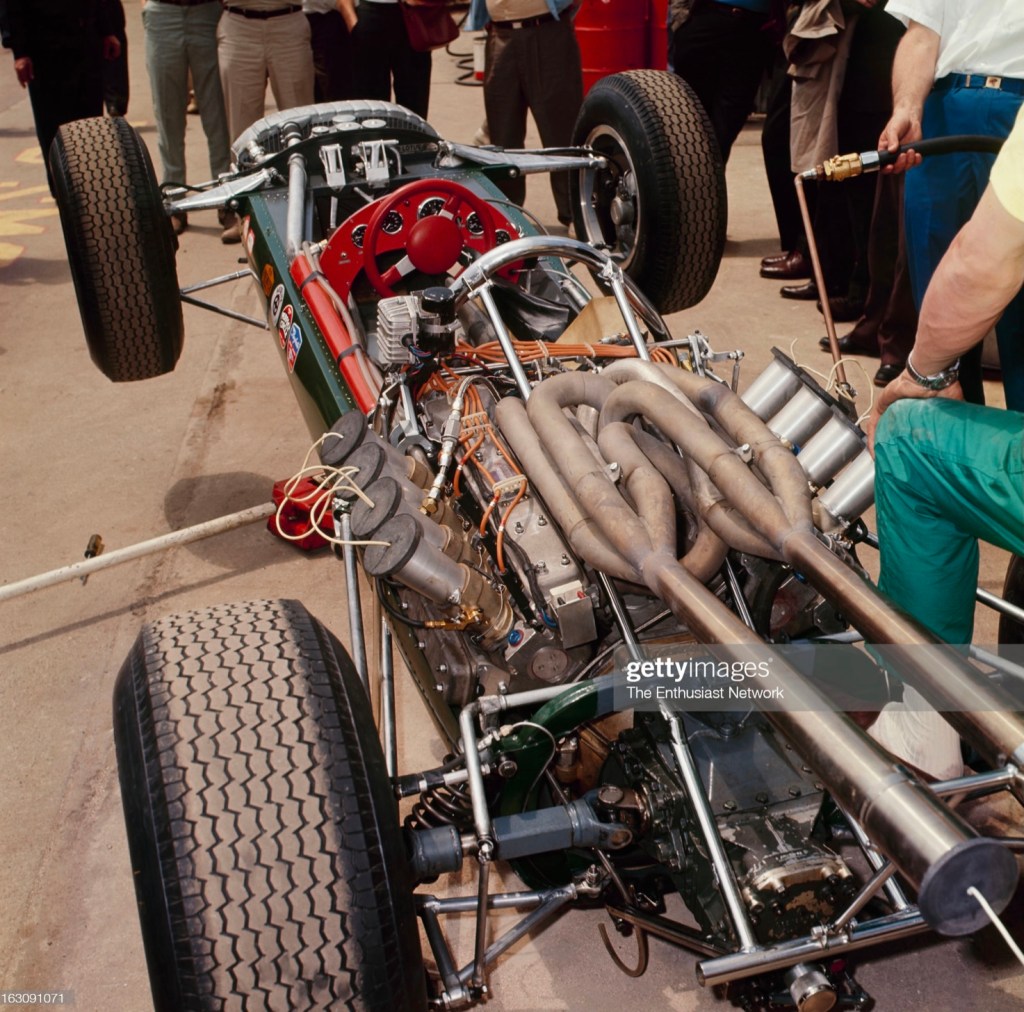
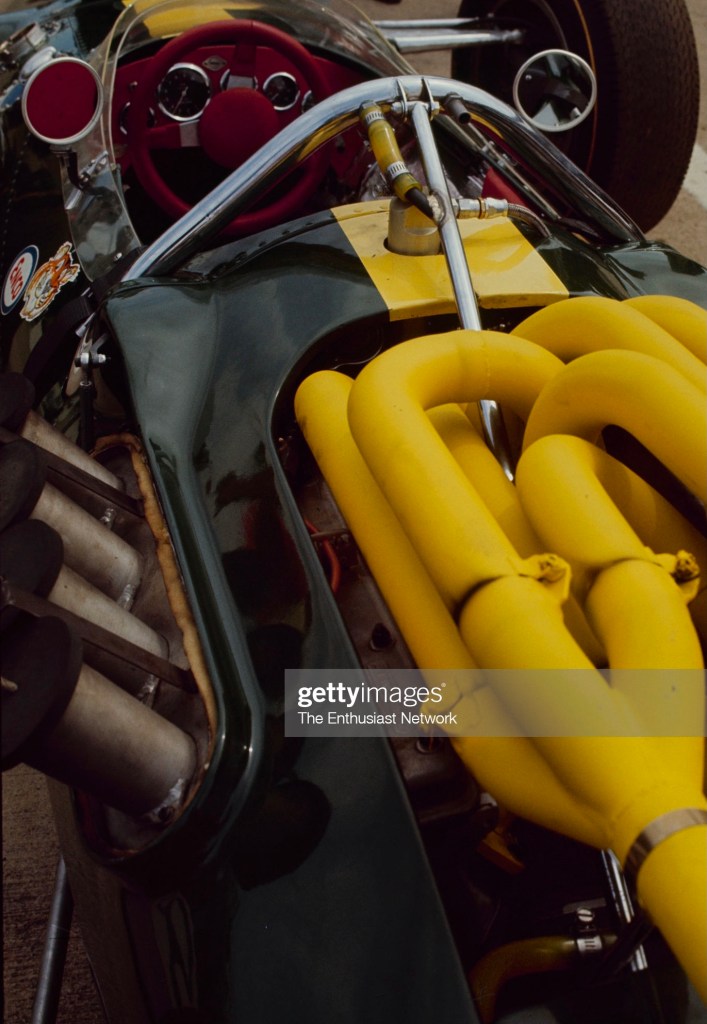
Key elements laid bare in the Indy garage: spaceframe chassis, modified Buick 215 stock-block aluminium V8, Halibrand two-speed transaxle, disc brakes (D Friedman)
Hilborn fuel injection, roller rockers by Iskenderian or Crower (D Friedman)

Buick 215 V8…

The Buick V8 underwent significant performance surgery to be match fit against the 4.2-litre fuel-injected Offys, which gave about 350 bhp in 500-mile race spec at the time.

While multiple parties were involved in the engine’s development, the key modifications were made by Scarab engineers, who worked on improving the engine’s breathing capacity, and Mickey Thompson’s team who experimented with fuel injection and made a specially fabricated intake manifold to suit.

Or is that the case? There seem to be two schools of thought…

In its August 1962 issue that year, Hot Rod reported that the Buick was a Mickey Thompson (M/T) project with no factory help. M/T pistons with a 14:1 compression ratio and M/T aluminum rods were coupled to an M/T cast ductile-iron crankshaft with a 3.10-in stroke. (M/T was then marketing “Cast Billet” stroker crankshafts for popular V8s.) Iskenderian supplied the roller camshaft and kit, while Bob Bubenik engineered the gear drive for the cam and oil, water, and fuel pumps. HIlborn fuel injection with both laydown and vertical-stack manifolds were tried, but vertical stacks proved best. Quoted output was 330 bhp on straight methanol fuel.

Buick 215 engine, mods as per text (MMCG)
(MMCG)

A few years later, in a May, 1970 feature Hot Rod interviewed some Buick executives who had a different perspective. In this version, noted Buick engineer Nelson Kunz led the three-month program, working closely with Thompson. Oversize cylinder liners allowed a bore of 3.6125 inches, but here the 3.10-in ductile iron stroker crank was a welded Buick piece and the connecting rods were 4340 steel. Large-port head castings and a Crower H-1 roller cam kit completed the combination, which produced 370 bhp at 7200 rpm. They reported about 15 engines were built with a few sent to sports car teams, including Lance Reventlow’s Scarab operation.

It’s hardly surprising if GM was a bit cute about its involvement in-period, given the Motor Racing Ban Deal between the Big Three at the time: GM, FoMoCo and Chrysler. On the balance of probabilities, Traco were involved too. They built a 3.9-litre modified, Weber-fed, Buick 215 V8 for Lance Reventlow, which was fitted to his Scarab RE Formula Libre car raced by Chuck Daigh in the February 1962 Sandown Park International.

That race was won by Jack Brabham’s Cooper T55 Climax. While the new Scarab chassis needed development – it was never raced again – the potency of the engine impressed onlookers, including Brabham, whose first Repco-Brabham F1 V8, built in 1965, used the Oldsmobile 215 F85 block in modified form; the RB620 3-litre V8 won World Drivers and Constructors Championships in 1966.

These early developments of the BOP 215 V8 Mickey Thompson and others were very important to the engine’s subsequent use by Repco-Brabham Engines and in the back of Bruce McLaren’s new McLaren-Elva sportscars, and others. More about the Scarab RE Buick in this article: https://primotipo.com/2016/01/27/chucks-t-bird/

Ain’t she very sweet, a handsome, purposeful machine in every respect. DG during the obligatory posed qualifying shot (IMS)

1962 Indy 500… 

Dan’s primary race program in 1962 was with Porsche in F1 and endurance sportscars. He therefore arrived in Indiana match fit and as sharp as a tack.

Gurney told Andrew Ferguson about his debut year at Indy in 1962 in Ferguson’s research for his great book, ‘Team Lotus – The Indianapolis Years’.

‘I had first gone to Indianapolis in 1962, at the invitation of an entrant named John Zink. I took the obligatory driver’s test in his traditional front-engined Offy roadster, but what he was hoping to qualify for the race was a rear-engined frame. I’m sure it was actually an old Lotus chassis – powered by a Boeing gas turbine.’

‘He had some Boeing engineers who were keen to promote these things as high-reliability, cheap-to-run engines powering Kenworth trucks. One of the engineers was running one on the street in a ’32 Ford roadster, which must have been quite exciting.’

Dan smiling as best he can, Moore 62 Boeing during Indy qualifying (IMS)
Boeing Model 502-10F turboshaft engine, a lightweight unit normally used in helicopters, being fettled at Indy. Moore 62 chassis aka John Zink Trackburner Spl (IMS)

‘But when Jack Zink appeared at Indy with his turbine car he was stiff and sore and his face and arms covered in scabs and grazes, because while testing the car back at some place in Oklahoma he’d flipped it during a test run. And when I got out on to the Speedway in the car it was plain that its 350 horsepower wasn’t enough. A gas turbine develops maximum torque at stall, like a steam engine, so the faster you ran it the less it delivered.’

‘In those days we were still having to brake into the turns at Indy, so when you went back on the gas that turbine could set very competitive corner speeds, and came off the turns with good acceleration. But part way down the straight it would be all over for the day. It just ran out of power and stopped accelerating.’

‘I was really having to hustle it in the effort to set competitive lap times, and it became clear that it just didn’t have enough power. So I told Zink that if he could find anyone to drive it faster he shouldn’t worry about hurting my feelings – he should go right ahead and try them…and then Mickey Thompson asked if I’d like to drive one of his new rear-engined Buick V8-powered cars.’

Thompson and Fritz Voigt during Indy qualifying. The ‘body-off’ shots suggest a high level of design and execution quality despite the tight timelines involved (MMCG)
‘Fancy meeting you here Colin!’ Gurney greets his Indy 500 guest, Colin Chapman, from the Hospitality Suite! Rather a successful weekend for them both (D Friedman)

Dan had a lot riding on the race. He had funded Colin Chapman to come over and see the 1962 Indy 500 with a view to hooking Lotus and Ford up for a proper shot at the 1963 500. Dan knew an Indy version of the then ‘spankers Lotus 25 monocoque – which debuted at the Dutch GP in May that year – was a race winner.

Dan’s switch to Thompson’s aluminium Buick V8 stock block-powered mid-engined Crosthwaite design proved a good one. The Indy Rookie qualified the new car a tremendous eighth with a speed of 147.886 mph, impressive in every respect. Having said that, Dan was of course, racing mid-engined cars all the time, there was nothing unconventional about the layout to him.

Up at the pointy end, the top three were Roadsters: Parnelli Jones’ Watson Offy from Rodger Ward’s similar car and Bobby Marshman’s Epperly Offy in third.

A couple of youngsters who done real good! Roger Penske wishes Dan well before he jumps in and puts on the ‘belts mandatory at Indy. Note the crash pad on the steering wheel and injection trumpet debris protector (IMS)
Mickey Thompson and Dan Gurney just before the start (R Brock/Getty)

After the start, Gurney gradually worked his way into ninth place after the initial stages. The only incident in those early stages was on lap 17 when a four-car pile-up involving Jack Turner, Bob Christie, Allen Crowe and Chuck Rodee. Noteworthy is that AJ Foyt lost a wheel off his Trevis Offy on lap 69.

Running nicely, on lap 92 of 200, Dan experienced a problem with the rear end and was forced to retire. A leaking Halibrand transaxle was later attributed to an improperly mounted seal around the starter shaft in the back of the gearbox which fell out and killed the gearbox.

The race was won by Ward from Len Sutton’s Watson Offy then Eddie Sachs’ Epperly Offy, with Dan classifed 20th and in the money to the tune of $US5161.

Pitstop for Dan, who was out on lap 92 in the Thompson Harvey Aluminium Spl (unattributed)
(D Friedman)

Despite not finishing, the Thompson Buick’s performance was considered noteworthy as it demonstrated again the potential of the rear-engined layout and a light aluminium stock block V8 at Indy.

The move looked prophetic on Dan’s part when one of two drivers who drove the John Zink Trackburner Spl aka Moore 62 Boeing. After Dan left, Duane Carter, and then Bill Cheesbourg, tried to get the Moore 62 up to speed but couldn’t. Cheesbourg followed Dan to Thompson’s outfit and drove the #35 Harvey Aluminium Special – Thompson Buick – #35 but missed the cut as did Chuck Daigh who had preceded him…

A third #33 Thompson Buick owned by Jim Kimberly was driven by Porky Rachwitz and Jack Fairman, who both failed to qualify.

The Thompson Harvey Aluminium Special at Indy in 1962 (B Tronolone-Revs)

Etcetera…

Gurney aboard Zink’s Watson Offy for his Rookie Test, Indy 1962, and the shot below (D Friedman)

In order to pass his rookie test Gurney used a good, old, reliable Roadster. Zink’s Offy powered car was no less a chassis than the updated Watson used by Pat Flaherty to win the 1956 race for Zink.

Of interest, perhaps, from indycar.com. ‘Rookie tests from 1936-80 took place during practice for the Indianapolis 500 in May, when the track was open nearly the entire month. Many rookie drivers took advantage of turning their required laps early in May, when there was less traffic because veteran drivers often waited until later in the month to begin their programs.’

(unattributed)
(LAT)

Rookie tests for seasoned professionals such as Gurney may seem a little strange, during July 1962 he had won his first championship Grand Prix for Porsche at Rouen-Les-Essarts aboard the the 1.5-litre flat-eight powered car (above).

But Indianapolis is a treacherous place, especially back then.

Porsche 804 laid bare at Zandvoort in May 1962, the meeting at which Gurney – along with the rest of motor racing – went WOW over Chapman’s new monocoque Lotus 25 Climax (J Alexander)

As a consequence, ‘In 1981, the Rookie Orientation Program was formalized. The biggest difference between ROP and previous rookie tests was the entire session was reserved for rookies only, with the session taking place sometime in April or early May. Drivers no longer needed to find clear track amid veteran practice to learn the ropes.’

‘It doesn’t matter if the driver is making their first NTT Indycar series start in the “500” or has extensive global racing success. They all must take the test.’

‘Some noteworthy drivers who were established stars before their first Indy 500 start required to take a rookie test include existing or eventual F1 World Champions Alberto Ascari, Juan Manuel Fangio, Jack Brabham, Jim Clark, Graham Hill, Denis Hulme, Jackie Stewart, Jochen Rindt, Emerson Fittipaldi, Nelson Piquet, Nigel Mansell and Fernando Alonso.’

(unattributed)

Dan aboard John S Zink’s Moore 62 Boeing, the John Zink Trackburner, in the Indy pitlane during qualifying. See below for more detail, lots of it on Allen Browns Old Racing Cars website: https://www.oldracingcars.com/indy/results/1962/indianapolis500/

Click on the link, then go to note 3, ‘Moore 62 Dan Gurney’, read that, then click on the link to the ‘Len Williams report’ for an amazing account of the car’s construction, testing by Zinc on the track at his ranch, and then the fun and games at Indy trying to coax the car into the race. Truly wonderful stuff.

Moore 62 Boeing turbine and Halibrand transaxle. Designer Denni Moore has gone to great lengths to stiffen the large opening that contains the bulky turbine engine ((D Friedman)
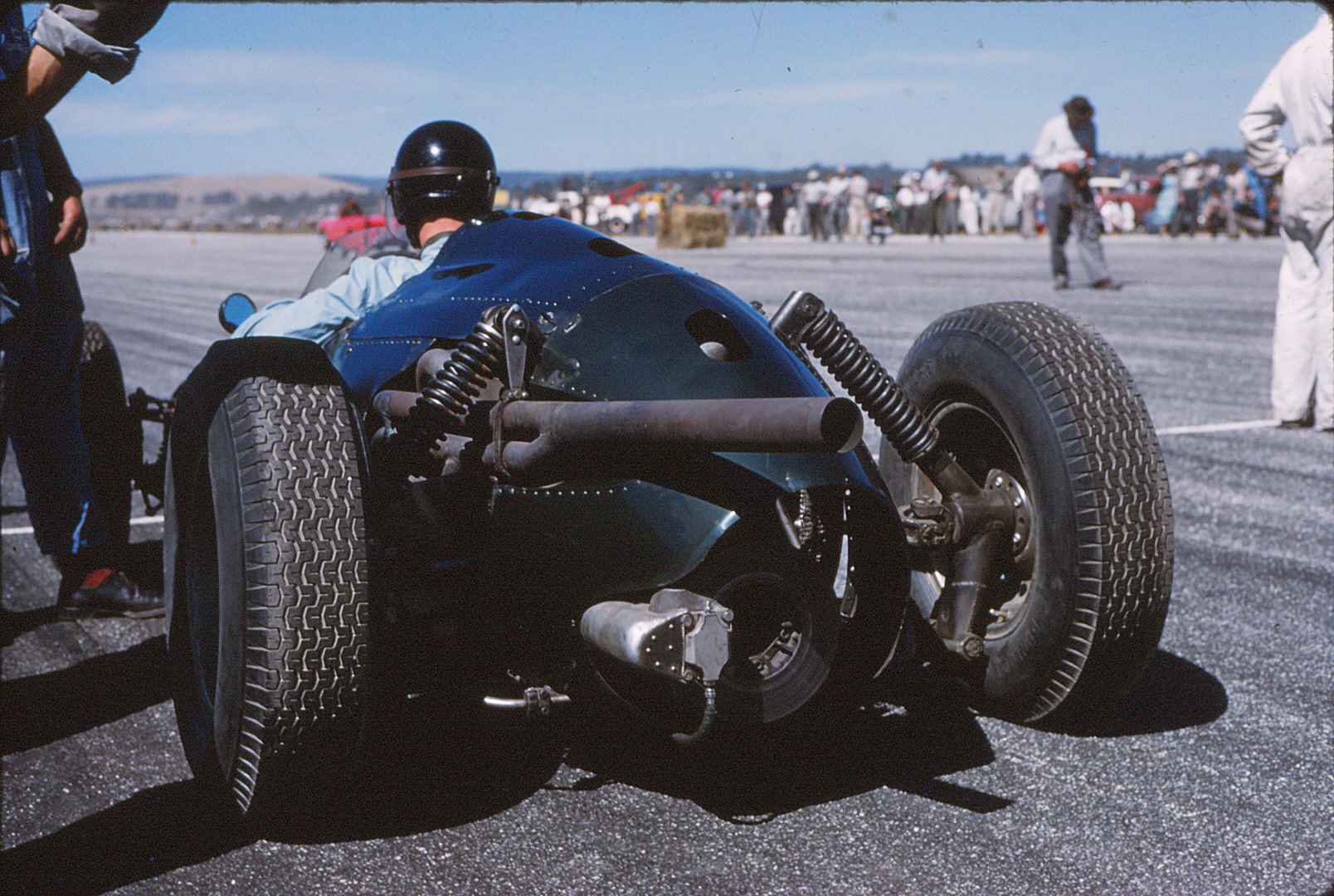
Thomson and Voigt, this angle shows how the Thompson Buick’s engine is mounted offset left (MMCG)
Firestone boys do their thing. Symmetry albeit offset left! (IMS)
Dan Gurney on the Indy 500 and GP racing in 1965
Mickey Thompson and John Crosthwaite sandwich a Harvey Aluminium representative well before the #35 car failed to make the ’62 500 cut in the hands of Chuck Daigh and Bill Cheesbourg! (JC Collection)

John Crosthwaite

Crosthwaite died on September 5, 2010, aged 84. 

After the Mickey Thompson cars for the 1962-63 Indy 500, Crosthwaite joined Holman Moody in July 1963. When their Indy project fell through, Crosthwaite commenced at BRM that December.

Later in his career, he was involved in designing chassis for road cars, including the Intermeccanica Italia, the Bond Bug, and the Reliant Scimitar GTE.

Crosthwaite worked with some notable figures/businesses in the sport, including Cooper, Team Lotus, Graham Hill, Dan Gurney, and Jackie Stewart. His innovative designs, particularly for the Indy 500, left a lasting impact on motorsport engineering.

You can’t go past Wiki’s entry for a great summary of Crosthwaite’s life of achievement: https://en.wikipedia.org/wiki/John_Crosthwaite

Buick had an ad ready to go had they won in ’91…Gary Bettenhausen DNF radiator after 89 laps, the best placed Buick turbo-V6-powered car was Stan Fox’s Lola T91/00, which was eighth in the race won by Rick Mears’ 2.65-litre Penske PC20 Ilmor Chev 265-A V8.

Credits…

David Friedman Archive, Macs Motor City Garage, psychoontyres.co.uk, Ray Brock/Getty Images, Bob Tronolone-The Revs Institute, Indy Motor Speedway, IMS-Indianapolis Motor Speedway Archive, oldracingcars.com, GM Corp, John Crosthwaite Collection via Wikipedia, LAT, Jesse Alexander, indycars.com

Finito…
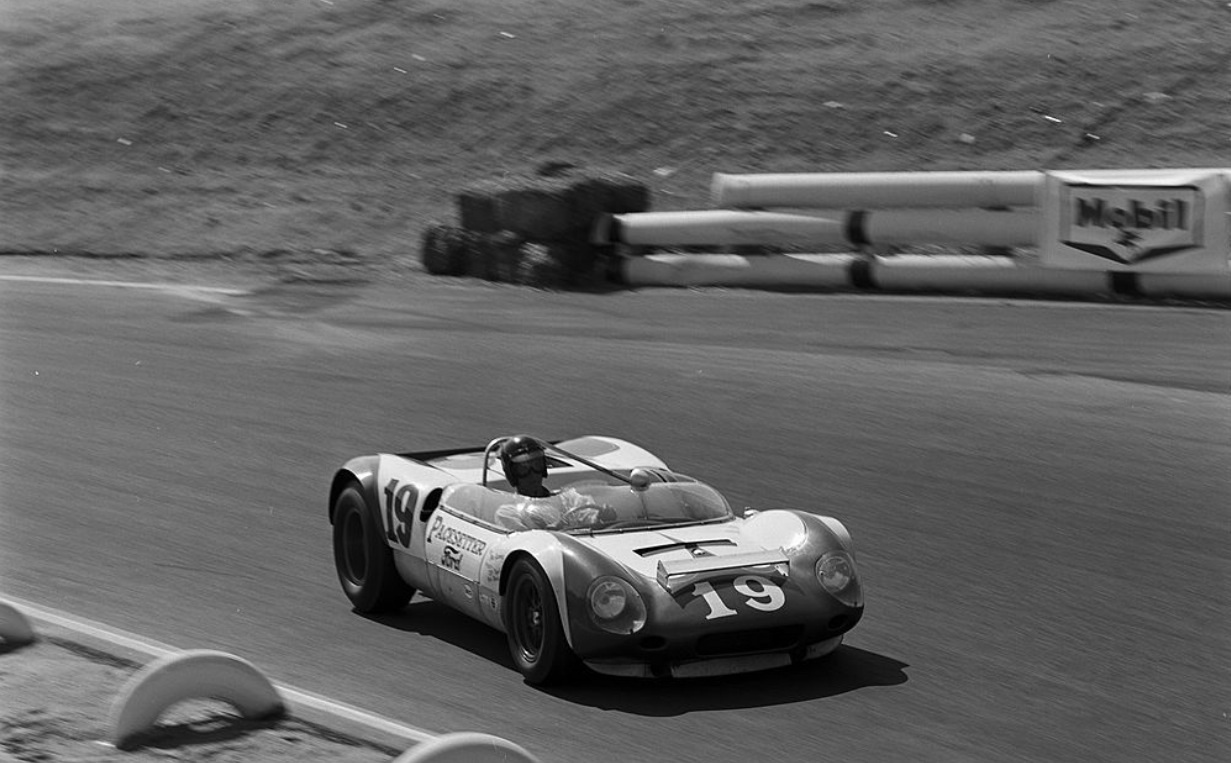
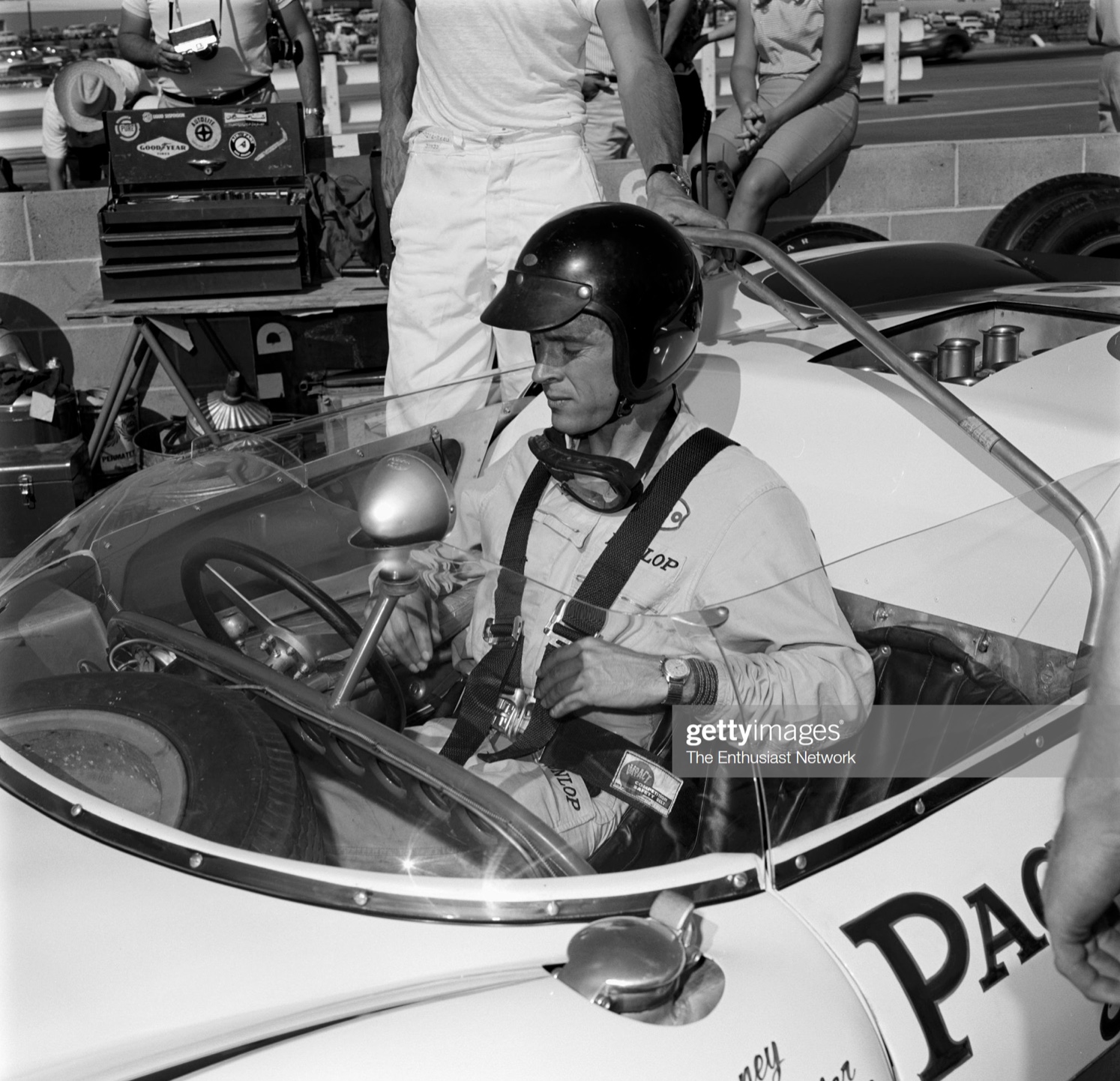
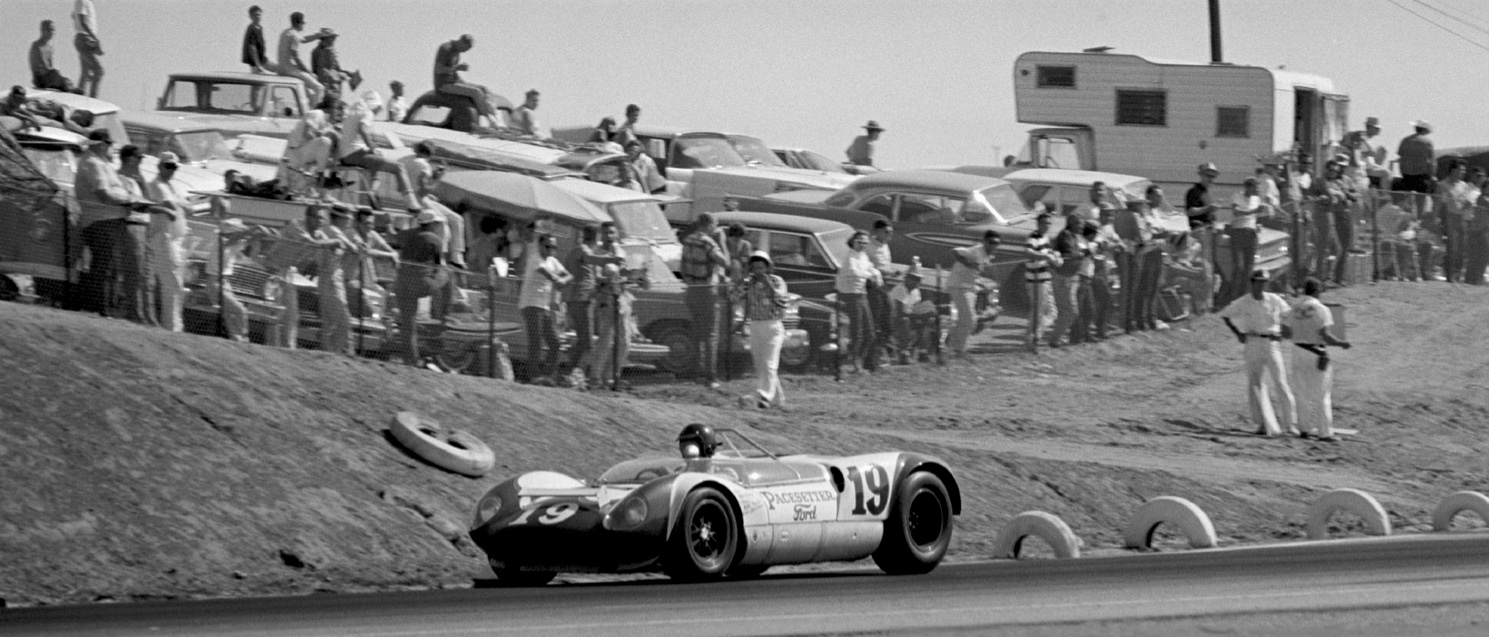
Dan Gurney’s winged Lotus 19B Ford V8 during the 1964 Times Grand Prix aka Riverside 200 on 20 October…

Ok, it’s only a little one but Dan is still testing a front wing on the nose of his Lotus 19B. Remember the year folks, 1964, the year the Chaparral lads were getting serious about spoilers but not a wing like this, even if it’s of poverty pack dimensions.

I wonder that he thought of it? He raced it so it can’t have been all bad? I am intrigued to know what contemporary reports made of the experiment.

This one of a kind Lotus 19 variant, the very last made, chassis number 966, was designed by Len Terry for Dan to accept the ubiquitous Ford 289cid pushrod V8 via the relationship created between the two men through the Lotus/Ford Indy program. It culminated in a win for Lotus, Ford, Colin Chapman, Len Terry and not least Jim Clark. Len joined Dan’s All American Racers after the historic 1965 victory.

Colin Chapman and Dan Gurney at Indy in 1963
966, Riverside paddock in 1964
Dan, and Roger Penske’s Chaparral @A Chev at Nassau in 1963

966 was delivered from Cheshunt to Dan’s new Costa Mesa, California workshop as a rolling chassis and built up by his team before its first race at Nassau in late 1963 (above).

966 is still extant, racing at elite level as late as 1969 in two Can-Am events at Riverside and Texas as the ‘BVC Mk1’- the poor little spaceframe must have been groaning under the strain of a 5.7-litre ‘hevvy Chevvy’.

Dan’s car was hardly the first of the Anglo-American V8 lightweights but it was a mighty quick car in its day, a better car than Chapman’s backbone chassis Lotus 30 and ‘ten more mistakes’ Lotus 40 successor.

The technical specifications of the Lotus 19 are outlined in this piece; https://primotipo.com/2017/09/08/bay-of-plenty-road-race-and-the-frank-matich-lotus-19s/

Fast but unreliable is a fair description of it. In December 1963, it was 16th in the Nassau Classic and DNF in the blue riband Nassau Trophy, which AJ Foyt won in a Scarab Mk4 Chev.

The Weber fed 4.7-litre Cobra engine produced circa 360bhp @ 6500rpm in period, the gearbox was a ZF. It evolved continuously of course, below in its original guise.

Laguna Seca, Ed La Mantia’s Genie Mk 5 Corvair, DNQ, about to be passed by Gurney during practice. Look at the practice crowd, FFS!
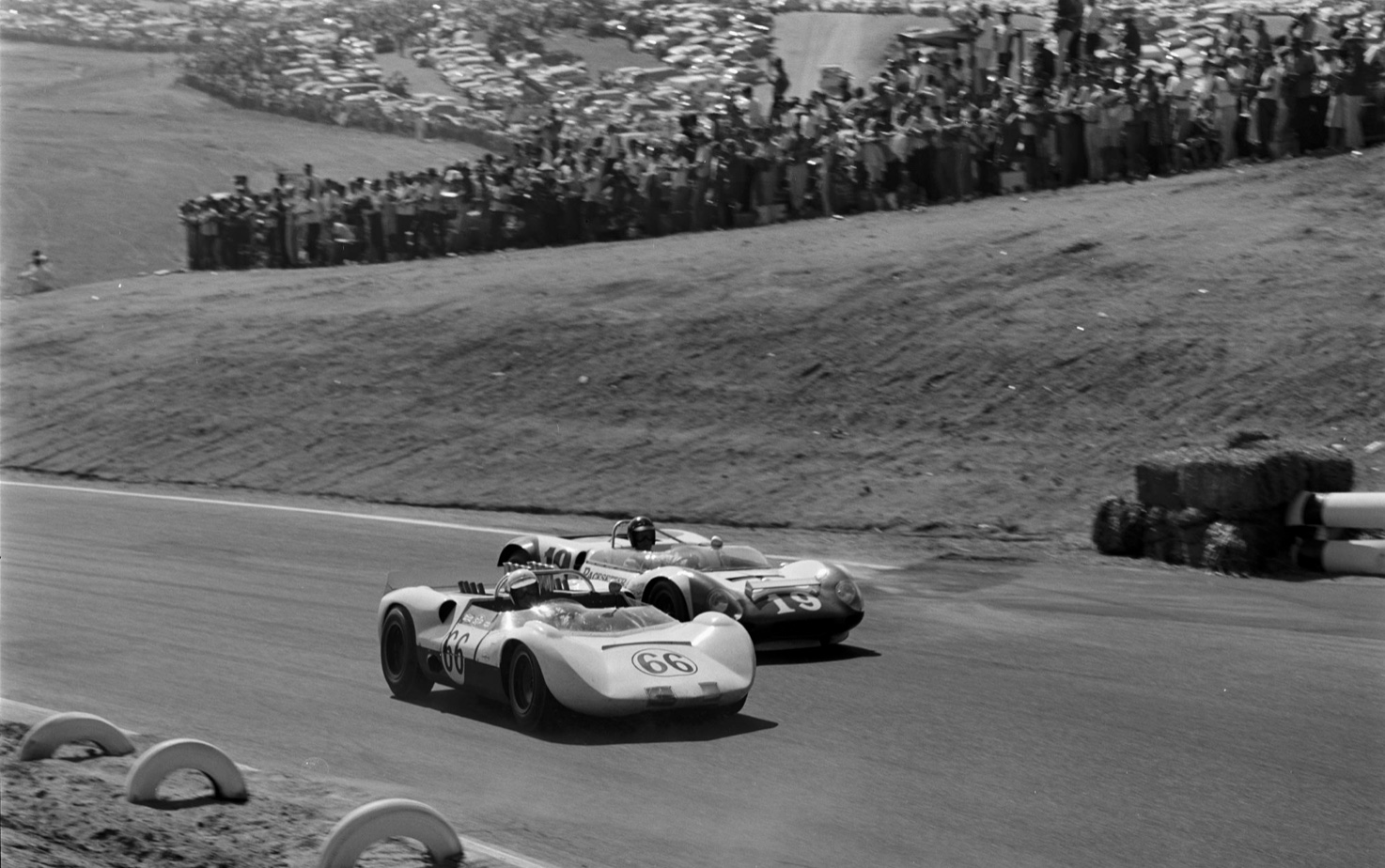
Penske, Chaparral 2A Chev and Gurney, Lotus 19 Ford, Laguna Seca 200 Miles October 1964

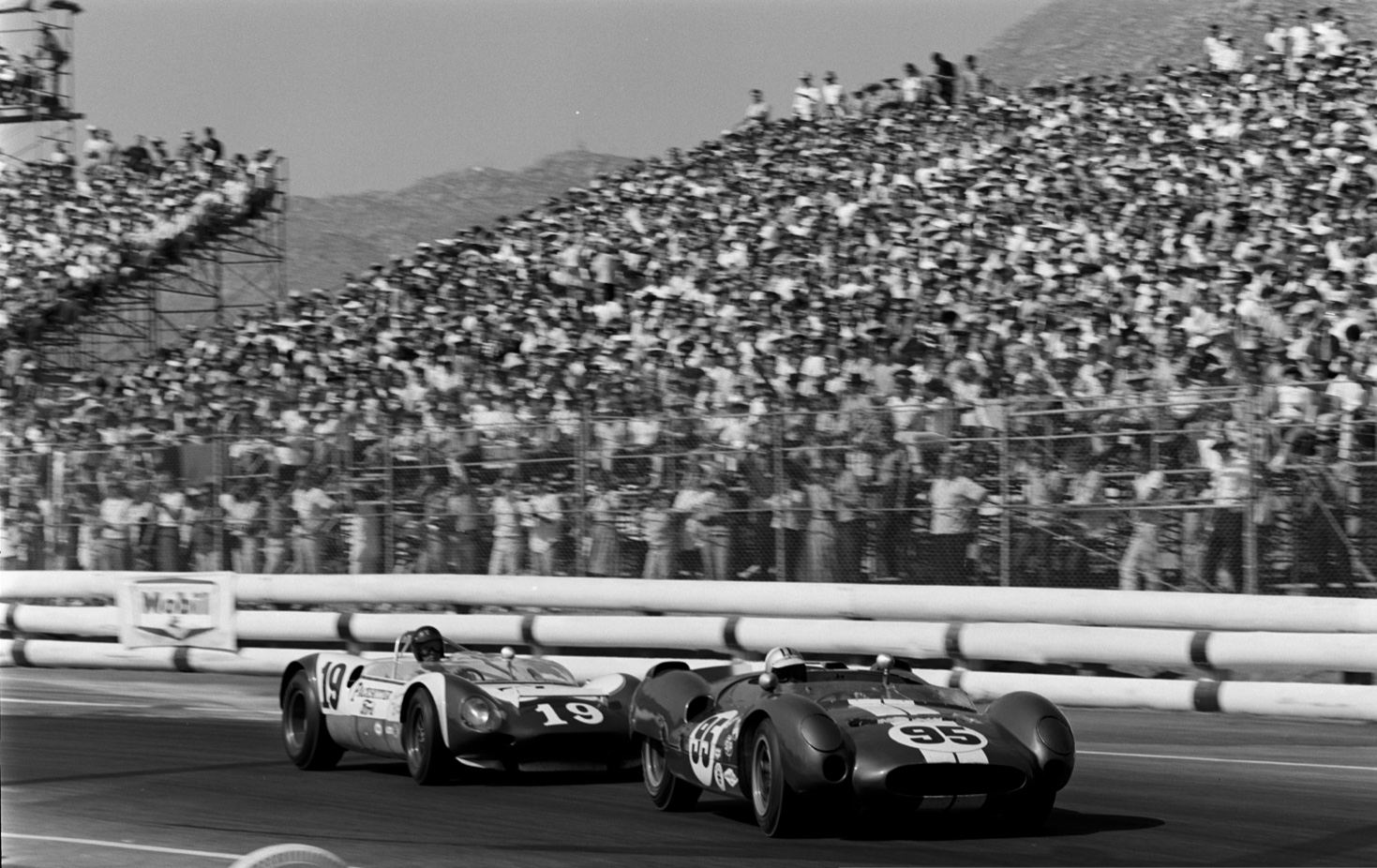
Parnelli Jones won the 1964 LA Times GP in a more developed and robust Cooper King Cobra from Roger Penske in Jim Hall’s Chaparral 2A Chev and Jim Clark’s works Lotus 30 Ford. The following weekend Dan was second to Penske in the 200 mile Monterey GP at Laguna Seca.

Gurney shared the All American Racers entered car at Daytona and Sebring in 1965. He led at Daytona for 211  laps before retiring at two-thirds distance with engine problems. At a very soggy Sebring he again ran up the front for a bit until the oil pump ended a valiant run. The car, by then entered as a Lotus 19J Ford, raced in Shelby American colours as below.

966 Lotus 19J Ford at Sebring in 1965 (L Galanos)

Louis Galanos wrote of Sebring (this group of photographs), ‘Gurney had an arrangement with Carroll Shelby to be ‘the rabbit’ and get the Chaparrals and Ferraris to chase him and hopefully retire early. This would leave the door open for either Shelby’s Cobra Daytona Coupes to win or one of the GT40s taking home the trophy for the overall win. Unfortunately it was Gurney who retired early with a broken oil pump chain drive. Gurney’s co-driver Jerry Grant never got the chance to drive. Jim Hall’s Chaparral won the race.’

Gurney negotiates Sebring’s Webster Turns – be interesting to know who built the body, Shelbys I guess? – whoever it was didn’t rate the little front wing…

Etcetera…

In the beginning…

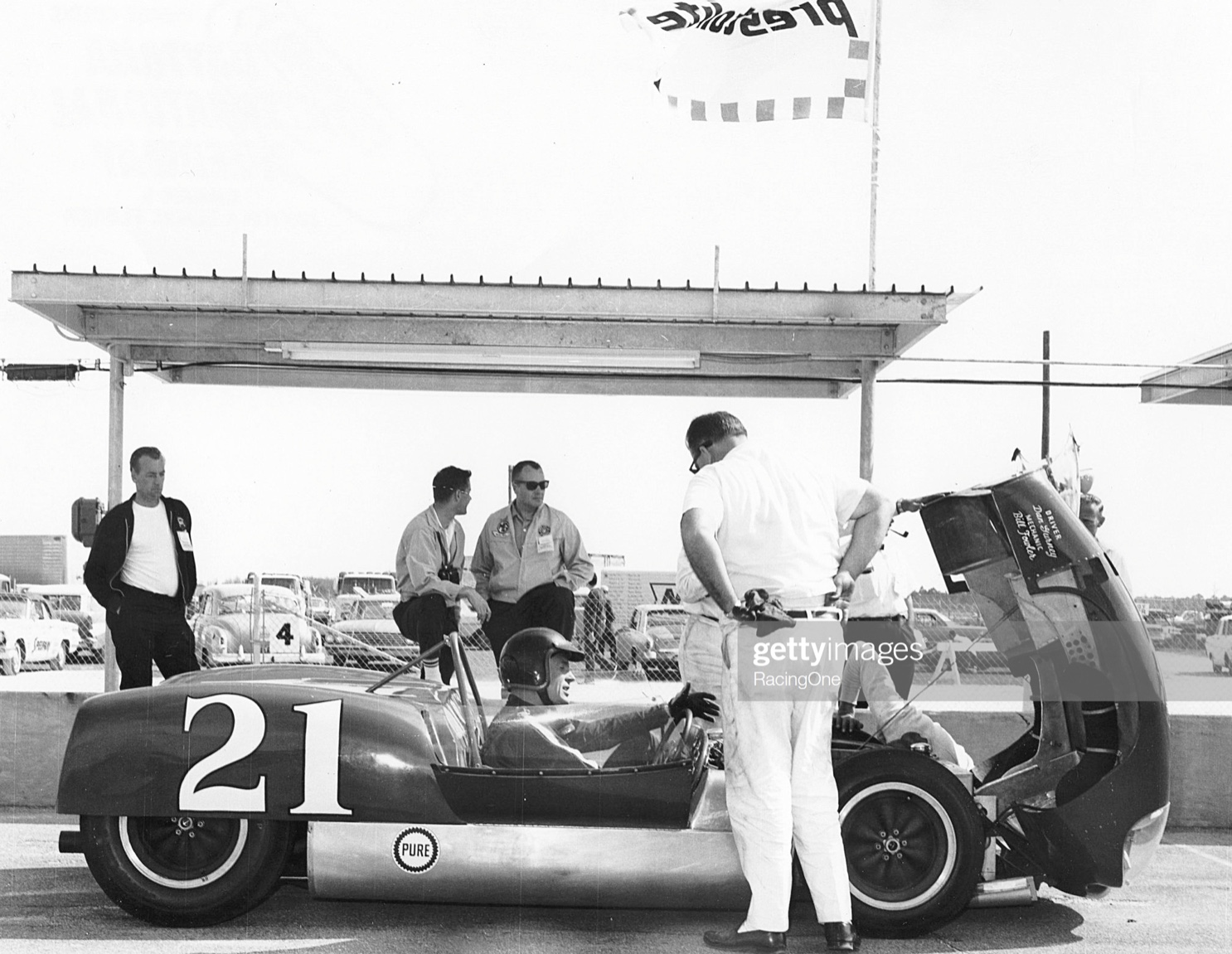
The delicate little flower as it arrived from Cheshunt, here (above) at Daytona in February 1964 still fitted with skinny Lotus wobbly-web magnesium alloy wheels. Dan took the view that 360 odd bee-aitch-pee needed more rubber on the road so a call to Halibrand was made.

The car was quick, on pole for the SCCA American Challenge Cup, he led the 15 February 400km race for 12 laps before stalling during a pitstop and was then disqualified for a push-start from his crew, a breach of the rules. Clearly Gurney had concerns about the cars endurance as he chose to contest this shorter race rather than the Daytona 2000km, as it then was, the following day.

Laguna Seca 1964. Gurney’s Lotus with Bruce McLaren, McLaren Mk1 Elva Olds at left, #8 is Jerry Grant’s Lotus 19 Chev and the white helmeted driver is probably Parnelli Jones’ Cooper King Cobra.

Penske won from Gurney and Bob Bondurant then Ronnie Bucknum- here dicing with Gurney in the photograph below the week before at Riverside.

Ronnie Bucknum, Shelby prepped Cooper King Cobra Ford, DNF, from Gurney’s Lotus 19 – 19G – in some texts, Riverside 1964

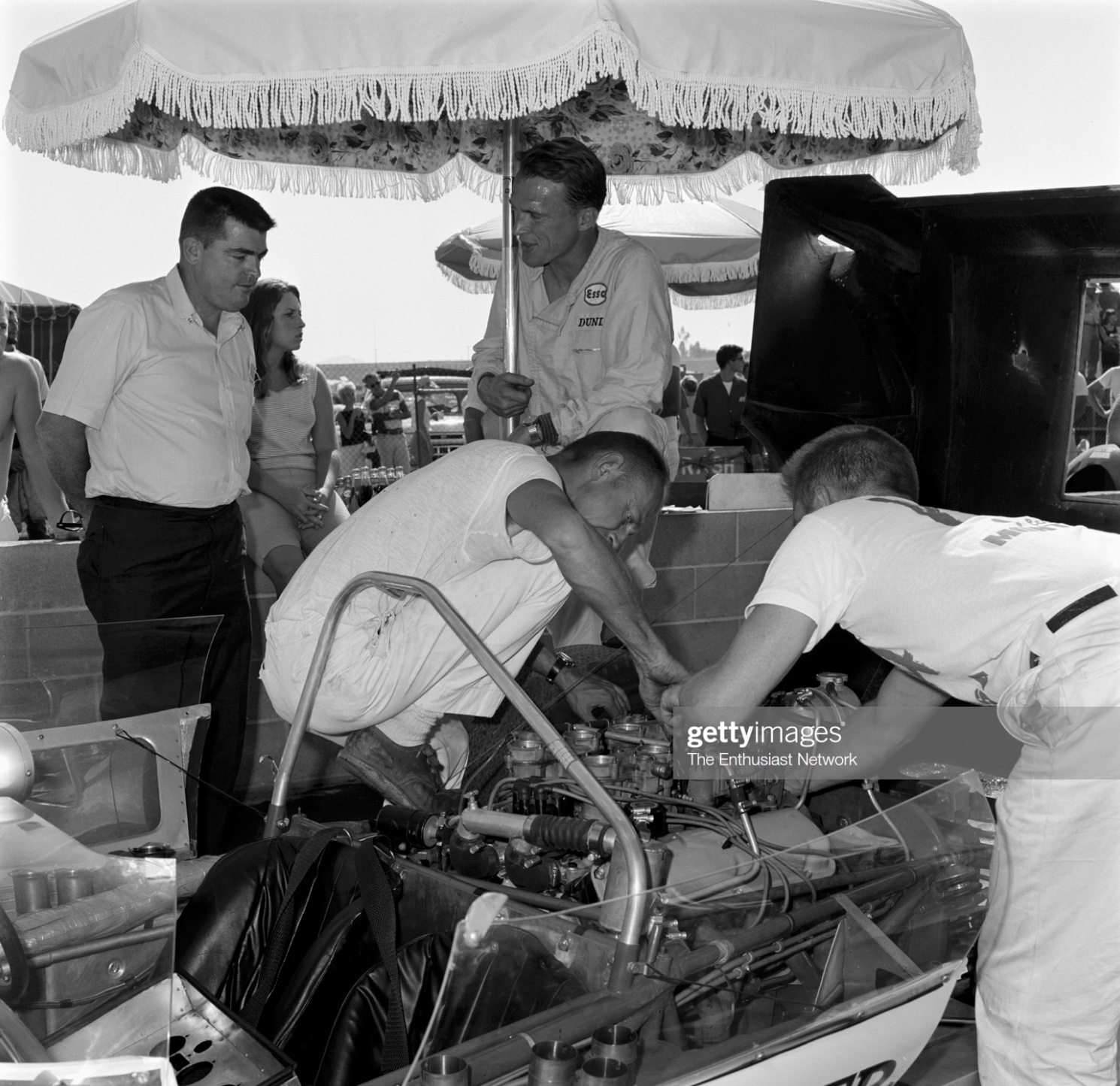
Dan and Mickey Thompson take shelter from the Laguna Seca, California, heat under Gurney’s beach umbrella. I wonder what plan they are hatching?

That roll bar is braced (removed in this shot) but is still a bit limp. Note the Lotus chassis and Weber fed 289 Ford V8, these little, light Windsors were and are gems of things, at 302cid they were the last ‘real production’ engines to win Le Mans outright in 1968 and 1969 in the back of JW Ford GT40s??

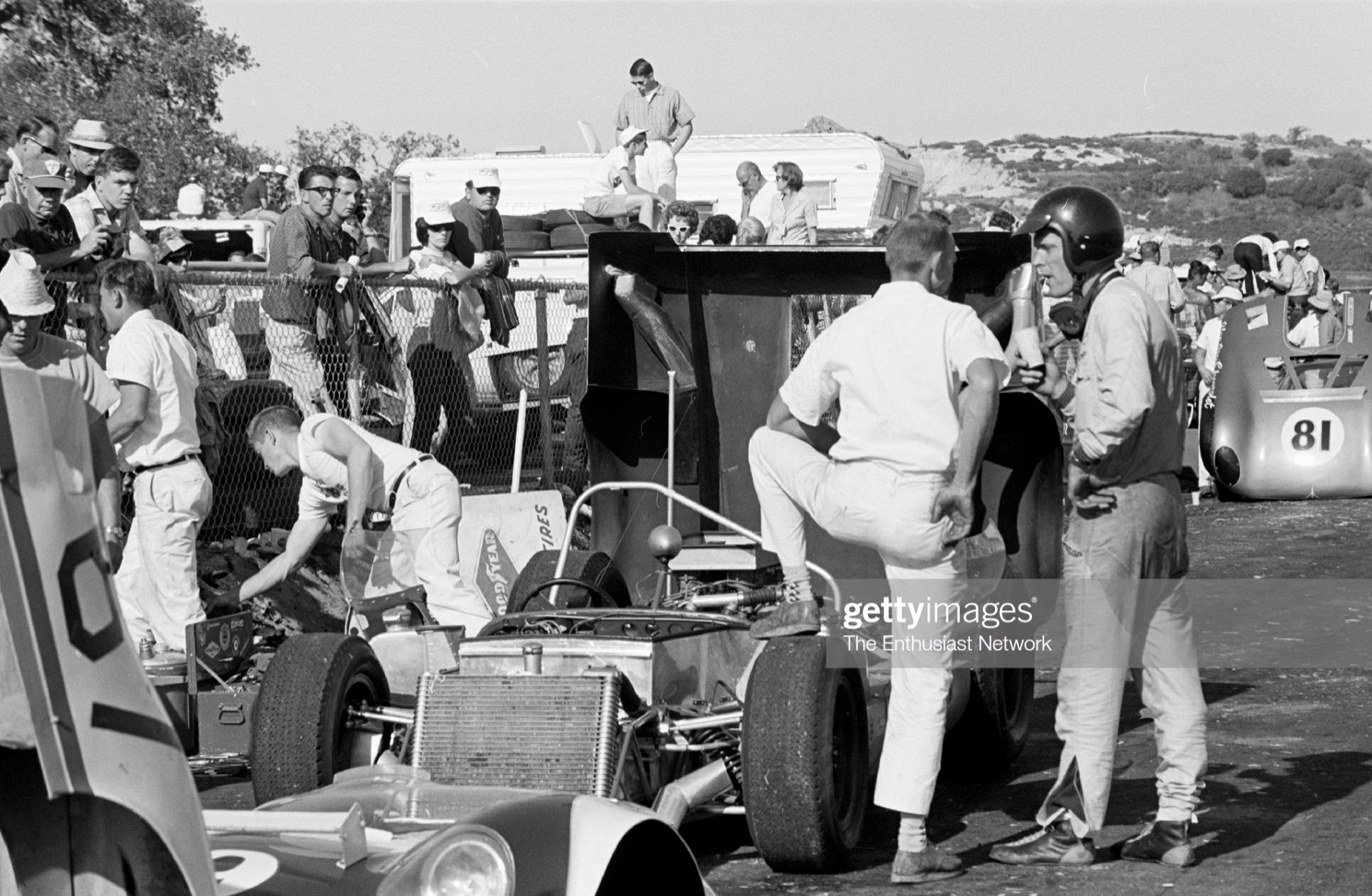
Between session changes at Laguna Seca. Note the Lotus 18 parts bin front suspension, and vestigial roll-over bar. Car #81 is Allen Grant’s Cheetah Chev, 14th.

Riverside again, at a glance the pretty car looks like a beefy Lotus 23. Team plagued with multiple mechanical issues over the weekend so did not finish.

Driver Bruce Campbell with his Ecurie Vickie Racing Team BVC Mk1 Chev 5.7 at Riverside in October 1969.

The car was given this name as a ruse to try and ensure race organisers didn’t know the derivation and age of the car. He qualified twentieth of 35 starters 14 seconds off the pace of Denny Hulme’s McLaren M8B Chev pole time and finished fifteenth 14 laps down. After his impressive qualifying time, race winner Denny spoke to Bruce and suggested a more modern car for the coming season!

At Texas International, Houston, the following weekend Bruce was 20 seconds off Denny’s pole and DNF. Hulme won aboard his M8B with Bruce winning the ’68 Can-Am Drivers championship and McLaren the Constructors of course.

Credits…

Getty Images, The Enthusiast Network, Louis Galanos, Bob D’Olivo, Pat Brollier, Vickie Callouette, Bill Stowe. Sorry about most of the photo credits, folks, I drafted this years ago and have long since lost those notes

Tailpiece: 1964 LA Times GP, Riverside…

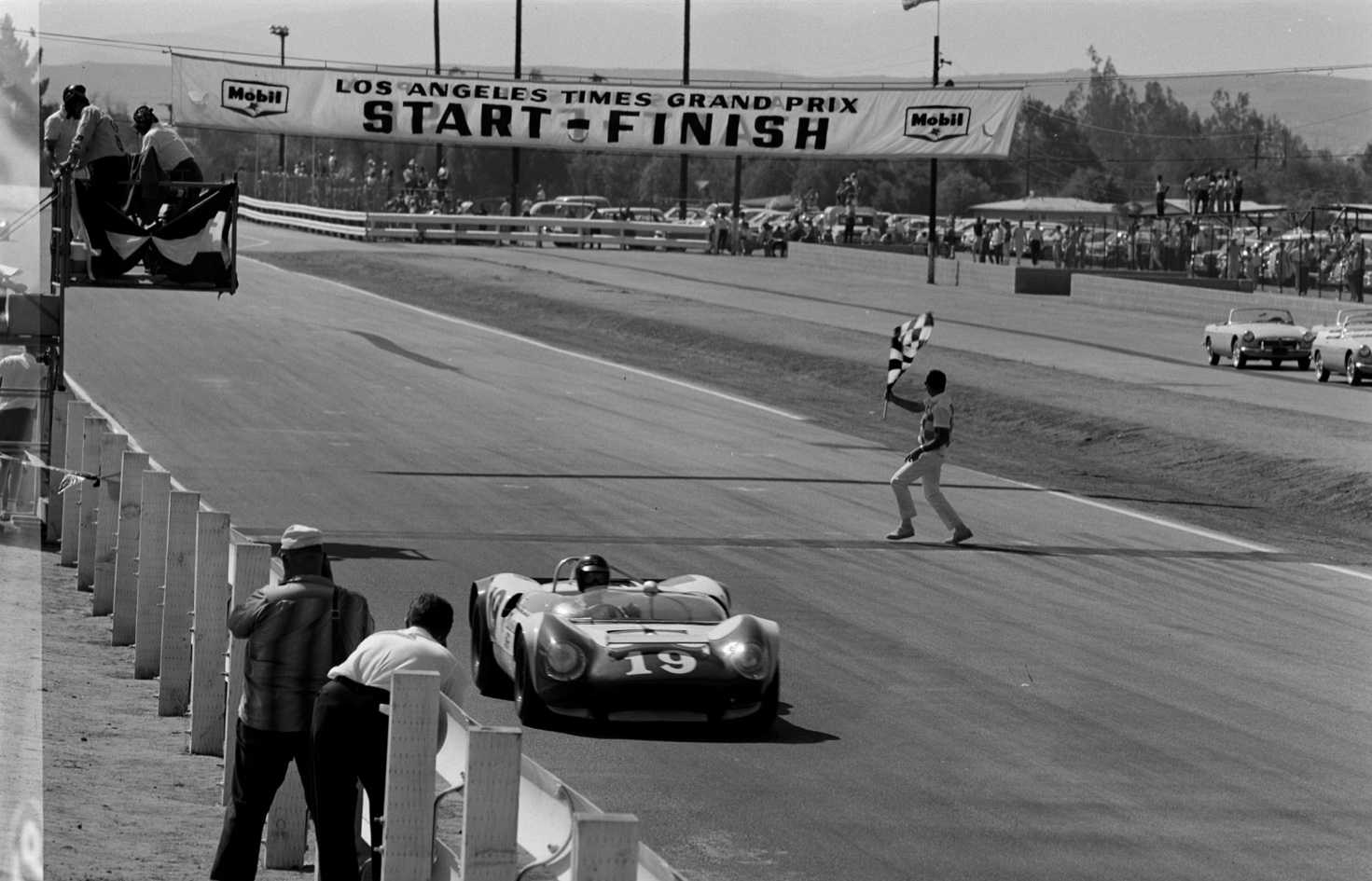
Sadly for Dan it’s just the end of qualifying not the end of the 200 mile race the following day! Lotus 19B Ford.

I’m not sure of the date of Dan’s last drive in the car, but it seems Joe Leonard crashed it whilst tyre testing. It then passed through the hands of Steve Dulio, Dick Callouette, Wayne Linden, Gordon and Nancy Gimbel, then back to Steve Dulio, who is the last name I can see online. The car is still historic raced in the US, which is wonderful.

Finito…

Graham Hill, Dan Gurney and the BRM mechanics await the start. Dan’s car is P48 #486 (D Jolly)

Make sure you buy the August 2024 issue of The Automobile, it contains a piece I wrote about Dan Gurney’s win at Ballarat Airfield in a BRM P48 on February 12, 1961.

That Victorian Trophy victory was the only international win for a P48 in Dan’s last drive for the Owen Racing Organisation.

There are some fantastic, never-seen-before colour shots taken by Australian Lotus ace/works-driver and Australian importer Derek Jolly at the meeting, courtesy of Lotus historian/restorer Mike Bennett.

Further ‘Australian content’ comes in the form of the cover car, Bugatti Type 35 chassis 4450. Better known to many of us as the Lyndon Duckett/Bob King Anzani Bugatti, the car is the subject of a long feature celebrating the centenary of the landmark T35. See here too: https://primotipo.com/2021/09/17/werrangourt-archive-9-lyndon-duckett-by-bob-king/

Towards the end of his 52 years of use on the road and in competition Bob restored the 4450 to its original, ex-factory specification. The same spec as that when it was delivered to first owner, George Pearson Glen Kidston in Molsheim on February 16, 1925. In a neat book-end of history Simon Kidston, Glen’s nephew, is the current custodian of #4450, not that it looks much like it did in Australia clad in its road-going garb.

Another fascinating article for proponents of Oily Rag Restoration, is a report on the Best in Show award going to an unrestored Alfa Romeo 8C2300 at May’s Concorso d’Elegance Ville d’Este.

It’s the first time the premier award in a ‘Grand Prix Concours’ has gone to a Preservation Class car. Great stuff, as Jörg Sierks ended his piece, ‘We can only hope that such appreciation of patina and preservation will be upheld and leave its mark on the future of Ville d’Este and other world-class concours events.’

The Automobile is in-store now in the UK, and two months away on the slow-boat to the Antipodes, other than to subscribers who should have it about now. Why not subscribe here: https://www.theautomobile.co.uk/subscribe/

Rear of Dan’s P48. Macpherson strut, single lower wishbone and radius rod rear suspension, and famous Dunlop ‘bacon-slicer’ ventilated single rear disc brake mounted to the gearbox output shaft (D Jolly)

Credits…

Derek Jolly via Mike Bennett, The Automobile

Finito…

(LAT)

The days of sublime, simply beautiful Grand Prix photographs are long gone, sadly. I friggin’ hate modern abbreviations like OMG but it does make a point, very economically.

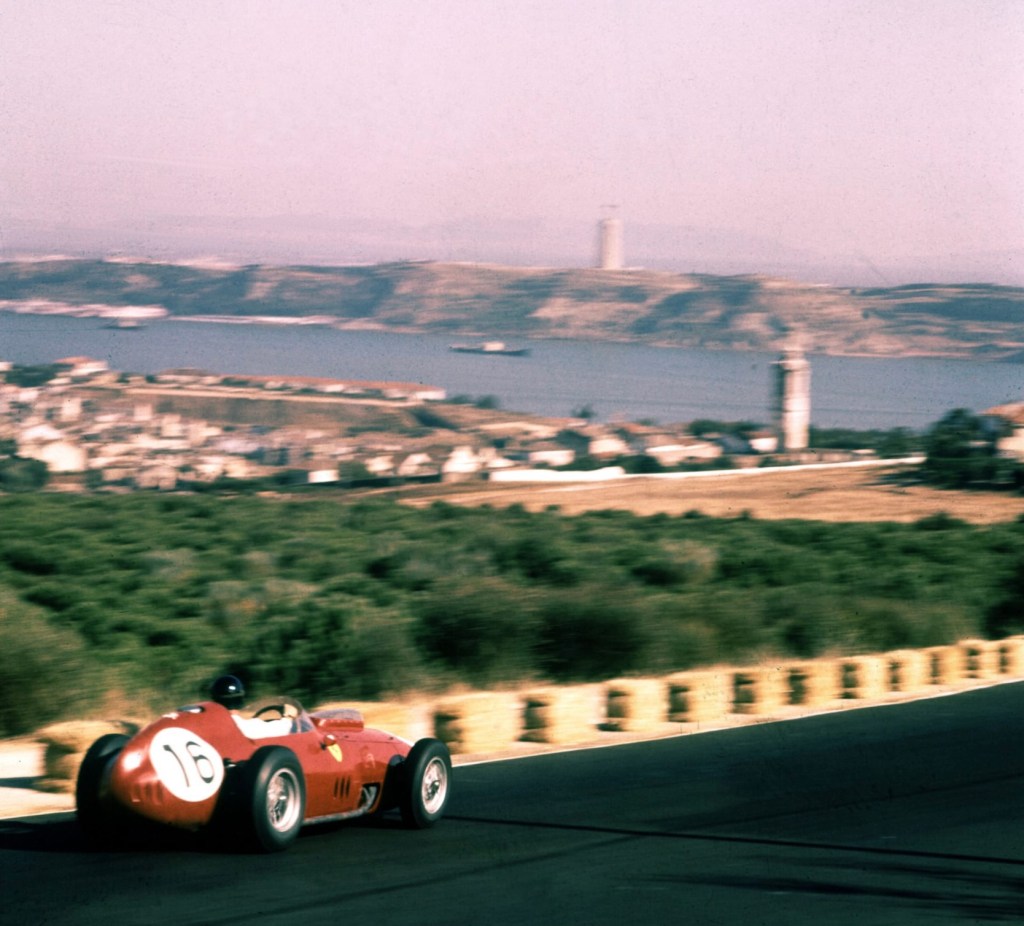
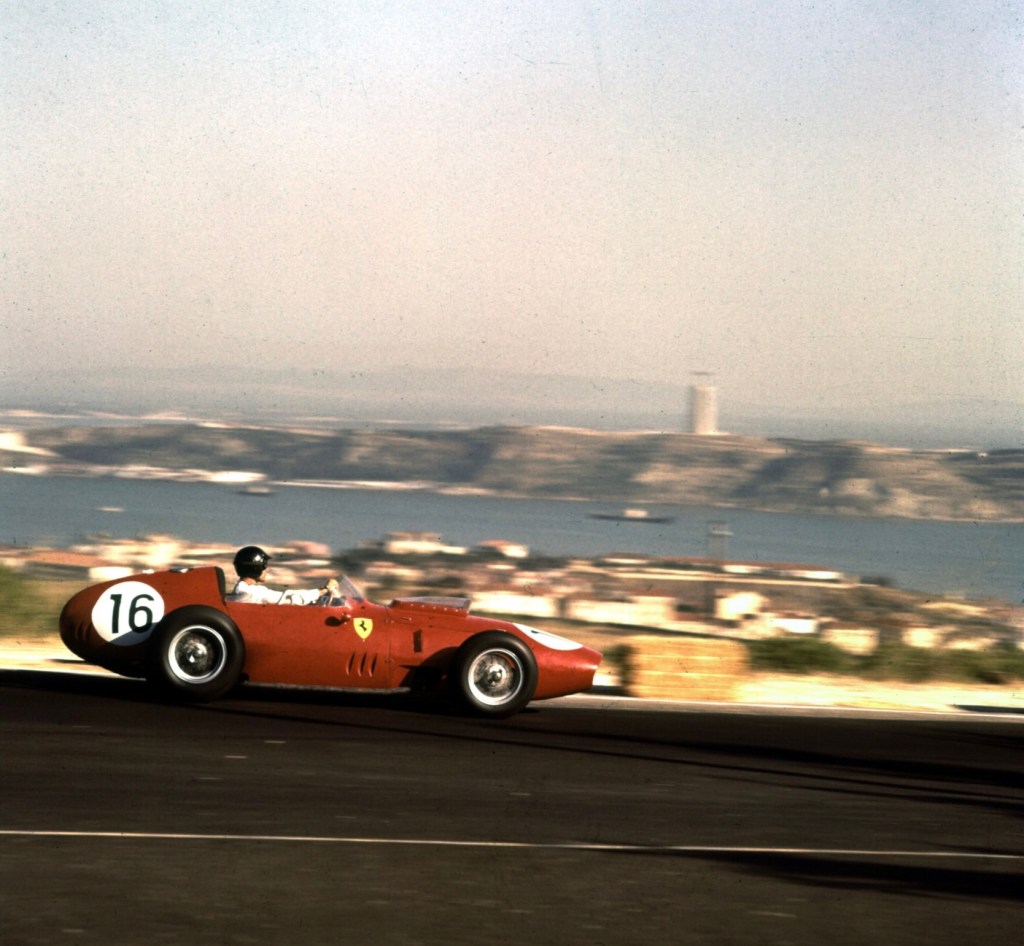
Dan the Man is blasting his Ferrari Dino 246 around the Circuito de Monsanto, a port city in Lisbon, Portugal, during the August 23, 1959 Portuguese Grand Prix. He was third behind the Cooper T51 Climaxes raced by Stirling Moss and Masten Gregory.

(LAT)

Back then, photographs weren’t usually attributed to the artist, so sadly we cannot give the talented ‘snapper the accolade he/she/uncertain deserves: try this https://primotipo.com/2017/07/14/composition/

Of course, rather than completely wallowing in the past, the challenge is to find some modern settings which match the OMG-WOW Factor of photographs like these. This is the first in what will be an ongoing series…

Credits…

LAT Photographic

Finito…

(MotorSport)

Denny’s South African Office…

Cockpit shot of Denny Hulme’s second placed – Jack won in his Brabham BT33 – McLaren M14A Ford during the March 7, 1970 South African Grand Prix weekend at Kyalami.

Smiths instruments of course: the chronometric-tach telltale is on 10,100rpm, the DFV developed all of its punch from 8-10000. Oil pressure and temperature is the priority, fuel pressure and water temperature secondary and out of Hulme’s direct line of sight. Switches are for the rev limiter, ignition, electrical fuel pump (starting only) and the starter button. I’ve always liked a nice big ignition kill switch, but let’s not get picky.

Bruce and Denny M14As – with Jack out of focus – in the Brands paddock during the Race of Champions weekend in March 1970 (MotorSport)

The M14A was an evolution of Robin Herd and Bruce’s 1968 M7 design. A profitable Grand Prix winning design, not to forget the McLaren M10A and M10B F5000 cars which made McLaren and Trojan Cars plenty of dollars.

The cars had a few steerers in 1970: Bruce and Denny, then Dan Gurney after Bruce’s fatal Goodwood accident, and after that, Peter Gethin when conflicting oil company sponsorship contracts got in the way of Dan’s F1 and Can-Am McLaren drives.

Gurney’s qualifying best was a second adrift of Denny in the British GP, it would have been interesting to see if he could have got back his old Grand Prix race-pace had he finished the season with McLaren. He was right on-the-money in the Can-Am Cup mind you, winning the first two races at Mosport and St Joliet from pole in his M8D Chev – no doubt relishing the very first ultra competitive Can-Am car he had ever raced! – and qualified second on the grid at Watkins Glen, then faded with undisclosed dramas in his last race for the team.

Gurney’s M14A Ford, British GP July 1970 Brands Hatch (MotorSport)

There is no such thing as an ugly Papaya McLaren! Note the full monocoque aluminium chassis under that inspection hatch.

In a very tough year for the team, Bruce’s best was second place in the Spanish GP in M14A/1, and Dan’s best in three Grands Prix with that car, was sixth in the French at Clermont Ferrand.

Denny raced M14A/2 to second at Kyalami, and third in the Race of Champions at Brands Hatch and the German Grand Prix. He missed the Belgian and Dutch GPs after burning his hands at Indianapolis when an imperfectly secured quick-release cap on his McLaren M15 Offy leaked methanol and caught fire.

Peter Gethin then raced M14A/2, placing second in the Spring Trophy at Oulton Park and in the International Trophy at Silverstone.

Dan Gurney, McLaren M14A Ford, on the beautiful Clermont Ferrand road circuit, French GP 1970 (MotorSport)

M14A/3 became Peter Gethin’s car from the 1970 Italian GP until the Spanish in March 1971. In eight meetings his best was sixth in the Canadian GP at Mont Tremblant.

Ultimately the M14A fell a bit short in 1970, while noting again the mitigating factors. It was a rare GP season in which victories were spread far and wide amongst the Lotus 72 Ford, Ferrari 312B, Brabham BT33 Ford, BRM P153 and March 701 Ford! Jochen Rindt posthumously won the drivers title and Lotus the constructors.

Bruce in M7B Ford. Note the front wing support mounts directly to the upright, Race of Champions 1969 (MotorSport)

Hey you in the Big Banger…

No it’s not a single-seat M8 Can-Am car, in 1969 McLaren converted M7A/3 to ‘Lancia D50 spec’ by placing all the fuel centrally and low. By filling in the space between the wheels Bruce and Gordon Coppuck were also playing with the aerodynamics of the car; the car was then tagged M7B/3.

It didn’t work though, after racing the car on debut in the South African GP at Kyalami in January 1969, and then the Brands Hatch Race of Champions (above) the car was sold to Colin Crabbe, of Antique Automobiles, for Vic Elford to drive.

Vic was fifth in the French GP, then sixth in the British before crashing it at the Nurburgring in an accident not of his making. Mario Andretti crash-landed his Lotus 63 Ford 4WD and Vic collected one of its wheels, flipped and ploughed into the trees destroying the car and breaking his arm in three places. I guess the Ford DFV and Hewland DG300 gearbox from that car found their way into the new March 701 that Crabbe bought for Ronnie Peterson to race in 1970?

Vic Elford, McLaren M7B Ford, Nurburgring 1969 not long before his big, Mario inflicted crash (MotorSport)
Bruce McLaren, McLaren M7C Ford, British GP Silverstone 1969. Third, race won by Jackie Stewart’s Matra MS80 Ford (MotorSport)

Bruce drove a new car, M7C/1 for the rest of 1969. The major factor which enhanced this cars performance was the use of a full monocoque aluminium chassis derived from the M10A F5000 car, itself derived from the bathtub-monocoque M7A.

McLaren’s conventional 2WD cars didn’t get as much love as they otherwise would have in 1969 given the attention lavished upon their 4WD brother, the M9A. McLaren, together with Lotus, Matra and Cosworth pursued this blind-alley. Ultimately, very quickly, wings and the tyre company Polymer Chemists solved the ‘3-litre problem’ of too much power and too little grip far more cost-effectively than then complex mechanical 4WD mechanisms.

Derek Bell aboard – although he looks like he is trying to escape it – the McLaren M9A Ford 4WD during the 1969 British GP weekend at Silverstone. DNF suspension after five laps (MotorSport)

Bruce’s 1969 M7C – as we have seen, a lineal descendant of the 1968 M7A – begat the 1970 M14A. The major advances from M7C to M14A were inboard rear brakes, new front uprights and a smidge greater fuel capacity.

See Allen Brown’s Oldracingcars.com for more detail: here: https://www.oldracingcars.com/mclaren/m7a/ and here: https://www.oldracingcars.com/mclaren/m4a/ not to forget my own masterpiece on the M7A here: https://primotipo.com/2018/07/13/mclaren-m7a-ford-dfv/

Etcetera…

(MotorSport)

A few more shots of the wideboy McLaren M7B Ford during that March 16, Race of Champions weekend at Brands Hatch in 1969.

High wings were the rage but Lotuses ‘cavalier’ engineering of their wing supports and their repeated failures – the last straw the breakages of Rindt’s and Hill’s wings and resultant crashes of their Lotus 49s at Montjuïc – saw them banned during the Monaco GP weekend that year. More tightly controlled, they stayed.

The photographs in this article demonstrate the changes being made by the teams to adapt in a a period of about 12 months, not to forget the related 4WD adventures for the affected teams!

(MotorSport)
(MotorSport)

Credits…

MotorSport Images, oldracingcars.com

Tailpiece…

(MotorSport-Schlegelmilch)

Our pit-babe was at Clermont during the 1970 French GP weekend, the cars are Denny and Dan’s M14As and Andrea de Adamich’s M14D Alfa Romeo. Another of Rainer Schlegelmilch’s signature shots!

Finito…

(MotorSport)

Dan Gurney’s – Brabham Racing Organisation – Coventry Climax FWMV 1.5-litre V8 during the 1963 Monaco Grand Prix weekend. F1-1-63’s second race.

The car is a Brabham BT7, the second type of GP Brabham, Jack having debuted the BT3 Climax in 1962. Two F1 BT7s – there was also two BT7A Intercontinental/Tasman Formula cars – were built. Dan debuted BT7 F1-1-63 at the International Trophy, Silverstone on May 11, 63, and Jack first raced F1-2-63 at Zandvoort on June 23, 1963.

(LAT)

Dan in front of Tony Maggs (fifth) and Willy Mairesse (DNF final drive) at Monaco that year: Brabham BT7 Climax, Cooper T66 Climax and Ferrari Dino 156. Gurney was out with crown wheel and pinion failure in the race won by Graham Hill’s BRM P57 from teammate Richie Ginther’s P57. Bruce McLaren’s Cooper T66 was third.

(MotorSport)

Gurney on the way to an historic first Championship Grand Prix win for the Brabham marque aboard his BT7 at Rouen-les- Essarts, France in June 1964. Dan also won the non-championship 1964 Mexican GP with this F1-1-63, while Jack’s best in F1-2-63 was a pair of wins in in the Aintree 200 and the Silverstone International Trophy in April/May 1964.

Somewhat incredibly, Allen Brown records the last of 48 in-period race meetings for this (Jack’s) car was at Indianapolis, where Dave Rines won the SCCA Regional at Indianapolis Raceway Park in May 1968, at which point the car was powered by a 3-litre Coventry Climax FPF-four.

Dutch GP: second, Clark won in a Lotus 25 (MotorSport)

Credits…

MotorSport Images, LAT Photographic, oldracingcars.com: https://www.oldracingcars.com/brabham/bt7/

Tailpiece…

(MotorSport)

Coventry Climax FWMV 1.5-litre Mk3 V8: Lucas fuel injected, DOHC, two-valve, 195bhp @ 9500rpm. Early five speed Hewland HD gearbox with distinctive upside-down VW Beetle case, but not yet with neato, bespoke side-entry rear housing. The ‘vertical bomb’ is Lucas’ hi-pressure fuel pump. Rear end comprises mag alloy uprights, inverted wishbones at the top, single links at the bottom plus two radius rods doing fore-aft locational duties. Ron changed his mind about the respective locations of the wishbones and links pretty soon after this.

Finito…

(MotorSport)

The Grand Prix cinematographer doesn’t seem the least bit perturbed by the immediate proximity of Daniel Sexton Gurney at Spa during the 1966 Belgian Grand Prix in the pouring Ardennes rain. There is a haybale or two there after all.

I guess Dan is past the critical – for the ‘snapper’s life – turn-in phase of the corner and he is only (sic) delicately balancing the Eagle Mk1 Climax 2.7 FPF on the throttle through Eau Rouge. Still, it was really dumb-shit like this that makes the film so great.

Gurney qualified 15th and wasn’t classified in this interim car, he was awaiting Weslake Engineering’s delivery of the Eagle-Weslake V12 motor to create a true contender, John Surtees’ Ferrari 312 won. See here; https://primotipo.com/2019/02/19/eagle-mk1-climax-101/

(Wfooshee)
(unattributed – who took the shot?)

He came, he saw and he conquered with mesmeric car control in the 1969 Warwick Farm 100 Tasman Cup round. Jochen Rindt Lotus 49B Ford DFW 2.5 V8.

If he wasn’t recognised as the fastest man alive at the start of the season, most pundits saw it that way by the end of it. Fastest I said, not best. See here; https://primotipo.com/2018/01/19/rindt-tasman-random/

(D Simpson)

Credits…

MotorSport Images, Dick Simpson, wfooshee

Finito…

Gurney in Lotus 29-R1 Ford at Indy in March 1963. Here with symmetrical suspension, raced with offset

A bit like Chris Amon, there is no such thing as too much Dan Gurney.

I’ve been researching an article on Lotus’ 1963 Indy campaign and have discovered a few Dan shots too good to waste.

Gurney’s mind was blown, just like everybody elses, when the Lotus 25 Climax was rolled out of the Team Lotus transporter at Zandvoort in 1962. That monocoque design was an Indy winner; as a Californian he was keen to drink the Indy Winners Milk.

He said as much to Colin Chapman and flicked the Lotus supremo a free air ticket to watch him contest the ’62 event in a Mickey Thompson Spl: John Crosthwaite’s mid-engined, spaceframe design was powered by a Buick stock-block V8. Dan ran in the top ten until the transaxle was hors ‘d combat. Importantly ole-Chunky was on the hook.

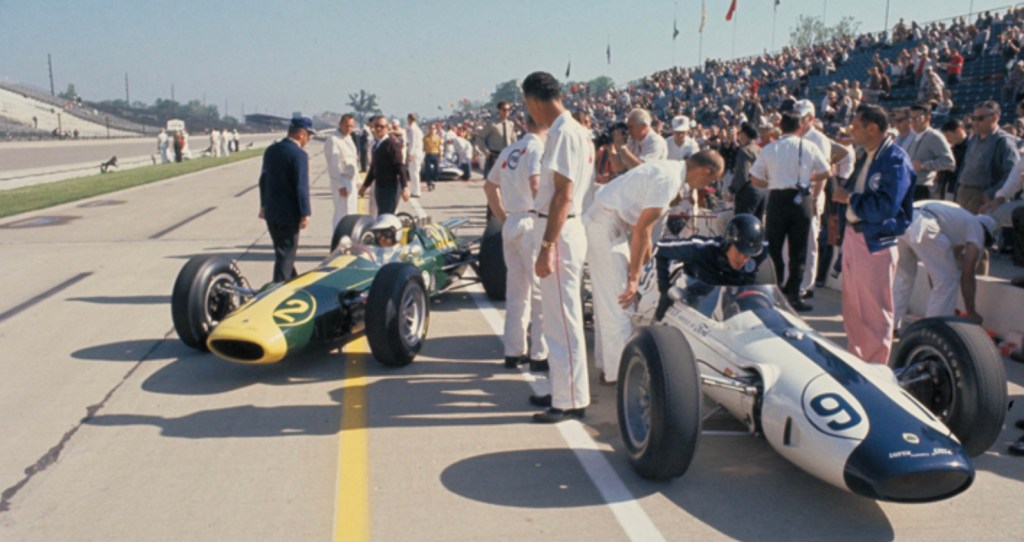
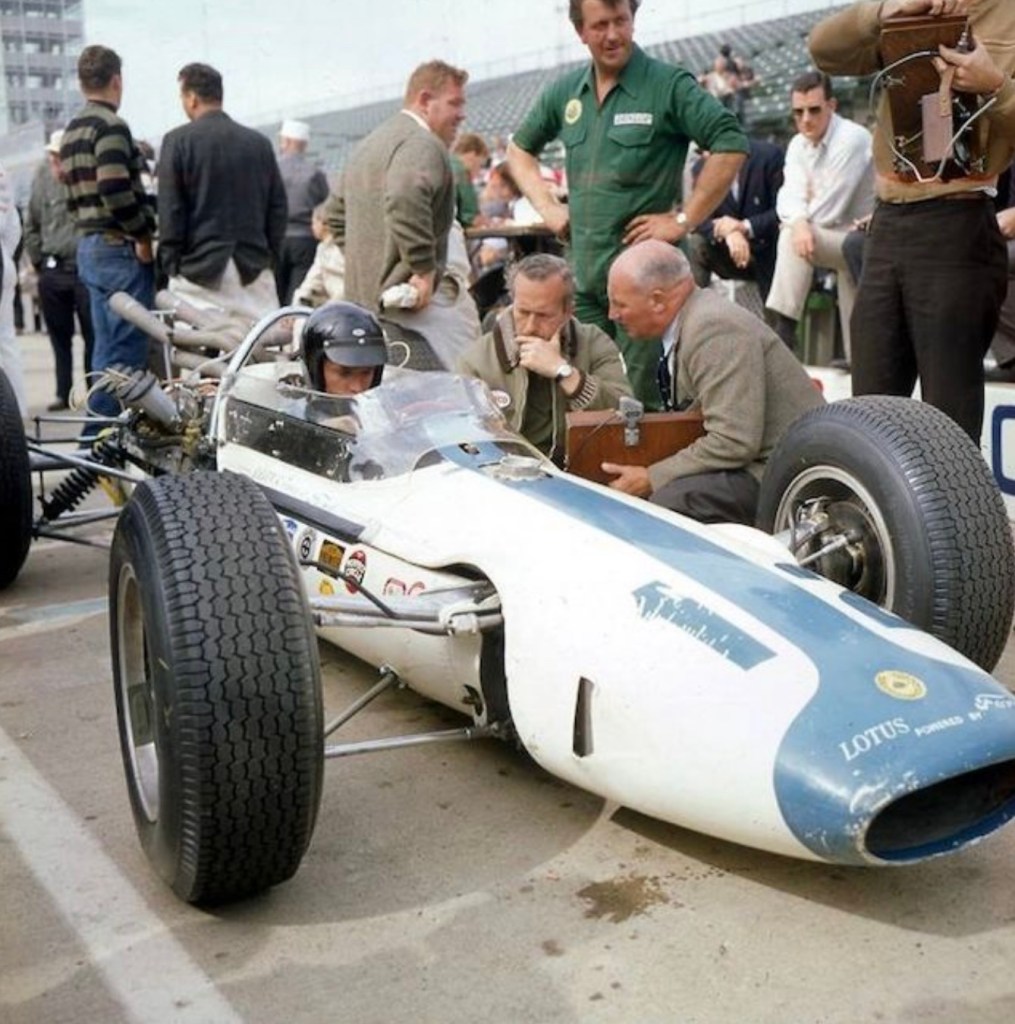
I promise your slice of the pie will be no less than that Daniel! Colin Chapman and Dan Gurney at Indy in 1963
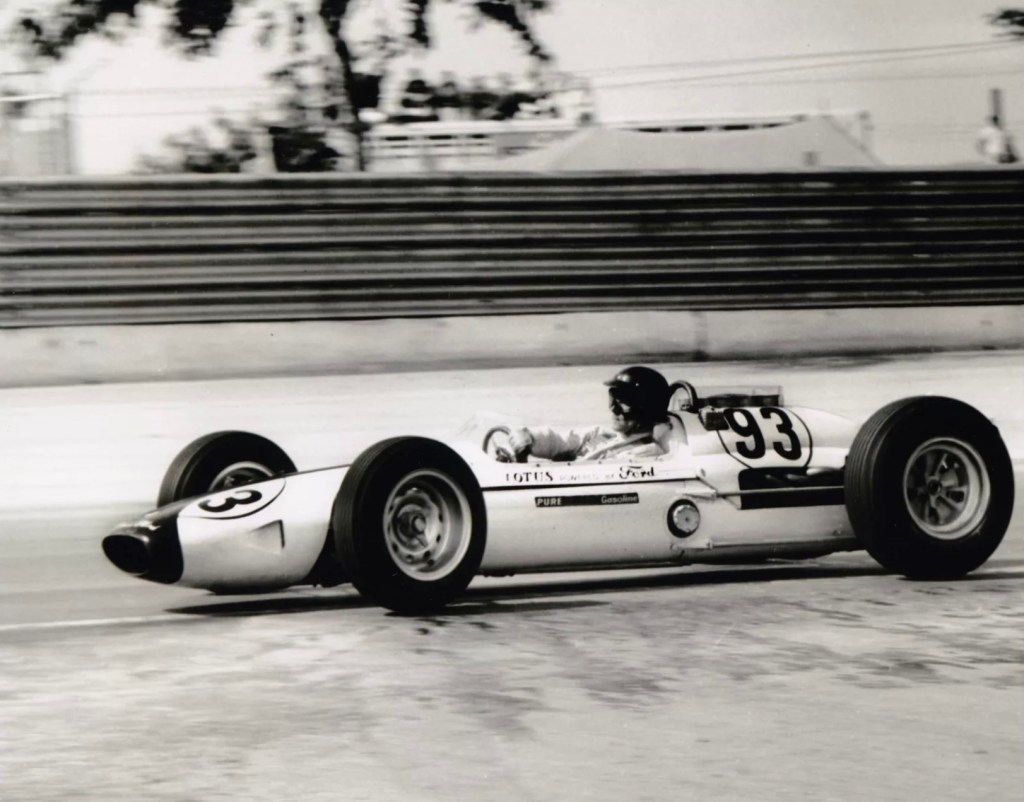
Lotus 29 Ford’s first test at Indy in March 1963. Gurney aboard chassis R1, which is fitted with symmetrical suspension, wobbly-web wheels rather than the Dunlops it raced with and stack-exhausts rather than the megaphones which followed (unattributed)

Gurney was a Ford man, his teenage hot-rod exploits were all Flattie-Ford powered. He raced a Holman Moody Ford Fairlane NASCAR at Riverside in early 1962 and used a couple of Ford heavies he met that weekend to set up a meeting between he, Chapman and the-right-Ford-execs at Dearborn in July.

By March 1963 the Lotus 29 – call it a fat-25 – powered by a 350-375bhp, 255cid all aluminium pushrod variant of the 260 Windsor Falcon/Fairlane V8 was being tested for the first time by Jim Clark at Snetterton.

At Indy Clark ran second to Parnelli Jones’ Watson Offy Roadster for the last 20 or 30 laps. Jones was dropping oil, but was not black-flagged as other cars dropping lubricant throughout the race had been.

The Indy Establishment, led by Chief Steward Harlan Fengler – who had the black flag power – shafted Lotus, Ford, Chapman, Clark and Gurney. Revenge was sweet in 1965 when Lotus Fords occupied the front row driven by Gurney, Clark and AJ Foyt – and Clark won.

Gurney was seventh in 1963, his engine wore a cam-lobe, so he wasn’t able to press hard in the same manner as Clark. Check out my Auto Action feature on the 1963 race here; Auto Action #1823 by Auto Action – Buy through Issuu

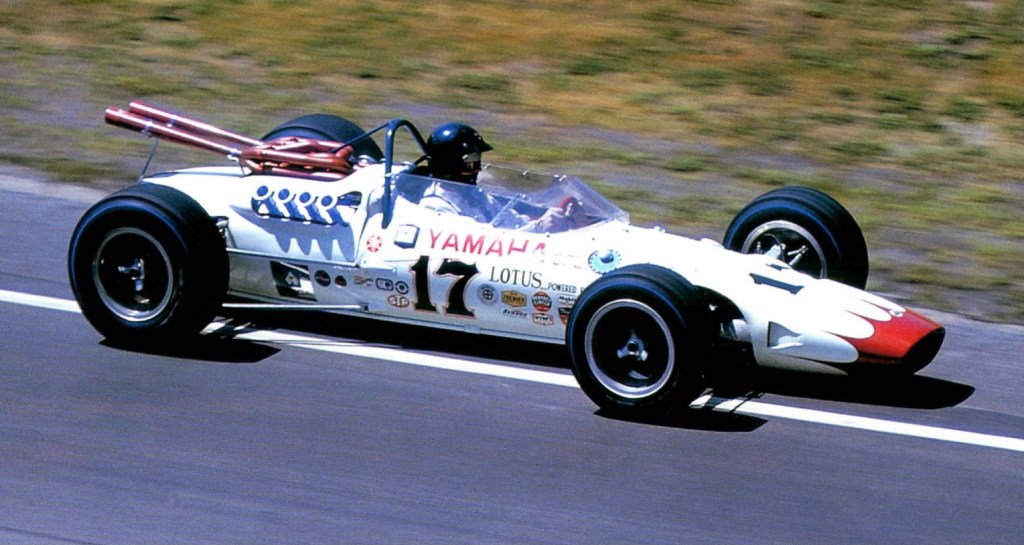
Clark and Gurney, in his Yamaha sponsored 29, Indy 1963 (unattributed)
Gurney during the Milwaukee 200 in 1963 (unattributed)

Keen to reinforce the point about their speed, Clark and Gurney raced in the Milwaukee 200 three weeks after Indy, Clark won with Gurney third.

In 1964 the same duo raced the evolved Lotus 34, the most critical mechanical change of which was use of Ford’s Quad Cam Indy V8: this fuel injected, four-cam, two valve V8 produced circa 400bhp.

AJ Foyt’s Watson Offy won the race – the last by a front-engined car – which is primarily remembered for the horrific seven car, lap two accident and conflagration which cost the lives of Dave MacDonald (Thompson Ford) and Eddie Sachs (Halibrand Ford). Coincidently, Sachs’ Watson was the last casualty of ‘Fengler’s oil slick’ the year before, when he boofed the fence on lap 181, and then copped a punch-in-the-nose the following day when he fronted Jones about his win.

Gurney’s Lotus 34 quad-cam in 1964, Chapman alongside (D Friedman)

Lotus were contracted to Dunlop in F1. Chapman used hard Firestones in 1963 and sought the performance, and no doubt, the commercial advantage of softer Dunlops in 1964. One of Clark’s (from pole) tyres failed after 47 laps taking out the left-rear corner of the car. Gurney retired after 110 laps with excessive wear.

The FoMoCo were not amused as Clark’s failure happened on the entry to the main-straightaway (front straight) providing an exciting – and oh so public – epic-fail in front of 150,000 or so spectators. Needless to say, Ford took control of tyre choice in 1965, an all-Ford year.

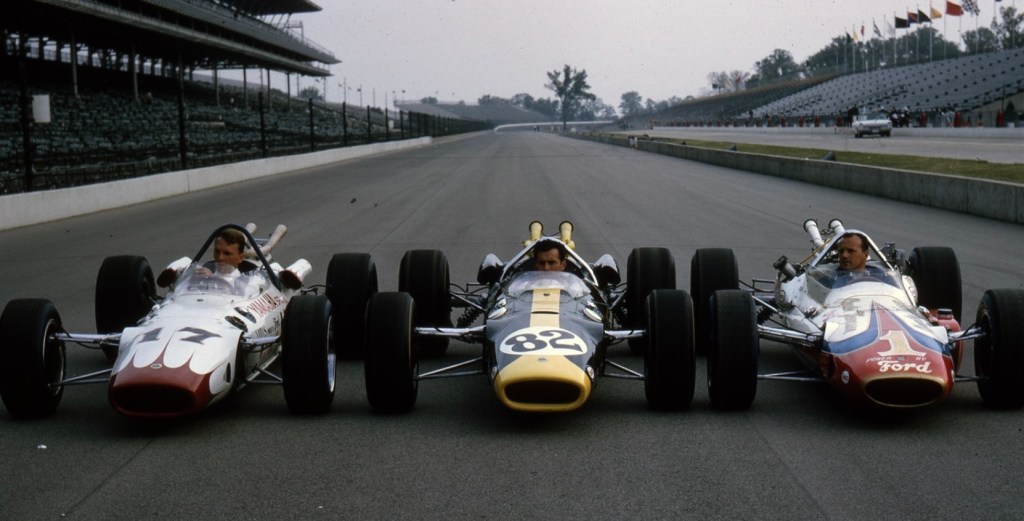
Indy front row 1965; Gurney, left and Clark in Lotus 38s and AJ Foyt on pole, Lotus 34 Ford (AAR archive)
Gurney, Lotus 38 Ford, Indy 1965 (unattributed)

AJ Foyt’s Lotus 34 Ford took pole while Clark’s Lotus 38 won in 1965, having led 189 of the 200 laps, from Jones Lotus 34 Ford, a young Mario Andretti’s (Brabham based) Hawk Ford and Al Miller’s Lotus 29 Ford.

Poor old Dan started from the outside of the front row but was a DNF after 38 laps with timing-gear failure in his Lotus 38. While his Eagles won plenty of Indy 500s, Dan never did take one as a driver, a great shame!

Etcetera…

(MotorSport)

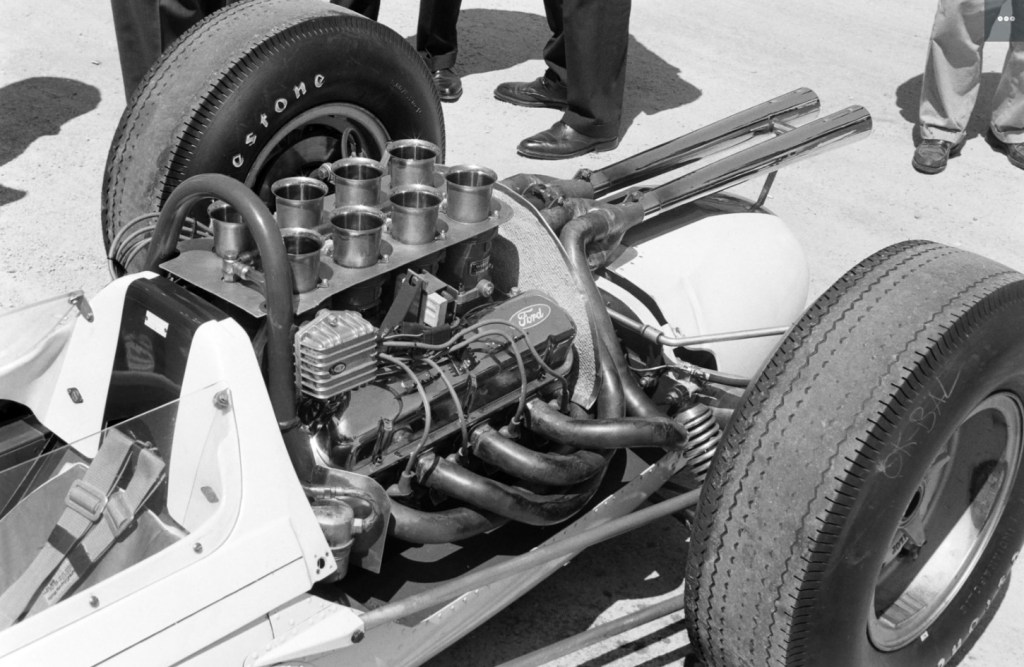
The business end of Gurney’s Lotus 29-R2 in 1963.

Gurney and Chapman pitched a 4.2-litre pushrod engine to Ford. They figured, based on Dan’s 1962 experience, that a 350 pound, 350bhp petrol fuelled Ford V8 would do the trick. As it did…

Clark’s Lotus 34 Ford in 1964.

The Lotus 29 and 34 were bathtub-monocoques, the 38 was a full-monocoque. Note the offset suspension to the right and Ford quad-cam 4.2-litre V8.

Credits…

Getty Images, David Friedman, AAR Archive

Tailpiece…

(AAR archive)

The boys fire up Dan’s Ford V8 in 1967. His beautiful, dual purpose F1/Indycar design, in Indy spec designated Eagle 67 Ford, was designed by Len Terry, the same bloke who drew Chapman’s epochal Lotus 25 F1 car and 29/34/38 Indycars.

He started from Q2, led two of the 200 laps but was out after 160 laps with piston failure. Better would come, Bobby Unser won in an Eagle 68 Offy in 1968, and Dan was second in an Eagle 68 Gurney-Weslake-Ford.

Finito…

I’ve written a feature In the current Auto Action #1803 on Dan Gurney’s win in the 1961 Victorian Trophy aboard his works BRM P48 at Ballarat Airfield.

He and Graham Hill raced at Ardmore, NZ, Warwick Farm and Ballarat that summer. Dan’s win was an interesting one in his last BRM drive- it was his first international victory and the only one for the P48 on the last occasion the machine was raced in works hands.

It’s a nice piece, but then I would say that.

For us historic nutters there is also the first in a two-part series on Tim Schenken written by Mark Fogarty. This issue covers his formative years to F1, the next one his Ferrari sportscar drives, Tiga period with Howden Ganley and beyond.

Other standout reads in the sixty page issue are five pages on F1, four on the year ahead for F1, Indycar, F2/3, Moto GP and Taxis, two pages on Oz international Scott Andrews with whom I was unfamiliar and coverage of the Monte, Dakar and the Symmons meeting I was lucky enough to attend a week ago. Plenty of maxi-taxis too of course.

If you haven’t read fifty-years-young Auto Action for a while give us a whirl.

Hopefully the Tasmanian Back to Back Double-Banger season openers at Symmons and Baskerville become a fixture- lets hope so. It makes so much sense on all levels, get you bums down there next year if you can.

The racing was great, imbibing Longford for a cuppla days was magic not to forget some great Tassie touring, sun on the sand and a shandy or three. It was heaven on a stick really.

(unattributed but very keen to know the ‘snapper)

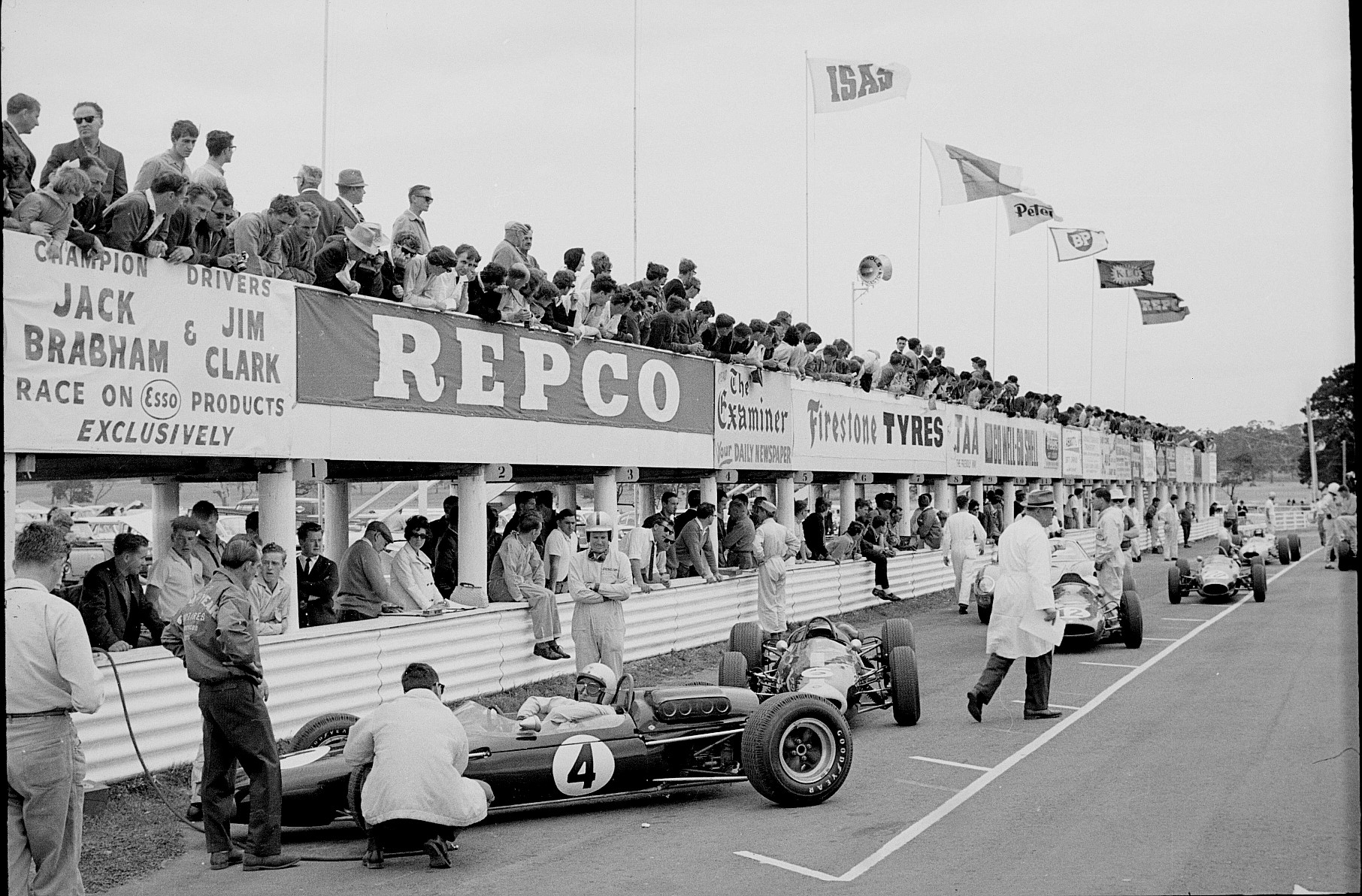
The more you look the more you see. All the fun of the fair. Longford AGP weekend March 1965.

Jack Brabham waits for the pressures in his Goodyears to be adjusted, Brabham BT11A Climax. That’s Roy Billington with hands on hips to the left and Bib Stillwell hovering- his new Brabham BT11A Climax is to the right. Next in line is the ill-fated #12 Ecurie Australie Cooper T62 Climax of Rocky Tresise.

Further along, obscured near the pit counter, is the Scuderia Veloce Ferrari 250LM with Lynn Archer’s #20 Elfin Catalina Ford 1.5 on the painted line. The light coloured car at the end of the queue is Frank Matich’ Brabham BT7A Climax.

Bruce McLaren’s Cooper T79 Climax  won this tragic March 1 race, see here; https://primotipo.com/2019/09/27/longford-1965/ and here; https://primotipo.com/2016/05/20/bruce-lex-and-rockys-cooper-t62-climax/

Credits…

Auto Action

Finito…

(Bonhams)

A couple of months ago, fifty years back Jack Brabham lost the Monaco Prix on the last corner of the last lap when he goofed his braking point for the Gasometer Hairpin- harried as he had been by Jochen Rindt who had been in ‘cruise and collect mode’ for a good percentage of the race until misfortune outted many of the dudes in front of him.

At that point, with a sniff of victory, he tigered in an amazing way- fastest bloke on the planet as he undoubtedly was at the time. Up front Jack’s comfortable cushion was whittled back by his former teammate aided and abetted by some unintended baulks by other drivers.

It is a well known story i have ventilated before, here; https://primotipo.com/2018/05/24/jochens-bt33-trumped-by-chunkys-72/ and here about Jack’s last season of racing; https://primotipo.com/2014/09/01/easter-bathurst-1969-jack-brabham-1970-et-al/

The two blokes alongside Jack in the shot above are his teammate Rolf Stommelen and on the outside the V12 Matra MS120 of Henri Pescarolo- Rolf did not qualify whilst Henri finished a splendid third, one of my most popular articles is a piece on the Matra here; https://primotipo.com/2014/07/06/venetia-day-and-the-1970-matra-ms120/

Love those ‘knock on’ hubs- a carry over from BT25 perhaps? BT33 a sexy and very quick jigger which was still very competitive in Tim Schenken’s hands in 1971 (Official Brabham)


Nice look at Ron Taunanac’s second monocoque chassis, Jack aboard BT33 at Monaco, the first being the 1968-1969 BT25 Repco ‘760’ 4.2 V8 engined ‘Indycar’

I wouldn’t have bothered with another article on BT33 but a couple of these photographs popped up lately and are too good not to share. The other thing which intrigues me a bit are the ‘Jet Jackson’ United States Air Force fighter pilot type crash helmets Jack, Jackie Stewart and Piers Courage experimented with in the earlier months of 1970 during the Spanish, Monaco and Dutch Grand Prix weekends that year, and in other events the drivers contested.

We are only, at the start of the 1970 season, nearly three years down the path since David ‘Swede’ Savage first used the first ‘Bell Star’ in motor cycle competition in mid-1967. The design was a great step forward in driver safety, Jackie Stewart was a safely crusader as we all know, it’s interesting that he chose to trial these open style of helmets which on the face of it , pun intended, seems a retrograde step.

Jackie Stewart- who else could it be with his distinctively branded USAF helmet in early 1970. March 701 Ford (Getty)


Piers contemplating the next change to be made by Gianpaulo Dallara to his De Tomaso 505 during early 1970 (Getty)

Most sadly, Piers put his to the ultimate test, he was wearing it when he crashed to a most gruesome death at Zandvoort on 21 June 1970- in no sense am i suggesting a Bell Star would have saved his life I might add.

When he went off on the flat or nearly flat out curves at the back of the circuit and into the catch fencing his helmet was wrenched off with both Adam Cooper and Jackie Stewart writing that he was probably dead before the conflagration which susequently engulfed the De Tomaso 505 Ford.

After some basic research i cannot find who made these helmets, i am intrigued to know the answer to that question if any of you know it.

After Monaco Brabham and Stewart do not appear to have worn the helmets again in Grands Prix.

(B Cahier)


(unattributed)

Jack thinks about an inside run at Jackie during the March 1970 South African GP- Kyalami.

At this stage of the season, the first championship round of course, they are both Bell equipped- Stewart in a ‘Star’ and Brabham a ‘Magnum’- Jack won the race with the reigning World Champion back in third aboard a machine which was not one of his favourites but far from the worst GP car he ever drove.

Brabham used three helmet types that season, two Bells- a Magnum and Star plus the USAF fighter helmet.

He was a busy boy in 1970 running the full GP season, selected F2 races in a John Coombs owned Brabham BT30 Ford FVA and five or so endurance events with Matra, plus the odd one-offs, here he is jumping out of his MS650 during the 1000 Km of Brands Hatch in April still wearing the fighter helmet, but a slightly different one to that he used in Monte Carlo.

Car #3 is the Scueria Filipinetti Ferrari 512S raced to thirteenth place by Herbie Muller and Mike Parkes


Jack shared the car with Jean-Pierre Beltoise , the pair finished twelfth in the race won by the JW Automotive Porsche 917K raced by Pedro Rodriguez and Leo Kinnunen, this being the race in which the Mexican Ace mesmerised the drenched crowd with his car control of the 450bhp machine as he flicked the big car frm lock to lock as though it was a nimble Formula Ford.

Wind the clock forward a month and Brabham had his last crack at Indianapolis in a Brabham BT32 Offy- this car was one of the BT25 Repco ‘760’ 4.2 V8 chassis modified by fitment of the turbo-charged four cylinder Offy motor- note the Bell Star in use at Indy.

This is during qualifying on 9 May, Jack was classified thirteenth from Q26, he retired with engine problems having completed 175 of the 200 laps, the race was won by Al Unser’s ‘Johnny Lightning Spl’ Colt Ford V8

Jack all ready to boogie with his Sunday best shoes on, no less. Same knock off hubs as the BT33 by the look of it


(Brabham Family)


(unattributed)

The Charade circuit just outside Clermont Ferrand was another French Grand Prix course which sorted the roosters from the feather dusters- I nearly made it there two years ago having first promised myself I would visit the place when falling for it with my nose buried in Automobile Year 18 in 1971. Drat.

Jack leads here from Jochen Rindt and Henri Pescarolo- Jochen won that day from Chris Amon and Jack with Henri fifth.

Brabham has his Bell Star on as does Henri but Jochen has swapped the full-race Star he used in 1970 more often than not for one of his old Magnums as the nature of the challenging course through the Auvergne-Rhone Alps countryside made him feel motion sickness which was solved with a change of helmet

Jochen was wearing a Bell Star on that fateful day at Monza in September but the crutch-straps of his Willans six-pointer were not items the great Austrian used- on that particular day in that particular accident he needed them badly, and divine intervention.

(Flickr)

‘It turns in ok but as I apply throttle…’ two great mates doing wonderful things together discussing the next chassis change at Zandvoort in 1970- Frank Williams and Piers Courage, note the helmet.

The car was not too flash at all in Kyalami but with each race Courage, the car’s designer Gianpaulo Dallara and Williams were improving it- expectations of both Williams and Courage were high for 1970 as the second-hand Brabham BT26 Ford they raced in 1969 had proved Piers’ place was right up front.

At Zandvoort Courage was running seventh from Q9 ahead of John Miles in a works Lotus 72 (below) when the accident occurred on lap 23- there was not enough of the wreck intact to determine whether the cause was cockpit/component/tyre.

(Twitter)

Pretty enough car which was progressively ‘getting there’, that oil cooler locale is sub-optimal, some revs lost perhaps in top speed. Dallara did get the hang of this racing car thing didn’t he?

In Australasia we had three visits from Piers and Sally Courage aka Lady Curzon, Earl Howe’s daughter, the couple and Piers pace and personality endearing them to all.

In 1967 the #1 BRM Tasman P261 2.1 V8 seat was occupied by Jackie Stewart (apart from Teretonga) with Richard Attwood, Courage and Chris Irwin sharing the second seat, the seasoned Attwood performing best.

In fact that year was a character building one for the Courage Brewing scion, it was said he was ‘over driving’ and despite John Coombs supposedly advising he get out before he killed himself the plucky Brit bought the McLaren M4A Ford FVA he had raced for Coombs that season and headed off south with a couple of FVAs funded by savings, some sponsorship from Courage, a loan from his father and a deal with Coombs which deferred payment for the car until the end of the series.

He had a brilliant 1968 summer with the Les Sheppard prepared 205 bhp car amongst the 2.5s, demonstrating all the speed which had been always apparent but with a much bigger dose of good judgement in the series of eight races over just as many weekends. He blotted his copybook at Pukekohe on the first day of practice but after Les ‘read the riot act’ his performances were very good to brilliant.

Teretonga 1967, BRM P261 2.1 V8, DNF engine after 53 laps- Clark won in his Lotus 33 Climax FWMV 2 litre from Attwood in the other BRM  (Ian Peak Collection)


Piers third and Chris Amon fourth with a deeply appreciative and enthusiastic Warwick Farm crowd at the end of the 1968 Warwick Farm 100- McLaren M4A Ford FVA and Ferrari 246T. Up front were the Team Lotus duo of Clark and Hill in Lotus 49 Ford DFWs (B Thomas)


Teretonga 1969- Derek Bell, Ferrari 246T from Graham Hill, Lotus 49B Ford DFW and Piers, Brabham BT24 Ford DFW. Piers took a splendid win that day from Hill and Amon (Steve Twist Collection)

Whilst fun in the sun is part of Tasman lore- and fact, there was plenty of pressure on a small equipe such as the Courage outfit to prepare the equipment and race it weekly, for the most part on unfamiliar circuits all of which were well known to his main competition- Clark, Hulme, Gardner, Hill to name a few.

His season ending win at Longford is still spoken about in reverential tones by those who were there- it literally pissed down with Piers legendary bravery coupled with a deftness of touch on one of the most daunting road circuits by then still in use in the world- whilst noting it was sadly the last time the circuit was used too.

In many ways the campaign ‘re-launched’ his career. Adam Cooper wrote ‘Thanks to the extensive press coverage his exploits received, Piers’ reputation was in better shape than he could have predicted. He was a failure (not entirely fair in that he was fourth in the 1967 European F2 Championship behind Ickx, Gardner and Beltoise despite pinging off too many bits of real estate) who had made himself into a hero. Those who had paid closer attention noted that his solo campaign also reflected an incredible determination and a hitherto unrecognised ability to organise. Even before Longford he’d been approached by Tim Parnell about renewing his relationship with BRM. Tim had seen the Courage revival at first hand, and was impressed.’

Back in at Slough Frank Williams was readying the Brabham BT23C FVA for the 1968 Euro F2 Championship, in addition he had his BRM ride and a personal retainer with Dunlop, he was away…

Rather than prattle on now about his Tasman exploits lets do ‘Piers in The Pacific’ soon- his Tasman Cup runs in 1967-1969 in BRM P261, McLaren M4A Ford FVA and Brabham BT24 Ford DFW respectively.

Bell Star…

Dan, Nurburgring 1968 as seen by (P-H Cahier)


There was no shortage of interest in Dan Gurney’s fancy-schmancy new Bell Star over the German Grand Prix weekend at the Nurburgring over the 4 August 1968 weekend, understandably so- mind you, he used the helmet at Indy that year too- May of course so it was already’out there’.

Dan was ninth in his Eagle Mk1 Weslake, doubtless his head was a bit more dry than the competition- up front it was Stewart from Hill and Rindt, Matra MS10 Ford, Lotus 49B Ford and Brabham BT26 Repco in a day of challenging rain.

But the first Bell Star use credit seems to go to David ‘Swede’ Savage in his motor cycle racing days, here is below at Santa Fe in 1967 so equipped- 9 June to be precise.

Perhaps the first life saved by the technology was that of Evel Knievel who came terribly unstuck upon landing when attempting a motorcycle jump over the Caesar’s Palace Casino Las Vegas fountains (43 metres) that 31 December, breaking and crushing countless of his bodies bones- but not his head!

If Swede’s 9 June use of the Bell Star is not ‘the first’ i am intrigued to know who has that honour and its date.

(Forever Savage)


(Forever Savage)


It was a pretty happy month of May for All American Racers when three Eagles filled the top four places of the Memorial Day classic, Bobby Unser won from Dan Gurney (above) with Denny Hulme fourth, the interloper was Mel Kenyon’s third placed Gebhardt Offy.

Of historic interest to we Eagle buffs is that the three Tony Southgate designed Eagle Mk4’s were powered by quite different engines- Unser’s used an Offy Turbo four, whilst Dan used a pushrod fuel injected Gurney-Weslake V8 whereas Denny in the other works car used the Ford DOHC ‘Indy’ V8- the options were certainly well covered, were it not for a rear tyre puncture minutes from the end of the race which befell Hulme, it would have been a clean sweep of ‘the podium’ placings.

Oh yes- Dan’s Bell Star, first use of the helmet in car racing.

Photo and Reference Credits…

Official Brabham/Brabham Family Collection , Automobilsport, MotorSport, LAT, ‘Piers Courage: Last of The Gentleman Racers’ Adam Cooper, ‘Forever Savage’ Facebook page, Ian Peak and Steve Twist Collections on The Roaring Season

Tailpiece…

(LAT)

Another one that got away.

Brabham exits Druids Hill with millimetre precision during the 1970 British Grand Prix- he had passed and was driving away from Jochen to what seemed a certain win but for a shortage of fuel hundreds of metres short of the chequered flag. Oh yes, Bell Star equipped.

Finito…