Posts Tagged ‘Derek Gardner’

(MotorSport)

“Och aye! That really is more like it” or thoughts to that general effect. Jackie Stewart in his brand new Tyrrell 001 Ford Cosworth DFV at Oulton Park during the August 22, 1970 Gold Cup weekend.

Derek Gardner’s first F1 design was only days old and already it felt better than the customer March 701 Ford – victories in the Race of Champions and Spanish GP (Stewart) and International Trophy (Chris Amon) notwithstanding – that he had been racing that season.
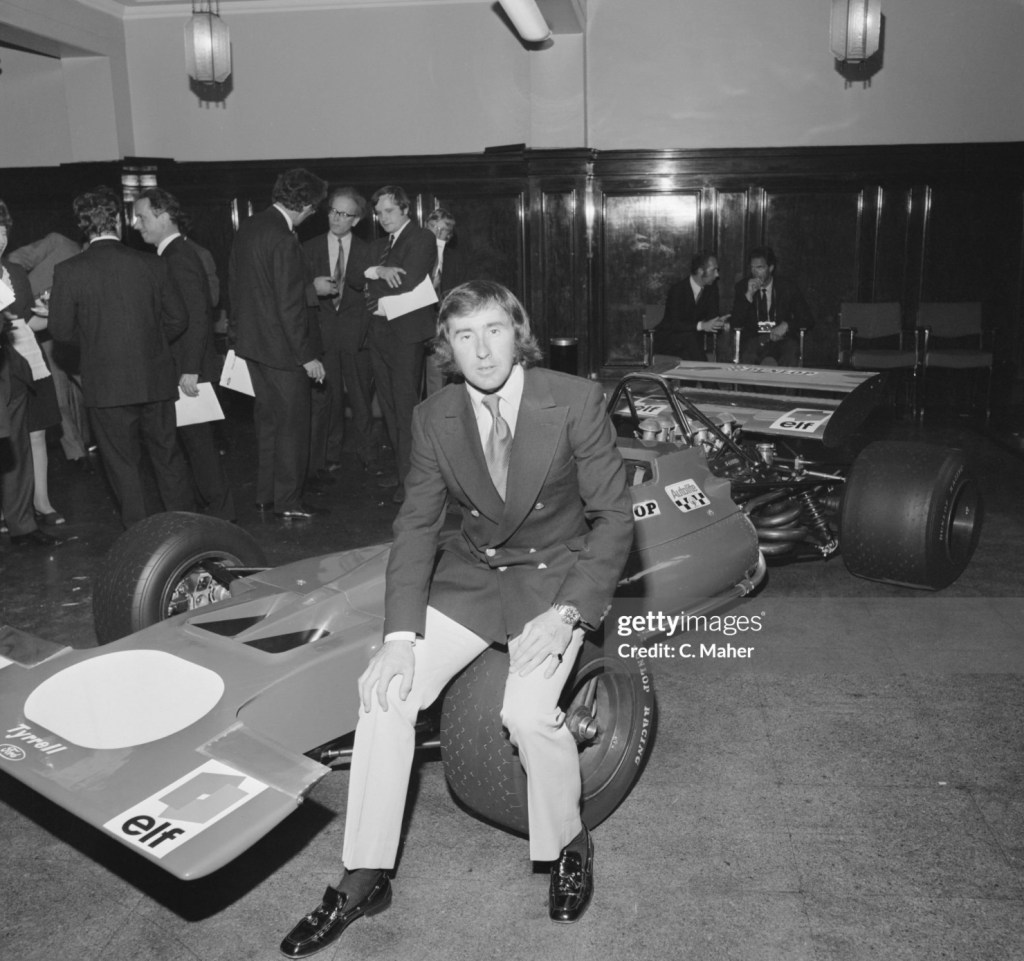
Press release of the Tyrrell 001 at Ford’s London premises, August 18, 1970

Stewart and Tyrrell’s Matra International team had won the 1969 World Drivers and Manufacturers Championships with the superb Matra MS80 Ford. For 1970 the French aerospace giant wanted to race only Matra V12 engined cars. After Tyrrell and Stewart travelled to France and Stewart tested the new Matra MS120 the pair decided they preferred to stick with the Ford engine; hence the acquisition of March 701s. See here for a short piece on the 701: https://primotipo.com/2014/05/15/blue-cars-rock/

Tyrrell quickly realised he needed to build his own car to control his destiny, rather than be at the mercy of a chassis manufacturer, so Gardner was engaged and secretly set to work in a design studio he established at his Leamington home.

Ken got to know and respect Derek during the occasions on which Matra International raced the Matra MS84 Ford 4WD drive car in 1969, Gardner was then employed by Ferguson Research and was responsible for the transmission in that car.
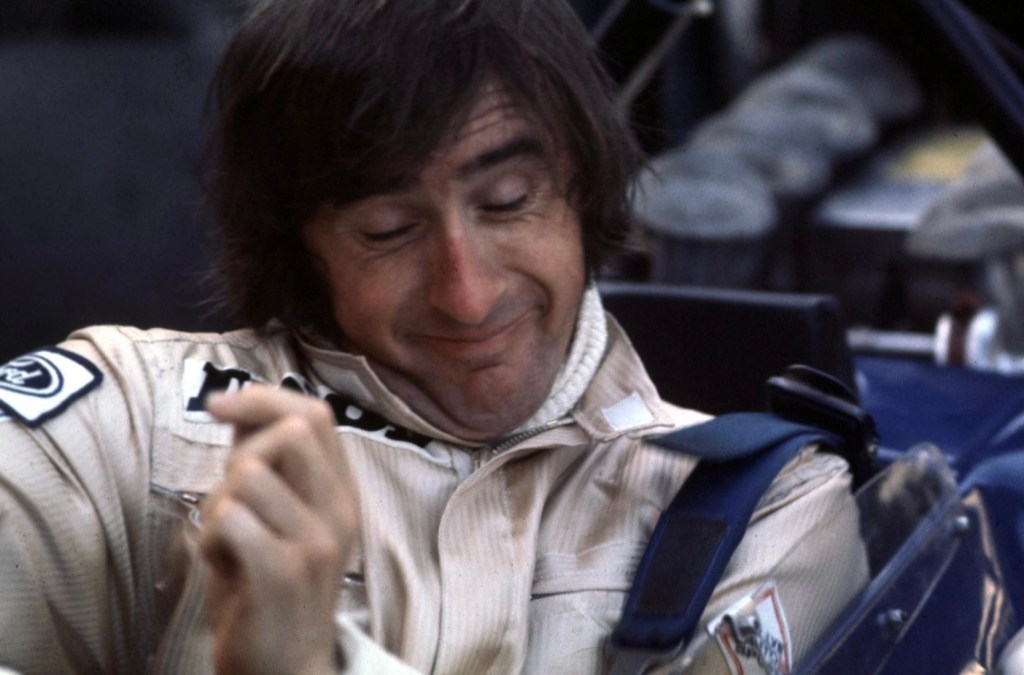
“…and then it does that, really suddenly!’ OR “…it doesn’t matter what I do, it just doesn’t respond!” JYS and March 701 Ford (MotorSport)
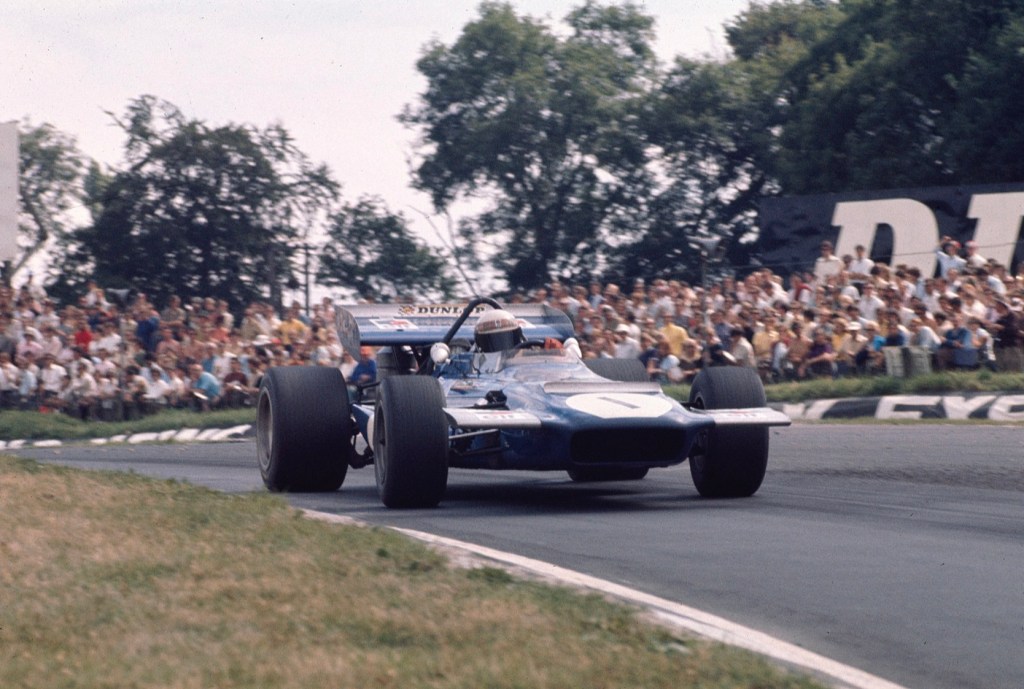
Stewart at Brands Hatch in the Tyrrell March 701 Ford during the July 1970 British GP (MotorSport)

The guidelines were, amongst others, that the design needed to be simple and competitive with minimal development, with a deadline of the August 22, Oulton Park Gold Cup meeting.

Gardner decided upon a light, aerodynamic car with very lower polar moment of inertia and optimum front-rear weight distribution. He had a wooden buck of the chassis made by a local joinery firm for Stewart to try. At that point the Tyrrell mechanics were let in on the secret with comments invited about what went where and maintenance – important design considerations for someone who hadn’t designed a racing car before
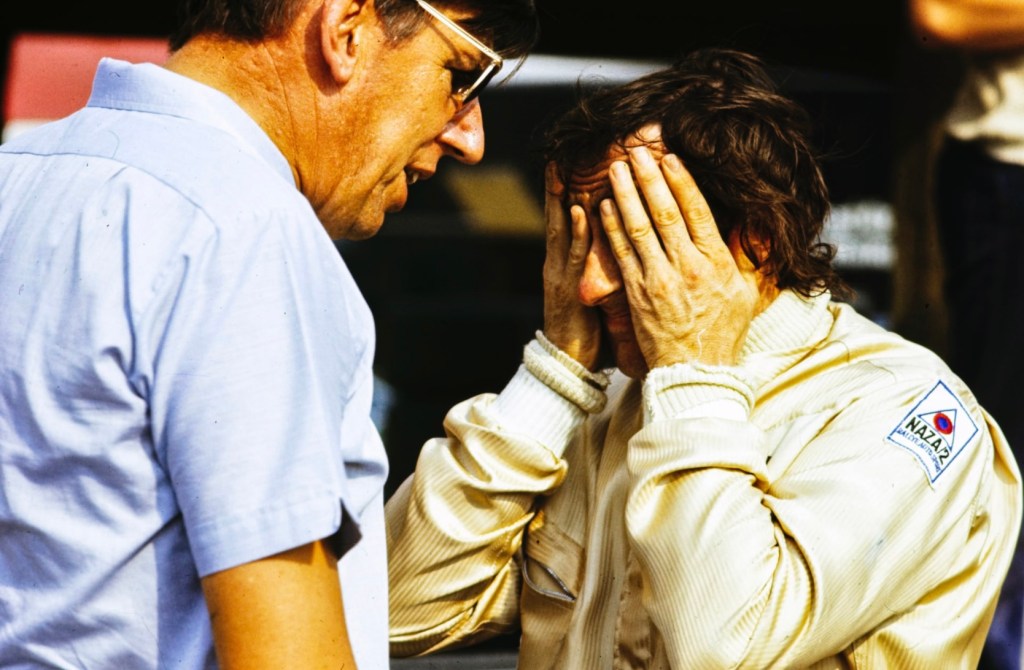
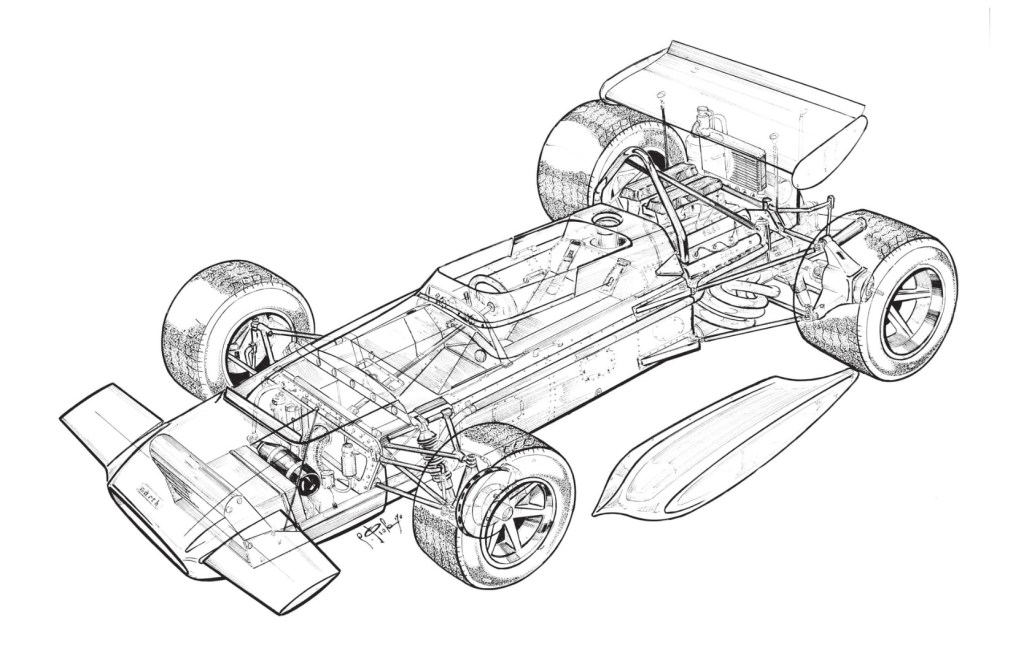
Hockenheim, Germany Q7 and DNF engine in the March 701, Jochen Rindt won(Schlegelmilch/MotorSport)
March 701 Ford cutaway drawing (G Piola)

Given Tyrrell’s famous Ockham timber yard operation was equipped to prepare racing cars, not build them – something that would change quickly enough – a swag of well known industry suppliers and ‘subbies were soon busily making components to the account of this fella named Gardner D.

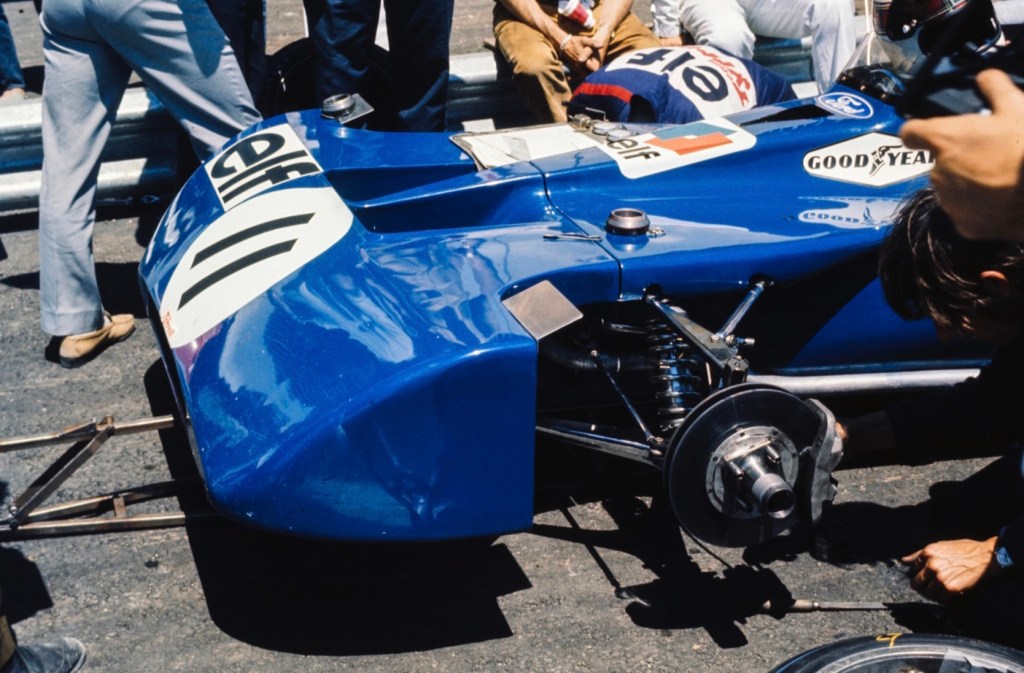
A Ford DFV engine and Hewland FG 5-speed gearbox were sent over to Derek, while Maurice Gomm’s Gomm Metal Developments fabricated Gardner’s open, bath-tub, pregnant-belly, monocoque chassis out of 18-gauge NS4 aluminium alloy. Derek had modelled a tenth-scale model of the car in the University of Surrey’s wind-tunnel. The front of the chassis covered Wee-Jackie’s feet, while a subframe extended forwards to carry the radiator and front lower wishbone pick-up points.

Doug Nye wrote that “A massive front bulkhead structure extended into Matra-like wings on each side, supporting tiny, split upper wishbones and top mounts for the outboard coil spring/damper units. Very wide-based fabricated lower wishbones were used.”
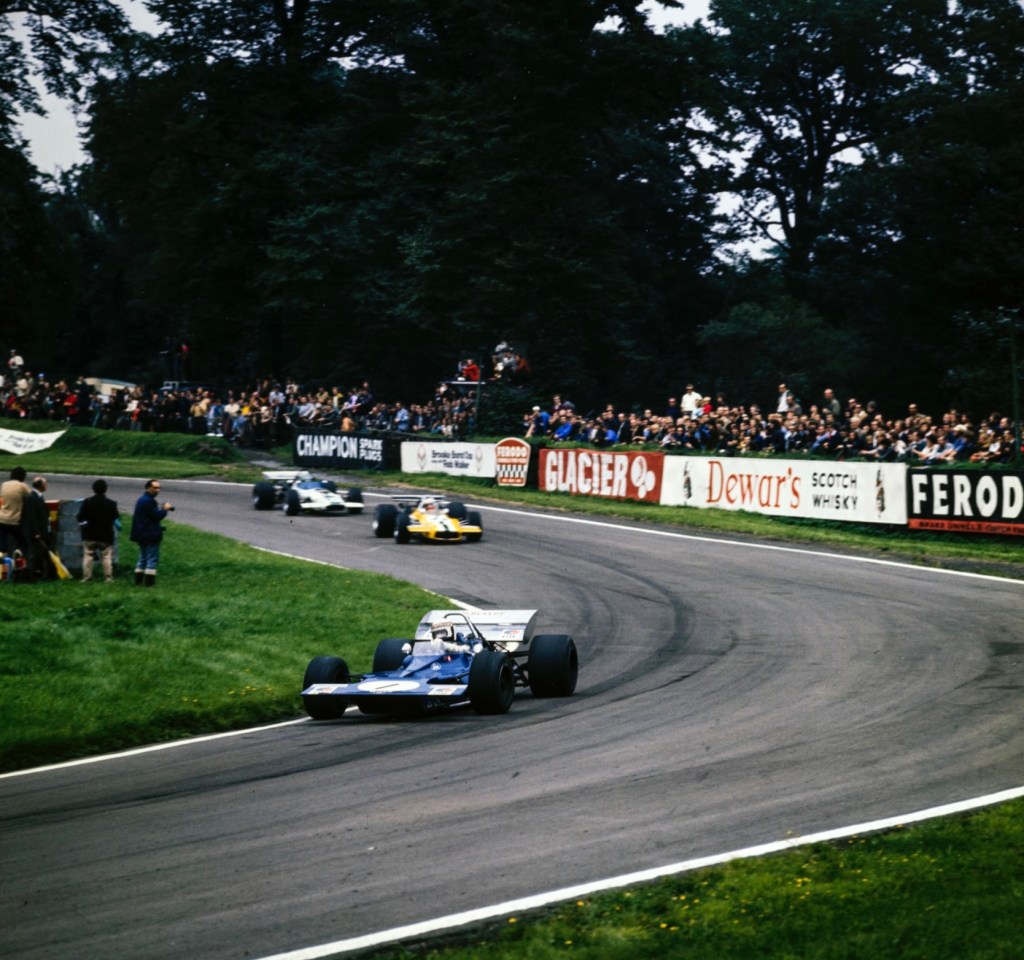
Jackie Stewart in 001 ahead of Mike Hailwood, Lola T190 Chev and Reine Wisell, McLaren M10B Chev Oulton Park Gold Cup, August 1970 (MotorSport)

The Ford DFV engine was mounted, as the design intended, to the bulkhead aft of the driver, while the rear suspension was attached to the DFV and Hewland transaxle via tubular subframes. Len Terry’s ‘industry standard’ parallel power links were used with a single top link, twin radius rods and again outboard coil springs/Koni shocks.

Brakes were outboard at the front, and inboard at the rear: rotors were ventilated and 10.5 inches in diameter front and rear. Aeroplane and Motor provided many of the castings: uprights, wheels and other items, Laystall made the stub axles and Jack Knight Engineering did most of the machining.

The unusual nose and cowling shape were informed by the ‘tunnel-work, the central spine designed to divert relatively clean air around the side of the cockpit back onto the two-tier rear wing mounted atop a gearbox strut.

“When the prototype car (#001) was first assembled and weighed it scaled some 100 lb less than the team’s proprietary March 701s, and was only 32 lb above the minimum weight limit. It had cost Ken Tyrrell £22,500 less engine and gearbox, compared to the purchase price of £9000 for his March 701s.” Nye wrote.
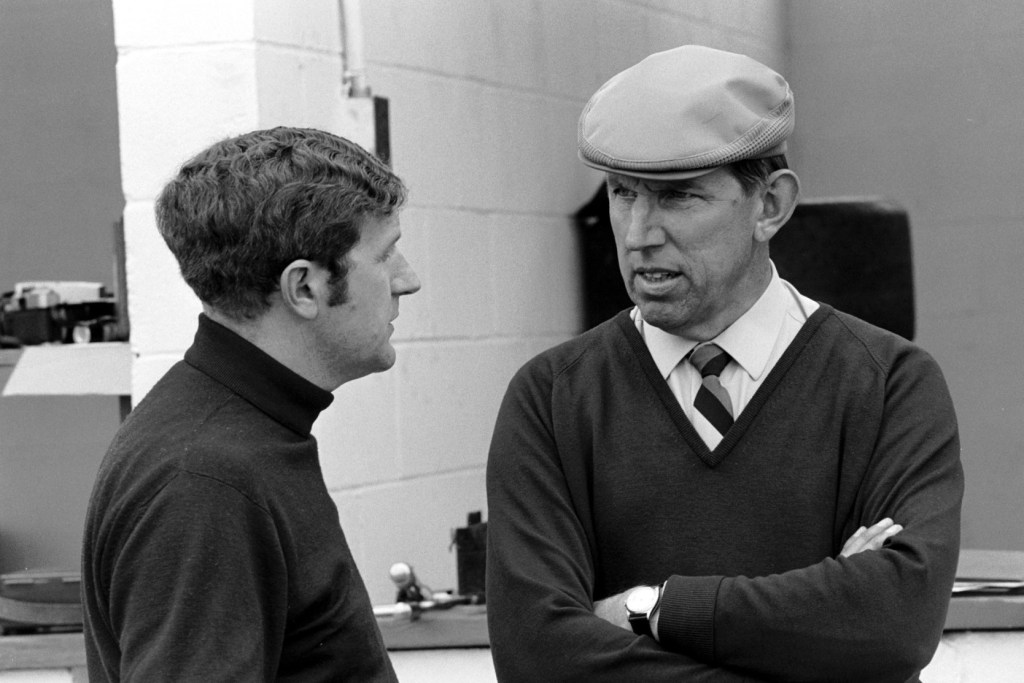
Messrs Gardner and Tyrrell looking youthful in 1970 (MotorSport)
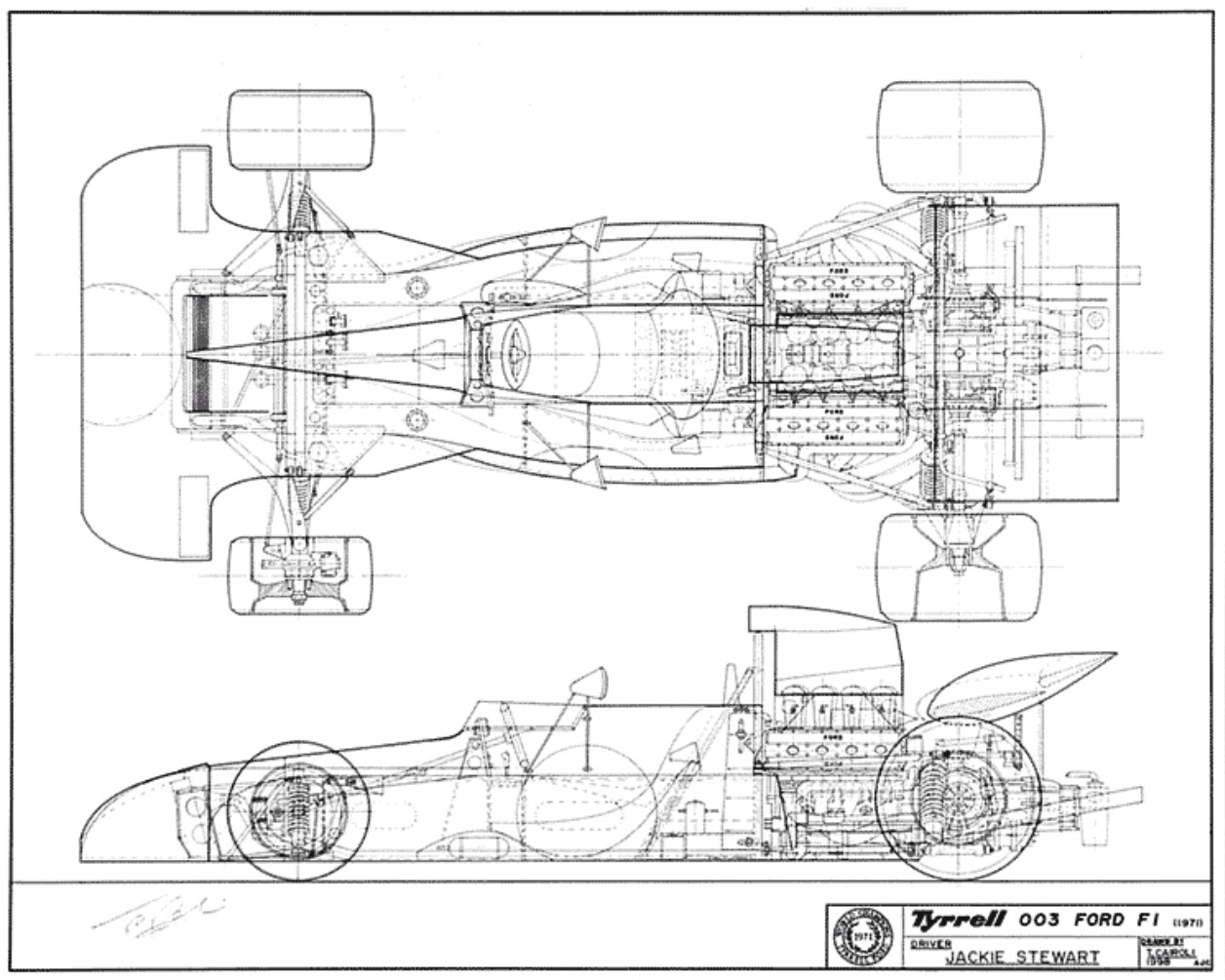
Tyrrell 003 Ford cutaway drawing, the eagle-eyed may pick the Girling twin-disc brakes (T Matthews)

After completion and dealing with all of the press-release niceties the car was despatched to Oulton Park where 18 cars faced the starters flag: five GP and thirteen F5000 cars.

Niggles that weekend included metering unit failure and a blocked fuel injection unit, so JYS also practiced and qualified his March fifth, but elected to start from the rear of the grid in 001 having not set a time.

On lap two of the first heat he pitted after the throttle jammed, to have the linkage eased a bit, and to have loose bodywork made good. He returned to set the lap record (twice) before an oil pick-up problem caused the engine to fail. John Surtees’ TS7 Ford won that heat, and Jochen Rindt’s Lotus 72C Ford the second, with John victorious overall.

Mosport, Canada 1970 (MotorSport)
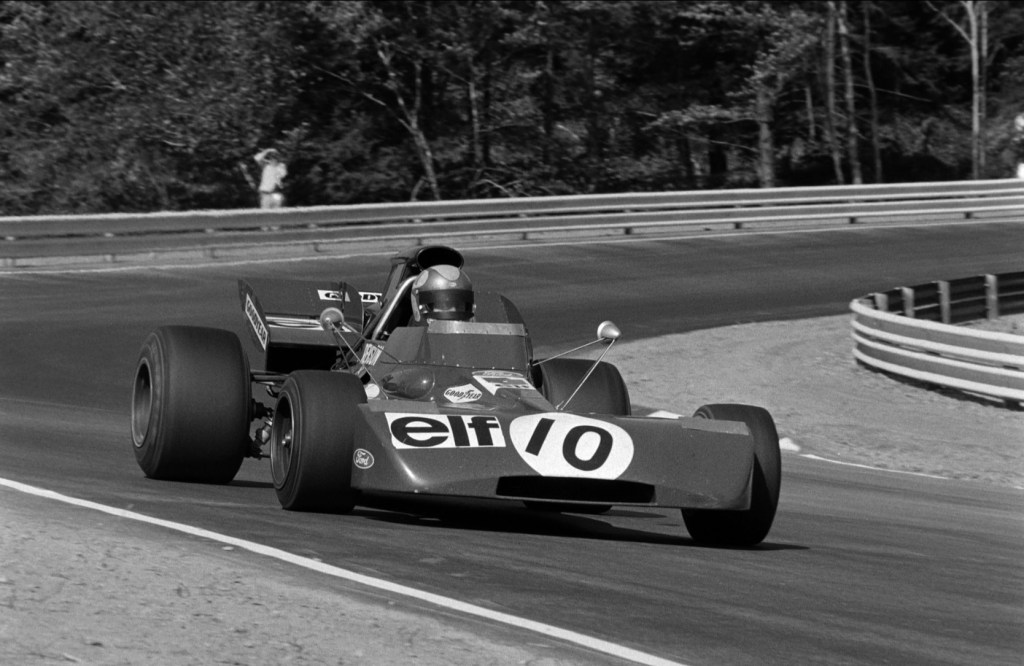
Stewart and team at Mosport where keeping wheels on 001 was a problem, and a broken stub axle (MotorSport)

Given a choice of cars Stewart did the logical thing and plumped for the new Tyrrell 001 for the final four championship round of the season at Monza, Mosport, Watkins Glen and Mexico City.

At Monza the car’s main fuel tanks weren’t picking up enough fuel to the collector to run at sustained maximum rpm so he raced his 701 – despite being distraught after the death of his close friend Jochen Rindt in practice – to second place behind Clay Regazzoni’s Ferrari 312B, Regga’s first GP win.

Things improved big time in North America. Jackie started from pole in Canada and was on the front row in the US and at Mexico City. At Mosport the wheels kept coming loose in practice, and then a left-hand-front stub-axle failed while Jackie led the race. Gardner designed stronger parts which were machined from solid magnesium by the Jack Knight crew and used on the car at the Glen and in Mexico.

Jackie lost in upstate New York when an oil-line retaining clip parted, “causing the plastic line to fall against a hot exhaust manifold and burn through, which allowed the lubricant to haemorrhage away.” Emerson Fittipaldi took his first GP win that weekend in a Lotus 72C Ford.

The Mexican GP was an entirely forgettable weekend all round, not least for Jackie Stewart, who hit a stray dog at 160mph. “It disintegrated and the car veered violently to the left towards a bank where spectators were sitting cross-legged a few metres from the tarmac. I only just managed to regain control and prevent my car from ploughing into that area and scything through the crowd.”

Importantly, despite the somewhat predictable niggles, the car was fast: Team Tyrrell, Stewart, Ford, Elf and the other sponsors looked forward to 1971 with plenty of optimism.

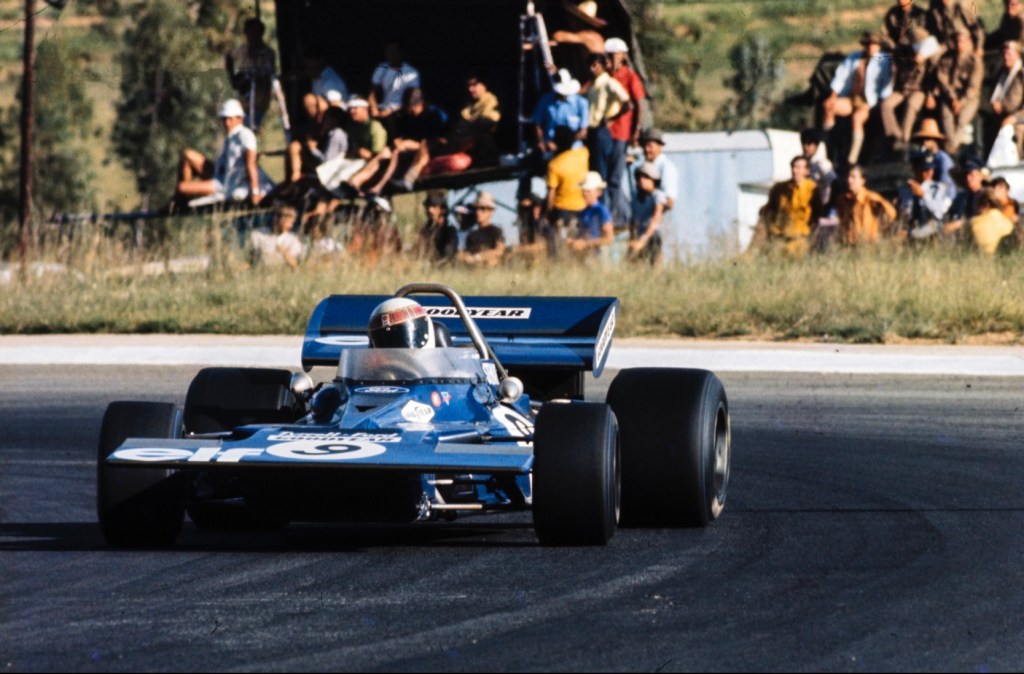
The Big Three at Kyalami in 1971: Stewart, Gardner and Tyrrell (MotorSport)
Stewart in 001 during the ’71 South African GP (MotorSport)

Over that 1970-71 winter the team built up another car, chassis #002 for Francois Cevert. A taller chap than his team-leader, the chassis was four inches longer than #001, the wheelbase 1.5 inches longer, and the side-skins of the tub were thicker 16-gauge NS4 aluminium. In addition, Derek simplified the front bulkhead structure and braced the roll-bar forward, rather than aft. “This latter change was to allow the engine to break away from the chassis in an accident without compromising the drivers protection, and would become standard practice in all categories over the next four to five years,” wrote Allen Brown.

Longtime tyre provider, Dunlop withdrew from F1 at the ned of 1970 so Tyrrell did over 1400 trouble-free miles (two engines) with Goodyear in warm Kyalami over the annual break. Trouble-free but not incident free: a pebble jammed between the throttle pedal and bracket causing a crash which crushed the tub’s left-front corner and jarred Stewart’s wrist. The car was sent home, the monocoque unstitched, the skins repaired then the chassis was reassembled and returned to South Africa.
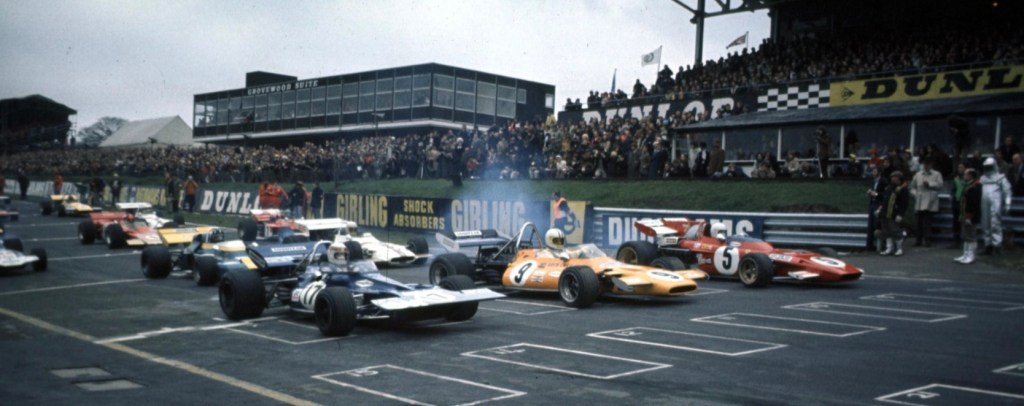
Stewart in his new Tyrrell 003 on the way to victory at Montjuïc Park, Barcelona in 1973. Rainer Schlegelmilch photographic brilliance (MotorSport)

Not much was wrong with 001, Stewart started his first three races in 1971 from pole…and finished second in all them: the South African GP, Race of Champions at Brands Hatch and the Questor GP at Ontario Motor Speedway in California.

From then JYS moved to Tyrrell 003 – identical in spec to 002 – and immediately won in Spain (Montjuich Park) and Monaco with it. He had brake dramas in the Zandvoort dunes but bounced back at Paul Ricard, Silverstone and the Nurburgring putting the World Championship in-the-bag. Later in the season Jackie won at Mosport and Francois took his first – and sadly his only – GP victory at Watkins Glen. Tyrrell won the Constructors Championship in its first full year of competition as a manufacturer.

Great cars! Doug Nye named his chapter in ‘The History of The Grand Prix Car 1966-1985’ about the 1970-73 championship Tyrrells ‘Uncomplicated Craftsmanship’, which about says it all…

Not a shot of Francois! Let’s fix that, here in during the September 5, 1971 Italian GP weekend in 002. Ronnie Peterson at left in his March 711 Ford, Cevert in 002, Mike Hailwood, Surtees TS9 Ford and one of the BRMs. Peter Gethin’s BRM P160 took a famous win by a bees-dick – one-tenth of a second – from Peterson then Cevert (MotorSport)

Etcetera…

Oulton Park 1970

(MotorSport)

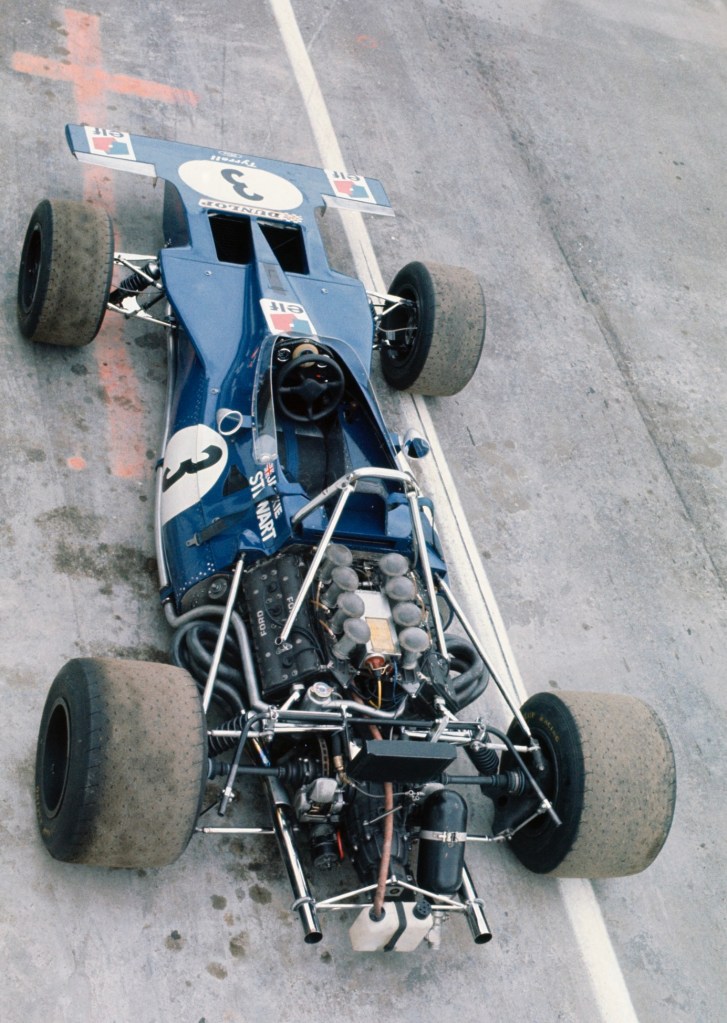
This overhead shot of Tyrrell 001 at Mosport in 1970 – sans rear wing – is a great one to show the overall packaging of the car – body features as per earlier text – and the period typical Ford Cosworth DFV, Hewland transaxle and outboard suspension. Quality of design, execution and preparation outstanding.
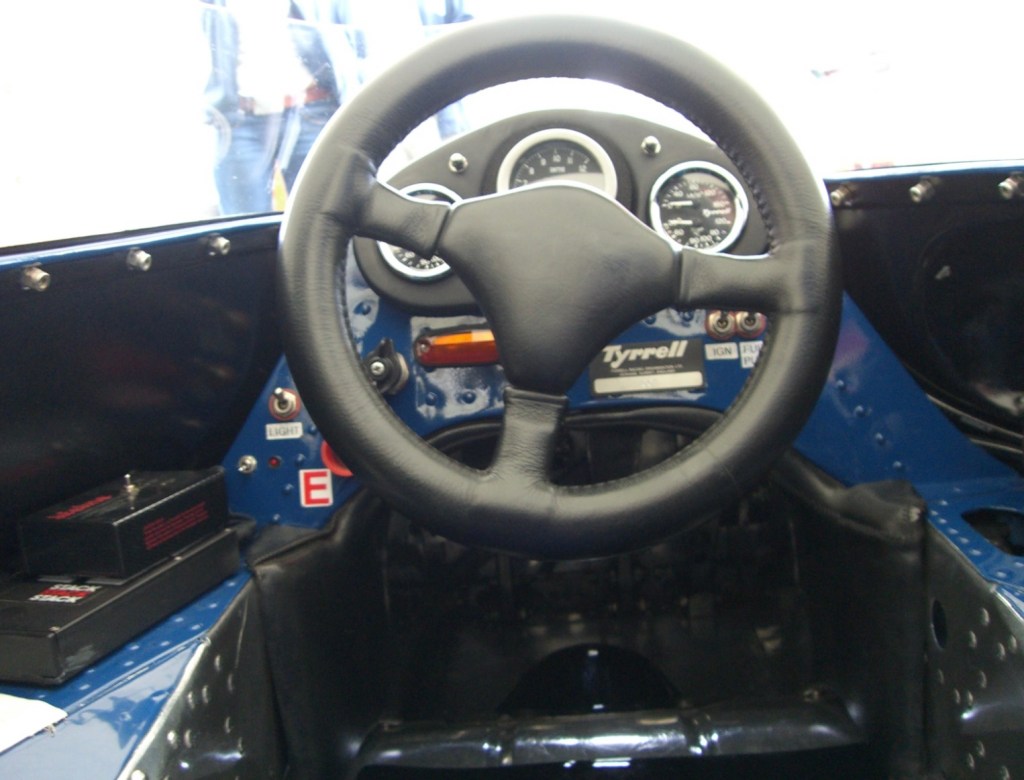
Contemporary photograph of 001’s cockpit.

(MotorSport)

Mechanics work on Francois Cevert new #002 at Kyalami in 1971. Note the forward facing roll bar bracing
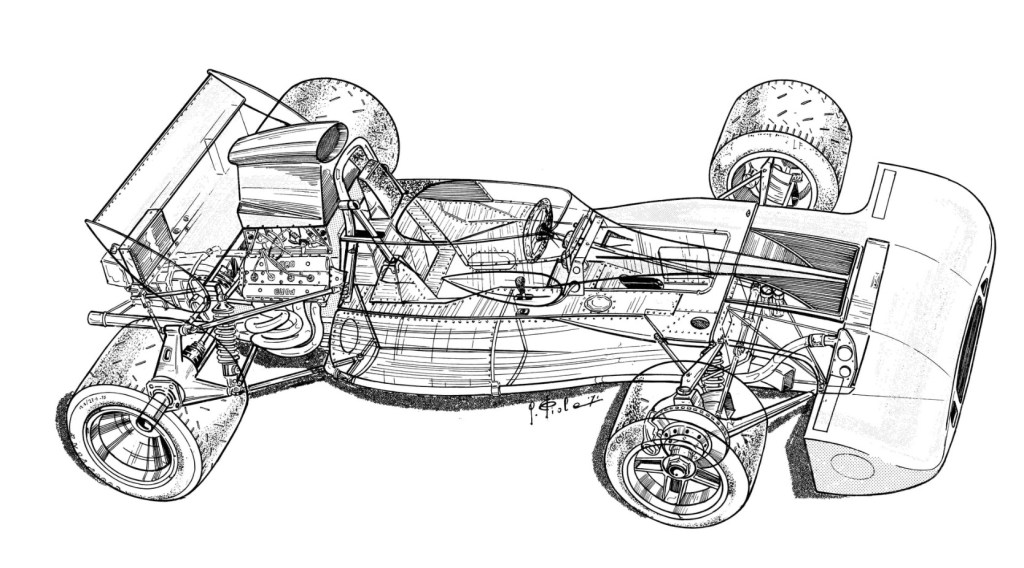
Tyrrell 002 Ford (G Piola)
(MotorSport)

Race of Champions March 21, 1971. Stewart in 001, Denny Hulme, McLaren M19A Ford and Clay Regazzoni, Ferrari 312B2. Regazzoni won from Stewart and Surtees in his TS9 Ford.

French GP 1971, Tyrrell 003, note Girling twin-disc set up (MotorSport)

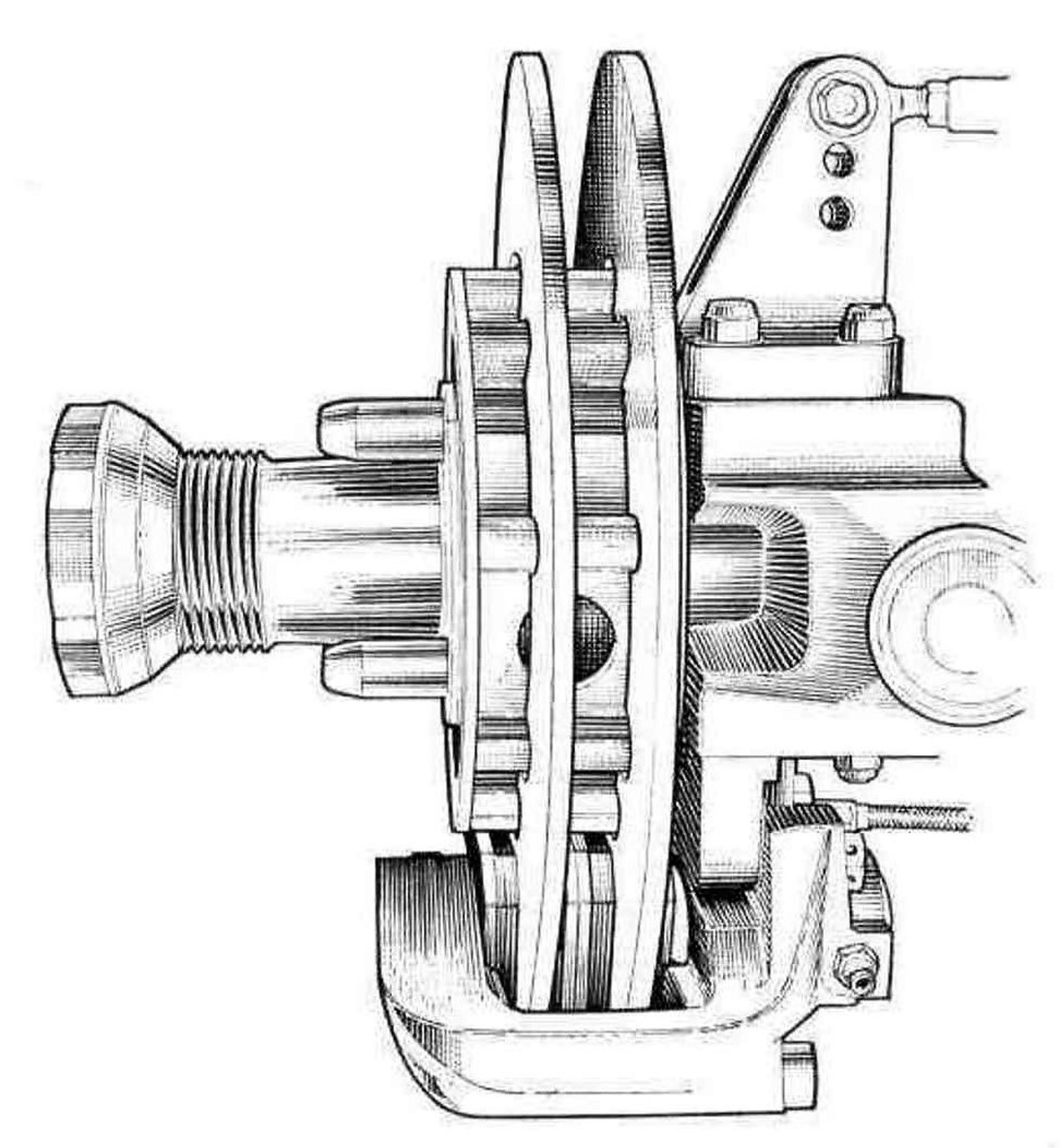
Tyrrell experimented with Girling twin-disc front brakes fitted to 001 at Silverstone during the May 1971 International Trophy weekend. After Monaco both regular cars: 002 and 003 were fitted with the double-disc brakes as here, to Jackie Stewart’s 003 at Paul Ricard.

Doug Nye explains the set-up, “There were twofold discs on each hub, spaced by a double thickness of pad material, and with pistons on only one side of the caliper. The discs were given a degree of side-float which allowed them to move sideways, cramped by the pads, when the brakes were applied. The idea was to double pad and disc area and provide better heat dissipation plus the opportunity to reduce line pressures which permitted the use of smaller pistons and less deflection on pad wear. The problem had been that conventional discs were wearing the brake pads into a taper form. This in turn promoted knock-off when the drivers braked hard, giving a spongy pedal feel and slashing driver confidence.”

The twin-discs were removed from both cars at Ricard, “after Stewart had a harmless spin into the catch-fencing, for Girling seemed happy with the lessons learned thus far.” Nye wrote.
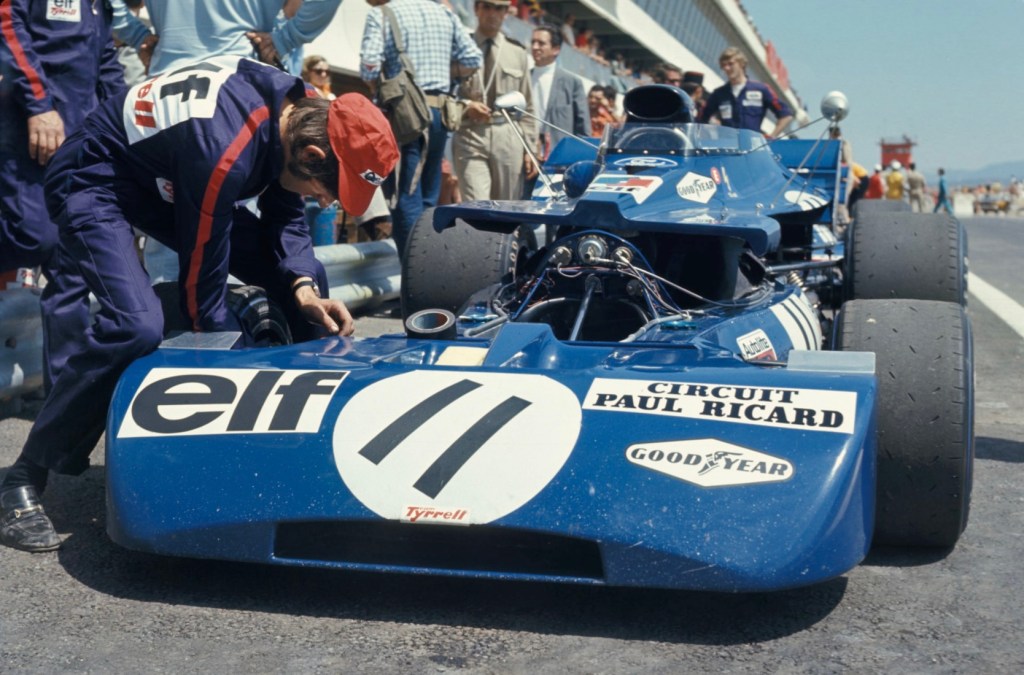
(MotorSport)

Two of Derek Gardner’s innovations are shown in the shot above, Stewart’s 003 at Paul Ricard, and Peter Revlon having this final in-period race of 001 at Watkins Glen in 1971 below.

The ‘Tyrrell nose’ first appeared in scutineering over the Dutch GP weekend and made its race debut at Ricard. The bluff nose extended to the maximum allowable width ahead of the front wheels, reducing the lift they caused and reducing drag.

With that, Gardner introduced the second alternative nose treatment until the ground effect era, the other was the wedge nose inspired by the Lotus 56/72.

Doug Nye notes that Stewart was “simply uncatchable on the long (Ricard) Mistral straight”. After the Tyrrell 1-2 in France and Stewart’s strong win at Silverstone a fortnight later, his engine was sealed and checked, and a fuel sample was taken in France with no irregularities found. Tyrrell simply had two very quick cars and drivers…

Note also the engine snorkels on the two cars. Lotus fitted ducts to the 72 from the 1970 British GP, and Matras snorkels, but Gardner’s design was sealed allowing clean air and a mild ‘supercharging’ effect.

It was far from the end of Derek Gardner’s innovations of course!

(MotorSport)

Peter Revson had a long international apprenticeship. Six years after winning the Monaco F3 GP and some promising top-five F2 performances in Ron Harris-Team Lotus 35s in 1965, at the ripe old age of 32 he returned to F1.

In 1971 he won the Can-Am Cup aboard a works McLaren M8F Chev and popped the team’s McLaren M16 Offy on pole at Indianapolis, then finished second behind Al Unser’s Colt Ford.

Tyrrell engaged Revson to race 001 at Watkins Glen. He qualified 19th but only did a lap after clutch failure. It was the last in-period ‘race’ for Tyrrell 001, Peter raced for McLaren in Grand Prix racing in 1972-73. See here: https://primotipo.com/2014/07/24/macs-mclaren-peter-revson-dave-charlton-and-john-mccormacks-mclaren-m232/

Happily, #001 is owned by the Tyrrell Family.

(MotorSport)

Credits…

MotorSport Images, Rainer Schlegelmilch, ‘History of The Grand Prix Car 1966-85’ Doug Nye, ‘Winning Is Not Enough’ Jackie Stewart, Automobile Year 19

Tailpiece…

(MotorSport)

February 2010 in the Ockham woodyard.

Finito…
image

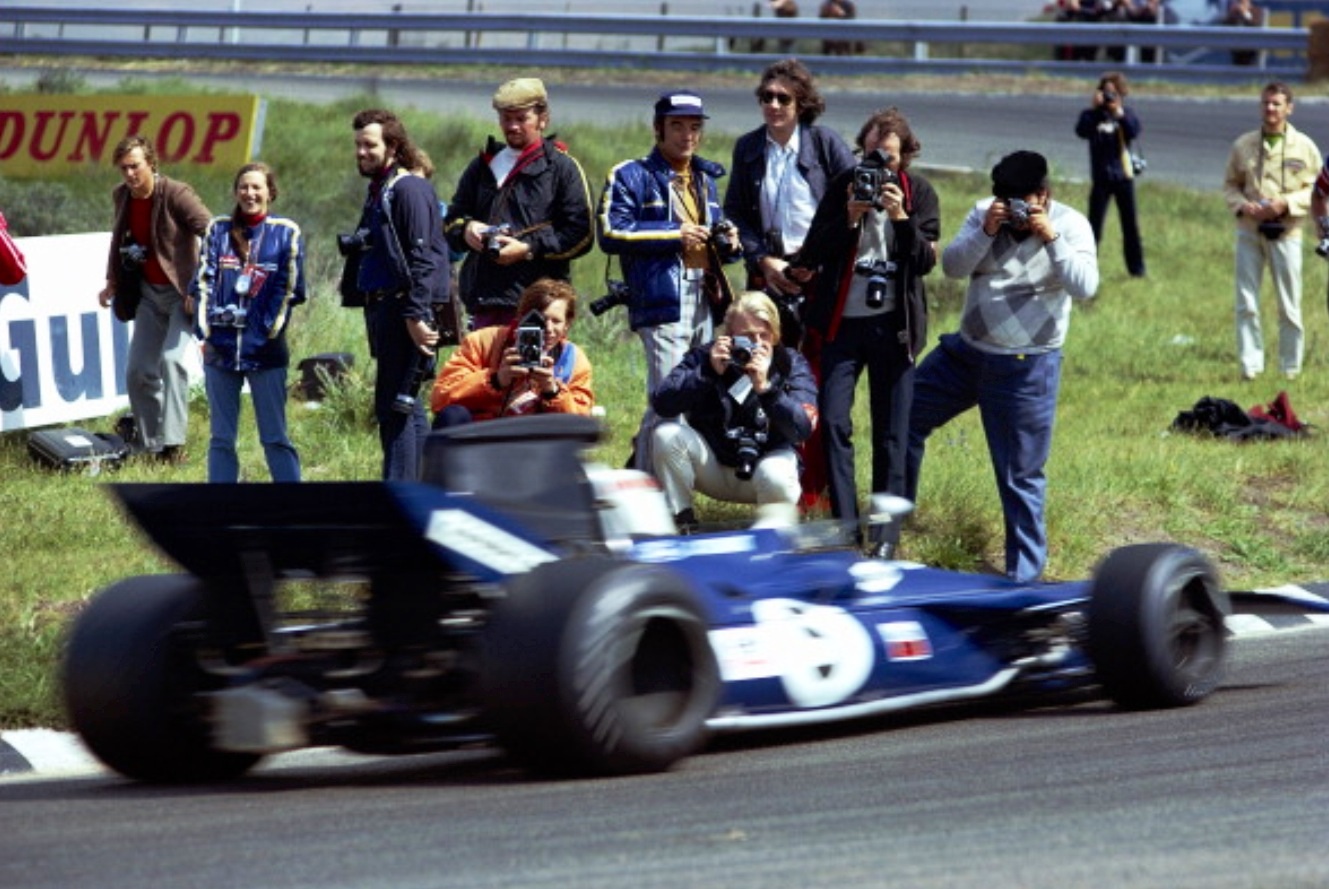
Jackie Stewart being largely ignored by most of the ‘snappers’ at Zandvoort during the Dutch Grand Prix weekend in 1971…

Rainer Schlegelmilch’s shot seems to be a portrait of his colleagues, Diana Burnett is the lady, the distinctive figure of Bernard Cahier is the chap in the blue cap and Goodyear jacket. It’s dry which makes it practice, the wet race was won by Ickx’ Ferrari with JYS 4th in Tyrrell 003 Ford.

I was first smitten by single-seaters upon spotting Jochen Rindt’s sensational ‘Gold Leaf’ Lotus 72 in the Automobile Year 18 ‘centrefold’ below.

jochen

Rindt on his way to a joyless first GP win for the Lotus 72 Ford during the 1970 Dutch GP at Zandvoort, his close friend Piers Courage perished in a grisly, fiery accident during the race in a De Tomaso 505 Ford (Automobile Year)

The book came from the Camberwell Grammar School library, I was an inmate for 6 years and borrowed these annuals, they bought the latest each year, hundreds of times over the years. If truth be known I surgically removed many of the full page color shots from the books which somehow found their way onto my bedroom wall, I was skilful with a razor blade long before I could shave!

So, I was a devotee of Colin Chapman’s Lotus 56/72 side radiator, chisel nose aero approach rather than Derek Gardner’s chunky ‘sportscar nose’ alternative he pioneered in F1 with Tyrrell in ’71. That the alternative approaches worked equally well was proved by the results of practitioners of the ‘two schools’ of aerodynamic thought throughout the ‘70’s, visually though it was ‘no contest’!

ken del

Derek Gardner and Ken Tyrrell outside the Ockham, Surrey factory in August 1971. Tyrrell Ford could be ‘002 or 3’, ‘bluff nose’ first raced at the 4 July ’71 French GP  (Klemantaski)

Gardner’s Tyrrell period was relatively short but wonderfully sweet…

Seven years is a pretty long stint with one team I guess. His first series of cars was the 1970-72 ‘001-004’, the second series the 1972-3 ‘005-6’. Both designs won Grands’ Prix and World Titles. His ’74-5 ‘007’ and stunning ’76-7 ‘P34’ six-wheeler won Grands Prix only, no titles. I doubt there are too many of the F1 design greats who can claim such a record.

I’ve written a few Tyrrell articles, which are worth a look if you haven’t done so; one is on innovation; https://primotipo.com/2014/09/16/tyrrell-019-ford-1990-and-tyrrell-innovation/ , the other on aerodynamics; https://primotipo.com/tag/tyrrell-007-ford/

image

The car pictured above is Jackie Stewart’s ‘004’, the last of Gardner’s first series of designs.

It’s being prepared for the 1972 Monaco Grand Prix, ‘004’s race debut, the GP classic won by Jean-Pierre Beltoise’ BRM P160B, famously his first and last GP win was also BRM’s last. JPB’s delicacy in the wet was aided by some schmick Firestone wets but it was a great drive by any measure. Jackie was 4th in ‘004’, he was not feeling 100% shortly thereafter was diagnosed with a stomach ulcer. Francois Cevert non-classified further back in ‘002’.

stew monaco

JYS practices ‘004’ at Monaco in 1972, the race was somewhat wetter! (unattributed)

The first Tyrrell, ‘001’ made its race debut in Stewart’s hands at Oulton Park in the ‘International Gold Cup’ on 22 August 1970…

 The car was famously designed and to an extent constructed, in secret in Gardner’s home garage in Parklands Avenue, Leamington! The ‘bath tub’ monocoque chassis was built to his design by Maurice Gomm’s Gomm Metal Developments, later chassis were built at Tyrrell’s famous woodyard, the base of his timber business in Ockham, Surrey.

Other notable sub-contractors involved were Jack Knight Engineering who did much of the machining, Aeroplane and Motor who provided the centre lock magnesium alloy wheels, Laystall the stub axles, not to forget Cosworth Engineering, Hewland’s and others.

‘001’s championship debut was at Mont Tremblant, the Canadian GP on 20 September where Jackie plonked it on pole and was leading strongly before a stub axle broke on lap 32.

The car was therefore ‘match fit’ at the start of its dominant 1971 season having done vast amounts of Goodyear testing, Dunlop, Tyrrell’s hitherto tyre supplier having withdrawn from F1. Over the South African summer at Kyalami over 400 tyres were tested by the team.

oulton 2

Tyrrell and Stewart during the Oulton Park International Cup weekend in August 1970 upon ‘001’s debut. In a meeting of contrasts JYS qualified poorly after the fuel metering unit failed, then had a stuck throttle during the race which was fixed, the Scot broke the lap record twice later in the race, the cars competitiveness clear from the start. John Surtees won the event on aggregate, he won the second heat in his Surtees TS9 Ford and Henri Pescarolo the first heat (his only F1 win?) in a March 711 Ford


oulton 1

More shots of ‘001’ during the Oulton August weekend. The cars distinctive bodywork was Gardner’s work and was tested at 1/10th scale in the wind tunnel of the University of Surrey in Guildford (Getty)

Powered by the good ‘ole 3 litre Ford Cosworth DFV V8 and using the equally ubiquitous Hewland FG400 5 speed transaxle, the bolides were ‘kit cars’ of the period derided by Enzo Ferrari but  remarkably quick bits of kit!

Look back to the photo of ‘004’ chassis at Monaco above.

The monocoque was made of 16 gauge NS4 aluminium alloy and like ‘002’ and ‘003’ was 4 inches longer in the length of the tub and 1 1/2 inches longer in the wheelbase than the prototype ‘001’.

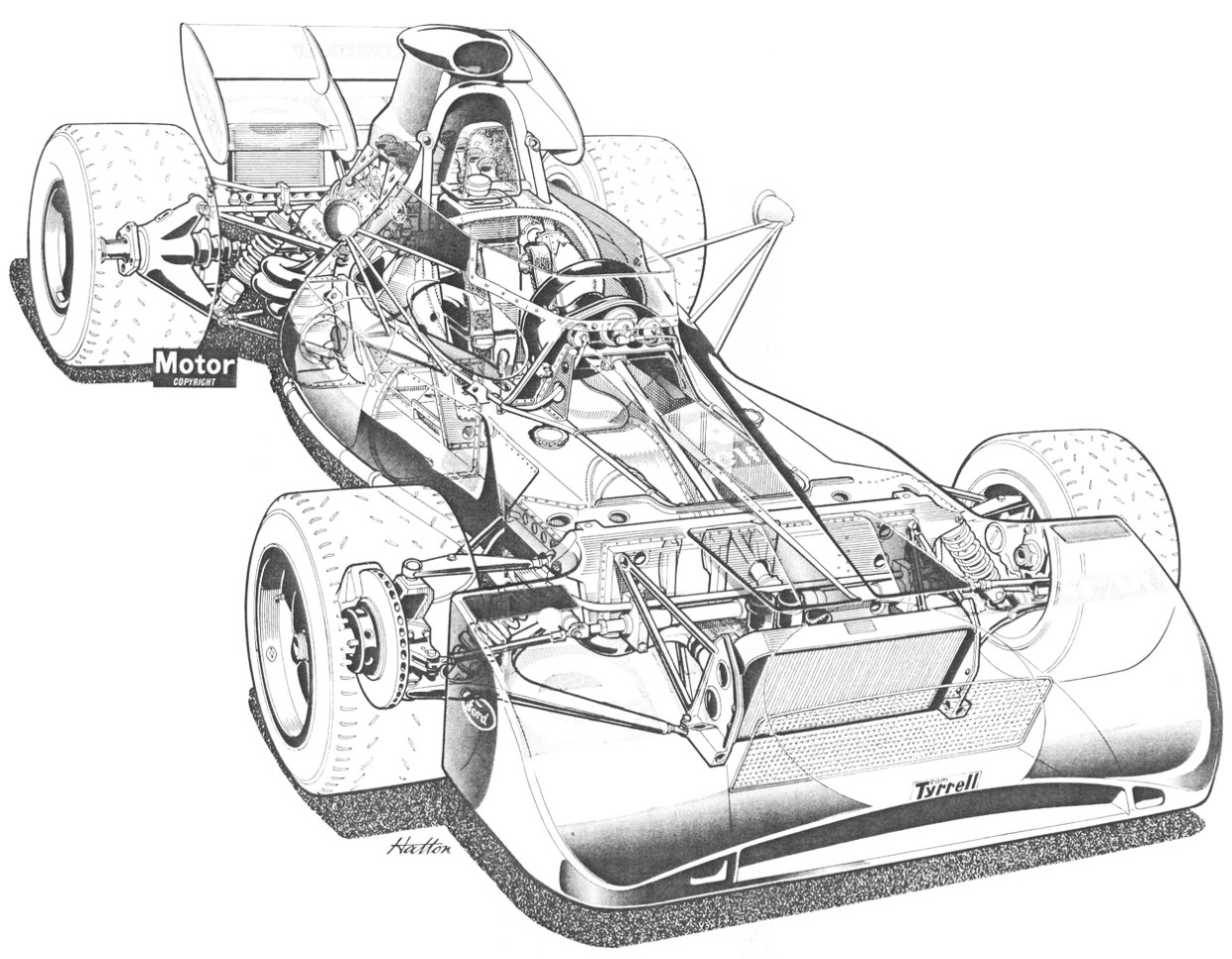
You can see the wide based lower one piece wishbone is mounted both to the tub and at its outer end the tubular suspension carrying frame which was first made up on a jig and then slipped over the top of the monocoque to which it was externally riveted. The upper suspension arm is a top link and locating link mounted to a bracket on the tub. Shocks are alloy bodied, double adjustable Koni’s- again period typical. The simple steering column is clear, the rack made by Tyrrells.

tyr cutaway

Tyrrell 002-4 cutaway drawing, all chassis the same design, this car is ‘003’. Specs as per text (Tony Hatton)

The vastly strong 360 degree roll bar encircled the the rear bulkhead and was both spigoted and bolted through into the monocoque. The DFV, stressed of course, was then bolted through this hoop. The forward radius rod pickups you can just see attached to the bar structure.

The rear was also a close to perfect expression of period paradigm; single top link, twin parallel lower links to better control toe than the inverted lower wishbone used for the decade before, two radius rods for fore and aft location and again coil spring/Koni dampers.

Brakes are Girling calipers, ventilated rotors front and solid rears of 10 1/2 inch diameter with Goodyear tyres used from the start of 1971.

‘004’ was completed at the end of the ’71 season as a spare car for Stewart, it was relatively lightly raced by the works, click on this link for a full, interesting article on the car which is still alive, well and historic raced; http://www.britishracecar.com/JohnDimmer-Tyrrell-004.htm

Gardner’s ‘005-006’ cars were low polar moment, very quick, nervous devices from which the aces for which they were designed, Stewart and Francois Cevert extracted ‘every ounce’ of performance in later 1972 and in 1973.

Here is my short article about these cars; https://primotipo.com/2014/08/25/jackie-stewart-monaco-gp-1973-tyrrell-006-ford/

tyr transport

Ken Tyrrell supervising the packing away of ‘003’ at the end of a Goodwood test session on 16 January 1972 prior to shipping the car to Argentina for the start of that season.

There Jackie drove it to his first win of a season in which Emerson Fittipaldi prevailed in the gorgeous, chisel nosed ‘John Player Special’ Lotus 72 which I think is about where we came in…

emo

The ever thoughtful Derek Gardner in blue shirt watches ‘Emmo’ head out for some more practice prior to the ’72 Italian GP, Monza. The Brazilian won the race and title in his Lotus 72D Ford. Francois Cevert is behind DG, his car Tyrrell 002, DNF with engine failure (unattributed)


image

’71 Dutch GP collage (Schlegelmilch)

Etcetera…

(T Matthews)

Some Tyrrell innovation over the 1971 Monaco GP weekend.

‘002’ was fitted with this ‘floating twin-disc’ brake assembly during practice. The thin discs float on the heavy splines of the hub to find their own centres relative to the pads in the caliper, which is mounted at the rear of the assembly. The pads are operated by a double piston assembly on the inner side of the caliper. Note the wheel locating pegs and single tapered wheel nut.

Photo and Reference Credits…

Rainer Schlegelmilch, Victor Blackman, Getty Images, Klemantaski Archive, Tony Hatton, Tony Matthews

Doug Nye ‘The History of The GP Car’, The GP Encyclopaedia

oldracingcars.com Checkout Allen Brown’s pieces on ‘001’ https://www.oldracingcars.com/tyrrell/001/ and ‘002-004’, inclusive of chassis by chassis records https://www.oldracingcars.com/tyrrell/002-004/

Tailpiece: Opening Dutch GP shot, uncropped, low res…

image

(Schlegelmilch)


Finito…


jean

Jean Alesi, Tyrrell 019 Ford DFR , French GP 1990 (Pinterest)

Tyrrell were an amazingly innovative small team.

Jean Alesi here in the 1990 French Grand Prix driving Designer Harvey Postlethwaite’s ground breaking and trend-setting ‘highnose’ Tyrrell 019 Ford DFR…

There were three distinct design regimes at Tyrrell. The first was from 1970-1977- the Derek Gardner era, then from 1978-1988 when Maurice Phillippe was at the helm and finally, from 1989-1998 when Harvey Postlethwaite led the design team until Tyrrells’ sale, the long established, family owned outfit morphing into ‘British American Racing’.

The Gardner and Postlethwaite periods were particularly aerodynamically innovative.

In 1971 Gardner introduced two important innovations to his Tyrrell 003.

The first was the high airbox, which debuted at the Dutch Grand Prix, Matra similarly equipped. Chris Amon’s MS120 V12 also having a ‘snorkel’.

cevert

Francois Cevert in Tyrrell 002 Ford showing the original aero treatment of that series of cars…Stewart ‘debut’ the Tyrrell Sports Car nose in this race the French GP 1971…Stewart first, Cevert second. ‘Pregnant-belly’ aero/fuel tank treatment apparent (L Harmegnies/motorsport.com)

The primary effect was mild ‘supercharging’ of the incoming fuel/air mix, the secondary one was aerodynamic- the simple snorkel quickly evolving into carefully sculptured rear bodywork which included the snorkel and smoothed airflow to the rear wing, aiding downforce and allowing a marginally flatter wing setting to be used. In essence, less drag for the same downforce.

In the French Grand Prix, Stewarts’ 003′ raced with a sports-car type nose, Gardner’s idea was to partially mask and aid airflow around and over the front of the car, the wheels/tyres being aerodynamically the least efficient part of an open-wheeler.

003

Derek Gardners Tyrrell 003 Ford , Jackie Stewarts primary, championship winning mount of 1971. Engine ‘Snorkel and bluff ‘Tyrrell nose’ innovations of that year are clearly shown

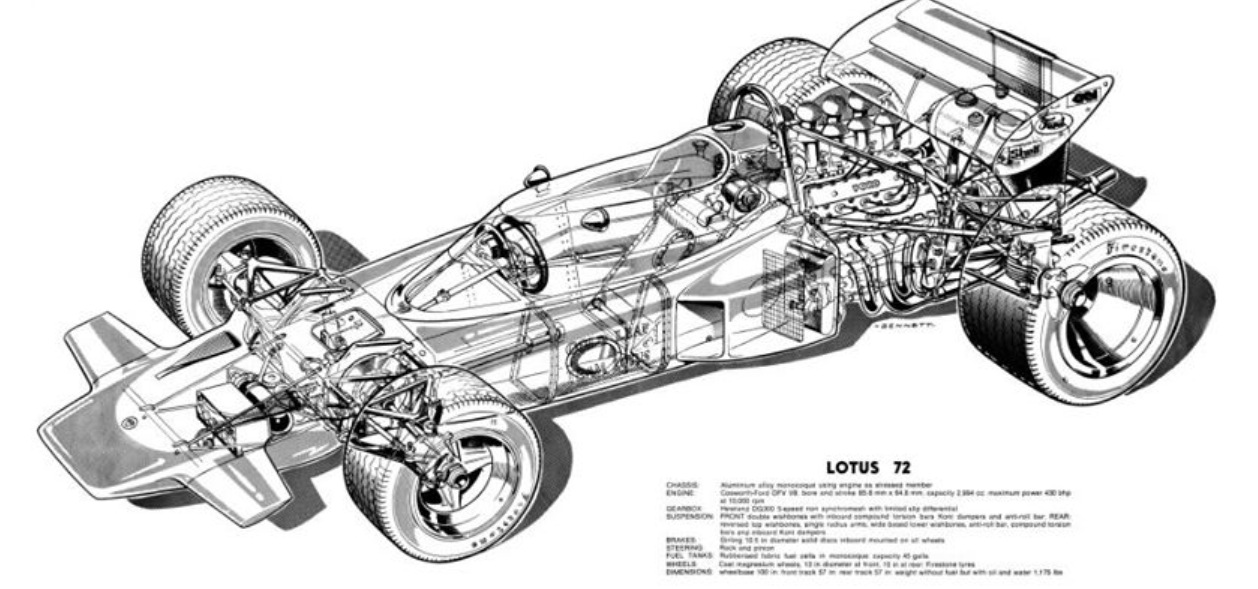
The Lotus 56 and 72 set a trend with their wedge shaped, side radiator design- the 72 appearing in 1970. The other alternative aero approach at the time, ‘Pre-Tyrrell Nose’ was the ‘pregnant-belly front radiator approach’ of the BRM P153/160, McLaren M14, Tyrrells 001-003 and others.

Gardner set the alternative aero trend of the 1970’s, until the advent of the Ground Effect Era, with his bluff sportscar type nose.

Look at the results of the two alternatives over that period from 1971 to 1979 when the needs of ground effect tunnels favoured the ‘chisel front wing and side radiator approach’ as against the ‘Tyrrell nose, front radiator approach’. Cars of both designs were successful, perhaps the former ‘wedge/side rads’ were the more successful.

Examples of winning ‘chisel/side radiator’ cars are the Lotus 72, McLaren M23, Ferrari 312T’s and of the ‘Tyrrell nose/front rad’ cars the Tyrrell 003-006 and Brabham BT42/44.


lotus

Colin Chapmans’ Lotus 72 Ford, 1970-1975

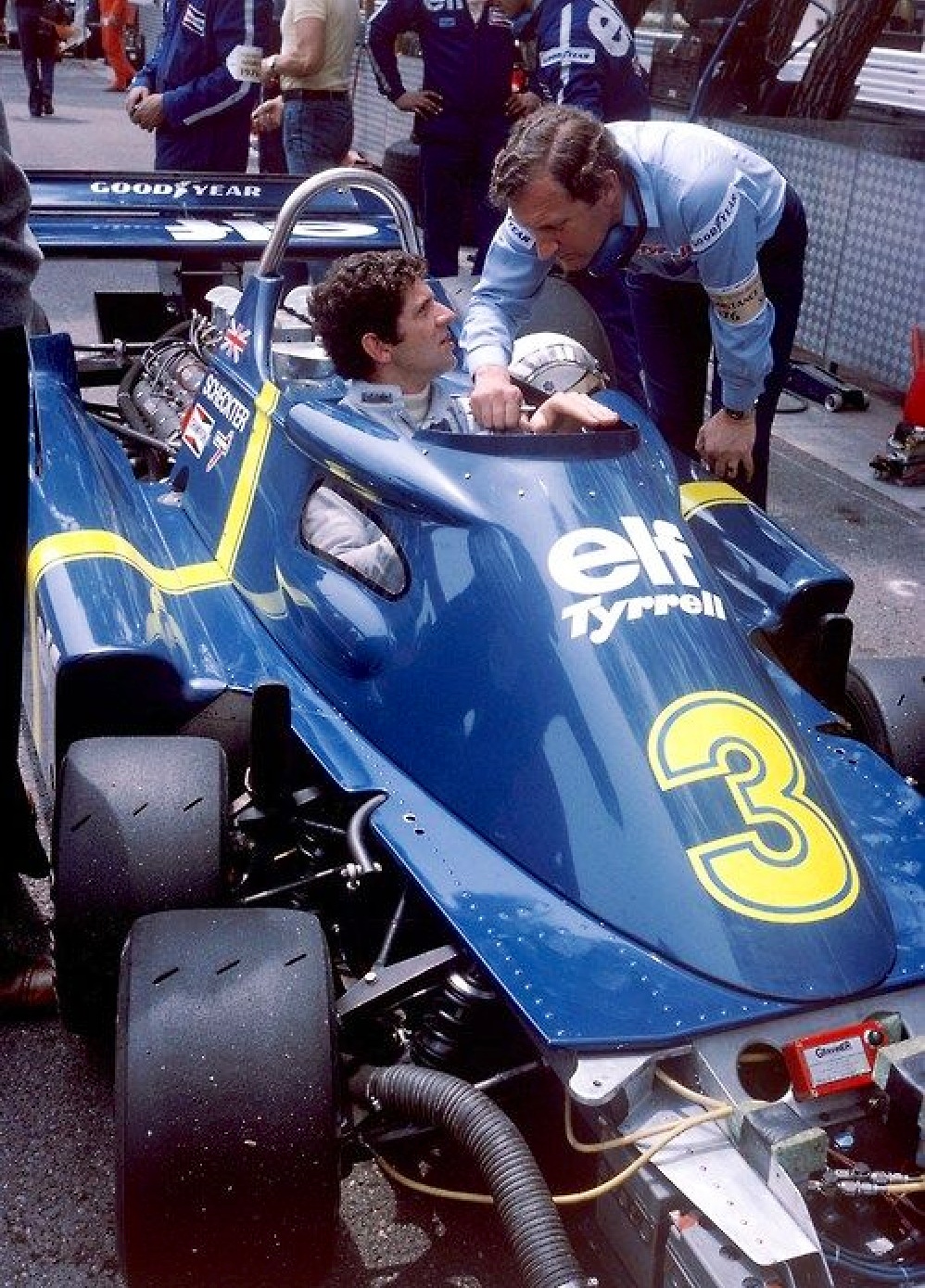
Gardner himself went to ‘chisel/side radiators’ with the 1974/5 Tyrrell 007 driven by Jody Scheckter and Patrick Depailler- and then back to the ‘Tyrrell nose’ for his stunning, outrageous P34 six-wheeler…

Both models were Grand Prix winners, the P34 once only, in Scheckter’s hands in Sweden in 1976.

Gardner was recruited by Tyrrell from Ferguson Research where he worked on advanced four wheel-drive systems used on the  Matra MS84 Ford four wheel drive F1 car of 1969- that car used Ferguson componentry. The Matra, as were the other 4WD cars developed by Cosworth, McLaren and Lotus were unsuccessful as wings and tyre polymer chemistry provided  grip more simply than 4WD technology of the day could.

But Ken Tyrrell was impressed and recruited Gardner to build the first Tyrrell 001, secretly in 1970.

derek and jody 1976

Jody Scheckter and Derek Gardner with P34 in 1976…Jody was not a fan despite his Swedish GP win and left the team for Wolf Racing for 1977, and a conventional, successful car, the Wolf WR1 Ford designed by Harvey Postlethwaite (Pinterest)

By the mid-seventies the challenge of the aluminium monocoque/Ford Cosworth DFV/Hewland FG400 gearbox brigade, ‘The Garagistes’, in Enzo Ferraris’ words, was how to beat the similarly equipped opposition?

Gardners audacious approach was aerodynamic in having four small front wheels which could be faired behind his Tyrrell nose, creating greater straight line speed whilst losing no mechanical grip from the tiny, Goodyear shod wheels.

The increased braking area provided by the four small discs was a further advantage.

There were mechanical challenges making the package work but the cars were competitive in both Jody Scheckter and Patrick Depailler’s hands in 1976, but less so in 1977 when Goodyear were not so interested in developing special tyres for just one team.

p34

Derek Gardners outrageous, successful Tyrrell Ford P34 six-wheeler of 1976/7

Then the FIA banned 6 wheelers and that was that, March and Williams had been toying with four rear wheels…

Scheckter jumped ship to Walter Wolf’s new team in 1977 and was a race-winner in the Harvey Postlethwaite designed cars.

Harvey, a Doctor of Engineering, had his motor racing start with March, modifying Lord Hesketh’s, James Hunt driven customer March 731. He then designed the Hesketh 308 in which James Hunt won his first GP and came to Tyrrell in 1988 after two stints at Ferrari including design of the 1982 and 1983 Constructors Championship winning 126C2.

Postlethwaite was joined at Tyrrell by aerodynamicist Jean Claude Migeot, together they evolved their competitive 1989 018 into the ground-breaking 019, the car which set the aerodynamic trend until the present.

The car was conventional in using a carbon-fibre monocoque chassis, wishbone and pushrod suspension front and rear, and Ford Cosworth 3.5 litre DFR V8 / Hewland six-speed transmission but utterly radical in its aero approach.

harves

Dr Harvey Postlethwaite during his very successful Ferrari period (L’Unita)

Contemporaray practice was to use a flat, steppped chassis undertray with a large diffuser producing downforce through the generation of low pressure under the car.

‘P and M’ realised this approach was compromised by the low nose at the front of the car, the wings diverted air sideways and upwards reducing the amount of air passing under the car. The generation of low pressure relies on increasing the speed of the air passing under the car in relation to the air passing over and around it.

In simple terms , the more air that can be drawn under the car, the faster the air will have to be moving, and the faster the air is moving the lower the pressure and greater the downforce.

By raising the nose-cone Postlethwaite increased the volume of air that was able to pass under the car…whilst keeping the wings themselves close to the ground where they work best with the distinctive, inverted V, anhedral front profile.

wing

The car was not that successful in terms of 1990 results, Alesi achieved sixth at San Marino and second in Monaco but a trend was set which most teams followed quickly- and principles which prevail today.

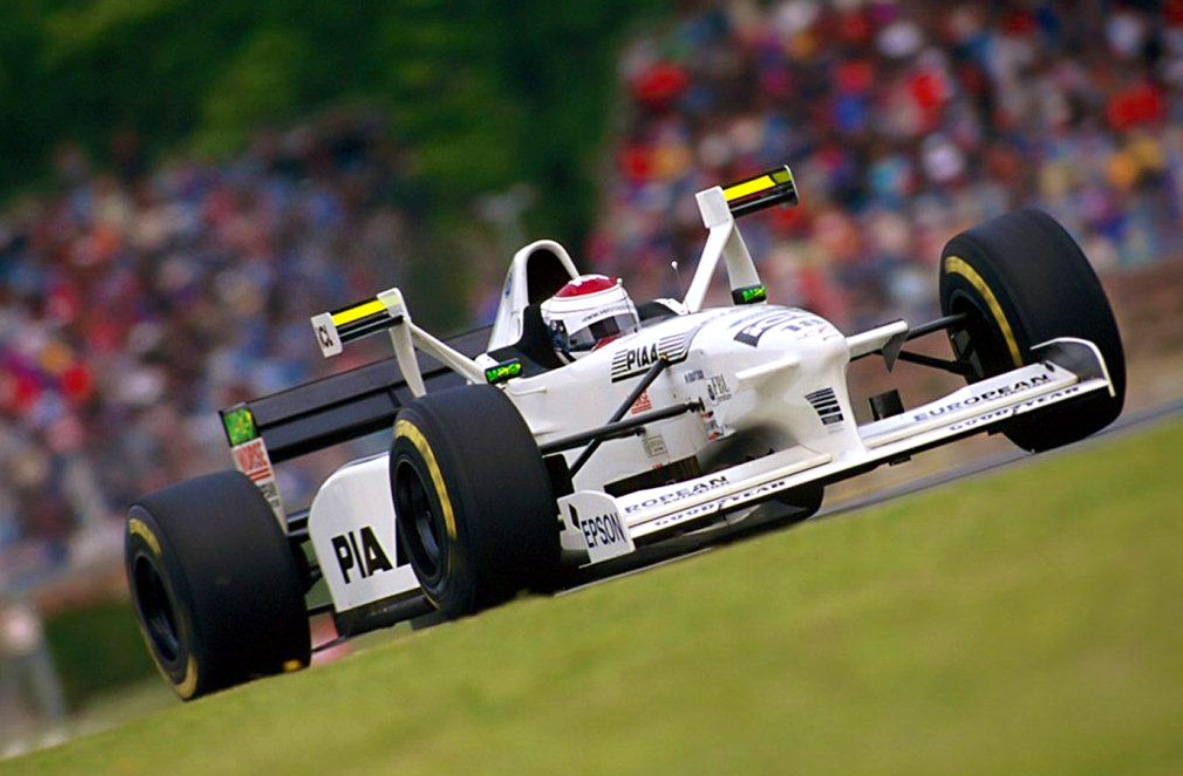
Tyrrell innovation continued with aerodynamically shaped wishbones in 1996, and the ugly but effective ‘X-Wings’ in 1997- on fast circuits two additional wings were installed either side of the cockpit.

Postlethwaite stayed with the team until it was sold by Ken Tyrrell to British American Tobacco at the end of 1997 and died suddenly of a heart attack whilst testing the Postlethwaite designed, Dallara built, in house Honda at Catalunya in April 1999- he was aged 55.

Ken Tyrrell died in August 2001, and Derek Gardner in January 2011, his post Tyrrell career was as Director of Engineering and Research at the Borg Warner clutch company.


Etcetera…Tyrrell 003 1971/2

oo3 cutaway

(Tyrrell)


stew

Jackie Stewart, German GP, Nurburgring 1972. Tyrrell 003 Ford. Stewart collided with Clay Regazzoni in this race won by the Ickx Ferrari 312B2, so DNF (Pinterest)


tyrel 003 cutaway

Etcetera…Tyrrell P34 1976/7

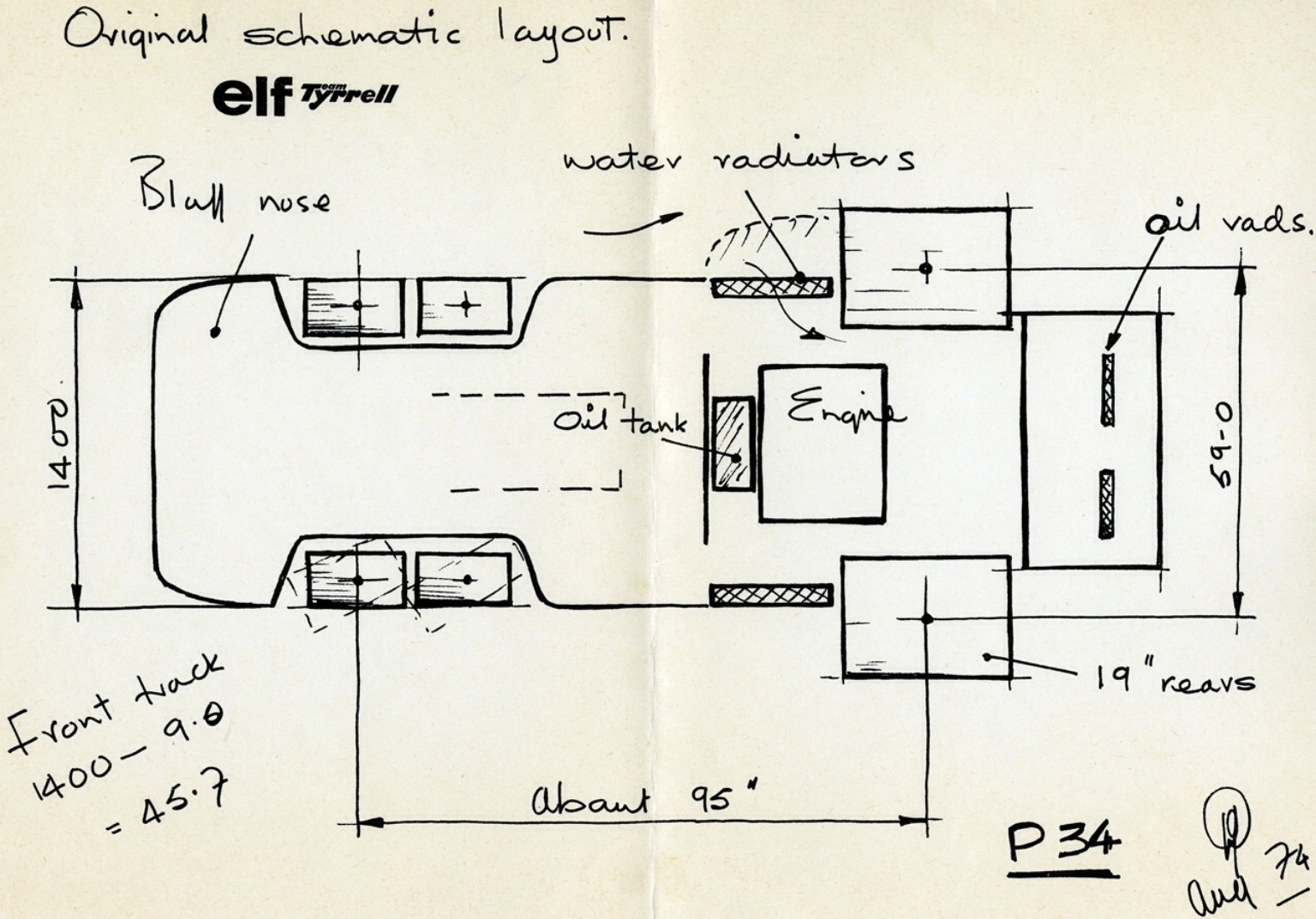
schematic

Derek Gardners original schematic of the essential elements of the Project 34 dated August 1974. Dimensions of the car as raced very close to this drawing


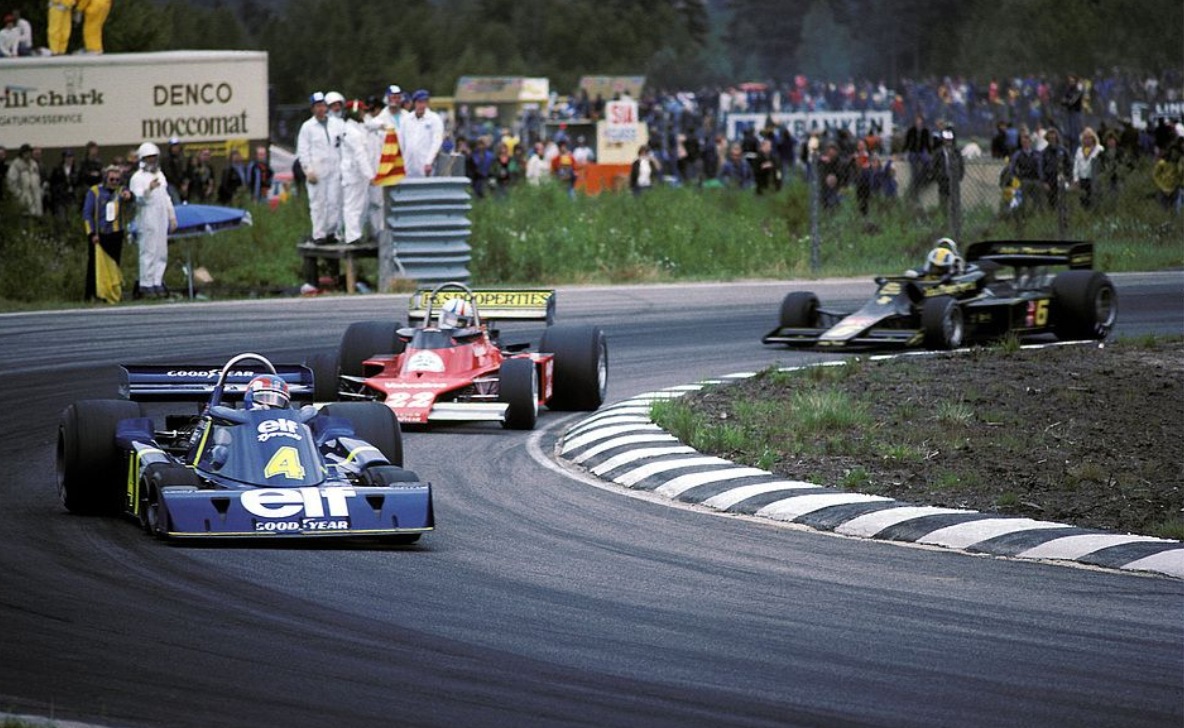
dep

Patrick Depailler (2nd) in the P34 ahead of Chris Amon (DNF) and Gunnar Nilsson (DNF), Ensign N176 Ford and Lotus 77 Ford respectively. Scheckter won this race, the 1976 Swedish GP in the sister P34. The shot is a ‘compare and contrast’ with conventional (aluminium monocoque/Ford DFV/Hewland gearbox) cars of the day. Note how well faired the small 10 inch wheels are by the ‘Tyrrell Nose’ (Sutton)


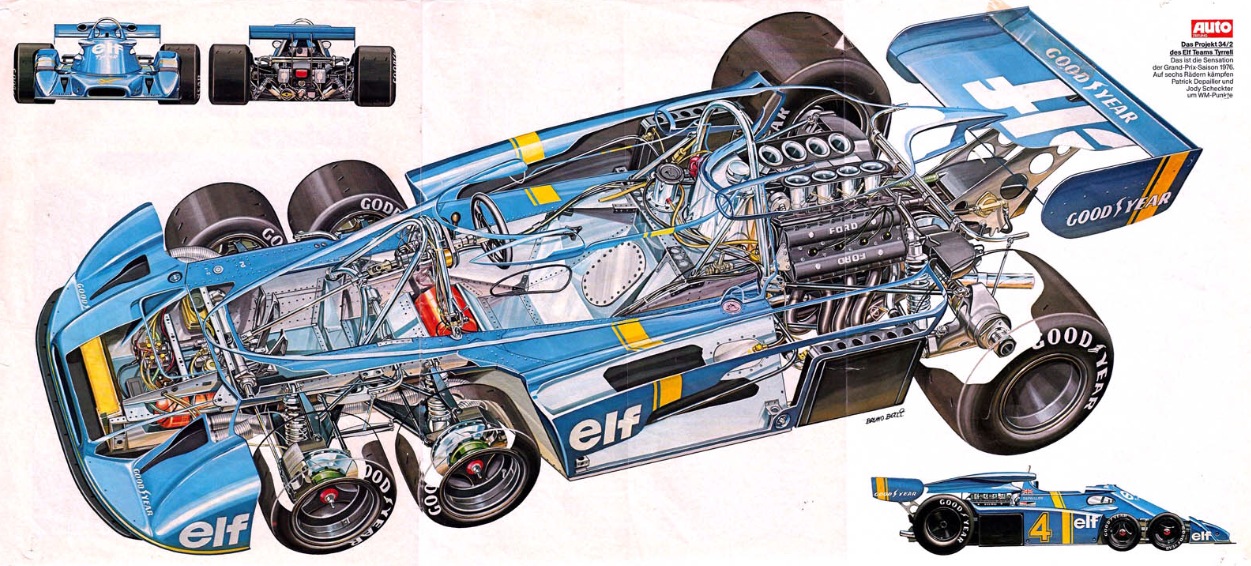
p 34 cutaway

(B Betti)


monaco

Scheckter second around the twists and turns of Monaco in 1976, the Lauda Ferrari 312T victorious. Depailler third in the sister car…plenty of ‘turn in’ and strong brakes on this demanding course (Pinterest)

Etcetera…Tyrrell 019 1990

adelaide

Wonderful 1990 Adelaide East Terrace shot of Jean Alesis’ Tyrrell 019 shows off its aerodynamic secrets…eighth in the AGP race won by Nelson Piquets Benetton Ford (Stupix)


019 cutaway

(unattributed)


jean and gerhard

Jean Alesi (3rd) and Gerhard Berger (5th)Monaco 1990, the high-nose Tyrrell 019 a contrast with the orthodoxy of the day, McLaren MP4/5B Honda. Ayrton Senna won the race in the other McLaren (Pinterest)

Etcetera…Tyrrell Ford 025 1997

jos

Jos Verstappen in Postlethwaites 1997 ‘X-Wing’ Tyrrell Ford ED4 3.5 V8 025. San Marino GP 1997…evolution of Harveys ‘high-nose’ over 7 years clear…Jos was tenth in the race won by Heinz-Harald Frentzens’ Williams Renault (Pinterest)

Photo Credits…

Pinterest, Sutton Archive, Bruno Betti P34 cutaway, Stupix, L ‘Unita, Lucien Harmegnies, motorsport.com

Finito…