Posts Tagged ‘Jim Clark’

(Telegraph)

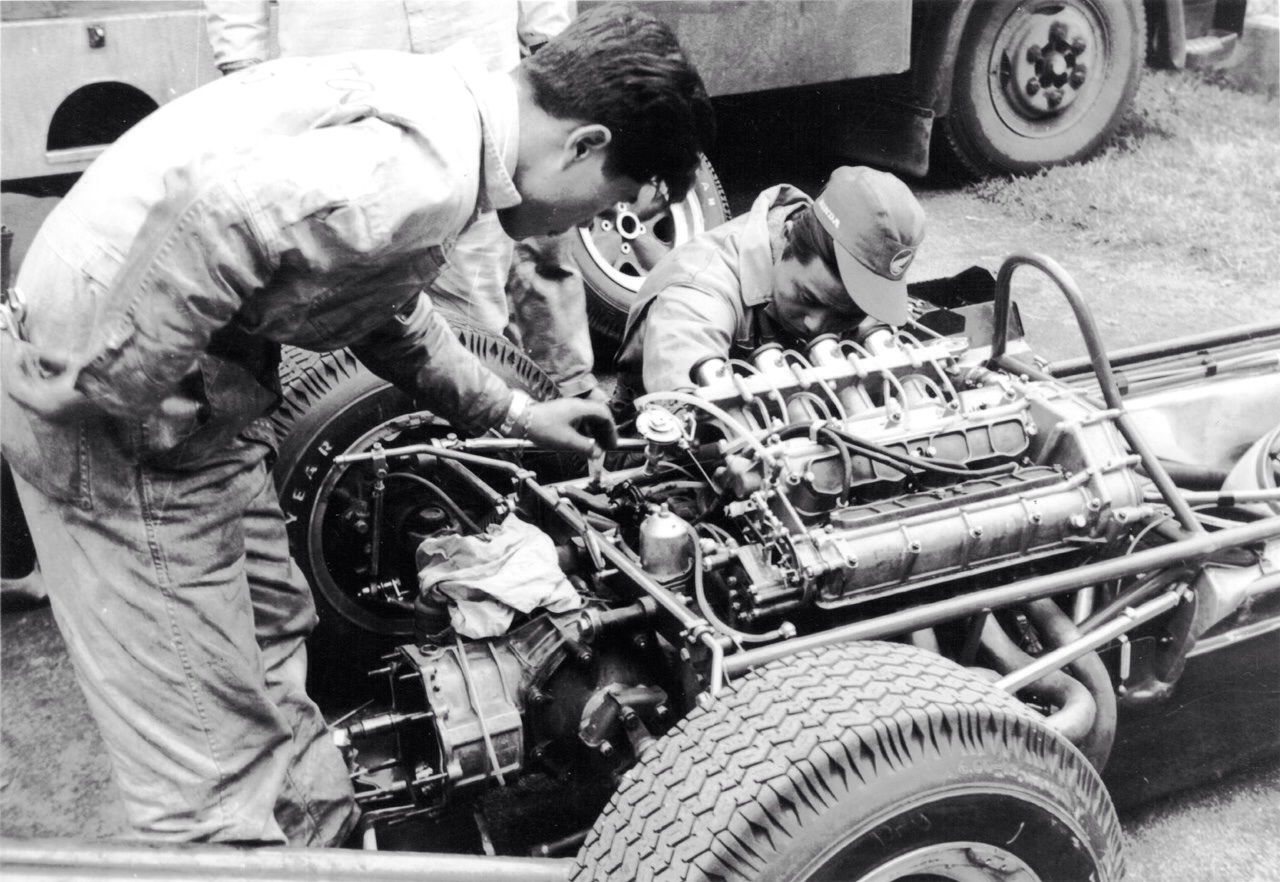
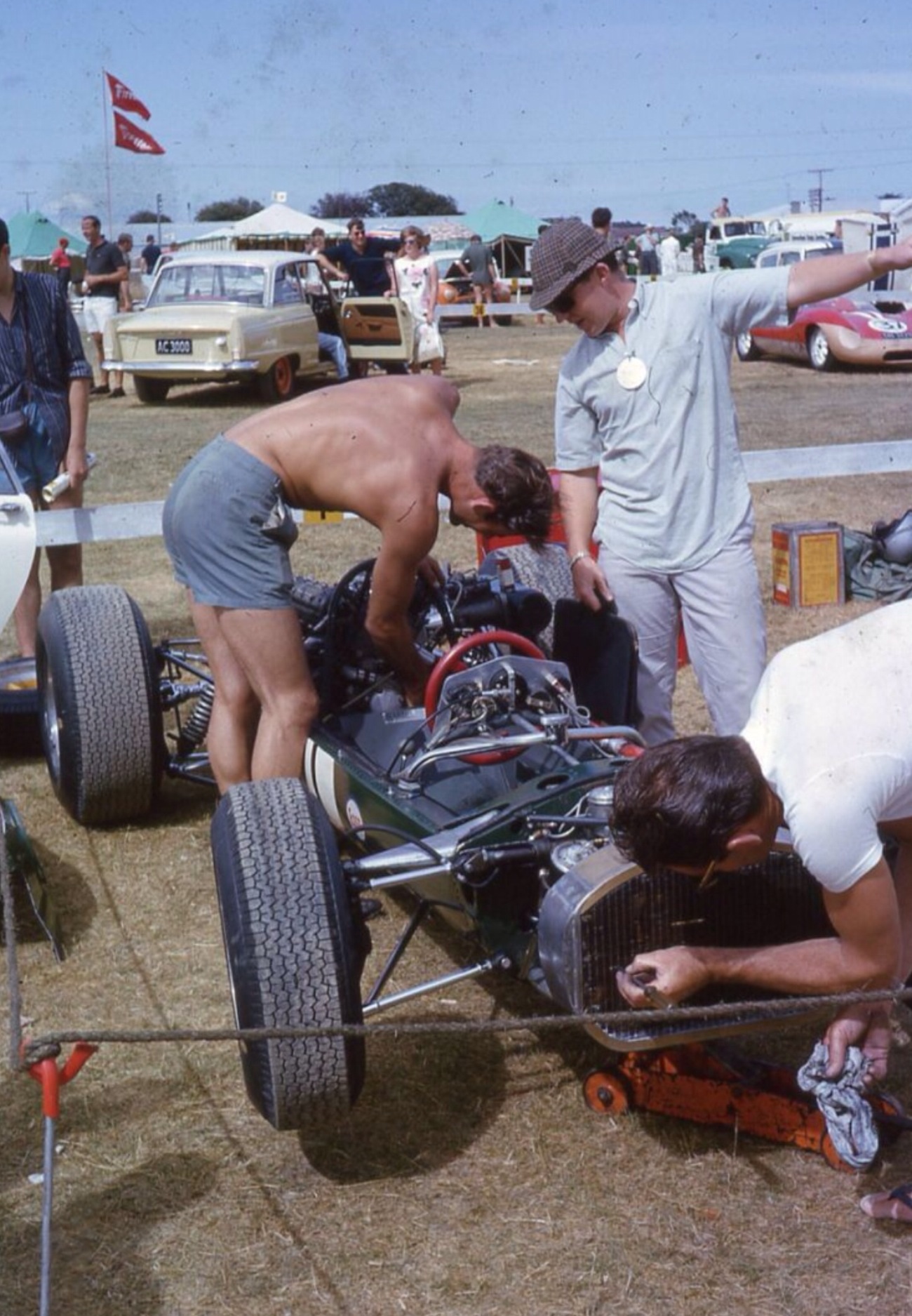
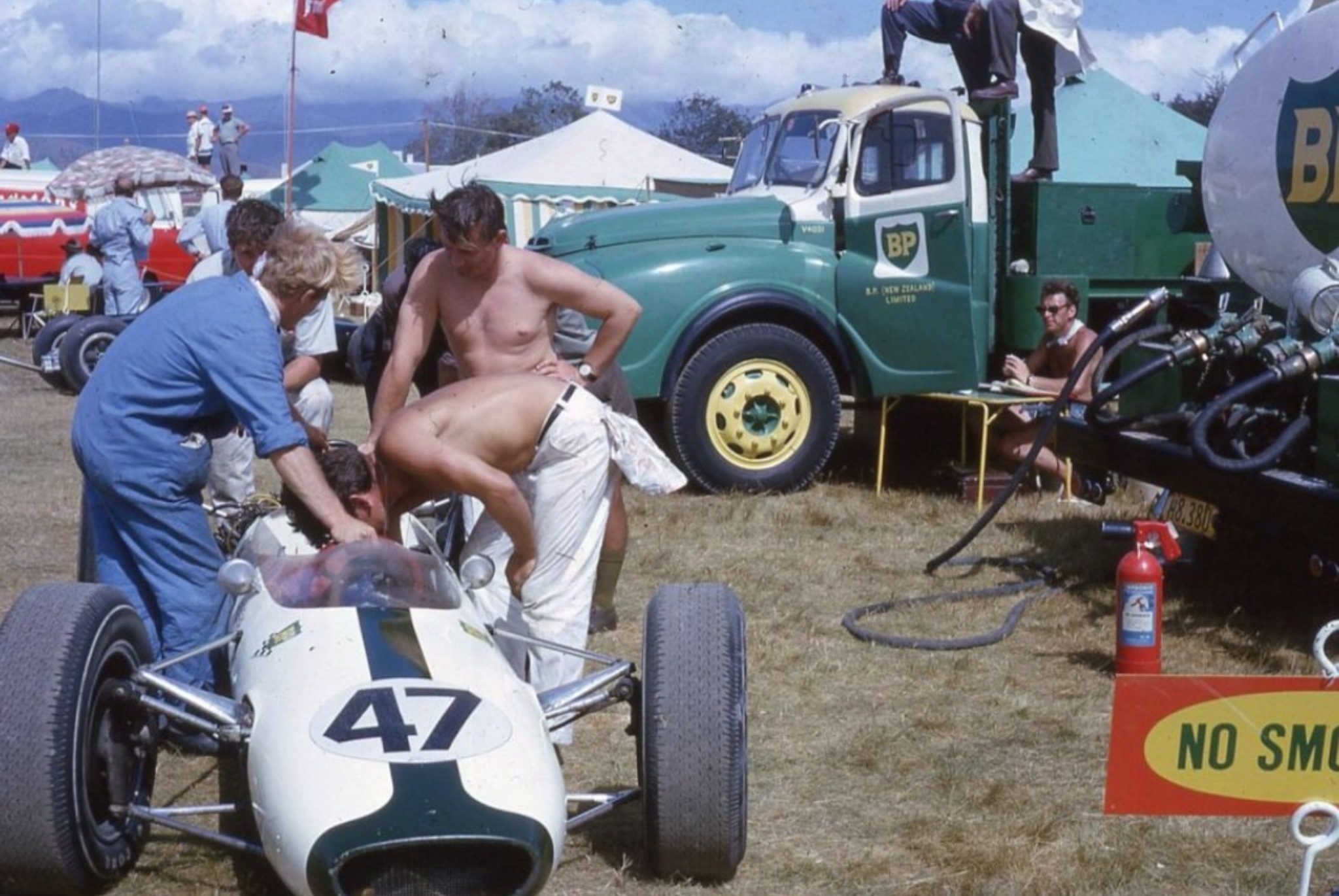
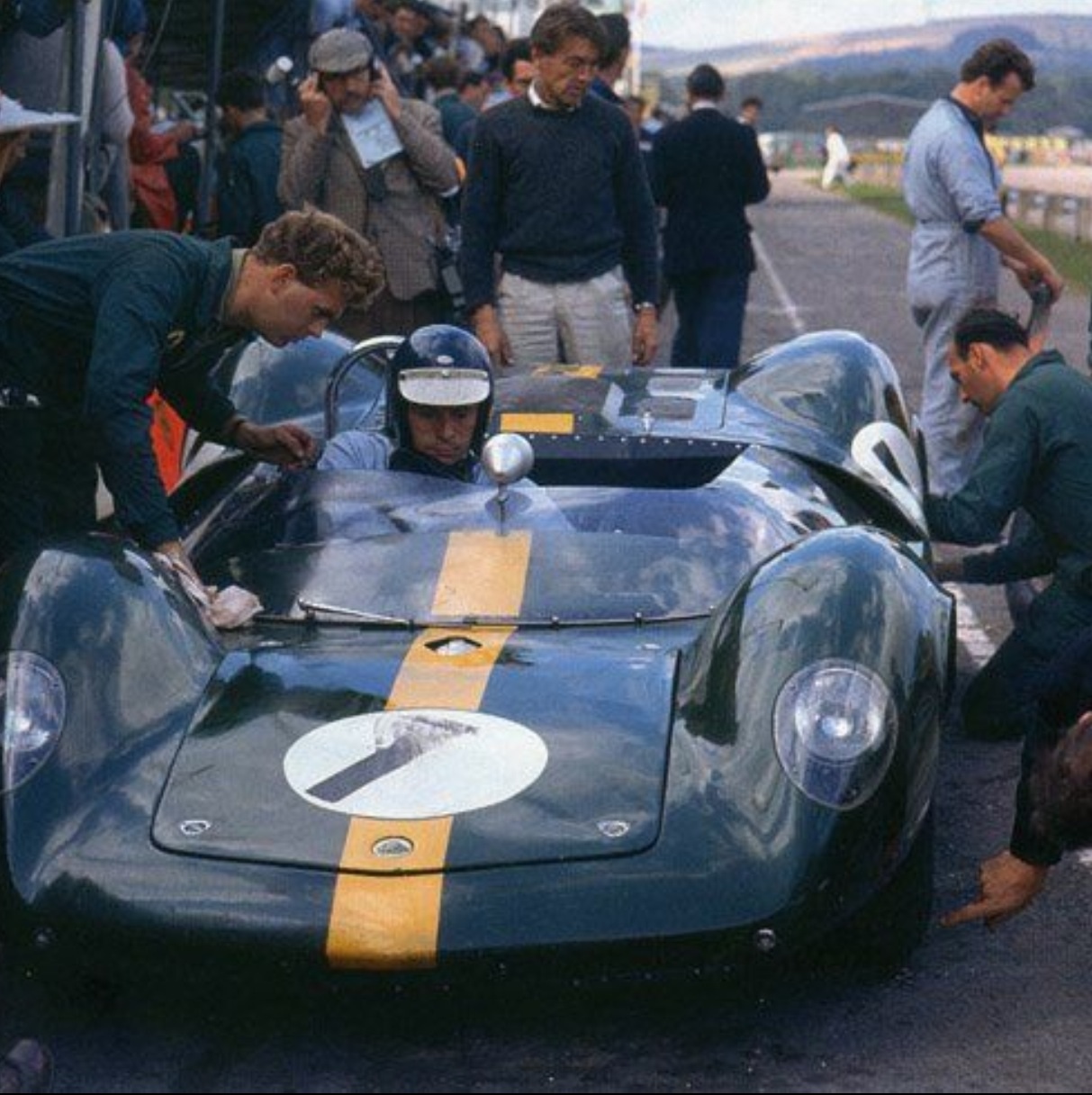
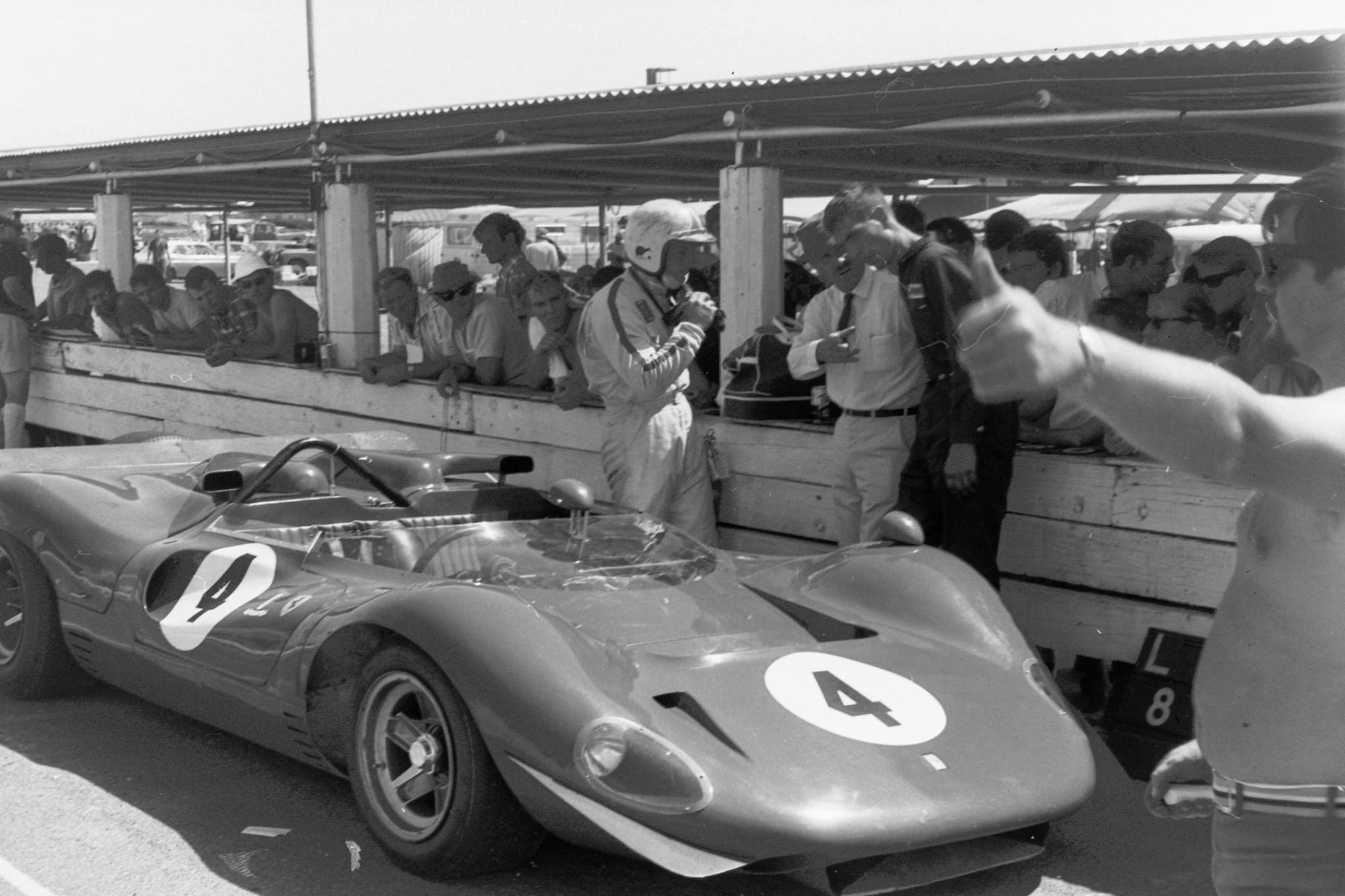
The highest paid Dunlop tyre fitter in the world attends to the needs of his Lotus 32B Climax, Warwick Farm, 1965…

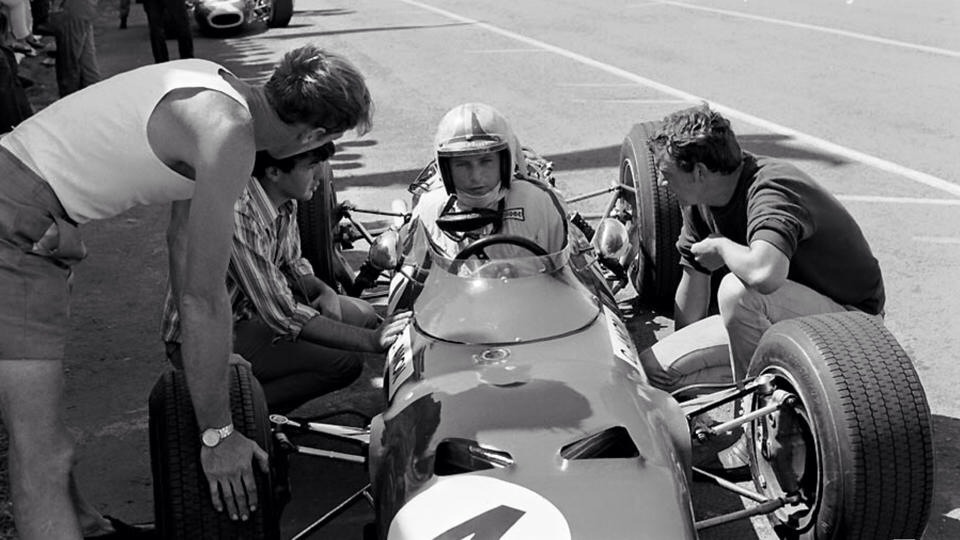
Its practice prior to the ‘Warwick Farm 100’ so Jim Clark assists Ray Parsons in between on-circuit sessions on the Friday or Saturday before the race.

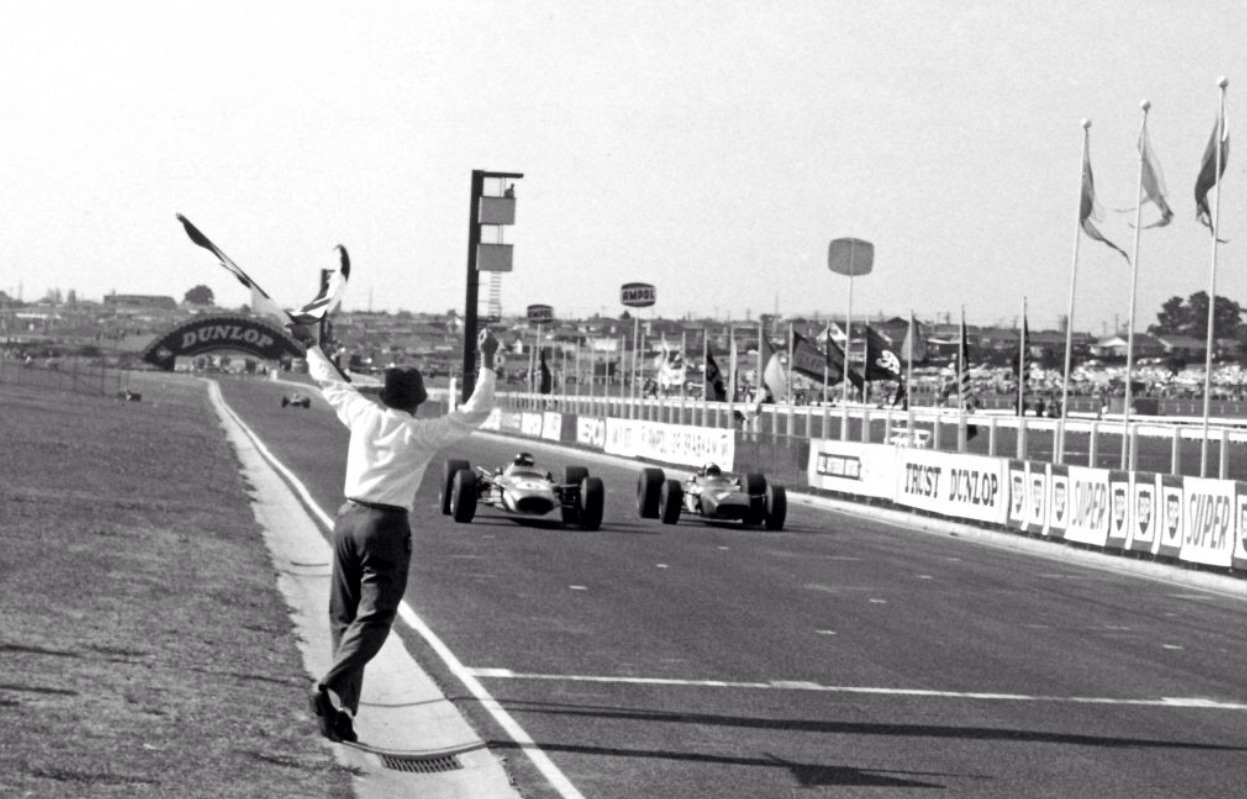
Its Frank Matich zipping by in his Brabham BT7A Climax, he was quick too, off pole and led Clark and Graham Hill for much of the first lap. He was 3rd, five seconds behind Brabham in 2nd with Jim a minute up the road from Jack in an emphatic victory.

Roy Billington, Brabham’s chief mechanic is the black clad dude to the left of Jim. In the white helmet is the tall, lanky frame of Frank Gardner and beside him his Alec Mildren Racing Brabham BT11A Climax. A DNF for Frank that weekend with Coventry Climax engine dramas on lap 25.

(Telegraph)

In the photo above Roy Billington is tending Jack’s BT11A, its Jim’s Lotus behind. The tall fellow to the right, in the cloth cap is, I think Lex Davison- Lex retired on lap 3 with a busted steering wheel in his Brabham BT4, an odd failure for a driver of considerable deftness and touch.

‘Topless’ behind Lex is Jim Clark talking to Warwick Farm boss, Geoff Sykes- to the left near the pit counter is again Frank Gardner.

Its all happening, as I say…the first six home were Clark, Brabham and Matich, then Bib Stillwell, Brabham BT11A, Graham Hill similarly mounted in the Scuderia Veloce entered machine and then Kiwi Jim Palmer in his BT7A.

Credits…

Daily Telegraph, oldracingcars.com, Bruce Wells on The Roaring Season

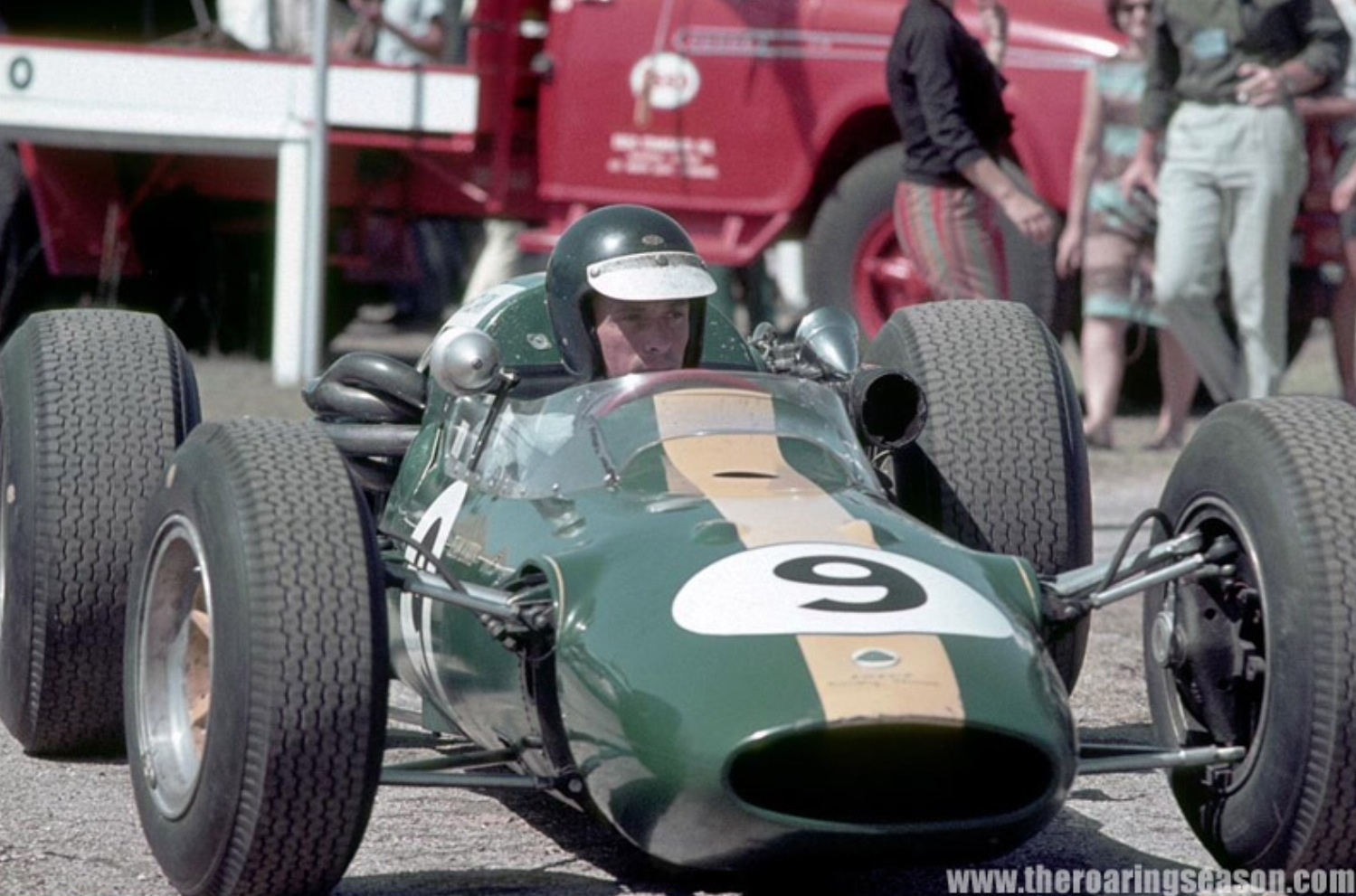
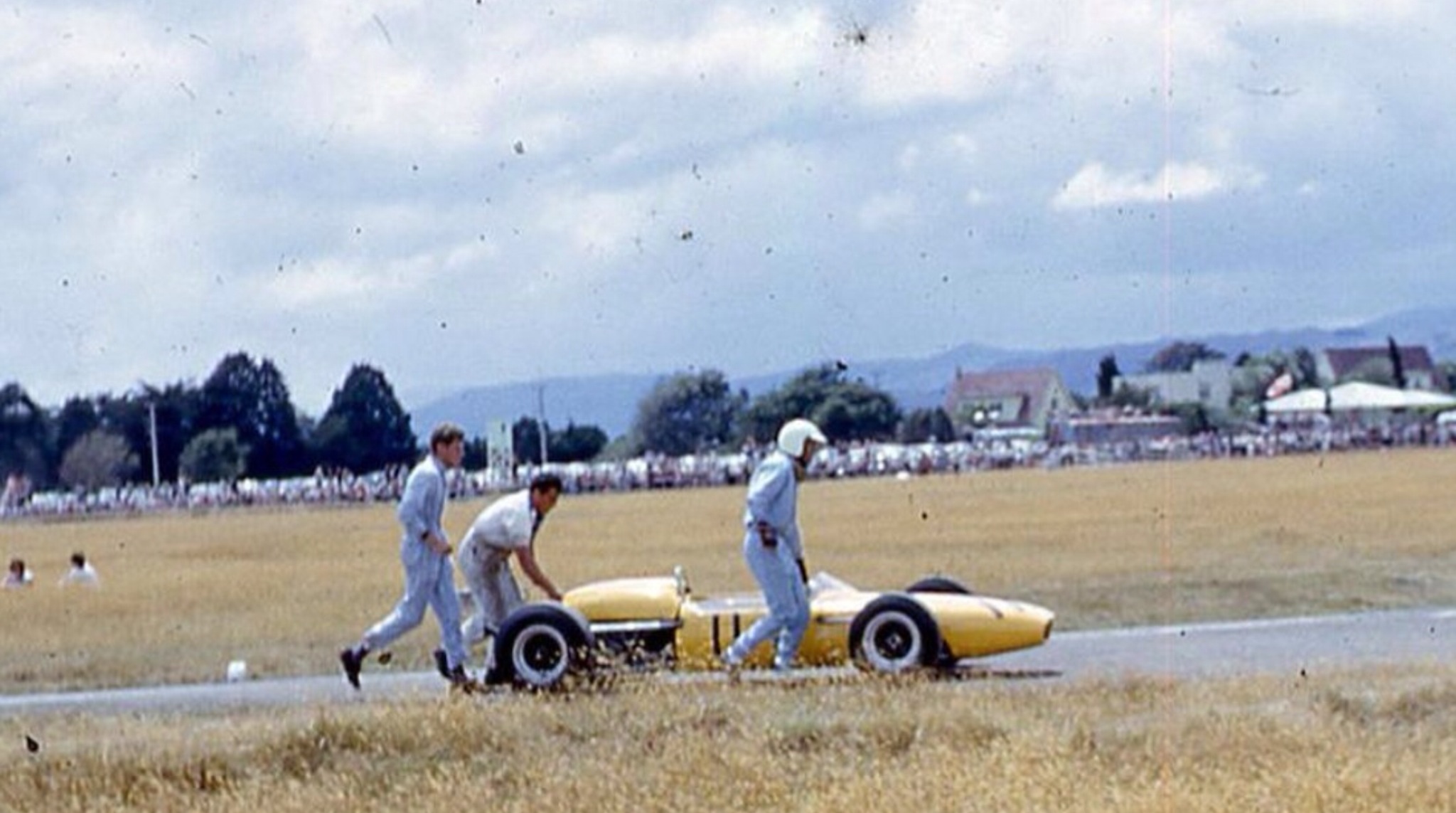
Tailpiece: Jim and Lotus 32B Climax on the hop…

(Bruce Wells/TRS)

He is entering The Esses and has clearly given someone or something a ‘tap’, the nose of the Lotus is slightly bruised. I’ve written about this car, click here for the link; https://primotipo.com/2017/11/02/levin-international-new-zealand-1965/

Finito…

(Gordon)

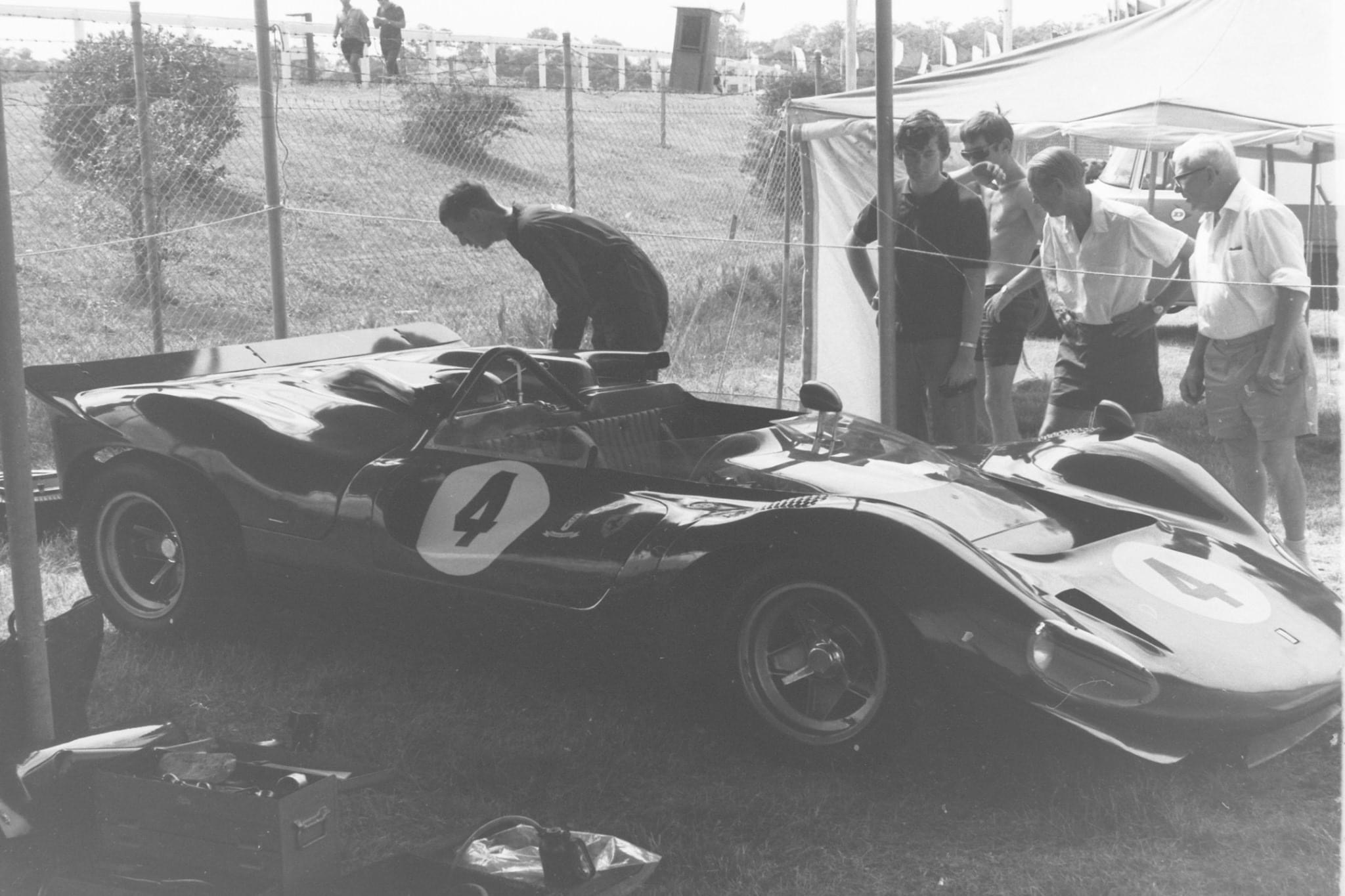
Jim Clark’s Lotus 35 Ford Cosworth SCA 1 litre F2 car at rest in the Pau paddock on the 25 April weekend in 1965…

You forget what delicate little flowers these cars were. When I glanced at Ian Gordon’s wonderful shot I initially thought it was a ‘screamer’, a 1 litre F3 of the same era. Not so.

Remember the pantheon of single-seater formulae at the time was 1.5 litre F1 engines giving 205-215’ish bhp, 1 litre pushrod F3’s breathing through a single carburettor choke giving about 100bhp and 1 litre OHC race engine F2’s giving 115 initially towards 150 bhp plus by the formula change to 1.6 litres in 1967.

Jim won at Pau from Dick Attwood’s Lola T60 SCA and Jochen Rindt, also SCA powered in a Brabham BT16.

The engine in Clark’s winning Lotus is Keith Duckworth’s conception based on the production Ford 116E block. The SCA (single cam series A) was the dominant F2 engine of 1965. It won all of the ‘Internationals’- there was no European F2 Championship until 1967, with the exception of the ‘Autocar Trophy’ at Snetterton in May. Graham Hill took that win, BRM P80 powered, aboard a John Coombs Brabham BT16.

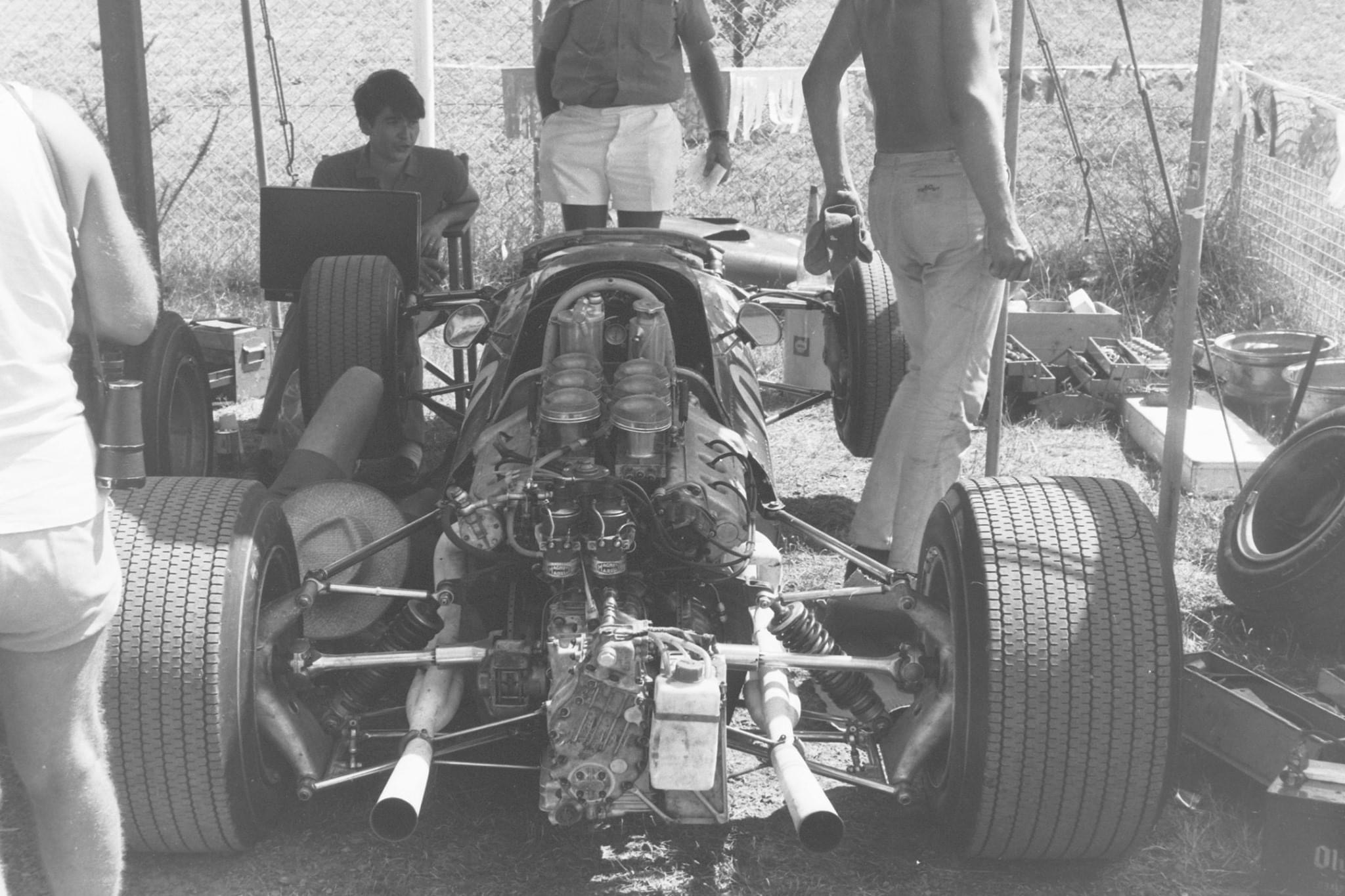
Hewland ratio change in Jacks BT16 in the Pau paddock- there were lots of them as Brabham tried to match ratios to the peaky 1965 variant of Honda’s S800 engine. Brabham raced much of the ’65 F2 season in SCA powered cars as Honda development continued (Gordon)

Ian Gordon became a well known and respected Australian race mechanic, later working for Alec Mildren Racing and Max Stewart amongst others. He was on a racing holiday in 1965 and snapped these fantastic photos of the ‘F2 Engines of 1965’ during the Pau Grand Prix weekend. The engines are the SCA, BRM P80 and Honda S800.

For Jim it was the first of five F2 wins in ’65- that amazing season of Clark domination (F1 World Title, Tasman Championship and Indy 500 win), the others were at Crystal Palace, Rouen, Brands Hatch and the Albi GP late in the season.

The real threat to Cosworth SCA dominance into 1966, not that it was necessarily apparent at the time, were the 1 litre DOHC, injected Honda 4 cylinder engines fitted to various of Jack’s works Brabhams during 1965. The peaky nature of the engines power delivery was the primary issue which was addressed in spades over the winter. Click here for my article on Brabham Honda dominance in 1966.

https://primotipo.com/?s=brabham+honda

Duckworth’s First Cylinder Head Design…

By the beginning of 1963 new F3 and F2 categories were announced, the former to replace Formula Junior to take effect from 1 January 1964.

Duckworth, armed with 17,500 pounds of support from Ford set to work on the new ‘SCA’ engine which would use the Ford 116E block known so well to them.

Sitting atop it would be an aluminium cylinder head with a line of vertical valves, two per cylinder ‘It was really an overhead cam version of the last Formula Junior engine’ Duckworth quipped in Graham Robson’s wonderful ‘Cosworth’ book.

The engine was notable for its bowl in piston combustion chamber or ‘Heron Head’ design. ‘My simple argument was that at the compression ratios we could use, and the valve sizes needed to ensure good breathing, that a bathtub type of chamber ended up masking the valves. It was an awfully long way around their periphery. I argued with myself, that if I put the combustion chamber in the piston, then for most of the time the valves would be out of the way, and that they wouldn’t impede the flow’ Duckworth said.

The steeply aligned inlet port of the SCA owed much to the Mk XVII pushrod 1963 engine engine which was heavily modified by having tubular downdraught inlet ports brazed into the casting. It wasn’t easy to do or cheap to make but improved gasflow. The SCA in some ways mirrored that approach.

KD ‘The SCA was the first cylinder head that I ever designed, and now I think their was quite a lot wrong with it. We had all sorts of trouble with the combustion- we couldn’t make it burn- but it was still good enough to win a lot of F2 races. In the end there was so much spark advance, that it wasn’t reasonable. We ended up with 49 degrees. The SCA chamber suffered from a lack of circumferential swirl’.

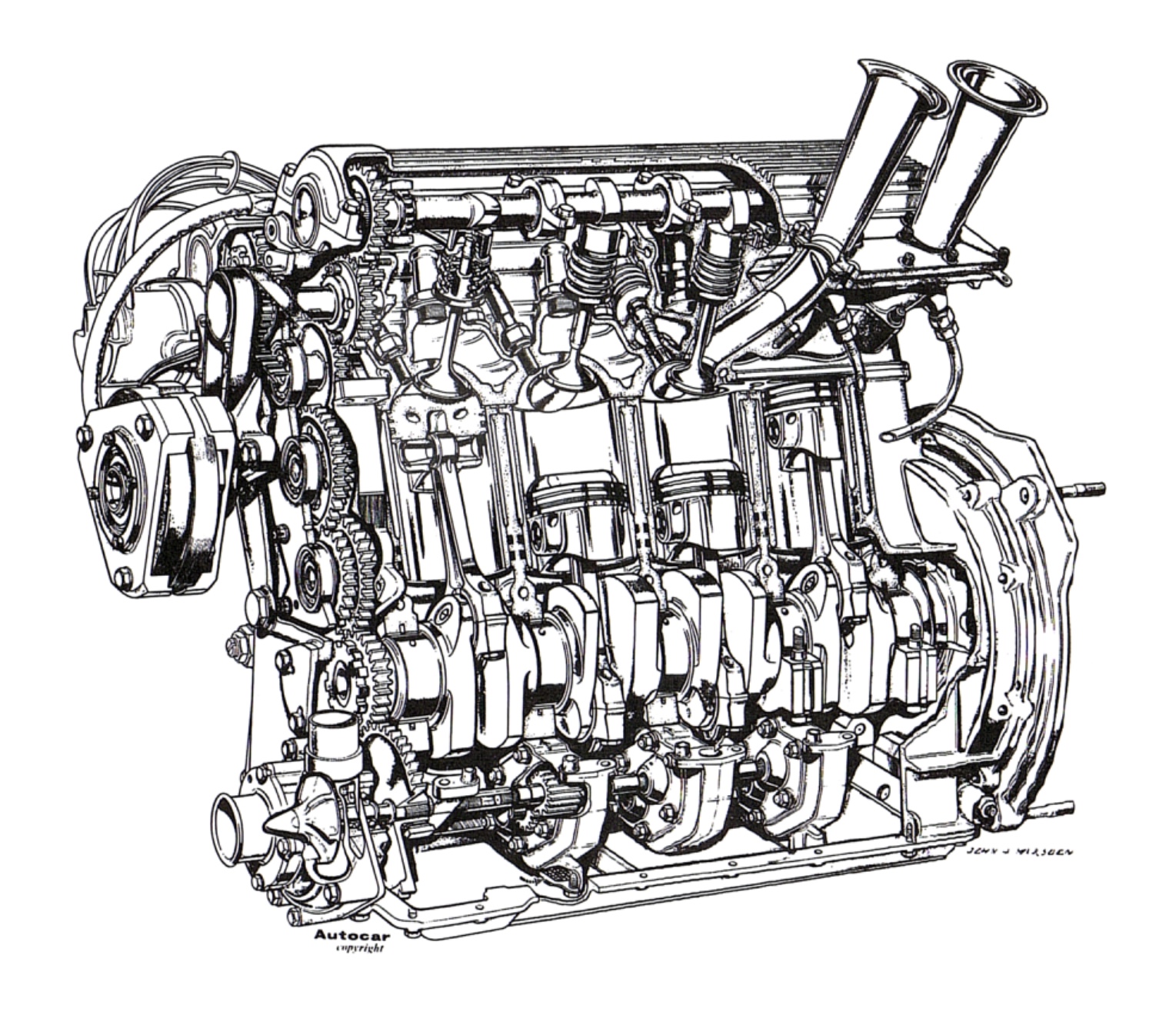
Colin Chapman sub-contracted the running of his F2 team to Ron Harris, the two wheels of the car alongside Clark’s Lotus 35 in the opening photo are those of his teammate Brian Hart- Brians 35 is BRM P80 powered and is shown above. The story of BRM’s 4 cylinder P80 F2 engine is one for another time but its vital statistics are an all aluminium, DOHC, 2 valve, Lucas injected 998cc (71.88X61.6mm bore/stroke) dry sumped motor giving circa 125 bhp @ 9750 rpm. (Gordon)


BRM P80 1 litre F2 engine cutaway (J Marsden)

Duckworth- ‘It might not have been right, but we had to make it work. It won the F2 Championships of 1964 and 1965…and…until the Honda engine of 1966 with four valves and twin overhead camshafts, tungsten carbide rockers and torsion bar valve springs appeared in Jack Brabham’s cars. We’d run out of breathing at 11,000 rpm so we obviously needed more valve area. That’s what started me thinking about 4-valve heads’.

‘Mike Costin  and I exercised great ingenuity- we had ports that curved around, we had the piston of the week with every kind of shape, dint and odd hole- but the combustion was not good, the mixture never burned properly’.

All the same, the dominant F2 engine of 1964 and 1965 did so producing between 115 bhp @ 8700 rpm in its original Weber 40 IDF carburettor form and ultimate ’66 spec Lucas injected form 143 bhp.

Ford 5 bearing 116E block. Single, (train of seven gears) gear driven overhead camshaft, two valves per cylinder , Cosworth rods and pistons, Laystall steel crank. 997cc- 81mm x 48.35mm bore-stroke.

SCB variant 1498cc 175 bhp – 3 engines only built including the Brabham BT21B raced by ex-Brabham mechanic Bob Ilich in Western Australia

SCC variant 1098cc 135 bhp for North American sportscar racing

Bibliography…

‘Cosworth: The Search for Power’ Graham Robson, tentenths.com, F2 Index

Photo Credits…

Ian Gordon, Peter Windsor, John Marsden

Tailpiece: Jim Clark’s Lotus 35 Cosworth SCA on the way to victory in the 80 lap, 221Km Pau GP on 25 April 1965. Its only when you look hard you realise that it is not an F1 Lotus 33!…

(Windsor)

 Finito…

(Fistonic)

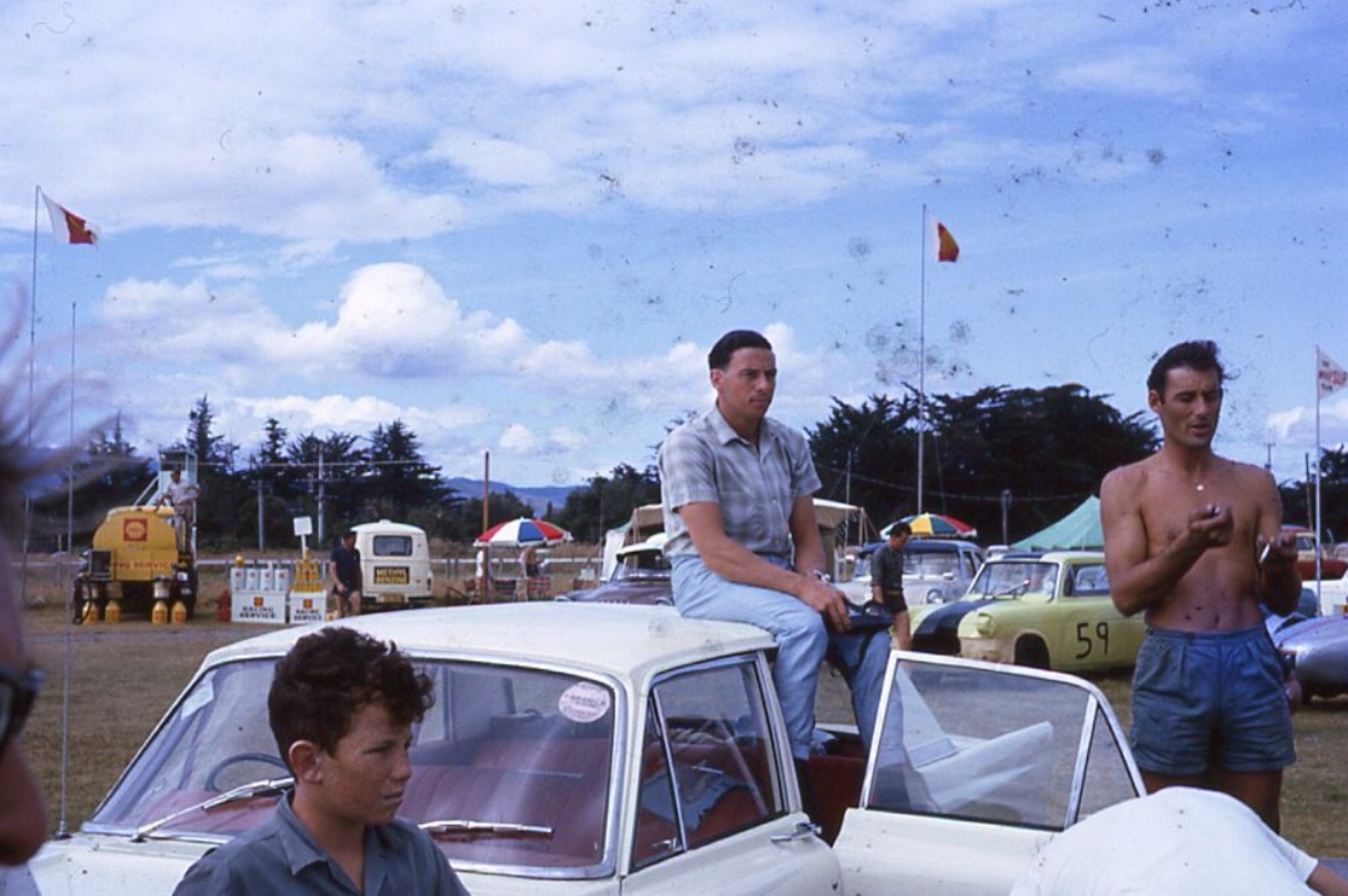
Jim Clark takes in a few rays and a touring car race from his grandstand atop a Ford Zodiac, Levin, New Zealand Tasman, January 1965. In the distance are the Tararua Ranges, alongside the Team Lotus mechanics are fettling Jim’s Lotus 32B Climax.

The champions relaxed nature and the scene itself epitomises all that was great about the Tasman Series. We had the best drivers on the planet visit us every summer and whilst the racing was ‘take no prisoners’ the atmosphere off track was relaxed- the parties, water skiing, golf and annual cricket matches at the Amon family beachhouse are stories told many times over.

Jim Clark cruising through the Lakeside paddock during the 7 March 1965 weekend. The ‘Lakeside 99’ wasn’t a Tasman Round in 1965 but Internationals Clark, Gardner and Grant contested the event- Jim won from Gardner and Spencer Martin in the Scuderia Veloce Brabham BT11A just vacated by Graham Hill’s return to Europe (Mellor)

Few racing drivers have had a season like Jim Clark did in 1965, surely?

He started the year in Australasia and took the Tasman series with four wins in a Lotus 32B Climax FPF, won the F1 Drivers Championship in a Lotus 33 Climax with 6 wins and topped it all off with victory at Indy aboard a Lotus 38 Ford. In between times he contested the usual sprinkling of F2 events and some Touring Car races in a Lotus Cortina. Lets not forget a few longer sportscar races in the Lotus 40 Ford Group 7 car in the US. Not to mention other races as well. Amazing really.

 We were lucky enough to have the immensely likable Scot in the Southern Hemisphere at the seasons commencement though.

Colin Chapman had the Lotus Components lads build up a Tasman Special for Clark which was a mix of an F2 Lotus 32 chassis, 2.5 litre Coventry Climax 4 cylinder FPF engine and ZF gearbox. The combination was very successful taking race wins at Wigram, Teretonga, Warwick Farm and here at Levin on 16 January 1965. 

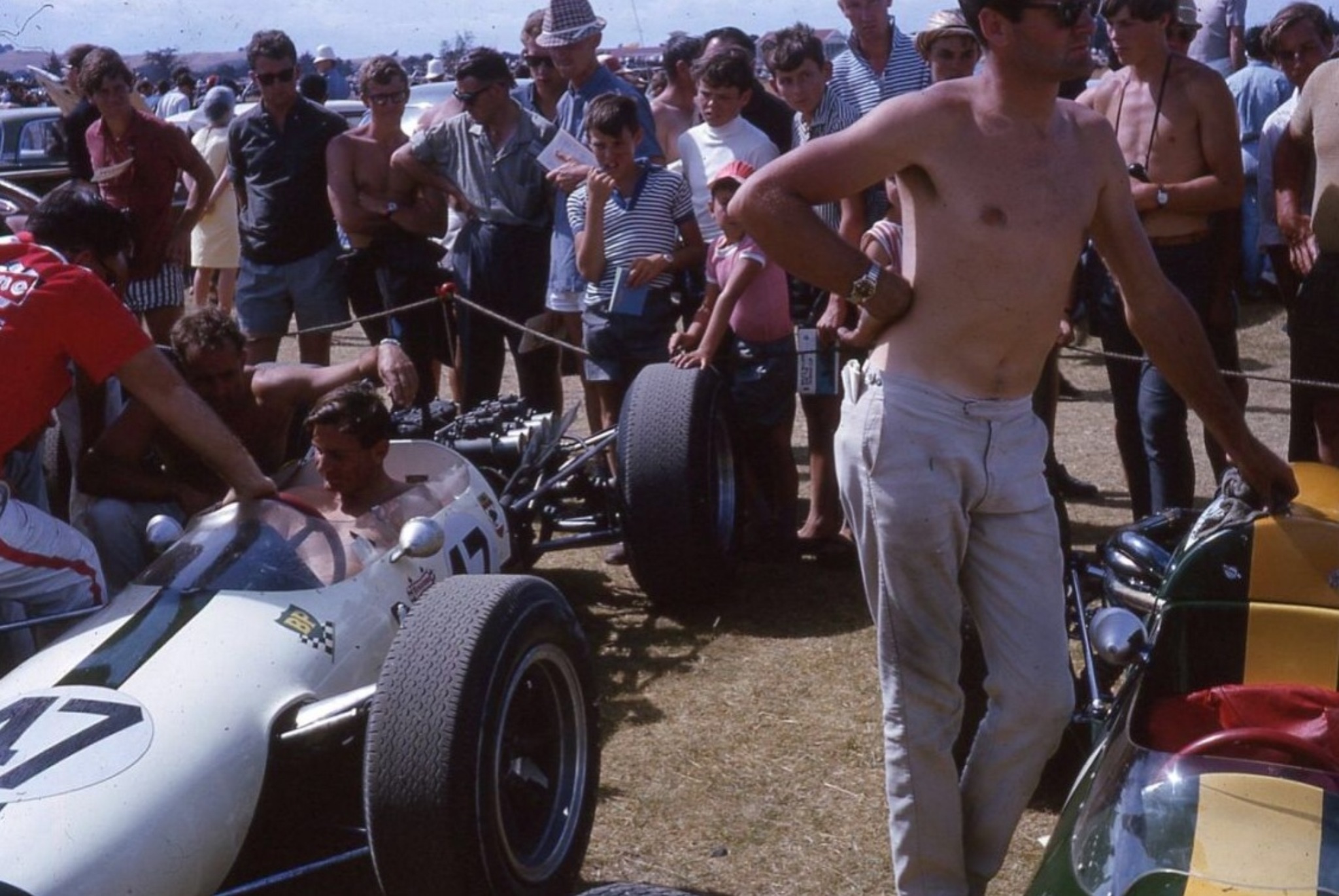
Kiwi international journalist and early member of Bruce McLaren Motor Racing, Eoin Young providing direction to the Lotus mechanics looking after Clark’s Lotus 32B. Technical specs as per text but note rocker/inboard front suspension and filler for twin tanks contained in each side of the monocoque chassis pontoons.Lola Mk1 Climax in the distance? (Fistonic)

Twelve Lotus 32 chassis were built plus Clark’s Tasman one-off car which was built around chassis or tub number 32/7. Unlike the 1 litre Cosworth SCA powered F2’s which used a full-monocoque chassis the 32B used a monocoque front section with the rear section removed and replaced by a tubular steel subframe to which the 235bhp, 2495cc, 4 cylinder Coventry Climax FPF engine was mounted. Otherwise the cars suspension, inboard at the front by top rocker and lower wishbone and outboard at the rear was the same as the F2 32. The gearbox was a ZF rather than the Hewland Mk6 of the F2 car. The car chassis plate was tagged ’32-FL-8′ where ‘FL’ was Formula Libre.

This car still exists and is owned and raced by Classic Team Lotus, a shame really as its entire racing history was in Australasia.

Clark won the Tasman in it, the car was then bought by the Palmer family, Jim raced it to NZ Gold Star victory and very competitively in the ’66 Tasman before selling it to Australian Greg Cusack. The car was also raced by South Australian Mel McEwin in period, albeit it was becoming uncompetitive amongst the multi-cylinder Repco’s and the like by then.

Eventually it passed into the very best of Lotus hands- the late John Dawson-Damer acquired it and restored it, eventually doing a part exchange with CTL to allow them to have a Clark Tasman car in their collection. John received a Lotus 79 Ford DFV as part of the deal, he already had Clark’s ’66 Tasman car in his wonderful collection, the Lotus 39 Climax, so it was a good mutual exchange.

Local boy McLaren surrounded by admirers in the Levin paddock. Cooper T79, alongside is the green and yellow of Clark’s Lotus 32B (Fistonic)

Clark won the ’65 Tasman title 9 points clear of 1964 champion Bruce McLaren aboard his self constructed Cooper T79 Climax and Jack Brabham’s BT11A Climax. Given the speed of the BT11A, it was a pity Jack contested only the three Australian Tasman rounds. Frank Gardner also BT11A mounted and Phil Hill were equal fourth with Phil aboard McLarens updated ’64 Tasman car, a Cooper T70 Climax.

Graham Hill was 7th in David McKay’s Brabham BT11A Climax with other strong contenders Frank Matich Brabham BT7A Climax, Kiwi Jim Palmer similarly mounted, Bib Stillwell in a BT11A, Lex Davison in a BT4 Brabham. In addition there were a host of 1.5 litre Lotus Ford twin-cam powered cars snapping at the heels of the 2.5 FPF’s and set to pounce as the bigger cars failed.

In this article I focus on one round, the Levin event held on 14-16 January 1965.

Kiwi enthusiast Milan Fistonic took some marvellous photos at the event which are posted on Steve Holmes ‘The Roaring Season’ website, check it out if you have not, it’s a favourite of mine. They are paddock shots which ooze atmosphere- Milan focuses mainly on local boy Bruce McLaren and Clark, they are magic shots which I hope you enjoy. This account of the weekend draws heavily on the sergent.com race report. It is another ripper site I always use as my Kiwi reference source.

Start of the 1965 NZ GP at Pukekohe, winner Hill on the outside, Clark in the middle and Lex Davison on the inside- Brabham BT11A, Lotus 32B and Brabham BT4 all Coventry Climax FPF powered (unattributed)

The 1965 Tasman series commenced the week before Levin with the New Zealand Grand Prix at Pukekohe. Graham Hill took a great win in David McKay’s new BT11A, straight out of the box, from the equally new Alec Mildren BT11A driven by Frank Gardner and Jim Palmer’s year old BT7A. How about that, Brabham Intercontinental cars from first to third places, with Jack not driving any of them!

Ron Tauranac’s first in a series of three very successful Coventry Climax engined cars, Tauranac tagged them as ‘IC’ for ‘Intercontinental’, was the 1962 BT4, based on that years BT3 F1 FWMV Coventry Climax 1.5 litre V8 engined car.

Jack raced the first of these in the 1962 Australian Grand Prix at Caversham, Western Australia, having a great dice with Bruce McLaren’s Cooper T62 until a back-marker took him out late in the race. This was followed by the 1964 BT7A and the 1965 BT11A.

Frank Gardner’s Mildren Brabham BT11A Climax being pushed onto the grid. The lanky chap at the back is Glenn Abbey, long time Mildren and Kevin Bartlett mechanic (Fistonic)

The BT11A’s were phenomenally successful in both Australasia and South Africa, winning lots of races and championships not least the 1966/7 Australian Gold Star Championship for Spencer Martin in the very same chassis raced by Graham Hill to victory at Pukekohe.

The cars were utterly conventional, simple and oh-so-fast spaceframe chassis cars with outboard wishbone suspension out the front and outboard multi-link at the rear- single top link, inverted lower wishbone, twin radius rods and coil springs with Armstrong shocks. Like all customer Brabhams they went like the clappers straight out of the box as the base suspension setup was done on circuit by Jack’s ‘highly tuned arse’. Many championships were won by Brabham customers not straying too far from factory suspension settings!

After the NZ GP the Tasman circus upped sticks from Pukekohe and drove the 500 km from the North of New Zealand’s North Island to its South, not too far from Wellington. Levin is now a town of about 20,000 people, then it would have been less than half that, and services the local rural and light manufacturing sectors.

Bruce, Ray Stone in blue and Wally Willmott? Cooper T79 (Fistonic)

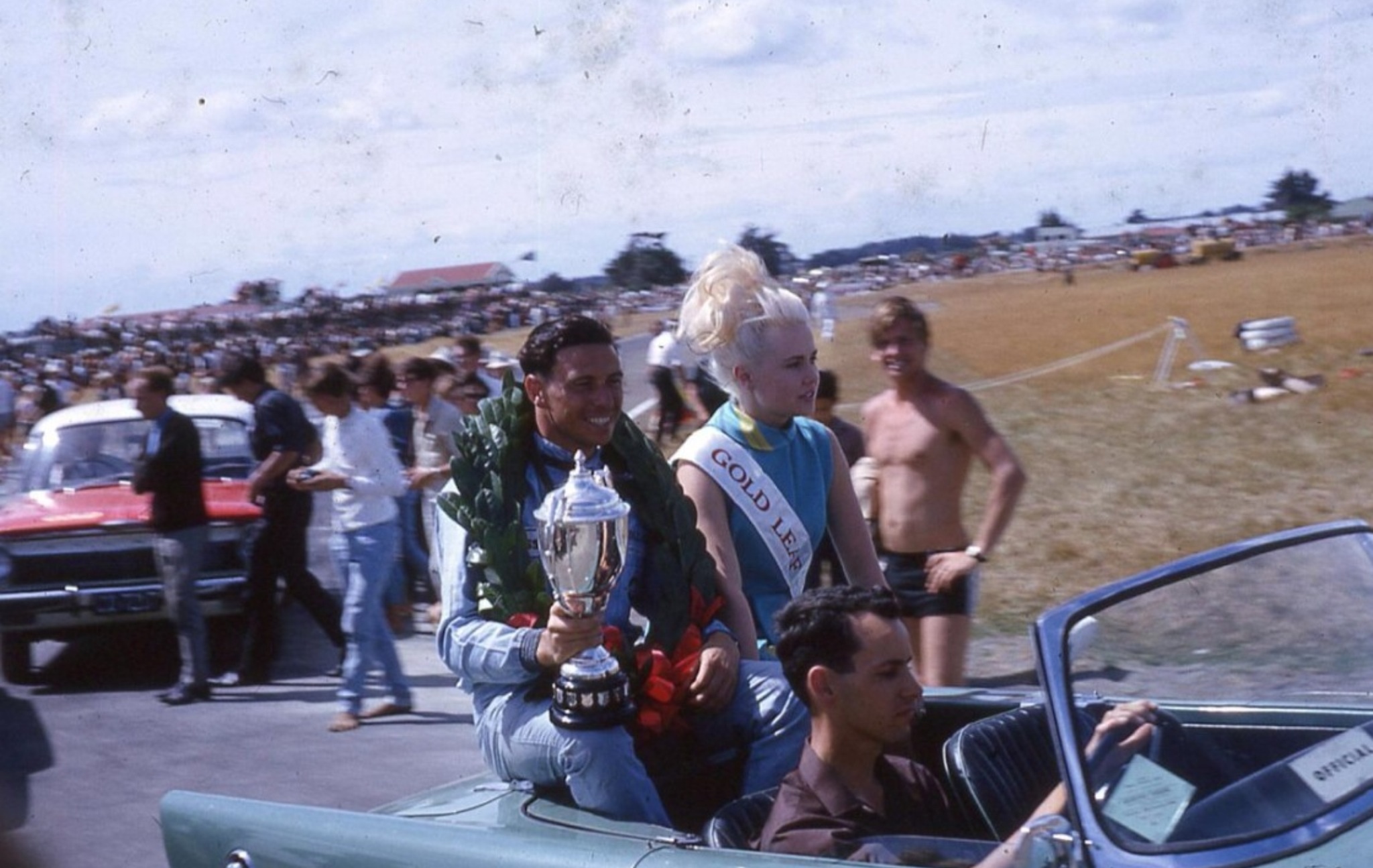
Jim Clark quickly got dialled in to his new Lotus 32B and down to business, opening his Tasman account by winning the Levin Motor Racing Club’s 30.8-mile ‘Gold Leaf International Trophy’ at fractionally more than 76.6 mph.

The Flying Scotsman cut out the twenty-eight laps in fine style in 24 min. 5.9 sec and put in his seventh lap in 49.9 sec. In 1964 Denny Hulme (2.5 Brabham-Climax) had set records of 24 min 36.8 sec and 50.3 sec in this event. Repeating their NZGP form, Brabham-Climax conductors Frank Gardner and Jim Palmer, filled second and third spots, while next in line were the Bruce McLaren Motor Racing Team 2.5 Cooper-Climaxes of Phil Hill, T70 and McLaren, T79.

Graham Hill, Lex Davison and Arnold Glass shipped their cars to Australia after the NZ Grand Prix. Wanganui driver, and later multiple Kiwi Champion, 1970 Tasman Champion and winner of many Asian Grands Prix, Graeme Lawrence had at last got hold of his Brabham BT6 which was making its first appearance at Levin. As noted above Brabham was having a Christmas break and did not join the series until the first Australian round at Sydney’s Warwick Farm in mid-February.

Levin is a tight, twisty and bumpy circuit. Newcomers Clark and Hill quickly had the 1.1-mile track sorted. Clark’s qualifying lap was a 49.4 whilst Phil Hill managed 50 sec, the same time as his team leader McLaren.

Phil Hill aboard the updated Cooper T70 Climax raced by Tim Mayer and Bruce McLaren in 1964. Compare and contrast with the ’65 model T79 below (Fistonic)

Bruce had a bitter-sweet 1964 Tasman Series. He won the championship in one of two Cooper T70’s he and his Kiwi mechanic Wally Willmott built at the Cooper Surbiton works.

These cars, raced by Bruce McLaren Motor Racing, are generally acknowledged as the first McLarens, built as they were in a corner of the Cooper factory to McLaren’s design. The second car was raced by American ‘coming man’ Tim Mayer with great speed and skill until he made a mistake on the daunting, fast, unforgiving Longford road circuit in Tasmania which took the young drivers life.

The undamaged T70 was updated during the winter to be raced by 1961 F1 World Champion Phil Hill with Bruce racing a new chassis, an evolved T70 designated T79, a spaceframe chassis was again used. The main difference between the cars were inboard front suspension on the T79 whereas the older T70 was outboard. The T79 used a nice, reliable but then new Hewland gearbox whereas the T70’s used a Colotti in one chassis and a Cooper/Citroen CS5 in the other. I wrote an article about Tim Mayer a while back, read it by following the link at the bottom of the page for details of the T70 design rather than repeat it all again here.

Hill P had a terrific Tasman which was a tonic for him as his single-seater career had stalled somewhat since his F1 title winning year. 1962 was a shocker for him with Ferrari who had failed to develop the 156,1963 in an ATS was far worse and his drives for Cooper reflected the fact that design wise, their cars were becoming outdated. If there was any doubt about Hills single-seater speed, he proved he ‘cut the mustard’ aboard a competitive year old car in the ’65 Tasman.

Bruce McLaren aboard his Cooper T79 Climax in the Levin paddock (Fistonic)

The Mayer/McLaren/Hill Cooper T70 Climax raced by all three drivers, originally carrying chassis plate ‘FL-1-64’, re-plated by McLaren prior to the ’65 Tasman to ‘FL-2-64’ passed through the hands of Bill Patterson for driver John McDonald, Don O’Sullivan and others before being acquired by Richard Berryman in 1974. The car was eventually beautifully restored by his son Adam in Melbourne, who retains and races it. The T79 was sold after the Tasman to John Love in South Africa who won many races in it before it later returned to the UK, it too still exists.

Back to Levin practice and qualifying…

Levis with the 1.5 Brabham BT6 Ford was in the groove with a brilliant 51.1 sec, his time put all the 2.5 drivers to shame. Palmer could only manage 51.7 sec in his Brabham BT7A, Grant 51.9 sec in his BT4, Abernethy did 52.2 in his Cooper T66 and Gardner was credited with 53.5 sec in Alec Mildren’s BT11A. Grant was a late arrival. His Brabham-Climax had undergone a major engine rebuild since the discovery of a cracked crankshaft on the eve of the Grand Prix. Second quickest 1.5 was Buchanan’s Brabham BT6 Ford with 52.0 sec. Qualifying times were academic in the sense that grid positions for the feature race were decided on heat results.

Jim Clark again chillin at Levin ’65 (Fistonic)

The eight-lap heat on raceday morning contained all overseas drivers and favoured locals.

‘Clark, sharing the front row with McLaren and Hill, jumped into the lead from the start and remained there to the finish. Hill, McLaren, Palmer and Grant settled into the next four spots after Gardner had dropped out with distributor trouble. The contest was enlivened a little by Palmer catching Grant napping on the seventh lap and assuming fourth place. Clark won in 6 min 49.8 sec and set a new lap record of 49.9 sec’ sergent.com reports.

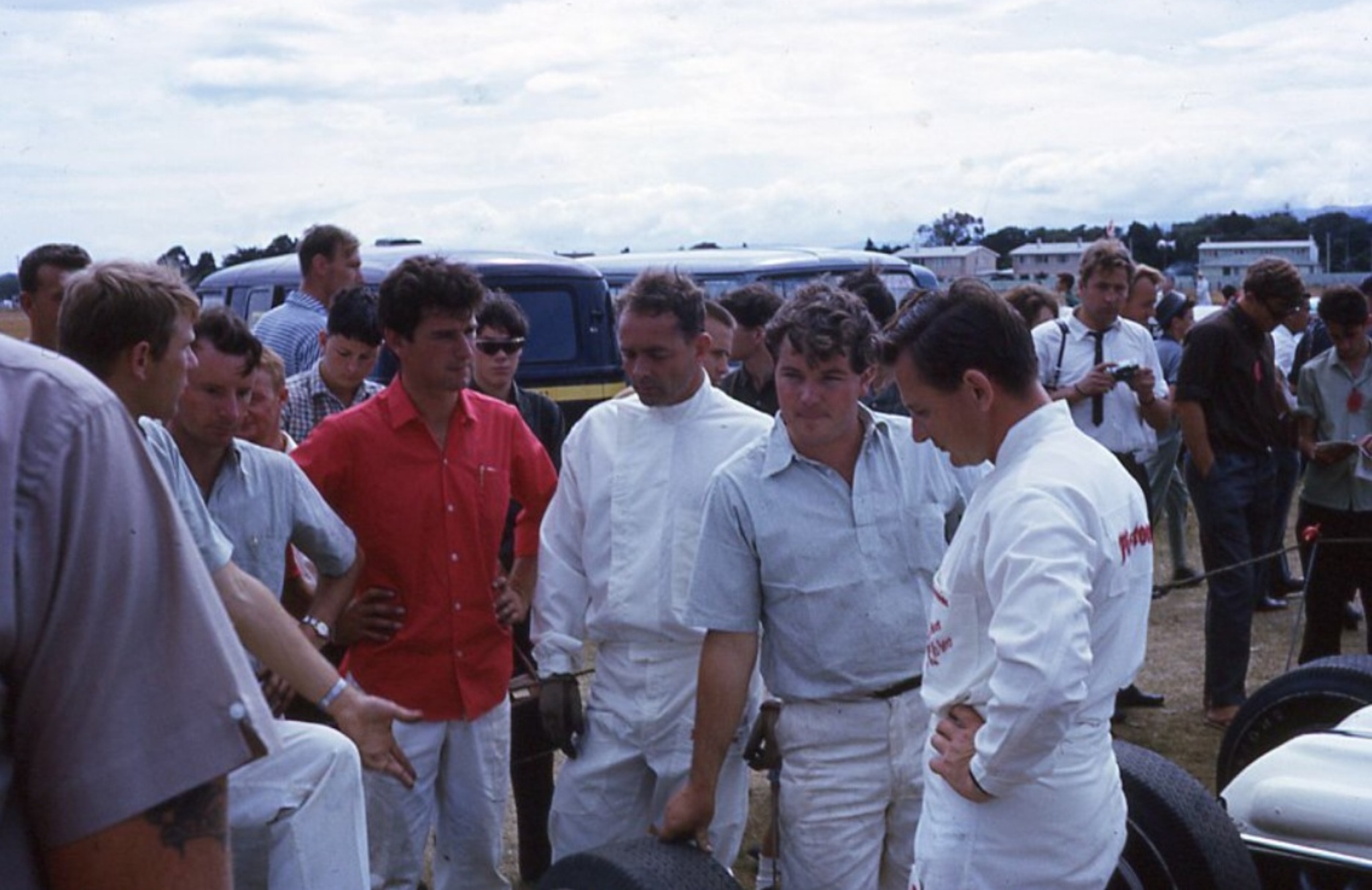
Council of war- Phil Hill in the pristine white race suit with Bruce front and centre, his allegiance to Firestone clear. Who are the other dudes? (Fistonic)

Levis had things all his own way in the second heat, winning in 7 min 13.5 sec, with Andy Buchanan, also in a 1.5 Brabham BT6 Ford, next. Third and fourth were Red Dawson Cooper T53 Climax 2.5 and John Riley in a Lotus 18/21 Climax 2.5. The situation was confused by Gardner who, anxious to make sure all was well with his car, was permitted to use the heat as a test run and took the lead in the last two laps.

Before the title race there was some feverish work in the Palmer pit to replace a cracked universal joint in his Brabham BT7A Climax. In a drama filled day for the team, an hour before the race was due to start, another close inspection revealed a hairline crack in a half-shaft. A replacement was found and fitted minutes before the cars were gridded.

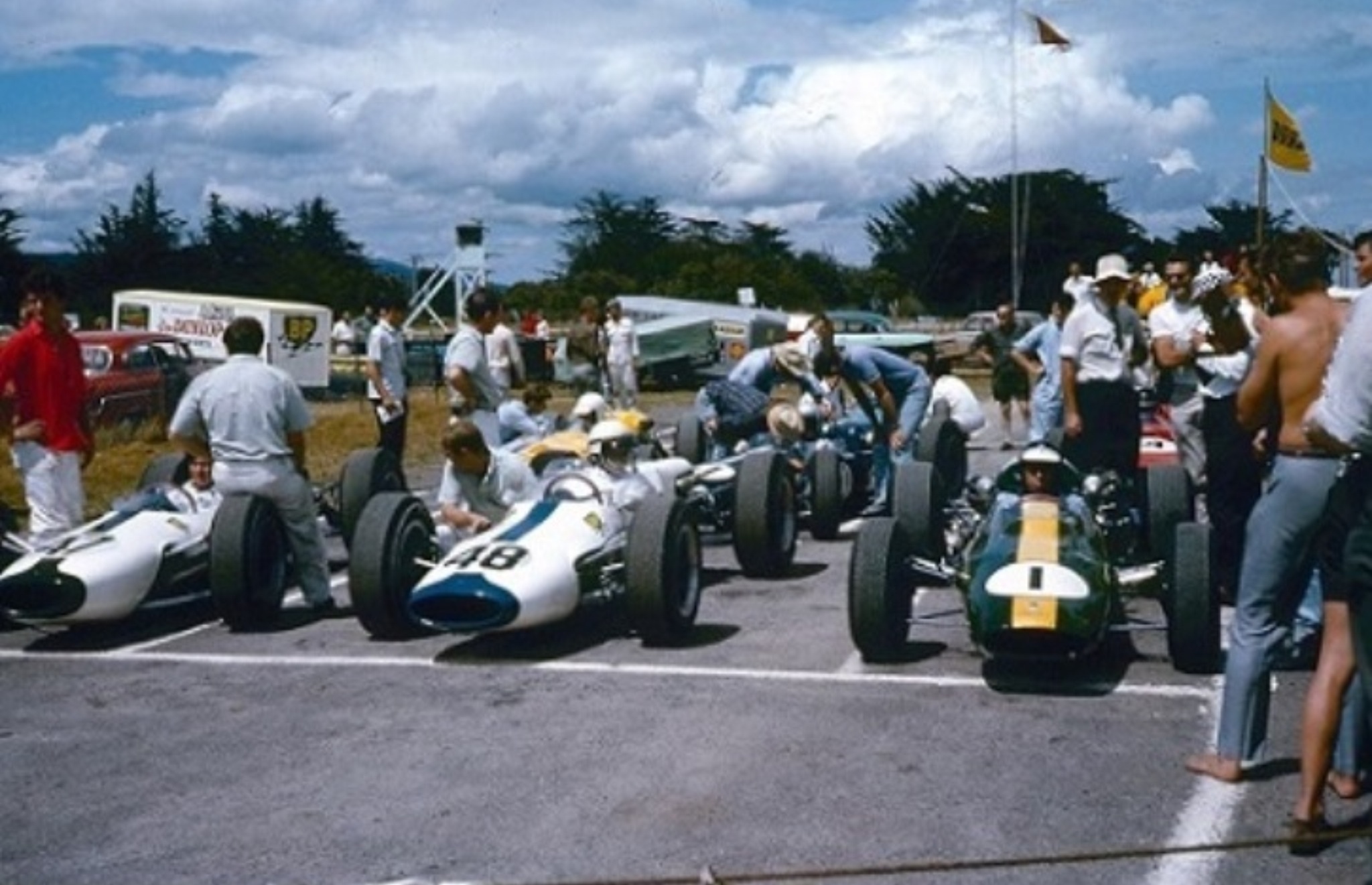
Dummy grid or form up area prior to the Levin International- Clark on pole then McLaren and Hill, the yellow of Gardner on row 2 (Fistonic)

Clark, Lotus 32B had pole position in the main event with Hill, Cooper T70 and McLaren, Cooper T79 outside him.

In rows of three, the rest of the field comprised Palmer, Brabham BT7A, Grant, Brabham BT4, Gardner, Brabham BT11A; Levis, Brabham BT6 Ford 1.5, Buchanan, Brabham BT6 Ford 1.5, Abernethy  Cooper T66; Dawson, Cooper T53, Thomasen, Brabham BT4, Brabham BT4 Riley; Flowers, Lola Mk4A, Smith, Lotus 22 Ford 1.5 Lawrence, Brabham BT6 Ford 1.5; and at the back Hollier, Lotus 20B Ford 1.5. As the cars were forming on the grid, Abernethy could not select a gear and he had to abort the start’.

‘Clark made a good start with Grant, Hill and McLaren right with him. To the elation of the partisan crowd, Grant proceeded to take McLaren and Hill on braking into the hairpin. When they came round the first time the leaders were Clark, Grant, Phil Hill, McLaren, Palmer, Gardner and Levis

A 51.6 sec second lap gave Clark a 3 sec lead over Grant. In his fourth lap Palmer took McLaren and in another two laps had moved to third place ahead of Hill. Clark held on to his lead over Grant. There was then a gap of 3 sec to Palmer, with Hill and Gardner next in line. McLaren, probably to his embarrassment, had the 1.5 drivers Levis and Buchanan looming large in his mirrors.

Clark on the way to Levin International victory 1965, Lotus 32B Climax (sergent.com)

The pattern changed dramatically during the tenth lap. Grant tried to correct a slide at Cabbage-Tree Bend, dropped a rear wheel into the rough and spun off the course to lose all chance in such a short race. Palmer took second spot, but not for long. Gardner in the next three laps bridged the gap to take over second place just 5 sec behind Clark. Next in line were Hill, McLaren and Levis. Flowers was out with transmission failure in the troublesome Lola on lap 14.

Those opening laps had been fast and furious. In their sixth lap Grant and Gardner had returned 50.6 sec in the midst of heavy traffic. A lap later Clark equaled his morning record of 49.9 sec.

As the race reached the last stages, Clark continued to circulate in a steady 51 sec. Gardner in two laps reduced Clark’s advantage from 11 sec to 9 sec while Palmer closed up to be 2 sec behind the Australian, but Clark was given the ‘hurry’ signal and moved out again with effortless ease to come home 11.3 sec ahead of Gardner with Palmer 4.7 sec further back. Thomasen retired with only a handful of laps remaining.’

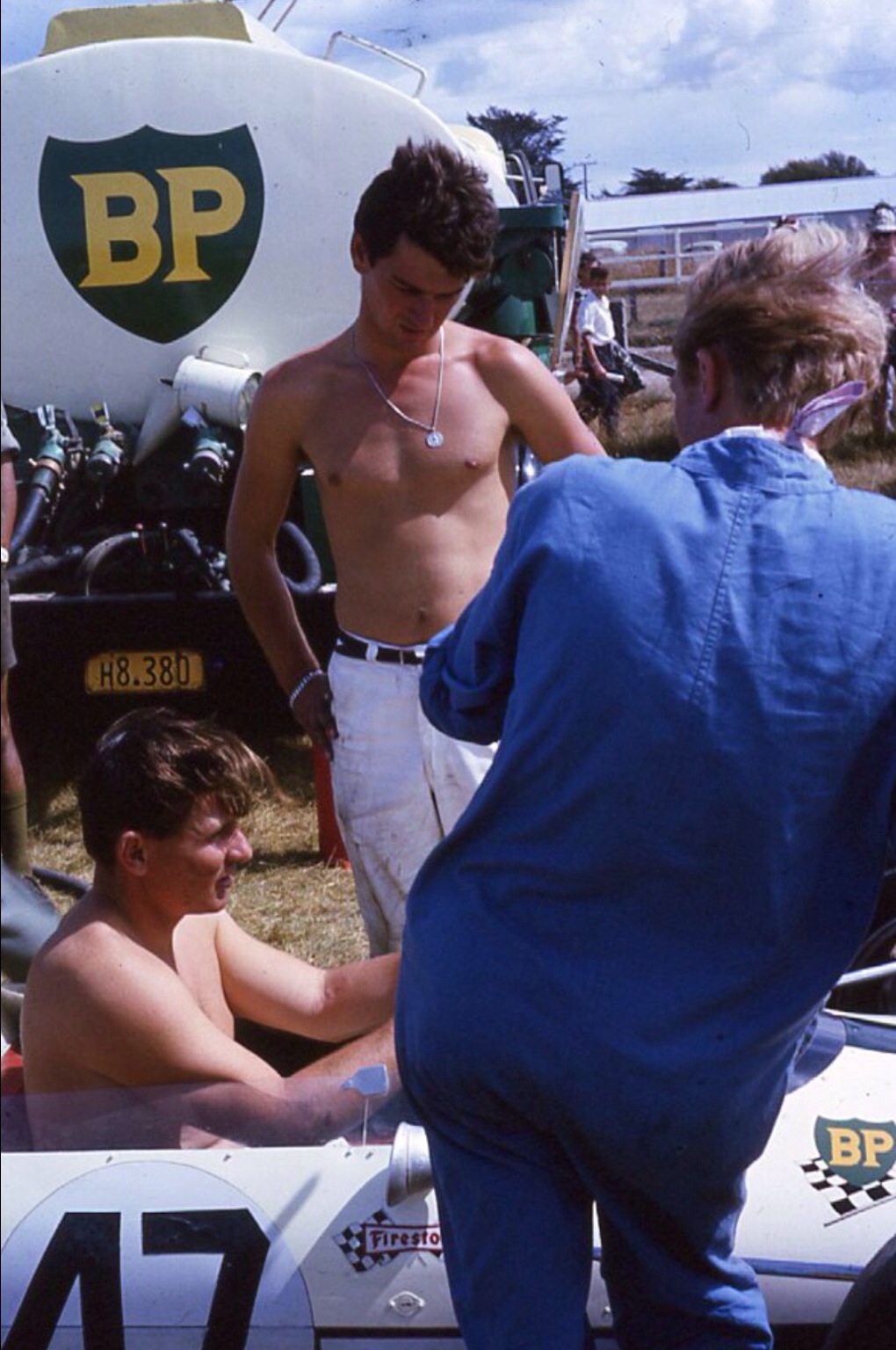
BP all the way, Bruce and Ray Stone in blue fuelling up the T79. Front on shot shows the top rocker/inboard front suspension of the car (Fistonic)

Bibliography…

sergent.com, oldracingcars.com

Cooper T70/Tim Mayer Article Link…

https://primotipo.com/?s=tim+mayer

Photo Credits…

Milan Fistonic, Peter Mellor, The Roaring Season

Tailpiece: Winners are grinners, the first of many such occasions for Jim Clark in 1965 at Levin…

(Fistonic)

Finito…


lotus spa

(unattributed)

Team Lotus in the Spa pitlane, Saturday June 12 1965: the 33’s of #17 Jim Clark, Mike Spence and the teams spare chassis…

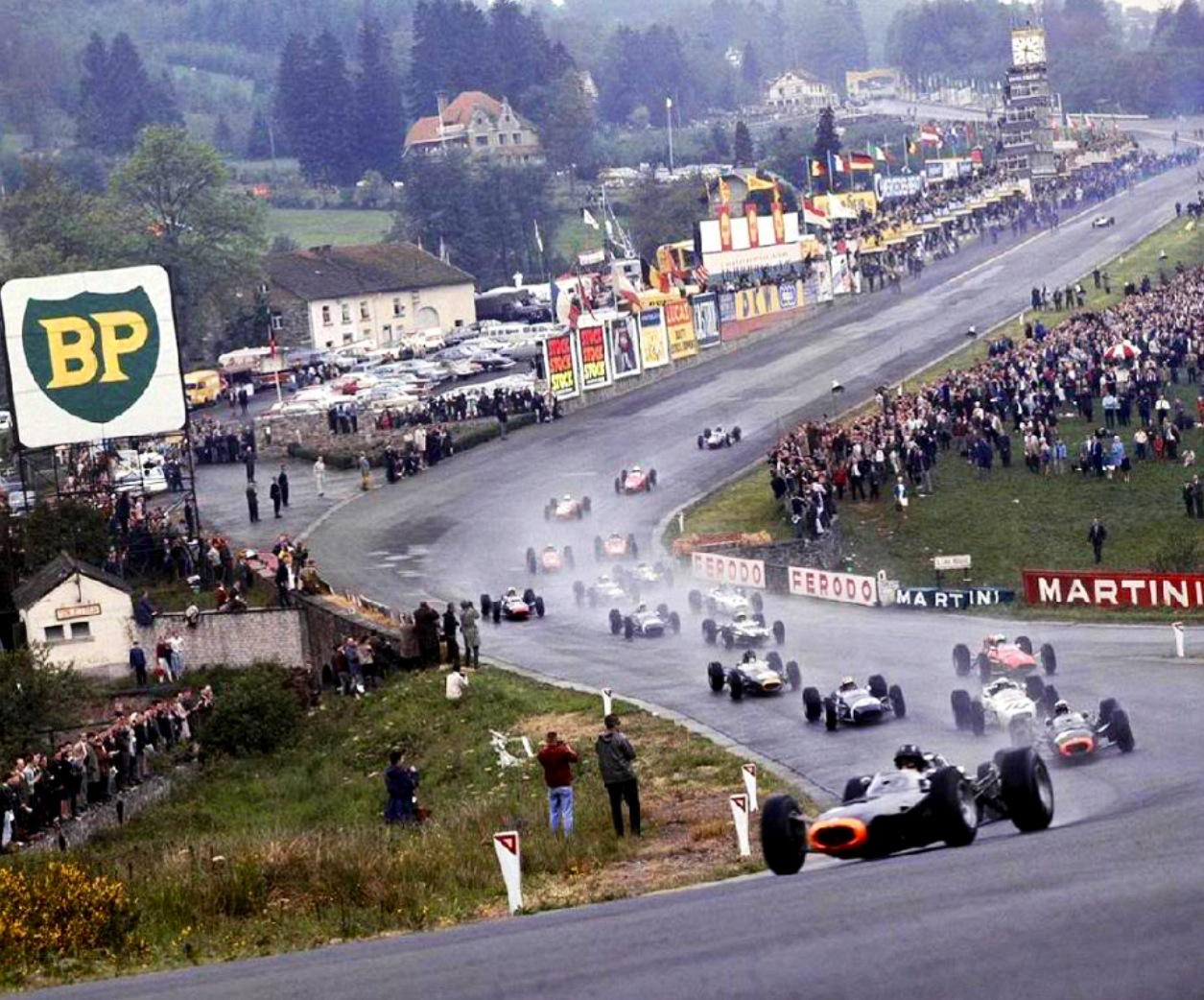
Sunday was wet, Jimmy ran away with the race from grid #2, Mike was 7th from grid 12. Graham Hill started from pole in his BRM P261 but finished 4th, Jackie Stewart was 2nd in the other BRM and Bruce McLaren 3rd in a Cooper T77 Climax.

spa start

Lap 1 and Graham Hill’s BRM P261 leads into Eau Rouge from pole. You can just see the white peak of Clark’s helmet and his Lotus 33’s left rear wheel right up Hills clacker. Stewart’s sister BRM follows then Ginther’s white Honda RA272, Siffert’s Rob Walker Brabham BT11 Climax, Surtees Ferrari 158 on the outside, Gurney’s Brabham BT11 Climax, McLarens Cooper T77 Climax and the rest…(unattributed)

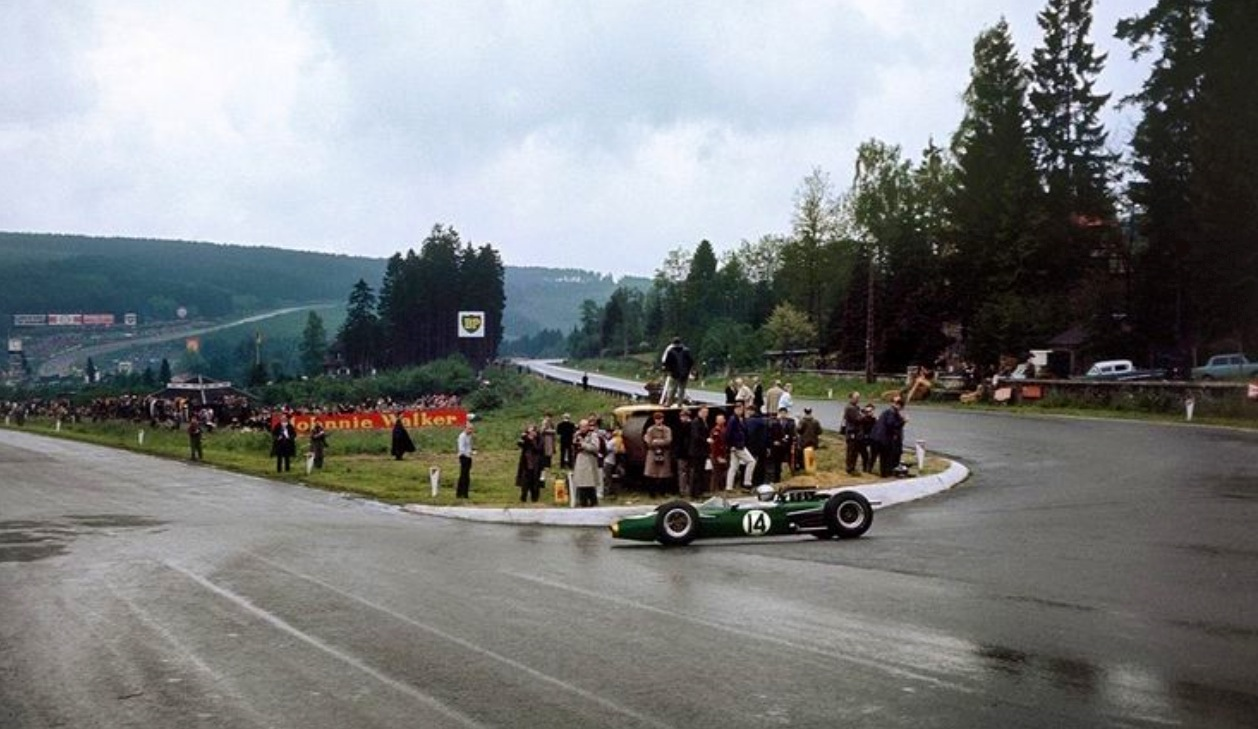
spa clark

Daunting in the dry positively frightening in the wet. Spa. Clark speeds to victory, he took the ’65 drivers title in his Lotus 33 Climax (unattributed)

Tailpiece: Alone in the Ardennes Forest, Jack Brabham…

brabham spa

Brabham, La Source hairpin, Spa 1965- 4th in his Brabham BT11 Climax (unattributed)


(Mr Reithmaier)

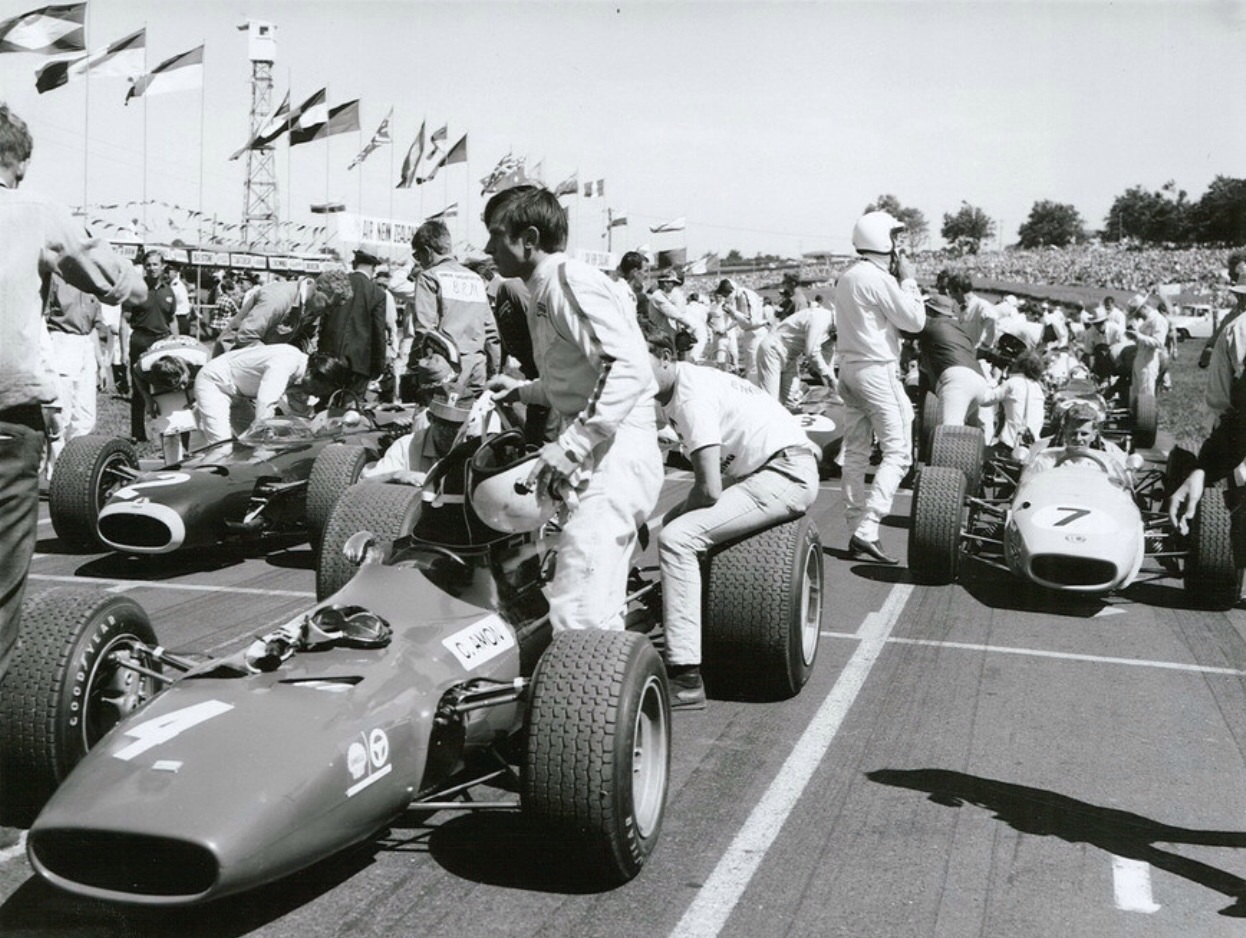
I love the build up and tension before the start of a big race; here it’s the grid prior to the start of the New Zealand Grand Prix at Pukekohe, in the north of NZ’s North Island on 6 January 1968…

Chris Amon readies himself and his Ferrari Dino 246T before the first round of the 1968 Tasman Series, a race in which he wonderfully and deservedly triumphed. Missing on the front row is Jim Clark’s Lotus 49T Ford DFW. Car #2 is Pedro Rodriguez’ BRM P261, the Mexican is bent over the cockpit of his car but failed to finish with clutch problems. Car #7 is Alec Mildren’s Brabham BT23D Alfa Romeo T33 2.5 V8 with chief mechanic Glenn Abbey warming up the one-off car. Lanky Franky Gardner is adjusting his helmet beside the car, it was a good day for Frank, the car was second.

Look closely and you can see a camera crew behind the Brabham which is focusing on 1967 reigning world champion Denny Hulme and his #3 Brabham BT23 Ford FVA F2 car- Denny’s head is obscured by Frank’s body. Hume boofed the ex-Rindt BT23 during the race badly enough for a replacement chassis to be shipped out from the UK.

I’ve always thought these F2/Tasman Ferrari’s amongst the sexiest of sixties single-seaters.
The 166 F2 car was not especially successful amongst the hordes of Ford Cosworth Ford FVA engined cars in Euro F2 racing, however, the car formed the basis of a very competitive Tasman 2.5 litre Formula car when fitted with updated variants of the Vittorio Jano designed V6 which first raced in F2 form and then powered the late fifties Grand Prix racing front-engined Ferrari Dino 246. It was in one of these cars that Mike Hawthorn won the 1958 World Drivers Championship.

Amon won the Tasman Series in 1969 with Ferrari Dino 246T chassis #0008, fellow Kiwi Champion Graeme Lawrence won aboard the same car in 1970 against vastly more powerful, if far less developed Formula 5000 cars. The story of those championships is for another time, this article is about Chris’ 1968 Tasman mount and campaign.

Amon hooking his gorgeous Ferrari Dino 246T ‘0004’ into The Viaduct in the dry at Longford 1968. Early ’68, we are in the immediate pre-wing era, and don’t the cars look all the better for it! (oldracephotos.com/D Keep)

In many ways Chris was stiff not to win the ’68 Tasman Cup a title, the last title won by the late, great Jim Clark…

Ferrari entered only one car that year, chassis #0004 was assembled in Maranello by longtime Amon personal mechanic Roger Bailey and tested at Modena in November 1967. It was then freighted by plane to New Zealand where it was prepared by Bruce Wilson in his Hunterville workshop in the south of the North Island.

The chassis was Ferrari’s period typical ‘aero monocoque’, a ‘scaled down’ version of the contemporary F1 Ferrari with aluminium sheet riveted to a tubular steel frame thus forming a very stiff structure. The 166 was launched to the adoring Italian public at the Turin Motor Show in February 1967.

In F2 form, the 1596cc, quad-cam, chain driven, 18 valve, Lucas injected engine developed circa 200bhp at an ear-splitting 10000 rpm. It is important to note that this F2 engine, designed by Franco Rocchi, and in production form powering the Fiat Dino, Ferrari Dino 206 and 246GT and Lancia Stratos is a different engine family to the Jano designed engines, evolved by Rocchi and used in the Tasman Dinos.

The F2 166 made its race debut in Jonathon Williams hands at Rouen in July 1967, whilst it handled and braked well it was around 15bhp down on the Cosworth engined opposition. The car was tested extensively at Modena, including 24 valve variants, but was not raced again that year.

Amon, who had not contested the Tasman Series since 1964, could immediately see the potential of the car, suitably re-engined, as a Tasman contender given the success of the small, ex-F1 BRM P261 1.9-2.1 litre V8’s in the 1966 and 1967 Tasmans. The same approach which worked for the boys from Bourne could work for Maranello Chris figured. A parts-bin special is way too crass, but you get my drift of a very clever amalgam of existing, proven hardware as a potential winning car.

In fact Ferrari went down this path in 1965 when a Tasman hybrid of a then current F1 chassis was married to a 2417cc variant of the Jano 65 degree V6 for John Surtees to race in the 1966 Tasman. John had Tasman experience in Coventry Climax FPF engined Coopers and Lola’s at the dawn of the sixties and could see the potential of a small Ferrari.

That plan come to nothing when Surtees was very badly injured in a Mosport Can-Am accident in his self run Lola T70 Chev in late 1965. This car, Ferrari Aero chassis ‘0006’ played the valuable role of proving Surtees rehabilitation when he completed 50 laps in the car at Modena. It was in the same chassis that Lorenzo Bandini finished second in the 1966 Syracuse and Monaco GP’s as Ferrari sought to get the new 3 litre V12 F1 312 up to speed, Bandini elected to race the Dino on both occasions- he also finished third in the car at Spa.

The allocation of this more competitive car to Bandini rather than team-leader Surtees was amongst the many issues which lead to the confrontation between John Surtees and team manager Eugenio Dragoni during Le Mans practice and Surtees departure from the team shortly thereafter.

An unidentified fellow, Jim Clark, Ferrari engineer Gianni Marelli, Chris Amon and Roger Bailey share a joke during the 1968 Longford weekend. Chassis ‘0004’ is fitted with the 24 valve V6 covered in the text. Note the quality of castings, fabrication and finish, inboard discs, sliding spline driveshafts and single plug heads of this very powerful- but less than entirely reliable engine in 1968 form, it’s shortcoming cylinder head seals (oldracephotos.com/Harrison)

The engine of the 166/246T was carried in a tubular subframe attached to the rear of the monocoque which terminated at the drivers bulkhead, the car was fitted with a 5 speed transaxle designed by Ingenere Salvarani and Girling disc brakes.

Suspension was also similar to the contemporary F1 cars in having an front upper rocker and lower wishbone with inboard mounted spring/shocks and conventional outboard suspension at the rear- single top link, inverted lower wishbone, two radius rods and coil spring/shocks.

For the 1968 NZ races- Chris won at Pukekohe after Clark retired and at Levin, leading from flag to flag, was second to Clark at Wigram and fourth at Teretonga- a 3 valve variant (2 inlet, 1 exhaust) of the 65 degree fuel injected V6 was fitted which was said to develop around 285bhp @ 8900rpm from its 2404cc.

Chris crossed the Tasman Sea with a nine point lead in the Series from Clark and the might of Team Lotus. It was a wonderful effort, whilst Ferrari provided the car free of charge and took a share of the prize money, the logistics were of Chris’ own small equipe, and here they were serving it up to Gold Leaf Team Lotus with a couple of World Champions on the strength, plenty of spares and support crew.

Amon just falls short of Jim Clark at the end of the 1968 AGP at Sandown. The official margin, one tenth of a second after 62 minutes of great motor racing. Lotus 49 Ford DFW and Ferrari Dino 246T (unattributed)


Amons heads into the Sandown pitlane to practice- Shell corner or turn 1 behind (G Paine)


Amon’s car in the Sandown paddock. That little four valve engine came so close to pipping Clark’s Ford DFW on raceday (G Paine)

For the four Australian races a 24 valve version of the engine was shipped from Maranello. Its Lucas injection was located within the engines Vee rather than between the camshafts and had one, rather than two plugs per cylinder. This motor developed 20 bhp more than the 18 valver with Chris promptly putting the car on pole at Surfers Paradise, a power circuit- he won the preliminary race and had a head seal fail whilst challenging Clark in the championship round.

At Warwick Farm he qualified with the 18 valve engine and raced the 24 valver having rebuilt it- they only had one of the motors. He was challenging both Clark and Hill in the race and then spun in avoidance of Hill who was having his own moment…he was fourth on the tight technical Sydney circuit.

At Sandown during the AGP, the pace of the car, and Amon, was proved in an absolute thriller of a race in which he finished second to Clark by one-tenth of a second, the blink of an eye. Let’s not forget the best driver in the world driving the best F1 car of the era powered by the Tasman variant of the greatest GP engine ever was his competition- and took fastest lap.

As the team crossed Bass Straight from Port Melbourne on the ‘Princess of Tasmania’ Chris knew he had to win the Longford ‘South Pacific Championship’, with Clark finishing no better than fifth to win the Tasman title.

At Longford, still fitted with the 24 valve engine, which must have been getting a little tired, he qualified a second adrift of Clark and Hill, he finished seventh in a race run in atrocious conditions on the most unforgiving of Australian circuits having initially run second to Clark but then went up the Newry Corner escape road and suffered ignition problems from lap 10.

Piers Courage won in an heroic drive aboard his little McLaren M4A Ford FVA F2 car that streaming day, in a series which re-ignited his career.

Chris and the boys confer about car set-up- in the dry!, at Longford(oldracephotos.com.au/Harrisson)

Chris was a busy boy during the Australian Tasman leg as he also drove David McKay’s Scuderia Veloce Ferrari 350 CanAm/P4 in sports car support events at each round in addition to the little Dino.

These races were outstanding as they involved close dices between Chris and Frank Matich in his self designed and built Matich SR3 powered by 4.4 litre Repco Brabham V8’s- with Frank getting the better of him in each of these races. The speed of the Matich was no surprise to Chris though, both had contested rounds of the Can-Am Championship only months before the Tasman in the US.

Click here for my article on the Ferrari P4/CanAm 350 #’0858’ Chris raced in Australia;

Ferrari P4/Can Am 350 #0858…

Amon lines David McKay’s Scuderia Veloce Ferrari P4/350 Can Am up for Longford’s The Viaduct during the 1968 Longford Tasman meeting. Matich didn’t take the SR4 to Longford so Chris had an easy time of it that weekend. The sight and sound of that car at full song on the Flying Mile at circa 180mph would have been really something! (oldracephotos.com/D Keep)


Chris Amon, David McKay and mechanic David Liddle with the Can-Am 350 in the Sandown pitlane (G Paine)

For the 1969 Tasman Chris applied all he learned in 1968 returning with two cars, the other driven by Derek Bell, four well developed 300bhp 24 valve engines with the logistics of the two months taken care of by David McKay’s Scuderia Veloce.

He promptly lifted the Tasman Cup in a very successful campaign from Jochen Rindt, Graham Hill and others, with a little more luck or greater factory commitment in 1968 it may have been two Tasmans on the trot for the Maranello team and Chris…

Etcetera…

(G Paine)


(G Paine)

A couple of shots of the SV Ferrari Can-Am 350 being fettled in the 1968 Sandown Tasman paddock.

Bibliography…

oldracingcars.com, sergent.com.au, ‘Dino: The Little Ferrari’ Doug Nye

Photo Credits…

Mr Riethmaier, oldracephotos.com, Rod MacKenzie, Glenn Paine Collection

Tailpiece: Love this moody, foreboding Longford shot by Roderick MacKenzie…

(Rod MacKenzie)

Chris has just entered the long ‘Flying Mile’ in the streaming wet conditions during Monday’s ‘South Pacific Trophy’ famously won by Piers Courage little McLaren M4 Ford FVA F2 car. 4 March 1968.

Finito…


image

(Wolfe)

Looking at Jack in this shot i wondered who the most recent of the F1 driver/engineers was?

Brabham is helping the boys prepare his BT23E Repco before the Sandown Tasman round, the Australian Grand Prix, in early 1968. Jack, ever the practical, hands-on engineer.

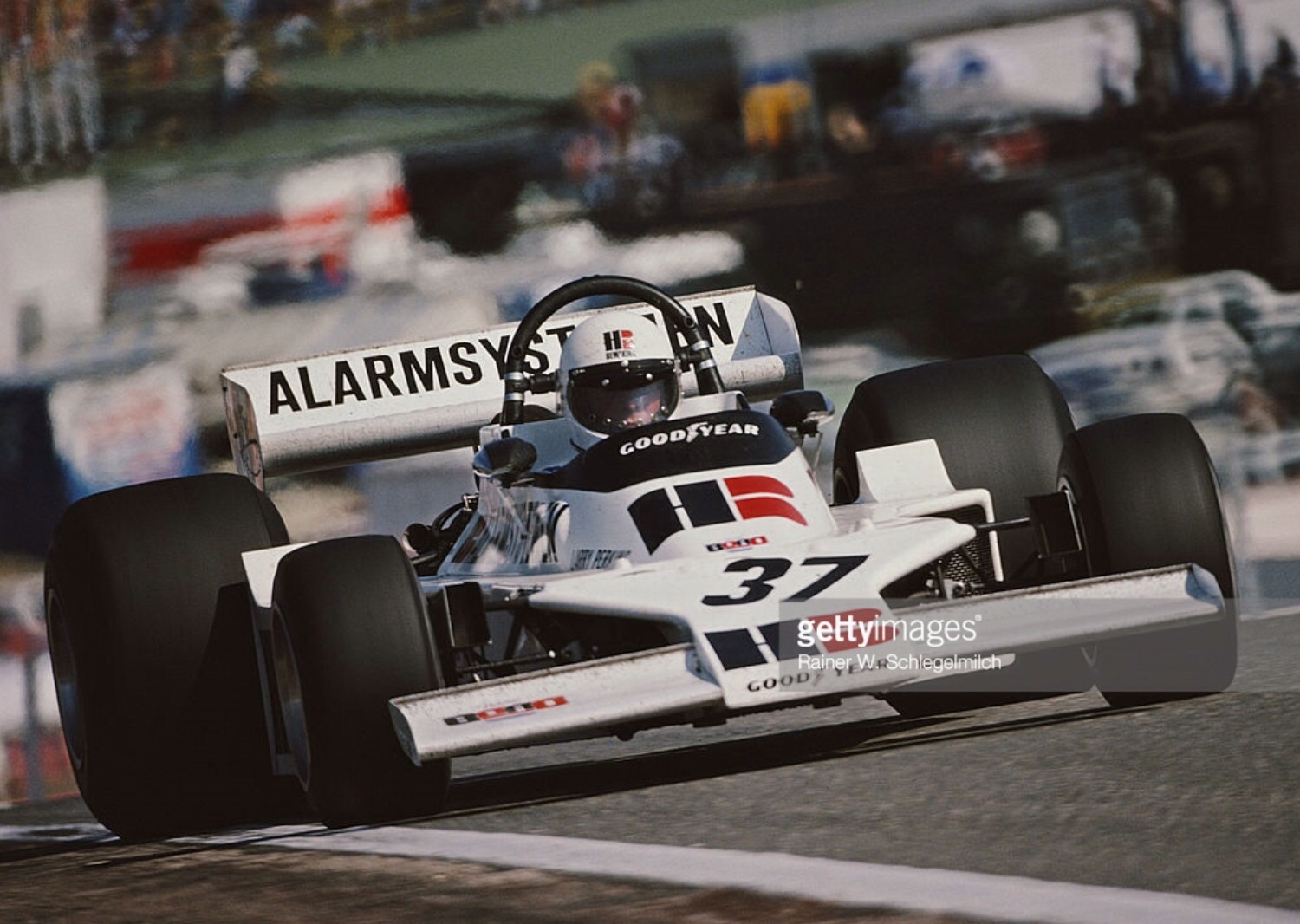
Larrikins, Larry Perkins perhaps? He raced and prepared an Ensign, nee Boro in 1976. Was he, perhaps, the last or most recent of the genre? The guys I am referring to are the blokes who could both drive the things and could and would put ‘em together themselves.

image

Nice overhead shot of Perkins Ensign ‘Boro’ N175 Ford at Monaco in 1976. He didn’t make the cut in the principality but raced the car in the Belgian, Spanish and Swedish Grands Prix for 8th, 13th and DNF in an operation which was very much smell of an oily rag and DIY…And did well enough to pick up a Brabham drive later in the season, one, sadly, he was not to keep. These cars of Mo Nunns were beautifully designed, quick jiggers. Chris Amon made ‘em fly too, tho their mechanical breakages sapped his confidence and bruised his body, ending his GP career (Schlegelmilch)

Qualifiers?…

Mercedes mechanic come driver ace Hermann Lang is the first who pops into my head but he can’t have been the only one pre-war? I wonder if the Renault brothers were ‘hands on’ maybe they qualify as the first way back in the Edwardian era? Vincenzo Lancia maybe?

image

Hermann Lang at Donington Park 1937. Apprenticed as a motor-cycle mechanic at 14, Lang was an ace on bikes by the time he joined Benz as a mechanic in 1934, by ’39 he was European (read World) Champion. He fettled Fagioli’s W25 initially. Aided and abetted by team manager Alfred Neubauer, and against the wishes of some of the drivers, he test drove the cars in 1935 and 1936 before being made a works driver for 1937 with the 5.6-litre W125. By 1939 he was the grids yardstick, winning 5 of the 8 major GP’s in the 3 litre W154. Having the momentum as the ace of the day was lost by the War years, after a few unsuccessful attempts in post-war GP’s, he won the ‘52 Le Mans in a 300SL Benz (Fox)

Fangio certainly built some of the ‘rockets’ he raced in Argentina early on in his career, whether he wielded a torch once he got to Europe is perhaps another thing.

The dudes i think of most readily are the fifties/sixties fellows; Jack and Bruce of course, Chapman qualifies altho he didn’t race in a GP, he did practice for the French GP in 1956 for Vanwall though.  He qualified 5th but boofed the car so did not race.

image

Here’s a few practical chaps, and all pretty handy steerers including Brabham designer Ron Tauranac (far right leaning) who was quick in his Ralts in Oz before he was enticed to the UK by Jack. From left Howden Ganley a picture of 70’s sartorial elegance in the flares, and a mechanic at McLarens in the early days as he progressed thru the junior formulae ranks in the UK. Tim Schenken, (these two later partners in Tiga Cars) Graham Hill waxing lyrical and RT at right. Car is the one of a kind ‘Lobster Claw’ Brabham BT34 Ford, driven by Hill, its British GP practice @ Silverstone in 1971. Tim drove last years BT33 and was consistently quicker than GH in his first full F1 season (Blackman)

Graham Hill, Phil Hill, Richie Ginther, Dan Gurney, Jim Hall, Bob Anderson, Frank Gardner, Denny Hulme, Howden Ganley and Graham McRae all qualify. The Kiwi F5000 ace did a Gee Pee or two in ‘73ish and his cars were great bits of kit.

image

In 1970-3 Graham McRae was one of the worlds best F5000 pilots at a time the category globally was mega-competitive, winning races and championships in Australasia, Europe and the US. His Len Terry designed Leda LT27/ McRae GM1 Chev’s were the ‘ducks guts’ as well, until the Lola T300 rained on his, and everybody else’s parades. Formula Lola from then on. Here he is in one of Frank Williams Iso IR Fords during ’73 British GP practice at Silverstone. He didn’t complete the first lap with throttle slide dramas at the start of the lap which ended with Jody Scheckter’s big Woodcote, McLaren M23 shunt which took out half the field (unattributed)

Thinking slightly more broadly Chevron’s Derek Bennett wasn’t an F1 driver but otherwise is absolutely of the driver/engineer fix it yerself mould. Make that design, build and drive it. And in Australia Garrie Cooper (Elfin) and Frank Matich spring to mind, Frank was ‘elite level’ as a driver and his sports and F5000’s cars were all winners. Both were not F1 drivers to be clear. ANF1 drivers, but not F1 drivers…

image

Larry at the press launch of the BRM P201 in early 1977. Mike Pilbeam’s chassis was good, if they had popped a DFV into it they would have had a good car? By then the BRM V12 was well past it’s use-by date and hadn’t had any development to speak of for years (Keystone)

Larry was later than all that lot so I reckon its him as ‘the last’? Unless some of you guys can think of someone more recent, and you may well do, the above is outta my head which does not fit into the category of thorough, diligent research.

image

Perkins had several drives of the Holden Dealer Team supercharged, Holden LC Torana GTR XU1 during 1972, here at Catalina Park in Sydney’s Blue Mountains (Rod MacKenzie)

Perkins spannered the very first Ralt RT1 Tauranac built to his ’75 Euro F3 Championship win then lent his talents to Chris Amon on his Amon and, as I say largely self prepared the Ensign/Boro Ford well enough to be plucked by BC Ecclestone into Brabham for a while. Until Carlos Pace rained on his parade. By the time Larry got to BRM they were shit-heaps, that episode a total wasta time. Mike Pilbeam’s chassis was in search of a good engine.

image

Here Larry is  trying to qualify the Amon AF101 Ford during German GP practice after Chris fell ill, Nurburgring 1974, DNQ. Clay Regazzoni won in a Ferrari 312B3 (Sutton)

Larry prepared all of his cars in the junior formulae in Australia before taking the same talents into European F3. I well remember seeing Larry rectifying his practice mishap transferring all the good bits of Robert Handfirds Ralt RT4 into a new chassis having had a territorial dispute with a slower car in practice, and rooted the cars tub, during the 1981 AGP weekend at Calder. Despite a lack of practice time the car was 4th on raceday, Roberto Moreno victorious in another RT4.

image

Teo Fabi and Perkins (near side) in March 782 and 77B during the 1979 F Pac NZ GP at Pukekohe.The 1979 NZ F Pac championship was won by Teo Fabi in a factory March 782. The 5 circuit, 5 weekend, 10 50-mile race series was tough. He dominated, the March 782 the best 1978 Euro F2 chassis, was fitted with the latest March 79B bodywork incorporating sliding skirts. Perkins was his toughest opponent driving the ex-works March 77B chassis raced by Danny Sullivan in NZ the year before. Perkins raced a Ralt Australia/Scuderia Veloce Ralt RT1 in the 1978 series finishing runner-up to Keke Rosberg. Larry was 29 then, it was still not too late to resuscitate his single-seater career, the result may well have been different had Perkins raced a car as quick as Fabi’s. Having said that, in early 1979 Fabi was an F3 graduate, Larry an ex-F1 driver so Larry should have been quicker. Perkins mixed single seaters and touring cars in the early eighties. He raced F Pac and F5000, winning the 1979 Rothmans International Series in an Elfin MR8 Chev. He then became a touring car specialist, winning the Bathurst 1000 6 times and a car constructor. He led the team which built the race cars at the Holden Dealer Team when it was owned by Peter Brock and formed Perkins Engineering to build and race Holdens from early 1986 to 2013.

Bob Janes All Australian, if you can call such an attempt in a German car!, attack on Le Mans in 1984 in a John Fitzpatrick Porsche 956 is a story in itself with the drive shared by Larry and Aussie Touring Car Legend, Pter Brock. The preparation of the car in Australia and France was in Larry’s tender, loving hands, the great run ended during the night whilst Larry was at the wheel.

image

Perkins at the wheel of the Porsche 956 he shared with Peter Brock in 1984. The car ran as high as 8th before crashing during the night (unattributed)

Larry was pushing hard and ran out of road passing two cars seeking to make up time, the car had slipped down to about 35th after losing 28 minutes repairing a front hub damaged when the car lost a front wheel whilst Brock was driving. He was sanguine about it saying later fatigue wasn’t the issue, the choice of passing a split second one of course, with hindsight backing off was the right one. Henri Pescarolo and Klaus Ludwig won in a 956B, Larry and Brock were out in the 18th hour having covered 145 laps

perkins-jag

Perkins at the wheel of the Jguar XJR9-LM he co-drove to 4th place at Le Mans in 1988 (unattributed)

Jaguar and Holden Special Vehicles…

Tom Walkinshaw was well aware of both Larry’s speed and car construction skills. The Brit owned Holden Special Vehicles in the post-Brock era but was making the same climb up the UK motor racing greasy pole as a driver, as Perkins in the early 1970’s.

Amusing was being a guest of HSV at Bathurst for the 1000Km event in 1988-the design and branding business of which I was a partner designed/created the HSV Logo and brand look and feel, and seeing the ‘in team competition’ between the two Holden VL Commodore HSV racers.

One was built by the Poms at TWR and one built by Larrikins and the lads in Melbourne! Larry’s qualified in the top 10 but neither finished, Walkinshaw’s car doing only 5 laps and Perkins 137. HSV was a very do it yerself operation then, MD John Crennan himself drove the courtesy vehicle to ferry we guests from the circuit to the airport after the race, a far cry of later years as the business of building heavily re-engineered performance Holdens grew.

Walkinshaw invited Larry to join his TWR Jaguar squad at Le Mans in 1988. The Aussie tested the car at Silverstone in preparation for the race, the car was very quick even compared to the Porsche 956, also a ground-effect car, of 4 years earlier. He finished 4th in the French classic co-driving a Jag XJR-9LM together with fellow ex-F1 driver Derek Daly and Kevin Cogan. The big 7 litre V12 was 11 laps behind the winning Jag of teammates Jan Lammers, Johnny Dumfries and Andy Wallace.

Perkins touring car exploits in Oz as both builder and driver are well known. Suffice it to say that the Perkins Engineering workshop at Moorabbin Airport in Melbourne’s southern suburbs built amongst the best Holden Group A and V8 Supercars for a couple of decades both for his own team and customers.

This made him a prosperous businessman, in so doing he applied the self taught engineering, business skills and resilience which made him such a formidable driver. Make that driver/engineer, to pick up where we started!

image

Drivers meeting during the 1979 NZ F Pacific series. Larry is talking to Teo Fabi, who won the title that year, Jeff Wood is the tall dude and the blondie, Oz F Pac Ace John Smith (Cammick)


image

Jack Brabham explaining why front stiffness is critical to performance, Tasman Series, Australia 1968 (unattributed)

Back to the Brabham BT23E race-prep picture at this articles outset…

Whenever you see pictures of Jack he is always fiddling with something, he is rarely looking on at the mechanics doing stuff or checkin’ out the babes.

This (opening article) shot was in a general interest magazine in Rodway Wolfe’s suitcase of Repco Goodies which is in my care. I was certain ‘twas Jack’s 1968 Tasman mount, his BT23E, to which is being fitted an RB740 275bhp Repco V8.

Rodway believes the place is probably a workshop on the South side of the Princes Highway near the Warrigal Road corner close to Sandown in Melbourne. Jack’s Australian manager, Reg Thompson (ex-Redex) used to organise these locales close to the circuit, rather than the team operate from Repco Brabham Engines HQ in Maidstone, which in those pre-Westgate Bridge days was a ‘cut lunch and camel ride’ from Sandown in Springvale.

Jack is at left of course, hidden behind him is Graeme Bartels to the right is Norman Wilson, RBE’s Senior Design Engineer post Phil Irving. He is fettling the Lucas metering unit which is beneath the exhausts, I wonder if he is cursing his packaging as he works! Bevan Weston is facing the camera in the middle, all these fellas are RBE Maidstone crew. The other blokes are BRO. (Brabham Racing Organisation)

One of the many hints its Oz rather than Europe are the cans of Australian oil company ‘Ampol’ fuel and lubricant on the floor of the workshop. In F1 Jack was sponsored by Esso then Gulf from 1968. Ampol didn’t make competition fuel or lubricants, Nigel Tait says that RBE used Shell Super M lubricants at Maidstone whilst assembling and testing the engines, I wonder if its Shell oil and fuel in those Ampol cans!

image

Front rows of the ’68 Australian GP grid, Sandown Park, Melbourne. Clark #6 then Amon and Jack on the front row-Lotus 49 DFW, Ferrari Dino 246T and Brabham BT23E Repco. On row 2 Hill in the other 49 and Leo Geoghegan Lotus 39 Repco, well up in this 1965 chassis. You can just see Frank Gardner’s Brabham BT23D Alfa on the inside of the circuit (Howard)

Sandown 1968 Tasman Race: The Australian GP…

This account is a truncated version of that found on the excellent sergent.com website.

The conditions that weekend at Sandown Park were absolutely scorching, Melbourne had been in drought for the previous months. I can still remember water restrictions at the time, the race was held over 55 laps of the 3 and a bit Km, very fast circuit laid out around a horse racing course.

‘The first official practice was held in temperatures of up to 106 degrees, Brabham was quickest in the Brabham-Repco V8 fitted with the older 630 type heads which brought the exhausts up from the lower part of the engine. It was obviously a powerful arrangement, as Brabham had little effort getting down to 1:6.7 secs during his 10 laps’.

Its interesting but not quite right, in fact the engine was a brand new ‘830 Series’ Tasman V8, a combination of the ‘short’ 800 block to be used in the 1968 RB860 F1 engine, and crossflow 30 Series heads. These were more powerful than the 40 Series used in F1 in ’67 and more widely on various Repco engines of capacities from 2.5 to 5 litres.

image

The brand new, prototype or first RB830 V8 nestled in the back of Jack’s Brabham BT23E chassis at Sandown during the AGP weekend in 1968. That it was developmental is indicated by the tack on oil cooler and weird aluminium ‘fuel pot’ as Rod Wolfe describes it (Rod MacKenzie)

Clearly though the engine being popped into the chassis in the opening shot is a 740 not an 830, so exactly when this engine is being put in-or pulled out is an interesting, if arcane one!

Jack only did the Warwick Farm and Sandown Tasman rounds in 1968, the car clearly raced a 740 that weekend in Sydney their is plenty of photographic evidence to support that. Equally, if you look closely at the grid at the start of the Sandown race the engine fitted to Jack’s car is not a 740 ‘between the Vee’ exhaust engine but a ‘crossflow’ 830 engine.

Perhaps the car practiced initially at Sandown with a 740, the 830 fitted later in the meeting or perhaps the photo at the articles outset is in a Sydney workshop prior to WF, for sure it isn’t RB HQ at Maidstone in Victoria.

To add to the confusion there is a photo in the report of the AGP in the bible (History of The Australian Grand Prix by Graham Howard and others) which shows the car at Sandown fitted with a 740, but the photo caption I don’t think is right, I suspect it’s at WF not Sandown, they are both circuits built around horse racing  tracks and the car carried #2 at both meetings. All contributions welcome on this arcane Repco topic of what engine where!

Clearly the 830 developed plenty of mumbo as Jack popped it on pole from Amon in the four valve Ferrari and Clark on the outside. Then came a brilliant Leo Geoghegan in his ex-Clark 1966 Tasman Series Lotus 39 but fitted with a Repco ‘740’ rather than the Coventry Climax FPF four which the car was built.

In fact it was built for the still-born Coventry Climax V16, but modified to suit the CC FPF. In any event Leo had the old car ‘dancin amongst this compoany in the latest and greatest from Europe and Graham Hill on the second row respectively.

Then was Gardner (Brabham BT23D Alfa Romeo T33 V8) and Cusack (Brabham BT23A Repco 740) Rodriguez (BRM P126 V12) then Piers Courage in the little 1.6 McLaren M4A Ford FVA, John Harvey’s old Brabham BT11 Repco V8 740 Attwood (BRM), Hulme and Bartlett (Brabham completed the grid with no ANF2 1.5’s allowed.

image

Jack in BT23E in the Warwick Farm pits the week before the Sandown AGP, car clearly fitted with a 740 Series ‘exhaust between the Vee’ engine. Car in front is one of the P261 BRM’s, behind is Piers Courage McLaren M4A FVA F2 car (Brian McInerney)

Race day was still scorching, the drivers avoided the usual pre-race sports car ride. Jim Clark led from Amon, with Jack making a poor start and getting away in 5th place as the field lined up Shell corner.

Coming under Dunlop Bridge for the first time the order was Clark, Amon, Hill, Gardner, Brabham, Geoghegan (already sounding off tune), Rodriguez, Cusack, Courage, Bartlett, Attwood, Hulme and Harvey.

Brabham took Gardner on lap 3 while Cusack slipped under Rodriguez. Hill fell to Brabham on lap 5. Cusack again poured it on to get by Geoghegan (only running on seven cylinders with a broken plug insulator) and Courage got by Rodriguez on the following lap.

The race was an absolute beauty by lap eight, the order was Clark and Amon with Brabham closing fast. Then came Hill, Gardner, a gap to Courage, Cusack, Geoghegan, Rodriguez, Attwood and Bartlett.

On lap 10 Rodriguez blew the V12 BRM. Brabham, by then was catching Amon and Clark at the rate of 0.5 sec a lap, the chase was sending the crowd wild. Three laps later Brabham had closed right up on Amon.

The three leaders lapped Hulme on BP Straight as they flashed past on lap 19, while Gardner got past Hill again and Bartlett somehow blew off Cusack in the Coventry Climax engined old Brabham BT11A. Next time round, Brabham had again lost ground to Amon and Gardner was one second ahead of Hill. Then, as the leaders came from under Dunlop Bridge onto the main straight, there were only two. Brabham came into view a little later coasting towards the pits with a seized engine.

image

Clark and Amon during their epic dice into turn 1 or Shell Corner for the quick blast past the old pits on the left, Sandown 1968 (Rod MacKenzie)

With Brabham out of the race, the crowd focused on the furious dice between Clark and Amon, and then back further to Graham Hill and Frank Gardner.

‘Amon desperately needed the win to make up points on Clark and he was driving superbly to hang on to the tail of the more powerful Lotus-Ford. He started a series of maneuvres which were to last throughout the race of slipstreaming the Lotus, then switching to the side and trying to forge past on the straights. However, Clark had enough steam to just hold the Ferrari leaving his braking slightly later than Amon on Shell and Lukey corners’.

Amon lost some ground lapping slower cars but by lap 43 he was looking into Clark’s ZF ‘box. Temperatures had tumbled during the race to a moderate 90 degrees (!) which made things a shade easier all round’.

‘With seven laps left in the 33rd Australian Grand Prix, Frank Gardner got the GO signal from the Mildren crew and roared after Hill. Amon had his nose over the finish line twice in the closing laps in a massive bid to snatch the lead from Clark, but he was out-braked each time into Shell. Gardner took Hill briefly at Lukey corner on lap 52 but Hill was in front again as they came under Dunlop Bridge.

image

Clark under brakes in the winning Lotus 49 DFW, AGP Sandown 1968 (Rod MacKenzie)

And that’s how they finished. It was probably the most exciting GP since the 1960 event at Lowood when Alec Mildren won by a mere one 26th second from Lex Davison. Clark credited Amon with a wonderful drive, and it was obvious both men were as near to the limit as anyone for the whole 55 laps. Courage came home a lap down in fifth place while Attwood, Geoghegan and Bartlett all completed 53 laps in that order. Geoghegan received the honour of first Australian home for the second time and Bartlett was fuming because he had received no pit signal as to how close he was to Geoghegan’.

F1 ‘830 Series’ Repco V8?…

An interesting historic sidebar is this engines prospects as an F1 engine, had it been raced in 1968.

The 860 Series, DOHC, 4 valve circa 390bhp engine bombed bigtime in F1 in 1968. Jack and Jochen Rindt had a torrid time, the engine was way behind with its build and testing compared to the simpler, championship winning 620 and 740 Series 1966 and 1967 engines-a story for another time.

Jack was later to reflect, including in a conversation with Repco’s Rodway Wolfe that another F1 title could have been won by Repco  in 1968. His theory was that had they taken the simple SOHC, 2 valve approach which yielded championships in 1966 and 1967 by using the 830 V8 in ’68 another title beckoned. In 2.5 litre Tasman form the 830 gave circa 295 bhp, even if it gave 350 bhp in 3 litre form, which is 20bhp more than the 740 F1 engine gave in 1967, Jack was drawing a long bow about its ’68 prospects, i think.

By 1968 the Ford Cosworth DFV, which first raced in the ’67 Dutch GP was giving a reliable 405bhp and was in the hands of Lotus, McLaren and Matra; 5 or 6 cars raced the engine in every GP depending upon whether Ken Tyrrell’s Matra International fielded one or two cars. Every 1968 GP bar the French (won by Ickx, Ferrari) was won by the DFV…Yep, an 830 engined Brabham BT26 would have finished in the points had it been reliable, Rindt was pedalling it remember. But a title? I really don’t think so Jack, the game had moved on.

The great tantalising Repco ‘what if’ is how the 860 quad cam would have gone in 1969 with its bugs sorted and having a reliable, torquey Repco (real horses, not ponies) 400bhp. A title in 1969?! Maybe…

Credits…

Rodway Wolfe Collection, Rod MacKenzie Collection, Fox Photos, Keystone, Ross Cammick, The Roaring Season, Getty Images, Brian McInerney, Victor Blackman

Tailpiece: Larry on his way to 13th in the Ensign N175 Ford during the 1976 Spanish Grand Prix at Jarama, Hunt won in a McLaren M23 Ford…

image

Finito…


image

Blondie surrounded by World Champs; Messrs Hulme, Hill and Clark, Melbourne, 1968…

Ford Australia’s 1967 ‘XR’ Falcon was a big step forward in its market competition with General Motors ‘Holden’ who had a dominant position.  The XR GT packed a 289cid V8 and started the trend of local pony cars which provided wonderful road cars and iconic Bathurst racers for years.

image

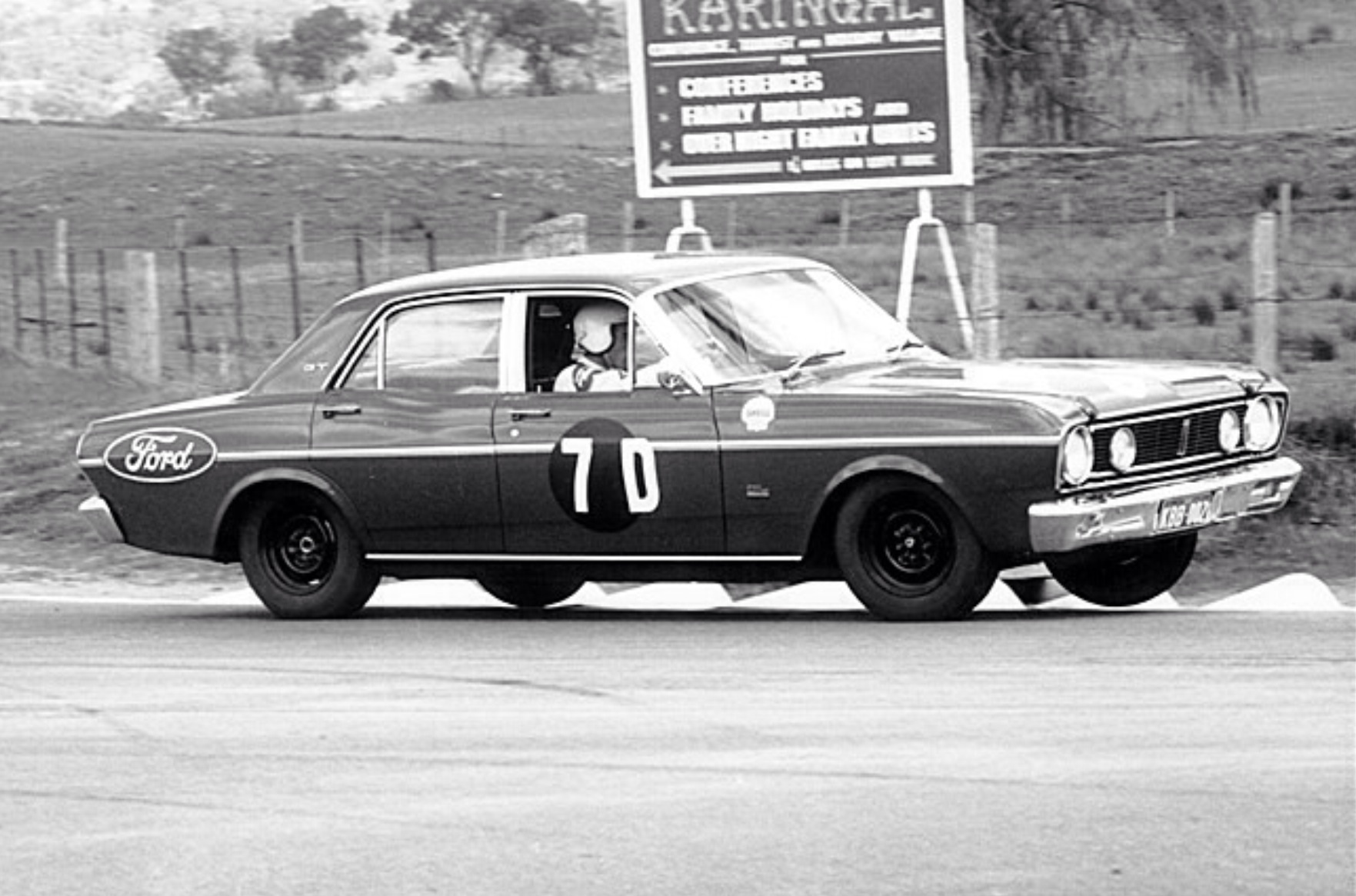
Barry Cassidy, Ford Falcon ‘XR’ GT, Newry Corner, Longford March 1968 (oldracephotos.com)

This photo is no doubt part of Ford’s ongoing repositioning of their product, ‘Going Ford is the Going Thing’ was FoMoCo’s ‘tag line’ of the day.

‘Blondies’ car is the 1968 ‘XT’ Falcon 500 ‘poverty pack’. A 302cid V8 was cranked under the bonnet to create the GT, a 4 speed box, slippery diff and front disc brakes with firmer springs and shocks completed the performance makeover. This was the only one of the ‘Big Henrys’ which didn’t win the Bathurst enduro classic. An ‘HK’ Holden Monaro 327 coupe driven by Bruce McPhee took the ’68 win.

‘Win on Sunday, Sell on Monday’ is the adage…

image

The Spencer Martin/Jim McKeown XT Ford Falcon GT auto!,Bathurst 500 1968. The pair were 42nd, the highest placed Ford was the XR GT driven by McIntyre/Stacey which was 7th (unattributed)

The local ranges of Ford and Holden were full of mundane stodge in 1966, perhaps the Cortina GT the ‘highlight’. Times ‘were a changin tho’, by 1970; Ford offered the Falcon 351V8 GT/GTHO, Lotus engined Escort Twin-cam, Capri GT V6 and 1600GT and Holden the Monaro HG 350V8 and Torana XU1 which sported a 186cid ohv triple-carbed straight six, all wonderful cars for 13 year olds to dream about…

ford

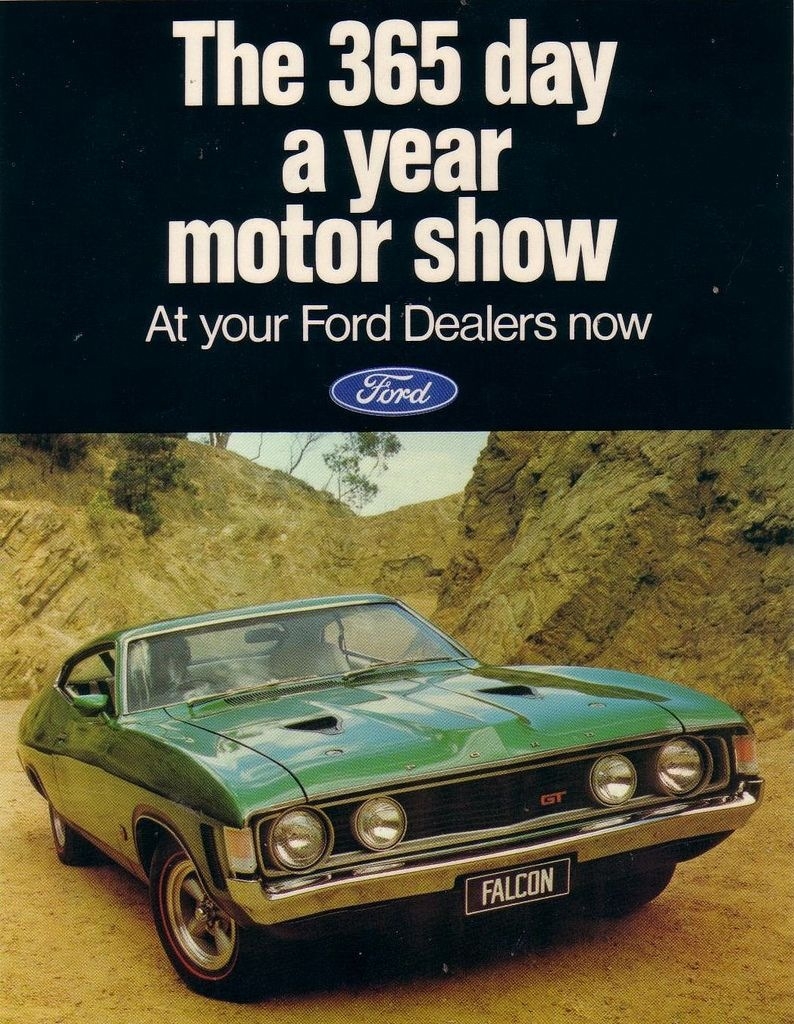
Ford Oz ad for the 1972/3 ‘XA’ Coupe GT; 351cid 300bhp V8, 4 speed ‘top loader’ box, slippery diff, disc/drum brakes, great cars!

Ford provided some support to Team Lotus who campaigned Lotus 49 DFW’s for both Jim Clark and Graham Hill during the ’68 Tasman Series which Clark won.

The Falcon shot at the articles start has Victorian plates so the shot was probably taken in the week of 25 February to 4 March 1968. Clark took the Sandown, Victorian round. The world champs were then in Melbourne for a few days before heading to Longford, Tasmania for the series ending race won by Piers Courage’ McLaren M4A FVA F2 car in a stunning wet weather drive.

image

Clark ahead of Graham Hill, slices into The Esses during the ‘Warwick Farm 100’, another win for the Scot’s Lotus 49, he took the ’68 Tasman (oldracephotos.com)

Credits…

Ford Australia, oldracephotos.com

image

The trouble with so many shots of Maria Teresa de Filippis is that many were shot by non-racing photographers so are devoid of the detail we want!…

‘Maria Teresa with racing car’ is about as precise as it often gets, it gives we amateur historians a research challenge I guess. Having trawled through the ‘F2 Register’ Formula Junior Archive as best I can (although the listing for this event does not include competitor numbers) this is the ‘Confronto Nord-Sud’ contested at Vallelunga on 1 November 1958. Lucio de Sanctis won the final in his own de Santis Fiat with Maria Teresa 4th in the first heat and 6th in the final. I wrote a short article after de Filippis died last year, click here to read it;

Maria Teresa de Filippis…

The car behind Maria Teresa is another Stanguellini, unfortunately the mid-engined car has been largely cropped out of the shot, ‘twould be interesting to know what it is if any of you FJ experts can identify the machine.

image

MTdF in her Stanguellini at Vallelunga in 1958 (Popperfoto)

Formula Junior had 11 events in 1958, 9 of them in Italy, the category’s champion was Count Giovanni Lurani an Italian who saw the need for a relatively inexpensive entry-level single-seater class. The category was for cars with engines of 1100cc and a minimum weight of 440Kg (their was a 1000cc class as well with a lower weight limit) exploded in 1959 with meetings all over Europe, the UK from mid-year and a couple towards the end of the year in the US.

image

Count Giovanni ‘Johnny’ Lurani, here in the mid-30’s, was an Italian auto engineer, driver and journalist who raced Salmson, Derby, Alfa and Maserati’s after graduating in engineering at the Politecnico di Milano. He won his class in the Mille Miglia thrice and founded Scuderia Ambrosiana in 1937. Post WW2 he worked with the FIA, his credits include the creation of FJ in ’59 and the GT Class in ’49. He also designed record breaking motorcycles and was president of the FIM in a life of achievement (ISC Images)

The category was immensely successful largely due to a progressively more buoyant post-war global economy, improving personal incomes and the arrival of consumer credit which meant young aspirants to Fangio’s world crown could buy a car.

There was plenty of choice of weapon too as builders of chassis and related componentry popped up all over the joint from Australia to Russia. An article on FJ and its incredible growth is an interesting one for another time!

image

Stanguellini factory in Modena with a swag of FJ’s lines up out front in 1959 (stanguellini.it)

Stanguellini were beautifully placed to build cars for Formula Junior given their rich history of racers based on the Fiat parts bin…

That glib phrase does not do the heritage of this firm justice however, click on this link to the marques website which provides a great summary of their cars and engines since the 1930’s, the photographic archive is also rich, take the time to cruise through it; http://www.stanguellini.it/en/100-years-of-history-stanguellini-car/

The ‘Stang’ is often often said to be a mini-250F but its as much Vanwall or Lotus 16, either way those comparisons don’t do justice to a car which has a beauty all of its own.

image

Stanguellini Fiat FJ cutaway drawing, all the key elements of the car clear and as described in the text (unattributed)

Vittorio Stanguellini engaged Alberto Massimino who was very clever in his design approach; its not innovative in terms of its ladder frame chassis, or choice of front-engined layout although the first cars appeared in late ’57 or ‘early ’58, the ‘Cooper Revolution’ wasn’t necessarily clear at that exact moment in time. A year later the mid-engined trend was, but the Stang with its circa 80bhp, twin Webered 1098cc pushrod engine was the most competitive thing around in 1958 and 1959.

In part it was due to a clever layout which provided the driver a low driving position, getting the weight down by the use of an offset drive line, the Fiat 4 speed gearbox kinked to the right, the driver to the left. The cars had conventional upper and lower wishbone front suspension and a Fiat live axle nicely located with parallel trailing arms and sprung by coils, co-axial shocks were used front and rear. The ‘look’ was completed by the use of Borrani 12 inch wire-wheels, brakes were finned Fiat 9.8 inch drums front and rear. The wheelbase was 79 inches, front and rear track 48 inches.

image

Snug cockpit of Norm Falkiners Stanguellini FJ in late 2015, offset transmission to get the driver down nice and low clear . Engine and ‘box Fiat 4 speed (Bisset)

None of these Stanguellini’s raced in Australia ‘in period’ but Melbourne driver Norm Falkiner imported one a decade or so ago. I happened to be testing my Van Dieman RF86 Historic Formula Ford at Calder when its restoration was just completed by Jim Hardman, who still fettles it. These mixed track days are interesting to see how different cars do their stuff (or not!) up close, I can still recall how nice the thing put its power down and how much punch it seemed to have, I could hear the little Fiat engine buzzing to circa 7500rpm each time I ranged up near it. It was less impressive under brakes, but chances are they were still being sorted.

Maria-Teresa’s views on the ‘Stang relative to the GP machines she was piloting at the time would be interesting!

image

de Filippis in her 250F at Spa in 1958, 11th in the Belgian GP won by Tony Brooks Vanwall VW57 (unattributed)

Robert Lippi won the Italian Championship in 1958 and Michel May won both the ’59 Monaco FJ GP and ‘Auto Italiana International Championship for Drivers’ and Stanguellini the ‘Quattroroute International Championship of Makes’. The ‘Campionato Italiano’ went to Stanguellini driver Raffaele Cammarota.

In 1960 things got tougher. The Brits ran their first championships for the class, Chapman’s mid-engined Lotus 18 was just as quick with an 1100 Ford bolted into the back of it as a 2.5 litre Coventry Climax FPF. It and the Cooper T52 BMC made the pickings tougher for the ‘front-engined brigade the best of which that year was perhaps the Lola Mk2.

image

The GP Icecar, Cortina 17/18 January 1959. In Italy racing on ice was a novelty, circuit at Monti Pallidi, contestants line up for the first heat. L>R Stanguellini Fiat’s of Crivellari, Zanarotti and De Carli. At right the VW based Mathe VW of Otto Mathe. The final was won by Manfredini’s Wainer Fiat (Stangullini)

In 1960 Colin Davis Osca Fiat won the ‘Campionato A.N.P.E.C/ Auto Italiana d’ Europa’ from Jacques Cales Stanguellini Fiat, Denny Hulme in a Cooper T52 BMC and Lorenzo Bandini, Stang Fiat.

image

Beautiful period shot; Michel May lines up his #33 Stang Fiat FJ on the front row of the second heat of the Trofeo Vigorelli, Monza on 24 April 1960, which he won. 2nd in the ‘final 2’ . Car #57 alongside is Rob Slotemaker’s Cooper T52 DKW (stanguellini.it)

That FJ was nurturing drivers of great talent is shown by the fields of the 1960 championship which included Henry Taylor, Giancarlo Baghetti, John Love, Gerhard Mitter, ‘Geki’ Russo, Kurt Ahrens, Trevor Taylor, Jo Siffert, Peter Arundell, Ludovico Scarfiotti and Jim Clark, to name a diverse global few!

Clark won the ‘BRDC/Motor Racing’, ‘British FJ Championship’ and ‘John Davey British FJ Championship’ aboard his works Lotus 18 Ford and Peter Arundell the ‘BARC Championship’ in the other works 18.

image

Jim Clark happy after winning the ‘Kentish 100 Trophy’ at Brands Hatch 27 August 1960, Lotus 18 Ford (Lee)


Stanguellini rose to the mid-engined challenge, building the multi-tubular chassis Delfino FJ. Again Fiat engined, but inclined at 45 degrees, it had a very distinctive high mounted exhaust. By 1962 Cosworth modified Ford engines were well out of the Fiat’s reach, the car had little success, with Stanguellini losing interest in the class.

image

Colin Davis testing the Stanguellini Delfino Fiat at Modena in winter 1962, distinctive exhaust system clear. ‘Sharknose’ styling modelled on Carlo Chiti’s 1961/2 Ferrari 156 F1 machine (stanguellini.it)


Credits…

Botti, Popperfoto, Lee, Stanguellini.it, F2 Register, ISC Images

Tailpiece: Maria-Teresa helping get her Stanguellini into position at Vallelunga, car behind a 250F. I’ve a feeling the ‘ogling fans in the background are focused on the lines of the lady not her car…

image

(Popperfoto)


image

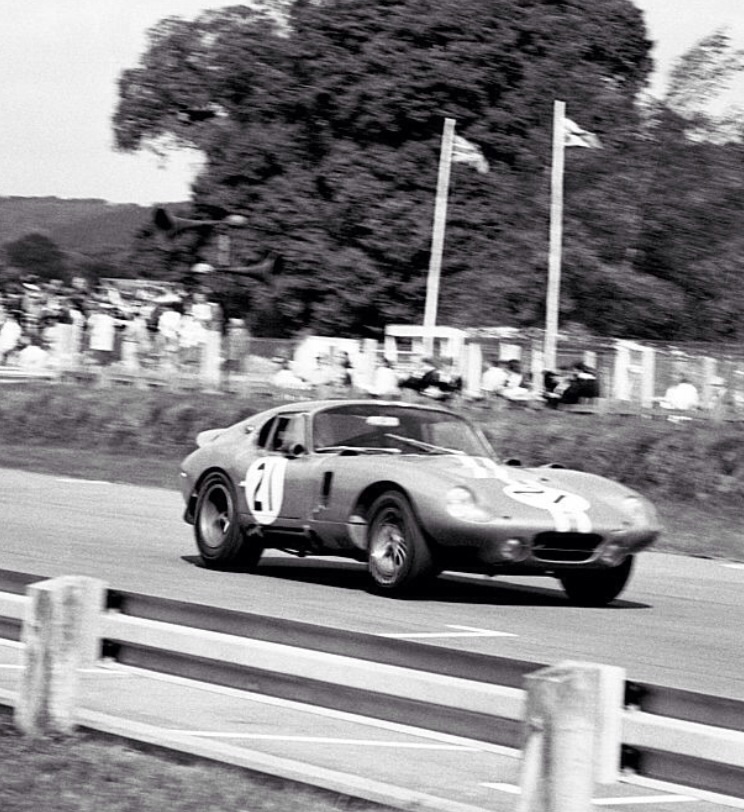
Jack Sears chases Graham Hill, #21 Dan Gurney, Denny Hulme and Mike Salmon in line astern; AC Shelby Cobra, Ferrari 330P, Shelby Cobra Daytona Coupe, Brabham BT8 Climax and Aston Martin DP214, 29 August 1964…

This group of cars is indicative of the quality of the field, Hill won the race of changing fortunes from David Piper’s Ferrari 250LM and Dan Gurney’s Shelby Cobra Daytona Coupe.

image
Clark and Lotus 30 Ford during practice. Thats Team Lotus’ Jim Endruweit behind the car and deer-stalker topped John Bolster with the headset on. Pitstops during the race not so serene! (unattributed)

Entry…

The Tourist Trophy is a much coveted sportscar victory, the 29th running of the classic at Goodwood on 29 August 1964 was no exception to the strong field of entrants…

The drawcards were GeePee drivers Bruce McLaren, Jim Clark and Graham Hill in outright contenders: ex-Penske ‘Zerex Spl’ Cooper Olds, works Lotus 30 Ford and Maranello Concessionaires Ferrari 330P respectively. Other potential frontrunners were David Piper’s Ferrari 250LM and five AC Shelby Cobras driven by Dan Gurney, Phil Hill, Jack Sears, Bob Olthoff and Roy Salvadori.

Denny Hulme and Hugh Dibley raced Brabham BT8 Climaxes. John Surtees, Richie Ginther, Innes Ireland and Tony Maggs Ferrari GTOs. Most of the drivers elected to race the 132 miles solo, it was a  typically spectacular international grid of sporties of the day.

image
Goodwood paddock; #23 Jack Sears Shelby Cobra, #22 Phil Hill and alongside him, Dan Gurney in Shelby Cobra Daytona Coupes (unattributed)

Graham Hill ponders the speed of his Maranello Concessionaires entered 4-litre Ferrari 330P chassis #0818 during practice. It may not have been the quickest car in the race but it had the endurance the Group 7 sprinters lacked.

image
goo start
The start, front row L>R; McLaren, Clark and Hill, Hugh Dibley in the white Brabham BT8 Climax, #4 Piper Ferrari 250LM (unattributed)

The Race…

Bruce popped the Zerex on pole from Clark, Hill and Dibley. Dan was the quickest of the GTs in his big, booming Cobra.

From the start McLaren led from a ‘very busy’ Clark, the Lotus much more of a handful than Bruce’s mongrel-Cooper T51 based special! Denny was third in his nimble Brabham with Trevor Taylor’s Elva BMW in fourth. Bruce’ clutch failed to transmit the power of his ally-Olds V8 and retired. The order was then Clark, Hulme, Taylor and Hill G. After 25 laps Piper and Salvadori were a lap back such was the pace of the frontrunners.

image
Dan Gurney was third in the best placed Shelby American entered Daytona Cobra Coupe (Getty)
image
(LAT)

Graham Hill spun the Ferrari at Woodcote on lap 17, Tony Maggs whips past in David Piper’s Ferrari GTO, the South African finished tenth.

Graham started to push, coming up to third, then second. Clark pitted for fuel on lap 64 giving Hill the lead, more drama for Clark as the Lotus had been under-filled, another 15 gallons were added, and oil, then the hot motor wouldn’t fire; by this stage Hill was nearly a minute up the road.

Clark then treated the crowd to a superb demonstration of on the limit driving ‘… in a hurry, needing all the road. He would come out of Woodcote, dust rising as the tail of the Lotus 30 touched the verge, accelerate in a burst of power that lifted the nose, slip through the chicane and like as not use the kerb out of it to bounce the car straight. Stop watches were out, Clark might close on Hill a couple of laps from the end…’

But it was not to be, Clark made a third pitstop when the car felt odd, the diagnosis was a bottom wishbone locking ring had slackened off and was contacting a front wheel, so Graham Hill’s 330P Ferrari won from Piper’s 250LM, then came the AC Cobras of Gurney, Sears and Olthoff in coupe, sports and hardtop respectively! Hills average speed was 97.13mph and Bruce McLaren set a new sportscr car lap record of 1:23.8 in the Zerex Cooper Olds before his retirement early in the race.

Etcetera…

goo piper
David Piper’s Ferrari 250LM (unattributed)
goo hill
Hill, Fazz 330P (unattributed)

Credits…

MotorSport October 1964, Sutton Images, LAT

Tailpiece…

image
(Sutton)

The TT would have been a nice win for the Lotus 30 Ford, not Chapman’s greatest bit of work. Clark at speed…

Finito…

arr ric sa

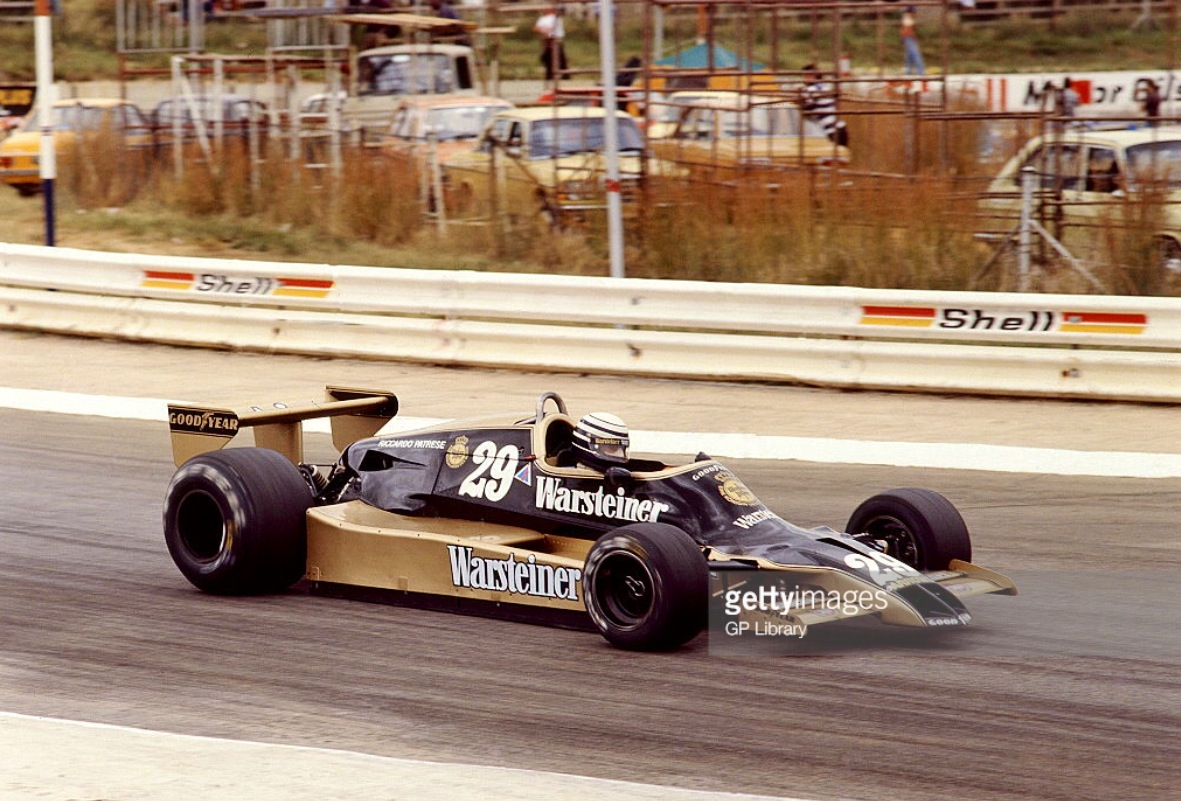
Patrese debuts Arrows A1-06 Ford at Kyalami, South African GP 1979. Q8 and 11th in the race won by Gilles Villeneuve’ Ferrari 312T4 (Schlegelmilch)

What’s it like livin’ and lovin’ the most successful race engine ever built?…
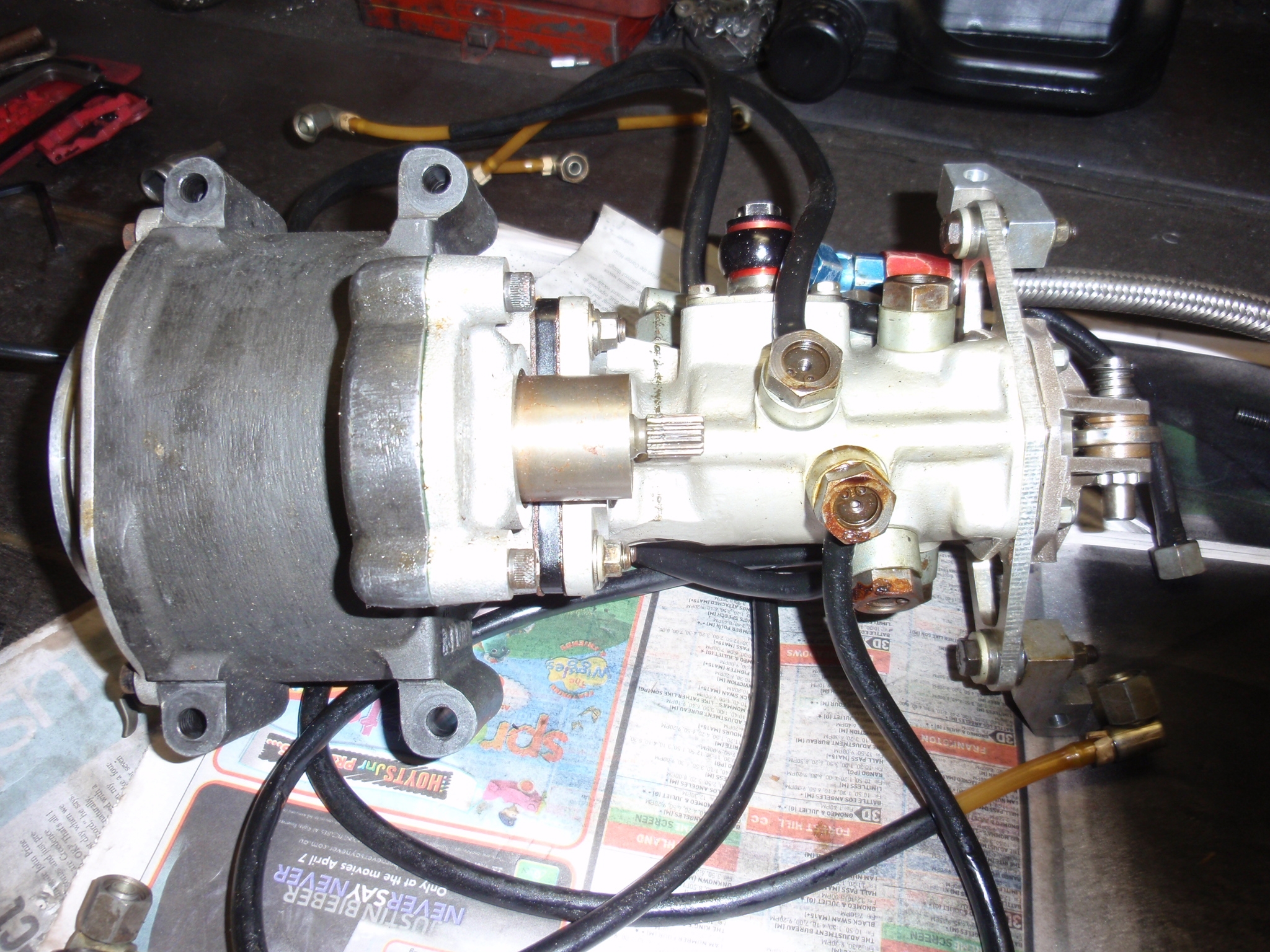
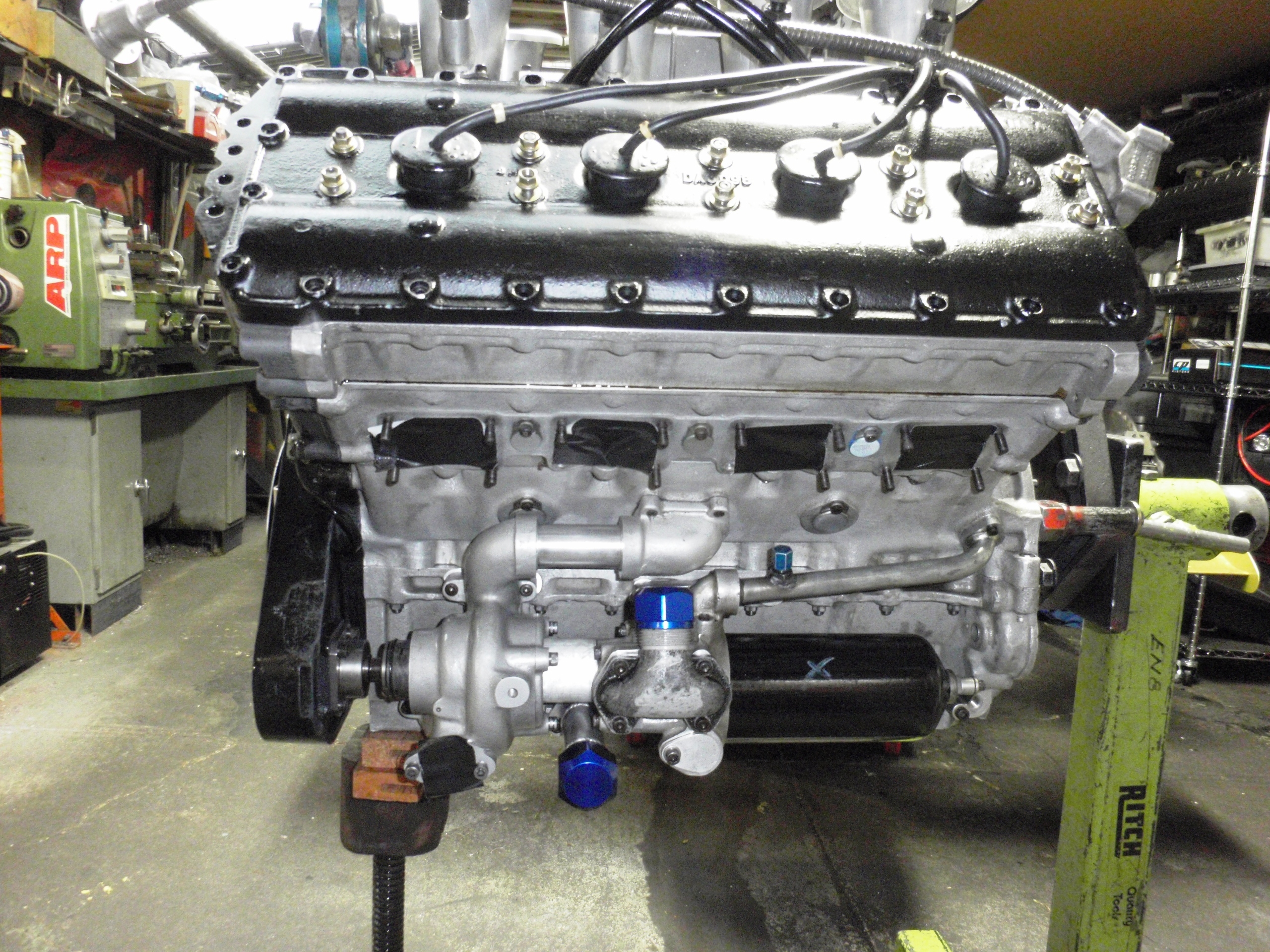
Our ‘Racers Retreat’, Peter Brennan owns and cares for ‘DFV250’. I have decided in fact he is a ‘perick’! Not only can he drive ‘big cars’ very quickly but he can  also reconstruct, rebuild and maintain the things which makes him a multi-talented ‘perick!

OLYMPUS DIGITAL CAMERA

Pete Brennan in the Arrows at Phillip Island, Paul Faulkner’s ex-Jones ’81 Williams FW07 behind (Brennan)

image

Villeneuve and Patrese, 7th and 5th in the 1979 Belgian GP at Zolder. Ferrari 312 T4 and Arrows A1 ’06’ May 1979 (unattributed)

‘DFV250’ sits in the back of his Arrows A1-‘06’. It was Ricardo Patrese’s car for the early season races in ’79 before Arrows switched to the more advanced but unsuccessful A2 which was not Tony Southgate’s best work. A1-06 was then sold for Aurora Series and Historic F1 use, eventually ending up in the Al Copeland Collection from whom Pierre acquired it after Copeland’s passing.

We will get to restoration of the Arrows and the Ford DFV which was at the ‘dismantle, crack-test and reassemble’ end of the spectrum rather than the ‘reconstruct around the monocoque bulkheads, four corners and ‘box’ huge task which Lola T330 ‘HU18’ represented, soon. Click on this link for a series of articles on that mammoth job which shows Peter’s talents.

https://primotipo.com/2014/06/24/lellas-lola-restoration-of-the-ex-lella-lombardi-lola-t330-chev-hu18-episode-1/

For now I just want to focus on the care and maintenance of a DFV race to race which I expect is rather more involved than that of my ‘Peter Larner Engines’ 105bhp Formula Ford ‘Kent’ moteur?

image

Clark on the way to the DFV and Lotus 49’s first win, Dutch GP, Zandvoort 4 June 1967. Clark leads Brabham Brabham BT19 Repco 2nd, Rindt Cooper T81B Maserati DNF and Hulme Brabham BT20 Repco 3rd (Schlegelmilch)


Why the DFV you ask?…

Keith Duckworth’s Ford sponsored 1967 3 litre, 4 valve, fuel injected, 2993cc V8 is both the most successful grand prix engine of all time with 155 championship GP wins from 1967-1983 but also part of the winningest ‘family’ of engines. The DFV spun off the 3.9 litre Le Mans winning endurance racing ‘DFL’ and single turbo-charged 2.65 litre ‘DFX’ Indy victor.

image

Theo Page cutaway of the Ford Cosworth DFV in 1967. All the key elements referred to in the text covered in this superb drawing

Phil Reilly Engineering…

Brennan has tackled all manner of race engines over the years including lots of Chevs, Repco Holden F5000, Repco Brabham V8’s and various Coventry Climax FPF’s, but the DFV was new to him. His ‘guru’, a source of advice from afar and the fellow to whom he sent the his heads was Phil Reilly who has forgotten more about these engines than most people ever knew. His ‘shop, well known to American enthusiasts is in Corte Madera, California. Reilly Engineerings ‘Care and Feeding Your Cosworth DFV’ and Peters practices in looking after ‘250’ form the basis of this article.

dfv lotus

Butt shot of one of the Lotus 49’s upon debut at Zandvoort 1967, ZF 5 speed ‘box, the ratios of which could not easily be changed about to be swapped. Shot shows the brilliant packaging of the DFV. Lotus’ Chapman prescribed a stress bearing V8 to Keith Duckworth inclusive of the way he wanted to attach the engine to the chassis at the bulkhead aft of the driver. Note the tubular brackets either side of the Borg and Beck clutch to which the suspension mounts. Their is no tubular frame or monocoque structure aft the driver, the engine itself forms the function of being the bit to which other bits are attached! Part of the brilliance of the DFV is its combination of power, weight, reliability and cost, the other aspect is the way it integrates with the chassis (Schlegelmilch)

DFV’s and DFV’s…

The development of these engines has effectively never stopped, you can still buy the bits from Cosworth Engineering, inclusive of a new engine should you buzz it to 15000rpm on an errant downchange and pop a rod or three thru its slender aluminium or magnesium flanks.

The DFV in Jim Clark’s winning Lotus 49 at Zandvoort on 4 June 1967 gave a smidge over 405bhp, its power delivery in the early days quite ferocious, coming in with a bang all up top, making it a bit of a challenge for Messrs Clark and Hill. A long stroke, same as Jims, engine like DFV250 gave around 470bhp and 260 lbs/foot of torque at 10500/9000rpm respectively whilst being thrashed to within an inch of its life by Patrese in early 1979.

A wrong turn of phrase really as the talented Italian multiple GP winner was both mechanically sympathetic and great test driver.

ickx

Jacky Ickx, Ensign N177 Ford, Monaco GP 1977, 10th in the race won by Scheckter’s Wolf WR1 Ford (unattributed)

dfv dfv

All go and no show Cosworth Engineering. Subtle stamping of engine number in the engines valley (Brennan)

In fact when ‘250’ was first born it was a Cosworth lease engine used by Team Ensign and supplied to them on December 3 1976.

It was fitted to the N177 chassis’ driven by Jacky Ickx and Clay Regazzoni, multi GP winners both, during 1977.  Without the teams records its not possible to know into which chassis ‘250’ was installed race by race.

image

Launch of the Arrows A1 at Silverstone in late 1977, maybe they figured the white body against the white snow would disguise its similarity to the new Shadow DN9, the design drawings of which Southgate erroneously thought were his! Patrese in car, Jack Oliver behind left and Tony Southgate at right. The High Court writ was shortly ‘in the mail’ (unattributed)

The engine was then bought by Arrows when the team spun out of Shadow. Jackie Oliver, Alan Rees, Tony Southgate and Dave Wass all felt they could ‘build a better mousetrap’ and left Don Nichols outfit at the end of 1977. The High Court legal stoush about ‘IP infringement’ which followed is a story for another time; in some ways Nichols had the last laugh as Shadow won a GP, the 1977 Austrian when Alan Jones took his first win in an a DN8 Cosworth, whereas Arrows never did win one albeit the business lasted a lot longer than Shadow…

OLYMPUS DIGITAL CAMERA

(Brennan)

The Calm Before The Storm…

Here is ‘250’ all ready to rock on Peter’s dyno; ‘It takes about a day to plumb the thing up, its godda be done very carefully of course. Cosworth prescribe very fully how to do it (see below) Having gotten thru all the preliminary stages of running it in, i gave the thing ‘a tug’. All was okey-dokey for a bit and then all hell broke loose, a huge bang and then schrapnel everywhere!’

‘Thank christ it wasn’t the engine itself. The DFV’s vibrate so much it broke the dyno driveshaft @ 9200 rpm precisely! I have had all manner of donks on that dyno, over 500bhp Chevs etc but nothing has done that before. Having had that happen i still haven’t given it a full power run on the dyno anyway!’

But we are getting ahead of ourselves, the rebuild of the engine itself we will cover in an article about the car.

OLYMPUS DIGITAL CAMERA

Brennan’s dyno driveshaft after Cosworth assault @ 9200rpm (Brennan)

dfv run in

Cosworth’s dyno running in procedures dated 31 October 1977 (Cosworth)

DFV use in Modern Times…

Phil Reilly; ‘If you rev the engine to 10800/11000rpm as Messrs Hunt, Fittipaldi and Jones did you will get the sort of engine bills Messrs Mayer, Fittipaldi and Williams paid!’

‘The DFV with an 11000rpm rev limit is a 3-4 hour motor…which will blow up big-time every now and then…needing an injection of $10-15K of parts and lots of (expensive) TLC…for vintage events use 10000rpm as a normal shift point. Doing this keeps the engine well below its stress point yet still provides enough power to test any drivers skills…the bonus is the engine will live 15-20 hours between rebuilds’.

Geoff Richardson Engineering have been looking after the engines since their heyday, James Claridge provided their perspective; ‘The routine rebuild interval for an engine limited to 10000rpm is approximately 1000 miles’.

‘This would comprise of us stripping it down, crack testing components, inspection of all parts, followed by re-assembly and dyno testing. Replacement of valve springs happens every time.Possible replacement of pistons depending on condition, if they were re-used they would certainly be replaced at 2000 miles. The same applies to all of the valves, they are taken on condition. New con-rod bolts are fitted, all new bearings, a new set of piston rings, and all new seals and O-rings are fitted. Nearly all the other parts are taken on condition and replaced accordingly’.

‘An engine with no issues or catastrophes that we knew the history of and is well looked after might cost somewhere in the region of £12-15000.00 to completely refresh’.

Peter Brennan provides the drivers perspective; ‘ The DFV has three quite distinct phases of power, one bangs in at 5500rpm, the next at 7000, then it goes ballistic at 9000 and all you do is chase gears with the tach going bananas…’ ‘Its not that difficult to get off the line, it obviously doesn’t have 500 plus foot pounds of torque like an F5000, sliding the foot sideways off the throttle at around 8000 rpm and then modulating it to match wheelspin with circuit grip soon has you motoring in the direction of tomorrow pretty smartly!’

Click on this footage of Brennan in the Arrows at the Adelaide Motorfest in 2014, the event uses part of the Adelaide GP circuit and some other streets.

‘The howl of the thing at 10000rpm as it yelps its way from cog to cog along the main straight at Phillip Island; with a 22/24 top fitted, fifth is 183 mph @ 10000rpm is unbelievable and Patrese would probably take it flat! Its not to be believed and relished every time you do it, Southern Loop comes up all too soon, its not the seagulls you are focused on as you turn the thing in believe me’.

allison

Bruce Allison in the March 771/781 Ford, Thruxton or Oulton Park in 1978 (Allison)

Bruce Allison raced Cosworth powered March’s in the Aurora Series in 1978 ‘The record of the engine speaks for itself, it will still be popular in historic racing in 50 years! The engine was powerful, smooth and reliable the cars of course handled better with far less weight at the back than the F5000’s i was used to. The 781 March may have been the 782 with a DFV shoved in it but it was a beautiful handling car, the 761 chassis i used early in the season was not as good but the engines were always great, beautiful to drive’.

Lookin’ After Cossie: These things are like a mistress, stunning to look at but always wanting attention, never happy and a constant sap of cash…

dfv ball

Brennan’s sense of humor never too far from the surface! ’06’ at Sandown historics 2014. Dissertation on the chassis and suspension i will save for the article on the car itself. Shot included to show just how much the engines compact size, packaging and stress bearing nature assists the chassis designer. Compare how Tony Southgate mounts his suspension to the engine via these fabricated aluminium plates compared with Chapman’s tubular structures in the Lotus 49 of 1967. Note back of sparkbox in the Vee, ‘two towers’ behind that to connect with air scoop to cool inboard mounted rear discs, rear suspension outta the airsteam and clear of G/E tunnels, single support for gold rear wing, oil cooler and black painted starter motor with drive going forward (Bisset)

Storage and Fuel System.

The engine needs to be turned over by hand one revolution each week. Turn on the fuel pump as well, this will ensure no two valve springs remain fully compressed for too long and will circulate fuel through the metering unit to prevent corrosion and keep all the seals from sticking in one place.

The fuel filter needs to be changed every 500-700 miles, the engines have a high pressure pump to start and a mechanical one for normal on circuit running. The engine won’t run below 2000 rpm on the mechanical one, the electric one is needed for starting, fuel pressure of 120psi needs to be maintained at all time, at least 95 psi is needed to fire her up.

OLYMPUS DIGITAL CAMERA

‘250’ ‘right bank’ showing both the auxiliary drive belt housing (right) and the super clever oil scavenge/de-aerator pump at left and one of the water pumps in between. The black coupling between oil and water pumps is called an ‘oldham drive’, a flexible joint (Brennan)

Olio.

A more critical liquid than fuel is oil. The engine must be plumbed to Cosworth specs…its data sheet DA0626 for ‘DFV250’ and the like. Its critical the engine never sucks air, at high revs bearing failure will result. At 10000rpm the engine is rotating at 166 times plus per second.

Peter; ‘I use Kendall 20/50 mineral oil, which has a high zinc content which is great for the cams and followers’. The Cosworth oil filter (Part #PP0404) needs to be changed every 300 miles, the oil level needs to be checked religiously as the engine uses as much as 4 quarts every 100 miles.

Oil temperature should be 90-100 degrees centigrade measured at the inlet to the pressure pump. 7000rpm should not be exceeded before the oil is at least 50 degrees centigrade.

OLYMPUS DIGITAL CAMERA

‘250’ ready to be refitted to ’06’ in Brennans eastern Melbourne workshop. Note spark box between the Vee and behind it the fuel metering unit below the ‘aeroquip’ lines, Lucas injection of slide as against butterfly type. ‘Knurled wheel’ beside rear LH injector sets mixture, ‘behind’ this is the drive for the mechanical tach. Line at far right is cable drive for electro-mechanical fuel pump. The more you look the more elegant the packaging of it all is (Brennan)

Spark.

‘250’ has the Lucas ‘Opus’ system which has a pickup on the crank which fires the Opus at 38-40 degrees BTDC. The Opus also has a retard mechanism which is set for starting at 12 degrees BTDC.

The DFV has an alternator which provides sufficient power as long as the electrical  fuel pump is switched off, DFV pilots need to remember this as they zap away from pitlane. ‘Pump Off’ was a familiar pit signal for decades!

Ignition timing is set on the dyno and is usually impossible to change in the chassis. Opus runs at 38-40 degrees BTDC, the sytem needs to be mounted in a cool place, the stock Cosworth mounting between the injection trumpets is usually fine.

The engine must be connected to negative earth with rev limiters set to 10400rpm.

The plugs are 10mm Bosch surface discharge to special order. Warm up plugs aren’t required, with plug life 3-4 race weekends. The plug wells need to be blown out, the HT leads removed with pliers. Plugs are tensioned to 9-10 foot pounds having been coated with ‘Copaslip’ first.

Spark boxes are delicate devices, you will kill them by voltage spikes caused by breaking the earth, so be clear on shut down procedures.

dfv throttle

Throttle linkage of Brennans Arrows at Sandown 2014, ’06’ about to fired up. Note the ‘Opus’ spark box between the injection trumpets and black electro-mechnical fuel pump atop the centrally mounted, between driver and engine, fuel cell. Note radiator header tank and cap, bottom right is roll bar support bracket (Bisset)

Mechanical Installation.

The valve cover engine mounting bolts are 5/16 inch UNF and should be tightened to 16-18 ft pounds, be careful not to over-tighten to avoid cracking or deforming the magnesium casting.

The engine throttle slides have four over-centre return springs at the rear, these are a unique Cosworth invention which both reduces pedal pressure and ensures the slides close fully when you lift your foot. But they are not the throttle return springs which sould be well designed and of the ‘compression type’.

OLYMPUS DIGITAL CAMERA

‘The Bomb’; Distributor cap missing at left, alternator in the middle and fuel metering unit at right, This is driven by a quill shaft off the complex gear set (shaft is only 6mm in diameter and designed to snap in cold weather rather the metering unit itself!) (Brennan)

The system needs to be cleaned and lubed regularly. The metering unit fuel cam should be flushed with aerosol ‘brake clean’ and carefully lubricated with a dab of ‘Copaslip’ before each event. If the fuel cam mechanism is gummy it will cause the throttle to seem to stick on.

OLYMPUS DIGITAL CAMERA

‘250’ this time showing the ‘left side’ of the engine with combined water pump and oil pressure pump/filter assy. 250 engine a ‘twin water pump long stroke engine’ as against later ‘slim line’ from circa 1980 which only had one water/oil pump to maximise the space available for ground effects tunnels (Brennan)

The cooling system must not trap air, use bleeds as required, the system uses a 15-20psi cap. A 50/50 mix of water/glycol keeps corrosion in check and lubricates the water pump. Temperature strips should be used to monitor ‘real’ engine temperatures. The water outlet temps at the back of the heads should be 90-110 degrees centigrade and inlet temps 70-80 degrees.

OLYMPUS DIGITAL CAMERA

‘250’ during its disassembly. Complex gear train to drive 32 valves, with degree plate to record engine valve timing during disassembly as a matter of record (Brennan)

Fuel & Fuel System.

Peter uses 100 octane avgas. Light engine oil is always added to the fuel to increase the life of the metering unit, fuel pumps and valve guides/seats. 20/50 Kendall is used, the ratio 2 ounces to 5 gallons of fuel.

The Lucas system needs 120psi to operate properly. Individual injector nozzles should seal at 50-65psi and thus not leak when the electrical pump is switched on, some leakage at 100psi plus is not unusual but it shouldn’t be pissin out…

The metering unit cam is set to run at specific clearances, typical DFV settings are .006 inch idle and .078inch wide open, these settings are 1 notch from full lean. These settings will be on the engine build sheet, check them periodically.

The mechanical fuel pump seal should be lubricated every 500 miles

dfv_parts

Cosworth DFV and its constituent parts (unattributed)

Trivial Pursuit Question?

The firing order is; 1-8-3-6-4-5-2-7

Cold Weather Operation.

Clearances in the metering unit are so tight that in cold weather the quill drive or the metering unit drive will break. Not a good idea.

In weather below 45 degrees fahrenheit the engine shouldn’t be spun over before warming the metering unit with either a hair dryer or judicious amounts of boiling water being poured over it.

Firing Her Up: The Good Bit.

Warm up plugs and oil heaters aren’t needed, so some of the theatre of a bygone era is lost!

Make sure Arrows isn’t in gear!

Set the fuel cam datum pin to full rich

Switch on the electric fuel pump

100psi of fuel pressure should be present

Crank the engine over for 8-10 seconds with the throttle full open

Then prime each injection trumpet with a delicate squirt of fuel

Hit the Opus system retard switch (switch back across for on circuit work)

Switch on the ignition

Hold the throttle open about 25%, start the engine, but don’t race it as it fires. Hold her steady above 2300rpm, savouring the beautiful music it plays, settle the revs wherever the mechanical chatter is minimised but @ around 2300rpm

Its important not to run the engine below 2000rpm as the cams are not properly lubricated below that

Once the engine settles down with a little temperature switch off the electric fuel pump.

As the engine warms, the engine should be leaned one datum pin down, one notch at a time. With each notch it will spit and crackle a bit until it warms to it.

Engines are set normally to run one notch from full lean, they will be ‘grumpy’ at low speed which is normal.

Oil pressure should be 40-60 psi, make sure your driver has a look every now and then on circuit!

Unsurprisingly running a DFV is more complex than its Ford ‘Kent’ little brother! If the maintenance regime is followed and the driver keeps the engine in its optimum band and doesn’t buzz it on the down-changes, something Ricardo did during his Arrows days according to Tony Southgate then ‘DFV250’ will last around 1700-2000 miles  between rebuilds…

DFV Engine in the Ground Effect Era…

Credits & Bibliography…

Peter Brennan many thanks

Phil Reilly Engineering, Geoff Richardson Engineering

Dossier on Arrows A1-06 written by Alan Henry for oldracingcars.com

Rainer Schlegelmilch

Tailpiece…

arr sticker