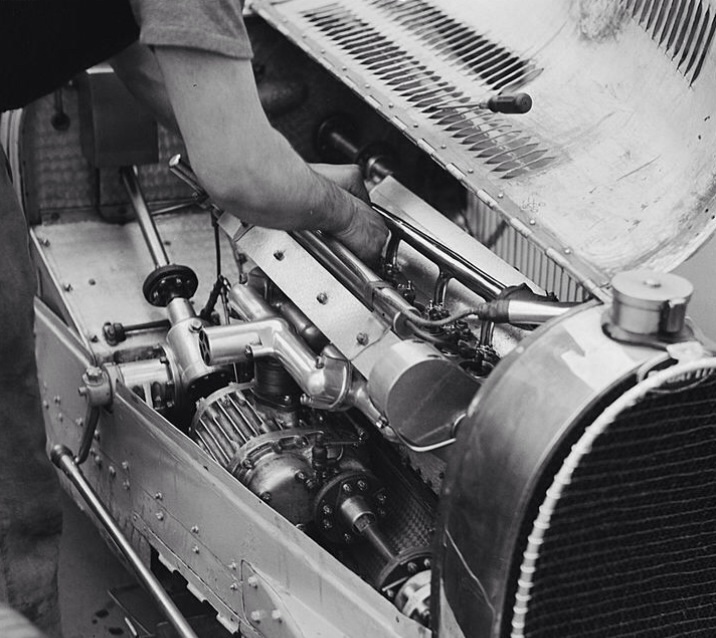
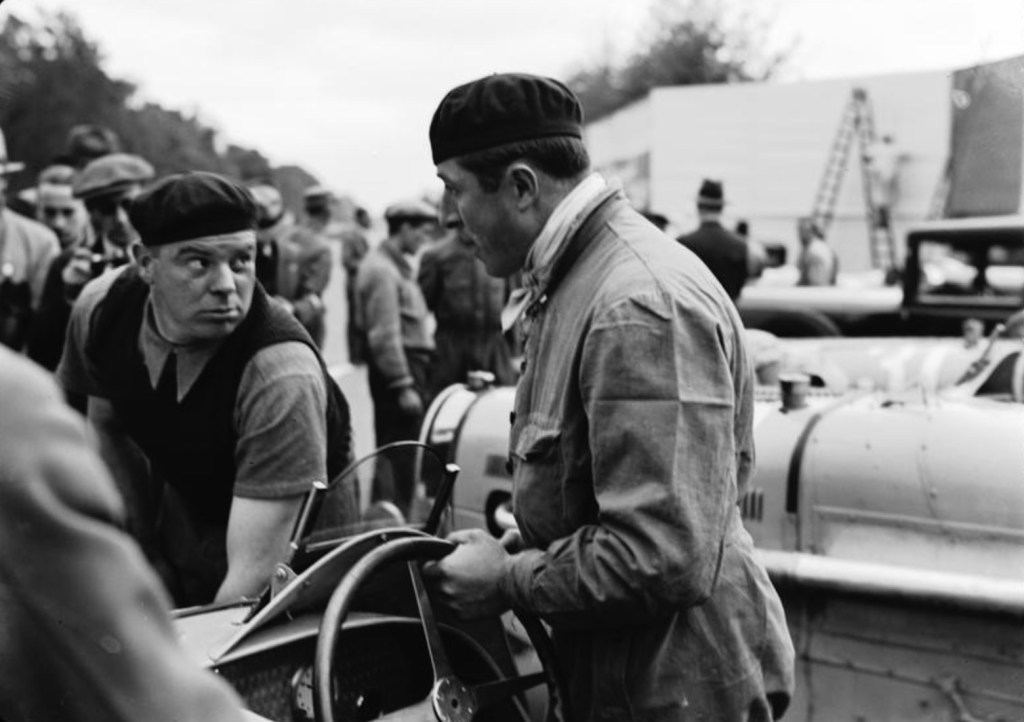
The magic hands are those of Bugatti’s Chief Mechanic, ‘Le Grand Robert’, Frenchman Robert Aumaitre working on a T51 straight-eight, twin-cam, 2.3-litre engine…
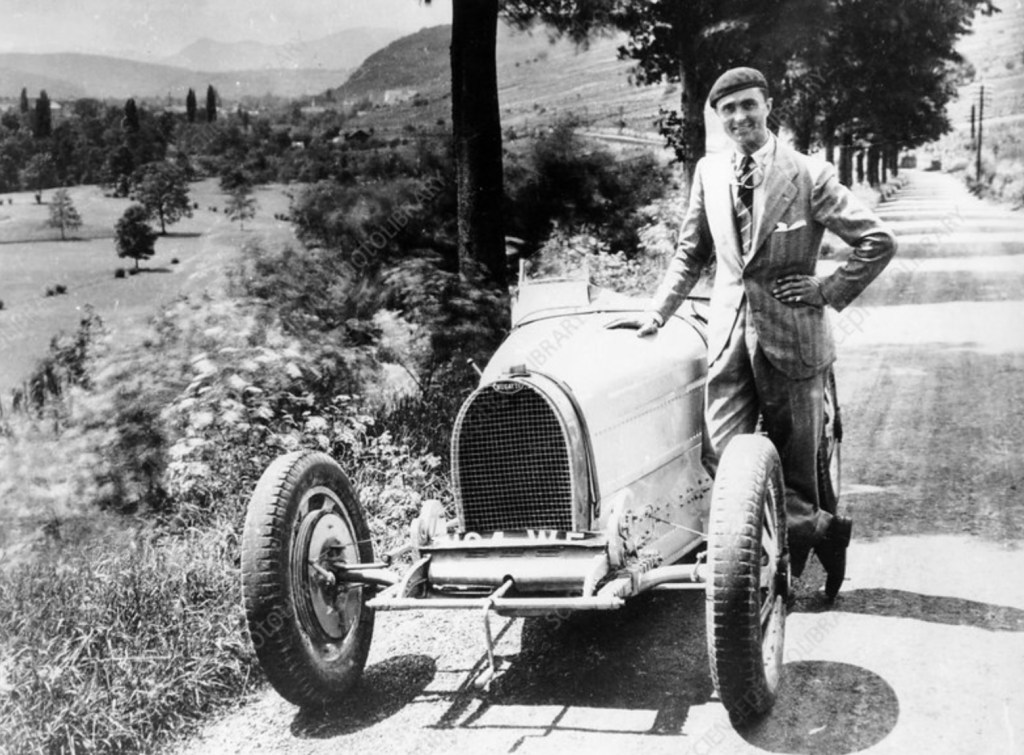
Louis Chiron with his Bugatti Type 51 near Molsheim in 1931 (sciencephoto.com)T51, Nurburgring German GP July 19, 1931. Race won by Rudy Caracciola’s Mercedes-Benz SSKL by over a minute from the Louis Chiron and Achille Varzi Bugatti T51s (Z Glass)
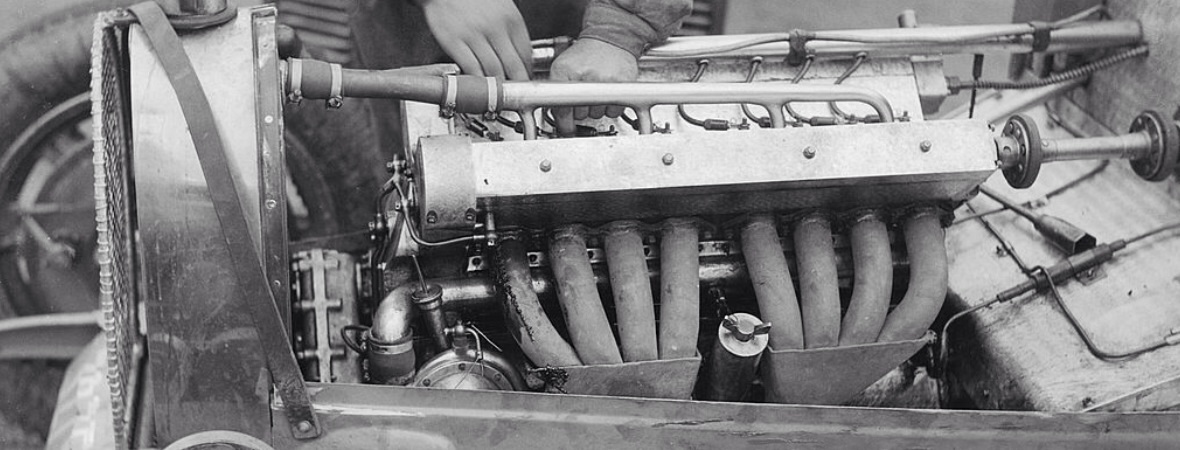
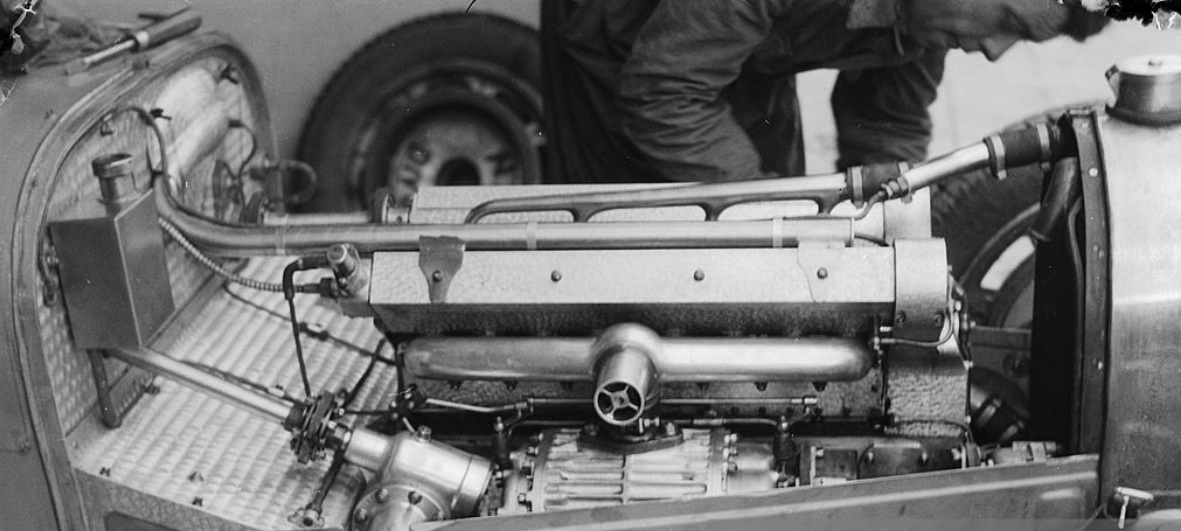
Bugatti’s Miller 91-inspired twin-cam design – 1931-35 T51 2262cc 60×100, T51A 1493cc 60×66, T51C 1991cc 60×88 – featured a monobloc design with a shared crankcase. The main bearings comprised three ball bearings in the middle and two roller bearings, one at each end. Rod bearings were roller. Lubrication was by jet and splash with a special oil pipe for the front main bearing.
The twin overhead camshafts were driven by a train of gears mounted at the front of the engine and operated two valves per cylinder. A single (T51) Zenith 48K carb fed a Roots type supercharger, with a Scintilla magneto firing one plug per cylinder. The engine gave about 180bhp @ 5500rpm.
T51 Nurburgring German Grand Prix July 19, 1931. Inlet side (Z Glass)Robert Aumaitre and Pierre Veyron at the Avus, Berlin. Veyron won the Avusrennen Voiturette race, 197km, in a Type 51A on May 21, 1933, from Ernst Burggaller’s similar car (Z Glass)
Robert Aumaître ‘came to service with Bugatti in 1930 and was Jean Bugatti’s mechanic. He experienced Jean’s last moments, when he was killed on August 11, 1939, a traumatic experience that haunted hm until his own death,’ recorded the bugattipage.com.
‘After WW2, he assisted French driver Jean Monneret and was involved in record attempts with various Vespas at Montlhery. He designed a Vespa-driven catamaran that crossed the channel in 1947, and was involved in a rally for bicycles with engines from Paris to Alpe d’Huez. After his retirement as manager of a big Cognac company, he spent his last years in Molsheim,’ where he died aged 93 on January 11, 1997.
Strange is that this piece omits Aumaitre’s time with Gordini post-war, where he was again Chief Mechanic.
Credits…
Zoltan Glass/Science and Society Picture Library, bugattipage.com, National Science and Media Museum, Bradford, sciencephoto.com
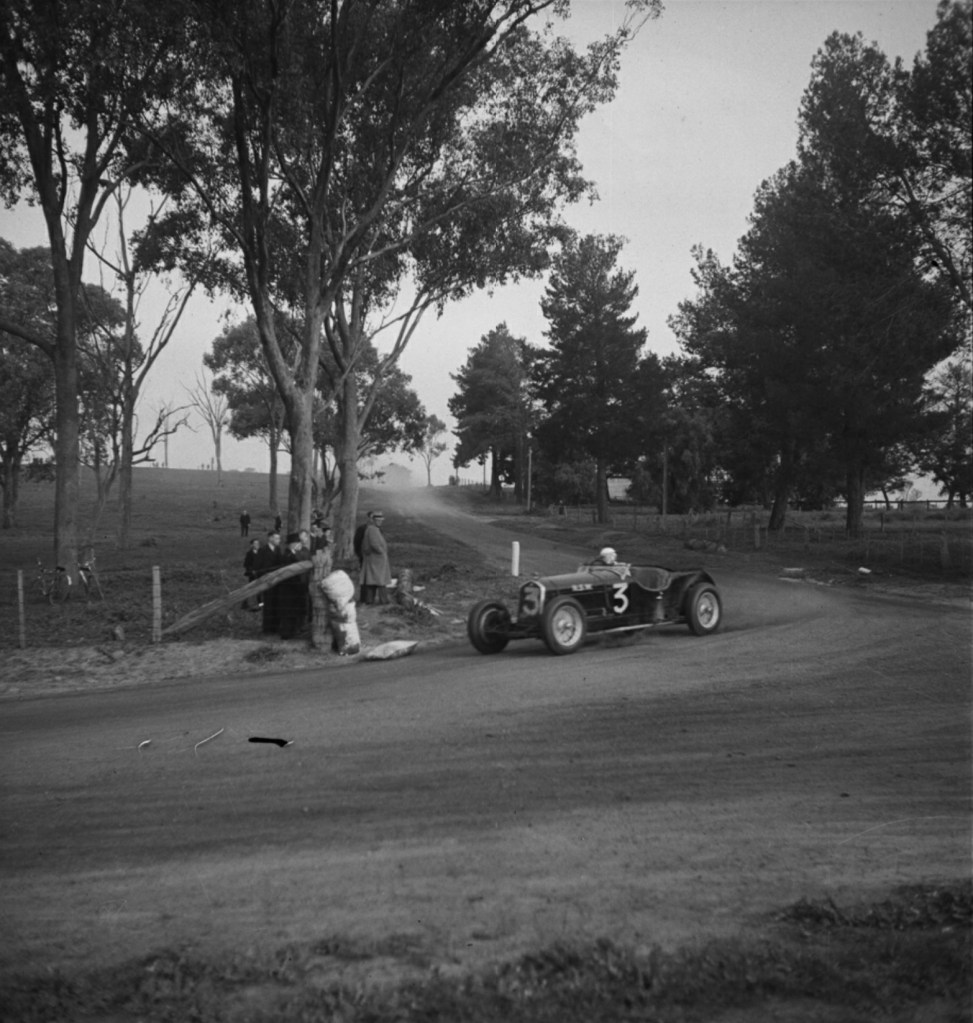
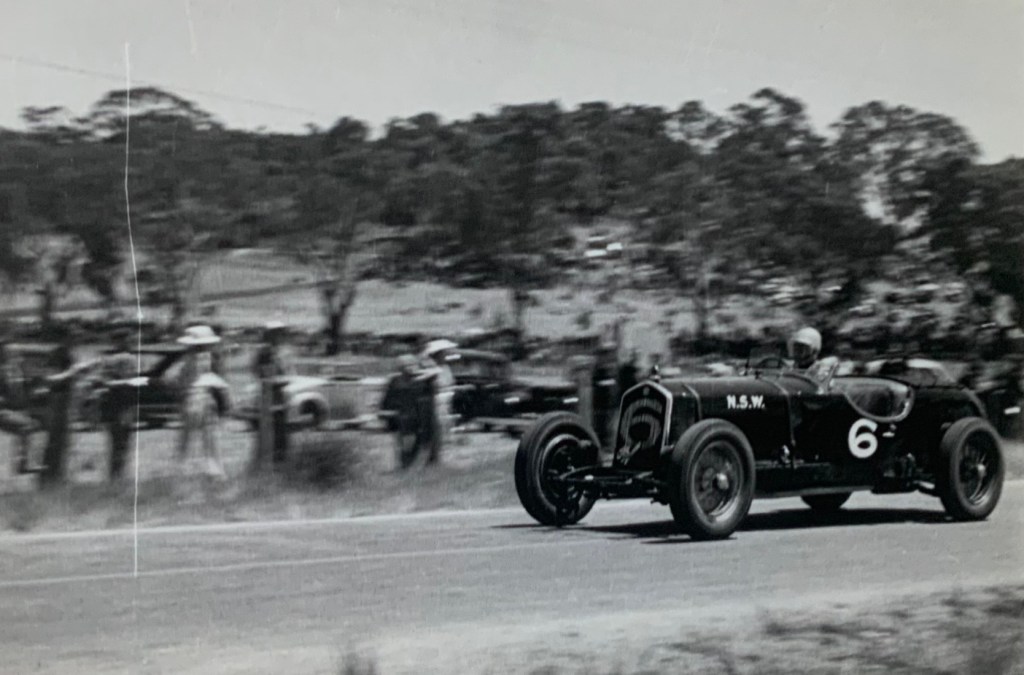
John Crouch plunges downhill on the Albury-Wirlinga road course – ‘on the border’ of Victoria and New South Wales – aboard his Alfa Romeo 8C 2300 Le Mans during the June 12/13, 1939 Albury and Interstate Gold Cup meeting.
Australian racer/entrepreneur John Snow imported this car to Australia in 1938, John Crouch acquired it shortly after it was offloaded in the Port of Sydney.
John Crouch aboard the booming 8C 2300 LM during the 1939 Australian Grand Prix at very fast, undulating Lobethal, South Australia (B King Collection)#2311202 during scrutineering at Le Mans in 1933 (Alfa Romeo Archives via Simon Moore)
8C2300 Le Mans chassis #2311202 was one of nine cars built to this specification, five of these long-wheelbase machines with Touring bodies were built in 1933, ‘our car’ was the second of these and was registered by Alfa Romeo on June 6, 1933 MI43972.
Simon Moore wrote in ‘The Legendary 2.3’ that “We will never be 100% sure, but I think it is really almost certain that this (2311202) was the Chiron (1933) Le Mans car,” raced by Louis Chiron and Franco Cortese …” The car ran amongst the leaders until after dawn, leading on several occasions before Cortese lost control and crashed the car in the Esses after completing 177 laps/2388km; the winning Sommer/Nuvolari 8C 2300 MM covered 3144km.
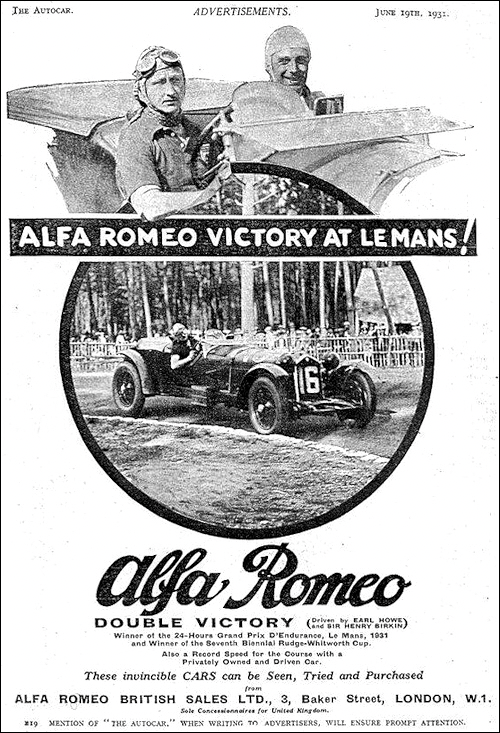
These straight-eight, supercharged, 2336cc, circa 165bhp Alfas are Le Mans royalty, winning the 24-Hour classic four years on the trot: 1931 Lord Howe/Tim Birkin 8C 2300 LM, 1932 Raymond Sommer/ Luigi Chinetti 8C 2300 LM, 1933 Raymond Sommer/Tazio Nuvolari 8C 2300 MM and 1934 Luigi Chinetti/Philippe Etancelin 8C 2300.
2311202 was third in the 1933 Tourist Trophy at Ards in the hands of Tim Rose-Richards and was later owned by Peter Mitchell-Thompson – Lord Selsdon.
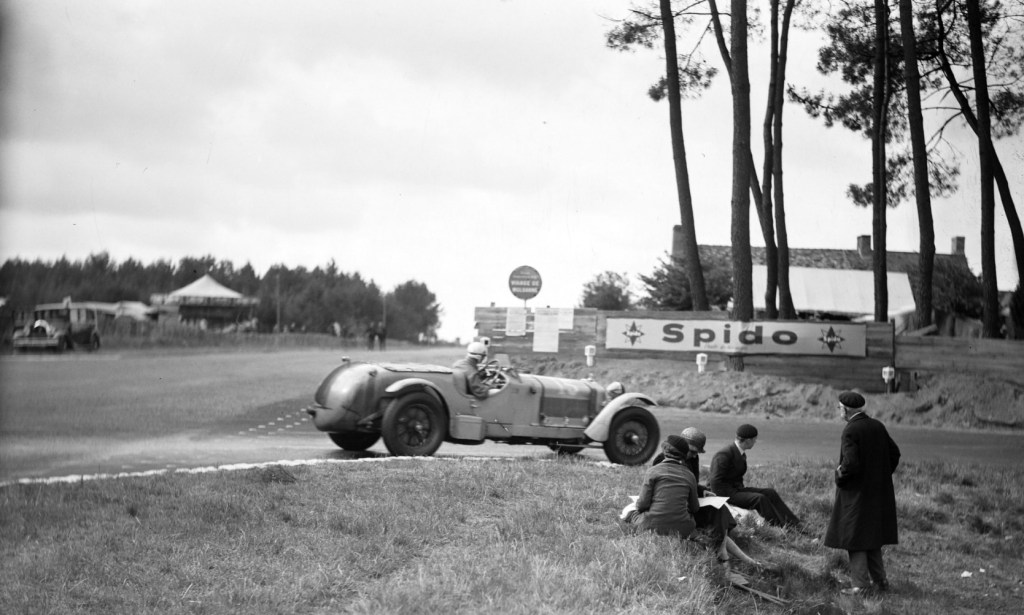
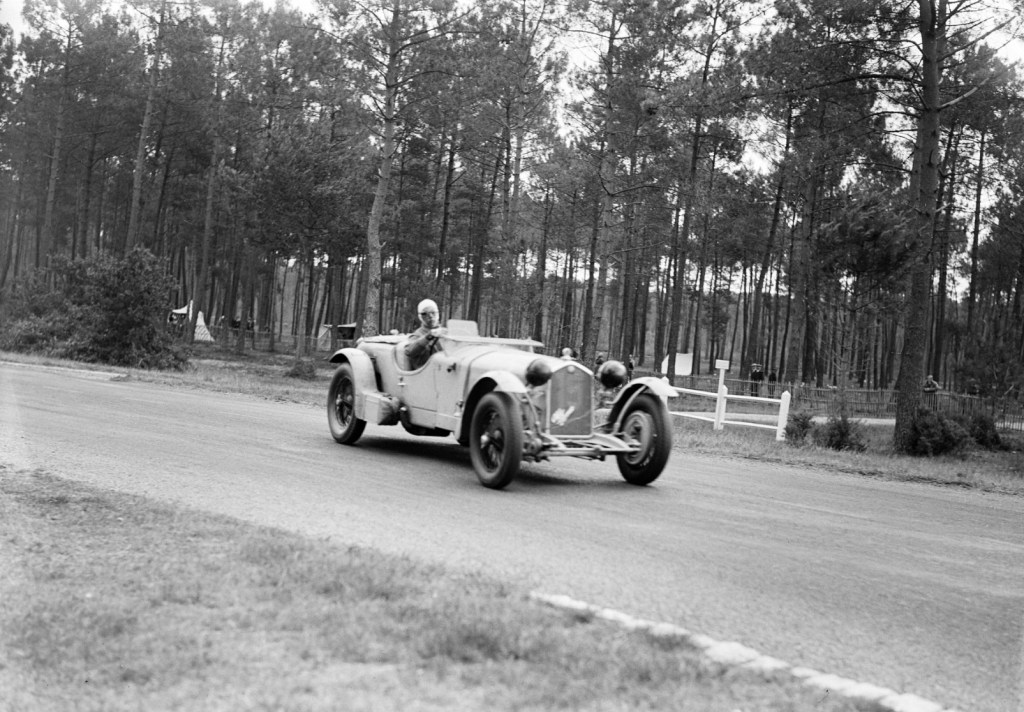
#2311202 at Le Mans in 1933 Louis Chiron/Franco Cortese DNF accident, also shot below (MotorSport)(MotorSport)
John Medley wrote in his ‘John Snow: Classic Motor Racer’ that Aussie racer/entrepreneur Snow brought a large number of cars acquired in Europe to Australia in the immediate pre-war years, single-handedly improving the quality of our grids in the process. This Alfa Romeo was one of them, its shipmates were a Hudson convertible phaeton, 5-litre Bugatti Type 46 sedan and a Delahaye 135CS sports-racer (#47190) for Snow’s own use.
He then shipped the car via coastal steamer to Port Adelaide and entered the 1939 Australian Grand Prix held at Lobethal in the Adelaide Hills on January 2. He was seventh in the race won in celebrated fashion by West Australian, Allan Tomlinson’s MG TA Spl s/c. Most of the big cars had tyre troubles in the extreme heat that day, Crouch had an off or two for this reason. He was a fast driver, but his pace with a still unfamiliar car wasn’t going to win him the race that weekend.
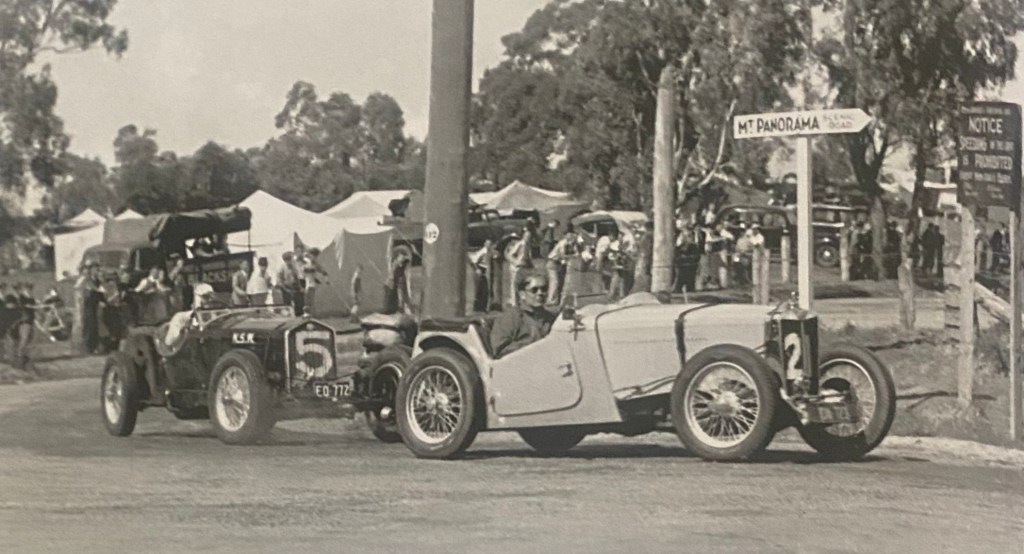
Other strong placings pre-war included fourth in the April 1939 New South Wales GP/150 Miles Road Race at Bathurst, and third fastest in a hillclimb and flying quarter-mile event at Mount Panorama in June. He was seventh in the NSW Road Race at Bathurst in October, a period in which he mixed his road racing with speedway events aboard a 4WD Skirrow.
Into 1940, with events getting a bit skinnier as the War impacted, he was fifth in the 150-miler at Easter Bathurst, and at Albury-Wirlinga in June he was second and again set the fastest time of the race.
While clearly a very potent racing car, John Crouch regularly used it around town (rego’ EO772), having the machine maintained by Jack Saywell and John Snow’s Monza Motors emporium-of-speed in East Sydney.
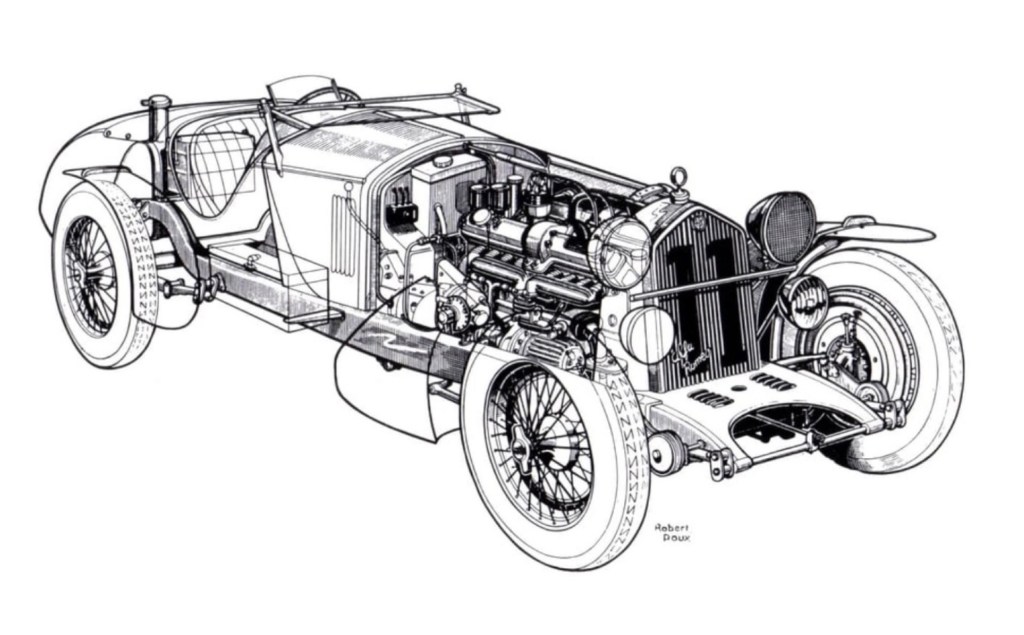
Tom Lancey checks his MG TA’s mirrors before being eaten by John Crouch and passenger and Alfa Romeo 8C 2300 during the 150 mile race at Bathurst during Easter 1939 (Terry McGrath via Simon Moore)Alfa Romeo 8C2300 cutaway (R Roux)Crouch, again at Lobethal in 1939 (B King Collection)
Victorian Colin Scott bought it in 1944 and had it fettled by Alf Barrett’s mechanic, Alan Ashton and his team at AF Hollins & Co in High Street, Armadale. Barrett and his 8C 2300 Monza were the fastest combination in Australia in the immediate pre and post-war periods. Scott was a frequent class winner at Rob Roy hill climb and a regular Vintage Sports Car Club competitor.
In 1949 #2311202 was bought by racer/pilot/dealer John Barraclough who onsold it to Tom Luxton. He raced and hillclimbed it, sometimes using the pseudonym James McEwan; McEwans was the family company, a 140 year old, national, retail hardware-store chain that was ultimately swallowed by Bunnings in the 1990s.
Howard Kiel owned the car next. Simon Moore wrote that Kiel was introduced to Louis Chiron at London’s Swallow Club by Tony Gaze. Chiron confirmed the car was French blue at Le Mans and “remembered it well and exalted its performance.”
Owner impressions are gold, Simon published Kiel’s impressions of the 8C 2300 outlined in an exchange of letters between the pair. “I well remember 2311202 as one of the most beautiful cars to drive. In fact I often drove it to work on the outskirts of Melbourne and raced Tony Gaze back to town many times. Through the streets the car was had to beat and exhilarating to drive. I sold the car when it became apparent it needed a comprehensive restoration.”
The next owner, Tom Roberts took great care of the car between 1958 and 1963 after which it joined the mouth-watering Doug and John Jarvis collection of 8C Alfas in Adelaide.
Australian Alfa Romeo owner/historian David Wright wrote in the February 2023 issue of Alfa Occidentale that “Doug Jarvis was particularly enamoured with this car and drove it at Mallala on several occasions. Following the death of Doug Jarvis, the 8C 2300 Le Mans was used regularly by his son, John, until, in 1975, it was acquired from the Jarvis Estate by Lance Dixon.”
(Reid Family)
Dixon, a successful Melbourne motor dealer and enthusiast reintroduced the car to VSCC events. Here Lance is taking then Prime Minister of Australia, Malcolm Fraser – a very tall bloke for a polly – for some quick laps in the car at a Sandown meeting in 1977.
In 1982 Lance’s restoration team, led by Ian Ruffley, were commissioned to comprehensively rebuild the car in Dixon’s Eltham workshop. The colour reverted to its original French blue, having been red for its entire life in Australia. #2311202 was sold via auction in 1986 to a Dutch enthusiast who continues to actively campaign it.
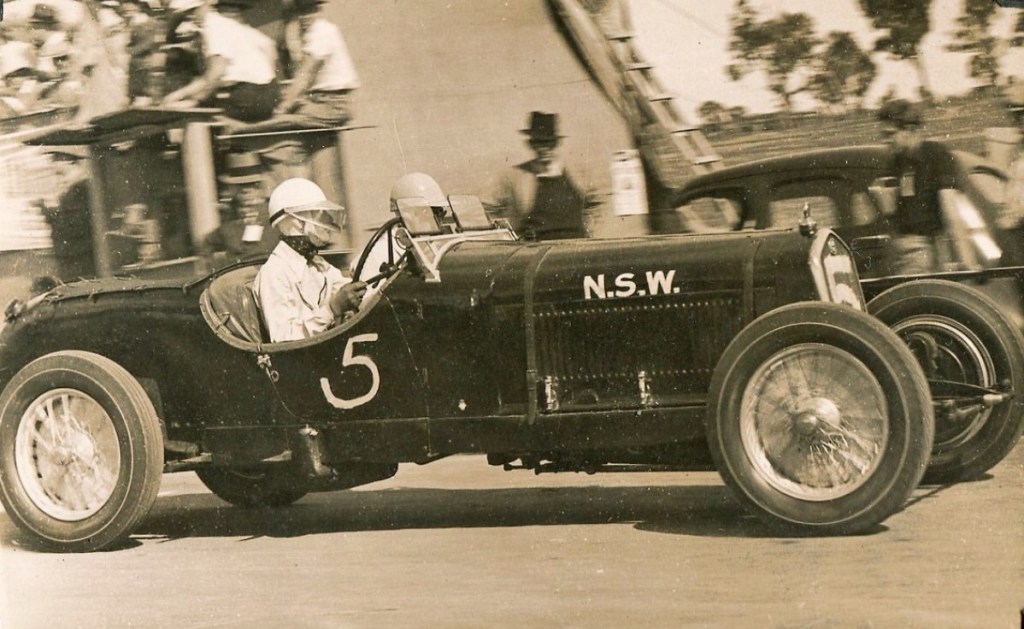
Nice close up profile shot of John Crouch in the 8C 2300 during the Easter 1939 Bathurst 150 meeting. The car lost its best years of racing in Australia thanks to the war, not that #2311202 was alone in that respect, far from it…(F Pearse)
A Driven Man and Driving Force Behind Motor Sports…
Is the title of the late Barry Lake’s obituary of John Crouch – 15/8/1918-30/5/2004 – published in the Sydney Morning Herald on June 17, 2004. Lake was a talented racer, journalist, historian and publisher; his beautifully written tribute is reproduced in full.
In the 1930s John Crouch was widely known as Australia’s youngest racing driver. In 1949 he won the Australian Grand Prix driving a French Delahaye. Even before his retirement from active racing in the mid-1950s, Crouch was heavily involved in the administration of motor sport in this country. By the time he died, at 85, he was recognised by many as the elder statesman of Australian motor sport.
Throughout all of these achievements, Crouch was the consummate gentleman, always immaculately dressed, always driving a late-model performance car (usually Mercedes-Benz in his later years) and always he was polite and softly spoken.
His father, Cecil, had his own new car sales company for 10 years before John was born in 1918, and the elder Crouch dabbled in motor sport when he raced a Metz car at Victoria Park racecourse in Sydney.
After leaving Sydney Church of England Grammar School (Shore), to which he walked every day from the family home in Wollstonecraft, Crouch went to work for his father. So it was hardly surprising he developed a keen interest in cars and motor racing – although his father strongly opposed the latter, having realised it consumed vast amounts of money.
Crouch began racing an MG TA sports car when barely 18. Two years later, he finished fifth in the 1938 Australian Grand Prix at Bathurst. In the late 1930s he drove a wide variety of cars including a supercharged Alvis, a Fronty-Ford, a Skirrow four-wheel drive speedway car, and an ex-Louis Chiron Le Mans Alfa Romeo 8C 2300.
With the Alfa, Crouch set fastest time in the Albury and Interstate Gold Cup races on the Wirlinga road circuit in 1939 and 1940, along with a third place and two fifth places on corrected times in the last three major events held at Bathurst before World War II.
After the war, Crouch left his father to start his own business. “I wanted to buy and sell performance cars but my father was never interested in them,” he once said.
He imported cars from England, including the high-class Bristol and the inexpensive but loads-of-fun Dellow sports car, as well as many new and used examples of exciting sports cars. In 1953 he gained the Australian distributorship for Austin-Healey sports cars, when the local Austin distributors rejected it as a folly. Crouch described it as a bonanza that sold beyond anyone’s wildest expectations.
The grid of the 1947 NSW Championship, Nowra airfield, June 16. #5 Jack Murray Mackellar-Bugatti Ford s/c, then #3 John Crouch Delahaye 135CS, #14 Alec Mildren Ford V8 Spl, #4 Frank Kleinig, Kleinig Hudson Spl and Alf Barrett, Alfa 8C2300 Monza. The handicap race was won by Tom Lancey’s MG TC, Crouch was eighth (J Hunter)
Immediately after World War II Crouch had bought a fast and reliable French Delahaye sports-racing car. It had a fastest race time at Bathurst to its credit, and Crouch scored second-fastest there with it in 1946.
But the one race to win then, as the Bathurst 1000 is today, for Australian drivers was the Australian Grand Prix. In 1948 the event was held at Point Cook in Victoria in blazing heat. The Delahaye scored third-fastest time but the handicap start resulted in his finishing only eighth.
The following year the race went to Queensland, on a wartime airstrip at Leyburn. Also for the first time, it was run from a scratch start, as is the case for today’s major events. Crouch was ready to pounce when the early pacesetter faltered. The blue Delahaye crossed the line a clear winner and John Crouch had achieved his life’s ambition.
In the early 1950s Crouch began to import and sell small, lightweight rear-engine Cooper racing cars. He sold the Delahaye and raced Coopers to promote them. He was ahead of his time. By the end of the decade Coopers were dominating Australian racing as they were the world championship. In Crouch’s time, however, they were fast but unreliable. In 1951, for example, Crouch’s Cooper set fastest race lap in the Australian GP, but retired with mechanical problems. In retrospect, he sold the Delahaye, had he kept it, would have been capable of winning the GP again in 1950 and 1951.
In 1953 Crouch sold a more modern, faster and more reliable Cooper-Bristol to Tom Brabham, for his son, Jack. The latter made his name in that car and went on to win world championships in 1959, 1960 and 1966.
Crouch’s final outings as a driver were in the Redex Round Australia Trials in 1953 and 1954, and the 24-Hour Race at Mount Druitt in 1954. He had planned to race in Europe before quitting the sport, but ran into financial difficulties when he expanded into importing tyres and tractors.
He retired from racing, closed his business and used his remaining resources to buy land and build apartment blocks in suburbs such as Dee Why. “Real estate was going so well at that time,” he said, many years later, “Any idiot could make money out of it.” He was comfortably well-off by the time the bust came in the 1970s – unlike many of his friends, who, he said, “had borrowed to the hilt and lost everything”.
Crouch had been the NSW state councillor for the then newly formed Confederation of Australian Motor Sports in 1953 and continued in various capacities with this organisation for many years, receiving awards for his contributions to motor sport. He also acted as clerk of course at a number of major events.
Crouch had two sons, John and David, with his first wife, Vivian. They eventually divorced, but remained good friends. Crouch’s second wife, Valerie, died in 1995. They had two daughters, Caressa and Penelope.
Crouch was reluctant to marry again, fearing a third would brand him a “womaniser”, but eventually he met June, whose lust for living a full life matched his own. They married and spent much of Crouch’s final few years travelling in South-East Asia and Europe, as well as attending various motor sport functions in Australia as honoured guests. That came to an end when Crouch suffered circulation problems that led to a series of strokes and heart attacks. He died in a hospital in Gosford.
Etcetera…
Sydney Morning Herald June 13, 1939(Motorsport)
Another shot of Louis Chiron or Franco Cortese at Le Mans in 1933 aboard #2311202.
(S Dalton Collection)
Credits…
Max Dupain-SLNSW, ‘John Snow: Classic Motor Racer’ and Bathurst: Cradle of Australian Motor Racing’ by John Medley, ‘The Legendary 2.3’ Simon Moore via the Bob king Collection, Robert Roux, MotorSport Images, Reid Family Collection, John Hunter Collection, Fred Pearse, Sydney Morning Herald – Barry Lake, Stephen Dalton Collection
Poster for the 1934 German Grand Prix at theNurburgring…
It’s famously the race in which Auto Union took their first GP win. Hans Stuck triumphed in the 4.4-litre V16 AU Type A from Luigi Fagioli, Mercedes W25A and Louis Chiron in a Scuderia Ferrari Alfa Romeo Tipo B/P3.
(SSPL)
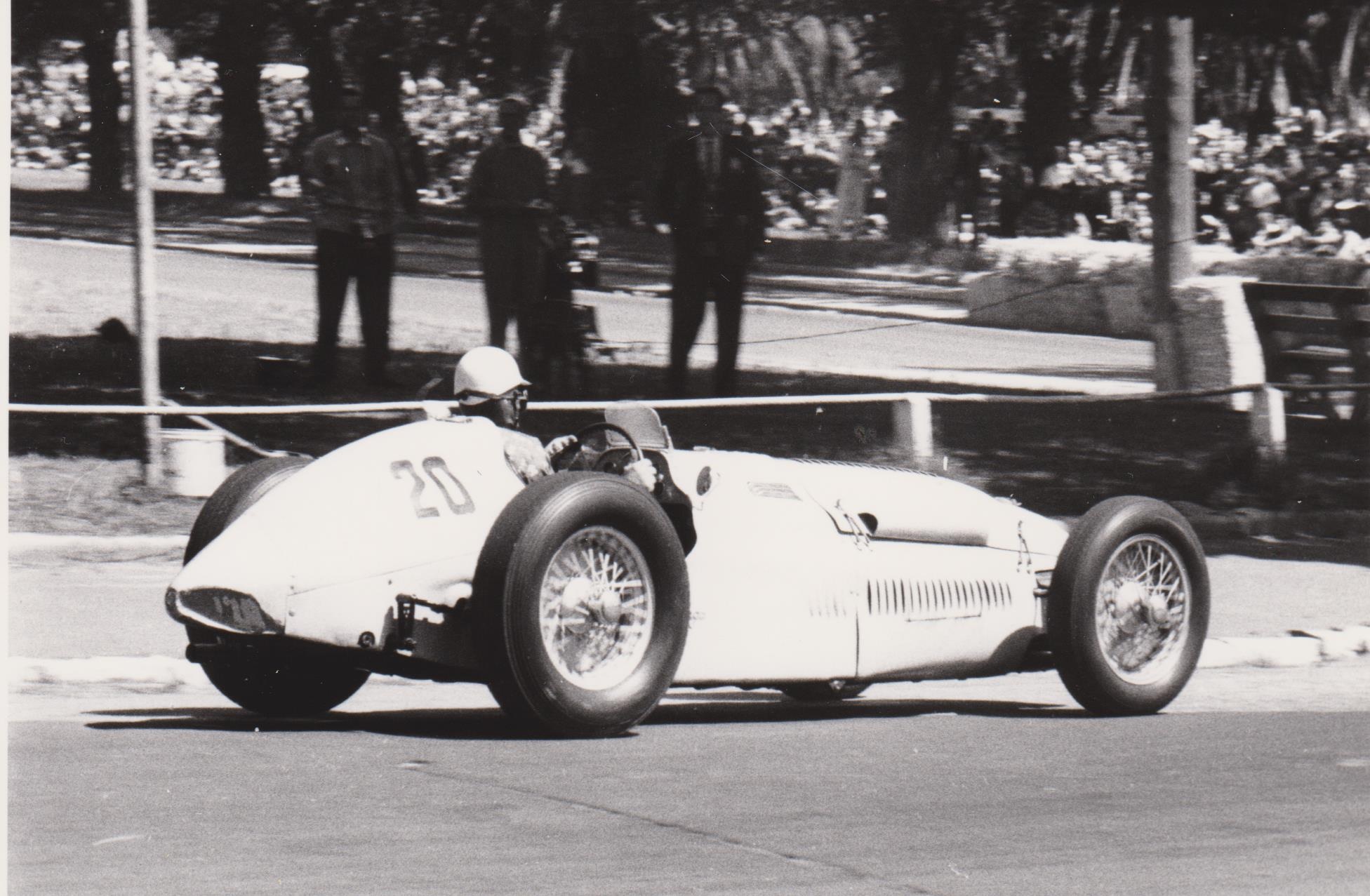
Grid before the off. #6 is the Rudy Caracciola MB W25A, #20 Goffredo Zehender Maserati 8CM, #1 Hans Stuck AU Type A. Alongside him is the Ulrich Maag Alfa Monza, #9 Luigi Fagioli MB W25A and beside him Laszlo Hartmann’s Bugatti T51, the AU on the row behind Fagioli is August Mombergers, #3 is the Ernst-Gunther Burgaller AU Type A, Hans Ruesch in the middle, Maserati 8CM, and #15 is the Luigi Soffietti Alfa Monza.
(SSPL)
All the fun of the fair. The Nurburgring paddock with only Louis Chiron’s Scuderia Ferrari Alfa Tipo B/P3 in the Eifel Mountains breeze
(Imagno)
Pitstop for Stuck’s winning Auto Union Type A, vents and ducts all over, note the torsion bar IFS, swing-axle at rear.
The race was important to the German teams, keen to avenge their defeat at the French Grand Prix, Montlhery on 1 July, where Louis Chiron won in a reliable Alfa Tipo B. The Silver Cars dominated at the Nurburgring where the Alfas and Maseratis were also-rans.
The race was also important for Caracciola’s return to form after his Monaco accident the previous year, and subsequent death of his wife in a skiing accident. His form was confirmed with a forceful drive which ended in retirement. Quick at Montlhery on 1 July – Rudy’s comeback drive after 14 months out of the seat – he showed he was on-it at the Nurburgring.
(Imagno)
Rudy Caracciola and Alfred Neubauer before the off, Caratch was back with a vengeance despite needing help getting in and out of the car. Once ensconced he was mighty fast
(SSPL)
#22 Battilana Alfa Monza, #20 Zehender Maserati 8CM, #6 Caracciola MB W25A, #12 Maag Alfa Monza, #1 Stuck AU Type A, #11 Hartmann Bugatti T51, #9 Fagioli MB W25A then the Momberger and Burgaller AU Type A’s.
(SSPL)
Fagioli’s Benz W25A, #2 Momberger’s AU and #15 Soffietti’s Alfa before the off. Fagioli was drafted into the team in the event Caracciola was not up to snuff after his convalescence. Luigi knew he had a fight on his hands within the team as Rudy was quick from his Montlhery return.
Stuck’s Auto Union lead early from Caratch’s Mercedes W25A and raced hard, breaking the lap record several times ahead of Fagioli Mercedes, Chiron Alfa P3, Moll Alfa P3 and Nuvolari Maserati 8CM. Rudy snuck past Stuck at the Karussell on lap 13 but the Benz’ eight-cylinder engine failed and he soon retired. Stuck regained the lead, the order was as above except that Momberger replaced Moll in the gaggle.
The supercharged 3.4-litre straight-eight of Caracciola’s Mercedes W25A being fettled, plug change perhaps, before the off (SSPL)
Stuck on the left getting plenty of attention in the pits, Caracciola on the right (SSPL)
With four laps to go Stuck was concerned about his engine water temperature and signalled as such to his team, who waved him on, only to be told after the race that the team had changed the gauges. What he was reading was oil not water temperature!
Stuck and Auto Union took a great win, Auto Union’s first GP victory from Fagioli, Mercedes Chiron’s Alfa and Nuvolari in a Maserati 8CM but Caracciola was the star of the show and back with a vengeance!
(Imagno)
Hans Stuck is a very happy chappy, after 4 hours and 38 minutes of hard work he won the race. Plenty of uniforms around in these shots even in 1934.
Credits…
Kolumbus.f1, Imagno, Science and Society Picture Library, Tony Turner
Etcetera…
(T Turner)
After this article was first posted, my friend Tony Turner sent me these two marvellous photographs and this note.
“Back in 2016 I went for a holiday in Germany. It was only when I went for a stroll around our temporary base in Remagen that I realised that I was in the birthplace of Caratch – the street sign was a definite clue, the sculpture in a little park nearby definite confirmation. I suspect it features the later W125 rather than the 1934 W25. It seems his grandfather (?) founded a big hotel there, which was taken over by successive generations, so the name’s still quite well respected in the town.”
(T Turner)
Tailpiece…
(SSPL)
Momberger and Burgaller shared this Auto Union Type A, DNF after completing 20 laps. Auguste Momberger is alongside the cockpit.
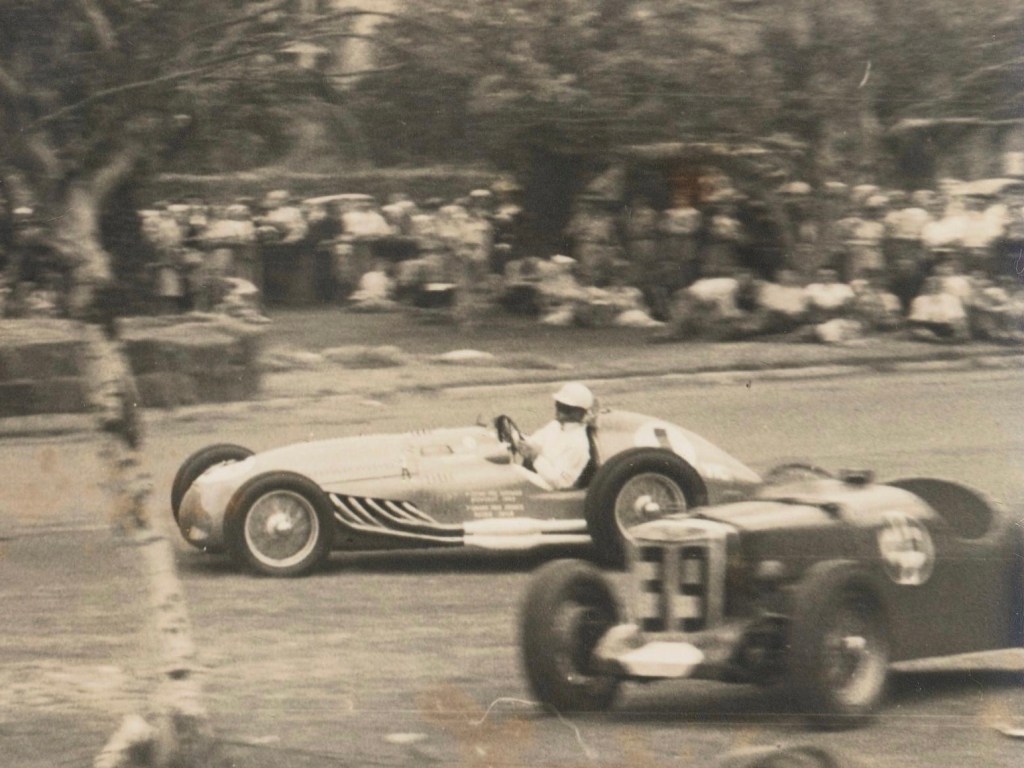
Doug Whiteford is as pleased-as-punch after winning the 1953 Australian Grand Prix at Albert Park aboard his self-prepared Talbot Lago T26C (Course).
It was too good to be true, he had won his second AGP at Bathurst 17 months before aboard the same machine. He took victory in the 250 miler in the park from Curley Brydon’s MG TC Spl s/c and Andy Brown’s MG K3. The dude with the fag at the far-left is Bill Wilcox who retired his Ford V8 Spl after 37 of the 64 laps.
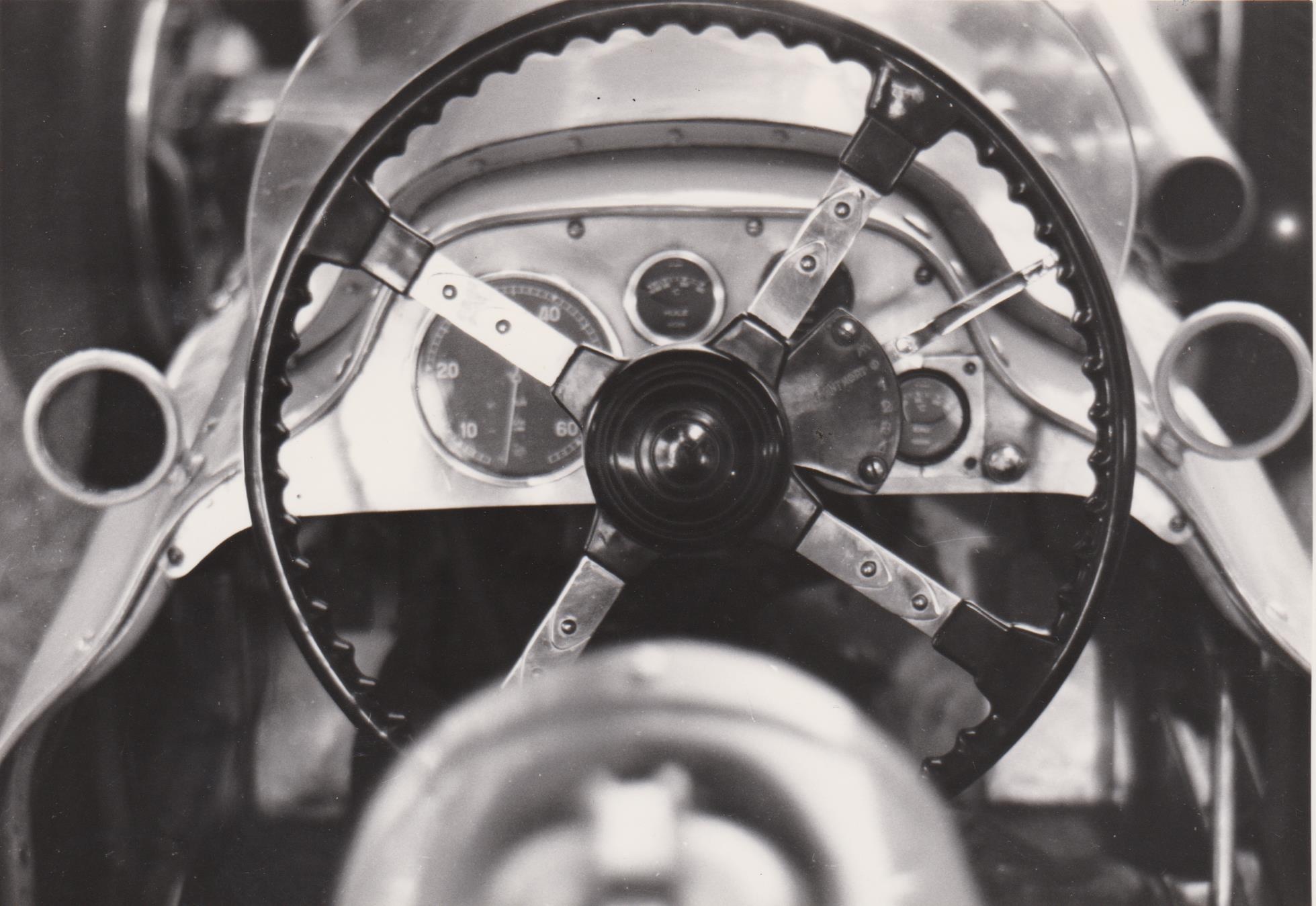
The photograph is so sharp you can see the instruments, quadrant for the four-speed Wilson pre-selector gearbox, chassis plate and front suspension.
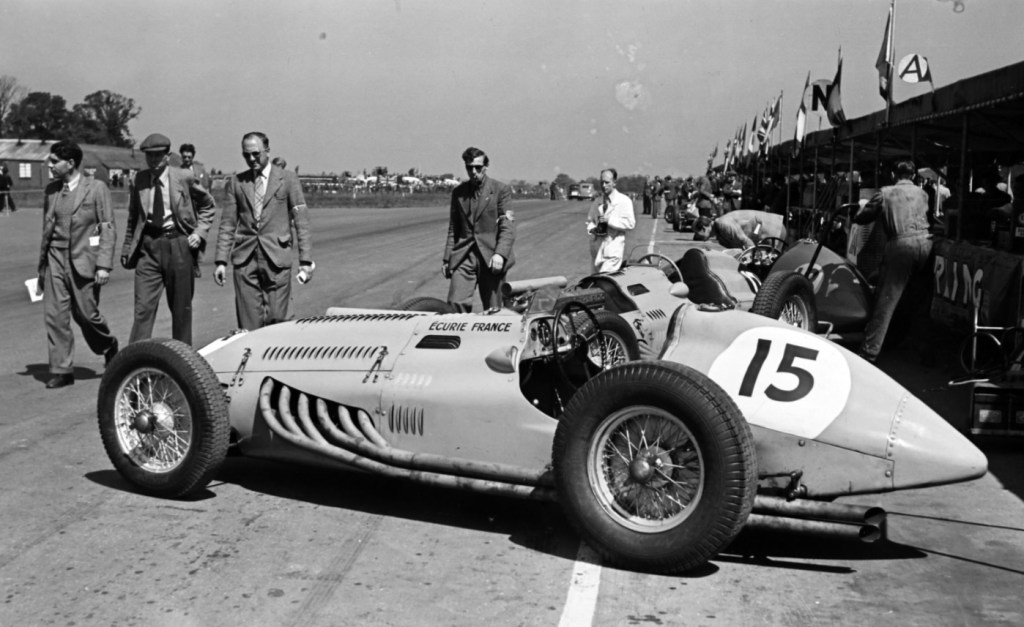
#110007 was part of Paul Vallee’s Ecurie France team between 1948-1950 before being sold, via Henry and Peter Dale, to Geelong’s Tom Hawkes in 1950 and shortly thereafter to Whiteford. See Bob King’s article on the Dales and their contribution to the number of European racers which came to Australia; ‘Words from Werrangourt’ 1, by Bob King… | primotipo…
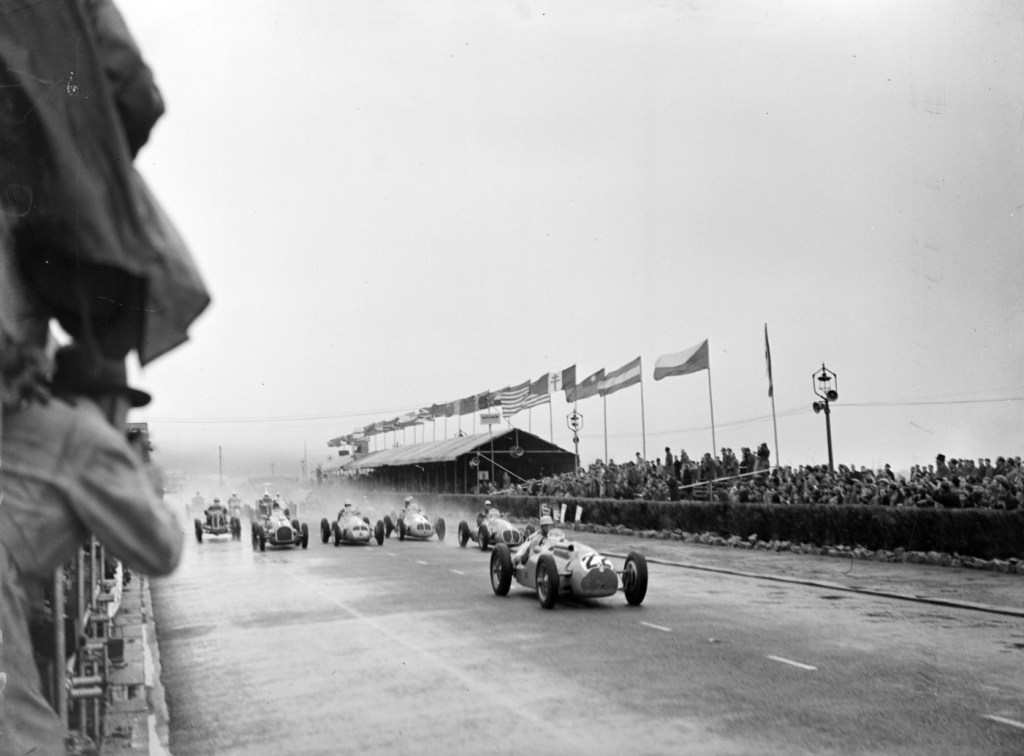
Louis Chiron jumps away from the rest of the field at the start of the April 1949 Jersey Road Race at St Helier aboard 110007. From the left, Raymond Mays’ ERA B-Type, Peter Whitehead’s Ferrari 125, and the Maserati 4CLT-48s of Gigi Villoresi, Bira and Emmanuel de Graffenried. Gerard won from De Graffenried and Mays Chiron DNF brakes (MotorSport)110007 in the Silverstone pitlane during the July 1949 British GP meeting. Q15 and DNF universal joint for Chiron, up front De Graffenreid’s Maser 4CLT-48 won from Bob Gerard’s ERA B-Type and Louis Rosier’s T26C (MotorSport)
Strong results for 110007 before coming to Australia was Louis Chiron’s 1949 French GP victory and Harry Schell’s second place at the Coupe du Salon at Montlhery that October.
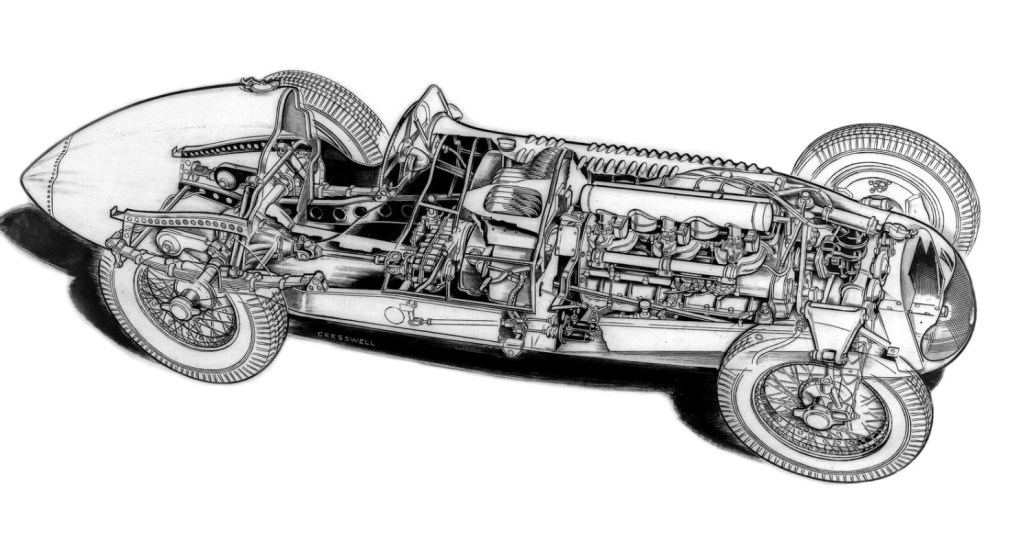
The car had chassis rails derived directly from Talbot sports car pattern. Front independent suspension was by lower transverse leaf spring and upper pressed steel rockers while at the rear a simple rigid axle was suspended by semi-elliptic leaf springs. Friction and hydraulic shocks were fitted as were Bendix cable operated brakes. A Wilson pre-selector gearbox was used.
The arrival of this modern straight-six cylinder 4482cc, 210bhp @ 4500rpm triple Zenith/Stromberg fed F1 car (4.5-litres unsupercharged, 1.5-litres supercharged) heralded the need for topline Australian competitors to have cars capable of outright wins as the sport evolved away from handicap events in our premier class.
Doug Whiteford passes the abandoned Jack O’Dea MG Spl aboard 110007 during his victorious ’53 AGP run at Albert Park (The Age)1949 Talbot Lago T26C cutaway by Leslie Cresswell
Technical Specifications…
The head and block of Walter Vecchia’s 4482cc six were of aluminium alloy. The engine was considerably undersquare with a bore/stroke of 93x110mm. Its two camshafts were located halfway up the block with short pushrods operating two valves per cylinder, the cost-effective design had some of the advantages of a more traditional twin-cam layout.
It produced circa 240bhp @ 4700rpm in the early stages of development, rising to 280bhp @ 5000rpm in 1950 when fitted with a twin-plug, twin-magneto cylinder head.
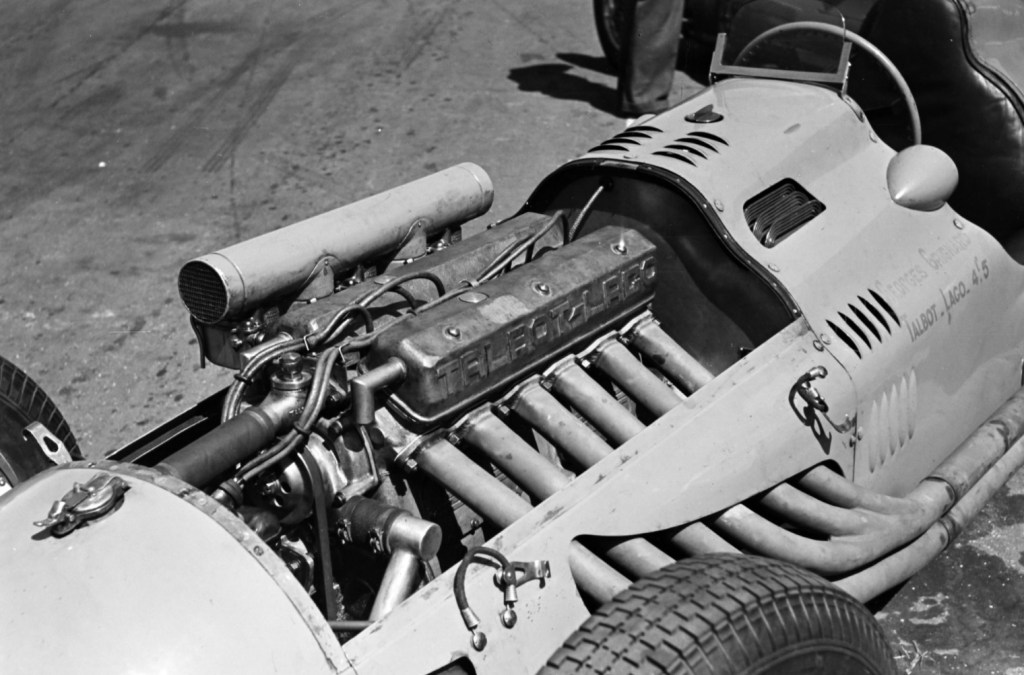
Carburation was by triple downdraught Zenith-Strombergs with two rocker covers proclaiming the name Talbot-Lago. A Scintilla magneto provided the spark, initially to one centrally located plug per cylinder.
Engine shot of Yves Giraud-Cabantous T26C #110006 in the 1949 Silverstone paddock. That motor swallowed a piston after 39 of the 100 laps (MotorSport)
A Wilson preselector gearbox was used, while heavy it was reliable and favoured by the drivers. The prop-shaft was offset to the right to allow a low seating position.
Front independent suspension incorporated top rockers, a lower transverse leaf spring and friction shock absorbers. The rear axle was suspended by good old fashioned semi-elliptic leaf springs, funds didn’t allow development of an independent design; the T26 was the last GP car to use semi-elliptic cart-springs.
Chiron watches while his car is readied at Silverstone in 1949 (MotorSport)
Credits…
The Age/Fairfax Archive, Peter Valentine’s Old Melbourne Town FB page, oldracingcars.com, Leslie Cresswell, Adam Gawliczek
Tailpieces…
(MotorSport)
A swarm of Talbot Lago T26Cs during the 1949 British GP.
‘Our’ 110007 in Chiron’s hands is at left, #17 is Yves Giraud-Cabantous machine (110006), DNF piston and Louis Rosier’s third placed machine #110001 at right.
In mid 1954 Whiteford sold the car after updating to the twin-plug headed T26C #110003. The car was raced by Rex Taylor, Ken Richardson, Owen Bailey and Barry Collerson in-period before becoming a historic racer. Bernard Charles Ecclestone has owned it since the early 1980s.
Whiteford heading up Mount Panorama on the way to victory in the 1952 AGP
On South Wharf, Port Melbourne, January 1951. Type 35 Bugatti, GP Lago Talbot and 4CL Maserati (Bob King)
This whole online caper is interesting not least for the people you meet in the virtual world and as a consequence subsequently in the real one.
Greg Smith is one such fellow, he is a well known Melbourne racer/engineer/restorer who wrote an article for us a while back. We were discussing some arcane topic online the other week which led to an invitation to one of Smithy’s wonderful Wednesday night feasts in honour of the late Italian/Australian hotelier/racer/raconteur Lou Molina- who looks down on proceedings from the wall with approval at Greg’s execution of some of Lou’s Italian dishes.
There were some fine car/racing identities there on the night including Perth boy Rod Quinn, and locals Ron McCallum, David Ogg and Bob King. Since then Bob and I have joined the Automotive Historians Australia Inc (many of you would be interested in this several years old group, a topic for another time) and the two day AHA conference gave me the chance to twist Bob’s arm into contributing an occasional article or two.
Bob King hustling the Anzani Bugatti around the Adelaide GP road circuit (Bob King)
He is a retired medical practitioner who has had a lifetime interest in vintage and racing cars and Bugattis- his particular passion. As well as racing and rallying these cars, he has maintained a deep interest in their history which culminated in the publication of three books on Australian (and New Zealand) Bugattis as well as one on the Brescia Bugatti. Bob has had historical articles published in many journals. He continues to enjoy restoring and driving his small collection of a Bebe Peugeot, Bugatti T35B and an AC Ace.
Bob is a wonderful, knowledgeable chap, its great to have him involved, his first ‘Words from Werrangourt’ piece is titled-
‘The Dale brothers, importers of important cars- Part 1’
Anyone who is fortunate enough to have old copies of Australian Motor Sport (January 1946 to April 1971) will be aware of wordy advertisements for exotic cars imported by the Dale brothers: Peter Durham Dale and Henry K H Dale. Their origins are something of a mystery, but it is thought they had some Egyptian ancestry mixed with more recent English blood – Henry may have been born in England.
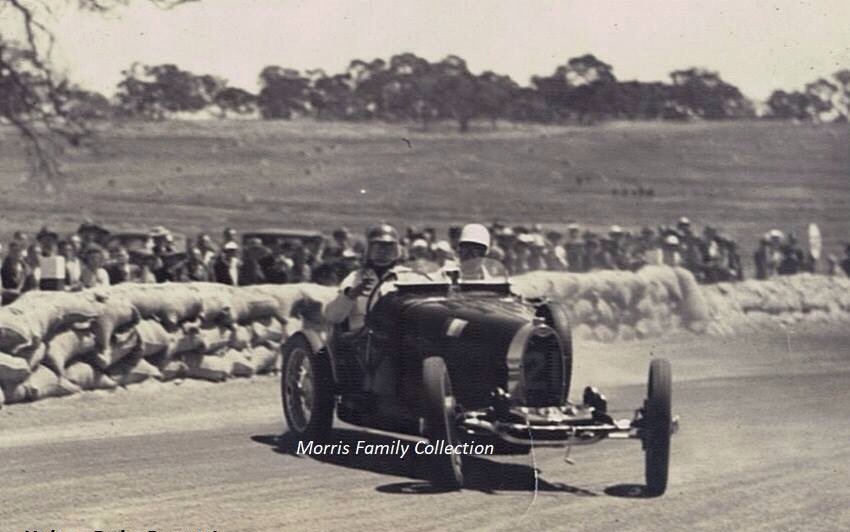
Dale brothers on the 1936 AGP grid at Victor Harbor in December 1936, Bugatti T37A. Henry driving, Peter alongside- DNF after 9 laps in the race won by the Les Murphy MG P Type (Bob King)
Dale boys during the Victor Harbor race, I wonder if he caught it! (Morris Family)
They are recalled as two rather pompous single men who lived the life of gentlemen in a terrace house in Williams Road, Toorak in Melbourne. Well remembered is a large round ‘coffee’ table in the drawing room on which was displayed the latest copy of every motoring magazine. The garage on the side street was opened to reveal the latest, newly acquired exotica. Peter, known as ‘Durham’ had some mundane job with an insurance company as well as being a journalist on the ‘Truth’ newspaper; he wrote a three part history of the pre-war Australian Grand Prix in AMS, which piqued the interest of the writer in these races. Henry, christened Hylton, was usually engaged in the wool trade in Egypt.
The writer’s earliest memory of Peter was at Fisherman’s Bend car races in the late 1950’s. A friend and I were gazing in awe at Miles Ryan’s 100mph Low Chassis Invicta. I commented to said friend that the radiator badge was not straight. We were addressed in a stentorious tone by one whom were later told was Peter Dale: “That is how you know it is handmade” – a lesson well learnt. We do not have a chronology of cars imported by the Dales, but let us start with three on a wharf.
Peter Dale in ‘37160’ with its unusual ‘Touriste’ body by Jarvis of Wimbledon (Bob King)
The Bugatti 35A is not an ‘A’, but a 1925 Molsheim works racing Type 35, chassis no. 4575.
It was Jules Goux’s 2 litre car for the French and Spanish Grands Prix of that year. The French GP was a 1000km race held in torrential rain over 9 1/2 hours. The Bugatti team finished intact with Goux in fifth place. What endurance.
Henry spotted its radiator in the back of a garage in Neuilly-Sur-Seine in about 1950 and bought it for about $150. Although it had not been run since before the war, he had the oil changed and then undertook a delightful Autumnal drive to Marseille, from where the car was shipped to Adelaide.
Fisherman’s Bend Races – don’t be fooled by the blower blow off hole in the bonnet, Herb Ford had swapped bonnets with his supercharged Type 37A, ‘37332’. (Dino Lanzi)
Peter collected it, had it registered by Bob Burnett-Read who actually substituted a Ford Prefect from his used car lot for the Bugatti – the weigh bridge man seemed satisfied with this. The car was driven by Peter to Melbourne and from there to Bathurst for the Easter races where it performed creditably in the hands of Lyndon Duckett and Peter Dale.
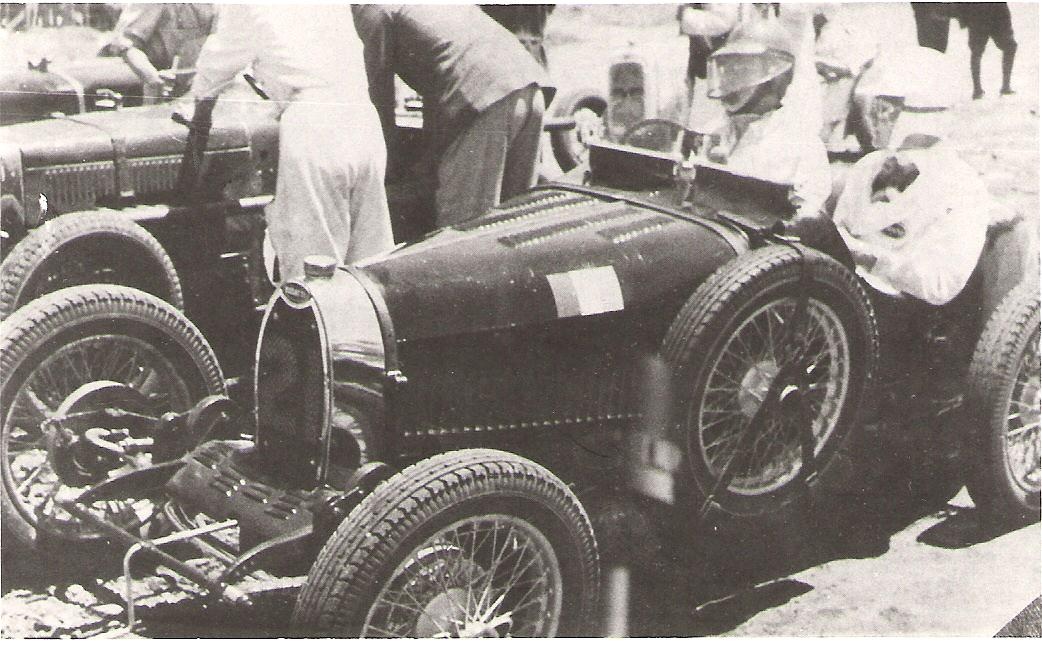
They had driven there in a convoy of 4 Bugattis – the Type 35, the Anzani Bugatti, a Type 51A and a Type 57C – Dales ‘Ecurie Pur Sang’. The next owner of the 35 was Bugatti enthusiast Herb Ford who sold it on when it emitted expensive noises from its roller bearing crankshaft. In the words of Peter, it was ‘a mass of fatigued stresses’.
Some more photos of Bugatti Type 35 ‘4575’…
(P-Y Laugier)
This photograph above is thought to be M Poret in the car pre-war, he was a Parisian owner.
(B Burnett-Read)
This photograph was taken shortly after arrival in Australia. Bob Burnett-Read has just had the car registered prior to Peter Dale’s drive from Adelaide to Melbourne.
(Bob King)
Herb Ford only used the car once or twice, including a sprint on or near the Geelong Road (accounts vary). It is said he made the fastest 1/4 mile time- finishing at astronomical revs in third, maybe this is why the engine was making unpleasant noises.
He sold the tired car to John Martin who did not keep it long enough to dismantle the complicated built-up roller bearing crank before passing it on to John Thomson. Here it is with Martin- note the ill-fitting bonnet from the 37A- when adding a supercharger to an unblown GP Bug, the steering box is moved up and back, to make space. Hence the steering drop arm being in the wrong place.
(unattributed)
The next owner, John Thomson had the good fortune to be friendly with Bugatti expert Peter Menere, at his Brighton ‘Pier Prestige Garage’.
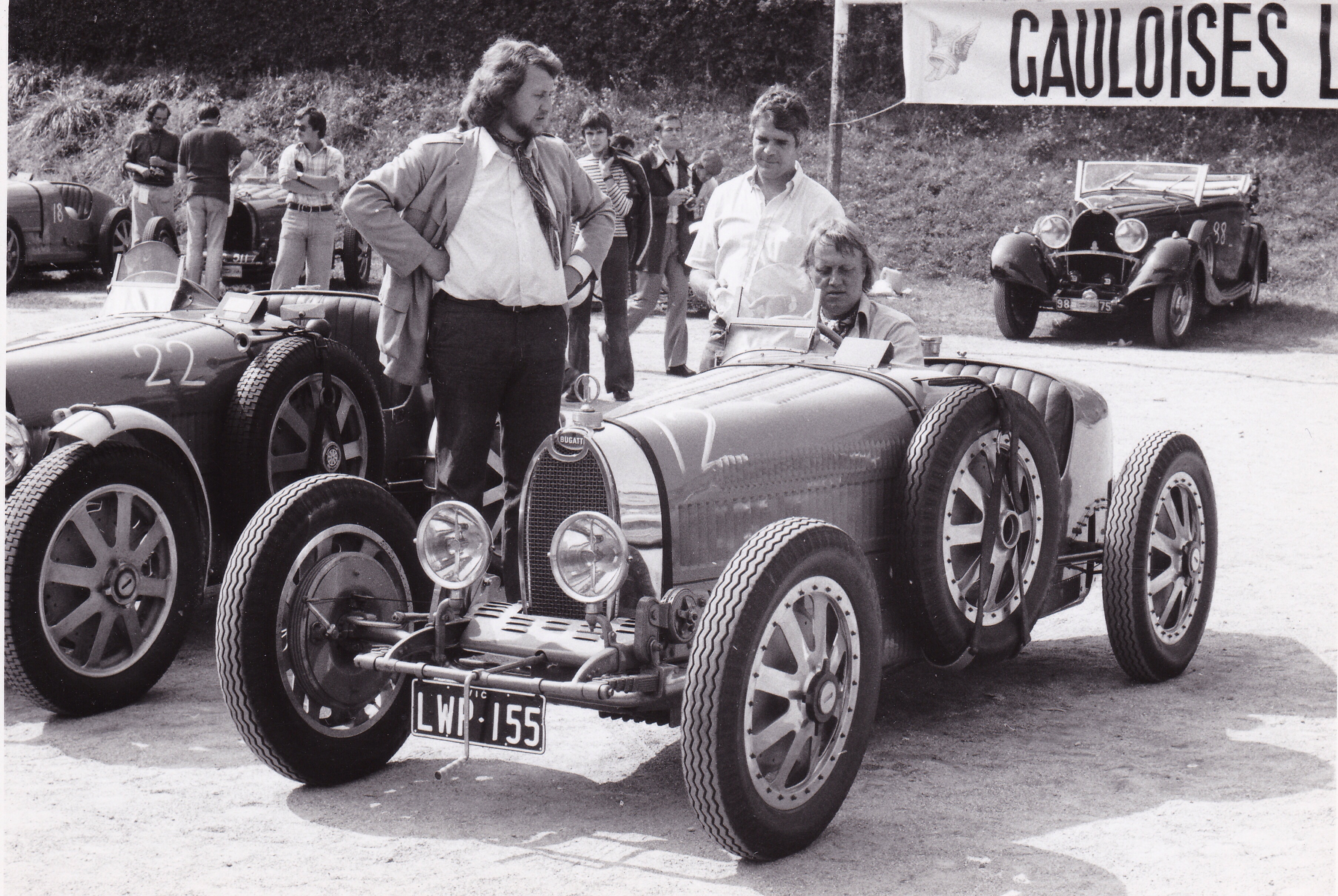
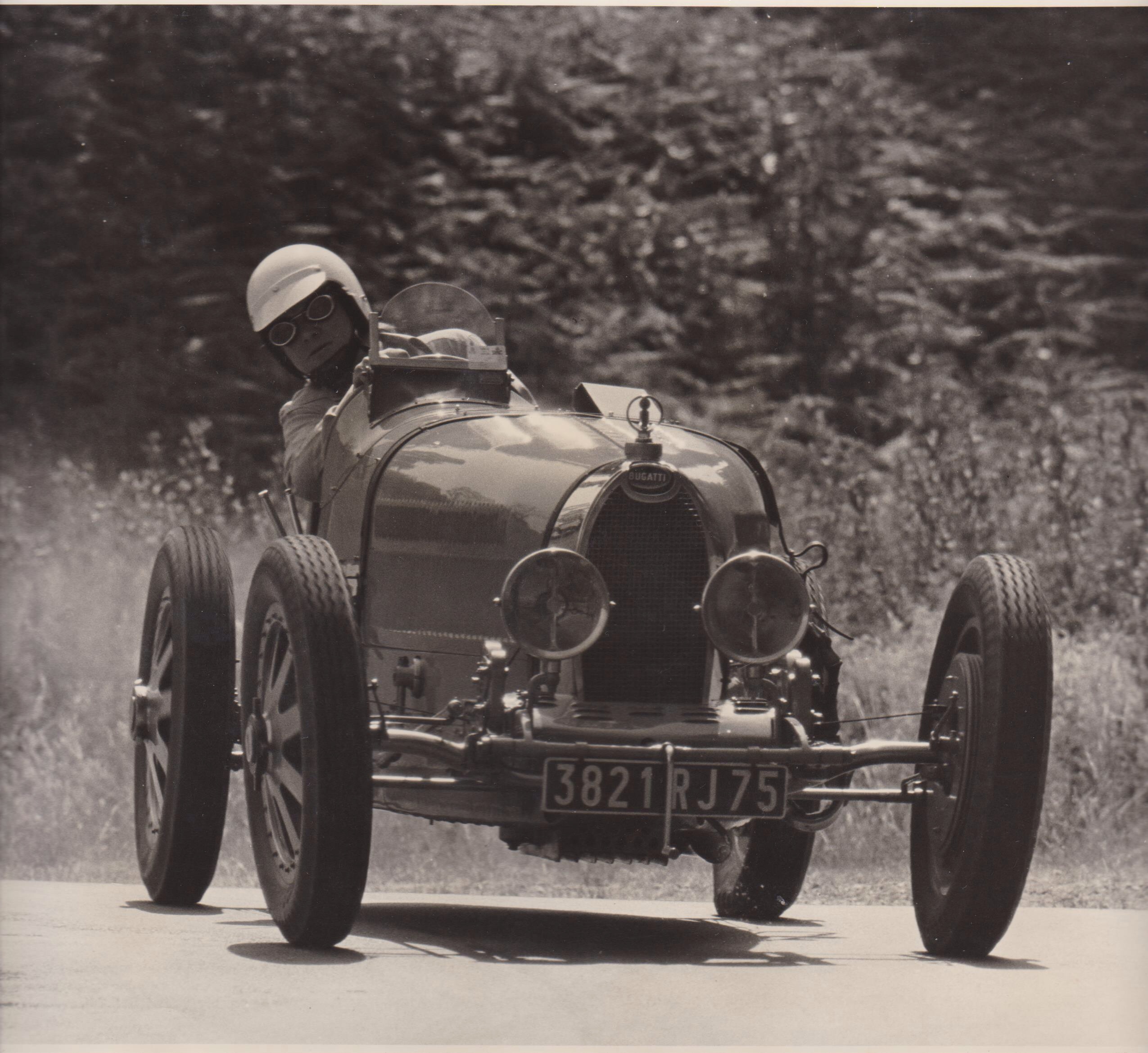
John was dead keen to have a GP Bug, and after prolonged and unsuccessful haggling with Ford, he eventually bought the dismantled car from Martin for an astromonical 870 pounds, the Brighton Buggattisti thought he was mad. After spending a further 700 pounds with Moore Hydraulics getting the crankshaft ground, and untold hours toiling over the rest of the car, he eventually had a going car- an original, unmolested factory racing car, no less. Not long after completing the car in the mid-sixties John moved to London, the car following him in 1972. In 1974 50 years of the Grand Prix Bugatti was celebrated in Lyon with an amazing turn-up of Grand Prix Bugattis. John is seen in the car on that occasion.
(unattributed)
On the starting line at Limonest Hillclimb, Lyon.
A great action shot of John on Prescott Hillclimb- the hillclimb owned and run by the Bugatti Owners Club (unattributed)
A well known photo of the Talbot-Lago ‘110007’ below but worth seeing again. Doug Whiteford AGP, Albert Park, 21 November 1953 – ‘Yes Doug, your tyre is missing’.
Lago Talbot GP chassis no. 110007 was the car with which Louis Chiron had won the 1949 French Grand Prix. Henry was contemplating purchasing Raymond Sommer’s Lago, but was advised by Chiron to speak to Paul Vallee, patron of Ecurie France, as he might sell Chiron’s car which was being prepared for the Barcelona Grand Prix. It was entrained to Marseille and thence to Adelaide.
Its first owner in Australia was Tom (Happy) Hawkes who only drove it once or twice. Its serious debut was at the 1951 Easter Bathurst meeting, 1951; Hawkes drove it to third in the Bathurst 100 and Whiteford was third in another scratch race, setting a new lap record of 3 minutes.
The ‘Maestro’ Whiteford won the 1952 GP at Bathurst and the 1953 race at Albert Park, in spite of the tyre issue.
Here the car is pictured below during the December 1956 Australian Grand Prix weekend at Albert Park, by then the ‘6 plug’ chassis ‘110007’ was owned by Owen Bailey, whose race was shortlived with axle failure on the line.
(S Wills)
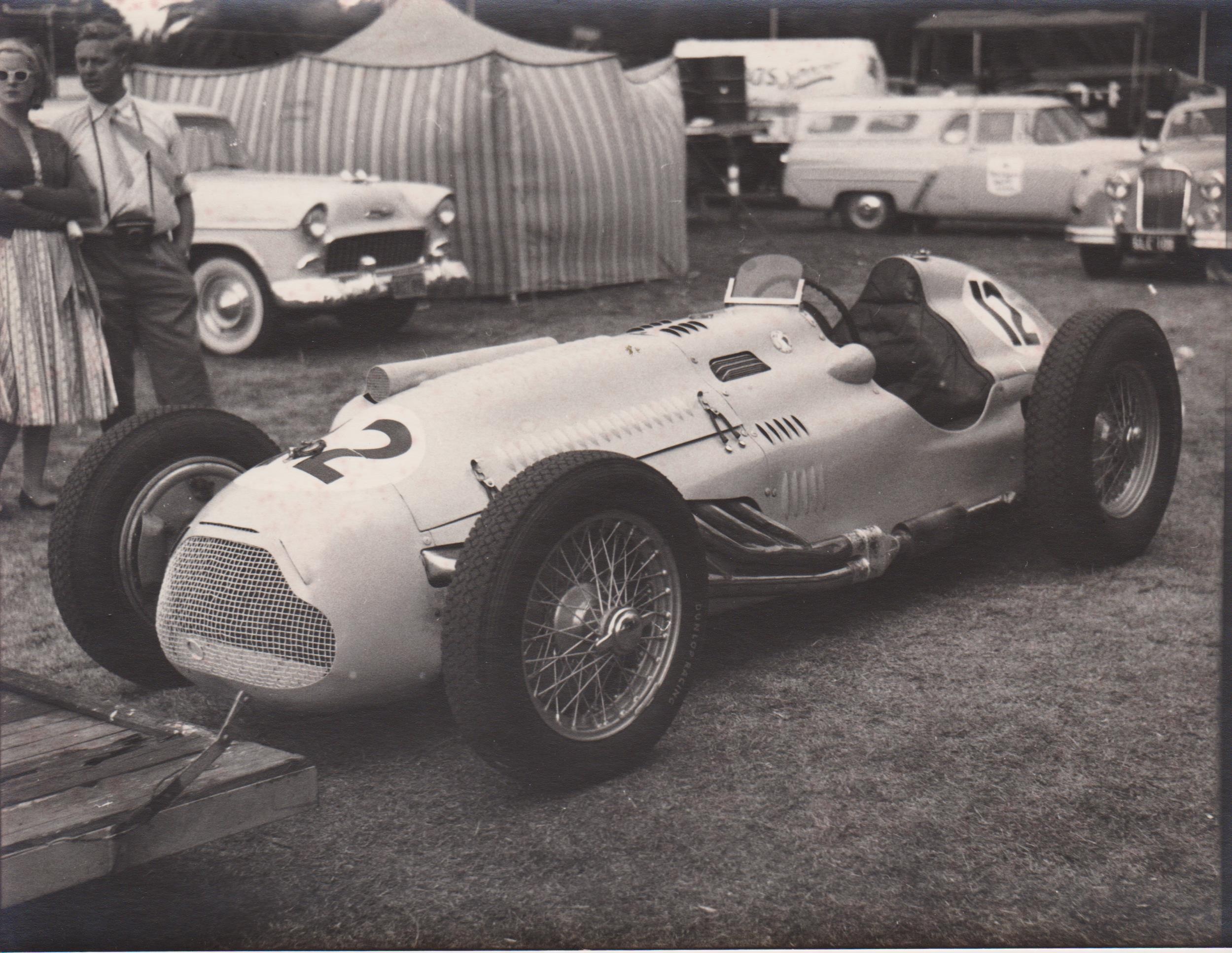
AGP Albert Park paddock with the ‘6 plug’ Bailey ‘110007’ in front of the car Doug Whitford replaced it with- an earlier car, chassis ‘110002’ but to more advanced specification inclusive of more powerful ’12 plug’ 4.5 litre motor. Stirling Moss won the feature race aboard a Maserati 250F.
(S Wills)
Beautiful shot of ‘Dicer Doug’ Whiteford with Peter Dale during the 1956 AGP carnival. Car is Talbot-Lago ‘110002’. It would be interesting to know how many AGP’s in total the various cars the Dales imported over the years contested.
(S Wills)
Cockpit below is ’12 plug’, ‘110002’, Spencer Wills photograph again taken in the Albert Park paddock. Quadrant for the pre-selector gearbox clear.
(S Wills)
Photo below of Owen Bailey at Albert Park, am intrigued to know which meeting. It appears he has spun into a gutter, or been rammed from behind.- the shape of the dent suggests the former.
(S Wills)
Shot below is of Whiteford in the ’12 plug’ ‘110002’ at Fishermans Bend on 12 February 1956.
(S Wills)
(unattributed)
‘The Maserati 4CL, chassis No. 1579 is first recognised as Raymond Sommer’s 1946 Marseilles Grand Prix winning car.
In the photo above Sommer is being led by Tazio Nuvolari in another 4CL during the second heat. Sommer won both this 15 lap heat and 35 lap final, the great Mantuan failed to finish the preliminary and therefore did not qualify for the final run on the Marseille Prado Street circuit on 13 May.
It was painted blue for its French owner. Again it was Louis Chiron who suggested Henry should buy it from Sommer’s widow – Sommer had been the owner of one of Europe’s largest carpet manufacturers.
Via an advertisement in Australian Motor Sport, the car was soon in the hands of Victorian Peter Vennermark. He soon had trouble with the highly supercharged 1.5 litre engine, which had developed an appetite for cylinder blocks. Unlike the other two cars featured which have returned to Europe, this car remains in the caring hands of the Victorian owners.’
Bibliography…
‘Historic Racing Cars in Australia’ John Blanden, ‘Bugattis in Australia and New Zealand, 1920 to 2012’ Bob King and Peter McGann
Photo Credits…
Bob King Collection, Herald-Sun, G Griffiths, S Anderson, Morris Family, Spencer Wills, Bob Burnett-Read, Pierre-Yves Laugier
Jersey Maserati line up of ; #1 Chiron 4CL, #2 Pagani 4C, #3 Sommer 4CL, #4 Bira 4C…
‘MotorSport’ announced the first British post-war international race at St Helier, Jersey on 8 May in its April 1947 issue…
‘The course embraces 1.5 miles of the St Helier promenade and measures 3.5 miles per lap, the race is a scratch contest over 160 miles, under Formula Rules ie; supercharged 1.5 litre and unsupercharged cars of 4.5 litres. There are no fuel restrictions and lady drivers are barred…Already everyone in the country seems to be booking accommodation…for the Jersey Road race will attract immense crowds of spectators’ MotorSport said.
Saint Helier is the capital of Jersey, the largest of the North Sea Channel Islands which had been liberated from the Germans less than two years before. The race was the first of five held on the island (1947-1950 and 1952), Brooklands having been bomb damaged during the war and there were problems with the authorities using a circuit on the mainland…
Raymond Mays supervising the preparation of his ERA D Type ‘R4D’ on 1 April 1947. The workshop shot is of interest as is the girder chassis of the car, 6 cylinder supercharged engine awaits installation on the bench (Getty)
Starved of racing opportunities the race was well supported by British entrants and was also the first meeting supported by drivers from the continent;Maserati 4CL’s were entered for Reg Parnell, Louis Chiron and Raymond Sommer, 4C’s for Bira, Ian Connell, Nello Pagani and Robert Ansell.
Louis Chiron surrounded by his team and well-wishers on race-day. Maser 4CL 2nd but probable winner of the race…(Bert Hardy)
A swag of ERA’s were entered; George Abecassis and Joe Ashmore in A Type’s, B Types for John Bolster, Bob Gerard, Peter Walker, Cuth Harrison and Billy Cotton/Wilkie Wilkinson, a D Type for Raymond Mays and E Type for Peter Whitehead.
Other notable entrants were Pierre Levegh’s Delage D6.70 these cars also entered for Henri Louveau and Jean Achard. Leslie Johnson was entered in a Talbot T150C.
Victor Reg Parnell’s Maserati 4CL (Bert Hardy)
Raymond Mays ready to practice his ERA at St Heliers on 4 June 1947 (Getty/Popperfoto)
Bira set the quickest time during practice on the Tuesday and Wednesday evenings at 2.6.6 but all three Scuderia Milano Maserati’s; Sommer, Chiron and Pagani were under 2.10.
Bira Maser mirror adjustment in the pits, fastest by some way in practice (Bert Hardy)
Melted pistons in several of the blown cars was a problem causing MotorSport to speculate about the impact of missing fuel company expert technicians. Whitehead ran well until a split fuel tank in the ERA E Type dumped its contents on the road, the tank was repaired for the race, not well as it turned out!
Maser mechanics fetting (Bert Hardy)
Johnson did a good time of 2.17 in the sports Talbot, the ‘Ecurie Delsac’ Delages of Louveau, Levegh and Achard slower.
The front row comprised Bira on pole from Pagani, Chiron and Sommer with Mays, Gerard and Ansell on row two and Whitehead, Parnell, Walker and Dixon on row three.
Parnells Maser being pushed onto the grid (Bert Hardy)
Chiron’s Maser 4CL being pushed onto the grid (Bert Hardy)
’47 Jersey Road race just prior to the start. The front row L>R Sommer, Chiron, Pagani with Bira on pole all in Maserati’s (Jersey Evening Post)
MotorSport reported ‘The start was quite colossal…the entire field hurtled off with a crash.Impressions were difficult to analyse during the first mad rush, with the howl of the engines rising to a scream and the confusion of the blurring colours. Pagani took a slight lead from teammates Chiron and Sommer while Whitehead’s ERA hung slightly on getaway so that the Talbot and two Delages of Johnson, Levegh and Achard closed up like a released rubber band’.
‘After about 90 seconds of silence the leaders dived out of the Bayview Hotel corner, brakes on and slowed for the pedestrian like hairpin, Sommer in the lead from Bira 2 seconds back then Pagani and Parnell. There was an appreciable gap…to Mays, Ansell and Whitehead’ the latter retired the ERA E Type with a recurrence of the split aluminium fuel tank.
Bira correcting a slide in his Maser 4CL on the harbour front road (Klemantaski)
Bira got in front of Sommer before lap 5 but the Frenchman got the lead back but couldn’t hold it, Bira pitted on lap 10 to change a wheel having boofed a kerb.
Bira Maser 4C from Sommer Maser 4CL early in the race at Bel Royal corner (Jersey Evening Post)
The Thai Prince lost only around 24 seconds but Derby’s Reg Parnell was in front by 45 seconds, a lead he never lost.
Sommer set a lap record of 2.6.2, 91.28mph on this road circuit before retiring with a ‘worn engine’.
Chiron’s Maserati 4CL Klemantaski)
There was considerable confusion about race positions the scoreboard and broadcast announcer at odds ‘It was not until 3 laps from the end that Parnell was shown as the leader with Chiron 2nd …Certainly (Parnell) was driving as if he thought he was 2nd, unlike Chiron who was driving as if he was sure he was 1st’.
Spectators as confused about race positions as the drivers and their crews? The scoreboard says its #7 Parnell from #4 Bira and #18 Gerard on Lap 15 (Bert Hardy)
Chiron pistop for fuel (Bert Hardy)
Further back ‘Mays drove as he has seldom before, climbing ruthlessly up the ruck to 3rd place once he got the car running on all six’.
Sam Gilby in his Maserati 6CM ‘Went well indeed but he should remember that in his first race, style, driving manners and a complete lack of baulking are are more important than dicing hard. Style and correctness are still the first things to learn’ MotorSport noted! (Klemantaski)
‘Johnson, playing a waiting game behind Louveau’s Delage…lost top gear, just when his pit signalled him to take Loueveau during the last third of the race’.
Parnell (Bert Hardy)
‘Final placings after all the protests and shouting had died down were’;
Parnell Maser 4CL from Louis Chiron Maser 4CL, Mays 3rd in ERA D Type then Ashmore’s ERA A Type, Henri Louveau Delage D6.70 and Leslie Johnson Talbot T150C.
Picture Post…
For the winner the spoils; Reg Parnell on the ‘Picture Post’ 24 May 1947 cover (Bert Hardy)
The inspiration for this article is the amazing work of Bert Hardy who was the principal photographer for the ‘Picture Post’, Britains most influential news-pictorial magazine, who took many of the shots used in this piece.
The magazine’s life spans around 30 years from 1938 to 1957, very quickly achieving sales of 1.7 million copies per month. What took my breath away is the sheer breadth of coverage of Hardy’s work, pretty much the progress, daily lives, sport, politics, contemporary culture and all of the conflicts in which the UK became enmeshed is shown in the archive. If you are a Brit take the time to have a look at the work. The disadvantage of the Getty Images (who now own the archive) format is that the low res scans don’t have the details of each shot unless you click on them and it ‘kicks you out’ after every 5 0r 6 clicks but its worth persevering.
And here is a long but very interesting article about Bert Hardy, as an Aussie i have never heard of the man but he was truly an amazing photo-journalist;
Bira preparing for the off , Maser 4C (Bert Hardy)
The top shot is Parnell’s Maserati 4CL being refuelled, the lower one Ray May’s, preoccupied but looking after the autograph needs of young fans (Bert Hardy)
Car #15 the Leslie Brooke ERA B Type passes the pits DNF engine failure (Bert Hardy)
Bibliography…
Motorsport April and June 1947
Photo Credits…
Bert Hardy, Louis Klemantaski, Jersey Evening Post, Getty Images
Tailpiece: Ray Mays ERA D Type independent front suspension detail…





















 primotipo...