Posts Tagged ‘Louis Klemantaski’

Marquis Alfonso de Portago and Edmund Nelson accelerate their Ferrari 335S away from the Rome control, heading north on the homeward leg during the 1957 Mille Miglia on May 12.

At that stage the ill-fated crew were placed fourth. They later crashed only 35km short of the Brescia finish, killing eleven – five of whom were kids – after tyre failure. I wrote about this race and car some years ago here; Peter Collins: Mille Miglia 1957: Ferrari 335S… | primotipo…

This piece is a pictorial delving into the the Klemantaski/Getty Images archive, remembering an event which changed the face of motor racing, ended the lives of two combatants, nine innocents and the Mille Miglia.
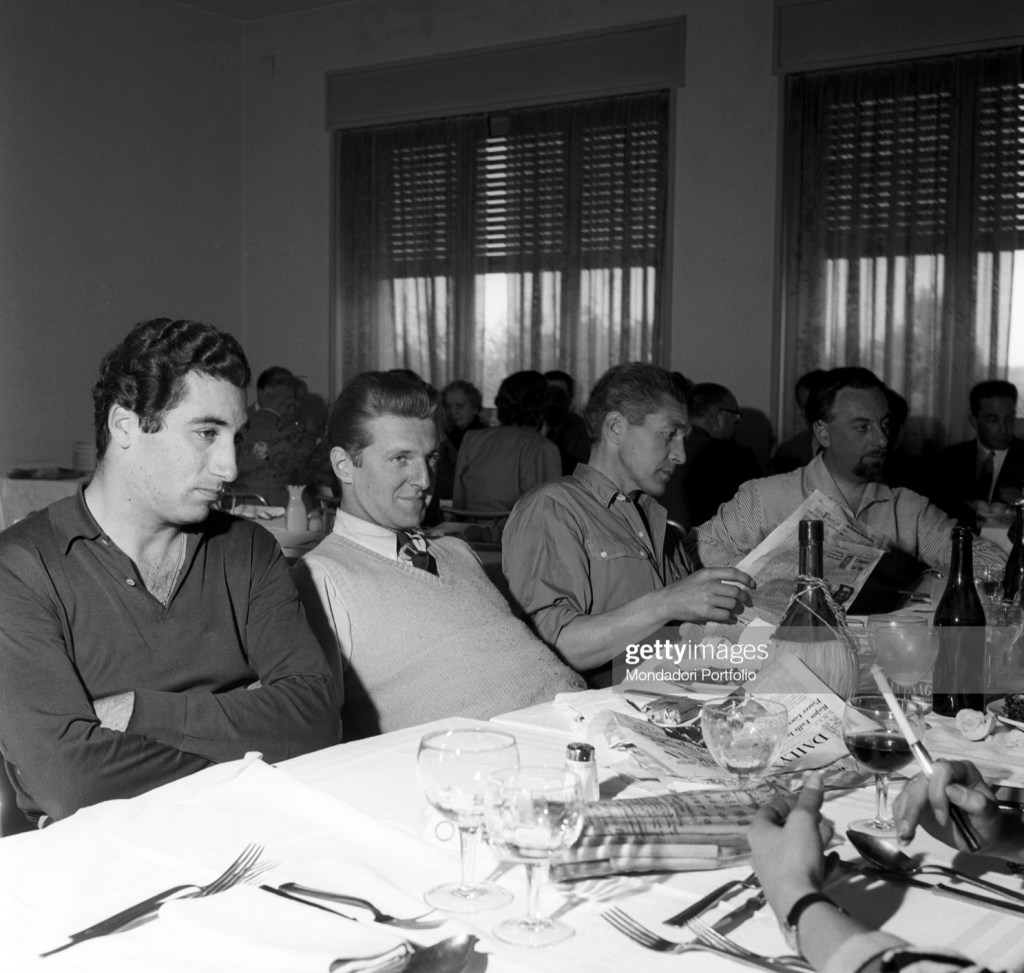
The table of nobles. De Portago along side Wolfgang von Trips during a ‘training camp’ or perhaps more accurately a pre-event briefing and planning session in the weeks before the Mille, held on 11-12 May 1957. See this wonderful Doug Nye piece on De Portago in MotorSport; Ferrari’s fastest playboy: Alfonso de Portago – Motor Sport Magazine
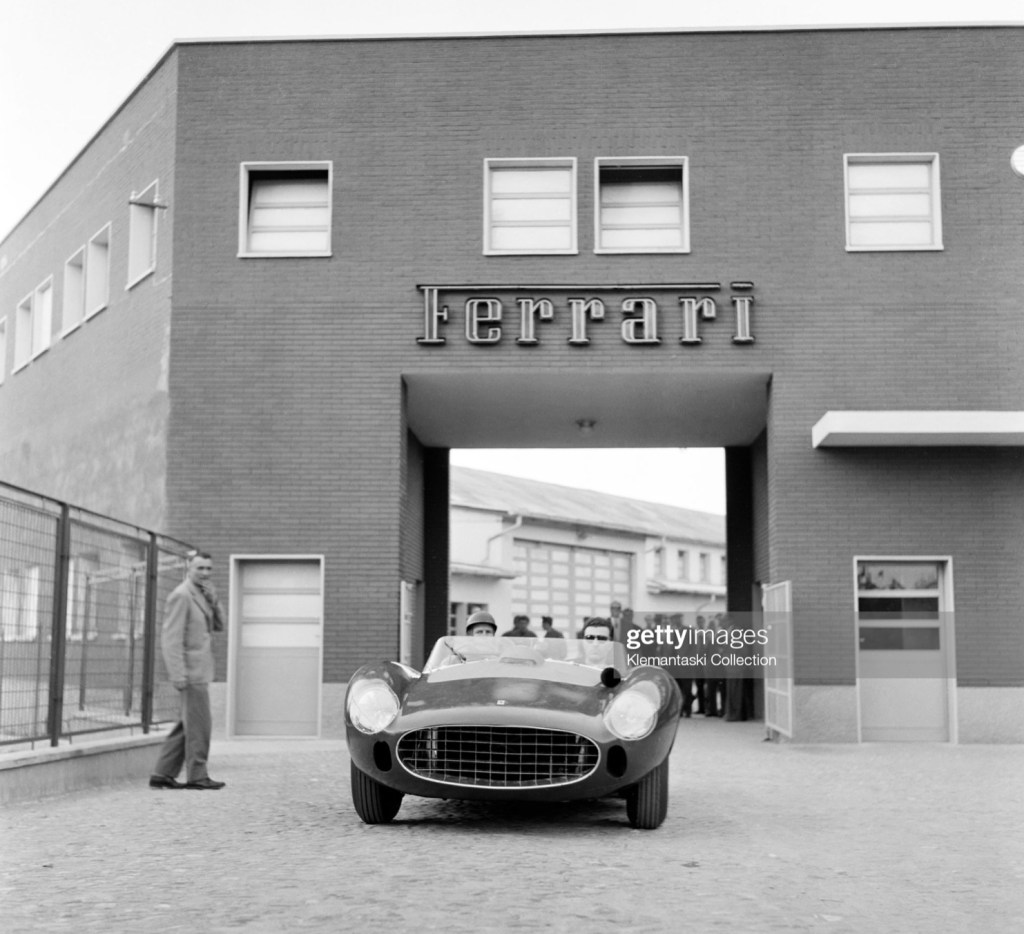
Peter Collins leaves Maranello for a quick blast up the Abetone Road to check that all is good with his 335S, note the bonnet is still to be painted.

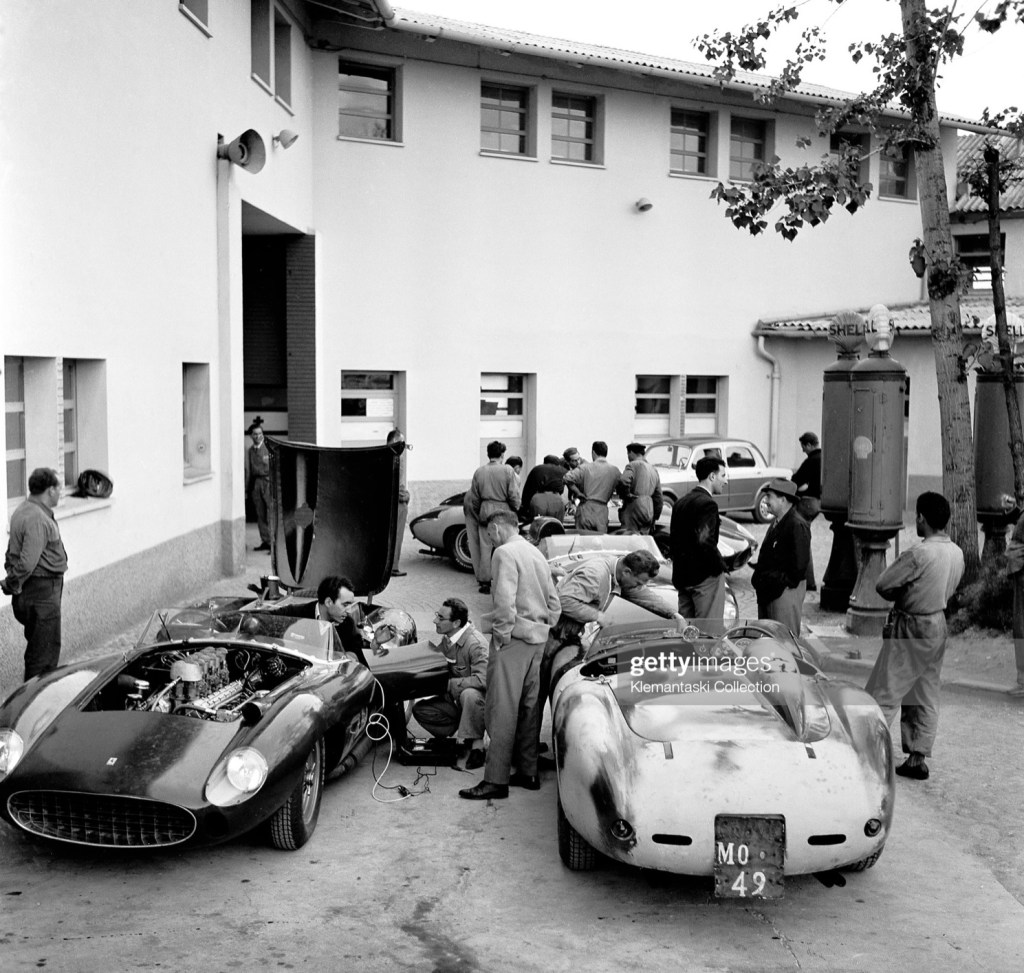
The team cars below in the famous factory courtyard are the four four-cam cars for Piero Taruffi – the winner – Von Trips, De Portago and Collins, with the Collins/Klemantaski machine at left. A blur of activity.
The series of photographs below are at Brescia, the start and finish of the classic event. The shots show the sheer pageantry and grandeur of the event tinged with no shortage of pathos given the events that day which took De Portago, Collins twelve months later aboard a Ferrari Dino 246 during the 1958 German GP at the Nurburgring, and at Monza in 1961 when Von Trips perished in the early laps of the Italian GP aboard a Ferrari 156 along with another group of spectators.
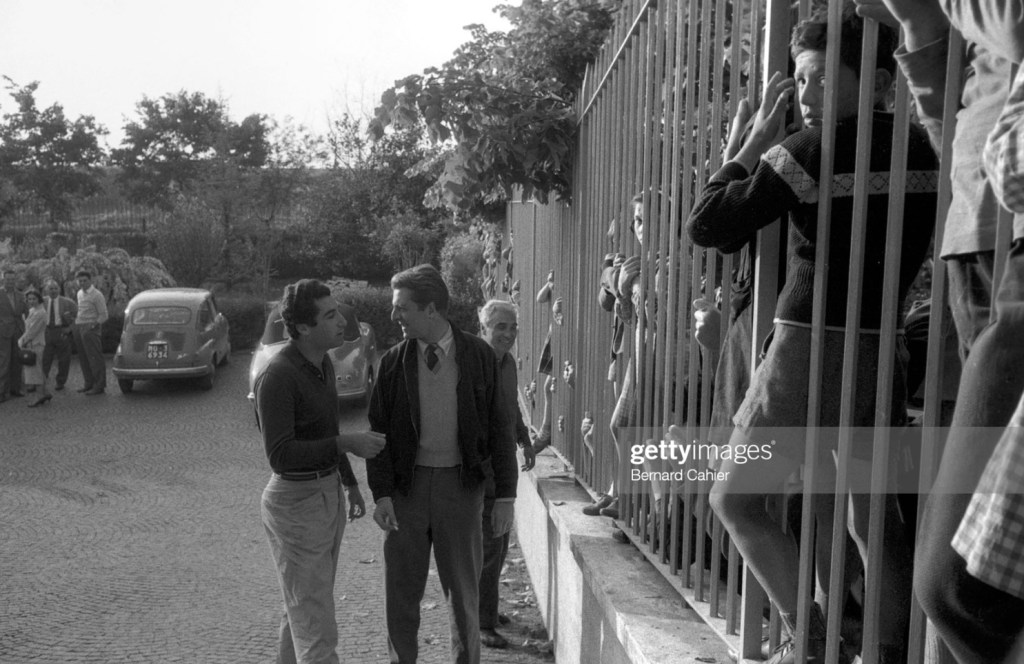
De Portago and Von Trips swapping notes before the off while Taruffi seems a little more focused on the needs of the adoring locals.

Enzo Ferrari with Peter Collins (above) before the start, and De Portago below.
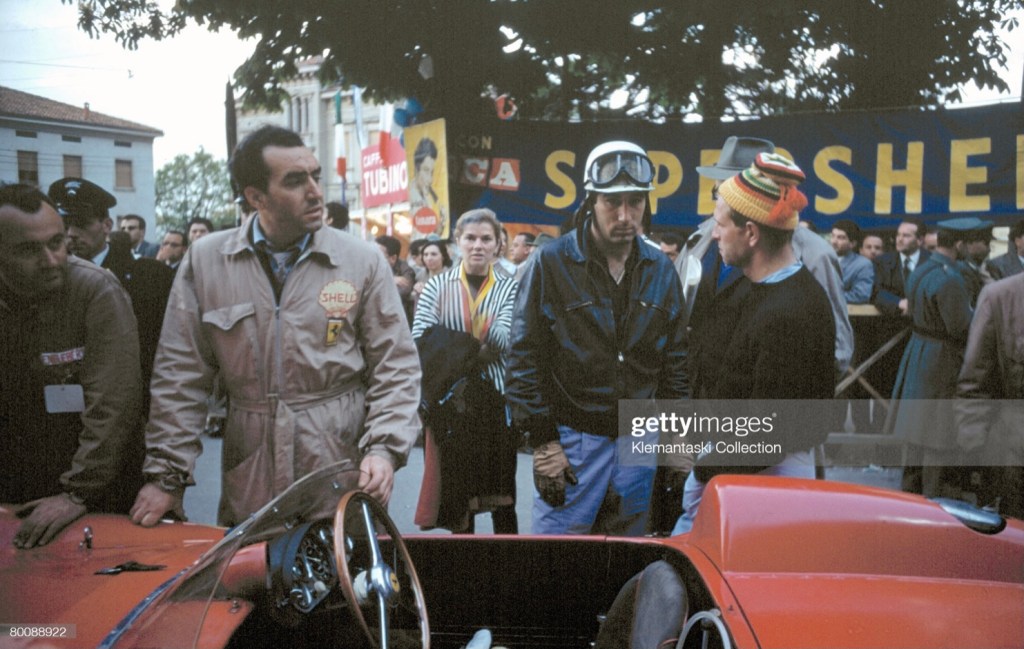
De Portago and Collins shortly before Alfonso’s departure from Brescia, car the ill-fated 335S chassis 0676. Louise Collins is mid-shot.

It was the first time De Portago raced the 4-litre car, the most powerful car he had ever driven. He drove it with skill and seemed set to finish well in this most difficult of races in the world’s fastest sportscar.

De Portago and Nelson departing the Ravenna control – in Emilia-Romagna – a couple of hours into the race.

Piero Taruffi won in a 315S from Von Trips in another 315S, while the Collins/Klemantaski 335S DNF with driveshaft failure in the fifth hour. The De Portago/Nelson accident happened after five hours, seventeen minutes, at 3.30pm near the village of Cavriana 35km from Brescia.

De Portago’s final pitstop was in Montova where he refused a tyre-change to save time, at that stage the crew were fourth, third by some accounts. “This may have caused his car’s tyres to be more susceptible to failure when the Ferrari ran over cat’s eyes at high speed.” The left-front failed at a little over 150mph.
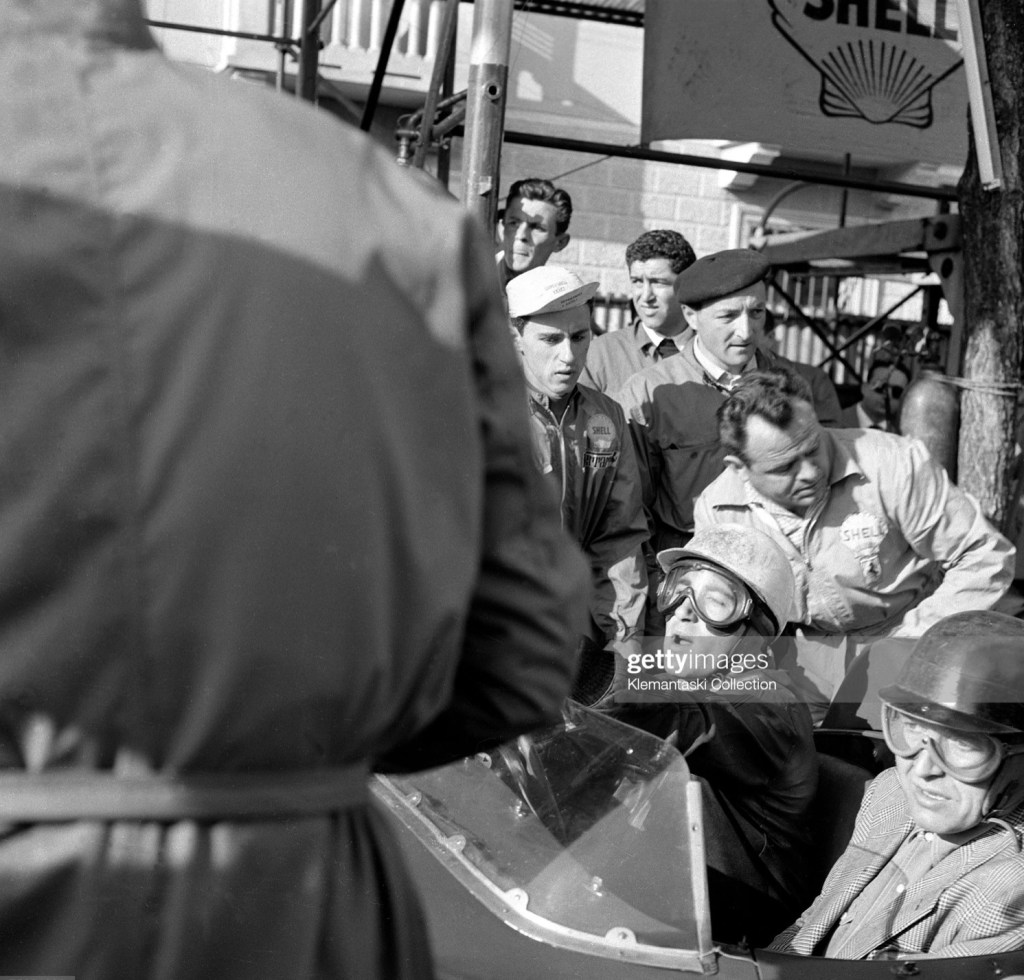
Not too many photos exist of Edmund Gurner Nelson, De Portago’s navigator, friend, confidant, fixer, Bob-sled coach and whatever else, in the car.

Here they are leaving the Ravenna control, the shot gives a sense of immediacy and pressure, note Ed’s sports-blazer casual attire.

Credits…

All photographs Klemantaski Collection/Getty Images, motorsportmemorial.org

Tailpiece…
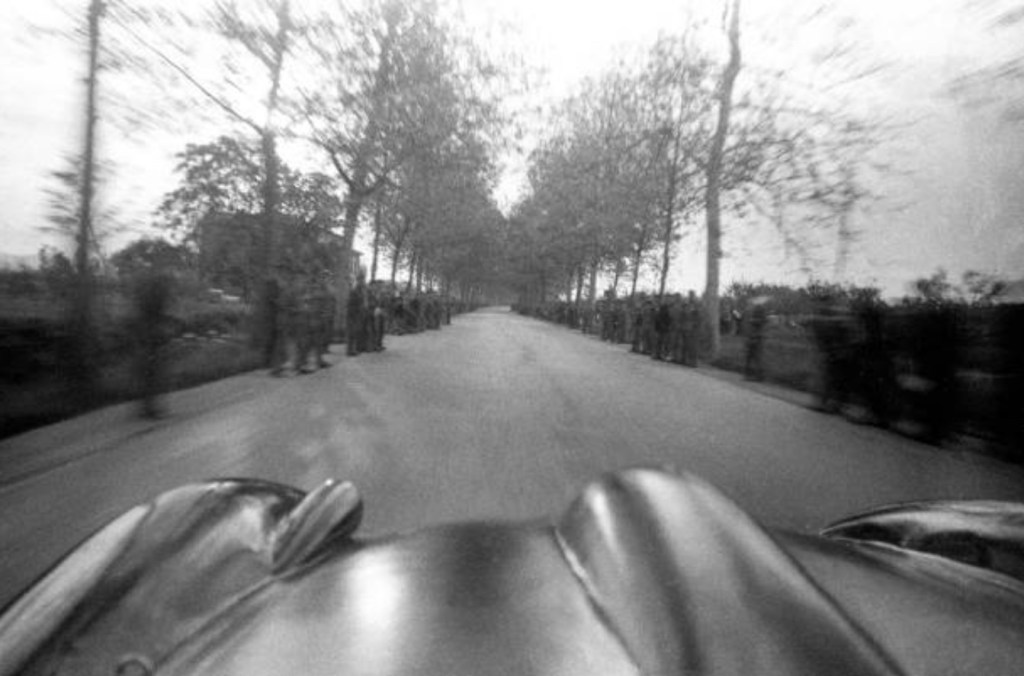
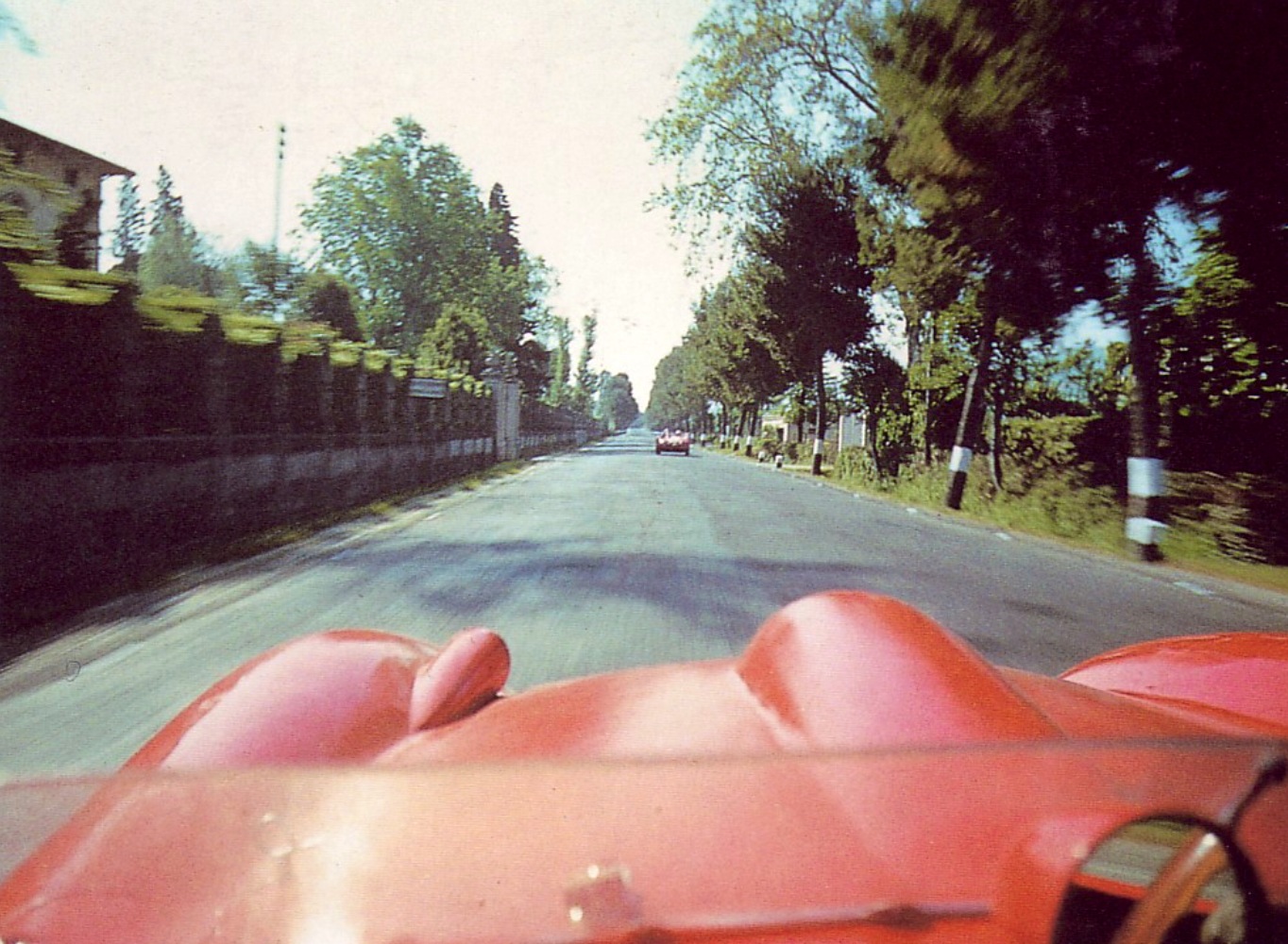
This moody shot was taken by Louis Klemantaski at high speed during the event alongside Peter Collins in his 335S. 150mph plus is all fine and dandy – even with an enthusiastic Italian crowd encroaching on the road – until something goes wrong. Apologies for the statement of the bleeding obvious…

We should all be thankful the Targa Florio survived in its traditional form for as long as it did given the ’57 Mille.

Finito…

hawt goodwood

One of the better known photographs in motor racing is Louis Klemantaski’s shot of Mike Hawthorn’s Cooper T20 Bristol attacking the apex of Fordwater at Goodwood in 1952…

The Klemantaski Collection archive describe the photograph thus; Hawthorn is obviously really on the absolute limit with this Cooper-Bristol. And of course he is aiming right for Klemantaski who had positioned himself at the edge of the track exactly at the apex of the very fast Fordwater corner on the back of the Goodwood circuit. What a dynamic image!

This race was the ‘Sussex International Trophy’ for Formula Libre racing cars on June 2, 1952. Hawthorn won, perhaps somewhat aided by his father Leslie’s long experience with nitromethane. It was Hawthorn’s third outing with a friend’s Cooper-Bristol.

On April 14th at Goodwood he came up against Juan Manuel Fangio, driving another Cooper, and won against the already famous Argentinian driver. Hawthorn won two races with the Cooper that weekend and finished second in the final race of the day to Froilán González in Tony Vandervell’s Thinwall Special Ferrari GP car.

More out of the car than in it! Cooper T20 Bristol, Belgian GP at Spa in June 1952 (M Tee)
At Silverstone a month later at the British GP in July 1952 (M Tee)
image
1953 French GP Reims July 1953. Mike Hawthorn’s Ferrari 500 and Juan Fangio’s #18 Maserati A6GCM flat out, grinning at one another, Mike won by a second after 300 miles of racing (Getty)

Then Hawthorn entered the Daily Express International Trophy on May 10th with the same Cooper-Bristol to win the first heat, but finished several laps down in the final due to gearshift problems.

His excellent showing with the Cooper at the Belgian Grand Prix at Spa-Francorchamps where he was fourth, and at the subsequent British Grand Prix finishing third, led to an offer from Ferrari for 1953- and an eventual World Championship aboard the Ferrari Dino 246 in 1958.

‘Hawthorn died in a road crash in January 1959 after retiring from racing at the end of his Championship year, is remembered by his own book Challenge Me the Race and Champion Year and in several biographies, including Mon Ami Mate and Golden Boy.

Mike Hawthorn’s grave is in Farnham, Surrey where he is still well remembered and where he and his father had run the Tourist Trophy Garage for many years’, the Klemantaski Collection wrote.

Cooper T20 Bristol cutaway by Vic Berris

Articles on the Cooper Bristol T20/23…

Stirling Moss and Jack Myers: Cumberland Park Speedway, Sydney: Cooper T20 / WM Holden 1956…

Credits…

Louis Klemantaski, Raymond Groves, Vic Berris, M Tee- MotorSport Images. Check out The Klemantaski Collection;  https://klemcoll.wordpress.com/about/

Tailpiece…

hawt funny
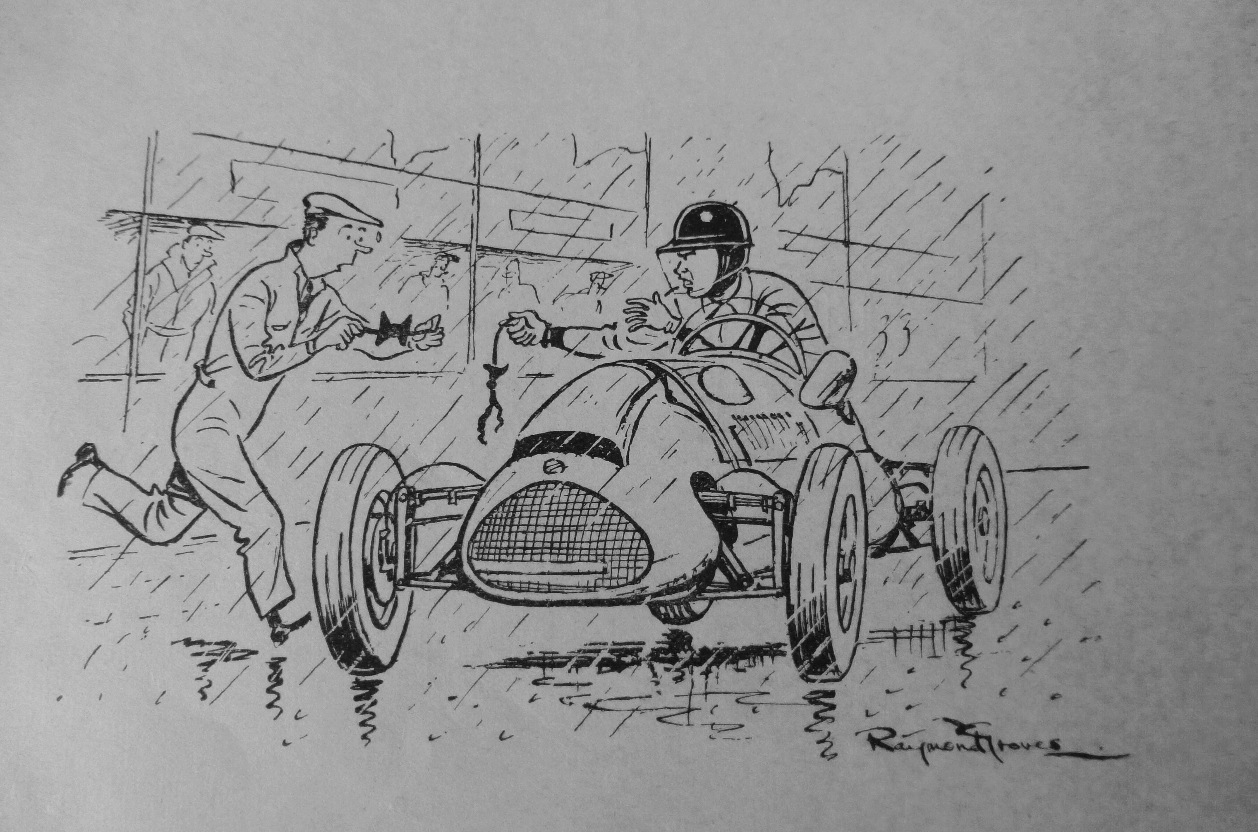
(Raymond Groves)

The tie dear boy, the tie…

Finito…

image

Gino Valenzano’s Lancia D24 passes Reg Parnell’s Aston Martin DB3S in the early morning Brescia fog, the action captured by Louis Klemantaski aboard the Aston as both navigator and ‘snapper. Mille Miglia 2 May 1954…

It wasn’t to be a happy event for either car, they both failed to finish as a result of accidents. The competitiveness of Vittorio Jano’s newish D24 design was underlined by Alberto Ascari’s win in another of the cars in a time of 11 hours 26 minutes and 10 seconds. Vittorio Marzotto’s 2nd placed Ferrari 500 Mondial was 34 minutes in arrears.

Piero Taruffi’s Lancia led the race early from Brescia, that year fog replaced the more usual rain, he was first into Ravenna with a lead of 1.5 minutes. Castellotti retired his Lancia by Rome, soon Piero’s car developed an oil leak so he too retired. Ascari then assumed the lead but on the home leg north his throttle return spring failed, a rubber band provided a temporary repair. By Florence he was ready to retire but was prevailed upon to continue, then by Bologna all of the quick Ferrari’s had retired so the final 200Km into Brescia was a ‘cruise’ if the final hours of a race lasting 11 plus hours can be so described!

Gianni Lancia and Vittorio Jano created some stunning sports and racing cars in the early 1950’s, at least the Lancia heir could look back on them as a legacy when he was forced to cede management of the company such was its parlous financial state into 1955.

The new D24 ended 1953 with a stunning 1-3 in the November Carrera Panamericana in Mexico; Fangio won from cars driven by Piero Taruffi and Eugenio Castellotti. Felice Bonetto’s death in a D24 during the event somewhat muted the joy the team felt in victory, to say the least.

image

Brescia 1 May 1954: Lancia D24’s are islands in a sea of people. #541 Valenzano DNF distributor, #602 Ascari’s winning car and  #540 Castellotti DNF accident (unattributed)

The D24 evolved from the D23 Spyder, itself begat by the D20 Coupe design. Jano’s development times were short, the D23 made its race debut at the Monza GP on 28 June (2nd Bonetto) and the D24 at the Nurbugring 1000Km on 30 August (Taruffi/Manzon and Fangio/Bonetto both DNF). The wheelbase of the D24’s tubular steel spaceframe chassis was marginally reduced. The quad-cam, chain driven, 2 valve, triple Weber 46DCF3 fed, 60 degree V6 engines capacity was increased from the D23’s 3102cc to 3284cc with power in the range 240 to 270bhp @ 6500rpm for each of the two engines.

The cars late 1953 speed carried through into 1954 with the Taruffi/Manzon D24 leading the Sebring 12 Hour until an engine failure about an hour before the end. Despite that the car completed 161 laps compared with the 168 of Stirling Moss and Bill Lloyd in the winning OSCA MT4.

Wins at the Targa by Taruffi, not a championship round in 1954, and 4th & 6th in the Tourist Trophy gave Lancia 2nd place in the Manufacturers Championship with 20 points to Ferrari’s 38 despite not entering Le Mans.

Lancia did get plenty of promotional rub-off for their considerable investment in Italy with the cars winning a swag of races and hillclimbs in ’54. Castellotti won the Treponti-Castelnuovo, Coppa Firenze-Siena, Bolzano-Passo Mendola and the Aosta-Gran San Bernardo. Taruffi took the Giro di Sicilia, Catania-Etna and Coppa d’Oro di Sicilia and Villoresi the Oporto GP.

Lancia’s F1 program absorbed plenty of resources, the D50’s first race  was the final ’54 championship round on 24 October, the Spanish Grand Prix at Pedralbes, Barcelona. Alberto Ascari’s jewel of a Lancia D50 started from pole and led until clutch problems caused him to retire on lap 9.

Lancia D24 cutaway: essential elements of Vittorio Jano’s car. Multi-tubular steel spaceframe chassis, Pininfarina designed and built aluminium body, 60 degree DOHC, 3284cc 270bhp V6, independent front suspension, de Dion rear suspension, leaf springs and tubular shocks. Gearbox 4 speed mounted at rear. Inboard drum brakes front and rear. Weight 740-760Kg (Betti)

Despite the competing GP car program Jano evolved the D24 design later in the year by increasing the capacity of the V6 to 3550cc for which 300-305bhp @ 6500 rpm was claimed. Two of these cars dubbed D25 were entered for Ascari/Villoresi and Fangio/Castellotti  at the Tourist Trophy, Dundrod in September but both retired with diff and engine failure respectively. Taruffi/Fangio and Manzon/Castellotti were 4th and 6th in D24’s.

The timing of the GP debut was unfortunate as the D24 was a mighty fine, fast car which deserved to have been the primary competition focus of Lancia that year.

The D50 changed the course of GP history in terms of its brilliant design, it’s contribution to Lancia’s fiscal disaster and of course giving Ferrari a car which won the world drivers championship for JM Fangio in 1956. But the D24 could conceivably have won Lancia a sportscar manufacturers championship in 1954 had the necessary, exclusive effort been applied to that campaign.

Wonderful hindsight of course, one of my strengths!…

Credits…

Louis Klemantaski, STF, Bruno Betti

Tailpiece: Alberto Ascari’s Lancia D24 chassis ‘006’ of nine cars built, in Rome and ‘heading for home’ 2 May 1954…

image

(STF)


collins

Peter Collins photographed by Louis Klemantaski aboard their Ferrari 335S during the ill-fated 1957 Mille Miglia…

This stunning, evocative shot, one of motor racing’s most famous, was taken by acclaimed photographer Louis Klementaski who navigated for Collins capturing the essence of the event and times which seem so long ago.

Klemantaski picks up the story in Automobile Year 44…’In the fateful Mille Miglia of 1957 I was in the Ferrari Team in the car driven by Peter Collins, a 335 Sport. This model was the ultimate achievement of Ferrari’s creativity of that period. Peter said it was the best handling sports-racing Ferrari he had driven so far. It was certainly the most powerful and I had to adjust my course notes accordingly’.

‘This photograph was taken as we went through a series of hairpin bends in the Abruzzi Mountains on the way to l’Aquila and Rome. There were no trees around and Peter could see the whole road for quite a way ahead, so I was able to take some time off from giving him signals as to the severity of the next corner and take some shots of the cockpit and him in action. As the G-forces were considerable, I had to make the exposure on the right-hand corner, so that I would be thrown outwards and away from him. We had no seat belts in those days and it was very difficult not to impede Peter on occasion. In those very tight corners, first on one lock and then the other, Peter could cope without changing the position of his hands on the wheel, which was just as well, as the corners came up with remarkable rapidity. This is my favourite Ferrari photograph because it was of a Ferrari in action, taken from a Ferrari cockpit – and how much closer to the spirit of these wonderful cars can you get?’

on root
The view at speed…somewhere in Italy! Klemantaski shot from the Collins 335S (Louis Klemantaski)

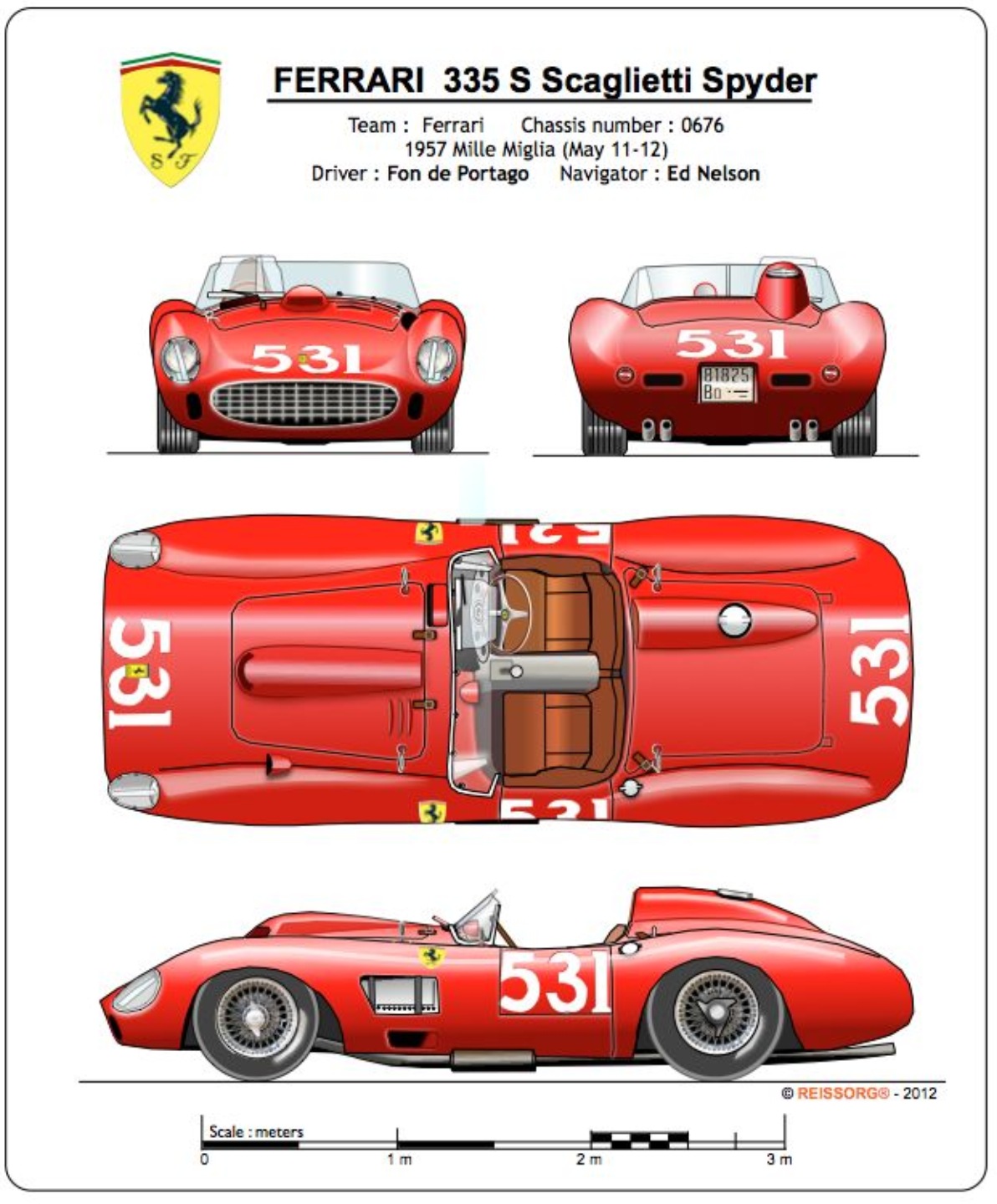
Scuderia Ferrari entered five cars in the 1957 event: 315S models for Piero Taruffi (his car was fitted with a 335 engine) and Count Wolfgang ‘Taffy’ von Trips, and the latest 4-litre quad-cam 335S models for Collins/ Klemantaski and Marquis ‘Fon’ de Portago and Ed Nelson. Finally, a 250LWB was entered for Olivier Gendebien and his navigator M Washer.

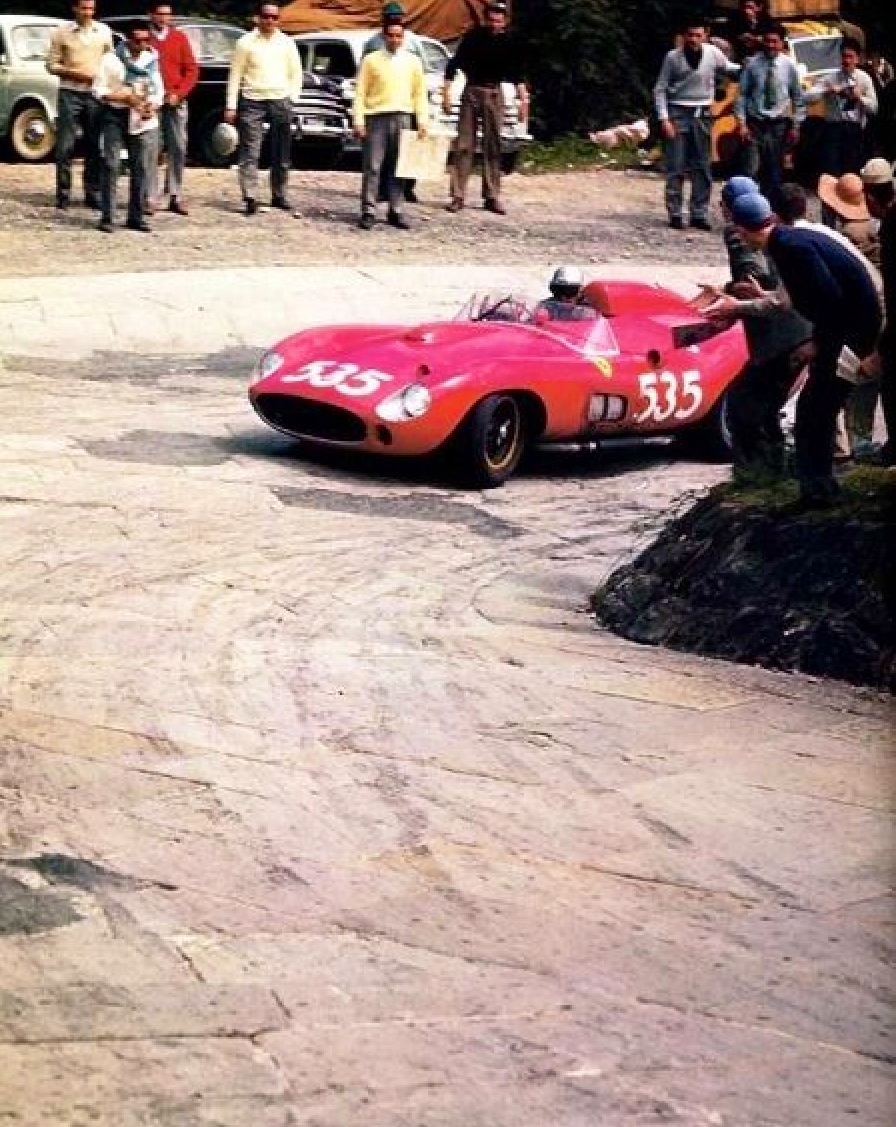
Taruffi won the race and then retired, Von Trips was second. The Collins car retired at the 5 hour 3 minute mark with a broken driveshaft. Sadly, and infamously, De Portago/ Nelson perished in a gruesome accident which also took the lives of nine spectators – five children – in the village of Guidizzolo, Lombardy, 110km east of Milan.

Some reports say De Portago should have changed his tyres earlier, a blowout was the cause of the accident. The race was banned as a consequence, and so ended a tradition which commenced in 1927, the event was run 24 times from then until 1957.

mille
1957 Mille Miglia course

The Mile Miglia was started by Count Aymo Maggi and Franco Mazzotti…after the Italian Grand Prix was moved from their home town of Brescia to Monza. They chose a race from Brescia to Rome and back, a figure-eight course of 1500km or 1000 Roman Miles.

Various courses were used over the years with many of the greats of the day winning. Tazio Nuvolari, Alfa 6C 1750 in 1930 and 8C 2300 in 1933, Rudy Caracciola in a Benz SSK 1931, Achille Varzi, Alfa Monza in 1934 and Alberto Ascari in a Lancia B24 in 1954 included.

Over the years Italians won the race the most. From 1953 to 1957 the event was a round of the World Sports Car Championship, Stirling Moss famously winning navigated by Motor Sport‘s Denis Jenkinson, the pair setting the fastest ever time of 10 hours 7 min 48 secs.

The duo covered six reconnaisance laps, Jenkinson making pace notes on a scroll of paper contained in an aluminium housing. Dennis called the corners and the stunning ability of Moss resulted in an emphatic, famous 1955 victory in their Mercedes Benz 300SLR.

de Portago Mille 1957
Fon de Portago/Ed Nelson in their Ferrari 335S go thru the Futa Pass on their fateful ’57 Mille run. (Yves Debraine)
brochure
le mans 5
The Collins/P Hill Ferrari 335S at Le Mans 1957, DNF engine failure on lap two (unattributed)

The 1957 Ferrari 335S…

The machine was a development of the 1956 860 Monza and 290 MM sports-racers.

A tubular steel chassis frame was fitted with independent unequal length wishbones, coil springs and hydraulic shocks at the front. A de Dion rear axle located by twin radius arms, transverse leaf spring and hydraulic shocks was fitted at the rear.

Drum brakes were used all round, steering was by worm and sector. A strong four-speed transaxle took all the torque of the big V12 with 6X16 inch and 7X 16 inch tyres fitted front/rear, the whole lot weighing a relatively light 880kg dry.

The 335 Sport was the height of development of Ferrari’s complex but powerful four-cam, two-valve front-engined sports cars which won the World Sports Car Championship in 1957, defeating arch rivals Maserati in the process.

Ferrari 335S cutaway
pitstop
4-litre V12 engine of the Collins 335S during a Mille Miglia pitstop (Louis Klemantaski)

The engines of the 290, 315 and 335S were primarily designed by Vittorio Bellantani. The ex-Maserati engineer received assistance from Vittorio Jano, some elements of the engine having a passing design relationship to Jano’s fabulous 1954-55 Grand Prix D50 Lancia V8. Jano of course came across to Ferrari from Lancia in the deal which saved-Ferrari’s-bacon, devoid as it was of a competitive Grand Prix car at the time.

The 60-degree all aluminium V12 displaced 4023cc with a bore/stroke of 77 X 72mm. Four overhead camshafts were deployed with two-valves per cylinder. Six Weber 44DCN carbs fed the engine with twin plugs and four coils taking care of the spark. Maximum power was quoted at 390bhp @ 7400rpm.

The Klemantaski Archive quotes Phil Hill as saying ‘the 335S was the best front-engined car ever built by Ferrari and certainly the fastest.’

cockpit
Cockpit of restored 335S #0764. Four speed rear mounted transaxle, worm and sector steering (unattributed)
hawt
Side profile of the Hawthorn Ferrari 335S on the exit of Tetre Rouge corner Le Mans 1957. He shared the car with Luigi Musso, and again DNF due to engine failure (Louis Klemantaski)

Etcetera…

scud
(unattributed)

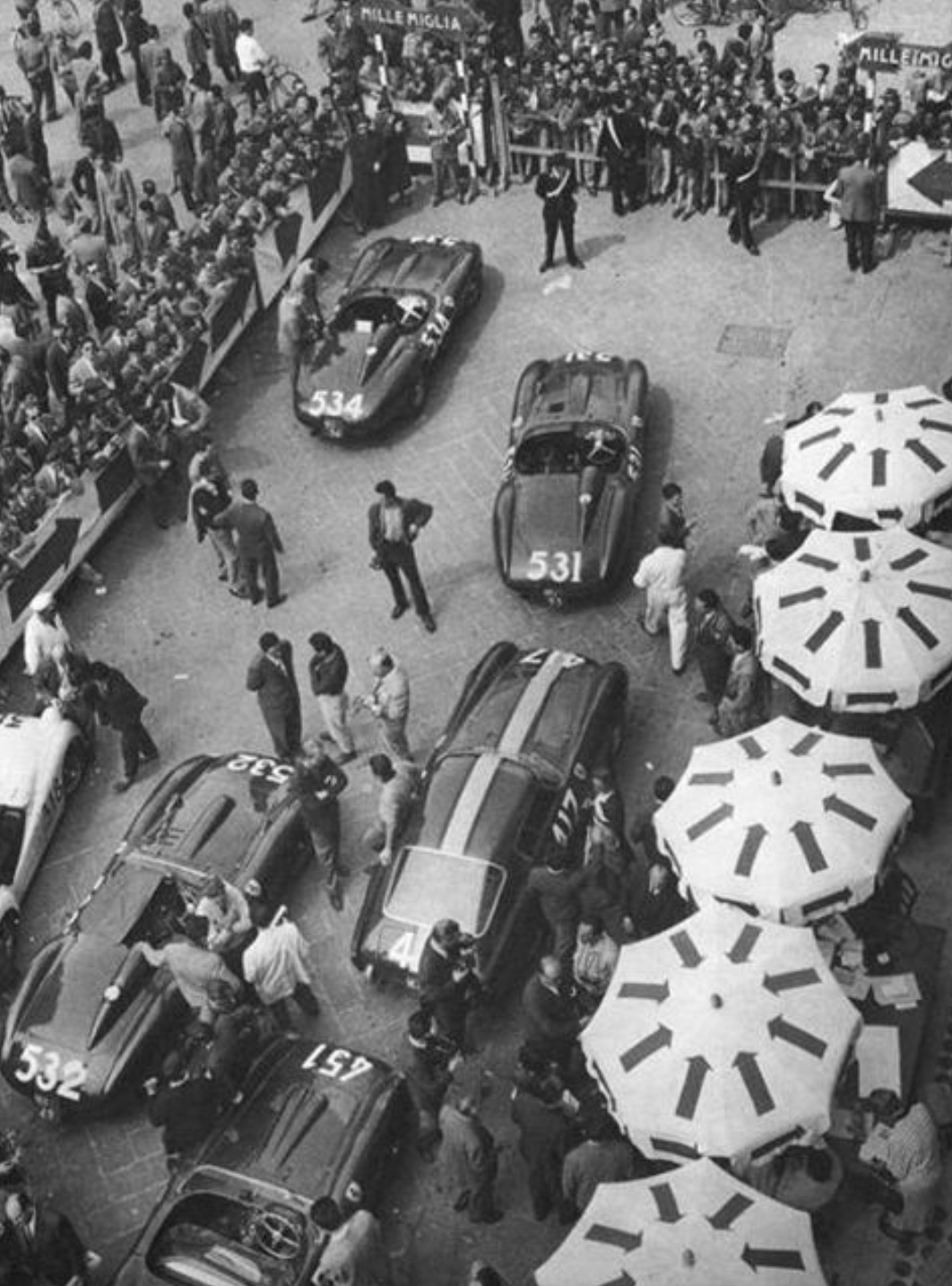
Scuderia Ferrari in Brescia before the 1957 MM start. #534 Collins/Klemantaski, #531 de Portago/Nelson, #417 Gendebien/Washer, #532 Von Trips and the privately entered Ferrari 500 Testa Rossa of Gino Munaron.

taruffi
(unattributed)

Piero Taruffi in the winning 335 engined Ferrari 315S, MM 1957. This very successful driver retired after winning the event then writing The Technique of Motor Racing, a rather good book!

cuta
portago
(Louis Klementaski)

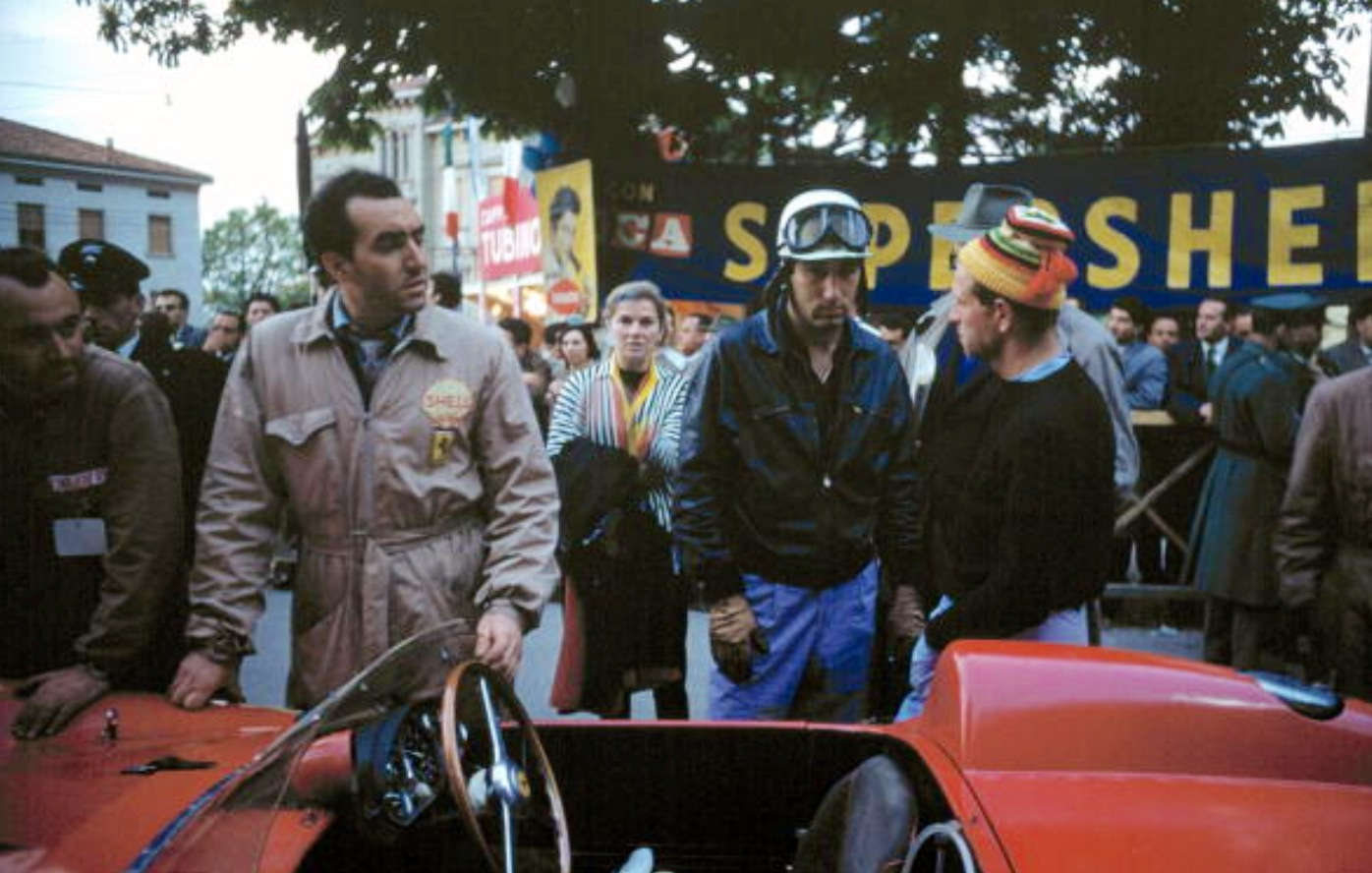
Fon de Portago and Peter Collins, in coloured beanie, before the MM start. Louise Collins is wearing the striped blouse at the rear.

image
(Louis Klemantaski)

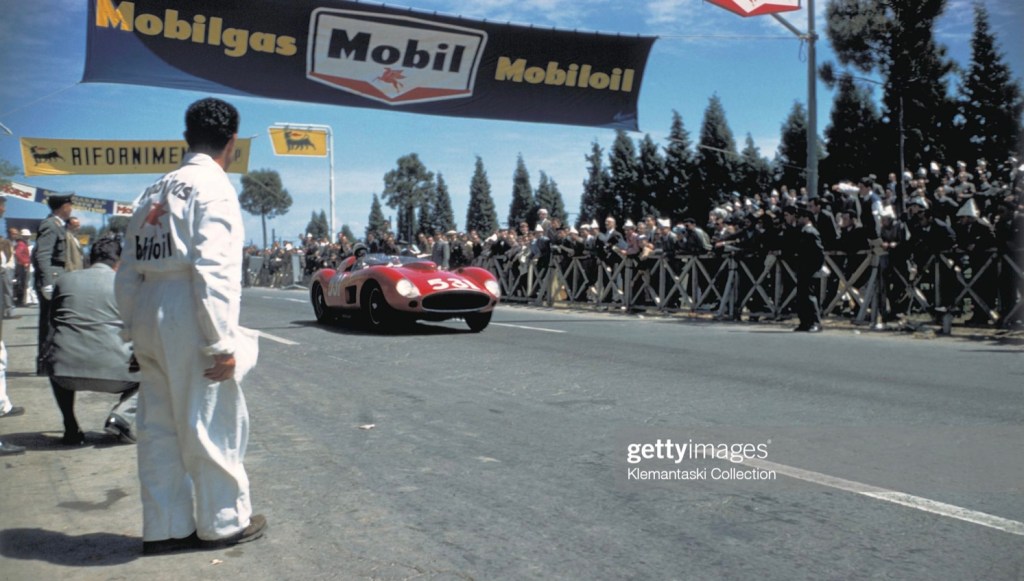
De Portago and Nelson leave the Rome control in fourth place.

Photo Credits…

Louis Klemantaski Archive, Yves Debraine, G Cavara cutaway drawing

Tailpiece…

fon
(unattributed)

An equally stunning shot as the one at the article’s outset.

It reflects the fanatical Italian crowd and their proximity to the cars. It’s poignant for that reason as one of the last shots of Fon de Portago before the fatal accident which took his and ten others lives. Ferrari 335S 0676 Mille Miglia 1957.

Finito…