Posts Tagged ‘Pedro Rodriguez’

(MotorSport Images)

Oh yeah baby!

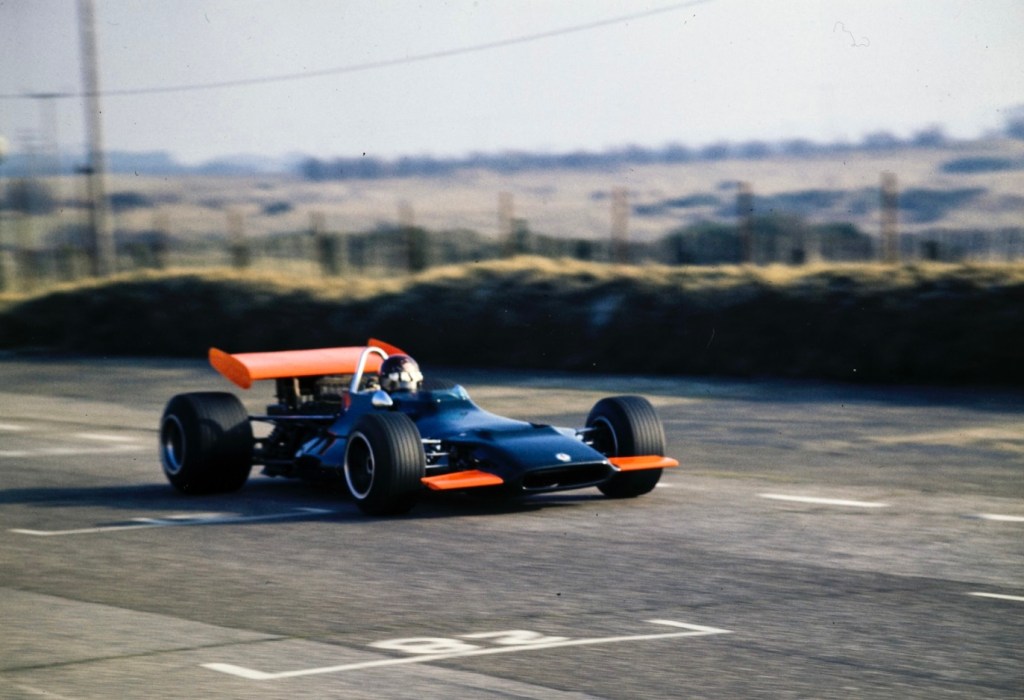
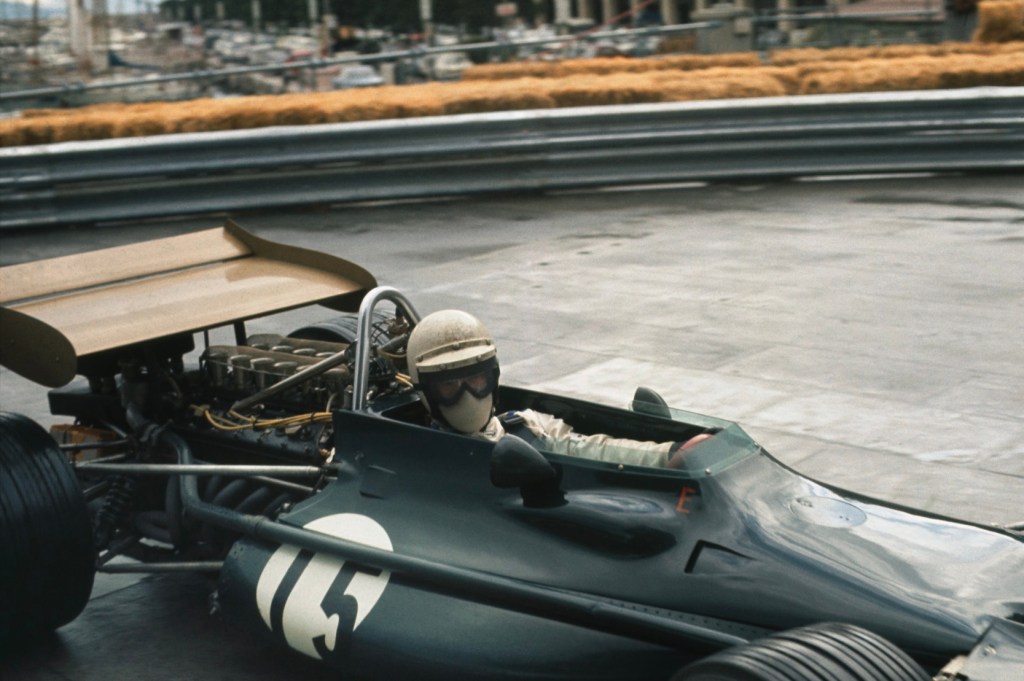
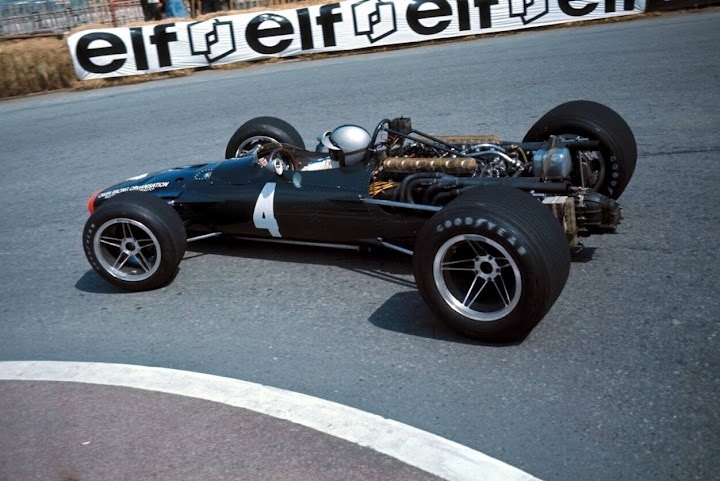
The 1970-71 BRM P153/P160 are two of my favourite Grand Prix cars, designer Tony Southgate at his best. Jackie Oliver is using every inch of Snetterton in this first test (?) of Bourne’s new P153.

It’s chassis P153/01 on January 1, 1970. This car had rather a short life sadly, it was burned to a crisp after Oliver had front stub-axle failure on the first lap of the Spanish Grand Prix on April 19. Ollie ploughed into the innocent Jacky Ickx’ Ferrari 312B – 312B/01 in fact – the ensuing massive conflagration and incompetence of the marshalls ensured both cars were destroyed.

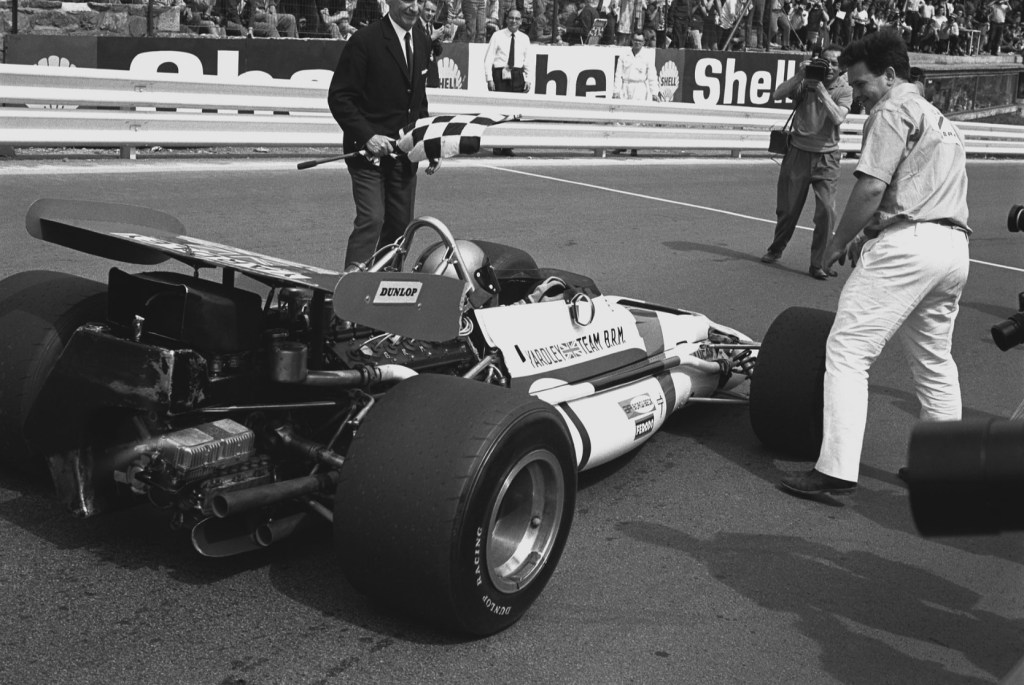
The P153/P160 were race winning cars too. Pedro Rodriguez was victorious in a P153 in the 1970 Belgian Grand Prix after an epic dice with Chris Amon’s March 701 Ford. He also won the Oulton Park Spring Cup in 1971 aboard a P160. P160 championship victories went to Jo Siffert and Peter Gethin at the Osterreichring and Monza in 1971, while Gethin also won the non-championship Brands Hatch Victory Race that October. In 1972 Jean-Pierre Beltoise took his only GP win at Monaco in soggy conditions in a P160B.

The P153 in its early traditional, pre-Yardley, BRM green with orangey-red trim looked superb! We have Southgate to thank for the new colour too. “The F1 BRMs had been painted a dark, dull, metallic green I thought looked terrible. I called it British Racing Mud…I persuaded the team to change to a more lively green and I ended up with a colour used by Vauxhall Motors, which looked great.

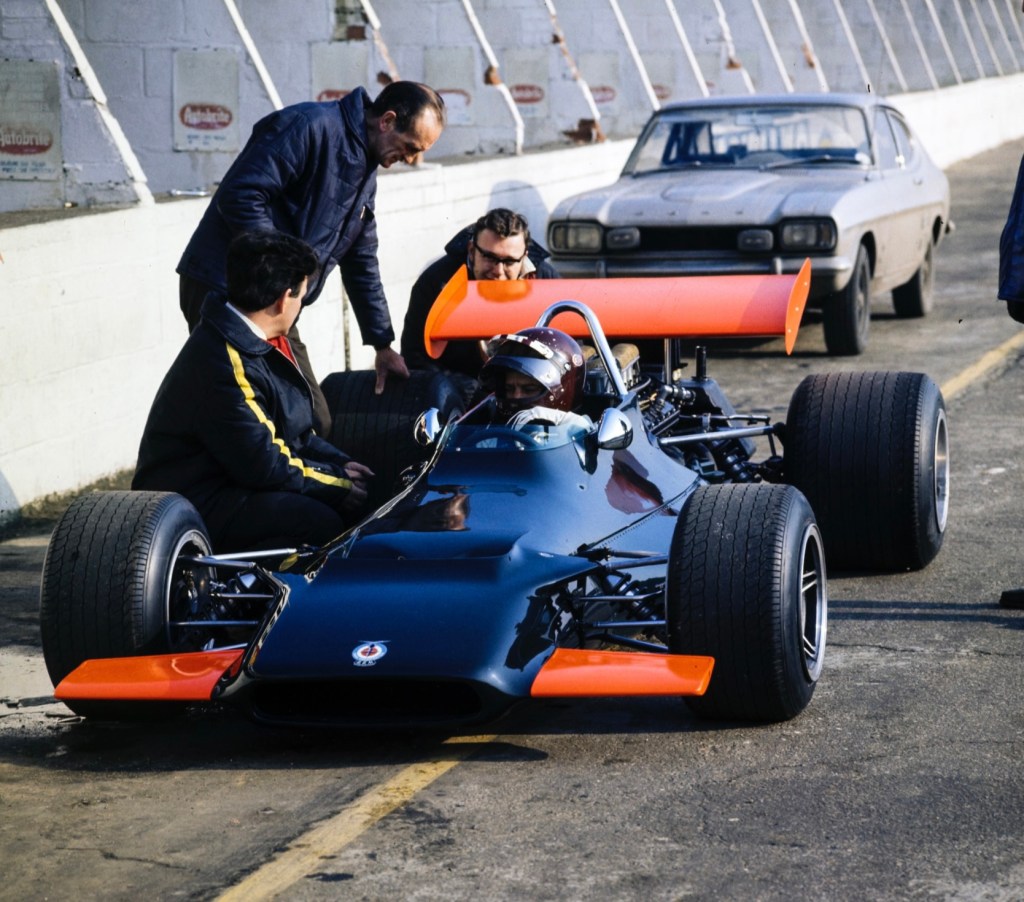
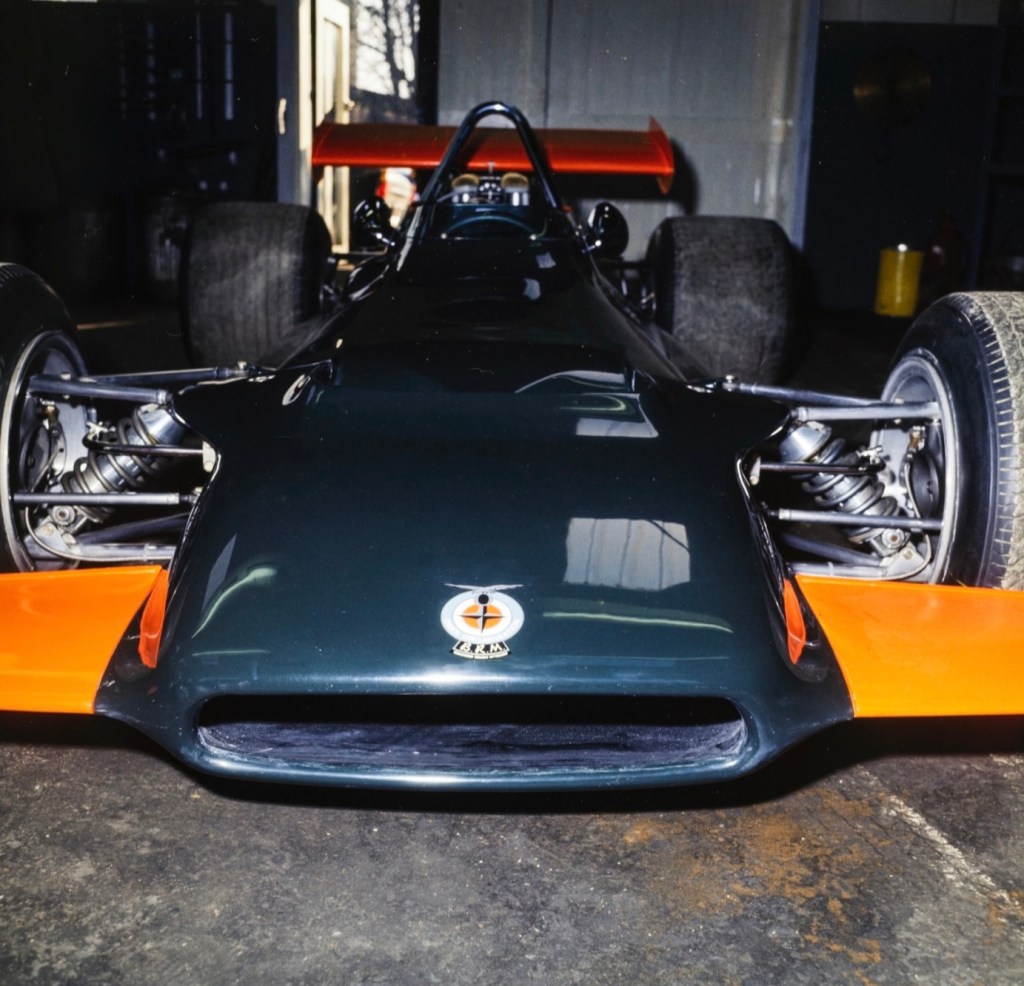
“Cor, this BRM really does look the goods boys!” Snetterton, January 1, 1970 (MotorSport)
(MotorSport)

After the phenomenal speed and results of the simple, light 1.5-litre P261 V8 Grand Prix car from 1963-65, BRM had been in the doldrums since 1966-67 with the phenomenal lack of speed of its complex, heavy P83 H-16.

While the 1968-69 P101 and P142 V12 powered P126/133/138/139 had shown occasional flashes of speed, to an extent Bourne had lost its way in both chassis and engine competitiveness. See here: https://primotipo.com/2018/01/25/richard-attwood-brm-p126-longford-1968/

Much respected, long-time engineering chief Tony Rudd – the architect of BRM’s late 1950s-early 1960s rise and rise – left Bourne for Hethel where he became Group Lotus’ Director of Engineering in mid-1969 and was replaced by Tony Southgate who had been drawing and building winning Eagles for Dan Gurney in California.

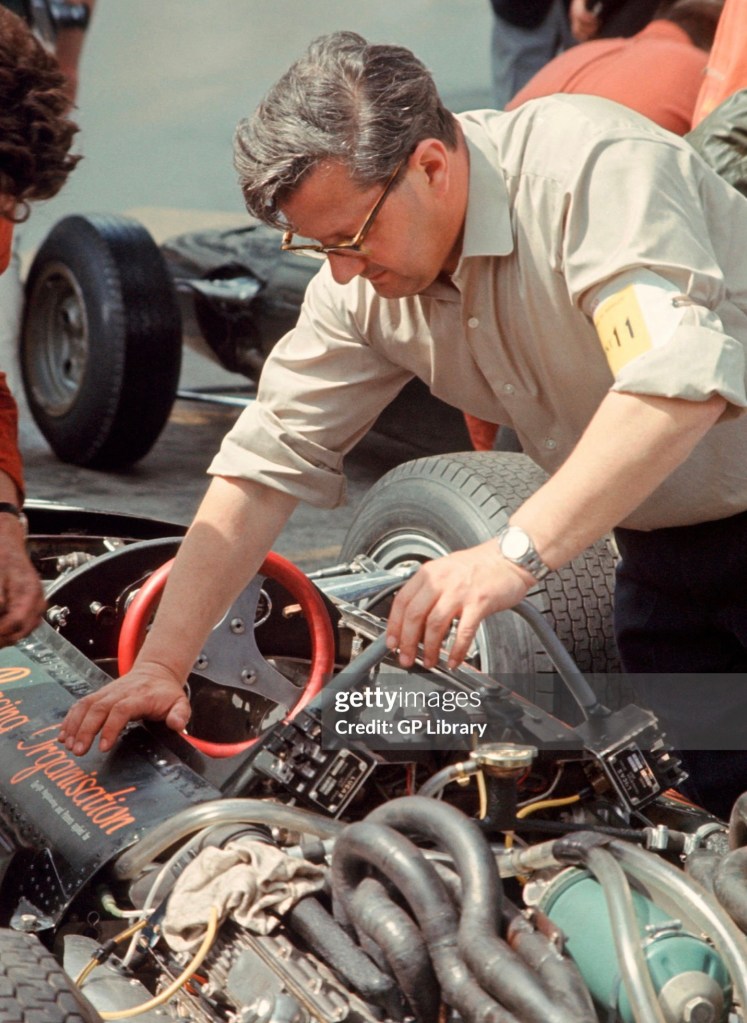
Tony Rudd fettles his nemesis at Monaco in May 1966, the gloriously-nuts P75 H-16 engined BRM P83.
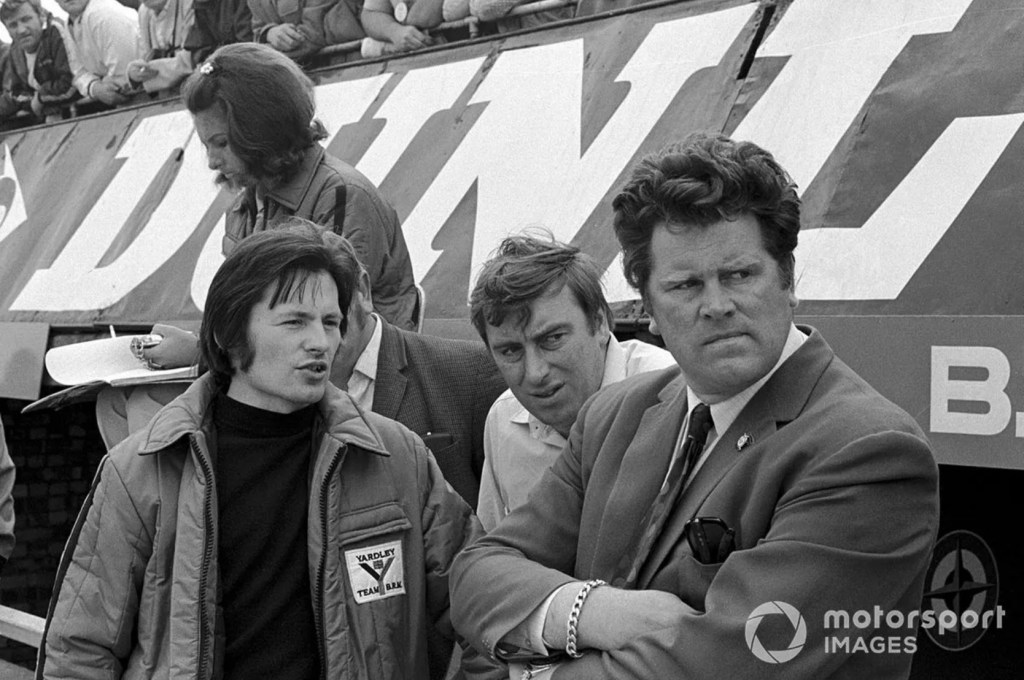
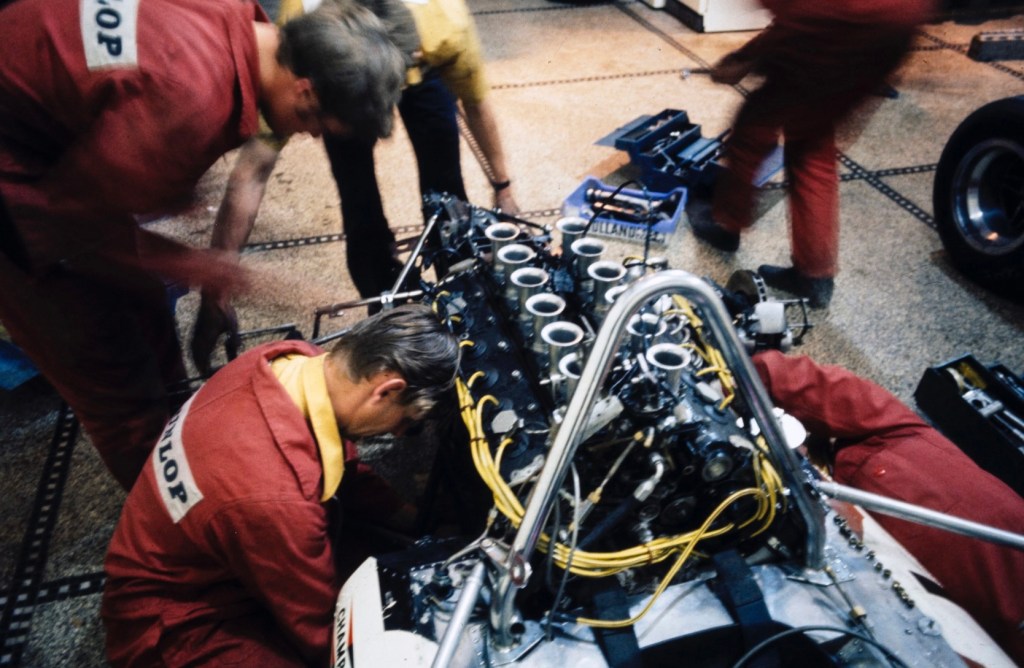
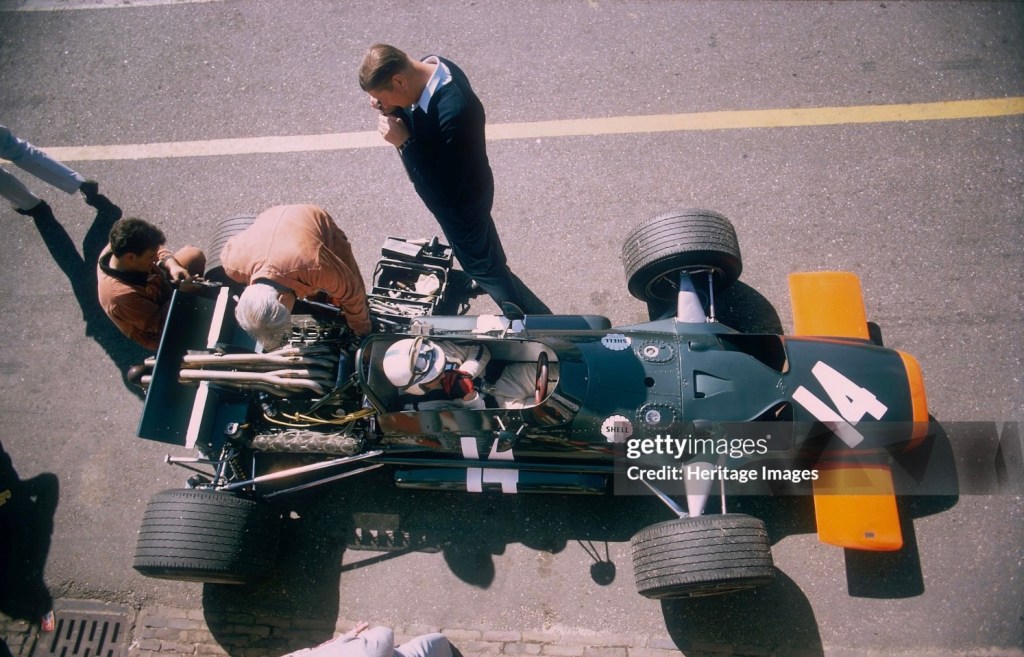
Oliver gives his early impressions of the new car to a Dunlop technician at left, and who else? Snetterton (MotorSport)
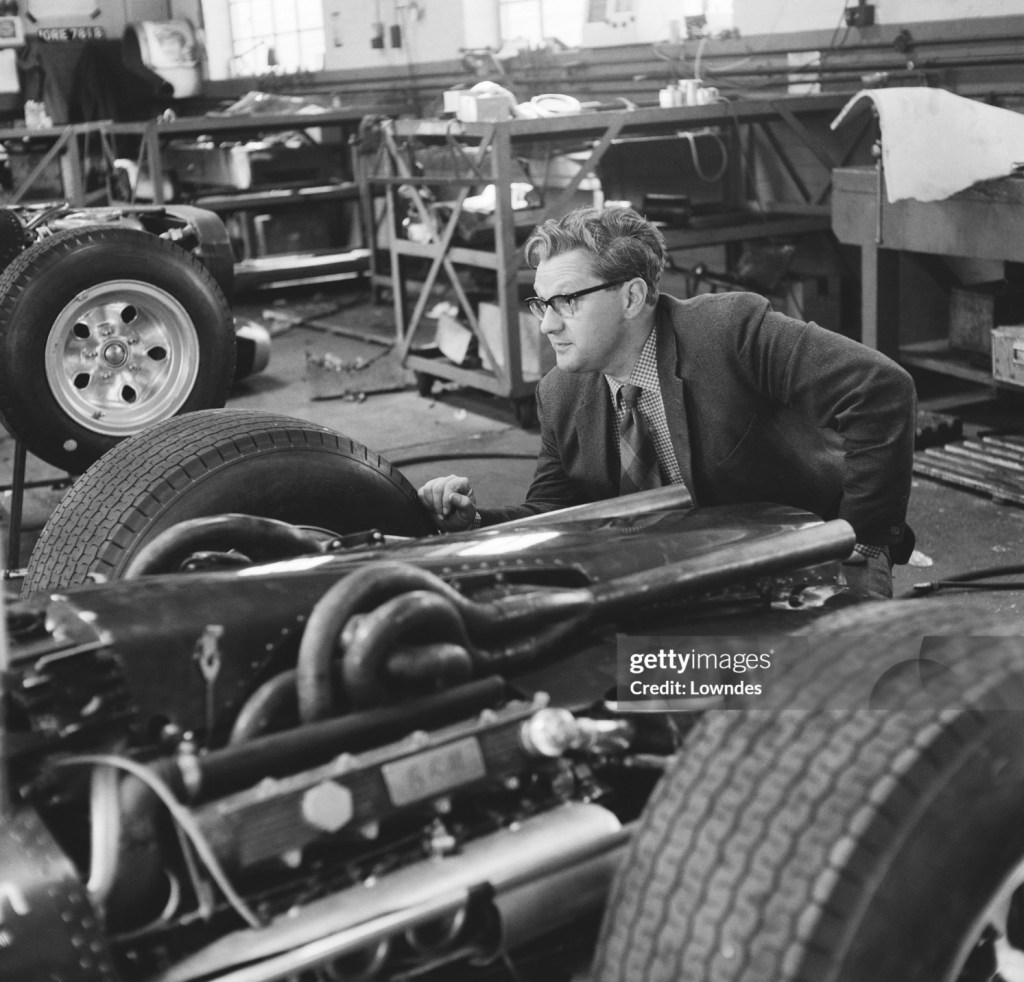
BRM Brains Trust during the 1971 British GP weekend: Tony Southgate, technician Gerry van der Weyden and Tim Parnell with the Bastard! look on his face

When 29 year old Tony Southgate arrived at BRM in June 1969 his boss was the self-styled, polarising, ‘Lord’ Louis Stanley. The leadership team comprised Southgate, in charge of chassis design and development, Aubrey Woods of engine development with Alex Stokes as the gearbox specialist.

“My brief was to improve the existing P139 for the remainder of the 1969 season, if possible, and then to deliver an all-new car for 1970,” he wrote in his great ‘Tony Southgate : From Drawing Board to Chequered Flag’.

Southgate decided Alec Osborn’s (who departed BRM along with Peter Wright when Southgate arrived) P139 wasn’t worth spending time on as “Some of the suspension systems and mountings deflected, which produced very spooky handling…Surtees withdrew from the German Grand Prix on the Nurburgring after two of the three practice periods; he was convinced that something was going to break on the car…”

As many of you will recall, John Surtees was having something of an annus horribilis that year, driving shit-heaps on ‘both sides of the Atlantic’: the BRMs and Jim Hall’s Chaparral 2H Chev in North America.

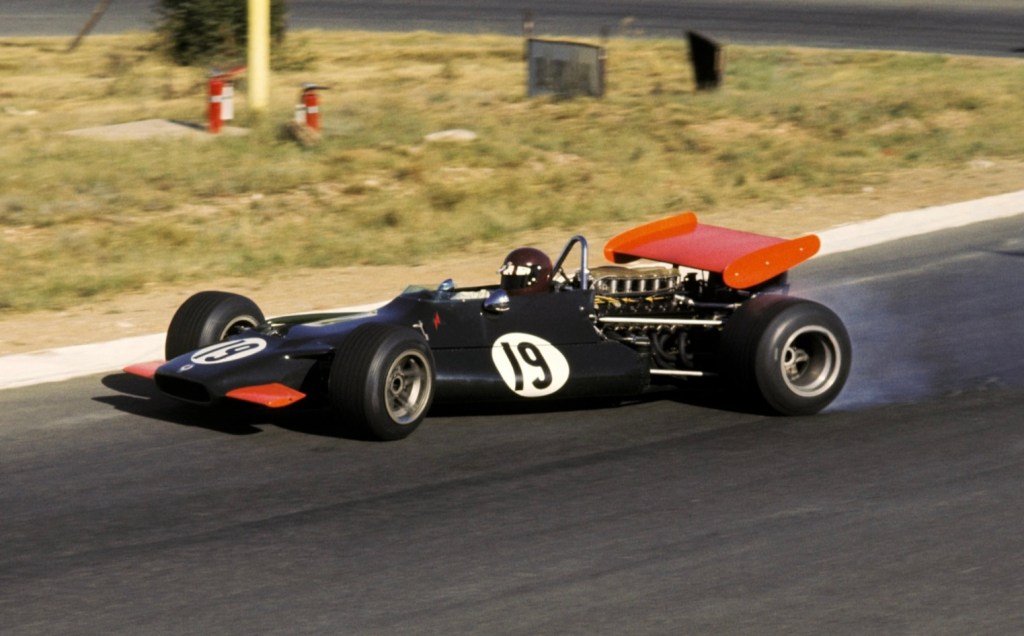
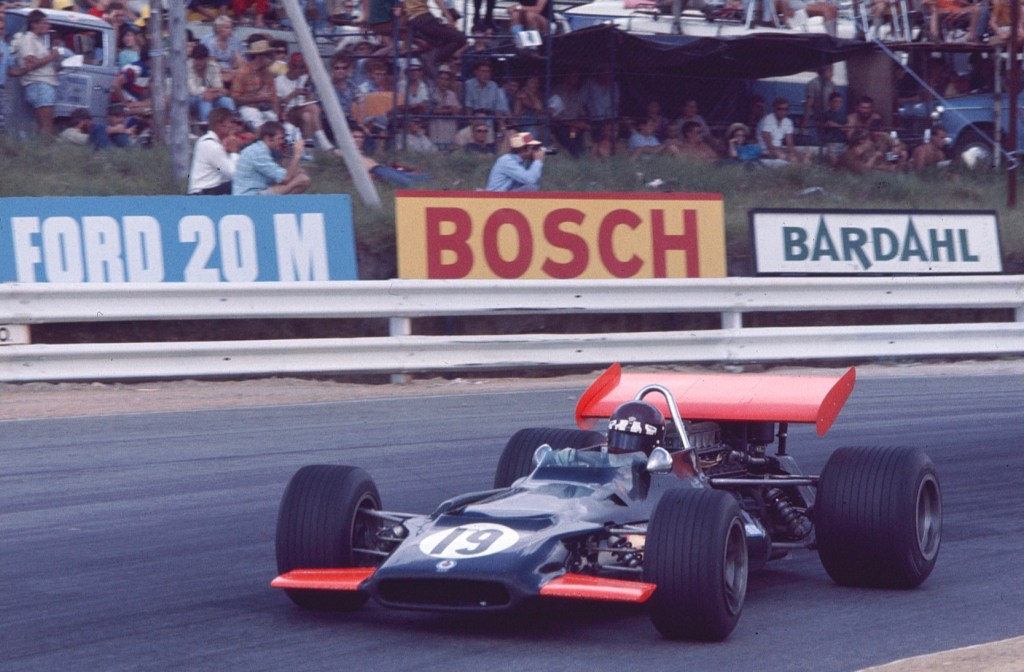
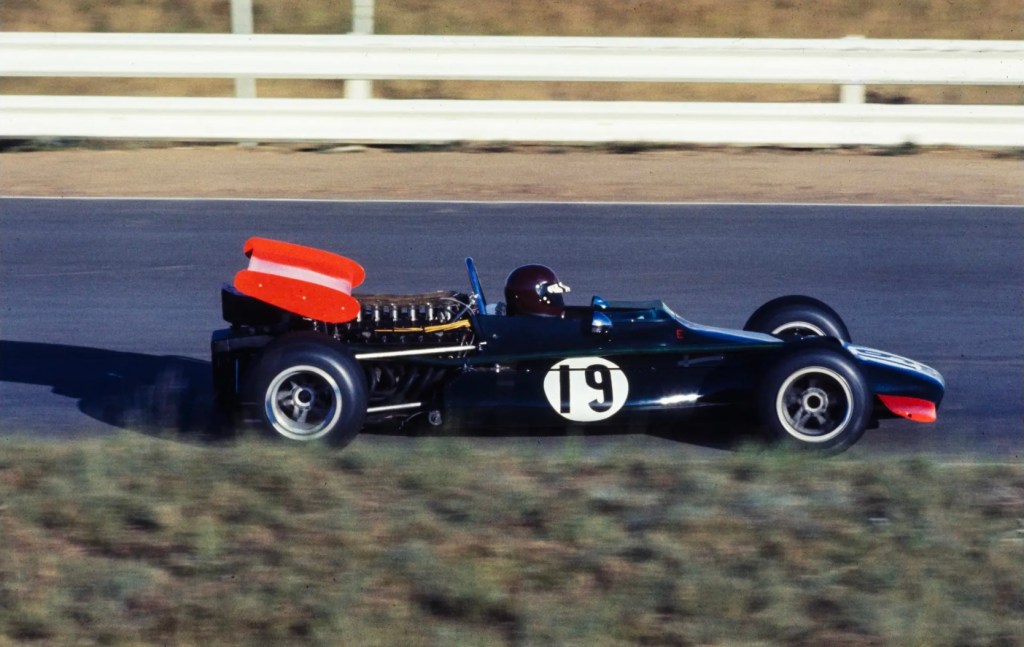
Jack Oliver giving his P153 plenty during the 1970 South African GP weekend (MotorSport)
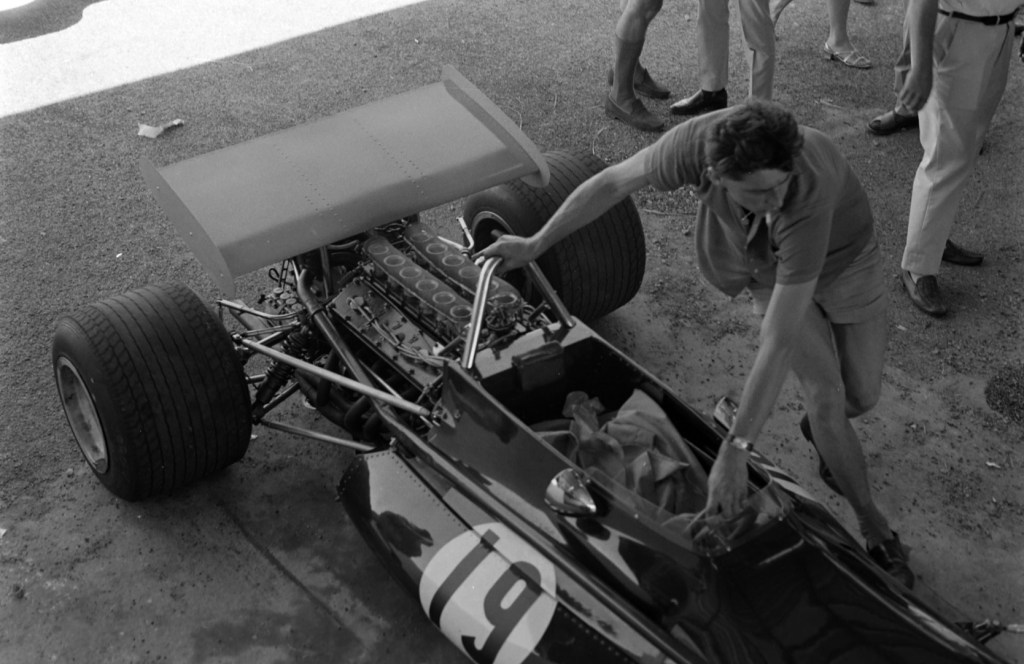
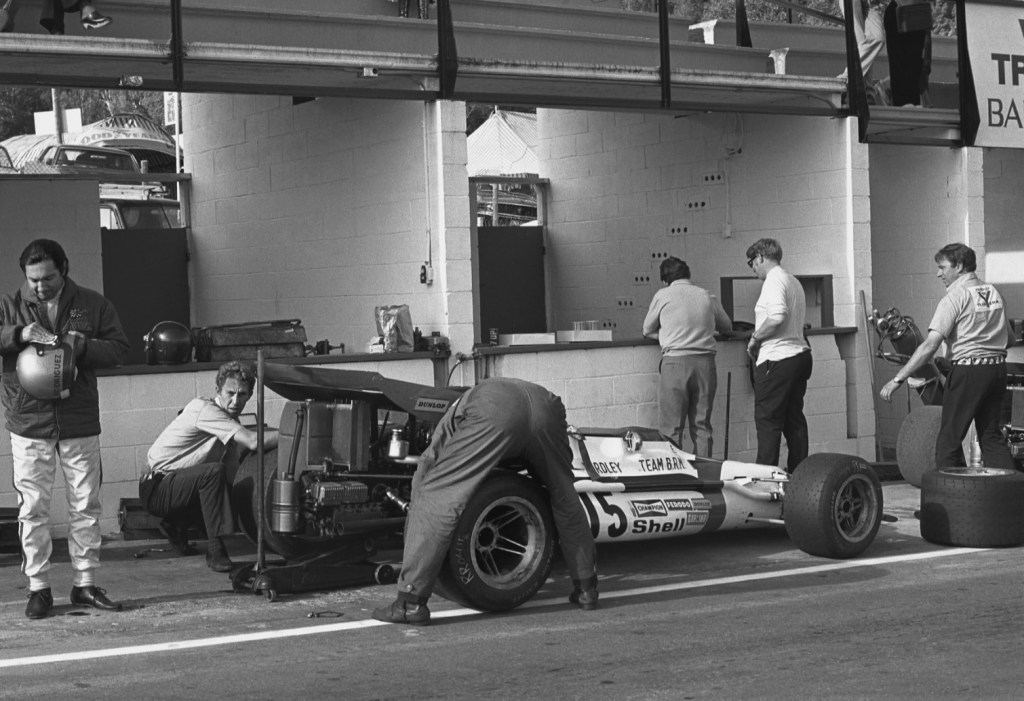
Kyalami pits 1970 (MotorSport)

Design and construction…

Tony Southgate wrote that “The philosophy behind the P153 design was maintaining my obsession with low CG, with the fuel concentrated in the centre of the car to achieve minimal interference with the weight distribution as the fuel level changed. Coupled with this was very good torsional stiffness between the wheel centres, and great rigidity of the suspension and its mountings.”

“Aerodynamic testing in 1969 was still basic by modern standards…The full-size race car ran in the MIRA wind tunnel, and the scale model work was done in the Campbell tunnel at Imperial College, London.”

“One of the cars interesting points of note was that it ran on 13-inch diameter wheels both front and rear, when the opposition were using 15-inch at the rear. The car ran on very fat Dunlop tyres (their last year in F1), giving it a very low, squat appearance.”

“The monocoque was unusual in that it had a very pronounced double-curvature shape, being 4 feet wide at the centre. The panels were hand rolled in-house and have a very ‘pregnant’ look to the car.”

(MotorSport)

Front suspension was period typical: magnesium uprights, upper and lower wishbones with Koni shocks and coil springs and an adjustable roll-bar.

Engine change of Rodriguez’ P153 on Sunday June 7, 1970 during the victorious Belgian Grand Prix weekend (MotorSport)

“The V12 engine, as originally designed by Geoff Johnson, was unstressed, but we modified it to make it semi-stressed. A small, neat triangular framework was added to the rear of the monocoque to take part of the load. The engine was very light for a V12. It weighed the same as a Cosworth DFV and had more or less the same maximum horsepower, approximately 427bhp, but less torque. We used 11,200rpm whereas at that time the DFV was limited to around 9300rpm.”

Doug Nye adds further detail about the 1970 engine developments of the 48-valve BRM P142 engine in his ‘History of the Grand Prix Car 1966-85’.

“In 1970, the P142s powered more adequate Southgate designed chassis and began winning races, but power was not destined to improve dramatically in the years left to BRM and its V12 engines. After Rudd had gone to Lotus, Aubrey Woods took over engine development.”

“Woods considered the chain-driven four-cam centre exhaust P142 overheated both its water and oil too easily, and suffered badly from detonation. Its relatively long stroke was a limiting factor, new pistons were required and they took along time to make. He designed new cylinder heads lowering engine CoG with outside exhausts and in’ve inlets with improved ports and enlarged cooling waterways. The crankcase was now cross-bolted and stiffened to allow use as a semi-stressed chassis member.”

“The BRMs would always retain their camshaft chain-drive as the systems last refuge in Formula 1.”

Southgate, “The (Project 131) gearbox for the P153 was the existing one carried over, but with a new outer casing and rear cover castings carrying the complete rear suspension, the rear wing and oil tank assembly. The P153 had np problem getting down to the minimum weight requirement…”

Oliver, Kyalami 1970 (MotorSport)

Racing the P153 in 1970…

“The car was immediately quick, but somewhat fragile. Our new number-one driver, Pedro Rodriguez, did a great job and became an instant star within the team. He was amazingly easy to work with, simply a natural, but not a technical driver like John Surtees.”

Frustrated with the lack of progress, and already building Surtees F5000 cars, Big John left to build and race his own F1 cars and to expand his range of customer cars. Jackie Oliver replaced him.

“I had some problems with the P153 in the beginning. A rear axle broke during Kyalami testing…then a similar problem at the front caused a famous fiery accident…” that destroyed both Oliver’s P153 and Jacky Ickx’ Ferrari 312B at Jarama, Spain.

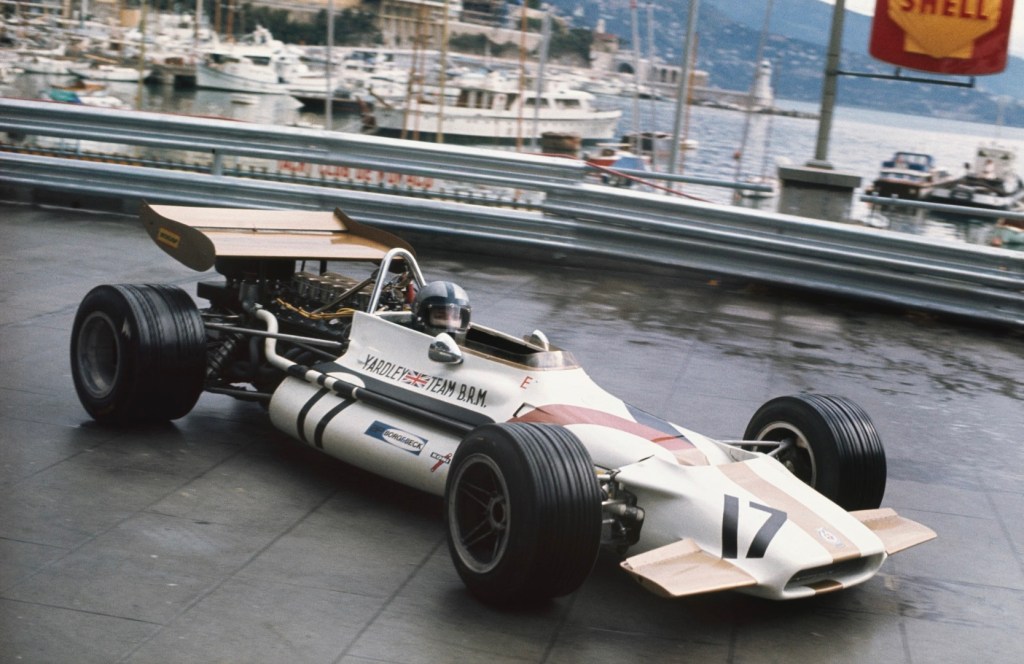
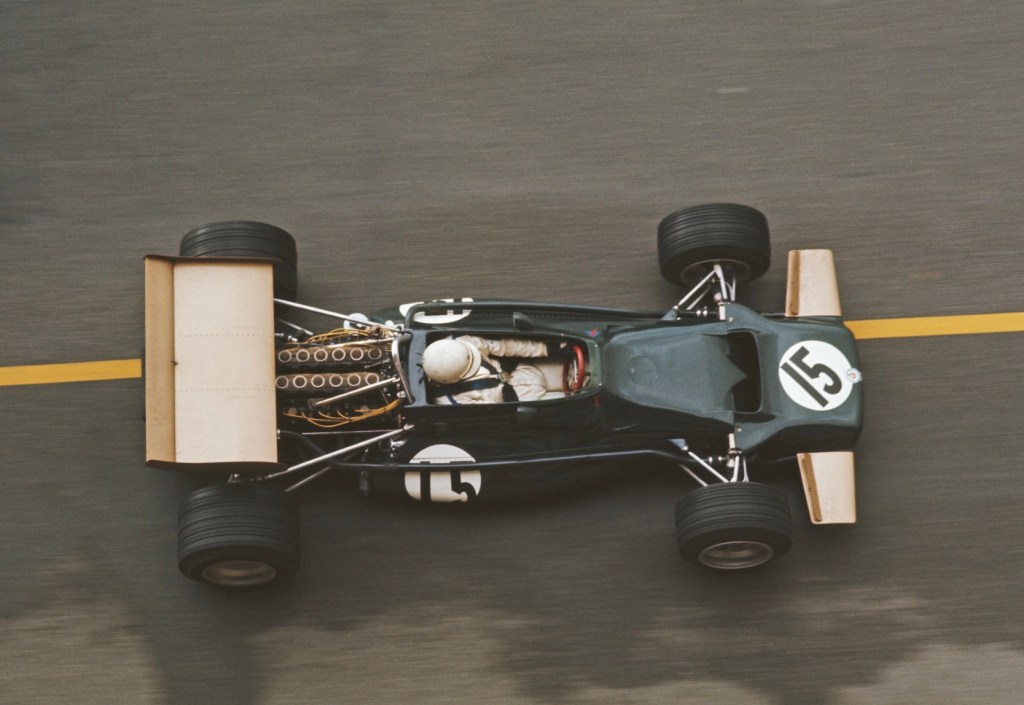
At Monaco the ‘commercial rot had set in’, or less emotionally, commercial reality, the pristine P153 pledged allegiance to Yardley. Not entirely though, George Eaton’s was in each-way bet livery as below: green car and Yardley-gold wings (MotorSport)
Pedro leads Chris at La Source during their titanic dice at Spa in 1970. That day the mighty BRM stayed together, Rodriguez sizeable wedding-tackle did the rest (MotorSport)

“Reliability was the main problem of 1970. The engine oil system was being particularly difficult. I tried ‘trick’ oil tanks, and by the time we got to the Belgian Grand Prix at Spa-Francorchamps, the oil-tank had grown to 4.5 gallons in capacity and was fed by 1.25 inch bore Aeroquip pipes (these were hardly hoses)! Miraculously, this did the job for a while. Pedro won the race after leading most of the way, closely caused by Chris Amon’s March 701 Ford. BRM was back…”

“But engine problems still dogged BRM throughput the year, although Pedro gained a second place in the US GP at Watkins Glen and a couple of fourths in other races, and he also won the non-championship Gold Cup at Oulton Park.”

Pedro was leading at Watkins Glen until a splash-and-dash pitstop for fuel, Doug Nye wrote. Fuel consumption had slipped from about 4.8mpg to 6mpg at St Jovite, the BRMs were forced to make pitstops in both Canada and the US as a consequence.

Southgate, “My thoughts on the engine problem were simple: the main bearings were all too small, too narrow. However, this was one of the main reasons the engine was so short. There was no chance of any major design changes in this area, so we had to do with lots of detail design improvements including even better oil tank systems.”

To Southgate’s point, look at the truly massive oil tanks under the BRM’s rear wing in the Mont Tremblant, Canada pitlane below; a few RPM were lost in aero-drag in that lot! Some of the fuel consumption problem is right there…

Pedro readies himself in the Mont Tremblant-St Jovite pitlane, fourth that weekend. #15 is Oliver’s P153 (LAT)
Pedro, Mont Tremblant 1970 (MotorSport)

In 1970 BRM finished 16 times from a total of 37 starts and placed sixth in the World Constructors Championship with Rodriguez seventh in the driver’s and Oliver a disappointing twentieth after retirements in 10 of the 13 rounds!

Nye, “Southgate produced the finest 3-litre BRM in 1971: the definitive chisel-nosed P160, a cleaner, lower, lighter development of the P153, though actually incorporating few interchangeable parts.” A story for another time folks…

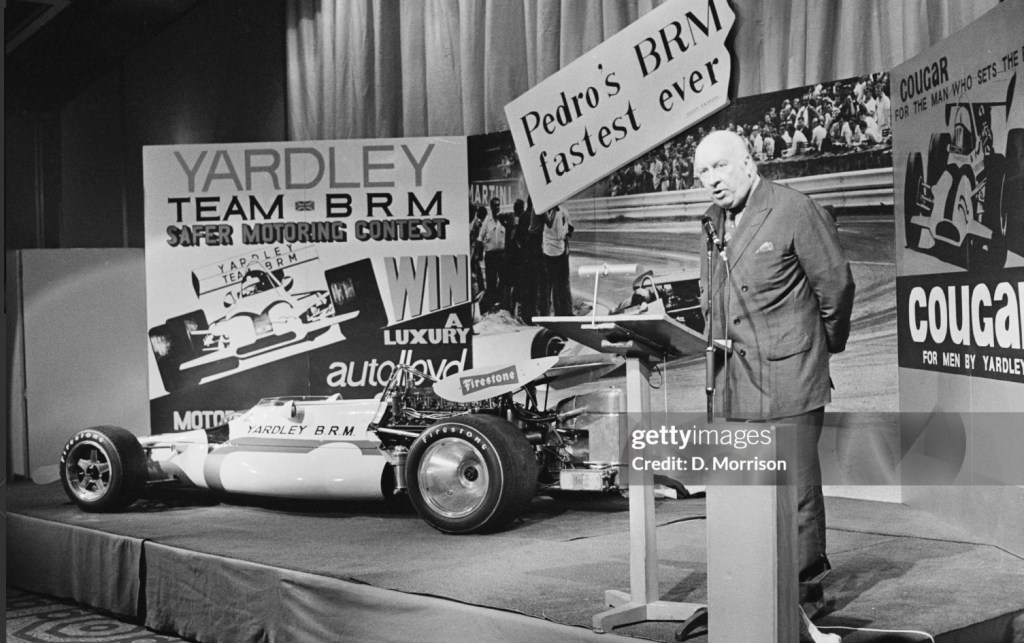
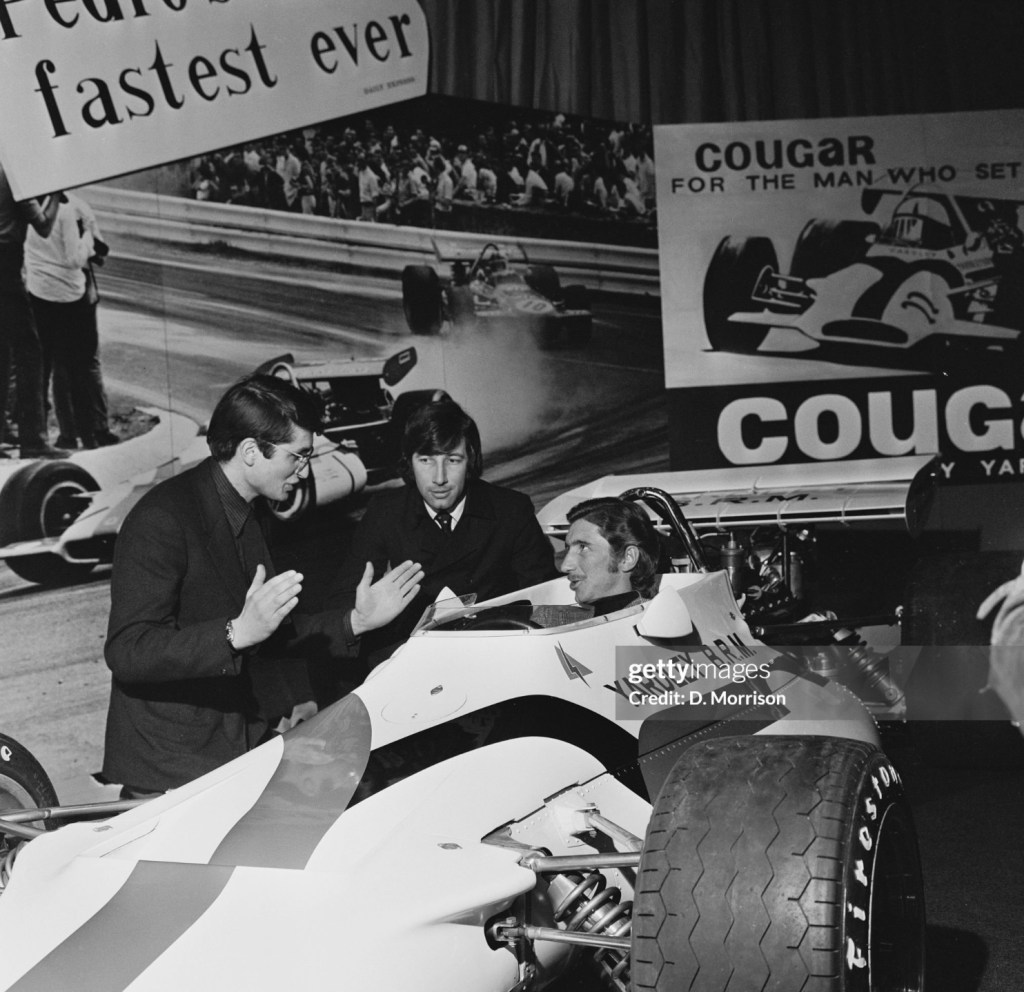
Big Lou extolls the virtues of the new BRM P160 and Cougar aftershave – ‘it’ll drive your mistress wild I tell you’ – place unknown, February 17, 1971

Etcetera…

(MotorSport)

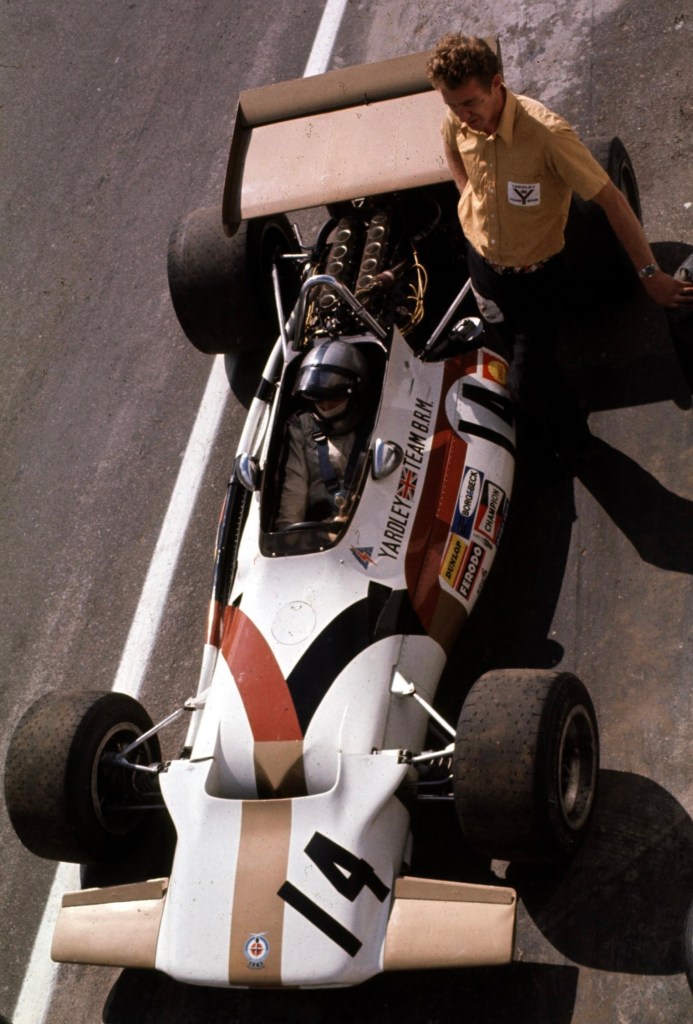
A pair of compare and contrast shots: George Eaton, 1970 BRM P153 at Monaco in May 1970 above, and John Surtees, 1969 BRM P139 during the British GP meeting at Silverstone that July.

The photographer in the Surtees shot looks suspiciously like Rob Walker, he has wandered away from his car, Jo Siffert’s Lotus 49B Ford.

Note the flatter, wider aerodynamic form of the P153, partially informed by the wind tunnel, and earlier P138.

The front suspension of Southgate’s car comprises simpler outboard wishbones, the earlier car uses more complex to make, and more aerodynamic, top rocker and lower wishbone layout. Rear suspension is the same albeit the more advanced two-lower links on the P138 were replaced by Southgate with lower inverted wishbones.

The engine fitted to the P153 is 1970 spec P142 inlet between the vee and side exhaust, that to the P139 is a 1969 spec P142 centre-exhaust V12.

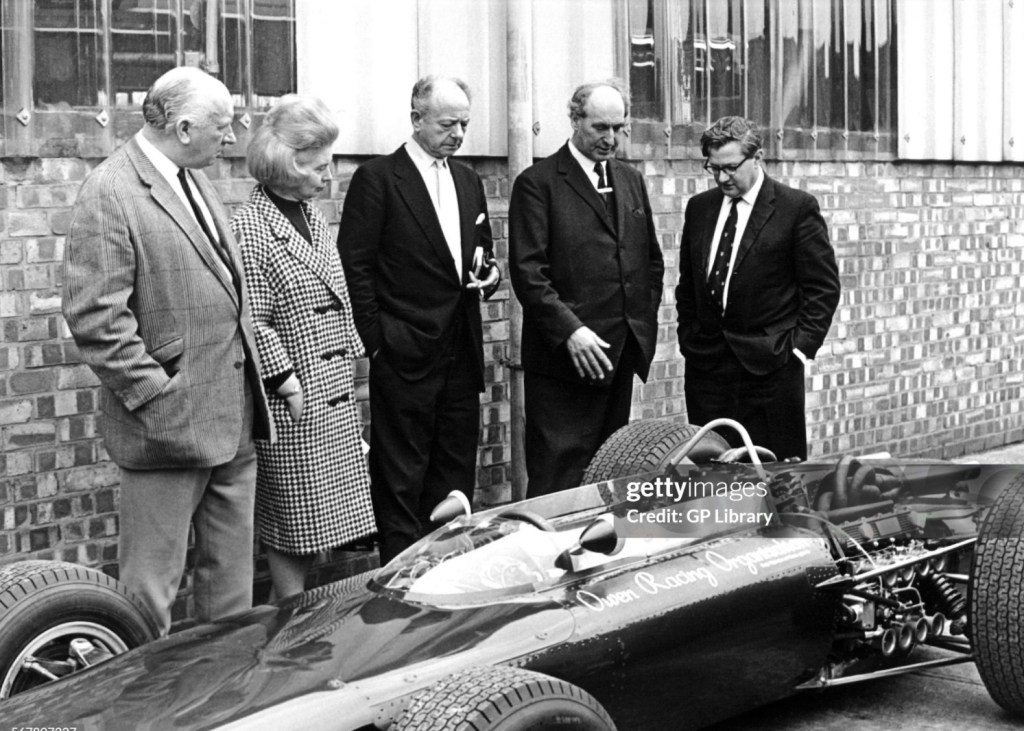
Louis Stanley, Jean Stanley nee-Owen, Raymond Mays, Sir Alfred Owen and Tony Rudd with a BRM P83 at Bourne, allegedly in 1969.

I say allegedly as by 1969 the H16 hadn’t been raced since late 1967, and it makes sense for the PR shot to be with the latest model, not the problem-child. The H-16’s solitary GP win was powering Jim Clark’s Lotus 43 at Watkins Glen in 1966.

In the best tradition of nepotism, Stanley’s power and position arises from his marriage to Jean Stanley, Alfred Owen’s sister.

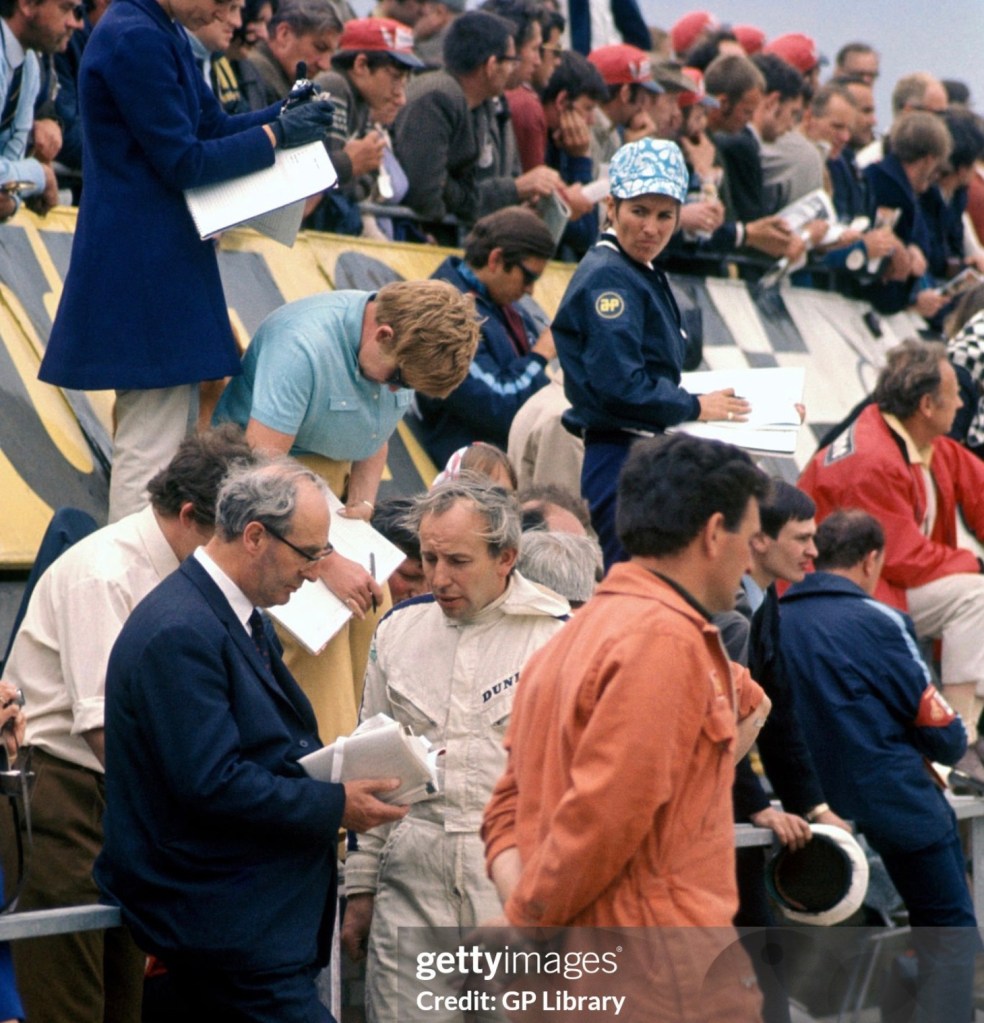
John Surtees tells it like it is to his boss, Sir Alfred Owen at Silverstone during the July 19, 1969 British GP meeting. Owen was a great industrialist and corporate leader, respected by all who came within his orbit. The AP-Lockheed lady is all over what’s going on, the rest are doing their best to look the other way…

Surtees qualified his BRM P139 sixth, and Oliver his P133 13th, Surtees was out with a suspension problem after completing one lap and Oliver on lap 20 when his transmission failed.

By that weekend Southgate was already onboard. He discloses in his autobiography that the approach for him to join BRM was made by Surtees in the US, John being delegated the task given his regular travel between the UK and US.

Lovely portrait of Tony Southgate (born May 25, 1940) at Silverstone during the July 1971 British GP weekend.

The funniest part of Southgate’s BRM chapters involves his first month at Bourne and running-the-gauntlet from the ageing (August 1, 1899-January 6, 1980) but still very frisky ‘Gay Ray’ Mays!

By that stage – the English Racing Automobiles and British Racing Motors founder – “RM had no particular job at BRM but he was still very much on the scene as a sort of ambassador.” As a handsome young bloke, Southgate was potential Mays’ fresh-meat despite the fact he was married.

Suffice it to say – and do re-read the chapter, in fact the whole fantastic book – after Tony declined to return RM’s car-keys to him to his bedroom, having borrowed said vehicle to visit the team mechanics across town earlier in the evening. Mays then refocussed his energies back on the hotel bell-boys for which he was somewhat infamous…

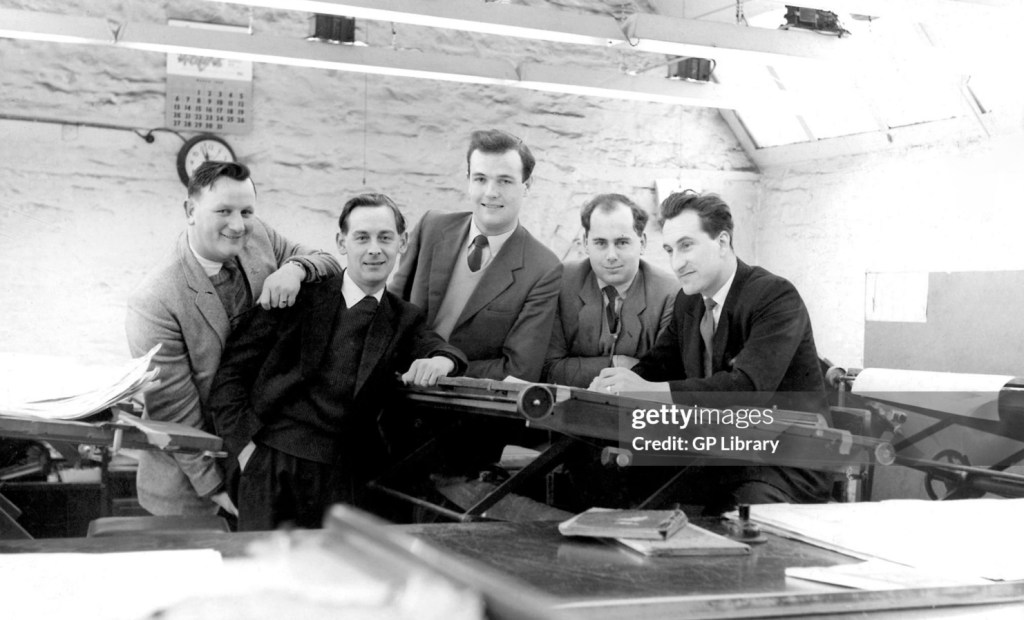
This fantastic shot of the BRM design team is diminished only because the caption cites four names rather than the requisite five!

Alec Stokes, Aubrey Woods, Alec Osborn and Geoff Johnson in 1959, who is missing folks? The drawing office was then located in the old maltings building behind Raymond Mays’ house.

(BRM Association Archive)

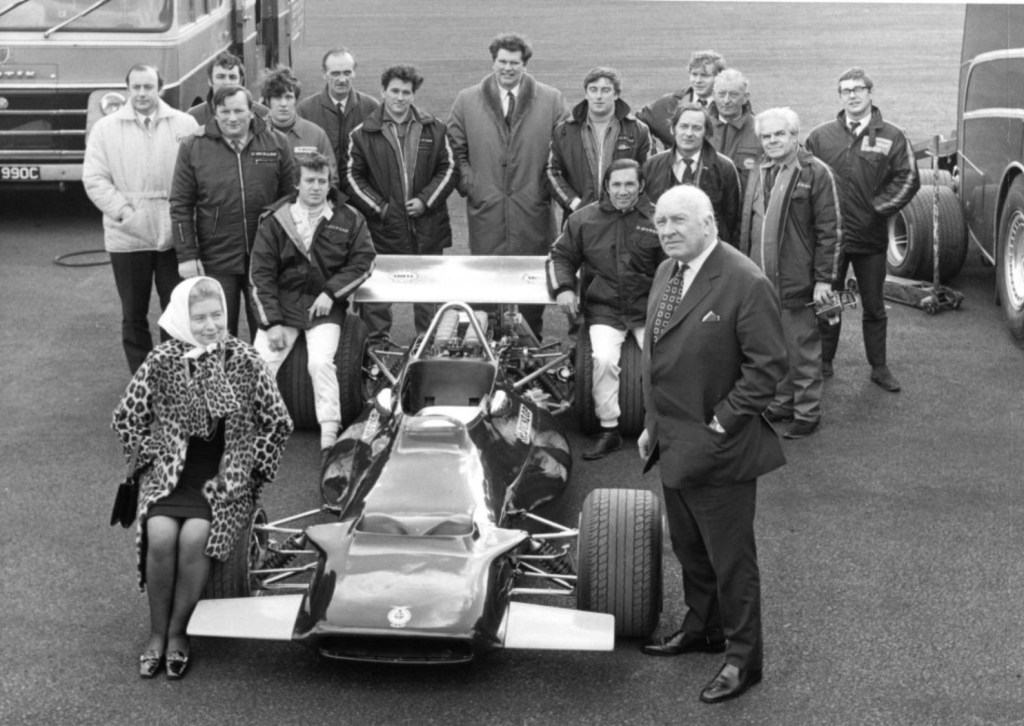
P153 launch at Silverstone, the car has grown a Dunlop decal since Snetterton in early January. Date folks?

From the left, back row – Dunlop employee Ken Spencer, Alec Stokes, Dave Mason, Len Reedman, Alan Challis, Tim Parnell, Gerry Van-Der-Weyden, Aubrey Woods, then two Shell employees, Willie Southcott, Dunlop employee. Centre Jackie Oliver and Pedro Rodriguez. Front, Jean and Louis Stanley.

Tony Rudd with BRM P83 at Bourne on May 17, 1966.

I suspect there are a couple of generations of BRM fans like me who feel we almost know Tony Rudd thanks to the all-embracing manner in which he worked with Doug Nye to produce the magnificent ‘Saga of British Racing Motors’ Volumes 1-3, with Vol 4 in-the-pot at present.

There are so many documents and corporate reports contained within written by him that you can form an impression of the way he thought, operated and communicated as part of the team. There nothing to suggest he was anything other than someone to know, like, trust and respect…

He was clearly determined, and stubborn too…Doug Nye wrote that “the ultimate, much modified, magnesium block four-valve-per-cylinder H16 engine (yes 64 valves, 128 valve springs – imagine assembling it all) was completed and tested for 1968 but the policy decision was taken to set it aside and concentrate on the simpler, lighter V12.”

Despite that, “The engine continued in test as late as from 13 December 1968 to 25 January 1969. It was number ‘7541’ and the best of its eight runs peaked at only 378bhp at 10,300rpm; that was nothing like enough to compete with Cosworth’s DFV, which was already beyond 430bhp.”

It seems the catalyst, or straw that broke the camels back in terms of Rudd’s departure from BRM was pursuing the H16 for too long, contravening the policy direction of a year or so before. Southgate wrote that “Tony Rudd…hadn’t done what had been ordered, which was to drop the team’s H16 engine programme and proceed with the V12 only.”

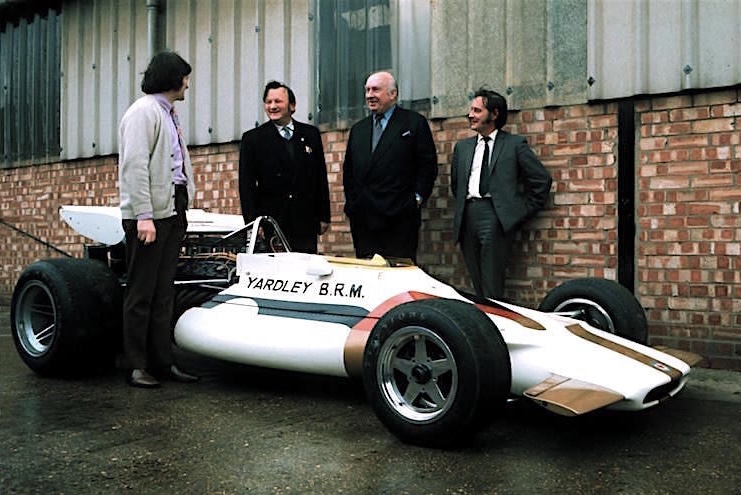
Clearly pink was in! Southgate, Alec Stokes, Stanley and Aubrey Woods perhaps at the time the Yardley deal was done. Bourne.

George Eaton, BRM P153, Monaco 1970 (MotorSport)

Every man and his poodle raced a BRM P153…

The long-lived machines, in P153, P153/P160B spec, were raced by a swag of drivers, many of them F1 virgins. The roll-call includes Rodriguez, Siffert, Oliver, George Eaton, Howden Ganley, Reine Wisell, Helmut Marko, Alex Soler-Roig, Vern Schuppan, Peter Westbury (DNQ US GP 1970) John Miles and John Cannon. Quite a list, in part due to Stanley’s crazy Marlboro-multiple-entry 1972 season and renta-ride availability.

Allen Brown’s chassis by chassis record of the seven P153s built from late 1969 to early 1971 is here: https://www.oldracingcars.com/brm/p153/ The shot below shows three BRM P153 pilots at Brands Hatch in early 1971: John Miles, Howden Ganley, and Jo Siffert in the car.

Jack Oliver, South African GP, Kyalami 1970 (MotorSport)

Credits…

‘Tony Southgate : From Drawing Board to Chequered Flag’ Tony Southgate, ‘History of The Grand Prix Car 1966-85’ Doug Nye, MotorSport Images, Rainer Schlegelmilch, Getty Images, GP Library, BRM Association Archive

Tailpiece…

(MotorSport)

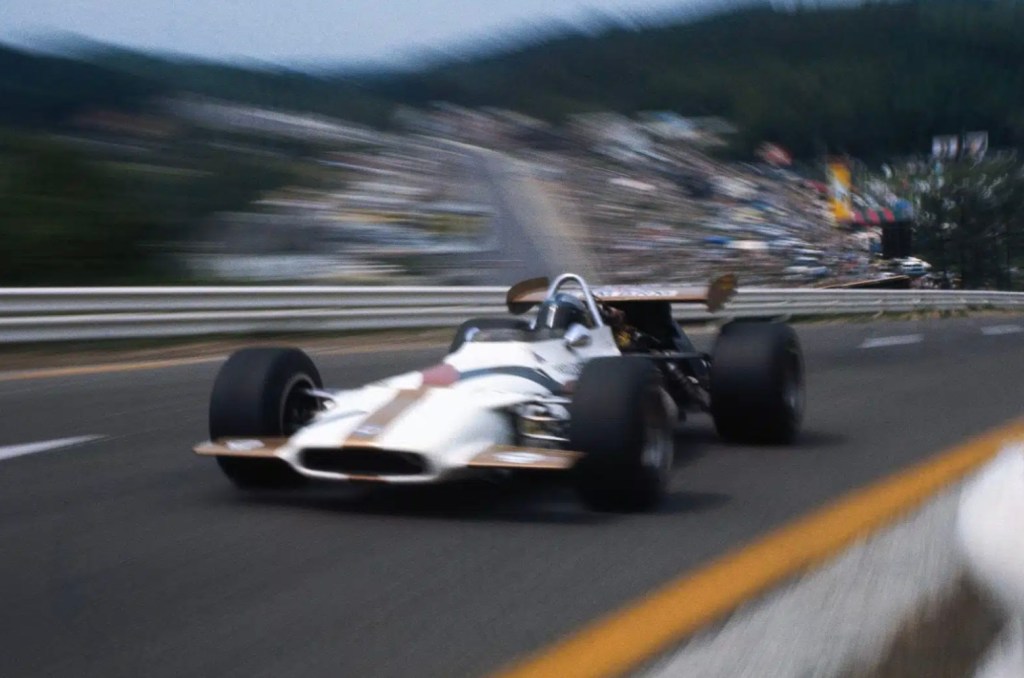
Superb MotorSport Images shot of Pedro Rodriguez blasting through Eau Rouge on his way to that hard-fought Belgian Grand Prix, P153 3-litre V12 win.

Any win at daunting Spa was pretty special, and Pedro had a few there, but that one must have been the sweetest of all given fabulous Chris Amon pushed him very hard all the way. It was the last Grand Prix held on the old circuit too…

(LAT)

Finito…

(MotorSport)

George Eaton during the July 1970 Watkins Glen Can-Am round aboard his BRM P154 Chev.

I’ve written about both car and driver before, here; https://primotipo.com/2017/04/28/pedros-heavy-chevy/ and here; https://primotipo.com/2017/02/16/george-eaton/ but the photos were too good to ignore.

George showed some pace too, he qualified fifth at both Road Atlanta and Donnybrooke, was sixth on the grid at Edmonton and eighth at Laguna Seca but he had a shocking run of reliability with various chassis, engine and engine ancillary failures. The team’s Chev engines were prepared at Bourne.

(MotorSport)

His best finish was third at St Jovite, a performance matched by Pedro Rodriguez who raced another P154 at Riverside, and at Laguna where he was fifth.

The team’s 1970-71 P153-P160 grand prix cars were race winners, so BRM had bigger fish to fry. It’s a shame they didn’t build on the Can-Am learnings of 1970 with a full two-car works effort the following year all the same.

Credits…

MotorSport Images, classicscars.com

Tailpiece…

(LAT)

Finito…

917 brands rodrig

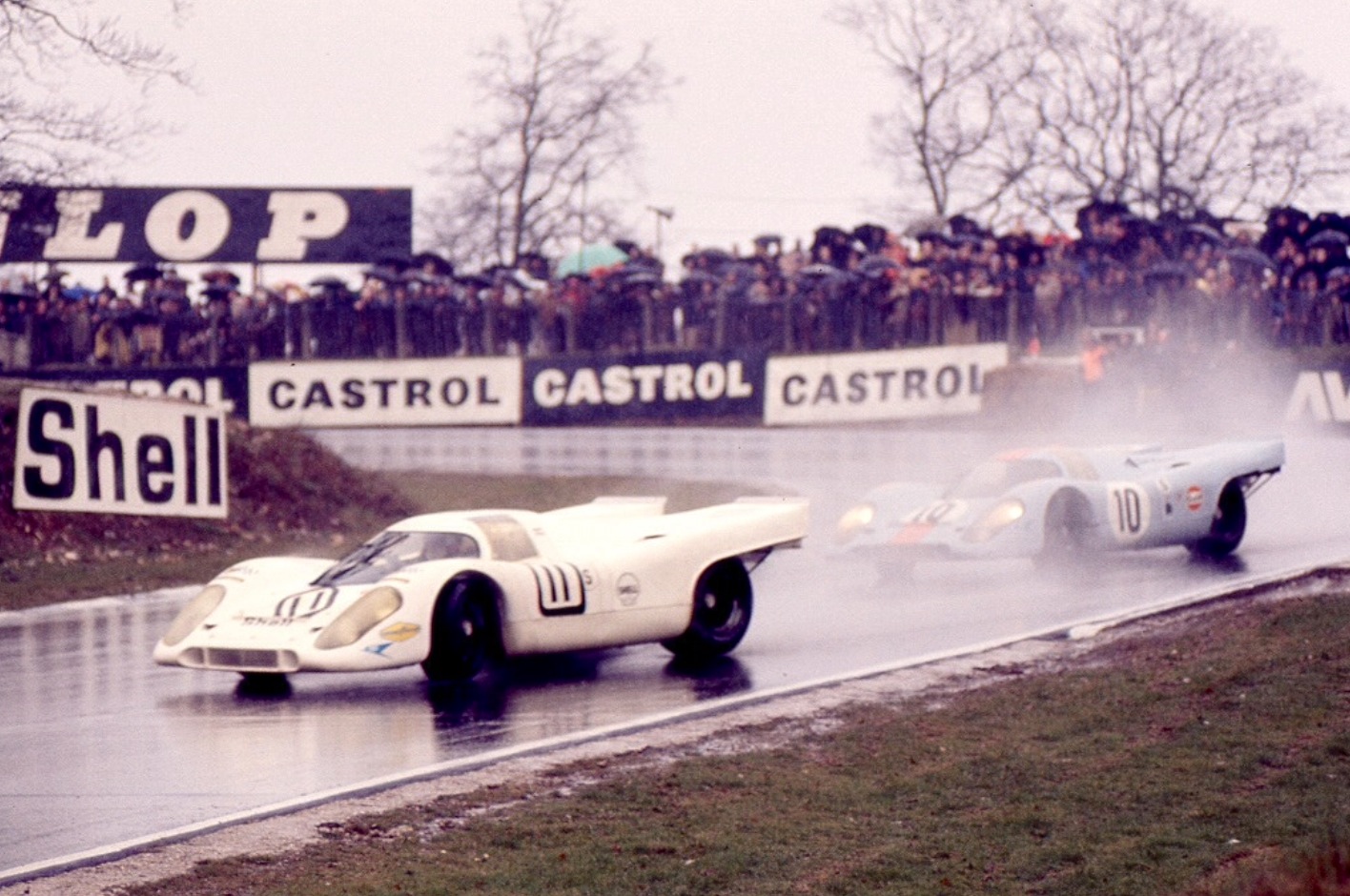
There are drives which are spoken of in reverential terms down the decades, Pedro Rodriguez’ victory in the Brands Hatch 1000km in 1970 is one of those…

Here #10, the John Wyer entry is set to pounce on #11 Vic Elford out of Druids in another factory (Porsche Salzburg) Porsche 917K, the Brit was of course no slouch on slippery surfaces himself. He was European Rally Champion aboard a Porsche 911 in 1967 and Monte winner similarly mounted in 1968 before going circuit racing.

Acknowledged wet weather ace Jackie Ickx raced a factory Ferrari 512S in a Brands Hatch field full of F1 drivers who in those days also contested the sportscar endurance classics. But Pedro was in a class of his own on that sodden Kent afternoon finishing five laps ahead of the second placed 917K of Elford and Denny Hulme, and eight laps ahead of another 917K driven by soon to be 1970 Le Mans winners Hans Hermann and Richard Attwood, both in similar equipment to Pedro…

Photo Credit…Bruce Thomas

Finito…

image

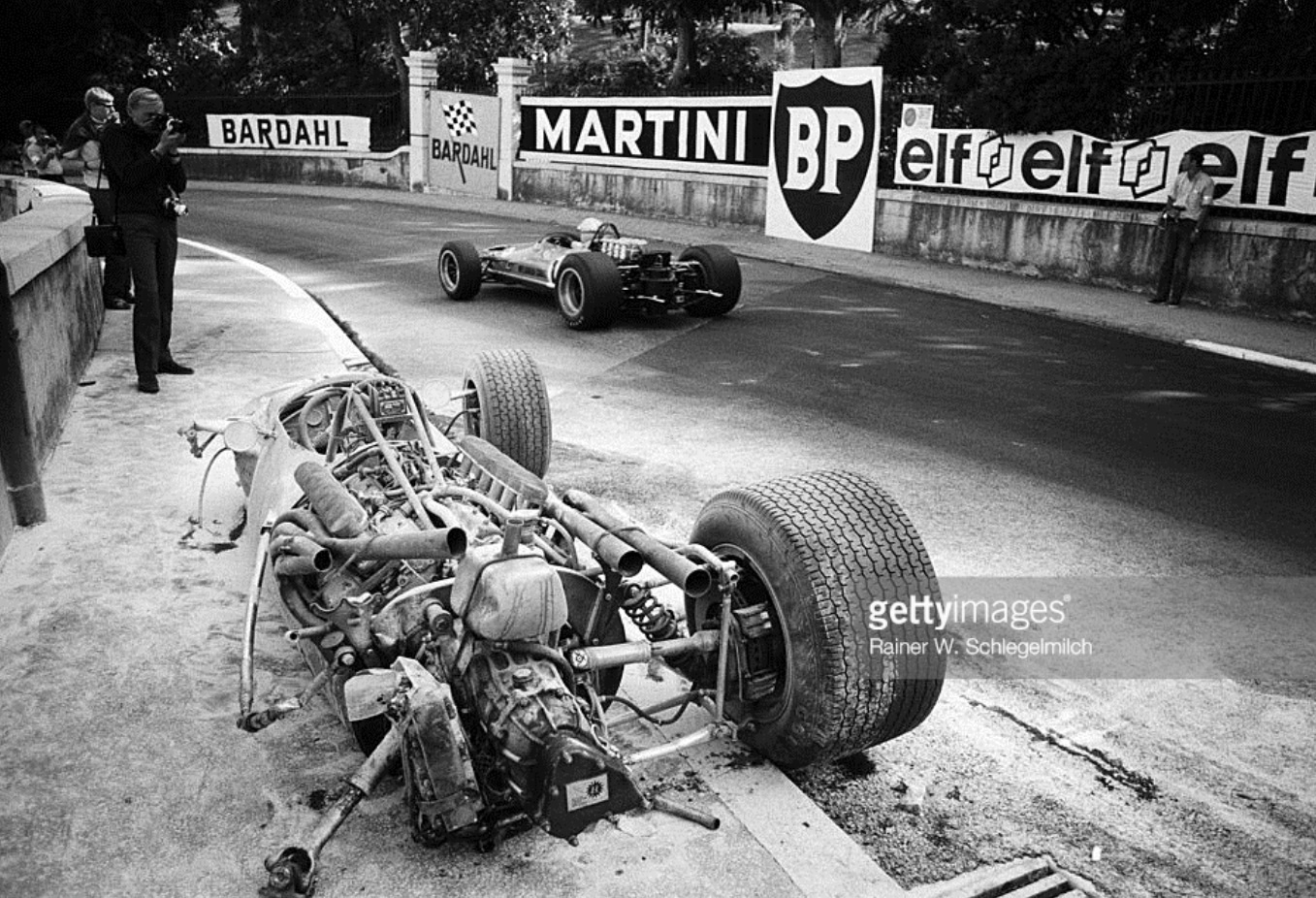
Denny Hulme’s snub/Monaco nosed McLaren M7A Ford passing Pedro Rodriguez’ very dead BRM P133 V12 during the 1968 Monaco Grand Prix…

By lap 16 there were only five cars left in the race won by Graham Hill’s Lotus 49B Ford from Richard Attwood’s BRM P126 and Lucien Bianchi’s Cooper T86B Maserati. Pedro boofed the Len Terry designed BRM on lap 16 having qualified ninth, Denny raced his car to fifth.

A couple of design aspects of the P126/133 design in the shot below are worth noting. The Hewland DG300 transaxle is the only occasion on which a non-BRM ‘box was fitted to a Bourne designed and built car. Checkout the remaining right-rear suspension componentry too, the twin-parallel-lower-links set up to better control rear toe, later picked up by all and sundry, was first designed for this car by Len.

image

Credits…

Rainer Schlegelmilch

Tailpieces: Pedro and BRM P133 in pre-rooted state…

image

(unattributed)

(unattributed)

(unattributed)

Finito…

(De Lespinay Collection)

Jack Brabham and John Cooper’s attack on the 1961 Indianapolis 500 took place on May 30, 1961. Lordy, that’s 60 years ago this weekend.

The story of their initial testing sortie in October 1960 in a GP T53, and Brabham’s problem-plagued ninth place in the race has been well told, not least in my piece in this week’s Auto Action #1811 https://autoaction.com.au/issues/auto-action-1811

Noddy Grohman giving the car a birthday after its qualifying run. Note the Dunlop wheels and tyres, more substantial roll-bar than the F1 equivalent, and big fuel tank on the left side (De Lespinay Collection)

David Friedman’s rare body-off shot shows the T54’s offset secrets- suspension, engine and gearbox, fuel tanks and driver. Transaxle is Cooper Knight C5S but with three, rather than the five speeds of the F1 spec ‘box (D Friedman)
Cooper receiving some Bear service before qualifying in May (De Lespinay Collection)

After the race, the star of the show was shipped back to the UK for a demonstration run at Silverstone, and then back to the car-owner, Jim Kimberly in the US. The Kleenex heir funded Cooper’s 500 attack.

The T54 at an SCCA Divisional meeting, Hillsborough, US in June 11, 1962. “Just after Kjell Qvale purchased the car…the Kimberly Cooper Spl lettering has been removed…at tis point the car had no engine, gearbox or driveshafts…(R Spencer)

Kimberley ordered two cars from Mickey Thompson for his ’63 Indy campaign, Kimberley sold 61-S-01, which had been on display in the Indy Museum for a little while, to Kjell Qvale, operator of British Motors in San Francisco.

Joe Huffaker, prominent engineer, suggested fitment of an Offy 4.2-litre DOHC, four-cylinder engine to the T54, this combination was potentially a race winning one.

Qvale sold Aston Martin amongst the suite of marques his British Motor Cars Ltd sold in San Francisco. He substituted the big, long, heavy – and as it turned out reliable but not powerful enough – Aston DOHC-six for the far more compact and suitable Offy four.

Joe Huffaker and Kjell Qvale with Cooper T54 Aston Martin in 1963, it looks pretty sleek from this angle (De Lespinay Collection)
Joe Huffaker contemplates the Aston Martin six, bulk, length and height. Chassis lengthened to accommodate it (De Lespinay Collection)
Rodriguez, T54 and crew for the obligatory Indy portrait shot (IMS)

Initial test laps at Indy by Ralph Liguori showed the Dunlop wheel/Firestone tyres combination was too weak, so cast Halibrands fitted with Firestones were substituted.

Later despite the best efforts of fizzy, fast Pedro Rodriguez at the wheel, the ungainly-looking car failed to make the qualifying cut.

The Cooper was the fastest thing through the corners, besting even the Clark and Gurney (Dunlop wheels and tyres) Lotus 29 Fords. The AM engine simply lacked the puff the company had promoted, Rodriguez’ qualifying speed was only 2mph than Brabham’s two years before despite better tyres.

The engine was returned to Newport-Pagnell, while the T54 was sold to a San Jose, California club-racer.

The photograph below shows the largely unmodified chassis, albeit fitted with a beefy roll-cage and nerf-bars for sprintcar use on the paved tracks of the northwest.

(De Lespinay Collection)

By 1966 T54 had changed hands a number of times. It was raced with a Maserati engine at Trenton and Phoenix, then Buick, Ford and Chev V8s in quick succession.

By 1976 the Cooper had morphed into a bizarre Chev-powered mid-engined sprintcar raced by Darryl Lopeman.

Cooper T54 Chev (De Lespinay Collection)

Under that mountain of sinful-ugliness (ya gotta admire the guys’s innovation however), “are the original chassis and suspension, brakes, shock absorbers, pedal-cluster, radiator, oil tank, dashboard, seat and plenty of other bits” wrote Phillippe de Lespinay, saviour and restorer of the car.

The car was crashed through a wooden wall at Spanaway Raceway, Washington due to a stuck throttle. While Lopeman was ok, the nose and both rear, magnesium uprights were damaged.

(De Lespinay Collection)

The T54 “reappeared in 1990 as a bad wreck” in Tacoma Washington, its main components were the basis of the rear-engined sprint car.

The remains of both (the wreck and sprint car) were bought by De Lespinay in partnership with Robert Arnold. The car was then rebuilt, including the original 2.7 Climax FPF, by De Lespinay, Thomas Beauchamp and Gene Crowe aided by detailed photographs taken in period, and provided by David Friedman, some of which are included within this article.

T54 parts acquired by De Lespinay (De Lespinay)
Brabham with T54 chassis in 1991, ample hole in 2.7 FPF block clear (De Lespinay)

The chassis survived “inside another car”, the engine parts were tracked down in Texas and in Colarado. The block was welded by renowned Indy engineer Quincy Epperly, then rebuilt by Gene Crowe at Steve Jennings Race Engines in California.

As much as possible of the original car was used. An indication of this is shown by the shot of the machine during its rebuild in California during March 1991 – with Jack Brabham inspecting progress – it was ready for Brabham to drive at the Monterey Historics six-months later.

After the best part of a quarter-century of ownership Lespinay sold the car five years ago, many of you will have seen it demonstrated in the US, the UK or the Gold Coast.

Brabham and Cooper reunited at the Monterey Historics (De Lespinay)

Etcetera…

(De Lespinay Collection)

Smiles, and relief all round. Jack has made the cut, Cooper and Rodger Ward – who had cajoled and bullied, in a caring kinda way, Cooper and Brabham into doing the initial Indy test in October 1960 – all looking happy with a hard won time. Look at that crowd.

Front suspension detail, upper and lower wishbones each side – but offset to the left. Adjustable Armstrong shock and coil springs. Oil tank aft of radiator, Alford and Alder upright just visible, so too the Cooper steering rack and roll bar.

Note fuel filler cap, fuel tank above the drivers knees and big soft crash-pad attached to steering wheel hub.

Just don’t think too hard about a very high speed frontal collision…

(B Tronolone)

Charlie and John Cooper taking in the Indy vibe.

A decade before they were knocking out Cooper Type 15 and 16s as fast as they could build them. Ten years later they had a couple of World Championships in their pockets, and the rest.

Who knows, if the planets had been aligned, shod with Firestone tyres and a trouble-free run they may have bagged Indy in ’61 too.

Fortune favours the brave. That, they most certainly were.

Jim Kimberley leaning in at left, Cooper up. Pit stop practice

(S Dalton Collection)

Beautiful portrait of Brabham and his F1 Cooper T53 Climax 2.5 FPF during the October 5-6 1960 initial test session at Indy.

Credits…

Phillippe de Lespinay’s tsrfcars.com website and Cooper T54 Facebook page

Time-Life, David Friedman, Roy Spencer, Bob Tronolone, Car and Driver, Stephen Dalton Collection, Grid

Tailpiece…

(Life)

What it was all about really.

Beating a great big car with a little itty-bitty-one. John Cooper in the T54 being pushed away from Rodger Ward’s Watson-Offy roadster after practicing some pitstops

Finito…

image

(Klemantaski)

The geography of racetracks prior to the seventies highlights the need for accuracy to avoid damage to the local scenery let alone car and driver…

It’s Le Mans 1966, the 18/19 June weekend. The Ecurie Francorchamps Ferrari 365P2 of Pierre Dumay and Jean Blaton starts the long run along the Mulsanne Straight ahead of a factory Ford Mk2 and Pedro Rodriguez in the NART Ferrari 365 P3 ‘0846’ he shared with Richie Ginther.

I’m not sure which Ford it is but the two Ferrari’s failed to finish- the Francorchamp’s car with engine dramas and the NART machine with gearbox failure.

Bruce McLaren and Chris Amon won in a Ford Mk2, click here for a short article about the race; https://primotipo.com/2016/06/27/le-mans-1966-ford-mk2-andrettibianchi/

The Ginther/Rodriguez Ferrari P3 ‘0846’ ahead of a couple of Ford GT40’s at Le Mans in 1966 (LAT)

‘0846’ was the first of the Ferrari P3’s built and was the official press car.

Built as a Spyder, the 4 litre, 420 bhp, 24 valve, Lucas injected V12 machine raced throughout 1966-at Sebring, Targa and Le Mans- all DNF’s. At the end of the year it was converted to P4 specifications for 1967- becoming one of four factory P4’s raced that season in the International Championship for Sports Prototypes and Sportscars.

At the 1967 opening round- the Daytona 24 Hour, Chris Amon and Lorenzo Bandini shared the drive and won the race in it.

Two Ferrari at Daytona in 1967- the winning Amon/Bandini P4 ahead of the third placed Mike Parkes/Jean Guichet 412P (unattributed)

Entered at Le Mans, Chris Amon and Nino Vaccarella qualified the car in twelfth position amongst a sea of Ford GT40’s and Mk2’s.

On lap 106 Chris Amon encountered a puncture and tried to change a Firestone out on the circuit but the hammer he was wielding broke so he then sought to drive the stricken P4 back to the pits.

During this trip the shredded tyre somehow ignited a fire and as a consequence the car was severely burned- and subsequently thought by most historians to be destroyed.

(unattributed)

Amon lapping early in the ’67 Le Mans 24 Hour- the beached car is the NART entered Ferrari 365 P2 shared by Chuck Parsons and Ricardo Rodriguez which retired after completing 30 laps during the race’s fourth hour- Chuck is wielding the shovel.

(unattributed)

Incapable of economic repair, the P4 ‘0846’ chassis was discarded into the Ferrari scrapyard after inspection back at Maranello.

In recent times it has been confirmed, by Mauro Forghieri, that the repaired remains of the ‘0846’ chassis form the basis of the James Glickenhaus’ owned P4. Somewhat contentious, and the subject of much discussion on various Ferrari internet forums about the place, and ‘The Nostalgia Forum’ for more than a decade, some of you will have seen the car in the US or Europe.

Click here for an article about the Ferrari P4, and P3 in passing, and towards its end a link to the TNF debate about the restoration of ‘0846’; https://primotipo.com/2015/04/02/ferrari-p4canam-350-0858/

‘Veloce Todays’ bullshit-free summary of the car is here; https://www.velocetoday.com/cars/cars_69.php

Glickenhaus Ferrari P4 (unattributed)

Forghieri’s letter to Glickenhaus in relation to the chassis of the car, in full, dated 23 February 2016 is as follows;

‘Dear Mr Glickenhaus,

I am submitting my expertise regarding your Ferrari P4. It is based on the documentation that’s been made available to date and, to avoid any misunderstanding, I am submitting it in both English and Italian, the binding version being the Italian one.

1. The P3/4 denomination was never used in Ferrari and it is therefore deemed as incorrect. (Cars were either called P3 or P4)

2. The P4 chassis was almost identical to the P3’s, which were therefore routinely modified to produce P4 chassis.

3. The chassis I examined bears signs of modifications which are different from what was done in Ferrari as current practice. My opinion is that they were done by some other outfit after the accident of Le Mans 1967. The car involved was a P4 built upon a P3 chassis bearing the SN#0846, SN which was carried over as practice and regulations mandated. The car itself was seriously damaged in the 1967 accident and never repaired. The chassis, also damaged by fire, was returned to the Ferrari “scrapyard”.

4. It is my opinion that original parts of that chassis (as modified by some outfit; see above) are currently mounted on the P4 vehicle owned by you.

5. In spite of point 4 above, however, and as indicated in the factory statement that Ferrari sent you, it must be concluded that, for all legal purposes, SN #0846 has ceased to exist. Your car cannot be designated as “#0846”.

6. I can nonetheless state that your car, albeit containing non-standard modifications, is indeed a Ferrari P4.

Best Regards,

Mauro Forghieri

Modena, February 23 2016’

Chris Amon settles himself into ‘0846’ before the 1967 Le Mans classic in 1967. Injection trumpets clear as is the MoMo steering wheel, it looks pretty comfy in there.

Credit…

Klemantaski Collection, LAT Images

Tailpiece: Nino Vaccarella during the 1966 Targa Florio…

(unattributed)

P3 ‘0846’ was shared by Nino Vaccarella and Lorenzo Bandini in Sicily during the May 1966 Targa Florio.

The hometown team had completed 6 laps before Bandini crashed the car having misunderstood the intentions of the hand signals provided by the driver of a privateer Ferrari he was seeking to pass.

The race was won by the Filipinetti/Works Willy Mairesse/Herbert Muller Porsche 906.

Finito…
image

Glenda Foreman focusses on the Heuers whilst Pedro Rodriguez runs up-front at Le Mans 1970…

Pedro’s girlfriends powers of concentration were not tested, the Mexican’s John Wyer Porsche 917K was out of the race on lap 22 with engine failure, he and Leo Kinnunen started from grid 5. Another 917K, the Hans Hermann, Richard Attwood car won the race.

image

image

Rodriguez/Kinnunen JW Porsche 917K Le Mans 1970 (Schlegelmilch)

Credits…

Rainer Schlegelmilch

Tailpiece: Leo, Pedro, Brian and Jo. Kinnunen, Rodriguez, Redman and Siffert, the 1970 JW Automotive drivers before the off…

image

monza bros

Siffert, Pedro chillin’, Redman and Kinnunen- JW squad 1970 (Schlegelmilch)

The JW Gulf boys relax before the off, the winning duo were Pedro Rodriguez and Leo Kinnunen…

There was only one Porsche 917 amongst the first nine cars home at the duration of the Monza endurance classic on 25 April but the German flat-12 was first, Pedro Rodriguez and Leo Kinnunen were happy winners.

Three Ferrari 512S followed them home, the Ignazio Giunti/Nino Vaccarella/Chris Amon Spyder 1.5 minutes adrift of the John Wyer Porsche.

It wasn’t a happy season for Ferrari in sportscars. Supremely competitive in F1 with the first of its flat-12 engined cars, the 312B, the 5 litre V12 512S really didn’t receive the development it needed to knock off the Porsches.

The German cars mainly raced at 4.5 litres in capacity that year but it was still more than enough. A win at Sebring in the second round of the Manufacturers Championship was Ferrari’s best result, and the flat-8 3 litre, nimble, light Porsche 908/3 mopped up on the tight, twisty circuits unsuited to the 917. The dudes from Stuttgart had the game well covered.

seppi

Seppi in conversation, and for the horologists he is sporting a nice Heuer Autavia chronograph  (Schlegelmilch)

The speed of Ferrari’s evolved 512S, the 512M was clear at the Osterreichring 1000 Km in October, so 1971 looked to be a great battle of two amazing 5 litre cars but effectively the Scuderia waved a white surrender flag before the seasons commencement.

They chose to race a new 3 litre flat-12 engined prototype, the 312P in 1971 with an eye to the rule change to cars of that capacity in 1972, rather than the factory race the 512M.

The Ferrari privateers did their best against the Panzers but it was ineffective, the speed of the beautifully prepared and superbly Mark Donohue driven Penske 512M duly noted. The 1971 endurance season could have been the greatest ever had Scuderia Ferrari raced those cars!

monza car

Pedro drives, Leo and the boys ride

Back to Monza 1970. The other ‘works’ Porsches were well back- the JW 917K of Jo Siffert and Brian Redman finished 12th, the Porsche Salzburg 917K’s of Vic Elford/Kurt Ahrens DNF with puncture damage after 92 laps and the 1970 Le Mans winning combo of Hans Hermann and Richard Attwood were out with engine failure on lap 63.

Still there was strength in numbers, Pedro and Leo were there at the end, in front…

Credits…

Rainer Schlegelmich

Tailpiece: Tifosi @ Monza, not as many as if a 512S won…

monza

(Schlegelmilch)


(Mr Reithmaier)

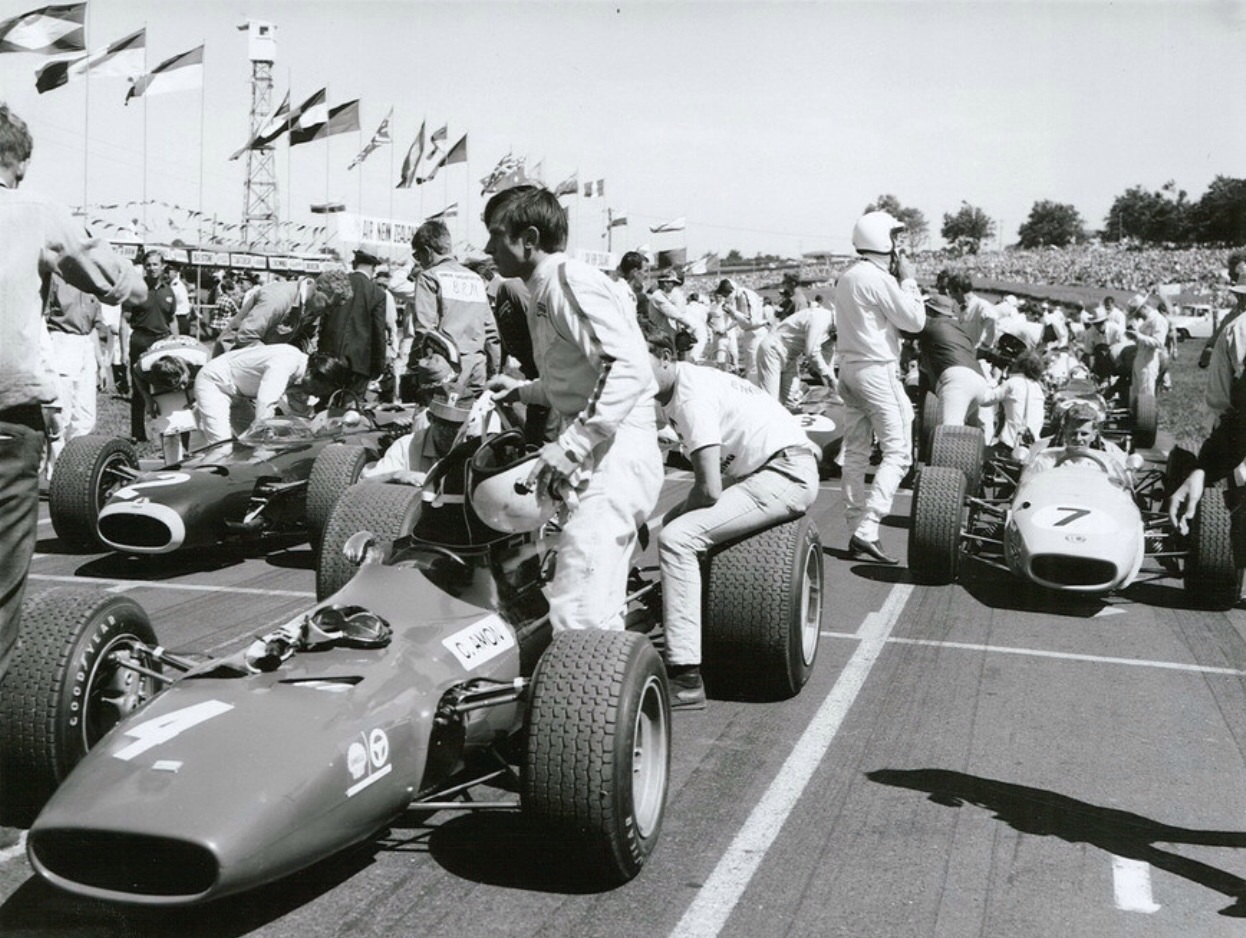
I love the build up and tension before the start of a big race; here it’s the grid prior to the start of the New Zealand Grand Prix at Pukekohe, in the north of NZ’s North Island on 6 January 1968…

Chris Amon readies himself and his Ferrari Dino 246T before the first round of the 1968 Tasman Series, a race in which he wonderfully and deservedly triumphed. Missing on the front row is Jim Clark’s Lotus 49T Ford DFW. Car #2 is Pedro Rodriguez’ BRM P261, the Mexican is bent over the cockpit of his car but failed to finish with clutch problems. Car #7 is Alec Mildren’s Brabham BT23D Alfa Romeo T33 2.5 V8 with chief mechanic Glenn Abbey warming up the one-off car. Lanky Franky Gardner is adjusting his helmet beside the car, it was a good day for Frank, the car was second.

Look closely and you can see a camera crew behind the Brabham which is focusing on 1967 reigning world champion Denny Hulme and his #3 Brabham BT23 Ford FVA F2 car- Denny’s head is obscured by Frank’s body. Hume boofed the ex-Rindt BT23 during the race badly enough for a replacement chassis to be shipped out from the UK.

I’ve always thought these F2/Tasman Ferrari’s amongst the sexiest of sixties single-seaters.
The 166 F2 car was not especially successful amongst the hordes of Ford Cosworth Ford FVA engined cars in Euro F2 racing, however, the car formed the basis of a very competitive Tasman 2.5 litre Formula car when fitted with updated variants of the Vittorio Jano designed V6 which first raced in F2 form and then powered the late fifties Grand Prix racing front-engined Ferrari Dino 246. It was in one of these cars that Mike Hawthorn won the 1958 World Drivers Championship.

Amon won the Tasman Series in 1969 with Ferrari Dino 246T chassis #0008, fellow Kiwi Champion Graeme Lawrence won aboard the same car in 1970 against vastly more powerful, if far less developed Formula 5000 cars. The story of those championships is for another time, this article is about Chris’ 1968 Tasman mount and campaign.

Amon hooking his gorgeous Ferrari Dino 246T ‘0004’ into The Viaduct in the dry at Longford 1968. Early ’68, we are in the immediate pre-wing era, and don’t the cars look all the better for it! (oldracephotos.com/D Keep)

In many ways Chris was stiff not to win the ’68 Tasman Cup a title, the last title won by the late, great Jim Clark…

Ferrari entered only one car that year, chassis #0004 was assembled in Maranello by longtime Amon personal mechanic Roger Bailey and tested at Modena in November 1967. It was then freighted by plane to New Zealand where it was prepared by Bruce Wilson in his Hunterville workshop in the south of the North Island.

The chassis was Ferrari’s period typical ‘aero monocoque’, a ‘scaled down’ version of the contemporary F1 Ferrari with aluminium sheet riveted to a tubular steel frame thus forming a very stiff structure. The 166 was launched to the adoring Italian public at the Turin Motor Show in February 1967.

In F2 form, the 1596cc, quad-cam, chain driven, 18 valve, Lucas injected engine developed circa 200bhp at an ear-splitting 10000 rpm. It is important to note that this F2 engine, designed by Franco Rocchi, and in production form powering the Fiat Dino, Ferrari Dino 206 and 246GT and Lancia Stratos is a different engine family to the Jano designed engines, evolved by Rocchi and used in the Tasman Dinos.

The F2 166 made its race debut in Jonathon Williams hands at Rouen in July 1967, whilst it handled and braked well it was around 15bhp down on the Cosworth engined opposition. The car was tested extensively at Modena, including 24 valve variants, but was not raced again that year.

Amon, who had not contested the Tasman Series since 1964, could immediately see the potential of the car, suitably re-engined, as a Tasman contender given the success of the small, ex-F1 BRM P261 1.9-2.1 litre V8’s in the 1966 and 1967 Tasmans. The same approach which worked for the boys from Bourne could work for Maranello Chris figured. A parts-bin special is way too crass, but you get my drift of a very clever amalgam of existing, proven hardware as a potential winning car.

In fact Ferrari went down this path in 1965 when a Tasman hybrid of a then current F1 chassis was married to a 2417cc variant of the Jano 65 degree V6 for John Surtees to race in the 1966 Tasman. John had Tasman experience in Coventry Climax FPF engined Coopers and Lola’s at the dawn of the sixties and could see the potential of a small Ferrari.

That plan come to nothing when Surtees was very badly injured in a Mosport Can-Am accident in his self run Lola T70 Chev in late 1965. This car, Ferrari Aero chassis ‘0006’ played the valuable role of proving Surtees rehabilitation when he completed 50 laps in the car at Modena. It was in the same chassis that Lorenzo Bandini finished second in the 1966 Syracuse and Monaco GP’s as Ferrari sought to get the new 3 litre V12 F1 312 up to speed, Bandini elected to race the Dino on both occasions- he also finished third in the car at Spa.

The allocation of this more competitive car to Bandini rather than team-leader Surtees was amongst the many issues which lead to the confrontation between John Surtees and team manager Eugenio Dragoni during Le Mans practice and Surtees departure from the team shortly thereafter.

An unidentified fellow, Jim Clark, Ferrari engineer Gianni Marelli, Chris Amon and Roger Bailey share a joke during the 1968 Longford weekend. Chassis ‘0004’ is fitted with the 24 valve V6 covered in the text. Note the quality of castings, fabrication and finish, inboard discs, sliding spline driveshafts and single plug heads of this very powerful- but less than entirely reliable engine in 1968 form, it’s shortcoming cylinder head seals (oldracephotos.com/Harrison)

The engine of the 166/246T was carried in a tubular subframe attached to the rear of the monocoque which terminated at the drivers bulkhead, the car was fitted with a 5 speed transaxle designed by Ingenere Salvarani and Girling disc brakes.

Suspension was also similar to the contemporary F1 cars in having an front upper rocker and lower wishbone with inboard mounted spring/shocks and conventional outboard suspension at the rear- single top link, inverted lower wishbone, two radius rods and coil spring/shocks.

For the 1968 NZ races- Chris won at Pukekohe after Clark retired and at Levin, leading from flag to flag, was second to Clark at Wigram and fourth at Teretonga- a 3 valve variant (2 inlet, 1 exhaust) of the 65 degree fuel injected V6 was fitted which was said to develop around 285bhp @ 8900rpm from its 2404cc.

Chris crossed the Tasman Sea with a nine point lead in the Series from Clark and the might of Team Lotus. It was a wonderful effort, whilst Ferrari provided the car free of charge and took a share of the prize money, the logistics were of Chris’ own small equipe, and here they were serving it up to Gold Leaf Team Lotus with a couple of World Champions on the strength, plenty of spares and support crew.

Amon just falls short of Jim Clark at the end of the 1968 AGP at Sandown. The official margin, one tenth of a second after 62 minutes of great motor racing. Lotus 49 Ford DFW and Ferrari Dino 246T (unattributed)


Amons heads into the Sandown pitlane to practice- Shell corner or turn 1 behind (G Paine)


Amon’s car in the Sandown paddock. That little four valve engine came so close to pipping Clark’s Ford DFW on raceday (G Paine)

For the four Australian races a 24 valve version of the engine was shipped from Maranello. Its Lucas injection was located within the engines Vee rather than between the camshafts and had one, rather than two plugs per cylinder. This motor developed 20 bhp more than the 18 valver with Chris promptly putting the car on pole at Surfers Paradise, a power circuit- he won the preliminary race and had a head seal fail whilst challenging Clark in the championship round.

At Warwick Farm he qualified with the 18 valve engine and raced the 24 valver having rebuilt it- they only had one of the motors. He was challenging both Clark and Hill in the race and then spun in avoidance of Hill who was having his own moment…he was fourth on the tight technical Sydney circuit.

At Sandown during the AGP, the pace of the car, and Amon, was proved in an absolute thriller of a race in which he finished second to Clark by one-tenth of a second, the blink of an eye. Let’s not forget the best driver in the world driving the best F1 car of the era powered by the Tasman variant of the greatest GP engine ever was his competition- and took fastest lap.

As the team crossed Bass Straight from Port Melbourne on the ‘Princess of Tasmania’ Chris knew he had to win the Longford ‘South Pacific Championship’, with Clark finishing no better than fifth to win the Tasman title.

At Longford, still fitted with the 24 valve engine, which must have been getting a little tired, he qualified a second adrift of Clark and Hill, he finished seventh in a race run in atrocious conditions on the most unforgiving of Australian circuits having initially run second to Clark but then went up the Newry Corner escape road and suffered ignition problems from lap 10.

Piers Courage won in an heroic drive aboard his little McLaren M4A Ford FVA F2 car that streaming day, in a series which re-ignited his career.

Chris and the boys confer about car set-up- in the dry!, at Longford(oldracephotos.com.au/Harrisson)

Chris was a busy boy during the Australian Tasman leg as he also drove David McKay’s Scuderia Veloce Ferrari 350 CanAm/P4 in sports car support events at each round in addition to the little Dino.

These races were outstanding as they involved close dices between Chris and Frank Matich in his self designed and built Matich SR3 powered by 4.4 litre Repco Brabham V8’s- with Frank getting the better of him in each of these races. The speed of the Matich was no surprise to Chris though, both had contested rounds of the Can-Am Championship only months before the Tasman in the US.

Click here for my article on the Ferrari P4/CanAm 350 #’0858’ Chris raced in Australia;

Ferrari P4/Can Am 350 #0858…

Amon lines David McKay’s Scuderia Veloce Ferrari P4/350 Can Am up for Longford’s The Viaduct during the 1968 Longford Tasman meeting. Matich didn’t take the SR4 to Longford so Chris had an easy time of it that weekend. The sight and sound of that car at full song on the Flying Mile at circa 180mph would have been really something! (oldracephotos.com/D Keep)


Chris Amon, David McKay and mechanic David Liddle with the Can-Am 350 in the Sandown pitlane (G Paine)

For the 1969 Tasman Chris applied all he learned in 1968 returning with two cars, the other driven by Derek Bell, four well developed 300bhp 24 valve engines with the logistics of the two months taken care of by David McKay’s Scuderia Veloce.

He promptly lifted the Tasman Cup in a very successful campaign from Jochen Rindt, Graham Hill and others, with a little more luck or greater factory commitment in 1968 it may have been two Tasmans on the trot for the Maranello team and Chris…

Etcetera…

(G Paine)


(G Paine)

A couple of shots of the SV Ferrari Can-Am 350 being fettled in the 1968 Sandown Tasman paddock.

Bibliography…

oldracingcars.com, sergent.com.au, ‘Dino: The Little Ferrari’ Doug Nye

Photo Credits…

Mr Riethmaier, oldracephotos.com, Rod MacKenzie, Glenn Paine Collection

Tailpiece: Love this moody, foreboding Longford shot by Roderick MacKenzie…

(Rod MacKenzie)

Chris has just entered the long ‘Flying Mile’ in the streaming wet conditions during Monday’s ‘South Pacific Trophy’ famously won by Piers Courage little McLaren M4 Ford FVA F2 car. 4 March 1968.

Finito…
 

image

‘yer don’t tend to think of Rodriguez as a Can-Am driver but he contested many races over the years without ever doing a full season’s program. A pity, as his fearless, blinding speed aboard big hairy V8’s would have been worth travelling a mile or three to see…

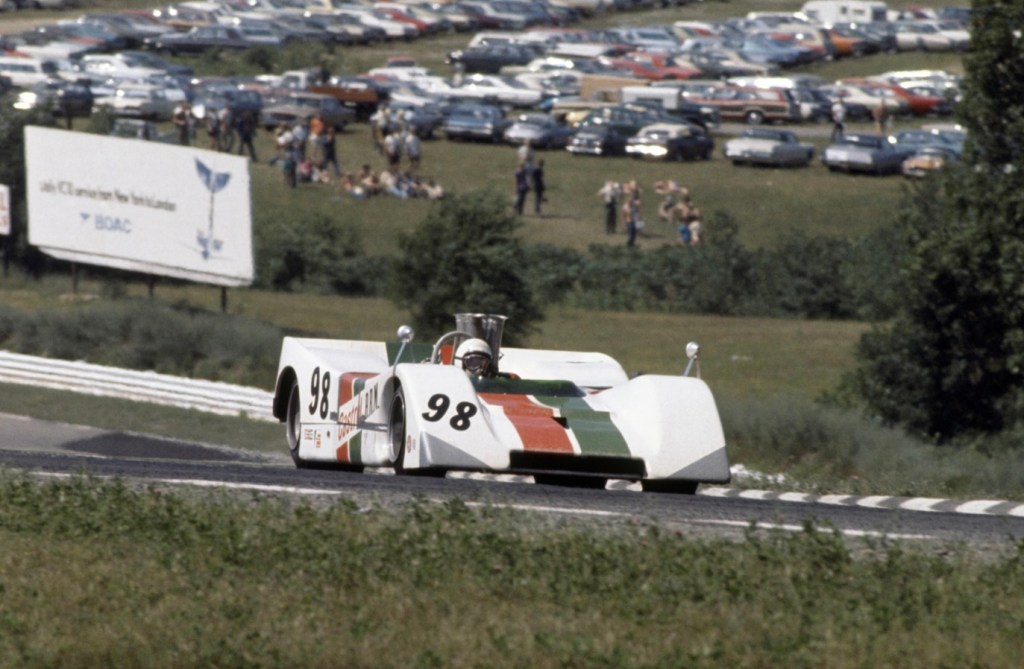
Here Pedro is with the 7.4 litre BRM P154 Chev during the Monterey Grand Prix weekend at Laguna Seca on 18 October 1970.

BRM built the P154 Chev to contest the 1970 Can-Am with George Eaton as its driver, the car was one of two brand new cars by Bourne’s just joined designer, Tony Southgate.

image

The immensely talented BRM Chief Engineer, team manager and designer Tony Rudd fettling his nemesis, the complicated, heavy and recalcitrant! BRM P83 ‘H16’, Monza, Italian GP practice in 1966 (GP Library)

BRM had two terrible years by their lofty standards in 1968 and into 1969. The BRM H16 engine was finally made reliable-ish in 1967 but it’s corpulence, it was well over 300 pounds in excess of it’s designed weight made the cars power to weight ratio poor whatever the chassis designers did to take weight out of the rest of the bolide.

The replacement P101 2 valve 3 litre V12, first raced by Bruce McLaren in his McLaren M5B at the Canadian GP  in late 1967 was concepted as a sports car engine. Whilst light it wasn’t a match for the Ford Cosworth DFV’s power, torque, fuel efficiency or reliability, the same problems being confronted by Ferrari and Matra with their own V12’s.  Into 1968 the DFV was being raced in numbers; by Lotus, McLaren, and Ken Tyrrell’s Matra International team.

As the Bourne engineers focussed on engines they lost their way with chassis direction, a strength prior to this. As a consequence Tony Rudd, who had masterminded BRM’s rise and consistency for over a decade left in mid-1969 to join Colin Chapman at Lotus.

image

British GP practice, Silverstone 1969 with Surtees telling the boss just how shite things really are! Sir Alfred Owen, the immensely successful industrialist listens carefully and acts, with ‘generational change’ at Bourne. Allan Challis is the BRM mech in orange (Rainer Schlegelmilch)

’69 BRM driver, John Surtees was having a shocker of a season on both sides of the Atlantic, Jim Hall’s conceptually brilliant but flawed Chaparral 2H CanAm car was an even bigger ‘sheissen-box’ than his BRM F1 P139 BRM. Time was ticking in terms of his own driving career, he was 35 and had managed to land in the wrong team at the wrong time, twice in the same year when time was very much a precious commodity!

image

Surtees in the BRM P138 in Monaco 1969 practice. The cars all raced raced sans wings due to a CSI  overnight safety decree severely limiting them. Surtees Q6 and DNF after Jack Brabham ran up his clacker when his gearbox failed, no injury to either driver (Rainer Schlegelmilch)

With BRM owner Sir Alfred Owen’s consent Surtees approached Tony Southgate, with whom he had worked at Lola on the T70 Can Am and T100 F2 cars and more recently designed competitive cars for Dan Gurneys ‘All American Racers’ in Santa Anna, California.

Southgate’s Eagle 210 Offy won the 500 in Bobby Unsers hands in 1968, he also designed a successful Formula A car and a stillborn ’68 F1 car design, elements of which were picked up in the Indy and ‘A Car’.

eaton monaco

George Eaton at Monaco in 1970 in Tony Southgate’s brand new, BRG BRM P153 V12. Compare the ‘old and new’ P138 Monaco ’69 with P153 Monaco ’70  (The GP Library)

Southgate’s brief when he joined BRM was twofold; ‘do what you can now to get the P139 competitive and design a new car for 1970’…

The Brit quickly decided their was little he could do with the P139 so pressed on with the design of the P153, it and the evolved for ’71 P160 were front running, GP winning (4 wins) cars.

Whilst in the middle of the P153 design the chaotic BRM ‘decision making process’ determined that a Can Am challenger for 1970 was a good idea. It was a good earn after all. In a way it was a good decision as Southgate had Can Am experience at Lola and AAR but at the time focus on the ‘main F1 game’ would have been the more prudent course, but racers to the core the BRM outfit were!

image

Tony Southgate’s quarter-scale layout drawing of the BRM P154 (Tony Southgate)

Given the designation P154, the car was very much a wedge-shaped device, developed at quarter scale in the Imperial College wind tunnel, then in MIRA’s full-size tunnel when it was completed.

Southgate recalled testing the car at MIRA (Motor Industry Research Association test facility); ‘MIRA has a large test track, with high banked corners to enable high average speeds to be maintained…the one and only Jaguar XJ13 was there for a filming run…an hour or two later whilst in the wind tunnel we heard a load bang. The XJ13 crashed violently at 125mph when a rear wheel collapsed, it rolled four times, I’m glad to say Norman Dewis, Jag’s legendary test driver was only bruised’.

‘By comparison with the 1965 prototype Le Mans car, certainly pretty but what then seemed like old technology, basically it looked like an E Type with an engine in the middle, very round in section with low drag the clear priority. By comparison the P154 was very aggressive looking, wedge-shaped with square sections and downforce was written all over it.’

image

‘The P154 model in the Imperial College wind tunnel. There was no moving floor in those days so the wheels were fixed with a small 1mm gap between them and the floor. The model was covered in chalk and paraffin so that when it dried the chalk left a surface air flow pattern for studying.’ (Tony Southgate)

The P154 had a neat lightweight monocoque chassis, the front suspension was similar to the P153 with a single upper link, lower wishbones, coil spring/Koni shocks and an adjustable roll bar. But the rear suspension was quite different as Southgate sought to run the exhaust low down, locating the exhaust primaries below the rear suspension lower wishbones, the aim was to lower the CG. ‘The end result looked good’. The suspension itself was conventional, single upper link, lower wishbones, twin radius rods for forward and lateral location and coil spring/Koni shocks and adjustable roll bar.

image

‘The prototype BRM P154/01 being assembled at Bourne. I am showing (TS left) the Castrol USA representative (sponsor) around whilst Tim Parnell (team manager at right) looks on. The monocoque was quite neat and full-length, finishing at the gearbox. The engine is a Chevy developed by BRM, the gearbox a Hewland LG500.’ (Tony Southgate)

Designed for super wide 19inch wide Firestones which never appeared, the car always looked ‘over bodied’ with the 17’s the car raced with. This contributed to the handling dramas attributed to the beast.

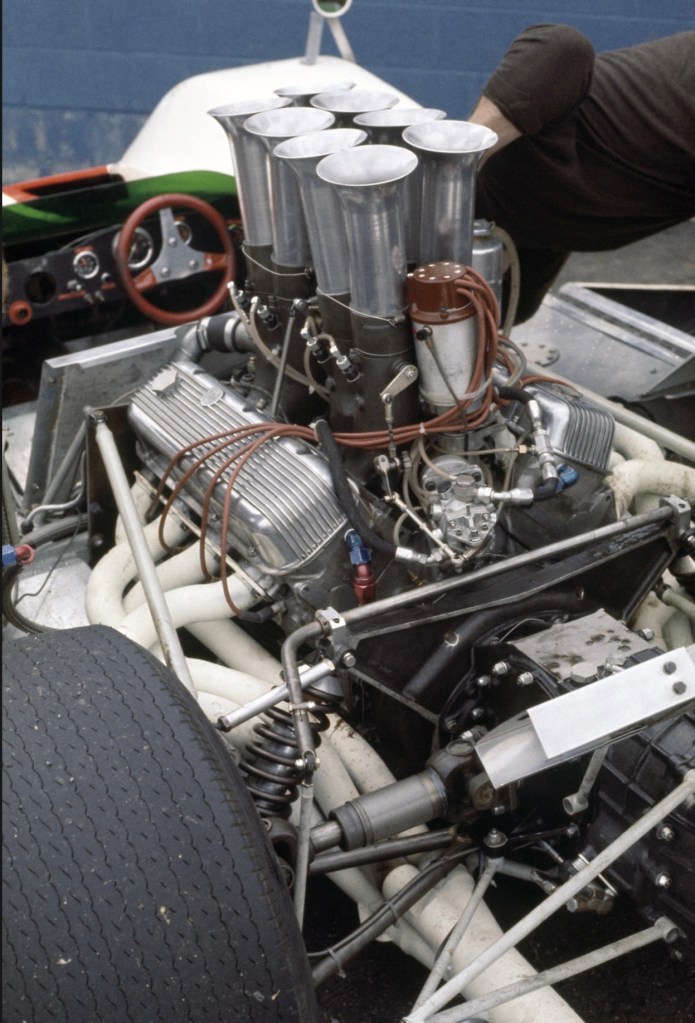
The engine was built in-house at BRM and seemed competitive; Chev ZL1 aluminium blocked 7.4 litre, Lucas injected, magneto ignited, dry sump V8 developing circa 650 BHP. The gearbox was one of Mike Hewland’s LG500’s.

The car had little testing, ‘it was thrown together and sent to America for the mechanics to sort out on the hoof” Southgate quipped in a MotorSport interview. The poor unfortunates sent to the US with the car were Roger Bailey and Mike Underwood!

The car sorely needed testing as BRM’s first Can Am machine and the cars driver, Canadian George Eaton didn’t have the experience of big sports cars of both other 1970 BRM F1 drivers, Pedro Rodriguez and Jackie Oliver. ‘It was a low budget operation and the results reflected that. For me, it was a distraction at the time from the real thing-Formula One’ said Southgate.

image

‘The completed P154 outside the Bourne workshop in 1970. Note the paintwork was not complete when this photo was taken. In this shot you can see the undersized tyres front and rear, which proved a problem on the circuit (Tony Southgate)

Racing the P154: George Eaton 1970…

eaton brm

George Eaton with the BRM P154 Chev, 11 June 1970 (Dick Darrell)

Eaton was far from devoid of ‘Big Car’ experience, however.

He raced a McLaren M10A Chev Formula A, 5 litre chassis successfully in North America in 1969 and had raced customer McLarens in the Can Am since 1967.

He was a very strong performer in his beautifully prepared McLaren M12 Chev in the 1969 Can Am consistently qualifying in the top 6 in a field with great depth of talent. His best results were in Texas 2nd, Edmonton 3rd, Watkins Glen 4th and Mid Ohio 6th. He was a bright young spark in these, big, demanding cars.

image

‘An early race for the P154, George Eaton, Eatons distant 3rd at St Jovite Canada being a rare highlight’ (Tony Southgate)

So George knew what a good, sorted McLaren was all about and how to drive it figuring a bespoke BRM works car would be a very good thing. Which it was not! The lack of development miles told in the early part of the season.

He qualified 7th at Mosport and 3rd at St Jovite for a DNF with oil and transmission problems and a strong 3rd place. At Watkins Glen he had brake failure, Edmonton a wheel bearing failure and at Mid Ohio fuel pressure problems having qualified 13th, 6th and 25th. At Road Atlanta an engine blew having qualified 5th.

Pedro Rodriguez joined the series from Donnybrooke in September where he was 9th, ‘it didn’t go well in Eaton’s hands so we put Pedro in a car’ was Southgate’s quip, it rather implied the problem was George, which it was not.  The Mexican finished 5th at Laguna and 3rd at Riverside but was out qualified at each round by George. Frustrating for Eaton was Pedro’s results given the hard yards he had put in. He had rocker failure at Donnybrooke and crashes at both Laguna and Riverside, in the latter event a practice shunt which prevented him taking the start.

No way did Eaton have Pedro’s speed in a GP BRM but he was certainly mighty quick in a Can Am car. Southgate ‘Pedro wasn’t a technical driver , he’d just get in and drive his heart out’, clearly Eaton was quick, Pedro was Top 5 in the world at the time, Top 7 anyway! One rather suspects the P154 needed testing miles with a development driver to both stress componentry, the role Eaton played in races early in the season and to re-engineer or tweak the package to make it behave. Southgate says the suspension geometry, designed for 19inch wide tyres didn’t work well with 17’s.

Best results for the P154 in a season dominated again by the papaya McLarens, the M8D in 1970, were George’s qualifying performances at Road Atlanta and Donnybrooke, his 3rd place at St Jovite, Pedro’s 3rd at Riverside and 5th at Laguna.

In essence Eaton did a very good job with an under-developed, evil handling car, one of the best in the world also struggled with it…

image

Eaton P154/01 Chev, Laguna Seca (The Enthusiast Network)

Development of the P154: Pedro raced the car later in the season and afterwards ‘came to see me in my office in Bourne to talk about the experience and told me in its present form the car was horrible to drive’ said Southgate.

‘I had great admiration for Pedro, so I knew it must be really bad. I was very embarrassed and immediately set about re-engineering it and fixing all the problems. The revised car, the P167 went on to be very good in 1971 but it was still a low budget operation’.

image

This is an interesting drawing of mine because it shows the wind tunnel development shapes that were produced to arrive at the distinctive ‘shovel’ nose on both the P154 and P167. The heavy line indicates the final shape.’ (Tony Southgate)

Modifications to make the car competitive comprised a large rear wing, widening the front and rear tracks to get the outsides of the wheels out to the most extreme width which the proposed for 1970 19 inch wheels were supposed to achieve. The front to rear balance was achieved with a shovel-type concave nose section. ‘It was the same design theory I arrived at in the wind-tunnel for the nose of the P160 ’71 F1 car.’

image

The 1971 BRM P167 was a P154 extensively modified.’…A new shovel nose section was added, new rear bodywork created and a rear wing fitted. The tracks, front and rear were widened.’ (Tony Southgate)

In fact when Howden Ganley, the talented Kiwi mechanic, engineer, racer and test driver drove the 1971 evolved car, the ‘P167’ at Goodwood the nose ‘grounded’ under brakes as so much downforce was being created. The fix was making the nose mounts more rigid.

Said Tony, ‘This was my first experience of very large aerodynamic loads deflecting the structure. The phenomenon was the visual interpretation to my understanding the sheer power of aerodynamics which could be produced on a modern car’.

image

‘The BRM developed Chevy V8 performed well and was quite reliable, the trouble was we had no spare available. The car ran without bodywork between the wheels as shown here.’ 1971 P167 (Tony Southgate)

image

‘The rear view of the P167 shows the exhaust system, which was unusual for a US V8 engined car. I liked it because of the lower CofG’ Note the rear suspension; single upper links, lower wishbones, coil spring/Koni alloy body dampers and roll bar. Inboard discs, LG500 Hewland ‘box with oil cooler above and magneto above it again. Note ‘stays’ to locate ‘mudguards’ above lower wishbones and monster wing compared with wingless P154 (Tony Southgate)

In a very limited Group 7 program by BRM in 1971 Pedro first raced the P167 in the European Interserie at Zolder in June, for Q7 and a DNF with a cylinder liner problem. He missed the next couple of rounds and then came the fateful Norisring round at which he lost his life, more of that below.

In September Brian Redman drove the P167 to a win at Imola and then in early October at Hockenheim against good fields, not Can Am quality mind you. The car was entered by Sid Taylor Racing, that year also running Brian in European F5000 events in a McLaren M18 Chev.

Buoyed by those results the Bourne hierarchy shipped the car to North America to contest the last two Can Am rounds in California. The car was raced again by Sid Taylor with his team providing the support. Jerry Entin and engine man George Bolthoff were with the team at both US races.

At Laguna Seca, Brian was Q6 and a strong 4th, and Howden Ganley raced the car at Riverside, Redman stayed in Europe to attend Jo Siffert’s funeral. The poor Swiss perished at the wheel of a BRM P160 at the end of season, 24 October, Brands Hatch ‘Victory Race’ after a tyre failure, the tyre moved on the rim and suddenly deflated, causing him to veer off the track and roll in the dip before Hawthorn Bend. He was almost uninjured but perished in a horrible fire. The plucky Swiss started the race from ‘equal pole’ with Peter Gethin, it demonstrated his competitiveness right to the very end of his career.

The talented Kiwi, Ganley a BRM F1 driver that season qualified 9th and finished 3rd behind the dominant McLaren M8F’s in the P167.

image

Howden Ganley at The Times Grand Prix, Riverside, P167/01 in 1971 definitive form, 4th (The Enthusiast Network)

‘Alcan Team BRM’ ran the car as a works entry in the 1972 Interserie with Ganley scoring wins at the Nurburgring and Zeltweg amongst a swag of DNF’s for the P167. Mike Pilbeam engineered the car with Reg Richardson, principally an engine man, the cars mechanic. Once the Porsche 917/10 appeared in Europe the going got much tougher for the V8 brigade, Leo Kinnunen took the title, Porsche mounted in ’72.

In an unfortunate and bizarre sequence of events the P167 led to Pedro’s death, Southgate again; ‘During 1971 when the P167 was showing promise, Pedro decided he wanted to race it in Europe. So the car was entered for the big Interserie race on the Norisring street circuit in Nuremberg’

‘Part of the preparation was to re-run the engine on the Bourne dyno, hoping to find a few more horsepower. Tragically, as it transpired, the engine was damaged and we had no spare so we cancelled our entry’.

Pedro ‘phoned me that evening to see how the cars preparation was going, only to be told as far as we were concerned the race was off. I told him I was sorry for letting him down. ‘Never mind he said, I have been offered a drive in a Ferrari (512M) for good money-£1500′. I wished him luck in the race. Little did I know this would be the last time that I ever spoke to Pedro. He was killed driving that Ferrari’.

image

Pedro and P167/01 in still evolving aero form, first race, Zolder, June 1971 (unattributed)

Tony Southgate has very fond memories of the great Mexican; ‘Pedro was extremely popular with everyone and I admired him both as a person and driver. He was a charismatic character with a particular aura about him, always appearing immaculate to the outside world, sleeking back his hair and wiping his brow after driving before he would talk to anyone. Actually he was a very private and quiet man…He never was a balls out qualifier; he preferred to save his efforts for the race. When his grid position was not as near the front as we would have liked, he would tell us that he would simply overtake a few cars on the first lap, which he often did. He was easy to work with, not a technical driver, but naturally talented and brave. Very brave…’

Bibliography…

‘Tony Southgate: From Drawing Board to Chequered Flag’ Tony Southgate, MotorSport interview by Simon Taylor, Jerry Entin on ‘The Nostalgia Forum’, classiccars.com

Credits…

The Enthusiast Network, Southgate biography as above, Getty Images

image

Pedro, P154/02 1970, Can Am circuit unknown (unattributed)

Build Numbers…

British racer and former twice national hillclimb champion David Hepworth bought all of the chassis’, patterns, drawings and moulds when BRM dropped the Can Am program, his best Interserie result was 5th at Silverstone in 1972.

It appears there were 5 chassis built: the two P154’s raced by Eaton and Rodriguez in 1970- P154/01 and P154/02. P154/02 was reduced, it’s parts donated to the P167 program, in recent years the car has been rebuilt/reassembled.

There was one P154/167 and two P167’s. The P154/167 ‘bastard car’ combined the P154 short wheelbase with P167 suspension geometry- this car does not appear to have been raced upon perusal of published records.

Rodriguez, Redman and Ganley raced the definitive P167/01 in 1971 in both the Interserie and Can Am.

Ganley raced P167/01 in the 1972 Interserie, Vern Schuppan practiced the same chassis but did not race it at the Nurburgring after engine failure in practice. Hepworth raced P154/01 in 1972 and in the 1973 Interserie, P167/01.

P167/02 was assembled later from spares acquired in the ‘job lot’ acquisition of cars and parts from BRM in 1972- it appears, entered for Hepworth, at the Nurburgring Interserie in 1974.

For many years the Hepworth family owned four of the five cars. I’m not sure of the present status of said racers but wouldn’t P167/01 be a nice thing to have?- ex-Rodriguez, Redman, Ganley, Schuppan and Hepworth…

Tailpiece: Racers Racer…

image

Pedro, Laguna Seca and P154/02 1970 (The Enthusiast Network)