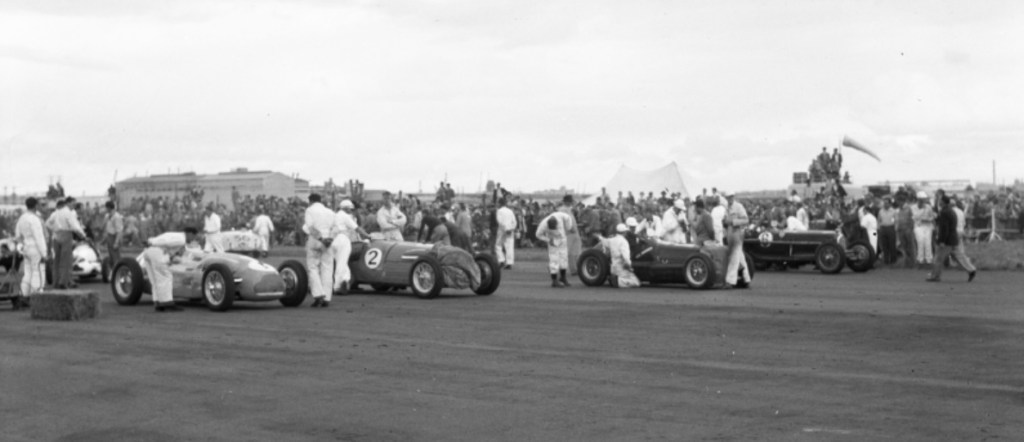
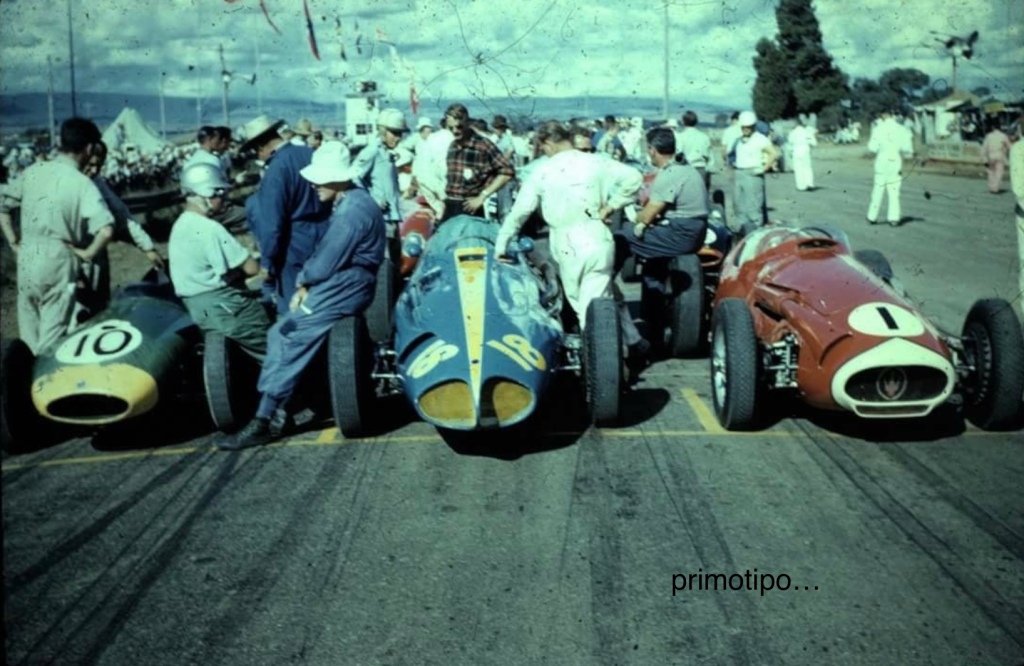
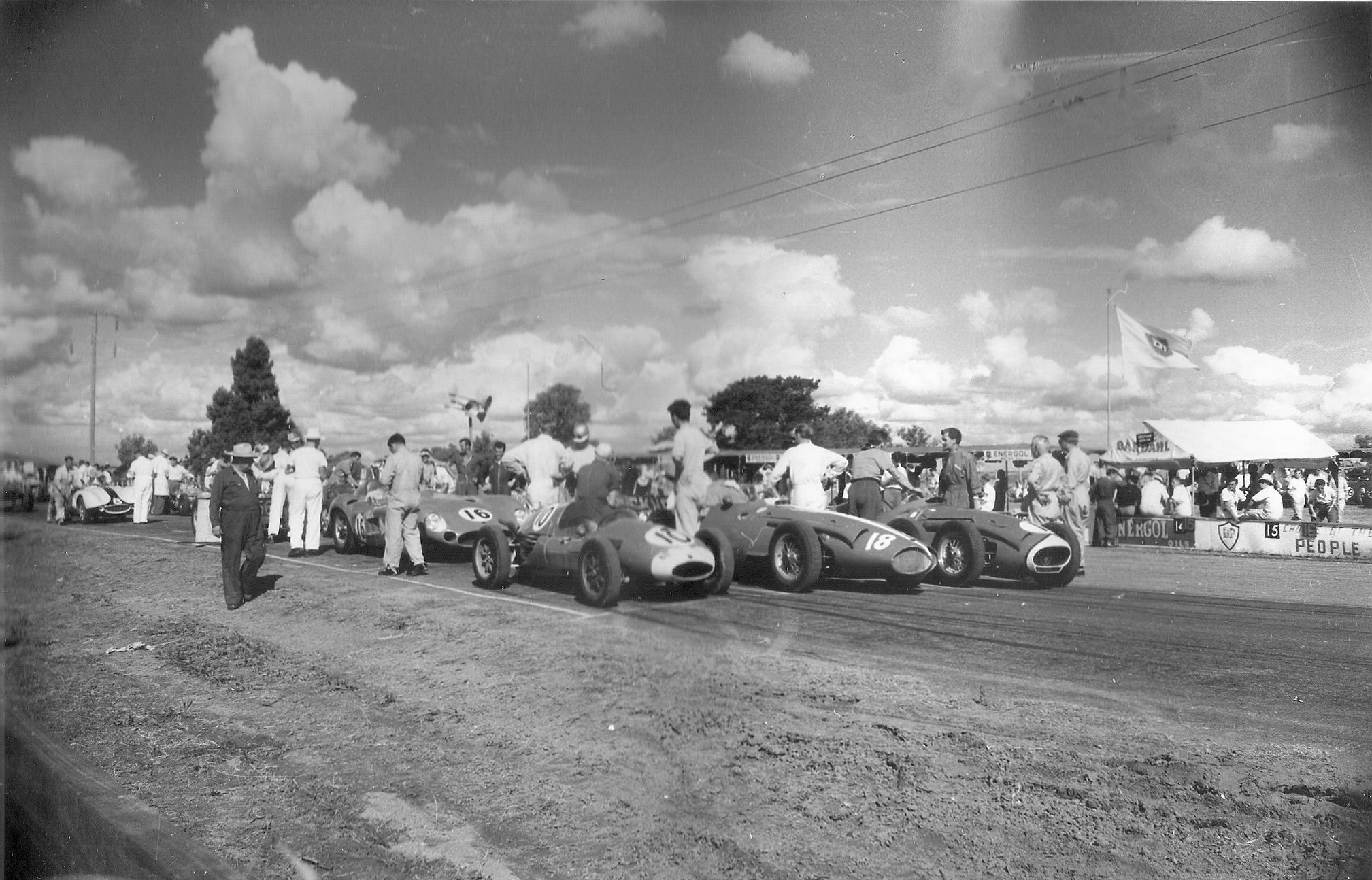
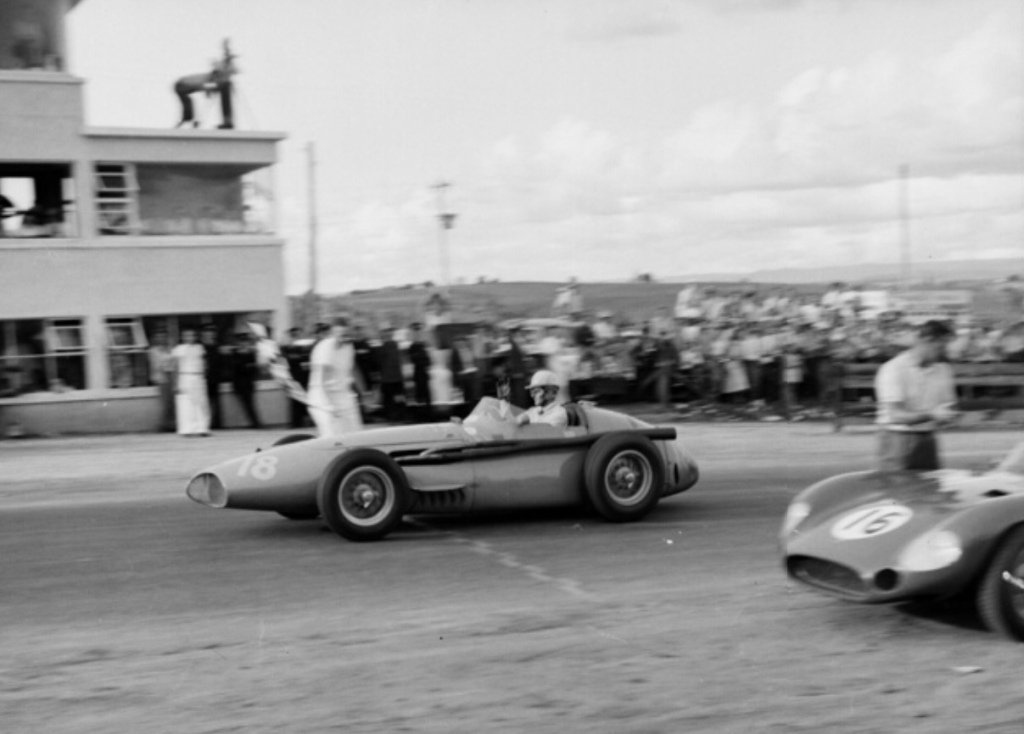
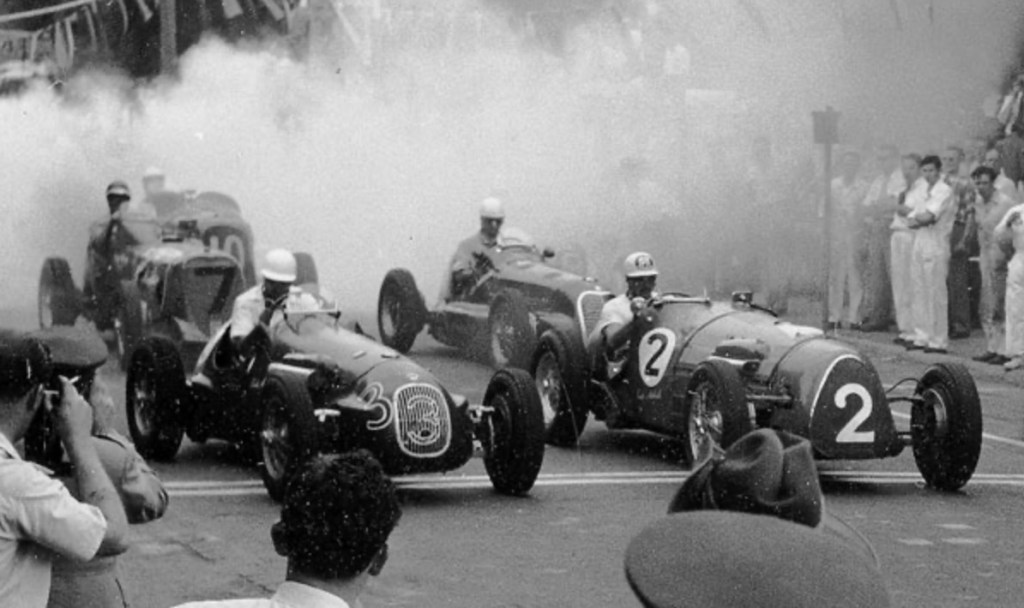
The front row of the Victorian Trophy grid at Fishermans Bend on Sunday, October 4, 1953 comprises, from the left, Doug Whiteford’s Talbot-Lago T26C, Stan Jones’ Maybach 1, Cec Warren, Maserati 4CL and Lex Davison, Alfa Romeo P3.
Tony Johns notes, ‘My program has Lex Davison’s HWM Jaguar scratched, so he raced his back-up Alfa Romeo. Doug Whiteford retired the Talbot-Lago with broken gears in the transfer box. Stan Jones won the race with Davison second and George Pearse, Cooper Mk4 Vincent third.’
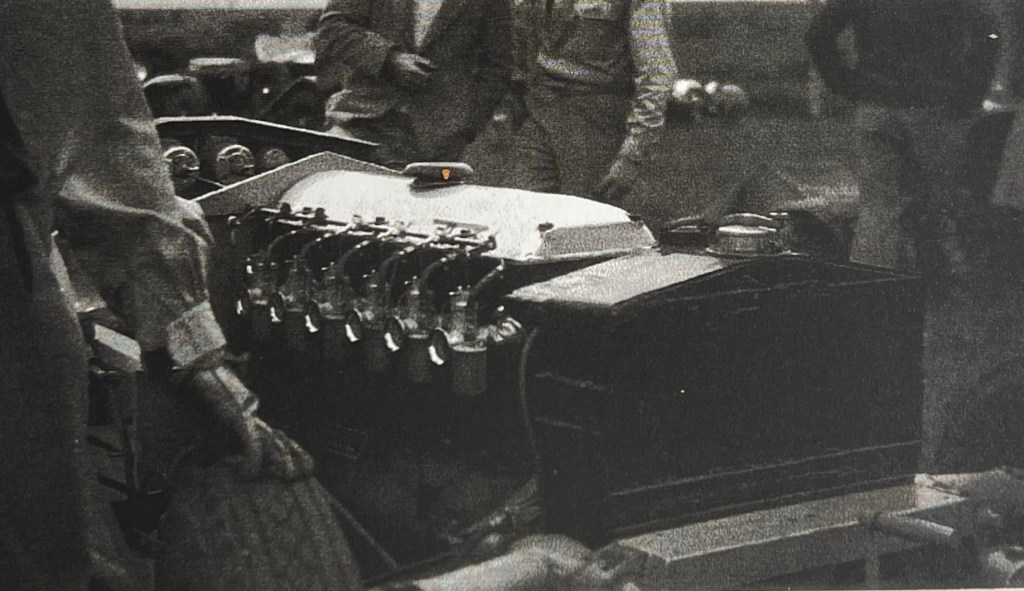
‘Reg Nutt driving Jack Day’s Talbot Darracq TD700 sheared the blower drive and for Sunday and fitted a TC manifold and carburettors.’ Wow!
(L Sims Archive)
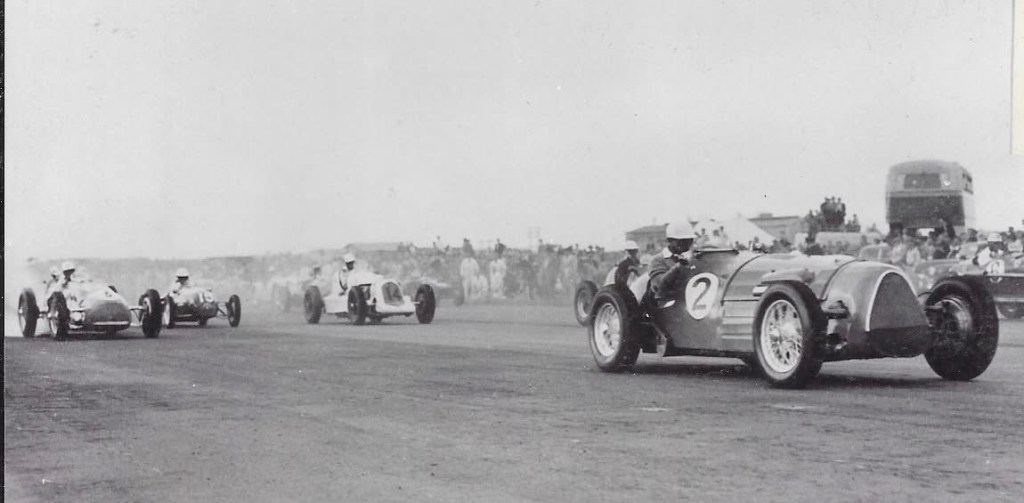
Didn’t Stan jump outta the box! Whiteford at left, then George Pearse, Cooper Mk4 Vincent and then the distinctive, upright-stance of #14 the ex-Sinclair The Spook Alta 21S Ford with Ted Gray up.
While the Victorian Trophy was a scratch race, there was also a handicap section won by Silvio Massola’s HRG from Davison and Jones.
While researching 1953 I thought I’d make a similar determination but there seems to be only three potential qualifying rounds that year: the Australian Grand Prix held at Albert Park won by Doug Whiteford’s Talbot-Lago T26C on November 21, the Victorian Trophy on October 4, and the 100-mile New South Wales Grand Prix held at Gnoo Blas on October 5. Jack Robinson won the handicap race in his Jaguar XK120 Special while the ‘Grand Prix title (the scratch section of the race) was awarded to Jack Brabham’s Cooper T23 Bristol (below) who had set the fastest race time.’
You will appreciate the degree of difficulty for a competitor in contesting races in Orange and Melbourne on consecutive days.
Jack Robinson, Jaguar XK120 Special, Bathurst, October 1955 (I Arnold)Jack Brabham, Cooper T23 Bristol, NSW GP, Gnoo Blas 1953 (Wikipedia)
The Australian Sporting Car Club – hitherto the Bathurst promoter – organised that first race at Gnoo Blas as the ASCC was ‘splitting asunder’ and its relationships with the City of Bathurst and the local police were so poisonous that Bathurst’s blue-riband Easter and October long-weekends of racing – probable Gold Star rounds – didn’t take place in 1953. The ASCC couldn’t get a permit, whereas the Auto-Cycle Union did, running a two day Easter ‘bike meeting.
Those of you with John Medley’s Bathurst Bible should read chapter 17, it’s interesting to be reminded of the sequence of events that saw the Australian Racing Drivers Club take over from the ASCC as the promoter of car racing at Mount Panorama.
So, given all those circumstances, it doesn’t seem appropriate to calculate a ’53 Gold Star Faux Division winner…The historians amongst you may know that the 1978 and 1979 Gold Stars were held over three rounds, while the 1981 affair was contested over only two; all three were in F5000’s dying days. In 1987, the Gold Star was a one-race gig, so I have precedent on my side, but I’ll leave it alone, I think. One race and ‘two other rounds’, which were effectively mutually exclusive, seems as lame as the one race 1987 championship. The perfect world in 1953 would have been for Whiteford, Jones, and Brabham to have faced off in all three races, I would have had a couple of pounds on Dicer Doug coming out on top….
Doug Whiteford and Talbot-Lago T26C take the plaudits of the Albert Park crowd after winning the 1953 Australian Grand Prix, his third such victory (The Age)
Credits…
Arthur Gordon Fraser-State Library of Victoria, Tony Johns, Leon Sims Archive, Ian Arnold, Wikipedia, The Age
Jack and Betty Brabham during the 1954 Australian Grand Prix weekend in the Southport paddock attending to the needs of Jack’s Cooper T23 Bristol.
I’ve done Cooper Bristols to death but these two colour shots of Jack are the earliest I’ve seen – Kodachrome at its best – so I thought I’d pop them up rather than add them to an existing post and effectively lose them.
Brabham had a lousy weekend in Southport, out with engine troubles on lap 2. Lex Davison won the race in his HWM Jaguar after Stan Jones suffered a chassis weld failure that pitched him off the road and through the undergrowth, killing the car but thankfully not its intrepid driver.
Brabham at Mount Druitt, the youngster is a youthful Pete Geoghegan (D Willis)(LAT)
CB/Mk2/1/53 was pretty trick by this stage, where is the photo above folks?
Jack had been racing it for a couple of years and made some modifications – some suggested by British mechanic/engineer Frank Ashby who was then living at Whale Beach on Sydney’s Barrenjoey Peninsula – including fitment of triple Stromberg carbs instead of the usual trio of Zeniths and taking bulk weight off the Bristol engine’s flywheel by adapting a Harley Davidson type clutch as used on his speedcar, and extensive machining. The Stromberg BXOV-1 carbs were lightly modified units of examples fitted as standard to the Holden 48-215.
Stan didn’t have it for long before selling it to Tom Hawkes in time for the 1955 Australian Grand Prix at Port Wakefield.
The rare shot below shows Hawkes in Jack’s old Cooper Bristol #8, with Brabham looking on from car #6, the monoposto Cooper T40 Bobtail Jack built at Coopers for his championship Grand Prix debut at Aintree in the British GP that July. He then brought it home and scored a lucky win at Port Wakefield after top-guns, Reg Hunt, #5 Maserati A6GCM-250 and Stan Jones, #4 Maybach 3 retired.
(E Steet)Hawkes on the way to a DNF in the 1957 AGP at Caversham in the ex-Brabham Cooper T23, now fitted with a Repco-Holden engine (E Steet)
The ultimate spec of CB/Mk2/1/53 was created when Tom Hawkes got his hands on it. He raced it initially as was and then made changes to the suspension, replacing the transverse leaf suspension with wishbones and coil springs, added a slimline body, fitted wider Lukey alloy wheels, and critically, replacing the 2-litre Bristol six with a 2.3-litre pushrod Holden Grey six topped by a crossflow Repco Hi-Power cylinder head and a pair of SU carbs.
Hawkes in the Albert Park paddock, 1956 AGP weekend. Repco-Holden engine, car still fitted with transverse-leaf IFS (NAA)Hawkes ascends Mount Panorama during the ‘58 AGP weekend, note the stance of the car and Lukey alloy wheels (T Martin)
Tom was third in the 1958 AGP at Bathurst – the ultimate Australian power circuit – with the Cooper in this spec behind Lex Davison’s 3-litre Ferrari 500/625 and Ern Seeliger’s 4.6-litre Maybach 4 Chev V8. Sure, Ted Gray, Tornado 2 Chev and Stan Jones, Maserati 250F retired from the lead, but was the best ever AGP finish for a Holden six, a great achievement.
Etcetera…
Brabham and crew at Mount Druitt circa 1953, names folks? (A Cox)(A Patterson Collection)(A Patterson Collection)
John Sherwood and Jack Brabham, perhaps at one of the send-off functions for Jack when he left for the UK in early 1955
Brabham chats to Doug Whiteford on the Australian Grand Prix-Port Wakefield grid in 1955. Cooper T40 Bristol and Talbot Lago T26C.
(unattributed)
This pair of shots show Jack aboard the Cooper T40 Bristol during the January 30, 1956 South Pacific Championship meeting at Gnoo Blas. Brabham was second behind Reg Hunt’s new F1 Maserati 250F with Kevin Neale third in, you guessed it, a Cooper T23 Bristol.
These cars – Type 20 and Type 23 or Cooper Bristol Marks 1 and 2 if you like – were hugely important machines in Australian racing for a decent chunk of the 1950s in original spec and modified from mild to wild…
(unattributed)
Credits…
Old Motor Racing Photographs Australia, Dick Willis, Allen Cox, LAT photographic, Ed Steet shots via David Zeunert, Lex Denniston shot via Tony Johns, Tony Martin, Adrian Patterson Collection
Tailpiece…
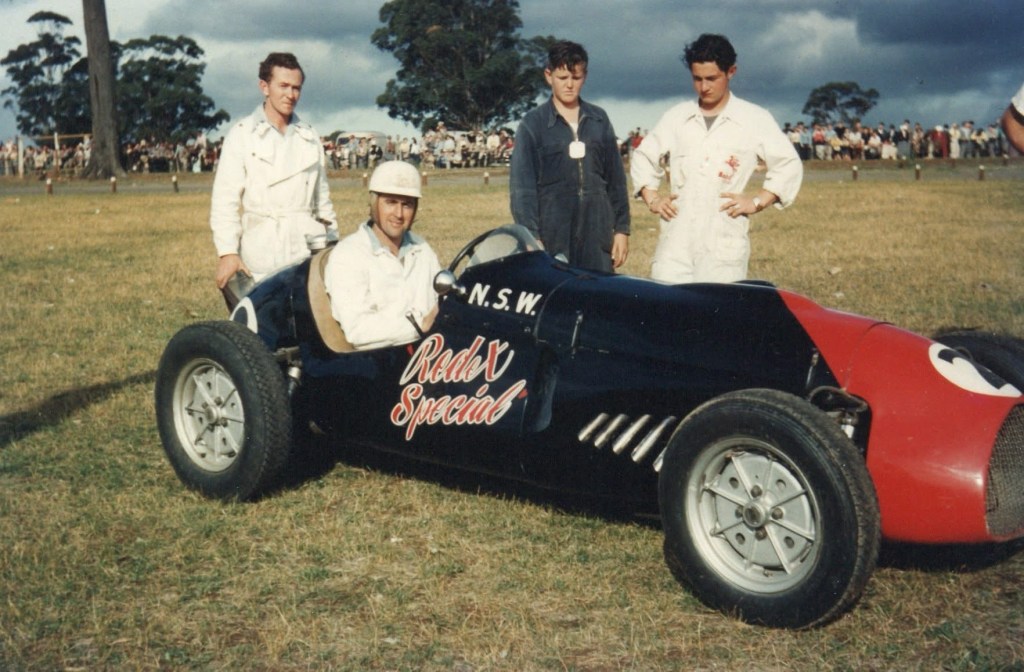
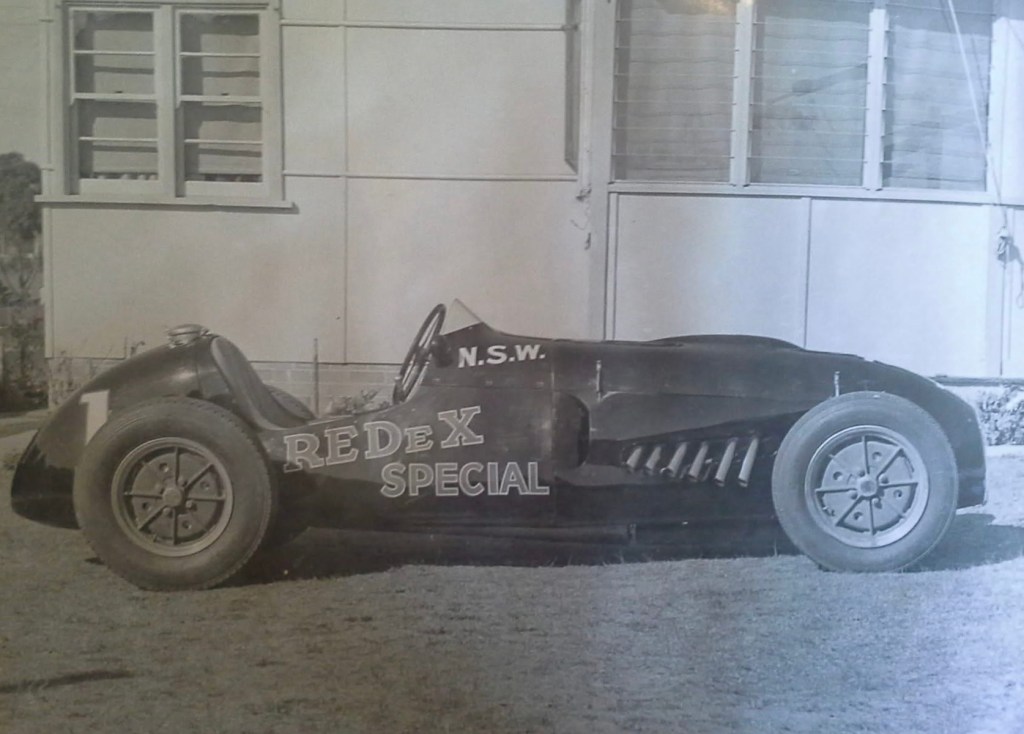
Three of the 1954 AGP protagonists on the cover of Wheels magazine in January 1955. Lex Davison’s HWM Jaguar, an ex-Moss F2 chassis fitted with a C-Type engine, Dick Cobden’s ex-Whitehead Ferrari 125 s/c and Jack Brabham’s RedeX Special Cooper T23 Bristol.
Quite why yerd’ put the winner, Davison, on the cover and two DNFs I know not…the answer is probably the timelines in hand-colouring the photographs for a race held on November 7, 1954.
It’s Easter Monday 1959. March 30, the Bathurst 100 grid. Alec Mildren on the wheel of his Cooper T45 Climax, Ross Jensen behind and to the left of his Maserati 250F and Stan Jones perched on the back wheel of his 250F…
Top contenders for the 100 mile classic were the three Maserati 250Fs driven by Stan Jones – winner of the AGP at Longford on March 2 and the South Australian Trophy at Port Wakefield only two days before on March 28 – Arnold Glass, and Kiwi 1957 Gold Star winner, the very experienced and accomplished Ross Jensen. His 250F Maserati is ‘in the blue and white colours of the Automobile Club of El Salvador – an NZGP publicity gimmick,’ wrote John Medley.
Doug Whiteford’s Maserati 300S, the 1958 Bathurst 100 winner was a contender as were the 2-litre Coventry Climax FPF powered Cooper T45s of Alec Mildren, Len Lukey and Bill Patterson.
Raceday, bright and sunny, attracted 25,000 spectators.
(unattributed)
The first three lap qualifying heat was won by Glynn Scott’s Repco Holden from Bill Reynold’s Orlando MG and Alwyn Rose’s big, booming Dalro Jaguar. The second three-lapper was won by Jones’ Maserati 250F from Mildren’s Cooper T45 Climax and Jensen’s 250F.
The photo above shows the grid prior to the start of the second heat, with Jack Myers beside his WM Holden and then the Maserati 250Fs of Jones and Jensen. Myers’ special was a very clever concoction of Cooper T20 chassis – although by then the frame was of Jack’s construction – and six-cylinder Holden Grey block atop which sat a Merv Waggott designed and built aluminium DOHC, twin-cam, two-valve cylinder head. This car in Jack’s capable hands always punched above its weight, read about it here; https://primotipo.com/2015/02/10/stirling-moss-cumberland-park-speedway-sydney-cooper-t20-wm-holden-1956/
Parade lap, logically before the Bathurst 100…(unattributed)(unattributed)
After the parade lap the Bathurst 100 grid of 27 starters was ‘away in indescribable noise, dust and confusion’, Jones was first to Hell Corner from Mildren Lukey and Whiteford – then Jensen, Glass, Scott, Jack Myers WM Cooper – with Ray Walmsley in the Alfa P3 GMC rolling to a halt out of Hell.
Mildren led at the end of lap one from Jones, Lukey, Jensen who was closing and Doug Whiteford who was falling back. Jensen passed Lukey on lap four and then challenged Jones, roaring past before The Cutting with the three leaders nose to tail through Reid Park.
Jones, 250F (unattributed)
Lukey’s Cooper was close, Whiteford a bit further back and Glass much further back, and then the Myers WM. Into lap five Medley records that the Kiwi started his run by putting in two laps of 2:51, taking the lead and extending it whilst Stan Jones pitted, restarted and retired after six laps.
Then Mildren was black flagged due to a loose bonnet catch, he pitted and rejoined after the drama was rectified, but he was now behind Jensen, Lukey and Whiteford.
Mildren got the bit back between his teeth and passed Whiteford up Mountain Straight at half distance and Lukey under brakes at Murray’s – Doug took Len two laps later as well. By then up to second, Mildren retired at Quarry having done a 2:55 lap and 147.73 mph on Conrod. Whiteford too retired from transmission failure.
Jensen passes Whiteford and his stranded Maserati 300S as he goes over the finishing line, out with transmission woes (PIX-SLNSW)
After Mildren’s pitstop Jensen wasn’t threatened and ‘motored the next 80 miles to win easily’ with a best lap of 2:50.6 and a speed through the Conrod traps at 139.53 mph.
Jensen won a race of incredible attrition – only 11 of the 27 starters finished – from Len Lukey, Cooper T45 Climax, and Glass in the ex-Hunt/Stillwell Maserati 250F, then Jack Myers WM Cooper Holden, Walmsley’s Alfa P3 GMC and Werner Greve in the ex-Moss/Davison 1954 AGP winning HWM Jaguar.
Walmsley’s fifth place in a Gold Star round in his pre-war Alfa Romeo P3 was surely the highest placing for such an old car in any Gold Star round?
(PIX-SLNSW)
Ross Jensen…
While Aucklander, Ross Jensen’s performance may have astonished fringe-race-fans in Australia in fact he had been a front runner in New Zealand amongst the visiting internationals for years.
He purchased the ex-Moss Maserati 250F #2508 1956 NZ GP winner finishing second to Jack Brabham’s Cooper in the 1958 NZ GP. Later that year he raced works-Lister Jaguars in the UK, placing second at Snetterton and Brands in July-August and winning Scott-Brown Memorial – a man he got to know on Archie’s early ’58 NZ Tour – at Snetterton in September. He then returned home having taken delivery of the long shark-nosed 250F #2509 in time for the 1959 NZ internationals.
Ross Jensen shared this Lister Jag with Ivor Bueb and Bruce Halford during the September 1958 Tourist Trophy at Goodwood, DNF (LAT)Soggy Ross – Jensen and 250F during the early stages of the 1959 Waimate 50. “famously there was a cloud burst just after the start…once the rain stopped, it dried up quickly and we had some really great racing,” Allan Dick wrote (Classic Auto News)
Bruce Sergent wrote that “the car was built around the frame of the Bira race winner (NZ GP) of 1955, but with the latest motor and transmission, giving the low, offset driving position.”
He was fifth in the NZ GP, qualified on the front row at Wigram but DNF with transmission problems, was second behind Bruce McLaren’s Cooper at Waimate, and was fourth behind McLaren, Flockhart’s BRM P25 and Brabham, Cooper T45 at Teretonga. He was no slouch…
Jensen established a race preparation shop, retired from racing in 1961 but was always part of the scene – foundation member and on the board of the NZ Grand Prix Association, founding trustee of the Bruce McLaren Trust – and later imported Renault, Jaguar and BMW amongst others. He died, aged 78 in October 2003.
Etcetera…
(PIX-SLNSW)
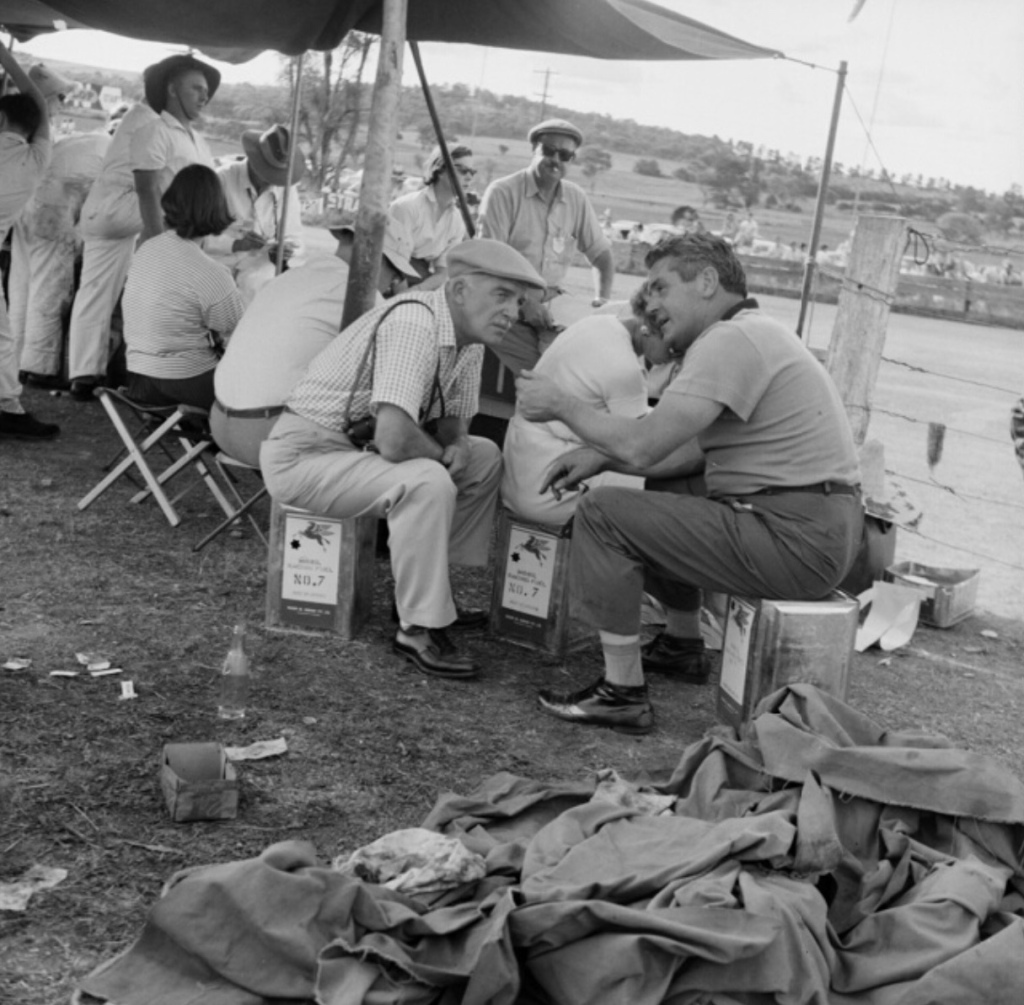
Stan Jones (right) dispenses some words of wisdom to a gent in the exclusive confines of the Mobilgas hospitality suite. BYO chair clearly.
(SLNSW)
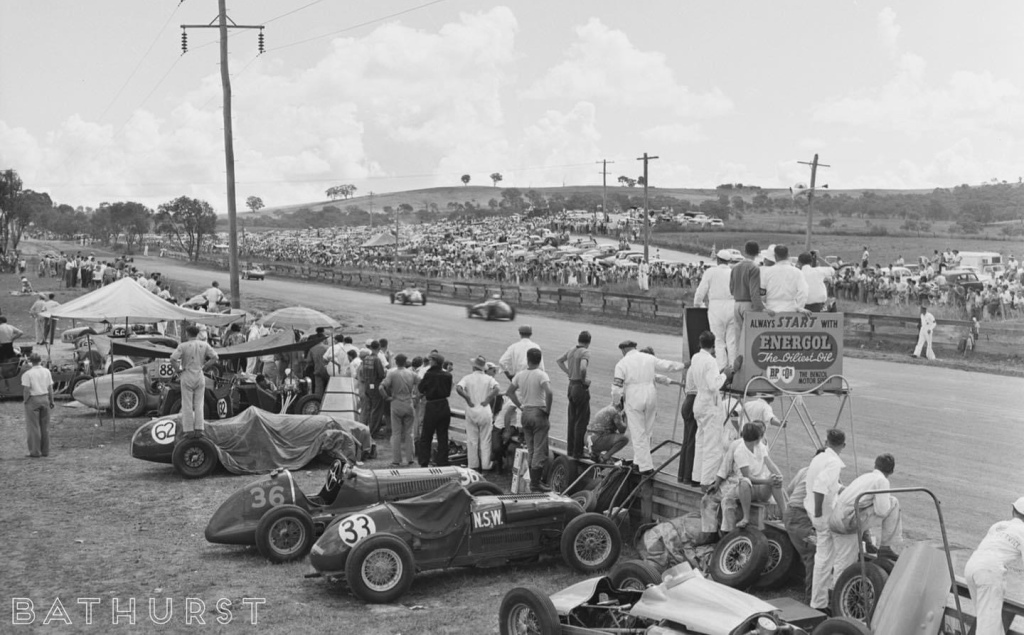
Great Pit Straight panorama with the #33 Bruce Leer MG TC Spl, Jesse Griffiths Maserati 4CL #36 and John Schroeder, covered Nota Consul. All of them contested the Bathurst 100 and all were DNFs.
(unattributed)
Porsche 356 Coupe leads Stan Jones and Ross Jensen on the parade lap.
(PIX-SLNSW)
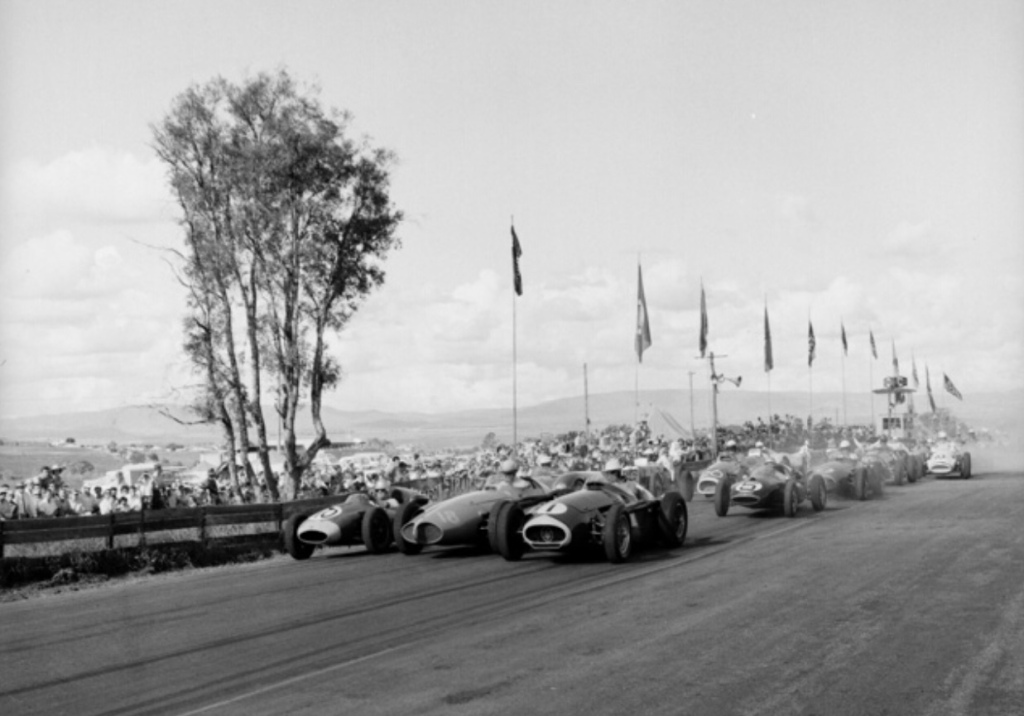
Mildren, Cooper T45 and the Jensen and Jones 250F’s on the front row at the start of the 100, feel the vibe…Len Lukey’s #5 Cooper Climax on the outside of row two
(unattributed)
Arnold Glass’ Maserati 250F goes inside Bill Clarke’s 492cc two-stroke, three-cylinder, air-cooled Berkeley SE492 Excelsior, the speed differential between some of the cars that weekend was mega.
Credits…
Russell Beckman, Bill Miles Collection, ‘Bathurst: Cradle of Australian Motor Racing’ John Medley, sergeant.com, Allan Dick-Classic Auto News, LAT, Maserati 250F chassis number source: http://8w.forix.com/250f-redux.html
Tailpiece…
Ross Jensen’s Maserati 250F in 1959, on the cover of the 1960 meeting programme.
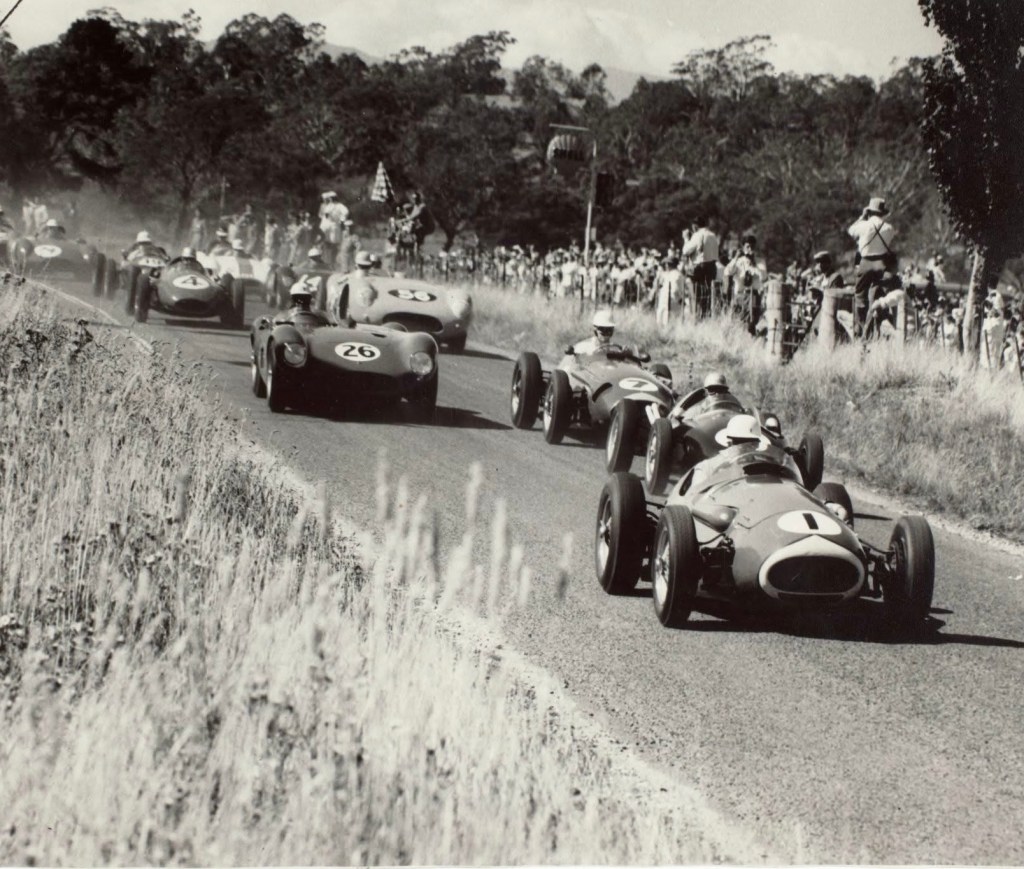
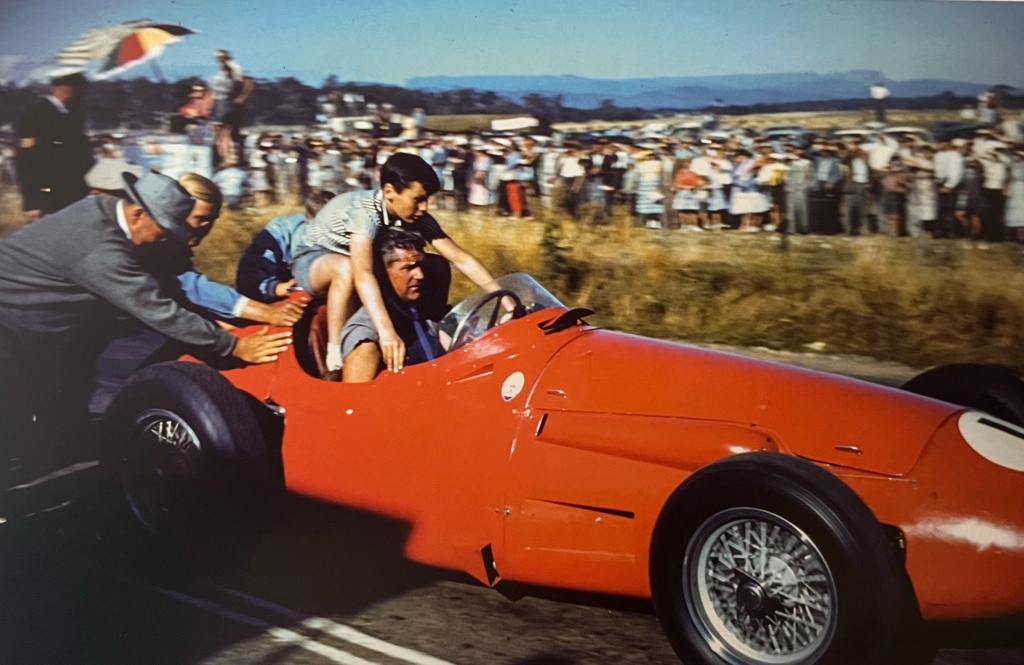
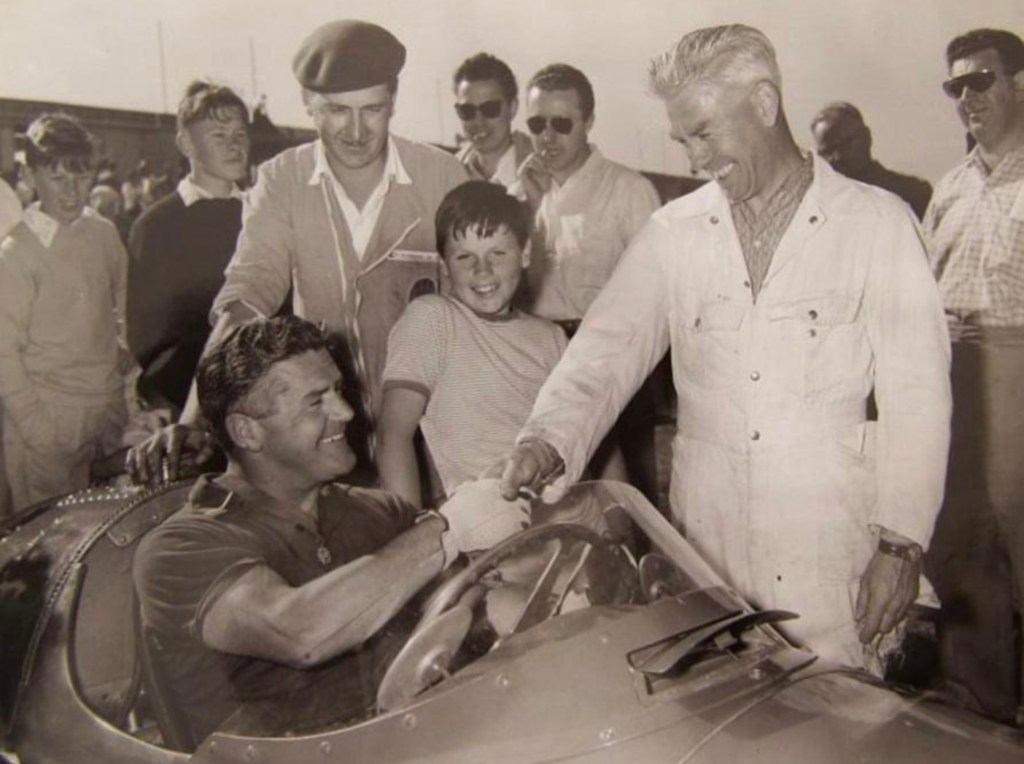
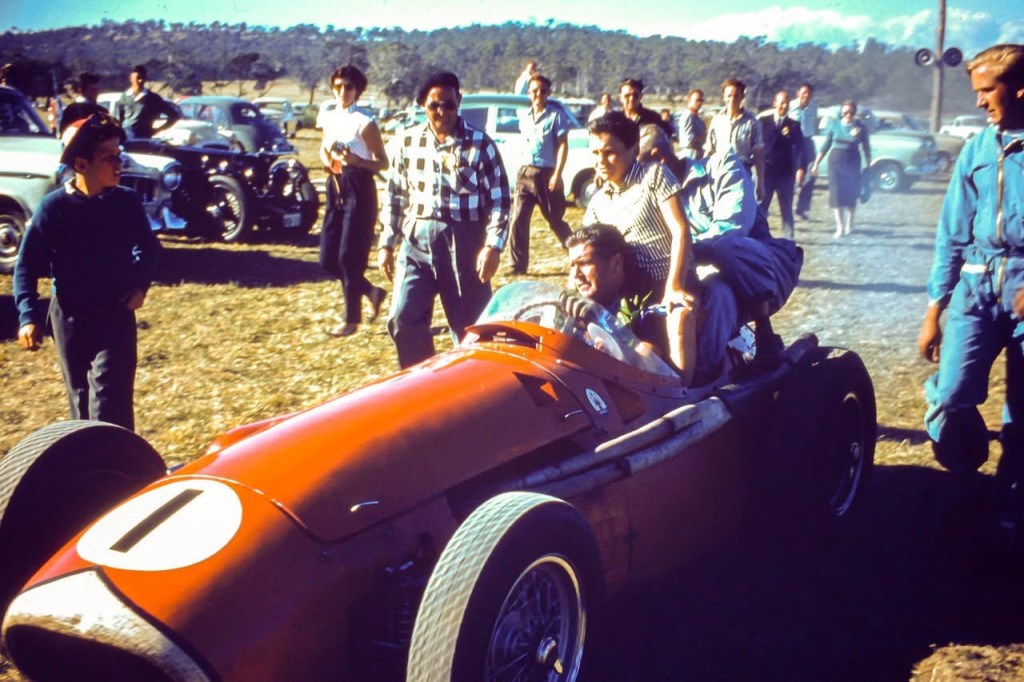
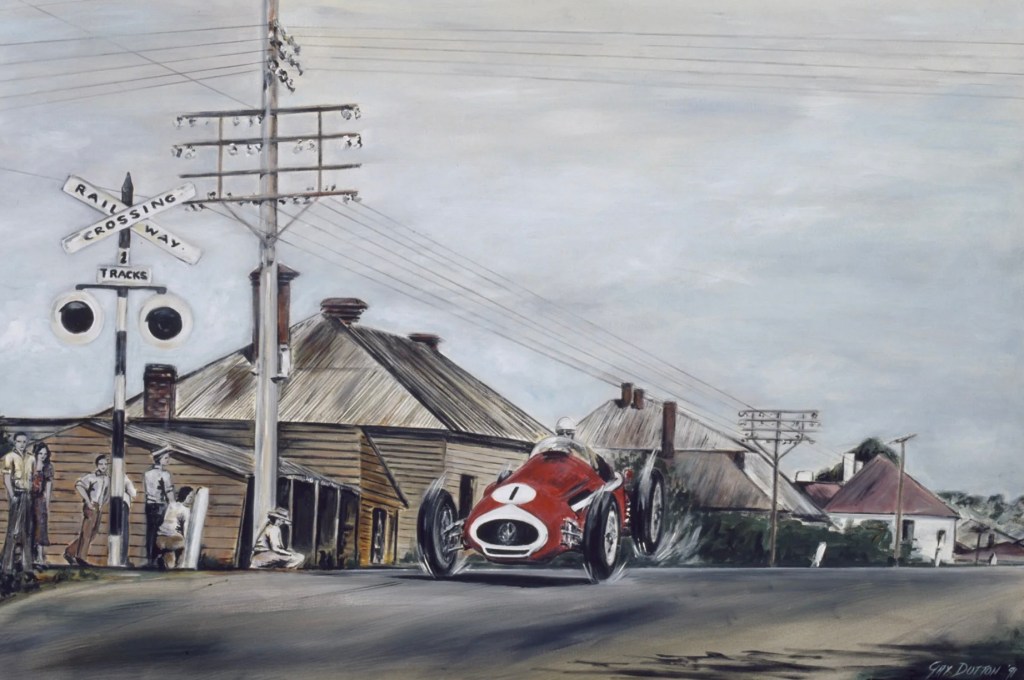
Stan Jones, well aloft over the railway crossing on Tannery Straight at Longford aboard his Maserati 250F, leads Len Lukey, Cooper T45 Climax 2-litre, during their epic battle for honours in the March 2, 1959 Australian Grand Prix.
(SLT)
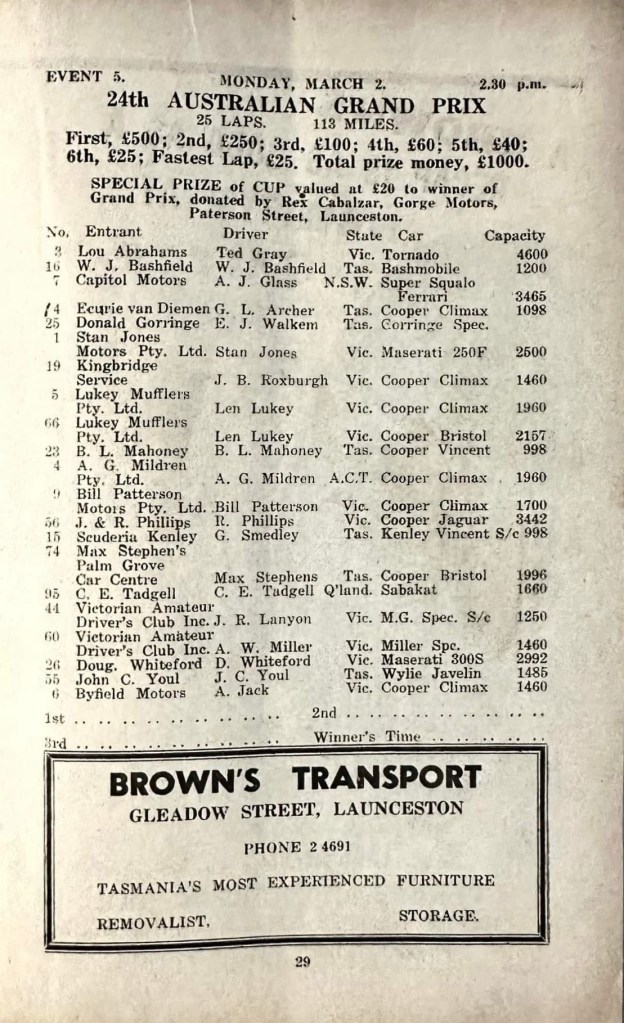
Stan Jones gets the jump in his Maserati 250F at the start of the 25 lap, 110 mile Formula Libre race from Len Lukey, Cooper T45 2-litre, Arnold Glass, Maserati 250F, Doug Whiteford, Maserati 300S, Ron Phillips’ Cooper T33 Jaguar 3.8, and #4, Alec Mildren, Cooper T43 Climax 2-litre.
‘Take it easy Dad!’ Alan to Stan Jones before their victory lap (Dunstan Collection)
In a long race of thrust and parry between the nimble Cooper and brawny Maserati, 30,000 spectators saw the battle resolved in Stan’s favour.
The reigning Gold Star champion had just enough power to offset the handling and roadholding advantage of Lukey’s new fangled mid-engined Cooper. Armed with a 2.5-litre Coventry Climax FPF – not readily available to customers at that time – the result wouldn’t have been the same, but karma looked after Stan that day, he had well-and-truly paid his AGP dues since 1952 after all!
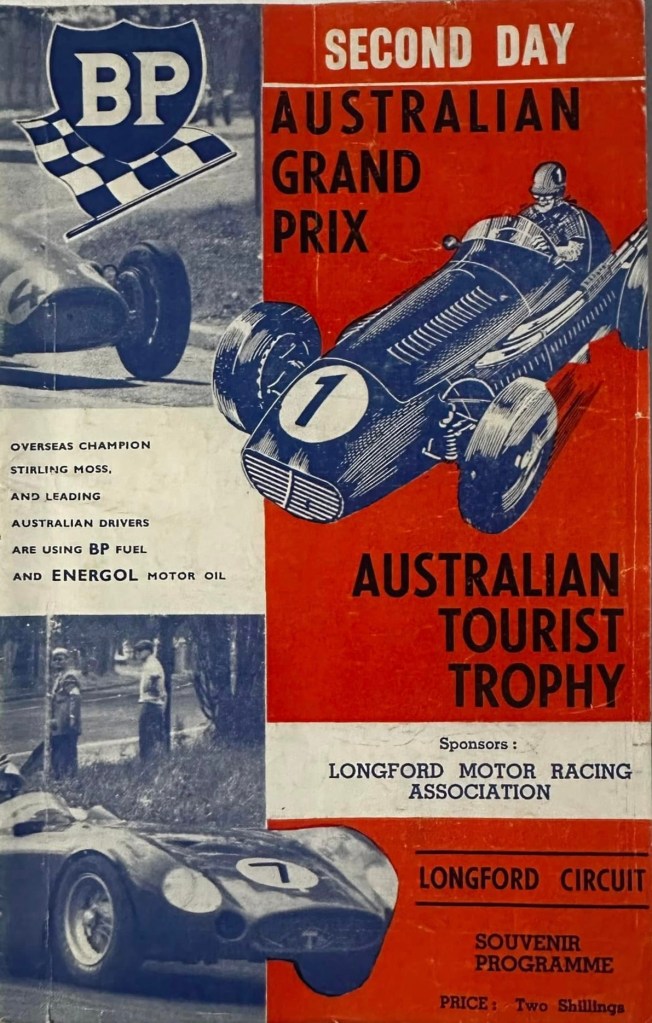
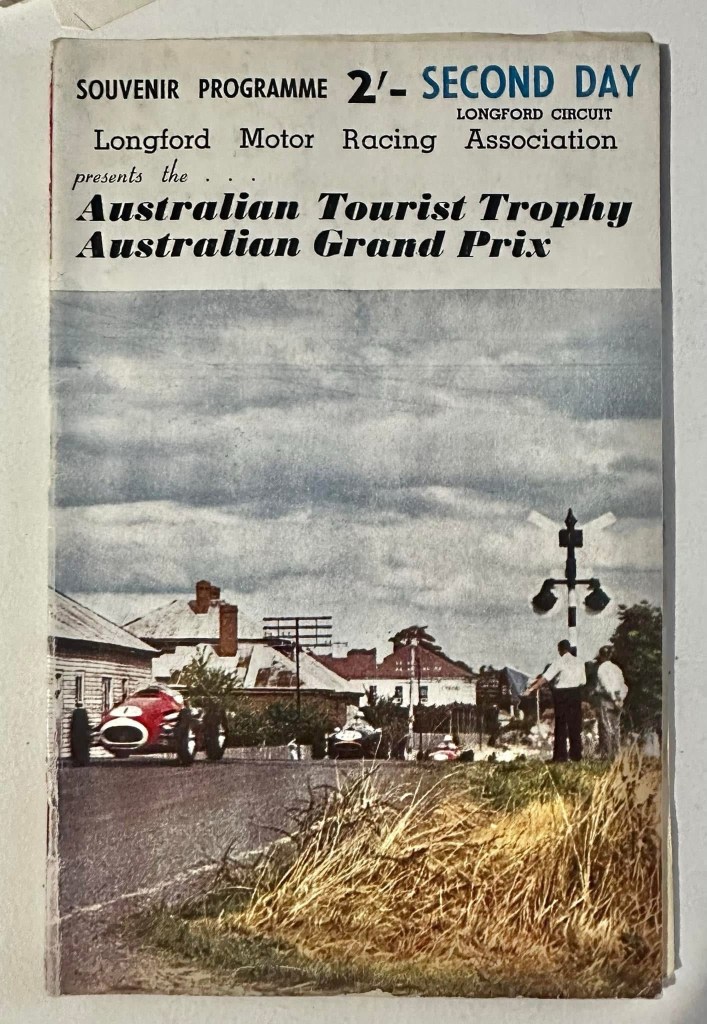
1959 Longford AGP program cover. The ATT was a motorcycle event(s) (A Lamont)
While Len Lukey missed out on that ‘59 AGP win, the Melbourne proprietor of the substantial Lukey Mufflers business took a great Gold Star win in a long championship of twelve rounds. He only won two of them but was a consistent front runner and point scorer throughout. Jones and Bill Patterson won two rounds, and Alec Mildren three, taking this pace into 1960, winning the title in a locally developed Cooper T51 Maserati.
Kiwi Ross Jensen’s Maserati 250F Bathurst 100 March 30, 1959 win was the last Gold Star victory for a front-engined car.
(A Lamont Collection)
Etcetera…
(B Young Collection)
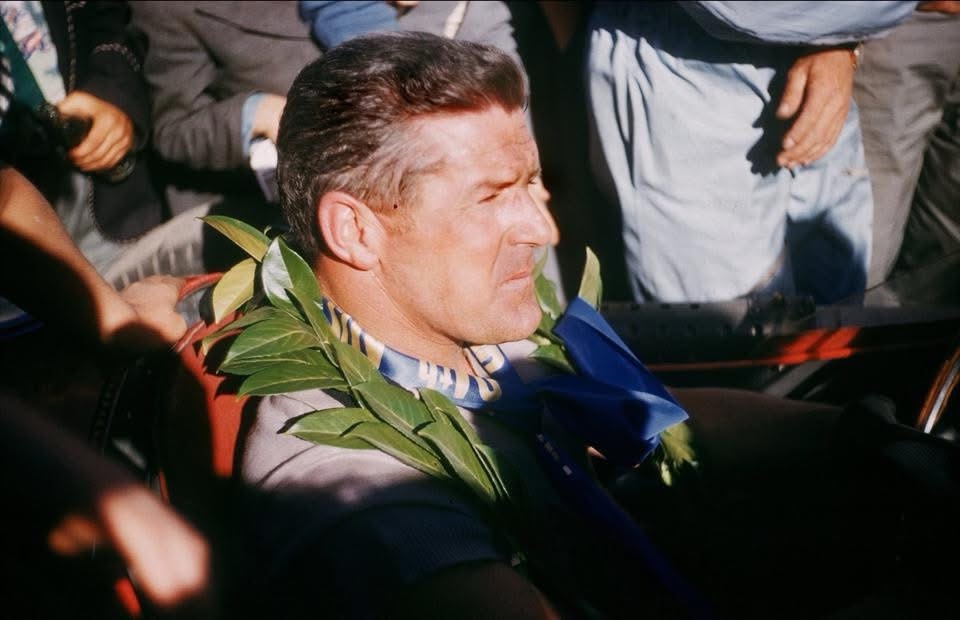
So near to Australian Grand Prix wins in 1954, 1955, 1957 – he took the chequered flat that Caversham day – and 1958, it must have been an immensely satisfying moment for the 1954 New Zealand Grand Prix winner and reigning Australian Gold Star champion, Stan Jones, to take the chequered flag at super demanding Longford.
(unattributed)
Otto Stone and Stan exchange congratulations in the Longford paddock. It wasn’t just the superb car preparation of racer/engineer Stone that made the difference to Jones’s results in 1958-59, it was a little bit more of a percentage play in his driving as well.
Otto was no slouch behind the wheel, there seems little doubt that he was able to communicate with Stan as a peer ‘to bring the thing home’. And yes, I’m not forgetting that (Repco’s) Charlie Dean was a good steerer too.
Jones only won two of the nine Gold Star rounds to win the title in 1958 but he had enough consistency to win a championship he richly deserved, let’s not forget Otto’s role in that regard…
Key Team: Jones, Jones with obscured Otto Stone behind Alan and John Sawyer at right (The Northern Courier)(A Lamont Collection)
Super rare colour shot of the 1959 AGP dice between Jones and Lukey on the cover of the 1960 Longford program.
(G Dutton)
Gay Dutton’s tribute to Stan’s great victory.
Credits…
The much used and abused money-Longford-shot was taken by Charles Rice, here courtesy of Paul Cross’ collection, Bob Young Collection, Lindsay Ross’ oldracephotos.com, Andrew ‘Slim’ Lamont Collection, Gay Dutton, The Northern Courier
Tailpiece…
(oldracephotos.com)
‘Don’t even think about it Stanley!’ muses Len Lukey as Jones shoves his nose into a rapidly diminishing gap. What a shot! The money-shot used on the cover of Neil Kearney’s excellent book actually…
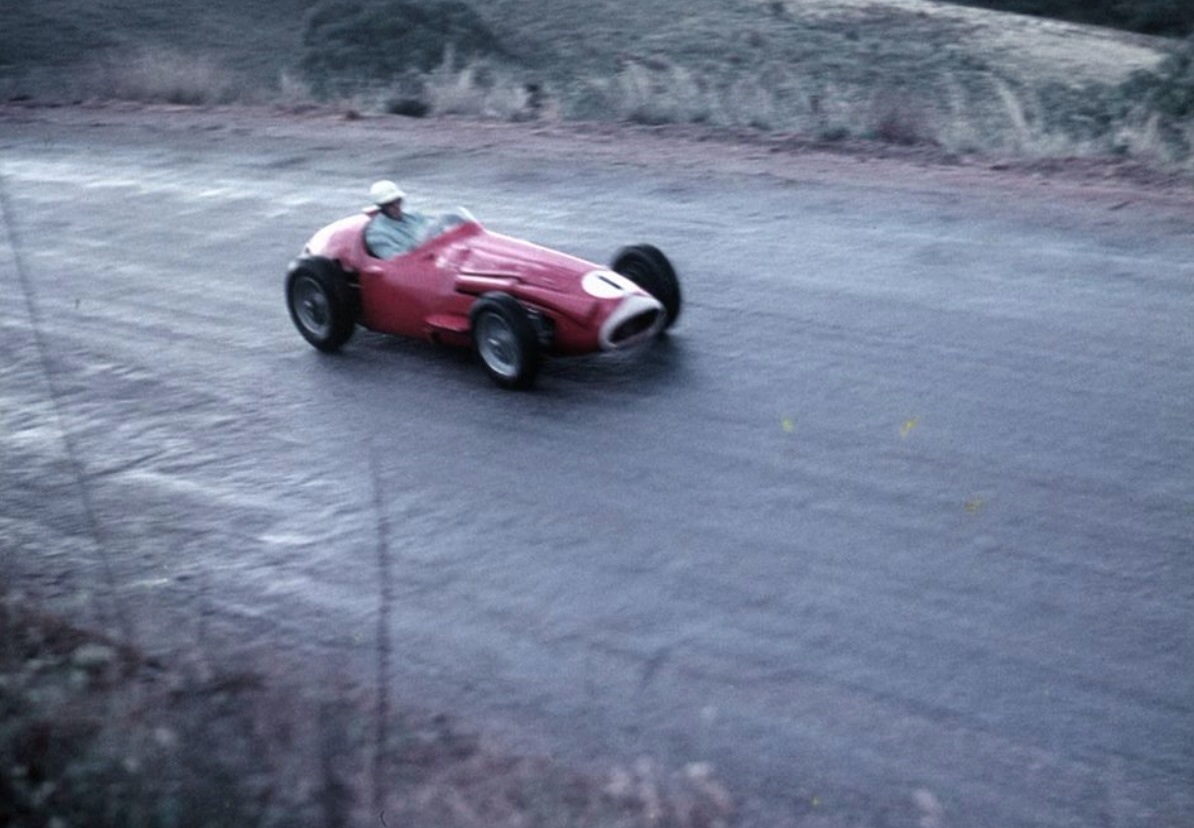
Reg Hunt, Maserati 250F, on his way to winning the Victorian Trophy at Fishermans Bend on February 12, 1956
Context…
Australian motorsport’s governing body was the Sydney based Royal Automobile Club of Australia until 1953 when the Melbourne based Confederation of Australian Motor Sport took over. CAMS Ltd trading as Motorsport Australia (CAMS) still rules the roost today.
One of the CAMS’ rare acts of decision-making excellence was the creation of the Australian Drivers Championship – the Gold Star – from 1957.
Lex Davison, Ferrari 500/625 was the first recipient of the award for points gained in nine rounds spread across all states except Tasmania – remedied in 1958 – on an 8-5-3-2-1 points basis for first to fifth places in each round.
1956 Faux Gold Star Championship…
I’ve thought for a long while that it would be interesting to summarise our elite level Formule Libre racing results by seasons, if for no other reason than when I want to research one thing or another a summary of the competitor set exists. Why not, I thought, extend the idea to calculating notional Gold Star points?
Of course it’s a fucking stupid thing to do as it simply didn’t happen! In the words of that great Australian philosopher, ‘Sir’ Frank Gardner, “If yer’ Aunty had balls she’d be yer’ Uncle”. In other words, deal with what is/was, rather than what isn’t/wasn’t.
But of course CAMS run a who-gives-a-fuck-about-facts (WGAFAF, pronounced ‘woggafaff’) motor racing history model. They don’t recognise the January 1927 Australian Grand Prix at Goulburn as the first AGP, yet we have 1928 and 1937 Australian Grands Prix, apparently, neither of which actually took place then, as officialdom chooses to brand them now. So, in accordance with established Oz-racing fast-and-loose WGAFAF precedent, what follows is a summary of the 1956 Gold Star, Faux Division.
Officialdom awaits the ‘Champion of the Day’ of the 100 Miles Road Race at Phillip Island held on Saturday 31 March, 1928. Oopsie, sorry there were two 100 Mile Road Races that day. The morning one started at about 11am, oopsie again, sorry, B-Class started at about 11am, and D-Class at about 11.05am. The afternoon race, races really, started at about 2.25pm for A-Class and then C-Class at about 2.30pm. All ‘Akin to European GP practice’ is the favoured line of some
The readily apparent State-The-Obvious flaw in my Faux Gold Star award is that as there was no such championship, drivers didn’t enter meetings they may have otherwise if they aspired to win such a title. However, the rich/well-funded in every era raced far and wide beyond their local meetings, this was certainly the case for the 1956 motor trader front runners, so I’m not so sure the top-3 are impacted by this factor.
Some criteria points. I’ve basically followed the equivalent 1956 meetings that CAMS recognised in ’57, even though some of the races are too short, in my mind, to be of championship length. Where there were two Formula Libre races of ‘championship length’ – over 75 miles – at the one meeting, such as the Albert Park Moomba meeting, the longer, feature event prevails. Results are scratch based only. I’m only awarding points for first to fourth placings as those are the records I have. If someone has more comprehensive records, spreadsheet skills and OCD knock yer’ socks off and I’ll update this masterpiece.
Away we go.
Reg Hunt on Gnoo Blas’ Main Straight while the 4.05pm to Sydney gets ready to depart. Maserati 250F (GB.com)
Gnoo Blas, Orange, New South Wales (NSW) : South Pacific Championship : January 30, 1956
This season opening race meeting on the Gnoo Blas road circuit at Orange, 260 km west of Sydney had become Australia’s only international meeting in prior years. The Australian Sporting Car Club always managed to entice a few of the drivers doing a full southern summer season In New Zealand across-the-ditch to the Great Brown Land before they headed back to Europe. As an aside, the Kiwis were five years or so in front of us in the Big Race Stakes.
Our Jack was the only international in ’56 mind you. He raced the 2-litre Cooper T40 Bristol that he built for himself at Surbiton to make his championship GP debut at the British Grand Prix at Aintree in July 1955. Brabham brought the car home at the end of the year, winning the AGP with it at Port Wakefield after frontrunners, Stan Jones in Maybach 3 and Reg Hunt’s Maserati A6GCM/250 (a 2.5-litre 250F engined A6GCM 2-litre F2 car) had problems, then did the Kiwi season and would sell it to Reg Smith before heading back to the UK.
To rub in his advantage, Reg Hunt brought along both the Maserati he raced throughout 1955 and his new 250F on the long tow from Melbourne to Orange, then disappeared into the distance, winning the 27 lap, 100-mile race in the 250F from Brabham.
Stan Jones gave vigorous chase, but blew the 3.8-litre Maybach SOHC six fitted under the long bonnet of Maybach 3 sky-high on lap 22 when 39 seconds adrift of his fellow Melbourne motor trader.
That blow-up proved a defining moment in Australian Motor Racing History of that era as it marked the end of the Charlie Dean/Repco Research/Stan Jones/Maybach period. Repco’s stock of 3.8 and 4.2-litre Maybach cylinder blocks was at an end, so the car couldn’t easily be rebuilt. In any event, Stan realised he needed a Big Red Car to remain competitive, taking delivery of a 250F later in the season. Ern Seeliger created the very fast Maybach 4 Chev V8 of course, it proved to have a surprise or two in 1958-59, but the big-blue Maybach sixes were no more.
Kevin Neal was third in his Cooper T23 Bristol, then came Curley Brydon’s ex-Peter Whitehead – present at Gnoo Blas in the previous two years – Ferrari 166 and then Col James’s MG Special. Jack was a non-resident by then so he doesn’t get Gold Star points for his second place, so we have our top-four below.
1.Hunt Maserati 250F 8 points 2.Neal Cooper T23 Bristol 5 points 3.Brydon Ferrari 166 3 points 4.James MG Special 2 points
End of an era. Jones aboard Maybach 3 – very Mercedes W196’esque in appearance – before the engine let go, South Pacific Championship, Gnoo Blas in 1956 (GB.com)
Fishermans Bend (once Fishermen’s Bend) Melbourne : Victorian Trophy : February 11, 1956
Top guns entered for the 24 lap, 52.8 miles Formula Libre race included Hunt’s Maserati 250F, Lex Davison’s HWM Jaguar (“now with latest D-Type head and Weber carbs” according to AMS), Doug Whiteford’s Talbot-Lago T26C, Stan Jones’ Cooper T38 Jaguar sportscar, Brabham’s Cooper T40, Tom Hawkes Cooper T23 Bristol and Bill Craig’s Alta Holden.
While billed as on international meeting to attract some spillover visitors to New Zealand that summer, the only ‘internationals’ were Brabham from New South Wales and Craig from South Australia…
Hunt romped away, Whiteford’s old T-L, somewhat surprisingly, proved quicker than Davison’s ’54 AGP winning HWM Jag, then Davo spun, while broken throttle linkages accounted for Jones and Hawkes.
1. Hunt, Maserati 250F 8 points 2.Whiteford Talbot-Lago T26C 5 points 3. K Neal Cooper T23 Bristol 3 points 4.W Wilcox Ford Special 2 points
Albert Park, Melbourne : Moomba Meeting – Argus Trophy : March 18, 1956
Albert Park – promoted by the Light Car Club of Australia – hosted a pair of international two-weekend carnivals in ’56: the Moomba meeting in March and Olympic meeting in November/December.
The feature on March 11 was the Moomba Tourist Trophy for sportscars. Tony Gaze won that 150-miler in his HWM Jaguar VPA9, from Bib Stillwell’s brand-spankers Jaguar D-Type and Ron Phillips’ Austin Healey 100S.
F.A.O. Gaze DFC and Two Bars, OAM had decided to retire from racing and sold his HWM and ex-Ascari Ferrari 500/625 to his good mate, Lex Davison before the meeting. Tony had raced both cars in New Zealand that summer together with Peter Whitehead. Davison’s deal included racing the Ferrari in the Argus Trophy, the Formula Libre, 48-lap, 150-mile feature on the following weekend, March 18.
Davo had some serious opposition though, not least Hunt’s 250F and Melbourne haulier, Kevin Neal, who had bought Hunt’s immaculate A6GCM/250. Other expected front-runners included Hawkes’ Cooper Bristol, Stillwell’s D-Type, not to forget Arthur Griffiths, who had bought the ex-Moss HWM Jaguar just vacated by Davison, and Reg Smith in the Cooper Bristol similarly vacated by Jack Brabham.
Somewhat predictably, Reg Hunt won the race in his current model Maserati 250F – one of the great GP cars of any era – from Davison, with Neal, Hawkes and Stillwell third to fifth.
Lex’s old-bus dated back to 1952 – in 2-litre spec it was Alberto Ascari’s main weapon of choice in his triumphant 1952-53 World Championship years – but fitted with a 3-litre DOHC four-cylinder ‘Monza’ engine it proved for several years to have the measure of the fastest cars in the country thanks to a combination of Davo’s speed and almost peerless reliability. Tony Gaze had the Ferrari prepared by Alan Ashton and his AF Hollins crew in High Street, Armadale. He implored Lex to continue the relationship, Davo did so and it was key to his ongoing success with this car.
Reg Hunt from Lex Davison during the Argus Trophy at Albert Park, March 1956. Maserati 250F and Ferrari 500/625 (D Meale)
Port Wakefield, South Australia : Easter Saturday : March 31, 1956
Not all the serious boys spent Easter at the traditional Bathurst fixture, some contested the 50-lap, 65- miles Wakefield Trophy at Port Wakefield, South Australia: Tom Hawkes, Cooper T23 Bristol, Kevin Neale, ex-Hunt Maserati A6GCM/250, Ted Gray, Tornado 2 Ford, and Derek Jolly, Decca Mk1 Climax FWA Spl included.
The weekend feature was for the 20 fastest cars. Soon after the start, the race developed into a Cooper and Maserati duel a lap in front of the rest of the field. Hawkes, in a great performance in the slower of the two cars, won from Neal’s Maserati, Ron Phillips’ Austin Healey 100S and TE Stevens, MG TC Spl.
Interesting are the top speeds recorded on Century Straight (all mph): Gray Tornado Ford V8 110.5, Neal Maserati 2.5 108.5, Hawkes Cooper Bristol 2-litre 104.7, Eldred Norman in the legendary Norman Zephyr Spl s/c 102.5, Murray Trenberth, Vincent 1000, 100, and Eddie Perkins, VW Spl s/c 99.5
The 26-lap, 100-mile handicap, Bathurst 100 had a huge field, “more entries from interstate than Bathurst has seen for some time” wrote Australian Motor Sports. Stan Jones and Jack Brabham weren’t at the meeting, Maybach 3 was dead and Stan’s 250F hadn’t arrived, while Jack had returned to the UK.
The handicap was won by Davison from Hunt, Bib Stillwell, Jaguar D-Type, and Paul England’s Ausca Repco-Holden. To be consistent, Gold Star points are awarded for the scratch results: Hunt, Maserati 250F, Lex Davison Ferrari 500/625 3-litre, Stillwell D-Type, and Tom Sulman’s Aston Martin DB3S.
1.Hunt Maserati 250F 8 points 2.Davison Ferrari 50/625 5 points 3.Stillwell Jaguar D-Type 3 points 4.Sulman Aston Martin DB3S 2 points
Port Wakefield Road Races : South Australian Trophy : June 4, 1956
Stan Jones took delivery of his Maserati 250F in May, demonstrating it in an untimed run at the Geelong Sprints meeting on May 27, Port Wakefield was chassis #2520’s Australian baptism of fire.
Other fast cars which took the trip to the desolate, wind-swept permanent race track included Davison, Stillwell and brilliant, intuitive Adelaide engineer, Eldred Norman in his Norman Zephyr Spl s/c. Most significantly, Ted Gray was present in the Lou Abrahams owned, Gray/Mayberry Bros/Abrahams built Tornado 2 Ford. Tornado 1 Ford died a terrible death at the October ’55 Bathurst meeting, Tornado 2 was a new car using few of T1’s bits, amongst the exceptions were the Ford Ardun/Abrahams fuel injected OHV V8 and Ford truck ‘box. Ted was ok after a very long convalescence too.
At this point of 1956 the key machines of Australian Formula Libre racing from 1956-59 were in place: the two Maserati 250Fs, Davo’s Ferrari and Tornado 2…two-litre Coopers were still to come.
Held in a big rainstorm, the 30 lap South Australian Trophy race, early on was a close contest between Stillwell – pretty comfy in his Jag sportscar – with Stan all over him, but unable to pass and see…
Davo spun on lap 3, so too later in the race did Gray, although another column in AMS says Ted didn’t even start the race due to a broken CV joint… The race was won by Stillwell from Jones, Norman and ??
Somewhat prophetically, Bob Pritchett wrote in the July 1956 issue of Australian Motor Sports, “Who said Ted Gray’s Tornado Special doesn’t handle. Ted was, I think, the only high-powered operator who did not spin off in the meeting (the guy that wrote the race report sez otherwise!) and in winning the A-grade scratch race 6-lapper, held Stan’s Maserati for four laps until Stan spun off in the wet.”
In the same column, Pritchett reported that Tom Hawkes was considering a Maserati four to get more speed out of his Cooper T23 Bristol, that engine being at the end of its development potential; a Repco-Holden Grey shortly thereafter provided a potent and more cost-effective solution.
Similarly, he mused about the possibilities of Maybach 3, “by dropping in one of those 300-plus USA V8 monsters that are now available.” – the very path followed by Ern Seeliger, and Ted Gray with hot 283 Chev Corvette V8s being popped under the bonnets of Maybach and Tornado before too long.
Yes, the little-tacker in the lower shot is Alan Jones. He has recounted over the years his disappointment in finding Dad’s new, red Italian car was a Maserati and not a Ferrari! Bob Chamberlain at left Bob King thinksTed Gray from Stan Jones during their Port Wakefield scrap in June 1956. Tornado 2 Ford V8 and Maserati 250F; plenty of scraps to come from this pair from 1956-59. Gray’s experience went all the way back to giving Peter Whitehead and ERA R10B a run for their money at Aspendale and Rob Roy in 1938 aboard a speedway-midget
Lowood Airfield Queensland : Lowood Trophy : June 3, 1956
“Queensland Racing Drivers Club conducted this year’s ‘Lowood Trophy’ meeting in typical Queensland winter sunshine, before a crowd of about 6000. The 2.7-mile circuit was in good condition…34 entries was received, including eight from NSW…” recorded AMS.
Top guns included Arthur Griffiths’ ex-Davison HWM Jaguar, Ken Richardson’s ex-Whiteford Talbot-Lago T26C, Steve Ames aka Count Steve Ouvaroff ex-Davison Alfa Romeo P3, John Aldis’ ex-Whitehead/Jones Cooper T38 Jaguar and Arnold Glass’ Maserati 4CL; it wasn’t a great entry of modern cars.
The 12 lap, 32 miles Lowood Trophy results were as follows:
1.Griffiths HWM Jag 8 points 2. S Mossetter Austin Healey 100S 5 points 3.R Weintraub Healey Silverstone 3 points 4.J Johnson MG TC 2 points
Bathurst : NSW Road Racing Championships : September 30, 1956
A crowd of 8-10,000 people fronted up to cold, blustery conditions for the second traditional Bathurst meeting a year, October fixture.
While Stan Jones was present to sharpen his skills in advance of the Australian Grand Prix two months hence, Lex Davison and Reg Hunt were notable by their absence, ‘preserving the machinery’ or whatever.
Bill Pitt was there in the Geordie Anderson/Westco Motors Jaguar D-Type and Jack Myers in the WM Special, a much-modified (by Myers, a highly skilled Sydney mechanic-cum-engineer) Cooper T20 fitted with a Waggott-Holden twin-cam, two-valve circa 200bhp ‘Grey’ six-cylinder engine.
Handicaps were still prevalent, if not the norm in Australian racing, with the 26 lap NSW Road Racing Championship (Racing Cars) no exception. Jones set a new lap record of 2min 44sec without being hard pushed. While ‘J Archibald’ (who was he?) won the handicap classification in his MG Spl, the scratch results and Gold Star points allocations are as follows:
Fishermans Bend, Melbourne : Astor Trophy : October 14, 1956
You might think the Victorian Contingent would be out in force in advance of the rapidly approaching AGP, but not so. While Hunt, Whiteford, Neal and Gray were present, Davison and Jones were AWOL.
Then, having satisfied himself that his 250F was all tickety-boo in a 5-lapper, Reg Hunt didn’t take the start of the start of the 24-lap, 52.8-mile Astor Trophy feature.
While Kevin Neal’s Maserati A6GCM/250 was a far quicker car than Doug Whiteford’s – relatively new to him, but geriatric – Talbot-Lago T26C, there was no way Neal was going to beat the aggressive, cagey, vastly experienced triple AGP winner! Ted Gray and Owen Bailey were/are the other recipients of Gold Star points aboard Tornado 2 Ford and ex-Whiteford Talbot-Lago T26C respectively: third and fourth placings.
“Tell him, he’s dreamin…’ Count Stephen Ouvaroff aka Steve Ames offers his ex-Scuderia Ferrari/Davison Alfa Romeo P3 chassis #50003 for sale, £895 is the ask. In 2024 dollars that is $A32,700, the value of a P3 is, however, in the ‘your guess is as good as mine’ categoryMoss Mastery – high speed drift at Albert Park, Maserati 250F, AGP December 1956
1956 Australian Grand Prix : Albert Park : December 2, 1956
120,000 people watched 22 starters contest the ’56 AGP held in the afterglow of Melbourne’s staggeringly successful Olympic Games.
Furriners included a five-car squad from Officine Maserati: three 250Fs and a pair of 300S (sportscars for the Australian Tourist Trophy contested and won by Moss from Behra the week before) for works drivers Stirling Moss and Jean Behra, while Peter Whitehead and Reg Parnell raced their 3.4-litre Ferrari 555s.
Moss disappeared into the distance, winning the 80-lap 250-miles race in 2hr 36min 15.4sec, over two minutes ahead of Behra, then came Peter Whitehead.
The battle-within-the-battle was a local Melbourne Holden Dealer Derby – Davo’s farming and shoe making interests duly noted – between the 250Fs of Reg Hunt and Stan Jones, and Lex Davison’s Ferrari 500/625.
Graham Howard points out in his 1956 chapter of the ‘History of The Australian Grand Prix’ that “It was to be, surprisingly, the first encounter of the Hunt and Jones’ 250Fs, and Davison – at that stage the only driver to beat the Hunt 250F – was also there in his Ferrari.”
“Hunt and Jones had, to be strictly correct, lined up against each other the weekend before, in a short sprint race in the supporting program to the Tourist Trophy, but it had been inconclusive. With Hunt on pole position and Jones right beside him, the race had an explosive start as Jones – ‘jockeying for position’, as AMS discreetly termed it – hit the kerb and then a tree on Hunt’s side of the course within a hundred metres of the start. The car was fortunately not too badly damaged and was ready for the AGP the following weekend.”
At the start of the Grand Prix, Moss led from Behra, the Whitehead and Parnell Ferrari Super Squalo’s, then the Trident Trio: Hunt, Neal and Jones. Davison was slowed by engine maladies.
By lap 5 Jones was behind Hunt, and after two fast laps, passed him, where he stayed – with Hunt pacing himself behind – for 35 laps, “With both driving with a concentrated ferocity, which was almost tangible – no errors, no let- up, certainly no smiles.”
When Stan’s Maserati started to blow smoke from under the bonnet, he eased on lap 40, gifting his place to Hunt. Post-race the problem was disclosed as a broken breather.
The Gold Star points go to the fifth, sixth, seventh and eighth placed local finishers:
Reg Smith competing at Templestowe hillclimb outside Melbourne in May 1956. His Cooper T40 Bristol was Jack’s ’55 British GP car and AGP winner. He can’t have been enamoured of the Cooper, replacing it with one of Officine Maserati 300S sold at the end of the ’56 AGP weekend
Gold Star Championship Points and Observations…
Drum roll…the winner of the 1956 Australian Gold Star Faux Championship is Reg Hunt, Maserati 250F, with 40 points, well clear of Kevin Neal’s 21 points gained with Cooper T23 Bristol and Maserati A6GCM/250, then Stan Jones, third on 18 points in his new 250F. Fourth was Whiteford, Talbot-Lago T26C 15 points, then the Davison Ferrari 500/625 on 13 points with Bib Stillwell sixth, on 11.
What does it all prove? Absolutely sweet-f-all, but I enjoyed it, which is all that really matters here.
I wish I could show you a neato little points chart or a spreadsheet of results for the year but I don’t know how to do those, so this hand-job will have to do, a remedy with which many of you will be familiar. Since publishing this, Stuart Murray – bless him – has done the vastly better spreadsheet which appears further below.
In my mind I’ve long thought Reg Hunt was the rock-star in 1955-56 aided and abetted by having The Best Equipment in the country in those two years by far. I’ve not done this exercise for 1955 yet to further prove the point, I’ll get around to it some time.
Having ‘came, saw, and conquered’, Reg retired from racing at the end of the season, aged only 33, to focus on his family and in building a staggeringly successful motor-dealership empire centred on his ‘Golden Mile of Cars’ in Brighton, Melbourne. He returned to historic racing in the 1980s with a Maserati 300S and Talbot-Lago T26C and died just shy of 100 on August 22, 2022.
Fellow Melbourne motor trader and later four-time Gold Star champ, Bib Stillwell bought the Hunt 250F (chassis #2616) but couldn’t resist the temptation of a factory freshen-up, so didn’t see it for the best part of 12 months. It’s a long boat ride between Port Melbourne and Genoa and back, and Maserati had bigger fish-to-fry, not least a World Championship to win with JM Fangio at the wheel of factory 250F’s.
At the end of ’56 the stage was set, the key players in 1957 seemed likely to be Jones, Davison and Gray with a tight contest likely given all three were well-funded ‘pro-outfits’ by Australian standards of the day. In the end Davo’s Ferrari 500/625 crushed the opposition with five Gold Star wins in nine rounds, a story for another time…
Credits…
Australian Motor Sports all 1956 issues, ‘Bathurst: The Cradle of Australian Motor Racing’ John Medley, ‘The History of The Australian Grand Prix’ edited by Graham Howard, ‘A History of Australian Grand Prix 1928-1939’ John Blanden, VSCC Victoria Collection, David Meale-Collections Victoria, gnooblas.com, Paul Cummins/Cummins Archive, Stuart Murray
Tailpiece…
(Cummins Archive)
Champions cockpit…the 1958 one’s actually – Stan Jones’ Maserati 250F chassis #2520, not Hunt’s #2516.
Paul Cummins wrote, “On the back of the photo it reads – this is the cockpit of Victorian racing driver Stan Jones’ new 2 1/2 litre ‘250F’ model Maserati which he has just imported from Italy. When that revolution counter shows 7800rpm his engine is developing 270hp giving a speed in excess of 165mph. It is expected to be the fastest car in Australia. It cost £7,200, but with freight cost and spare parts (including a 3-litre 300S engine), the actual landed cost is expected to be nearly £12,000.”
“The Maserati which will be using Mobilgas Racing Fuel and Mobiloil exclusively was built in October last year (1955) and taken to South America for the Argentine Grand Prix Season, but it was never raced. Stan Jones will race it for the first time at Port Wakefield South Australia on 4 June.”
Veglia instruments, right-hand shift for the 5-speed transaxle, note the far-left clutch location given Stan sits astride the driveline tunnel – Jones has clearly specified a ‘conventional’ right-hand throttle and central brake setup.
Finally, while Maserati’s bullshit story to Stan may have been that #2520 was a new car, in fact it was slightly shop-soiled. It had been raced as a works-car by Froilan Gonzalez at Buenos Aires on 22 January 1956 (DNF) and by Pablo Guile at Mendoza on February 5 (eighth).
The nose of the car as landed in Australia in the earlier arrival photographs rather suggests the car was shipped straight from South America rather than via the Modena paint-shop. What is in no doubt is that 250F #2520 has one of the simplest, most straight-forward histories of all Maserati 250F’s, so too does #2516 for that matter.
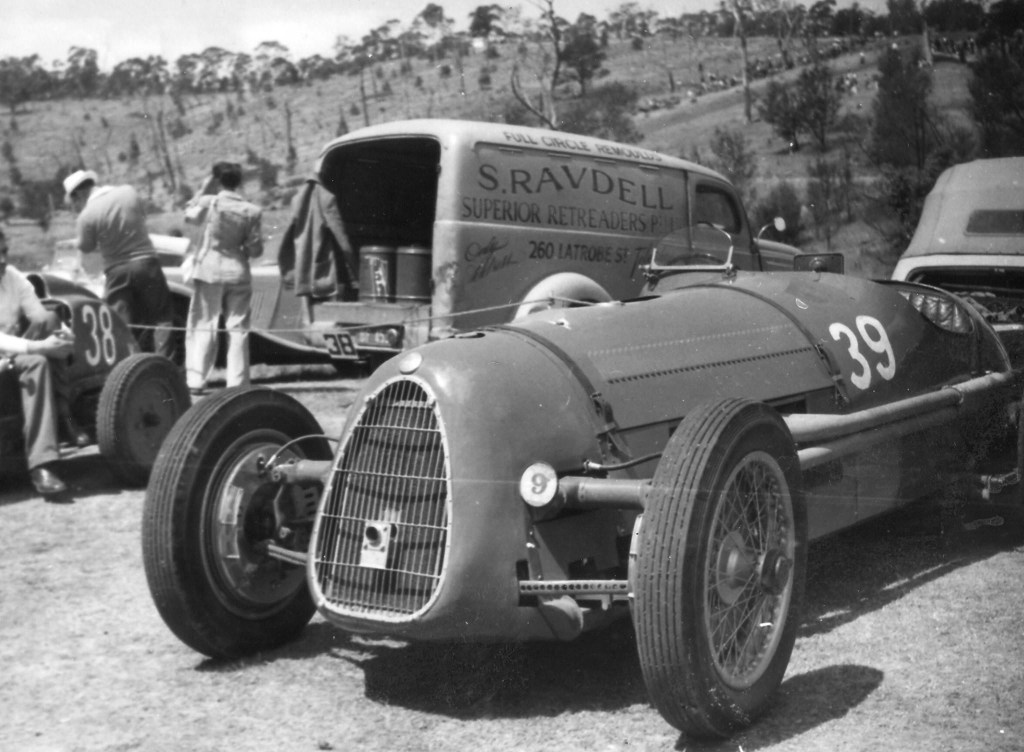
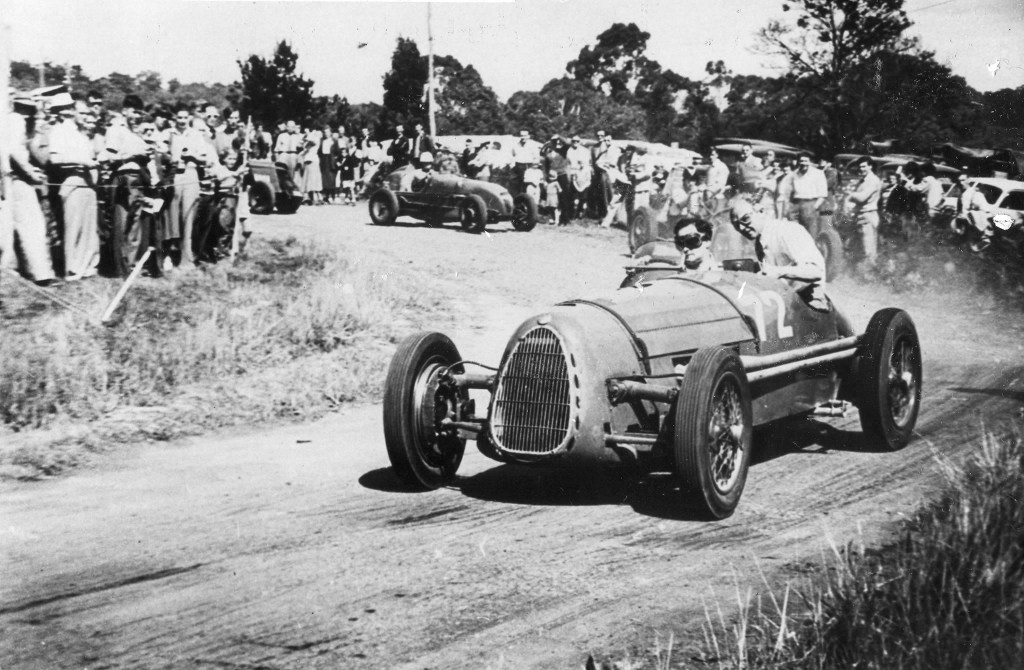
Charlie Dean’s Maybach 1 at Rob Roy in January 1949. The equipe behind is Micha Ravdell’s van and #38 Wyliecar Ford-A Special, still driven by its builder, Arthur Wylie. Number 9 on Maybach is a rego-disc (L Sims)
Even the contrarians amongst knowledgable Australian racing historians generally answer “the Maybach” when questioned about which racer was our greatest Australian Special.
It isn’t the Maybach though, but rather Maybachs – four of them – with no shortage of variants across the three chassis built. Whenever a photograph of a Maybach is uploaded onto social media there is always plenty of uninformed yibba-yabba about the specifications of the car in shot.
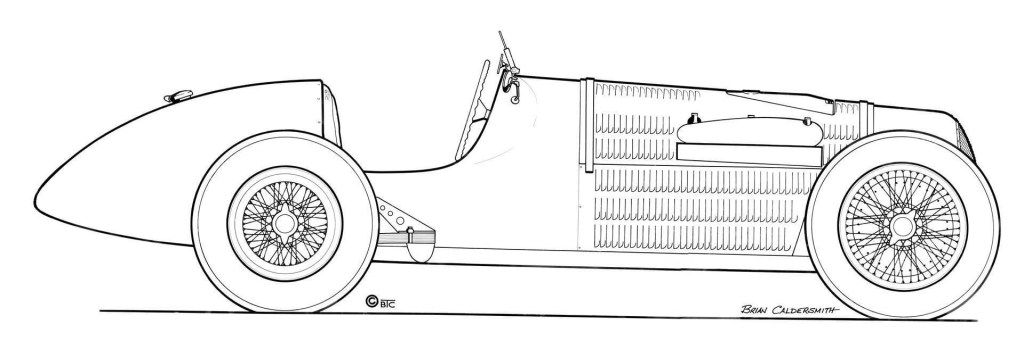
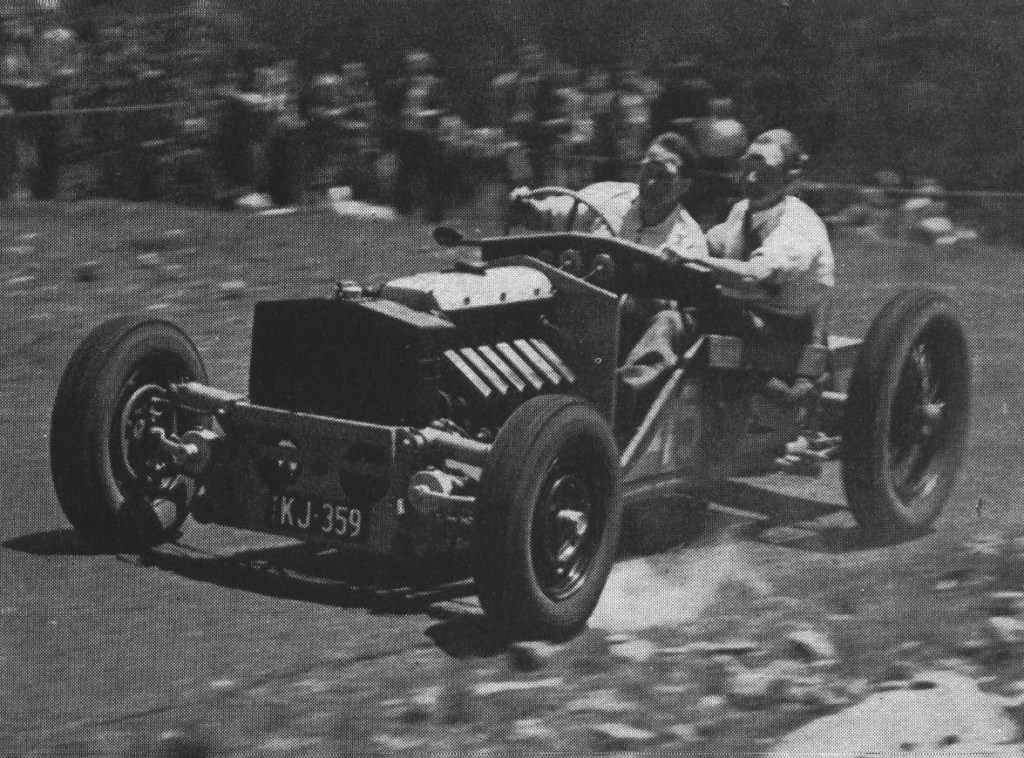
(Brian Caldersmith)Charlie Dean and the brave Jack Joyce aboard Maybach 1 at Rob Roy in November 1947. The body is still to come. Wild road car! (L Sims)
One of our friends, John Ballantyne, prompted this article which I assembled to address the lack of accessible, accurate information about the specifications of Maybachs 1-4.
What follows is a copy of the technical specifications and evolution of the Charlie Dean and Repco Research built Maybach 1 published in an article of the Australian Motor Sports Annual 1958-59. The author’s name isn’t cited, but I’ve credited the editor of the book, Mr John Goode. The other two chassis – three cars – Maybachs 2, 3 and 4 will follow in my next post.
The article is focussed on technical information, not race results: this one that does that best, ponderous as it is: https://primotipo.com/2014/12/26/stan-jones-australian-and-new-zealand-grand-prix-and-gold-star-winner/ I hadn’t planned many photographs, but, as usual, my enthusiasm got the better of me…the period Repco ads are a visual device to assist in splitting one evolution of Maybach 1 from the next.
The photo choices are mine, so too are the ‘Notes’ sections, albeit almost all of that information is sourced from the same AMS article. I’m taking as-read a general knowledge of Maybach, if you need a refresher, click on the links at the end of this piece.
Six years later (from the 1947 shot) Stan Jones bolts away from the Europeans to win the October 1953 Victoria Trophy at Fishermans Bend in Maybach 1 S3. Behind is Doug Whiteford’s Lago Talbot T26C, George Pearse’s Cooper Vincent, and to the right, Ted Gray aboard Alta 21S Ford. Lex Davison’s Alfa Romeo P3 is partially obscured behind Maybach (L Sims)John Fleming’s copy of The Argus report of the 1953 Victoria Trophy – the preceding shot
One final contextual word from Australia’s greatest motor racing historian, John Medley, about the Maybachs and their place in the Australian pantheon before we set off, quoted from the ’50 Year History of The Australian Grand Prix’, specifically John’s 1948 AGP chapter.
“HC (Horace Charles) Dean’s car, powered by a captured German scout-car engine, was little more than a year old, and had only been given a proper body in 1947: even so, in its brief career of trials, hillclimbs and sprints it had already attracted a lot of attention for its very willing performance and for its relatively advanced specification. It was, for example, one of just four runners in the 1948 AGP with independent front suspension, and of those four the Maybach was the only Australian special – the other three were factory-built cars of pre-war design: John Crouch’s Delahaye, Frank Pratt’s BMW, and Cec Warren’s Morgan.”
“The Maybach and Delahaye (135CS) actually had a lot in common, not least that both had been laid down not as pure racers, but as big-engined road cars with competition potential although another point which should not be overlooked is that both were essentially very conservative designs.”
“The significance of the Maybach was that it was Australian built, by a man at the centre of a small but talented team, and that the car had development potential – just how much was not realised at the time. Between 1948 and 1960, Maybachs in various forms were to contest eight AGPs and to lead – if sometimes only briefly – five of those races.”
Maybach 1 during June 1949, Charlie Dean and Jack Joyce on the way to FTD (D Stubbs)Maybach 1 during Rob Roy #16 in May 1948 (D Stubbs)
MAYBACH 1 (1946-1949)…
ENGINE: 6 cyl. inline single oh. camshaft. Bore and stroke: 90 × 100 mm. Capacity: 3,800 c.c., Compression ratio: 6.43 to 1. Output (initially on pool petrol: 69 octane) 100 B.H.P. at 3,000 г.p.m.
Single casting cast iron cylinder block and crankcase, with sump joint well below the crankshaft centre line. Crankshaft machined all over and fully counter balanced, running in eight white metal lined bearings, one between each crank throw and an extra one behind the camshaft drive pinion situated at rear end of crankshaft. Wet liners fitted to cylinder bores with lightweight balanced connecting rods and other reciprocating parts.
Single camshaft running in seven white metal bearings, opening valves by means of rocker arms fitted with eccentric bushes which could be rotated and locked to adjust valve clearances. Rockers had roller cam followers. Valves inclined at 65 degrees in hemispherical head and located on opposite sides. Helical timing gears with idler (originally compounded fabric, but replaced by steel).
Wet sump lubrication through filter with pressure fed oil supplied to centre main bearings, then to other caps, and through the crankshaft to big end bearings. Also fed to valve rocker shafts and camshaft bearings. Carburettors: Two marine Amal.
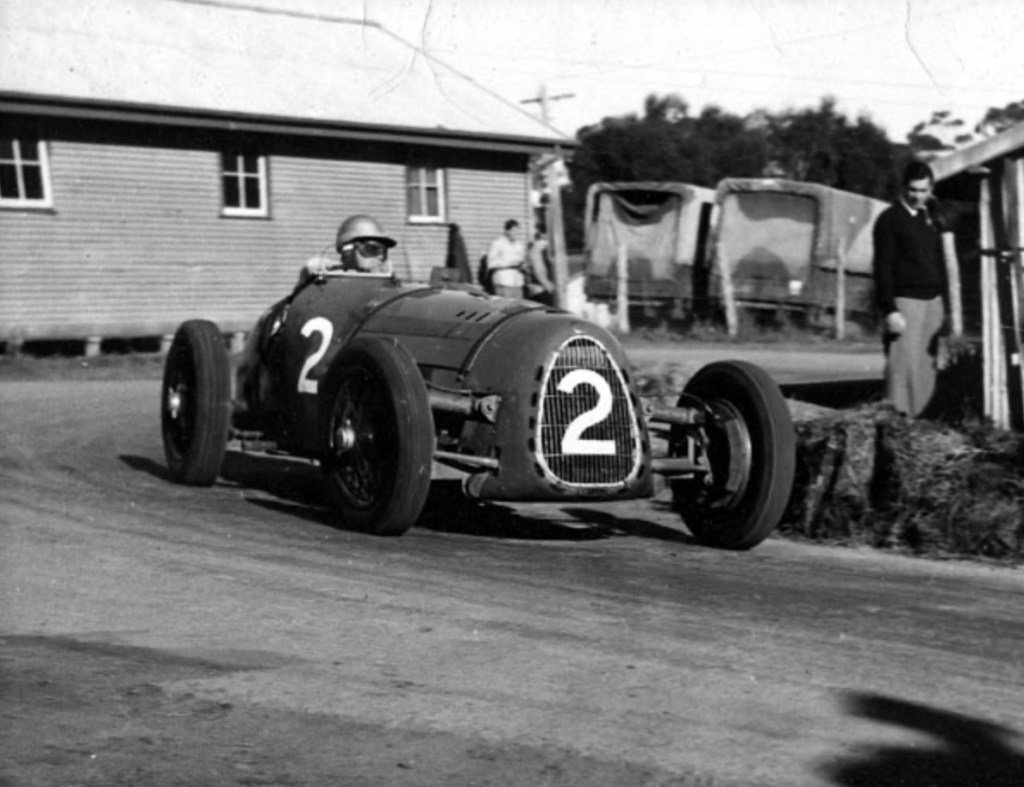
Charlie Dean and Maybach 1 during the January 26, 1948 AGP weekend at Point Cook RAAF Base just west of Melbourne. It was the cars first appearance with a body fitted, and painted white. DNF magneto failure on lap 12, the passenger decamped before the off. Note the Studebaker steel wheels at the front (AMS Review 1958-59) Maybach 1 at Rob Roy in May 1948. A swag of these sensational, uber-rare Dacre Stubbs’ shots appear to have been taken immediately after Maybach was repainted, in the front garden of Dean’s Kew, Melbourne, home. Six Amals at this point, in November 1947 there were two…(D Stubbs)(D Stubbs)
TRANSMISSION: Clutch: Fichtel and Sachs. Gearbox: Four speed crash type from a Fiat Model 525. Rear Axle: Lancia Lambda Series VIl in standard form.
CHASSIS: Frame: Tubular steel consisting of two parallel 4″ dia. steel tubes with independent suspension at the front (Dean’s own design) and conventional twin half elliptic springs at rear.
Suspension: Front Independent with transverse semi-elliptic spring and wishbones. Mainly 1937 Studebaker Commander parts. Steering: Cam and roller box (Marles) with two piece track rod.
Wheels and Brakes: Front: Studebaker bolt on pressed steel wheels with standard Studebaker brakes. Rear: Lancia centre lock 19″ dia. wIre wheels and brakes.
(D Stubbs)(D Stubbs)
BODY: Two seat from welded sections of aircraft belly tanks.
LATER MODIFICATIONS: Included 6 carburettors, reduction of weight achieved by new front end. Minerva brake drums fitted with specially fabricated shoes, and new cast steel liners, mounted on light steel backing plates. Centrelock wire wheels with adapted hubs to replace Studebaker wheels. Body frame lightened.
(D Stubbs)While all the one-liners down the decades credit Frank Hallam with the body, there is no way that’s correct. FH was apprenticed as a mechanic. Who built the body, it was clearly executed by a talented specialist, surely? (D Stubbs)(D Stubbs)
NOTES: The car’s engine came from a German half-track vehicle that had been captured during the Middle East campaign and shipped to Australia for technical study by the military. Dean acquired it from a wrecker. Built as a sportscar, Dean was cajoled into turning it into a racing car by George Wade, a Repco mechanic/engineer, after recording 100mph in a Vintage Sports Car Club trial. The body was constructed in time for the 1947 AGP at Point Cook using aircraft belly tanks cut and shut by Frank Hallam, another Repco employee – so the story goes.
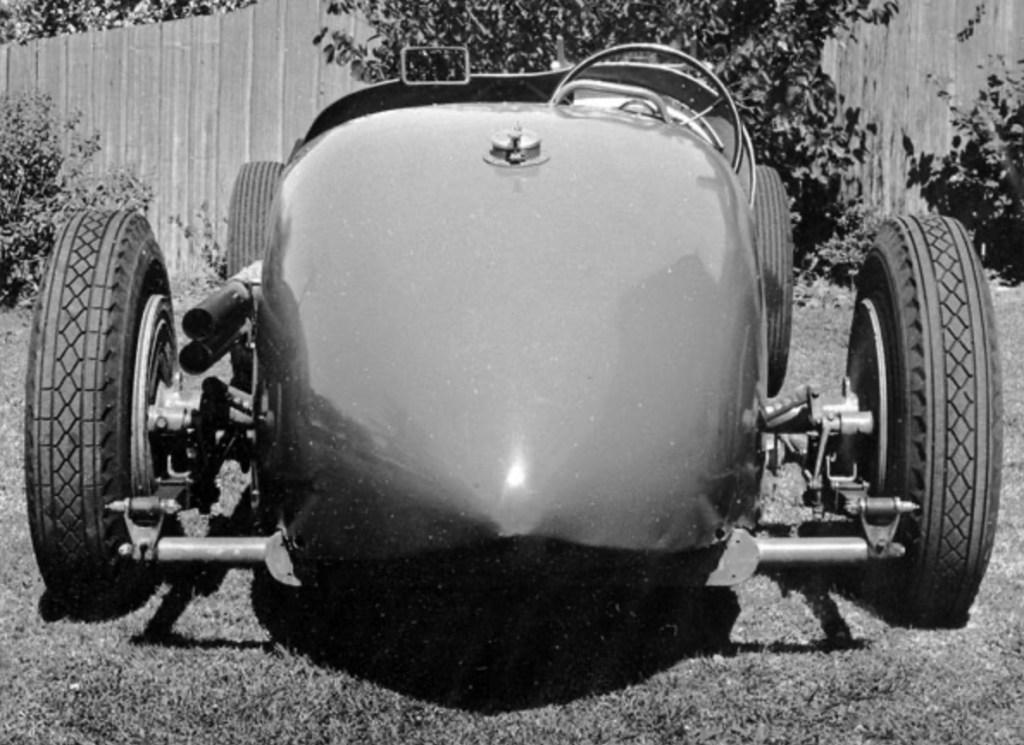
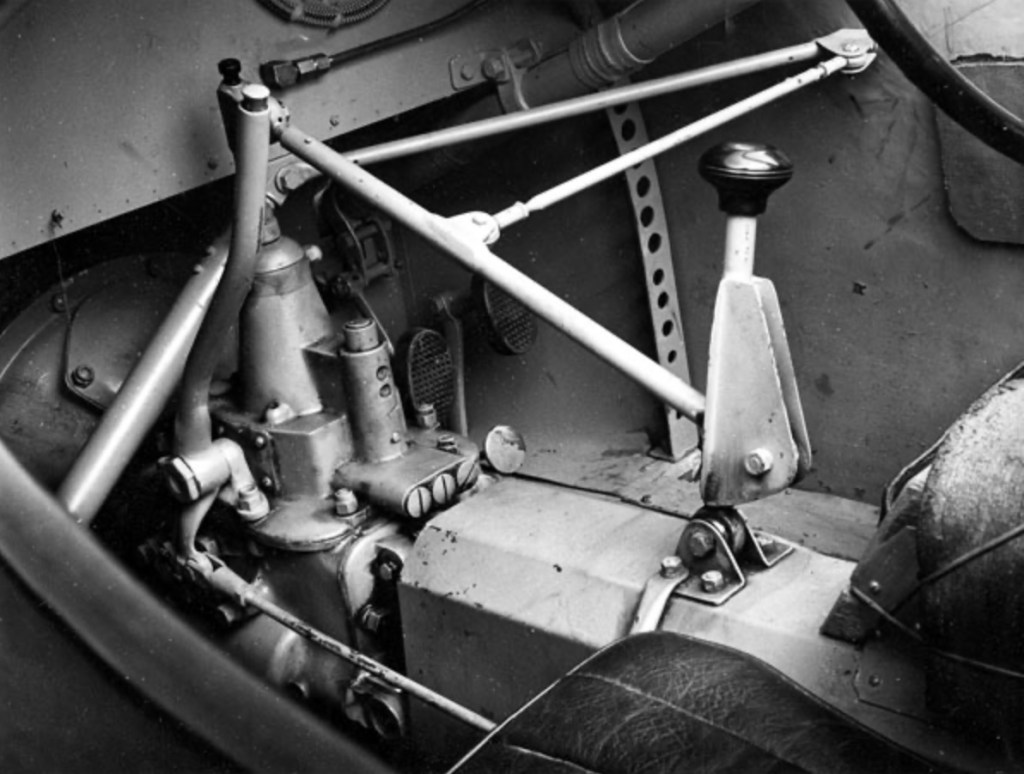
Cockpit shot shows the car was a ‘reasonably generous’ biposto in early spec. Twin-tube frame chassis, note diagonal bracing of the forward driver bulkhead. Revs, oil pressure and water temperature at a guess. Attractive – ahem – steering wheel, what is it off? (D Stubbs)Neat remote shift – and locating stays to ensure easy accurate changes – to modified four speed Fiat 525 gearbox (D Stubbs)(AMS Annual 1958-59)Dean in Maybach 1 S2 competing in the Mornington Motor Races at the Balcombe army training base on Melbourne’s Mornington Peninsula in June 1950 (D Stubbs)
MAYBACH 1 Series 2 (1949 -1950/1)…
Basically the same two seater sports/racing body and chassis with the following changes made from the original car.
ENGINE: 4.2-litre Maybach adapted to take developed parts from 3.8-litre original. Reground camshaft and special new main bearings. Original lead bronze bearings retained for big ends.
Supercharger: Ex G.M. diesel Roots type with three lobe rotors, mounted beside the motor driven by triple V-belts from the crankshaft nose; output 7 lb/sq. inch. Carburettor: Originally Claudel Hobson aircraft type replaced by Bendix-Stromberg aircraft type. Cooling System: Later sealed at blow off pressure of 4 p.s.i. Magneto: Adapted V-12 type but burnt out, subsequently Lucas.
TRANSMISSION: Differential: American Power Lock (1922 vintage truck) limited slip type fitted in modified Lancia housing.
CHASSIS: Rear Brakes: Special drums of original design using two leading shoes hydraulic system but replaced with leading trailing shoe hydraulics.
When Charlie Dean obliged Dacre Stubbs for the undated The Age (I think) article below he didn’t take Maybach 1 S2 too far, this shot is at the Willsmere Mental Institution in Kew. I grew up closeby, there were many occasions when Dad threatened to take us kids to The Nuthouse, as he sensitively referred to the place, when we misbehaved…(D Stubbs)(J Fleming Collection)Maybach 1 S2 at Rob Roy in June 1949 when Dean and Joyce bagged FTD. Wylie A-Ford Spl behind (L Sims)(AMS Annual 1958-59)Stan’s muscle-shirts were famous, here during the 1953 AGP at Albert Park. DNF with a variety of problems while leading in Maybach 1 S3 (S Griffiths)
MAYBACH I Series 3 (1951 – Early 1954)…
Fundamentally similar in appearance to the two previous models, still a two seater but with suspension changes, three feet of rear chassis rails removed.
Modifications listed in order of introduction:
June 1950 – April 1951
Front suspension rebuilt: Studebaker parts replaced by Oldsmobile upper wishbones with integral shock absorbers. Transverse leaf spring redesigned to three leaf to reduce weight. Rear Suspension: Axle mounted on trailing quarter-elliptics with radius rods. It was this which necessitated cutting the rear end of the chassis.
Stan Jones awaits the off at Templestowe in September 1952, Maybach 1 S3, see photographer/racer/engineer John Fleming’s comments about his shot below(J Fleming)Posed The Age shot published on November 18, in the week before the ’53 AGP at Albert Park. Taken at Jones’ home garage in Yongala Road, Balwyn. From left, Ern Seeliger, Jones, Reg Robbins at the back, Charlie Dean and Lloyd Holyoak ‘working’ on Maybach 1 S3. Note the Oldsmobile top wishbones and (unsighted) lever arm shocks and transverse bottom leaf spring. One of the three big SUs is obscured by Stan’s armYou can feel and smell Albert Park! Dacre Stubbs has tightly focussed his 1953 AGP start shot on Lex Davison, Jaguar powered ex-Moss HWM #3 and on Jones’ Maybach 1 S3; the ‘snappers framing of the shot heightens the drama. #7 is the legendary Frank Kleinig and Kleinig Hudson Spl with Cec Warren’s Maserati 4CLT alongside and #10, W Hayes’ Ford V8 Spl (D Stubbs)
Carburettors: Three marine Amals. Supercharger removed. Other Mods: Mild steel sheet head gasket fitted to engine raising compression ratio to 9 to 1.
Bodywork: Few obvious changes but considerable minor modifications. Framing modifled and lightened. Lighter radiator grille fitted, front cowl modified to give lower bonnet line.
June 1951 – September 1952
Carburettors: Three 1 3/4″ S.U. replacing Amals. Three special 2 3/16″ S.U. carburettors (originally designed for Lago Talbots) later fitted.
Tyres – Rear: 16 x 6.50 touring type (six ply). Subsequently four ply specially manufactured.
NOTES: Stan Jones bought the car off Charlie Dean in June 1951. Reports that the 1952 AGP would be held to F1 regs – 1.5-litres blown and 4.5 unblown, 1952-53 2-litre GP formula duly noted – meant the Maybach in 4.2-litre supercharged specs would have been ineligible so Repco Research developed a 3.8-litre unblown engine as noted above; three marine Amals fed the engine initially. Ultimately the ’52 AGP was held, as usual, to Formule Libre.
One of Jones’ pitstops at Albert Park in the 1953 AGP, Maybach 1 S3, Jag XK120 passes (D Stubbs)
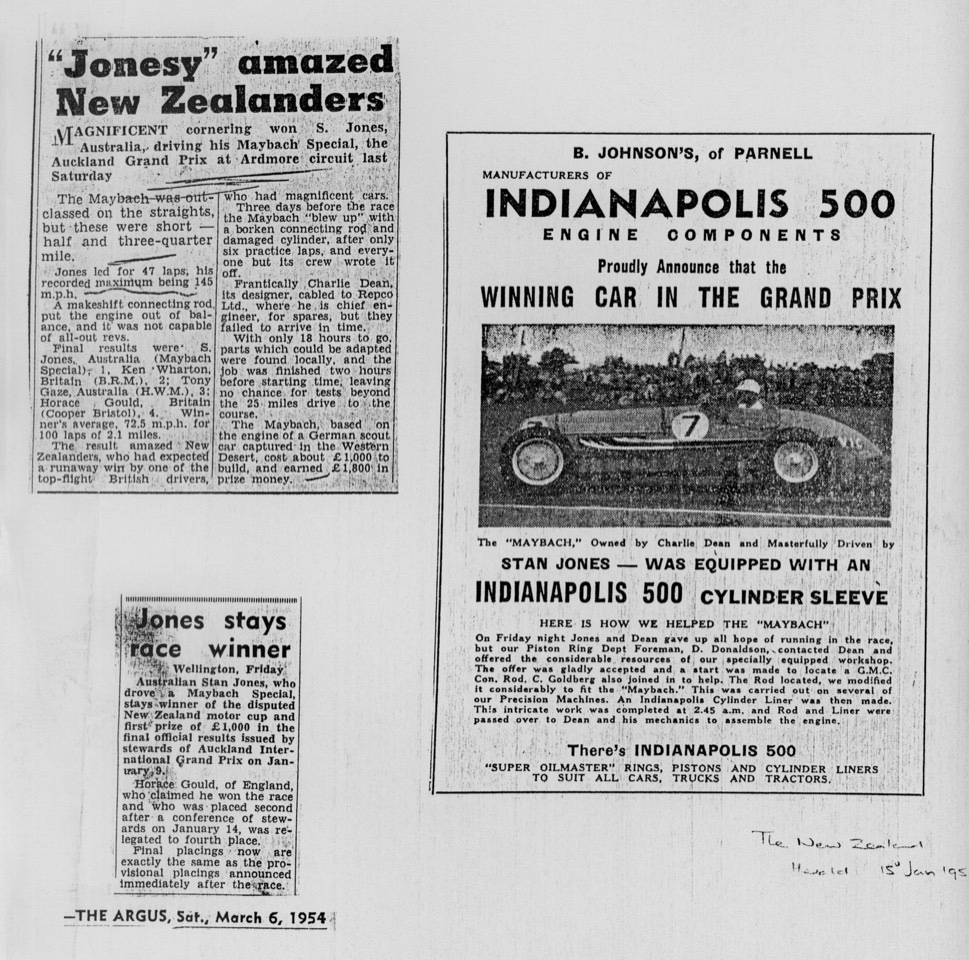
The 1955 New Zealand Grand Prix programme recognised the achievements of Stan, the Repco Research team and Maybach 1 S3 in winning the 1954 event at Ardmore against international opposition the year before.
(AMS Annual 1959-60)
Etcetera…
(G McKaige)
Maybach 1 on Kew Boulevard at Studley Park, Melbourne before the start of the September 1947 VSCC One Day Trial. Alex Bryce’s Bentley 3-litre is behind. Note the twin-Amals, lump of wood to keep Charlie in-situ and slicks fitted up front!
(G McKaige)
By the time the VSCC Killara Park sprints were held at the Davison Lilydale farm in November 1947, Maybach 1 had grown four more Amals. The message to be taken is that Maybach(s), like all great racing cars, were in a perpetual state of development.
(J Montasell)
Charlie Dean at Rob Roy in January 1948, Maybach 1 obviously now bodied. Note the Studebaker pressed steel wheels and front drums compared with the shot of Maybach 1 in almost the same spot a year later below, with wire wheels and bespoke Minerva/PBR drums. Patons Brake Replacements – PBR – was another Repco Ltd subsidiary.
(J Montasell)(G McKaige)
Charlie Dean cornering hard on Hurstbridge Hillclimb in April 1949, Maybach 1. He was second in the over 3-litre racing car class, Hurstbridge, to Melbourne’s east was used several times post-war.
(G McKaige)
Dean, Maybach 1 S2 competing in the Mornington Motor Races at the Balcombe military camp in June 1950.
Stan Jones in Maybach 1 S3 chasing Jack Murray’s Allard J2 at Parramatta Park, Sydney – the first meeting at the venue – on the Australia Day weekend in January 1952.
(J Fleming Collection)
Maybach 1 S3 this is The Age shot shown earlier, with the article as published. If somebody has a photograph of the Victoria Trophy we would all know if the annual for many years event was the Victorian, or Victoria Trophy. Both names are bandied around…
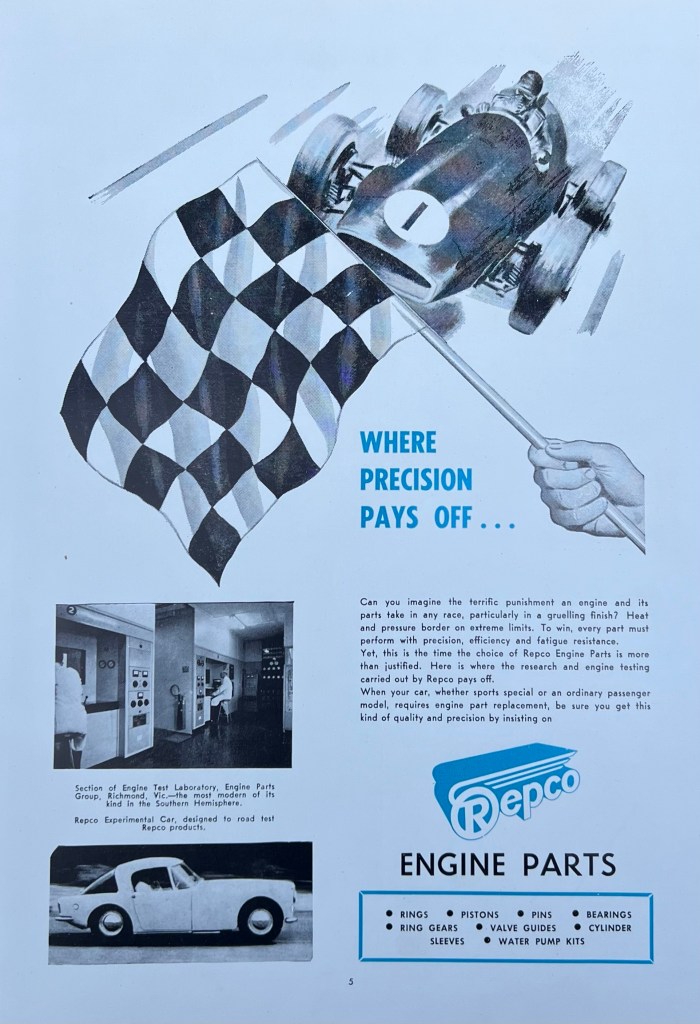
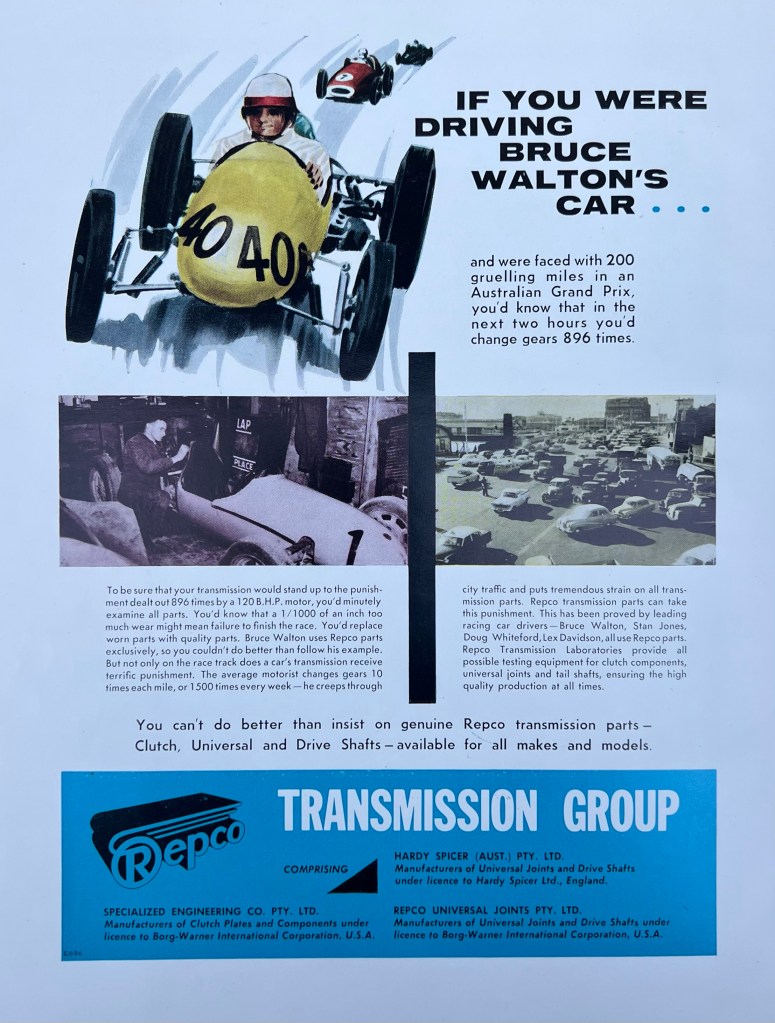
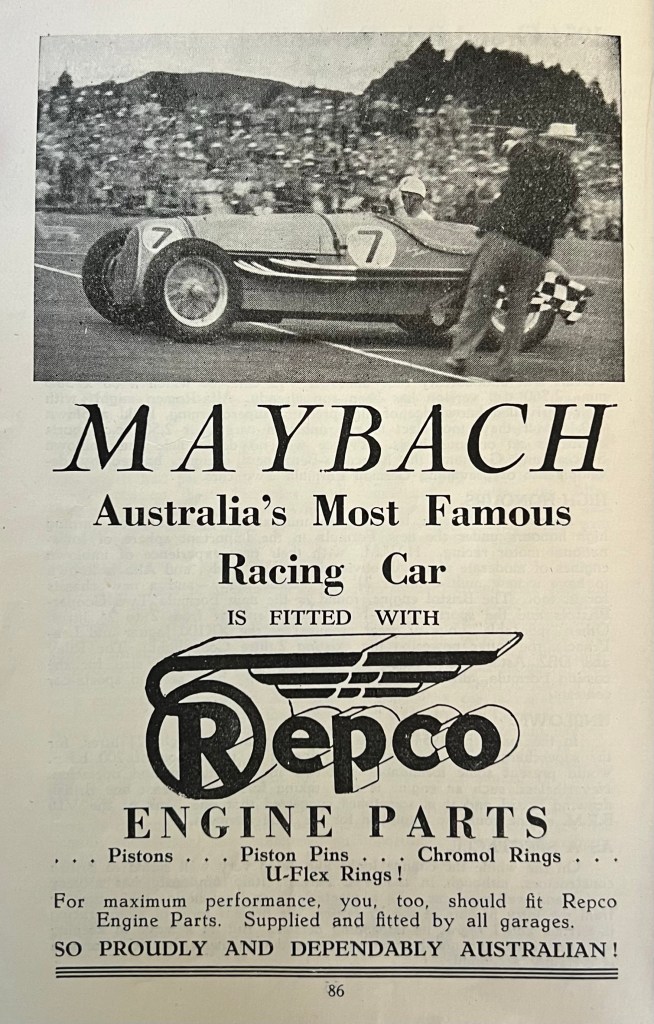
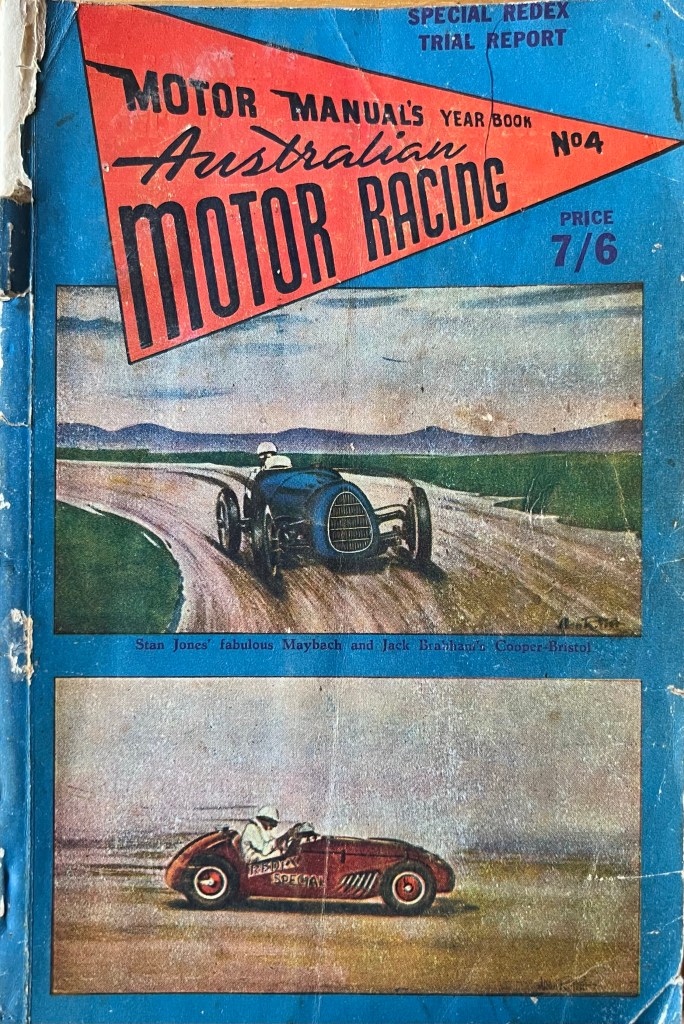
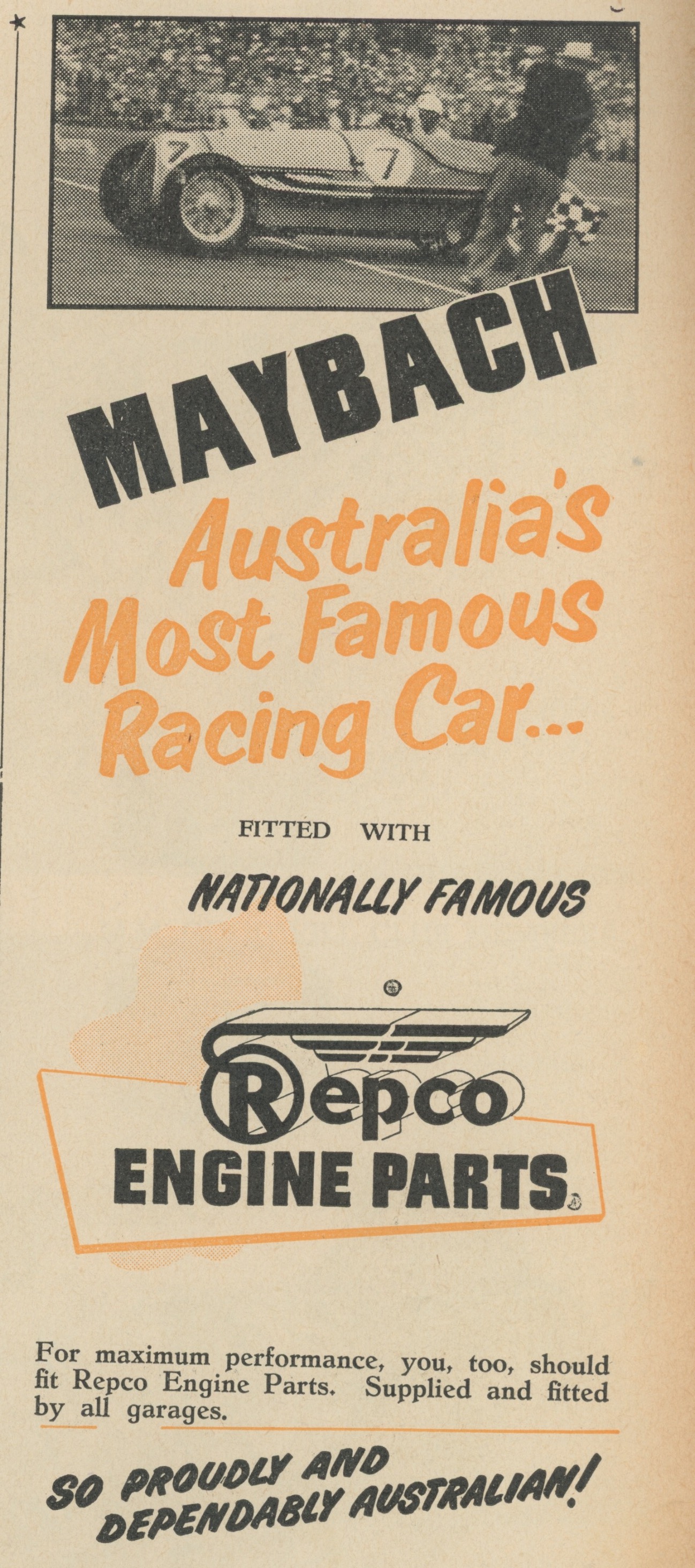
(Repco ad in the Motor Manual Australian Motor Racing Year Book No 4 1953-54)
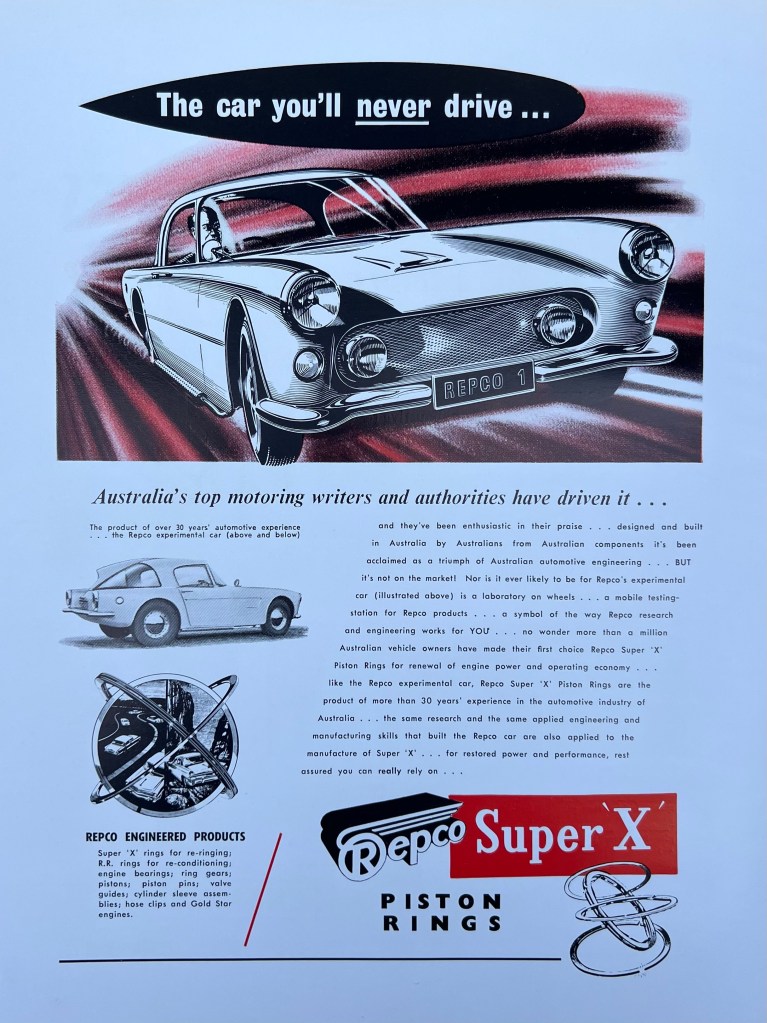
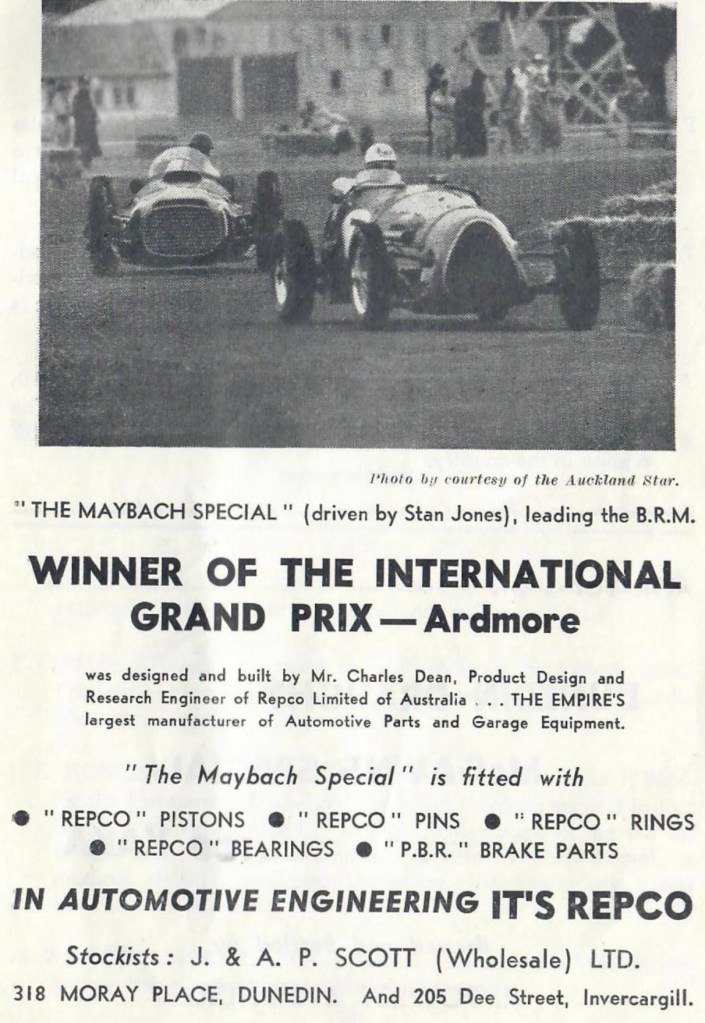
Just how strongly Repco used the Maybach programme to promote their engineering excellence to the broader populace is unclear to me.
This ad in the horsepower-press below promotes some of the Repco subsidiary produced components used in Maybach, but pointedly fails to note that the car and driver shown are winning the 1954 New Zealand Grand Prix at Ardmore. Time to sack the ad agency and/or the internal copy-boy/girl!
Repco ad from the back cover of the November 4, 1952 Australian Hillclimb Championship, Rob Roy programme
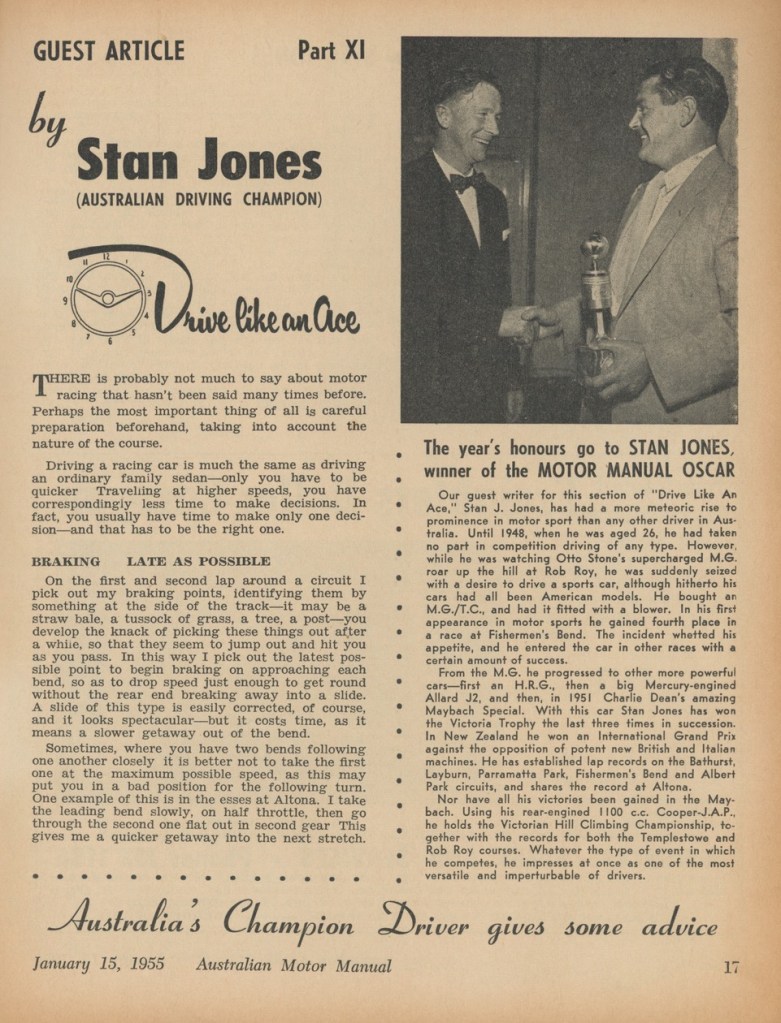
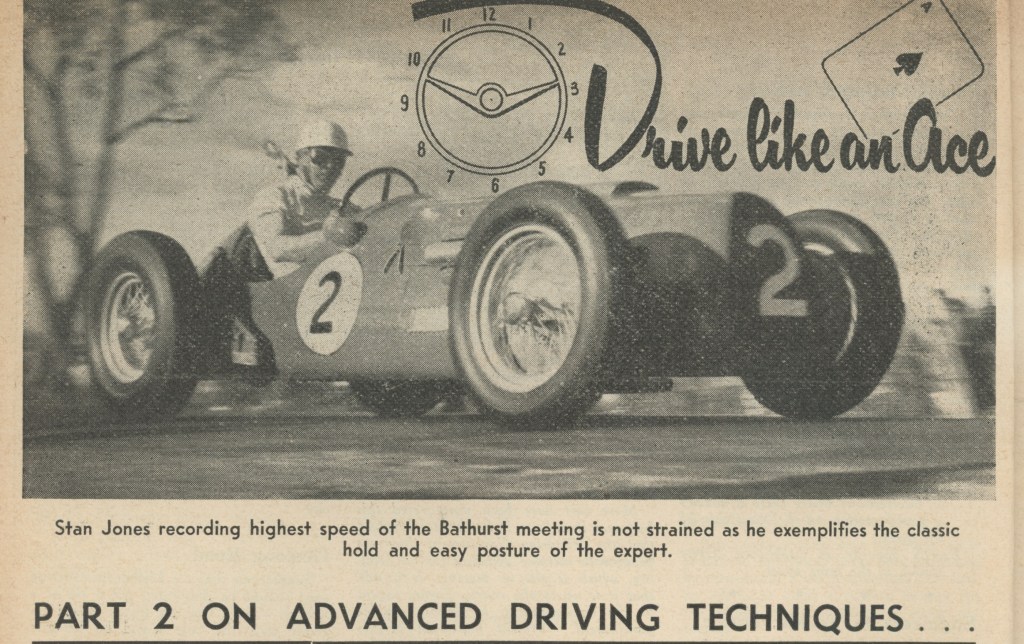
Clearly – to the extent you can see the cars – Motor Manual’s cars and drivers of the year were Stan Jones and Maybach 1 S3, and Jack Brabham and his RedeX Special, aka Cooper T23 Bristol.
Reference and photocredits…
Australian Motor Sports Review 1958-59, Brian Caldersmith, ‘The 50 Year History of The Australian Grand Prix’, John Fleming Collection via Tony Johns, George McKaige and Chester McKaige via their superb two ‘Beyond The Lens’ books, Stan Griffiths, David Zeunert Archive, sensational and rare Dacre Stubbs photographs via Martin Stubbs, VSCC Vic Collection, John Montasell, Clem Smith, Motor Manual, Ivan Pozega Collection, Peter Moore
Tailpieces…
(C Smith)
The Maybach reality: Australia against the Europeans – ignoring the country of origin of the engine! – with Stan as often as not leading as chasing. Here Jones is aboard Maybach 1 on the Adelaide Hills, Woodside road circuit in October 1951, chasing arch-Melbourne-rival come fellow rough-nut, Doug Whiteford’s Lago Talbot T26C. Whiteford won this encounter in what were Stan’s early days in Formule Libre.
(I Pozega Collection)
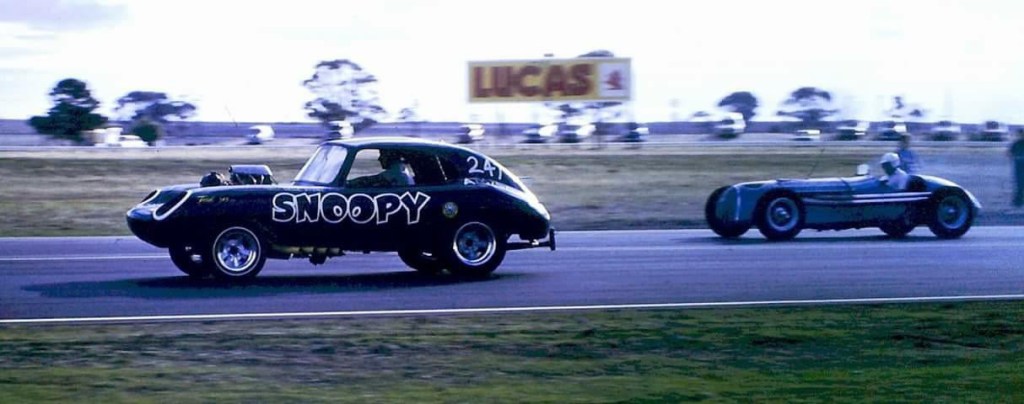
Maybach 1’s mortal remains were tracked down or found by Jack McDonald in a South Melbourne wrecking/junk-yard in the early 1960s. He rebuilt the car – all of the required donor bits were easier to obtain back then – and soon the old-gal was back on track, in this case a Calder Drags meeting in 1968. Jack is being blown off by Des Byrne’s E-Type Ford V8.
For the last 32 years Maybach 1 has been in the very safe, caring hands of Melbourne racer/historian Bob Harborow, shown below competing at Goodwood in 2006.
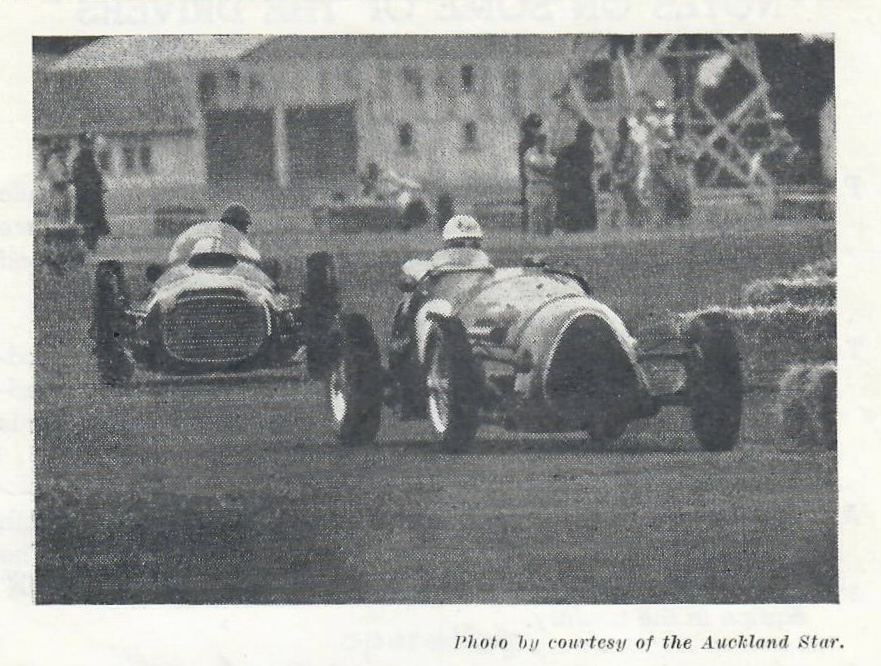
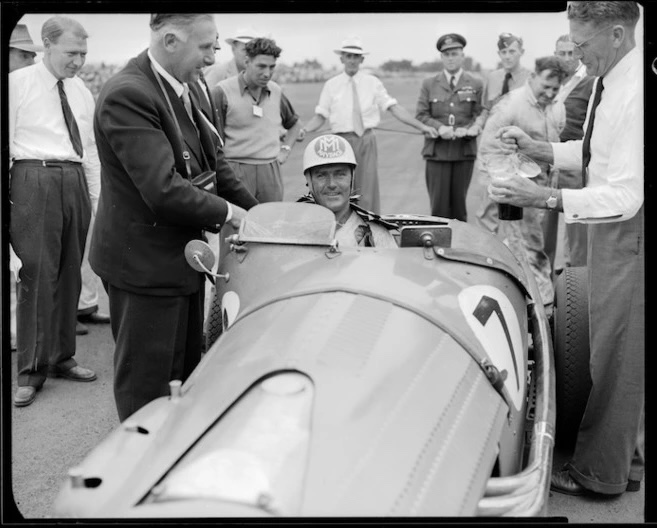
When Stan Jones took the chequered flag at Ardmore to win the New Zealand Grand Prix seventy years ago today – on January 9, 1954 – he became the first Australian car racer to win an international Grand Prix. His weapon of war was the Charlie Dean built, then Dean/Repco Research developed and maintained Maybach 1.
That’s Ken Wharton in the BRM P15 V16 behind, he pitted with mechanical problems and finished second with Tony Gaze’ HWM Alta s/c third.
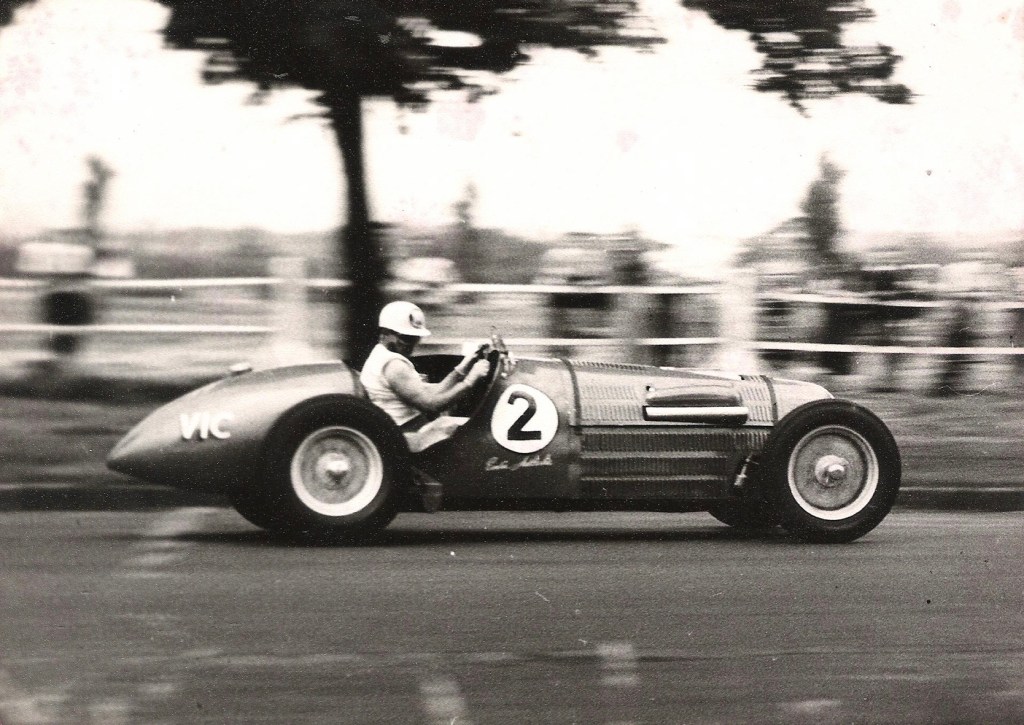
Victory spoils that much sweeter after the adversity of the previous 24 hours – Charlie Dean all smiles at right rear. Sportscar derivation of Maybach 1 clear (Lib NZ)Maybach 1, Ardmore 1954. HC Dean in the light, short sleeve shirt. ‘Ecurie Australie’ is the sign below the tonneau. Repco always seemed pretty cute about their lack of signage on Maybachs 1-3 while noting the no-advertising-on-cars rules of the day (N Tait)
I’ve done Stan and this topic to death over the years, see the links at the bottom of this article. So much so, I’ve no photos on this race I haven’t already posted so let’s recognise the occasion and scale of the achievement and then jump to the very end of the Maybach program, in terms of the three cars being Maybach six-cylinder powered at least.
With Repco’s stash of blocks in short supply, Maybach 3 – first raced at Templestowe Hillclimb on April 11 1955 - was powered by a 260bhp @ 5000rpm, 3.8-litre variant of the German SOHC, two-valve engine, albeit the motor was now fuel injected, such work done by Phil Irving and Charlie Dean.
With Big Red Cars growing locally in number – Davison Ferrari 500/625, Hunt Maserati A6GCM and 250F – the big silver beast was hard pushed despite Stan’s undeniable skills at twiddling its steering wheel.
Jones on-the-hop, as always, aboard Maybach 3 at Gnoo Blas in January 1956 before she let go at bulk-revs. Mercedes Benz W196 stylistic influence clear from this angle (R Donaldson)3.8-litre, direct-injected Maybach-six was mounted 60-degrees to vertical. Port Wakefield AGP paddock in 1955. Dean – the very fast Charlie Dean – at the wheel, Jones DNF in the race won by Jack Brabham’s Cooper T40 Bristol (E Gobell)
1956 opened with the international meeting at Gnoo Blas on January 30. Reg Hunt’s new Maserati 250F set the pace and won the South Pacific Championship easily against skinny opposition compared with previous years. Squeezing all that Maybach had to offer, on lap 23, with Stan 38 seconds adrift of the 250F, the engine let go in a major way.
Jones then got with the strength and bought a 250F. #2520 was demonstrated by Stan at the Geelong Sprints on May 27, first racing at Port Wakefield the following weekend.
While Stan got to grips with his new Italian Stallion, his mate, the brilliant engineer/racer Ern Seeliger set to work turning Maybach 3 into Maybach 4 inclusive of modified Chev 283cid V8, de Dion rear suspension and other mods.
Stan had an occasional steer of Maybach 4 Chev, winning a Gold Star round in it at Port Wakefield in 1959, but in essence, the Maybach Program of 1946-56 was at an end…oh-so-critical bits of Repco and Oz racing histories.
As Paul Cummins put it, “Stan with the NZ Trophy in one hand and a glass of champers in the other; or is that a martini shaken not stirred?” (Cummins Archive)(Motor Manual May 1954 T Johns Collection)
Credits…
Auckland Star, Libraries NZ, Bob Donaldson, State Library of New South Wales, Naomi Tait, E Gobell, Tony Johns Collection, Cummins Archive
Tailpiece…
(R Donaldson)
Look out ladies!…
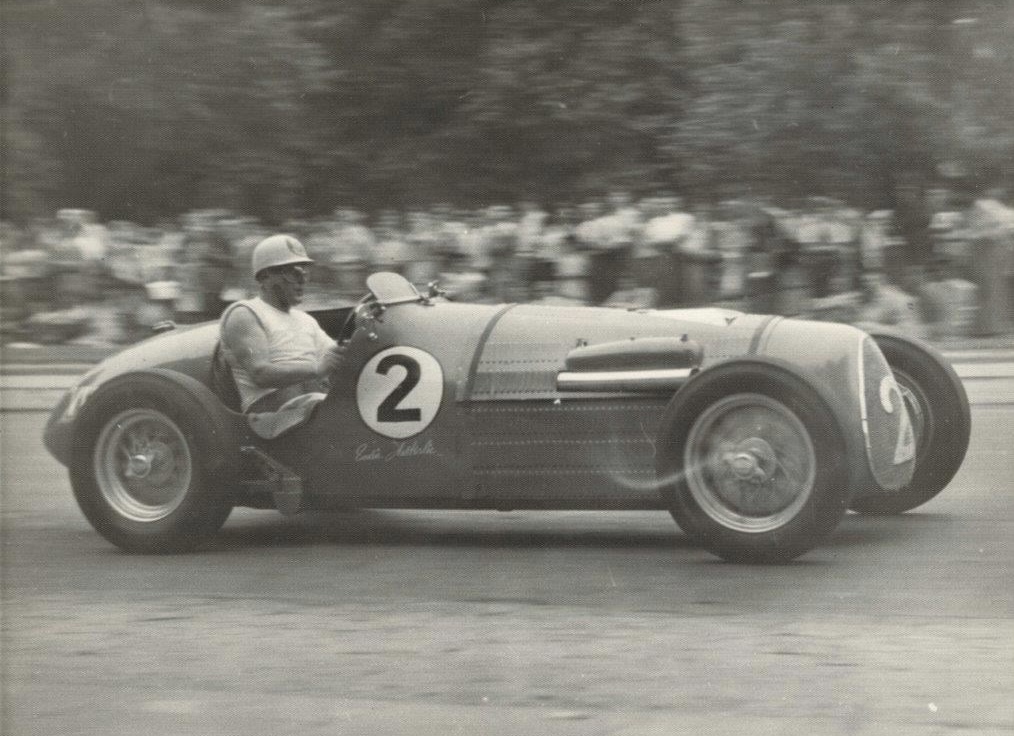
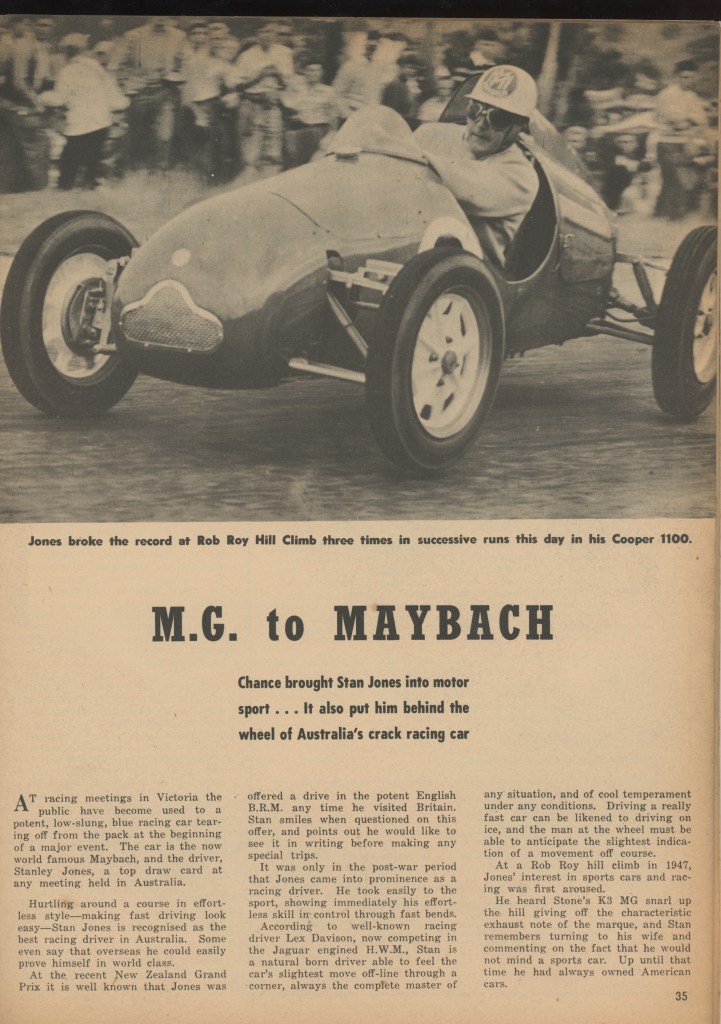
Stan was a good-lookin’ Rooster at 32, that portrait is the best! He’s at the wheel of Maybach 3 during the ’56 SouPac, Gnoo Blas meeting. With hair Brylcreemed back, Raybans and terry-towelling T-shirt sourced from Buckley & Nunn, Stanley really looks-the-goods. Jones had a life of great achievement, he was not a bloke who died guessing, bless him.
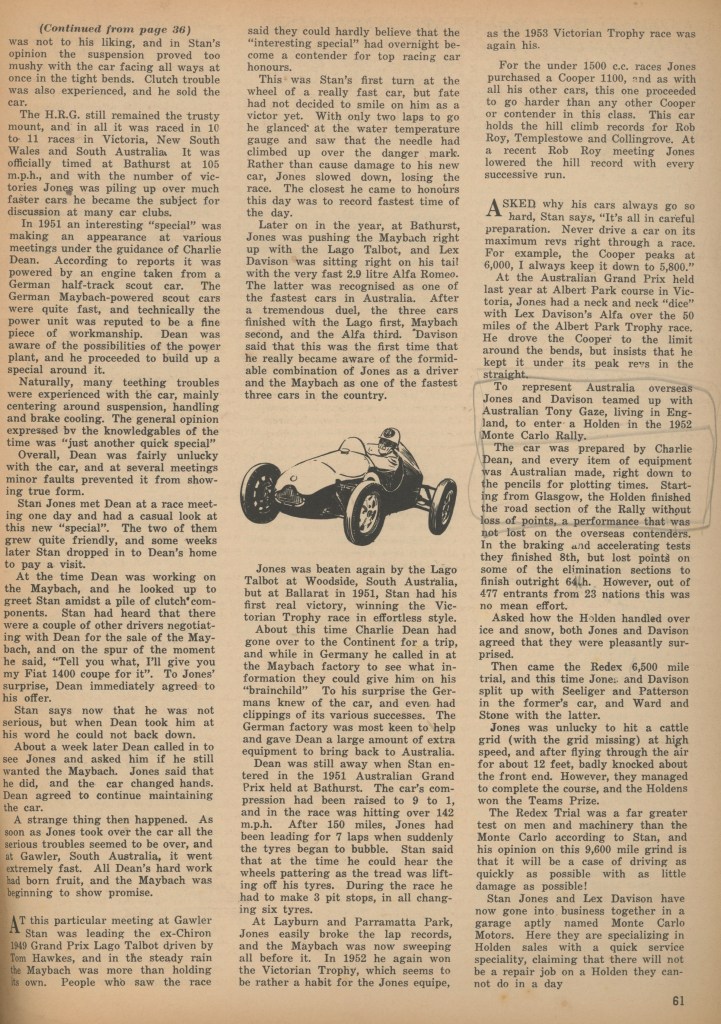
The definitive article(s) on Stan Jones are still to be written. I like this piece on the great Australian’s early pre-Maserati 250F phase which helps plug some of the early gaps of timing and circumstances, forwarded on by my racer/historian/author buddy Tony Johns.
It’s from the June 1954 issue of CARS magazine, a 70 year-old long deceased title published in Melbourne by Larry Cleland Pty Ltd and edited by Bruce Kneale. It comes to us from the Darren Overend Collection via Tony – grazia. As Tony points out, the author of the article was not disclosed, a bumma given its quality.
Click on the links at the end of the piece for more on Stan…
Jones at Ardmore during the 1954 NZ GP weekend (unattributed)
The Charlie Dean/Repco Research constructed Maybach series of three ‘1950s’ racing cars – Ern Seeliger’s Chev engined Maybach 4 evolution of Maybach 3 duly noted and venerated – are favourites.
Links at the end of this piece provide more for those with the Maybach fetish.
Repco had no plan-grande in the 1950s to take on and beat the world in Grand Prix racing, as they did in 1966-67. But in hindsight, the Maybach race program was an important plank in a series of identifiable steps by Repco which commenced in the 1930s and ended in global racing triumph.
The catalyst for this piece is some material Tony Johns sent me this week, in addition to some other shots I’ve had for a while from two other mates, Bob King and David Zeunert. It seemed timely to have another crack at Maybach 1, Jones’ 1954 New Zealand Grand Prix winning machine, still extant in Bob Harborow’s hands.
(T Johns Collection)(T Johns Collection)
We are diving into the minutiae here, but I’ve never heard of the Fesca Gear Co, clearly a key relationship in developing Maybach 1, and the other cars?
Chris De Fraga, the fella to whom the letter is addressed, was the longtime motoring editor of The Age, Melbourne, a daily aimed at those who could read and think. The competitor Sun and Herald were aimed at those without those capabilities, IG Mason, my English master useter tell us endlessly at Camberwell Grammar School. “Just read the front, back, and editorial pages of The Age if you’ve not got the time to read anything else.” I digress.
(KE Niven & Co)
Jones looking pretty happy with himself after the Ardmore victory. It had been a tough few days for all of the team dealing with major mechanical recalcitrance of the big Maybach six, note the company logo on Stan’s helmet.
And below leading Ken Wharton’s basso-profundo-shrieking, absolutely sensational V16 BRM P15, DNF brakes.
Credits…
Tony Johns, David Zeunert and Bob King Collections
Tailpiece…
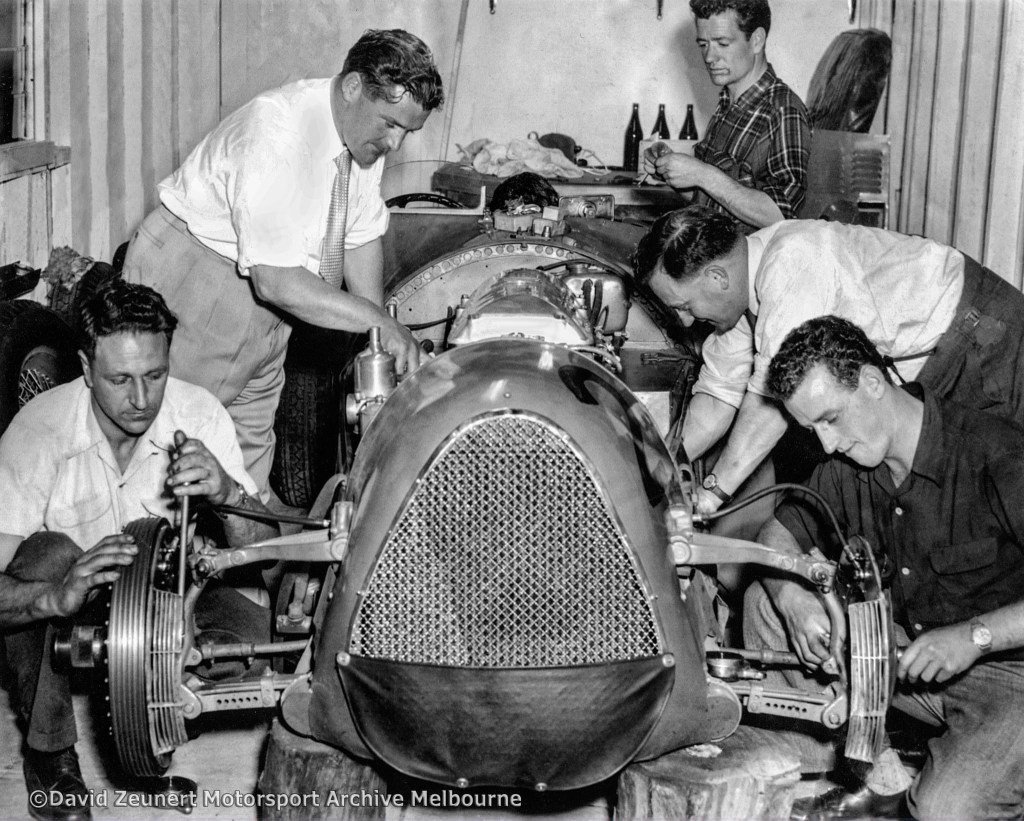
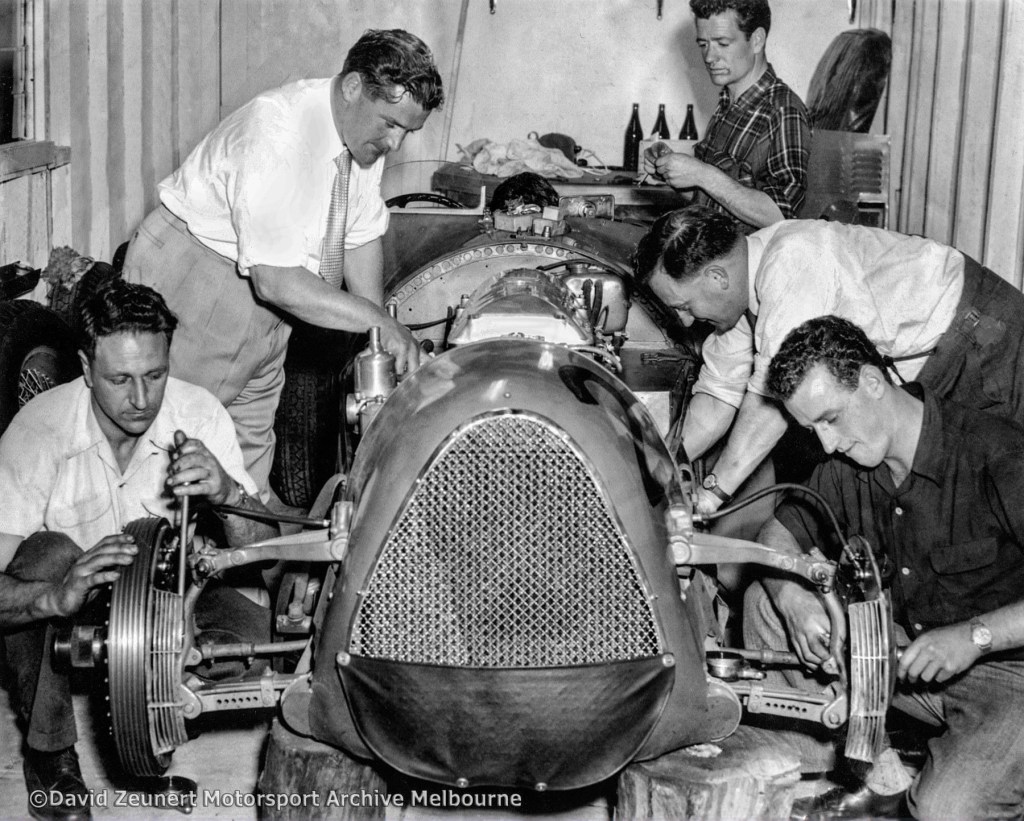
‘Speed Man After 500 Pounds Racing Car Trophy’ said the heading of this The Age promo shot of Maybach in Stan’s backyard garage at Yongala Road, Balwyn, Melbourne in the days prior to the 1953 Australian Grand Prix at Albert Park.
The technicians hard at it are Ern Seeliger, racer/engineer/Jones’ friend, Stocky Stan, Alan Jones’ head you can just see behind the wheel, Reg Robbins, longtime Jones’ employee, Charlie Dean and Lloyd Holyoak, Jones’ used car manager.
Dean lived in Kew, the adjoining suburb to Stan so it was an easy shot to set up when both men headed for home. Note the three bottles of Fosters Lager – we call these Long Necks or Depth Charges – to ease the pain of car preparation on the bench behind the car.
In essence Maybach 1 was built by Dean in 1946, continually modified and raced by him, including the 1948 AGP, then sold to Jones in 1951. Part of the deal was that Maybach was further developed and prepared by Repco Research, which Dean ran. In so doing a generation of the best mechanics and technicians from the rapidly growing Repco conglomerate were imbued with the racing ethos, another key plank in the long road to Brabham’s first championship win aboard a Repco Brabham Engines V8 powered BT19 chassis at Reims on July 3, 1966…
(B King Collection)
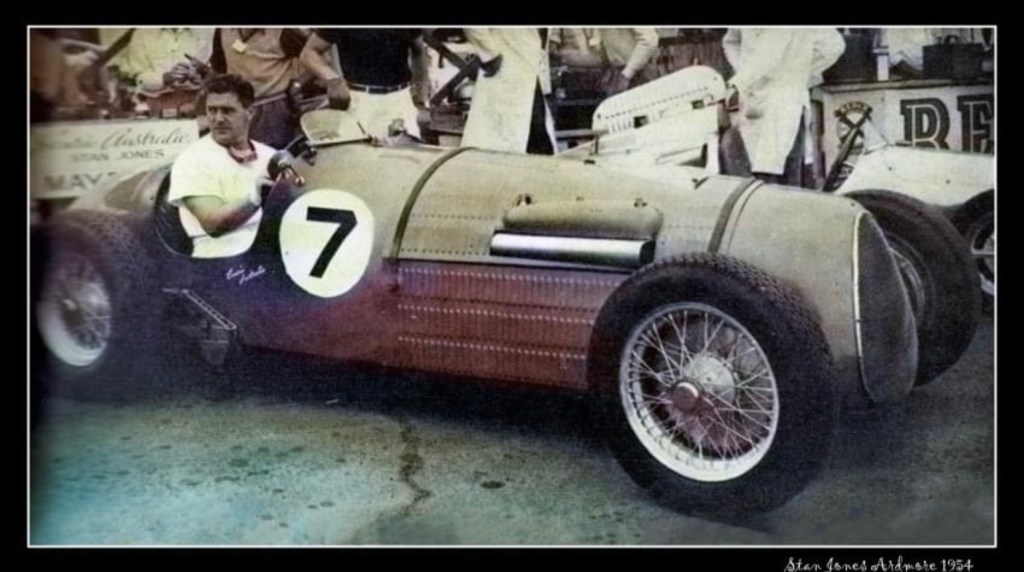
Jones sneaks a look at his pursuers a few days later during the race. Maybach DNF with various maladies, fastest lap was some consolation. Another local lad, Doug Whiteford prevailed in a Talbot Lago T26C, his third AGP win.
The Ecurie Australie (name under the number) was – and still is – the name under which the Davison family sometimes race. Lex Davison and Stan were competitors on-track, but owned a Holden dealership for a while and competed in the Monte Carlo Rally aboard a Holden 48-215, also crewed by Tony Gaze, in 1953.
The name on the side of the car should have been Repco, or Repco Research, but such vulgar commercialisation wasn’t kosher then. It would come of course…








































 primotipo...