Posts Tagged ‘Ted Gray’

(R Button Archive)

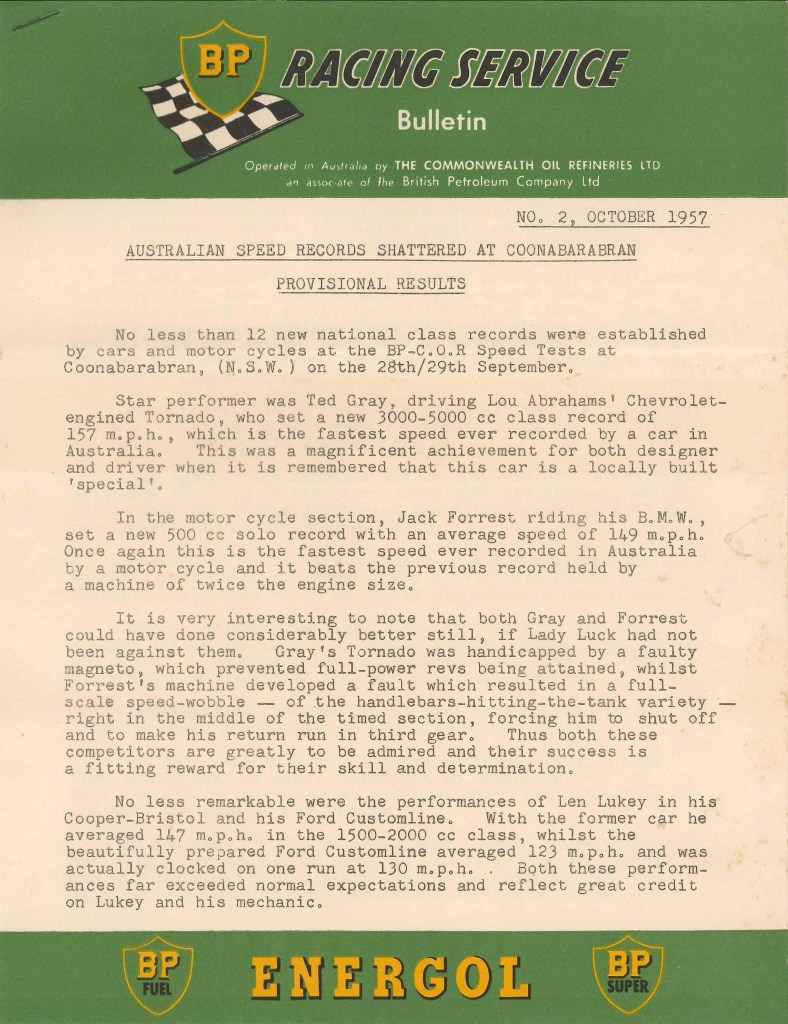
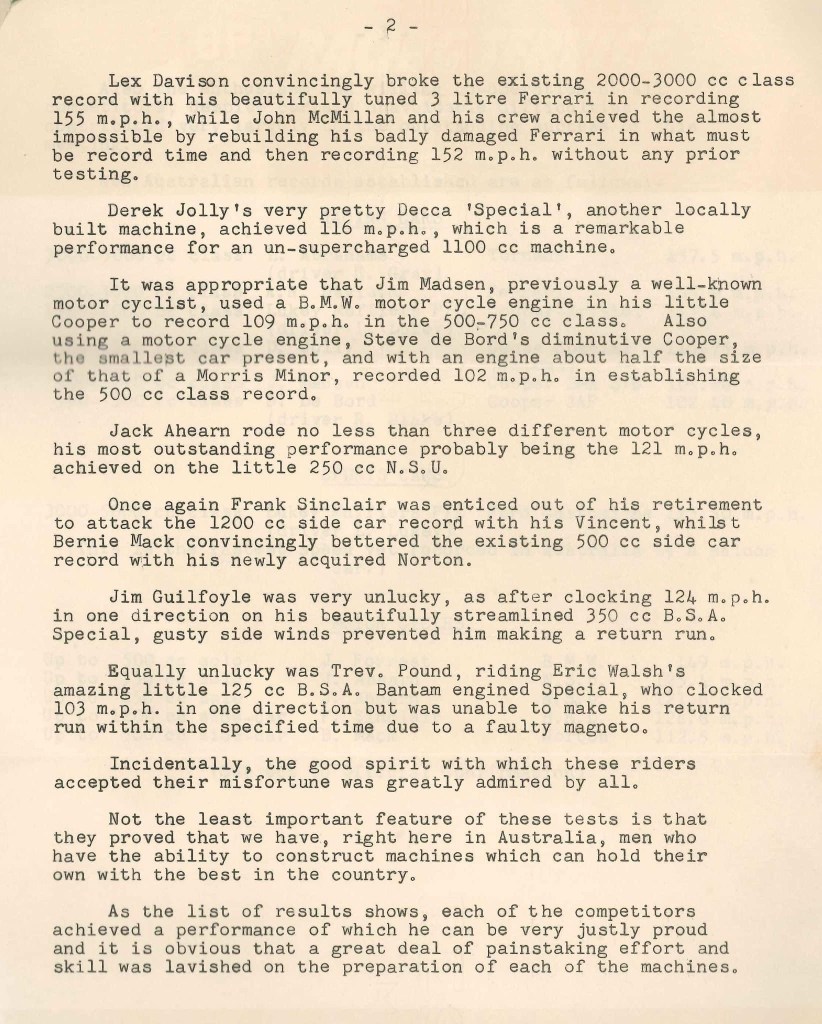
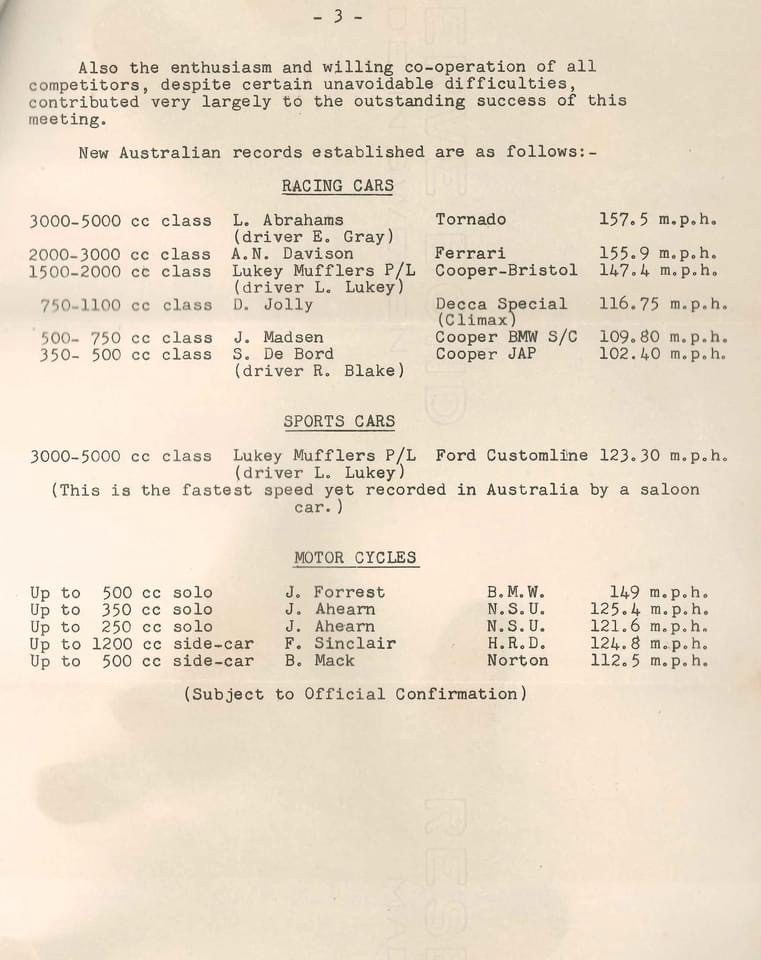
‘This BP Press Release was still in its original envelope with some pit pass tags’, Peter Button wrote of his late Uncle, Ron Button’s archive.

‘Ron didn’t talk about his time racing, it’s only on the passing of his son, Phil, that the extent of his motor racing history has become apparent. I’m piecing it together. I have his wooden helmet and Light Car Club of Australia badges, I’m sure he would be glad the racing community is getting something out of them,’ he wrote on Bob Williamson’s Old Motor Racing Photographs – Australia Facebook page, which continues to give…and give. My Lordy-me there is are good goings on, sharing of knowledge on this site and Smithy’s Pre-1960 Historic Racing in Australasia one.

(V Mills)

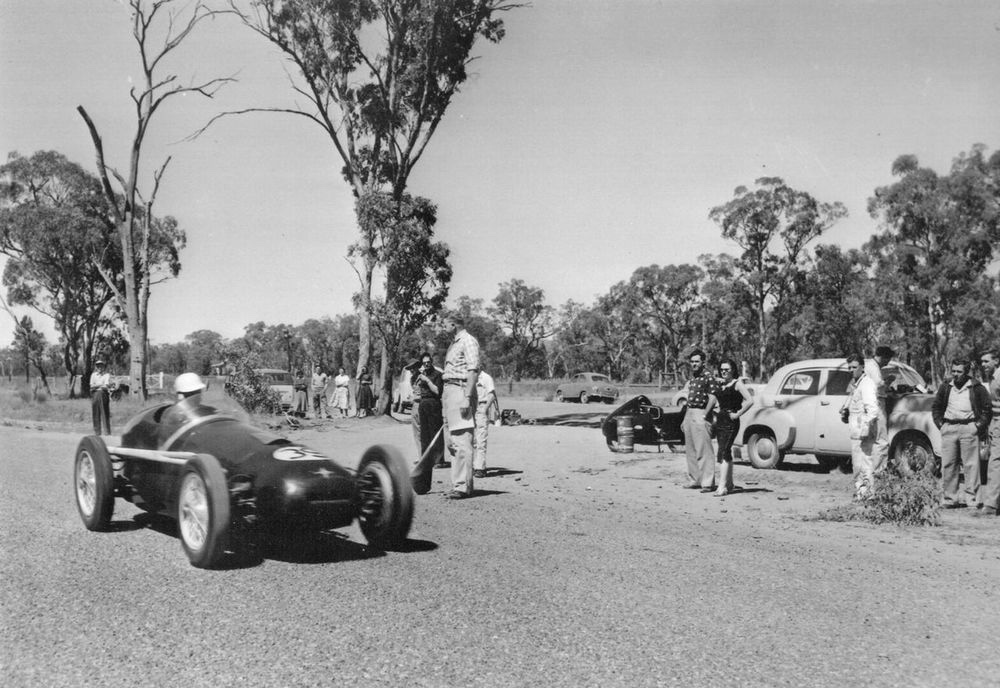
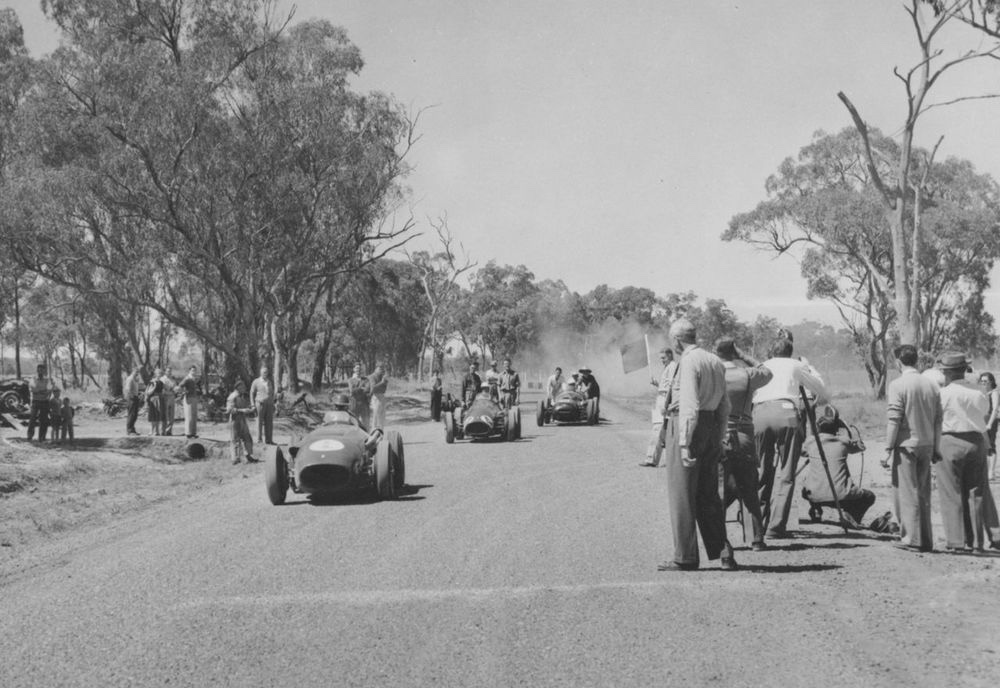
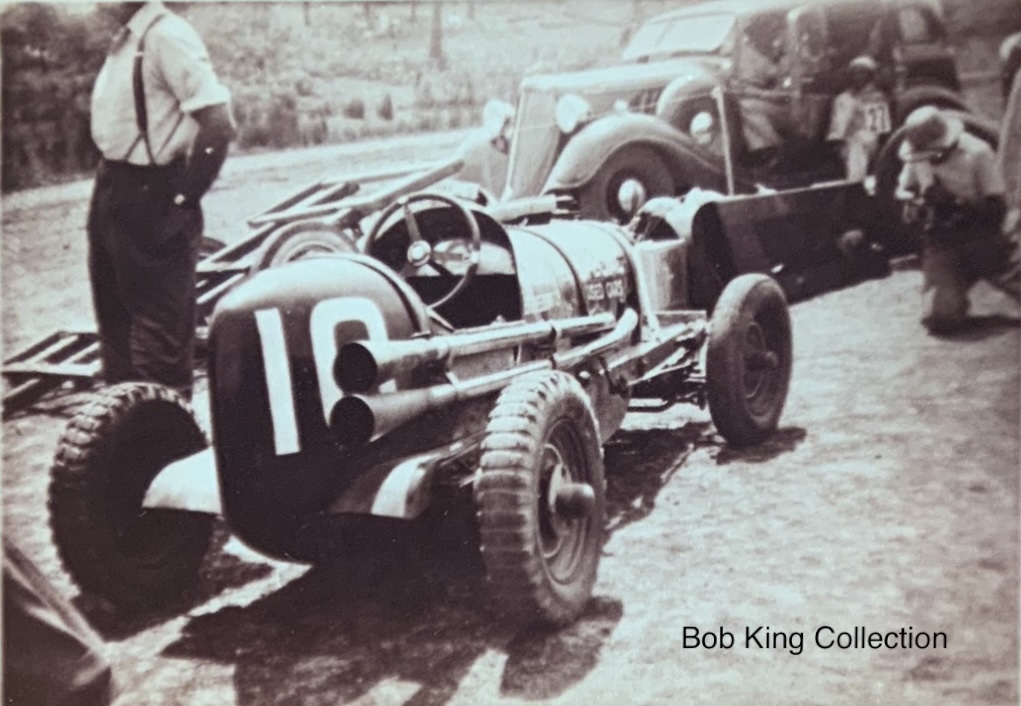
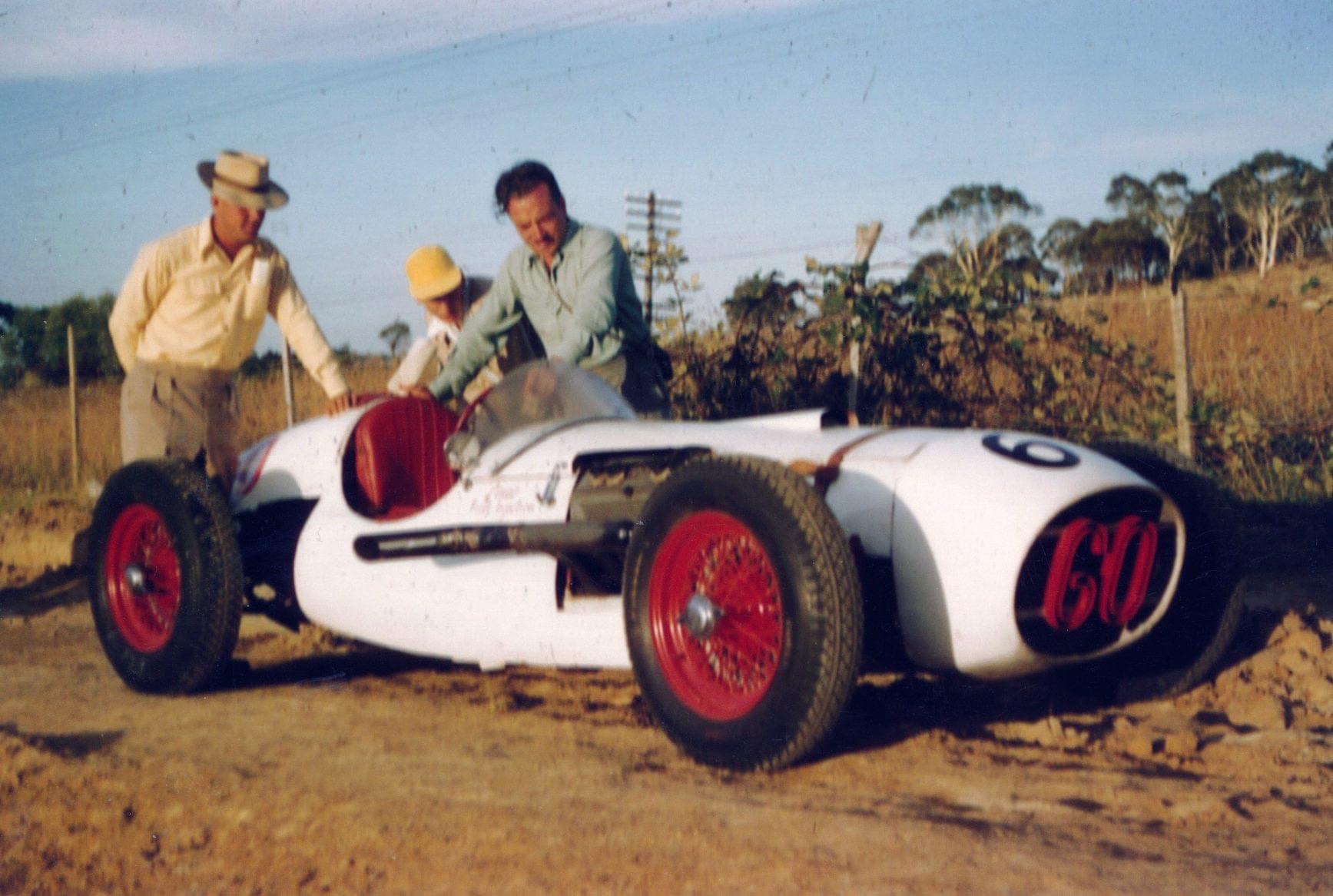
Star of the show was Ted Gray aboard Tornado 2, just fitted with its new, much modified fuel-injected Chev Corvette 283cid engine. Here he lines up for the start at Tipperary on September 28-29, 1957. It may look old but it sounded pretty much F5000 if some way short of the power of those 1970s roller-skates.

While BP’s spiel describes Tornado as a ‘locally built special’, by 1958 the Gray, Lou Abrahams and brothers Mayberry built Tornado was objectively the fastest Formula Libre road-racer in the country…if not the most reliable. It was quicker than Stan Jones’ 250F and Lex Davison’s Ferrari 500/625, Tiger Ted was no longer a spring-chookin’ by then either.

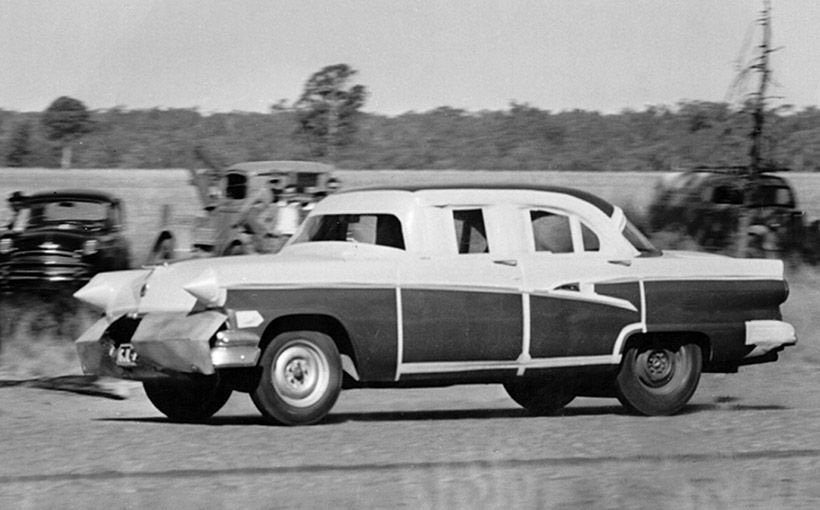
While Len Lukey’s home-made attempts to streamline his race Ford Customline may look a bit half-arsed, in fact NASA would have been proud of him, the big beast did a two-way average of 123.30mph.

(Chevron)

Back-story…

Prominent motorsport identity/engineer/racer/Australian Rally Champion navigator/CAMS administrator Graham Hoinville was tasked by his employer, BP to find a suitable site to stage some Australian Land Speed Record attempts in early 1956.

About 12 months later he selected from a shortlist, a dead-straight four-mile stretch of the Coonabarabran-Baradine road at Baradine, 535km north-west of Sydney. The road adjacent to the railway line between the two townships he assessed as suitable for some promotional record-breaking. The road ran past the gates of Tipperary Station (farm), locally the event became known as the Tipperary Flying Mile.

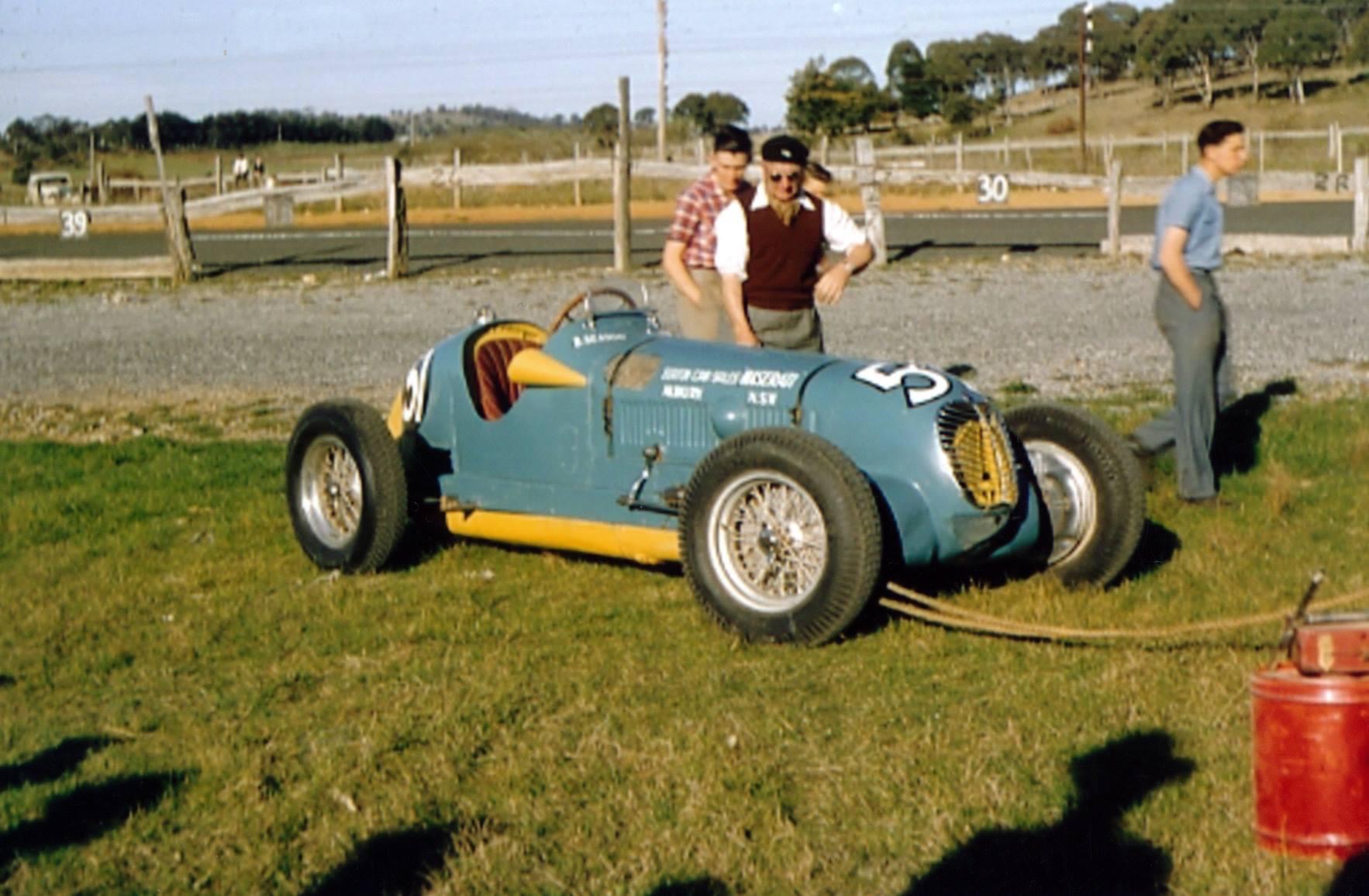
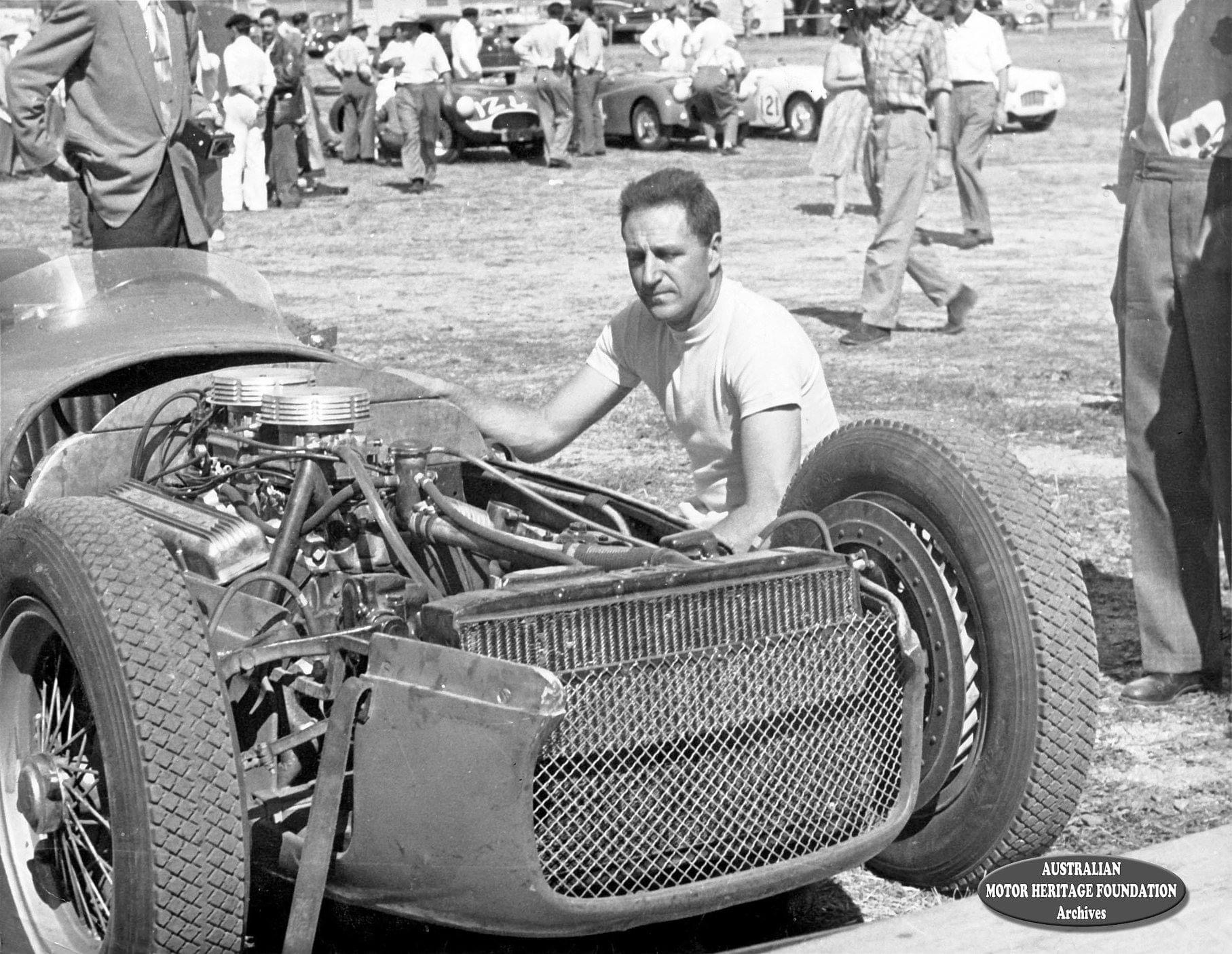
Drivers hand-picked to attend the 1957 BP-COR (Commonwealth Oil Refinery) Speed Trial were all BP contracted drivers and riders, including Davison, Ferrari 500/625 – soon to the first Gold Star Champion, the Australian Driver’s Championship – Gray racing Lou Abrahams’ Tornado 2 Chev, Lukey, Cooper T23 Bristol and Ford Customline V8, Derek Jolly, Decca Mk2 Coventry Climax sportscar, John McMillan, Ferrari 555 Super Squalo and Roy Blake’s Cooper JAP. Motorcyclist invitees included Jack Forrest, BMW 500 and Jack Ahearn, Norton Manx 350.

(R Button Archive)

Over 3,000 spectators rocked-up to watch the cars run over a flying kilometre, and the bikes’, a flying half mile. While the road had been resurfaced, it was only 18 feet wide and had a pronounced crown. Strong winds and bushfires in the area added to the challenge…

It was so blustery on the Saturday that the motorcycle attempts were postponed to Sunday when conditions were kinder. In accordance with FIA regs, a run in opposite directions had to be made within an hour, and timed to 1/100th of a second.

(V Mills)

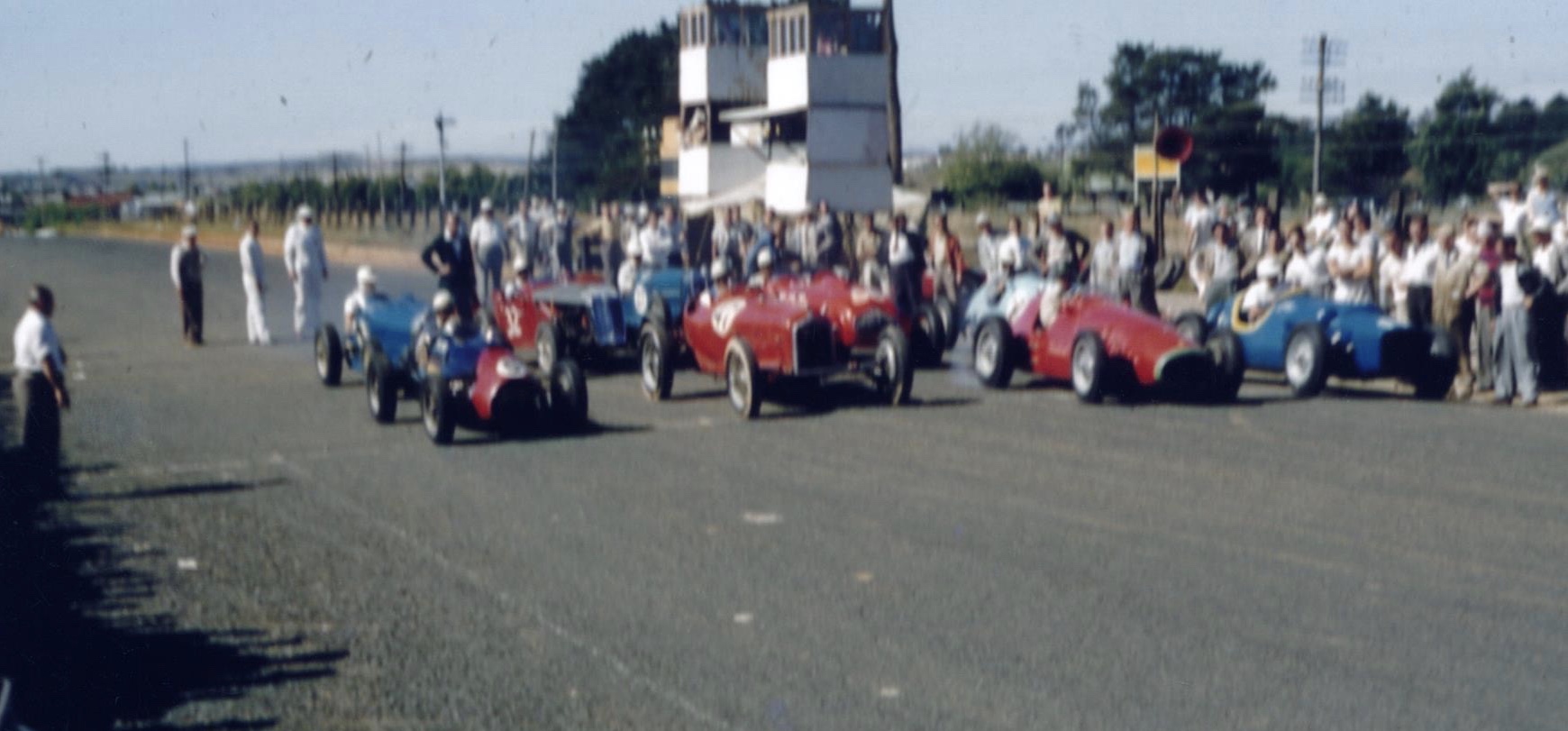
The group of ‘outright cars’ included John McMillan’s Ferrari 555 Super Squalo, Lex Davison’s Ferrari 500/625 3-litre and Ted Gray’s big, booming Tornado Chev, all three of which are heading for the start above.

It all looks suitably casual and bucolic, but some great work was done in what was the first mass attack on local land-speed-records. Almost every local record for cars and bikes was broken. Nationally, that Baradine region feat has never been toppled.

(R Button Archive)
(oldbikemag.com.au)

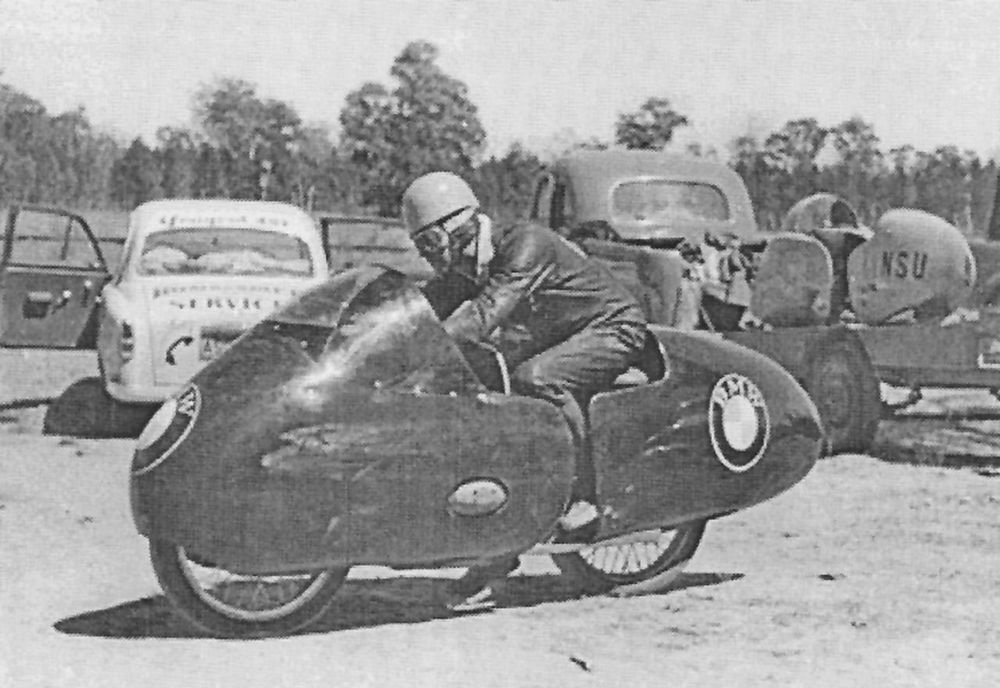
Jack Forrest set a new outright record of 149mph on his ex-works BMW Rennsport 500 despite a blistered rear tyre and an altercation with a flock of galahs, the damage inflicted by said birds obvious on the fairing. The NSU on the trailer is Jack Ahearn’s Sportmax.

It wasn’t all plain sailing…

Jim Johnson decided to give his MG TC Special a final test run before the off to ensure a misfire was sorted. With the roads still open to normal traffic, Johnson arrived at high speed on the Coonabarabran-Baradine road at the Tipperary Station farm gates at about 6.30am – listening hard to his engine but not necessarily watching fully in front of him – just as a fuel truck turned right into Tipperary. Johnson went straight under the truck, the unfortunate Leichhardt garage proprietor and father died instantly in gruesome fashion. The truck didn’t have external rear vision mirrors so the driver didn’t see him coming. It wasn’t a great start to the event, but the event hadn’t actually started for the day…

Credits…

Ron Button Archive, V Mills photographs in the Coonamble Times, Jim Scaysbrook’s Tipperary Flying Mile article on oldbikemag.com.au dated October 4, 2019, Chevron Publishing

Tailpiece…

(V Mills)

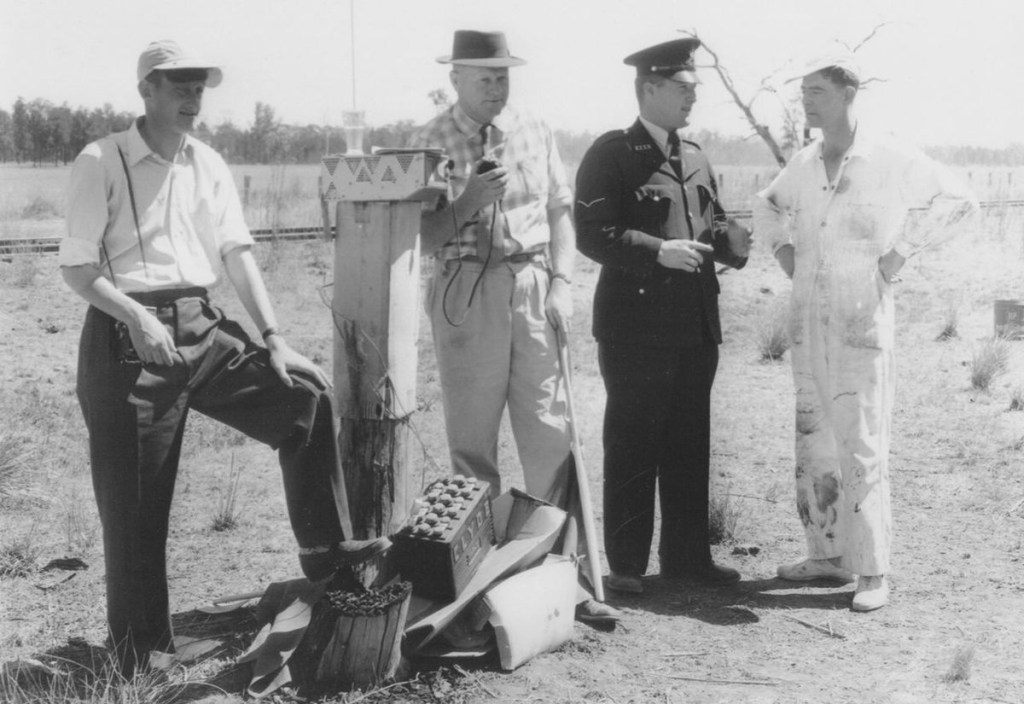
Officialdom ready for the off: the butcher, baker, candle-stick maker and copper. In the manner of the day, everybody pitched in. Note the lightweight battery…

Finito…

(MotorSport)

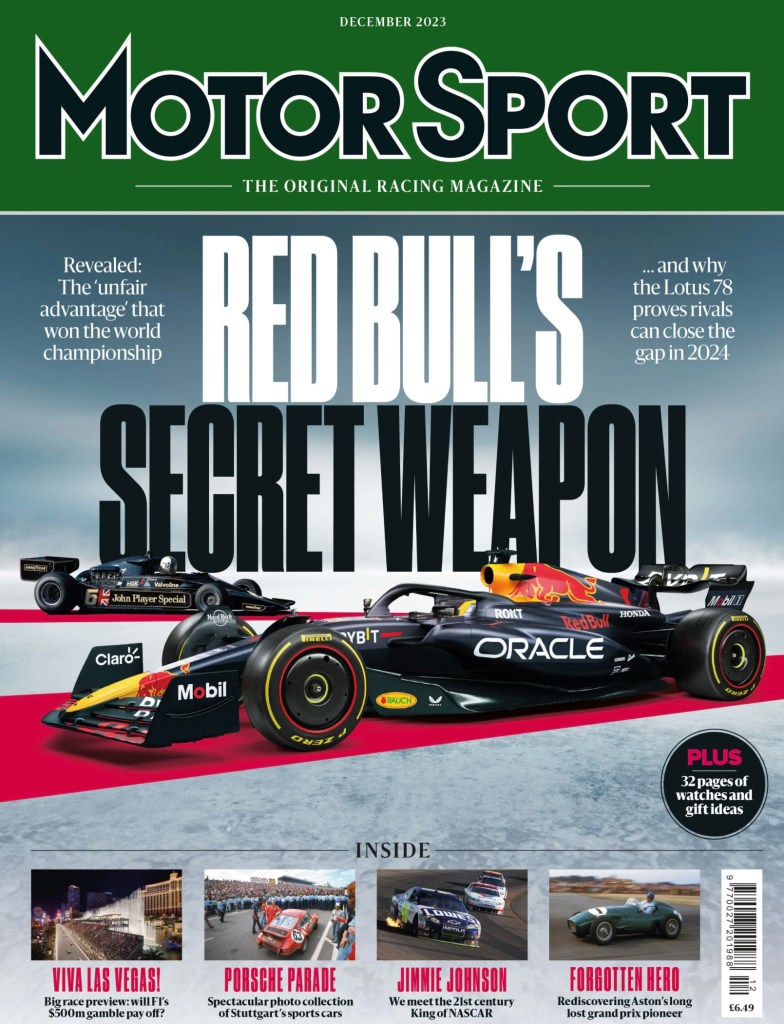
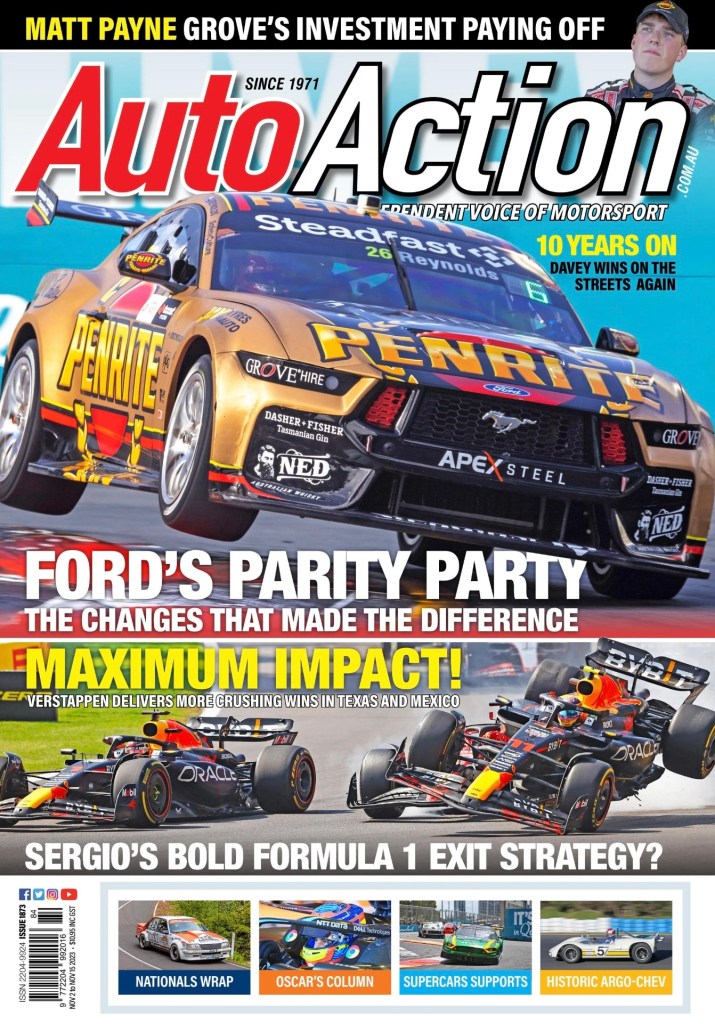
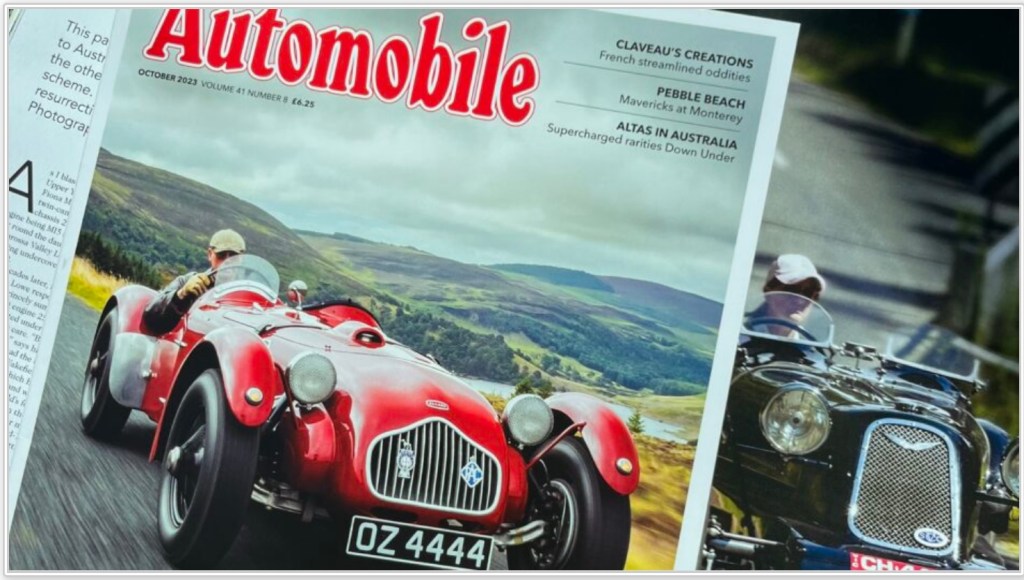
A few articles of potential interest to you I’ve written in the December issue of MotorSport, October’s The Automobile and issue #1873 November 2-15 of Auto Action.

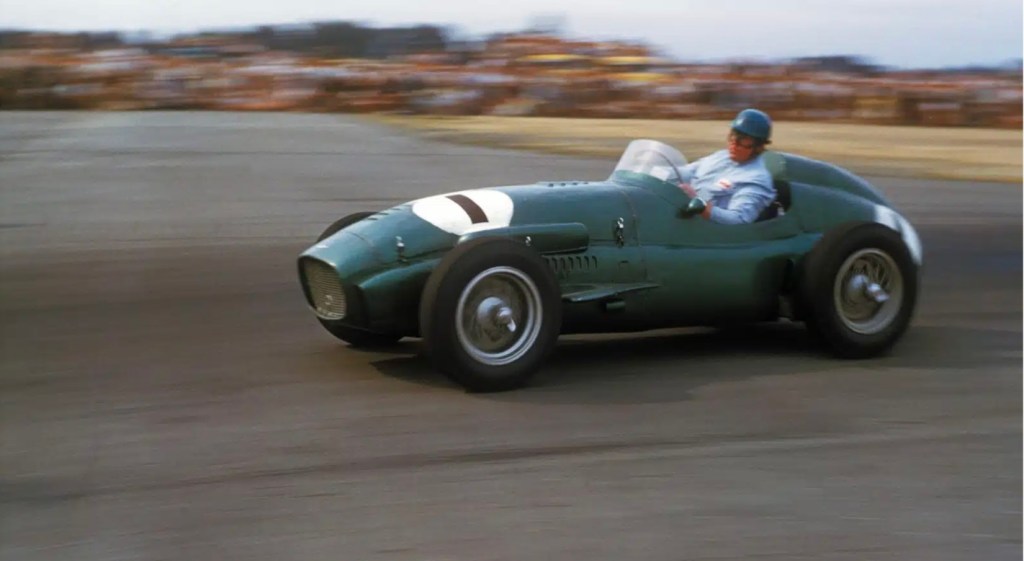
The MotorSport piece is about the long-forgotten Aston Martin DP155 Grand Prix car which really only drew blood during the 1956 New Zealand Internationals driven by Reg Parnell, as above at Wigram. It was potentially a ‘series winner’ too – there was no Tasman Cup at that stage – powered by Feltham’s supercharged DB3S six, but events conspired to thwart that. It’s in the shops in the UK now, in Australia in two months, or see here; https://www.motorsportmagazine.com/archive/issues/december-2023/

Ian Cook with a touch of the opposites, Argo Chev, Calder 1967 (oldracephotos.com via Osborne Collection)

Melbourne racers Tony Osborne and Ray Gibbs did-a-Penske and turned their outdated ex-Jack Brabham Cooper T53 Climax GP car into the muscular Argo Chev V8 sportscar, now owned by Melbourne’s Peter Brennan. But what should have taken three months or so took three years, so by 1967 it was a tad off the pace. Still, Ian Cook and Peter Macrow showed their prowess and that of the car throughout 1967-68. The transmogrification of Cooper to Argo, and decades later, to Argo…and Cooper is an interesting story. In the shops in Australia at present, or click here; https://autoaction.com.au/issues/auto-action-1873

Altas 21S and 55S at rest in March, Launching Place, Victoria (M Bisset)

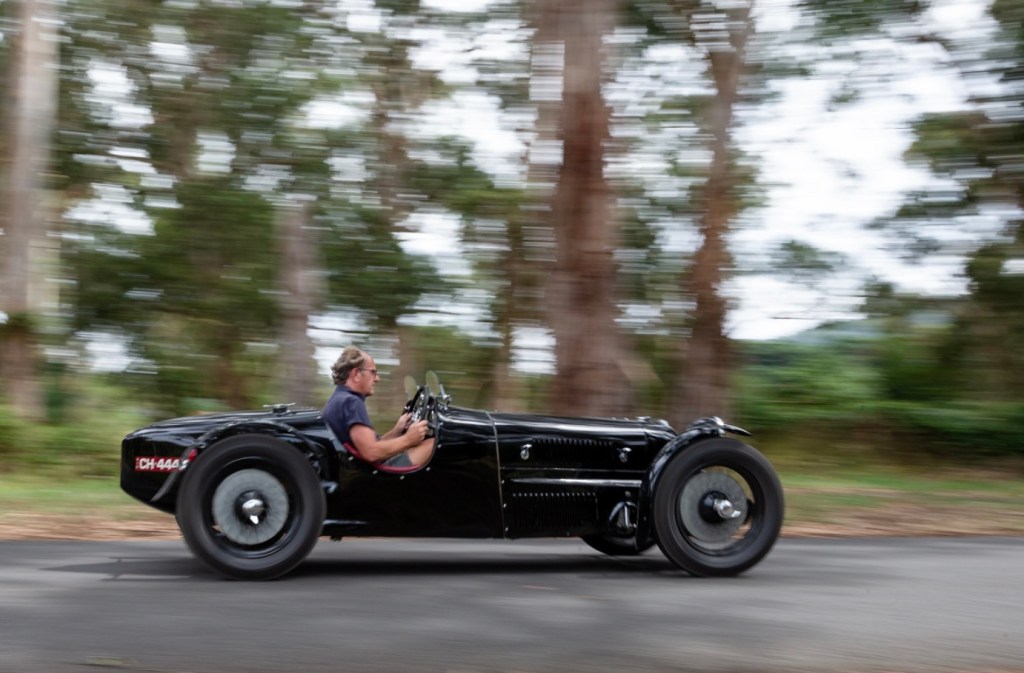
Regular readers will know that ‘Tiger Ted’ Gray and his Alta Ford V8 and Tornado Ford/Chev V8 1940-50s exploits are close to my heart. The story is about this Alta – the 1100cc, supercharged 21S – and its sibling 2-litre supercharged 55S, which were both raced, then restored by Melbourne artisan/racer Graeme Lowe and are now owned by Melbourne’s Murdoch family. Driving impressions too. It’s just left the shops in the UK and in-store in Australia soon, or click here; https://www.theautomobile.co.uk/october-2023-issue/

Please support the magazines that support me folks: MotorSport, The Automobile, Auto Action, Benzina: https://benzinamagazine.com/product/digital-edition/# and Australian Musclecar https://www.musclecarmag.com.au/. primotipo is free, the mags are commercial enterprises, if we don’t buy ’em they won’t exist…

Credits…

Osborne Family Collection-oldracingcars.com, Benzina Magazine and David Hewison, Norman Howard

Tailpieces…

(David Hewison)

Storming through the countryside near Gladysdale, Victoria in Alta 21S pretending to be MI5 Spook Alan Sinclair at Lobethal, in the Adelaide Hills, January 1938 (below)…just love that car and its history, lucky Fiona Murdoch!

(N Howard)

Finito…

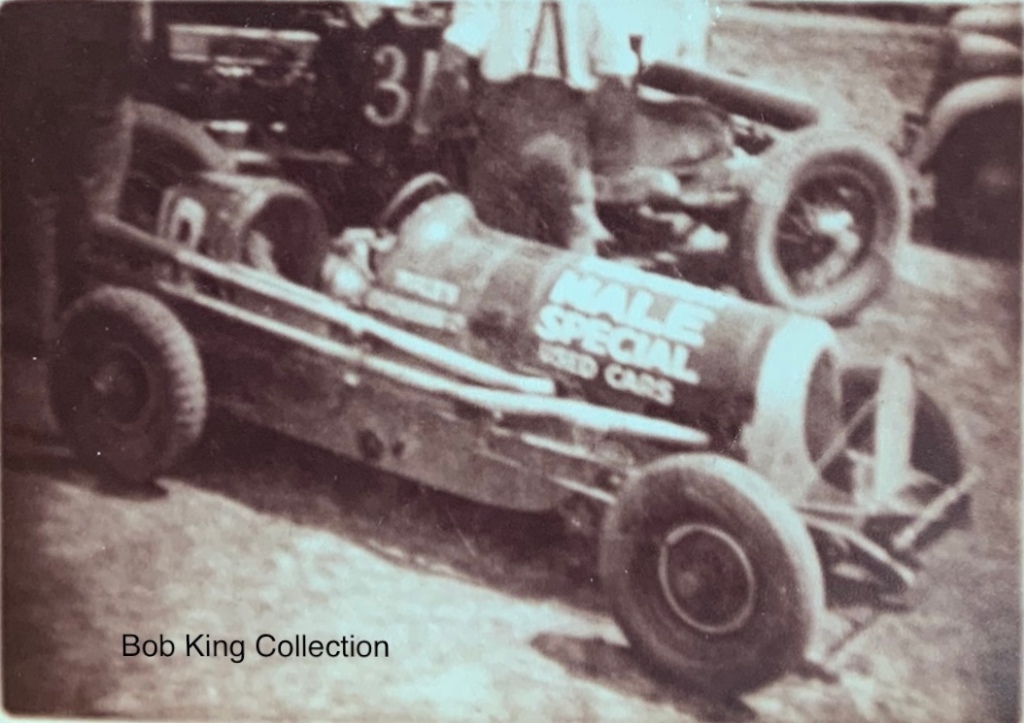
Not so much special, but three specials sponsored by Melbourne car dealer, Alan D Male and raced by Ted Gray in the immediate pre-WW2 years.

One was the JAP engined speedway midget above, the next a buggered-if-I-know powered midget and the third, Alta 21S, ex-Alan Sinclair/Bill Reynolds, and by then Ford V8 powered.

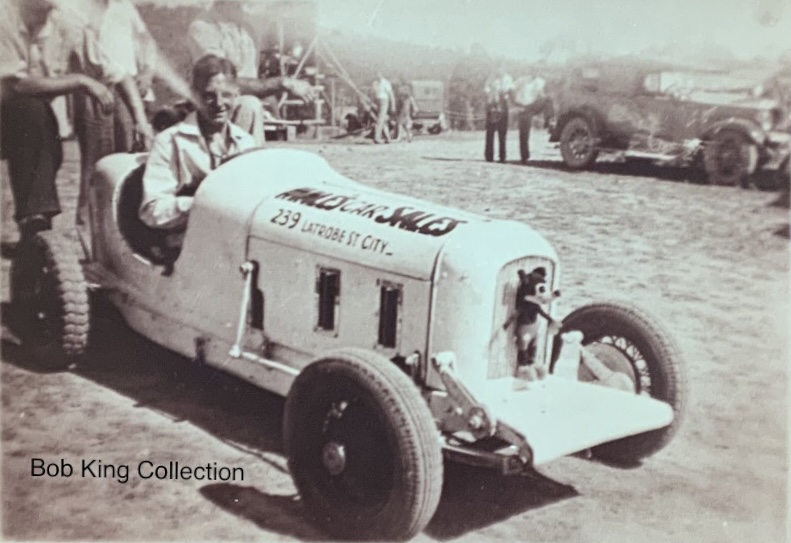
Male operated yards at 233 and 239 Latrobe Street, Melbourne named Males Car Sales and AD Male Car Sales respectively. This seemingly successful business man was important in the rise and rise of Tiger Ted pre-War, his final push into the top rank was provided post-War by Lou Abrahams.

While the contribution of Abrahams to Gray’s rise to the very front of Australian Formula Libre racing aboard the Alta – by then owned by Gray – and the two subsequent Tornado V8s has been well covered by us before, here; https://primotipo.com/2015/11/27/the-longford-trophy-1958-the-tornados-ted-gray/ and here; https://primotipo.com/2020/05/04/ted-gray-alfa-romeo-ford-v8-wangaratta-to-melbourne-record/ and there’s yet more here; https://primotipo.com/2023/07/15/alta-1100-special/ – the contribution of Alan Male has not.

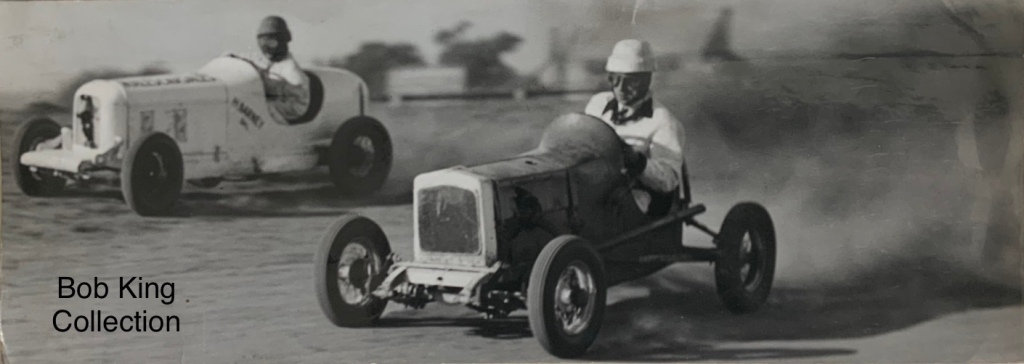
Gray gave the visiting Peter Whitehead’s ERA B-Type a serious run for his money in the midget above during meetings at Aspendale Speedway and Rob Roy hillclimb in 1938. Leon Sims tells us that in the meeting above, Rob Roy 5 on November 20, 1938, that Gray set the FTD 0.5 seconds outside the hill record set by Whitehead only five months before. In the process “he set the committee of the Light Car Club of Australia scratching their heads in concern over the suitability of a car designed for midget racing, taking the award on their hill. It was not seen as a ‘proper car’ in their eyes.”

When Jack Brabham raced his midget at Rob Roy post-war he had the same problems but went to Sydney, fitted some brakes to his car, and returned to take the Australian Hillclimb Championship at Rob Roy in 1951. Up yours Blue Blazer Officialdom, or something like that!

This is the ‘other midget’, a rare shot with car owner Alan Male at the wheel at Rob Roy 5, he did a time of 31.5 seconds. I’d love to know the builder and specifications of this car. If Mickey Mouse seems an odd radiator-shroud fear not for the little-fella, he seems to have been adopted by the team as a mascot, he is present on the team’s Alta 21S Ford shown further below.

Ted Gray on the outside of A ‘Stud’ Beasley (as in head stud or babe-magnet?) at Aspendale in August 1938, with Mickey still hanging on for grim life. I’m rather hoping some of you may be able to tell me a little more about Alan Male in order that we can put it on the public record.

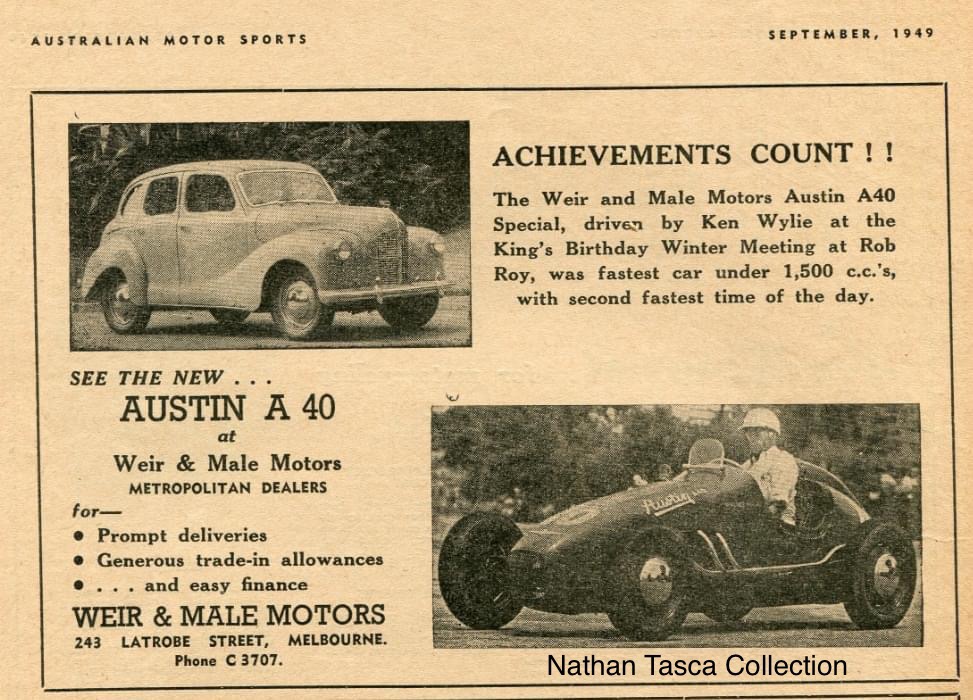
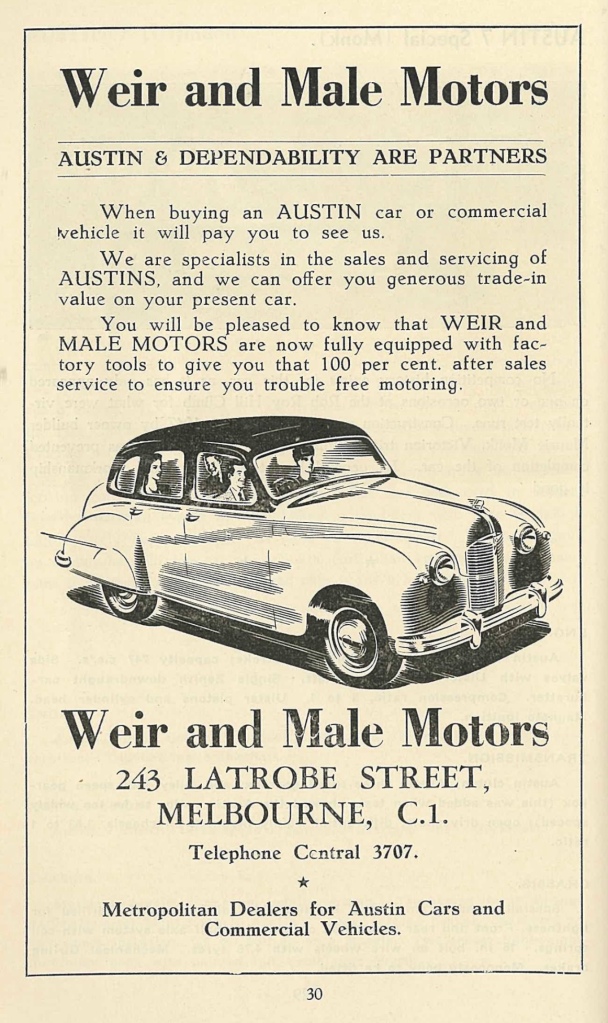
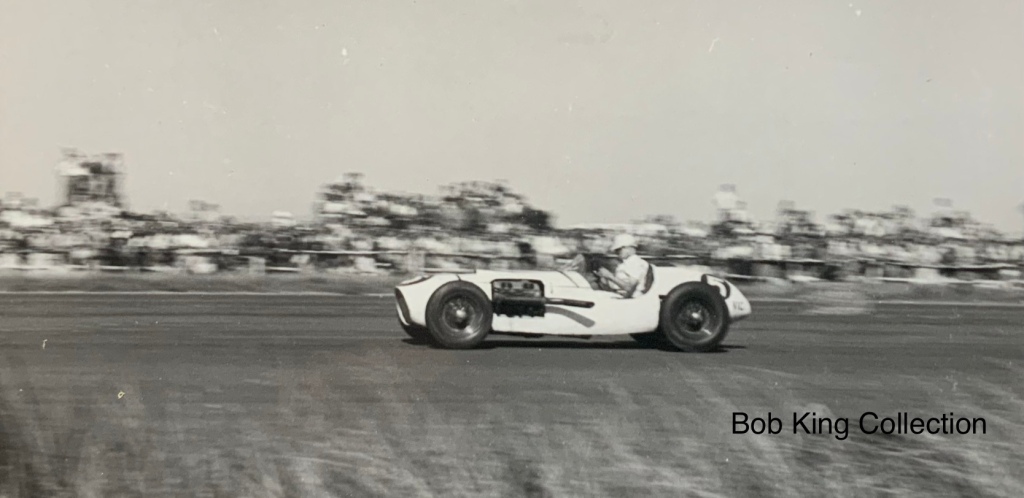
Nathan Tasca’s research shows he was still trading in cars post-War, as Weir & Male Motors at 243 Latrobe Street, familiar territory for him! He still maintained his interest in motor racing, note the AMS advertisement below. The wording of the ad, and coverage of the car in the Motor Manual 1950-51 Australian Motor Racing Year Book confirms the car was built by Ken Wylie for Weir & Male Motors, Austin dealers, and was driven by Wylie.

(Photographer-Byron Gunther)

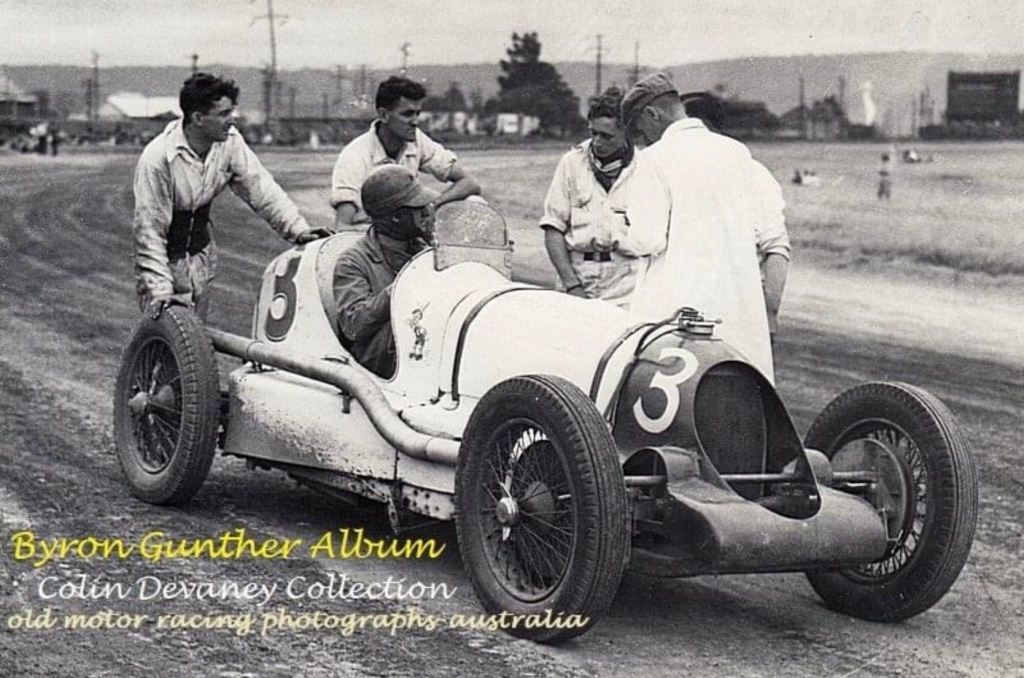
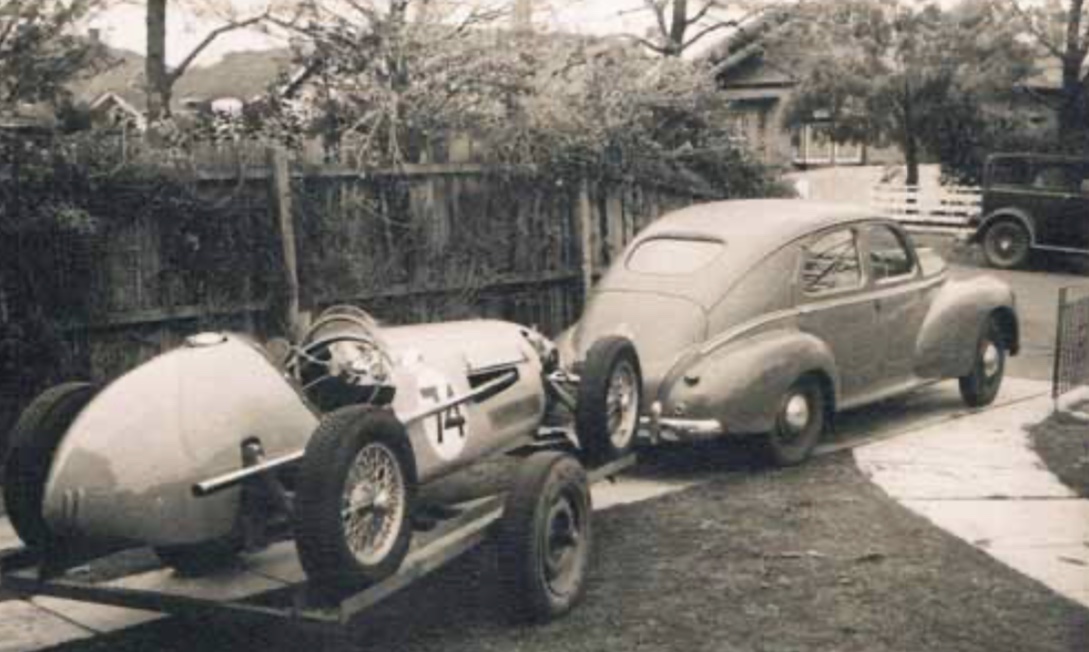
The final Male Special/Ford V8 Special – it was entered in various names – is most correctly, using the modern – make-model-engine manufacturer – ‘racing car description protocol’ Alta 21S Ford V8. Here Ted is considering proceedings with his crew and officialdom at Penrith Speedway, NSW in 1940.

While built as a road racing racing sportscar, and modified by Sinclair’s team in the UK before coming to Australia as a road racing 1100cc supercharged single-seater, the car performed well both on the roads and on dirt speedways, as here. The car was raced well into the war years, Gray in the Male Special V8 beating S Bail’s Midget V8 in a 3 lap match race at Aspendale on Sunday January 19, 1941, his final entry March-April ’41. Picking up the Austin connection, Tony Johns tells me S Bail was a partner in the Bail Brothers Austin sub-agency (Stan and Wally) in Hampton Street, Brighton in the 1960s.

By the way, the little dude on the scuttle of the Alta is Pinocchio not Mickey Mouse…there is a story there, but what is it? I know, Walt Disney was so impressed with Ted’s performances he was slipping a few greenbacks Male’s way…

Motor Manual 1950-51 Yearbook via David Zeunert Collection

Credits…

Bob King Collection, photos perhaps taken by Ted Hider-Smith, The Argus January 20, 1941, David Zeunert Collection

Tailpiece…

Tiger Ted aboard the very new Tornado 1 Ford V8 at Fishermans Bend in early 1955, date please (car #5).

When the shortcomings of Alta 21S finally became apparent after Lou Abrahams’ big-brawny Ardun-Abrahams head Ford V8 was dropped between its chassis rails the Abrahams, Gray and Mayberry team built Tornado 1. This car’s short life ended when Gray had a huge accident at Bathurst in October 1955 after brake dramas, see the articles linked above for the details.

Finito…

(G McKaige)

Bill Dutton’s gorgeous little Alta 1100 Special in the Fishermans Bend paddock during the 29-30 January, 1950 Victorian Tourist Trophy meeting. Love the ‘works’ Alta overalls.

George McKaige attended the meeting and took some marvellous photographs. A prolific enthusiast, driver, restorer and photographer, he and his son Chester published two books of George’s work, called ‘Beyond The Lens’, the shot above is on the cover of Volume 1.

This little known car was conceived when Bill Dutton – of the famous Melbourne car trading family – bought the supercharged, DOHC Alta 1100c engine (number 25S) which had been cast aside when Bill Reynolds bought Alta 21S from probable British MI5 spook, Alan Sinclair. Sinclair raced the car in Australia in 1938, an exhaustive and exhausting account is here; https://primotipo.com/2018/11/08/the-spook-the-baron-and-the-1938-south-australian-gp-lobethal/

Reynolds replaced the troublesome Alta four with a big, fat, lazy, powerful and reliable Ford V8. The Alta engine was surplus to requirements until Dutton saw its potential and built a car around it. The evolution of Alta 21S from four-cylinder sweetie to brawny V8 marauder is covered here; https://primotipo.com/2015/11/27/the-longford-trophy-1958-the-tornados-ted-gray/

Alta 21S as built, an 1100cc sportscar delivered to Scotland’s AJ Cormack on March 19, 1934. Here at Donington Park later that year (G Smith)
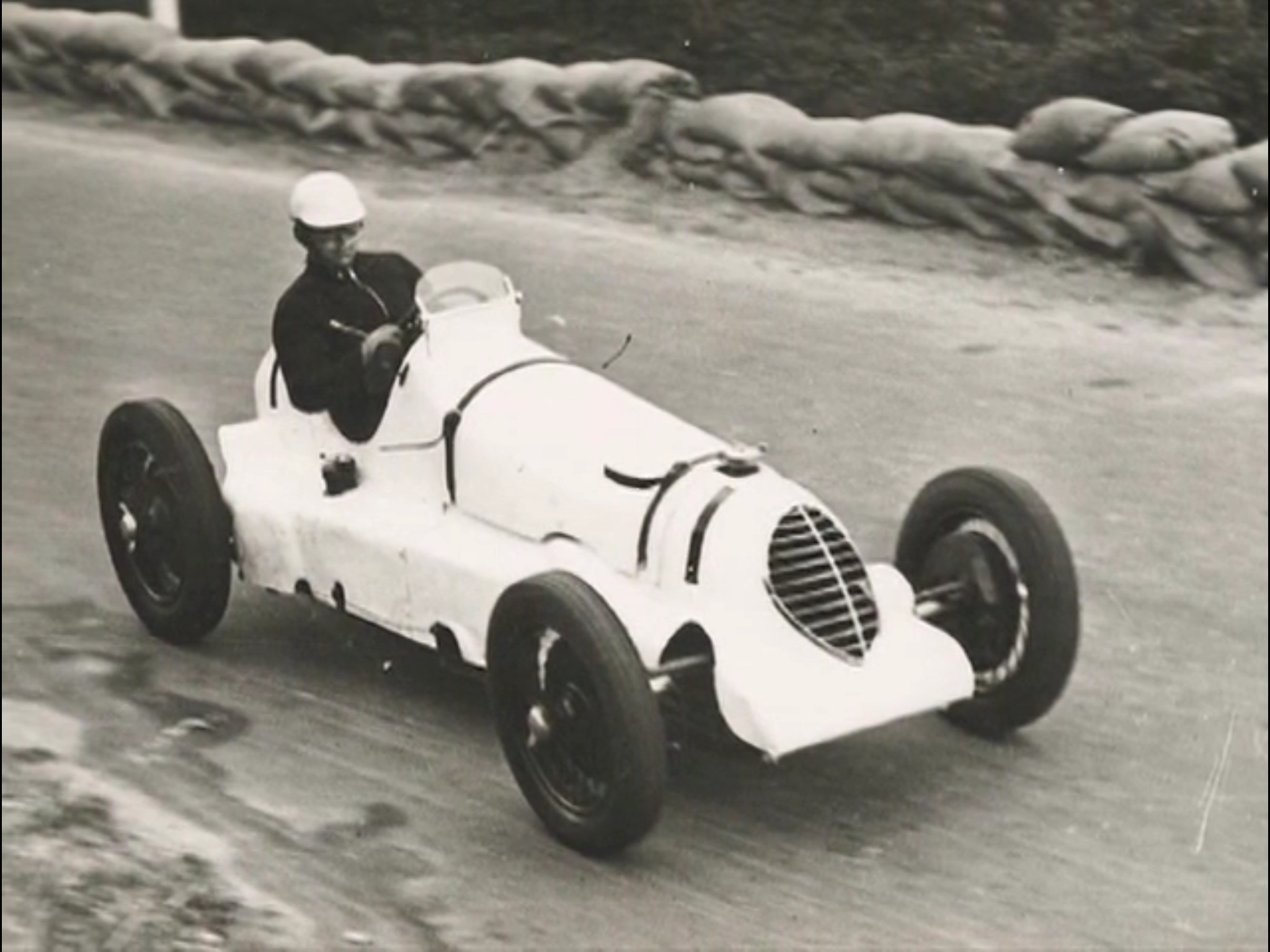
The svelte Alta 21S 1100cc sports of the previous picture, by the time of the 100 miles January 3, 1938 South Australian GP at Lobethal, had become a dumpy, upright 1100cc single seater. Probable MI5 spook, Alan Sinclair up (N Howard)

Tony Johns tells me that the Dutton family business had all of the mechanical, engineering and body building skills to create the car on their Burnley Street, Richmond site. Stephen Dalton points out that Bill Dutton thanks Jack Dongers and Tom Stevenson for construction and body help respectively in the October 1949 issue of Australian Motor Sports. Do theses chaps ring a bell with any of you?

The 1950-51 Motor Manual Yearbook records that the Alta 25S four was 1096cc in capacity, was of twin-cam, two-valve type and fed by an Alta built Roots type-blower/SU carb giving 130bhp @ 5800rpm with 15lbs of boost. It was mated, via a bespoke bellhousing and metal to metal clutch, to a four-speed gearbox of unspecified make.

The Alta Spl it is a fine example of the body-builder’s art, but who was the gifted chappy? (R Edgerton Collection)

The chassis was made of chrome-moly steel tube, the main members of which were 16 gauge and two inches in diameter. The tubular front axle was specially made and suspended by transverse leaf springs front and rear with Armstrong hydraulic/Hartford friction shocks. The back axle was also specially made and used Ford bevel gears.

Brakes were hydraulic using modified Chev/Ford drums front/rear, wheels were pressed steel, 16 inch x 6 inch in size, with the whole lot clad ‘in a single-seat aluminium panelled racing body with a long tail, similar to a Grand Prix Alta.’

Ted Gray aboard Alta 21S Ford V8 (aka the Male Special / Ford V8 Special) at Penrith Speedway, west of Sydney in 1940 according to John Medley. Racer Ken Wylie is in the goggles at right, perhaps Jim McMahon left. I’ve still to get to the bottom of Pinocchio’s presence on the scuttle. Just look at all those names on Byron Gunther’s image…
Ted Gray clears Hell Corner for the run up the mountain, Bathurst October 1950, the left front is just clear of terra firma (J Blanden Collection)

Bill Dutton engaged Wangaratta’s Ted Gray to drive his new car. Ted initially showed speed on pre-War speedways and in two very impressive appearances in the Male Special midget against Peter Whitehead’s ERA R10B at Rob Roy and Aspendale in 1938. Gray’s Alta credentials became impeccable when his patron, Melbourne car dealer, Alan Male bought Alta 21S Ford with which Gray took 24 wins from 26 starts pre-War according to John Blanden.

After the conflict, Ted re-commenced racing in another famous old-Oz racer, the ex-JAS Jones Alfa Romeo 6C1750 Zagato into which, you guessed it, Ted fitted a Ford V8. Blanden records that the Alta Special’s first race as being at the Fishermans Bend October 29-30, 1949 meeting where a broken cam-follower ended proceedings early in the day. ‘In the late 1940s, early 1950s, the car was a regular competitor, however the engine problems continued. The little car was third in the F1 Scratch Race at Woodside in October 1951,’ a better performance.

(T Johns Collection)

In the 1950s ‘the car simply disappeared’, one theory is that it sat on a service station roof in St Kilda (an adjacent suburb to AGP venue Albert Park) as a drawcard for punters after the servo owner refused to pay an exorbitant Alta engine repair bill from a Sydney business. Then Melbourne pilot/enthusiast/engineer Graeme Lowe responded to a VSCC Newsletter ad for an engine in 1967. His £10 purchase of 1100 #25S was the catalyst of a very long, thorough reconstruction/restoration of Alta 21S which was completed and then made its public debut in Betty Lowe’s hands in 1999.

In recent times 21S was acquired by Fiona Murdoch, the shot below was taken at Gladysdale, Victoria on March 4, 2023 during a drive – one I won’t forget in a big hurry – and photo session for a feature article just published in issue 07 of quarterly Australian classic car magazine, Benzina. If you can’t find it in a newsagent, a decent example of which is as rare as rocking horse shit in Australia these days, email the publisher, Jack Quinn; jack@benzinamagazine.com

(M Bisset)

Credits…

George and Chester McKaige, Ron Edgerton Collection, ‘Historic Racing Cars in Australia’ John Blanden, 1950-51 Motor Manual Year Book, Graham Smith Collection, David Woodhouse, Norman Howard, Byron Gunther

Etcetera…

(T Johns Collection)

The other pages of the 29-30 October, 1949 Fishermans Bend (correct spelling of the place according to our Government and lack of apostrophe by the way) programme sent by Tony Johns.

I always find these documents of wonderment as I don’t have a collection of them. This was fundamentally a local meeting but there are a swag of interstaters too, its interesting to see the Top Guns, Future Top Guns and Notables in the mix. Mine are – in no particular order – Ted Gray, Reg Hunt, Otto Stone, Lex & Diana Davison, Ken Tubman and Dick Cobden (NSW interlopers), Stan Jones, Gib Barrett, Rupert Steele, Tony Gaze, Jim Leech, Charlie Dean, Eldred Norman (Adelaide Hills), Doug Whiteford, Tom Hawkes, Ron Edgerton, Jim Gullan, Lou Molina, Murray Carter, Hedley Thompson, Arnold or Arthur Terdich, Peter Manton, Bill Patterson, Derek Jolly and no doubt others who just don’t ring-the-bells for me.

(T Johns Collection)

What jumps off the pages too is the importance of Australian Specials, and MGs in particular, which provided the lifeblood and bulk of Australian motor racing grids for decades. Depending on the year MG provided both outright contenders and the ‘Formula Vee’ in unmodified form, and ‘Formula Ford’ in modified form entry-level classes of the day.

(T Johns Collection)

Finito…

(unattributed)

If the 1938 Australian Grand Prix at Bathurst was our first international event, by virtue of visiting Brits Peter Whitehead and his ERA B Type, and Alan Sinclair, Alta 1,100 s/c, our second international, and first of the modern era, was the South Pacific Championship at Gnoo Blas held in January 1955.

Peter Whitehead liked the place so much he came, saw, and conquered again, just as he did seventeen years before at Mount Panorama, albeit the 1955 field had a bit more depth that of 1938.

Peter and Tony Gaze raced Ferrari 500/625s, Bira a Maserati 250F with the better equipped locals Dick Cobden’s Ferrari 125 and Jack Brabham’s Cooper T23 Climax. Kiwi’s John McMillan and Fred Zambucka in Alfa Romeo Tipo B and Maserati 8CM respectively came across the ditch but both cars were too long in the tooth as was Tom Sulman’s Maserati

Non starters were Reg Hunt, short of parts for his new Maserati A6GCM, and Lex Davison’s HWM Jaguar

Whitehead won from Brabham and Gaze with Joe Murray, Allard Cadillac, Tom Sulman, Maserati 4CM and Curley Brydon, MG TC Spl in fourth to sixth places, I’ve written a feature in this race here; https://primotipo.com/2020/04/09/1955-south-pacific-championship-gnoo-blas/

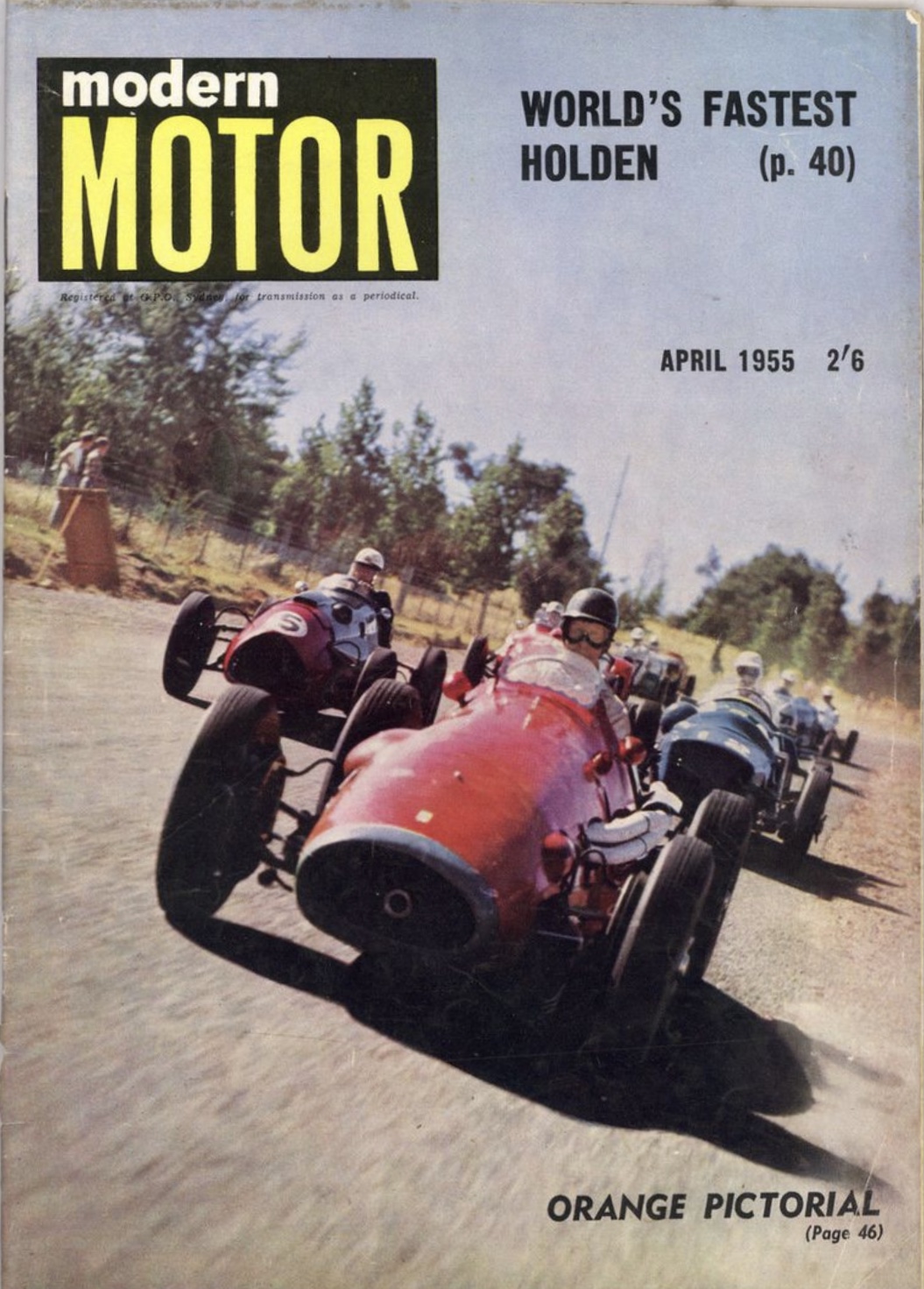
(Modern Motor)

This shot isn’t kosher, it was staged for Modern Motor magazine but is still a cracker showing the Whitehead Ferrari, Brabham Cooper off to the left and Jack Robinson’s Jaguar Special aft of Peter. Further back is the unmistakable shape of a Bugatti, perhaps the John Hall Holden engined Type 37.

The grid on Huntley Road. From left, Jack Brabham, Cooper T23 Bristol, John McMillan, Alfa Romeo Tipo B, Peter Whitehead, Ferrari 500/625 and Jack Robinson, Jaguar Special (unattributed)


(unattributed)

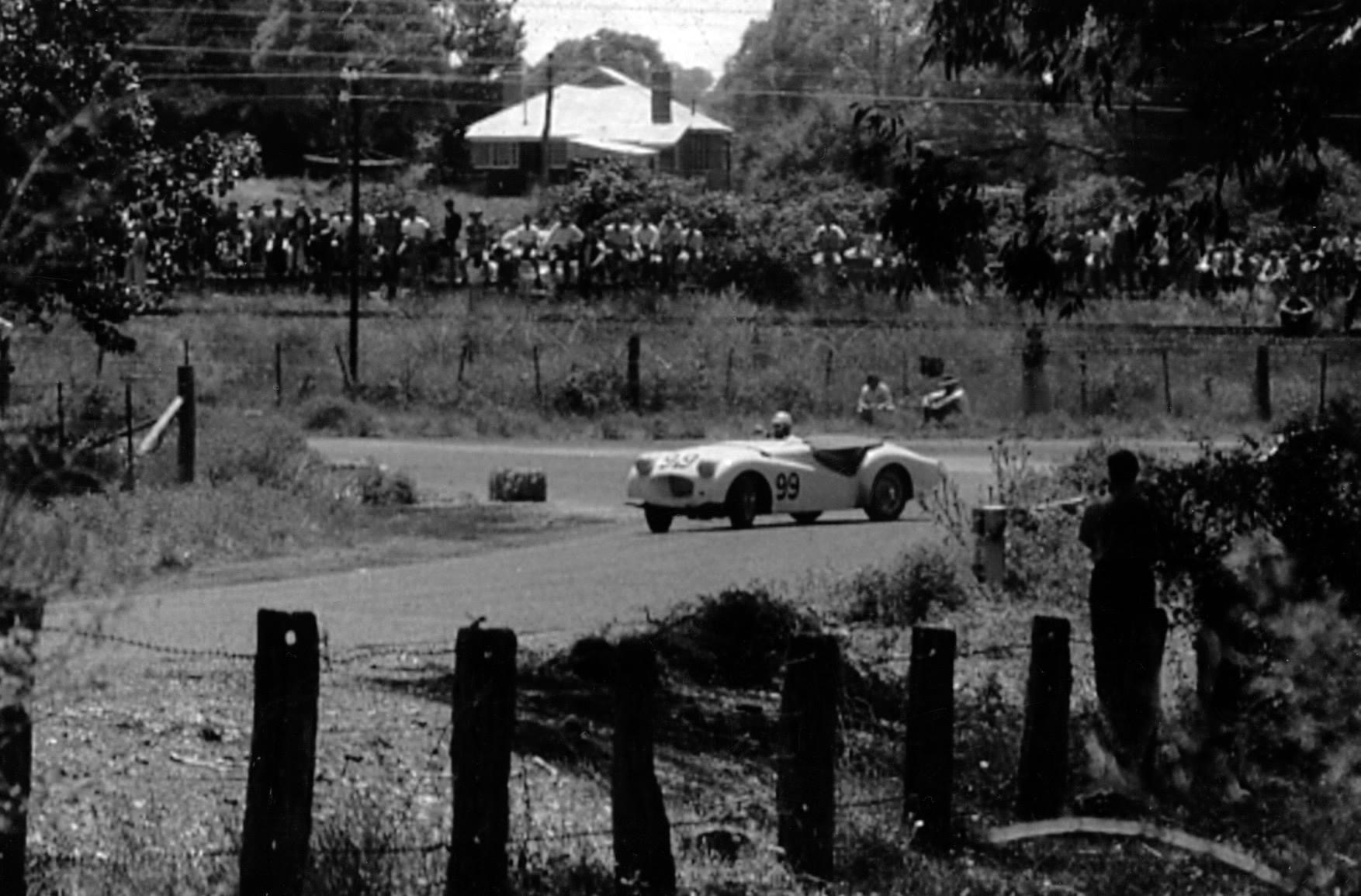
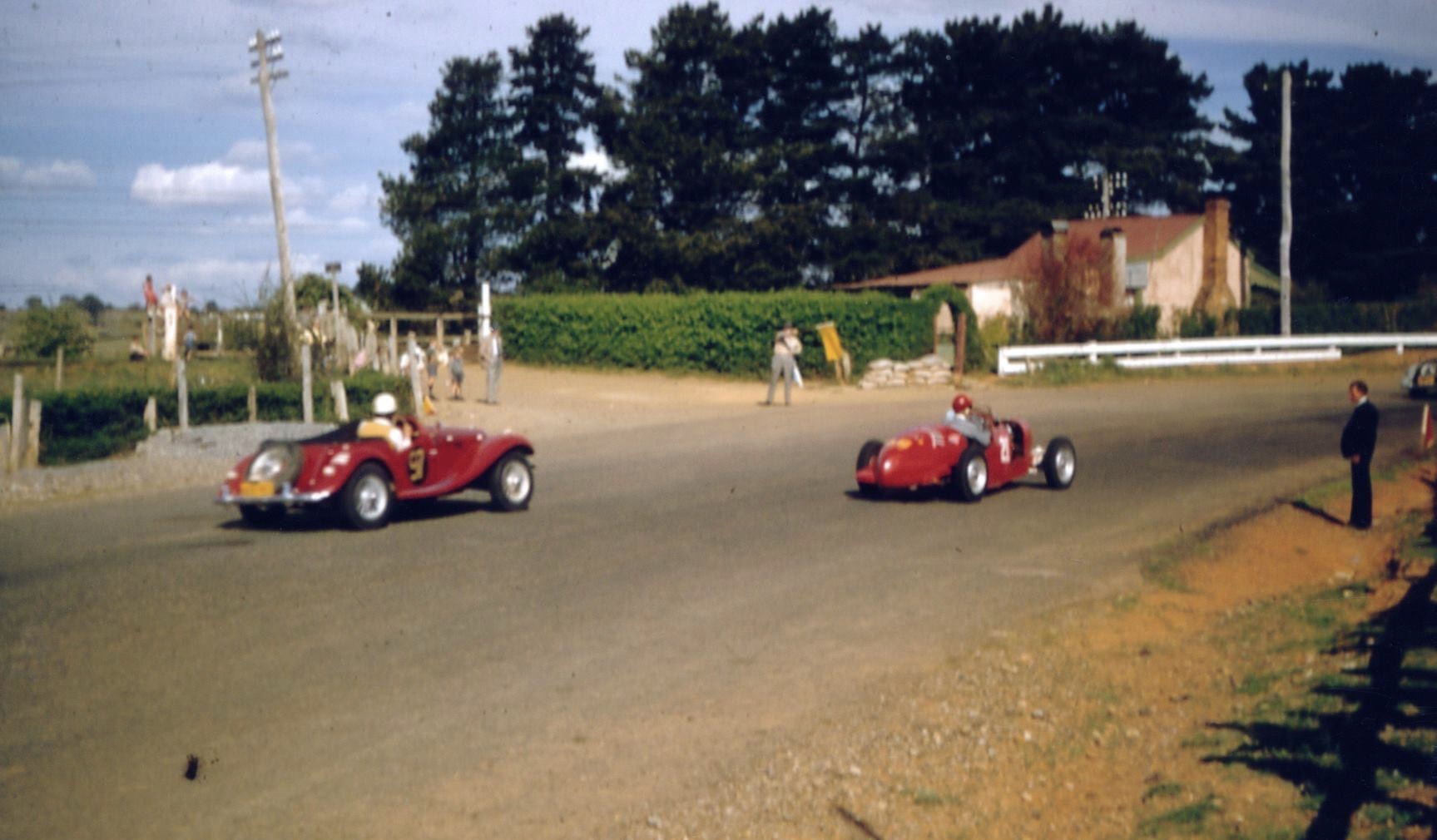
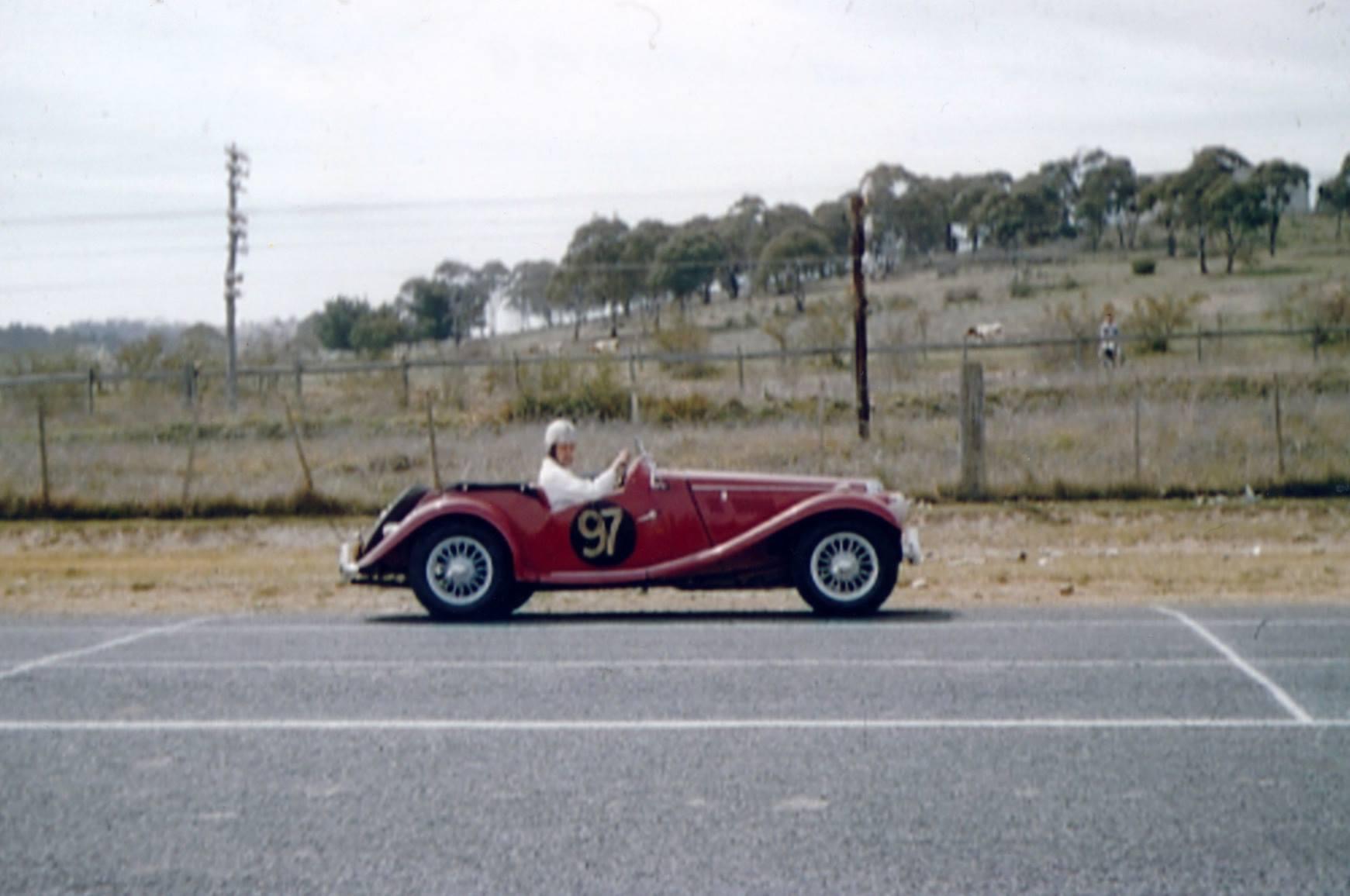
This group of wonderful colour photographs were taken by George Causbrook, an Orange electrician who worked at the time for Tom Barrett, owner/driver of the #97 MG TF.

Barretts Milk was a successful local business with a factory/depot including an airstrip. Causbrook’s family, the Beasleys, made available the shots to the Gnoo Blas Classic Car Club from whom I have shoplifted them, with thanks!

George had a fine eye, his colour shots of this challenging road course help us understand better its nature sixty years after the final Gnoo Blas meeting.

Ted Gray is shown below fussing over his brand new Lou Abrahams owned Tornado 1 Ford, just finished in Gray’s workshop in Melbourne.

By the October Bathurst meeting the team were starting to get the new beast sorted, but a huge accident in practice destroyed the car and came close to killing its plucky driver who took six months to recover from his injuries. See here for Tornado; https://primotipo.com/2015/11/27/the-longford-trophy-1958-the-tornados-ted-gray/

(unattributed)


(unattributed)

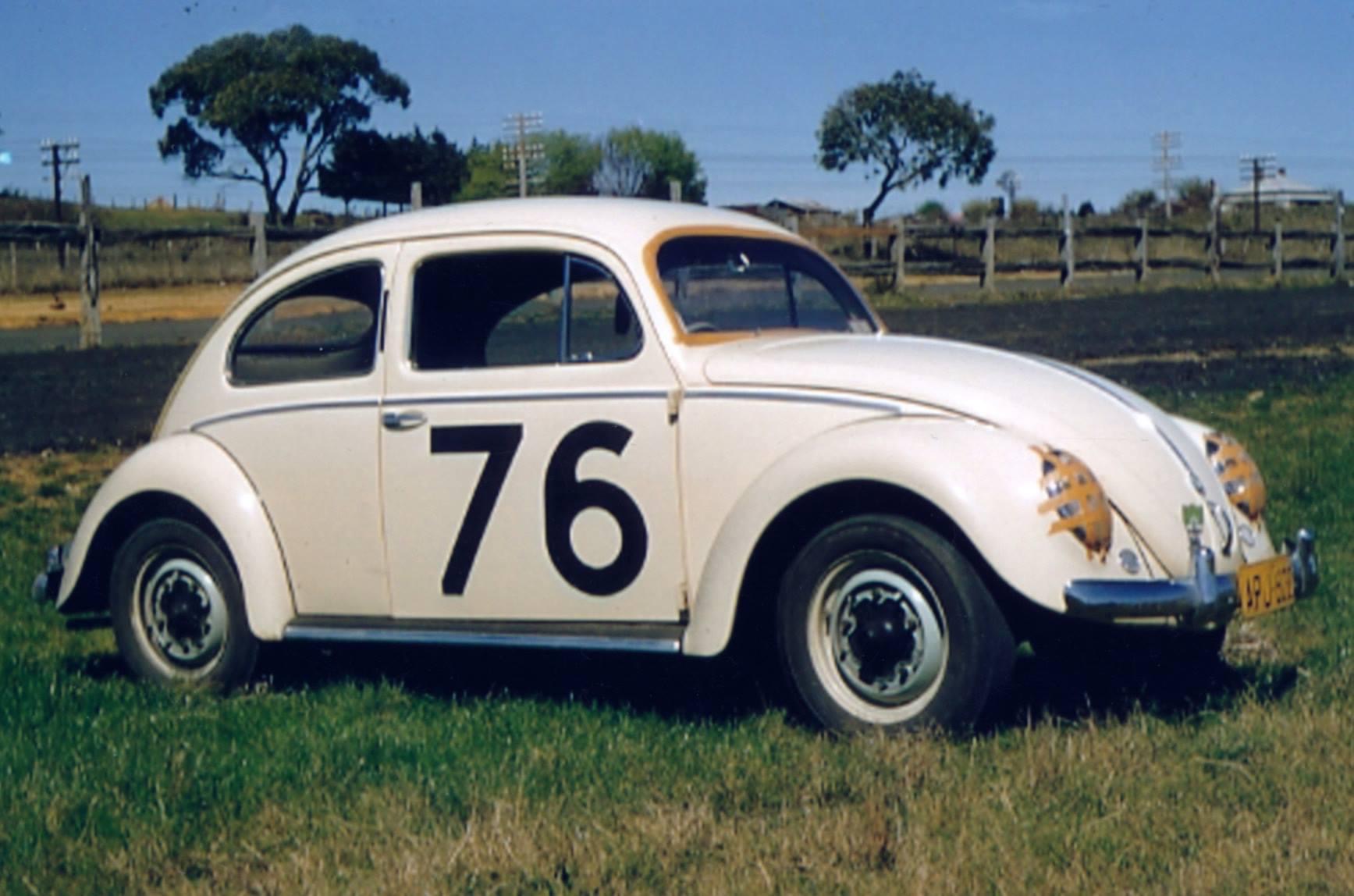
T Borrer’s VW Beetle entered in the production car race, October 1954 meeting.

The sportscar race grids (October ’54) seemed to be particularly well supported, with T Jordan’s 2.4-litre Riley-engined Healey Silverstone, Austin Healeys, #90 W Kelly and #104 Robert Page Jaguar XK120s in the shot below.

(unattributed)


(unattributed)

The ‘pretty boy’ with the Ray Bans in the XK120 is none other than local Cake Shop proprietor Bill Kelly, he would be as in fashion at an historic meeting in 2020 as he was in 1955!

Clearly there was plenty of money in pies and lamingtons in the fifties.

(unattributed)

The great Eldred Norman’s least favourite car was this 1937 Maserati 6CM 1.5-litre six cylinder Voiturette.

Chassis ‘1542’ was originally raced by Franco Cortese throughout 1937, but the going was tough against the dominant ERAs. The machine then made occasional appearances as part of Ciro Basadonna’s various teams both pre and post-war. It was imported to the UK for Gilbey Engineering in 1947, Colin Murray raced it in the UK throughout 1949 and 1950 then brought it to Australia to contest the Narrogin 1951 AGP before its sale to Norman.

When the engine blew shortly thereafter Norman fabricated a steel block and cast detachable bronze heads then cobbled together Fiat 1500 conrods and BSA pistons when Maserati originals were unavailable. Eldred raced it for a year or so before he sold it to Edward David ‘Ted’ McKinnon who finished fifteenth in the 1953 Albert Park AGP.

‘1542’ then passed to Eddie Thomas briefly, before Albury’s Seaton Brothers bought it in poor shape, they solved the engine reliability issues by fitting a Holden Grey six-cylinder unit. In this form Jack Seaton ran it and Ken Cox raced it on the country tracks of Victoria between 1957-1959.

Stephen Dalton places the above shot as during the October 1954 Gnoo Blas meeting with Tom Sulman the driver. Ted Gray was entered but he has been crossed off Stephen’s program and Sulman substituted- well familiar with Maseratis.

The car went through a variety of hands before passing to Doug Jarvis, then some years later to Alf Blight, a talented engineer who did a great job over a decade with its restoration, it left Australia in the early eighties.

(unattributed)

Tom Barrett, now racing a Triumph TR2 during the January 1956 meeting. I wonder if he caught it?

The fences to catch the wayward or unfortunate at ‘Mrs Muttons Corner’, the intersection of what is now Bloomfield and Huntley Roads, are clear and poignant in the context of Ian Mountain’s fatal accident during January 1955.

Stan Coffey, Cooper T20 Bristol, at Windsock Corner ‘due to the location of the old windsock when the Orange Aerodrome was in Jack Brabham Park during October ’54. The picture is looking towards Applebar/Pybar. The area that is now Leewood is in the background to the right, and in the middle of the background one can see what is now Blowes Road when it was dirt!’

Our friend Tom Barrett in the MG TF ‘at what is now the intersection of Huntley Road and Leewood Drive, where the level crossing now is’ and a special entering, the high speed Connaghans corner.

(unattributed)

Mr Barrett and MG TF.

Credits…

Modern Motor, Stephen Dalton

George Causbrook via Deidre and Brett Beasley and the Gnoo Blas Classic Car Club Facebook page

Tailpiece…

Finito…

Towards Hell Corner for the first time. Jones’ Maserati 250F, Gray’s blue Tornado 2 Chev with Davison’s Ferrari 500/625 at left. Mildren’s green Cooper T43 Climax FPF 2.0 then Tom Clark’s Ferrari 555 Super Squalo 3.4 and Merv Neil’s Cooper T45 Climax FPF 1.7 (M Reid)

The October 6, 1958 Australian Grand Prix was regarded as one of the great AGPs- a battle between the big red Italian cars of Stan Jones and Lex Davison and the booming blue homegrown Australian special raced by Ted Gray.

In the end Davo’s evergreen ex-Ascari/Gaze Ferrari 500/625 prevailed over the 100 miles, while the attacks of Stan’s Maserati 250F and Tiger Ted’s Tornado 2 Chev fell short.

The event took on greater significance over time as it showed the front-engined Italians at the height of their power in Australia before the full force of the Cooper onslaught bit.

Lex Davison dips his fuel level before the off, Ferrari 500/625 (R Reid)


Ted Gray during his glorious run in front for two thirds of the race. Tornado exiting Murrays (R Reid)

Lou Abrahams and his team had developed, arguably, the fastest car in the country during 1958. In addition they had improved Tornado’s reliability as they addressed, step by step, shortcomings in the machines drivetrain exposed by the prodigious power and torque of it’s fuel-injected Chev Corvette 283cid V8 fitted later in 1957.

Stan Jones found the consistency he needed to win the Gold Star in 1058 but Tornado was quicker. Lex Davison, the defending champion, wasn’t seen during the Gold Star as the AF Hollins & Co crew took a long time rebuilding the Ferrari’s 3-litre DOHC four-cylinder engine which blew after piston failure during the New Zealand Grand Prix at Ardmore in January.

Gray’s promise was proved with a win in the heat which contained the quicker cars. Not only was the car speedy over a lap, he was also considerably quicker than the opposition down Conrod – 152.54mph from Davison’s 146.74 and Jones’ 139.5

Tension mounts before the start of the second heat. #22 Clark and Davison, then Gray and Jones. The dark car on the outside of row 3 is perhaps Len Lukey’s Lukey Bristol with Ray Walmsley’s Alfa Romeo P3 Chev on his inside. The red car with the white nose-roundel is Tom Hawkes modified Cooper T23 Holden-Repco Hi-Power (R Reid)


Tail of the field thru Hell on lap 1- Alf Harvey’s light blue Maserati 4CLT OSCA 4.5 V12 with what looks like, perhaps, John Schroder’s Nota Consul. Harvey’s just rebuilt Maserati won it’s heat but ‘blew a spark plug right through the bonnet’ on lap 16. The Nota was out on lap 10 (ABC)

Early in the race the lead changed between the big three, who cleared away from the rest of the field to lead by nearly a minute at the conclusion of the first 10 of 30 laps- at this point Gray was 8 seconds up on the Jones/Davison battle.

By lap 22 Ted was ahead by a steady’ish 10 seconds but pitted to report erratic handling. A messy, unplanned pitstop ensued during which fuel was topped up and slopped all over the place. A post-race examination showed cracked rear suspension mounts were the cause of the handling misdemeanors. Ted returned to the fray determined to make up the gap but in his haste, and still with his problem, Tornado glanced off the fence on the mountain, then did a couple of slow laps before retiring on lap 24.

Stan Jones then appeared set take a race he deserved to win (he did at Longford in 1959) but he had been shifting gears sans clutch for 7 laps- during his 26th lap the 250F dropped a valve and he was out. Davo completed the remaining four laps to win from Ern Seeliger in Maybach 4 Chev and Tom Hawkes’ Cooper T23 Holden-Repco Hi-Power. It was a happy day for Ern as he prepared both cars, and Tom’s was out of oil with a split sump!

Stan The Man in one of his muscle-shirts while in the lead early on. Maserati 250F exiting Murrays (I think) into Pit Straight (R Reid)

Etcetera…

(R Reid)

Credits…

‘Bathurst: Cradle of Australian Motor Racing’ John Medley, ‘History of The Australian Grand Prix’ Graham Howard and Ors, Ron Reid Collection, Australian Broadcasting Corporation

Tailpiece…

(R Reid)

A slightly fuzzy Jones, Davison and Gray through Reid Park in the early laps before Ted cleared out- Maserati, Ferrari, Tornado.

Finito…

Ian Mountain and his mates with his self-built, very clever IKM Peugeot Special on the AGP grid at Southport on Queensland’s Gold Coast, November 7, 1954.

Ian gives the photographer a big grin, it’s none other than champion racer Reg Hunt, who is sharing his previously unpublished shots with us via his friend and confidant, Melbourne enthusiast/historian David Zeunert.

The young Montclair Avenue, Gardenvale (now Brighton) engineer first came to prominence racing the MYF (Mountain Young Ford) Special he built together with fellow Royal Melbourne Institute of Technology civil engineering student, Bruce Young.

In the finest traditions of the day, this Ford 4.2 litre V8 two-seater provided day to day transport and a multi-purpose racer including a mount for the 1952 AGP at Mount Panorama. Up front Doug Whiteford won in his Talbot-Lago T26C, while Ian retired after 24 of the 38 laps.

Ian awaits the off in the MYF Ford Spl at Rob Roy circa 1952 (L Hatch)


IKM Spl. Chassis, engine and suspension detail as per text (AMS)

Despite his training, Ian was up to his armpits in all things automotive. He was employed as a Peugeot salesman by Canada Cycle and Motor Co in Latrobe Street, Melbourne. It was to them he turned for components for his next car, the IKM (Ian Keith Mountain) Peugeot Special.

The machine’s chassis was of typical ladder frame type, longerons were of 16 gauge 2 3/4 inches diameter steel tube with four cross members – one at the front, one behind the engine then two at the back, in front of and behind the final drive unit.

Front suspension used Peugeot 203 transverse front springs and stub axles with fabricated top wishbones and telescopic shocks. Steering was 203 rack and pinion, as was the steering wheel.

Rear suspension was de Dion. The bowed tube picked up the hub-carriers and a 1946 Ford V8 diff housing mounted on the frame. This had specially cast side-plates with Dodge pot-type universal joints at each end of the driveshafts. Semi-elliptic springs, radius rods and telescopic shocks completed the package.

The hydraulic brakes use MG TC backplates and shoes with Alfin drums. The wheels were Holden FJ ‘laced’ onto ‘TC hubs- 5 inches x15 in front and 5.5 x 15 at the back, whilst the heart of the matter was a modified 203 crossflow engine.

IKM engine and front suspension. Peugeot suspension and steering components with fabricated top wishbones, MG TC/Alfin brakes. Peugeot engine 1490cc- 80.5mm bore and 73mm stroke, big Wade blower and SU carb (AMS)


IKM ally fuel tank and rear suspension detail- de Dion tube, radius rod and shock mount (AMS)

The standard Peugeot four-cylinder OHV 1290cc unit was bored to 1490cc using custom made Rolloy pistons and sleeves. A big Wade R020 blower fed by a 55mm SU carb giving about 6 pounds of boost was mounted on a frame ahead of the front suspension and chain-driven from the front of the crank. Extractors were fabricated, a Scintilla Vertex magneto gave the sparks, Peugeot provided a competition fuel pump and exhaust valves. Inlets and valve springs were standard but the valve gear was lightened and polished as were the rods and crankshaft before balancing. The compression ratio was 6:1.

The engine was mounted to the left in the frame to allow a driveline left of centre and therefore a nice, low seating position. An MG TC gearbox mated to the bellhousing easily, 22 gallons of fuel were carried in a rear mounted tank.

Neil Coleman’s ‘shop in North Melbourne built the light aluminium body with the light, low purposeful car beautifully built and finished. IKM weighed 9cwt, had a wheelbase of 7′ 6″, front track of 4′ 2″ and a rear track of 4’, ‘so the car is not really a small one, belying its looks’ AMS reported.

After testing in the quiet(!) of the Geelong Road Ian ran the machine at the Beveridge and Templestowe Hillclimbs in chassis form, and then at Fisherman’s Bend with its body fitted. He finished two races despite fuel feed problems caused by shortcomings in the manifold design.

Ian married Laurel Duguid in the Scotch College Chapel at Hawthorn on November 2, 1954 then the couple set off for Southport and the 1954 AGP, what a honeymoon! Lex Davison won in his HWM Jaguar with the IKM retiring after 11 laps. Ian’s radiator drain tap was opened slightly by vibration of the body panels which allowed the water to escape, the travails of new cars.

Peugeot 203 and IKM Spl ready for the long Melbourne-Gold Coast November 1954 AGP trip, Gardenvale to Southport is 1,725km each way (L Hatch)


Ian looking around for his crew at Gnoo Blas, long, low lines of the innovative IKM Pug clear (K Devine)

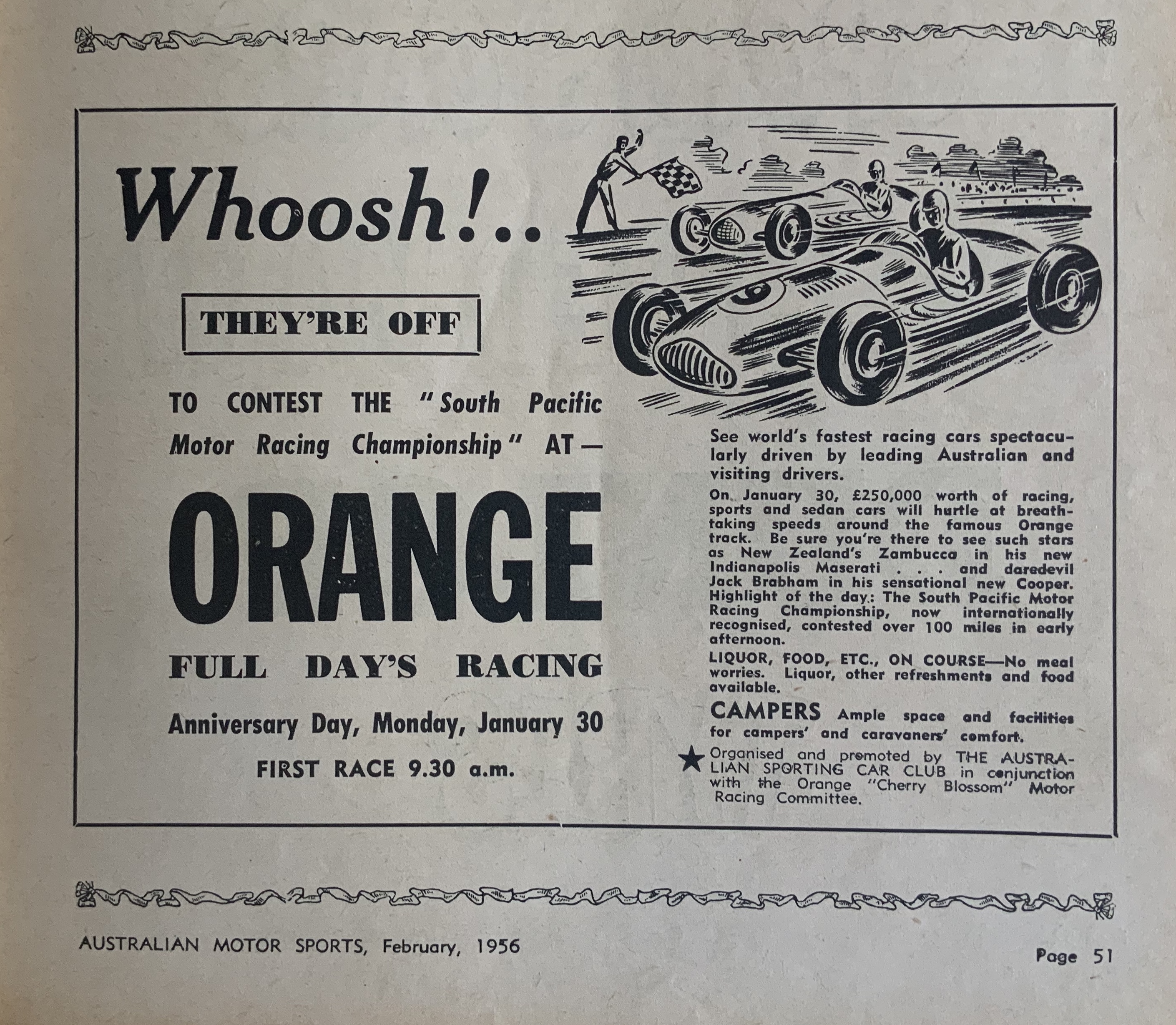
After a relaxing Port Phillip Bay Christmas/New Year the newlyweds set off from Melbourne for the South Pacific Trophy at Gnoo Blas, Orange, New South Wales over the January 31, 1955 weekend.

Australia’s first FIA listed international meeting featured the Ferrari 500/625s of Peter Whitehead and Tony Gaze, Jack Brabham’s Cooper T23 Bristol, Dick Cobden’s Ferrari 125 and Bira’s Maserati 250F and Osca V12 amongst others.

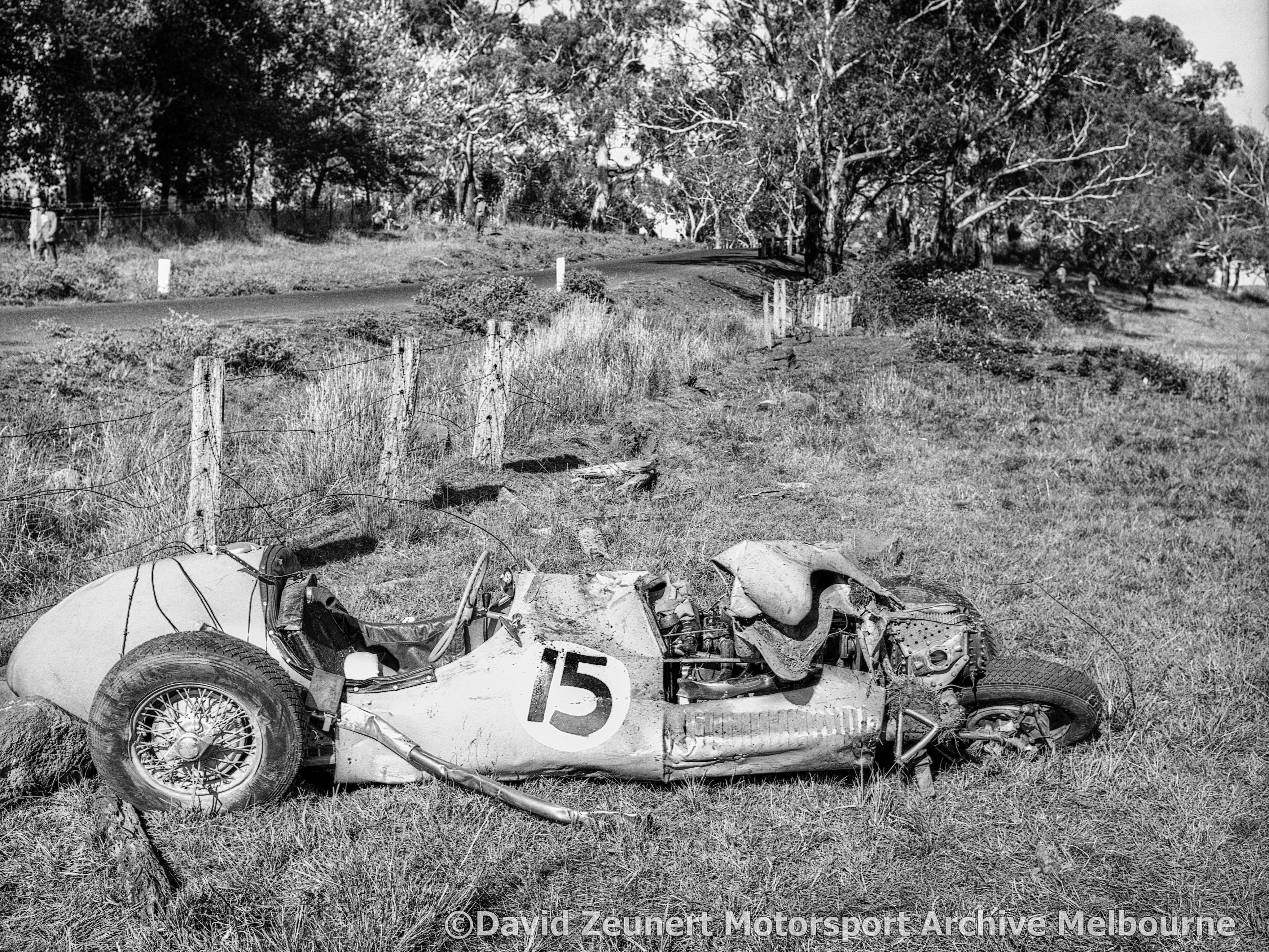
Two cars in Connaghan’s Corner after the right-hand Mrs Mutton’s Corner and then the downhill The Dip. Ian has lost adhesion and left the circuit on the outside, his crashed car is visible with officials well away on the left as, perhaps, the South Pacific Trophy takes place. Superb, rare angle of this section of this road circuit whilst noting the sad scene Reg Hunt reveals


Sadly, oil which spewed from Bira’s Osca V12 probably led to the awful accident which cost 25 year old Ian and a young spectator in a prohibited area their lives on the fast, downhill run out of Connaghan’s Corner, see here for a feature on this meeting; https://primotipo.com/2020/04/09/1955-south-pacific-championship-gnoo-blas/

Reg Hunt’s Maserati A6GCM 2.5 litre was entered for the meeting but necessary spares were late arriving from Italy so he prowled the circuit with his camera instead.

Laurel remarried in 1960, the IKM remains passed to Ian’s brother Ken who later sold them to Harry Firth. Ian Tate, who admired the car in the day, later acquired it and is in the gradual process of restoration.

Path of the car clear through the fence from the previous shot from up the hill towards Connaghan’s Corner.

Whilst components off the crashed machine have been placed on the wreck and in the cockpit the barbed wire fence, wrapped around IKM Spl, which provided some of Ian’s fatal wounds is clear. When the worst happened on those tracks in those days, lady luck either was, or was not present. Unseen by Ian that day sadly

Stunning, most significant photographs, many thanks Reg, David.

Credits…

Australian Motor Sports, December 1954, ‘Ian Mountain: Potential Unfulfilled’ Paul Watson, Reg Hunt photographs via David Zeunert Archive, Ken Devine Collection, Gnoo Blas Classic Car Club

Tailpiece…

Finito…


(J Comber)

Ern Seeliger jumps aboard the magnificent Maybach 4 Chev at Fishermans Bend in March 1958…

One of the Covid 19 phenomena, the only good one I might add, is the incredible number of enthusiasts who have been using time released from normal outdoor activities to doing stuff inside including finding and sorting old racing images, Melbourne enthusiast, John Comber is one such fella.

In addition to the shots he also wrote a piece about his work experience as a fifteen year old in Seeliger’s workshop at 52 Baker Street, Richmond, Melbourne way back in 1958- Seeliger didn’t frighten him off either, he commenced his career as a panel beater shortly thereafter.

Of course i have written about the Maybachs before, here; https://primotipo.com/2014/12/26/stan-jones-australian-and-new-zealand-grand-prix-and-gold-star-winner/ and here; https://primotipo.com/2018/03/01/1954-australian-grand-prix-southport-qld/

A big blow up of the one remaining Maybach six cylinder engine at Gnoo Blas littered the bitumen with expensive metallic debris in early 1956 and resulted in Stan Jones decision to acquire a Maserati 250F, the Maybach was handed over to Seeliger, long time friend and preparer of some of his cars to further develop and race, although Stan did have the occasional drive too.

Maybach 3 was styled along the lines of the Mercedes Benz W196, its chassis was built up from two 4 inch diameter steel tubes, the cars front suspension was by upper wishbones and a lower transverse leaf spring and radius rods, drum brakes were by PBR and the gearbox a four-speed manual.

Seeliger’s evolution of Maybach 3 to 4 essentially involved the insertion of a Chev Corvette 283 cid V8 into the space once occupied by the German 3.8 litre SOHC injected six, changes to accomodate it and better put its power to the road.

Maybach 3 in the Gnoo Blas, Orange paddock on the fateful early 1956 when its beautiful, fuel injected SOHC six lunched itself bigtime for the last time-who is at the wheel? (B Caldersmith)

John Comber’s time in the Seeliger shop coincided with some of these modifications, lets look at his work experience now.

‘…My second job was also with a neighbour, Mr Seeliger, who had a small automotive engineering business in Richmond…The arrangements were for me and my friend Trevor to be at the Seeliger’s house at 7.30 am Monday morning, do a days work and see how we liked it.’

‘On the Monday, with a  packed lunch and wearing our best “old clothes” we arrived at 7.30 just as Mr Seeliger was starting the engine of his utility. “Jump in boys” he said and we took off straight away, heading for Richmond (from Blackburn).’

‘I still remember quite clearly his opening comments, “Well i have the right job for you two bastards today, you can clean some car parts with kero, “That’ll keep you busy”.

‘The thought of cleaning the car parts with kerosene didn’t faze me but the language had caused me something of a jolt. To me this was school-yard  language and i wasn’t used to adults swearing, certainly not from my parents or relatives, or family friends.’

‘Well the rest of the day turned out fine, Trevor and i set-to with a can of kerosene cleaning mechanical parts and some body parts as well. This was quite an easy job and allowed us to look around and take in the surroundings. Mr Seeliger’s workshop  was converted from some old run-down stables with cobblestones between the sheds and an overhead loft used for storage. The yard was quite large with grass growing between some old cars and car trailers adding to the overall run-down appearance of the place.’

‘This must have been too much for Trevor as he didn’t come any more but i was there each day for the next fortnight, working amongst the cars was perfect for me…’

The core of Mr Seeliger’s business was tuning and maintaining racing cars, he was a qualified aircraft engineer and understood high performance engines and was also a racing driver himself. One of the racing cars he worked on had a V8 engine and was a potential race-winner. I learned later that this car was known as the “Maybach” and had a long history of success. He had spent several days working on the rear of the car making some modifications. Finally with it all finished i can still visualise him standing on the back of the car, making it bounce up and down and saying “That’ll keep me ahead of those bloody Ferraris.”

‘There were only three on staff, Mr Seeliger, a mechanic and Roy, the apprentice. Although Roy was only a year or two older than me he was quite friendly and helpful. To quote an old mechanic’s saying “he knew his way around a toolbox”, sometimes i helped with jobs on customer cars- simple jobs…’

‘Working conditions can best be described as matching the already mentioned surroundings: primitive might sum it up. There was no lunch-room, morning tea break was around the car being worked on and discussing the progress of the job while sipping tea or coffee. Lunch break was a little better though with a couple of old car seats to sit on…There was no heating of any sort, the area between the main sheds being open to the elements. The toilet was basic and the only tap available for hand washing was also used for filling radiators and washing cars etc.’

‘Despite these poor working conditions, which by twenty-first century standards would be deemed illegal, i thoroughly enjoyed myself working with cars and receiving five pounds each week. Now i was even more eager to finish school and begin an apprenticeship as a panel beater’, John Comber concluded in a wonderful personal account of what it was like ‘in the day’.

Tom Hawkes’ Cooper T23 Holden-Repco and Ron Phillips’ Cooper T38 Jaguar (J Comber)


Seeliger, above, with his mount at Bathurst during the 1958 Australian Grand Prix weekend- and a successful meeting too, second behind Lex Davison’s Ferrari 500/625 3 litre.


(J Comber)

In fact the modifications to the car John alluded to included the design and construction of a de Dion rear axle to better put the greater power and torque of the bigger, heavier cast-iron V8 to the road. The previous quarter-elliptic springs were replaced with a transverse leaf, the rear track widened by an inch, the chassis lengthened a bit and at the front an anti-roll bar was fitted which incorporated brake torque rods. A larger 30 gallon tank was made to feed the thirsty Chevy.

American hot-up parts were quickly produced for this engine (in large numbers continuously for about seventy years so far!) the first of the ‘small-blocks’- the modifications to the motor used in Maybach involved fitment of two 4-barrel Carter carbs, porting and polishing the heads, bigger valves, stronger springs, lightened flywheel, oilways modified for greater flow and dry-sumping- 274bhp @ 3500rpm and 300lb/ft at 3500rpm was the result. Seeliger designed and made the clutch and a bell-housing to adapt the American engine to German Maybach ‘box whilst the diff was the same unit used in ‘3’ but with shorter axles and stronger cv’s bolted and mated to the new de Dion.

Ern made the cars debut in this form at Fishermans Bend in March 1958, John Comber’s first shot at this articles outset and some others below were taken on that very weekend.

His bid for victory came to an end with stripped tyres, John recalls ‘We watched the races from a large furniture van…after a few laps of the main race the rear tyres showed white strips around their perimeter and those on the van became quite worried the tyres might blow- fortunately Seeliger saw the problem and retired from the race….Back in the van there were many commiserations and i distinctly remember asking him “Would he be suing Dunlop because the tyres let him down”? He laughingly said “Oh no, they were just some old tyres anyway”- and indeed if you look closely at the first photograph the rears are well worn.

Importantly, the car was quick right out of the box though, Seeliger was a mighty fine design and development engineer.

Stan Jones was stiff not to win the 1958 AGP at Bathurst aboard his 250F- as was Ted Gray unlucky to dip out in Tornado 2 Chev, but Seeliger finished second in Maybach 4 with Lex Davison, always a lucky AGP competitor, the winner.

Be in no doubt my friends Maybach 4 Chev in Jone’s hands was a front row car had he felt so inclined in 1958 but he was busy winning the Gold Star aboard the 250F in any event. John believes he took the second #69 shot about two years later at a Fishermans Bend Sprint Meeting- it would be great to hear from anyone who can date it.

Into 1959 Maybach 4 was still competitive in Ern’s hands, and Stan took a win in the ‘South Australian Trophy’ Gold Star event at Port Wakefield in late March and third place in the Lowood Trophy race in Queensland but his performances that year were not enough to win him the Gold Star again despite his Longford 250F AGP win at the season’s outset.

The reign of the ‘Red Cars’ was quickly coming to an end In Australia but lets never forget the dark blue Tornado 2 shown in the Albert Park paddock below in late 1958, and the silver/blue Maybach 4- both Chev V8 powered locally designed and engineered devices very much as quick as the more sophisticated, twin-cam, exotic, expensive factory cars from Italy’s north.

Click here for a feature on the Tornados; https://primotipo.com/2015/11/27/the-longford-trophy-1958-the-tornados-ted-gray/

Tornado with the Derek Jolly Lotus 15 Climax in profile behind, Albert Park 1958 (J Comber)


(J Comber)

In fact that is a beautiful segue to Comber’s second 1958 Albert Park, Melbourne Grand Prix shot above of Stirling Moss’ Rob Walker entered Cooper T45 Climax being pushed through the paddock by Tim Wall.

Just look at the relative size and packaging of Tornado 2 Chev, together with Maybach 4, Stan Jones Maserati 250F and Lex Davison’s Ferrari 500/625 the fastest cars in Australia in 1958 and the tiny, light, nimble 2 litre Cooper.

At the season’s outset, before the Fishermans Bend meeting in March when Seeliger debuted Maybach 4, Stirling Moss won the first World Championship Formula 1 race taken by a mid-engined car by receiving the chequered flag in the Argentinian Grand Prix in a Walker T45- i am not sure if he used the same chassis to defeat Jack Brabham in another T45 that Melbourne summer afternoon- sadly the last use of Albert Park as a race venue until the modern era.

That day in Argentina reset the paradigm for Grand Prix and Sports-Racer design, the last World Championships for front engined cars were won in 1958- Vanwall took the constructors title and Mike Hawthorn the drivers award in a Ferrari Dino 246.

It was the same, in a fashion in Australia, the last front-engined Gold Star win was Jones 1958 award aboard his Maserati 250F, the first mid-engined one went to Len Lukey who raced the same Cooper T45 Brabham ran at Albert Park in late 1958 to Gold Star victory in 1959.

No wonder Comber’s camera was drawn to the little Cooper at Albert Park.

See here for Moss at ‘The Park’; https://primotipo.com/2016/12/27/moss-at-albert-park/


(J Comber)

Derek Jolly’s Lotus 15 Climax has been well covered, here the car is at rest with Norman Hamilton’s Porsche 550 Spyder alongside- Ern Tadgell raced the car that weekend.

Before the end of a weekend the Lotus’ good health was ruined comprehensively- a rear suspension failure pitched the car into the trees late in the Melbourne GP race and resulted in some acrimonious discussions between Colin Chapman and Jolly about the quality of its build- a Le Mans drive and new chassis was the net result- see here for a feature article on the Derek’s Deccas and Lotuses; https://primotipo.com/2017/11/09/dereks-deccas-and-lotus-15s/


(J Comber)

David McKay’s Jaguar Mk1 is another car which has been well covered in these pages, here at Albert Park it has not been in the country long at all. See here; https://primotipo.com/2014/08/05/gnoo-who-gnoo-blas-circuit-jaguar-xkc-type-xkc037/

The Sydneysider had a great carnival winning the Touring Car Scratch Race on both weekends with the eternal Bob Holden, and Clem Smith Holdens second and third on both occasions- Holden raced an FE and Smith a ‘Humpy’.

(J Comber)

Doug Whiteford was as close to a professional driver Australia had at the time, albeit his St Kilda and Hawthorn garages and dealerships were an inextricable part of his business mix- above is his Dodge Custom Royal and Rice Trailer contained within is his famous, long raced and much lusted over Maserati 300S- Fisherman’s Bend February or March 1958.

This piece is about the Maserati 300S; https://primotipo.com/2015/05/15/bob-jane-maserati-300s-albert-park-1958/

(J Comber)

Len Lukey made his name in Ford Customlines before adding single seaters to the mix and winning a Gold Star aboard a Cooper T45 Climax in 1959.

He famously towed his Cooper Bristol to a Caversham Gold Star round with a Customline and then contested the Touring Car races with said tow-car, note the tow-bar in this ‘Fishos shot.

All about Len here; https://primotipo.com/2019/12/26/len-lukey-australian-gold-star-champion/ and here; https://primotipo.com/2018/02/20/teds-tornado-and-lens-cooper/

(J Comber)

Another two Fishermans Bend tourer contestants are this #69 Hillman raced by Harry Firth and Esquire Motors entered Wolseley driven by 1936 Australian Grand Prix winner, Les Murphy, towards the end of a very long racing career- 22/23 February 1958 weekend. The shot below is Bob Holden’s FE Holden.

(J Comber)

Otto Stone and crewman push the great engineer, and very handy steerers MG K3 through the paddock- I think it is fair to say that Stan Jones Maserati 250F fortunes changed for the better when Otto took over the preparation of chassis ‘2520’.

(J Comber)

Other Photographs…

(J Comber)

Two of the cars featured above in period in more recent times- the late eighties during an Eastern Beach, Ritchie Boulevard, Geelong Sprint meeting.

These days Maybach 4 I think is owned by Peter Briggs’ York Motor Museum in West Australia and Tornado 2 Chev by Frank Moore in Queensland- both are such significant cars it would be great to see them out and about more often.

(J Comber)


(J Comber)

A series of three photographs at Sandown to finish off- the first is again Tornado 2 Chev, this time during the 1978 ‘Fangio Meeting’ with, if memory serves, one of its ‘in period’ drivers John McDonald at the wheel, perhaps someone with a  program to hand can check that.

John has framed his shot brilliantly by avoiding modern advertising hoardings, this is the run along Pit Straight, close to Peters/Torana Corner.

Stan Jones is one of my all-time faves so i’ve saved the best till last!

And what a cracker of a shot it is, a beautiful pan of Jones’ Maserati 250F on the run away from Dandy Road towards The Causeway with the tree and blurred background giving the place a feel of a time five or so years before it actually opened.

(J Comber)

John believes this is probably the ‘St Vincents’ Historic Meeting’ in November 1963. By this stage Stan’s financial fortunes are not what they were, the Maser is for sale so my guess is that this is probably his last drive of a car which was perhaps kinder to him than any other- Maybach 1 made his reputation but the Maserati ‘brought home the bacon’.

It would have been with a heavy heart he backed off the throttle alongside the grandstand to lose speed and pulled into pit lane and the dusty paddock to switch off the peachy, punchy straight-six for one last time.

The crop of the same shot below reveals Stan’s usual race attire inclusive of five year old helmet and T-Shirt- just magic, I can hear the bellowing six and snickety-snick changes executed with expert familiarity…

(J Comber)

Photos/References…

John Comber’s words and pictures, as he quipped ‘Not bad for a 15 year old equipped with a Box-Brownie!’- who can argue with that, a mighty fine, evocative job indeed.

David Zeunert Collection, Australian Motor Heritage Foundation Archives, Brian Caldersmith Collection

Stephen Dalton for vehicle identification and additional research

Tailpiece: Ern Seeliger, Stan Jones and Superior Motors salesman Doug Roberts aboard Jones’ HRG, Baker Street, Richmond, 1950…

(D Zeunert Collection)

David Zeunert observes ‘Stan’s second hand car emporium “Superior Motors” in Victoria Street was only five minutes away from Ern’s garage, very handy for both guys who used one another’s wits on many race projects.’

Stephen Dalton chips in, ‘The photo would have been taken in the first week of October 1950,  just before or after the October 1950 Bathurst meeting that Stan Jones ran as car number 34. Mr Medley has Stan spinning in his Bathurst tome for that chapter- by the following weekend the car was carrying #7 at Woodside, South Australia.’

(D Zeunert Collection)

Finito…


(SLNSW)

Its amazing the interesting stuff ya trip over sometimes…

I’ve written abut the racing career of Wangaratta’s Ted Gray favourably but tangentially in two pieces- in one about his Alfa Romeo Ford V8 and the other about the Lou Abrahams owned Tornado V8s- they are here; https://primotipo.com/2018/02/15/mrs-jas-jones-alfa-6c-1750-ss-zagato/ and here; https://primotipo.com/2015/11/27/the-longford-trophy-1958-the-tornados-ted-gray/

The shot above shows him in his ex-Mrs JAS Jones Alfa Romeo 6C 1750 Zagato Ford V8 in front of Frank Kleinig, Kleinig Hudson Special during the handicap 1946 New South Wales Grand Prix at Bathurst. Ted was fourth and Kleinig DNF in the race won by Alf Najar MG TB Monoposto- article here; https://primotipo.com/2019/11/15/1946-new-south-wales-grand-prix/

I was researching another Wangaratta driver, Ron Phillips when I came upon this gem about Ted’s legendary Wangaratta to Melbourne record breaking run in his race Alfa in a blog by KB Hill…

‘What about the celebrated record attempt, undertaken in the late forties by two Wangaratta personalities, Ted Gray and North Eastern Car Club President, Jack Cox. Here’s a condensed version of the story that Jeff Whitten recounts in one of his publications:

A group of men had been chatting in a local hotel when the conversation turned to how fast a car could travel from Wangaratta to Melbourne (145 miles). Ted Gray drained the last drop of ale from his glass, planted it on the bar and told the small group in a confident tone: “I’ll do it in less than two hours.”

A boast became a bet, and hundreds of pounds changed hands during the next few days. Speculation raged around town. On the day (in April 1946 according to Tony Parkinson) of the attempt Wangaratta’s taxi fleet did a roaring trade, shuttling people to the ‘S’ Bend just south of Glenrowan, for 2 shillings a time. Many spectators thought the Alfa Romeo may fail to negotiate the sharp turn over the railway line. Visions of a wrecked car, hurtling over and over, were probably foremost in the minds of those who were waiting there.

That evening, more than 1,000 people lined Murphy Street as Gray, the Australian Land Speed Record Holder, and his passenger Jack Cox, a Faithfull Street engineer, sat waiting in the Alfa Romeo. The moment the Post Office clock struck 5.30 the Alfa’s engine roared and the pair took off, accompanied by the cheering of the crowd. All along the route, thousands stood in the darkness, shuddering with cold, and expectation.

Telephones ran hot, as people sought updates. In many places the Alfa, with Gray at the wheel, exceeded 110 miles per hour, while Cox hung on for dear life. The car clipped the railing on the sharp bridge over the river at Seymour, but sped on and recorded 112mph over Pretty Sally (Hill).

The railway-gate keeper at Tallarook had been bribed, to make sure that he kept the gates open at a certain time.

With misty rain falling, Gray spent much of the trip peering over the top of the windscreen, ensuring he wouldn’t tangle with cars and transports that hadn’t yet turned on their tail-lights. It enabled him to reach Bell Street, Coburg, in record time.

The trip from Bell Street to the Melbourne GPO took six and a quarter minutes. The pair pulled up in front of the Post Office exactly one hour and 59 minutes after leaving Wangaratta.

Jack Cox climbed out of the car, knees still shaking, while Ted Gray acknowledged the cheers of the crowd…’

Ian Virgo in the Alfa Romeo V8 from Tom Stevens MG TC Spl at Port Wakefield in the mid-fifties , date folks?- the Ford V8 engines Alfa Romeo 6C 1750 SS Zaato was by this stage was owned by Broken Hill’s Bob Jervies (T Stevens)


(J Cox Family)

Postcript…

The power of the internet.

Racer/restorer/historian Tony Parkinson got in touch with the fabulous material below, he wrote ‘I found references to the Alfa Romeo sent to me by John Cox, son of Jack Cox, riding mechanic on the infamous Wangaratta to Melboune run, also shots at Fishermans Bend pus Jack Cox (with blindfold) and Pat O’Keefe, the Alfa front on in Murphy Street Wangaratta, a glorious shot of the Cox & Gray garage and a very young John Cox on a trike in Roy Street Wangaratta with the 6C1750 V8 up the drive.’

Just wonderful stuff, in addition there are various newspaper reports, if anyone can help with the date of the run in April 1946 that would be the candle atop the cake!

(J Cox Family)

Jack Cox and Pat O’Keefe aboard the Alfa Romeo and hamming it up for the local press.


(J Cox Family)

The old beast still looked pretty good in 1946 despite a very active competition life from the time it arrived in Australia- here in Murphy Street, Wangaratta with road equipment- well lights anyway!

Late 1950’s report or retrospective on the run probably from the Melbourne ‘Herald’ at a guess (J Cox Family)


Big sister looks after John Cox whilst his Dad, Jack Cox and Ted Gray’s big V8 engined racer is at rest up the drive.

Imagine the drives possible from there- Wang to Corryong, Wang to Mansfield via the King Valley, Wang to Echuca and so on…apart from the car’s racing of course.


(J Cox Family)

There was obviously plenty of consternation after the veracity of the elapsed time given plenty of money wagered on the outcome- a close run thing it seems!


(J Cox Family)


(J Cox Family)

The two shots of the Alfa at Fishermans Bend- be great to know the date and have the identities of other cars and drivers.

(J Cox Family)

Credits…

Excerpt of an article by KB Hill ‘A Lifetime Passion for Motor Sport’, December 2019 in kbonreflection.wordpress.com, State Library of New South Wales, Australian Motor Sports Tom Stevens Collection via Tony Parkinson, Jack Cox Family Collection via John Cox and Tony Parkinson

Tailpiece…

(J Cox Family)

Jack Cox and Ted Gray’s ‘Hume Garage’ in Wangaratta.

His pre and post war speedway and road racing career across the country was conducted using Wang as a base- was his move to Melbourne from the time he started to race Tornado 1 Ford with Lou Abrahams circa 1954?

You need luck in motor racing of course, Lex Davison made his own with great preparation of his cars by AF Hollins (and others early on), Ted Gray was keeping Lex’ Ferrari 500/625 and Stan Jones Maserati 250F at bay at Bathurst in October 1958, he really, coulda-shoulda-woulda won the Australian Grand Prix that year, cracked suspension mountings caused his retirement.

An under-rated driver i reckon…

Jones, Gray and Davison, Hell Corner, Mount Panorama during the 1958 AGP (AMS)

Finito…

1953 AGP grid. Front row L>R Davison HWM Jag, Jones Maybach 1, Whiteford Talbot-Lago T26C, car 11 on row 2 is Ted Gray Alta Ford V8 (Dacre Stubbs)

The allocation of the 1953 Australian Grand Prix to Albert Park was the result of over two decades of work by the Light Car Club of Australia…

I live 800 metres from Albert Park Lake, I awoke this morning to F1 music at 7.05 AM- the sound of two-seater Minardi V10 engined cars ferrying their lucky cargo around gods motor racing country at high speed. The dawn of the 2019 race seems an apt time to upload this article on the 1953 event- the first Albert Park AGP.

Barry Green in his wonderful book ‘Glory Days’, writes that there was a strong push to race at Albert Park in 1934. The Light Car Club of Australia, (LCCA) the promoter of race meetings at Phillip Island were aware of the ‘Islands growing unsuitability given its loose gravel surface as speeds increased.’ Extensive negotiations secured Albert Park as the venue for a race meeting to celebrate the Centenary of Victoria in 1935.

The ‘Sun News Pictorial’ one of the Melbourne daily tabloids, and then as now a good thing in which to wrap ones fish n’ chips, announced the event on June 4 1934.

In doing so the ‘paper lit the fuse of naysayers who brought about the events cancellation, but not before racers Arthur Terdich, Bill Lowe, Barney Dentry, and Cyril Dickason in Bugatti, Lombard, and Austins respectively, lapped the track with mufflers fitted to prove noise wasn’t the issue.’

Stan Jones at speed in Maybach 1, Albert Park 1953, DNF. Stan made this series of cars sing, Maybach 1 won the ’54 NZ GP at Ardmore but none of the Maybachs- 1,2,3 or 4 won an AGP, such a shame! If the Chamberlain 8 is Australia’s most brilliant and innovative special surely the Maybachs are the greatest? Hopeless bias declared! (R Fulford /SLV)

Post war things were little different, but a partnership between the LCCA, the Australian Army- who had a facility at Albert Park, and Victorian Labor Senator Pat Kennelly was more successful.

The three groups/people provided the combination of race organisation, promotional ability, logistical capability- the Army being able to ‘man’ Albert Park, a site of some 570 acres, and political power and influence.

For all, the ability to raise funds in the aftermath of World War 2 was important. For the army, it was money for war widows and orphans, for Kennelly to finance much needed improvements to the park for to upgrade the local amenity, and for the LCCA, the betterment of motor racing.

The parties all were aware they needed to be very careful with the use of the facility so the event was a one day affair, with practice in the morning, racing in the afternoon with the roads open to the public in between. Total time absorbed by the racing activities was less than seven hours!

And so, the 1953 Australian Grand Prix, held at Albert Park over 64 laps, 200 miles in total, on Saturday 21 November, was won by Doug Whiteford in a Lago-Talbot, the last AGP win for ‘French Racing Blue’.

Doug Whiteford’s Talbot Lago T26C passes the abandoned MG Spl of Jack O’Dea on the way to victory. Writing on the side of the car is a list of race wins. Whiteford owned two TL26C’s- this one, 1948-ex Louis Chiron chassis ‘110007’ and later, an earlier but higher spec car, chassis ‘110002’. Vern Schuppan is the current owner of ‘110002’. Crowd right to the edge of the track (R Fulford/SLV)

Entry…

The entry list was headed by local Melbourne businessmen Doug Whiteford, Stan Jones and Lex Davison.

Whiteford was perhaps the form driver, he won the AGP at Mount Panorama the year before in the same Talbot-Lago T26C. Doug was a tough grafter who owned an automotive repair and sales business a drop kick from the shores of Albert Park Lake in Carlisle Street, St Kilda.

The preparation and presentation of all of his racers was legendary. His career stretched back well pre-war to motor cycles circa 1932. He raced Norman Hamilton’s blown Ford. V8 Spl at Phillip Island circa 1935, an MG Magnette and a supercharged Ford Roadster before building the Ford Ute based ‘Black Bess’ his 1950 AGP winner.

A racer to the core, he competed all the way through into the early to mid seventies, after his long time at elite level, as a works driver for the Datsun Racing Team in small sedans and sportscars.

What a shot! Not at Albert Park I hasten to add, Fishermans Bend is my guess. Whiteford changing plugs on his TL T26C. A mechanic by trade, he toiled on his own cars, his race record, standard of preparation and presentation legendary. Date unknown (R Fulford/SLV)

On the up was Stanley Jones, another tough nugget from Warrandyte, rapidly building an automotive retailing empire which would fund an impressive array of racers over the decade to come- all of which would come tumbling down in the credit squeeze of 1961. Jones had thrown in his lot with Charlie Dean and Repco a year or so before- Jones bought Maybach from Dean with Charlie and his team at Repco Research in Brunswick continuing to maintain and develop it. Jones was as forceful as Whiteford was stylish- both were impressively fast.

Also on the rise was Lex Davison, native of St Kilda but then a resident of Lilydale and fast building the shoe manufacture, importing and retailing business he inherited from his father.

Lex by this stage had learned his craft on a varied mix of cars, most recently an Alfa Romeo Tipo B/P3 GP car. He had just bought an ex-Moss/Gaze F2 HWM to which he fitted a Jaguar 3.4 litre six-cylinder DOHC engine to ‘C Type’ specs and gearbox, this clever combination took his first AGP win at Southport, Queensland in 1954- a race Jones had a mortgage on until the chassis failure of Maybach 2 at very high speed.

Elite Racers All: L>R Jack Brabham Cooper T23 Bristo, third in this group, #3 Lex Davison HWM Jag and #8 Ted Gray Alta Ford V8. Shot included to show the HWM and Alta- Victoria Trophy Fishermans Bend 22 March 1954. Lex is soon to win the ’54 AGP, Jack is soon to travel to the UK and Gray is soon to get a competitive mount in Tornado 1 Ford! (VHRR)

Lex was an urbane man of considerable wit, bearing and charm- but he could and did go toe to toe with racers of Whiteford and Jones ilk and beat them. His career, which had far from peaked in 1953 stretched all the way to early 1965 when he shared the front row of the NZ GP grid with Clark and Hill, a couple of fellas ‘still in short pants’ in 1953.

Frank Kleinig and his Kleinig-Hudson straight-8 Spl could not be discounted nor could the Ted Gray driven Alta Ford V8 Spl- much more would be seen of this outstanding pre-war driver who cut his teeth on the country speedways of Victoria in the years to 1960 with the Lou Abrahams owned Tornados 1 and 2.

Oh to have seen this bloke drive at his best!- as here at Rob Roy Hillclimb, 2 November 1947. Frank Kleinig, Kleinig Hudson 8 Spl, a remarkable marriage of MG chassis, Hudson mechanicals and various other donor parts continuously developed over a couple of decades. A car which shoulda won at least one AGP. Kleinig another driver/mechanic ace (G Thomas)

Kleinig should have won an AGP or two, or three.

The Sydney driver was one of the very quickest immediately pre and post war but times had changed. The AGP was now a scratch race, not a handicap and Frank’s machine, development of which never stopped simply wasn’t quick enough to win outright whatever the undoubted skills of the bloke behind the wheel.

Ted and Frank both needed the ‘guns’ up front to retire and have a dose of reliability themselves for the long 200 mile race to win.

The Reg Nutt, Talbot Darracq 700, DNF dropped valve on lap 14 (Dacre Stubbs)

The balance of the entry was a swag of MG Specials, pre-war GP cars, sports cars and a sprinkling of Coopers including several new fangled JAP mid-engined cars.

Above and below. Davison, Jones and Whiteford. Further back #11 Gray, his Ford V8 creating the smokescreen, #7 Kleinig, #10 Hayes Ford V8 Spl #6 Vennermark/Warren Maser 4CL (unattributed)

Practice and the Race…

Practice commenced early at 8.30 AM and before too long their was drama aplenty amongst the topliners.

Davison’s HWM suffered bearing problems in practice, the session started at 8.30am, the team linished them as best they could prior to the race start at 2.30 pm, but the same affliction stopped the car during the race.

Another top driver I didn’t mention above was Sydney ex-speedway star Jack Brabham but his new Cooper T23 Bristol succumbed in the morning session, like Davison, to bearing problems. The ace engineer/mechanic did of course turn this car into rather a formidable weapon- one which inspired him to try his hand in England a year or so hence.

Also having practice dramas was Whiteford, who had a lose, the car was quickly loaded up and trailered back to Doug’s ‘shop closeby ‘…where the front suspension was stripped. Jim Hawker used the table of a mill as a surface plate and found a bent stub axle he straightened in a press. The Lago also needed a new flexible hose; without a word Whiteford took a pair of side-cutters, walked across to the pre-War Triumph his nephew Doug McLean was rebuilding and liberated precisely the correct hose. This was fitted, the brakes were bled…’ wrote Graham Howard.

The Jones Maybach in for the pitstop which changed the race, albeit the car retired in any event. Passing is the Jag XK120 of Frank Lobb (Dacre Stubbs)

From atop a double-decker bus race officials and a crowd estimated by local newspapers variously at between 50,000 and 70,000 people saw Whiteford, Jones and Davison form the front row with Lex’ HWM leading into the first corner under heavy, muggy skies.

The start was fraught and chaotic as several crews were still with their driver and car as the flag dropped!

Davo’s lead was shortlived, Stanley passed him on the first lap and then drew away. McKinnon was a lap 1 casualty when he nosed the hay-bales but got going again, Arthur Wylie spun the Jowett Javelin Spl at Jaguar Corner but he too got going.

Early in the race Jones led Whiteford, Davison, Arthur Wylie’s Jowett powered Wylie Javelin and Curley Brydon’s  ex-Bill Patterson MG TC Spl.

Davo was out on lap 3, he watched the balance of the event from Stan’s pit.

Bob Pritchett in Australian Motor Sports (AMS) wrote that ‘The trouble with the HWM was that the oil pressure relief valve was cockeyed on its seat allowing all the oil to rush right back into the sump through bypass: most surprisingly, the XK120 oil pressure gauge is so hooked in that, under such circumstances, full pressure was still indicated. Lex’s boys did their best with emery strip and managed to have the car on the line for the GP, but it was of no avail.’

Same scene as above from a different angle- Charlie Dean at bottom right (unattributed)

By half distance Stan still had a good lead over Whiteford, but on lap 40 he pitted for fuel and with his Maybach straight-six engine overheating- the car also needed a water pump drive belt.

His crew were not expecting him and in the confusion Stan was bathed in methanol fuel which necessitated a speedy dismount and then being doused in water before returning to the fray.

Whiteford could not believe his luck.

He perhaps lacked the pace to win, although Pritchett observed on the other hand that he didn’t think ‘Doug was unduly worried…Every few laps he would come up from his half-minute or so back and have a a look at the Maybach and then fall back into line again, so he must have had something up his sleeve’? Stan always pushed hard and was said to lack mechanical sympathy, something Doug had in spades. Jones retired Maybach on lap 56 with clutch failure.

Whiteford’s right rear separates from the Talbot Lago on the exit of Dunlop Corner (AMS)

It was not an easy win though.

Melbourne weather is capricious, the skies darkened and rain tumbled down and cars spun- Wal Gillespie’s HRG (shared with Thompson) amongst others. Spectators added to the challenge with ‘suicidal disregard for their own safety…John Calvert rammed a strawbale…when he had to take avoiding action. I suppose they just can’t understand that towards the end of the straight, the quick drivers are covering the best part of fifty yards each second…’ Pritchett mused.

Whiteford slows the TL 26C at the pits to change wheels having lost his right rear tyre. Fortunately the separation happened close to the pits and his efficient crew (Fairfax)

Two laps from home the right-rear tyre of the T26C came off its rim, fortunately only 300 metres from the pits.

After a stop of 30 seconds to change the wheel, with a huge gap to his pursuers, the local lad was on his way to win the race ‘in a Largo Talbot by 5 laps at an average speed of 82 mph for the 200 miles’ The Melbourne Sun, with its characteristic great attention to motor racing reporting detail, recorded in its 22 November account of the race.

Curley Brydon, a member of the RAAF’s crack 78 fighter squadron during the war, was second in his MG TC Spl 5 laps adrift and South Australian Andy Brown third in an MG K3 Magnette. Then came former AGP winner Les Murphy, MG Q Type and Lou Molina in the MM Holden Spl sportscar

Third placed Andy Brown’s very pre-war MG K3 in for a pitstop. K3 ‘030’ still in Oz- ex-Bira/Snow/Dunne/Davison/Brown and many others! (Dacre Stubbs)

Graham Howard in his ‘History of The Australian Grand Prix’ (HAGP) account of the race reports on some post race controversy which reader and owner of the Curley Brydon TC, Richard Townley develops further in his note below this article.

Howard wrote ‘…Curley Brydon, who had provisionally been placed third, protested that too many people had assisted with Whiteford’s tyre change, and indeed it was suggested one of the helpers was no more than a gate-crashing spectator; but it was agreed that Whiteford could have changed the wheel single-handed and still had time to win, and Brydon’s protest was withdrawn.

Curley Brydon, in the 2nd placed MG TC Spl s/c leads the 16th placed John Nind MG TB Spl (K Wheeler)

Whiteford is quoted in the Sydney Morning Herald (SMH) as saying ‘Our pit was very congested and there were more spectators around than mechanics. Evidently someone we didn’t know tried to help.’ Note that the SMH report states the protests were heard on Sunday 22 November, the day after the race.

As Richard Townley relates in his comments post publication of this article, Phil Irving wrote in his autobiography that Whiteford ‘…was not immediately declared the winner, through an unofficial report that he had been helped by a bystander to get the Talbot back on course after over-shooting a corner. Not having the use of a telephone, the marshal on the corner concerned wrote out a report to be delivered to the Clerk of The Course, who did not receive it until long after after the race had ended.’

‘Doug, who knew the rule book by heart was aware that the official report of the incident had not been lodged within the stipulated half-hour of the race finish, and shrewdly claimed that it was ultra vires and could not form the basis of a protest. This view being upheld by the stewards, Doug was awarded his third AGP, but it was not a very popular victory’ Irving wrote.

Let’s come back to this after dealing with the balance of the protests.

Howard continues ‘However, he (Brydon) also protested Andy Brown’s second placing, and after investigation it was agreed Brydon was second: Murphy protested Brown as well, claiming to have passed him on the last lap, but this was not upheld.’

‘Fifth was Lou Molina first time out in the neat little Holden-engined MM Special, and the first AGP finish for a Holden engine, Sixth was Jim Leech, a nice reward for his part in securing Albert Park for the race.’

‘Seventh, with a plug lead off, with only first and fourth gears useable and with his seat belt broken, was Frank Kleinig; from six AGP starts, going back 15 years to 1938, it was the cars first finish, and very popular. Nonetheless, the days of 15-year old AGP cars could not last much longer’ Howard concluded.

No doubt Kleinig was well pleased with the result as Pritchett wrote that he left Sydney very late for the meeting with trade-plates affixed to the racer to run it in on the Hume Highway!- when that process was complete the car took its place on the trailer for the balance of the trip south.

So what do we make of Phil Irving’s claims of Whiteford receiving outside assistance?

I can find no record of this in any of the published information I have access to. It is not mentioned in any of the contemporary newspaper reports of the meeting- not in Howard’s AGP account in HAGP, Howard’s ‘Lex Davison: Larger Than Life’, Barry Green’s superb long piece on the meeting in ‘Albert Park Glory Days’ or in the November or December 1953 issues of Australian Motor Sports.

Lets not forget that the protests were heard and decided, according to the SMH, on the day after the race- Sunday 22 November. The Stewards of the meeting, given all of the circumstances, and I have in mind the logistics of communication at the meeting, could choose to admit as evidence what they saw as appropriate- and call witnesses. By that I mean the Marshal concerned could have been called, and no doubt others who were stationed on the corner at the time to give their account of what Irving wrote occurred, to the Stewards, and for them to then make a determination accordingly. So, on balance, and in the absence of other accounts which agree with Irving’s I don’t believe his version of events to be the correct one. I am happy to alter that position if other proof, a photograph or first-hand spectators recollection, for example can be made available.

I wonder if Phil, writing his book years later- it was published after his death in 1992, is somehow linking DW’s Saturday morning practice spin with the Saturday post-event protests? Irving makes no mention in his book of the other protests addressed by Howard, Green and the SMH in their reports. Intriguing isn’t it?

(Fairfax)

Winners are Grinners: ‘Dicer Doug’ has won his third and last AGP.

His birthdate is a bit of a mystery but a consensus seems to be during 1914, so it makes him 39, still a young man albeit a racing veteran of not far short of 20 years then.

A great shame to me was his purchase of a 300S Maserati when the factory lobbed with five cars- three 250F’s and two 300S for the 1956 AGP right here at Albert Park- those machines were driven by Messrs Moss and Behra.

I mean it’s a shame in that, if he had bought and raced a 250F he would have been right in amongst Jones, Davison, Reg Hunt and Ted Gray with an equal car. He made the 300S sing but a 250F would have been a more appropriate car methinks

Things go better with Melbourne Bitter- Coke in this case for ‘Dicer Doug’ (Fairfax)

’53 AGP Australian Motor Racing Context…

This excerpt from the 1953-54 LCCA Annual Report is self explanatory and whilst it is self-serving does provided valuable information about the positive impact of the event in terms of the public’s perception of motor racing.

‘When your committee finally obtained permission to conduct the Australian Grand Prix on Albert Park circuit the victory was only half won.

To overcome public prejudice has been the major bugbear of organised racing on public roads and any incompetent handling of this delicate situation could easily have touched off an explosion of indignation.

That we did not receive even one complaint can be attributed to good fortune and untiring organisation of directors and officials. As it can be said that enthusiasts will make the best of the most adverse conditions, our achievements at Albert Park was the greater in having gratified both the general public and the competitors.

In justifying the faith which the Albert Park Trust, inexperienced in motor racing, was prepared to place in our ability, we have broken down one of the few remaining barriers to a more general acceptance of motor racing as one of the national sports.’

Etcetera…

Whereizzit?! Whiteford sneaks a peek at what he already knows- his pit is close and he has 5 laps in hand, but still a heart in the mouth moment.

Bob King recalls the moment ‘My memory says I saw Doug on the bare rim at Melford Corner, but this must be wrong. This photo is probably taken on the way from Jaguar Corner (which is still there if you look for it) and the pits. After all, I was only 15 and it was my first motor race: A life changing event.’

(S Wills)

Ted McKinnon’s 15th placed Maserati 6CM1500. An ex-works car, this machine first raced in Australia at the 1951 AGP at Narrogin, WA, raced by visiting Englishman Colin Murray.

Car #57 alongside is not entered in the AGP (Dacre Stubbs)

(Dacre Stubbs)

(D Elms)

Lou Molina’s fifth placed Molina Monza Holden Special and then Les Murphy, MG Q Type fourth, about to be rounded up at speed by Stan Jones in Maybach 1- an unusual angle of Albert Park at its south end.

(D Zeunert Collection)

Cec Warren at the wheel of his Maserati 4CL #1579, he shared the drive with Peter Vennermark but the intrepid duo retired after 41 laps. Poor Cec died twelve months later. He was racing the car at Fishermans Bend in March 1954 and pulled into the pits for adjustments, he collapsed and died shortly thereafter.

(R Townley)

Bibliography…

‘History of The Australian Grand Prix’ Graham Howard and ors, ‘Lex Davison: Larger Than Life’ Graham Howard, ‘Phil Irving: An Autobiography’, ‘Glory Days’ Barry Green, Australian Motor Sports December 1953,

Melbourne Sun 22 November 1953, Sydney Morning Herald 23 November 1953

Photo Credits…

Dacre Stubbs Collection-Martin Stubbs, R Fulford Collection, State Library of Victoria, VHRR Collection, Fairfax Media, Ken Wheeler via Richard Townley Collection, Spencer Wills via Bob King Collection, David Zeunert Collection

Tailpiece: Whiteford on the way to victory, Talbot-Lago T26C…

(R Fulford/SLV)

Finito…