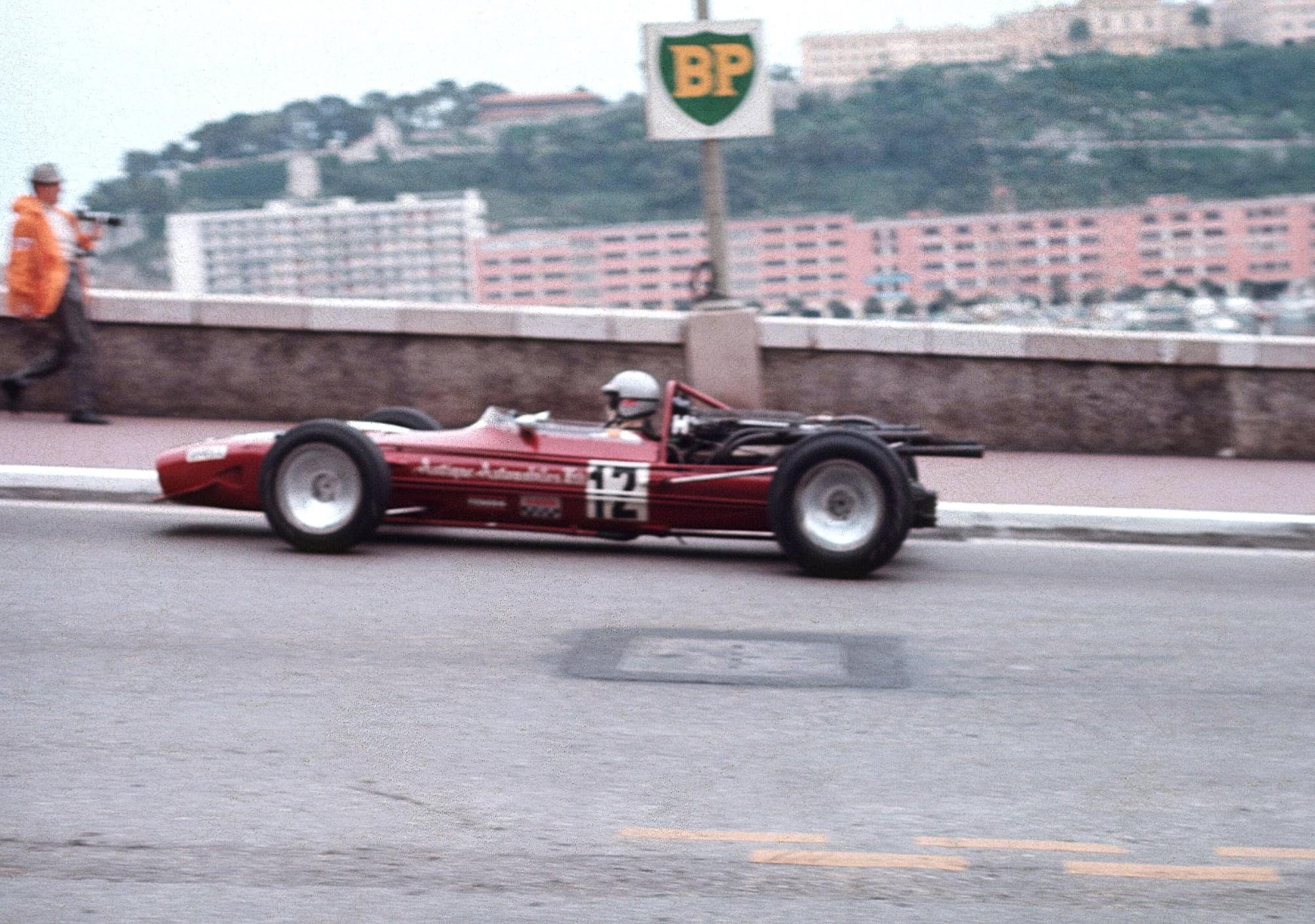
Posts Tagged ‘Vic Elford’

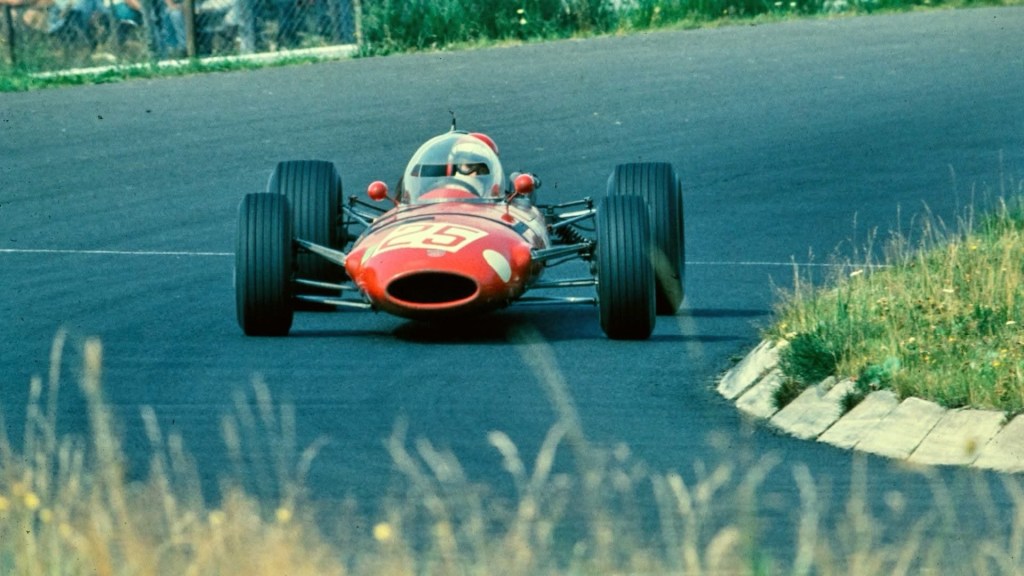
Sighting an apex, Brian Hart, Protos 16 Ford FVA, German Grand Prix, Nurburgring 1967

Brian Hart raced a Lotus F2 and F3 cars for Ron Harris in 1964-66 and was looking for opportunities in the 1.6-litre F2 that had been announced for commencement in 1967. He was after an Unfair Advantage as an innovative engineer.

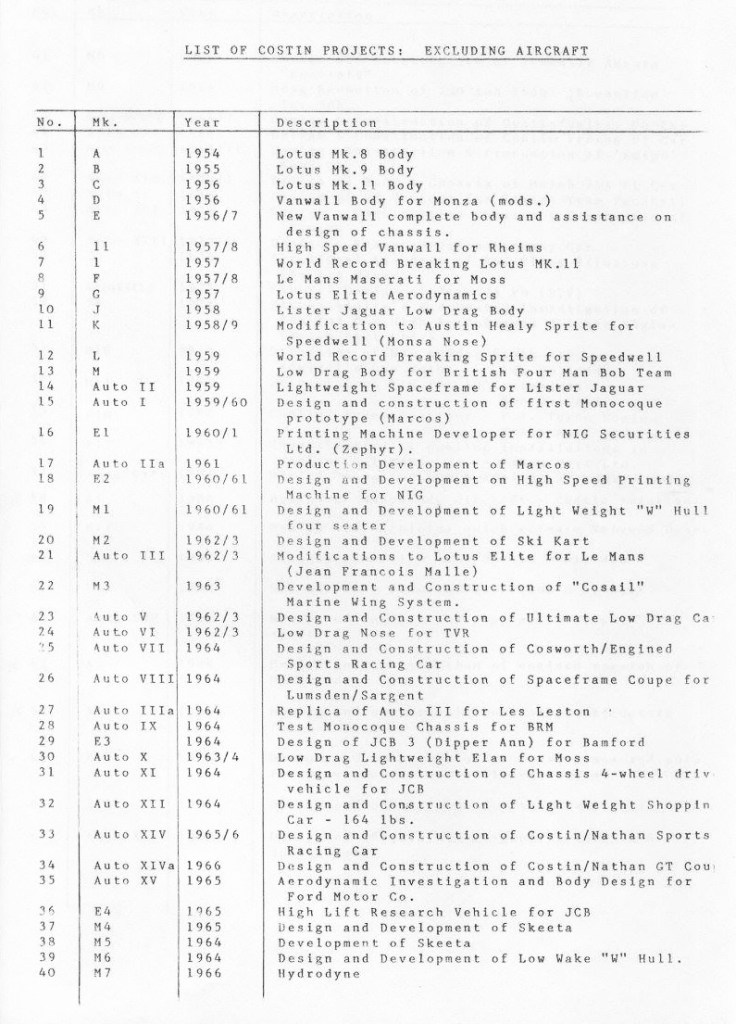
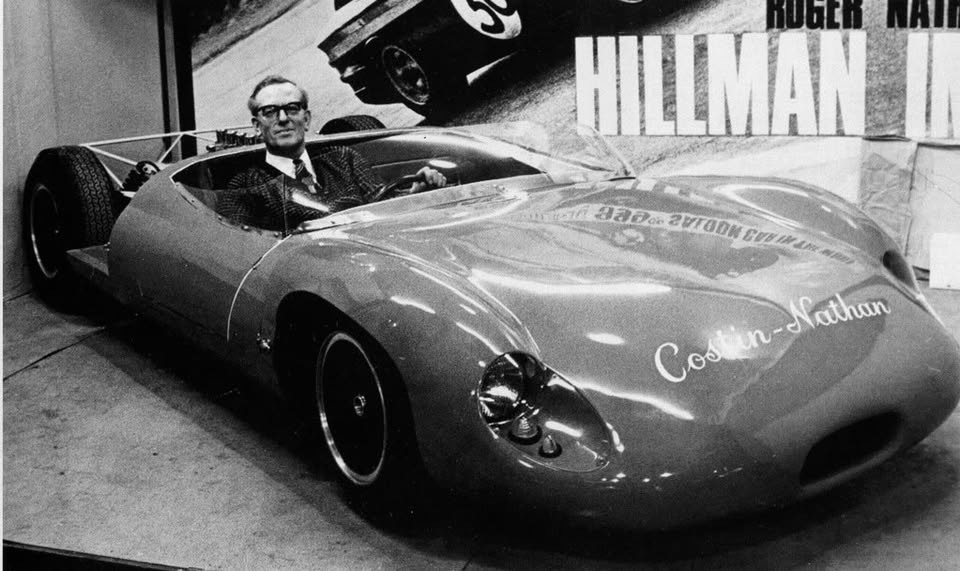
At the January 1966 London Racing Car Show, Hart sought out aerodynamicist/engineer Frank Costin – both were De Havilland Aircraft graduates – about the coming season. Costin was there to sell his new, very light Hillman Imp-powered wooden chassis Costin-Nathan sports car (below). Hart knew of Frank via his younger brother, Mike, who co-founded Cosworth Engineering together with Keith Duckworth, where Brian was an employee.
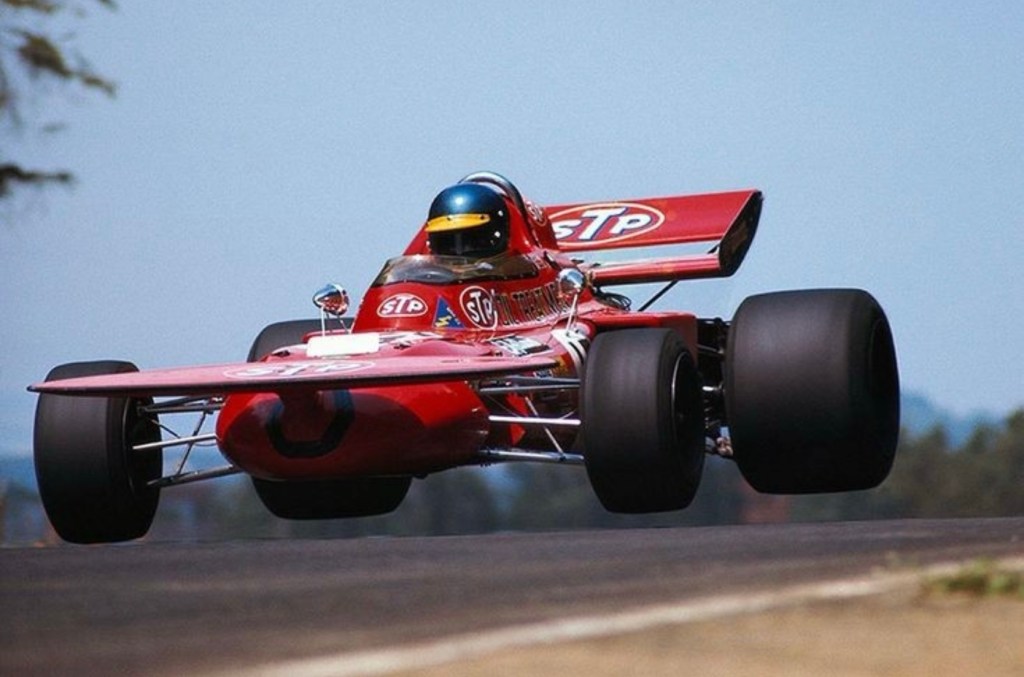
Ronnie Peterson, March 711 Ford, Nurburgring 1971 (R Schlegelmilch)

Earlier, Frank Costin had started Marcos with Jem Marsh. The first Marcos had a wooden chassis too, but Costin’s reputation came from 20 years in aviation, where he developed vast knowledge of the use of wooden structures and aerodynamic theory and practice, to wit, the De Havilland Mosquito

Post war Frank had been summoned by Mike to assist Colin Chapman on the Lotus Mk 8 sports car. Costin improved the car and worked on several more of Chapman’s designs, including Vanwall VW5, the 1958 F1 Manufacturers Championship (then called the International Cup) winning car.

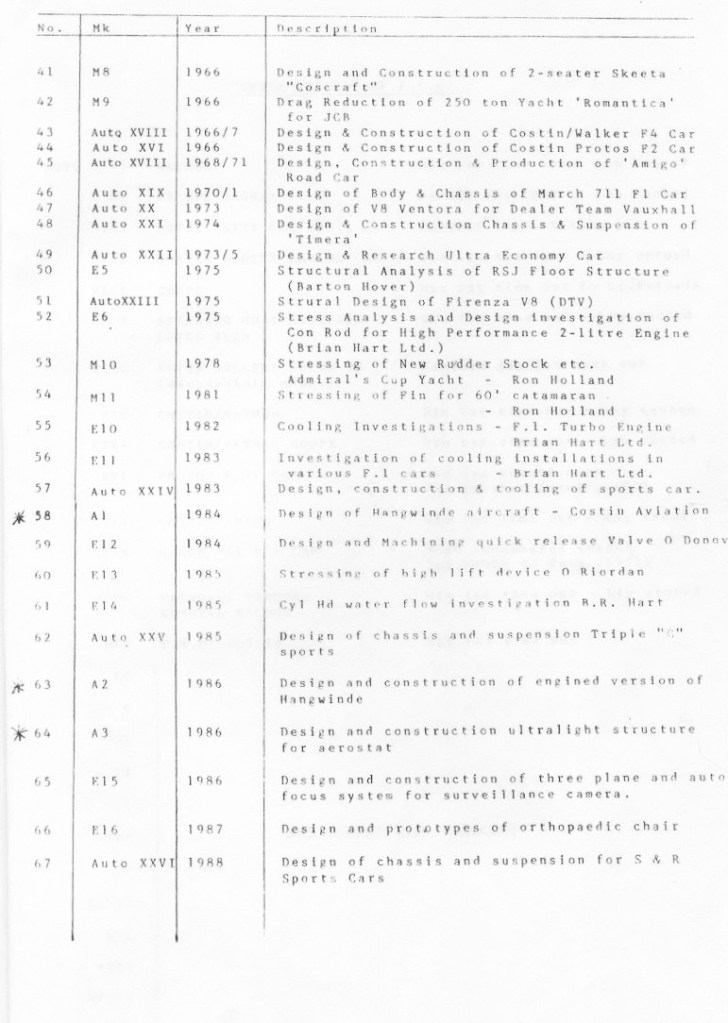
Frank’s Grand Prix involvement extended to the body design of the March 711 Ford Ronnie Peterson drove to second place in the 1971 F1 Drivers World Championship.
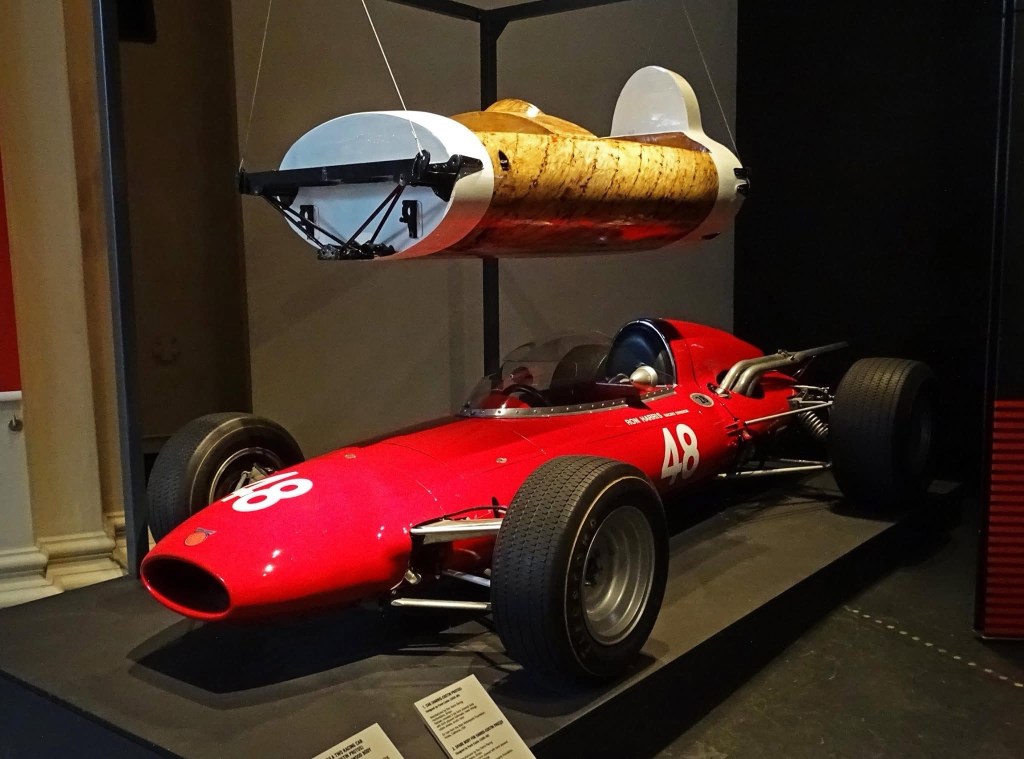
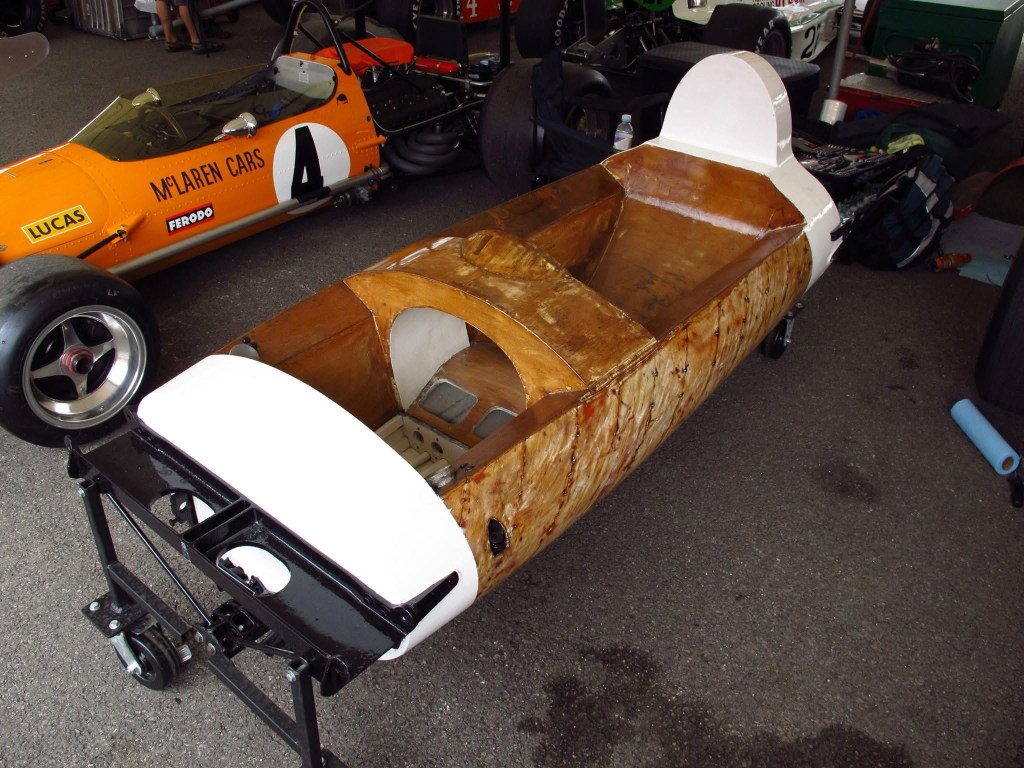
Protos 16 Ford FVA and spare monocoque on display in the Victoria and Albert Museum in 2017 (V & A Museum)

Protos Design and Construction…

Ron Harris (24/12/1905-18/9/1975), hailed from Maidenhead, Surrey, and was a motorcycle racer/dealer who made his name on Manx Nortons and other machines from the early 1930s until the war. Post conflict, he was involved in film distribution, the cash flow from that business initially funded his return to motorsport, the Ron Harris Racing Division, which ran a pair of Lotus 20 Ford FJs in 1961 (John Turner/Mike Ledbrook).

Success with them attracted Lola’s Eric Broadley’s attention in 1962 (John Fenning/John Rhodes in Lola Mk5s) and the Team Lotus F2 machines from 1963 – Lotus 35/44 – where the driving roster included Peter Revson, Brian Hart, Peter Arundell, Francisco Godia, Piers Courage, Picko Troberg, Eric Offenstadt, Jackie Stewart, Jim Clark etc.

Harris’ Lotus gig came to an end in 1966; it was time to become a manufacturer in 1967!
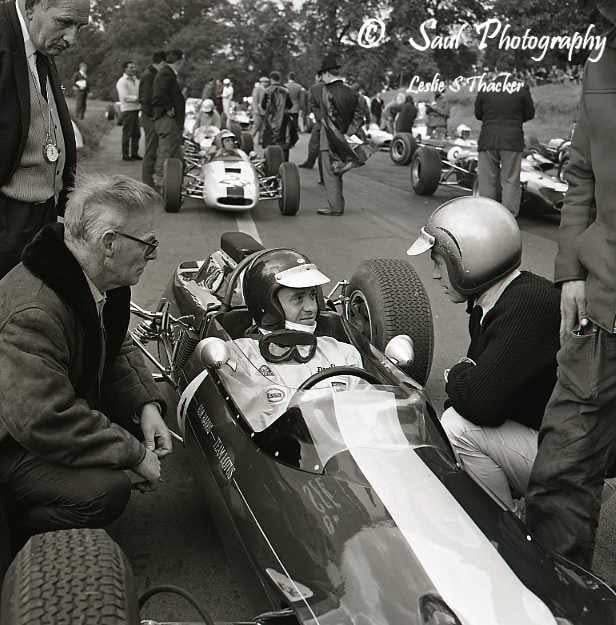
Ron Harris, Jim Clark and Mike Spence with the works Ron Harris Racing Division Lotus 35 Cosworth SCA. Gold Cup Oulton Park, September 18, 1965
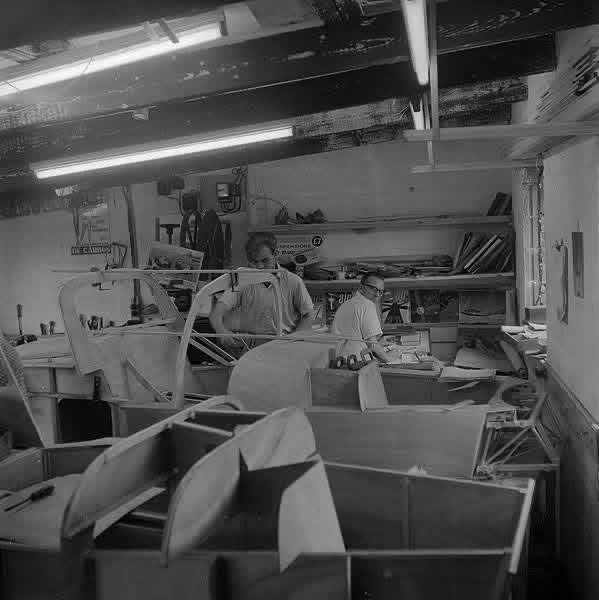
Frank Costin in Costin Research & Development’s first factory in North Wales (Wales Library)

Set in his ways, Costin built the prototype at his home in North Wales with Brian Hart doing the legwork, over 40,000 miles of fetch and carry of component purchase and sub-contracting between London and Wales in the early months of 1967. ‘Frank was a fascinating chap and spoke with such enthusiasm: he was adamant that he could build an F2 car way ahead of its time.’ Brian Hart told Paul Fearnley in a MotorSport 2009 interview.

There was huge excitement among drivers and racing car manufacturers for the new 1.6 F2 with monocoque designs, including the Matra MS5/7, McLaren M4A, and Lola T100, as well as spaceframes, with the dominant car of the year in a variety of hands, Ron Tauranac’s new, spaceframe Brabham BT23.

What became the ubiquitous engine/gearbox combination for the duration of 1967-71 1.6-litre F2, was the Ford Cosworth circa 220bhp @ 9000rpm twin-cam, four-valve, Lucas injected four, and the Hewland FT200 five-speed transaxle, was used by most. BMW, Alfa Romeo four-valve engines, the Ferrari Dino 166 and several others duly noted.

Into that environment of competitive activity, the Costin and Harris team – based in Maidenhead, Hertfordshire – designed and built two strong, light, aerodynamically advanced Protos 16 Ford FVA timber-skinned monocoques in 128 days.

Hart, ‘We were making everything apart from the engine and gearbox; there was no template like there was on a privateer Brabham.’
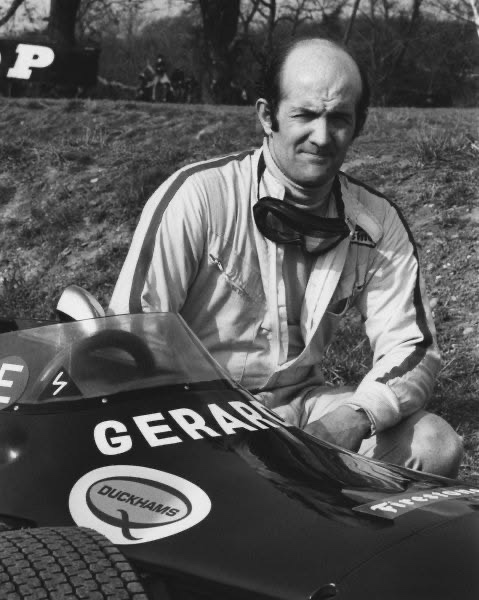
Brian Hart with his Brabham BT30 Ford FVA at Mallory Park in 1970 (LAT)
(L Ghys)

Ed McDonough wrote of the chassis that, ‘Costin’s original intention was to have one set of plywood panels bonded to elliptical plywood end panels and bulkheads with adhesives and further stress-bearing panels of spruce made to form strong box shapes on both sides of the cockpit area. Then, further layers of overlapping strips would form the outer skin. Much like modern carbon-fibre construction, Costin intended for the whole monocoque unit to be placed into a rubber tube to clamp the adhesive and form the proper shape, with the air being sucked out by vacuum. The outcome, Costin reasoned, would be very high levels of strength and low weight in a smooth shape.’

‘Unfortunately, the old spectre of time rushing by meant this elaborate process wouldn’t be possible. So birch plies were used for the outer skin, and the whole thing was clamped conventionally, and the finished wooden structure was smooth-sanded when the glue was dry.’ While this process added weight, after painting, it was hard to tell the difference between this and a steel or alloy unit.’
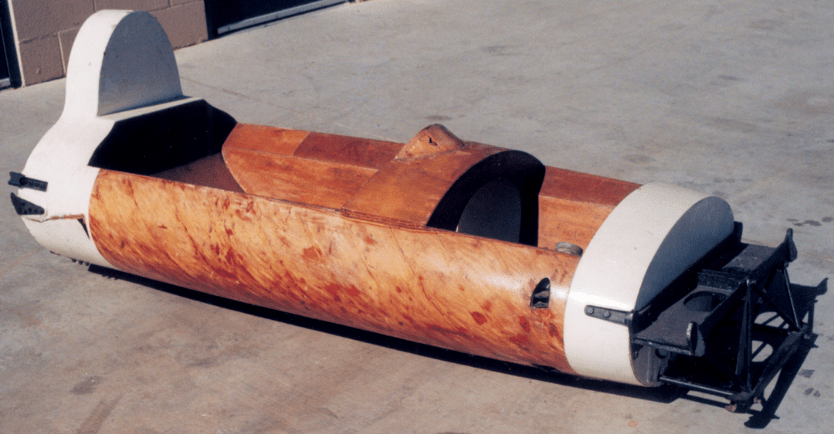
A tub with a difference, note the diagonal banding of the birchwood plies (Blain Motorsports Foundation)

With the prototype finished in Wales, the other cars were built in Harris’s Maidenhead workshop. Given its unusual construction, Harris coined it ‘Protos’, first in Greek.

With inherent fire risk, Costin designed neoprene-coated alloy fuel tanks, housed in fragile wooden bearers within the chassis. In the event of a big one, the tanks were designed to break away from the car, an element that was tested all too soon…

A magnesium bulkhead was mounted across the front of the car, and together with a light tubular subframe, located top-rockers which actuated vertically mounted, inboard Armstrong shockers, wide-based lower wishbones and an adjustable roll-bar. Front and rear uprights were magnesium.
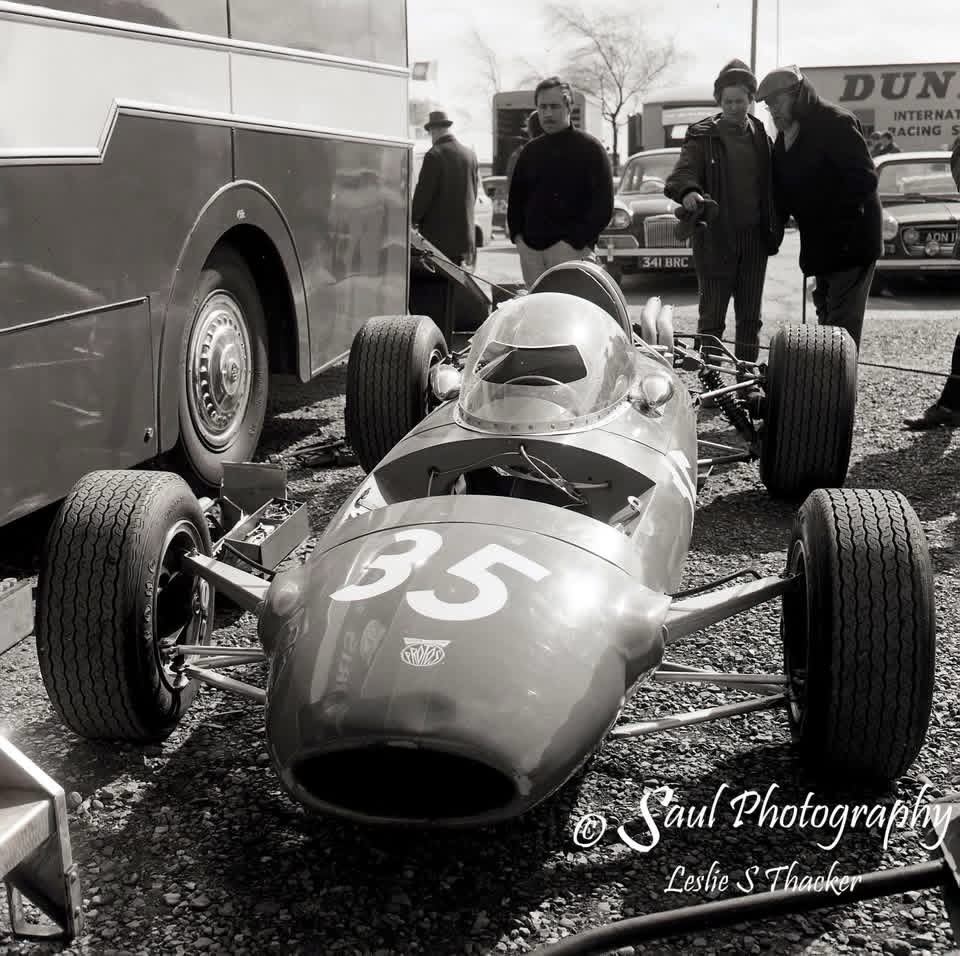
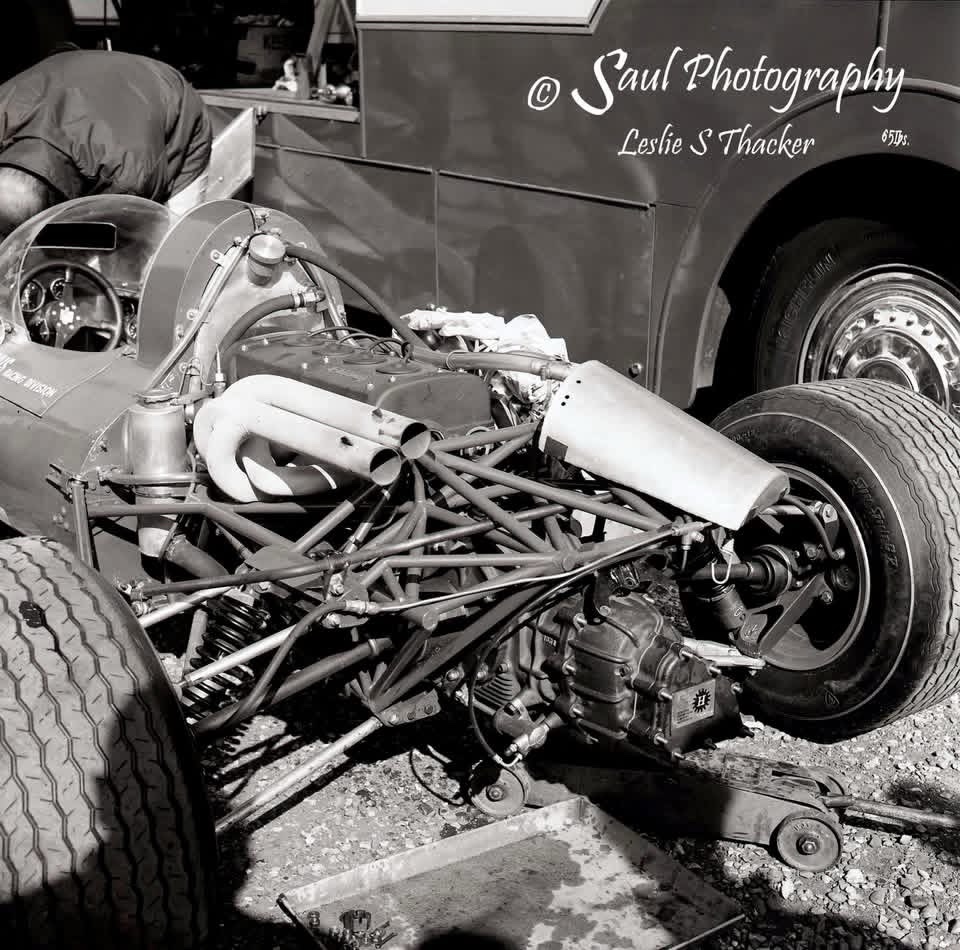
Brian Hart’s Protos 16 HCP-1 BARC 200 Wills Trophy Silverstone March 27, 1967

At the rear, a complex steel tubular spaceframe structure supported the FVA/FT200 combo with six bolts attaching the mechanicals to the tub with the load spread through the wooden monocoque via clever internally glued metal spreaders.

The rear suspension was a combination of magnesium uprights, twin top links, a wide-based wishbone with a pair of radius rods doing fore and aft locational duties, Armstrong shocks and an adjustable roll-bar. Brakes were Girling and tyres Firestone: 9 x 13 inches at the front and 11 x 13 at the rear, with wheels also magnesium.

The car looked the goods when it was launched with some fanfare at Selfridges London store’s ‘Grand Prix Exhibition’ on March 3, 1967.

1967 European F2 Championship…

Harris’s outfit built four tubs (it’s not clear to me if the four build number includes the prototype made in Wales or not), two of which were built up into complete racers with Brian Hart testing HCP1 – Harris Costin Protos – at Goodwood, putting in some competitive times despite the bodywork snagging Hart’s right-hand gear shifting gears, a ‘bubble’ alleviated the problem. Excessive front understeer was cured with changes to the ‘bars and springs.

The cars were entered in the first round of the European F2 Championship on March 24, but failed to appear. All of the other new cars were present with the heats going to Jochen Rindt and Denny Hulme, in Winkelmann and works Brabham BT23 FVAs, with Rindt – the King of F2 – taking the final from Graham Hill, works Lotus 48 FVA and Alan Rees in the other Winkelmann Brabham.

Rees took the Euro F2 Championship points as an ungraded driver. The FIA cleverly created a two-class system. Graded drivers were those who had achieved/won in F1, Can-Am, WSC etc. Ungraded drivers were up-and-comers who had not. Graded drivers could win the races and prize money but were ineligible for Euro F2 Championship points.

Hart raced the car at Silverstone three days later, on March 27, in the BARC Wills Trophy. From grid 16 alongside the Lola T100 BMW of Jo Siffert, Hart and HCP-1 retired in heat 1 when a fuel pump belt broke, while a misfire cruelled his second heat, a recurrent problem throughout the season. Rindt won again.
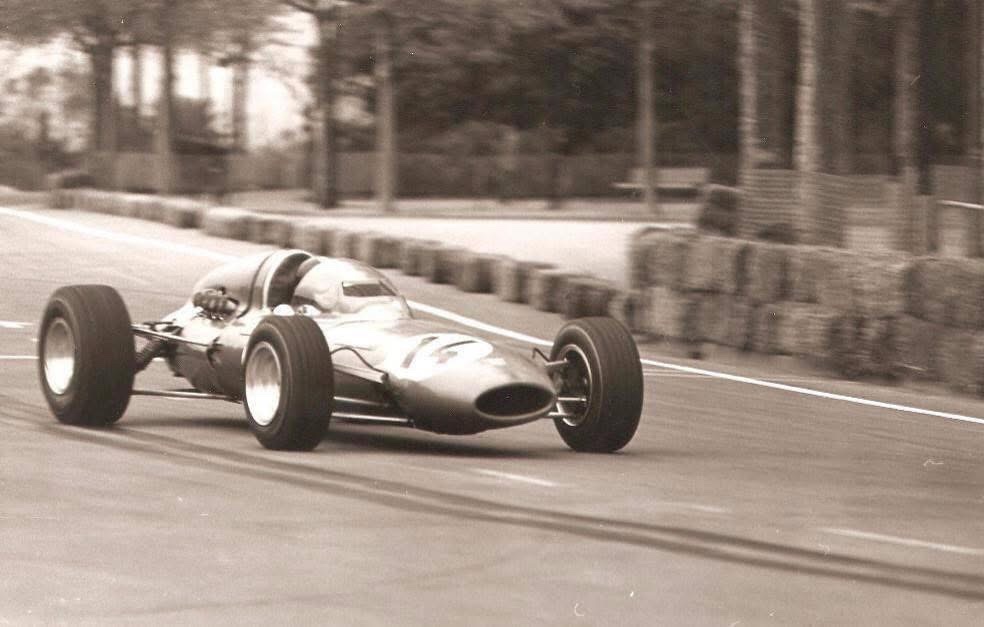
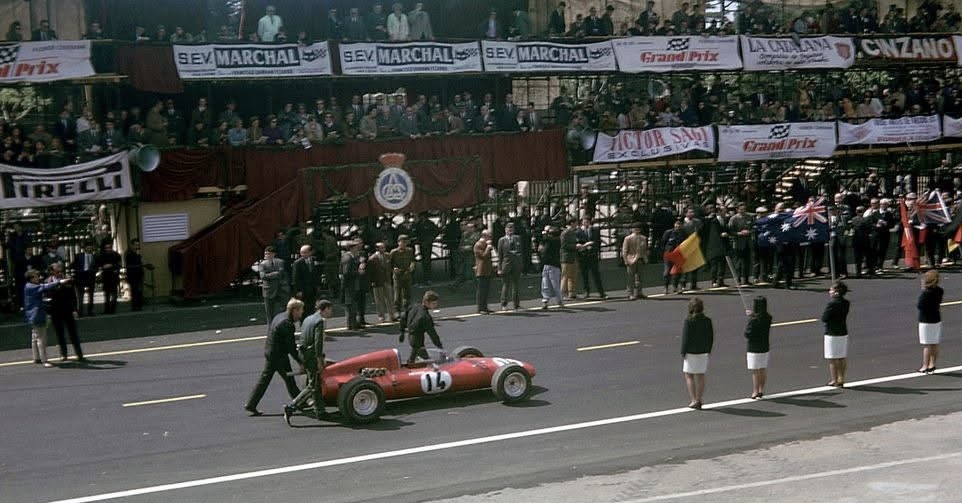
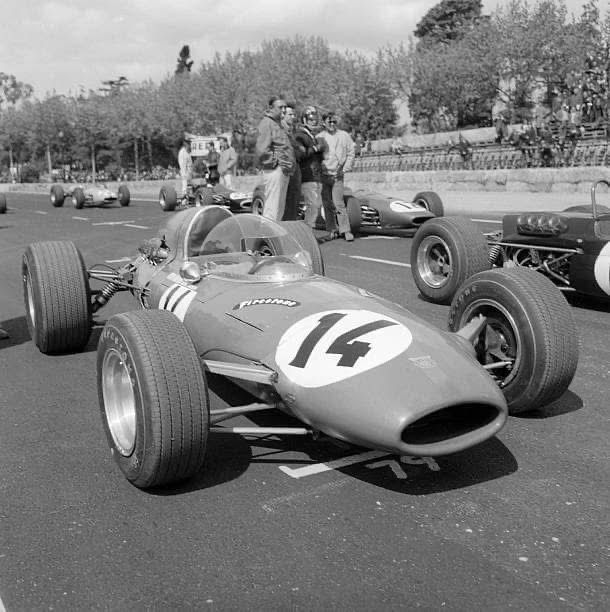
Eric Offenstadt, Montjuïc Parc, Barcelona 1967 (H Fohr Collection)
Pomp and ceremony as Offenstadt’s car is rolled onto the Magic Montjuïc grid (J Arch)

Harris entered two cars in the Pau Grand Prix (Rindt, Brabham BT23) on April 4 but the machines weren’t ready, with only Offenstadt contesting the GP de Barcelona at Montjuïc Parc on April 9. After several off-course excursions, he retired with brake and misfiring problems, having done only 12 of the 60 laps completed by Jim Clark’s winning Lotus 48 FVA.

The team missed the Spring Trophy at Oulton Park where many of their competitors raced against Grand Prix cars. Up front the Brabham BT20 Repco V8s of Brabham and Hulme were first and second, with the first F2 home Jackie Oliver’s Lotus 41B FVA.

Just two weeks later, the F2 Circus were off to the Nurburgring for the Eifelrennen and there Offenstadt took Graham Hill off in practice and non-started HCP-1.

HCP-2, was finally finished and tested by Hart. Engine misfires continued to come and go, but the team were optimistic as they headed for the RAC Autocar Trophy at Mallory Park on May 14, a British F2 Championship round. Hart qualified a good fifth, but both cars were withdrawn from the race after Costin found a crack in an upright following another shunt by Offenstadt.

New uprights were cast but the team missed the May 21, Limborg GP at Zolder, where John Surtees’ Lola T100 FVA won.

Hart tested HCP-2 at Brands Hatch, where the misfire appeared to have been cured. He then raced it in the London Trophy British F2 Championship round at Crystal Palace on May 29. Offenstadt was allocated HCP-1.

Both did well in practice and in their heat until the misfire returned: Eric was sixth and Brian seventh. On a track he knew well, Hart ran as high as third in the final before troubles dropped him back to tenth. Offenstadt’s troubles continued; this time, he retired with a broken engine mount, while up front was Jacky Ickx in a Ken Tyrrell Matra MS5 FVA.

The next championship round wasn’t until Hockenheim on July 9, so the team set to with some strengthening modifications while noting that both drivers reported the chassis itself to be immensely stiff.
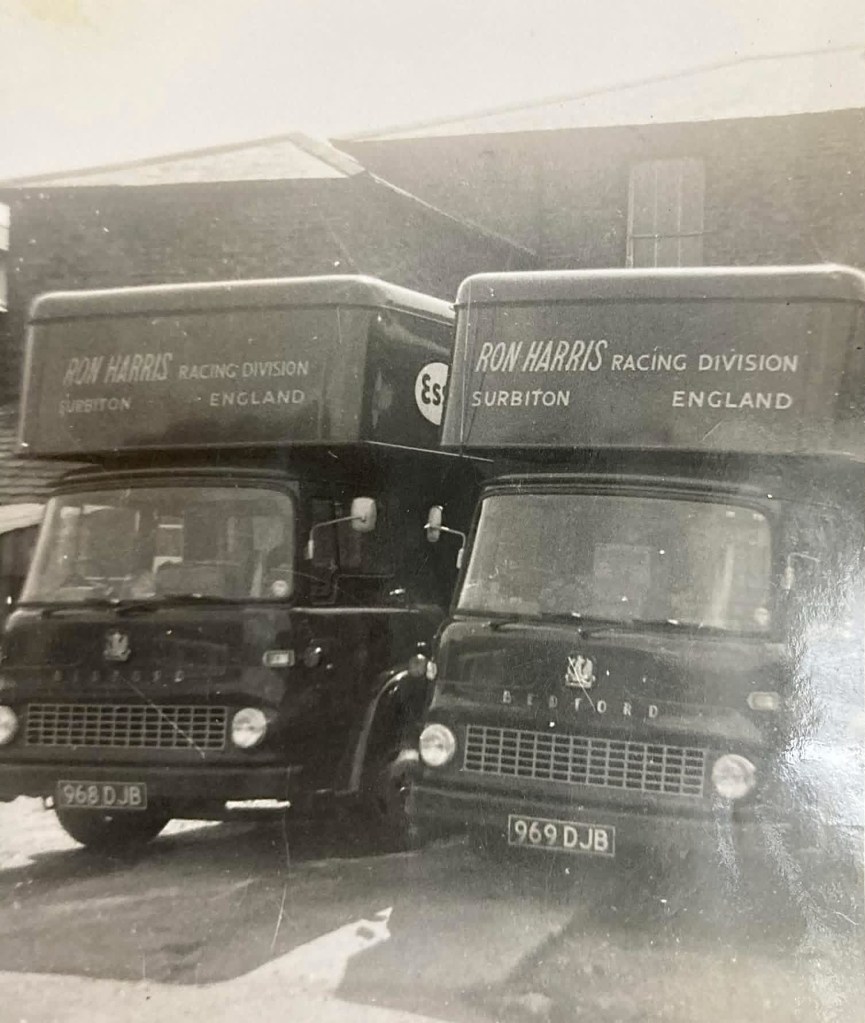
(M Stegmann Arc)

With the work completed the Ron Harris Racing trucks headed for Dover to contest the non-championship Rhein-Pokalrennen on June 11.

Offenstadt demonstrated the promise he showed in 1965 and Hart was in the leading group when he lost fuel pressure.

‘I thought I could win. The car was capable of 180mph, and I was cruising. I could pick up five to six places a lap,’ before the dreaded misfire returned. Brian eventually finished tenth with Offenstadt in a personally rousing fourth. Post-race calculations indicated a top speed of 163 mph without a tow and 172 with one! The customer car favourite Brabham BT23 Ford FVA indicated its user friendliness in that Chris Lambert won the race in a privateer BT23.

Costin observed of his Hockenheim handiwork in 1975, ‘The Protos was approximately 9mph faster at maximum speed than the slowest opposition, and 3-4mph faster than the quicker opposition. This means, given all cars were using the same engine (Cosworth FVA giving 218-220bhp), the aerodynamic advantage of the Protos was about 15bhp over the faster rivals and 40bhp over its slowest competitors at maximum speed.’
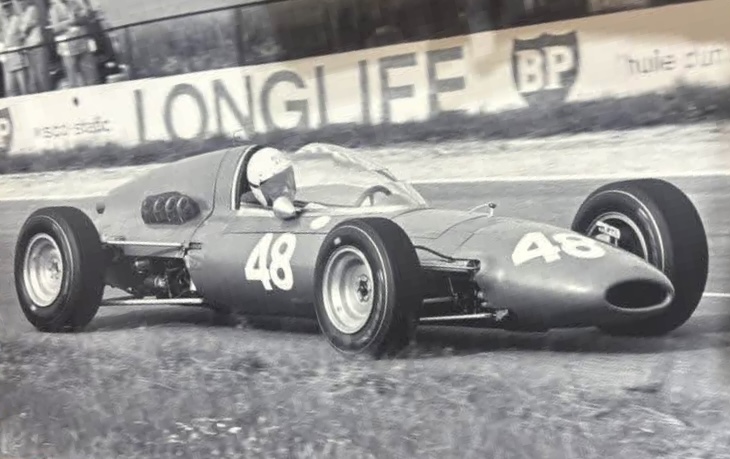
Brian Hart was the class of the field during the June 25, 1967 Reims Grand Prix (unattributed)

With the high-speed Reims Grand Prix coming up on June 25 the team continued to refine the Protos aero, including the extension of the cockpit canopy back to the roll bar.

Practice was again marred by problems, not least Offenstadt crashing again. ‘Some of these problems stemmed from the fact that one of the sponsors hadn’t paid some bills, so there wasn’t the funding for bigger brakes, a real limitation at Reims’, McDonough wrote.

‘Hart and the Protos amazed everyone with the car’s speed, catching and passing Jim Clark and Jackie Oliver (Lotus 48/41B) after a spin. The French crowds cheered as Hart would drop back under braking and then catch and retake the leaders. Unfortunately, the swirlpot cracked on lap 37, and the overheated engine quit, but the car was clearly the fastest of all the F2 machines on the day.’ Despite not finishing, Brian was classified ninth…

Pedro is bubbled-up by Ron Harris before heading out at Hockenheim on the July 9, 1967 weekend for his Protos race debut (Blain Motorsports Foundation)

The team elected to miss the non-championship GP de Rouen-les-Essarts (Rindt, Brabham BT23 FVA) on July 9 to contest the Deutschland Trophäe Preis Von Baden on high-speed Hockenheim, on the same day.

Offenstadt was replaced by Pedro Rodriguez from this meeting. Mechanical changes included new front and rear subframes, bigger brakes, and on Rodriguez’s rebuilt HCP-1, a more enclosed rear body section.

Rodriguez turned Q3 into the lead of heat 1, but he spun the Protos in the stadium section when it jumped out of gear and ultimately finished fourth in front of Hart. The Mexican again led heat 2, spun again, and then retired with a bent wishbone while Brian was third. Better was to come in the final, where Hart drove an inspired race, battling with Jackie Ickx and Frank Gardner, and ultimately finished third and bagged fastest lap. Gardner won the round on aggregate in a works BT23 FVA from Hart, with Piers Courage’s McLaren M4A FVA third.
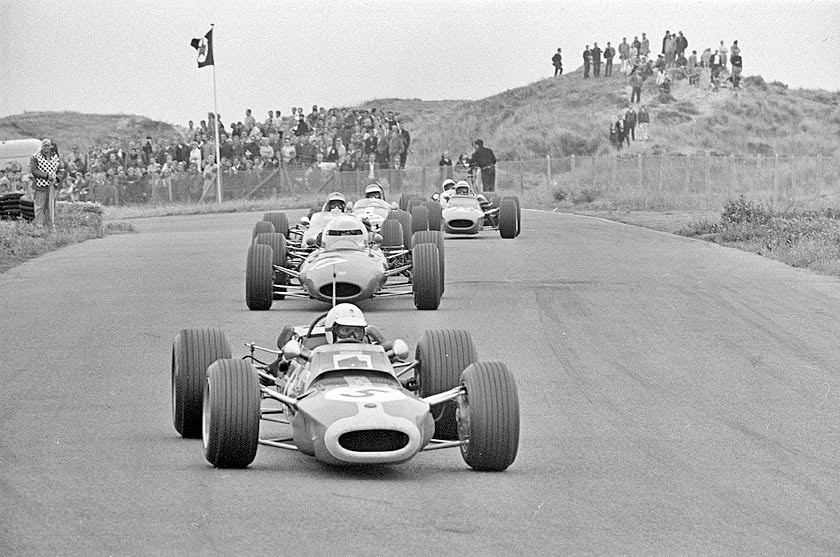
Johnny Servoz-Gavin’s works Matra MS5 FVA from Hart’s UFO Protos (fifth) at Zandvoort July 30, 1967 (LAT)

Ron Tauranac watched Protos progress closely and figured Costin’s something-for-nothing aerodynamic lessons were worth pursuing. Brabham was battling for F1 World Championship honours with Team Lotus and their Ford Cosworth-powered Lotus 49s, so Ron developed his own canopy cover and bodywork to the very rear of his Brabham BT24 Repco’s Hewland gearbox to buy critical RPMs at Monza. Brabham had trouble sighting apexes so equipped, and didn’t race the car in that form. The point is that Costin had some of the competition thinking…
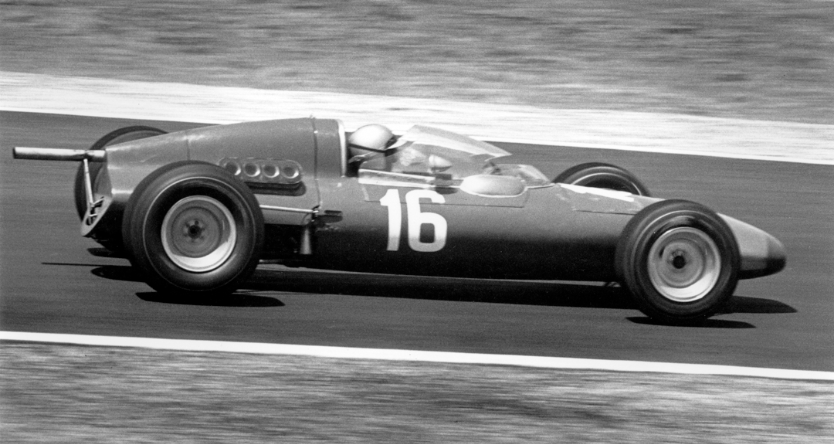
Rodriguez, Jarama, July 23, 1967 (Whittlesea Collection)

The team missed the Tulln-Langenlebarn aerodrome race in Vienna on July 16 for undisclosed reasons but rejoined the fray in Spain, where Hart and Rodriguez contested the GP de Madrid at Jarama on July 23. Hart retired his car due to overheating, and Rodriguez was seventh in the race won by Clark’s Lotus 48 FVA.

Zandvoort hosted an F2 Championship round on July 30 that year; the race in Holland was won by Ickx’s Matra MS5 FVA. Hart was sixth, with Rob Slotemaker a DNF due to gearbox problems after only eight of the 30 laps. The Dutchman stood in for Rodriguez, who was racing a JW Automotive Mirage M1 Ford in the Brands Hatch 6-Hours.
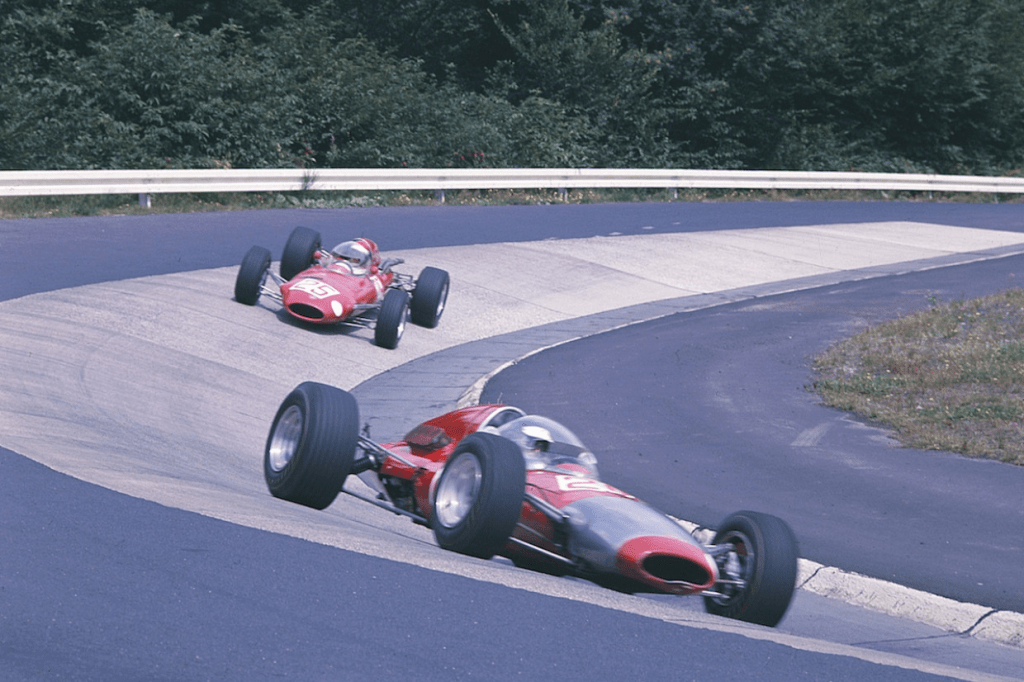
Kurt Ahrens from Brian Hart during the August 1967 German GP, Nurburgring (LAT)
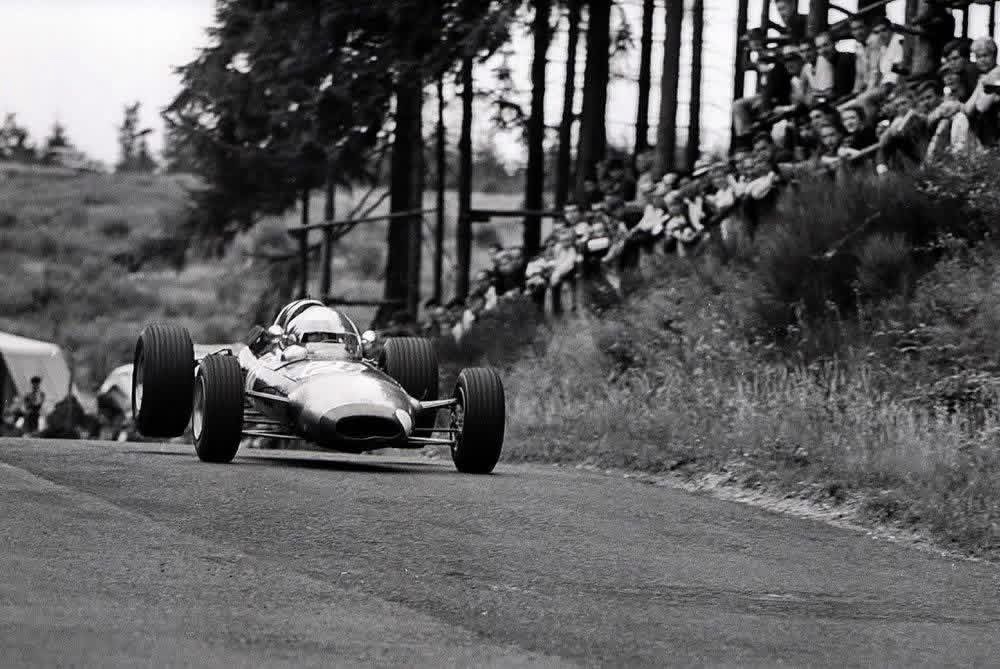
Ahrens landing at Flugplatz? DNF radiator (K Tweddel)

Talented German, Kurt Ahrens, raced HCP-1 in the F2 class of the German Grand Prix at the Nurburgring on August 6 and retired, while Hart finished fourth in class with Jackie Oliver the first of the F2s in this non-championship Euro F2 round. Ahrens was an F3 and F2 Brabham veteran of some years, his opinions of the Protos would have been interesting.

The Harris equipe missed the non-championship Kanonloppet, the Swedish Grand Prix, at Karlskoga on August 11, where Jackie Stewart prevailed in a Tyrrell Matra MS7 FVA. The F1 championship aspirant added his name to a long list of F2 race winners (in all championships) in 1967: Rindt, Clark, Brabham, Surtees, Ickx, Widdows, Gardner and Oliver.

The long haul to the wilds of Sicily for the GP del Mediterraneo at Enna-Pergusa on August 20 followed, a day on which Rodriguez put Costin’s woodie to the ultimate test!

Luc Ghys was there. ‘The track, similar to Hockenheim with long straights, led to fierce slipstream battles. On lap 10, Jackie Stewart’s Matra had Pedro on his tail, and both were passing Beltoise’s leading Matra. The Frenchman gave way to Stewart but immediately tucked in behind, touching Pedro’s car at high speed.’

Beltoise told Ed McDonough decades later how he had been surprised by the speed of the Protos. When Rodriguez attempted to pass the Frenchman’s Matra, Beltoise admitted not being ready for the move and didn’t give Pedro enough room as a consequence.
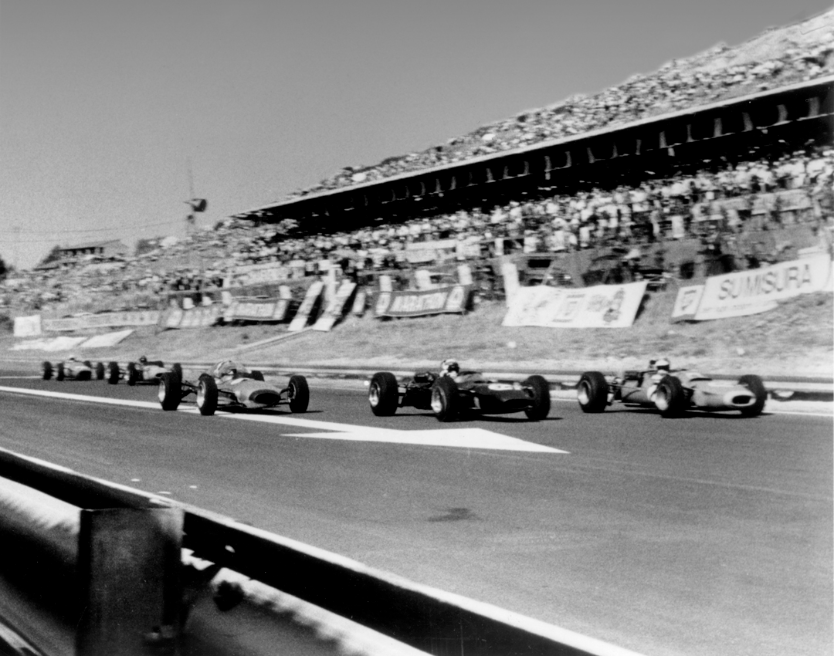
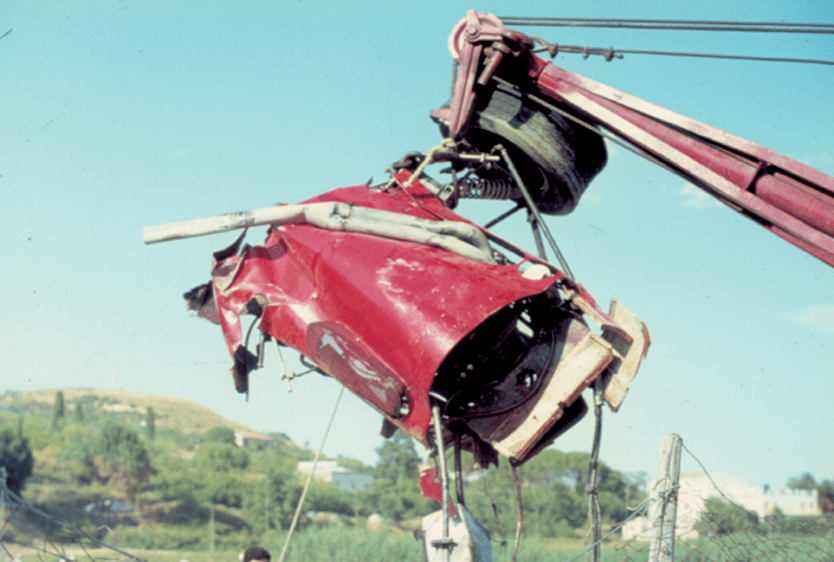
Enna-Pergusa August 1967. Stewart Matra MS7 in the middle has just jumped out of Beltoise’s MS7 slipstream on the right, JYS then passes JPB, who immediately pulls in behind JYS and collects Pedro the Innocent at left, who was in the process of making his own run in the slippery Protos (Blain Motorsports Foundation)
One careful lady owner…Protos wooden, aluminium and rubber remains at Enna (J Gleave)

The car careered out of control, hit the guardrails and broke in half, jettisoning the fuel cells as intended. The tub bore the impact as designed and protected the Mexican from serious nasties: he was still in second place as the Protos-in-bits blasted past the finishing line! Said components were then deposited into Enna’s famous snake-infested lake! Hart had a weekend of consistency, finishing eighth in both heats and the final; both Protos did 165 mph on Enna’s straights.

Pedro, interviewed not long after the race, said philosophically, ‘If it wasn’t for that Protos, I wouldn’t be here talking to you now. It has a wooden monocoque body, you see, and at about 150 miles an hour, it absorbed the impact completely. The car starts to disintegrate, and I went out of the car with the seat on in the middle of the road! The only thing that happened to me was that my right heel was what they call a poolverise fracture.’ Pedro also suffered a small fracture in his left ankle.

‘Ron called us into his hotel room (after the race),’ says Hart, ‘and not only did he say that there wouldn’t be a next year, he also said that he wouldn’t be able to pay off Frank for the remainder of this year.’ Hart’s eighth at Enna was the programme’s denouement. ‘I don’t think we would have won in our second year, but we would have been closer to the front; I think Frank could see that some compromises were needed. But we never got the chance. But what a project. I’ve got a soft spot for that car.’

Despite making four tubs, no more than two complete cars ever existed; HCP-1 was rebuilt over the winter, consuming one of the spare monocoques. Harris and Costin had initially intended to run an evolved Protos in 1968; the same decision was made by most of the major manufacturers to run evolutions of their ’67 cars, but the year had been so expensive that Harris decided to run Tecnos instead.
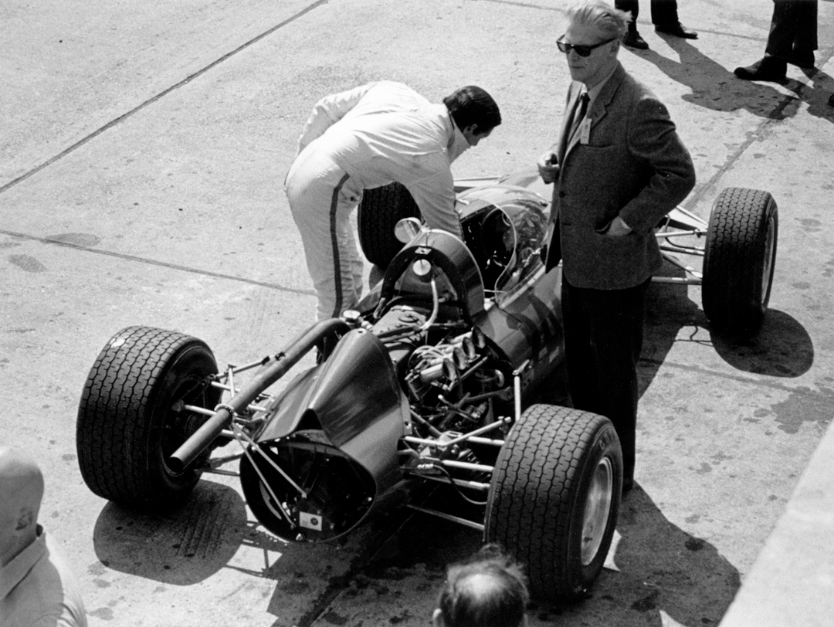
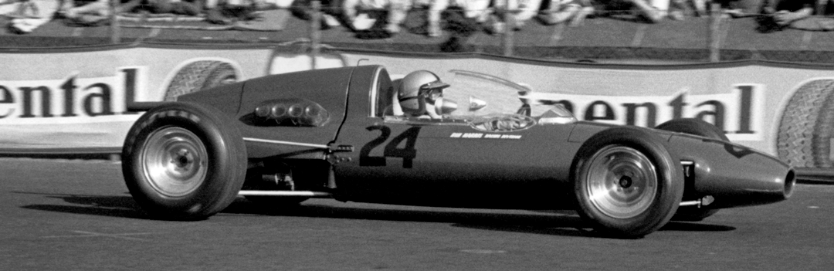
The Carnival is Over. Rodriguez prepares to saddle up at the Nurburgring on April 21, 1968 while Ron Harris waits, and below on track. The last Protos in-period race (Blain Motorsports Foundation)
(Blain Motorsports Foundation)

When the Pederzanis delivered the Tecnos hopelessly late, Rodriguez, clearly fond of the Woodies, asked Harris to enter a Protos for the non-F2 Championship Eifelrennen at the Nurburgring on April 21.

Pedro raced HCP-1 and Vic Elford HCP-2 on his single-seater debut. Rodriguez retired out of fuel while Vic finished a splendid seventh. Man On The Rise Chris Irwin won in a works Lola T100 FVA, his next visit to the Eifel didn’t end quite so well.

Sadly, that was it, Rodriguez raced the first of Harris’ Tecno PA68 FVAs at Crystal Palace on June 3 1968, then added insult to Ron Harris’ injury by crashing it on the first lap of the final, having placed fifth in his heat…the Protos never raced again.

The 1968 season was so expensive and difficult for Harris that it ended his active involvement in racing. Much of his equipment disappeared or was damaged on the late-season Temporada tour in South America, so ultimately everything was sold off.
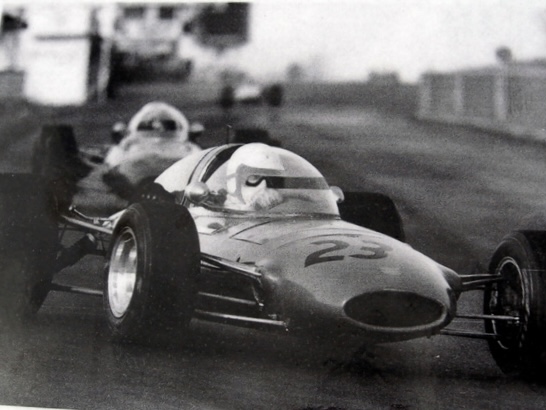
Vic Elford and Pedro Rodriguez in the final race weekend for the Protos 16 Ford FVA during the April 21, 1968 Eifelrennen weekend

Hindsight…

Brian Hart told Paul Fearnley, ‘It was incredibly fast in a straight line (a useful asset in those slipstreaming days), but it had shortcomings. The engine was carried in a metal subframe, and where this was affixed to the wooden tub was a weak point. And because the car had a rounded shape, the side fuel tanks were carried quite high, giving a bad CoG. It was heavy, too – about 25kg more than the rest – and when this was coupled with an initial lack of anti-roll bars (Costin had yet to be convinced of their necessity), it was a bit of a handful in the corners. One of our biggest failings was our inability to engineer the car once the season had started: money was tight, and we had no baseline from which to work.’

Eric Offenstadt said of the car to Michael Dawson, ‘I had a picture of my pole position at Hockenheim in front of Jochen Rindt with the Protos…but I lost it. The roadholding was “peculiar”, not because of the wooden chassis, but because of “rare suspension geometry”.

Firestone funded the project, which explains in part why Ron Harris was adventurous. The challenge to design, build, develop, prepare and race a new car was a far more complex and costly process than racing works-Lotuses that were competitive outta the box.

That the designer was reluctant to leave Wales must have made the development of the car a challenge!

Despite the design’s shortcomings, it was clearly competitive on faster tracks, with suspension geometry the area that required focus over the 1967-68 winter, had the Harris team raced on with the Protos.

The Ford Cosworth FVA engine problems the Harris team experienced in 1967 are somewhat ironic given Brian Hart Engines Ltd’s capabilities in preparing and developing these engines by 1969!…

What extraordinary racing cars those Protos were/are.

Historic Era…

Englishman Richard Whittlesea bought the two cars, HCP-1 complete and HCP-2 as a rolling chassis, restoring and racing HCP-1 and displaying it at Donington, before selling the cars to American Norbert McNamara, then later he sold them to Californian Brian Blain/Blain Motorsports Foundation, who retains them.

Etcetera…
(Getty Images-GP Library)

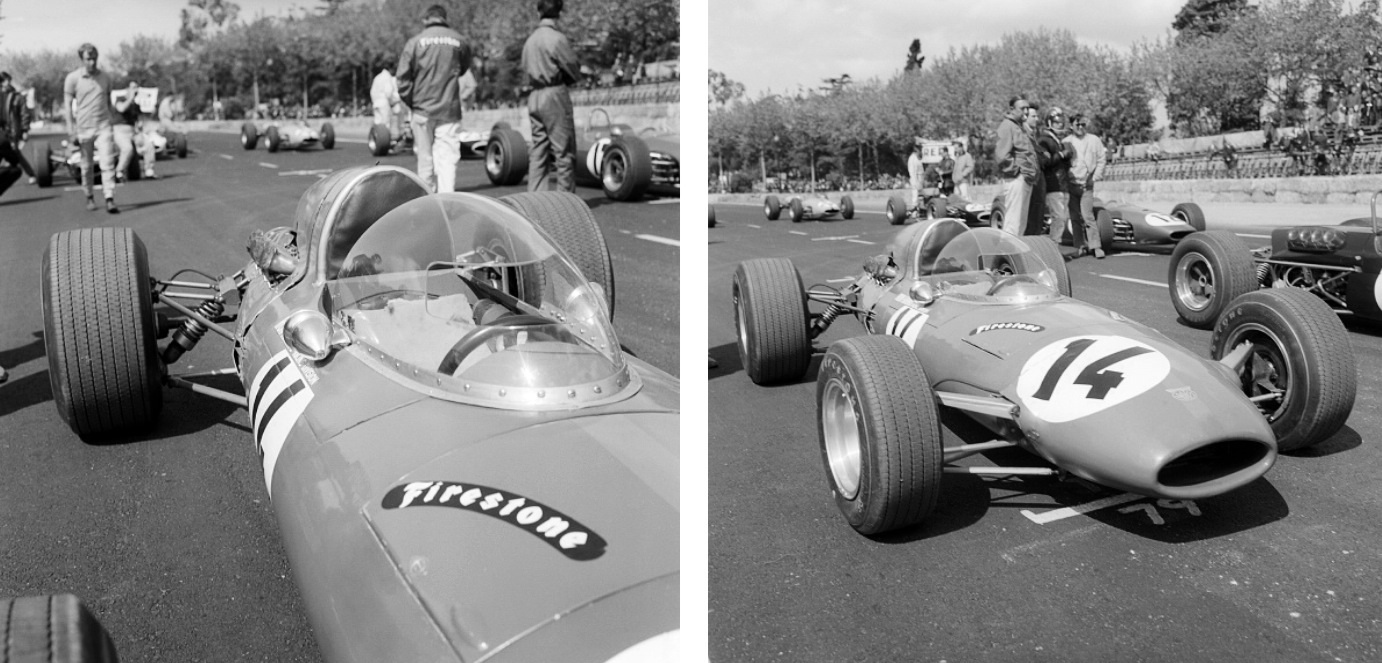
The Protos Ford FVA of Eric Offenstadt on the Montuic Park grid, April 9, 1967. Nice shot of the swept-back rockers and cast-mag upright
image

Credits…

Getty Images, Hans Fohr Collection, Steve Wilkinson Archive, Ed McDonough article on supercars.net, Pete Austin, Les Thacker, Josef Arch, ‘Aerodynamics of the modern car’, Frank Costin in Automotive Engineer magazine in 1975, ‘Ply in The Ointment’ Paul Fearnley, MotorSport November 2003, Formula 2 Racing and Frank Costin Autos Facebook pages, Mike Stegmann, Rafael Calatayud Collection, Blain Motorsport Foundation, Jim Gleave

Tailpiece…
(R Calatayud)

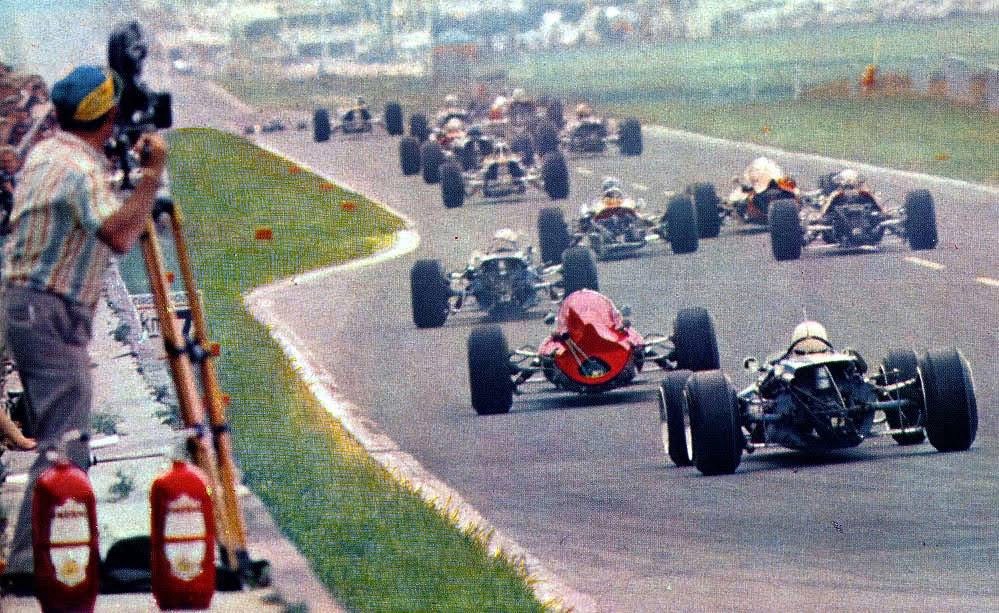
Hmmm…which cars are the Protos’ I wonder?

Reims June 25, 1967. DNF’s for both Hart and Offenstadt. Jochen Rindt’s Winkelmann BT23 FVA won from Graham Hill, John Surtees, Jackie Stewart and Denny Hulme, World Champions all! In its heyday(s) F2 was absolutely marvellous.

Finito…
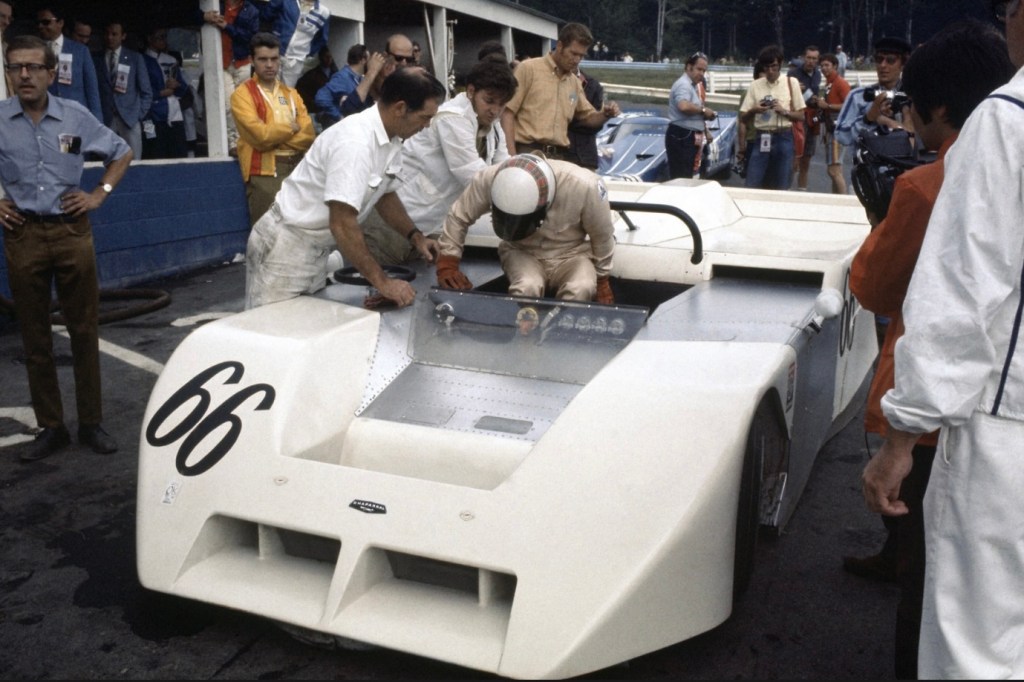


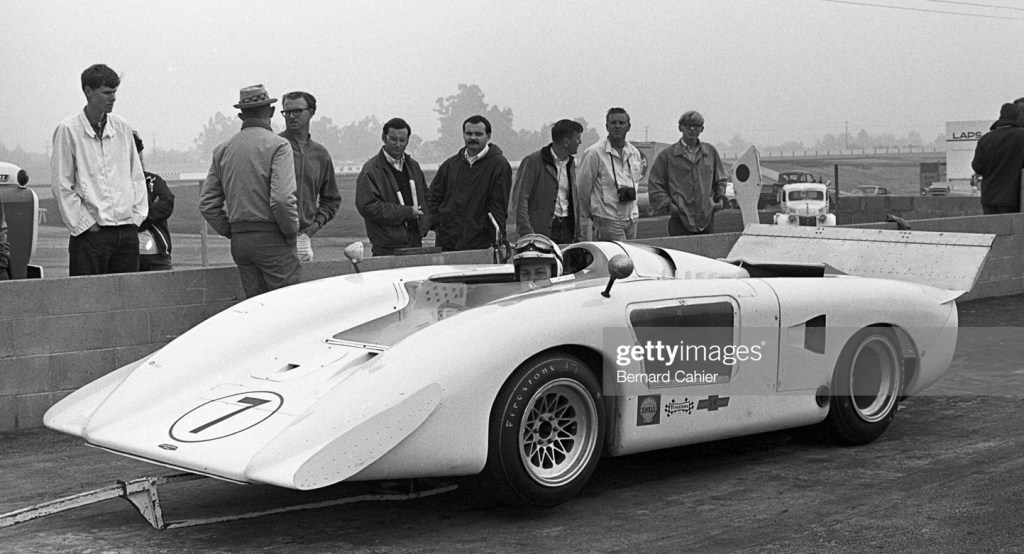
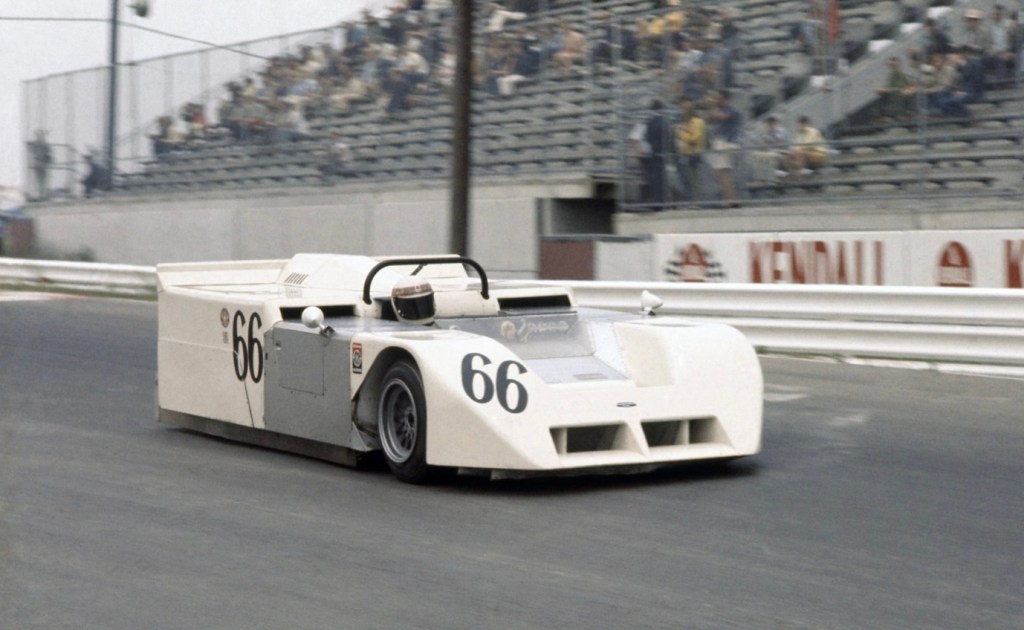
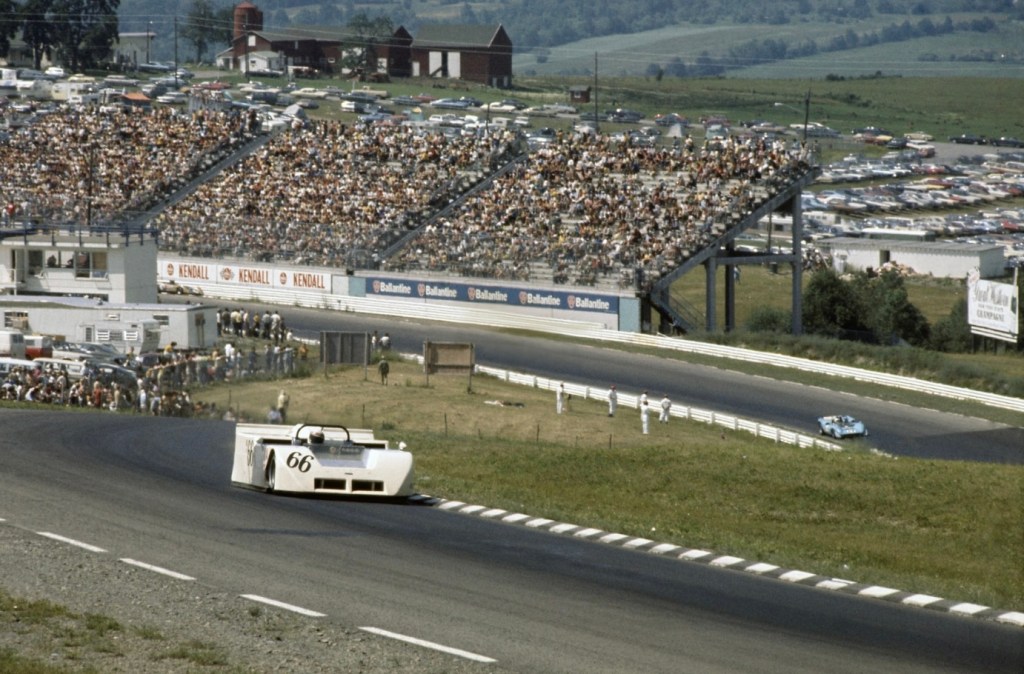
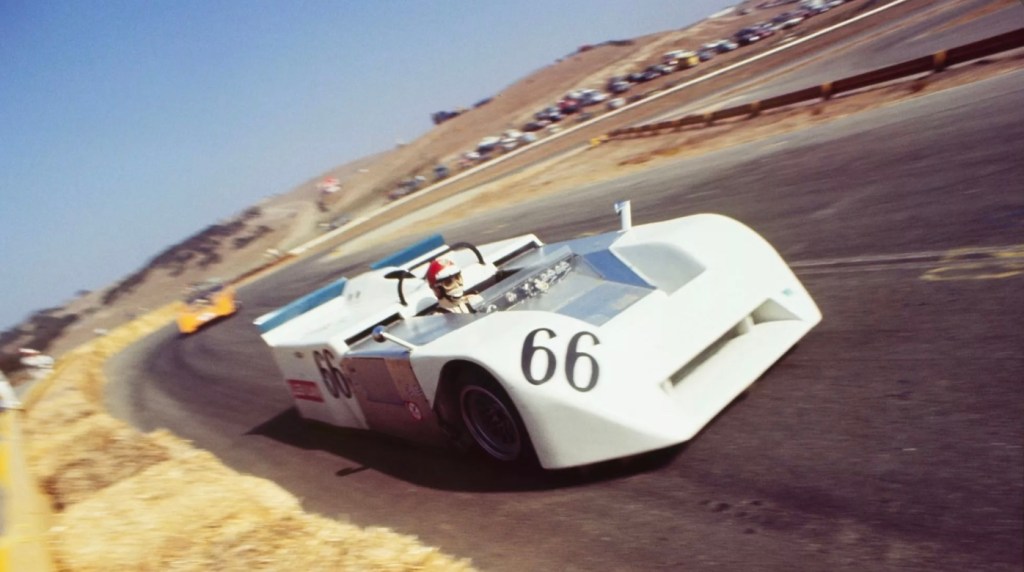
JYS loads up into the Chaparral 2J at Watkins Glen in July 1970 (LAT)

Apart from the Chaparral 2J Chev, name another car raced in 1970 that looks as edgy now as it did way back then?

I still remember flicking through Automobile Year 18 in Camberwell Grammar’s library in 1971 and flipping-my-14-year-old-lid at the sight of the 2J. My oldest mate remembers me saying, “Look at George Jetson’s car!” The only things missing were Jane, Judy, Elroy, and of course ‘rAstro!

John Surtees, Chaparral 2H Chev at Riverside in October 1969
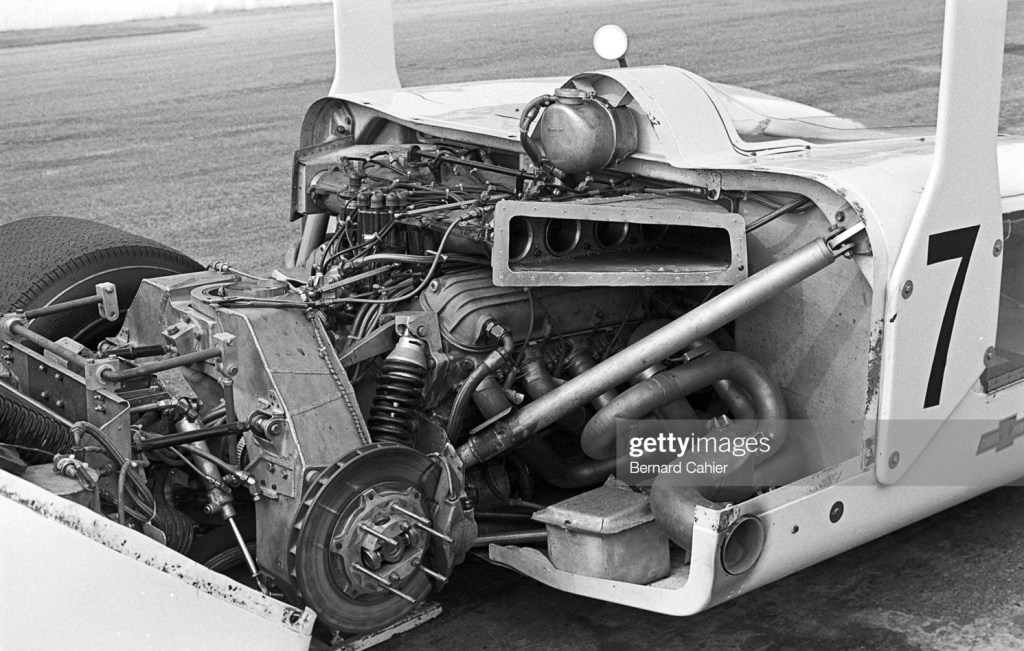
2H butt at Riverside in October 1969. Of note is the world’s biggest fabricated aluminium De Dion rear axle and one of the worlds biggest radius rods. ZL1 Chev has a crossover inlet manifold to get the fuel injection trumpets out of the airstream, ditto routing of extractors. Enormous wing fitted in this shot – you can see the vertical support – which is not installed in the shot above, remember too that this car was originally designed and built with the driver fully enclosed inside, something John Surtees pushed strongly against

Jim Hall has gonads the size of pineapples.

His outrageous 1969 offering, the wedgy, door-stop, knee high, De Dion rear-ended 2H was a complete flop. It’s driver, John Surtees, thought Hall had been smoking wacky baccy at Woodstock rather than working with clean-cut Nixon supporters at GM’s Skunkworks to design a new car.

Ever the poker player, Hall doubled his bets and concepted a machine so advanced and fast it was banned after only four races.

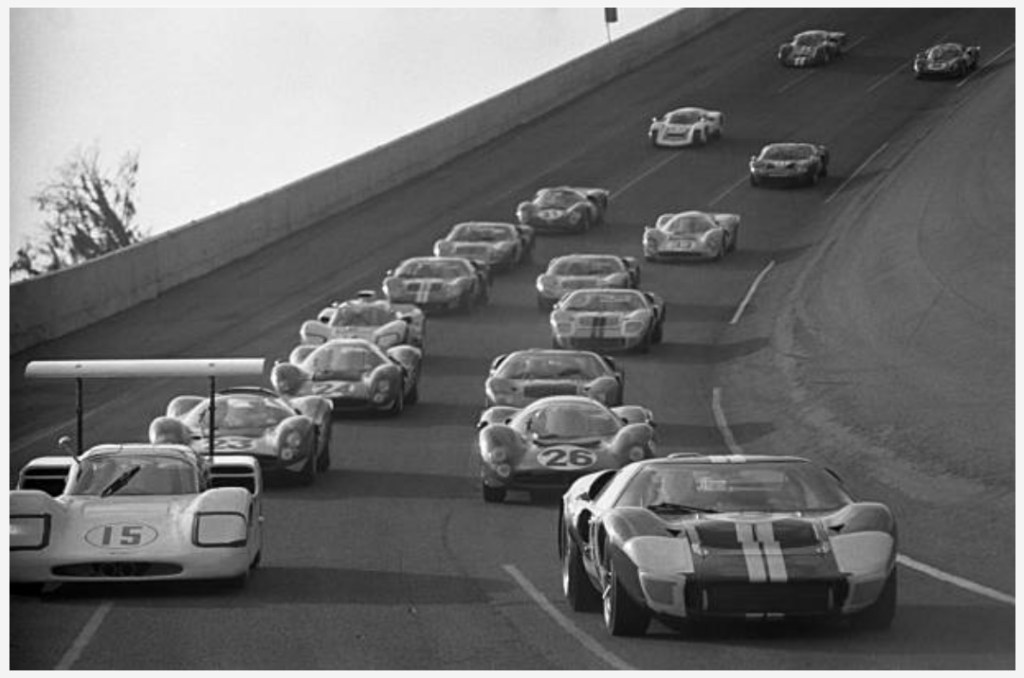
The Phil Hill/Mike Spence winged Chaparral 2F Chev looking lonely on the Daytona banking in 1967, DNF (Getty)

Chaparral had been giving the rest of the racing world aerodynamics and aero-technology lessons for five years or so to that point.

By 1970 the aluminium monocoque chassis was passe, so too was the aluminium block 650bhp’ish Chev ZL1 V8, even Chaparral/GM’s semi-automatic three-speed transaxle was a bit ho-hum.

Legend has it the inspiration for the 2J was a child’s fan-mail drawing to Hall of a sports racer being sucked down to the road by giant fans extracting the air underneath.

Whether it was ‘Elroy Jetsons’ sketch, an extension of previous Chapparral/GM R&D work, or divine providence, GM’s Paul Von Valkenburgh and Charlie Simmons, and Chaparral’s Don Gates started modelling the possibilities on Chevy R&D’s Suspension Test Vehicle.

More of a test-rig than a car, it enabled them to play with roll-centres and stiffness, ride height, pitch axis, anti-dive/squat and lots of other stuff; this rig became the 2J test mule.

“Gates worked out a fan and skirt infill defence system while Don Cox, Ernie DeFusco and Joe Marasco engineered a chassis to match,” Doug Nye wrote.

(sportscardigest.com)

The resulting tricky bits were the slab-sided, fully-fenced bodywork and Rockwell JLO 247cc two-stroke 45bhp snowmobile engine which powered two rear fans nicked from an M-109 Howitzer Tank. That combination could move 9,650 cubic feet of air a minute @ 6,000rpm, creating negative pressure equal to 2,200 pounds of downforce. Unlike other racing cars, the downforce was independent of the speed of the car.

For three-quarters of its footprint the car was ‘attached’ to the ground via skirts made of General Electric’s new, trick, Lexan polycarbonate. The skirts moved up and down with the movement of the car via a system of cables, pulleys and machined arms that bolted to the suspension. On the smoother Can-Am venues the seal was good, with the fans on the car hunkered-down by two inches.

The net effect of all of this was that the car sucked itself to the road, thereby creating immense cornering power and traction.

Stewart on the Watkins Glen grid, Chris Ecomomaki in front looking for a mike (J Meredith Collection)
Vic Elford togs-up at Riverside. The car in front is Peter Revson’s Carl Haas entered Lola T220 Chev, Revson is sitting on the pit wall to the right of the Lola’s rear. His performances in that car propelled him into a works-McLaren M8F Chev with which he won the 1971 Can-Am Cup – F1 followed (B Cahier-Getty)

During the 2J’s build Jim Hall was smart enough to give SCCA officialdom a look at the car to ensure it was kosher in the almost-anything-goes Group 7/Can-Am world. The crew-cut mob deemed it hunky-dory to race.

While the car was first tested at Rattlesnake Raceway in November 1969, the complex machine missed the June 14, 1970 Mosport season opener and the following Canadian round at St Jovite. But 2J-001 finally arrived aboard a modest ute (pick-up) at Watkins Glen in mid July.

It’s driver was reigning World Champion Jackie Stewart in a one-race deal supported by GM (weird given the Ford sponsored Cosworth engine which powered his F1 cars). JYS had plenty of sportscar experience, including Can-Am cars, but nothing prepared him for the 2J.

“The car’s traction, its ability to brake and go deeply into corners is something I’ve never experienced before in a car of this size and bulk,” he wrote in Faster! “Its adhesion is such that it seems able to take unorthodox lines through turns, and this, of course, is intriguing.”

Jackie Stewart during practice at Watkins Glen, and below, a wonderful race day panorama (LAT)
(LAT)

Stewart, and Vic Elford, retained by Hall to drive the car for the balance of the series, experienced the same other worldly, steep learning curve – retraining the brain about what was possible – as Mario Andretti encountered with Peter Wright and Colin Chapman’s Lotus 78-79 ground-effect cars in 1977-1978.

In a practical sense, half the problem was keeping the auxiliary engine alive – remember it wasn’t designed for this application – in its new harsh environment with all the trackside detritus the fans sucked up from the bottom of the car and regurgitated out the back at speed. Not to forget the skirts and their support mechanisms. The engineering challenge of this lot was mega.

Stewart qualified the brave-new-world 2J third behind the dominant orthodoxy, Denny Hulme and Dan Gurney’s new Batmobile-Beautiful McLaren M8D Chevs. Jackie closed on Dan during the race before being forced to pit, then went out for another seven laps – 22 in all – he bagged fastest lap before braking problems ended his race.

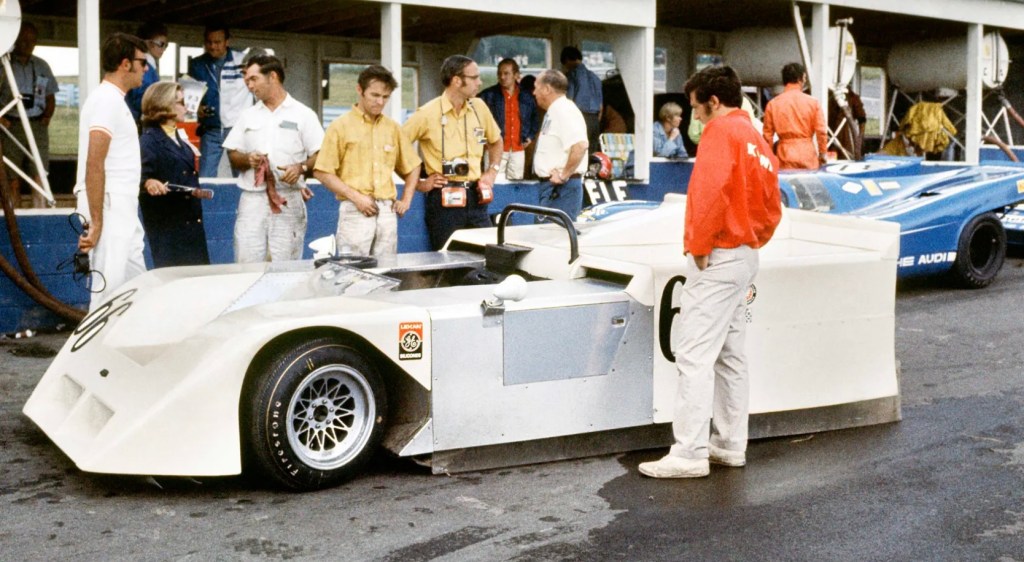
2J-001 at rest in the Watkins Glen pitlane. Sole sponsor decal is for GE-Lexan. Porsche Salzburg 917 of either Vic Elford or Dickie Attwood behind (LAT)
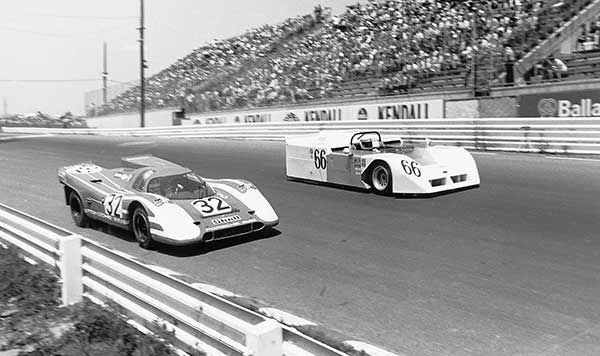
Stewart blasts past Attwood’s third placed Porsche 917. While Hulme’s McLaren M8D Chev won at Watkins Glen, the next six placings were taken by Group 5 enduro cars, not the Group 7 cars for which the race was run. Said Porsche 917 and Ferrari 512S’ had already done the Watkins Glen 6-Hours the day before, most without an engine change between the two races. The JW 917 of Pedro Rodriguez/Leo Kinnunen won (unattributed)

Context is everything. The Glen’s Can-Am round was always topped up by Group 5-6 World Endurance Championship cars which were also in town for the Watkins Glen 6-Hour.

The dominant 1970-71 endurance racer was the swoopy-rounded, spaceframe, 4.5-4.9-litre flat-12 engined Porsche 917. Alongside the 917 the 2J looked like a Sci-Fi film prop!

The Texans missed the next three rounds at Edmonton, Mid Ohio and Road America to further develop the car before rejoining the circus at Road Atlanta in mid-September.

Elford recalled his impressions of the car to MotorSport, “Drving the car was just out of this world. The start-up procedure was a bit like an aeroplane I suppose, you didn’t just jump into first gear and drive away.”

“I put my left foot hard on the brake to make sure it didn’t go anywhere, then fire-up the little engine which immediately started to drive the two monster fans at the back, sucking up the air underneath. When I did this the car would literally go: ‘Shhhp!’ and lower itself down to the ground by about two and a half inches.”

Such was the suction of the turbines, the 2J could tootle off on its own at up to 30mph if the brakes weren’t applied.

At Road Atlanta Vic popped it on pole and finished sixth after ignition problems with the snowmobile engine.

“You get to the stage of thinking it’s just not possible to go around any corner at that speed, and adapting to it mentally is the most difficult approach because no other car has ever gone around a corner as fast as this one,” Elford recalled.

“Another great thing about the suction is that it doesn’t allow the cars’s handling characteristics to change as you go through a corner. Whichever way it’s set it remains that way at all times, whether its a fast corner or a slow swerve – it remains absolutely constant.”

Come race day Elford was always impacted by the three speed semi-auto transaxle, rather than the four of the LG600 Hewland equipped competition, that wasn’t the problem at Road Atlanta though, it was the subsidiary engine.

Laguna Seca followed a month later. There, Elford was the only car to go under a minute, a smidge less than two seconds quicker than Denny Hulme, despite never seeing the place before…

“I went around Laguna in 59 seconds and it was about five years before the next car managed to go under a minute, and that was an Indycar!”

He didn’t get to start from pole as the Chevy popped a-leg-out-of-bed in the warm-up early in the day, and there simply wasn’t the time for the Midland boys to pop in a new engine. The complexity of an engine change involved pulling much of the car apart and reassembly, a days work. It was an immense bummer for the Californian crowd.

Beautiful Laguna Seca profile shot of Vic Elford shows the unmistakable slab-sided lines of the car and operation of the skirts which appear to be riding the bitumen pretty well (unattributed)
Imagine being showered by fast moving trackside shrapnel at 170mph, Dyson have nothing on this vacuum-cleaner! Elford in the Road Atlanta pitlane

The final Can-Am round was at Riverside a fortnight later. There, Elford was again well clear of Hulme in qualifying, this time the gap was a little over two seconds, these are huge margins folks.

“At one point we came into Turn 9 with Denny Hulme just in front of me. I was right up against the wall and I probably didn’t even change gear. I drove all the way around the outside of Denny in third gear. He went straight off, went into the pits and took his helmet off, sat on the pit wall and sulked for the next half hour!”

This time the Rockwell engine didn’t play ball, breaking its crank. The team managed to patch it up and take the start but it inevitably failed on lap two.

And that was it, the howls of protest were loud and long.

Not that there was any way known the 2J didn’t bristle with illegal ‘moveable aerodynamic devices’! No way can the SCCA officials who saw the car pre-season could have thought it otherwise, but – bless-em – they probably thought “Let ‘em run, the crowds will be huge and we’ll see what happens from there.”

In the process of banning it, the SCCA ripped the soul out of Can-Am in that Hall and his boys walked away.

Can-Am’s attraction was its anything goes nature which invited innovation. Anything goes was great, unless, it seems, it threatened the dominant orthodoxy. To me there was Chaparral-Can-Am and Post-Chaparral-Can-Am and the former was vastly better than the latter, with all due respect to Porsche and Shadow.

Elford in front of one of the Papaya-M8D-Terrors at Laguna Seca. Hay bales still very much around in 1970 (H Thomas/Getty)
Brian Redman, Jim Hall, the Chaparral crew and their Lola T330/332 Chevs were the dominant US F5000 force from 1974-76. Here the duo are in the Elkhart Lake pits in 1974, Lola T332C Chev

Still, Hall kept his core team together running Lolas in the US F5000 and single-seat Can-Am championships, then had the joy of watching Lotus carry the ground effect torch forward, not that Chapman ever gave any credit his way, our Col never did that to anyone.

Hall then returned with the John Barnard designed ground effect Chaparral 2K Cosworth which won the CART championship and the Indy 500 in 1980 with Johnny Rutherford at the wheel.

Lone Star JR on the way to a win at Indy in 1980, Chaparral 2K Cosworth (IMS)

That Automobile Year 18 I prattled on about at the start of this masterpiece was hugely influential in stimulating my interest in cars and racing. Six of my Top Ten cars I first saw in that tome; Ferrari 312B, Lotus 72 Ford, Ferrari 512S, McLaren M8D Chev, Ferrari Dino 246GT and of course the Chaparral 2J. The Ferraris and McLaren are all about sex-on-wheels, the 72 and 2J are a tad more cerebral.

This article made me consider what the most influential racing car in my lifetime is? Its ‘gotta be a toss-up between the Lotus 25 Climax and 2J.

All monocoque racing cars are related to the 25, the first modern monocoque. The aerodynamics of racing cars since the Lotus 78 are related to the 2J. Let’s toss the coin as to which is the more influential, let the debate begin!

PS…

I ‘spose you think I’ve forgotten John and Charlie Cooper, but they were doing their mid-engined thing way before I was born, so, I’ve dodged that debate at least. In any event, Auto Union’s mid-engined missiles won GPs pre-war.

May 1967
Thinkin, always thinkin. Jim Hall at Riverside in 1966 (B D’Olivo-Getty)

Credits…

MotorSport Images, sportscardigest.com, Indy Motor Speedway, Getty Images, J Meredith Collection, Harry Hurst, Sports Illustrated, Sportscar Digest, MotorSport November 2020 article by James Elson

Tailpieces…

“Aw come on Jim, it’s years since you raced in F1, time to return and give things a bit of a shake up.”

Jim Hall and Jackie Stewart pre-race at Watkins Glen. “Just make sure you have your left foot on the brake when we fire it up or you’ll mow down half the paddock!”

Note the fan-covers missing at Watkins Glen but present in subsequent races.

Jim Hall’s British Racing Partnership Lotus 24 BRM during the 1963 Dutch GP at Zandvoort, eighth in the race won by Jim Clark’s epochal Lotus 25 Climax. Carel de Beaufort’s ninth placed Porsche 718 in the distance (MotorSport)

Finito…

917 brands rodrig

There are drives which are spoken of in reverential terms down the decades, Pedro Rodriguez’ victory in the Brands Hatch 1000km in 1970 is one of those…

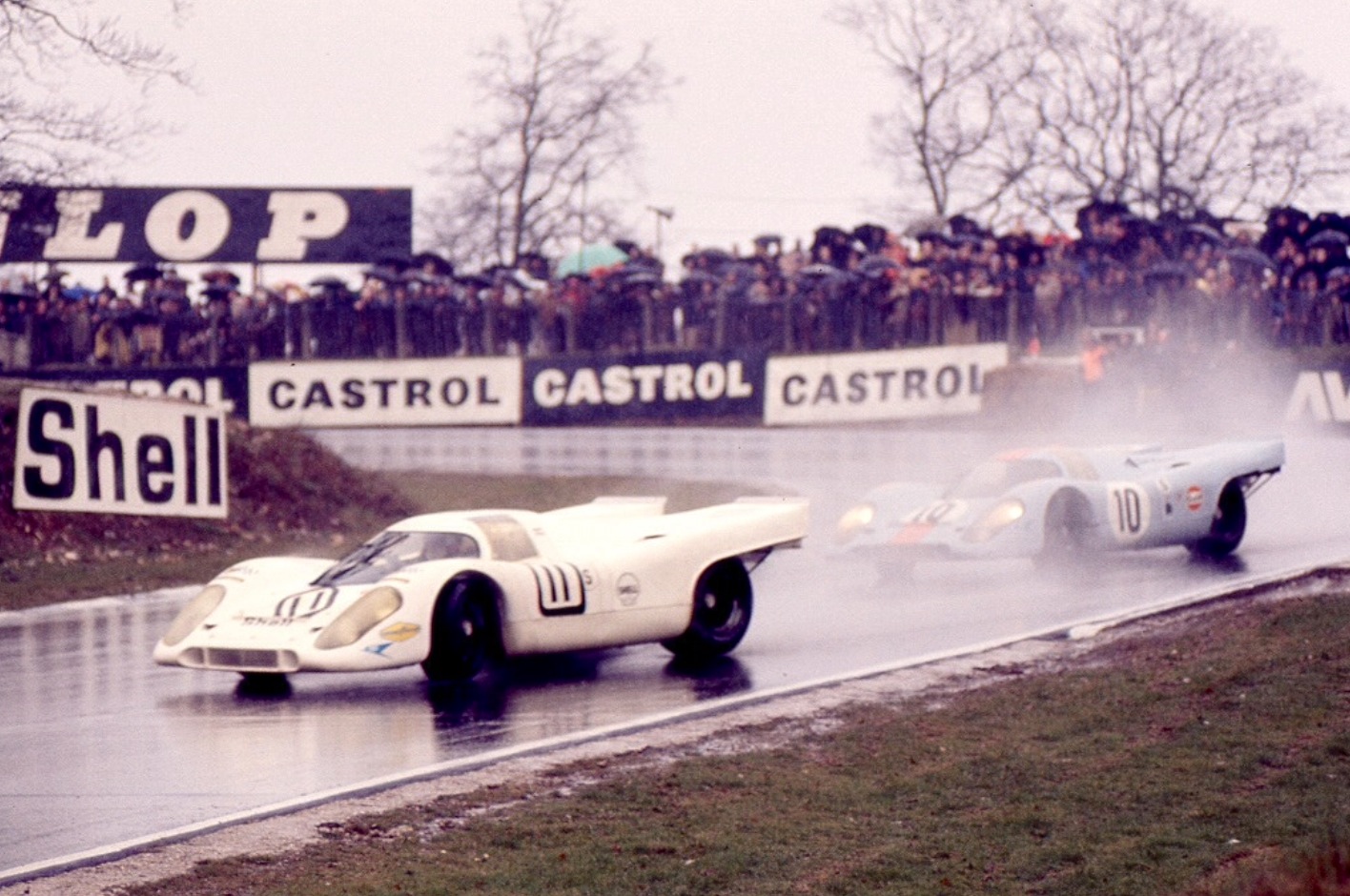
Here #10, the John Wyer entry is set to pounce on #11 Vic Elford out of Druids in another factory (Porsche Salzburg) Porsche 917K, the Brit was of course no slouch on slippery surfaces himself. He was European Rally Champion aboard a Porsche 911 in 1967 and Monte winner similarly mounted in 1968 before going circuit racing.

Acknowledged wet weather ace Jackie Ickx raced a factory Ferrari 512S in a Brands Hatch field full of F1 drivers who in those days also contested the sportscar endurance classics. But Pedro was in a class of his own on that sodden Kent afternoon finishing five laps ahead of the second placed 917K of Elford and Denny Hulme, and eight laps ahead of another 917K driven by soon to be 1970 Le Mans winners Hans Hermann and Richard Attwood, both in similar equipment to Pedro…

Photo Credit…Bruce Thomas

Finito…
(B Henderson)

Cripes! Move. My clutch! My water temperature!

Look a bit closer, the Formula 3 car caught in the 1969 Monaco GP traffic is being towed by the Simca in front. I love the creativity of Bryan Henderson’s shot, a Scot who emigrated to Sydney, Peter Houston tells me he was a Formula Vee racer in the mid seventies, he plies his trade as Scanpix.

Bryan recalls, ‘The 1969 Monaco GP was my first F1 race, i had just arrived to pursue a career as a freelance photographer and jumped on a train down to the south of France to catch the race. I remember taking the photo of the car in the traffic, I was waiting to cross the road and there was the open-wheeler in my way! I was able to get the shot as it drove away.’

So, who is it?

F2 Index to the rescue. My guess as to the number is 50, 52, 58 or 59! #50 was Bernard Plaisance who raced an Ecurie Tecno France, Tecno 69 Ford, DNQ. Car 52 did not arrive, so let’s cross him off. #58 was Peter Hanson’s Chevron B15 Ford DNQ and #59 was Roger Keele, EMC F3 Ford, he was eighth in the race won by Ronnie Peterson’s Tecno 69 Ford. I’m going for Bernard, he’s French, the other two blokes are British so would probably have a Pommie registered tow car…

I’ve chosen a few other Henderson shots which are a bit different from the average, the first is Vic Elford heading up the hill from Ste Devote in his Cooper T86B Maserati.

(B Henderson)


(B Henderson)

The next one is Jackie and Helen Stewart walking down the hill towards Ste Devote, JYS even has a bag-man, who is the guy, he looks familiar?

How great would it have been to have attended the race then, plenty of challenges too that weekend, high wings were banned after the Thursday session by the CSI so the shot of Jo Siffert’s Rob Walker Lotus 49B Ford sans wings is probably on the Friday, by Saturday front wings were back.

(B Henderson)

Credits…

Bryan Henderson at Scanpix.com.au

(B Henderson)

Denny Hulme’s McLaren M7 Ford on Pit Straight, perhaps a Matra ahead, classic Monaco shot with that home made fence in the foreground!

Finito…

(R Schlegelmilch)

Vic Elford leans his machine gun on moustachioed teammate Lucien Bianchi’s, winged Cooper T86B BRM in search of a Messerschmitt BF109, Nurburgring 1968…

This is a pretty canny bit of impromptu PR by the Cooper boys at the height (sic) of the hi-wings explosion that summer in Grand Prix racing. That trend was all over pretty quickly due to the flimsy engineering of some of the appendages, that story covered by an article I wrote a while back; https://primotipo.com/2015/07/12/wings-clipped-lotus-49-monaco-grand-prix-1969/

Cooper’s built three T86B chassis for the 1968 season by adapting the 1967 Maserati V12 engined T86 design to accept BRM’s sportscar derived customer P101 V12 first used by Bruce McLaren during the later half of the 1967 season in the back of his McLaren M5A.

Cooper T86B- aluminium/electron monocoque chassis, front suspension by top rockers, lower wishbones and inboard mounted coil spring/dampers, rear suspension by single top link, inverted lower wishbones, twin radius rods and coil spring dampers, adjustable roll bars front and rear. Outboard disc brakes front and rear, Cooper steering rack. BRM P101 2998 cc DOHC, 2 valve, Lucas injected 60 degree circa 375 bhp V12, Hewland DG300 5 speed transaxle (Bill Bennett)

The heavy, relatively lower (a Cosworth DFV punched out about 410bhp at the time) powered machines were raced initially by Brian Redman and Ludovico Scarfiotti, who was tragically killed at Rossfeld Hillclimb over the June Spa weekend. He was replaced by Lucien Bianchi, who had an amazing year in sportscars, rally machines and in single-seaters. Click here for an article in part about Lucien; https://primotipo.com/2016/03/22/cowans-grunter/

Quick Vic got the steer after Brian Redman was badly injured at Spa when his suspension failed, the car then crashed into and over a concrete barrier, his progress arrested by a parked Ford Cortina- he escaped with a broken arm and minor burns but was out of racing for a bit. Johnny Servoz-Gavin and Robin Widdows had one-off drives. Best results for the cars were thirds for Redman in Spain and Bianchi at Monaco, whilst fourth places were scored by Scarfiotti in Spain and Monaco and by Elford in France.

German GP start, gloomy to say the least! Denny Hulme’s McLaren M7A Ford in shot, to his left and forward is John Surtees Honda RA302 with Elford’s Cooper to John’s front left. Up front are Ickx and Amon’s Ferrari 312’s, Hill is to Elford’s right in the hi-winged Lotus 49 and a slow starting Stewart, Matra MS10  in front of Hulme (PH Cahier)

Vic popped his Cooper on grid 5 at the Nurburgring but left the road on the first lap of the famously wet and treacherous race won by Jackie Stewart’s Dunlop shod Matra MS10 Ford. He won by four minutes from Graham Hill’s Firestone shod Lotus 49B Ford and Jochen Rindt’s Goodyear tyred Brabham BT26 Repco a further six seconds back. Stewart was magic that day aided by some schmick, trick Dunlop wets- one of his greatest drives in the minds of many including the great man himself.

JYS during his soggy, stunning run, Matra MS10 Ford (R Schlegelmilch)

Credits…

Rainer Schlegelmilch, PH Cahier, oldracingcars.com

Tailpiece…

(unattributed)

Finito…

image

Shit! Whereizzit?, the engine in the TZ2 was in the front!…

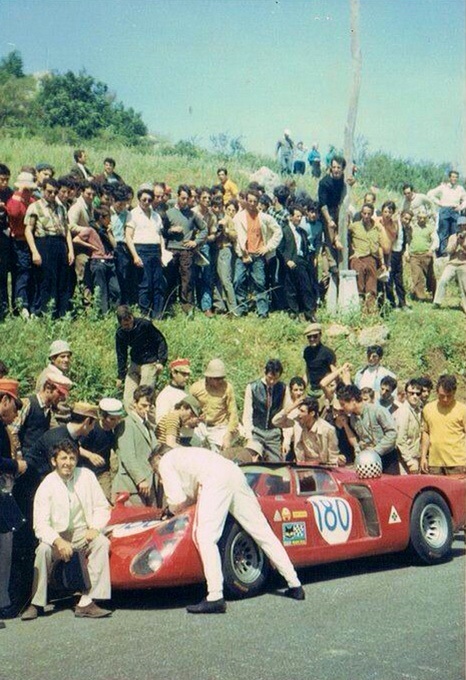
Gustave Gosselin tries hard to get his Team VDS Alfa Romeo Tipo 33/2 going by the Little Madonie roadside during the 1969 running of the Targa Florio. The joy of the punters in getting a close look at a racer and souvenir or two was not shared by the driver focussed on his fussy, recalcitrant car.

The race was won by Vic Elford and Umberto Maglioli (below in a works Porsche 907, the best placed T33 was the Autodelta entry of future GP drivers Ignazio Giunti and Nanni Galli. Gosselin’s car, shared with Serge Trosch is by the roadside on the lap one, where it stayed.

image
(unattributed)

Finito…