


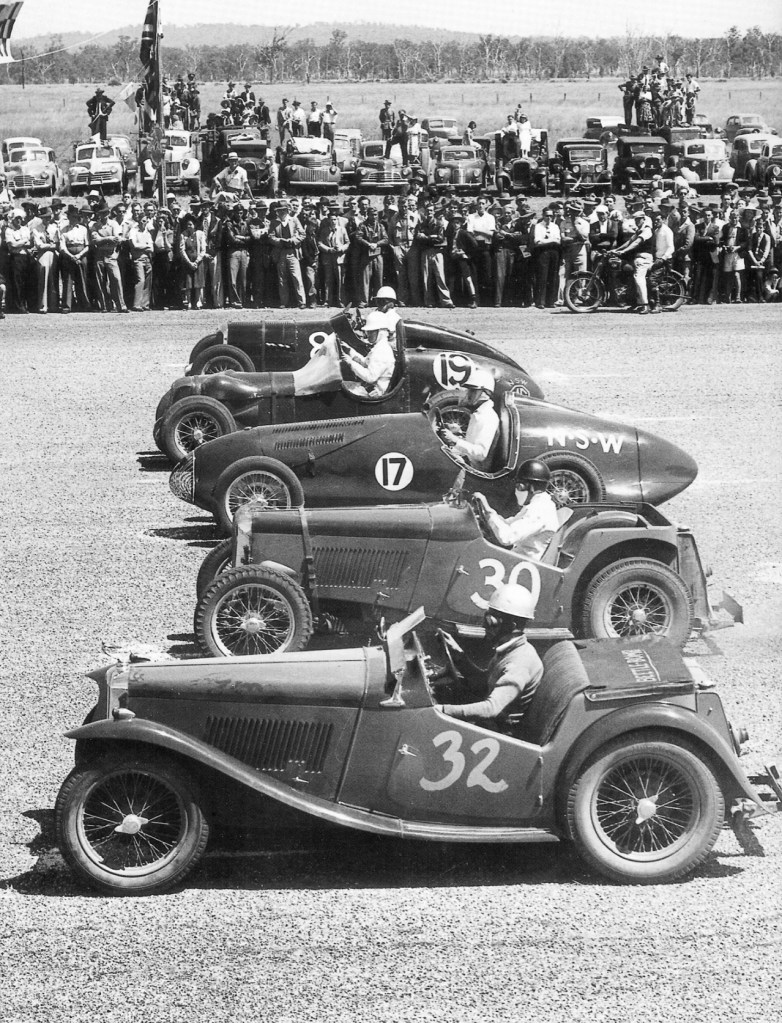
One row of the 28 starters of the 35 lap, 150 mile, 1949 Australian Grand Prix – or more likely the supporting F2 race – at Leyburn, Queensland, await the drop of the flag on September 18.
The first two cars are MG TCs, Col Robinson’s #32, and J Hillhouse in #30. #17 is the more focused TC Spl of Dick Cobden, then Peter Critchley’s fourth placed ex-Alf Najar MG TB Spl, and on the far side, Arthur Rizzo’s Riley Spl, who finished third on the RAAF airfield track
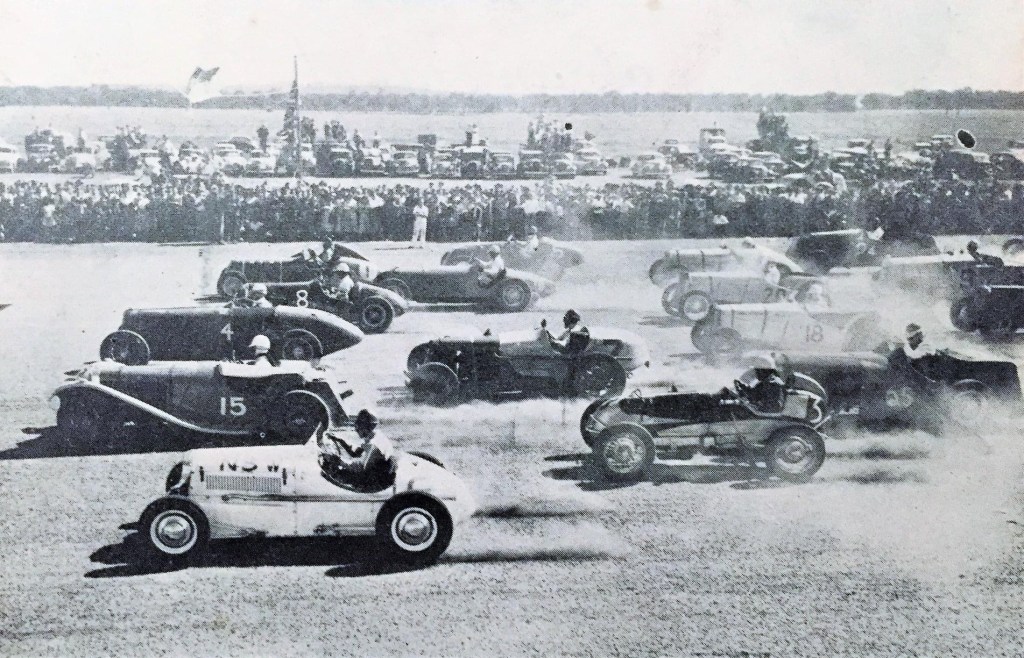
A race day crowd estimated at 30,000 people saw John Crouch’s Delahaye 135S win from Ray Gordon’s TC Spl.
The front row, away from the start is Alan Larsen, Cadillac Special ‘SoCal’, #15 Keith Thallon, Jaguar SS100, #4 the winning Crouch Delahaye 135S, #8 Arthur Rizzo’s third place Riley Special, and on the far side, Frank Kleinig, Hudson Special. The next row includes #3 Arthur Bowes’ Hudson Spl, #2 Dick Bland, George Reed Special, #25 Doug McDonald, Bugatti Dodge and #18 Garry Coglan, MG TC Spl.
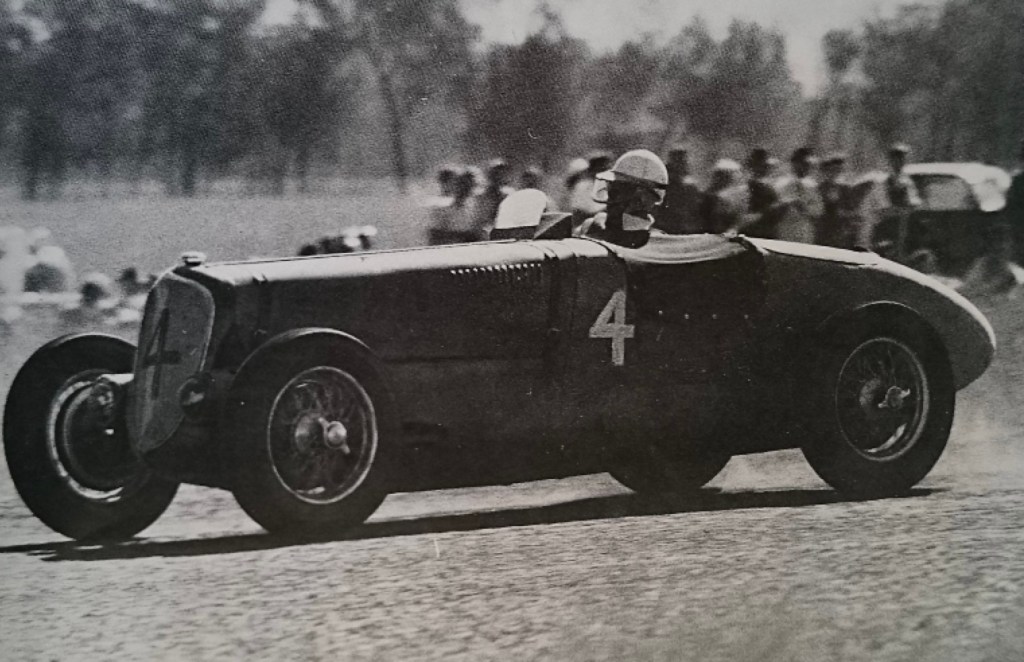
John Snow imported the 1936 3.6-litre, six-cylinder Delahaye (chassis # 47190) from France to Australia in time for the 1939 AGP at Lobethal, with the talented Crouch finally realising its potential.
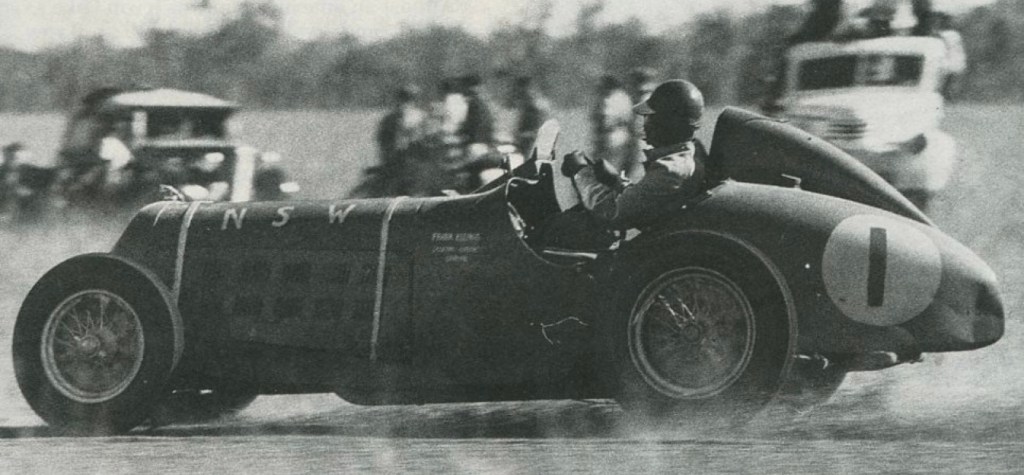
For so long the fire-and-brimstone Frank Kleinig had been an AGP favourite. 1949 was really his last chance to do well as the quality of our fields improved and his oh-so-fast Kleinig Hudson Spl slipped down the grids. Its development potential by then having pretty-much peaked.
Kleinig led Crouch for seven laps – they shared the fastest lap of the race 2’52 seconds/90mph – but then had the first of three pitstops which led to his retirement after completing only 21 laps.
Dick Cobden’s shapely, quick, Gordon Stewart built, Bob Baker bodied, 1946 MG TC (#3306) ‘Red Cigar’ single-seater (below) was out early after only six laps with undisclosed dramas.

Thanks to Terry Sullivan for pointing out this interesting article about the machinations and difficulties associated with the staging of this race; The AGP When Any Airfield Would Do – The Race Torque
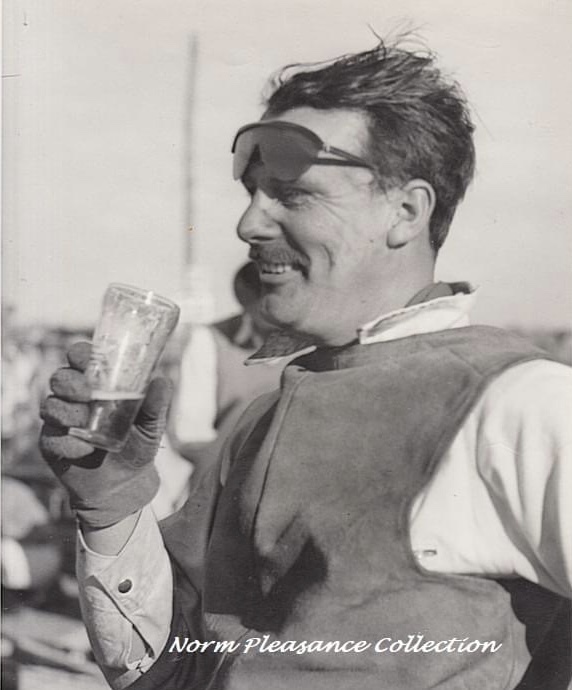
John Crouch deals with the rigours of the day in typical Australian fashion.
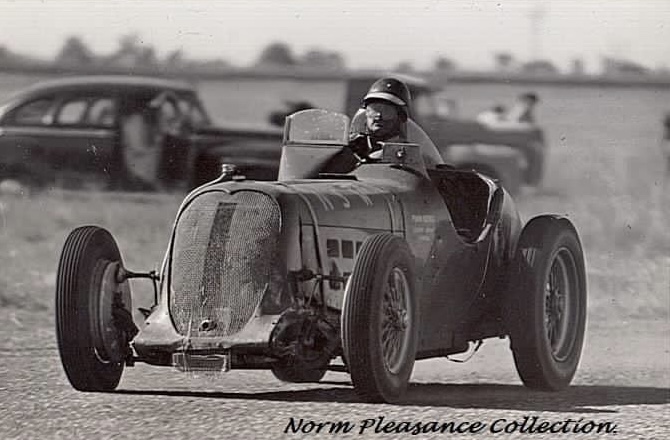
Frank Kleinig on the hop, see more for this ever evolving, famous Oz racing car; https://primotipo.com/2019/12/06/frank-kleinig-kleinig-hudson-special/
Etcetera…
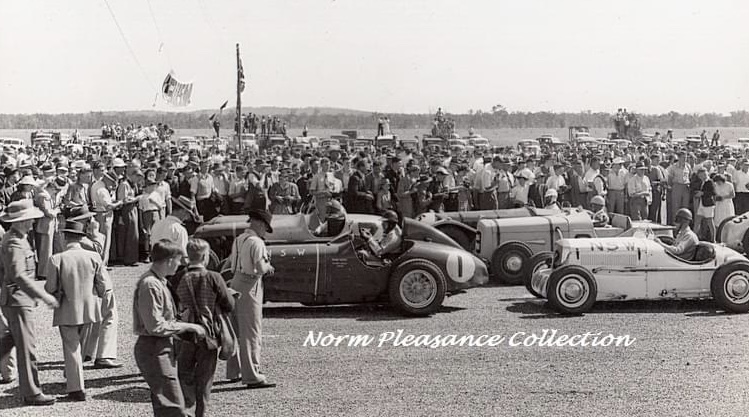
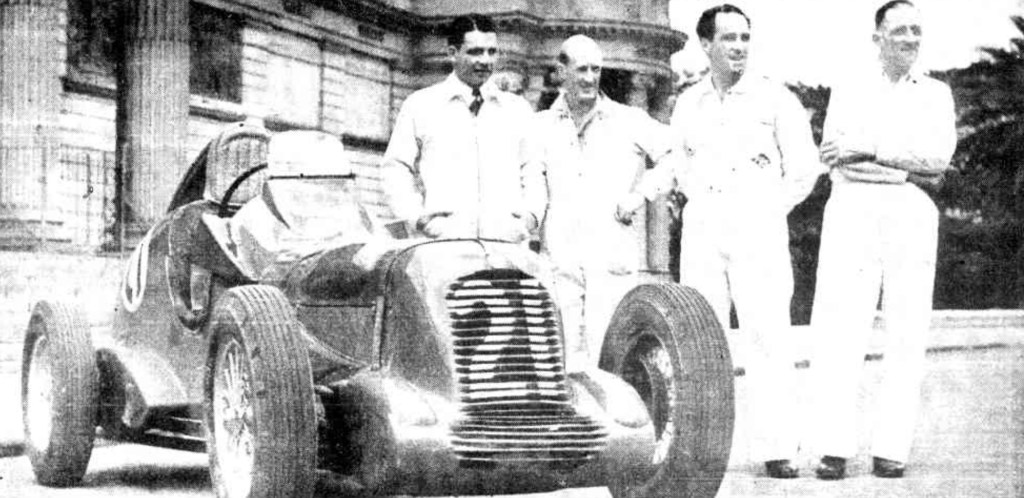
The Brisbane Telegraph caption of this pre-AGP promo piece reads, “Teamwork counts and here are seen NSW motorists, Alf Najar (left) who will be relief driver of Peter Critchley’s (ex-Najar 1946 NSW Grand Prix winning) MG TB Spl (second from right) the winner of the 1948 NSW Grand Prix (at Bathurst), Arthur Rizzo, and their mechanics.”
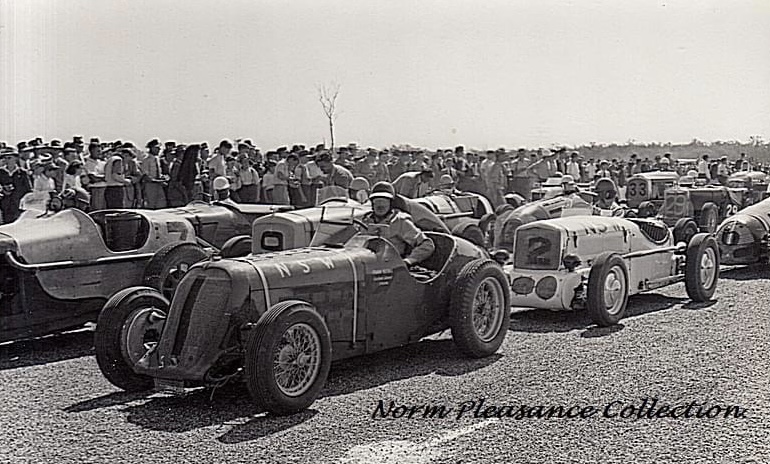
Kleinig again, #2 Dick Bland in the George Reed Ford V8 Special, #7 Alan Larsen, Cadillac Spl and the rest – #29 Brydon’s MG TC Spl and #33 at the very back is the Ford V8 Spl raced by Jack Wright.
Credits…
Wikipedia, racerviews.com, Rob Bartholomaeus, Stephen Dalton, Dick Willis, Brisbane Telegraph, Norm Pleasance Collection-Warwick Daily News via Daniel Kleinig
Tailpiece…
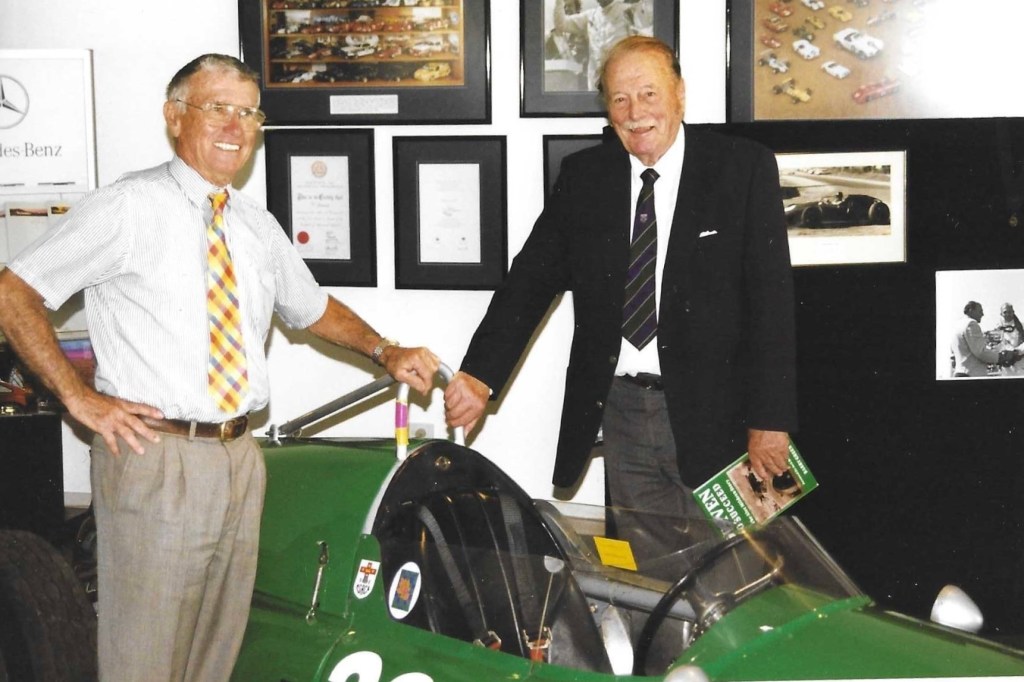
Racers both: Charlie Smith and John Crouch at the launch of Alec Mildren’s biography at Frank Gardner’s Norwell, Gold Coast facility on April 18, 1999.
Finito…
 primotipo...
Hi Mark,
Great article , coincidence that this very same model was recently featured in the Automobile on the cover?? I think the Australian example may have been destroyed in a fire??
But I will leave that to the experts.
Love your work.
Cheers
Iain R
Hi Iain,
I’ve not seen that issue of The Automobile, so I’m not sure.
The ‘Oz Delahaye 135S #47190 was famously turned into a corn-chip on the way back from finishing second in the 1951 AGP at Narrogin in WA’s wheatbelt. One of Dick Blands crew flicked the butt of a fag out the window – on the way back to Bathurst – and it set the tarp over the car alight, in the ensuing BBQ the car was ‘destroyed’ beyond its then economic value.
If my memory is correct, Ian Polson bought the remains in his days in Australia as an engineer at Chrysler Australia at Tonsley Park, SA. He later restored/rebuilt/recreated it in the UK, and after using it for many years sold it.
Who has it now? No idea, but that info is probably a simple Google search away…
Mark
Mark,
Re your question on the unidentified MG #30 in the first photo, the 80 Year AGP book does not list a #30 among the entries for the 1949 AGP. Further to this, the AGP starting grid order as published in that book does not tie in with the cars that you have identified in the caption. I would say that the image is actually from the Formula 2 support race which was contested by the Riley of Arthur Rizzo plus the seven MGs of John Nind, E.P. Critchley, C.R. Cobden, J. Hillhouse, C. Robinson, Pearse and Connie Jordan.
Rob Bartholomaeus
Thanks Rob,
An F2 race, intriguing. I wonder how we defined F2 in those days? Is the class defined in your program?
regards,
Mark
Rob,
Stephen Dalton has since identified, from his program, #30 MG as J Hillhouse. Note the changes I’ve made. Your F2 support explanation is doubtless correct.
Mark
Mark,
I don’t have the Official Programme for the 1949 AGP, but the “Formula II Scratch Race” is defined in the AMS report as being “For cars under 2,000 c.c. unsupercharged and under 500 c.c. supercharged”. I assume the organisers simply used the FIA FII definition.
Rob Bartholomaeus
Thanks Rob,
I don’t have much of a program collection so I’m not familiar with the way our ‘secondary’ class races were described and grouped back then. Quick look at the F2 Index site, in Europe in 1949 they ran races for F2, and, still, Voiturettes. It’s so soon after the war that ‘anything goes’ makes sense.
Obviously our sportscars (as shown in the Leyburn shot) wouldn’t have been accepted in F2 over there, but similarly, that soon after the war, run-what-yer-brung made common sense.
I rabbited on in an article a while back about just how critical MG was here to give us scale in racing for four decades or so, and described them as F2-cars-of-the-day without realising it was literally true!
Mark
Mark,
I don’ believe that Australia had an official secondary class as such prior to the introduction of Formula Junior circa 1961. Certainly it was very rare for race meeting organisers to include a “Formula II” race in the program back in the 1940s and 50s. Much more commonly, races were run for cars of up to 1500cc capacity, but again that was not an official national class. Australian motor racing classes prior to the 1960s were more about what the organisers fancied than about what CAMS decreed.
Rob Bartholomaeus
Thanks Rob
[…] Given the relative population of Queensland to Victoria and New South Wales, the banana-benders (Queenslanders) weren’t lagging behind too much. What is interesting is the popular press ‘pushing’ for creation of a local venue. It wasn’t until 1949 that an AGP was held in the Sunshine State, at Leyburn, a former Royal Australian Air Force base. See Aspendale here; Werrangourt Archive 11: DFP ‘The Greyhound of France’ by Bob King… | primotipo… and Leyburn here; 1949 Australian Grand Prix, Leyburn… | primotipo… […]
[…] John Crouch became one of Australia’s most talented post-war drivers, winning the 1949 Australian Grand Prix aboard that very same Delahaye 135. Soon after the Alfa arrived in late 1938, Crouch entered chassis #2311202 in the ill-fated Parramatta Centenary Trophy Race on November 5, see here for that story: https://primotipo.com/2018/02/27/parramatta-park-circuit/ while Crouch’s AGP triumph is recorded here: https://primotipo.com/2022/10/05/1949-australian-grand-prix-leyburn/ […]
[…] I’ve done Frank Kleinig and his Kleinig Hudson Spl before: https://primotipo.com/2019/12/06/frank-kleinig-kleinig-hudson-special/ while John Crouch and his Delahaye 135S gets a run here:https://primotipo.com/2022/10/05/1949-australian-grand-prix-leyburn/ […]