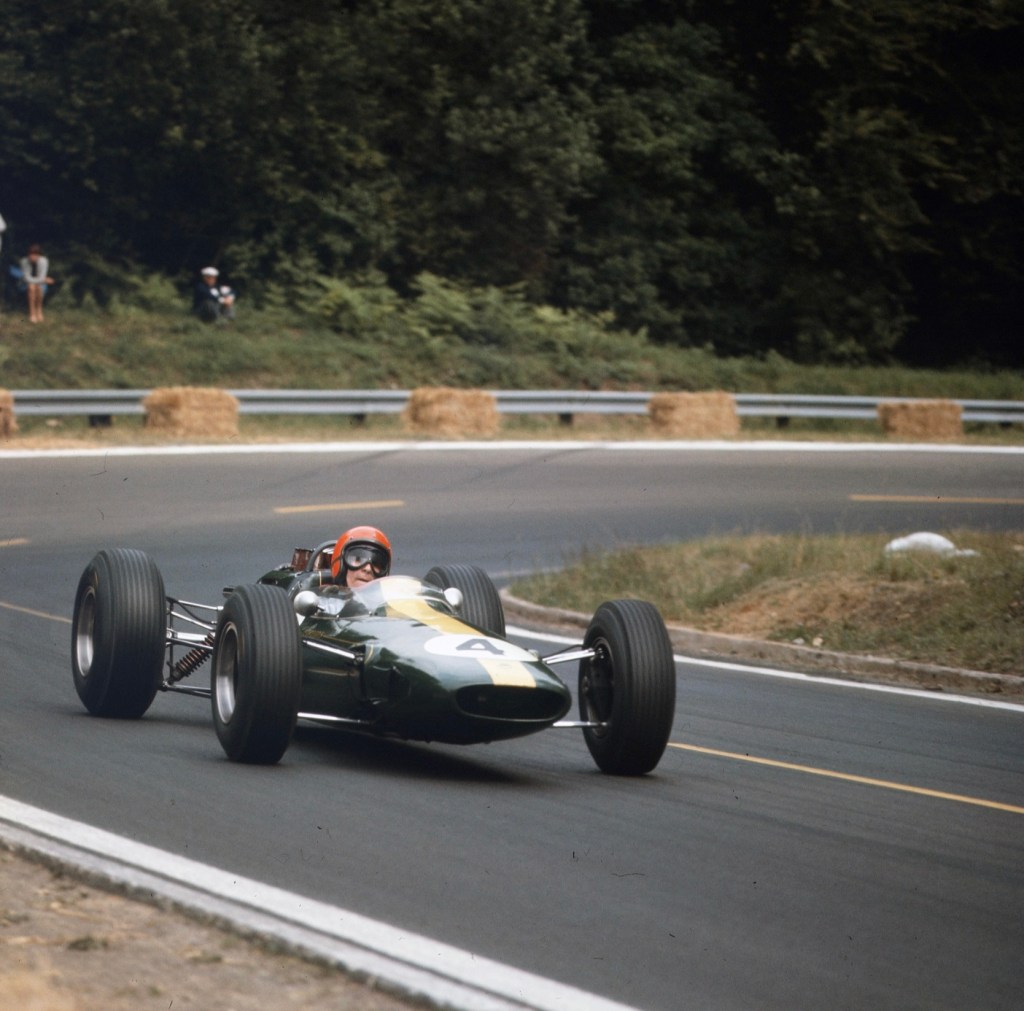
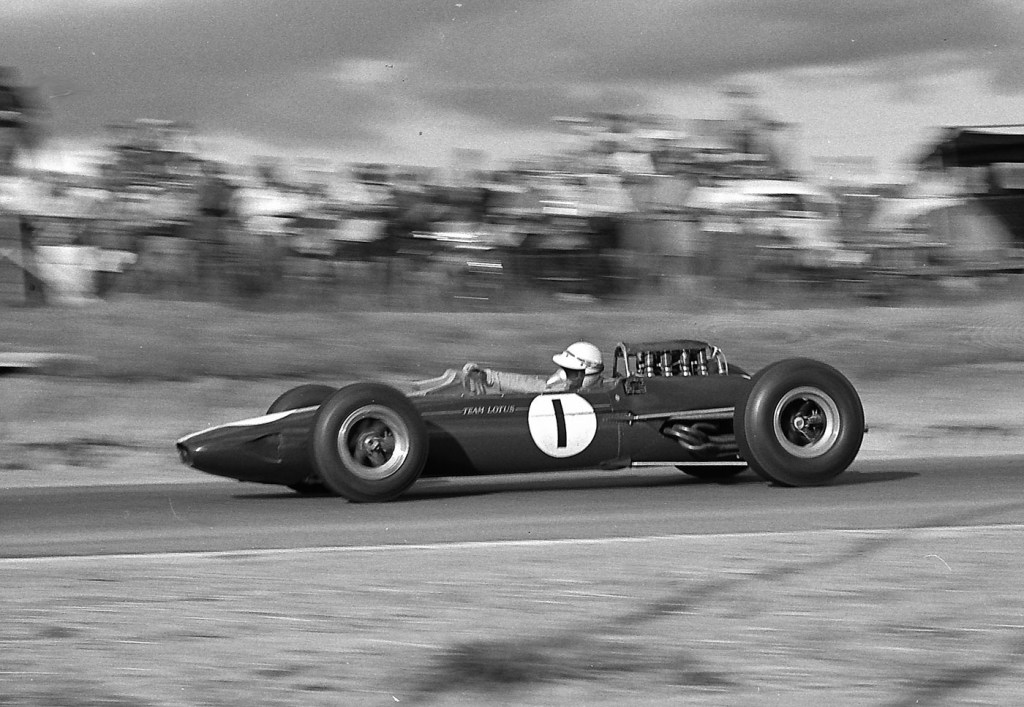
Stewart, Lotus 33 Climax #R10, Rand GP 1964 (P Tempest)
Jackie Stewart on his way to victory in the second heat of the Rand Grand Prix aboard a works Lotus 33 Climax. Kyalami, December 12, 1964.
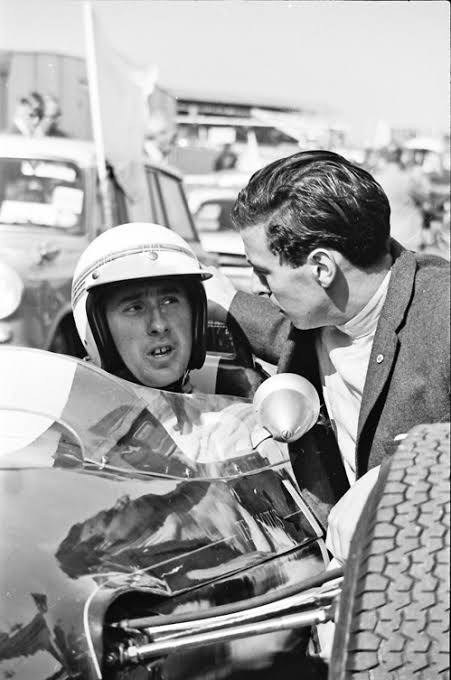
Stewart’s first drive of a Grand Prix car had been organised by Jim Clark during the 1964 British Grand Prix weekend at Brands Hatch on the July 11 weekend.
Dominant in one of Ken Tyrrell’s Cooper T72 BMCs that F3 season, Clark convinced Colin Chapman to give the young charger a few laps in Clark’s Lotus 33 Climax at the end of practice. The marshalls were asked to stay in situ for an extra 20 minutes to allow the test to take place. Using Jim’s car and his settings: pedals, seat etc, off went The Other Scot down the pitlane to complete only a few laps before the engine failed.
Despite the short session, JYS impressed, a week later Jackie had the first of a half-dozen meetings in a works-Ron Harris Racing Lotus 32 Cosworth SCA F2 car at Clermont Ferrand. The opportunity arose as a result of Peter Arundell’s misfortune.
Peter Arundell on his way to fourth place during the French GP at Rouen on June 28, Lotus 25 Climax. Only a week before his Reims near death experience (MotorSport)
Arundell was badly injured during the Reims F2 GP on July 5. In a slipstreaming group, he got onto the rough at the kink on the straight, corrected, but lost a bit of speed and was hit by Richie Ginther’s Lola T55 Cosworth SCA. Peter parted company with his car in mid-air, breaking an arm, thigh and collarbone and was comatose for a fortnight. At that time he was in joint third place in the F1 World Championship standings with Ginther, behind Clark and Graham Hill. Arundell eventually returned to F1 with Team Lotus in 1966, a tough place to be at the time: see here for a great summary of Peter’s career: https://www.f1forgottendrivers.com/drivers/peter-arundell/
Meanwhile, Jackie Stewart was immediately on the pace at Clermont, placing second behind Denny Hulme’s winning Brabham BT10 Cosworth SCA. Jackie then won at Snetterton, was second at Montlhery and third at Oulton Park.
So when Clark sustained a back injury at Cortina d’Ampezzo during a snowball fight at a Ford Cortina marketing event, it was an easy call for Chapman to engage Stewart to replace him in South Africa. Lotus had contracted to provide two cars to contest the Rand Grand Prix and touring car support races at Kyalami that weekend.
Jim briefing Jackie before heading out at Brands Hatch in July (F1GPDC)Stewart at Snetterton, winning the Vanwall Trophy on the 26 September, British F2 Championship round, Lotus 32 Cosworth SCA (MotorSport)
Stewart initially thought that he should make his GP debut with BRM, to whom he was contracted for 1965, but “I telephoned Ken Tyrrell and asked his advice. He said ‘don’t be such a stick in the mud, you’ve got to get out and drive the thing sometime’ and pointed out that this Formula 1 scamper would calm my nerves rather than taking my first appearance in a full-scale Grand Epreuve. I think from that aspect I couldn’t have done better than drive at Kyalami and perhaps I wouldn’t have done it if someone hadn’t kicked me in the backside and told me to get on with it,” he told the F1 Grand Prix Drivers Club.
Chapman cleared the drive with BRM’s Tony Rudd and Stewart promptly qualified on pole in a brand new Lotus 33 Climax (R10). The field included his teammate Mike Spence, his soon to be teammate at BRM, Graham Hill in a Willment entered Brabham BT11 BRM, Bob Anderson’s BT11 Climax and two Brabham BT10 Lotus-Ford twin-cams raced by Paul Hawkins and David Prophet. There was a swag of competent locals too including John Love, Piet de Klerk and Sam Tingle.
Stewart, Kyalami (R Young)
Jackie’s Lotus broke a driveshaft on the line of the first heat – causing maximum chaos behind – but the Team Lotus mechanics, ever competent, had the car ready for the second heat which Stewart won from Hill. Graham won the Rand GP overall from Hawkins and Anderson. Mike Spence was second in the first heat but had a rose-joint fail after only one lap in the second.
F1Grand Prix Drivers Club, VeloceToday.com, Robert Young, Peter Tempest, MotorSport Images, f1forgottendrivers.com
(R Young)
Tailpiece…
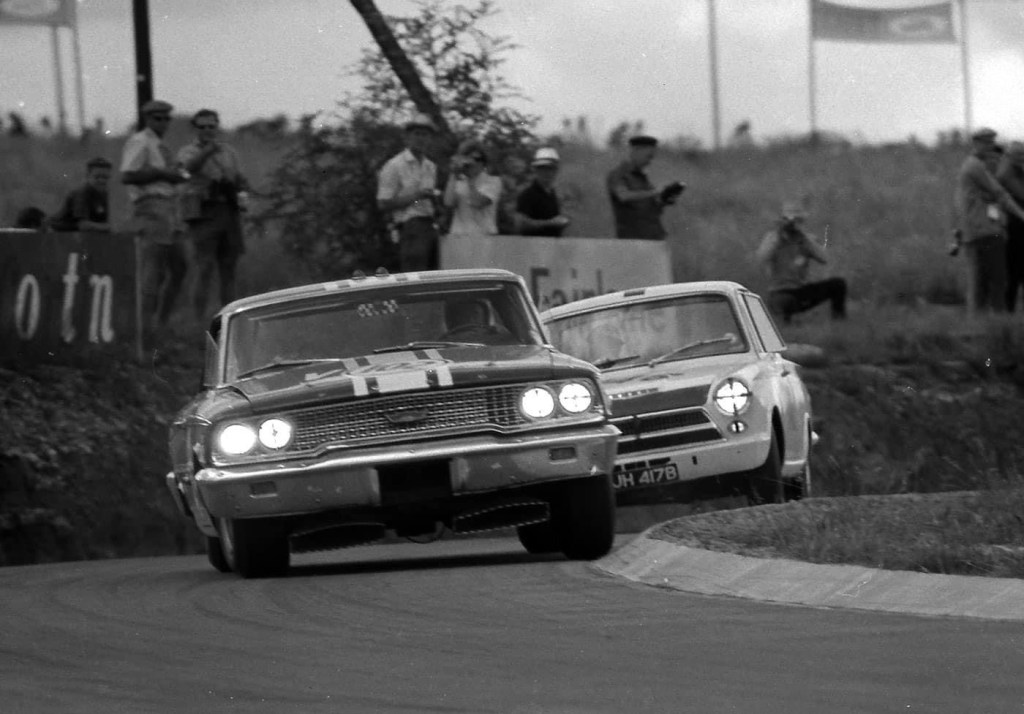
Paul Hawkins raced John Willment’s Brabham and Ford Galaxie that weekend, getting the better of Stewart’s Lotus Cortina in the touring car support races. Look at the size of that thing…
Dan Gurney’s – Brabham Racing Organisation – Coventry Climax FWMV 1.5-litre V8 during the 1963 Monaco Grand Prix weekend. F1-1-63’s second race.
The car is a Brabham BT7, the second type of GP Brabham, Jack having debuted the BT3 Climax in 1962. Two F1 BT7s – there was also two BT7A Intercontinental/Tasman Formula cars – were built. Dan debuted BT7 F1-1-63 at the International Trophy, Silverstone on May 11, 63, and Jack first raced F1-2-63 at Zandvoort on June 23, 1963.
(LAT)
Dan in front of Tony Maggs (fifth) and Willy Mairesse (DNF final drive) at Monaco that year: Brabham BT7 Climax, Cooper T66 Climax and Ferrari Dino 156. Gurney was out with crown wheel and pinion failure in the race won by Graham Hill’s BRM P57 from teammate Richie Ginther’s P57. Bruce McLaren’s Cooper T66 was third.
(MotorSport)
Gurney on the way to an historic first Championship Grand Prix win for the Brabham marque aboard his BT7 at Rouen-les- Essarts, France in June 1964. Dan also won the non-championship 1964 Mexican GP with this F1-1-63, while Jack’s best in F1-2-63 was a pair of wins in in the Aintree 200 and the Silverstone International Trophy in April/May 1964.
Somewhat incredibly, Allen Brown records the last of 48 in-period race meetings for this (Jack’s) car was at Indianapolis, where Dave Rines won the SCCA Regional at Indianapolis Raceway Park in May 1968, at which point the car was powered by a 3-litre Coventry Climax FPF-four.
Dutch GP: second, Clark won in a Lotus 25 (MotorSport)
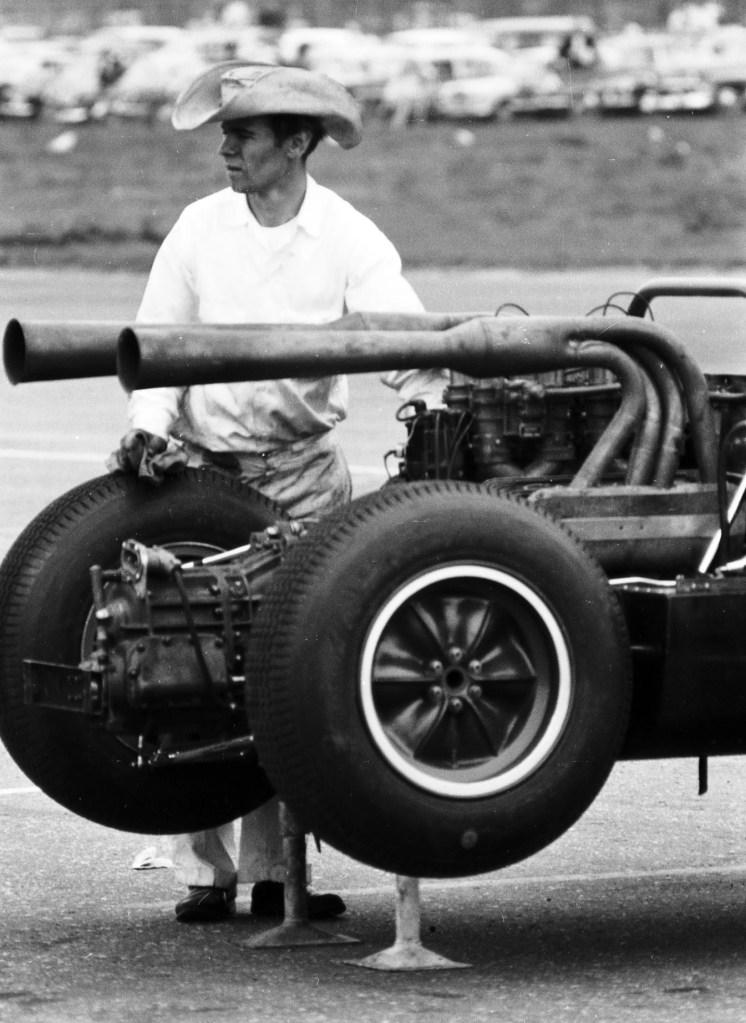
Coventry Climax FWMV 1.5-litre Mk3 V8: Lucas fuel injected, DOHC, two-valve, 195bhp @ 9500rpm. Early five speed Hewland HD gearbox with distinctive upside-down VW Beetle case, but not yet with neato, bespoke side-entry rear housing. The ‘vertical bomb’ is Lucas’ hi-pressure fuel pump. Rear end comprises mag alloy uprights, inverted wishbones at the top, single links at the bottom plus two radius rods doing fore-aft locational duties. Ron changed his mind about the respective locations of the wishbones and links pretty soon after this.
The Ferrari pits during the Grand Prix des Nations weekend, Geneva, July 30, 1950.
Alberto Ascari at left with car #40, a 4.1-litre Ferrari 340, the car behind is Gigi Villoresi’s 3.3-litre Ferrari 375 with the man himself at right (I think). Typical of the era, factory Alfa Romeo 158s finished one-two-three: Juan Manuel Fangio from Emmanuel de Graffenreid and Piero Taruffi.
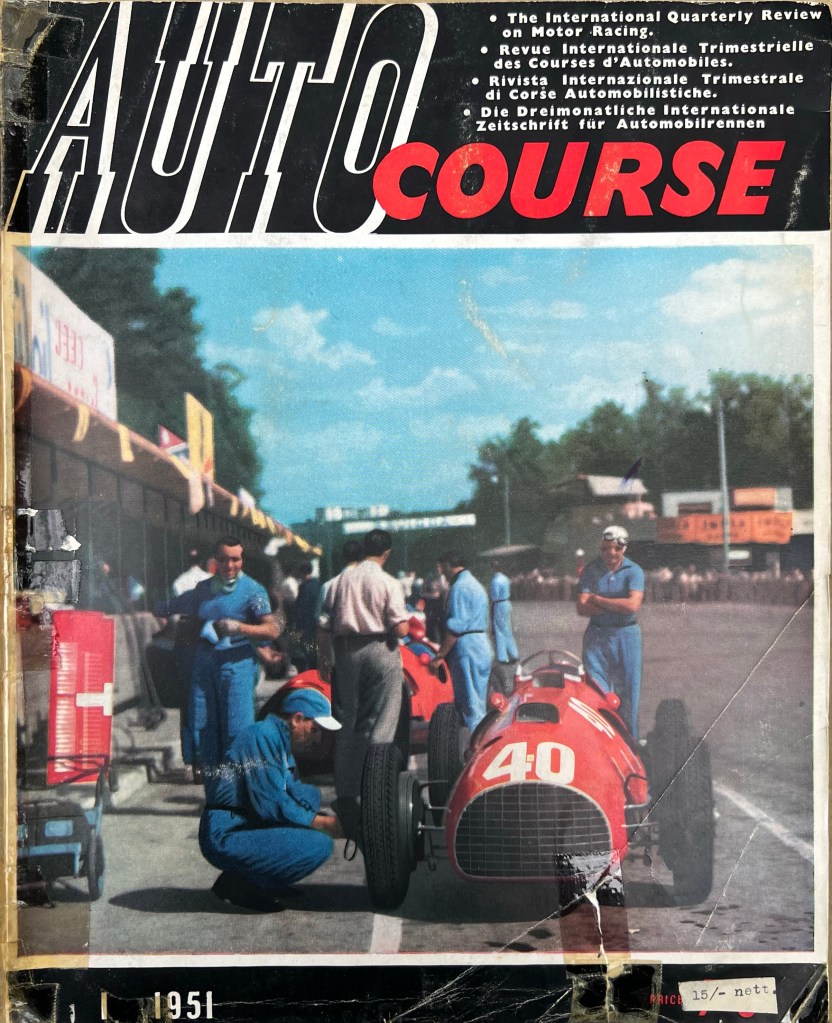
“It took me five years to get this Autocourse and a whole lot of others from the widow of the owner!” my friend Tony Johns said with a chuckle. I’ve always been an Automobile Year guy, by the time I realised Autocourse was THE racing annual I’d already got the Automobile Year bug and started what became a 20 year journey to collect a set.
It was another set, Blommie The Great 38’s fabulous tits that led me in the wrong direction. Camberwell Grammar School appointed 25 year old, very statuesque Miss Blomquist as a librarian in 1971-72. Of course one couldn’t just sit in the library with ones tongue on the floor, it was while cruising the aisles trying to look like a serious student on my furtive, very frequent perving missions that I came upon Automobile Year 18, the 1970 season review. And so the obsession began, I was soon surgically removing the best photographs of the school’s Auto Years with a razor blade and adding them to my bedroom wall where scantily clad Raquel Welch had pole position.
It’s been great to have the very first of these learned journals for a week to peruse, read and enjoy. The 140 page, then-quarterly, cost 15 shillings in Australia and was distributed by Curzon Publishing Company, 37 Queen Street, Melbourne, not an outfit familiar to me but will perhaps ring a bell with some of the older brotherhood?
Two features are reproduced: one on F3 by Stirling Moss and another by Alfred Neubauer on the ‘Brains’ of the racing driver.
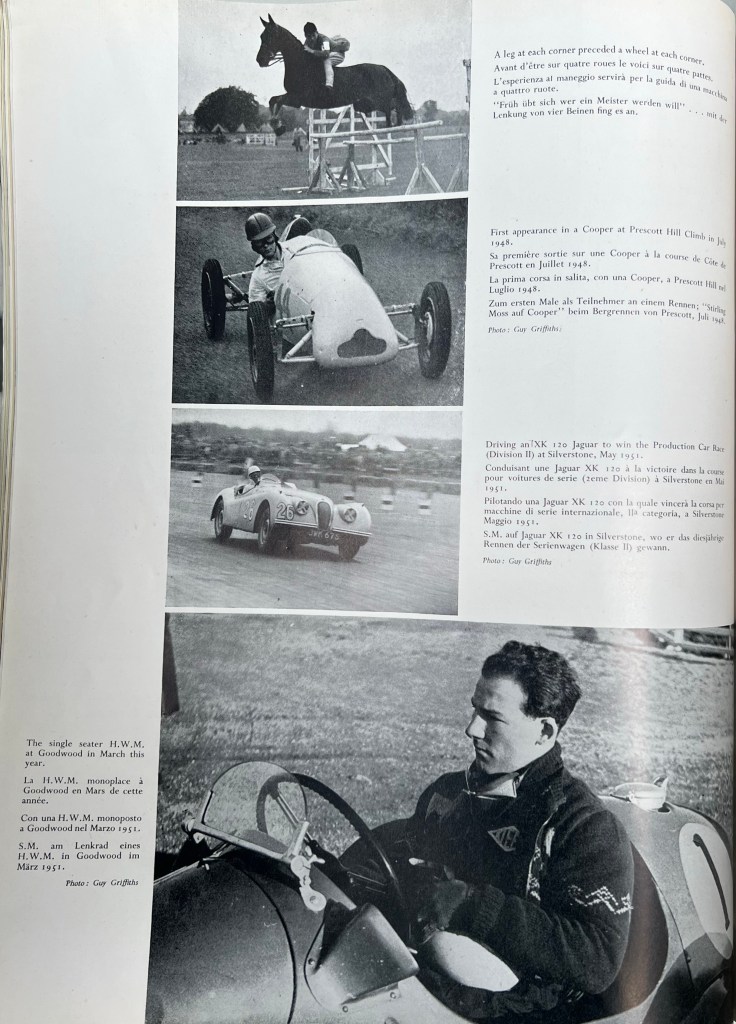
Walt Whitman once wrote ‘stout asa horse, patient, haughty, electrical’ but when first set to control one of the breed, at the age of six, it seemed to me neither stout nor patient. Reference to a horse may seem somewhat out of place when one begins to consider a motor racing career, but the equine enthusiasts talk about a good pair of hands and a good seat, and I am sure that both are just as necessary to the racing driver. If you are going to ride a horse seriously, as I did, then you must think one step ahead of it. A racing car also appears to have a personality of its own, and the driver must be equally facile at anticipating its behaviour.
Certainly I have never thought that the time I spent astride four legs as being anything but invaluable to subsequent control of four wheels, and my fourlegged career went on for ten years. Apart from the lessons it taught, it was even more directly concerned with the first appearance of ” Stirling Moss (Cooper) ” in a hill climb programme. Prize money won in the jumping ring was the financial foundation of the purchase of that Cooper.
It seems astounding now to recall that in 1948 British motor sport was centred on sprints and hill climbs, and that 500c.c. cars were still a somewhat despised novelty, mostly produced by enthusiastic owner drivers. I took delivery of one of the early production Coopers and it really is impossible to consider those days without digressing to praise the foresight and ability of the Coopers, both father and son, for without the reputation built up by their products half litre racing could never have reached the point where it won International recognition as Formula III. The only pity is that France and Italy appear yet to need to discover their equivalent of these two enthusiasts.
If they could, and were thus able to get equally successful cars into production, I am sure that there would not be the present move towards a change in the Formula.
Since those days the design of half litre cars has settled into a fairly consistent pattern of rear mounted motor cycle engine driving the back axle by chains via a motorcycle gearbox and it was the excellence of the available motorcycle components which played another big part in boosting the possibilities of Formula III. Perhaps the biggest advance in the past three years has been the mating of reliability with steadily increasing speeds. Maximum speeds have not changed so much, but circuit speeds have, as the result of patient chassis development, and though in 1951 circumstances will prevent me from driving half litre cars as much as in the past, the lessons learned at the wheel of these flyweights can be applied to the much trickier problems of heavier and faster machines.
Giving around 45 b.h.p. the more prominent 500 c.c. engines of today will propel a racing car at 100 to 105 m.p.h. and because the car is so low and so small this seems to the driver a pretty high velocity. It is only when one changes to a heavier car that one realises just how far liberties can be successfully taken with a car weighing perhaps 6 1/2 cwts all up.
Half-litre racing is always fun, and as far as the British scene is concerned is the most keenly contested class of all, because it has given so many people the opportunities which had previously been the prerogative of Continental drivers. I for one could never have hoped to motor race seriously but for the reduction in cost brought about by the 500 c.c. class and instead of being the proud possessor of the British Racing Drivers’ Club’s 1950 Gold Star would most likely have been, at the best, an unknown also ran with some sports machine in club events.
It may comfort some to know also that the first entry I submitted, fresh with enthusiasm at the prospect of taking delivery of the Cooper, bounced back at me.
The next step forward from the Cooper 500 was the Cooper 1000.
I say step forward without belittling the smaller car, but because I imagine that the goal of every racing driver is Formula I. That is a long road which I have yet to traverse but just how tricky a road it is I am learning almost every weekend this summer of 1951. I was fortunate in having parents every bit as enthusiastic about motor racing as myself, and at the same time a good deal more experienced when they suggested that one did not know what motor racing was all about until one had been on the Continent. With a Cooper 1000 I set out to see for myself in the latter half of 1949, and how right they were. The foray achieved some moderate success, not so much in the results, but in the experience gained and the feeling of confidence induced, and above all that I had something definite to offer to John Heath when he was looking around for drivers for the H.W.M. team. On his side, John could offer a car which was magnificently reliable and always pleasant to drive. The results achieved in 1950 are a matter of history, and there was only one snag. Excellent as the cars were they were never quite fast enough to win against a Ferrari, and we kept on meeting Ferraris.
This is not a criticism, but a simple statement of fact of which John himself was only too well aware, and which he has made every effort to remedy for 1951 by the most ingenious use of available materials. What was always a delight to me was to be a member of a well turned out team of cars bearing the British green which always arrived on the starting line a credit to their sponsor.
A racing driver usually gets some stock questions put to him by the layman, which can be paraphrased into ” How fast can you go?” “Which car do you like driving best? ” and ” What was your most memorable race?” My answer to the first is that speed is purely relative. The real art of motor racing and, for that matter the real excitement, is in negotiating an 8o m.p.h. corner at 90 m.p.h., for it doesn’t matter whether you do 100 or 150 m.p.h. down the straight.
As for the other two questions, the answer to the second is usually the car I am to drive next, and to the third, my last race. If one is to succeed, it has always seemed to me that one must be entirely engrossed in the race in hand, and whilst drawing on the experience of the past, memories of races as races are wiped out by the task of the moment. In any case, the last person to approach for any coherent picture of a race is a driver who was taking part in it.
The same sort of thing applies to cars, and one has to completely identify oneself with the machine of the moment, until you almost approach the state of believing that that is the only car which you really know how to drive.
Certain races stand out because of particular objects achieved, such as last year’s Tourist Trophy as being my first experience of a really fast heavy car, but the race itself was one of the easiest. So much so that I let my mind wander to external problems and made an excursion down an escape road. At Silverstone last August my chief reaction was a pleasure not so much in winning but in beating the late Raymond Sommer on the only occasion we met in reasonably comparable machines.
At Bari it was natural to feel a similar pleasure in bringing an H.W.M. home third behind two type 158 Alfas, because that was a result so much better than any of us had hoped for.
That is really the biggest satisfaction of all; doing just a little bit better than one expects when faced by a new situation and these notes are being written on the eve of what I am expecting to be my memorable race of 1951, the Mille Miglia and Le Mans.
The ‘Brains’ of the Racing Driver
By Alfred Neubauer, Team Manager of Mercedes Benz
The racing driver fixes hisses on the starting flag; his nerves are the keyed up to the highest pitch, for he knows those few moments of suspense, seeming like hours, will soon pass and the flag will drop. Another 10 seconds to go, slowly he pushes his gear lever into first…5…4…3…2…1 off!
With only 5 seconds left, he revs the car up to half its maximum, gently lets in the clutch and revs, further. The flag drops and with care to ensure that the back wheels do not spin, thus causing the car to run sideways, he shoots forward like a bullet from a gun.
Even for this first phase of the race – the start – the tactics involved have been thoroughly worked out by the team manager as a result of his observations during training. The popular opinion exists that in every racing team one or two drivers are chosen to set the pace. This, it is believed, will compel the other competitors to greater speeds. They will strain their engines, weaknesses will become apparent, resulting in their elimination, thus giving the driver, selected as the eventual winner, the opportunity to choose his moment and then drive through to clear victory. The opinion that such tactics are dictated is absolutely wrong. In fact, they evolve from the experience and technique of the driver himself.
The basic rule is as follows: ” Drive your machine within your own capabilities as fast as you can – but do not overstrain either yourself or your machine.” One rider must be added to this. Both car and driver, of course, must be subjected to some strain, but a first-class driver will know at what point this strain becomes excessive and for what length of time any strain can be borne without collapse. After continual experience, maximum powers of endurance become clear. Some drivers use both their cars and themselves unsparingly from the start and, consequently, collapse after a short time. They either drop back or are forced to retire. Others are capable of taking the lead from the start and holding it until the end of the race. There is yet a third kind of driver who knows the individual characteristics of his rivals and plays upon them. They purposely keep on their tail, in the meanwhile economising their own forces, and wait for a suitable moment to overtake them. The nerves of some drivers are unable to bare being trailed, and again there are those who remain completely indifferent to it.
Drivers can only know their position in a race so long as they keep within sight of one another. Once the leading drivers have got so far ahead as to lose contact with the rest of the field or when cars begin to drop out or are forced into the pits, then it is no longer possible for the drivers to know their position. It is at this juncture that the work of the pits commences. They are the brains of the racing driver and are led by the team manager. In aviation radio communication between the flyers of a squadron has long been recognised. So far as motor racing is concerned, however, this method of contact between the team manager and driver has not been introduced.* Thus for them the only means of communication is visual. It is, however easily understandable that the simplest method is the best because the driver’s attention must, under all circumstances, be concentated solely on his own car and the road ahead. A further duty of the pits is to inform the driver of the number of laps he has already covered and also the laps remaining. Each driver signifies that the message communicated to him has been understood by nodding his head.
An inexperienced team leader will be astonished when only a few laps later, by means of a circular movement of his hand, the driver indicates that he once more wants to know the number of laps that remain to be covered. This is, however, not exceptional and the explanation is given more often than not by the driver at the end of the race. He has to admit that very shortly after he received the first message he completely forgot its contents. For the driver the most important signals are those indicating his position in the race and the intervals that separate him from his opponents. The knowledge of his exact position dictates his policy. If the lead over his opponent is increasing, then naturally he will relax and thus economise his own forces and those of his car. If his lead is decreasing, then he will do everything in his power to increase once more the distance between himself and his rival. Similarly it is imperative for the driver lying in second place to know the distance between himself and the leader. From this it follows that he must be careful that his present position is not threatened by those who lie yet farther behind.
Naturally the team manager prefers those drivers who take the lead from the outset and hold it throughout the race without straining either themselves or their cars. It is only during a race itself that the driver can know whether he can have some moments’ relaxation or not. In some racing teams first-class drivers are fully aware of the potential weaknesses of their team mates and their cars and from the very start they remain in second place, thus conserving their own forces. As soon as they realise that their team mates’ powers are exhausted, they can immediately take the lead. The brains of the racing driver -the pits – have also to take such considerations into account, and must ensure that the driver who has made his way through the field and eventually takes the lead maintains the position he has succeeded in gaining. There have been instances when these tactics have been employed with great success. It is then the duty of the team manager to inform both the leading driver and his followers at each lap of the distance between them. It must be made clear to the driver lying in second place that he has lost his lead and would do far better to content himself by remaining in second place rather than force his car out of the race.
The price of driving as fast as driver and car permit is often very high. It should take very little experience for the driver to be fully aware of his own capabilities. So far as his engine is concerned he will have received precise directions and he will have been told by his testing engineers of the precise amount of revolutions permitted. However, it is only natural that he should make a point of ensuring that these instructions have not been too cautious and he will certainly confirm for himself to what extent his motor may be over-revved. The experience of former years has shown that drivers who have been given precise instructions that their revs should not exceed 4500 have, some years later, admitted reaching 6200. When a driver confines himself strictly to the instructions of the technicians and a team mate overtakes him, it becomes quite obvious that this team mate has exceeded the limits given to him. Here temperament plays its part, for the decision has to be made whether he will exceed his limits or whether he will observe the technical instructions to the letter and bear in mind the increased lasting powers of his engine.
Generally speaking, the driver who is bound by technical instructions has an advantage over those drivers who themselves assisted in the building of their engines. The latter, whilst testing, will have discovered the limits which the construction of the engine has imposed. Indeed it is fair to say that it is no advantage whatsoever to a driver to be himself a builder or testing engineer. He is naturally hampered by the knowledge of his own technical experience.
Perhaps this is a suitable moment to say a few words about “luck” in racing. If a driver fails to take into consideration the limits imposed by the technicians and a piston rod breaks or some defect in the engine forces him to retire or his tyres do not stand up to his way of driving, then he will have the satisfaction of knowing that all will say:- “What bad luck ! ” Conversely, one member of a team finishes and the others are forced to retire, invariably the latter will exclaim :- ” How lucky he was! “
Technically speaking, 95% of ” luck ” in racing is dependent upon the preparation of a car. This preparation begins at the first moment of building. The other 5% lies in the hands of the driver, whose “feel ” permits him to get the maximum value out of his car. There are drivers on the Nürburgring who use up their tyres in six laps and are indeed slower than those who do not have to change their tyres for eight or even ten laps. A more subtle method of driving, a more even use of the engine on leaving corners and a softer application of the brakes differentiate a good driver from a better one.
As in every activity which demands talent so in motor racing. There are many enthusiasts, but few become champions.
All these facts prove how many conditions have to be fulfilled before success in a race can be achieved. The popular complaint of housewives :-” You have eaten in a minute what I have taken hours to prepare,” would perhaps be even more suitable to motor racing!
It is not the obiect of this article to consider the many hurdles which must be cleared before the racing car eventually reaches the track:- the planning of the design according to the formula given, the design itself, the manufacture of the parts, the assembly and testing. Our task commences only from the moment when the car leaves the factory and proceeds to a race, there to prove the quality of its design and justify the work of preparation. These preparations are no more than stages on the road to victory.
The work is undertaken not merely to prepare a car for one particular race, but also with a view to its chances of success over its rivals.
Experience gained by entering for the same race year after year greatly assists the designer in his attempts to reach perfection so far as one particular course is concerned. Often drivers entering a race for the first time are taken unawares by the peculiarities of the track which had they had opportunities of practising thoroughly earlier, could have been avoided without difficulty. Practise on non-permanent tracks presents complications as it is practically impossible to close circuits to the public so as to enable practising to take place. Consesequently, the preparation of cars for non-permanent circuits is considerably more difficult than for permanent circuits which are open to racing cars at all times of the year. To list but a few-the choice of the right transmission, the measurements of fuel requirements and the wear on brakes and tyres are factors which must depend entirely on the circuit to be raced.
Many years ago, the principle of fitting streamlined bodies to cars for very fast circuits was accepted. Nevertheless, without comparative tests it is not so easy to decide whether this style of bodywork is most suitable to any track. The streamlined bodies with their attendant lack of wind resistance have the advantage in acceleration and are preferable when high maximum speeds are required. This, however, is offset by the decrease in braking power with the resultant strain on the brakes. On the former Avus circuit, where there are two parallel stretches of ten kilometres and long curves, this disadvantage was not apparent. Many, streamlined designers had soon to learn that the cooling of tyres presented a difficult problem. Within their enclosed space, the maximum temperature permitted was soon reached, but problems of engine and gear cooling often counter balanced the advantages gained by streamlining.’
All these points have to be considered during tactical preparation for a race, and it is on the conclusions reached that the decisions must be taken whether pit stops are to be made or not. These matters are of first-rate importance. In fact, success in a race depends on them just as much as it depends on the tactics of the driver which were mentioned before in this article.
It can now be seen that a race is not just a haphazard competition between one car and other. Each circuit has its individual problems, and not least of these are the prevailing weather conditions. Above all, fuel, tyres, back axle and gear ratios must be adjusted according to the circumstances.
The particular suitability of individual drivers to different tracks has to be considered also and a strategical race plan cannot be worked out without continual observations of the other competitors and the tactics which they employ. There are supreme examples which prove that although complicated preparations were made for a race, it was a the result of such observations that victory was achieved.
There was an instance at the Nürburgring when a driver’s race plan required him to stop for one minute to change his tyre. However this driver had a ten-second victory over his rival whose plan permitted him to run through the ten lap race without a pit stop though at a limited speed.
This ” organisation for victory ” does not date back very far. Even in 1914 visual communication between driver and the pits did not exist. In those days the pits were really no more than depots for refuelling and the change of tyres, and it was not until the period between the two world wars that the pits became more and more ” the brains of the racing driver.”
After many years of practice, this “Organisation” no longer carries many difficulties in so far as circuits are concerned. What is not so easy to master is the “organisation” of long distance races such as the Mille Miglia. It was in 1931 that Caracciola arrived at the finish in Brescia and refused to believe his team manager when told that he had won the race. In fact, it was not until some half an hour later, when his victory was confirmed by the organisers of the event, that he was convinced. The Mille Miglia is so planned that although times between control points are given, they arrive so late that it is impossible to communicate them to a driver, who may be anywhere on the Appenine peninsula.
In this race the only workable maxim is: “Know the capabilities of your machine and your own ability and get the best out of both.” It was not without reason that the experienced Italian master Villoresi exclaimed after the last Mille Miglia:-” What a ghastly race ! ” Above all, in England, where there are many handicap races, ” the brains of the racing driver ” have a particular problem to solve. Here a driver is not in direct competition with his rival who holds a position in the race which is obvious to all. On the contrary, the pits must continually work out his position according to the class of his car.
Many times during the Tourist Trophies in Ireland the team manager has looked for his rivals amonst the fastest competitors whilst the real speed so far as he was concerned was dicated by relatively unimportant competitors who had completely escaped his notice. In each handicap race average comparative speeds are formulated. If a car in the small capacity class exceeds its handicap speed, then the driver of car in a larger capacity class is compelled not only to increase his relative speed but also the speed laid down by his class.
Many prominent drivers from the Continent have been baffled by this and have to do everything within their power not to be defeated by a completely unknown rival. What to an onlooker appears to be no more than the smooth running of a race is to the team manager the careful integration of many factors which achieves the much-sought-after victory.
* Radio communication was used successfully by the American Cadillac team at Le Mans last year – Ed
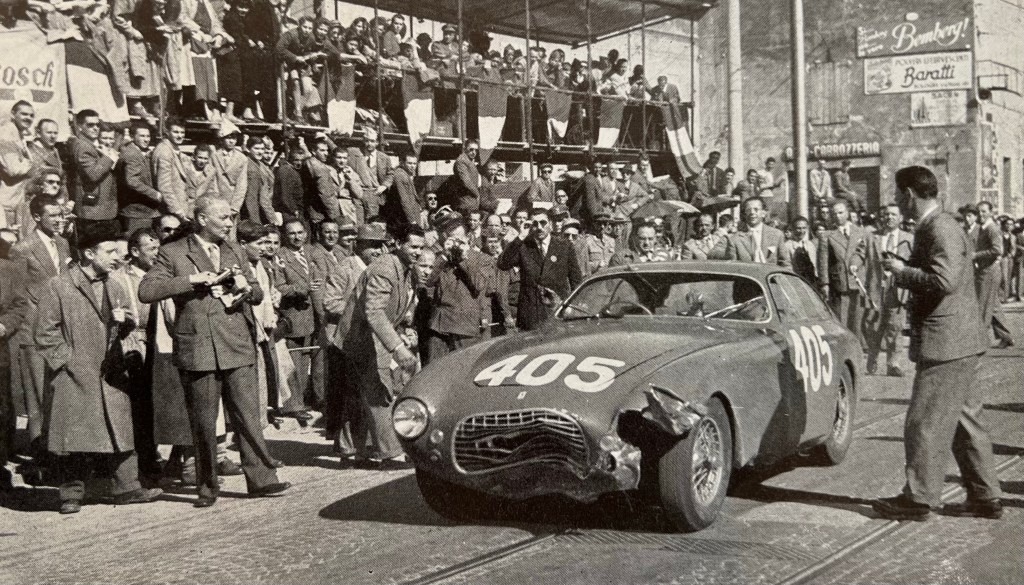
The Gigi Villoresi and Piero Cassani victorious, battered and bruised Ferrari 340 America Berlinetta passing through Bologna on its April, 29 1951 Mille run.
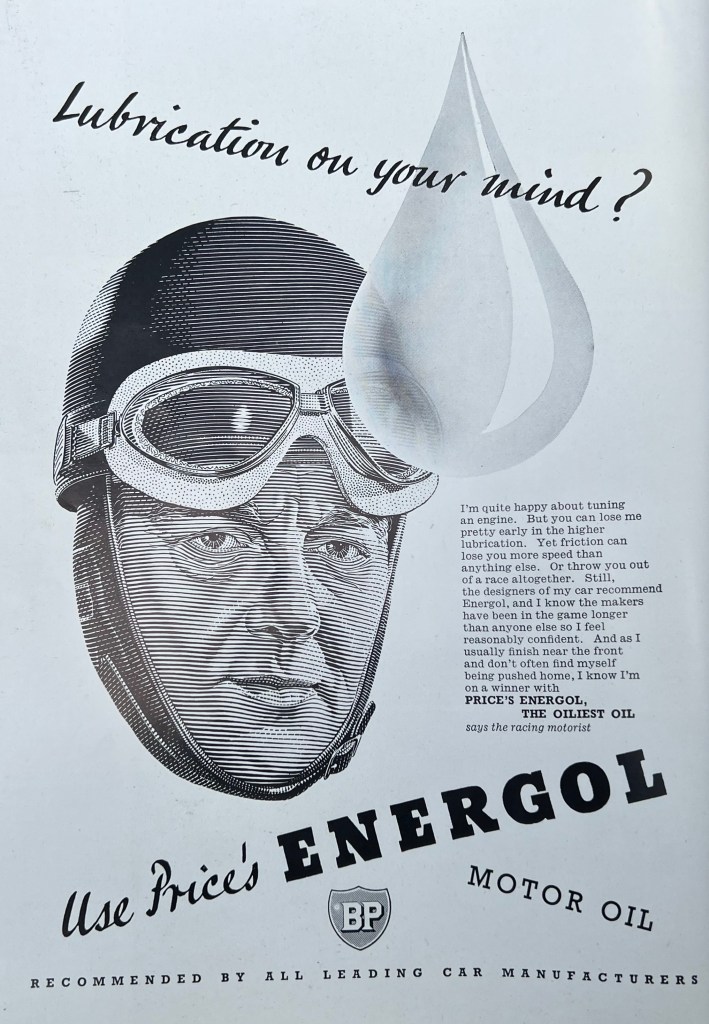
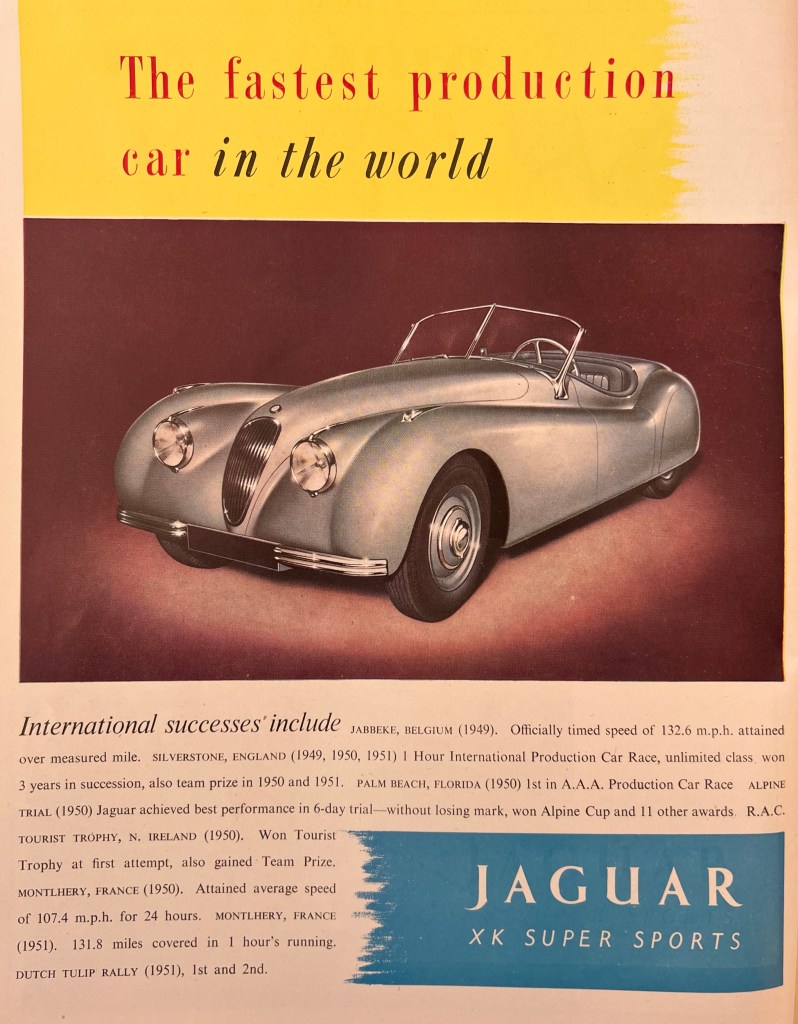
Jaguar XK Super Sports. Was that the car’s model name before XK120 came along or has the copy-writer goofed?
Credits…
Autocourse 1951 from Tony Johns’ collection – many thanks TJ
Doug Whiteford won the first Australian Grand Prix held at Albert Park in his Talbot Lago T26C 70 years ago today, November 21, 1953.
He won the Formula Libre race from Curley Brydon’s MG TC Spl and Andy Brown’s MG K3. 40 starters took on the challenge, racing in the opposite direction to today on a course that goes around the lake but is a bit different to the original.
I’d forgotten the anniversary. The Australian Grand Prix Corporation celebrated the occasion back in March during the F1 weekend. My mate, Auto Action publisher Bruce Williams called before to say they were going to post online the article I wrote back then for the pre-AGP Auto Action, see here: https://autoaction.com.au/2023/11/21/australian-grand-prix-at-albert-park-70-years-young-2
That front row above is Lex Davison in his ex-Moss F2 HWM, then fitted with a Jaguar C-Type spec 3.4-litre XK-six at left, Stan Jones’ Maybach 1 4.3-litre and Whiteford’s 4.5-litre Talbot-Lago at right.
(S Wills)
The bolter early was Stan Jones in Maybach 1, he led till the halfway mark but retired after completing 58 of the 64 lap, 250 mile journey. Whiteford lost a tyre off the rim with 10 laps to run, but he was close to his pit, and had a huge lead so the 30 second stop to change the wheel wasn’t a problem.
(The Age)
Whiteford looking modestly chuffed with his win. He took the same car to AGP victory at Mount Panorama, Bathurst the year before, and won at Nuriootpa in the Barossa Valley aboard his famous Ford V8 Ute based special, Black Bess, in 1950.
Dicer Doug was a formidable, aggressive driver who was also a master-mechanic. His preparation and presentation skills were legendary, so too his mechanical sympathy. He was the complete package.
Jack Brabham being pestered by Frank Matich before the start of the Tasman Series Sandown Park Cup on February 16, 1969. Frank is after some tips on how to extract the best sponsorship deal from Repco Ltd management.
It’s intrigued me that Jack clearly forgot to bring his nice modern Bell Magnum helmet home with him when he jumped on his Qantas 707 at Heathrow for Sydney in December 1969.
When his Brabham BT31 Repco was finally offloaded at Port Melbourne and had its nice new RBE 830 V8 fitted at Repco Brabham Engines in Maidstone, he cast around for a skid-lid and – seemingly – this circa 1960 helmet and pair of goggles were the only ones available to head off to Calder to test the car two days before the Sandown race. See here for a BT31 epic: https://primotipo.com/2015/02/26/rodways-repco-recollections-brabham-bt31-repco-jacks-69-tasman-car-episode-4/
The lovely shot above seems to be the helmet in question sitting atop Jack’s noggin on the grid of the BRDC International Trophy at Silverstone nine years before, May 14, 1960: second in his works-Cooper T53 Climax behind Innes Ireland’s Lotus 18 Climax.
(unattributed)
Our very own Jack during the ‘69 Sandown Cup. He is on the run out of Peters above, and on the way into Dandy Road below, wearing the same 1960 helmet or one very much like it.
Small things as I say…mind you, I don’t like ‘yer chances of racing with a nine year old helmet in today’s homogenised, pasteurised over regulated times.
Brabham finished third in the race, proving brand-new BT31 was quick right out of the box, which was won – so too the Tasman Series – by Chris Amon’s Ferrari 246T. Jochen Rindt was second in his Lotus 49B Ford DFW.
(R MacKenzie)
Jack returned that Easter to fulfil his final Australian Repco commitments, winning the Gold Star round at Bathurst in BT31. This time (below) Jack remembered to pack the Bell Magnum but not his modern goggles…
Lou Molina, Molina Monza Holden leads Don H Swanton, Lotus 11 Climax and Alan Jack, Cooper T39 Bobtail Climax at Albert Park during the Victorian Tourist Trophy on 23 November, 1958…
It’s the first lap I suspect, with the lead bunch in front of Lou’s superb MM Holden s/c. The race was contested on the first Sunday of a double-header meeting, the feature race a week later was the Melbourne Grand Prix, won by Stirling Moss from Jack Brabham in similar 2.1 and 2.2-litre Cooper T45 Climaxes. Swanton’s car (a series 2, chassis # 303) was an ex-Team Lotus Peter Ashdown machine that Don bought in January 1958 and raced throughout the UK before being shipped home in time for this Albert Park meeting.
The TT had a good field of depth and breadth and was run over 100 miles/32 laps of the demanding Albert Park track; they raced anti-clockwise then, the opposite to the direction of today.
Unfortunately the political winds of change were blowing in Victoria. Some powerful voices on the conservative side of politics, aided and abetted by the editor of The Herald, one of the local fish ‘n chip wrappers, were against the use of the park for motor racing. And so it was that Albert Park was closed for racing, other than speedboats, until the modern era when the conservative side of politics, in the form of then Premier Jeff Kennett swung the pendulum back the other way and nicked the F1 GP from the South Australian conservative government; there is no love lost between thieves after all! All you needed to know about Albert Park politics but were too scared to ask; https://primotipo.com/2020/05/12/albert-park-lake-boats-and-politics/
Bob Jane about to be rounded up by the battling Whiteford and partially obscured Pitt Jag-D, with Lou Molina (DNF) on the inside, and a Healey 100S in the distance (E Steet)
Back to the Tourist Trophy, triple Australian Grand Prix winner – including a win at the ‘Park in 1953 – Doug Whiteford was the classiest, most experienced driver in the field and won the race in 65m47.2sec aboard an ex-works Maserati 300S (chassis 3055) he acquired from Officine Alfieri Maserati at the end of the 1956 Australian Tourist Trophy/Australian Grand Prix carnival that November-December: Stirling Moss won both these races aboard 300S and 250F respectively.
Bill Pitt put on a great show, leading the race for the first 12 laps in the Queensland Jaguar distributors, Westco Motors’ Jaguar D-Type (#XKD526) before Whiteford passed him on lap 13. Pitt, on his third trip to Albert Park, then hung onto Whitehead but nudged the hay bales on lap 26, pushing a rear ‘guard onto a wheel in the process. The ensuing pitstop cost 40 seconds and any chance of a race-win, third place was the result.
Ron Phillips placed second in the booming Cooper T38 Jaguar raced by Peter and Graham Whitehead throughout Europe, including Le Mans, in 1955. It was sold to Stan Jones by Peter Whitehead towards the end of his 1956 Australasian Ferrari 500/625 3-litre tour. But Stan wasn’t a fan of it, CJ/1/55 then passed through less competent hands until Phillips got hold of it. He got the best out of it too, a win in the Australian Tourist Trophy at Lowood in 1959 was his best result. Ron proved his intent and pace early in his time with the car that Albert Park weekend, sharing the fastest lap of the race with Whiteford: 2m01.2sec and 98mph.
Derek Jolly, a member of the family who owned Penfolds Wines, was fourth in an ex-works Lotus 15 Climax FPF 2-litre that had raced at Le Mans in 1958 (below). Derek first raced the car in the 1958 Australian Tourist Trophy that October at Bathurst, there he finished second to David McKay’s Aston Martin DB3S, the Lotus was at that stage fitted with a 1.5-litre Climax. See here for a long feature on Derek and various of his cars including his ‘two’ Lotus 15s; https://primotipo.com/2017/11/09/dereks-deccas-and-lotus-15s/
Derek in Lotus 15 #608, the car lost its life the following week during the closing laps of the Melbourne GP, see link above (R Hope)(R Hope)
Bob Jane in Australia’s other ex-works 300S (#3059) was a rather second-hand fifth, and Eddie Perkins’ – Larry’s dad – Porsche 356 was sixth. ‘Jano’ became a very handy racing driver, particularly in touring cars – ATCC and Bathurst wins duly noted – but he was wayward when he first bought the Maser, the quickest thing he had raced to that point. So much so that Reg Hunt famously moved his boat out of harms way by mooring it further out into Albert Park Lake. See here; https://primotipo.com/2015/05/15/bob-jane-maserati-300s-albert-park-1958/
(Allan Quinn)
Jim Goldfinch’ ex-Ron Phillips Austin Healey 100S chassis #3906 from the ex-Derek Jolly Decca Climax Spl of Gavin Sandford-Morgan. A good run in the race with the 100S was thwarted by a black flag due to the exhaust system wriggling away from its mounts. There is a great website about this car chockers with photographs if you’ve not tripped over it; https://austinhealey100s.com.au/AHS-3906-1955-1
(unattributed)
Other Healey 100S were raced by John Roxburgh in the ex-Whiteford car (chassis 3907), and of great historical significance, later Australian sportscar and open-wheeler international, Paul Hawkins in Italo-Australian businessman Terry Valmorbida’s car.
The ‘rootin-‘tootin, rough-as-guts Reverend’s son is shown above in the Valmorbida (chassis 3909) Healey 100S #77 in front of a gaggle of cars comprising later Cooper S ace Peter Manton’s Austin Healey Sprite, the Goldfinch 100S and Jon Leighton’s Lotus 11 Willment-Ford. More on Hawkins here; https://primotipo.com/2020/09/25/hawkeye/
Austin Healey 100S by two: Goldfinch #61 and Paul Hawkins in #77 car (unattributed)(J Goldfinch Collection)
Etcetera…
The Goldfinch 100S in the ‘Albert Park paddock 500 miles from home’ in Adelaide as Jim noted; Army barracks in the background.
D Swanton, Lotus 11 Climax, Goodwood 1958 (D Swanton Collection)
Donald Swanton…
Don Swanton was born on March 3, 1930, grew up in Highton Grove, Balwyn and attended Camberwell Grammar School, which was over his back-fence.
His first car was an Amilcar Roadster, his first job allowed the purchase of a Singer 9 which he ‘climbed, and raced at Fishermans Bend. He sold a Cooper to fund a move to the UK in 1955 and soon landed a job at SU in Edgbaston where he worked in the experimental department.
He purchased the Lotus 11 and changed jobs many times in the UK to learn and advance his career then returned to Australia in late-1958, racing the Lotus successfully until he sold it to Tom Corcoran in early 1960.
Swanton married Lorraine in 1967, had a son and daughter, and had a diverse career in Melbourne and Sydney, finally moving into the McKenzie Aged Care Residence in Templestowe in 2020.
D Swanton, Lotus 11 Climax in the UK, Goodwood 1958 (D Swanton Collection)
Credits…
Chris Charge Collection, Edward Steet, Allan Quinn, Ron Hope, ‘Glory Days : Albert Park 1953-58’ Barry Green, Don Swanton Collection, David Syers, Stephen Dalton
Tailpiece…
(D Syers)
Let’s finish with a splash of colour, this group is lining up for one of the sportscar supports, the shot was taken by Austin Distributors salesman, David Syers. #72 is the Monaro Motors owned Peter Manton driven Austin Healey Sprite. “It had only been in the country for two months and Manton had already turfed out the A-Series for a 1100 Coventry Climax and new nose,” quipped Stephen Dalton.
#74 is the JR Phillips Healey. Brian Sampson’s #97 Morris Spl is at left, #90 the Austin Distributors/Brotherton Sprite, then the #73 Esquire Motors/Rod Murphy Sprite, the silver coloured Franz Bird MG Milano with aeroscreen, the #78 Calvert owned, Eddie Perkins driven Porsche 356. In the distance is the red Frank Elkins Triumph TR2.
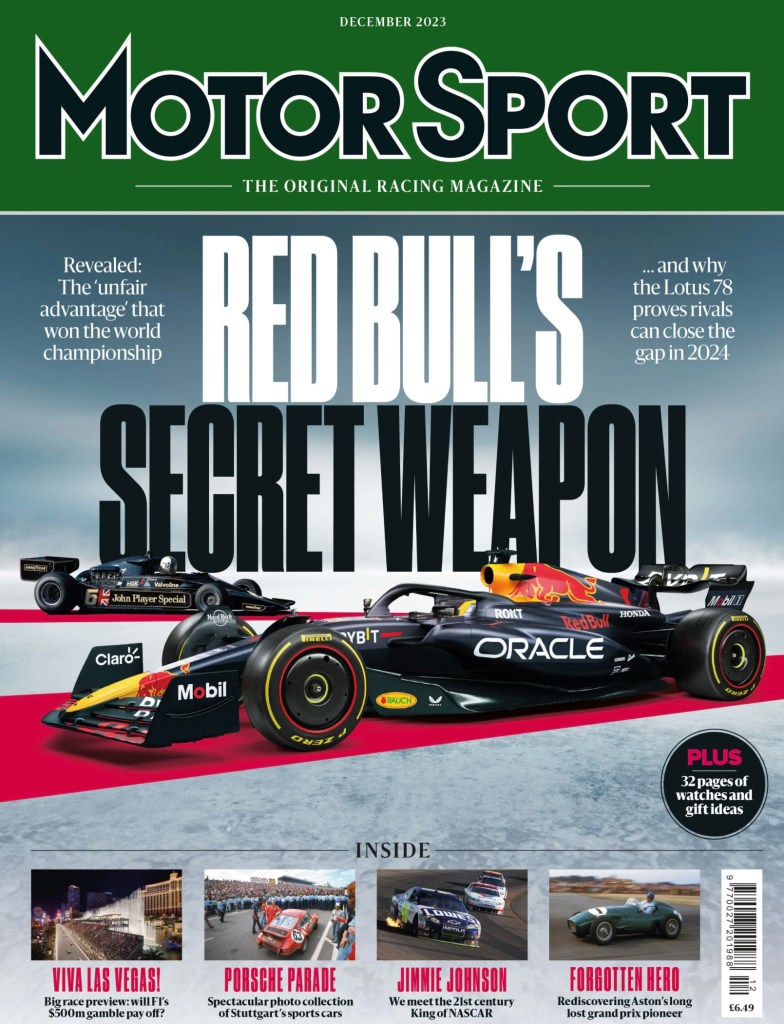
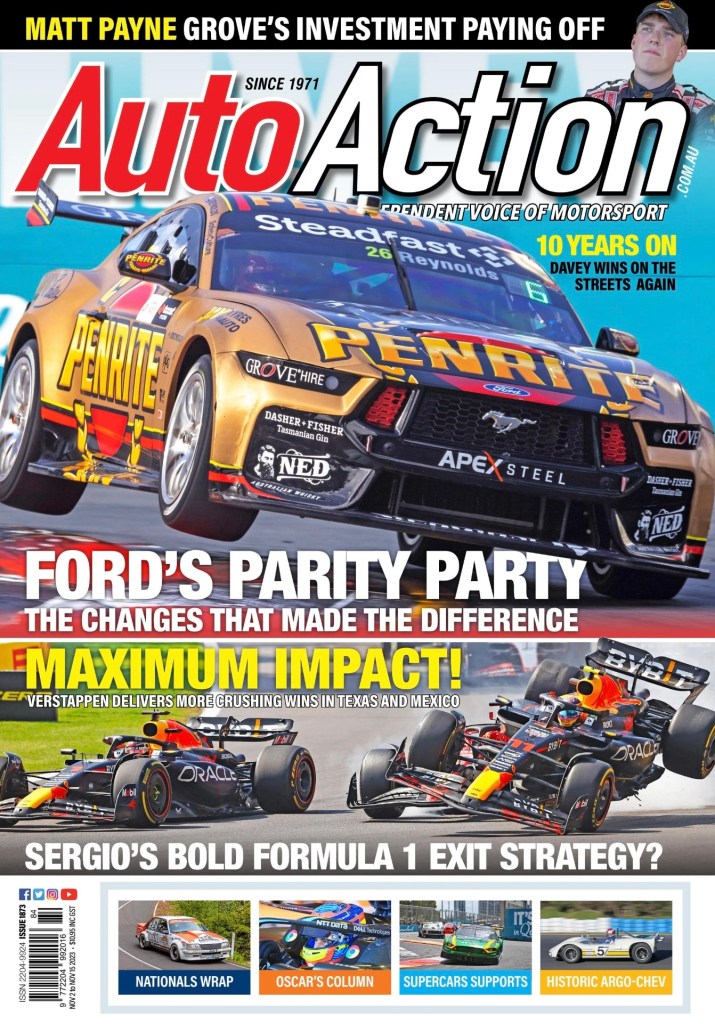
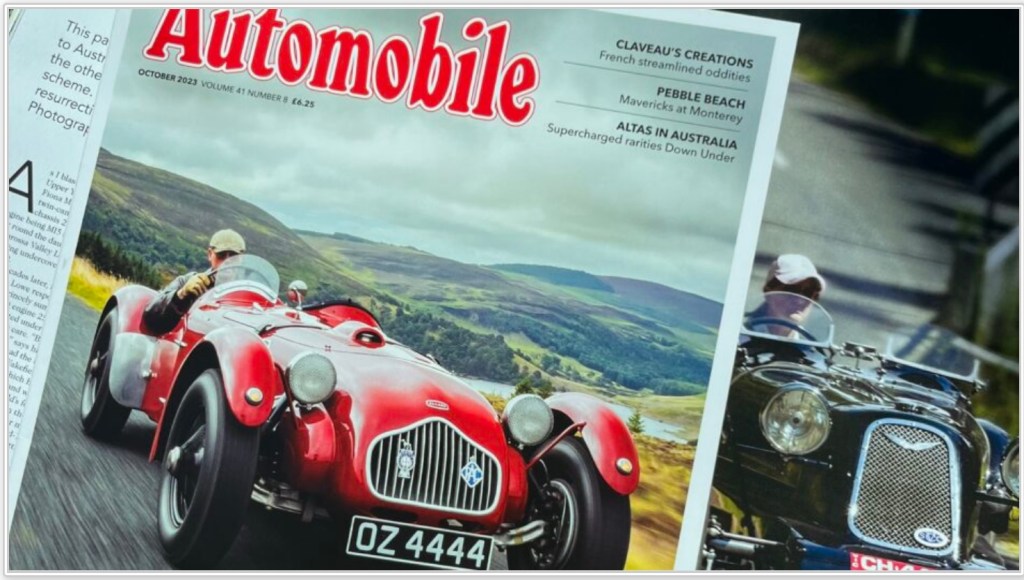
A few articles of potential interest to you I’ve written in the December issue of MotorSport, October’s The Automobile and issue #1873 November 2-15 of Auto Action.
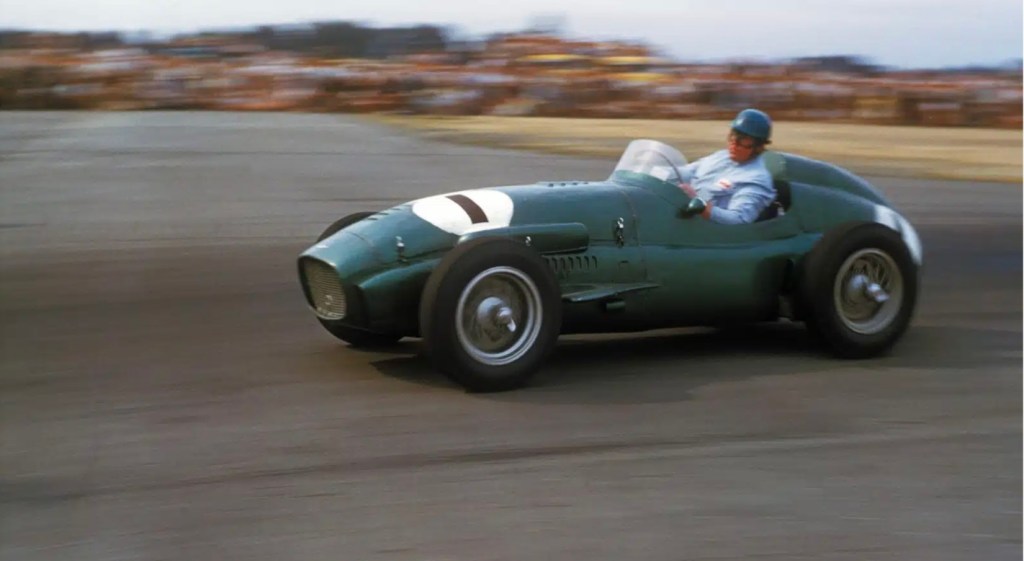
The MotorSport piece is about the long-forgotten Aston Martin DP155 Grand Prix car which really only drew blood during the 1956 New Zealand Internationals driven by Reg Parnell, as above at Wigram. It was potentially a ‘series winner’ too – there was no Tasman Cup at that stage – powered by Feltham’s supercharged DB3S six, but events conspired to thwart that. It’s in the shops in the UK now, in Australia in two months, or see here; https://www.motorsportmagazine.com/archive/issues/december-2023/
Ian Cook with a touch of the opposites, Argo Chev, Calder 1967 (oldracephotos.com via Osborne Collection)
Melbourne racers Tony Osborne and Ray Gibbs did-a-Penske and turned their outdated ex-Jack Brabham Cooper T53 Climax GP car into the muscular Argo Chev V8 sportscar, now owned by Melbourne’s Peter Brennan. But what should have taken three months or so took three years, so by 1967 it was a tad off the pace. Still, Ian Cook and Peter Macrow showed their prowess and that of the car throughout 1967-68. The transmogrification of Cooper to Argo, and decades later, to Argo…and Cooper is an interesting story. In the shops in Australia at present, or click here; https://autoaction.com.au/issues/auto-action-1873
Altas 21S and 55S at rest in March, Launching Place, Victoria (M Bisset)
Regular readers will know that ‘Tiger Ted’ Gray and his Alta Ford V8 and Tornado Ford/Chev V8 1940-50s exploits are close to my heart. The story is about this Alta – the 1100cc, supercharged 21S – and its sibling 2-litre supercharged 55S, which were both raced, then restored by Melbourne artisan/racer Graeme Lowe and are now owned by Melbourne’s Murdoch family. Driving impressions too. It’s just left the shops in the UK and in-store in Australia soon, or click here; https://www.theautomobile.co.uk/october-2023-issue/
Osborne Family Collection-oldracingcars.com, Benzina Magazine and David Hewison, Norman Howard
Tailpieces…
(David Hewison)
Storming through the countryside near Gladysdale, Victoria in Alta 21S pretending to be MI5 Spook Alan Sinclair at Lobethal, in the Adelaide Hills, January 1938 (below)…just love that car and its history, lucky Fiona Murdoch!
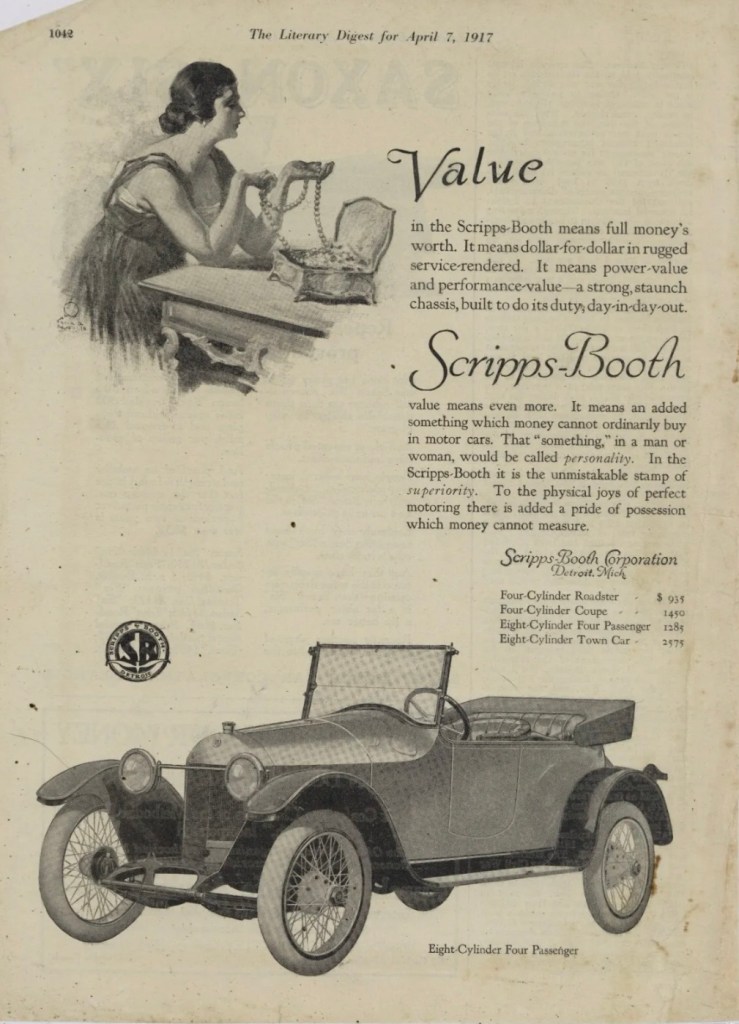
Kelvin Bullock’s 1917 Scripps-Booth V8 Special looking very handsome at Lake Perkolilli, Western Australia in the late-1930s.
I’d never heard of the marque Scripps-Booth (S-B) until tripping over this shot of Bullock’s handsome racer on Graeme Cocks’ mighty-fine Lake Perkolilli Red Dust Revival Facebook page; https://www.facebook.com/reddustrevival2022/
The American marque was imported into Western Australia by the Armstrong Cycle and Motor Agency, this car was living in the rural hamlet of Corrigin when Claremont racer/mechanic Bulloch acquired it and extensively modified it circa 1937.
He raced at various of the West Australian’ Round the Houses towns including Albany, Bunbury, Pingelly, Applecross, Cannington, Dowerin and Lake Perkolilli.
Dowerin, September 4, 1938 and side view of the Bulloch Scripps-Booth V8 Spl (G Cocks)Ferro V8 engine 1916-17 technical details as per text (Ferro)
Motorist and Wheelman magazine outlined the technical details of the Scripps-Booth Model D based special, as Cocks quipped, it shows just how inventive Specials builders were.
The engine was a Ferro V8, one of the first production American V8s, “which was surprisingly modern in design, and a most beautifully made and finished motor.” It still had its original cast iron pistons and had never been rebored. “The valves now in use, were designed for an Essex, and turned own for the Scripps. They are now closed by Chevrolet springs.”
The Alanson Brush designed series of V8s were built by the Ferro Machine and Foundry Company in Cleveland, Ohio; the Ferro Corporation still exists. The engine chosen by Scripps Booth was Ferro’s Model 8-35, a 162cid/2660cc, a two-main bearing OHV unit famous for being one of the first production automobile V8s, the first too with the block and crankcase produced as a single casting, 16 years before the 1932 Ford V8. The 8-35 had a 2 5/8 inch bore, 3 3/4 inch stroke, with a compression ratio of about 5.5:1. Fed by a Zenith twin-barrel carb, it produced 22.05hp/SAE, with an advertised output of 35hp. A Bosch magneto provided the sparks on Bulloch’s engine.
One owner described the engine as like two four-cylinder motors joined at the crankshaft, with each bank of cylinders fed by one chamber of a water heated inlet manifold. A heavy flywheel kept the vibrations at bay.
“The gearbox is original Scripps-Booth, but the rest of the 889kg that makes up the car, includes parts from a remarkable number of makes. The front dumb-irons are Chevrolet and the wheels and spring shackles Citroen. The radiator grille is ’34 Ford, the core Chevrolet, while the fan did 10 years service on a Rugby but its mounting is Bulloch Special.”
“Both the front axle and front brakes are Whippet, while the lamps in the first place showed the way to a driver of a Chrysler. The steering box, tailshaft and universals are Essex. At the top of the column a Ford steering wheel rides and behind it are two Austin bucket seats. Shock absorbers are Ford, and the rear braking, Bulloch says, ‘is by accident’!”
Dowerin September 4, 1938 (G Cocks Collection)
James Scripps-Booth and his creations…
“James Scripps Booth was a Detroit-area artist and automotive engineer. Born on May 31, 1888, in Detroit, Michigan, Booth was the eldest child of George Gough Booth, of the Booth publishing chain, and Ellen Scripps Booth, of the Scripps publishing empire,” according to the Detroit Historical Society. What follows is their ‘Encyclopaedia of Detroit’ entry on Booth.
“Booth grew up in a household that encouraged an awareness and appreciation of the arts, and he spent many hours sketching in and around his parents’ home in Detroit, surrounded by an extensive art collection. He also encountered many distinguished artists, writers, and musicians. Booth received most of his education through private schools and left school before finishing tenth grade. He taught himself the basics of automobile mechanics by systematically dismantling and reassembling the family’s car. While employed at the Detroit Evening News he developed his writing skills, broadened his automotive background, and refined his art techniques.”
“In 1910 at the age of 22, he married Jean Alice McLaughlin in Detroit. Following their marriage, Booth and his wife moved to Paris, where Booth studied art at the École des Beaux-Arts. They also spent some time living in Etaples, France, where Booth learned the fundamentals of working with pastels from Michigan-born artist Myron Barlow. In the decades following the couple’s return to the U.S., several of Booth’s works received critical acclaim at exhibitions at the Detroit Museum of Art and at other shows in both Michigan and California.”
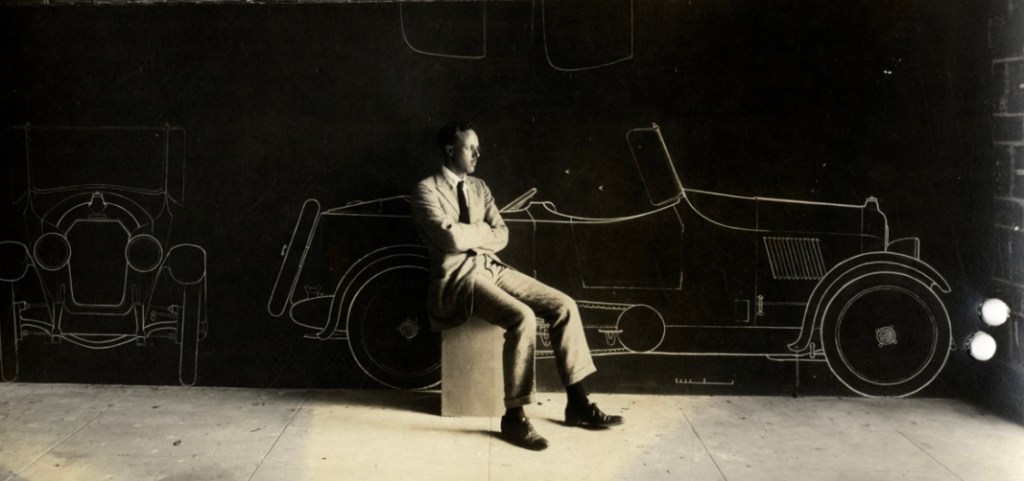
James Scripps Booth (he didn’t hyphenate his own name) posing with a life size drawing of his Da Vinci ‘Pup’ cyclecar in 1921 (HA Parker)James Scripps Booth’s drawing of the 115 inch wheelbase 1915-16 Scripps-Booth Vitesse Speedster V8, only one of which was built. The reverse of this drawing has this note by James “Proposed for Scripps Booth, accepted and detailed, then policy changed by Clarence Booth, then JSB quit.”
“As Booth perfected his artistic talents, he also developed a keen interest in mechanical engineering and automotive design. Many of his early drawings consisted of new designs for automobiles. In 1913, Booth developed his first automobile prototype, the “Bi-Autogo,” a unique two-wheeled cyclecar. The Bi-Autogo utilized the first V-8 engine ever built in Detroit. Booth’s Scripps-Booth Cyclecar Company was defunct within a year but was responsible for memorable designs. In 1914, with the financial support of his uncle William Booth, publisher of The Detroit News, Booth began his second business venture, the Scripps-Booth Automobile Company. The company produced more traditional upscale automobiles and was much more successful than the cyclecar business. Booth resigned in 1913 and moved to Pasadena, California. The company was purchased by General Motors and continued to operate until 1922.”
“In the 1930’s Booth moved his family back to Detroit from California, established an industrial design/art studio in Indian Village, and assumed responsibilities both as a trustee of the Brookside School and Cranbrook Foundation and as a director of the Cranbrook Academy of Art. During World War II, Booth published the General Handbook, Motor Mechanics Simplified: Understand Your Car, used by the American Red Cross in their automotive mechanics classes.”
“Following Booth’s death on September 13, 1954, a large collection of his automotive drawings, artwork, and several of his cars were donated to area institutions, including the Detroit Historical Museum.”
Scripps-Booth Model D…
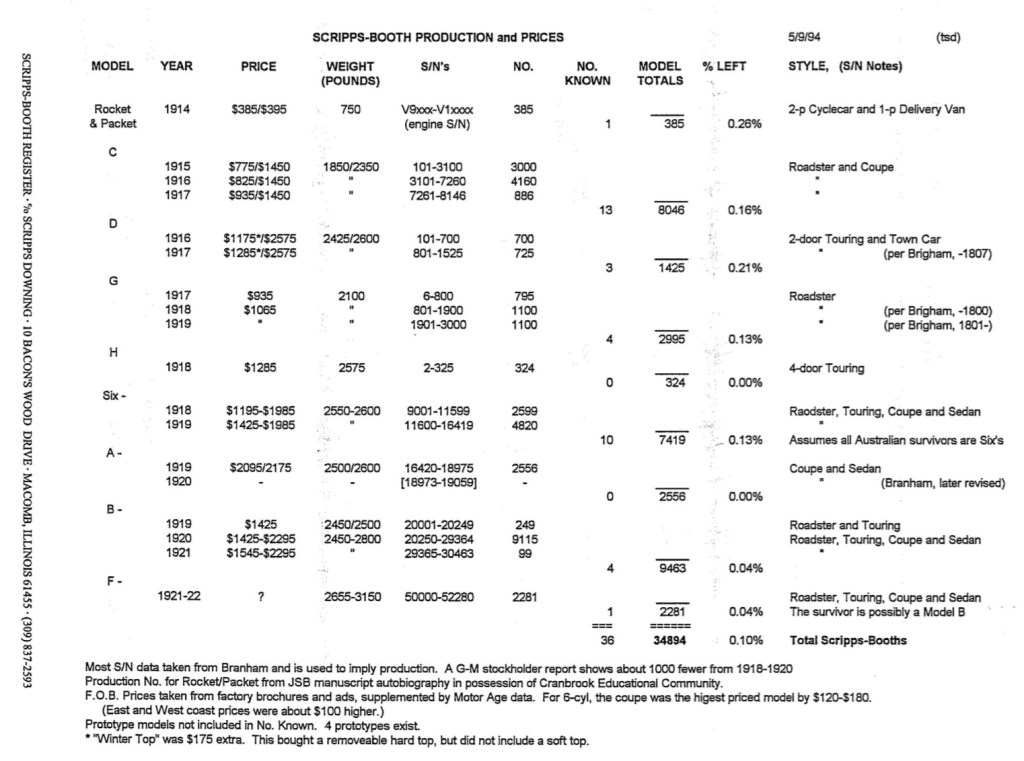
The donor car for Bullock’s special, the model D was built between July 1916 and July 1917. VIN numbers quoted are 101-801 (and 101-700) and 801-1807 (and 801-1525) respectively: 700 cars and 725 cars depending upon the figures you believe.
While Booth’s prototype of the Model D V8 was the short wheelbase (115 inch) two-seat sporty Vitesse, Booth lost the production battle with his fellow management team of the Michigan based Scripps-Booth Company. The cars built were 2-door tourers and town cars (and runabout, chummy runabout/roadster built on a 120 inch wheelbase. Whether S-Bs imported to Australia were factory built or arrived sans-bodies, given the favourable tax-treatment afforded cars imported as rolling-chassis, is unclear.
The agents for S-B in Australia were the Armstrong Motor and Cycle Agency in WA, Roy Standfield Ltd in Sydney (from 1919 John McGrath) and Durance-Mayston Motors in Melbourne. It appears the cars came to Australia in some numbers, 62 S-Bs were registered in NSW in 1919 alone. How many are left here now? less than 10 it seems.
1916 Ferro ‘V-Type’ Motors ad. The types listed are the 8-35 (163cid), 8-48 (198cid), and 8-60 (265cid), that is 35, 48 and 60hp V8s and the 12-80 80hp V12. Hopefully, you can just read this…
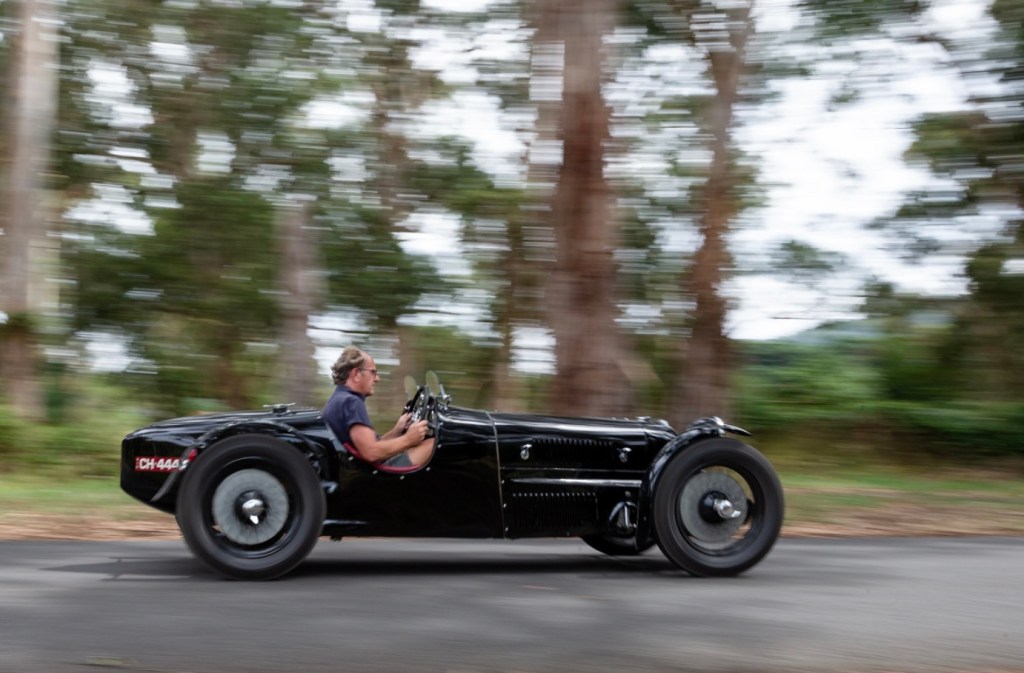
What inspired this exploration of the arcane is the gorgeous looking body Bulloch had built by a body-artisan of some ability in Perth. It seems it’s perhaps not entirely original though. Perth man Graeme Holman is building a tribute car to the long-lost Bulloch Scripps-Booth V8 Special and credits the design inspiration for it as the 1934 Ford Model 40 Special Speedster commissioned by Edsel Ford for his own use. What a shame it is the magnificent E.T. ‘Bob’ Gregorie designed car was not put into series-production, they would have sold like hot-cakes. See here for a great piece on these cars; https://www.thetruthaboutcars.com/2012/01/look-at-what-i-found-the-most-significant-car-at-the-2012-naias-edsel-fords-1934-model-40-special-speedster/
The second Ford Speedster ordered by Edsel Ford – 1934 Type 40 Special Speedster – with its original, very elegant front styling, the photo was perhaps taken near Greenwich Village on Ford’s Dearborn campus. The shot below shows Ford Chief Designer Bob Gregorie’s scale model of the 1940 restyling to address overheating issues, and Edsel’s note to him (FoMoCo)(FoMoCo)
Bulloch bought his S-B in late 1937 or early 1938 in Corrigin, an affluent wheatbelt town 230km southeast of Perth. Perhaps the car was a farmer’s pride and joy and was pushed into a shed when it eventually misbehaved? Interestingly, a Mr C.D. Kerr placed fifth in a S-B at the Bibra Lake standing-quarter mile meeting in February 1935 (26.4sec), I wonder if it’s the same car?
Quite who the team of mechanic/engineers/bodybuilders that assembled the cocktail of S-B Model D chassis, engine and gearbox and other assemblage of components into such a cohesive looking and seemingly competitive racer is unknown…but I’d love to know.
Kelvin Bulloch had been a prominent in the WA Sporting Car Club from about 1935. In ’37 he won the club’s silver-star for the greatest aggregate points in club competitions as well as the over 1500cc hill climb and had considerable success in gymkhanas. In 1936 he won the club’s eight-hour trial, the year before he dead-heated with Aub Melrose for first place.
Some of the field at the September 1938 Dowerin meeting, Bulloch #6. Help with other car IDs welcome (G Cocks)
Bulloch is said to have raced the car at various of the WA Round the Houses town tracks including Albany, Bunbury, Pingelly, Applecross, Cannington and Lake Perkolilli, with his best result a win at Dowerin in September 1938. There he won the main event, a 20 lap handicap, “driving well to gain the lead in the early stages” and triumphing despite his engine misfiring in the race’s final stages.
In an article to promote that Dowerin meeting, The West Australian described the car as ‘The Venerable Scripps-Booth’. It reads “One of the most unlucky drivers in recent months has been Kelvin Bulloch. He failed to start at Albany, and a minor ignition failure robbed him of almost certain victory in the big race at Dowerin in June. This time he is hopeful that the old Scripps-Booth, which has been dubbed ‘The Scraps’ will at least last the course.”
The class of the field in WA then was soon to be 1939 Australian Grand Prix winner Allan Tomlinson and his MG TA Spl s/c and Jack Nelson in a Ballot 2LS Ford V8 Spl.
Quite what became of the Kelvin Booth Scripps-Booth V8 Special is unknown, do get in touch if you can assist.
(Cox Family)
Other Australian competition Scripps-Booth…
“A picture of my old man, Wally Cox about 1937,” Allen Cox wrote. “A 23 year old petrol-head, his car was a 1922 Scripps-Booth fitted with a T-Model Ford engine fitted with a Frontenac or Rajo cylinder head conversion. In addition to that he pulled off the guards and lightened it etc. The problem was that in small country towns the constabulary knew where everyone lived!”
(Thomas Family)
1960’s drag-racing champion and speedshop chain entrepreneur Eddie Thomas owned a Scripps-Booth 13-34 162cid V8 that he fitted to a speedway midget he raced circa 1940.
What became of these cars and engines is unknown.
Etcetera…
These tables are from the Scripps Booth register, check out scrippsboothregister.com if you have a hankering to learn more about these cars.
Model D styling drawings by James Scripps Booth
Credits…
Red Dust Revival Facebook page, Graeme Cocks Collection, Detroit Historical Society, Harold A Parker, scrippsboothregister.com, various newspapers via Trove, Terry Walker’s Place – West Australian race results, Ferro Corporation, FoMoCo
“Joisus! Bite your tongue young man!” I showed a far younger bloke a shot of a Chaparral 2F and he offered up, “It doesn’t look that special.” FFS!
But context is everything, one needs to see Chaparrals surrounded by the paradigm set of the day to observe just how edgy their aerrodynamics and technology was/is. GM contribution duly noted.
The photograph above shows the Bruce Jennings/Bob Johnson Chaparral 2F Chev (DNF battery) leading the Jochen Neerpasch/Rolf Stommelen Porsche 910/6 (sixth) – with another 910 up ahead at Le Mans in 1967. The team-leading 2F of Phil Hill and Mike Spence was out after 225 laps with transmission failure, the cars Achilles heel. The winning Shelby Ford GT40 MkIV piloted by Dan Gurney and AJ Foyt completed 388 laps. See here for a feature on Le Mans 1967; https://primotipo.com/2015/09/24/le-mans-1967/
(MotorSport)
On the hunt, the Mike Spence/Jim Hall 2F (DNF diff) closes on the West/Osborn/Allison Shelby GT350 (disq outside assistance) under brakes at Sebring in 1967. The Bruce McLaren/Mario Andretti Ford GT40 MkIV won. More on the Chaparral 2F here; https://primotipo.com/2014/06/26/67-spa-1000km-chaparral-2f/
(MotorSport)
Simply superb. Aluminium monocoque chassis, steering rack and period typical outboard front wishbone suspension. Look at the emphasis on brake rotor and caliper cooling.
Hill/Spence with Mike at the wheel, Le Mans 1967 (MotorSport)(MotorSport)(LAT)
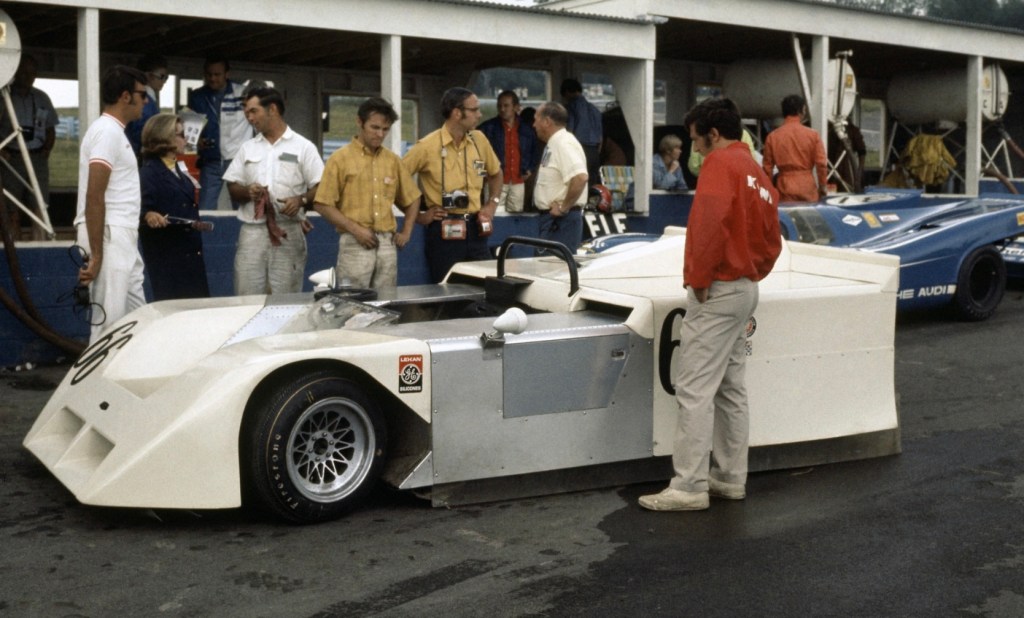
Vic Elford’s Chaparral 2J Chev at Riverside during the final 1970 Can-Am Challenge round. Bonus points for the names of the crew. Q1 by only a little over two-seconds! from Denny Hulme’s championship winning McLaren M8D Chev and DNF auxiliary engine after only two laps. Denny won.
(MotorSport)
Chaparral 2J-001 at rest during the Watkins Glen Can-Am/Six Hour July 11 1970 weekend, with one of the Porsche Salzburg 917Ks behind. Jackie Stewart raced the 2J, Q3 and DNF brake failure, see here for more; https://primotipo.com/2022/09/17/chaparral-2j-chev/
Riverside 1970 (MotorSport)(MotorSport)
Either Hap Sharp was a very big unit or the interviewer is a tiny-tot? Looking happy, he has just won the Governor’s Trophy & Nassau Tourist Trophy race aboard a 2E Chev during the 1966 Nassau Speed Week; none of that nancy-boy Nomex crap for Hap.
(MotorSport)
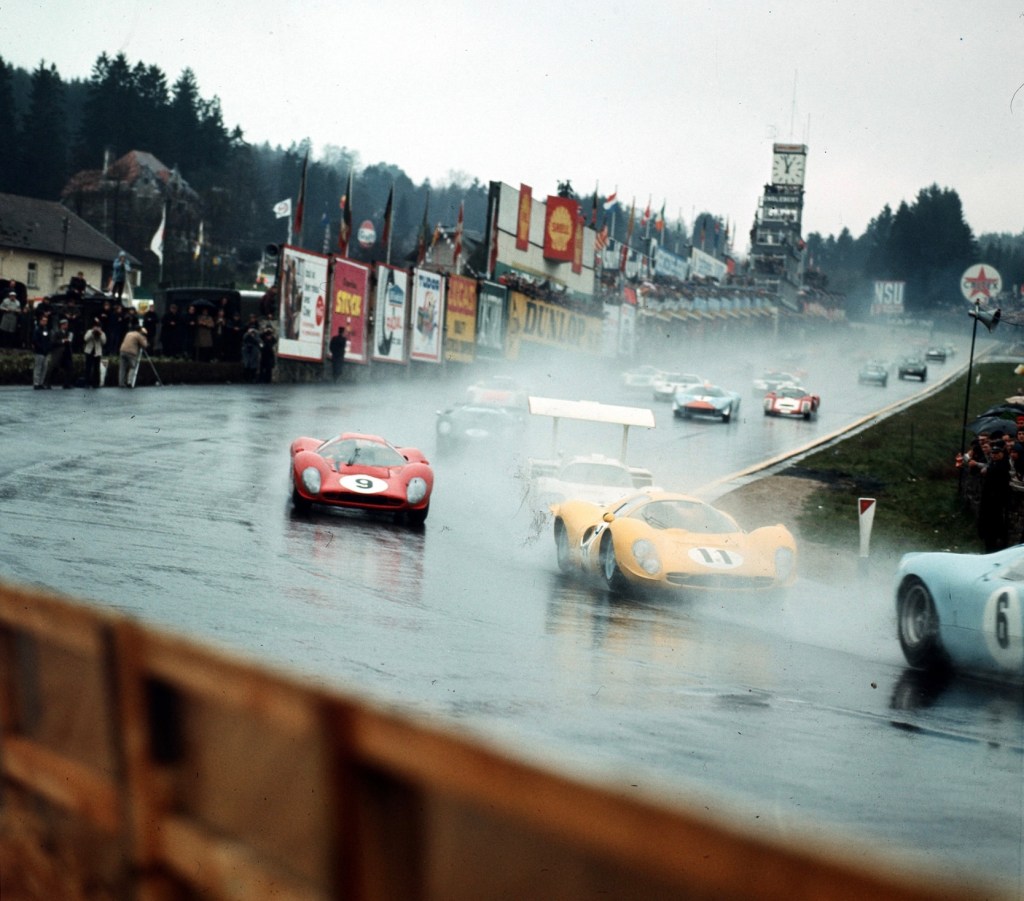
It still looks radical even if you can’t properly see it! The Spence/Hill 2F up the pointy end at the start of the May 1967 Spa 1000km.
#6 is the first placed Jacky Ickx/Dick Thompson Mirage Mk1 Ford, the Willy Mairesse/Beurlys Ferrari 330P4/412P follows and then the works-Ferrari P4 crewed by Mike Parkes/Phil Hill. Sadly another gearbox failure for the Chaparral boys.
Credits…
MotorSport Images
Tailpiece…
(MotorSport)
Franz Weis was a key member of the Rattlesnake Raceway crew from the outset, and all the way through. More than a few Aussies used 5-litre Chaparral Chevs built by him in the Formula 5000 era. Here he is with Jim Hall’s Chaparral 2A Chev at Corry Field Pensacola, Florida before the USRRC round in April 1964.
Jim Hall won the race from Roger Penske’s Cooper T61 Monaco Chev and Ed Hugus’ Lotus 23B Lotus-Ford. Hall won the 10 round championship with victories in four rounds, Sharp took one win. See here for a feature on the 2A; https://primotipo.com/2020/01/25/chaparral-2a-chev/


























 primotipo...