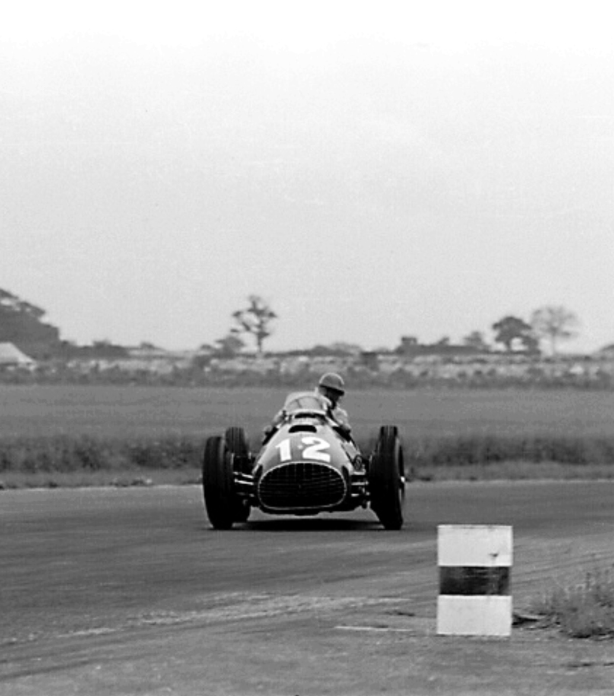
(Louis Klemantaski)
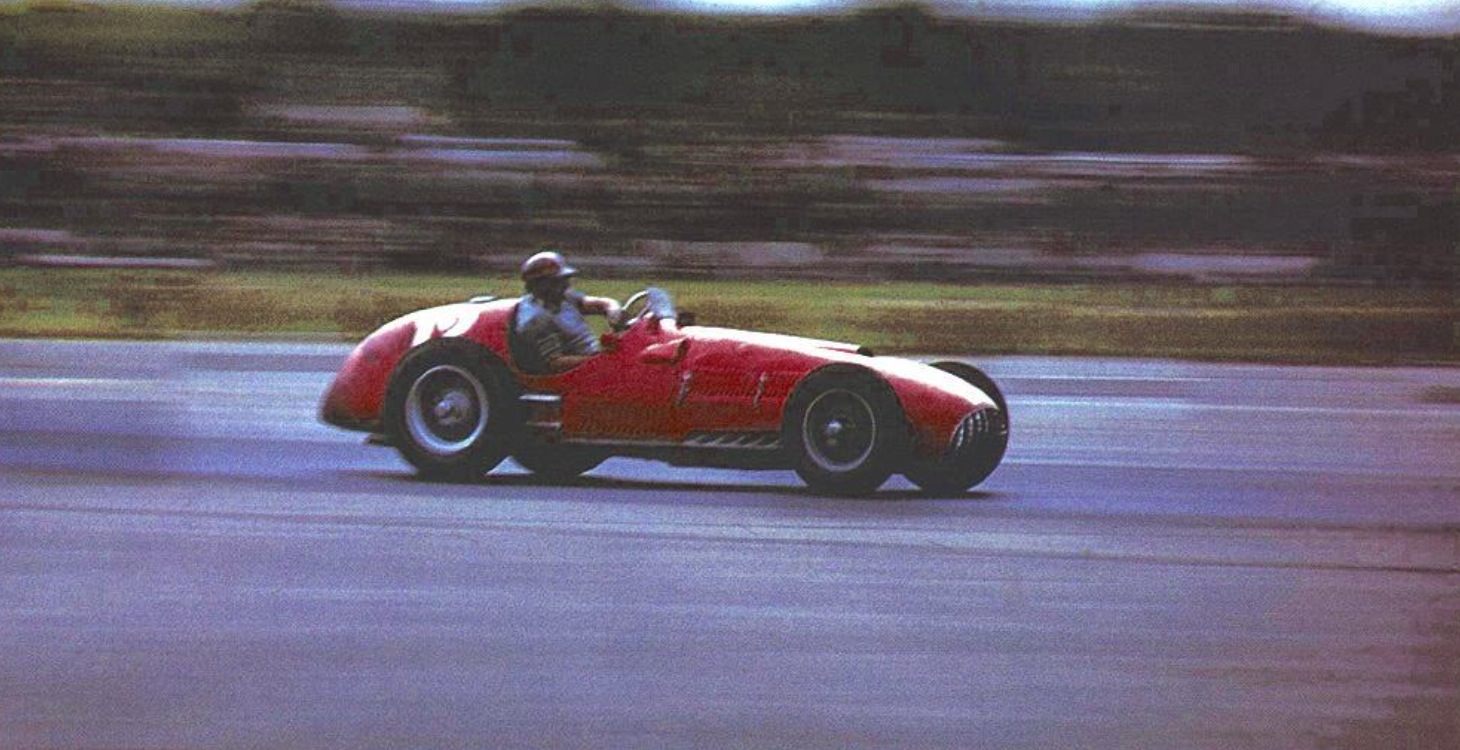
Froilan Gonzalez plays with the limits of adhesion of his victorious Ferrari 375 V12 at around 140mph. Copse Corner, Silverstone, 14 July 1951…
The dominant force in Grand Prix racing in the immediate post-war period was Alfa Romeo, the pre-war ‘Alfetta’ voiturettes progressively modified to remain winners; they had not been beaten since 1946.
Ferrari had achieved success at Le Mans, the Mille Miglia and the Targa Florio and now took an alternative Grand Prix design path to Alfa and BRM for the 1951 season in building cars powered by a normally aspirated 4.5 litre V12 rather than the supercharged straight 8/V16 route of his rivals. Instructive had been the reliability and speed of the Talbot-Lagos despite the cars relative lack of sophistication given the French machines road-car origins.
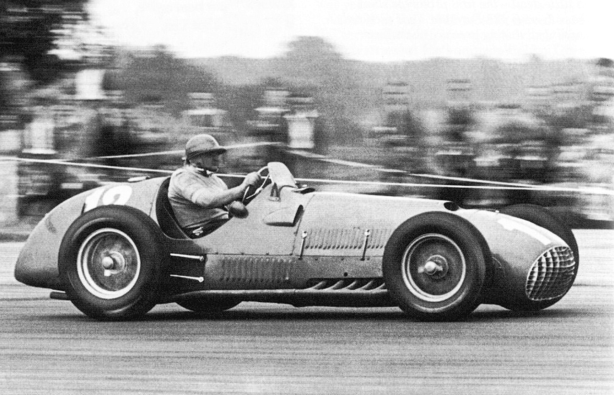
Gonzalez, Silverstone 1951, Ferrari 375, the burly Argentinian master of this car. Note exhaust system of the V12 and twin radius rods locating rear axles (unattributed)
Ferrari’s Type 375’s were first entered at the Pescara Grand Prix on 15 August 1950, but were not ready. The cars made their championship debut at Monza on 3 September 1950 with entries for Alberto Ascari and Dorino Serafini. Ascari qualified 2nd and was dicing with the lead group of Fangio and Farina both 158 mounted, before retiring on lap 21 with engine overheating.
Click here for an article on the Type 375 i wrote a while back;
VI Gran Premio del Valentino, April 1952: Ferrari 375…
In order to test the cars over a full GP distance,375’s for Ascari and Serafini were entered for the GP do Penya Rhin, at Pedralbes, Barcelona on 29 October. The cars finished 1/2, no Alfa’s were entered but the cars completed a GP distance without problems. With further development over the winter the 375’s were ready for 1951.
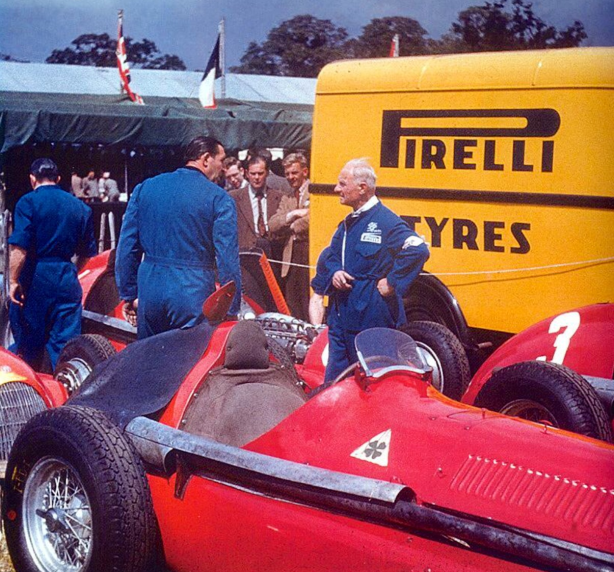
Alfa Romeo pit British GP, Silverstone 1951 (unattributed)
By 1951 the supercharged Alfa’s, designated ‘159’ developed around 410bhp from their supercharged 1.5-litre engines, while Ferrari had been working on a twin-plug version of the 4.5-litre V12. It wasn’t as powerful as the Alfa but it was more efficient, less fuel meant less pit stops.
Alfa ignored most of the early season non-championship races. In their absence Ferrari 375’s won at Siracuse and Pau on 11 and 26 March, Gigi Villoresi the winning driver on both occasions. Ascari won the San Remo GP on 22 April.
The Alfa’s finally appeared for the ‘BRDC International Trophy’ race at Silverstone on May 5, but the works Ferari 375’s did not. Fangio and Farina each won a heat for Alfa with the final held in torrential rain led by Reg Parnell’s Ferrari 125/375 when the race was ended after 16 minutes on lap 6.
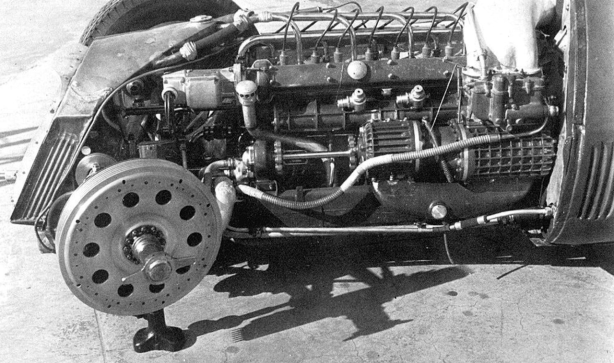
Engine and brake detail of the Alfa Romeo 159, Silverstone 1951. 1.5 litre two-stage supercharged straight-8 (unattributed)
The first 1951 Championship GP was at Berne for the Swiss Grand Prix. Ascari was suffering from a burn to the arm received during a Formula 2 race at Genoa the weekend before and Villoresi slid off the road in wet conditions. Progress was indicative of Taruffi’s Ferrari second place splitting the Alfas of Fangio and Farina, first and third.
At Spa, a jammed wheel at a pit stop cost Fangio his second successive win, Farina took Belgian GP win for Alfa Romeo from Ascari and Villoresi in Ferrari 375’s.
The French Grand Prix was a furious battle between Ascari and Fangio, both of whom changed cars with Fangio taking the win for Alfa. Ascari’s 375 had gearbox failure and Froilan Gonzalez, who had led the race briefly and pitted to refuel, was asked to hand his car over. Fangio took over Luigi Fagioli’s Alfa, JM’s car failed on the first lap of the race. This was Gonzalez’ first race for Ferrari. Just before the French Grand Prix, Enzo Ferrari had approached him to replace the unwell Piero Taruffi. The Fagioli/Fangio car won the race from the 375 of Gonzalez/Ascari.
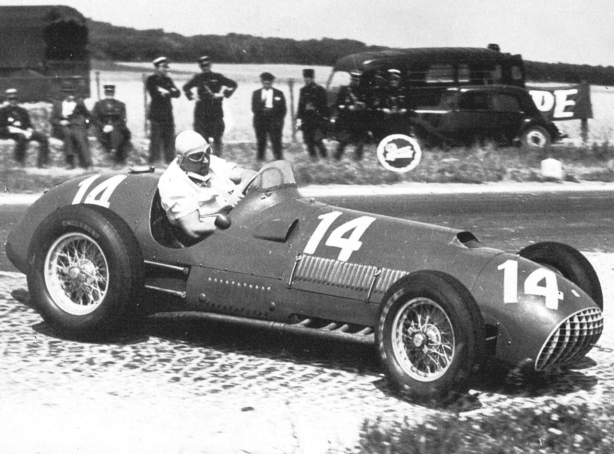
Gonzalez in his first Ferrari drive, he lead the French GP at Reims before offering his 375 to Alberto Ascari, the pair finished 2nd to the Fangio/Fagioli Alfa 159 (unattributed)
Froilan recalled the French GP in Gonzalez ‘The Pampas Bull’; ‘The dream was to be very brief. I was utterly determined to make my mark at Reims in the Grand Prix de France and after a tough battle I managed to lead the race. But when I stopped at the pits to refuel (Ferrari Team Manager) Ugolini told me to hand over my jewel to Alberto Ascari who had walked back to the Ferrari pits after his own car had broken down’.
‘Recalling it now I suppose it was understandable. Ascari was more experienced in the Grand Prix arena than I, and since he was now available, it was obviously more sensible to let him take over. But at the time I was mystified and wounded. I assumed I had in some way failed one of Ferrari’s mysterious tests. Yet nobody would tell me where I had failed’.
‘I was just as puzzled when Enzo Ferrari sent for me. Puzzled and timid, for Ferrari was a powerful experienced man of the world while I had only recently arrived in Europe I had no idea how to address the ‘sacred monster’ of the motoring world when I was led into his office. I managed to say ‘Good morning’ in Spanish and then stood there speechless, wondering why I was there and what to do next. Don Enzo, realizing my embarrassment, helped me out by smiling and shaking my hand. And to my utter amazement he – the greatest figure in world motor racing – actually congratulated me for what I had done at Reims. I was even more astounded when he suddenly asked me: ‘Would you like to sign a contract to drive for the Ferrari team?’ I can feel even now the almost painful thumping of my heart. This just isn’t true, I told myself.’
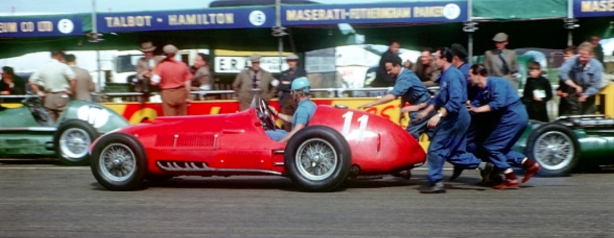
Ascari cruising the Silverstone pitlane, Ferrari 375 during practice DNF lap 56 with ‘box failure (Getty Images)
Alfa Romeo brought 159’s to Silverstone for Fangio, Farina, Consalvo Sanesi and Felice Bonetto. Ferrari brought three Type 375s for Ascari, Villoresi and Gonzalez with Peter Whitehead in Tony Vandervell’s ‘Thinwall Special’ Ferrari…
Talbot returned with three T26C 4.5-litre, straight-6 cylinder cars. Maserati relied on ageing 4CLTs for David Murray and John James, while Philip Fotheringham-Parker raced an older 4CL. ERA had Bob Gerard and Brian Shawe-Taylor and Joe Kelly was in his Alta.
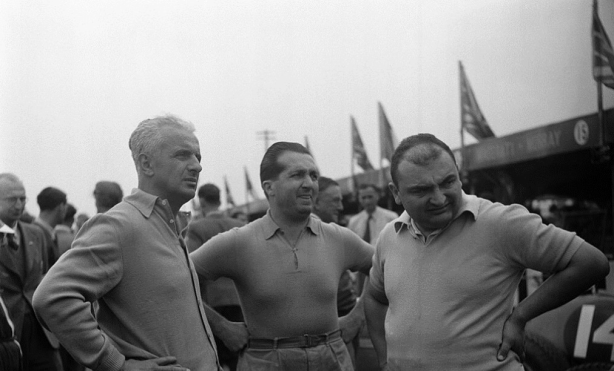
Scuderia Ferrari drivers Silverstone 1951; Gigi Villoresi left, Alberto Ascari and Froilan Gonzalez, all remarkably ‘well-nourished’ by driver standards of today! And older of course (Getty Images)
BRM turned up on the morning of the race having missed practice. Reg Parnell and Peter Walker started from the rear of the grid as a consequence.
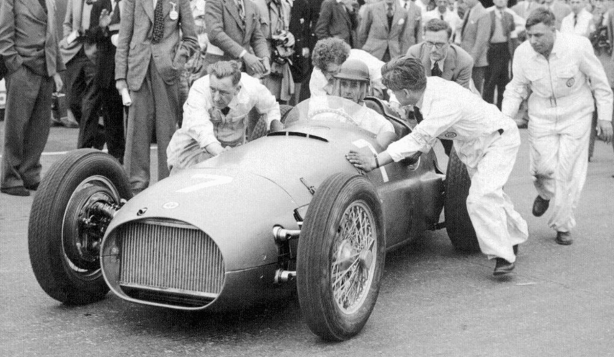
Peter Walker’s BRM Type 15, 7th being given a shove during practice (unattributed)
John Bolster of Autosport commented about Gonzalez’ speed and technique; ‘Thursday found me walking round the circuit, trying to work out how on earth these boys get round the corners the way they do. My stopwatch was busy in my hand, and I had a conversion table, so it was with immense excitement that I observed that Froilan Gonzalez had lapped at 99mph. His next tour looked even faster and, yes, the magic 100mph had been topped at last!’
‘The interesting thing is that he brakes later than anybody else, actually enters the corner faster, and gets through in an immensely long drift. He has none of the ease in the cockpit that Farina exhibits, and certainly does not follow the same path every time. Unlike all the other drivers, he changes down without gunning his motor, and yet there is no clash of gears and the box stands up to the treatment. John Wyer and I listened to this for lap after lap at Woodcote, and were fair amazed. A phenomenon, this Froilan!’ Bolster observed.
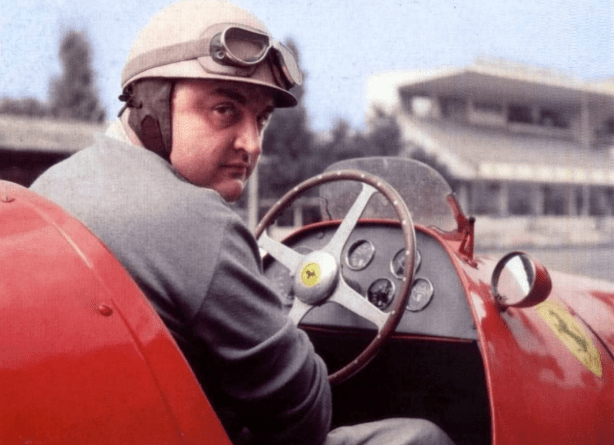
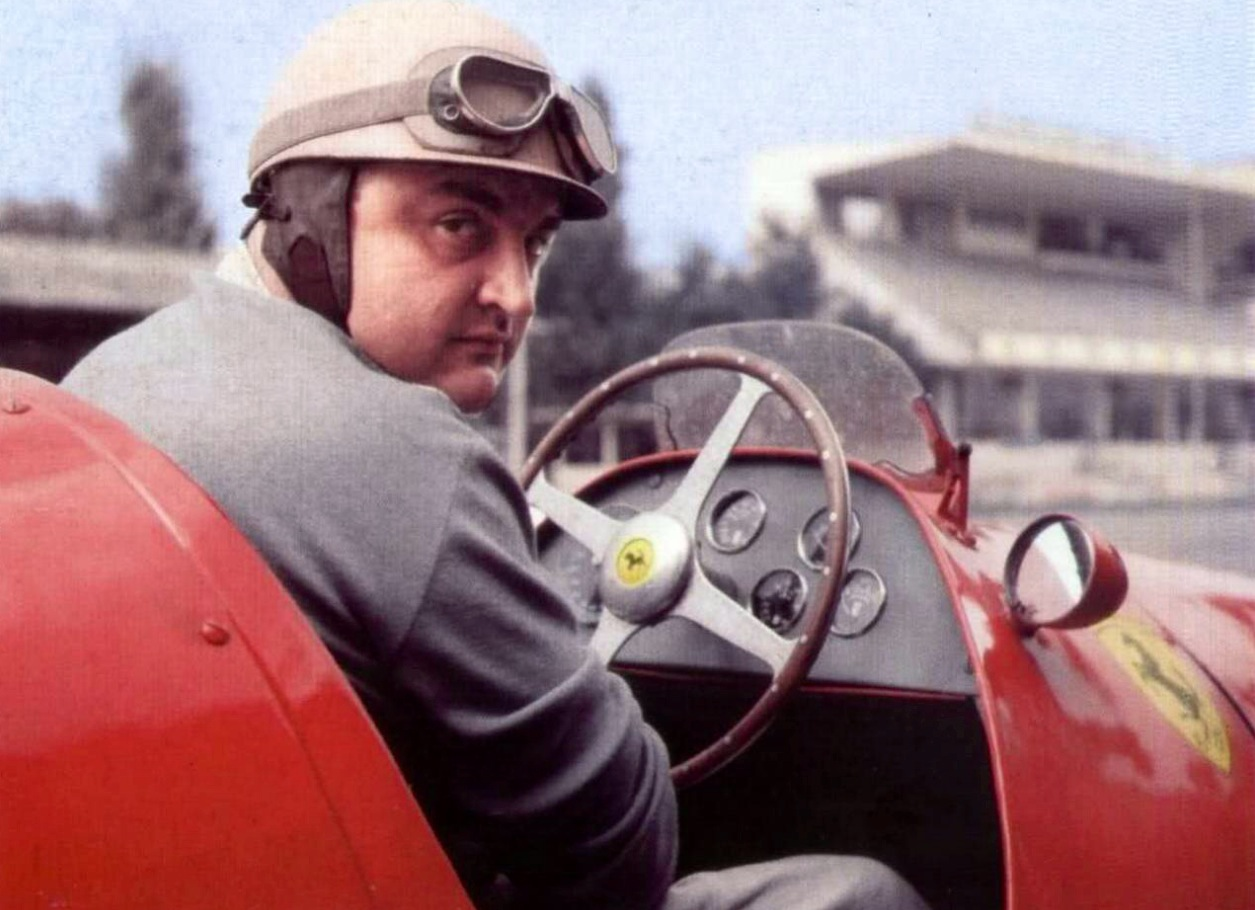
Froilan Gonzalez Ferrari 375, Silverstone 1951, lovely portrait of the Argentinian Champion (unattributed)
Gonzalez lapped Silverstone in 1 minute 43.4 seconds and was on pole, a second quicker than Fangio’s Alfa. On Friday the track was damp and those times prevailed. Froilan’s time was set without the latest the latest twin-plug V12 fitted to Ascari’s car.
Gonzalez; ‘Ferrari had the gift of instilling confidence in its drivers. Although I was still very inexperienced I arrived at Silverstone for the 1951 British Grand Prix feeling that I really belonged in the Scuderia Ferrari, feeling eager also to pit my car’s power against the almost unbeatable Alfa Romeos – and my own skill against the world’s greatest racing drivers. Silverstone was the meeting place for international statesmen, industrialists, and millionaires, all looking for excitement’.
Silverstone was the first time an Alfa Romeo had not been on pole position since the world championship began the year before…
Around 50,000 spectators arrived at the Northhamptonshire circuit on the Saturday, eager to see a great contest between Alfa, Ferrari and BRM.
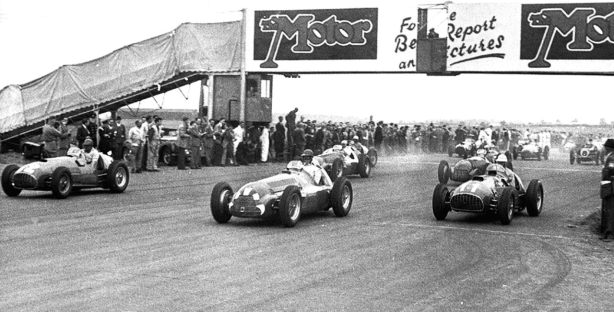
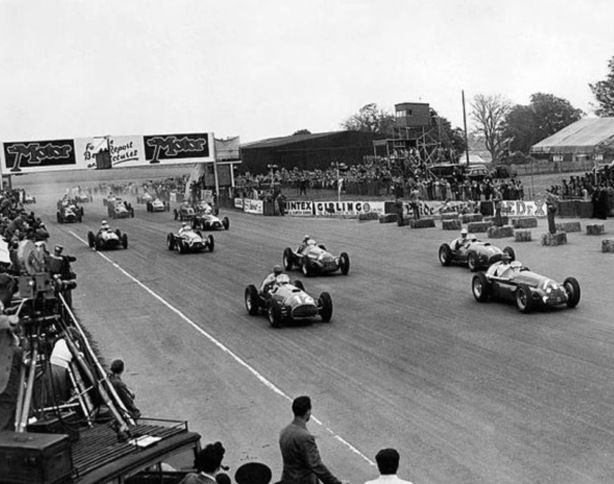
Start of the GP with Gonzalez, left on pole Fangio and Ascari #11 on the outside. Ferrari 375, Alfa 159, Ferrari 375 (unattributed)
Felice Bonetto made the best start from seventh, the front row delayed with excessive wheelspin, and lead at the end of lap 1 but Gonzalez took over with Fangio chasing.
Gonzalez; ‘As we passed the pits for the first time I noticed that both the Alfa and Ferrari team managers were signaling the same instructions, which were in effect that we should drive our own race. The alarming start meant that team tactics must be abandoned. ‘Go for the lead’ came the urgent message and soon as I saw that I went flat-out. By the next lap I was leading’.
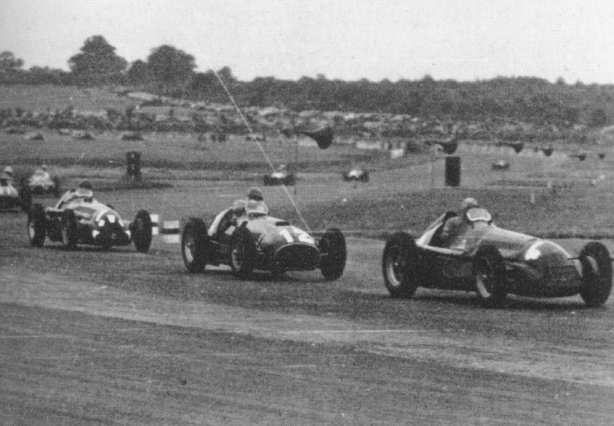
Felice Bonetto Alfa being chased by #12 Gonzalez Ferrari and #1 Farina Alfa 159 with #11 Ascari Ferrari just in shot (unattributed)
‘I could not hear them but I had the feeling that the British crowd had forgotten their usual restraint. They were jumping and waving and, it seemed to me, yelling like mad. ‘Pepito. You are ahead of the Field Marshals,’ I thought, and kept my foot hard down on the accelerator pedal. Then suddenly my rear-view mirror showed a red car, growing bigger and bigger. A signal from my pit as I shot past told me it was Fangio’s Alfa Romeo. ‘Pepito. Don’t do anything foolish. Don’t panic. Even Fangio will have to do a re-fuel.’
Within 15 laps, Fangio was five seconds ahead of Gonzalez. the duo were 44 seconds ahead of third-Farina who was scrapping with Ascari from Bonetto and Villoresi. It was Alfa Romeo, Ferrari, Alfa Romeo, Ferrari, Alfa Romeo, Ferrari. The fuel stops would settle the issue.
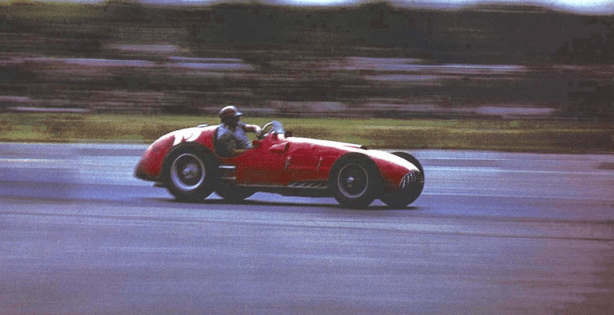
Nice color panned shot of Gonzalez on the way to victory. Shows the big, butch lines of the Ferrari to good effect, the delicacy of touch required to drift the thing at 140mph readily apparent, and appreciated! (unattributed)
Gonzalez hit the straw-bales at Becketts but gradually closed on Fangio to retake the lead on lap 39. At the end of lap 48, Fangio pitted and Gonzalez came in 13 laps later. Ascari had retired with gearbox trouble and Gonzalez climbed from his car and offered it to his team-mate. Ascari refused and urged Gonzalez to continue. The stop took 23 seconds, Fangio’s 49 seconds, JM had his rear wheels changed and his fuel tank filled. The gap between the leaders was then 1 minute 19.2 seconds.
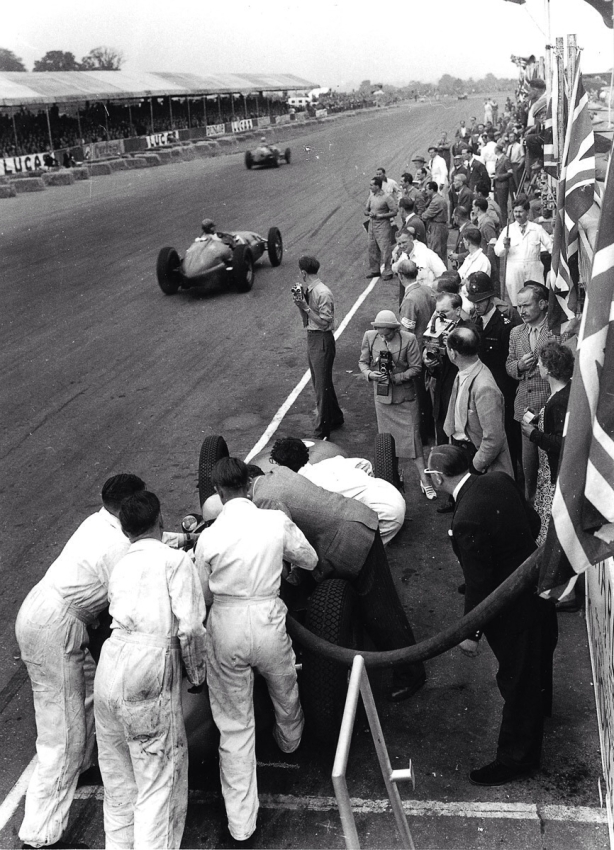
Pitsop for the thirsty Parnell BRM Type 15 ; passing is the Farina Alfa being closely watched by Alberto Ascari, astride the white line, retired from the race. The balding Raymond Mays looks away from the BRM , to Mays right beside ‘the copper’ is journalist and racer John Bolster (unattributed)
‘When Fangio caught me in the 10th lap I let him overtake, placing myself directly on his tail. We traveled in tandem, our two cars seeming to be roped together. Even when he increased speed we remained like this, driving like men pursued by the Devil himself. There was a moment of danger around the 25th lap when I took Becketts Corner too fast and hit the straw bales. But this made me keener than ever and I set off again after Fangio. I began to close on him, having been perhaps 5 or 6 seconds behind him with both of us averaging about 97 mph until, on the 39th lap, I eventually took him. Towards the end of the race I was more than a minute ahead of him’.

Gonzalez leads Fangio during their great Silverstone race (unattributed)
‘Motorsports’ August 1951 issue described the events as follows: ‘Try as Fangio could and did, it was over. Gonzalez came round, crash hat and visor in his left hand, waving them to the crowd.
‘Ferrari with the unblown 4.5-litre had at last broken the might of the two-stage supercharged 159 Alfa Romeo, as they have been threatening to do since Monza last year. Froilan Gonzalez had driven impeccably and is now in the front rank.
‘Fangio drove like the master he is, but couldn’t catch the Ferrari, nor could his longer pit-stop explain the 51 second gap and he was the meat in the Ferrari sandwich. And how these Argentinians drive!’
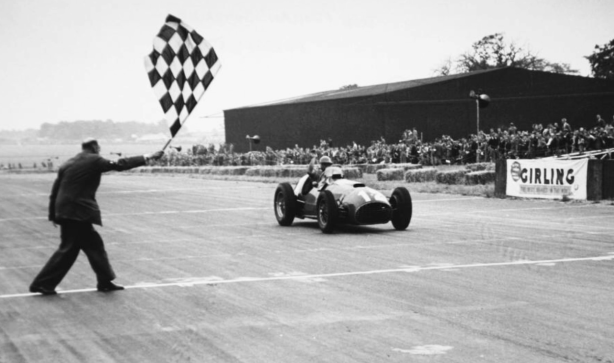
Froilan Gonzalez takes the Silverstone chequered flag to record an historic personal and team win, Ferrari 375 (unattributed)
Villoresi was third after Farina retired at Abbey Curve, with smoke billowing from the engine compartment but the failure reported as ‘clutch’. Bonetto was a further lap behind the Ferrari in fourth.
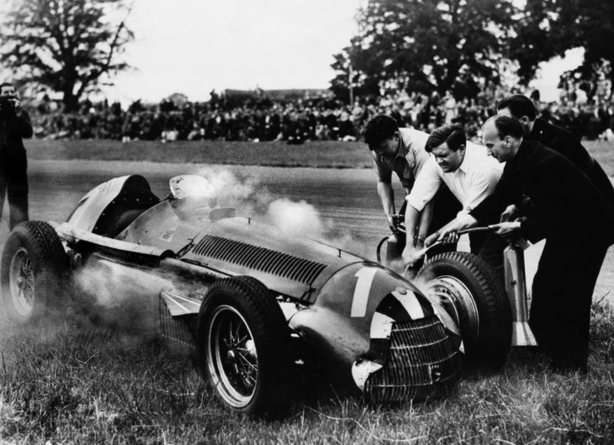
Farina’s Alfa 159 hors ‘d combat on lap 75 with a failed clutch (unattributed)
Reg Parnell was 5th in the BRM with Walker 7th. The BRM drivers completed the race burned by their exhausts and dazed by fuel vapours. In the hurry to complete the cars for the race, the exhausts hadn’t been properly insulated and the drivers were ‘cooked’.

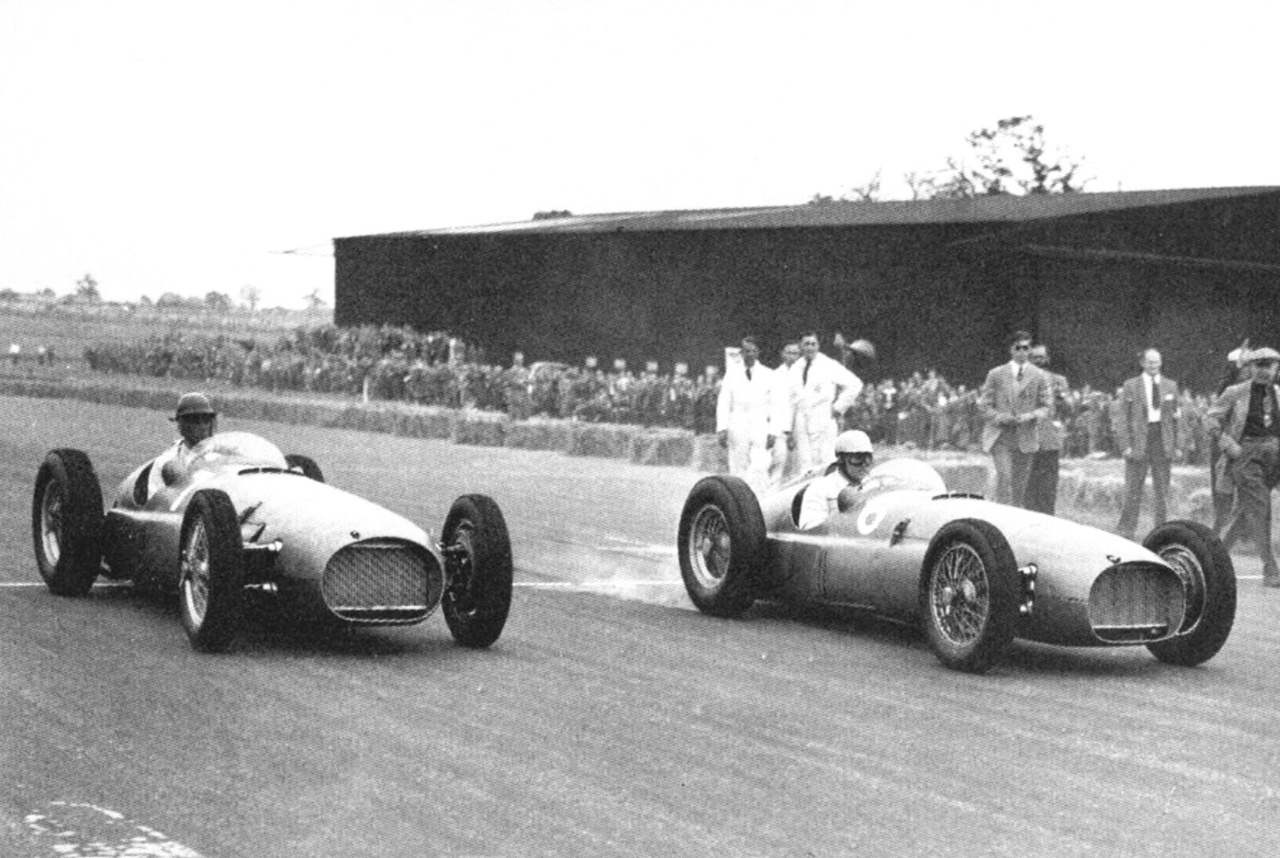
The BRM Type 15′ s get away at the start; Walker left 7th and Reg Parnell #6 5th (unattributed)
‘It was very confusing’ said Gonzalez aftewards, ‘But very exciting. Everyone was shouting and talking; the mechanics saying over and over again that the Alfa Romeos had been beaten. Then I was taken to meet the Queen and given a laurel wreath. Of course, I understood little of what was said but it was a very nice feeling to have all those people congratulating me.
‘On the winners podium I was embraced warmly by Fangio. That meant a lot to me. Then they played the Argentine National Anthem. I had never experienced anything like this before. When I saw my country’s flag being hoisted, it was just too much for me and I cried. That moment will live with me for ever.’
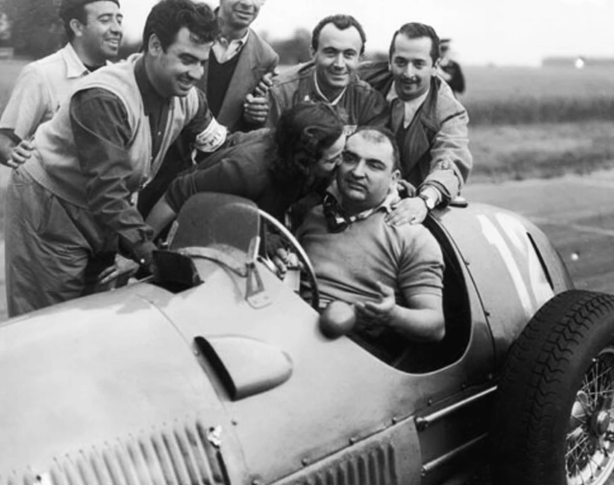
Gonzalez being congratulated by his wife and crew after the historic win, the enormity of it all still to set in (unattributed)
Enzo Ferrari’s dogged determination to win Grands Prix with his own cars was achieved against Alfa Romeo, for whom for many years he lead their pre-War racing programs. It was the first time the Alfas had been beaten since the first post-war French Grand Prix in 1946.
At the end of the season, Alfa Romeo applied for a significant increase in their government grant, the company still within the control of the agency which took it over after its insolvency pre-war. It was refused and the team withdrew from Grand Prix racing, a return finally made with the provision of engines in 1970 and more wholistically as a team in 1979.
In his Richard Williams biography, Enzo Ferrari said of his first Ferrari GP victory: ‘I cried for joy. But my tears of enthusiasm were mixed with those of sorrow because I thought, today I have killed my mother’…
Etcetera…
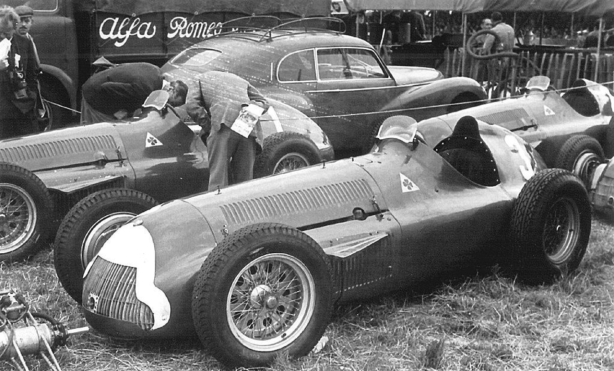
Alfa’s in the Silverstone paddock; #3 Consalvo Sanesi 6th, #1 Farina DNF (unattributed)

Front row makes a poor start; #12 Gonzalez, Farina better away and Ascari #11 on the right with Fangio’s Alfa almost beside Ascari and Felice Bonetto, Alfa coming up quickly behind Fangio (unattributed)

Alberto Ascari from Giuseppe Farina Ferrari 375 and Alfa 159, Silverstone 1951, both DNF (unattributed)
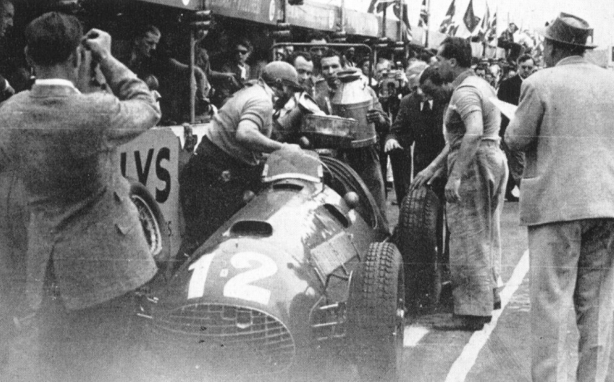
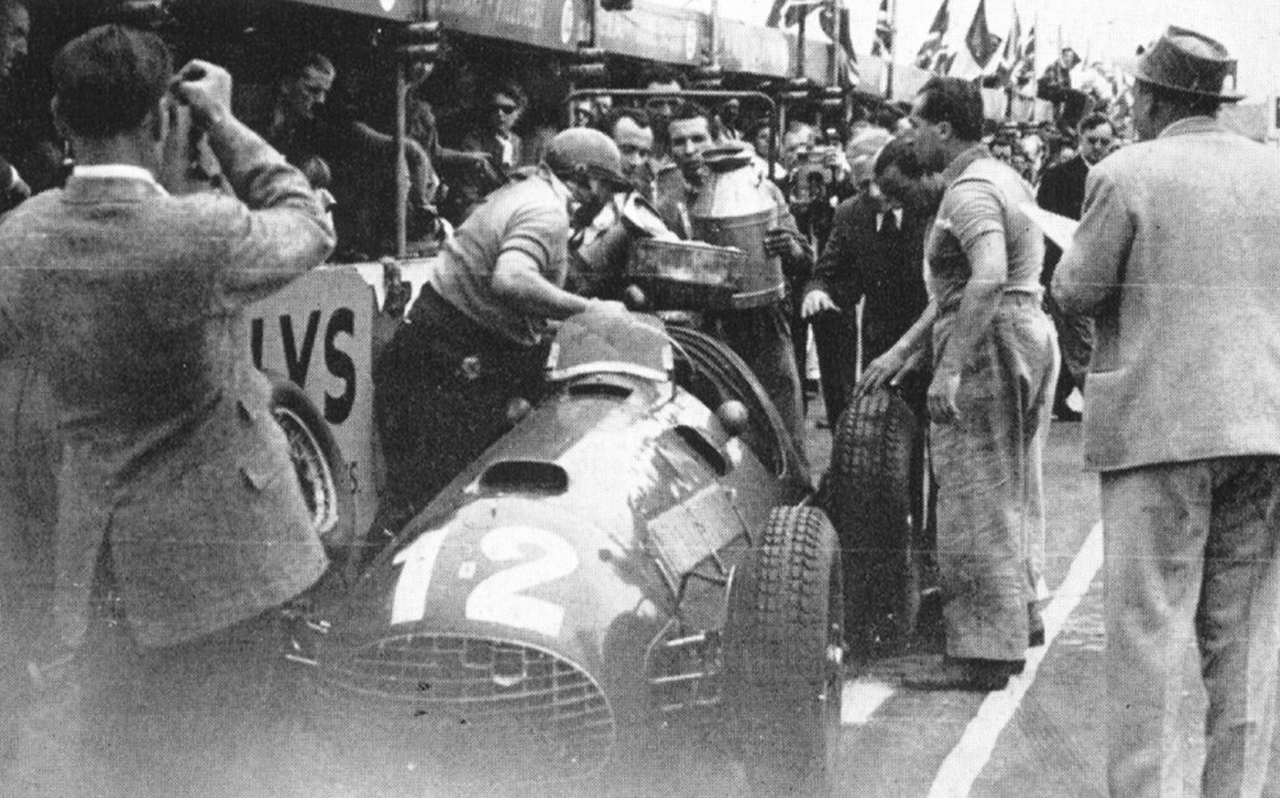
Gonzalez supervises his Ferrai pitstop whilst Ascari, right, looks on having sportingly declined to take the car offered to him by Froilan allowing him to take the well deserved win (unattributed)
Bibliography…
f1fanatic.co.uk, grandprixhistory.org, Team Dan, silhouet.com, J Perez Loizeau and Ors ‘Jose Froilan Gonzalez:The Pampas Bull’
Photo Credits…
Louis Klementaski, Getty Images, Michael Turner art
Tailpiece…
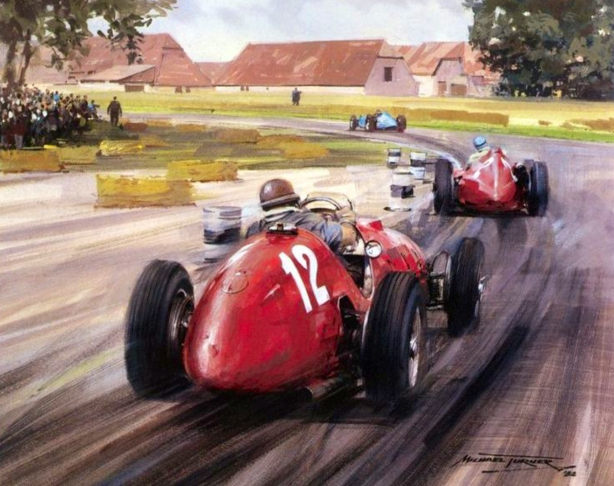
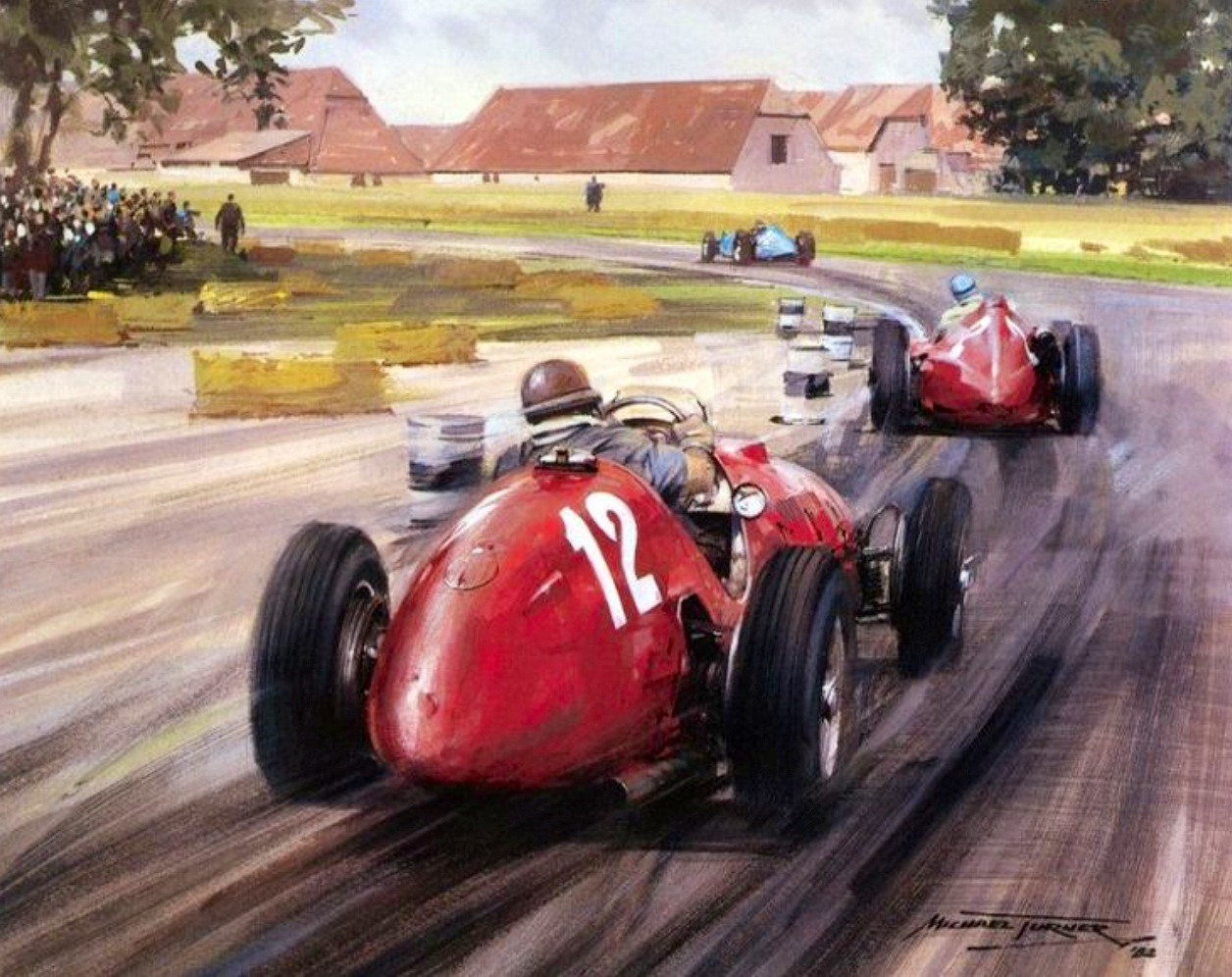
Painting depicts Gonzalez’ pursuit of Fangio with a blue Talbot-Lago T26 ahead (Michael Turner)

















 primotipo...