
Who hasn’t owned a Pommie car or three and cursed Lucas ‘The Prince of Darkness’!? Nice 1969 ad from Automobile Year 17…
 | Rob on The Times They Are A-Changin… |
 | Tony Johns on Book Review: Sporting Austin S… |
 | peterfinlay07 on Top Shot: Rileys at Gnoo … |
 | markbisset on Top Shot: Rileys at Gnoo … |
Who hasn’t owned a Pommie car or three and cursed Lucas ‘The Prince of Darkness’!? Nice 1969 ad from Automobile Year 17…

(Louis Klemantaski)
Froilan Gonzalez plays with the limits of adhesion of his victorious Ferrari 375 V12 at around 140mph. Copse Corner, Silverstone, 14 July 1951…
The dominant force in Grand Prix racing in the immediate post-war period was Alfa Romeo, the pre-war ‘Alfetta’ voiturettes progressively modified to remain winners; they had not been beaten since 1946.
Ferrari had achieved success at Le Mans, the Mille Miglia and the Targa Florio and now took an alternative Grand Prix design path to Alfa and BRM for the 1951 season in building cars powered by a normally aspirated 4.5 litre V12 rather than the supercharged straight 8/V16 route of his rivals. Instructive had been the reliability and speed of the Talbot-Lagos despite the cars relative lack of sophistication given the French machines road-car origins.

Gonzalez, Silverstone 1951, Ferrari 375, the burly Argentinian master of this car. Note exhaust system of the V12 and twin radius rods locating rear axles (unattributed)
Ferrari’s Type 375’s were first entered at the Pescara Grand Prix on 15 August 1950, but were not ready. The cars made their championship debut at Monza on 3 September 1950 with entries for Alberto Ascari and Dorino Serafini. Ascari qualified 2nd and was dicing with the lead group of Fangio and Farina both 158 mounted, before retiring on lap 21 with engine overheating.
Click here for an article on the Type 375 i wrote a while back;
In order to test the cars over a full GP distance,375’s for Ascari and Serafini were entered for the GP do Penya Rhin, at Pedralbes, Barcelona on 29 October. The cars finished 1/2, no Alfa’s were entered but the cars completed a GP distance without problems. With further development over the winter the 375’s were ready for 1951.

Alfa Romeo pit British GP, Silverstone 1951 (unattributed)
By 1951 the supercharged Alfa’s, designated ‘159’ developed around 410bhp from their supercharged 1.5-litre engines, while Ferrari had been working on a twin-plug version of the 4.5-litre V12. It wasn’t as powerful as the Alfa but it was more efficient, less fuel meant less pit stops.
Alfa ignored most of the early season non-championship races. In their absence Ferrari 375’s won at Siracuse and Pau on 11 and 26 March, Gigi Villoresi the winning driver on both occasions. Ascari won the San Remo GP on 22 April.
The Alfa’s finally appeared for the ‘BRDC International Trophy’ race at Silverstone on May 5, but the works Ferari 375’s did not. Fangio and Farina each won a heat for Alfa with the final held in torrential rain led by Reg Parnell’s Ferrari 125/375 when the race was ended after 16 minutes on lap 6.

Engine and brake detail of the Alfa Romeo 159, Silverstone 1951. 1.5 litre two-stage supercharged straight-8 (unattributed)
The first 1951 Championship GP was at Berne for the Swiss Grand Prix. Ascari was suffering from a burn to the arm received during a Formula 2 race at Genoa the weekend before and Villoresi slid off the road in wet conditions. Progress was indicative of Taruffi’s Ferrari second place splitting the Alfas of Fangio and Farina, first and third.
At Spa, a jammed wheel at a pit stop cost Fangio his second successive win, Farina took Belgian GP win for Alfa Romeo from Ascari and Villoresi in Ferrari 375’s.
The French Grand Prix was a furious battle between Ascari and Fangio, both of whom changed cars with Fangio taking the win for Alfa. Ascari’s 375 had gearbox failure and Froilan Gonzalez, who had led the race briefly and pitted to refuel, was asked to hand his car over. Fangio took over Luigi Fagioli’s Alfa, JM’s car failed on the first lap of the race. This was Gonzalez’ first race for Ferrari. Just before the French Grand Prix, Enzo Ferrari had approached him to replace the unwell Piero Taruffi. The Fagioli/Fangio car won the race from the 375 of Gonzalez/Ascari.

Gonzalez in his first Ferrari drive, he lead the French GP at Reims before offering his 375 to Alberto Ascari, the pair finished 2nd to the Fangio/Fagioli Alfa 159 (unattributed)
Froilan recalled the French GP in Gonzalez ‘The Pampas Bull’; ‘The dream was to be very brief. I was utterly determined to make my mark at Reims in the Grand Prix de France and after a tough battle I managed to lead the race. But when I stopped at the pits to refuel (Ferrari Team Manager) Ugolini told me to hand over my jewel to Alberto Ascari who had walked back to the Ferrari pits after his own car had broken down’.
‘Recalling it now I suppose it was understandable. Ascari was more experienced in the Grand Prix arena than I, and since he was now available, it was obviously more sensible to let him take over. But at the time I was mystified and wounded. I assumed I had in some way failed one of Ferrari’s mysterious tests. Yet nobody would tell me where I had failed’.

Ascari cruising the Silverstone pitlane, Ferrari 375 during practice DNF lap 56 with ‘box failure (Getty Images)
Talbot returned with three T26C 4.5-litre, straight-6 cylinder cars. Maserati relied on ageing 4CLTs for David Murray and John James, while Philip Fotheringham-Parker raced an older 4CL. ERA had Bob Gerard and Brian Shawe-Taylor and Joe Kelly was in his Alta.

Scuderia Ferrari drivers Silverstone 1951; Gigi Villoresi left, Alberto Ascari and Froilan Gonzalez, all remarkably ‘well-nourished’ by driver standards of today! And older of course (Getty Images)
BRM turned up on the morning of the race having missed practice. Reg Parnell and Peter Walker started from the rear of the grid as a consequence.

Peter Walker’s BRM Type 15, 7th being given a shove during practice (unattributed)
John Bolster of Autosport commented about Gonzalez’ speed and technique; ‘Thursday found me walking round the circuit, trying to work out how on earth these boys get round the corners the way they do. My stopwatch was busy in my hand, and I had a conversion table, so it was with immense excitement that I observed that Froilan Gonzalez had lapped at 99mph. His next tour looked even faster and, yes, the magic 100mph had been topped at last!’
‘The interesting thing is that he brakes later than anybody else, actually enters the corner faster, and gets through in an immensely long drift. He has none of the ease in the cockpit that Farina exhibits, and certainly does not follow the same path every time. Unlike all the other drivers, he changes down without gunning his motor, and yet there is no clash of gears and the box stands up to the treatment. John Wyer and I listened to this for lap after lap at Woodcote, and were fair amazed. A phenomenon, this Froilan!’ Bolster observed.
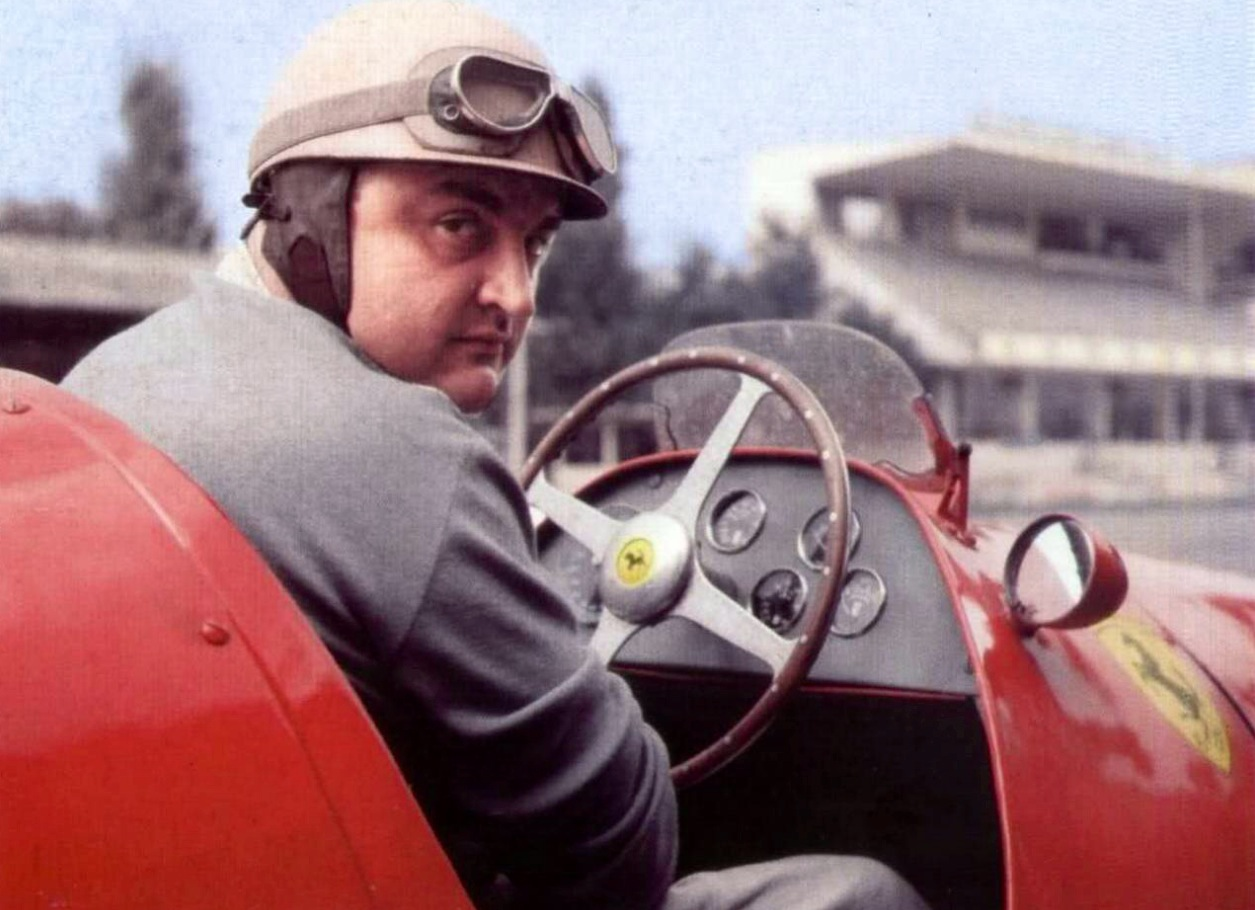
Froilan Gonzalez Ferrari 375, Silverstone 1951, lovely portrait of the Argentinian Champion (unattributed)
Gonzalez lapped Silverstone in 1 minute 43.4 seconds and was on pole, a second quicker than Fangio’s Alfa. On Friday the track was damp and those times prevailed. Froilan’s time was set without the latest the latest twin-plug V12 fitted to Ascari’s car.

Silverstone was the first time an Alfa Romeo had not been on pole position since the world championship began the year before…
Around 50,000 spectators arrived at the Northhamptonshire circuit on the Saturday, eager to see a great contest between Alfa, Ferrari and BRM.

Start of the GP with Gonzalez, left on pole Fangio and Ascari #11 on the outside. Ferrari 375, Alfa 159, Ferrari 375 (unattributed)
Felice Bonetto made the best start from seventh, the front row delayed with excessive wheelspin, and lead at the end of lap 1 but Gonzalez took over with Fangio chasing.
Gonzalez; ‘As we passed the pits for the first time I noticed that both the Alfa and Ferrari team managers were signaling the same instructions, which were in effect that we should drive our own race. The alarming start meant that team tactics must be abandoned. ‘Go for the lead’ came the urgent message and soon as I saw that I went flat-out. By the next lap I was leading’.

Felice Bonetto Alfa being chased by #12 Gonzalez Ferrari and #1 Farina Alfa 159 with #11 Ascari Ferrari just in shot (unattributed)
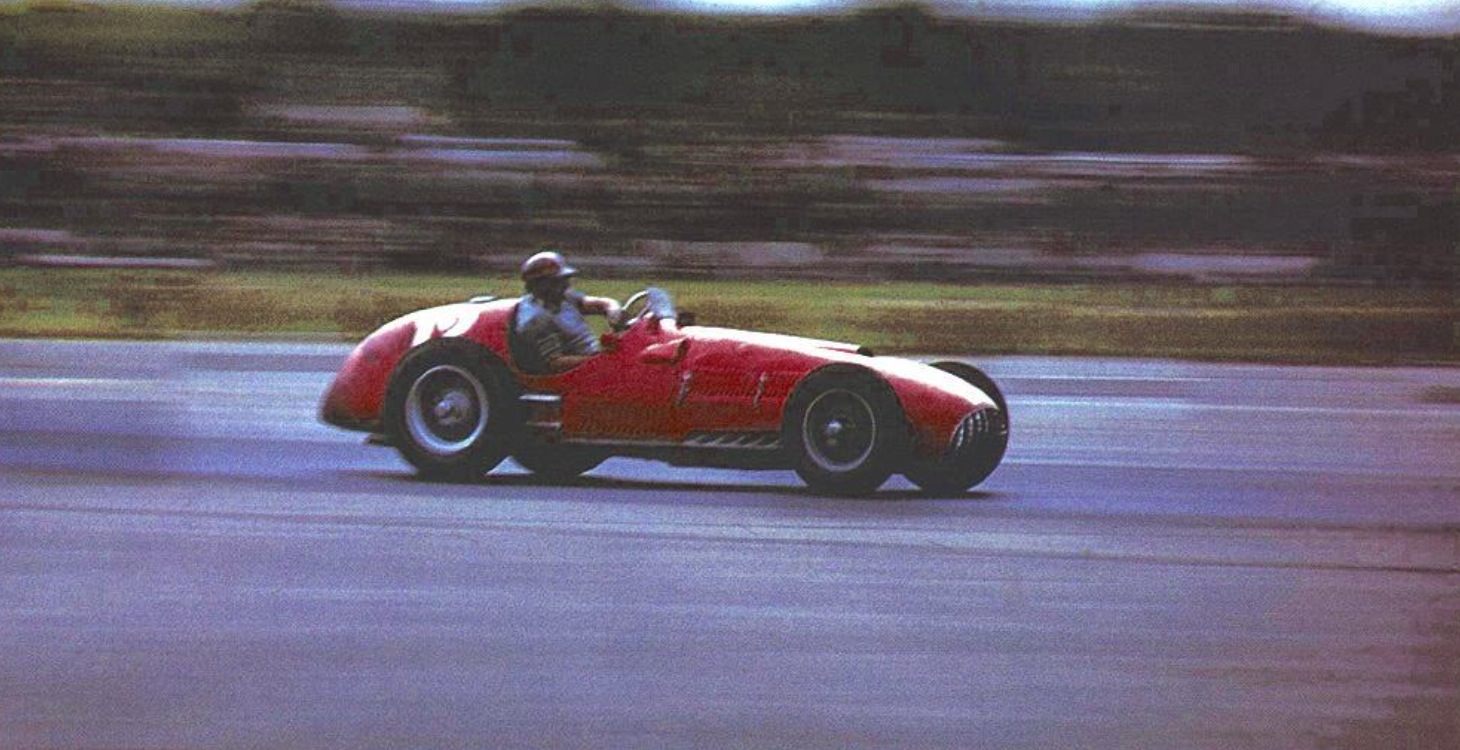
Nice color panned shot of Gonzalez on the way to victory. Shows the big, butch lines of the Ferrari to good effect, the delicacy of touch required to drift the thing at 140mph readily apparent, and appreciated! (unattributed)
Gonzalez hit the straw-bales at Becketts but gradually closed on Fangio to retake the lead on lap 39. At the end of lap 48, Fangio pitted and Gonzalez came in 13 laps later. Ascari had retired with gearbox trouble and Gonzalez climbed from his car and offered it to his team-mate. Ascari refused and urged Gonzalez to continue. The stop took 23 seconds, Fangio’s 49 seconds, JM had his rear wheels changed and his fuel tank filled. The gap between the leaders was then 1 minute 19.2 seconds.

Pitsop for the thirsty Parnell BRM Type 15 ; passing is the Farina Alfa being closely watched by Alberto Ascari, astride the white line, retired from the race. The balding Raymond Mays looks away from the BRM , to Mays right beside ‘the copper’ is journalist and racer John Bolster (unattributed)
‘When Fangio caught me in the 10th lap I let him overtake, placing myself directly on his tail. We traveled in tandem, our two cars seeming to be roped together. Even when he increased speed we remained like this, driving like men pursued by the Devil himself. There was a moment of danger around the 25th lap when I took Becketts Corner too fast and hit the straw bales. But this made me keener than ever and I set off again after Fangio. I began to close on him, having been perhaps 5 or 6 seconds behind him with both of us averaging about 97 mph until, on the 39th lap, I eventually took him. Towards the end of the race I was more than a minute ahead of him’.

Gonzalez leads Fangio during their great Silverstone race (unattributed)
‘Motorsports’ August 1951 issue described the events as follows: ‘Try as Fangio could and did, it was over. Gonzalez came round, crash hat and visor in his left hand, waving them to the crowd.
‘Ferrari with the unblown 4.5-litre had at last broken the might of the two-stage supercharged 159 Alfa Romeo, as they have been threatening to do since Monza last year. Froilan Gonzalez had driven impeccably and is now in the front rank.
‘Fangio drove like the master he is, but couldn’t catch the Ferrari, nor could his longer pit-stop explain the 51 second gap and he was the meat in the Ferrari sandwich. And how these Argentinians drive!’

Froilan Gonzalez takes the Silverstone chequered flag to record an historic personal and team win, Ferrari 375 (unattributed)
Villoresi was third after Farina retired at Abbey Curve, with smoke billowing from the engine compartment but the failure reported as ‘clutch’. Bonetto was a further lap behind the Ferrari in fourth.

Farina’s Alfa 159 hors ‘d combat on lap 75 with a failed clutch (unattributed)
Reg Parnell was 5th in the BRM with Walker 7th. The BRM drivers completed the race burned by their exhausts and dazed by fuel vapours. In the hurry to complete the cars for the race, the exhausts hadn’t been properly insulated and the drivers were ‘cooked’.
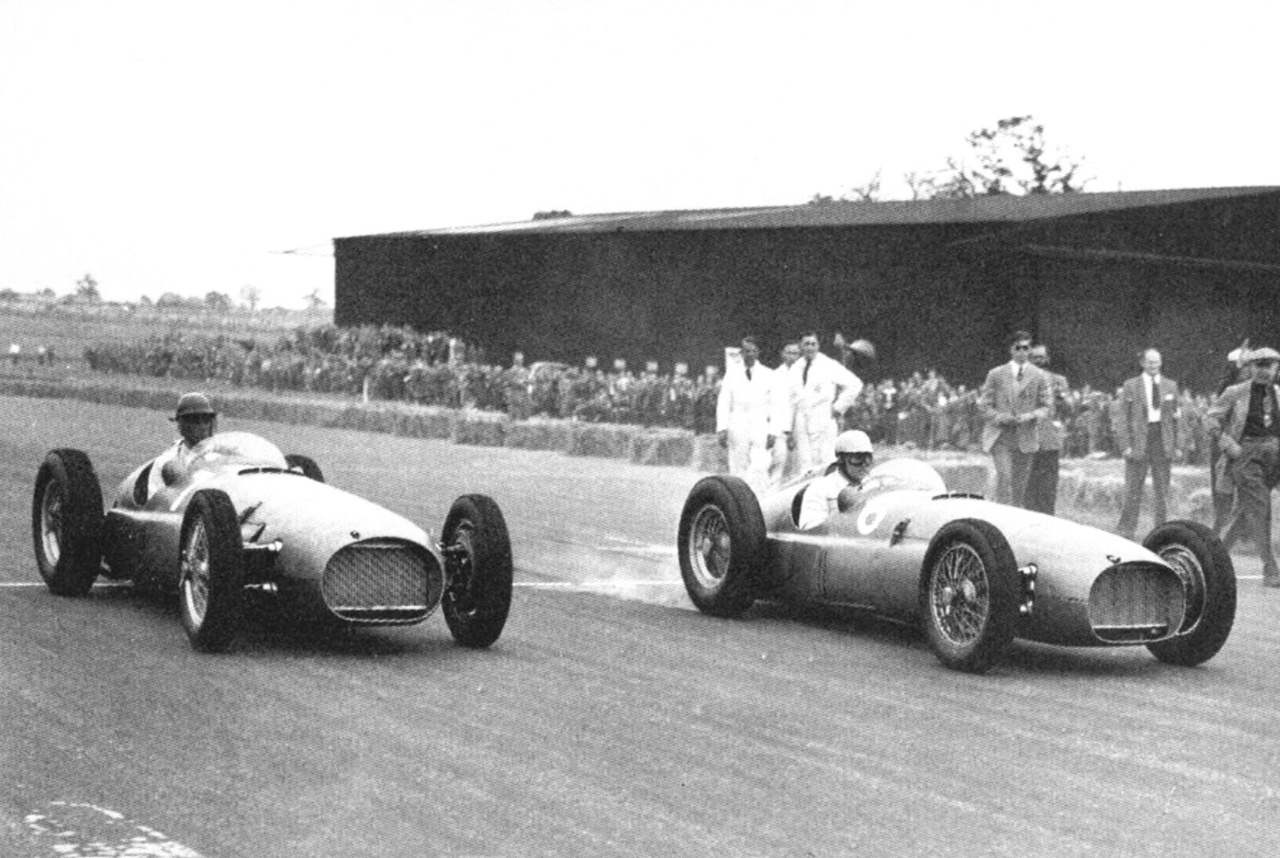
The BRM Type 15′ s get away at the start; Walker left 7th and Reg Parnell #6 5th (unattributed)
‘It was very confusing’ said Gonzalez aftewards, ‘But very exciting. Everyone was shouting and talking; the mechanics saying over and over again that the Alfa Romeos had been beaten. Then I was taken to meet the Queen and given a laurel wreath. Of course, I understood little of what was said but it was a very nice feeling to have all those people congratulating me.
‘On the winners podium I was embraced warmly by Fangio. That meant a lot to me. Then they played the Argentine National Anthem. I had never experienced anything like this before. When I saw my country’s flag being hoisted, it was just too much for me and I cried. That moment will live with me for ever.’

Gonzalez being congratulated by his wife and crew after the historic win, the enormity of it all still to set in (unattributed)
Enzo Ferrari’s dogged determination to win Grands Prix with his own cars was achieved against Alfa Romeo, for whom for many years he lead their pre-War racing programs. It was the first time the Alfas had been beaten since the first post-war French Grand Prix in 1946.
At the end of the season, Alfa Romeo applied for a significant increase in their government grant, the company still within the control of the agency which took it over after its insolvency pre-war. It was refused and the team withdrew from Grand Prix racing, a return finally made with the provision of engines in 1970 and more wholistically as a team in 1979.
In his Richard Williams biography, Enzo Ferrari said of his first Ferrari GP victory: ‘I cried for joy. But my tears of enthusiasm were mixed with those of sorrow because I thought, today I have killed my mother’…
Etcetera…

Alfa’s in the Silverstone paddock; #3 Consalvo Sanesi 6th, #1 Farina DNF (unattributed)
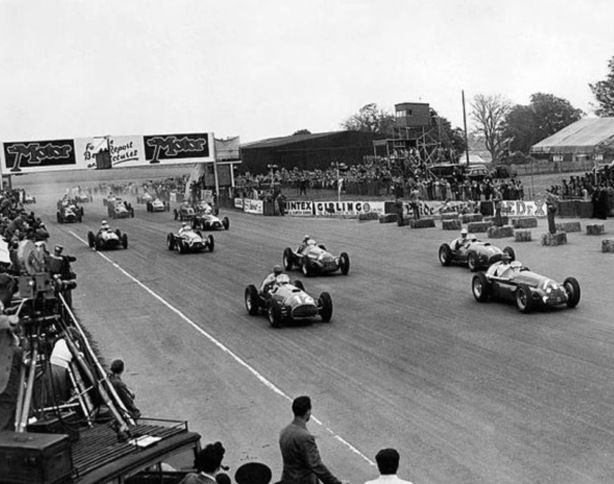
Front row makes a poor start; #12 Gonzalez, Farina better away and Ascari #11 on the right with Fangio’s Alfa almost beside Ascari and Felice Bonetto, Alfa coming up quickly behind Fangio (unattributed)

Alberto Ascari from Giuseppe Farina Ferrari 375 and Alfa 159, Silverstone 1951, both DNF (unattributed)
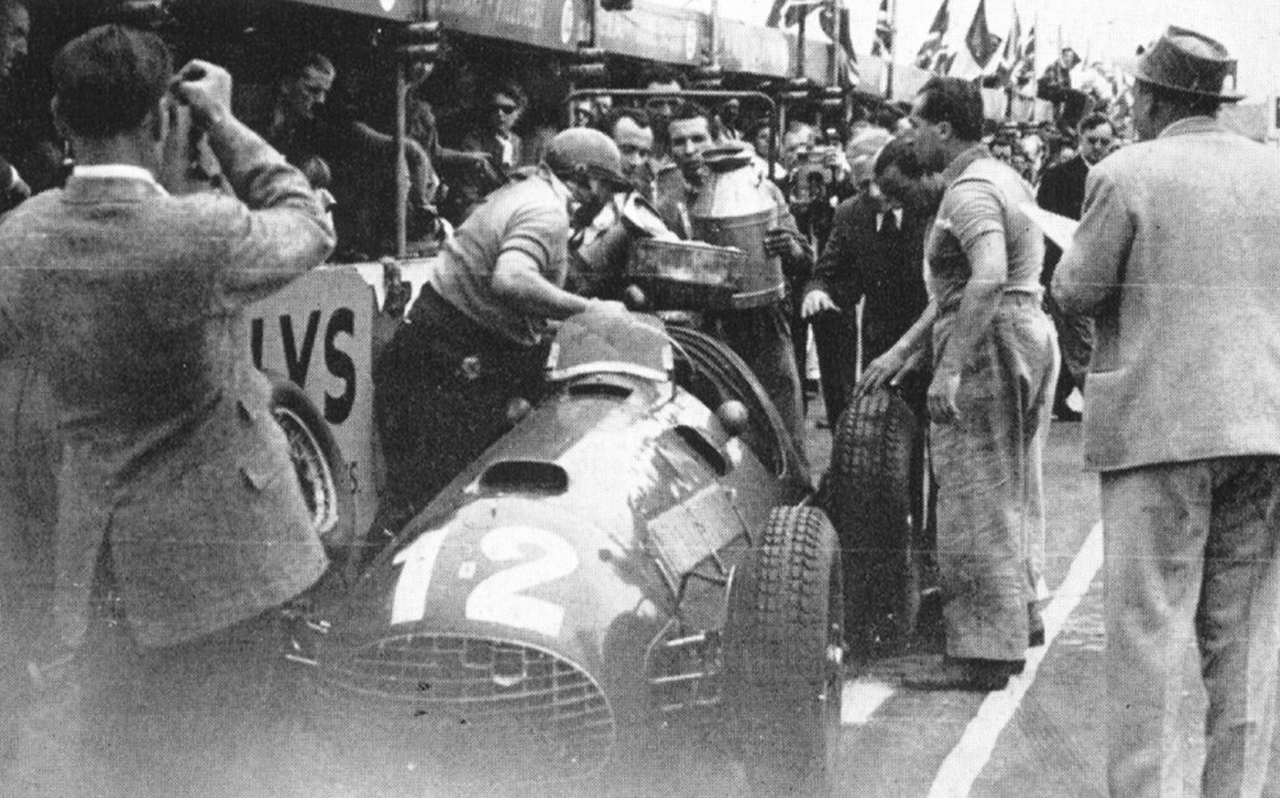
Gonzalez supervises his Ferrai pitstop whilst Ascari, right, looks on having sportingly declined to take the car offered to him by Froilan allowing him to take the well deserved win (unattributed)
Bibliography…
f1fanatic.co.uk, grandprixhistory.org, Team Dan, silhouet.com, J Perez Loizeau and Ors ‘Jose Froilan Gonzalez:The Pampas Bull’
Photo Credits…
Louis Klementaski, Getty Images, Michael Turner art
Tailpiece…
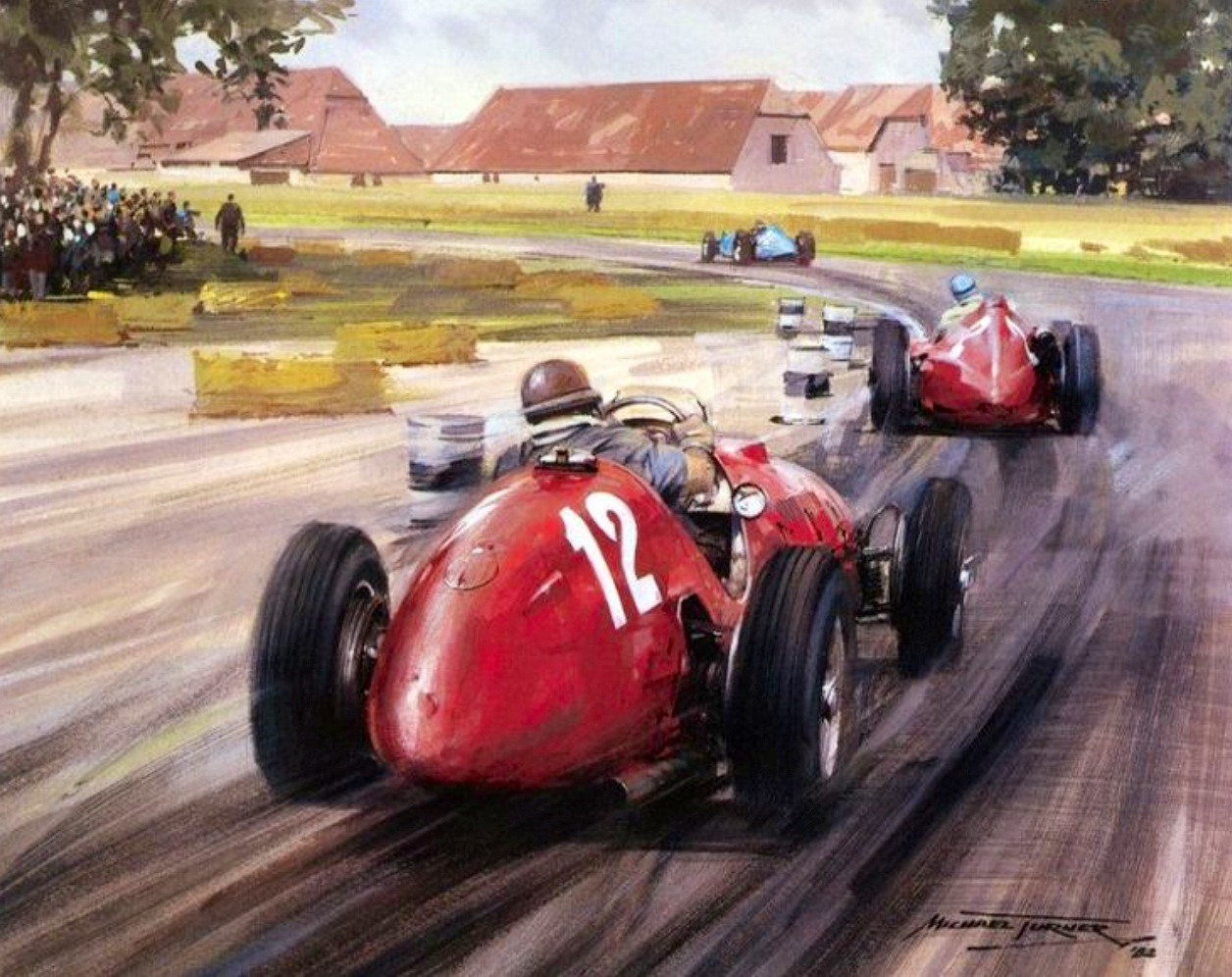
Painting depicts Gonzalez’ pursuit of Fangio with a blue Talbot-Lago T26 ahead (Michael Turner)

(Getty Images)
There is just no chance Damon Hill wasn’t going to be a racing driver?…
There are so many childhood shots of him with his dad in practice for an event somewhere round the globe. This one is close to home, Graham’s Lotus 33 BRM is being fettled for the ‘XIX BRDC International Trophy’ at Silverstone on 29 April 1967.
GH rejoined Team Lotus from BRM so was well familiar with the 2 litre P56 engine which powered his Lotus. He won plenty of races with this engine in both 1.5 litre F1 and 2 litre ‘Tasman’ spec in the BRM P261 chassis.

Damon @ 15 aboard his Bultaco 1975 (Chris Ware)
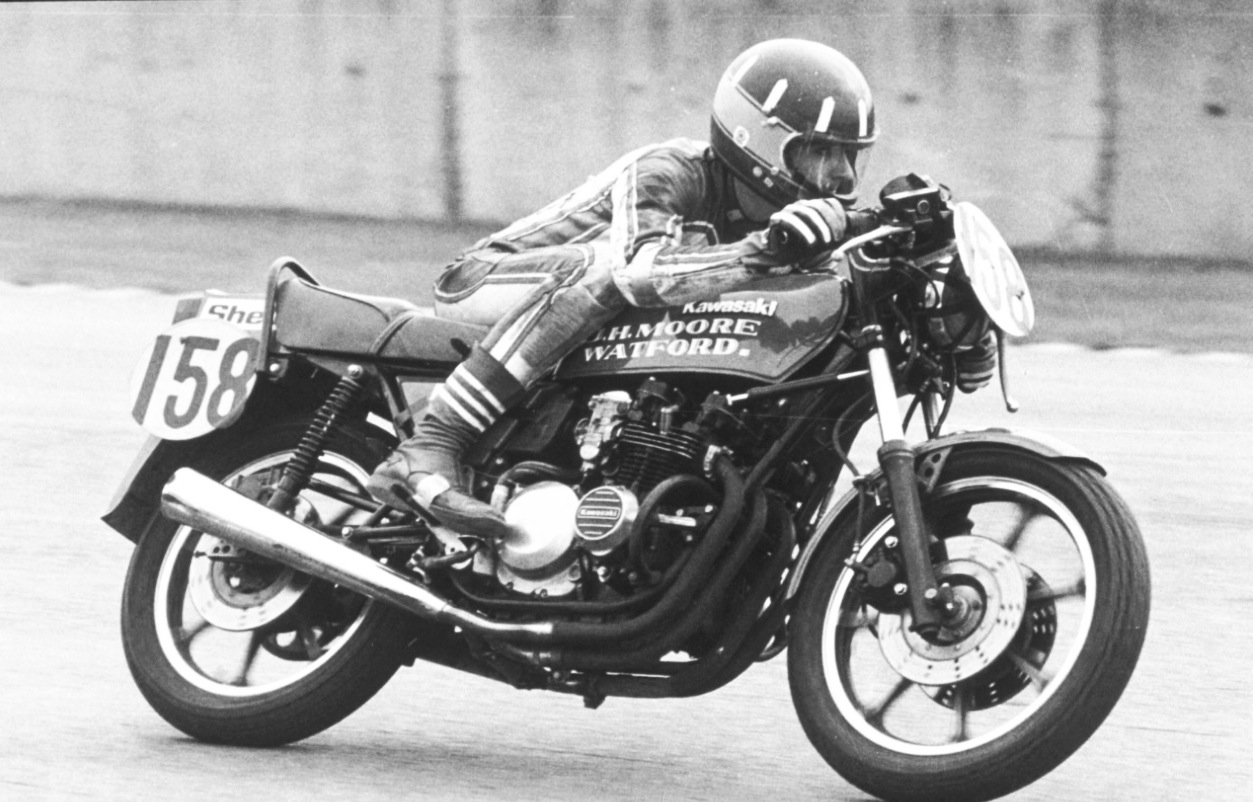
Hill started racing bikes in 1981, here aboard a Kawasaki 500 at Donington Park. His early racing was all self-funded, the Hill family fortune diminished by claims of victims families after the light aircraft crash which killed GH and most of his team in 1975 (unattributed)
There were 2 ‘interim’ 2 litre V8 33’s in 1967; this chassis ‘R11’ and Jim Clark’s Coventry Climax powered ‘R14’ in which he had just won the Tasman Series.
Things were about to change though; the 3 litre Ford Cosworth DFV powered Lotus 49 was already being tested by Hill and famously won upon its Dutch Grand Prix debut in Clarks hands on 4 June.
Parkes won at Silverstone in his Ferrari 312 from Jack’s Brabham BT20 Repco and Siffert’s Cooper T81 Maserati with Graham fourth in ‘R11’. The car was kind to Graham, he was second in the Monaco GP on 7 May, the last championship round in which these cars were raced by Team Lotus.
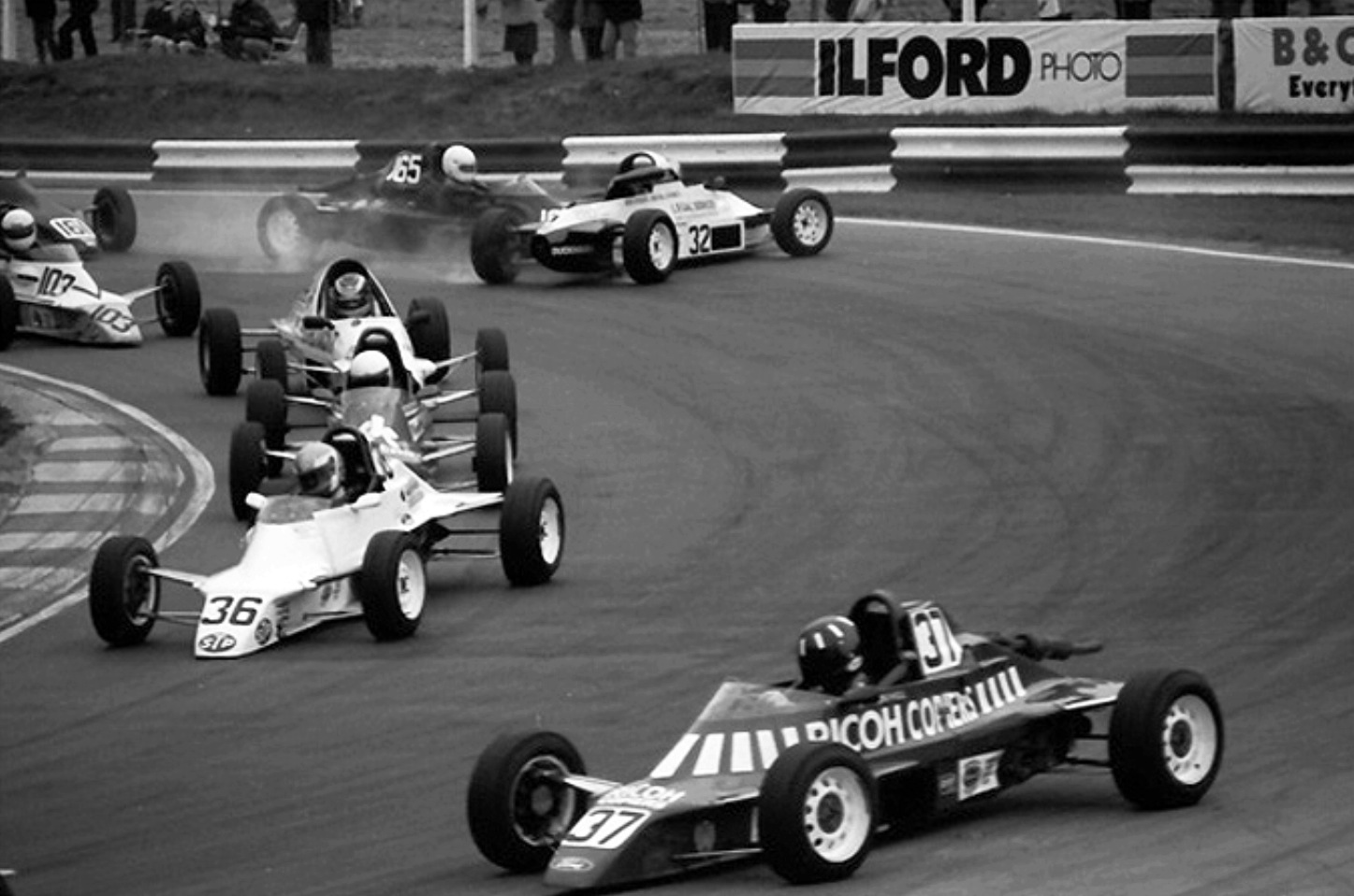
Formula Ford Festival Mayhem! 1985 Brands Hatch. Damon Hills #37 Van Dieman RF85 leads the pack, interested to know who the other drivers and cars are FF fans!? The ’85 festival was won by Johnny Herbert’s Quest with Jonathon Bancroft 2nd, Hill 3rd and Mark Blundell 4th all in VD RF85’s. DH career progression; F3 in 1986, F3000 in 1989, a critical testing contract with Williams in 1992 and Brabham F1 drive in the same year. He was no star in his early years, he ‘got there’ by displaying the same grit, determination and persistence as his father. He also has his fathers ‘class’ and is a fine ambassador for his country and sport (Phil Rainford)

Damon Hill on his way to 6th in the 1992 Hungarian GP. Brabham BT60B Judd 3.5 V10. Q25, a good drive in difficult conditions, Senna won the race in a McLaren MP4 Honda V12. First GP season. Also proved his speed and feedback as a test driver for Williams that year. World Champ for Williams Renault in 1996 (unattributed)
Credits…
Getty Images, Victor Blackman, Chris Ware, Phil Rainford
Tailpiece: ‘Better still, i get to steer’!…

Silverstone Intl Trophy paddock 29 April 1967. Lotus 33 BRM (unattributed)

(J Wilds/Getty Images)
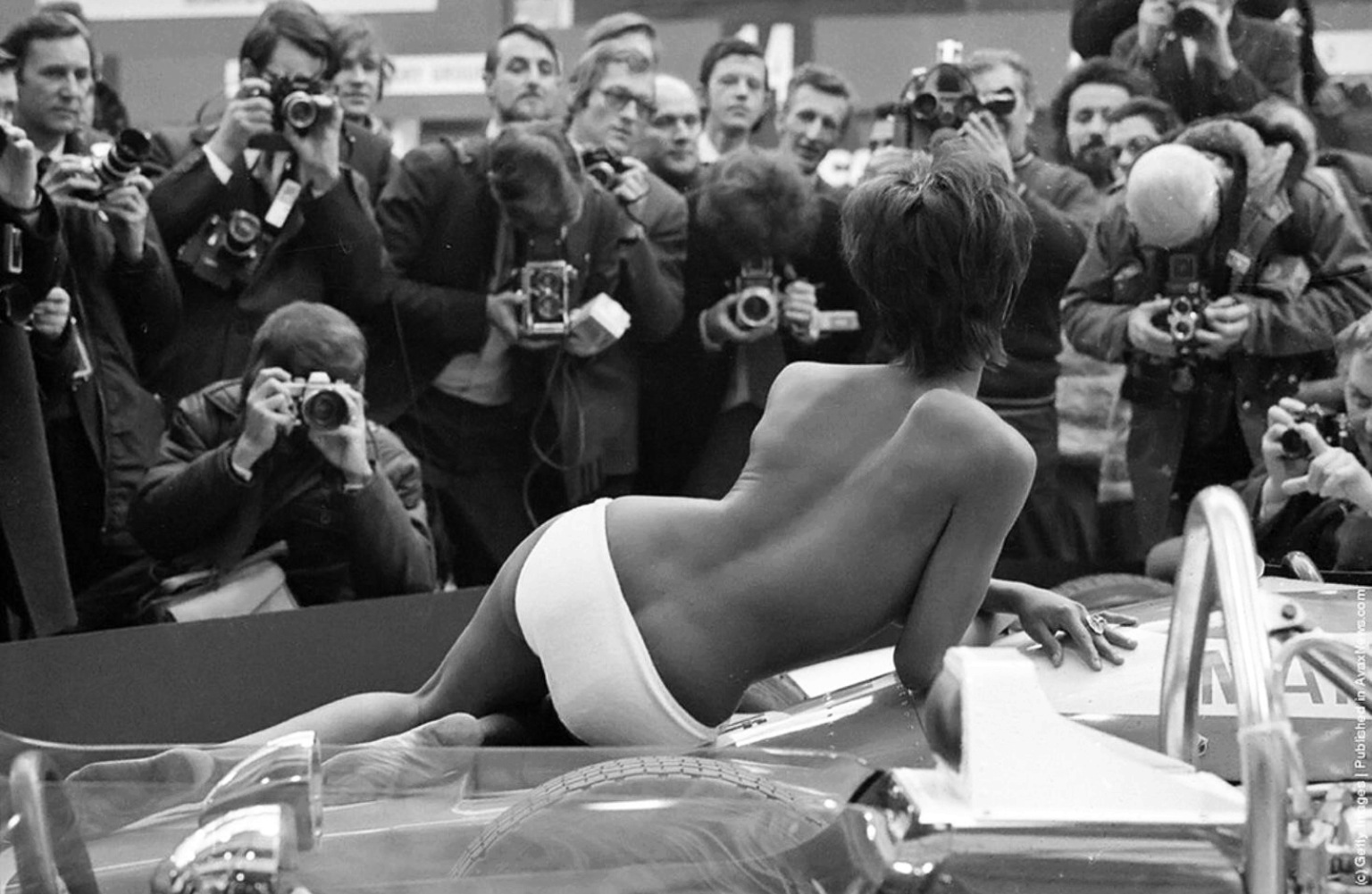
Venetia Day adorns the Matra MS120 at London’s Racing Car Show at Olympia on January 6 1971…
She is quite the most beautiful young lady with all of the ‘bibs n bobs’ we fellas tend to like. With the compound curvature of a Maserati 250F she is hard to beat.
I get a lot of metrics as part of this WordPress website, it always amuses me that the seventh most popular article i have done is the MS120 Matra piece i wrote a while back featuring Venetia’s ‘rear suspension’. Here to complete the set is her ‘front suspension’ which is as firmly set and finely proportioned as the rear…
Its certainly not the best piece i have written, so i guess it has something else going for it, page one or two of a Matra MS120 Google search !
All very politically incorrect these days of course, but political correctness is so ‘ferkin boring!
Here’s the original article if you’ve not read it;
Tailpiece…
(J Wilds)

(Automobile Year #10)
‘One of the most classic racing engines of all time – and unquestionably the most widely copied – was the 1913 3-litre four cylinder Peugeot conceived jointly by Georges Boillot, Jules Goux and Paolo Zuccarelli whose ideas were interpreted by the brilliant draftsman Ernest Henry’ ; Harry Mundy in Automobile Year #10…
The team first expounded the advantages of twin overhead camshafts, four valves per cylinder and compact combustion chambers.

Jules Goux fourth and Robert Peugeot at the 1914 French GP. Goux winner at Indy in 1913 in a Peugeot L56. Mercedes Christian Lautenschlager won the race, Boillot was well in the lead before a spate of Dunlop tyre problems. 4 July 1914, less than a week after the assassination of Archduke Franz Ferdinand and the imminent start of WW1 (unattributed)
‘The Three Charlatans’; driver/technicians Goux, Boillot and Zuccarelli, the latter the most important in terms of his conceptual ideas, as they became known within Peugeot HQ, put a proposal to M Robert Peugeot to develop, outside the factory a team of cars for the 1912 French GP. The race was being revived that year, and two 3-litre cars for the Coup l’Auto at a cost of 4000 pounds for each car.
The 1912 GP engine of 7602cc was estimated to develop 140bhp@2200rpm, the car very successful as covered in the contemporary magazine articles included at the end of this piece.
‘Overhead camshafts had been used earlier by Mercedes and Clement-Bayard…The technical contribution of the Peugeot engine was in the use of the hemispherical combustion chamber, four valves per cylinder operated directly by twin overhead camshafts and a central sparking plug. In other words, Zuccarelli, from whom this conception emanated, appreciated the virtues of a compact combustion chamber, large effective valve area and low valve stresses’.
‘A stirrup-type valve tappet guided top and bottom ad having its own return spring was used and the entire mechanism was fully enclosed and lubricated; the valves and springs were exposed to assist cooling…The one piece cylinder block and head was bolted to a two piece crankcase split on the horizontal centre line of the five main bearings’ said Mundy.
Boillot won the 1912 French GP at Dieppe by 13 minutes from the closest Fiat at an average speed of 68.5 mph. The Fiats, to demonstrate the efficiency of the Peugeot engine were of 14143cc.

Georges Boillot, Peugeot L3, Coup l’Auto 1913 (Getty Images)
The 3-litre Peugeot engine produced for the 1913 Coupe de l’Auto race run concurrently with the French GP, was the more important in its technical influence as its efficiency and light chassis was more than a match for the 1912/13 GP cars built for an unlimited formula and having in some cases twice the capacity.
Many features of the 3-litre were common with its bigger brother but other key elements copiously copied were;
.A train of spur gears contained in a separate and easily detachable casing which replaced the former bevel gear and shaft drive to the camshafts
.The heavy stirrup type of valve tappet was discarded in favour of a finger interposed between the cam and valve stem

Boillot on the way to Peugeot L3 victory on the Amiens 31.6 km road course used only once for the French GP, in 1913. Zuccarelli was killed when he hit a cart before the race; five fatalities at the place in two months (unattributed)
.A novel construction was introduced for the crankcase and the three main bearing crank, made of the highest quality BND/Derihon steel. The latter was made in two halves and bolted at the centre, at which point a double row ball bearing was used; a single row roller bearing was used for the front and rear mains. This type of construction permitted the use of a one-piece crankcase casting, the two end bearings for the crankshaft being contained in a separate housing.

Ernest Henry at his drawing board, year unknown. Hiss exact contribution to the design of the Peugeot’s and the engine still the subject of debate after 100 years; a key member of the team whichever way you cut it (unattributed)
.It was also the first engine to use dry-sump lubrication; better cooling with full pressurisation to all bearings and also allowing engines to be placed lower in the chassis.
The influence of the engine was also profound in the sense that it lead to the adoption of a capacity limitation from 1914, a principle adopted for most subsequent formulae. From 1914 onwards there was no effective alternative to the overhead camshaft as stroke to bore ratios were reduced and rotational speeds increased, two basic requirements of increased performance…

‘The Three Charlatans’ circa 1912; Paolo Zuccarelli, Jules Goux and Georges Boillot (TNF)
Contemporary ‘The Automobile’ articles on the 1912/1913 Peugeots…
1912 L76 7.6-litre.


1913 L3 3-litre.


Bibliography and Credits…
Automobile Year #10 article by Harry Mundy on Grand Prix engines, ‘The Automobile’ 26 September 1912 and February 1914 articles via theoldmotor.com, The Nostalgia Forum Peugeot GP thread, Jacques Henri-Lartigue
Tailpiece: Boillot, winner on Peugeot L3. French GP, Amiens 12 July 1913…

(Jacques-Henri Lartigue)
Finito…
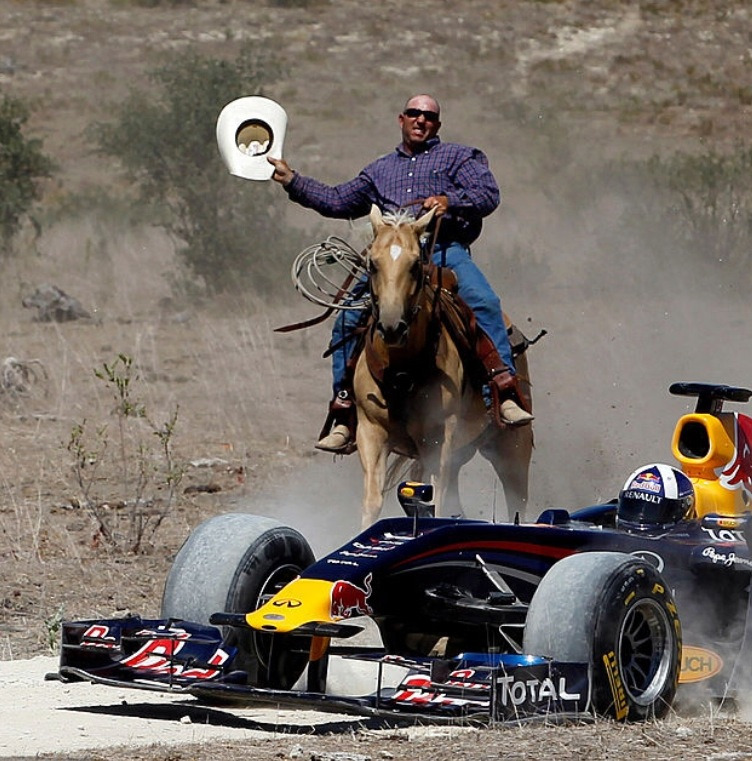
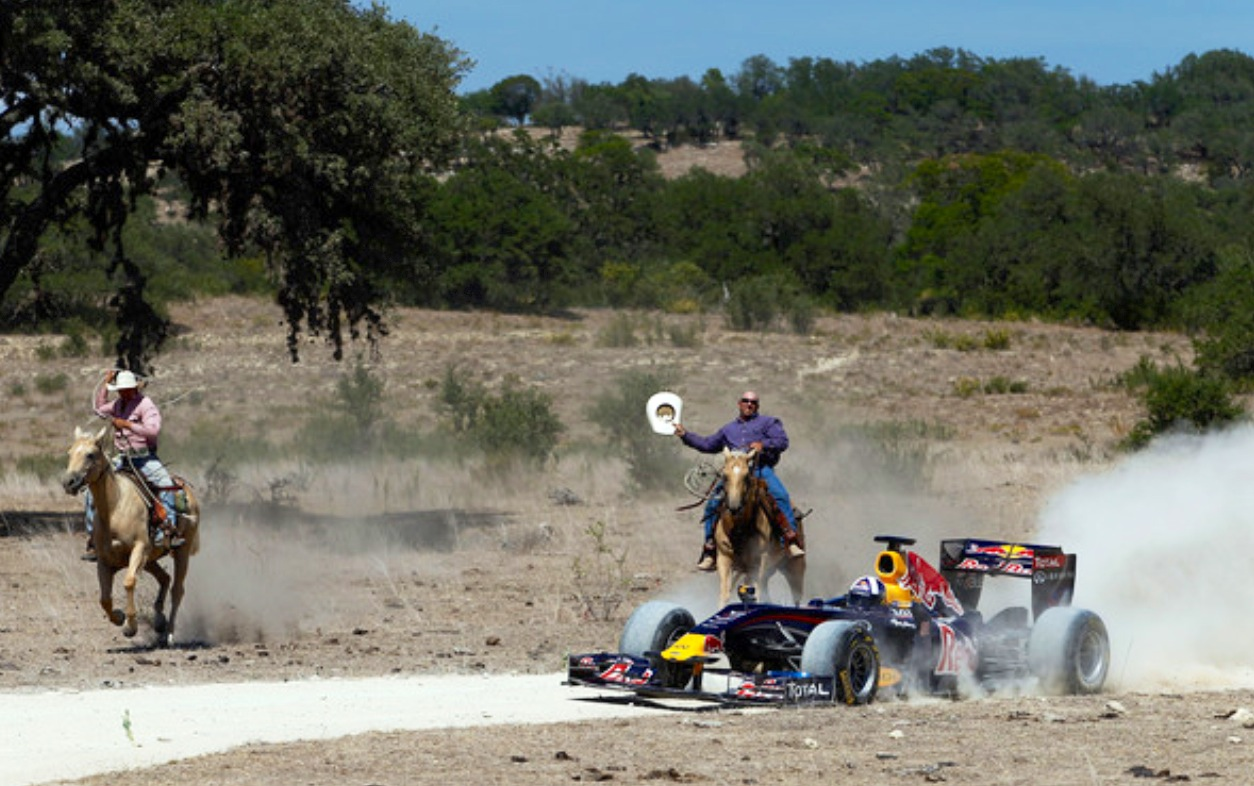
David Coulthard’s Red Bull Renault RB’4WD’ trys to avoid being lassooed y’all, Johnson City, Texas 19 August 2011…
There was no American GP from 2008 to 2011 this Red Bull promotion was of Coulthard driving the ‘Circuit of The Americas’ then under construction outside Austin, Texas.
YouTube footage thereof…
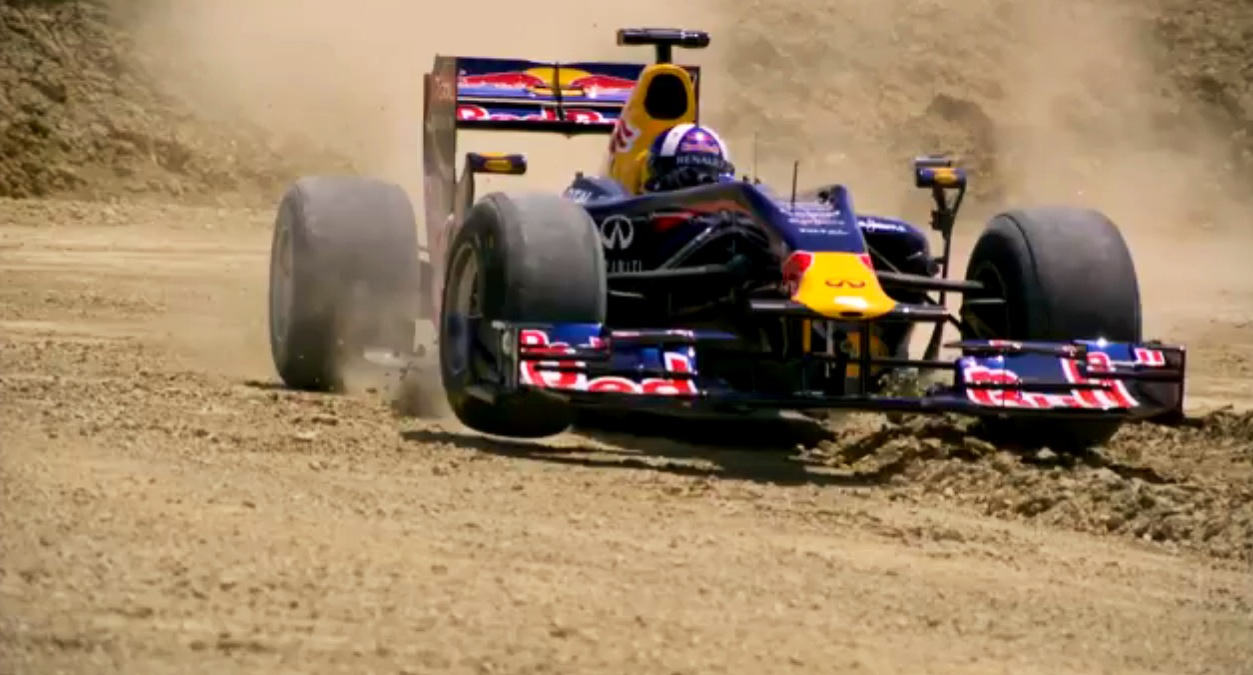
DC Red Bull Renault, ‘Circuit of The Americas’ first ‘race laps’, August 2011 (Getty Images)
Credit: Tom Pennington/Getty Images
Tailpiece…
(Getty Images)
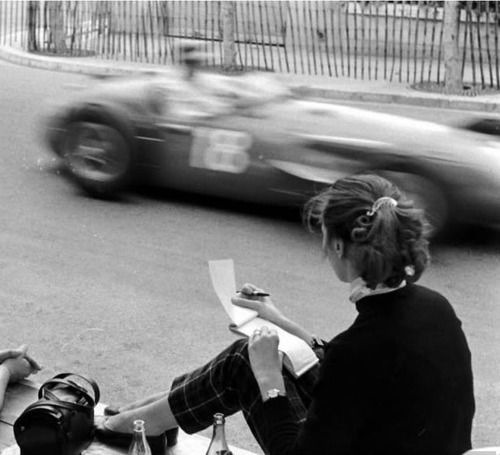
British privateer, Horace Gould’s ‘crew’ time his Maserati 250F, he finished eighth in the race won by Moss’ similar car…i love this unattributed shot, it somehow captures the waiting game of a drivers lover in those very dangerous days…
Gould was a Bristol motor trader who competed in sixteen Grands’ Prix, his best result in this car , an ex-works 1954 250F ‘2514’, in the 1956 British Grand Prix, finishing fifth and earning two championship points.
He raced Jack Brabhams’ similar Cooper Bristol on an ‘Australasian Tour’, at Mount Druitt, New South Wales, in 1953 beaten by Jack, and in the 1954 New Zealand Grand Prix, the race won by Stan Jones’ Maybach 2.
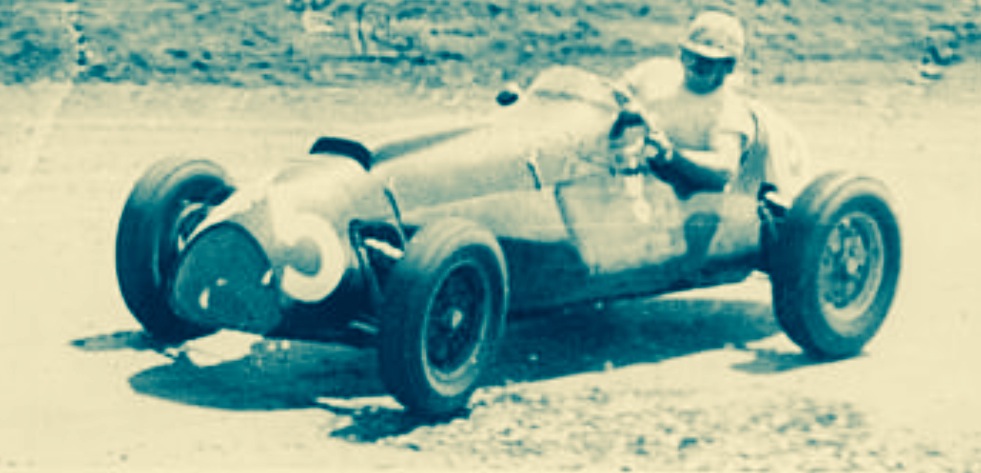
Horace Gould in his Cooper T23 Bristol at Mt Druitt, he ‘was left for dead off the line, Jacks car with its lightweight flywheel, Harley clutch and Stromberg carbs’. (aussieroadracing.homestead.com)
Gould was the quintessential passionate privateer, eking out an existence on start and finish money in events throughout Europe in the late 1950’s, he stopped racing around 1959 and died of a heart attack in 1968, aged 47.

de Filippis in the cockpit of her Maserati 250F. Monza, Italian Grand Prix 1958…
de Filippis started racing Fiat 500s aged 22 after her brothers bet her she couldn’t drive fast. In 1954 she finished second in the Italian sports car championship and was scooped up by Maserati as a works driver.
In 1958, driving Maserati 250F chassis #2523 a ‘T car’ used by Fangio in 1957, she became the first woman to take part in a World Championship Grands’ Prix at Spa, Belgium finishing 10th. She missed the French Grand Prix when an official with Gallic charm and chauvinism suggested to her that ‘The only helmet a woman should wear is the one at the hairdresser’s.’
Jean Behra offered her a drive in his Porsche team in 1959. Behra’s death led to her reconsidering her future and she quit. ‘Too many friends had died,’ she told the Observer in 2006. ‘There was a succession of deaths – Luigi Musso, Peter Collins, Alfonso de Portago, Mike Hawthorn. Then Behra was killed in Berlin. That, for me, was the most tragic because it was in a race that I should have been taking part in. I didn’t go to the circuits any more. The following year I got married, then my daughter was born and family life became more important.’
Her GP results are; 1958 Syracuse Q8, DNF Belgium Q19 DNF, Italian Q21 DNF all 250F. 1959 Monaco Porsche 718 DNQ and BRDC Intl Trophy Silverstone 250F Q23 DNF.

de Filippis, Maser 250F, Spa 1958 (The Cahier Archive)
Credits…
The Cahier Archive, silhouet.com

(The Cahier Archive)
Well, Mike Spence in any event. His ‘Parnell Racing’ Lotus 25 BRM is ‘in drag’ for filming of John Frankenheimer’s iconic racing film ‘Grand Prix’…
James Garner played Aron, the helmet design that of Chris Amon, Aron drove for the fictional, nascent Japanese ‘Yamura’ team after being booted out of the Jordan BRM team in a crash which took out his teammate ‘Scott Stoddard’.
In the race itself the great British ‘all-rounder’ Spence finished an excellent 5th behind Brabham, Hill, Clark and Stewart…

Mike Spence in his factory BRM P261 on the ‘BRDC Intl Trophy’ grid, Silverstone 29 April 1967. He was 6th in the race won by Mike Parkes’ Ferrari 312. ‘Gedda move on with the start’ seems to be the pose? (unattributed)
Photo Credit: The Cahier Archive

Great atmospheric shot of Michael Schumacher in his Ferrari F2005 during the Monaco Grand Prix, he finished 7th after an accident with David Coulthard, DC trying to avoid the spinning Albers Minardi, Kimi Raikkonen won the race in a McLaren…

Kimi Raikkonen on his way to Monaco victory 2005. McLaren MP4/20 Mercedes. (Coolamundo)
The Ferrari F2005 was the final evolution of a series of V10 3 litre engined cars, F1 engine regs changed to 2.4 litre V8’s in 2006.
The chassis was lighter than the F2004 and the aerodynamics evolved over the previous car. The gearbox was smaller and lighter than F2004’s, made of titanium and carbon fibre. The ‘055’ engine was essentially carried over but with mounting points changed, the challenge that year to get 2 race meetings out of the engine.

Rubens Barrichello, Albert Park, AGP. Ferrari F2005. (Coolamundo)
The rear suspension was redesigned to improve its aerodynamics and work with the cars Bridgestone tyres, and therein lay the problem of Ferrari’s season after 5 years of dominance.
The sporting regulations for 2005 didn’t allow tyre changes at pitstops. Bridgestone didn’t master the tradeoff between race long durabilty and performance so the year was fought out amongst Michelin shod teams.
Ferrari’s only 2005 ‘win’ was at the farcical US GP at Indianapolis when the Michelin shod teams withdrew from the event, or rather completed one slow lap as the tyres failed with the loads imposed by Indy’s banking during qualifying.
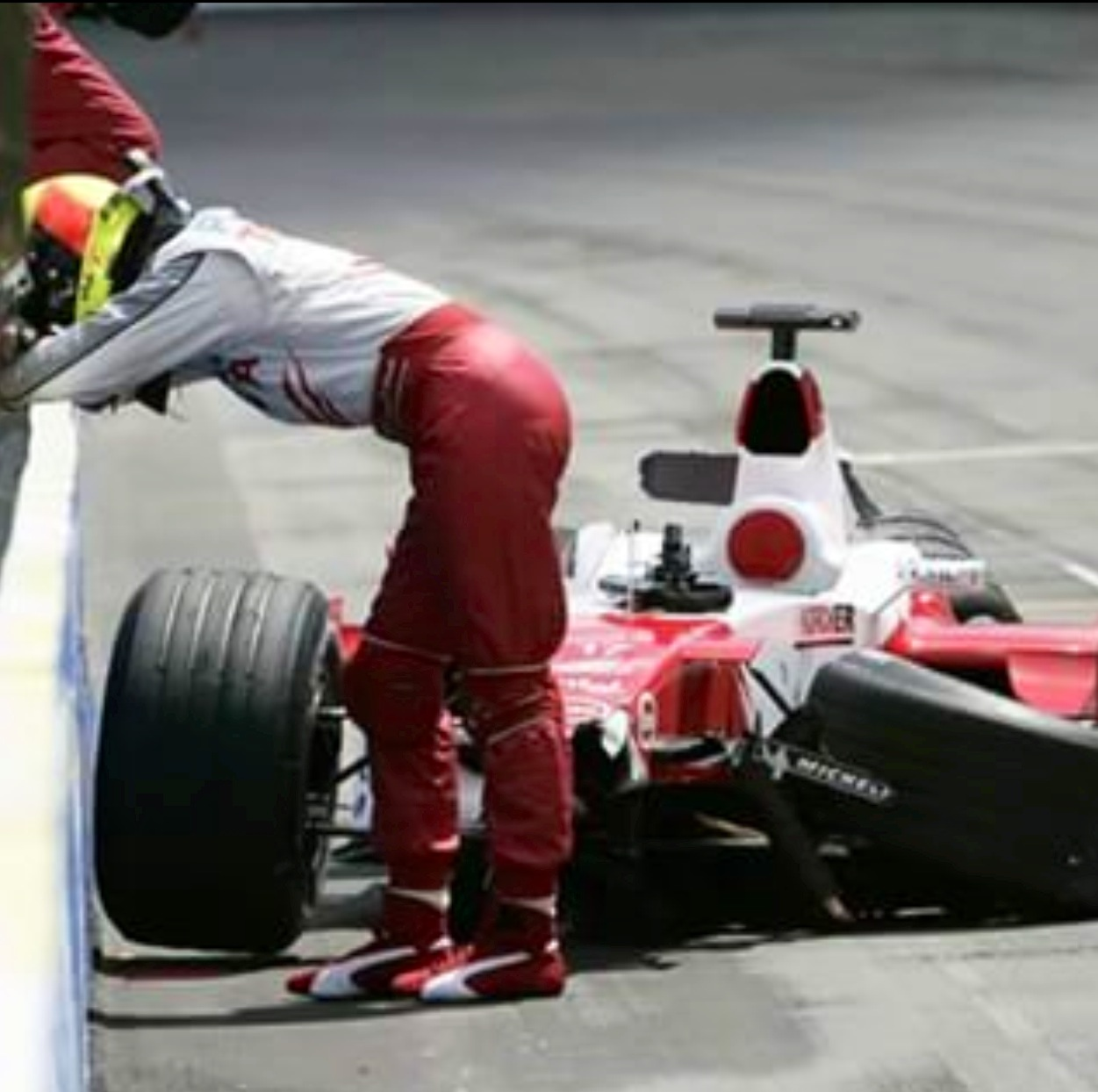
Ralf Schumacher beside his shagged Toyota TF105 after his huge shunt caused by tyre failure. Deja vu for the poor German who had an even bigger accident at Indy the year before in his Williams, outing him for several races. (unattributed)
A compromise proposed by Michelin to use a chicane was rejected by the FIA. This dopey decision resulted in a meaningless Ferrari ‘win’ but was otherwise to everyones’ detriment; American fans, TV audience, Michelin, the FIA and the sport…
Fernando Alonso won the 2005 Drivers title and Renault the Manufacturers’ with their Renault R25, McLaren were resurgent especially in the second half of the season, Kimi Raikkonen consistently quicker than Juan Pablo Montoya in the McLaren MP4/20 Mercedes.

Fernando Alonso in his Renault R25, 2005. Circuit unknown. (LAT)
Ferrari F2005 Technical Specs…
Carbon fibre and honeycomb composite monocoque chassis, suspension by pushrods and torsion bars front and rear. Type ‘055’ 90 degree 2997cc , 4 valve normally aspirated V10 giving circa 900bhp@19000rpm. Semi-automatic 7 speed sequential gearbox. Carbon fibre brakes. Weight inclusive of fluids and driver 605Kg.
Tailpiece…

Michael Schumacher Ferrari F2005. (ChronoArt)
Photo Credit…LAT, Coolamundo, ChronoArt

