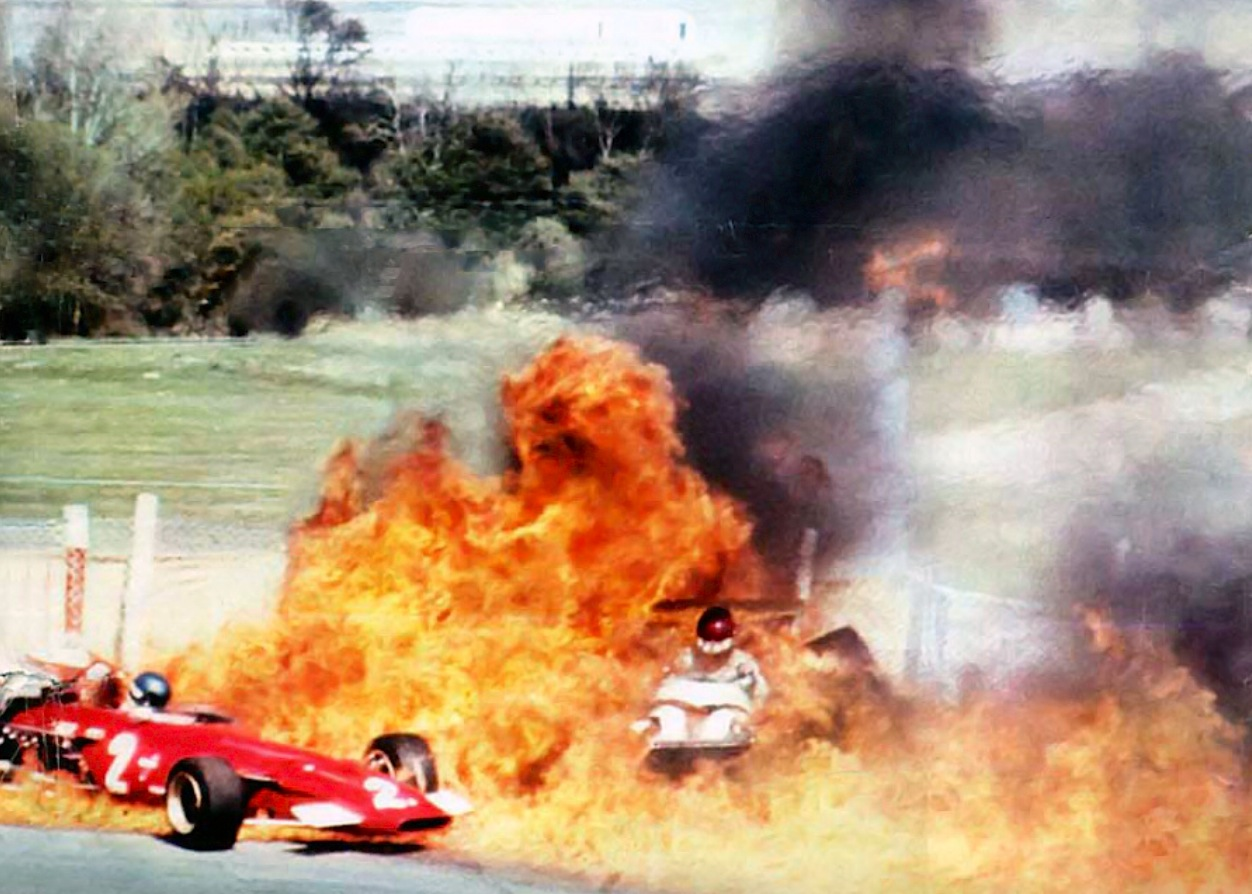
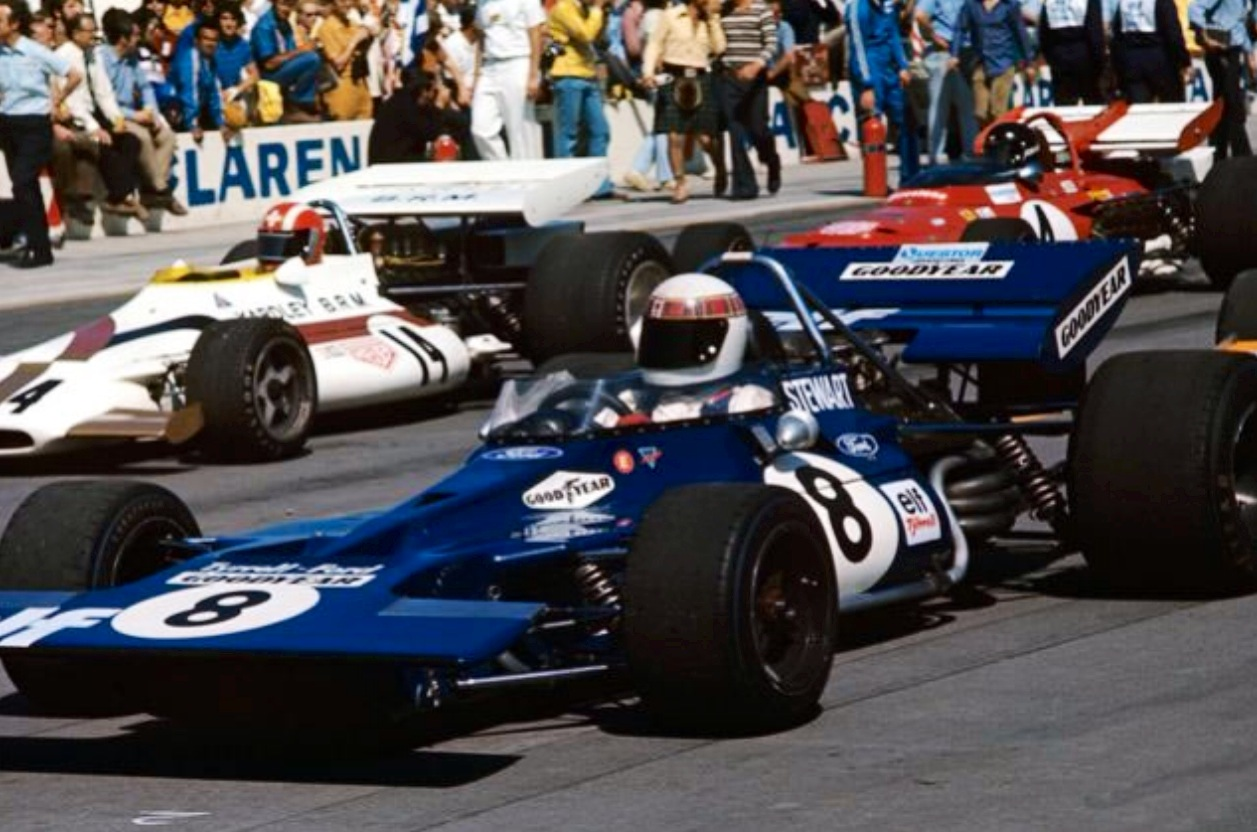
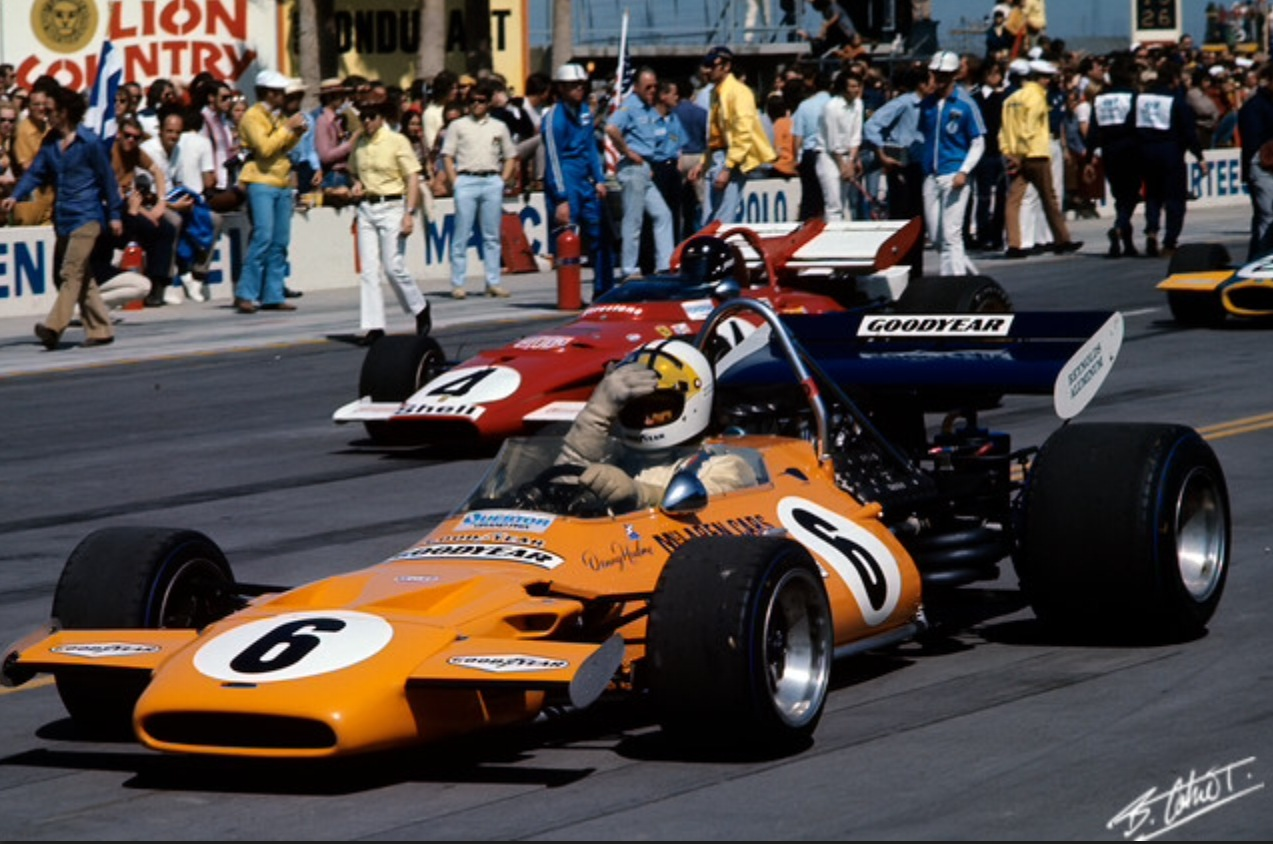
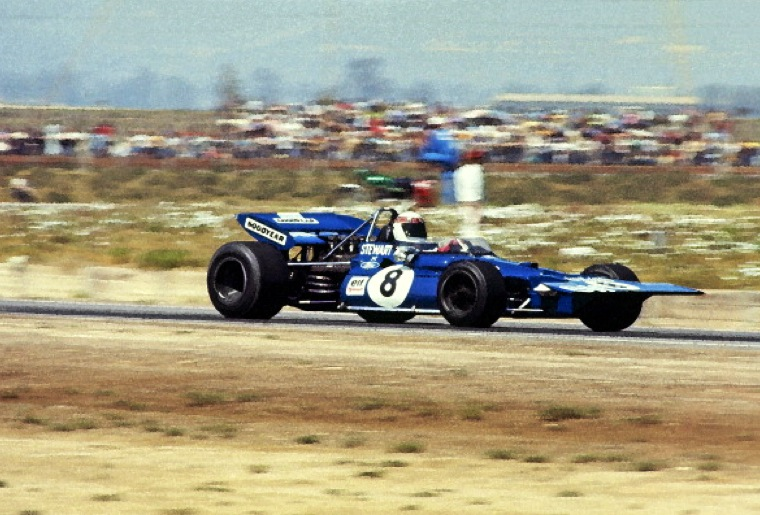
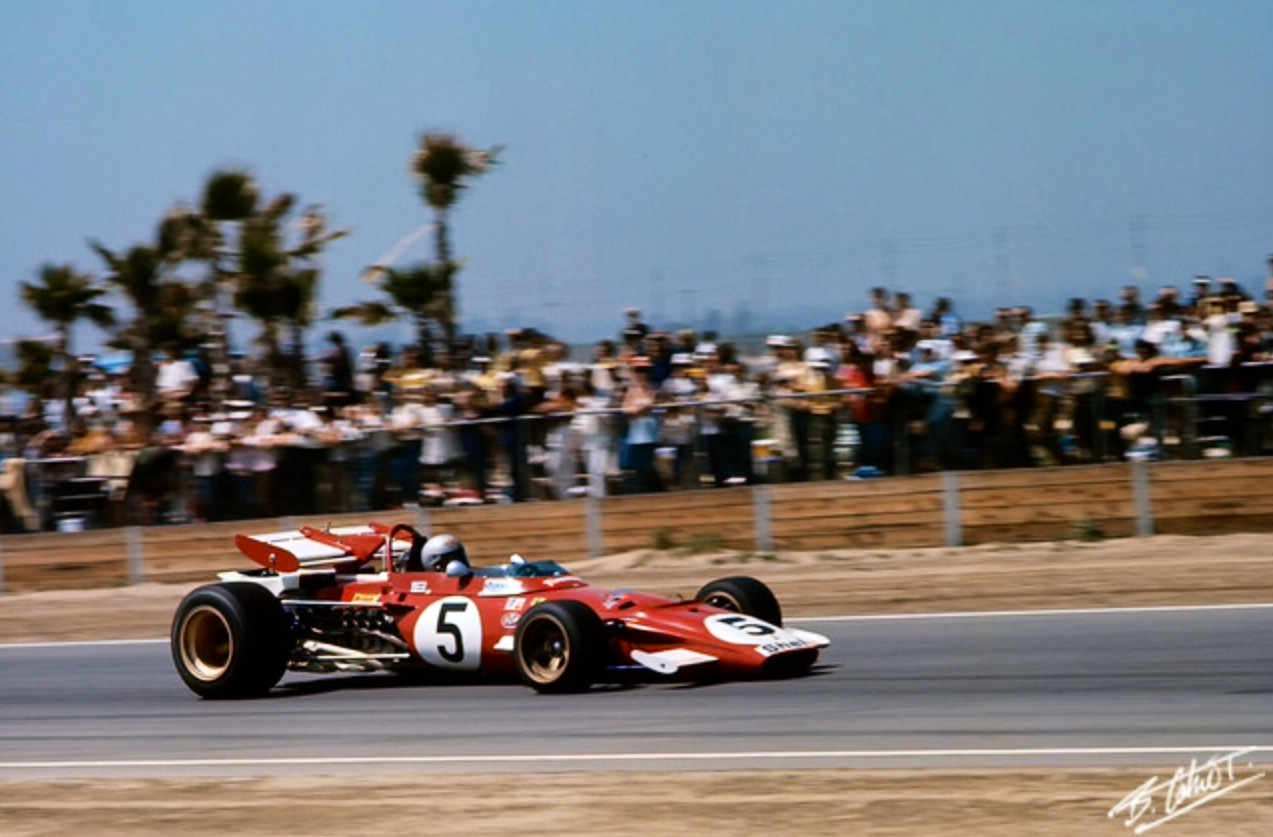
Jackie Stewart passes the burning molten alloy remains of Jackie Oliver’s BRM P153 and Jacky Ickx’ Ferrari 312B, fortunately both drivers escaped with only minor injuries, burns in Ickx’ case, lucky, it could have been much worse…
On the first of the 90 lap 19 April 1970 event Oliver had a suspension failure at the Ciudalcampo, Jarama, Madrid circuit, ploughing into Ickx and puncturing his fuel tank. The other P153 BRM of Pedro Rodriguez was withdrawn as a precautionary measure, Ollie reported stub axle failure as the accident’s cause.
#2 Ickx Ferrari 312B and Oliver’s white BRM P153, inside an inferno. ‘Bag type’ safety bladder fuel tanks mandated from the start of the 1970 season. The FIA at this time, pretty much year by year changed the regulations to improve safety around fuel tanks; safety foam around tanks in ’72, crushable structures around tanks in ’73, self-seal breakaway tank/hose coupling in ’74. (unattributed)
The full horror of the situation confronting the two drivers; Oliver has punched the release on his Willans 6 point harness and is jumping out of the BRM, Ickx is in the process of popping his Britax Ferrari belts. Johnny Servoz-Gavin’s Tyrrell March 701 Ford 5th passes. (unattributed)
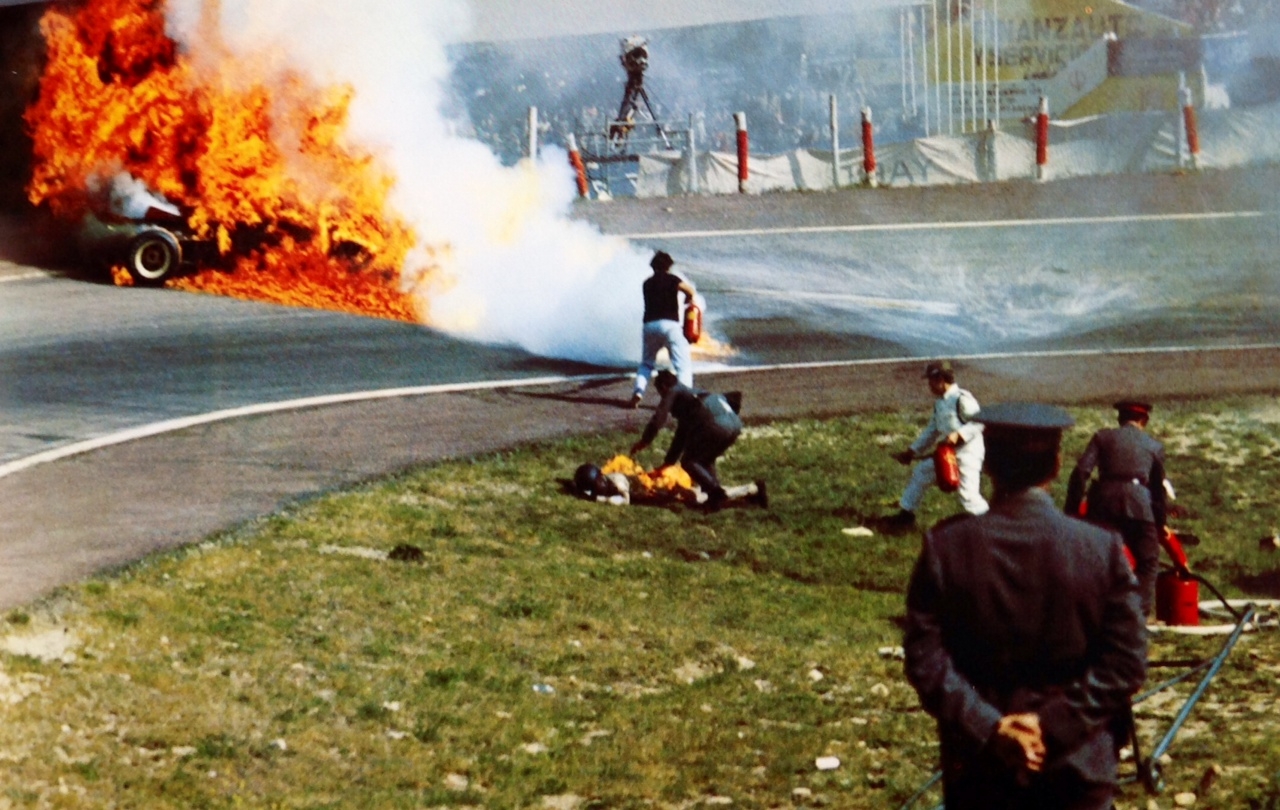
Ickx disoriented and on fire in search of a marshall (Automobile Year 18)
A soldier beckons in Jacky’s direction. (Automobile Year 18)
The soldier, not a marshall puts Ickx’ overalls fire out. At this stage foam is being sprayed on the car fire but the foam extinguishers were soon emptied leaving water only, the impact on the molten magnesium componentry was to make the fire worse. (Automobile Year 18)
Jack Brabham’s Brabham BT33 Ford was on pole, reinforcing the speed of Ron Tauranac’s first monocoque GP contender, but Jackie Stewart won the race in one of his least favourite cars, the March 701 Ford.
The accident happened at the ‘Esses Bugatti’, a stub axle failed and Oliver’s BRM rammed Ickx’ Ferrari puncturing its fuel tanks and releasing 45 gallons of avgas, a similar amount aboard the BRM. Oliver got out quickly, Ickx finally emerged with his overalls on fire, the flames were put out by a soldier. Ickx suffered as a result of keeping his fuel soaked overalls on.
‘The accident created race havoc, not only the visibility being dangerously reduced for drivers…but the flaming petrol constituted another hazard. The fire-fighting was abysmal, vast quantities of water being hosed on the flames for a long time-a procedure which caused the magnesium elements to ‘gas’ and flare up time and time again. The BRM was still burning at the end of the race, but miraculously no-one was hurt’ the Automobile Year race report said.
Stewart didn’t have the race to himself; he initially pulled away from Brabham and Hulme, electronic dramas causing the Kiwi’s demise. Despite spinning twice Jack chased Stewart and Pescarolo, taking second when the Frenchman’s Matra V12 seized, he was five seconds behind JYS. Only a few metres separated them when Brabham’s Ford Cosworth failed, allowing Jackie to ease off to take victory.
Bruce McLaren was second, McLaren M14A and Mario Andretti in another privately entered March 701, third.
The 1970 speed of BT33 was reinforced by Jack’s pole. He won the season opening South African GP. Here spinning on the ‘extinguisher foam rink’. He spun twice but despite that was right on Stewart’s tail when his engine blew. Jarama 1970. (unattributed)
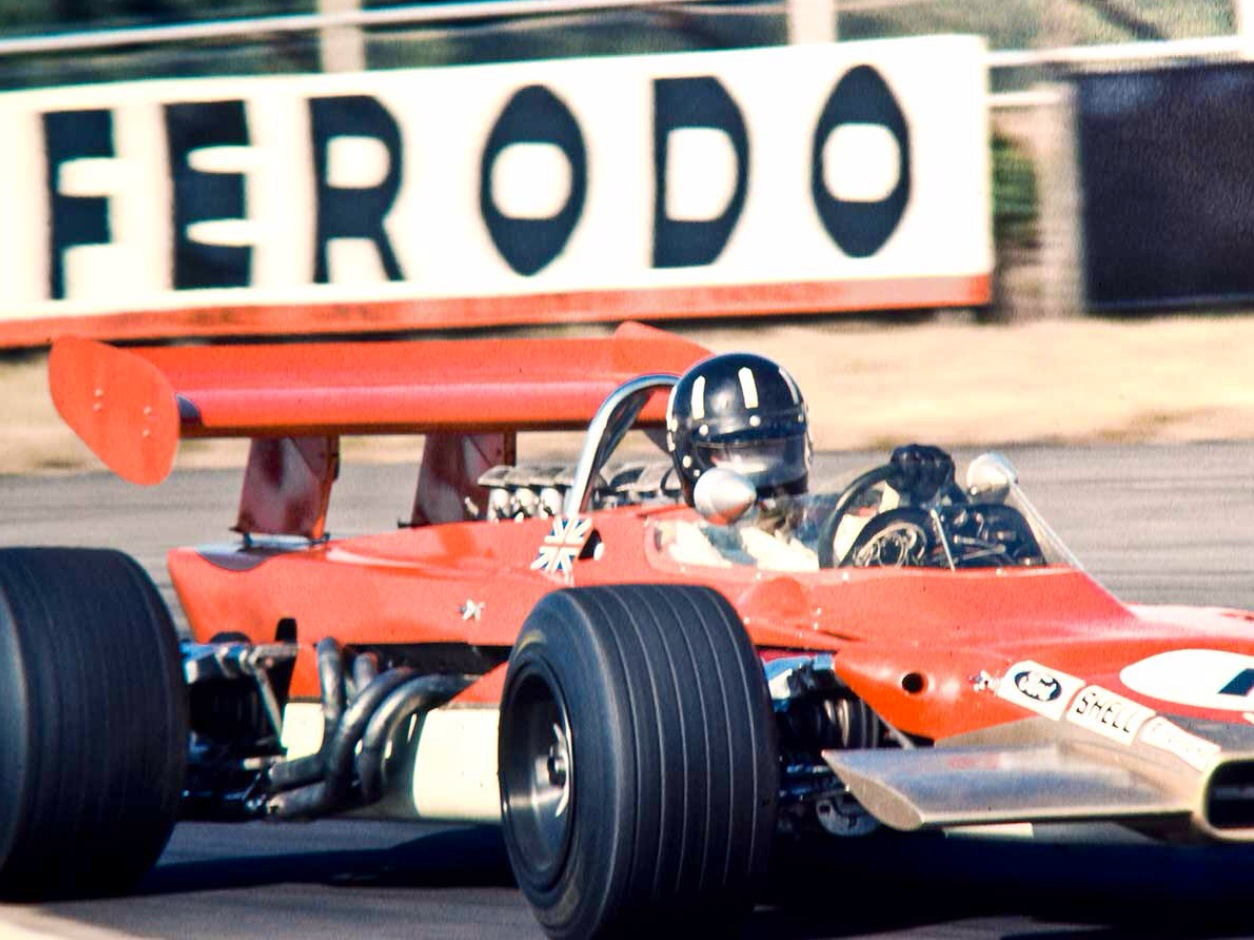
Jarama 1970 was also notable for the race debut of Chapman’s latest design the Lotus 72.
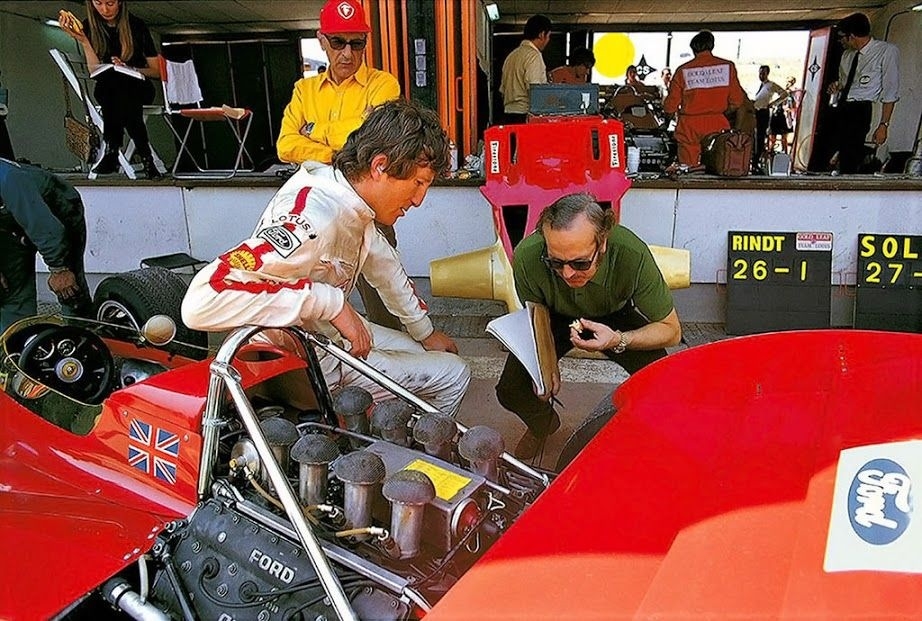
Jochen Rindt qualified his 8th, John Miles in the sister car did not make the cut. Rindt was out of the race on lap 8 with ignition failure.
It would take intensive development by Colin Chapman and his team to make the car competitive, the cars monocoques had to be ‘unpicked’ to make the suspension changes to eliminate a lot of the anti-dive/squat geometry and many other modifications but by June they had a winning car; victorious for Rindt in the sad Dutch Grand Prix, unfortunately the fire on that day had far more serious, fatal consequences for Piers Courage and his De Tomaso 505 Ford.
The sad reality of days like Jarama and Zandvoort in 1970, look how ill equipped in terms of fire protective clothing the marshalls are in the photos above, was the acceptance that safety standards in every respect; circuits, car construction and race support services had to improve to societal levels of acceptability. Thankfully we are on a different level in every respect today…
Rindt, Lotus 72 Ford, Jarama 1970. Look at the suspension travel on that early 72! (unattributed)
Jochen and Colin making a long joblist during Spanish GP practice. The car which won at the Dutch GP in June was a 72C which shows how much change there was in 2 short months. ‘Sol’ pitboard is Alex Soler-Roig who failed to qualify a Lotus 49C. (unattributed)
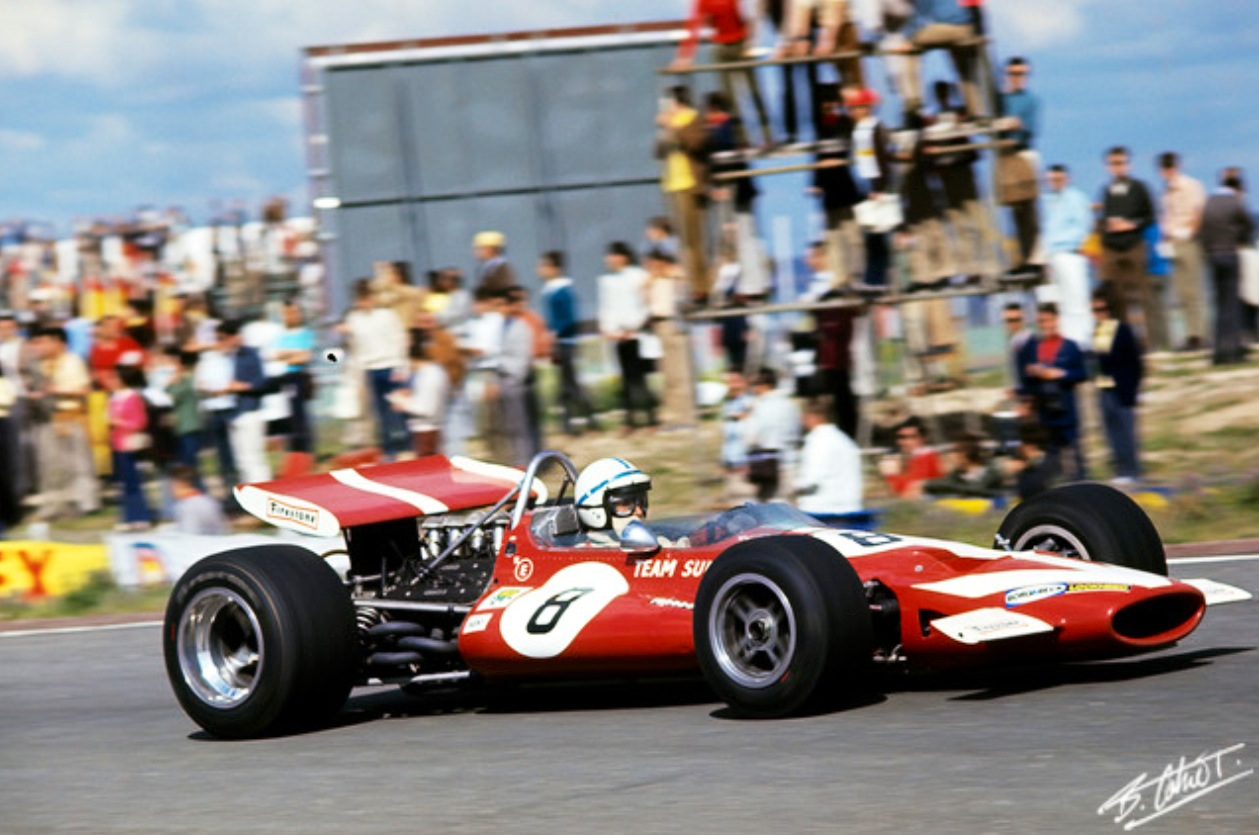
John Surtees ran as high as 3rd in his ex-works McLaren M7C Ford but faded and then retired with gearbox problems. Back at base his team were building John’s first F1 car the ‘TS7’ which made its debut at the British GP in July. (The Cahier Archive)
Piers Courage during Jarama practice 1970. His Frank Williams De Tomaso 505 Ford non-started after a practice accident. (The Cahier Archive)
Tailpiece: Stewart’s winning March 701 passes the conflagration…
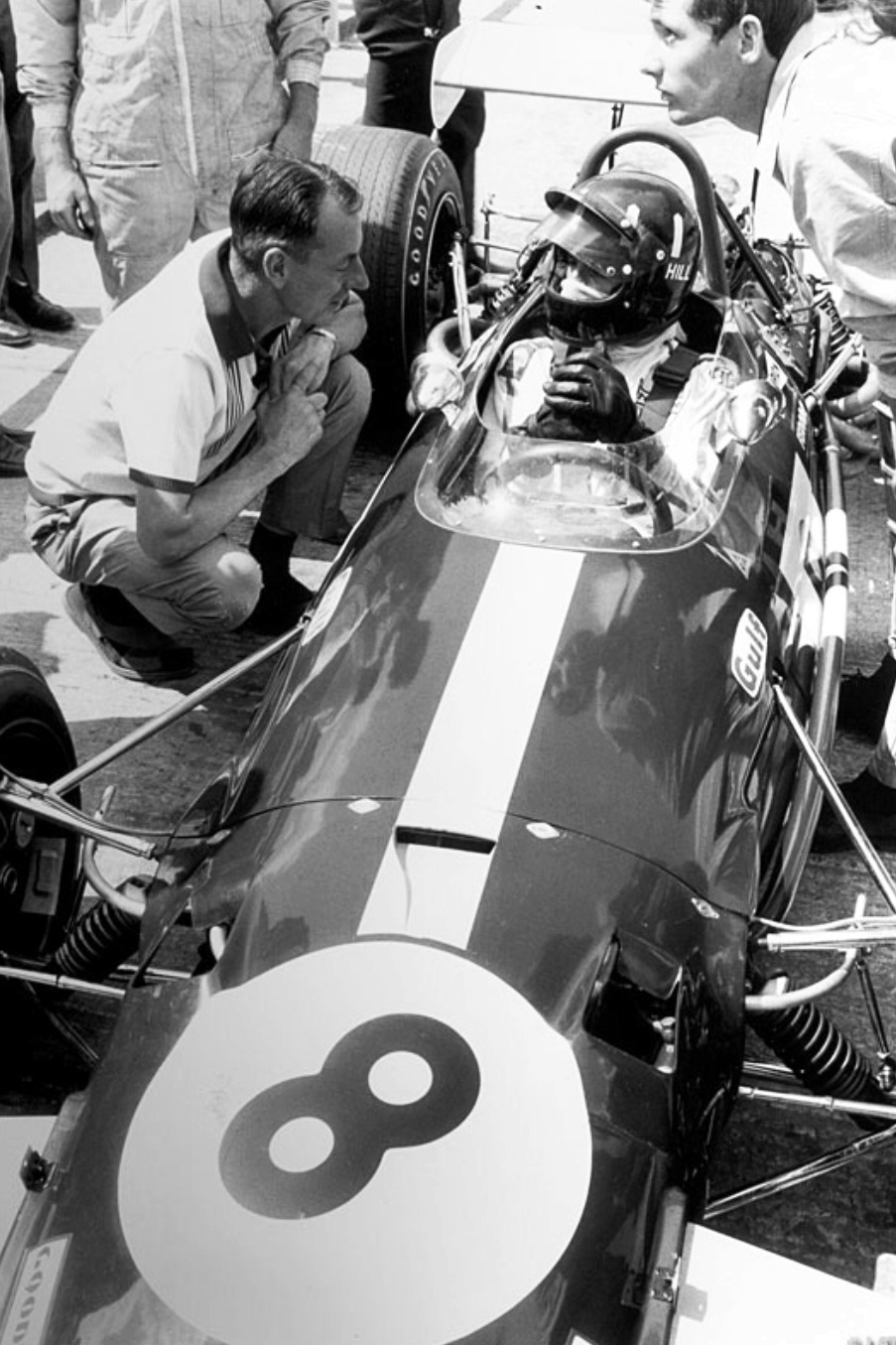
Graham Hill having a squirt of Jack’s Brabham BT26A Ford in British GP practice, Silverstone, July 1969…
GH in a Brabham is not such a big deal; he raced F2 Brabhams with success for years, as well as Tasman Formula ‘Intercontinental’ Brabhams in the mid-sixties. Later, he was the pilot of Ron Tauranac’s intriguing ‘Lobster Claw’ BT34 in 1971, but he was a Lotus F1 driver in 1969, so ’twas a bit unusual to practice an opponent’s car.
Hill’s red Brabham BT11 Climax from Clark’s Lotus 32B and Aussie Lex Davison Brabham BT4, all Climax 2.5 FPF powered on the way to an NZGP win for Graham. Pukekohe, 9 January 1965. Hill also raced an earlier BT7A in the ’66 Tasman for David McKay’s Scuderia Veloce, the entrant of the car shown; he was familiar with Brabham ‘GP’ cars long before 1969! (unattributed)
Jack was still recovering from a testing accident at Silverstone in June when a Goodyear popped off a front rim, his car ploughed into an earth bank, his ‘equal worst accident’ with the Portuguese Grand Prix one in 1959. He lay trapped in the car with a badly broken ankle, Cossie V8 screaming at maximum revs until he punched the ignition cutout and extinguishers to minimise the chance of the pool of fuel in which he lay igniting. Eventually, a touring car, also on the quiet circuit mid-week, stopped and raised the alarm.
Jacky Ickx, driving the other Brabham, was late for Silverstone’s first session, all timed for grid positions in those days, so Tauranac had 2 cars idle.
Graham and teammate Jochen Rindt were peeved with Colin Chapman, to say the least, as the Lotus transporter was not in the paddock when the session got underway. Graham was ‘ready to rock’ all suited up, but had no car to do so and was more than happy to put in a few laps for Tauranac. Rindt remained in his ‘civvies’ and fumed as the rest of the field practised.
Ron Tauranac is giving Hill a few tips on his very quick, twice a GP winner in ’69, BT26. ‘Just don’t over rev the thing for chrissakes Graham, Jack will kill me if you do…’ Is that Ron Dennis at right? (unattributed)
1969 was the year of 4WD experimentation for Matra, McLaren, Lotus and Cosworth.
Ultimately, very quickly in fact, 4WD was determined an F1 blind alley; the traction the engineers sought was more cost-effectively provided by advances in tyre technology. Goodyear, Firestone and Dunlop were all slugging it out in F1 at the time, none of ‘yer control formula bullshit then. The effectiveness of the ‘low wings’ mandated from the ’69 Monaco GP also played its part in getting grip.
Chapman’s issue was persuading his pilots to treat the Lotus 63 Ford, his 4WD design, seriously, to test it with a view to developing it rather than to humour him. 4WD was successful at Indy; Chapman’s ’68 Indy Lotus 56 ‘wedge’ was 4WD and came within an ace of winning the race, so was the ’69 Lotus 64, ignoring the misfortune surrounding both of these cars.
It was a challenge to get Rindt into the thing at all, but he did finish 2nd in the August 1969 Oulton Park Gold Cup. The result meant nothing, though, in front of him was Ickx’s Brabham BT26A, but all the cars behind were F5000 and F2 cars, not GP machines. Still, it was useful testing for Chapman if not for Rindt; his 4WD view was formed!
Chapman’s solution to his drivers’ recalcitrance was to sell two of his Lotus 49’s, one each to Jo Bonnier and Pete Lovely, leaving only one 49 in Team Lotus’ possession! A car you don’t have is a car you cannot drive. Said drivers were not best pleased.
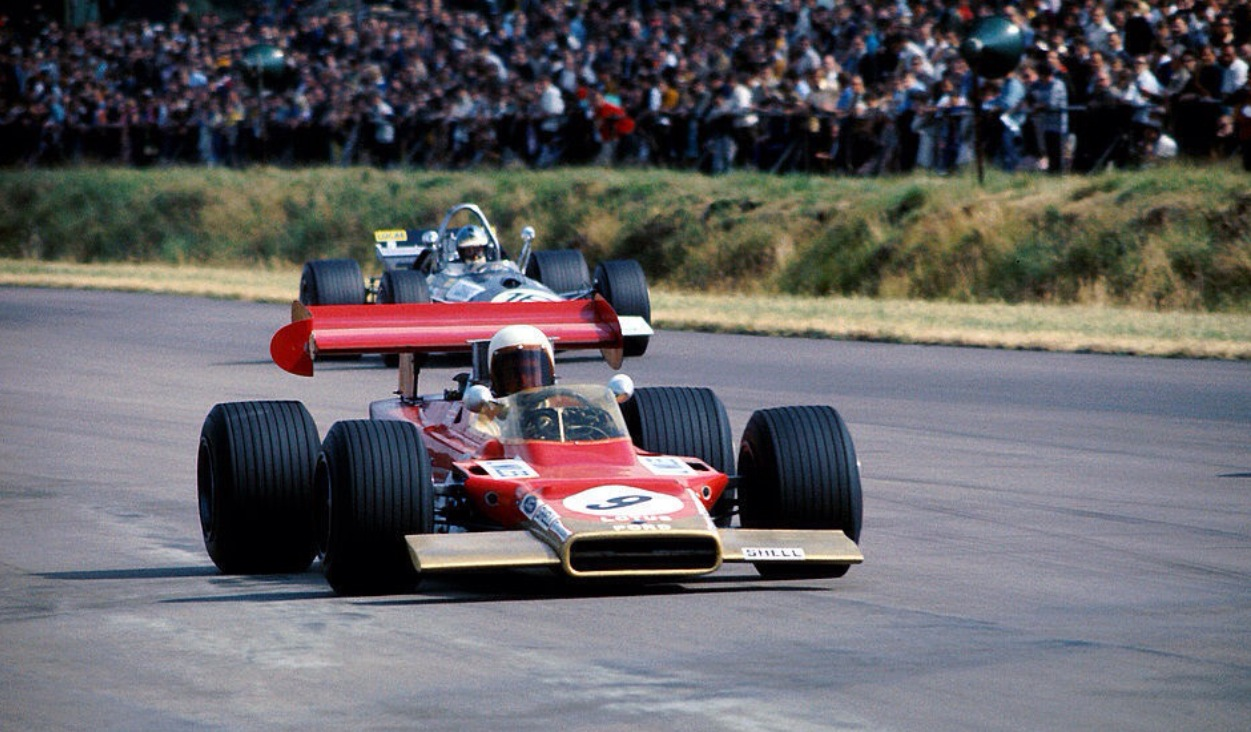
Hill, Lotus 63 Ford 4WD, British GP practice, Silverstone, July 1969. ‘Turn in bitch!’, understeer and the inability of these cars to respond to delicate throttle inputs plus excessive weight, were the main performance deficiency issues. As well as the absence of the electronic trickery which helped make 4WD work into the 80’s (Brian Watson)
When the showdown with Chapman occurred, and the speed, or lack thereof, of the 63 was clear, Col borrowed back the car he sold to Bonnier, GH raced that 49 and JoBo raced the 63. Chapman rescinded the contract with Lovely.
The ever restless Lotus chief didn’t give up on 4WD in Fl, the gas turbine powered Lotus 56 campaigned in some 1971 events had its moments and potentially a great day in the wet at Zandvoort until Dave Walker ‘beached it’.
The 49 raced on into 1970 and in ‘C’ spec famously won the Monaco GP in Rindt’s hands before the Lotus 72, Chapman’s new 2WD sensation, which made its debut at Jarama was competitive.
Hill races his Lotus 49B to 7th place. Silverstone 1969 GP (unattributed)
At Silverstone Hill, the 49 B raced to 7th, having qualified 12th, and Bonnier retired the slow 63 with a popped engine. John Miles, making his F1 debut, raced the other Lotus 63 to 9th. The young, talented Lotus engineer stroked the car home from grid 14.
Stewart won a thrilling high-speed dice on the former airfield with Rindt, only to be ruined when Jochen’s wing endplate chafed a rear Firestone. Some say it was the greatest British GP ever, on the way to his world title in a Matra MS80 Ford.
It would be interesting to know Graham’s opinion of the Brabham BT26 compared to his 49, the competitiveness of which, especially in Rindt’s hands not at all in doubt despite the 49’s middle age; it was a little over 2 years old in 1969.
I am a huge Graham Hill fan, he was well past his F1 best by the time I became interested in motor racing in 1972, but he was still quick enough to take F2, and Le Mans wins then, he was my kinda bloke, sportsman and champion. A statesman for his sport and country.
Jochen and Jackie scrapping for the ’69 British GP lead, Jochen’s Lotus 49B with bulk, uncharacteristic understeer. Look closely and you can see the closeness of his LR wing endplate to Firestone tyre, the cause of a pitstop to rectify and then back into the fray only to run outta fuel, the 49 notorious for its incapacity to sometimes scavenge the last few gallons from its tanks. Stewart Matra MS80 Ford (unattributed)
1969 was as tough a year for Hill as 1968 was great.
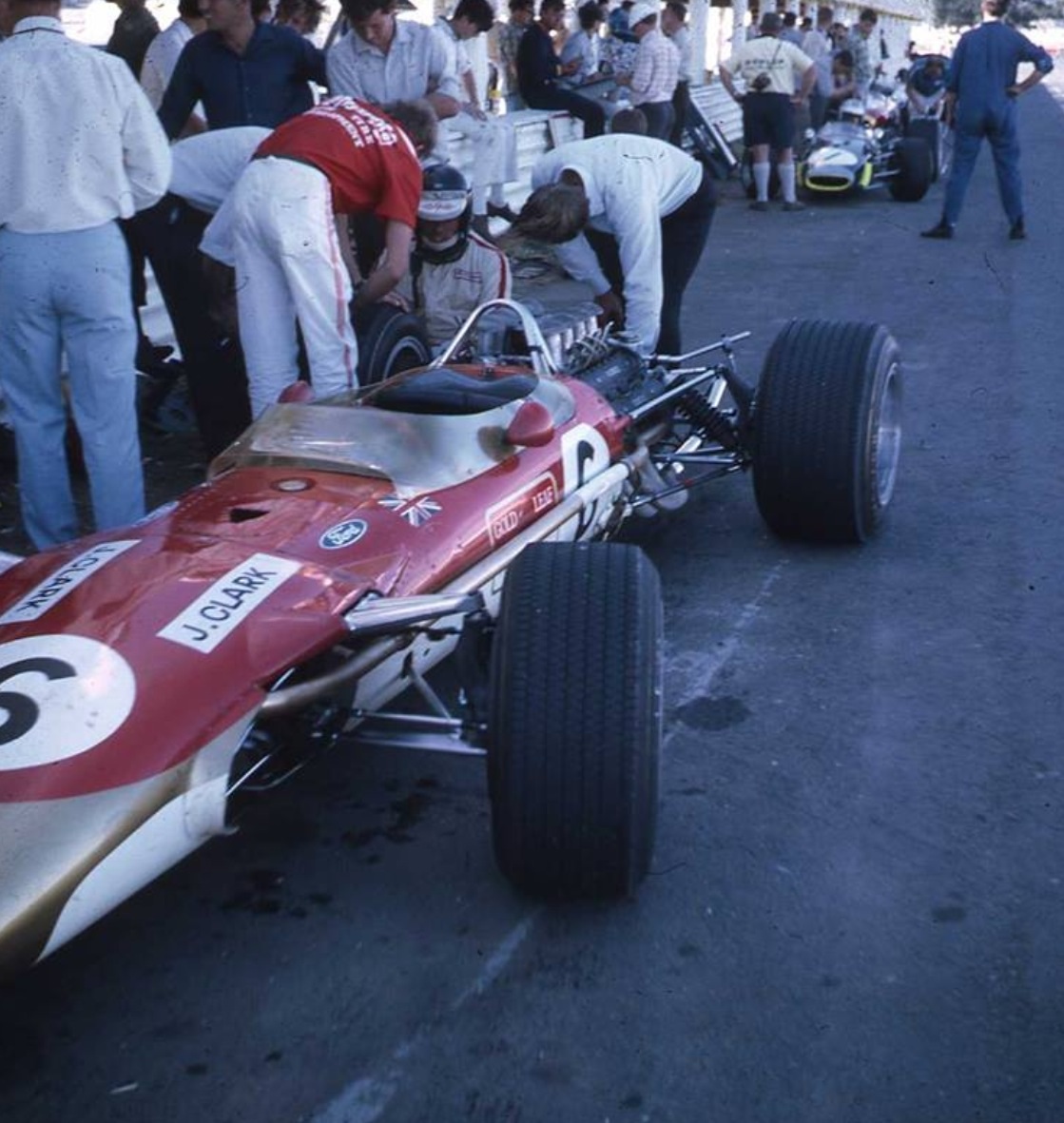
Jim Clark’s April 1968 death impacted Hill deeply on a personal level; they had been friends for years and Lotus teammates since the ’67 Tasman Series. Colin Chapman and Clark were like brothers, and whilst Colin struggled with his grief, Hill, in a tour de force of character and leadership, marshalled Team Lotus by their bootstraps and refocused them on the year ahead. The result, World Titles for Hill and Lotus by the season’s end.
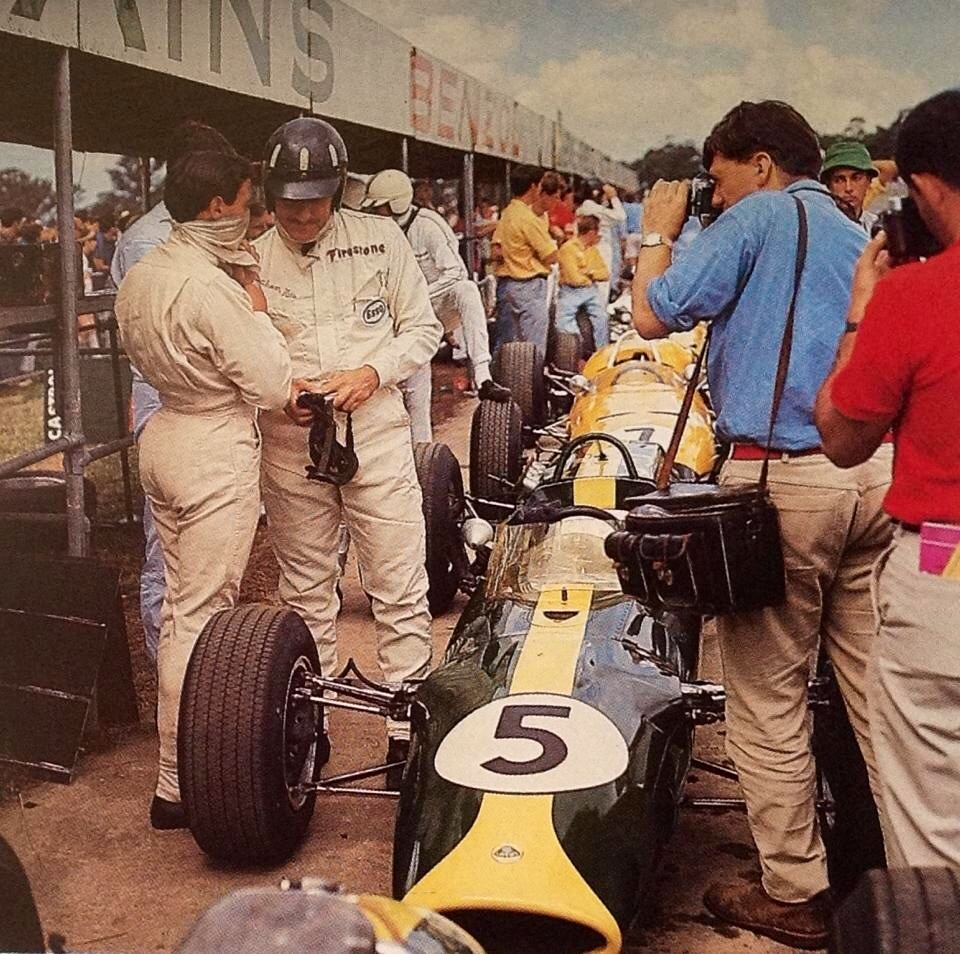
Clark and Hill beside Graham’s Lotus 48 Ford FVA F2 car prior to the start of the Australian Grand Prix, Warwick Farm, 1967. Car behind is Kevin Bartlett’s Brabham BT11 Climax. Clark was 2nd in Lotus 33 Climax FWMV 2 litre, GH DNF with a gearbox failure. JYS won in BRM P261 2.1 litre (History of The AGP)
The Tasman Series in early 1969 showed just how tough a year Graham was going to have within Lotus. Rindt joined them from Brabham, and whilst enjoying it, he had committed to Jack verbally to return to Brabham in 1970, and landed in the team in the year the Repco 860 quad-cam engine failed consistently.
Jochen had been in GP racing since mid-1964, was a consistent winner in F2 and had taken the 1965 Le Mans classic with Masten Gregory in a Ferrari 250LM, was regarded as one of the fastest guys around, if not the fastest, but had still not scored his first GP win. Graham was simply blown off by a guy with it all to prove. Jochen finally got the breakthrough win at Watkins Glen, the last round of the season, in which Graham had what could have been a career-ending shunt.
He spun mid race, undid his belts to bump start the car and of course was unable to redo them unaided; he spun again on lap 91, this time the car overturned, throwing him out and breaking both his legs badly.
What then followed was a winter of Hill’s familiar grit and determination to be on the South African GP grid in March 1970. He was and finished 6th in Rob Walker’s Lotus 49C Ford.
Quite a guy, G Hill.
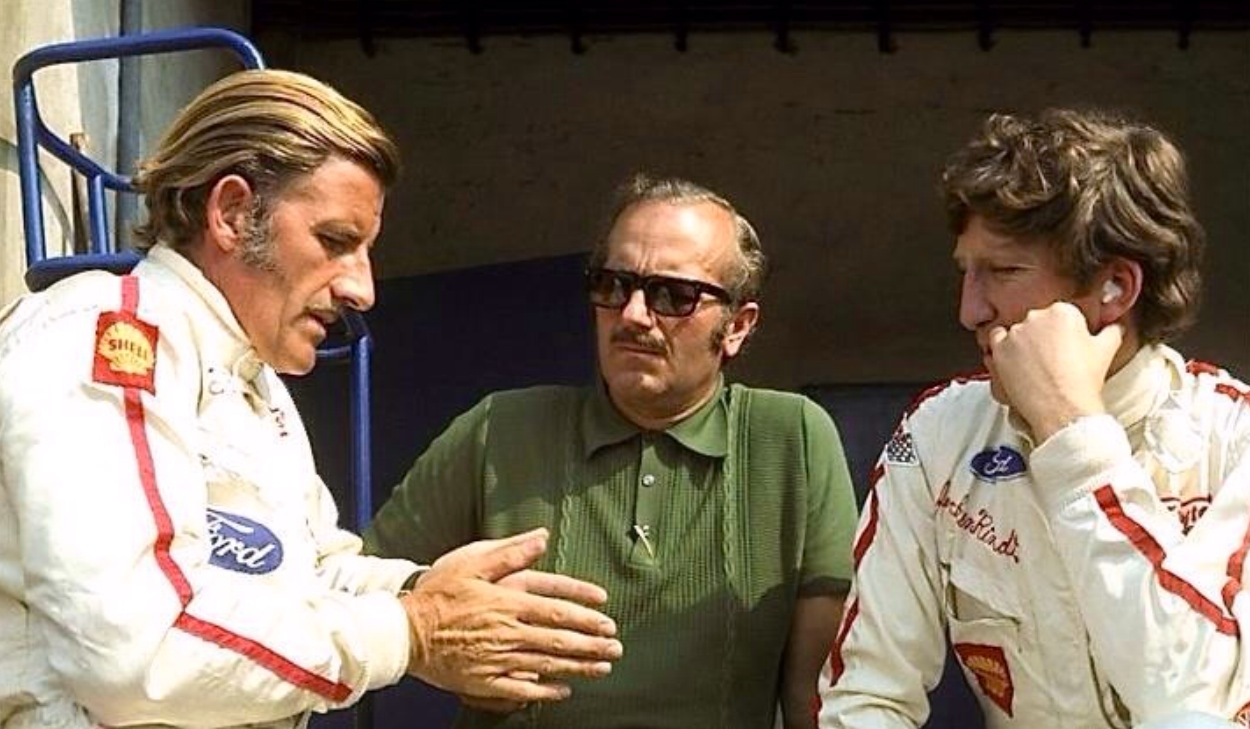
Team Lotus 1969. Hill, Chapman and Rindt. A tough season all round. With some reliability from his Lotus and mechanical sympathy to it from Rindt, there was a serious opportunity at the title that year, not to be (unattributed)
Etcetera: Lotus 63 Ford…
John Miles races the Lotus 63 to 10th on his GP debut at Silverstone 1969. Rounding him up is Piers Courage’ Frank Williams owned Brabham BT26 Ford, he finished 5th at Silverstone in a ripper season in this year old chassis. He emerged as a true GP front runner in ’69 (unattributed)
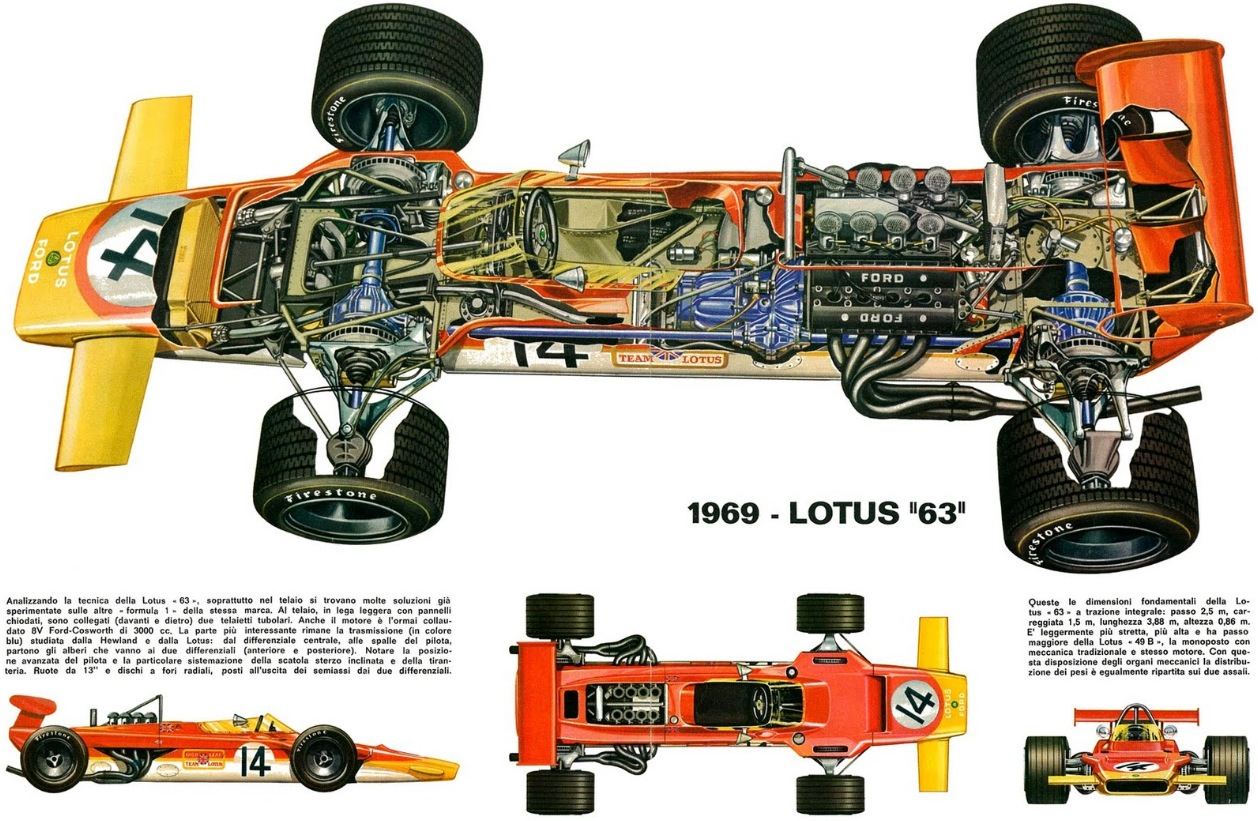
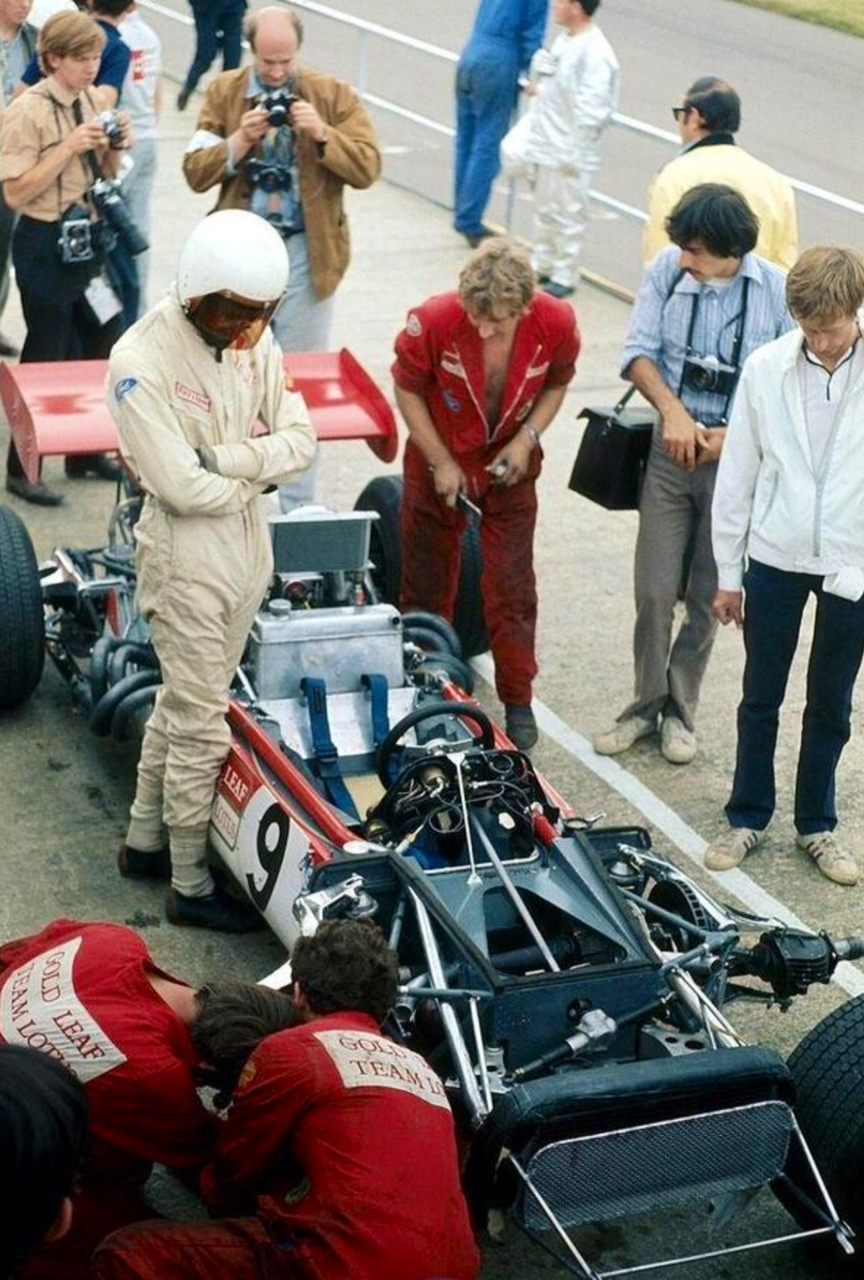
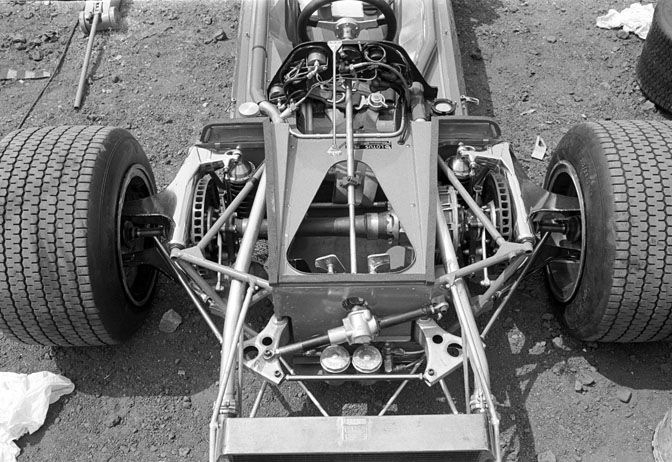
Cutaway is self-explanatory for our Spanish friends! Key elements of 4WD system in blue; see front-mounted Ferguson system diff, Ford Cosworth DFV and Hewland DG300 ‘box mounted ‘arse about’ with driveshafts on LHS of cockpit taking the drive fore and aft to respective diffs. Rear suspension top rocker and lower wishbone, coil spring/damper, brakes inboard (unattributed)John Miles, a young Lotus engineer and F3 graduate, ponders his mount. Lotus 63 Ford. He was later to say the 63 was not so bad, he did more miles in it than anyone else, until he first parked his butt in a conventional Lotus 49! which provided context. Note forward driving position for the time and sheet steel to stiffen the spaceframe chassis. Nice shot of disc, rocker assy and stub axle also (unattributed)Fantastic front-end detail shot of the Lotus 63. Spaceframe chassis, Lotus first since 1962, beefy front uprights, upper rocker actuating spring/shock, lower wishbone. The Ferguson system front diff axle and driveshafts to the wheels. Big ventilated inboard discs. Intricate steering linkage from angled rack to provide clearance required (unattributed)
Tailpiece: Tauranac, Hill and the ‘Lobster Claw’ BT34 1971…
RT seeks feedback from GH during Italian GP practice at Monza 1971. Hill Q14 and DNF with gearbox failure on lap 47. GH’s best results in 1971, 5th in Austria and Q4 in France. Teammate Tim Schenken, in his first full F1 year generally quicker than GH in the year-old, very good BT33, BT34, not RT’s best Brabham. No doubt RT missed Jack Brabham’s chassis development skills; Jack was on his Wagga Wagga farm from the start of 1971 (unattributed)
Jack Brabham starts the plunge from the Casino Square to Mirabeau in his factory Lotus 25 Climax ‘R3’ during the 1963 Monaco Grand Prix…
Brabham was joined at Brabham Racing Organisation by Dan Gurney in 1963; the lanky Californian left Porsche at the end of their F1 program. In 1962, BRO ran a car for Jack only in the team’s first F1 season.
In 1963, both were driving the latest Brabham BT7s powered by short-stroke, fuel-injected Coventry Climax V8S. In the first Monaco practice, Jack’s Climax munched a valve. Jack flew the engine back to the UK in his Cessna to have it rebuilt in time for Sunday’s race. The F1 racer of 1963 was a DIY kinda guy, if his name was Brabham anyway!
Dan Gurney’s brand new Brabham BT7 Climax, Monaco 1963, he was mighty fast if lacking in reliability and luck in that car that year! Famously the driver Clark came to respect the most. (unattributed)
In the final practice, Gurney lost the head off a valve, as had Trintignant’s Lotus 24. Roy Billington gave Jack the sad news when The Guvnor returned with his rebuilt FWMV from Coventry.
Brabham decided to start Gurney and withdraw from the race. The following morning, having heard of Jack’s predicament, Colin Chapman sportingly offered Jack a drive in the Team Lotus spare, ‘R3’ fitted with last year’s Weber carb Coventry Climax V8. Clark did a 1:35:2 in this car, just for fun, only 9/10 of a second slower than his pole time in his race chassis towards the end of qualifying.
Chapman knew Jack was well familiar with the handling characteristics of the car, as Jack acquired a Lotus 24 in early 1962, the spaceframe variant of the epochal, monocoque 25, whilst Ron Tauranac completed the build of Jack’s 1962 and first GP contender, the Brabham BT3.
And so it was that Jack had the opportunity to drive a car he had wondered a lot about since driving his own Lotus 24 Climax for much of 1962. ‘That was a great gesture by Colin, and I was delighted not to miss the race, but I can’t say I liked his car. If I thought my tube chassis Lotus 24 had been cramped, this Lotus 25 redefined the term. Its German ZF gearbox had a weird ‘upside down’ change pattern, and whilst I thought Dan’s feet were big, Jimmy’s must have been microscopic! The 25 seemed to have terrific traction and cornered well, but the gearbox got stuck in 5th twice, and I had to stop to have it fixed and finished way back’ said Jack in Doug Nye’s biography of him. Click here for an article on this race and the Lotus 25; https://primotipo.com/2015/03/03/lotus-25-jim-clark-monaco-1963/
’63 Monaco GP lap 1, the field led by Hill’s BRM P57 1st and Clark’s Lotus 25 cl 8th exiting the Station Hairpin. Next is Ginthers BRM P57 2nd, Surtees’ Ferrari T56 4th, #7 is a flash of McLaren’s Cooper T66 Climax 3rd, #4 Gurney’s Brabham BT7 Climax DNF ‘box and the rest. (unattributed)
MRD, BRO and the 1962 Season…
Jack Brabham and Ron Tauranac formed MRD – Motor Racing Developments Ltd to build racing cars in 1961; their first car, the FJ MRD, was raced by Aussie Gavin Youl that year.
The main games were both production racing cars and F1. ‘Motor Racing Developments’, jointly owned by Brabham and Tauranac, built the cars and ‘Brabham Racing Organisation’ owned by Jack (at that stage), ran the F1 program, prepared and entered the cars and contracted commercial agreements to fund the program.
Brabham being pushed to the Sandown grid, March 1962. Brabham sold this Cooper T55 to John Youl who raced it very successfully over the next couple of years the car continually developed by engineer Geoff Smedley including fitment of a twin-plug 2.5 FPF built by Smedley, an interesting story in itself. (autopics.com.au)
Jack raced in the international series of races in the Australasian summer in early 1962 in a Cooper T55 under his own Ecurie Vitesse banner.
The car was his factory Cooper 1961 F1 chassis ‘F1-10-61’, the little 1.5-litre FPF used in GP events replaced by its big FPF brother, an ‘Indy’ 2.7 for the Antipodean F Libre races. He won at Levin in NZ and Lakeside Queensland, I reckon his last Cooper win was his victory in the Sandown Park International on 12 March 1962 from Surtees and McLaren, both Cooper T53 mounted.
Jack Brabham in his F1 BT3 derived BT4 ‘Intercontinental’ Formula Brabham powered by a Coventry Climax 2.7 litre FPF ‘Indy’ engine. BT4 used smaller tanks than BT3 and 15 inch wheels all round. Australian national F1 was F Libre at this time. AGP, Caversham, WA, November 1962. Bruce Mclaren won the race in a Cooper T62 Climax, Jack collided with another competitor. (Milton McCutcheon)
By the end of the year, he was racing his own BT4, 2.7 FPF powered in the Australian Grand Prix at Caversham, WA in November.
But first there was a season of Grand Prix racing to contest, BT3 wouldn’t be ready until mid year as the customer FJ program had priority; MRD built 11 BT2 FJ’s, BT3 and 3 BT4’s in 1962, not bad for a new concern!
Brabham Racing Organisation needed a car for Jack to race in both championship and non-championship 1962 events in the interim.
Colin Chapman was more than happy to oblige, selling Jack Lotus 21 chassis 936 and 24 947 to enable the Aussie to chase the prizemoney and championship points on offer.
The 21 was the factory 1961 F1 design, a beautiful chassis only let down by the lack of a suitable, modern engine; the old 1.5 litre Coventry Climax FPF, even in updated Mk2 form, was too long in the tooth to keep up with the Ferrari Dino V6s in 1961. Mind you, the brilliance of Moss in Rob Walker’s Lotus 18 took two wins at Monaco and the Nurburgring and Innes Ireland one in his factory 21 at the season-ending Watkins Glen round.
Chapman updated the Lotus 21 design into the 24 for 1962, adapting the chassis to take the new 1.5-litre V8 Coventry Climax FWMV engine and the suspension of his ‘experimental masterstroke’, the Lotus 25, the first modern, monocoque single seater from which all such racing cars right through to the present owe their parental lineage.
Lotus 24 cutaway drawing. Multi-tubular spaceframe chassis, front suspension by top rocker and lower wishbones and coil spring/damper units. Rear suspension by reversed lower wishbone, single top link and 2 radius rods for lateral location, coil spring/damper units. Girling disc brakes. Wheelbase 91 inches, front track 51 1/2 and rear 51 3/4 inches. Weight 1036 lb dry. Fuel tank capacity: 27 gallons. Engines Coventry Climax V8 or BRM V8, gearboxes 5-speed ZF or 5/6 speed Colotti Francis. A good Coventry Climax FWMV V8 developed around 181bhp@8200rpm in 1962. (unattributed)
Mind you, the customers of the 24 thought they were buying Col’s latest design…
As is well known, the conceptual inspiration for the Lotus 25 was Chapman’s Elan road car and it’s backbone chassis; why not widen the ‘backbone’ to accommodate the driver, pop the fuel into the structure so created either side of him and get enhanced torsional rigidity for less weight, the primary objectives of the exercise?
Chapman sketched his ideas, the 25 was drawn by draftsman Alan Styman, the prototype R1 was put together in the early months of 1962 in a partitioned part of the Team Lotus workshop at Cheshunt by mechanics Dick Scammell and Ted Woodley working with Mike Costin, Lotus Engineering Director (and shortly the ‘Cos’ of Cosworth) and Chapman himself. Doug Nye; ‘Chapman suspected the concept might not work out, but would in fact revolutionise racing car design’
The 1961 Lotus 21 chassis frame’s torsional stiffness was only 700lb/ft per degree of deflection; the 24 frame was 10 pounds lighter bare weight (before brackets and aluminium fuel tanks) and had similar rigidity to the 21. The 25 weighed in at 65 pounds bare, ‘yet offered 1000 lb/ft per degree rigidity rising to what was at that time a staggering 2400 lb/ft per degree when the new Coventry Climax V8 was installed in its rear bay,’ said Nye.
Clark all snuggled into his brand new Lotus 25 ‘R1’, Belgian GP 1962. Monocoque structure by riveted D-shaped light alloy longerons with fabricated steel bulkheads to support suspension, steering and engine. Suspension, wheelbase and track as per Lotus 24. Engine Coventry Climax FWMV V8 and ZF 5 speed ‘box. Fuel capacity: 32 gallons. Weight 990lb dry. (Yves Debraine)
Chapman justified the new type 24 customer design against offering them the 25, saying, ‘just in case the monocoque idea didn’t work out’. Many customers had ordered 24’s unsuspecting that the work was going to be running something quite different and superior. From Chapman’s perspective, it was simple; he could build and sell plenty of 24s. Then, off the back of the speed of the 21 in 1961, the 25 was unproven, and it would take months to fulfil the orders even if he could talk his customers into embracing what a new concept was. Better to ‘take the bird in hand’, Lotus Components could build the 24’s quickly, allowing Chapman to focus on the new 25 and deal with the flak later!
Lotus 24 customers in 1962 included UDT Laystall 4 chassis, Rob Walker 2 chassis, Wolfgang Seidel, Team Lotus themselves and Brabham.
Maurice Trintignant in one of Rob Walkers Lotus 24 during the 1962 French GP. He was 7th and highest placed Lotus in the race won by Dan Gurney’s Porsche 804. (unattributed)
It’s interesting to reflect on Jack’s thoughts when the 25 was announced, but he probably had more than a sneaking admiration for Chapman’s ‘guile’, Jack and Chapman both ‘wheeler-dealers’ par excellence, one needed to get up pretty early in the day to get the better of them; if anyone ever did!
In any event, Jack was a racer, he needed to work with what he had knowing the BT3 was coming along later in the season and in any event the 25 might not work.
Jack’s 21 936 was first tested at Goodwood. I found one that needed a shoehorn to fit into it. Colin Chapman seemed to build cars for midgets. But its ride was softer than any Cooper, its steering lighter, and its handling good’ said Jack.
Only a few days later, the car was destroyed in a workshop fire at the Repco facility in Surbiton, where Tim Wall was preparing the car. Whilst fitting the battery, a spanner shorted against one of the fuel tanks, making a small hole which then gushed burning fuel! Brabham and Wall ran out of fire extinguishers trying to control the fire, and the fire brigade was unable to save the uninsured 21.
Chapman lent Jack the parts to build up another car, which was ‘flung together’ in time for the Pau GP on 23 April. Jack qualified well in 4th, but the car ran its bearings on lap 4.
The team rushed to make the ‘Aintree 200’, the following weekend, but they missed practice, the car stripped its gears in the race, which was won by Clark’s Lotus 24. Chapman and Clark let Jack drive the 24 for the first time in practice. Again, I found it as tight as a sardine can, quipped Brabham. Tight but fast!
By early May, Jack’s 24 was ready. Roy Billington and Jack’s team worked feverishly on the car to finish it at Lotus in Cheshunt in time for the ‘BRDC International Trophy’ at Silverstone on May 12. He was 13th on the grid and finished 6th, the race won by Hill’s BRM P578. It was a good result; the final chassis set-up was done by guesswork/the eye and the tacho drive failed.
Brabham raced his Lotus 24 competitively in Holland before running into the spinning Rodriguez Ferrari 156. Q4, DNF on lap 4 upon Clark’s debut of the Lotus 25. (unattributed)Jim Clark debuts one of the most influential GP cars of all time; Lotus 25 Climax chassis ‘R1’ Zandvoort 1962. (unattributed)
On 20 May, the Lotus 25 made its race debut in Jim Clark’s hands at Zandvoort, Holland. The racing world drooled over ‘R1’, which Clark qualified 2nd and led the race until clutch problems intervened.
24’s were entered for Trevor Taylor, Innes Ireland and Jack, the competitiveness of the chassis shown by Taylor’s 2nd place, Jack qualified very well 4th, but was punted out of the race by Ricardo Rodriguez’ Ferrari 156. The Mexican spun across his path as Jack lined him up for a fast downhill pass. The race was won by Hill’s BRM P57.
Jack blasts up Beau Rivage, Ste Devote in the background, Monaco 1962. Behind his Lotus 24 is Clark’s Lotus 25. Jim Q1 DNF with clutch dramas, Jack classified 8th. In the distance is one of the Ferrari 156’s. (Sutton Images)
At Monte Carlo Jack had ‘947’ flying,he qualified 6th and raced in 3rd until until a prang forced his withdrawal. He was classified 8th and quipped ‘I had a wishbone break-after i hit the barricade’ avoiding Phil Hill’s spun Ferrari 156 in Casino Square. Bruce McLaren won in a Cooper T60 Climax.
Back in the UK a week later for the ‘International 200 Guineas’ at Mallory Park on June 11, he finished 2nd from 3rd on the grid and continued to get good experience of the new Climax V8 in the 24. Surtees was victorious in his Lola Mk4 Climax.
Brabham, Lotus 24, ‘2000 Guineas’ Mallory Park. June 1962. (unattributed)
A week later at Spa on 17 June, he qualified 15th, having arrived late and had little practice, but raced well, finishing 6th. Clark took his and the 25’s first championship win.
There, the handling of the Lotus was simply evil, demanding the full road width at 150mph…the boys straightened out the bent chassis (damaged in the Monaco prang) in time for Reims.
Innes Ireland’s BRP/UDT Laystall Lotus 24 Climax being loaded at the 1962 French GP at Rouen. Innes Q8 DNF puncture on lap 1. Fine carefully faired rump on display, as is the rear suspension, typical layout of the day described in the text earlier. (unattributed)
At Reims for the non-championship GP, he was 4th from grid 5 on 1 July, McLaren again winning in a T60 Cooper. Jack enjoyed a long high-speed slip-streaming dice with Bruce and Graham Hill’s BRM, and in the process forgot to switch to the reserve fuel tank late in the race.
Then a week later Jack contested the French Grand Prix at Rouen-Les Essarts qualifying 4th but failed to finish with a suspension breakage, a rear shocker mount had broken. Dan Gurney took a popular win in the Porsche 804 from Tony Maggs Cooper T60, a wonderful result for the young South African. Hill and Clark both had troubles.
Brabham firing up the Coventry Climax FMWV 1.5 litre V8 engine of his Brabham Racing Organisation Lotus 24 under the watchful eye of chief mechanic Roy Billington, Aintree, British GP paddock 1962. This shot shows the svelte lines of the car to good effect. (unattributed)
Back home for the British GP, that year held at Liverpool’s Aintree on 21 July, he qualified 9th and raced to 5th. The new BT3 was nearly completed, but difficulties finishing the complex ‘crossover’ exhaust system required by the early series Climax engines prevented its debut.
Brabham, Aintree British GP 1962. Lotus 24 Climax. (unattributed)
The BT3 F1-1-62 was completed the week after Aintree and run briefly at Goodwood before Coventry Climax dramas intervened…
The engine out of the 24 was slotted in and then tested at Brands. Here at last was a modern F1 car into which I actually fitted. Its cockpit wasn’t too hot, and most critically, it handled beautifully. Ron really knew his stuff’ said Jack.
Brands BT3 test in late July at Brands Hatch. Tauranac at left, Harry Speirs of Climax fettling the engine and Jack. (Jack Brabham Story)
The BT3 was taken straight to the Nurburgring for its GP debut.
Brabham awaits the start of the very sodden German GP, the Nurburgring awash. He looks calm but it had been a fraught practice with the new car, the Climax V8 ran a bearing. (unattributed)
On the 5th of August, BT3 finally made its GP debut at the Nurburgring.Jack was taking the new car gently but it still ran the bearings in his Climax engine.
The team built an engine from the bottom end of a Team Lotus unit and the top end of the one in BT3, which was rough but allowed him to qualify. Jack’s spare was flown in that night to Cologne and fitted in the morning.
He qualified 24th but failed to finish with a throttle linkage that had been lashed up with extra springs to ensure it would close safely. Throttle balance in the corners a real challenge, so he retired. This thrilling race in awful wet conditions, watched by over 350000 fans, was won by Graham Hill, a supreme drive in his BRM P57 by 2.5 seconds from Surtees’ Lola Mk4 Climax and Gurney’s Porsche 804.
Brabham BT3 cutaway. Muti-tubular spaceframe chassis. Front suspension by unequal length upper and lower wishbones with coil spring/Armstrong damper units. Rear by reversed top wishbones, wide-based lower wishbones, coil spring/Armstrong damper units. Girling disc brakes. Fuel capacity: 26 gallons. Wheelbase, as for the Lotus 24 and 25, was 91 inches. Front track 52 and rear track 50 1/2 inches. Weight 1045 lb dry. Engine Coventry Climax FWMV V8 circa 180bhp@8600rpm, 6 speed Colotti-Francis gearbox. (unattributed)Brabham’s first GP car, the BT3 Climax makes its debut at the Nurburgring 1963. (unattributed)
Whilst testing of BT3 continued Jack raced the Lotus 24 ‘947’ one last time in the 3rd Danish GP at Roskildering on 25 August winning all 3 heats in a real carve-up with Masten Gregory in a similar Lotus 24, and the event as a consequence.
Nice portrait of Brabham in his Lotus 24 Climax in the Aintree paddock 1962. Cars behind are the Lola Mk4 Climaxes of John Surtees and Roy Salvadori. (unattributed)
Back in the UK Jack contested the ‘9th Gold Cup’ at Oulton Park on 1 September.Clark won the race in his Lotus 25; he seemed to have more luck in the non-championship than title rounds in 1962. Jack was 3rd in BT3, having qualified 5th. The race was held over a full GP distance, so it provided valuable mileage for the new car.
A critical learning was that the brake pads had worn after only 40 laps of a total of 73, the discs were increased in size from 9 to 10.5 inches and spring rates stiffened, the body was also ‘tidied up’ post Oulton.
Brabhams BT3, Oulton Park ‘Gold Cup’ September 1962. (unattributed)
Jack elected to miss the Italian Grand Prix on September 16 in order to better prepare for the ‘away races’ at the end of the season; the non-championship Mexican GP and final championship rounds at Watkins Glen and Kyalami. Graham Hill won at Monza from teammate Richie Ginthers BRM P57, Clark started from pole but this time gearbox dramas caused a lap 12 DNF.
Brabham BT3, US GP. (George Phillips)
The US Grand Prix was held at Watkins Glen on October 7. Clark won the race from Hill, and in so doing kept his championship hopes alive. The title was decided in the final round in South Africa.
Jack had a competitive run, finishing 4th, having a big dice with Gurney and McLaren, despite his Colotti box jumping out of gear and qualifying 5th, the ‘Automobile Year’ report stating Jack ‘created a sensation in qualifying’ with what was still a new car.
The non-championship Mexican Grand Prix was contested by many of the GP teams on 4 November as it was close to the US Grand Prix in both time and proximity.
The event was a tragic one; Ferrari had not entered, but local star Ricardo Rodriguez, a Ferrari driver that year, was keen to strut his stuff in front of his home crowd at the Magdalena Mixhuca circuit in Mexico City. He approached Rob Walker, who entered the 20-year-old in his Lotus 24 Climax.
Jack’s Lotus 24 947 was lent to John Surtees for this race and was a ‘bit player’ in the sequence of events which led to Ricardo’s death. Rodriguez had the fastest time, which Surtees then pipped in 947. Rodriguez kissed his father on the hand from the cockpit of the Lotus and went out to attempt to retake pole to keep the faith with the thousands of his countrymen who had turned up to see him.
Poignant and sad shot. Ricardo Rodriguez kisses his fathers hand, youngest brother Alejandro looks on and drives the Rob Walker owned Lotus 24 Climax to his death. Mexico 1962. (unattributed)
The poor driver had a massive, fatal accident on the dauntingly fast Peraltada corner.
Some reports say there was a right rear suspension failure on the Lotus, others that he was simply going too fast in a car he wasn’t familiar with. Innes Ireland’s account in his autobiography of the differences in handling of the Lotus 24 and Ferrari 156, which he raced both in 1962, is that they were considerably different. It’s possible, given his limited time in the Lotus, that Rodriguez made an error as a result of the differences in handling characteristics of the different chassis. Whatever the case, the young driver was dead.
Clark and Trevor Taylor shared the winning Lotus 25 from Jack’s BT3 and Ireland’s Lotus 24.
Jacks BT3 2nd leads good mate Bruce McLaren’s Cooper T60 Climax DNF engine in the 1962 Mexican GP. 4 November. (Dave Friedman Collection)
John Surtees, in Jack’s Lotus 24, qualified 4th in front of Jack in 7th but had ignition failure in the race and failed to complete a lap. ‘947 was then sold to Syd van der Vyver in South Africa. It was subsequently destroyed in a workshop fire there; it and Jack’s Lotus 21 ‘936’ have been ‘reconstructed/rebuilt/rebirthed’ and run in Historic Events to this day.
At Kyalami on December 29, Jack had another competitive points winning run, again finishing 4th, despite a gearbox jumping out of 3rd and 4th gears. Jack experimented with the first Hewland gearbox in BT7 in 1963 and, in so doing, ended the gearbox’s unreliability for the non-BRM British teams of the era. Mike Hewland’s transmissions amazingly robust.
All of the South African GP drama was centred on the battle for the championship between rivals and friends, Clark and Hill.
Clark led from pole and had the race ‘in the bag’, but as was so often the case in 1962, whilst the Lotus 25 was easily the fastest car, it was not the most reliable. Races were lost due to engine, gearbox, clutch and other component failures, and so it was that Jim retired on lap 61 of the 82-lap event with an engine losing oil, a liquid which cannot be replenished during a race.
Hill took a popular race and drivers’ championship win, and BRM’s only one as a manufacturer.
Brabham races to victory in BT3, the first GP win for Brabham as a marque, at Solitude, Stuttgart 28 July 1963. (unattributed)
BT3 raced on into 1963 and GP Success…
Ron Tauranac developed a new car for 1963, the BT7, which was a lighter and cleaned-up BT3, Gurney’s car, 2 inches longer in the wheelbase than Jack’s in an effort to keep the lanky Californian comfier than Jack had been in Chapman’s Lotus 24!
Jack’s BT7 was not ready until later in the season; he ran BT3 at Monaco before the Climax engine failure, racing the Team Lotus 25 and at Spa before using BT7 in the championship events from the Dutch GP in June.
Fittingly, BT3 won Brabham’s first GP as a manufacturer when Jack won the Solitude GP, near Stuttgart, Germany, on 28 July 1963 from Peter Arundell’s works Lotus 25 and Innes Ireland’s BRP BRM. The circuit was majestic, 7.1 miles long with many fast corners through pine forests, with average speeds of over 105 mph; it was a fitting place to take such a win.
Solitude GP 1963. Brabham’s #1 BT3 1st from #30 Jo Bonnier’s Cooper T60 Climax 9th, #16 Trevor Taylor’s Lotus 25 Climax ‘R3’ DNF, the car Jack drove at Monaco that May, the red nosed Lola T4A Climax of Chris Amon DNF #2 Innes Ireland BRP BRM 3rd, #17 Peter Arundell’s Lotus 25 Climax and the red Lotus 24 BRM of Jo Siffert DNF. (Michael Turner)‘Autosport’ 1963 Solitude GP report
Solitude was truly an amazing feat for a newish marque. Jack famously became the first man to win a championship GP in a car of his own name and manufacture at the French GP in 1966, when BT19 Repco took the chequered flag.
BT3 was also used by Jack to win the Austrian GP at Zeltweg on 1 September from Tony Settember’s Scirocco BRM and Carel de Beaufort’s Porsche. Raced by Denny Hulme to 3rd in the Kanonloppet at Karlskoga, Sweden behind Clark and Taylor’s Lotus 25’s on 1 August, BT3 was retained as BRO spare car for the balance of 1963.
Sold to Ian Raby for the 1964 season and a life in British Hillclimbing after that, before being restored by Tom Wheatcroft in 1971 and an exhibit of his fantastic Donington Museum. In more recent times, BT3 has been sold and is ‘historic raced’ which seems fitting for a car so significant in laying the foundations of success for Tauranac and Brabham all those years ago…
BT3 at the Goodwood Festival of Speed in 2012. (oldracingcars.com)
Team Lotus sorted the 25 over the ’62/3 winter into a more consistent, reliable package.Doug Nye credits Len Terry for his role in finessing and fettling the car and Coventry Climax also developed the engines further.
Not only was the Lotus 25 and its successor 33 the best package of the 1.5 Litre F1 but one of the ten most important GP designs ever…no doubt Ron Tauranac had a good, long, hard look at Jack’s sister Lotus 24 as he finalised the design elements of BT3 in the early months of ’62.
Victorious spaceframe amongst the monocoques; #6 Jacky Ickx in his winning Brabham BT26A Ford, #7 Stewart Matra MS80 2nd, Rindt Lotus 49B DNF and Hulme McLaren M7C DNF, all Ford powered. German GP 1969. Tauranac evolved his Repco-powered 1968 BT26 into the Cosworth-powered BT26A for ’69. Ickx also won at Mosport, Canada. Ron was using aluminium to provide some additional structural stiffness to his multi-tubular masterpieces by then. (unattributed)
One of the bits of history which amuses me, small things amuse small minds, granted! Is that despite the undoubted technical advantages of a monocoque chassis over a good-ole spaceframe, Tauranac’s Brabhams won GP’s with spaceframes right to the end of the sixties; his 1968 design BT26 won 2 Grands Prix for Jacky Ickx in 1969, let alone the titles Ron and Jack took in ’66 and ’67! So theory and practice sometimes diverge.
Tauranac’s first monocoque GP Brabham, the 1970 BT33, a change forced by regulations demanding ‘bag’ fuel tanks (his 1968 BT25 Indycar was his first monocoque) was a ripper car, one of the seasons best, it should have won at least 3 GP’s (South Africa, Monaco and British) instead of the one it did and Jack with luck, could have taken a title in his final, 1970 F1 year.
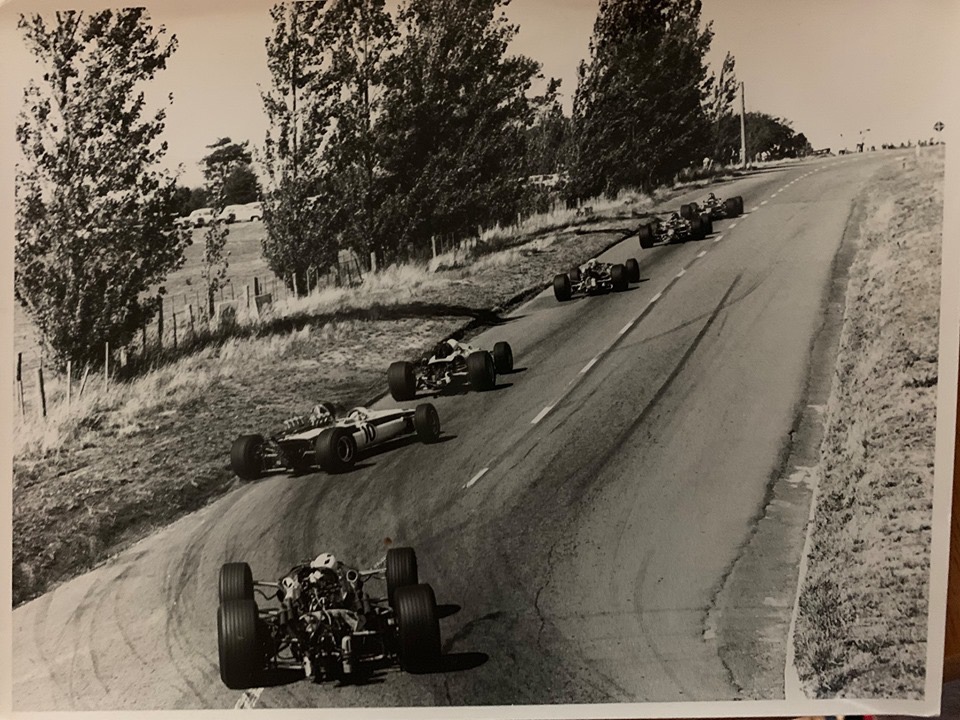
Brabhams BT33 3rd ahead of Hulme’s McLaren M14D 4th and Peterson’s March 701DNF a Ferrari 312B in the distance. Rindt’s Lotus 72 Ford won. French GP, Clermont Ferrand 1970. BT33 took a win for Jack in South Africa in 1970, Tauranac’s first GP monocoque. (unattributed)
Back to the period at hand, 1962’s BT3 evolved into 1963’s BT7, a very competitive package in the hands of both Jack and, particularly Dan Gurney, who became the driver the era’s undoubted star, Jim Clark, feared the most.
There would be Brabham wins in the 1963-65 period, but not as many as there should have been with a series of problems/preparation errors and bad luck of the type Team Lotus experienced in 1962, a story for another time…
The photos below by George Phillips were taken of BT3 on 29 July 1962 at MRD’s New Haw Lock factory beside the River Wey navigation canal adjacent to the old Brooklands circuit.
Profile of BT3 (George Phillips)Cockpit shot of BT3 also shows the spaceframe chassis and unusual front suspension, beefy upper wishbone and single lower link (George Phillips)BT3 Rear wishbone upper and lower suspension, Weber carbed Coventry Climax FWMV engine in 1962, Colotti-Francis 6 speed ‘box. (George Phillips)BT3 CC FWMV engine layout, spaceframe chassis, vestigial roll bar!, 2 radius rods. (George Phillips)BT3 butt shot. Nicely faired engine, inverted upper wishbones. (George Phillips)BT3 front detail. Spaceframe of 18 guage steel construction, Smiths instruments, LH change for Colotti ‘box, front suspension detail including odd top wishbone. (George Phillips)
BT7 1963 Future.
Brabham’s own spaceframe 1963 vintage. Jack in the Nurburgring paddock in a BT7 Climax, an evolution of BT3, 1963. (unattributed)
Bibliography…
Doug Nye ‘History of The GP Car 1965-85’, ‘Automobile Year’ # 10 and 11, Doug Nye ‘The Jack Brabham Story’, silhouet.com, oldracingcars.com
Photo Credits…
The Cahier Archive, Dave Friedman Collection, Milton McCutcheon, Yves Debraine, John Hendy, George Phillips, autopics.com.au, Getty Images, Sutton Images
Tailpiece…
(The Jack Brabham Story)
Brabham debuts BT3 Nürburgring 1962. What a sense of achievement and anticipation Brabham must have felt as he set off on his first laps of The ‘Ring in BT3, in his wildest dreams, I doubt he would have imagined the success of the following years?!
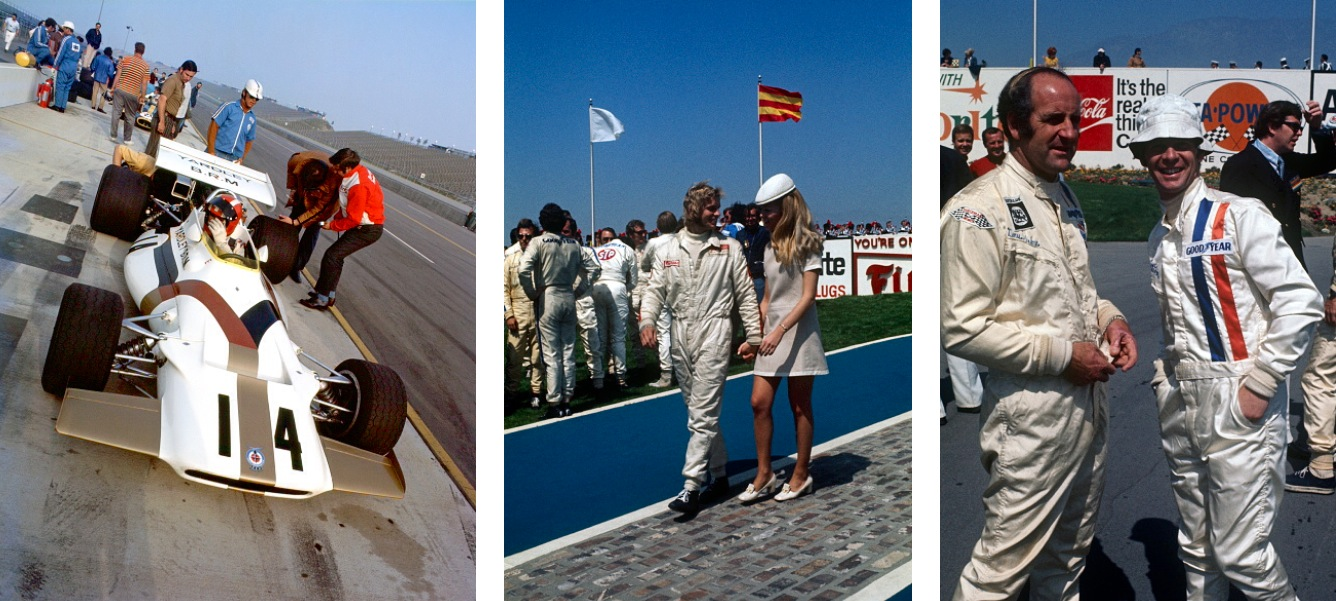
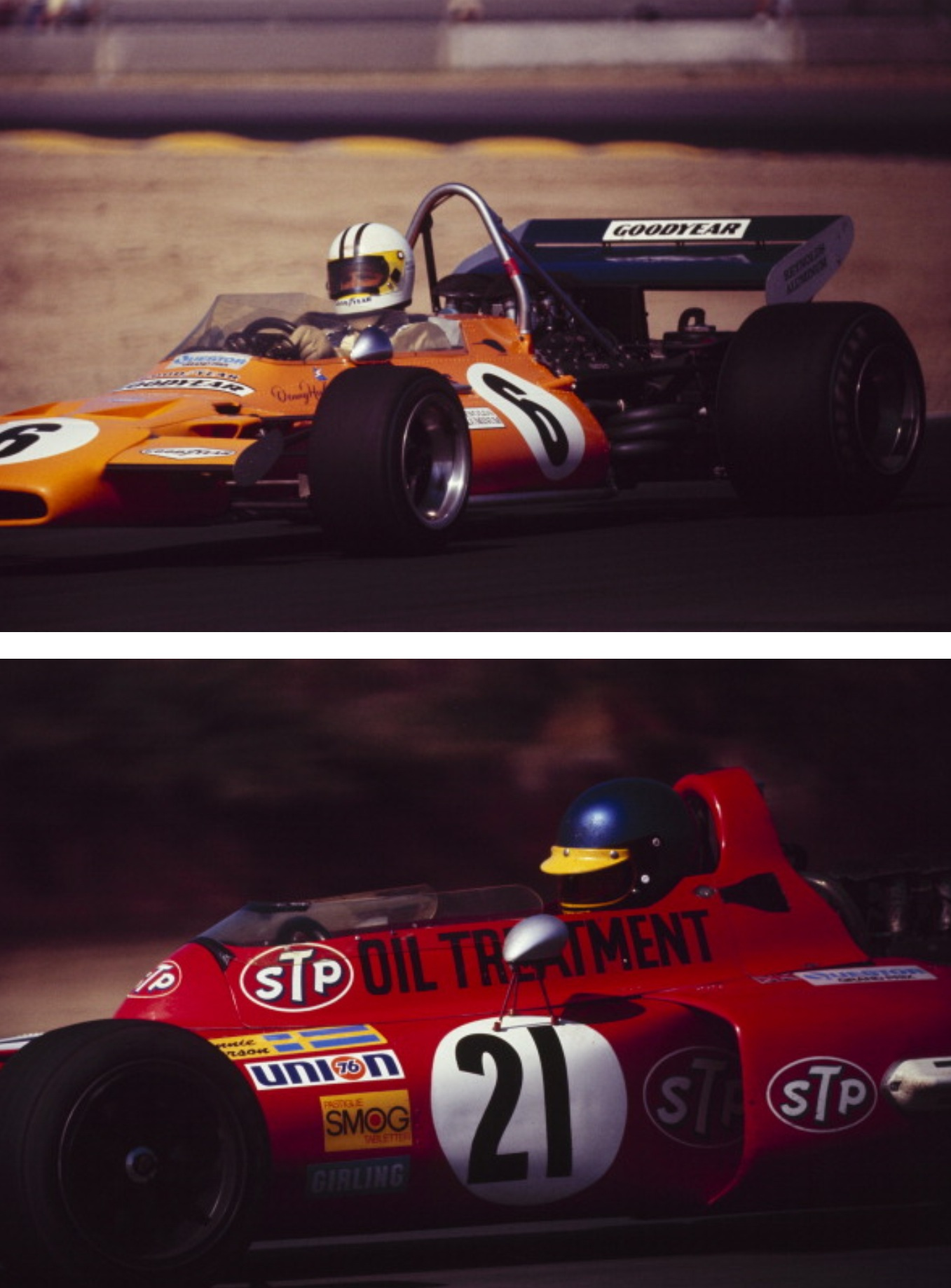
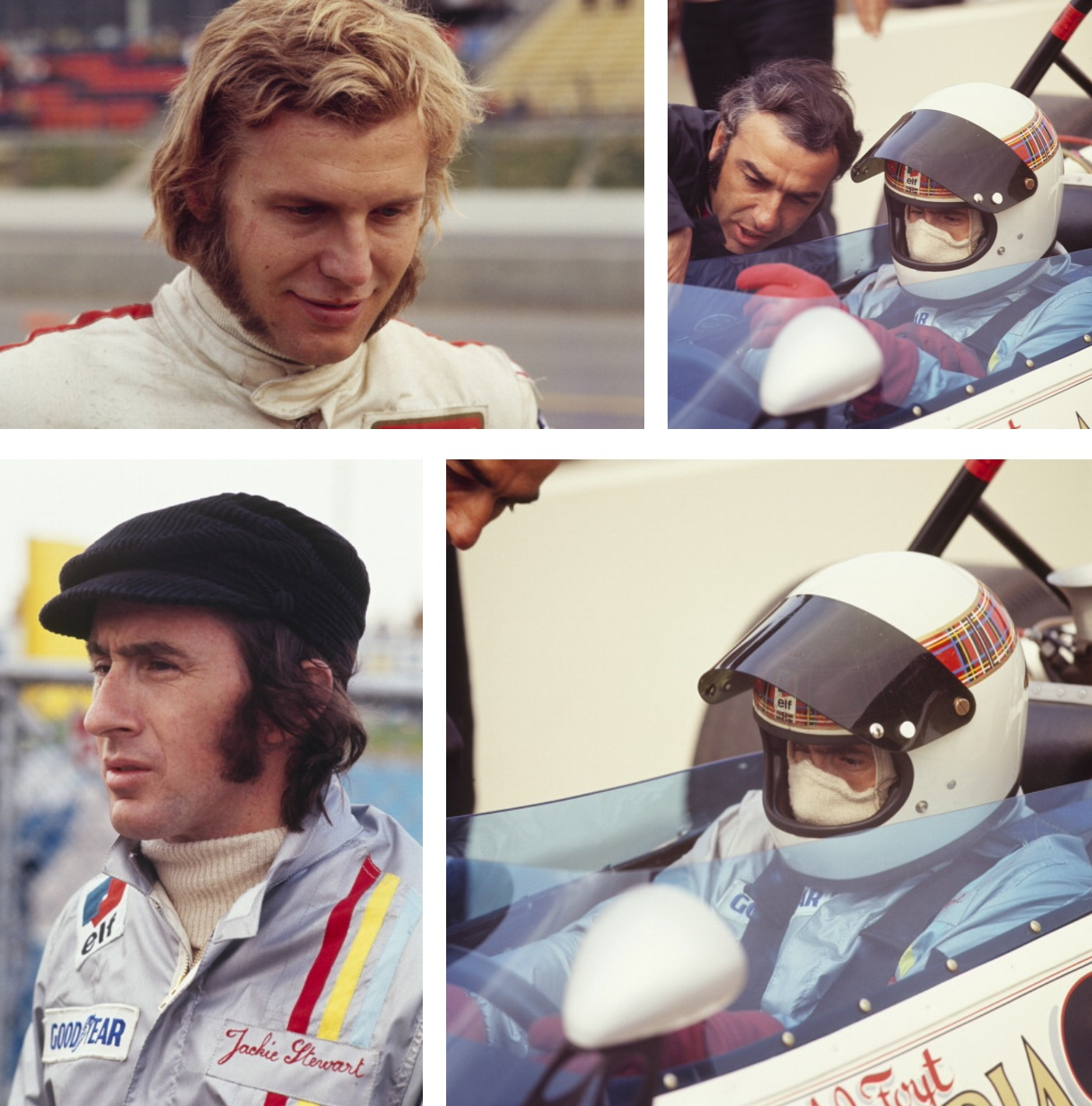
Jackie Stewart tests AJ Foyt’s Mclaren M10B Chev F5000 during Questor GP qualifying, perhaps the only time the Scot drove an F5000 car?…
The Questor Grand Prix was an intensely interesting experiment, a shame the Ontario circuit didn’t repeat it in subsequent years.
The event took place in March 1971 at the newly completed Ontario Motor Speedway. Promoted as the ‘Battle of Two-Worlds’, the USA and its Formula A/5000 cars against the best of European F1.
In 1971 there were only 11 championship F1 events so it was relatively easy for the teams to fit the event in, it gave them an extra race test without championship points at stake early in the season, and the prize money was $US278K or in 2015 $ terms, $M1.6, so it was well worth the effort!
For the Ontario Speedway promoters it was an ideal way to promote their new venue, the owners had aspirations of having a second US GP there, running of an event successfully provided the essential credentials to advance that goal. The event was well promoted with over 65000 punters rocking up on raceday.
The course itself comprised the start/finish straight, the first banked corner of the oval layout and a twisty infield section.
The Grid…
The American entry included Peter Revson’s Surtees TS8 Chev, Mark Donohue Lola T192 Chev, George Follmer Lotus 70B Ford, AJ Foyt in a McLaren M10B Chev, Bob Bondurant’s Lola T192 Chev and Al and Bobby Unser, both in Lola T190/2 Chevs, Swede Savage was Eagle Mk5 Plymouth mounted and Tony Adamowicz raced a Lola T192 Chev.
Mark Donohue’s Lola T192 Chev 14th, Derek Bell March 701 Ford 15th.
Tony Adamowicz’ Lola T192 Chev 17th, Graham Hill.
3 litre GP entrants included Ferrari with 2 1970 spec 312B’s (Mario Andretti and Jackie Ickx), Lotus (Emerson Fittipaldi and Reine Wisell in 72 Ford’s), BRM (Jo Siffert and Pedro Rodriquez P160, Howden Ganley P153 V12), Brabham (Graham Hill BT34 Ford ‘Lobster Claw’ and Tim Schenken BT33), Matra (Chris Amon MS120B V12), March (711 for Ronnie Peterson), Tyrrell (Jackie Stewart in 001), McLaren (M19A’s for Denny Hulme and Peter Gethin), and two privateer March 701’s entered by Frank Williams (Henri Pescarolo and Derek Bell).
Siffert in his ‘brand spankers’ BRM P160, Reine Wisell and friend, McLaren’s Hulme & Gethin.
Attractive young maiden and Hulme poring over the innards of his McLaren M19A.
We may never see such a star studded battle ever again. All the heavy hitters from each side of the Atlantic were there. A race fans dream which some saw as a repeat of Monza’s ‘Race of Two Worlds’ held in 1957 and 1958.
Denny Hulme, McLaren M19A Ford 3rd and Ronnie Peterson, March 711 Ford 13th.
L>R top to bottom. Hill in his Brabham, #29 Ron Grable Lola T190/2 Chev #8 Denny Hulme McLaren M19A Ford, #28 Stewart McLaren M10 B Chev, Peterson March 711 Ford, Howden Ganley BRM P153.
Racing…
Stewart, Tyrrell 001 Ford, Siffert BRM P160 and Ickx Ferrari 312B on the grid. (unattributed)
The race was run in two 100-mile heats because the F5000’s didn’t have the fuel capacity for a 200 mile race, a GP’s normal duration.
Mario Andretti, having just taken his first GP win in the season opener at Kyalami, South Africa, had an accident in qualifying on Friday and missed most of the session. He also had an Indy race on Saturday at the Phoenix Oval. He started in 12th place, standing on his Friday time.
With AJ Foyt racing at Phoenix Jackie Stewart did some laps in his McLaren M10B doing a time good enough for 11th on the grid. Foyt was uncomfortable with the Scots setup and reverted to his own.
Jackie Stewart was on pole in his Tyrrell from Amon, Ickx, Hulme, Rodriguez and Hill with Donohue’s Lola the best of the F5000’s, then Siffert, Fittipaldi and Follmer’s Lotus 70.
Hill, Brabham BT34 Ford 26th, Siffert.
Hill and Ickx, Ferrari 312B 11th.
L>R top to bottom. Fittipaldi, Andretti, Amon Matra MS120B 4th from Ickx Ferrari and Hulme’s McLaren M19A..
In the first heatAndretti worked his way to the front, caught and passed Jackie Stewart under braking for the first turn and won pulling away, much to the delight of the American crowd.
Initially Ickx used his Ferrari’s power to take the lead from Stewart, Amon, Hulme, Hill and Siffert . Spins for Siffert and Hulme dropped them back, while Stewart battled to get past Ickx, outbraking him and moving ahead. There was a high attrition rate, Foyt retired early with handling issues and Follmer with an oil fire in his Lotus, Hill was the first F1 car to drop out as he felt his Cosworth engine tighten, Savage crashed his Eagle heavily into a concrete wall off the infield section of the course suffering severe leg and head injuries. Their were other Chevrolet failures amongst the Formula A contenders, both the F1 and 5 litre cars engines were suffering as a consequence of the long straight and therefore long period at maximum revs.
Hulme on row 2 McLaren M19A, Ickx Ferrari 312B behind, nose in shot is the Brabham BT33 of Tim Schenken. (The Cahier Archive)
Reine Wisell, Lotus 72 Ford, ret’d.
Andretti was moving up, Donohue, defended strongly in his Lotus before Andretti passed him for third, which became second when Amon pitted with a puncture.
Together with three laps remaining, Andretti moved ahead to the delight of the crowd, taking the win from Stewart, Donohue was forced to pit from third with fuel injection dramas allowed Siffert into 3rd with his BRM.
Retirements included both Marchs; Pescarolo with a cracked chassis member and Peterson going off after a shock absorber failure, both Lotus 72s retired, Fittipaldi with an injection issue.
Mark Donohue’s FA Lola T192 Chev 14th ahead of Andetti’s Ferrari 312B 1st. (unattributed)
In the 2nd heat outside front row starter Jackie Stewart got the jump on Andretti and led. Andretti stalked Stewart for a handful of laps then repeated his first turn, first heat overtaking manouevre on Stewart to take the lead and the win.
Twenty-two cars gridded for heat two 45-minutes after the first. Foyt was persuaded to venture out in his McLaren Chevy and Peterson rejoinined after repairs but only once a large part of the race had been run.
Andretti was on pole but lost out to Stewart on the opening lap. Behind, Siffert led Ickx, Hulme, Amon and Donohue, that order changed when Ickx tried to dive past Siffert at the end of one of the short straights, Ickx spun and took Siffert with him. Whilst Seppi continued Ickx pitted with a puncture.
Stewart, Tyrrell 001 Ford 2nd.
Luckless Donohue pitted from third with injection dramas after a fine run, easily the quickest of the Formula A’s in his Penske Lola T192, Amon took over third in his Matra.
At the front, Andretti was closing in again on Stewart, the Tyrrell suffering a broken rear anti-roll bar which was causing issues on the banking, Stewart elected to yield as Andretti made his move.
The tough nature of the circuit again took its toll. Even Andretti was impacted, his Ferrari not revving cleanly and puffing smoke. He held on to win though with Stewart second from Amon. Rodriguez benefited from Siffert slowing after losing a suspension bolt to take fourth ahead of Hulme, Schenken and Ron Grable the first FA car home in seventh.
John Cannon in an STP sponsored March 701 Ford 12th. (unattributed)
Andretti’s victorious Ferrari 312B in essentially 1970 spec. (The Cahier Archive)
In terms of overall results the complex points structure meant that a car with a high finish in one race could outscore a car that had finished both, gave Andretti the win he deserved, Stewart was second from Hulme, Amon and Grable heading the US-runners in seventh.
The race was popular with the crowd, the American racers felt their cars had been uncompetitive and the European’s, other than those who had extensive sportscar experience of Daytona, were not fond of the banking!
The Questor Group, builder/owners of the circuit encountered financial problems shortly after the event so it was not repeated, leaving it a ‘great might have been’.
Certainly as F5000’s became more sophisticated into the 1970’s, the Lola T330/2 famously as quick as many F1 cars at Mosport and Watkins Glen, circuits upon which they both raced, would have made such an event much closer, perhaps, than the Questor GP was in 1971?
L>R top to bottom. Hill/Schenken/Peterson and friend, happy winner Andretti, Jo Siffert
Etcetera…
Ickx doing a few laps in Andretti’s chassis during practice, Ferrari 312B. (unattributed)
L>R top to bottom. #7 Gethin McLaren M19A Ford 8th, #14 Siffert BRM P160 6th, #2 Fittipaldi Lotus 72 Ford 21st, John Cannon March 701 Ford 12th.
Tim Schenken Brabham BT33 Ford, 5th.
YouTube Footage…
Etecetera…
Dan Gurney’s protege Swede Savage deserved a more competitive car than the ’69 Eagle Mk5 Plymouth, the oldest car in the race. He crashed heavily and didn’t return to racing for 6 months after severe leg injuries and a ‘bruise to his brain stem’. (unattributed)
Al Unser in his ‘Kastner Brophy Racing’ Lola T192 Chev, #38 behind in the colour shot is brother Bobby’s similar ‘Charlie Hayes Racing’ T192. (unattributed)
Ontario lap 1 Questor GP vista (unattributed)
Andretti’s Ferrari 312B, lines of that 1970/71 series of Ferrari’s about as good as it gets?, #18 Henri Pescarolo’s Frank Williams March 711 Ford (unattributed)
1971 Questor GP entry (unattributed)
Reine Wisell top left and Jackie Stewart, Foyt F5000 McLaren M10B mounted, engineeer familiarising JYS with the dash and rev limits ‘7500 not 10500 pleeease Jackie…’
Bibliography…
The Nostalgia Forum, oldracingcars.com, HistoricRacingNews.com
Photo Credits…
Getty Images-all images by Getty unless otherwise stated, The Cahier Archive
All drivers have a day of greatness, surely!? Jean Pierre-Beltoise’ was his great wet weather drive at Monaco in 1972 when he won the race in a drive of controlled speed and aggression in the toughest of conditions in his BRM P160B V12…
Even ‘Rainmaster’ Jacky Ickx finished second to the Frenchman in his Ferrari 312B2 that day with Emerson Fittipaldi’s Lotus 72D Ford in third.
JPB started from row 2, his task made a little easier on lap 5 when Clay Regazzoni went up the escape road at the chicane taking Fittipaldi and Ickx with him, they had been braking when Clay did…
But it was a great drive, JPB’s first and last GP win and BRM’s last, sadly.
Taffy von Trips settles himself into his F2 Ferrari Dino 156 #0008 on the grid of the 1960 Italian Grand Prix, Monza, September 6…
The cars designer, Carlo Chiti looks on. Click on the link below to my article, I’ve converted a 100 word quickie on a Monaco vista in 1960 into a feature on a significant Ferrari thanks to a tangent introduced by reader Grant Perkins for reasons which are clear in the text; https://primotipo.com/2015/10/04/monaco-panorama-1958/
This car, Ferrari Dino 246P/156 0008, is the Scuderia’s first mid-engined car.
(unattributed)
Ferrari factory test driver Martino Severi drives the brand new, mid-engined 246P 0008 on 22 May 1960 at Modena. Ginther and Hill also drove it that day, it’s a week before its Monaco GP debut. It’s not as gorgeous as it became in Fantuzzi bodied 1961 156 form, but luvverly all the same
Dino 246P 0008’s evolution from 2.5-litre mid-engined GP prototype in Ginther’s hands at Monaco 1960 to 1.5-litre Dino 156 Syracuse 1961 GP winner for Giancarlo Baghetti within 12 months is an interesting story.
(unattributed)
Richie Ginther at Monaco 1960 for his, and Ferrari Dino 246P 0008’s GP debut.
Rod MacKenzie’s moody, foreboding, evocative image of Jim Clark’s Lotus 49 at Longford in 1968 is one of my favourites…
Clark is exiting Newry Corner on the run towards the ‘Flying Mile’. He started from pole, winning 100 bottles of champagne in the process and finished second in the Saturday preliminary race in beautiful weather but the clouds opened on Monday morning for the Tasman Championship event, ‘The South Pacific Trophy’.
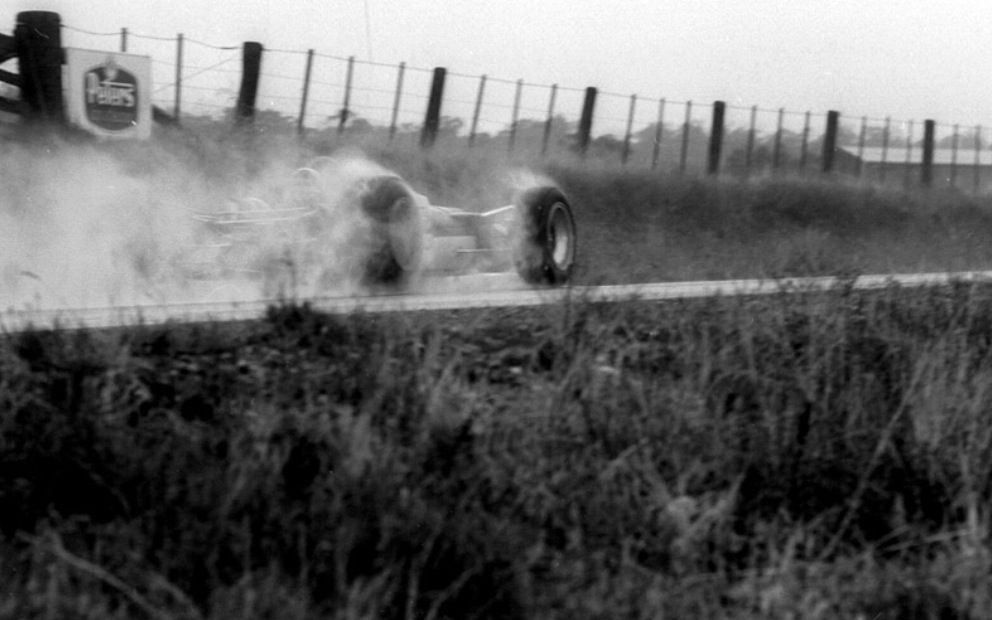
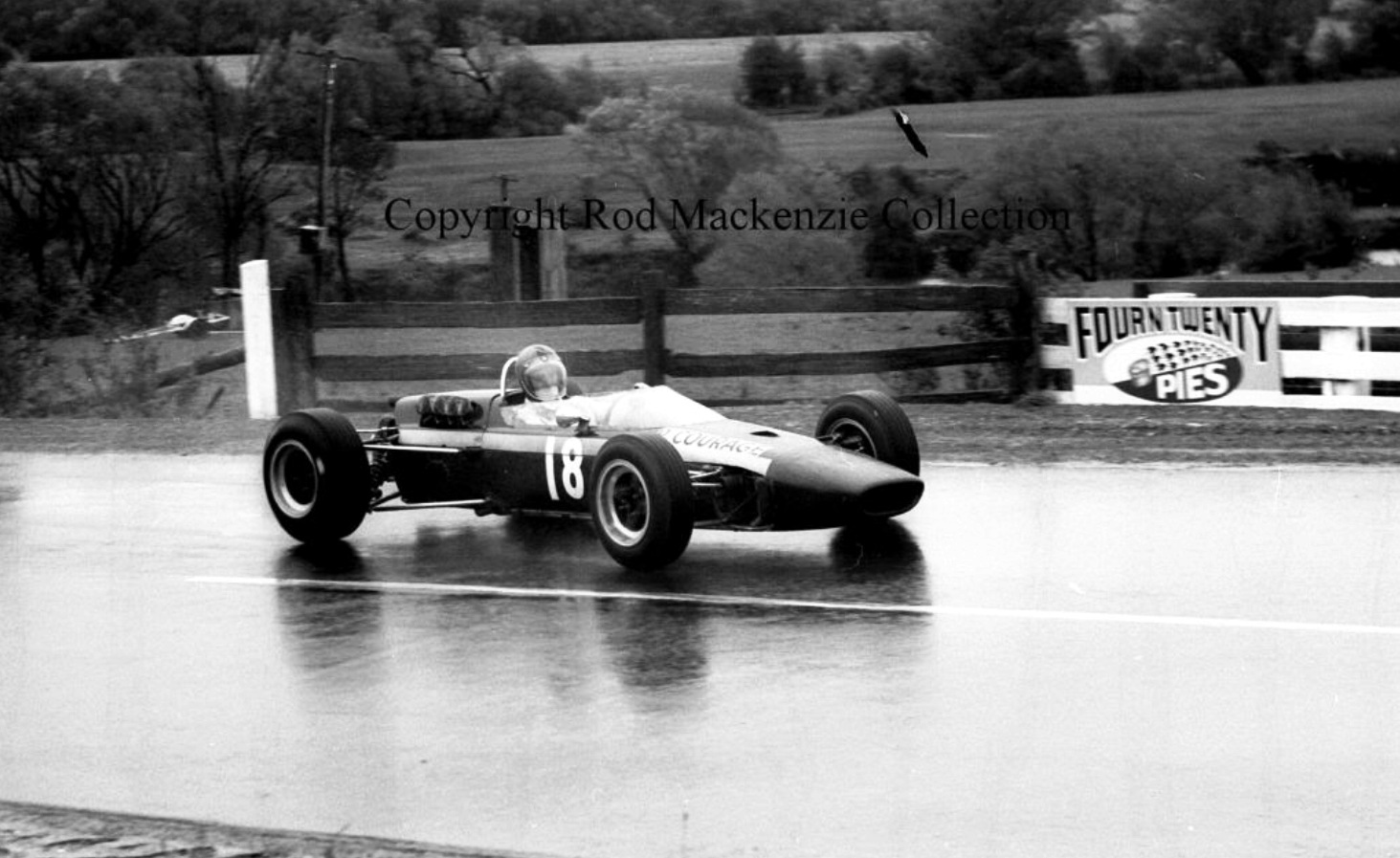
Star of the show was Piers Courage who drove a gutsy, skilful race in the most challenging, treacherous conditions to win the event in his little F2 McLaren M4A FVA ahead of the big Tasman 2.5’s of his close competitors. Pier’s car was self run, his performances in it that summer reignited his career.
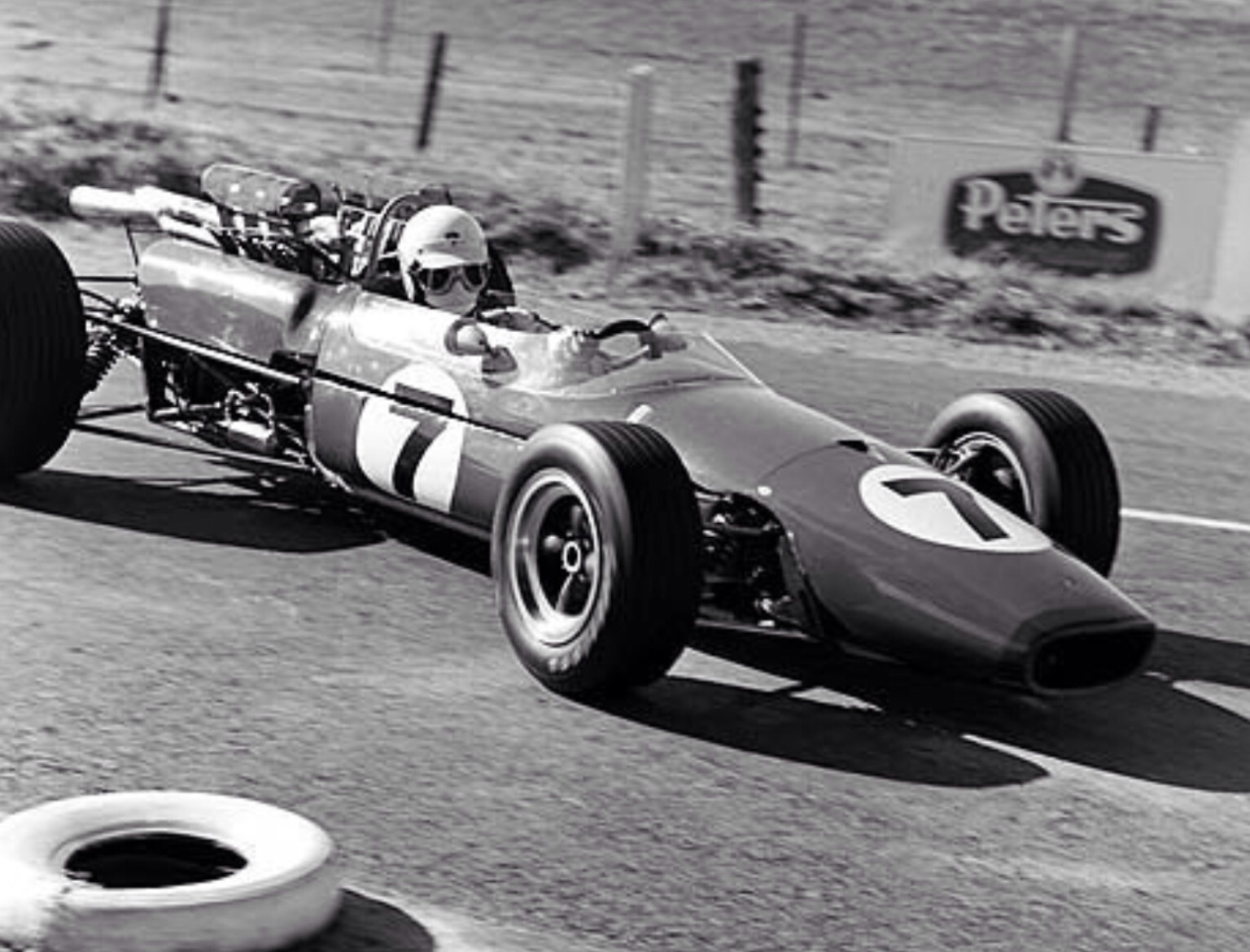
Piers Courage in his McLaren M4A F2 car, Newry Corner, Longford 1968. Power was not all on this fast circuit in such wet conditions, but the plucky Brit was giving away at least 130bhp to his 2.5 litre V8 powered opponents (R MacKenzie)
Pedro Rodriguez and Frank Gardner were second and third in BRM P261 2.1 V8 and Brabham BT23D Alfa 2.5 V8 respectively. Clark was fifth in his Ford Cosworth DFW engined Lotus 49, the 2.5 litre variant of the epochal 3 litre DFV GP engine.
Jim Clark chewing the fat with BRM’s Tim Parnell- all the fun of the fair, Longford 1968, Clark’s Lotus 49 Ford DFW ready for action (oldracephotos/Harrisson)
Clark and the boys with Denny Hulme’s Brabham BT23 FVA behind (HRCCT)
Lets go back to the start of the meeting, marvellous from the Tasmanian’s perspective as the series went down to the wire, Chris Amon was still a potential series victor with only six points between he and Jim Clark with Piers Courage’s third place within Graham Hill’s grasp depending upon how he fared.
Chris Amon blew the sealing rings in the Ferrari’s little V6 keeping his crew busy for the evening whilst Pedro Rodriguez popped an engine too- the BRM mechanics therefore readied the P261 V8 for the race rather than the P126 V12 the Mexican raced in the Saturday preliminary. Piers Courage tapped the nose of his pristine McLaren M4A when the flaggies got so enamoured of the cars they forgot to signal oil on the track! All was well at Gold Leaf Team Lotus.
Lap 1 of the preliminary on Saturday, Geoff Smedley’s amazing colour shot- Clark from Hill, Amon, Gardner and one of the BRM’s- Lotus 49 by two, Ferrari 246T, Brabham BT23D Alfa and BRM P261 0r P126 (G Smedley)
Practice times didn’t mean too much as the teams were focused on race setup for the twelve lap Saturday preliminary race ‘The Examiner Racing Car Scratch’ which also counted for grid positions. In the second session of practice Clark did a 2:12.8, Hill 2:13.6 and Amon 2:13.8. Clark was under Jack Brabham’s record set on the way to his win the year before in his BT23A Repco, Jim won 100 bottles of champagne for pole as stated earlier.
In the preliminary on Saturday the grid formed up with Clark on pole. Hill comfortably won the event run in fine, dry weather from Clark and Amon. Both Lotuses were timed on the Flying Mile at 172 mph but Amon’s 182 mph in David McKay’s ex-works Ferrari P4/Can Am 350 sportscar rather put the single-seaters in the shade! Lets not digress about that car now, follow the link at the end of this article for a long piece about the P4 which Chris raced in the sportscar support events in each of the Australian Tasman rounds.
Hill G leads the pack off Long Bridge on lap 1 of the Saturday preliminary. Hill, Clark, Amon, Gardner, Leo Geoghegan Lotus 39 Repco, a BRM and perhaps Kevin Bartlett Brabham BT11A Climax (R MacKenzie)
Exit from Newry, lap 1 of the preliminary- Hill, Clark, Amon, Gardner, Geoghegan’s Lotus flirting with the tracks edge, and Attwood. Great shot shows how the circuit rises at this point into the right hand kink up the road (S Geoghegan)
Only a couple of supporting races had been run on the Monday raceday when light rain started to fall at about 10am, this soon became heavy. As the rain got harder and the clouds more threatening it was obvious that it was not likely to abate before the 2.15 pm race start time
The track was almost under water at some points where hay bales had broken up and straw was blocking the drains. Efforts by track officials soon had most of the drainage system under control.
A large crowd was of course present on the Labour Day long-weekend. Crews brought the cars out onto the circuit in front of the pit counter and stood together under umbrellas as the drivers went into a huddle with the promoters of the meeting and the CAMS stewards to determine if the race should go on.
Leo Geoghegan and Lotus 39 Repco return to the Longford pits after some exploratory laps. DNS with unsuitable tyres. Its the Courage McLaren by the pit counter (oldracephotos)
Sergent.com report that first it was decided that the cars should do a couple of exploratory laps then report their findings.
Geoghegan, Amon, Clark, Hill, Attwood, Gardner, Bartlett and others went out and after looking like motor boats ploughing through the water delivered their thoughts to the meeting. The conditions were so bad various drivers with unsuitable tyres elected not to start having driven some ‘sighting laps’.
Kevin Bartlett recounted his experience in the Alec Mildren Racing Brabham BT11A Climax; ‘I did two exploratory laps and the old BT11 couldn’t find traction anywhere. I had an absolutely terrifying 4th gear 720 degree spin across the short Kings Bridge, the one after the Viaduct, missing all the obstacles at the tracks edge. After exiting Pub and in a straight line i did a 360 degree loop. She nearly escaped me over the rail line on the way to Long Bridge. Out of Newry and up the hill to the straight slithering along with no touch felt between me and the bitumen, so i suppose I thought at that moment to do another lap at a very reduced speed then pit’.
Packed car park: Amon’s Dino, the BRM’s of Attwood and Rodriguez, Pedro’s P261 fully covered, the two Lotus 49’s, Piers McLaren, then Leo G’s Lotus 39 and John Harvey’s Brabham BT11A (oldracephotos)
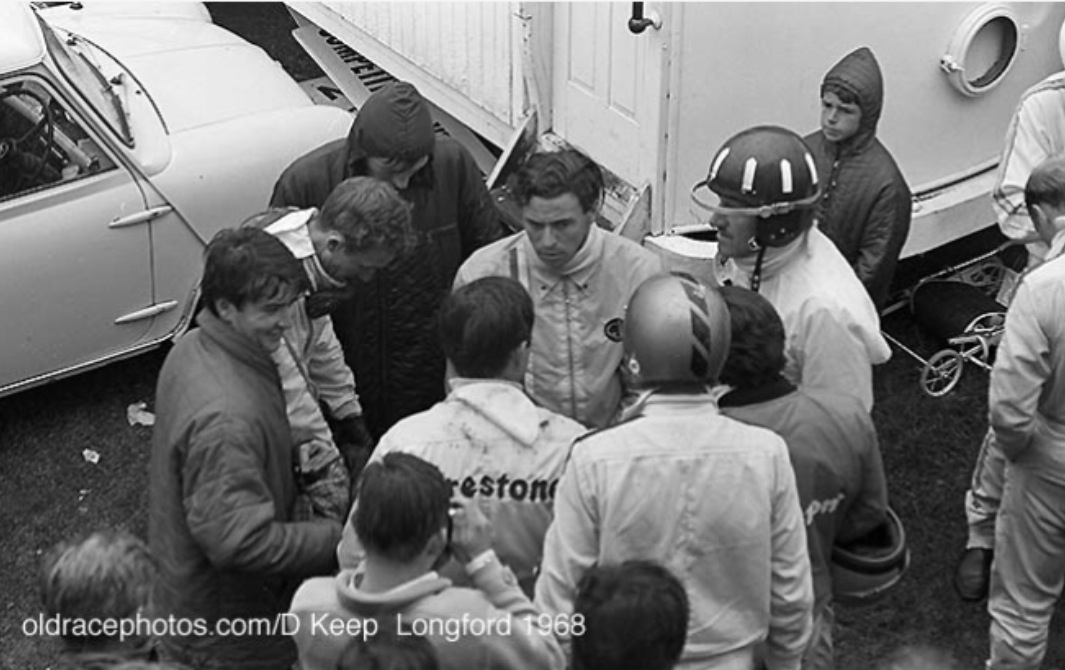
‘What are we going to do boys?!’ Drivers considering their options before the race, the pouring rain exacerbated by drains beside the track which couldn’t cope with the deluge; Clark facing us, Hill’s distinctive helmet clear. Courage with his back to us in helmet, Gardner’s lanky frame partly in shot to the right. Amon in the ‘Firestone’ suit, Harvey? at left with head down (oldracephotos)
‘Once back in the tent Alec, Frank (Gardner) Denny (Hulme Brabham BT23 FVA F2) and i had a talk about the tyres that Denny and i had and after trying to come up with a better tread pattern, such as the ones fitted to Franks car (Brabham BT23D Alfa) but with no result. It was agreed that Denny and i shouldn’t risk a start. I was happy with the call and Leo (Geoghegan Lotus 39 Repco) followed suit. Most of the top guys had the latest Firestone, Dunlop or Goodyear wets but none were available to suit the BT11’s. I consoled myself with the fact that if the new world champion (Hulme) didn’t like the risk i certainly shouldn’t!’
Longford, wonderful circuit that it was, provides no runoff area for a driver to go in the wet (or dry!) should a driver lose control or suffer a bad attack of aquaplaning, and this was the main point in contention.
The ill fated Brabham BT23A Repco ‘740’ of Greg Cusack on Friday or Saturday (oldracephotos)
Greg Cusack in David McKay’s Scuderia Veloce Brabham BT23A Repco (Brabham’s victorious Longford mount from 1967) had left the road that morning. He lost the car on the greasy road as he went over the hump/bump on the approach to The Viaduct. The car left the road, hit a bank, somersaulted and crashed into a ditch, he was then pinned under the it before being quickly released by officials.
The 37 year old Canberra motor dealer, who had intended Longford to be his last race meeting, was taken to Launceston Hospital with chipped bones to both knees, stretched ligaments and a fractured left wrist. He was lucky it was not a good deal worse. Bib Stillwell organised for one of his planes to fly Cusack and his wife home to Canberra on the Tuesday where he was admitted to hospital.
Whilst Cusack lay in hospital the other drivers were trying to explain the difficulties of Longford which were exacerbated hugely in the wet. ‘Motoring News’ reports at length about the cordial discussions between the drivers and officialdom and all of the competing issues of safety, providing a show and running a race to determine the winner of the Tasman Cup.
The Stewards finally ruled that the race should go ahead but be shortened to 15 laps of the 4.5 mile circuit, (128 miles to 68 miles) and put the starting time back to 4pm hoping the rain would ease and the situation be safer as a consequence. At 4.15pm the sodden cars and their game, uncomplaining drivers were facing the soggiest start ever seen at Longford, one of the most challenging road circuits in the world.
Front row- Amon Ferrari 246T and the two Lotus 49 DFW’s of Hill and Clark, that’s Frank Gardner’s Brabham BT23D Alfa nose (oldracephotos)
Soggy start: L>R Amon Ferrari Dino 246T, Hill Lotus 49 and unsighted to the right Clark. Then Rodriguez BRM P261 #11 and alongside Gardner in the light coloured Brabham BT23D, #12 behind him Attwood BRM P126 and alongside him the winner Courage McLaren M4A. L>R in the back row John Harvey’s Brabham BT11A, John McCormack Brabham BT4 and Mel McEwin Lotus 32B (oldracephotos)
Clark’s Lotus 49 got away well, somehow finding traction with the wide Firestones, and he was followed into the right-hander before The Viaduct by Amon and Hill. The drivers took the opening laps cautiously under race conditions and each car was leaving a gap to the other so they could see through the flying spray.
At the end of lap one the order was Clark, Rodriguez BRM P261 V8 on Dunlops, Gardner Brabham BT23D Alfa on Goodyears, Courage Mclaren M4A Ford FVA using new narrow-section 970s, Hill Lotus 49 Ford DFW on Firestones, Attwood BRM P126 V12 on Dunlop, Amon Ferrari 246T back in seventh owing to a run down the escape road at Newry Corner, then John Harvey Brabham BT11A Repco John McCormack Brabham BT4 Coventry Climax FPF and Mel McEwin Lotus 32B Coventry Climax FPF, this car the ex-Clark/Palmer 1965 Tasman Championship winning chassis.
Richard Attwood, a very good 4th in the big BRM P126 V12 on Pit Straight. BRM was testing, by way of eight Tasman race weekends in a row, this new F1 design in 2.5 litre capacity in advance of the ’68 GP season (oldracephotos/DKeep)
‘Attwood found he had more traction on Dunlops than Hill had with the wide Firestones and he slipped under the Lotus for fifth place on lap 2. Both Attwood and Rodriguez had hand-cut drainage grooves in their tyres. A lap later Courage really got his foot in it to take Gardner on lap 3. He then jumped past both Rodriguez and Clark on the next lap while Gardner followed him through and waited for another lap behind Clark before taking the plunge and heading for second. Amon had taken Hill and now, on lap 5, the order was Courage 9.6 secs ahead of Gardner, Clark, Rodriguez, Attwood, Amon, Hill and Harvey. McEwin and McCormack were already in danger of being lapped by the flying Courage.
Hill from Gardner, not sure who and one of the BRM’s, Long Bridge (R MacKenzie)
Courage, driving like a young Stirling Moss in the blinding rain, somehow gained another 9.5 secs on lap 6, putting him 16 secs ahead of second man Gardner in the Brabham-Alfa. Rodriguez had pulled past Clark and on the next lap Attwood whizzed past Clark to take fourth. On lap 9 Courage was 32 secs ahead of Gardner and having a ball out on his own, right foot hard in it. Gardner was 3.5 secs ahead of Rodriguez who was followed by Attwood, Clark, Amon, Hill and Harvey losing a lot of ground’.
Pedro raced the little 2.1 litre BRM P261 V8 having raced the new P126 V12 in the preliminary and had engine failure. 2nd a minute behind Courage just sneaking past Gardner in the final stages (oldracephotos/DKeep)
‘Rodriguez started to close up on Gardner in the closing laps, but nothing could touch Courage. This was his day, it was he who had the best gear on his car and he was darned sure he was going to make it a race to remember. He had pulled 45.5 secs on Gardner by lap 12 while Rodriguez had got within 2.5 secs of Gardner. Hill challenged Amon on the same lap and finally squeezed past in a daring effort on the greasy track to make the Lotus-Fords fifth and sixth’.
Frank Gardner on the exit of Newry, Alec Mildren’s Brabham BT23D Alfa Tipo 33 2.5 V8. 3rd a minute behind Courage (R MacKenzie)
‘As Courage screamed down the straight heading for the flag he was over 55 secs ahead of Gardner and he came past the pits jubilantly waving his hand. Gardner by this time, heading for the braking area at Mountford, had Rodriguez looking right at the Alfa V8 pipes. There seemed no way that Rodriguez could slip past, but suddenly a gap appeared as Gardner went a shade wide on Mountford and Rodriguez poured on the power into the short straight and took the flag about 25 yards ahead of the Alec Mildren car. Attwood finished his race fourth after a very steady drive, followed by Clark, Hill and Amon’.
John Harvey coming off Long Bridge in Bob Janes Brabham BT11A Repco ‘740’ V8. This is the car in which Spencer Martin won the ’66/7 Australian Gold Star. Converted to Repco power just prior to the Tasman (R MacKenzie)
Hill, Lotus 49 DFW, 5th on the Flying Mile (R MacKenzie)
‘Courage had the rubber, just the right amount of power for the job and the ability to keep the car straight on a very dicey and greasy circuit. He finished the Tasman Cup Series in a wonderful third place behind Clark and Chris Amon. Then came Hill and Gardner 17, McLaren 11, Rodriguez and Hulme 8, Jim Palmer 7, Attwood 4, Roly Levis and Leo Geoghegan 3, Paul Bolton, Red Dawson and Kevin Bartlett 2, Graeme Lawrence and Ross Stone 1 each’.
Like a duck to water- Courage, right tyres, set up, enough power, precision and bravery. McLaren M4A FVA F2 machine (R MacKenzie)
It was very much the end of an era, the last Longford, the speed of the cars and advancing track safety rules caught up with the place and an inability of the club/government to make the requisite investment. Most importantly Jim Clark, a very popular visitor to Australasia since the early sixties and twice winner of the series in 1965 and 1968 died at Hockenheim in an F2 Lotus 48 in April.
Lotus returned in 1969 but it was not quite the same without the magic and personality of the great Scot.
A very happy but cold and soggy Piers Courage, with wife Sally after his Longford ’68 win. It was a might fine drive which is still remembered by those fortunate enough to see it. (oldracephotos)
Etcetera…
Practice and Saturday Preliminary
Richard Attwood, BRM P126, The Viaduct (oldracephotos/Keep)
Lap 1 bunch behind the lead group- Gardner Brabham BT23D, Geoghegan Lotus 39, Attwood BRM P126, Bartlett Brabham BT11A, Rodriguez BRM P126 into The Viaduct (oldracephotos)
Leo Geoghegan, Lotus 39 Repco 740. Leo frightened the internationals in his ‘old bus’ more than once that summer- Clark’s ’66 Tasman mount Coventry Climax FPF engined. Non starter on Monday tho (R MacKenzie)
Chris Amon, Ferrari 246T. Chris learned a lot from his ’68 tour, and applied those learnings well in 1969 winning the title in an updated, four valve, winged Dino (oldracephotos
Pedro Rodriguez, BRM P126. The V12 engine in this car failed during the race so Pedro raced the ‘backup’ P261 V8 in the championship event- cars which had become wonderful Tasman machines from 1966-8. Winner in ’66 in Stewart’s hands (oldracephotos/Keep)
Graham Hill, Lotus 49 Ford DFW. Perhaps not the best of Tasmans- 2nd at Surfers and Warwick Farm his best results (R MacKenzie)
Pedro Rodriguez, BRM P261 V8 during practice (oldracephotos/Keep)
Pedro Rodriguez, BRM P126, The Viaduct (oldracephotos/Keep)
Richard Attwood, BRM P126. Drove the Oz rounds in the car vacated by McLaren- 4th at Longford deserved, DNF’s @ Surfers and Sandown, overall the P126’s were not blessed with great reliability in the ’68 Tasman (R MacKenzie)
Tailpiece: Practice- Rodriguez BRM P261 from Courage McLaren M4A Ford FVA and Kevin Bartlett Brabham BT11A Climax FPF. Variety is the spice, braking into The Viaduct…
Mercedes Benz returned to Grand Prix racing with a vengeance at Reims in 1954, here Fangio leads Karl Kling in the W196 Streamliners…
Mercedes had a habit of re-entering racing in the French Grand Prix every twenty odd years, when doing so bringing new standards of engineering excellence with them.
In 1914 the four cylinder, SOHC 4483cc engined Mercedes 18/100 of Sailer, Lautenschlager, Salzer, Pilette, and Wagner crushed the opposition at Lyon just before The Great War. The course was 37.6 Km long, 20 laps of it took the winner Christian Lautenschlager 7hr 8 min!
Three of the 1914 French GP winning Mercedes team cars at Unterturkheim post event. L>R #28 Lautenschlager first, #39 Salzer third, #40 Wagner second. (unattributed)
In 1934 Auto Union and Mercedes came to Monthlery with cars which would largely sweep the board until war again intervened.
Although on that day an Alfa Romeo triumphed – Louis Chiron won in a Scuderia Ferrari Alfa P3 from Achille Varzi similarly mounted – the three 2.9-litre supercharged straight-eight Mercedes W25s of Rudi Caracciola, Manfred von Brauchitsch and Luigi Fagioli retiring with a variety of maladies.
1934 French GP, Montlhery. Rudy Caracciola Mercedes W25 DNF, from Avhille Varzi Alfa P3/Tipo B, second (unattributed)
And so it was that Mercedes returned to racing after a break of fifteen years at Reims on the weekend of July 4th 1954 – 40 years after Lyon and 20 after Monthlery – with the W 196 R, as the car is designated internally…
JM Fangio, Mercedes Benz W196, Reims victor 1954 (Jesse Alexander Archive)(Mercedes Benz)
The W196R was a triumph of complex engineering, the 2.5-litre straight eight cylinder car had a swag of new features.
Direct injection (Bosch) of fuel into the M196R’s cylinders (76×68.8mm) for more precise ignition of the incoming fuel charge was the first of many, the engine lay on its side 53 degrees from the horizontal to the right to allow a lower bonnet line and the driveshaft to pass beside the driver rather than have him sitting on it. Desmodromic, or mechanical operation of the valves allowed higher rpm than the valve springs of the day could handle.
Downstairs, in traditional Mercedes fashion, there were/are two blocks of four cylinders with welded on cooling water jackets. The Hirth type crankshaft was supported by 10 roller-bearings, with central power take-off. Mercedes quoted 256bhp @ 8260rpm with maximum potential revs 9500. The transaxle is 5-speed and mounted behind the rear axle.
M196R 2.5-litre straight-eight (Mercedes Benz)W196R chassis, inboard brake drums and 5-speed transaxle. Rear suspension is swing axle, tubular dampers and longitudinally mounted torsion bars, hidden in this shot (Mercedes Benz)
The chassis is a multi-tubular spaceframe with upper and lower wishbones, telescopic shocks and torsion bars. At the rear there is a single-joint swing axle, longitudinal torsion bars and again telescopic shock absorbers. Inboard drum brakes front and rear (350/275mm in diameter) to lower unsprung weight and a streamlined all enveloping body helped the car to be quicker thru the air. Steering was worm and sector, wheel/tyres 6-inch and 7-inch wide and 10-inch diameter
The very experienced pre-war engineering team of Dr Fritz Nallinger and Rudy Uhlenhaut were in control of the conception, design, development and testing of the new car.
Reims 1954 paddock shot. #18 Fangio and #22 Hans Hermann Mercedes W196 Streamliners being prepared for the race. Open bodies were used from Nurburgring 1954 onwards, Streamliner body about 60 pounds heavier than the ‘Nurburg’ slipper/open wheeler bodies (unattributed)
The purpose of this article is not to write in detail about a car which has had everything written about it, rather the words are a support to the wonderful painting and cutaways originally published in that splendid annual, Automobile Year, in this case in the 1955 edition.
(Automobile Year)
In his Automobile Year technical review of the 1954 season noted journalist/Le Mans Winner/GP driver Paul Frereexplains in great detail the technical advances of the car, but also makes clear that in his view all of the Benz victories that season were scored by Fangio, in that the car’s speed was in large part a factor of Fangio’s dominance as a driver rather than it being a function of the cars outright pace; JMF and Alberto Ascari were the standout drivers at the time.
The W196 won four of five 1954 races entered, impressive with a new car, Frere also makes it clear that the development potential of the car was obvious, that point subsequently reinforced in their 1955 season!
French GP Start; #18 Fangio, #20 Kling Benz W196, #10 Alberto Ascari Maser 250F #2 Gonzalez Ferrari 553, #12 Marimon Maser 250F, #46 Prince Bira Maser 250F, #22 Hans Hermann Benz W196, #6 Hawthorn Ferrari 553, #4 Maurice Trintignant Ferrari 625, #34 Robert Manzon Ferrari 625, #14 Luigi Villoresi Maser 250F (unattributed)
At Reims Fangio was on pole with his young German teammate Karl Kling alongside and Alberto Ascari in a factory Maserati 250F.
Alberto and Onofre Marimon were ‘loaned’ to Maserati by Gianni Lancia given his new D50 GP car was still not raceworthy and the drivers were otherwise unemployed for the weekend.
Ascari’s race was over on lap 1 due to either gearbox or engine failure depending upon the report you read, this left Fangio and Kling to run away with the race. Hawthorn and Marimon scrapped for third before the Argentinian stopped for a plug change and dropped to the back of the field.
Fangio left, and Kling Mercedes W196 well clear of Ascari’s Maser 250F shortly after the start (unattributed)
Pre-war Thai driver Prince Bira drove a great race in a customer 250F dropping from third to fourth having run out of fuel and losing time switching to his auxiliary tank, so Robert Manzon was third in a Ferrari 625.
Hans Herrman in the other W196 took fastest lap early in the race before over-revving the engine and leaving its telltale at 9100rpm!
So, a dominant Mercedes start to a run which sadly only lasted until the end of the 1955 season before their modern era return and the dominance of 2014/5…
Front row prior to the Reims start. Fangio and Kling taking a sideways glance, and Ascari’s new but somehow antiquated looking 250F in the company of the Mercedes Streamliners whilst Hawthorn fiddles with his goggles on row three.
(Mercedes Benz)
M 196 R – Mercedes Benz when publishing the car and engine type use the spacing shown, albeit short-form will do me – engine being dyno tested Unterkükheim in 1954. From the left, Engineers Karlheinz Göschel and Heinz Lemm, Werner Wolf and Eckstein.
(Automobile Year)
Fangio’s car being ministered to between sessions. What stands out is the quality of the Streamliner’s build and finish and the enormous inboard brake drums both front and rear – JMF’s seat has been removed allowing a peek at the rear units.
The straight-eight Type 32 Gordini was the last Grand Prix car fitted with an engine of this layout, but the W196 was the last successful one. The compact nature of Vittorio Jano’s 2.5-litre V8 engined 1954-55 Lancia D50 was a reminder of the advantages of engines in Vee formation and was highly influential as such.
(Mercedes Benz)(Automobile Year)
Nice cross section of the W196 cylinder head showing the operation of its desmodromic valve gear.
(Mercedes Benz)
Another detail front end shot sans radiator; the hollow bars either side of the drums are the ends of the torsion bars, note also the short upper suspension links.
Tailpiece…
(unattributed)
Majestic and atmospheric Reims as JMF takes his position on the grid.
Credits…
Max Staub, Automobile Year, Jesse Alexander Archive, Getty Images-Maurice Jarnoux, Mercedes Benz Archive
Michael Schumacher’s Benetton Ford just in front of Nigel Mansell’s Williams Renault. He took his first GP win having made his Championship debut at Spa with Jordan 12 months before…
Schumacher’s 1991 Belgian Grand Prix debut was in a Jordan 191 Ford. His Sauber Mercedes sportscar performances didn’t make it clear that ‘The Next Superstar’ had arrived but he qualified 8th and ran 4th retiring his car with clutch dramas, his brief drive was enough to convince Flavio Briatore to sign him up on the spot.
Roberto Moreno lost his Benetton seat to the German, swapping across to Jordan, Schumacher took a 5th and two 6th placings by seasons end.
1992 would be a tough year for all but Williams.
‘Active suspension’ experiments which started at Lotus with Colin Chapman tasking his engineers to explore it as far back as 1981 with the Esprit road car and in F1 from 1987 met an ‘apex’ with the Williams FW14B/15C Renault’s in 1992/3.
Nigel Mansell, Williams FW14B Renault, the dominant car of 1992, here at Spa. (unattributed)
The Patrick Head/Adrian Newey designed cars were powered by a 3.5 litre Renault V10 considered to have around 760bhp, 30bhp more than the Honda V12 by seasons end.
But the key to the cars dominance; Nigel Mansell became the first driver to achieve 9 wins, and the title that year, was the cars carbon fibre chassis which incorporated active suspension. The advance of computer technology finally allowed the exploitation of suspension actuators to deploy the system effectively.
The Williams 6 speed gearbox incorporated traction control and was of the semi-automatic type pioneered by the Ferrari 640 in 1989. The car also incorporated anti-lock braking for a time. The promise shown later in 1991 was now converted into stunning, consistent race winning pace.
Benetton B192 Ford…
(Terry Collins)
The Benetton B192 was a conventional, well engineered, ‘chuckable’ chassis developed by Ross Brawn and Rory Byrne.
The chassis was carbon fibre, suspension by wishbones front and rear with coil spring/dampers actuated by pushrods. The gearbox was Benetton’s own transverse design 6 speed manual.
The Ford Cosworth HB 75 degree 3.5 litre V8 developed around 700bhp @ 130000rpm, well short of the Honda and Renault’s output but the car was consistently fast and ‘best of the rest’ after the dominant Williams and the McLaren with which Senna took 3 wins.
Jean Alesi, Ferrari F92A and Schumacher collide after an attempted Schumi pass on lap 12 of the 1992 Monaco GP. Jean’s car was damaged taking him out of the race, MS 4th in the race won by Senna’s McLaren. (unattributed)
Schumacher’s 1992 Season..
MS Benetton B192 Ford, Spa 1992. (unattributed)
Schumacher was 3rd in the drivers championship in a season of speed and consistency; he took 2nds in Spain, Canada and Australia and four 3rds, his breakthrough first win was at Spa, exactly 12 months after his GP debut.
THE classic Spa shot, MS La Source hairpin 1992. (unattributed)
In a race of changing fortunes and variable conditions good or lucky pit work put him on dry tyres at the right time; Mansell and Patrese in the other Williams chased him down but both had cracked exhausts which took the edge of their engines performance. Schumi took the win from Mansell, Patrese, his Benetton teammate Martin Brundle, Senna’s McLaren MP4/7A Honda and Mika Hakkinen’s Lotus 107 Ford.
Remember the skid plate sparks!? L>R; Hakkinens 6th placed Lotus 107 Ford, Schumacher and Alesi’s Ferrari F92AT, he spun on lap 7 so its early in the race. (unattributed)
The Schumacher/Benetton/Ford combination took the drivers (but not the manufacturers) title in a season of tragedy and controversy in 1994, the 1992 B192 was an important stepping stone in that evolution…
Spa 1992 victory dais; the first of 91 GP wins. (unattributed)