Archive for the ‘Icons & Iconoclasts’ Category

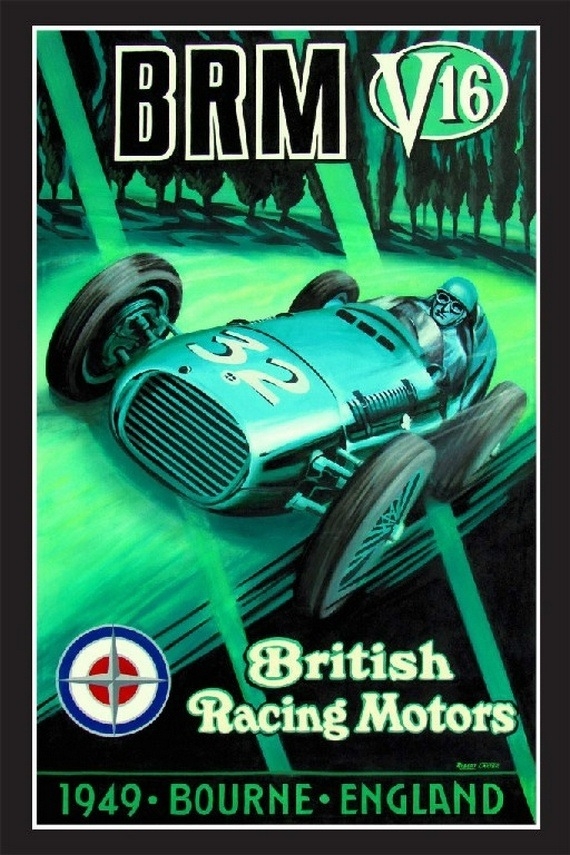
brm m sport v16 cover

About 15 years ago, I got a phone call from my father, telling me that his brother, my Uncle Henry had passed away at his home in Derbyshire, UK…

I remember Henry from the early 1960s, my dad’s dashing brother, who never married, but whenever he visited, arrived on or in interesting machinery. My first ride on a bike was on his Vincent Comet and then on a legendary Black Shadow. A Mini Cooper was thrilling, even more so, a Cooper S.

We moved to Australia, but news came occasionally of the succession of Lotus, Porsche and latterly turbocharged Nissans of the Silvia and Skyline variety.

brm 1

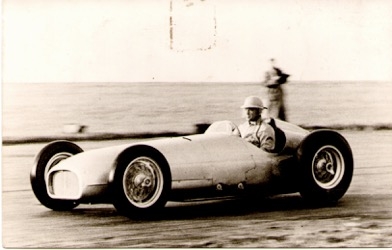
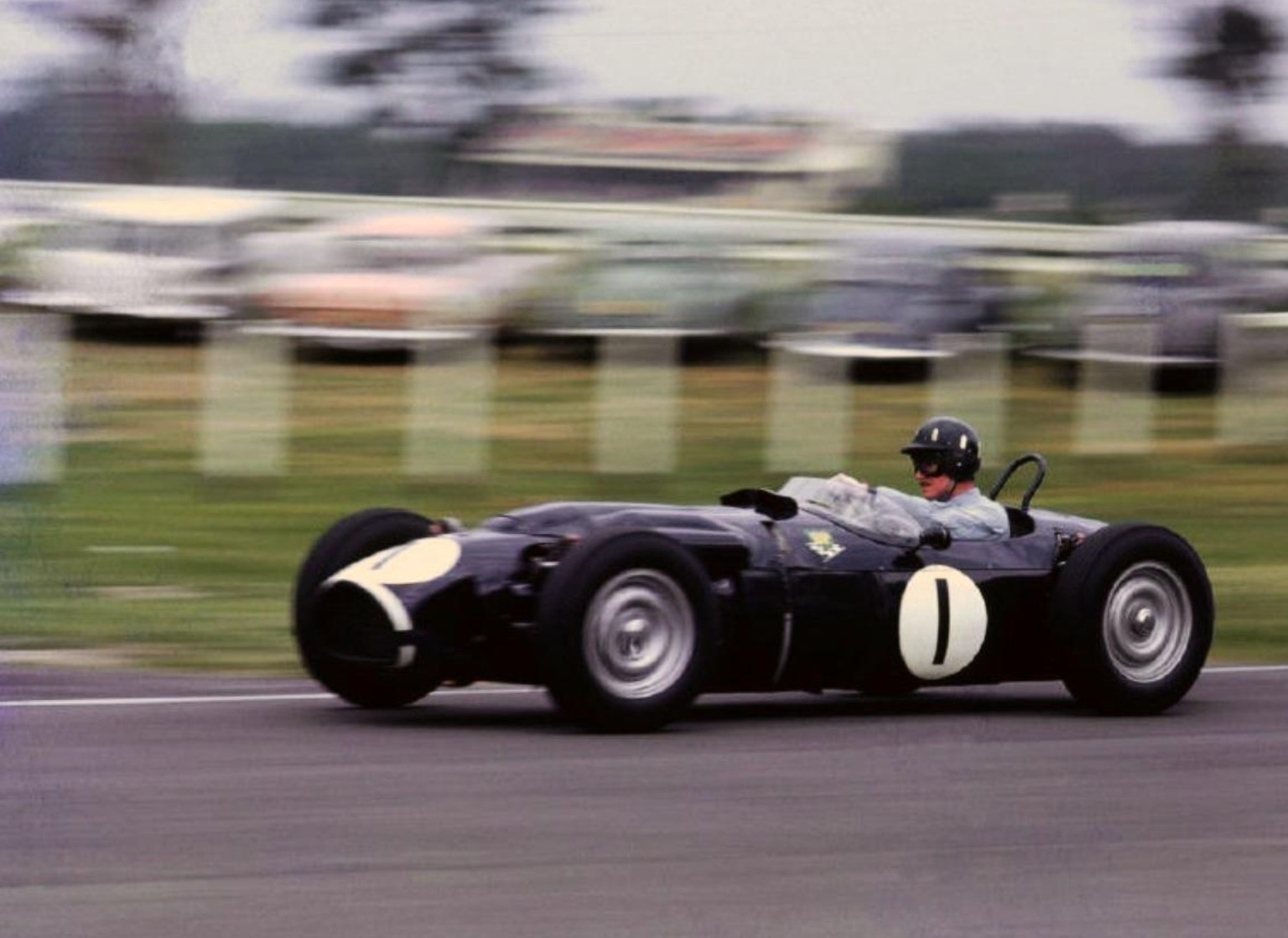
BRM V16, Ken Richardson, Folkingham 15 December 1949. (Marcus Clayton Collection)

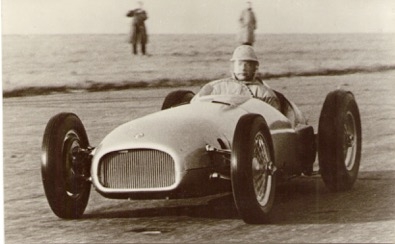
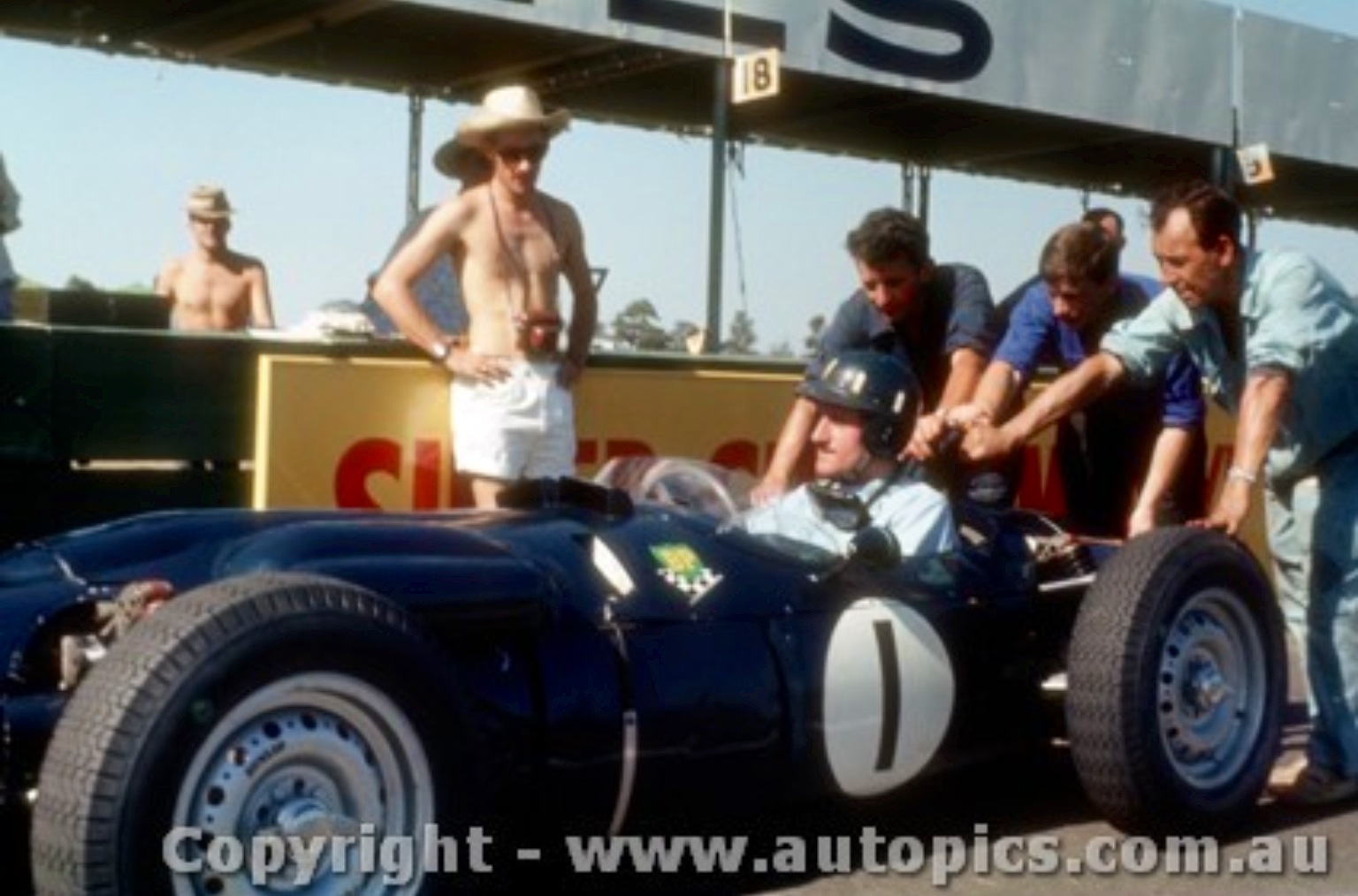
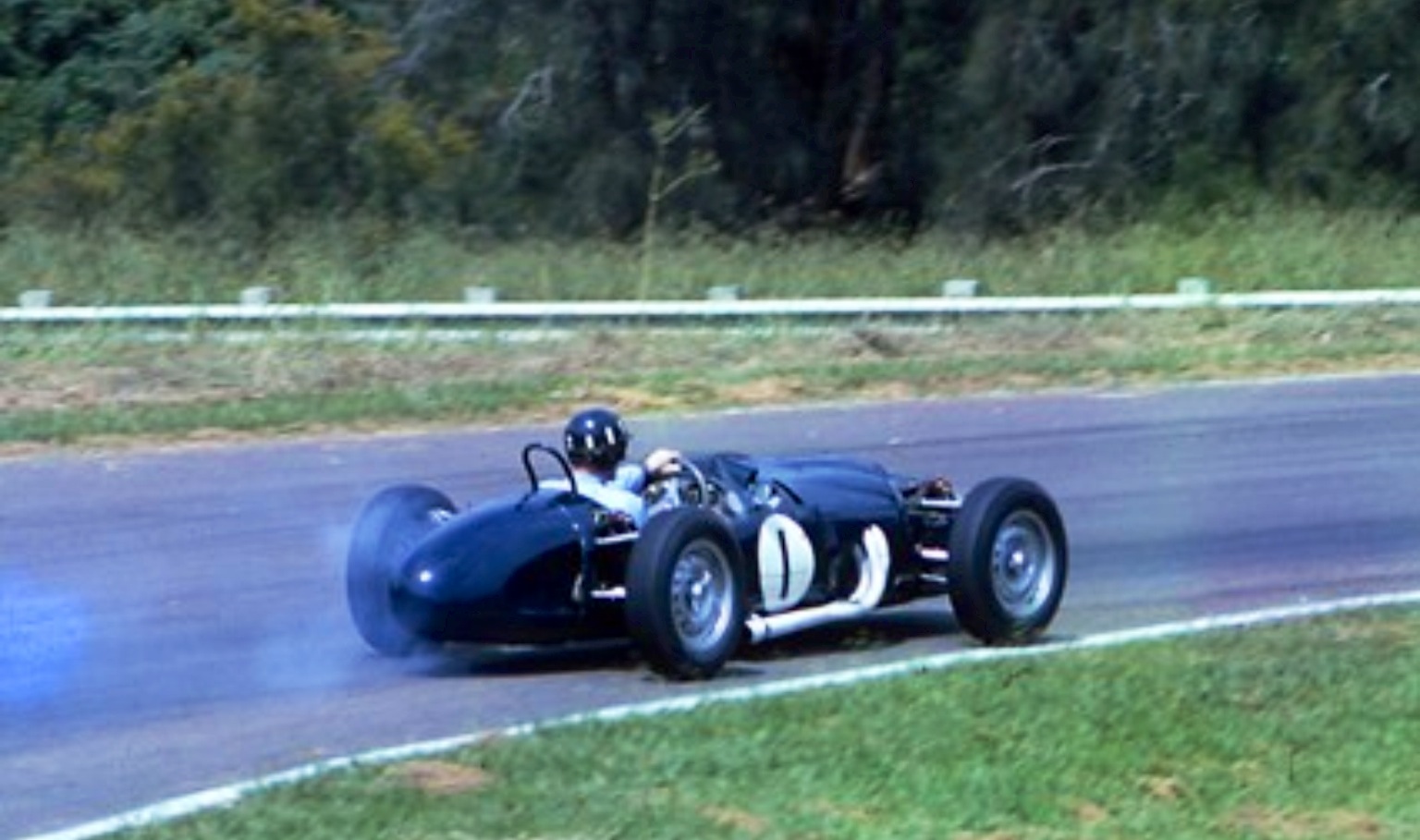
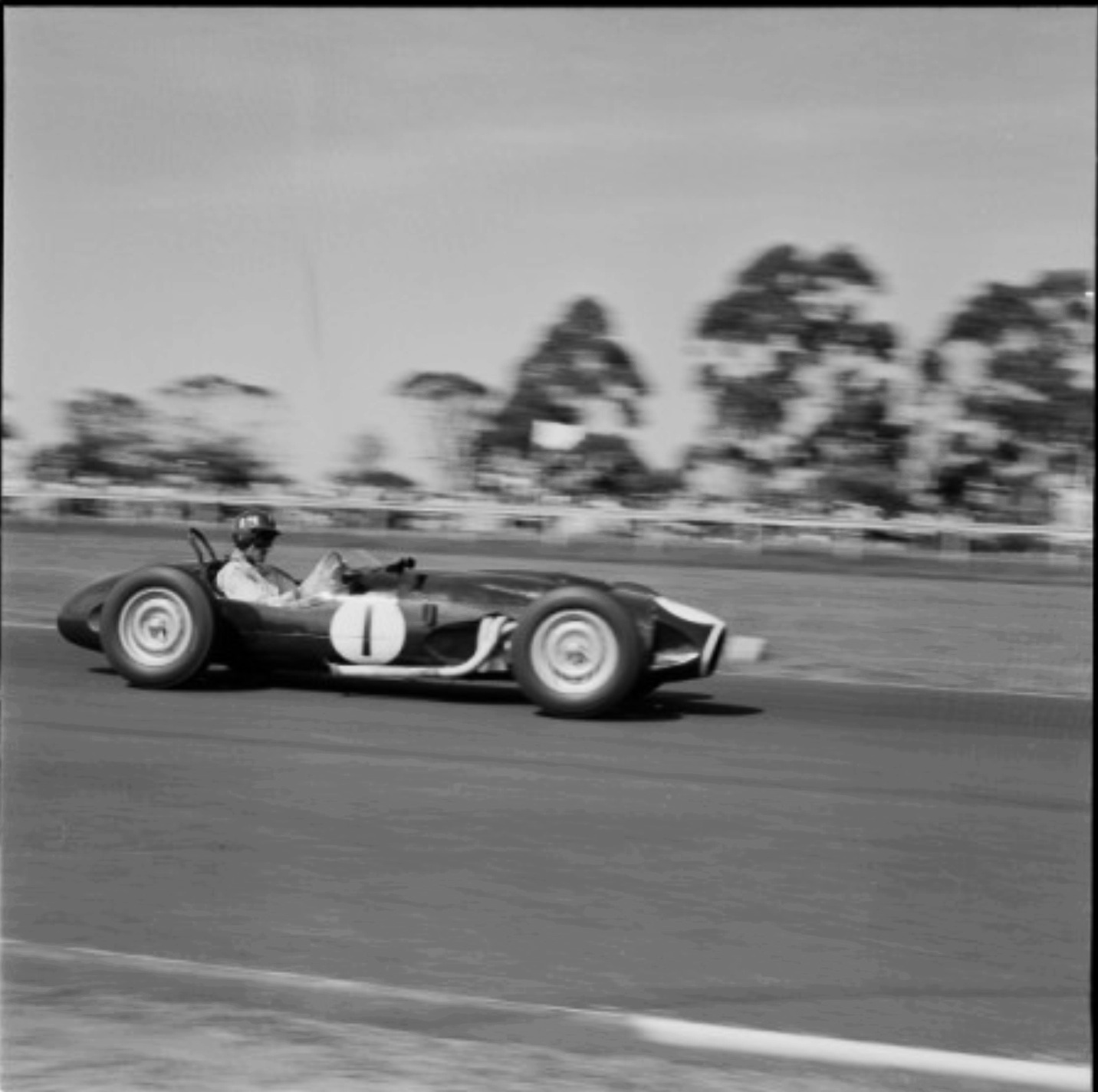
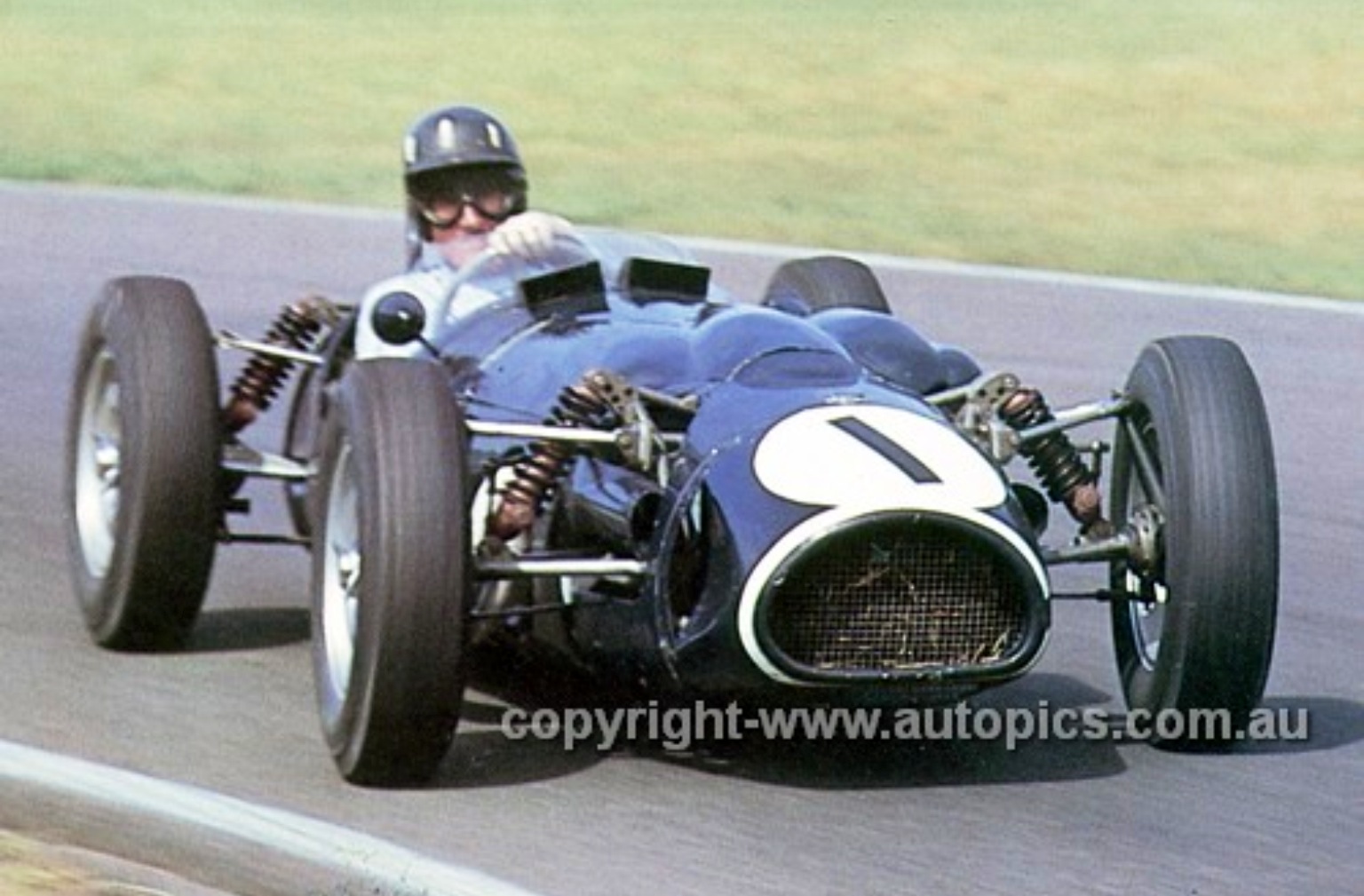
I was pleased to receive, as part of a modest inheritance from Henry, a packet of photos, reproduced here. They are obviously very early BRM shots, which I had never seen before. I thought they may have been taken by him as a young man, but 2 of them appear elsewhere on the interweb, so I can only assume they are part of a postcard pack, or press pack. I would date them around 1950/51.

(Contributor/Historian Stepen Dalton advises the photos are BRM Press Kit shots, the cars launch was at Folkingham on December 15 1949, Stephen suspects Henry may have been a ‘BRMA’ or ‘ORMA’ member, the BRM supporters groups. The members of those groups were perhaps provided with copies of the shots. See membership badges below. Stephen has also indicated the likely dates of the track sessions and drivers, i have changed the captions accordingly.)

brm 2

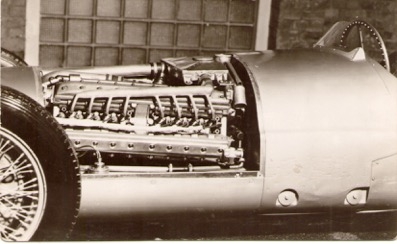
1488cc, centrifugal-supercharged, DOHC 2 valve V16. (Marcus Clayton Collection/Louis Klemantaski)

I have always had a fascination with the BRM. It has been written about extensively, so I can only add my personal take on this machine.

Mark Hales described it as like ‘The Victorians trying to build a moon rocket, and they very nearly succeeded’.

16 cylinders, each of less than 100cc, highly supercharged, spinning at 12,000 rpm, air suspension, disc brakes, with all this componentry, supplied by dozens of different companies, motivated to show ‘Johnny Foreigner’ that British engineering was still the best in the world. Inevitably, when there are so many suppliers involved, with so many radical parts, the project was delayed, time and time again, until the great day when the car had its first race start. It travelled about 3 feet, after breaking an axle at the start.

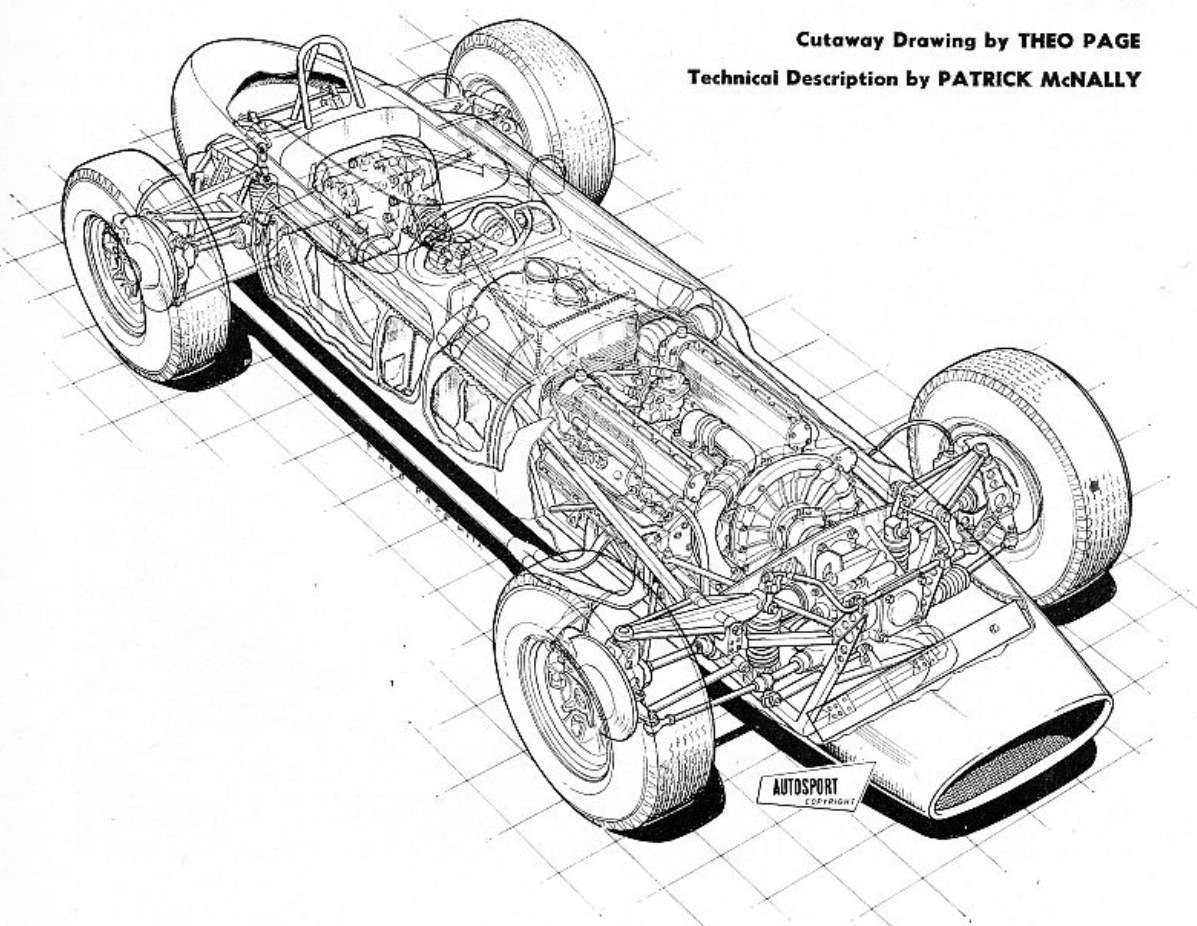
brm v 16 cutaway

Chassis was tubular comprising double-tube side members, 4 cross members, aluminium body. Suspension at front by Porsche type trailing arms and Lockheed air struts, de Dion rear axle located by a single radius rod each side and Lockheed air struts. Brakes Girling 3 shoe drums,(Mk 2 had discs) Wheels Dunlop centre lock wires with 5.25 inch wide x18 inch diameter wheels at front and 7 inch x17 inch diameter at the rear. BRM 5 speed gearbox with ZF ‘slippery diff, gearchange on RHS, transmission angled to pass to the left of the driver. Engine specifications with engine cutaway drawing below. Weight at the start line circa 862Kg. (Tony Matthews)

The cars were extensively sorted over 3 years before they became reliable. Exhausts changed from full length, to in front of rear wheels, to stubs behind the front wheels. Radiator intakes increased and decreased, oil cooling and filtration revised, nearly every part was altered and changed.

When some cars were being properly restored during the 90s, the original dyno shed was discovered, and on the walls were all the different firing orders tried. I don’t know that the final order used was ever identified.

Of course there is the sound.

I don’t know if it is the greatest sound in the automotive world, but it has to be in the running. I played a recording of the BRM to an engineering colleague, who makes drag racing engines. He thought the BRM sounded like an extremely angry Funny Car, and took some persuading to be convinced that all that fury came from only 1500 cc.

brm 3

BRM V16, Folkingham, Ken Richardson 15 December 1949. (Marcus Clayton Collection)

None of the drivers really liked the car, as it was unreliable and difficult.

‘The V16 was a thoroughly nasty car,’ said Moss. ‘The brakes were OK, the acceleration was incredible – until you broke traction – but everything else I hated, particularly the steering and the driving position. Handling? I don’t remember it having any…’

Raymond Mays, (Who I think is driving in the photos) ‘Before we went to Albi in ’53, I drove Fangio’s car at Folkingham Aerodrome and I had it up to 190mph on the 2000-yard runway. It was quite frightening, because you could re-spin the wheels at 9800 in fourth gear. I reached 11,800, with a high gear in…’

mays

Ray Mays, BRM V16, Daily Express Int Trophy Meeting, Silverstone 26 August 1950 (J Wilds)

Mays again ‘By the end of that lap, though, Fangio detected a misfire, and, as Mays admitted, ‘When you got a misfire on the V16, it could have been 1001 things… We worked through the night, and at 3.30am it was decided that I would test the car. At that time of the day – early dawn – there were horses and carts about, farmers coming out of gates, but on this long straight road I had the thing up to 180, and I scared myself stiff.’ How wide was the road? I asked. ‘Narrow’. said Mays. ‘Narrow.’

So the cars were ultimately irrelevant, only winning races in Formula Libre after time ran out for them when F1 changed to the unsupercharged 2 litre formula.

brm 4

Handsome side profile undeniable.(Marcus Clayton Collection/Louis Klemantaski)

The world is a better and more interesting place for the BRMs having been made. It would be unlikely to happen today, as the risks were far too high, but they were, like so many of the automotive and other objects that we so treasure, a delightful folly.

The recording is of Nick Mason’s BRM in 1998, driven by Mark Hales, from ‘Into the Red’.

brm 5

BRM V16 Folkingham. Perhaps Ray Mays on the cars first trial run, 3 December 1949. (Marcus Clayton Collection)

Restoration and Maintenance of This Car, Type 15 Chassis #1 Owned by the British National Motor Museum…

http://www.telegraph.co.uk/cars/classics/brm-v16-appeal/

Etcetera…

brm 6

Another shot at what appears to the be the launch of the BRM Type 15. (Marcus Clayton Collection/Louis Klemantaski)

brm board

Raymond Mays at right doing a bit of ‘stakeholder management’.R>L: Mays leaning, behind him Peter Berthon. Beside Peter, publicist Walter Hill, to his left Bob Henderson Tate from the Ministry of Supply. Standing, still going R>L are members of the ‘British Motor Racing Research Trust’ Bernard Scott and Denis Flather of Lucas, Alfred Owen far left. Seated in front of the table is administrator and later company secretary of BRM James Sandercombe. The meeting is in the study at Eastgate House, Mays family home in 1948. (photo unattributed but caption details ‘BRM Vol1’ Doug Nye)

brm engine cutaway

135 degree all alloy, 1488cc V16 with cast-iron wet liners. 10 bearing crank. DOHC 2 valves per cylinder, Rolls Royce 2 stage centrifugal supercharger fed by 2 SU carbs. Ignition by Lucas coil and 4 Lucas magnetos.Mk 1 Type 15 power 330bhp@10250rpm 1950-460bhp@11000rpm 1951.(unattributed)

BRM V16 crank

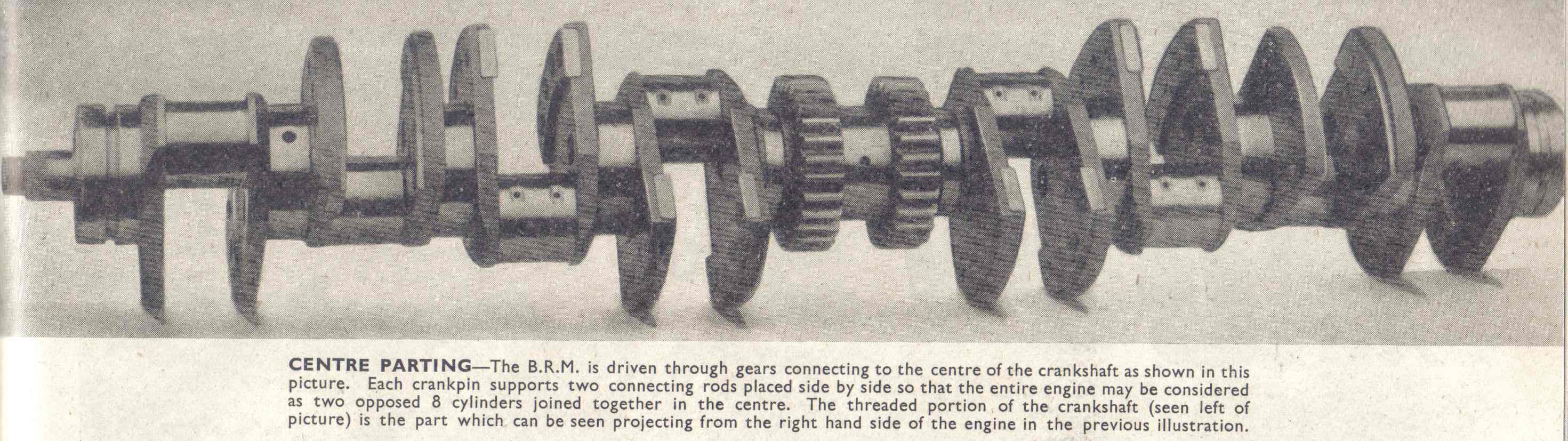
BRM crankshaft, centre power take-off clear. (Stephen Dalton Collection from the ‘BRM Ambassador for Britain Booklet’)

BRM V16 Vandervell ad

(Stephen Dalton Collection from the ‘BRM Ambassador for Britain Booklet’.)

orma

‘Owen Racing Motor Association’badge.

brma

Scratchy ‘BRM Association’ lapel badge.

brm postcard

Photo and Other Credits…

Tony Matthews cutaway, Motorsport magazine, Stephen Dalton Collection, J Wilds, ‘BRM Vol 1’ Doug Nye

Finito…


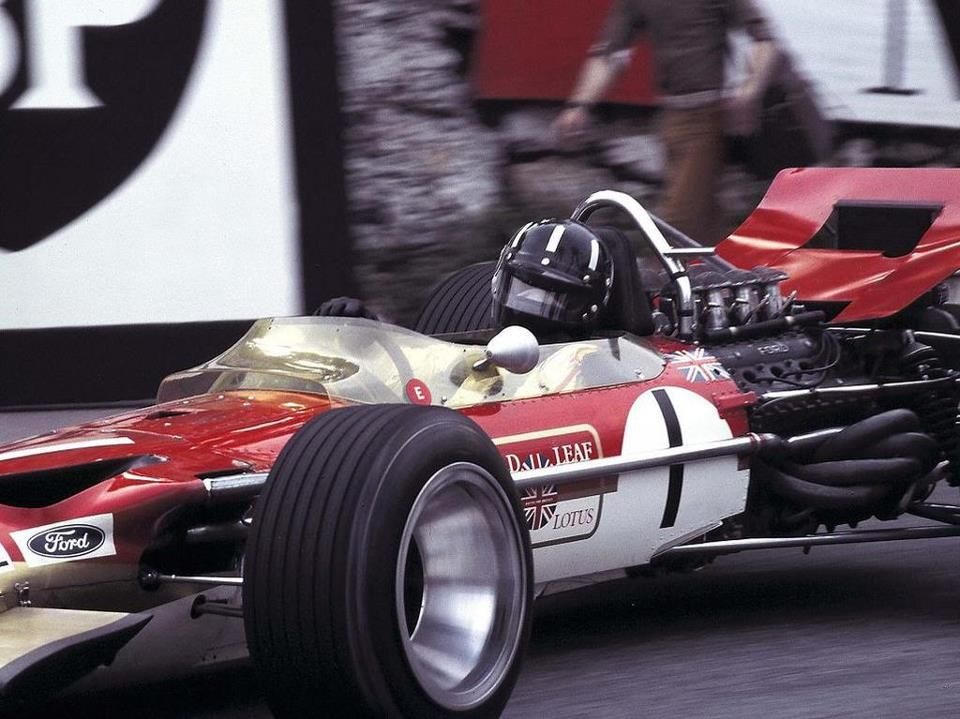
hill hi wing

Graham Hill in his hi-winged Lotus 49 during practice for the 1969 Monaco Grand Prix, he went on to win the last of his five Monaco victories on Sunday May 18 1969…

‘Twas his last Grand Prix win as well but his competitiveness was still there, wins were to come in F2 and in endurance racing. His ’72 Le Mans Matra victory with Henri Pescarolo made him unique in our sport as the only winner of ‘Motor Racing’s Triple Crown’; victories in the Drivers World Championship, (BRM 1962 Lotus 1968) Indy (Lola 1966) and Le Mans.

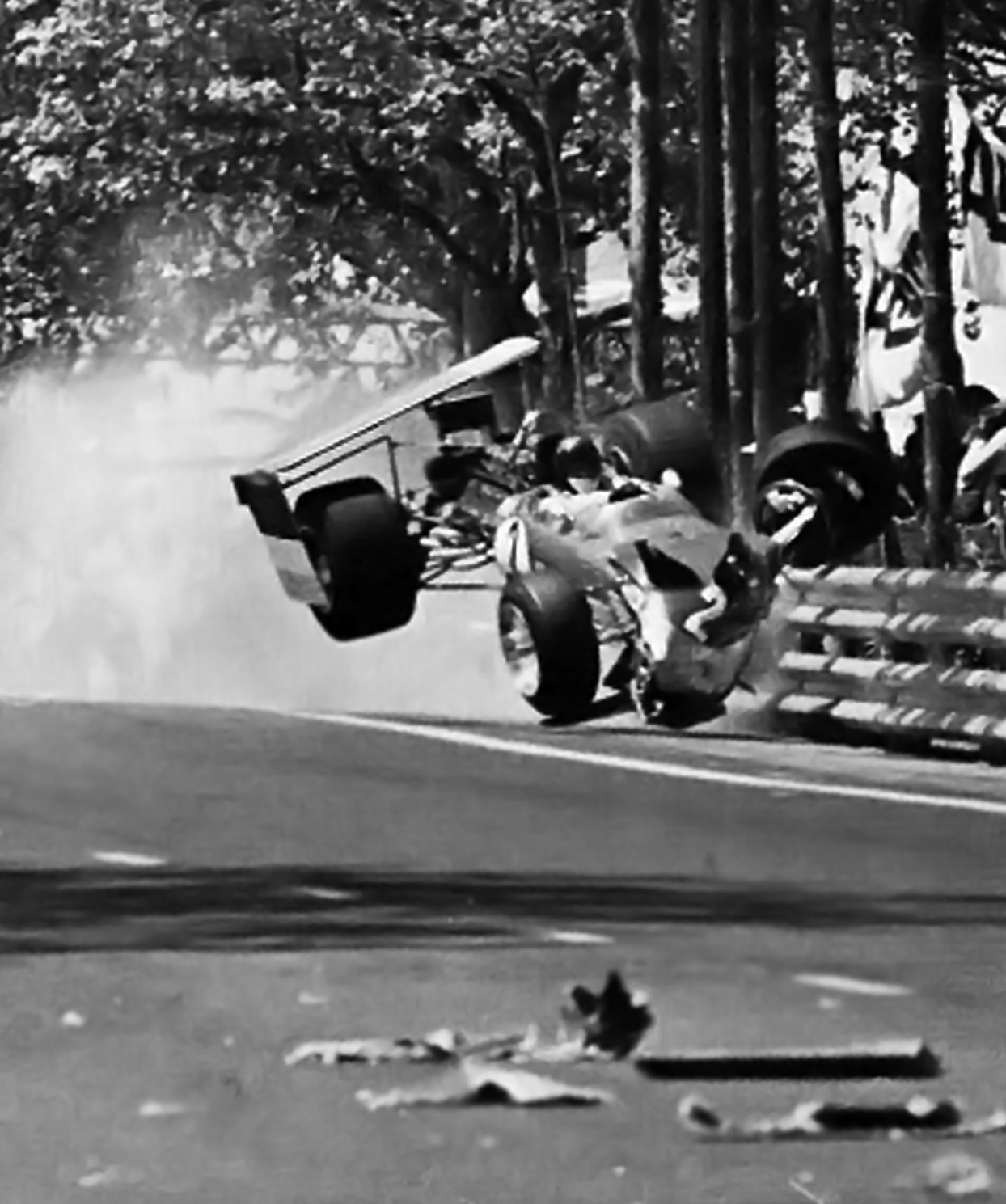
The story of the weekend was all about wings. There had been some big failures as engineers battled with forces they did not fully understand, notably the collisions, fortunately without serious injury to both Hill and Jochen Rindt at Barcelona on May 4, the race before Monaco.

Hill’s rear wing failed on lap 9 as he crested the rise after the Montjuic Park pits, he crashed heavily but was uninjured. Eleven laps later Rindt’s leading Lotus 49 suffered the same failure, collided with Hill’s abandoned car and overturned. He emerged with cuts, bruises and a broken nose. The wing on Ickx’ Brabham BT26 fell apart during the race as well.

There had been other failures in the recent past, the authorities needed to act before someone was killed.

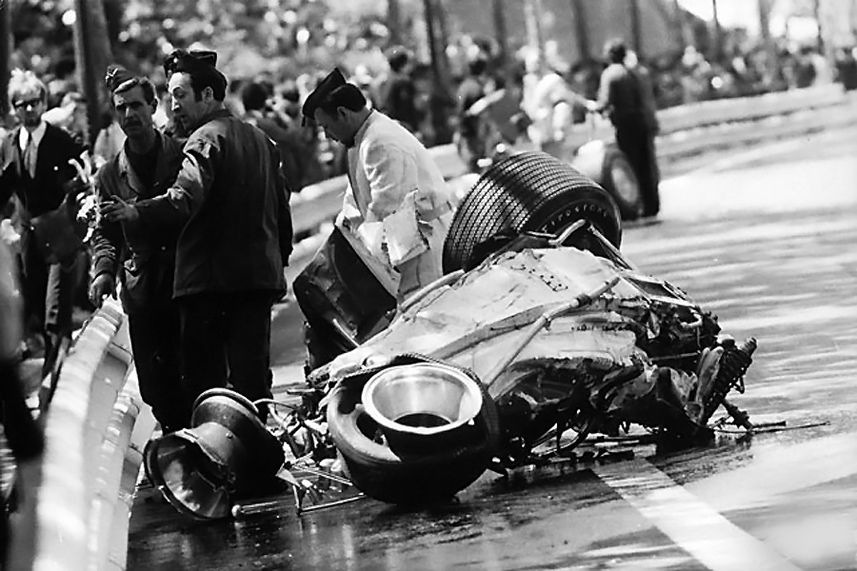
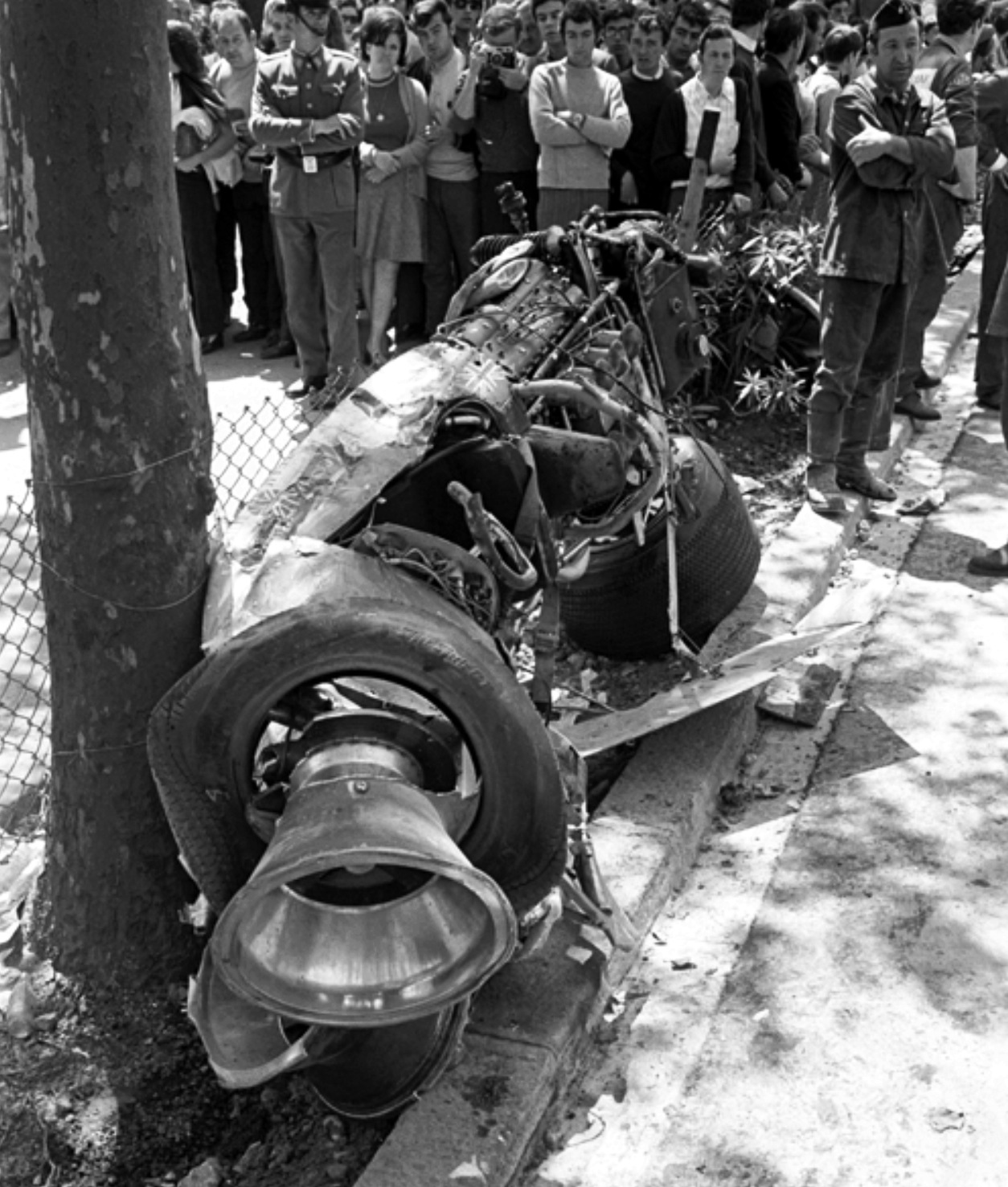
rindt rooted lotus

Rindt’s rooted Lotus 49, Montjuic Park Barcelona 1969. Jochen was a very lucky boy to escape withour serious injury after a wing support failure, Hill’s car into which Rindt collided is just down the road. (unattributed)

The CSI met in Monaco and acted after first practice by banning high wings forthwith, times were scrapped and the process of qualifying recommenced.

The sport was made safer as a consequence, some remain of the view that wings should have been banned then. Full stop.

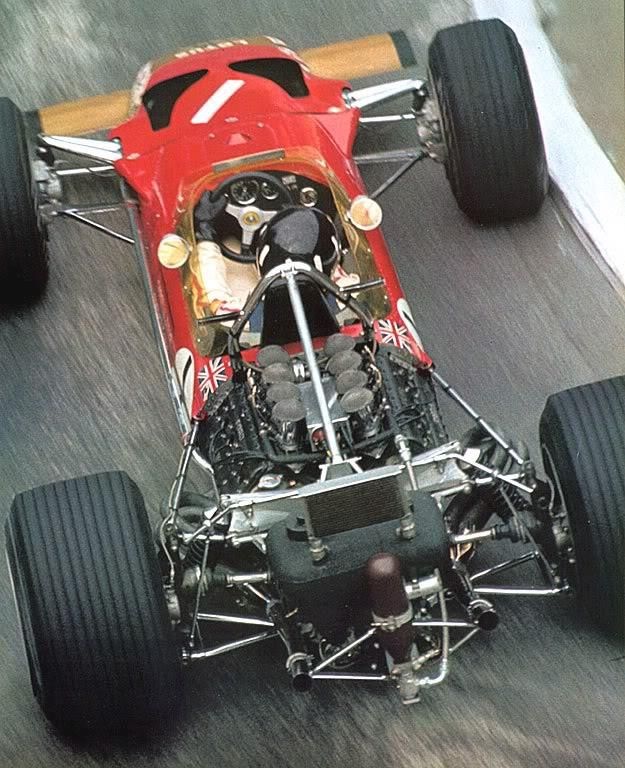
hill monaco interim

Wonderful overhead shot of Hill in qualifying post the wing ban; Chapman chose to keep the front wings, meanwhile the tin-snips were being put to work…3 litre Ford Cosworh DFV, big rear oil tank, external extinguisher the first thing to leave the car in the event of a major rear impact (handy for the driver in need of foam!), and Aeroquip brakelines running along the radius rods all clear to see. You can just about read the Smiths tach and chassis plate! (Automobile Year 16)

Stewart took an early lead from Amon’s Ferrari 312 in the race, Hill moved into third shortly after the start and after differential failures to both Amon and Stewart’s Matra MS80 Ford gained the lead he never lost. He took victory from Piers Courage’ Brabham BT26 Ford and  Jo Siffert’s Lotus 49B.

hill low level spoiler

By the time of the race’ start Chapman and his team had fashioned this neat spoiler…not as nice as the 49 used at Monaco in ’68 but that was built at the factory, this was not bad overnight and ‘ in the field’. (unattributed)

Winners are grinners, Hill ‘The Mayor of Monaco’ was always a popular victor in the Principality…

hill victory

Hill victorious in Lotus 49 ‘R10′, first debut’ by Jochen Rindt at Wigram NZ in January 1969. Victories in the Tasman Warwick Farm 100 in Rind’ts hands and Hill at Monaco. 49’s much raced by many drivers this chassis also raced by John Miles. Alex Soler-Roig and Emerson Fittipladi, Emmo raced it in its final GP, Austria in August 1970. Car still exists in the UK. (unattributed)

Etcetera…

montjuic

All those hi-wings in the Montjuic dummy grid, soon to be a thing of the past. #7 Jackie Stewart with teammate Jean Pierre-Beltoise behind, both Matra MS80 Ford, Graham Hill Lotus 49 Ford beside Stewart, #6 Bruce McLaren McLaren M7A Ford, #15 Chris Amons Ferrari 312 and #4 Jacky Ickx Brabham BT26A Ford (unattributed)

rindt barcelona

Rindt’s Lotus 49B and its broken wing supports clear in this shot of the ‘unguided missile’. Spectators and Rindt fortunate. Montjuic Park 1969. (unattributed)

rindt spain

49 ‘R9’ decidedly second-hand, Jochen was so lucky to ‘walk away’ from this accident (Getty Images)

rindts letter to chapman

Rindt’s 9 May 1969 letter post Spanish prang to Chapman is widely circulated and a classic! Prophetic sadly. (Jochen Rindt Archive)

Credits…

oldracingcars.com chassis research, Automobile Year 16, Getty Images

agp 67 hill and clark

(Graham Howard ‘History of The Australian Grand Prix’)

Jim Clark and Graham Hill swap notes prior to the start of the 1967 Australian Grand Prix, Warwick Farm, Sydney. It would be a good season for them both…

Their new F1 Lotus 49’s await their return to Europe, the Ford Cosworth powered cars established a package of integrated design which became the F1 standard for the duration of the 3 litre formula. Their is plenty of press interest in the two stars, teammates for the first time in 1967 and Hill’s #5 Lotus 48.

Behind them in the ‘Farm pitlane is Kevin Bartlett’s Brabham BT11A Climax, KB just in shot with his foot on his front Goodyear. Sixth in the race for him, an excellent result in the old car.

agp 67 start

Start of the 1967 AGP. #5 Hill Lotus 48 FVA 1.6, #6 Clark Lotus 33 Climax 2.0 V8, #3 Jackie Stewart on pole, BRM P261 2070cc V8. (autopics.com.au)

The 48 was Lotus’ new car for the inaugural 1.6-litre F2 1967 season. Designed by Colin Chapman and Maurice Philippe, it was in essence a ‘mini’ Lotus 49 which made its successful debut in the ’67 Dutch Grand Prix on June 4.

Keen to get in some early season testing of the new car, Colin Chapman sent the first chassis to Australia for the Warwick Farm round of the Tasman Series, the Australian GP that year, held on 19 February for Graham Hill to drive. Hill was popular at the Sydney circuit, the promoters paying plenty of money to get the Brit and his new Lotus to New South Wales for just one race. Of added local interest was that Hill had just returned to Lotus having been a BRM driver since 1960. Mind you, in Australia he raced in our internationals the Ferguson P99, Brabham Climaxes owned by ‘Scuderia Veloce’ as well as various BRM’s.

Jim Clark did all of the Tasman rounds in New Zealand and Australia that summer. He won the title in a Lotus 33 Climax, his 1966 F1 mount ‘R14’ fitted with the 2 litre Coventry Climax FWMV V8 engine with which he started the 1966 F1 season, the first year of the 3 litre F1. He used the car until the BRM engined Lotus 43 was ‘ready’ to race.

The new 48 F2 car had a full monocoque chassis made from aluminium sheet with steel bulkheads front and rear. Bolted to the rear bulkhead was a tubular steel subframe which carried the unstressed FVA engine and ZF gearbox. Front suspension used top rockers operating inboard mounted springs and dampers. The rear suspension was also conventional; single upper link, reversed lower wishbone, twin radius rods and coil spring/ damper units.

The 48 used the Ford Cosworth FVA, one of two engines contracted from Keith Duckworth and Mike Costin by Ford. Significantly the engine proved Duckworth’s design direction for his F1 V8, the Cosworth DFV which made its race debut at Zandvoort in the back of the equally new Lotus 49. The FVA’s design commenced in July 1965, its first bench test was in March 1966 and its first race in July 1966. The engine was well tested prior to its trip to Australia in the summer of ’67.

The remarkably successful unit combined a four-cylinder cast iron Ford Cortina block with an aluminium Cosworth head. FVA was an acronym of the ‘four valve assembly’ or ‘four valve type A’ of the engine’s new head. Twin overhead camshafts were used of course, driven from the crankshaft by gears. Equipped with Lucas fuel injection, the dry sumped engine developed circa 220 hp @ 9000rpm.

Ford-Cosworth-FVA

Ford Cosworth FVA Engine Cutaway drawing by Theo Page.

Graham Hill qualified Lotus 48 chassis ‘R1’ well amongst the Tasman Formula 2.5 litre engined cars, 3rd on the grid with only the V8 engined cars of teammate Jim Clark and Jackie Stewart’s BRM in front of him. He may only have had 1.6 litres but the chassis was clearly good and Hill was always been quick around Warwick Farm, the Sydney circuit a very technical one.

Stewart was very fast throughout the Tasman, he won it in ’66, but the BRM’s gearbox was at its limits with the greater stresses of the P60 BRM V8, now at 2070cc and developing much more power and torque than the same engine in its original 1.5 litre F1 guise ever produced. But the car held together at the ‘Farm, Jackie won from Clark and Frank Gardner in a Brabham BT16 Climax FPF, the old 2.5 litre F1 Climax four cylinder engine well and truly outclassed by ’67.

Hill’s new Lotus 48 expired with gearbox maladies on lap 25 but he gained valuable miles on the brand new chassis in advance of the European F2 season, which both he and Clark contested.

Intended as a customer car, the 48 was exclusively campaigned by Team Lotus during 1967, privateers used uprated 41’s. The new Lotus was quick but encountered the Brabham BT23, one of Ron Tauranac’s most successful designs. The 48 won four F2 races in 1967, three in Clark’s hands, the fourth by Jackie Oliver in the combined F1/F2 German GP at the the Nürburgring.

Whilst the Brabham BT23 was the car of the season many of its victories were taken by ‘graded drivers’, notably the ‘King of F2′ Jochen Rindt, whilst graded drivers did win races they could not score championship points. The 1967 title was won by Jacky Ickx using both Matra MS5 and MS7 chassis’, FVA powered.

Lotus continued with the 48 in 1968, 4 chassis were built in total, but struggled again with the dominant Brabham BT23’s. Jean Pierre Beltoise won the ’68 title in a Matra MS7 FVA. 1969 would be a ‘different kettle of F2 fish’, the Dave Baldwin designed Lotus 59 a much more competitive tool.

gh lotus 48 cockpit

Graham Hill tucked into the comfy cockpit of his beautifully finished Lotus 48. He is on the grid of the ‘Guards 100’, Snetterton in March 1967. Hill was 2nd to Rindt’s Brabham BT23. (Max Le Grand)

III Gran Premio Barcelona, Montjuic, Spain 31 March 1968…

untitled

Jim Clark, Lotus 48 FVA, Montjuic, Barcelona 1968. (Unattributed)

Jim Clark aviating his Lotus 48 during practice for the first European F2 event in 1968.

He started the season strongly with victories in his Lotus 49 in both the South African Grand Prix held at Kyalami on 1 January and the Tasman Series, including the Australian Grand Prix at Sandown Park, Melbourne. Jim won 4 of the 8 Tasman rounds, his Lotus used the 2.5 litre Ford Cosworth V8 variant, the ‘DFW’ so he came to this F2 event ‘razor sharp’.

Despite Clark’s speed, Jackie Stewart won the race in his Matra MS7 FVA, Jim was tagged by Jacky Ickx at the first turn, a ‘bonzai’ move down the inside taking out the innocent Scot, deflating a tyre and rearranging the rear suspension. Ickx was involved in another accident on lap 2 and retired. Karma at play!

The shot below is of #1 Clark, with Hills nose in shot, in the middle is an innocent Jochen Rindt, Brabham BT23 FVA. Ickx shot off down the road in his Ferrari 166. The next F2 round was the ‘II Deutsche Trophae’ at Hockenheim the following weekend.

mont clark

Hill’s Lotus 48 nose, Jochen Rindt caught up in the melee in his Brabham BT23 FVA and Clark, Lotus 48 FVA. (Unattributed)


mont clark 2

End of Clark’s race, flat tyre and shagged rear suspension. Lotus 48 FVA. Barcelona 1968. (Unattributed)

YouTube Footage of the Barcelona Race;

Hockenheim 7 April 1968…

Jim Clark before the off and (below) in the early stages of this fateful, awful race and the probable high speed tyre deflation which caused the accident that claimed the champions life.

clark and sims

Jim Clark, relaxed before the off and Dave Sims. Hockenheim 7 April 1968. Lotus 48 FVA. (Rainer Schlegelmilch)


clark lotus 48 hocken 68

Clark, Lotus 48 FVA, Hockenheim 7 April 1968. (MotorSport)

Lotus 48 Technical Specifications…

Chassis; aluminium monocoque with rear subframe. Front suspension; lower wishbones, top rocker actuating inboard coil spring/dampers, roll bar. Rear suspension; reversed lower wishbones, top links, twin radius arms, coil spring/dampers, roll bar
Steering rack and pinion, Brakes, discs all-round, Gearbox ZF 5DS12 5 speed.
Weight 420 kilo / 926 lbs. Length / Width / Height 3,797 mm (149.5 in) / 1,727 mm (68 in) / 762 mm (30 in)
Wheelbase / Track (fr/r) 2,330 mm (91.7 in) / 1,473 mm (58 in) / 1,473 mm (58 in). Wheels (fr/r) 13 x 8 / 13 x 10

Ford Cosworth FVA

Pretty much the ‘engine de jour’ of the 1.6 litre F2 from 1967 to 1971, the FVA won all of the European titles in that period.
Cast-iron Ford Cortina 1600 ‘116E’ 5 bearing block, aluminium head, 1,598 cc. Bore/Stroke 85.7 mm/69.1 mm, DOHC, 4 gear driven valves per cylinder, Lucas fuel injection and electronic/transistorised ignition. Circa 220 bhp @ 9000rpm.

Those with a strong technical interest in the Cosworth FVA and its role in relation to the subsequent Cosworth DFV V8 Design will find this treatise of interest;

Click to access cosworthstory.pdf

Etcetera…

clark pau 1967

Mini Lotus 49 indeed! Clark in his svelte Lotus 48, Pau GP 1967. 4th behind 3 Brabham BT23’s; Rindt, Hulme and Alan Rees. (Unattributed)


clark jarama 67

Clark in his Lotus 48 from Jackie Stewart’s Ken Tyrrell entered Matra MS7, both Ford Cosworth FVA powered, 1st and 2nd, Chris Irwin’s Lola T100 3rd, Jarama, Spain July 1967. (Unattributed)


oliver german gp

Jackie Oliver jumping his works Lotus 48 into 5th place, and first F2 finisher, German GP August 1967. He drove a great race, Hulme victorious in his Brabham BT24 Repco. (Unattributed)


hill oulton brian watson

Hill on the way to 3rd place in the Oulton Park ‘Gold Cup’ in September 1967 amongst the F1 cars, Jack Brabham won in his BT24 Repco from Jackie Stewart in a Matra MS7 FVA F2 car. (Brian Watson)


hill 48 in 68

Graham Hill in the Tulln Langenlbarn, Austria paddock in July 1968. NC with insufficient laps. Rindt won the race in a Brabham BT23C. ‘Chequered Flag’ truck contained the McLaren M4A driven by Robin Widdows also DNF. (Unattributed)


lotus 59

For the sake of completeness…this is the Dave Baldwin designed, spaceframe chassis F2 Lotus 59 which succeeded the 48. ‘Twas an FF/F3/F2 car, much more successful than the Lotus 48 but again the Brabham BT 28/30 gave it a good run for its money! Here G Hill at the Pau GP in April 1969 with high wings having only weeks to run before being outlawed by the FIA during the Monaco GP weekend. Hill DNF with fuel metering unit failure, Jochen Rindt victorious in the other Winkelmann Racing 59B. (Unattributed)

Credits…

Graham Howard ‘History of The Australian Grand Prix’

Max Le Grand, autopics.com.au, MotorSport, Rainer Schlegelmilch, Theo Page, Brian Watson, Roger Linton

Tailpiece: 1967 AGP Warwick Farm…

(R Linton)

Start of the race from the pit counter.

Hill’s Lotus 48 FVA at right, Clark, Lotus 33 Climax and Jackie Stewart, BRM P261 on the front row. Brabham is behind Stewart and Denny Hulme behind Jack in Repco ‘640’ V8 engined Brabhams

Finito…

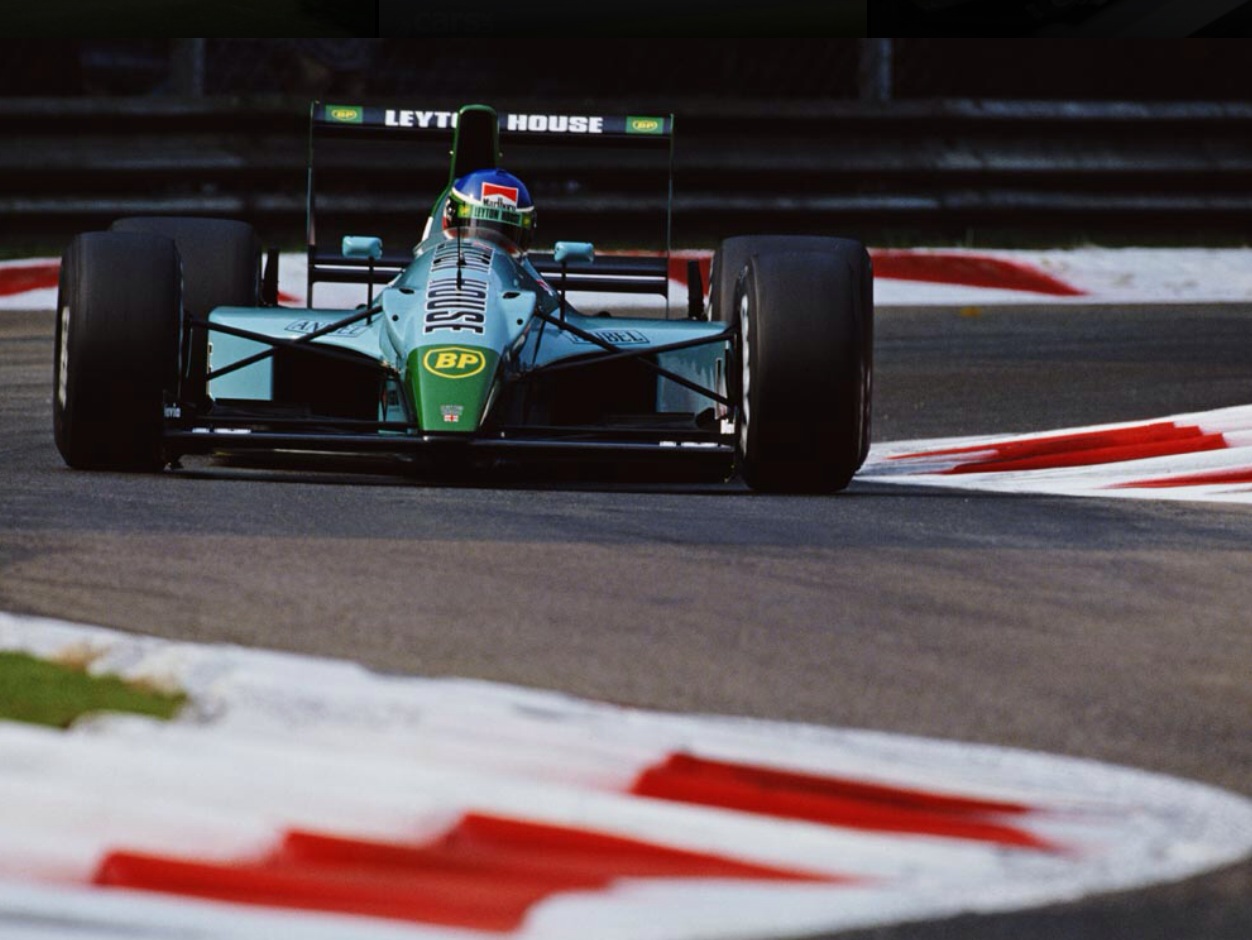
capelli cg 901 LH

Ivan Capelli in his Leyton House CG901 Judd, 1990…

It’s been interesting to learn about and admire the careers of the sports’ outstanding contemporary engineer/designers and those of the decades which pre-date my interest in the sport.

It’s the ones who have enjoyed enduring success I have been most drawn to. Janos’ and Chapmans’ contributions over 30 years truly amazing.

Dr Porsche, Vittorio Jano and Jim Hall predate my period of interest but Colin Chapman, Mauro Forghieri, Gordon Murray, John Barnard and Adrian Newey i have followed since 1972.

image

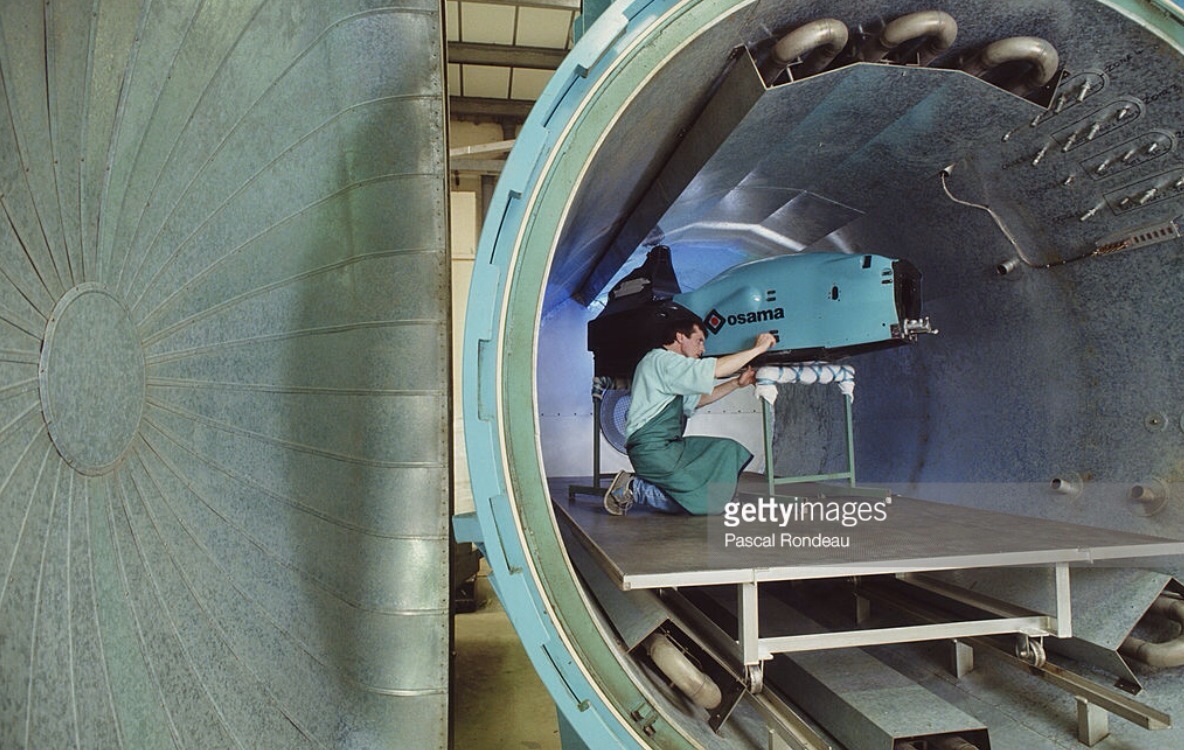
CG901 monocoque inside the teams autoclave, Bicester 1990 (Pascal Rondeau)

Newey has been ‘the man’ in F1 for the better part of 25 years with ten constuctors titles for three teams; Williams, McLaren and presently Red Bull.

Like the others he is degree trained and his practical experience is rooted in time spent as a race engineer. He is different though, in that his primary degree is in Aeronautics and Astronautics. It was the application of the science of aerodynamics, increasingly important in the overall F1 design package as regulations progressively became more restrictive in other areas, at March nee Leyton House in 1988-1991 which first brought him to the attention of Patrick Head, Frank Williams and others.

image

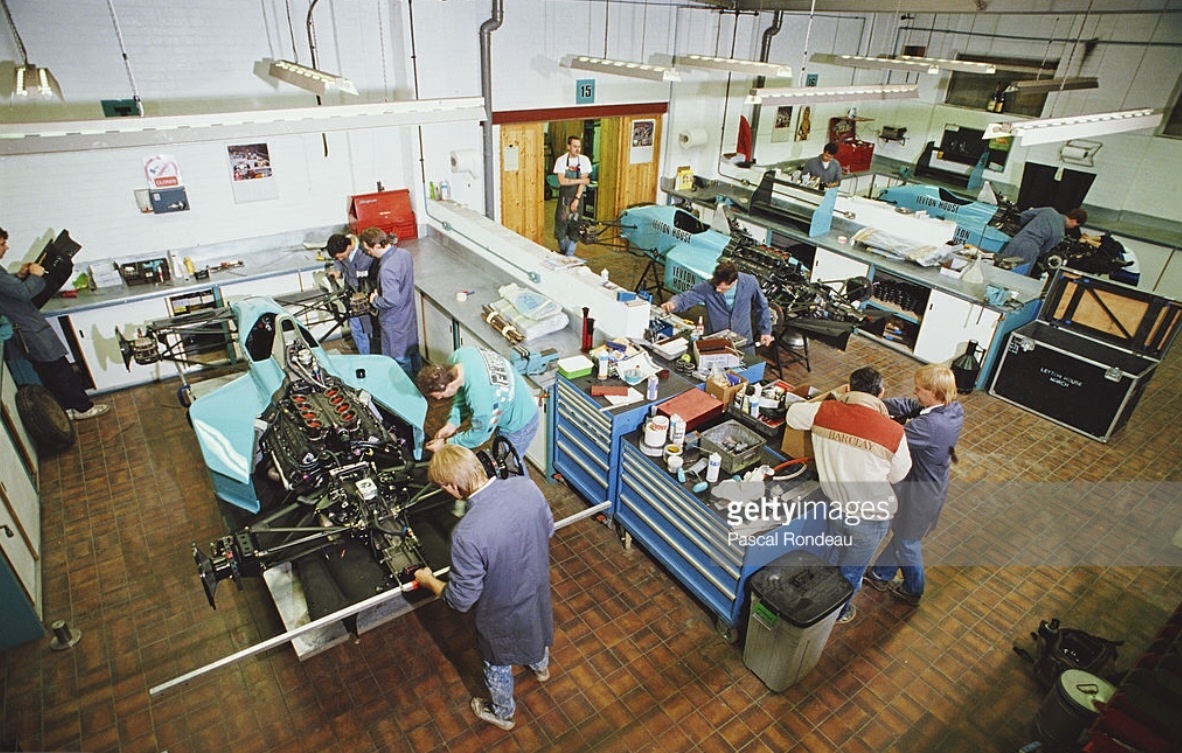
Race prep of 3 CG901 chassis in June 1990 (Pascal Rondeau)

The overall pace of the March 881 and it’s successors top speeds at different circuits made it clear they slid through the air rather nicely, better than many other cars with the same engine or considerably more grunt.

That the cars ‘batted above their weight’ made it clear he could do more with greater resources, as has been proven the case.

The 1988 March 881, powered by John Judds’ 3.5 litre V8 finished 6th in the constructors championship, in 1989 the March 891 Judd  finished 12th, drivers Mauricio Gugelmin and Ivan Capelli retiring from most of the races.

hutton cg901 LH cutaway

Drawing of the LH CG901 Judd…engine 3.5 litre V8 not 3 litre…(Peter Hutton)

In 1990 March F1 morphed into ‘Leyton House’…the Japanese company acquired the team it had previously sponsored. Neweys’ Leyton House CG901 Judd was quick in the hands of its two drivers after a mid year update of the aero package to correct ‘erroneous wind tunnel data’. Capelli lead the French Grand Prix for many laps before being passed by race winner Alain Prost. The team finished 7th in the Constructors Championship, Newey was fired and quickly hired by Williams all the same.

And the rest, as they say, is history. The 1991/2 Williams FW14 Renault, Neweys’ first Williams won 17 Grands’ Prix and Leyton House, amid allegations of financial misdemeanours and the arrest of its CEO disappeared without trace in early 1993 having changed it’s name back to March F1 for the 1992 season…

capelli from prost

Ivan Capelli LH CG 901 Judd leads Alain Prosts’ Ferrari 641 during the 1990 French GP. Wonderful 2nd place for the Italian ahead of victor Prost. (Unattributed)

capelli Lh suzuka 1990

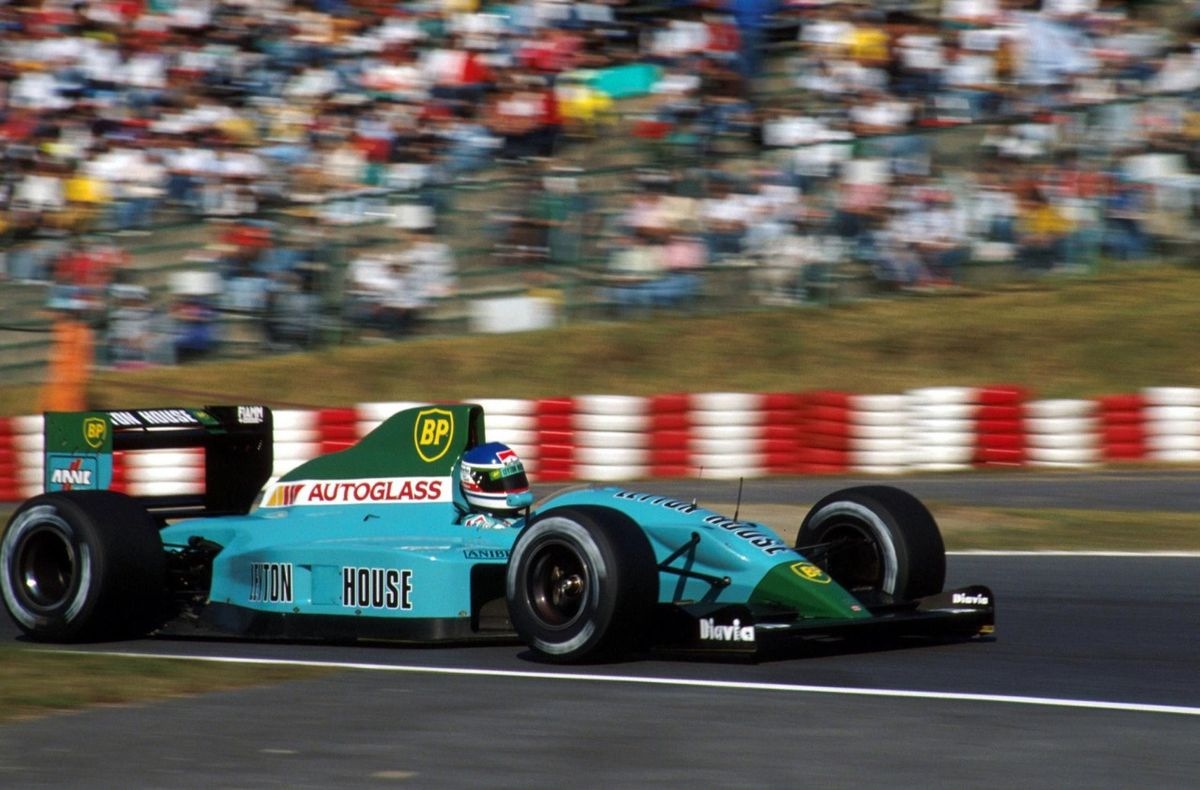
The gorgeous lines of Capellis’ LH CG901 at Suzuka, Japanese GP 1990. Q13, DNF with ignition dramas on L16. (Unattributed)

image

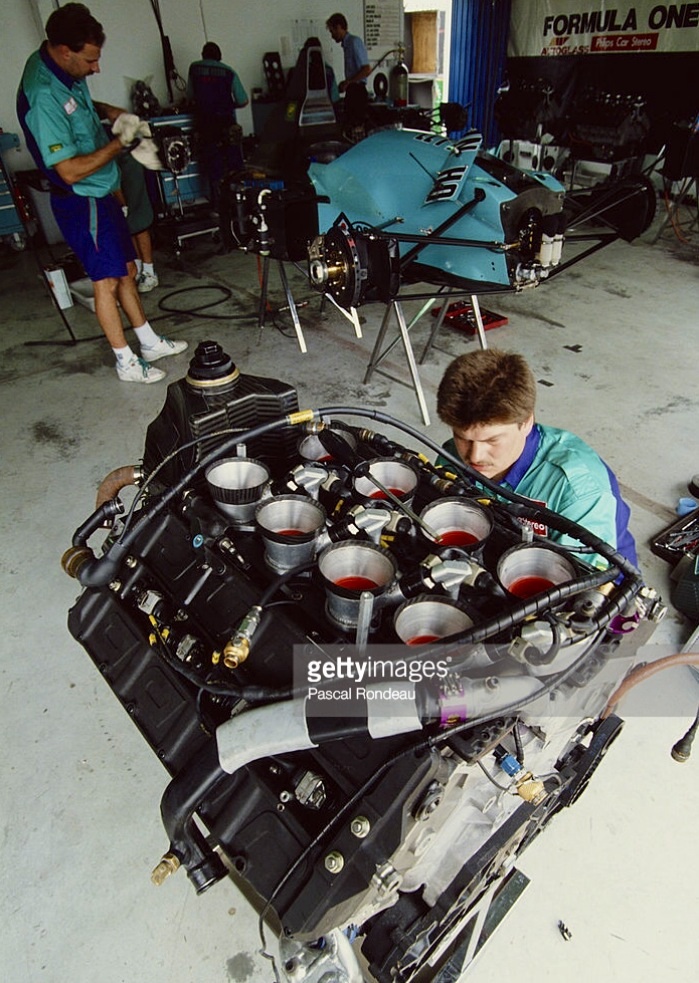
Leyton House workshops in June 1990 (Pascal Rondeau)

cg 901 designey stuff

LH CG901 design elements. Carbon fibre chassis, suspension double wishbones, pushrod and rocker actuated coil spring/dampers front and rear. Judd EV 3496cc 76 degree DOHC 4 valve N/A V8, 660bhp. March 6 speed manual transaxle. carbon ceramic brakes. 520Kg. (Unattributed)

image

Estoril 21 September 1990, a practice Judd V8 engine change during the Portuguese GP weekend (Pascal Rondeau)

Credits…

Peter Hutton, Pascal Rondeau

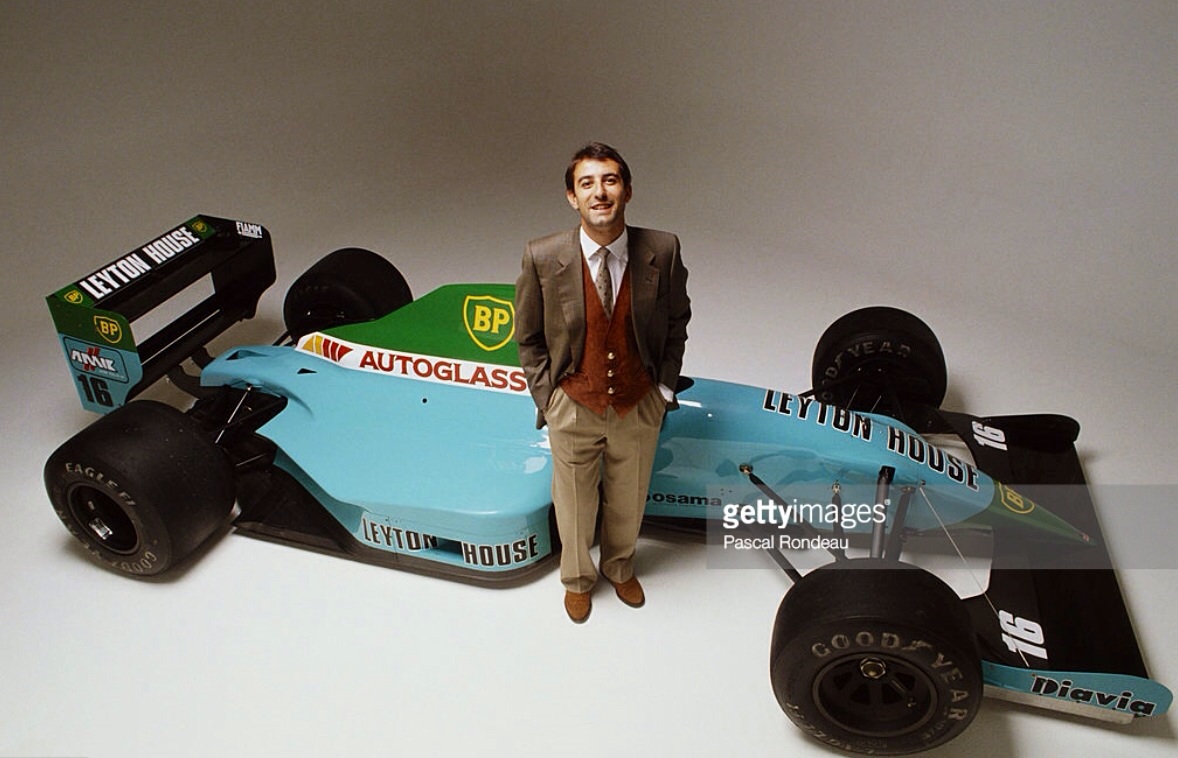
Tailpiece: Ivan Capelli, Leyton House CG901 Judd at the Allsport Studios on 15 May 1990…

image


2 f targa

Phil Hill blasts through the ancient Sicilian countryside in his Chaparral 2F, its booming 7 litre Chev engine and ‘outta this world’ aerodynamics entertaining and fascinating the locals…

I posted a short photo article on the 2F in June last year, i have now turned it into a 3500 word feature on this fabulous, seminal 1967 Jim Hall creation. Please click on this link to read it…https://primotipo.com/2014/06/26/67-spa-1000km-chaparral-2f/

targa start

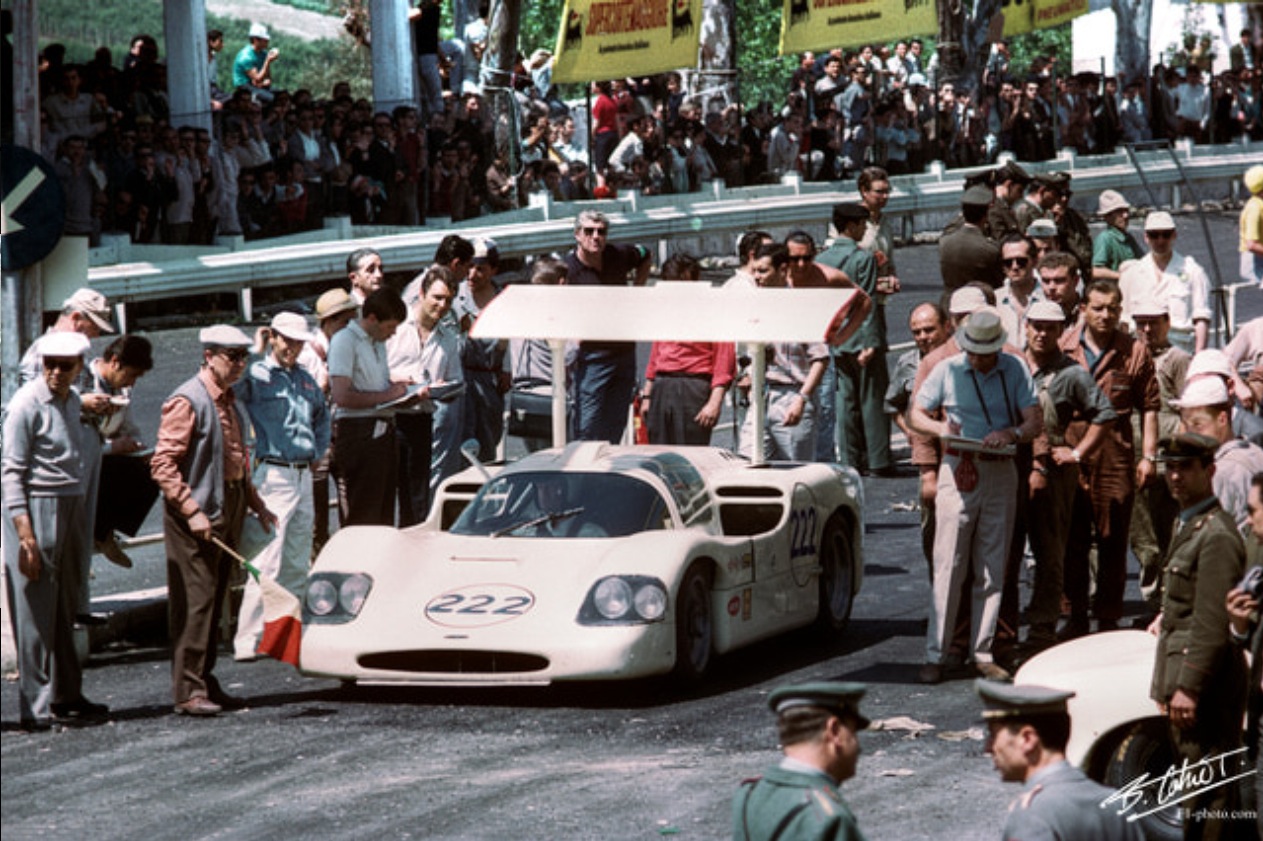
Hap Sharp at the Targa start, plenty of local interest in the American Interloper, carabinieri excepted. Chaparral 2F Chev 1967. (Bernard Cahier)

Photo Credits…Yves Debraine, Bernard Cahier

berger busstop chicane belgianm 1989 fazz 640

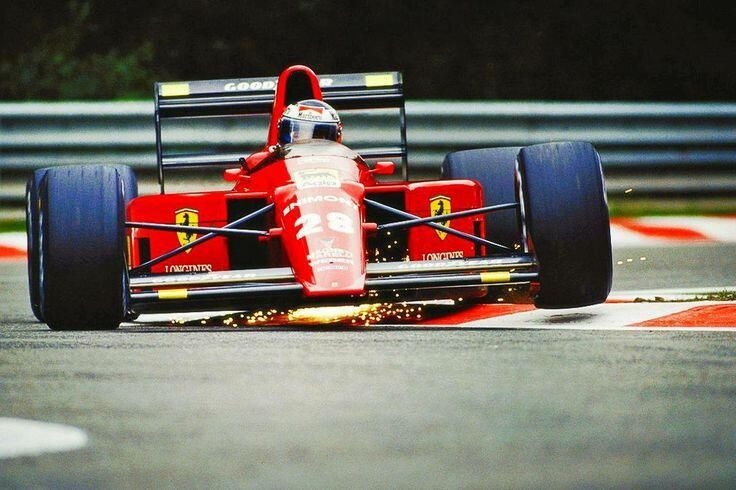
Gerhard Berger pings his Ferrari 640 through the ‘Bus-Stop’ chicane, Spa 1989…

He spun off on lap 9, the race won by Ayrton Senna from teammate Alain Prost in McLaren MP/5 Hondas’ and Nigel Mansell in the other Ferrari 640.

ferrari 640 cockpit

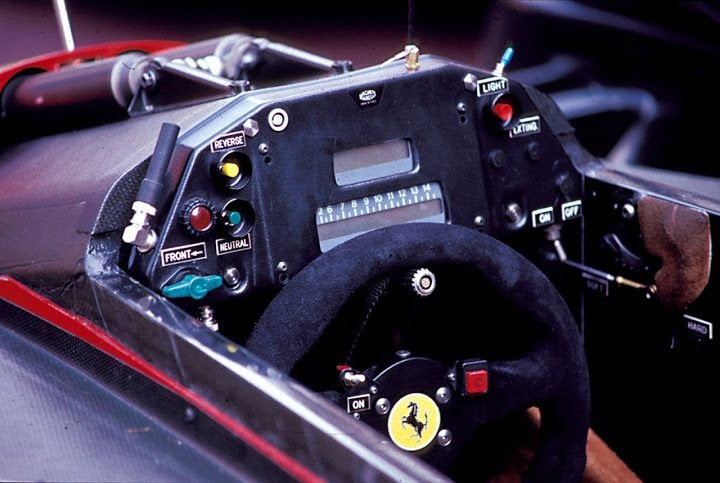
The nub of the cars innovation, its electro-hydraulic 7 speed gearbox and steering wheel mounted operation; faster gearchanges, greater reliability by eliminating ‘muffed’ up and especially downchanges, two hands on the wheel at all times giving greater control and speed. (Unattributed)

Ferrari 640 and Innovation…

The new single-seater was known colloquially as the 640 after its design number, but was officially F1-89.

Nigel Mansell joined the team, Gerhard Berger was his teammate. Ferrari took three wins and was third in the Constructors’ Championship with 59 points.

The F1-89 hailed the return of the normally aspirated 12-cylinder engine and in a major first for Formula 1, also had a gear change bar mounted behind the steering wheel.

Ferrari have never been noted for innovation but this was a ‘game changer’ which all other teams and formulae followed.

Nigel Mansell won his debut race at Interlagos and then headed the pack across the line again at Budapest. The Scuderia’s third season win came from  Gerhard Berger at Estoril. McLaren took both titles that year with Alain Prost winning the Drivers’ Title for them.

The semi-automatic gearbox was Barnard’s solution to the problem of the long manual actuation mechanism. Barnard interviwed by ‘MotorSport’ in 2005 said ‘The project started because I wanted to make the monocoque really narrow. In those days we had to fit a gearshift run through the monocoque alongside the engine and back to the gearbox. It was a real pain to find a route for this and make room in the cockpit for the selector and the driver’s hand. I thought, ‘Surely, instead of a gear lever, I can have a switch.’ So it was a packaging imperative. The gear linkage affected lots of things, and of course the driver was taking his hand off the wheel during changes. The time-saving advantage came afterwards. Vittorio Ghidella, running Ferrari post-Enzo, was terrified of the ‘box failing and had a manual version built; Mansell tested it and said ‘forget it’. But the effort was a danger to the project.’

Originally intended to appear in ’88 on the 639, the electrohydraulic ‘box and normally aspirated V12 were held back until the following season once it was clear that the equivalency rules for ’88 made it vital to run a turbo to be competitive. When it did at last race in ’89 the new transmission was initially unreliable but it eventually became clear to everyone in the pitlane that here was a technology they would all have to copy.

Ferrari say that ‘the new gearbox and communications difficulties with Barnard who was working from England dragged out the car’s development’. However, when it finally did emerge, it was seen by the other constructors as a shining example of superb engineering and aerodynamics, the latter thanks to its extremely clean-looking form’

Boy, it was and is a stunning looking car, perhaps the last really sexy F1 car?

ferrari 640 cutaway

Technical Specifications…

With the banning of turbo-charged engines from the end of 1988, as stated above, Ferrari returned to a normally aspirated 65° V12 Bore/stroke 84 x 52.6 mm displacing 3497.96 cc. The  block was cast iron as a result of Barnard driving Ferrari hard on engine length and to get the crank as low as possible. He also influenced the 4 bolt pick ups for the engine, which differed from the way Ferrari hung their engines from the tub before.

Compression ratio was 11.5 : 1, maximum power 441 kW (600 hp) at 12,500 rpm. Valve actuation was DOHC per bank, five valves per cylinder, Fuel feed by Weber-Marelli electronic indirect injection, Ignition electronic, single spark plug per cylinder, lubrication dry sump. Clutch multi-plate with a 7 speed electro-hydraulic gearbox.

The chassis was designed by Barnard and his team at Ferraris’ Guildford Technical Office in the UK. When Barnard joined the team Ferrari had not won a race since 1985 so he was able to name his terms, inclusive of not working at the factory in Maranello! Ferrari agreed to the establishment of a design office near Barnards’ home in the UK.

The chassis was typical of the period, a Kevlar and carbon-fibre composite monocoque, its distinctive pannier shape a function of the large volumes of fuel, 220-230 litres carried at the time..

Barnard commented about the cars suspension ‘The 639 had conventional spring/damper units on top of the chassis, but because the 640 monocoque was so narrow I drew up a torsion-bar arrangement instead which started the short-torsion-bar fashion that continues today. It kept the installation as compact as possible and also I didn’t like coil-over dampers. The springs were never well enough made to avoid side loads on the damper rods and consequently added friction. I designed a lower friction package with the torsion bar, which ran on ball bearings. It was a really good solution’.

Front suspension comprised independent push-rod, torsion bar springs, telescopic shock absorbers and anti-roll bar. Rear suspension independent push-rod, twin wishbones, coil springs over horizontally-mounted telescopic shock absorbers. Brakes were steel discs. Steering rack-and-pinion. Fuel tank capacity 192 litres and Front tyres 25.0-10.0-13 and Rear tyres 26.0-15.0-13.

ferrari 640 naked

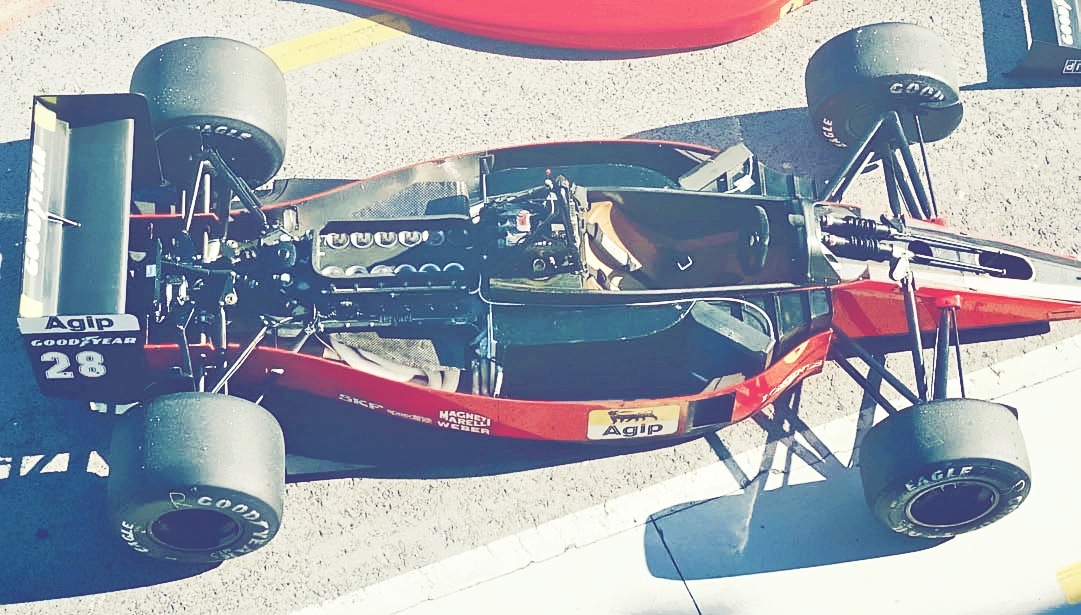
The beautiful symmetry and packaging of the car, a Barnard strength is seen to good effect in this shot from above. (Unattributed)

Apart from Mansells debut win at Interlagos in Brazil the gearbox gave early season troubles, both drivers having DNF’s in all subsequent races until the French GP, the ‘box the cause of many of them.

John Barnard again comments and sets the record straight ‘The semi-auto gearbox was slagged off early on for being unreliable, but that was unwarranted. A lot of the retirements in early 1989 listed as gearbox failures weren’t at all, they were due to loss of power to the ‘box. The alternator was driven by a belt from the crank and this kept falling off. It took a long time to find out why, using high-speed photography on the dyno. At this time the V12 only had a four-bearing crank which started to whip at certain revs, causing the front pulley to shed the belt. The alternator would stop and so would the gearbox electronics. We didn’t have any fundamental problems with the ‘box itself. It was pretty reliable. It was mostly standard inside and the hydraulic system was simple and robust.’

After these problems were sorted the advantages of the gearbox were clear…Barnard had instigated the second technical innovation of his career, the first the carbon-composite chassis…

Check out this article on John Barnards’ McLaren MP4/1 Ford…

McLaren MP4 Ford: 1981 The first Carbon-Composite Car…John Barnards’ Brilliance

1989 brazilian gp start

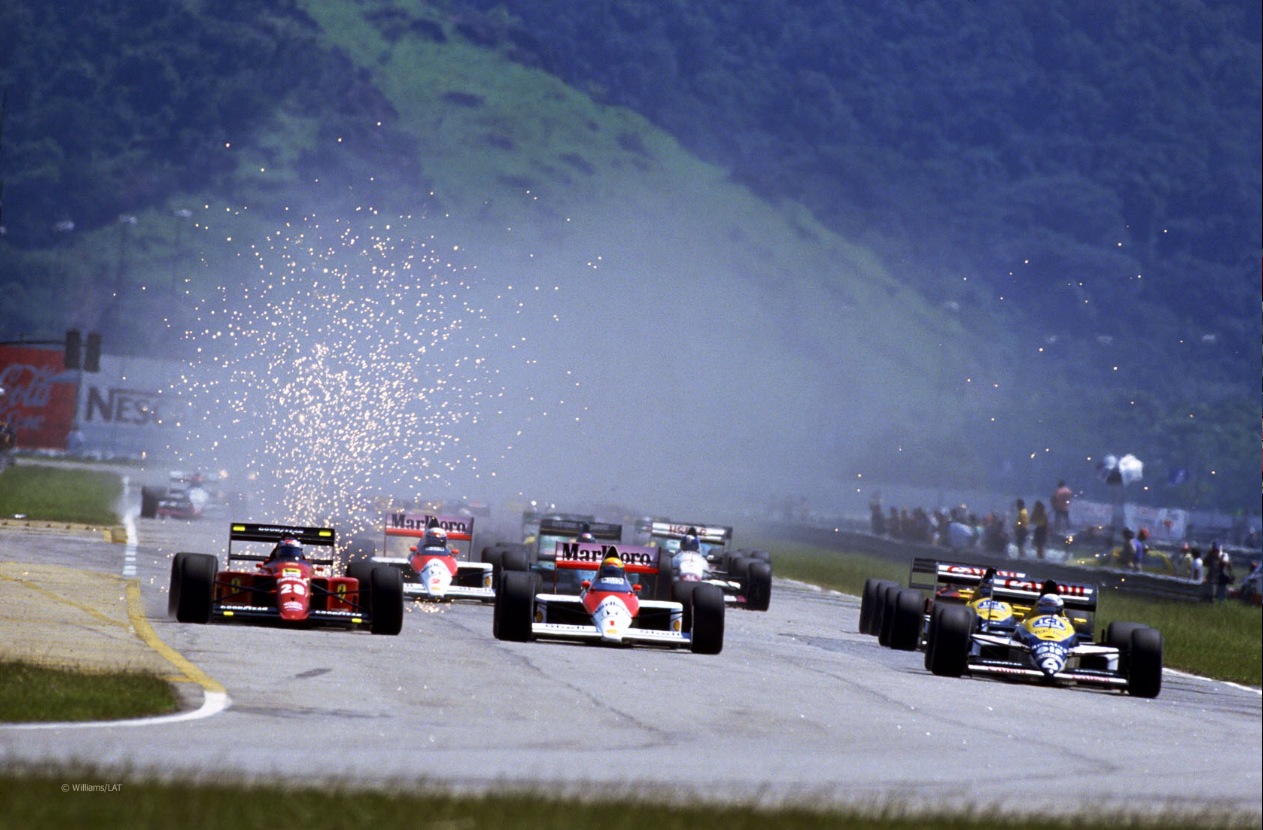
Start of the 1989 Brazilian GP with L>R Berger, Prost, Senna, Patrese and Boutsen behind him…Ferrari 640, McLaren MP4/5 Honda x2 and Williams FW12C Renault x2. Winner Mansell is not to be seen, he won from Prost and Mauricio Gugelmins’ March CG891 Judd. (Unattributed)

Etcetera…

mansell onaco fazz 640

Nigel Mansell at Monaco in his 640 1989. He retired with gearbox failure, Senna won in his McLaren. (Unattributed)

Credits…

Scuderia Ferrari, MotorSport June 2005


image

The beautifully finished and trimmed cockpit of Clarks’ Lotus 25 at Monaco 1963. Leather bound Mota-Lita steering wheel, a dash full of Smiths instruments including its famed chronometric tach and right hand change for the 5 speed ZF ‘box. Naked aluminium of the monocoque chassis below the shift lever. (Yves Debraine)

The tell-tale on Jim Clarks Lotus 25 after his retirement from the 1965 Monaco Grand Prix is at 9500rpm…

He was comfortably in the lead of the race by 14 seconds when the car engaged 2 gears at once on the entry to the Gasometer hairpin. Graham Hill inherited a lead he maintained to the race’ conclusion.

image

Clark in classical pose. Lotus 25 Climax. (Eric Della Faille)

The Lotus 25, the first ‘modern monocoque’ appeared at the Dutch Grand Prix in 1962 and was much copied for the 1963 season. For ’63 the car remained much unchanged other than small details and power increases from the Coventry Climax FWMV 1.5 litre quad cam, 2 valve V8.

Lucas fuel injection was adopted and a changed bore/stroke ratio allowed higher rpm and power.

Lotus retained the ZF gearbox but also tried a 6 speed Colotti-Francis ‘box and later in the season a Hewland 5 speed transmission which would soon become ubiquitous.

image

Surtees gesticulating at the fast approaching Ginther. (Marti)

John Surtees and Richie Ginther in Ferrari T56 and BRM P57 respectively scrapped for much of the race, this shot is on the entry to the Gasometer hairpin. Ginther tries to pass with Surtees gesticulating in protest.

Ginther finished second to teammate Hill, with Surtees, sitting in a pool of oil and with falling oil pressure finished fourth and set fastest lap on the last lap and the lap record. McLaren was third in his Cooper T66 Climax.

image

John Surtees eyes focused on a Monaco apex, Ferrari T56/156. (Yves Debraine)

Ferrari competed with interim cars for much of the season using the V6 engines which won the World Championships in 1961. The 1964 car appeared at Monza powered by a V8, the development of the car in ’63 setting up Surtees’ tight title victory in 1964.

dark

Surtees again, here chasing winner Graham Hill’s BRM P57. (unattributed)

clark monaco lotus 25

Clark enroute to what seemed a certain victory, before the intervention of gearbox dramas in his lithe, lissom utterly luvverly Lotus 25. (Unattributed)

hill winner

To the victor, the spoils. Graham Hill ‘The King of Monaco’ after the first of his 5 wins in the Principality. (Getty Images)

image

Lotus 25 Climax cutaway drawing by James Allington…

This short article makes no attempt to put into perspective one of the most successful and influential racing cars of all time, the first ‘modern monocoque’ includes amongst its relatives all monocoque racing cars built since its debut at Zandvoort in May 1962.

‘Monocoque’ construction by riveted ‘D section’ light alloy longerons attached to fabricated steel bulkheads front and rear.

Front suspension by upper top rocker operating inboard mounted coil spring /damper unit, lower wishbone and adjustable sway bar. Rear suspension by upper top link, inverted lower wishbone and coil spring/damper unit and adjustable sway bars. Cast alloy uprights front and rear.

Girling disc brakes, rack and pinion steering.

Wheelbase 91 inches, track front 51.5 inches, rear 51.75 inches, overall length 146 inches, dry weight 990 pounds. Wheel sizes 5X15 front and 6 or 6.5X15 inches at rear.

Coventry Climax FWMV 1.5 litre 90 degree V8. Bore 67.8mm, stroke 51.6mm, 1496cc, Lucas fuel injection, compression ratio 10.5:1, weight 290lb, 194bhp @ 8500rpm.

ZF gearbox mainly used in 1963 but Colotti and Hewland also tried.

Clark and Chapman

Clark and Chapman with a ’63 spec 25, its essential elements as described above. (Unattributed)

Clarks 1963 Championships…

Clark Zandvoort 1963

Jim Clark, Dutch Grand Prix June 1963. Jim zooms his Lotus 25 between the North Sea sand dunes at Zandvoort on his way to victory. (Yves Debraine)

That Jim Clark and the Lotus 25 were the fastest combination in 1962 was not in doubt but Coventry Climax reliability was not as great as BRM’s that year. In 1963 the promise of ’62 was realised with Clark winning five Grands’ Prix and both the Drivers Championship for himself and the first Manufacturers Championship for Lotus.

Clark finished second in a Lotus 29 Ford in his first foray to Indianapolis and further demonstrated his versatility with wins in cars as diverse as the Lotus 23 sports car and Ford Galaxie touring car/saloon that year.

Clark became the standard by which other drivers were judged in 1963, if not earlier.

Auto Year 13

The cover shot of Clark is at the Dutch Grand Prix, Clark won on the 25’s debut there in 1962 and in 1963 and 1964, all in 25’s and in 1965 in the updated Lotus 33 also Climax FWMV V8 powered.

Oulton Park Gold Cup 1963…

clark winning oulton gold cup 1963

Not only did Jim Clark win the Oulton Park Gold Cup during 1963 but he also recorded some stunning in car footage at the Cheshire circuit in his Lotus 25, such footage very rare at the time.

http://m.youtube.com/watch?v=PffCawETtK8&autoplay=1

There were four Non-Championship F1 races in the UK alone in 1963, lucky Brits! The footage is amazing on so many levels not the least of which is a drivers eye period view of the circuit; typical track edges, the lack of run off areas and the topography of trees, ditches and the like for the unwary…and this is a circuit devoid of the ‘special obstacles’ of the ultra dangerous road circuits of the day on which Clark raced. The Nurburgring, Spa, Reims, Pescara and Longford here in Australia spring to mind.

Ok, he is not racing but the precision and accuracy for which he was renowned is also on display…

An ace in every sense of the word.

clark atop 25 oulton park 63

Etcetera…

Lotus 25 camera car

Clark tootling thru the Oulton paddock in his ‘camera car’, its a bit hard to pick out the beefy mount against the dark background. And to think in the day of the ‘GoPro’ this was how it was done only a short time ago. Even when the specialists at Channel 7 in Australia popularised in car footage in the ‘Bathurst 1000’ in the late 70’s the heavy rig occupied a good percentage of the rear seat area…progress! (Unattributed)

image

Photo Credits…

Yves Debraine, Eric Della Faille, Marti, James Allington cutaway drawing, Automobile Year 13, Peter Windsor

Finito…


ferrari 2016 concept 1

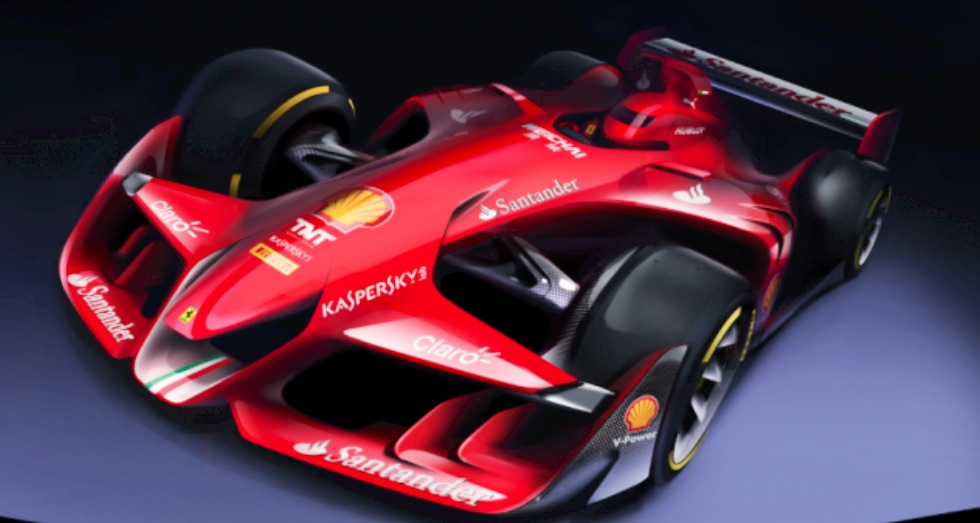
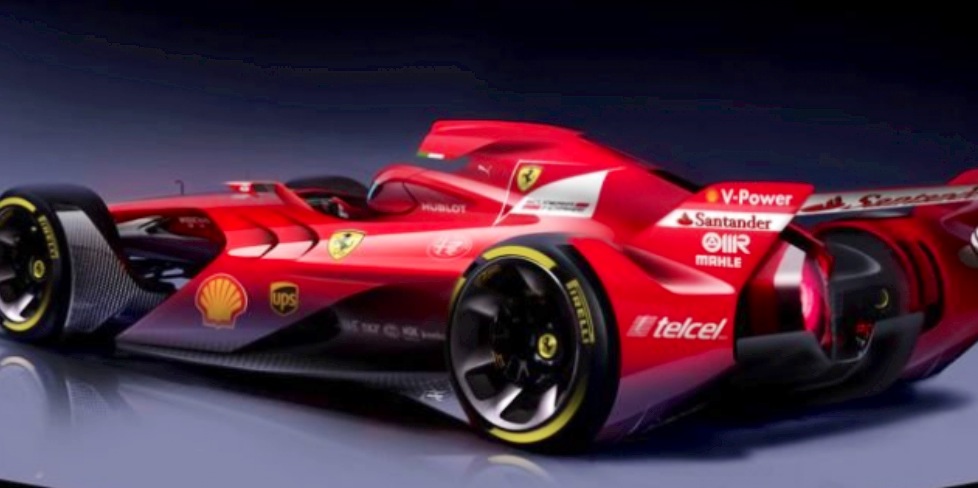
Ferrari have developed this concept as part of their contribution to the debate about how the Grand Prix car of the future could look. I’m not so sure about it, but, like a wart, it may grow on me over time…

They are seeking feedback from fans so let ’em have it!; http://formula1.ferrari.com/news/concept-f1-we-value-your-comments

ferrari 2016 concept

One of my favourite contemporary F1 writers is MotorSport’s Mark Hughes, his view on what changes are likely in the next couple of years is worth reading; http://www.motorsportmagazine.com/f1/opinion/f1s-aerodynamic-catch-22/

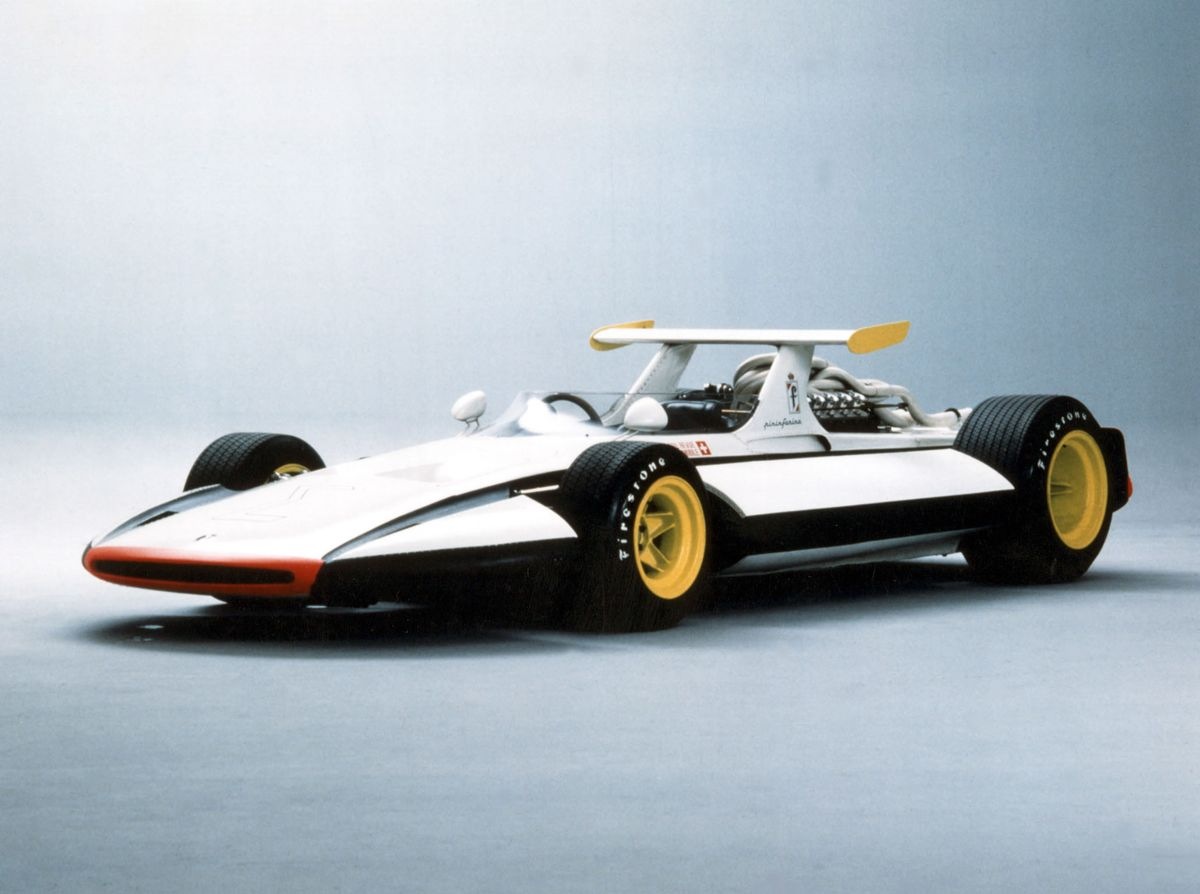
Pininfarina Sigma Ferrari Safety Concept Car 1969…

Funnily enough, when I first saw Ferrari’s concept it reminded me of the Sigma Safety Car which was equivalently way-out at the time. Mind you it was a running car not a computer image, and was very effective in showcasing technology which saved drivers lives, it wasn’t an effort to spice up the show which the car above is fundamentally all about.

sigma front

The Pininfarina Sigma used hardware from the contemporary 1967/8 Grand Prix Ferrari 312; 3-litre 48-valve 430bhp V12 and five speed gearbox, front and rear suspension, uprights, brakes wheels and tyres, 590kg (Pininfarina)

The idea for the car was inspired by Dr Michael Henderson’s 1967 book, Motor Racing in Safety. Henderson is a Brit who moved to Australia in 1968 and is still an active figure in the CAMS (Confederation of Australian Motor Sport). He Chairs CAMS’ Australian Institute of Motor Sport Safety and was recently appointed a Fellow of the FIA Institute for Motor Sport Safety. He still races, campaigning an ex-Niki Lauda March 722 Ford F2 machine not so long ago.

He raced in the UK before moving to Oz to establish the Traffic Accident Research Unit in New South Wales. He continued to race but it was his professional involvement in accident analysis and the promotion of safety features in cars on the road and track which led to his book and the development of the original six-point GQ/Willans safety harness which was soon adopted globally.

Joan Williamson wrote in Retro Speed, “His contribution to motor racing safety continued with his involvement in the Pininfarina/Ferrari Sigma Grand Prix – a race safety concept vehicle that demonstrated features now carried by all current Formula One cars.”

sigma from above

Sigma from above. The far forward rear wing doubles as roll over protection, pontoons – the enveloped front wheels – is a practice adopted by Tyrrell in 1971. Mind you that was for performance enhancement rather than safety reasons. Ferrari front suspension is inboard by top rocker operating a coil spring/damper unit, and lower wishbone (unattributed)

The Sigma – the name was chosen to reference a 1963 Pininfarina sedan safety project – was built in 1969 by Pininfarina in cooperation with Swiss magazine Revue Automobile. The editor, Robert Braunschweig took the lead role in the projects gestation and completion with Ferrari supplying its contemporary V12 FI engine, gearbox and other suspension and brake componentry, as noted above.

Sigma was designed by Paolo Martin, with Henderson flown to Europe to consult on the project. Designed as a safety prototype, it was never intended to compete but rather to showcase driver protection features.

I wrote an article about another of Paolo Martin’s designs for Pininfarina a while back, the Ferrari Dino Competitzione 206S; https://primotipo.com/2014/07/27/ferrari-dino-206-competizione-pininfarinas-1967-yellow-dino-and-ferrari-dino-206-s/

Mercedes and Fiat engineers were also involved, with ex-F1 driver/journalist Paul Frere recruited to test it. The Sigma was a great looking racer with the benefit of hindsight, but visually challenging in its day, as is Ferrari’s latest offering…

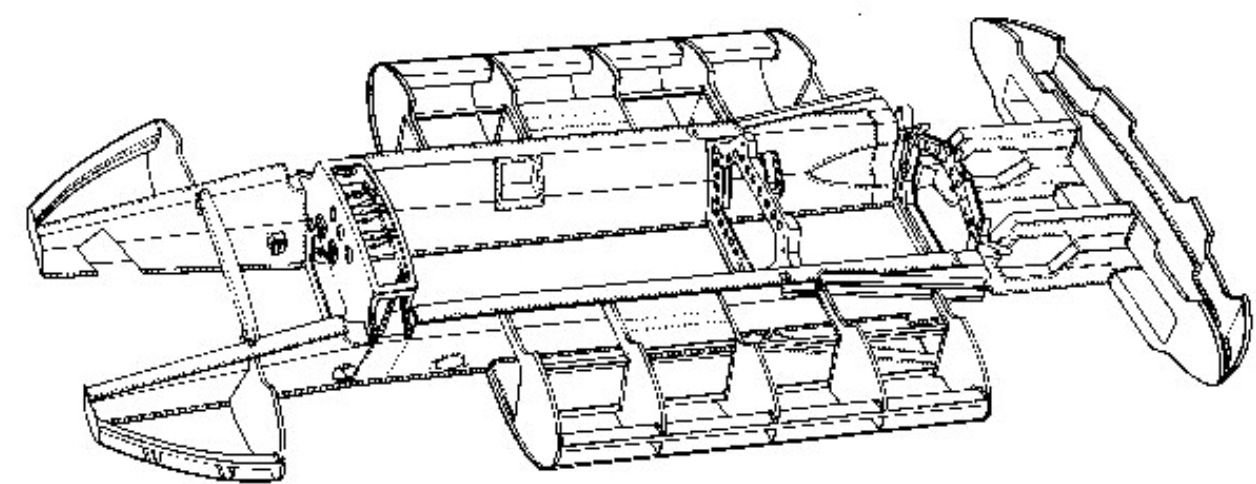
sigma tub

(Pininfarina)

Technical Specifications…

The Sigma’s unique monocoque chassis, deformable structure regulations would come in F1, and fully enclosed wheels probably will too.

The chassis has two compartments, one for the driver and one for the engine. Each had collapsible impact zones to protect the driver. Sigma’s bodywork largely enclosed the cars suspension and wheels, having pontoons each side for protection and to prevent intersecting-wheel collisions.

The rear wing was moved forward (compared with contemporary practice) and reinforced to double as a roll bar/hoop. The car had foam filled, flexible fuel tanks, an automatic built-in fire extinguisher, six-point safety harness, and even a head and neck support system thirty years before F1 adopted the HANS device.

It was a car well ahead of its time which showed the way for many modern safety features which have become standard.

Two wooden 1:5 scale models were built to refine the concept, these are owned by Automobile Revue and Ferrari. The car, which made its debut at the 1969 Geneva Motor Show, is part of Pininfarina’s collection and occasionally travels the world as a motor show starlet.

Today’s F1 is relatively safe despite the ferocity of some of the accidents of the last 25 years. In 1968 Jim Clark (F2), Mike Spence (Indy), Ludovico Scarfiotti (hillclimb), and Jo Schlesser (F1) all died in racing cars.

Sigma played its part in the long process of changes to circuit design and licensing, competition car design, materials adoption and driver apparel improvements to get to where we are today. Ferrari’s design of the future addresses style rather than substance…

sigma rear

Butt shot shows the side and rear pontoons for driver protection and to prevent intersecting wheels. Ferrari conventional rear end for the period; outboard suspension, single top link, inverted lower wishbone, twin parallel radius rods and coil spring/shocker (auta5p.eu)

sigma front 1

Etcetera…

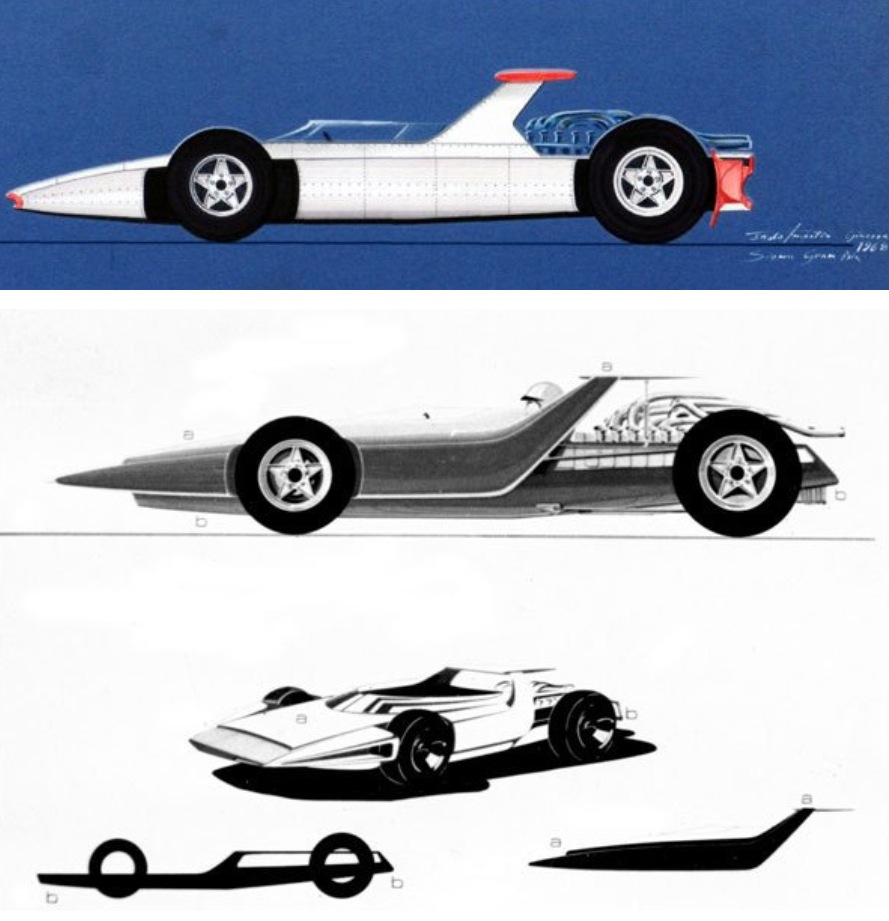
sigma concepts

Conceptual drawings on the journey to Sigma’s creation

Credits…

‘Retro Speed’ Joan Williamson, Scuderia Ferrari, auta5p.eu, Theo Page

Finito…

Graham Hill Ferguson P99

(John Ellacott)

Graham Hill working his radical four wheel drive Ferguson P99 Climax hard to stay in front of the mid-engined paradigm, Homestead Corner, Warwick Farm, Sydney…

Jack Brabham won the race from John Surtees and Bruce McLaren in Brabham BT4, LolaMk4A and Cooper  T62 respectively, all powered by Coventry Climax FPF 2.7 litre ‘Indy’ engines. Bored versions of Climax’ successful 2.5 litre F1 Championship winning motors. Hill finished 6th in his 2.5 litre FPF powered car. At the time Australian National F1 was Formula Libre, the ‘2.5 Tasman Formula’ commenced in 1964.

agp prizegivig 1963

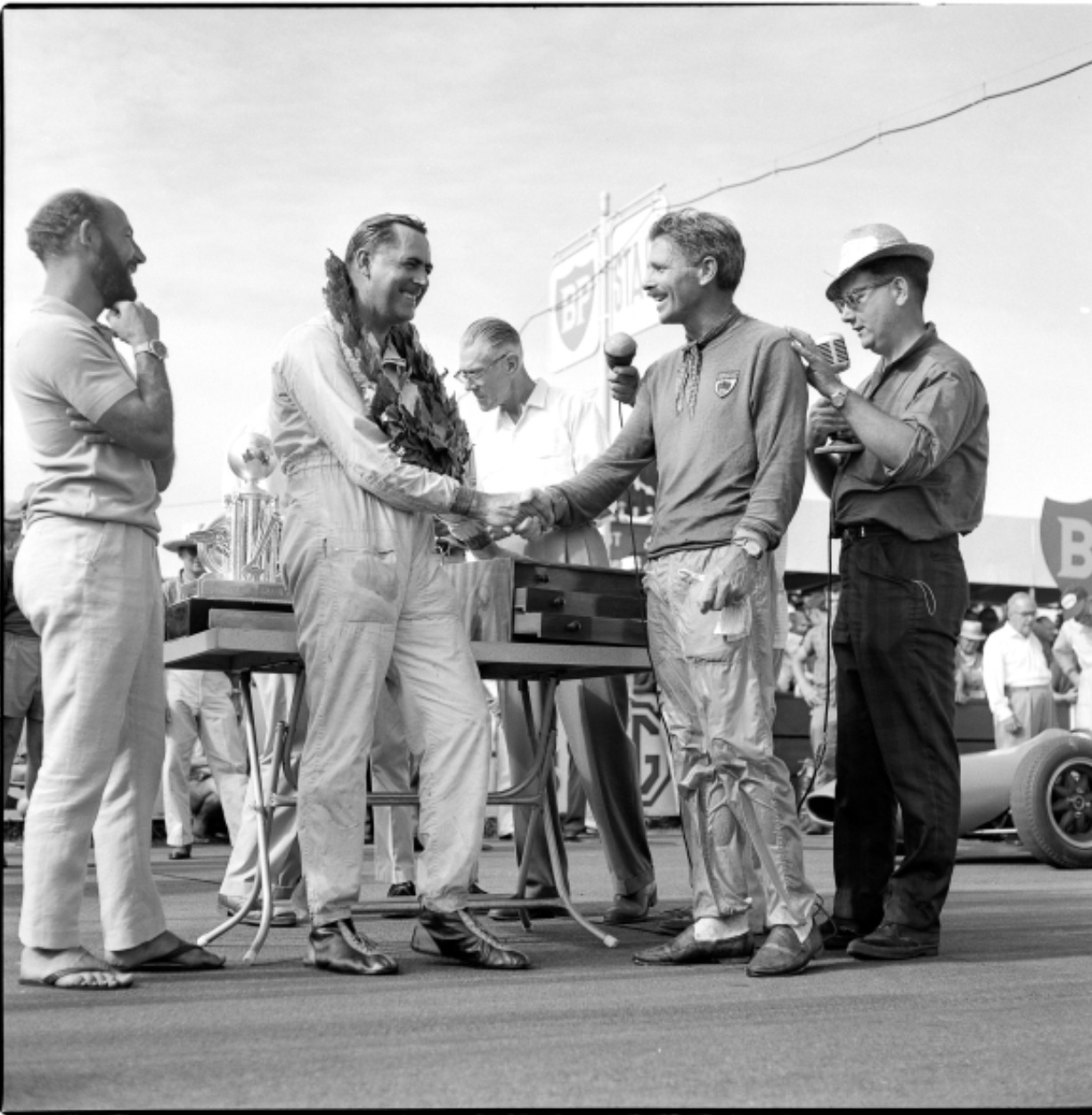
David Mckay congratulates Jack Brabham, Brabham victorious in his BT4. A very relaxed, bearded Stirling Moss wearing that great Australian footwear fashion icon, rubber ‘thongs’ looks on. Moss still recovering from his Easter Monday, 23 April 1962, near fatal and career ending Goodwood Lotus crash. Mckay a great Australian driver and ‘Scuderia Veloce’ team owner/patron. McKay finished 4th in the race also Brabham BT4 Climax mounted. (David Mist)

Hill also raced the Rob Walker entered, 2.5 litre FPF engined car at the ‘Lakeside International’, in Queensland the following weekend finishing second to Surtees on this very fast track, not necessarily the sort of circuit on which one might expect the car to shine. Hill was victorious in a wet preliminary race on the Saturday, the car excelling in the wet conditions.

hill lakeside p99 in the wet

Graham Hill in the wet Lakeside preliminary event he won in P99. Lakeside. (John Stanley)

P99’s ‘Summer Sunshine Tour’ started in New Zealand in January the car being campaigned by ‘newly minted’ World Champion Graham Hill, victorious in his BRM P57 in 1962, and Innes Ireland.

I posted this short article a while back about Hills’ 1962 Championship winning car; https://primotipo.com/2014/10/12/graham-hill-brm-p57-german-gp-1962/

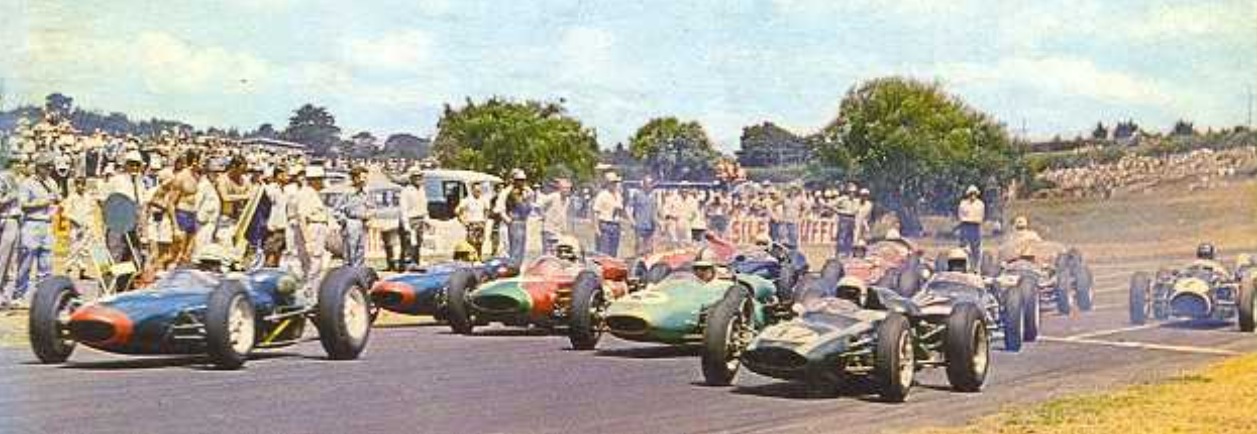
Hill drove in the NZGP, held at the brand new Pukekohe circuit on January 5, DNF with gearbox dramas on the second last lap, Surtees won in his Lola.

nz gp 1963

Start of the ’63 NZGP at Pukekohe. Surtees left and McLaren right LolaMk4a and Cooper T62 get the jump at the start. Hill is on the far right in P99. Beside Surtees and back is his teammate Tony Maggs LolaMk4a, the green nose of Amons’ Cooper T53 and Brabhams turquoise Brabham BT4…all Coventry Climax powered. (sergent.com)

Hill then returned to the UK, Ireland handling the car at Levin, Wigram and Teretonga on the 12th, 19th and 26th of January respectively. Innes was third at Wigram, victory going to Brabhams’ BT4, he retired with overheating at Wigram, the race won by Bruce McLarens’ Cooper T62 and was third at Teretonga, McLaren again victorious.

The car was then shipped to Sydney for the Warwick Farm AGP and finally north to Brisbane by road before returning to the UK.

lakeside on ute p99

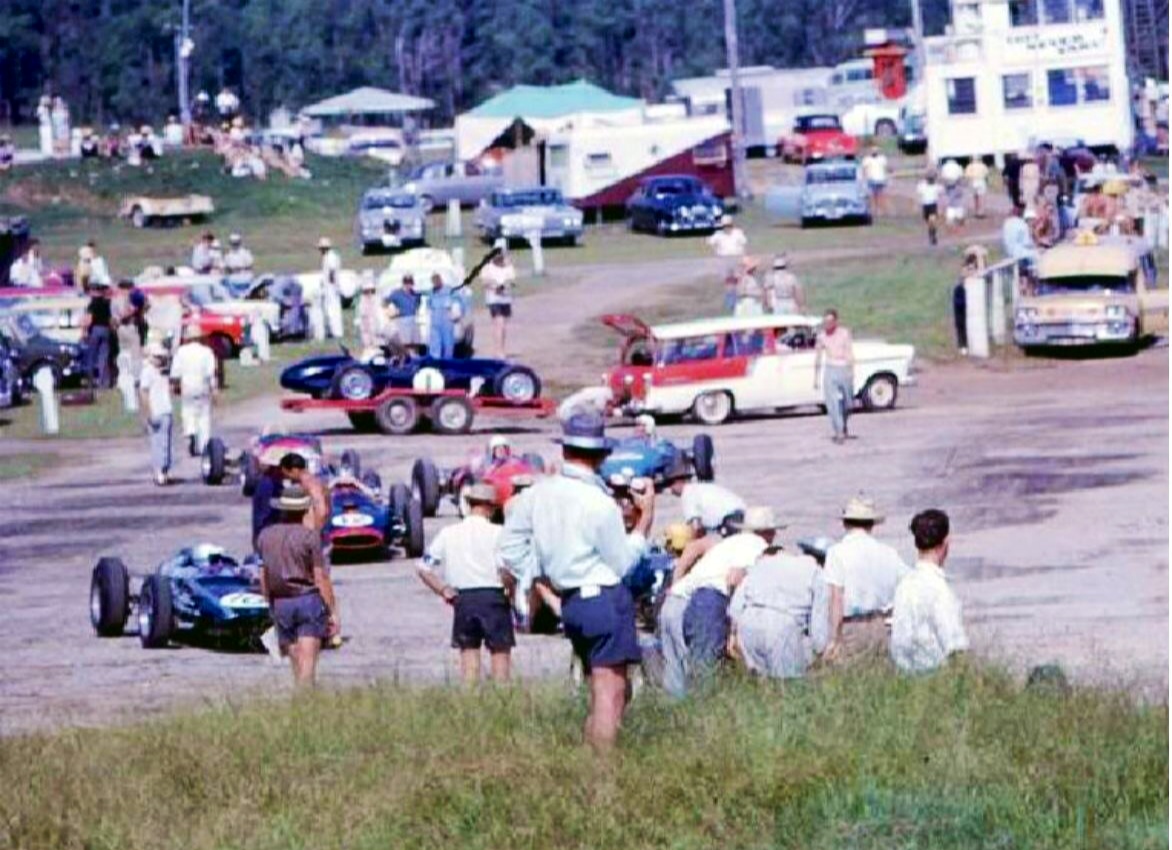
Lakeside Queensland paddock scene 1963. P99 middle of shot lashed onto an open trailer behind a Holden FC ‘Station Wagon’, as we call an ‘Estate’ in Oz. The car travelled the 950 Km from Warwick Farm on Sydneys’ outskirts to Lakeside, north of Brisbane. McLarens Cooper T62 is at the front of this group, and the red nose car is Maggs’ Lola Mk4a. (Ray Bell)


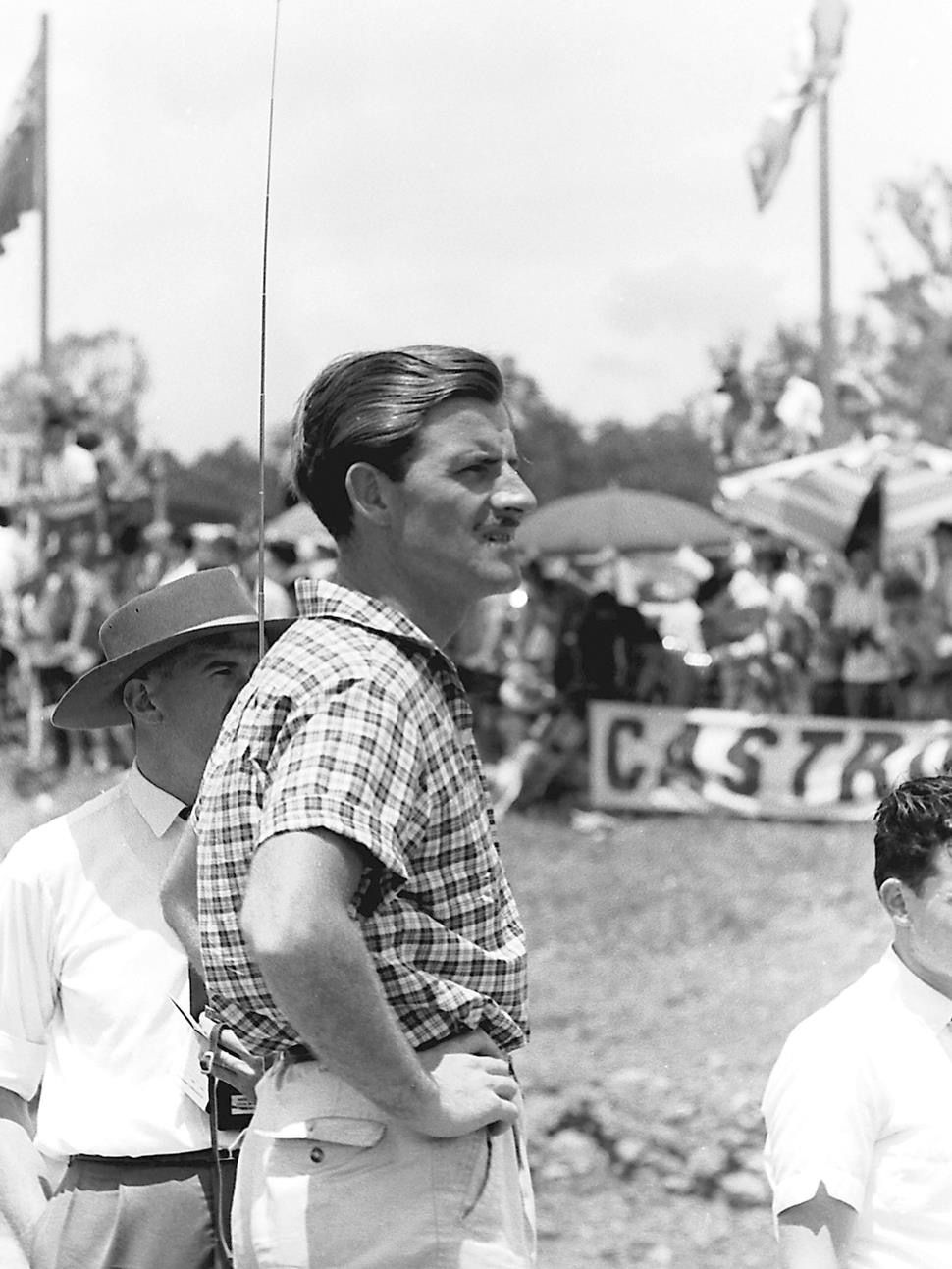
Graham Hill looking pretty relaxed at Lakeside in 1963 (J Psaros)

Ferguson Research…

The Ferguson Family Museum summarises the P99 as follows…’The creation of the Ferguson Formula four wheel drive system began shortly after World War II.

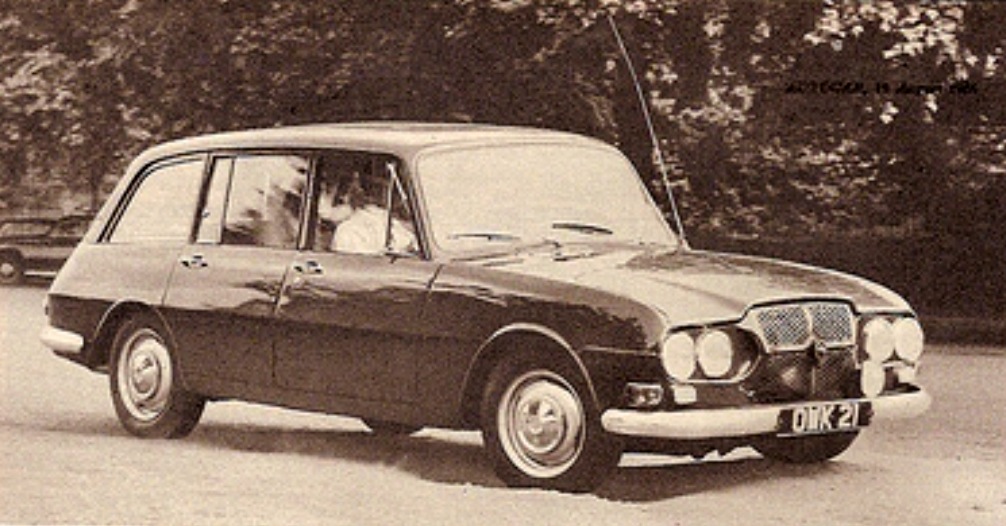
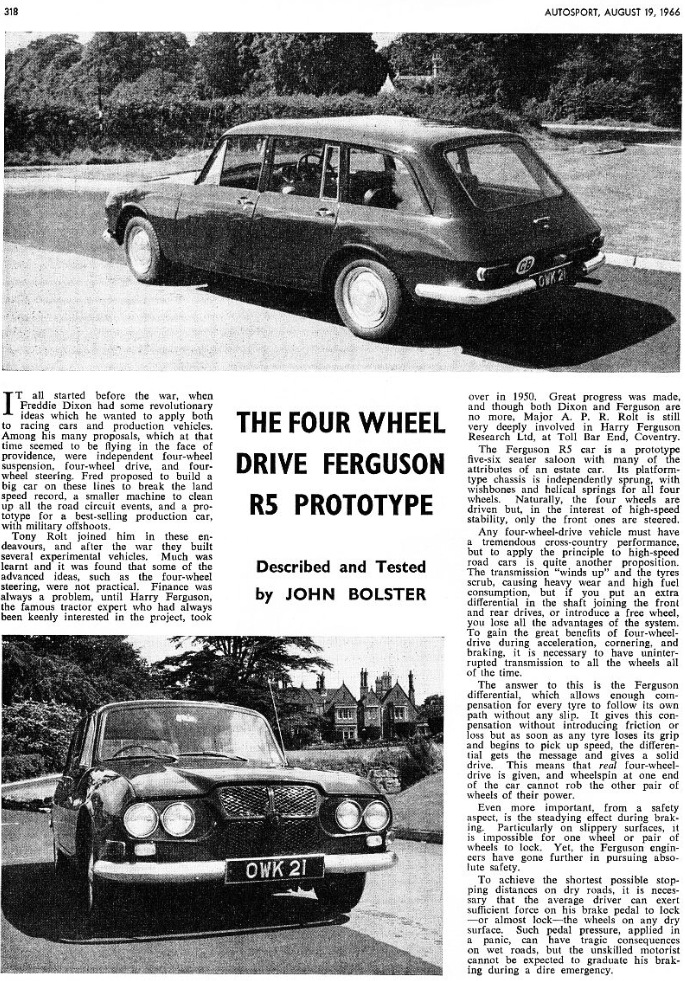
Harry Ferguson had always loved the world of motorsport and had a vision of creating a four wheel drive system with the purpose of improving road safety. The Ferguson car, ‘the R5’, was 40 years ahead of its time. It featured four wheel drive, anti-lock braking, electric windows, disc brakes and a hatchback design, it was the forerunner of the modern car.

ferguson r5

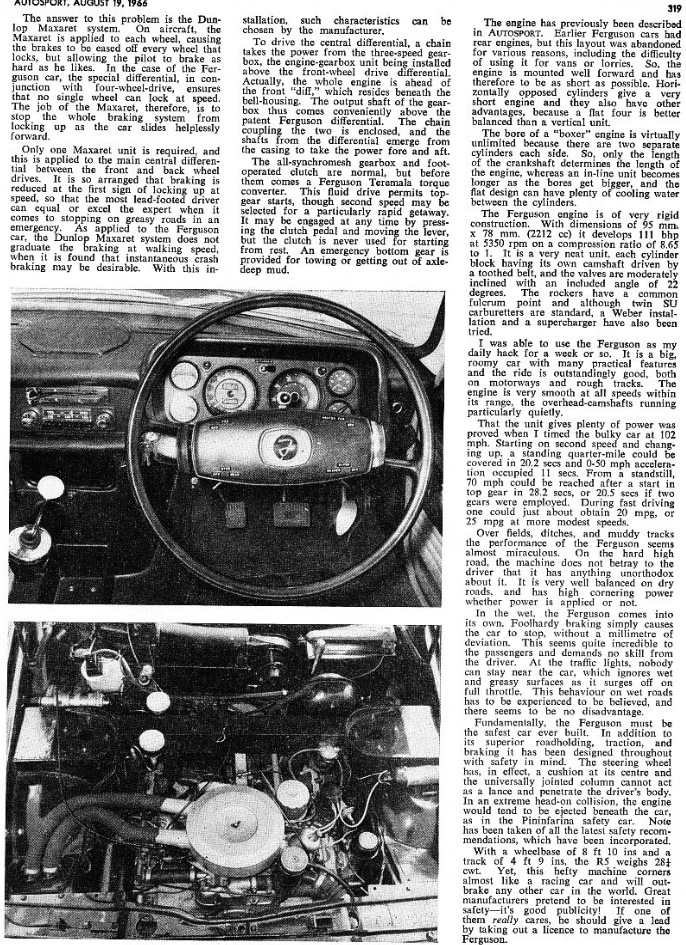
Not the prettiest of things but 4WD, powered by belt driven SOHC 2.2 litre engine, 4 wheel discs, ABS…all at the time of the Cortina Mk1. This car has escaped me, i have included John Bolsters’ Autosport road test of the prototype at the bottom of this post. (Autocar)

Harry Ferguson decided the best way to prove the importance of four wheel drive and anti-skid braking was to demonstrate it on a successful Formula 1 car.

In 1950 designer, Claude Hill, Brooklands Riley racer, Fred Dixon and Tony Rolt, a POW escapee and 24 hour Le Mans winner, teamed up with Harry Ferguson to start development on what was later to become the world’s only Formula 1 winning four wheel drive car – Project 99.

Later the Ferguson Formula four wheel drive system was widely adopted by rally cars and the motor industry worldwide in the form of the viscous coupling. Although designed as a racing car P99 was also a research vehicle intended to show the advantages and reliability of the four wheel drive system. What better way to generate public interest than to successfully race a car using the Ferguson Formula four wheel drive’.

p 99 fettled lakeside

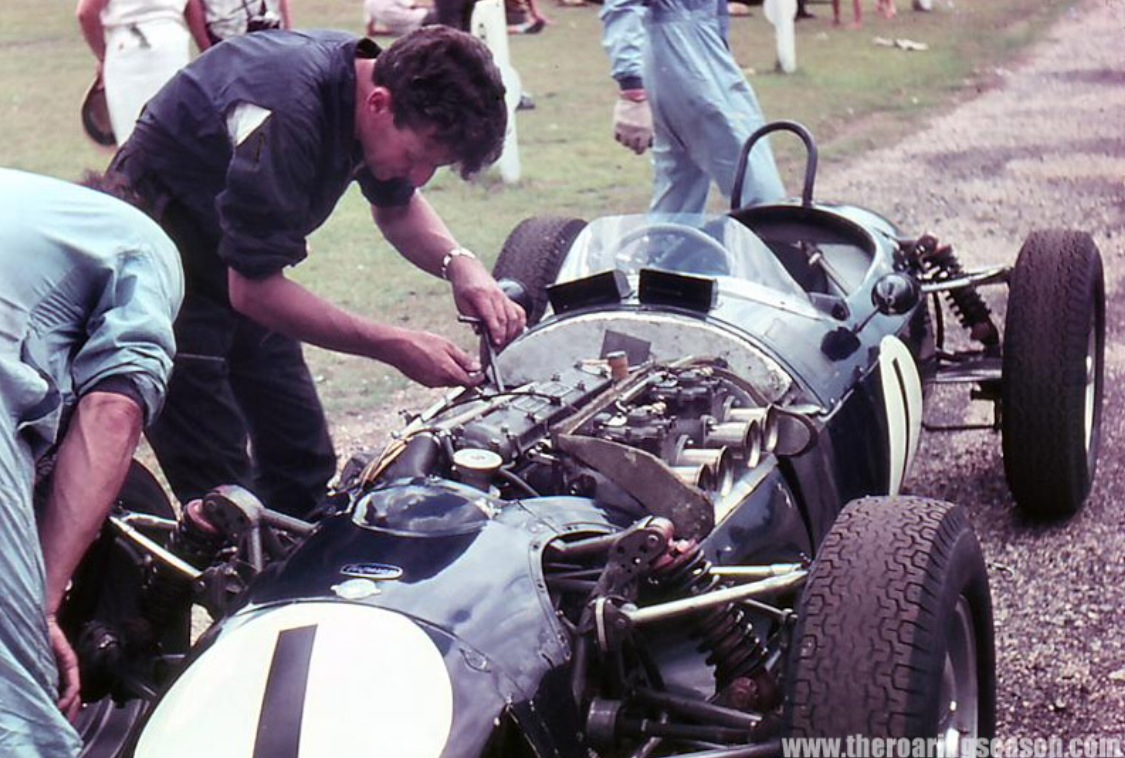
P99 being fettled by Rob Walkers team at Lakeside, February 1963. Thats’ G Hills legs in the driving suit at rear of the car. Lovely alloy body, Climax 2.5 FPF 4 pot engine, spaceframe chassis and upper and lower wishbone/ coil spring damper units, alloy Dunlop wheels,vestigial roll over bar all clear in this shot. (Peter Mellor)

P99 Design and Specifications…

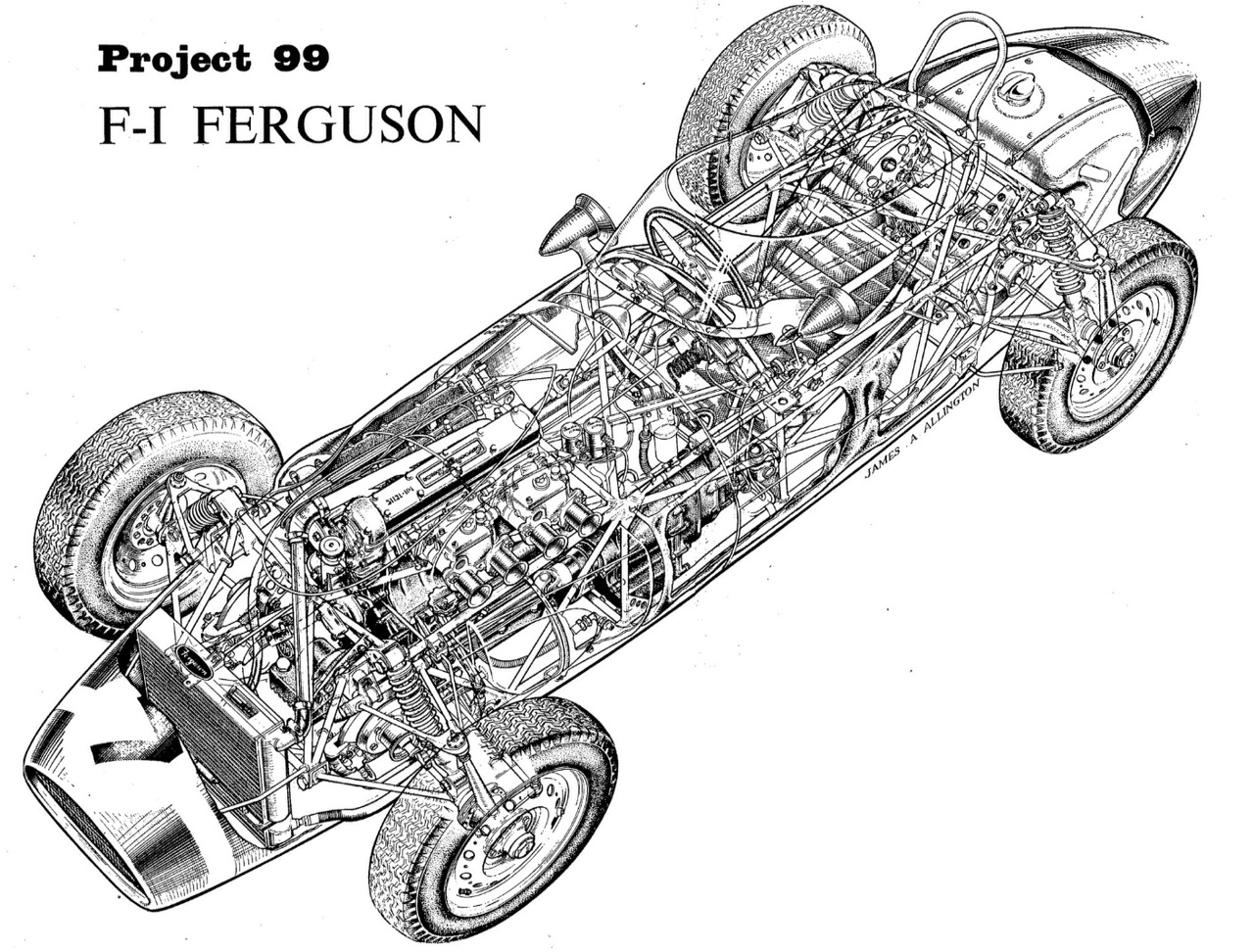
p 99 cutawy

Spaceframe chassis, 2.5 litre Coventry Climax FPF 4 cylinder engine circa 235bhp. Suspension front and rear by upper and lower wishbones and coil spring/damper units. Rack and pinion steering. Dunlop disc brakes and alloy wheels. Ferguson 5 speed box and 4WD transfer case…(James Allington)

Ferguson hired Claude Hill from Aston Martin to design the car. He used a then ‘state of the art’ space-frame chassis, front and rear suspension comprising upper and lower wishbones and coil spring/Armstrong damper units and adjustable sway bars. Brakes were Dunlop anti-lock, which was tested but unraced.

Lightweight Dunlop alloy wheels were used, steering is rack and pinion.

The clever bit was of course the 4WD system. It comprised a transfer box bolted directly to the 5 speed gearbox. The Climax engine was installed at an angle to allow space for the driveshaft to the front differential. The rear driveshaft was installed on the left side of the chassis, the driving position slightly off centre to the right. Similar to the weight balance, the torque was evenly divided between the front and rear wheels.

P99 was planned for the 2.5-litre F1 utilising the championship winning Coventry Climax FPF 235bhp, DOHC, four-cylinder engine. The rules changed and Formula 1 was restricted to 1.5-litres from 1961, which meant the extra weight of the four-wheel-drive system was a handicap. The Intercontinental series was established for the old 2.5-litre engined F1’s, to be raced in 1962, the Ferguson was therefore built to accommodate both the Climax 1.5 (151bhp) and 2.5 litre (235bhp) FPF motors.

The whole project took less than a year.

There were to be no concessions in relation to tolerance. Perfection would only just be good enough. Dixon was right when he calculated that differentials, bearings, gears and other drivetrain parts could be lighter if the energy was dispersed to four wheels rather than two.

Ferguson’s central differential system, which would be the key to Peugeot’s and later Audi’s rally success in the 1980s, could balance out the delivery of that power to the wheels.

Ferguson were keen to try the Dunlop Maxaret anti-lock brake system, the whole assembly would eventually find its way into the automotive mainstream some 30 years later. Sadly, Harry Ferguson died before his dream took to the track and it was Rolt who eventually became the projects’ driving force.

P99 rear shot

P99 from aft. Rear suspension detail; upper and lower wishbone and adjustable Armstrong shock. You can just see the driveshaft below the upright. Beautiful ally bodywork of pretty car. Driving position offset to the right, gearchange for 5 speed box to drivers left, right side more conventional in a single seater. (Unattributed)

By 1961 Mid-Engined cars were de-rigeur the Front-Engine GP car obsolete, so the Ferguson P99 was a complete dark horse…

moss aintree

Stirling Moss, Aintree British GP 1961. On a charge and soon to be disqualified. The photograph below is of Jack Fairman earlier in the race before he pitted to allow Moss to take over the car (Unattributed)


(Simon Lewis Transport Books)

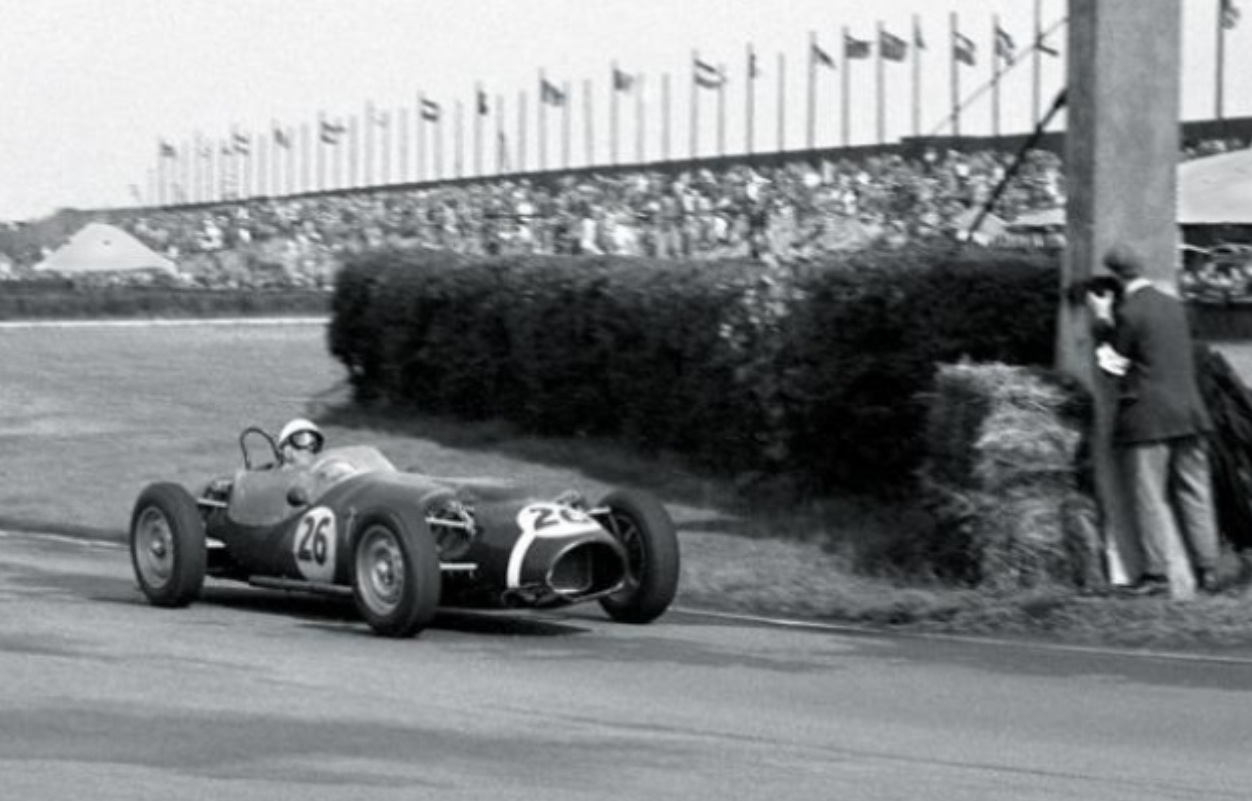
Launched at the 1961 British Empire Trophy at Silverstone, Jack Fairman drove the car which was entered by Rob Walker. The P99 had mechanical problems and didn’t finish.

Its next outing was at Aintree in the British Grand Prix. Rob Walker entered a Lotus 18 for Moss and the P99 for Jack Fairman, when the Lotus 18/21 brake pipe broke Moss took over the P99. The P99 was under investigation by the Stewards when Moss took it over because Fairman had a push start from the pits, which was not allowed by the rules- as a consequence the car was black-flagged on lap 57, his progress to that point had been swift…

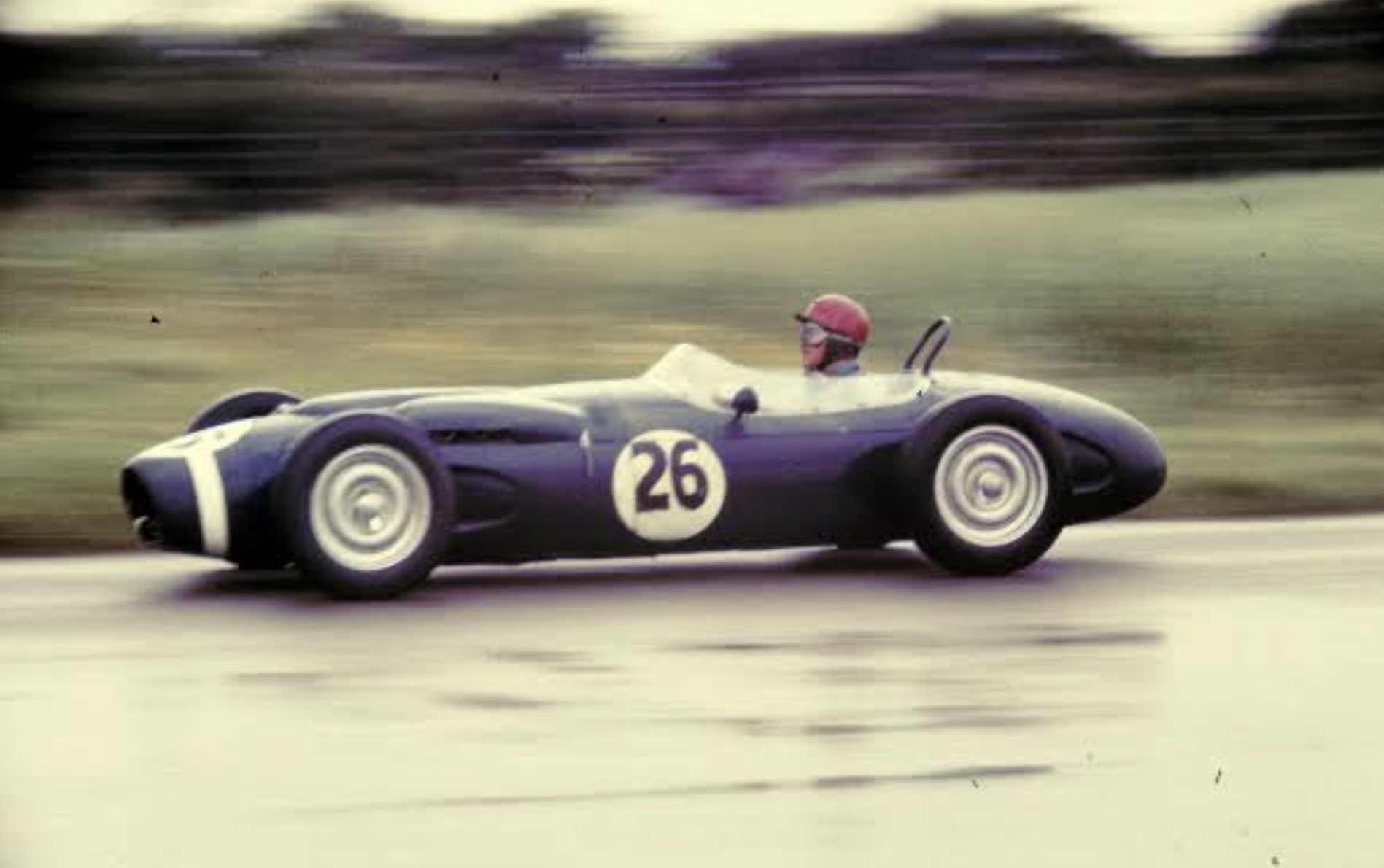
For the September 1961 Oulton Park Gold Cup, Moss returned in the P99 and to his delight, it was a classically British summer’s day – 57 degrees, steady drizzle and a wet track! Moss won the race by 46 seconds from Jack Brabham’s Cooper T51 Climax, the only F1 race ever won by a four-wheel-drive car.

moss oulton gold cup

Moss wins the 1961 Oulton Park “Gold Cup’ in P99. The only GP win for a 4WD drive car, albeit Non-Championship F1 race. Greasy conditions tailor made for the fabulous, innovative car. (Unattributed)

The CSI then banned four-wheel-drive from F1.

Moss had the option of using the Dunlop Maxaret anti-lock brakes but preferred to turn them off and use his own judgment. They would reappear in 1967 on the Jensen FF- the Chrysler-power coupé that was a four-wheel-drive version of the Interceptor utilising both the Ferguson four-wheel-drive and anti-lock brakes.

The Ferguson P99 then raced in New Zealand and Australia in 1963 as outlined above fitted with a 2.5-litre engine in our 1963 F Libre International Series. It would have been interesting to see how the car would have performed with a 2.7 Litre FPF equivalent in capacity to the engines of the other front runners that summer.

hill lakeside p99 loading up

World Champ Graham Hill about to board P99. Lakeside, Queensland again. He was keen on the car, with his support BRM developed a 4WD variant of their P261/57 GP car, the BRM P67 1.5 V8 in 1964, using Ferguson technology, well ahead of the ‘1969 4WD pack’, comprising Lotus, Matra, McLaren and Cosworth. BRM P67 qualified in Richard Attwoods’ hands, second last on the British 1964 GP at Brands Hatch grid but was withdrawn from the race, circa 7 seconds off the pace. (Peter Mellor)

P99 returned to England and was lent to hillclimb racer Peter Westbury, who won the 1964 British championship with it, it also ran competitively in 1965 and 1966 and was retired in 1968.

p westbury p99

Peter Westbury, P99. Harewood Hillclimb 1964, he won the British Hillclimb Championship in the car that year. (Unattributed)

P99 also played a key role in the resurgence of 4WD at Indianapolis.

There had been a lot of activity both immediately pre and post war with Harry Miller’s 4WD specials. STP’s Andy Granatelli, on one of his trips to Europe was regaled by the recently retired Stirling Moss, his career ending accident was at Goodwood in 1962, about the dominance of his damp Oulton Park 1961 victory in P99.

Granatelli then approached Tony Rolt at Ferguson to try P99 at Indy, Jack Fairman shortly thereafter put in some impressive 140mph laps in the 2.5 litre car around the famous ‘Brickyard’.

Andy was convinced and ordered a car from Ferguson powered by the Novi V8, the 4WD setup the same FF system as used on P99 but with the split being variable from 70/30 to 60/40 rear/front instead of the P99’s fixed 50/50 split.

Bobby Unser qualified the car sixth at Indy 1964.

This is a tangent too far for this article (see ‘Etcetera below for a cutaway drawing and further details) but for those with an interest in 4WD in motor racing click on this link to a great forix.autosport article on the subject; http://8w.forix.com/4wd.html

novi studebaker 1964

Ferguson Novi ‘STP Studebaker’ with Bobby Unser at the wheel. Indy 1964. Q6, DNF after hitting the wall seeking to avoid the fatal McDonald/Sachs accident. (Unattributed)

Four-wheel drive made another appearance in Formula 1 in 1969…

As teams struggled for more traction- the Ford Cosworth engine was developing well in excess of 400bhp at this stage, putting the power down was key to improved performance.

At the time 4WD was being used successfully at Indianapolis, it was therefore a natural direction for the F1 teams to explore, particularly Lotus who had been racing at Indy since 1962 and using 4WD competitively, putting accidents to one side, in their 1968 and 1969 contenders, the Lotus 56 Pratt & Whitney gas turbine powered car, and Lotus 64 Ford, powered by a Turbo Ford engine.

Matra, Lotus and McLaren all tried the Ferguson system and Cosworth devised their own 4WD car. The introduction of wings, which could achieve the same traction outcomes without the weight penalty, and advances in race tyre technology and widths provided simpler cost-effective solutions than persevering with 4WD.

Overall, only eight four-wheel-drive F1 cars were ever built.

Robin Herd’s Cosworth 1968 4WD design (Bennet)

In 2004  following a period of 35-plus years in the Donington Collection…

The ‘one of a kind’- only 1 chassis was ever built Ferguson P99 was retrieved by the Ferguson family to the Ferguson Family Museum on the Isle of Wight and overhauled.

The car was stripped and was in remarkably good order, it was re-assembled using all of the original parts, including the extremely rare twin-choke Weber 58 DCO carburettors and re-fitted with the totally original bodywork which still wears original Rob Walker team paint and livery.

Sir Stirling Moss drove it at the 2005 Goodwood Revival and at the Monaco Historic Grand Prix in 2008. In 2006 Moss handed it over to Barry “Whizzo” Williams at Goodwood, who started 18th and had worked his way up to third before his brakes faded, he finished in that position.

P99 still appears regularly in suitable events, its historic significance enormous.

moss p 99 in recent times

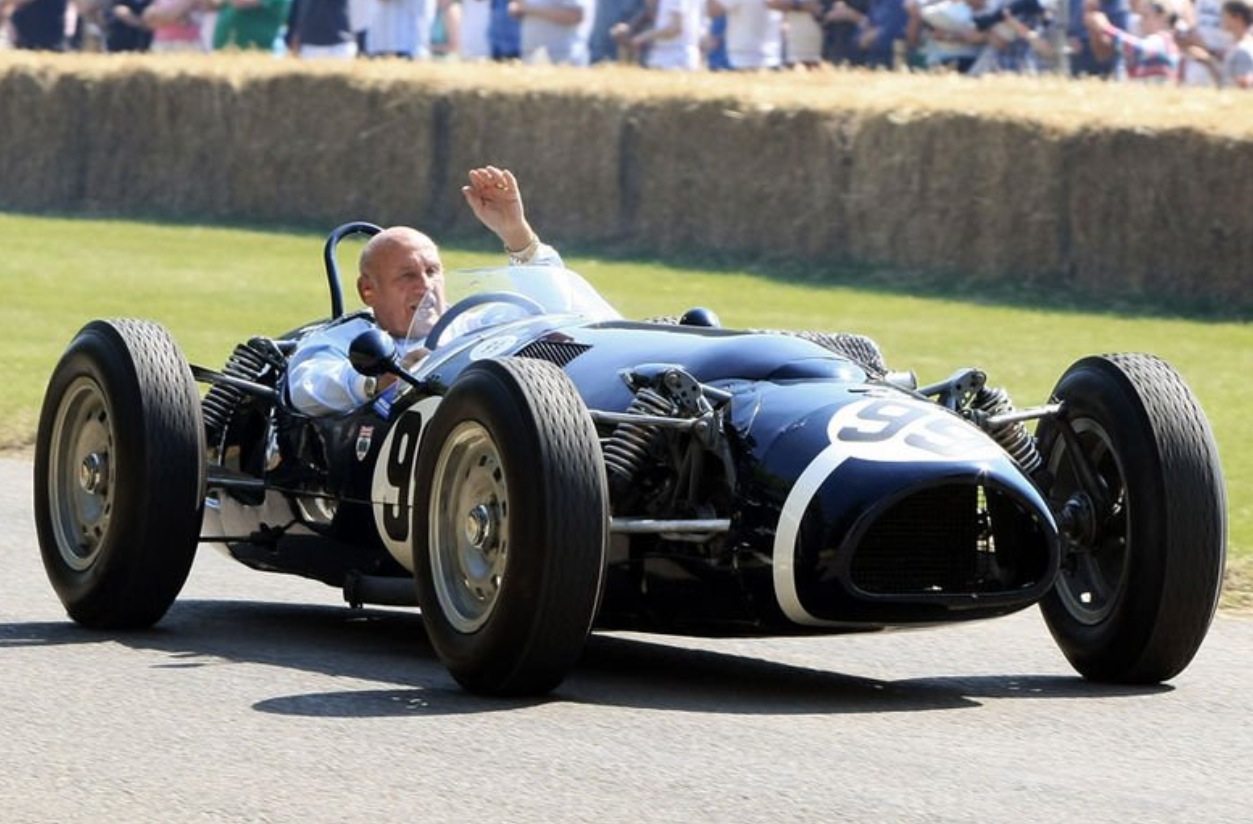
Stirling Moss in P99 at the Goodwood Festival of Speed. (Unattributed)

Etcetera…

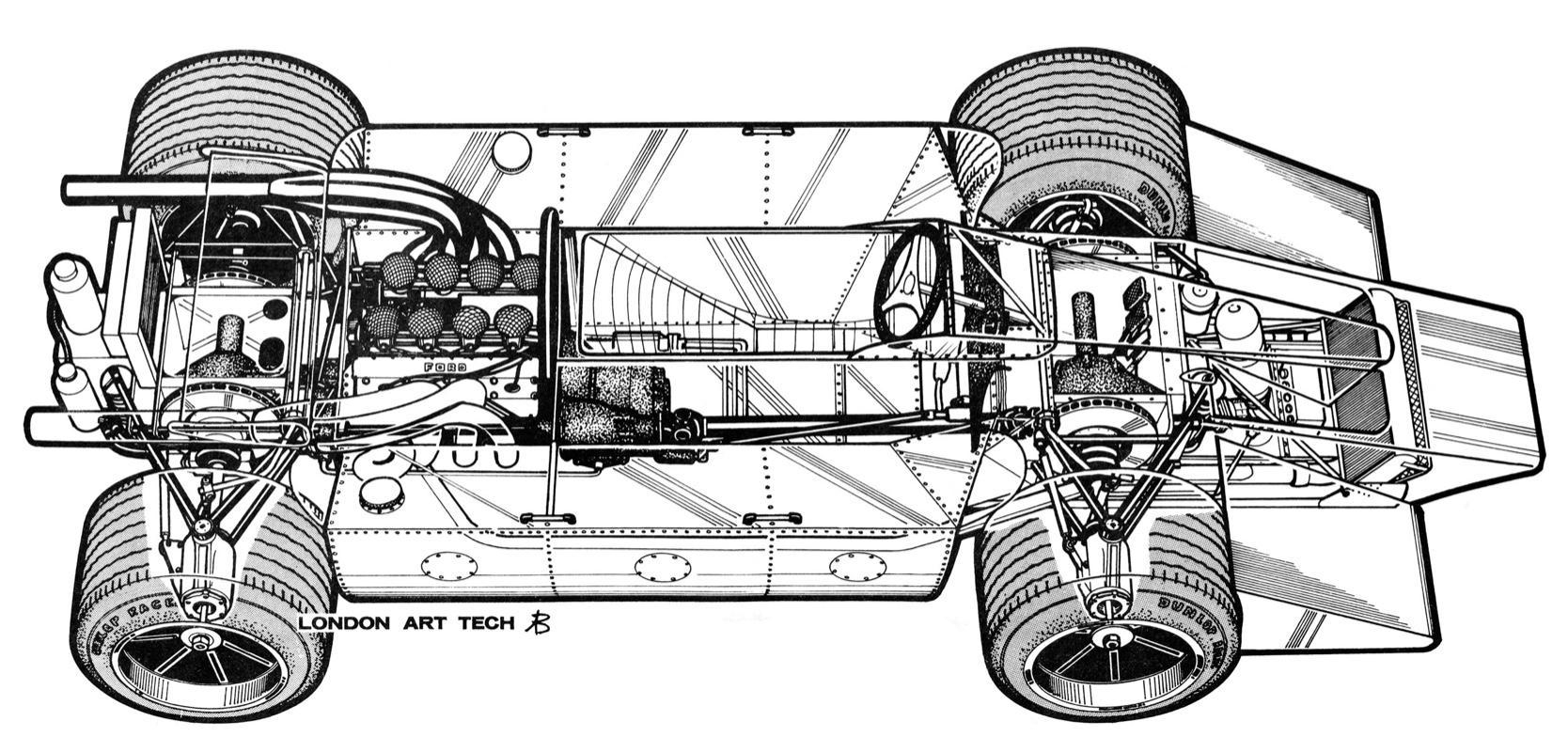
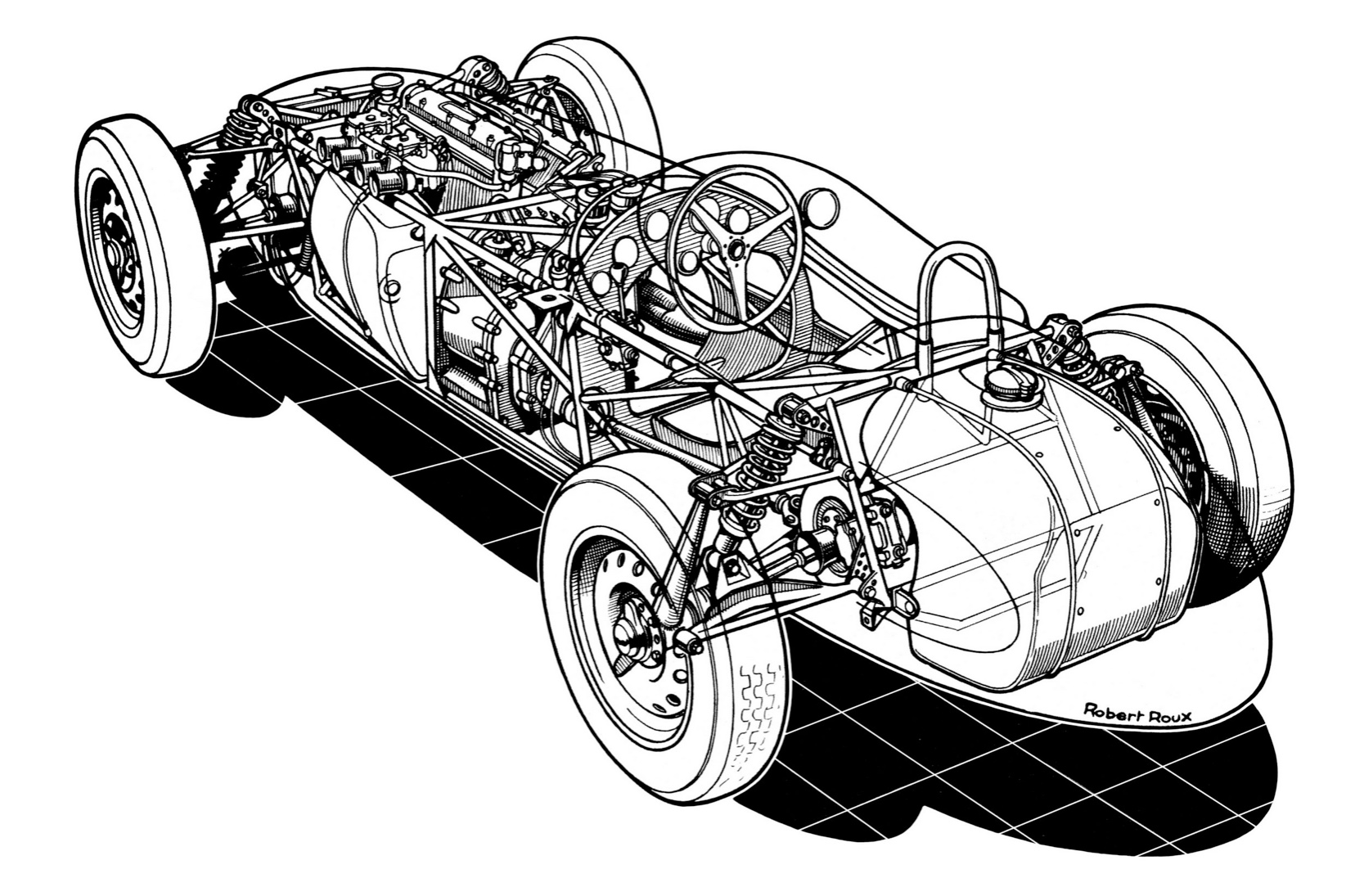
P99

P99 (R Roux)


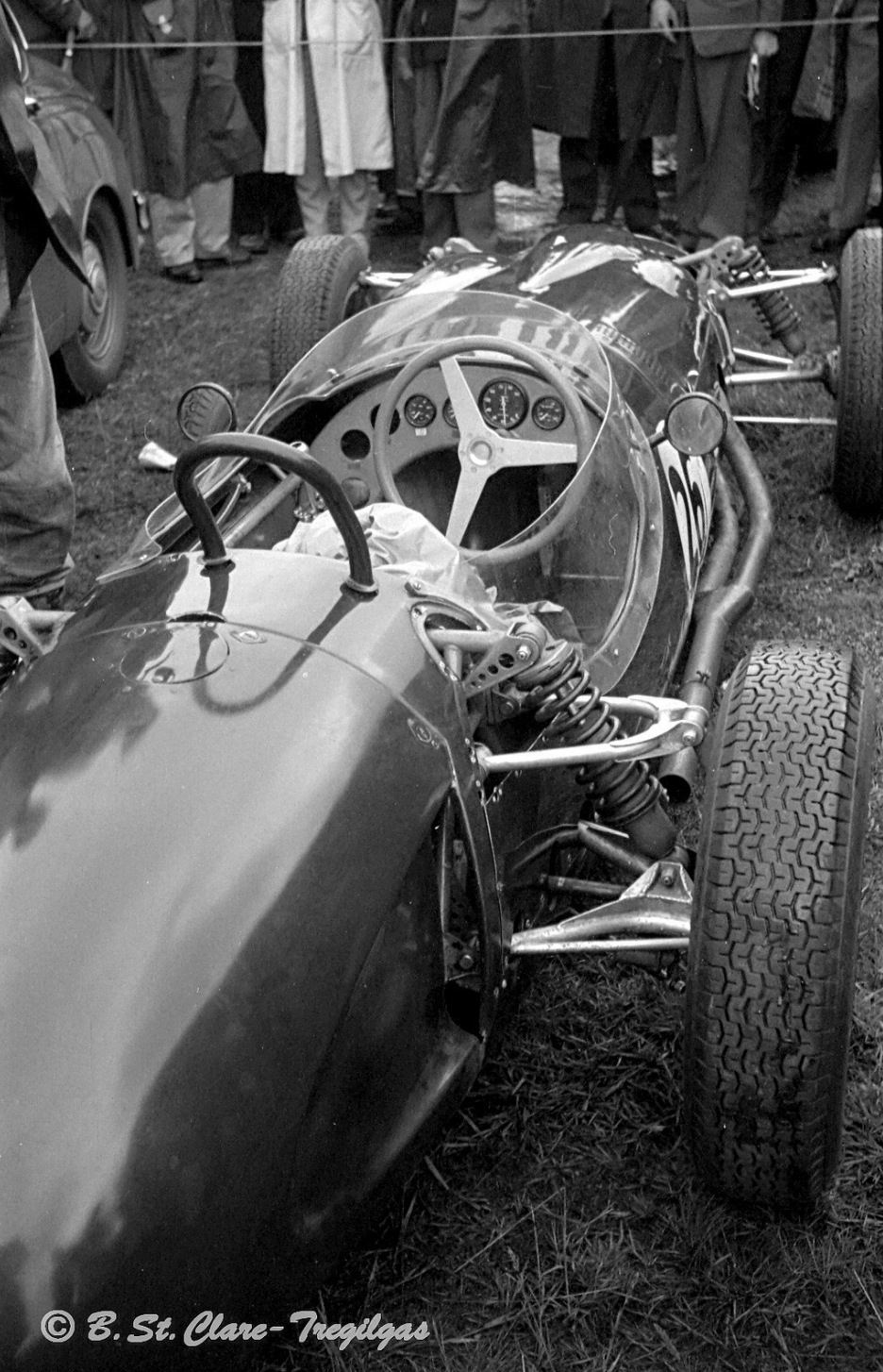
p99 british gp

Cockpit shot British GP, Aintree 1961. Driving position offset to the right, gearchange for 5 speed box to the left. 1.5 litre FPF powered Climax engine in the last year of the 1.5 Litre Formula. (B St Clare-Tregilgas)


hill wf push start p99

Push start for Hill from the Warwick Farm pit counter, P99. AGP meeting 1963. (autopics)


hill wf butt shot

Hill at Warwick Farm trailing smoke from the rear. Probably practice as the car finished the race. (Adrian Schagen)


hill p99 wf mist

Evocative David Mist shot of Hill during the 1963 AGP Warwick Farm. P99. (David Mist)


p99 wf frontal rea

Hill again at Warwick Farm during the ’63 AGP, this shot showing the not inconsiderable frontal area of P99. Weight and width of car a function of ‘4WD hardware’. (autopics)


Ferguson Novi

ferguson novi page

What a wild car this is! Conceptually similar to the P99, the chassis was a spaceframe with a monocoque centre section. As you can see the suspension is inboard with rockers actuating the spring/dampers, P99 is outboard. Contrary to common Indy practice then the suspension was not offest, but the engine and transmission were, a simpler solution. Novi used Dunlop 7X15 inch tyres fitted to alloy wheels and disc brakes using alloy calipers.

The Novi engine was designed pre-War by Bud Wingfield and Leo Goossen and built by Fred Offenhauser. It was a 90 degree, DOHC V8, 2741cc in capacity. Bendix fuel injected and using a Paxton 2 stage centrifugal blower power was circa 830bhp @ 8200rpm.

The engine never won Indy but the engine and its unique sound remain iconic to this day.

R5 Prototype

fergy road car 1

Ferguson R5 road car prototype. Autosport Road Test P1.


fergy road car

R5 Road Test P2.

Credits…

John Ellacott, Bruce Wells, B St Clare-Tregilgas, James Allington, Adrian Schagen, John Stanley, autopics.com, David Mist, Peter Mellor, theroaringseason.com, Theo Page, Robert Roux, Autocar, Autosport, Jock Psaros, Simon Lewis Transport Books

Finito…


Le Mans start 1969

#14 Stommelen/Ahrens Porsche 917LH, #20 Siffert/Redman Porsche 908/2, #22 Lins/Kauhsen Porsche 908LH, #23 Schutz/Mitter Porsche 908LH, #2 Bonnier/Gregory LolaT70 Mk3b Chev, #7Hobbs/Hailwood Ford GT40…and the rest (unattributed)

Spectacular start of the tragic Le Mans 24 Hour Race, June 1969, the last with the traditonal driver sprint to the cars…

The Porsche 917 was a tricky, somewhat under-developed beast in its original specification even for experienced professionals. British privateer John Woolfe lost control of his on the very first lap of the race perishing in the subsequent accident.

Despite that, a 917 took pole and led the race for twenty hours, maybe it has been somewhat maligned in its formative year?

917 homologation CSI

Groups 4, 6 and the regulator…

By 1967 the Commission Sportive Internationale (CSI) were concerned about the growing speeds of the unlimited ‘pushrod production’ 7 litre Ford GT Mk4 and Chaparral 2F Chev and the 4 litre ‘racing engine’ Ferrari P4 and therefore banned them- it did so by increasing the required number of cars to be built and lowered the engine capacity limits for homologation or admission of cars into both classes.

For 1969 there were no minimum production numbers to qualify in Group 6 ‘3 litre Prototypes’ and a minimum of twenty-five cars to be built for homologation into Group 4 ‘5 litre Sports Cars’.

Effectively the changes in 1968 allowed the existing Mark 1 Ford GT40 and Lola T70 Mk3B cars to remain eligible to keep grid sizes up in Group 4, but with the hope or intent that 3 litre prototypes would be built in large numbers to bolster Group 6, Formula 1 having the same capacity limit at the time.

Porsche would not have had the 908 ready to race in 1968 had they not anticipated the rule changes for 1968 which were announced late by the CSI- in October 1967. Fifty cars were required to be built to qualify for Group 4 in 1968, but that was reduced, as stated above, to twenty-five for 1969, which rather left the door ajar for Porsche…

The FIA, as the governing body then was, had another crack at rewriting the rules to encourage 3 litre prototypes with effect 1 January 1972, given the speed of the 5 litre or thereabouts Porsche 917 and 5 litre Ferrari 512S in 1970 and 1971 but that is another story- lets not get ahead of ourselves.

Porsche had come close to Le Mans victory with their 3 litre 908LH ‘class cars’ in 1968 and wanted to go one better, to win outright, to do so they audaciously and at great cost built twenty-five 4.5 litre air-cooled Flat 12 engined cars- the 917 in 1969.

With the gauntlet thrown down, Enzo Ferrari, his coffers full of Fiat money having sold his road car division to them in 1969, built twenty-five 5 litre V12 512S’ to go head to head with Porsche in perhaps the two best years of sports car racing ever in 1970 and 1971.

917 at Geneva Show

917 homologation

(Porsche AG)

On 12 March 1969 a 917 was displayed at the Geneva Motor show with a price tag of DM140,000 a fraction of the cars development costs- a couple of weeks later in late March Rolf Stommelen ran a 917 at the Le Mans test weekend, its quickest time was three seconds a lap quicker than the Group 6 Matra 630/650 V12 of Johnny Servoz-Gavin, but its seeming dominance was not assured as the thing wandered all over the road, somewhat alarming at over 200mph…

The cars above were displayed for inspection at the factory before CSI representatives on 22 April, Ferdinand Piech cheekily offered them the opportunity to drive any of the machines to prove they were complete and running, said offer was declined!

Twenty-five Porsche 917’s lined up at Zuffenhausen awaiting the CSI chassis count for homologation into Group 4, 22 April 1969. Imagine what a chill that image must have sent down the spine of Enzo Ferrari!

Lets have a look at the design, development and competition record of the 917 with a focus on 1969, the 908/02 also gets rather a good look-in given its dominance of the year with twelve months of intense competition under its belt.

Design…

917 brochure

Sales brochure for the 917, a snip at DM140,000 in 1969

Engineer Ferry Piech said that Porsche would not have built the 3 litre 908 had they known the CSI’s intent in relation to the 5 litre group.

At the time they built the 908- a Group 6 car, the minimum production number for homologation into Group 5 was fifty cars not twenty-five, so he can be somewhat forgiven for not being able to read the minds of the rule-makers, then as now unpredictable. The regime of rules was not about encouraging 5 litre cars with ‘racing’ as against ‘production’ based engines.

So Porsche surprised everyone- until then they had built class contenders rather than outright cars and even then it was not thought possible to build a 5 litre air-cooled engine, to that time a Porsche specialty- water cooled Porsches were not to appear for nearly a decade.

Work started on the design of the 917 in July 1968 with Ferdinand Piech entrusting Chief Engineer Hans Mezger with the task of leading the project. Porsche describe the choice of the ‘917’ type number as follows ‘The 912 engine designation comes from more recent Porsche race car nomenclature, whereby the number of cylinders in that particular car’s engine is also included ie. 904, 906, 908, however the vehicle as a whole with a 5-speed transmission, is given the 917 designation.’

Porsche were convinced they could build a car down to the class minimum weight limit of 800 Kg based on the 908 which was 300 pounds lighter than their Alfa, Matra and Ferrari 3 litre rivals. The aluminium spaceframe chassis of that car was a guide and shifting the cockpit and drivers seat forward ensured the 908 wheelbase of 2300mm was kept despite the 12 cylinder engine being considerably longer than its little brothers eight. 908 practice was also applied in that the fibreglass body was bonded to the chassis. A design maxim from the start was a car of exceptionally low drag, top speed is important on the Mulsanne with two bodies for ‘slow’ and ‘fast’ tracks always intended to be homologated.


917 engine cutaway

Cutaway shot by Vic Berris of the aircooled, flat-12, SOHC 2 valve, fuel injected engine. Capacities/power  1969 4494cc/580bhp@8400rpm, 1970 4907cc/600bhp@8400rpm, 1971 4998cc/630bhp@8300rpm. Torque 376, 415, and 425 lb ft respectively. More than enough to see off the 512S/M Ferraris’…cooling fan absorbed around 17bhp @ maximum revs, far less than that absorbed by a water radiator @ equivalent speeds (Vic Berris)

To speed up the development of the 917 engine the same reciprocating parts, bore, stroke, valve and port sizes of the 908 engine were used giving a capacity of 4494cc with a bore and stroke of 85 x 66mm. Porsche believed, initially at least, it wouldn’t be necessary to build a car to the full 5 litre limit to dominate.

All the fuel injection and valve timing settings were taken over from the 908 albeit the valve angle differed to allow cooling air passages between the valves- four valves per cylinder was never an option for this reason, apart from that, the flat-12 is an entirely different engine to the 3 litre flat-8.

A long crankshaft did not allow anything other than a central power take off to avoid catastrophic torsional vibrations. The long crank hence became effectively two shorter cranks joined together at their flywheels, which were just a gear in mesh with another on the output shaft running parallel to, and under the crankshaft, which ran on eight main bearings.

Gerhard Kuechle and Valentin Schaeffer assemble a 917 engine, note central power take-off gears on the crank in 1969 (Porsche AG)


image

917 engine on the dyno in 1969 (GP Library)

The power output shaft drove the triple gear type oil pump with four additional small oil pumps driven by the exhaust camshafts. Another shaft running symmetrically with the crank drove the two distributors of the electronic ignition, the Bosch fuel injection pump being driven off the left hand exhaust camshaft.

The engine had few steel or iron parts- the crankcase, cam covers and timing gear case were magnesium. The heads and cylinders were aluminium with titanium used for conrods, auxiliary drive shafts, the main output shaft and later in the engines development, valves and valve springs. The cooling blower and most of the air ducts were plastic.

The 4.5 litre engine weighed 528lb in its original form and developed 542bhp on its first dyno run, this rose to 580bhp @ 8400rpm by the time the car arrived at Le Mans in 1969.

A new gearbox was built to take 376lb ft of torque- the case was magnesium, used Porsche synchromesh and had a wet sump incorporating a ZF ‘slippery diff’ with 75% locking factor.

917 engine cross section

Cross section of the incredibly complex 917 engine, each of which took 200 hours to assemble. Magnesium crankcase is split along its centreline, the power takeoff is by pinion between the two middle main bearings, eight main bearings in total. DOHC per bank, two valves per cylinder sodium filled and two plugs per cylinder. Not winning was not an option! (Porsche AG)


917 assembly

All hands on deck…homologation and timeline pressures created surely one of the most amazing production lines ever!? Werk 1, Zuffenhausen (Porsche AG)

The spaceframe chassis was of welded aluminium tube and largely that of the 908 but suitably reinforced. Note that later in the program three chassis’ were built of magnesium, the wheelbase was 90 inches and track in 1969 58.8 inches at the front and 60.4 inches at the rear.

As with all Porsche racing cars the frame had to withstand 600 miles of hard driving on the Weissach ‘Destruction Course’ but even so a tyre valve was incorporated into the 103lb frame to allow it to be ‘inflated’, a loss of pressure indicative of chassis cracks- sub-optimal in a car of this performance!

Again, magnesium, aluminium and titanium parts were widely used for the running gear- titanium for spherical joints, hubs, springs, the gear lever and steering column. Magnesium was used for the uprights and wheels and aluminium for the steering rack, this obsessive approach to weight saving ensured the car tipped the scales at less than 800kg.

917 spaceframe

Porsches’ obsession with weight extended to the chassis which was welded aluminium tube. Total weight 103lbs. The one on the right is unfinished. Strong and light…both 917 and 512S Ferrari were spaceframe chassis’, hardly state of the art in 1969/70 but effective all the same. Porsche did not build an aluminium monocoque racing car till the 956 in 1983 (Porsche AG)

The suspension geometry was the same as the 908 but incorporated anti dive geometry, this was achieved by angling the upper and lower wishbone pivots to each other. Wishbones were used at the front with coil spring/damper units and an adjustable sway bar. At the rear a single top link and lower inverted wishbone was used, radius rods provided fore and aft location and again coil spring/damper units were used and an adjustable sway bar- Bilstein provided the shock absorbers.

Initially 9×15 inch front, and 12×15 inch rear, magnesium alloy wheels were used, with a single centre aluminium lock nut- the same as the 908, inside these big wheels the brake package in 1969 comprised ATE aluminium calipers clamping cast iron, ventilated rotors/discs.

Once ready to test, the suspension was largely set up at the Nurburgring- long suspension travel, plenty of camber change and tyres of a rounded tread section were necessary for performance there. This did not translate well at other circuits where the car was ‘under-tyred’ and the geometry thought unsuitable as well- more of this later in the article.

917 rear suspension drawing

Factory rear suspension drawing- upper top link, inverted lower wishbone and progressive rate coil spring/damper unit. Titanium driveshafts with ‘rubber donut’. Magnesium uprights with titanium hubs, ATE aluminium brake calipers clamped ventilated iron discs. Wheels in mag alloy with aluminium lock nut (Porsche AG)

The bodies were developed in the wind tunnel…

The 917 body was developed in the Porsche Design Department, a plasticine model was created at 1:5 scale and shortly thereafter a 1:1 model which was used for wind-tunnel testing at the Research Institute of Automotive Engineering and Vehicle Engines at the University of Stuttgart. Additional support for testing the aerodynamic development was provided by Charles Deutsch’s Pars based Societe d’etudes et de Realisations Automobiles (SERA), although this was later in the program, not at its outset in 1968.

Both short and long tails were interchangeable, fitted with the latter 236mph on the Mulsanne Straight was achieved in 1969- the bodies were fibreglass, bonded to the chassis, as already outlined and incorporated two seats and doors in accordance with the regulations.

Stability of the cars was critical, front spoilers were fitted and an ingenious setup of mobile rear flaps connected to the rear suspension in such a way that if the suspension was compressed the flaps would create an aerodynamic force to raise the tail whilst if the suspension was extended, the flaps would angle up to push the tail down.

In 1969 these appendages caused major dramas- only two weeks before Le Mans, during the Monaco Grand Prix weekend, the FIA banned ‘moveable aerodynamic devices’ on all racing cars, a consequence of the many wing failures in F1 throughout 1968 and into early 1969- the ‘straw which broke the camels back’ was the breakage of Colin Chapman’s fragile high wings fitted to the Jochen Rindt/Graham Hill Lotus 49 Fords and consequent accidents a lap apart during the Spanish Grand Prix weekend at Montjuich Park- Jochen was lucky to survive that one.

As the 917 was almost undriveable without the flaps with which it was designed and homologated, the cars were allowed to race at Le Mans but the devices had to removed thereafter. Twenty-five sets had been made to comply with homologation requirements but only two or three were used!

917 Wing flaps

Porsche factory drawing showing how suspension deflections actuated the rear wing flaps, from full to no downforce. Movable aero devices banned by the FIA from the end of Le Mans ’69. Changes to bodywork design obviated the need for the flaps in both short and longtailed forms in 1970/71 (Porsche AG)


porsche 917 tail

’69 spec long and short tail comparisons (Porsche AG)

Construction…

From the outset Piech was determined to exhibit the 917 at the Geneva Motor Show in March 1969 to both maximise publicity and to use that timeline to ensure construction of sufficient machines to allow homologation before Le Mans- construction commenced in December 1968.

To meet the target Porsche created thirteen working groups into which 45 race mechanics were inserted to assemble the cars in the testing and race department at Werk 1 (Plant 1) in Zuffenhausen with 10 other mechanics taking cars of component pre-assembly.

Chassis construction was sub-contracted to Baur in Stuttgart and the fibreglass bodies to Waggonfabrik Rastatt. By this stage the first of Mezger’s engines had been tested and run.

917-001 after completion before loading for Geneva, outside Werk 1 Zuffenhausen (Porsche AG)


(Porsche AG)

With a little over two months to run the team were working around the clock to meet the deadline, with only a brief break for Christmas. Baur delivered the first chassis to Waggonfabrik Rastatt at the end of 1969, then, on 1 March 1969 the first chassis- 917-001 arrived at Zuffenhausen for final assembly, it was completed on 10 March 1969, the evening before its despatch to Geneva. At 3pm on 12 March the worlds motoring media gathered around the stunning new machine on the Geneva Show official press day.

Back at Werk 1 assembly continued, the 917 was accepted for technical inspection on 20 March but not all the cars were in running order so the CSI ordered a further inspection a month later ‘…the day finally arrived on 21 April 1969, the English FIA delegate, Dean Delamont, and the German ONS representative, Herbert Schmitz arrived at Werk 1 to examine the regulation compliant roadworthy units.’. The next day the Porsche Press Department declared that “The Porsche 917 is homologated as a sports car from 1 May 1969 and is expected to make its debut appearance at the 1000 kilometres of Spa-Francorchamps on 11 May”.

Porsche 917 homologation document dated 19 April 1969

Racing the 917…

The traditional Le Mans test weekend took place on 29/30 March 1969, there the 917 made its public circuit debut.

Proceedings were dominated by the gruesome death of Lucien Bianchi in the new Autodelta Group 6 Alfa Romeo Tipo 33 3 litre V8 which crashed after a component failure befell the co-winner of the race the year before, going over the hump on the Mulsanne Straight.

Rolf Stommelen drove the car (below) and achieved a speed quicker then the 908LH, (LH is ‘Langheck’ or Long Tail), 3 minutes 30.7 seconds, over 3 seconds clear of Johnny Servoz-Gavin in a Group 6 Matra MS630/650. Whilst ‘on paper’ the car had potential the handling and levels of stability from the drivers seat were frightening.

917 Le Mans test weekend

(unattributed)


Le Mans test weekend 917 in Paddock

(unattributed)

Fettling the 917 at the Le Mans test weekend.

No amount of ‘at the track fixes’ would deal with the high speed instability the drivers were experiencing- body is fibre glass and bonded to the aluminium spaceframe chassis.

By that stage of the sportscar season the first two championship rounds in North America had been run and won in February and March- the Daytona 24 Hour was won by Roger Penske’s Lola T70 Mk3b Chev driven by Mark Donohue and Chuck Parsons whilst the Sebring 12 Hour went to another 5 litre pushrod American V8- this time a JW Automotive Ford GT40 crewed by Jacky Ickx and Jackie Oliver- the season was wide open at this stage with Porsche still to get an outright win on the board.

The next two rounds at Brands Hatch in late April, and Targa in early May started to redress the balance though- both the Brands and Monza 1000km fell to the 908/02 combination of Jo Siffert and Brian Redman.

Gerhard Mitter and Udo Schutz won in Sicily, the Targa Florio on 4 May was a 908 rout- Vic Elford/Umberto Maglioli and Rolf Stommelen/Hans Hermann were second and third with another factory car of Willy Kauhsen/Von Wendt in fourth. ‘Porsche System Engineering Ltd’ entered six cars!, only the Lins/Larrousse and Attwood/Redman 908/02’s failed to finish. No 917’s were entered on a circuit totally unsuited to them.

Spa 1969 917

First race apperance for the 917, Spa 1969. Gerhard Mitter and Udo Schutz shared the car but an engine failure early in the race meant only Mitter got a race drive (unattributed)

After little testing, two 917’s, in addition to a ‘fleet’ of 908s were entered for the Spa 1000Km on 11 May.

Jo Siffert and Brian Redman practiced their 917 but Jo made the call to race a 908, the duo won the event from Pedro Rodriguez and David Piper in a Group 6 Ferrari 312P and Vic Elford/Kurt Ahrens third in another 908 with the Stommelen/Herrmann crew fourth.

Gerhard Mitter started his 917, having qualified it eighth but retired with engine failure on lap 1 having possibly over-revved the motor at the start- the 917’s continued to exhibit high speed instability, the very reason Siffert elected to race a 908LH. It was a good call from a championship perspective with another win on the board.

On the Spa grid- drivers immediately behind the 917? Kurt Ahrens in the anorak to the right aft of car (Porsche AG)


917 Spa 1969

(unattributed)

Gerhard Mitter wrestles his 917 around Spa’s La Source hairpin above, early aero with adjustable wings at the rear and no winglets up front- compare the front of the 917 at the Osterreichring in the photos to follow below. 1969 cars exhausts exited from both the rear and aft of the doors.

Porsche entered six cars at Monza- four Group 6 3 litre 908LHs for Elford/Ahrens, Stommelen/Herrmann, Siffert/Redman and Mitter-Schutz and two Group 4 4.5 litre 917’s for the last two named pairs who could make a choice between 908/917 as they/the team saw fit.

Frank Gardner 917 Nurburgring 1969

Frank Gardner and David Piper brought the 917 home for its first race finish at the Nurburgring 1000Km (unattributed)

For Porsche’s home event, the Nurburgring 1000Km on 1 June they hired two hardened sports car professionals in Frank Gardner and David Piper to ‘bring the thing home’- that they did in eighth place having wrestled the unruly beast, chassis 917-004, around 44 laps of the ‘Green Hell’ for six hours and twenty minutes.

Gardner was a noted test and development driver, Porsche were keen to get his views on the changes he considered necessary to make the car competitive. The race was won again by the Siffert/Redman combination in a 3 litre 908/02 ahead of four other 908’s- Herrmann/Stommelen, Ahrens/Elford, Rudy Lins/Attwood and Kauhsen/Karl von Wendt- what domination, the first five cars on the grid were all 908/02s.

image

Gardner/Piper 917 ahead of the Hobbs/Hailwood Mirage M2/300 BRM DNF and Ortner/van Lennep Abarth 2000SP NC (Schelgelmilch)

Le Mans 1969…

Other than more power- 580bhp, and with the anti-dive geometry of the suspension reduced from a factor of 50% to 5%, the 917 arrived at Le Mans as designed. Fortunately, as described above the cars were able to race with their adjustable rear wings, common-sense prevailed from a safety perspective.

At Le Mans Porsche famously, very narrowly lost the race by about 100 metres, the Hans Herrmann/Gerard Larrouse 908LH was just beaten by the Ford GT40 of the ‘two Jackys’- Jacky Ickx and Jackie Oliver, won in GT40 chassis ‘1075’ the same JW Automotive GT40 which was victorious the year before in the hands of Pedro Rodriguez and Lucien Bianchi.

Le mans start 1969 Siffert in lead

’69 Le Mans start. Jo Siffert #20 908/2, Elford #12 917LH, Schutz 908LH, #7 Hobbs Ford GT40, #2 Bonnier Lola T70Mk3b Chev, #64 Hermann 908LH, #22 Lins 908LH…and the rest. (Porsche AG)


Elford retires 1969

The pole winning Stommelen/Ahrens 917LH retires on lap 148 with an oil leak, the car was hard driven, it was the teams ‘hare’ (unattributed)

Rolf Stommelen put his 917 on pole, outlining the cars potential but the car failed on lap 148 with an oil leak. Vic Elford qualified his second co-driven by Richard Attwood, the car led the race for twenty hours and did 327 laps- enough for ninth place but the car was not running at the finish having withdrawn with a cracked bellhousing.

Elford recalled ‘The engine was running like clockwork until that point. No problems whatsoever’ whilst Hans Mezger noted, upon returning from his lunch break at the time that ‘When I returned to the pit I could tell straight away that something wasn’t right.’

John Woolfe’s car was destroyed in his fatal lap 1 accident, the car having qualified ninth in the hands of factory driver Herbert Linge- car owner Woolfe started the race rather than the far better credentialled Linge.

elford 917 le mans 1969

Vic Elford in the car he qualified 2nd. He shared the car with Richard Attwood, they led the race for 20 hours, DNF after 327 laps with a cracked gearbox bellhousing (unattributed)


Le Mans finish 1969

Ickx wins from Hermann…the GT40 margin from the 908LH, 2 seconds after 24 hours of racing and despite losing 20 minutes in a long pitstop for the crew of the 908 to replace a front wheel bearing (unattributed)

The first 917 win, Osterreichring 1000Km 1969…

Porsche did not take a 917 to the 12 July Watkins Glen 6 Hour but were victorious again all the same, Siffert and Redman again won in a 908/02 from the Elford/Attwood and Jo Buzzetta/Rudy Lins Porsche Austria pairing- the non-Porsche class-winner was the screaming V12 Group 6 Matra MS650 raced by Pedro Rodriguez and Johnny Sevoz-Gavin to fourth.

‘More intensive testing and test drives were carried out before the last race of the year, the Austrian Grand Prix in Zeltweg…A scheme to improve driving stability is instigated by race engineer Peter Falk, is one of the first tests to be tested at the South Loop of the Nürburgring. Further tests are later conducted on the skid-pad in Weissach and at Hockenheim. Adjustments to the aluminium frame and modifications to the body are intended to enhance the characteristics of the 917’ Porsche wrote, confident in advance of the meeting.

Osterreichring start 1969

Starting grid Osterreichring 1000Km 1969. #29 Siffert/Ahrens winning 917, #33 Bonnier/Muller Lola T70 Mk3b Chev (2nd) #9Ickx/Oliver MirageM3 Ford (DNF). The 3rd placed Attwood/Redman 917 in white is behind Siffert. #42 Matra is Servoz-Gavin/Rodriguez (DNF) and the rest (unattributed)

The Seventh Austrian Grand Prix/Zeltweg 1000km/Austrian 1000km (take your pick) on the new 5.911km Osterreichring was the last round of the Manufacturers Championship in 1969 and is a fast track, circa 130 mph average and therefore well suited to the 917’s qualities.

And so it was that a 917 entered by Karl F von Wendt driven by Jo Siffert and Kurt Ahrens beat the Jo Bonnier/Herbie Muller Lola T70Mk3b Chev from the Richard Attwood and Brian Redman in the David Piper Racing Ltd 917K with Masten Gregory and Richard Brostrom fourth in the first of the 908/02s.

The Von Wendt/Piper 917 entries were made on the basis that both had options to buy the cars at a later date, Porsche having 25 of the things to sell, less those required for works use as you will recall…It wasn’t the strongest round of the year in terms of depth of entry but it was a win all the same!

Porsche 917 Spa Siffert 1969

(unattributed)

The Osterreichring winning Porsche 917K of Jo Siffert and Kurt Ahrens above.

Fitted with a 4.5 litre Flat-12 at this stage with the early rear aero treatment clear in this Shell promotional shot. In its first two races at Spa and the Nurburgring the car raced with a small fixed rear spoiler. Compare this photograph with the shot in ‘Etcetera’ below of the 1970 917K tail.

Jo Siffert (below) leads Jacky Ickx- the 4.5 litre Porsche 917 ahead of the 3 litre Mirage M3 Ford Cosworth DFV. JW Engineering, the entrant of the Mirage would be contracted by Porsche to race and develop the 917’s in 1970 and 1971, becoming the dominant team of that wonderful two year period…Le Mans excepted, where their luck did not hold!

Siffert and Ickx Austria 1969 1000km

(unattributed)

Race development, secret testing and the 917PA…

Jo Siffert Porsche 917PA Bridgehampton 1969

Jo Siffert Porsche 917PA, Bridgehampton Can-Am 1969. The race was won by Denny Hulme, McLaren M8B Chev, Jo finished third (unattributed)

Whilst a short tail 917K won the Austrian 1000Km race against weak opposition, other than at Le Mans the cars were still uncompetitive.

A critical test took place at Zeltweg which changed everything. Representatives of Porsche including experienced engineers Peter Falk and Helmut Flegl and from JW Automotive- David Yorke, Team Manger and Chief Engineer, John Horsman, attended the test which took place at the Osterreichring between 14 and 17 October 1969.

Two 917’s were made available- 917-006, a Le Mans practice car and 917-008 which led the race until it retired during the twenty-first hour. The target time for drivers Redman and Ahrens was the 1:46.6 the Gulf Mirage M3 Ford had done in August, by the end of the second day, the 15th, the best they had done was a 1:48.2.

During a pitstop John Horsman noticed the lack of dirt and bugs-gnats, on the rear bodywork which indicated to him the air was not following the contours of the bodywork and therefore the problems with the car were aerodynamic rather than suspension geometry or tyres. Note that the Porsche duo have claimed that they saw exactly what Horsman did at the same time he did so take your choice as to who was responsible for the key observation or whether the credit should be shared.

‘I knew immediately that we had to raise the rear deck and then attach small adjustable spoilers to the trailing edge. It was obvious to me that if the whole body was in the airstream it would be able to exert some downforce’ recalled Horsman.

Together with the JW mechanics- Ermanno Cuoghi and Peter Davies they quickly fashioned changes to the rear bodywork of 917-008 with aluminium sheet, rivets and tape, the work was finished after the circuit had closed. Brian Redman, sceptical, went out to test the car the following morning, 16th October and stayed out for 7 laps he was enjoying the car so much!

The changes were then made to 917-006 as well. Then, working between the cars on further alterations to both the body and suspension including springs and bars, no changes were made to the suspension geometry- and using wider wheels and Firestone tyres with whom JW were contracted (Porsche used Dunlops), resulted in a time of 1:43.2 set by Kurt Ahrens.


The John Horsman suggested changes to the rear deck of a 917 at ‘the Zeltweg test’ in October 1969 (J Horsman)


Less is more- you can see how the deck evolved over those couple of fateful days with more angle and bigger spoilers (K Ludvigsen)


(K Ludvigsen)

The Porsche design team, led by Eugen Kolb then had the task of ‘productionising’ the changes which involved the tail shape including redesign of the rear window, creating a tunnel in the upward sweeping tail to provide rear vision for the drivers and re-routing the exhausts to the open area behind the rear wheels. New side pods were also needed as they no longer housed the exhausts for the forward cylinders of the big flat-12. The nose profile was to be finalised too, with larger ducts for the brakes and fender vents for brake cooling.

The engine was largely left as was- whilst noting the exhaust changes, the Fichtel and Sachs clutch was replaced by a triple-plate Borg and Beck item whilst the gearbox and clutch housing were reinforced to avoid the failures experienced at Le Mans.

The pressure on Porsche was immense as a follow up test of what was by then referred to as the 917K was scheduled at Daytona only a month hence, on November 19 and 20 1969- it was another secret test with even Speedway employees refused admission to the grandstands and infield.

On hand were a squadron of technicians as well as drivers Siffert, Ahrens, Rodriguez and David Hobbs. In addition to the short tail, Porsche also brought along a new longtail, about which the drivers were not enthusiastic so the focus was on the ‘K’ and comprised Goodyear/Firestone tyre comparisons with simulated races and endurance runs.

Hobbs buzzed an engine on day 2 when he muffed an up-shift and bagged second instead of fourth gear and with it went his chance of perhaps partnering Pedro- the Porsche factory paid combination for 1970 was Siffert/Redman whilst the JW pairing, paid by them, ended up being Rodriguez and Leo Kinnunen- Ickx went to Ferrari for both F1 and sportscars in 1970 and so was no longer available to John Wyer.

Further changes to the cars made as a consequence of the test included re-routing the oil lines through dedicated plumbing rather than the chassis tubes to reduce cockpit heat, creation of the ‘D shaped’ windscreen to improve driver vision on the banking, bringing the steering wheel closer to the driver (when wanted), detail changes to the steering rack and transmission and a new front upright design due to concerns about brake pad taper wear and stability under brakes.

Whilst there are no photographs from Daytona, 917-011 was sent immediately upon its return from Florida to the University of Stuttgart for wind tunnel testing, the shots show how the car looked. The tests confirmed acceptable drag and downforce readings so no further changes were made to the body prior to Daytona several months hence with the exception of a roof window.

917-011 in the Uni of Stuttgart wind tunnel in November 1969 (Porsche AG)


(Porsche AG)

Lets not forget than an open car was built- designated the 917PA (PA ‘Porsche Audi’ the US importer of Porsche) for Jo Siffert to drive in the 1969 Can-Am series late that year.

The 917PA competed in six races with its best results a second and a third, the car was ‘blown away’ by the 7 and 8 litre Chevs, Bruce McLaren and Denny Hulme were dominant in their McLaren M8B Chevs. Valuable experience was gained for both the 1970 Manufacturers Championship and for another tilt at the Can-Am series. This information would prove useful for Porsche’s successful assault on the Can-Am championship in 1972 and 1973 with the awesome, turbo-charged 917/10 and 917/30.

Porsche had a fantastic 1969 season winning all but Le Mans. They won at Brands Hatch, Monza, Targa Florio, Spa, the Nürburgring, Watkins Glen and the Osterreichring to win the Manufacturers’ Championship and the GT Trophy as well as ‘blooding’ the 917 to set up its dominance for the next four years- two years in endurance racing and another two years at the Can-Am.

For 1970/1971 Porsche changed their approach to racing the cars, the factory continued to develop them but the race organisation was contracted to JW Automotive and Porsche-Salzburg, those seasons of success are another story- the seeds of dominance were sown in 1969…

Porsche 917PA and 917K late 1969

(unattributed)

Porsche media day in late 1969 at Hockenheim.

Porsche 917PA Can-Am car and 917K in shot. Brian Redman, Jo Siffert, Pedro Rodriguez and Rico Steinemann are in attendance. You can see the refinements to the rear bodywork of the 917K, reputedly ‘cribbed’ off the Lola T70Mk3b and also on the #23 1970 Le Mans winning car below.

Etcetera…

Porsche 917-001 (Porsche AG)


(Porsche AG)

Assembly in Werk 1 Zuffenhausen early 1969.

(Porsche AG)

The first car completed, chassis 917-001, was a show car and beauty queen in a variety of configurations right throughout its life, it was restored to its original 1969 917 LH specifications a few years ago.

(Porsche AG)

Ferdinand Piech with the CSI inspection crew at Zuffenhausen in April 1969, can’t have been a difficult task, they only had to count to 25!

The process took two bites of the cherry, the cars were not complete on the first visit so the team rocked up again a month later to ensure alles wast kosher allowing the formal homologation of the 917 into Group 4 to take effect in time for Le Mans.

Porsche kaleidescope le mans 1969

(unattributed)

Porsche kaleidescope of colour, 908 and 917 wings at Le Mans in 1969.

See the text for the operation of these rear wing flaps, 25 sets made for homologation but only 3 or so actually used! Flaps banned post Le Mans.

Porsche 917 at Le Mans

(unattributed)

The original 1969 917 body in all its glory.

#15 is the Herbert Linge/Brian Redman/Rudy Lins car which tested but did not race at Le Mans. It is a 917LH spec note front trim wings but lack of adjustable wing flaps at the rear.

(Klemantaski)

The Elford/Attwood 917LH at Arnage during Le Mans 1969.

Note the extreme length of the tail, side exhaust, front winglet and flaps at the back, allowed as per the earlier text for Le Mans only.

917-001 cockpit post restoration in modern times (Porsche AG)


917 cockpit

(Geoff Goddard)

Porsche racing cockpits have always been about function.

‘Momo’ steering wheel, lever for 5 speed synchro (sometimes 4) gearbox to the right. Aluminium tube frames on floor visible, six point harness and minimal instrumentation.

(unattributed)

Bata ‘Scouts’ were the go in cool footwear for twelve year olds in 1969, clearly the Bata ‘Jacky Ickx’ was aimed at a slightly older market!

Jo Siffert at Spa during practice, again note in particular the aerodynamic treatment of this 917K- Jo elected to race a 908 and won together with Brian Redman.

Jo Siffert Porsche 917PA Laguna Seca 1969

(unattributed)

Jo Siffert, Porsche 917PA being chased at the Laguna Seca Can-Am round by Denny Hulme’s McLaren M8B Chev, the dominant car of 1969- Bruce McLaren won the race from Hulme with Jo fifth.

Compare and contrast the bodywork of the 917PA above on 12 October and that of the car a fortnight later on 26 October below during the LA Times Grand Prix at Riverside.

There the car has a much ‘wedgier’ nose in search of greater front bite and top speed. Siffert was Q11 and DNF with an oil leak, Denny the winner in his M8B Chev- Bruce McLaren won the championship that year from Denny and Chuck Parson’s Lola T163 Chev.


Hermann 917 1970

(unattributed)

Quintessential 917K (short tail) 1970 spec car- here the Porsche Salzburg Le Mans winning car driven by Hans Hermann and Richard Attwood car.

The shot included to show the changes made to the car’s bodywork very late in 1969- different door line, no exhaust exits aft of the doors, wedge shape and Lola T70 Mk3b inspired rear deck.

Larrousse Porsche 917L Le Mans 1970

(unattributed)

For the sake of completeness the 1969 917LH evolved into this bodywork in 1970.

Here is the marvellous Martini Racing Team ‘Hippy Car’ of Gerard Larrousse/Willie Kauhsen which was second at Le Mans 1970- compare and contrast the swoopy, curvaceous long tail body with the 1970 917K #23 immediately above.

Le Mans poster 1969

Reference and Photo Credits…

Vic Berris cutaway drawing, Porsche AG, ‘Cars in Profile Collection 1’ article by Paul Frere, ‘Testing at Zeltweg’ article by Karl Ludvigsen in ‘Drivetribe’, International Motor Racing Research Center article ‘A truly Secret Track Test of The Porsche 917’, Vic Berris, Geoff Goddard, Rainer Schlegelmilch, Klemantaski Collection, John Horsman Collection

Tailpiece: No time to admire the scenery for Frank Gardner! 917/004 during Nurburgring 1000 Km practice in June 1969…

image

(Schlegelmilch)

Finito…