(John Ellacott)
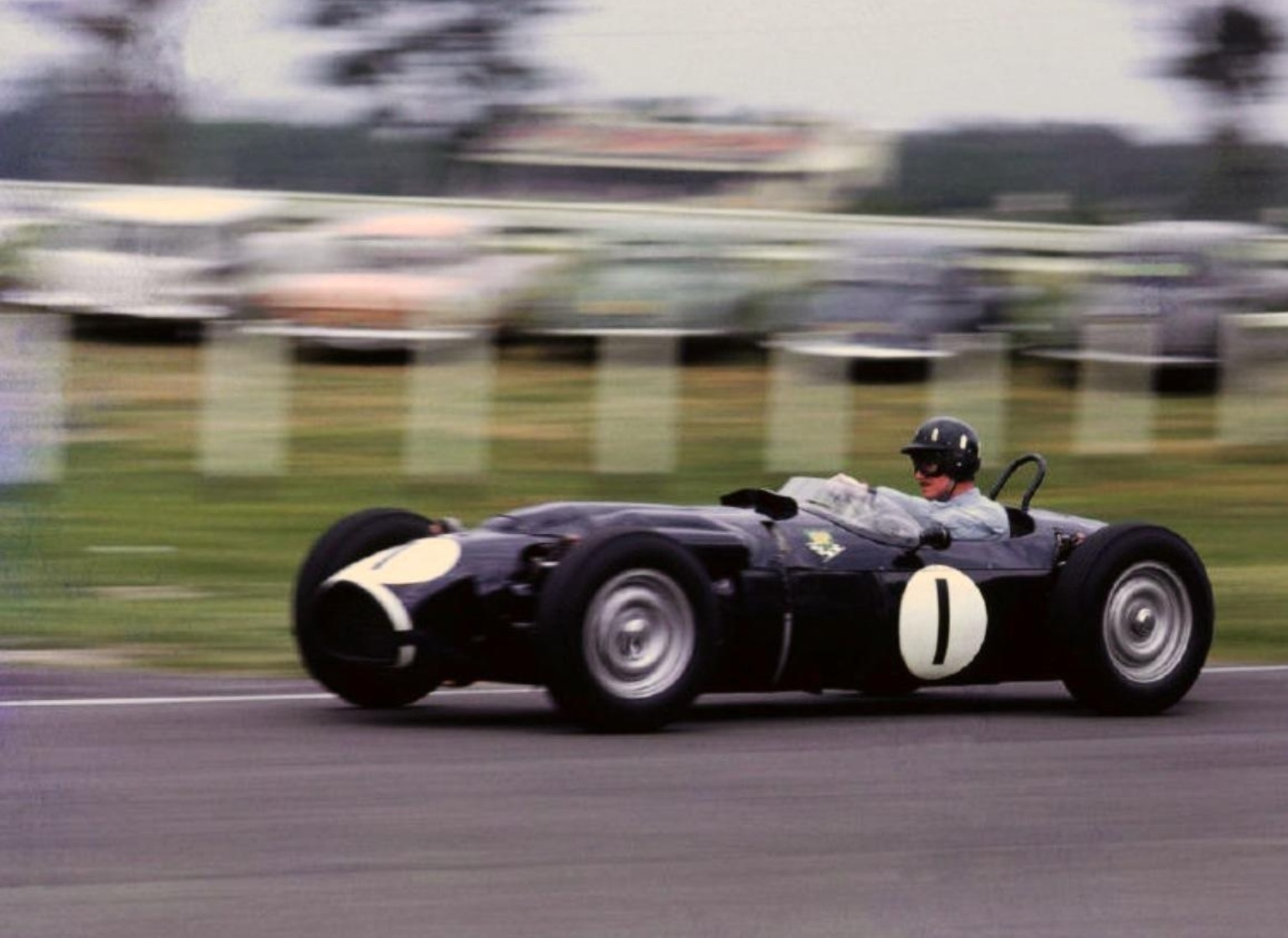
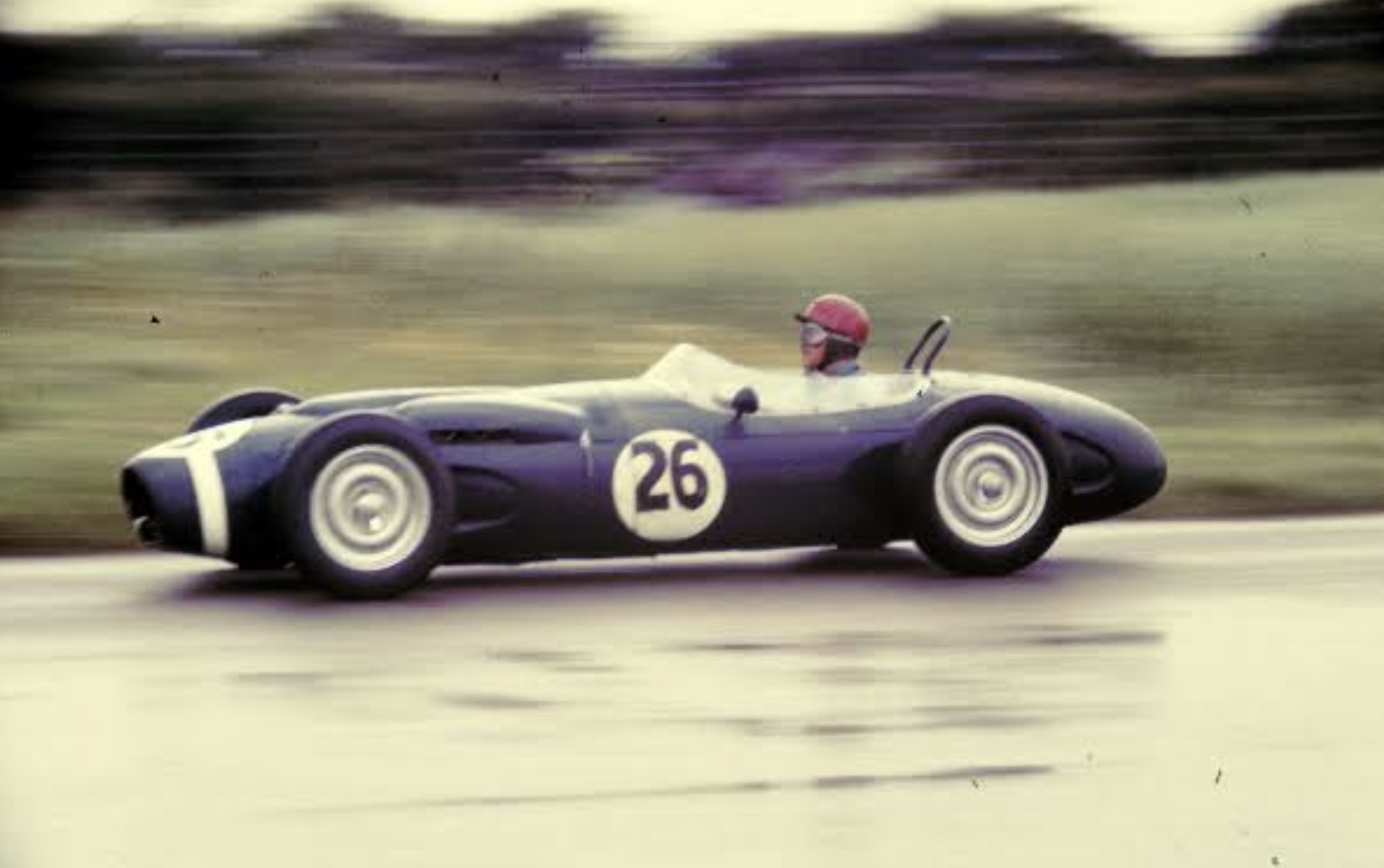
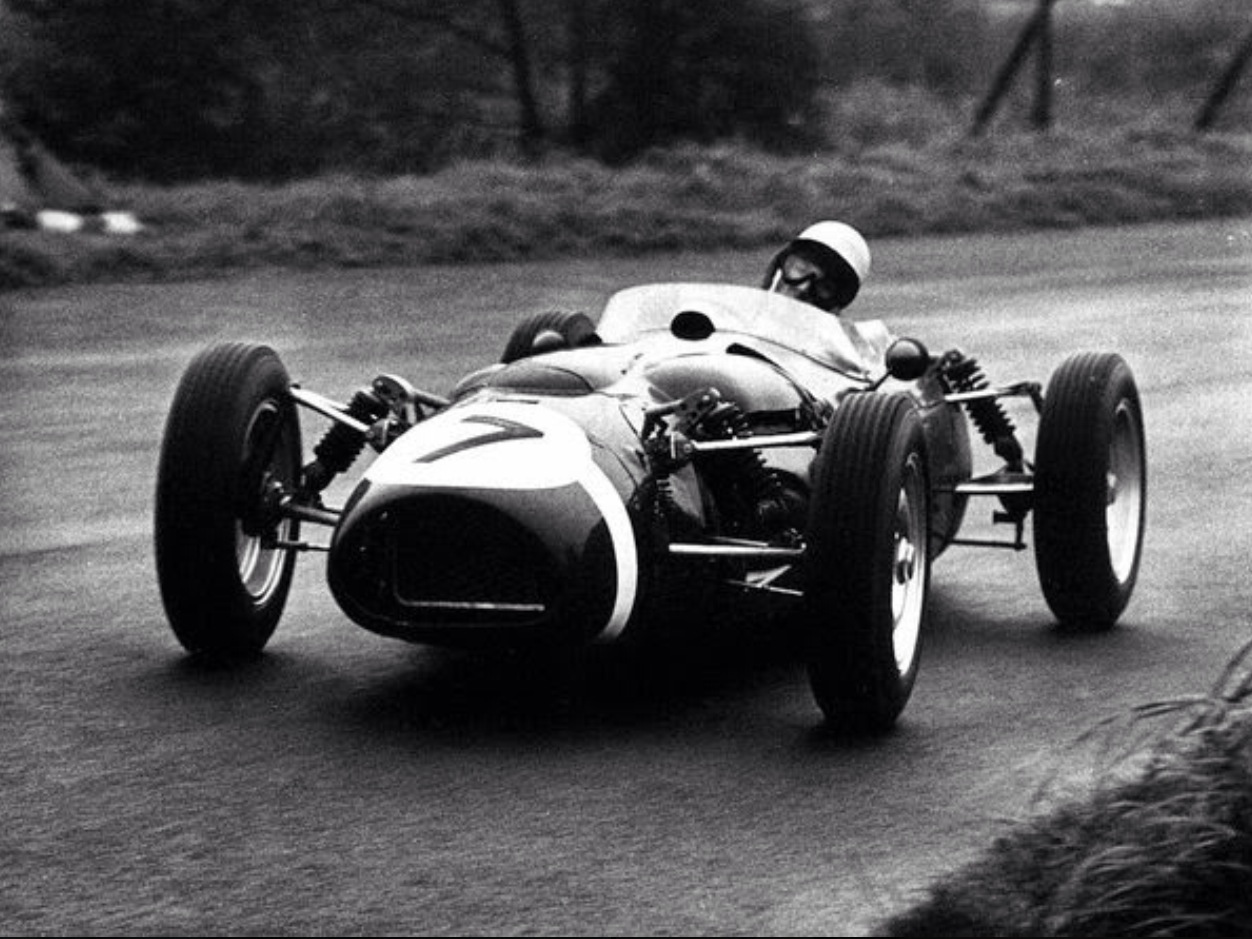
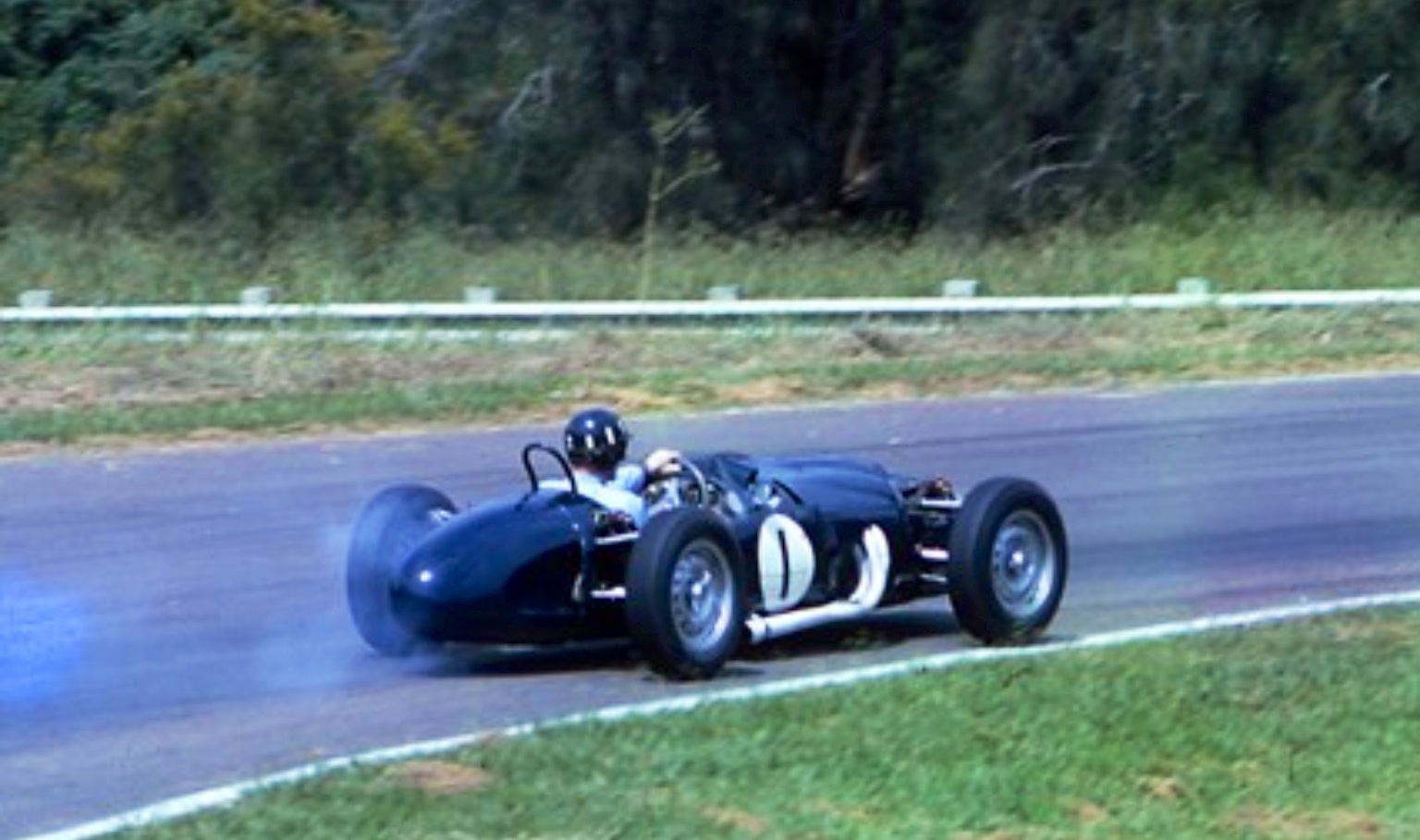
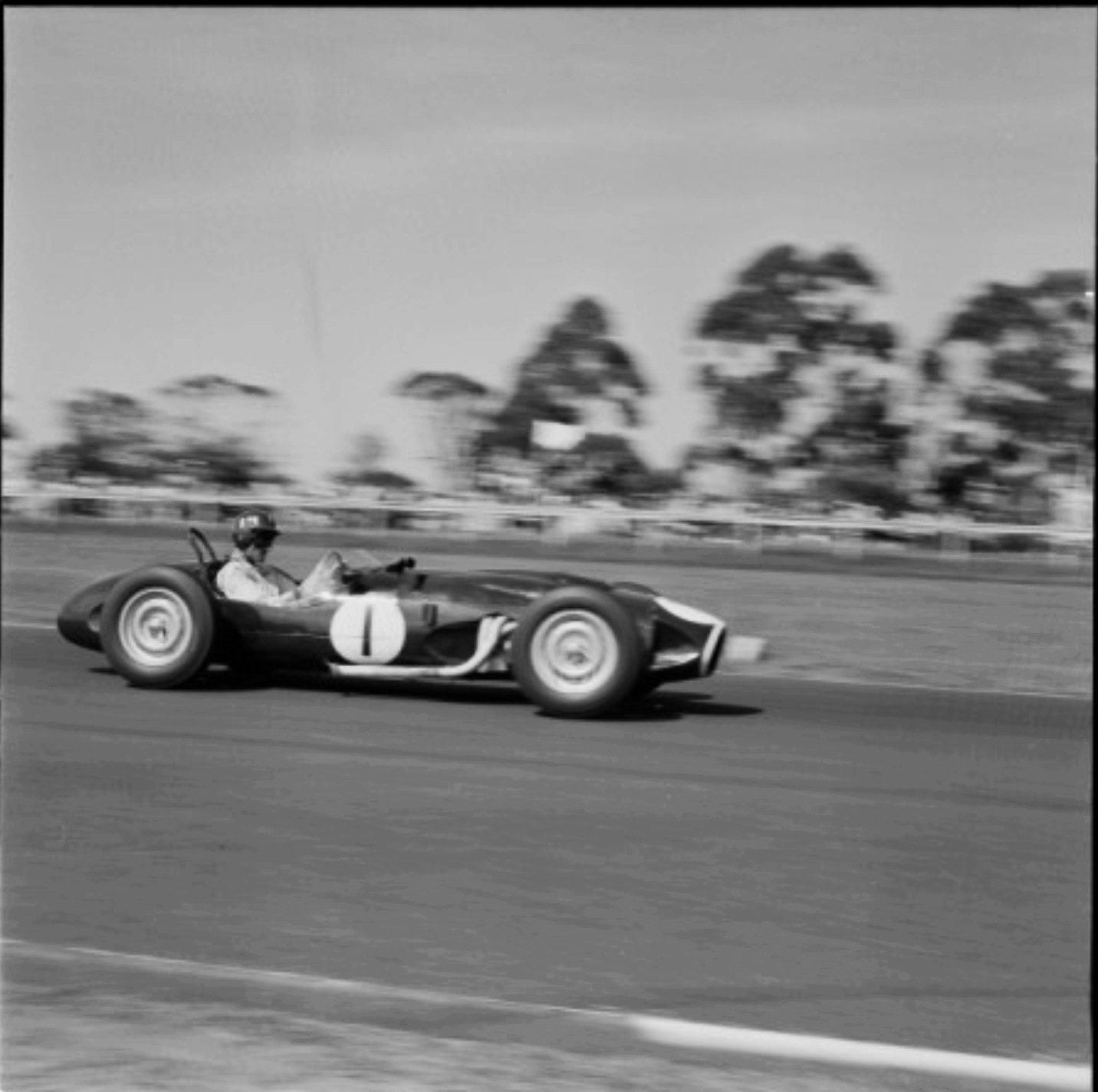
Graham Hill working his radical four wheel drive Ferguson P99 Climax hard to stay in front of the mid-engined paradigm, Homestead Corner, Warwick Farm, Sydney…
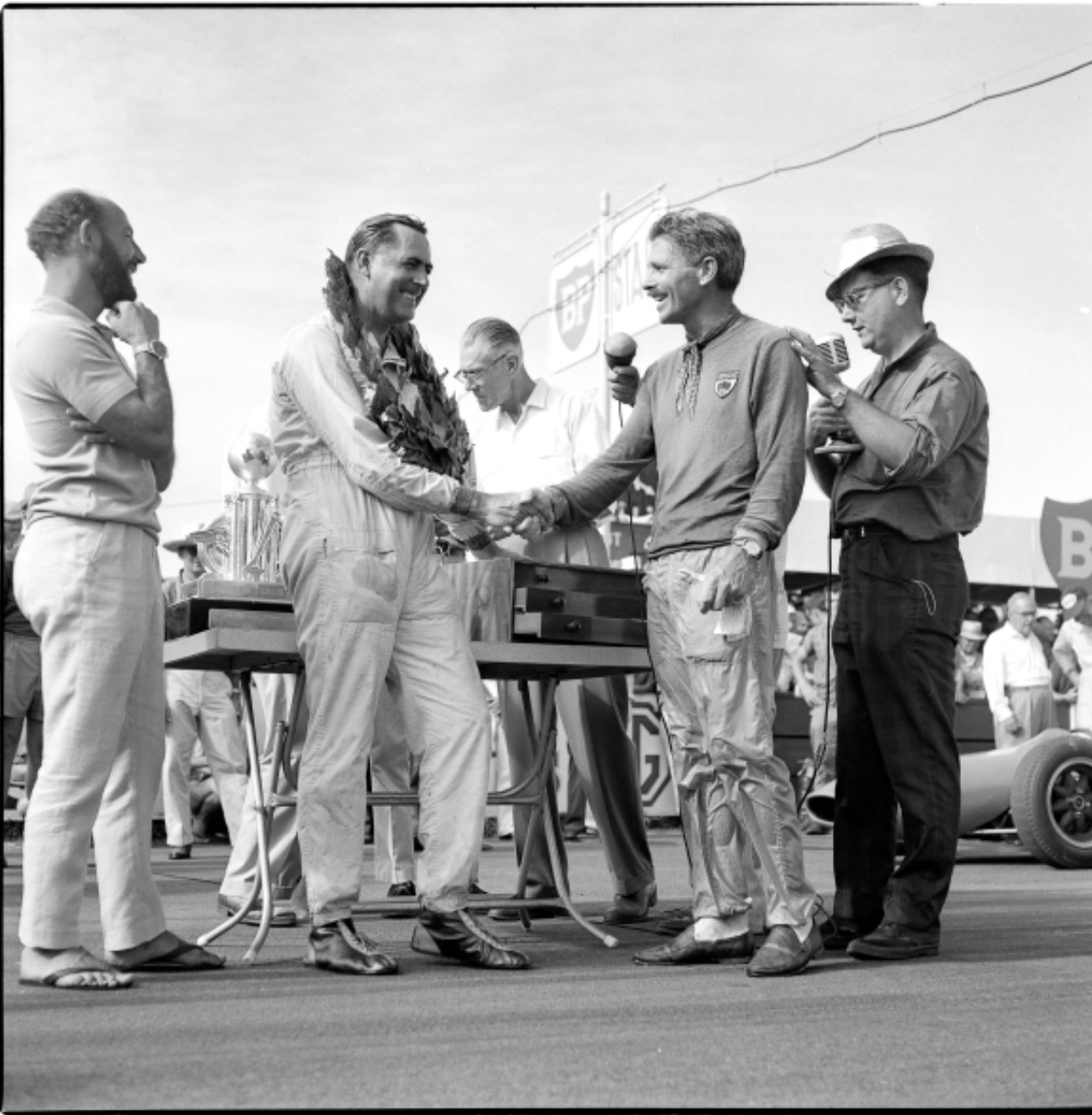
Jack Brabham won the race from John Surtees and Bruce McLaren in Brabham BT4, LolaMk4A and Cooper T62 respectively, all powered by Coventry Climax FPF 2.7 litre ‘Indy’ engines. Bored versions of Climax’ successful 2.5 litre F1 Championship winning motors. Hill finished 6th in his 2.5 litre FPF powered car. At the time Australian National F1 was Formula Libre, the ‘2.5 Tasman Formula’ commenced in 1964.

David Mckay congratulates Jack Brabham, Brabham victorious in his BT4. A very relaxed, bearded Stirling Moss wearing that great Australian footwear fashion icon, rubber ‘thongs’ looks on. Moss still recovering from his Easter Monday, 23 April 1962, near fatal and career ending Goodwood Lotus crash. Mckay a great Australian driver and ‘Scuderia Veloce’ team owner/patron. McKay finished 4th in the race also Brabham BT4 Climax mounted. (David Mist)
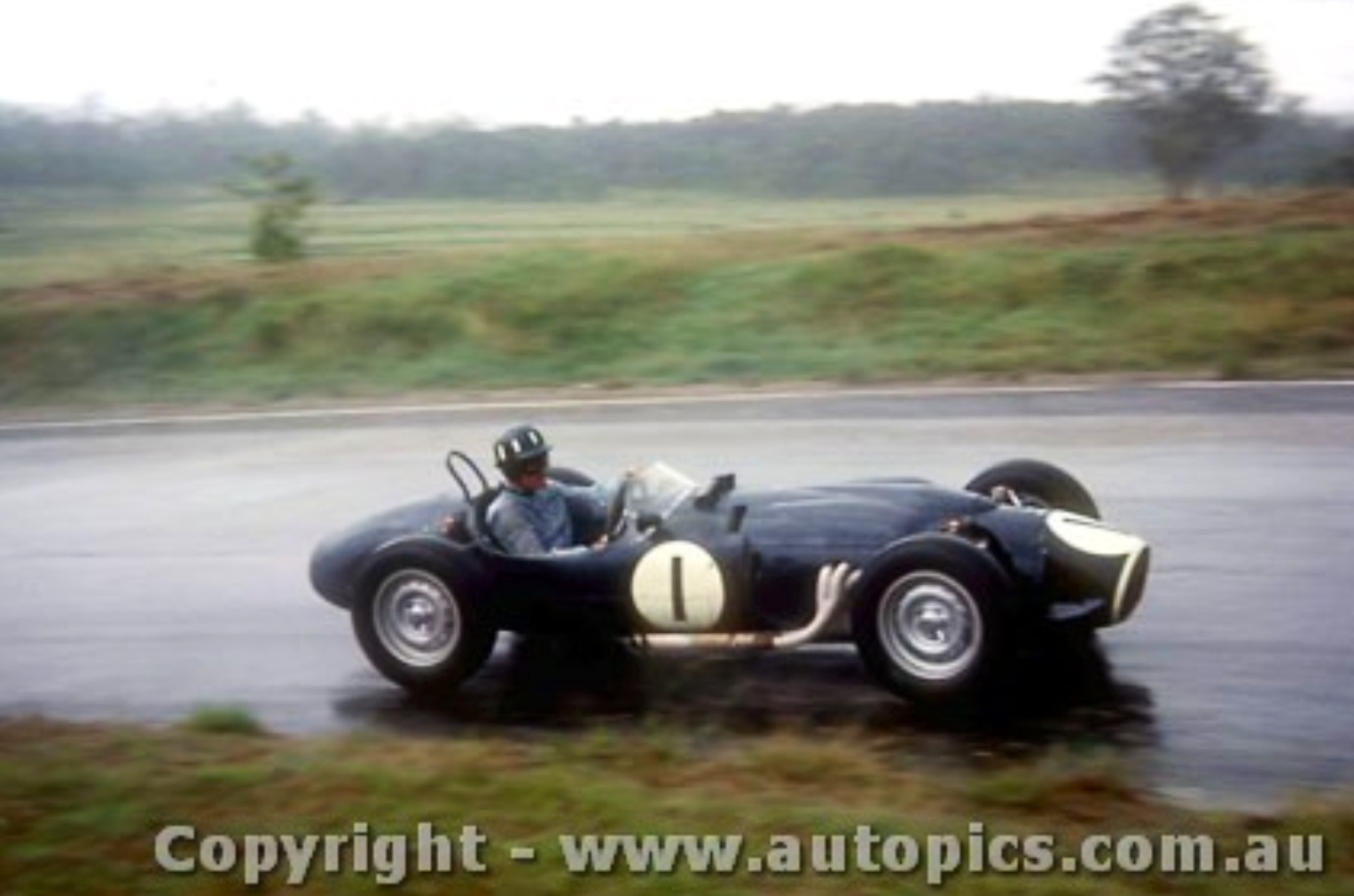
Hill also raced the Rob Walker entered, 2.5 litre FPF engined car at the ‘Lakeside International’, in Queensland the following weekend finishing second to Surtees on this very fast track, not necessarily the sort of circuit on which one might expect the car to shine. Hill was victorious in a wet preliminary race on the Saturday, the car excelling in the wet conditions.

Graham Hill in the wet Lakeside preliminary event he won in P99. Lakeside. (John Stanley)
P99’s ‘Summer Sunshine Tour’ started in New Zealand in January the car being campaigned by ‘newly minted’ World Champion Graham Hill, victorious in his BRM P57 in 1962, and Innes Ireland.
I posted this short article a while back about Hills’ 1962 Championship winning car; https://primotipo.com/2014/10/12/graham-hill-brm-p57-german-gp-1962/
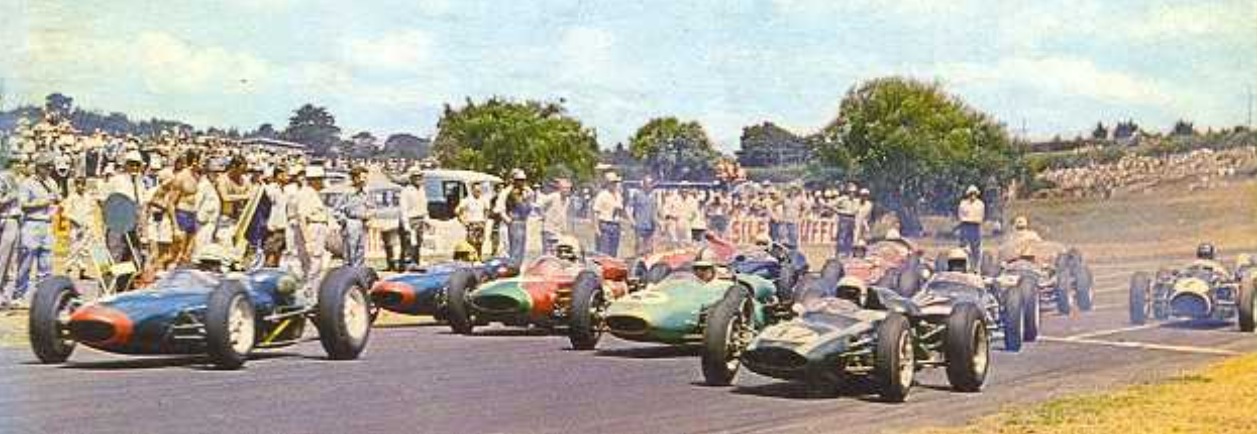
Hill drove in the NZGP, held at the brand new Pukekohe circuit on January 5, DNF with gearbox dramas on the second last lap, Surtees won in his Lola.

Start of the ’63 NZGP at Pukekohe. Surtees left and McLaren right LolaMk4a and Cooper T62 get the jump at the start. Hill is on the far right in P99. Beside Surtees and back is his teammate Tony Maggs LolaMk4a, the green nose of Amons’ Cooper T53 and Brabhams turquoise Brabham BT4…all Coventry Climax powered. (sergent.com)
Hill then returned to the UK, Ireland handling the car at Levin, Wigram and Teretonga on the 12th, 19th and 26th of January respectively. Innes was third at Wigram, victory going to Brabhams’ BT4, he retired with overheating at Wigram, the race won by Bruce McLarens’ Cooper T62 and was third at Teretonga, McLaren again victorious.
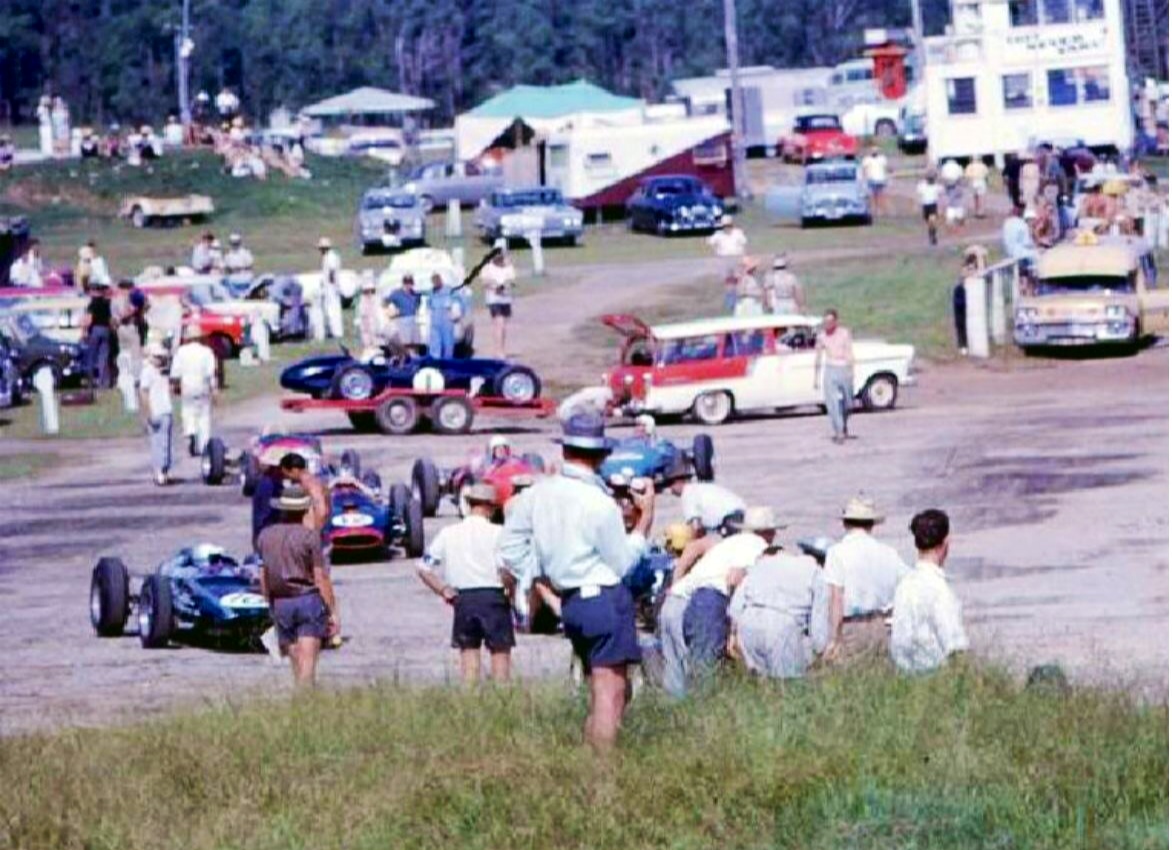
The car was then shipped to Sydney for the Warwick Farm AGP and finally north to Brisbane by road before returning to the UK.

Lakeside Queensland paddock scene 1963. P99 middle of shot lashed onto an open trailer behind a Holden FC ‘Station Wagon’, as we call an ‘Estate’ in Oz. The car travelled the 950 Km from Warwick Farm on Sydneys’ outskirts to Lakeside, north of Brisbane. McLarens Cooper T62 is at the front of this group, and the red nose car is Maggs’ Lola Mk4a. (Ray Bell)
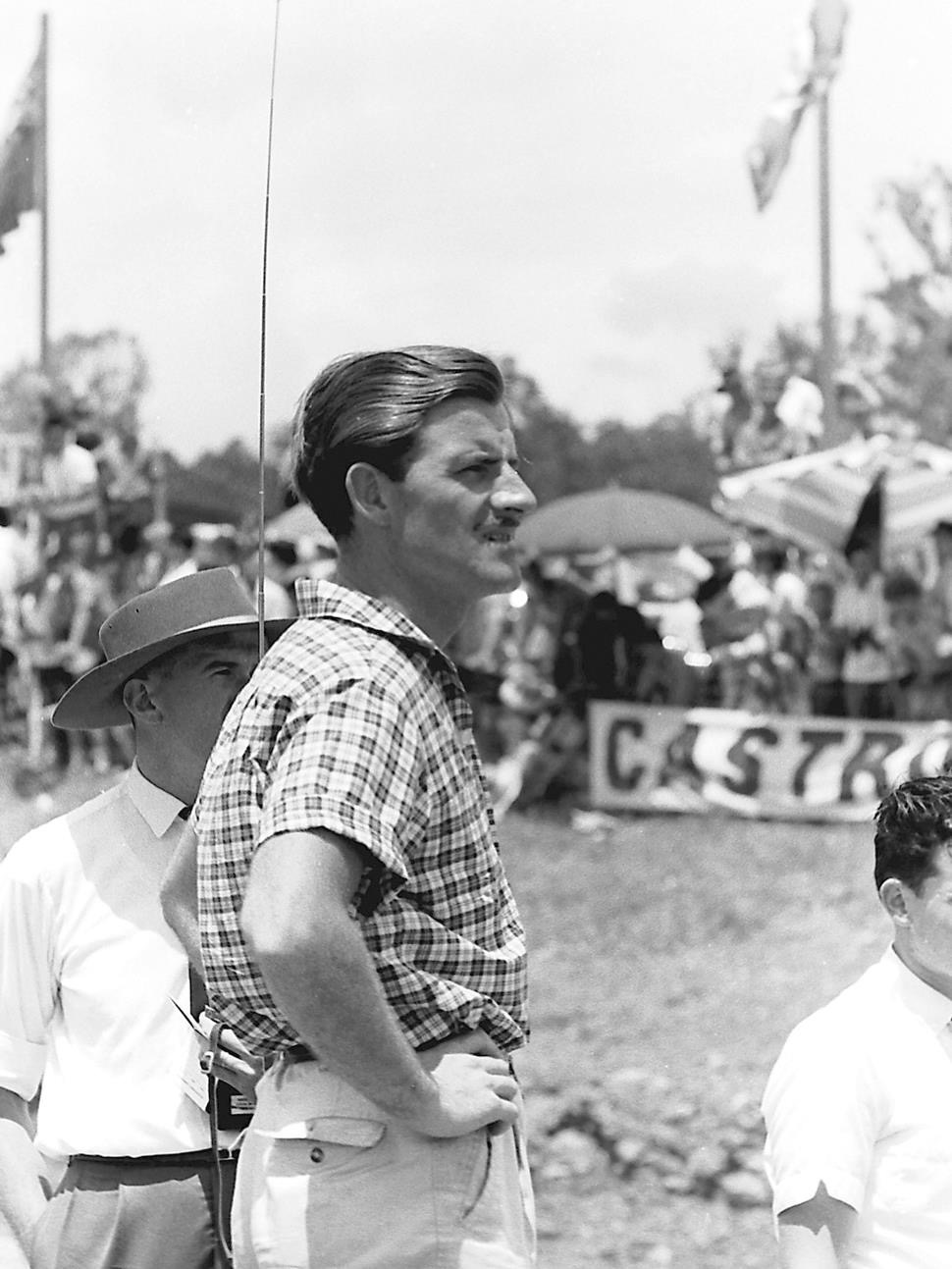
Graham Hill looking pretty relaxed at Lakeside in 1963 (J Psaros)
Ferguson Research…
The Ferguson Family Museum summarises the P99 as follows…’The creation of the Ferguson Formula four wheel drive system began shortly after World War II.
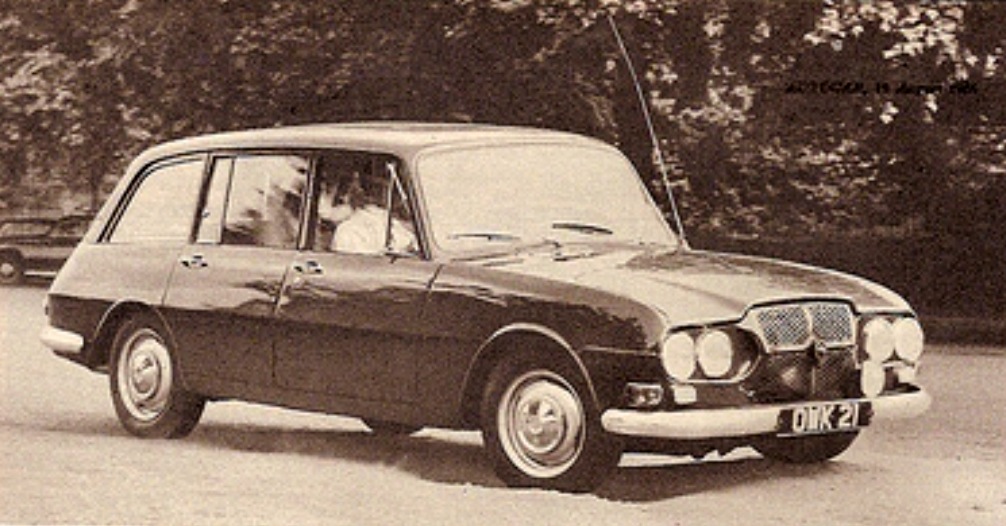
Harry Ferguson had always loved the world of motorsport and had a vision of creating a four wheel drive system with the purpose of improving road safety. The Ferguson car, ‘the R5’, was 40 years ahead of its time. It featured four wheel drive, anti-lock braking, electric windows, disc brakes and a hatchback design, it was the forerunner of the modern car.

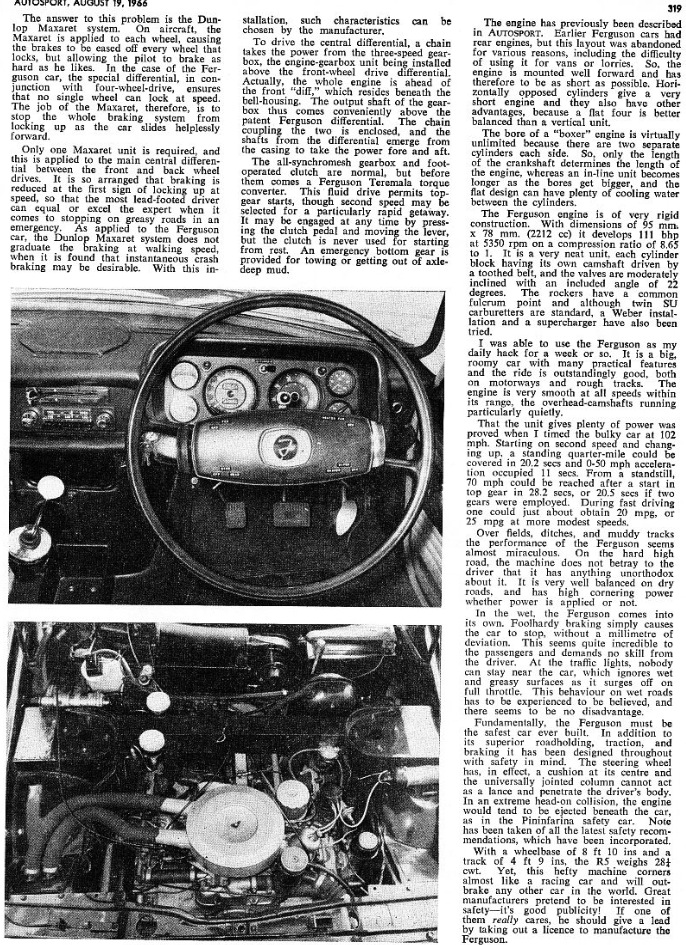
Not the prettiest of things but 4WD, powered by belt driven SOHC 2.2 litre engine, 4 wheel discs, ABS…all at the time of the Cortina Mk1. This car has escaped me, i have included John Bolsters’ Autosport road test of the prototype at the bottom of this post. (Autocar)
Harry Ferguson decided the best way to prove the importance of four wheel drive and anti-skid braking was to demonstrate it on a successful Formula 1 car.
In 1950 designer, Claude Hill, Brooklands Riley racer, Fred Dixon and Tony Rolt, a POW escapee and 24 hour Le Mans winner, teamed up with Harry Ferguson to start development on what was later to become the world’s only Formula 1 winning four wheel drive car – Project 99.
Later the Ferguson Formula four wheel drive system was widely adopted by rally cars and the motor industry worldwide in the form of the viscous coupling. Although designed as a racing car P99 was also a research vehicle intended to show the advantages and reliability of the four wheel drive system. What better way to generate public interest than to successfully race a car using the Ferguson Formula four wheel drive’.

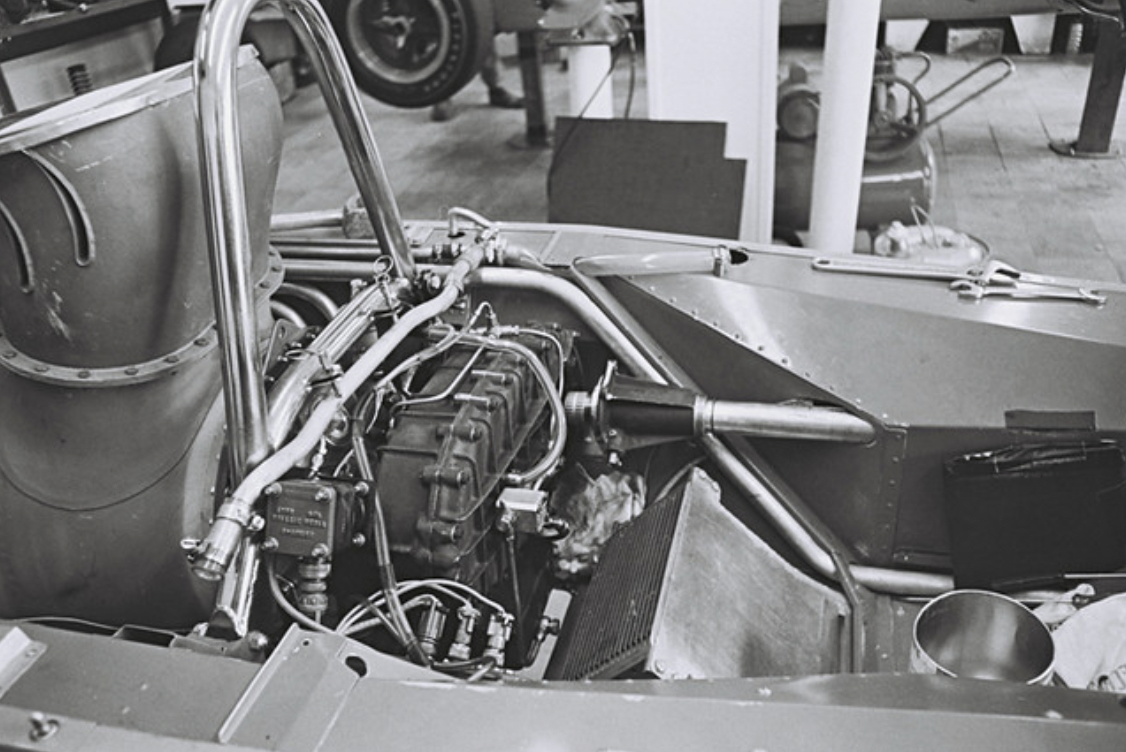
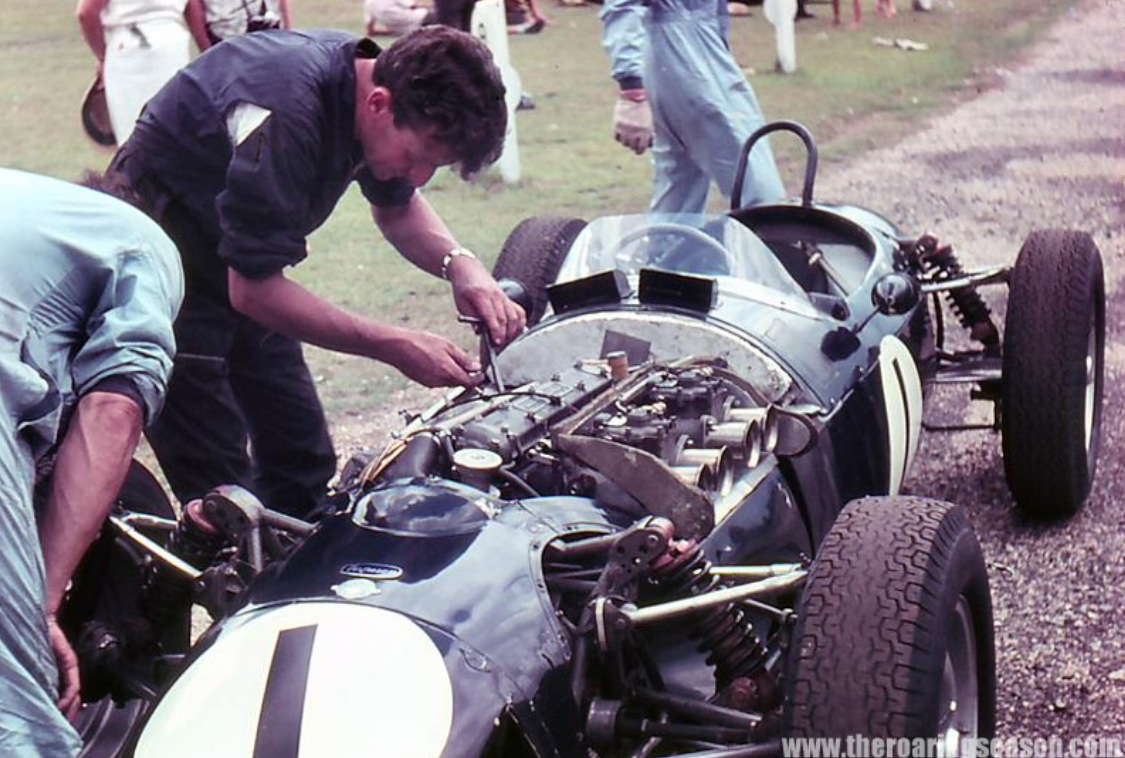
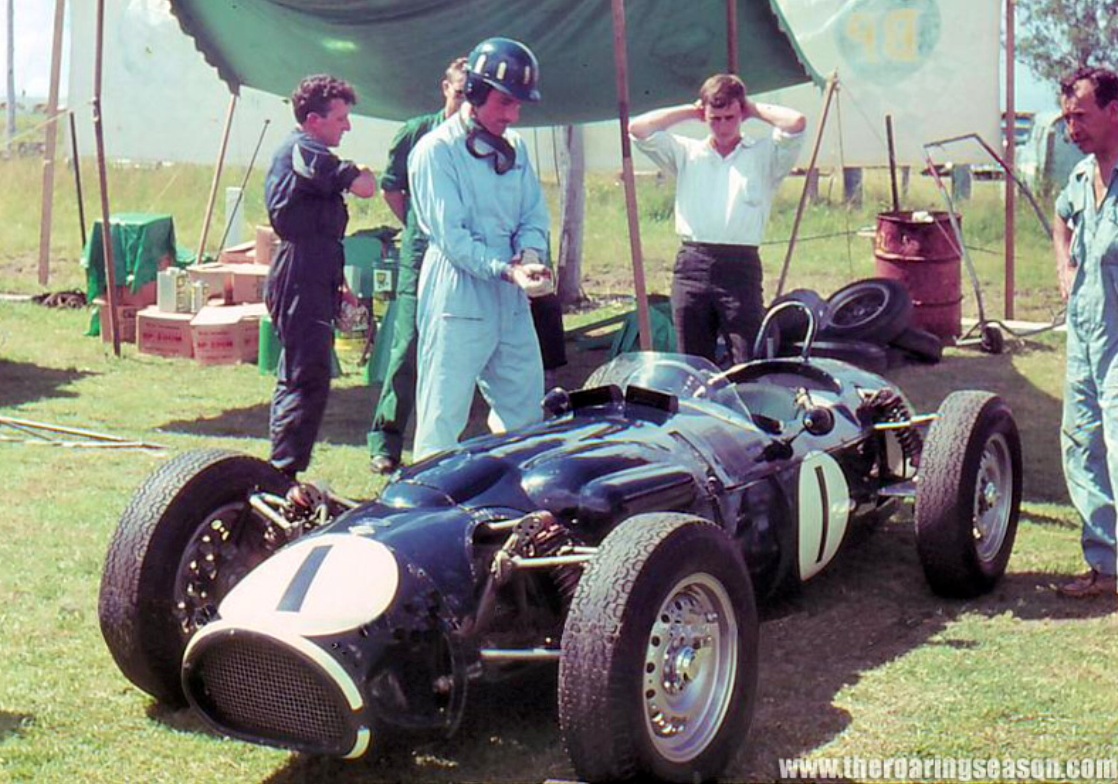
P99 being fettled by Rob Walkers team at Lakeside, February 1963. Thats’ G Hills legs in the driving suit at rear of the car. Lovely alloy body, Climax 2.5 FPF 4 pot engine, spaceframe chassis and upper and lower wishbone/ coil spring damper units, alloy Dunlop wheels,vestigial roll over bar all clear in this shot. (Peter Mellor)
P99 Design and Specifications…

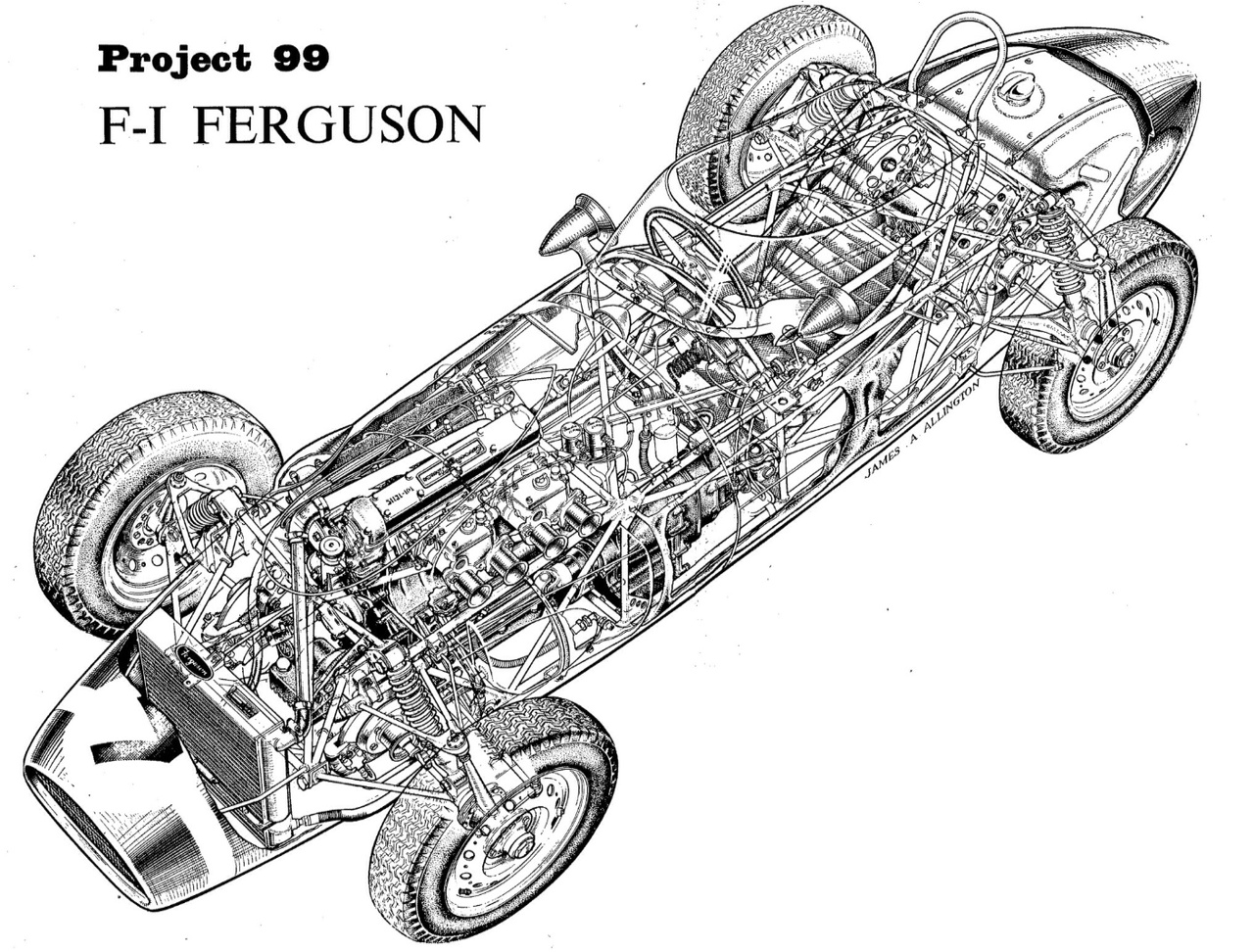
Spaceframe chassis, 2.5 litre Coventry Climax FPF 4 cylinder engine circa 235bhp. Suspension front and rear by upper and lower wishbones and coil spring/damper units. Rack and pinion steering. Dunlop disc brakes and alloy wheels. Ferguson 5 speed box and 4WD transfer case…(James Allington)
Ferguson hired Claude Hill from Aston Martin to design the car. He used a then ‘state of the art’ space-frame chassis, front and rear suspension comprising upper and lower wishbones and coil spring/Armstrong damper units and adjustable sway bars. Brakes were Dunlop anti-lock, which was tested but unraced.
Lightweight Dunlop alloy wheels were used, steering is rack and pinion.
The clever bit was of course the 4WD system. It comprised a transfer box bolted directly to the 5 speed gearbox. The Climax engine was installed at an angle to allow space for the driveshaft to the front differential. The rear driveshaft was installed on the left side of the chassis, the driving position slightly off centre to the right. Similar to the weight balance, the torque was evenly divided between the front and rear wheels.
P99 was planned for the 2.5-litre F1 utilising the championship winning Coventry Climax FPF 235bhp, DOHC, four-cylinder engine. The rules changed and Formula 1 was restricted to 1.5-litres from 1961, which meant the extra weight of the four-wheel-drive system was a handicap. The Intercontinental series was established for the old 2.5-litre engined F1’s, to be raced in 1962, the Ferguson was therefore built to accommodate both the Climax 1.5 (151bhp) and 2.5 litre (235bhp) FPF motors.
The whole project took less than a year.
There were to be no concessions in relation to tolerance. Perfection would only just be good enough. Dixon was right when he calculated that differentials, bearings, gears and other drivetrain parts could be lighter if the energy was dispersed to four wheels rather than two.
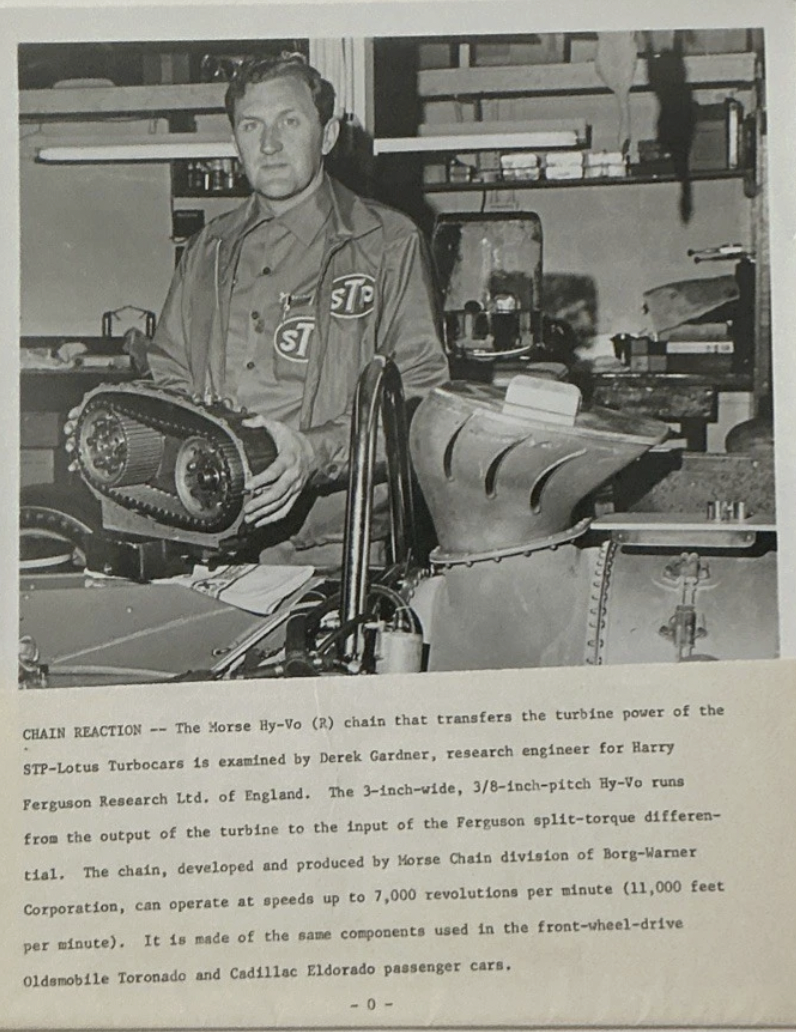
Ferguson’s central differential system, which would be the key to Peugeot’s and later Audi’s rally success in the 1980s, could balance out the delivery of that power to the wheels.
Ferguson were keen to try the Dunlop Maxaret anti-lock brake system, the whole assembly would eventually find its way into the automotive mainstream some 30 years later. Sadly, Harry Ferguson died before his dream took to the track and it was Rolt who eventually became the projects’ driving force.

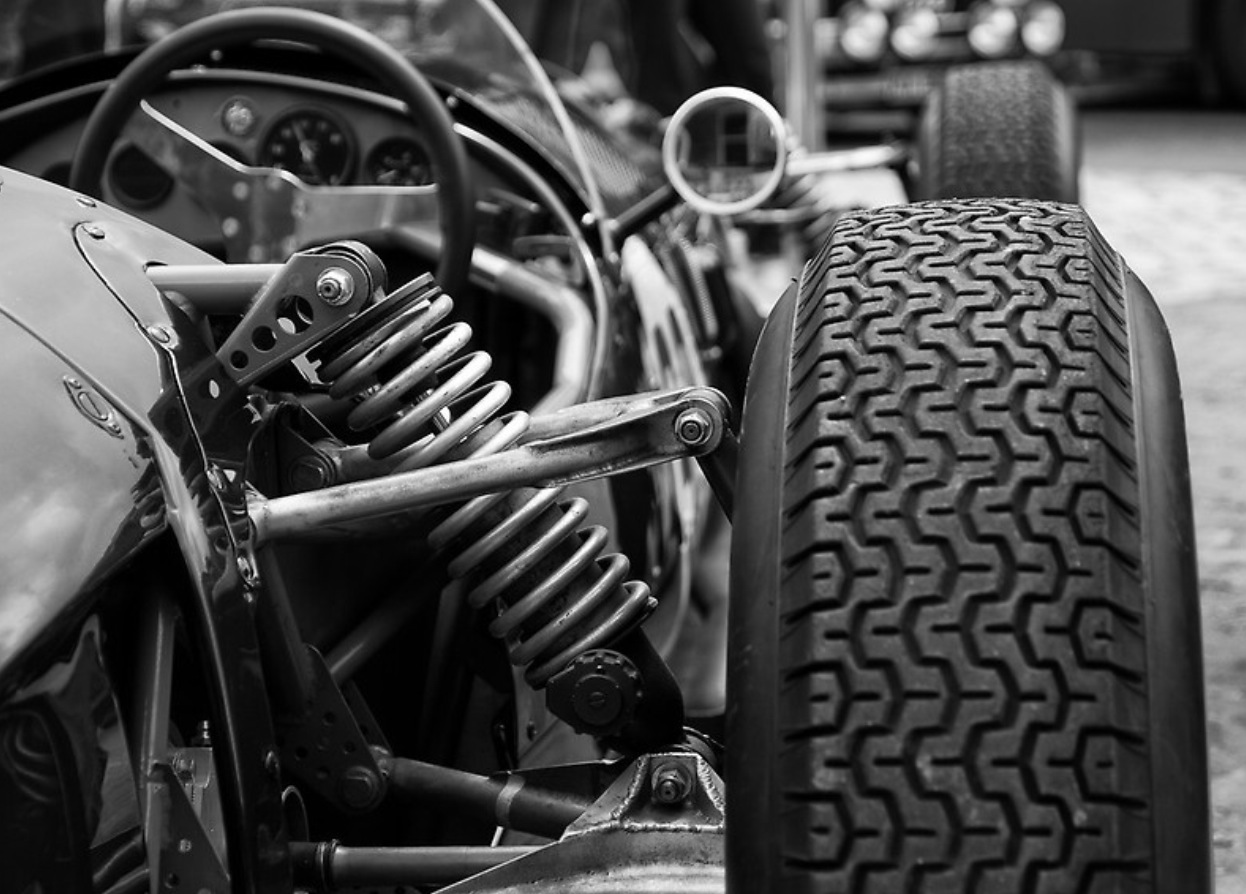
P99 from aft. Rear suspension detail; upper and lower wishbone and adjustable Armstrong shock. You can just see the driveshaft below the upright. Beautiful ally bodywork of pretty car. Driving position offset to the right, gearchange for 5 speed box to drivers left, right side more conventional in a single seater. (Unattributed)
By 1961 Mid-Engined cars were de-rigeur the Front-Engine GP car obsolete, so the Ferguson P99 was a complete dark horse…

Stirling Moss, Aintree British GP 1961. On a charge and soon to be disqualified. The photograph below is of Jack Fairman earlier in the race before he pitted to allow Moss to take over the car (Unattributed)

(Simon Lewis Transport Books)
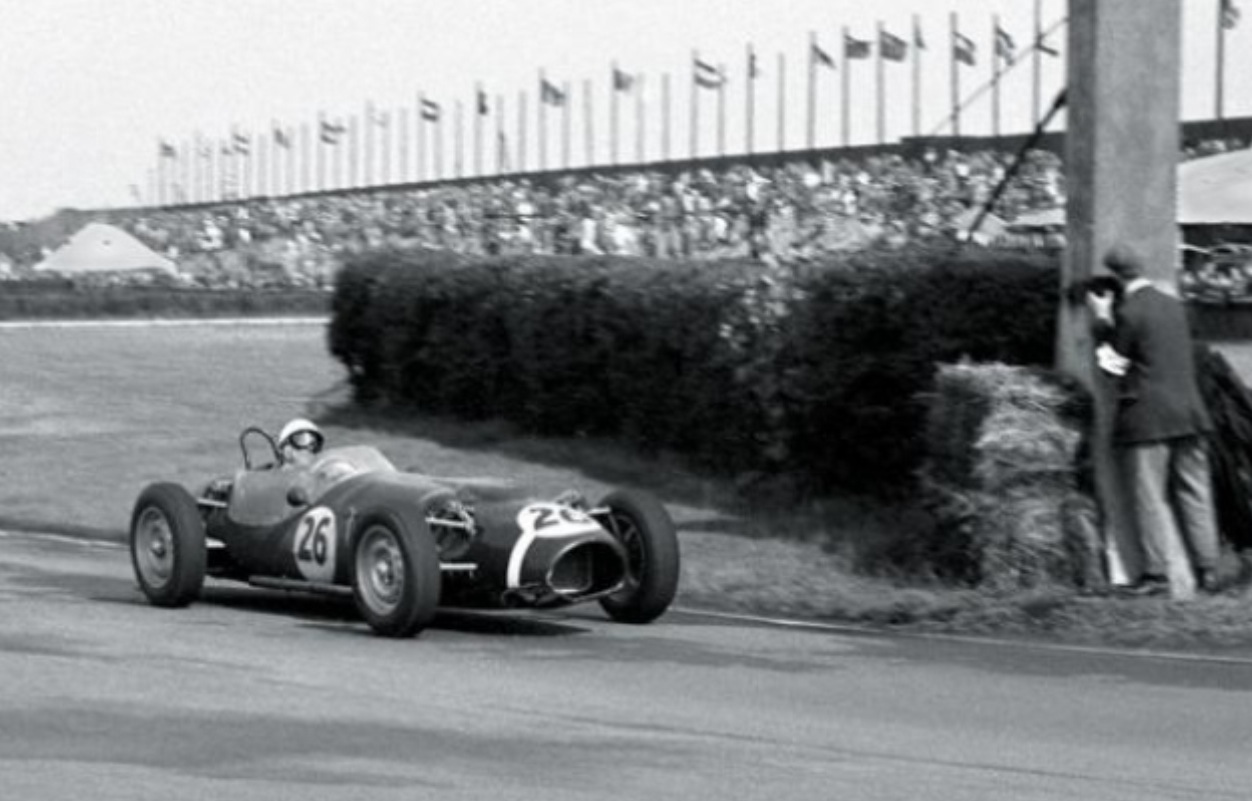
Launched at the 1961 British Empire Trophy at Silverstone, Jack Fairman drove the car which was entered by Rob Walker. The P99 had mechanical problems and didn’t finish.
Its next outing was at Aintree in the British Grand Prix. Rob Walker entered a Lotus 18 for Moss and the P99 for Jack Fairman, when the Lotus 18/21 brake pipe broke Moss took over the P99. The P99 was under investigation by the Stewards when Moss took it over because Fairman had a push start from the pits, which was not allowed by the rules- as a consequence the car was black-flagged on lap 57, his progress to that point had been swift…
For the September 1961 Oulton Park Gold Cup, Moss returned in the P99 and to his delight, it was a classically British summer’s day – 57 degrees, steady drizzle and a wet track! Moss won the race by 46 seconds from Jack Brabham’s Cooper T51 Climax, the only F1 race ever won by a four-wheel-drive car.

Moss wins the 1961 Oulton Park “Gold Cup’ in P99. The only GP win for a 4WD drive car, albeit Non-Championship F1 race. Greasy conditions tailor made for the fabulous, innovative car. (Unattributed)
The CSI then banned four-wheel-drive from F1.
Moss had the option of using the Dunlop Maxaret anti-lock brakes but preferred to turn them off and use his own judgment. They would reappear in 1967 on the Jensen FF- the Chrysler-power coupé that was a four-wheel-drive version of the Interceptor utilising both the Ferguson four-wheel-drive and anti-lock brakes.
The Ferguson P99 then raced in New Zealand and Australia in 1963 as outlined above fitted with a 2.5-litre engine in our 1963 F Libre International Series. It would have been interesting to see how the car would have performed with a 2.7 Litre FPF equivalent in capacity to the engines of the other front runners that summer.

World Champ Graham Hill about to board P99. Lakeside, Queensland again. He was keen on the car, with his support BRM developed a 4WD variant of their P261/57 GP car, the BRM P67 1.5 V8 in 1964, using Ferguson technology, well ahead of the ‘1969 4WD pack’, comprising Lotus, Matra, McLaren and Cosworth. BRM P67 qualified in Richard Attwoods’ hands, second last on the British 1964 GP at Brands Hatch grid but was withdrawn from the race, circa 7 seconds off the pace. (Peter Mellor)
P99 returned to England and was lent to hillclimb racer Peter Westbury, who won the 1964 British championship with it, it also ran competitively in 1965 and 1966 and was retired in 1968.

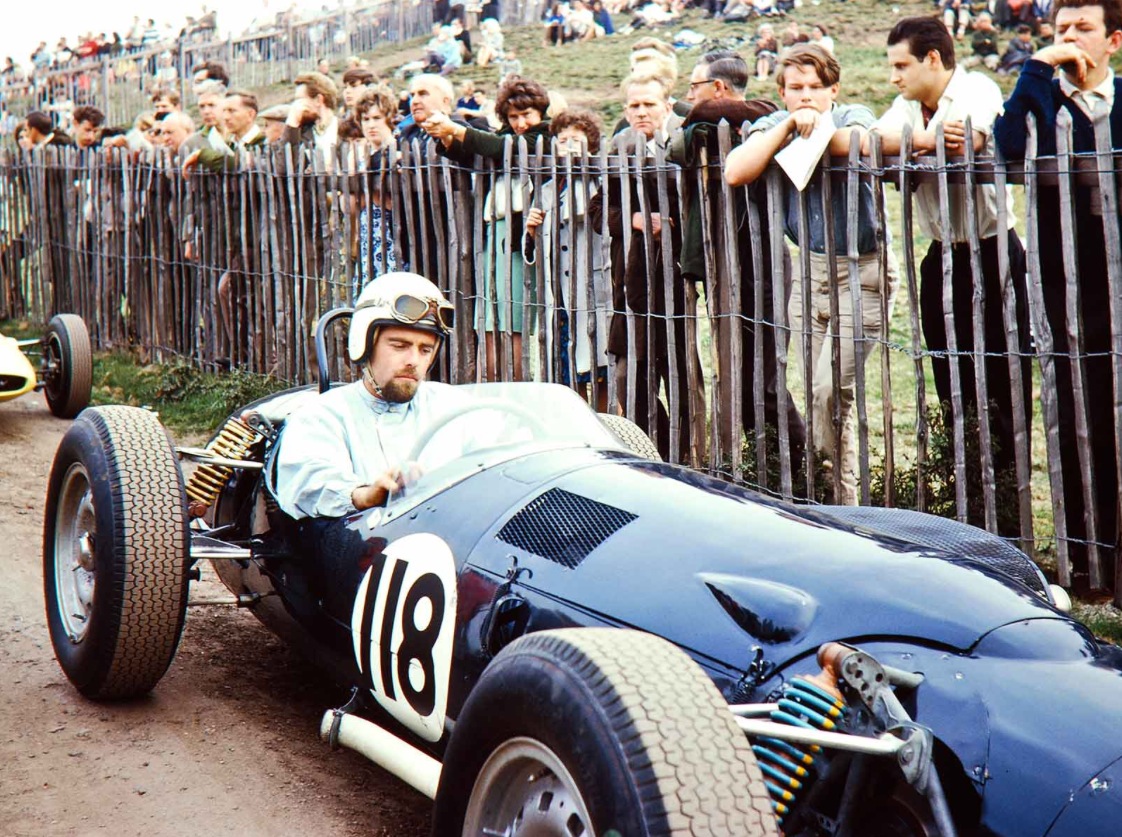
Peter Westbury, P99. Harewood Hillclimb 1964, he won the British Hillclimb Championship in the car that year. (Unattributed)
P99 also played a key role in the resurgence of 4WD at Indianapolis.
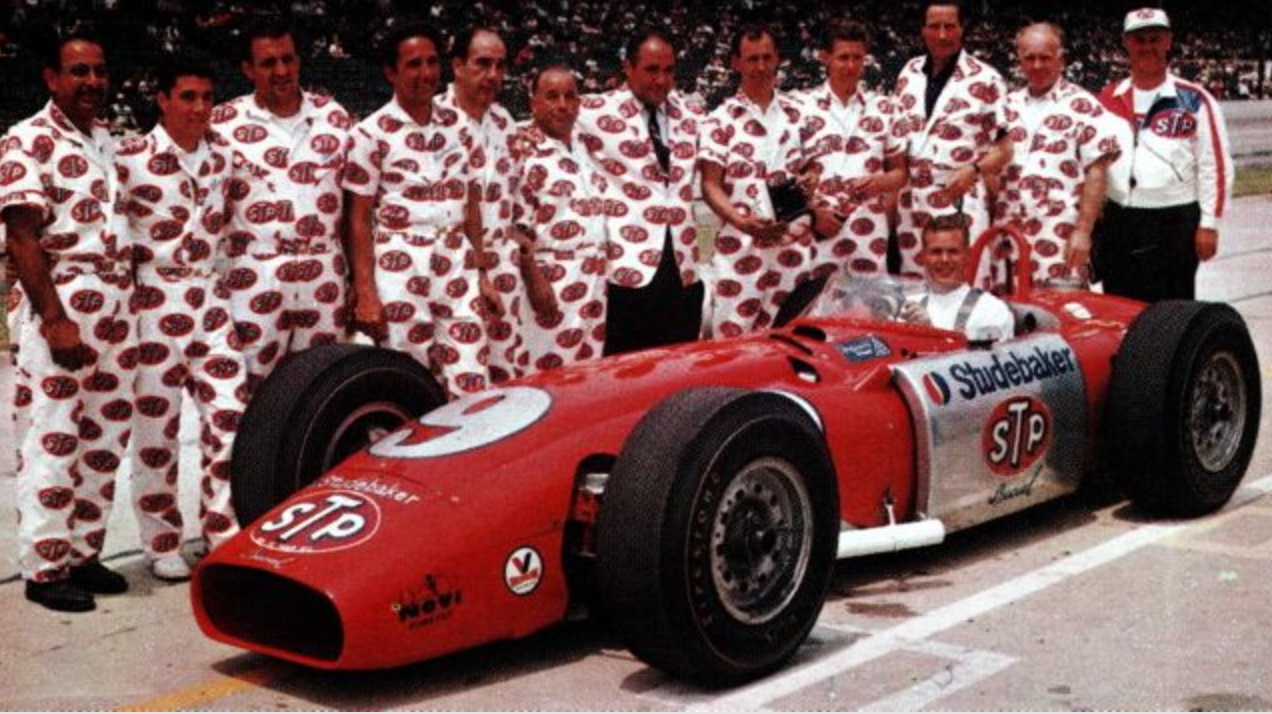
There had been a lot of activity both immediately pre and post war with Harry Miller’s 4WD specials. STP’s Andy Granatelli, on one of his trips to Europe was regaled by the recently retired Stirling Moss, his career ending accident was at Goodwood in 1962, about the dominance of his damp Oulton Park 1961 victory in P99.
Granatelli then approached Tony Rolt at Ferguson to try P99 at Indy, Jack Fairman shortly thereafter put in some impressive 140mph laps in the 2.5 litre car around the famous ‘Brickyard’.
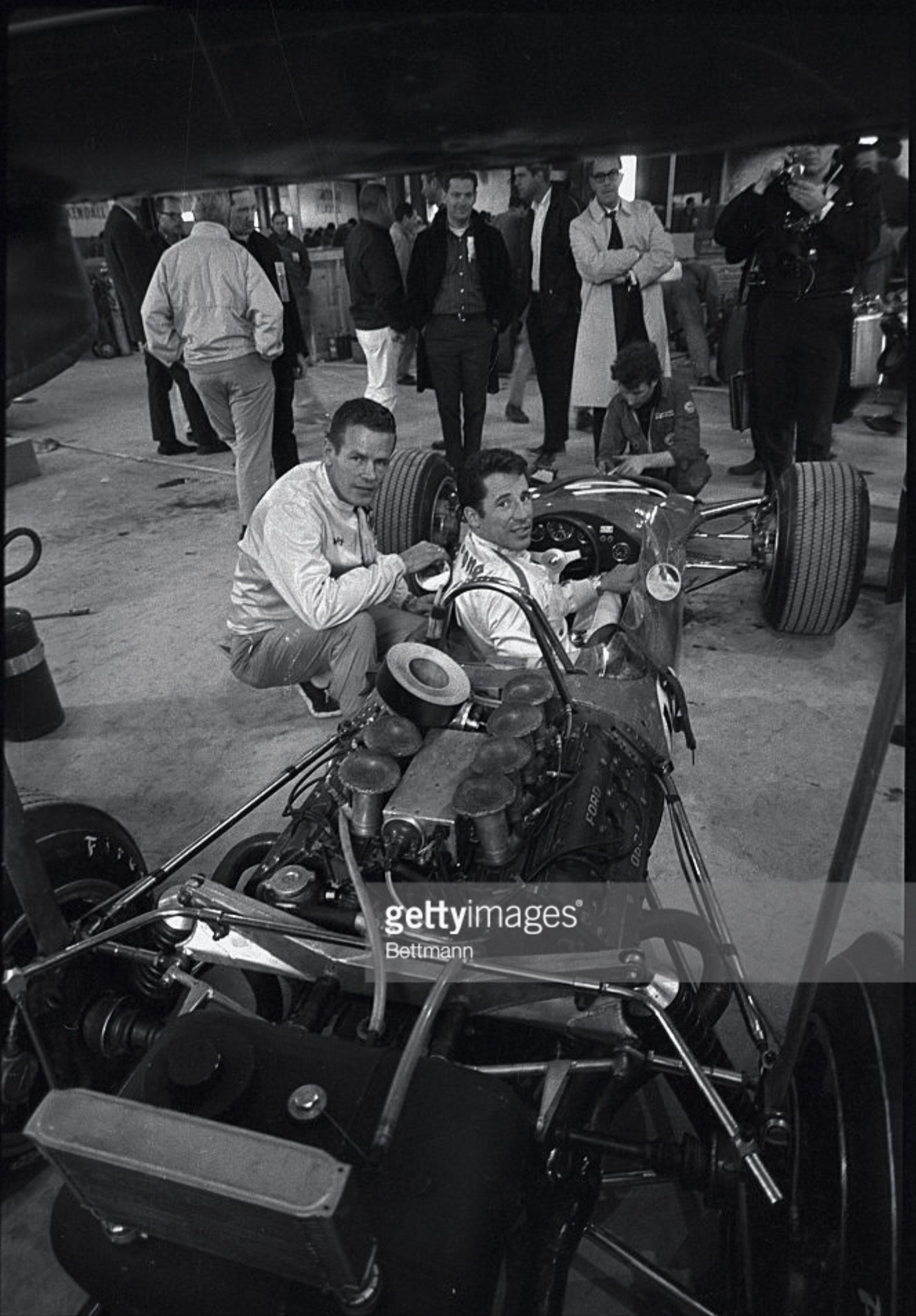
Andy was convinced and ordered a car from Ferguson powered by the Novi V8, the 4WD setup the same FF system as used on P99 but with the split being variable from 70/30 to 60/40 rear/front instead of the P99’s fixed 50/50 split.
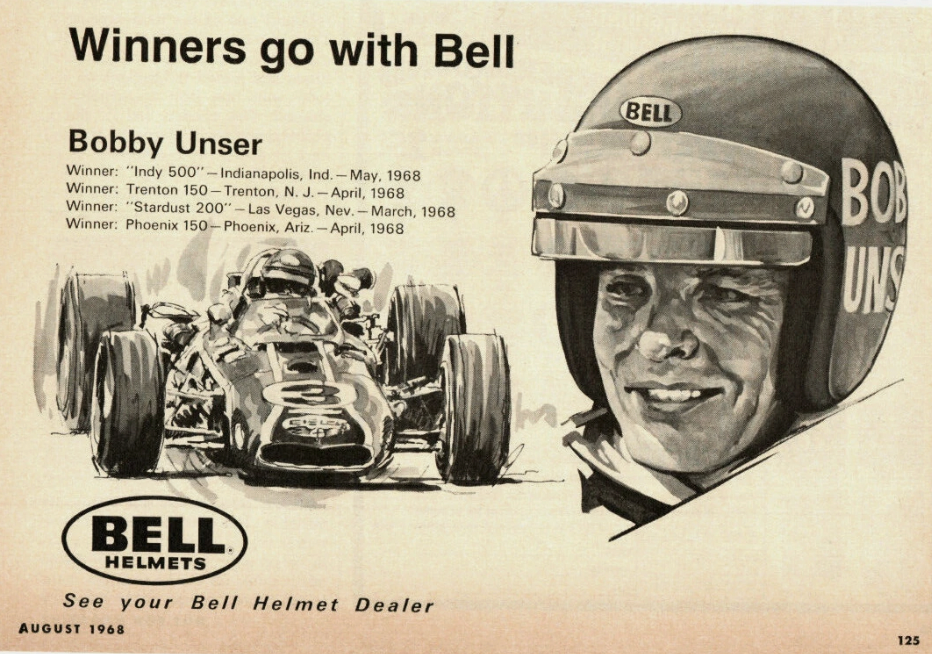
Bobby Unser qualified the car sixth at Indy 1964.
This is a tangent too far for this article (see ‘Etcetera below for a cutaway drawing and further details) but for those with an interest in 4WD in motor racing click on this link to a great forix.autosport article on the subject; http://8w.forix.com/4wd.html

Ferguson Novi ‘STP Studebaker’ with Bobby Unser at the wheel. Indy 1964. Q6, DNF after hitting the wall seeking to avoid the fatal McDonald/Sachs accident. (Unattributed)
Four-wheel drive made another appearance in Formula 1 in 1969…
As teams struggled for more traction- the Ford Cosworth engine was developing well in excess of 400bhp at this stage, putting the power down was key to improved performance.
At the time 4WD was being used successfully at Indianapolis, it was therefore a natural direction for the F1 teams to explore, particularly Lotus who had been racing at Indy since 1962 and using 4WD competitively, putting accidents to one side, in their 1968 and 1969 contenders, the Lotus 56 Pratt & Whitney gas turbine powered car, and Lotus 64 Ford, powered by a Turbo Ford engine.
Matra, Lotus and McLaren all tried the Ferguson system and Cosworth devised their own 4WD car. The introduction of wings, which could achieve the same traction outcomes without the weight penalty, and advances in race tyre technology and widths provided simpler cost-effective solutions than persevering with 4WD.
Overall, only eight four-wheel-drive F1 cars were ever built.
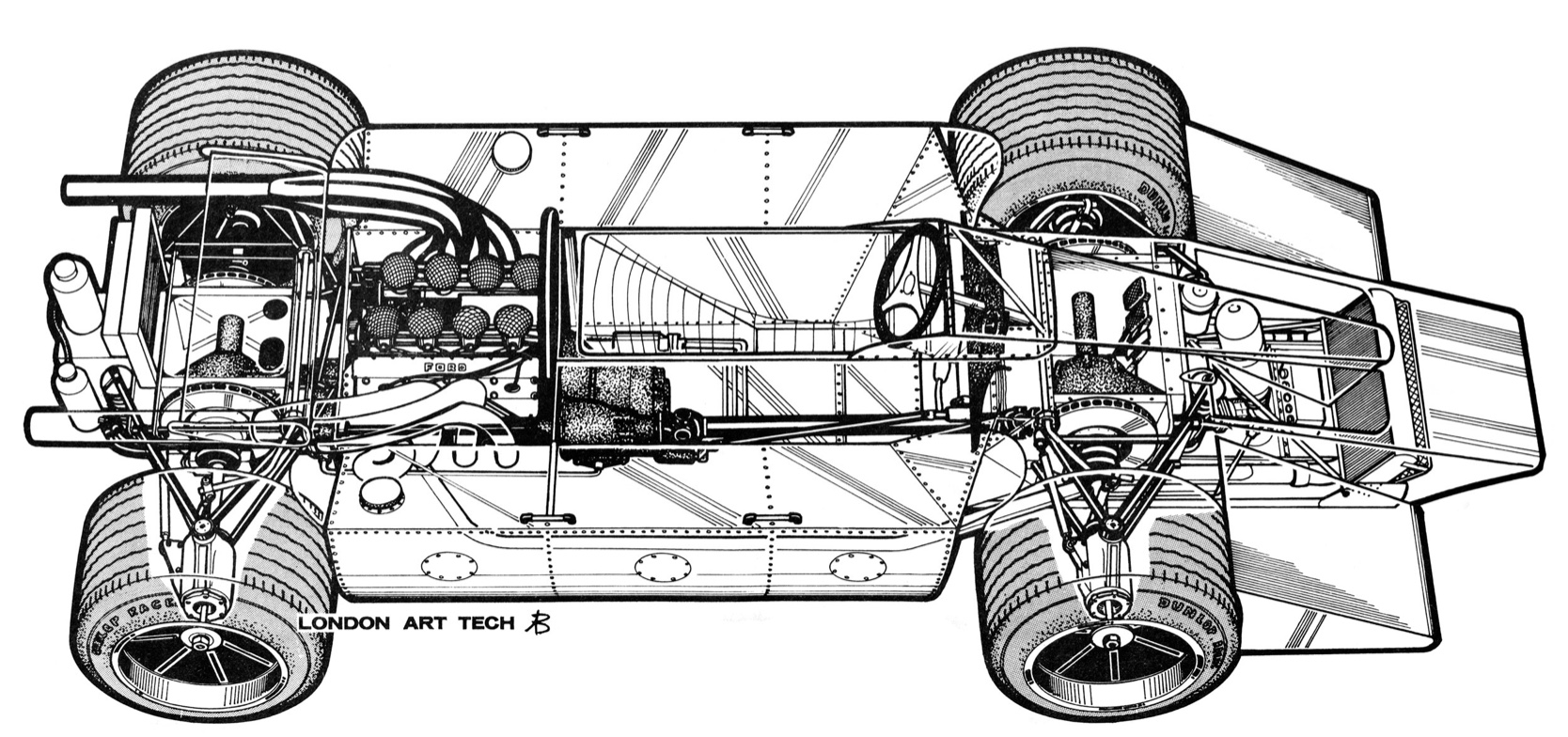
Robin Herd’s Cosworth 1968 4WD design (Bennet)
In 2004 following a period of 35-plus years in the Donington Collection…
The ‘one of a kind’- only 1 chassis was ever built Ferguson P99 was retrieved by the Ferguson family to the Ferguson Family Museum on the Isle of Wight and overhauled.
The car was stripped and was in remarkably good order, it was re-assembled using all of the original parts, including the extremely rare twin-choke Weber 58 DCO carburettors and re-fitted with the totally original bodywork which still wears original Rob Walker team paint and livery.
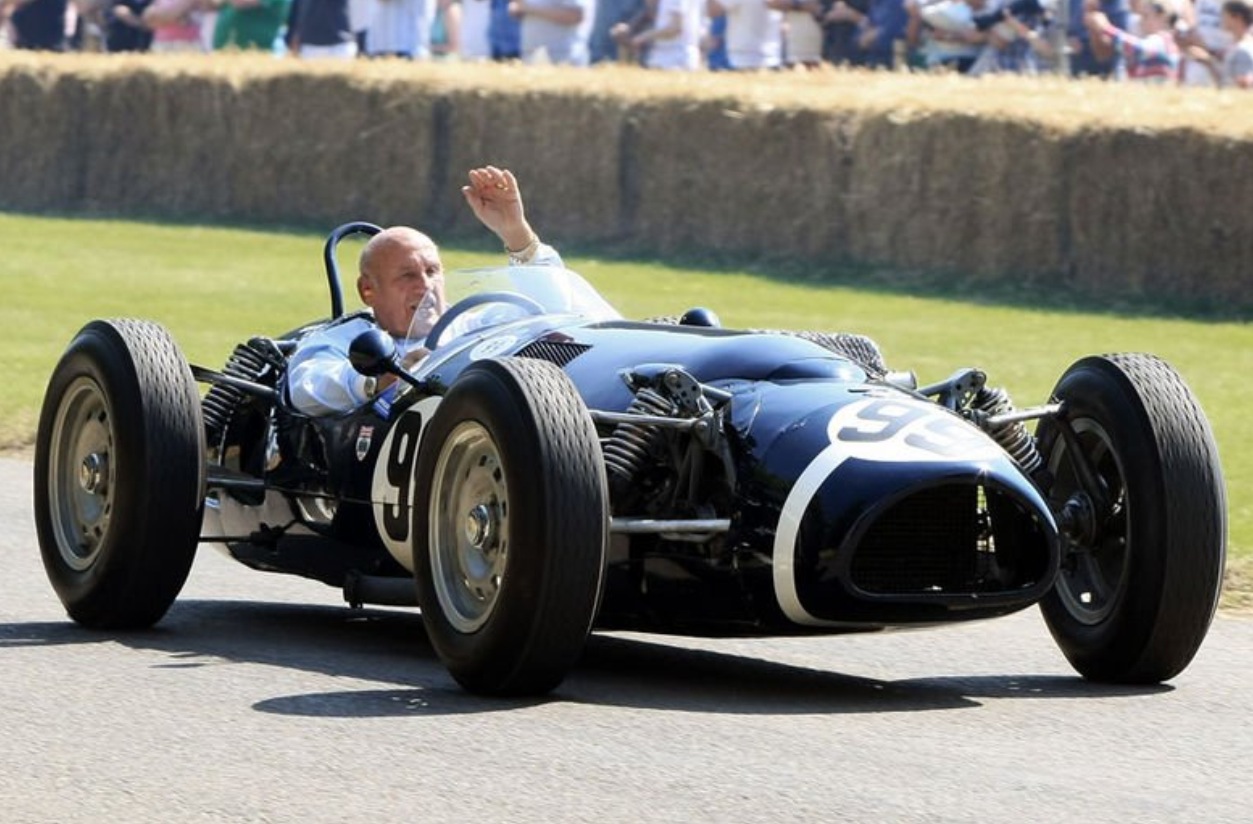
Sir Stirling Moss drove it at the 2005 Goodwood Revival and at the Monaco Historic Grand Prix in 2008. In 2006 Moss handed it over to Barry “Whizzo” Williams at Goodwood, who started 18th and had worked his way up to third before his brakes faded, he finished in that position.
P99 still appears regularly in suitable events, its historic significance enormous.

Stirling Moss in P99 at the Goodwood Festival of Speed. (Unattributed)
Etcetera…
P99
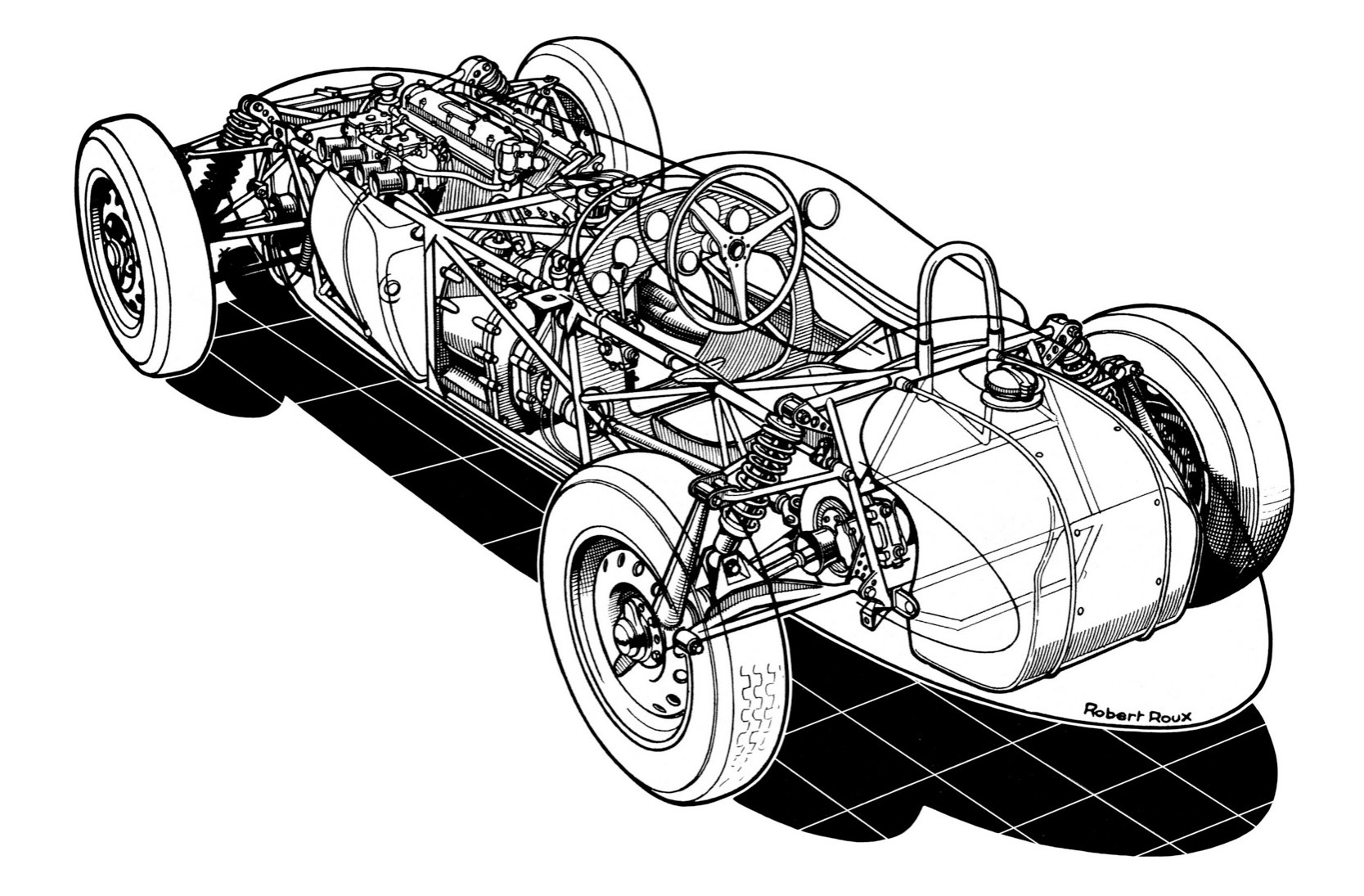
P99 (R Roux)

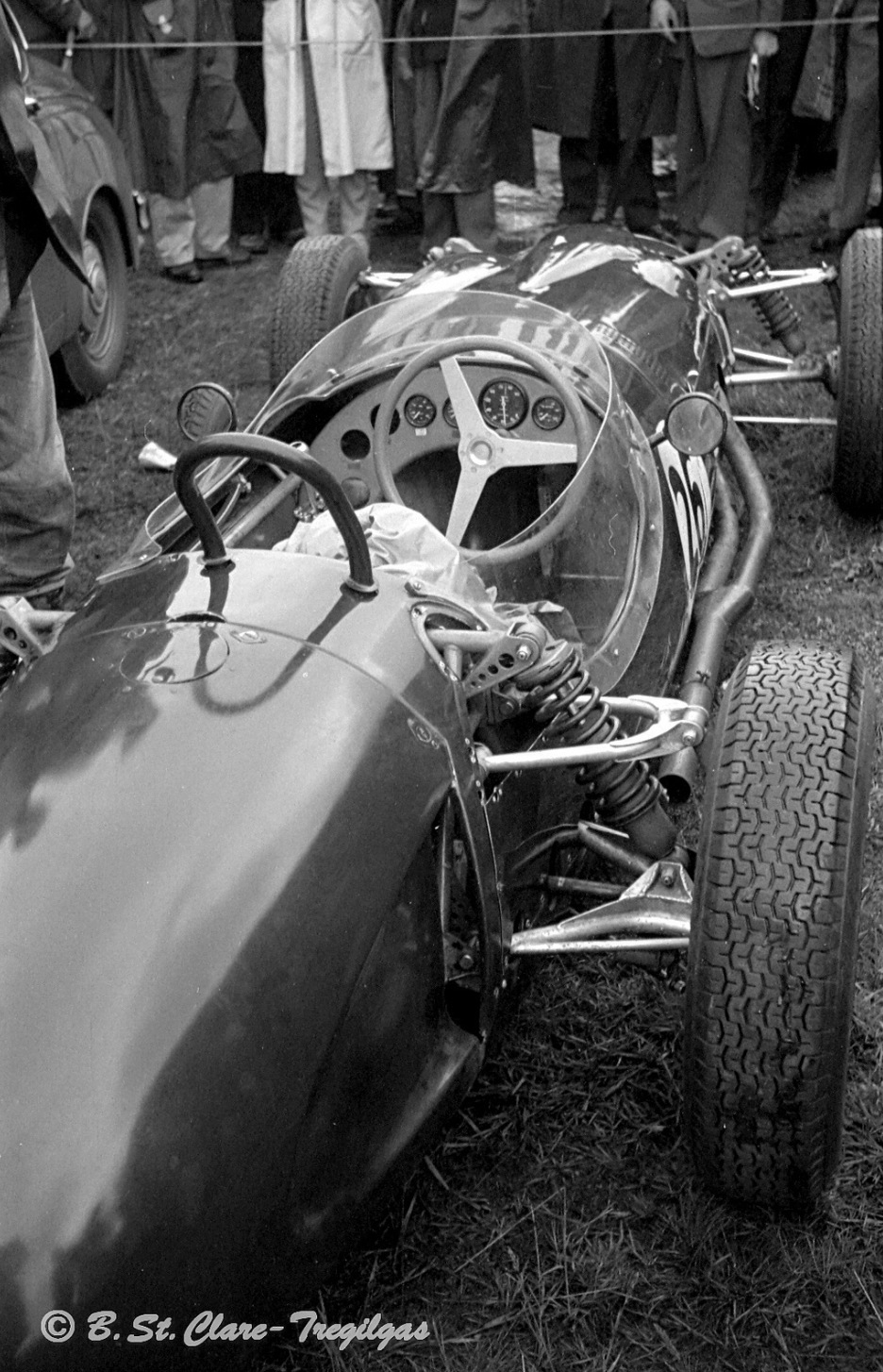
Cockpit shot British GP, Aintree 1961. Driving position offset to the right, gearchange for 5 speed box to the left. 1.5 litre FPF powered Climax engine in the last year of the 1.5 Litre Formula. (B St Clare-Tregilgas)

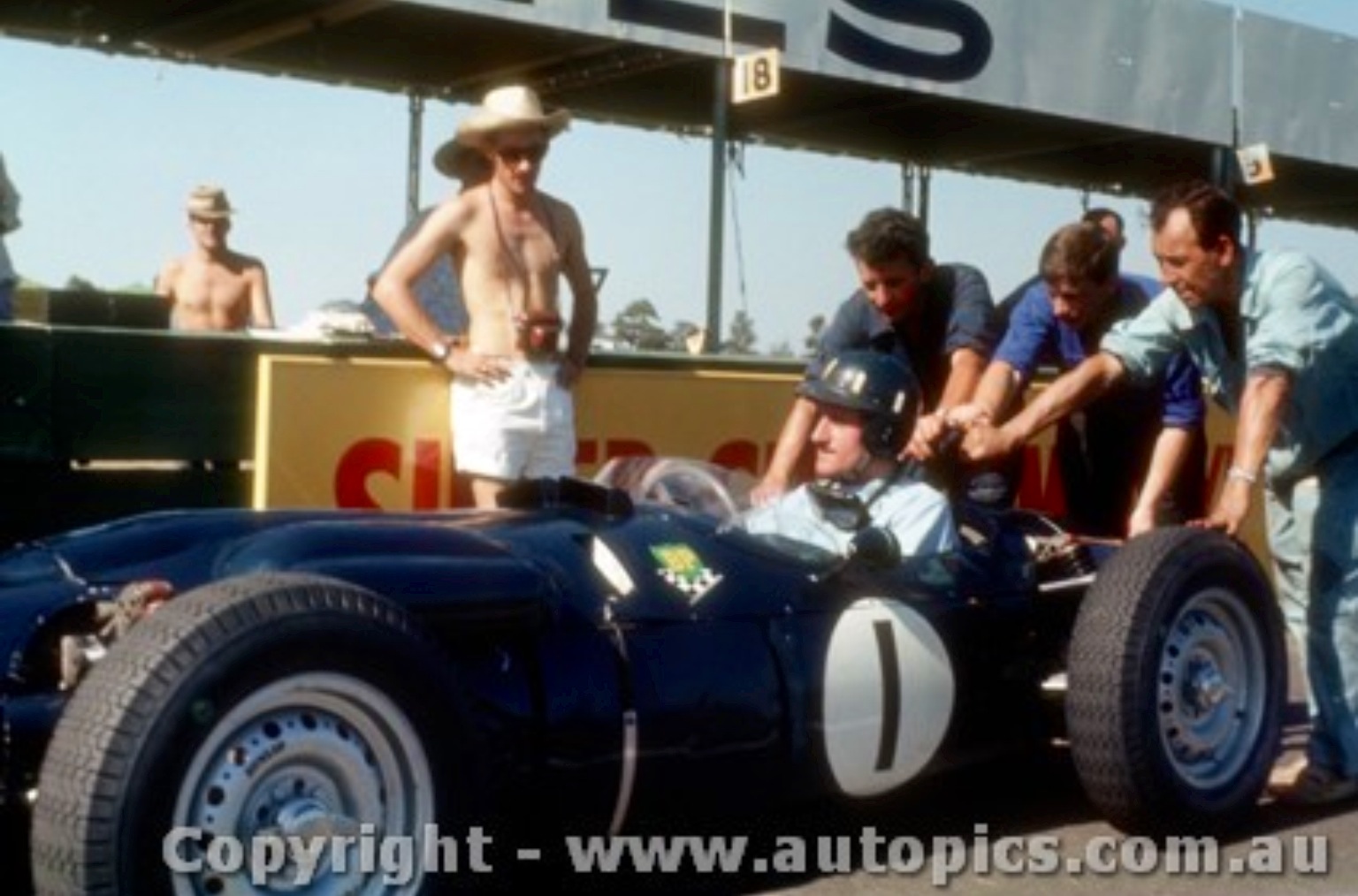
Push start for Hill from the Warwick Farm pit counter, P99. AGP meeting 1963. (autopics)

Hill at Warwick Farm trailing smoke from the rear. Probably practice as the car finished the race. (Adrian Schagen)

Evocative David Mist shot of Hill during the 1963 AGP Warwick Farm. P99. (David Mist)

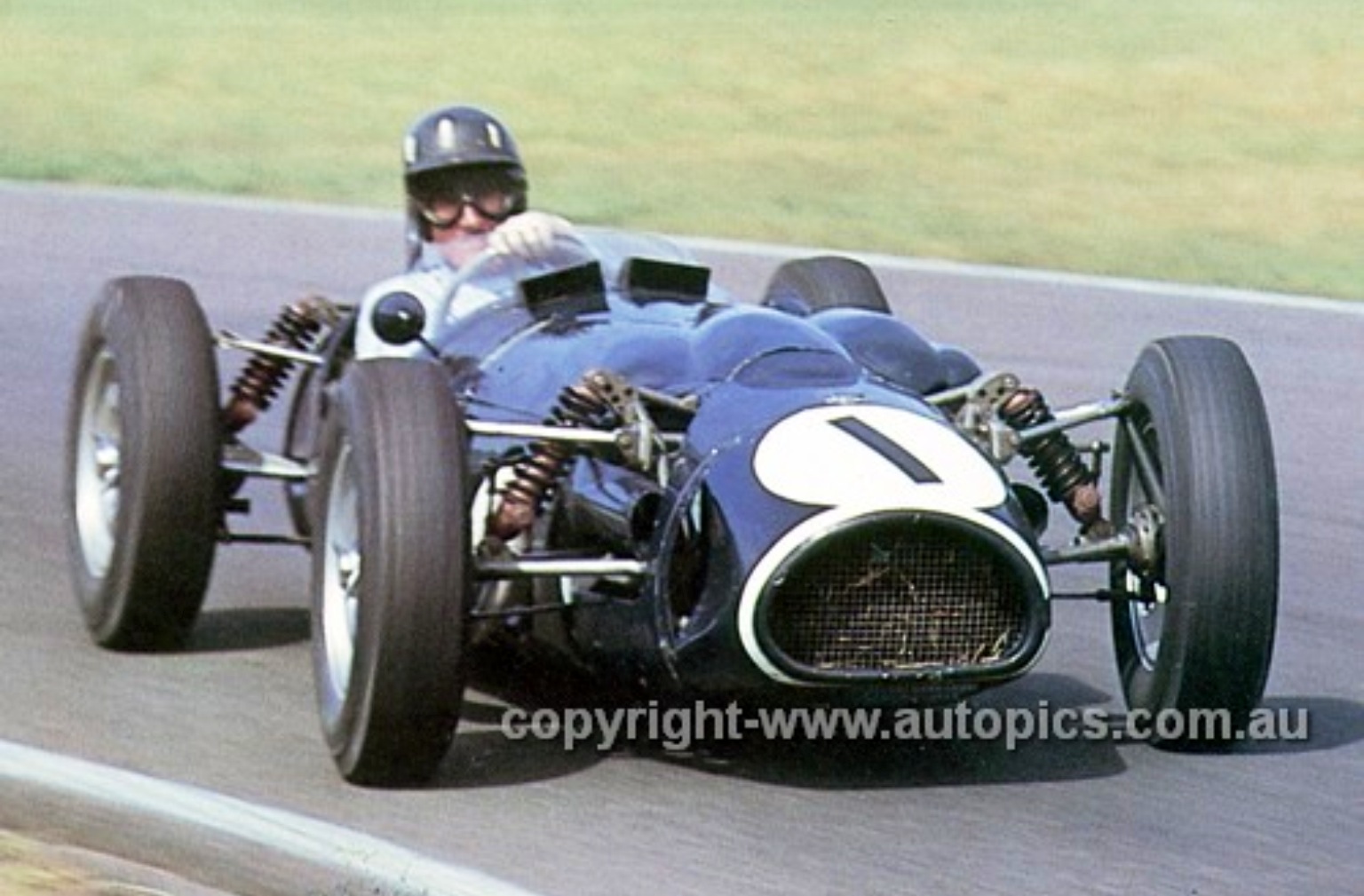
Hill again at Warwick Farm during the ’63 AGP, this shot showing the not inconsiderable frontal area of P99. Weight and width of car a function of ‘4WD hardware’. (autopics)
Ferguson Novi
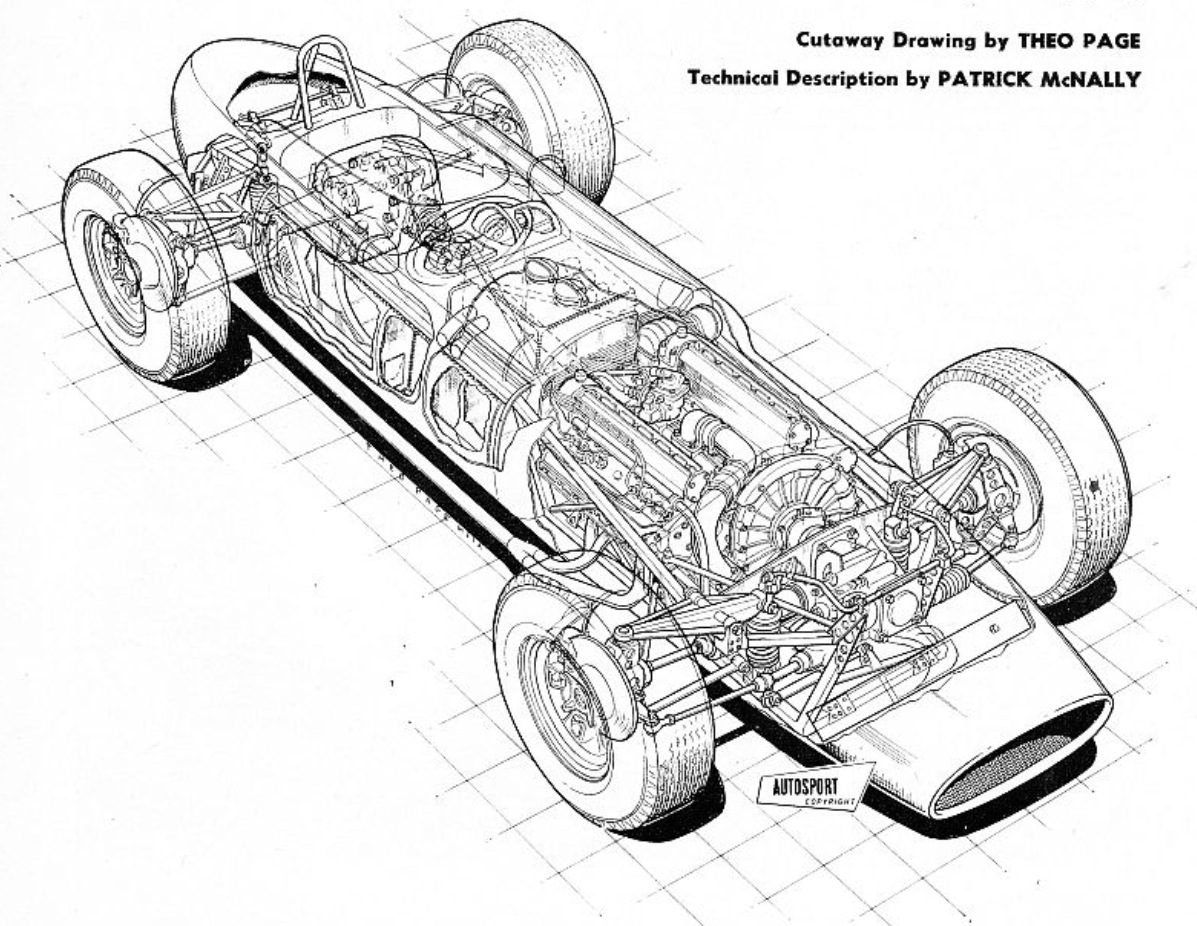
What a wild car this is! Conceptually similar to the P99, the chassis was a spaceframe with a monocoque centre section. As you can see the suspension is inboard with rockers actuating the spring/dampers, P99 is outboard. Contrary to common Indy practice then the suspension was not offest, but the engine and transmission were, a simpler solution. Novi used Dunlop 7X15 inch tyres fitted to alloy wheels and disc brakes using alloy calipers.
The Novi engine was designed pre-War by Bud Wingfield and Leo Goossen and built by Fred Offenhauser. It was a 90 degree, DOHC V8, 2741cc in capacity. Bendix fuel injected and using a Paxton 2 stage centrifugal blower power was circa 830bhp @ 8200rpm.
The engine never won Indy but the engine and its unique sound remain iconic to this day.
R5 Prototype
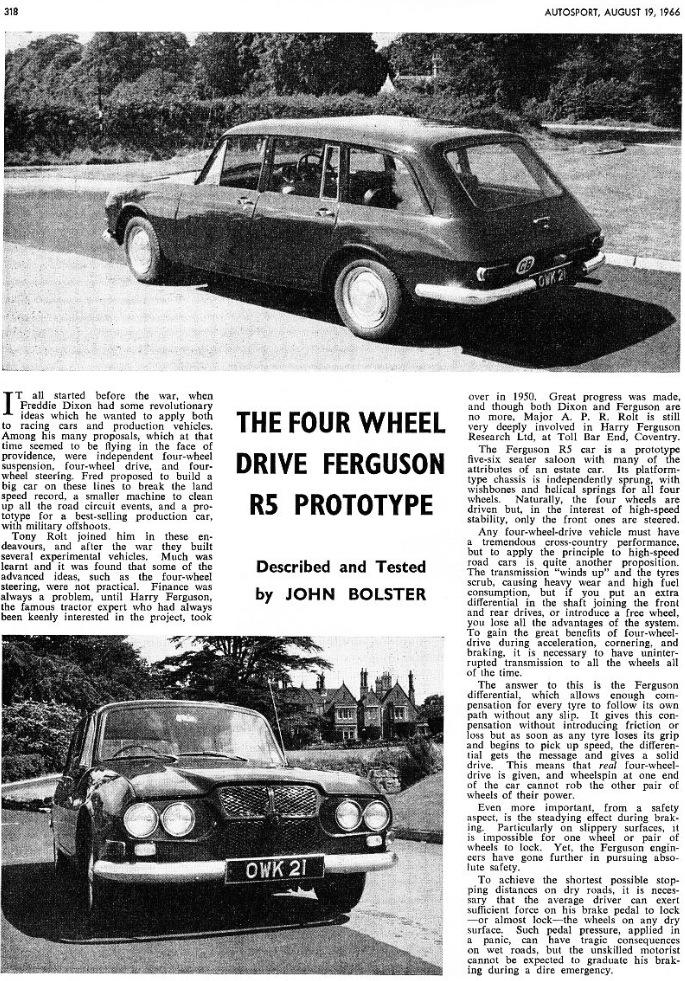
Ferguson R5 road car prototype. Autosport Road Test P1.

R5 Road Test P2.
Credits…
John Ellacott, Bruce Wells, B St Clare-Tregilgas, James Allington, Adrian Schagen, John Stanley, autopics.com, David Mist, Peter Mellor, theroaringseason.com, Theo Page, Robert Roux, Autocar, Autosport, Jock Psaros, Simon Lewis Transport Books
Finito…