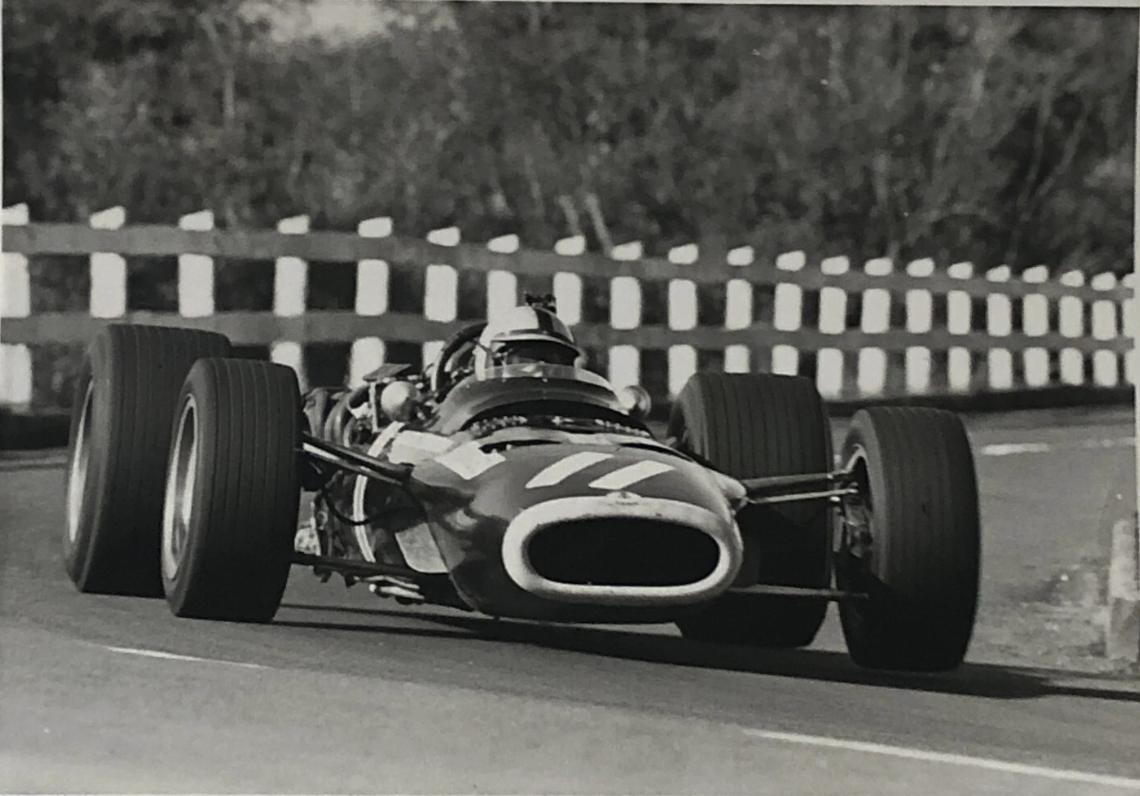
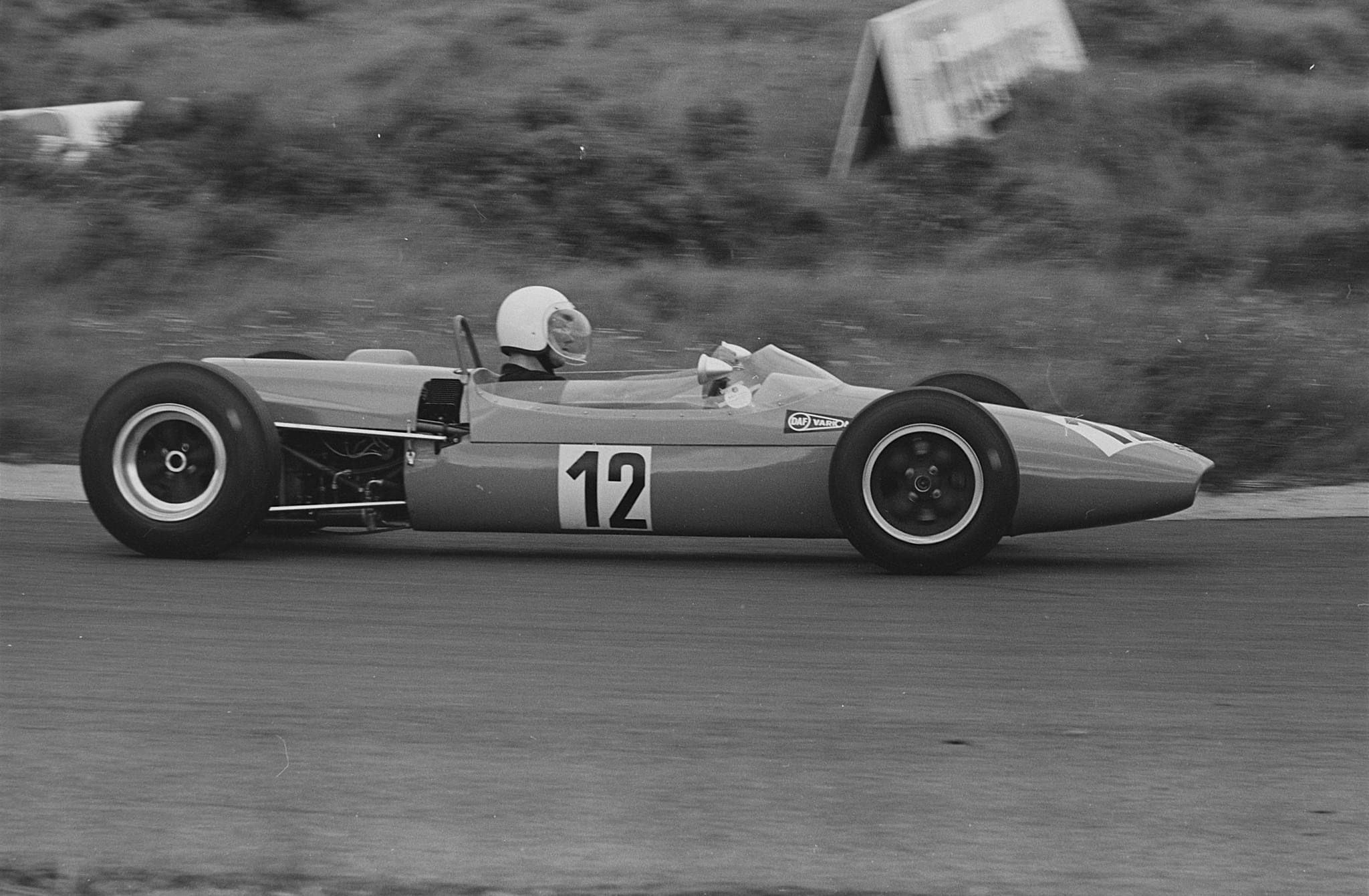
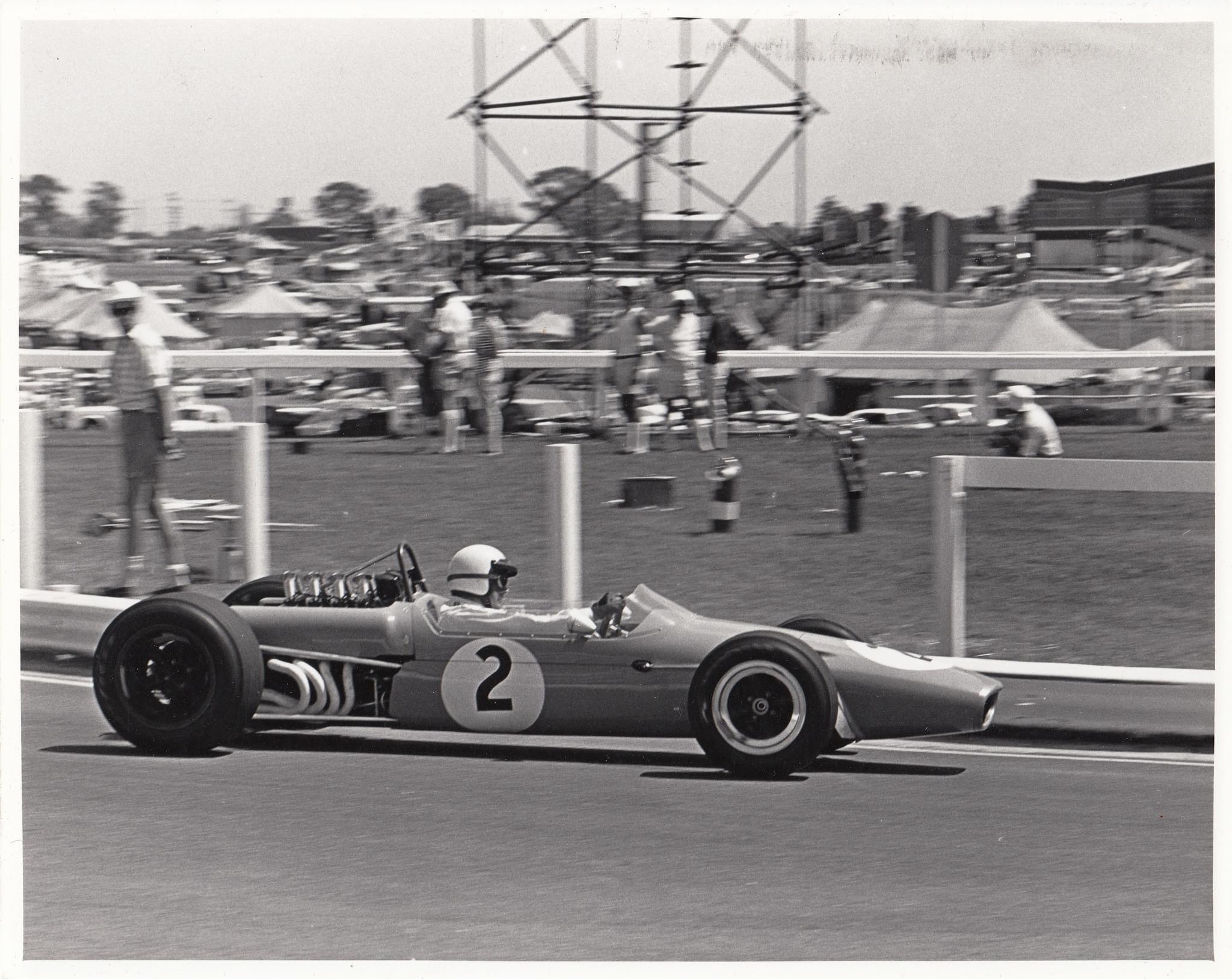
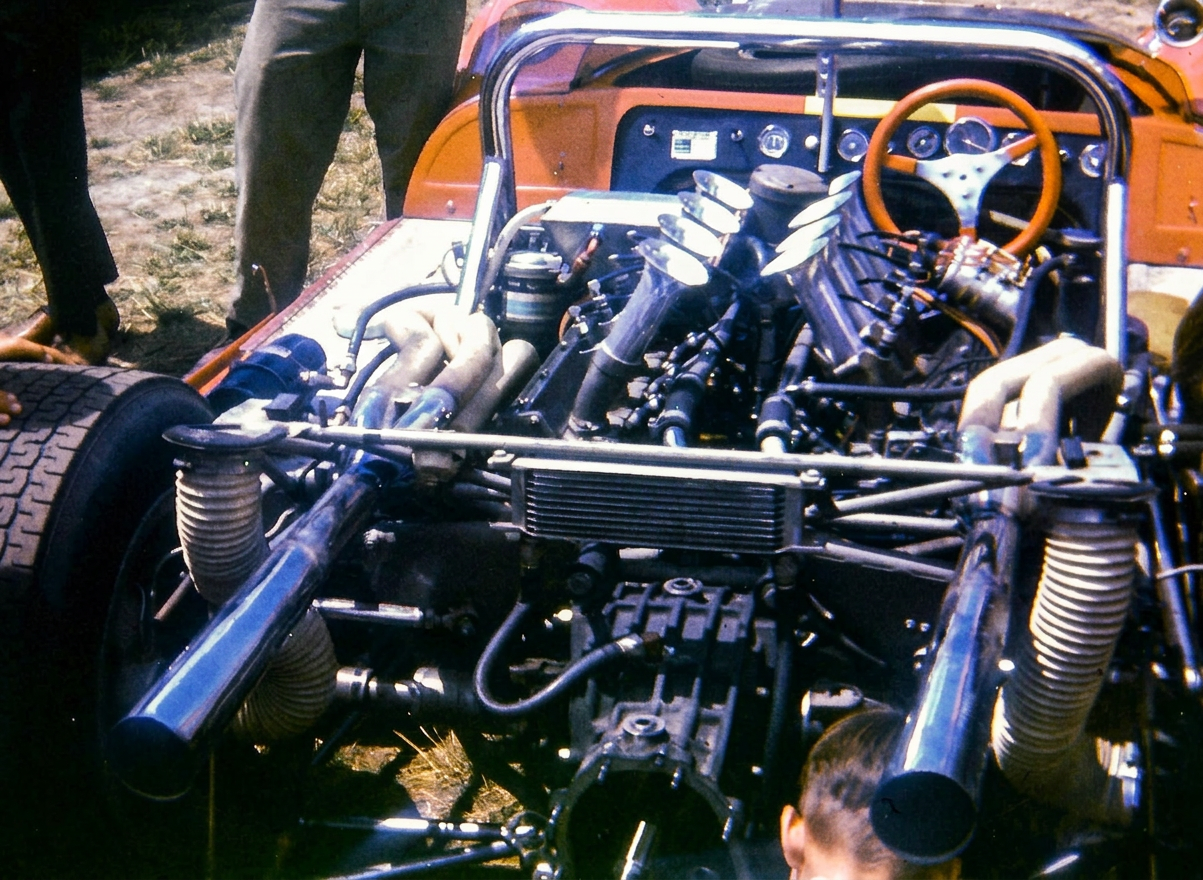
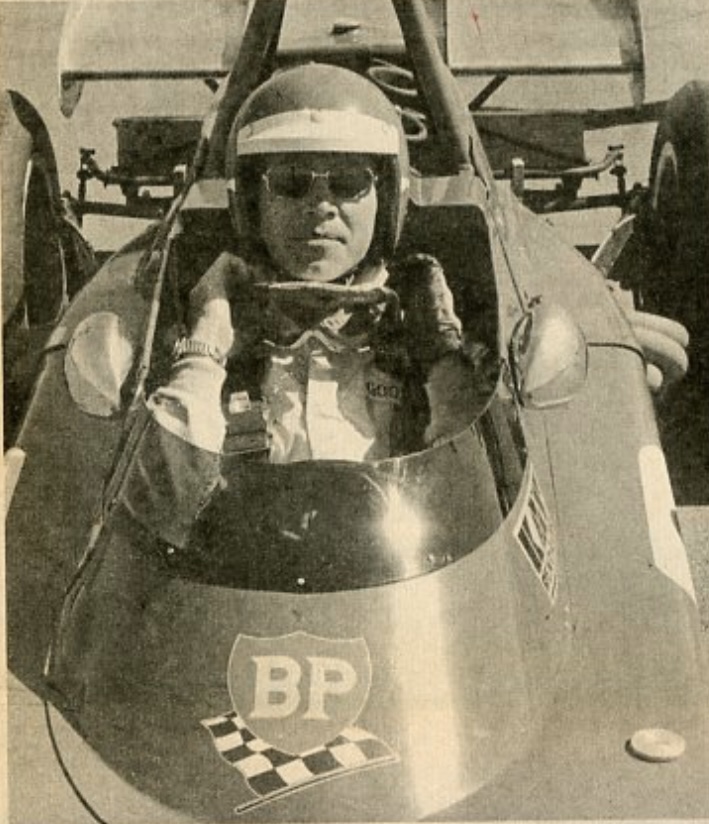
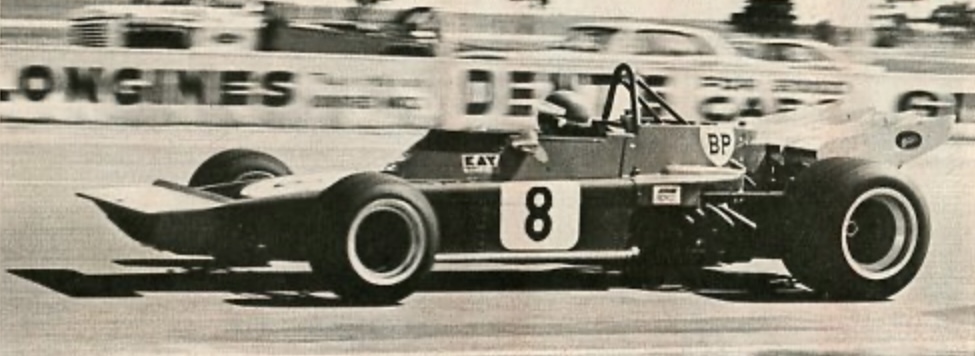
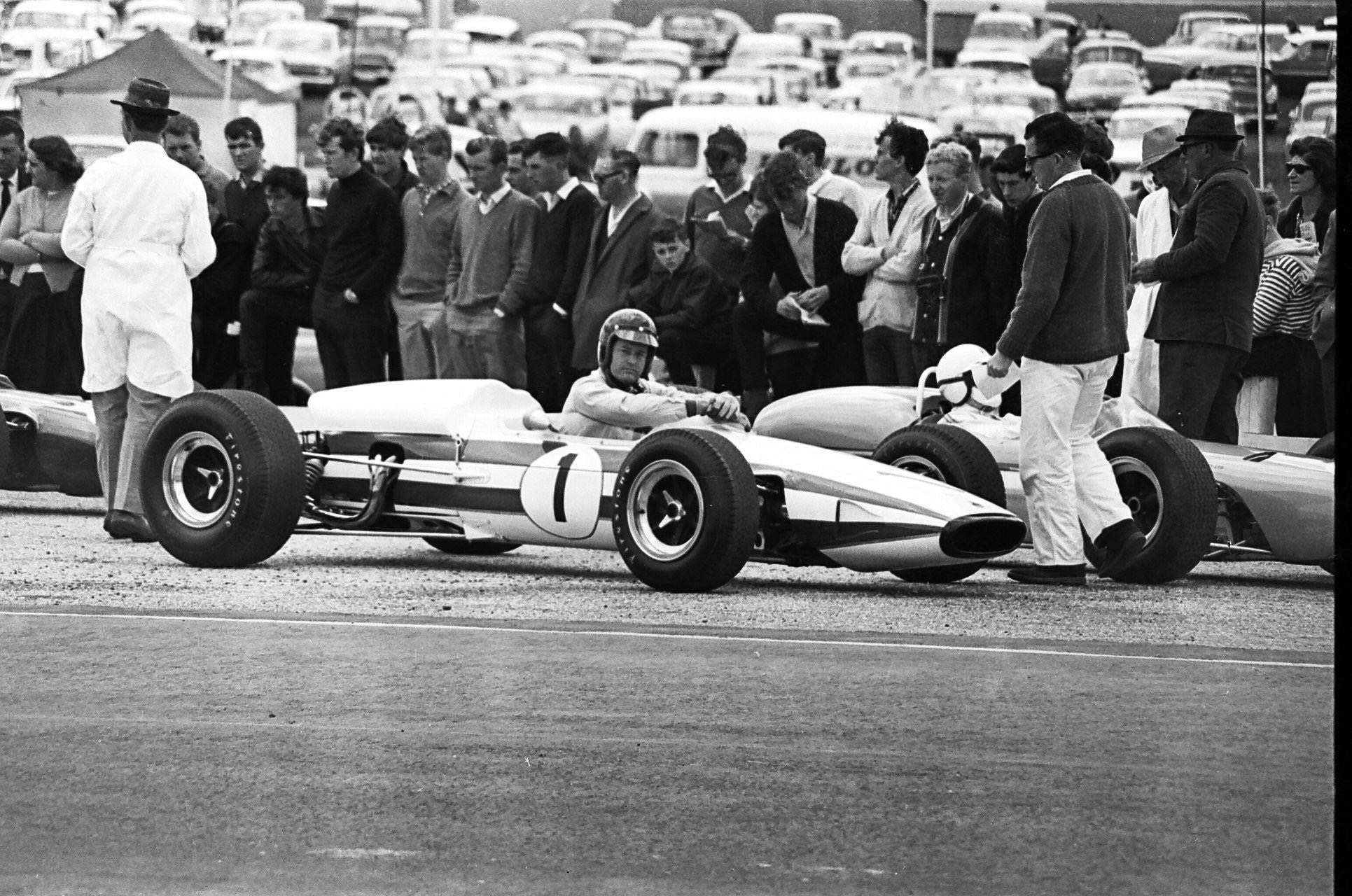
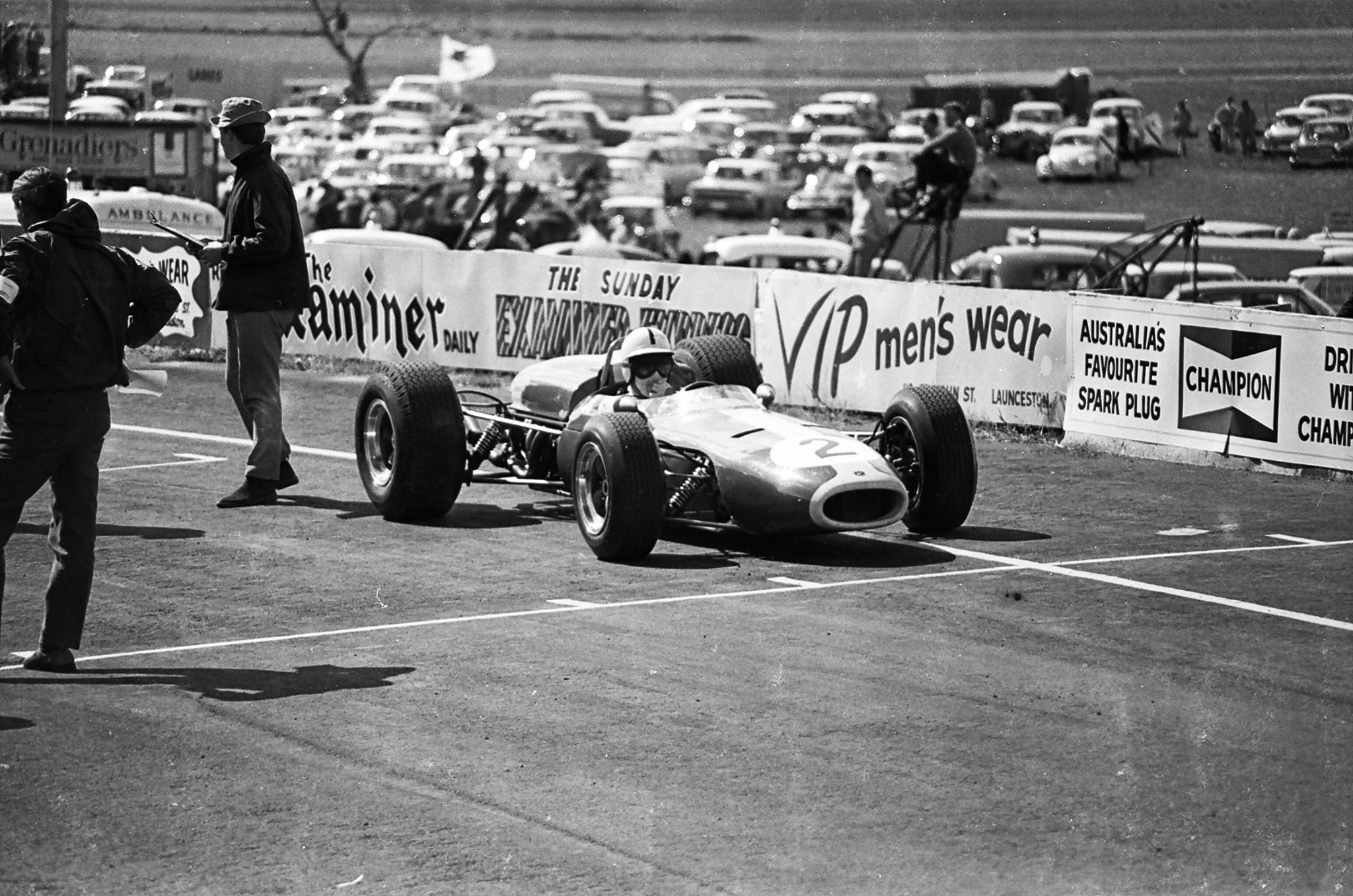
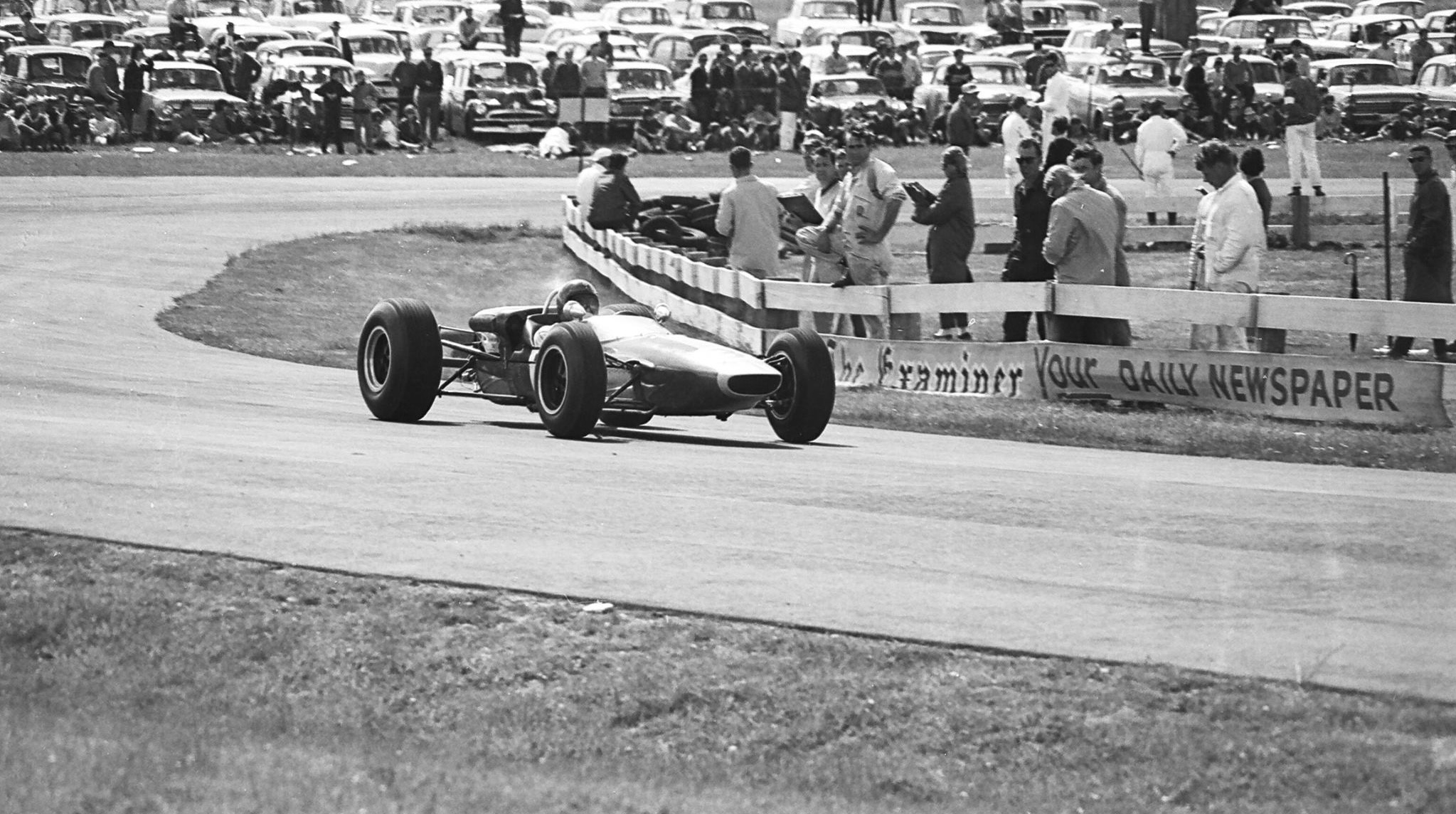
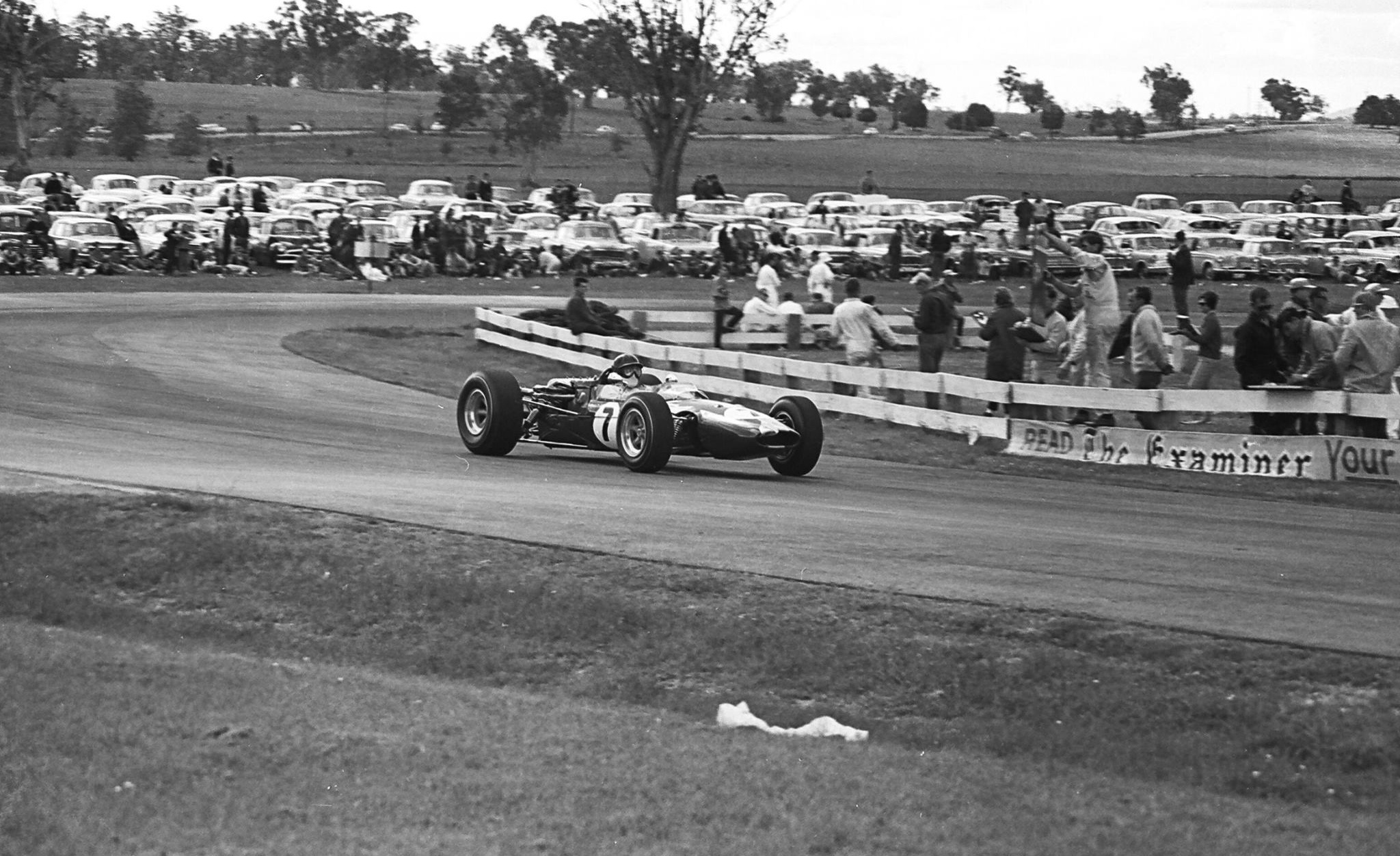
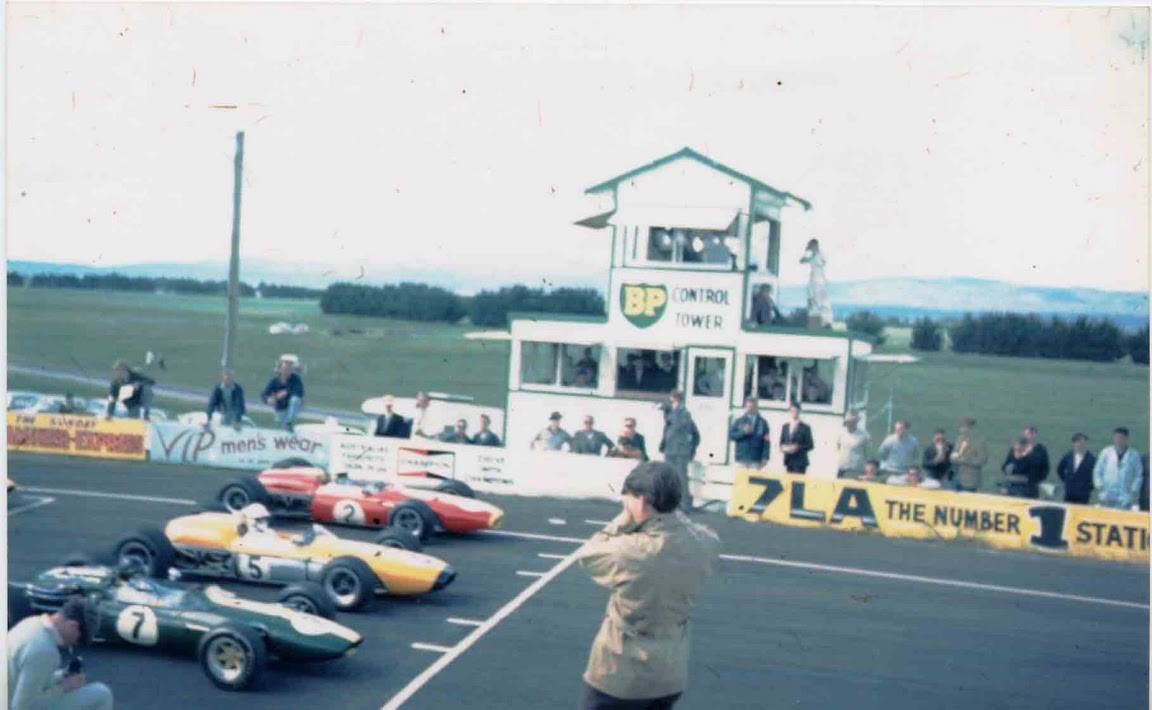
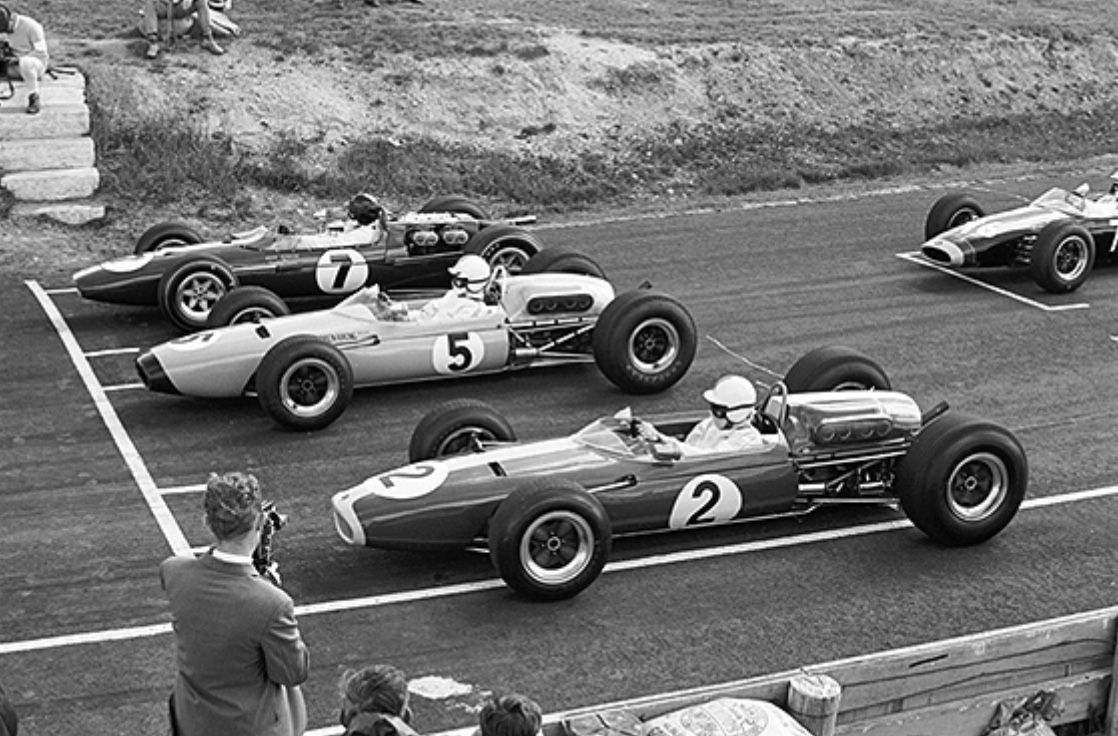
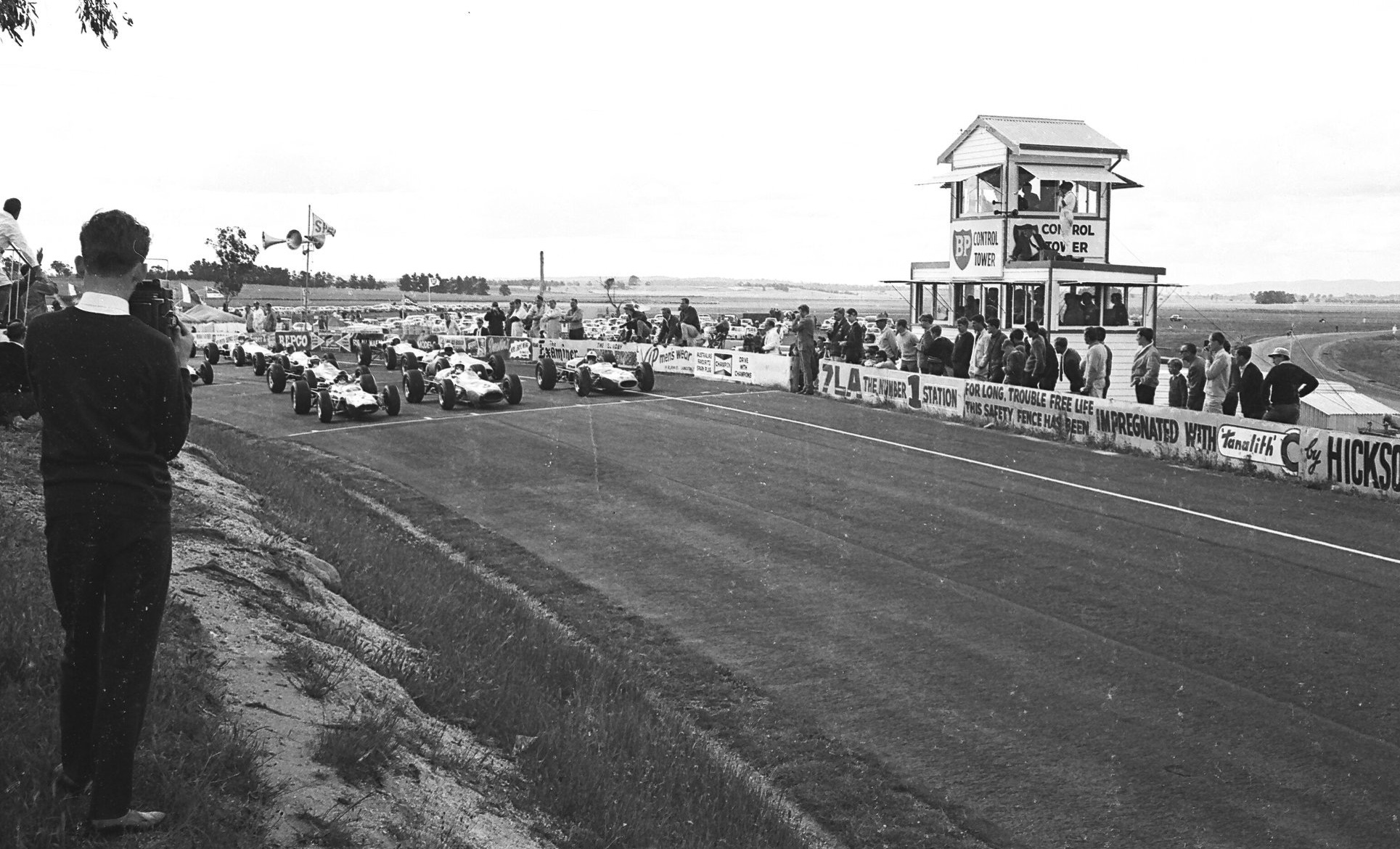
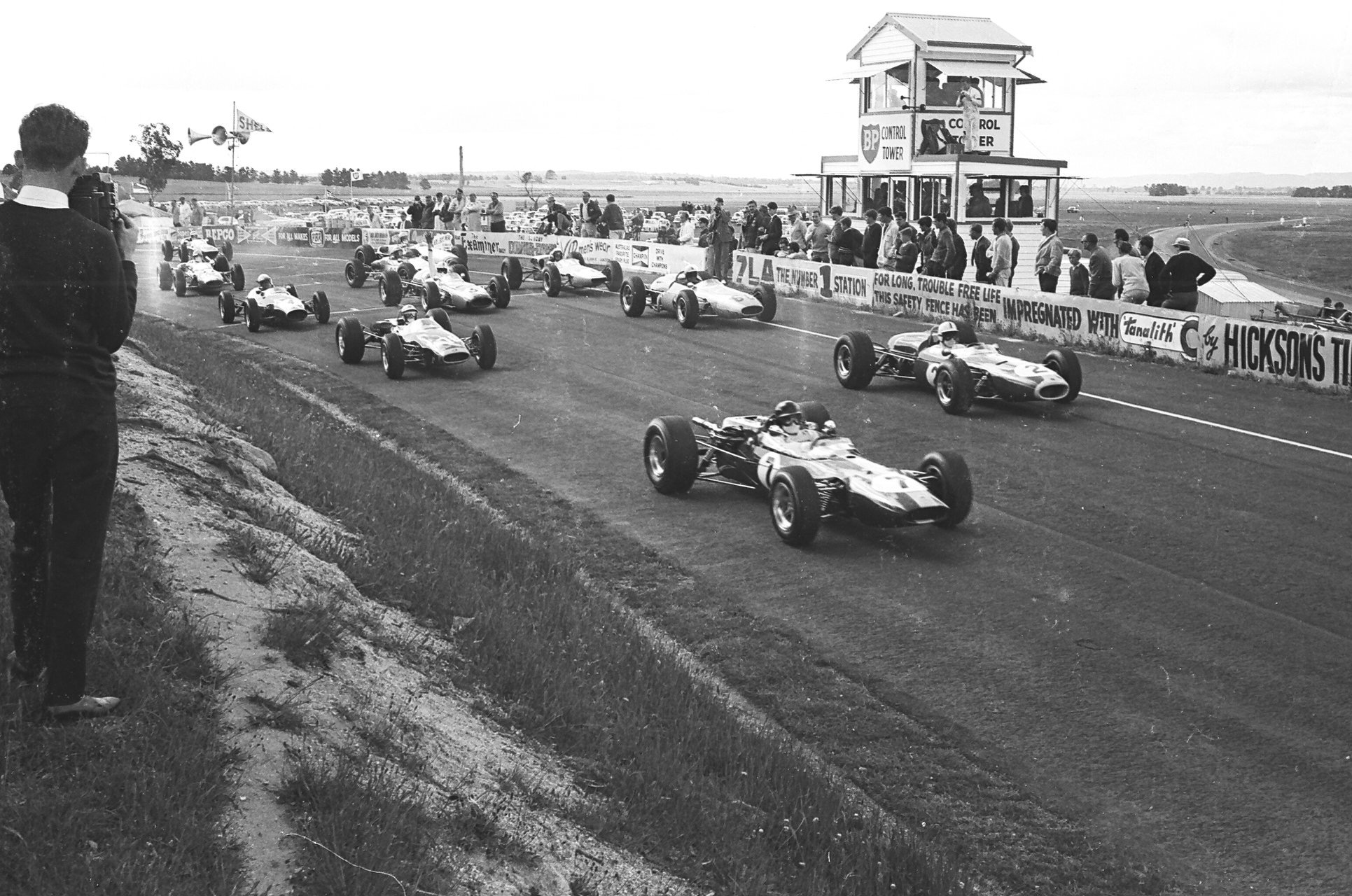
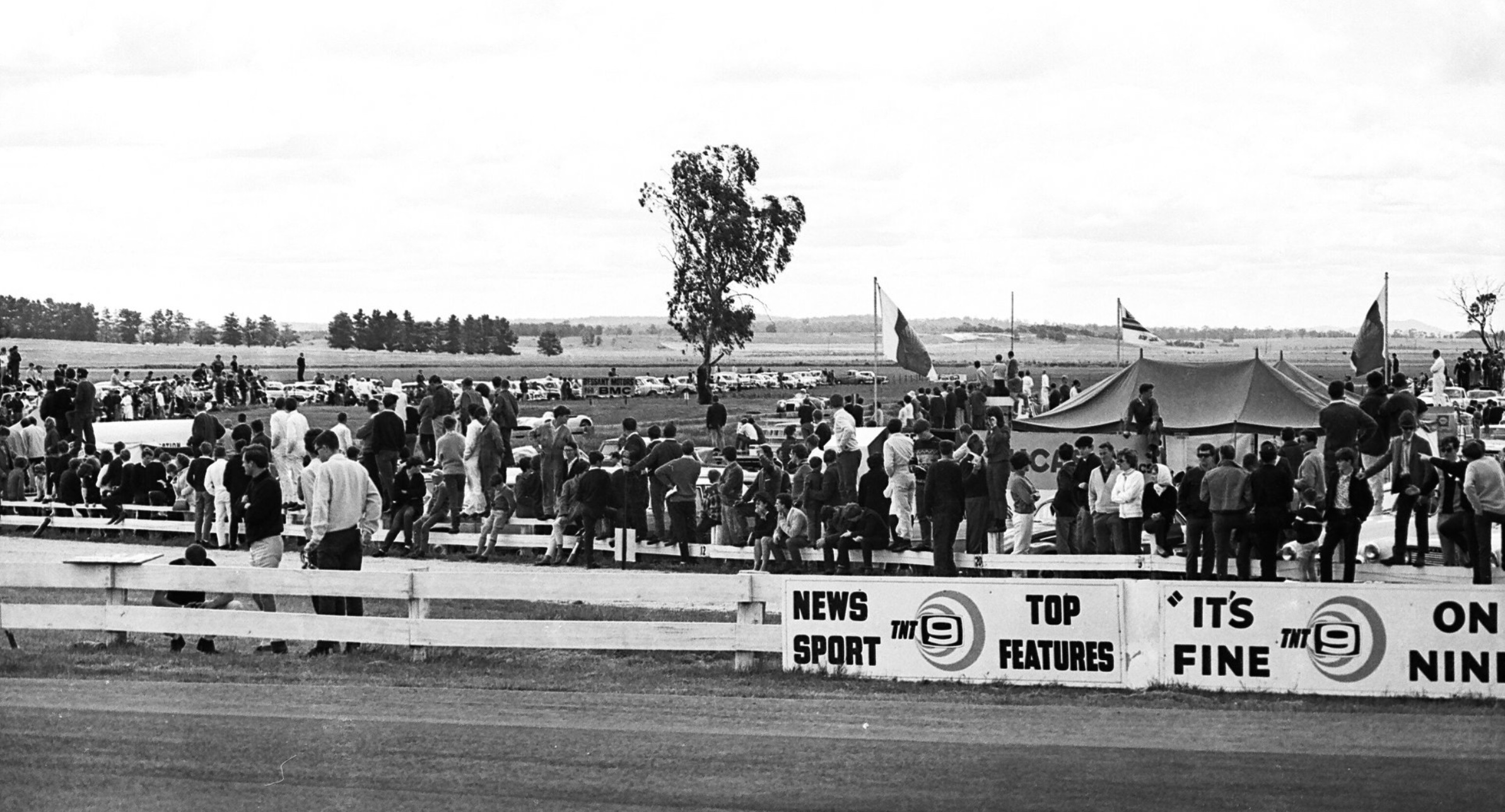
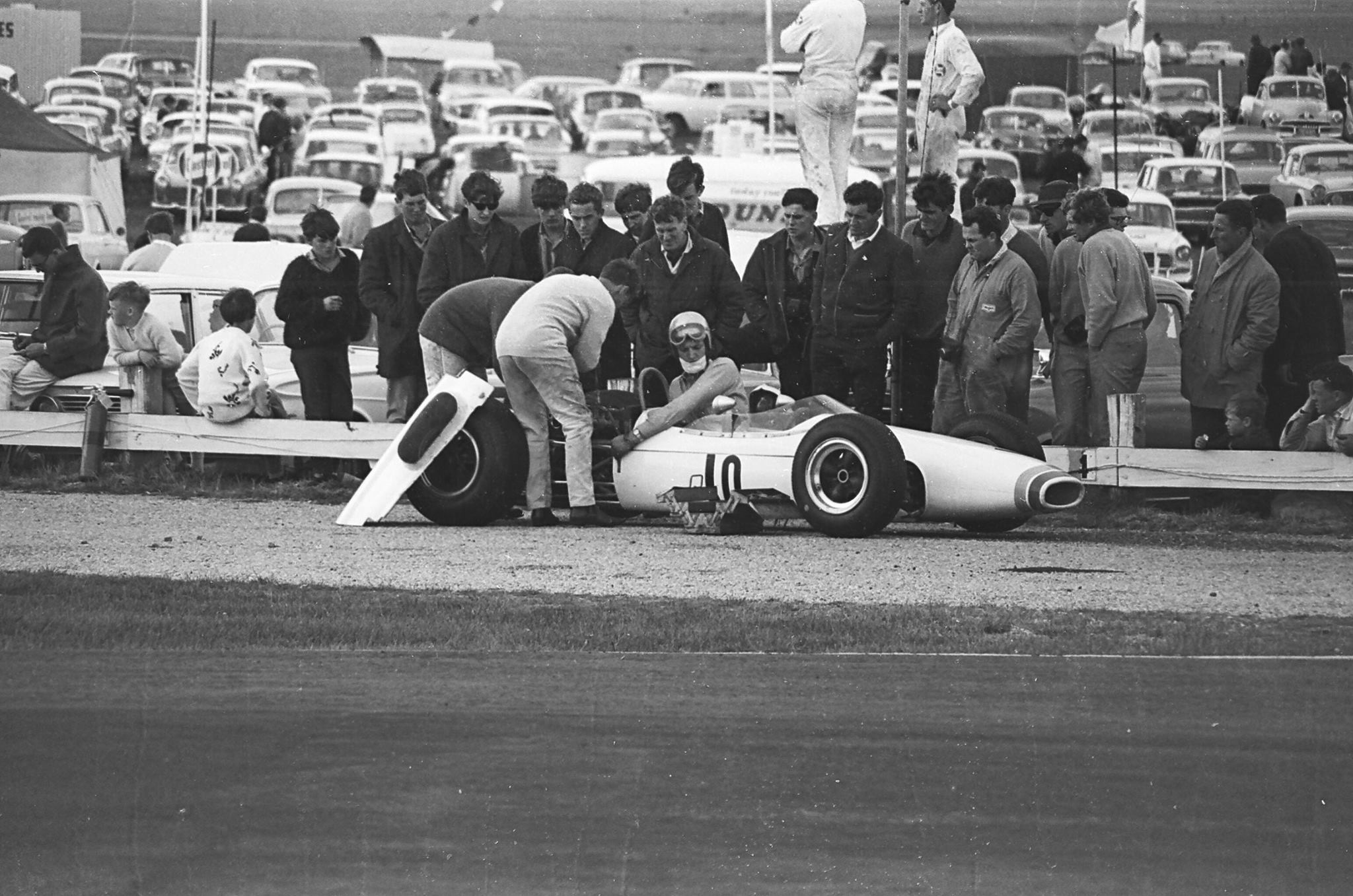
Pedro Rodriguez blasts off Long Bridge in his 2.5-litre BRM P126 #01 V12 during the South Pacific Trophy, Tasman Cup meeting over the March 4, 1968 weekend at Longford.
Montgomery Dunn (a King Street, Sydney snapper I’ve not heard of) took this ripper shot on March 2, ‘Rodriguez in the V12 BRM before it blew up in Saturday’s supporting race.’ Graham Hill won from Jim Clark and Chris Amon: Lotus 49 Ford DFW by two, and Ferrari Dino 246T.
Len Terry’s new Grand Prix design was blooded in the 1968 Tasman Cup, where P126/01 and P126/02 were shared by Pedro, Bruce McLaren and Richard Attwood. Bruce got the better of it with a victory in the Teretonga International.
Pedro raced P126/01 at Levin DNF fuel-pickup, Wigram sixth, Teretonga DNF engine, Surfers Paradise tenth, and Sandown DNF engine. But he spent most of his time, when Tim Parnell was out of sight, looking at the 2.1-litre V8 P261, which was fully sorted, to say the least! It was the tour spare, but Pedro raced it at Pukekohe for a DNF clutch, Warwick Farm, sixth and a splendid second at Longford where he nicked the spot from Frank Gardner’s Brabham BT23D Alfa Romeo 2.5 V8 in the streaming, atrocious rain on the last lap.
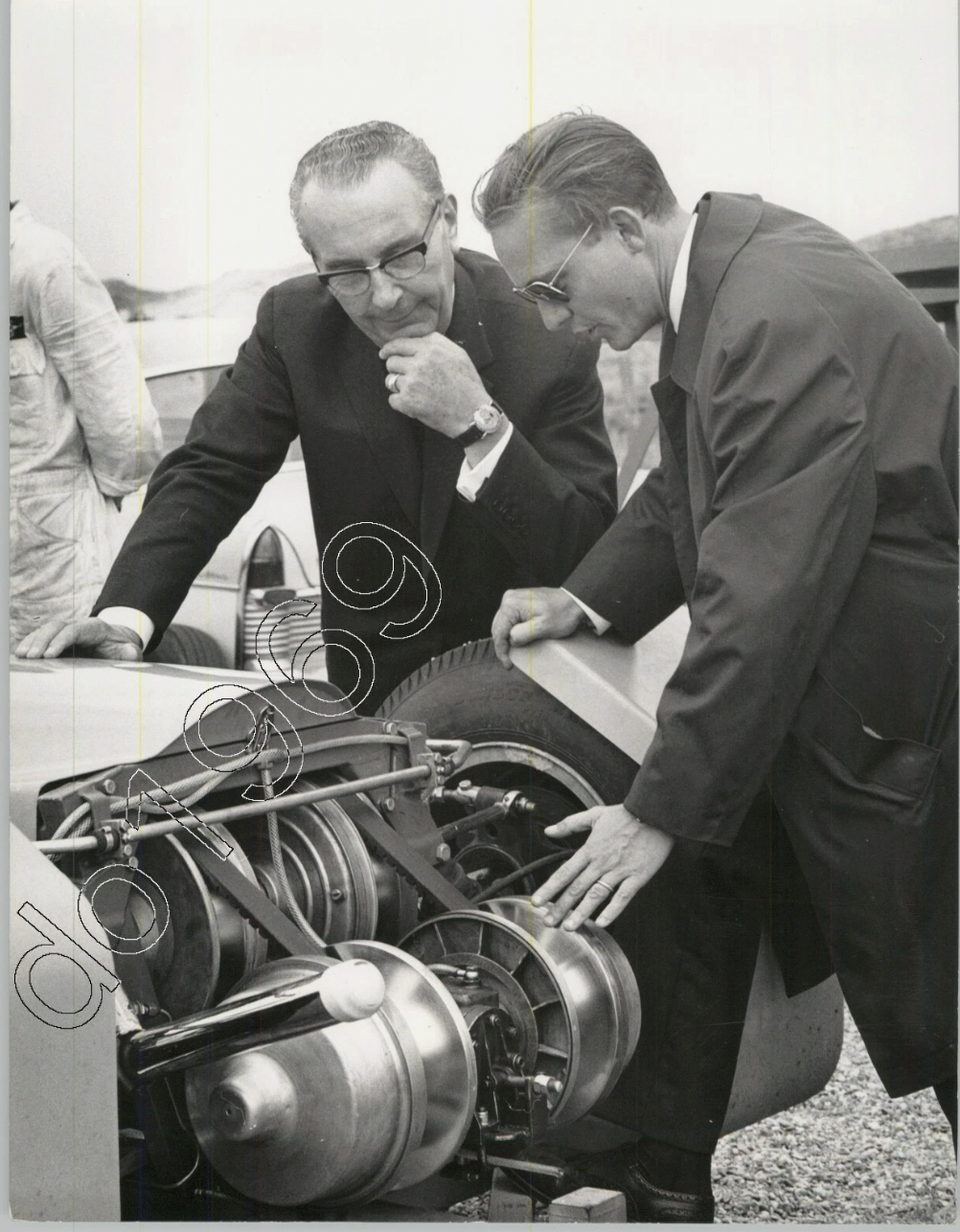
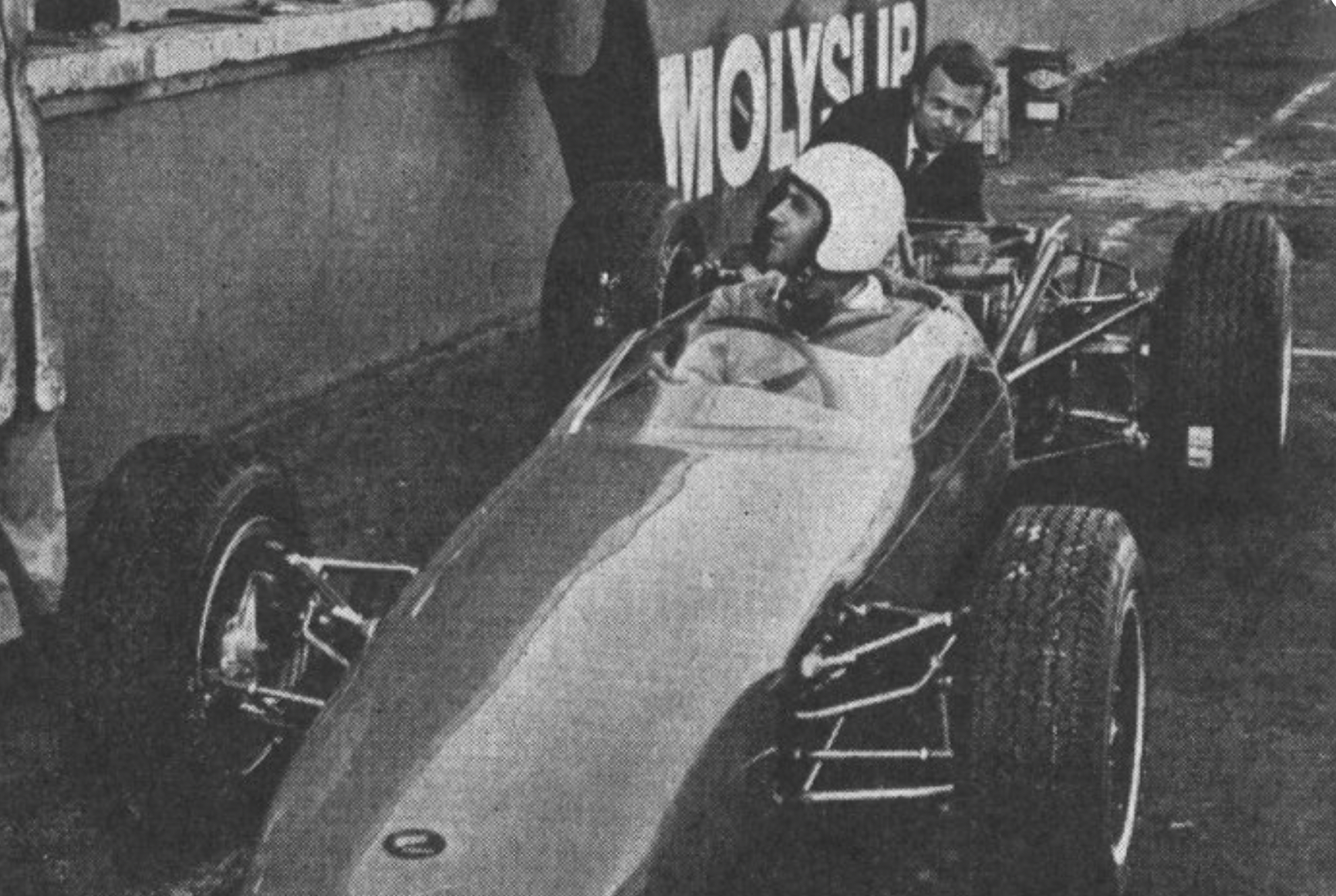
‘Hub van Doorne (left), founder of the DAF Automobile Company, Eindhoven/Holland, and his son Martin van Doorne. The two car experts are discussing the Variomatic transmission of their Brabham BT15 DAF F3 car at Zandvoort,’ the photo records, in early May 1965.
‘The DAF Co produces Daffodil cars (140 per day), which have a fully stepless transmission, lorries, and last but not least the DAF Pony for the US Army.’
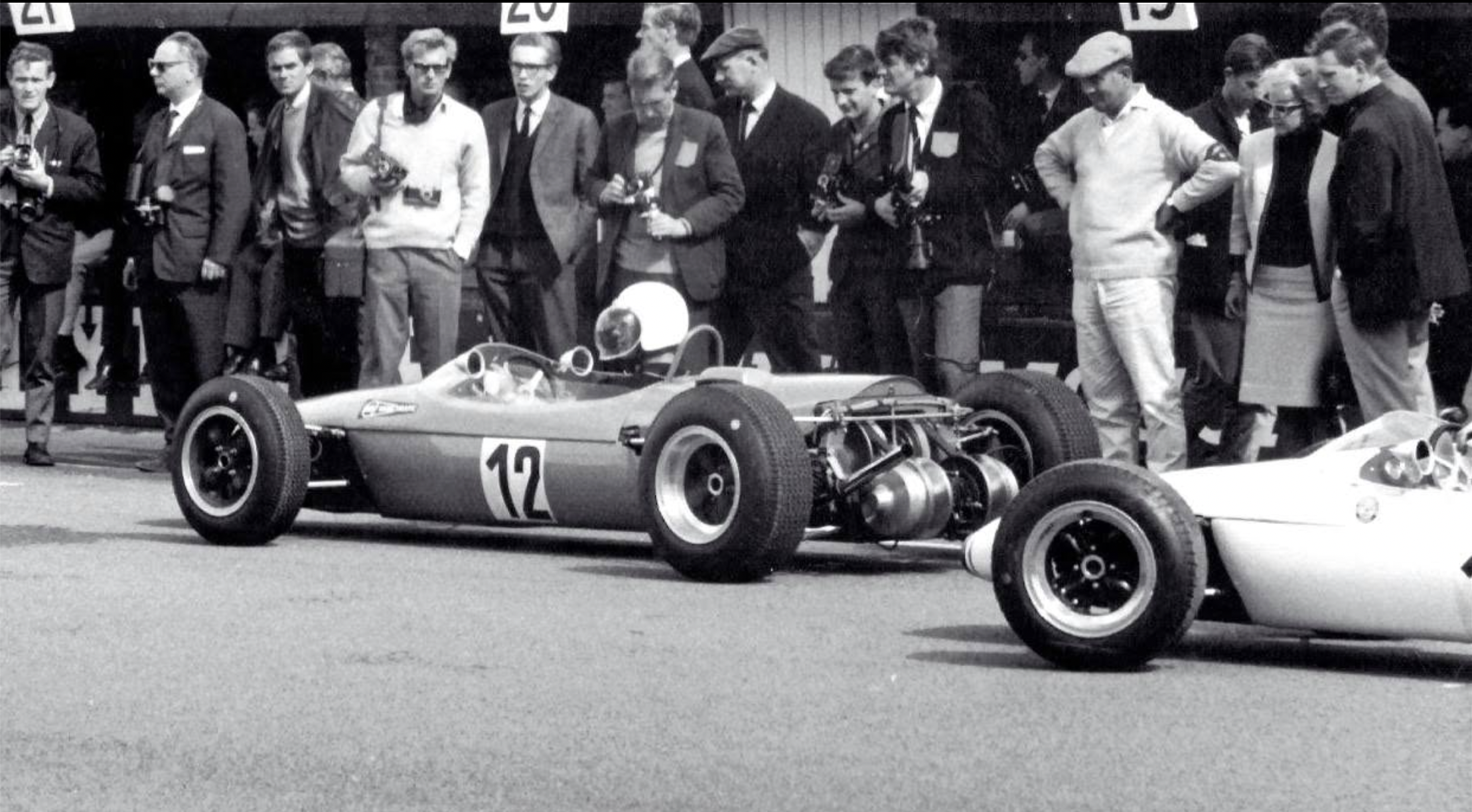
Zandvoort Trophy weekend in August 1965, Slotemaker, BT15 (E Wayenberg)
One of the countless racing improves the breed projects of the 1960s was DAF’s involvement in 1-litre Formula Three from 1965-68, with Alexis, Brabham, DAF (Gemini) and Tecno chassis, all of which were fitted with DAF’s signature stepless ‘variomatic’ continuously variable transmissions (CVT).
The device had infinitely variable ratios, so there weren’t discernible gear changes. The pulleys in the transmission expanded and contracted depending on speed, load and driver demand. Final drive to the rear wheels was provided by rubber composite drive belts.
Dutch racers Rob Slotemaker and Henk van Zalinge (HVZ) formed the Rensportschool Zandvoort race driving school in 1955 and delivered countless racing drivers in the process. Van Zalinge (1922-5/2/2006), in addition to his talents behind the wheel, was also an automotive engineer of note.
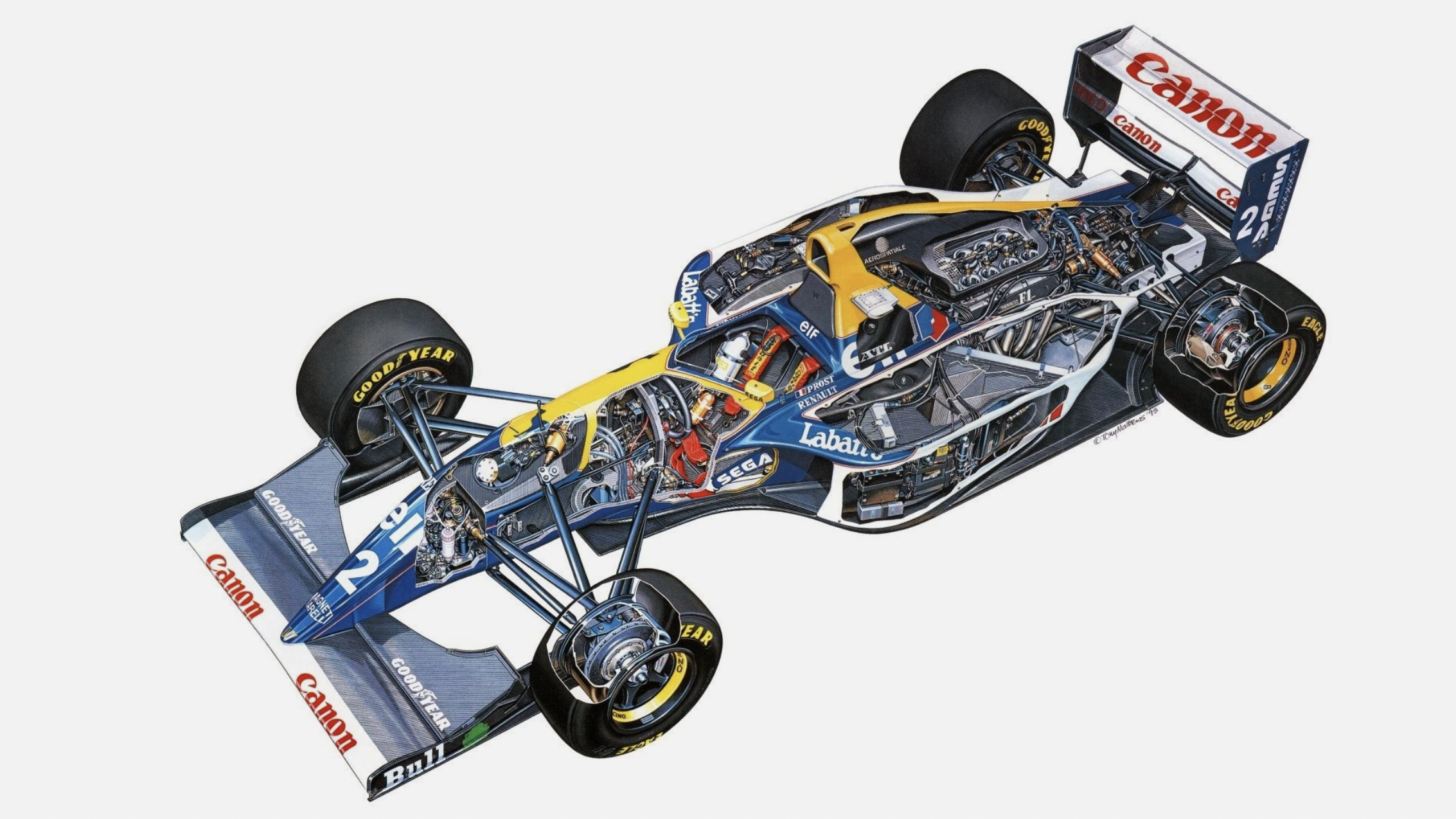
It was his idea to harness DAF’s transmission to handle greater power/torque than their contemporary small-car range. In essence, the Variomatic transmission potentially provided an Unfair Advantage by keeping an engine perpetually in its optimum power band. They proved rather successful too; the technology made it into road cars, and the pace of a CVT-equipped F1 Williams FW15C Renault 3.5 V10 was quick enough for the FIA to ban it…but we are getting ahead of ourselves.
Design and Development…
DAF quickly embraced HVZ’s pitch, and its execution was thrown to the head of DAF Research & Development, Wim Hendriks, the man who designed and built the first Variomatic for the DAF 600 in 1967.
DAF bought a British Alexis Mk5 chassis (#HF501) and the usual Ford Cosworth MAE 1-litre engine over the winter of 1963-64, then proceeded to adapt their unique technology for this most competitive of classes.
Hendrik’s challenge was re-engineering the rubber belts, heavy-duty pulleys and ratios to survive 100bhp tearing away at components built for half the power.
Much initial work on the car was carried out in Martin van Doorne’s home garage. Further attempts at privacy included testing the car at De Peel Air Base rather than DAF’s test track at Sint-Oedenrode. Eventually, De Telegraaf covered the news on its front page.
In the early Alexis stage, Slotemaker and Van Zalinge shared the test-driving work, albeit HVZ was the primary bridge between the cockpit and engine bay; the racer/mechanic diagnosed what the transmission was doing under load, then Van Zalinge fine-tuned the centrifugal weights and vacuum ratios trackside.
After a steep learning curve with the Alexis, competition manager Rob Koch approached Jack Brabham to partner with what was, by then, the pre-eminent manufacturer of production racing cars. DAF bought a more sophisticated Brabham BT15 (F3-25-65), and it was with this chassis that the DAF Racing made its F3 debut at Zolder on May 9, 1965, that circuit, the site of much of the development testing.
Brabham BT15 Ford Cosworth DAF (R Koch)
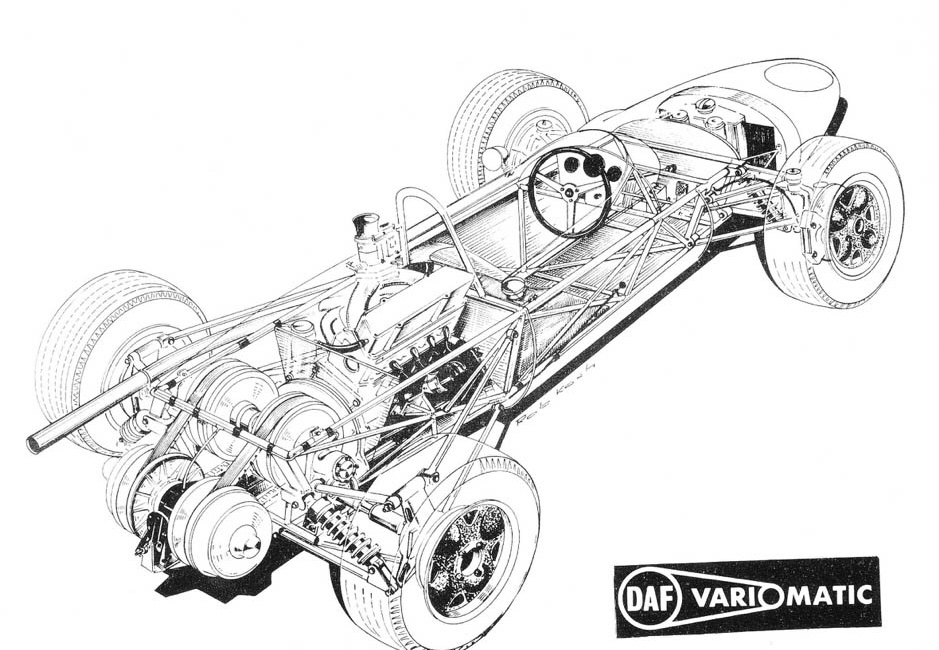
Art Macoran’s tale of how this BT15 cutaway came about is a beauty. ‘The story goes that the car was to be announced in the Dutch paper De Telegraaf, and one of the team members mentioned that it would be good to have a technical drawing to accompany the story “DAF builds a racer”. Rob Koch, DAF Development Engineer with the racing team, said he would spend the weekend on the drawing!’
The FJ Zolder GP on May 9, 1965 wasn’t a great one for poor Rob Slotemaker, who failed to complete a lap with fuel starvation problems.
Not long after, Jack Brabham met the DAF team at Zandvoort and tested the car, amongst his recommendations was the use of a single-belt setup with a conventional racing differential to eliminate the bulk understeer being caused by the ‘dual belt layout fighting itself in high-speed corners’
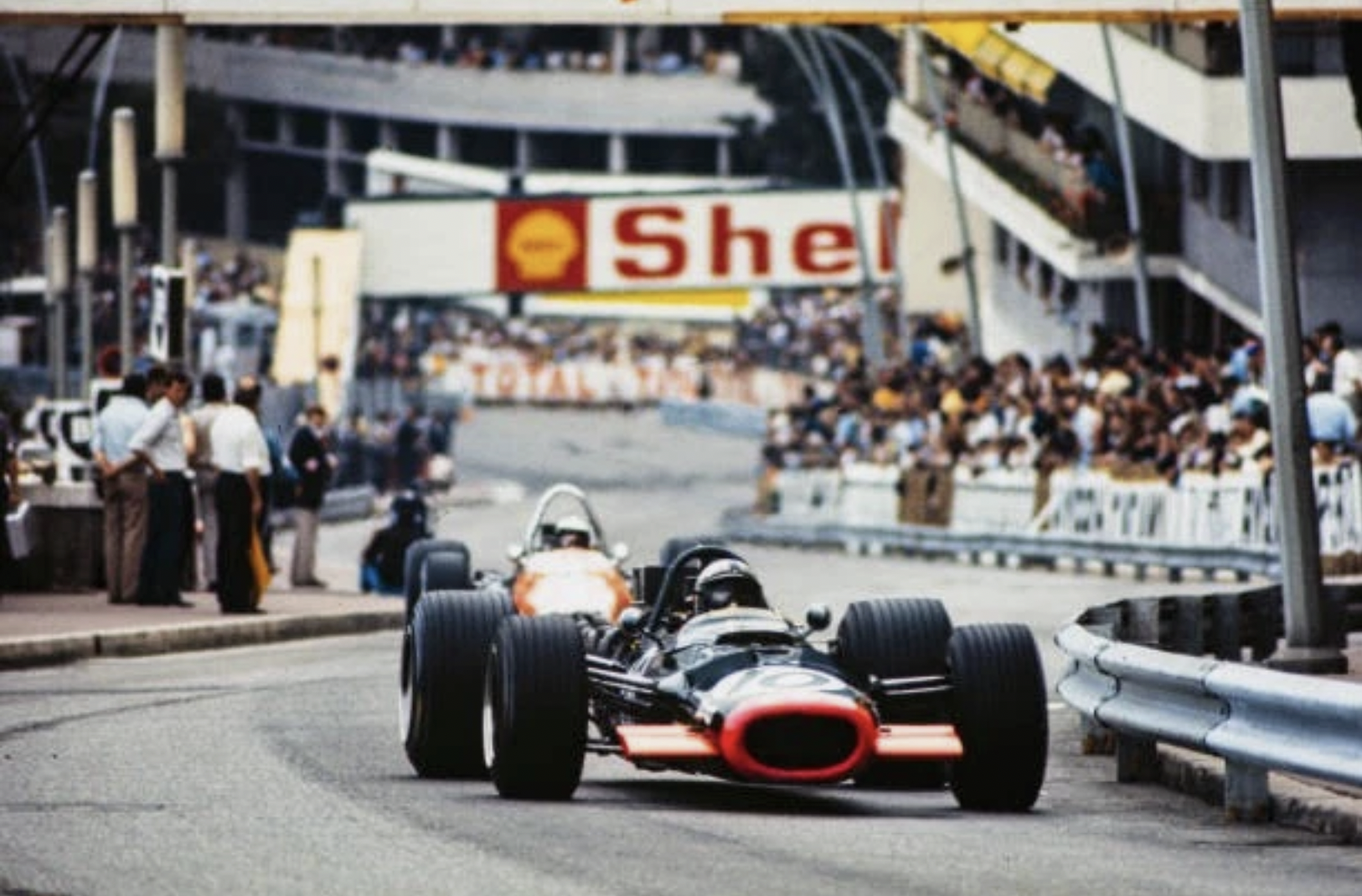
Three weeks later the DAF Racing Team fronted for the Big One, the Monaco F3 Grand Prix held on May 29.
There, for reasons unclear to me, they raced the Alexis, which overheated throughout the weekend, its nose already heavily cut away. Slotemaker was fourth in heat 1 and seventh in the final, in front of several later F1 drivers. The man up front was Peter Revson in a works/Ron Harris Lotus 35 Ford-Holbay.
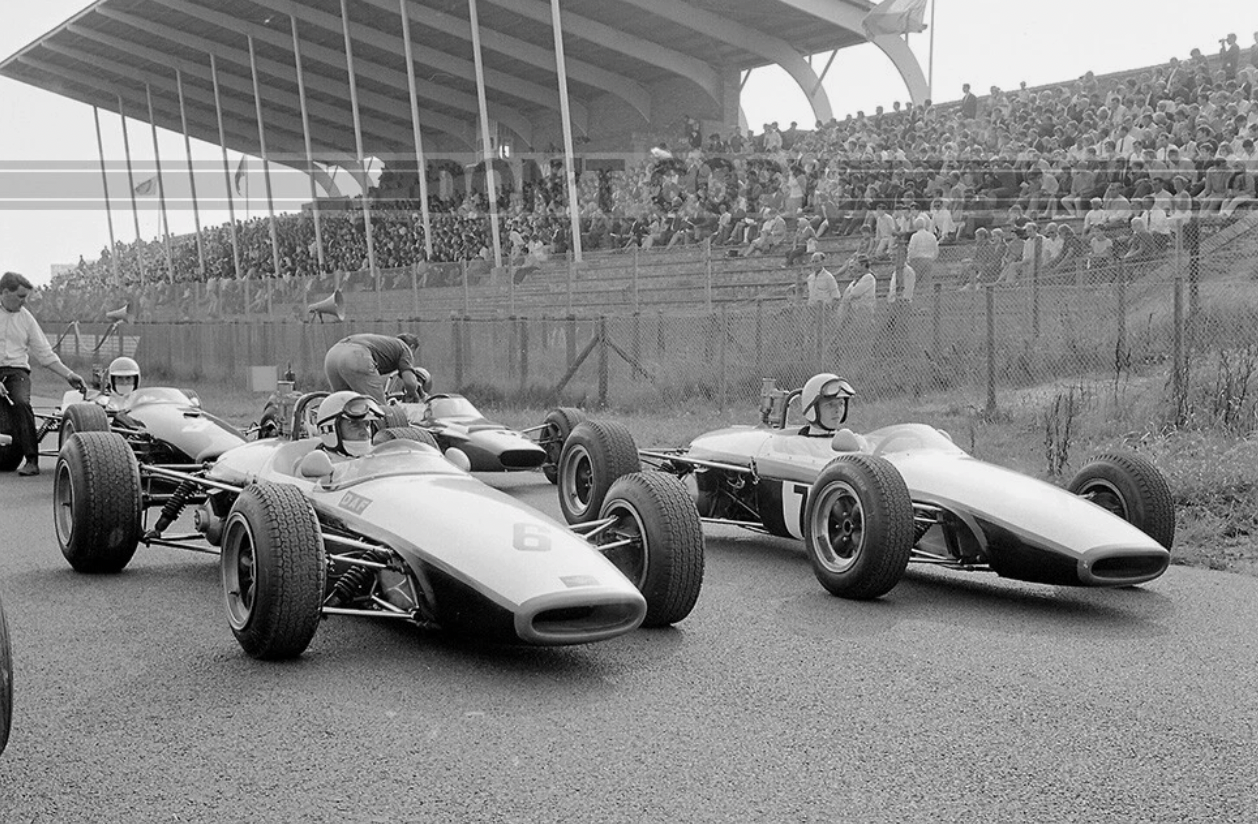
The only other outing for the year was at home in the August 29, Zandvoort Trophy, where Slotemaker was eighth in the BT15; the podium all raced Brabham BT16s: Kurt Ahrens, Trevor Blodyk and Chris Irwin.
Slotemaker, Brabham BT15 Ford DAF, Zandvoort Trophy, August 29, 1965. Eighth in the race won by Kurt Ahrens’ BT16 Ford(P Demeyer)
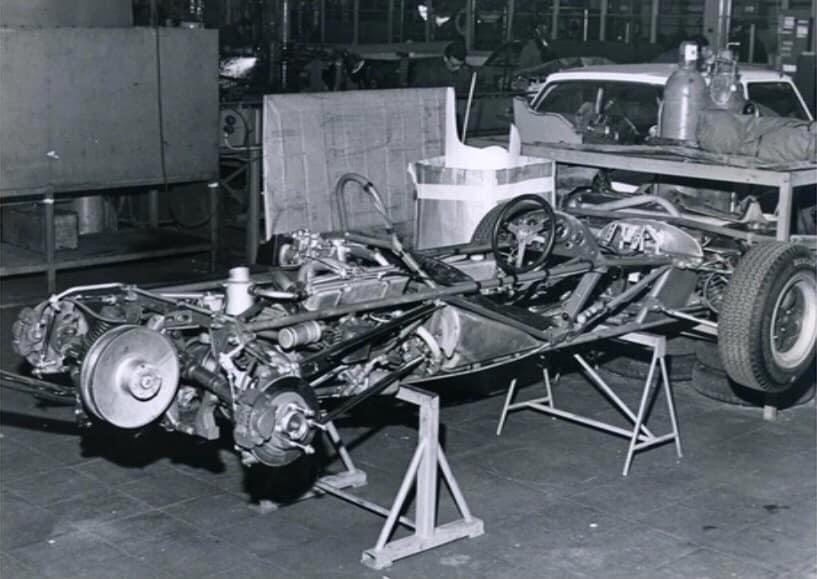
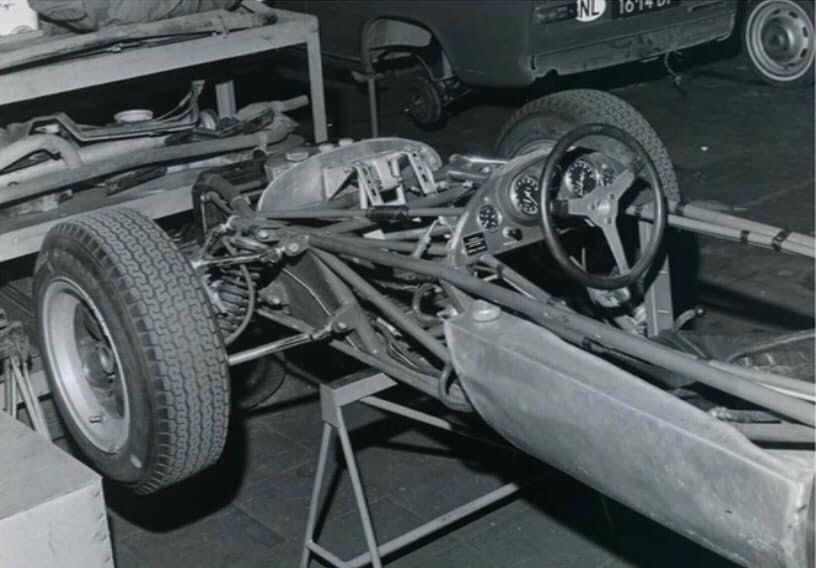
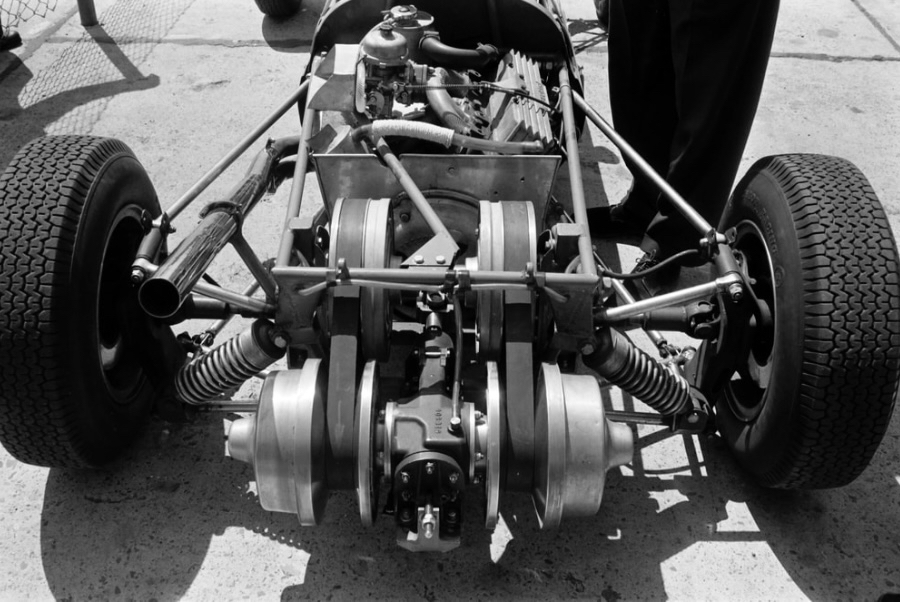
The BT15 Ford chassis #F3-25-65 in the DAF factory during 1965.
The relative bulk of the CVT setup and its location, components thereof, well aft of the rear axle line is clear. The Cosworth MAE screamer 1-litre pushrod engines gave circa 100bhp.
The drivers soon mastered the art of left-foot braking, momentum driving, and the somewhat hypnotic effect of the engine revving hard within its upper limits all the time; watch the Williams YouTube footage linked later in the piece to experience that. Interesting is that the BT15 is fitted with two Smiths tachs, why I’m intrigued to know?
(P Demeyer)Jack Brabham tests one of the Brabham BT18 Ford DAFs. One of Jack’s recommendations was to adopt a differential (F3History.co.uk-MBisset-WordPress)
1966-68 Racing Program…
In 1966 a pair of Brabham BT18s were acquired and raced by seasoned Brit, Mike Beckwith, and promising Dutch young-thruster, Gijs van Lennep, in his first year of single-seaters.
Progress was made with some top-six finishes for both drivers; Mike Beckwith’s third at Zolder in September was the standout.
I can’t give you further insights on 1966 as the relevant F2 Register pages, my much valued refererence site, won’t load. Fuggit.
Zandvoort Trophy, August 27, 1967. The DAF-Gemini Ford Cosworths of #6 Mike Beckwith, eighth, and Gijs van Lennep who isn’t listed in the results. The race was won by Henri Pescarolo’s Matra MS6 Ford Cosworth (Unatt-MBisset-WordPress)
For 1967, DAF approached The Chequered Flag to build them a bespoke DAF. Chas Beattie’s Gemini-DAF was a slinky Brabhamesque design that was only let down by the power losses of the Variomatic pulley system relative to a good-ole bulletproof Hewland dog-box.
Still, the cars could be very good in the wet – depending upon the behaviour of the belts – where the power delivery was advantageous and took two wins that year: Mike Beckwith in the ER Hall Trophy at Brands Hatch in October, in front of a top class field including at least 12 later F1 drivers, and Gijs van Lennep at Skarpnack in September in front of Ronnie Peterson, Dave Walker and Howden Ganley amongst others.
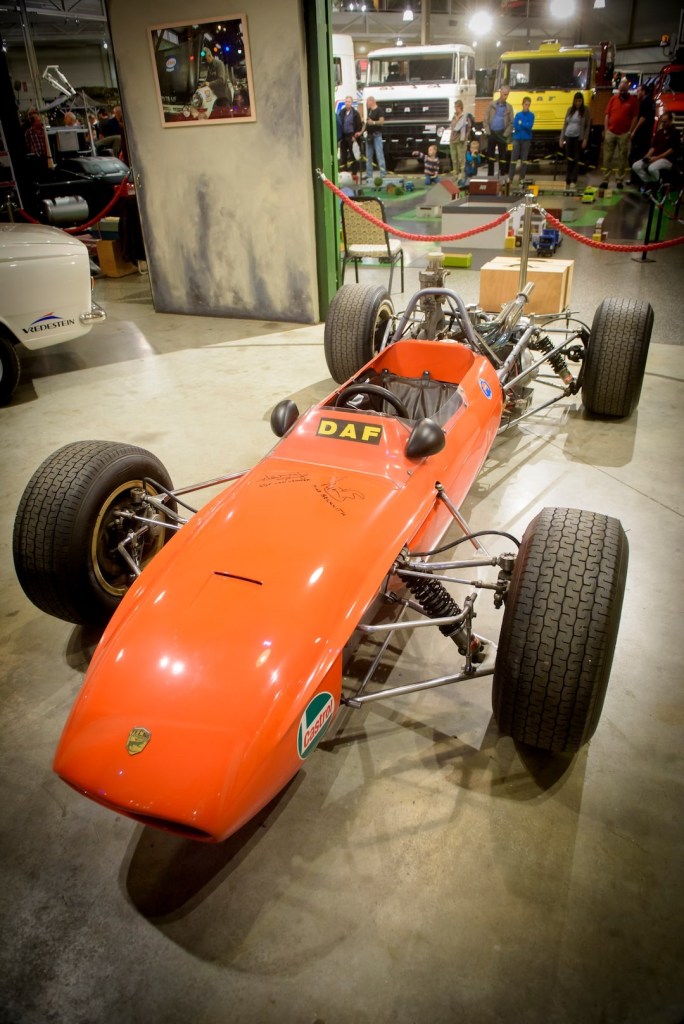
One of the 1968 Tecno 68 Fords raced by Beckwith and Van Lennep that year (DAF Museum)
For 1968, their final year, DAF reverted to a pair of Brabham BT21s to kick off the season before switching to Tecno 68s after the Monaco F3 Grand Prix in May.
Van Lennep was seventh in Barcelona in March, then eighth in Monte Carlo. Mike Beckwith took a fantastic win in heat 2 at Monaco in front of Van Lennep, Francois Cevert, Peter Gethin,- Jean-Pierre Jabouille and others; it was a measure of just how much progress DAF had made, but he had piston failure in the final. Jean-Pierre Jaussaud’s Matra MS6 Ford won that year.
While Wim Hendriks still had to modify the rear of the Tecno chassis to accommodate the Variomatic hardware, it was a better fit than the more slender cars that went before. In its final iteration, the primary and secondary pulley discs were cast magnesium, while critical internal shafts were machined in titanium.
The Tecno 68 had a more compact layout in that the transmission was still located aft of the engine, but the belts ran sidways/transversely, rather than up the back. This got the weight lower and within the wheelbase, reducing the polar moment of inertia.
The final tweak was an electro-vacuum override switch on the dash that allowed the drivers to manually ‘trick’ the transmission into a ‘lower ratio’ instantly when approaching the corner providing some engine braking and a more conventional corner approach, before the CVT took over on corner exit.
VL was then third at Skarpnack in September in his Tecno, before Beckwith took a splendid second behind Roy Pike’s Titan Mk3 Ford at Zolder in the same month. He followed up with third place at Roskilde the following weekend (Sept 22).
Then the Racing Team Holland boys made monkeys of themselves at their final meeting of the year at Montlhery in October when, while in a winning position, they ran into each other…
It wasn’t a great way to end the program, but it was mission accomplished from DAF’s perspective, plenty had been learned.
(DAF)The DAF 44 raced by Claude Laurent and Jacques Marche finished 43rd and first in class of the 1968 Monte Carlo Rally (Unatt-MBisset-WordPress)
It wasn’t the end of the competition program either. DAF had an ongoing presence in rallying, rallycross, and a Huron 2-litre Ford BDA-powered sports car, the DAF 555 4WD, twin-engined Paris-Dakar car and the rest…
While DAF cars was sold by the Van Doorne’s to Volvo in 1975, DAF Trucks continued and so too did Van Doorne’s Transmissie b.v. That company continued to develop CVT technology and sold it to various of the major manufacturers.
Watch this fantastic video about the development of VDT’s CVT technology and its F1 pace and potential when used in the Williams FW15C Renault in 1993. https://youtu.be/b84mFiXWsog?si=7UvPMLamsqqkdSJD
Peter Wright wrote about the Williams CVT experiment in ‘Formula 1 Technology’.
‘Step-less gear ratio changing permits the engine to operate within a narrow rpm band, or even at a discrete rpm, instead of requiring an operating band of approximately 200 rpm. The engine designer can then tune the engine for that rpm, avoiding any compromises in intake and exhaust lengths or valve timing. The increase in available power (the integral of power throughout a cycle of accelerating through the speed range) must outweigh any loss in efficiency or increase in weight.’
‘Williams started research into CVTs in the late 70s, initially with a system based on the Perbury system. At the time, Williams was developing the Cosworth DFV and was seeking ways to achieve a power advantage over other DFV users. The Perbury proved to be too heavy and was encumbered with IPR problems. Some years previously, Van Doorne had raced an F3 version of its rubber belt and cone CVT, based on a system sold in DAF road cars. It was reasonably competitive but unable to take the power of an F1 engine.’
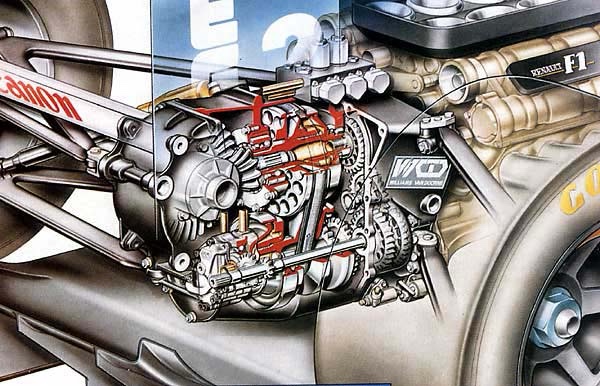
Williams Grand Prix Engineering/Alain Prost’s 1993 F1 Championship-winning Williams FW15C Renault 3.5-litre V10 fitted with its usual Williams transverse, 6-speed semi-automatic gearbox and below with the Williams Van Doorne CVT transmission. The difference in packaging between 1965 and 1993 is marked! (Tony Matthews)
‘Williams decided to work with Van Doorne to develop a steel belt version, suitable for F1. The issues of engine starting, engaging drive, reverse, and the hydraulic and electronic control integration with the engine all had to be solved. The gearbox was mounted in a Williams FW15, powered by a specially tuned Renault 3.5-litre engine, weighed 6 kg more than the six-speed one it replaced and was approx. 93% efficient compared to 96% for the spur gear variant.’
‘This appeared in testing in 1993 but was banned as part of a package of control system regulations at the end of the year, before its performance advantages could be demonstrated. History does not relate whether the ban was the result of the fear of having to develop competing systems, when Williams had been working on the principle for so long, or the thought of 24 F1 cars, all with their engines continuously at peak rpm.’
Etcetera…
(R Schlegelmilch)
Rainer Schlegelmilch’s shot of the Brabham BT15 Ford DAF was taken at the Nurburgring during the May 23, 1965 1000km weekend.
There wasn’t an F3 race at the Ring that weekend, so perhaps the DAF Racing Team took it there to showcase their project to Ferrari, Porsche, Ford, Alfa Romeo and the rest.
Frustrating is that I have plenty of shots of the transmission in its early form but not in ultimate 1968 spec, if any of you can oblige I’d love to hear from you.
During the research process for this article I dived down and down with the Google-Gemini AI tool to generate this response, ‘recorded verbatim’ to questions about the developmental challenges the DAF team faced in 1964-65.
‘The primary mechanical challenges Wim Hendriks and the engineering team had to solve when adapting the road-car Variomatic transmission for the Formula 3 cars boiled down to handling unprecedented power, heat, and physical space constraints.
The specific mechanical issues they faced included:
Belt Slippage and Shredding: The standard road-going DAF rubber V-belts were designed for modest 30-horsepower commuter engines. The high-revving Cosworth MAE Formula 3 engines produced close to 100 horsepower. Under sudden acceleration and track loads, the standard belts would instantly slip, overheat, and violently disintegrate or shred. Hendriks had to test and source reinforced, heavy-duty belts capable of gripping under high torque.
The Lack of a Differential: The original road Variomatic layout used two independent belts (one for each rear wheel), effectively acting as a limited-slip differential. However, in sharp, high-speed racing corners, this caused severe understeer and uneven belt wear. As mentioned previously, Jack Brabham strongly advised using a single-belt drive coupled to a conventional racing differential. Van Zalinge had to redesign the entire rear casing to integrate a differential into a single-seater layout.
Heat Dissipation: Because the Variomatic relied entirely on friction between the rubber belts and the metal pulleys (sheaves), it generated massive amounts of heat under racing conditions. If the pulleys got too hot, the rubber softened and failed. The team had to engineer custom cooling air ducts and use ventilated, lighter pulley materials to keep operating temperatures down.
Weight and Packaging: The Variomatic unit was bulky and heavy compared to a standard, compact racing gearbox. Placing it at the very rear of an Alexis or Brabham chassis severely ruined the car’s weight distribution and centre of gravity. Hendriks had to modify the rear frames, pushing the heavy pulleys as far forward into the wheelbase as possible, while redesigning the rear suspension to clear the spinning belts.
Vacuum and Centrifugal Calibration: The Variomatic shifted ratios using a combination of centrifugal weights (engine speed) and engine vacuum load. Racing engines operate at high RPMs almost constantly and have very different vacuum profiles than road cars. Van Zalinge spent endless test sessions swapping out springs, diaphragm valves, and internal weights to ensure the transmission “upshifted” and “downshifted” at the exact optimal powerband of the Cosworth racing engine.’
Track Test…
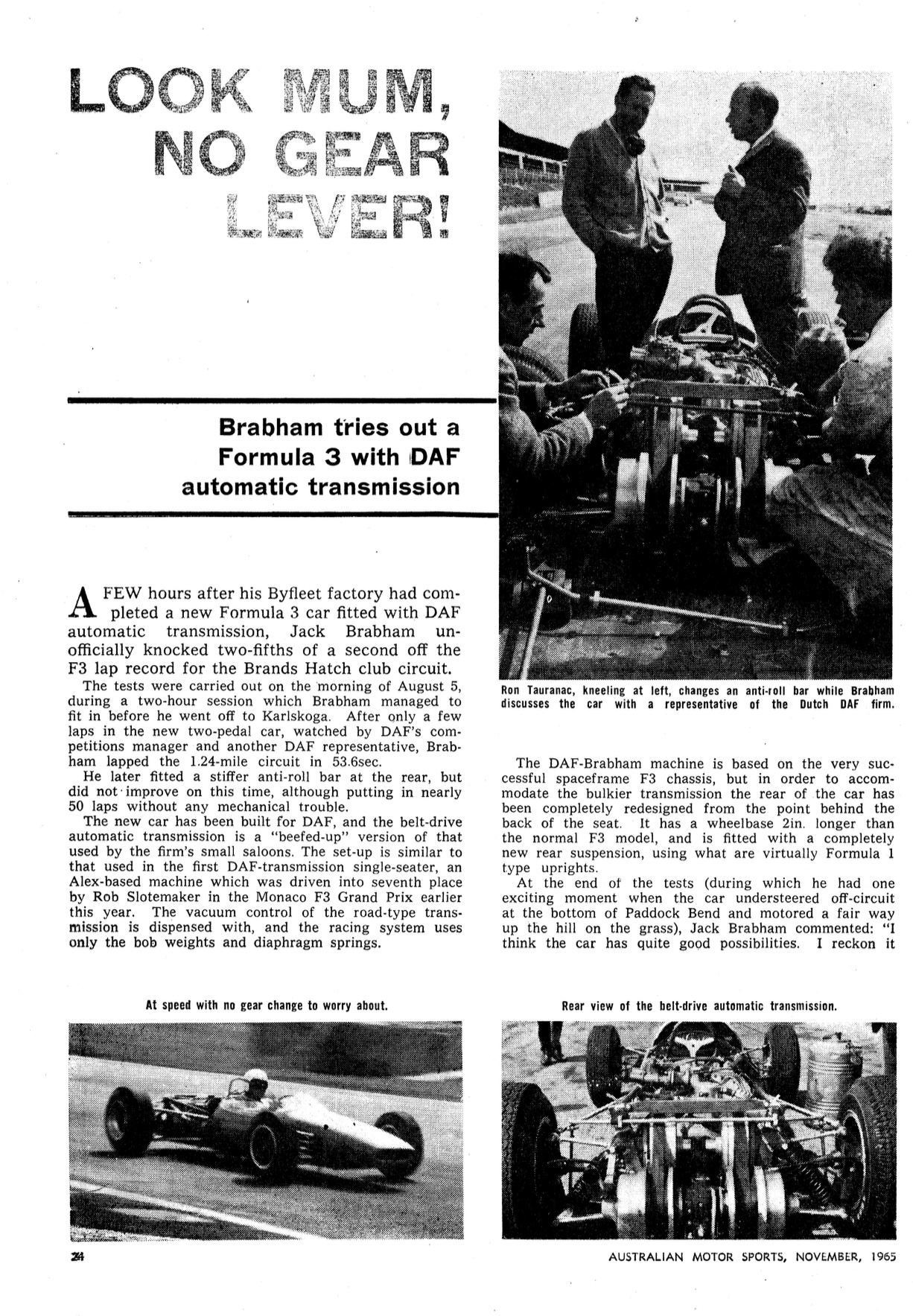
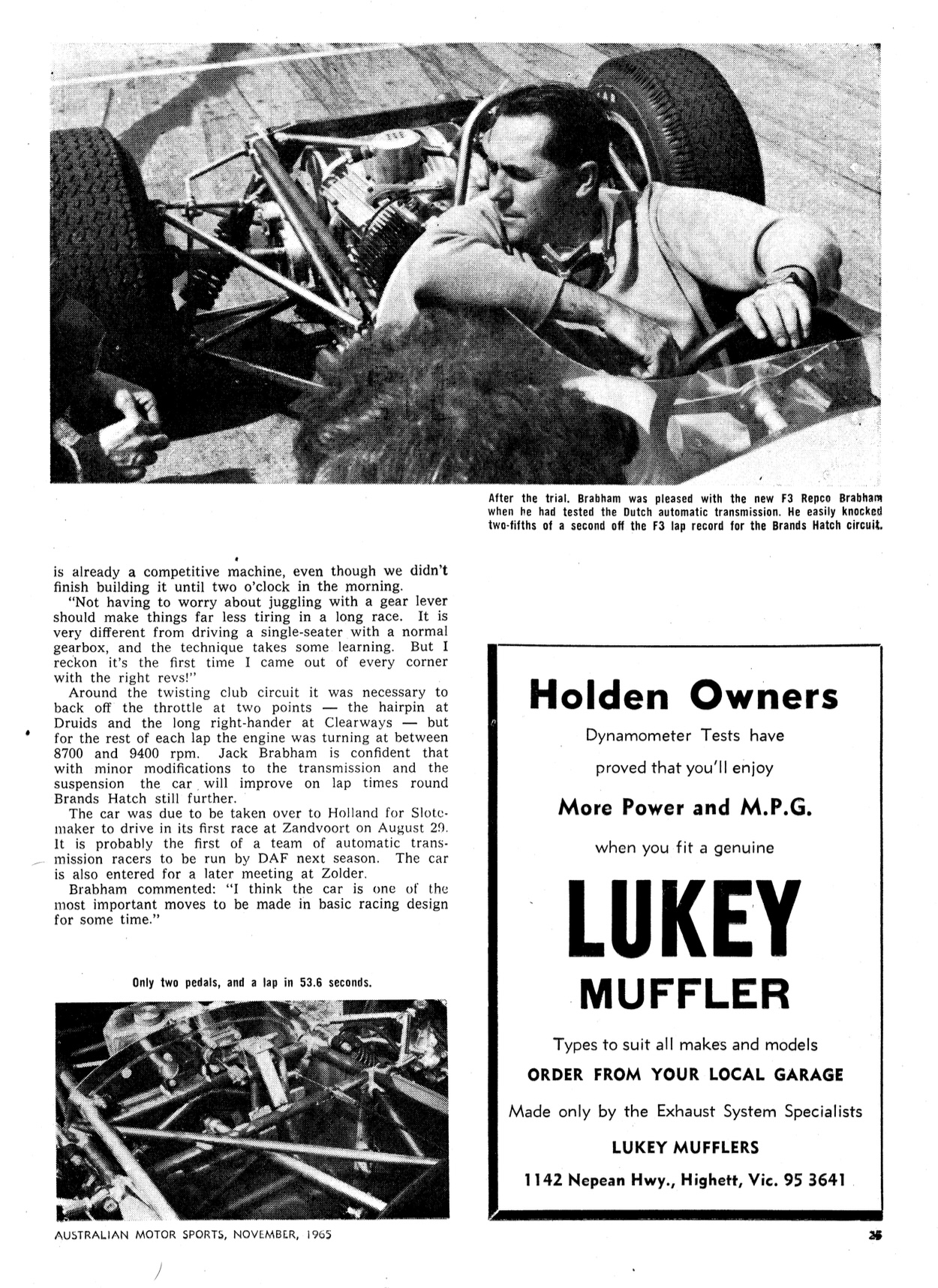
A couple of days after publishing this piece, Paul Best sent me this track test article published by Australian Motor Sports in their November 1965 issue.
It makes clear that MRD made the changes to incorporate the DAF hardware into the Brabham BT15 frame. I imagine the truth is somewhere in the middle.
Credits…
Gunter Reitz, DAF, F2 Register-Fastlane, Google Gemini, E Wayenberg via Romain Moorman, Phil Demeyer, F3history.co.uk, ‘Formula 1 Technology’ Peter Wright, Tony Matthews, F2Register, Rainer Schlegelmilch, De Telegraaf, Paul Best Collection-Australian Motor Sports
Tailiece…
(DAF)
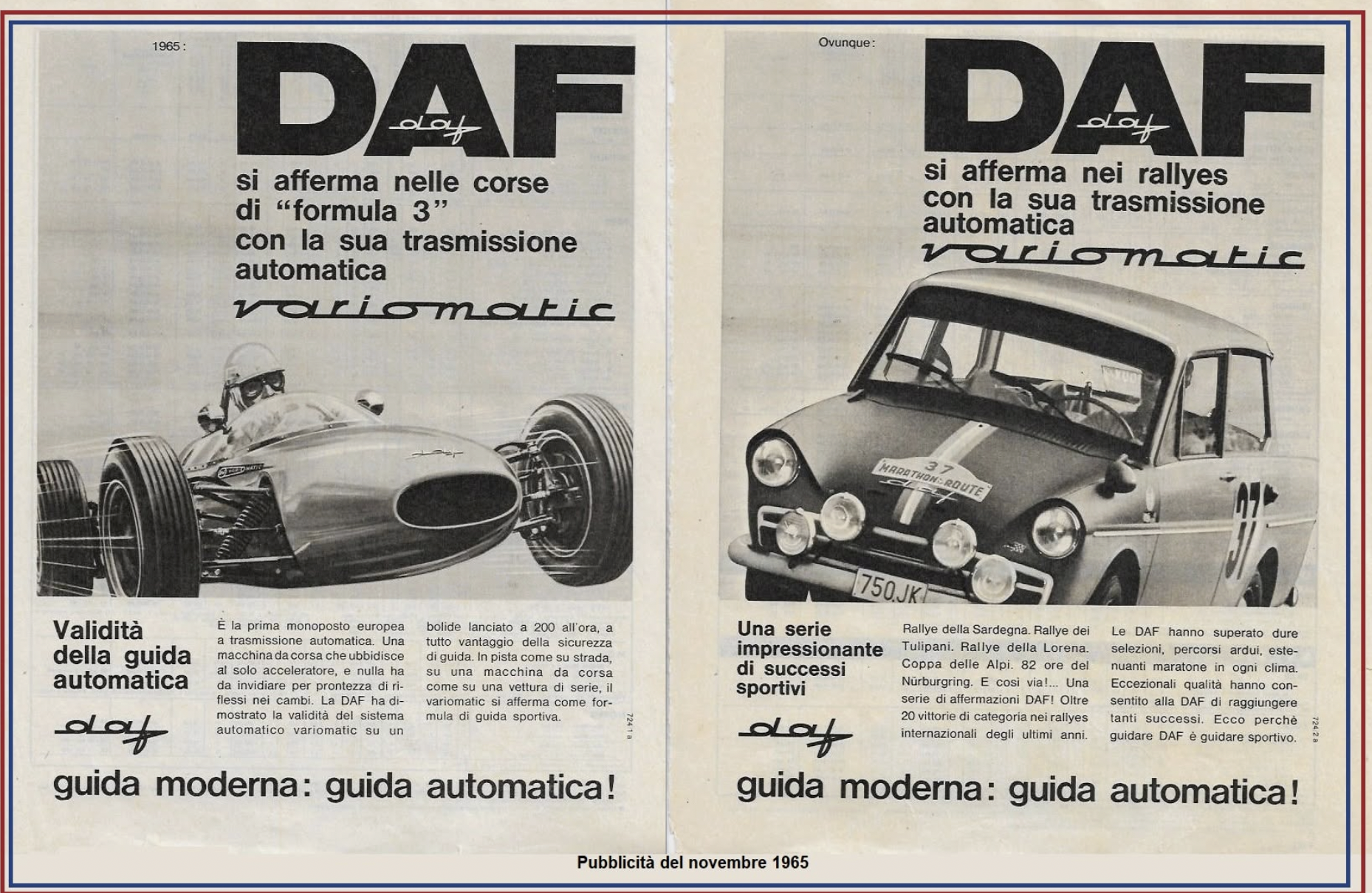
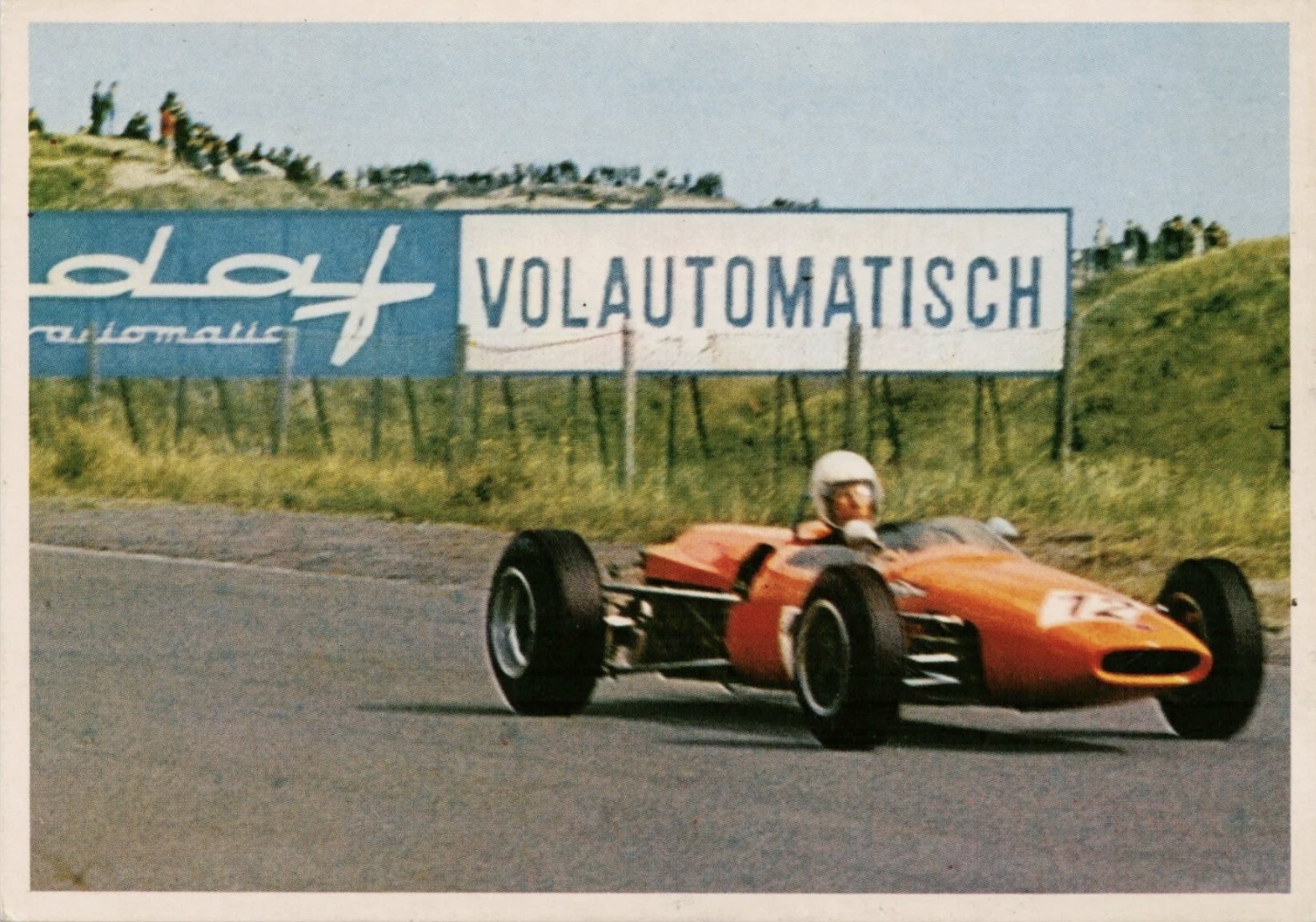
This 1965-66 DAF Postcard shows Rob Slotemaker in the DAF Brabham BT15 Ford during the August 29, 1965 Zandvoort Trophy. Volautomatisch translates as fully automatic…
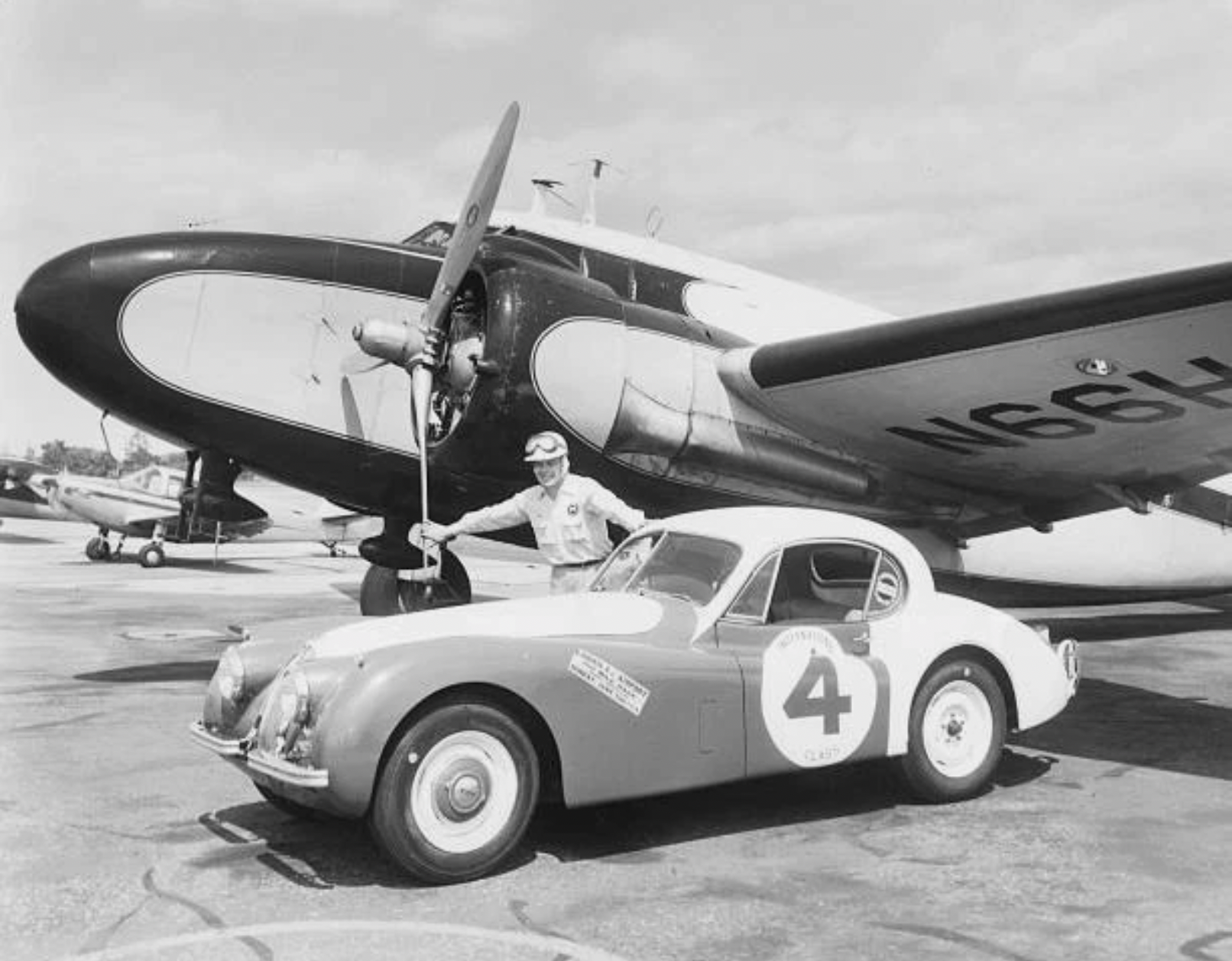
One bit of Jaguar history I didn’t know is that Al Keller won a NASCAR Grand National Series race in 1954 aboard this Paul Whiteman-owned Jaguar XK120. The race was at Linden Airport, Linden, New Jersey, on June 13, 1954; it was a 100-miler, 50 laps of a 2-mile road course. That XK win must have been pretty good for sales?
Thanks to those who answered my question about the aircraft type. The Freddo Frog first prize goes to Paul Cummins response of a Lockheed 18 Lodestar. The rego #N66H was attached to serial #558, chassis #18-2379. It was originally deployed to the USAAF on March 5, 1943 and was in civvy-street by 1946-47 going through countless hands until it crashed near Redbird, Texas, on December 7, 1987, after which the airframe was written off.
(Unattributed)
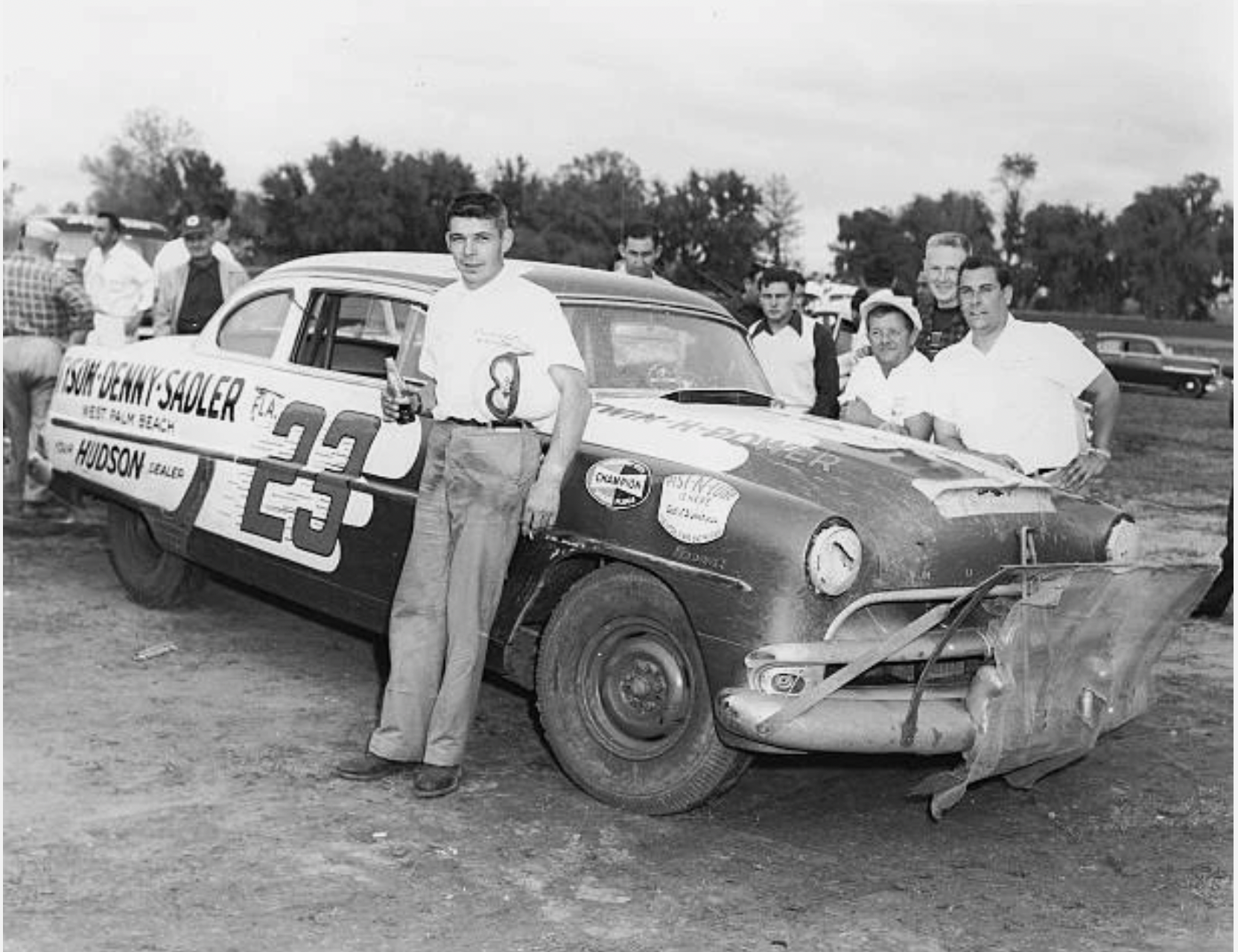
Alvah August Keller (11-4-1920 to 9-11-1961) made 29 starts in NASCAR’s top division (Strictly Stock/Grand National) between 1949 and 1954, taking two wins, both in 1954. He won aboard George Miller’s Hudson Hornet at Oglethorpe Speedway, Savannah, Georgia, that March (photo above), in addition to Linden Airport. In so doing, he became the first driver in NASCAR history to win on both oval and road courses in the same year.
The Hornet was the dominant NASCAR weapon at the time, with three Manufacturer’s Championships and 81 Cup Series victories over its lifespan.
In ’54 Keller progressed to Champ Cars (AAA & USAC), with his best finish in five starts at Indy, fifth in 1961 aboard the HH Johnson-owned Phillips Offy.
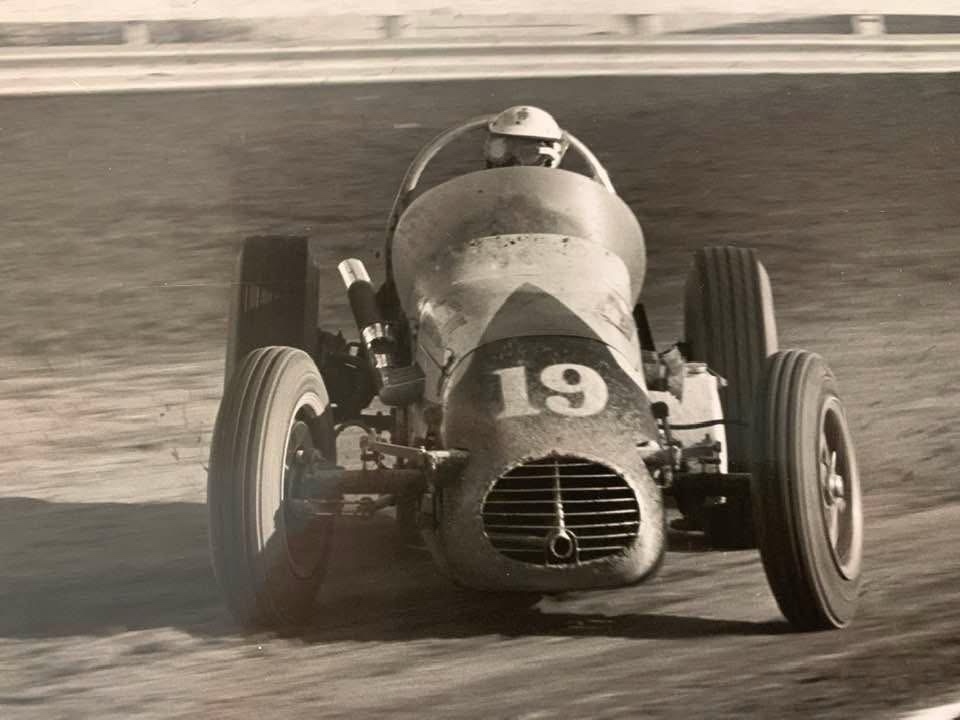
Keller started the 100-mile, 100-lap Bobby Hall Memorial on pole on November 19, 1961. He was fifth in the USAC Championship at the time and died after his Lesovsky Offy got caught in a rut and rolled on the one-mile dirt track at the Arizona State Fairgrounds in Phoenix.
Al Keller during qualifying for the fateful November 1961 Bobby Hall Memorial, Lesovsky Offy (M Littles Collection)
Credits…
NASCAR-Getty, eBay, Marty Littles Collection
Tailpiece…
(Unattributed)
Utterly irrelevant in the context of this article but too good an image to waste…
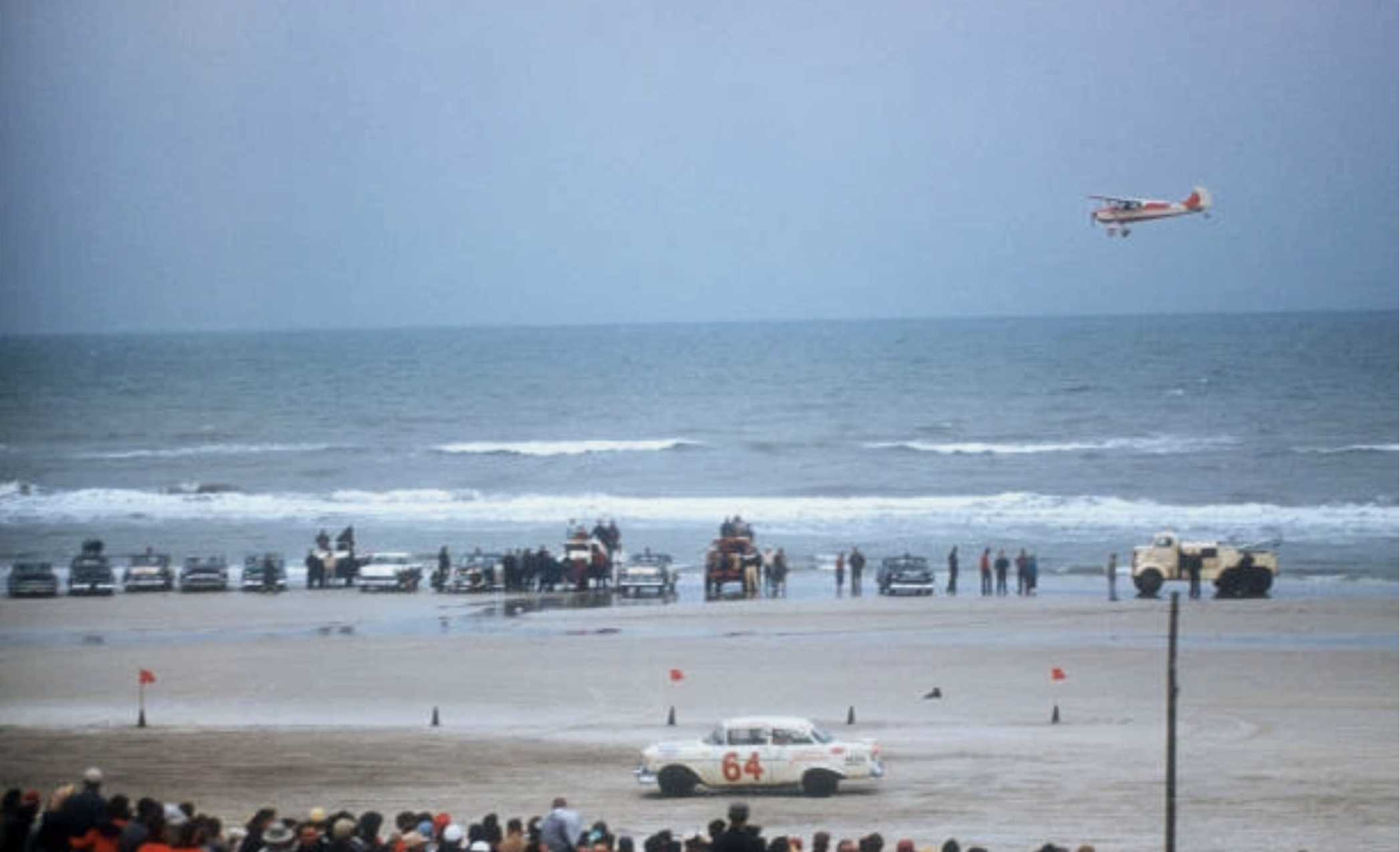
Al Keller on track for sixth place in the February 26, 1956, Daytona Beach NASCAR race in a Chevrolet; up front was Tim Flock’s Chrysler.
Barry Nelson with Allan Moffat aboard his Brabham BT16 Lotus-Ford Formula B on the Road America dummy grid on June 17, 1967.
In a very limited campaign, he finished seventh in the Central Division of the SCCA-sanctioned championship.
(BryarRacingMagazine-MBisset-Wordpress)
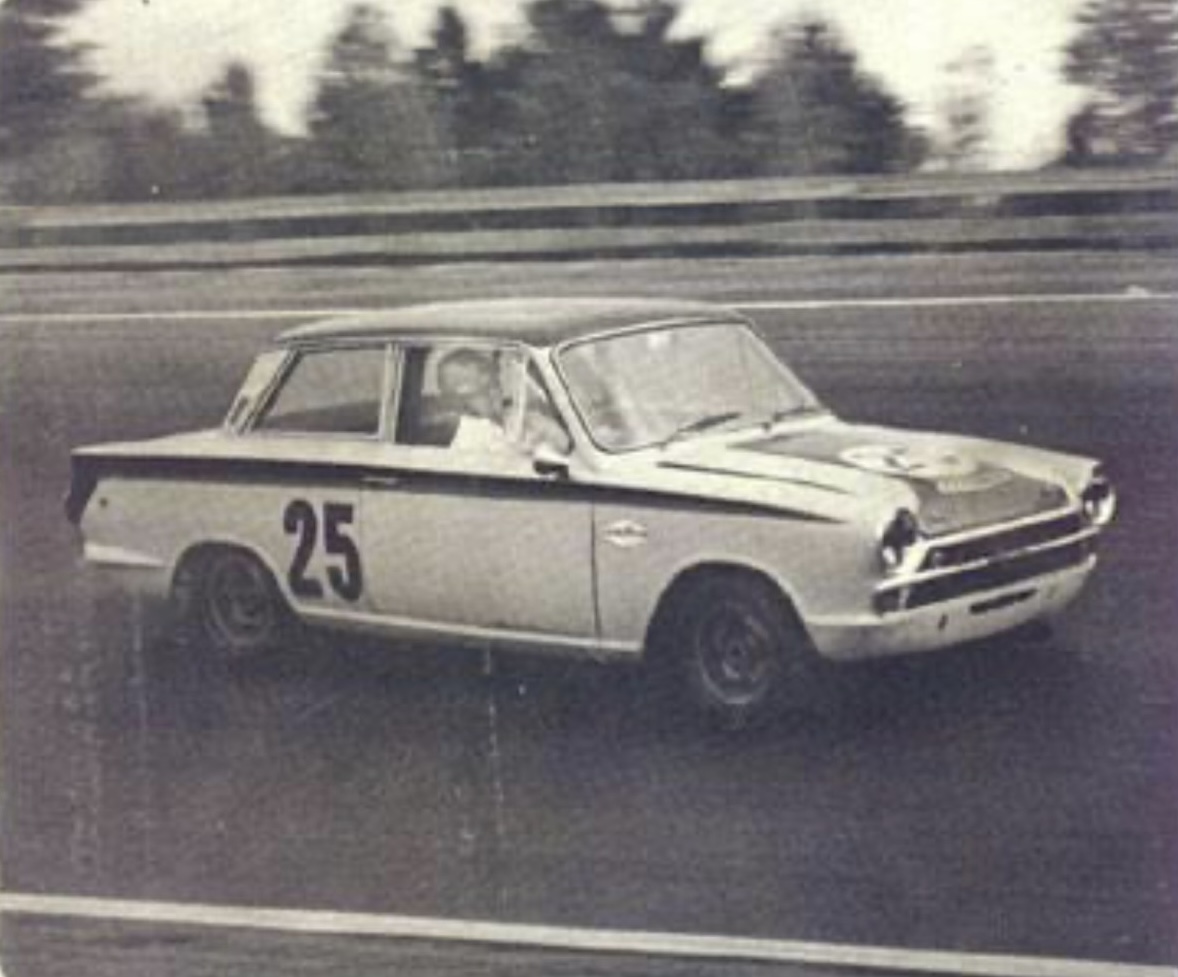
Moffat’s primary program was running Ford’s Lotus Cortina program. The shot above shows him winning the Bryar Motor Sport Park 250 Trans Am round outright in London-Laconia, New Hampshire, in July 1966.
I’ve already written an epic about Moff’s single-seater racing, but my discovery of AI-enhanced photographs lured me back in this direction, as it meant I could do something with Barry Nelson’s old colour shots which were potentially very good. See here:https://primotipo.com/2020/04/14/allan-moffat-single-seater-racer/
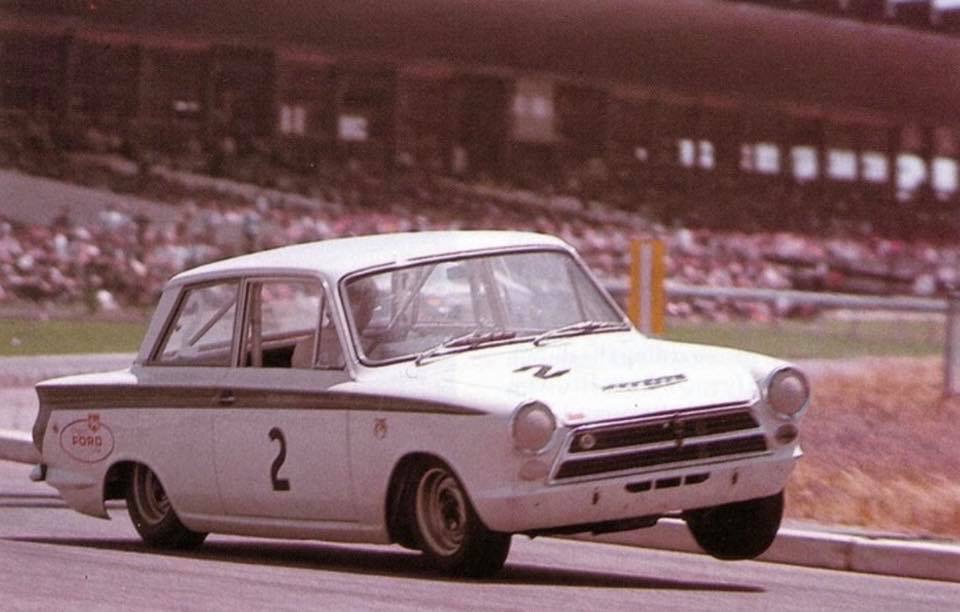
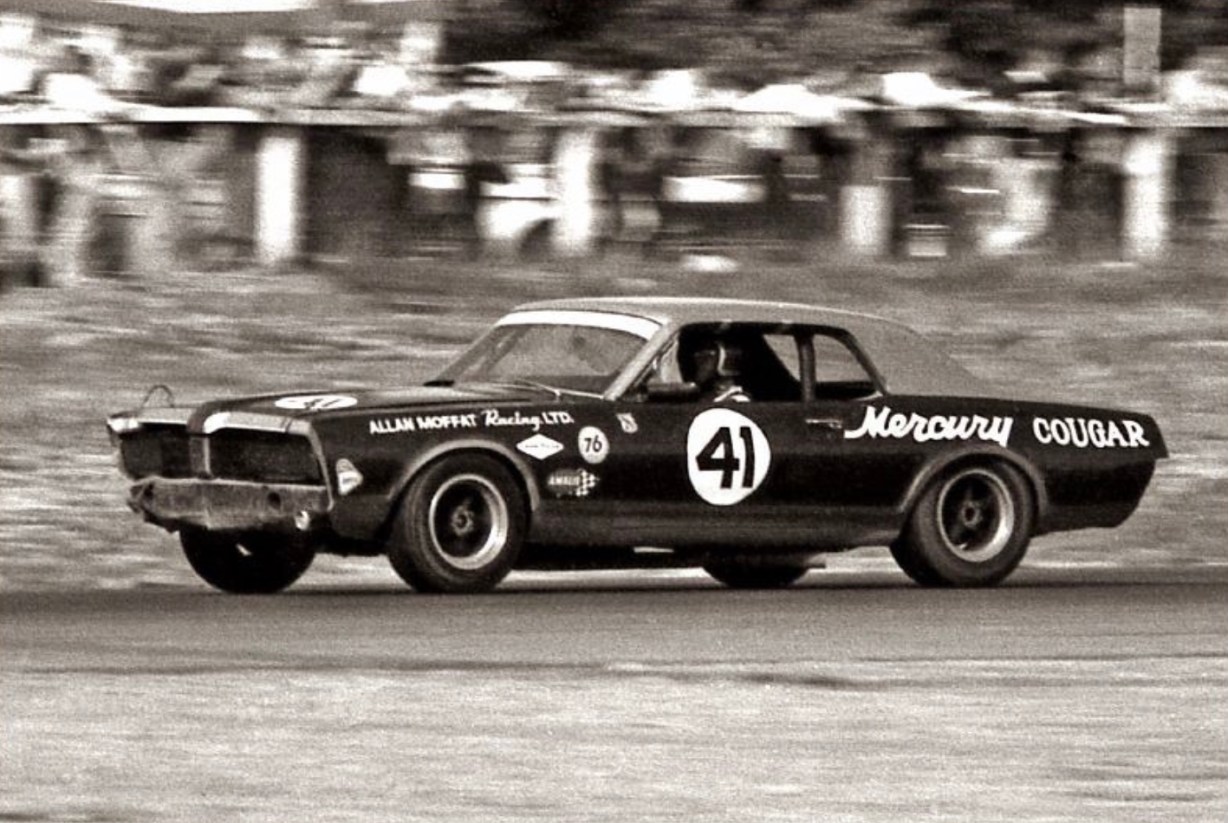
Moffat two-wheeling his Lotus-Cortina at Sandown during the November 1964 6 Hour, he and Jon Leighton were fourth (unattributed)AM racing a works-Bud Moore Mercury Cougar, circuit unknown, 1967 (unattributed)(BNelson-MBisset-Wordpress)
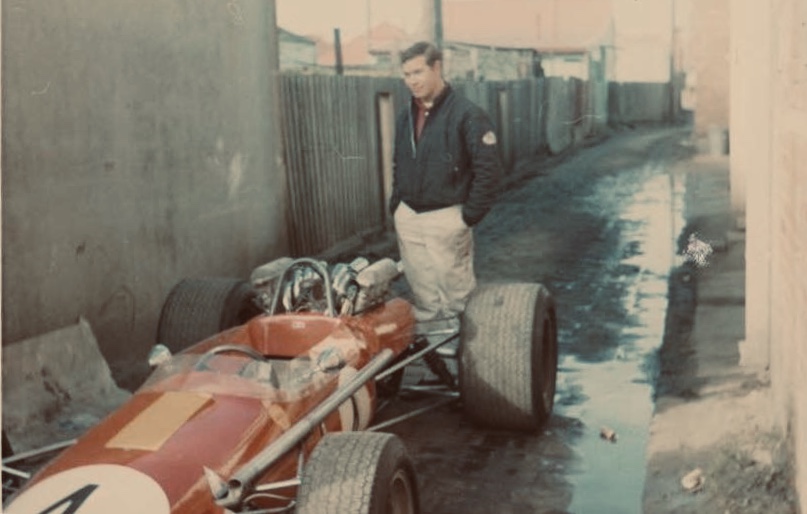
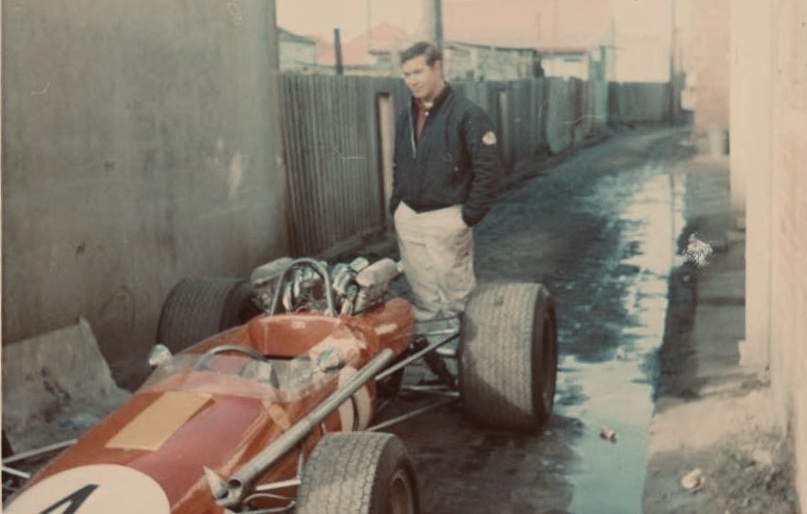
AM ready to rock and roll in the most salubrious of surroundings! In the lane behind Bob Jane Racing, itself behind Jane’s Chrysler/Valiant dealership at 740 Sydney Road, Brunswick, Melbourne, with the ex-Jack Brabham 1968 Tasman Cup Brabham BT23E Repco-Brabham 740 2.5 V8.
Moff was entered in round three of the Australian Drivers Championship, the Gold Star, at Sandown on September 15, 1968, but things quickly turned to custard in practice when the just rebuilt car – from John Harvey’s Easter Bathurst accident caused by component failure – lost a wheel and did enough damage to end the weekend.
(B Nelson)(BNelson-MBisset-CoPilot)
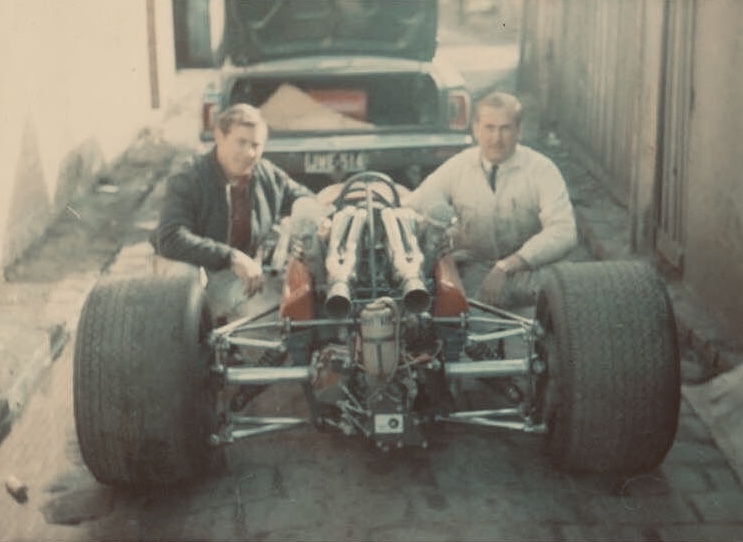
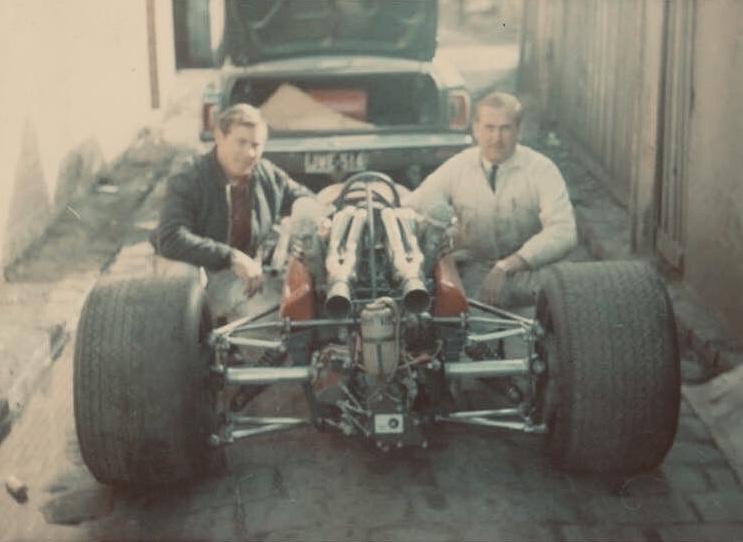
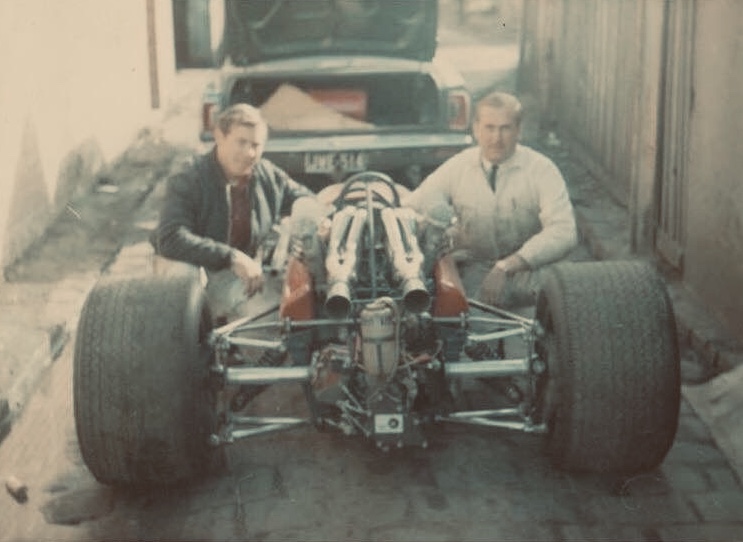
Same time, same place, same car, but this time with John Sawyer, Jane’s team manager and chief mechanic. And a VE Valiant. In both enhanced shots, the car comes up well, but the facial features are much harder for the tool when the original is lacking…
(BNelson-MBisset-Wordpress)
Jack Brabham, below, earlier in 1968 racing the same chassis, BT23E, but fitted with the first 830 Repco-Brabham V8 during the February 25 Australian Grand Prix. DNF engine after 21 of the 55 laps; Jim Clark won the race – his last GP win – in a works Lotus 49 Ford Cosworth DFW.
(RBartholamaeusColl-MBisset-Wordpress)
Moffat exits Honda, maybe, in Bob Jane’s Elfin 400 Repco-Brabham 720 4.4 V8 at Phillip Island in November 1968. It’s a little-known event, and was probably a case of Bob throwing Moffat a bone.
He’d helped Sawyer and Jane buy the Shelby Mustang, and the deal supposedly was that AM would drive the old Mustang and Bob the newie. But Bob had racing drivers up to his armpits by that stage: there was Bob himself, Harvey recovering from his huge Bathurst prang, Ian Cook racing the Brabham and Elfin, and Bevan Gibson – arguably the most promising of the lot – sniffing around too.
(Rob Bartholomaeus Coll)
‘Take the Elfin down to the Island for a race or two and have a good time at the Isle of Wight.’ Before too long, Jane and Moffat had a parting of the ways, then Moffat pulled off the KarKraft Trans Am Mustang deal, and the rest is history…
How’d he go in the Elfin at the Island, folks? Rob Bartholomaeus sent me this magazine shot a decade ago. It’s a shit shot out of the December 1968 PIARC Notes magazine, but it’s amazing how well it came up with a tickle on WordPress. I even colourised it, something I’ve said to all and sundry I’d never do, but being the President of the Australian Society of Hypocrites, I just had to have a go. A brilliant job, too. And yes, the number could be 7. Apart from anything else, I’m intrigued to see how long it takes the colour shot to ‘do the social media rounds.’
(RBartholomaeusColl-MBisset-WordPress)Engine and cockpit of the Jane 400 – ratio change in progress – probably taken during the January 26, 1969 Phillip Island meeting when the car was driven by Bevan Gibson (N Chambers)(AutoAction-MBisset-WordPress)
Moffat hadn’t finished with single-seaters just yet.
Elfin ran a Calder test day for mainly BP-contracted drivers to have a lash in the brand new Elfin MR5 Repco-Holden F5000 car at Calder on Monday, September 13, 1971.
John McCormack finished second in the Sandown Gold Star round the day before in #5711, Kevin Bartlett won it in his McLaren M10B Chev. The steerers that day included Moffat, Henk Woelders, Garry Rush, John Harvey and David McKay, wearing his journo hat.
Moff did an undisclosed number of laps, and with too tall Sandown gearing, worn tyres and fullish tanks, did a best of 44 seconds neat.
There were rumours once or twice about a Tasman F5000 drive, but, sadly, that never happened.
(AutoAction-MBisset-WordPress)
Credits…
Barry Nelson, Rob Bartholomaeus, Neville Chambers, Auto Action
Tailpiece…
Things Go Better With…
Moffat with the Sandown hardware after winning the 1970 Sandown Three Hour aboard a works Ford Falcon GTHO Phase 2. Who is the bloke in the background?
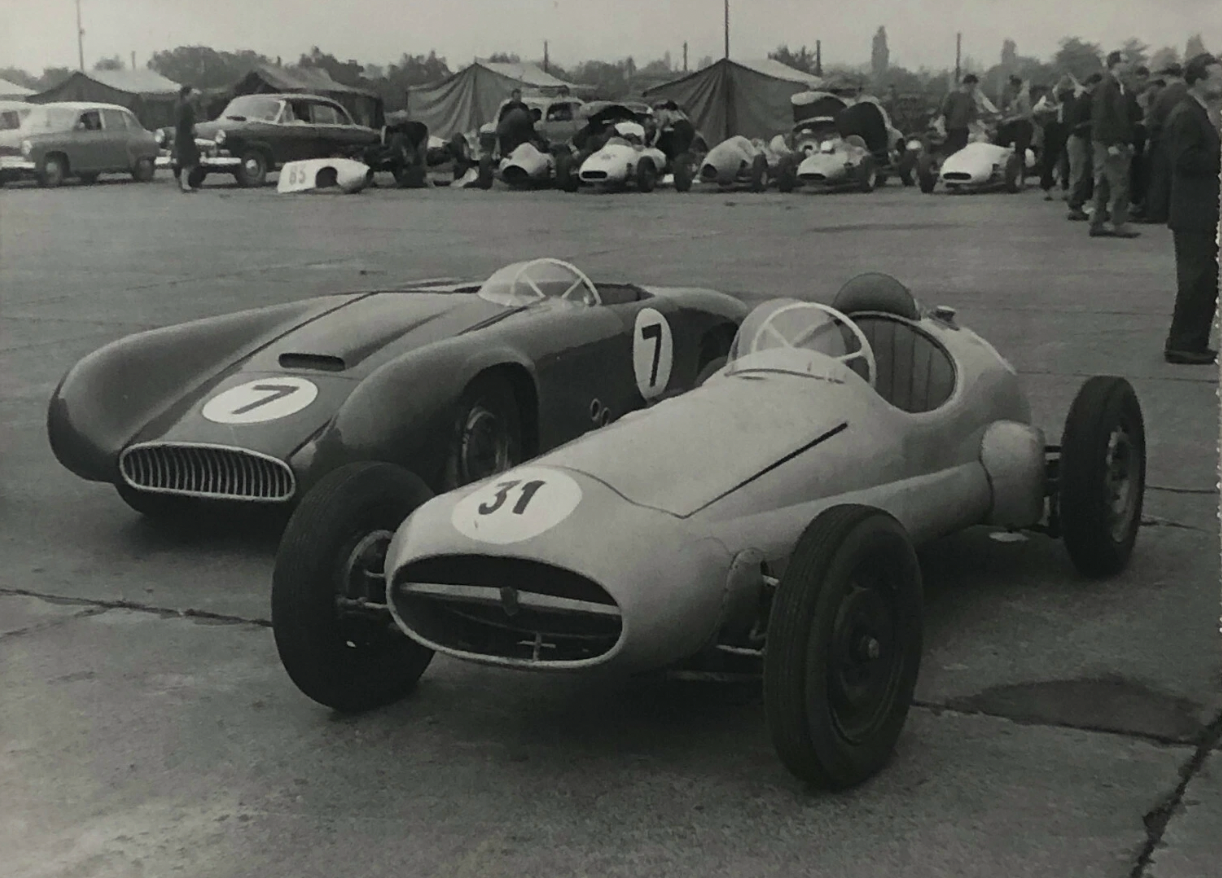
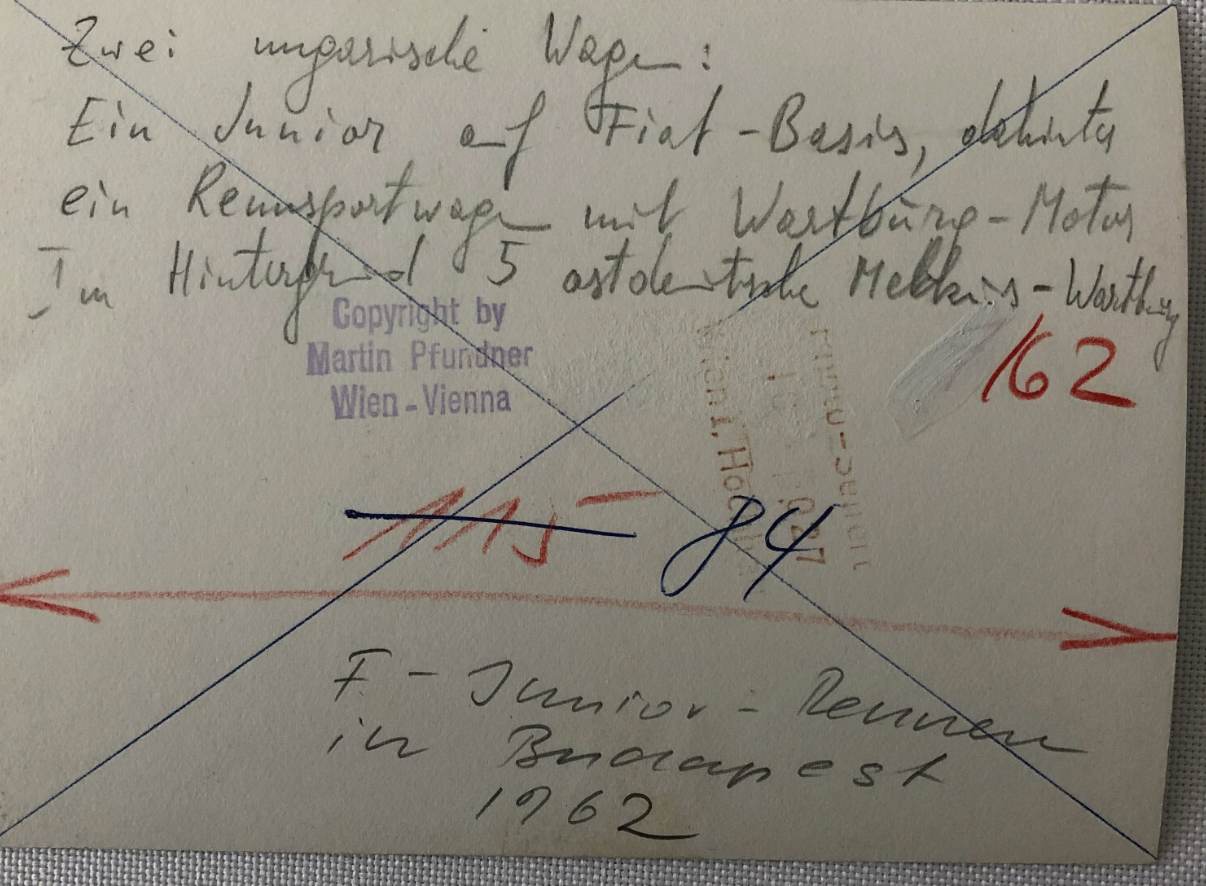
I found this intriguing photograph taken by Martin Pfundner during the Budapest Nagy Dij Formula Junior event at Ferihegy Airport in Budapest, Hungary, on May 6, 1962.
Curt Lincoln won the event, which comprised two heats and a 22-lap final on the 3.3km track, a total of 74 km, driving a Cooper BMC. Kurt Ahrens was second in a Lotus 22 Ford, and Jacques Cales third in a Stanguellini Fiat.
#7 is a Fiat-based Formula Junior; John Fox wrote is ‘almost certainly Bertalan Mezei’s special or eigenbau (self-made). #7 is a Wartburg-engined sports racer. Car #5 is a Melkus-Wartburg FJ driven by its constructor, Heinz Melkus, an East German. Melkus was fifth.
As always with these things, there is usually a surprise or two for me at least; it turns out that Heinz Melkus had a rich history of building sports cars and single-seaters behind the Iron Curtain until he died in 2005. https://www.melkus-motorsport.de/melkus-motorsport-start.html
Anjakub wrote in The Nostalgia Form in September 2005 that ‘Heinz Melkus (20 April 20, 1928-September 5, 2005) born in Dresden) designed and produced a range of single-seat racing cars and road-going sports cars between 1959 and 1986. The cars were produced in Dresden in East Germany. The cars particularly used Wartburg engines.’
‘Melkus racing cars competed in Formula Junior, Formula 3, Formula Easter and sports car races. In 1968, Heinz developed the famous RS 1000 road-going sports car featuring a mid-mounted tuned version of the Wartburg 3-cylinder 2-stroke engine. Most cars used the 992cc version of this engine, but a few of the later cars were built using a special 1200cc version.’
‘Son Ulrich Melkus was the most successful GDR driver, but he had a deadly accident in 1990 after tyre damage on a public road. His younger son, Peter, also participated in auto races. Ulrich’s sons Ronny and Sepp still drive in races today. Heinz Melkus and his family now run a BMW dealership in Dresden called Autohaus Melkus.’
David McKinney, ‘It could be added that in the bad old days when East European drivers had to do all their racing on their side of the Iron Curtain, Melkus was consistently the most successful East German driver, winning many 1960s races not only on his home ground, but in Poland, Czechoslovakia, Hungary, Latvia and Russia as well. On more than one occasion he was the most successful driver in the inter-nation Friendship of Socialist Countries Cup.’
‘His FJ and later F3 Melkus-Wartburg cars, of which scores must surely have been built, were equally successful in the hands of many other drivers from the other side of the Iron Curtain throughout this period and beyond.’
Credits…
Martin Pfundner, F2 Register, Anjakub, David McKinney
‘A new £12,000 British sports racing car, planned for international events, is due to make its debut at Goodwood on Monday, after weeks of secret tests,’ proclaimed Tim Parnell’s press release about his new Parnell BRM sports racer in April 1966.
Bob King thinks the track may be Donington, whereas David Fox, considers the Darley Moor race track in Ashbourne, Derbyshire, likely. It opened in 1965 for motor cycles, on a former RAF base. ‘It was just down the road from Parnell’s s Derby base. Basic, but an ideal place for “secret testing” unlike Silverstone, Brands, etc.’ David adds, ‘Tim’s wearing a Kangol crash helmet; I used to have one of the hideous things for my ‘bike before you could buy Bell helmets in the UK.’
‘Designers of the aluminium prototype are Mr Tim Parnell, son of racing driver the late Reg Parnell, and Mr Les Redmond.’
‘Mr Parnell (34), a Derbyshire farmer, said: ‘The car is the first British sports car racer to be designed for several years and up to now all tests have been successful. It could have tremendous potential if it performs well in its early races. There are a large number of enthusiasts who would be interested in this type of car.’
Silicanza wrote on The Nostalgia Forum in August 2009 that, ‘After Reg Parnell’s death and the subsequent mothballing of the almost completed Les Redmond-designed and built Climax-engined Parnell RP64 F1 car, Reg’s son, Tim, instead acquired three Lotus 25s for 1964.
‘Redmond, designer and builder of Moorland cars, Gemini FJ and various other designs, was then commissioned to design and build the aluminium-bodied sports racing car, the Parnell BRM. Redmond had worked with Reg at Aston Martin in the competition department when Parnell was the Race Manager.’
‘The Parnell BRM with a rear-mounted 2-litre normally aspirated BRM enjoyed success in 1966, in the hands of Mike Spence. Spence drove it to victory at Goodwood in the (April 11) Lavant Cup. Then, Spence won the Anerley Trophy at Crystal Palace and finished second at Silverstone in July. Tony Maggs also drove the car at some point.’
(Unattributed) Tim and Reg Parnell with Tim’s F2 Cooper T45 Climax in the family workshop on August 21, 1958The Parnell BRM at Tim’s Findern, Darby workshop, Les Redmond wields the pipe! At lefts is one of Tim’s Lotus 25s, note the P-B rear body leaning against the wall (T Wilson)
Tony Wilson picks up the story. ‘Back to the Parnell-BRM sports car, I worked on this car for a few months in 1966 as a 23-year-old junior mechanic to engineer Roy Christmas.’
‘We took the car from a rolling chassis to a racer in time for the Goodwood 1966 Easter Monday meeting, where Mike Spence won in its first outing. Not an easy victory; Mike was in a battle with Mike Beckwith (Willment-BRM), Tony Dean (Willment Brabham BT8-Climax) and Mac Daghorn (Felday-BRM), and was off the circuit once! I am reading from the results sheet, which includes race positions every lap. The Parnell ran under race number 143.’
David Fox adds, ‘In the race for Sports up to 2-litre (no big bangers any more for Goodwood), Spence stalled at the start, but hurtled through to be the last winner of a major international race at Goodwood before it closed.’
Wilson, ‘A win at Crystal Palace (pit shot below), then a second and a fuel-pressure retirement at Silverstone, before the project was shelved and I was out on my ear! I have photos of the car in the early stages of the build.’
(Unattributed)
Mike Spence at Crystal Palace during the Anerley Trophy meeting on May 30, 1966. The car/driver combination won the 20-lap race from Peter Gethin’s Crossle BMW and Tommy Weber, Lotus BRM.
(Derby Evening Standard)
Tony Wilson, engineer, Roy Christmas and Tim Parnell admire their just-completed Parnell BRM. It is a very handsome car!
Last word to David Fox, ‘Further trivia? Tim Parnell was a staunch supporter of the Derby County football team, usually in the English Second Division. Wherever Tim and his team were in the world, he always wanted to know the Saturday football results!’
Credits…
Silicanza and Tony Wilson on The Nostalgia Forum, Derby Evening Standard, David Fox
Leo Geoghegan lookin’ not all that joyful in his ex-Clark Lotus 39 Climax on the Symmons Plains Gold Star grid, 13 November 1966. That’s Kevin Bartlett’s Alec Mildren Racing Brabham BT11A Climax alongside…
Geoghegan is swearing, in his mind at least, about the shitful Coventry Climax 2.5 FPF motor he bought from Team Lotus when he acquired Jim Clark’s 1966 Tasman Series weapon of war at the end of that summer. There was nuffin’ wrong with the chassis, but the tired ‘ole engine gave Australia’s Lotus concessionaire all manner of problems.
So he may well be dreaming of a Repco-Brabham V8, not that said acquisition proved drama free either into 1967 and beyond!
Look at the crowd, all well rugged up despite it being mid-November; all eyes are on the Cusack Lotus (perhaps it is he off to the left). I wonder what they’re doing to that car to arouse so much interest. Maybe it’s just a pretty lady standing beside the car; a few things fixate a group of males of all ages as much as a fine specimen of that particular species…
Leo’s Lotus is in Total colours: red and blue stripes on white, sensational too! The Total name could not appear on the car, of course, but I imagine the colour cues to the punters were pretty strong in the day.
That year of Australian elite-level single-seater racing is an interesting one as it represented a changing of the guard, which in the main shaped the grids to come for the next half decade or so.
Bib Stillwell, who raced for a looong time from just after the war, and peaked late in his career, retired at the end of 1965, having won four Gold Stars on the trot and proved on his day, with all of the planets aligned, that he was as good as all but the absolute cream of the international crop.
Spencer Martin won the Gold Star in 1966 with three wins in six rounds- he brought to the table twelve months and a bit of racing the challenging 2.5’s, having jumped aboard David McKay’s Brabham BT11A after Graham Hill vacated it when he returned to Europe at the end of the 1965 Tasman, having won the NZ GP at Pukekohe in the same chassis. Click here: https://primotipo.com/2015/04/30/spencer-martin-australian-gold-star-champion-19667
Spencer Martin, in the ex-SV, then Bob Jane Racing-owned Brabham BT11A Climax, on the Symmons pole. Car still owned by the Jane Family- or, more specifically, his Deceased Estate (R Dalwood)Bob Jane, Elfin Mono Mk1 Ford 1.5 t/c (R Dalwood)
Bob Jane bought the car in 1966 when McKay and Martin had a meltdown in their relationship. They patched up later in their lives, but things were a bit frosty at the time. Jane and McKay were both sponsored by Shell, so it was all kept in the family, but I suspect Jano paid full-tote-odds for the BT11A rather than nick-it the way he preferred to buy stuff…
Kevin Bartlett had done his time, having come into racing circa 1958 and been in Alec Mildren’s care for a year or so. He had been getting some big car experience in Alec’s Mildren Maserati 2.9 sports-racer and showed great speed in his Brabham BT2 Ford t/c 1.5 in the 1966 Australian Tasman rounds, including fifth in the AGP at fast Lakeside.
That KB chucked the BT11A about with the gay abandon he demonstrated in smaller cars surprised no one. The pointy end of the grid was usually these two similarly mounted Sydneysiders- that is, Bartlett and Martin, who were and still are good mates. Click here for Martin and Bartlett and BT11A speed: https://primotipo.com/2018/04/27/kbs-first-bathurst-100mph-lap/
Greg Cusack raced under the Scuderia Veloce umbrella with his Elfins and Brabham 1.5 but struck out on his own in 1966 with Clark’s 1965 Tasman car- a Lotus 32B Climax which had been acquired by Kiwi Jim Palmer after the Tasman and raced by him in New Zealand in 1965, and sold to Cusack after the 1966 Tasman in which Palmer showed plenty of speed.
Greg wasn’t entirely happy with the car, converting the front suspension from inboard rocker to conventional outboard wishbones and picked up the win at Symmons when poleman Martin retired with clutch problems, Bartlett’s Hewland played up, and Leo’s FPF issues did not even allow him to take the grid, hence the shitty look in photo #1!
Greg Cusack in the ex-Clark/Jim Palmer Lotus 32B Climax, Symmons 1966 (R Dalwood)Scratchy but still good in colour- from this side, Greg Cusack, Lotus 32B Climax and the two BT11A ‘twins’ Bartlett in Mildren Yellow and Martin in Bob Jane Racing Red on pole (E French)Ditto above- the nose is John Harvey’s RRC Phillips owned Brabham BT14 Ford t/c(oldracephotos.com/DKeep)
John Harvey was a speedway star before deciding longevity was a bit more likely if he switched to the circuits. After showing speed in Ron Phillip’s Cooper S, he graduated to the ex-Stillwell Brabham BT14 Ford t/c ANF1.5- he made his debut in the car at the Hordern Trophy Gold Star round at Warwick Farm in December 1965 and showed lots of speed and consistency in it during 1966, fettled as it was by Peter Molloy, who very sadly left us several weeks back.
John raced this car with a twin-cam which progressively grew in size until Molloy squeezed an RBE640 2.5 V8 into its spaceframe chassis in time for the opening Gold Star meeting at Lakeside in June 1967- and then became very much an outright contender. By the time they had the package sorted, winning a feature at Oran Park, Bob Jane popped Harves into the Brabham BT11A seat vacated by Spencer Martin at the end of the 1967 Gold Star- he retired prematurely in the minds of many, but in one piece, at his peak.
Jane was in a very good place to observe the talent sharing the grids as he was and being passed every now and again by the 2.5’s in his ANF1.5 Elfin Mono Mk1…
Let’s not forget John McCormack either.
He raced the ex-Jack Brabham BT4 Climax to third place this weekend, albeit three laps adrift of the leading pair of Cusack and Harvey. This car was raced by thrice World Champ Brabham in the 1962 Caversham AGP and our Internationals that summer. It would be a year or three before Mac chased his dream nationally, moved to Adelaide and acquired an Elfin 600C, initially fitted with the FPF out of the Brabham, with his intent really shown when he and the Elfin boys fitted an RBE740 2.5 into that car in the dying days of ANF2.5 in 1970. Success in F5000 followed, of course.
Garrie Cooper didn’t travel across Bass Strait, but he contested four of the Gold Star rounds in his ‘works’ Elfin Mono- he too was stepping up a gear with the luxury of his own car in addition to looking after the needs of his customers.
Let’s not lose my original premise, though- 1966 and the ’emergence at elite level’ of Geoghegan, Martin, Bartlett, Cusack and Harvey shaped our Gold Star races for the next few years to come, with only KB and McCormack racing single-seaters a decade hence.
(R Dalwood)(R Dalwood)
The two photos above are just before the off and a few seconds after the drop of the flag.
In the lower of the two, Cusack on the left has gotten the jump on Martin on the right. Bartlett hasn’t left the line; look carefully, and you can see him mid-grid, arm in the air, praying nobody gives him a hit up the arse, so to speak. KB has Lynn Archer, Elfin Catalina Ford, at left and Stan Keen (I think), Elfin Mono Mk1 Ford, at right. The two cars in between are Harvey’s BT14 on the left and McCormack’s BT4 on the right.
Cusack won from Harvey, McCormack, McEwin’s Elfin Mono Mk1 Ford t/c, Glynn Scott’s Lotus 27 Ford t/c and Archer’s Elfin Ford 1.5 pushrod.
Etcetera…
(R Dalwood)
Symmons 1966 raceday scene.
The track is still in use, having opened on 13 March 1960 using a leased paddock on the Youl family’s Symmons Plains grazing property. The track is 2.41km long and located 30km south of Launceston, the ‘capital’ of Northern Tasmania.
I’m buggered if I know who this is, but I’ve arrived at Mike Champion’s ex-Dave Walker/Frank Gardner/Kevin Bartlett (how’s that for a pedigree?) Brabham BT2 Ford by a process of elimination.
Using good old racingcars.com as my reference source, it ISN’T Bob Jane, Mel McEwin or Stan Keen’s Elfin Monos; Glynn Scott or Les Howard’s Lotus 27s; or Lynn Archer’s Elfin Catalina Ford. Therefore, it is Mike Champion. Is it, though?
There’s More…
Shortly after I uploaded this article, Ray Bell, author/historian and race reporter in the day for Racing Car News and other publications, sent me this email, many thanks, Ray.
Hi Mark,

Your 'Times They Are A-Changin' was indeed how it felt at the time. All of a sudden the relatively new Spencer was up against Leo, Greg and KB. Spencer had been in the 2.5s since 1964, however, having had the joy of driving the BT4 for one season. Another young newcomer in a 2.5 was John McDonald.

Leo's problems are hard to quantify. I tried to talk to Sheppo about some of this, one meeting at the Farm a head stud broke, which he explained was because he'd had them plated. Hydrogen embrittlement was the cause of it breaking, he said that if he'd known he could have avoided it by putting them in the oven. So were the problems partially lack of experience with that engine? Shouldn't have been, but maybe Sheppo applying his perfection to things hit in other ways too.

The conversion of the 32B to Brabham suspension was done in pursuit of the ideal that Greg was used to the chuckability of the little Brabham. Both front and rear suspensions got the changes. See the pic (below). If you go through the RCN reports that year you'll see that Bruce Burr's contribution was pure amateur hour stuff. He told me at Longford that he'd been watching the cars coming down the straight to Mountford and saw that the Lotuses were doing the best job of holding a straight line and so he used Greg's money to buy the Palmer car - yet three months later (or less?) he was pitching the original suspension out.

For KB it was a slow start to the year. The car failed in practice at Bathurst and then didn't appear at the May Warwick Farm, so his first race was Lakeside. Then at Surfers he was showing JB and Jackie Stewart the way around. McDonald, meanwhile, was floundering. But a late start to Leo's and Greg's season wasn't helpful for the competition either.

The other thing about Symmons was that there was heavy rain for the last nine laps of the race, Harvey made good progress in those conditions but Greg still won. And it was Champion, who had a pit stop with engine
trouble a few laps before pitting again for good. Funny thing, I don't remember him ever having those stripes around the front, the most memorable thing about that car being a very high exhaust pipe.

Ray
Bruce Burr aboard the ex-Clark/Palmer Greg Cusack Lotus 32B Climax, now with outboard front suspension rather than the factory-delivered rocker set-up used so effectively by others…(R Bell)
Credits…
oldracingcars.com, Reg Dalwood Collection, oldracephotos.com/DKeep, Ray Bell