


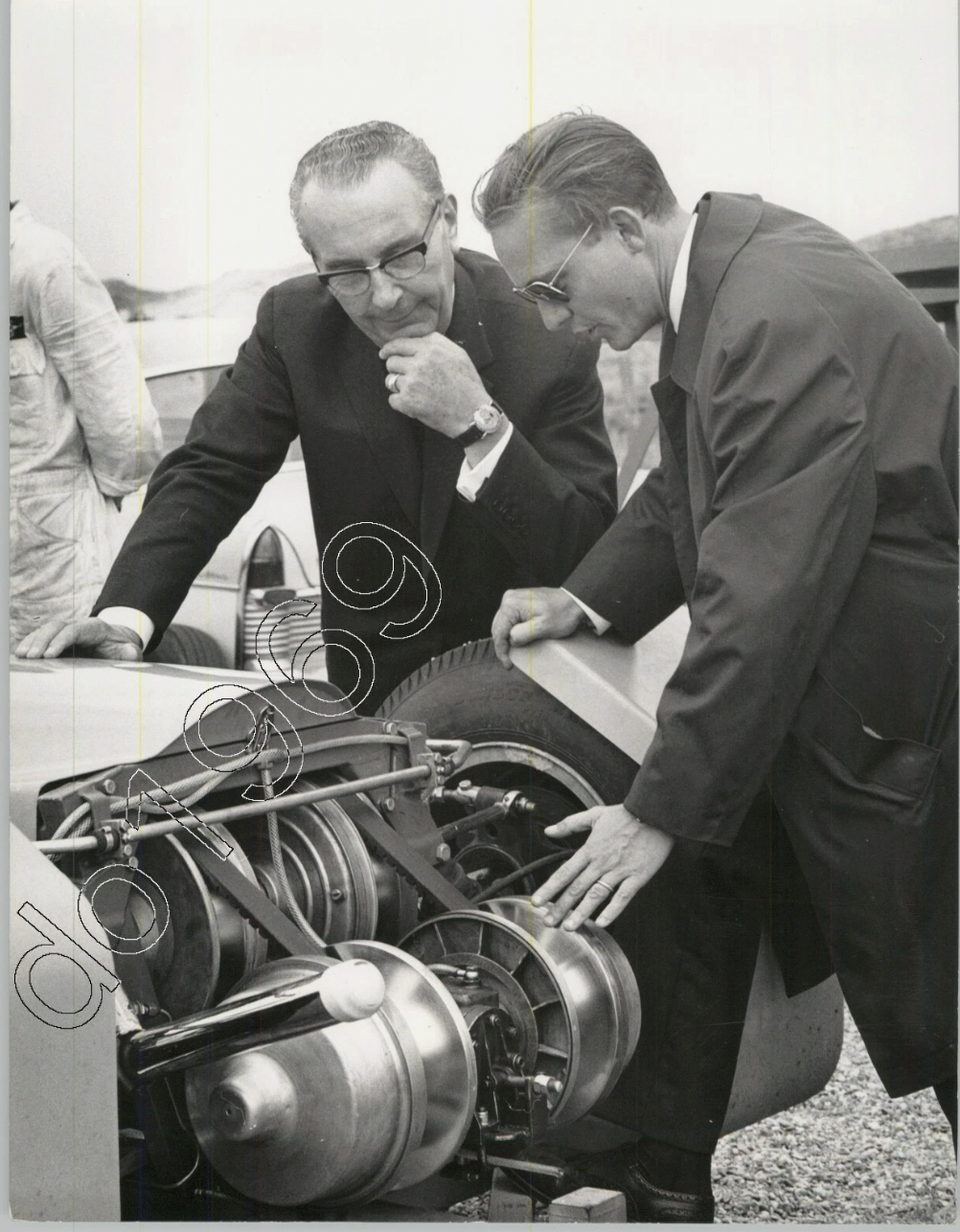
‘Hub van Doorne (left), founder of the DAF Automobile Company, Eindhoven/Holland, and his son Martin van Doorne. The two car experts are discussing the Variomatic transmission of their Brabham BT15 DAF F3 car at Zandvoort,’ the photo records, in early May 1965.
‘The DAF Co produces Daffodil cars (140 per day), which have a fully stepless transmission, lorries, and last but not least the DAF Pony for the US Army.’
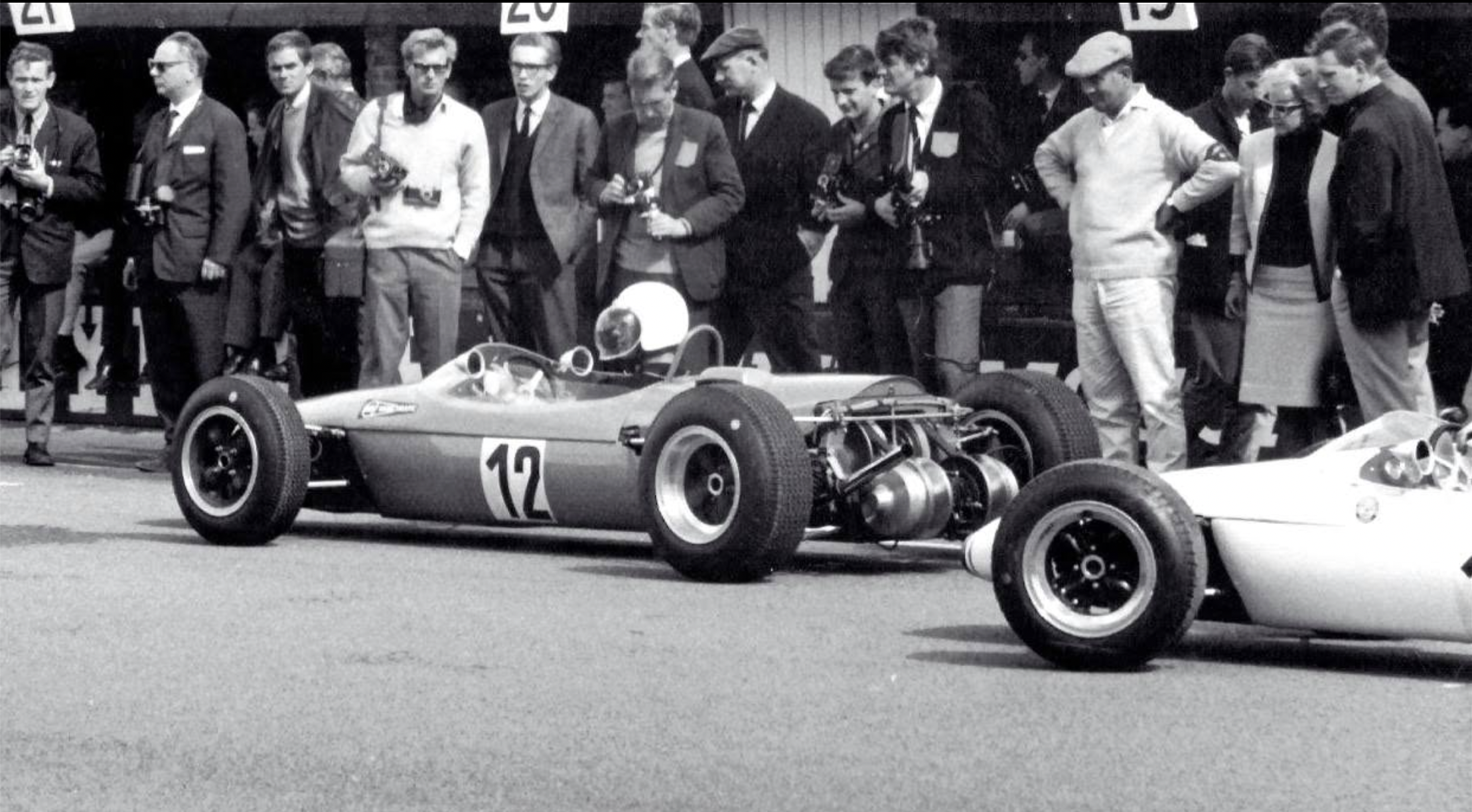
One of the countless racing improves the breed projects of the 1960s was DAF’s involvement in 1-litre Formula Three from 1965-68, with Alexis, Brabham, DAF (Gemini) and Tecno chassis, all of which were fitted with DAF’s signature stepless ‘variomatic’ continuously variable transmissions (CVT).
The device had infinitely variable ratios, so there weren’t discernible gear changes. The pulleys in the transmission expanded and contracted depending on speed, load and driver demand. Final drive to the rear wheels was provided by rubber composite drive belts.
Dutch racers Rob Slotemaker and Henk van Zalinge (HVZ) formed the Rensportschool Zandvoort race driving school in 1955 and delivered countless racing drivers in the process. Van Zalinge (1922-5/2/2006), in addition to his talents behind the wheel, was also an automotive engineer of note.
It was his idea to harness DAF’s transmission to handle greater power/torque than their contemporary small-car range. In essence, the Variomatic transmission potentially provided an Unfair Advantage by keeping an engine perpetually in its optimum power band. They proved rather successful too; the technology made it into road cars, and the pace of a CVT-equipped F1 Williams FW15C Renault 3.5 V10 was quick enough for the FIA to ban it…but we are getting ahead of ourselves.
Design and Development…
DAF quickly embraced HVZ’s pitch, and its execution was thrown to the head of DAF Research & Development, Wim Hendriks, the man who designed and built the first Variomatic for the DAF 600 in 1967.
DAF bought a British Alexis Mk5 chassis (#HF501) and the usual Ford Cosworth MAE 1-litre engine over the winter of 1963-64, then proceeded to adapt their unique technology for this most competitive of classes.
Hendrik’s challenge was re-engineering the rubber belts, heavy-duty pulleys and ratios to survive 100bhp tearing away at components built for half the power.
Much initial work on the car was carried out in Martin van Doorne’s home garage. Further attempts at privacy included testing the car at De Peel Air Base rather than DAF’s test track at Sint-Oedenrode. Eventually, De Telegraaf covered the news on its front page.
In the early Alexis stage, Slotemaker and Van Zalinge shared the test-driving work, albeit HVZ was the primary bridge between the cockpit and engine bay; the racer/mechanic diagnosed what the transmission was doing under load, then Van Zalinge fine-tuned the centrifugal weights and vacuum ratios trackside.
After a steep learning curve with the Alexis, competition manager Rob Koch approached Jack Brabham to partner with what was, by then, the pre-eminent manufacturer of production racing cars. DAF bought a more sophisticated Brabham BT15 (F3-25-65), and it was with this chassis that the DAF Racing made its F3 debut at Zolder on May 9, 1965, that circuit, the site of much of the development testing.
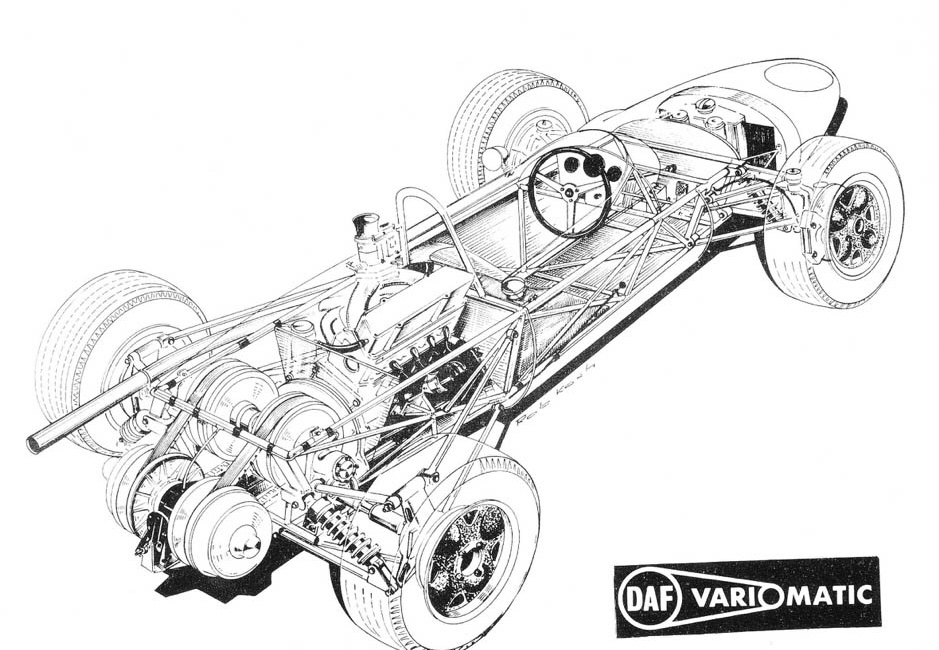
Art Macoran’s tale of how this BT15 cutaway came about is a beauty. ‘The story goes that the car was to be announced in the Dutch paper De Telegraaf, and one of the team members mentioned that it would be good to have a technical drawing to accompany the story “DAF builds a racer”. Rob Koch, DAF Development Engineer with the racing team, said he would spend the weekend on the drawing!’
The FJ Zolder GP on May 9, 1965 wasn’t a great one for poor Rob Slotemaker, who failed to complete a lap with fuel starvation problems.
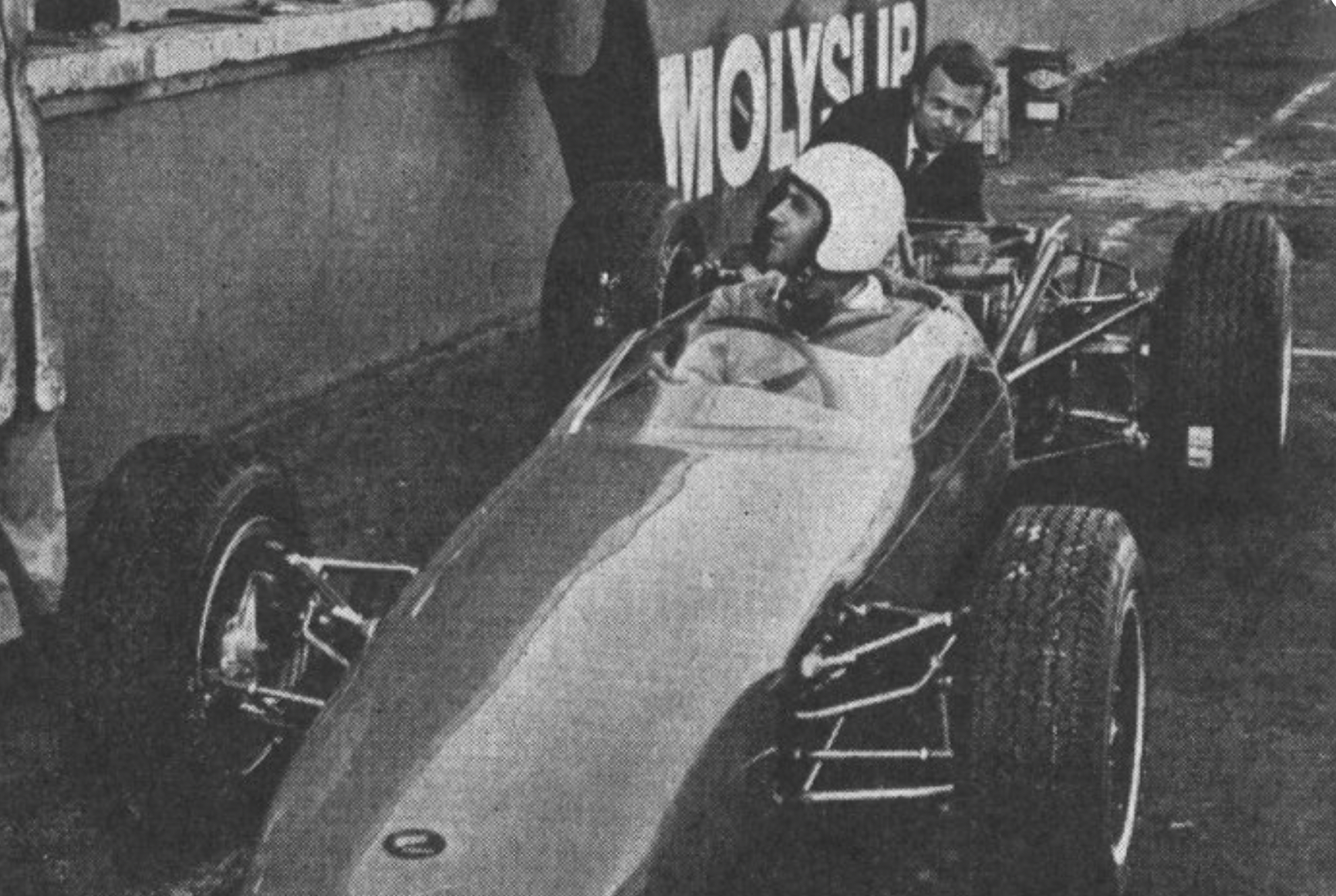
Not long after, Jack Brabham met the DAF team at Zandvoort and tested the car, amongst his recommendations was the use of a single-belt setup with a conventional racing differential to eliminate the bulk understeer being caused by the ‘dual belt layout fighting itself in high-speed corners’
Three weeks later the DAF Racing Team fronted for the Big One, the Monaco F3 Grand Prix held on May 29.
There, for reasons unclear to me, they raced the Alexis, which overheated throughout the weekend, its nose already heavily cut away. Slotemaker was fourth in heat 1 and seventh in the final, in front of several later F1 drivers. The man up front was Peter Revson in a works/Ron Harris Lotus 35 Ford-Holbay.
The only other outing for the year was at home in the August 29, Zandvoort Trophy, where Slotemaker was eighth in the BT15; the podium all raced Brabham BT16s: Kurt Ahrens, Trevor Blodyk and Chris Irwin.
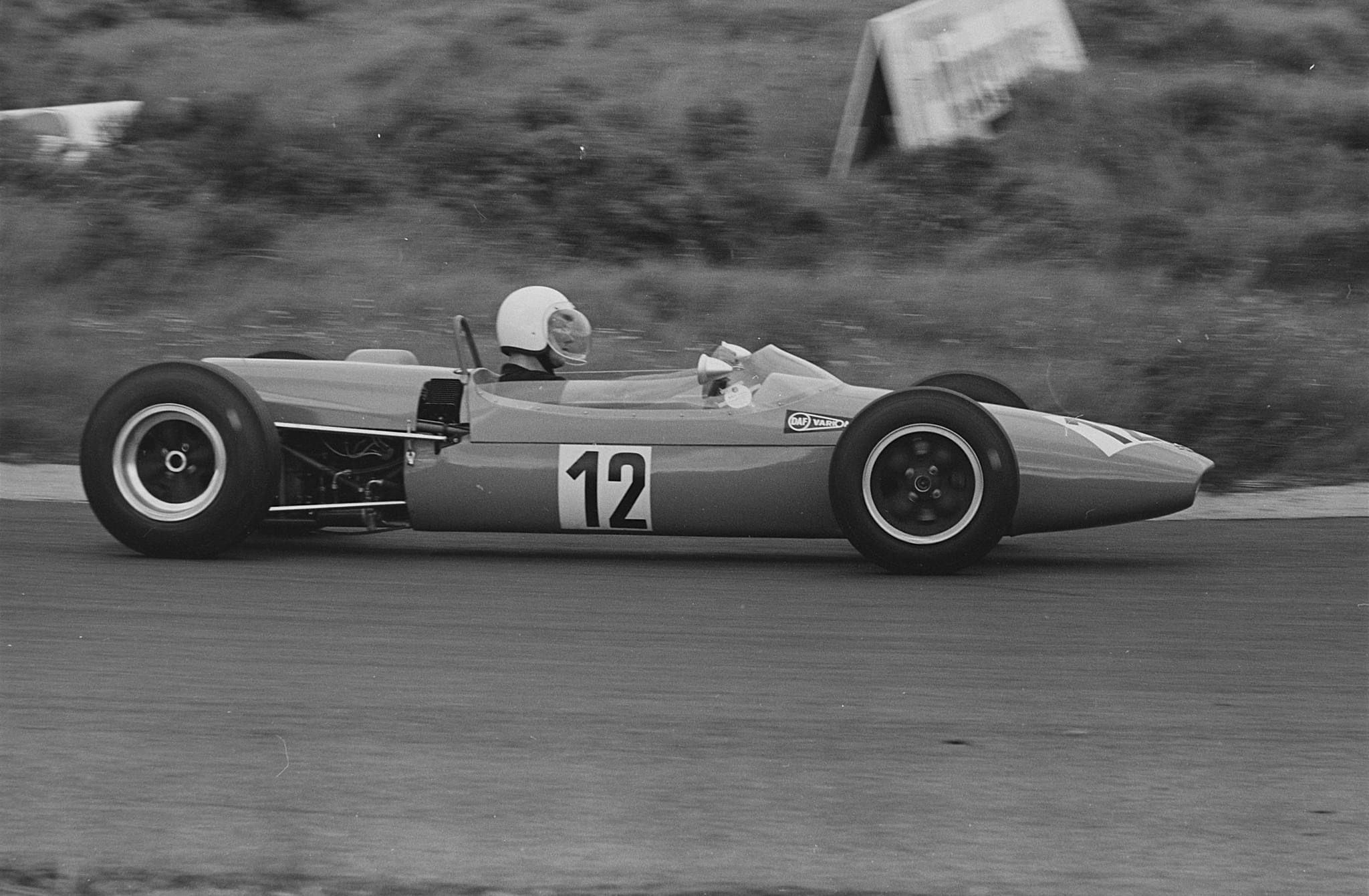
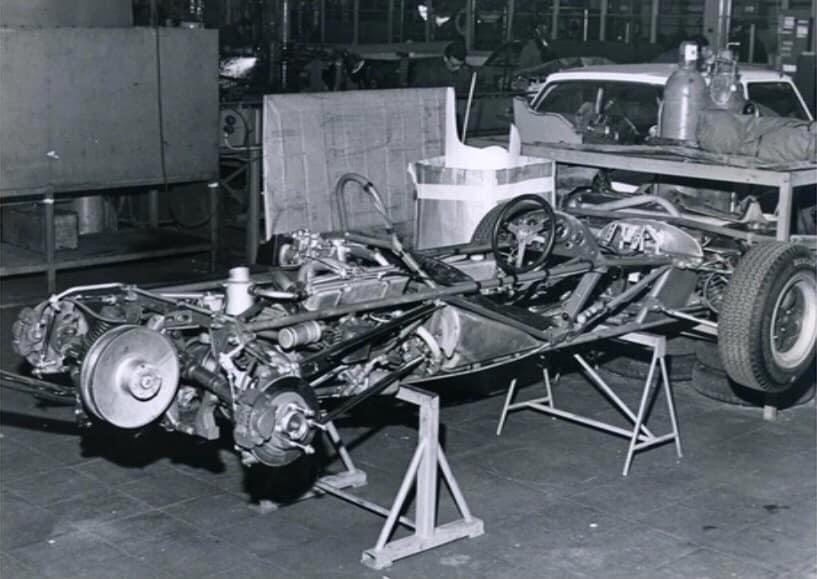
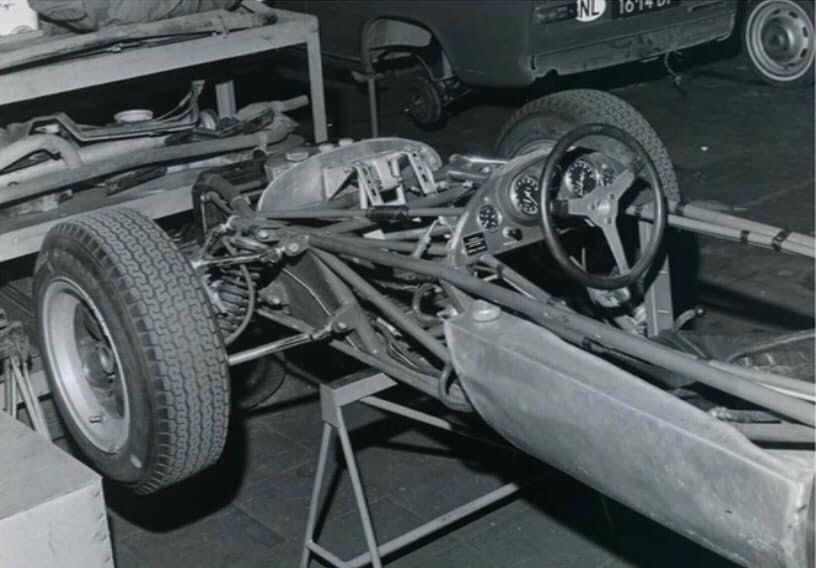
The BT15 Ford chassis #F3-25-65 in the DAF factory during 1965.
The relative bulk of the CVT setup and its location, components thereof, well aft of the rear axle line is clear. The Cosworth MAE screamer 1-litre pushrod engines gave circa 100bhp.
The drivers soon mastered the art of left-foot braking, momentum driving, and the somewhat hypnotic effect of the engine revving hard within its upper limits all the time; watch the Williams YouTube footage linked later in the piece to experience that. Interesting is that the BT15 is fitted with two Smiths tachs, why I’m intrigued to know?
1966-68 Racing Program…
In 1966 a pair of Brabham BT18s were acquired and raced by seasoned Brit, Mike Beckwith, and promising Dutch young-thruster, Gijs van Lennep, in his first year of single-seaters.
Progress was made with some top-six finishes for both drivers; Mike Beckwith’s third at Zolder in September was the standout.
I can’t give you further insights on 1966 as the relevant F2 Register pages, my much valued refererence site, won’t load. Fuggit.
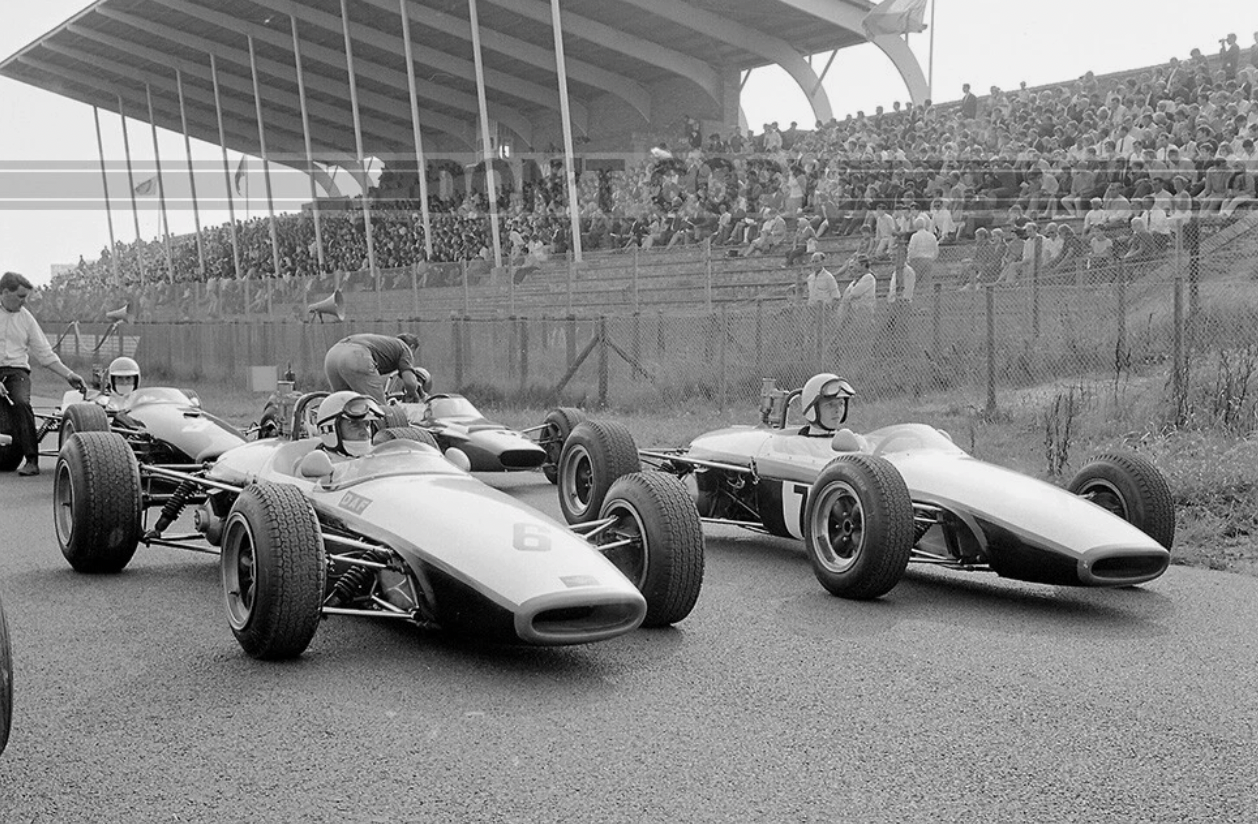
For 1967, DAF approached The Chequered Flag to build them a bespoke DAF. Chas Beattie’s Gemini-DAF was a slinky Brabhamesque design that was only let down by the power losses of the Variomatic pulley system relative to a good-ole bulletproof Hewland dog-box.
Still, the cars could be very good in the wet – depending upon the behaviour of the belts – where the power delivery was advantageous and took two wins that year: Mike Beckwith in the ER Hall Trophy at Brands Hatch in October, in front of a top class field including at least 12 later F1 drivers, and Gijs van Lennep at Skarpnack in September in front of Ronnie Peterson, Dave Walker and Howden Ganley amongst others.
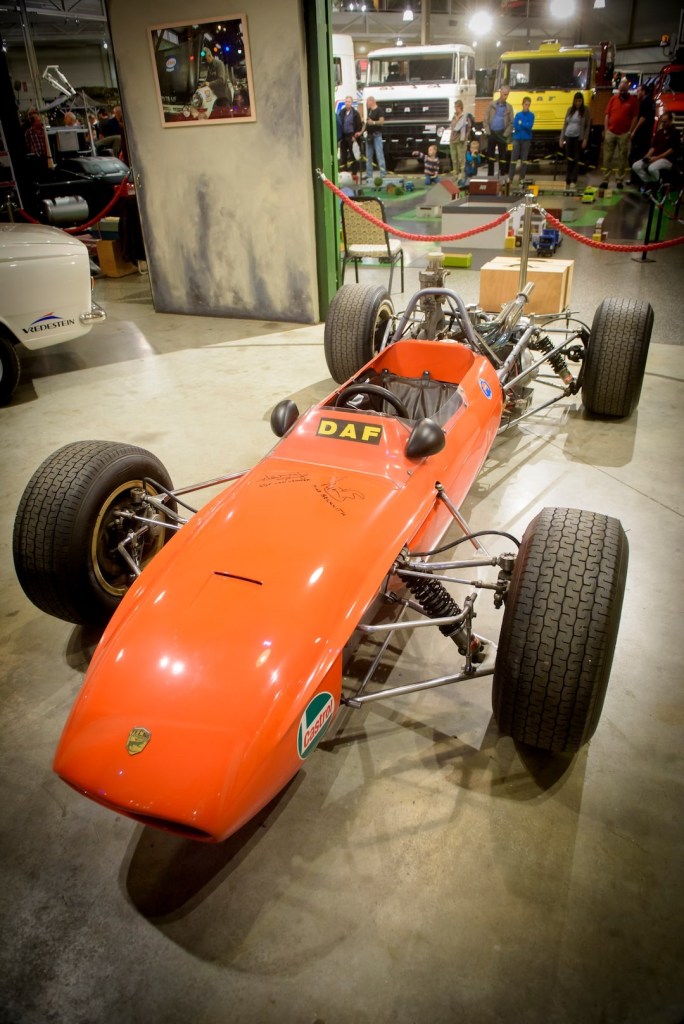
For 1968, their final year, DAF reverted to a pair of Brabham BT21s to kick off the season before switching to Tecno 68s after the Monaco F3 Grand Prix in May.
Van Lennep was seventh in Barcelona in March, then eighth in Monte Carlo. Mike Beckwith took a fantastic win in heat 2 at Monaco in front of Van Lennep, Francois Cevert, Peter Gethin,- Jean-Pierre Jabouille and others; it was a measure of just how much progress DAF had made, but he had piston failure in the final. Jean-Pierre Jaussaud’s Matra MS6 Ford won that year.
While Wim Hendriks still had to modify the rear of the Tecno chassis to accommodate the Variomatic hardware, it was a better fit than the more slender cars that went before. In its final iteration, the primary and secondary pulley discs were cast magnesium, while critical internal shafts were machined in titanium.
The Tecno 68 had a more compact layout in that the transmission was still located aft of the engine, but the belts ran sidways/transversely, rather than up the back. This got the weight lower and within the wheelbase, reducing the polar moment of inertia.
The final tweak was an electro-vacuum override switch on the dash that allowed the drivers to manually ‘trick’ the transmission into a ‘lower ratio’ instantly when approaching the corner providing some engine braking and a more conventional corner approach, before the CVT took over on corner exit.
VL was then third at Skarpnack in September in his Tecno, before Beckwith took a splendid second behind Roy Pike’s Titan Mk3 Ford at Zolder in the same month. He followed up with third place at Roskilde the following weekend (Sept 22).
Then the Racing Team Holland boys made monkeys of themselves at their final meeting of the year at Montlhery in October when, while in a winning position, they ran into each other…
It wasn’t a great way to end the program, but it was mission accomplished from DAF’s perspective, plenty had been learned.
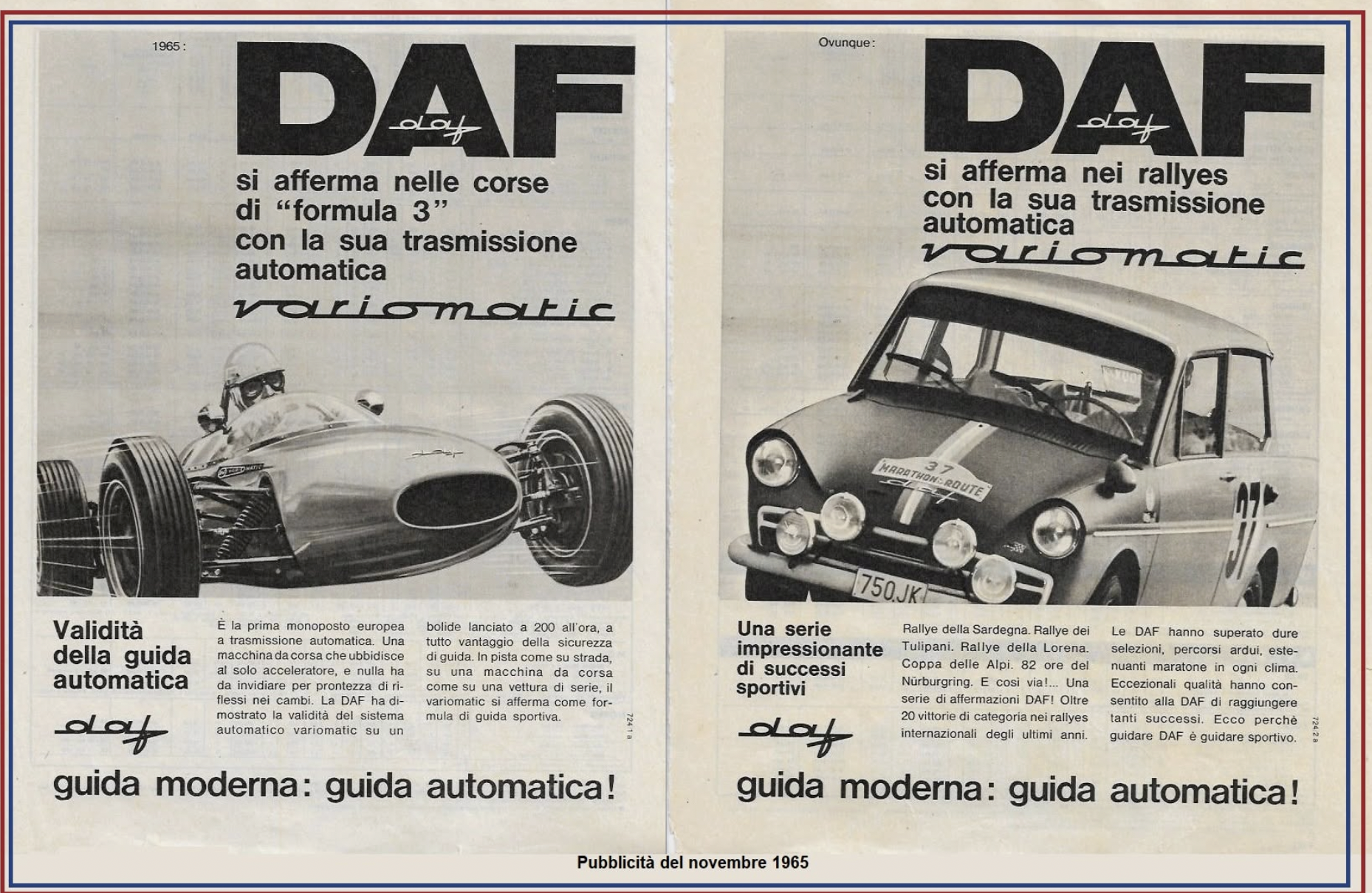
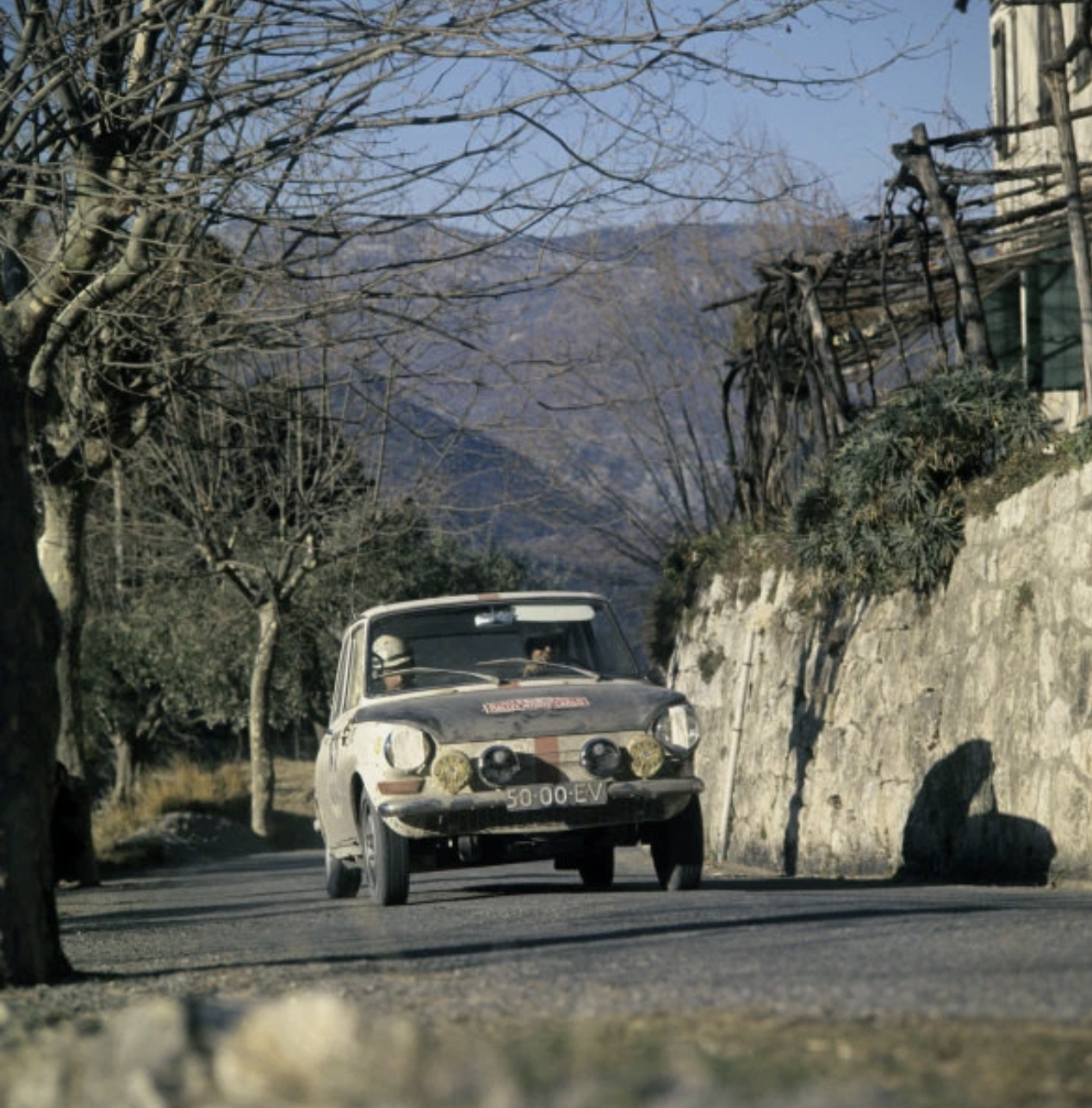
It wasn’t the end of the competition program either. DAF had an ongoing presence in rallying, rallycross, and a Huron 2-litre Ford BDA-powered sports car, the DAF 555 4WD, twin-engined Paris-Dakar car and the rest…
While DAF cars was sold by the Van Doorne’s to Volvo in 1975, DAF Trucks continued and so too did Van Doorne’s Transmissie b.v. That company continued to develop CVT technology and sold it to various of the major manufacturers.
Watch this fantastic video about the development of VDT’s CVT technology and its F1 pace and potential when used in the Williams FW15C Renault in 1993. https://youtu.be/b84mFiXWsog?si=7UvPMLamsqqkdSJD
Peter Wright wrote about the Williams CVT experiment in ‘Formula 1 Technology’.
‘Step-less gear ratio changing permits the engine to operate within a narrow rpm band, or even at a discrete rpm, instead of requiring an operating band of approximately 200 rpm. The engine designer can then tune the engine for that rpm, avoiding any compromises in intake and exhaust lengths or valve timing. The increase in available power (the integral of power throughout a cycle of accelerating through the speed range) must outweigh any loss in efficiency or increase in weight.’
‘Williams started research into CVTs in the late 70s, initially with a system based on the Perbury system. At the time, Williams was developing the Cosworth DFV and was seeking ways to achieve a power advantage over other DFV users. The Perbury proved to be too heavy and was encumbered with IPR problems. Some years previously, Van Doorne had raced an F3 version of its rubber belt and cone CVT, based on a system sold in DAF road cars. It was reasonably competitive but unable to take the power of an F1 engine.’
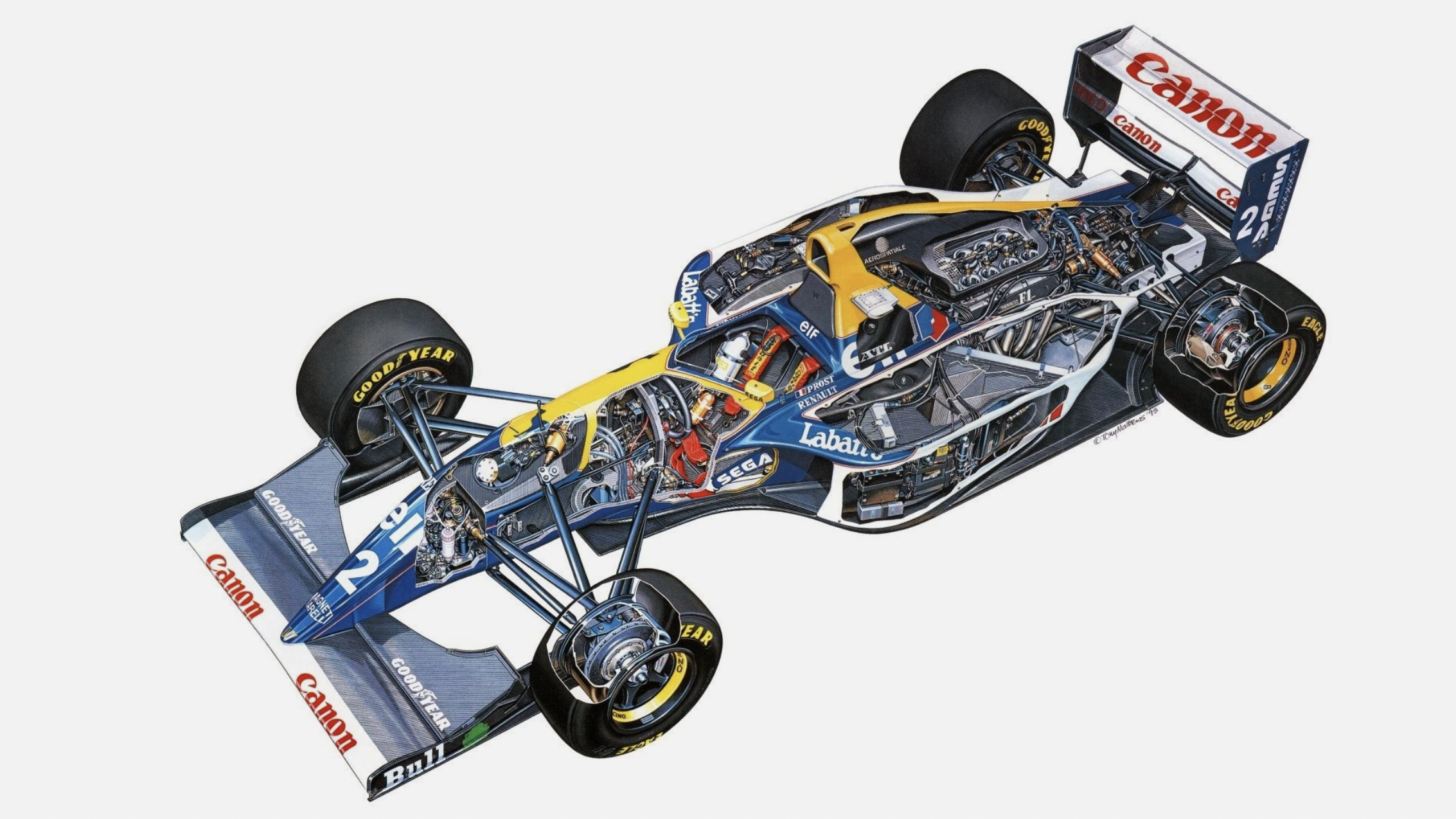
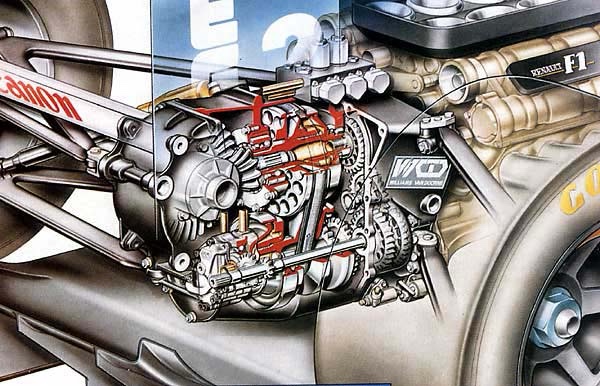
‘Williams decided to work with Van Doorne to develop a steel belt version, suitable for F1. The issues of engine starting, engaging drive, reverse, and the hydraulic and electronic control integration with the engine all had to be solved. The gearbox was mounted in a Williams FW15, powered by a specially tuned Renault 3.5-litre engine, weighed 6 kg more than the six-speed one it replaced and was approx. 93% efficient compared to 96% for the spur gear variant.’
‘This appeared in testing in 1993 but was banned as part of a package of control system regulations at the end of the year, before its performance advantages could be demonstrated. History does not relate whether the ban was the result of the fear of having to develop competing systems, when Williams had been working on the principle for so long, or the thought of 24 F1 cars, all with their engines continuously at peak rpm.’
Etcetera…
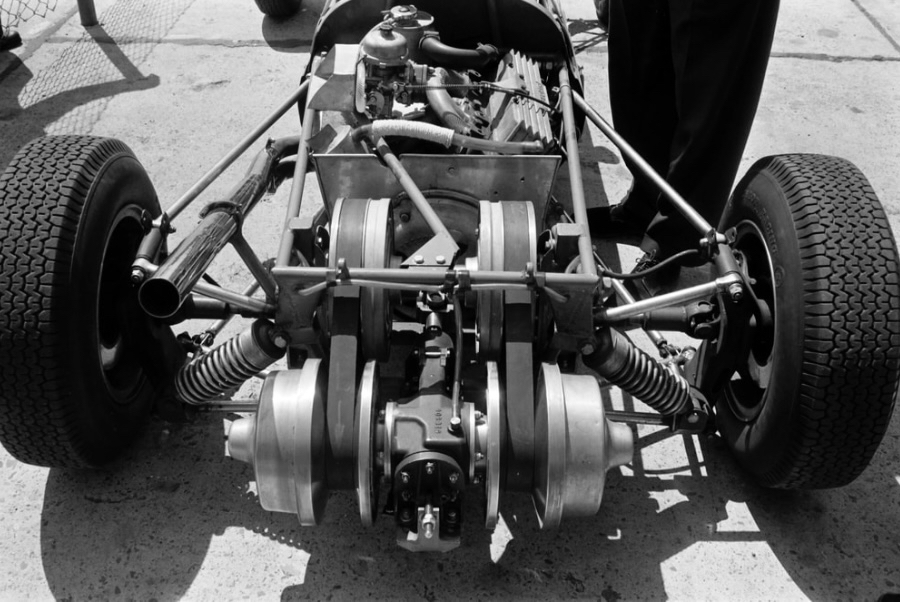
Rainer Schlegelmilch’s shot of the Brabham BT15 Ford DAF was taken at the Nurburgring during the May 23, 1965 1000km weekend.
There wasn’t an F3 race at the Ring that weekend, so perhaps the DAF Racing Team took it there to showcase their project to Ferrari, Porsche, Ford, Alfa Romeo and the rest.
Frustrating is that I have plenty of shots of the transmission in its early form but not in ultimate 1968 spec, if any of you can oblige I’d love to hear from you.
More material here:https://forix.autosport.com/8w/altpower-cvts.html and here:https://en.dafclub.nl/DAF/Models/Prototypes-and-specials#F3
During the research process for this article I dived down and down with the Google-Gemini AI tool to generate this response, ‘recorded verbatim’ to questions about the developmental challenges the DAF team faced in 1964-65.
‘The primary mechanical challenges Wim Hendriks and the engineering team had to solve when adapting the road-car Variomatic transmission for the Formula 3 cars boiled down to handling unprecedented power, heat, and physical space constraints.
The specific mechanical issues they faced included:
Belt Slippage and Shredding: The standard road-going DAF rubber V-belts were designed for modest 30-horsepower commuter engines. The high-revving Cosworth MAE Formula 3 engines produced close to 100 horsepower. Under sudden acceleration and track loads, the standard belts would instantly slip, overheat, and violently disintegrate or shred. Hendriks had to test and source reinforced, heavy-duty belts capable of gripping under high torque.
The Lack of a Differential: The original road Variomatic layout used two independent belts (one for each rear wheel), effectively acting as a limited-slip differential. However, in sharp, high-speed racing corners, this caused severe understeer and uneven belt wear. As mentioned previously, Jack Brabham strongly advised using a single-belt drive coupled to a conventional racing differential. Van Zalinge had to redesign the entire rear casing to integrate a differential into a single-seater layout.
Heat Dissipation: Because the Variomatic relied entirely on friction between the rubber belts and the metal pulleys (sheaves), it generated massive amounts of heat under racing conditions. If the pulleys got too hot, the rubber softened and failed. The team had to engineer custom cooling air ducts and use ventilated, lighter pulley materials to keep operating temperatures down.
Weight and Packaging: The Variomatic unit was bulky and heavy compared to a standard, compact racing gearbox. Placing it at the very rear of an Alexis or Brabham chassis severely ruined the car’s weight distribution and centre of gravity. Hendriks had to modify the rear frames, pushing the heavy pulleys as far forward into the wheelbase as possible, while redesigning the rear suspension to clear the spinning belts.
Vacuum and Centrifugal Calibration: The Variomatic shifted ratios using a combination of centrifugal weights (engine speed) and engine vacuum load. Racing engines operate at high RPMs almost constantly and have very different vacuum profiles than road cars. Van Zalinge spent endless test sessions swapping out springs, diaphragm valves, and internal weights to ensure the transmission “upshifted” and “downshifted” at the exact optimal powerband of the Cosworth racing engine.’
Track Test…
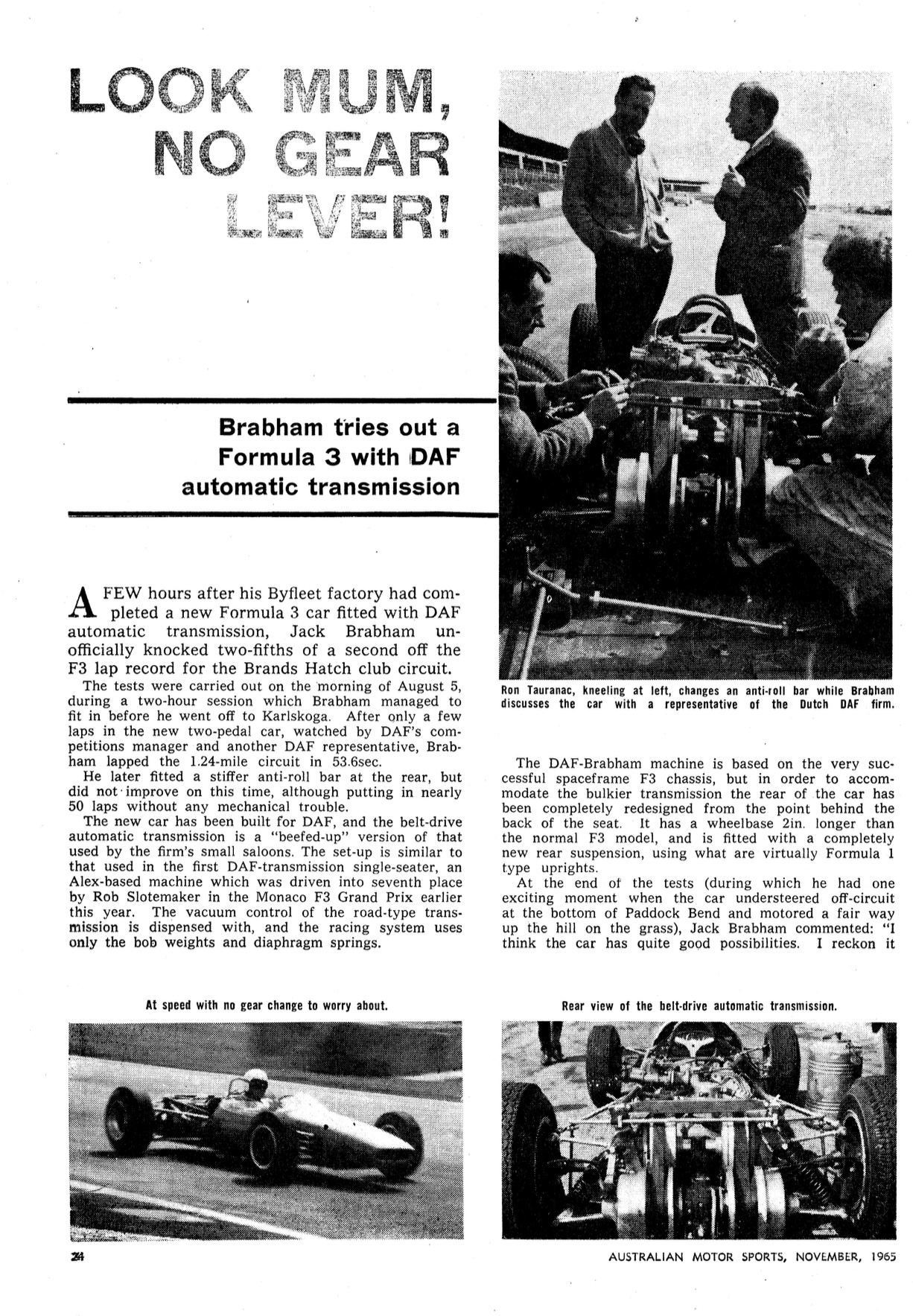
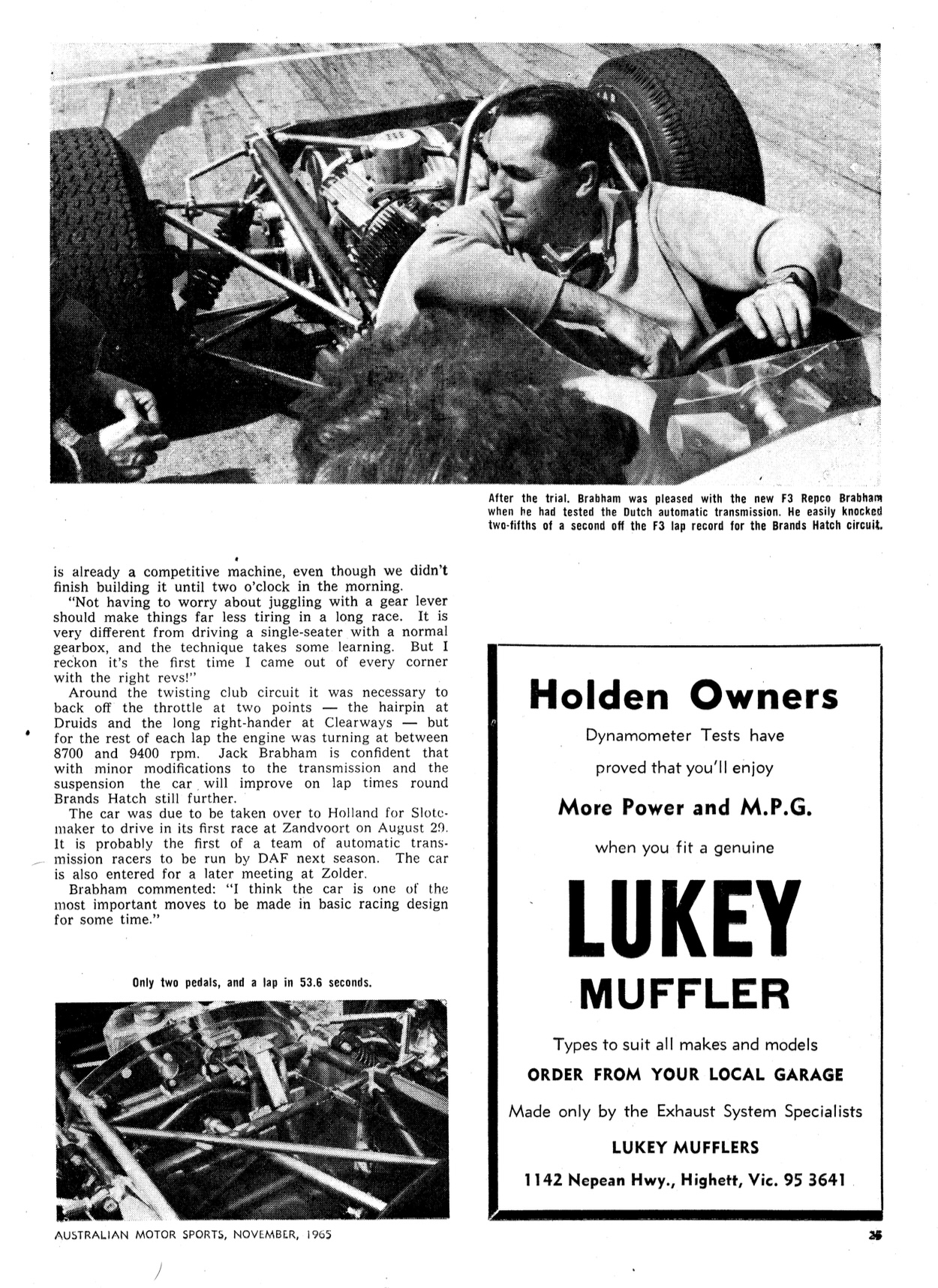
A couple of days after publishing this piece, Paul Best sent me this track test article published by Australian Motor Sports in their November 1965 issue.
It makes clear that MRD made the changes to incorporate the DAF hardware into the Brabham BT15 frame. I imagine the truth is somewhere in the middle.
Credits…
Gunter Reitz, DAF, F2 Register-Fastlane, Google Gemini, E Wayenberg via Romain Moorman, Phil Demeyer, F3history.co.uk, ‘Formula 1 Technology’ Peter Wright, Tony Matthews, F2Register, Rainer Schlegelmilch, De Telegraaf, Paul Best Collection-Australian Motor Sports
Tailiece…
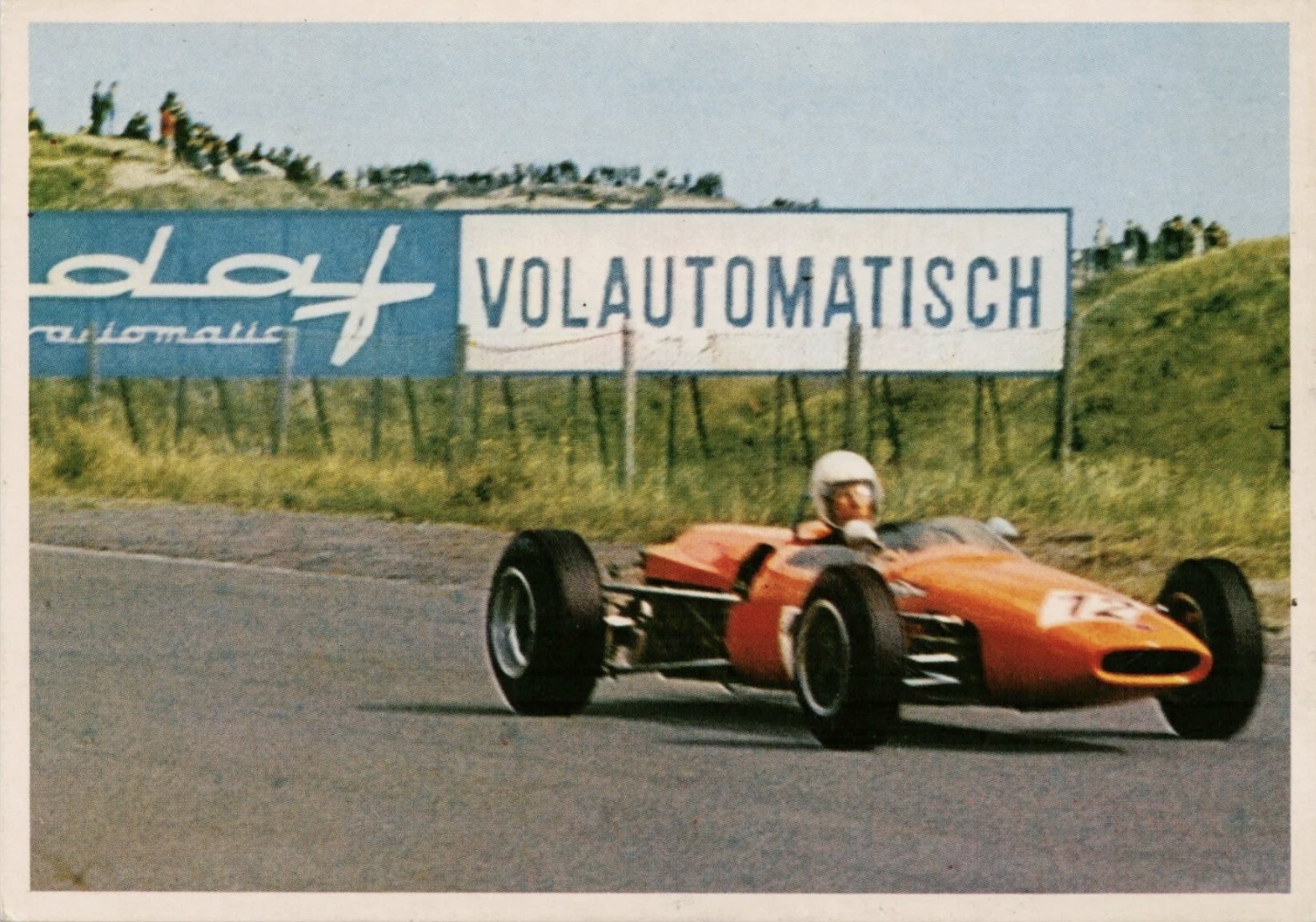
This 1965-66 DAF Postcard shows Rob Slotemaker in the DAF Brabham BT15 Ford during the August 29, 1965 Zandvoort Trophy. Volautomatisch translates as fully automatic…
Finito…

