Luvverly poster/program to promote the October 1955 race meeting at Fishermans Bend, 6 Km west of Melbourne’s CBD…
My guess is that the ‘artists car’ is Lex Davison’s Ferrari 500/625 and the bike an MV Agusta 4…
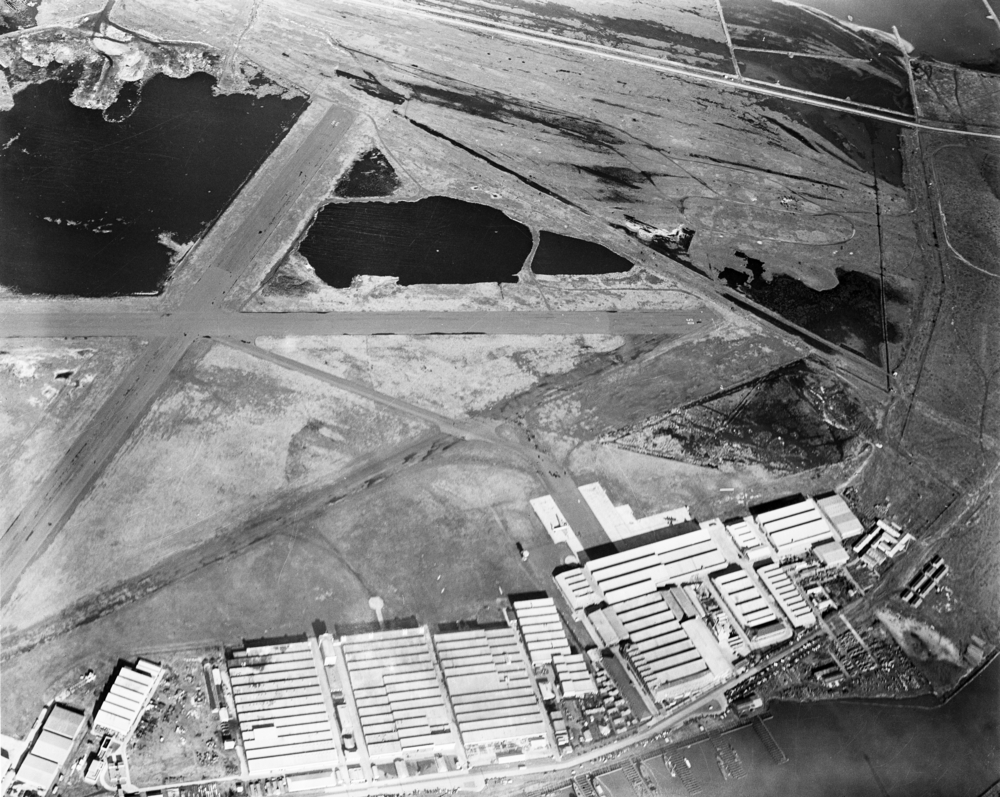
Fishermans Bend Aerodrome was located near the emergence of the Yarra River with Port Phillip Bay. The area was a vast swamp owned by the Commonwealth Government. In the early 1930s, a primitive airstrip was built there which was used by gliding and light aircraft enthusiasts.
In 1935 the Government built the Commonwealth Aircraft Corporation (CAC) factory, together with a long sealed airstrip. CAC is the best known of the Australian aircraft manufacturers of the Word War 2 and post war era’s. It began as a private company founded by Lawrence Wackett, a captain with the Australian Flying Corps known for his engineering ingenuity. After World War I, Wackett began design and manufacture of civil aircraft.
‘The CAC was conceived in 1935 by Essington Lewis then managing director of BHP. It was a private company formed by a consortium including BHP and GMH (Holden) to manufacture military aircraft with the intention of providing Australia with the tools to fight the modern war that was looming’.
‘Land was selected adjoining the recently completed GMH (General Motors Holden, 191 Salmon Street) factory at Fishermans Bend.
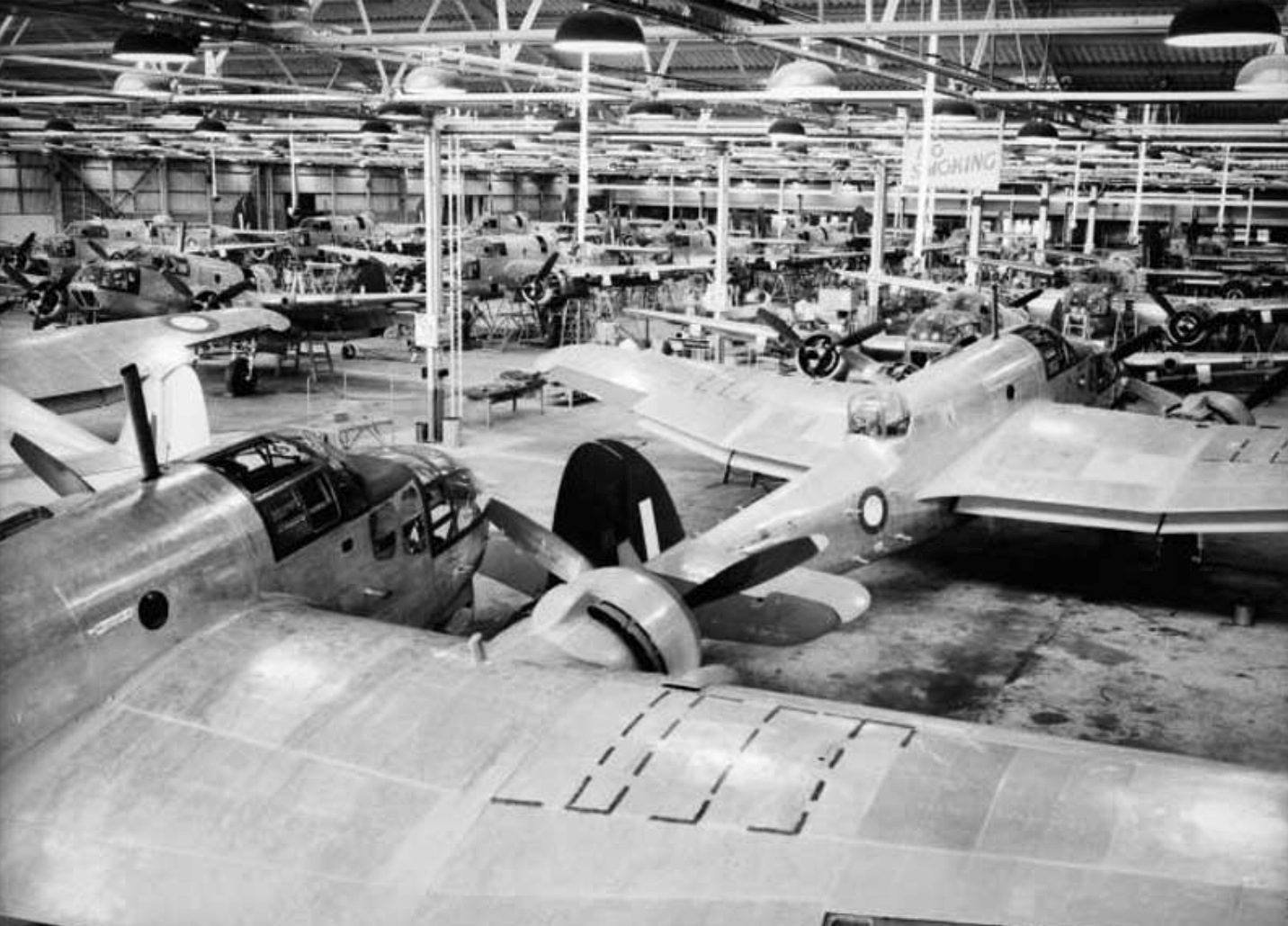
The factory manufactured a modified US designed advanced trainer under licence which became known as the Wirraway. Other wartime aircraft built included the Wackett elementary trainer, the P51 Mustang and the Boomerang, a fighter aircraft conceived, designed and manufactured in little over three months’.
Bristol Beaufort Mk VIII being built at Fishermans Bend in 1943 (unattributed)
‘Fishermans Bend became a centre of the wartime aircraft industry with the adjacent Department of Aircraft Production factories and the Aeronautical Research Laboratories. During the war CAC produced two interesting prototypes which sadly never made it into production. The Woomera, the first was a three seater medium bomber that had remotely operated turrets in the rear engine nacelles. The other was an interceptor, the CA-15 or Kangaroo, it was a 721 km/h fast fighter with a range of 4000 Km’.
‘After the war the CAC Sabre, one of the ultimate Sabres of the type was built. With a more powerful Avon turbojet and twin 30mm cannons the (American) frame was 60% redesigned. Post WW2 the facilities continued manufacturing and assembling aircraft’.
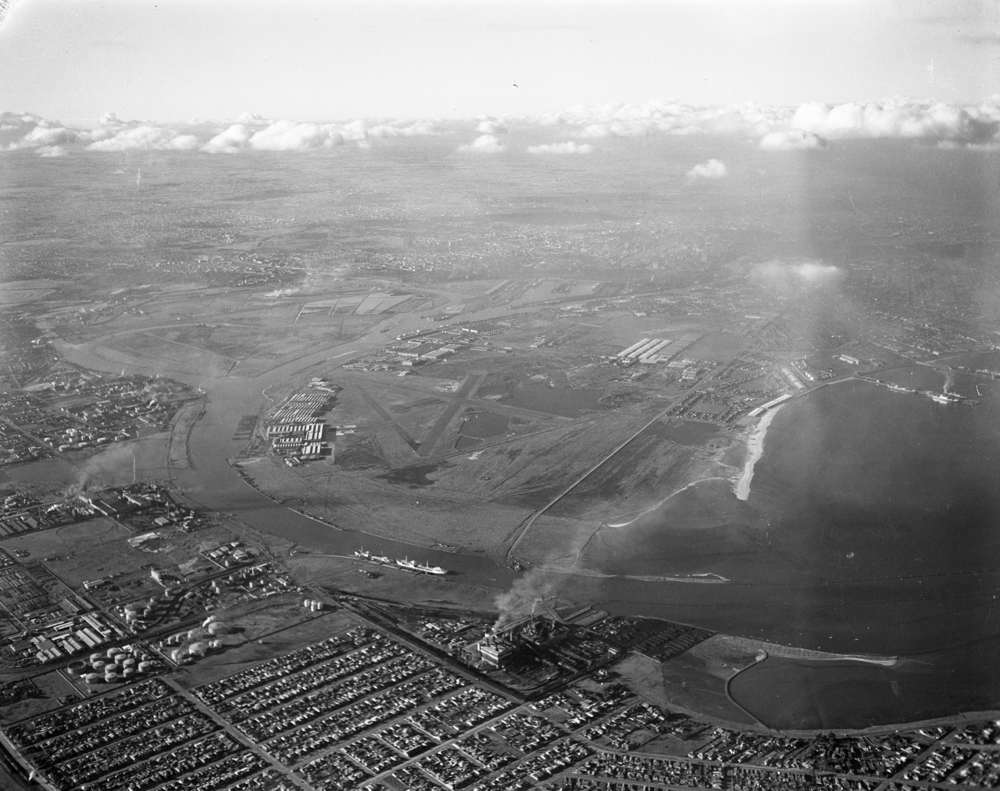
Aerial view of Yarra River, Newport and Fishermans Bend circa 1940-50. The smoke is coming from the Newport Power Station. To its right is the exit of the Yarra River into Port Phillip Bay. The straight road which ends at the Yarra near the berthed ship is Williamstown Road, there was a car ferry to cross the Yarra, the Westgate Bridge was opened in the mid-70’s. In the middle of the shot are the runways of the airfield used for racing. Shot also shows the Dept of Aircraft Production, Commonwealth Aircraft Corporation and the GMH Holden factory on the right or ‘above’ the runways. Melbourne CBD is lost in the haze at the top of shot but not far away as the crow fly’s (Francis Hodgson)
For the aviation history buffs click on this link to a very detailed publication about Fishermans Bend’s 60 year role in Australian Aviation…
Its a government document of value. Therefore a global rarity.
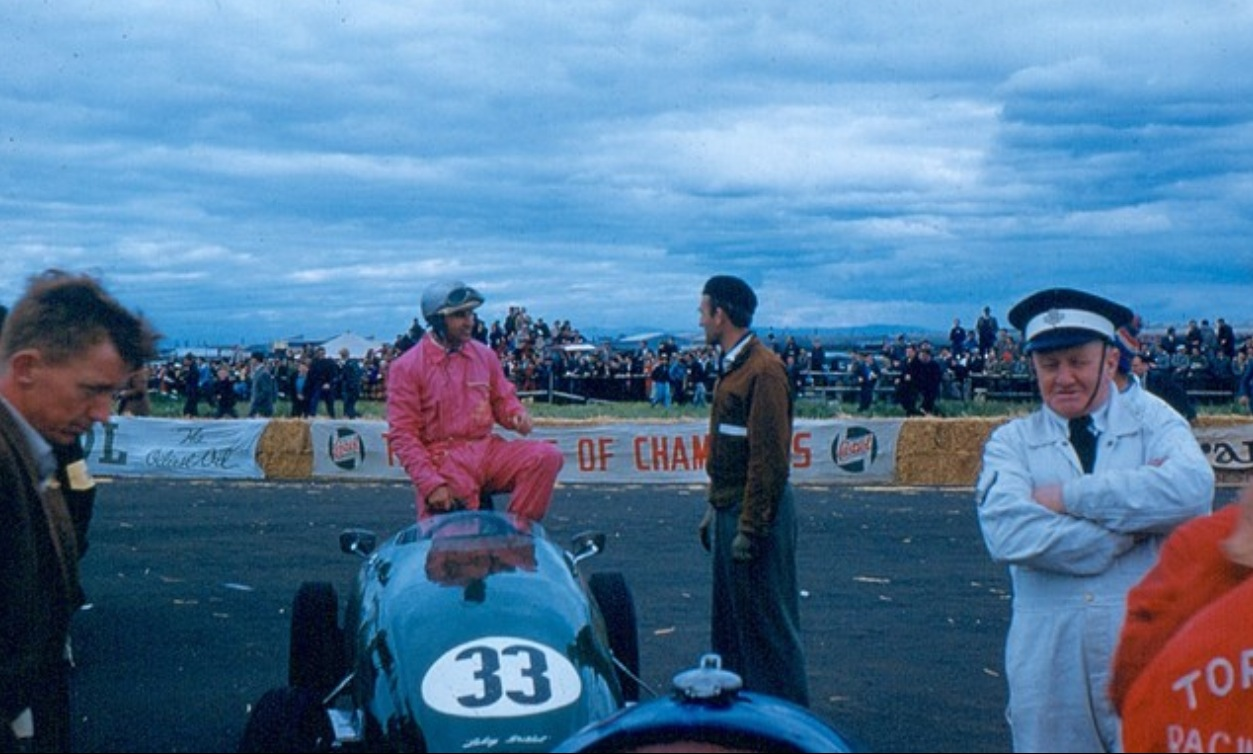
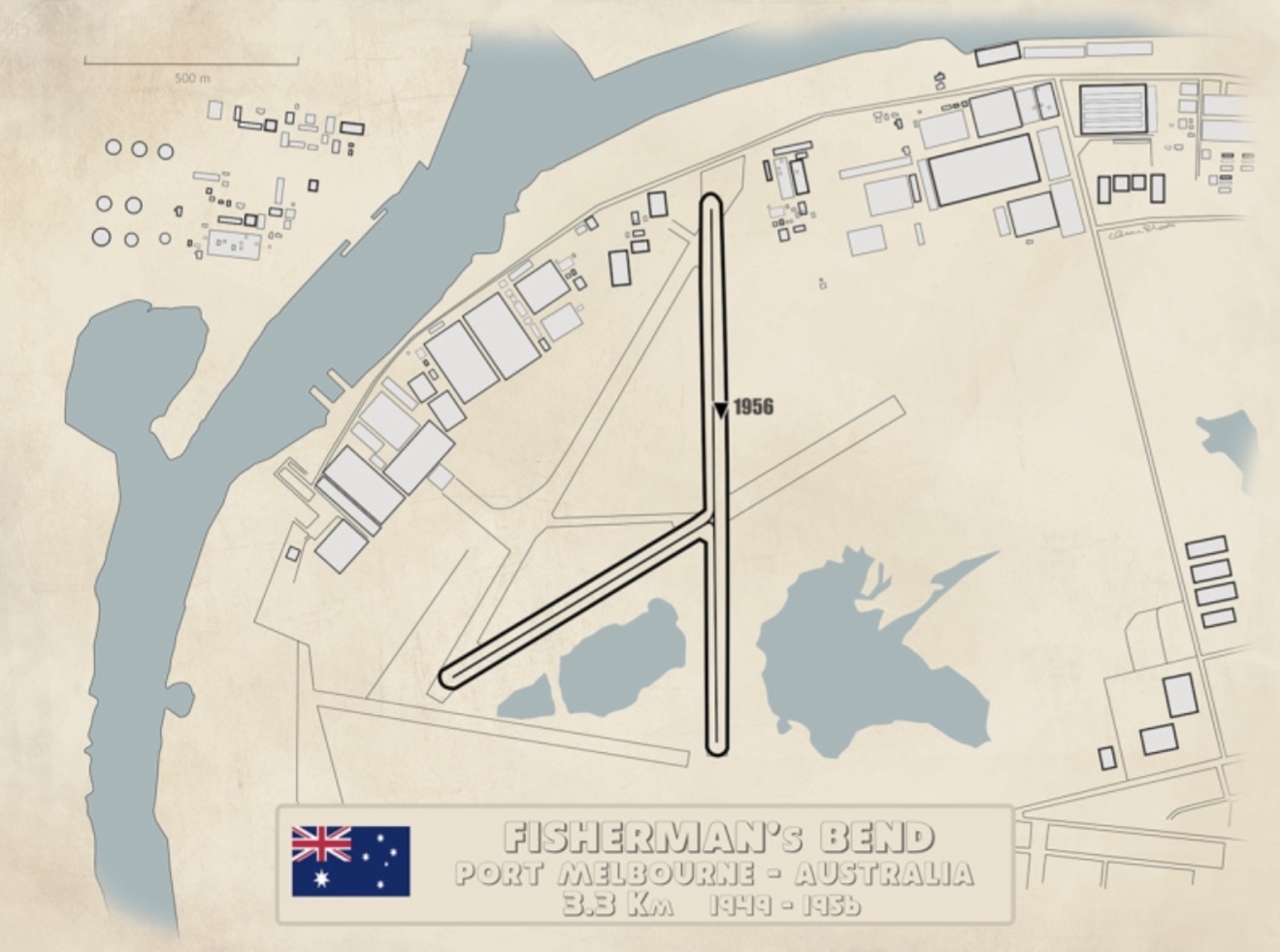
The Aerodrome was also used for car and motorcycle racing from 1949 to 1966, using the main airstrip and the 3 km perimeter road.
The Commonwealth Aircraft Corporation was taken over in 1986 and the majority of its buildings demolished in 2003-04.
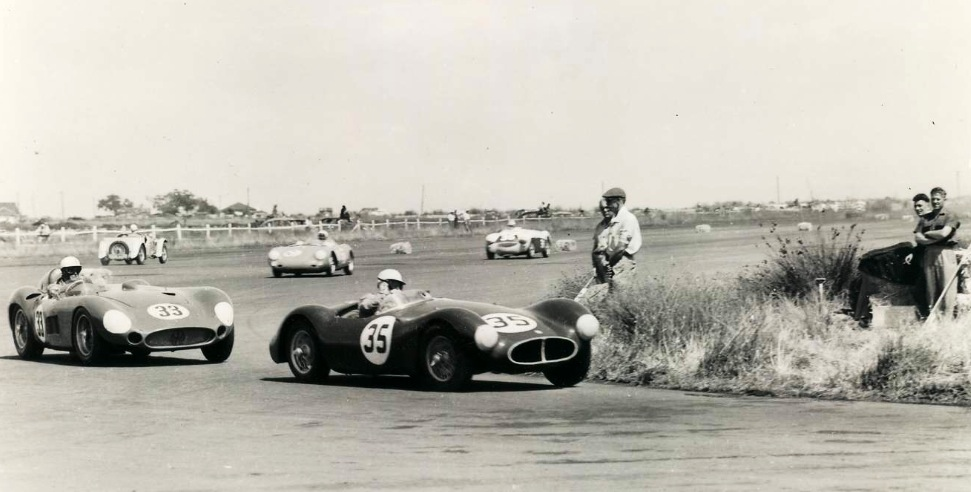
Flavour of the era. Love this Fishermans Bend shot; ‘Victoria Trophy’ meeting February 1958 with the front engined cars of Ted Gray, Tornado 2 Chev and Stan Jones Maserati 250F up the front. Policeman and his horse oblivious to the cacophony, note the ‘safety’ fence. Industrial heartland of inner western Melbourne in the background (Geoff Green)
‘Westgate Park’ now occupies part of former CAC land. The aerodrome’s runway became Todd Road, the taxi runway became Wharf Road. A legacy of the past is found the names of some of the nearby streets; Sabre Drive, Wirraway Drive and Canberra Drive. The railway line which serviced industry in the area remains but is no longer used and isn’t connected to the contemporary rail system.
The former CAC factory, at 344-370 Lorimer Street and 231-249 Todd Road Port Melbourne, was constructed from 1937 to manufacture military aircraft.
The only remaining buildings of the extensive factories are a section of ‘saw-tooth’ factory to the west (now part of Hawker de Havilland/Boeing) and four hangars at the eastern end of the former factory at the corner of Lorimer Street and Todd Road. These hangars, dating from WW2 comprise one US made ‘Butler’ and three British designed ‘Bellman’ hangars.
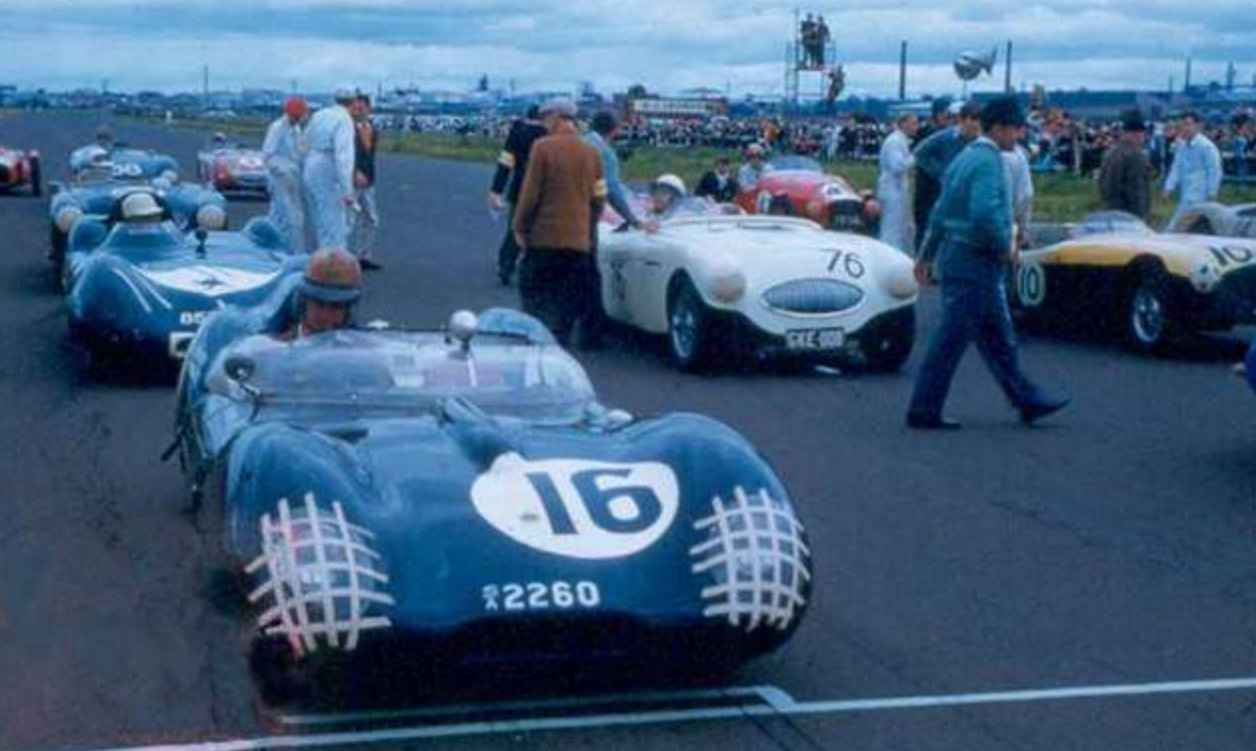
Fishermans Bend sports car race October 1958. #16 Derek Jolly’s Lotus 15 Climax, various Austin Healey 100’s and a Lotus 11 behind Jolly. To the far right is the Coad Bros Vauxhall Holden Repco Spl which the family still owns (Kevin Drage)
Motor Racing at Fishermans Bend…
Airfield circuits popped up post World War 2 globally; in Australia at Point Cook, Fishermans Bend, Leyburn, Caversham, Mallala and Lowood.
The infrastructure was available, people were looking for things to do postwar and governments sought ways of creating economic activity locally.
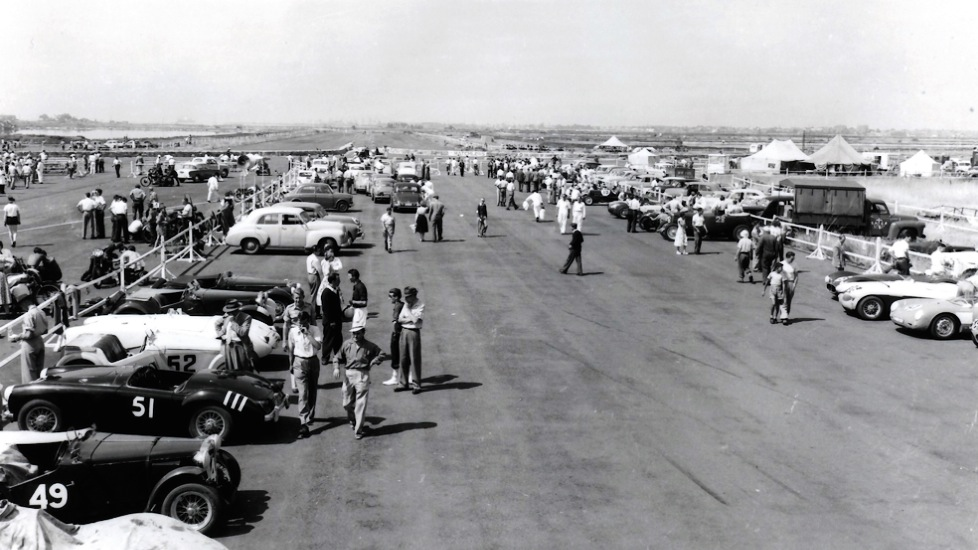
Fishos’ paddock, 10 February 1957. It would have been hot but at least it was sealed, unlike all but airfield circuits at the time! #49 the Graham Hoinville MG TC, which the prominent competitor, engineer and CAMS official still owns! (unattributed)
These photos are not to show a particular race meeting but rather are selected to ‘taste’ the flavour of the place; typically airfield flat and featureless, desolate, industrial backdrops and devoid of much in the way of amenities or safety considerations.
Greg McEwin’s HRG 1500 from South Australia. The body of this car, styled on the Healey Silverstone was built by Ray Manser in Adelaide, it first raced at Port Wakefield in September 1951.Note the aircraft factory backdrop, October 1953 meeting (SLV)
The Light Car Club of Australia and the Harley Motor Cycle Club were the circuits promoters on behalf of the Air Force Association,meetings were run to raise money for a variety of disparate charities over the years.
The pent up demand for entertainment post war is shown by a Melbourne ‘The Age’ newspaper article dated 31 October 1949 which estimated crowd numbers at 70000 people for a program of car and ‘bike events! Staggering really. Crowds of over 30000 were common, by 1952 ‘The Age’ pointing out the demand for motor sport should the quality of venues be improved.
A Cooper Bristol and Maybach 3 (or 4 Chev) , Fishermans Bend. I found this shot in the SLV archive, i’m certain about the cars, thats the easy bit! Perhaps its Tom Hawkes CB leading Stan Jones in Maybach, but it could be another CB and could be Ern Seeliger in Maybach. Stan retained Maybach after he acquired his 250F. Ern modified the car with Chev engine and mainly raced it but Stan used the car right up to 1959 on occasion. Interested to get a view from Aussie enthusiasts as to who and when (SLV/Reg Fulford Collection)
‘Fishos’ was used up until 1960 for road racing, as the surface deteriorated the government was unwilling to resurface it just for the sake of motor-racing.
The last road-race meeting was organised by the LCCA on 14 February and the last sprint meeting by the Victorian Amateur Drivers Club on May 5, 1960.
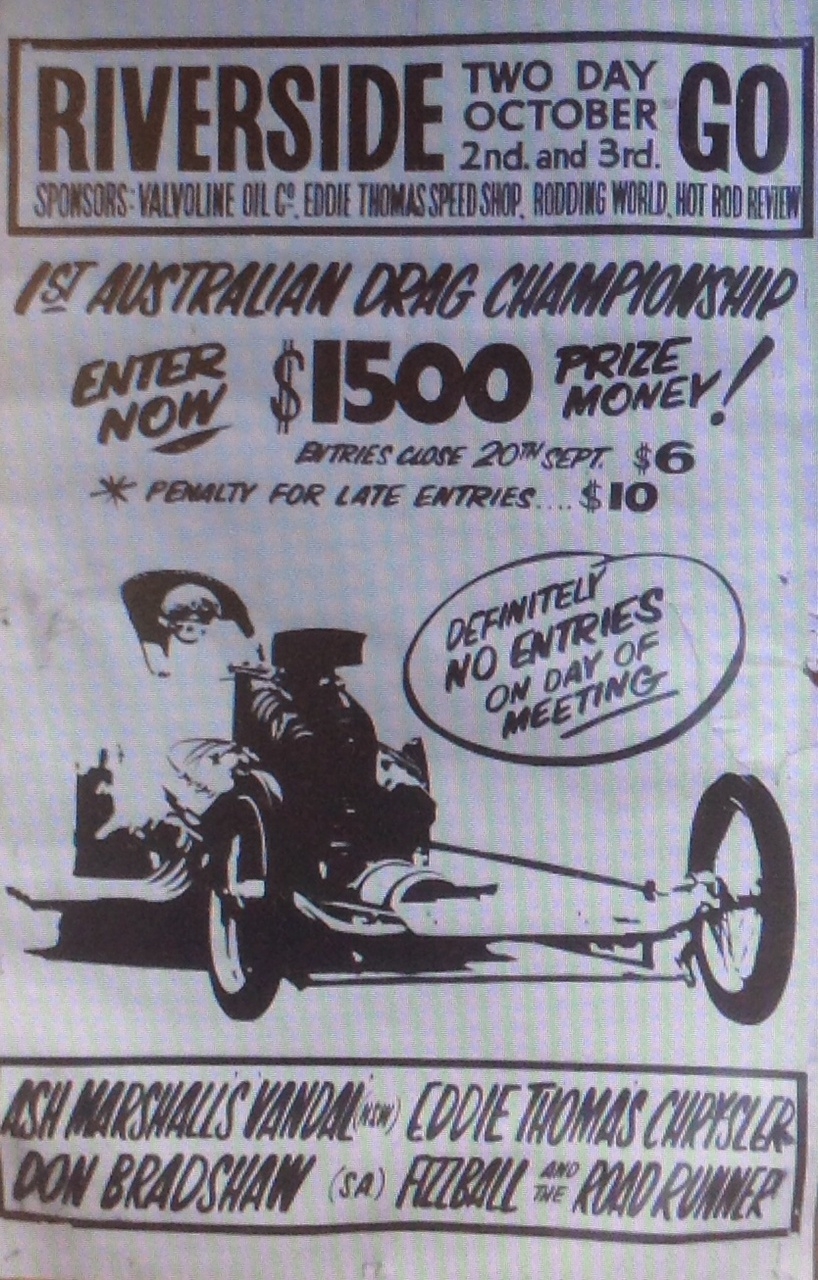
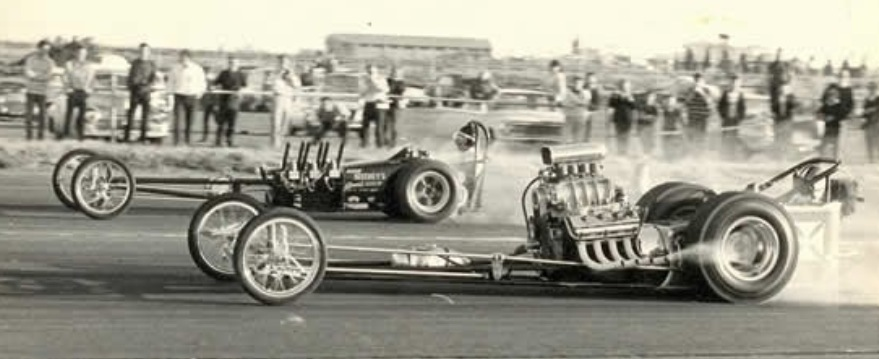
The airstrip was then used as a drag racing venue until 1966, ‘Riverside Raceway’ played an important part in the formative stages of Drag Racing in Australia…
(Ray Sprague Collection)
Early sixties wonderful Fishos scene (T Beyer)
Unmistakable Fishermans Bend backdrop. The ‘Rails’ of Ash Marshall (near) and ‘Fizzball’ Collins at Riverside in 1965 (moondog.net.au)
Drag racers view- cars lined up date unknown (T Beyer)
Random Fishos’ Shots…
Ron Phillips and Doug Whiteford in Austin Healey 100S’ 14 October 1956. Dougs #’3907′ a little more understeering than Phillips #’3906′ (unattributed)
Len Lukey in his Lukey/Cooper Bristol after finishing 2nd in the October 1958 Victorian Road racing Championship, Derek Jolly in brown congratulating him. Ted Gray won this race in the Tornado i wrote about a while ago (Kevin Drage)
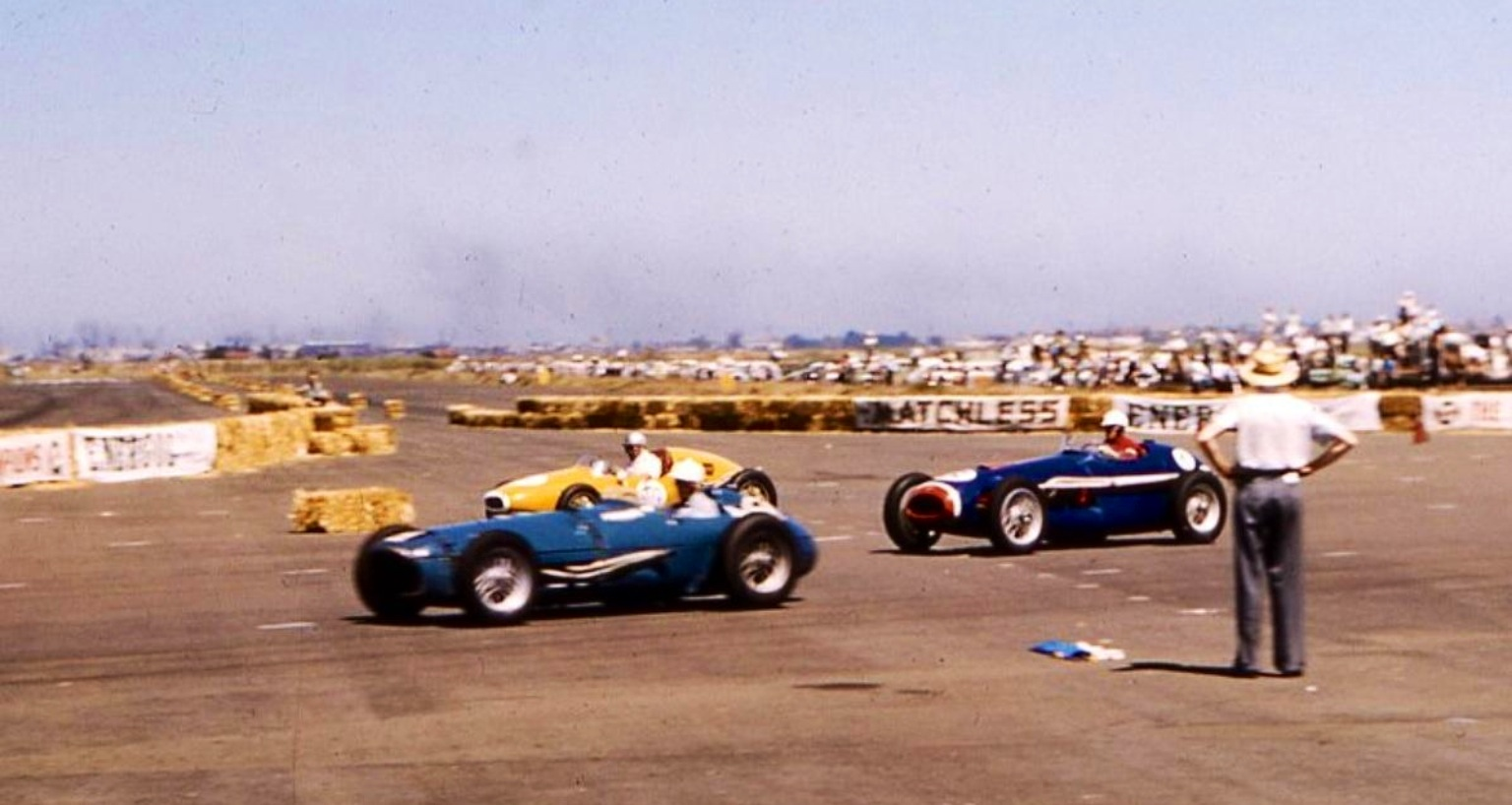
After the finish of the Victorian Road Racing Championship October 1958. Winner is Ted Gray in the dark blue Tornado 2 Chev V8, light blue car Ern Seeliger in Maybach 4 Chev V8 and the yellow Cooper T41 Climax of Austin Miller . Note how flat and featureless the place is, circuit in classic period style bordered by hay bales (David Van Dal)
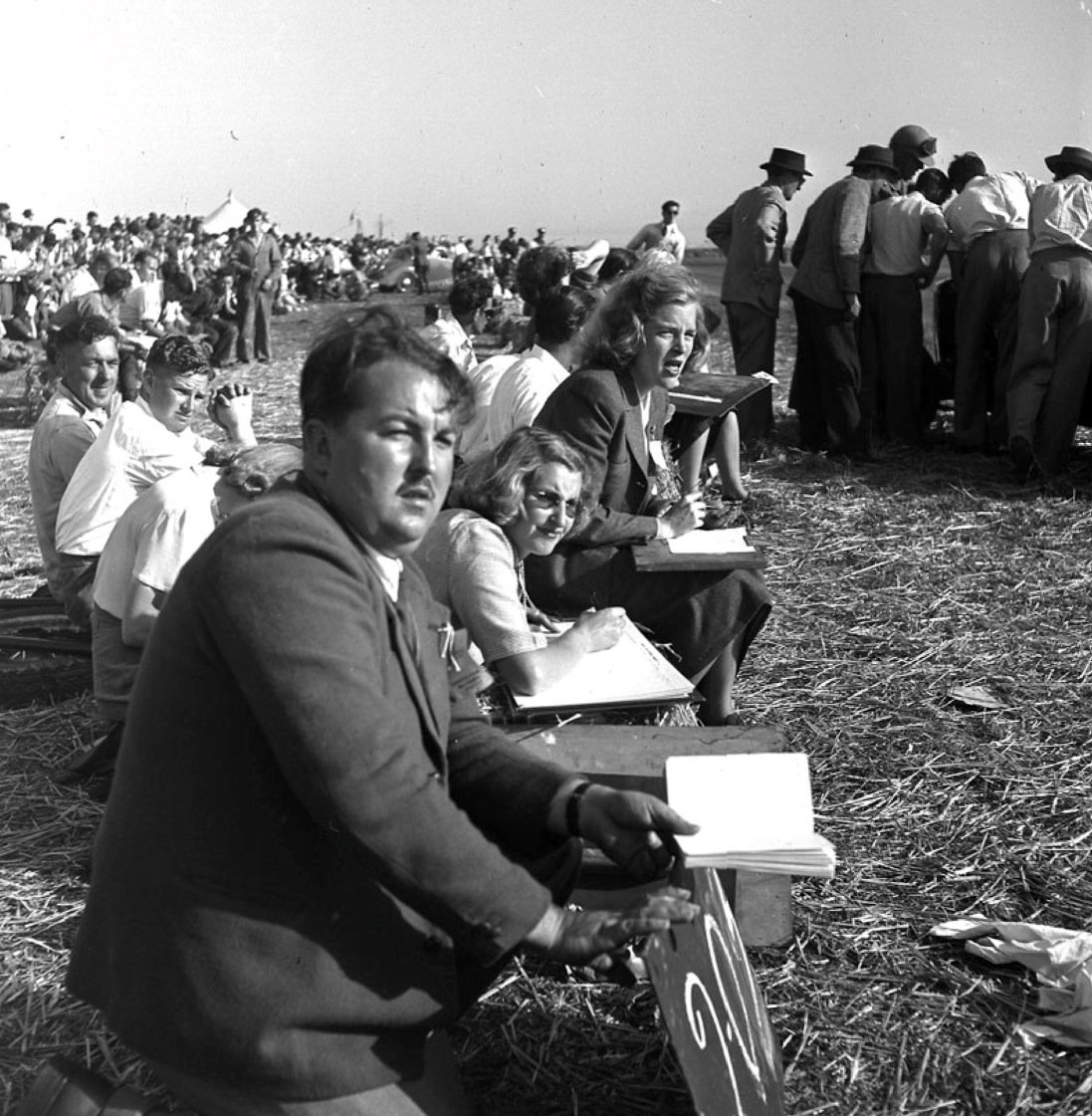
Lap charting Fishos 1949 style. Wonderful evocative shot from Martin Stubbs archive. Male at left in bright, white shirt Bib Stillwell 4 time Gold Star champion in the 60’s, beefy guy is Peter Ward and elegant lady with the ‘big’ lapchart is Diana Davison, Lex’ wife (Dacre Stubbs Archive)
Part of the nose of the blue McEwin HRG, O’Donohue’s Jim Gullan built Ballot Olds and Otto Stone’s MG K3, October 1953 meeting (SLV)
Paul England in the Ausca Holden from Doug Whiteford’s Maser 300S, Otto Stone in the Norman Hamilton owned Porsche 550 Spyder and Ron Phillips Austin Healey 100S 10 February 1957 (unattributed)
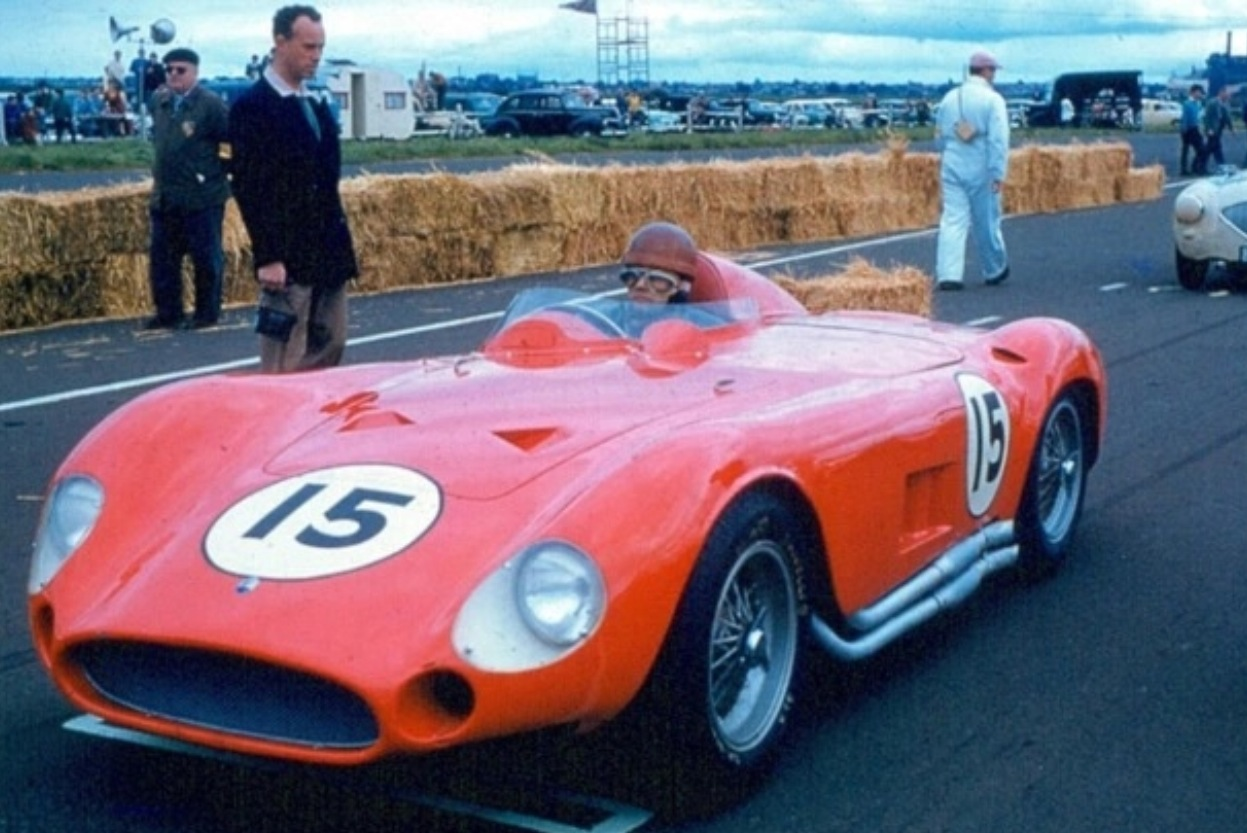
Bob Jane on the Fishermans Bend grid October 1958. Ex-works Maserati 300S, his debut in the car in which he was ‘wild and wooly’! He got the hang of the racing caper, dual Australian Touring Car Champion in 1971 and 1972 (Kevin Drage)
Ken Wylie and Jack Brabham Wylie Javelin and Cooper T23 Bristol. 22 March 1954 Victoria Trophy (SLV)
Lex Davison, HWM Jaguar, Victoria Trophy 1954. Davison won the 1954 AGP at Southport on Queenslands Gold Coast in this car (SLV)
Credits…
progcovers.com, australiaforeveryone.com, Greg Smith, Francis Hodgson, Kevin Drage, David Van Dal, Dacre Stubbs Archive, Geoff Green, State Library of Victoria, Reg Fulford Collection, Ray Sprague Collection, moondog.net.au
Thanks to Pat Ryan, Stephen Dalton and Shane Bowden for helping ID some of the cars in the SLV shots
Paul Emery racing ‘the wrong way’ at Brands Hatch in 1951…
Car is the Emeryson 500 front-engined and front wheel drive car built by he and his family. Click here for an interesting article on the various Emeryson cars.
The photo below is Emery being pushed onto the grid in his Emeryson JAP twin 500cc car ‘for race 1, amateur built cars, the very first race at Brands Hatch during the inaugural Brands event on 16 April 1950’.
Barry Sheene laps Brands Hatch in a 1976/7 Surtees TS19 Ford in his first F1 drive on 25 April 1978…
It would have been interesting if Bazz gave cars a ‘red-hot’ go from about then, born in 1950 he was 28 and had already won the 1973 Formula 750 and 1976/7 500cc World Titles for Suzuki.
Not too many motor-cyclists have made the transition from bikes to cars successfully at elite level. Three spring to mind; John Surtees, Mike Hailwood and less obviously Johnny Cecotto. His speed and race wins on bikes flowed into F2 drives, badly broken legs in his Toleman Hart during 1984 British GP practice, he had already banged himself about on bikes, ended an F1 career of great promise.
Buckle up. At the time the Surtees TS19’s were being raced in the British F1 Series, so were ‘still current’
Sheene still had unfinished business on bikes though;always a threat when on a decent machine, he raced on in 500’s, his battles against Kenny Roberts the stuff of legend, his last win the 1981 Swedish GP.
An accident at Silverstone during 1982 British GP practice was one too many. He hit a fallen competitors obscured bike at around 160mph, slid for 150 metres, breaking both legs again, and an arm. Undimished, Sheene had enormous courage and resilience, he raced on into 1983 on a semi-works Suzuki even finishing 8th in the British GP 12 months after the awful accident. Unsurprisingly, his ultimate edge was dulled, he retired from bikes in 1984.
Place, date and bike unknown (unattributed)
Barry did race touring Cars and trucks prior to emigrating from the UK to Oz in the late 1980’s, he left his beloved Britain in search of sun to help ease arthritis partially caused by his many race prangs down the years.
An immensely likable character, he was soon as popular here as in Europe mixing property development, motorsport TV coverage and commentary with product endorsements. He and Oz Touring Car Legend Dick Johnson did a series of TV ads for Shell for years which both polished its brand and were iconic in terms of their laconic humor. Sadly lost to cancer at the all-too-young age of 53 in 2003.
Isle of Man 1971, Barry Sheene at Quarter Bridge after crashing out of the race in apalling conditions whilst 2nd in the 125cc race on his Suzuki. His only IOM TT race. 21, how young does he look!? (Bob Thomas)
‘you missed the apex by that much!’ Sheene, George Harrison and John Surtees, Brands during the test
Barry, George and those Linea Sport overalls so period!
Credits…
Roger Lings, Bob Thomas, Patrick Litchfield, Keystone France
Tailpiece: You can be certain the one thing, ‘the two amigos’ aren’t talking about is Texaco…
Norman Dewis, famous as Jaguar’s test and development driver was often entered as a relief driver but until 1955 had not raced a Jag…
Here he is in the factory ‘D Type’ during the 1955, horrific Le Mans event. He co-drove Don Beauman’s car the pair failed to finish when Beauman ‘beached the car atop the sand dunes’ at Arnage. Mike Hawthorn and Ivor Bueb scored a hollow win in ‘XKD 505’.
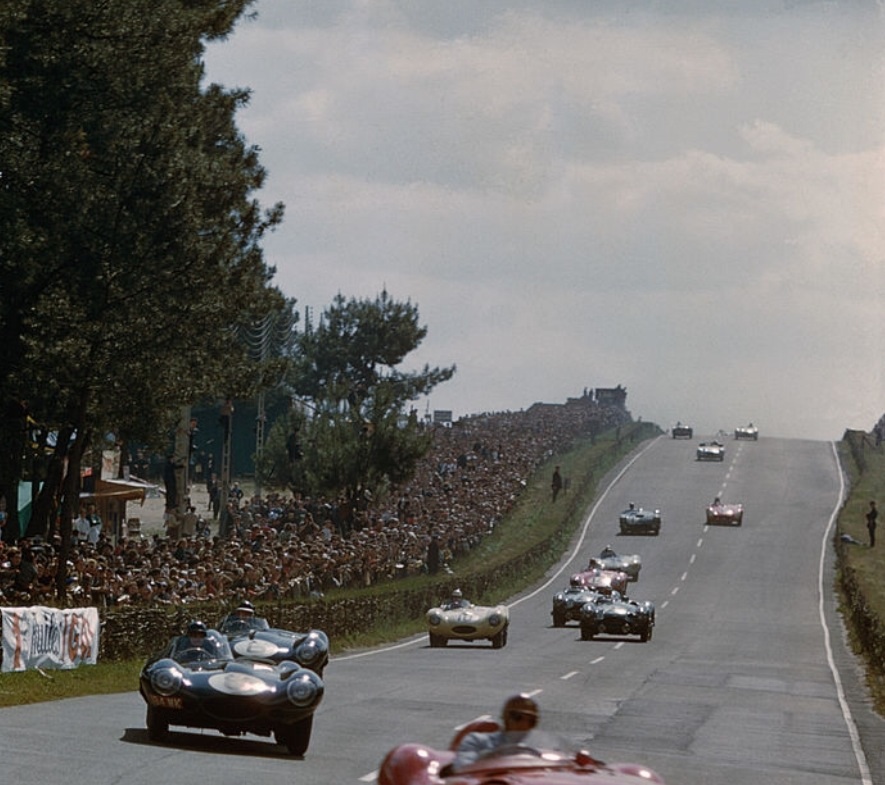
Umberto Maglioli’s head in his Ferrari 118 LM ahead of the Beauman, Hawthorn and Jacques Swaters D Types during the early laps of the 1955 Le Mans 24 Hours (Klemantaski)
Before he joined Jaguar, as the 500cc F3 movement grew, and with a fellow LeaF employee Dewis designed and built a neat Rudge-powered F3 car, the DNC. In its first race at Silverstone in July 1950, he qualified on pole and led for two laps before engine failure. It was rebuilt to do more races in 1951, in October that year Dewis joined Jaguar.
As noted Dewis had been a Jag reserve driver before, but the 1955 Le Mans was his only race/works drive for his Browns Lane employers. He had done most of the D development work, the result, the long-nose 1955 car.
Jaguar’s works 1955 Le Mans entries were for Hawthorn/Jimmy Stewart, Tony Rolt/Duncan Hamilton and Don Beauman/Desmond Titterington. Beauman, an old friend of Hawthorn’s was hired after a test under Lofty England’s watchful eye.
Two weeks before Le Mans Titterington and Stewart crashed their Ecosse D’s during the Eifelrennen at the Nurburgring. Stewart decided to retire and Des was hospitalised. So, days before the race Ivor Bueb was slotted into Hawthorn’s car and Dewis into Beauman’s. Their car ‘XKD508’ ran as high as 4th before the Mercedes team withdrew their 300 SLR’s but on lap 106 Beauman ‘parked it’ at Arnage and retired it unable to free it from the sand.
Click here to read an interesting interview with Norman Dewis in MotorSport about his life;
Honda finished fourth in the 2006 F1 Constructors Championship, behind Renault, Ferrari and McLaren Mercedesbut ahead of the other Japanese Teams; Toyota 6th, MF1 Toyota 10th and Super Aguri Honda 11th. Honda broke through for an F1 victory in the ‘modern era’ when Jenson Button won the Hungarian GP in the teams new for 2006, mandated 2.4 litre V8 engined RA106 chassis.
But there is more than one way to ‘skin the public relations cat’. Setting a new Formula 1 car land speed record over the Bonneville flying mile with an average speed of 400 kph was Honda’s PR mission they called the ‘Bonneville 400’.
The racer used for the attempt was its 2005 F1, 3 litre V10-powered BAR-Honda 007. For the runs out on the salt, the car was fitted with an upright rear fin instead of the standard wing and used a parachute to help slow down at the end of each run.
Driver Alan van der Merwe, the team and the car broke F1 class records three times.
During the final attempts, the Honda set two LSR’s for GP cars.Over the flying mile, the car achieved an average speed of 397.360kph (246.908mph). The second record was over the flying kilometer, an average of 397.481kph (246.983mph).
The magic 400 kph average remained outta reach, though earlier in the week the car hit 400.454 kph on one pass of the measured mile. ‘007’ wasn’t able to match the feat on the return trip.
17 July 2006 ‘Bonneville 400’ Day 1. F1 land speed record attempt, Bonneville Salt Flats, Utah. USA (Honda)
While disappointed that they didn’t set the record at 400, Honda were pleased with the success achieved but not as happy as they were with their first F1 win since the 1967 Italian GP victory by John Surtees! Button took that win, his first in F1 racing 3 weeks later on 6 August 2006.
Jenson won in changeable greasy conditions from Pedro de la Rosa’s McLaren MP4/21 Mercedes and Nick Heidfeld’s BMW Sauber F1.06. It was a well deserved win for both team and driver.
Button, Honda RA106, victorious in Hungary 2006 (Clive Mason)
Button, Hungary 2006, intricacies of modern F1 cars aerodynamics clear in this shot (Clive Mason)
Button, Hungary 2006 (Mark Thompson)
Photo Credits…Honda Corp, Clive Mason, Mark Thompson
Tailpiece: I bet ‘007’ Sounded Sensational on the Bonneville Salt!…
Listen and see the YouTube footage;
17 July 2006 ‘Bonneville 400’, BAR-Honda 007, Alan van der Merwe (Honda)
I wrote a long article about Peter Whitehead’s successful 1938 ‘Australian Tour’ which culminated in his ERA R10B, Bathurst, AGP win on 18 April, here he is enjoying a ‘cleanser’ at the races duration, click here to read it;
This piece is a ‘photographic update’ of the earlier tome.It’s interesting the way photos sometimes ‘pop up’, in this case as a result of someone clearing out a house and finding a cache of photos of a man who was clearly a Whitehead fan ‘in period’.
Most of the shots were posted on an antiquarian website with a blog devoted to identifying unknown objects, via that medium they found the primotipo article above. Go figure the ways of this internet world! The photo’s existence 80 years later is indicative of just how much general press interest there was in Whitehead’s visit with the ‘fastest car to come to Australia’ at the time .
I received the assistance of a ‘panel of expert mates’ to ID the shots,many thanks to racers/fettlers/historians/enthusiasts John Medley, Patrick Ryan and Greg Smith for their ‘smarts’! Mind you there was not a unanimous view on all of the shots, opinions from others welcome.
ERA Australia Shots…
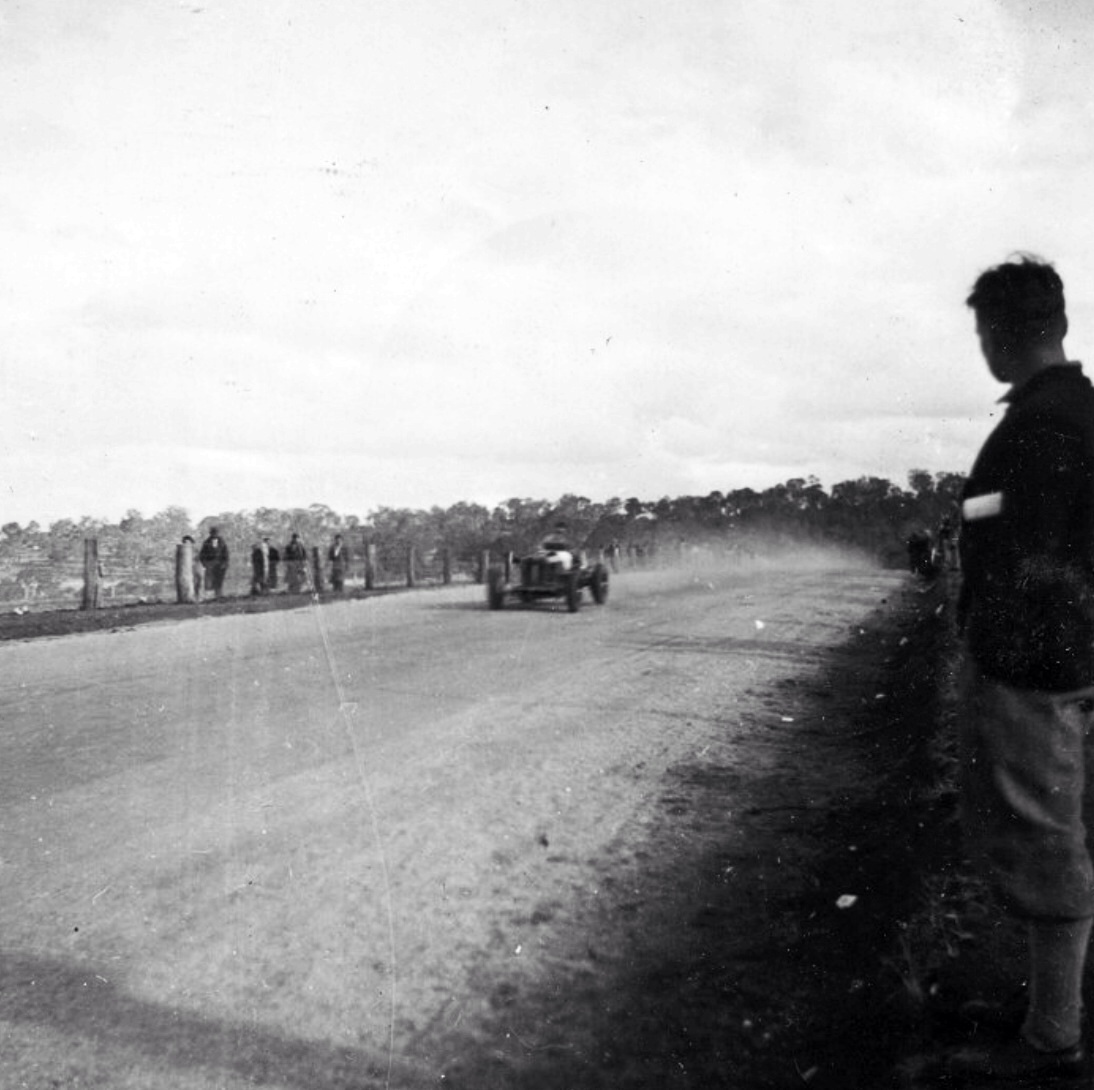
PW either during the 1938 AGP, Bathurst or at Rob Roy, Christmas Hills, Victoria. Whitehead ran with number 1 at both events, won both and set course records. Bathurst expert Medley says its Mount Panorama and Melburnian Rob Roy regular Pat Ryan’s vote is for the Clintons Road, Christmas Hills short ‘climb.
As you will see Whitehead is sans any form of head protection, not even the vestigial ‘cotton bonnet’ of the day; mad given Bathurst’s surface.
(Sydney Morning Herald)
The next 3 shots are of Whitehead going down the long Conrod Straight ahead of (ID Stephen Dalton) Barney Dentry’s #14 Riley. It would have been pretty wild, flat out in that ERA without helmet atop the gravel surface pinging past the gum-trees close by at around 150mph.
(Dave Sullivan Album)
Two shots ago but cropped closer to the cars; Whitehead and Dentry down Conrod (Dave Sullivan Album)
Refuelling R10B with fuel and topping up the radiator at Bathurst. Crew member Kenneth Maxwell at left.
(Sydney Morning Herald)
UK ERA R10B shots…
Start of the 1937 Donington GP, 2 October 1937 won by Bernd Rosemeyers #5 Auto Union Type C from the #3 von Brauchitsch and #1 Caracciola Mercedes W125’s
#2 Lang DNF gets the jump at the start in his W125 Benz from #4 MB Seaman DNF, #1 MB Caracciola #5 AU Rosemeyer and #3 von Brauchitsch MB on the outside. The next group comprises the 2 AU’s of Hasse 5th and Muller 4th. #8 are the Mays and #16 Whitehead ERA B Types both DNF (The Autocar)
The next photo is of Peter Whitehead leading Dick Seaman’s famous Delage at Donington during the Junior Car Club 200 Mile race and Andre Cup on 29 August, Seaman won the event in 15S8 Delage from the earl Howe and D Briault/Keith Evans ERA B Types.
The race was contested by a mix of 1500cc Voiturettes and Grand Prix cars; mainly Alfa Tipo B/Monza and Bugatti T51’s.
(The Autocar)
The Walker/Whitehead ERA leads the Seaman Delage at Donington in 1936, date unknown.
(The Autocar)
Hector Dobb’s Riley leads the Whitehead/Walker ERA R10B at Brooklands.
The Walker/Whitehead ERA ahead of a Bugatti, MG K3, MG NE at Brooklands
Credits…
Thanks again to John Medley, Patrick Ryan and Greg Smith for your period knowledge
Dave Dempsey and antiquers.com, Dave Warner Album on ‘The Nostalgia Form’ via Terry Walker
Tailpiece: ERA ‘Peter Partners’ Walker left, and Whitehead celebrating a race win, by Walker perhaps? at Donington in 1936…
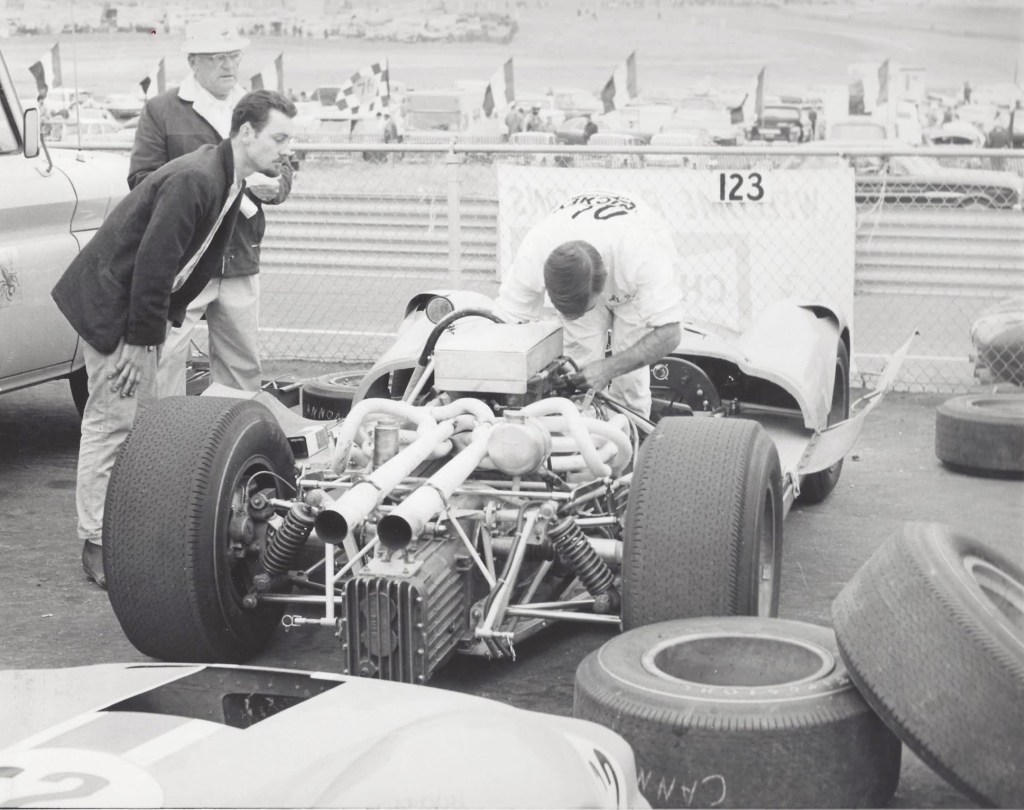
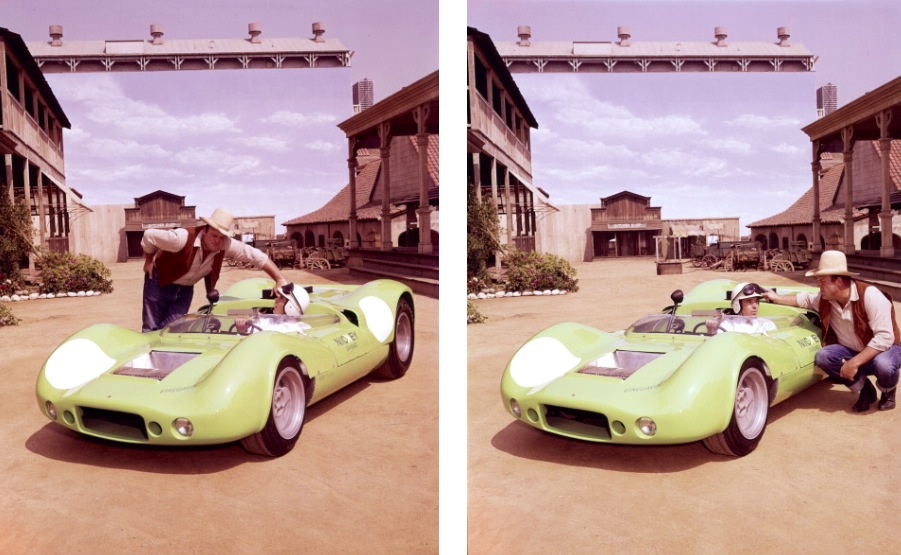
Hoss Cartwright checks out his new Can-Am Genie Mk10B Traco-Olds with driver John Cannon…
As a 1960s Aussie kid i grew up on a diet of fantastic American TV, our own tele/movie industry wasn’t what it is today. I have wonderful memories of ‘Flipper’, ‘Gilligans Island’, ‘The Jetsons’, Freddy Flintstone, ‘The Munsters’, ‘The Addams Family’, ‘McHales Navy’, ‘Batman’, ‘Hogans Heroes’, ‘Get Smart’ of course and ‘Bonanza’, all of which explains how i turned out i guess!
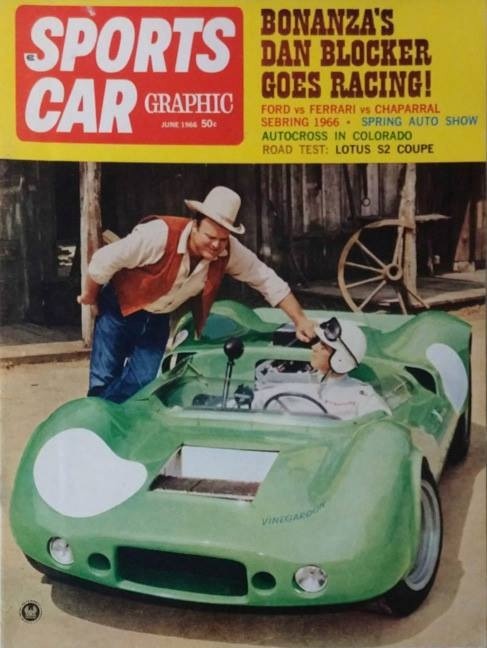
‘Bonanza’ was a Western the whole family sat down to watch. Dan Blocker, the Genie’s owner played Hoss Cartwright in the popular show which ran from 1959-73, shite thats a long time! This publicity shot was taken on 3 February 1966 on ‘The Western Street’ set, Paramount Studios, Los Angeles.
(The Enthusiast Network)
Genie Mk10B Traco Olds…
Blocker, a motor racing enthusiast acquired the car from Ray Huffaker its constructor. Nickey Chevrolet provided some sponsorship with British born Canadian ex-RAF pilot, John Cannon engaged as driver.
Cannon contested the 1965 and 1966 USRRC seasons, he finished second in the 1965 Nassau Tourist Trophy and won the USRRC race at Stardust Raceway, Las Vegas in April 1965.
In 1966 John won the first USRRC round at Stardust on 24 April and retired at Riverside, Laguna and Bridghampton in May. After another retirement due to an accident at Watkins Glen in June, Cannon left the team and bought a McLaren-Elva Mk2 finishing second at Kent on 31 July.
Times Grand Prix, Riverside 31 October 1965: John Cannon’s Genie Mk10B Olds eighth ahead of Chris Amon in the Ford GT40-X1 5th. Hap Sharp’s Chaparral 2A Chev won from Jim Clark’s Lotus 40 Ford and Bruce McLaren’s McLaren Elva Mk2 Olds. It was a great performance from Cannon in a car not as quick as many, the field also included McCluskey, Pabst, Follmer, Dick Thompson, Revson, Parsons, Titus, Hobbs, Bondurant, Ginther, Hill, Gurney, Grant and Hansgen! Quite a field (The Enthusiast Network)The Genie at Bridghampton in 1966 (Frederic Strauss)
In the first, 1966, Can Am series, stunt driver Bob Harris took over the Genie, fifteenth at St Jovite and elevnth at Stardust his best results, the series was won by John Surtees works-Lola T70 Chev.
The Genie passed through various hands but is still extant and is run in historic racing by Tom Stephani, son of Jack Stephani who co-owned Nicky Chevrolet, the Genie’s sponsor when Cannon raced it.
Genie Mk10 as raced by Bob Harris in the ’66 CanAm (Larry Fulhorst)
Paul Stephani, Tom’s son picks up the story; ‘My grandfather owned Nickey Chevrolet in Chicago (with his brother Ed and sister Jean). Jack was a big racing enthusiast and used Nickey as an excuse to go racing’.
‘It doesn’t stop there as Michael Cannon (son of John cannon) married a close friend of our family and has driven the Vinegaroon to the car show from Road America to Elkhart Lake a few years back. Michael is the head engineer on Conor Daly’s IndyCar entry this year. Here’s how the Blocker/Nickey/Cannon combination went their separate ways after the ’66 CanAm round at Watkins Glen! : https://www.youtube.com/watch?v=cxClHhH4xto
Tom Stephani recalls how Dan Blocker and his father Jack Stephani came to create a race team together; ‘Basically, my Dad met Blocker at the West Coast races in the fall of 1965. Dad saw a natural connection between the two. Both loved racing, Nickey had a fairly substantial racing team and budget, and Blocker could provide a promotional opportunity for Nickey Chevrolet. ‘Bonanza’ was sponsored by Chevrolet so the tie-in really worked well. His personal appearance at the Nickey Dealership in February 1966 drew at least 5,000 people. Shut the whole place down for a couple of days!’
Joe Huffaker started building racing specials and Formula Junior’s. He switched to sportscars as the greater market opportunity became clear. The first Genie Mk4 was a ‘G Modified’ car powered by a BMC 1100cc engine.
Jack Stephani co-owner of Nickey Chevrolet in the glasses behind the toolbox, Dan Blocker and John Cannon at the USRRC Bridghampton round in May 1966 (The Enthusiast Network)The Genie M10B as it is today owned by Tom Stephani, the son of original Nickey Chev/Genie sponsor Jack Stephani (Paul Stephani)
Technical Specifications…
The Genie Mk10 was an improvement on or evolution of his Mk8, his first big-banger USRRC series car.
It comprised (see below) a multi-tubular spaceframe chassis which accommodated a range of American V8s and utilised the ‘usual’ 1960s suspension mix of wishbones and coil spring/dampers at the front and inverted wishbone, single top link, coil spring/dampers and radius rods at the rear. Brakes were Dunlop calipers with outboard discs all round, the whole lot clad in a curvy fibreglass body.
The Blocker Mk10B was powered by a Traco-Olds 300cid/5-litre engine fed by four 48IDA Weber carbs, the transaxle was a BMCD Huffaker unit.
The team’s Chief Mechanic was ex-F1 UDT/BRP guy John Harris who extensively modified the car during the winter of 1965/6, the car was christened the ‘Vinegaroon’ from then.
The Genie Mk10 retailed at around US$9500 winning a few races, but was soon left behind by Chaparral, McLaren-Elva and Lola.
(R Wright)(The Enthusiast Network)
John Cannon…
Of Canadian nationality, but born in London on 21 June 1933, John Cannon initially raced a $750 Morgan at St Eugene in 1959. A Canadian newspaper report dates his emigration to Canada from the UK as 1957 so i am not sure that some earlier races in the US attributed to him in some sources are correct.
In any event he progressed racing an Elva Courier in 1959, 1960 and into 1961. He also raced a Jag D Type and the Dailu Mk1, results in that car brought him to the attention of NART who teamed him with NASCAR star ‘Fireball Roberts’ in a Ferrari 250 GTO in the 1963 Daytona 3 Hour (fifteenth) and Jo Bonnier at the Sebring 12 Hour (thirteenth).
Jim Parkinson/Jack Flaherty MGB DNF follows the NART Ferrari GTO of Bonnier/Cannon 13th at Sebring in 1963 (Bill Stowe)John Cannon circa 1970 (mclaren.com)
In later 1963/4 Cannon raced a great variety of cars, proving his versatility including the Dailu Mk2/3, Lola Mk1, Comstock EXP, Fiat Abarth, Chev Corvette and Elvas Mk 3/7- for John Mecom he raced the teams Lotus 19, Scarab Mk4/5 and Lola T70.
He progressed through to the Blocker drive and then became a McLaren Can-Am customer and ‘foot soldier’ as the McLaren website puts it! Mind you, whilst they claim him as ‘their own’ he raced many cars other than McLarens after 1965! Whilst never a member of the works team John’s achievements both as a privateer and driving for independent teams earned him a worthy place in McLaren’s Top 50 drivers ranking- listed as thirty-eighth.
He took a superbly opportunistic victory in the rain-soaked Laguna Seca Can-Am round in 1968 that pushed his career along. Driving an aged M1B Olds, Cannon kept his cool when others were slip-sliding in all directions and finished ahead of Denny Hulme’s works M8A at the chequered flag.
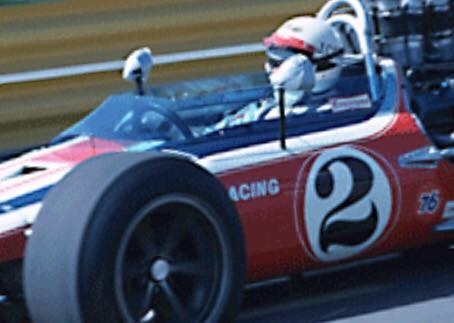
Press launch with John Cannon left beside Jack Saunders in the Mecom Lola T70 before Sebring in 1965. DNF (Lola Heritage)Cannon aboard his F5000 Eagle Mk5 Chev in 1969, Michael Cannon quipped ‘this shot is early in the season as they added an extension to the roll-hoop before the first round at Riverside’. JC won the Riverside and Mosport rounds, finishing the series 5th, Tony Adamowicz won it in another Eagle (Racing One)
In 1969 and 1970 he moved into single seaters as well as Can-Am, he raced a Can-Am McLaren M6B in 1968 and Ford G7 in 1969, contesting the prestigious L&M Continental F5000 series, winning it in 1970 driving a McLaren M10B Chev for St Louis trucking magnate Carl Hogan’s ‘Hogan-Starr’ operation.
Cannon used this success as a springboard to establish his racing reputation in Europe, raising funds to lease a semi-works March 712M in the European F2 championship in which Ronnie Peterson, Carlos Reutemann and Francois Cevert were leading lights. In this company Cannon performed very respectably, well enough to be invited to drive as a member of the five-car BRM squad in the 1971 US GP at Watkins Glen- he finished fourteenth in a P153.
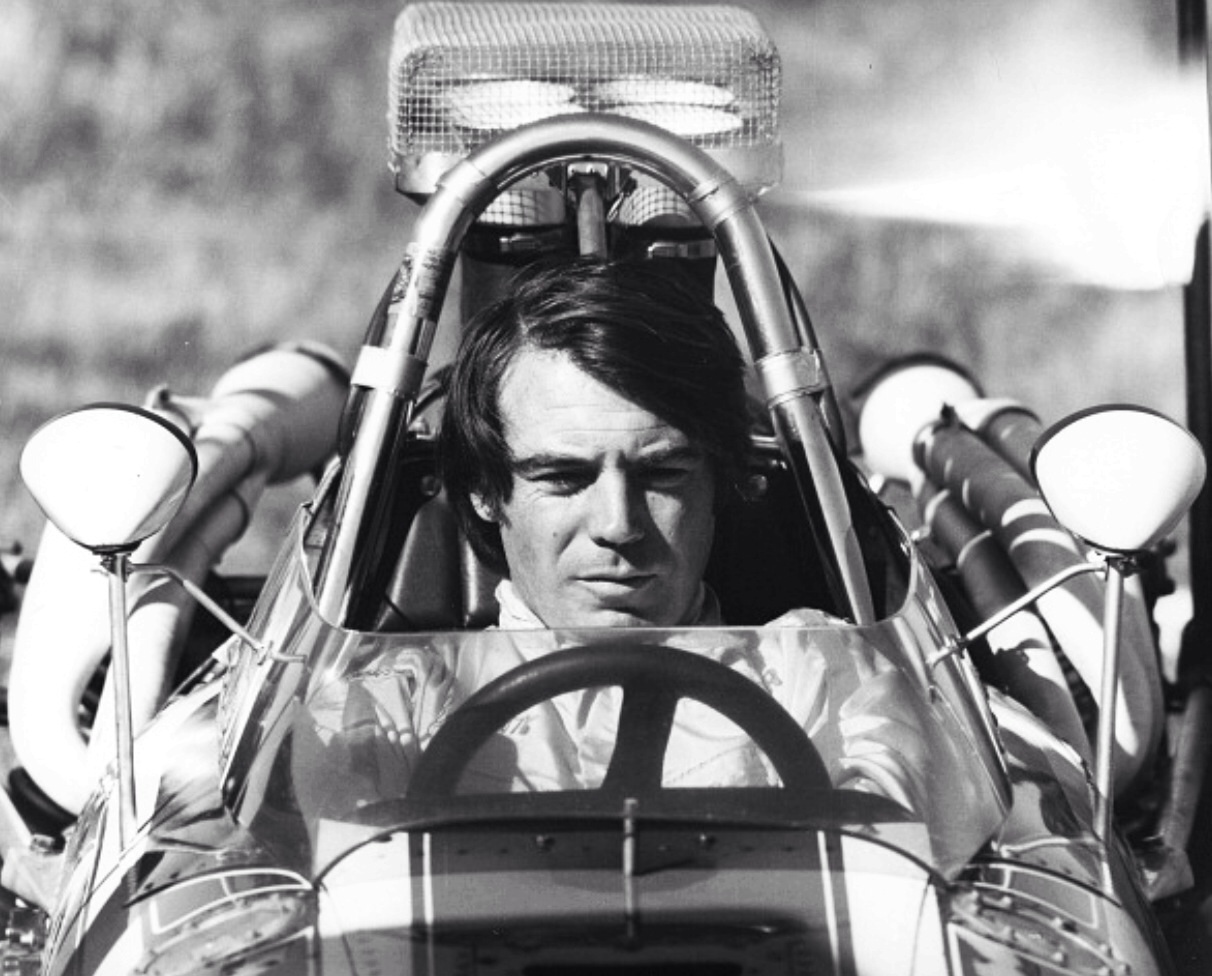
John Cannon in the first production McLaren M10B Chev ‘400-01’ the car in which he won the 1970 US Championship, when this shot was taken, and the 1971 Tasman Championship (oldracingcars.com)
An interesting insight into this part (1970-1) of John Cannon’s career was provided by his son John M Cannon on ‘The Nostalgia Forum’ in 2007, he wrote/posted;
‘After the 1970 F5000 season, my dad went down to do the Tasman Series. He already had an agreement with Carl Hogan to do the 1971 US series and wanted to stay sharp by racing the winter series. At Sandown, he crashed the McLaren M10B beyond repair and was offered Chris Amon’s Granatelli Lotus Cosworth F1 for the last round at Surfer’s. (in fact he raced a Granatelli F5000 Lotus 70 Ford at Surfers to seventh place but probably had a steer of an F1 March 701 raced mainly by Chris Amon during the series in practice somewhere, that car was powered by the ‘Tasman’ Ford Cosworth DFV variant, the 2.5 litre ‘DFW’ engine) Well this car was a total revelation for him – he loved the nimble handling of the F1 car and decided then and there that he would do everything possible to pursue a ride in F1.’
John Cannon’s March 701 DFV in the 1971 Questor GP, Ontario Motor Speedway 28 March 1971. This was a combined F5000/F1 race won by Mario Andretti’s Ferrari 312B, Cannon DNF on lap 29 (MotorSport)
‘He was able to run an STP backed March F1 car at the Questor GP and this only whetted his appetite further. He broke off his agreement with Hogan (who was one of the nicest and fairest people you’d ever have wanted to meet by all accounts), grabbed every dollar he had and headed off to Europe to do F2. At the age of 38, he was a rookie in what was probably the most fiercely competitive series in the world!
The early season stuff went fairly well as was able to buy what he called a ‘stonking great (Ford FVA F2) motor’ from Jackie Stewart. However, once that motor blew and money began to get tight, things got tougher. He effectively ran out of money late in the season and I don’t know that he even finished the series.’
John Cannon cruisin’ his year old BRM P153 thru the Watkins Glen paddock, US GP 3 October 1971, the race was won by Francois Cevert’s Tyrrell 002 Ford from Jo Sifferts BRM P160 and Ronnie Peterson’s March 711 Ford (Chris Kennedy)
‘That autumn, (1971) he did the USGP in the fifth BRM. It was a bit of an old nail and the ‘qualifying engine’ was 500 rpm down from his practice motor… Anyway, he did finish the race and the team kept in touch, offering him a ride for 1972. He wouldn’t get paid but he would get a share the prize money. Now my dad had been earning his living as a driver for many years and thought this to be a ridiculous offer-if he wasn’t paid, he wasn’t going to do it. That was the last time F1 came calling…’
Cannons P153 running very soft roll bars! ahead of Siffert’s second placed BRM P160 Watkins Glen 1971, BRM entered 5 cars. Cannon Q24, finished 14th. Amongst the other ‘guest/one off drivers’ Posey Surtees Q17 and Revson Tyrrell Q19 were quicker but so were their cars. Cannon was faster than regulars such as De Adamich. It would have been interesting to see how he would have fared with a regular BRM drive in 1972 but BRM was a ‘bear pit’ in the sense of running too many cars for too many drivers all fairly poorly! Beltoise’ P160 ’72 Monaco win duly noted. (Norm MacLeod)
In a varied and long career Cannon also contested 15 USAC events between 1968 and 1974, his best result a second at Mont Tremblant in 1968. He had two cracks at Indy in 1970/4, failing to make the cut on both occasions.
Riverside Can-Am 28 October 1973: Bob Nagel’s #17 Lola T260 Chev fourth with Cannon’s #96 McLaren M20 Chev Turbo DNF up his chuff and boxed in by #64 Bob Peckham’s McLaren M8C Chev sixth. #11 Steve Durst McLaren M8F Chev eighth, #34 Tom Dutton’s McLaren M8R Chev seventh. Race won by Mark Donohue’s Porsche 917/30 Turbo (Schlegelmilch)Cannon in his McLaren M10B Chev during the Warwick Farm 100 14 Feb 1971 Tasman round. Cannon was seventh on this technically challenging circuit, where locals always have an advantage! Gardner won in his Lola T192 Chev (Lynton Hemer)
John Cannon was a popular, fast Tasman Cup competitor…
He contested the ’71 Tasman in NZ and Australia and the Rothmans F5000 International Series in Australia (The Kiwis went F Atlantic/Pacific from ’76) in 1976 and 1978. His 1978 Rothmans appearances were essentially his last races.
He raced his Hogan-Starr US Championship winning McLaren M10B Chev in 1970 his best results two fifths at Levin and the Pukekohe NZGP rounds. He retired at Wigram, Teretonga and didn’t start the Sandown round as noted above. At Warwick Farm he was seventh and in the Lotus 70 Ford, seventh again at Surfers Paradise.
Getting settled into Carl Hogan’s McLaren M10B before the off at Levin, NZ 1971. That oil cooler? duct would have cost a few RPM (Ian Peak Collection/The Roaring Season)
The Tasman was very strong in its early F5000 years, perhaps more so than the US Champion expected! In well developed McLaren M10B’s were Graham McRae, Frank Matich, Niel Allen and Teddy Pilette. Frank Gardner raced his works Lola T192, other top-drivers somewhat hamstrung by poor/under-powered equipment included Graeme Lawrence Ferrari Dino 246T, Kevin Bartlett Mildren Chev, Max Stewart Mildren Waggott. Chris Amon, at the peak of his career- the STP March 701 DFW and Lotus 70 Ford were inferior amongst such tough competition. Graham McRae won the first of his Tasman Cups in 1971.
John Cannon’s one-off March F2 722 based F5000, the March 725 Olds at Silverstone in 1972 (oldracingcars.com)
March were led into F5000 by John Cannon, notes Allen Brown on his definitive race history website oldracingcars.com.
‘Cannon won the 1970 F5000 US series before becoming a March customer in F2 in 1971. For 1972, Cannon ordered a new 722 F2 tub to be fitted with a Race Engine Services Oldsmobile V8 for F5000. The car was called the ‘725’.
Brown; ‘Cannon missed the first four rounds of the UK championship but then took a surprise pole in his debut at Nivelles, Belgium the fifth round, some 1.3s ahead of McRae’s Leda/McRae. He was pushed back to fifth on the grid at Silverstone but qualified second at Mondello Park in 30 April, where he finished fifth. He then took the car to North America for the lucrative L&M championship where he took pole position at Watkins Glen in June but was let down by reliability problems.
He returned to the UK in time for the race at Silverstone in early August where he finished second. He had time to rush back to the US for the Riverside race at the end of September before returning again to England for the last few races of the season’. The 725 never appears to have raced again but Cannons attraction to the marque was well established!
Cannon’s March 73A/751 Chev in the Sandown Park pitlane during Saturday practice, 1976. I watched the final laps of the race from the pit counter here, hoping with each lap that the ‘falling off’ airbox wouldn’t ruin a great run/dice and cause a black flag, fortunately it didn’t and John scored a very popular win! (Stupix)
Cannon returned to Australia in 1976 with the car he had been racing in the US which was a blend of March 73A F5000 and March 751 F1 components.
In the US the car’s best results were a fourth and eighth at Riverside in 1975 and 1976 respectively. It was a great looking car and fast amongst the highly developed local Lola T332/400’s, Elfin MR8′ s and Matich’s.
The series that year had depth, contestants included David Purley, Vern Schuppan, Kiwis Graeme Lawrence and Ken Smith and Australians John Goss, Kevin Bartlett, Bruce Allison, John Leffler, Max Stewart and John McCormack. Schuppan’s Theodore Racing Lola T332 won the series.
Cannon’s March sets off after David Purley’s Lola T330 Chev at Adelaide International in Feb 1976. Not a soul to be seen, Friday practice i suspect. Ken Smith’s Lola T330 won, Cannon 13th 16 laps down with dramas, Purley crashed on lap 28 (Kym)Sandown Rothmans start 1976; L>R Bruce Allison’s black Lola T332 Chev, JC March, John Walker orange Lola T332 Repco and John Leffler white Lola T400 Chev on the inside fence (unattributed)‘Great Australian Motor Racing Pictures’ with a Canadian on the cover, go figure! JC leading on the Rothmans ’76 first lap into Dandenong Rd corner. Following are Allison, Leffler, John Goss in the blue Matich A51/3 Repco and John Walker (Bryan Hanrahan)
He took a fantastic Sandown win by less than a half a second from Vern Schuppan’s Theodore Racing Lola T332 Chev, I can clearly remember the car’s airbox coming loose and hoping the ‘underdog’ wouldn’t be black-flagged in the last couple of exciting laps! In NSW he retired from the Oran Park round with electrical problems and was well back, thirteenth in Adelaide. At the end of the Rothmans he shipped the March to the UK and did several early rounds of the ’76 Shellsport F5000/F1/Libre Series without much success.
Cannon, Sandown, 1978, March 73A/751 Chev. An attractive car, relatively narrow track compared with the Lola’s, quick in a straight line. Pretty circuits ‘double life’ for horse racing clear in the background grass and fencing (Robert Davies)
In 1978 he returned to Australia with the same March to again contest the ‘Rothmans’,like so many of the F5000’s by that stage the March was getting a tad long in the tooth.
1978 contestants included Warwick Brown, Keith Holland, Derek Bell, Alfredo Costanzo, John Walker, Kevin Bartlett, Vern Schuppan, John Goss, Graham McRae and John McCormack. Brown took the series in his new VDS Racing Lola T333/332C.
Cannon had a good run at Sandown again, 3rd in the race won by Warwick Brown’s Lola T333/332C Chev but had mechanical dramas elsewhere. Driveshaft flange/circlip problems in Adelaide and Surfers respectively and falling oil pressure in his Chevy engine at the final Oran Park round.
JC cruises thru the Sandown paddock in 1978 (Chris Parker)Sandown Rothmans 1978: Cannon’s March 73A/751 Chev 3rd turning into ‘Shell’ or turn 1, ahead of John Goss’ Matich A51 Repco sixth. Race won by Brown’s Lola T333/332C (Anthony Loxley Collection)
John Cannon, then 45 ended his racing career and focussed on his businesss lifewhich included an LA Ferrari distributorship. His son Michael followed in his racing footsteps has been one of the most respected race engineers in Indycar racing for over fifteen years.
Ever the ‘thrillseeker’, John very sadly died as a result of injuries sustained when he crashed an ultralite ‘plane in New Mexico on 18 October 1999.
Etcetera…
(Sports Car Graphic June 1966 cover courtesy of Thomas Voehringer)Cannon’s Eagle Mk5 Chev in 1969, note the lip addition to the roll bat compared to the earlier shot (Eric Haga via Michael Cannon)(unattributed)
Shit that thing is fast! John Cannon is thinkin’!? of Matich’s M10B Repco L>R Aussie driver Don O’Sullivan, Cannon and Frank Matich during the 1971 Tasman, not sure where. JC probably thought his car would be quicker than it was in the ’71 Tasman but McRae’s M10B developed in Europe and Matich’s Repco engined M10B/C were mighty quick conveyances not to mention the Frank Gardner, Niel Allen and Teddy Pilette driven bolides…
(Simon Stubbs)
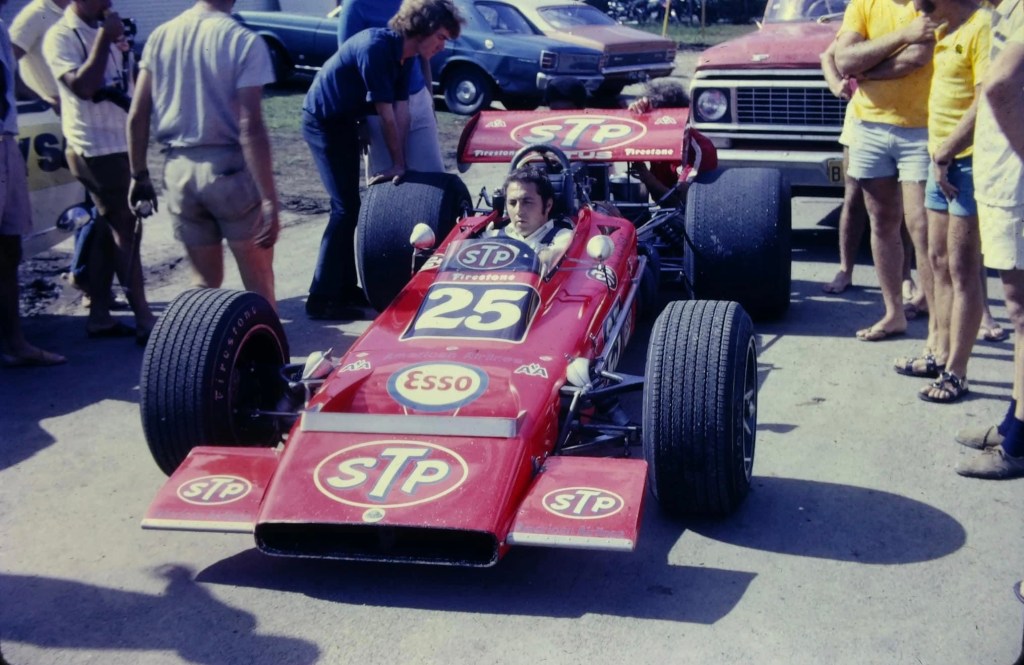
Cannon crashed his McLaren M10B at Sandown in the second last 1971 Tasman round. He did a deal to run the STP owned Lotus 70 Ford raced by David Oxton and Chris Amon throughout that series at Surfers Paradise, the final race, finishing a distant seventh in the unloved car (#70-02). Here he is getting the cockpit comfy during practice.
Photo Credits…
The Enthusiast Network, Rainer Schlegelmilch, Lynton Hemer, Robert Davies, Stupix, Kym, Ian Peak Collection/The Roaring Season, MotorSport, Bill Stowe, Norn MacLeod, Randy Wright, Anthony Loxley, Paul Stephani, Larry Fulhorst, Frederic Strauss, Racing One, Eric Haga, Chris Parker, Simon Stubbs
Bibliography…
‘Montreal Gazette’ 3/4/63, Daniel Vaughan, Don Capps, mclaren.com, Allen Brown and his oldracingcars.com, Sports Car Graphic cover courtesy Thomas Voehringer. Special thanks for Paul and Tom Stephani’s recollections and photos
Tailpiece…
(The Enthusiast Network)
C’mon John just let me do a lap of the set, the horses will be ok and we will be done before anybody gets wind of it?!…
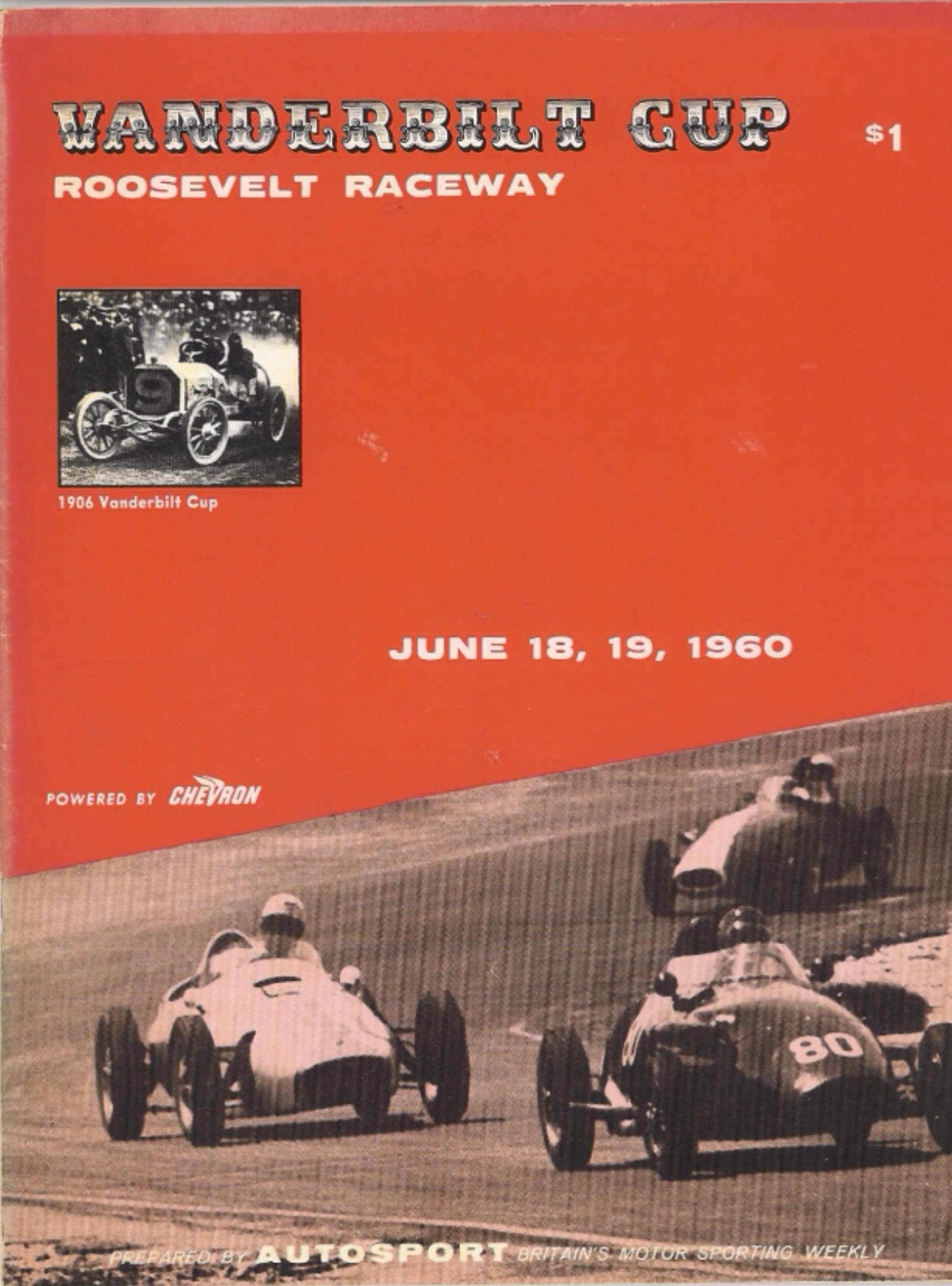
The Formula Junior field starts the Vanderbilt Cup at Roosevelt Raceway, Long Island, New York on Sunday 19 June 1960…
On April 2, 1960 the New York Region of the Sports Car Club of America (SCCA) announced a ‘revival’ of the Vanderbilt Cup.
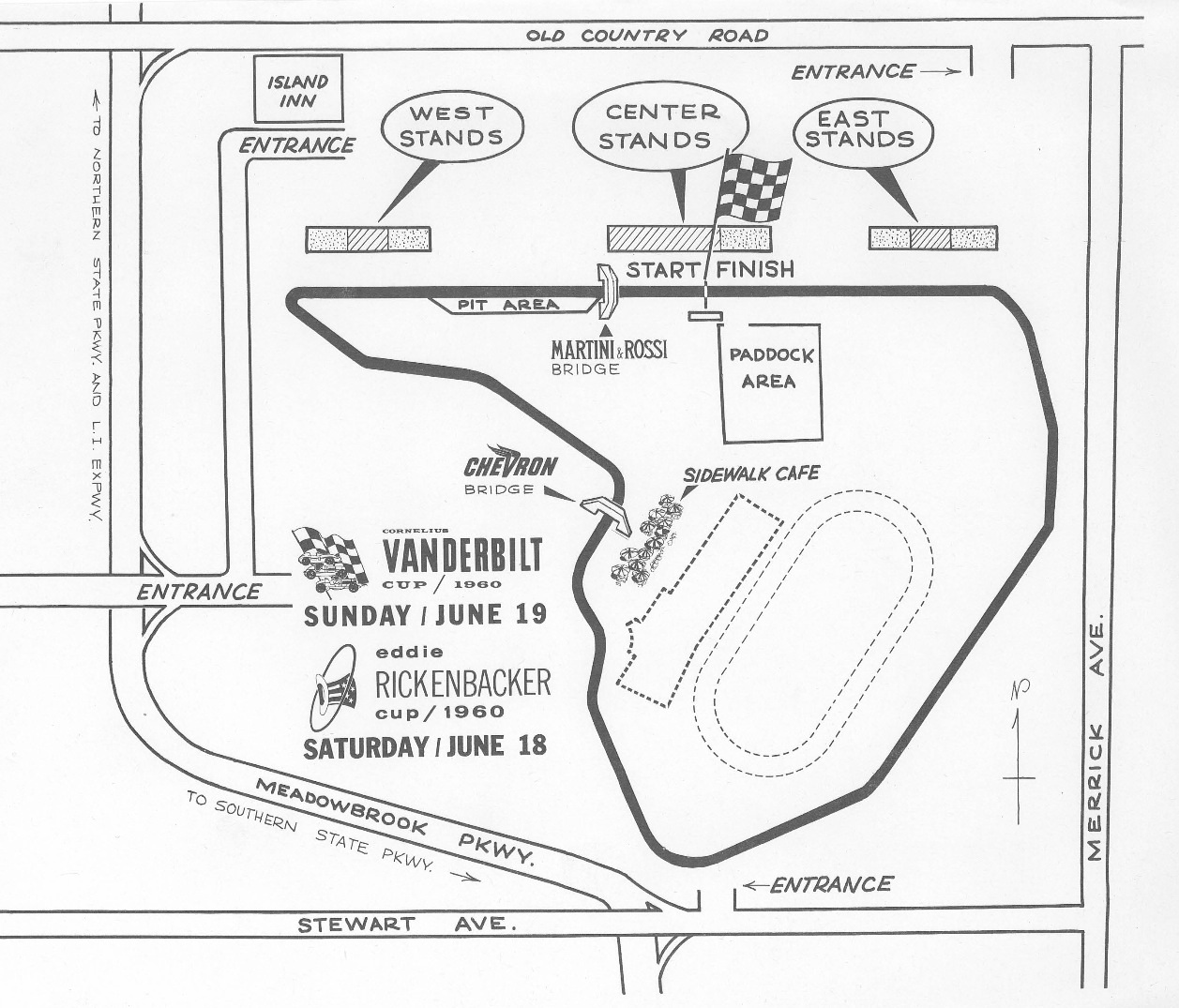
The feature race was one of nine events viewed by 37000 spectators and took place at the SCCA’s new road circuit on the Roosevelt Raceway’s grounds. The track used a portion of the car park and access roads of a harness racing track. Its 11-turn, 1.5 miles included a half mile straight.
The ‘Cornelius Vanderbilt Cup Race’ was run on Sunday, June 19, 1960. Usually the province of amateur drivers, this SCCA event was granted special status which allowed professionals to compete in what was a ‘Junior Formula’ race. As a result Indy Winners Jim Rathman and Roger Ward competed along with Carroll Shelby, the ’59 Le Mans winner and future GP drivers Ricardo and Pedro Rodriguez, Jim Hall and Lorenzo Bandini.
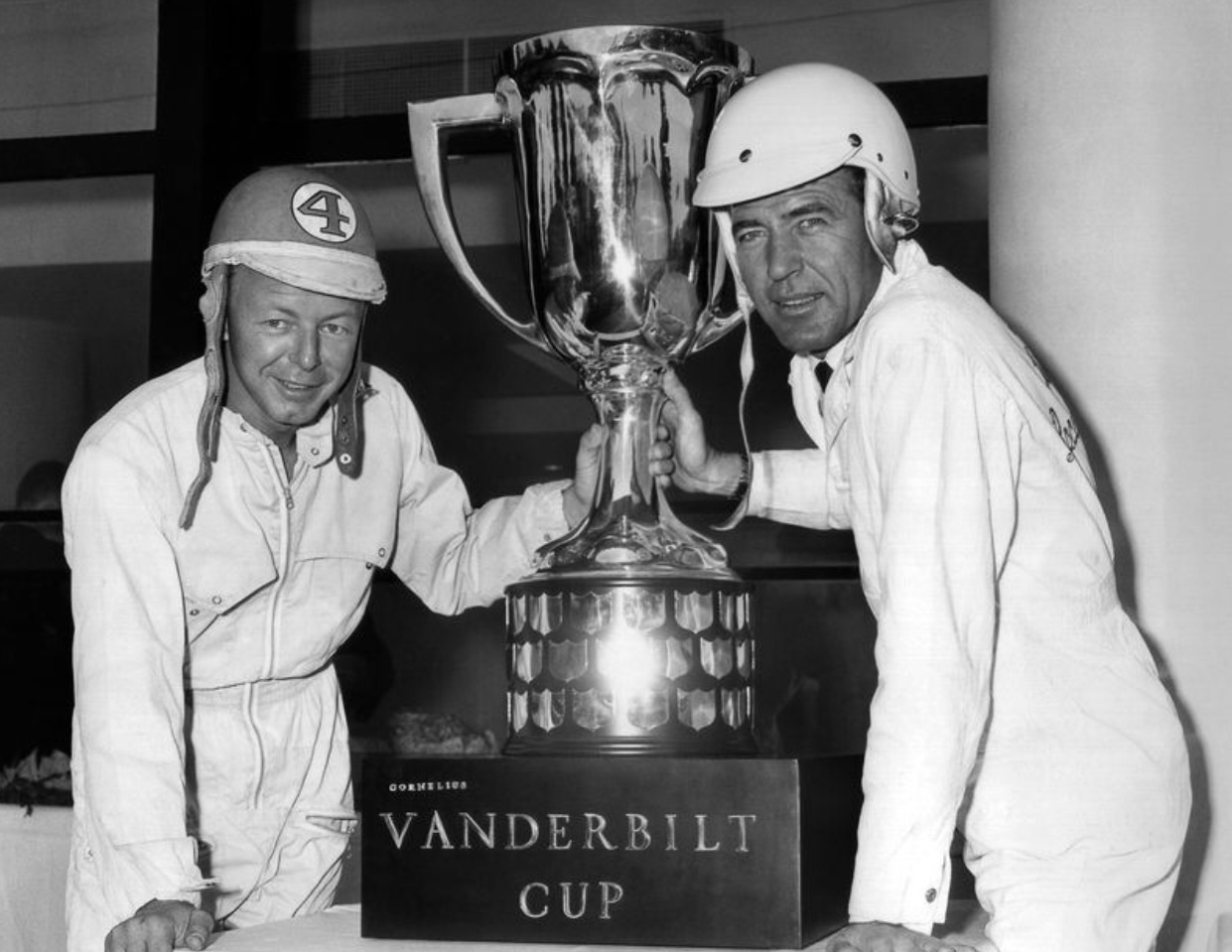
Jim Rathman (left) and Carroll Shelby pose for a pre-meeting publicity shot (nydailynews)
‘At the turn of the 20th century the superiority of European automotive craftsmanship cast a long shadow over America’s fledgling car industry. To encourage American automobile manufacturers to challenge European quality, 26-year old William K. Vanderbilt Jr., heir to a railroad fortune and a pioneer race car driver, organized America’s first international road race, modeled after those held in Europe. The six Vanderbilt Cup Races held on Long Island from 1904 to 1910 were the greatest sporting events of their day. These colorful, exciting and dangerous races drew huge crowds from 25,000 to over 250,000 spectators’.
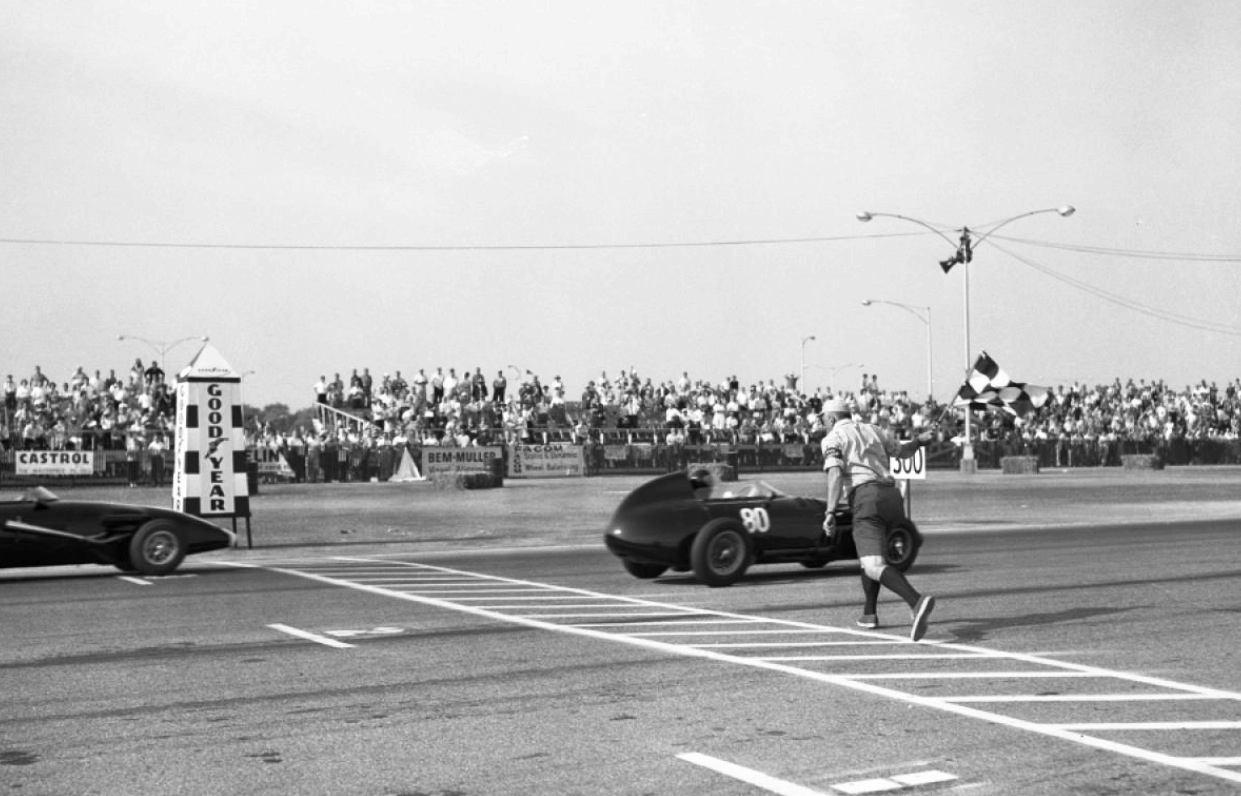
Winner Henry Carter receives his little! trophy from Cornelius Vanderbilt IV, author, newspaperman and nephew of WK Vanderbilt the founder of the VDB Cup series of races (nydailynews)
The 1960 FJ race was a 50 lapper over 75 miles and wonby Henry Carter driving a Stanguellini Fiat. Of the ‘name drivers’, only Pedro Rodriguez finished in a Scorpion DKW, 2nd was Chuck Wallace in a similar car and Jerry Truitt 3rd in a Stanguellini.
If any readers know the cars/drivers let me know, whilst there is some interesting information about the race i’ve not been able to find an entry list complete with race numbers.
Click on this link to an article about the 1960 race, have a fossick around this site which has a wealth of detailed information about the ‘real’ Vanderbilt Cup races;
All of the ‘hey man, hip cat, cool, groovy funky dude’ areas in any city I’ve visited globally share common attributes;inner city precincts filled with students, professionals and those of more limited means, ‘tree-huggers’, bohemians and artists with the restaurants and shops those types attract in areas which are architecturally interesting, a blend of the old and the edgy in terms of the built environment?!
Melbourne’s CBD in totality ‘cuts the mustard’ these days, do stay in the CBD if you visit for the Australian Grand Prix.
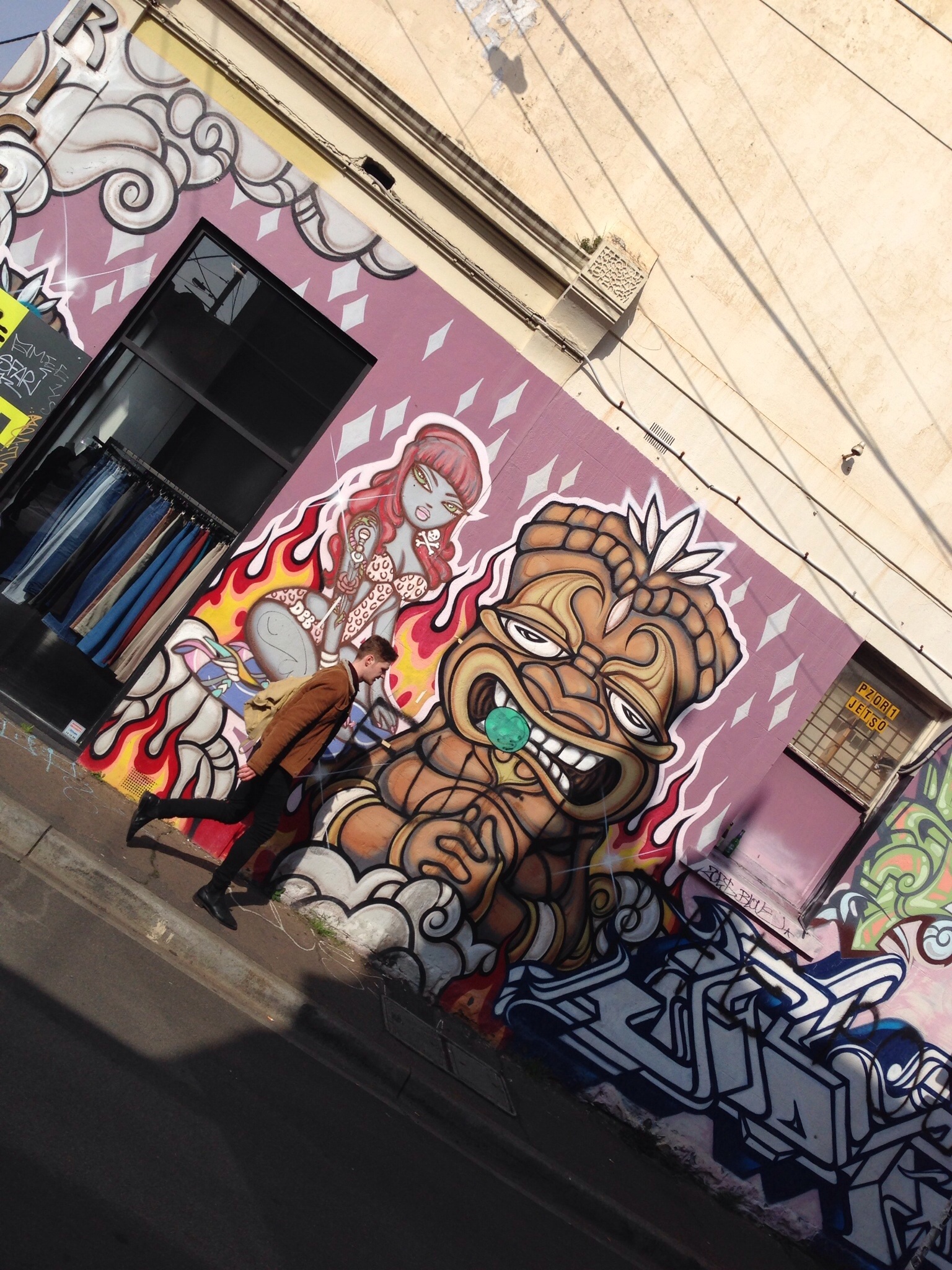
Smith Street urban art
Outside the city grid Melbourne has two precincts which meet said criteria,there are some pretenders which have fallen from grace in my book. These include Chapel Street and Toorak Road South Yarra, Lygon Street Carlton, Fitzroy and Acland Streets St Kilda and Greville Street in Prahran. A sure sign an area is about to lose its appeal is the arrival of major retail chains despoiling the magic of places which are about difference, not the formulaic sameness of da big guys.
So, my (and more importantly my 3 sons who are in the right age-group to judge such things!) two hey man etc precincts in Melbourne at present are the stretch of Chapel Street, Windsor from High Street to ‘Dandy’ Road and Smith and Gertrude Streets Collingwood/Fitzroy with that intersection the epicentre.
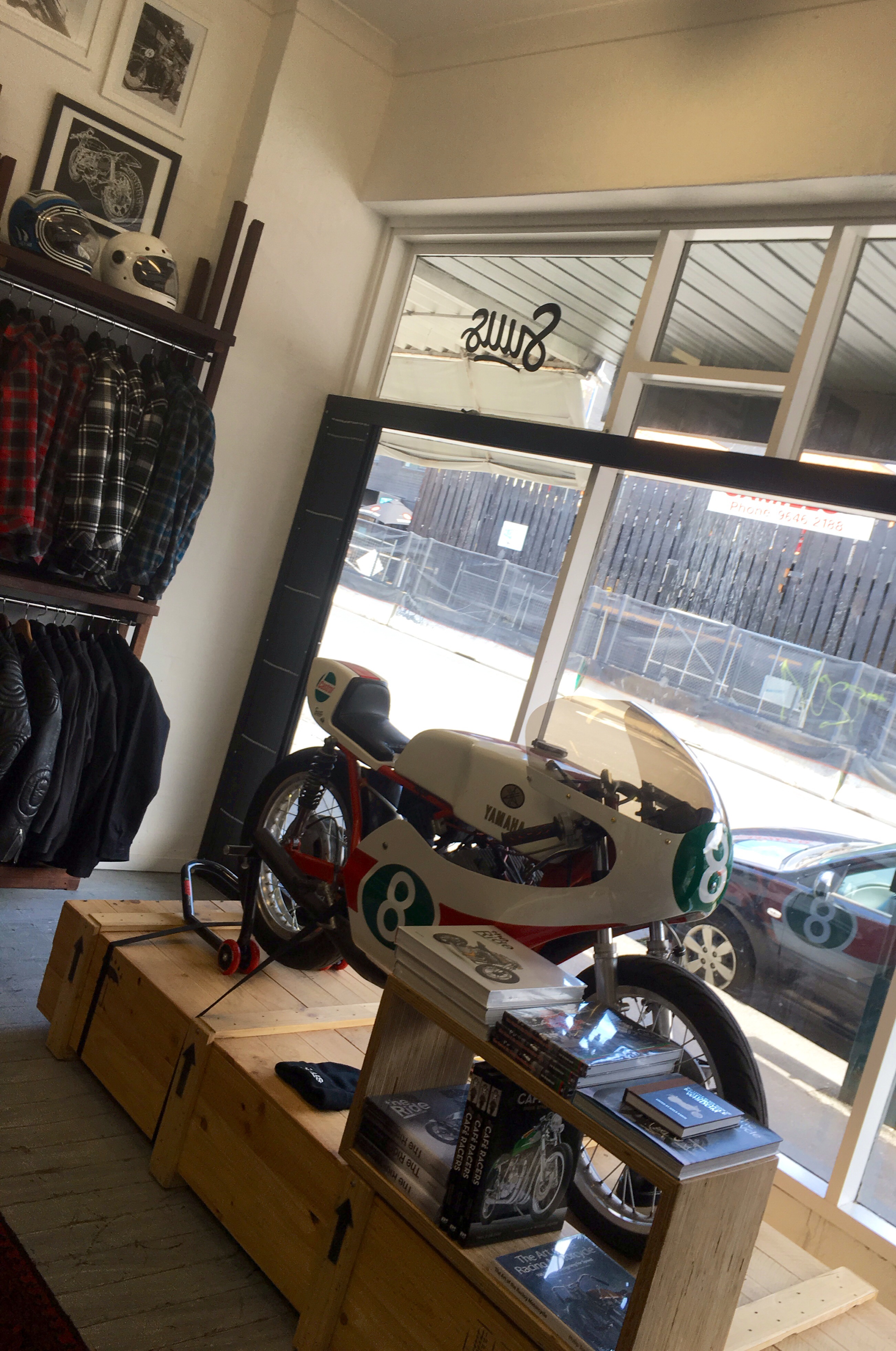
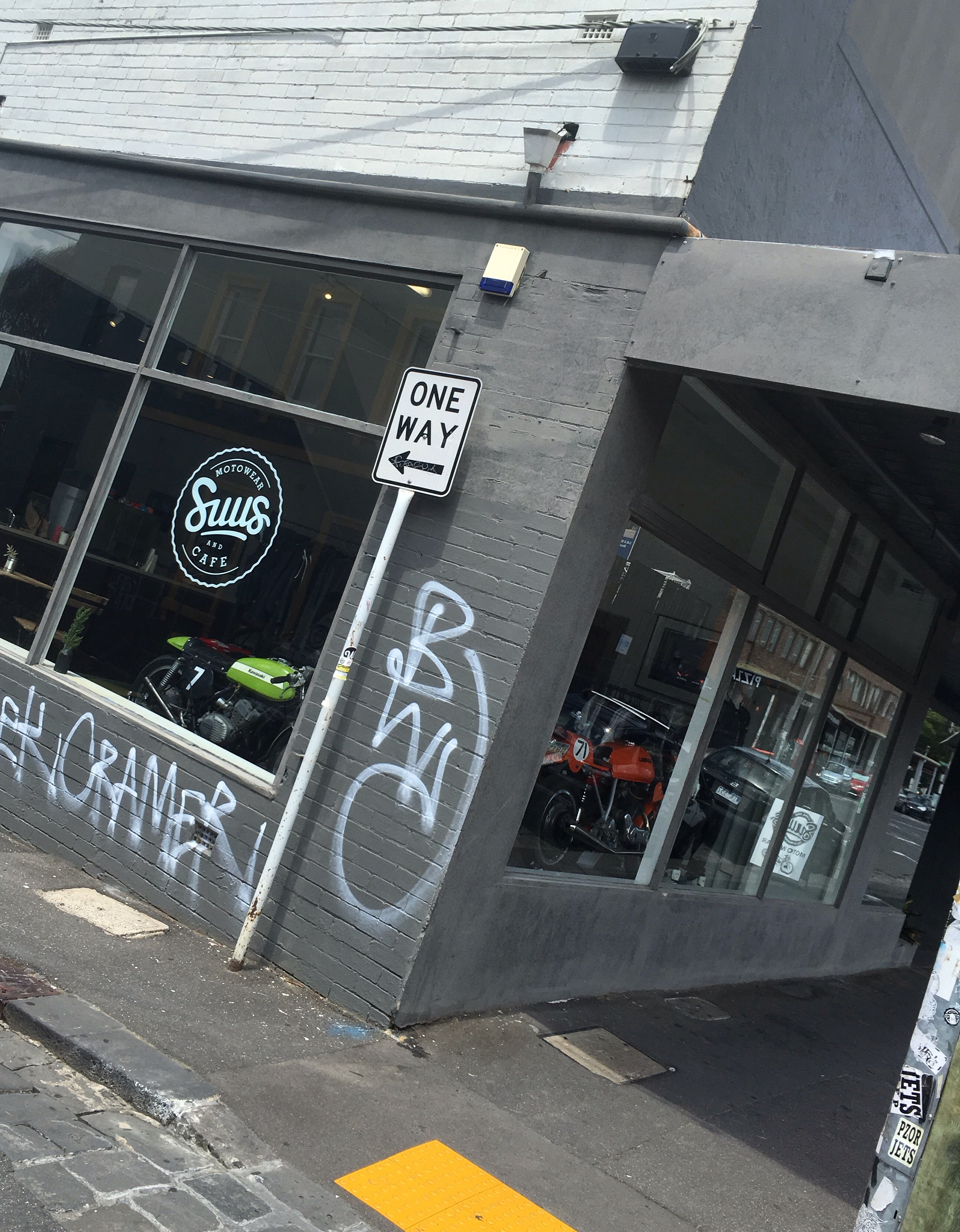
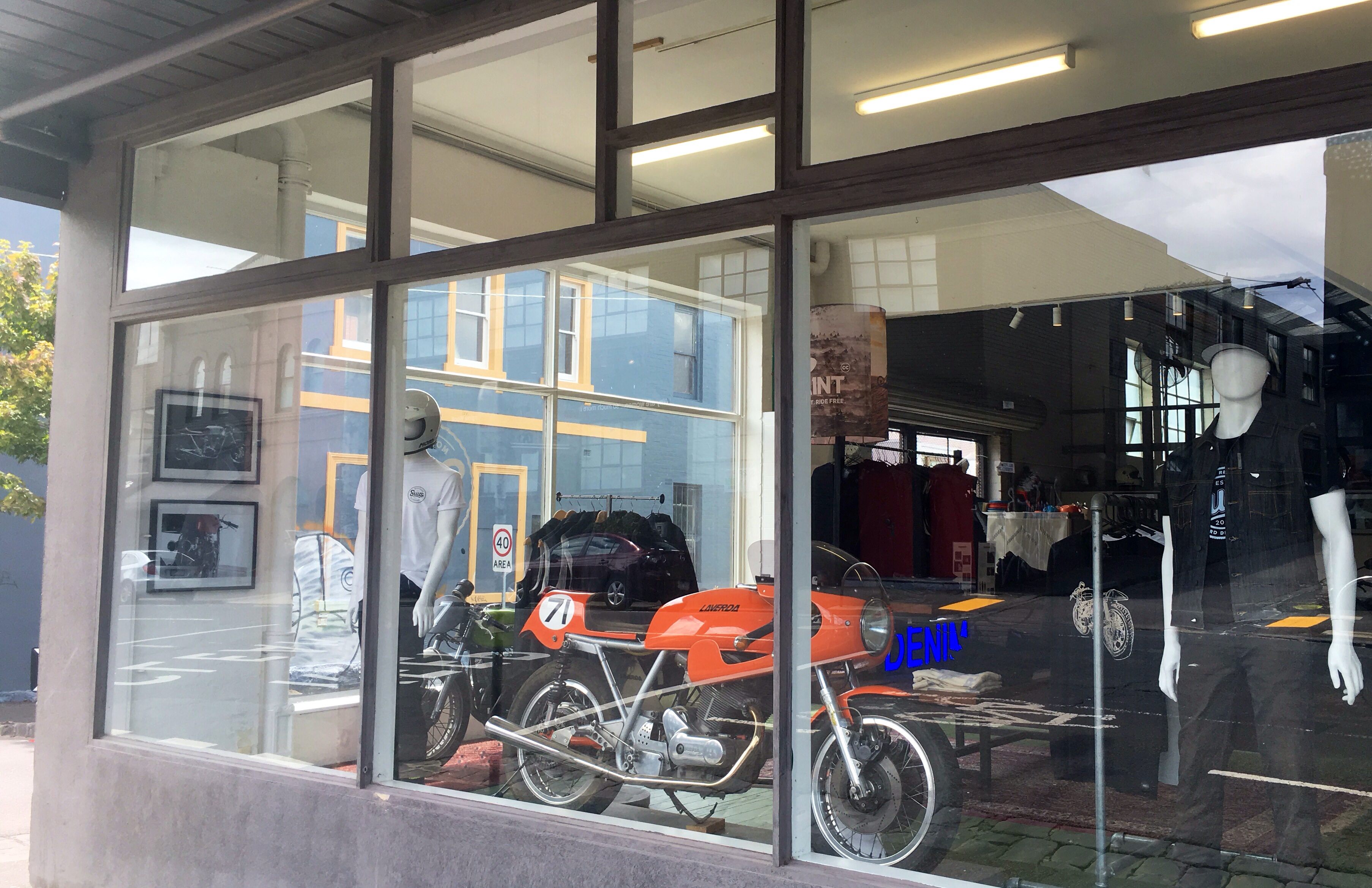
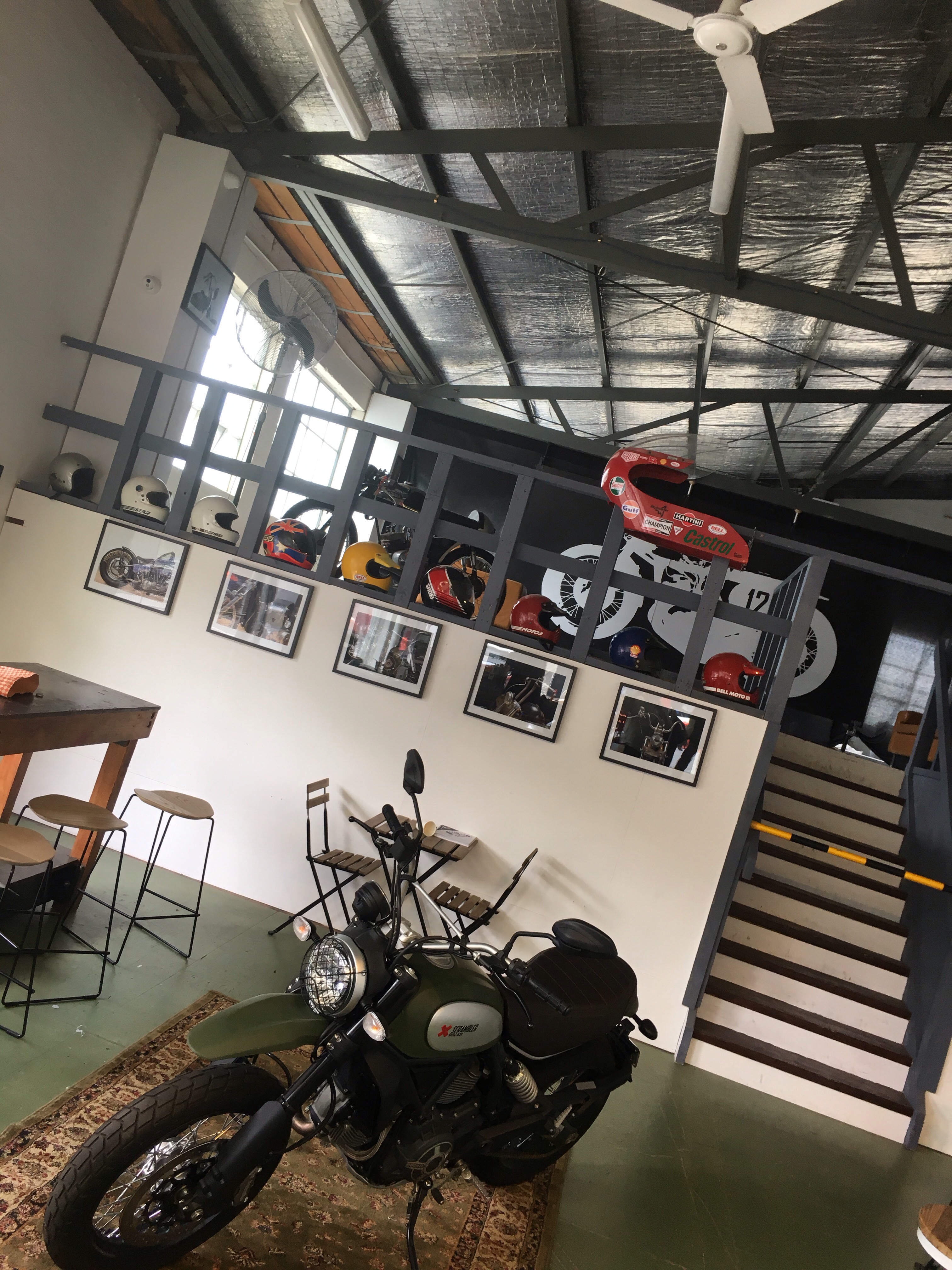
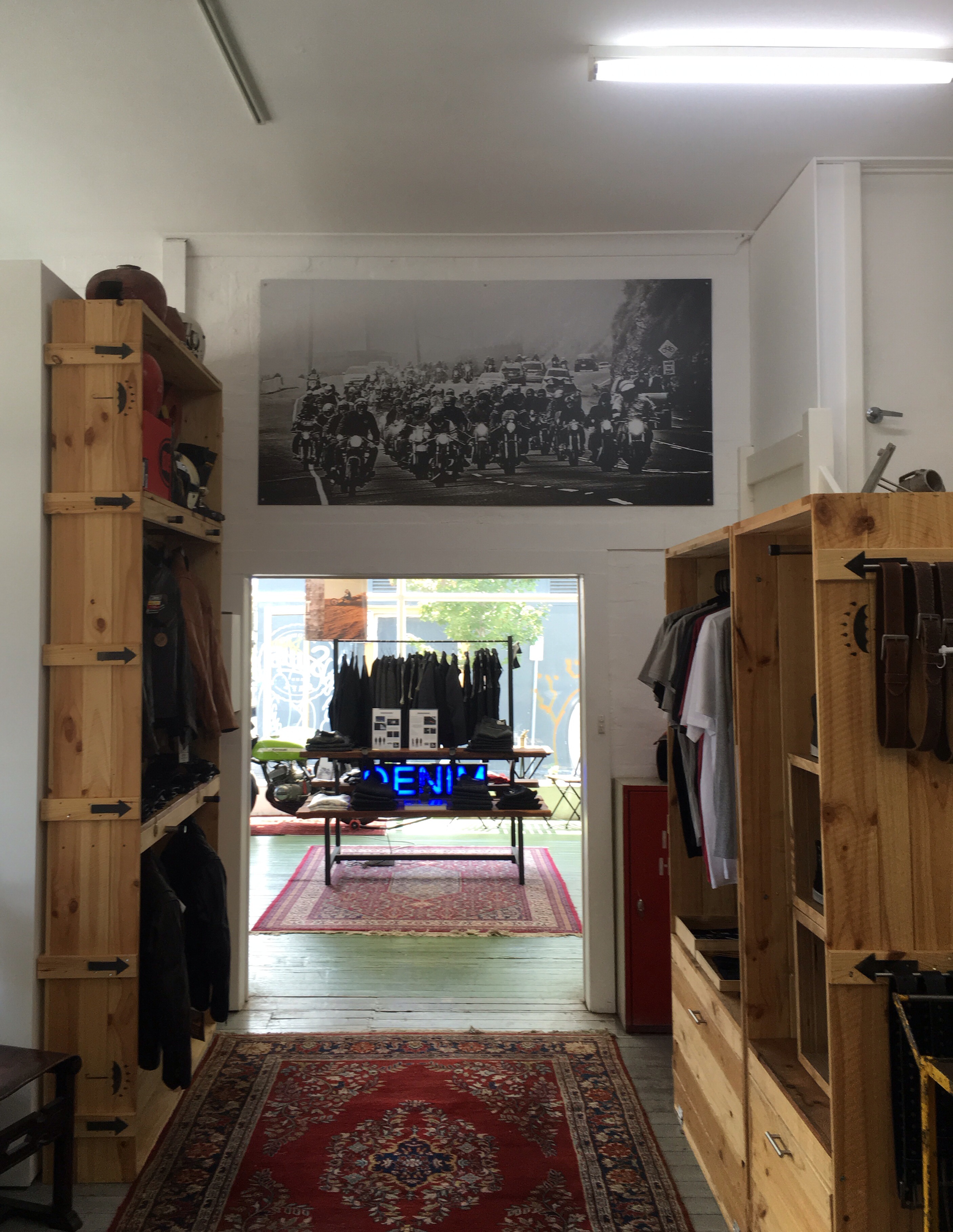
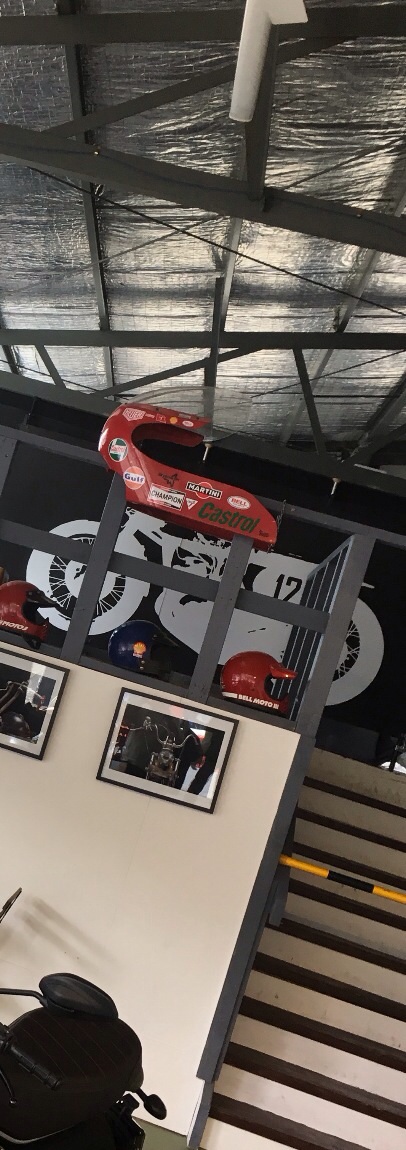
‘Suus’ is a motor-cycle emporium which has recently moved into Collingwoodadding some coolness@ 12 Smith Street. The place is a blend of retail outlet, clothes and bikes, custom shop to build and modify ‘cafe-racers’ and most recently a coffee shop. I do mean coffee, just coffee.
I’ve no vested interest in the place at all other than the hope that a venue where bike and car guys can go and talk about salient gob-shite survives and thrives.
‘Suus’ nice Ducati 750SF in the window @ present
Coffee area, workshop out ze back
‘Bell’ stockist, ‘mood and vibe’ of the place tops
It’s a long time since automotive establishments where one could gather like the Light Car Club, Lou Molina’s ‘Anchor and Hope’ or more colloquially and appropriately the ‘Anchor and Grope’ hotel and more recently Jeff Duttons house of fine cars existed.
The latter was a global pioneer of the automotive retail/food/lifestyle cocktail in his Church Street, Richmond facility. ‘Duttons’ survives in a fashion but lost its soul when Jeff exited and is now in the bowels of Richmond way outta sight.
The point is we don’t have too many nice Melbourne ‘automotive’ environments so check ‘Suus’ out when next in the area. Better still take the other half, there are loads of ‘chick boutiques’, restaurants and bars close by so one can have a win for a change; keep yourself and ‘the chief” happy.
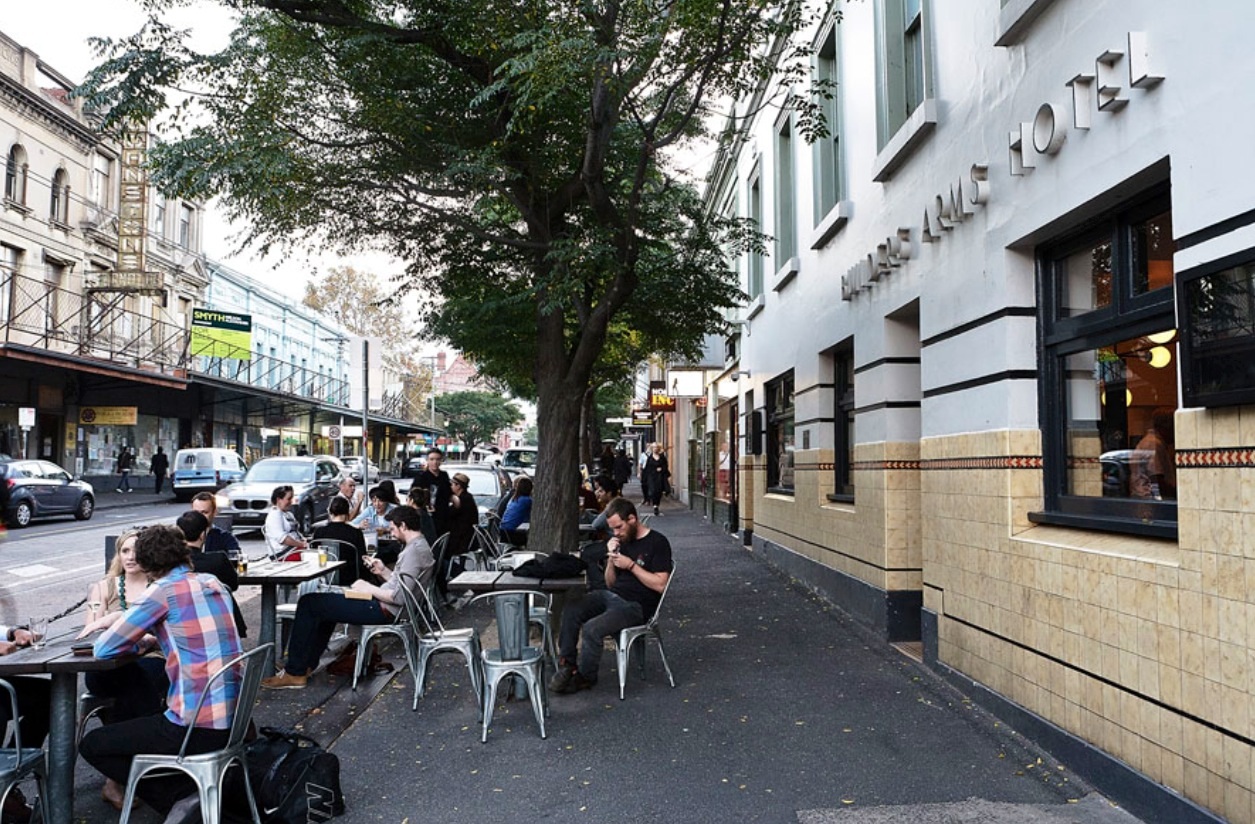
The pick of the local pubs is ‘The Builders Arms’ in nearby Gertude Street, order the fish-pie which is sensational and will sate the appetite of even the most corpulent. The bar is a place where fossils like me feel just as comfortable as the young and the pert. The outside area is tres-pleasant with trams rumbling gently past under brakes for the off-camber approach to the challenging Smith Street apex…
Etcetera…
‘Builders Arms Hotel’ one of Andrew McConnell’s joints so is consistent. As in good
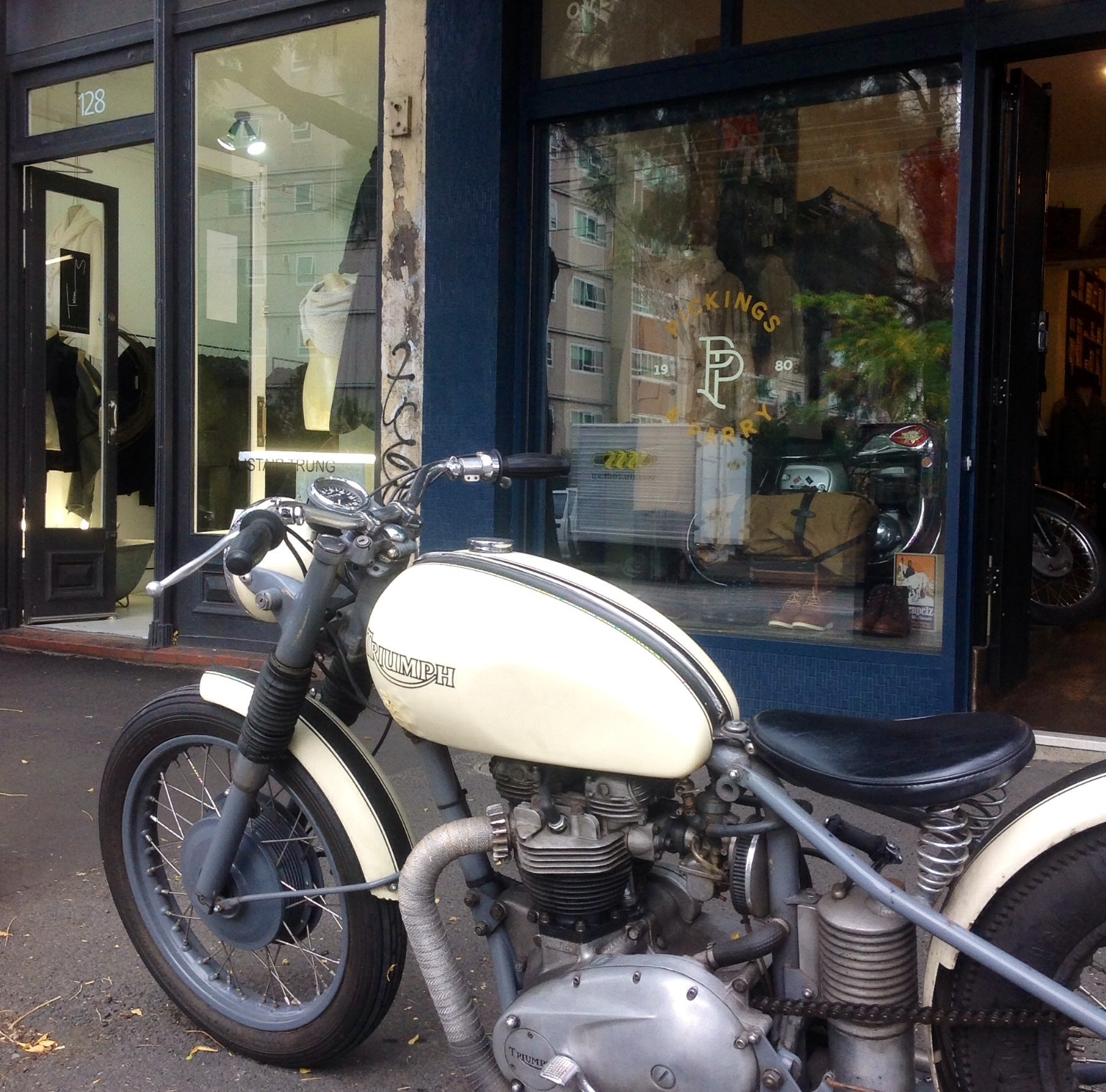
‘Pickings’ in Gertrude Street for hipster gear should you be so inclined
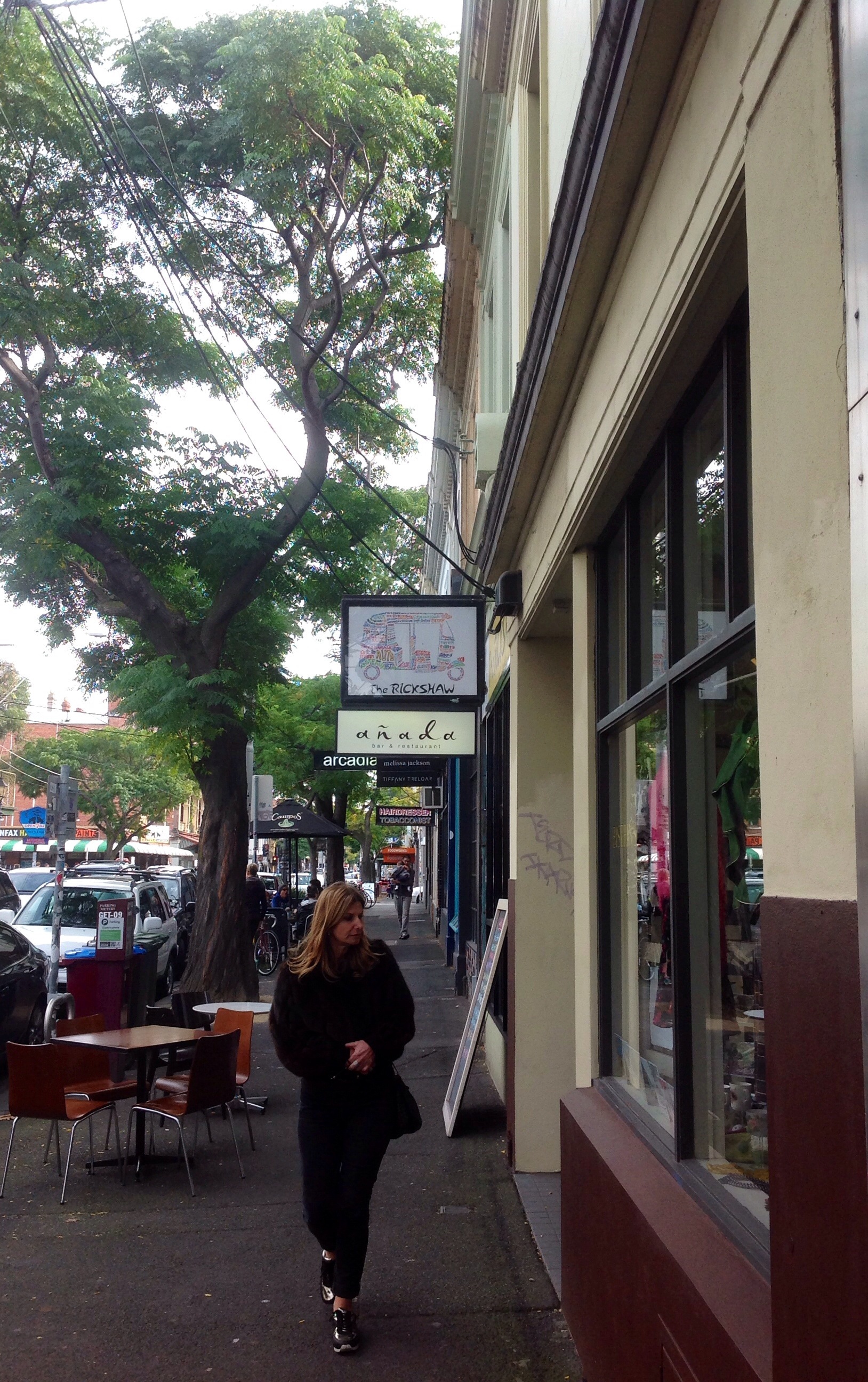
Gertrude Street looking west towards the city and Brunswick Street
Gertrude Street towards Smith Street, out front of ‘Ladro’ also good Italian grub





























 primotipo...